A Review of Urease-Based Biomineralization: MICP and EICP


Abstract
1. Introduction
2. Mechanisms of Mineralization
2.1. Urease-Based MICP Mechanism
2.2. Urease-Based EICP Mechanism
2.3. Differences in Mineralization Between EICP and MICP
2.3.1. Differences in Calcium Carbonate Crystal Size
2.3.2. Crystal Morphology Differences
3. Core Organism and Urease Activity
3.1. MICP Urease
3.1.1. MICP Urease Source
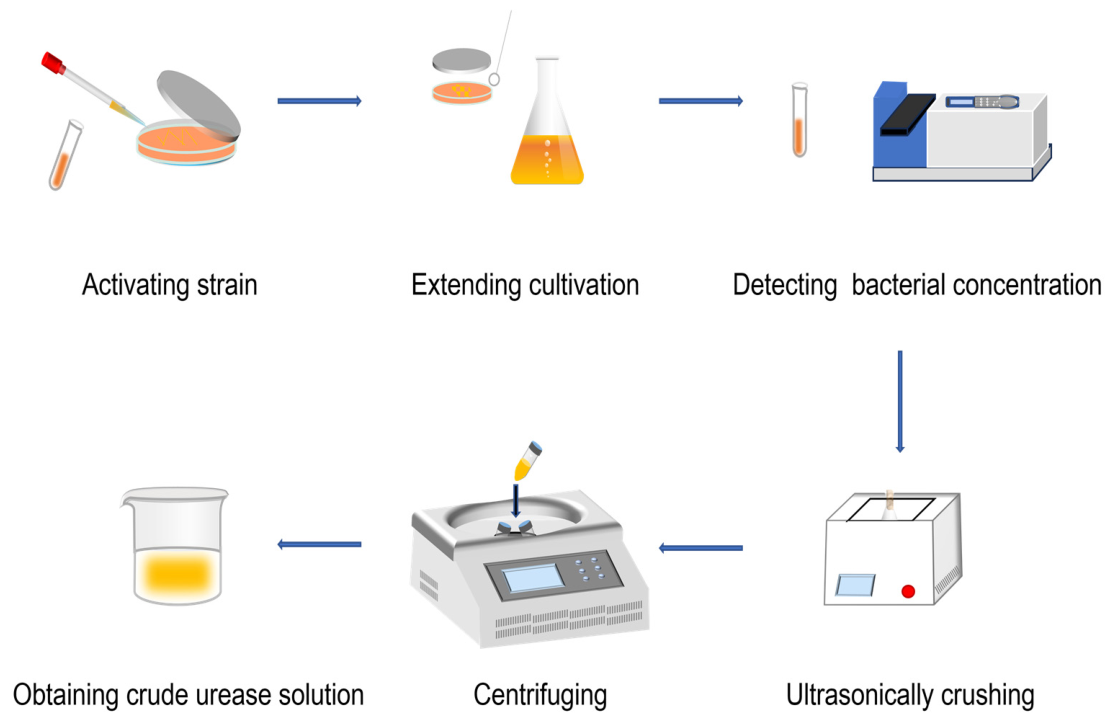
3.1.2. Microbial Culture
3.2. EICP Urease
3.3. Differences in Urease Activity and Carrier Action
4. Key Factors Influencing Self-Healing Efficiency
4.1. Factors Influencing MICP Mineralization
4.1.1. Microbial Effects
4.1.2. pH in MICP
4.1.3. Temperature
4.1.4. Substrates and Nutrients
- Urea concentration: Urea as a substrate affects the reaction rate. Xiaohao Sun et al. [9] investigated the effect of urea on the calcium carbonate conversion rate using Bacillus megaterium and reported that higher urea concentrations led to higher reaction yields but reduced microbial biomass and urease activity, resulting in a lower conversion efficiency. In experiments with different urea substrate concentrations conducted on Sporosarcina pasteurii, researchers reported that increasing the urea concentration increasingly inhibited microbial growth, and urease activity peaked at 0.5 mol/L before decreasing with further increases in the urea concentration [7].
- Calcium source type and concentration: Increasing the calcium ion concentration can promote product formation, but the presence of calcium ions also inhibits microbial activity and reduces the rate of urea hydrolysis. An excessively high calcium ion concentration decreases the conversion rate of calcium carbonate [9]. The addition sequence of calcium ions also influences the reaction progress. The addition of calcium ions before or after urease-catalyzed urea hydrolysis affects the crystal morphology of the formed calcium carbonate. The authors of [7] conducted experiments on calcium carbonate yield with early versus late addition of calcium ions, and the group with calcium ions added later achieved higher calcium carbonate yields under different pH conditions.
- Metal ions: As key cofactors of microbial urease, nickel ions significantly activate urease activity. Studies have shown that a nickel ion dosage of 10 μmol/L can increase urease activity nearly four-fold [7]. In addition, trace metal ions such as Mg2+ and Mn2+ can also positively promote microbial urease activity [51].
- Nutrients and inoculation amount: In the MICP experiment for achieving autonomous crack healing of alkali-activated slag composites using Sporosarcina pasteurii immobilized by polymers, the bacterial suspension had a viable cell concentration of 107 CFU/mL, and 450 g of the suspension was vacuum-impregnated into 450 g of expanded glass (EG), corresponding to an EG-to-bacterial suspension mass ratio of 1:1 [26]. The higher the strain concentration is, the greater the urease activity. In terms of the effect of flora synergy on other bacteria, because few bacteria have urea or ammonium ions as nutrients in nature, other strains have little effect on urease-producing bacteria in the external nonsterile environment. Lei V. Zhang et al. [26] inoculated 107 CFU/mL as the microbial concentration into concrete samples in their experiment, whereas Mokhtar et al. [27] used a 1 × 10⁹ cells/mL bacterial suspension as the inoculation dose for concrete repair. Considering the requirement of MICP technology for obtaining nutrients, microorganisms cannot survive for long periods without forming spores. Therefore, studying the urease activity produced by different strains at different inoculation amounts, as well as the required nutrients and survival time, is very important.
4.2. Factors Influencing EICP Mineralization
4.2.1. pH in EICP
4.2.2. Temperature
4.2.3. Substrate Concentration
- 1.
- Urease concentration: For soybean urease, scholars have shown that the crude urease activity extracted from unit weight soybean is the highest at 40 g/L. The higher the quality of soybean urease used for extraction is, the greater the amount of urease obtained, and the greater the transformation activity [52]. Cui et al. [56] investigated the extraction of soybean powder at concentrations ranging from 10 g/L to 120 g/L. These results demonstrated that higher soybean concentrations led to increased urease activity and a higher calcium carbonate precipitation rate. In the sand solidification experiment conducted by Sun, X. H. et al. [57], stable calcite is mainly formed at low urease concentrations, while vaterite and amorphous calcium carbonate tend to form at high urease concentrations, resulting in reduced crystal stability.
- 2.
- Urea concentration: Because EICP technology uses direct urease, urea has a linear inhibitory effect on urease activity. Fan et al. [7] tested the inhibitory effect of urea on soybean urease activity. Excessively high urea concentration tends to over occupy the dinickel active sites and peripheral hydrogen-bonding domains of urease, inducing steric hindrance that impedes normal substrate binding and product desorption [58].Therefore, the urea concentration of the reaction substrate should be between 0.5 M and 1.5 M [53].
- 3.
- Type and concentration of the calcium source: Ca2+ as a reaction substrate inhibits urease activity. Chen et al. reported that for the same concentration of chemical mixture, different calcium sources affect the pH value of the solution and then affect the concentration of Ca2+ after precipitation. Among these calcium sources, CaCl2 has the highest consumption of Ca2+, followed by Ca(NO3)2, and CaAc2 has the lowest consumption [52]. Weng y. et al. [15] extracted crude soybean urease solution (with an activity of approximately 3.9 mmol/L/min), selected 0.425–0.6 mm medium sand as the matrix, and prepared a biological treatment solution containing 1 mol/L calcium salt and urea for experiments. The results revealed that the calcium carbonate content (CCC) of the sand column increased with increasing treatment time and that the CCC of the (CH3COO)2Ca group was greater than that of the CaCl2 group with the same treatment time. However, the unconfined compressive strength (maximum 1680 kPa) of the sand column in the CaCl2 group was significantly greater than that in the (CH3COO)2Ca group (approximately 1000 kPa), and there was no significant difference in the biological plugging effect. Ca2+ and anions could inhibit the urease activity of coarse soybean, and the inhibitory effect of NO3− was significantly stronger than that of CH3COO− and Cl−. In the Ca(NO3)2 group, urease was completely inactivated after 0.5 h of reaction due to the synergistic inhibition of Ca2+ and NO3−. In view of the damage caused by chloride ions in concrete samples, calcium chloride is recommended for use as a calcium source in sand experiments, and calcium acetate is recommended for use as a calcium source in concrete repair experiments. In the experimental study of Sun, X. H. et al. [57], the calcium carbonate yield of EICP first increases and then decreases with the rise of urea concentration, and the optimal calcium ion concentration is 0.5 mol/L. Excessively high calcium ion concentration inhibits urease activity, thereby reducing the mineralization productivity. Under the same conditions, calcium acetate, as a calcium source, exhibits a higher calcium carbonate yield and better soil solidification strength than calcium chloride.
- 4.
- Trace elements and nutrients: Because EICP uses urease directly, nutrients are not needed. Ming Juan cui et al. [13] used seawater as a cementation solution and reported that the substances present in it affect urease activity and reduce production. However, the soybean urease extracted from seawater is purer, which is not easy to block, and has a better cementation effect on sandy soil, with the strength nearly doubled [59]. With respect to the effect of Ni2+ on urease activity, because EICP technology uses urease directly, it does not need to provide nutrients as microorganisms do. According to previous studies, nickel ions can increase the urease activity of Bacillus pasteurei but inhibit the growth of microorganisms. The microbial concentration (OD600) decreases linearly with increasing Ni2+ ion content, and it inhibits the activity of the extracted soybean urease [53].
4.3. Comparative Analysis of Self-Healing Evolution Processes of MICP and EICP
4.3.1. Self-Healing Method
4.3.2. Self-Healing Materials
4.3.3. Self-Healing Cycle
4.3.4. Self-Healing Performance Evaluation and Comparative Analysis
5. Detection and Characterization of the Reaction Rate and Effect of EICP and MICP
5.1. Reaction Rate Detection
5.1.1. Conductivity Method
5.1.2. Determination of Microbial Concentration
5.1.3. Determination of Ammonium Ion Concentration
5.1.4. Determination of the Calcium Ion Concentration
5.2. Multi-Scale Characterization and Comprehensive Performance Testing
5.2.1. Microscopic Detection Method
5.2.2. Detection of Macromechanical Properties
5.2.3. Testing of Other Properties
6. Challenges and Prospects of Urea-Based Bioremediation
6.1. Integration of Multiple Mineralization Technologies
6.2. Research on the Response Mechanism
6.3. Effects of Microbial Mineralization on the Environment
6.4. Construction Application Optimization of Biomineralization
7. Conclusions
- Commonalities and Differences in Mechanisms: Both MICP and EICP are centered on urease-catalyzed urea hydrolysis to generate calcium carbonate precipitation with calcium ions. However, they differ significantly in catalytic carrier size, calcium carbonate crystal particle size/crystal form, and nucleation mode. MICP relies on micron-sized urease-producing bacteria to generate large-sized calcite, while EICP uses nano-sized free urease to produce small and dispersed aragonite/vaterite. These differences directly determine their permeability, cementation uniformity, and engineering adaptation scenarios.
- Urease Sources and Activity Regulation: MICP uses non-pathogenic bacteria such as Bacillus megaterium and Sporosarcina pasteurii as functional strains, which require strict control of temperature, pH, and nutrient substrates. In contrast, EICP can extract crude urease from plants (e.g., soybeans, jack beans) and microorganisms with a low-cost and easily available sources. Urease activity is jointly regulated by pH, temperature, substrate concentration, and metal ions, which is a core parameter determining mineralization rate and repair effect.
- Influencing Factors and Self-Healing Process: Strain type, environmental temperature and pH, urea/calcium source concentration, and curing period are the key factors regulating the self-healing efficiency of MICP/EICP. EICP has a fast reaction initiation and short cycle, while MICP relies on microbial metabolism and has a longer cycle. Repair processes such as single/double-phase grouting, powder filling, and premixing, combined with filling and encapsulation materials such as fibers, nano-silica, and alginate capsules, can adapt to different crack widths and geotechnical repair scenarios.
- Characterization and Evaluation System: A multi-scale evaluation system of macro-mechanics + micro-morphology + physical-chemical indicators has been established, including rate detection methods such as conductivity measurement and ion concentration titration, micro-characterization techniques such as SEM/XRD/FTIR/EDX-Raman, and macro-performance tests such as compressive strength, shear strength, permeability, and ultrasonic non-destructive testing.
- Existing Challenges and Development Directions: Current challenges include insufficient long-term durability of microorganisms, easy attenuation of urease activity, high engineering application cost, environmental risks caused by ammonia nitrogen byproducts, and immature large-scale construction processes. In the future, efforts should be made to carry out strain modification and enzyme immobilization, multi-technology coupling, cost reduction using solid waste as alternative raw materials, environmental risk control, and interdisciplinary theoretical integration, so as to promote the transformation of the technology from laboratory research to standardized engineering application.
Author Contributions
Funding
Data Availability Statement
Conflicts of Interest
References
- Whiffin, V.S. Microbial CaCO3 Precipitation for the Production of Biocement. Ph.D. Thesis, Murdoch University, Murdoch, Australia, 2004. Available online: https://researchportal.murdoch.edu.au/esploro/outputs/doctoral/Microbial-CaCO3-precipitation-for-the-production/991005540291407891 (accessed on 20 May 2026).
- Hamdan, N.; Kavazanjian, E. Enzyme Induced Carbonate Precipitation (EICP) for Soil Improvement. In Proceedings of the ASCE, Geo-Congress 2015: Sustainable Infrastructure and Systems 2015, San Antonio, TX, USA, 17–21 March 2015; pp. 102–111. [Google Scholar] [CrossRef]
- Zhang, M.; Zhang, S.; Zheng, J.; Song, Y.; Li, J. Study on the fracture toughness of fractured rock mass reinforced by MICP/EICP with different calcium sources. Theor. Appl. Fract. Mech. 2025, 140, 105188. [Google Scholar] [CrossRef]
- Wang, Y.; Chen, Y.; Marchelina, N. Crack repairing performance by soybean urease induced calcium carbonate precipitation (SICP) combined with fibers and lightweight aggregates. Constr. Build. Mater. 2025, 458, 139678. [Google Scholar] [CrossRef]
- Wang, Y.; Ma, B.; Song, L.; Li, Y.; Zhang, L.; Chen, Y. Sustainable repair of cementitious cracks using soybean urease-induced carbonate precipitation: Impermeability and durability assessment. Eng. Struct. 2026, 346, 121616. [Google Scholar] [CrossRef]
- Arpajirakul, S.; Pungrasmi, W.; Likitlersuang, S. Efficiency of microbially induced calcite precipitation in natural clays for ground improvement. Constr. Build. Mater. 2021, 282, 122722. [Google Scholar] [CrossRef]
- Fan, Y.N. Study on Mechanism and Multiscale Performance of Biomineralization for Repairing Fire Damage of Concrete. Doctoral Dissertation, Taiyuan University of Technology, Taiyuan, China, 2022. [Google Scholar] [CrossRef]
- Whiffin, V.S.; van Paassen, L.A.; Harkes, M.P. Microbial carbonate precipitation as a soil improvement technique. Geomicrobiol. J. 2007, 24, 417–423. [Google Scholar] [CrossRef]
- Sun, X.; Miao, L. Application of bioremediation with Bacillus megaterium for crack repair at low temperature. J. Adv. Concr. Technol. 2020, 18, 307–319. [Google Scholar] [CrossRef]
- Nain, N.; Surabhi, R.; Yathish, N.V.; Krishnamurthy, V.; Deepa, T.; Tharannum, S. Enhancement in strength parameters of concrete by application of Bacillus bacteria. Constr. Build. Mater. 2019, 202, 904–908. [Google Scholar] [CrossRef]
- Harkes, M.P.; Van Paassen, L.A.; Booster, J.L.; Whiffin, V.S.; Van Loosdrecht, M.C. Fixation and distribution of bacterial activity in sand to induce carbonate precipitation for ground reinforcement. Ecol. Eng. 2010, 36, 112–117. [Google Scholar] [CrossRef]
- Mazzei, L.; Cianci, M.; Benini, S.; Ciurli, S. The structure of the elusive urease-urea complex unveils a paradigmatic case of metalloenzyme catalysis. Angew. Chem. Int. Ed. 2019, 58, 7415–7419. [Google Scholar] [CrossRef]
- Cui, M.J.; Zhou, J.N.; Lai, H.J.; Zheng, J.J.; Huang, M.; Zhang, Z.C. Seawater-based soybean urease for calcareous sand biomineralization. Acta Geotech. 2024, 19, 6643–6659. [Google Scholar] [CrossRef]
- Neupane, D.; Yasuhara, H.; Kinoshita, N.; Unno, T. Applicability of enzymatic calcium carbonate precipitation as a soil-strengthening technique. J. Geotech. Geoenviron. Eng. 2013, 139, 2201–2211. [Google Scholar] [CrossRef]
- Weng, Y.; Zheng, J.; Lai, H.; Cui, M.; Ding, X. Biomineralization of soil with crude soybean urease using different calcium salts. J. Rock Mech. Geotech. Eng. 2024, 16, 1788–1798. [Google Scholar] [CrossRef]
- Erickson, H.P. Size and shape of protein molecules at the nanometer level determined by sedimentation, Gel Filtration, and Electron Microscopy. Biol. Proced. Online 2009, 11, 32–51. [Google Scholar] [CrossRef]
- Ran, D.; Kawasaki, S. Effective use of plant-derived urease in the field of geoenvironmental/geotechnical engineering. J. Civ. Environ. Eng. 2016, 6, 1000207. [Google Scholar] [CrossRef]
- Xie, D.; Zhang, R.; Wang, J. The influence of environmental factors and precipitation precursors on enzyme-induced carbonate precipitation (EICP) process and its application on modification of recycled concrete aggregates. J. Clean. Prod. 2023, 395, 136444. [Google Scholar] [CrossRef]
- Blakeley, R.L.; Zerner, B. Jack bean urease: The first nickel enzyme. J. Mol. Catal. 1984, 23, 263–292. [Google Scholar] [CrossRef]
- Nafisi, A.; Safavizadeh, S.; Montoya, B.M. Influence of microbe and enzyme-induced treatments on cemented sand shear response. J. Geotech. Geoenviron. Eng. 2019, 145, 06019008. [Google Scholar] [CrossRef]
- Wang, L.; Wang, B.; Liu, Z.Q.; Chang, X.H. Advances of Soil Cemented by Enzyme Induced Calcium Carbonate Precipitation. Ind. Constr. 2022, 52, 57–66. [Google Scholar] [CrossRef]
- Van Paassen, L.A. Biogrout, Ground Improvement by Microbial Induced Carbonate Precipitation. Delft Univ. 2009. Available online: https://research.tudelft.nl/en/publications/biogrout-ground-improvement-by-microbially-induced-carbonate-prec/ (accessed on 27 May 2026).
- Hoang, T.; Alleman, J.; Cetin, B.; Choi, S.-G. Engineering properties of biocementation coarse-and fine-grained sand catalyzed by bacterial cells and bacterial enzyme. J. Mater. Civ. Eng. 2020, 32, 04020030. [Google Scholar] [CrossRef]
- Jonkers, H.M.; Thijssen, A.; Muyzer, G.; Copuroglu, O.; Schlangen, E. Application of bacteria as self-healing agent for the development of sustainable concrete. Ecol. Eng. 2008, 36, 230–235. [Google Scholar] [CrossRef]
- Zhang, L.; Wang, W.; Yue, C.; Si, Y. Biogenic calcium improved Cd2+ and Pb2+ immobilization in soil using the ureolytic bacteria Bacillus pasteurii. Sci. Total. Environ. 2024, 921, 171060. [Google Scholar] [CrossRef]
- Zhang, L.V.; Suleiman, A.R.; Mehdizadeh Allaf, M.; Marani, A.; Tuyan, M.; Nehdi, M.L. Crack self-healing in alkali-activated slag composites incorporating immobilized bacteria. Constr. Build. Mater. 2022, 326, 126842. [Google Scholar] [CrossRef]
- Mokhtar, N.; Johari, M.A.M.; Tajarudin, H.A.; Al-Gheethi, A.A.; Algaifi, H.A. A sustainable enhancement of biocement using immobilized Bacillus sphaericus: Optimization, microstructural properties, and techno-economic analysis for a cleaner production of biocementitious mortars. J. Clean. Prod. 2021, 318, 128470. [Google Scholar] [CrossRef]
- Zheng, T.; Qian, C.; Su, Y. Influences of different calcium sources on the early age cracks of self-healing cementitious mortar. Biochem. Eng. J. 2021, 166, 107849. [Google Scholar] [CrossRef]
- Nur, M.M.A.; Dewi, R.N. Opportunities and challenges of microalgae in biocement production and self-repair mechanisms. Biocatal. Agric. Biotechnol. 2024, 56, 103048. [Google Scholar] [CrossRef]
- Das, N.; Kayastha, A.M.; Srivastava, P.K. Purification and characterization of urease from dehusked pigeonpea (Cajanus cajan L.) seeds. Phytochemistry 2002, 61, 513–521. [Google Scholar] [CrossRef] [PubMed]
- Nam, I.-H.; Chon, C.-M.; Jung, K.-Y.; Choi, S.-G.; Choi, H.; Park, S.-S. Calcite precipitation by ureolytic plant (Canavalia ensiformis) extracts as effective biomaterials. KSCE J. Civ. Eng. 2014, 19, 1620–1625. [Google Scholar] [CrossRef]
- Gao, Y.; He, J.; Tang, X.; Chu, J. Calcium carbonate precipitation catalyzed by soybean urease as an improvement method for fine-grained soil. Soils Found. 2019, 59, 1631–1637. [Google Scholar] [CrossRef]
- Lai, H.J.; Chen, Y.W.; Cui, M.J.; Zheng, J.; Chen, Z. Extraction of high activity bacterial urease and its application to biomineralization of soil. J. Rock Mech. Geotech. Eng. 2025, 17, 1847–1861. [Google Scholar] [CrossRef]
- Sahin, B.; Ozbey-Unal, B.; Dizge, N.; Keskinler, B.; Balcik, C. Optimization of immobilized urease enzyme on porous polymer for enhancing the stability, reusability and enzymatic kinetics using response surface methodology. Colloids Surf. B Biointerfaces 2024, 240, 113986. [Google Scholar] [CrossRef]
- Liu, F.H.; Cheng, X.H.; Miu, J.; Li, X.J.; Yin, R.Y.; Wang, J.H.; Qu, Y.P. Application of different methods to determine urease activity in enzyme engineering experiment and production. E3S Web Conf. 2021, 251, 02057. [Google Scholar] [CrossRef]
- Javadi, N.; Khodadadi, H.; Hamdan, N.; Kavazanjian, E. EICP treatment of soil by using urease enzyme extracted from watermelon seeds. In Innovations in Ground Improvements for Soils, Pavements and Subgrades 2018; Stuedlein, A.W., Ed.; ASCE: Reston, VA, USA, 2018; pp. 115–124. [Google Scholar] [CrossRef]
- Almajed, A.; Khodadadi Tirkolaei, H.; Kavazanjian, E. Baseline investigation on enzyme-induced calcium carbonate precipitation. J. Geotech. Geoenviron. Eng. 2018, 144, 04018081. [Google Scholar] [CrossRef]
- Zusfair, Z.; Ningsih, D.R.; Putri, D.; Fatoni, A. Partial purification and characterization of urease from black-eyed pea (Vigna unguiculata ssp unguiculata L.). J. Fundam. Appl. Sci. 2018, 14, 20–24. Available online: https://mjfas.utm.my/index.php/mjfas/article/view/749 (accessed on 27 May 2026).
- Yi, H.H.; Zheng, T.W.; Jia, Z.R.; Su, T.; Wang, C.G. Study on the influencing factors and mechanism of calcium carbonate precipitation induced by urease bacteria. J. Cryst. Growth 2021, 564, 126113. [Google Scholar] [CrossRef]
- Almajed, A.; Khodadadi Tirkolaei, H.; Kavazanjian, E., Jr.; Hamdan, N. Enzyme induced biocementated sand with high strength at low carbonate conten. Sci. Rep. 2019, 9, 1135. [Google Scholar] [CrossRef]
- Elgendy, I.M.; E Elkaliny, N.; Saleh, H.M.; O Darwish, G.; Almostafa, M.M.; Metwally, K.; Yahya, G.; Mahmoud, Y.A.-G. Bacteria-powered self-healing concrete: Breakthroughs, challenges, and future prospects. Buildings 2022, 12, 1799. [Google Scholar] [CrossRef]
- Konstantinou, C.; Wang, Y. Unlocking the Potential of Microbially Induced Calcium Carbonate Precipitation (MICP) for Hydrological Applications: A Review of Opportunities, Challenges, and Environmental Considerations. Hydrology 2023, 10, 178. [Google Scholar] [CrossRef]
- Ahenkorah, I.; Rahman, M.; Karim, R.; Beecham, S. Optimisation of chemical constituents on enzyme-induced carbonate precipitation in test-tube and soil. Geotechnique 2022, 72, 701–712. [Google Scholar] [CrossRef]
- Omarov, K.; Alarifi, S.A.; Mahmoud, M.; Kamal, M.S.; Murtaza, M.; Humam, A.; AlAhmari, M.M. Sand consolidation using enzyme-induced carbonate precipitation: New insights on temperature and particle size effects. J. Mater. Civ. Eng. 2023, 35, 04023087. [Google Scholar] [CrossRef]
- Bao, J.; Xu, W.; Zhou, D. Operational thresholds of urease-mediated microbial cementation: Multivariate optimization and field validation in ambient groundwater environments. PLoS ONE 2025, 20, e0330481. [Google Scholar] [CrossRef]
- Zhang, Q.; Zheng, Y.; Huang, M.; Shen, X.; Wu, L.; Zhang, Z. Experimental and Computational Investigation of pH-Dependent Urease Conformational Dynamics and Its Impact on MICP Efficiency. Chin. J. Biochem. Mol. Biol. 2025, 41, 1071–1081. [Google Scholar] [CrossRef]
- Zhang, W.; Zhang, H.; Xu, R.; Qin, H.; Liu, H.; Zhao, K. Heavy metal bioremediation using microbially induced carbonate precipitation: Key factors and enhancement strategies. Sci. Total Environ. 2024, 898, 165432. [Google Scholar] [CrossRef] [PubMed]
- Parastegari, N.; Mostofinejad, D.; Poursina, D. Use of bacteria to improve electrical resistivity and chloride penetration of air-entrained concrete. Constr. Build. Mater. 2019, 210, 588–595. [Google Scholar] [CrossRef]
- Reeksting, B.J.; Hoffmann, T.D.; Tan, L.Z.; Paine, K.; Gebhard, S. In-depth profiling of calcite precipitation by environmental bacteria reveals fundamental mechanistic differences with relevance to application. Appl. Environ. Microbiol. 2020, 86, e02739-19. [Google Scholar] [CrossRef]
- Xu, Y.B.; Qian, C.X.; Lu, Z.W. Enhancing urease thermostability of Bacillus pasteurii by glycerol. J. Southeast Univ. Nat. Sci. Ed. 2013, 43, 147–151. [Google Scholar] [CrossRef]
- Luo, S.; Liu, B.; Zhang, J.L.; Li, Q.W.; Deng, X. Optimization of sporulation and germination of self-healing bacterium Bacillus sp. for concrete crack. J. Shenzhen Univ. Sci. Eng. 2020, 37, 25–32. [Google Scholar] [CrossRef]
- Chen, Y.; Tian, A.; Luo, X.; Zhou, Y.; Tang, Q.; Kawasaki, S. Enhancing the physical and mechanical properties of recycled aggregates through enzyme-induced carbonate precipitation. Soils Found. 2023, 63, 101394. [Google Scholar] [CrossRef]
- Fan, Y.; Du, H.; Wei, H.; Zhao, T. Experimental study on urease activity and cementation characteristics of soybean. J. Wuhan Univ. Technol. Sci. Ed. 2022, 37, 636–644. [Google Scholar] [CrossRef]
- Tüzüner, B.A.; Tunali, S.; Yanardag, R.; Yarat, A. Influence of storage time and temperature on the activity of urease. Bulg. Chem. Commun. 2019, 51, 159–163. [Google Scholar] [CrossRef]
- Javadi, N.; Khodadadi Tirkolaei, H.; Hamdan, N.; Kavazanjian, E., Jr. Longevity of raw and lyophilized crude urease extracts. Sustain. Chem. 2021, 2, 325–334. [Google Scholar] [CrossRef]
- Cui, M.; Fu, X.; Zheng, J.; Lü, S.; Xiong, H.; Zeng, C.; Han, S. Multivariate experimental study on soybean urease induced calcium carbonate precipitation. Rock Soil Mech. 2021, 43, 3027–3035. [Google Scholar] [CrossRef]
- Sun, X.H.; Miao, L.C.; Wu, L.Y. Applicability and theoretical calculation of enzymatic calcium carbonate precipitation for sand improvement. Geomicrobiol. J. 2020, 37, 295–306. [Google Scholar] [CrossRef]
- Mazzei, L.; Musiani, F.; Ciurli, S. The Structure-Based Reaction Mechanism of Urease, a Nickel Dependent Enzyme: Tale of a Long Debate. J. Biol. Inorg. Chem. 2020, 25, 829–845. [Google Scholar] [CrossRef] [PubMed]
- Yu, X.; Pan, X. One-phase improvement of sandy soil using seawater-based soybean-induced carbonate precipitation. J. Sustain. Cem. Mater. 2023, 12, 962–971. [Google Scholar] [CrossRef]
- Zhao, H.H.; Zhao, Z.H.; Yang, X.; Wu, H.; Zhang, J.; Sun, G.; Liu, S.; Liu, H.; Xiong, J. Comparative study on biomineralization repair schemes for rock fractures. J. Civ. Environ. Eng. 2026, 1–9. [Google Scholar] [CrossRef]
- Qian, C.; Zheng, T.; Zhang, X.; Su, Y. Application of microbial self-healing concrete: Case study. Constr. Build. Mater. 2021, 290, 123226. [Google Scholar] [CrossRef]
- Xu, F.; Wang, D.; Xu, X.; Xiao, Z. Strengthening effect of nano-SiO2 on microbial induced carbonate precipitation (MICP) solidified sediment: Macro- and microanalysis. Geomech. Energy Environ. 2024, 38, 100555. [Google Scholar] [CrossRef]
- Sun, X.; Miao, L.; Chen, R. Adding aluminum oxide to improve the repairing effect of cracks based on bioremediation. J. Adv. Concr. Technol. 2019, 17, 177–187. [Google Scholar] [CrossRef]
- Khaneghahi, M.H.; Kamireddi, D.; Rahmaninezhad, S.A.; Sadighi, A.; Schauer, C.L.; Sales, C.M.; Najafi, A.R.; Cotton, A.; Street, R.; Farnam, Y. Development of a nature-inspired polymeric fiber (BioFiber) for advanced delivery of self-healing agents into concrete. Constr. Build. Mater. 2023, 408, 133765. [Google Scholar] [CrossRef]
- Başaran Bundur, Z.; Bae, S.; Kirisits, M.J.; Ferron, R.D. Biomineralization in self-healing cement-based materials: Investigating the temporal evolution of microbial metabolic state and material porosity. J. Mater. Civ. Eng. 2017, 29, 04017079. [Google Scholar] [CrossRef]
- Zhang, G.Z.; Liu, C.; Zhang, J.Y.; Wang, H.G.; Liu, J.Z. Enhanced MICP efficacy for cracks repair of marine mortar with coral sand: Coupled effects of seawater and basalt fiber on products morphology. Constr. Build. Mater. 2025, 470, 140647. [Google Scholar] [CrossRef]
- Hommel, J.; Akyel, A.; Frieling, Z.; Phillips, A.J.; Gerlach, R.; Cunningham, A.B.; Class, H. A numerical model for enzymatically induced calcium carbonate precipitation. Appl. Sci. 2020, 10, 4538. [Google Scholar] [CrossRef]
- Wang, Y.Z.; Soga, K.; DeJong, J.T.; Kabla, A.J. Effects of bacterial density on growth rate and characteristics of microbial-induced calcium carbonate precipitates: Particle-scale experimental study. J. Geotech. Geoenviron. Eng. 2021, 147, 04021036. [Google Scholar] [CrossRef]
- Al Qabany, A.; Soga, K.; Santamarina, C. Factors affecting efficiency of microbially induced calcite precipitation. J. Geotech. Geoenviron. Eng. 2012, 138, 992–1001. [Google Scholar] [CrossRef]
- Zhang, J.; Wang, X.; Shi, L.; Yin, Y. Enzyme-induced carbonate precipitation (EICP) combined with lignin to solidify silt in the Yellow River flood area. Constr. Build. Mater. 2022, 339, 127792. [Google Scholar] [CrossRef]
- Zhang, M.; Liu, S.; An, Y.; Zhang, D.; Tan, J.; Wang, L.; Li, Y.; Jiang, M.; Wu, H.; Tong, S. Exogenous nitrogen enhances aboveground plant phosphorus accumulation through soil moisture and organic carbon in semi-arid grazed wetlands. Agric. Ecosyst. Environ. 2025, 388, 109635. [Google Scholar] [CrossRef]
- Zhang, Z.; Wang, Y.; Dai, Z.; Liu, T.; Qin, Y.; Sun, D.; Liu, C.; Li, S. Ecological niche and environmental adaptability of denitrifiers in the yellow river estuary. Mar. Pollut. Bull. 2025, 213, 117693. [Google Scholar] [CrossRef] [PubMed]
- Wang, F.; Guo, N.; Ma, Y.; Yuan, Z.; Qin, X.; Jia, Y.; Chen, G.; Yu, H.; Wang, P.; Fu, Z. Calcium-Modified Coal-Based Humin Waste Residue: Enhanced Cadmium Remediation in Combined Soil–Plant Systems. Sustainability 2026, 18, 1103. [Google Scholar] [CrossRef]
- Shi, B.; Liu, C.; Wang, J.; Du, Z.; Hou, K.; Wang, J.; Wang, J.; Li, B.; Zhu, L. 3,6-Dibromocarbazole Have a Significant Effect on Diversity, Community and Function of Soil Microorganisms. J. Hazard. Mater. 2025, 495, 138962. [Google Scholar] [CrossRef]
- Xiao, Y.; Zhao, C.; Cui, H.; Chen, Y.; Wu, B.Y.; Liu, H.L. Microscale insights into enzyme-induced carbonate precipitation in rock-based microfluidic chips. Géotechnique 2025, 75, 846–860. [Google Scholar] [CrossRef]
- Soltmann, U.; Raff, J.; Selenska-Pobell, S.; Matys, S.; Pompe, W.; Böttcher, H. Biosorption of heavy metals by sol-gel immobilized Bacillus sphaericus cells, spores and S-layers. J. Sol-Gel Sci. Technol. 2003, 26, 1209–1212. [Google Scholar] [CrossRef]
- Peng, L.; Song, A.Y.; Ma, J.Z.; Dong, L.; Li, Q.; Li, G.; Li, H. Effects of soil salinity and nitrogen fertilizer application on the photosynthetic characteristics and sucrose metabolism of winter jujube. Appl. Ecol. Environ. Res. 2025, 23, 11093–11111. [Google Scholar] [CrossRef]
- Zhang, D.; Liu, X.; Gao, S.; Liu, C.; Xin, Y.; Wang, T.; Zhang, M.; Tong, S. Ecological and photosynthetic characteristics of Carex schmidtii with respect to hydrological fluctuations. J. Freshw. Ecol. 2023, 38, 2271502. [Google Scholar] [CrossRef]
- Sun, J.; Chi, Y.; Fu, Z.; Li, T.; Dong, K. Spatio temporal variation of plant diversity under a unique estuarine wetland gradient system in the Yellow River Delta, China. Chin. Geogr. Sci. 2020, 30, 217–232. [Google Scholar] [CrossRef]
- Yue, X.Y.; Yue, W.; Zhang, Z.W.; Zhao, W.; Dong, K. The response of functional traits and aboveground biomass of Phragmites Australis to habitat changes in the Yellow River Delta, China. Appl. Ecol. Environ. Res. 2025, 23, 7347–7357. [Google Scholar] [CrossRef]
- Liu, Y.; Wang, L.; Xia, J.; Guo, H.; Wang, J. Ozone enrichment and drought stress have more negative effects on invasive leguminous woody species than co-occurring native species. Environ. Exp. Bot. 2024, 217, 7. [Google Scholar] [CrossRef]
- Liu, Y.; Hu, K.; Pan, M.; Dong, W.; Wang, X.; Zhu, X. Research and application of green technology based on microbially induced carbonate precipitation (MICP) in mining: A review. Sustainability 2025, 17, 7587. [Google Scholar] [CrossRef]
- Alotaibi, E.; Arab, M.G.; Abdallah, M.; Nassif, N. Life cycle assessment of biocemented sands using enzyme induced carbonate precipitation (EICP) for soil stabilization applications. Sci. Rep. 2022, 12, 6032. [Google Scholar] [CrossRef] [PubMed]
- Liu, D.Y.; Xiang, R.; Zhang, L.; Xia, Z.Y.; Gao, F.; Xiao, H. Effects of EICP treatment on aggregate stability and organic carbon sequestration capacity of purple soil. Trans. Chin. Soc. Agric. Eng. 2026, 42, 149–157. [Google Scholar] [CrossRef]
- Song, Z.; Wu, C.; Shen, D.; He, M.; Zhang, F. Microbially induced carbonate precipitation under high temperature and high pressure: Implications for geological CO2 storage. J. Rock Mech. Geotech. Eng. 2025, 17, 3872–3882. [Google Scholar] [CrossRef]
- Bhukya, P.K.; Adla, N.; Arnepalli, D.N. Numerical optimisation of microbially induced calcite precipitation (MICP) injection strategies for sealing the aquifer’s leakage paths for CO2 geosequestration application. Adv. Water Resour. 2024, 193, 104800. [Google Scholar] [CrossRef]
- Gao, F.L.; Roiloa, S.; Xia, J.; Ren, J.; Zou, M.; Zhao, X.; Yu, F.H. Effects of native species richness on reproduction of invasive Bidens pilosa vary with nutrient supply. Ecol. Process. 2024, 13, 46. [Google Scholar] [CrossRef]
- Qi, X.; Qu, Z.; Zhang, J.; Liu, Y.; Zhao, Y.; Li, C. Applying Different Organic Amendments Optimizes Soil Nitrogen Management and Increases Greenhouse Tomato Yield. Water Air Soil Pollut. 2024, 235, 291. [Google Scholar] [CrossRef]
- Zhang, M.; Liu, S.; Wang, G.; An, Y.; Jiang, M.; Zhang, D.; Cui, G.; Yan, L.; Tong, S. Precision water recharge facilitates spikelet development and seed growth in Carex schmidtii: Implications for near-natural restoration of degraded semi-arid wetlands. J. Environ. Manag. 2025, 375, 124338. [Google Scholar] [CrossRef]
- Zhelyazov, T. Numerical simulation of the response of concrete structural elements containing a self-healing agent. Materials 2022, 15, 1233. [Google Scholar] [CrossRef]
- Yoosathaporn, S.; Tiangburanatham, P.; Bovonsombut, S.; Chaipanich, A.; Pathom-Aree, W. A cost effective cultivation medium for biocalcification of Bacillus pasteurii KCTC 3558 and its effect on cement cubes properties. Microbiol. Res. 2016, 186, 132–138. [Google Scholar] [CrossRef]
- Cuzman, O.A.; Richter, K.; Wittig, L.; Tiano, P. Alternative nutrient sources for biotechnological use of Sporosarcina pasteurii. World J. Microbiol. Biotechnol. 2015, 31, 897–906. [Google Scholar] [CrossRef] [PubMed]
- Tirkolaei, H.K.; Javadi, N.; Krishnan, V.; Hamdan, N.; Kavazanjian, E. Crude urease extract for Biocementation. J. Mater. Civ. Eng. 2020, 32, 04020374. [Google Scholar] [CrossRef]
- Lambert, S.E.; Randall, D.G. Manufacturing bio-bricks using microbial induced calcium carbonate precipitation and human urine. Water Res. 2019, 160, 158–166. [Google Scholar] [CrossRef]
- Yu, X.; Chu, J.; Yang, Y.; Qian, C. Reduction of ammonia production in the biocementation process for sand using a new biocement. J. Clean. Prod. 2021, 286, 124928. [Google Scholar] [CrossRef]
- Mohsenzadeh, A.; Aflaki, E.; Gowthaman, S.; Nakashima, K.; Kawasaki, S.; Ebadi, T. A two-stage treatment process for the management of produced ammonium by-products in ureolytic bio-cementation process. Int. J. Environ. Sci. Technol. 2022, 19, 449–462. [Google Scholar] [CrossRef]
- Yan, Z.; Gowthaman, S.; Nakashima, K.; Kawasaki, S. Polymerassisted enzyme induced carbonate precipitation for non-ammonia emission soil stabilization. Sci. Rep. 2022, 12, 8821. [Google Scholar] [CrossRef]



| Experimental | Size | References |
|---|---|---|
| MICP microorganisms | 0.5~5 μm | [17] |
| MICP crystal size | 50 μm | [18] |
| EICP urease | 12 nm | [19] |
| EICP crystal size | 10–20 μm | [18] |
| Calcium Source Type | Main Crystal Types Produced by Reaction | References |
|---|---|---|
| Calcium chloride (CaCl2) | calcite | [1,3] |
| Calcium phthalate monohydrate (C6H6O4Ca·H2O) | vaterite | [3] |
| Calcium acetate (Ca(CH3COO)2) | vaterite | [9] |
| Calcium lactate (C6H10CaO6) | calcite | [24] |
| Biomass calcium sources (e.g., shell materials) | calcite | [25] |
| Calcium Source Type | Main Crystal Types Produced by Reaction | References |
|---|---|---|
| Calcium chloride (CaCl2) | calcite | [3] |
| Calcium nitrate anhydrous (Ca(NO3)2) | calcite | [18] |
| Calcium lactate monohydrate (C6H10CaO6·H2O) | vaterite | [9] |
| Calcium acetate (Ca(CH3COO)2) | calcite | [5,15] |
| Microbial Species | Improvement | Supplement | References |
|---|---|---|---|
| Bacillus subtilis | Ordinary concrete has a compressive strength of 3.28MPa, while the Bacillus subtilis group has a compressive strength of 4.11 MPa, an increase of 25.3%. | Add bacterial solution before concrete solidification and cure for 7 days. | [10] |
| Bacillus megaterium | Ordinary concrete has a compressive strength of 38.08 MPa, while the Bacillus subtilis group has a compressive strength of 46.68 MPa (an increase of 22.58%). | Add bacterial solution before concrete solidification and cure and repair the entire process at a low temperature of 10 °C for 12 days. | [10] |
| Bacillus cohnii | After surviving for 28 days, the pores shrink to 0.01~0.1 μm, and the spores are squeezed and inactivated. | Self-healing with internal mixing method. High concentration spores (6 × 10⁸/cm3) were mixed into the concrete mixing water for 28 days. | [24] |
| Bacillus aerius | Under the use of calcium lactate as the calcium source, the 3- and 7-day maintenance intensity was basically the same as the control group, with a slight increase in 28 days maintenance intensity. | Self-healing with internal mixing method. High concentration spores (6 × 10⁸/cm3) were mixed into the concrete mixing water for 28 days. | [24] |
| Sporosarcina pasteurii | 12% increase in compressive strength. | Soak in calcium chloride as the calcium source for 14 days. | [26] |
| Bacillus sphaericus | The compressive strength of the repaired mortar specimen is 40–54 MPa. | Using calcium nitrate as the calcium source, repair and maintain for 90 days. | [27] |
| Bacillus alcalophilus | The 28 days compressive strength increased by 5.8% compared to the benchmark group, the flexural strength increased by 5.3%, and the change in permeability coefficient decreased by one order of magnitude compared to the unrepaired group. | The total repair period through artificial fissure infusion is 28 days. | [28] |
| Emiliania huxleyi | Repair cracks within 0.26 mm. | 14 days closure rate 75%–80%. | [29] |
| Category | Urease Activity | References |
|---|---|---|
| Soybean (Glycine max) | 13.2 mM/min (130 g/L) | [13,32] |
| Watermelon seeds (Citrullus lanatus) | 48.4 U/mg | [36] |
| Sword bean (Canavalia gladiata) | 3.5 U/mg | [37] |
| Pea (Pisum sativum) | 198 U/mg | [38] |
| Pigeonpea (Cajanus cajan) | 32 U/mg | [30] |
| Jackbean (Canavalia ensiformis) | 41.8 U/mg | [31] |
| Microbial derived urease | 11.1 mM/min | [33] |
| Commercial urease | 43.57 U/mg | [14,31] |
| Repair Method | Construction Process |
|---|---|
| Single-phase grouting method [60] | All reaction components for biomineralization (bacterial suspension/urease solution, calcium source, urea, etc.) are pre-mixed into a single homogeneous slurry, and calcium carbonate precipitation is induced by in situ reaction in fractures to cement fracture surfaces. |
| Two-phase Grouting Method [60] | The biomineralization system is divided into two independent slurries (bioactive phase: bacterial suspension/urease solution; reaction phase: calcium salt and urea solution). Carbonate precipitation is induced by sequential injections to avoid premature reaction. |
| Rock Powder Nucleation Method [60] | Rock powder (consistent with surrounding rock composition) is added into the grouting slurry as heterogeneous nucleation sites, reducing the nucleation energy barrier of calcium carbonate and enhancing interface bonding. |
| Rock Powder Filling Method [60] | Rock powder is filled into fractures as a skeleton first, and then MICP/EICP mineralization slurry is injected to cement the rock powder into an integral consolidated body. |
| Microbial Slurry Method [60] | Based on MICP technology, bacterial suspension (e.g., Bacillus) is used as the main raw material, combined with calcium source and urea to prepare microbial mineralization slurry, and calcium carbonate precipitation is induced by microbial metabolism to cement fractures. |
| Premixing Method [4] | Urease/bacterial agent, calcium source and matrix materials are pre-mixed into mortar/concrete matrix, and in situ biomineralization is used to realize self-healing of cracks without post-grouting. |
| Material | Technology | References |
|---|---|---|
| Rock fiber | EICP | [4] |
| Lignin fiber | EICP | [5] |
| Silt | EICP | [5] |
| Polypropylene fiber (PP fiber) | EICP | [5] |
| Nanosilica | MICP | [62] |
| Aluminum oxide | MICP | [63] |
| Sodium alginate hydrogel-encapsulated spores | MICP | [64] |
| Polystyrene/polylactic acid blend shell | MICP | [64] |
| Testing Instrument | Test Content | Significance |
|---|---|---|
| Ultrasonic time value detection [4,9] | Through the sound time value of the repaired specimen, the repair effect is evaluated and the sound time value is significantly reduced compared with the unrepaired mortar specimen. | It can reflect the internal compactness and defect degree of the repaired material, providing an intuitive, rapid and non-destructive evaluation index for the repair effect of cracks. |
| Manometer method [8] | The U-tube pressure gauge method, which belongs to the indirect gas volume method, is used to measure the carbon dioxide (CO2) generated by the reaction between calcium carbonate and acid using the acid dissolution core. | It can quantitatively characterize the content and distribution of newly formed calcium carbonate precipitates and provide a direct basis for evaluating the mineralization degree and repair efficiency of bio-cementation technology. |
| Permeability test [15] | After 8 rounds of treatment, the permeability decreased by two orders of magnitude, and the pore sealing effect was significant. | It directly reflects the improvement in the impermeability of the material after treatment and quantitatively verifies the effectiveness of the pore and crack sealing performance of the bio-cementation technology. |
| Mercury intrusion method [24] | Analyze the pore size distribution. | It can quantitatively characterize the changes in pore structure (e.g., pore size, porosity, and pore distribution) before and after treatment, revealing the microscopic mechanism of pore plugging and densification induced by calcium carbonate precipitation. |
| Color difference [60] | Determine the repair effect by measuring the color difference between the crack and the original specimen. | It provides a visual and quantitative evaluation index for the surface repair effect, which can reflect the degree of color recovery of the crack area and the consistency with the original material surface and is conducive to evaluating the aesthetic repair performance. |
| Electric flux test [5,48] | Judging the damage degree of the test piece through the chloride ion penetration resistance test chloride ion erosion is the deterioration of cement-based materials. | It can characterize the improvement of the anti-chloride ion penetration performance of the material after repair, which is of great significance for evaluating the long-term durability and corrosion resistance of cement-based structures in chloride-containing environments. |
| Water absorption [53] | Fan y. et al. tested the water absorption of the repaired coagulation chart and found that the water absorption of the repaired coagulation chart specimen could be reduced by 80%. | It directly reflects the improvement of the surface hydrophobicity and pore filling degree of the material after treatment and is an important index to evaluate the water-proof and anti-permeability effect of the repair technology. |
Disclaimer/Publisher’s Note: The statements, opinions and data contained in all publications are solely those of the individual author(s) and contributor(s) and not of MDPI and/or the editor(s). MDPI and/or the editor(s) disclaim responsibility for any injury to people or property resulting from any ideas, methods, instructions or products referred to in the content. |
© 2026 by the authors. Licensee MDPI, Basel, Switzerland. This article is an open access article distributed under the terms and conditions of the Creative Commons Attribution (CC BY) license.
Share and Cite
Liu, J.; Hu, Y.; Shen, J.; Liu, W.; Xu, Y. A Review of Urease-Based Biomineralization: MICP and EICP. Minerals 2026, 16, 588. https://doi.org/10.3390/min16060588
Liu J, Hu Y, Shen J, Liu W, Xu Y. A Review of Urease-Based Biomineralization: MICP and EICP. Minerals. 2026; 16(6):588. https://doi.org/10.3390/min16060588
Chicago/Turabian StyleLiu, Jifan, Yingying Hu, Jianjun Shen, Weitao Liu, and Ying Xu. 2026. "A Review of Urease-Based Biomineralization: MICP and EICP" Minerals 16, no. 6: 588. https://doi.org/10.3390/min16060588
APA StyleLiu, J., Hu, Y., Shen, J., Liu, W., & Xu, Y. (2026). A Review of Urease-Based Biomineralization: MICP and EICP. Minerals, 16(6), 588. https://doi.org/10.3390/min16060588