Article

Permian Mafic–Ultramafic Magmatism and Ni-Cu Sulfide Mineralization Potential Analysis of Chengxuan Area, Southern Beishan Orogenic Belt

1
Gansu Provincial Geological Exploration Fund Management Center, Lanzhou 730000, China
2
School of Earth Sciences, Lanzhou University, Lanzhou 730000, China
3
No. 2 Institute of Geology and Mineral Exploration, Gansu Provincial Bureau of Geology and Mineral Exploration and Development, Lanzhou 730020, China
4
Key Laboratory of Mineral Resources Exploration of Gansu Province, Lanzhou 730000, China
*
Author to whom correspondence should be addressed.
Minerals 2026, 16(6), 572; https://doi.org/10.3390/min16060572
Submission received: 30 March 2026 / Revised: 18 May 2026 / Accepted: 20 May 2026 / Published: 27 May 2026

Abstract

The southern margin of the Beishan orogen is a key region hosting mafic–ultramafic intrusions and Cu-Ni sulfide deposits, yet previous studies have focused mainly on the Xinjiang segment, leaving the eastern extension in Gansu Beishan poorly constrained. To constrain the emplacement age, tectonic setting and assimilation–contamination of the mafic–ultramafic intrusions in the Chengxuan area, and to address the research gaps regarding Cu-Ni sulfide mineralization and magmatic evolution, this study conducted systematic petrographic, geochronological, and whole-rock geochemical and isotopic analyses of the Chengxuanbei intrusions. The intrusions are dominated by olivine gabbro and gabbro facies, with the sulfides predominantly hosted in the olivine gabbro and gabbro; zircon U-Pb dating yields a weighted mean age of 283.5 ± 0.85 Ma, corresponding to the Early Permian. The rocks exhibit pronounced negative Nb-Ta and moderate negative Zr-Hf anomalies, indicating magma derivation from partial melting of the mantle wedge metasomatized by subduction fluids, and high-field-strength element diagrams reveal an island arc calc-alkaline basalt affinity, reflecting a subduction-related extensional setting (e.g., back-arc extension) during the Early Permian. The Sr-Nd-Hf isotopes suggest crustal contamination during magma ascent, while the δ34S values indicate input of crust-derived sulfur; the olivine Fo values (79.8–81.0) and Ni contents (573–1320 ppm) indicate sulfide saturation and Ni extraction processes. A regional correlation confirms that the Chengxuanbei intrusion has favorable magmatic Cu-Ni metallogenic conditions and great exploration potential, providing pivotal theoretical support for Early Permian Cu-Ni prospecting in the southern Beishan belt.

1. Introduction

The Central Asian Orogenic Belt (CAOB) is a globally significant accretionary orogenic belt and polymetallic metallogenic domain, characterized by widespread magmatic Cu-Ni sulfide deposits associated with mafic–ultramafic intrusions [1,2,3]. These deposits predominantly formed in post-orogenic extensional settings, closely linked to lithospheric delamination, asthenospheric upwelling, and extensional rifting, which together provided favorable dynamic and material conditions for the ascent and emplacement of mantle-derived magmas.
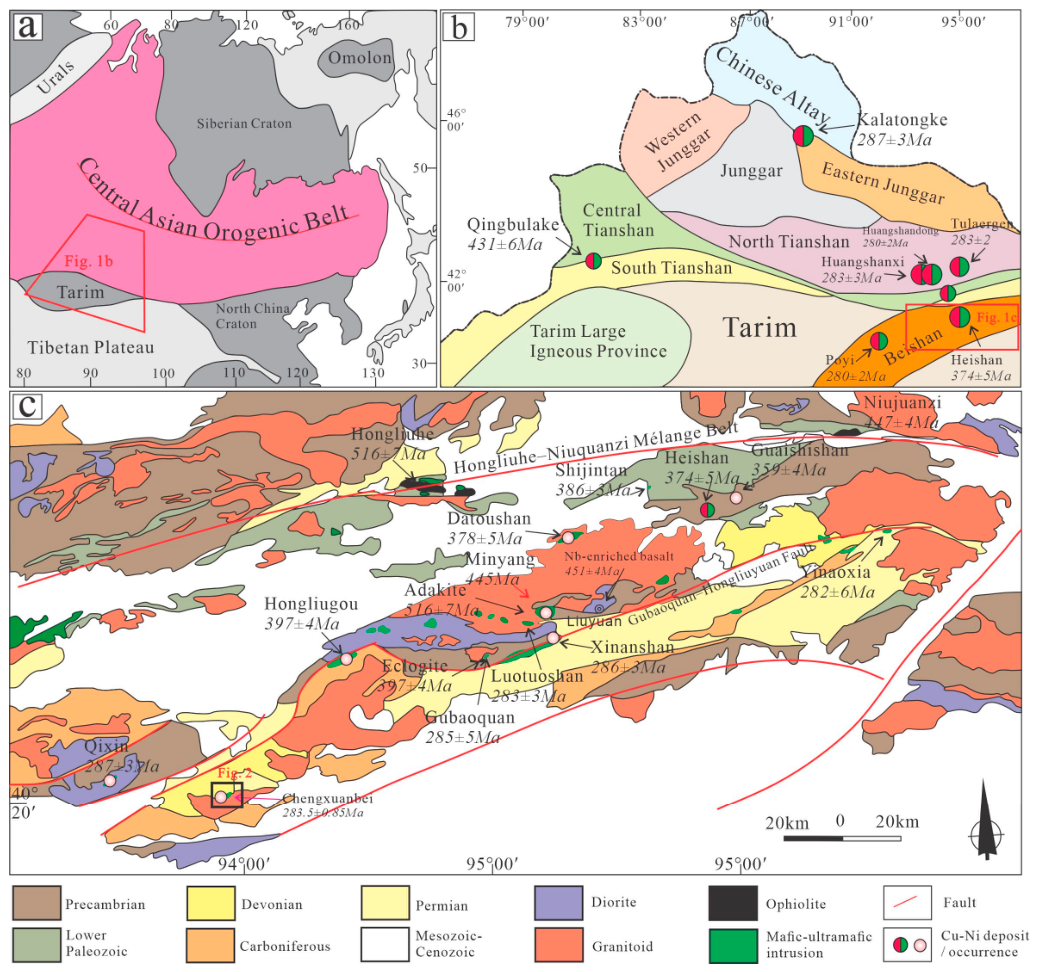
The Tianshan–Beishan area, located on the southern margin of the CAOB (Figure 1b), is a key component of the southern CAOB accretionary collage zone. It has undergone a multi-stage tectonic evolution involving rifting, subduction, collision, and post-orogenic extension [4,5,6]. The mafic–ultramafic intrusions hosting Cu-Ni mineralization in this region were emplaced mainly from the Silurian to the Triassic, with two prominent metallogenic peaks during the Devonian and Permian [4,5,6,7,8,9,10,11,12]. Previous studies have focused on the Devonian Cu-Ni mineralized intrusions in the southern Beishan belt, and their petrogenesis, mineralization mechanisms, and tectonic settings have been well documented [13]. In contrast, the Permian mafic–ultramafic intrusions in this region have long been overlooked due to limited outcrops and insufficient research, resulting in poor constraints on their petrological characteristics, magmatic evolution, and Cu-Ni mineralization potential.
Recently, the Chengxuanbei Cu-Ni-mineralized mafic–ultramafic intrusion was discovered in the Beishan area, Gansu Province, within the eastern segment of the southern Beishan orogenic belt. The preliminary field investigations indicated that the intrusion consists of gabbro, pyroxenite, and peridotite, with distinct Cu-Ni sulfide mineralization. This discovery not only confirms that the southern Beishan belt hosts both Devonian and Permian Cu-Ni mineralization, but also fills the research gap concerning Permian Cu-Ni-bearing mafic–ultramafic intrusions in this area [13]. Nevertheless, the precise emplacement age, magma source characteristics, crustal assimilation and contamination (CAC) processes, and tectono-dynamic setting of the Permian intrusions in the Chengxuan area remain poorly constrained. The inadequate understanding of these key geological issues severely limits the interpretation of regional Cu-Ni metallogenic regularity and future exploration efforts.
In this paper, based on detailed field geological surveys, mapping, and sampling of the sulfide-bearing mafic–ultramafic intrusions in the Chengxuan area, combined with zircon U-Pb geochronology, petrography, major and trace element geochemistry, and Sr-Nd-Pb isotopic data, we address three key scientific questions: (1) the precise emplacement age of the Permian mafic–ultramafic intrusions; (2) the nature of the magma source and magmatic evolution, particularly the influence of CAC on sulfur saturation and Cu-Ni mineralization; and (3) the tectono-dynamic setting and its genetic relationship with the regional Devonian Cu-Ni metallogenic system. This study aims to clarify the petrogenesis and mineralization mechanisms of the Permian mafic–ultramafic intrusions in the Chengxuan area, establish a regional Permian Cu-Ni metallogenic model, and provide theoretical support and exploration guidance for similar Cu-Ni sulfide deposits in the southern Beishan belt and even the southern margin of the CAOB.

2. Regional Geological Setting

The Beishan orogenic belt is situated in the middle segment of the southern margin of the Central Asian Orogenic Belt and the northeastern margin of the Tarim Craton. It is adjacent to the Dunhuang Block and the Central Tianshan Block to the south and north, respectively, and bounded by the Liuyuan–Daqishan and Xingxingxia–Hongliuhe major faults. This belt features a complicated tectonic setting and has undergone multiple episodes of rifting, collision and amalgamation since the Paleozoic, accompanied by intense tectono-magmatic activities [2]. Its Late Paleozoic tectonic framework can be divided into nine alternating tectonic units, which are, from north to south: the Que’ershan Arc, the Hongshishan Ophiolite Belt, the Heiyingshan–Hanshan Arc, the Xingxingxia–Shibanjing Ophiolite Belt, the Mazongshan Arc, the Hongliuhe–Xichangjing Ophiolite Belt, the Shuangyingshan–Huaniushan Arc, the Liuyuan Ophiolite Belt, and the Shibanshan Arc.
Magmatism is widespread in the Gansu Beishan orogenic belt, occurring intermittently from the Neoproterozoic to the Mesozoic. Among these magmatic events, Permian mafic–ultramafic intrusions are mainly distributed in the Liuyuan area, occurring along the Gubaoquan–Hongliuyuan major fault (Figure 1c), and obviously controlled by this fault. The fault-controlled ultramafic rocks can be classified into two types: one is ophiolite, representing relics of ancient oceanic crust; the other is mafic–ultramafic intrusive rocks formed by fractional crystallization of basaltic magma under extensional settings (e.g., rift or mantle plume activity), which are mainly distributed in Liuyuan, Heishan, Chengxuan and other adjacent regions. The basic characteristics of the major Permian mafic–ultramafic intrusions in the Beishan area, including their emplacement age, scale, morphology and lithofacies, are summarized in Table A1.
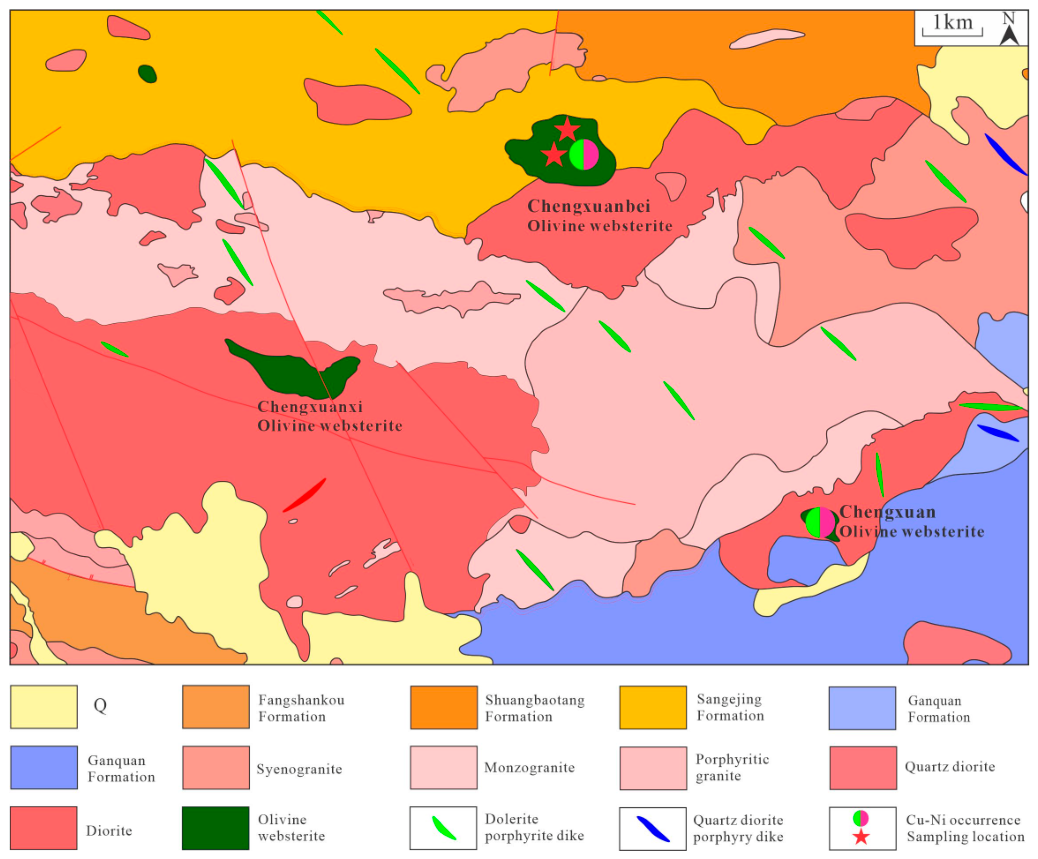
Chengxuan is located in the Beishan area of Gansu Province, administratively under the jurisdiction of Dunhuang City. It lies approximately 80 km west-northwest (300° azimuth) of Dunhuang City, and tectonically belongs to the Hongliuyuan Rift Zone within the Beishan orogenic belt and the northern margin of the Dunhuang Landmass of the Tarim Plate. Permian mafic–ultramafic complexes are exposed in this area, characterized by small outcrop areas and low denudation degrees. The northern part of the intrusions are in intrusive contact with Permian syenogranite and quartz diorite, while the central part is in intrusive contact with quartz diorite and diorite. Regional strata of the pre-Paleozoic, Paleozoic and Mesozoic are well developed, generally striking EW, but sporadically distributed due to the influence of tectonism and folding [13].

3. Geological and Petrological Characteristics of the Intrusions

3.1. Intrusion Geology

The Chengxuan area hosts a suite of recently discovered Cu-Ni-mineralized mafic–ultramafic intrusions, which are divided into three plutons: the Chengxuan, Chengxuanbei, and Chengxuanxi intrusions (Figure 2). Cu-Ni mineralization has been identified in both the Chengxuan and Chengxuanbei intrusions, and the Chengxuanbei intrusions are taken as the major primary research focus in this study. The Chengxuanbei intrusion consists of three small EW-trending mafic–ultramafic bodies, among which the largest one has an outcrop area of approximately 0.53 km2, with a steep north-dipping attitude. It intrudes into the Late Paleozoic diorite and quartz schist of the Devonian Shuangbaotang Formation. The dominant rock types include hornblende gabbro, gabbro, olivine websterite, and pyroxenite, with gradual contacts among the different lithofacies. Alterations, such as chloritization, serpentinization, and uralitization, are widely developed in the intrusion. To date, three nickel ore bodies of industrial grade and five low-grade nickel ore bodies have been delineated in Chengxuanbei, accompanied by associated Cu and Co mineralization.

3.2. Lithofacies Characteristics

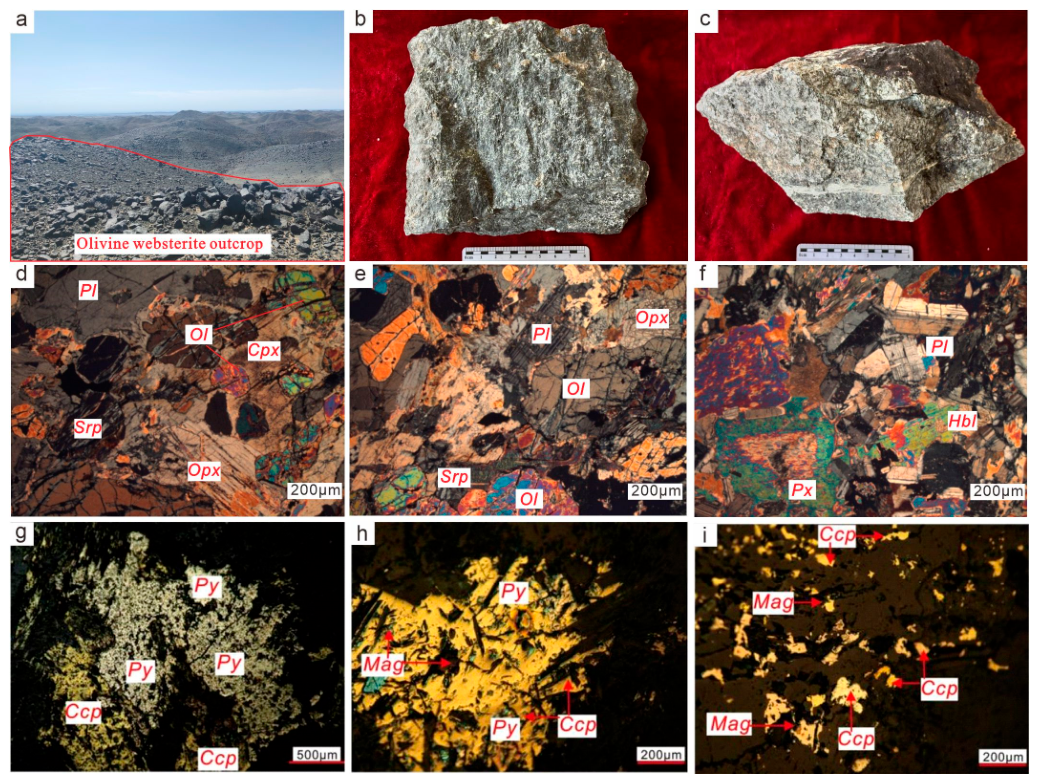
The Chengxuanbei mafic–ultramafic intrusion can be divided into two lithofacies: a gabbro facies and an olivine gabbro facies. The olivine gabbro facies is the main ore-hosting lithofacies, followed by the hornblende gabbro (within the gabbro facies) as a subordinate one. The sulfides in the olivine gabbro facies mostly occur as disseminations (Figure 3g), whereas droplet-like and massive sulfides are visible in the gabbro facies (Figure 3h). The metallic minerals are dominated by pyrrhotite, pentlandite, and chalcopyrite, and the sulfides as a whole exhibit typical magmatic immiscibility characteristics. The main petrographic characteristics are described as follows.
Olivine Gabbro Facies: The lithology is dominated by olivine websterite, which exhibits a black anhedral granular texture and massive structure. It consists mainly of olivine (40%–45%) and pyroxene (approximately 55%). Most of the olivine has been serpentinized and talcized, occurring as rounded grains enclosed in coarse-grained pyroxene, with dust-like magnetite precipitated on its surfaces. Pyroxene occurs as anhedral coarse grains, commonly altered to serpentine, chlorite, and other secondary minerals (Figure 3d). Pentlandite, pyrrhotite, chalcopyrite, and magnetite occur as disseminated grains filling the interstices between mineral grains.
Gabbro Facies: The main lithology is hornblende gabbro, which shows a triangular framework texture and massive structure. It is dominated by euhedral columnar plagioclase (approximately 60%, grain size 0.5–1 mm) that forms a triangular framework (Figure 3f). Pyroxene (15%–20%) and hornblende (20%–25%) occur as anhedral grains filling the interstices between plagioclase grains, mostly altered to tremolite and chlorite, with pyrrhotite, pentlandite, and chalcopyrite present.

4. Analytical and Testing Methods

4.1. Zircon U-Pb Dating and Hf Isotope Analysis

In this study, hornblende gabbro samples collected from the Chengxuanbei mafic–ultramafic intrusion were selected for zircon U-Pb dating and Hf isotope analysis, and the samples were fresh without obvious alteration. Zircon grains were separated from the bulk rock samples using conventional heavy liquid and magnetic separation methods at Yuheng Mineral Rock Technology Service Co., Ltd. (Langfang, China). After separation, the selected zircons were mounted in epoxy resin, polished to expose the grain interiors, and then photographed under transmitted and reflected light using a scanning electron microscope (Tescan, Brno, Czech Republic), followed by cathodoluminescence (CL) imaging to reveal the internal structures and oscillatory zoning for target spot selection.
The zircon U-Pb dating was performed at Wuhan SampleSolution Analytical Technology Co., Ltd. (Wuhan, China) using laser ablation inductively coupled plasma mass spectrometry (LA-ICP-MS). The analytical conditions were as follows: a laser beam spot diameter of 32 μm and a repetition rate of 5 Hz. Zircon standard 91500 [21] was used as the external calibration standard, and GJ-1 was applied as the monitor standard for the isotope ratio calibration. The data processing, age calculation and concordia diagram construction were conducted using the ICPMSDataCal software (ICPMS Data Cal 12.0 1) package, with the analytical procedures referenced from [21,22]. The detailed U-Pb dating results are listed in Table A2.
An in situ zircon Hf isotope analysis was also carried out at the same laboratory using laser ablation multi-collector inductively coupled plasma mass spectrometry (LA-MC-ICP-MS) (Thermo Fisher Scientific, Bremen, Germany), with a single spot ablation diameter of 44 μm. The international zircon standards Plesovice, 91500 and GJ-1 were analyzed synchronously for quality control, and Temora2 was used as the monitor standard to correct the Yb/Hf ratios; the recommended values for the reference standards were obtained from [23], and the analytical methods followed [24]. The corresponding Hf isotope data are presented in Table A3.

4.2. Whole-Rock Major and Trace Element Analysis

The hornblende gabbro and olivine websterite samples collected from the Chengxuanbei mafic–ultramafic intrusion were selected for whole-rock major and trace element analysis, and all the samples were fresh without visible alteration. The whole-rock geochemical tests were completed at Wuhan SampleSolution Analytical Technology Co., Ltd. (Wuhan, China). The whole-rock major element contents were determined using a ZSX Primus II wavelength-dispersive X-ray fluorescence spectrometer (XRF, Rigaku, Tokyo, Japan) equipped with a 4.0 kW end-window Rh-target X-ray tube. The analytical conditions were set as follows: operating voltage of 50 kV and current of 60 mA, with Kα lines adopted for all major element spectral lines. The calibration curves were established using national standard reference materials, including rock series (GBW07101-14), soil series (GSS07401-08), and stream sediment series (GBW07302-12) [22]. Data calibration was performed using the theoretical α-coefficient method, and the relative standard deviation (RSD) of each major element analysis was less than 2%. The detailed whole-rock major element data are listed in Table A4.
The whole-rock trace and rare earth element (REE) contents were analyzed using an Agilent 7700e ICP-MS system at Wuhan SampleSolution Analytical Technology Co., Ltd. (Wuhan, China).The sample preparation procedures for the ICP-MS analysis were as follows: 1. The 200-mesh rock powders were dried in an oven at 105 °C for 12 h. 2. Exactly 50 mg of dried powder was weighed and transferred into a Teflon digestion bomb. 3. A total of 1 mL of high-purity HNO3 and 1 mL of high-purity HF were slowly added sequentially. 4. The Teflon bomb was sealed in a steel jacket, tightened, and heated in an oven at 190 °C for more than 24 h. 5. After cooling, the bomb was opened, and the sample solution was evaporated to dryness on a 140 °C hot plate, followed by adding 1 mL of HNO3 and evaporating to dryness again. 6. A total of 1 mL of high-purity HNO3, 1 mL of MQ water, and 1 mL of 1 ppm In were added to the internal standard solution, then the bomb was resealed in the steel jacket and heated at 190 °C for more than 12 h. 7. The final solution was transferred into a polyethylene bottle and diluted to 100 g with 2% HNO3 for subsequent ICP-MS testing. The corresponding trace and REE data are presented in Table A4.

4.3. Whole-Rock Sr-Nd Isotope Analysis

Fresh and unmineralized hornblende gabbro and olivine websterite samples from the Chengxuanbei mafic–ultramafic intrusion, with no visible alteration or weathering, were selected for a whole-rock Sr-Nd isotope analysis. All the Sr-Nd isotope tests were completed at Wuhan SampleSolution Analytical Technology Co., Ltd. (Wuhan, China), using a Neptune Plus multi-collector inductively coupled plasma mass spectrometer (MC-ICP-MS, Thermo Fisher Scientific, Bremen, Germany) for isotope concentration and ratio determination.
Quality control for the Sr and Nd isotope compositions was performed using reference materials NBS 987 and GSB 04-3258-2015, respectively. The measured 87Sr/86Sr ratio of NBS 987 was 0.710247 ± 8, consistent with the recommended value of 0.710248 ± 12, within analytical error [25]; the measured 143Nd/144Nd ratio of GSB 04-3258-2015 was 0.512439 ± 6, which is in agreement with the recommended value of 0.512438 ± 6 (2SD), within uncertainty [26]. All the isotopic data were processed using the professional isotope data processing software “Iso-Compass” (Isoplot 3.7.1) [25]. The detailed Sr-Nd isotope results are listed in Table A5.

4.4. Chemical Composition Analysis of Rock-Forming Minerals

The major element analyses of rock-forming minerals in the Chengxuanbei mafic–ultramafic rocks were carried out at Wuhan SampleSolution Analytical Technology Co., Ltd. using a JXA-8230 electron probe microanalyzer (EPMA, JEOL, Tokyo, Japan) The analytical conditions were set as follows: operating voltage of 15 kV, beam current of 1.0 × 10⁻⁸ A, beam spot diameter of 3 μm, and peak counting time of 20 s. International mineral reference materials were employed for calibration, and the analytical precision was better than 2.0%. The detailed test results are listed in Table A6.

4.5. Sulfur Isotope Analysis

The sulfur isotope analyses of the Chengxuanbei mafic–ultramafic rocks were completed at the Analytical and Testing Center of Beijing Research Institute of Uranium Geology. Approximately 15 mg of whole-rock samples with sulfur-bearing minerals were weighed for the experiments. The sulfur in the samples was converted and extracted into pure barium sulfate via the sodium carbonate–zinc oxide semi-sintering method.
Barium sulfate, quartz and vanadium pentoxide were mixed uniformly at a weight ratio of 2:7:7 and ground to 180 mesh. When the vacuum level of the pretreatment sample preparation device reached 1.0 × 10⁻² Pa, the samples were heated at 980 °C to undergo an oxidation reaction and generate sulfur dioxide. The sulfur dioxide was collected and purified using liquid nitrogen freezing, and its sulfur isotopic composition was analyzed using a Delta V Plus gas isotope ratio mass spectrometer (Thermo Fisher Scientific, Bremen, Germany).
The measurement results are reported as δ34S relative to the international standard for troilite from the Canyon Diablo iron meteorite in Arizona, USA (CDT). Two national silver sulfide reference materials (GBW04414, GBW04415) were adopted for the sulfur isotope calibration [20]. The analytical precision of samples was better than ±0.2‰. The detailed sulfur isotope data are listed in Table A7.

5. Analytical Results

5.1. Zircon U-Pb Geochronology and Hf Isotope Compositions

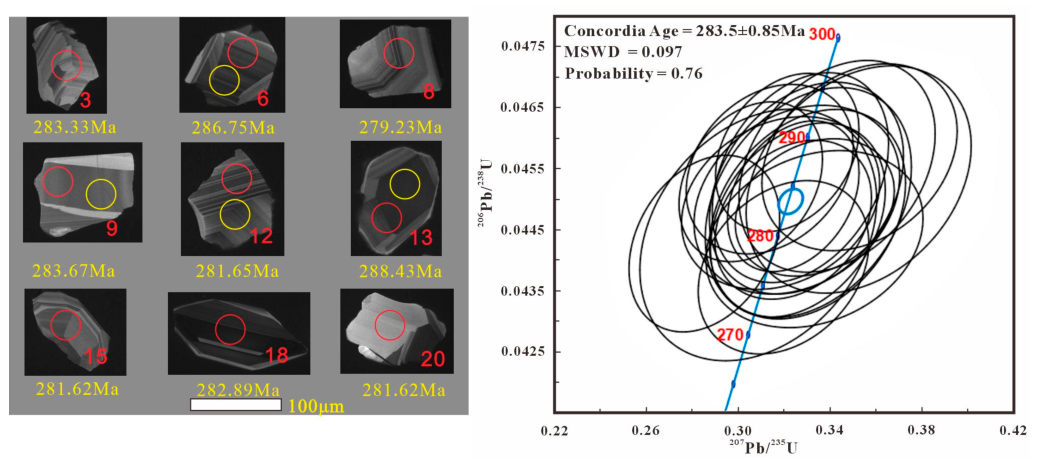
The zircons separated from the hornblende gabbro samples of the Chengxuanbei mafic–ultramafic intrusion were mostly colorless and transparent, dominated by subhedral granular and columnar crystal morphologies. The grain sizes ranged from 80 to 200 μm, with length–width ratios of 1:1 to 2:1, and the crystals exhibited relatively regular morphologies. The cathodoluminescence (CL) images show that the zircon grains had flat crystal faces, with weak oscillatory zoning widely developed internally, and some grains lacked obvious zoning structures. Overall, these zircons displayed typical characteristics of magmatic zircons (Figure 4).
The in situ Hf isotope analyses were conducted on five representative magmatic zircons from the hornblende gabbro of the Chengxuanbei mafic–ultramafic intrusion. The results revealed that the Hf isotopic compositions were homogeneous with limited differentiation. The tested 176Yb/177Hf ratios ranged from 0.016916 to 0.046937, and the 176Lu/177Hf ratios varied between 0.000483 and 0.001463, both of which were relatively low. These values indicate negligible accumulation of radiogenic Hf after zircon crystallization, making these zircons suitable for initial Hf isotope calculation.
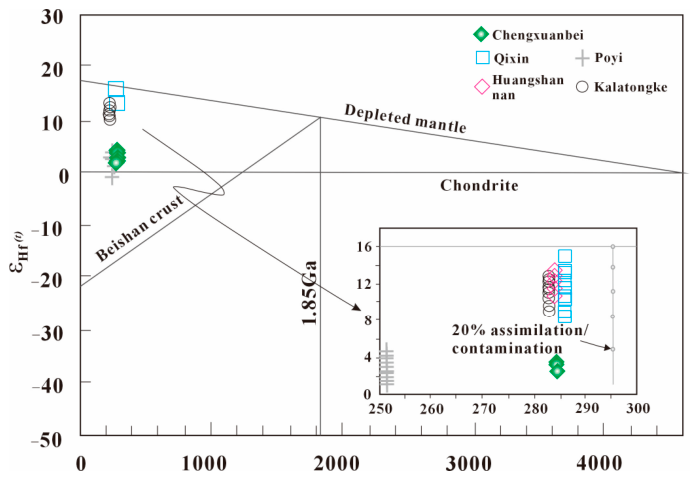
Using the zircon U-Pb weighted mean age of t = 283.5 Ma as the calculation time point, the initial zircon Hf isotope ratios 176Hf/177Hf were calculated to be 0.282665–0.282696, with an average of 0.282690. The corresponding εHf(t) values ranged from 2.47 to 3.56, with a mean value of approximately 3.28. The data are concentrated and highly stable (Figure 5; Table A3).

5.2. Mineral Chemical Characteristics

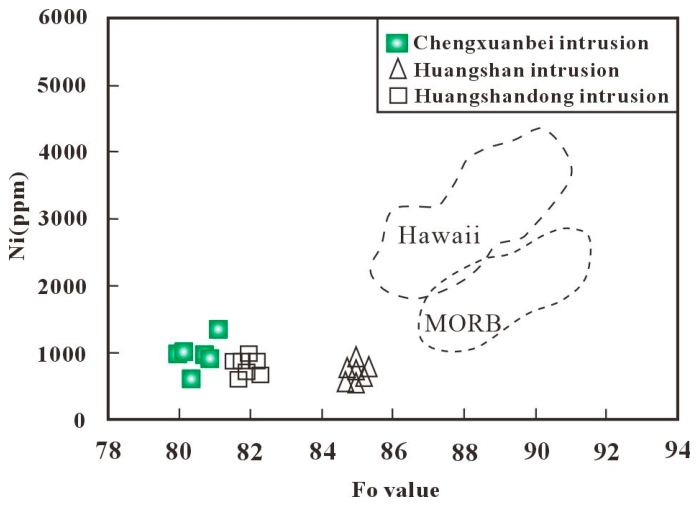
The olivine is mainly distributed in the olivine websterite facies with a content of approximately 40%–45%. Some olivine grains have undergone serpentinization and talcization alterations, but the crystal morphologies are well preserved, with dust-like magnetite precipitates visible on the grain surfaces. The Fo(Fo (mol%) = 100 × Mg/(Mg + Fe)) values are concentrated in the range of 79.8–81.0, and were calculated following the method of [28]. The Ni contents range from 573 ppm to 1320 ppm, the MgO contents vary from 41.6% to 43.5%, and the FeO contents are between 17.4% and 18.3%, showing a narrow and homogeneous compositional range (Figure 6).
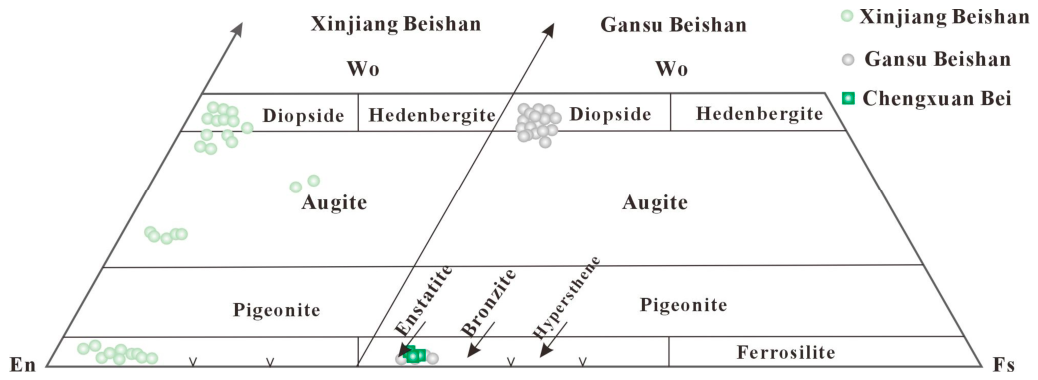
The pyroxene is exclusively orthopyroxene (enstatite); clinopyroxene is absent or negligible. Orthopyroxene accounts for approximately 80% of pyroxenite and 55% of olivine websterite (Figure 3d,e). Some grains have been altered into tremolite and chlorite. The orthopyroxene yields Mg# values of 86–88, with SiO2 contents of 55.4–56.7 wt%, MgO of 28.4–29.3 wt%, FeO of 9.8–10.4 wt%, and CaO of 1.6–1.7 wt%. The Wo (wollastonite) values range from 3.2 to 3.5 mol%, and the En (enstatite) values range from 80.4 to 81.6 mol%, consistent with the composition of magnesian orthopyroxene (Figure 7). No clinopyroxene was identified in the analyzed samples.

5.3. Whole-Rock Major and Trace Element Compositions

The major element data for the Chengxuanbei intrusion show that the hornblende gabbro in the intrusions is characterized by relatively high SiO2 (48.11%–52.15%) and Al2O3 (16.03%–22.90%) contents, variable total Fe2O3 (TFe2O3) contents (4.19%–12.36%), low MgO contents (6.50%–8.81%), and Mg# values of approximately 55–65 (Table A4). These features indicate that the magma underwent intensive fractional crystallization (Mg# = 60–70). In contrast, the olivine websterite exhibits distinctly low SiO2 (42.16%–43.70%) and Al2O3 (7.14%–13.42%) contents, high MgO (18.57%–28.86%) and total iron contents, with Mg# values of about 73–80, representing relatively primitive Mg-rich mantle-derived magma (Mg# = 75–85). The overall loss on ignition (LOI) values range from 1.46 wt% to 5.40 wt%, suggesting that the rocks experienced weak-to-moderate post-magmatic hydrothermal alteration. However, the total major element contents are generally stable, indicating no large-scale compositional disturbance.
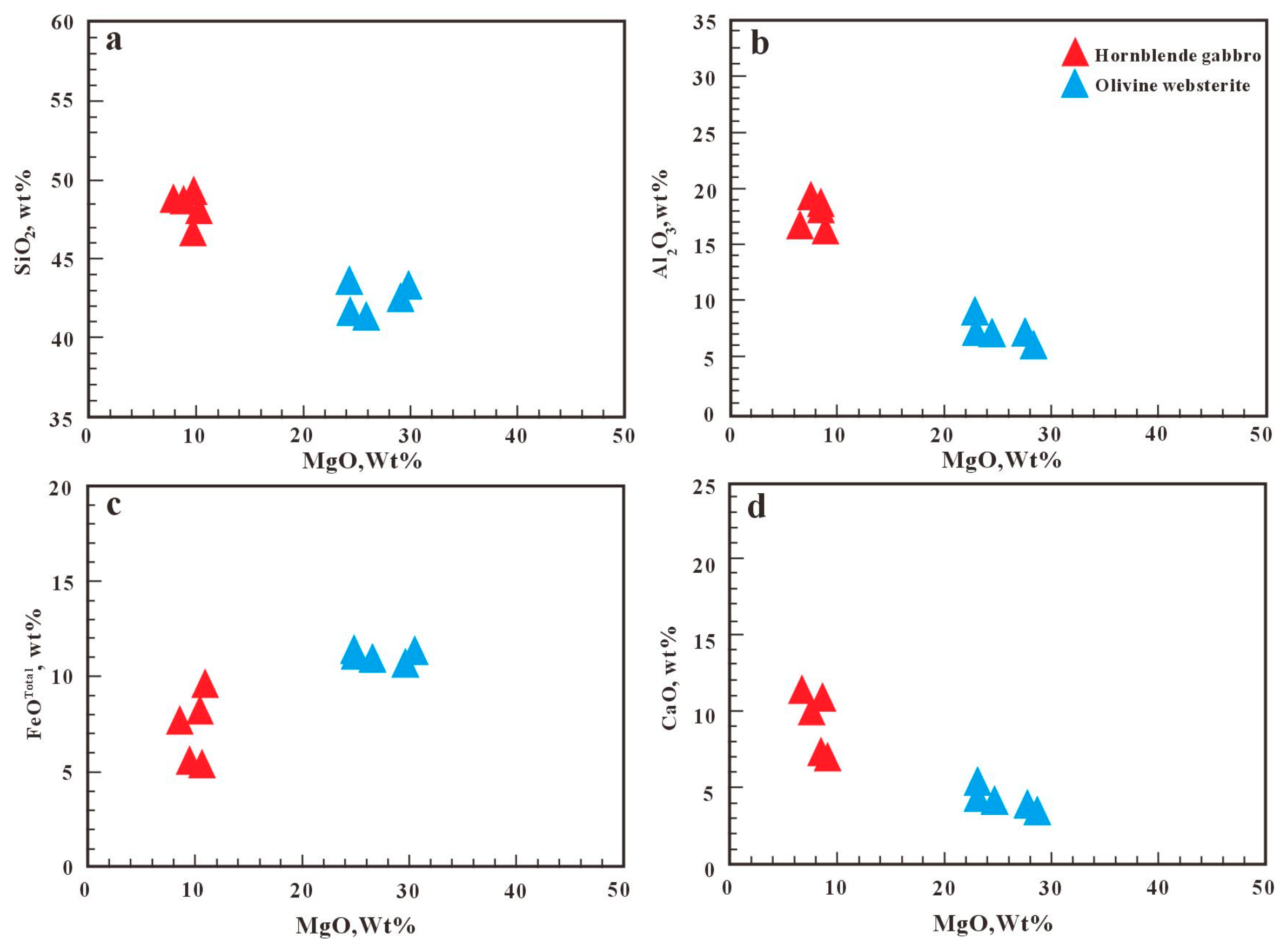
The major oxides of the Chengxuanbei rocks display obvious covariation characteristics with the MgO content. The olivine websterite facies and pyroxenite facies have relatively high total FeO contents. The correlations between the major oxides and MgO indicate that SiO2, Al2O3 and CaO show significant negative correlations with MgO (Figure 8), but positive correlations with FeO, suggesting that fractional crystallization and cumulation of olivine and pyroxene occurred in the early stage of magma evolution.
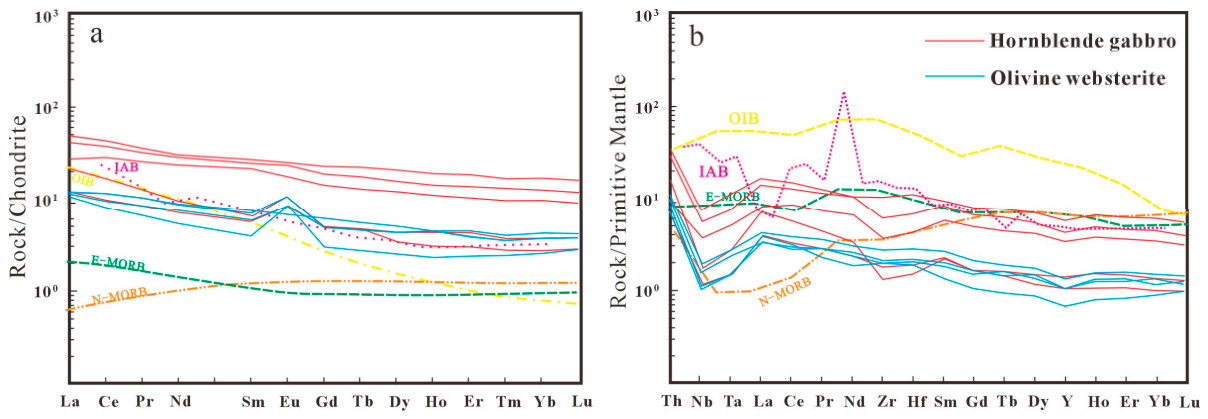
The ΣLREE/ΣHREE ratios of samples from Chengxuan and Beishan range from 3.01 to 7.06 and 2.64 to 3.53, respectively. All the samples exhibit slightly right-sloping patterns on the chondrite-normalized rare earth element (REE) distribution diagrams (Figure 9b). The rocks are slightly enriched in LREE, with δEu values of 0.90~1.74, 0.81~2.35, and 1.03~1.24, showing weak positive Eu anomalies. This feature is probably attributable to the preferential partitioning of Eu into early-crystallized plagioclase during magmatic evolution. In terms of trace elements, the samples display pronounced negative anomalies of Nb and Ta, along with weak negative anomalies of Zr and Hf, which are typical geochemical signatures of island arc basalts (Figure 9a).

5.4. Whole-Rock Sr-Nd-S Isotopes

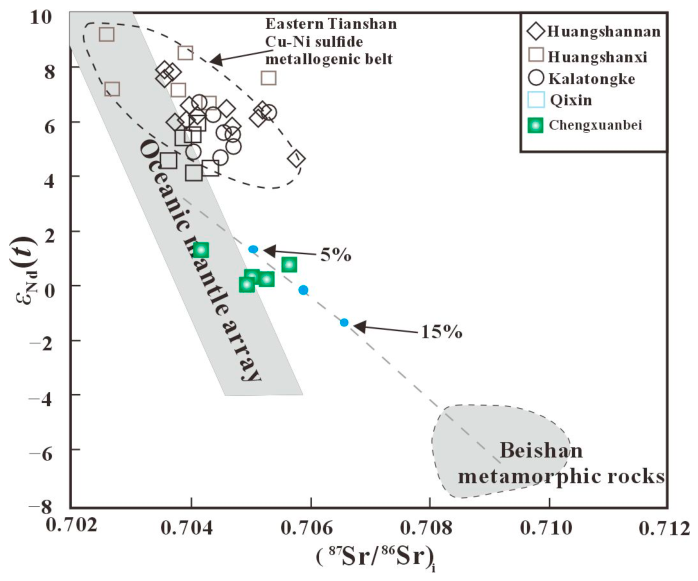
The whole-rock Sr-Nd isotopic compositions of the Chengxuanbei intrusions show moderate variations, with the initial (87Sr/86Sr)i ratios ranging from 0.7042 to 0.7057 and εNd(t) values varying between 0.14 and 3.14. These features collectively indicate a relatively homogeneous depleted mantle source.
In the εNd(t) versus (87Sr/86Sr)ᵢ isotopic discrimination diagram (Figure 10), the samples from the Chengxuanbei intrusions are mainly distributed to the right of the oceanic mantle array (OMA). Their isotopic values overlap extensively with those of typical intrusions in the East Tianshan Cu-Ni sulfide metallogenic belt (e.g., Huangshannan, Huangshanxi, Kalatatong) and the ore-bearing intrusions in the Beishan area, and are clearly distinguished from the enriched isotopic end-member of Beishan metamorphic rocks.
This distribution pattern has the following implications: The source region of the Chengxuanbei intrusions is dominated by depleted mantle components, sharing similar mantle source affinities with the regional Cu-Ni mineralized intrusions. Some samples exhibit a slight shift toward higher (87Sr/86Sr)ᵢ and lower εNd(t) values, suggesting limited crustal material contamination during magmatic evolution. Moreover, its Sr-Nd isotopic characteristics are comparable to those of intrusions in the East Tianshan Cu-Ni metallogenic belt, further confirming that the Chengxuanbei intrusions belong to the Beishan–East Tianshan Early Permian Cu-Ni metallogenic system.
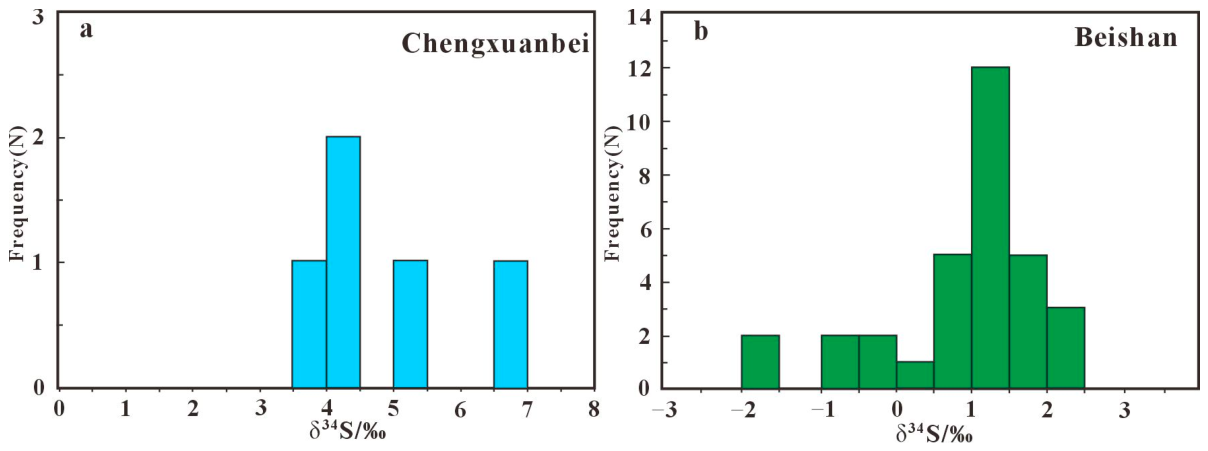
The whole-rock sulfur isotopic data for the Chengxuanbei intrusion yield δ34S values ranging from 3.7‰ to 6.5‰ (Table A7), with an average of approximately 5.1‰. The δ34S values show a roughly unimodal distribution, with most values clustering between 4‰ and 5‰ (Figure 11a). These isotopic compositions are higher than those of normal mid-ocean ridge basalt (MORB; −1.28 ± 0.33‰ [37]) and those of primitive mantle sulfur (δ34S ≈ 0‰ ± 3‰ [38]).

6. Discussion

6.1. Petrogenesis

6.1.1. Evaluation of Post-Magmatic Alteration

The loss on ignition (LOI) values of hornblende gabbro samples are generally low, ranging from 1.46 to 3.13 wt%, indicating that these rocks have only experienced weak low-temperature alteration. These rocks are dominated by plagioclase, clinopyroxene, and hornblende, with their alteration mainly consisting of chloritization and sericitization. Such alterations consume only small amounts of mafic minerals and plagioclase, incorporate limited structural water, and thus contribute weakly to LOI. Although a few samples (e.g., YQ-11, YQ-20) show slightly higher LOI values, possibly related to locally enhanced alteration of hornblende, the overall degree of alteration has not significantly affected the geochemical signals of immobile elements.
In contrast, the LOI values of olivine websterite samples are notably higher, ranging from 4.22 to 5.4 wt%, reflecting intense low-temperature alteration. As ultramafic cumulates, these rocks are mainly composed of olivine, orthopyroxene, and clinopyroxene. Their high MgO contents (18.57–28.19 wt%) provide sufficient material basis for serpentinization. During the reaction of olivine with aqueous fluids to form serpentine, large amounts of structural water are incorporated, which are released during LOI analysis and directly increase the LOI values. The widespread serpentinization observed in the petrographic thin sections provides direct evidence for this process.

6.1.2. Magmatic Source

The whole-rock trace elements of the Chengxuanbei intrusion exhibit typical geochemical signatures of subduction zone magmas: the large-ion lithophile elements (LILEs, e.g., Rb, Ba, Th, U) are significantly enriched, whereas the high-field-strength elements (HFSEs, e.g., Nb, Ta, Zr, Hf) are markedly depleted (Figure 9a). This geochemical fingerprint is highly consistent with mantle wedge metasomatism triggered by fluids released from dehydrated subducting slab [40].
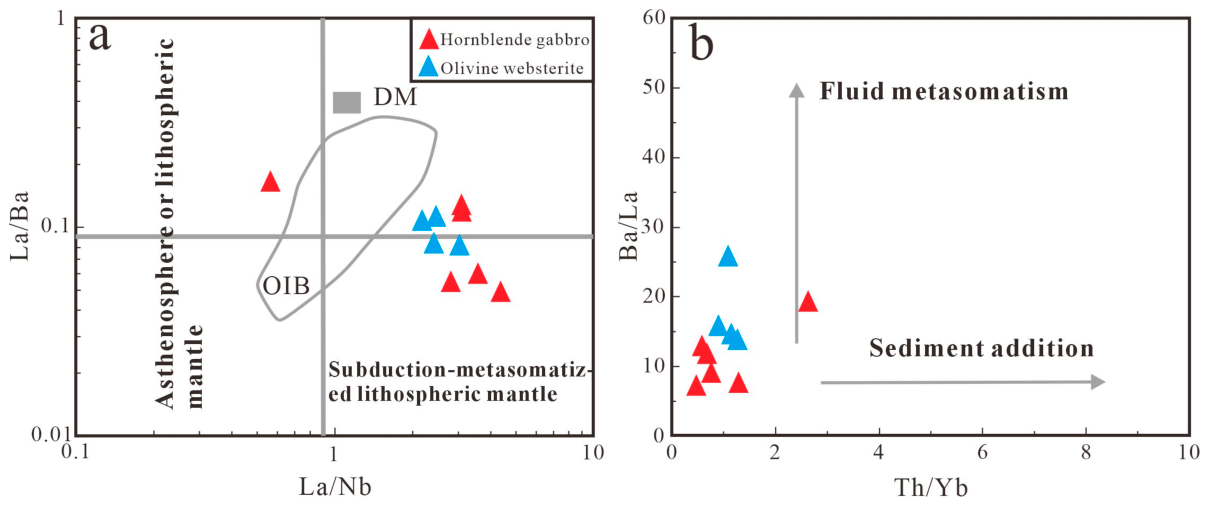
In the La/Nb versus La/Ba diagram (Figure 12a), both the hornblende gabbro and olivine websterite samples from the Chengxuanbei intrusions are concentrated in the field of subduction-metasomatized lithospheric mantle, far from the ocean island basalt (OIB) and depleted mantle (DM) end-members. The La/Nb ratios are mostly concentrated in the range of 1–5, with the La/Ba ratios varying between 0.05 and 0.3. These features are distinct from the typical low La/Nb and high La/Ba characteristics of OIB, as well as the high La/Nb and low La/Ba composition of primitive depleted mantle, clearly indicating that the magma source was not primitive depleted mantle, but rather a lithospheric mantle wedge that had undergone intense fluid metasomatism [41].
In the Th/Yb versus Ba/La diagram (Figure 12b), all the sample points plot along the “fluid metasomatism” trend, characterized by significantly elevated Ba/La ratios (5–30) and relatively low Th/Yb ratios (<2). This trend is in sharp contrast to the remarkably increased Th/Yb ratios caused by “sediment input”, further confirming that fluid metasomatism, rather than direct sediment mixing, was the dominant mechanism of source modification [41]. Subduction fluids not only enriched the large-ion lithophile elements (LILEs), but also selectively extracted elements such as Ba and Th, thus shaping the unique trace element distribution pattern of the Chengxuanbei intrusions.
The Sr-Nd-Hf isotopes provide quantitative constraints on the mantle source affinity. The intrusion has initial 87Sr/86Sr ratios of 0.7042–0.7057, higher than the typical values of depleted mantle (0.702–0.703); the εNd(t) values range from 0.14 to 1.43, lying between those of depleted mantle (εNd(t) ≈ +5 to +10) and continental crust (εNd(t) ≈ −10 to 0) [42]. The zircon εHf(t) values vary from 2.47 to 3.56, displaying overall weakly depleted mantle signatures.
The isotopic compositions show no strong enrichment signals derived from the ancient enriched lithospheric mantle or melting of subducted sediments [14,26], thus ruling out these potential source candidates. Collectively, the parental magma of the Chengxuanbei intrusions originated from a depleted mantle wedge metasomatized by subduction fluids of the Paleo-Asian Ocean. These subduction fluids carried large-ion lithophile elements and fluid-mobile elements into the mantle wedge, lowering the mantle solidus and triggering partial melting, and finally generating mafic–ultramafic magmas with island arc geochemical affinities [2,10].
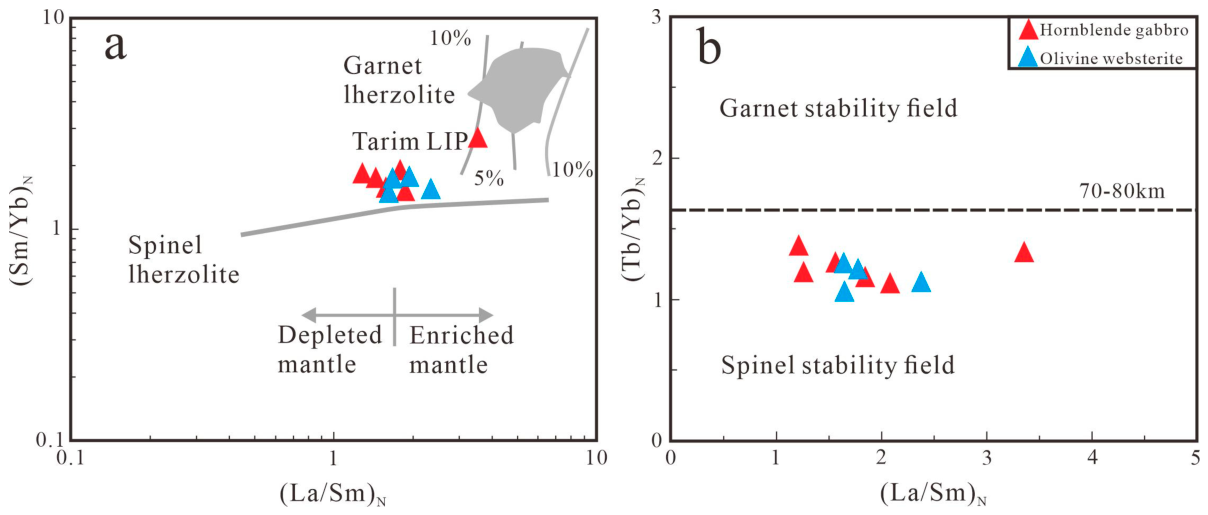
The melting pressure and residual mineral phases of the mantle source can be effectively distinguished via rare earth element (REE) partitioning diagrams. Melting within the garnet stability field (>70–80 km) results in significant enrichment of heavy rare earth elements (HREEs, e.g., Yb, Tb), whereas melting in the spinel stability field (<70–80 km) preserves relatively flat HREE patterns [43].
In the (La/Sm) versus (Sm/Yb) diagram (Figure 13a), all the samples from the Chengxuanbei intrusion plot within the field of spinel lherzolite, with the (Sm/Yb) ratios concentrated between one and three. They are far from the garnet lherzolite field ((Sm/Yb) > 5) and show a clear contrast with the garnet field samples from the Tarim Large Igneous Province. This feature clearly indicates that the residual phase during mantle melting was dominated by spinel, corresponding to a shallow melting depth.
In the (La/Sm) versus (Tb/Yb) diagram (Figure 13b), all the samples fall within the spinel stability field, with the (Tb/Yb) ratios ranging from one to two, far below the threshold of (Tb/Yb) > 2 for the garnet stability field (equivalent to depths >70–80 km). This further confirms that mantle melting occurred in the spinel stability field rather than the deeper garnet stability field.
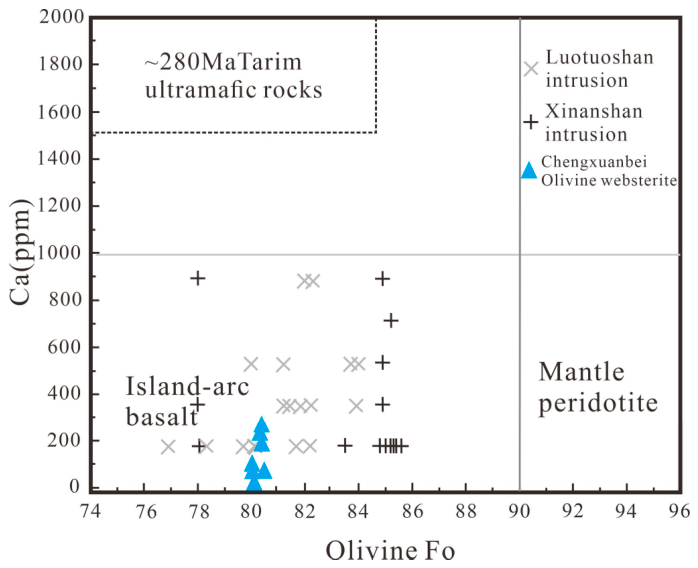
The partition coefficient of Ca in olivine is extremely sensitive to the water content of magmas: low Ca concentrations generally indicate high initial water contents in mantle-derived magmas, because H2O significantly reduces the partition coefficient of Ca between olivine and melt, thereby retaining more Ca in the melt [44]. In the Fo vs. Ca diagram (Figure 14), the olivine grains from the olivine websterite of the Chengxuanbei intrusion exhibit two key characteristics: (1) their Fo values are tightly clustered between 79.8 and 81.0, indicating crystallization from a magnesian basaltic primary magma without extreme differentiation; and (2) their Ca contents are extremely low (<300 ppm), markedly lower than those of mantle olivine (Fo > 90, Ca > 1000 ppm). These features are nearly identical to those of the neighboring Chengxuan mafic–ultramafic intrusion [45]. Together with the samples from the Luotuoshan and Xinandong intrusions in the region, they plot within the island arc basalt field, in marked contrast to the high-Ca signature of the ~280 Ma Tarim ultramafic rocks.

6.1.3. Magmatic Evolution

The Chengxuanbei intrusion underwent magmatic evolution dominated by fractional crystallization and cumulus processes. The major element covariations, mineral chemistry, and petrographic evidence collectively constrain a clear evolutionary path.
The major element covariations show that SiO2, Al2O3, and CaO exhibited strong negative correlations with MgO, whereas FeOᵀ displayed a positive correlation with MgO (Figure 8). These trends are consistent with the early fractional crystallization of olivine and clinopyroxene from mantle-derived mafic magmas [48,49]. As a relatively primitive lithology, the olivine websterite contains high MgO contents (18.57%–28.86%), accompanied by elevated Cr and Ni abundances. In contrast, the hornblende gabbro and gabbro show markedly decreased MgO and increased SiO2 and Al2O3, reflecting prolonged fractional crystallization and magmatic evolution toward Si- and Al-enriched compositions.
The mineral chemistry reveals the comprehensive crystallization sequence. The olivine exhibits homogeneous compositions, with Fo values clustered at 79.8–81.0 and Ni contents of 573 ppm–1320 ppm. The absence of coupled decreases in Fo and Ni caused by extreme differentiation indicates a moderate fractional crystallization intensity [27,28]. The clinopyroxene is predominantly diopside, characterized by a restricted compositional range (Mg# = 86–88; Wo = 3.2–3.5; En = 80.4–81.6) and tight clustering in the Wo-En-Fs classification diagram (Figure 7). This suggests stable physicochemical conditions during crystallization and high magma–mineral equilibrium [30,50]. The petrographic observations reveal that the intrusions are dominated by massive structures with gradational contacts between lithologies, lacking typical layered cumulate textures. This indicates that major differentiation occurred in a deep magma chamber, followed by rapid emplacement.
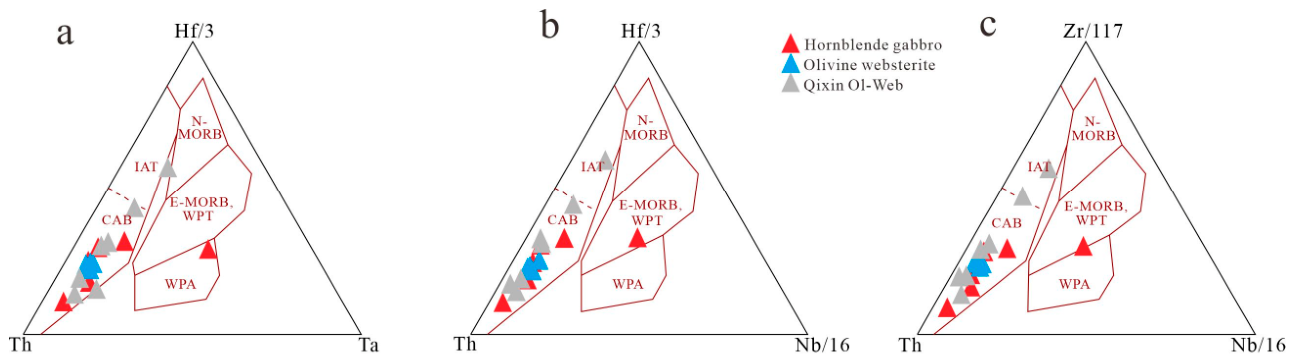
The high-field-strength element tectonic discrimination diagrams show that the samples strictly fall within the island arc calc-alkaline basalt field (Figure 15), further indicating that the magma preserved geochemical fingerprints of a subduction-metasomatized source during fractional crystallization without significant intraplate overprinting [40,51]. Combined with the whole-rock rare earth and trace element patterns, magmatic evolution was dominated by the crystallization sequence olivine → clinopyroxene → plagioclase → hornblende, accompanied by weak-to-moderate alterations, such as chloritization, serpentinization, and uralitization, which did not modify the major evolutionary trend. Overall, the Chengxuanbei intrusions are characterized by moderate fractional crystallization and rapid emplacement, representing a typical evolutionary model for mantle-derived mafic magmas in orogenic belts [9,12].

6.1.4. Crustal Contamination

Crustal contamination is a key mechanism controlling sulfide saturation and Cu-Ni mineralization in magmatic systems [53,54]. The Chengxuanbei intrusion exhibits significant crustal contamination characteristics in terms of major elements, trace elements, Sr-Nd-Hf isotopes, and sulfur isotopic compositions.
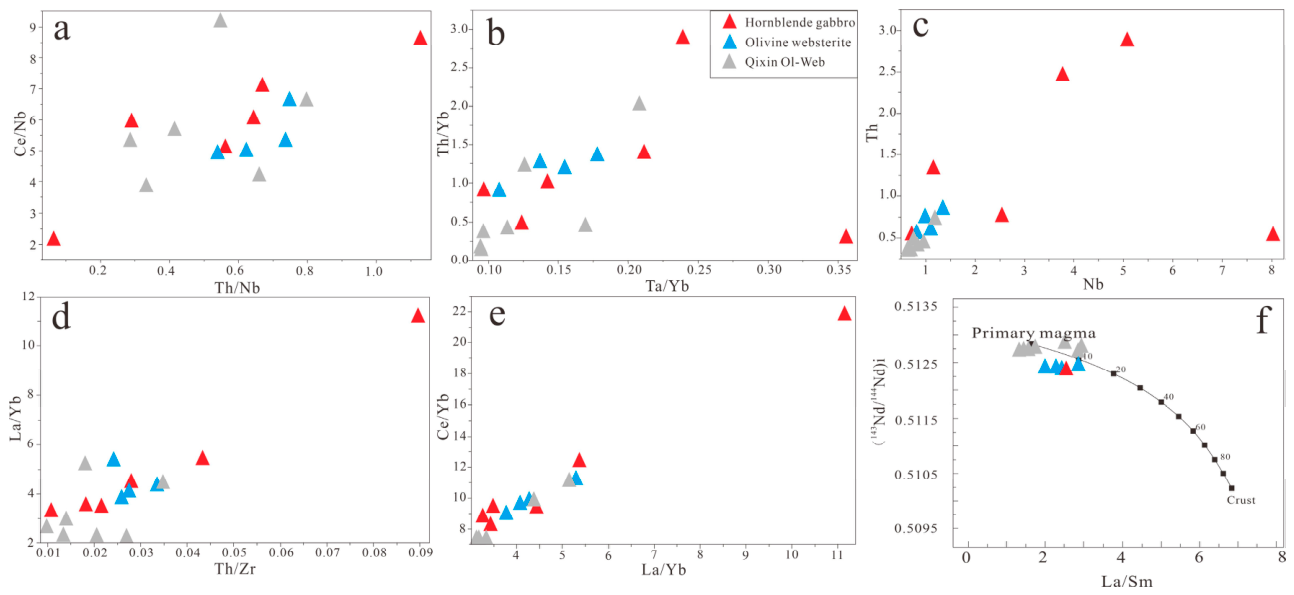
In terms of major elements, from the olivine websterite to the hornblende gabbro, the MgO content decreases rapidly, while SiO2 and Al2O3 increase synchronously (Figure 8a,b), which is consistent with the typical geochemical trends of silicic crustal contamination. Regarding the trace elements, the clear negative anomalies of Nb-Ta and Zr-Hf cannot be explained solely by their source characteristics; the contents of crustal-enriched elements, such as Rb, Ba, and Th, are significantly higher than those of primitive mantle-derived magmas. The sensitive element ratios, such as Ce/Nb versus Th/Nb, Th/Yb versus Ta/Yb, and Th/Zr versus La/Yb, exhibit clear linear correlations (Figure 16), unequivocally indicating assimilation of crustal material during magma ascent [54,55],This is similar to the characteristics of the Qixin Cu-Ni deposit in Beishan, Xinjiang (Figure 16).
To further quantitatively constrain the intensity of crustal contamination, a two-component binary mixing model was established using a diagram of (143Nd/144Nd)i versus La/Sm (Figure 16f). This mixing model employed two geochemically constrained end-members, following the classical mass balance binary mixing theory [56]: a primary mantle-derived magma end-member and a Beishan continental crust end-member. The primary magma end-member was defined based on the least-contaminated olivine websterite samples from the Chengxuanbei intrusion, characterized by an initial 143Nd/144Nd ratio of ~0.51259 and a low La/Sm ratio. The continental crust end-member adopted the average composition of Paleozoic continental crust in the southern Beishan orogen, featuring a low initial 143Nd/144Nd ratio (~0.5095–0.5105) and a relatively high La/Sm ratio [57]. In the modeling, the rare earth elements La and Sm were assumed to behave as typical incompatible elements with stable bulk partition coefficients during the mixing process, without significant geochemical fractionation induced by fractional crystallization [58]. The theoretical mixing curve was calculated using the standard binary mixing equation, and a least squares optimization was applied to fit the curve to the geochemical data points, achieving an optimal match between the theoretical trend and the measured samples [59]. All the sample points fell along the theoretical mixing trend, indicating that the Chengxuanbei magma experienced limited crustal contamination.
Figure 16. Crustal contamination discrimination diagrams for the Chengxuanbei mafic–ultramafic intrusion ((f) modified after [42], Qixin data are from [60]). (a) Th/Nb vs. Ce/Nb; (b) Ta/Yb vs. Th/Yb; (c) Nb vs. Th; (d) Th/Zr vs. La/Yb; (e) La/Yb vs. Ce/Yb; (f) (143Nd/144Nd)i vs. La/Sm isotopic variation diagram, where the black squares represent the crustal contamination trend with contamination percentages labeled.
Minerals 16 00572 g016
The Sr-Nd-Hf isotopes provide robust constraints on crustal contamination. The increase in the initial 87Sr/86Sr ratios and decrease in the εNd(t) values show a negative correlation (Figure 10), representing a typical crust–mantle mixing trend. The zircon εHf(t) values are lower than those of weakly contaminated mantle-derived intrusions and show a weak coupling with the whole-rock Nd isotopes, indicating that contamination persisted throughout magma evolution [24,25]. The Sr-Nd isotopic modeling based on La/Sm versus the initial 143Nd/144Nd indicates that the Chengxuanbei intrusion was contaminated by crustal material, a feature consistent with those of known mineralized intrusions in the southern Beishan belt [5,61].
The sulfur isotopes provide direct evidence for the addition of crustal sulfur. The whole-rock δ34S values of the intrusion range from 3.7‰ to 6.5‰ (average 5.1‰), which are higher than those of primitive mantle sulfur (0‰ ± 3‰) and MORB sulfur (−1.28 ± 0.33‰). These values overlap with the δ34S range of Paleozoic crustal sulfides in the Beishan area (0‰ to +6‰) [62], suggesting that the magma assimilated sulfur-bearing crustal strata [37,53]. No significant variation in sulfur isotopes is observed among the different lithofacies, implying that the addition of crustal sulfur likely occurred early in the magma evolution, broadly contemporaneous with crustal contamination, thus providing a material prerequisite for subsequent sulfide saturation. However, the average δ34S value of the Chenxuanbei intrusion (5.1‰) appears slightly higher than the δ34S values reported for other Beishan areas (as illustrated in Figure 11b, where the values mostly fall between −3‰ and 2‰). This may indicate that the Chenxuanbei mafic–ultramafic intrusion experienced a relatively higher degree of crustal contamination. Although crustal contamination is the most plausible explanation, the δ34S values (3.7–6.5‰) are higher than typical crustal sulfur values in the Beishan Paleozoic strata (0 to +2‰, [63]). This may indicate assimilation of marine sulfate-bearing sediments (e.g., evaporites or carbonate-hosted sulfates), which are known to occur in the Devonian–Carboniferous sequences of the Beishan region. Alternatively, fractional degassing of SO2 from a moderately oxidized magma could have also produced heavy δ34S in residual sulfide melts. Further in situ S isotope analyses of individual sulfide minerals are needed to resolve this.


6.2. Tectonic Setting and Significance

6.2.1. Tectonic Setting

In the Th-Hf-Ta, Th-Hf-Nb, and Th-Zr-Nb ternary diagrams (Figure 15a–c), the samples from the Chengxuanbei mafic–ultramafic intrusion cluster predominantly within the CAB (calc-alkaline basalt) field, with some plotting near the boundary of the IAT (island arc tholeiite) field and far from the fields of N-MORB (normal mid-ocean ridge basalt), E-MORB (enriched mid-ocean ridge basalt), and within-plate basalts (WPA, WPT). This distribution unambiguously indicates that the intrusion formed in an arc-related setting. Qixin also shows similar characteristics (Figure 15a–c).
Specifically, the samples exhibit relative enrichment in Th and depletion of Ta and Nb, which is highly consistent with the geochemical fingerprint of arc magmas derived from mantle wedge metasomatism by subduction zone fluids [40]. Their exclusion from the MORB and within-plate basalt fields rules out an ocean ridge or intraplate rift origin, further supporting formation in a subduction-related setting. The zircon U-Pb age of the Chengxuanbei intrusion (hornblende gabbro) is 283.5 ± 0.85 Ma, corresponding to the Early Permian. Regionally, the Paleo-Asian Ocean was not completely closed during the Early Permian; instead, subduction continued along the southern margin of the Central Asian Orogenic Belt, accompanied by slab rollback that induced upper-plate extension in the Beishan orogen [2]. This subduction-related extensional regime (e.g., back-arc or intra-arc extension) was characterized by slab rollback, asthenospheric upwelling, and lithospheric thinning, which collectively provided the geodynamic conditions for the generation and emplacement of mantle-derived magma. The arc-like calc-alkaline signature indicated by the high-field-strength element diagrams (Figure 15) reflects the direct imprint of subduction-zone metasomatism: the fluids and melts released from the subducting slab metasomatized the mantle wedge, enriching it in large-ion lithophile elements and depleting the high-field-strength elements. Subsequent decompression melting under the extensional regime preserved this signature, ultimately producing the distinctive trace element pattern of the Chengxuanbei intrusion.
6.2.2. Geological Significance: Constraints on Cu-Ni Mineralization

The tectonic discrimination results for the Chengxuanbei intrusion provide direct constraints on the Early Permian tectonic affinity of the Beishan orogen. They confirm that the Beishan orogen was in a subduction-related extensional setting during the Early Permian. This indicates that slab rollback and associated asthenospheric upwelling facilitated magma generation while preserving subduction-induced geochemical signatures in the mantle source. The clear contrast with the samples from the Tarim Large Igneous Province in the rare earth element diagrams (Figure 16) rules out a genetic link between the Chengxuanbei intrusion and the Tarim mantle plume, further supporting an arc-related extensional origin rather than a mantle plume origin for Early Permian magmatism in the Beishan orogen. These findings provide key petrological evidence for a subduction extension model along the southern Central Asian Orogenic Belt and improve the constraints on the geodynamic framework of the Paleo-Asian Ocean during the Early Permian.
The tectonic setting and source characteristics collectively control the metallogenic potential of the Chengxuanbei intrusion, as manifested by the following: 1. Hydrous nature of arc magma: The calc-alkaline affinity indicated by the high-field-strength element diagrams is consistent with the hydrous signatures recorded by olivine chemistry. The hydrous conditions not only facilitated rapid magma ascent but also reduced sulfur solubility, providing critical prerequisites for sulfide saturation and immiscibility. 2. Subduction-metasomatized mantle source: Fluid metasomatism enriched the mantle source in volatiles (e.g., S, Cl) and ore metals (Cu, Ni), establishing a favorable material foundation for mineralization. 3. Subduction-related extensional regime: Extension provided structural pathways for magma ascent and sulfide accumulation, whereas crustal contamination further triggered sulfide immiscibility. The Chengxuanbei intrusion belongs to the same metallogenic system as known deposits (e.g., Huangshan, Poshi) in the region, which also formed in similar arc-related extensional environments. Accordingly, the Chengxuanbei intrusion exhibits the potential to host medium-to-large magmatic Cu-Ni sulfide deposits [54].

6.3. Analysis of Metallogenic Potential

The Chengxuanbei intrusion satisfies the key metallogenic criteria for magmatic Cu-Ni sulfide deposits in terms of petrography, mineral chemistry, geochemistry, and tectonic setting, demonstrating significant ore-forming potential. A systematic evaluation can be conducted from three aspects: essential ore-forming factors, mineralization evidence, and regional correlation.

6.3.1. Completeness of Ore-Forming Factors

Magma Source and Ore Element Supply: The parental magma was derived from a subduction-metasomatized mantle wedge and is magnesian mafic magma characterized by high primary Mg# and sufficient initial abundances of ore-forming elements, such as Ni and Cu, satisfying the requirement for adequate metal supply [53,64].
Magmatic Evolution and Sulfide Saturation: The magma underwent moderate fractional crystallization. Early crystallization of olivine and pyroxene reduced the Mg# and temperature of the magma, leading to a decrease in sulfur solubility. In combination with crustal contamination and the addition of crust-derived sulfur, sulfide saturation and immiscibility were triggered, forming an independent sulfide melt [28,65].
Host Space and Lithofacies: The intrusions are characterized by a small size, steep dip angle, and nearly EW strike, emplaced within diorite and quartz schist. The contact zones and lithological boundaries provide favorable trap sites for mineralization. Olivine websterite and pyroxenite are the primary host lithofacies, consistent with those hosting typical Cu-Ni deposits, such as Huangshan and Huangshandong in Xinjiang [28,66].
Mineralogical Indicators for Metallogenesis: The olivine compositions (Fo = 79.8–81.0; Ni = 573–1320 ppm) deviate from normal fractional crystallization trends in Fo-Ni diagrams (Figure 6), unambiguously recording sulfide immiscibility and Ni depletion—direct mineralogical evidence for Cu-Ni mineralization [56,67]. The high Mg# in clinopyroxene, together with widespread orthopyroxene and hornblende, represent favorable mineral indicators for magmatic Cu-Ni deposits [61,68].

6.3.2. Mineralization and Isotopic Evidence

Three economic ore bodies and five low-grade ore bodies have been identified within the intrusion, with associated Cu and Co mineralization. Sulfides are predominantly disseminated, locally occurring as droplet-like or patchy aggregates. The metallic minerals consist of pyrrhotite, pentlandite, and chalcopyrite, exhibiting typical magmatic immiscibility textures. The sulfur isotopes (δ34S = 3.7‰–6.5‰) indicate mixing of mantle-derived and crustal sulfur, a critical factor promoting sulfide saturation [37,54]. Moderate crustal contamination constrained by Sr-Nd-Hf isotopes is consistent with the metallogenic mechanisms of typical Cu-Ni deposits in the Eastern Tianshan–Beishan region (Figure 16) [5,63].

6.3.3. Regional Correlation and Exploration Significance

A regional correlation reveals that the Chengxuanbei intrusion exhibits strong similarities to Permian ore-bearing intrusions in the Beishan and Eastern Tianshan regions of Xinjiang in terms of formation age (276–286 Ma), lithological assemblage, geochemical characteristics, and tectonic setting. These intrusions are interpreted to have formed in a subduction-related extensional setting (e.g., back-arc extension) associated with slab rollback of the Paleo-Asian Ocean. Table A1 shows that the age, lithofacies, and mineralization style of the Chengxuanbei intrusions are directly comparable with known ore-bearing intrusions, such as Luotuoshan, Poyi, and Hongshishan, demonstrating favorable geological conditions for hosting medium-to-large Cu-Ni deposits [35,50]. In addition, the Chengxuanbei intrusion shows a good fit with the Qixin data in terms of trace elements, and the metallogenic settings are similar, which also indicates that Chengxuanbei has good Cu-Ni mineralization potential (Figure 16).
This comprehensive evaluation indicates that the Chengxuanbei intrusion satisfies all essential metallogenic prerequisites for magmatic Cu-Ni sulfide deposits and exhibits significant ore-forming potential, representing a priority target for Early Permian Cu-Ni exploration along the southern Beishan belt. This study clarifies its magmatic and metallogenic mechanisms, filling a research gap on Permian mafic–ultramafic intrusions in the Chengxuan area of Gansu Beishan and providing key theoretical support for regional exploration deployment [13,39].

7. Conclusions

  • The zircon U-Pb weighted mean age of the Chengxuanbei mafic–ultramafic intrusion is 283.5 ± 0.85 Ma, indicating formation during the Early Permian and providing precise geochronological constraints on the Early Permian magmatic–metallogenic events along the southern Beishan belt.
  • The intrusion consists mainly of olivine websterite and hornblende gabbro. It exhibits arc calc-alkaline basalt affinities (negative Nb-Ta and Zr-Hf anomalies). The low Ca in the olivine suggests a hydrous arc magma, and the Sr-Nd-Hf isotopes and elevated δ34S values confirm crustal contamination. The intrusion was formed in a subduction-related extensional setting; its arc-like signatures reflect a geochemical memory of prior subduction metasomatism.
  • The Chengxuanbei intrusion possesses a complete set of favorable metallogenic prerequisites (magnesian primary magma, abundant ore-forming elements, crustal contamination, favorable host lithofacies, and structural traps). Economic and low-grade ore bodies have been delineated, demonstrating significant Cu-Ni mineralization potential. This intrusion belongs to the Early Permian Cu-Ni metallogenic system of the Beishan–Eastern Tianshan region and represents a priority target for future Cu-Ni exploration along the southern Beishan belt.

Author Contributions

Conceptualization, J.Z. and S.C.; methodology, J.Z.; software, J.Z.; validation, J.Z., S.C. and P.L.; formal analysis, J.Z.; investigation, J.Z.; resources, J.Z.; data curation, J.Z.; writing—original draft preparation, J.Z.; writ-ing—review and editing, J.Z.; visualization, J.Z.; supervision, S.C.; project administration, S.C.; funding acquisition, S.C. All authors have read and agreed to the published version of the manuscript.

Funding

This work was supported by the Longyuan Young Talents Program of Gansu Province and the Gansu Provincial Natural Science Foundation project “Study on Pyrite Characteristics and Metallogenic Mechanism of the Hongliuhe Gold Deposit in the Northern Margin of the Dunhuang Block” (Grant No. 24JRRA752).

Data Availability Statement

Data are contained within the article.

Conflicts of Interest

The authors declare no conflicts of interest.

Appendix A

Table A1. Basic characteristics of Permian mafic–ultramafic intrusions in the Gan–Xinbei mountain area.
RegionIntrusionsAge (Ma)Area (km2)ShapeLithofaciesOre-Bearing LithofaciesReferences
ChengxuanChengxuanbei283.5 ± 0.850.53BandedGabbro, Hornblende gabbro, Pyroxenite, Diabase, Olivine diabase, Olivine gabbro–diabaseHornblende gabbro, Olivine gabbro–diabaseThis study
LiuyuanLuotuoshan282.60.6TriangularPeridotite, Olivine websterite, Pyroxenite, Diabase, Gabbro, Olivine gabbro, GabbroPeridotite, Olivine websterite[35]
Xinanshan277.120Irregular, strip likeHarzburgite, Olivine websterite, Single-pyroxene peridotite, Olivine websterite–gabbro, Gabbro, PyroxeniteSingle-pyroxene peridotite, Olivine websterite
PobeiPoyi276.16.72Waterdrop likePure peridotite, Harzburgite, Single-pyroxene peridotite, Olivine websterite–gabbro, Olivine gabbro, Pyroxenite–syenite, Olivine gabbro–syenite, GabbroSingle-pyroxene peridotite, Pyroxenite–syenite[46]
Poshi284.03.2Irregular, ellipticalPure peridotite, Harzburgite, Single-pyroxene peridotite, Olivine websterite, Pyroxenite, Olivine websterite–syeniteSingle-pyroxene peridotite[50]
Luodong284.02.4GlobularPure peridotite, Harzburgite, Pyroxenite, Olivine websterite–gabbro, Gabbro [45]
HongshishanHongshishan286.44.7PrismaticPure peridotite, Pyroxenite, Gabbro, Olivine gabbro, GabbroPure peridotite, Pyroxenite[17]
Bjiashan279.213Dike likePure peridotite, Pyroxenite, Gabbro, Olivine gabbro, Gabbro[5]
Xuanwoling260.75IrregularOlivine websterite, Gabbro, Olivine websterite–gabbro, Gabbro[17]
Table A2. Zircon U-Pb isotopic dating data for hornblende gabbro from the Chengxuanbei area.
SpotPb (ppm)Th (ppm)U (ppm)Th/U207Pb/206Pb207Pb/235U206Pb/238UAge (Ma)
TW-1-015.8383.299.20.840.05240.00240.32730.01570.04530.00072860.0008
TW-1-024.3256.975.90.750.05470.00310.33050.01740.04470.00072820.0008
TW-1-035.0548.093.00.520.05180.00290.31870.01760.04490.00062830.0008
TW-1-044.0440.873.20.560.05410.00340.33080.01830.04490.00082830.0007
TW-1-0511.621571970.800.04910.00200.30570.01270.04530.00052850.0009
TW-1-067.881081350.800.05060.00250.31400.01490.04550.00062870.0008
TW-1-085.4345.41040.440.04740.00230.28550.01340.04430.00062790.0010
TW-1-095.1780.384.40.950.05330.00320.32580.01830.04500.00062840.0006
TW-1-105.5950.41020.490.05510.00310.34330.01740.04550.00072870.0007
TW-1-128.5078.31600.490.05270.00230.32420.01390.04470.00052820.0011
TW-1-139.161081620.670.05120.00210.32160.01270.04580.00052880.0005
TW-1-1410.971092020.540.05250.00200.32420.01170.04500.00052840.0007
TW-1-155.8751.81110.470.05300.00270.32620.01550.04470.00062820.0005
TW-1-166.371041070.970.05300.00260.32000.01520.04390.00062770.0008
TW-1-174.7772.481.30.890.05490.00330.33350.01930.04430.00062800.0004
TW-1-1811.601761960.900.05370.00220.33360.01410.04490.00052830.0005
TW-1-195.2545.495.60.470.05650.00280.35310.01740.04570.00062880.0009
TW-1-202.7228.749.20.580.05170.00430.30900.02100.04440.00082800.0007
Table A3. Zircon Hf isotopic results for hornblende gabbro from the Chengxuanbei area.
No. 1176Yb/177Hf176Lu/177Hf176Hf/177Hf(176Hf/177Hf)iεHf (t)
TW-1-060.0435100.00003710.0013670.0000280.2827010.0000380.2826943.49
TW-1-070.0169160.00002710.0004830.0000060.2826920.0000280.2826893.32
TW-1-090.0292260.00002650.0008710.0000240.2827010.0000260.2826963.56
TW-1-120.0469370.00003220.0014630.0000160.2826730.0000320.2826652.47
TW-1-130.0330770.00003360.0009590.0000180.2827010.0000340.2826963.56
Table A4. Major, trace and rare earth elements analyses of the Chengxuanbei area.
Sample No.YQ-11YQ-12YQ-13YQ-14YQ-15YQ-20YQ-16YQ-17YQ-18YQ-19
Rock TypeHornblende GabbroOlivine Websterite
SiO245.3149.5352.1551.5248.1149.7342.7642.6143.7042.16
TiO23.500.180.741.030.271.360.340.260.240.27
Al2O316.5222.9017.3016.7120.3016.037.927.8613.427.14
TFe2O312.364.197.138.834.669.7912.0412.1511.2112.61
MnO0.200.080.120.150.080.190.150.170.140.17
MgO6.976.507.068.038.817.2026.8627.4918.5728.19
CaO9.6810.6311.538.9112.807.023.844.096.493.72
Na2O2.372.862.102.901.604.430.700.650.650.65
K2O0.120.360.300.280.370.370.440.380.720.43
P2O50.240.030.090.170.030.160.050.040.050.04
LOI2.822.281.461.772.403.134.344.225.404.75
SUM100.0899.5499.98100.3199.4299.4299.4399.93100.59100.13
FeO8.853.105.006.703.406.708.057.807.807.90
Li11.97.324.1114.716.412.513.611.130.511.5
Be0.670.640.631.250.330.850.310.220.310.22
Sc43.410.8627.429.522.332.012.212.38.6212.5
V45352.414517384.021568.161.040.864.4
Cr48.9200124103477234146715371861619
Co37.721.130.437.127.334.010711182.9117
Ni11.114739.349.29940.8588577391617
Cu70.14.3714.923.465.024.780.410721.583.9
Zn97.636.256.071.239.475.676.477.572.286.2
Ga17.816.915.816.715.118.37.387.109.957.02
Rb1.7615.27.637.4915.926.014.411.125.811.4
Sr33849033130731940912211862.9109
Y19.04.9815.621.46.3725.76.114.663.174.97
Zr47.814.740.866.019.611330.422.022.123.1
Nb8.031.172.555.080.823.781.351.000.721.11
Sn0.730.500.740.980.421.050.520.360.500.41
Cs0.252.090.180.271.022.931.481.772.471.46
Ba38.486.255.586.133.312939.132.057.436.2
La6.235.135.6311.22.759.542.902.362.282.31
Ce16.710.0215.125.75.7822.76.785.374.815.43
Pr2.331.181.953.280.763.020.960.750.620.77
Nd10.84.298.7513.83.2013.34.053.012.443.36
Sm3.190.952.533.600.833.921.120.780.580.89
Eu1.360.610.931.000.481.380.390.290.460.31
Gd3.720.882.833.880.984.481.220.880.610.97
Tb0.630.150.470.640.170.780.200.150.100.16
Dy3.810.853.033.931.085.001.251.000.641.03
Ho0.770.170.610.790.241.030.250.210.130.21
Er2.090.491.692.190.692.880.730.600.390.64
Tm0.290.0690.240.320.0930.410.100.0830.0610.089
Yb1.910.461.612.080.622.780.710.550.430.61
Lu0.270.0710.220.280.0910.390.100.0860.0720.090
Hf1.450.461.272.000.543.300.840.660.550.67
Ta0.680.110.200.440.0600.300.110.0980.0590.087
Tl0.0190.0350.0360.0410.0590.200.0750.0700.130.074
Pb2.356.506.246.337.142.212.012.283.462.19
Th0.521.320.752.860.552.440.840.740.540.60
U0.370.280.220.990.150.540.230.290.250.20
Table A5. Whole-rock Sr-Nd isotopic compositions of the Chengxuanbei area.
Sample No.Rock TypeRbSrSmNd87Rb/86Sr87Sr/86Sr(87Sr/86Sr)i147Sm/144Nd143Nd/144Nd(143Nd/144Nd)iεNd (t)
YQ-16Olivine Websterite14.41221.124.050.34070.7063550.704990.16680.5125900.5122820.14
YQ-17Olivine Websterite11.11180.783.010.27180.7061440.705050.15770.5125770.5122860.22
YQ-18Olivine Websterite25.862.90.582.441.18850.7089950.704230.14470.5126150.5123481.43
YQ-19Olivine Websterite11.41090.893.360.30450.7065000.705280.1610.5125860.5122890.28
YQ-20Hornblende Gabbro26.04093.9213.30.18370.7064130.705680.17790.5126480.512320.88
Table A6. Comparison of olivine and pyroxene chemical compositions of Permian mafic–ultramafic intrusions in the Gansu–Xinjiang Beishan area.
RegionIntrusionsOlivinePyroxeneReferences
MgOFeONiFoSiO2(%)TiO2(%)Al2O3(%)FeO(%)MgO(%)CaO(%)WoEn
(%)(%)(×10−6)
ChengxuanChengxuanbei41.6~43.517.4~18.3573~132079.8~81.055.4~56.70.18~0.232.2~2.79.8~10.428.4~29.31.6~1.73.2~3.580.4~81.6This study
LiuyuanLuotuoshan39.3~45.815.0~21754~208176.9~84.650.1~51.90.4~1.42.5~3.64.3~6.215.5~17.319.8~22.942.7~4744.5~49.0[35]
Xinanshan40.7~46.313.8~20.6628~243578.0~85.651.1~52.80.1~0.82.2~3.44.0~6.315.7~18.120.9~22.740.7~46.443.9~50.8
PobeiPoyi41.1~50.19.3~20.6402~377878.0~90.549.7~60.30.1~1.50.2~4.61.9~14.711.8~33.817.0~24.434.4~51.374.7~93.3[63]
Poshi42.0~47.412.0~18.5990~318280.3~87.550.3~57.90~1.40.2~5.92.8~21.414.8~31.59.0~22.619.5~49.761.8~86.8[50]
Luodong36.0~48.210.7~26.7204~269510.5~89.450.5~56.10~21.5~6.53.2~9.815.2~22.311.8~23.727.3~49.463.4~84.2[50]
HongshishanHongshishan33.9~4416.3~30.5165~259368.7~83.150.0~54.30.4~1.30.7~5.84.1~17.114.9~29.511.7~23.726.6~48872.4~79.8[5]
Bjiashan44.2~45.915.2~19.4746~179179.7~84.550.9~56.70.1~ 1.20.3~4.43.9~20.713.6~31.810.4~22.721.3~47.264.6~85.3[17]
Table A7. Whole-rock sulfur (S) isotopic compositions of the Chengxuanbei mafic–ultramafic area.
Sample No.Rock Typeδ34S V-CDT (‰)
SYQ-16Olivine Websterite3.7
SYQ-17Olivine Websterite5.1
SYQ-18Olivine Websterite4.4
SYQ-19Olivine Websterite4.3
SYQ-20Hornblende Gabbro6.5
Note: Whole-rock sulfur isotopic analyses of the intrusion samples were completed at the Analytical Testing Center of Beijing Research Institute of Uranium Geology.

References

  1. Windley, B.F.; Alexeiev, D.V.; Xiao, W.J.; Kröner, A.; Badarch, G. Paleozoic tectonics of Chinese Tianshan. J. Asian Earth Sci. 2007, 30, 334–353. [Google Scholar]
  2. Xiao, W.J.; Windley, B.F.; Hao, J.; Zhai, M.G. Paleozoic tectonic evolution of Chinese Tianshan. J. Asian Earth Sci. 2010, 39, 166–183. [Google Scholar]
  3. Song, X.Y.; Chen, L.M.; Qi, H.W.; Deng, Y.F.; Xie, W. Research progress on Cu-Ni-PGE deposits related to mafic-ultramafic rocks in China. Acta Mineral. Sin. 2019, 39, 1–16. [Google Scholar]
  4. Zhou, M.F.; Lesher, C.M.; Yang, Z.X.; Li, J.W.; Sun, M. Geochemistry and petrogenesis of 270 Ma Ni-Cu-(PGE) sulfide-bearing mafic intrusions in the Huangshan district, Eastern Xinjiang, Northwest China: Implications for the tectonic evolution of the Central Asian orogenic belt. Chem. Geol. 2004, 209, 233–257. [Google Scholar] [CrossRef]
  5. Qin, K.Z.; Su, B.X.; Sakyi, P.A.; Tang, D.M.; Li, X.H.; Sun, H.; Xiao, Q.H.; Liu, P.P. Permian Ni-Cu sulfide mineralization in Beishan Orogen. Ore Geol. Rev. 2011, 43, 215–230. [Google Scholar]
  6. Qin, K.Z.; Su, B.X.; Tang, D.M.; Li, X.H.; Sun, H.; Xiao, Q.H.; Liu, P.P. Metallogenic regularity of Cu-Ni sulfide deposits in the Tianshan-Beishan area. Miner. Depos. 2014, 33, 225–244. [Google Scholar]
  7. Qian, B.; Qin, K.Z.; Xue, S.C.; Su, B.X.; Tang, D.M.; Sakyi, P.A. Zircon U-Pb and Hf isotope of Beishan intrusions. J. Asian Earth Sci. 2018, 154, 221–236. [Google Scholar]
  8. Wang, Q.; Deng, J.; Li, G.J.; Liang, Y.Y. Permian tectonic evolution of Beishan Orogen. J. Asian Earth Sci. 2018, 151, 276–292. [Google Scholar]
  9. Deng, J.; Wang, Q.F.; Li, G.J.; Li, C.S.; Wang, C.M. Metallogeny of the Central Asian Orogenic Belt: A review. Earth-Sci. Rev. 2020, 199, 104403. [Google Scholar]
  10. Deng, J.; Li, G.J.; Zhang, Z.C.; Wang, Q.F.; Liu, Y. Permian mafic-ultramafic intrusions and Ni-Cu mineralization in the Beishan Orogen, NW China. Ore Geol. Rev. 2022, 404–405, 106478. [Google Scholar]
  11. Zhao, G.C.; Wang, Y.J.; Huang, B.C.; Dong, Y.P.; Li, S.Z.; Zhang, G.W.; Yu, S. Tectonic evolution of the Central Asian Orogenic Belt. Earth-Sci. Rev. 2020, 209, 103290. [Google Scholar]
  12. Song, X.Y.; Li, X.W.; Chen, L.M.; Deng, Y.F.; Xie, W. Metallogeny of Ni-Cu sulfide deposits in CAOB. Ore Geol. Rev. 2021, 134, 104118. [Google Scholar]
  13. Liu, C.; Zhang, K.X.; Jin, J.S.; Tang, D.M. Analysis of metallogenic potential of the Permian mafic-ultramafic intrusion in northern Chengxuan, Beishan, Gansu. Acta Geol. Sin. 2024, 98, 985–1002. [Google Scholar]
  14. Jahn, B.M.; Wu, F.Y.; Chen, B. Granitoids of the Central Asian Orogenic Belt and continental growth in the Phanerozoic. Earth Environ. Sci. Trans. R. Soc. Edinb. 2000, 91, 181–193. [Google Scholar] [CrossRef]
  15. Xie, G.Q.; Mao, J.W.; Li, R.L.; Zhou, S.D. Tectonic evolution of Beishan Orogen. J. Asian Earth Sci. 2014, 79, 412–428. [Google Scholar]
  16. Zheng, Y.Y.; Gao, Y.B.; Zhang, G.X.; Xu, R.K.; Jiang, X.J.; He, L. Tectonic framework and magmatic metallogeny in the southern Beishan belt. Acta Geol. Sin. 2020, 94, 1612–1628. [Google Scholar]
  17. Su, B.X.; Qin, K.Z.; Sun, H.; Tang, D.M.; Sakyi, P.A.; Chu, Z.Y.; Liu, P.P.; Xiao, Q.H. Geochronological and petrochemical studies of the Hongshishan mafic-ultramafic intrusion, Beishan area, Xinjiang (NW China): Petrogenesis and tectonic implications. Lithos 2012, 148–149, 160–176. [Google Scholar]
  18. Xie, G.Q.; Xiao, W.J.; Han, C.M.; Qin, Q.Z.; Zhu, J.H. Zircon U-Pb geochronology of Beishan Orogen. J. Asian Earth Sci. 2012, 49, 163–178. [Google Scholar]
  19. Xue, S.C.; Qin, K.Z.; Li, C.; Tang, D.M.; Mao, Y.J.; Qi, L.; Ripley, E.M. Geochronological, petrological, and geochemical constraints on Ni-Cu sulfide mineralization in the Poyi ultramafic-troctolitic intrusion in the northeast rim of the Tarim Craton, Western China. Econ. Geol. 2016, 111, 1461–1485. [Google Scholar] [CrossRef]
  20. Xue, S.C.; Qin, K.Z.; Li, C.; Tang, D.M.; Mao, Y.J.; Qi, L.; Ripley, E.M. Geochronology and geochemistry of Permian intrusions in Beishan. Lithos 2019, 334–335, 204–220. [Google Scholar]
  21. Liu, Y.S.; Hu, Z.C.; Gao, S.; Günther, D.; Xu, J.; Gao, C.G.; Chen, H.H. Zircon U-Pb dating by LA-ICP-MS. J. Anal. At. Spectrom. 2009, 24, 1517–1526. [Google Scholar]
  22. Liu, Y.S.; Hu, Z.C.; Gao, S.; Günther, D.; Xu, J.; Gao, C.G.; Chen, H.H. In situ trace element analysis of zircon by LA-ICP-MS. Chin. Sci. Bull. 2008, 53, 2963–2970. [Google Scholar]
  23. Zhang, H.; Hu, Z.C.; Liu, Y.S.; Gao, S.; Chen, K. Zircon Hf isotope analysis by LA-MC-ICP-MS. J. Anal. At. Spectrom. 2020, 35, 28–46. [Google Scholar]
  24. Hu, Z.C.; Liu, Y.S.; Gao, S.; Liu, W.G.; Zhang, W.; Tong, X.R.; Lin, L.; Zong, K.Q.; Li, M.; Chen, H.H.; et al. Improved in situ Hf isotope ratio analysis of zircon using newly designed X skimmer cone and jet sample cone in combination with the addition of nitrogen by laser ablation multiple collector ICP-MS. J. Anal. At. Spectrom. 2012, 27, 1391–1399. [Google Scholar] [CrossRef]
  25. Zhang, C.; Hu, Z.C.; Liu, Y.S.; Gao, S.; Li, M. High-precision Sr-Nd isotope analysis by MC-ICP-MS. Chin. J. Geochem. 2020, 39, 217–226. [Google Scholar]
  26. Li, X.H.; Li, W.X.; Li, Q.L.; Wang, X.C.; Liu, Y.; Yang, Y.H. Sr-Nd-Hf isotopes of Cretaceous basalts from eastern China. Lithos 2017, 278–281, 340–354. [Google Scholar]
  27. Li, C.; Ripley, E.M. Olivine composition as a monitor of sulfide segregation. Econ. Geol. 2013, 108, 1529–1544. [Google Scholar]
  28. Ripley, E.M.; Li, C.S.; Moore, C.H.; Naldrett, A.J. Olivine-liquid equilibria and sulfide segregation. Econ. Geol. 1999, 94, 705–720. [Google Scholar]
  29. Feng, Y.Q.; Chai, F.M.; Xia, M.Z.; Zhang, Z.C.; Li, B.; Wang, Q. Geochemical characteristics of olivine and their metallogenic implications for the Huangshan Cu-Ni deposit, Xinjiang. Miner. Depos. 2017, 36, 373–386. [Google Scholar]
  30. Morimoto, N.; Fabries, J.; Ferguson, A.K.; Ginzburg, I.V.; Ross, M.; Seifert, F.A.; Zussman, J.; Aoki, K.; Gottardi, G. Nomenclature of pyroxenes. Am. Mineral. 1988, 73, 1123–1133. [Google Scholar]
  31. Xue, S.C.; Qin, K.Z.; Li, C.; Tang, D.M.; Mao, Y.J.; Qi, L.; Ripley, E.M. Compositional characteristics of pyroxenes from Permian mafic-ultramafic complexes in eastern Xinjiang, and their implications for petrogenesis and Ni-Cu mineralization. Acta Petrol. Sin. 2015, 31, 795–812. [Google Scholar]
  32. McDonough, W.F.; Sun, S.S. The composition of the Earth. Chem. Geol. 1995, 120, 223–253. [Google Scholar] [CrossRef]
  33. Chai, F.M.; Zhang, Z.C.; Mao, J.W.; Dong, L.H.; Zhang, Z.H.; Ye, H.S.; Wu, H. Geochemical characteristics and metallogenic significance of intrusions in the Huangshan-Jingerquan Cu-Ni metallogenic belt, Eastern Tianshan. Xinjiang Geol. 2006, 24, 185–190. [Google Scholar]
  34. Feng, H.Y.; Chai, F.M.; Xia, M.Z.; Chen, B.L. Geochemical characteristics and metallogenic potential of mafic-ultramafic intrusions in the Beishan area, Xinjiang. Geol. Bull. China 2014, 33, 721–730. [Google Scholar]
  35. Ma, B.C.; Qin, K.Z.; Xue, S.C.; Li, C.; Tang, D.M.; Mao, Y.J.; Qi, L. Petrogenesis and Cu-Ni metallogenic potential of the Luotuoshan intrusion in the Beishan area. Acta Petrol. Sin. 2022, 38, 2015–2034. [Google Scholar]
  36. Ma, B.C.; Qian, Z.Z.; Reid, K.E.; Qin, K.Z.; Xue, S.C.; Li, C.; Tang, D.M.; Mao, Y.J.; Qi, L. Geochemical and petrological implications of mineral chemistry of Permian mafic-ultramafic intrusions in the Gansu-Xinjiang Beishan area. Acta Petrol. Sin. 2023, 39, 1095–1116. [Google Scholar]
  37. Labidi, J.; Cartigny, P.; Birck, J.L.; Assayag, N.; Bourrand, J.J. Sulfur isotope systematics of oceanic basalts. Earth Planet. Sci. Lett. 2013, 361, 302–313. [Google Scholar]
  38. Labidi, J.; Cartigny, P.; Moreira, M. Non-chondritic sulphur isotope composition of the terrestrial mantle. Nature 2013, 501, 208–211. [Google Scholar] [CrossRef]
  39. Wang, J.; Gu, X.; Zhang, Y.; Zhou, C.; He, G.; Liu, R. The Sanfengshan copper deposit and early Carboniferous volcanogenic massive sulfide mineralization in the Beishan orogenic belt, Northwestern China. Ore Geol. Rev. 2016, 78, 388–404. [Google Scholar] [CrossRef]
  40. Pearce, J.A. Role of subduction zone processes in convergent margin magmas. In Magmatism at Convergent Plate Boundaries; Geological Society: London, UK, 1983; pp. 1–33. [Google Scholar]
  41. Furman, T.; Bryce, J.G.; Karson, J.; Iotti, A. Geochemical evidence for fluid-metasomatized mantle sources. J. Petrol. 2004, 45, 1069–1088. [Google Scholar] [CrossRef]
  42. DePaolo, D.J. Neodymium isotopes in the Colorado Front Range and crust-mantle evolution. Nature 1981, 291, 193–196. [Google Scholar] [CrossRef]
  43. Zhang, M.J.; Li, W.Y.; Wang, R.; Li, C.S.; Ripley, E.M. A non-plume model for the Permian protracted (266–286 Ma) basaltic magmatism in the Beishan-Tianshan region, Xinjiang, Western China. Lithos 2016, 256–257, 232–247. [Google Scholar]
  44. Feig, S.D.; Koepke, J.; Snow, J.E. The effect of water on calcium partitioning between olivine and basaltic melt. Contrib. Mineral. Petrol. 2006, 152, 323–338. [Google Scholar]
  45. Liu, C. Genetic Study on the Chengxuan Cu-Ni Sulfide Ore-Bearing Mafic-Ultramafic Intrusion in the Beishan Orogenic Belt. Ph.D. Thesis, Lanzhou University, Lanzhou, China, 2024. [Google Scholar]
  46. Ma, B.C.; Qin, K.Z.; Xue, S.C.; Li, C.; Tang, D.M.; Mao, Y.J.; Qi, L.; Li, J. Olivine geochemistry constraints on water content. Lithos 2023, 426–427, 106879. [Google Scholar]
  47. Ma, B.C.; Qin, K.Z.; Xue, S.C.; Li, C.; Tang, D.M.; Mao, Y.J.; Qi, L.; Li, J. Petrogenesis and Ni-Cu mineralization of Luotuoshan intrusion. Ore Geol. Rev. 2022, 145, 104998. [Google Scholar]
  48. Ghiorso, M.S.; Sack, R.O. Chemical mass transfer in magmatic processes IV. A revised and internally consistent thermodynamic model for the interpolation and extrapolation of liquid-solid equilibria in magmatic systems at elevated temperatures and pressures. Contrib. Mineral. Petrol. 1995, 119, 197–212. [Google Scholar] [CrossRef]
  49. Kelemen, P.B.; Shimizu, N.; Salters, V.J.M. Formation of harzburgite by melt-rock reaction. Nature 1993, 365, 431–434. [Google Scholar]
  50. Su, B.X.; Qin, K.Z.; Sakyi, P.A.; Li, X.H.; Yang, Y.H.; Sun, H.; Tang, D.M.; Liu, P.P.; Xiao, Q.H. Petrogenesis of Pobei mafic-ultramafic complex. J. Petrol. 2012, 53, 1633–1664. [Google Scholar]
  51. Wood, D.A. The application of a Th-Hf-Ta diagram to problems of tectonomagmatic classification and to establishing the nature of crustal contamination of basaltic lavas of the British Tertiary Volcanic Province. Earth Planet. Sci. Lett. 1980, 50, 11–30. [Google Scholar] [CrossRef]
  52. Xue, S.; Li, C.; Wang, Q.; Ripley, E.M.; Yao, Z. Geochronology, Petrology and Sr-Nd-Hf-S Isotope Geochemistry of the Newly-Discovered Qixin Magmatic Ni-Cu Sulfide Prospect, Southern Central Asian Orogenic Belt, NW China. Ore Geol. Rev. 2019, 111, 103002. [Google Scholar] [CrossRef]
  53. Naldrett, A.J. Magmatic Sulfide Deposits: Geology, Geochemistry and Genesis, 2nd ed.; Springer: Berlin, Germany, 2011. [Google Scholar]
  54. Xue, S.C.; Qin, K.Z.; Li, C.; Tang, D.M.; Mao, Y.J.; Qi, L.; Yao, Z.S.; He, Y.T. Crustal contamination and sulfide saturation in Beishan intrusions. Ore Geol. Rev. 2022, 142, 104771. [Google Scholar]
  55. McDonald, I.; Le Roex, A.P.; Reid, D.L. Crustal contamination in Karoo flood basalts. J. Petrol. 2001, 42, 2063–2092. [Google Scholar]
  56. Langmuir, C.H.; Vocke, R.D.; Hanson, G.N.; Hart, S.R. A general mixing equation with applications to Icelandic basalts. Earth Planet. Sci. Lett. 1978, 37, 380–392. [Google Scholar] [CrossRef]
  57. Mu, Z.G.; Liu, C.; Huang, B.L.; Hou, G.T.; Zuo, G.C.; Liu, C.Y.; Feng, Y.Z. Isotopic and REE geochemical characteristics of crustal evolution in the Paleozoic orogenic belt of Beishan, Gansu. Acta Sci. Nat. Univ. Pekin. 1994, 30, 199–211. [Google Scholar]
  58. Rollinson, H.R. Using Geochemical Data: Evaluation, Presentation, Interpretation; Longman Scientific & Technical: Harlow, UK, 1993. [Google Scholar]
  59. Kelley, K.A.; Cottrell, E. Binary mixing modeling and least-squares fitting for magmatic geochemical data. Geochem. Geophys. Geosyst. 2005, 6, GC000975. [Google Scholar]
  60. Pirajno, F.; Li, J.L.; Jian, P. Geochemistry of mafic-ultramafic intrusions in CAOB. J. Asian Earth Sci. 2005, 25, 363–382. [Google Scholar]
  61. Su, B.X.; Qin, K.Z.; Tang, D.M.; Sakyi, P.A.; Chu, Z.Y.; Yang, Y.H.; Sun, H.; Xiao, Q.H.; Liu, P.P. Petrogenesis of Luodong mafic-ultramafic intrusion. Ore Geol. Rev. 2014, 61, 106–122. [Google Scholar]
  62. Xue, S.C.; Wang, Q.F.; Tang, D.M.; Li, C.; Qin, K.Z.; Ripley, E.M.; Yao, Z.S.; He, Y.T. Contamination models of magmatic Cu-Ni sulfide deposits in orogenic belts: An example from the Permian Cu-Ni deposits in the Tianshan-Beishan area. Miner. Depos. 2022, 41, 1–20. [Google Scholar]
  63. He, S.P.; Ren, B.C.; Yao, W.S.; Zhou, R.J.; Li, T.D.; Zhang, W.J. Sulfur isotopic composition of the Paleozoic crust in the Beishan area. Geol. Rev. 2005, 51, 296–300. [Google Scholar]
  64. Barnes, S.J.; Fiorentini, M.L. Ni-Cu-PGE deposits in mafic-ultramafic intrusions: The central role of sulfide saturation. Miner. Depos. 2012, 47, 683–704. [Google Scholar]
  65. Tang, Z.L.; Li, C.J.; Bai, Y.L.; Song, X.Y. Prospecting criteria for magmatic Cu-Ni sulfide deposits. Northwest. Geol. 2009, 42, 2–8. [Google Scholar]
  66. Zhang, Y.N.; Tang, Z.L.; Ma, B.C.; Xu, W.; Qian, Z.Z. Relationship between rock-forming minerals of mafic-ultramafic rocks and Cu-Ni mineralization. J. Miner. Rocks 2025, 45, 65–74. [Google Scholar]
  67. Li, C.; Naldrett, A.J. Geology and petrology of the Voisey’s Bay intrusion: Reaction of olivine with sulfide and silicate liquids. Lithos 1999, 47, 1–31. [Google Scholar] [CrossRef]
  68. Tang, Z.L.; Bai, Y.L.; Sun, G.H.; Yu, F.X. Metallogenic model of magmatic Cu-Ni sulfide deposits in China. Earth Sci. 2006, 31, 445–452. [Google Scholar]
Figure 1. (a) Simplified geological map of the Central Asian Orogenic Belt (modified after [14]); (b) tectonic sketch map of the Beishan and adjacent areas (modified after [15]); (c) simplified geological map of the southern Beishan belt and adjacent regions (modified after [16]). Age data are compiled from [17,18,19,20].
Minerals 16 00572 g001
Figure 2. Simplified geological map of the Chengxuan area (The red lines represent structures).
Minerals 16 00572 g002
Figure 3. Lithofacies characteristics of the Chengxuanbei mafic–ultramafic intrusion. (a) Olivine websterite outcrop; (b) olivine websterite hand specimen; (c) hornblende gabbro hand specimen; (d) olivine websterite photomicrograph; (e) olivine websterite photomicrograph; (f) hornblende gabbro photomicrograph. Ol, olivine; Cpx, clinopyroxene; Opx, orthopyroxene; Px, pyroxene; Pl, plagioclase; Hbl, hornblende; Srp, serpentine; Py, pyrite; Ccp, chalcopyrite; Mag, magnetite; (g,h) clotty sulfide; (i) droplet sulfide; The red lines in Figure 3a represent the field outcrops of olivine websterite.
Minerals 16 00572 g003
Figure 4. Representative zircon CL images and concordia diagram of hornblende gabbro from the Chengxuanbei mafic–ultramafic intrusions. (Red circles denote U-Pb isotope analysis spots; yellow circles denote Hf isotope analysis spots).
Minerals 16 00572 g004
Figure 5. Zircon age–εHf(t) correlation diagram of the ore-bearing Chengxuanbei intrusions (after [27]).
Minerals 16 00572 g005
Figure 6. Correlation diagram of olivine Fo values versus Ni contents in the Beishan ultramafic intrusion (data for Huangshan and Huangshandong intrusions are cited from [29]).
Minerals 16 00572 g006
Figure 7. Pyroxene Wo-En-Fs classification diagram (Wo: wollastonite; En: enstatite; Fs: ferrosilite) (base map after [30]; data for Xinjiang Beishan area from [31]).
Minerals 16 00572 g007
Figure 8. Whole-rock major element correlation diagram for the Chengxuanbei mafic–ultramafic intrusions. (a) Plot of SiO2 vs. MgO; (b) Plot of Al2O3 vs. MgO; (c) Plot of total FeO (FeOT) vs. MgO; (d) Plot of CaO vs. MgO.
Minerals 16 00572 g008
Figure 9. Chondrite-normalized rare earth element patterns (a) and primitive mantle-normalized trace element spider diagrams (b) for the mafic–ultramafic rocks from Chengxuanbei. Chondrite and primitive mantle values are from [32]. (OIB–Ocean Island Basalt; IAB–Island Arc Basalt; E-MORB–Enriched Mid-Ocean Ridge Basalt; N-MORB–Normal Mid-Ocean Ridge Basalt).
Minerals 16 00572 g009
Figure 10. Plot of (87Sr/86Sr)ᵢ versus εNd(t) for the Chengxuanbei ore-bearing intrusions and ore-bearing intrusions from the Beishan area, Xinjiang. Data for the Beishan area, Xinjiang, are cited from [33,34]; the base map is after [35,36].The gray dashed line represents the binary mixing simulation curve between the mantle endmember and the Beishan metamorphic crustal endmember, and the blue circles indicate the proportion of crustal contamination.
Minerals 16 00572 g010
Figure 11. Sulfur isotopic frequency histogram of ore-bearing intrusions in the Chengxuanbei (a) and Beishan areas (b). Data for the Beishan area are from [39].
Minerals 16 00572 g011
Figure 12. Plots of La/Nb vs. La/Ba (a) and Th/Yb vs. Ba/La (b) for the Chengxuanbei intrusions. The base map is after [41].
Minerals 16 00572 g012
Figure 13. (Sm/Yb)N vs. (La/Sm)N (a) and (Tb/Yb)N vs. (La/Sm)N (b) diagrams for the Chengxuanbei mafic–ultramafic intrusions (after [41,43]).
Minerals 16 00572 g013
Figure 14. Olivine Fo vs. Ca diagram (modified after [46]; data for Luotuoshan and Xinanshan from [47]).
Minerals 16 00572 g014
Figure 15. Tectonic discrimination diagrams for the Chengxuanbei intrusion (N-MORB, normal mid-ocean ridge basalt; E-MORB, enriched mid-ocean ridge basalt; IAT, island arc tholeiite; CAB, calc-alkaline basalt; WPT, within-plate tholeiite; WPA, within-plate alkali basalt. Modified after [50]. Qixin data are from [52]). (a) Th-Hf/3-Ta ternary diagram; (b) Th-Hf/3-Nb/16 ternary diagram; (c) Th-Zr/117-Nb/16 ternary diagram.
Minerals 16 00572 g015
Disclaimer/Publisher’s Note: The statements, opinions and data contained in all publications are solely those of the individual author(s) and contributor(s) and not of MDPI and/or the editor(s). MDPI and/or the editor(s) disclaim responsibility for any injury to people or property resulting from any ideas, methods, instructions or products referred to in the content.