Article

Magnetic-Field-Assisted LIBS-Based Enhancement of REE Detection Sensitivity

1
Atomic and Molecular Physics Laboratory, Department of Physics, Quaid-i-Azam University, Islamabad 45320, Pakistan
2
National Center for Physics, Quaid-i-Azam University Campus, Islamabad 45320, Pakistan
3
School of Mining Engineering and Mineral Resources, The University of Arizona, Tucson, AZ 85719, USA
4
School of Chemical and Materials Engineering (SCME), National University of Sciences and Technology (NUST), Islamabad 44000, Pakistan
5
School of Energy and Material Science, Hunan University of Humanities Science and Technology, Loudi 417099, China
*
Author to whom correspondence should be addressed.
Minerals 2026, 16(6), 565; https://doi.org/10.3390/min16060565 (registering DOI)
Submission received: 11 February 2026 / Revised: 18 April 2026 / Accepted: 21 May 2026 / Published: 24 May 2026
(This article belongs to the Special Issue Critical Metal Minerals, 2nd Edition)

Abstract

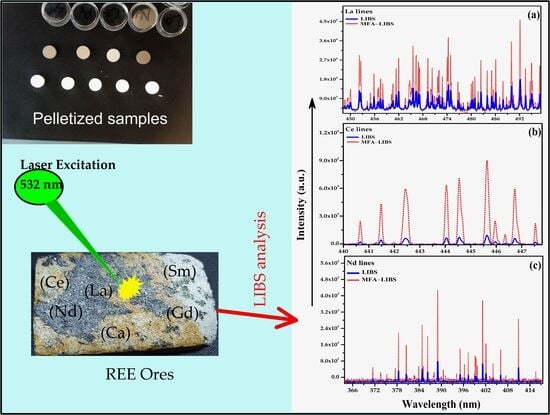
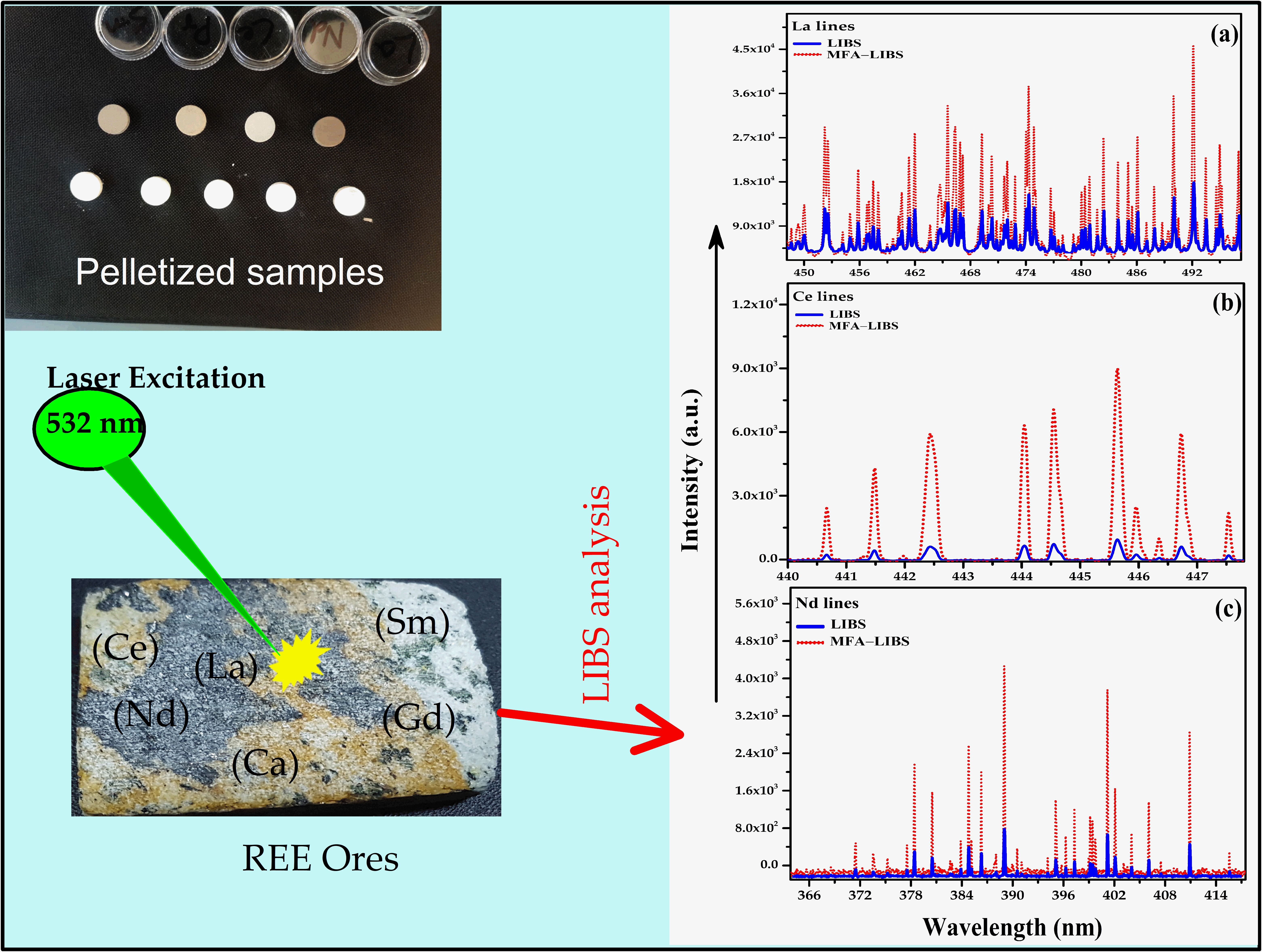
Rare earth element (REE) detection sensitivity with minimal sample damage is exciting. Laser-induced breakdown spectroscopy (LIBS) with a typical methodology is a useful diagnostic tool, but often shows poor REE sensitivity. This study presents the qualitative, quantitative, and classification analysis of REE-bearing ore samples that contain multiple elements from the lanthanoid (Ln) group (e.g., La, Ce, Nd, Sm, and Gd) using the LIBS technique, and the results are compared with those obtained using a magnetic-field-assisted LIBS (MFA-LIBS) system. The LIBS spectrum was recorded using a Nd:YAG Laser with a 532 nm emission wavelength, a 5 ns pulse duration, and a 10 Hz repetition rate. Optical regions exhibiting the strongest emission lines of REEs were identified, followed by MFA-LIBS to improve the qualitative signatures of the elements of interest. MFA-LIBS also assists in confirming signal enhancement for Sm and Gd, which were unidentified with a conventional LIBS setup. Quantitative analysis was performed using a calibration-free and magnetic-field-assisted LIBS (CF-MF-LIBS) method. La, Ce, and Nd concentrations were estimated to be from 1 to 3 wt.%, whereas Sm and Gd were detected within 0.5 wt.%. The results obtained using CF-MF-LIBS were compared with those obtained using the X-ray fluorescence spectroscopy (XRF) technique, showing good agreement between the LIBS/XRF techniques. Further, the limit of detection (LOD) of the REEs using in-house prepared samples was estimated, and the results were compared with those previously reported in the literature. Furthermore, classification analysis of REE ores based on compositional variations was achieved using principal component analysis (PCA). The first two principal components (PCs) with maximum spectral variance, such as PC1~74.5% and PC2~14.5%, were considered for the clustering, and ellipses with 95% confidence using major (x) and minor (y) axes were created to explore outliers. Therefore, the CF-MF-LIBS method in combination with PCA demonstrates a rapid, robust, and effective methodology for the detection, quantification, and classification investigation of REE-bearing ores.

1. Introduction

An ore inorganic aggregate is a naturally occurring rock material that may have economically separable minerals [1]. The extracted rare metals, also known as rare earth elements (REEs), from ore minerals are broadly used in different fields. REEs include a set of 17 chemically similar metallic elements, such as La, Ce, Nd, Sm, Gd, Pr, Y, and Yb [2,3], etc. REEs have been observed in low concentrations, and they are generally concentrated in mineral deposits. REEs show challenges for their extraction, processing, and quantification from these mineral deposits. REEs possess valuable chemical and physical properties that render them crucial for applications in the engineering field, energy manufacturing, magnets, electric vehicles, wind turbines, and technical developments [4,5]. The mining techniques utilized can vary widely depending on the type and location of the ore, ranging from open-pit mining to underground mining. Once the ore is extracted, it undergoes a series of processes to separate and refine the precious minerals from the surrounding rock and impurities. These processes include crushing, grinding, washing, and various chemical or physical separation techniques. To study the distribution and chemical abundance of REE ore minerals, fast, precise, and accurate quantitative measurements are essential, which provide statistics for economic feasibility and resource estimation. In commercial and industrial technological usages, qualitative as well as quantitative studies provide for the compact detection and precise identification of REEs, empowering real reserve assessment, workflow refinement, and quality regulation in ingredients covering rare earths from La to Yb.
Laser-induced breakdown spectroscopy (LIBS) is a technique for the rapid and robust elemental analysis of any material, including solids, liquids, gases, and aerosols, with no or minimal sample preparation; however, calibration procedures may be needed depending on the applied technique, while calibration-free approaches can also be employed under suitable conditions [6,7,8]. Experimentally, a high-power laser beam is focused onto the sample surface, generating a microsecond plasma, and the characteristic light is emitted when the plasma decays. The emission light is spectrally resolved through a spectrometer, which contains optical signatures of the elements present in the sample. Practically all elements of the periodic table can be detected using the LIBS technique by cross-validating with a standard database, covering the spectral range usually from deep-UV to the near IR. LIBS has many applications in various fields, e.g., space exploration, environmental monitoring, geological array (e.g., rocks, ores, and minerals) [9,10,11], mining, agriculture, and the nuclear industry [12,13,14,15,16,17]. LIBS is well-suited for detection, enhancement, quantification, and classification analysis of REE-bearing ores because it demonstrates a rapid, multi-elemental nature, in situ, micro-destructive, and remote analysis, which is crucial for mineral exploration, ore extractions, and mining procedures. Regarding REEs, LIBS has already been applied to study them in different matrices and environments. For example, Bhatt et al. [18] evaluated the analytical performance of collinear DP-LIBS for identifying REEs (e.g., Eu, Gd, Pr, and Y), determining 3 to 13× signal enhancement and up to ~10× improvement in detection limits compared with single-pulse LIBS by optimizing the inter-pulse delay. Martin et al. [19] quantified various REEs such as Eu, Nd, Y, Sm, Gd, La, and Pr using LIBS coupled with the PLS regression technique to build calibration models, achieving reliable quantitative estimates with R2 values of ~0.95 to 0.99. Gaft et al. [20] studied the detection of multiple REEs such as Sm, Tm, Yb, Lu, Eu, Ce, Pr, Nd, Tb, Dy, Ho, Er, Gd, Sc, Y, and La using diatomic molecular emission in LIBS, suggesting that REOs produce characteristic molecular bands whose wavelengths shift systematically with atomic number, enabling enhanced identification of REEs in complex matrices. Regarding quantification, calibration-free laser-induced breakdown spectroscopy (CF-LIBS) can be used as a robust and efficient analytical method for the quantitative characterization of REE-based ore samples without the need for external calibration standards [21]. This potential makes CF-LIBS attractive for REE exploration, where conventional methods often require extensive sample preparation and calibration efforts [22,23]. CF-LIBS estimates elemental concentrations by evaluating plasma temperature and electron density under the assumption of local thermodynamic equilibrium (LTE) [24]. However, its accuracy may be affected by matrix effects, deviations from LTE, and uncertainties in spectroscopic parameters [25,26]. X-ray fluorescence spectroscopy (XRF), on the other hand, is a non-destructive technique based on the emission of characteristic X-rays from elements excited by a primary X-ray source [27,28]. XRF is widely used in ore exploration, due to its capability to provide precise elemental composition over large sample areas [29]. It offers excellent repeatability and minimal sample handling but is limited in detecting light elements and has lower sensitivity for trace-level REE detection compared to LIBS [30].
The key figure of merit of this study is to detect trace-level signals from REE atoms present in the ores. The application of magnetic-field-assisted laser-induced breakdown spectroscopy (MFA-LIBS) is critical to guarantee precise detection and quantification of trace REEs. The external magnetic field of MFA-LIBS exerts a Lorentz force on the plasma particles and confines the laser-produced optical plasma. As a result, an excellent reduction in the radial expansion of the plasma is achieved, and collisional interactions are also enhanced [31]. The important point is that the confinement increases the plasma density and prolongs its lifetime, leading to a higher degree of excitation and ionization. Thus, the spectral line intensities are improved, which is vital for trace elements. Note that the MFA-LIBS technique improves plasma confinement; however, the impact is very responsive to the sample matrix, field strength, and alignment. Over-confinement can essentially restrain trace signals from heavy atoms (e.g., lanthanoid (Ln) group). Therefore, field optimization is an essential requirement to get the trace signals from the low-concentration atoms. Previously, Tang et al. [32] established a transient temperature measurement technique by combining MFA-LIBS with a machine learning model. They reported that magnetic field confinement increased the intensity of the singly ionized iron (Fe) line at 578 nm by 1.67 times and improved SNR by ~25% with a high prediction accuracy, such as an R2 of 0.9982 and an RMSE of 3.57. Liu et al. [33] examined the magnetic confinement using LIBS emission from an Al/Li alloy sample. They showed that the intensities of Al (I) and Li (I) spectral lines are enhanced by ~1.5 to 3 times under a 1.1 T magnetic field compared to field-free conditions. Furthermore, Tang et al. [34] integrated the effect of gold (Au) nanoparticles and magnetic field confinement in LIBS. They showed that while moderate magnetic fields (20 to 90 mT) increased line intensity, the combined NE-LIBS-MF-LIBS approach achieved much higher enhancement factors, up to ~11.5 times for the Cu (I) 521 nm line compared to typical LIBS. Although MFA-LIBS has been broadly applied to analyze a variety of materials and improve spectral performance, its application to ores containing REEs remains very limited. To the best of our knowledge, the application of magnetic field confinement in LIBS for ores containing REEs remains largely unexplored. This gap provides strong motivation for the present study.
In this work, qualitative, quantitative, and classification analyses of REE-bearing ore samples are performed using the LIBS technique. La, Ce, and Nd elements from the lanthanoid (Ln) group are detected with relatively weak amplitudes using the conventional LIBS system, while Sm and Gd are unidentified. Interestingly, the application of the MFA-LIBS technique detects Sm and Gd and also improves signal amplitudes of REEs (e.g., Ce, Gd, La, Nd, and Sm). Both Sm/Gd appeared with detectable intensity amplitudes, establishing the signal enhancement potential of the MFA-LIBS setup. A calibration-free and magnetic-field-assisted LIBS (CF-MF-LIBS) technique is used for the quantitative analysis. The concentration of La, Ce, and Nd is estimated to cover the range from 3 to 8 wt.%, and within the limit of 0.5 wt.% for Sm and Gd. The results obtained from CF-MF-LIBS were compared with XRF measurements, showing excellent agreement between CF-MF-LIBS/XRF. Further, the detection limits of the REE Ce, Gd, La, Nd, and Sm using in-house prepared target samples were estimated. Moreover, classification analysis is achieved using principal component analysis by considering the first two principal components (PCs), such as PC1 and PC2, explaining ~74.5% and ~14.5% of the total variance, respectively, and vibrant grouping is observed within 95% confidence ellipses.

2. Materials and Methodology

2.1. Mineralogical Characterization and Sample Preparation

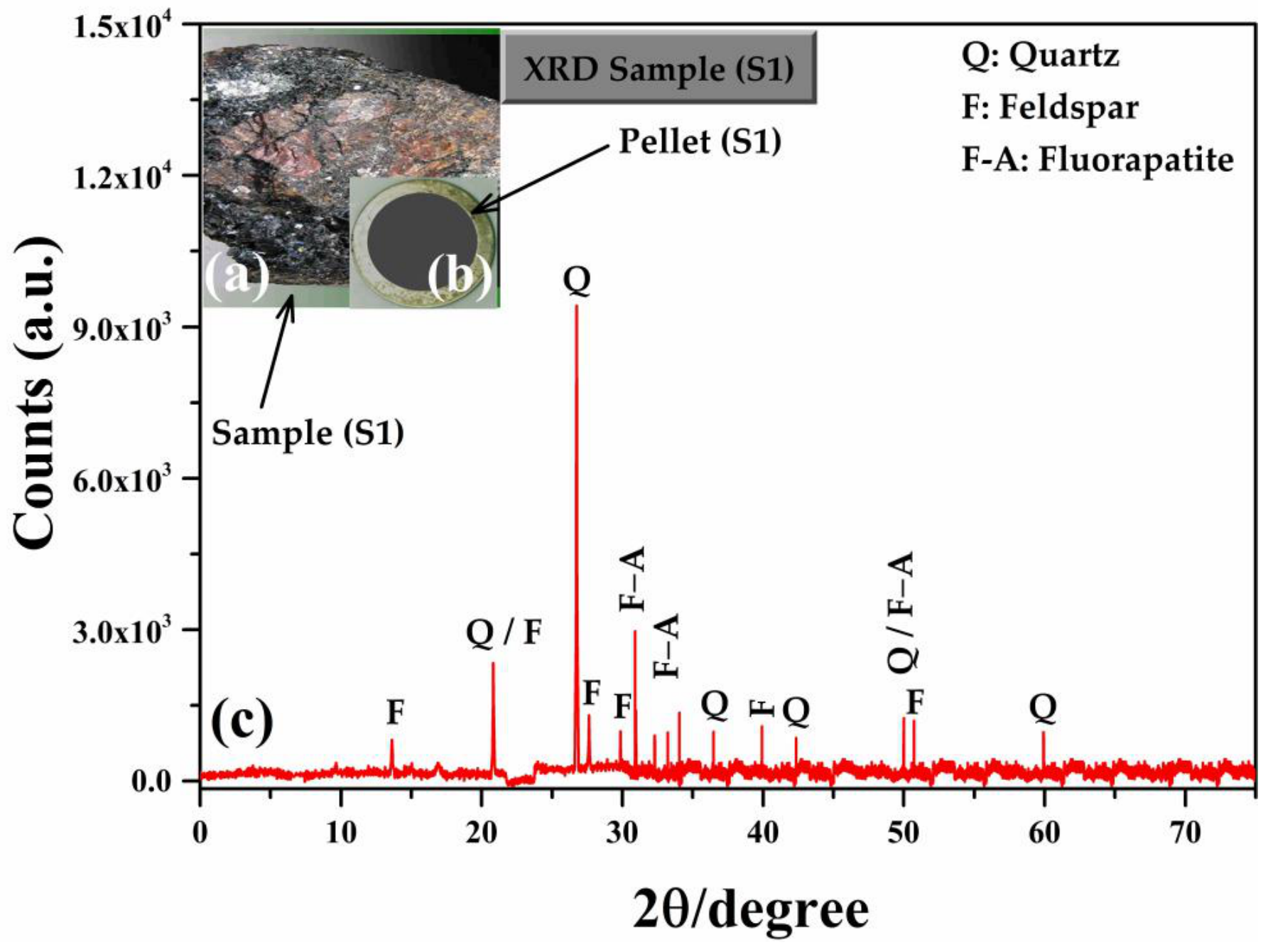
In the present work, seven mineral ore samples (S1, S2, S3, S4, S5, S6, S7) were selected and studied. Their mineralization and matrix types, and the presence of major elements are shown in Table 1. Initial characterization was carried out using X-ray diffraction (XRD) and XRF techniques. A representative case is sample S1: Figure 1a shows the raw sample from mixed silicate—phosphate matrices, Figure 1b presents the prepared pellet, and Figure 1c displays the XRD pattern, confirming quartz, feldspar, and fluorapatite as the principal gangue phases. As specified in Table 1, the samples contain silicate, phosphate, carbonatite, and oxide matrices. Silicate-hosted phases (e.g., royite/fluorapatite/feldspar and eudialyte) are dominated by Al, Ca, Na, and Si, with associated light REEs (e.g., La, Ce, Nd). The carbonatite sample (bastnäsite) is enriched in Ca, C, F, and O, with prominent Ce, highlighting its role as a key REE-bearing mineral. Xenotime represents the phosphate group, characterized by Y and P and enriched in heavy REEs (Dy, Er, Yb). The oxide phase (e.g., magnetite) is primarily composed of Fe and Mg. Bulk analysis shows total REE concentrations in the range of ~0.5–8 wt.%, with light REEs significantly more abundant ~ ( 4 × 10 2 5 × 10 3 ppm) than heavy REEs (generally less than 400 ppm). The original mineral grains varied from a few micrometers to several hundred micrometers; however, all samples were crushed, sieved (˂70 μm), and pelletized for analysis, yielding homogenized polymineralic material and eliminating primary textural features. Preliminary geochemical screening by XRF provided semi-quantitative compositions with typical uncertainties of about ~±8 wt.%. Loss on ignition (LOI) values of ~1–3.5 wt.% indicate minor volatile content, due to structurally bound water and/or small amounts of carbonate phases (e.g., calcite).
In the second stage, for spectroscopic analysis, the raw ore samples were first cleaned in an ultrasonic bath using acetone for 40 min. Samples were then placed in an oven for 90 min to eliminate moisture, followed by crushing and finely grinding to confirm homogeneity. For chemometric analysis to classify REE samples based on compositional variations, two raw ore samples, designated as S6 and S7, were prepared by doping them with known concentrations of selected REEs. Sample S6 was doped with La (5 wt.%), Ce (4 wt.%), and Nd (3 wt.%), whereas sample S7 was doped with Nd (3 wt.%), Sm (2 wt.%), and Gd (1 wt.%). The precision magnitudes were confirmed by using a high-accuracy analytical balance with an accuracy of ±0.01 mg for smaller (~5 mg) and ±0.001 g for larger (~5 g). Evenly increasing the concentration of elements La, Ce, Nd, Sm, and Gd provides a systematic dataset that enhances the strength of the chemometric study for sample classification. Such a controlled concentration gradient allows the chemometric study to efficiently capture and distinguish the variance associated with compositional changes. Furthermore, the detection limits of the REEs (e.g., La, Ce, Nd, Sm, and Gd) were determined using in-house prepared samples with concentration ranges of La (1–5 wt.%), Ce (1–4 wt.%), Nd (1–3 wt.%), Sm (0.5–2 wt.%), and Gd (0.25–1 wt.%). All samples were therefore shaped into pressed pellets with a diameter of ~15 mm and a thickness of ~6 mm using a hydraulic press pressure of ~150 MPa.
In this work, a comparative study between LIBS/XRF was performed for the qualitative and quantitative analysis of REE ores. Even though both systems can be used for elemental study, they are dependent on basically different principles. In LIBS, laser pulses are focused onto the sample surface, leading to rapid heating, melting, and vaporization of the material. This process forms a transient micro plasma that contains excited atoms, ions, and free electrons. As the plasma cools, these excited ingredients return to lower energy states by emitting characteristic light, which acts as an optical fingerprint of the elements present in the sample. The intensity of the light signal is used to estimate the concentration of the elements. In contrast, XRF depends on the interaction of incident X-rays with the sample. When X-rays strike the atoms, they can eject tightly bound inner-shell electrons from the K or L shells. This establishes an electronic vacancy, which is filled by a higher-energy outer-shell electron from an L to K or M to K transition. The energy difference between these shells is released in the form of a fluorescent X-ray photon. The emitted X-rays, which are unique to each element, enable accurate elemental detection and, by measuring their intensity, provide the concentration of the elements.
The quantitative analysis is performed using a calibration-free and magnetic-field-assisted LIBS (CF-MF-LIBS) approach. To apply the CF-MF-LIBS methodology, the plasma must satisfy two essential conditions: it should be optically thin and in local thermodynamic equilibrium (LTE). To confirm optical thinness, the experimentally measured intensity ratios of selected Ca emission lines were compared with the theoretically calculated ratios following our previously reported work [35]. The close agreement between the observed and calculated ratios confirms that the plasma is optically thin. The LTE condition was validated using the McWhirter criterion, which relates to the critical electron number density required for collisional processes to dominate radiative ones. The estimated electron density, calculated using the relation N e 1.6 × 10 12 × E 3 × T , was ~1015 cm−3, consistent with the value obtained from the Stark-broadened Hα line, confirming LTE validity. After verifying optical thinness and LTE, CF-MF-LIBS was applied following the procedure described elsewhere [7,35,36]. Only emission lines that were optically thin, non-resonant, free from self-absorption, unsaturated, and within a 50 nm spectral window were selected to minimize detector efficiency variations.

2.2. Experimental Setup

The LIBS system consists of a Nd:YAG laser (Brilliant, Quantel France, Lannion, France) operating at a wavelength of 1064 nm, with a pulse duration of 5 ns and a repetition rate of 10 Hz. The maximum laser pulse energy is 400 mJ. To generate the LIBS plasma on the sample surface, the laser beam was focused using a convex lens with a focal length of 5 cm. The laser pulse energy was adjusted to 80.0 ± 0.8 mJ by changing the FLQS (flash lamp to Q-switch delay) delay. The focused beam diameter at the target was ~0.5 mm, with a corresponding laser fluence of about 41 Jcm−2. The light emitted by the plasma was collected by a collecting lens coupled with a fiber optic. The fiber optic bundle was coupled to a 6-channel spectrometer (Avantes, Apeldoorn, The Netherlands), each equipped with a 3648 pixel CCD, a 10 μm slit width, 0.06 nm resolution at Zn (I): 577.21 nm [36], and a CCD array detector where the collected plasma light was spectrally resolved within the wavelength range of 220 to 970 nm. The delay (td) and integration time (tg) were set at 2 μs and 10 μs, respectively. For each spectrum, the delay and integration times are optimized and persistent to ensure the emission spectra are not saturated. To minimize single-shot signal variation, 50 single-shot spectra were acquired and averaged for each sample. In this experiment, a constant focal condition throughout the measurements was maintained. The sample positioning is defined in a three-dimensional framework: the y-axis associated with the laser propagation direction (optical axis) and the xz-plane along the horizontal plane of the sample surface. The lens-to-sample distance was precisely fixed along the y-axis by keeping the sample at the focal plane of the focusing lens. This ensured that the laser spot size and corresponding power density remained constant for all measurements. The pellets were manually moved within the xz plane (e.g., the vertical position of the sample was not changed) in small millimeter-scale steps on a horizontal and flat surface following a nearly random pattern in order to sample fresh surface spots. Since this sample surface translational change is perpendicular to the laser propagation direction, it does not affect the focal distance or the laser fluence on the sample. Moreover, the sample surface was kept planar and properly aligned perpendicular to the laser beam to minimize any variation in effective distance during translational variation. Therefore, the experimental procedure ensures a constant lens-to-sample distance and stable power density while assisting measurements over fresh surface regions.
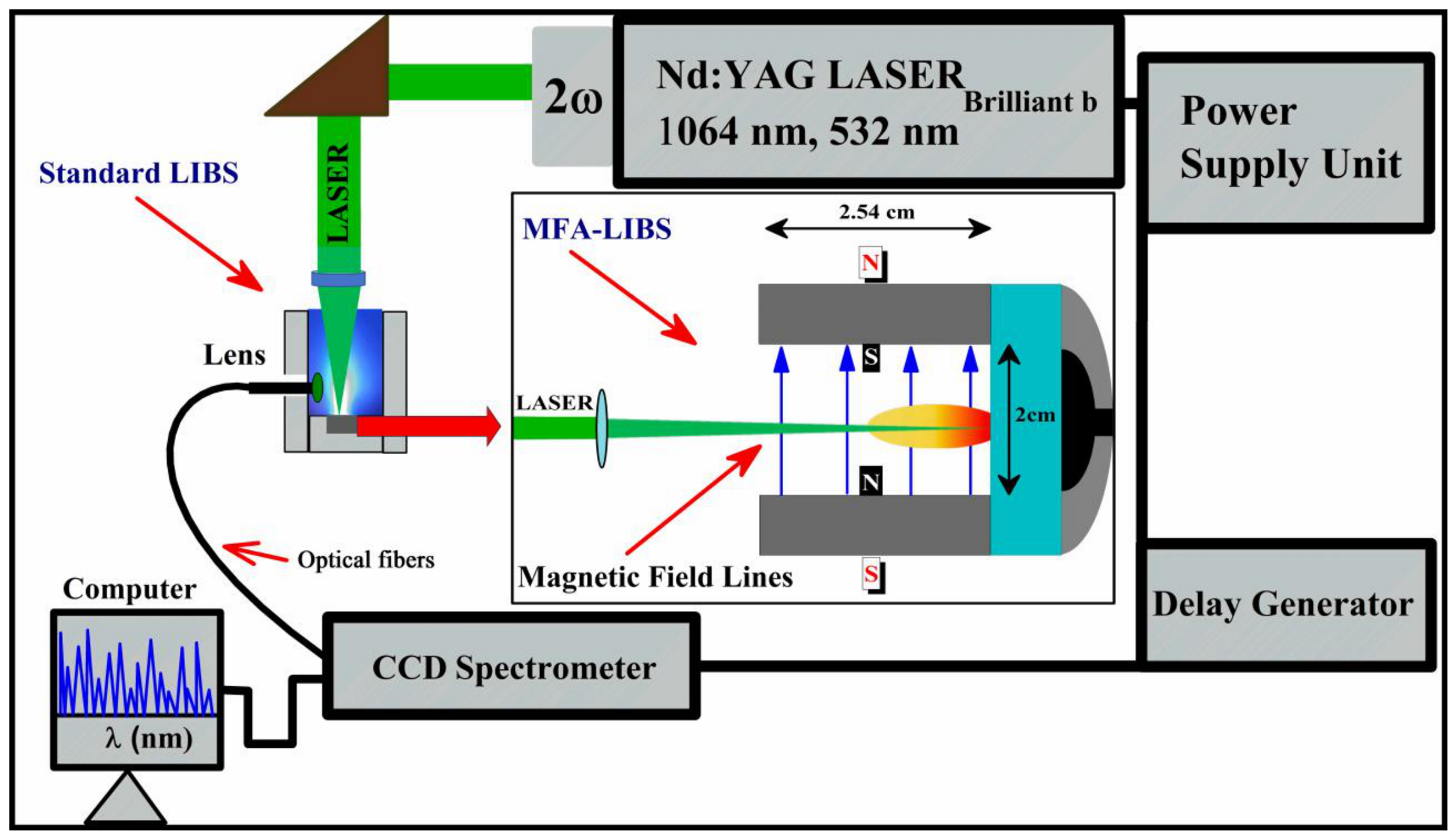
To enhance the emission signal from REE atoms, which are present as relatively trace elements, MFA-LIBS was conducted by increasing the magnetic field strength in regular intervals, such as 430, 450, 470, 490, 510, 530, and 550 mT. In the MFA-LIBS study, the sample is placed within a transverse magnetic field, and plasma is generated by irradiating it with a high-power laser pulse. Figure 2 presents a schematic diagram of the MFA-LIBS experimental setup. The magnetic field in our setup is generated using two separate permanent magnets positioned on either side of the plasma region. This arrangement produces a uniform field at the plasma without using a horseshoe-shaped magnet. The field strength was optimized as 510 mT, which is based on a complete analysis of the signal-to-noise ratio (SNR) obtained for each sample separately to register emission spectra. It was observed that the LIBS emission lines of REEs yielded the highest SNR for all the samples investigated at this optimized 510 mT field strength. The improved SNR at 510 mT reveals a prolonged plasma lifetime and an excellent plasma confinement. Even though small differences in SNR were observed at field strengths higher or lower than 510 mT, the 510 mT field provided the best overall SNR across all tested samples. The optimized strength improves plasma confinement, limits its expansion, and increases collisional interactions between charged particles, thus enhancing plasma parameters (e.g., electron number density and electron plasma temperature). The REE emission lines of interest were La (II): 489.99 nm; Ce (II): 441.88 nm; Nd (II): 386.33 nm; Sm (II): 363.43 nm; and Gd (II): 425.17 nm. These emission lines were studied in the analysis because they appeared with high intensities, were unsaturated, and were free from interferences.
The qualitative and quantitative results of the same REE target samples obtained using CF-MF-LIBS were cross-validated using the X-ray fluorescence (XRF) system (JSX-3202M, Tokyo, Japan). The XRF system is equipped with a silicon drift detector (SDD), which offers high count-rate capabilities, and a rhodium (Rh) anode X-ray tube. The X-ray source operates over a voltage range of 5–50 kV and a current range of 0.01–1.0 mA. The energy resolution of the system is ~135 eV at 5.9 keV (Mn Kα), enabling effective elemental discrimination. The detection limits of the system classically range from 10 to 100 ppm, depending on the element and experimental conditions.

2.3. Theoretical Modeling of Magnetic Field Distribution

The application of an external magnetic field to laser-induced plasma reduces plasma expansion dynamics and enhances charged particle confinement. This results in increased plasma parameters and prolonged emission lifetime, which enhances spectral emission intensity. The enhancement is important for weak emission lines, as they are more sensitive to changes in plasma conditions. The magnetic field confines the plasma by restricting the motion of charged particles (electrons and ions), which spiral along magnetic field lines due to the Lorentz force. This confinement increases both electron density and plasma temperature by suppressing expansion and reducing adiabatic cooling. As a result, the rate of excitation and ionization events rises due to the enhanced electron–atom collision frequency, thereby intensifying the spectral emission lines. The intensity I i j of a spectral line due to a transition from an excited state j to a lower state i can be expressed as [37]:
I i j N j A i j h ν i j
where A i j   ( s 1 ) is the transition probability, ν i j   ( s 1 ) is the frequency of the emitted photon, and N j   ( c m 3 ) is the population of the upper energy level. The population N j is governed by the Boltzmann distribution [37]:
N j = g j N Z ( T ) e E j K T
where g j (dimensionless) is the statistical weight, N   ( c m 3 ) is the total atomic number density, Z ( T ) (dimensionless) is the partition function, E j ( J ) is the excitation energy, and T ( K ) is the electron temperature. The magnetic field also alters key plasma parameters such as the cyclotron frequency ω c = e B m e , the Larmor radius r L = m e ν e B , and the ratio of the kinetic to magnetic plasma pressure β = 2 μ 0 N e K T B 2 , indicating the degree of magnetic confinement when β < 1 . The increase in number density and the plasma temperature through magnetic compression leads to a growth in the excitation and ionization rates. Since the spectral line intensity is proportional to the population of the excited states (which depends on T and N), the signal intensity grows as I N   e x p ( E / k T ) [37]. As a result, SNR improves as the signal increases at a faster rate than the background noise. Because the magnetic field concentrates the species and energy, the signal intensity grows significantly, while the background noise is moderated by the spatial confinement. The standard deviation of the background signal can be used to estimate baseline uncertainty, which accounts for variations arising from detector noise and continuum emission. The electron temperature increases in the presence of an externally applied magnetic field due to the Joule heating effect and adiabatic compression. The expansion of the ionized plume in a magnetic field is best explained by the Magneto-Hydrodynamic (MHD) model, primarily due to the Joule heating effect. The generalized form of Ohm’s law from the MHD equations can be expressed as [38]
E + V × B = J σ + J × B N e e
Here, E and B represent the electric and magnetic fields, respectively; V is the mass flow velocity; J is the electron conduction current; and σ is the electrical conductivity. The term J × B represents the Lorentz force, which contributes to plasma confinement and pressure balance. This confinement increases collisional interactions, empowering the translation of kinetic energy of the expanding plasma species into electron thermal energy, so promoting collisional excitation and ionization and increasing the electron temperature ( T ) and electron number density ( N e ) .

3. Results and Discussion

3.1. Spectral Analysis

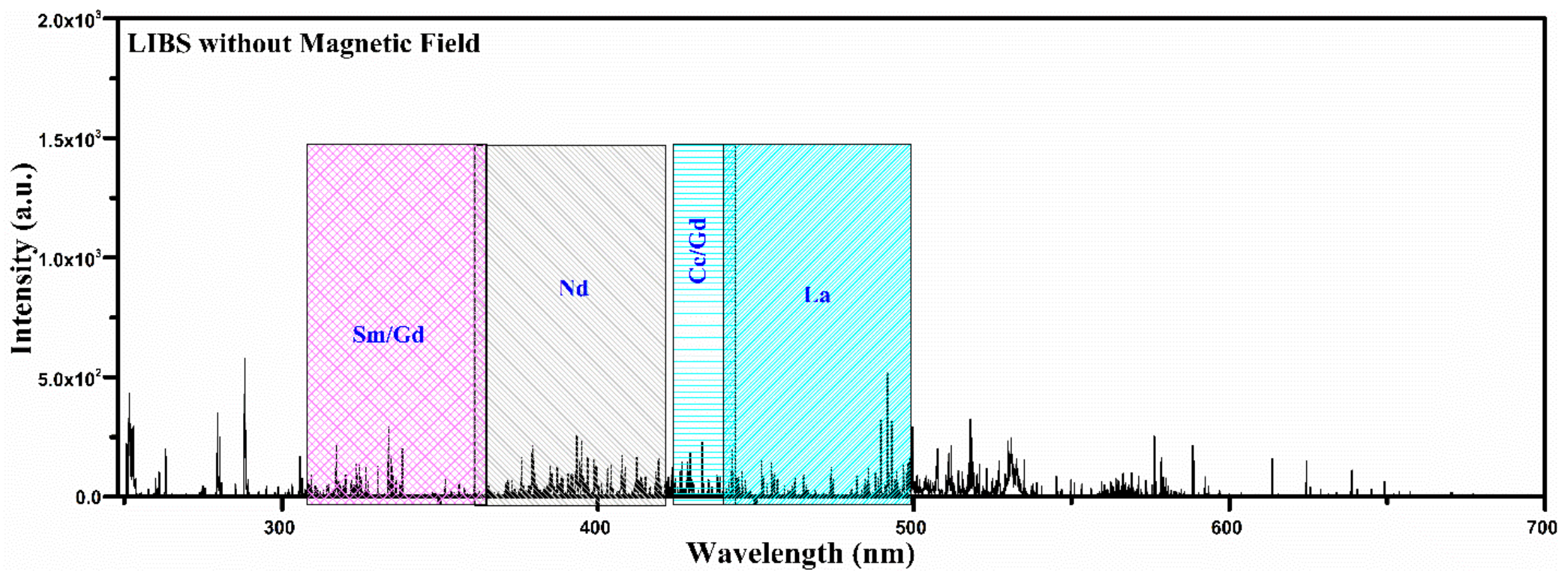
The present study focuses on enhancing the detection sensitivity of REEs using the magnetic-field-assisted LIBS (MFA-LIBS) approach. To evaluate the enhancement in REE detection within ore samples, initial experiments were performed using an established LIBS setup without an external magnetic field. For improved clarity and readability, representative emission spectra of the sample S1 acquired using conventional LIBS over the optical wavelength range of 220 to 970 nm are presented in Figure 3. Various elements such as H (656.28 nm), Li (670.77 and 670.79 nm), C (247.85 nm), O (777.54 and 844.63), Na (588.90 nm), Mg (279.55, 280.27, and 285.21 nm), Si (250.69, 251.43, 251.61, 251.92, 252.41, 252.85, 263.13, and 288.16 nm), K (766.50 nm), Ca (422.67, 428.30, 428.94, 429.89, 430.25, 430.77, 431.86, 442.54, 443.49, 445.47, 487.81, 526.56, 527.03, 534.95, 558.19, 558.87, 559.01, 559.45, 559.85, 612.22, 616.13, 616.22, 643.91, 646.26, 647.17, 649.37, 315.88, 317.93, 393.36, and 396.84 nm), Ti (319.19, 319.99, 320.38, 321.79, 301.72, 302.37, 302.97, and 334.90 nm), and Fe (271.90, 272.09, 296.69, 302.06, 258.58, 259.94, 260.71, 261.19, 263.11, 273.95, 275.57, and 373.5 nm) were identified through their strong, unsaturated, and self-absorption-free emission lines. In addition, trace signals of REEs, including La, Ce, and Nd, were detected in different optical regions as highlighted in Figure 3. The selected regions cover 308 to 365 nm for Sm and Gd, 360 to 420 nm for Nd, 423 to 444 nm for Ce and Gd, and 440 to 500 nm for La. REEs show very rich emission spectra when present in the sample, which can lead to spectral overlap with nearby emission lines limited by spectrometer resolution (0.06 ± 0.01 nm); therefore, we focused only on optical regions that exhibited minimal overlap, well-isolated features, and negligible self-absorption effects.
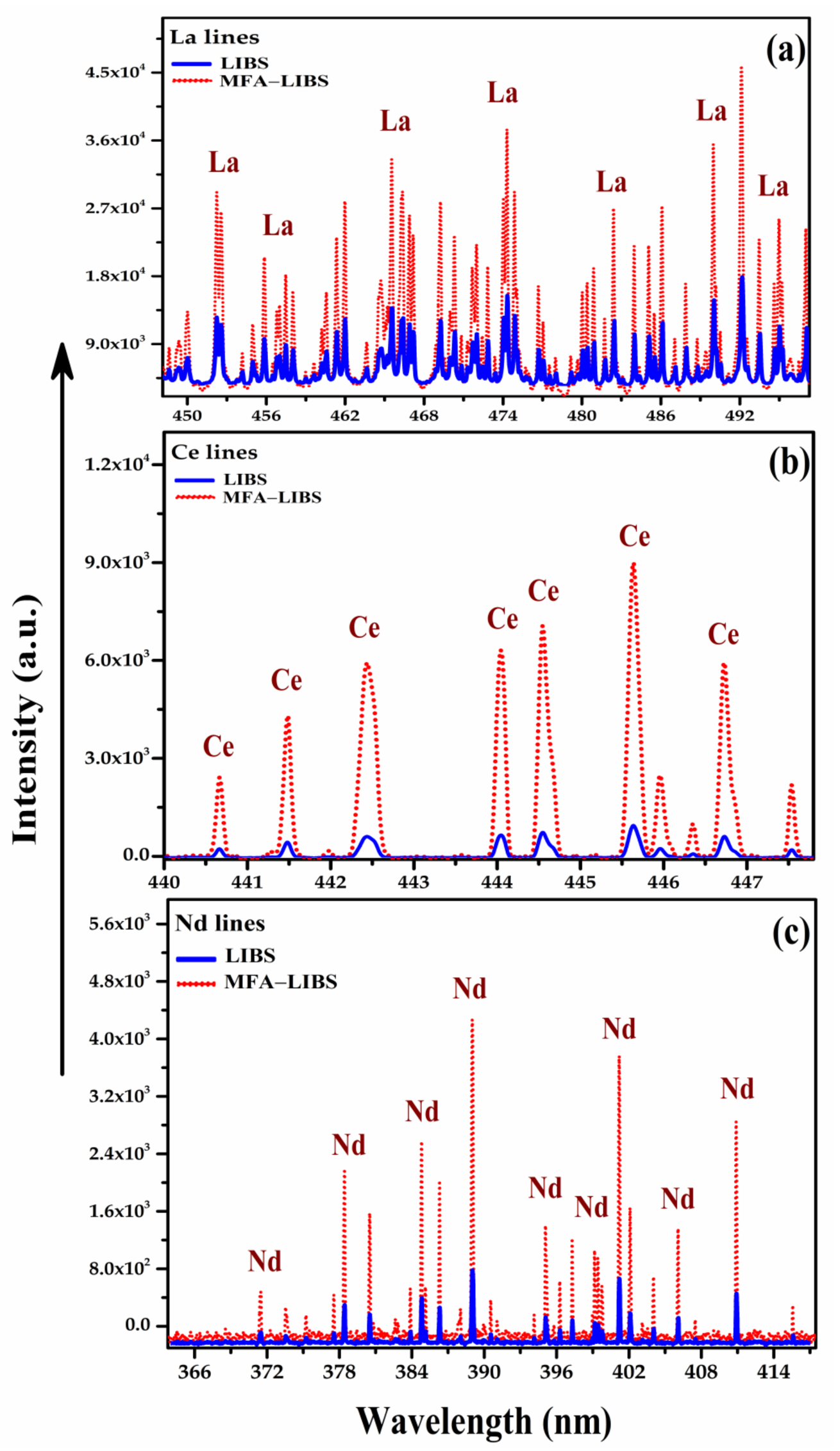
To enhance REE detection and compare with conventional LIBS, MFA-LIBS was employed, which improves weak trace signals by magnetically confining the plasma and increasing excitation rates. This results in higher emission intensities, though accuracy may still be affected by plasma inhomogeneity and field strength variations. A comparative conventional LIBS vs. MFA-LIBS analysis of the emission spectra covering the wavelength ranges 363 to 417 nm, 440 to 448 nm, and 448 to 493 nm for the emission lines of Nd, Ce, and La, respectively, is shown in Figure 4. The spectrum (blue) corresponds to the standard LIBS technique, whereas the spectrum (red) is obtained through MFA-LIBS. In Figure 4a, the emission lines of La obtained with MFA-LIBS are compared with those from standard LIBS analysis. The La emission lines from 450 to 300 nm are evidently detected and identified using the NIST database [39]. The emission lines are observed at central wavelengths [456.79 nm: 4f5d(3F°)6s 47/2 → 5d2(3F)6s 4F7/27/2, 465.55 nm: 4f(27/2)6p1/2 (7/2,1/2)4 → 4f(27/2)6s1/2 (7/2,1/2)°4, 466.07 nm: 4f5d(3D°)6s D°5/2 → 5d2(3F)6s 2F7/2, and 466.25 nm: 4f5d z31 → 5d2 a3F2], [470.26 nm: 4f5d(3F°)6s 47/2 → 5d2(3F)6s 4F9/2, and 470.82 nm: 4f5d(3P°)6s 43/2 → 5d2(1D)6s 2D5/2], [489.99 nm: 4f5d z33 → 5d2 a3F2], and [492.63 nm: 5d2(3F)6p 47/2 → 5d2(3F)6s 4F5/2]. These emission lines exhibit significant enhancement in the spectra obtained using MFA-LIBS, thereby improving the detectability and spectral resolution of the ionic lines. In Figure 4b, the comparative emission spectra of Ce within the wavelength range of 440 to 448 nm are presented using both standard LIBS and MFA-LIBS. With standard LIBS, the Ce emission lines appear with very low SNR, whereas MFA-LIBS reveals them with higher SNR. The Ce emission lines are evidently observed using the NIST database [39] at central wavelengths; 439.79 nm [4f5d(3F°)6p 4G7/2 → 4f5d(3F°)6s 47/2], 441.88 nm [4f2(3H5) 6p3/2 (5,3/2)°13/2 → 4f2(3H)6s 4H13/2], 442.93 nm [4f2(3F4)6p1/2 (4,1/2)°7/2 → 4f2(3F)6s 4F9/2], 445.07 nm [4f2(3H5)6p1/2 (5,1/2)°9/2 → 4f2(3H)6s 4H11/2], 447.12 nm [4f2(3H5)6p1/2 (5,1/2)°9/2 → 4f2(3H)6s 2H9/2], and 448.39 [4f2(3H6)6p1/2 (6,1/2)°11/2 → 4f2(3H)6s 4H13/2]. The intensity amplitude of the Ce spectral lines was enhanced by almost eightfold. This prominent increase is attributed to the rise in plasma temperature caused by plasma confinement. These results show the efficiency of MFA-LIBS in detecting trace REE signals, highlighting its value as a sensitive analytical technique. In Figure 4c, the comparative emission spectra of Nd within the wavelength range of 365 to 415 nm are presented using both standard LIBS and MFA-LIBS. The Nd emission lines are observed at central wavelengths; 372.81 nm [4f46p → 4f46s], 378.37 nm [4f35d6p → 4f35d6s], 384.18 nm [4f35d6p → 4f35d6s], 384.83 nm [4f46p → 4f46s], 385.17 nm [6p → 6s], 386.33 nm [4f46p → 4f46s], 389.15 nm [4f46p → 4f46s], 390.58 nm [4f46p → 4f46s], 395.75 [4f35d6p → 4f35d6s], 404.88 nm [4f35d6p → 4f35d6s], 410.65 nm [4f35d6p → 4f46s], 410.94 nm [4f46p → 4f46s], and 413.33 nm [4f46p → 4f46s] [39]. The enhancement in the signal amplitude of various REE emission lines validates the application of MFA-LIBS for the detection of La, Ce, and Nd in the ore sample. Thus, the sensitivity and accuracy of elemental analysis are improved with the MFA-LIBS system. REEs such as Gd and Sm were also detected; however, their trace signals overlapped with stronger emission lines of other constituent elements, making accurate spectral identification difficult. To minimize uncertainty, only the La, Ce, and Nd emission spectra from well-resolved, non-overlapping, and self-absorption-free zones were presented. Nevertheless, Sm and Gd were included for concentration estimation using their enhanced signals obtained through MFA-LIBS-assisted calibration-free analysis, and the results were compared with XRF data. Despite this, minor uncertainties may persist due to line interference and the limited sensitivity of LIBS for weak REE emissions. Note that even if the emission lines of Sm and Gd partially overlap with stronger emission lines from other elements, we precisely select isolated and slightly interfering lines for investigation. The calibration-free LIBS approach further supports reliable quantification by using the relative intensities of multiple spectral lines, which compensate for spectral overlaps and matrix effects.

3.2. Plasma Characterization

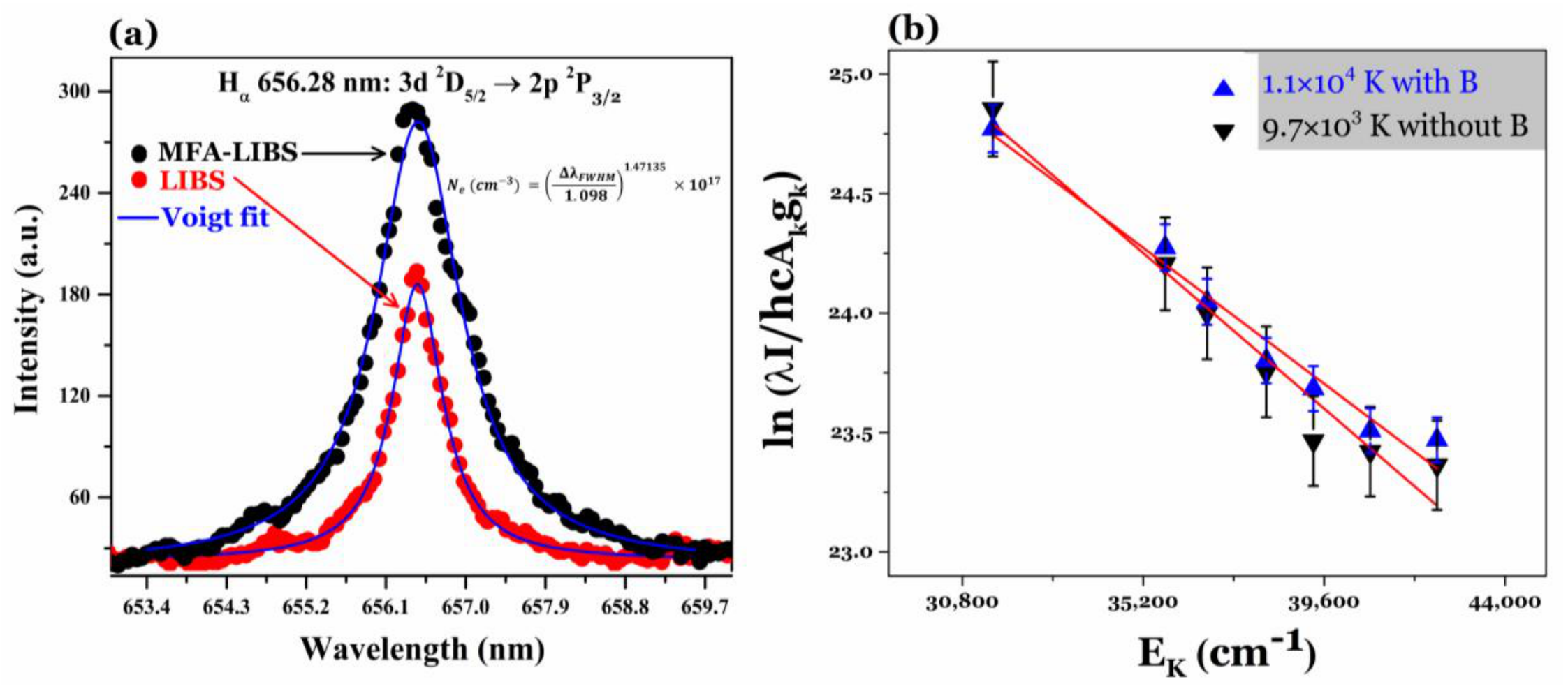
The calibration-free LIBS approach critically depends on the fundamental plasma parameters and conditions. The electron plasma temperature (Te) governs the population distribution of excited states through the Boltzmann distribution, directly influencing the relative emission line intensities, while the electron number density (Ne) determines Stark broadening, line profile characteristics, and overall plasma diagnostics. The assumption of LTE [40] is essential for applying the Boltzmann and Saha equations, ensuring that collisional processes dominate over radiative ones so that species populations follow equilibrium distributions. Moreover, the optically thin plasma condition [37,40] must be satisfied to avoid self-absorption effects, which otherwise distort emission intensities and lead to systematic errors in concentration estimations. Stoichiometric ablation [40], where the ablated plume composition represents the bulk target without preferential element loss, is equally crucial to preserve the integrity of quantitative analysis. So, accurate Te, reliable Ne, LTE validity, optical thinness, and stoichiometric ablation form the base for extracting precise elemental concentrations in CF-LIBS, as they ensure that the theoretical plasma models align with the experimentally observed spectra. In this work, the electron number density was calculated with and without the application of a magnetic field (B) using the full width at half maximum (FWHM) of the hydrogen Hα line at 656.28 nm [36,41], which exhibited a good-quality signal-to-noise ratio (SNR). The FWHM of the line profile was determined using a Voigt function fitting on the Hα line profile [42] that incorporated the instrumental width (0.06 ± 0.01 nm). Self-absorption causes broadening of the spectral line, which may lead to errors in the estimated value of electron density. A self-absorption correction of the line was made, as described in our previously reported work [36]. The average self-absorption coefficient was calculated to be ≤0.023 for the hydrogen Hα emission line in all samples. Therefore, the self-absorption of the Hα line was sufficiently low to be neglected. The observed FWHM of the spectral line for the representative sample S1 was calculated as 1.61 ± 0.5 nm and 0.79 ± 0.5 nm with and without the magnetic field (B), respectively. The number density line profile with Voigt fit for the Hα emission line at 656.28 nm, with and without B for sample S1, is shown in Figure 5a. The calculated electron number density [27] was found to be (1.76 ± 0.1) × 1017 cm−3 with B and (0.62 ± 0.1) × 1017 cm−3 without B. The external magnetic field confines plasma charge particles, reducing electron diffusion and increasing energy coupling, which grows electron plasma temperature, lifetime, and electron number density. The average electron density for all samples studied was (1.49 ± 0.1) × 1017 cm−3 with B and (0.56 ± 0.1) × 1017 cm−3 without B. The error in electron number density was quantified by considering the uncertainty in the Stark-broadened linewidth (e.g., FWHM), which is the basic parameter in number density calculation. The FWHM uncertainty was determined from multiple line profile fittings of the emission line, which accounts for instrumental broadening, spectral noise, and line-fitting variations. These uncertainties were then propagated to estimate the corresponding error in number density using standard error propagation methods.
Plasma temperature is commonly determined using methods based on line intensities, such as line pair ratios or Boltzmann plots, typically yielding temperatures of a few thousand up to ~2 × 10⁴ K. In this study, the plasma temperature was determined using the well-known Boltzmann plot method [36,37]. The accuracy and precision of Te estimation depend on selecting neutral and singly ionized spectral lines with sufficiently large upper-level excitation energy differences. Assuming a Boltzmann distribution of level populations, the integrated line intensity (e.g., relative to the transition rate/unit volume) was used to construct Boltzmann plots from Ca (I) emission lines. LIBS emission spectra recorded using a CCD detector (e.g., indicating temporally integrated plasma emission) were used for electron temperature (Te) estimates. Calcium was chosen because it was consistently present in all samples, and its analysis serves as a validation of the LIBS technique, given Ca’s common occurrence in ores. The selected Ca (I) emission lines were 487.81, 526.56, 527.03, 559.45, 559.85, 612.22, 616.23, and 647.17 nm, as shown in Table 2. The emission intensities were normalized to the Ca (I) at 610.27 nm line for each sample individually to account for variations in calcium concentration. These normalized intensities were used to construct the Boltzmann plots. Since the plasma temperature strongly depends on the delay and integration times, the obtained Te values represent rough, time-averaged estimates. The temperature determined using optically thin lines reflects only a population-averaged value. Figure 5b shows the Boltzmann plots of Ca (I) lines for sample S1 under optimized conditions. Spectroscopic parameters such as transition probabilities, statistical weights, and upper-level energies were obtained from the NIST database [39]. The data points exhibit a strong linear relationship (R2 ≈ 0.997). From the Boltzmann plots, the plasma temperature for sample S1 was estimated as 1.1 × 10 4 K with a magnetic field (B) and 9.7 × 10 3 K without B. The y-axis error bars represent the standard deviation in emission line intensities. Across all samples, the electron temperature ranged from 1.1 × 10 4 K to 1.4 × 10 4 K with B, and 9.1 × 10 3 K to 9.9 × 10 3 K without B, each with an uncertainty of ~±5%. The uncertainty in Te was derived from the statistical uncertainty in the Boltzmann slope.

3.3. X-Ray Fluorescence (XRF) Emission Spectra

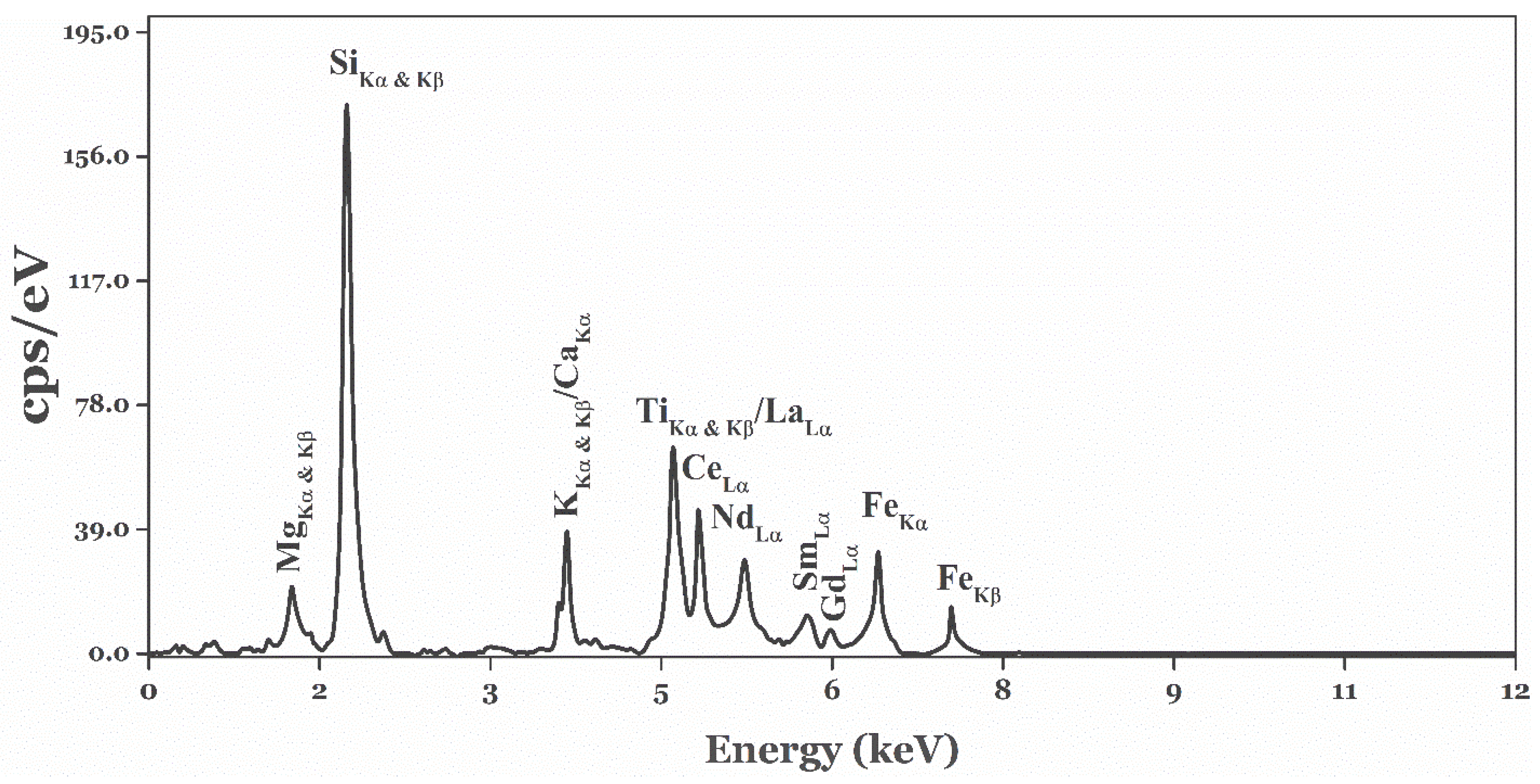
The XRF technique is widely used to locate REEs (e.g., Ce, La, Nd, and Pr) from geological and mineralogical sources and is also helpful for extraction applications. The qualitative emission spectra were recorded for all samples; however, only the spectrum of the representative sample S1 is presented in Figure 6. The spectrum of the REE sample S1 shows the presence of elements including Mg at Kα ≈ 1.25 keV & Kβ ≈ 1.30 keV, Si at Kα ≈ 1.74 keV and Kβ ≈ 1.84 keV, K at Kα ≈ 3.31 keV & Kβ ≈ 3.59 keV, Ca at Kα ≈ 3.69 keV and Kβ ≈ 4.01 keV, Ti at Kα ≈ 4.51 keV & Kβ ≈ 4.93 keV, and Fe at Kα ≈ 6.40 keV and Kβ ≈ 7.06 keV, with Kα and Kβ corresponding to (2p → 1s) and (3p → 1s) transitions, respectively, along with REEs including La, Ce, Nd, Sm, and Gd, showing Lα lines (3d → 2p) at ≈4.65, 4.84, 5.23, 5.64, and 6.06 keV, respectively. The XRF technique efficiently detected REEs La, Ce, Nd, Sm, and Gd, and the estimated concentrations show good agreement with those obtained from LIBS analysis, confirming the reliability of both techniques for REE qualitative and quantitative analysis. However, light elements such as H, Li, C, and Na were not identified by XRF due to its characteristic limitations, including low fluorescence yield and strong absorption in detector windows. The combined use of XRF and LIBS provides complementary elemental information, with XRF reliably detecting mid-size to heavy elements, while LIBS is capable of detecting lighter elements as well.
Despite its excellent capabilities in detection and quantification, XRF presents several fundamental limitations when applied to REE detection. In particular, the characteristic X-ray emission lines of REEs are closely spaced, leading to spectral line overlap (e.g., in general within a few eV to tens of eV). For example, the L-series emission lines of La, Ce, and Nd lie in closely adjacent energy ranges (~4.5 to 6.5 keV), making accurate peak deconvolution challenging, especially in multi-element matrices. As a result, quantitative uncertainties can increase by more than 10 to 20% in complex samples without advanced spectral fitting procedures. This issue is further intensified by matrix effects, where absorption and secondary fluorescence can alter the determined intensities, resulting in additional systematic errors. Furthermore, the detection limits of standard XRF for REEs are usually in the range of tens to hundreds of mg/kg (ppm), which limits its application for trace-level analysis. In contrast, laser-based techniques such as LIBS and MFA-LIBS can achieve lower detection limits under optimized conditions, along with reduced spectral interference due to their broader spectral coverage and plasma-based excitation mechanisms.

3.4. CF-MF-LIBS/XRF Comparison

The use of a calibration-free approach in LIBS-based experiments was first established by Ciucci et al. [37] in 1999. The growing interest in calibration-free LIBS arises from its crucial developments, including the elimination of composition-matched calibration standards and reduced sensitivity to chemical and physical matrix effects [21]. In brief, LIBS plasma is composed of atoms and neutrals, which collectively make up the overall composition of the sample. With LTE assumptions, the line integral intensity is used in the Boltzmann equation [43] to estimate the atomic composition of the elements in the sample. The concentration of the ions in the sample is calculated using the Saha–Boltzmann equation [44], which consists of the atomic and ionic concentrations, ionization energy, partition function, electron number density, and plasma temperature. The total (atomic and ionic) composition of elements in the sample is estimated as the sum of the neutral and ionized contributions.
Table 3 shows the chemical composition estimated by calibration-free and magnetic-field-assisted LIBS (CF-MF-LIBS) and XRF for Li, C, Na, Mg, Si, K, Ti, Ca, Fe, and REEs (La, Ce, Nd, Sm, and Gd). Note that while direct quantification of light elements—oxygen (O), hydrogen (H), nitrogen (N), and sulfur (S)—is not feasible using the present LIBS setup, their presence could be estimated from stoichiometric limitations and phase associations. The percentage (%) error in the concentration measurement of REEs represents the standard deviation in the LIBS measurements relative to the XRF technique, which is estimated by calculating the intensity variation of the signal over 50 laser shots. This error accounts for uncertainties in the transition probability, plasma temperature, and number density derived from the spectroscopic parameters. The results from both analytical techniques show good agreement within ~5% relative standard deviation (RSD). Among the REEs, La is observed at the highest concentration, followed by Ce, Nd, Sm, and Gd. The concentrations of La, Ce, and Nd ranged from ~1–3 wt.%, while Sm and Gd were detected at levels below 0.5 wt.%. Note that XRF is characteristically limited in its ability to detect light elements such as Li, Be, B, and C due to instrumental constraints and very low fluorescence yield for light elements. Light elements emit low-energy X-rays when excited, which are easily absorbed by air, detector windows, and the sample matrix itself before reaching the detector. This self-absorption largely reduces the detectable signal intensity. As a result, the XRF detection limits for light elements are poor, making it unsuitable for their accurate quantification compared to heavier elements.

3.5. Uncertainty Analysis (LIBS vs. XRF)

The uncertainty in quantification of La, Ce, Nd, Sm, and Gd using LIBS and XRF was evaluated through statistical dispersion, inter-technique comparison with XRF, and detection limits associated effects. The magnitude of the accuracy was calculated using the relative standard deviation (RSD) [45]. For La, Ce, and Nd, present in the range of ~1 to 3 wt.%, RSD values were typically below 4%, reflecting stable plasma conditions and high SNRs. The combined uncertainty ( u c ) was estimated by considering major contributing sources that include signal repeatability uncertainty ( u r e p ), calibration uncertainty ( u c a l ), and matrix-effect-related uncertainty ( u m a t ) [46,47]. u r e p is linked with the standard deviation of replicate LIBS-based measurements, u c a l is associated with the regression of spectral intensity to concentration, and u m a t accounts for matrix-related effects, including ablation efficiency, plasma–matrix interactions, and inter-technique deviation relative to XRF. The combined uncertainty ( u c ) is obtained by the root-sum-square of these individual contributions, and the expanded uncertainty ( U ) was then calculated using a coverage factor k = 2 corresponding to a confidence level of approximately 95%, i.e., U = k u c . Based on this approach, the expanded uncertainty for La, Ce, and Nd was estimated to be ~6 to 8%, which is consistent with the observed ~5% relative deviation between LIBS and XRF results. For Sm and Gd, detected at concentrations below 0.5 wt.%, higher relative uncertainties were observed, with RSD values in the range of ~7 to 15%, predominantly due to weak emission intensities and proximity to the detection constraints of LIBS. At concentrations approaching the detection limits, the relative concentration uncertainty increases unusually, as small absolute fluctuations in signal intensity result in large proportional errors. Consequently, the uncertainty for Sm and Gd is strongly associated with detection limits, even though the absolute differences between LIBS and XRF concentrations remain small. Therefore, the combined uncertainty analysis confirms that LIBS provides reliable quantitative results for major REEs with reasonable expanded uncertainty, while the increased relative uncertainty for trace levels (e.g., Sm and Gd) reflects essential sensitivity limitations rather than systematic bias.

3.6. PCA-Based Chemometric Analysis

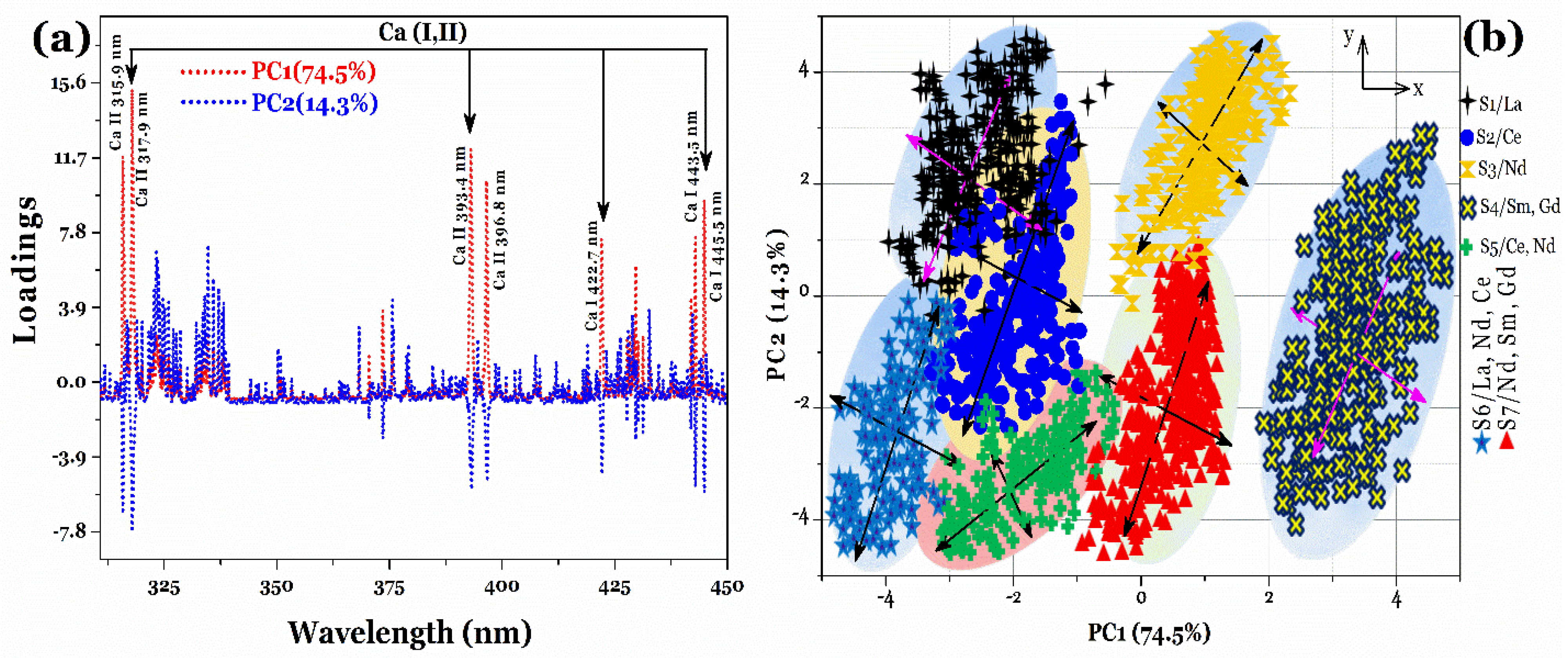
In addition to quantitative analysis using CF-MF-LIBS, multivariate chemometric analysis was applied to the spectral data. The purpose of this section is to demonstrate how multivariate chemometric analysis can classify REE ore samples based on compositional variations, even when multiple elements vary simultaneously. While CF-LIBS provides precise elemental concentrations, multivariate chemometric analysis helps to visualize patterns, correlations, and clustering in the dataset, highlighting subtle differences between samples that may not be immediately evident from univariate analysis. This combined approach provides a more complete identification of sample composition and enhances the capability of CF-MF-LIBS for rapid and reliable ore characterization.
The use of chemometric analysis, such as principal component analysis (PCA), partial least squares, random forest, and independent component analysis, in LIBS has given an important boost to many applications of LIBS, with some limitations [48]. PCA is a supervised multivariate technique that reduces large complex datasets into a smaller number of principal components (PCs) while preserving most of the original variance [49,50,51]. REEs exhibit complex and rich emission spectra with several overlapping weak features; however, PCA can effectively handle such complexity by reducing spectral dimensionality and isolating the most significant variance associated with elemental differences. PCA enhances the visualization of clustering behavior and compositional variations. In this work, emission intensities of the REEs of interest at specific characteristic wavelengths were transformed into orthogonal PCs. The wavelengths of interest were La (II): 492.09 nm; Ce (II): 456.23 nm; Nd (II): 415.60 nm; Sm (II): 363.43 nm; and Gd (II): 425.17 nm. The PCA methodology used in this study was adapted from our previously reported studies [51].
In this analysis, loadings were observed based on Ca emission lines from known samples S6 and S7, and then other samples S1, S2, S3, S4, and S5 were loaded for the analysis based on selected emission wavelengths. Loadings in the PCA plot show a strong response for the Ca element, as shown in Figure 7a. The gradual increase in the target element helps in understanding inter-elemental correlations, matrix effects, and their influence on spectral features. The systematic variation thereby improves the reliability of classification trends, enabling more accurate differentiation among samples with complex elemental interactions. In Figure 7b, we present the statistical compositional variation of the samples based on the concentration of REEs. The first two PCs were considered as they show maximum variance of the total variance, such as PC1 (~74.5%) and PC2 (~14.5%). PCA clustering plots show that data points making clusters with a confidence ellipse are scattered around known samples (6, 7) based on REE concentrations. For example, La is highly concentrated in the representative sample S1, as also observed in the CF-LIBS measurements, and is found very close to sample S6. Similarly, sample S7 can be compared with samples S2, S3, and S5 for Ce and Nd composition. The 2D ellipsoids represent a 95% confidence level within the xy plane. Clearly, the PCA results show that the ore samples were classified by compositional type, as the ellipsoids for S1 (black), S2 (blue), S3 (orange), S4 (black to yellow), S5 (green), S6 (royal blue), and S7 (red) represent different samples based on compositional variation. It is noted that the ellipsoids minimally overlap for two to three samples; however, the data spread remains within the ellipsoids and shows clear differentiation. Furthermore, the ellipsoids are considerably flatter along one of their axes; therefore, the data points lie within a nearly planar region, which further aids classification by compositional type.

3.7. Limits of Detection

The limits of detection (LODs) are identified as the minimum concentration that can be detected with acceptable confidence for a given diagnostic technique. The LOD is an analytical figure of merit applied to estimate the performance of analytical techniques. The calibration curves for estimating the slopes of the elements La, Ce, Nd, Sm, and Gd were constructed using the normalized peak intensity of the emission lines as a function of concentration (wt.%). The normalized peak net intensity was obtained by dividing the peak intensity by the background signal [52]. The intensity normalization procedure was performed to improve the coefficient of determination (R2) of the calibration curves [53,54]. The REE emission lines for calibration curves were included as La (II): 489.99 nm; Ce (II): 441.88 nm; Nd (II): 386.33 nm; Sm (II): 363.43 nm; and Gd (II): 425.17 nm. Singly ionized REE (II) emission lines were selected to construct calibration curves because, in LIBS plasma, rare earth elements are predominantly present in ionized form due to their low first ionization potentials (e.g., ≈5 to 7 eV). This results in REE (II) lines exhibiting higher emission intensities than neutral lines, leading to improved SNR and lower LODs. Furthermore, these lines are less affected by self-absorption and matrix effects, providing better linearity and reproducibility. Their abundance in the UV-VIS spectral range allows for the selection of well-isolated, non-resonance transitions, making REE (II) lines more suitable for accurate and reliable analysis. Therefore, non-resonance lines (e.g., those that do not terminate in the ground state) are recommended to minimize self-absorption. Although the emission lines La (II) at 489.99 nm and Nd (II) at 386.33 nm involve the ground state, no significant self-absorption was observed, probably due to their low concentrations in the sample and the small plasma volume. The coefficients R2 of the calibration curves for La, Ce, Nd, Sm, and Gd were 0.998, 0.976, 0.984, 0.999, and 0.899, respectively. The LODs of the aforementioned elements were calculated using the equation reported elsewhere [54]. In Table 4, we present the LIBS-derived LODs for REEs (La, Ce, Nd, Sm, and Gd), which are comparable to previously published results [55]. The Earth’s crust’s chemical compositions vary from 28.4 to 71 ppm for La, 57.5–66.4 ppm for Ce, 25.6–30.4 ppm for Nd, 4.5–5.09 ppm for Sm, and ~2.8–4.21 ppm for Gd [55]. The REEs abundance in the Earth’s crust was utilized as a reference because it represents REEs average concentrations, which is relevant for geological exploration purposes. Therefore, based on the LODs achieved in this study, LIBS can be employed to generate calibration curves using in-house-prepared REE-doped samples, with the resulting LOD values being directly relevant to extraction, refining, and applications in the geological and mining sectors.

4. Conclusions

The optical emission analysis shown in the present study establishes a strong potential of LIBS for direct application in the qualitative, quantitative, and classification analysis of REE-bearing ores. In this contribution, we have developed a set of LIBS, XRF, and PCA explorations under optimized conditions to investigate ore samples. The qualitative analysis acquired using LIBS shows the presence of REEs (e.g., La, Ce, and Nd) along with other multiple non-REEs (e.g., H, Li, C, O, Na, Mg, Si, K, Ca, Ti, and Fe). Remarkably, the magnetic-field-assisted LIBS (MFA-LIBS) technique detected and enhanced signals corresponding to Sm and Gd, which were unidentified with a conventional LIBS setup. The quantitative analysis was performed by applying calibration-free and magnetic-field-assisted LIBS (CF-MF-LIBS) methodology, which yielded concentration ranges from 1 to 3 wt.% for Ce, La, and Nd and within the range of 0.5 wt.% for Gd and Sm. In addition, the limit of detection (LOD) of the REEs La, Ce, Nd, Sm, and Gd using in-house prepared solid target samples was determined to evaluate the performance of the LIBS analytical technique, and the results were compared with those previously reported in the literature. For comparative studies, the XRF technique was exploited to quantify the REE-bearing ore samples by studying X-ray emissions emitted from inner-shell electron transitions. The combined uncertainty in CF-MF-LIBS for La, Ce, and Nd was estimated to be ~6%–8%, showing strong correlation with the observed relative uncertainty of ~5% between LIBS and XRF. The results verify that both CF-MF-LIBS and XRF techniques are in good agreement. LIBS measurements often show uncertainties due to matrix effects; however, the application of PCA is useful in multielemental and multidimensional spectra to reduce dimensionality and to create matrix-based 2D/3D data clustering. In this work, classification analysis using PCA was accomplished. The first two principal components (PCs), such as PC1 (~74.5%) and PC2 (~14.5%), having maximum spectral variance, were considered. A 2D elliptical clustering with a 95% confidence interval was constructed, supporting the strength of the classification. Therefore, the results show that integrating LIBS with XRF and multivariate techniques offers an efficient and robust approach for the detection, quantification, and classification of rare earth ores.

Author Contributions

Conceptualization, A.F., M.W., U.L. and K.N.; Methodology, A.F., M.W., U.L. and K.N.; Software, U.L.; Validation, M.A.B.; Formal analysis, A.F., M.W. and U.L.; Investigation, A.F.; Data curation, A.F.; Writing—original draft, A.F.; Writing—review & editing, M.A.B.; Visualization, M.W. and K.N.; Supervision, M.A.B.; Funding acquisition, M.A.B. and M.W. All authors have read and agreed to the published version of the manuscript.

Funding

This research received no external funding.

Data Availability Statement

The raw data supporting the conclusions of this article will be made available by the authors on request.

Acknowledgments

This research was completed at the Atomic and Laser Laboratory, Department of Physics, Quaid-i-Azam University (QAU), and the Laser Laboratory, National Centre for Physics (NCP), Islamabad. The authors gratefully acknowledge the support of the Pakistan Academy of Sciences (PAS) for funding the acquisition of the instrumental setup used in this study.

Conflicts of Interest

The authors declare no conflict of interest.

References

  1. Robb, L. Introduction to Ore-Forming Processes; John Wiley & Sons: Hoboken, NJ, USA, 2020. [Google Scholar]
  2. Jha, A.R. Rare Earth Materials: Properties and Applications; CRC Press: Boca Raton, FL, USA, 2014. [Google Scholar]
  3. Alonso, E.; Sherman, A.M.; Wallington, T.J.; Everson, M.P.; Field, F.R.; Roth, R.; Kirchain, R.E. Evaluating rare earth element availability: A case with revolutionary demand from clean technologies. Environ. Sci. Technol. 2012, 46, 3406–3414. [Google Scholar] [CrossRef]
  4. Haque, N.; Hughes, A.; Lim, S.; Vernon, C. Rare earth elements: Overview of mining, mineralogy, uses, sustainability and environmental impact. Resources 2014, 3, 614–635. [Google Scholar] [CrossRef]
  5. Haxel, G. Rare Earth Elements: Critical Resources for High Technology; US Department of the Interior, US Geological Survey: Reston, VA, USA, 2002; Volume 87.
  6. Pořízka, P.; Demidov, A.; Kaiser, J.; Keivanian, J.; Gornushkin, I.; Panne, U.; Riedel, J. Laser-induced breakdown spectroscopy for in situ qualitative and quantitative analysis of mineral ores. Spectrochim. Acta Part B At. Spectrosc. 2014, 101, 155–163. [Google Scholar] [CrossRef]
  7. Umar, Z.A.; Liaqat, U.; Ahmed, R.; Baig, M.A. Classification of nephrite using calibration-free laser induced breakdown spectroscopy (CF–LIBS) with comparison to laser ablation–time-of-flight–mass spectrometry (LA–TOF–MS). Anal. Lett. 2020, 53, 203–216. [Google Scholar] [CrossRef]
  8. Yu, X.; Li, Y.; Gu, X.; Bao, J.; Yang, H.; Sun, L. Laser-induced breakdown spectroscopy application in environmental monitoring of water quality: A review. Environ. Monit. Assess. 2014, 186, 8969–8980. [Google Scholar] [CrossRef]
  9. Gaft, M.; Panczer, G.; Reisfeld, R.; Shinno, I. Laser-induced luminescence of rare-earth elements in natural zircon. J. Alloys Compd. 2000, 300, 267–274. [Google Scholar] [CrossRef]
  10. Romppanen, S.; Häkkänen, H.; Kaski, S. Singular value decomposition approach to the yttrium occurrence in mineral maps of rare earth element ores using laser-induced breakdown spectroscopy. Spectrochim. Acta Part B At. Spectrosc. 2017, 134, 69–74. [Google Scholar] [CrossRef]
  11. Abedin, K.M.; Haider, A.F.M.Y.; Rony, M.A.; Khan, Z.H. Identification of multiple rare earths and associated elements in raw monazite sands by laser-induced breakdown spectroscopy. Opt. Laser Technol. 2011, 43, 45–49. [Google Scholar] [CrossRef]
  12. Harmon, R.S.; De Lucia, F.C.; Miziolek, A.W.; McNesby, K.L.; Walters, R.A.; French, P.D. Laser-induced breakdown spectroscopy (LIBS)–an emerging field-portable sensor technology for real-time, in-situ geochemical and environmental analysis. Geochem. Explor. Environ. Anal. 2005, 5, 21–28. [Google Scholar] [CrossRef]
  13. Baig, M.A.; Fayyaz, A.; Ahmed, R.; Umar, Z.A.; Asghar, H.; Liaqat, U.; Hedwig, R.; Kurniawan, K.H. Analytical techniques for elemental analysis: LIBS, LA-TOF-MS, edx, pixe, and XRF: A review. Proc. Pak. Acad. Sci. A Phys. Comput. Sci. 2024, 61, 99–112. [Google Scholar]
  14. Bhatt, C.R.; Ghany, C.; Yueh, F.; Singh, J.; McIntyre, D. Laser-Induced Breakdown Spectroscopy: Advanced Analytical Technique Chapter 12; National Energy Technology Laboratory (NETL): Pittsburgh, PA, USA; Morgantown, WV, USA; Albany, OR, USA, 2020.
  15. Ji, J.; Hou, Z.; Song, W.; Yu, X.; Wang, Z. Quantitative performance improvement using beam shaping plasma modulation for uranium detection in di-uranate using laser-induced breakdown spectroscopy. J. Anal. At. Spectrom. 2024, 39, 1885–1894. [Google Scholar] [CrossRef]
  16. Fayyaz, A.; Waqas, M.; Asghar, H.; Ahmed, R.; Liaqat, U.; Naseem, K.; Baig, M.A. Rapid Elemental Imaging of Copper-bearing Critical Ores using Laser-Induced Breakdown Spectroscopy coupled with PCA and PLS-DA. Talanta 2026, 296, 128463. [Google Scholar] [CrossRef]
  17. Cui, M.; Deguchi, Y.; Wang, Z.; Tanaka, S.; Jeon, M.-G.; Fujita, Y.; Zhao, S. Remote open-path laser-induced breakdown spectroscopy for the analysis of manganese in steel samples at high temperature. Plasma Sci. Technol. 2018, 21, 034007. [Google Scholar] [CrossRef]
  18. Bhatt, C.R.; Hartzler, D.; Jain, J.C.; McIntyre, D.L. Evaluation of analytical performance of double pulse laser-induced breakdown spectroscopy for the detection of rare earth elements. Opt. Laser Technol. 2020, 126, 106110. [Google Scholar] [CrossRef]
  19. Martin, M.; Martin, R.C.; Allman, S.; Brice, D.; Wymore, A.; Andre, N. Quantification of rare earth elements using laser-induced breakdown spectroscopy. Spectrochim. Acta Part B At. Spectrosc. 2015, 114, 65–73. [Google Scholar] [CrossRef]
  20. Gaft, M.; Nagli, L.; Gorychev, A.; Raichlin, Y. Rare-earth elements detection using diatomic molecular laser-induced plasma spectroscopy. Spectrochim. Acta Part B At. Spectrosc. 2022, 192, 106426. [Google Scholar] [CrossRef]
  21. Hermann, J. Calibration-Free Laser-Induced Breakdown Spectroscopy. In Laser Induced Breakdown Spectroscopy (LIBS) Concepts, Instrumentation, Data Analysis and Applications; Springer: Cham, Switzerland, 2023; Volume 1, pp. 89–121. [Google Scholar]
  22. Fayyaz, A.; Baig, M.A.; Waqas, M.; Liaqat, U. Analytical techniques for detecting rare earth elements in geological ores: Laser-induced breakdown spectroscopy (LIBS), MFA-LIBS, thermal LIBS, laser ablation time-of-flight mass spectrometry, energy-dispersive X-ray spectroscopy, energy-dispersive X-ray fluorescence spectrometer, and inductively coupled plasma optical emission spectroscopy. Minerals 2024, 14, 1004. [Google Scholar]
  23. Harmon, R.S. Laser-induced breakdown spectroscopy in mineral exploration and ore processing. Minerals 2024, 14, 731. [Google Scholar] [CrossRef]
  24. De Giacomo, A.; Dell’Aglio, M.; Salajkova, Z.; Vaníčková, E.; Mele, D.; Dellino, P. Real-time analysis of the fine particles in volcanic plumes: A pilot study of laser induced breakdown spectroscopy with calibration-free approach (CF-LIBS). J. Volcanol. Geotherm. Res. 2022, 432, 107675. [Google Scholar] [CrossRef]
  25. Wang, Z.; Li, L.; West, L.; Li, Z.; Ni, W. A spectrum standardization approach for laser-induced breakdown spectroscopy measurements. Spectrochim. Acta Part B At. Spectrosc. 2012, 68, 58–64. [Google Scholar] [CrossRef]
  26. Costa, V.C.; Babos, D.V.; Castro, J.P.; Andrade, D.F.; Gamela, R.R.; Machado, R.C.; Sperança, M.A.; Araújo, A.S.; Garcia, J.A.; Pereira-Filho, E.R. Calibration strategies applied to laser-induced breakdown spectroscopy: A critical review of advances and challenges. J. Braz. Chem. Soc. 2020, 31, 2439–2451. [Google Scholar] [CrossRef]
  27. Singh, V.K.; Kawai, J.; Tripathi, D.K. (Eds.) X-Ray Fluorescence in Biological Sciences: Principles, Instrumentation, and Applications; John Wiley & Sons: Hoboken, NJ, USA, 2022. [Google Scholar]
  28. Baig, M.A.; Ahmed, R.; Umar, Z.A. Comparison of LIBS with other analytical techniques. In Laser Induced Breakdown Spectroscopy (LIBS) Concepts, Instrumentation, Data Analysis and Applications; John Wiley & Sons: Hoboken, NJ, USA, 2023; Volume 1, pp. 461–486. [Google Scholar]
  29. Balaram, V. Advances in analytical techniques and applications in exploration, mining, extraction, and metallurgical studies of rare earth elements. Minerals 2023, 13, 1031. [Google Scholar] [CrossRef]
  30. Saputra, H.A.; Aji, D.; Ali, B.T.I.; Asranudin. Emerging Analytical Techniques for Rare Earth Element Study: Basic Principles and Cutting-Edge Developments. Analytica 2025, 6, 35. [Google Scholar] [CrossRef]
  31. Singh, K.S. A Mini-Review on Laser-Produced Plasma in an External Magnetic Field: Plasma Confinement and Optical Emission Enhancement. Mapana J. Sci. 2024, 23, 1. [Google Scholar] [CrossRef]
  32. Tang, B.; Yang, Z.; Li, Z.; Wei, W.; Xia, L.; Li, Z.; Li, P.; Wu, G. A transient temperature measurement method for extreme environments based on the combination of MF-LIBS and machine learning. Talanta 2025, 292, 127927. [Google Scholar] [CrossRef]
  33. Liu, P.; Hai, R.; Wu, D.; Xiao, Q.; Sun, L.; Ding, H. The enhanced effect of optical emission from laser induced breakdown spectroscopy of an Al-Li alloy in the presence of magnetic field confinement. Plasma Sci. Technol. 2015, 17, 687–692. [Google Scholar] [CrossRef]
  34. Tang, H.; Hao, X.; Hu, X. Spectral enhancement effect of LIBS based on the combination of Au nanoparticles with magnetic field. Optik 2019, 179, 1129–1133. [Google Scholar] [CrossRef]
  35. Fayyaz, A.; Liaqat, U.; Adeel Umar, Z.; Ahmed, R.; Aslam Baig, M. Elemental analysis of cement by calibration-free laser induced breakdown spectroscopy (CF-LIBS) and comparison with laser ablation–time-of-flight–mass spectrometry (LA-TOF-MS), energy dispersive X-ray spectrometry (EDX), X-ray fluorescence spectroscopy (XRF), and proton induced X-ray emission spectrometry (PIXE). Anal. Lett. 2019, 52, 1951–1965. [Google Scholar]
  36. Fayyaz, A.; Waqas, M.; Fatima, K.; Naseem, K.; Asghar, H.; Ahmed, R.; Umar, Z.A.; Baig, M.A. Laser-Based Characterization and Classification of Functional Alloy Materials (AlCuPbSiSnZn) Using Calibration-Free Laser-Induced Breakdown Spectroscopy and a Laser Ablation Time-of-Flight Mass Spectrometer for Electrotechnical Applications. Materials 2025, 18, 2092. [Google Scholar] [CrossRef] [PubMed]
  37. Ciucci, A.; Corsi, M.; Palleschi, V.; Rastelli, S.; Salvetti, A.; Tognoni, E. New procedure for quantitative elemental analysis by laser-induced plasma spectroscopy. Appl. Spectrosc. 1999, 53, 960–964. [Google Scholar] [CrossRef]
  38. Freidberg, J.P. ideal MHD; Cambridge University Press: Cambridge, UK, 2014. [Google Scholar]
  39. NIST Database. 2025. Available online: https://physics.nist.gov/PhysRefData/ASD/lines_form.html (accessed on 30 April 2025).
  40. Tognoni, E.; Cristoforetti, G.; Legnaioli, S.; Palleschi, V.; Salvetti, A.; Müller, M.; Panne, U.; Gornushkin, I. A numerical study of expected accuracy and precision in calibration-free laser-induced breakdown spectroscopy in the assumption of ideal analytical plasma. Spectrochim. Acta Part B At. Spectrosc. 2007, 62, 1287–1302. [Google Scholar] [CrossRef]
  41. Konjević, N.; Ivković, M.; Sakan, N. Hydrogen Balmer lines for low electron number density plasma diagnostics. Spectrochim. Acta Part B At. Spectrosc. 2012, 76, 16–26. [Google Scholar] [CrossRef]
  42. Xu, W.; Sun, C.; Zhang, Y.; Yue, Z.; Shabbir, S.; Zou, L.; Chen, F.; Wang, L.; Yu, J. Accurate determination of structural H2O in rocks using LIBS coupled with machine learning algorithms extensively exploring the characteristics of the Hα line. J. Anal. At. Spectrom. 2022, 37, 317–329. [Google Scholar] [CrossRef]
  43. Hahn, D.W.; Omenetto, N. Laser-induced breakdown spectroscopy (LIBS), part II: Review of instrumental and methodological approaches to material analysis and applications to different fields. Appl. Spectrosc. 2012, 66, 347–419. [Google Scholar] [CrossRef]
  44. Cremers, D.A.; Radziemski, L.J. Handbook of Laser-Induced Breakdown Spectroscopy; John Wiley & Sons: Hoboken, NJ, USA, 2013. [Google Scholar]
  45. Wang, J.; Shi, M.; Zheng, P.; Xue, S. Quantitative analysis of lead in tea samples by laser-induced breakdown spectroscopy. J. Appl. Spectrosc. 2017, 84, 188–193. [Google Scholar] [CrossRef]
  46. Magnusson, B.; Näykki, T.; Hovind, H.; Krysell, M.; Sahlin, E. Handbook for calculation of measurement uncertainty in environmental laboratories. In Nordtest Report TR 537, 4th ed.; NORDTEST: Serravalle Scrivia, Italy, 2017. [Google Scholar]
  47. Rasul, S.B.; Kajal, A.M.; Khan, A.H. Quantifying uncertainty in analytical measurements. J. Bangladesh Acad. Sci. 2017, 41, 145–163. [Google Scholar] [CrossRef]
  48. Zhang, T.L.; Shan, W.U.; Tang, H.S.; Wang, K.; Duan, Y.-X.; Li, H. Progress of chemometrics in laser-induced breakdown spectroscopy analysis. Chin. J. Anal. Chem. 2015, 43, 939–948. [Google Scholar] [CrossRef]
  49. Chatterjee, S.; Singh, M.; Biswal, B.P.; Sinha, U.K.; Patbhaje, S.; Sarkar, A. Application of laser-induced breakdown spectroscopy (LIBS) coupled with PCA for rapid classification of soil samples in geothermal areas. Anal. Bioanal. Chem. 2019, 411, 2855–2866. [Google Scholar] [CrossRef]
  50. Unnikrishnan, V.K.; Choudhari, K.S.; Kulkarni, S.D.; Nayak, R.; Kartha, V.B.; Santhosh, C. Analytical predictive capabilities of laser induced breakdown spectroscopy (LIBS) with principal component analysis (PCA) for plastic classification. RSC Adv. 2013, 3, 25872–25880. [Google Scholar] [CrossRef]
  51. Fayyaz, A.; Asghar, H.; Alrebdi, T.A. Laser-induced breakdown spectroscopy and energy-dispersive X-ray analyses for green mineral fluorite (CaF2). Results Phys. 2023, 52, 106850. [Google Scholar] [CrossRef]
  52. Diaz, D.; Hahn, D.W.; Molina, A. Evaluation of laser-induced breakdown spectroscopy (LIBS) as a measurement technique for evaluation of total elemental concentration in soils. Appl. Spectrosc. 2012, 66, 99–106. [Google Scholar] [CrossRef]
  53. Long, G.L.; Winefordner, J.D. Limit of detection. A closer look at the IUPAC definition. Anal. Chem. 1983, 55, 712A–724A. [Google Scholar]
  54. Lister, A.S. Validation of HPLC Methods. In Handbook of Pharmaceutical Analysis by HPLC; Elsevier: Amsterdam, The Netherlands, 2005; Volume 6, p. 191. [Google Scholar]
  55. Rudnick, R.L. Composition of the continental crust. In Treatise on Geochemistry; Holland, H.D., Turekian, K.K., Eds.; Elsevier Ltd.: Amsterdam, The Netherlands, 2003; pp. 1–64. [Google Scholar]
Figure 1. (a) Ore sample S1, (b) shows sample S1 pressed pellet, (c) sample S1 characterization using the XRD technique.
Minerals 16 00565 g001
Figure 2. MFA-LIBS experimental system.
Minerals 16 00565 g002
Figure 3. LIBS emission spectrum obtained without an external magnetic field, highlighting different regions of interest corresponding to REEs [39].
Minerals 16 00565 g003
Figure 4. Comparative LIBS and MFA-LIBS emission spectra of the REE sample showing enhanced peak intensities of (a) La, (b) Ce, and (c) Nd.
Minerals 16 00565 g004
Figure 5. (a) Hα emission line at 656.28 nm with (black) and without (red) a magnetic field, together with the Voigt line fitting profile [42] (blue). (b) Boltzmann plots of Ca emission lines with vertical error bars representing the standard deviation of intensity measurements for multiple laser shots, with and without the application of a magnetic field (B).
Minerals 16 00565 g005
Figure 6. XRF-based elemental detection in REE sample S1.
Minerals 16 00565 g006
Figure 7. (a) PCA loadings as a function of wavelength. (b) 2D score plot of the first two principal components. Samples S1 to S5 are raw ores containing REEs: La (S1), Ce (S2), Nd (S3), Sm and Gd (S4), and Ce and Nd (S5). Two additional raw ore samples without REE signatures were doped with known REE concentrations for classification analysis.
Minerals 16 00565 g007
Table 1. Sample properties (mineralization, matrix, and major elements).
Sample #MineralizationMatrixMajor Elements
1Royite/Fluorapatite/FeldsparSilicate/Phosphate Na, Mg, K, Fe, Al, Si, with REE traces (La, Ce, Nd, Sm, and Gd)
2BastnäsiteCarbonatiteC, Ca, F, O, Ba, and Ce
3EudialyteSilicateNa, Ca, Si, O, Fe, Mn, Cl, with light REEs (La, Ce, and Nd)
4XenotimePhosphateY, P, with REEs (Dy, Y, Er, and Yb)
5MagnetiteFe-Mg OxideFe, Mg, O, and Si
6FergusoniteGranite/Pegmatite Al, Si, Ca, Th, with REE traces (Ce, Sm, Dy, Er, Y, Nb, Gd, Yb)
7AllanitePegmatiteSi, Ca, Al, Fe, with light REEs (La, Ce, Nd; minor Sm)
Table 2. Spectroscopic parameters of the Ca (I) spectral lines used to create Boltzmann plots.
Wavelength, λ (nm)Transition Probability (107 s−1)Ek (eV)gk
Calcium (I)
487.811.885.257
526.564.44.883
527.035.04.885
559.453.84.745
559.854.34.743
612.222.873.913
616.234.773.913
647.170.594.447
Table 3. Chemical composition (wt.%) of the samples obtained using CF-MF-LIBS and XRF.
S1 (wt.%) S2 (wt.%)S3 (wt.%)S4 (wt.%)S5 (wt.%)S6 (wt.%)S7 (wt.%)
CF-MF-LIBS/XRF
ElementLi1.411.911.771.392.881.511.93
C2.822.922.112.512.911.841.73
Na4.163.872.433.143.064.962.11
Mg5.67/5.952.65/3.431.36/1.295.66/6.415.34/6.283.98/4.474.99/4.67
Si26.21/27.8827.74/29.7529.22/31.4827.75/29.5028.22/30.2124.58/26.2129.23/30.54
K0.97/0.892.07/2.902.15/2.731.87/1.971.64/2.591.73/1.901.44/1.39
Ti9.41/9.7213.05/15.6615.71/16.5511.85/13.2414.58/15.7514.12/16.6212.99/13.30
Ca22.30/25.1420.51/21.6118.28/20.9018.22/19.5114.57/16.2821.38/22.5921.37/25.11
Fe20.75/22.4418.93/19.8119.79/20.2519.17/22.2119.22/21.3418.38/20.9116.87/17.44
La2.32/2.97 ± 0.221.93/2.18 ± 0.122.71/2.69 ± 0.742.48/2.40 ± 0.031.95/1.19 ± 0.642.81/2.78 ± 0.012.47/2.31 ± 0.07
Ce1.44/2.37 ± 0.391.81/1.74 ± 0.042.05/1.94 ± 0.052.23/1.15 ± 0.942.90/3.17 ± 0.082.54/2.23 ± 0.142.53/2.83 ± 0.11
Nd1.62/1.75 ± 0.071.85/1.97 ± 0.061.54/1.49 ± 0.032.93/2.85 ± 0.021.96/2.39 ± 0.181.30/1.53 ± 0.151.61/1.68 ± 0.04
Sm0.45/0.48 ± 0.060.35/0.50 ± 0.300.38/0.39 ± 0.020.42/0.40 ± 0.050.46/0.43 ± 0.070.49/0.47 ± 0.040.43/0.41 ± 0.05
Gd0.47/0.41 ± 0.150.41/0.45 ± 0.090.50/0.29 ± 0.720.38/0.36 ± 0.060.31/0.37 ± 0.160.38/0.29 ± 0.310.30/0.32 ± 0.06
Table 4. Estimated Detection Limits for Selected REEs.
ElementWavelength (nm)Sample Minimum Concentration (wt.%)LOD
(ppm)
La(II) 489.991.05.9
Ce(II) 441.885.7
Nd(II) 386.334.5
Sm(II) 363.430.57.5
Gd(II) 425.170.258.6
Disclaimer/Publisher’s Note: The statements, opinions and data contained in all publications are solely those of the individual author(s) and contributor(s) and not of MDPI and/or the editor(s). MDPI and/or the editor(s) disclaim responsibility for any injury to people or property resulting from any ideas, methods, instructions or products referred to in the content.