Article

Pilot-Scale Investigation of Bauxite Tailings Dewatering by Decanter Centrifuge—Part 1: Process Performance and Fine Particle Recovery

by
Rafael Alves de Souza Felipe
1,*,
Camila Botarro Moura
2,
Carlos Antônio Hoffman Gatti Filho
3 and
Homero Delboni, Jr.
1
1
Department of Mining and Petroleum Engineering, Escola Politécnica, Universidade de São Paulo, Cidade Universitária, São Paulo 05508-900, SP, Brazil
2
Institute of Resources, Environment and Sustainability, University of British Columbia, Vancouver, BC V6T 1Z4, Canada
3
Department of Mining Engineering, School of Engineering, Universidade Federal de Minas Gerais, Belo Horizonte 31270-901, MG, Brazil
*
Author to whom correspondence should be addressed.
Minerals 2026, 16(5), 554; https://doi.org/10.3390/min16050554
Submission received: 13 April 2026 / Revised: 17 May 2026 / Accepted: 19 May 2026 / Published: 21 May 2026

Abstract

The management of fine bauxite tailings, rich in clay minerals, represents an environmental and operational challenge for the aluminum industry. This study (Part 1) presents a pilot-scale investigation into the dewatering of these ultrafine tailings using a decanter centrifuge, 0.62 m in diameter, as an alternative to conventional wet storage. Tests were conducted at three bowl speeds, 1600 rpm, 1700 rpm, and 1800 rpm, corresponding to G-forces of 888, 1003, and 1124 G. The feed slurry behaved as a non-Newtonian, yield-pseudoplastic fluid, as confirmed by rheology tests. A comprehensive mass balance and performance analysis were conducted. The results demonstrated a monotonic improvement in key performance metrics with increasing bowl speed. Accordingly, increasing the G-force from 888 G to 1124 G improved the final cake solid content from 66.3% to 71.5% (by weight), together with an increase in the average solid recovery from 40.0% to 56.2%. Partition curve analysis revealed the primary limitation: while recovery of particles coarser than 20 µm was very high (>98%), recovery of particles finer than 20 µm remained low, ranging from 22.0% to 35.1%. Partition curve analysis using the Whiten model identified a mechanical cut size (d50c) ranging from 9.72 µm to 12.0 µm. Hydraulic bypass increased from 8.35% to 14.9% with increasing bowl speed, indicating a significant non-size-selective component of separation. Rheological analysis further showed that the apparent viscosity at 100 s−1 decreased from 0.332 to 0.111 Pa·s across the tested conditions, confirming enhanced slurry mobility and its contribution to increased ultrafine bypass. While overall solid recovery reached 56.2% at 1124 G, the mechanical capture of the ultrafine fraction (<5 µm) remains the primary bottleneck for industrial viability. It is concluded that while the decanter centrifuge is mechanically viable for producing a high-solid cake, the limited recovery of fines would create an unsustainable circulating load in an industrial plant. These results demonstrate that G-force alone, within the tested range, is insufficient to manage these tailings and provide the basis for the mathematical modeling required to design the process, as described in Part 2 of this investigation.

1. Introduction

Global demand for aluminum, a metal considered vital for the future due to its strategic significance, is expected to increase significantly, driving continuous bauxite extraction and flow worldwide [1,2]. Bauxite is the essential raw material for aluminum production, and its extraction is foreseen to keep increasing along with the aluminum demand [3,4]. Bauxite reserves are vast, estimated at approximately 30 to 33.4 billion metric tons globally, with major exporting countries including Guinea, Australia, Brazil, and Indonesia [1,3,4].
Bauxite is the primary commercial ore utilized for the extraction of aluminum metal, a process that is highly resource-intensive, requiring the processing of roughly 5 to 6 tons of bauxite ore to yield the necessary input for 1 ton of metal production [3,4]. Brazil is a significant global producer, and its bauxite resources are exclusively classified as lateritic deposits [5]. Given the often-shallow nature of these occurrences, the prevalent method for mining lateritic bauxite in Brazil is the opencast method [6]. Large-scale operations often employ mechanized techniques such as strip mining, where the ore is extracted from an open strip, and the overburden from the subsequent mining cut is used to backfill the mined area [6]. Effective mine waste management, including disposal, is critical for sustainability in the industry [7].
The core reason for subjecting bauxite ore to beneficiation is to enhance the raw material quality and reduce impurity content, particularly the most deleterious contaminant in the Bayer process: reactive silica [3,4,8]. Reactive silica, commonly found in clay minerals within lateritic bauxites, poses a significant economic and operational challenge because it reacts with the expensive caustic soda (sodium hydroxide) during the high-temperature digestion stage of alumina extraction [4]. This reaction not only consumes caustic soda but also leads to the formation of a detrimental sodium aluminum silicate product (DSP) that is discarded with the bauxite residue, incurring a direct operational loss [3,4]. Consequently, efficient beneficiation techniques are key for controlling silica levels and achieving higher concentrations of valuable available alumina [4].
The beneficiation process primarily targets the separation of fine clay minerals (which contain reactive silica) from the coarser fractions, the latter containing higher grades of valuable bauxite particles [3]. This process typically begins with comminution to prepare the ore for handling, followed by mechanical and hydraulic operations intended to disaggregate the clay and separate it from the bauxite [6]. Essential steps include the use of scrubbers or disaggregating drums, followed by screening and classification techniques, such as hydrocyclones, which perform desliming to produce the valuable bauxite product [4,6,9]. This classification results in a finer waste stream referred to as tailings, which usually takes the form of a dilute slurry [4].
A critical and complex stage in modern bauxite processing is the management of the resultant fine tailings’ slurry [9,10]. The accumulation of these tailings poses enormous environmental and social liabilities, characterized by significant occupancy of land, potential pollution of air, soil, and water resources, and, most critically, the risk of catastrophic dam failures [4,11,12]. Accidents like the Córrego do Feijão dam failure in Brazil highlight the catastrophic human and environmental costs associated with compromising the structural integrity of TSFs [13].
Consequently, the mining industry, driven by stricter environmental regulations, host community resistance, which reinforces the need for the pursuit of sustainability goals, increasingly shifting its focus toward innovative solid–liquid recovery methods [11,13]. These alternative strategies, such as paste thickening and filtered tailings for later dry stacking, aim to maximize water recycling and reduce or even eliminate reliance on high-risk wet storage facilities [4,14,15].

1.1. Solid–Liquid Separation

Effective solid–liquid separation and dewatering are critical challenges in bauxite processing due to the fine, complex nature of the tailings [4,16].

1.2. Separation Theory: Governing Principles for Fine Tailings

Solid–liquid separation processes like thickening, filtration, and centrifugation rely on theoretical frameworks, though the complexity of fine-particle tailings often limits the accuracy of simplified models [17,18,19]. Bauxite tailings, defined as ultrafine with D50 finer than 0.030 mm, typically D50 equals 0.013 mm, and high kaolinite content, present specific challenges that dictate the separation method selection [4,16].

1.2.1. Sedimentation and Settling Theory

Gravitational sedimentation is the process where suspended particles settle under gravity [11,20]. For bauxite tailings, where the percentage of particles finer than 0.037 mm is high (e.g., 90%–100%) and the solid content is high, the settling rate is very low due to the high viscosity of the slurry [4,11].
  • Stokes’ Law Limitations: Traditional models of settling velocity, such as those derived from Stokes’ law, rely on the assumption of single-particle settling in a laminar flow regime [17,19,21]. However, the high solid content in mineral slurries means that the assumption of single-particle settling is often insufficient, leading to deviations from experimental data [19].
  • Kynch Theory: The Kynch theory is a highly significant tool in sedimentation studies [20,22]. This theory distinguishes the following four zones during batch sedimentation tests: clear water, initial concentration, a variable concentration (transition phase), and a compression bed [11,23]. However, the flocculation and segregation behaviors observed in tailings, which contain a wide particle size distribution (PSD), often preclude the direct application of classical Kynch theory, especially since continuous segregation can modify the solid concentration and PSD of the settling zone over time [22,24].

1.2.2. Compressional Rheology and Dewatering Limits

Dewatering processes increase the solid concentration of a suspension, resulting in non-Newtonian flow behavior [25]. The theoretical framework of compressional rheology describes dewatering performance using two key material functions [25]:
  • Compressive yield stress P y ( ϕ ) quantifies the suspension’s resistance to consolidation due to the strength of the interparticle network [25]. At a constant applied pressure, the equilibrium solid volume fraction ( ϕ ) is defined by P y ( ϕ ) , which quantifies the suspension’s compressibility [25].
  • Reductions in particle size significantly influence the equilibrium extent of dewatering [25]. For instance, an ultra-fine calcium carbonate suspension achieved equilibrium at a lower solid volume fraction than a coarser mixture under the same pressure [25]. This observation underscores the challenge of achieving low moisture levels in ultrafine tailings [25].
  • Hindered settling function R( ϕ ) reflects the hydrodynamic drag of liquid flowing past the particles and is inversely correlated with the dewatering rate [25]. As the solid concentration ( ϕ ) increases, R( ϕ ) increases sharply due to reduced pore space, creating greater resistance to flow [25].
  • The gel point ϕ g marks the critical solid volume fraction where particles form a continuous, space-filling, and stress-bearing supportive structure [25]. For mineral tailings with fine particles, net attractive interparticle potential often results in a continuous particulate network at lower packing fractions, which resists consolidation [25]. Achieving higher solid concentration in these fine systems can prove challenging, even with high-pressure dewatering [25]. The goal of mechanical dewatering is to reach the dryness limit, which represents the theoretical water content limit that can be removed by mechanical means [26,27].

1.3. Role of Rheology in Dewatering Selection

The yield stress and viscosity of the tailings’ slurry are crucial properties that affect particle settling velocity and determine material transport and disposal characteristics [4,11,28]. Suspensions exhibiting higher viscosity often come from particle network formation, highlighting a trade-off between the speed and degree of dewatering [25].
  • Shear vs. Compressive Yield Stress: Experimental analysis comparing shear and compressive rheology showed that the shear yield stress was consistently two to three orders of magnitude lower than the compressive yield stress, irrespective of the ultra-fine fraction [25]. This suggests that incorporating shear alongside pressure application has the potential to enhance the dewatering process, a strategy explored in devices like High-Pressure Dewatering Rolls [25,29,30].
  • Operational Control: The viscosity of the tailing fluid determines the particle settling rate [11]. Viscosity measurements are critical for understanding how operational variables, such as temperature and solid concentration, affect water release from bauxite slurry; for instance, increasing temperature generally reduces viscosity, which aids dewatering [16,31,32].

1.4. Separation Methods Suitable for Bauxite Tailings

The fine nature and high moisture of bauxite tailings demand efficient mechanical separation technologies to produce high-density material suitable for adequate deposition.

1.4.1. Gravitational Sedimentation

Thickeners are cost-effective and traditionally serve as the primary dewatering step [9,25]. Conventional thickeners, introduced in 1905, use gravity sedimentation and rakes to discharge concentrated solids as underflow [11,33].
  • High-Rate/Paste Thickeners: High-rate thickeners use high cylindrical tanks and steeper cones to produce higher pressure on settled particles, leading to denser underflow, often targeting a paste range of solids by mass [11,25,33]. The alumina industry commonly uses paste thickening as one of the most effective dewatering methods, followed by spreading the material for drying purposes before layering it in the environment [28,34].

1.4.2. Filtration

Filtration is one of the most common methods applied for achieving the lowest moisture content across various industries [25]. Pressure filtration is a favorable option for processing ultra-fine slurries in the mining industry, where very high solid concentration is the objective [13,25].
  • Pressure Filtration: In various cases, high-pressure filtration devices, such as filter presses, are necessary to achieve the high solid concentrations required for filtered tailings (dry stacking) [11,13,25]. Dry stacking facilities have been successfully implemented using plate and frame filter presses for applications where over 50% of the material is finer than 0.015 mm [13]. Despite its benefits, high-pressure filtration is a relatively high-cost option, both in terms of capital and maintenance costs. Producing a filter cake with sufficiently low moisture content can be challenging when processing ultra-fine slurries with high-pressure filters [13,25].

1.4.3. Centrifugal Dewatering

Decanter centrifuges are highly suitable for hard-to-filter slurries containing fine particles [35]. They are a preferred technology due to their continuous operation, efficient separation, and versatility compared to other methods that are prone to blockage [11,35].
Decanter centrifuges are proven technology for dewatering bauxite tailings, even in cases of ultra-fine kaolinite-rich slurries [4]. Pilot tests showed high cake solid content consistently greater than 70% (up to 81.7%) and solid recovery yielding centrate clean enough for water reutilization [4].
It is important to note that decanter centrifuges require careful adjustment of parameters like pool depth; otherwise, small changes can result in significant changes in efficiency and throughput [11,19].

1.5. Decanter Centrifuge

The decanter centrifuge, also known as a solid bowl centrifuge (SBC), is an advanced piece of equipment widely adopted across diverse industries, including chemical, pharmaceutical, food processing, water treatment, and mineral processing, due to its high efficiency and continuous operation capability [4,11,36,37].

1.5.1. Equipment Description and Operational Principle

A decanter centrifuge is a continuous and automatic sedimentation device, leveraging high centrifugal forces to separate liquid–solid or liquid–liquid mixtures based on density differences [11,21,36,38].
They are highly versatile and are classified into five broad uses: clarification, classification, thickening, dewatering, and washing [21]. Key aspects of its utilization are listed in Table 1.
Basic Structure
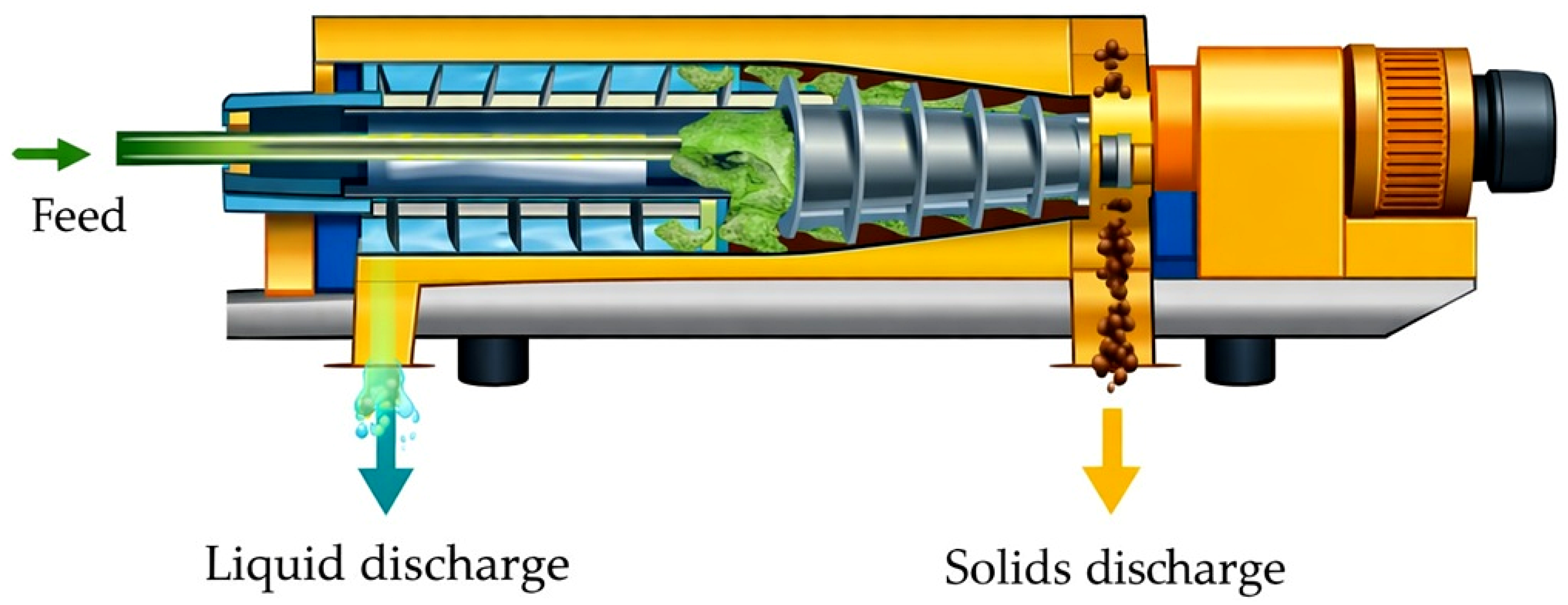
Figure 1 shows the schematics of a typical decanter centrifuge.
  • The core of the equipment is the rotating assembly, which is the most expensive and sophisticated component [21,37]. The main constituent parts are listed as follows.
  • Solid Bowl (Drum): A horizontal, cylindrical–conical shell that rotates at high speed, generating the centrifugal force [17,21,36,37]. The cone section, also referred to as the “beach,” facilitates solid removal [4,40].
  • Screw Conveyor (Scroll): An Archimedean screw located coaxially inside the bowl, rotating in the same direction but at a slightly different (differential) speed [17,21,36,37].
  • Feed System: Slurry is introduced via a stationary feed pipe (or hollow axis) into the rotating bowl, often through a feed accelerator that minimizes particle shock and brings the feed up to bowl speed before it enters the pond [21,39,40].
  • Discharge Systems: Clarified liquid, the centrate, overflows through weir plates (dam plates) at the cylindrical end of the bowl [17,40]. The dewatered solids, the cake, are discharged at the conical end [4,17].
Separation Mechanism
The decanter centrifuge operates primarily by sedimentation accelerated by centrifugal force [11,21], resulting from the two following actions.
  • Centrifugal Force: High centrifugal acceleration forces, which can range from 1500 G to over 4000 G, cause the denser solid particles to migrate rapidly toward the inner wall of the drum [4,11,26,41].
  • Solid Conveyance: The differential speed induces shear forces in the accumulated sediment [19]. The screw conveyor continuously transports the deposited solids up the conical “beach zone”, where they undergo further dewatering and compaction before being discharged as a solid cake [4,17,19,37].

1.5.2. Sizing, Design, and Scaling Factors

Proper decanter centrifuge design and sizing require consideration of numerous interacting physical and mechanical parameters.
Key Structural and Operational Parameters
Decanter centrifuge performance is dictated by design factors that influence separation efficiency and cake dryness [4,36], described as follows:
  • Rotational Speed/G-Force: Determines the magnitude of the centrifugal force, which is critical for sediment compaction [19,42]. Increasing rotational speed generally improves separation performance up to 3000 rpm but may cause efficiency to decline at higher speeds [42,43].
  • Differential Speed: The difference in speed between the bowl and the scroll [35]. This parameter most significantly influences the dry matter content of the cake; generally, increasing the differential speed decreases the cake dryness and increases liquid flow rate [42,44].
  • Pool Depth (Weir Diameter): The depth of the liquid layer in the bowl is adjusted by the weir plates [40]. Increasing the pool depth generally enhances cake solid content but can slightly reduce overall solid recovery [45]. A deeper pool increases residence time and improves clarification [40].
  • Screw Pitch and Cone Angle: The interaction between the drum’s half cone angle and the screw pitch significantly affects solid recovery [36]. A moderate half-cone angle enhances centrifugal force, while an excessively large angle can cause flow field disturbance and reduce recovery [36]. Increasing the screw pitch initially promotes particle flow, but if too large, it increases liquid flow rate, possibly causing particle re-suspension [36].
Sizing and Scale-Up
The maximum G-force attainable is inversely related to the bowl diameter. For instance, a 750 mm diameter decanter centrifuge may attain 3000 G, while a 150 mm diameter bowl can reach 6000 G or higher [39].
  • Scaling Theory: Scale-up is ideally carried out between geometrically similar decanters [21]. Historically, the Σ-theory [46] simplified sedimentation based on Stokes’ law to estimate capacity, but this approach often leads to deviations from experimental data, as it neglects high solid content and complex flow conditions [17,19].
  • G-Volume Approach: This widely used scaling method maintains the ratio of the clarification volume and the G-force constant relative to the volume flow during scale-up [18].

1.5.3. Advanced Modeling and Optimization

Due to the complex internal dynamics and high speeds, mathematical modeling is essential for optimization and design of decanter centrifuges [19,42].
Modeling Techniques
  • Dynamic Simulation Models: These physically based models predict unsteady behavior such as startup and shutdown, by coupling three simultaneous processes: settling, cake consolidation, and sediment transport [18,19]. These models use material functions derived from lab-scale tests to describe hindered settling and consolidation [18,19].
  • CFD and Multiphase Modeling: Computational Fluid Dynamics—CFD is used for simulating the complex 3D internal flow field, which is difficult to monitor experimentally [36,42].
    Models: The Eulerian multiphase model is often selected for flows with large solid-phase volume fractions [36,42,43].
    Turbulence: The Renormalization Group—RNG model is preferred because it accurately captures internal flow dynamics, accounts for rotational effects, and provides superior accuracy for the sharp velocity gradients typical of high-speed centrifuges [36,42,43].
    Internal Flow: CFD reveals that the liquid tangential velocity exhibits hysteresis relative to the drum speed, especially pronounced as solid density decreases, and static pressure reaches its maximum near the inner bowl wall [42,45].
Integrated Optimization
To address the synergistic interactions among multiple design parameters, an integrated optimization approach is used:
  • RSM and MOGA: The combination of Response Surface Methodology (RSM) and Multi-Objective Genetic Algorithm (MOGA) is applied to structural optimization [36]. RSM builds models relating structural variables (e.g., drum half cone angle, screw pitch) to objectives, and MOGA finds the optimal balance between maximizing solid recovery and minimizing overflow solid content, leading to substantial performance enhancements [36].

1.6. Objectives

The present study aimed to evaluate the performance of a pilot-scale bauxite tailings dewatering plant operating under different process conditions. The tested ore was obtained from deposits in the southeastern region of Minas Gerais State, Brazil. Surveys were carried out in each pilot test, including sampling of each individual stream, subsequent technological characterization for supporting performance assessments, and mathematical modeling of decanter centrifuge operation.
This paper corresponds to Part 1 of the study, which focuses on pilot-scale testing and process characterization. The subsequent stage, to be addressed in Part 2 of the study, will focus on the development of a mathematical model for the dewatering of bauxite tailings in decanter centrifuges, resulting in a simulation model, the latter aimed to predict industrial-scale centrifuge performance based on laboratory data. The study is particularly relevant for enabling a conceptual evaluation of decanter centrifuge applications using low-cost, small-sample experimental setups at early project stages, contrasting with current practices that rely exclusively on pilot-scale testing, which demands larger samples, higher costs, therefore only feasible at later stages of industrial project development.

2. Materials and Methods

2.1. Pilot Plant Setup

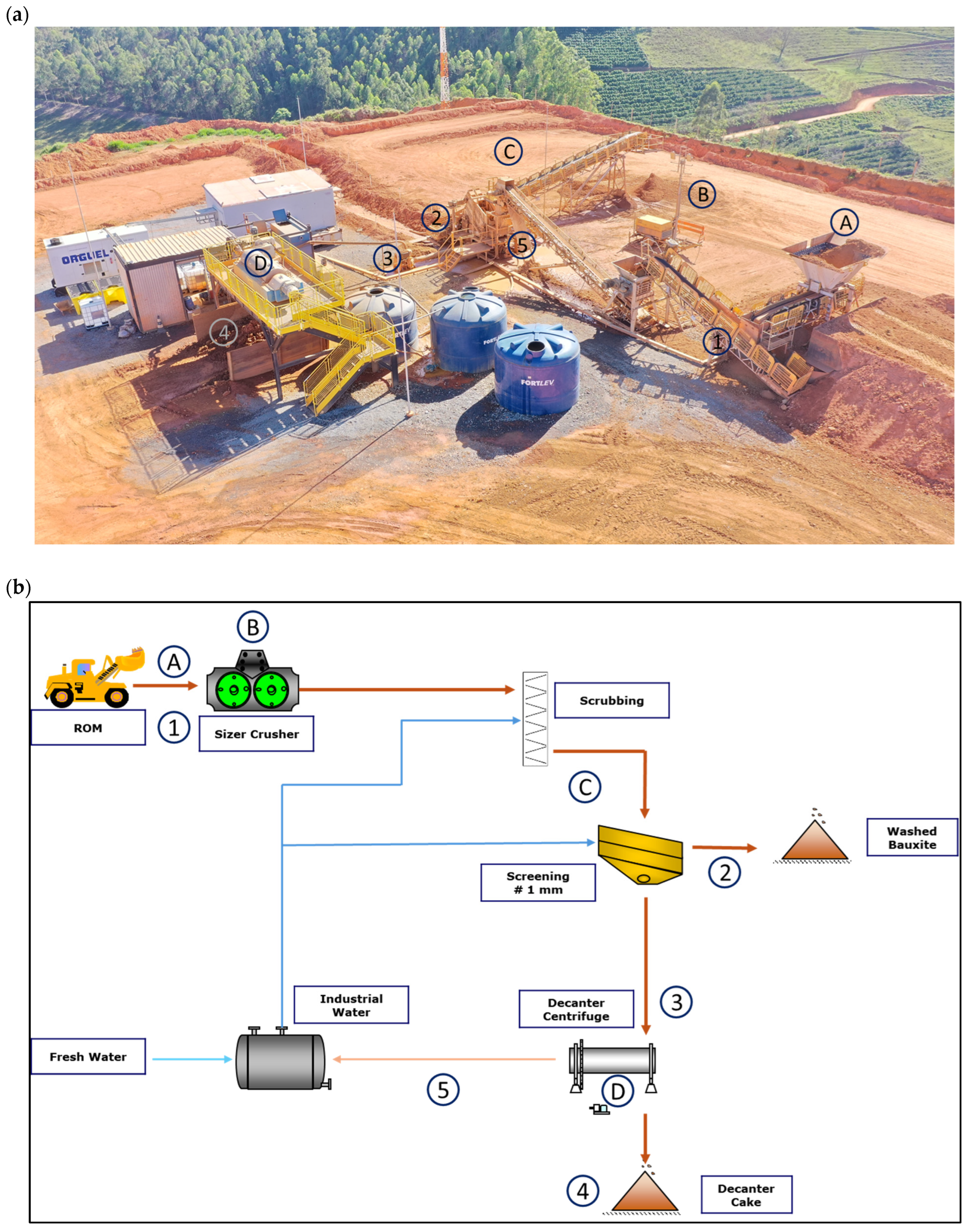
Experimental work was conducted at a specially built pilot-scale bauxite beneficiation facility designed to reproduce the main operations of a typical bauxite washing industrial plant. Figure 2a shows the actual pilot-plant installation, while Figure 2b includes a simplified flow sheet as adopted in the pilot-plant.
The flowsheet comprised:
  • Crushing carried out in a sizer-type crusher, manufactured by Haver & Boecker model HB-10080X (Monte Mor, Brazil), 37 kW power operating at 40 mm aperture.
  • Disaggregation conducted at a slurry chute equipped with a high-pressure jet technology to separate clay particles from the bauxite particles.
  • Screening carried out at a 0.8 m in width and 1.5 m in length screen manufactured by Haver & Boecker model XL-CLASS ME (Monte Mor, Brazil), equipped with a 1 mm metallic aperture mesh.
  • Dewatering stage executed in a decanter centrifuge.
The operation of the pilot plant consisted of feeding a hopper with a dedicated front-end loader with run-of-mine (ROM) bauxite. A belt feeder controlled the feed rate from the hopper to a chute, where high-pressure water was injected for disaggregation. The output stream of the disaggregation stage was screened at 1 mm, whose undersize fraction was directed to the decanter centrifuge feed, while the oversize was discharged as washed bauxite product. Two products derived from the decanter centrifuge operation, i.e., the cake (dewatered tailings) and the centrate (clarified liquid), the latter recycled into the process water circuit.
The dewatering tests were carried out using a decanter centrifuge with an internal bowl diameter of 620 mm and a total length of 2.8 m, therefore resulting in a length to diameter—L/D ratio of 4.5. During the experimental campaign, three rotational speeds were tested: 1600 rpm, 1700 rpm, and 1800 rpm, corresponding to differential speeds of 450 rpm. Each test was run under steady-state operation conditions for at least one hour per condition prior to sampling of the following streams.
  • Centrifuge feed slurry at the pump outlet.
  • Centrifuge cake—dewatered tailings.
  • Centrate—clarified liquid.
Sampling was performed incrementally, with successive aliquots collected every 20 min over a 60 min period (time zero plus three aliquots) for each sampling point, resulting in four increments per condition. As the pilot plant was not equipped with automatic samplers, all collections were carried out manually using suitable equipment for each stream.
As the decanter centrifuge feed flow was critical for closing the mass balance, flow rate and slurry density were measured and recorded at each aliquot collection. Sampling was conducted directly at the centrifuge feed, collecting one 2.5 L aliquot every 20 min, with at least three aliquots per test. Each test condition was maintained for a minimum of one hour under steady-state operation.
The centrate flow, corresponding to the clarified liquid phase, was equally important for mass balance purposes. Flow rate and density were recorded at each collection. Samples were taken from the clarified pumping outlet, collecting one 7 L aliquot every 20 min, with at least three aliquots per test and a minimum of one hour operating time per condition.
The centrifuge cake, representing the dewatered solids, posed the greatest sampling challenge. Sampling was performed manually at the top of the dewatered clay stockpile, collecting one 10 kg aliquot every 20 min, with at least three aliquots per test and a minimum of one hour of continuous operation per condition.
During all tests, process variables were continuously monitored by a dedicated supervisory control system—SCS. Concurrent measurement of flow rates and densities at each sampling point, combined with data redundancy, enhanced the accuracy of the mass balance estimations. The overall mass balance was calculated based on measured flow rates and solid concentrations, applying classical mineral processing mass conservation equations. Recovery was reconciled on a size-by-size basis to ensure internal consistency of the partition data.
It is important to note that the feed dilution was not deliberately controlled but resulted from steady-state pilot operation conditions.
Minor variations in feed solid concentration were associated with natural fluctuations in pilot-scale operation, including variations in ore feed characteristics, water recirculation, slurry inventory, and manual process stabilization. Since the objective of the campaign was to evaluate centrifuge performance under realistic steady-state operating conditions, feed dilution was not imposed as an independent controlled variable.

2.2. Mineral Characterization

Samples obtained from the decanter centrifuge feed were prepared and tested to:
  • Rheological characterization—carried out using an Anton Paar rotational rheometer (Graz, Austria), model MCR 92, equipped with a Mooney–Ewart-type geometry. Prior to the measurements, 200 mL of bauxite tailing slurry, prepared under tested conditions, was homogenized for 5 min using a mechanical stirrer operating at 500–600 rpm. Subsequently, 18 mL of the slurry was transferred to the measurement cup for rheological testing at 25 ± 0.2 °C. A pre-shear step at 700 s−1 for 1 min was applied to ensure that the particles were homogeneously suspended. Tests were then conducted, in duplicate, over the shear rate range of 0.1   γ ˙   700 s−1 (ramp down).
Likewise, samples obtained from the decanter centrifuge feed, cake, and clarified liquid were prepared and tested to:
  • Specific Gravity determination—determined by helium gas pycnometry using a Micromeritics AccuPyc II 1340 (Micromeritics Instrument Corp, Norcross, GA, USA). Samples were dried for 12 h at 100 °C prior to analysis, which was conducted on the “as collected” granulometry with 10 purge cycles.
  • Particle size distribution analysis—determined by laser diffraction using a Malvern Mastersizer 2000 equipped with a Hydro 2000MU (Malvern Panalytical Ltd., Malvern, UK) dispersion unit. The analysis was carried out in deionized water (refractive index 1.33) with a pump speed of 2500 rpm and 1 min of ultrasonic treatment to ensure full particle dispersion. A refractive index of 1.76 was applied for the solid phase.

2.3. Quantitative Characterization of Classification Efficiency

The mechanical efficiency of the decanter centrifuge was quantified by fitting experimental partition data to the Whiten model [9]. The experimental partition ( y i ) was first corrected for hydraulic bypass ( R f ) to isolate centrifugal capture. The corrected partition ( y c ) was calculated as Equation (1). These values were then fitted to the Whiten equation (Equation (2)) using non-linear least-squares regression to determine the corrected cut size (d50c) and the inclination parameter (α) which represents the sharpness of the classification.
y c = y i R f ( 1 R f )  
y c = exp α   · d d 50 c 1 exp α · d d 50 c + exp α 2

3. Results

3.1. Technological Characterization

3.1.1. Rheology

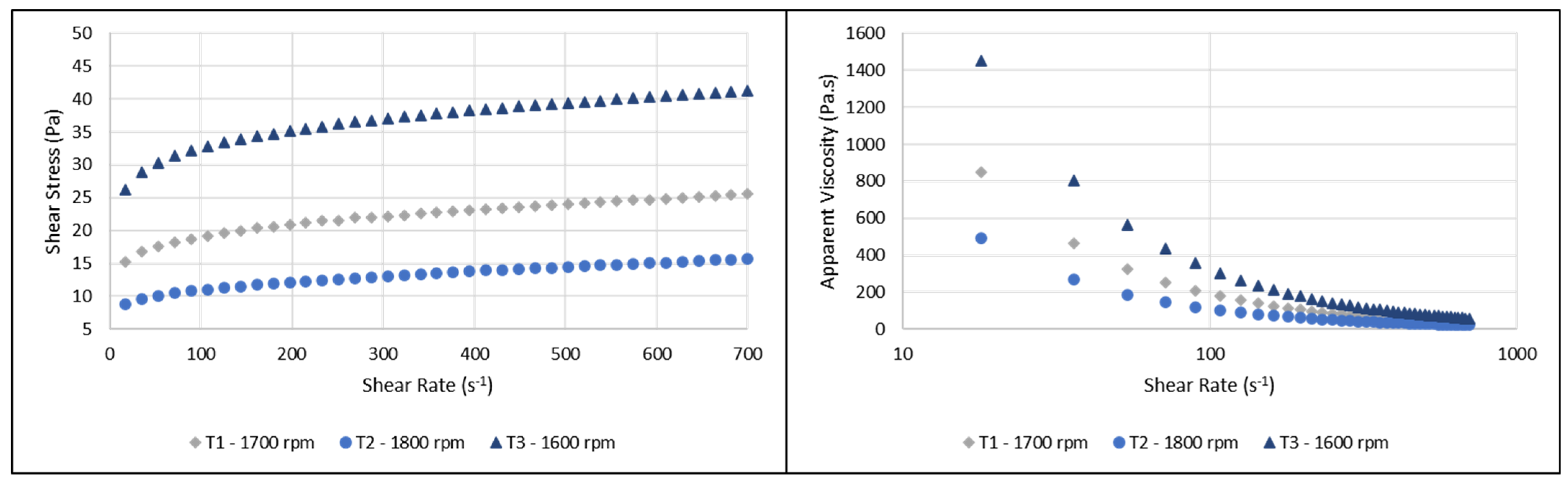
The resulting flow curves obtained from rheology testing carried out on decanter centrifuge feed are shown in Figure 3. The apparent viscosity curves showed that all tested samples exhibited non-Newtonian, shear-thinning (pseudoplastic) behavior [28].
The flow curves were fitted to the Power Law and Casson models, respectively represented by Equations (3) and (4) [47].
τ   = K γ ˙ n
τ 1 / 2 = τ 0 1 / 2 + η · γ ˙ 1 / 2
where variables are: τ —shear stress [Pa]; γ ˙ —shear rate [s−1]; τ 0 —yield stress [Pa]; η – Casson’s viscoplastic viscosity [Pa·s]; K —fluid consistency coefficient [Pa·sn]; n—power law index or fluid behavior index with n < 1 for shear-thinning, n > 1 for shear-thickening and, n = 1 for ideal viscous flow behavior (Newtonian fluid).
Table 2 shows the results obtained from fitting the balanced data to the Power Law and Casson models.
The results quantify the non-Newtonian character of the tailings, specifically highlighting a clear hierarchy in flow resistance across the three test conditions. The comparison between the samples reveals a clear hierarchy in rheological resistance, where Test 3 (1600 rpm) exhibited the most robust internal structure. With a consistency index K of 18.7 Pa·sn and a yield stress τ 0 of 22.2 Pa, this sample required nearly three times the initial stress to initiate flow compared to Test 2 (1800 rpm), which showed the lowest flow resistance ( τ 0 = 7.5 Pa). This variation is directly attributable to the higher solid concentration in the Test 3 feed (14.40% wt/wt) compared to Test 2 (12.52% wt/wt).
This non-Newtonian behavior is further evidenced by the high R2 values (0.98 to 1.00) obtained for both the Power Law and Casson models, which validate that these tailings behave as predictable yield-pseudoplastic fluids. While the Power Law model captures the rapid rate of structural breakdown as shear increases, the Casson model defines the structural strength at rest. The rheograms confirm that while the slurries are highly resistant to initial movement, they are extremely sensitive to deformation; in a high-shear environment, the apparent viscosity drops by orders of magnitude. This transition from a rigid network to a fluid state is the fundamental mechanism that allows the centrifugal force to eventually overcome interparticle friction and facilitate the separation of the solid phase.
To provide a quantitative indicator of slurry mobility under representative process conditions, the apparent viscosity (μapp) was calculated at a shear rate of 100 s−1 using the fitted Casson model parameters [28,47].
The corresponding shear stress at 100 s−1 was calculated, and the apparent viscosity μapp was obtained as Equation (5).
μ a p p = τ γ ˙  
A shear rate of 100 s−1 was selected as representative of internal flow conditions in decanter centrifuges.
Using the fitted Casson parameters, the apparent viscosity at 100 s−1 was calculated for each condition. The values decreased systematically from 0.332 Pa·s at 1600 rpm to 0.194 Pa·s at 1700 rpm and 0.111 Pa·s at 1800 rpm, reflecting a substantial increase in slurry mobility with decreasing yield stress and solid concentration.

3.1.2. Specific Gravity

The resulting S.G. values obtained for samples representing the process streams were consistent across all three test conditions. The summary of the results is shown in Table 3, indicating greater S.G. values for decanter cake and smaller SG values for centrate, as compared with decanter feed.
The observed SG variations are consistent with the selective classification behavior of the decanter centrifuge. The cake stream became enriched in coarser and denser mineral particles due to preferential centrifugal settling, resulting in higher SG values. In contrast, the centrate stream became enriched in ultrafine clay-rich particles, which generally present lower particle density and remained suspended in the liquid phase, leading to lower SG values relative to the feed.

3.1.3. Particle Size Distribution

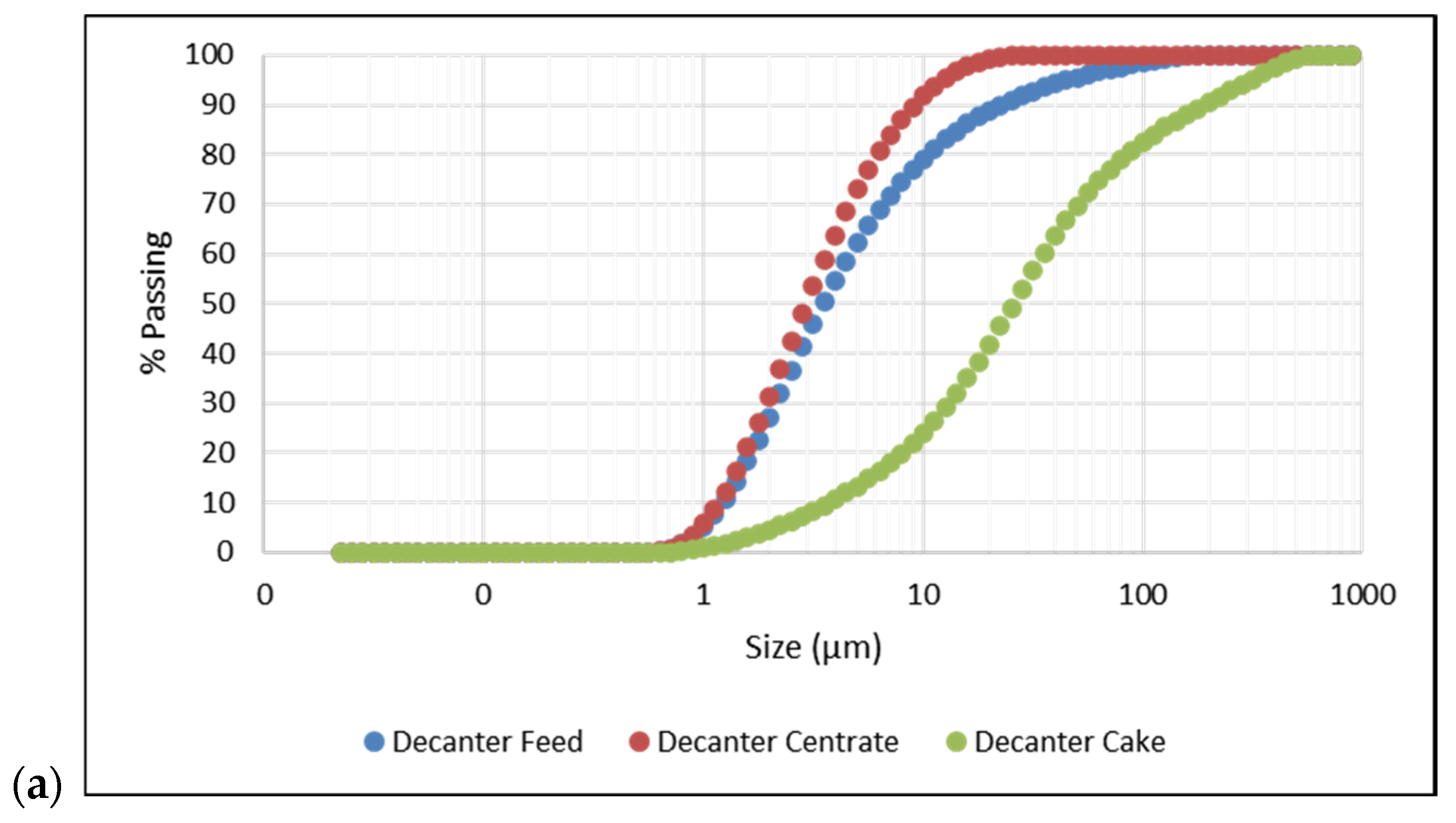
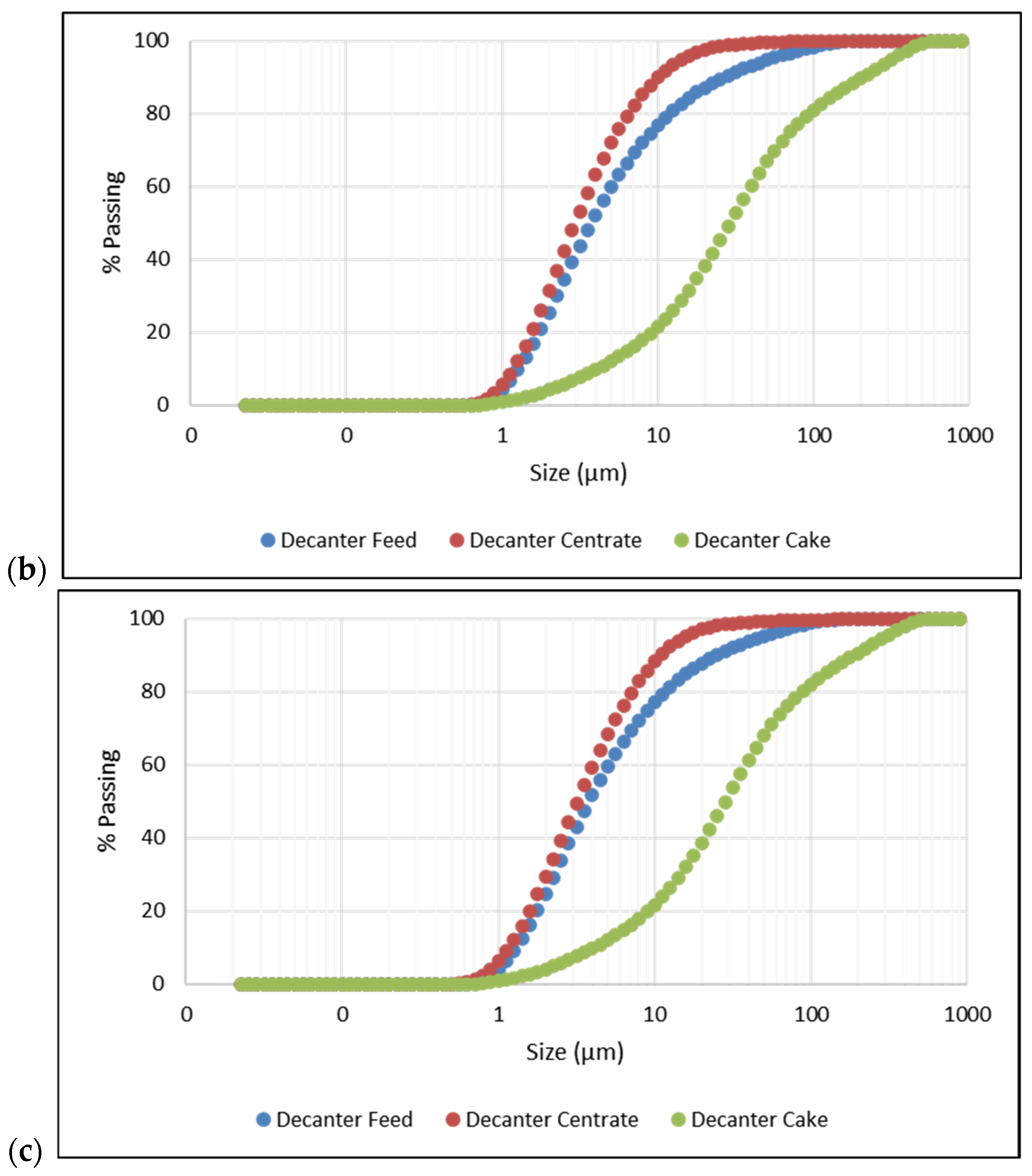
The selective classification behavior of the decanter centrifuge is quantitatively evidenced by the characteristic sizes of the process streams, summarized in Figure 4 and Table 4.
A progressive refinement of the centrate and consolidation of the cake were observed with increasing rotational speed. As the bowl speed increased from 1600 rpm to 1800 rpm, the centrate median size (D50) decreased from 3.1 µm to 2.8 µm, while the cake D50 increased from 35.8 µm to 37.0 µm, with an intermediate minimum of 33.8 µm at 1700 rpm. The centrate D90 decreased from 10.3 µm to 9.2 µm across the same range of operating conditions, indicating a slight reduction in coarse particle reporting to the liquid stream.
The feed material exhibited an ultrafine particle size distribution, with D50 values ranging from 8.1 µm to 13.3 µm. The D25 increased from 3.4 µm to 5.5 µm, while the D98 increased from 45.9 µm to 74.8 µm, indicating a measurable coarsening of the feed across the experimental campaigns. The slight feed coarsening likely reflects natural variability of the pilot campaign rather than controlled operational change. Despite this variation, the feed remained predominantly within the fine-silt domain.
The centrate stream consistently presented a narrow and fine particle size distribution. The D50 remained approximately 3.0 µm under all three conditions, while the D98 was constrained between 15.6 µm and 17.6 µm. Cumulative passing values further support this observation: at 20 µm, more than 96% of the centrate material reported below this size for all operating speeds. At 37 µm, cumulative passing exceeded 99.7% in all cases, confirming limited coarse particle carryover.
Conversely, the cake stream exhibited substantial enrichment in coarser material. The D50 ranged from 33.8 µm to 37.0 µm, corresponding to a 2.8–4.4-fold increase relative to the feed median size, depending on operating condition. The D90 ranged from 112.3 µm to 122.8 µm, and the D98 ranged from 190.8 µm to 208.6 µm, confirming consolidation of the coarse silt and sand fractions. Although the cake D25 (14.0–15.3 µm) remained significantly coarser than the feed D25, measurable proportions of ultrafine material were still present in the underflow.
Overall, a clear separation between centrate and cake particle size distributions was maintained across all rotational speeds, with the centrate consistently enriched in ultrafine material and the cake enriched in coarse fractions.

3.2. G-Force Calculation and Operational Parameters

The primary operational variable adjusted during the pilot campaign was the rotational speed of the decanter bowl. This speed determines the centripetal acceleration (ac) and the resulting equivalent gravitational force (G-force) applied to the slurry, which is the key driver for separation [4,21].
The G-force is the ratio of the centripetal acceleration to the standard acceleration of gravity (g~9.8 m/s2). It can be calculated from the bowl speed (N, in rpm) and the decanter’s internal diameter (D, in meters) using the relationship shown in Equation (6) [21].
G = N 2 π 2 D 1800   g
Using Equation (6), the G-force was calculated for all three test conditions, as presented in Table 5.

3.3. Solid and Water Recovery

A comprehensive mass balance was conducted for each of the three test conditions to quantify the decanter centrifuge’s operational performance. The key process parameters, flow rates, and separation results are summarized in Table 6. The data reveal that while water recovery to the centrate was consistently high (over 96%), the overall solid recovery and cake dryness were highly dependent on the operational parameters.

3.4. Effect of Rotational Speed on Performance

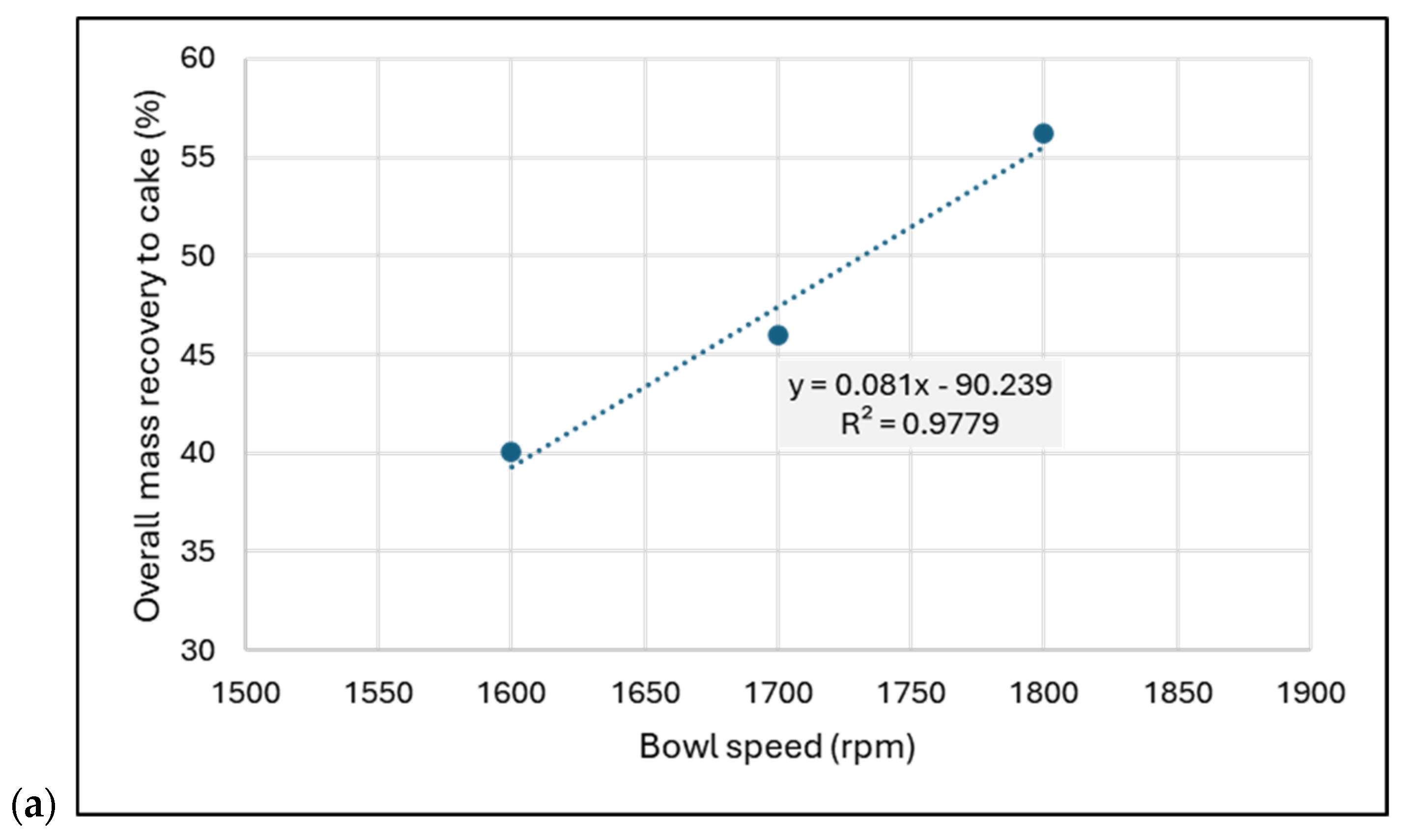
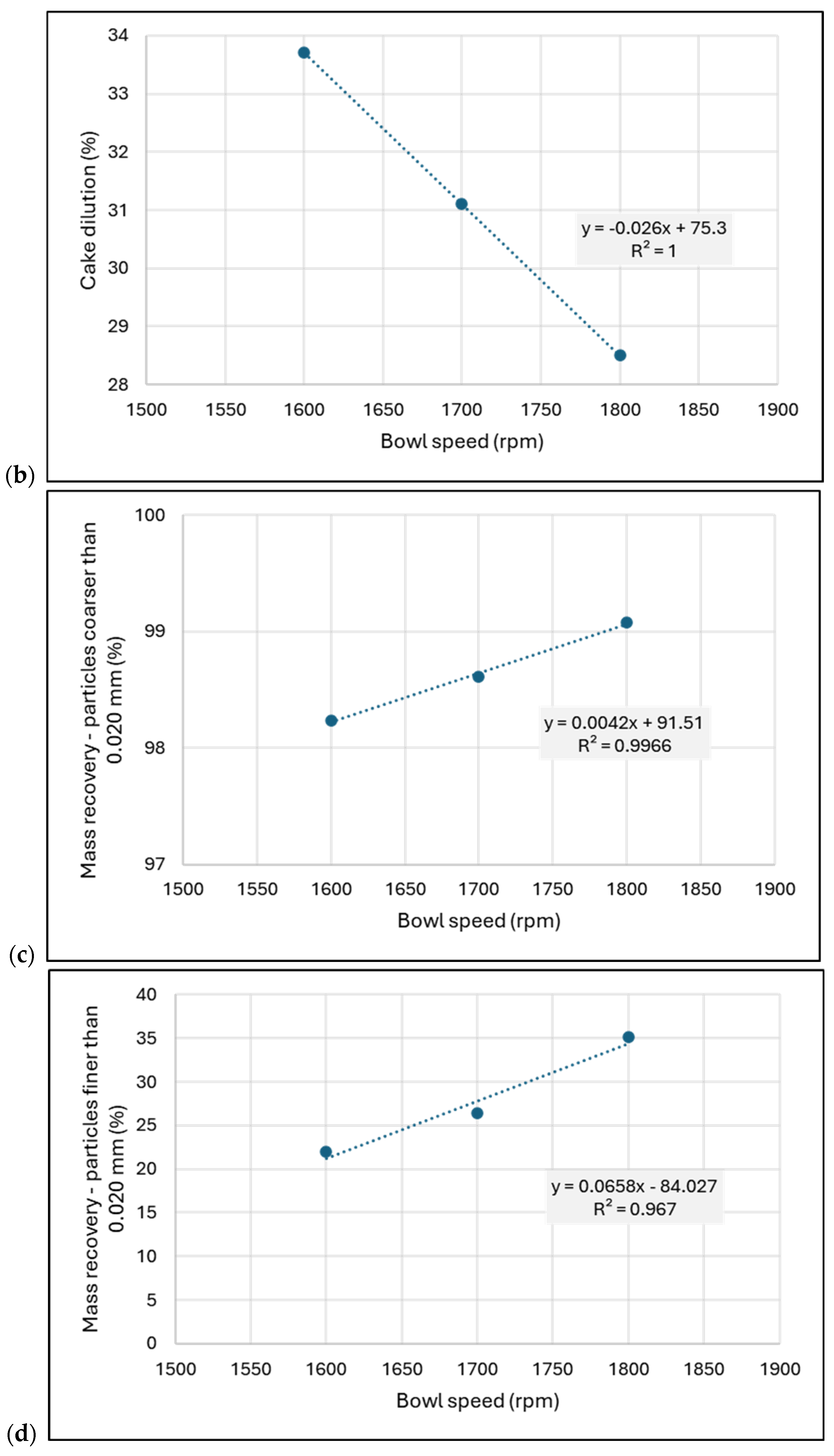
Table 7 and Figure 5 show the relationship between bowl speed and selected performance parameters.
  • Dewatering Efficiency: A clear linear relationship was observed between bowl speed and the cake water dilution or final cake dryness (Figure 5b). Increasing the speed from 1600 rpm (888 G) to 1800 rpm (1124 G) significantly improved the cake solid content from 66.30% to 71.50% by weight.
  • Overall Solid Recovery: Average cake mass recovery (Figure 5a) also showed a strong positive linear trend (R2 = 0.9946), increasing from 40.03% at 1600 rpm to 56.22% at 1800 rpm.
It is interesting to note, though, that the overall solid recovery is a composite of two distinct components, as follows.
  • Coarse Fraction: As shown in Figure 5c, recovery of particles coarser than 20 µm was near-total under all conditions, increasing slightly from 98.2% to 99.1% with bowl rotation speed (R2 = 0.9988). This indicates the centrifuge is highly effective at capturing almost all particles coarser than 20 µm.
  • Fine Fraction: Figure 5d shows that the majority of particles finer than 20 µm were directed to the centrate, therefore contributing to the obtained overall mass recovery. Accordingly, the mass recovery of fine particles to the cake product was much smaller, ranging from only 22.0% to 35.1%. This parameter also showed a monotonic increase within the tested range with speed (R2 = 0.9848), confirming that the applied G-force is the critical factor in capturing these ultra-fine particles.

3.5. Separation Efficiency by Particle Size—Partition Curves

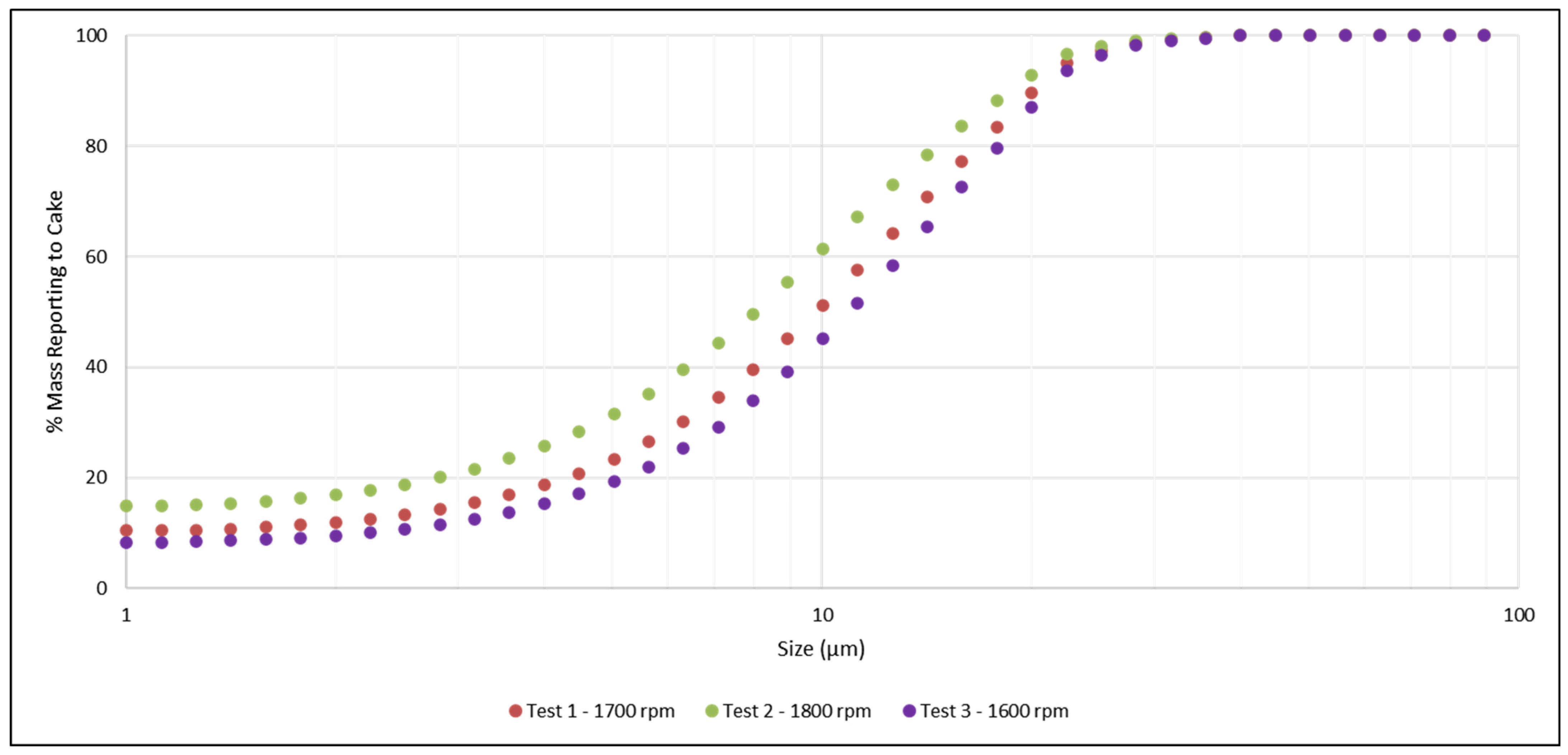
The partition curves here referred to as cake mass recovery as a function of particle size fraction, for all tests are presented in Figure 6.
As the partition of solids showed clear dependence on particle size, an investigation was thus conducted to assess the classification aspect of the results. In this case, according to Figure 6, all three partition curves show the S-shape typical of classification processes. For particles coarser than 0.040 mm, all test conditions resulted in practically 100% recovery to the cake product.
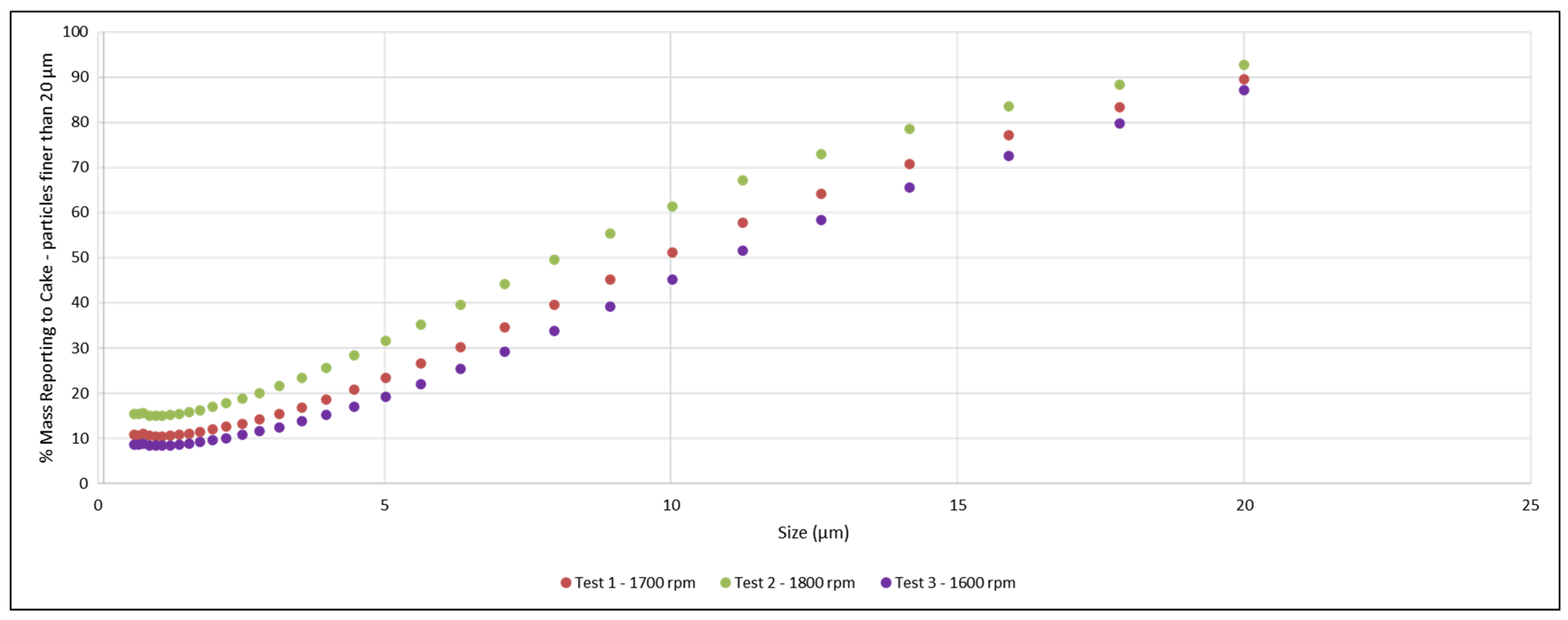
Due to the relative importance of particles finer than 20 µm, such a fraction was highlighted in Figure 7, using a linear scale in the abscissa.
Test 2, carried out at 1800 rpm, represented by green dots in Figure 7, consistently showed the highest recovery curve, indicating that the highest G-force (1124 G) was most effective at capturing the ultra-fine particles in the cake product. Test 3, carried out at 1600 rpm, represented by purple dots, showed the smallest recovery of the fine fraction, in this case corresponding to the smallest G-force (888 G).
These results confirm that the primary challenge in dewatering the bauxite tailings is to capture the fraction finer than 20 µm. Even though increasing G-force improves both fine particle capture and overall cake dryness, a significant portion of the fines remained in the centrate under all tested conditions.
Although the experimental partition curves clearly demonstrate the size-dependent separation behavior of the decanter centrifuge, a purely graphical interpretation does not allow direct quantification of the effective cut size, separation sharpness, or the contribution of hydraulic bypass. To obtain a quantitative description of classification performance and to enable objective comparison between operating conditions, the experimental partition data were therefore fitted using the Whiten model, as described in Section 2.3. This approach provides the corrected cut size (d50c), the inclination parameter (α), and the bypass fraction (Rf), which together characterize the mechanical and hydraulic components of the separation process.

3.6. Quantitative Partition Modeling Using the Whiten Equation

The experimental partition data presented in Section 3.5 were fitted using the Whiten model in order to quantify the effective cut size, separation sharpness, and hydraulic bypass for each operating condition. Non-linear least-squares regression was applied to the corrected partition data as described in Section 2.3. The resulting model parameters are summarized in Table 8.
A progressive reduction in the corrected cut size (d50c) was observed with increasing bowl speed, decreasing from 11.99 µm at 1600 rpm (888 G) to 9.72 µm at 1800 rpm (1124 G), corresponding to an approximate 19% decrease. The inclination parameter (α) showed a slight reduction from 2.80 to 2.47 across the same operating range.
The hydraulic bypass fraction (Rf) increased from 8.35% at 1600 rpm to 14.92% at 1800 rpm, indicating a systematic increase in the fraction of solids reporting to the cake independently of size-selective centrifugal classification.
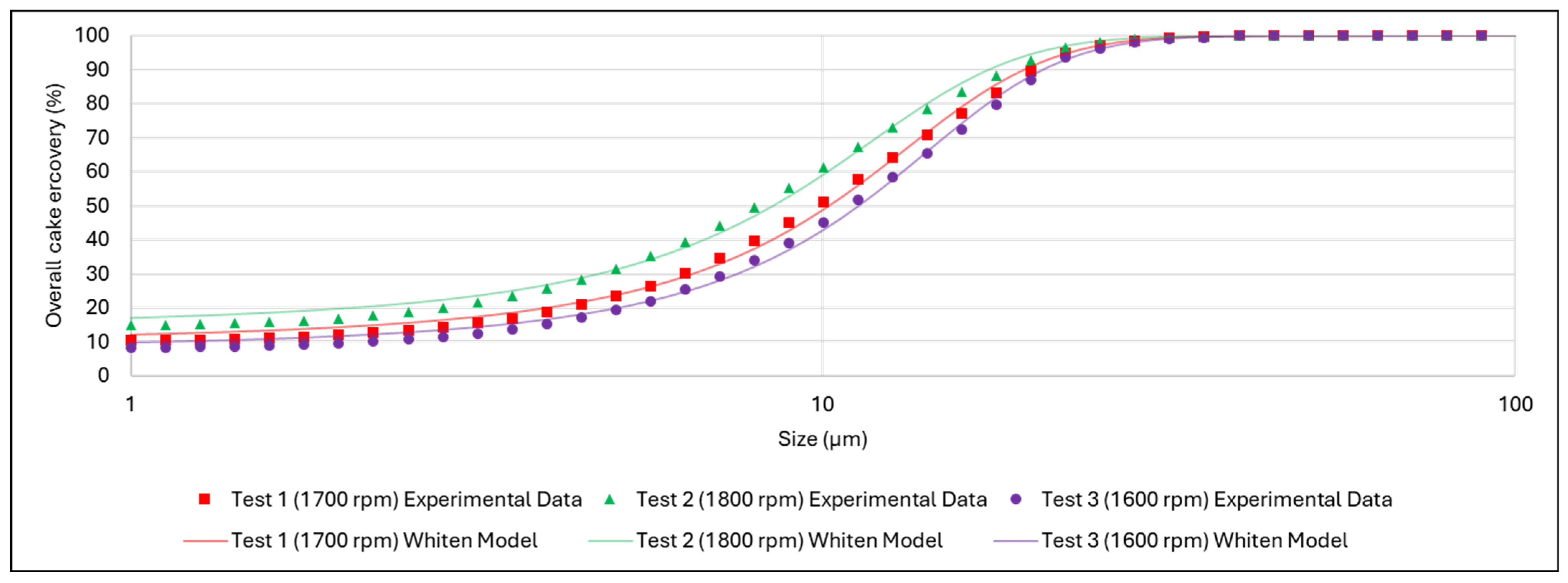
The fitted Whiten curves showed excellent correlation with the experimental partition data for all operating conditions, as illustrated in Figure 8.
Overall, the Whiten model parameters confirm systematic changes in classification performance with increasing centrifugal acceleration.

4. Discussion

This study assessed the performance of a pilot-scale decanter centrifuge for the dewatering of a sample of ultrafine, clay-rich bauxite tailings, integrating bulk dewatering metrics with size-selective partition modeling. The results demonstrate that performance is governed by the coupled interaction between centrifugal acceleration and slurry rheology, rather than by mechanical settling alone.

4.1. Influence of Bowl Speed on Mechanical Separation Performance

The decanter centrifuge successfully produced a high-solid cake, with final solid content increasing from 66.3% at 1600 rpm to 71.5% at 1800 rpm. These values indicate effective consolidation of the mineral fraction and are consistent with mechanically stackable tailings products.
Increasing bowl rotational speed from 1600 to 1800 rpm resulted in a systematic increase in overall solid recovery from 40.0% to 56.2%. Whiten modeling revealed a corresponding reduction in corrected cut size (d50c) from 11.99 µm to 9.72 µm, representing an approximate 19% decrease. This confirms that higher rotational speed enhances centrifugal classification efficiency and extends capture toward finer particle sizes.
However, the inclination parameter (α) decreased slightly from 2.80 to 2.47, indicating a modest reduction in separation sharpness at higher speeds. Simultaneously, hydraulic bypass increased from 8.35% to 14.9%, suggesting that non-size-selective transport mechanisms become increasingly significant as rotational speed increases.
Although measurable variation in feed PSD occurred between tests (D50 ranging from 8.1 to 13.3 µm), the systematic decrease in d50c and increase in hydraulic bypass followed the imposed changes in bowl speed rather than the direction of feed coarsening. This supports the conclusion that the observed performance trends are primarily operationally driven.
To summarize the coupled mechanical and hydraulic responses, Table 9 presents the key performance indicators.
The table highlights a consistent trend: while mechanical cut size decreases with increasing speed, hydraulic bypass increases and sharpness slightly declines. Therefore, performance improvements at higher speeds are not purely mechanical; they reflect a shift in the balance between centrifugal settling and hydraulic transport.
The reduction in feed solid concentration from 14.4% to 12.5% may have contributed to the observed improvement in performance; however, the monotonic trends in d50c and bypass align directly with imposed rotational speed increments, suggesting bowl speed as the dominant driver.

4.2. Fine Particle Recovery and the Role of Rheology

Size-by-size recovery confirms that performance limitations are concentrated in the ultrafine fraction. For particles coarser than 20 µm, recovery to the cake exceeded 98% under all operating conditions, indicating near-complete mechanical capture of coarse silt fractions.
In contrast, recovery of particles finer than 20 µm remained limited, increasing only from 22.0% to 35.1% across the tested speed range. Because the feed is predominantly ultrafine (D50 = 8–13 µm), this limited fine recovery directly constrains overall solid recovery.
The rheological characterization provides quantitative insight into this behavior. Yield stress decreased from 22.2 Pa to 7.5 Pa across the tested conditions, while the apparent viscosity at 100 s−1 decreased from 0.332 to 0.111 Pa·s. This represents a reduction of approximately 67% in viscous resistance. The substantial increase in slurry mobility enhances internal fluid circulation within the rotating bowl and increases the probability of ultrafine particle bypass. The observed increase in hydraulic bypass and slight reduction in separation sharpness are therefore consistent with the rheological evolution of the feed slurry.
As slurry mobility increases, the probability of fine particle bypass within internal liquid flow structures also increases, contributing to the observed rise in hydraulic bypass. Thus, increasing rotational speed produces two simultaneous effects:
  • Reduction in mechanical cut size (enhanced centrifugal classification);
  • Increased hydraulic transport of ultrafine particles (higher bypass).
The slight reduction in α further supports this interpretation, indicating reduced separation sharpness as hydraulic effects become more pronounced. Therefore, the attainable improvement in ultrafine capture is constrained not solely by centrifugal force, but by the rheological properties governing internal flow dynamics.
The particle size distribution of the investigated tailings places the material firmly within the ultrafine regime. As noted by Loftus [13], solid-bowl centrifuges are typically applied to materials with characteristic particle sizes above approximately 20 µm, achieving cake moisture contents generally in the range of 15%–30%. The present study therefore evaluates centrifuge performance near the lower boundary of its conventional application envelope. Despite operating in this challenging domain, the achieved cut sizes (9.7–12.0 µm) and cake solids (66%–72%) indicate performance approaching the lower boundary of conventional application envelopes for ultrafine tailings.

4.3. Industrial Implications and Optimization Strategy

From an operational standpoint, the production of cake solids up to 71.5% demonstrates mechanical feasibility for dry stacking applications. However, overall solids recovery remains moderate due to limited ultrafine capture.
At 1800 rpm, approximately 44% of feed solids were reported to the centrate stream, primarily composed of particles finer than 20 µm. In a continuous industrial circuit, such solids would accumulate in recycled process water, progressively increasing slurry density and rheological resistance. This feedback loop could ultimately reduce centrifuge efficiency and increase water clarification demands.
Accordingly, optimization must address both mechanical and hydraulic components of separation. Increasing bowl speed alone improves cut size but simultaneously amplifies bypass. Future optimization strategies should therefore consider:
  • Control of feed solid concentration and rheology;
  • Adjustment of differential speed and pool depth;
  • Potential use of flocculation or pre-conditioning to reduce ultrafine mobility.
Ultimately, the results indicate that decanter centrifugation of ultrafine bauxite tailings is mechanically viable but hydraulically constrained. Effective industrial deployment will depend on integrated control of both centrifugal force and slurry rheology.

5. Conclusions

This study (Part 1) successfully characterized the pilot-scale dewatering of bauxite tailings using a decanter centrifuge, leading to the following key conclusions:
  • Material Characterization: The bauxite tailings slurry is a challenging, non-Newtonian material. It exhibits strong yield-pseudoplastic behavior with a high yield stress (7.5–22.2 Pa), characteristic of concentrated, cohesive clay suspensions. This rheological response significantly influences internal flow dynamics and constrains size-selective separation in the ultrafine regime.
  • Performance on Cake Moisture: The decanter centrifuge is a mechanically adequate piece of equipment for dewatering bauxite tailings, producing cake ranging from 66.3% to 71.5% solids, respectively obtained at 1600 rpm (888 G) to 1800 rpm (1124 G). This confirms the technology’s potential to generate a high-solid product suitable for further deposition.
  • Influence of Bowl Speed: Bowl rotational speed was identified as the dominant operational parameter. Increasing speed from 1600 to 1800 rpm reduced the corrected cut size (d50c) from 12.0 to 9.72 µm and increased overall solid recovery from 40.0% to 56.2%. However, hydraulic bypass increased from 8.35% to 14.9%, accompanied by a slight reduction in separation sharpness (α), indicating that improvements in mechanical capture are partially offset by enhanced hydraulic transport effects.
  • Primary Separation Limitation: The critical constraint is ultrafine particle recovery. While recovery of particles coarser than 20 µm exceeded 98% under all conditions, recovery of particles finer than 20 µm remained limited (22.0–35.1%). As the feed is predominantly ultrafine (D50 = 8–13 µm), the overall separation efficiency was modulated by this limited fine capture.
  • Implication for Industrial Viability: The moderate overall solid recovery implies that 44%–60% of feed solids report to the centrate stream. In an industrial circuit, accumulation of ultrafine particles in recycled process water would progressively increase slurry rheology and compromise operational stability. Therefore, centrifugation within the tested speed range is mechanically viable but hydraulically constrained.
  • Outlook and Future Work: The conclusions derived from this pilot investigation form the foundation for Part 2 of this study, in which a mathematical modeling framework will be demonstrated to simulate and optimize decanter centrifuge performance. The model intends to enable predictive evaluation of operating conditions beyond the tested range, including higher rotational speeds, feed pre-conditioning strategies, and ultrafine management approaches. This modeling approach provides a systematic tool for assessing industrial feasibility and guiding process optimization without reliance on extensive pilot-scale experimentation.
The findings contribute to the technical understanding of decanter centrifuge performance for ultrafine bauxite tailings dewatering under industrially relevant conditions.

Supplementary Materials

The following supporting information can be downloaded at: https://www.mdpi.com/article/10.3390/min16050554/s1.

Author Contributions

Conceptualization, R.A.d.S.F.; Methodology, R.A.d.S.F. and H.D.J.; Software, R.A.d.S.F.; Validation, R.A.d.S.F.; Formal analysis, R.A.d.S.F., C.B.M. and H.D.J.; Investigation, R.A.d.S.F.; Resources, C.A.H.G.F.; Data curation, R.A.d.S.F.; Writing—original draft, R.A.d.S.F.; Writing—review & editing, C.B.M. and H.D.J.; Visualization, R.A.d.S.F. and C.B.M.; Supervision, H.D.J.; Project administration, R.A.d.S.F. and C.A.H.G.F.; Funding acquisition, C.A.H.G.F. All authors have read and agreed to the published version of the manuscript.

Funding

This research received no external funding.

Data Availability Statement

The original contributions presented in this study are included in the article/supplementary material. Further inquiries can be directed to the corresponding author(s).

Conflicts of Interest

The authors declare no conflict of interest.

References

  1. Fu, Q.; Liu, Q.; Song, Y.; Wu, J.; Zhao, F.; Zhao, R.; Wang, L. The evolution and causality of global bauxite flow since the 21st century: Based on the resource flow field model. J. Transp. Geogr. 2025, 128, 104346. [Google Scholar] [CrossRef]
  2. das Neves, M.N.B.; Gama, M.A.P.; Ishihara, J.H.; da Silva Filho, D.P.; Ferreira, G.C.; Noronha, N.C.; Sánchez, L.E.; Paschoal, J.P. Closure process of bauxite tailings facilities: The induction of ecological succession can enhance substrate quality in the initial phase of revegetation. Ecol. Eng. 2024, 209, 107400. [Google Scholar] [CrossRef]
  3. Banerjee, P.K.; Mankar, A.U.; Kumar, V. Chapter 4—Beneficiation of bauxite ores. In Mineral Processing; Rajendran, C.H.S., Murty, V.G.K., Eds.; Elsevier: Amsterdam, The Netherlands, 2023; pp. 117–166. [Google Scholar]
  4. Moura, C.B.; Chaves, A.P.; Felipe, R.A.d.S.; Júnior, H.D. Evaluating the Behavior of Bauxite Tailings Dewatering in Decanter Centrifuges. Minerals 2024, 14, 827. [Google Scholar] [CrossRef]
  5. Carvalho, A. Bauxitas No Brasil: Síntese de um Programa de Pesquisa. Doctoral Dissertation, Instituto de Geociências, Universidade de São Paulo, São Paulo, Brazil, 1989. [Google Scholar]
  6. van Deursen, C.M. Métodos de Desaguamento e Disposição de Rejeito da Bauxita: Estudo de Caso e Avaliação Econômica. Master’s Thesis, Escola Politécnica, Universidade de São Paulo, São Paulo, Brazil, 2016. [Google Scholar]
  7. Franks, D.M.; Boger, D.V.; Côte, C.M.; Mulligan, D.R. Sustainable development principles for the disposal of mining and mineral processing wastes. Resour. Policy 2011, 36, 114–122. [Google Scholar] [CrossRef]
  8. Sampaio, J.A.; Andrade, M.C.; Dutra, A. Bauxita. In Rochas e Minerais Industriais, 2nd ed.; Luz, A.B., Lins, F.A.F., Eds.; CETEM/MCT: Rio de Janeiro, Brazil, 2008; pp. 311–377. [Google Scholar]
  9. Wills, B.A.; Finch, J.A. Wills’ Mineral Processing Technology: An Introduction to the Practical Aspects of Ore Treatment and Mineral Recovery, 8th ed.; Butterworth-Heinemann: Oxford, UK, 2016. [Google Scholar]
  10. Hamraoui, L.; Bergani, A.; Ettoumi, M.; Aboulaich, A.; Taha, Y.; Khalil, A.; Neculita, C.M.; Benzaazoua, M. Towards a Circular Economy in the Mining Industry: Possible Solutions for Water Recovery through Advanced Mineral Tailings Dewatering. Minerals 2024, 14, 319. [Google Scholar] [CrossRef]
  11. Adewuyi, S.O.; Anani, A.; Luxbacher, K. Advancing sustainable and circular mining through solid-liquid recovery of mine tailings. Process Saf. Environ. Prot. 2024, 189, 31–46. [Google Scholar] [CrossRef]
  12. Reis, M.O.; Moura, A.C.; Cota, G.E.; Magalhães, A.P. World Overview of the tailings dam failures. Cad. De Geogr. 2020, 30, 368. [Google Scholar] [CrossRef]
  13. Loftus, T. Complexities of tailings management: Emphasising comprehensive dewatering process design and optimisation. In Paste 2025, Proceedings of the 26th International Conference on Paste, Thickened and Filtered Tailings; Fourie, A.B., Copeland, A., Daigle, V., MacRobert, C., Eds.; Australian Centre for Geomechanics: Perth, Australia, 2025. [Google Scholar]
  14. Ulrich, B. Practical thoughts regarding filtered tailings. In Proceedings of the 22nd International Conference on Paste, Thickened and Filtered Tailings; Australian Centre for Geomechanics: Perth, Australia, 2019; pp. 71–79. [Google Scholar]
  15. Zeng, H.; Tang, H.; Sun, W.; Wang, L. Strengthening solid–liquid separation of bauxite residue through the synergy of charge neutralization and flocculation. Sep. Purif. Technol. 2022, 285, 120296. [Google Scholar] [CrossRef]
  16. Bortoleto, D.A.; Costa, A.S.; Angélica, R.S.; Paz, S.P.A. Flocculation performance of an anionic copolymer for two amazonian fluid ultrafine-fine mineral tailings: Bauxite and copper. Miner. Eng. 2025, 230, 109428. [Google Scholar] [CrossRef]
  17. Bai, C.; Park, H.; Wang, L. Modelling solid-liquid separation and particle size classification in decanter centrifuges. Sep. Purif. Technol. 2021, 263, 118408. [Google Scholar] [CrossRef]
  18. Baust, H.K.; Hammerich, S.; König, H.; Nirschl, H.; Gleiß, M. Resolved simulation of the clarification and dewatering in decanter centrifuges. Processes 2024, 12, 9. [Google Scholar] [CrossRef]
  19. Menesklou, P.; Nirschl, H.; Gleiss, M. Dewatering of finely dispersed calcium carbonate-water slurries in decanter centrifuges: About modelling of a dynamic simulation tool. Sep. Purif. Technol. 2020, 251, 117287. [Google Scholar] [CrossRef]
  20. Kynch, G.J. A theory of sedimentation. Trans. Faraday Soc. 1952, 48, 166–176. [Google Scholar] [CrossRef]
  21. Records, A.; Sutherland, K. Decanter Centrifuge Handbook; Elsevier Advanced Technology: Oxford, UK, 2001. [Google Scholar]
  22. Li, Y. Fundamental Study of the Sedimentation of Copper Tailings with Kynch Theory. Master’s Thesis, University of British Columbia, Vancouver, BC, Canada, 2015. [Google Scholar]
  23. Coe, H.S.; Clevenger, G.H. Methods for determining the capacities of slime-settling tanks. Trans. Am. Inst. Min. Metall. Eng. 1916, 55, 356–384. [Google Scholar]
  24. Li, Y. Segregation and Hindered Settling Behavior of Mine Tailings Suspension. Doctoral Dissertation, University of British Columbia, Vancouver, BC, Canada, 2023. [Google Scholar]
  25. Hassan, S.; Ekanayake, N.I.K.; Scales, P.J.; Batterham, R.J.; Stickland, A.D. Quantifying the effect of ultra-fine particles on dewatering performance in bimodal suspensions. Powder Technol. 2025, 458, 120986. [Google Scholar] [CrossRef]
  26. Ginisty, P.; Mailler, R.; Rocher, V. Sludge conditioning, thickening and dewatering optimization in a screw centrifuge decanter: Which means for which result? J. Environ. Manag. 2021, 280, 111745. [Google Scholar] [CrossRef] [PubMed]
  27. Mailler, R.; Ponce de léon, M.; Rocher, V.; Ginisty, P. Application of a laboratory screw decanter to evaluate sludge behaviour in mechanical thickening and dewatering: Preliminary results. J. Environ. Chem. Eng. 2021, 9, 106068. [Google Scholar] [CrossRef]
  28. Boger, D.V. Rheology and the resource industries. Chem. Eng. Sci. 2009, 64, 4525–4536. [Google Scholar] [CrossRef]
  29. Höfgen, E.; Collini, D.; Batterham, R.J.; Scales, P.J.; Stickland, A.D. High pressure dewatering rolls: Comparison of a novel prototype to existing industrial technology. Chem. Eng. Sci. 2019, 205, 106–120. [Google Scholar] [CrossRef]
  30. Louzada, J.C.G. Princípio da Entropia Máxima Aplicado à Reologia de Suspensões de Minério de Ferro. Doctoral Dissertation, Universidade de São Paulo, São Paulo, Brazil, 2021. [Google Scholar]
  31. Li, H.; Zhang, S.; Jiang, H.; Hu, Y.; Wang, D. Selective depression of diaspore with waxy maize starch. Miner. Eng. 2010, 23, 1192–1197. [Google Scholar] [CrossRef]
  32. Sun, D.; Hou, X.; Yang, T.; Zhao, Y.; Zhang, P.; Yang, B.; Ma, K. Calibration of water inrush channel and numerical simulation of water inrush process in coal mine roof. Front. Earth Sci. 2022, 10, 931508. [Google Scholar] [CrossRef]
  33. Concha, F. Solid-Liquid Separation in the Mining Industry; Springer International Publishing: Cham, Switzerland, 2014. [Google Scholar]
  34. Wu, A.; Cheng, H.; Yang, Y.; Zhang, L. Development and challenge of paste technology in China. In Proceedings of the 20th International Seminar on Paste and Thickened Tailings; University of Science and Technology Beijing: Beijing, China, 2017; pp. 2–11. [Google Scholar]
  35. Kinnarinen, T.; Häkkinen, A. Experimental study on the influence of selected process variables on the separation of a fine particle suspension with a pilot scale decanter centrifuge. Part. Sci. Technol. 2013, 31, 603–611. [Google Scholar] [CrossRef]
  36. Cong, P.; Zhou, D.; Li, W.; Deng, M. Structural optimization of mining decanter centrifuge based on response surface method and multi-objective genetic algorithm. Chem. Eng. Process. Process Intensif. 2025, 212, 110276. [Google Scholar] [CrossRef]
  37. Retter, E.A.; Schilp, R. Solid-bowl centrifuges for wastewater sludge treatment. Filtr. Sep. 1994, 31, 47–51. [Google Scholar] [CrossRef]
  38. Kang, X.; Cai, L.; Li, Y.; Gao, X.; Bai, G. Investigation on the separation performance and multiparameter optimization of decanter centrifuges. Processes 2022, 10, 1284. [Google Scholar] [CrossRef]
  39. Leung, W.W.-F. 15—Flocculation with Decanter Centrifuges. In Centrifugal Separations in Biotechnology, 2nd ed.; Leung, W.W.-F., Ed.; Butterworth-Heinemann: Oxford, UK, 2020; pp. 331–352. [Google Scholar]
  40. Schubert, T.; Ergin, I.; Panetta, F.; Hinrichs, J.; Atamer, Z. Application of a temperature-controlled decanter centrifuge for the fractionation of αS-, β- and κ-casein on pilot scale. Int. Dairy J. 2021, 122, 105148. [Google Scholar] [CrossRef]
  41. Schubert, T.; Meric, A.; Boom, R.; Hinrichs, J.; Atamer, Z. Application of a decanter centrifuge for casein fractionation on pilot scale: Effect of operational parameters on total solid, purity and yield in solid discharge. Int. Dairy J. 2018, 84, 6–14. [Google Scholar] [CrossRef]
  42. Mou, Y.; Zhong, L.; Liu, W.; Jin, G.; Song, F.; Li, Z.; Teng, J.; Song, C. Optimization of drum rotation speed of decanter centrifuge for dewatering with different sludge properties. J. Water Process Eng. 2025, 71, 107221. [Google Scholar] [CrossRef]
  43. Li, K.; Zhou, F.; Fu, S.; Zhang, Y.; Dai, C.; Yuan, H.; Yu, S. Study on the separation performance of a decanter centrifuge used for dewatering coal water slurry. Chem. Eng. Res. Des. 2023, 195, 711–720. [Google Scholar] [CrossRef]
  44. Leone, A.; Perone, C.; Berardi, A.; Tamborrino, A. Energy analysis and numerical evaluation of the decanter centrifuge for wastewater management to allow a sustainable energy planning of the process. Energy Convers. Manag. X 2024, 22, 100596. [Google Scholar] [CrossRef]
  45. Yuan, H.; Zhang, Y.; Fu, S.; Jiang, Y. Influence of the length-diameter ratio and the depth of liquid pool in a bowl on separation performance of a decanter centrifuge. In Advanced Manufacturing and Automation VIII; Lecture Notes in Electrical Engineering; Wang, K., Wang, Y., Strandhagen, J.O., Yu, T., Eds.; Springer: Singapore, 2019; Volume 484, pp. 78–85. [Google Scholar]
  46. Ambler, C.M. The evaluation of centrifuge performance. Chem. Eng. Prog. 1952, 48, 150–158. [Google Scholar]
  47. Chhabra, R.P.; Richardson, J.F. Non-Newtonian Flow in the Process Industries: Fundamentals and Engineering Applications; Butterworth-Heinemann: Oxford, UK, 1999. [Google Scholar]
Figure 1. Cut-away of solid bowl decanter centrifuge.
Minerals 16 00554 g001
Figure 2. Pilot plant installation (a) and flowsheet (b).
Minerals 16 00554 g002
Figure 3. (Left) Shear stress as a function of shear rate. (Right) Apparent viscosity as a function of shear rate for the bauxite tailings slurries.
Minerals 16 00554 g003
Figure 4. Particle size distribution curves for decanter feed, centrate, and cake under (a) Test 1 (1700 rpm), (b) Test 2 (1800 rpm), and (c) Test 3 (1600 rpm).
Minerals 16 00554 g004aMinerals 16 00554 g004b
Figure 5. Correlation of bowl speed (rpm) with: (a) overall mass recovery to cake, (b) cake dilution, (c) cake mass recovery—particles coarser than 20 µm, and (d) cake mass recovery—particles finer than 20 µm.
Minerals 16 00554 g005aMinerals 16 00554 g005b
Figure 6. Cake mass recovery as a function of particle size fraction for all tests.
Minerals 16 00554 g006
Figure 7. Detailed view of recovery for fractions finer than 20 µm.
Minerals 16 00554 g007
Figure 8. Experimental partition data and corresponding Whiten model fit.
Minerals 16 00554 g008
Table 1. Decanter centrifuge key aspects.
FeatureAdvantagesDisadvantages
OperationContinuous and Automatic: Allows for high throughput and reduced personnel costs [36,37].Optimal settings are complex to predict due to high shear stresses and flow complexity [26,27].
Slurry TypeVersatile: Handles high solid concentrations (e.g., >5%–10% v/v) and hard-to-filter slurries containing fine particles, unlike filters [21,35,39].Cannot usually match the clarification performance or ultra-low moisture content achieved by high-pressure filters [11,21].
EnvironmentalEnclosed Operation: Reduces odors and the risk of infection, especially important for biological sludges [37].High rotational energy means component failure can cause severe damage [21].
EconomicsCan have total operating costs at least 20% lower than conventional technology, especially due to reduced chemical and disposal costs [37].High capital cost (CAPEX) compared to methods like hydrocyclones [11].
MaintenanceLow maintenance expenditure and personnel deployment compared to filter presses [19].Abrasion protection is essential when handling abrasive materials like secondary sludges or drilling mud [21].
Table 2. Rheological model parameters for centrifuge feed slurries in different conditions.
Test
Condition
Power LawCasson
K
[Pa·sn]
n R 2 τ 0
[Pa]
η
[×10−3 Pa·s]
R 2
T1—1700 rpm
(13.6% wt/wt)
10.0 ± 0.10.14 ± 0.001.0012.9 ± 0.26.5 ± 0.10.98
T2—1800 rpm
(12.5% wt/wt)
5.2 ± 0.00.16 ± 0.000.987.5 ± 0.03.5 ± 0.00.99
T3—1600 rpm
(14.4% wt/wt)
18.7 ± 0.10.12 ± 0.001.0022.2 ± 0.011.0 ± 0.10.98
Note: Although measurements were performed over 0.1–700 s−1, regression was restricted to 0–100 s−1 to avoid high-shear structural breakdown effects.
Table 3. Solid S.G.
Table 3. Solid S.G.
FlowS.G.
Decanter Feed2.60
Decanter Centrate2.48
Decanter Cake2.83
Table 4. Particle size distribution notorious values.
Size
(µm)
Cumulative Passing %
1600 rpm1700 rpm1800 rpm
FeedCentrateCakeFeedCentrateCakeFeedCentrateCake
1500100100100100100100100100100
1000100100100100100100100100100
50099.810099.999.710099.999.610099.9
20098.010096.097.610096.296.910095.4
15096.710091.996.010092.394.910091.1
10093.910082.992.810083.991.010081.9
7491.110074.489.610075.887.110073.3
3782.499.752.880.010054.875.899.751.9
2072.596.835.769.499.437.864.197.435.2
1060.485.721.556.891.823.350.887.621.3
5.048.566.512.544.970.913.838.869.812.5
2.537.945.97.134.445.88.028.849.67.1
D98 (µm)45.917.620255.615.919174.815.6209
D90 (µm)27.010.311932.79.311244.09.2123
D80 (µm)18.97.283.122.96.578.530.86.485.8
D75 (µm)16.36.271.619.75.667.626.55.573.9
D50 (µm)8.13.135.89.82.833.813.32.837.0
D25 (µm)3.41.314.94.11.214.05.51.115.3
Note: D98, D90, D80, D75, D50 and D25 were calculated using Rosin-Rammler interpolation.
Table 5. Bowl speed and G-Force for test conditions.
Test ConditionBowl Speed
(rpm)
G-Force
Test 31600888
Test 117001003
Test 218001124
Note: Tests are ordered by increasing rotational speed for clarity in analysis.
Table 6. Process parameters and mass balance for the pilot-scale decanter centrifuge tests.
ParameterUnitTest 3
(1600 rpm)
Test 1
(1700 rpm)
Test 2
(1800 rpm)
Feed solid throughputt/h6.315.925.35
Feed solid dilution by weight% wt/wt14.4013.6512.52
Cake solid throughputt/h2.522.723.01
Cake solid dilution by weight % wt/wt66.3068.9071.50
Centrate solid dilution by weight % wt/wt2.481.111.20
Solid recovery (to cake)%40.046.056.2
Water recovery (to centrate)%96.696.796.8
Note: Tests are ordered by increasing rotational speed for clarity in analysis.
Table 7. Relationship between bowl speed and selected performance parameters.
TestBowl Speed (rpm)G ForceMass Recovery—Particles Coarser Than 20 µm (%)Mass Recovery—Particles Finer Than 20 µm (%)Overall Mass Recovery to Cake (%)Cake
Dilution (%)
3160088898.2421.9340.0333.70
11700100398.6126.4046.0231.10
21800112499.0835.0956.2228.50
Table 8. Whiten model parameters for the tested operating conditions.
TestBowl Speed (rpm)G ForceOverall Mass
Recovery to Cake (%)
Corrected d50 (µm)Inclination
(α)
Bypass
(%)
3160088840.0312.02.808.35
11700100346.0211.12.6610.4
21800112456.229.722.4714.9
Table 9. Mechanical and hydraulic performance indicators as a function of bowl speed.
TestBowl Speed (rpm)Corrected d50
(µm)
Inclination
(α)
Bypass
(%)
Yield Stress
(Pa)
μapp
100 s−1
(Pa·s)
Cake Solids (%)
3160011.992.808.3522.20.33266.3
1170011.102.6610.4312.90.19468.9
218009.722.4714.927.50.11171.5
Disclaimer/Publisher’s Note: The statements, opinions and data contained in all publications are solely those of the individual author(s) and contributor(s) and not of MDPI and/or the editor(s). MDPI and/or the editor(s) disclaim responsibility for any injury to people or property resulting from any ideas, methods, instructions or products referred to in the content.