Article

Mineralogical and Geochemical Variability of the Mamutovac-1a Upper Eocene Karst Bauxite Deposit (Croatian Dinarides) and Its CRM Potential

1
Department of Mineral Resources and Marine Geology, Croatian Geological Survey, 10000 Zagreb, Croatia
2
Department of Geology, Faculty of Science, University of Zagreb, Horvatovac 102a, 10000 Zagreb, Croatia
*
Author to whom correspondence should be addressed.
Minerals 2026, 16(5), 547; https://doi.org/10.3390/min16050547
Submission received: 20 March 2026 / Revised: 2 May 2026 / Accepted: 14 May 2026 / Published: 19 May 2026

Abstract

Karst bauxites represent important archives of paleoenvironmental conditions and potential sources of REE and other critical raw materials (CRMs). This study presents a multiproxy investigation of the Upper Eocene Mamutovac-1a bauxite deposit (Croatian Dinarides), integrating petrography, X-ray diffraction (XRD), magnetic susceptibility, whole-rock geochemistry, and aqua regia extractions along a 25.1 m drill core. The deposit shows clear vertical variability defined by four facies-based zones, accompanied by systematic mineralogical and geochemical changes. The bauxite is dominated by böhmite, gibbsite, hematite, and anatase, with subordinate goethite and clay minerals. ΣREE concentrations range from 276 to 670 mg/kg and increase toward the deeper zones, with consistent LREE enrichment relative to HREE, negative Eu anomalies, and variable Ce anomalies. Correlations suggest that REE are likely associated with phosphate phases, with a possible secondary contribution from clay minerals. The integrated dataset indicates a polygenetic, multi-stage evolution involving both in situ bauxitization and episodic reworking and redeposition, controlled by variable redox conditions and fluid–rock interaction. Geochemical signatures suggest a mixed provenance with contributions from intermediate to ultramafic sources. The elevated concentrations and enhanced extractability of selected elements (La, Sc, Ga, V) indicate that the deposit may represent a potential secondary source of CRMs.

1. Introduction

Karst bauxites are residual deposits formed by intense chemical weathering of aluminosilicate material under warm and humid climatic conditions [1,2,3,4,5]. Together with lateritic and Tikhvin-type bauxites, karst bauxites represent one of the three principal genetic types of bauxite deposits [1]. They typically develop on subaerially exposed carbonate platforms where karstification creates morphological traps such as depressions, fissures, and paleokarst cavities suitable for the accumulation of bauxitic material [1,6,7]. Mineralogically, karst bauxites are predominantly composed of aluminum hydroxides (gibbsite and/or böhmite) accompanied by varying proportions of clay minerals, iron oxides and hydroxides, and titanium oxides [1,3,4,6,8,9,10,11,12]. In addition to in situ weathering, external inputs such as aeolian or volcaniclastic material may have contributed aluminosilicate components, further influencing the mineralogical and geochemical composition of the resulting bauxite bodies ([1,4,13,14] and references therein). Consequently, many karst bauxite deposits may display complex polygenetic characteristics and pronounced vertical variability in their mineralogical and geochemical properties [4,10,15,16]. Karst bauxites in Europe are predominantly distributed within the Mediterranean Bauxite Belt, which represents one of the most important global provinces of karst bauxite formation [1,17]. This belt extends along the northern margin of the Mediterranean region, from southern France through the Dinarides and Greece to Turkey and is considered the classical region for karst bauxite development [1]. Bauxite formation within this belt spans a wide geological time range, from the Permian to the Miocene, with the most significant accumulation occurring during the Upper Cretaceous [1].
In the Mediterranean region, karst bauxites are closely associated with carbonate platforms that experienced periods of tectonically induced emergence and prolonged subaerial exposure [1]. Their formation is commonly linked to regional stratigraphic discontinuities marking interruptions in marine sedimentation, during which karstification and intense weathering processes allowed the accumulation of residual aluminous material [4,6,18]. In recent years, karst bauxites have attracted increasing scientific interest not only as indicators of paleoenvironmental and tectonic evolution but also as potential sources of critical metals, particularly light rare earth elements (LREE) ([11,19,20,21,22,23,24,25,26,27,28,29] and others). The distribution and fractionation of REE within bauxite deposits are controlled by multiple factors, including the composition of the precursor materials, the intensity of chemical weathering, pH and redox conditions, and post-depositional redistribution processes within the weathering profile [9,14,30,31,32]. These factors can cause selective enrichment or depletion of specific REE, resulting in distinct vertical geochemical trends within individual bauxite bodies [9,14,33]. Consequently, detailed geochemical investigations of well-preserved bauxite deposits provide valuable insights into the genetic mechanisms and processes controlling element mobility, mineralogical hosts of REE, and the evolution of the weathering system (e.g., [9,10,11,34,35,36,37,38]).
Within the Croatian Karst Dinarides, numerous bauxite deposits formed on the Adriatic–Dinaric Carbonate Platform (ADCP), where repeated phases of uplift, karstification, and erosion created favorable conditions for bauxitization [17,39,40,41,42,43,44,45]. These deposits occur within eight stratigraphically defined horizons [46,47] that reflect major emersion phases of the platform and are therefore important markers of regional tectonostratigraphic evolution and continental weathering episodes [48,49]. In the Croatian Karst Dinarides, the Upper Eocene represents one of the most significant periods of bauxite formation, as constrained by biostratigraphic data and regional stratigraphic correlations [46,47,50]. Previous studies show that Upper Eocene bauxites, together with Upper Paleocene and Middle Eocene horizons, exhibit the highest ΣREE contents among bauxite-bearing horizons in Croatia. Median ΣREE values for the Upper Eocene horizon are 568.63 mg/kg, with individual deposits reaching up to 5044.76 mg/kg, reflecting pronounced REE enrichment [48,49].
However, despite extensive research on bauxites in Croatia, integrated investigations of individual deposits that combine petrographic, mineralogical, magnetic, and detailed REE geochemical data along vertical profiles remain relatively limited. Such studies are essential for understanding the internal structure of bauxite bodies, the processes responsible for element redistribution during bauxitization, and the relationship between primary weathering processes and later diagenetic modifications. The present study focuses on the Mamutovac-1a bauxite deposit located in the Promina area of the External Dinarides in Croatia. Based on its stratigraphic position, the deposit belongs to the Upper Eocene bauxite horizon developed on the Adriatic–Dinaric Carbonate Platform. In the Promina area, these bauxites typically occur within karstified Upper Cretaceous carbonate successions and are overlain by Upper Eocene–Oligocene Promina deposits [17,51,52]. Using drill-core material obtained during exploration of the deposit, this study investigates the vertical variability of mineralogical, textural, magnetic susceptibility, and geochemical characteristics within the bauxite deposit. Particular emphasis is placed on the distribution and fractionation of rare earth elements to constrain the processes governing their mobility and enrichment during bauxitization and subsequent post-depositional modification. In addition, the study aims to characterize the physicochemical, elemental, and mineralogical composition of the dominant (fine) fraction of bauxite and to assess the readily extractable critical raw materials (CRMs) (La, Sc, Ga and V). The results contribute to a better understanding of the internal structure and polygenetic development of karst bauxites in the Dinarides and provide new insights into REE behavior in Mediterranean-type bauxite systems.

2. Geological Setting

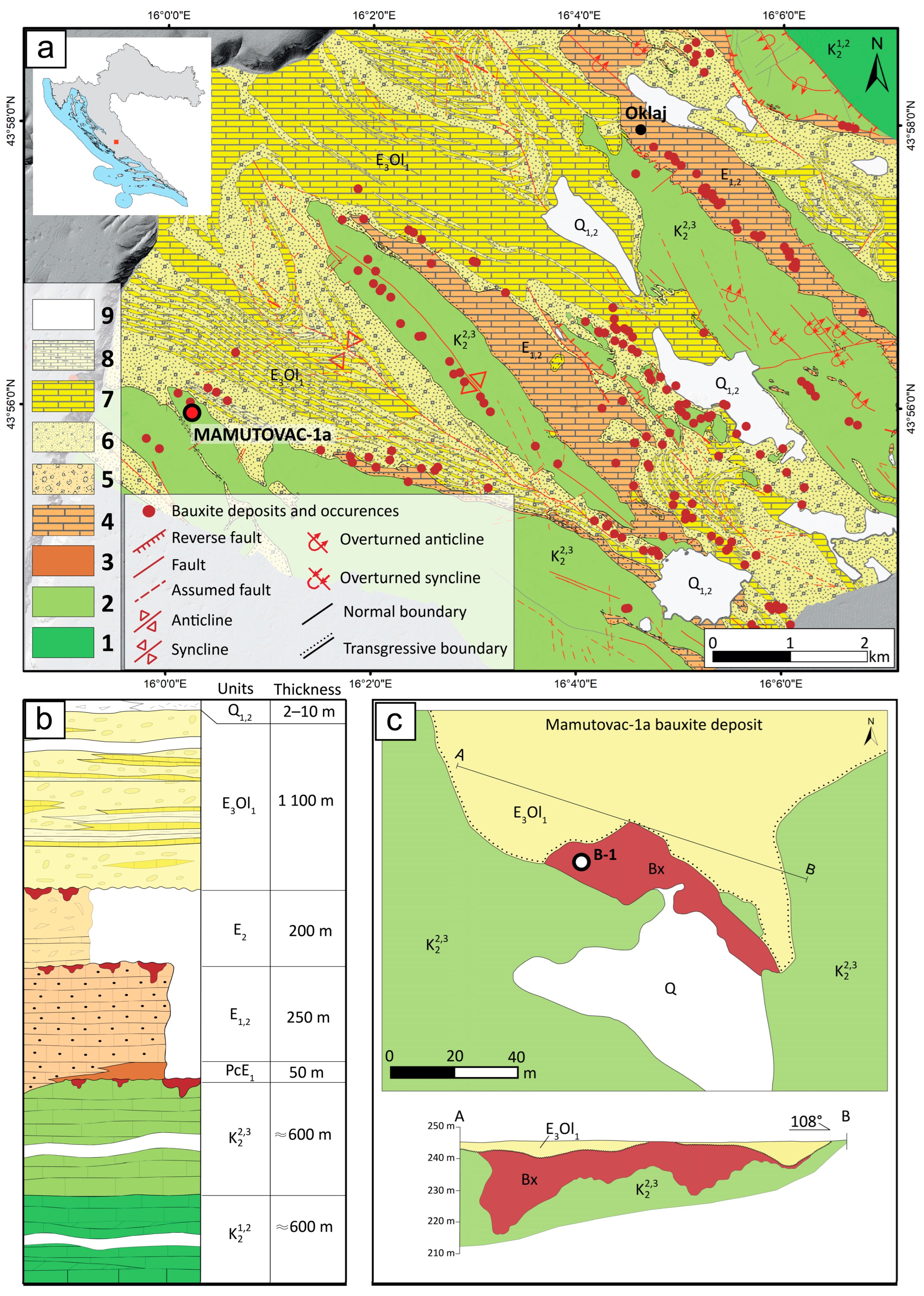
The Mamutovac-1a bauxite deposit is situated within the Municipality of Promina in Šibenik–Knin County, Croatia, southwest of the village of Oklaj (Figure 1a). Structurally, the area belongs to the Croatian karst Dinarides, forming part of the high-karst thrust sheet of the Dinaric orogen [53,54]. The deposit is exposed in a shallow syncline, part of a system of NW–SE–trending anticlines and synclines typical of the External Dinarides [40]. The limbs and hinge zones of these folds acted as natural traps for bauxite accumulation, while tectonic activity promoted partial redeposition of previously formed bauxite [55,56].
The regional stratigraphy is dominated by carbonates of the Adriatic Carbonate Platform (AdCP), ranging from the Toarcian to the Eocene (details in [39,40,57,58]) (Figure 1a,b). In the Mamutovac area, Upper Cretaceous rudist limestones form the base, overlain by Paleogene Kozina deposits and foraminiferal limestones [39,56,59,60,61]. These limestones were deposited in shallow marine environments and later subjected to subaerial exposure and intense karstification, forming a paleorelief with depressions, fractures, and fissures suitable for bauxite accumulation [1,15,16].
The wider Dinaric region experienced several phases of bauxite formation related to Late Cretaceous uplift and emergence of the Adriatic Carbonate Platform [41,43,44,62,63], and bauxite occurrences in the wider Promina Municipality area, associated with periods of emersion, occur within three stratigraphic horizons [46,47] (Figure 1b). Considering its stratigraphic position and its relationship to the overlying strata, the Mamutovac-1a bauxite deposit belongs to the Upper Eocene (BX7) bauxite horizon of the Croatian karst bauxites [48,49]. During the Middle to Late Eocene (Lutetian to Priabonian), warm and humid subtropical conditions favored intense chemical weathering and bauxitization of exposed carbonate and volcaniclastic material [46,47]. At the same time, intensified orogenic uplift and thrust propagation resulted in widespread erosion, renewed karstification, and the development of a regional erosional unconformity, which acted as the principal control on the formation and spatial distribution of the Upper Eocene bauxite deposits in the Promina area [52,64]. Aeolian and fluvial input of volcanic ash, derived from contemporaneous Eocene magmatism in the wider region, contributed to the formation of aluminous precursor material, as confirmed by a recent study of a different deposit within the same exploitation field [17,45].
Tectonic activity associated with the Dinaric orogeny reshaped the paleorelief and controlled the distribution of bauxite [39]. Folded and faulted structures created anticline hinges and synclinal depressions that served as traps for redeposited bauxite [17]. The semi-lithified bauxite fragments, along with pisolitic clasts, accumulated in synclinal areas, while the more uplifted limbs contributed material through local erosion and redeposition [17]. These processes continued until the Eocene–Oligocene transition, when deposition of Promina molasse covered the entire area [65]. The overlying Promina Formation, composed of alternating conglomerates, breccias, limestones, and marls, reflects sedimentation in deltaic to shallow-marine environments with frequent lateral and vertical facies changes, representing the transition from emergence to renewed sedimentation under variable depositional conditions. These deposits covered the bauxite deposits, protecting them from further erosion and preserving the thin, widely distributed, and partially redeposited bodies observed today [56]. Quaternary sediments in the area are limited to minor alluvial deposits along the Krka River [52,65].

Geological and Resource Characteristics of the Mamutovac-1a Bauxite Deposits

The Mamutovac-1a deposit is part of the non-active exploitation field Mamutovac [66]. The exploitation field, located in the north-western part of the Promina plateau, comprises ten bauxite deposits, several of which have already been fully exploited. The deposits occur within a relatively narrow elevation range of approximately 244–256 m a.s.l. and typically form irregular, lens-shaped bodies with lateral dimensions of up to about 100 m and an average thickness of around 4 m [51]. Previous studies of the Mamutovac exploitation field indicate that deposit morphology is strongly controlled by the underlying paleokarst relief, resulting in uneven basal contacts and frequent occurrences of pinnacled limestone protrusions that locally penetrate and segment the ore bodies [51]. This is consistent with the general characteristics of karst bauxite deposits developed on karstified carbonate substrates [4]. The basal contacts are often irregular and infill depressions in the karstified substrate, whereas the upper contacts with overlying sediments are relatively planar [51]. The Mamutovac-1a deposit is formed on Upper Cretaceous rudist limestones. The outcrop of the deposit measures approximately 80 × 10–25 m, while the ore body extends a further 30–80 m beneath the Promina cover towards the northeast. It forms an elongated trough, reaching up to ~30 m in thickness in its central part and thinning towards both ends. The overlying Promina deposits are well stratified, dominated by conglomerates with subordinate marls and limestones. In the southeastern part, the succession is locally covered by a thin layer of Quaternary terra rossa [51] (Figure 1c).
The bauxites are predominantly of böhmitic or mixed böhmitic–gibbsite composition [51]. However, their quality modulus generally ranges between 2 and 4, indicating relatively low ore quality, and a substantial proportion of the material has therefore been classified as off-balance ore in previous resource assessments [51]. Exploration of the Mamutovac exploitation field has a long history, beginning prior to the First World War and continuing through several major exploration campaigns during the second half of the twentieth century and the early twenty-first century, which included trenching, shallow pits, and extensive drilling programs. Among the identified deposits, Mamutovac-1a represents the most economically significant body, with estimated reserves of ~112 kt, within a total of ~291 kt of remaining exploitable bauxite in the Mamutovac exploitation field [51,52].

3. Materials and Methods

To investigate the vertical variability of the Mamutovac-1a bauxite deposit, exploratory drilling was carried out at a representative location selected based on previous investigations [51]. The selected site corresponds to a thicker part of the ore body, where it is exposed at the surface and not covered by overlying Promina deposits or terra rossa. Drilling was performed vertically. Drill core B-1, obtained at this location (coordinates: E: 460,164.5 m, N: 486,6035.2 m), had a diameter of 101 mm and was recovered in a partially compact and locally fragmented condition. The borehole reached a total depth of 26.4 m, of which 25.1 m of core was retrieved. Core loss occurred at the contact with the limestone basement, which is more permeable than the overlying bauxite. During drilling, water inflow at this contact led to washing out and loss of the lowermost part of the core. As a result, the lowermost 1.3 m of the core was not recovered.
The extracted core was systematically placed into plastic PVC core boxes, transported, and securely stored in the laboratories of the Croatian Geological Survey. The bauxite core was initially subjected to macroscopic description, with color characterization performed for all depth intervals using the Munsell Soil Color Charts [67]. Based on macroscopic observations, specific 5 cm thick intervals from various depths were selected for sampling and further analysis. The collected samples were dried to a constant weight in a drying oven. Once dried, they were finely ground using an agate mortar and pestle, rendering them suitable for subsequent analytical procedures.
For the determination of textural properties, thin sections were prepared from 11 bauxite samples collected along the core at representative intervals (Figure 2). Samples were selected to cover the entire core length, with preference given to sufficiently compact material suitable for thin section preparation, and were examined using a polarizing optical microscope (Olympus BX51TF, Olympus Corporation, Tokyo, Japan).
The measurement of magnetic susceptibility in 42 pulverized and homogenized samples from various depth intervals of the bauxite drill core was conducted using a Bartington MS2 device with a dual-frequency MS2B sensor (Bartington Instruments Ltd., Witney, UK) in the laboratories of the Croatian Geological Survey. Samples were packed into plastic containers with a volume of 10 cm3, weighed, and subsequently measured first at a low frequency (0.465 kHz) and then at a high frequency (4.65 kHz). The obtained results were used to determine mass-specific magnetic susceptibility values at low frequency χlf, as well as the frequency-dependent magnetic susceptibility χfd, expressed as percentages.
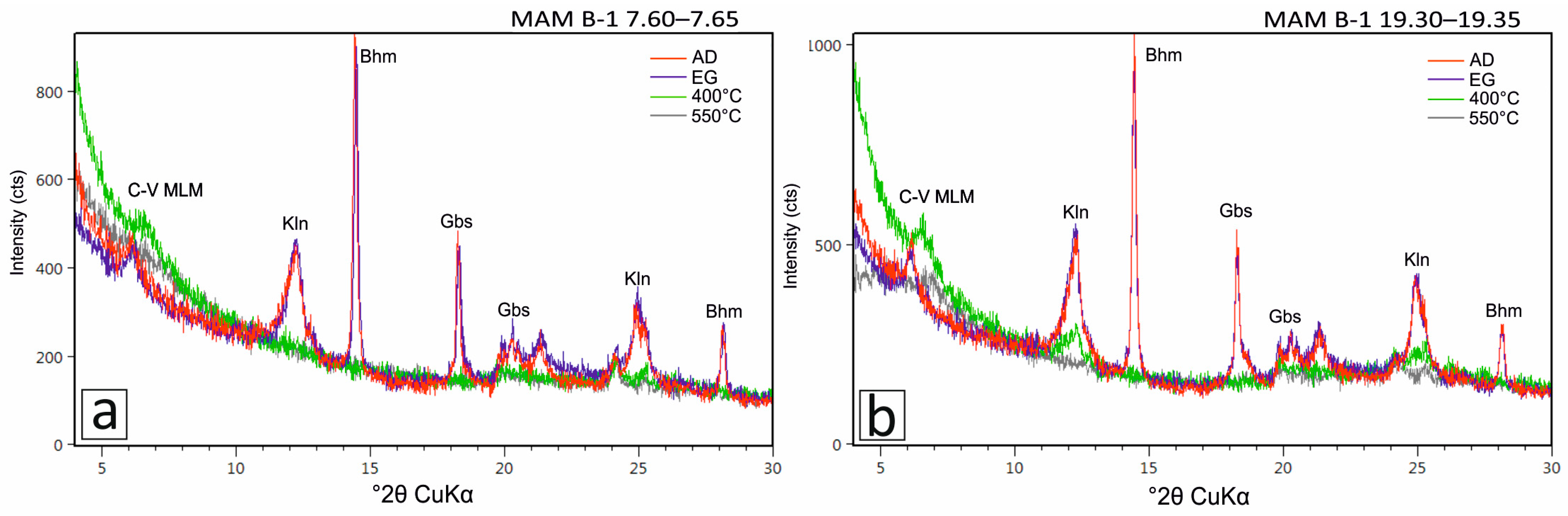
The mineral composition of the selected bauxite samples was determined through qualitative mineralogical analysis using X-ray powder diffraction (XRD) on a PANalytical X’Pert Powder diffractometer (Malvern Panalytical, Almelo, The Netherlands) at the Croatian Geological Survey. It is equipped with a Cu ceramic X-ray tube (CuKα radiation, λ = 1.5406 Å), a vertical goniometer of θ-θ geometry, a graphite monochromator, and a PIXcel detector. Measurements were performed at 45 kV and 40 mA, with a step size of 0.02°2θ, and a counting time of 100 s per step, over the 5–66°2θ range. The obtained diffraction patterns were analyzed using the X’Pert HighScore Plus software package (ver. 4.5; PANalytical B.V., Almelo, The Netherlands), which is linked to the ICDD PDF-4/Minerals database containing reference data for all known mineral species. The bulk mineralogical analysis involved examining a total of 42 finely ground bauxite samples. Powdered samples were crushed using an agate mortar and pestle, and subsequently prepared as random mounts on Al holders using the back-loading method. Oriented aggregates were prepared from approximately 10 g of seven selected bauxite samples across the core to provide detailed insight into the mineralogy of clay minerals. The clay mineral fraction (<2 μm) was separated by centrifugation, and the suspension was eyedropped onto glass slides and allowed to air-dry at room temperature to obtain oriented mounts. A series of standard treatments were then applied [68], including ethylene glycol solvation (overnight) and heating at 400 °C and 550 °C (>0.5 h). X-ray diffraction measurements were subsequently performed in the 4–30° 2θ range. These diagnostic tests facilitated the identification of clay minerals with overlapping basal reflections.
Geochemical analyses of bauxites were performed utilizing the whole rock major and trace element analytical method at the Bureau Veritas laboratory (formerly ACME Analytical Laboratories Ltd.) in Vancouver, BC, Canada. They were conducted on 23 bauxite core samples (~5 g of samples ground in an agate mortar and pestle), collected at approximately one-meter intervals, to assess chemical composition variations along the core. Major oxides and minor elements were quantified using inductively coupled plasma atomic emission spectroscopy (ICP-AES) on 0.2 g of sample following lithium borate fusion and dissolution in dilute nitric acid. Trace and rare earth elements (REE) underwent the same digestion process as major elements (0.2 g of sample) and were analyzed via inductively coupled plasma mass spectrometry (ICP-MS). To ensure analytical accuracy and precision, quality control measures included blanks, duplicates, and standard reference materials (STD SO-19), with results documented in a certified quality (CQ) report. Analytical uncertainties were <5%, except for elements at concentrations lower than 10 mg/kg, for which uncertainties were 5% to 15%. Recoveries of the standard reference material (STD SO-19) were within 95–105%.
Additionally, eight subsamples of bauxite were also analyzed using ICP-ES/MS after treatment with a modified aqua regia digestion (1:1:1 HNO3:HCl:H2O) at the Bureau Veritas laboratory to complement the overall geochemical dataset. At the Croatian Geological Survey, the aqua regia digestion (HCl:HNO3, 1:3 ratio) was performed on two selected samples with a solid-to-liquid ratio of 1:20 in a hot block digestion system at 90 °C. After digestion, the solutions were dried and powdered for mineralogical detection of the resulting bauxite residue using X-ray diffraction (XRD) and compared with the untreated bauxite samples.

4. Results

4.1. Mineralogy and Texture

4.1.1. Macroscopic Description of the Core

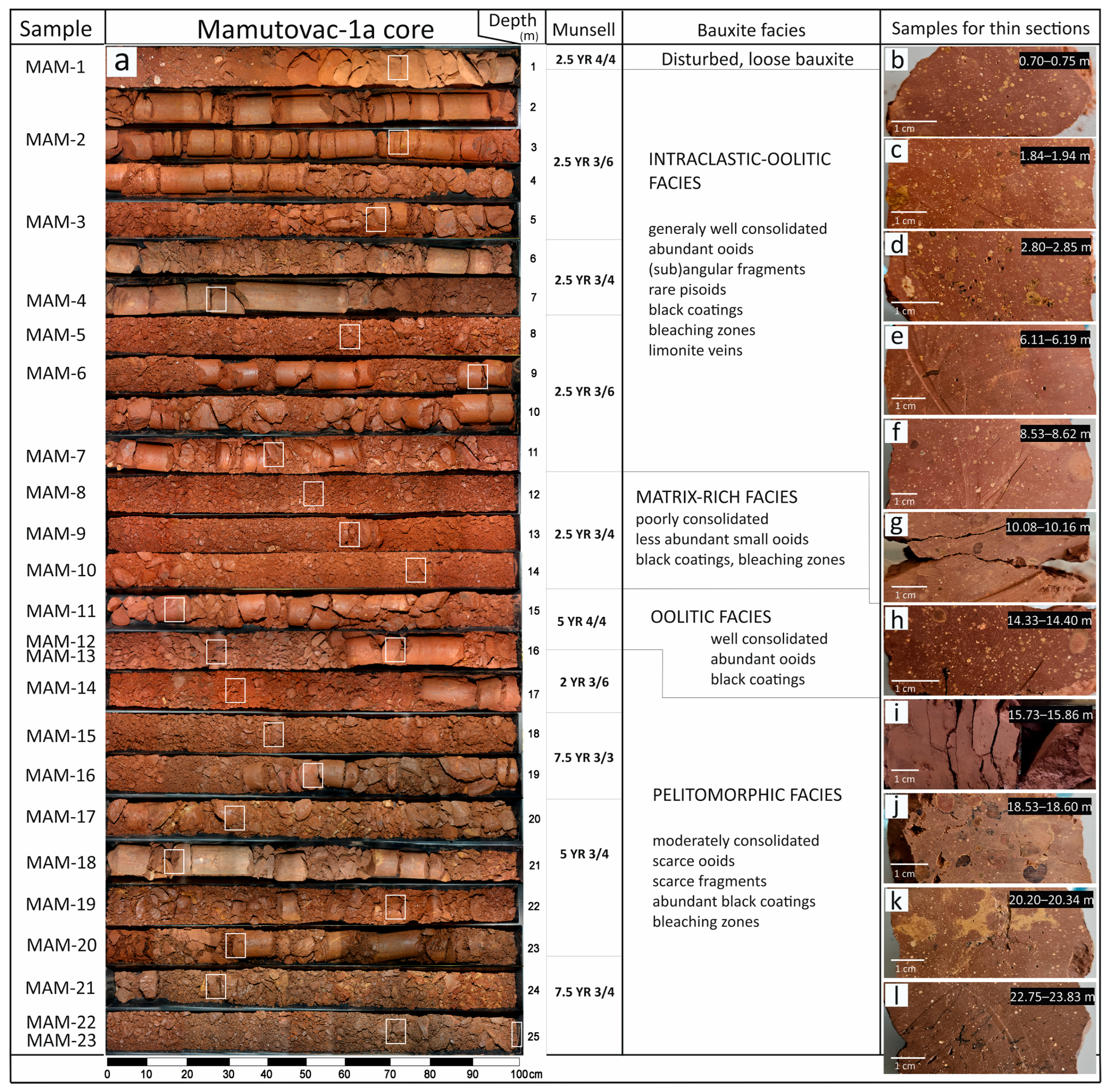
Macroscopic observations reveal systematic variations in color, texture, and degree of consolidation along the core (Figure 2a). The color of the bauxite falls within the red–yellow (YR) range of the Munsell Soil Color Charts [67], with a general shift from darker red hues (2.5 YR) in the upper part of the core (0–14 m) to more brownish tones (5–7.5 YR) at greater depths (14–25 m) (Figure 2a). Core solidity varies from well-consolidated to poorly consolidated material that locally disintegrated during drilling (Figure 2a). The uppermost 0–0.5 m of the core consists of a disturbed, poorly consolidated bauxite interval containing abundant limestone fragments and showing clear signs of limestone disintegration. From 0.5 to 11 m, the core is predominantly well consolidated and characterized by a red groundmass with abundant ooids and occasional larger grains (up to 1 cm), typically lighter in color than the surrounding material. Bleaching features and occasional black coatings are present (Figure 2b–g). Within this interval, local sections of weaker consolidation occur (e.g., ~6.8–8.2 m), where the material becomes more friable and disaggregated. A distinct change is observed between 11 and 14 m, where the bauxite becomes finer-grained, with a reduced abundance of ooids and generally poorer consolidation. Bleaching features are common in this part of the core. Between 14 and 15.5 m, the material becomes more consolidated again and is characterized by red to dark red bauxite with abundant light-colored ooids (up to 1 mm). Irregular to subrounded darker aggregates (up to ~5 mm) occur locally, together with bleaching zones (Figure 2h). Below 15.5 m, the core is dominated by red to brown, fine-grained bauxite with a general decrease in ooid abundance. Bleaching features are frequent in the upper part of this interval but diminish with depth and are absent in the lowermost part. Black coatings are abundant, and the material is generally moderately consolidated (Figure 2i–l).
Figure 2. (a) Photographic overview of the Mamutovac-1a drill core with depth indicated in meters (0–25 m). White rectangles indicate the exact positions of intervals sampled for geochemical analyses, corresponding to the samples listed on the left. The adjacent column shows the dominant Munsell color codes for zones defined based on bauxite facies, together with a brief macroscopic description of their characteristics. (bl) Hand-specimen photographs of the samples used for preparation of thin sections, with the corresponding depth ranges indicated.
Minerals 16 00547 g002

4.1.2. Textural and Mineralogical Properties

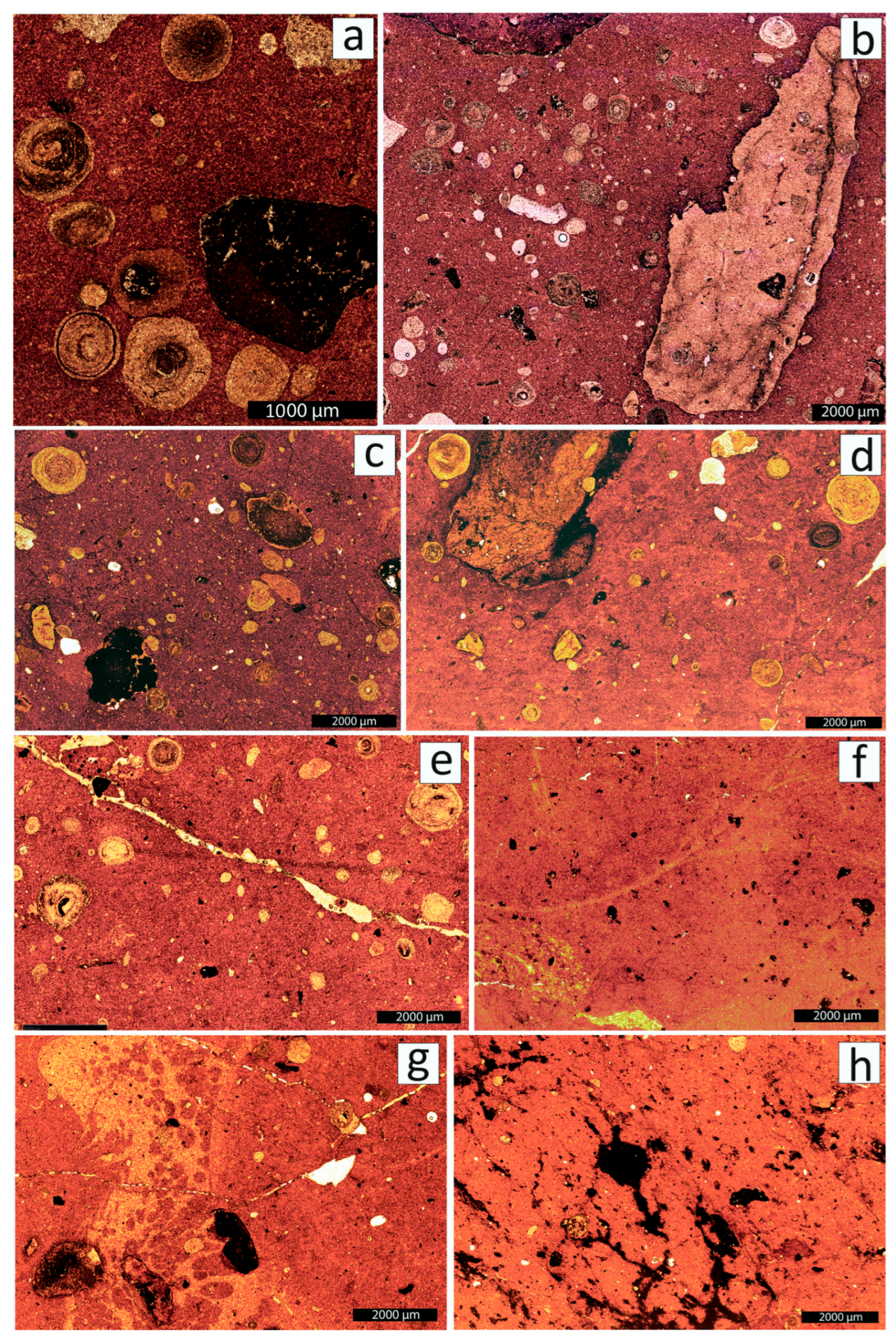
Thin-section observations reveal a dominantly dark red to reddish-brown, pelitomorphic to microclastic matrix rich in Fe oxi-hydroxides across all samples. Based on variations in petrographic characteristics, four main facies types are distinguished (Figure 2 and Figure 3a–h), following approaches commonly applied to karst bauxites (e.g., [69]). The intraclastic–oolitic facies is characterized by abundant ooids and frequent intraclasts embedded in a fine-grained ferruginous matrix. Ooids are typically well-rounded to subrounded and display concentric internal structures. Locally, ooids exhibit composite internal structures and partially disrupted concentric laminae. They are commonly lighter in color than the surrounding matrix, with outer laminae locally showing partial to complete iron depletion. Intraclasts are angular to subangular and exhibit variable internal textures, locally showing iron depletion. They also display internal heterogeneity and irregular boundaries. Iron-rich coatings and impregnations are common, forming discontinuous rims around clasts and filling small voids (Figure 3a–d). In contrast, the matrix-rich, poorly consolidated facies is dominated by fine-grained material with reduced ooid abundance and weak cementation. No thin sections were prepared from this interval due to the poorly consolidated nature of the material. The oolitic facies is characterized by abundant ooids embedded in a fine-grained red matrix. Ooids are mostly light-colored and typically up to 1 mm in size. Minor intraclasts are present, and iron-rich coatings and impregnations occur locally (Figure 3e). The pelitomorphic facies is dominated by a fine-grained matrix with only rare ooids. Small intraclasts (up to 1 mm) are locally present. Ferruginous impregnations are abundant in this zone and occur both as diffuse concentrations within the matrix and as irregular coatings and infillings (Figure 3f–h).
The vertical distribution of these facies defines four zones along the core. Zone I (0.5–11 m) is dominated by the intraclastic–oolitic facies; however, a distinct interval between ~6.8 and 8.2 m is characterized by the occurrence of matrix-rich, poorly consolidated facies. Zone II (11–14 m) is dominated by matrix-rich, poorly consolidated facies. Zone III (14–15.5 m) corresponds to the oolitic facies. Zone IV (15.5–25 m) is dominated by pelitomorphic facies.
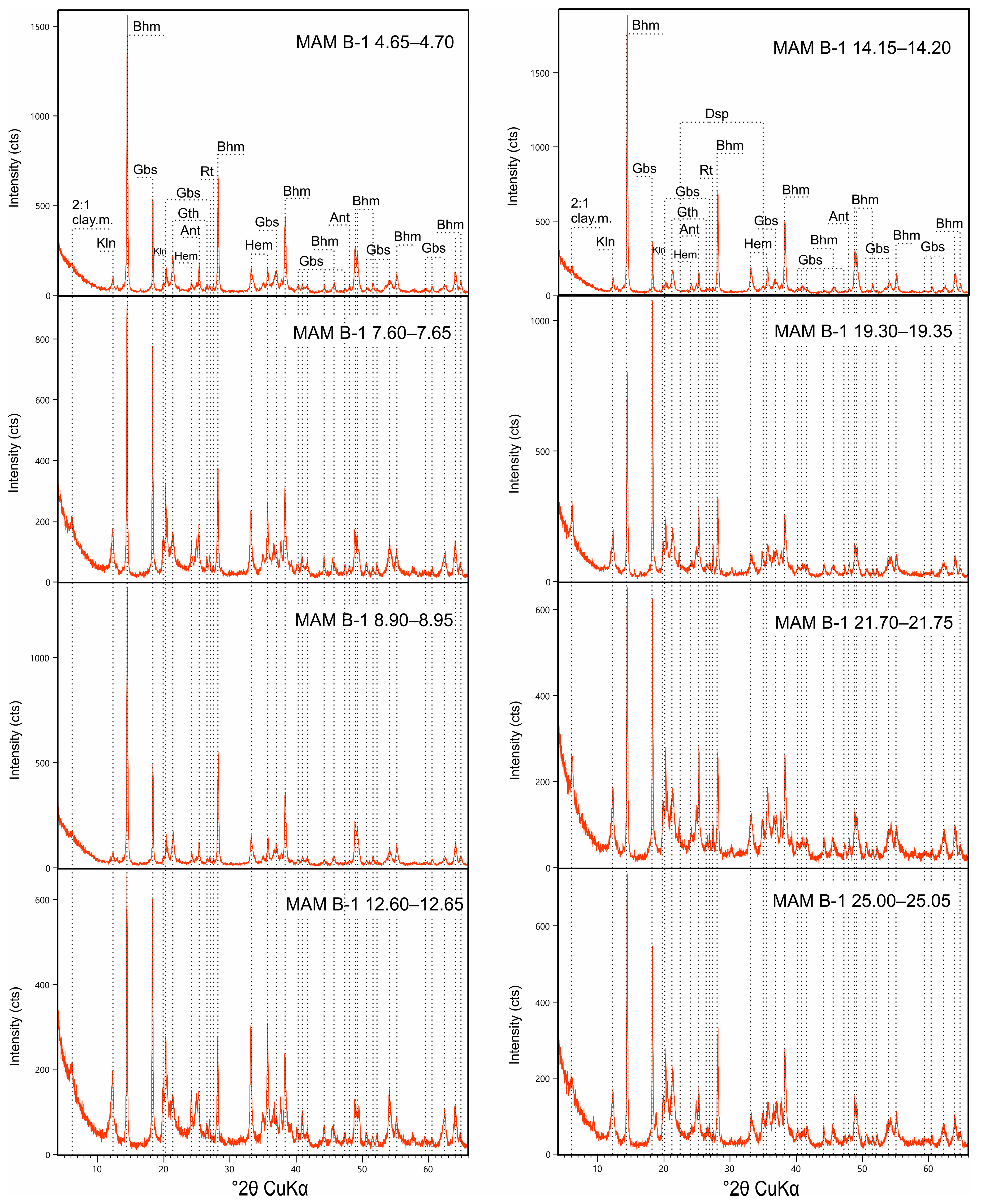
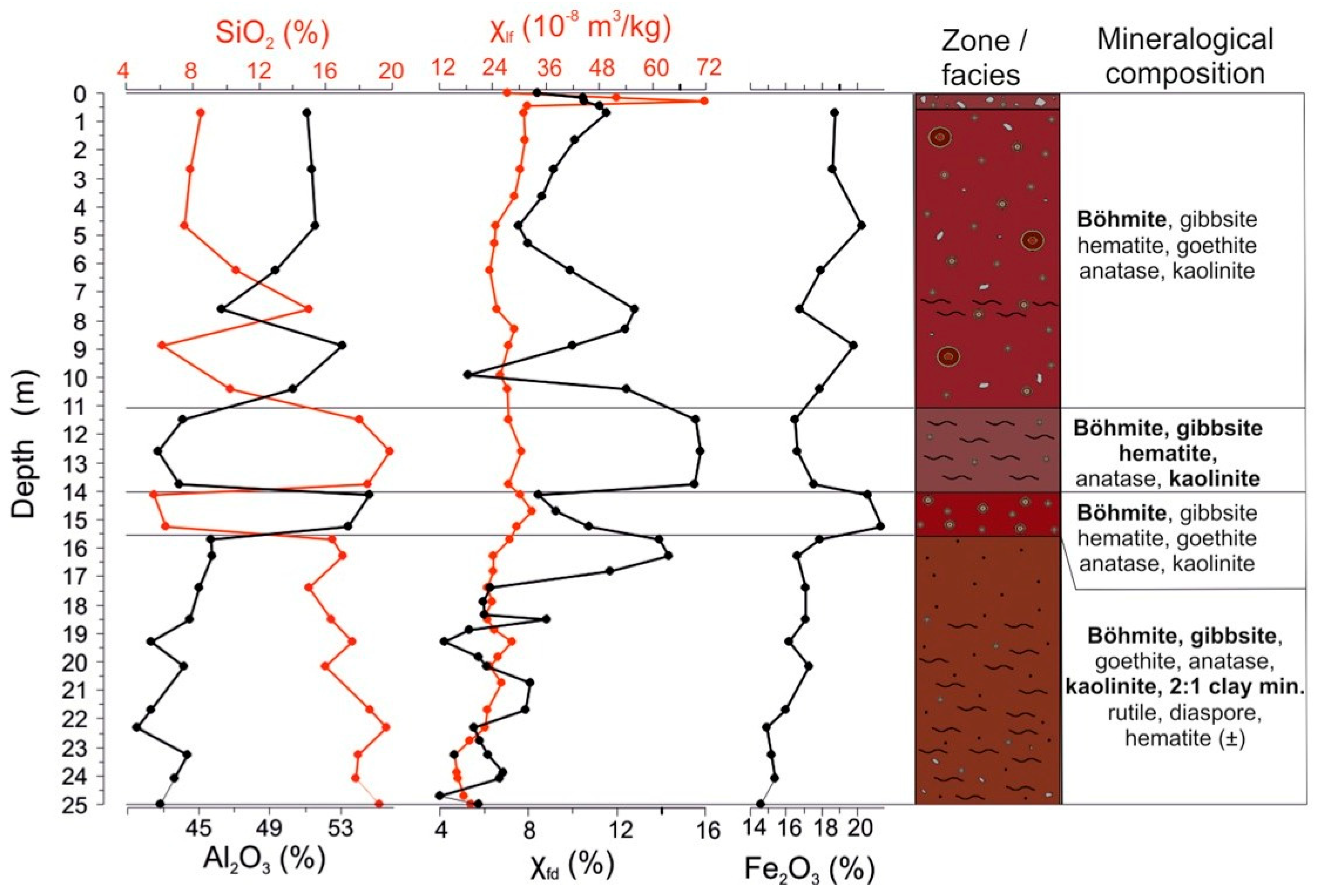
XRD analysis identified böhmite, gibbsite, hematite, and anatase as the major mineral phases, while goethite, kaolinite, and rutile occur as minor phases (Figure 4, Figure 5 and Figure 6; Table S1 in the Supplementary Material). The interpretation of mineral abundances is based on relative peak intensities rather than quantitative phase analysis. The mineralogical composition varies systematically between facies types, which largely correspond to the defined zones along the core. The intraclastic–oolitic facies (Zone I; 0.5–11 m) is dominated by böhmite, with gibbsite as a subordinate phase. Hematite is consistently present and more abundant than goethite, which occurs in lower proportions. Anatase is present in minor amounts, while clay minerals are scarce. Detailed XRD analysis following diagnostic tests on oriented clay mounts of two selected bauxite samples from this zone allowed identification of kaolinite (1:1 type clay mineral) (Figure 5a). It appears as poorly crystallized (disordered) kaolinite. The chlorite/vermiculite mixed-layer mineral is identified as a 2:1 clay mineral. The matrix-rich, poorly consolidated facies (Zone II; 11–14 m) retains böhmite as the dominant phase, accompanied by an increase in gibbsite. Hematite reaches a relative maximum in this zone, whereas goethite is absent or negligible. Anatase and kaolinite also show higher relative abundances compared to Zone I, with minor contributions of chlorite/vermiculite mixed-layer mineral. The oolitic facies (Zone III; 14–15.5 m) remains dominated by böhmite. Compared to the overlying matrix-rich facies, this zone shows a decrease in gibbsite and kaolinite, while the chlorite/vermiculite mixed-layer mineral is present in small amounts. Hematite is present but less pronounced than in Zone II, while goethite reappears and remains less abundant than hematite. Anatase persists in minor and relatively stable amounts. The pelitomorphic facies (Zone IV; 15.5–25 m) is characterized by an increase in gibbsite, which locally exceeds böhmite. Böhmite remains present but is less dominant than in the overlying facies. Presence of diaspore has also been identified in several samples from Zone IV. Hematite decreases, becoming very low in the lowermost part of the core (between 19 and 25 m), whereas goethite increases and generally occurs in higher proportions than hematite. Clay minerals are more abundant, with kaolinite showing a general increase in relative abundance with depth within this zone. Well-crystallized (ordered) kaolinite was identified in the two selected samples at depths of 19.30 m and 21.7 m. The chlorite/vermiculite mixed-layer mineral (Figure 5b) is also more prominent in this zone compared to the others. Anatase is relatively more abundant compared to all other zones. Rutile appears exclusively within this lowermost facies (specifically between 18 and 23 m), although only in minor amounts.

4.1.3. Magnetic Susceptibility

The mass magnetic susceptibility (χlf) ranges from 15.49 to 71.69 × 10⁻⁸ m3/kg (Figure 6), with the highest values in the uppermost part of the profile and the lowest values in the lowermost interval (Zone IV). A general decrease in χlf with depth is observed, with higher average values in Zones I–III compared to Zone IV. Frequency-dependent susceptibility (χfd) follows a similar trend, showing higher values in the upper part of the core.

4.2. Geochemistry

Major, trace, and rare earth element compositions of 23 representative samples from the Mamutovac-1a core are summarized in Table 1. Total REE (ΣREE) as well as ΣLREE and ΣHREE values are provided in Table 2. Concentrations are reported in mg/kg, which is numerically equivalent to ppm. Sample positions along the core are shown in Figure 2a.

4.2.1. Major Element Geochemistry

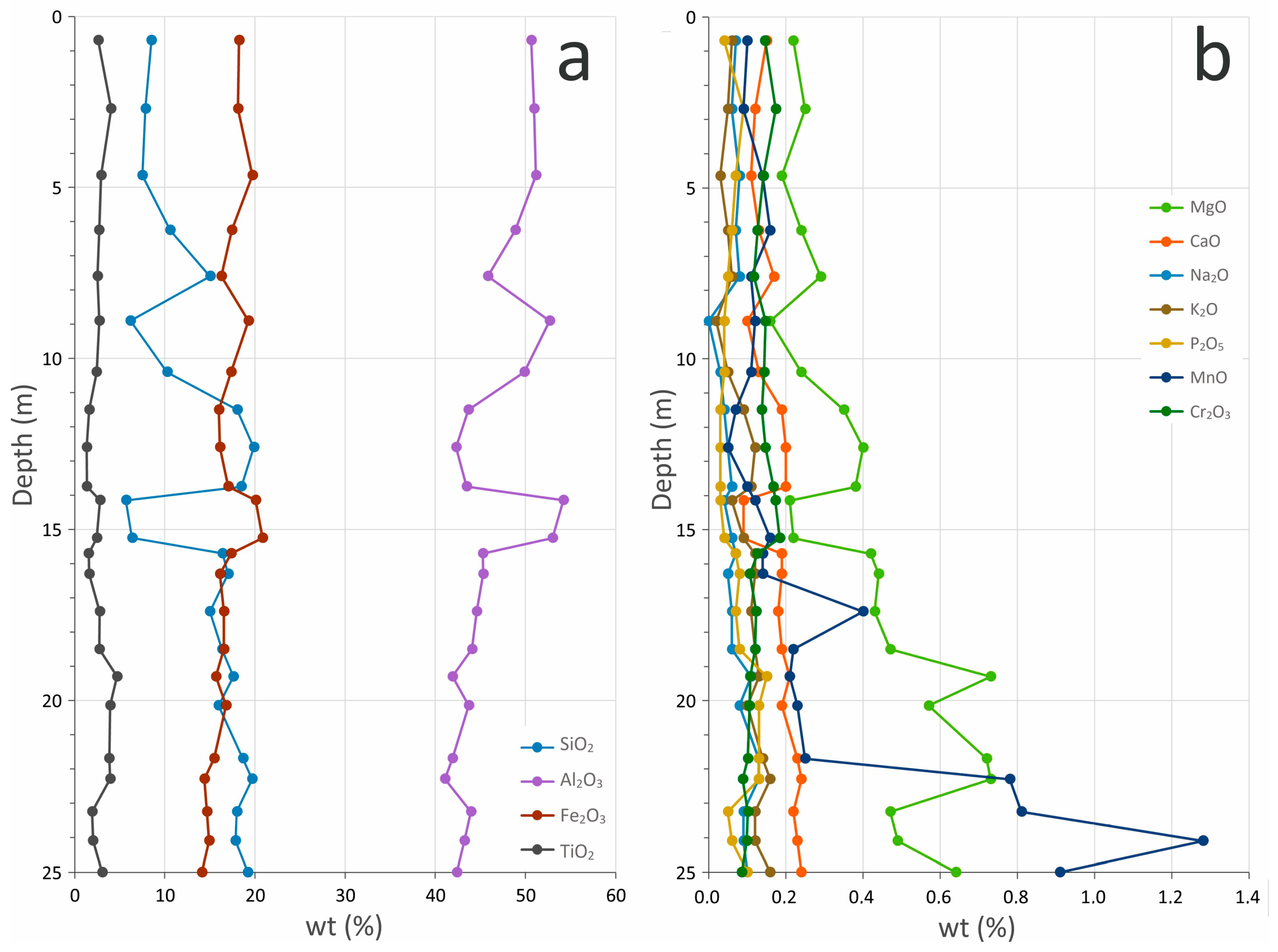
The sampled intervals are characterized by Al2O3 as the dominant oxide (41.08–54.19 wt%), followed by Fe2O3 (14.11–20.85 wt%), while SiO2 (5.69–19.88 wt%) and TiO2 (1.33–4.71 wt%) show more variable concentrations (Table 1, Figure 7a).
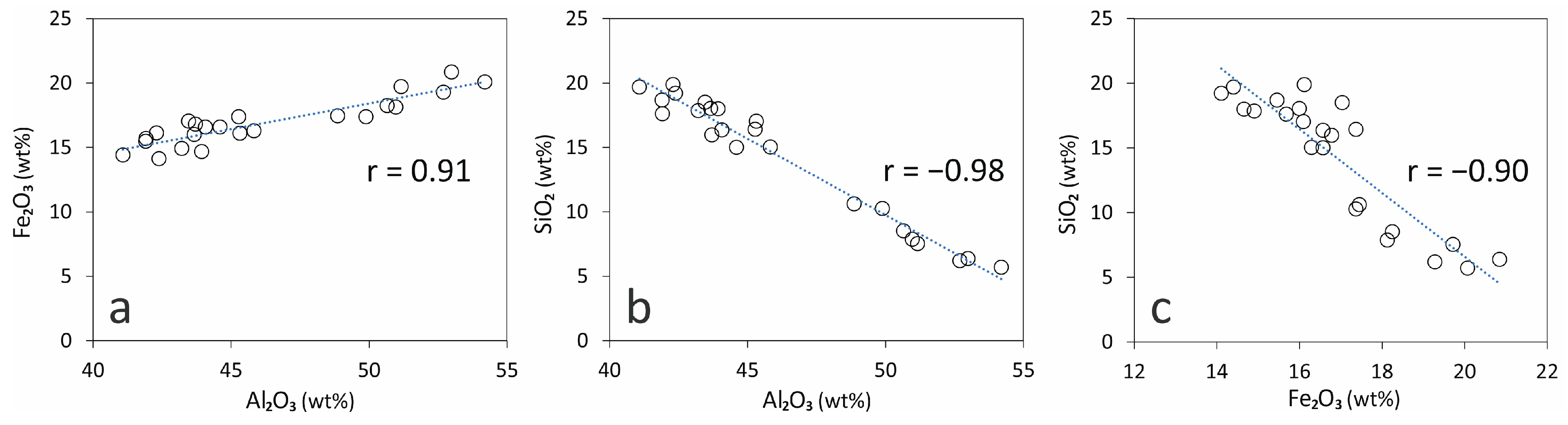
The mass fractions of Al2O3, Fe2O3, SiO2, and TiO2 show distinct variations across the defined facies (Figure 7a). Al2O3 is highest in the intraclastic–oolitic facies (Zone I), decreases in the matrix-rich facies (Zone II), and shows a local increase in the oolitic facies (Zone III), followed by a general decline in the pelitomorphic facies (Zone IV). Fe2O3 displays a broadly similar distribution, with higher values in Zone I, a decrease in Zone II, and a local maximum in Zone III, followed by decreasing values toward Zone IV. SiO2 content varies significantly and generally shows an opposite trend to Al2O3 and Fe2O3 (Figure 7a), with elevated values in the matrix-rich facies (Zone II) and in the deeper pelitomorphic facies (Zone IV), as well as locally within Zone I (e.g., ~8 m). Al2O3 and Fe2O3 show a broadly positive covariation (Figure 8a), whereas SiO2 exhibits a pronounced inverse relationship with both Al2O3 and Fe2O3 (Figure 8b,c). Overall, Al2O3 and Fe2O3 show a general decrease with depth, whereas SiO2 tends to increase toward the lower part of the profile.
TiO2 exhibits moderate variability, with a slight decrease from Zone I to Zone II, followed by a local increase in the oolitic facies (Zone III), and fluctuating values, with a tendency toward slightly higher concentrations in the pelitomorphic facies (Zone IV).
In addition to the major oxides, oxides exhibiting mass fractions ranging from 0.01 wt% to 1 wt% were also detected, specifically MgO (0.16–0.73 wt%), CaO (0.09–0.24 wt%), Na2O (0.03–0.13 wt%), K2O (0.02–0.16 wt%), P2O5 (0.03–0.15 wt%), MnO (0.05–1.28 wt%), and Cr2O3 (0.09–0.18 wt%) (Table 1, Figure 7b). MgO, CaO, and K2O show strong positive correlations with SiO2 (r = 0.81, 0.96, and 0.85, respectively; Table S2 in the Supplementary Material) and therefore follow a similar distribution, including lower values in the oolitic facies (Zone III) and higher values in the pelitomorphic facies (Zone IV). P2O5 shows a similar distribution to TiO2, correlating positively with it (r = 0.79; Table S2 in the Supplementary Material), with lower values in the upper facies (Zones I–III) and an increase in the pelitomorphic facies (Zone IV). In contrast, Cr2O3 shows an opposite trend, with relatively higher values in the upper facies (Zones I–III), and correlates positively with Fe2O3 (r = 0.84; Table S2 in the Supplementary Material). MnO shows the most pronounced variation, with low values in the upper facies (average ~0.15 wt%) and a sharp increase in the pelitomorphic facies (Zone IV), reaching up to 0.95 wt%.
The observed geochemical variations broadly correspond to the mineralogical com-position of the defined facies. The intraclastic–oolitic facies (Zone I) and oolitic facies (Zone III), characterized by the dominance of böhmite and hematite, show higher Al2O3 and Fe2O3 contents, reflecting the abundance of Al- and Fe-bearing mineral phases. In contrast, the matrix-rich facies (Zone II) and pelitomorphic facies (Zone IV), which contain higher proportions of clay minerals and gibbsite, show higher SiO2 contents and selected minor oxides. In particular, elevated SiO2, MgO, and K2O contents are consistent with the increased contribution of clay minerals, whereas higher TiO2 values reflect the presence of Ti-bearing phases such as anatase and rutile. Similarly, the distribution of P2O5 shows higher values in the pelitomorphic facies (Zone IV). The positive relationship between Cr2O3 and Fe2O3 suggests that Cr is at least partly associated with Fe-bearing phases, likely through adsorption or substitution in Fe oxi-hydroxides.

4.2.2. Trace Element Geochemistry

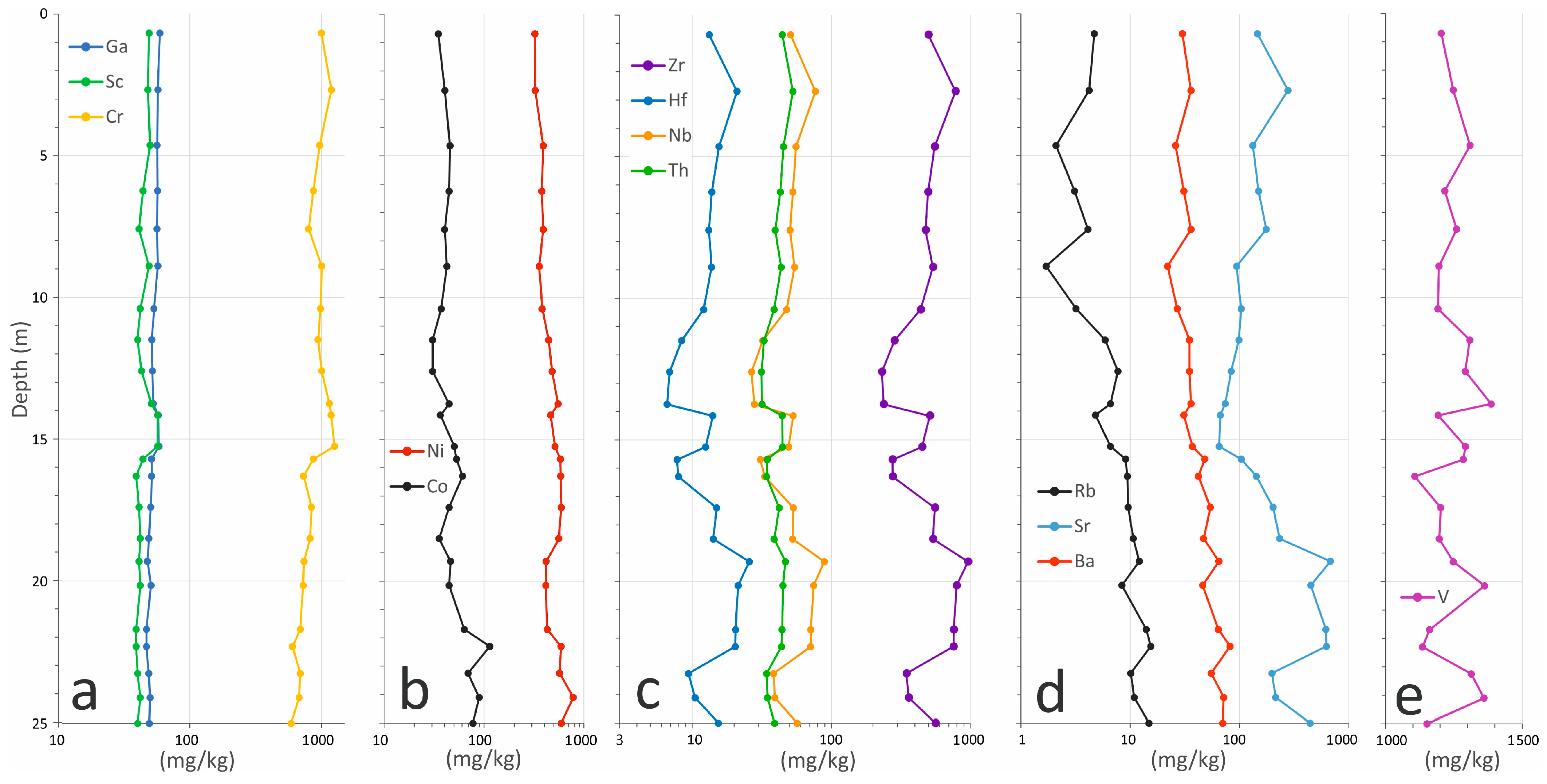
The most abundant trace elements in the core are V (1239 mg/kg), Cr (884.7 mg/kg), Zr (508 mg/kg), Ni (482 mg/kg), and Sr (234 mg/kg) (Table 1, Figure 9a–e). Vanadium ranges from 1107 to 1387 mg/kg, Zr from 231 to 963 mg/kg, and Ni from 322 to 780 mg/kg, while Sr ranges from 65 to 681 mg/kg. Cr concentrations range from 588.6 to 1259.4 mg/kg and broadly follow the vertical trend observed for Cr2O3.
Sn and Sc show a decrease in Zone II, followed by a local increase toward Zone III and more variable values in Zone IV. In contrast, Cr shows a less systematic distribution, with no clearly defined facies-dependent trend, while Ga displays only minor variations across the profile. All four elements display systematic relationships with Fe2O3, showing positive correlations (Cr r = 0.84, Ga r = 0.83, Sn r = 0.76, Sc r = 0.88), while Sn also correlates with TiO2 (r = 0.55). The observed distribution of Cr, Ga, Sn, and Sc is consistent with their association with Fe oxi-hydroxides, which are most abundant in Zones I and III (Figure 9a). Ni and Co show a general increase from Zones I–II toward Zone IV, with some local variability (Figure 9b). Both elements show strong positive correlations with MnO (Ni r = 0.73; Co r = 0.82), along with negative to moderate correlations with Fe2O3 (Ni r = −0.49; Co r = −0.56). Zr, Hf, Nb, Ta, Th, U, and W follow a general pattern of decreasing values from Zone I to Zone II, a local maximum in Zone III, and more irregular variations in Zone IV (Figure 9c). These elements exhibit strong positive correlations with TiO2 (Zr r = 0.99, Hf r = 0.99, Nb r = 0.99, Ta r = 0.98, Th r = 0.85, U r = 0.91, W r = 0.92; Table S2), as well as weaker and variable positive correlations with P2O5. A nearly perfect positive correlation between Zr and Hf (r = 0.99) is also observed. Rb, Cs, Sr, and Ba show a progressive increase from Zone I toward Zone IV (Figure 9d). These elements display generally positive correlations with K2O, MgO, P2O5, CaO, Na2O, and MnO, and negative correlations with Al2O3 and Fe2O3. The strongest correlations are observed between Rb and K2O (r = 0.96), Cs and MgO (r = 0.93), and Sr and P2O5 (r = 0.93). Vanadium shows no clear facies-dependent trend and exhibits irregular variability throughout the profile, without significant correlations with major oxides (Figure 9e).

4.2.3. REE Geochemistry

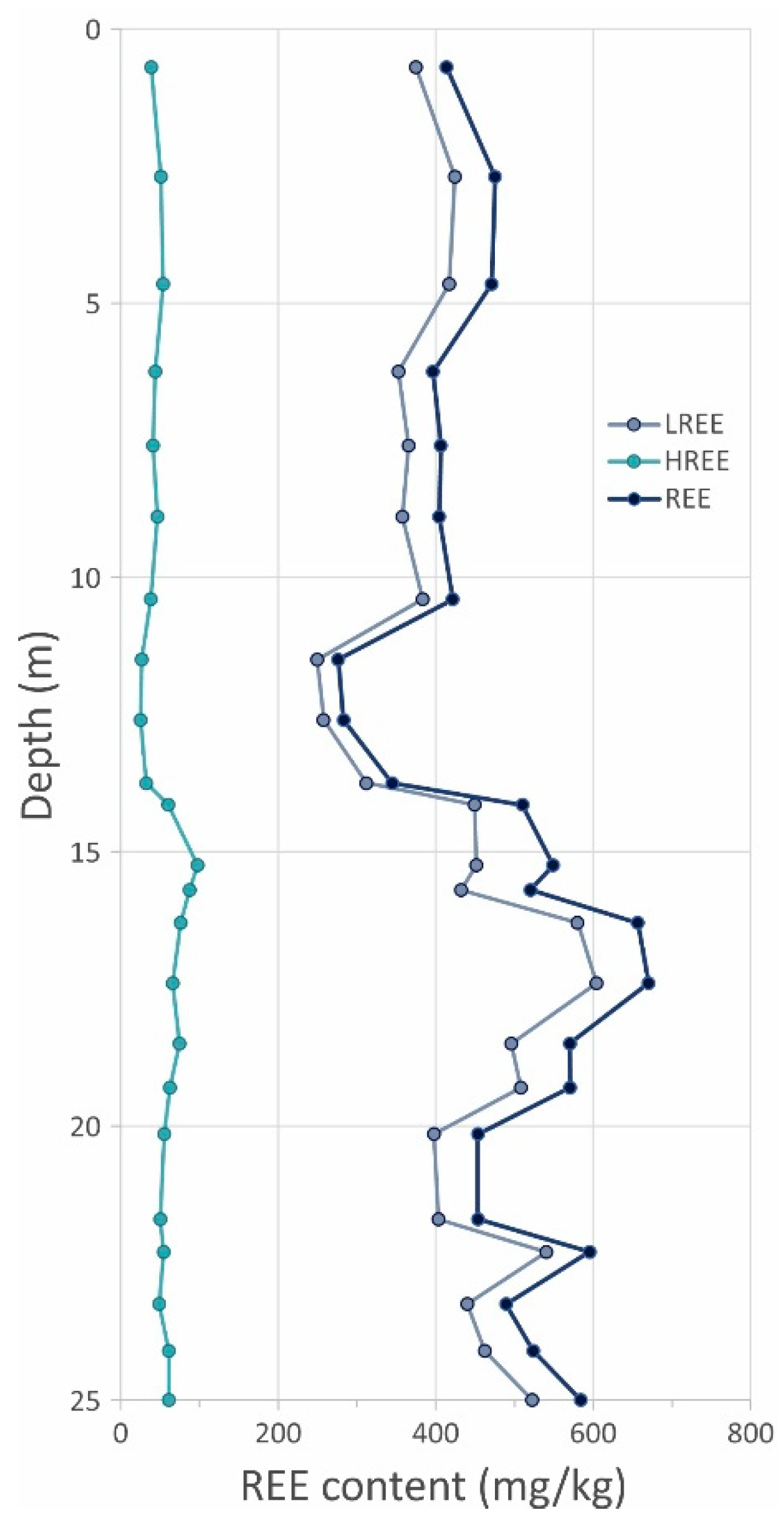
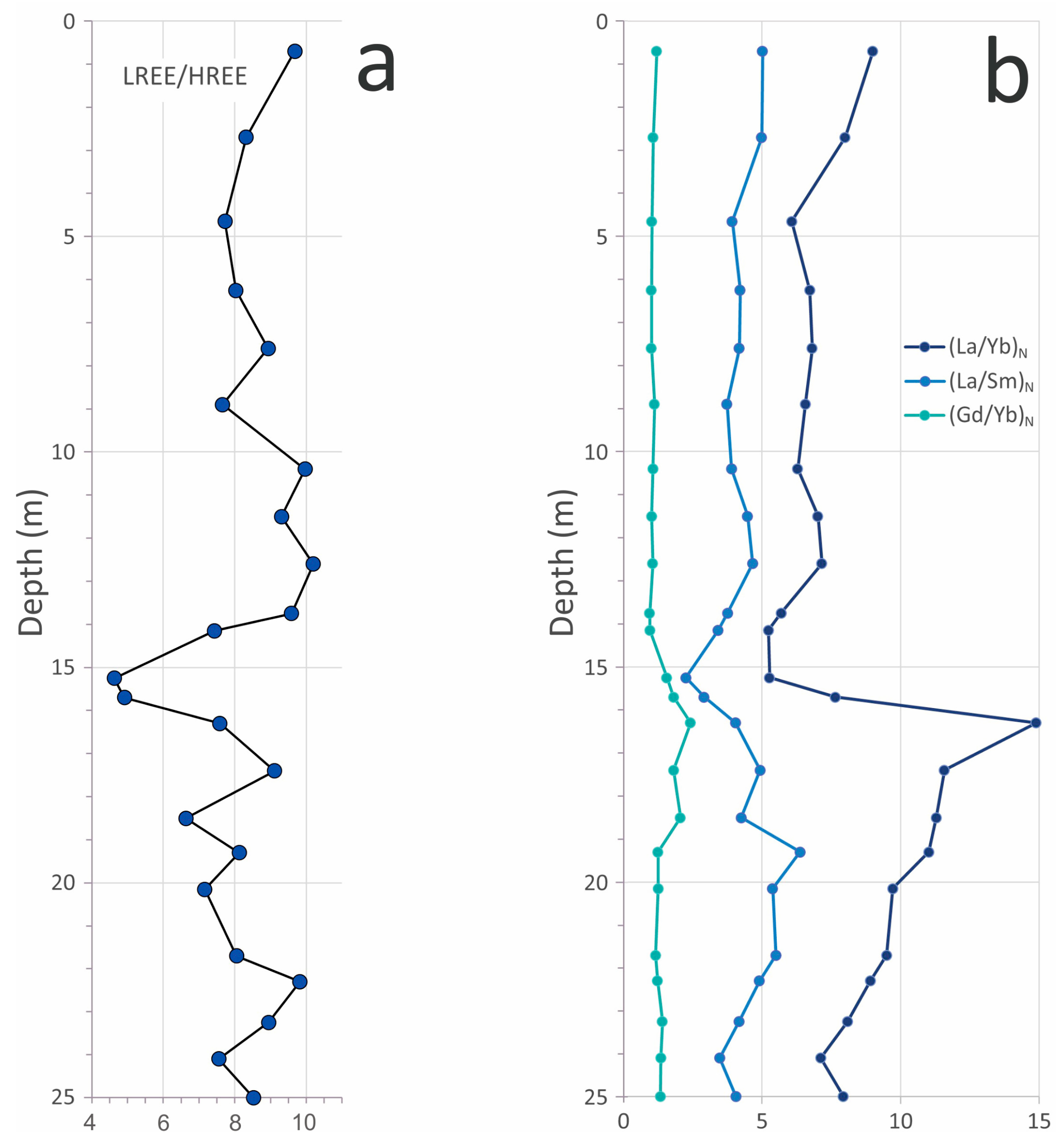
The bauxite samples from the Mamutovac-1a core show variable REE contents (Table 1, Figure 10). The total REE content (ΣREE) ranges from 276 to 670 mg/kg. ΣREE values are lower in Zones I–II, reach a local minimum in Zone III, and increase again toward Zone IV, although individual samples show some variability. Similar distribution patterns are observed for both light REEs (ΣLREE; La–Sm) and heavy REEs (ΣHREE; Eu–Lu). ΣLREE ranges from 250 to 604 mg/kg and represents the dominant fraction of total REE content, whereas ΣHREE concentrations are significantly lower, ranging from 25 to 98 mg/kg. Variations are more pronounced in the ΣLREE fraction, while ΣHREE shows comparatively subdued variability.
The REE distribution is characterized by enrichment of LREE relative to HREE, as reflected in ΣLREE/ΣHREE ratios ranging from 4.63 to 10.20 (Table 2). These ratios show systematic vertical variations, with slightly higher values in the upper part of the profile (Zones I–II; average ~8.8) compared to deeper intervals (Zones III–IV; average ~7.6). A local minimum in ΣLREE/ΣHREE is observed at approximately 15–16 m, corresponding to the transition between Zones III and IV. The (La/Yb)N ratios range between 5.24 and 14.90, with generally lower and decreasing values from Zones I to III, followed by a sharp increase to a maximum at 16.30–16.35 m in Zone IV, and generally higher values in Zone IV, with a decreasing trend. The (La/Sm)N ratios range between 2.25 and 6.38, with decreasing values from Zones I to III and higher values in Zone IV, where a local maximum is observed at 19.30–19.35 m. The (Gd/Yb)N ratios range between 0.95 and 2.42 and remain relatively uniform across all zones, with slightly higher values in the upper part of Zone IV.
Table 2. Geochemical parameters of Rare Earth Elements and selected ratios for the 23 Mamutovac-1a core samples. The normalization factors for chondrite are from [71].
SampleMAM-1MAM-2MAM-3MAM-4MAM-5MAM-6MAM-7MAM-8MAM-9MAM-10MAM-11MAM-12
Depth (m)0.7–0.752.70–2.754.65–4.706.25–6.307.60–7.658.90–8.9510.40–10.4511.50–11.5512.60–12.6513.75–13.8014.15–14.2015.25–15.30
ΣREE413.76475.64471.13396.70406.77404.61421.76276.34283.13344.58510.10549.22
ΣLREE375.01424.60417.14352.78365.83357.89383.30249.53257.84312.03449.61451.70
ΣHREE38.7551.0453.9943.9240.9446.7238.4626.8125.2932.5560.4997.52
ΣL/ΣH9.688.327.738.038.947.669.979.3110.209.597.434.63
(La/Yb)N9.008.006.086.726.816.576.297.027.165.705.245.28
(La/Sm)N5.034.993.924.224.183.743.914.484.663.763.422.25
(Gd/Yb)N1.201.071.031.011.011.121.061.021.060.950.951.57
La/Y1.551.411.231.331.391.251.271.411.401.341.361.30
Sm/Nd0.190.190.230.210.210.230.210.210.200.220.240.27
Eu/Eu*0.680.680.710.730.710.730.710.700.700.750.760.77
Ce/Ce*1.381.251.631.381.541.472.241.661.932.121.650.90
SampleMAM-13MAM-14MAM-15MAM-16MAM-17MAM-18MAM-19MAM-20MAM-21MAM-22MAM-23
Depth (m)15.70–15.7516.30–16.3517.40–17.4518.50–18.5419.30–19.3520.15–20.2021.70–21.7522.30–22.3523.25–23.3024.10–24.1525.00–25.10
ΣREE520.35656.79670.25570.46570.74453.64453.50595.40489.39523.76584.26
ΣLREE432.40580.25603.97495.72508.18398.04403.39540.39440.17462.51522.90
ΣHREE87.9576.5466.2874.7462.5655.6050.1155.0149.2261.2561.36
ΣL/ΣH4.927.589.116.638.127.168.059.828.947.558.52
(La/Yb)N7.6414.9011.5911.2911.029.729.508.928.097.127.94
(La/Sm)N2.924.054.944.266.385.385.514.914.173.474.06
(Gd/Yb)N1.812.421.812.061.241.261.161.241.401.351.33
La/Y1.862.511.451.461.641.451.491.461.391.321.32
Sm/Nd0.250.180.170.190.170.170.170.170.200.220.20
Eu/Eu*0.770.720.660.690.650.650.660.680.710.700.68
Ce/Ce*0.660.501.070.670.750.680.861.401.541.311.35
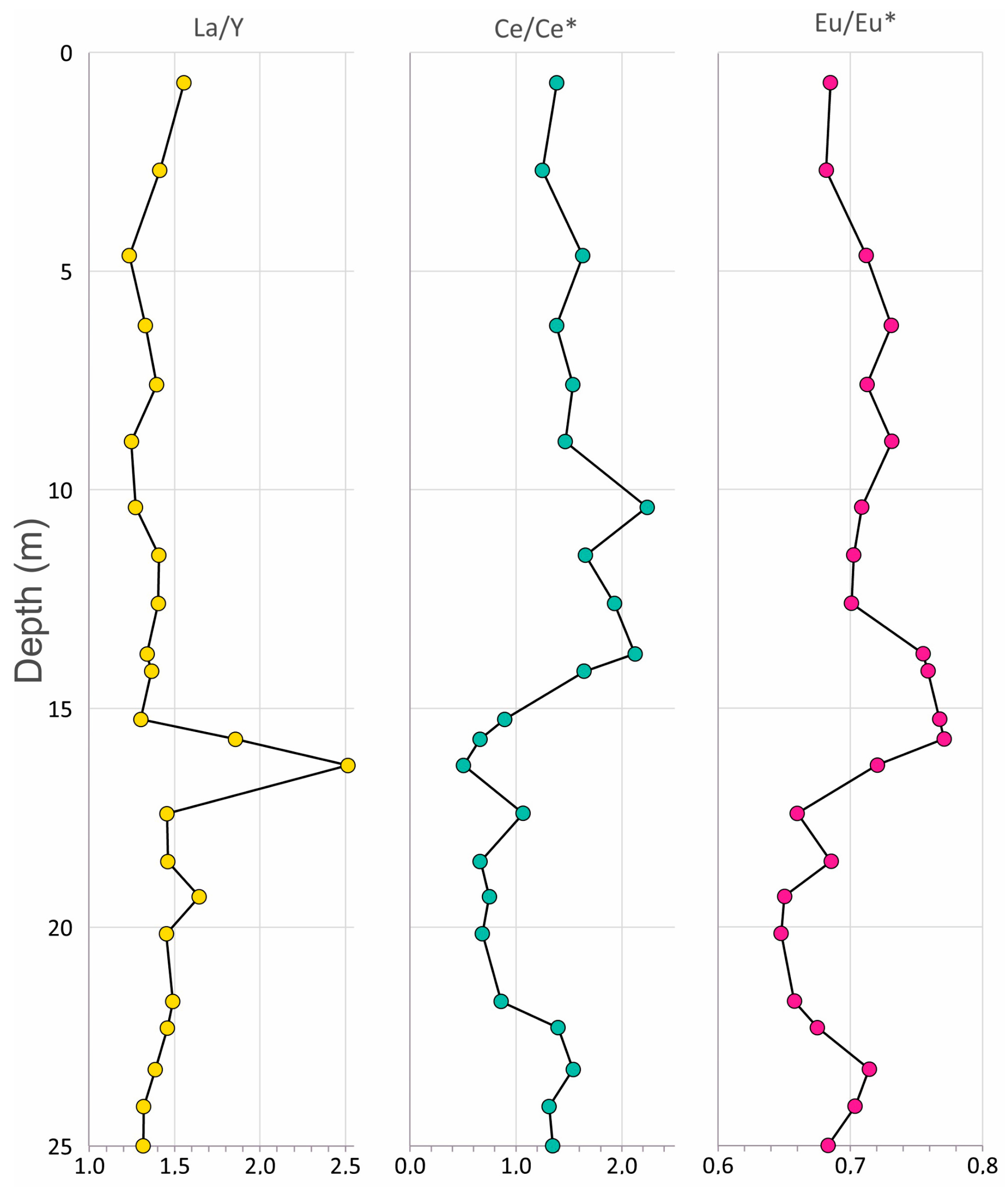
The La/Y ratio ranges from 1.23 to 2.51 and remains consistently above unity throughout the profile. Values are relatively uniform in Zones I–III, whereas higher and more variable values are observed in Zone IV, including a pronounced peak at 16.30–16.35 m.
All samples exhibit clear Ce and Eu anomalies. The Ce/Ce* ratio ranges from 0.50 to 2.24, with predominantly positive anomalies in Zones I–III, followed by a shift toward negative values through Zone III and predominantly negative anomalies in the upper part of Zone IV. Positive Ce anomalies are again observed in the lowermost part of the core (22–25 m). Eu shows consistently negative anomalies throughout the core, with Eu/Eu* values ranging from 0.65 to 0.77, increasing slightly from Zones I to III and followed by lower values in Zone IV.
Most REEs show strong mutual positive correlations, whereas Ce displays distinct behavior compared to the other REEs (Table S3 in the Supplementary Material) and shows a moderate positive correlation with MnO (r = 0.57). None of the REEs show significant correlations with Al2O3 and Fe2O3, indicating no direct association with the main bauxitic components. In contrast, positive correlations are observed between ΣREE (excluding Ce) and P2O5, with the strongest relationships for La (r = 0.69), Y (r = 0.71), Pr (r = 0.53), and Nd (r = 0.47). Moderate correlations are also observed with K2O (Pr r =0.48, La r = 0.45, Nd r = 0.45) and MgO (La r =0.52, Y r = 0.49, Pr r = 0.43), as well as with TiO2 (Y r = 0.64, La r =0.43, Lu r = 0.42), although their strength varies among individual elements.

4.2.4. Extraction with Aqua Regia

Bauxite deposits primarily serve as sources of aluminum, but they also contain a range of elements classified as critical raw materials (CRMs). The extraction of such elements from bauxite and red mud can be achieved through direct leaching processes using mineral acids (e.g., HNO3, HCl, H2SO4, and aqua regia), which are considered highly effective [72]. These elements are commonly leached with other components, which may affect selectivity, particularly with respect to iron [72]. In this study, aqua regia extraction was applied to evaluate the leachability of selected elements from the Mamutovac bauxite.
The concentrations of selected CRMs (La, Ga, Sc and V) in the Mamutovac-1a deposit fall within the range reported for karst bauxite deposits worldwide (Ga; [73]), including those from southern Italy, Sardinia [11], and Montenegro [21]. The only exception is V, which shows elevated concentrations (approximately three times higher) compared to previously reported Mediterranean-type bauxites [11,21]. Total and aqua regia extractable concentrations are presented in Table 3.
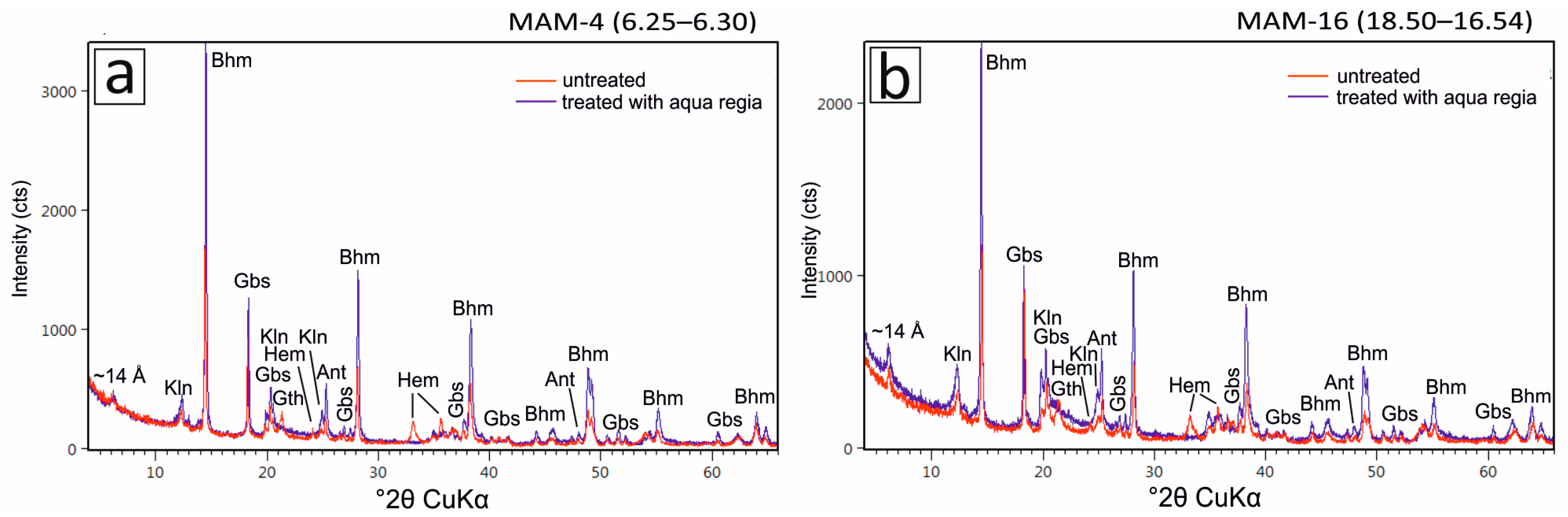
XRD analysis of the residue after aqua regia extraction and dissolution of goethite and hematite (Figure 11) shows that the main mineralogical composition remains largely comparable to that of the untreated bauxite samples, with the notable removal of Fe oxi-hydroxides. This indicates that the acid treatment primarily affects Fe-bearing phases, while the general mineralogical framework is preserved.

5. Discussion

5.1. Facies Variability and Implications for Depositional Processes

The vertical variability of the Mamutovac-1a core is expressed through changes in facies distribution and associated textural features (Figure 2 and Figure 3). The intraclastic–oolitic facies (Zone I) and oolitic facies (Zone III) are characterized by abundant ooids, intraclasts, and micro-pebbles embedded in a fine-grained matrix. Ooids are predominantly rounded to subrounded and commonly display concentric internal structures, locally showing composite features and partially disrupted laminae (Figure 3a–e). Intraclasts are irregular to subangular, with heterogeneous internal textures and irregular boundaries. These features indicate that a significant part of the material was redeposited after initial bauxitization [4,17,74]. In contrast, the matrix-rich facies (Zone II) shows a reduced abundance of coated grains and is dominated by fine-grained material, whereas the pelitomorphic facies (Zone IV) is composed of a homogeneous matrix with only rare ooids and small intraclasts (Figure 3f–h). The absence or scarcity of coated grains in these intervals indicates a lower degree of reworking compared to Zones I and III [1,4]. The vertical alternation of these facies suggests repeated redistribution of bauxitic material within the profile, rather than uniform accumulation. In this context, Zone II represents a transitional interval separating two horizons characterized by more intensive reworking (Zones I and III), marked by a reduced abundance of coated grains and a higher proportion of fine-grained material. According to Bárdossy [1], facies dominated by intraclasts and coated grains correspond to reworked (allothigenic) bauxite, whereas pelitomorphic textures are characteristic of authigenic formation. The observed distribution therefore indicates that reworked material predominates in Zones I and III, while Zone IV, and partly Zone II, reflect a greater contribution of authigenic material. The combined sedimentological and petrographic features indicate that the deposit formed through multi-stage accumulation involving both in situ bauxitization and episodic reworking and redeposition.
Post-depositional modification of the Mamutovac-1a ore body is reflected in variations in consolidation across the defined zones. Well-lithified intervals alternate with poorly consolidated material, indicating differences in cementation and compaction intensity within the profile. Color variations show a systematic vertical pattern. Dark red hues dominate Zone I, whereas Zones III–IV are characterized by 5 YR and 7.5 YR hues, indicating a shift toward yellowish-brown tones (Figure 2). Such variations are commonly associated with changes in iron mineralogy and hydration state during diagenesis [75]. Secondary coatings occur as discontinuous rims and infillings on clasts, with a more frequent occurrence in Zone IV (Figure 3f–h). Black coatings are associated with Mn- and/or Fe-oxide accumulations, whereas yellow coatings correspond to goethite-rich alteration products [2]. Their distribution indicates localized fluid circulation and secondary mineral precipitation following deposition. These post-depositional features are more pronounced in Zones III–IV, suggesting more extensive secondary modification in the lower part of the profile.

5.2. Mineralogical and Geochemical Variability in Response to Evolving Physico-Chemical Conditions

Böhmite is the dominant Al-bearing phase in Zones I–III, whereas gibbsite becomes relatively more abundant in Zone IV (Figure 4, Figure 5 and Figure 6). Minor amounts of diaspore are also observed in Zone IV. This vertical distribution reflects differences in the degree of diagenetic modification across the profile. The dominance of böhmite in the upper and middle parts of the core (Zones I–III) indicates dehydration and transformation following initial bauxitization, as commonly observed in karst-hosted bauxite profiles [2,76,77]. Böhmite is widely interpreted as a secondary phase formed from gibbsite under near-surface conditions through water loss during compaction. The prevalence of this phase in Zones I and III, which are also characterized by abundant coated grains, is consistent with reworking of already transformed bauxitic material. The relative enrichment of gibbsite in Zone IV indicates a lower degree of transformation and greater preservation of earlier-formed phases, consistent with more stable or water-saturated conditions where dehydration is limited [1,78]. The presence of minor diaspore in this interval may reflect localized transformation of boehmite under specific physico-chemical conditions. Supergene diaspore is commonly formed under reducing and alkaline conditions [4,36]. Özlü [79] has also interpreted mineral assemblages containing syn-diagenetic diaspore as indicators of reducing, likely alkaline environments. Anatase occurs throughout the core, with a slight increase in Zones III–IV, while rutile is restricted to a narrow interval within Zone IV (18–23 m). The increased abundance of anatase in the lower part of the core may reflect changes in physico-chemical conditions, including variations in redox state. In karst bauxite systems, anatase has been linked to relatively reducing and lower pH conditions [79]. Similar mineral assemblages, characterized by böhmite as the dominant Al-bearing phase and anatase as the main Ti-bearing phase, have been reported from karst bauxites in other parts of the Mediterranean region, including southern Italy [9] and Montenegro [21]. The distribution of Fe oxi-hydroxides also varies systematically along the profile. Hematite dominates in Zones I–II and shows relatively stable proportions, with a local maximum in Zone II, whereas its abundance decreases toward Zone IV, where goethite becomes more prominent. This trend is consistent with a transition from relatively more oxidizing and dehydrated conditions in the upper part of the profile to more hydrated conditions in the lower zones. Fe oxi-hydroxides are sensitive to variations in redox conditions, fluid composition, and drainage within the weathering environment [80]. Hematite typically forms under strongly oxidizing conditions and may originate from the transformation of primary Fe-bearing minerals or through dehydration of goethite [2,77]. Kaolinite is present in all zones but becomes more abundant and better crystallized in Zone IV, whereas it occurs in lower amounts and with poorer crystallinity in the upper zones. The reduced abundance of clay minerals in the upper part of the profile is consistent with more intensive leaching, which promotes silica removal during advanced chemical weathering and favors the formation of Al-rich phases such as gibbsite and böhmite. In contrast, the retention of kaolinite and the presence of chlorite/vermiculite mixed-layer mineral in the lower part of the profile suggest less intensive leaching, possibly related to slower drainage conditions or increased detrital input [81]. Similar occurrences of 2:1 clay minerals have been reported in bauxites of the Dinaric karst region, including hydroxy-interlayered vermiculite identified in the Crveni Klanac deposit [45]. Overall, the mineral assemblages suggest formation under variable physico-chemical conditions, ranging from relatively oxidizing and dehydrated, likely more acidic environments in the upper and middle parts of the bauxite body (Zones I–III) to more hydrated and locally reducing, possibly more alkaline conditions in the lowermost parts (Zone IV).
Mass magnetic susceptibility (χlf) decreases with depth, broadly following the distribution of Fe-bearing phases, particularly hematite, which are more abundant in the upper zones (Figure 6). Higher frequency-dependent susceptibility (χfd) values in the upper part of the profile indicate the presence of ultrafine superparamagnetic particles [82]. The limited development of pedogenic features suggests that these particles are more likely inherited from reworked material rather than formed in situ, supporting the interpretation of a polygenetic origin of the bauxite deposit.
Major element variability in the Mamutovac-1a core reflects differences in the degree of desilicification and Al and Fe redistribution across the defined facies (Figure 6 and Figure 7a). The inverse relationship between SiO2 and Al2O3–Fe2O3 (Figure 8) indicates that silica removal was a primary control on the chemical evolution of the deposit, consistent with the fundamental role of desilicification in bauxite formation [1,2]. Zones I and III, characterized by elevated Al2O3 and Fe2O3 contents, correspond to intervals where desilicification was more effective, leading to residual enrichment of Al and Fe. Such geochemical signatures are typical of advanced bauxitization stages, where silica is progressively removed and Al–Fe oxi-hydroxides become dominant [1,4]. The positive covariation between Al2O3 and Fe2O3 suggests largely parallel enrichment of these elements, a relationship commonly observed in lateritic and karst-hosted bauxites under conditions of limited element mobility [32]. In contrast, Zones II and IV show increased SiO2 contents and lower Al2O3 and Fe2O3 values, indicating less efficient desilicification and a greater contribution of less altered material. According to Bárdossy [1], elevated silica in bauxitic profiles may reflect either incomplete leaching or the incorporation of detrital clay material, particularly in polygenetic karst systems. This interpretation is consistent with the higher abundance of clay minerals and gibbsite observed in these zones, suggesting a lower degree of bauxitization compared to Zones I and III. The vertical distribution of Fe2O3 further reflects changes in redox and hydration conditions during bauxitization and early diagenesis. Higher Fe2O3 contents in the upper part of the profile correspond to hematite-dominated assemblages, which typically form under more oxidizing and dehydrated conditions, whereas the relative increase in goethite in deeper intervals indicates more hydrated conditions [2,80]. This transition is consistent with progressive modification of Fe oxi-hydroxides controlled by changes in Eh–pH conditions within the paleokarst system.
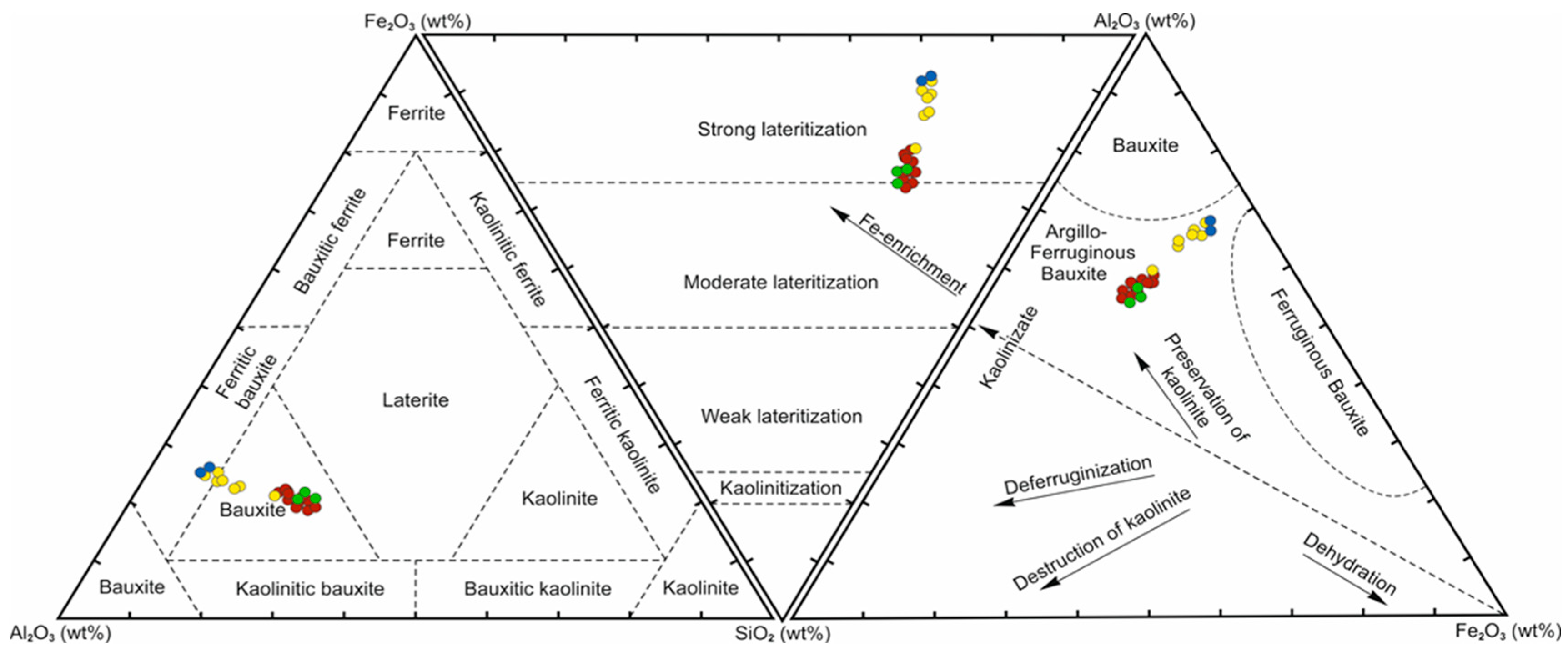
The ternary diagrams (Figure 12) illustrate different aspects of bauxite composition and evolution: the first reflects compositional classification, the second highlights the degree of lateritization and Fe enrichment, and the third shows the relative contribution of clay- and Fe-rich components. The dispersed distribution of Zone I samples between the bauxite and ferritic bauxite fields indicates variable Fe participation and heterogeneous geochemical conditions, consistent with reworking and redistribution of bauxitic material in karst environments [4]. Samples from Zones II and IV cluster within the bauxite field and correspond to moderate to strong lateritization, reflecting more uniform but less advanced chemical differentiation. In contrast, Zone III samples plot within the ferritic bauxite field and correspond to strong lateritization, indicating relatively enhanced Fe enrichment. In the clay–Fe ternary diagram, all samples fall within the argillo–ferruginous bauxite field, indicating a consistent contribution of both clay-related and Fe-rich components across the profile. The limited separation between zones suggests that, despite vertical variability in major element concentrations, the overall geochemical character of the deposit remains within the same compositional domain, typical of polygenetic karst bauxites [1].
TiO2 shows variable distribution along the profile despite its general immobility during chemical weathering (Figure 7a). The lack of systematic correlation with Al2O3, Fe2O3, or SiO2 indicates that Ti behaved largely independently of the main geochemical processes controlling bauxitization. Such behavior is typical for Ti in bauxite deposits, where it is commonly concentrated in resistant minerals and reflects residual enrichment or detrital input rather than in situ chemical redistribution [1,9,32]. The relative enrichment of TiO2 in the lower part of the profile may therefore reflect localized accumulation of Ti-bearing detrital material or residual concentration under conditions of reduced leaching intensity.
The distribution of minor oxides reflects facies-dependent geochemical variability and differences in element behavior during bauxitization and subsequent diagenesis. MgO, CaO, and K2O show a strong positive correlation with SiO2, indicating their association with silicate phases and suggesting a link to detrital material or incomplete desilicification. Their enrichment in Zone IV, together with higher SiO2 contents, points to reduced leaching efficiency and a greater contribution of less altered material in the lower part of the profile, whereas their lower concentrations in Zone III are consistent with more advanced bauxitization. P2O5 follows a similar vertical pattern, with higher values in Zone IV and lower values in Zones I–III. This distribution indicates that phosphorus is not directly linked to the main Al–Fe enrichment processes but is instead associated with specific mineral phases or localized accumulation in the lower part of the profile. Cr2O3 shows relatively higher values in Zones I–III and correlates positively with Fe2O3, indicating its association with Fe-bearing phases. This relationship suggests that chromium was incorporated into Fe oxi-hydroxides during bauxitization and was largely retained within Fe-bearing phases during subsequent diagenetic modification [2,80]. MnO exhibits the most pronounced variation, with low values in Zones I–III and a marked increase in Zone IV. This enrichment reflects the redox-sensitive behavior of manganese and its tendency for secondary mobilization and reprecipitation, leading to enrichment in the lower part of the bauxite body [1,35]. The distribution of minor oxides therefore distinguishes between the upper part of the profile (Zones I–III), where more efficient leaching resulted in a chemically cleaner bauxitic assemblage, and the lower part (Zone IV), where higher contents of SiO2, MnO, and alkali elements reflect reduced leaching efficiency and increased retention of clay-related components under less efficient drainage conditions, together with localized secondary redistribution processes. This interpretation is consistent with established models of bauxite evolution, where incomplete leaching leads to enrichment in silica and mobile elements [1,32].
Trace element distribution in the Mamutovac-1a core reflects variations in dominant geochemical controls and mineral hosts along the profile. High-field-strength elements (Zr, Hf, Nb, Ta, Th, U) show limited coupling with the main Al–Fe geochemical trends and are primarily controlled by their residence in resistant minerals such as zircon and Ti-bearing phases. Their distribution therefore largely reflects detrital inheritance and is only minimally affected by post-depositional processes [32,35]. In the upper part (Zones I–III), trace element distribution is largely controlled by Fe oxi-hydroxides, reflecting incorporation of Cr, Ga, Sn, and Sc into these phases during ferruginization under oxidizing conditions [14,80]. The decrease observed in Zone II and subsequent increase toward Zone III likely reflect variations in the abundance and redistribution of these Fe-bearing phases along the profile. Toward the lower part of the bauxite body (Zone IV), the distribution of trace elements indicates a shift in dominant geochemical hosts. The enrichment of Mn, Ni, and Co reflects changing redox conditions that enabled mobilization of Mn in solution and its subsequent reprecipitation as Mn oxides, which act as efficient scavengers for transition metals [83]. This pattern indicates redistribution of trace elements through percolating fluids and their accumulation in Mn-rich phases under more hydrated conditions [84]. In addition to Mn-bearing phases, the increased abundance of large-ion lithophile elements (Rb, Cs, Sr, Ba) in Zone IV indicates a stronger influence of clay-related components. This interpretation is supported by the strong correlations of Rb with K2O and Cs with MgO, indicating their association with clay-related phases. Their incorporation into phyllosilicate phases reflects reduced leaching efficiency and retention of less altered material in the lower part of the profile [32,35]. These relationships indicate that trace element distribution is governed by a combination of detrital inheritance and secondary redistribution processes, with a clear transition from Fe-dominated to Mn- and clay-influenced geochemical environments along the profile. Such variability reflects changes in redox conditions, fluid circulation, and mineral stability within the paleokarst system [9,84]. Vanadium does not follow this general pattern and shows irregular distribution, suggesting that its behavior is controlled by local geochemical conditions rather than by a single dominant mineral host [80].

5.3. Parental Affinity and Source Characteristics of the Bauxite Material

Despite extensive geological and geochemical research, the identification of source rocks and the understanding of ore-forming processes in karst-type bauxites remain challenging. It is generally accepted that these deposits are derived from a combination of materials, including weathering products of various lithologies within the provenance area and, to a lesser extent, components associated with the underlying carbonate rocks subjected to karstification [1]. However, the dissolution of carbonate bedrock alone is insufficient to account for bauxite formation [9]. Unlike lateritic bauxites, which are commonly linked directly to their precursor rocks [2], karst bauxites typically originate from mixed and often distal sources. Proposed protoliths include fluvially transported detritus, aeolian input, volcanic material, and contributions from mafic and felsic basement rocks [1,9,33]. As a result of intense weathering, major, trace, and rare earth elements undergo significant fractionation, which complicates the reconstruction of parental relationships [9]. Consequently, the evaluation of source affinity in karst bauxites relies primarily on indirect geochemical approaches, including immobile element ratios, trace-element systematics, and REE patterns [14]. In this study, due to the lack of direct data from the underlying bedrock, interpretations are based on such indirect geochemical constraints.
To evaluate the parental affinity of the studied bauxite, it is essential to identify elements that behave conservatively during bauxitization. Alkali and alkaline earth elements are typically leached during intense weathering, whereas several trace elements (e.g., Zr, Nb, Ta, Ti, Hf, and Ga) are generally considered immobile [33,85,86]. Ratios of these immobile elements (e.g., Zr/Hf, Nb/Ta, Zr/Ti) are therefore widely used to constrain source characteristics, as they are less affected by weathering and diagenetic processes and tend to preserve the geochemical signature of the precursor material [14].
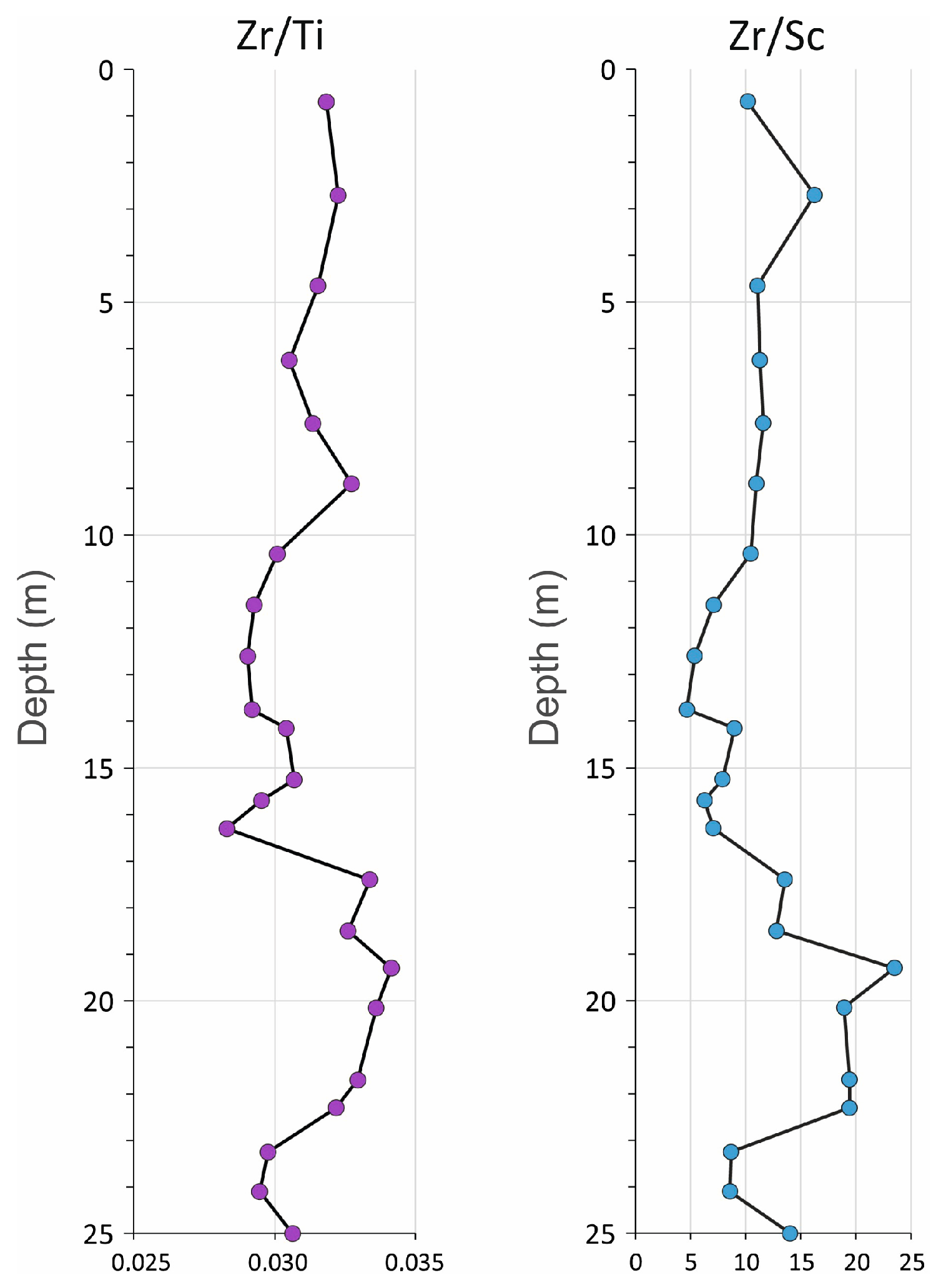
The behavior of immobile elements was first evaluated to assess the reliability of geochemical proxies. Zr and Ti are widely regarded as conservative elements during intense weathering and bauxitization, as they are primarily hosted in resistant mineral phases. The strong correlation between Zr and Ti confirms their immobile behavior in the studied system (Table S2 in the Supplementary Material). However, slight variations in Zr/Ti ratios with depth (Figure 13) suggest that the system was not derived from a single homogeneous source but rather reflects variable input and compositional heterogeneity of the source material.
Zr/Sc ratios show a heterogeneous vertical distribution, decreasing from Zone I to Zone II, followed by a local maximum in Zone III, and reaching the highest but strongly fluctuating values in Zone IV (Figure 13). Th, Sc, and Zr are generally considered to be largely unaffected by late-stage diagenetic processes and primarily reflect the composition of their source rocks, with Zr being particularly resistant [9,87]. Zr is predominantly hosted in highly resistant zircon minerals, which are commonly reported in karst bauxites and have been documented in the Mamutovac area based on detrital zircon U–Pb geochronology [17]. It may become enriched through sediment recycling, whereas Sc typically preserves a provenance signal comparable to other REE [88]. Accordingly, the Zr/Sc ratio is widely used as a proxy for evaluating the extent of sediment recycling, with elevated values typically indicating progressive enrichment of zircon relative to Sc-bearing minerals. The observed variability suggests that the contribution of compositionally mature or recycled material was not uniform throughout the profile. The local maximum in Zone III indicates a temporary increase in zircon enrichment, while the highest and strongly fluctuating values in Zone IV point to a more heterogeneous input of compositionally mature material. Therefore, the vertical variation in Zr/Sc most likely reflects changes in the proportion of compositionally mature versus less evolved material rather than a simple, monotonic increase in sediment recycling. The relatively constant Zr/Hf ratios (r = 0.99) indicate a dominant detrital zircon control and suggest that recycling processes primarily concentrated zircon without significantly modifying its original source signature [89].
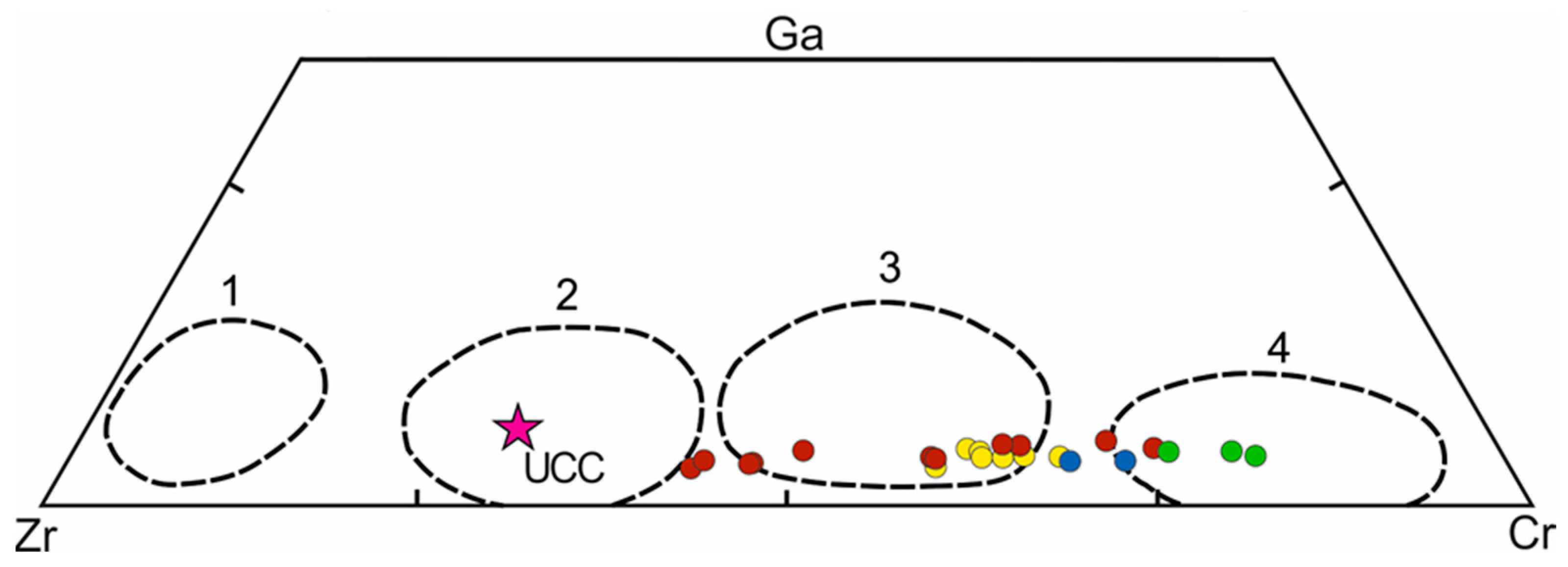
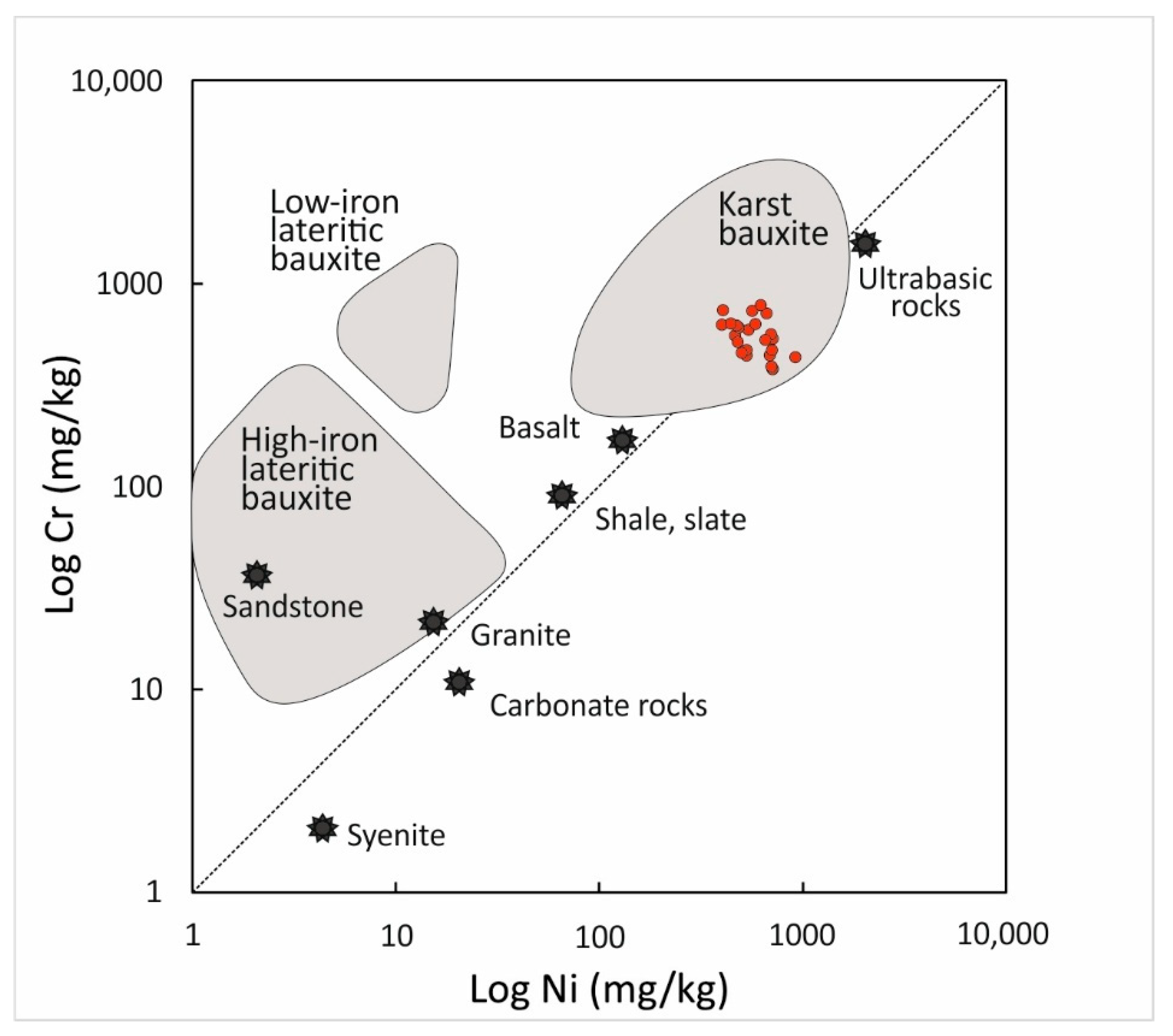
Trace elements such as Cr, Zr, and Ga, which are relatively immobile during weathering and diagenesis, are often used to constrain the provenance of karst bauxites and indicate contributions from felsic to ultramafic parent rocks [79]. The distribution of samples in the Zr–Cr–Ga ternary diagram (Figure 14) shows systematic variations when grouped according to the defined bauxite facies. Samples from the intraclastic–oolitic facies (Zone I) and the pelitomorphic facies (Zone IV) predominantly plot within the field corresponding to mafic parent rock compositions. In contrast, samples from the matrix-rich (Zone II) and oolitic facies (Zone III) show a slight shift towards the ultramafic field, reflecting a higher contribution of Cr-rich components. These variations indicate that the source material was not uniform but instead reflect contributions from compositionally diverse parent rocks. As noted by Özlü [79], such geochemical discrimination provides only a general indication of source rock affinity, as the detrital nature of karst bauxites may obscure direct relationships with specific parent lithologies. Accordingly, the results indicate a heterogeneous and mixed provenance, with contributions ranging from intermediate to ultramafic material. Bivariate plots of Cr and Ni (Ni/Cr ratios) place the Mamutovac-1a samples within the karst bauxite field (Figure 15).
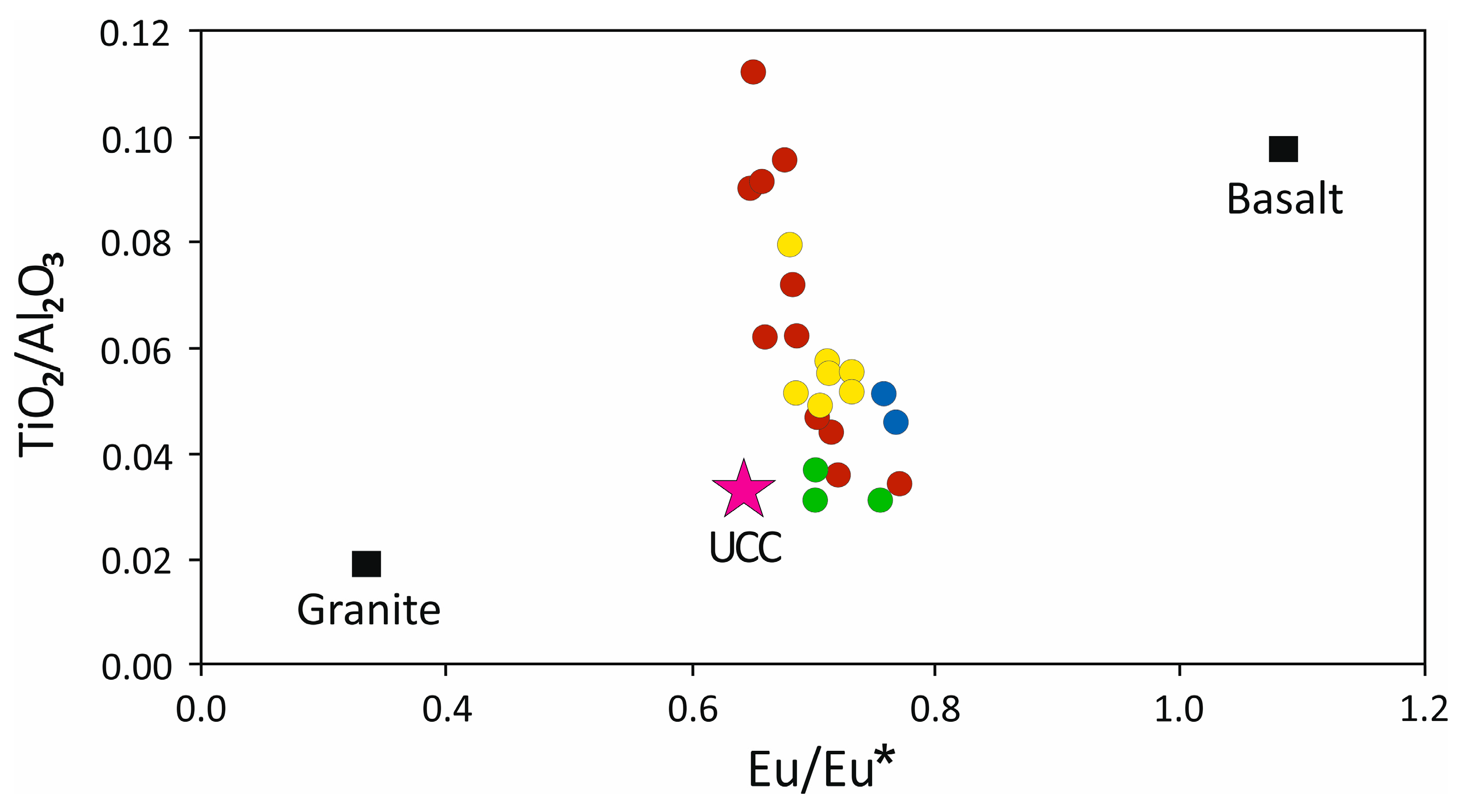
Eu anomalies are indicators of chemical differentiation and thus represent a useful proxy in provenance studies of karst bauxites. They are commonly considered relatively conservative during bauxitization and intense weathering and therefore tend to retain values close to those of the precursor material more effectively than many other geochemical indicators [9,12,80,83,91]. The studied samples show Eu anomalies that are generally higher (Eu/Eu* = 0.65–0.77) than the Eu anomaly of the Upper Continental Crust (Eu/Eu* = 0.66; [87]), suggesting a shift towards more mafic-influenced source components relative to typical upper crustal compositions (Table 2). The TiO2/Al2O3 ratio is often used as an indicator of parental affinity when both elements exhibit relatively conservative behavior [14,35]. The relationship between the Eu anomaly and TiO2/Al2O3 shows a noticeable dispersion of TiO2/Al2O3 values, indicating that the system is not compositionally homogeneous (Figure 16). This variability, together with the consistently elevated Eu/Eu* values, supports a heterogeneous and mixed source with contributions from less evolved components. Previous studies from the Promina area suggest that bauxitization involved both residual carbonate weathering and input of volcaniclastic material, including volcanic ash [17]. The geochemical data presented here, however, indicate a mixed provenance and do not constrain the specific nature of the primary source rocks.

5.4. Factors Controlling the Distribution and Fractionation of REE

The REE distribution along the studied core exhibits systematic vertical variations, reflecting a combination of inheritance from the parent material and subsequent redistribution during bauxitization and diagenetic processes. These variations are expressed through differences in total REE contents, fractionation patterns, and anomaly development across the defined zones.
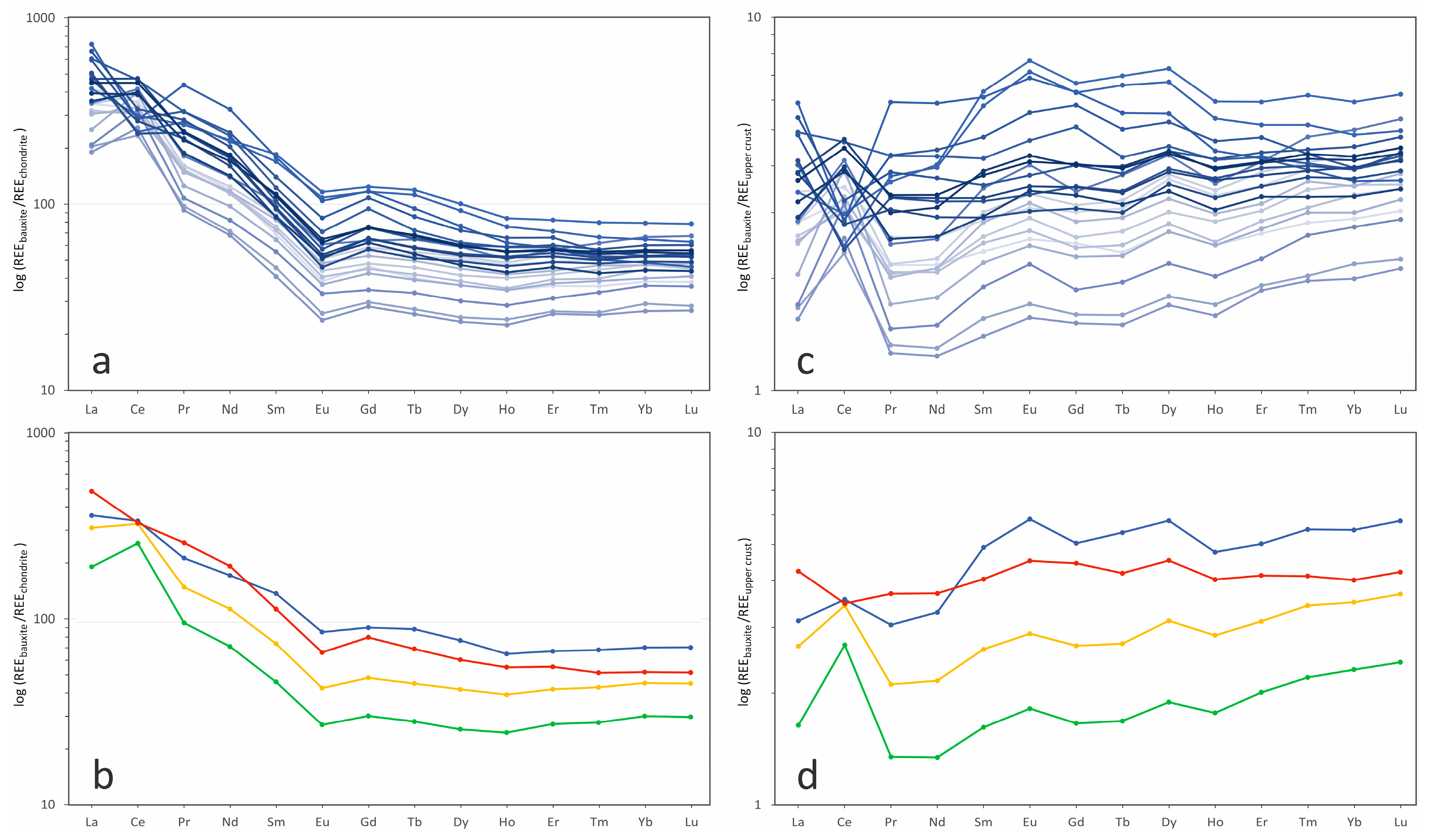
REE patterns normalized to different reference compositions provide insight into both provenance and post-depositional evolution. Chondrite-normalized patterns primarily reflect the geochemical signature of the parent material, whereas normalization to the upper continental crust (UCC) highlights modifications related to bauxite formation and subsequent geochemical processes [26]. The chondrite-normalized diagram (Figure 17a,b) shows that all samples are characterized by enrichment of LREE relative to HREE, expressed by a general decrease from La to Lu, a relatively flat HREE segment, and a systematic negative Eu anomaly. Clear differences are observed between the defined zones. Samples from Zone II show the lowest REE concentrations and the weakest enrichment, whereas Zones III and IV exhibit higher abundances. Zone IV is characterized by the strongest LREE enrichment, while Zone III displays comparatively higher HREE levels, with Zone I showing intermediate characteristics. These variations reflect differences in weathering intensity, transport, and post-depositional redistribution processes. At the same time, the overall REE pattern partly preserves the parent material signature, as REE fractionation during bauxitization may be limited (e.g., [9,84,86]). Despite zonal differences, consistent LREE enrichment relative to HREE is evident, with LREE reaching several hundred times chondritic values, whereas HREE show only moderate enrichment [71]. In contrast to the relatively uniform negative Eu anomaly, Ce anomalies show marked variability between zones, indicating differences in redox conditions and fluid-mediated processes during post-depositional evolution.
Normalization to the UCC (Figure 17c,d) shows clear zonal variability, with the lowest values in Zone II and progressively higher abundances in Zones III and IV. Zone III is distinguished by pronounced MREE and HREE enrichment, reflected in an upward trend from Sm to Lu, whereas Zone IV exhibits a more uniform pattern with moderate enrichment across both LREE and HREE. Zone I shows intermediate characteristics between these end members. Compared to chondrite-normalized patterns, the Eu anomaly appears positive due to normalization to a crustal reference composition characterized by a negative Eu anomaly [92]. In contrast, Ce anomalies remain variable across the defined zones, with negative anomalies more evident in the deeper parts of the succession, suggesting localized redox-controlled redistribution.
REE fractionation is characterized by consistent enrichment of LREE relative to HREE. Zones I and II show relatively elevated and stable ΣLREE/ΣHREE ratios, indicating persistent LREE enrichment in the upper part of the succession (Figure 18a). A marked decrease in ΣLREE/ΣHREE is observed in Zone III, where the lowest values occur, pointing to reduced fractionation between LREE and HREE. In contrast, Zone IV is characterized by higher and more variable ratios, indicating renewed LREE enrichment under more heterogeneous geochemical conditions. These variations are commonly attributed to changes in REE mobility and retention during weathering and subsequent geochemical evolution, controlled by pH-dependent fractionation and adsorption processes [14,84]. Under acidic conditions, HREEs are preferentially mobilized due to stronger aqueous complexation, resulting in relative LREE enrichment through adsorption onto mineral surfaces. In contrast, under neutral to alkaline conditions, HREEs become less mobile and are more likely to precipitate ([9,84] and references therein). REE fractionation is also strongly influenced by the stability of REE–carbonate complexes, which preferentially stabilize HREEs in solution and enhance their mobility relative to LREEs (e.g., [14,93]). Accordingly, LREEs are preferentially retained through adsorption and incorporation into phosphate minerals, whereas HREEs remain more mobile in solution.
Fractionation indices derived from chondrite-normalized ratios further constrain these trends. The (La/Yb)N and (La/Sm)N ratios decrease from Zones I to III, indicating reduced fractionation between LREE and both MREE and HREE (Figure 18b). In contrast, Zone IV is characterized by generally higher but variable values, reflecting enhanced LREE retention and more heterogeneous geochemical conditions. In contrast, (Gd/Yb)N ratios remain relatively uniform, indicating limited fractionation between MREE and HREE. In karst bauxite systems, (La/Yb)N ratios are primarily controlled by pH-dependent REE mobility [9], and the observed zonal variations therefore reflect changes in pH and fluid interaction during diagenesis.
La/Y values remain consistently above unity throughout the succession (Figure 19). Distinct zonal variations are observed, with relatively lower and more uniform values in Zones I–III and generally higher, more variable values in Zone IV, including a pronounced peak at its upper boundary. Yttrium (Y), although not a lanthanide, behaves geochemically similarly to heavy rare earth elements (HREE) and is therefore commonly used as their proxy in REE fractionation studies, particularly in assessing the relative mobility of LREE versus HREE during weathering and fluid–rock interaction. The La/Y ratio has often been used as an indicator of weathering conditions. Values lower than 1 are commonly associated with acidic environments, whereas values above 1 are generally interpreted to reflect more basic conditions [21,94,95,96]. Although La/Y ratios are commonly interpreted as indicators of pH conditions, they should be treated with caution, as they reflect the combined effects of pH-dependent processes, adsorption, complexation, and mineralogical controls, rather than pH alone [9]. In this context, the relatively moderate and uniform La/Y ratios in Zones I–III may reflect the influence of meteoric waters and vadose conditions, where fluctuating pH and fluid circulation promote more uniform REE fractionation. In contrast, the higher La/Y values observed in Zone IV suggest enhanced retention of LREE relative to Y, likely related to increased interaction with the carbonate basement and evolving pore-water chemistry, potentially under mildly alkaline conditions that favor adsorption processes.
Ce anomalies show clear vertical variations, with predominantly positive values in Zones I–III, followed by a transition toward negative anomalies through Zone III and predominantly negative values in the upper part of Zone IV (Figure 19). Positive Ce anomalies are again observed in the lowermost part of the succession. The transition from positive Ce anomalies in the upper zones to negative values at intermediate depths closely resembles patterns described in Mediterranean karst bauxites, where downward percolation of Ce-depleted solutions, following Ce4+ precipitation in oxidizing upper horizons, leads to the development of negative Ce anomalies at depth [9,83]. Under oxidizing conditions, Ce3+ is readily oxidized to Ce4+ and preferentially removed from solution through precipitation or adsorption onto Fe oxi-hydroxides, resulting in positive Ce anomalies, whereas negative anomalies reflect interaction with Ce-depleted percolating fluids [34,83,96]. Accordingly, positive anomalies in the upper part of the succession indicate oxidizing and likely more acidic conditions typical of vadose environments, while negative anomalies in the upper part of Zone IV reflect downward migration of Ce-depleted solutions under more reducing and possibly more alkaline conditions. Ahmadnejad et al. [14] reported from the Bidgol bauxite deposit that Ce exhibits positive anomalies in the upper parts of the profile, related to Ce4+ fixation under oxidizing conditions, followed by a transition to negative anomalies at depth, reflecting more reducing and likely alkaline conditions. The reappearance of positive anomalies in the lowermost part of the succession points to specific geochemical conditions near the contact with the carbonate basement. Similar features have been reported in Mediterranean bauxite deposits and are commonly attributed to the influence of carbonate bedrock, which may promote Ce fixation in carbonate-bearing REE minerals such as bastnäsite and parisite [86,97]. In the studied core, the proximity to carbonate bedrock likely provided an additional source of carbonate ions, facilitating Ce precipitation in the deepest part of the deposit.
Eu anomalies are consistently negative across all zones and show only minor variation (Figure 19). The limited variability of Eu/Eu* values and the lack of correlation with redox-sensitive REE such as Ce indicate that Eu was not substantially affected by post-depositional processes. The implications of Eu anomalies for parental affinity are discussed in Section 5.3.
Correlation patterns further constrain the controls on REE distribution (Table S3 in the Supplementary Material). The lack of correlation between REE and major bauxitic components such as Al2O3 and Fe2O3 indicates that REEs are not primarily associated with the main Al- and Fe-bearing phases (e.g., [84,96]) but rather suggests redistribution during bauxite formation and subsequent geochemical evolution. In contrast, the observed relationship with P2O5 suggests that phosphate minerals likely represent important hosts for REE [1,80]. Supporting evidence from other karst bauxite deposits indicates that REE are commonly hosted in phosphate minerals. Residual and authigenic monazite and xenotime reported from the Zagrad bauxites (Montenegro) indicate partial redeposition of REE minerals from primary sources [21]. The association between REE and P2O5 observed in the Mamutovac-1a core is consistent with findings from Spanish karst bauxites, where monazite-(Ce) and xenotime-(Y) of predominantly detrital origin were identified as the main REE-bearing minerals [84], as well as from the Tošići–Dujići Upper Eocene deposit in Croatia, where the same detrital REE phosphate minerals have been reported [26]. Similarly, residual and authigenic monazite and xenotime documented in the Zagrad deposit (Montenegro) indicate partial redistribution of REE during post-depositional processes [21]. Authigenic REE phosphates documented in Cretaceous bauxites from Campania [98] further support the role of phosphate phases in REE fixation. The coexistence of detrital and authigenic REE-bearing phases, as documented in the Zagrad deposit, suggests that REE distribution reflects both inherited and secondary processes, rather than a single-stage enrichment mechanism [21]. Moderate positive correlations with K2O and MgO further suggest that clay minerals may also contribute to REE retention, most likely through adsorption processes. A recent study of bauxites from the Adriatic–Dinaric Carbonate Platform indicates that elevated concentrations of HREE are primarily associated with REE-bearing mineral phases rather than clay minerals (49), further supporting a subordinate role of clays in REE hosting. The distinct behavior of Ce, which shows no clear association with these phases, further indicates that its redistribution is primarily controlled by redox conditions rather than mineralogical hosts. Overall, the observed REE distribution reflects the combined influence of protolith inheritance and subsequent redistribution during bauxite formation under variable redox and pH conditions. The zonal variability and Ce anomalies indicate that REE mobility was largely controlled by fluid–rock interaction, with indications of an additional influence of the carbonate basement on pore-water chemistry.

5.5. Distribution and Extractability of Selected Critical Elements (La, Sc, Ga, V) in the Mamutovac-1a Deposit

Bauxite deposits are not only important for aluminum production but also contain a range of elements classified as critical metals, such as lithium, scandium, titanium, vanadium, gallium, zirconium, niobium, hafnium, tantalum, and rare earth elements. The distribution of these elements is primarily associated with aluminum, iron, and titanium oxi-hydroxides, as well as clay minerals, and to a lesser extent with detrital phases [11]. According to Yang et al. [99], lithium, boron, vanadium, chromium, and gallium in the Baofeng bauxites show a distribution pattern similar to K2O and SiO2, with higher concentrations in clay-rich layers than in bauxite horizons, indicating an association with clay minerals.
Gallium (Ga) and Vanadium (V) are elements commonly associated with bauxite systems and are known to be recovered from the byproducts of aluminum (Al) production. Due to the similar ionic radii of Ga3+ (0.62 nm) and Al3+ (0.57 nm), they can easily form isomorphous substitutions, resulting in a strong correlation (r = 0.89) between Ga and Al across all samples (Table S2 in the Supplementary Material). This finding aligns with Mongelli et al. [10], who observed Ga in aluminum oxides such as böhmite, gibbsite, and diaspore within bauxite ore. Aqua regia extraction yielded an average Ga extraction rate of 43%. Vanadium in bauxite is commonly associated with titanium oxides [10,27], suggesting the potential for V to undergo isomorphous substitution of Ti due to similar ionic radii. In the studied deposit, V shows no clear correlation with other trace or major elements (Table S2 in the Supplementary Material). The average vanadium concentration in Mamutovac-1a is 1224 mg/kg (based on samples used for aqua regia extraction), with 86.9% of V being extracted, a value comparable to that of FE (Table 3), indicating that V is largely associated with Fe minerals in the bauxite. It is widely accepted that rare earth elements (REEs) are introduced into karst systems mainly as adsorbed ions on clay particle surfaces or as discrete REE minerals [9,10]. The aqua regia extraction of La (30.3%) is comparable to that of P (33.6%), suggesting that La is at least partially incorporated into phosphate mineral phases. La shows a strong correlation (r = 0.69) with P2O5 and lacks correlation with Ca, which is consistent with the interpretation by Tomašić et al. [26], who suggest that light REEs are linked with carbonate in the bauxite from the Tošići-Dujići deposit (Table S3 in the Supplementary Material). The aqua regia extraction of bauxite from the nearby Tošići–Dujići deposit yielded higher extraction rates of light REEs, ranging from 34% to 64% [26]. The extraction of critical raw materials (CRMs) from bauxite ore using aqua regia indicates that bauxite may represent a potential source of CRMs [99,100,101], in addition to bauxite residue or red mud [102,103].

6. Conclusions

The Mamutovac-1a core exhibits a vertically zoned bauxite body defined by four facies-based zones, accompanied by systematic mineralogical and geochemical variations, including a transition from böhmite-dominated to more gibbsite- and clay-rich assemblages with depth. Macroscopic observations and petrographic textures (ooids, intraclasts, and coated grains) indicate episodic transport and redeposition. Major and trace element data show consistent vertical trends, while REE concentrations increase with depth and display pronounced stratigraphic differentiation, including consistent LREE enrichment, stable negative Eu anomalies, and variable Ce anomalies. Magnetic susceptibility also varies along the core and likely reflects changes in the abundance and grain-size distribution of magnetic carriers, although it should be regarded as supporting rather than standalone genetic evidence.
The geochemical data indicate a heterogeneous and mixed provenance with contributions from compositionally diverse source materials ranging from intermediate to ultramafic components. In this context, the vertical zonation reflects differences in depositional and post-depositional processes, with the upper part showing evidence of repeated reworking, whereas the lowermost interval preserves a stronger in situ component. These features indicate a polygenetic, multi-stage evolution involving both in situ bauxitization and episodic reworking and redeposition. The observed REE distribution reflects a combination of inheritance from the parent material and subsequent redistribution during bauxite formation under variable redox and pH conditions, as reflected in the mineralogical zonation of the profile. The upper zones (I–III), dominated by boehmite and hematite and characterized by predominantly positive Ce anomalies, indicate more oxidizing and likely more acidic conditions, whereas the lowermost interval (Zone IV), marked by increased gibbsite, the presence of diaspore, and higher proportions of anatase (locally with rutile), and elevated Mn contents, corresponds to more reducing and likely more alkaline conditions. Variations in REE fractionation are primarily controlled by changes in element mobility, with preferential retention of LREE and relative mobility of HREE. The association between REE and P2O5 indicates that phosphate minerals might be the main hosts for REE, whereas no clear relationship with Al- and Fe-bearing phases is observed. Moderate correlations with K2O and MgO further suggest a secondary role of clay minerals in REE retention.
The integrated petrographic, mineralogical, and geochemical dataset provides new insight into the processes controlling the formation and evolution of karst-hosted Upper Eocene bauxite deposits in the Croatian karst Dinarides. Although the present study does not address the economic feasibility of REE extraction, these results indicate that karst-hosted bauxites may represent potential secondary sources of critical raw materials. The enhanced recovery of La, Sc, Ga, and V using aqua regia further emphasizes this potential, extending beyond conventional aluminum production.

Supplementary Materials

The following supporting information can be downloaded at: https://www.mdpi.com/article/10.3390/min16050547/s1, Table S1: Mineralogical composition of the bauxite samples from the Mamutovac-1a deposit; Table S2: Pearson correlation matrix of major and trace elements; Table S3: Pearson correlation matrix of major and rare earth elements.

Author Contributions

Conceptualization, E.K.G. and H.F.; methodology, Z.P. and S.M.; software, Z.P.; formal analysis, E.K.G. and N.T.; resources, S.M. and N.I.; writing—original draft preparation, E.K.G. and D.T.; writing—review and editing, N.I., I.I.F., H.F., N.G. and S.M.; visualization, E.K.G., H.F., N.I., Z.P., S.M. and N.G.; supervision, N.I. and N.T.; project administration, Z.P.; funding acquisition, S.M. and N.I. All authors have read and agreed to the published version of the manuscript.

Funding

This study was supported by the Croatian Geological Survey, Department of Mineral Resources and Marine Geology and by EIT Raw Materials (European Institute of Innovation and Technology), Horizon 2020 project REEBAUX—Prospects of REE recovery from bauxite and bauxite residue in the ESEE region (project number 17089). This work is part of the Master’s Thesis of Dominik Teskera at the Geological Department, Faculty of Science, University of Zagreb.

Data Availability Statement

The original contributions presented in this study are included in the article. Further inquiries can be directed to the corresponding author.

Acknowledgments

This work was supported by the Croatian Geological Survey (HGI-CGS) and the Ministry of Science, Education and Youth of the Republic of Croatia through the financing of the national research project “Map of Minerals Resources of the Republic of Croatia”. We would like to thank the Academic Editor and the reviewers for their valuable comments and constructive suggestions, which significantly improved the manuscript.

Conflicts of Interest

The authors declare no conflicts of interest.

References

  1. Bárdossy, G. Karst Bauxites: Bauxite Deposits on Carbonate Rocks; Elsevier Scientific Publication: Amsterdam, The Netherlands, 1982; p. 441. [Google Scholar]
  2. Bárdossy, G.; Aleva, G.J.J. Lateritic Bauxites. Developments in Economic Geology; Elsevier Scientific Publication: Amsterdam, The Netherlands, 1990; Volume 27, p. 624. [Google Scholar]
  3. Schellmann, W. Geochemical differentiation in laterite and bauxite formation. Catena 1994, 21, 131–143. [Google Scholar] [CrossRef] [Scilit]
  4. D’Argenio, B.; Mindszenty, A. Bauxites and related paleokarst: Tectonic and climatic event markers at regional unconformities. Eclog. Geol. Helv. 1995, 88, 453–499. [Google Scholar]
  5. Mindszenty, A. Bauxites: Feedbacks of System Earth at Greenhouse times. Geol. Croat. 2016, 69, 79–87. [Google Scholar] [CrossRef] [Scilit]
  6. Bárdossy, G.; Combes, P.J. Karst bauxites: Interfingering of deposition and palaeoweathering. Spec. Publ. Int. Assoc. Sedimentol. 1999, 27, 189–206. [Google Scholar]
  7. Liu, X.F.; Wang, Q.F.; Zhang, Q.Z.; Feng, Y.W.; Cai, S.H. Mineralogical characteristics of the superlarge Quaternary bauxite deposits in Jingxi and Debao counties, western Guangxi, China. J. Asian Earth Sci. 2012, 52, 53–62. [Google Scholar] [CrossRef] [Scilit]
  8. Retallack, G.J. Lateritization and bauxitization events. Econ. Geol. 2010, 105, 655–667. [Google Scholar] [CrossRef] [Scilit]
  9. Mongelli, G.; Boni, M.; Buccione, R.; Sinisi, R. Geochemistry of the Apulian karst bauxites (southern Italy): Chemical fractionation and parental affinities. Ore Geol. Rev. 2014, 63, 9–21. [Google Scholar] [CrossRef] [Scilit]
  10. Mongelli, G.; Buccione, R.; Gueguen, E.; Langone, A.; Sinisi, R. Geochemistry of the Apulian allochthonous karst bauxite, southern Italy: Distribution of critical elements and constraints on Late Cretaceous peri-Tethyan palaeogeography. Ore Geol. Rev. 2016, 77, 246–259. [Google Scholar] [CrossRef] [Scilit]
  11. Mongelli, G.; Boni, M.; Oggiano, G.; Mameli, P.; Sinisi, R.; Buccione, R.; Mondillo, N. Critical metals distribution in Tethyan karst bauxite: The Cretaceous Italian ores. Ore Geol. Rev. 2017, 86, 526–536. [Google Scholar] [CrossRef] [Scilit]
  12. Sinisi, R. Mineralogical and geochemical features of Cretaceous bauxite from San Giovanni Rotondo (Apulia, Southern Italy): A provenance tool. Minerals 2018, 8, 567. [Google Scholar] [CrossRef] [Scilit]
  13. Boni, M.; Reddy, S.M.; Mondillo, N.; Balassone, G.; Taylor, R. A distant magmatic source for Cretaceous karst bauxites of Southern Apennines (Italy), revealed through SHRIMP zircon age dating. Terra Nova 2012, 24, 326–332. [Google Scholar] [CrossRef] [Scilit]
  14. Ahmadnejad, F.; Zamanian, H.; Taghipour, B.; Zarasvandi, A.; Buccione, R.; Ellahi, S.S. Mineralogical and geochemical evolution of the Bidgol bauxite deposit, Zagros Mountain Belt, Iran: Implications for ore genesis, rare earth elements fractionation and parental affinity. Ore Geol. Rev. 2017, 86, 755–783. [Google Scholar] [CrossRef] [Scilit]
  15. Valeton, I. Processes of allochthony and autochthony in bauxites of carbonate platforms of the Mediterranean area. Miner. Wealth 1991, 71, 13–28. [Google Scholar]
  16. Valeton, I. Element concentration and formation of ore deposits by weathering. Catena 1994, 21, 99–129. [Google Scholar] [CrossRef] [Scilit]
  17. Brčić, V.; Dunkl, I.; Mindszenty, A.; Brlek, M.; Trinajstić, N.; Bajo, P.; Bauluz, B.; Mišur, I.; Karius, V.; Šuica, S.; et al. A time-space window between Eocene karst bauxite genesis and the first molasse deposition in the Dinaric Foreland Basin in North Dalmatia, Croatia. Front. Earth Sci. 2023, 11, 1224164. [Google Scholar] [CrossRef] [Scilit]
  18. D’Argenio, B.; Mindszenty, A. Tectonic and climatic control on paleokarst and bauxites. G. Geol. 1992, 54, 207–218. [Google Scholar]
  19. Deady, D.; Mochos, E.; Goodenough, K.; Williamson, B.; Wall, F. Rare earth elements in karst-bauxites: A novel untapped European resource? In Proceedings of the ERES2014: 1st European Rare Earth Resources Conference, Milos, Greece, 4–7 September 2014; pp. 1–12. [Google Scholar]
  20. Goodenough, K.M.; Schilling, J.; Jonsson, E.; Kalvig, P.; Charles, N.; Tuduri, J.; Deady, E.A.; Sadeghi, M.; Schiellerup, H.; Müller, A.; et al. Europe’s rare earth element resource potential: An overview of REE metallogenetic provinces and their geodynamic setting. Ore Geol. Rev. 2016, 72, 838–856. [Google Scholar] [CrossRef] [Scilit]
  21. Radusinović, S.; Jelenković, R.; Pačevski, A.; Simić, V.; Božović, D.; Holclajtner-Antunović, I.; Životić, D. Content and mode of occurrences of rare earth elements in the Zagrad karstic bauxite deposit (Nikšić area, Montenegro). Ore Geol. Rev. 2017, 80, 406–428. [Google Scholar] [CrossRef] [Scilit]
  22. Goodenough, K.M.; Wall, F.; Merriman, D. The Rare Earth Elements: Demand, Global Resources, and Challenges for Resourcing Future Generations. Nat. Resour. Res. 2018, 27, 201–216. [Google Scholar] [CrossRef] [Scilit]
  23. Gamaletsos, P.N.; Godelitsas, A.; Filippidis, A.; Pontikes, Y. The Rare Earth Elements Potential of Greek Bauxite Active Mines in the Light of a Sustainable REE Demand. J. Sustain. Met. 2019, 5, 20–47. [Google Scholar] [CrossRef] [Scilit]
  24. Mondillo, N.; Balassone, G.; Boni, M.; Chelle-Michou, C.; Cretella, S.; Mormone, A. Rare earth elements (REE) in Al- and Fe-(oxy)-hydroxides in bauxites of Provence and Languedoc (southern France): Implications for the potential recovery of REEs as by-products of bauxite mining. Minerals 2019, 9, 504. [Google Scholar] [CrossRef] [Scilit]
  25. Radusinović, S.; Papadopoulos, A. The potential for REE and associated critical metals in karstic bauxites and bauxite residue of Montenegro. Minerals 2021, 11, 975. [Google Scholar] [CrossRef] [Scilit]
  26. Tomašić, N.; Čobić, A.; Bedeković, M.; Miko, S.; Ilijanić, N.; Gizdavec, N.; Matošević, M. Rare earth elements enrichment in the Upper Eocene Tošići-Dujići bauxite deposit, Croatia. Minerals 2021, 11, 1260. [Google Scholar] [CrossRef] [Scilit]
  27. Zhang, S.; Zhao, F.; Liu, D.; Zhao, L.; Zhang, X.; Lin, J.; Dong, H.; Zhao, S.; Liu, X.; Zan, M. Modes of occurrence of critical metal elements in low-grade bauxite. Minerals 2022, 12, 990. [Google Scholar] [CrossRef] [Scilit]
  28. Peytcheva, I.; Bilić, Š.; Georgiev, S.; Pavičić, I.; Šumanovac, F.; Hikov, A.; Holma, M.; Guillong, M.; Grubišić, I. Posušje bauxites in Bosnia and Herzegovina: A source of critical raw materials and a paleoclimatic marker. Rev. Bulg. Geol. Soc. 2023, 84, 133–136. [Google Scholar] [CrossRef] [Scilit]
  29. Bilić, Š.; Peytcheva, I.; Georgiev, S.; Holma, M.; Hikov, A.; Pavičić, I.; Šumanovac, F.; Deljak, G.; Kurylo, S.; Guillong, M. Mineralogy, petrology, geochemistry and U-Pb zircon age of Upper Cretaceous bauxites from Jajce, Bosnia and Herzegovina. Ore Geol. Rev. 2025, 184, 106736. [Google Scholar] [CrossRef] [Scilit]
  30. Nesbitt, H.W. Mobility and fractionation of rare earth elements during weathering of a granodiorite. Nature 1979, 279, 206–210. [Google Scholar] [CrossRef] [Scilit]
  31. Ling, K.Y.; Zhu, X.Q.; Tang, H.S.; Du, S.J.; Gu, J. Geology and geochemistry of the Xiaoshanba bauxite deposit, Central Guizhou Province, SW China: Implications for the behavior of trace and rare earth elements. J. Geochem. Explor. 2018, 190, 170–186. [Google Scholar] [CrossRef] [Scilit]
  32. Abedini, A.; Khosravi, M.; Calagari, A.A. Geochemical characteristics of the Arbanos karst-type bauxite deposit, NW Iran: Implications for parental affinity and factors controlling the distribution of elements. J. Geochem. Explor. 2019, 200, 249–265. [Google Scholar] [CrossRef] [Scilit]
  33. Zamanian, H.; Ahmadnejad, F.; Zarasvandi, A. Mineralogical and geochemical investigations of the Mombi bauxite deposit, Zagros Mountains, Iran. Chem. Erde 2016, 76, 13–37. [Google Scholar] [CrossRef] [Scilit]
  34. Mongelli, G. Ce-anomalies in the textural components of Upper Cretaceous karst bauxites from the Apulian carbonate platform (southern Italy). Chem. Geol. 1997, 14, 69–79. [Google Scholar] [CrossRef] [Scilit]
  35. Mameli, P.; Mongelli, G.; Oggiano, G.; Dinelli, E. Geological, geochemical and mineralogical features of some bauxite deposits from Nurra (Western Sardinia, Italy): Insights on conditions of formation and parental affinity. Int. J. Earth Sci. 2007, 96, 887–902. [Google Scholar] [CrossRef] [Scilit]
  36. Liu, X.F.; Wang, Q.F.; Feng, Y.W.; Li, Z.; Cai, S.H. Genesis of the Guangou karstic bauxite deposit in western Henan, China. Ore Geol. Rev. 2013, 55, 162–175. [Google Scholar] [CrossRef] [Scilit]
  37. Buccione, R.; Mongelli, G.; Sinisi, R.; Boni, M. Relationship between geometric parameters and compositional data: A new approach to karst bauxites exploration. J. Geochem. Explor. 2016, 169, 192–201. [Google Scholar] [CrossRef] [Scilit]
  38. Perković, I.; Martinuš, M.; Cvetko Tešović, B.; Vlahović, I.; Matešić, D.; Newton, R.J.; He, T.; Šoufek, M.; Razum, I.; Durn, G. Tracing the evolution of the world’s first mined bauxite from palaeotopography to pyritization: Insights from Minjera deposits, Istria, Croatia. Geol. Croat. 2024, 77, 159–178. [Google Scholar] [CrossRef] [Scilit]
  39. Vlahović, I.; Tišljar, J.; Velić, I.; Matičec, D. Evolution of the Adriatic Carbonate Platform. Palaeogeogr. Palaeoclimatol. Palaeoecol. 2005, 220, 333–360. [Google Scholar] [CrossRef] [Scilit]
  40. Korbar, T. Orogenic evolution of the external Dinarides in the NE Adriatic region: A model constrained by tectonostratigraphy of Upper Cretaceous to Paleogene carbonates. Earth-Sci. Rev. 2009, 96, 296–312. [Google Scholar] [CrossRef] [Scilit]
  41. Kovačević Galović, E.; Ilijanić, N.; Peh, Z.; Miko, S.; Hasan, O. Geochemical discrimination of early Palaeogene bauxites in Croatia. Geol. Croat. 2012, 65, 53–65. [Google Scholar] [CrossRef] [Scilit]
  42. Brlek, M.; Korbar, T.; Košir, A.; Glumac, B.; Grizelj, A.; Otoničar, B. Discontinuity surfaces in Upper Cretaceous to Paleogene carbonates of central Dalmatia (Croatia): Glossifungites ichnofacies, biogenic calcretes, and stratigraphic implications. Facies 2014, 60, 467–487. [Google Scholar] [CrossRef] [Scilit]
  43. Peh, Z.; Kovačević Galović, E. Geochemistry of Istrian Lower Palaeogene bauxites—Is it relevant to the extent of subaerial exposure during Cretaceous times? Ore Geol. Rev. 2014, 63, 296–306. [Google Scholar] [CrossRef] [Scilit]
  44. Peh, Z.; Kovačević Galović, E. Geochemistry of Lower Palaeogene bauxites—Unique signature of the tectonostratigraphic evolution of a part of the Croatian Karst. Geol. Croat. 2016, 69, 269–279. [Google Scholar] [CrossRef] [Scilit]
  45. Brlek, M.; Gaynor, S.P.; Mongelli, G.; Bauluz, B.; Sinisi, R.; Brčić, V. Karst bauxite formation during Miocene climatic optimum (Central Dalmatia, Croatia): Mineralogical, compositional and geochronological perspectives. Int. J. Earth Sci. 2021, 110, 2899–2922. [Google Scholar] [CrossRef] [Scilit]
  46. Sakač, K.; Šinkovec, B. The bauxites of the Dinarides. Trav. ICSOBA 1991, 20–21, 1–12. [Google Scholar]
  47. Šinkovec, B.; Sakač, K. Bauxite Deposits of Yugoslavia—The State of the Art. Acta Geol. Hung. 1991, 34, 307–315. [Google Scholar]
  48. Ilijanić, N.; Kovačević Galović, E.; Gizdavec, N.; Ivkić Filipović, I.; Miko, S.; Peh, Z. Geochemical records in subaerial exposure environments in Croatia using discriminant function analysis of bauxite data. Front. Earth Sci. 2023, 10, 1055435. [Google Scholar] [CrossRef] [Scilit]
  49. Kovačević Galović, E.; Ilijanić, N.; Gizdavec, N.; Miko, S.; Peh, Z. Geochemical insights and mineral resource potential of rare earth elements (REE) in the Croatian karst bauxites. Minerals 2025, 15, 192. [Google Scholar] [CrossRef] [Scilit]
  50. Šinkovec, B.; Sakač, K. The Paleogene bauxites of Dalmatia. Trav. ICSOBA 1982, 12, 294–331. [Google Scholar]
  51. Lukšić, B.; Pencinger, V.; Jurić, A.; Jurić, J. Elaborat o Rezervama Boksita u Eksploatacijskom Polju Mamutovac [Elaboration on the Bauxite Reserves in the Mamutovac Exploitation Field—In Croatian]; Fund of Professional Documents 032/04: Unpublished report; Croatian Geological Survey: Zagreb, Croatia, 2004; p. 24. [Google Scholar]
  52. Kruk, B.; Dedić, Ž.; Kovačević-Galović, E.; Kruk, L. Osnove Gospodarenja Mineralnim Sirovinama na Području Općine Promina u Šibensko-Kninskoj Županiji [Basics of Mineral Resource Management in the Promina Municipality, Šibenik-Knin County—In Croatian]; Fund of Professional Documents 050/14: Unpublished report; Croatian Geological Survey: Zagreb, Croatia, 2014; p. 124. [Google Scholar]
  53. Schmid, S.M.; Bernoulli, D.; Fügenschuh, B.; Matenco, L.; Schefer, S.; Schuster, R.; Tischler, M.; Ustaszewski, K. The Alpine-Carpathian-Dinaridic orogenic system: Correlation and evolution of tectonic units. Swiss J. Geosci. 2008, 101, 139–183. [Google Scholar] [CrossRef] [Scilit]
  54. Schmid, S.M.; Fügenschuh, B.; Kounov, M.; Matenco, L.; Nievergelt, P.; Oberhänsli, R.; Pleuger, J.; Schefer, S.; Schuster, R.; Tomljenović, B.; et al. Tectonic units of the Alpine collision zone between Eastern Alps and western Turkey. Gondwana Res. 2020, 78, 308–374. [Google Scholar] [CrossRef] [Scilit]
  55. Babić, L.J.; Zupanič, J. Laterally variable development of a basin-wide transgressive unit of the North Dalmatian foreland basin (Eocene, Dinarides, Croatia). Geol. Croat. 2012, 65, 1–27. [Google Scholar] [CrossRef] [Scilit]
  56. Ćosović, V.; Mrinjek, E.; Nemec, W.; Španiček, J.; Terzić, K. Development of transient carbonate ramps in an evolving foreland basin. Basin Res. 2018, 30, 746–765. [Google Scholar] [CrossRef] [Scilit]
  57. Tišljar, J.; Vlahović, I.; Velić, I.; Sokač, B. Carbonate platform megafacies of the Jurassic and Cretaceous deposits of the Karst Dinarides. Geol. Croat. 2002, 55, 139–170. [Google Scholar] [CrossRef] [Scilit]
  58. Velić, I.; Vlahović, I.; Matičec, D. Depositional sequences and palaeogeography of the Adriatic carbonate platform. Mem. Soc. Geol. It. 2002, 57, 141–151. [Google Scholar]
  59. Velić, I.; Vlahović, I. Explanatory Text for Geologic Map of Croatia 1:300,000; Croatian Geological Survey: Zagreb, Croatia, 2009. [Google Scholar]
  60. Španiček, J.; Ćosović, V.; Mrinjek, E.; Vlahović, I. Early Eocene evolution of carbonate depositional environments recorded in the Čikola Canyon (North Dalmatian Foreland Basin, Croatia). Geol. Croat. 2017, 70, 11–25. [Google Scholar] [CrossRef] [Scilit]
  61. Babić, L.J.; Zupanič, J. The youngest stage in the evolution of the Dinaric carbonate platform: The upper nummulitic limestones in the North Dalmatian foreland, middle Eocene, Croatia. Nat. Croat. 2016, 25, 55–71. [Google Scholar] [CrossRef] [Scilit]
  62. Sakač, K. A new survey of stratigraphic position of bauxite-bearing horizons in Croatia (Yugoslavia). Bull. Sci. Cons. Acad. Yougosl. 1972, 17, 221–223. [Google Scholar]
  63. Sakač, K.; Šinkovec, B.; Durn, G.; Benić, J. The bauxites and Jelar beds. Rud.-Geol.-Naft. Zb. 1993, 5, 59–64. [Google Scholar]
  64. Marković, S. Hrvatske Mineralne Sirovine (Croatian Mineral Raw Materials—In Croatian); Institut za geološka istraživanja, Zavod za geologiju: Zagreb, Croatia, 2002; p. 544. [Google Scholar]
  65. Babić, L.J.; Zupanić, J.; Kurtanjek, D. Sharply-topped alluvial gravel sheets in the Palaeogene Promina basin (Dinarides, Croatia). Geol. Croat. 1995, 48, 33–48. [Google Scholar]
  66. JISMS “Unique Information System of Mineral Resources” (“Jedinstveni Informacijski sustav Mineralnih Sirovina” in Croatian)—WebGis Portal. Available online: https://jisms.gospodarstvo.gov.hr/#/maps (accessed on 27 January 2026).
  67. Munsell Color Company. Munsell Soil Color Charts; Munsell Color Company: Baltimore, MD, USA, 1994; p. 12. [Google Scholar]
  68. Moore, D.M.; Reynolds, R.C., Jr. X-Ray Diffraction and the Identification and Analysis of Clay Minerals, 2nd ed.; Oxford University Press: New York, NY, USA, 1998; p. 378. [Google Scholar]
  69. Gürsu, S.; Kiraz, E.; Bozkaya, G.; Bozkaya, Ö.; Yiğmatepe, M. Petrogenetic Characteristics of Karstic Meta-Bauxite Deposits in Milas Area, SW Türkiye: Insights on Chemical Fractionations and Parental Affinities. J. Afr. Earth Sci. 2026, 234, 105893. [Google Scholar] [CrossRef] [Scilit]
  70. Warr, L.N. IMA–CNMNC approved mineral symbols. Miner. Mag. 2021, 85, 291–320. [Google Scholar] [CrossRef] [Scilit]
  71. Evensen, N.M.; Hamilton, P.J.; O’Nions, R.K. Rare-earth abundances in chondritic meteorites. Geochim. Cosmochim. Acta 1978, 42, 1199–1212. [Google Scholar] [CrossRef] [Scilit]
  72. Tsakanika, L.A.; Panagiotatos, G.; Lymperopoulou, T.; Chatzitheodoridis, E.; Ochsenkühn, K.; Ochsenkühn-Petropoulou, M. Direct phosphoric acid leaching of bauxite residue for selective scandium extraction. Metals 2022, 12, 228. [Google Scholar] [CrossRef] [Scilit]
  73. Schulte, R.F.; Foley, N.K. Compilation of Gallium Resource Data for Bauxite Deposits; Open-File Report 2013-1272; U.S. Geological Survey, U.S. Department of the Interior: Reston, VA, USA, 2013; p. 14.
  74. Abedini, A.; Khosravi, M. Geochemical characteristics of aluminum-bearing iron ores: A case study from the Kolijan karst-type bauxite deposit, northwestern Iran. Minerals 2024, 14, 151. [Google Scholar] [CrossRef] [Scilit]
  75. Economou-Eliopoulos, M.; Kontou, M.; Megremi, I. Biogeochemical redox processes controlling the element cycling: Insights from karst-type bauxite, Greece. Minerals 2022, 12, 446. [Google Scholar] [CrossRef] [Scilit]
  76. Valeton, I. Bauxites; Elsevier Scientific Publishing: Amsterdam, The Netherlands, 1972; p. 226. [Google Scholar]
  77. Temur, S.; Kansun, G. Geology and petrography of the Masatdagi diasporic bauxites, Alanya, Antalya, Turkey. J. Asian Earth Sci. 2006, 27, 512–522. [Google Scholar] [CrossRef] [Scilit]
  78. Mamedov, V.; Boeva, N.; Makarova, M.; Shipilova, E.; Melnikov, P. The problem of the formation of boehmite and gibbsite in bauxite-bearing lateritic profiles. Minerals 2022, 12, 389. [Google Scholar] [CrossRef] [Scilit]
  79. Özlü, N. Trace-element content of “karst bauxites” and their parent rocks in the Mediterranean Belt. Miner. Depos. 1983, 18, 469–476. [Google Scholar] [CrossRef] [Scilit]
  80. Abedini, A.; Khosravi, M. Geochemical constraints on the Triassic–Jurassic Amir-Abad karst-type bauxite deposit, NW Iran. J. Geochem. Explor. 2020, 11, 106489. [Google Scholar] [CrossRef] [Scilit]
  81. Velde, B.; Meunier, A. The Origin of Clay Minerals in Soils and Weathered Rocks; Springer: Berlin/Heidelberg, Germany, 2008. [Google Scholar] [CrossRef] [Scilit]
  82. Dearing, J.A.; Dann, R.J.L.; Hay, K.; Lees, J.A.; Loveland, P.J.; Maher, B.A.; O’Grady, K. Frequency-dependent susceptibility measurements of environmental materials. Geophys. J. Int. 1996, 124, 228–240. [Google Scholar] [CrossRef] [Scilit]
  83. Mondillo, N.; Di Nuzzo, M.; Kalaitzidis, S.; Boni, M.; Santoro, L.; Balassone, G. Petrographic and geochemical features of the B3 bauxite horizon (Cenomanian–Turonian) in the Parnassos-Ghiona area: A contribution towards the genesis of the Greek karst bauxites. Ore Geol. Rev. 2022, 143, 104759. [Google Scholar] [CrossRef] [Scilit]
  84. Reinhardt, N.; Proenza, J.; Villanova-de-Benavent, C.; Aiglsperger, T.; Bover-Arnal, T.; Torró, L. Geochemistry and mineralogy of rare earth elements (REE) in bauxitic ores of the Catalan Coastal Range, NE Spain. Minerals 2018, 8, 562. [Google Scholar] [CrossRef] [Scilit]
  85. Calagari, A.A.; Abedini, A. Geochemical investigations on Permo–Triassic bauxite deposit at Kanisheeteh, east of Bukan, Iran. J. Geochem. Explor. 2007, 94, 1–18. [Google Scholar] [CrossRef] [Scilit]
  86. Karadağ, M.M.; Küpeli, S.; Aryk, F.; Ayhan, A.; Zedef, V.; Döyen, A. Rare earth element (REE) geochemistry and genetic implications of the Mortas bauxite deposit (Seydisehir/Konya—Southern Turkey). Chem. Erde 2009, 69, 143–159. [Google Scholar] [CrossRef] [Scilit]
  87. Taylor, S.R.; McLennan, S.M. The Continental Crust: Its Composition and Evolution; Blackwell: Hoboken, NJ, USA, 1985; p. 328. [Google Scholar]
  88. McLennan, S.M.; Hemming, S.; McDaniel, D.K.; Hanson, G.N. Geochemical approaches to sedimentation, provenance and tectonics. In Processes Controlling the Composition of Clastic Sediments; Johnsson, M.J., Basu, A., Eds.; Spec. Pap. 284; Geological Society of America: Boulder, CO, USA, 1993; pp. 21–40. [Google Scholar]
  89. Wang, X.; Griffin, W.L.; Chen, J. Hf contents and Zr/Hf ratios in granitic zircons. Geochem. J. 2010, 44, 65–72. [Google Scholar] [CrossRef] [Scilit]
  90. Schroll, E.; Sauer, D. Beitrag zur Geochemie von Titan, Chrom, Nickel, Cobalt, Vanadium und Molybdän in bauxitischen Gesteinen. Trav. ICSOBA 1968, 5, 83–96. [Google Scholar]
  91. Khosravi, M.; Abedini, A.; Alipour, S.; Mongelli, G. The Darzi-Vali bauxite deposit, West-Azarbaidjan Province, Iran: Critical metals distribution and parental affinities. J. Afr. Earth Sci. 2017, 129, 960–972. [Google Scholar] [CrossRef] [Scilit]
  92. Taylor, S.R.; McLennan, S.M. Planetary Crusts: Their Composition, Origin and Evolution; Cambridge University Press: Cambridge, UK, 2009; p. 378. [Google Scholar]
  93. Cantrell, K.J.; Byrne, R.H. Rare earth element complexation by carbonate and oxalate ions. Geochim. Cosmochim. Acta 1987, 51, 597–605. [Google Scholar] [CrossRef] [Scilit]
  94. Zhuk-Pochetukov, K.A.; Serdobova, L.I.; Kataeva, Z.T.; Andreeva, I.P.; Ryabova, T.V.; Lagunova, E.V. Rare earth elements in anhydrites from Kacharskoe iron-ore deposits. Geochemistry (USSR) 1986, 5, 630–635. [Google Scholar]
  95. Crnički, J.; Jurković, I. Rare earth elements in Triassic bauxites of Croatia, Yugoslavia. Trav. ICSOBA 1990, 19, 239–248. [Google Scholar]
  96. Maksimović, Z.; Pantó, G. Contribution to the geochemistry of the rare earth elements in the karst–bauxite deposits of Yugoslavia and Greece. Geoderma 1991, 51, 93–109. [Google Scholar] [CrossRef] [Scilit]
  97. Wang, X.; Jiao, Y.; Du, Y.; Ling, W.; Wu, L.; Cui, T.; Zhou, Q.; Jin, Z.; Lei, Z.; Weng, S. REE mobility and Ce anomaly in bauxite deposits of northern Guizhou, China. J. Geochem. Explor. 2013, 133, 103–117. [Google Scholar] [CrossRef] [Scilit]
  98. Mondillo, N.; Boni, M.; Balassone, G.; Rollinson, G. Karst bauxites in the Campania Apennines (southern Italy): A new approach. Period. Mineral. 2011, 80, 407–432. [Google Scholar] [CrossRef] [Scilit]
  99. Yang, S.; Wang, Q.; Liu, X.; Kan, Z.; Santosh, M.; Deng, J. Global spatio-temporal variations and metallogenic diversity of karst bauxites. Earth-Sci. Rev. 2022, 233, 104184. [Google Scholar] [CrossRef] [Scilit]
  100. Xu, H.; Zhang, D.; Xiao, D.; Wang, Y.; Zhou, Q.; Li, X. Mineralogical characteristics and occurrence of critical metal elements in lateritic bauxites from the Boké region, Guinea. Appl. Geochem. 2026, 201, 106758. [Google Scholar] [CrossRef] [Scilit]
  101. Çelik Karakaya, M.; Rüşen, A.; Karakaya, N.; Alkan, M.S. Selection of Mineral Acids for Extraction of Rare Earth Elements and Critical Metals from Bauxite Ore Using the Taguchi Method. JOM 2026. [Google Scholar] [CrossRef] [Scilit]
  102. Rao Borra, C.; Pontikes, Y.; Binnemans, K.; Van Gerven, T. Leaching of rare earths from bauxite residue (red mud). Miner. Eng. 2015, 76, 20–27. [Google Scholar] [CrossRef] [Scilit]
  103. Reid, S.; Tam, J.; Yang, M.; Azimi, G. Technospheric mining of rare earth elements from bauxite residue (red mud): Process optimization, kinetic investigation, and microwave pretreatment. Sci. Rep. 2017, 7, 15252. [Google Scholar] [CrossRef] [Scilit]
Figure 1. (a) Geological map of the Promina Municipality in Šibenik-Knin County, modified after [52], showing numerous bauxite deposits and occurrences, including the location of the Mamutovac-1a deposit. The geological units on the map (as well as on (b,c)) are as follows: 1—Upper Cretaceous (Cenomanian–Turonian) limestones with dolomite intercalations (K21,2), 2—Upper Cretaceous (Turonian–Coniacian) rudist limestones (K22,3), 3—Paleogene Kozina beds (PcE1), 4—Paleogene foraminiferal limestones (E1,2), 5—Paleogene Jelar deposits–limestone breccias (E2), 6—Paleogene Promina beds–conglomerates, breccias, limestones, calcareous marls (E3Ol1), 7—Paleogene Promina beds–limestones (E3Ol1), 8—Paleogene Promina beds–marly limestone (E3Ol1), 9—Quaternary–terra rossa with rock fragments (Q1,2). The inset map shows the location of the studied area in Croatia; (b) Geological column of the studied area with bauxite-bearing horizons. Modified after [52]. Bauxite occurrences in the wider region are associated with periods of emersion and occur within three stratigraphic horizons, while the studied Mamutovac-1a deposit is genetically linked to the Upper Eocene emersion phase. Note that the thickness of the geological units is not to scale; (c) Detailed geological map and geological profile of the Mamutovac-1a bauxite deposit. The location of borehole B-1 is marked with the black and white dot in the detailed geological map. Modified after [51].
Minerals 16 00547 g001
Figure 3. Thin-section photomicrographs of selected bauxite samples from the Mamutovac-1a core: (a) 0.70 m, (b) 1.84 m, (c) 2.80 m, (d) 8.53 m, (e) 14.33 m, (f) 15.73 m, (g) 18.53 and (h) 22.67 m. (ad) Samples from the upper part of the core (Zone I; intraclastic–oolitic facies), characterized by abundant, well-developed ooids and intraclasts embedded in a fine-grained ferruginous matrix. (e) Sample from the oolitic facies (Zone III), showing abundant light-colored ooids and a relatively grain-rich texture. (fh) Samples from the lower part of the core (Zone IV; pelitomorphic facies), dominated by a fine-grained matrix with sparse to rare ooids and abundant ferruginous impregnations.
Minerals 16 00547 g003
Figure 4. XRD patterns of selected bauxite samples from the Mamutovac-1a deposit. Mineral abbreviations [70]: Bhm: böhmite, Gbs: gibbsite, Hem: hematite, Gth: goethite, Ant: anatase, Kln: kaolinite, Dsp: diaspore, Rt: rutile.
Minerals 16 00547 g004
Figure 5. XRD patterns obtained from oriented mounts of the clay fraction of two selected bauxite samples from the Mamutovac-1a deposit; (a) sample from 7.60–7.65 m depth; (b) sample from 19.30–19.35 m depth. AD: air-dried, EG: ethylene-glycolated, 400 °C and 550 °C, heated. Mineral abbreviations [70]: Bhm: böhmite, Gbs: gibbsite, Kln: kaolinite. C-V MLM refers to chlorite–vermiculite mixed-layer mineral.
Minerals 16 00547 g005
Figure 6. Variation of mass magnetic susceptibility (χlf) and frequency-dependent magnetic susceptibility (χfd) with depth in the Mamutovac-1a core, shown alongside SiO2, Al2O3, and Fe2O3 contents and mineralogical composition. The combined major oxide, magnetic susceptibility and mineralogical data support the subdivision of the core into four facies-based zones defined by petrographic characteristics (from top to bottom: Zone I—intraclastic–oolitic facies, Zone II—matrix-rich facies, Zone III—oolitic facies, and Zone IV—pelitomorphic facies).
Minerals 16 00547 g006
Figure 7. Diagram showing the distribution of (a) major and (b) other oxides in the 23 Mamutovac-1a core samples and their variation with depth.
Minerals 16 00547 g007
Figure 8. Bivariate plots of (a) Al2O3–Fe2O3, (b) Al2O3–SiO2, and (c) Fe2O3–SiO2 showing positive correlations between Al2O3 and Fe2O3, and their negative correlations with SiO2.
Minerals 16 00547 g008
Figure 9. Depth-dependent variations of selected trace elements in the Mamutovac-1a bauxite core. Trace elements are grouped according to their correlations with major oxides: (a) Ga, Sc, and Cr, (b) Ni and Co, (c) Zr, Hf, Nb, and Th, (d) Rb, Sr, and Ba, and (e) V. Panels (ad) are plotted on a logarithmic scale, whereas panel (e) is shown on a linear scale.
Minerals 16 00547 g009
Figure 10. Diagram illustrating the absolute values of ΣLREE, ΣHREE, and ΣREE for the 23 Mamutovac-1a core samples and their variation with depth.
Minerals 16 00547 g010
Figure 11. XRD patterns for bauxite samples (a) MAM-4 (6.25–6.30 m) and (b) MAM-16 (18.50–18.54 m), before and after aqua regia (a.r.) treatment. Mineral abbreviations [70]: Bhm: böhmite, Gbs: gibbsite, Hem: hematite, Gth: goethite, Ant: anatase, Kln: kaolinite.
Minerals 16 00547 g011
Figure 12. Al2O3–SiO2–Fe2O3 ternary diagrams showing mineralogical classification, degree of lateritization, and bauxite classification. Modified after [32] and references therein. Sample points are color-coded according to the defined bauxite facies: yellow for Zone I (0.5–11 m), green for Zone II (11–14 m), blue for Zone III (14–15.5 m), and red for Zone IV (15.5–25 m).
Minerals 16 00547 g012
Figure 13. Depth-dependent variations of Zr/Ti and Zr/Sc ratios in the Mamutovac-1a bauxite core.
Minerals 16 00547 g013
Figure 14. Ternary Zr–Cr–Ga diagram for the 23 samples from the Mamutovac-1a bauxite core. Numbered circles indicate the fields corresponding to felsic (1), intermediate (2), mafic (3), and ultramafic (4) rocks, representing probable parent materials in the genesis of Mediterranean karst bauxites. Modified after [79]. UCC denotes the average Zr–Cr–Ga composition of the upper continental crust and is modified after [87]. Sample points are color-coded according to the defined bauxite facies: yellow for Zone I (0.5–11 m), green for Zone II (11–14 m), blue for Zone III (14–15.5 m), and red for Zone IV (15.5–25 m).
Minerals 16 00547 g014
Figure 15. Binary diagram showing the concentrations of Cr vs. Ni in laterite- and karst-type bauxites and potential precursor rocks. Red dots represent the values of the 23 samples from the Mamutovac-1a bauxite core. Modified after [90].
Minerals 16 00547 g015
Figure 16. Eu anomaly vs. TiO2/Al2O3 for the 23 samples from the Mamutovac-1a bauxite core. Eu/Eu* and TiO2/Al2O3 depart from the average composition of upper crustal rocks [87] and point towards a more mafic composition. Sample points are color-coded according to the defined bauxite facies: yellow for Zone I (0.5–11 m), green for Zone II (11–14 m), blue for Zone III (14–15.5 m), and red for Zone IV (15.5–25 m).
Minerals 16 00547 g016
Figure 17. Spider diagrams of REE values for 23 samples from the Mamutovac-1a core, normalized to (a,b) chondrite and (c,d) upper continental crust (UCC). Panels (a,c) show all samples, whereas panels (b,d) present averaged patterns for individual facies-based zones. The normalization factors are from [71] for chondrite and [92] for UCC. Colors correspond to zones: Zone I (0.5–11 m, yellow), Zone II (11–14 m, green), Zone III (14–15.5 m, blue), and Zone IV (15.5–25 m, red).
Minerals 16 00547 g017
Figure 18. (a) Depth-dependent variations of ΣLREE/ΣHREE, (b) REE fractionation ratios along the Mamutovac-1a core.
Minerals 16 00547 g018
Figure 19. Depth-dependent variations of La/Y ratios and Ce and Eu anomalies in the Mamutovac-1a bauxite core.
Minerals 16 00547 g019
Table 1. Geochemical composition of the 23 bauxite samples from the Mamutovac-1a core.
SampleMAM-1MAM-2MAM-3MAM-4MAM-5MAM-6MAM-7MAM-8MAM-9MAM-10MAM-11MAM-12
Depth (m)0.7–0.752.70–2.754.65–4.706.25–6.307.60–7.658.90–8.9510.40–10.4511.50–11.5512.60–12.6513.75–13.8014.15–14.2015.25–15.30
(%)
SiO28.517.867.5210.6115.036.1910.2618.0219.8818.495.696.37
Al2O350.6550.9751.1648.8645.8352.6949.8943.6642.343.4654.1952.99
Fe2O318.2518.1319.7217.4516.2919.2817.371616.1217.0420.0720.85
MgO0.220.250.190.240.290.160.240.350.40.380.210.22
CaO0.150.120.110.130.170.10.130.190.20.20.090.09
Na2O0.070.060.080.070.08<0.010.030.040.050.060.040.06
K2O0.060.050.030.050.060.020.050.090.120.110.060.09
TiO22.624.042.932.722.532.742.441.621.331.362.812.45
P2O50.040.090.070.060.050.040.040.030.030.030.030.04
MnO0.10.090.140.160.110.120.110.070.050.10.120.16
Cr2O30.1460.1740.1420.1270.1170.1470.1440.1380.1470.1680.1730.184
LOI18.717.617.41918.91818.819.318.918.11615.9
Total99.5599.4799.599.5399.5399.5399.5599.5899.699.5699.5399.5
(mg/kg)
Ba303626313622273535363137
Ni322324390379390357382444480550464511
Sc494850444149424043515757
Be656245544268
Co34.740.445.444.540.342.337.130.430.444.736.550.2
Cs1.92.11.11.82.21.21.92.63.12.72.53.1
Ga59.157.156.456.856.357.253.451.451.952.857.458.2
Hf13.32115.613.913.213.812.18.46.96.614.112.5
Nb5177.155.95350.554.647.832.126.82853.249.3
Rb4.74.22.13.14.11.73.25.97.76.64.86.6
Sn1112101091197781111
Sr146.3278.4132.5149.5176.294.2103.498.784.17466.865.1
Ta3.65.54.33.73.83.93.62.421.93.63.1
Th44.653.145.443.139.543.638.832.931.531.944.644.7
U18.621.516.415.714.915.112.612.211.511.713.512.6
V120412481309121612601195119113081291138711921293
W697.26.36.56.76.344.24.67.16.3
Zr499.5780.5553.4497.1475.2537.2439.6283.9231.2237.8511.8450.3
Y54.572.368.458.653.360.648.435.533.238.162.578.4
(mg/kg)
La84.7102.284.477.974.375.561.55046.65185.3102
Ce207.8224.5245193.5211.6200.1253.6149.3163.8203.2264.9190.7
Pr15.418.315.514.5514.7514.2812.099.418.9510.3917.5225.72
Nd56.566.758.755.25455.346.233.832.238.966.2104.8
Sm10.6112.913.5411.6311.1812.719.917.026.298.5415.6928.48
Eu2.242.712.962.552.362.82.151.51.381.923.546.74
Gd9.4211.4511.939.789.1710.788.686.075.767.0812.9725.31
Tb1.51.972.071.711.571.861.471.020.961.252.424.46
Dy9.3212.8713.2810.539.811.439.336.265.937.6714.9725.53
Ho1.962.672.752.2722.381.961.361.271.622.874.76
Er6.068.138.856.986.557.296.244.44.275.199.4413.64
Tm0.931.291.351.141.021.20.990.670.650.861.582.04
Yb6.358.629.377.827.367.766.64.814.396.0410.9913.05
Lu0.971.331.431.141.111.221.040.720.680.921.711.99
SampleMAM-13MAM-14MAM-15MAM-16MAM-17MAM-18MAM-19MAM-20MAM-21MAM-22MAM-23
Depth (m)15.70–15.7516.30–16.3517.40–17.4518.50–18.5419.30–19.3520.15–20.2021.70–21.7522.30–22.3523.25–23.3024.10–24.1525.00–25.10
(%)
SiO216.4117.031516.3417.615.9718.6719.6817.9917.8419.2
Al2O345.2845.3244.644.0741.9243.7141.941.0843.9443.2142.39
Fe2O317.3716.116.5716.5715.6816.7815.4614.414.6614.9114.11
MgO0.420.440.430.470.730.570.720.730.470.490.64
CaO0.190.190.180.190.210.190.230.240.220.230.24
Na2O0.070.050.060.060.110.080.130.130.090.090.1
K2O0.120.120.110.120.130.10.140.160.120.120.16
TiO21.561.632.782.754.713.953.843.931.952.043.06
P2O50.070.080.070.080.150.130.130.130.050.060.1
MnO0.140.140.40.220.210.230.250.780.811.280.91
Cr2O30.1270.1070.1230.120.1080.1060.1010.0880.1010.0990.086
LOI17.718.319.118.417.717.517.817.9191918.3
Total99.5499.5599.4699.4899.3499.3999.4299.3899.599.4699.43
(mg/kg)
Ba4842544765466482557270
Ni580584592560419415429588571780591
Sc4439414241423939404240
Be87457866865
Co53.160.744.535.54644.763.4113.6698977.3
Cs3.84.66.46.57.357.185.55.98
Ga51.251.350.448.847.650.746.846.748.649.949.2
Hf7.881514.225.821.420.520.49.410.515.5
Nb3133.353.552.789.374.871.371.238.439.457
Rb9.19.49.610.712.18.41415.410.110.914.9
Sn8899101098878
Sr103.7142.8203.4233.4680.9448.3616.9625.7198.3213.9443.3
Ta1.92.13.73.75.85.45.252.82.93.9
Th34.734.342.338.946.84544.443.934.434.839.2
U12.513.41615.722.320.422.620.315.31518.8
V12841107120211961248136211611135131313601152
W4.54.86.26.415.39.49.48.95.55.67.7
Zr275.8276.2555.8537.1963.3795.1757.9757.4347.5359.9561.3
Y6570.3101.699.698.485.476.879637383.3
(mg/kg)
La120.7176.8147.8145.4161.8123.9114.4115.287.496.2109.6
Ce156.1180.9296.7183.7206.7152.7178.4301.7254.3247.1285.7
Pr26.6442.0630.2230.3127.3123.3521.7123.4118.0821.2823.72
Nd102.9153110.4114.896.483.675.885.367.280.586.9
Sm26.0627.4918.8521.5115.9714.4913.0814.7813.1917.4316.98
Eu6.296.054.124.893.322.952.663.13.023.753.61
Gd23.8823.9819.3322.1115.2613.3811.6913.3312.6715.2315.37
Tb4.213.552.73.212.442.191.922.172.022.552.52
Dy23.4819.3415.818.3615.3213.7412.513.4911.9715.3415.09
Ho4.293.513.323.733.342.962.632.932.443.133.16
Er11.859.649.7310.979.989.078.118.677.619.379.44
Tm1.71.291.341.421.461.321.231.281.091.381.42
Yb10.668.018.618.699.918.68.138.727.299.129.32
Lu1.591.171.331.361.531.391.241.321.111.381.43
Table 3. Statistical parameters for selected elements Fe, P (%), Sc, Ga, V and La (mg/kg) after the aqua regia (a.r.) extraction (% element amount extracted).
ElementTreatmentNMeanMinimumMaximumStd. Dev.
Fe (%)total811.689.8712.760.92
P (%)total80.0300.0130.0570.015
Sc (mg/kg)total84439514.2
Ga (mg/kg)total852.346.859.14.2
V (mg/kg)total812241152138777
La (mg/kg)total895.751.0145.432.2
Fe (%)aqua regia810.759.0011.620.88
P (%)aqua regia80.0090.0040.0130.003
Sc (mg/kg)aqua regia834.425.843.25.7
Ga (mg/kg)aqua regia822.518.924.92.0
V (mg/kg)aqua regia81063969126293
La (mg/kg)aqua regia829.016.955.613.1
Fe% extracted892.0288.9897.082.46
P% extracted833.5722.9145.838.22
Sc% extracted878.0566.1584.716.35
Ga% extracted843.3636.5549.805.39
V% extracted886.7583.8990.992.29
La% extracted830.2818.0138.246.60
Disclaimer/Publisher’s Note: The statements, opinions and data contained in all publications are solely those of the individual author(s) and contributor(s) and not of MDPI and/or the editor(s). MDPI and/or the editor(s) disclaim responsibility for any injury to people or property resulting from any ideas, methods, instructions or products referred to in the content.