The Origin of Organic Matter Pore Destruction in Post-Mature Shales of the Qiongzhusi Formation, Southwestern Upper Yangtze, China: Evidence from Scanning Electron Microscopy


Abstract
1. Introduction
2. Geological Background
3. Materials and Methods
4. Results
4.1. Petrology
4.2. OM Pores
4.2.1. OM Pores Within Sedimentary Organic Matter
4.2.2. OM Pores Within Migrated Organic Matter
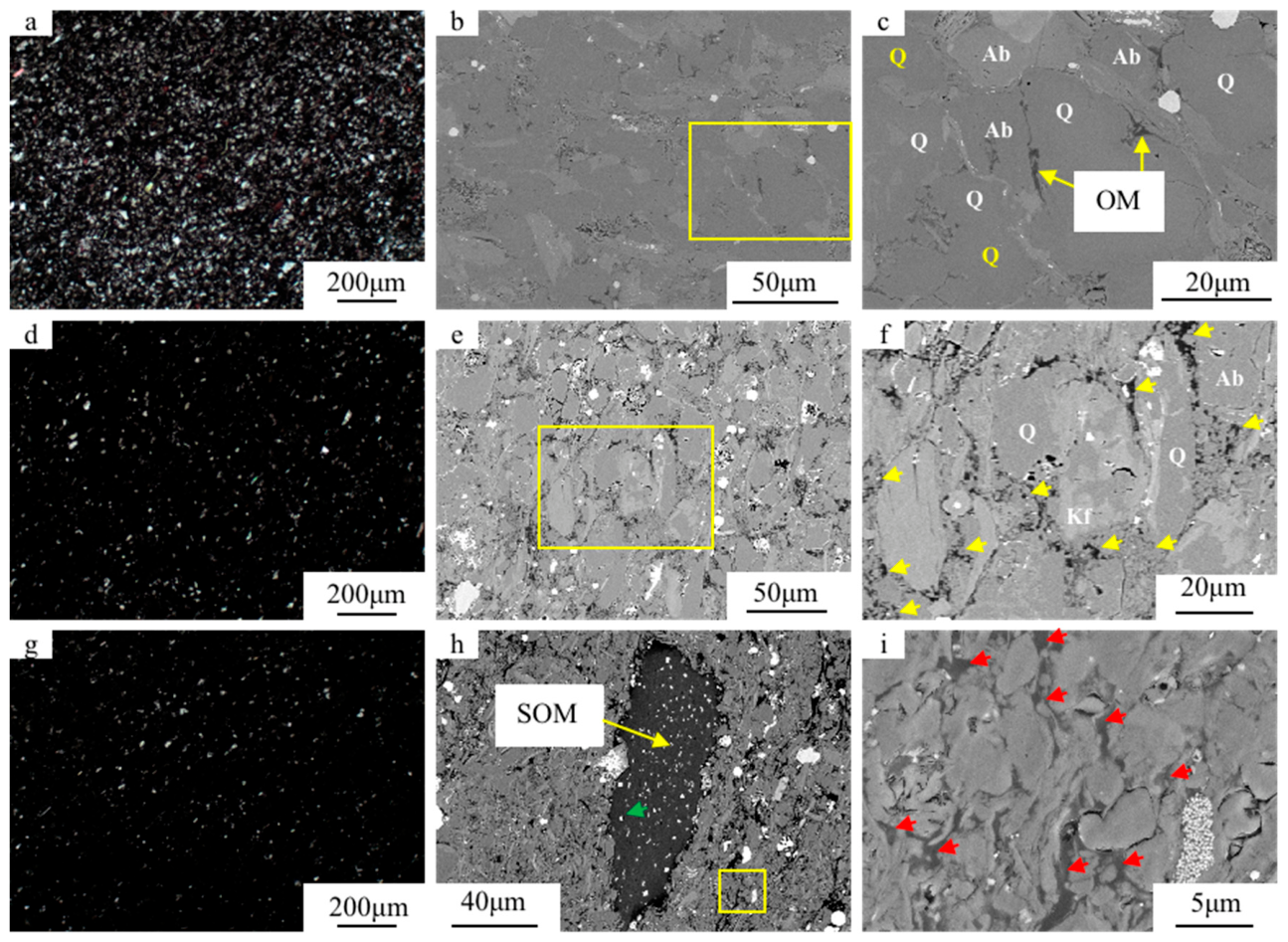
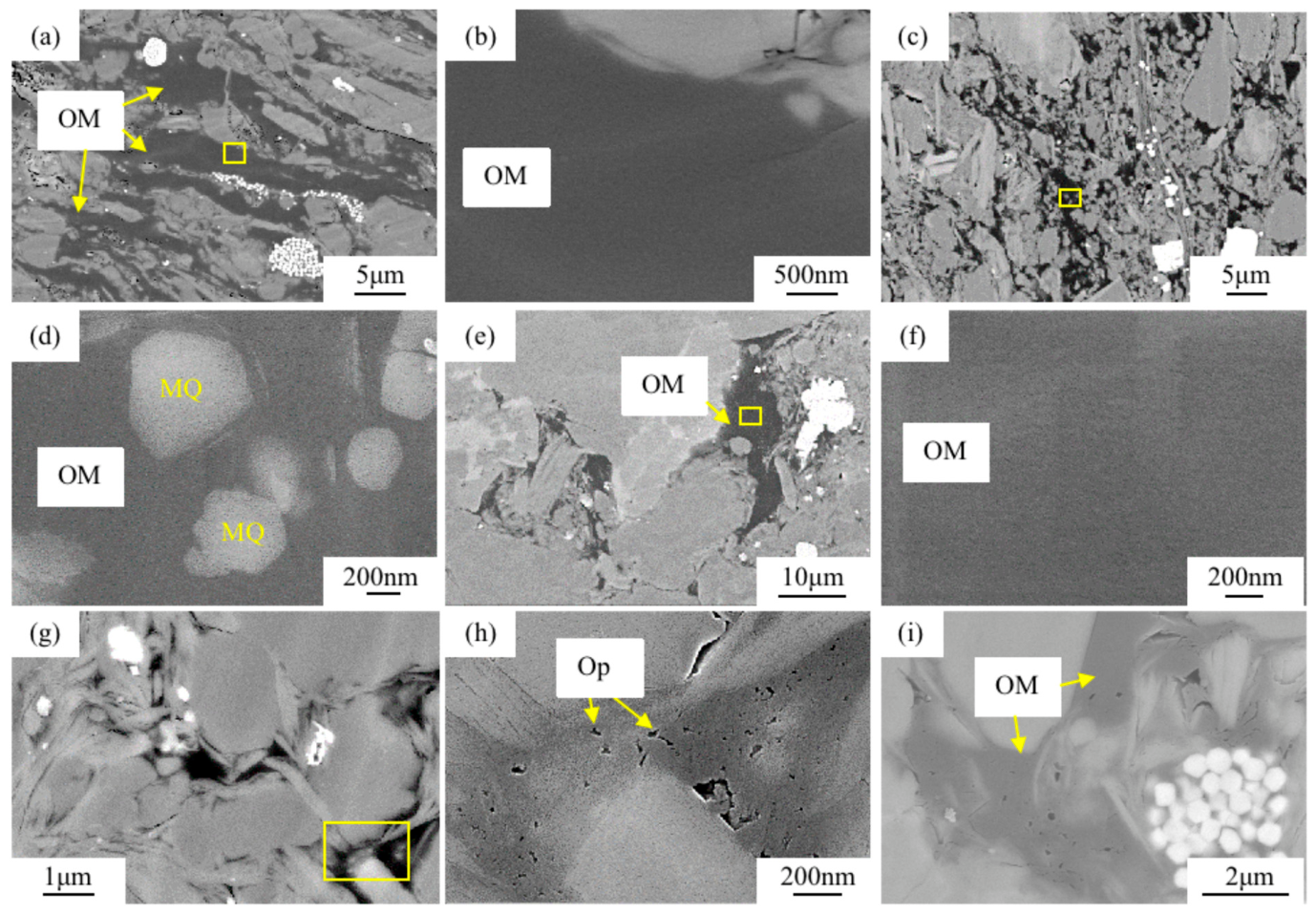
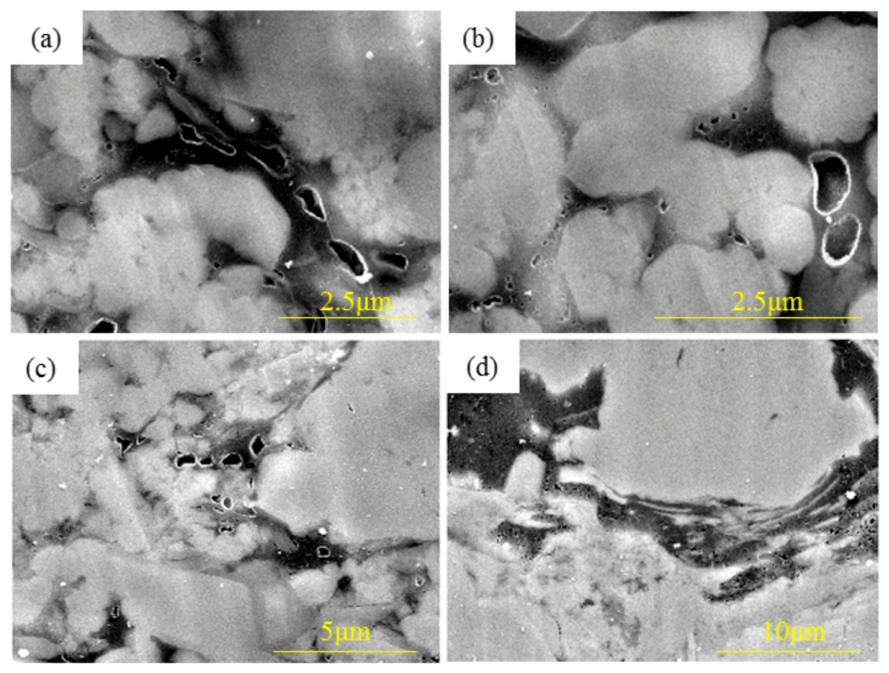
- OM pores are poorly developed and exhibit highly irregular morphologies. Compared with commercially productive shales, the migrated organic matter in the Qiongzhusi shales has far fewer OM pores [6,8,9,10,13,47,48]. Most of the OM pores are isolated and of varying sizes, with pore sizes ranging from a few nanometers to several hundred nanometers. The plane porosity of organic matter generally does not exceed 5% (Figure 5). Unlike the OM pores in commercially developed shales—which are of predominantly nearly circular or elliptical in shape—the OM pores in the Qiongzhusi shales are highly irregular in shape (Figure 5h,i).
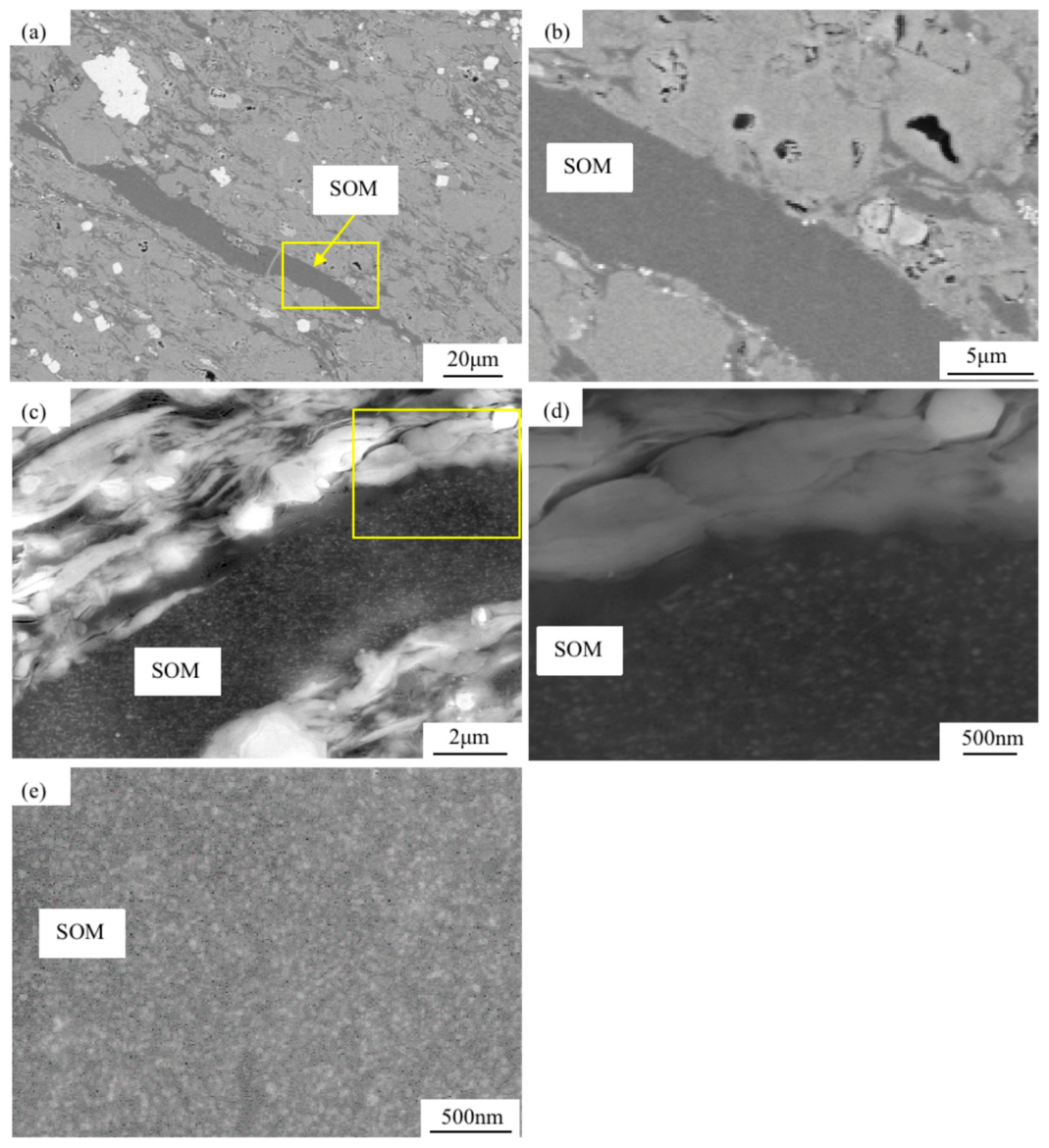
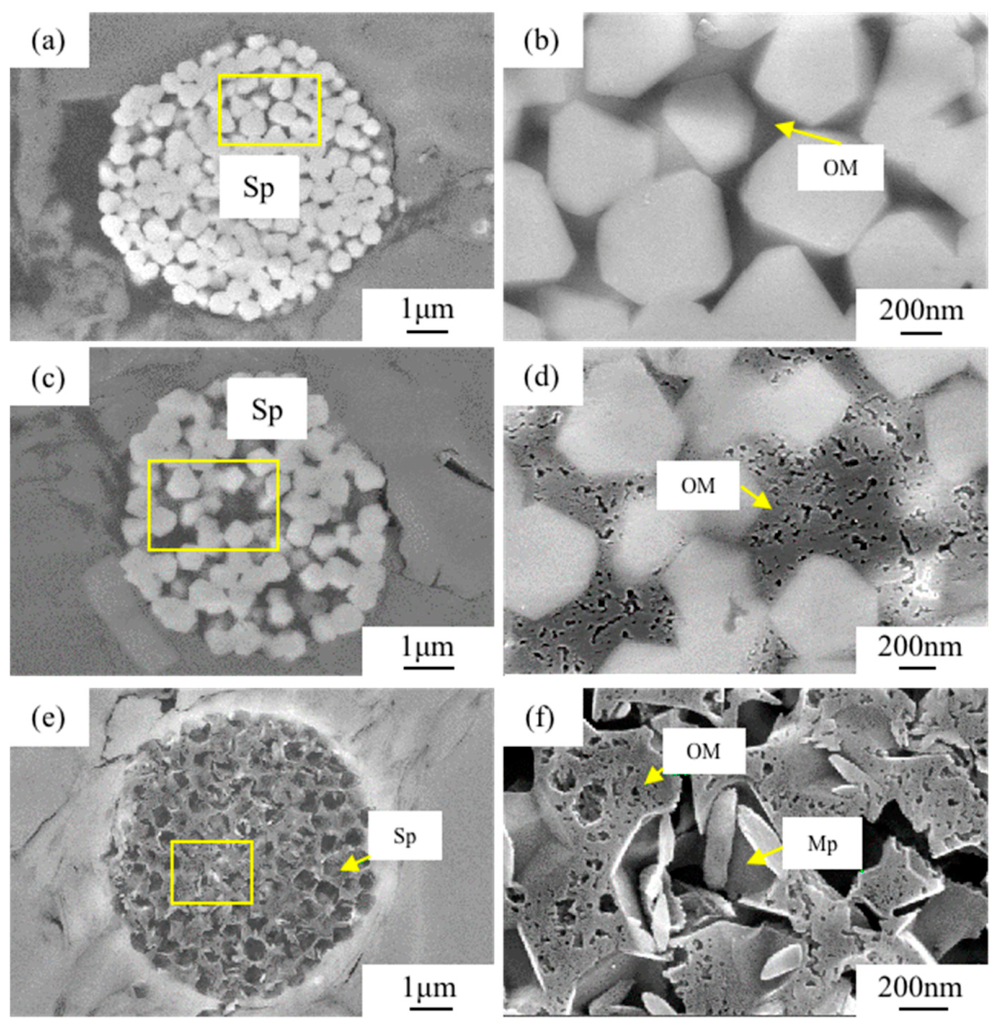
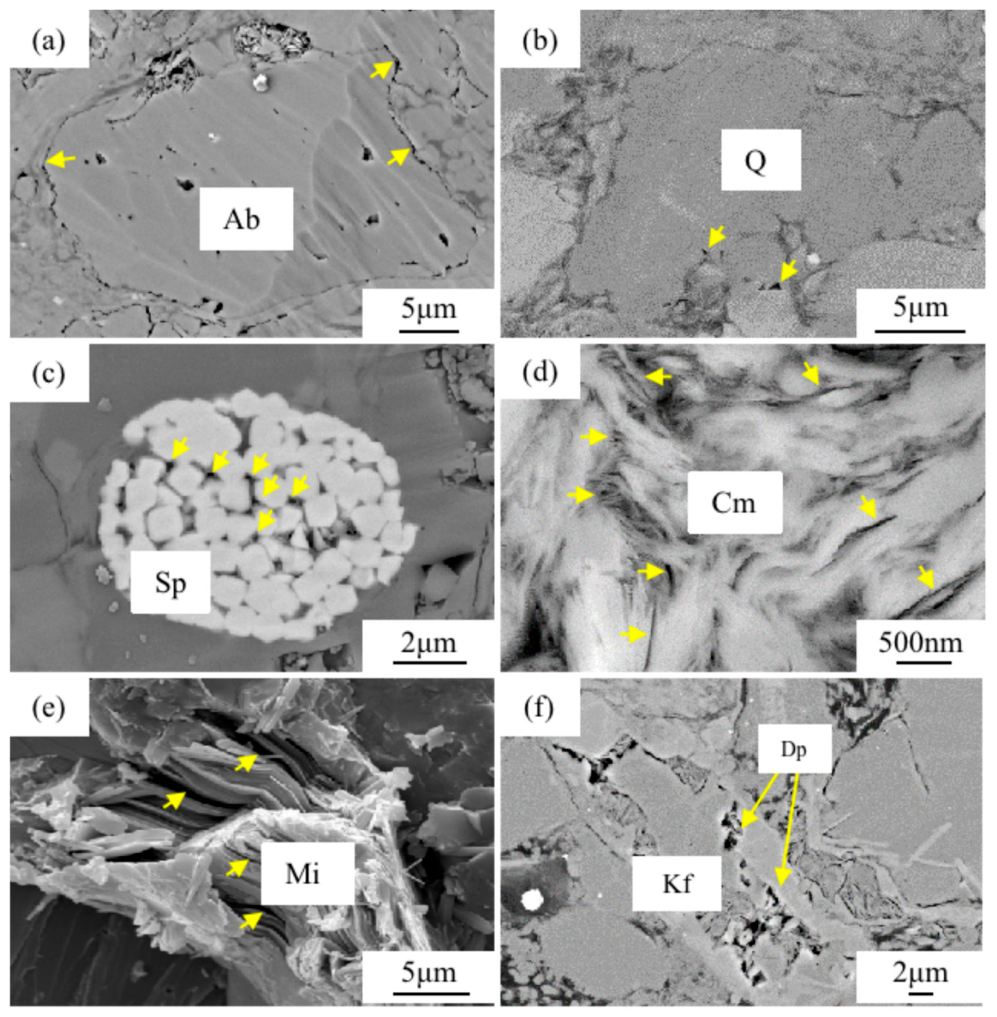
- OM pores are relatively less developed in the shales with TOC > ~4 wt.%. For samples with TOC > ~4 wt.%, most of the organic matter is dense, with no pores that can be observed under SEM (Figure 5a–f), except for locally developed, coalesced, sheet-like pores (Table 2). The organic matter within the framboidal pyrite is also dense in shales with TOC > ~4 wt.% (Figure 6a,b).
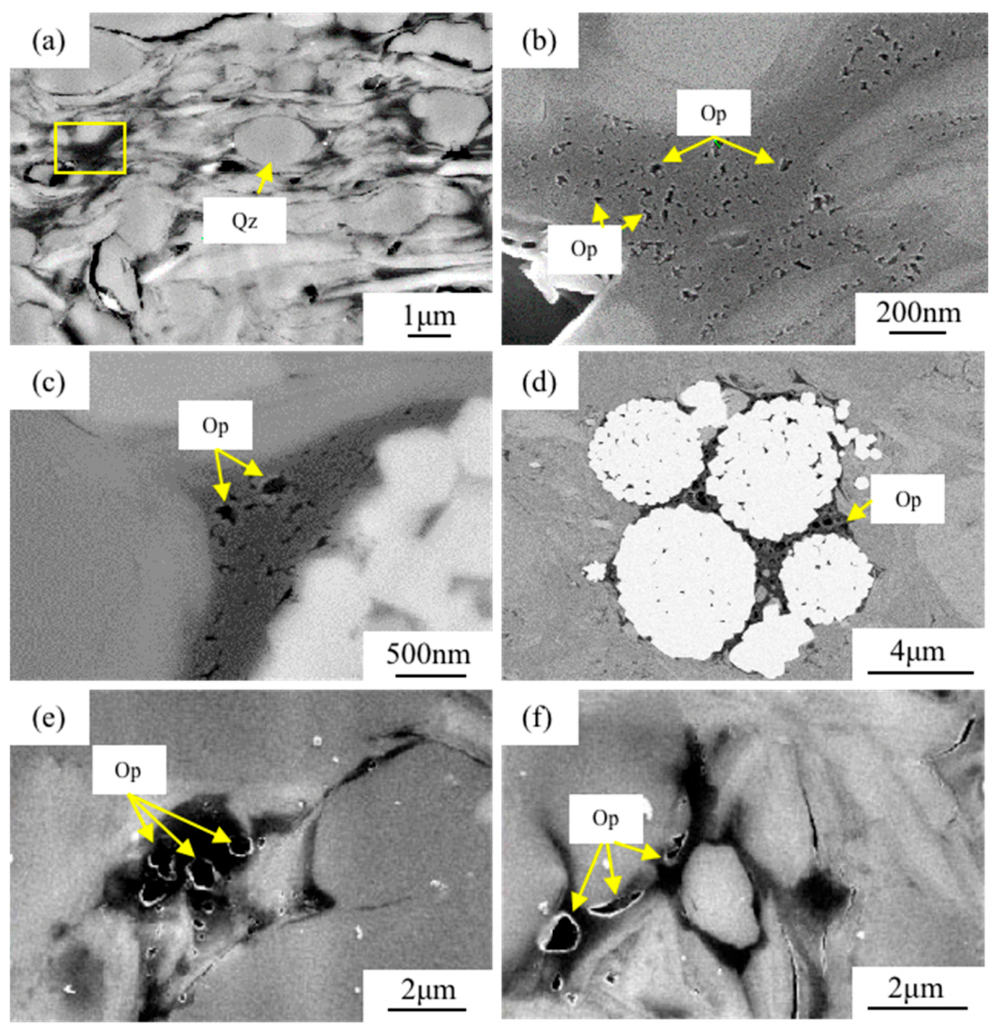
- OM pores are relatively well developed in samples with TOC < ~2.5 wt.%. Samples with TOC < 2.5 wt.% exhibit less developed OM pores; however, the OM pores are nonetheless common and—locally—relatively well developed (Figure 7). These pores are predominantly isolated and irregular in shape (Table 2, Figure 5g–i). In some compaction shadows, the OM pores are well-developed and exhibit nearly circular or elliptical morphologies (Figure 7d–f), resembling those observed in commercially exploited shales of relatively low thermal maturity. Some organic matter appears to have been subjected to unidirectional compaction, with internal pores arranged in a direction (Figure 7c). In these shales, the organic matter within the framboidal pyrite has well-developed OM pores—either homogeneous or complex sponge-like in morphology (with a maximum plane porosity of 15%) (Table 2, Figure 6c–f).
4.3. Other Pores in the Shales
4.4. Porosity of the Shales
5. Discussion
5.1. Reservoir Quality of the Qiongzhusi Shales
5.2. Origin of the Destruction of OM Pores in the Qiongzhusi Shales
5.2.1. Graphitization and OM Pore Destruction
5.2.2. Compaction and OM Pore Destruction
- Formation of OM pores provides essential space for compaction. Prior to thermal maturity, kerogen in source rocks typically generates substantial quantities of bitumen, which infiltrates and fills pores—thereby significantly reducing shale porosity [4]. In shales with high TOC, pore space may be nearly exhausted following bitumen saturation [2], severely constraining compaction due to the absence of pore space. However, during and after the wet-gas window (Ro ≤ 3.0%), abundant OM pores develop [21,64], creating additional pore volume that accommodates further compaction as burial depth increases. This mechanism is theoretically applicable to the Qiongzhusi shales in the study area.
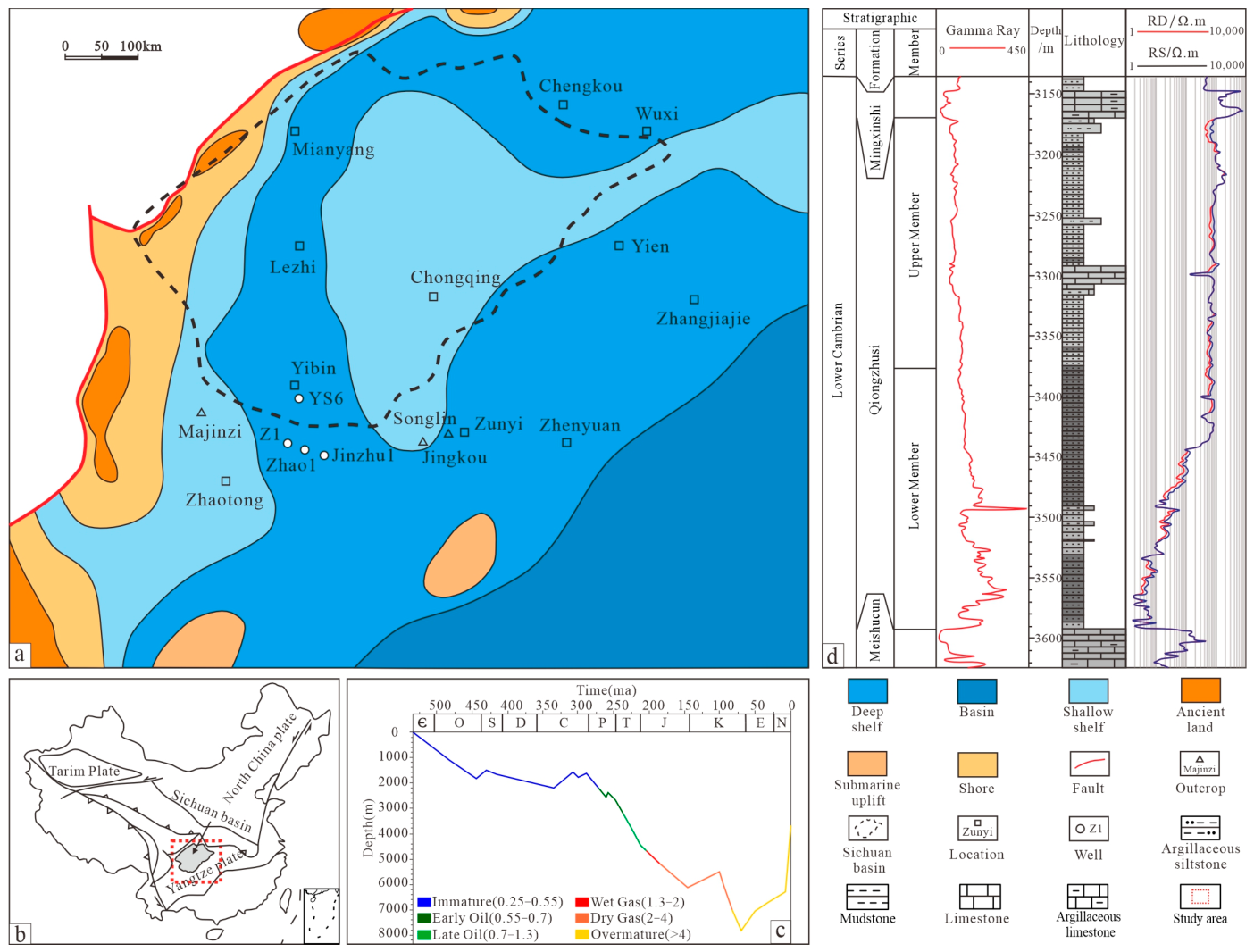
- A substantial increase in shale burial depth provided the driving force for compaction. Between the onset of the wet-gas window and the maximum paleo-burial depth, the burial depth of the Qiongzhusi shales in the study area increased by 3000–4500 m [40]. This substantial increase in overburden pressure provided the requisite energy to sustain ongoing compaction.
- Absence of Overpressure Favors Compaction: Carbonate karst reservoirs developed at the top of the underlying Dengying Formation likely enhanced the efficiency of hydrocarbon expulsion—particularly from the basal intervals of the Qiongzhusi shales—during hydrocarbon generation [42,65]. As a result, the development of overpressure was inhibited, thereby establishing favorable geomechanical conditions for compaction.
- The relatively low mechanical strength of organic-rich shales rendered them particularly susceptible to compaction. Elevated organic matter and clay mineral content can collectively reduce shale strength and diminish its resistance to compaction [63,66]. Shales rich in organic matter or clay minerals—owing to their relatively low mechanical strength—are particularly susceptible to compaction, which may have significantly impacted pore evolution even during the early stage of extensive organic matter pore development [9,67]. Milliken et al. (2013) observed that in the Marcellus shale (Ro ranging from 1.0% to 2.1%), porosity exhibited a strong positive correlation with TOC only up to TOC ≈ 5.5 wt.%; beyond this threshold, porosity plateaued or even declined—a trend attributed by the authors to compaction [9]. Similarly, Lis et al. (2025) noted that although OM pores are theoretically expected to develop during the wet-gas to dry-gas stage, they remain poorly developed in Silurian shales of the Baltic Basin [67]. This anomaly was ascribed to an exceptionally high clay mineral content (~50 vol.%), which compromises the development of a rigid mineral framework and eliminates pressure-shadow protection essential for preserving OM pores. In the basal Qiongzhusi Formation shales—characterized by exceptionally high TOC (up to 13.7 wt.%)—such pronounced organic enrichment would inevitably lead to substantial reductions in rock strength, thereby strongly compacting.
5.3. Implications for Hydrocarbon Exploration
6. Conclusions
- (1)
- The Qiongzhusi shales exhibit low porosity and poorly developed OM pores. However, this poor development of the OM pores is the result of post-formation destruction rather than an original feature. Despite the generally poor OM pore development, highly porous spongy-like migrated OM is still observable under SEM, indicating that the widespread destruction of OM pores was not caused by graphitization. This finding negates the traditional view that graphitization leads to the massive destruction of OM pores in post-mature shales and improves our understanding of pore evolution in post-mature shales.
- (2)
- Compaction likely played a major role in the destruction of OM pores. Consequently, anti-compaction mechanisms (e.g., overpressure) are critical for pore preservation in post-mature shales. In the presence of overpressure, post-mature shales may still serve as high-quality shale-gas reservoirs (e.g., the Marcellus Shale).
- (3)
- The continuous compaction-induced destruction of OM pores after their formation results in a “depth window” for the development of high-quality shale gas reservoirs: Beyond a certain depth, OM pores are largely destroyed, leading to a significant decline in reservoir quality, potentially to the extent of becoming non-reservoir. Therefore, in shale-gas exploration, priority should be given to areas where the maximum paleoburial depth falls within this window.
- (4)
- It should be noted that the mechanisms, controlling factors, and extent of compaction-driven OM pore destruction require further investigation. Moreover, the conclusions of this study are primarily based on the Qiongzhusi shales and need to be validated by studies of shales from more basins.
Author Contributions
Funding
Data Availability Statement
Conflicts of Interest
Abbreviations
| BSE | Backscattered electron; |
| GPa | Giga Pascal; |
| OM | Organic matter; |
| RO | Vitrinite reflectance; |
| SOM | Sedimentary organic matter; |
| SEM | Scanning electron microscopy; |
| TOC | Total organic carbon. |
References
- Jarvie, D.M.; Hill, R.J.; Ruble, T.E.; Pollastro, R.M. Unconventional shale-gas systems: The Mississippian Barnett Shale of north-central Texas as one model for thermogenic shale-gas assessment. AAPG Bull. 2007, 91, 475–499. [Google Scholar] [CrossRef]
- Mastalerz, M.; Schimmelmann, A.; Drobniak, A.; Chen, Y. Porosity of Devonian and Mississippian New Albany Shale across a maturation gradient: Insights from organic petrology, gas adsorption, and mercury intrusion. AAPG Bull. 2013, 97, 1621–1643. [Google Scholar] [CrossRef]
- Khan, M.; Nawaz, S.; Gao, X.; Khan, N.M. Reservoir Characterization of Eocene Carbonates and Cambrian Sands in the Eastern Potwar Region, Pakistan. Reserv. Sci. 2026, 2, 111–125. [Google Scholar] [CrossRef]
- Pommer, M.; Milliken, K. Pore types and pore-size distributions across thermal maturity, Eagle Ford Formation, southern Texas. AAPG Bull. 2015, 99, 1713–1744. [Google Scholar] [CrossRef]
- Wang, T.; Wang, X.; Zhang, D.; Wang, Q.T.; Luo, H.Y.; Wang, J.; Ma, Z.L.; Chen, Z.X.; Liu, W.H. Pore formation and evolution mechanisms during hydrocarbon generation in organic-rich marl. Pet. Sci. 2025, 22, 557–573. [Google Scholar] [CrossRef]
- Loucks, R.G.; Reed, R.M.; Ruppel, S.C.; Jarvie, D.M. Morphology, Genesis, and Distribution of Nanometer-Scale Pores in Siliceous Mudstones of the Mississippian Barnett Shale. J. Sediment. Res. 2009, 79, 848–861. [Google Scholar] [CrossRef]
- Ambrose, R.J.; Hartman, R.C.; Campos, D.M.; Akkutlu, I.Y. New pore-scale considerations for shale gas in place calculations. In Proceedings of the Society of Petroleum Engineers Unconventional Gas Conference, Pittsburgh, PA, USA, 23–25 February 2010. [Google Scholar]
- Curtis, M.E.; Cardott, B.J.; Sondergeld, C.H.; Rai, C.S. Development of organic porosity in the Woodford Shale with increasing thermal maturity. Int. J. Coal Geol. 2012, 10, 6–31. [Google Scholar] [CrossRef]
- Milliken, K.L.; Rudniki, M.; Awwiller, D.N.; Zhang, T. OM–hosted pore system, Marcellus Formation (Devonian), Pennsylvania. AAPG Bull. 2013, 97, 177–200. [Google Scholar] [CrossRef]
- Chalmers, G.R.; Bustin, R.M. A multidisciplinary approach in determining the maceral (kerogen type) and mineralogical composition of Upper Cretaceous Eagle Ford Formation: Impact on pore development and pore size distribution. Int. J. Coal Geol. 2017, 171, 93–110. [Google Scholar] [CrossRef]
- İnan, S.; Badairy, A.H.; İnan, T.; Al Zahrani, A. Formation and occurrence of organic matter-hosted porosity in shales. Int. J. Coal Geol. 2018, 199, 39–51. [Google Scholar] [CrossRef]
- Song, L.; Martin, K.; Carr, T.R.; Ghahfarokhi, P.K. Porosity and storage capacity of Middle Devonian shale: A function of thermal maturity, total organic carbon, and clay content. Fuel 2019, 241, 1036–1044. [Google Scholar] [CrossRef]
- Zhang, K.; Jiang, S.; Zhao, R.; Wang, P.; Jia, C.; Song, Y. Connectivity of organic matter pores in the Lower Silurian Longmaxi Formation shale, Sichuan Basin, Southern China: Analyses from helium ion microscope and focused ion beam scanning electron microscope. Geol. J. 2022, 57, 1912–1924. [Google Scholar] [CrossRef]
- Li, X.; Jiang, Z.; Song, Y.; Zhai, G.; Bao, S.; Li, Z.; Tang, X.; Wang, P.; Li, T.; Wang, G.; et al. Porosity evolution mechanisms of marine shales at over-maturity stage: Insight from comparable analysis between Lower Cambrian and Lower Silurian inside and at the margin of the Sichuan Basin, South China. Interpretation 2018, 6, T739–T757. [Google Scholar] [CrossRef]
- Li, X.; Jiang, Z.X.; Wang, P.F.; Song, Y.; Li, Z.; Tang, X.L.; Li, T.W.; Zhai, G.Y.; Bao, S.J.; Xu, C.L. Porosity-preserving mechanisms of marine shale in Lower Cambrian of Sichuan Basin, South China. J. Nat. Gas Sci. Eng. 2018, 55, 191–205. [Google Scholar] [CrossRef]
- Liu, B. Organic Matter in Shales: Types, Thermal Evolution, and Organic Pores. Earth Sci. 2023, 48, 4641–4657. [Google Scholar] [CrossRef]
- Wang, X.; Zhang, K.; Jiang, Z.; Lin, Y.; Song, Y.; Jia, C.; Jiang, S.; Jiang, L.; Niu, H.; Li, J.; et al. Hydrocarbon generation and pore evolution in marine organic-rich shales across maturation stages. Fuel 2025, 402, 136050. [Google Scholar] [CrossRef]
- Xie, W.D.; Fu, X.F.; Wang, H.X.; Sun, Y.; Vandeginste, V.; Li, X.P. Thermal maturity effect on the microscopic pore structure and gas adsorption capacity of shale gas reservoirs: A review. Pet. Sci. 2025, 22, 3967–3990. [Google Scholar] [CrossRef]
- Song, L.; Carr, T.R. The pore structural evolution of the Marcellus and Mahantango shales, Appalachian Basin. Mar. Pet. Geol. 2020, 114, 104226. [Google Scholar] [CrossRef]
- Bernard, S.; Wirth, R.; Schreiber, A.; Schulz, H.M.; Horsfield, B. Formation of nanoporous pyrobitumen residues during maturation of the Barnett Shale (Fort Worth Basin). Int. J. Coal Geol. 2012, 103, 3–11. [Google Scholar] [CrossRef]
- Loucks, R.G.; Reed, R.M. Scanning-Electron-Microscope petrographic evidence for distinguishing organic matter pores associated with depositional organic matter versus migrated organic matter in mudrocks. GCAGS 2014, 10, 51–60. [Google Scholar]
- Ko, L.T.; Ruppel, S.C.; Loucks, R.G. Pore-types and pore-network evolution in Upper Devonian-Lower Mississippian Woodford and Mississippian Barnett mudstones: Insights from laboratory thermal maturation and organic petrology. Int. J. Coal Geol. 2018, 190, 3–28. [Google Scholar] [CrossRef]
- Piane, C.D.; Ansari, H.; Li, Z.; Mata, J.; Rickard, W.; Pini, R.; Dewhurst, D.N.; Sherwood, N. Influence of organic matter type on porosity development in the Wufeng-Longmaxi Shale: A combined microscopy, neutron scattering and physisorption approach. Int. J. Coal Geol. 2022, 249, 103880. [Google Scholar] [CrossRef]
- Wang, G. Deformation of organic matter and its effect on pores in mud rocks. AAPG Bull. 2020, 104, 21–36. [Google Scholar] [CrossRef]
- Wang, Y.; Yang, J. Origin of chemical structure and pore heterogeneity of over-matured organic matter in the Paleozoic marine shales, China. Int. J. Coal Geol. 2025, 303, 104742. [Google Scholar] [CrossRef]
- Ma, Y.; Ardakani, O.H.; Li, D.; Ma, J.; Zhong, N.; Huang, H. OM-hosted pore systems in Ordovician Wufeng–Silurian Longmaxi shales in Sichuan Basin SW China: Origin, gas storage, and flow behavior. Int. J. Coal Geol. 2025, 312, 104897. [Google Scholar] [CrossRef]
- Zagorski, W.A.; Wrightsone, G.R.; Bowman, D.C. The Appalachian Basin Marcellus gas play: Its history of development, geologic controls on production, and future potential as a world-class reservoir. AAPG Mem. 2012, 97, 172–200. [Google Scholar] [CrossRef]
- Chalmers, G.R.; Bustin, R.M.; Power, I.M. Characterization of gas shale pore systems by porosimetry, pycnometry, surface area, and field emission scanning electron microscopy/transmission electron microscopy image analyses: Examples from the Barnett, Woodford, Haynesville, Marcellus, and Doig units. AAPG Bull. 2012, 96, 1099–1119. [Google Scholar] [CrossRef]
- Wang, S.; Zhang, Z.; Dong, D.; Wang, Y.; Li, X.; Hu, J.; Huang, J.; Guang, Q. Microscopic pore structure and reasons making reservoir property weaker of Lower Cambrian Qiongzhusi shale, Sichuan Basin, China. Nat. Gas Geosci. 2016, 27, 1619–1628. [Google Scholar] [CrossRef]
- Song, D.; Wu, C.; Tuo, J. Relationships between Organic Structure Carbonization and Organic Pore Destruction at the Overmatured Stage: Implications for the Fate of Organic Pores in Marine Shales. Energy Fuels 2022, 36, 6906–6921. [Google Scholar] [CrossRef]
- Wang, D.; Wang, Y.; Dong, D.; Wang, S.; Huang, J.; Huang, Y.; Wang, S.; Li, X. Quantitative characterization of reservoir space in the Lower Cambrian Qiongzhusi Shale, Southern Sichuan Basin. Nat. Gas Ind. 2013, 33, 1–10. [Google Scholar] [CrossRef]
- Li, A.; Su, S.; Li, X.; Zhang, J.; Jing, C.; Zhao, Z. Effects of Organic Matter Graphitization on Shale Gas Accumulation in the Lower Paleozoic Longmaxi Formation from the Changning Area, Southern Sichuan Basin. Lithosphere 2022, 12, 7102509. [Google Scholar] [CrossRef]
- Hou, Y.; Yu, R.; Li, J.; Chen, Z.; Wang, C.; Chen, X.; Yang, R.; He, S. Molecular structure characterization of kerogen in contact metamorphic shales: Insights into the effect of graphitization on organic matter pores. AAPG Bull. 2024, 108, 633–662. [Google Scholar] [CrossRef]
- Liang, F.; Zhao, Q.; Zhao, S.; Shi, Z.; Zhang, Q.; Zhou, T.; Wang, Y.; Cui, H.; Chen, H.; Wang, Y. Genesis Mechanism of Low Resistivity in the Lower Cambrian Qiongzhusi Formation Shale and Its Response Characteristics to Pore Structure—Take the Z201 Well as an Example. ACS Omega 2025, 10, 43995–44011. [Google Scholar] [CrossRef]
- Piane, C.D.; Bourdet, J.; Josh, M.; Clennell, M.B.; Raven, M.D. Organic matter network in post-mature Marcellus Shale: Effects on petrophysical properties. AAPG Bull. 2018, 102, 2305–2332. [Google Scholar] [CrossRef]
- Kun, J.; Ye, Y.H.; Liu, S.G.; Ran, B.; Deng, B.; Li, Z.W.; Li, J.X.; Yong, Z.Q.; Sun, W. Characterization and Evolution of Nanoporosity in Superdeeply Buried Shales: A Case Study of the Longmaxi and Qiongzhusi Shales from MS Well #1, North Sichuan Basin, China. Energy Fuels 2018, 32, 191–203. [Google Scholar] [CrossRef]
- Zhang, A.Y.; Wu, D.M.; Guo, L.N.; Wang, Y.L. Geochemistry of Marine Black Shale Formation and Its Metallogenic Implication; Science Press: Beijing, China, 1987; pp. 13–30. [Google Scholar]
- Yan, J.; Li, Q.; Zhu, X. Main factors controlling shale gas accumulation and exploration targets in the Lower Cambrian, Sichuan Basin and its periphery. Pet. Geol. Exp. 2016, 38, 445–452. [Google Scholar] [CrossRef]
- Xu, H.; Shen, J.; Yang, F.; Hu, Q.; Yu, Y.; Xiong, L.; Zhang, T.; Deng, H.; He, J. Provenance, sedimentary paleoenvironment and organic matter accumulation mechanisms in shales from the Lower Cambrian Qiongzhusi Formation, SW Yangtze Block, China. Mar. Pet. Geol. 2025, 181, 107520. [Google Scholar] [CrossRef]
- Min, H.J. Characteristics and Formation Mechanism of Highly Over-Mature Shale Gas Reservoirs in Lower Cambrian Qiongzhusi Formation in the Southwestern Yangtze Plate. Doctoral Thesis, Chengdu University of Technology, Chengdu, China, 2020. [Google Scholar]
- Zhang, S.; Wang, H.; Su, J.; Wang, X.; He, K.; Liu, Y. Control of Earth system evolution on the formation and enrichment of marine ultra-deep petroleum in China. Pet. Explor. Dev. 2024, 51, 759–773. [Google Scholar] [CrossRef]
- Zhao, W.Z.; Li, J.Z.; Yang, T.; Wang, S.F.; Huang, J.L. Geological difference and its significance of marine shale gases in South China. Pet. Explor. Dev. 2016, 43, 547–559. [Google Scholar] [CrossRef]
- Wang, Y.M.; Li, X.J.; Chen, B.; Wu, W.; Dong, D.Z.; Zhang, J.; Han, J.; Ma, J.; Dai, B.; Wang, H.; et al. Lower limit of thermal maturity for the carbonization of organic matter in marine shale and its exploration risk. Pet. Explor. Dev. 2018, 45, 385–395. [Google Scholar] [CrossRef]
- Zhang, Q.; Zhao, Q.; Luo, C.; Liang, F.; Zhou, S.W.; Wang, Y.M.; Lu, B.; Qiu, Z.; Liu, H.L.; Liu, W. Effect of graphitization of organic matter on shale gas reservoirs: Take the marine shales in the southern Sichuan Basin as examples. Nat. Gas Ind. 2022, 42, 25–36. [Google Scholar] [CrossRef]
- GB/T 34533-2017; General Administration of Quality Supervision, Inspection and Quarantine and Standardization Administration of the People’s Republic of China. Measurement of Helium Porosity and Pulse Decay Permeability of Shale. China Standards Press: Beijing, China, 2017; pp. 1–12.
- Dai, H.M.; Wang, S.Y.; Chen, Y.C. Geochemistry of Petroleum Exploration, 2nd ed.; Petroleum Industry Press: Beijing, China, 2011. [Google Scholar]
- Loucks, R.G.; Reed, R.M.; Ruppel, S.C.; Hammes, U. Spectrum of pore types and networks in mudrocks and a descriptive classification for matrix-related mudrock pores. AAPG Bull. 2012, 96, 1071–1098. [Google Scholar] [CrossRef]
- Guo, X.S.; Li, Y.P.; Liu, R.B.; Wang, Q.B. Characteristics and controlling factors of micro pore structures of Longmaxi Shale Play in the Jiaoshiba area, Sichuan Basin. Nat. Gas Ind. 2014, 34, 9–16. [Google Scholar] [CrossRef]
- Dong, D.Z.; Liang, F.; Guan, Q.Z.; Jiang, Y.Q.; Zhou, S.W.; Yu, R.Z.; Gu, Y.F.; Zhang, S.R.; Qi, L.; Liu, Y. Development model and identification evaluation technology of Wufeng-Longmaxi Formation quality shale gas reservoirs in the Sichuan Basin. Nat. Gas Ind. 2022, 42, 96–111. [Google Scholar] [CrossRef]
- Okiongbo, K.S.; Aplin, A.C.; Larter, S.R. Changes in type II kerogen density as a function of maturity: Evidence from the Kimmeridge clay formation. Energy Fuel 2005, 19, 2495–2499. [Google Scholar] [CrossRef]
- Ardakani, O.H.; Sanei, H.; Ghanizadeh, A.; Lavoie, D.; Chen, Z.H.; Clarkson, C.R. Do all fractions of organic matter contribute equally in shale porosity? A case study from Upper Ordovician Utica Shale, southern Quebec, Canada. Mar. Pet. Geol. 2018, 92, 794–808. [Google Scholar] [CrossRef]
- Luo, S.Y.; Chen, X.H.; Li, H.; Liu, A.; Wang, C.S. Shale Gas Accumulation Conditions and Target Optimization of Lower Cambrian Shuijingtuo Formation in Yichang Area, West Hubei. Earth Sci. 2019, 44, 3598–3615. [Google Scholar] [CrossRef]
- Ma, Z.J.; Tang, X.; Zhang, J.C.; Zhai, G.Y.; Wang, Y.F.; Liang, G.D.; Luo, H. Organic matter-hosted pores in the Cambrian Niutitang shales of the Upper Yangtze region: Pore development characteristics and main controlling factors. Earth Sci. 2023, 30, 124–137. [Google Scholar] [CrossRef]
- Gao, H.T.; Cheng, P.; Wu, W.; Luo, C.; Xu, L.; Li, T.F.; Gai, H.F.; Tian, H. The geochemical, pore development and water-bearing characteristics of deep and ultra-deep marine shales and their effects on gas content: New implications from the shales of the first Lower Cambrian high yield gas well (Z201) in China. Pet. Sci. 2025, 22, 1839–1853. [Google Scholar] [CrossRef]
- Lei, H.; Sun, W.J.; Zuo, Y.J.; Wu, Z.H.; Dai, Q.C.; Lv, W.; Li, Y.Q.; Xie, X.G. Impact of micromechanical properties of organic matter on the micro-mesopore structures of the over-mature shale in the Niutitang Formation. Sci. Rep. 2025, 15, 4542. [Google Scholar] [CrossRef]
- He, X.; Liang, F.; Li, H.; Zheng, M.J.; Zhao, Q.; Liu, Y.; Liu, W.P. Breakthrough and enrichment mode of marine shale gas in the Lower Cambrian Qiongzhusi Formation in high-yield wells in Sichuan Basin. China Pet. Explor. 2024, 29, 142–155. [Google Scholar] [CrossRef]
- Yong, R.; Shi, X.W.; Luo, C.; Zhong, K.S.; Wu, W.; Zheng, M.J.; Yang, Y.R.; Li, Y.Y.; Xu, L.; Zhu, Y.Q.; et al. Aulacogen-uplift enrichment pattern and exploration prospect of Cambrian Qiongzhusi Formation shale gas in Sichuan Basin, SW China. Pet. Explor. Dev. 2024, 51, 1211–1226. [Google Scholar] [CrossRef]
- Zou, C.N.; Zhao, Z.F.; Pan, S.Q.; Yin, J.; Lu, G.W.; Fu, F.L.; Yuan, M.; Liu, H.L.; Zhang, G.S.; Luo, C.; et al. Unveiling the Oldest Industrial Shale Gas Reservoir: Insights for the Enrichment Pattern and Exploration Direction of Lower Cambrian Shale Gas in the Sichuan Basin. Engineering 2024, 42, 278–294. [Google Scholar] [CrossRef]
- Wang, Y.M.; Dong, D.Z.; Cheng, X.Z.; Huang, J.L.; Wang, S.F.; Wang, S.Q. Electric property evidences of the carbonification of organic matters in marine shales and its geologic significance: A case of the Lower Cambrian Qiongzhusi Shale in southern Sichuan Basin. Nat. Gas Ind. 2014, 34, 1–7. [Google Scholar] [CrossRef]
- Yang, A.; Firdaus, G.; Heidari, Z. Electrical resistivity and chemical properties of kerogen isolated from organicrich mudrocks. Geophysics 2016, 81, D643–D655. [Google Scholar] [CrossRef]
- Wang, Z.; Li, X.Q.; Qi, S.; Yao, S.P.; Wang, F.Y. Characteristics of Microscopic Pore Structures and Its Influencing Factors of the Qiongzhusi Formation Shales in the Southern Sichuan Basin. Acta Metall. Sin. 2018, 24, 273–284. [Google Scholar] [CrossRef]
- Cao, Y.C.; Yuan, G.H.; Yang, H.J.; Wang, Y.Z.; Liu, K.Y.; Zan, N.M.; Xi, K.L.; Wang, J. Current situation of oil and gas exploration and research progress of the origin of high-quality reservoirs in deep-ultra-deep clastic reservoirs of petroliferous basins. Acta Pet. Sin. 2022, 43, 112–140. [Google Scholar] [CrossRef]
- Kumar, V.; Sondergeld, C.; Rai, C.S. Effect of mineralogy and organic matter on mechanical properties of shale. Interpretation 2015, 3, SV9–SV15. [Google Scholar] [CrossRef]
- Chen, J.P.; Zhao, W.Z.; Wang, Z.M.; Zhang, S.C.; Deng, C.P.; Sun, Y.G.; Xiao, Z.Y. A discussion on the upper limit of maturity for gas generation by marine kerogens and the utmost of gas generative potential: Taking the study on the Tarim Basin as an example. Chin. Sci. Bull. 2007, S1, 125–132. [Google Scholar] [CrossRef]
- Zhou, W.; Xu, H.; Yu, Q.; Xie, R.C.; Deng, K. Shale gas-bearing property differences and their genesis between Wufeng-Longmaxi Formation and Qiongzhusi Formation in Sichuan Basin and surrounding areas. Lithol. Reserv. 2016, 28, 18–25. [Google Scholar] [CrossRef]
- Xie, G.Y.; Sun, M.D.; Ma, Y.Q.; Mohammadian, E.; Ostadhassan, M.; Pan, Z.J.; Duan, X.G. Impact of laminae characteristics on pore-fracture connectivity in the Wufeng-Longmaxi shale. Mar. Pet. Geol. 2025, 182, 107562. [Google Scholar] [CrossRef]
- Lis, G.P.; Topór, T.; Mastalerz, M. Organic matter content and its role in shale porosity development with maturity: Insights from Baltic Basin Silurian shales. Int. J. Coal Geol. 2025, 301, 104713. [Google Scholar] [CrossRef]
- Li, X.; Jiang, Z.X.; Jiang, S.; Wang, S.; Miao, Y.N.; Wu, F.; Cao, X.N. Synergetic effects of matrix components and diagenetic processes on pore properties in the Lower Cambrian shale in Sichuan Basin, South China. J. Nat. Gas Sci. Eng. 2021, 94, 104072. [Google Scholar] [CrossRef]
- Eliyahu, M.; Emmanuel, S.; Day-Stirrat, R.J. Mechanical properties of organic matter in shales mapped at the nanometer scale. Mar. Pet. Geol. 2015, 59, 294–304. [Google Scholar] [CrossRef]
- Lewan, M.D. Primary oil migration and expulsion as determined by hydrous pyrolysis. In Proceeding of the 13th World Petroleum Congress; OnePetro: Richardson, TX, USA, 1991; Volume 2, pp. 215–223. [Google Scholar]
- Kock, M.O.D.; Beukes, N.J.; Adeniyi, E.O.; Cole, D.; Götz, A.E.; Geel, C.; Ossa, F.G. Deflating the shale gas potential of South Africa’s Main Karoo basin. S. Afr. J. Sci. 2017, 113, 87–98. [Google Scholar] [CrossRef]
- Xie, G.L.; Jiao, K.; Deng, B.; Hao, W.D.; Liu, S.G. Pore characteristics and preservation mechanism of over-6000-m ultra-deep shale reservoir in the Sichuan Basin. Front. Earth Sci. 2023, 11, 1059869. [Google Scholar] [CrossRef]
- Yin, J.; Wei, L.; Sun, S.S.; Shi, Z.S.; Dong, D.Z.; Gao, Z.Y. Overpressure Generation and Evolution in Deep Longmaxi Formation Shale Reservoir in Southern Sichuan Basin: Influences on Pore Development. Energies 2023, 16, 2533. [Google Scholar] [CrossRef]
- Liu, S.G.; Deng, B.; Zhong, Y.; Ran, B.; Yong, Z.Q.; Sun, W.; Yang, D.; Jinag, L.; Ye, H. Unique geologic features of burial and superimposition of the Lower Paleozoic shale gas across the Sichuan basin and its periphery. Front. Earth Sci. 2016, 23, 11–28. [Google Scholar] [CrossRef]
- Guo, T.L.; Xiong, L.; Ye, S.J.; Dong, X.X.; Wei, L.M.; Yang, Y.T. Theory and practice of unconventional gas exploration in carrier beds: Insight from the breakthrough of new type of shale gas and tight gas in Sichuan Basin, SW China. Pet. Explor. Dev. 2023, 50, 27–42. [Google Scholar] [CrossRef]
- Guo, T.L.; Deng, H.C.; Zhao, S.; Wei, L.M.; He, J.H. Formation mechanisms and exploration breakthroughs of new type of shale gas in Cambrian Qiongzhusi Formation, Sichuan Basin, SW China. Pet. Explor. Dev. 2025, 52, 64–78. [Google Scholar] [CrossRef]





| Sample Number | Section/Well | Sample | Lithology | TOC/wt.% | Porosity/% |
|---|---|---|---|---|---|
| 1 | Majinzi | M-1 | argillaceous siltstone | 3.6 | / |
| 2 | Z1 | Z1-1 | argillaceous siltstone | 4.77 | 2.4 |
| 3 | Z1 | Z1-2 | argillaceous siltstone | 4.24 | 1.8 |
| 4 | Z1 | Z1-3 | argillaceous siltstone | 1.84 | 3.4 |
| 5 | Z1 | Z1-4 | argillaceous siltstone | 1.8 | / |
| 6 | Z1 | Z1-5 | argillaceous siltstone | 1.77 | 2.6 |
| 7 | Z1 | Z1-5 | argillaceous siltstone | 1.68 | 3.3 |
| 8 | Z1 | Z1-7 | argillaceous siltstone | 1.68 | 4.5 |
| 9 | Z1 | Z1-8 | argillaceous siltstone | 4.0 | / |
| 10 | Z1 | Z1-9 | silty mudstone | 2.1 | / |
| 11 | Songlin | ZNC-1 | argillaceous siltstone | 6.95 | 1.6 |
| 12 | Songlin | ZNC-2 | argillaceous siltstone | 6.96 | / |
| 13 | Songlin | ZNC-3 | argillaceous siltstone | 6.61 | / |
| 14 | Songlin | ZNC-4 | mudstone | 13.7 | 1.3 |
| 15 | Songlin | ZNC-5 | mudstone | 10.9 | 2.1 |
| 16 | Songlin | ZNC-6 | mudstone | 1.6 | / |
| 17 | Songlin | ZNC-7 | mudstone | 1.7 | / |
| 18 | Jingkou | JK-1 | marl | 1.33 | 2.3 |
| 19 | Jingkou | JK-2 | marl | 1.77 | 1.6 |
| 20 | Zhao 1 | Zhao-1 | mudstone | / | / |
| 21 | YS6 | YS-1 | argillaceous siltstone | / | / |
| 22 | YS6 | YS-2 | mudstone | 0.6 | / |
| 23 | Jinzhu1 | JZ-1 | mudstone | 1.15 | / |
| Pore Types | Pore Pattern | Typical Image | Description |
|---|---|---|---|
| Isolated irregular pores |  |  | The pores formed in isolation, exhibiting heterogeneous sizes, irregular morphologies, and poor interconnectivity. |
| Isolated regular pores |  |  | The pores formed in isolation, exhibiting relatively uniform morphologies and poor interconnectivity. |
| Homogeneous sponge-like pores |  |  | The pores are extensively and uniformly developed and exhibit excellent interconnectivity. Morphology of the pores is nearly ellipsoidal. |
| Complex sponge-like pores | 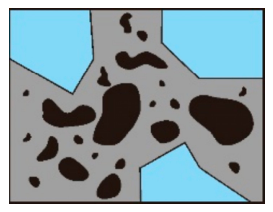 |  | The pore network is highly developed, exhibiting significant heterogeneity in pore size and excellent interconnectivity. Morphology of the pores is nearly ellipsoidal. |
| Coalesced sheet-like pores |  |  | The sheet-like pores are concentrated and aligned along a single direction. |
| Dense organic matter |  |  | Organic matter has no pore development inside and closely adheres to minerals. |
Disclaimer/Publisher’s Note: The statements, opinions and data contained in all publications are solely those of the individual author(s) and contributor(s) and not of MDPI and/or the editor(s). MDPI and/or the editor(s) disclaim responsibility for any injury to people or property resulting from any ideas, methods, instructions or products referred to in the content. |
© 2026 by the authors. Licensee MDPI, Basel, Switzerland. This article is an open access article distributed under the terms and conditions of the Creative Commons Attribution (CC BY) license.
Share and Cite
Min, H.; Xu, J.; Liang, S.; Liu, C.; Zhao, L. The Origin of Organic Matter Pore Destruction in Post-Mature Shales of the Qiongzhusi Formation, Southwestern Upper Yangtze, China: Evidence from Scanning Electron Microscopy. Minerals 2026, 16, 529. https://doi.org/10.3390/min16050529
Min H, Xu J, Liang S, Liu C, Zhao L. The Origin of Organic Matter Pore Destruction in Post-Mature Shales of the Qiongzhusi Formation, Southwestern Upper Yangtze, China: Evidence from Scanning Electron Microscopy. Minerals. 2026; 16(5):529. https://doi.org/10.3390/min16050529
Chicago/Turabian StyleMin, Huajun, Jinhui Xu, Shuangqing Liang, Chunyan Liu, and Limin Zhao. 2026. "The Origin of Organic Matter Pore Destruction in Post-Mature Shales of the Qiongzhusi Formation, Southwestern Upper Yangtze, China: Evidence from Scanning Electron Microscopy" Minerals 16, no. 5: 529. https://doi.org/10.3390/min16050529
APA StyleMin, H., Xu, J., Liang, S., Liu, C., & Zhao, L. (2026). The Origin of Organic Matter Pore Destruction in Post-Mature Shales of the Qiongzhusi Formation, Southwestern Upper Yangtze, China: Evidence from Scanning Electron Microscopy. Minerals, 16(5), 529. https://doi.org/10.3390/min16050529