
Article

Development Characteristics and Reservoir Significance of Laminae in the Cambrian Qiongzhusi Formation Shale in the Southern Sichuan Basin

1
PetroChina Southwest Oil & Gas Field Company, Chengdu 610051, China
2
Shale Gas Geological Evaluation and Efficient Development Key Laboratory of Sichuan Province, Chengdu 610213, China
3
School of Geoscience and Technology, Southwest Petroleum University, Chengdu 610500, China
*
Author to whom correspondence should be addressed.
Minerals 2026, 16(5), 552; https://doi.org/10.3390/min16050552
Submission received: 25 February 2026 / Revised: 15 May 2026 / Accepted: 16 May 2026 / Published: 20 May 2026
(This article belongs to the Special Issue Element Enrichment and Gas Accumulation in Black Rock Series)

Abstract

The Cambrian Qiongzhusi Formation shale in southern Sichuan is a promising new marine shale gas exploration target, often considered the next major potential source following the Silurian Longmaxi Formation. Clarifying its reservoir characteristics of shale is crucial for identifying shale gas sweet spots. As the most distinctive structure feature in shale, laminae development plays a vital role in the formation and evolution of shale reservoirs. Based on core samples, thin sections, and a variety of test data, this study investigates the laminae development characteristics and reservoir significance of the Qiongzhusi Formation shale in the southern Sichuan Basin, yielding the following conclusions: (1) A three-level classification and nomenclature system for shale laminae in the Qiongzhusi Formation is proposed based on mineral composition and stacking patterns, dividing laminae into single laminae, lamina sets, and lamina series. The study area exhibits diverse lamina types, including four types of single laminae, three types of lamina sets, and seven types of lamina series. (2) The vertical heterogeneity in lamina series is pronounced. Within the organic-rich interval, the lithology transitions upward from organic-rich massive shale, through organic-rich argillaceous–felsic laminae, to organic-lean argillaceous–felsic laminae. In the low-TOC interval, increasing water depth corresponds to a transition from massive sandstone to predominantly organic-lean argillaceous–felsic–calcareous laminae and organic-lean argillaceous–felsic laminae. (3) Lamina development exerts a significant control over reservoir properties, with marked differences observed between various lamina series and massive shale. Among them, the organic-rich argillaceous–felsic lamina series exhibits the most favorable reservoir characteristics, including the highest total organic carbon (TOC) content, porosity, and gas content, representing the optimal shale reservoir type.

1. Introduction

The Cambrian Qiongzhusi Formation shales in the Sichuan Basin are characterized by considerable thickness, extensive distribution, and high resource potential. With a total formation thickness ranging from 100 to 600 m and organic-rich shale intervals (TOC > 2%) averaging 50 to 110 m, they provide a robust geological foundation for shale gas development [1,2,3,4]. Recently, exploration in the Qiongzhusi Formation has seen a series of breakthroughs: in 2023, CNPC achieved a major milestone at Well Z201, with a test production rate of 738,800 cubic meters per day; Well WY1 delivered 386,000 cubic meters per day. Sinopec’s Well JS103HF produced 258,600 cubic meters per day, Well JY3HF reached 825,000 cubic meters per day, and Well ZY2 achieved a remarkable test output of 1,257,000 cubic meters per day. Following the commercial breakthroughs achieved by Wells Z201, JS103, and WY1 in the Cambrian Qiongzhusi Formation shale of the southern Sichuan Basin, an increasing number of drilling results have confirmed the substantial resource potential and promising exploration prospects of shale gas in this formation [1,2,3,4,5]. Unlike the Wufeng–Longmaxi Formation shale, the Qiongzhusi Formation shale is older, buried at greater depths, and has undergone more complex tectonic evolution, resulting in stronger reservoir heterogeneity [4,5,6,7]. The heterogeneity, variability, and formation mechanisms of the Qiongzhusi Formation shale reservoirs remain incompletely understood [2,8,9,10], which constrains further exploration breakthroughs. Laminae, as a distinctive sedimentary structure, are extensively developed within shale sequences. Their development directly influences shale heterogeneity and further impacts hydrocarbon generation, reservoir quality, and gas-bearing properties. The development of laminae significantly influences shale oil and gas systems in the following aspects: (1) there are notable differences in organic matter abundance and preservation conditions across different lamina types. Organic-rich laminae serve as the primary hydrocarbon-generating units, characterized by high total organic carbon (TOC) content and favorable conditions for organic matter enrichment and preservation under anoxic environments. (2) Siliceous and carbonate laminae commonly develop inorganic pores such as intercrystalline and dissolution pores, whereas organic matter-rich laminae predominantly host organic-related nanopores. Mechanical property contrasts between laminae (e.g., differences in elastic modulus) can induce microfractures to propagate along bedding planes or across layers, significantly enhancing pore connectivity. (3) Laminae sets and series types, density, thickness, and stacking patterns directly control gas content and fracability. Bedding fractures act as “high-speed channels,” facilitating lateral hydrocarbon migration [11,12,13,14,15,16,17,18,19,20,21,22,23]. For the Qiongzhusi Formation shale, factors such as global sea-level changes during the early Cambrian and paleogeographic differentiation due to the formation of the Deyang–Anyue rift trough have directly contributed to spatial and temporal variations in lamina development, thereby intensifying reservoir heterogeneity [2,6,8,9]. Therefore, clarifying the developmental characteristics of laminae and their control mechanism over reservoir quality is the key to revealing the genesis of shale reservoir heterogeneity and realizing accurate prediction of sweet spots.
However, existing research exhibits three significant deficiencies that constitute critical scientific gaps urgently requiring resolution: (1) Studies on lamina-bearing shales in China have predominantly focused on lacustrine shale systems, while investigations of marine laminated shales have largely concentrated on the Upper Ordovician Wufeng Formation–Lower Silurian Longmaxi Formation. The lamina development characteristics and reservoir response of the Cambrian Qiongzhusi Formation, as a deep to ultra-deep ancient marine shale, remain essentially unexplored [11,12,19,22]. (2) Current lamina research tends to emphasize classification and morphological description at macroscopic or microscopic scales, generally neglecting the microstructural elements that fundamentally control reservoir quality—such as lamina stacking patterns—and their quantitative coupling relationships with reservoir performance. (3) In particular, how different lamina assemblage types differentially control organic matter enrichment, pore development, and gas content remains insufficiently demonstrated [14,15,16,18,20,21,23]. Shale laminae are the most fundamental sedimentary units and also the smallest units for fracture initiation during hydraulic fracturing; thus, laminae can serve as a bridge linking geological characteristics to engineering responses [14,15,16,17]. To address these scientific questions, this study adopts a lamina-based perspective to investigate how laminae and their assemblages influence shale reservoir characteristics, thereby deepening the understanding of shale reservoir formation mechanisms.
This study, based on core samples, drilling data, thin sections, QEMSCAN analysis, and various analytical tests, aims to investigate the types and developmental characteristics of laminae in the Qiongzhusi Formation shale of southern Sichuan, as well as their influence on shale reservoirs, thereby elucidating the developmental features and reservoir significance of laminae in this formation, providing a theoretical basis for the exploration breakthrough of deep to ultra-deep marine shale gas exploration.

2. Geological Setting

The Sichuan Basin is a representative superimposed basin marked by multi-phase tectonic evolution and cyclical sedimentary overprinting. This study area is located in the southern part of the Sichuan Basin (Figure 1). Since the Sinian Period, characterized by the breakup of the Rodinia supercontinent and the assembly of Gondwana, a tectonic regime—a mainly extensional tectonic regime with minor compressional events—has been established. During the early Cambrian, influenced by multi-phase tectonic activities of the Tongwan Movement, the Deyang–Anyue rift trough gradually formed under an extensional background, leading to the development of a differentiated paleogeographic pattern of troughs and platforms in the southern Sichuan region [24,25,26,27]. Within this paleogeographic framework, influenced by regional sea-level rise, extensive and continuously distributed organic-rich shale was deposited within the rift trough, providing the basis for deposition of organic matter and subsequent gas formation [28,29,30].
During the deposition of the Qiongzhusi Formation, the study area was located within the rift basin, where the Qiongzhusi Formation conformably overlies the underlying Cambrian Maidiping Formation. The formation is dominated by deep-water ramp subfacies of organic-rich siliceous shale, with a thickness ranging from 450 to 600 m [28,31]. Based on lithological variations, sedimentary cycles, well-logging response characteristics, and paleontological indicators, the Qiongzhusi Formation is generally divided from bottom to top into the Qiong-1 Member and the Qiong-2 Member. The Qiong-1 Member is further subdivided into the Qiong-1-1 submember and the Qiong-1-2 submember (Figure 1). The Qiong 1-1 sub-member comprises sublayers 1 to 4, the Qiong 1-2 submember includes sublayers 5 and 6, and the Qiong 2 member consists of sublayers 7 and 8. Regionally, the stratigraphy can be correlated. For practical production needs, the industry further subdivides the Qiongzhusi Formation into eight sublayers. Among these, Sublayers 1, 3, 5, and 7 are black shale intervals, while Sublayers 2, 4, 6, and 8 are predominantly composed of silty shale or silt-fine sandstone (Figure 1) [6]. During the deposition period of the Maidiping Formation to the first member of the Qiongzhusi Formation, the rift trough was in a filling stage; during the deposition of the second member of the Qiongzhusi Formation, the rift trough was gradually overfilled and onlapped onto the basin margins, with strata showing widespread coverage. In addition, the sedimentary record within the trough is relatively complete, whereas strata outside the trough are severely missing, characterized by progressive absence from the lower to upper sections of sublayers 1–6 [2,6].

3. Materials and Methods

Lamina classification is crucial, as different types of laminae and lamina sets often exhibit distinct differences in morphology, structure, mineral composition, and stacking relationships [20]. Due to the microscale to millimeter-scale thickness of marine shale laminae, variations in analytical techniques and resolution lead to inconsistencies in lamina classification [20,32,33]. Current classification of laminae is primarily based on their occurrence, thickness, and composition. Classification based on occurrence aids in interpreting sedimentary processes but lacks quantitative rigor [33]. Classification based on thickness typically divides laminae into thick, thin, and very thin laminae. This approach allows for relatively quantitative classification but offers limited insight into sedimentary and reservoir formation mechanisms [16,33,34]. In contrast, classification based on mineral composition enables quantitative analysis of laminae and facilitates investigations into the reservoir formation and sedimentary mechanisms of shale intervals with different compositional laminae [16,17,19,21,35,36]. Compared to schemes based on occurrence or thickness, a mineral composition-based classification is more suitable for quantitative studies of laminae and their impact on shale reservoir development. Describing and quantitatively characterizing shale composition, structure, and morphology at three hierarchical levels—laminae, lamina sets, and lamina systems—not only helps to reveal sedimentary units across scales from macro to micro, but also facilitates analyzing the influence of shale laminae development on reservoir properties, rock mechanical behavior, and fracability from a sedimentary petrological perspective [11,14,15,16,20,37,38,39]. Therefore, this study adopts a mineral composition-based approach for lamina classification.
Core observations were conducted on four wells—W207, WY1, Z201, and Z203—in this study, with a systematic collection and preparation of 420 thin sections and 38 QEMSCAN analyses. The results indicate that the thickness of laminae in the Qiongzhusi Formation shale ranges from several tens of micrometers to several millimeters. To comprehensively characterize these laminae, multi-scale analysis is necessary. Accordingly, this classification scheme first divides single laminae into dominant monomineralic laminae and dominant mixed-composition laminae based on their mineral composition. Building upon the identification of single laminae, lamina sets are classified based on the stacking relationships of single laminae. Subsequently, lamina series are further classified based on the stacking relationships of different lamina sets (Table 1).

4. Results

4.1. Single Lamina Types and Characteristics

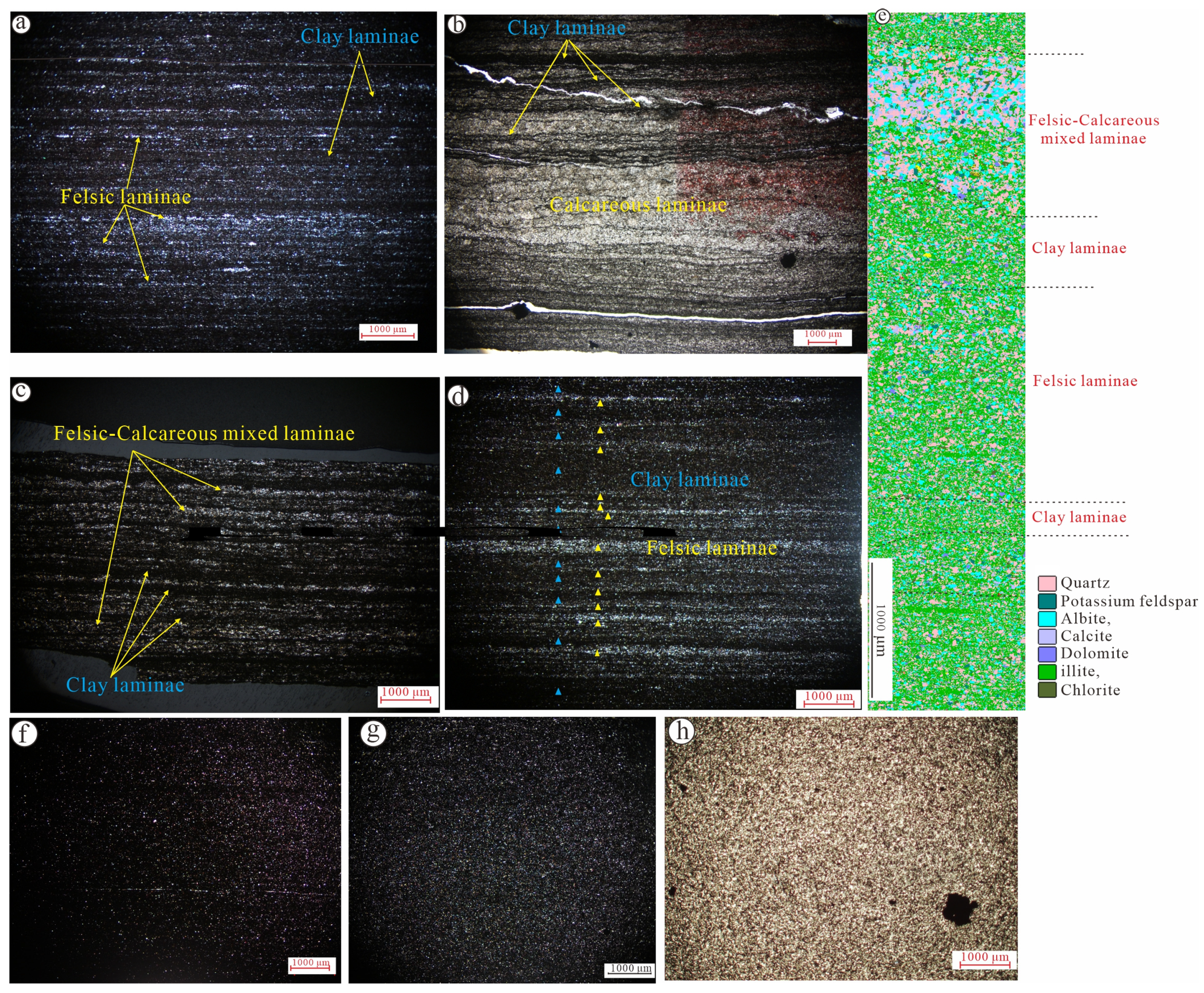
The identification of single laminae is crucial for lamina research. A single lamina is the smallest sedimentary unit composed of sediment with similar mineral composition, texture, and grain size, typically only a few millimeters thick. Due to differences in mineral composition among laminae, this study employs a combination of macroscopic and microscopic methods—including core observation, thin section analysis, and QEMSCAN (ZEISS Merlin, Germany) to accurately identify single laminae. The research reveals that the Qiongzhusi Formation in the southern Sichuan region primarily develops four main types of single laminae: felsic laminae, calcareous laminae, felsic–calcareous mixed laminae, and argillaceous laminae, along with homogeneous massive structures. Occasionally, pyrite laminae and organic-rich laminae are also observed (Table 2).
(1)
Felsic Laminae
Felsic laminae are primarily formed from terrigenous clastic materials (e.g., quartz, feldspar) that are transported by rivers or wind into marine environments, where they accumulate under specific hydrodynamic conditions and eventually lithify into layered structures. Under the microscope, these laminae appear light-colored, exhibiting first-order gray–white to gray–yellow interference colors (Figure 2a,d,e). They are predominantly composed of quartz and feldspar, which appear angular to subrounded under the microscope with moderate to good sorting. The combined content of quartz and feldspar exceeds 50%. These laminae form in low-energy environments through suspension settling or bottom current transport, typically displaying continuous horizontal lamination. Most lamina boundaries are distinct, with thickness ranging from 100 μm to 240 μm (Figure 2a).
(2)
Calcareous Laminae
These laminae are mainly formed by chemical precipitation of oversaturated Ca2+ and CO32− from seawater, with carbonate minerals (calcite and dolomite) constituting over 50% of the composition. Under the microscope, they appear light-colored, showing high-order white interference colors (Figure 2b), which contrast sharply with the surrounding darker laminae. Staining with alizarin red confirms the presence of calcite, which appears red (Figure 2b). Carbonate minerals within these laminae are subangular to angular in shape. The laminae predominantly exhibit continuous horizontal or wavy lamination, with locally discontinuous horizontal bedding. Lamina boundaries are clear (Figure 2b). The thickness of these laminae generally ranges from 100 μm to 1 mm.
(3)
Felsic–Calcareous Mixed Laminae
These laminae result from the combined deposition of terrigenous felsic minerals and chemically precipitated carbonate minerals from seawater, typically in relatively shallow water bodies. Under the microscope, they appear light-colored, exhibiting a mixture of high-order white interference colors and first-order gray–white to gray–yellow interference colors. The primary mineral components are felsic and calcareous, with their combined content exceeding 50%. Mineral grains are angular to subangular. The laminae predominantly display continuous horizontal lamination, with minor amounts of argillaceous minerals and dispersed organic matter. Lamina boundaries are distinct and contrast clearly with surrounding darker streaks (Figure 2c,e). The thickness of these laminae ranges from 200 μm to 1 mm.
(4)
Argillaceous Laminae
These are the most extensively developed laminae in the Qiongzhusi Formation shale. They originate from argillaceous minerals formed through the chemical weathering of terrigenous feldspar aluminosilicate minerals, which are transported by rivers into marine environments and deposited via suspension settling. Based on total organic carbon (TOC) content, they can be further classified into organic-lean argillaceous laminae (TOC < 2%) and organic-rich argillaceous laminae (TOC > 2%). Under the microscope, these laminae appear dark, exhibiting third-order brown–yellow interference colors. The primary mineral component is argillaceous minerals, with content exceeding 50%, appearing brown under cross-polarized light and typically of fine mud-grade size (Figure 2a,e). Argillaceous laminae predominantly display continuous horizontal lamination (Figure 2a,e). Most lamina boundaries are clear, though a few are indistinct and transitional. Some argillaceous laminae contain dispersed felsic and calcareous mineral grains and exhibit microfractures. The thickness of these laminae ranges from 150 μm to 2 mm.
(5)
Homogeneous massive
The homogeneous massive type comprises two main categories: massive shale and massive sandstone. Organic-rich massive shale (Figure 2e) and organic-lean massive shale (Figure 2f) are primarily developed in sublayers 1, 3, 5, and 7 while massive siltstone (Figure 2h) predominates in sublayers 2, 4, 6, and 8.

4.2. Lamina Set Types and Characteristics

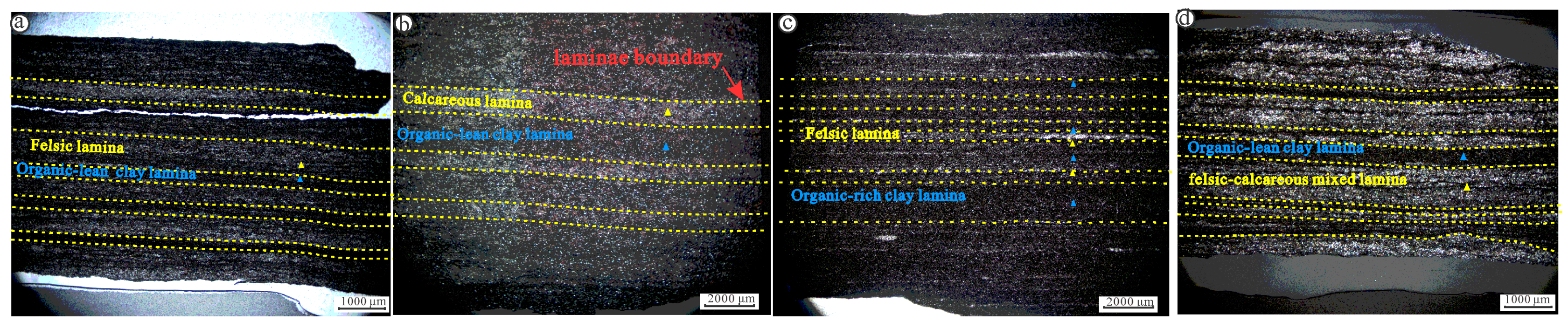
A lamina set is composed of two or more different types of single laminae with similar composition, texture, and occurrence. Observations from thin sections reveal that the most common lamina sets in the Qiongzhusi Formation within the study area include three major categories: argillaceous–felsic lamina sets, argillaceous–calcareous lamina sets, and argillaceous–felsic–calcareous mixed lamina sets. Specifically, the primary lamina sets developed are organic-rich argillaceous–felsic lamina sets, organic-lean argillaceous–felsic lamina sets, organic-lean argillaceous–calcareous lamina sets, and organic-lean argillaceous–felsic–calcareous mixed lamina sets (Figure 3).
At the microscopic scale, lamina sets typically exhibit alternating light and dark bands with clear boundaries and good continuity. The relatively bright bands generally correspond to felsic, calcareous, or felsic–calcareous mixed laminae, while the dark bands correspond to (organic-rich or organic-lean) argillaceous laminae. The overall grain size is predominantly silt to mud and sources (Figure 3). This distinct repetitive pattern of alternating laminae indicates periodic, rhythmic fluctuations in environmental factors during deposition, such as terrigenous clastic supply, carbonate precipitation/biogenic activity, water-column stability, and redox conditions. These fluctuations controlled the fine-scale cyclic enrichment of different material components and the formation of lamina sets.

4.3. Lamina Series Types and Characteristics

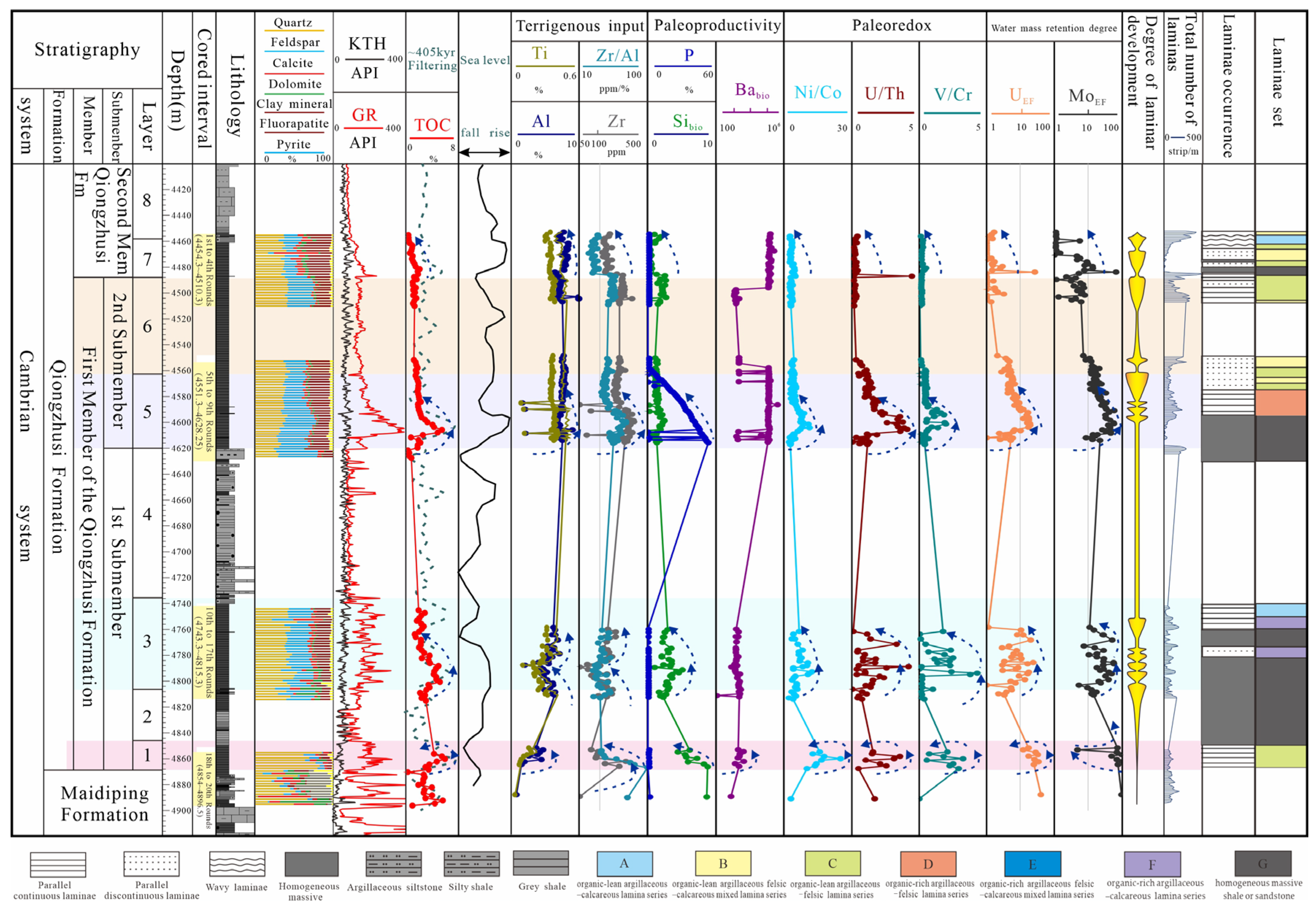
A lamina series refers to a sequence unit at the centimeter to decimeter scale, formed by the repeated stacking of two or more similar lamina sets with comparable composition, structure, and occurrence, or by the sequential superposition of genetically linked but compositionally distinct lamina sets. Based on observations of ordinary thin sections, scanning electron microscopy (SEM), QEMSCAN mineral quantification, and comprehensive large-thin-section analysis, seven types of lamina series have been identified in the Qiongzhusi Formation shale within the study area: Type A (organic-lean argillaceous–calcareous lamina series), Type B (organic-lean argillaceous felsic–calcareous mixed lamina series), Type C (organic-lean argillaceous–felsic lamina series), Type D (organic-rich argillaceous-felsic lamina series), Type E (organic-rich argillaceous-felsic-calcareous mixed lamina series), Type F (organic-rich argillaceous-calcareous lamina series), and Type G (homogeneous massive shale or sandstone). Among these, Types A–D and G are the most extensively developed and widely distributed, representing the predominant lamina architectures in the Qiongzhusi Formation (Figure 4).
Organic-rich shale intervals: During deposition, these intervals exhibited an initial increase followed by a decrease in orbital eccentricity, sea level, and the degree of water-column euxinia/stagnation, as well as in paleoproductivity. The TOC content is relatively high, showing an initial increase and subsequent decrease (from 1.7% to 5.5%, and then decreasing to 1.6%). From bottom to top, the lithology transitions from organic-rich massive shale, through organic-rich argillaceous-felsic laminae, to organic-lean argillaceous-felsic laminae (Figure 4).
Low-TOC shale intervals: During deposition, these intervals exhibited decreasing orbital eccentricity and sea level, a weakening of water-column euxinia/stagnation, reduced paleoproductivity, and stable terrigenous input. With increasing water depth, the lithology transitions from massive sandstone to predominantly organic-lean argillaceous-felsic-calcareous laminae and organic-lean argillaceous-felsic laminae (Figure 4).

5. Discussion

Composition, structure, and fabric of fine-grained sedimentary laminae in marine shales can reflect the microstructure and reservoir properties of shale. Therefore, gas-bearing shale laminae and their sets and series control the mineralogical composition, pore characteristics, and distribution of microfractures, thereby influencing porosity and permeability. This directly affects the propagation pattern of hydraulic fractures in horizontal wells and the subsequent fracturing effectiveness [14,15,16,17,18,19,20,37]. Previous studies have demonstrated that the presence of laminae significantly affects shale reservoir properties, including storage capacity, gas content, and hydrocarbon generation potential [11,12,13,14,15,16,17,18,19,20,21,22,23]. It is essential to systematically compare reservoir differences among shales with varying laminae series and clarify the controlling role of laminae development characteristics on shale reservoir properties.

5.1. Influence of Laminae on Shale TOC

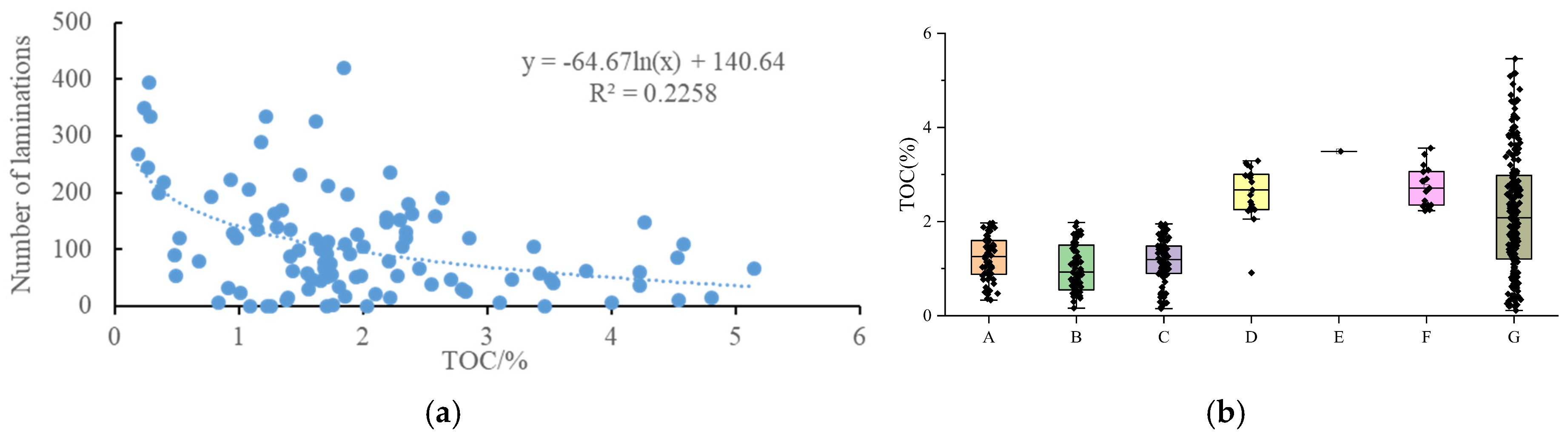
The study reveals a negative correlation between lamina density and shale TOC content (Figure 5a), indicating that lower lamina density generally corresponds to higher TOC. Furthermore, distinct TOC variations are observed among different lamina types, with Type D and Type F lamina series, as well as massive shale, exhibiting relatively higher TOC values, ranging from 2.4% to 3.8%, with an average of 3.2% (Figure 5b).
Orbital eccentricity regulates climate fluctuations, which in turn affect ocean primary productivity, water chemical conditions, and sedimentary environments, thereby control-ling total organic carbon (TOC) content and lithological variations [40,41]. During the Qiongzhusi Formation depositional period, sedimentation was regulated by Milankovitch orbital eccentricity cycles (approximately 100 kyr and 405 kyr). High-eccentricity phases corresponded to warm and humid climates, rising sea levels, reduced Antarctic ice volume, and enhanced monsoon precipitation, which led to increased terrestrial nutrient input and elevated marine primary productivity. Concurrently, enhanced water column stratification in deep-water environments promoted the development of anoxic to euxinic bottom-water conditions, establishing a coupled “high productivity–high preservation” organic matter enrichment regime. Under these conditions, sedimentation was dominated by suspension settling with stable hydrodynamic conditions, which was unfavorable for lamina development but conducive to the formation of homogeneous massive organic-rich shale (Type G) or Type D lamina series dominated by organic-rich clay laminae. Conversely, low-eccentricity phases were characterized by drier and colder climates, falling sea levels, enhanced water column oxygenation, reduced productivity, and relatively increased terrestrial clastic input. The resulting periodic instability in depositional environments and fluctuating hydrodynamic conditions drove rhythmic deposition of different mineral assemblages, leading to extensive lamina development. However, organic matter experienced significant oxidative degradation under these conditions, resulting in markedly reduced preservation efficiency and lower TOC contents.
Lamina density fundamentally reflects an inverse relationship between sedimentation rate and hydrodynamic stability. Higher lamina density indicates more frequent hydrodynamic fluctuations during deposition, corresponding to faster sedimentation rates. This enhances the “dilution effect” of organic matter per unit volume of sediment, while simultaneously expanding the oscillation range of the oxic–anoxic interface and prolonging the exposure time of organic matter to oxygenated waters, thereby increasing degradation losses. Consequently, the observed negative correlation between lamina density and TOC represents the macroscopic expression of a coupled sedimentation rate–oxic exposure time effect.
Furthermore, comparison of lamina types reveals that the high TOC characteristics of Type D (organic-rich clay–felsic) and Type F (organic-rich clay–calcareous) lamina series are also controlled by mineral matrix adsorption and protection mechanisms for organic matter. Clay minerals (particularly illite and illite/smectite mixed layers) possess large specific surface areas and interlayer charges, enabling organic matter adsorption through cation bridging and thereby inhibiting microbial degradation. The mechanical stability of felsic minerals helps reduce organic matter expulsion during diagenetic compaction, while early cementation by calcareous minerals can decrease porosity decay rates, preserving more accommodation space for organic matter. In contrast, although clay mineral contents remain high in organic-poor lamina series (Types A–C), depositional oxic conditions resulted in low initial organic matter input, and the absence of effective mineral protection mechanisms further compromised organic matter preservation.

5.2. Influence of Laminae on Reservoir Physical Properties

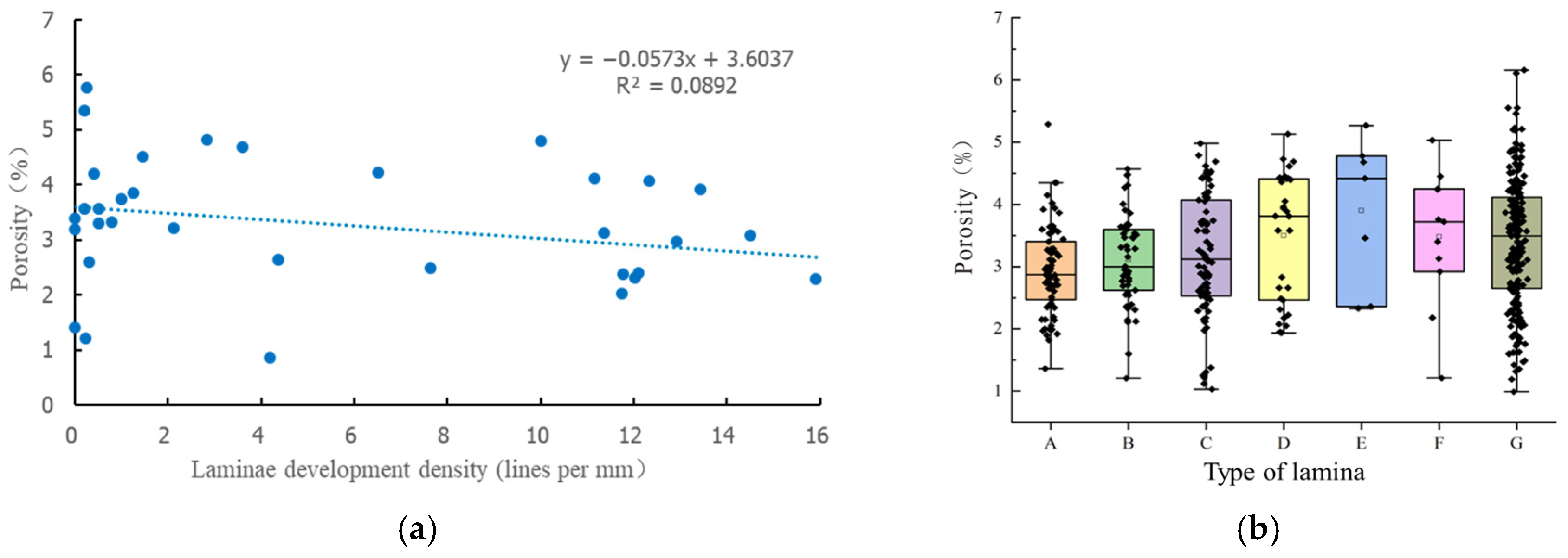
Significant differences in porosity are also observed among shales of different lamina series, indicating that lamina occurrence and type similarly affect shale reservoir properties. Overall, the correlation between lamina density and porosity is not pronounced, showing a weak negative relationship (Figure 6a); porosity tends to decrease as lamina development increases. Porosity varies among different lamina types, with organic-rich lamina series exhibiting higher porosity. Specifically, Type D and Type E lamina series shales display relatively high porosity, averaging close to 4% (3.79% and 4.13%, respectively). In contrast, organic-lean lamina series (Types A–C) show lower porosity, averaging around 3% (Figure 6b).

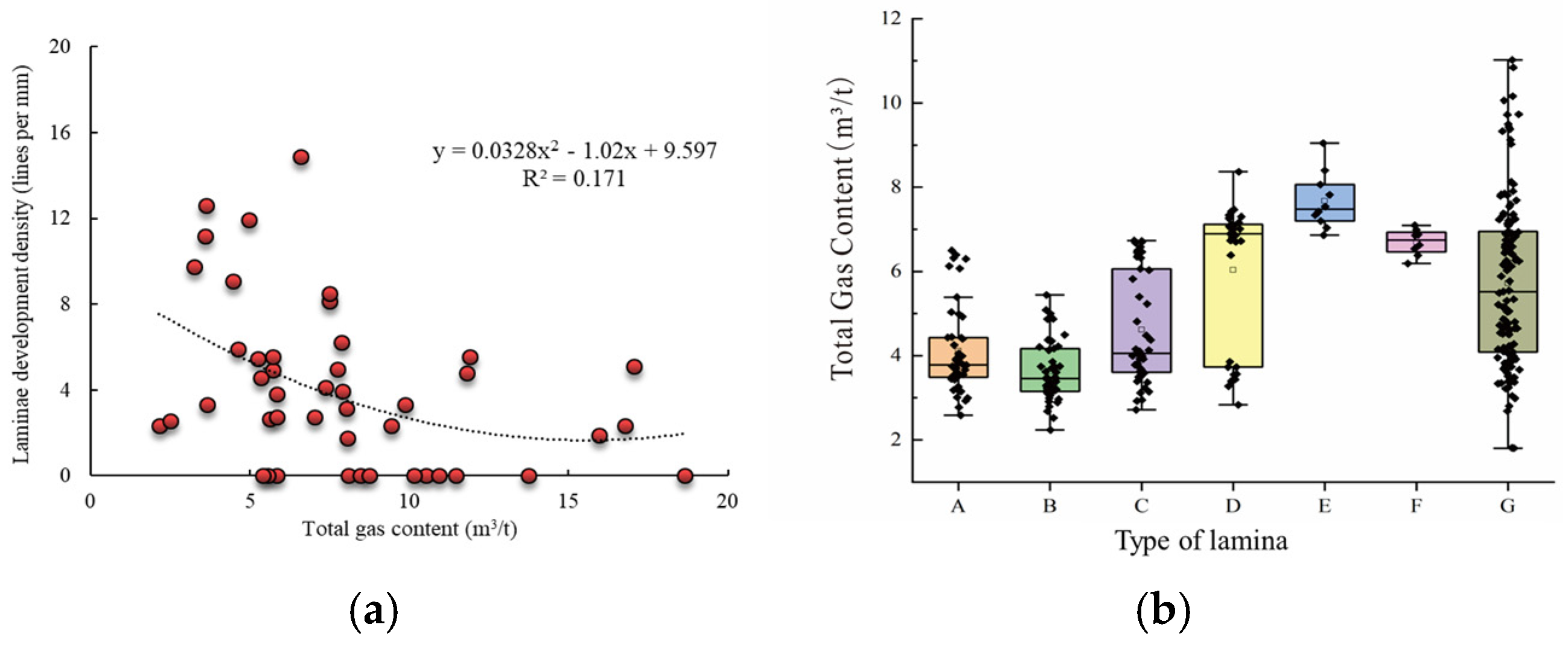
5.3. Influence of Laminae on Gas Content of the Reservoir

The development of laminae in the Qiongzhusi Formation shale within the study area shows a significant correlation with gas content. A negative relationship exists between lamina density and total gas content, meaning that lower lamina density is associated with higher shale gas content. Furthermore, hierarchical differences in gas content are observed among different lamina series. Type C lamina series exhibits the highest total gas content, followed by Type F lamina series and Type G (homogeneous massive) shale. This pattern aligns with the regulatory effects of lamina development on organic matter enrichment and pore structure. Comparative analysis of gas content reveals clear differences between shales of different lamina series and massive shale. Among them, Type D~E lamina series shale has the highest gas content, with an average of up to 7. m3/t, followed by massive shale (Type G), Type A, and Type B lamina series shales, which also show relatively high gas content (Figure 7).
The development of shale laminae in the study area is coupled to some extent with reservoir heterogeneity, where water chemistry and hydrodynamic conditions are the key controls on laminae types and abundance. Under relatively deep depositional water conditions, organic matter preservation is favored, resulting in higher total organic carbon (TOC) content, less-developed laminae, and correspondingly higher porosity and gas content. In contrast, when the water becomes shallower, increased oxygen levels and terrigenous input hinder organic matter enrichment and preservation. Reservoir spaces are dominated by inorganic pores, and laminae number increases significantly, ultimately leading to poorer reservoir quality. This coupling relationship is typified in the fifth sublayer of high-quality shale, which exhibits high TOC, high porosity, and high gas content. The interval is predominantly composed of homogeneous massive shale and Type D laminae series, where light-colored laminae are slightly more abundant, but dark-colored laminae have notably greater thickness, collectively exhibiting optimal reservoir performance (Figure 4).
A comprehensive comparison of TOC, porosity, and gas content data indicates significant differences between shales of different lamina series and massive shale. Among these, Type D lamina series shale demonstrates relatively the best performance in TOC, porosity, and gas content, making it the most favorable shale reservoir type.

6. Conclusions

Based on mineral composition and stacking relationships, a three-tier classification and nomenclature system for laminae in the Qiongzhusi Formation shale is proposed, categorizing laminae into single lamina, lamina set, and lamina series.
The Qiongzhusi Formation shale in southern Sichuan exhibits diverse lamina types. Four types of single laminae are identified: felsic laminae, calcareous laminae, siliceous-calcareous mixed laminae, and argillaceous-rich laminae. Common lamina sets include three major categories: argillaceous–felsic lamina sets, argillaceous–calcareous lamina sets, and argillaceous–siliceous–calcareous mixed lamina sets, contributing to seven distinct lamina series.
Vertically, the lamina series in the Qiongzhusi Formation shale show significant variation. Within organic-rich shale intervals, the lithology evolves upward from organic-rich massive shale through organic-rich argillaceous–felsic laminae to organic-lean argillaceous–felsic laminae. In low-TOC shale intervals, with increasing water depth, the lithology transitions from massive sandstone to predominantly organic-lean argillaceous–felsic–calcareous laminae and organic-lean argillaceous–felsic laminae.
Lamina development exerts a significant control on shale reservoirs. Marked differences in reservoir properties exist between shales of different lamina series and massive shale. Among them, Type D lamina series shale exhibits the relatively best performance in terms of TOC, porosity, and gas content, representing the most favorable shale reservoir type.

Author Contributions

Conceptualization, X.C., S.Z., L.C.; methodology, X.C., B.L., L.C.; software, Y.L., X.C.; validation, X.C., G.W., and S.X.; formal analysis, X.C., C.Z.; investigation, X.C.; resources, B.L.; data curation, L.C.; writing—original draft preparation, X.C., L.C.; writing—review and editing, X.C.; visualization, C.Z.; supervision, H.Y.; project administration, X.C.; funding acquisition, B.L., S.Z. All authors have read and agreed to the published version of the manuscript.

Funding

This research was funded by “The National Science and Technology Major Project of China, grant number 2025ZD1405301, 2025ZD1404106” and “The Youth Science and Technology Project of CNPC, grant number 2024DQ03067”.

Data Availability Statement

The datasets presented in this article are not readily available because the data are part of an ongoing study. The partial data that supports the findings of this study are available on request from the first author.

Conflicts of Interest

Xin Chen, Bo Li, Chenglin Zhang, Shengyang Xie, Gaoxiang Wang, and Yifu Luo were employed by PetroChina Southwest Oil & Gas Field Company, Chengdu 610051, China and Shale Gas Geological Evaluation and Efficient Development Key Laboratory of Sichuan Province, Chengdu 610213, China; Hongzhi Yang and Shengxian Zhao were employed by the PetroChina Southwest Oil & Gas Field Company, Chengdu 610051, China. The remaining authors declare that the research was conducted in the absence of any commercial or financial relationships that could be construed as a potential conflict of interest. The funding sponsors had no role in the design of the study; in the collection, analyses, or interpretation of data; in the writing of the manuscript; or in the decision to publish the results.

References

  1. Guo, H.T.; Cheng, P.; Wu, W.; Luo, C.; Xu, L.; Li, T.F.; Tian, H. The geochemical, pore development and water-bearing characteristics of deep and ultra-deep marine shales and their effects on gas content: New implications from the shales of the first Lower Cambrian highyield gas well (Z201) in China. Pet. Sci. 2025, 22, 1839–1853. [Google Scholar] [CrossRef]
  2. Yong, R.; Shi, X.W.; Luo, C.; Zhong, K.S.; Wu, W.; Zheng, M.J.; Yang, Y.R.; Li, Y.Y.; Xu, L.; Zhu, Y.Q.; et al. Aulacogen-uplift enrichment pattern and exploration prospect of Cambrian Qiongzhusi Formation shale gas in Sichuan Basin, SW China. Pet. Explor. Dev. 2024, 51, 1402–1420. [Google Scholar] [CrossRef]
  3. Zou, C.N.; Zhao, Z.F.; Pan, S.Q.; Yin, J.; Lu, G.W.; Fu, F.L.; Yuan, M.; Liu, H.L.; Zhang, G.S.; Luo, C.; et al. Unveiling the Oldest Industrial Shale Gas Reservoir: Insights for the Enrichment Pattern and Exploration Direction of Lower Cambrian Shale Gas in the Sichuan Basin. Engineering 2024, 42, 278–294. [Google Scholar] [CrossRef]
  4. Guo, T.L.; Deng, H.C.; Zhao, S.; Wei, L.M.; He, J.H. Formation mechanisms and exploration breakthrough of New Type of Shale Gas in the Qiongzhusi Formation, Sichuan Basin, SW China. Pet. Explor. Dev. 2025, 52, 64–78. [Google Scholar] [CrossRef]
  5. Zhao, W.Z.; Li, J.H.; Yang, T.; Huang, J. Geological difference and its significance of marine shale gases in South China. Pet. Explor. Dev. 2016, 43, 547–559. [Google Scholar] [CrossRef]
  6. He, X.; Zheng, M.J.; Liu, Y.; Zhao, Q.; Shi, X.W.; Jiang, Z.X.; Wu, W.; Wu, Y.; Ning, S.T.; Tang, X.L.; et al. Characteristics and differential origin of Qiongzhusi Formation shale reservoirs under the “aulacogen-uplift” tectonic setting, Sichuan Basin. Oil Gas Geol. 2024, 45, 420–439, (In Chinese with English Abstract). [Google Scholar]
  7. Yong, R.; Wu, J.F.; Wu, W.; Yang, Y.R.; Xu, L.; Luo, C.; Liu, J.; He, Y.F.; Zhong, K.S.; Li, Y.Y.; et al. Exploration discovery of shale gas in the Cambrian Qiongzhusi Formation of Sichuan Basin and its significance. Acta Pet. Sin. 2024, 45, 1309–1323, (In Chinese with English Abstract). [Google Scholar]
  8. Chen, S.B.; Gong, Z.; Li, X.Y.; Wang, H.J.; Wang, Y.; Zhang, Y.K. Pore structure and heterogeneity of shale gas reservoirs and its effect on gas storage capacity in the Qiongzhusi Formation. Geosci. Front. 2021, 12, 198–214. [Google Scholar] [CrossRef]
  9. Xiong, L.; Dong, X.X.; Wei, L.M.; Wang, T.; Shen, J.; He, J.H.; Deng, H.C.; Xu, H. Sedimentary paleoenvironment and organic matter enrichment mechanism of the Qiongzhusi Formation in Jingyan-Qianwei area, Southwest Sichuan. Nat. Gas Geosci. 2024, 35, 2091–2105, (In Chinese with English Abstract). [Google Scholar]
  10. Yang, Y.R.; Shi, X.W.; Li, Y.Y.; He, Y.F.; Zhu, Y.Q.; Zhang, R.H.; Xu, L.; Yang, X.; Yang, Y.M.; Zhang, Y.C.; et al. Paleogeomorphology, sedimentary pattern and exploration orientation of Qiongzhusi Formation in Deyang–Anyue Rift Trough, Sichuan Basin. China Pet. Explor. 2024, 29, 67–81, (In Chinese with English Abstract). [Google Scholar]
  11. Lei, Y.H.; Luo, X.R.; Wang, X.Z.; Zhang, L.X.; Jiang, C.F.; Yu, Y.X.; Cheng, M.; Zhang, L.K. Characteristics of silty laminae in Zhangjiatan Shale of southeastern Ordos Basin, China: Implications for shale gas formation. AAPG Bull. 2015, 99, 661–687. [Google Scholar] [CrossRef]
  12. Liu, B.; LÜ, Y.F.; Meng, Y.L.; Li, X.N.; Guo, X.B.; Ma, Q.; Zhao, W.C. Petrologic characteristics and genetic model of lacustrine lamellar fine-grained rock and its significance for shale oil exploration: A case study of Permian Lucaogou Formation in Malang sag, Santanghu Basin, NW China. Pet. Explor. Dev. 2015, 42, 656–666. [Google Scholar] [CrossRef]
  13. Raji, M.; GrÖcke, D.R.; Greenwell, H.C.; Gluyas, J.G.; Cornford, C. The effect of interbedding on shale reservoir properties. Mar. Pet. Geol. 2015, 67, 154–169. [Google Scholar] [CrossRef]
  14. Shi, Z.S.; Qiu, Z.; Dong, D.Z.; Lu, B.; Liang, P.P.; Zhang, M.Q. Laminae characteristics of gas-bearing shale fine-grained sediment of theSilurian Longmaxi Formation of Well Wuxi 2 in Sichuan Basin, SW China. Pet. Explor. Dev. 2018, 45, 358–368. [Google Scholar] [CrossRef]
  15. Xie, G.Y.; Sun, M.D.; Ma, Y.Q.; Mohammadian, E.; Ostadhassan, M.; Pan, Z.J.; Duan, X.G. Impact of laminae characteristics on pore-fracture connectivity in the Wufeng-Longmaxi shale. Mar. Pet. Geol. 2025, 182, 107562. [Google Scholar]
  16. Shi, Z.S.; Dong, D.Z.; Wang, H.Y.; Sun, S.S.; Wu, J. Reservoir characteristics and genetic mechanisms of gas-bearing shales with different laminae and laminae combinations: A case study of Member 1 of the Lower Silurian Longmaxi shale in Sichuan Basin, SW China. Pet. Explor. Dev. 2020, 47, 888–900. [Google Scholar] [CrossRef]
  17. Pei, X.Y.; Li, X.Z.; Guo, W.; Huang, H.Y.; Huang, Y.Z.; Guo, Q.M.; Zhou, M.F.; Wang, L.Y.; He, S.J.; Yu, W.X.; et al. Influence of Lamina Types and Combinations of Deep Marine Shale on Reservoir Quality in Zigong Block of Southern Sichuan Basin. ACS Omega 2024, 46, 46293–46301. [Google Scholar] [CrossRef]
  18. Tan, J.Q.; Shen, B.J.; Wu, H.; Wang, Y.H.; Ma, X.Y.; Ma, X.; Liu, W.H. Characteristics of Lamination in Deep Marine Shale and Its Influence on Mechanical Properties: A Case Study on the Wufeng-Longmaxi Formation in Sichuan Basin. Minerals 2024, 14, 1249. [Google Scholar] [CrossRef]
  19. Xin, B.X.; Hao, F.; Liu, X.F.; Han, W.Z.; Xu, Q.L.; Guo, P.; Tian, J. Quantitative evaluation of pore structures within micron-scale laminae of lacustrine shales from the Second Member of the Kongdian Formation in Cangdong Sag, Bohai Bay Basin, China. Mar. Pet. Geol. 2022, 144, 105827. [Google Scholar] [CrossRef]
  20. Xiong, M.; Chen, L.; Chen, X.; Ji, Y.B.; Wu, P.J.; He, Y.; Wang, G.X.; Peng, H. Characteristics, genetic mechanism of marine shale laminae and its significance of shale gas accumulation. J. Cent. South Univ. (Sci. Technol.) 2022, 53, 3490–3508, (In Chinese with English Abstract). [Google Scholar]
  21. Wu, J.; Li, H.; Yang, X.F.; Zhao, S.X.; Guo, W.; Sun, Y.P.; Liu, Y.Y.; Liu, Z.L. Types and combinations of deep marine shale laminae and their effects on reservoir quality: A case study of the first submenber of Member 1 of Longmaxi Formation in Luzhou block, south Sichuan Basin. Acta Pet. Sin. 2023, 44, 1517–1531, (In Chinese with English Abstract). [Google Scholar]
  22. Yu, C.L.; Zhang, S.M.; Chen, T.; Sun, Z.G.; Xu, J.X. Seepage mode in lamina-developed shale oil reservoirs under strong heterogeneous and strong fluid–solid coupling in Jiyang depression of China. Sci. Rep. 2025, 15, 936. [Google Scholar] [PubMed]
  23. Zhao, S.X.; Li, B.; Chen, X.; Liu, W.P.; Zhang, C.L.; Ji, C.H.; Liu, Y.Y.; Liu, D.C.; Cao, L.Y.; Chen, Y.L.; et al. Structural differences of shale laminae and their controlling mechanisms in the Wufeng-Longmaxi Formations in Tiangongtang, southwestern Sichuan. Earth Sci. Front. 2024, 31, 75–88, (In Chinese with English Abstract). [Google Scholar]
  24. Wang, Z.C.; Jiang, H.; Chen, Z.Y.; Liu, J.J.; Ma, K.; Li, W.Z.; Xie, W.R.; Jiang, Q.C.; Zhai, X.F.; Shi, S.Y.; et al. Tectonic paleogeography of Late Sinian and its significances for petroleum exploration in the middle-upper Yangtze region, South China. Pet. Explor. Dev. 2020, 47, 946–961. [Google Scholar] [CrossRef]
  25. Ma, K.; Wen, L.; Zhang, B.J.; Li, Y.; Zhong, Y.Y.; Wang, Y.L.; Peng, H.L.; Zhang, X.H.; Yan, W.; Ding, Y.; et al. Segmented evolution of Deyang-Anyue erosion rift trough in Sichuan Basin and its significance for oil and gas exploration, SW China. Pet. Explor. Dev. 2022, 49, 313–326. [Google Scholar] [CrossRef]
  26. Fang, Z.X.; Guo, L.; Liu, J.N. Geochemistry of marine black shale of the Cambrian Qiongzhusi Formation, Yangtze Plate, SW China: Implications for provenance and paleoweathering. Oil Shale 2023, 40, 261–282. [Google Scholar] [CrossRef]
  27. Li, R.; Wang, Y.X.; Wang, Z.C.; Xie, W.R.; Li, W.Z.; Gu, M.F.; Liang, Z.R. Geological characteristics of the southern segment of the Late Sinian–Early Cambrian Deyang-Anyue rift trough in Sichuan Basin, SW China. Pet. Explor. Dev. 2023, 50, 321–333. [Google Scholar]
  28. Wang, G.C.; Ju, Y.W.; Han, K. Early Paleozoic shale properties and gas potential evaluation in Xiuwu Basin, western Lower Yangtze Platform. J. Nat. Gas Sci. Eng. 2015, 22, 489–497. [Google Scholar] [CrossRef]
  29. Ye, C.-L.; Shen, J.-J.; Li, S.-S.; Wang, Y.-M.; Tan, G.-C.; Yan, J.-K.; Zhou, L.; Liu, J.-Y. Sedimentological and geochemical characteristics of lower Cambrian Qiongzhusi shale in the Sichuan Basin and its periphery, SW China: Implications for differences in organic matter enrichment. Pet. Sci. 2024, 21, 3774–3789. [Google Scholar] [CrossRef]
  30. Gao, P.; Li, S.J.; Lash Gary, G.; Li, S.S.; Wang, Y.M.; Tian, G.C.; Yan, J.K.; Zhou, L.; Liu, J.Y. Stratigraphic framework, redox history, and organic matter accumulation of an Early Cambrian intraplatfrom basin on the Yangtze Platform, South China. Mar. Pet. Geol. 2021, 130, 105095. [Google Scholar] [CrossRef]
  31. Fan, H.J.; Deng, H.C.; Fu, M.Y.; Liu, S.B.; Yu, H.Z.; Li, Y.L. Sedimentary Characteristics of the Lower Cambrian Qiongzhusi Formation in the Sichuan Basin and Its Response to Constrution. Acta Sedimentol. Sin. 2021, 39, 1004–1019, (In Chinese with English Abstract). [Google Scholar]
  32. O’Brien, N.R. Shale lamination and sedimentary processes. In Palaeoclimatology and Palaepceanography from Laminated Sediments; Geological Society Special Publication No. 116; Kemp, A.E.S., Ed.; Geological Society of London: London, UK, 1996; pp. 23–36. [Google Scholar]
  33. Wang, Q.M.; Zhang, Y.Y.; Zhu, R.K.; Guo, Z.J.; Li, Z.Y.; Wang, J.F. Progress and Perspective on the Characteristics and Formation Mechanism of Laminae in Lacustrine Fine-grained Sedimentary Rocks. Acta Sedimentol. Sin. 2025, 43, 1897–1918, (In Chinese with English Abstract). [Google Scholar]
  34. O’Brien, N.R. Significance of lamination in Toarcian (Lower Jurassic) shales from Yorkshire, Great Britain. Sediment. Geol. 1990, 67, 25–34. [Google Scholar] [CrossRef]
  35. Zhang, X.; Sha, J. Sedimentary laminations in the lacustrine Jianshangou Bed of the Yixian Formation at Sihetun, western Liaoning, China. Cretac. Res. 2012, 36, 96–105. [Google Scholar] [CrossRef]
  36. Liu, G.H.; Huang, Z.L.; Jiang, Z.X.; Chen, J.F.; Chen, C.C.; Gao, X.Y. The characteristic and reservoir significance of lamina in shale from Yanchang Formation of Ordos Basin. Nat. Gas Geosci. 2015, 26, 408–417, (In Chinese with English Abstract). [Google Scholar]
  37. Luo, J.C.; Yan, J.P.; Zheng, M.J.; Guo, W.; Zhong, G.H.; Wang, M.; Geng, B.; Hu, Q.H. Effects of Mineral Composition and Lamina on Mechanical Properties and Fractures of the Wufeng−Longmaxi Shale in the Luzhou Area of the Southern Sichuan Basin. Energy Fuels 2023, 37, 13949–13959. [Google Scholar]
  38. Yang, W.; Wang, Y.; Du, W.; Song, Y.; Jiang, Z.X.; Wang, Q.Y.; Xu, L.; Zhao, F.P.; Chen, Y.; Shi, F.L.; et al. Behavior of organic matter-hosted pores within shale gas reservoirs in response to differential tectonic deformation: Potential mechanisms and innovative conceptual models. J. Nat. Gas Sci. Eng. 2022, 102, 104571. [Google Scholar]
  39. Hou, H.D.; Yang, W.; Du, W.; Feng, X.; Jiang, Z.X.; Shi, F.L.; Lin, R.Q.; Wang, Y.S.; Zhang, D.Q.; Chen, Y.; et al. Implications of multi-stage deformation on the differential preservation of lower paleozoic shale gas in tectonically complex regions: New structural and kinematic constraints from the upper yangtze platform, South China. Mar. Pet. Geol. 2024, 160, 106629. [Google Scholar] [CrossRef]
  40. Liu, F.H.; Huang, E.Q.; Du, J.L.; Ma, W.T.; Liu, Z.H.; Lourens, L.J.; Tian, J. Eccentricity rhythms in the Oligocene-Miocene carbon cycle regulated by weathering and carbonate burial. Sci. Adv. 2026, 12, eadx6682. [Google Scholar] [CrossRef] [PubMed]
  41. Chen, L.; Xiong, M.; Tan, X.C.; Chen, X.; Zheng, J.; Yang, Y.; Jing, C.; Wang, G.X. Coupling mechanism between sea level changes and pore heterogeneity of marine shale reservoirs driven by astronomical orbital cycles: Lower Silurian Longmaxi shale in the Upper Yangtze area, South China. Mar. Pet. Geol. 2024, 160, 106590. [Google Scholar] [CrossRef]
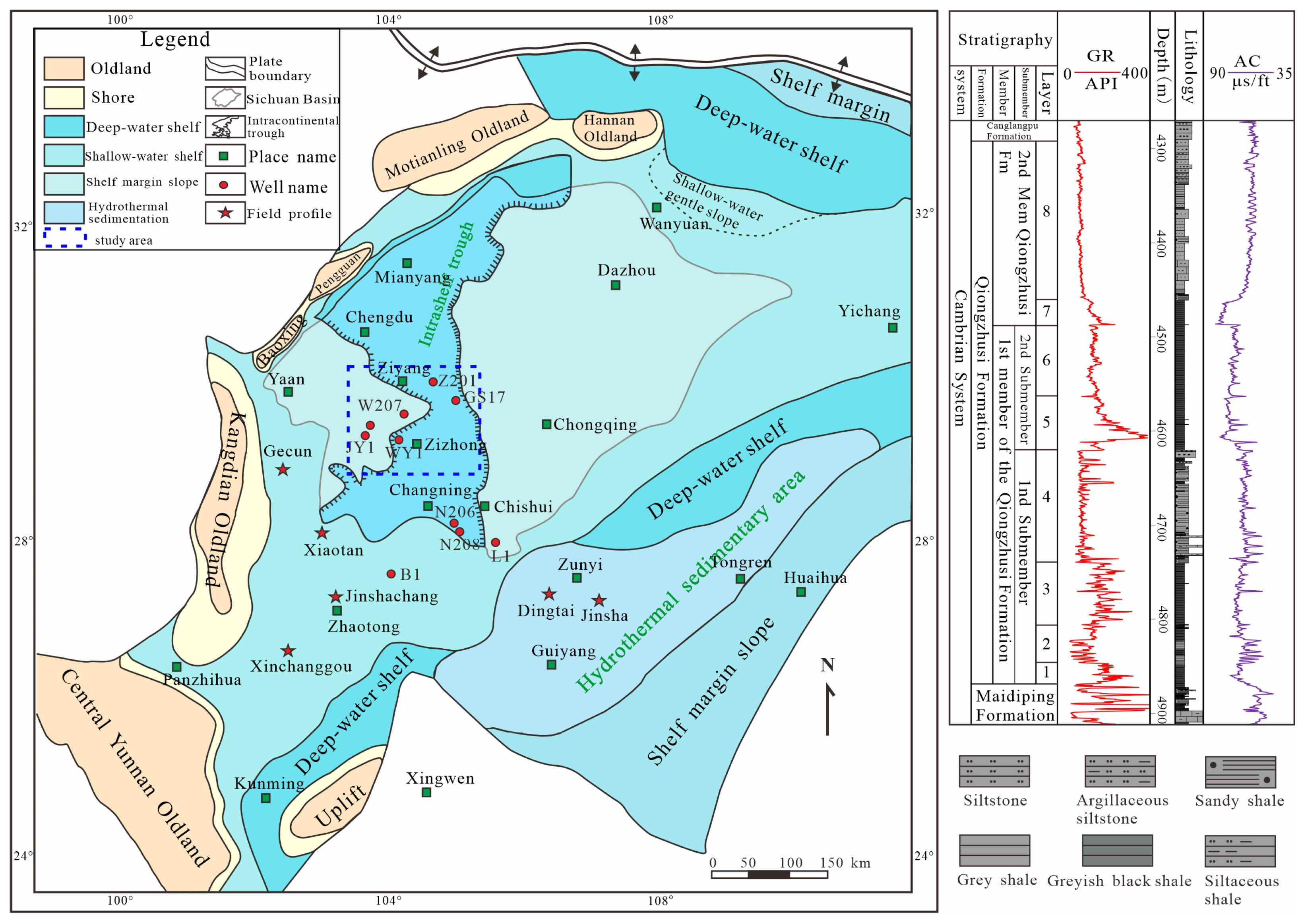
Figure 1. Location map of the study area (modified after [31]), and a comprehensive stratigraphic column of the Qiongzhusi Formation.
Minerals 16 00552 g001
Figure 2. Typical thin-section and core photographs illustrating different lamina types. (a) Felsic and argillaceous laminae, Z201, 4459.23 m; (b) Calcareous and argillaceous laminae, WY1, 4242.38 m; (c) Felsic–Calcareous mixed laminae and argillaceous laminae, W207, 3082.28 m; (d) Felsic and argillaceous laminae, Z201, 4459.23 m; (e) QEMSCAN reveals that Felsic laminae, Felsic–Calcareous mixed laminae, and argillaceous laminae, Z201, 4459.23. (f) Organic-rich massive shale, Z201, 4483.4. (g) Organic-lean massive shale, WY1, 4417.7. (h) Siltstone, WY1, 4325.19.
Minerals 16 00552 g002
Figure 3. Typical thin-section characteristics of common lamina sets. (a). Organic-lean argillaceous–felsic lamina set, W207, 3059.18 m; (b). Organic-lean argillaceous–calcareous lamina set, Z203, 3203.51 m; (c). Organic-rich argillaceous–felsic lamina set, W207, 3096 m; (d). Organic-lean argillaceous–felsic–calcareous mixed lamina set, W207, 3055.6 m.
Minerals 16 00552 g003
Figure 4. Sedimentary environment evolution and lamina development characteristics of the Cambrian Qiongzhusi Formation shale in Z201.
Minerals 16 00552 g004
Figure 5. Correlation between lamina density, lamina type, and shale TOC in the Qiongzhusi Formation. (a) Correlation between lamina density and shale TOC; (b) Correlation between lamina type, and shale TOC.
Minerals 16 00552 g005
Figure 6. Correlation between lamina density, lamina type, and shale porosity in the Qiongzhusi Formation. (a) Correlation between lamina density and shale porosity; (b) Correlation between lamina type and shale porosity.
Minerals 16 00552 g006
Figure 7. Comparative histogram of total gas content differences among shale intervals of different lamina series and massive shale in the Qiongzhusi Formation, Southern Sichuan. (a) Correlation between lamina density and shale total gas content; (b) Correlation between lamina type and shale total gas content.
Minerals 16 00552 g007
Table 1. Classification scheme of laminae.
HierarchyTypeClassification BasisLamina Scale
Single LaminaFelsic lamina, Calcareous lamina, Argillaceous lamina, Calcareous-Felsic mixed lamina, Organic lamina, Pyrite laminaSingle mineral or mixed mineral content > 50%Micrometer to millimeter (typically 100 µm–2 mm)
Lamina SetFelsic–argillaceous lamina set, Calcareous–argillaceous lamina set, Calcareous–siliceous mixed–argillaceous lamina setStacking relationshipMillimeter to centimeter (typically 1 cm–10 cm)
Lamina SeriesFelsic–argillaceous lamina series, Calcareous–argillaceous lamina series, Calcareous–siliceous mixed–argillaceous lamina seriesGenetic relationship and stacking relationshipDecimeter scale (>10 cm)
Table 2. Classification scheme and types of single laminae in the Qiongzhusi Formation, southern Sichuan.
TypeFelsic MineralsCarbonate MineralsArgillaceous MineralsOrganic MatterPyriteDevelopment Layers
Single LaminaSilt-grade Laminae
(>50% grains >3.9 μm)
Felsic Lamina>50%0%–25%0%–25%0%–5%0%–5%1, 3, 5, 6
Calcareous Lamina0%–25%>50%0%–25%0%–5%0%–5%4, 6, 7
Felsic–Calcareous Mixed Lamina25%–50%25%–50%0%–25%0%–5%0%–5%5, 6, 7
Argillaceous Laminae
(>50% grains <3.9 μm)
Organic-lean Argillaceous Lamina0%–25%0%–25%>50%0%–5%0%–5%1, 2, 3, 4,
5, 6, 7, 8
Organic-rich Argillaceous Lamina0%~25%0%~25%>50%2%–5%0%~5%3, 5, 7
Non-laminatedHomogeneous MassiveCharacterized by rapid deposition of sediment (often suspended material), with uniform composition and structure and no internal layering within the unit.1, 2, 3, 4,
5, 6, 7, 8
Disclaimer/Publisher’s Note: The statements, opinions and data contained in all publications are solely those of the individual author(s) and contributor(s) and not of MDPI and/or the editor(s). MDPI and/or the editor(s) disclaim responsibility for any injury to people or property resulting from any ideas, methods, instructions or products referred to in the content.