Article

Repurposing of Novel Magnetic Adsorbent from Copper Converter Slag for the Recovery of Gold from Chloride Solution


1
Western Australian School of Mines: Minerals, Energy, and Chemical Engineering, Faculty of Science and Engineering, Curtin University, Kent Street, Bentley, Perth, WA 6102, Australia
2
Laboratory of Mineral Processing and Resources Recycling, Division of Sustainable Resources and Engineering, Graduate School of Engineering, Hokkaido University, Kita 13, Nishi 8, Kita-ku, Sapporo 060-8628, Japan
3
Department of Materials and Resources Engineering and Technology, College of Engineering and Technology, Mindanao State University-Iligan Institute of Technology, Tibanga, Iligan City 9200, Philippines
*
Author to whom correspondence should be addressed.
Minerals 2026, 16(5), 511; https://doi.org/10.3390/min16050511
Submission received: 15 February 2026 / Revised: 1 May 2026 / Accepted: 6 May 2026 / Published: 12 May 2026

Abstract

Repurposing mineral processing waste offers both environmental and economic benefits, reducing the disposal burden while enabling mineral resource recovery. A magnetic adsorbent, with an Fe3O4 content of 71.0%, collected from waste copper converter slag was utilized to recover gold (Au3+) from chloride solution. The adsorbent was separated from the slag samples by crushing, grinding to an average particle size of 30 μm, and magnetic separation. Batch adsorption experiments were performed to evaluate the effects of pH, contact time, chloride concentration, and initial gold concentration on gold uptake amount. The material recovered over 99% of gold from chloride solution under acidic conditions and in the near-neutral pH range. The gold sorption rate was also relatively fast and over 98% recovery was achieved after just 15 min of contact time. Increasing chloride concentration did not influence gold uptake. Parameter studies and spectrometric analyses suggest that chalcocite (Cu2S) and metallic copper present in magnetite slag reduced the gold chloride complex to metallic gold. These results suggest that converter magnetite slag is a potentially effective sorbent to recover gold from secondary sources due to its selectivity and low cost. Moreover, gold-loaded magnetite slag can be easily separated from the solution by magnetic separation and then recirculated to the smelting stage of copper processing to recover the deposited gold and other precious metals. Overall, this work highlights a pathway to transform waste into opportunity, reinforcing sustainability in mineral processing operations.

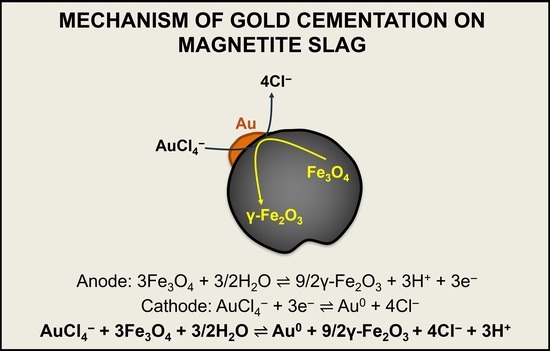
Graphical Abstract

1. Introduction

The accumulation of industrial by-products such as copper converter slag poses significant environmental challenges, including land use issues [1], potential leaching of heavy metals [2], and the long-term risks associated with large-scale waste stockpiling [3,4]. Repurposing and valorizing these materials can contribute to cleaner production pathways while reducing the reliance on virgin raw materials [1,3,4].
Around 80% of the world’s metallic copper is produced from sulfide ores, primarily chalcopyrite (CuFeS2) and chalcocite (Cu2S), via pyrometallurgical processing routes. These routes involve a sequence of high-temperature operations, including smelting to produce copper matte, converting to remove iron and sulfur and yield blister copper, and fire refining followed by electrorefining to achieve high-purity cathode copper [5,6]. Converting, the final stage in the smelting of sulfide ore or concentrates, is a process that eliminates most of the unwanted constituents, principally iron and sulfur, from the matte by oxidation. By blowing air, oxygen, or oxygen-enriched air into the liquid matte in the converter, components of the matte with high affinities for oxygen are selectively oxidized and removed in the form of slag or volatile gas [7]. The molten blister copper is then sent to fire-refining or electro-refining for further purification [6].
The conversion of copper matte is a batch process and takes place in two sequential stages. The first stage is the oxidation of FeS to FeO, Fe3O4, and SO2 (Equations (1)–(3)), forming the slag.
FeS + 3 2   O 2 FeO + SO 2
3FeS + 5O2 ⇌ Fe3O4 + 3SO2
2FeS + 3O2 + SiO2 ⇌ 2Fe2SiO4 + 2SO2
After the slag is removed, the second stage of converting takes place, in which Cu2S is oxidized to metallic copper (Equation (4)) [6].
Cu2S + O2 ⇌ 2Cu + SO2
A typical converter furnace generates around 400 tons/day of converter slag [8]. Converter slag usually contains 4%–8% Cu, 20%–25% Fe3O4, 15%–30% SiO2, and less than 5% of Al2O3, CaO, MgO and ZnO [6]. Considerable amounts of magnetite (Fe3O4) are produced during conversion due to the further oxidation of FeO (Equation (5)) generated by the intensive initial oxidation of FeS to FeO (Equation (1)). Magnetite is a stable oxide at 1200 °C, which is the operating temperature of the converting process. Due to some level of inertness of Fe3O4, it will not readily combine with SiO2 flux to form a slag, but it does have solubility in the converter slag of some 15%–30%, depending on the slag temperature. The converter slag, containing some amounts of copper and magnetite, is usually returned, while still liquid, to the smelting furnace to recover copper [7].
6FeO + O2 ⇌ 2Fe3O4
However, when not adequately recycled, much of this slag ends up discarded, contributing to growing waste stockpiles. This represents not only environmental liability but also a loss of potentially valuable resources such as iron oxides and residual copper. Finding high-value applications for these waste streams aligns strongly with the principles of the circular economy and sustainable resource management.
The recycling of converter slag to the smelting furnace may also generate some problems due to the tendency of Fe3O4 in the slag to settle down at the bottom of the furnace, and if not checked, the build-up may cause the shutdown of the furnace due to the limited space for proper fuel combustion, and less available room for matte–slag layer formation and separation. Owing to this difficulty, an alternative method was considered. Instead of returning the converter slag to the smelting furnace, the slag can be cooled, crushed, and ground, and then the copper content can be recovered by froth flotation [7]. The tailings, which contain mostly Fe3O4 and SiO2, are usually discarded.
We have previously reported the utilization of magnetite as a sorbent for gold and precious metal recovery from chloride solution [9,10,11]. Sorption experiments and electrochemical investigations confirmed that synthetic and natural magnetite powders can uptake gold from chloride solution by heterogeneous reduction. Gold was deposited as metallic gold on the surface of magnetite. These results suggest the potential of Fe3O4 as a selective sorbent for gold from chloride solution. It is mentioned above that converter slag contains appreciable amounts of magnetite, which usually end up in dump sites or disposal areas after recovering the copper values. The Fe3O4 can be separated by crushing or grinding the converter slag and can then be concentrated using magnetic separation. The concentrated Fe3O4 can be used as a sorbent to recover gold from aqueous solution.
The development and application of magnetic adsorbents have indeed garnered significant attention in recent years, particularly due to their versatility, efficiency, and ease of separation and use in a variety of environmental and industrial processes [12]. Magnetic adsorbents combine the properties of magnetic materials with the capability to adsorb contaminants, making them highly effective in addressing pollution control [13], wastewater treatment [14], and resource recovery [15]. Magnetic adsorbents are typically synthesized by combining magnetic materials, such as magnetite (Fe3O4) and maghemite (γ-Fe2O3), with other functional adsorptive materials. The key development strategies focus on improving the surface area, enhancing the magnetic properties, and functionalizing the materials for better adsorption efficiency. Developing low-cost, sustainable, and waste-derived magnetic adsorbents has been the focus of much research [16,17], promoting the circular economy in diverse applications.
This work investigated the use of magnetite recovered from the waste copper converter slag of a smelting company for gold recovery from a chloride solution. The converter magnetite slag provided by a mining company was characterized and evaluated as a candidate carrier (adsorbent) for gold in batch sorption experiments. The effects of different parameters, such as pH, contact time, gold concentration, and Cl concentration, on the uptake of gold from chloride solutions were studied. From the results of the experiments, an uptake mechanism was proposed.

2. Materials and Methods

Reagent-grade gold (HAuCl4 in 1 M HCl) standard solution (Wako Chemicals, Osaka, Japan) was used as the source of gold ions. Single- and mixed-metal solutions of Pt, Pd, Cu, Zn, and Ni were prepared by diluting the corresponding ICP standard solutions of these metals (Wako Chemicals, Japan) in 0.1 M NaCl. The magnetite sample, which was collected through dry magnetic separation after crushing the converter slag [18], was provided by a copper smelting company in Japan. The sample, with an average particle size of 30 µm, was used as received. The copper converter slag-derived magnetite (CCS magnetite) sample was characterized using X-ray Fluorescence Spectroscopy (XRF, JEOL Element Analyzer, JSX-3201A, Tokyo, Japan), Scanning Electron Microscopy-Energy Dispersive X-ray (SEM-EDX, SSX-550 Shimadzu, Kyoto, Japan), a Nova 2200e Surface Area and Pore Size Analyzer (Yuasa Ionics, Tokyo, Japan), and a Microtrac Size Analyzer (MT3300SX, York, PA, USA) to determine its chemical composition, surface area, and particle size. The rest of the chemicals used in this study, such as NaCl, HCl, and NaOH, were all of reagent grades.
Batch adsorption experiments were performed to investigate the ability of the magnetite slag to recover gold from chloride solution. All experiments were carried out by adding 0.1 g of magnetite slag powder into a 50 mL Erlenmeyer flask containing 10 mL of NaCl solution (0.001–1.0 M) with varying concentrations of HAuCl4 (0.01–1.0 × 10⁻⁴ M). The pH of the solution was adjusted by adding HCl or NaOH solutions. The mixture was shaken for 0.25–24 h in a water bath shaker (ML-10F, Taitec, Saitma, Japan) at a rate of 120 strokes per minute and a temperature of 25 °C. After shaking, the mixture was centrifuged and then membrane-filtered using a 0.20 µm nitrocellulose membrane filter (Sartorius, Gottingen, Germany). The gold content in the aqueous phase was determined by using an Inductively Coupled Plasma-Atomic Emission Spectrometer (SPS 7800, Seiko Instruments, Chiba, Japan). The magnetite particles were examined after the treatment under a Scanning Electron Microscope (SEM) equipped with an Electron Dispersive X-ray Spectrometer to check for the presence of gold on their surface.
The amount of adsorbed gold was calculated according to the mass balance equation
Metal   Uptake ,   µ mol / g = ( C i C f ) ( V w )
Metal   Uptake ,   % = C i C f C i × 100 %
where Ci is the initial metal concentration, Cf is the remaining metal concentration in the aqueous solution, V is the volume of the aqueous solution, and w is the weight of the sorbent.

3. Results and Discussion

3.1. Characterization of Magnetic Adsorbent

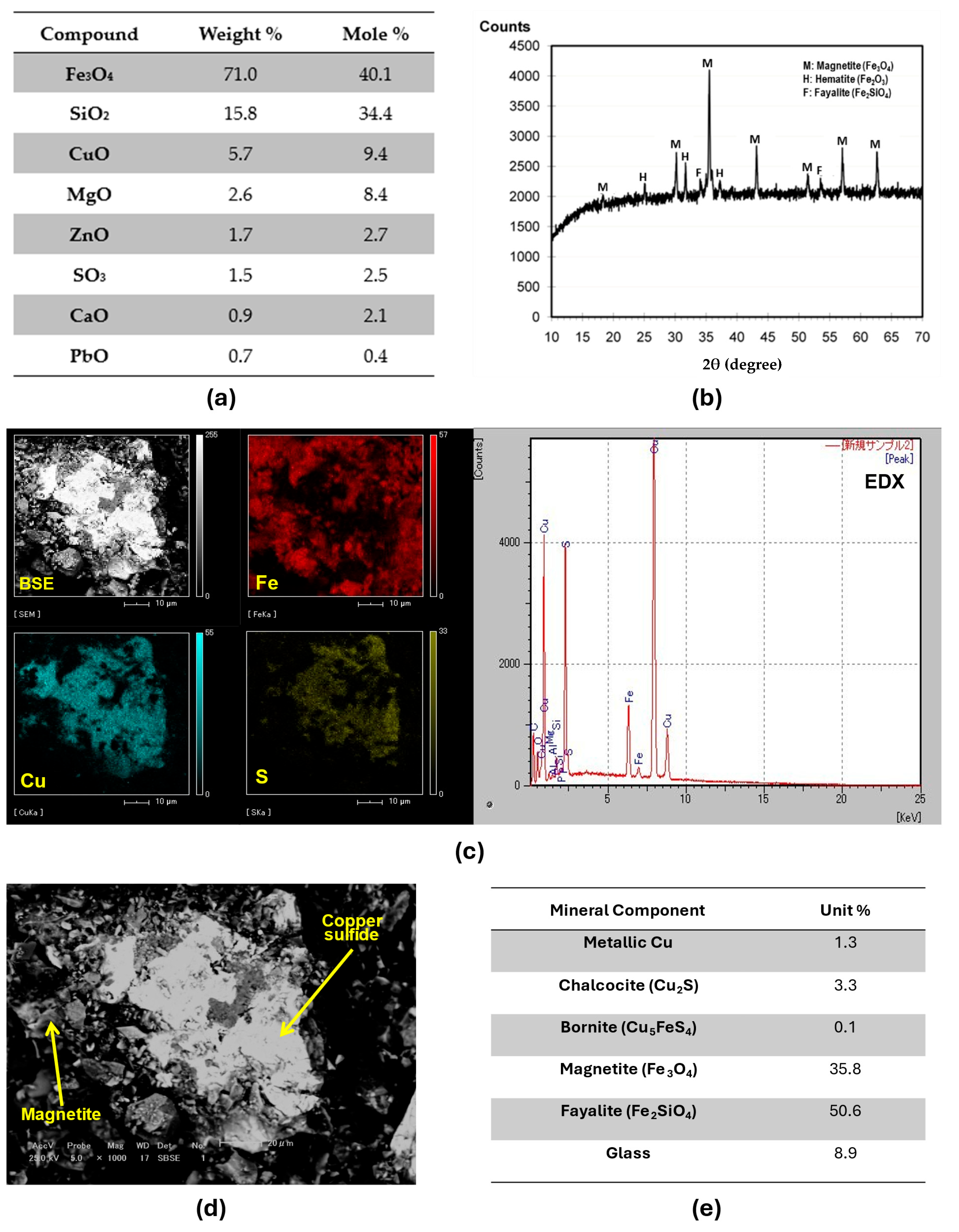
The CCS magnetite exhibited a surface area of 2.2 m2/g and an average particle size of 30 μm, as determined using a Nova 2200e Surface Area and Pore Size Analyzer. The chemical composition of the converter magnetite slag sample was determined by various analytical techniques, as summarized in Figure 1. The composition of the converter magnetite slag sample was determined by XRF, as shown in Figure 1a. The converter magnetite slag had an Fe3O4 content of 71.0%, and the major impurities include Si, Cu, and Mg. Heavy metals, such as Zn and Pb, were also detected. The surface area and the average particle size of the magnetite slag were 2.2 m2/g and 30 µm, respectively.
The XRD pattern in Figure 1b indicates that the sample is dominated by magnetite, as evidenced by the characteristic reflections at approximately 30.1°, 35.5°, 43.1°, 57.0°, and 62.6° (Cu Kα). In addition to magnetite, minor peaks and shoulders observed around ~33.2°, ~49.5°, and ~63.8° suggest the presence of hematite, indicating partial oxidation of magnetite, which is typical for slag-derived materials. Silicon identified from bulk analysis is not associated with strong discrete quartz peaks; instead, it is most plausibly hosted in fayalite, a common iron silicate phase in copper slag, whose reflections often overlap with those of magnetite. A significant fraction of silicon is also likely present in an amorphous silicate matrix, as indicated by the elevated background (broad hump) between ~20 and 35° 2θ, which is characteristic of glassy phases. Although copper is present in considerable amounts based on the chemical analysis, no distinct copper-bearing crystalline phases are clearly resolved in the XRD pattern. This suggests that Cu is predominantly incorporated within the amorphous silicate phase or within fayalite as a solid solution, and possibly as finely disseminated sulfide phases below the detection limit of XRD. Overall, the phase assemblage comprises magnetite as the major phase, with minor hematite and fayalite, and a significant amorphous silicate component hosting silicon and copper.
The SEM photomicrograph, elemental maps, and EDX spectra of the magnetite slag are presented in Figure 1c. When examined at a higher magnification under BSE, copper was observed as shiny, bright, and white areas randomly distributed in the magnetite matrix, as shown in Figure 1d. The elemental maps and EDX spectra revealed that Cu and S coincided with each other, which is further supported by strong Cu and S peaks found in the point analysis of the shiny, bright, and white areas. These results imply that copper in the magnetite slag sample is present as Cu-S phases, likely as CuS or Cu2S.
To quantify the amounts of copper-bearing minerals in the sample, the Point Counting Method was conducted. The principle behind the Point Counting Method is that, in a thin or polished section of a rock, the ratio of the area of a particular mineral to the area of all the minerals is a consistent estimate of the volume percent of the mineral in the rock. From this measurement, it was determined that the converter magnetite slag is composed of 35.8% Fe3O4 and 50.6% Fe2SiO4 as the major components, as summarized in Figure 1e. The magnetite slag contained appreciable amounts of copper in the form of metallic Cu, chalcocite (Cu2S), and bornite (Cu5FeS4). Copper sulfide takes the bulk of the Cu component in the magnetite slag at 3.3%. These results confirmed and supported the findings obtained from SEM-EDX and BSE analyses (Figure 1c,d).

3.2. Effect of Solution pH

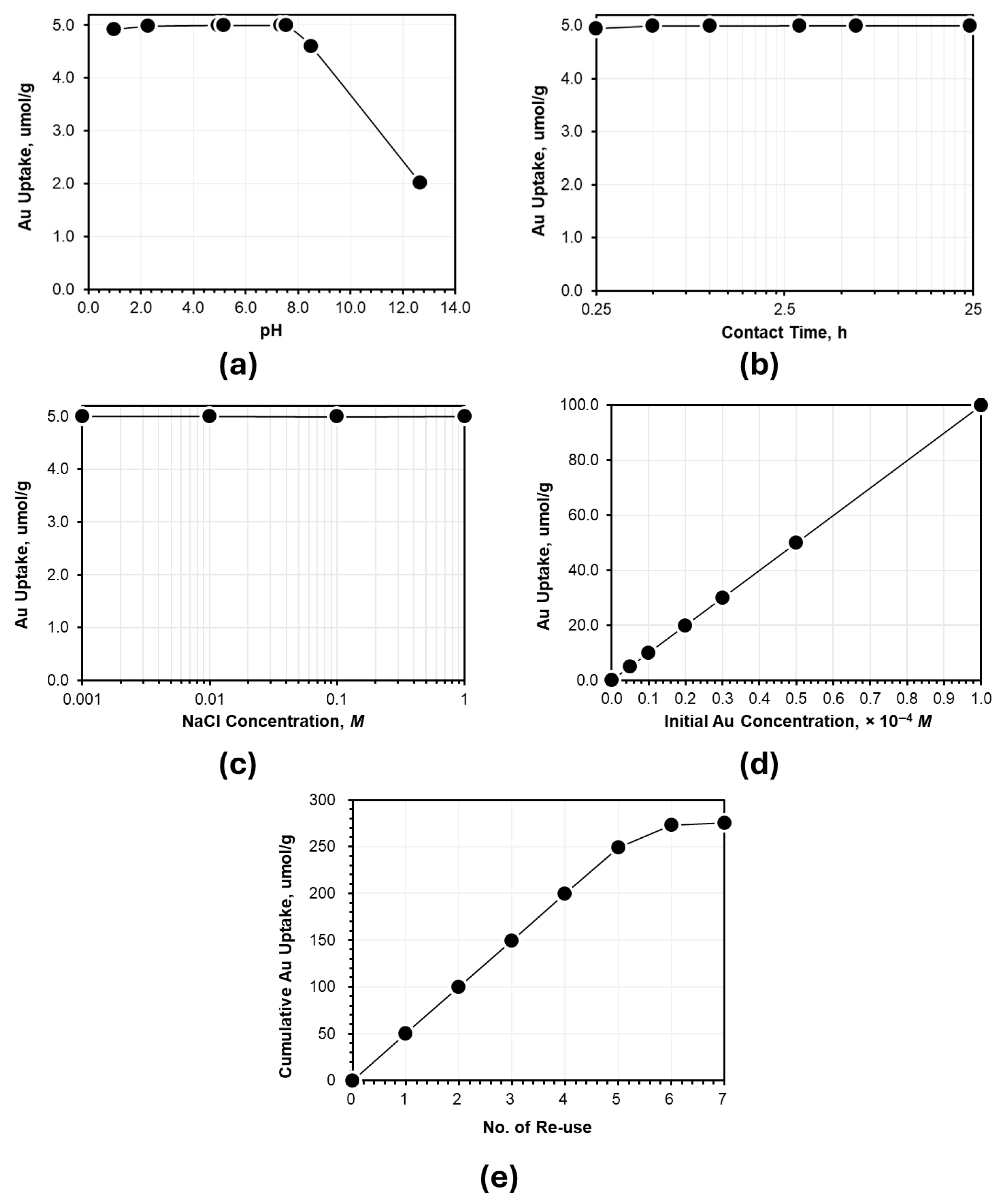
The influence of pH on the sorption of gold chloride complexes on magnetite from copper converter slag was studied under an initial gold concentration of 5 × 10⁻⁵ M, which represents a typical level of gold found in tailings [19], and 0.1 g magnetite slag. The results are presented in Figure 2a. The results indicate that more than 99% of gold was recovered (~5 µmol/g gold uptake) over a wide pH range. This adsorption capacity is comparable to, and exceeds, the reported gold uptake of activated carbon in non-cyanide leach systems (~2.4 µmol/g), highlighting the strong performance of the magnetite-based adsorbent [20]. The gold uptake was at a maximum in the acidic to neutral pH range until around pH 8. Above pH 8, gold recovery started to decrease and was reduced significantly at highly basic pH. At pH levels above 12, gold uptake decreased to 40%.
We have previously reported the pH dependence of gold uptake from chloride solution using synthetic and natural magnetite [9,10]. The maximum recovery of gold for both types of magnetite was observed at pH 6–7. Comparing the pH dependence plot for gold recovery using the converter magnetite slag to that using synthetic and natural magnetite, a clear difference in the plot patterns can be observed. This variation could suggest that the gold uptake process using the converter magnetite slag is governed by a different mechanism.
The higher gold reduction (uptake) at low pH is primarily governed by speciation, surface charge, and redox behavior [21]. At low pH, gold is typically present as the anionic complex AuCl4. Under these acidic conditions, the surface of the adsorbent/reductant (e.g., magnetite or iron-bearing phases) becomes protonated and positively charged, which promotes strong electrostatic attraction toward the negatively charged gold complex. This enhances adsorption and facilitates subsequent electron transfer, leading to the reduction of Au(III) to metallic Au(0).
In addition, acidic conditions favor the redox activity of Fe2+/Fe3+ species (in iron-containing materials), which can act as electron donors for gold reduction. The higher availability of protons can also stabilize intermediate species and accelerate reduction kinetics.
Control experiments were conducted to determine if gold precipitation occurs at different pH ranges or if the presence of other compounds contained in the converter magnetite slag affects the gold recovery. Leaching of the converter magnetite slag using NaCl at an acidic pH and near-neutral pH was conducted. The supernatant produced by leaching was added to 5 × 10⁻⁵ M AuCl4 and then shaken for 24 h under the same conditions as in the batch-sorption experiments. After the treatment, the solution was analyzed for gold and other metal components using ICP-AES. The results of the control experiments confirmed that no gold precipitation occurred at the acidic and near-neutral pH ranges, even with the co-existence of other impurities in the solution. This implied that the difference in the initial and the final gold concentrations was due to the sorption of the gold ions onto converter magnetite slag.

3.3. Effect of Contact Time

The effect of contact time on the sorption of gold chloride ions on magnetite slag was investigated under the following conditions: initial gold concentration of 5 × 10⁻⁵ M, 0.1 g magnetite slag, and NaCl concentration of 0.1 M. The pH of the solution was controlled at pH 5.5–6.5. The results are shown in Figure 2b. The contact time was set from 15 min (0.25 h) to 24 h. The gold uptake by the converter magnetite slag was characterized by a fast sorption rate. More than 98% recovery was obtained even at a contact time of 15 min. A contact time of 15 min was considered sufficient to recover all the gold ions from the solution and to complete the process.

3.4. Effect of Chloride Concentration

Figure 2c illustrates the effect of chloride concentration on the uptake of gold by the converter magnetite slag particles. As a source of chloride ions, NaCl solution was used, and the concentration was varied from 0.001 to 1.0 M. The gold concentration, converter magnetite slag amount, contact time, and pH were fixed at 5 × 10⁻⁵ M, 0.1 g, 24 h, and pH 5.5–6.5, respectively. The presence of NaCl over the concentration range of 0.001–1.0 M did not affect the gold recovery by the converter magnetite slag. A 100% recovery was obtained even at high chloride concentrations. This result implies that gold recovery by magnetite slag is not influenced by the chloride ions present in the solution. In acidic chloride media, gold predominantly exists as the stable anionic complex AuCl4 over a wide range of chloride concentrations. Once this complex is fully stabilized, further increases in Cl concentration do not significantly change gold speciation [21].

3.5. Effect of Initial Gold Concentration

The effect of the initial gold concentration on gold uptake by the converter magnetite slag was studied, and the result is shown in Figure 2d. The initial gold concentration was varied in the range of 0.01–1.0 × 10⁻⁴ M, and the amount of magnetite slag powder added was fixed at 0.1 g. The results show that gold uptake increases proportionally with increasing initial gold concentration. A 100% recovery was obtained at all initial gold concentrations used. The magnetite slag was able to recover all the gold ions, even from the solution containing the highest amount of AuCl4 used (at 1.0 × 10⁻⁴ M or 19.7 mg/L). This result illustrates that the gold uptake by magnetite slag did not tend to approach a constant value, which means that the magnetite slag did not yet reach the saturation point and still has the capacity to recover gold from the solution.
An experiment involving repetitive use of the converter magnetite slag was further carried out to test its sustained performance and sorption capacity. For each run, 5 × 10⁻⁵ M gold was added to 0.1 g of converter magnetite slag. After each run, the converter slag was separated from the solution and re-used for the succeeding runs. The pH of the solution was controlled at 5.5–6.5, the NaCl concentration was kept at 0.1 M, and the contact time was maintained at 24 h. The result of the experiment is presented in Figure 2e. The cumulative amount of gold recovered by the magnetite slag increased steadily until the 6th run. From the 1st until the 5th repetitive uses, the converter magnetite slag recovered almost 100% of the added gold in the solution. On the 6th run, the converter magnetite slag recovered about 275 µmol Au/g of converter slag or a cumulative amount of 5.4 mg gold from the solution. The gold uptake leveled off on the 7th run, which showed a negligible increase in gold recovery. From these results, it can be inferred that the converter magnetite slag has a high adsorption capacity for gold in chloride solution, considering that only 0.1 g of the powder was used.
The leveling off of gold recovery with prolonged use of the magnetite material is most plausibly attributed to progressive material degradation and surface passivation, which reduce its reactivity over time. Initially, magnetite (Fe3O4) provides active Fe2+ sites that facilitate the reduction of Au(III) to Au(0). However, during repeated use or extended contact, the oxidation of Fe2+ to Fe3+ occurs, diminishing the availability of electron-donating sites required for gold reduction. This weakens the redox capacity of the material [22].
The formation of passivating surface layers (e.g., Fe(OH)3 or other iron oxyhydroxides) [23] can coat the magnetite surface, blocking active sites and hindering both adsorption and electron transfer. Deposition of metallic gold on the surface may physically cover reactive sites [23], further limiting accessibility. Structural changes such as surface dissolution, recrystallisation, or pore blockage may reduce surface area and active site exposure. In chloride-rich acidic environments, partial leaching of iron can also alter the surface composition and integrity of the magnetite.
Together, these effects lead to a gradual decline in the number of available reactive sites and the efficiency of electron transfer, causing gold recovery to plateau even if sufficient gold remains in the solution.

3.6. Morphological Examination of the Reacted Converter Magnetite Slag

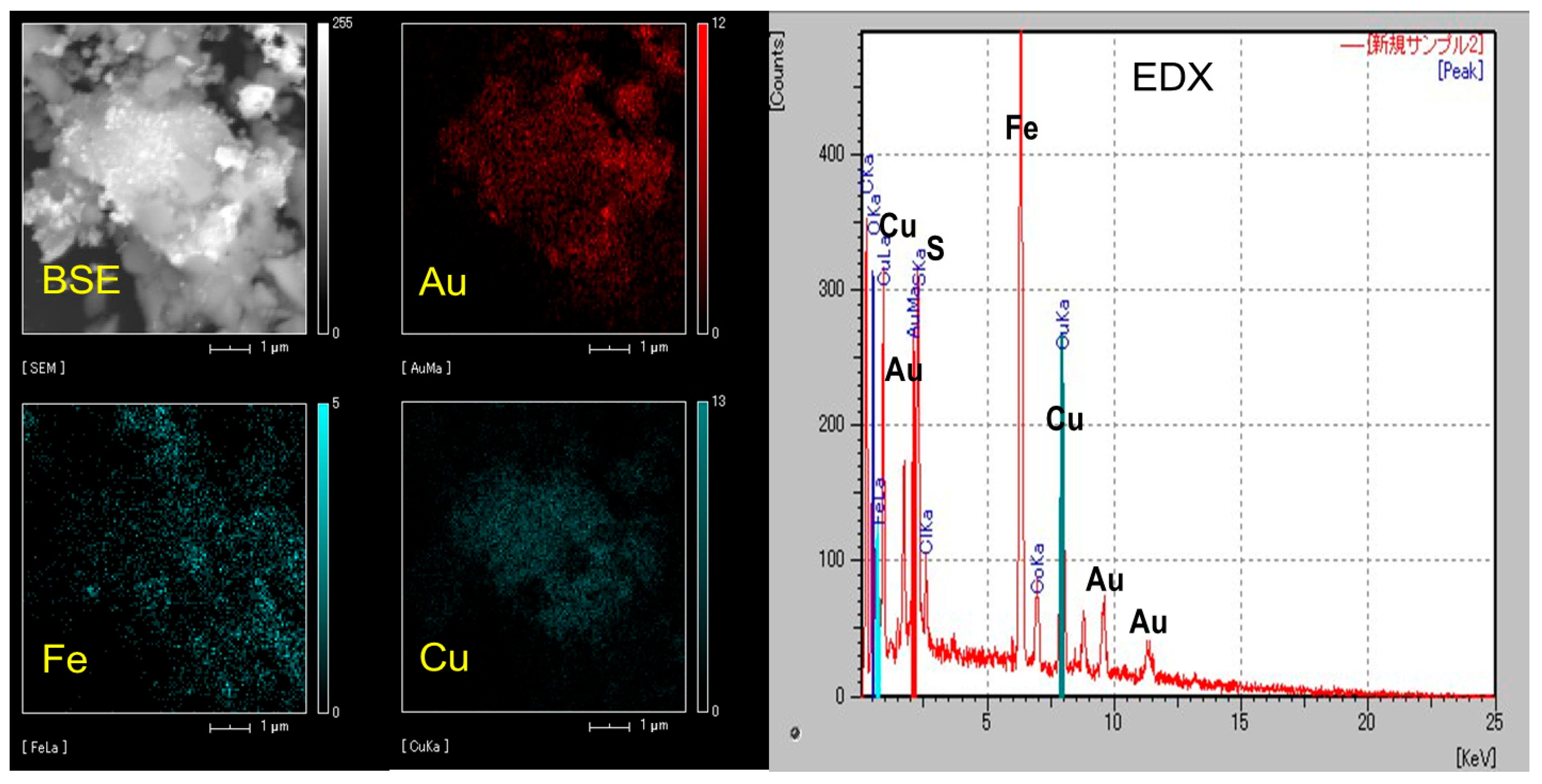
The reacted magnetite slag particles were morphologically examined using Scanning Electron Microscopy-Energy Dispersive X-ray (SEM-EDX) and Backscattering Electron (BSE) analyses. The converter magnetite slag particles collected from the batch sorption experiment containing a solution of 5 × 10⁻⁵ M AuCl4 were used for the SEM-EDX and BSE analyses. Prior to the microscopic examination, the reacted magnetite slag particles were washed with distilled water and dried in a vacuum oven for 24 h. The results are displayed in Figure 3.
Gold was detected on the surface of the converter magnetite slag. SEM and BSE photomicrographs of the reacted slag particles showed clusters of gold in regions where copper sulfide appears to be present. Elemental mapping indicated that Au and Cu signals overlapped; however, this does not definitively confirm that gold preferentially nucleated on intact copper sulfide phases. EDX analysis of these regions produced peaks for Cu, S, and Au, suggesting that gold is associated with areas containing copper sulfide. It should be noted, however, that partial dissolution of the copper sulfide could release Cu2+ into solution, which may contribute indirectly to the reduction of AuCl4. Therefore, while gold aggregates are observed near copper sulfide-containing regions of the slag, further investigation is needed to confirm whether the deposition occurs directly on the copper sulfide or through secondary processes.

3.7. Sorption of Different Metal Ions on Magnetite Slag

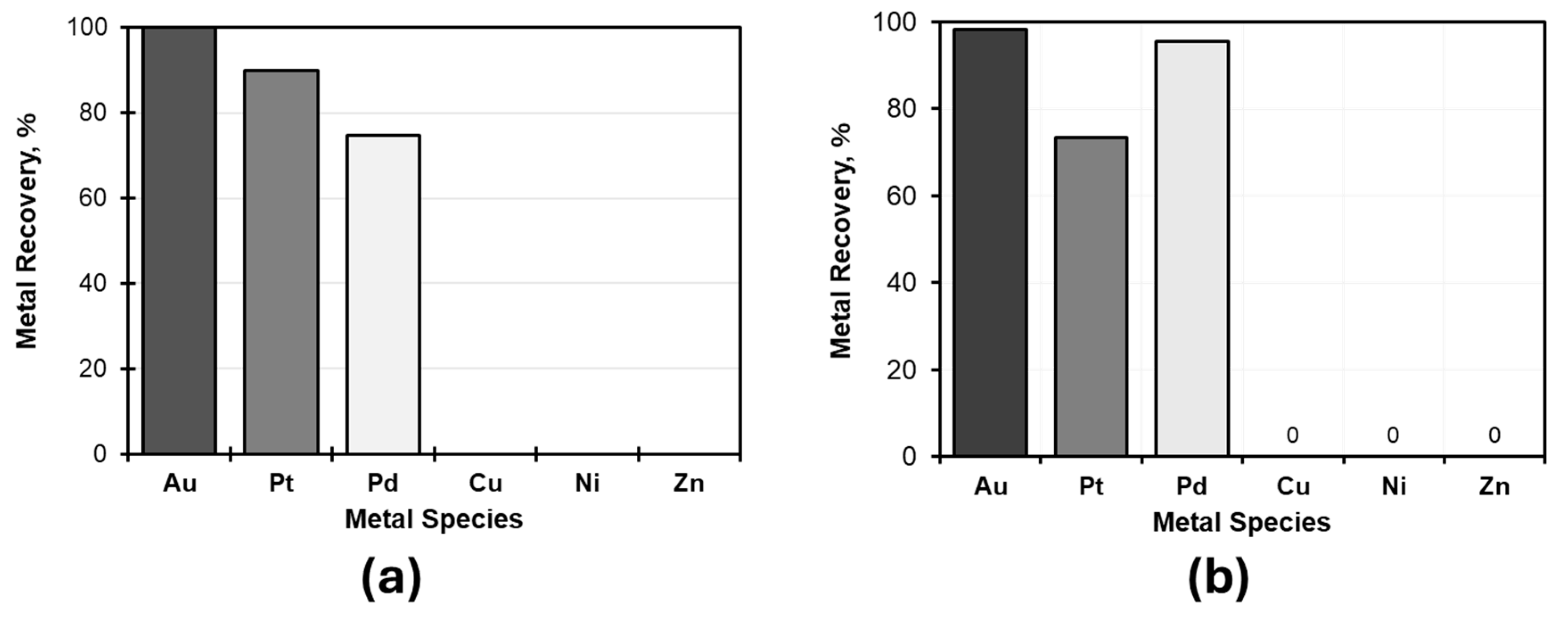
The converter magnetite slag effectively recovered gold from chloride solution at different experimental conditions as described in the previous section. To evaluate the ability of the magnetite slag to recover other metal ion species, single-metal and mixed-metal batch sorption experiments involving Pt, Pd, Cu, Zn, and Ni ions were conducted. These metals were chosen due to their economic value and presence in mine tailings [24]. For both single-metal and mixed-metal sorption experiments, reagent-grade metal solutions were used as sources of metal ions. The experimental conditions were set at an initial metal concentration of 5 × 10⁻⁵ M, a contact time of 24 h, and employed 0.1 g of magnetite slag. The pH was controlled at a range of 4–5 to avoid precipitation of metal species [9]. The results are presented in Figure 4a,b for single-metal and mixed-metal studies.
The single-metal sorption experiment results in Figure 4a show that the converter magnetite slag can also recover other precious metals such as Pt and Pd. Among the three precious metals, gold was most preferred by the magnetite slag with 100% recovery, followed by Pt with about 90%, and then Pd with 75% recovery. No recoveries were observed for Cu, Ni, and Zn under similar experimental conditions. When the metal species, which include Au, Pt, Pd, Cu, Zn, and Ni, were mixed in the solution, similar sorption behavior was observed, as shown in Figure 4b. The converter magnetite slag recovered only Au, Pt, and Pd from a solution containing various metal ions.
The results presented in Figure 4 show that the converter magnetite slag is selective towards precious metal ions in a chloride solution. Precious metals, such as Au, Pt, and Pd, are reduction–oxidation-sensitive species due to their high standard reduction potentials. In the presence of an electro-conductive material, such as Fe3O4, these precious metal ions can be reduced on the surface of magnetite by virtue of the large differences in the reduction potentials between the metal ions and magnetite [25]. On the other hand, metal ions such as Cu, Ni, and Zn, having lower standard reduction potentials, are not as electroactive, and their reduction is less thermodynamically favorable [26]. Thus, magnetite was not able to reduce these metal ions to their elemental form, resulting in no recoveries from the solution.
The demonstrated selectivity of the magnetite slag can be harnessed in applications such as recycling, where precious metal ions co-exist with other metal ion species in solution. Recently, there has been increasing research into the selective recovery of gold and other precious metals from solutions [27,28,29]. The converter magnetite slag can be used as a cheap and effective sorbent to selectively recover precious metals from solution.

3.8. Proposed Uptake Mechanism

The SEM-EDX analysis (Figure 1e) showed that the converter magnetite slag contained 3.3% CuS and 1.3% metallic Cu. The SEM-EDX analysis of the reacted converter magnetite slag (Figure 3) also showed that gold clusters were deposited on an area in the converter magnetite slag where copper sulfides were present. Based on the spectroscopic and microscopic analyses, together with the outcomes of the parameter studies presented above, a plausible adsorption mechanism is proposed to explain the uptake of AuCl4 by the converter magnetite slag. It is emphasized that this mechanism remains hypothetical, as direct experimental confirmation is not yet available.
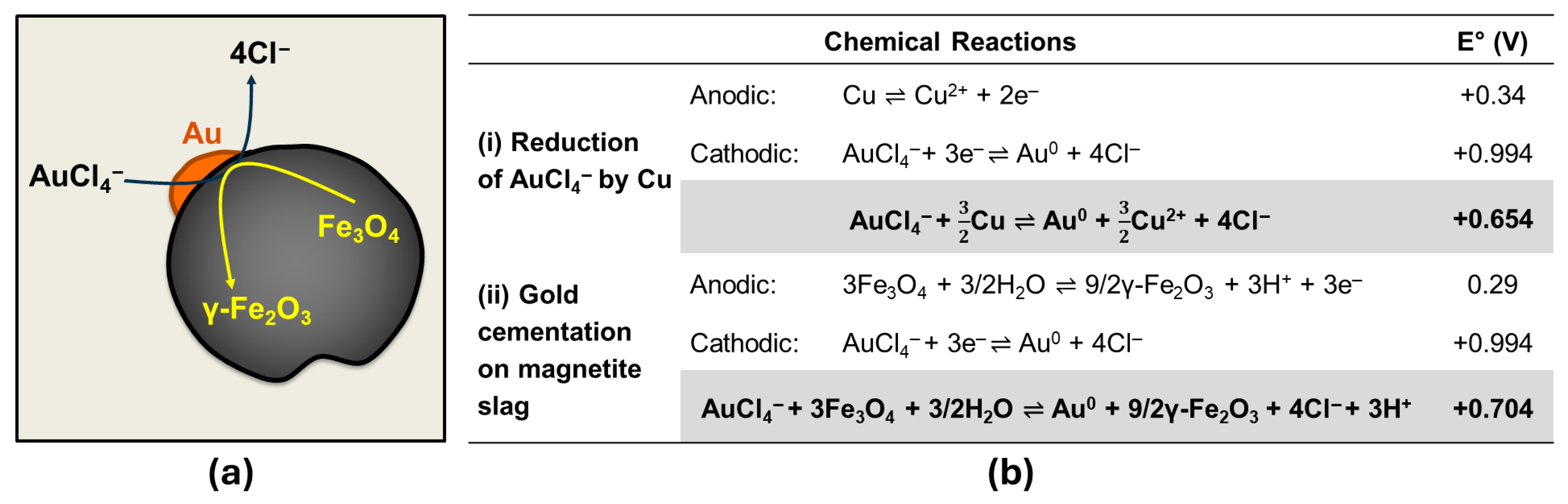
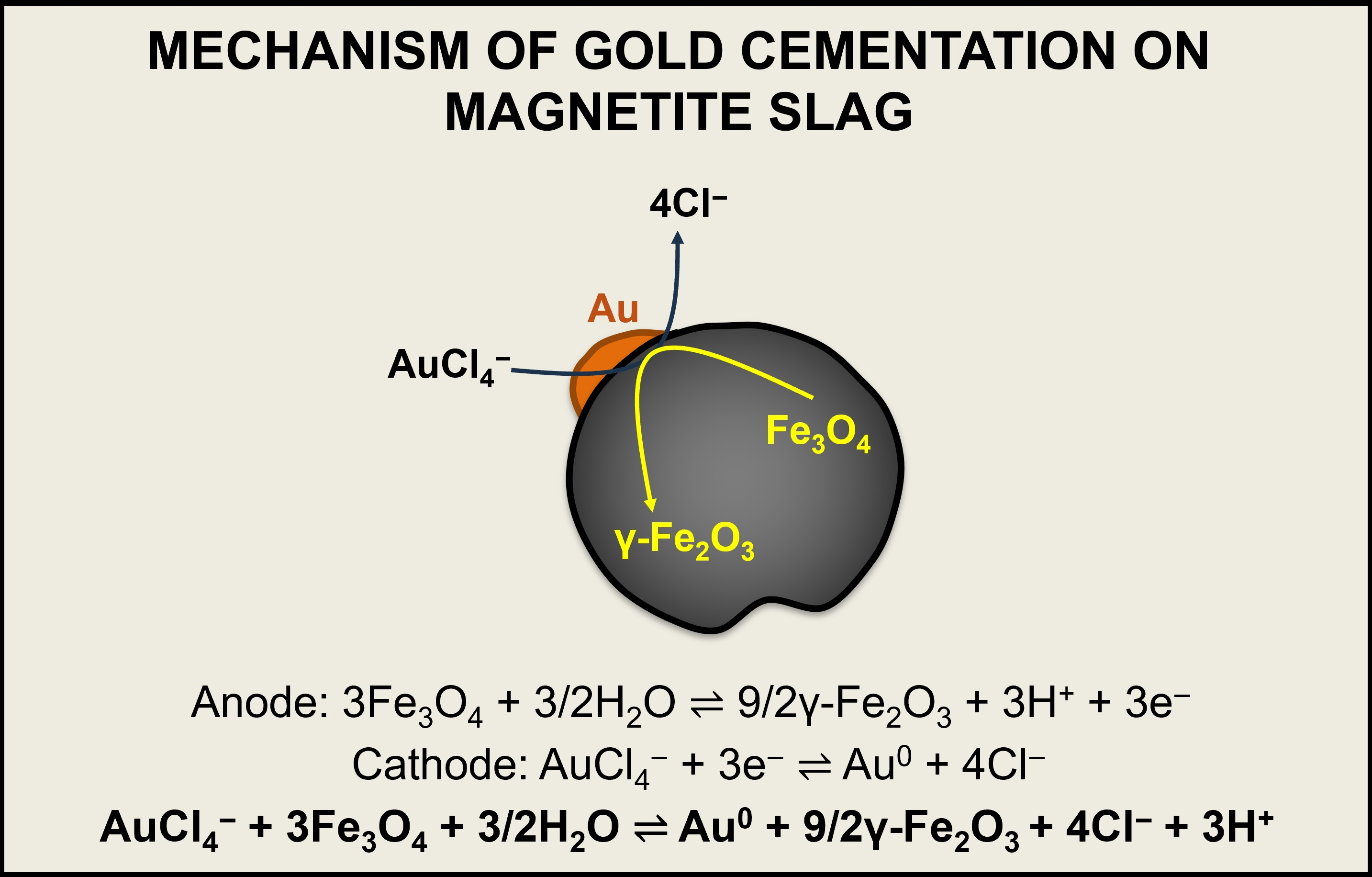
The recovery of gold from chloride solution by magnetite slag could be attributed to two mechanisms: (1) direct reduction by Cu, and (2) cementation via galvanic interactions, as shown schematically in Figure 5a.
Both Cu2S and metallic Cu are present in the magnetite slag sample, and both are capable of reducing AuCl4, but Cu has a stronger reducing ability compared to Cu2S, given that E° = 0.334 V for Cu2+/Cu versus E° = 1.51 V for Cu2+, S2−/Cu2S [30]. The utility of copper to recover gold from various aqueous media, such as cyanide [31], ammoniacal thiosulphate [32,33], and thiosulphate solutions [34], has been documented, and reaction mechanisms have been proposed. In the present study, the proposed reduction mechanism of AuCl4 by Cu is summarized in Figure 5b. The dissolution of Cu in aqueous solution forms the anodic half of the coupled electrochemical reactions. The reduction of gold from a chloride solution to metallic gold represents the cathodic half of the reduction process.
Another possible mechanism of gold recovery by magnetite slag in chloride solution is through cementation via galvanic interactions. Galvanic interactions occur when two conductors or semi-conductors with different redox/rest potentials come in contact with each other [35,36]. For the magnetite slag sample used in this study, Cu2S likely acted as the cathode where the reduction of AuCl4 to gold occurred, and the magnetite as the anode as well as the reducing agent. In this “galvanic” system, the cementation of gold chloride Cu2S is consistent with the earlier observations by SEM-EDX that the bulk of gold was recovered on Cu-bearing phases and not on magnetite. Although O2 reduction may also occur on the cathode, thermodynamic calculations showed that the reduction of gold is more favorable than that of O2 because of the more negative ΔG generated by the former reaction. Cementation via galvanic interactions could also explain why magnetite, which is known for its ability to recover gold via cementation [9], was capable of recovering gold ions in this study. The overall reaction mechanism for the cementation of AuCl4 by magnetite is summarized in Figure 5b.

3.9. Material Cycle and Proposed Application

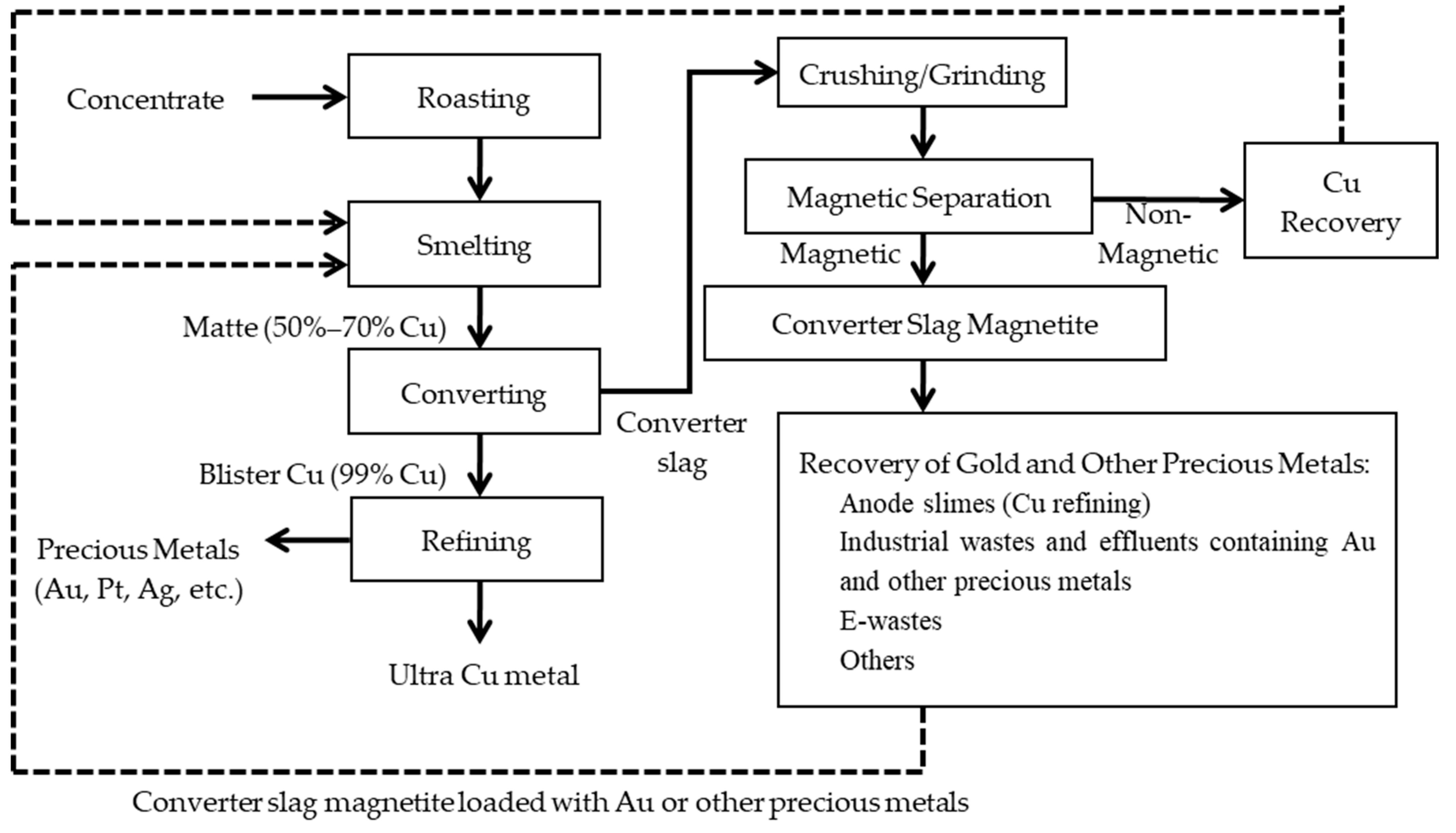
The converter magnetite slag has demonstrated a very promising ability to uptake gold from chloride solution. One very beneficial characteristic of the magnetite slag, apart from the fact that it contains Cu2S-Cu composite, which is the main driver of gold cementation, is its magnetic property. By simply using a magnet, the physical separation of the magnetite slag from slurries or mixtures can be carried out easily. With this in mind, coupled with the effectiveness of the converter magnetite slag to uptake gold from chloride solution, a proposed material cycle for the magnetite slag is presented to outline its potential application in the field of precious metals recovery. This proposed application is illustrated in Figure 6. The diagram is conceptual in nature and does not represent quantitative material flows.
The converter slag, which is the by-product of the converting process, should be crushed and ground to the desired particle size and undergo magnetic separation to obtain magnetic and non-magnetic fractions. The non-magnetic fraction will be sent to the copper recovery process (i.e., flotation). The magnetic fraction of the converter slag, also known as the converter magnetite slag, can be utilized as a sorbent to recover gold or other precious metals from secondary sources (within the smelting plant or from external sources), such as printed circuit boards [37,38], decopperized anode slime [38,39], jewelry scrap or wastes [38,40], spent catalysts [38,41,42], used electrical contactors [43], and electroplating wastes and effluents [44]. The reacted converter magnetite slag loaded with gold or other precious metals will be returned to the smelting stage as a feed material. The recovered precious metals can be collected in the refining stage of the process and will undergo further purification. This proposed application is perceived to offer an economical and effective way of recovering gold from secondary sources and minimizing waste output from the copper converting process.

4. Conclusions

Repurposing converter slag into a valuable sorbent not only recovers precious metals but also reduces the environmental burden associated with large-scale slag disposal. In this study, waste converter magnetite slag collected from a copper smelting company in Japan was utilized as a sorbent to recover gold from chloride solution. Batch sorption experiments were performed to evaluate the effects of pH, contact time, chloride concentration, and initial gold concentration on the gold uptake amount. Magnetite slag can effectively recover gold from a chloride solution. More than 99% recovery was obtained at acidic and near-neutral pH ranges. The gold sorption rate was relatively fast, and over 98% recovery was achieved even at 15 min contact time. Increasing the chloride concentration did not influence the gold uptake. Further quantitative evaluation of magnetite-based sorbents, particularly in terms of adsorption capacity, kinetics, and their applicability to other gold complex systems, remains an important direction for future work.
The perceived gold uptake mechanism was reductive precipitation or cementation. Parameter studies and spectrometric analyses suggested that metallic Cu and chalcocite (Cu2S) present in the magnetite slag reduced the gold chloride complex to metallic gold. The SEM-EDX and BSE analyses of the reacted magnetite slag particles revealed that gold accumulated in the area where the copper sulfide is present. The study also demonstrated that the magnetite slag was selective only towards precious metals, such as Au, Pt, and Pd, due to the differences in the reduction potentials. The converter magnetite slag can be used as a selective, economical, and effective sorbent to recover gold from secondary sources. The gold-loaded magnetite slag can be returned to the smelting stage of copper processing to recover the deposited gold and other precious metals. This not only advances resource recovery but also promotes sustainable metallurgical practices by transforming an industrial waste stream into an environmentally beneficial material.

Author Contributions

Conceptualization, N.H.; Methodology, R.D.A. and H.K.; Validation, R.D.A. and H.K.; Formal analysis, R.D.A., J.H.J., J.G. and C.B.T.; Investigation, R.D.A. and H.K.; Writing—original draft preparation, R.D.A.; Writing—review and editing, J.H.J., J.G., C.B.T., M.I. and N.H.; Visualization, R.D.A., J.H.J. and C.B.T.; Supervision, M.I. and N.H.; Project administration, N.H. and M.I. All authors have read and agreed to the published version of the manuscript.

Funding

This research received no external funding.

Data Availability Statement

The original contributions presented in this study are included in the article. Further inquiries can be directed to the corresponding author.

Acknowledgments

The Ministry of Education, Culture, Sports, Science and Technology (MEXT) of Japan, and Sumitomo Metal Mining Corporation are acknowledged for their support for this research.

Conflicts of Interest

The authors declare no conflicts of interest.

References

  1. Tian, H.; Guo, Z.; Pan, J.; Zhu, D.; Yang, C.; Xue, Y.; Li, S.; Wang, D. Comprehensive review on metallurgical recycling and cleaning of copper slag. Resour. Conserv. Recycl. 2021, 168, 105366. [Google Scholar] [CrossRef]
  2. Gabasiane, T.S.; Danha, G.; Mamvura, T.A.; Mashifana, T.; Dzinomwa, G. Environmental and Socioeconomic Impact of Copper Slag—A Review. Crystals 2021, 11, 1504. [Google Scholar] [CrossRef]
  3. Mitrašinović, A.; Kamberović, Ž.; Yu, D. Toward Zero Waste Mining: Circular Economy of Copper Slags. Glob. Chall. 2025, 9, e00392. [Google Scholar] [CrossRef]
  4. Nikoloski, A.N.; Singh, P.; Chanda Phiri, T. From Waste to Resource: Critical Mineral Recovery and Environmental Impact Mitigation in Copper Smelting Slag. Minerals 2026, 16, 206. [Google Scholar] [CrossRef]
  5. Mokmeli, M.; Parizi, M.T. Low-grade chalcopyrite ore, heap leaching or smelting recovery route? Hydrometallurgy 2022, 211, 105885. [Google Scholar] [CrossRef]
  6. Schlesinger, M.E.; King, M.J.; Sole, K.C.; Davenport, W.G. Extractive Metallurgy of Copper, 5th ed.; Elsevier: Oxford, UK, 2011. [Google Scholar]
  7. Gill, C.B. Nonferrous Extractive Metallurgy; R.E. Krieger Publishing Company: New York, NY, USA, 1988. [Google Scholar]
  8. USEPA. Slag Reprocessing: Magma Copper Company’s San Manuel Facility; USEPA: Washington, DC, USA, 1993.
  9. Alorro, R.D.; Hiroyoshi, N.; Kijitani, H.; Ito, M.; Tsunekawa, M. On the Use of Magnetite for Gold Recovery from Chloride Solution. Miner. Process. Extr. Metall. Rev. 2010, 31, 201–213. [Google Scholar] [CrossRef]
  10. Alorro, R.D.; Hiroyoshi, N.; Kijitani, H.; Ito, M.; Tsunekawa, M. Electrochemical Investigation of Gold Uptake from Chloride Solution by Magnetite. Miner. Process. Extr. Metall. Rev. 2015, 36, 332–339. [Google Scholar] [CrossRef]
  11. Homchuen, P.; Alorro, R.D.; Hiroyoshi, N.; Sato, R.; Kijitani, H.; Ito, M. A Study on the Utilization of Magnetite for the Recovery of Platinum Group Metals from Chloride Solution. Miner. Process. Extr. Metall. Rev. 2016, 37, 246–254. [Google Scholar] [CrossRef]
  12. Aghaei, E.; Alorro, R.; Encila, A.; Yoo, K. Magnetic Adsorbents for the Recovery of Precious Metals from Leach Solutions and Wastewater. Metals 2017, 7, 529. [Google Scholar] [CrossRef]
  13. Tatarchuk, T.; Soltys, L.; Macyk, W. Magnetic adsorbents for removal of pharmaceuticals: A review of adsorption properties. J. Mol. Liq. 2023, 384, 122174. [Google Scholar] [CrossRef]
  14. Phouthavong, V.; Yan, R.; Nijpanich, S.; Hagio, T.; Ichino, R.; Kong, L.; Li, L. Magnetic Adsorbents for Wastewater Treatment: Advancements in Their Synthesis Methods. Materials 2022, 15, 1053. [Google Scholar] [CrossRef]
  15. Calderon, A.R.M.; Alorro, R.D.; Tadesse, B.; Yoo, K.; Tabelin, C.B. Repurposing of nickeliferous pyrrhotite from mine tailings as magnetic adsorbent for the recovery of gold from chloride solution. Resour. Conserv. Recycl. 2020, 161, 104971. [Google Scholar] [CrossRef]
  16. Farahat, M.M.; Abdel Khalek, M.A.; Sanad, M.M.S. Affordable and reliable cationic-anionic magnetic adsorbent: Processing, characterization, and heavy metals removal. J. Clean. Prod. 2022, 360, 132178. [Google Scholar] [CrossRef]
  17. Zhang, L.; Dan, H.; Bukasa, O.T.; Song, L.; Liu, Y.; Wang, L.; Li, J. Low-Cost Efficient Magnetic Adsorbent for Phosphorus Removal from Water. ACS Omega 2020, 5, 25326–25333. [Google Scholar] [CrossRef]
  18. Hiroyoshi, N.; Tsunekawa, M.; Ito, M.; Alorro, R.D.; Kijidani, A.; Okamoto, H.; Ochi, D.; Takahashi, Y. Precious Metal Adsorbent Using Copper Smelting Slag as Raw Material and Manufacturing Method Thereof. JP 2012-001747, 5 January 2012. [Google Scholar]
  19. Ubaldini, S.; Guglietta, D.; Vegliò, F.; Giuliano, V. Valorization of Mining Waste by Application of Innovative Thiosulphate Leaching for Gold Recovery. Metals 2019, 9, 274. [Google Scholar] [CrossRef]
  20. Monteiro, J.; Cunha, L.; Azevedo, A.; Futuro, A.; Soeiro, J.; Sousa, R. Study on Activated Carbon Adsorption of Gold from Cyanide-Free Leaching Solutions. Metall. Mater. Trans. B 2026, 57, 525–534. [Google Scholar] [CrossRef]
  21. Marsden, J.; House, I. The Chemistry of Gold Extraction; SME: Littleton, CO, USA, 2006. [Google Scholar]
  22. Cornell, R.M.; Schwertmann, U. The Iron Oxides: Structure, Properties, Reactions, Occurrences and Uses; John Wiley & Sons: Hoboken, NJ, USA, 2003. [Google Scholar]
  23. Huang, F.-X.; Wu, Y.-F.; Evans, K.; Williams-Jones, A.E.; Zhao, X.-F.; Wei, Y.; Feng, W.; Li, J.-W. Adsorption and coarsening of gold nanoparticles in iron (oxyhydr)oxides lead to high-grade gold mineralization. Geochim. Cosmochim. Acta 2025, 404, 1–12. [Google Scholar] [CrossRef]
  24. Tapfuma, A.; Mutimutema, P.; Bazhko, O.; Nkabinde, S.; Ledwaba, M.; Kabangu, J.M.; Chiwaye, N.; Muller, E.; Ndlovu, G. Gold tailing metal extraction and sustainable end-use: A closed-loop review. Miner. Eng. 2026, 239, 110075. [Google Scholar] [CrossRef]
  25. Tuo, Y.; Liu, G.; Dong, B.; Zhou, J.; Wang, A.; Wang, J.; Jin, R.; Lv, H.; Dou, Z.; Huang, W. Microbial synthesis of Pd/Fe3O4, Au/Fe3O4 and PdAu/Fe3O4 nanocomposites for catalytic reduction of nitroaromatic compounds. Sci. Rep. 2015, 5, 13515. [Google Scholar] [CrossRef]
  26. Homchuen, P. Hydrometallurgical Recovery of Precious Metals Using Magnetic Adsorbents. Doctoral Dissertation, Hokkaido University, Saporro, Japan, 2017. [Google Scholar]
  27. Rahmati, S.; Adavodi, R.; Hosseini, M.R.; Veglio, F. Efficient Metal Extraction from Dilute Solutions: A Review of Novel Selective Separation Methods and Their Applications. Metals 2024, 14, 605. [Google Scholar] [CrossRef]
  28. Sronsri, C.; Panitantum, N.; Sittipol, W.; U-yen, K.; Kerdphol, P. Optimization of selective gold recovery from electronic wastes through hydrometallurgy and adsorption. Process Saf. Environ. Prot. 2022, 163, 659–668. [Google Scholar] [CrossRef]
  29. Cotrina-Teatino, M.; Marquina-Araujo, J.; Mamani-Quispe, J.; Arango-Retamozo, S.; Gonzalez-Vasquez, J.; Portilla-Rodriguez, H. Bibliometric and Systematic Literature Analysis on Hydrometallurgy for the Recovery of Gold, Silver, and Platinum Group Metals. JOM 2025, 77, 10065–10087. [Google Scholar] [CrossRef]
  30. Babichuk, I.; Yukhymchuk, V.O.; Semenenko, M.; Klyui, N.; Caballero, R.; Hreshchuk, O.; Lemishko, I.S.; Babichuk, I.; Ganus, V.; Léon, M. Optical and morphological properties of tetragonal Cu2ZnSnS4 thin films grown from sulphide precursors at lower temperatures. Semicond. Phys. Quantum Electron. Optoelectron. 2014, 17, 284–290. [Google Scholar] [CrossRef]
  31. Nguyen, H.H.; Tran, T.; Wong, P.L.M. A kinetic study of the cementation of gold from cyanide solutions onto copper. Hydrometallurgy 1997, 46, 55–69. [Google Scholar] [CrossRef]
  32. Guerra, E.; Dreisinger, D.B. A study of the factors affecting copper cementation of gold from ammoniacal thiosulphate solution. Hydrometallurgy 1999, 51, 155–172. [Google Scholar] [CrossRef]
  33. Hiskey, J.B.; Lee, J. Kinetics of gold cementation on copper in ammoniacal thiosulfate solutions. Hydrometallurgy 2003, 69, 45–56. [Google Scholar] [CrossRef]
  34. Choo, W.L.; Jeffrey, M.I. An electrochemical study of copper cementation of gold(I) thiosulfate. Hydrometallurgy 2004, 71, 351–362. [Google Scholar] [CrossRef]
  35. Seng, S.; Tabelin, C.; Kojima, M.; Hiroyoshi, N.; Ito, M. Galvanic Microencapsulation (GME) Using Zero-Valent Aluminum and Zero-Valent Iron to Suppress Pyrite Oxidation. Mater. Trans. 2018, 60, 277–286. [Google Scholar] [CrossRef]
  36. Tabelin, C.B.; Igarashi, T.; Villacorte-Tabelin, M.; Park, I.; Opiso, E.M.; Ito, M.; Hiroyoshi, N. Arsenic, selenium, boron, lead, cadmium, copper, and zinc in naturally contaminated rocks: A review of their sources, modes of enrichment, mechanisms of release, and mitigation strategies. Sci. Total Environ. 2018, 645, 1522–1553. [Google Scholar] [CrossRef]
  37. Park, Y.J.; Fray, D.J. Recovery of high purity precious metals from printed circuit boards. J. Hazard. Mater. 2009, 164, 1152–1158. [Google Scholar] [CrossRef]
  38. Syed, S. A green technology for recovery of gold from non-metallic secondary sources. Hydrometallurgy 2006, 82, 48–53. [Google Scholar] [CrossRef]
  39. Dönmez, B.; Sevim, F.; Çolak, S. A Study on Recovery of Gold from Decopperized Anode Slime. Chem. Eng. Technol. 2001, 24, 91–95. [Google Scholar] [CrossRef]
  40. Chmielewski, A.G.; Urbański, T.S.; Migdał, W. Separation technologies for metals recovery from industrial wastes. Hydrometallurgy 1997, 45, 333–344. [Google Scholar] [CrossRef]
  41. Barakat, M.A.; Mahmoud, M.H.H.; Mahrous, Y.S. Recovery and separation of palladium from spent catalyst. Appl. Catal. A Gen. 2006, 301, 182–186. [Google Scholar] [CrossRef]
  42. Parinayok, P.; Yonezu, K.; Yokoyama, T.; Watanabe, K.; Leepowpanth, Q.; Wiwattanadate, D. Recovery of platinum from spent automobile catalytic converters. In Proceedings of the 2nd International Workshop and Conference on Earth Resources Technology, Bangkok, Thailand, 3–4 April 2008. [Google Scholar]
  43. Niederkorn, J.S.; Huszar, S. Gold recovery from used electrical contactors. Gold Bull. 1984, 17, 128–130. [Google Scholar] [CrossRef][Green Version]
  44. Ishikawa, S.-I.; Suyama, K.; Arihara, K.; Itoh, M. Uptake and recovery of gold ions from electroplating wastes using eggshell membrane. Bioresour. Technol. 2002, 81, 201–206. [Google Scholar] [CrossRef]
Figure 1. Characterization of magnetite slag sample. (a) Composition of the Cu converter magnetite slag measured by XRF. (b) X-ray diffraction pattern of the magnetite from copper converter slag. (c) Scanning Electron Microscope-Energy Dispersive X-ray (SEM-EDX) and Backscattering Electron (BSE) micrograph, maps, and spectra of the CCS magnetite. (d) Backscattering Electron (BSE) photomicrograph of a copper sulfide component (white part) present in the CCS magnetite. (e) Mineral components of the Cu converter magnetite slag determined by Point Counting Method.
Minerals 16 00511 g001
Figure 2. Gold uptake by magnetite from copper converter slag as influenced by (a) solution pH at 5 × 10⁻⁵ M initial gold concentration; 24 h; 0.1 M NaCl. (b) Contact time at 5 × 10⁻⁵ M initial gold concentration; pH 5.5–6.5; 0.1 M NaCl. (c) NaCl concentration at 5 × 10⁻⁵ M initial gold concentration; pH 5.5–6.5; 24 h. (d) Initial gold concentration at 0.1 M NaCl concentration; pH 5.5–6.5; 24 h. (e) Repetitive usage of the converter magnetite slag at 5 × 10⁻⁵ M gold concentration for each run; pH 5.5–6.0; 24 h.
Minerals 16 00511 g002
Figure 3. SEM-EDX and BSE micrograph, mapping, and spectra of the gold-containing converter magnetite slag (10,000× magnification).
Minerals 16 00511 g003
Figure 4. (a) Single-metal sorption of different metal species on a converter magnetite slag (AuCl4, PtCl6, PdCl42−, Cu2+, Ni2+, Zn2+). (b) Mixed-metal sorption of different metal species on a converter magnetite slag (AuCl4, PtCl6, PdCl42−, Cu2+, Ni2+, Zn2+).
Minerals 16 00511 g004
Figure 5. (a) Schematic representation of the mechanism of gold cementation on magnetite slag. (b) Chemical reaction mechanisms of the (i) reduction of AuCl4 by Cu and (ii) gold cementation on magnetite slag.
Minerals 16 00511 g005
Figure 6. Proposed material cycle and application of the converter magnetite slag.
Minerals 16 00511 g006
Disclaimer/Publisher’s Note: The statements, opinions and data contained in all publications are solely those of the individual author(s) and contributor(s) and not of MDPI and/or the editor(s). MDPI and/or the editor(s) disclaim responsibility for any injury to people or property resulting from any ideas, methods, instructions or products referred to in the content.