Article

Petrogenesis of the Early Cretaceous Volcanic Rocks in the North Himalayan Longzi Area, Southern Tibet

1
College of Earth and Planetary Sciences, Chengdu University of Technology, Chengdu 610059, China
2
No. 2 Geological Brigade, Sichuan Bureau of Geology and Mineral Resources, Chengdu 610041, China
3
College of Engineering, Tibet University, Lhasa 850000, China
4
Institute of Geological Resources and Energy in Tibetan Plateau, Xizang University, Lhasa 850000, China
5
China Metallurgical Geology Bureau, Institute of Mineral Resources Research, Beijing 100025, China
6
Chengdu Geological Survey Center, China Geological Survey, Chengdu 610081, China
*
Author to whom correspondence should be addressed.
Minerals 2026, 16(5), 510; https://doi.org/10.3390/min16050510
Submission received: 5 March 2026 / Revised: 21 April 2026 / Accepted: 6 May 2026 / Published: 12 May 2026

Abstract

Early Cretaceous volcanic rocks are widely developed in the Longzi area, southern Tibet. Their petrogenesis and tectonic setting are important for understanding the initial breakup of eastern Gondwana and its deep geodynamic mechanisms. This study integrates field observations, petrography, zircon U-Pb geochronology and trace elements, whole-rock major and trace element geochemistry, and Sr-Nd-Pb isotopes to investigate the origin and tectonic significance of these rocks. The analyzed suite comprises diabase and rhyolite, with no intermediate compositions in the studied samples, thus defining a mafic–felsic volcanic association. Zircon U-Pb ages indicate Early Cretaceous magmatism at 132–138 Ma for the diabase and 132–134 Ma for the rhyolite. Geochemically, the mafic rocks are enriched in LREEs and HFSEs and display OIB-like trace-element characteristics, with εNd(t) values ranging from −0.2 to +4.4, indicating derivation from low-degree partial melting of a spinel–garnet lherzolite source modified by limited interaction with the lithospheric mantle. The felsic rocks show pronounced negative Eu anomalies, A-type granite affinities, and εNd(t) values ranging from −12.2 to −11.9, indicating derivation mainly from partial melting of upper-crustal materials. The marked geochemical and isotopic contrast between the mafic and felsic rocks argues against simple fractional crystallization from a common parental magma. Combined with regional geological data, these results indicate that the Longzi mafic–felsic volcanic association formed in an intraplate extensional setting related to Kerguelen-plume thermal input during the initial breakup of eastern Gondwana.

1. Introduction

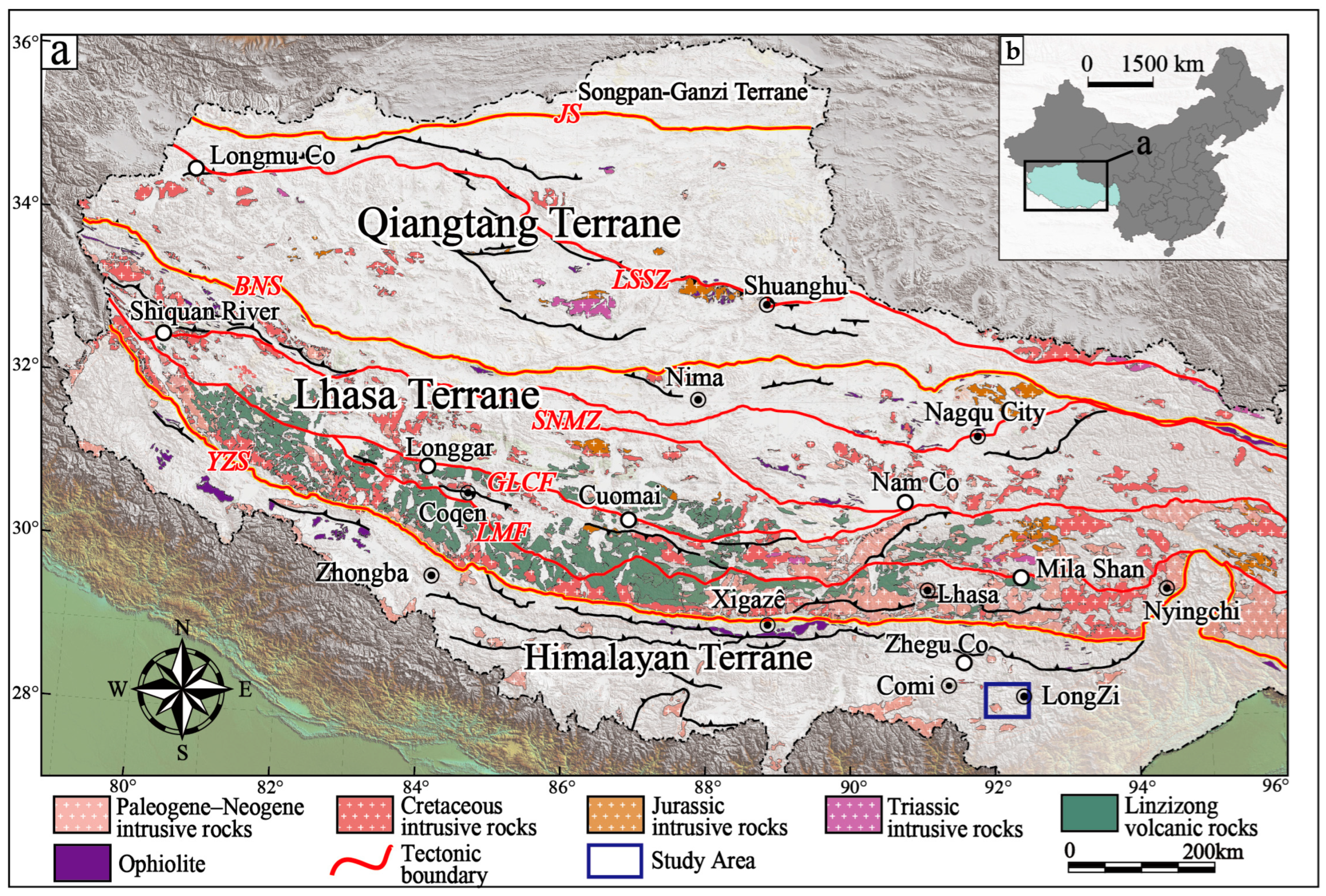
The Tibetan Plateau, which forms the core of the Eastern Tethyan tectonic domain, has a complex and distinctive structure characterized by an unusually thick crust and lithosphere [1,2]. It is a composite terrane that formed through successive back-arc extension and rifting along the southern margin of Laurasia, the western edge of the Pan-Cathaysian blocks, and the northern boundary of Gondwana, ultimately culminating in their collision and merger during the late Mesozoic [1]. From north to south, the Tibetan Plateau can be divided into the Qiangtang Terrane, the Lhasa Terrane, and the Himalayan Terrane, bounded by the Bangong–Nujiang Suture Zone (BNS) and the Yarlung–Zangbo Suture Zone (YZS) (Figure 1). In the Himalayan Terrane, a series of Late Jurassic to Early Cretaceous magmatic rocks is widely exposed [3,4]. Regarding the origin of this magmatic suite, two main interpretations have been proposed in the literature. The first one suggests that, coinciding with the closure of the Paleo-Tethys Ocean and the opening of the Neo-Tethys Ocean, the northern margin of Gondwana—where the Himalayan region was located—experienced significant extensional tectonics along its eastern continental margin [2]. Crustal thinning caused asthenosphere upwelling and melting of both crustal and mantle sources, ultimately leading to extensive magmatic intrusion and volcanic activity [3]. The second interpretation proposes that a mantle plume originating from the core–mantle boundary or deep mantle impinged on the lithosphere beneath the Himalayan region [4]. This process actively initiated and intensified lithospheric rupture and extension. Furthermore, the plume produced a significant thermal anomaly that induced partial melting of crustal material and generated the magmatic suite of this period [5,6].
Regarding the genesis of this magmatic suite, significant controversy persists. In 2017, a set of Charong basalts was identified by researchers in the central Tethyan Himalaya of Tibet [10]. Zircon geochronology and petrogeochemical studies indicate an age of approximately 142 Ma [10]. Moderate SiO2, high MgO and TiO2 contents, enrichment in Rb and Th, and distinct Nb-Ta negative anomalies characterize the rocks. Isotopic signatures show elevated initial 87Sr/86Sr ratios and negative εNd(t) values [10]. The estimated crystallization temperature of the magma is ~1469 ± 44 °C [10]. These findings suggest that the magmatic activity occurred during the Early Cretaceous and exhibits clear signatures of continental crustal contamination [10]. Notably, the calculated magma temperature is significantly lower than that expected for typical mantle plume-derived magmas, thus arguing against a mantle plume origin for this suite [11,12,13]. However, proponents of the mantle plume model contend that this magmatism is not only linked to plume activity but may also represent a direct product of the breakup of eastern Gondwana. Given its extensive exposure, estimated at over 40,000 km2, some researchers have designated it as the “Comei Large Igneous Province” [4]. Furthermore, through a combination of geochronological and paleomagnetic data, the location of the Early Cretaceous magmatic activity in the Tethyan Himalaya has been directly linked to the head of the Kerguelen mantle plume [14].
By synthesizing previous geochronological and geochemical data on magmatic rocks from the Longzi–Comei–Nagarzê–Gyangzê–Kangmar zone, it is clear that magmatic activity in this part of the Tethyan Himalaya was concentrated between ca. 130 and 137 Ma, with a peak near 132 Ma [15,16,17,18,19]. This timing broadly overlaps the initial breakup of eastern Gondwana [18,20]. However, the petrogenesis and tectonic significance of the Longzi suite remain insufficiently constrained, particularly with respect to the temporal and genetic relationship between the mafic and felsic rocks. In this study, we integrate field relationships, petrography, zircon U-Pb geochronology and trace elements, whole-rock geochemistry, and Sr-Nd-Pb isotopes to (1) constrain the timing of Longzi magmatism, (2) evaluate whether the mafic and felsic rocks represent a coeval mafic–felsic association rather than simple differentiation from a common parental magma, (3) assess the tectonic significance of this magmatism for the initial breakup of eastern Gondwana.

2. Geological Setting

The study area is situated in the southern Tibet Autonomous Region, to the west of Longzi County and east of Comei County. It is located within the central-eastern segment of the Himalayan–Tethyan orogenic belt on the southern Tibetan Plateau, encompassing the Himalayan Block and the Yarlung Zangbo Suture Zone, and shares a boundary with the Gangdese Block to the north. This region has experienced an extensive history of sedimentation and tectonic evolution dating back to the Pan-African orogeny along the northern margin of Gondwana. It was notably affected by the expansion and subsequent closure of the Tethyan ocean basins from the Triassic period onward, as well as by the vigorous collisional orogeny between the Himalayan and Gangdese Blocks, followed by large-scale extension, detachment, strike-slip, and rotational deformation. These geological processes have led to complex sedimentary environments, vigorous magmatic and metamorphic activities, and a variety of structural levels, facies, styles, and assemblages.
The region is delineated to the north by the Gudui–Longzi Fault and to the south by the Qumo–Juela Fault. It is traversed by NW-trending faults, resulting in a wedge-shaped landscape that is broader in the west and narrower in the east. Despite this configuration, the predominant structural orientation remains consistently E–W. This tectonic unit is chiefly distinguished by the exposure of three Jurassic stratigraphic units: the Lower Jurassic Ridang Formation (J1), the Middle-Lower Jurassic Lurê Formation (J1–2), and the Middle-Upper Jurassic Zhela Formation (J2–3).
The Ridang Formation (J1) consists of interbedded black slate and marl with sandstone, variegated shale, slate, metamorphic fine sandstone, and quartz sandstone intercalated with marl and siliceous rocks. The slate commonly exhibits horizontal bedding, is relatively rich in carbonaceous material, and contains ferruginous and siliceous nodules. It yields abundant ammonite fossils, indicating a tidal flat–shelf depositional environment. The formation conformably overlies the Late Triassic Nieru Formation and is conformably overlain by the Lurê Formation. Its contacts with the Zhela and Weimei Formations are primarily fault-bounded. The total thickness exceeds 1400 m.
The Lurê Formation (J1–2) is characterized by dark gray to grayish-black, medium-bedded micritic limestone intercalated with gray, medium-bedded siltstone and silty slate. Slate and limestone are frequently interbedded. Parallel bedding is common within the limestone. The unit contains abundant fossils of ammonites, bivalves, and belemnites, suggesting a shallow-platform–platform-shoal depositional setting. It conformably overlies the Ridang Formation.
The Zhela Formation (J2–3) is dominated by dark gray to grayish-green massive or amygdaloidal basalt and gray massive dacite. Its base often comprises interbedded gray, thin-bedded metamorphic siltstone and slate, while its top is frequently marked by purplish-red or grayish-green tuff. This assemblage reflects an effusive–sedimentary character. The formation contains fossils of bivalves, ammonites, and belemnites. It overlies the Lurê Formation with an unconformity related to eruption.
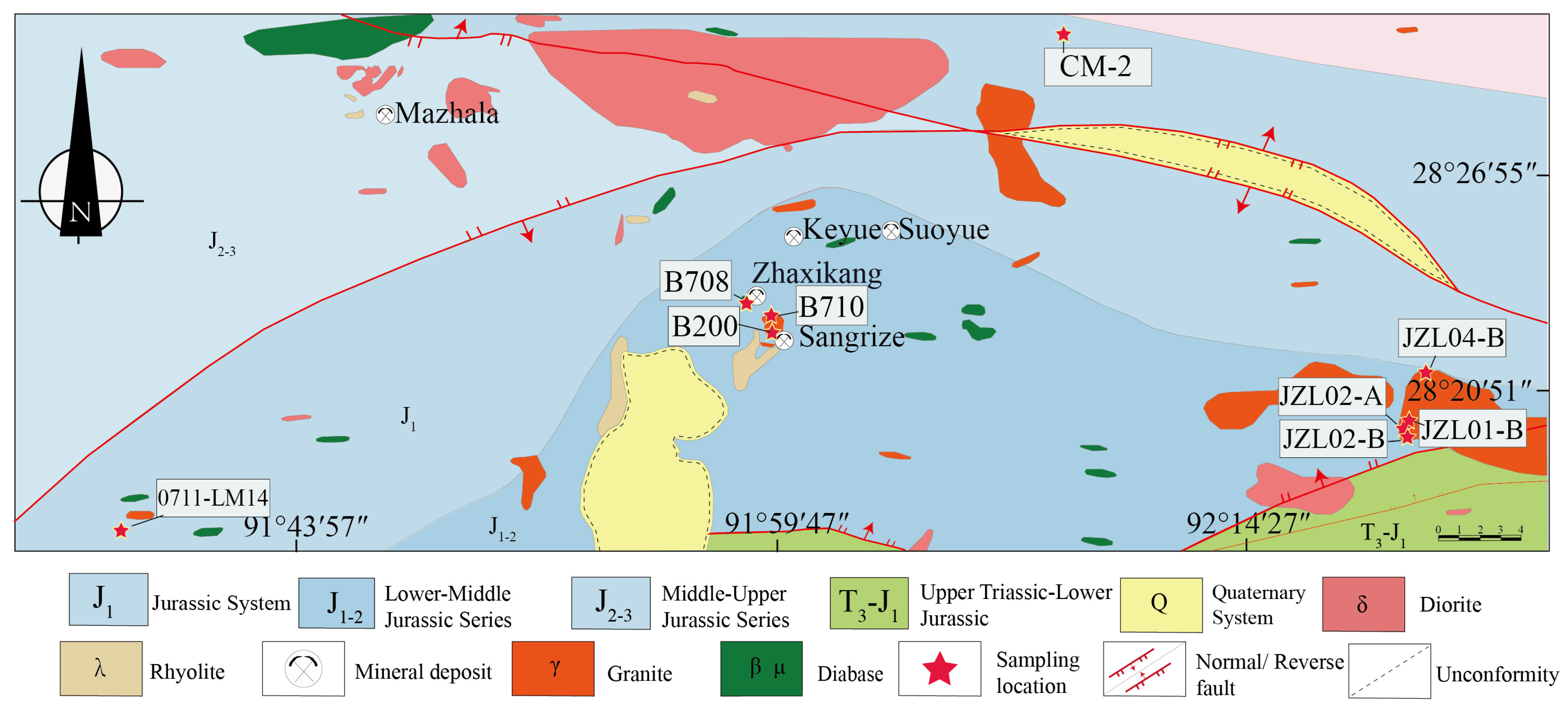
The samples investigated in this study were collected mainly from the Jurassic Ridang Formation (J1) and the Lower-Middle Jurassic Lurê Formation (J1–2) (Figure 2). Numerous hand specimens were collected during fieldwork. Samples selected for analytical work include diabase samples 0711-LM14, CM-2, JZL01-B, JZL04-B, JZL02-B, and B708, and rhyolite samples B710, B200, and JZL02-A. These samples were used selectively for zircon U-Pb geochronology and whole-rock geochemistry. Whole-rock Sr-Nd-Pb isotopic analyses were carried out only on the low-LOI samples JZL01-B, CM-2, B710, and JZL02-A.
Figure 2. Geological map of the Longzi area based on the authors’ field geological mapping. The map shows the distribution of Jurassic stratigraphic units, rhyolite, diabase, granite, faults, mineral deposits, and sampling locations. Intrusive contacts between diabase and rhyolite are constrained by field observations; representative outcrop-scale contact relationships are shown in Figure 3C,D.
Minerals 16 00510 g002
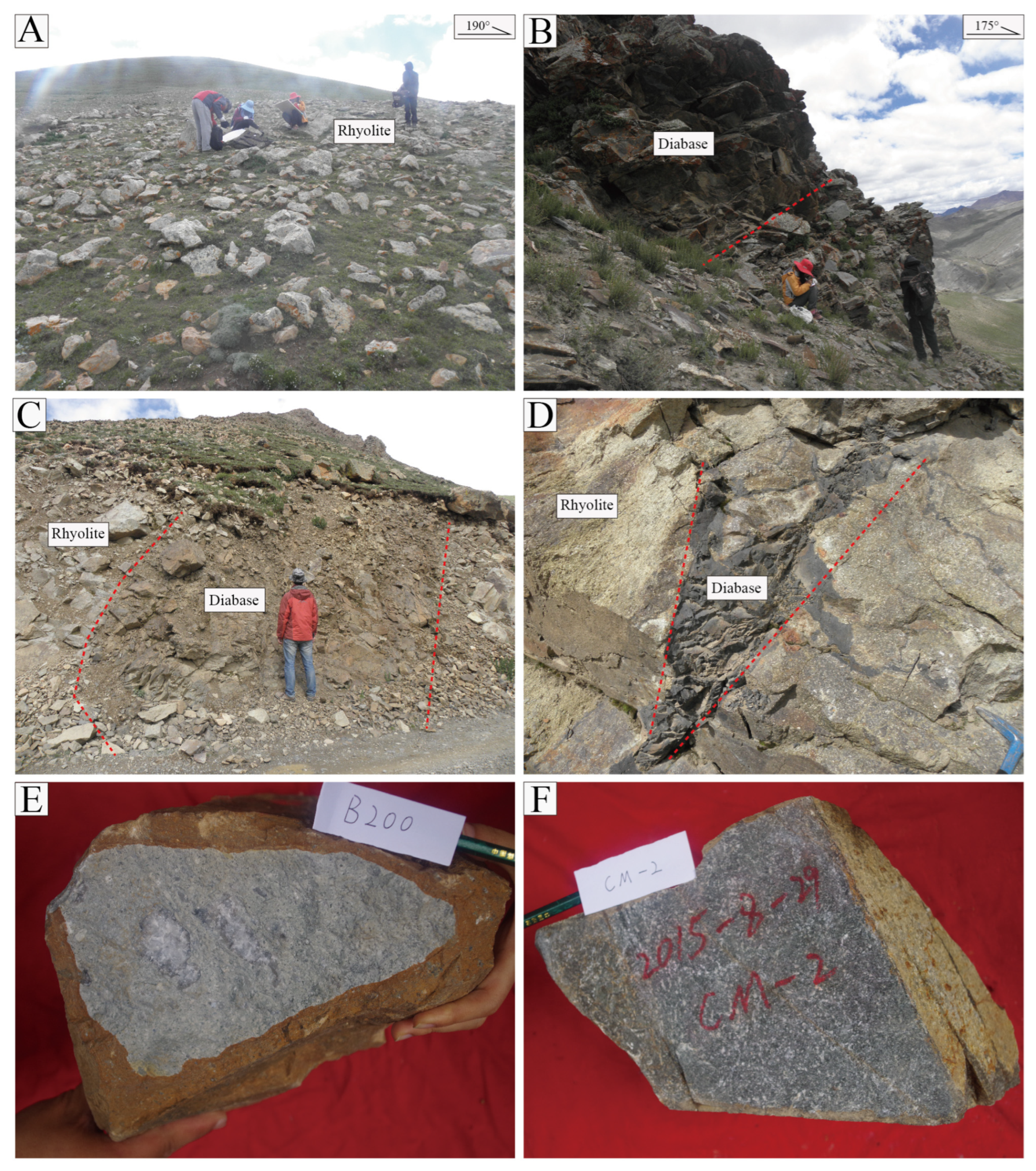
Figure 3. Field photographs and sample images of volcanic rocks from the Longzi Area. (A) Rhyolite overlying the strata. (B) A prominent diabase outcrop with a grayish-green weathered surface; a sandstone layer displaced by strike-slip faulting is apparent. The upper diabase sheet intrudes concordantly for approximately 15 m, whereas the underlying layer is sandstone. (C) Contact zone between a diabase stock and rhyolite. (D) Diabase dike intruding into rhyolite. (E) Photograph of a rhyolite sample. (F) Photograph of a diabase sample.
Minerals 16 00510 g003
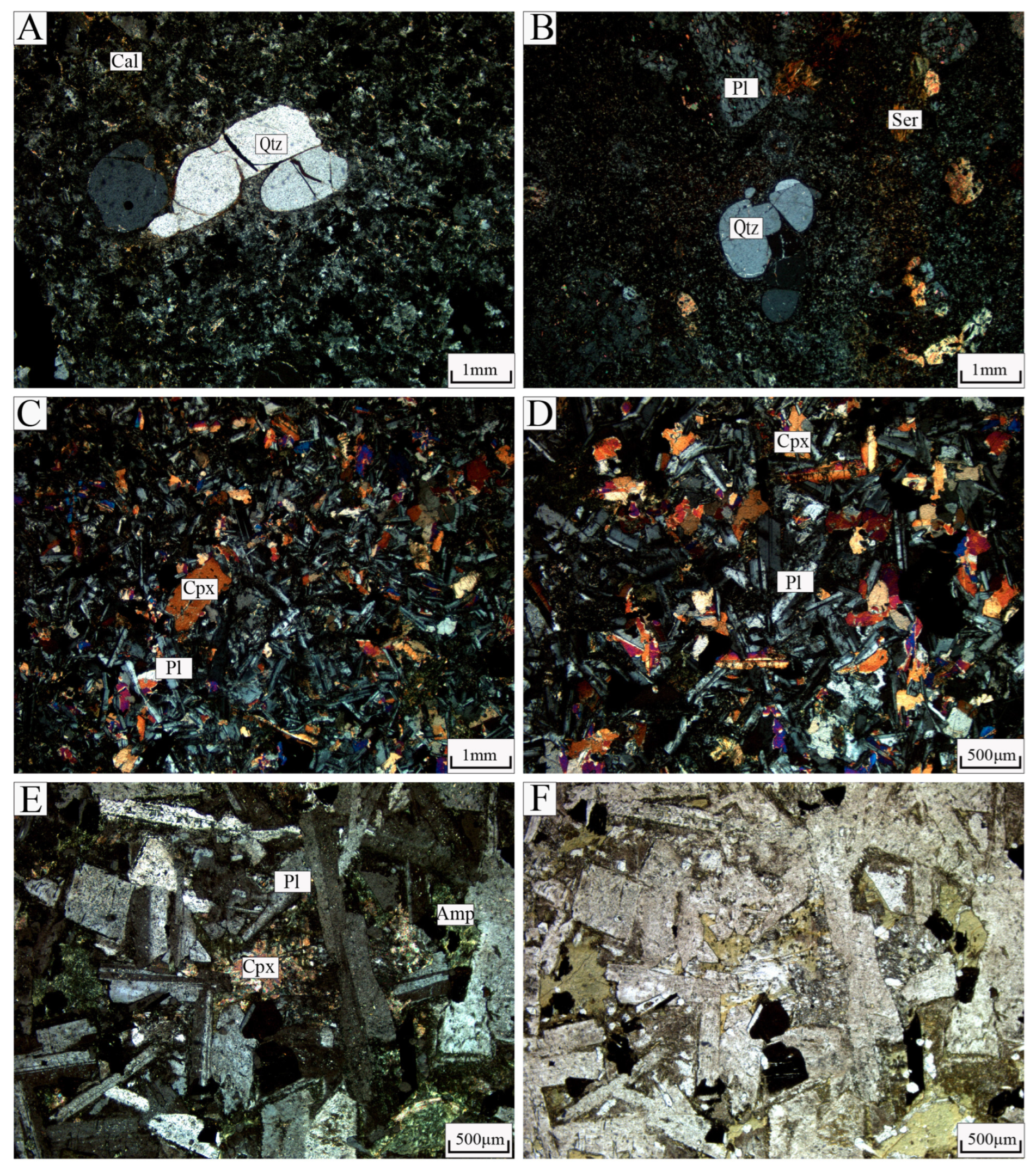
The diabase hand specimens show yellowish-brown weathered surfaces and dark gray to black fresh surfaces. They are massive and fine-grained. Under the microscope, the diabase samples are composed mainly of plagioclase (50%–60%) and clinopyroxene (30%–40%), with minor amphibole, and display a characteristic ophitic texture (Figure 4C–F). Some plagioclase grains are locally turbid owing to weak sericitization.
The rhyolite hand specimens show yellowish-brown weathered surfaces and grayish-white fresh surfaces. They are massive and porphyritic. Phenocrysts are dominated by quartz and plagioclase and are typically 0.6–1.7 mm in size. Some feldspar phenocrysts are altered to sericite and locally argillized. The matrix consists mainly of very fine-grained felsitic material with minor volcanic glass (Figure 4A,B). These petrographic features indicate weak to moderate low-temperature secondary modification rather than pervasive hydrothermal alteration.
In outcrop, the diabase and rhyolite show clear intrusive contact relationships (Figure 3C,D). The diabase occurs mainly as vein-like and dendritic bodies emplaced along fractures and structurally weak zones within the rhyolite. The contact surfaces are locally undulatory and irregular. Bleached zones and baked margins are locally developed along the contacts, indicating thermal modification of the rhyolite during diabase emplacement.
Thin-section observations show that the diabase samples are primarily composed of plagioclase (50%–60%) and clinopyroxene (30%–40%), with minor amphibole, and exhibit a characteristic ophitic texture (Figure 4B–E). Euhedral to subhedral lath-shaped plagioclase crystals (0.3–1.2 mm in length) form a network framework. The plagioclase is mainly labradorite and commonly displays polysynthetic twinning; some crystals are locally turbid owing to sericitization. The interstices of the plagioclase framework are filled with anhedral granular clinopyroxene.
The rhyolite samples display a porphyritic texture under microscopic observation. Phenocrysts consist mainly of quartz and feldspar, with some feldspar grains altered to sericite. The matrix constitutes the bulk of the rock and comprises very fine-grained (<0.02 mm) anhedral felsic minerals with minor volcanic glass (Figure 4A,B).

3. Analytical Methods

3.1. Zircon U-Pb Geochronology and Trace Element Analysis

In this study, six magmatic rock samples from the Longzi area, comprising three diabase and three rhyolite samples, were subjected to zircon U-Pb geochronology and trace-element analysis. Zircon separation and mount preparation were conducted at Hebei Langfang Chenchang Geological Service Co., Ltd. (Langfang, Hebei, China) and Nanjing Hongchuang Co., Ltd.(Nanjing, China). The procedure involved the following steps: First, the outer surfaces of the samples were removed to obtain fresh interior material. The material was then crushed, ground, and processed using conventional gravity- and magnetic-separation techniques. Subsequently, zircon grains with well-developed crystal morphology and high transparency were hand-picked under a binocular microscope. Over 300 zircon grains were selected for analysis. The selected grains were mounted on glass slides using epoxy resin. After the mounts solidified, they were polished to expose the maximum grain cross-sections. The mounts were then imaged under transmitted and reflected light using a polarizing microscope. Cathodoluminescence (CL) images were obtained using a scanning electron microscope equipped with a CL detector (SEM-CL).
Zircon U-Pb dating and trace element analysis were conducted at the Institute of Tibetan Plateau Research, Chinese Academy of Sciences. U-Pb dating and trace element analysis were conducted using a New Wave NWR 213 nm laser ablation system coupled to an Agilent 7900 inductively coupled plasma mass spectrometer (ICP-MS).
Analyses were performed with a 24 μm spot size, 5 Hz repetition rate, and laser energy density of 6 J/cm2 (≈85% power output), using He as the carrier gas (~0.5 L/min).
Detection limits are better than 0.05 μg/g for incompatible elements (Rb, Sr, Pb, Th, U, REE), <0.01 μg/g for HFSEs (Nb, Ta, Zr, Hf), and 0.01–0.5 μg/g for transition metals (V, Cr, Mn, Co, Ni, Cu, Zn).
Zircon standard 91500 [21] was employed as the primary reference material for U-Pb isotope fractionation correction, while the Plesovice zircon standard was used as the internal standard. The analytical session commenced with the analysis of a single spot on the 91500 standard, a single spot on the Plesovice standard, and a single spot on the NIST SRM 610 glass standard for trace elements. Subsequently, after every ten unknown sample analyses, a single spot on the Plesovice standard and a single spot on the SRM 610 standard [22] were analyzed.
Raw data were processed offline using the software ICPMSDataCal 11.0, developed by the research group of Liu Yongsheng at the China University of Geosciences (Wuhan, China). Common lead correction was applied using the ComPbCorr#3 procedure. Concordia diagrams and weighted mean age calculations were generated using the Isoplot 4.11 add-in.

3.2. Whole-Rock Major and Trace Element Analysis

A total of 12 whole-rock major- and trace-element analyses were obtained for volcanic rocks from the Longzi area. The analytical work was carried out collaboratively by ALS Mineral Laboratory and Nanjing Hongchuang Geological Survey Technology Service Co., Ltd. Selected samples were analyzed in parallel between the two laboratories to evaluate inter-laboratory reproducibility.
Sample preparation involved crushing and quartering to obtain approximately 300 g of material, which was then ground to <75 μm (200 mesh). The powdered samples were pre-dried at low temperature and allowed to cool slowly to room temperature. After cooling, the powders were weighed, ignited in a muffle furnace, and re-weighed to determine loss on ignition (LOI). The powder was then divided for major- and trace-element analysis.
Major elements were analyzed using X-ray fluorescence (XRF), and trace elements were analyzed using ICP-MS following digestion/fusion and dilution to volume. Matrix-matched certified reference materials from the Chinese national GBW series of silicate rocks were used for quality control, and all reference materials were within their validity period. For major elements with concentrations > 1%, the relative error between measured and certified values was required to be ≤3%, or the absolute error had to comply with the specifications of GB/T 14506 [23], Analytical Methods for Silicate Rocks. These procedures were used to monitor analytical accuracy and inter-laboratory consistency.
Only the 10 analyses with LOI < 5 wt.% were used in the main-text geochemical figures and in the parts of the interpretation that depend directly on whole-rock geochemistry. The two higher-LOI analyses, B708 and B200, are retained in Table S4 for analytical completeness. All major-element data used for plotting were normalized to 100% on an anhydrous basis.
For trace elements, a combined acid digestion and alkaline fusion method was applied. After digestion/fusion and dilution to volume, the solutions were introduced into an ICP-MS instrument for measurement. The ICP-MS analysis was performed under optimized operating conditions for solution analysis, with detection limits better than 0.05 μg/g for incompatible elements (Rb, Sr, Pb, Th, U, REE), <0.01 μg/g for HFSEs (Nb, Ta, Zr, Hf), and 0.01–0.5 μg/g for transition metals (V, Cr, Mn, Co, Ni, Cu, Zn). A strict quality control protocol was implemented throughout the analysis. Matrix-matched certified reference materials from the Chinese national GBW series of silicate rocks were used. All reference materials were within their validity period. For major elements with concentrations >1%, the relative error (RE) between measured and certified values was required to be ≤3%, consistent with standard requirements for major element analysis, or the absolute error had to comply with the specifications of the national standard GB/T 14506 [23] “Analytical Methods for Silicate Rocks.” This protocol ensured consistency and accuracy of major-element data between the two laboratories, confirming that the whole-rock major- and trace-element data are suitable for scientific research and interpretation.

3.3. Whole-Rock Sr-Nd-Pb Isotopic Analysis

Whole-rock Sr-Nd-Pb isotopic analyses were carried out on four low-LOI samples at Nanjing Hongchuang Geological Survey Technology Service Co., Ltd., including two diabase samples (JZL01-B and CM-2) and two rhyolite samples (B710 and JZL02-A). Regarding Sr isotopes, the precise Sr concentration was initially determined using an Agilent 7900 quadrupole ICP-MS. Subsequently, the stock solution was diluted with 2% HNO3 to produce a 2.0 mL solution containing 50 ppb Sr. This solution was then introduced via a CETAC Aridus III membrane desolvation system into a Neptune XT MC-ICP-MS for the measurement of the 87Sr/86Sr ratio. Instrumental mass bias was corrected internally using 86Sr/88Sr = 0.1194, and external drift correction was performed employing the NIST SRM 987 international standard [24].
For Nd isotopes, the accurate Nd concentration was measured using an Agilent 7900 quadrupole ICP-MS (Agilent Technologies, Santa Clara, CA, USA). Subsequently, the stock solution was diluted with 2% HNO3 to prepare a 2.0 mL solution with 50 ppb Nd. After introduction through the CETAC Aridus III desolvation system, Nd isotopic ratios were analyzed on the Neptune XT MC-ICP-MS. Instrumental mass fractionation was corrected internally assuming 146Nd/144Nd = 0.7219, and the JNdi-1 international standard was employed for external drift correction.
For Pb isotopes, the digested sample solutions were dried and converted to a 0.2 mol/L HBr + 0.5 mol/L HNO3 medium. Pb was separated using a BioRad AG MP-1 anion-exchange column. Lithophile elements were first removed using 0.2 mol/L HBr + 0.5 mol/L HNO3, and the Pb fraction was then eluted using 0.05 mol/L HNO3. The Pb fraction was further purified using a second anion-exchange column, evaporated to dryness, and re-dissolved in 1.0 mL of 2% HNO3. Pb concentrations were measured using an Agilent 7900 quadrupole ICP-MS, and the final Tl-doped solution was introduced into a Neptune XT MC-ICP-MS through a CETAC Aridus III desolvating nebulizer system. Pb isotope ratios were corrected for instrumental mass fractionation using 205Tl/203Tl = 2.3885, and NIST SRM 981 was periodically analyzed to monitor instrumental drift and analytical reproducibility.

4. Analytical Results

4.1. Zircon U-Pb Geochronology and Trace-Element Results

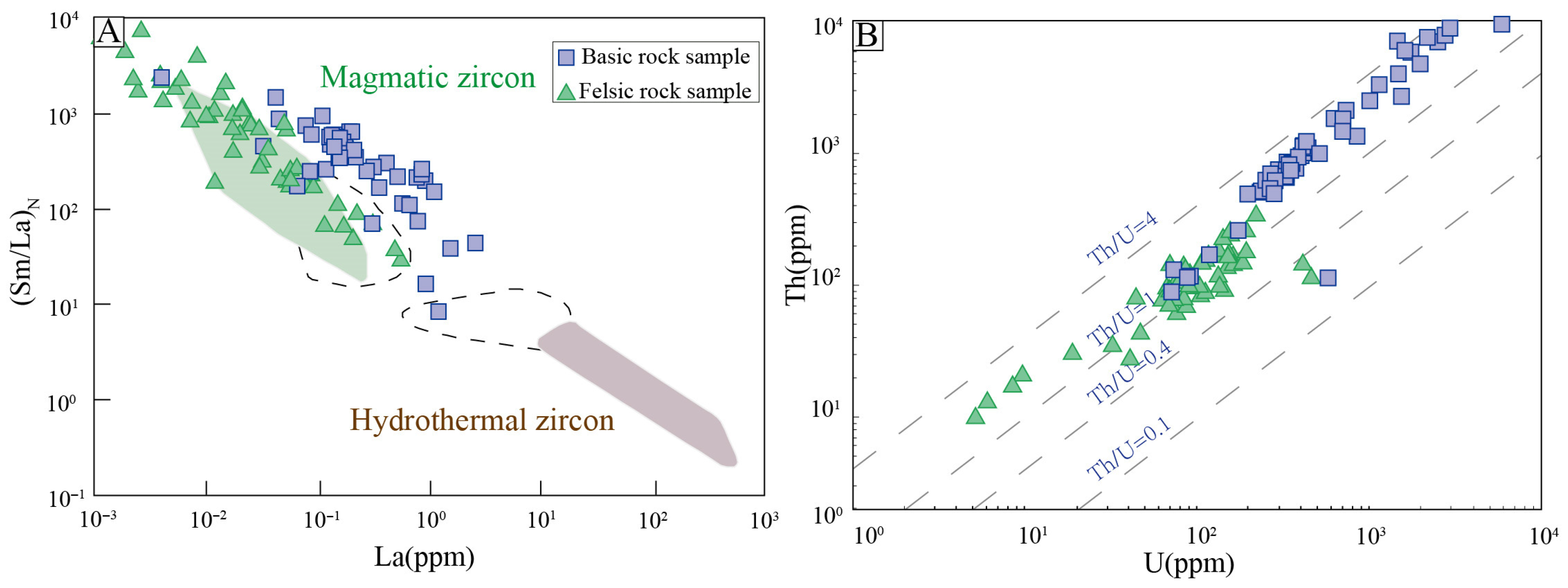
The zircon U-Pb isotopic results are presented in Supplementary Table S2, the zircon trace-element results in Supplementary Table S3, and the concordia diagrams and weighted mean ages are shown in Figure 5. Representative cathodoluminescence (CL) images of zircon are displayed in Figure 6, and zircon trace element discriminant diagrams are provided in Figure 7.
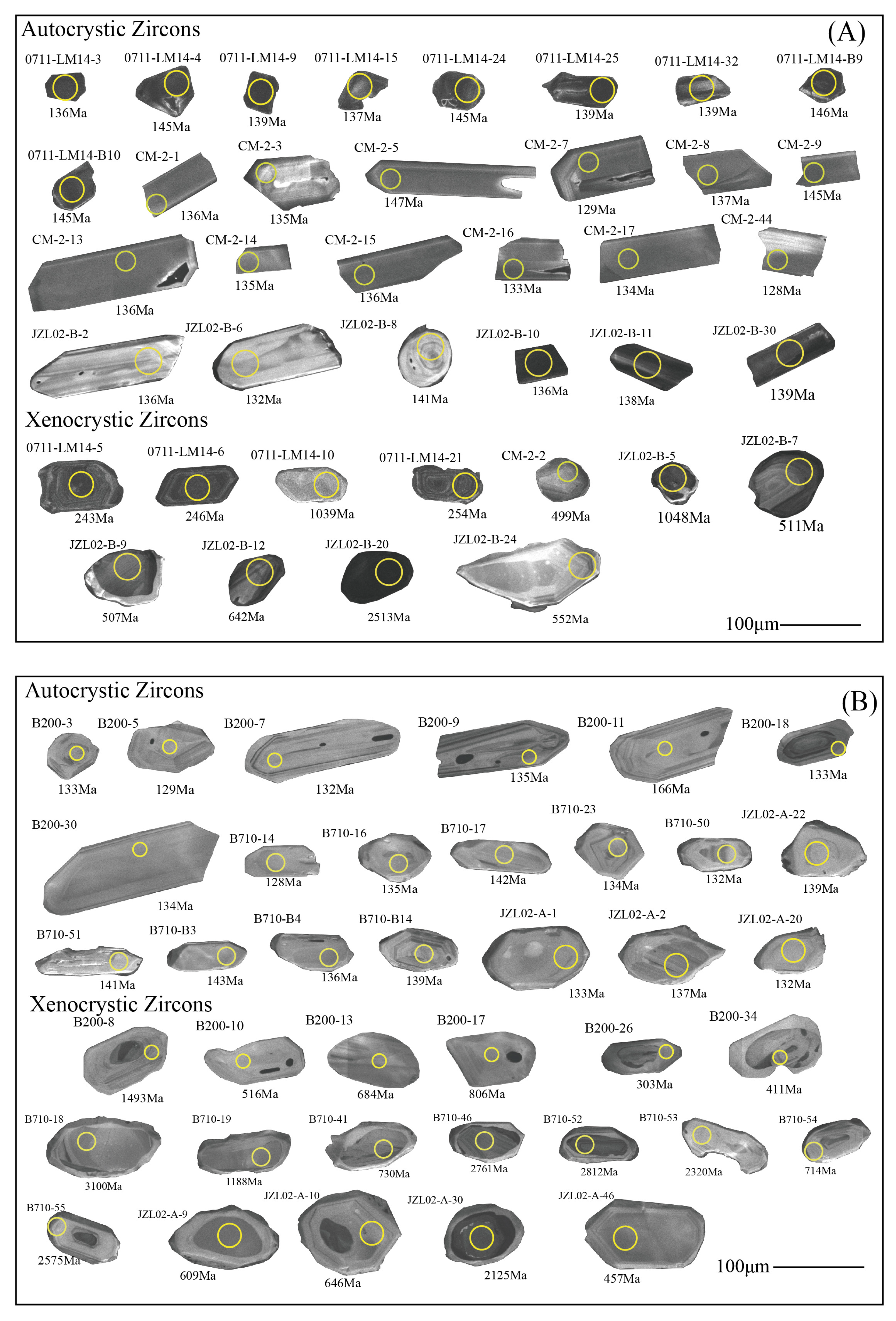
The selected zircon crystals demonstrate well-developed, predominantly euhedral morphologies, primarily presenting as granular or elongate prismatic forms with length-to-width ratios ranging from 1.5 to 5.8. Under transmitted light, the majority of grains are transparent and colorless. Cathodoluminescence (CL) images indicate that most zircons display distinct oscillatory zoning. Both the morphology and internal structure are indicative of typical magmatic origins of zircon [25].
The mafic rock samples consist of three diabase specimens, numbered 0711-LM14, CM-2, and JZL01-B. They are distributed across the western Quzhuomu area, northern Pumang, and eastern Shuyulang, respectively.
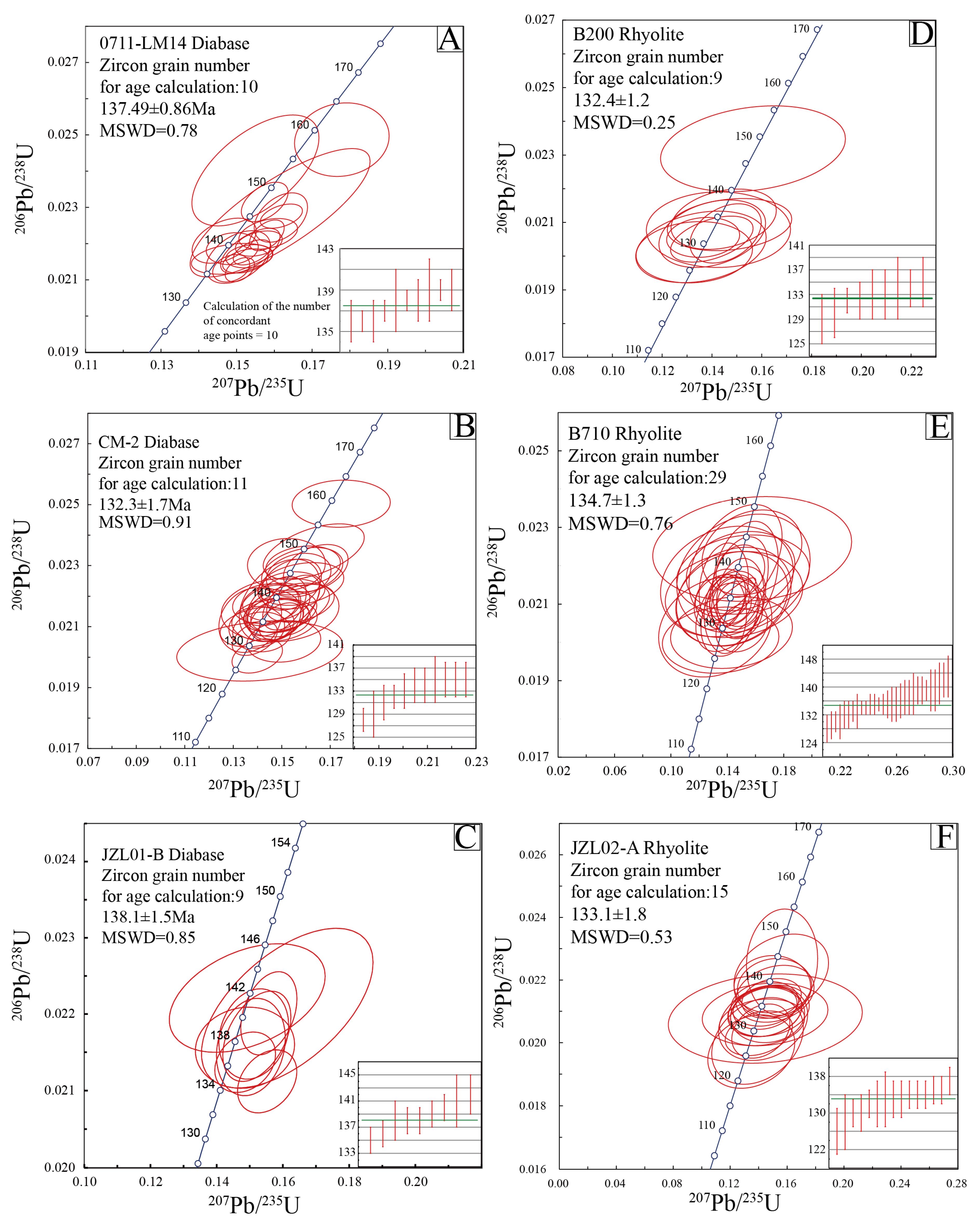
For sample 0711-LM14, a total of 75 zircon grains were analyzed (Figure 5A). Ten concordant analyses were used for age calculation. Fourteen grains were excluded because of concordance below 90%, and two additional grains were disregarded because of large analytical uncertainties. The younger zircon population yields ages concentrated between 136 Ma and 148 Ma, whereas the remaining inherited/xenocrystic zircons range from 232 Ma to 300 Ma. The weighted mean age calculated from the younger population is 137.49 ± 0.86 Ma. This result is consistent with a zircon U-Pb age of 142.0 ± 2.5 Ma reported by Dong Suiliang et al. (2016) for a dacite from the Quzhuomu area [26].
For sample CM-2, 44 zircon grains were analyzed (Figure 5B). Eleven concordant analyses were used for age calculation. Nine grains were excluded because of concordance below 90%. The analyzed zircons are mostly prismatic, and their ages are tightly clustered, with only a minor population of inherited/xenocrystic grains. The calculated weighted mean age is 132.3 ± 1.7 Ma.
For sample JZL01-B, 31 zircon grains were analyzed (Figure 5C). Nine concordant analyses were used for age calculation. Four grains were excluded because of concordance below 90%, and seven others were disregarded because of large analytical uncertainties. The calculated weighted mean age is 138.1 ± 1.5 Ma. This result is consistent with a zircon U-Pb age of 134.9 ± 2.3 Ma reported by Lü Xiaochun et al. (2016) for a dacite sample collected near the Shuyulang area [27]. In summary, the three diabase samples yield ages clustering around 135 Ma, all of which belong to the Early Cretaceous. These ages are consistent with those obtained from coeval felsic volcanic rocks in the same region.
The three rhyolite samples yield ages clustering around 134 Ma, closely matching the crystallization ages of the coeval diabase suite. Sample B200 yields an age of 132.4 ± 1.2 Ma based on 9 analyses; sample B710 yields an age of 134.7 ± 1.3 Ma based on 29 analyses; and sample JZL02-A yields an age of 133.1 ± 1.8 Ma based on 15 analyses. These data indicate temporally overlapping Early Cretaceous magmatism in the Longzi area. Zircon trace-element analysis further supports a magmatic origin: most grains exhibit low La concentrations and plot within the field of magmatic zircon on the (Sm/La)N vs. La (ppm) discrimination diagram (Figure 7A) [28]. In addition, most grains show Th/U ratios typical of magmatic zircon (Figure 7B) [29,30].
Figure 7. Zircon Trace-Element Discrimination Diagrams for the Longzi Area. (A) Chondrite-normalized (Sm/La)N vs. La (ppm) discrimination diagram [28]. The subscript N denotes chondrite-normalized values following the original discrimination scheme. (B) Th (ppm) vs. U (ppm) diagram for zircon.
Minerals 16 00510 g007

4.2. Whole-Rock Major and Trace Element Results

4.2.1. Major Elements

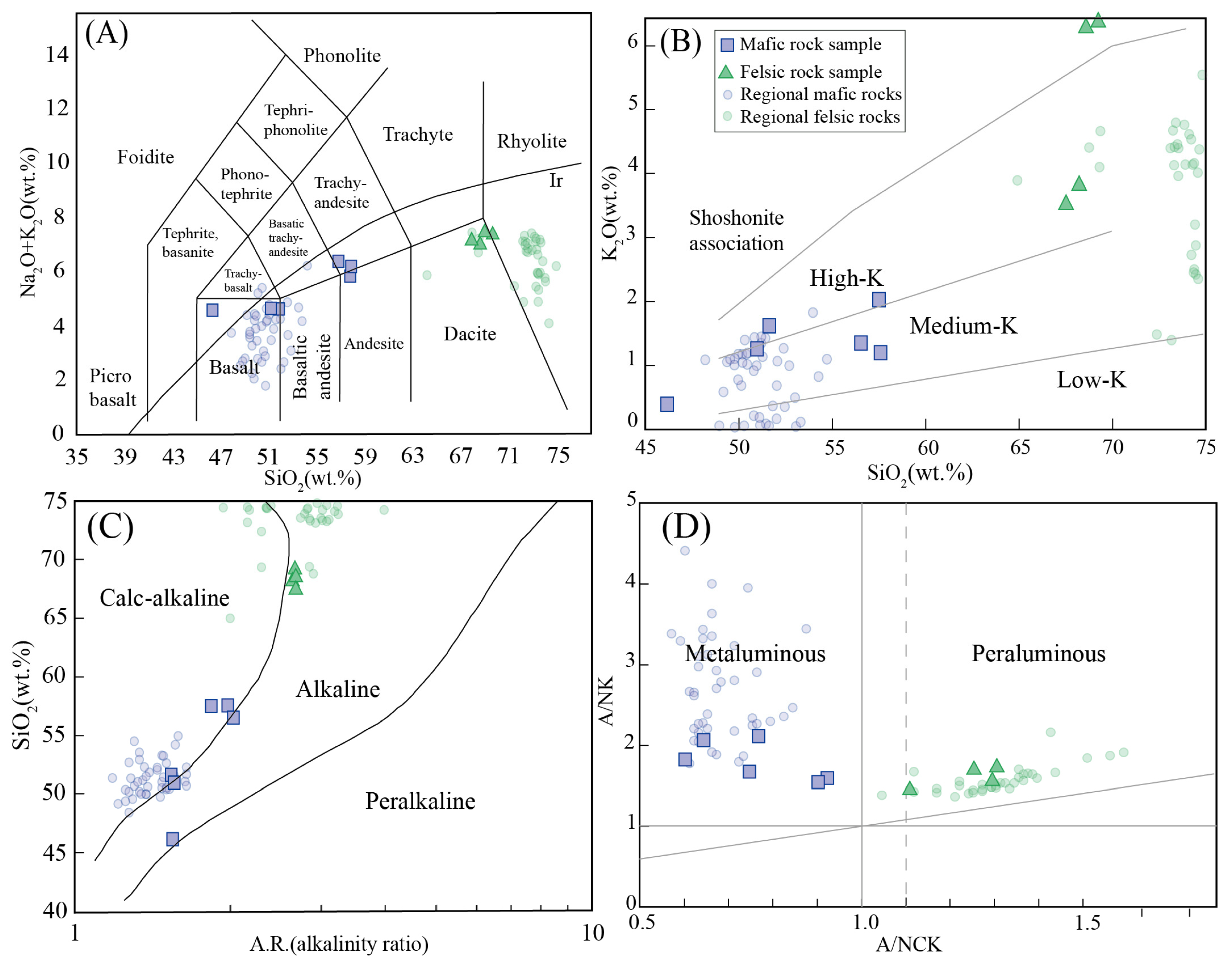
Table S4 reports 12 whole-rock major- and trace-element analyses for the Longzi volcanic rocks. Of these, 10 analyses have LOI values < 5 wt.% and were used in the main-text major-element discrimination diagrams and in major-element-based interpretation. The two higher-LOI analyses, B708 (diabase; LOI = 5.52 wt.%) and B200 (rhyolite; LOI = 7.39 wt.%), are retained in Table S4 for analytical completeness.
The 10 low-LOI analyses used for interpretation comprise six diabase analyses and four rhyolite analyses. The retained diabase analyses have SiO2 contents of 44.8–56.5 wt.%, whereas the retained rhyolite analyses have SiO2 contents of 65.3–66.9 wt.%, defining a pronounced compositional gap between the mafic and felsic end-members. To reduce the uncertainty associated with the limited number of newly analyzed samples, published regional whole-rock data were compiled and plotted together with the Longzi samples in Figure 8. The regional dataset includes 43 mafic analyses from [5,15,18,31] and 34 felsic analyses from [17,18,32,33]. These published data also define a mafic–felsic distribution and do not form a continuous intermediate compositional trend, supporting the interpretation that the Longzi rocks represent a local expression of a broader Early Cretaceous mafic–felsic volcanic association in the Tethyan Himalaya. On the TAS diagram [34], the diabase samples plot mainly in the basalt field, whereas the rhyolite samples plot in the rhyolite to dacite fields depending on the classification scheme used.
The retained rhyolite analyses are characterized by relatively high K2O contents, peraluminous compositions, and A/NCK values of 1.09–1.28. On the SiO2 (wt.%) vs. K2O (wt.%) diagram [35], they plot mainly within the high-K calc-alkaline to shoshonitic fields. On the A.R. versus SiO2 (wt.%) diagram [36], they define a felsic trend from calc-alkaline to alkaline affinity. On the A/NCK versus A/NK diagram [37], they plot in the peraluminous field. The retained diabase analyses are metaluminous, with A/NCK values of 0.60–0.91, and plot mainly within the calc-alkaline to high-K calc-alkaline fields on the major-element classification diagrams [35,36,37].
Together, these data define a mafic–felsic volcanic association in the Longzi area. Because the main-text major-element figures are based only on the low-LOI subset, the compositional interpretation presented below refers specifically to this filtered interpretive dataset.

4.2.2. Trace Elements

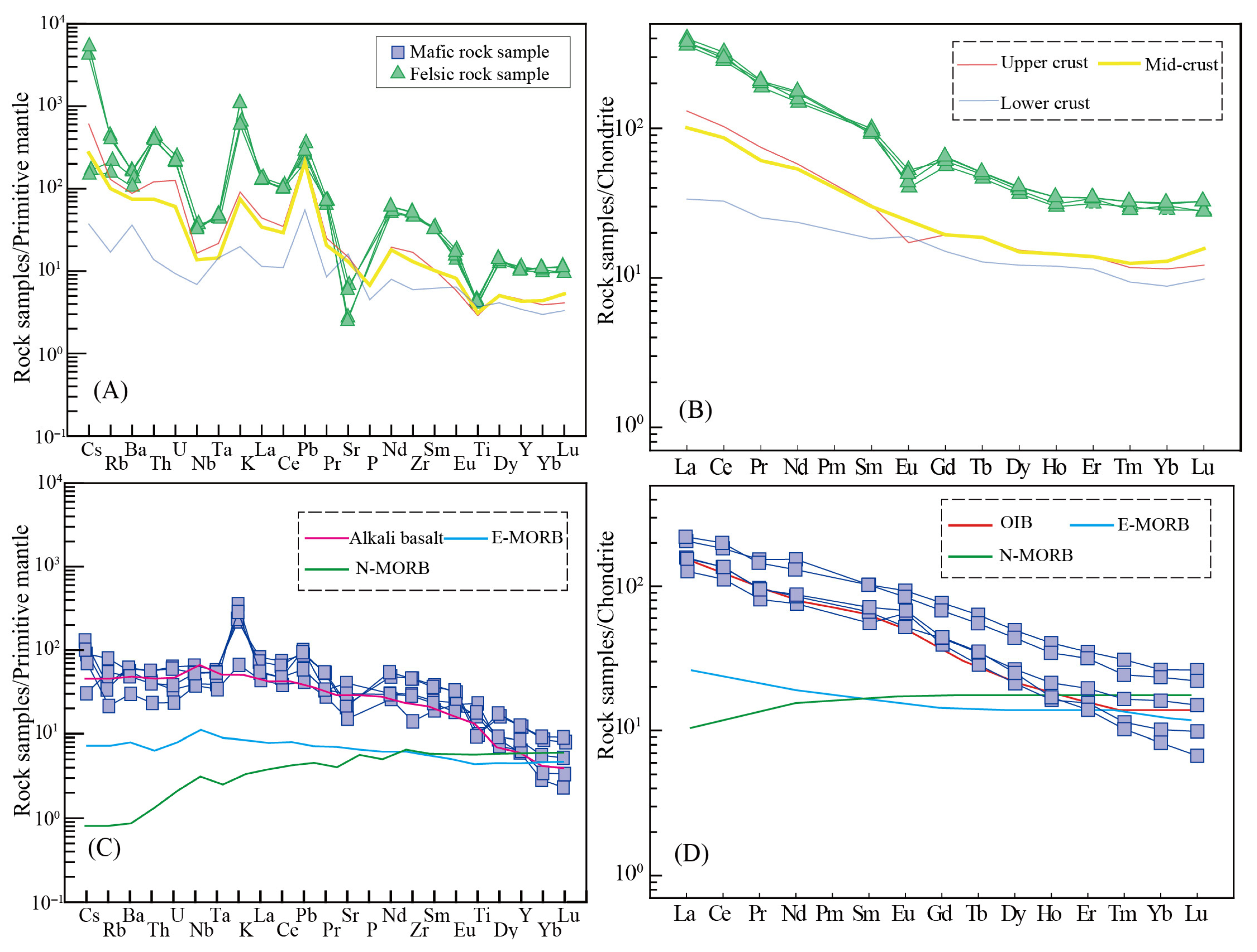
In contrast to the major-element discussion, the trace-element interpretation focuses mainly on REE-HFSE systematics, which are less sensitive to weak low-temperature alteration than alkalis and other mobile components. In the main-text trace-element figures, only the low-LOI subset is shown. The two higher-LOI analyses, B708 and B200, are retained in Table S4 for analytical completeness. Primitive mantle-normalized trace-element spider diagrams and chondrite-normalized REE patterns were plotted using the normalization values of Sun and McDonough [38].
The low-LOI rhyolite analyses show high total REE contents, enriched LREEs relative to HREEs, and pronounced negative Eu anomalies in Figure 9A,B Their chondrite-normalized REE patterns display consistent right-inclined trends, and the primitive-mantle-normalized trace-element patterns are characterized by enrichment in Rb and Th and depletion in Ba, Nb, Sr, P, and Ti. These features are consistent with substantial feldspar-controlled fractionation and/or residual feldspar in the source, together with the involvement of apatite and Fe-Ti oxide phases.
The low-LOI diabase analyses show moderate LREE enrichment and lack significant Eu anomalies in Figure 9C,D, indicating limited plagioclase fractionation. Their primitive-mantle-normalized trace-element patterns are enriched in HFSEs such as Nb and Ta. Taken together, the low-LOI trace-element dataset defines geochemically coherent mafic and felsic groups in the Longzi area.

4.3. Sr-Nd-Pb Isotopic Characteristics

To further constrain the source characteristics of the volcanic rocks, whole-rock Sr-Nd-Pb isotopic analyses were obtained for four low-LOI samples from the Longzi area, including two diabase samples (JZL01-B and CM-2) and two rhyolite samples (B710 and JZL02-A) (Table S1). Initial isotope ratios were calculated using the corresponding zircon U-Pb crystallization ages of the analyzed samples, namely 138.1 ± 1.5 Ma for JZL01-B, 132.3 ± 1.7 Ma for CM-2, 134.7 ± 1.3 Ma for B710, and 133.1 ± 1.8 Ma for JZL02-A.
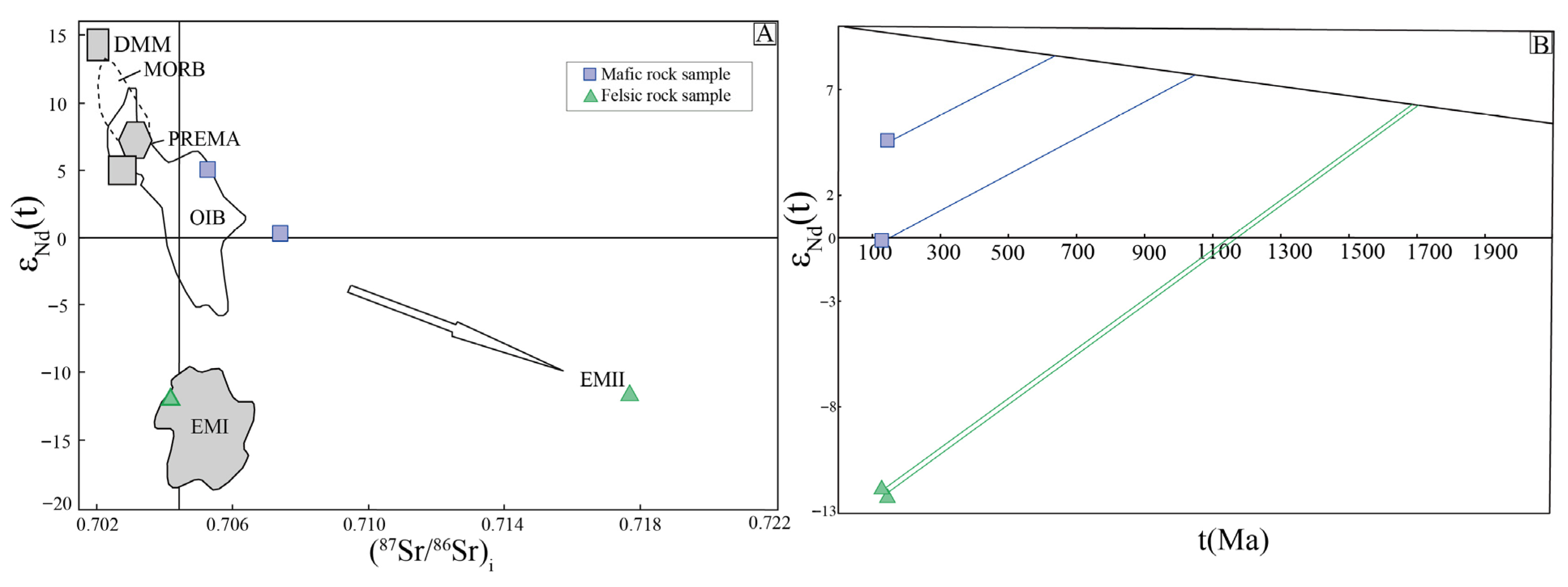
The two diabase samples yield εNd(t) values from −0.2 to +4.4, consistent with derivation from an isotopically more juvenile mantle-derived source. In contrast, the two rhyolite samples yield markedly lower εNd(t) values, from −12.2 to −11.9, indicating involvement of an older crustal source. This strong Nd-isotopic contrast between the mafic and felsic rocks supports derivation from distinct magma sources [40,41].
The rhyolite samples show more radiogenic measured Sr isotopic compositions than the diabase samples, but whole-rock Sr in felsic rocks is treated with caution because of the high Rb/Sr ratios and the sensitivity of Sr to post-magmatic disturbance. On the (87Sr/86Sr)i versus εNd(t) diagram (Figure 10A) [42], the diabase samples plot near OIB-like fields and are clearly separated from the rhyolite samples in Nd isotopic composition. The age versus εNd(t) diagram (Figure 10B) further shows that the samples are temporally comparable but isotopically distinct, supporting derivation from different source reservoirs [40,41].
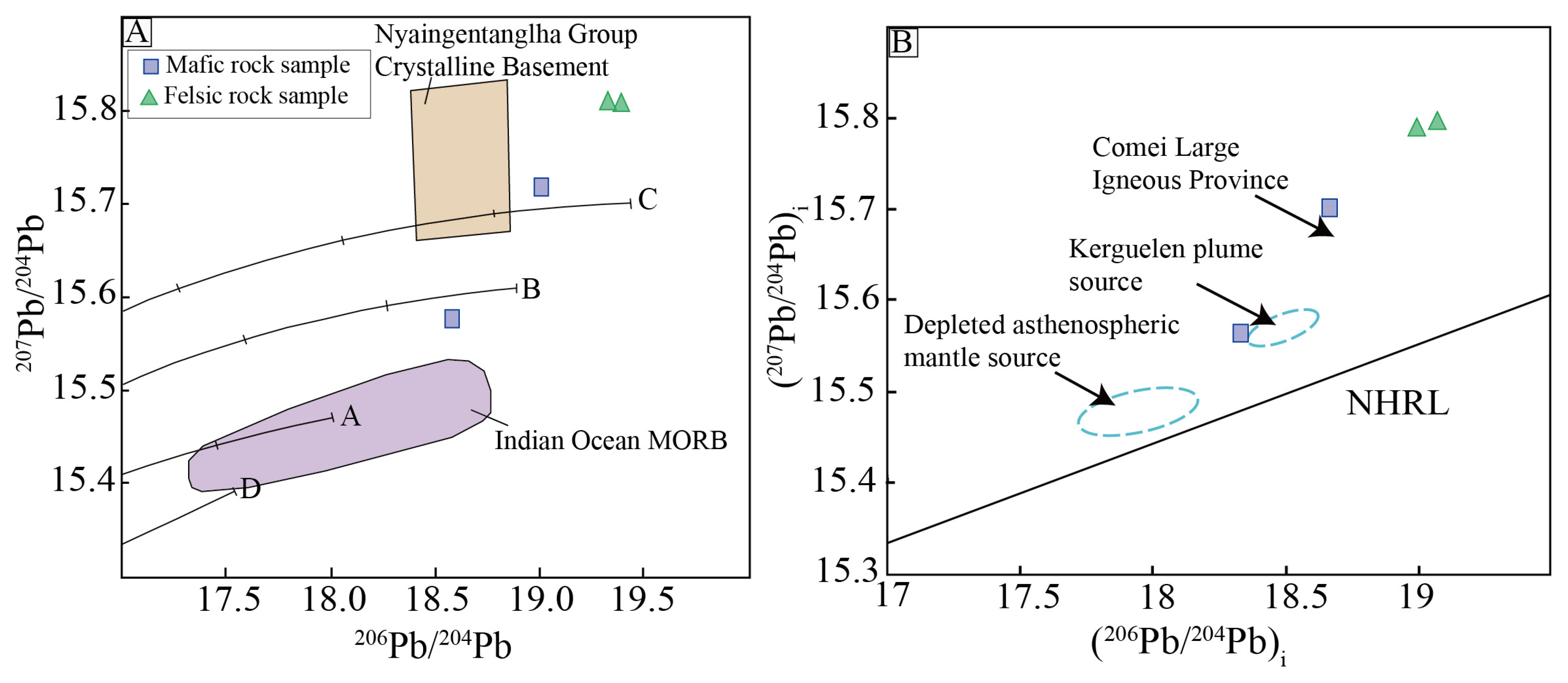
The Pb-isotopic compositions of the diabase samples are less radiogenic than those of the rhyolite samples (Figure 11). The two rhyolite samples cluster near relatively radiogenic Pb-isotopic values consistent with an upper-crustal contribution, whereas the diabase samples plot closer to mantle-derived fields. Pb isotopes are used only as a supporting rather than standalone constraint on magma source characteristics. Taken together with the Nd-isotopic data, these results support isotopically distinct mafic and felsic magma sources in the Longzi area [43,44].

5. Discussion

5.1. Petrogenesis of the Mafic Rocks

The whole-rock interpretation of the mafic rocks is based on six low-LOI diabase analyses. Petrographically, these rocks are dominated by plagioclase and clinopyroxene, but minor amphibole is present, and some plagioclase grains are locally turbid owing to weak sericitization. These features provide a petrographic basis for the observed LOI values in shallow-level mafic volcanic/hypabyssal rocks and do not, by themselves, indicate that the whole-rock data are unsuitable for interpretation.
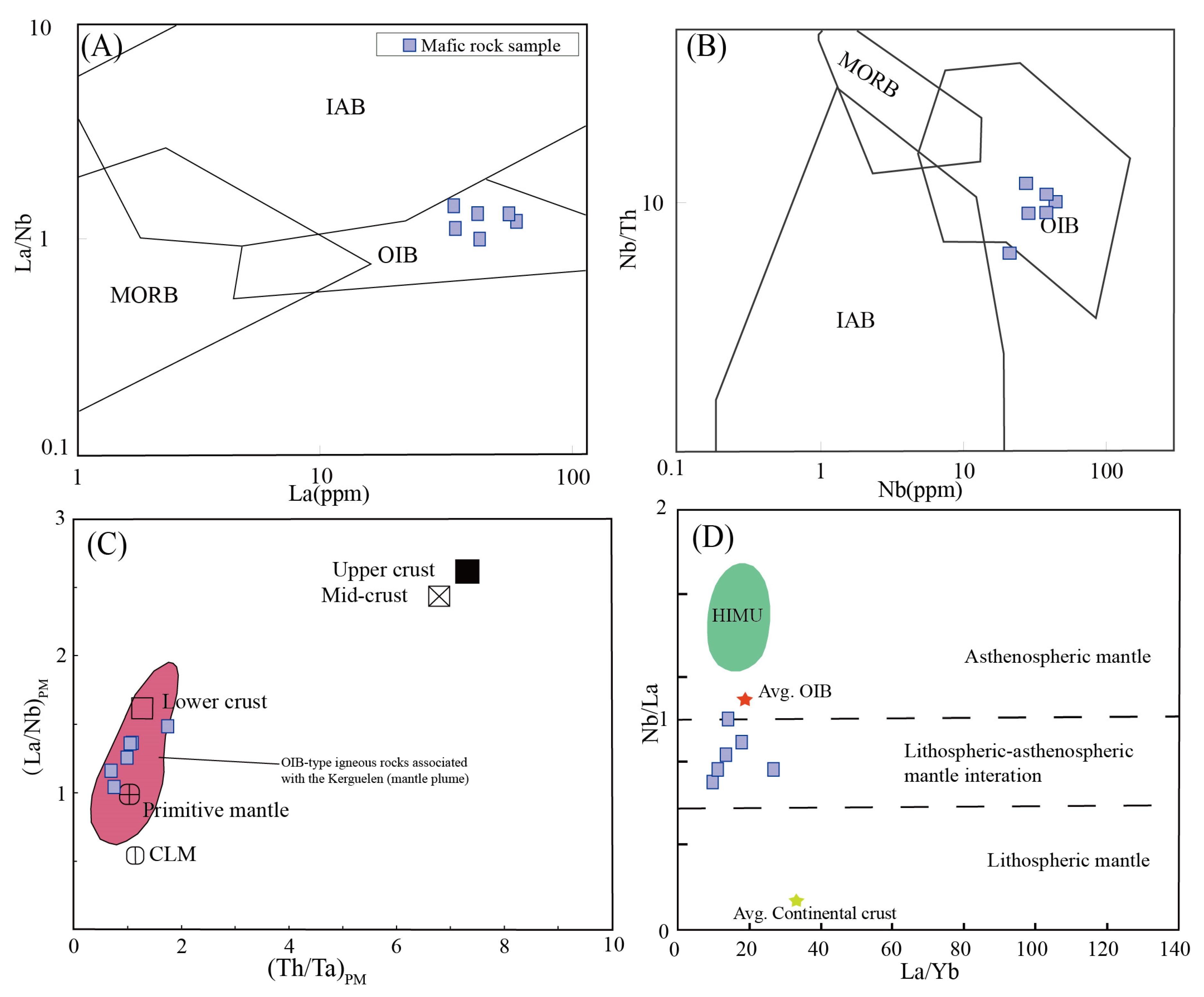
The low-LOI diabase samples show OIB-like REE-HFSE characteristics. Their Nb/Th and La/Nb ratios place them within or close to the OIB field on the Nb versus Nb/Th and La versus La/Nb discrimination diagrams (Figure 12A,B) [45]. The petrogenetic discussion below therefore relies chiefly on relatively immobile trace elements, especially REEs and HFSEs, together with isotopic constraints, rather than on major elements alone.
Calculated trace-element ratios for the low-LOI diabase samples are as follows: Nb/La = 0.70–1.00, Hf/Ta = 3.14–5.86, La/Ta = 17.23–24.05, and Ti/Y = 213.94–1038.98. In general, within-plate basalts, transitional MORB, and enriched MORB are characterized by Nb/La > 1, Hf/Ta < 5, La/Ta ≤ 15, and Ti/Y ≥ 350, which contrasts with the characteristics of island-arc basalts and some depleted MORB [46]. Although the Longzi diabase samples exhibit OIB-like signatures on the Nb–Nb/Th and La–La/Nb diagrams [45], their Nb/La and La/Ta ratios indicate that the magmas were not simple unmetasomatized OIB-type melts. Because the continental crust is characterized by a pronounced negative Nb–Ta anomaly relative to La and other highly incompatible elements [47,48,49], these features suggest that the magma source and ascent history involved interaction with lithospheric mantle components rather than significant bulk upper-crustal contamination.
On the (Th/Ta) PM versus (La/Nb) PM diagram (Figure 12C), most samples plot close to the primitive mantle field and do not trend toward the middle-upper crust, indicating that contamination by felsic upper crust was limited [16]. Similarly, on the Nb/La versus La/Yb diagram (Figure 12D), the samples plot mainly within the field representing interaction between the asthenospheric mantle and the lithospheric mantle, rather than within the fields typical of strong crustal or crust-mantle mixing [50].
Mantle-plume-derived magmas typically show La/Ta ratios of approximately 8–15. When such melts interact with lithospheric mantle material, the La/Ta ratio can increase markedly, whereas La/Sm commonly remains comparatively stable [51]. The low-LOI diabase samples in this study show La/Ta ratios of 17.23–24.05 and La/Sm ratios of 3.06–3.70. These values indicate that the magma source approximated a primitive mantle composition but was modified by limited interaction with the lithospheric mantle during ascent or storage.
Therefore, the diabase magmas in the Longzi area are interpreted to have been derived mainly from a primitive mantle-like source and modified by limited interaction with the lithospheric mantle. Their whole-rock geochemical signatures do not indicate substantial bulk crustal contamination, although localized crustal entrainment and/or limited assimilation may have occurred during magma ascent or storage.
Figure 12. Discrimination diagrams for petrogenetic classification and crust-mantle interaction processes of diabase from the Longzi Area. (A) La/Nb vs. La (ppm) diagram [45]. (B) Nb/Th vs. Nb (ppm) diagram [45]. (C) (La/Nb)PM vs. (Th/Ta)PM diagram [16]. The subscript PM denotes primitive-mantle-normalized values. (D) Nb/La vs. La/Yb diagram [50]. OIB—ocean island basalt; MORB—mid-ocean ridge basalt; IAB—island-arc basalt; CLM—continental lithospheric mantle; HIMU—high-μ (high U/Pb). Avg. OIB—average ocean-island basalt; Avg. continental crust—average continental crust.
Minerals 16 00510 g012
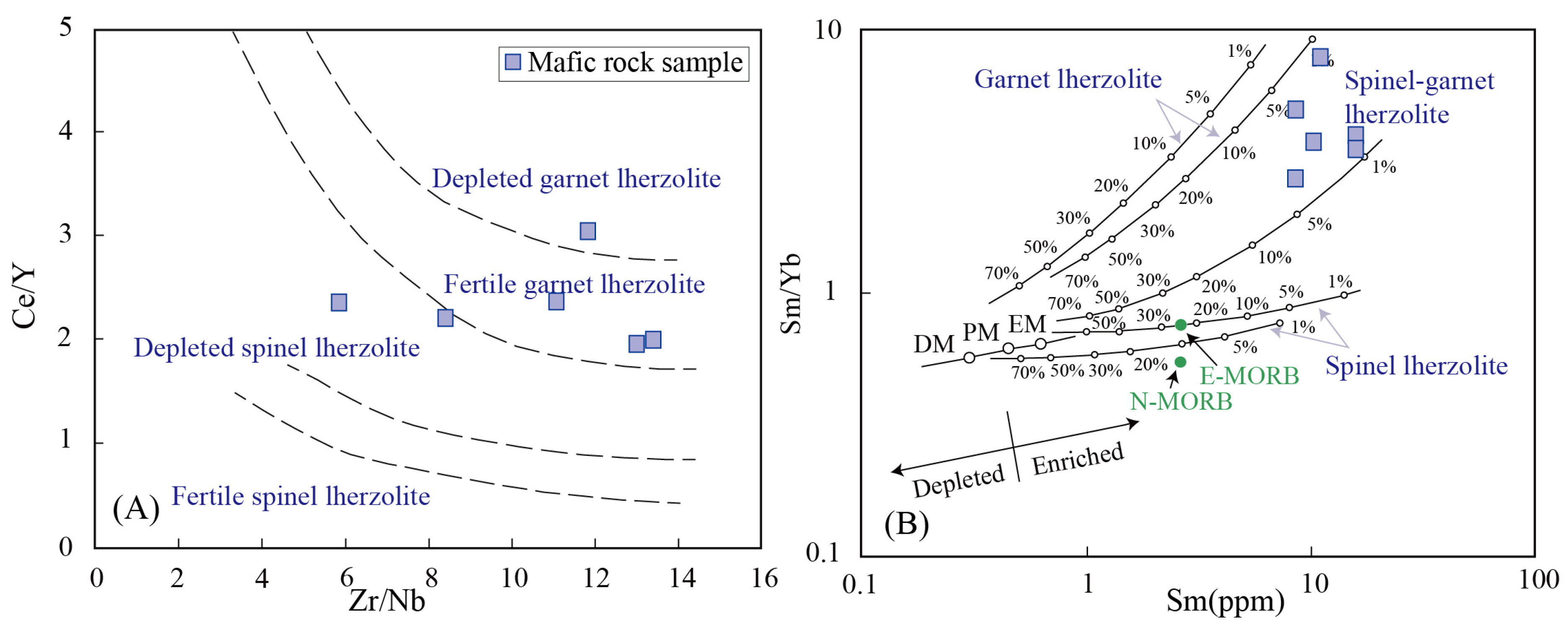
The source characteristics can be further investigated using the Zr/Nb vs. Ce/Y diagram (Figure 13A). The chemical composition of mafic volcanic rocks is significantly influenced by their source materials. In this diagram, the sample points are clustered between the fields of garnet lherzolite and depleted garnet lherzolite, with a few plotting between depleted spinel lherzolite and garnet lherzolite. This indicates a close genetic relationship between the studied samples and magmas derived from the partial melting of garnet lherzolite. Generally, during low-degree partial melting of garnet lherzolite, a significant fractionation of heavy rare earth elements (HREEs) occurs, resulting in high Ce/Yb ratios [52]. The mafic rock samples in this study exhibit relatively high Ce/Yb ratios, ranging from 25 to 60. This is further supported by the Sm/Yb vs. Sm (ppm) diagram (Figure 13B), in which all the analyzed mafic samples plot near the field of spinel–garnet lherzolite (with garnet > spinel). These features indicate that the Longzi mafic rocks originated from the partial melting of a spinel–garnet lherzolite source.

5.2. Petrogenesis of the Felsic Rocks

The whole-rock interpretation of the felsic rocks is based on four low-LOI rhyolite analyses shown in the main-text geochemical figures. The higher-LOI rhyolite analysis B200 is retained in Table S4 for analytical completeness, but it is excluded from the main-text whole-rock geochemical interpretation.
The rhyolite samples record weak to moderate low-temperature secondary modification. Some feldspar phenocrysts are altered to sericite and locally argillized, and the very fine-grained felsitic groundmass with minor volcanic glass is more susceptible to hydration and alteration than coarse plutonic mineral assemblages. For this reason, the whole-rock discussion below is restricted to the low-LOI rhyolite subset.
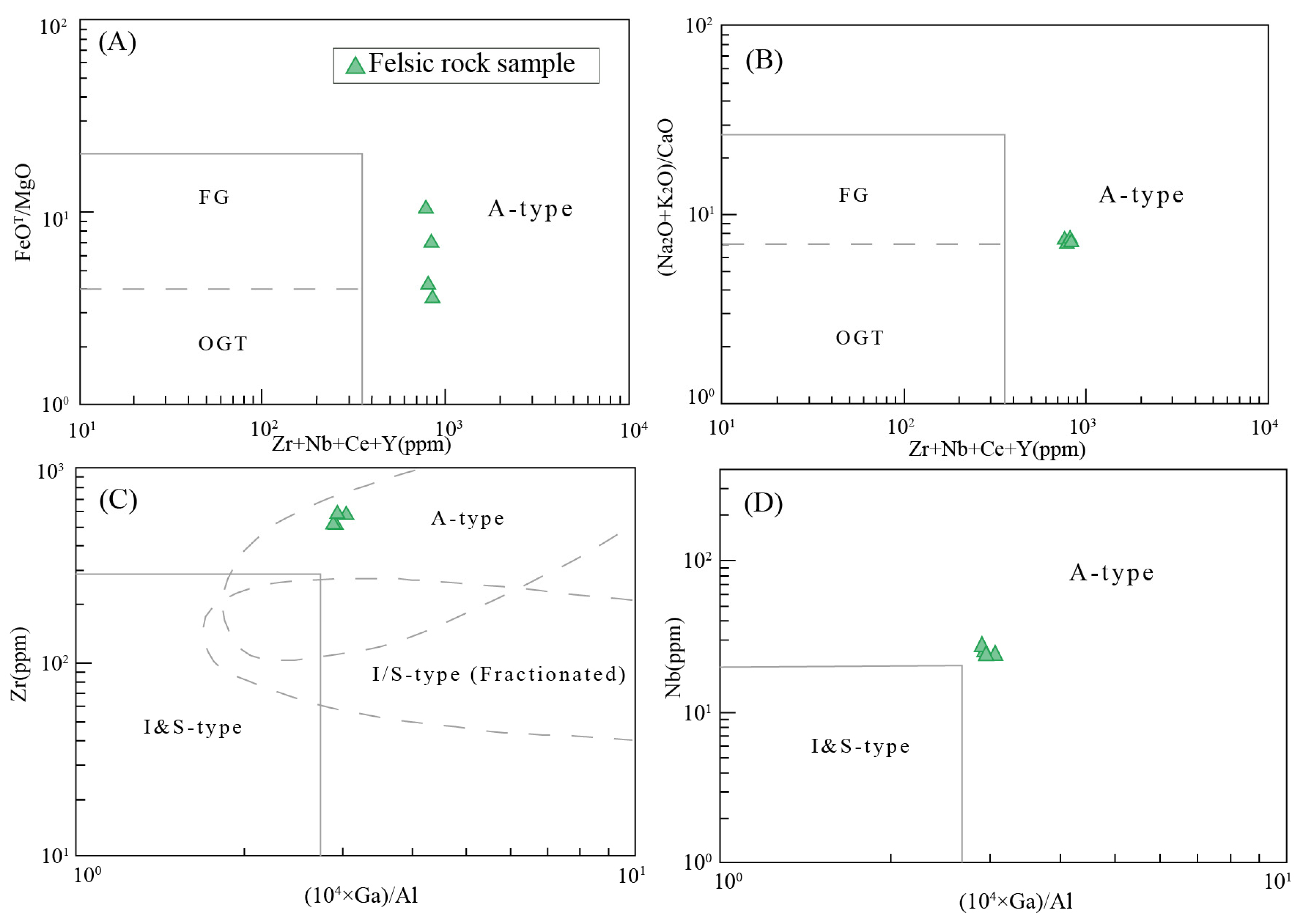
In the low-LOI interpretive subset, four rhyolite analyses are used for whole-rock geochemical discussion. All four low-LOI rhyolite analyses exhibit calc-alkaline to alkaline and peraluminous characteristics. Felsic igneous rocks are commonly classified into I-type, S-type, M-type, and A-type groups on the basis of distinct geochemical signatures [55]. A-type granites are typically characterized by elevated FeOᵀ/MgO ratios and enrichment in high-field-strength elements and REEs [56,57,58]. The low-LOI rhyolite samples of the Longzi area show FeOᵀ/MgO ratios of 3.5–10.3, together with elevated concentrations of Th, U, Ce, and LREEs, and low concentrations of Sr and Ti. On the discrimination diagrams of FeOᵀ/MgO vs. (Zr + Nb + Ce + Y) (ppm) (Figure 14A), (Na2O + K2O)/CaO vs. (Zr + Nb + Ce + Y) (ppm) (Figure 14B), Zr (ppm) vs. (104 × Ga/Al) (Figure 14C), and Nb (ppm) vs. (104 × Ga/Al) (Figure 14D), all samples plot within the A-type granite field [57,59].
Zircon saturation thermometry yields calculated magma temperatures of 911–928 °C [60], which are consistent with the high-temperature nature of A-type felsic magmatism. The petrogenesis of such felsic rocks is generally attributed either to extensive fractional crystallization of mantle-derived alkaline basaltic magma or to partial melting of the crust in an intracontinental extensional setting [56,57,58]. These two genetic pathways produce felsic melts with significantly different geochemical signatures.
The low-LOI rhyolite samples have A/CNK values of 1.09–1.28 and A/NK ratios of 1.43–2.00, classifying them as peraluminous. On primitive mantle-normalized spider diagrams, they display pronounced Nb depletion, and their εNd(t) values range from −11.9 to −12.2, which is distinctly different from those of the diabase samples (−0.2 to +4.4). Collectively, these geochemical and isotopic characteristics indicate that the felsic rocks in the Longzi area were derived mainly from partial melting of upper-crustal materials rather than from fractional crystallization of the coeval mafic magmas [56,57,58].

5.3. Tectonic Setting and Implications

Collectively, the Longzi data define a clear mafic–felsic volcanic association with a pronounced compositional gap in SiO2 [61]. This interpretation is supported not only by the low-LOI Longzi dataset but also by the published regional whole-rock data compiled in Figure 8 [5,15,18,31,32,33]. When compared with previously published Early Cretaceous volcanic rocks from the Tethyan Himalaya [15,16,17,18,19], the Longzi suite is consistent with a broader mafic–felsic magmatic pattern in the region. The Longzi suite is therefore interpreted as a local expression of Early Cretaceous mafic–felsic magmatism in the Tethyan Himalaya, rather than as a standalone basis for establishing the regional significance of the Daly gap.
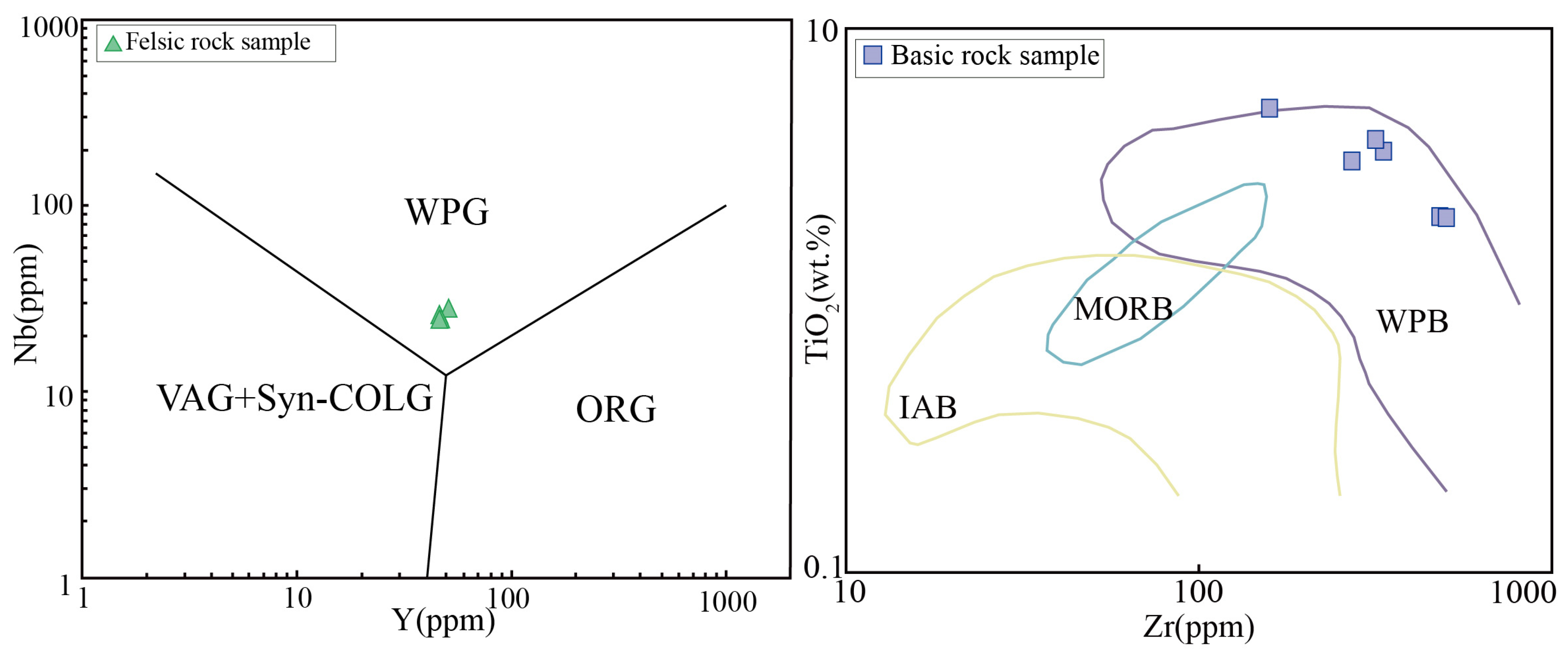
Bimodal magmatic associations commonly occur in extensional tectonic settings, including continental rifts, back-arc basins, oceanic islands, and other thinning-related environments [62,63,64,65,66]. The rhyolite samples from the Longzi area show A-type granite affinities and within-plate felsic geochemical characteristics, whereas the diabase samples display within-plate basaltic affinities [67]. On the Nb (ppm) vs. Y (ppm) discrimination diagram (Figure 15A), the rhyolite samples plot within the within-plate granite field [68], and on the TiO2 (wt.%) vs. Zr (ppm) discrimination diagram (Figure 15B), the diabase samples plot within the within-plate basalt field [69]. These features indicate that both the mafic and felsic rocks formed in an intraplate extensional setting.
Paleogeographic studies indicate that the Tethyan Himalaya was a passive continental margin during the Mesozoic and formed part of the northern margin of eastern Gondwana [70,71]. Some authors have argued that large-scale spreading of the Neo-Tethys in the Late Jurassic–Early Cretaceous could have generated a compressional rather than extensional setting along parts of the passive margin [72]. However, the integrated petrological, zircon geochronological, whole-rock geochemical, and isotopic evidence presented here is more consistent with plume-related thermal input and intracontinental extension than with passive-margin extension alone.
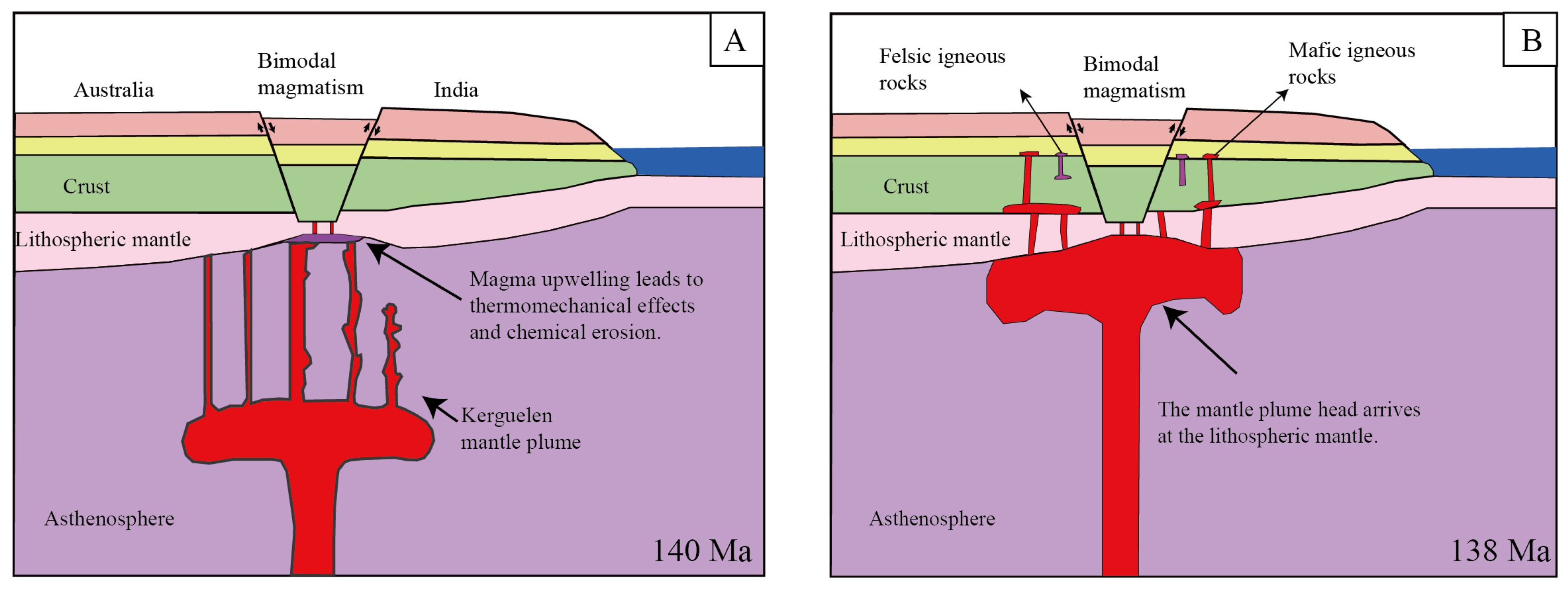
At 140 Ma, the Kerguelen mantle plume upwelled beneath the junction of Australia, India, and Antarctica, introducing significant heat. As the melts migrated upward, the plume-derived melts induced partial melting of the lithospheric mantle, forming a series of mafic rocks such as diabase. Simultaneously, the elevated temperatures caused partial melting of the deep continental crust, leading to the formation of felsic magmas. Subsequently, the magma ascended and intruded along extensional fractures, generating rhyolite (Figure 16).
The Tethyan Himalaya was once part of eastern Gondwana. By studying the formation age of the bimodal volcanic rock assemblage, the timing of continental breakup can be constrained. The bimodal magmatic rocks in this study formed between 132 Ma and 138 Ma, indicating that a rifting event occurred in the Tethyan Himalaya prior to 138 Ma. This suggests that the initial breakup of eastern Gondwana began earlier than 138 Ma, and also earlier than the formation of the Comei–Bunbury Large Igneous Province. At around 138 Ma, the head of the Kerguelen mantle plume had already reached the lithospheric mantle. Interaction between the plume and the lithospheric mantle led to the generation of the bimodal volcanic rocks, accompanied by widespread rifting along the Neotethyan Himalayan continental margin and the eventual breakup of eastern Gondwana.

6. Conclusions

(1) The volcanic rocks in the Longzi area, southern Tibet, define a mafic–felsic volcanic association represented by diabase and rhyolite. Zircon U-Pb dating indicates that the diabase samples formed at 132–138 Ma and the rhyolite samples at 132–134 Ma, showing that this magmatic association developed during the Early Cretaceous.
(2) The diabase samples are enriched in Nb, Ta, and LREEs and display mantle-plume-affiliated geochemical characteristics. They were derived from partial melting of a spinel–garnet lherzolite source and experienced limited interaction with the lithospheric mantle. The rhyolite samples show marked negative Eu anomalies and isotopic compositions distinct from those of the diabase, indicating derivation mainly from partial melting of upper-crustal materials.
(3) The Longzi mafic–felsic volcanic association is interpreted to have formed in an intraplate extensional setting related to Kerguelen-plume thermal input during the initial breakup of eastern Gondwana. This interpretation is based on integrated zircon geochronological, petrographic, whole-rock geochemical, and isotopic evidence.

Supplementary Materials

The following supporting information can be downloaded at: https://www.mdpi.com/article/10.3390/min16050510/s1, Table S1: Sr-Nd-Pb isotopic data for the representative samples from the Longzi area; Table S2: LA-ICP-MS zircon U-Pb isotopic results for zircon from the Longzi area; Table S3: LA-ICP-MS zircon trace-element data for zircon from the Longzi area; Table S4: Complete whole-rock major- and trace-element analytical results for representative rocks from the Longzi area; Table S5:The Whole-rock major and trace element data of regional magmatic rocks.

Author Contributions

Conceptualization, D.L. and Y.L.; methodology, D.L.; software, J.W.; validation, D.L. and Y.L.; investigation, D.L., D.J., H.Y., S.D. and K.E.T.; writing—original draft preparation, J.W. and D.L.; writing—review and editing, J.W., Y.L., W.L. and D.L.; supervision, D.J. All authors have read and agreed to the published version of the manuscript.

Funding

This study was funded by the Xizang Autonomous Region Key Research and Development Program Project (Grant No. XZ202501ZY0140) and the Xizang University High-level Talent Project (Grant No. xzdxdd202401).

Data Availability Statement

Data are contained within the article and Supplementary Materials.

Conflicts of Interest

The authors declare no conflict of interest.

References

  1. Pan, G.T.; Li, X.Z.; Wang, L.Q.; Ding, J.; Chen, Z.L. Preliminary division of tectonic units of the Qinghai-Tibet Plateau and its adjacent regions. Geol. Bull. China 2002, 21, 701–707. [Google Scholar]
  2. Zhong, H.; Tong, J.; Xia, J.; Lu, R.; Qiu, J. Characteristics and tectonic setting of volcanic rocks of the Sangxiu Formation in the southern part of Yamzho Yumco, southern Tibet. Geol. Bull. China 2005, 24, 72–79. [Google Scholar]
  3. Jiang, S.H.; Nie, F.J.; Hu, P.; Liu, Y. An important spreading event of the Neo-Tethys Ocean during the late Jurassic and early Cretaceous: Evidence from zircon U-Pb SHRIMP dating on diabase in Nagarze, southern Tibet. Acta Geol. Since-Engl. Ed. 2006, 80, 522–527. [Google Scholar]
  4. Zhu, D.-C.; Chung, S.-L.; Mo, X.-X.; Zhao, Z.-D.; Niu, Y.; Song, B.; Yang, Y.-H. The 132 Ma Comei-Bunbury large igneous province: Remnants identified in present-day southeastern Tibet and southwestern Australia. Geology 2009, 37, 583–586. [Google Scholar] [CrossRef]
  5. Zhu, D.; Mo, X.; Pan, G.; Zhao, Z.; Dong, G.; Shi, Y.; Liao, Z.; Zhou, C. Petrogenesis of the earliest Early Cretaceous basalts and associated diabases from Cona area, eastern Tethyan Himalaya in south Tibet: Interaction between the incubating Kerguelen plume and eastern Greater India lithosphere. Lithos 2008, 100, 147–173. [Google Scholar] [CrossRef]
  6. Olierook, H.K.H.; Merle, R.E.; Jourdan, F. Toward a Greater Kerguelen large igneous province: Evolving mantle source contributions in and around the Indian Ocean. Lithos 2017, 282, 163–172. [Google Scholar] [CrossRef]
  7. Liu, Z.C.; Zhong, K.H.; Zeng, Q.G. Instructions to the Geological Map of Xizang (1:1,000,000); Geological Publishing House: Beijing, China, 2019. [Google Scholar]
  8. Zhu, D.C.; Zhao, Z.D.; Niu, Y.L.; Mo, X.X.; Chung, S.L.; Hou, Z.Q.; Wang, L.Q.; Wu, F.Y. The Lhasa Terrane: Record of a microcontinent and its histories of drift and growth. Earth Planet. Sci. Lett. 2011, 301, 241–255. [Google Scholar] [CrossRef]
  9. Zhu, D.-C.; Zhao, Z.-D.; Niu, Y.; Dilek, Y.; Hou, Z.-Q.; Mo, X.-X. The origin and pre-Cenozoic evolution of the Tibetan Plateau. Gondwana Res. 2013, 23, 1429–1454. [Google Scholar] [CrossRef]
  10. Zeng, Y.-C.; Xu, J.-F.; Chen, J.-L.; Wang, B.-D.; Huang, F.; Yu, H.-X.; Chen, X.-F.; Zhao, P.-P. Breakup of eastern Gondwana as inferred from the Lower Cretaceous Charong Dolerites in the central Tethyan Himalaya, southern Tibet. Palaeogeogr. Palaeoclimatol. Palaeoecol. 2019, 515, 70–82. [Google Scholar] [CrossRef]
  11. Lee, C.-T.A.; Luffi, P.; Plank, T.; Dalton, H.; Leeman, W.P. Constraints on the depths and temperatures of basaltic magma generation on Earth and other terrestrial planets using new thermobarometers for mafic magmas. Earth Planet. Sci. Lett. 2009, 279, 20–33. [Google Scholar] [CrossRef]
  12. Brandl, P.A.; Regelous, M.; Beier, C.; Haase, K.M. High mantle temperatures following rifting caused by continental insulation. Nat. Geosci. 2013, 6, 391–394. [Google Scholar] [CrossRef]
  13. Hole, M.J. The generation of continental flood basalts by decompression melting of internally heated mantle. Geology 2015, 43, 311–314. [Google Scholar] [CrossRef]
  14. Bian, W.; Yang, T.; Ma, Y.; Jin, J.; Gao, F.; Wang, S.; Peng, W.; Zhang, S.; Wu, H.; Li, H. Paleomagnetic and geochronological results from the Zhela and Weimei Formations lava flows of the eastern Tethyan Himalaya: New insights into the breakup of eastern Gondwana. J. Geophys. Res. Solid Earth 2019, 124, 44–64. [Google Scholar] [CrossRef]
  15. Liu, Z.; Zhou, Q.; Lai, Y.; Qing, C.; Li, Y.; Wu, J.; Xia, X. Petrogenesis of the Early Cretaceous Laguila bimodal intrusive rocks from the Tethyan Himalaya: Implications for the break-up of Eastern Gondwana. Lithos 2015, 236, 190–202. [Google Scholar] [CrossRef]
  16. Zhu, D.; Pan, G.; Mo, X.; Liao, Z.; Jiang, X.; Wang, L.; Zhao, Z. Petrogenesis of volcanic rocks in the Sangxiu Formation, central segment of Tethyan Himalaya: A probable example of plume–lithosphere interaction. J. Asian Earth Sci. 2007, 29, 320–335. [Google Scholar] [CrossRef]
  17. Zhou, Q.; Liu, Z.; Lai, Y.; Wang, G.-C.; Liao, Z.; Li, Y.-X.; Wu, J.-Y.; Wang, S.; Qing, C.-S. Petrogenesis of mafic and felsic rocks from the Comei large igneous province, South Tibet: Implications for the initial activity of the Kerguelen plume. Bulletin 2018, 130, 811–824. [Google Scholar] [CrossRef]
  18. Tian, Y.; Gong, J.; Chen, H.; Guo, L.; Xu, Q.; Chen, L.; Lin, X.; Cheng, X.; Yang, R.; Zhao, L. Early Cretaceous bimodal magmatism in the eastern Tethyan Himalayas, Tibet: Indicative of records on precursory continental rifting and initial breakup of eastern Gondwana. Lithos 2019, 324, 699–715. [Google Scholar] [CrossRef]
  19. Ding, F.; Gao, J.G.; Xu, K.Z. Geochemistry, geochronology and geological significances of the basic dykes in Rongbu area, southern Tibet. Acta Petrol. Sin. 2020, 36, 391–408. [Google Scholar]
  20. Jia, X. Magmatic Event and Geological Significance of Mesozoic in the Central Tethyan Himalaya. Master’s Thesis, China University of Geosciences (Beijing), Beijing, China, 2019. [Google Scholar]
  21. Wiedenbeck, M.; Allé, P.; Corfu, F.; Griffin, W.L.; Meier, M.; Oberli, F.; von Quadt, A.; Roddick, J.C.; Spiegel, W. Three natural zircon standards for U-Th-Pb, Lu-Hf, trace element and REE analyses. Geostand. Newsl. 1995, 19, 1–23. [Google Scholar] [CrossRef]
  22. Pearce, N.J.G.; Perkins, W.T.; Westgate, J.A.; Gorton, M.P.; Jackson, S.E.; Neal, C.R.; Chenery, S.P. A compilation of new and published major and trace element data for NIST SRM 610 and NIST SRM 612 glass reference materials. Geostand. Newsl. 1997, 21, 115–144. [Google Scholar] [CrossRef]
  23. GB/T 14506; Analytical Methods for Silicate Rocks. Standardization Administration of the People’s Republic of China: Beijing, China, 2010.
  24. Steiger, R.H.; Jäger, E. Subcommission on geochronology: Convention on the use of decay constants in geo- and cosmochronology. Earth Planet. Sci. Lett. 1977, 36, 359–362. [Google Scholar] [CrossRef]
  25. Wu, Y.; Zheng, Y. Genesis of zircon and its constraints on interpretation of U-Pb age. Chin. Sci. Bull. 2004, 49, 1554–1569. [Google Scholar] [CrossRef]
  26. Dong, S.; Zhang, Z.; Zhang, L.; Li, G.; Qing, C.; Liang, W.; Fu, J.; Cao, H.; Li, H.; Xu, C. Geochemistry, Hf-Sr-Nd isotopes and petrogenesis of acidic volcanic rocks in Quzhuomu region of Southern Tibet. Earth Sci. 2018, 43, 2701–2714. [Google Scholar]
  27. Lü, X.C.; Ren, C.; Wu, R.; Cheng, M.; Qiu, H.; Qiu, Y. Discovery of the Early Cretaceous bimodal volcanic rocks in the Longzi area, southern Tibet: Evidence from SHRIMP zircon U-Pb geochronology and petrogeochemistry. Geol. Rev. 2016, 62, 945–954. [Google Scholar] [CrossRef]
  28. Hoskin, P.W. Trace-element composition of hydrothermal zircon and the alteration of Hadean zircon from the Jack Hills, Australia. Geochim. Cosmochim. Acta 2005, 69, 637–648. [Google Scholar] [CrossRef]
  29. Corfu, F.; Hanchar, J.M.; Hoskin, P.W.; Kinny, P. Atlas of zircon textures. Rev. Mineral. Geochem. 2003, 53, 469–500. [Google Scholar] [CrossRef]
  30. Bell, E.A.; Boehnke, P.; Harrison, T.M. Recovering the primary geochemistry of Jack Hills zircons through quantitative estimates of chemical alteration. Geochim. Cosmochim. Acta 2016, 191, 187–202. [Google Scholar] [CrossRef]
  31. Mu, J.Z.; Kang, Z.Q.; Yang, F.; Wu, L.L.; Qiao, Z.D. OIB-Type Gabbros in the Longzi Area on the Southeastern Margin of the Tibetan Plateau Constrain the Initial Activity of the Kerguelen Mantle Plume: Integrated Evidence from Geochronology and Geochemistry. Geoscience 2025, 40, 44–61. [Google Scholar] [CrossRef]
  32. Zhu, D.; Pan, G.; Mo, X.; Wang, L.; Liao, Z.; Jiang, X.; Geng, Q. SHRIMP U-Pb zircon dating for the dacite of the Sangxiu Formation in the central segment of Tethyan Himalaya and its implications. Chin. Sci. Bull. 2005, 50, 563–568. [Google Scholar] [CrossRef]
  33. Yan, Y.W.; Gong, Z.C.; Zhang, L.; Chen, Q.; Wang, S.M.; Dai, D.C.; Gan, B.P.; Pei, Q.M. Genesis of Cretaceous bimodal volcanic rocks and mantle plume-related rift in the Shannan Prefecture of Xizang: Constraints from geochronology and geochemistry. J. Chengdu Univ. Technol. (Sci. Technol. Ed.) 2025, 1–20. [Google Scholar] [CrossRef]
  34. Middlemost, E.A. Naming materials in the magma/igneous rock system. Earth-Sci. Rev. 1994, 37, 215–224. [Google Scholar] [CrossRef]
  35. Peccerillo, A.; Taylor, S. Geochemistry of Eocene calc-alkaline volcanic rocks from the Kastamonu area, northern Turkey. Contrib. Mineral. Petrol. 1976, 58, 63–81. [Google Scholar] [CrossRef]
  36. Wright, J. A simple alkalinity ratio and its application to questions of non-orogenic granite genesis. Geol. Mag. 1969, 106, 370–384. [Google Scholar] [CrossRef]
  37. Maniar, P.D.; Piccoli, P.M. Tectonic discrimination of granitoids. Geol. Soc. Am. Bull. 1989, 101, 635–643. [Google Scholar] [CrossRef]
  38. Sun, S.-S.; McDonough, W.F. Chemical and isotopic systematics of oceanic basalts: Implications for mantle composition and processes. Geol. Soc. Lond. Spec. Publ. 1989, 42, 313–345. [Google Scholar] [CrossRef]
  39. Rudnick, R.L.; Gao, S. Composition of the Continental Crust. In Treatise on Geochemistry, 2nd ed.; Holland, H.D., Turekian, K.K., Eds.; Elsevier: Amsterdam, The Netherlands, 2014; Volume 4.1, pp. 1–51. [Google Scholar]
  40. Doe, B.R.; Leeman, W.P.; Christiansen, R.L.; Hedge, C. Lead and strontium isotopes and related trace elements as genetic tracers in the upper Cenozoic rhyolite-basalt association of the Yellowstone Plateau volcanic field. J. Geophys. Res. Solid Earth 1982, 87, 4785–4806. [Google Scholar] [CrossRef]
  41. Davies, G.; Macdonald, R. Crustal influences in the petrogenesis of the Naivasha Basalt—Comendite Complex: Combined trace element and Sr-Nd-Pb isotope constraints. J. Petrol. 1987, 28, 1009–1031. [Google Scholar] [CrossRef]
  42. Li, L.; Sun, F.; Li, B.; Li, S.; Chen, G.; Wang, W.; Yan, J.; Zhao, T.; Dong, J.; Zhang, D. Geochronology, geochemistry and Sr-Nd-Pb-Hf Isotopes of No. I complex from the shitoukengde Ni–Cu sulfide deposit in the Eastern Kunlun Orogen, Western China: Implications for the magmatic source, geodynamic setting and genesis. Acta Geol. Sin. Engl. Ed. 2018, 92, 106–126. [Google Scholar]
  43. Zartman, R.; Doe, B. Plumbotectonics—The model. Tectonophysics 1981, 75, 135–162. [Google Scholar] [CrossRef]
  44. Olierook, H.K.; Jiang, Q.; Jourdan, F.; Chiaradia, M. Greater Kerguelen large igneous province reveals no role for Kerguelen mantle plume in the continental breakup of eastern Gondwana. Earth Planet. Sci. Lett. 2019, 511, 244–255. [Google Scholar] [CrossRef]
  45. Li, S. Ba-Nb-Th-La diagrams used to identify tectonic environments of ophiolite. Acta Petrol. Sin. 1993, 9, 146. [Google Scholar]
  46. Condie, K.C. Geochemical changes in baslts and andesites across the Archean-Proterozoic boundary: Identification and significance. Lithos 1989, 23, 1–18. [Google Scholar] [CrossRef]
  47. Paces, J.B.; Bell, K. Non-depleted sub-continental mantle beneath the Superior Province of the Canadian Shield: Nd-Sr isotopic and trace element evidence from Midcontinent Rift basalts. Geochim. Cosmochim. Acta 1989, 53, 2023–2035. [Google Scholar] [CrossRef]
  48. Rudnick, R.L.; Fountain, D.M. Nature and composition of the continental crust: A lower crustal perspective. Rev. Geophys. 1995, 33, 267–309. [Google Scholar] [CrossRef]
  49. Barth, M.G.; McDonough, W.F.; Rudnick, R.L. Tracking the budget of Nb and Ta in the continental crust. Chem. Geol. 2000, 165, 197–213. [Google Scholar] [CrossRef]
  50. Karsli, O.; Dokuz, A.; Kaliwoda, M.; Uysal, I.; Aydin, F.; Kandemir, R.; Fehr, K.-T. Geochemical fingerprints of Late Triassic calc-alkaline lamprophyres from the Eastern Pontides, NE Turkey: A key to understanding lamprophyre formation in a subduction-related environment. Lithos 2014, 196, 181–197. [Google Scholar] [CrossRef]
  51. Lassiter, J.C.; DePaolo, D.J. Plume/lithosphere interaction in the generation of continental and oceanic flood basalts: Chemical and isotopic constraints. Geophys. Monogr. Ser. 1997, 100, 335–355. [Google Scholar]
  52. Mysen, B. Trace-element partitioning between garnet peridotite minerals and water-rich vapor; experimental data from 5 to 30 kbar. Am. Mineral. 1979, 64, 274–287. [Google Scholar]
  53. Deniel, C. Geochemical and isotopic (Sr, Nd, Pb) evidence for plume–lithosphere interactions in the genesis of Grande Comore magmas (Indian Ocean). Chem. Geol. 1998, 144, 281–303. [Google Scholar] [CrossRef]
  54. Zhang, Z.; Li, G.; He, X.; Zhang, L.; Dong, S.; Qing, C.; Liang, W.; Han, S. The evolution of Kerguelen mantle plume and breakup of eastern Gondwana: New insights from multistage Cretaceous magmatism in the Tethyan Himalaya. Gondwana Res. 2023, 119, 68–85. [Google Scholar] [CrossRef]
  55. Maheshwari, A.; Coltorti, M.; Rajput, S.K.; Verma, M. Geochemical characteristics, discrimination and petrogenesis of Neoproterozoic peralkaline granites, Barmer District, SW Rajasthan, India. Int. Geol. Rev. 2009, 51, 1103–1120. [Google Scholar] [CrossRef]
  56. Eby, G.N. Chemical subdivision of the A-type granitoids: Petrogenetic and tectonic implications. Geology 1992, 20, 641–644. [Google Scholar] [CrossRef]
  57. Whalen, J.B.; Currie, K.L.; Chappell, B.W. A-type granites: Geochemical characteristics, discrimination and petrogenesis. Contrib. Mineral. Petrol. 1987, 95, 407–419. [Google Scholar] [CrossRef]
  58. Grebennikov, A. A-type granites and related rocks: Petrogenesis and classification. Russ. Geol. Geophys. 2014, 55, 1353–1366. [Google Scholar] [CrossRef]
  59. Wu, F.; Gup, C.; Hu, F.; Liu, X.; Zhao, J.; Li, X.; Qin, K. Petrogenesis of the highly fractionated granites and their mineralizations in Nanling Range, South China. Acta Petrol. Sin. 2023, 39, 105166. [Google Scholar] [CrossRef]
  60. Watson, E.B.; Harrison, T.M. Zircon saturation revisited: Temperature and composition effects in a variety of crustal magma types. Earth Planet. Sci. Lett. 1983, 64, 295–304. [Google Scholar] [CrossRef]
  61. Daly, R.A. The geology of Ascension island. Proc. Am. Acad. Arts Sci. 1925, 60, 3–80. [Google Scholar] [CrossRef]
  62. Wang, Y.; Qian, Q.; Liu, L.; Zhang, Q. Major geochemical characteristics of bimodal volcanic rocks in different geochemical environments. Acta Petrol. Sin. 2000, 16, 169–173. [Google Scholar]
  63. Hochstaedter, A.G.; Gill, J.B.; Kusakabe, M.; Newman, S.; Pringle, M.; Taylor, B.; Fryer, P. Volcanism in the Sumisu Rift, I. Major element, volatile, and stable isotope geochemistry. Earth Planet. Sci. Lett. 1990, 100, 179–194. [Google Scholar] [CrossRef]
  64. Geist, D.; Howard, K.A.; Larson, P. The generation of oceanic rhyolites by crystal fractionation: The basalt-rhyolite association at Volcán Alcedo, Galápagos Archipelago. J. Petrol. 1995, 36, 965–982. [Google Scholar] [CrossRef]
  65. Brouxel, M.; Lapierre, H.; Michard, A.; Albarède, F. The deep layers of a Paleozoic arc: Geochemistry of the Copley-Balaklala series, northern California. Earth Planet. Sci. Lett. 1987, 85, 386–400. [Google Scholar] [CrossRef]
  66. Duncan, A.R.; Erlank, A.J.; Marsh, J.S. Regional geochemistry of the Karoo igneous province. Petrog. Volcan. Rocks Karoo Prov. 1984, 13, 355–388. [Google Scholar]
  67. Zhang, Q. The criteria and discrimination for A-type granites: A reply to the question put forward by Wang Yang and some other persons for” A-type granite: What is the essence?”. Acta Petrol. Mineral. 2012, 32, 267–274. [Google Scholar]
  68. Pearce, J.A.; Harris, N.B.; Tindle, A.G. Trace element discrimination diagrams for the tectonic interpretation of granitic rocks. J. Petrol. 1984, 25, 956–983. [Google Scholar] [CrossRef]
  69. Pearce, J.A. Trace element characteristics of lavas from destructive plate boundaries. In Orogenic Andesites and Related Rocks; John Wiley and Sons: Hoboken, NJ, USA, 1982; pp. 528–548. [Google Scholar]
  70. Subrahmanyam, C.; Chand, S. Evolution of the passive continental margins of India—A geophysical appraisal. Gondwana Res. 2006, 10, 167–178. [Google Scholar] [CrossRef]
  71. Wilde, S. Evolution of the western margin of Australia during the Rodinian and Gondwanan supercontinent cycles. Gondwana Res. 1999, 2, 481–499. [Google Scholar] [CrossRef]
  72. Yan, J.; Qiu, W.; Zhu DiCheng, X.Y.; Qiu BiBo, W.Q. Why do we need to propose the Early Cretaceous Comei large igneous province in southeastern Tibet? Acta Geol. Sin. 2013, 29, 3659–3670. [Google Scholar]
Figure 1. Index map showing the location of the study area and tectonic subdivisions of the Tibetan Plateau. (a) Tectonic subdivisions of the Tibetan Plateau, modified from [7,8,9]. (b) General location of Tibet and the study area. Abbreviations: JS—Jinshajiang Suture Zone; LSSZ—Longmu Co–Shuanghu Suture Zone; BNS—Bangong–Nujiang Suture Zone; SNMZ—Shiquanhe–Nam Co Ophiolitic Mélange Zone; GLCF—Gar–Lunggar–Cuomai Fault; LMF—Luobadui–Milashan Fault Zone; YZS—Yarlung–Zangbo Suture Zone.
Minerals 16 00510 g001
Figure 4. Photomicrographs of volcanic rocks from the Longzi Area. Mineral abbreviations: Cal—calcite; Qtz—quartz; Pl—plagioclase; Ser—sericite; Cpx—clinopyroxene; Amp—amphibole. (A,B) Cross-polarized light (CPL) images of rhyolite from the Longzi Area. (CE) Cross-polarized light (CPL) images of diabase from the Longzi Area. (F) Plane-polarized light (PPL) image of diabase from the Longzi Area.
Minerals 16 00510 g004
Figure 5. Zircon U–Pb Dating Results for Mafic and Felsic Rocks from the Longzi Area: Concordia plot and bar chart. (A) Zircon U–Pb Concordia Diagram and bar chart for Sample 0711-LM14. (B) Zircon U–Pb Concordia Diagram and bar chart for Sample CM-2. (C) Zircon U–Pb Concordia Diagram and bar chart for Sample JZL01-B. (D) Zircon U–Pb Concordia Diagram and bar chart for Sample B200. (E) Zircon U–Pb Concordia Diagram and bar chart for Sample B710. (F) Zircon U–Pb Concordia Diagram and bar chart for Sample JZL02-A.
Minerals 16 00510 g005
Figure 6. Representative zircon cathodoluminescence (CL) images of samples from the Longzi Area. (A) Typical zircon CL images of mafic rocks. (B) Typical zircon CL images of felsic rocks.
Minerals 16 00510 g006
Figure 8. Discrimination diagrams for petrogenetic classification and characterization of magmatic rocks from the Longzi Area. (A) TAS classification diagram for the magmatic rocks [34]. (B) K2O (wt.%) vs. SiO2 (wt.%) diagram [35]. (C) SiO2. vs. A.R. (wt.%) discrimination diagram [36]. A.R. (A R = (Al2O3 + CaO + K2O + Na2O)/(Al2O3 + CaO − K2O − Na2O)) denotes the alkalinity ratio as defined by [36]. (D) A/NK vs. A/NCK discrimination diagram [37]. Only analyses with LOI < 5 wt.% are shown in the main-text major-element discrimination diagrams. Published regional mafic-rock data are from [5,15,18,31], and published regional felsic-rock data are from [17,18,32,33].
Minerals 16 00510 g008
Figure 9. Primitive mantle-normalized trace-element spider diagrams and chondrite-normalized REE patterns of volcanic rocks from the Longzi Area. (A) Primitive mantle-normalized spider diagram for low-LOI rhyolite samples. (B) Chondrite-normalized REE patterns for low-LOI rhyolite samples. (C) Primitive mantle-normalized spider diagram for low-LOI diabase samples. (D) Chondrite-normalized REE patterns for low-LOI diabase samples, together with a representative OIB reference pattern. Normalization values are from Sun and McDonough [38]. Data for the upper, middle, and lower continental crust are from Rudnick and Gao [39].
Minerals 16 00510 g009
Figure 10. Isotopic comparison diagrams for volcanic rocks from the Longzi Area. (A) εNd(t) vs. (87Sr/86Sr)i [42]. (B) εNd(t) vs. Age for volcanic rocks from the Longzi Area. Only the low-LOI isotopic subset is shown. DMM—Depleted mantle; MORB—Mid-ocean ridge basalt; PREMA—Primitive mantle; OIB—Ocean island basalt; EMI—Enriched mantle I; EMII—Enriched mantle II.
Minerals 16 00510 g010
Figure 11. Pb-isotope diagrams for volcanic rocks from the Longzi Area. (A) 207Pb/204Pb vs. 206Pb/204Pb tectonic discrimination diagram for volcanic rocks from the Longzi Area [43]. End members are labeled as follows: A—Mantle; B—Orogen; C—Upper crust; D—Lower crust. (B) (207Pb/204Pb)i vs. (206Pb/204Pb)i diagram for volcanic rocks from the Longzi Area [44]. Only the low-LOI isotopic subset is shown in the main-text figures.
Minerals 16 00510 g011
Figure 13. Discrimination diagrams for the source characteristics of mafic rocks from the Longzi Area. (A) Ce/Y vs. Zr/Nb diagram [53]. (B) Sm/Yb vs. Sm (ppm) diagram [54].
Minerals 16 00510 g013
Figure 14. I-, S-, and A-type granite discrimination diagrams for the Longzi Area [57]. The subdivisions for A-type and fractionated felsic granites in diagram C are after [59]. (A) FeOᵀ/MgO vs. (Zr + Nb + Ce + Y) (ppm). (B) (Na2O + K2O)/CaO vs. (Zr + Nb + Ce + Y) (ppm). (C) Zr (ppm) vs. (104 × Ga/Al). (D) Nb (ppm) vs. (104 × Ga/Al). FG—fractionated felsic granites; OGT—unfractionated M-, I-, and S-type granites.
Minerals 16 00510 g014
Figure 15. Tectonic discrimination diagrams for volcanic rocks from the Longzi Area. (A) Nb (ppm) vs. Y (ppm) diagram [68]. (B) TiO2 (wt.%) vs. Zr (ppm) diagram [69]. WPG—within-plate granites; VAG—volcanic arc granites; Syn-COLG—syn-collision granites; ORG—ocean ridge granites; VAB—volcanic arc basalt; MORB—mid-ocean ridge basalt; WPB—within-plate basalt.
Minerals 16 00510 g015
Figure 16. Evolution model for the breakup of eastern Gondwana, modified from [18]. (A) Mantle plume accumulates beneath the crust. (B) The mantle plume head reaches the lithospheric mantle.
Minerals 16 00510 g016
Disclaimer/Publisher’s Note: The statements, opinions and data contained in all publications are solely those of the individual author(s) and contributor(s) and not of MDPI and/or the editor(s). MDPI and/or the editor(s) disclaim responsibility for any injury to people or property resulting from any ideas, methods, instructions or products referred to in the content.