Review

A Review of H2 Generation and H2O Distribution in the Earth’s Interior


1
Key Laboratory for High-Temperature and High-Pressure Study of the Earth’s Interior, Institute of Geochemistry, Chinese Academy of Sciences, Guiyang 550081, China
2
University of Chinese Academy of Sciences, Beijing 100049, China
3
School of Physics and Electronic Science, Guizhou Normal University, Guiyang 550025, China
4
Advanced Institute for Ocean Research, Institute of Major Scientific Facilities for New Materials, Shenzhen Key Laboratory of Natural Gas Hydrate, Academy for Advanced Interdisciplinary Studies, Southern University of Science and Technology, Shenzhen 518055, China
5
Department of Physics & Institute of Major Scientific Facilities for New Materials, Shenzhen Key Laboratory of Natural Gas Hydrate, Academy for Advanced Interdisciplinary Studies, Southern University of Science and Technology, Shenzhen 518055, China
6
Shenzhen Key Laboratory of Solid State Batteries, Southern University of Science and Technology, Shenzhen 518055, China
*
Authors to whom correspondence should be addressed.
Minerals 2026, 16(5), 507; https://doi.org/10.3390/min16050507
Submission received: 9 April 2026 / Revised: 6 May 2026 / Accepted: 7 May 2026 / Published: 12 May 2026

Abstract

Hydrogen (H) is the most abundant element in the solar system. In the Earth’s interior, it primarily exists in the form of hydrogen gas, water, atomic hydrogen, and hydroxyl groups. Hydrogen gas, as a clean energy source, is widely distributed within the Earth and is mainly generated through serpentinization, with minor contributions from water radiolysis, rock fracturing, biological activity, etc. Hydrogen sequestration occurs mainly through clay adsorption, entrapment under rock layers, dissolution in water, and fluid inclusions. Besides being present as pore water, hydrogen in the deep Earth predominantly resides in minerals as point defects related to hydrogen species (e.g., OH, H+). During the Earth’s evolution, substantial hydrogen was stored in the deep Earth through accretion, and surface water has been transported into the Earth’s interior via subducting slabs; meanwhile, it can migrate upward through magmatic activity and mantle plumes. The inputs and outputs constitute the global hydrogen cycle. Hydrogen concentration and distribution are highly heterogeneous across the crust, mantle and core. The upper mantle is likely mostly dry, while the Earth’s core is potentially a large reservoir of hydrogen. Small amounts of hydrogen can profoundly influence the physicochemical properties of the Earth’s interior materials, as well as the dynamic processes within the Earth’s interior.

1. Introduction

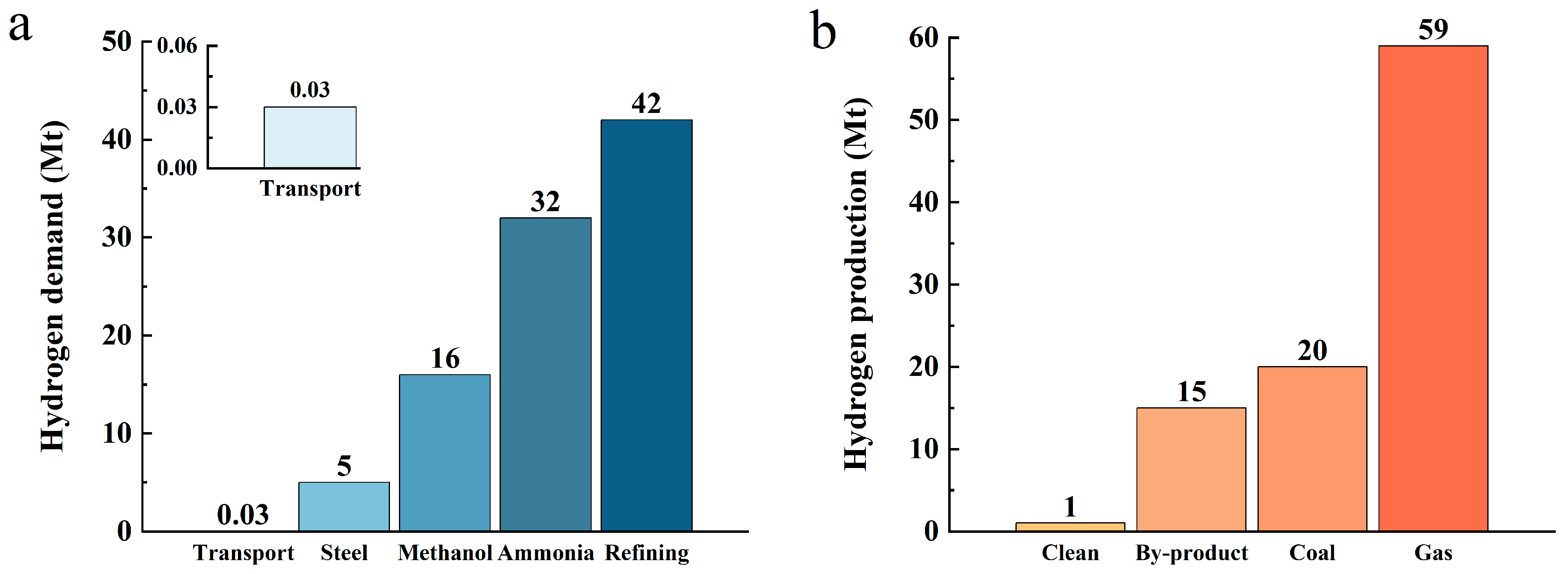
Hydrogen (H), as the most abundant and lightest element in the solar system, is increasingly becoming a focus in the field of Earth science. A majority of studies mainly concentrate on its origin, forms, distribution, geochemical behavior, and impact on the physical properties of materials within the Earth’s interior. Hydrogen gas, being one form of hydrogen, is a clean new energy source that has already been widely used in industrial production and in life. According to the International Energy Agency’s Global Hydrogen Review 2023, global hydrogen consumption in 2022 reached 95 million tons [1], with main uses including (Figure 1a): (1) oil refining (44%), mainly for removing impurities (e.g., sulfur) from crude oil and upgrading heavy crude oil; (2) ammonia and methanol production (50%), primarily as feedstock for synthesizing chemical products; and (3) steelmaking (6%), where primary steel can be produced using a mixture of hydrogen and carbon monoxide as a reducing agent for direct reduced iron. Furthermore, hydrogen has broad application prospects. In the transportation sector, hydrogen fuel cells have high weight–energy density, enabling faster acceleration and lighter weight for vehicles. Hydrogen fuel cell vehicles have been proposed as potential replacements for internal combustion engine vehicles. In the construction industry, hydrogen can be used for district heating or cooling. In the power industry, power generation using hydrogen or hydrogen-based fuels (e.g., ammonia) can effectively reduce carbon emissions. Hydrogen-based fuels are also an option for large-scale and long-term energy storage to balance seasonal electricity demand or fluctuations in renewable power generation [2,3].
Currently, most hydrogen used is produced from fossil fuels, referred to as black or gray hydrogen [4]. As shown in Figure 1b, hydrogen produced from natural gas without carbon capture, utilization and storage (CCUS) accounts for about 62%, hydrogen produced from coal without CCUS accounts for about 21%, by-product hydrogen from naphtha reforming in refineries and the petrochemical industry accounts for about 16%, while low-emission hydrogen produced via water electrolysis or using fossil fuels with CCUS accounts for only about 1% [1]. At present, the energy transitions gradually from fossil fuels to non-fossil energy sources. Although hydrogen as a low-carbon energy source holds an important position among clean energies, most hydrogen currently used is a secondary energy produced from other sources, accompanied by carbon emissions during production. In contrast, vast amounts of hydrogen gas are stored in the Earth’s interior; it is a carbon-free source that is labeled white and orange hydrogen [4]. It is estimated that the cost of producing 1 kg of hydrogen could be 2 to 10 times higher than that of extracting natural hydrogen; hence, the exploitation and utilization of natural hydrogen would be a potentially important research direction in future [5].
The Earth formed from the gas and dust of the solar nebula through gravitational accretion and collisions. Therefore, it is suggested that the Earth’s interior is a vast hydrogen reservoir, especially the outer core [4,6,7]. Hydrogen transports from the deep Earth to the surface through degassing processes; therefore, it is an important source of natural hydrogen, which can possibly be directly utilized to serve social development. The hydrogen species in the Earth’s interior are primarily water, molecular hydrogen, hydroxyl (OH), and hydrides. Their presence profoundly influences the physical and chemical properties of rocks and geological processes within the Earth, from the microscopic to the global scale. The study summarizes the origin, cycle, and reservoirs of hydrogen within the Earth’s interior, which not only aids in understanding the evolutionary history of our planet but also provides crucial insights into key scientific issues such as tectonics, magmatic activity, and the origin of life.

2. Generation of Natural Hydrogen

The generation of natural hydrogen stems from both biological and abiotic processes. Biological processes are mainly anaerobic decay of organic matter, fermentation, and nitrogen-fixing bacteria; however, the hydrogen produced in these processes is rapidly consumed by other coexisting organisms [8]. Abiotic processes primarily include serpentinization, water radiolysis, rock fracturing, and magma degassing, as shown in Table 1 [9]. The hydrogen generated through these abiotic processes is considered to potentially be utilizable. The following section primarily summarizes the abiotic processes.

2.1. Serpentinization

Serpentinization is a metamorphic process where mainly ultrabasic rocks (i.e., iron-bearing mantle rocks) react with water, transforming into serpentine minerals and producing hydrogen, primarily referring to the reaction of olivine with water in which Fe2+ in olivine oxidizes to Fe3+ and hydrogen in water reduces to H2. The reaction is as follows:
3 Fe 2 SiO 4   +   3 H 2 O   =   Fe 3 Si 2 O 5 ( OH ) 4   +   H 2 ( aq )   +   Fe 3 O 4   + SiO 2 ( aq )
This process is mainly influenced by Fe partitioning. During the reaction, if Fe2+ preferentially enters products, e.g., serpentine and brucite, the generated H2 will decrease. Conversely, when Fe2+ preferentially enters the product magnetite (Fe3O4), the amount of hydrogen increases [10].
The quantity of hydrogen during serpentinization is affected by many factors, which are summarized in Table 2. The increase in the water–rock ratio enhances the generation of hydrogen, whereas the hydrogen concentration in the solution decreases with an increasing water: rock ratio due to the amount of water increasing, and concentrations are highest when the least amount of H2 is generated per a given amount of rock [10].
Additionally, temperature significantly affects the reaction rate of serpentinization, which is most active within the temperature range of 200 to 310 °C. At temperatures lower than this range, the reaction rate becomes very limited, and more Fe2+ enters brucite as temperature decreases, leading to the decrease in H2 production. At higher temperatures, the reaction rate decreases rapidly due to thermodynamic constraints, and the extent of serpentinization also diminishes, resulting in less H2 production [8,10].
Furthermore, SiO2, CO2, Al content, and pH also significantly impact H2 production [11,12,13,14,15,16]. During serpentinization, a Mg-rich, Si-poor layer forms on the olivine surface as the solution changes from acidic to alkaline (pH > 9). Magnesium detaches from this surface layer and dissolves into the solution, then it can react with OH- in the solution to form brucite. The decrease of magnesium content in the solution allows olivine to continue dissolving, thereby increasing the serpentinization reaction rate. However, the higher the pH, the lower the H2 production due to more Fe2+ entering the brucite and serpentine [15]. Moreover, the addition of CO2 during serpentinization can lead to carbonate formation that facilitates Fe2+ entering carbonate products more rapidly, ultimately resulting in the reduction in H2 production. Nevertheless, the inhibitory effect of CO2 on H2 generation diminishes with increasing temperature because high temperatures promote olivine dissolution in CO2-rich environments, releasing more Fe2+ for reaction and simultaneously inhibiting the formation of brucite and magnesite [14,17,18]. In Al-bearing solutions, the primary form of Al is Al ( OH ) 4 which can adsorb onto the positively charged olivine surface, forming Al-Si complexes that promote olivine dissolution and the nucleation of Al-rich serpentine [11]. The serpentinization reaction rate and H2 generation are also influenced by SiO2. The participation of SiO2-rich geological fluids in the hydrothermal alteration of olivine can reduce the hydrogen concentration in the fluid by 1–2 orders of magnitude [16].
Serpentinization is the primary mechanism for hydrogen generation within the Earth’s interior. By this process, hydrogen can be artificially produced by injecting water into reactive geological structures; correspondingly, the hydrogen-rich water from recovery wells surrounding the injection points can be collected [4]. The total peridotite volume in the upper 7 km of the crust is estimated at 1020 kg [19]. Complete oxidation of this mass could theoretically yield up to 100 trillion tons of H2, equivalent to a production rate of approximately 2–4 kg of H2 per cubic meter of rock [4]. Furthermore, tectonic activity continuously replenishes peridotites at a rate of 1012 kg per year, implying an even larger long-term hydrogen production potential [19].
Table 2. The main factors affecting the H2 production during serpentinization.
FactorsProduct H2Source of FactorsReferences
TIncreases first, then decreases with TGeothermal energy[10]
water: rockIncreases with this ratioInfiltration/dehydration[10]
pHDecreases with pHAlteration of olivine[15]
CO2Suppressed at low T; the effect disappears at >270 °CCO2-rich hydrothermal fluids[14,17,18]
AlIncreases with AlCoexisting minerals[11]
SiO2Decreases (<400–515 °C) with SiO2Coexisting minerals[16]

2.2. Radiolysis of Water

The Earth’s interior contains large amounts of radioactive elements, such as U, Th, and K, which release energy during their decay. The energy is high enough to decompose water molecules into hydrogen atoms, hydroxyl radicals, hydrogen gas, hydrogen peroxide, hydrated electrons, and hydronium ions.
These products subsequently enter the solution and react with other substances to generate H2 [20]:
H ·   + H ·   =   H 2
2 e aq + 2 H 2 O = 2 OH + H 2
H + + e aq + H 2 O = OH + H 2
The amount of H2 produced by radiolysis primarily depends on the concentration of radionuclides, the availability of water in pore spaces and fractures, and the concentration of dissolved anions and cations in the fluid, including dissolved salts [9]. Since water primarily resides in the pore and fracture spaces of rocks, rock permeability and porosity are important factors for H2 generation via water radiolysis. It has been estimated that only 1% of the total energy from the radiogenic decay is absorbed by pore water [20]. Additionally, if salts dissolve in water, new covalent bonds form between cations and the oxygen in water, and between anions and the hydrogen in water. These new covalent bonds can weaken the energy of the O–H bonds in water and reduce the energy required to break them, facilitating the production of additional H2 under irradiation. Therefore, the higher the salt concentration in saline solutions, the more dissolved the cations and anions; correspondingly, the H2 production increases [21]. Additionally, H2 yields from radiolysis can also be increased by the presence of certain minerals, e.g., zeolites; this is relevant for natural systems and in the context of decontaminating radioactive water [22].
Furthermore, some studies indicate that the decay products of radioactive elements can also react with water to produce H2. For example, 40Ca, produced from the decay of 40K, can react with water to yield Ca(OH)2 and H2 [8]. Radiolytic H2 production is a relatively ubiquitous process in the Earth’s crust. The Precambrian crust that constitutes about 70% of the continental crust can generate approximately 1.6–4.7 × 10¹⁰ mol of H2 per year [23]. Radioactive elements in basaltic oceanic crust and marine sedimentary rocks can also cause water radiolysis [24,25], It is estimated that the annual H2 production from radiolysis in the oceanic crust is approximately 2 × 10⁸ mol [26]. Radionuclide concentrations are generally higher in continental crust than in basaltic oceanic crust; therefore, H2 production will typically be higher in continental crust compared to oceanic crust at the same porosity.

2.3. Rock Fracturing

It has been discovered that hydrogen concentrations are anomalously high in the soil within the fault zone, whereas hydrogen levels in soils away from the fault zone were similar to atmospheric concentrations [27]. By measuring CH4, CO2, and O2 concentrations in the soil and comparing H2 levels in areas with minimal biological activity, they ruled out biological processes as the cause of the H2 anomaly, and hypothesized that fresh surfaces generated by rock fracturing react with groundwater to produce H2 [27]. It has been experimentally evidenced that H2 gas can be released by crushing granite and quartz, through a chemical reaction between water and such radicals as Si· and Si–O· derived from the break of Si–O bonds by crushing. The Si–O· radical reacts with O2 to form SiO2·, which decomposes into Si· at 180–220 °C. The Si· radical then reacts with water to produce H2 [28]:
2 Si ·   +   2 H 2 O     2 SiOH   +   H 2
This reaction has a temperature dependence. Below 200 °C, the increase in Si· with increasing temperature leads to the rise in H2 production, while above 200 °C, the radicals become unstable, and Si–O· and Si· tend to react with H2O to form SiOH without H2 production [28].
Moreover, trace water present at structural defect sites within nominally anhydrous minerals in igneous and metamorphic rocks can undergo redox reactions to produce H2 [29]:
2 OH     O 2 2   +   H 2
If the produced H2 diffuses away from the defect site to become an interstitial molecule or completely diffuses out of the mineral structure, the reaction becomes irreversible. H2 generated by this reaction is stored within the rock and can escape through fractures when the rock breaks [29].
This “mechanical” method of H2 generation via rock fracturing may be widespread in fault zones. Faults are ubiquitous in geological structures such as orogenic belts, subduction zones, continental rifts, passive continental margins, spreading centers, transform faults, and fracture zones. In creeping faults, H2 generation might be continuous, whereas it could be intermittent in locked faults and limited to slip events [9]. In addition, this H2 generation mechanism might occur in any region where silicate mineral fragmentation happens.
H2 produced by rock fracturing serves as an energy source for some microorganisms, which aids in understanding the evolution of ancient life. It has been indicated that after small-magnitude earthquakes H2 concentrations in fracture zones can reach 1.1 mol/kg—a concentration sufficient to sustain a hydrogen-based subsurface lithoautotrophic microbial ecosystem. In addition, this process of earthquake-generated H2 sustaining subsurface microbial activity might have occurred as early as 3.8 billion years ago [30]. The study from Telling et al. [31] suggested that H2 produced from the pulverization of subglacial bedrock could have served as an energy source for subglacial life during past global glaciation periods.

2.4. Other Reactions

The oxidation of sulfides in nature can also generate H2. The formation of pyrite (FeS2) is accompanied by H2 production. Amorphous FeS, hematite (Fe2O3), and magnetite (Fe3O4) can react with H2S to produce pyrite and H2 [32,33]. The high H2 content observed in hydrothermal systems of the Indian Ocean Ridge can be generated by the precipitation of metal sulfides [34]:
Cu +   +   Fe 2 +   +   2 H 2 S   =   CuFeS 2   +   0.5 H 2 +   3 H +
Additionally, magmatic gas emissions containing H2 can be observed during or after volcanic eruptions. This involves the conversion of H2S and SO2 in magma which is primarily controlled by pressure, where the yields of SO2 and H2 increase with the decrease in pressure [35]. H2 in magmatic gases may also originate from reactions between CH4 and H2O, which continuously produce H2 at temperatures around 1200 °C [36].
Within the Earth’s interior, the process where Fe2+ oxidizes to Fe3+ and generates H2 occurs not only in serpentinization reactions but also in other Fe-bearing minerals. For example, Fe-bearing amphiboles in the continental crust and subduction zones can undergo oxidation–dehydrogenation during prograde metamorphism [37]:
2 Fe 2 +   +   2 OH   =   2 Fe 3 +   +   O 2   +   H 2

3. Hydrogen Occurrence

Natural hydrogen can be adsorbed by clay minerals. It was found that clay minerals (primarily illite, chlorite, and kaolinite) in the Cigar Lake area of northern Saskatchewan, Canada, can adsorb up to 500 ppm of hydrogen. Over the 1.4-billion-year lifespan of this deposit, 4%–17% of the hydrogen generated by water radiolysis was adsorbed by clay minerals [38]. Hydrogen is adsorbed onto the surfaces of clay minerals via van der Waals forces. The adsorption capacity of clay minerals is influenced by temperature, pressure, and pore structure. It increases with rising pressure, and pore sizes smaller than 30 nm can effectively enhance the adsorption capacity of clay minerals. However, the kinetic energy of hydrogen molecules increases with temperature, leading to a reduction in the adsorption capacity of clay minerals [39,40].
Natural hydrogen can also exist as free hydrogen dissolved in water and be stored sealed by low-permeability cap rocks. A study by Maiga et al. [41] on hydrogen-bearing reservoirs in the Bourakébougou field, Mali, revealed that hydrogen primarily resides in karst pores within carbonate rocks at shallow depths. The solubility of hydrogen in water increases with pressure. At greater depths, hydrogen is mainly dissolved in water. The diabase with few fractures overlying the carbonate reservoir acts as a cap rock sealing the hydrogen. In contrast, diabase at deeper depths exhibits high fracture density, facilitating the upward migration of hydrogen [42]. Porous media primarily store hydrogen through structural trapping and cap rock seals. Cap rocks, due to their low permeability and small pore sizes, are considered to generate high capillary forces that prevent hydrogen from passing through, thereby providing a geological seal against leakage. Ideally, hydrogen remains trapped in the reservoir as long as the capillary pressure threshold of the cap rock is not exceeded [42].
Hydrogen (H2) may dissolve in minerals. Due to their extremely small size, hydrogen molecules can occupy interstitial sites in the mineral lattice. The solubility of hydrogen in minerals increases with increasing pressure and hydrogen fugacity [43].
Hydrogen can also be stored within fluid inclusions. Aqueous fluids can form fluid inclusions within minerals at temperatures corresponding to the brittle–ductile transition (e.g., 600–800 °C for olivine). When olivine cools below approximately 400 °C, the water within these inclusions can participate in serpentinization reactions, generating hydrogen that becomes stored within the inclusions [44,45].

4. Hydrogen in the Deep Earth

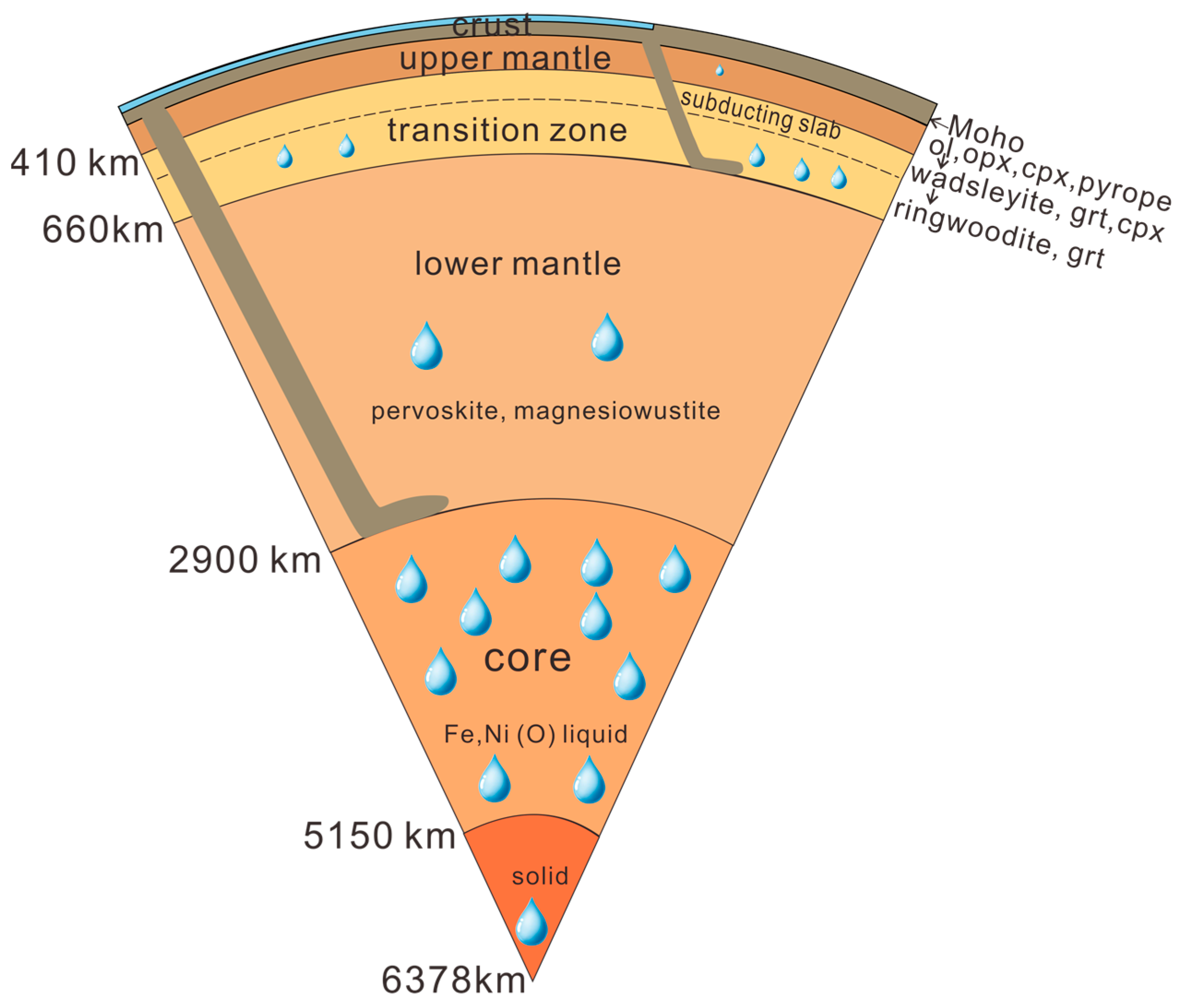
Besides H2 and free water, hydrogen, mainly as point defects such as hydroxyl OH), is present within mineral structures in the deep Earth. Surface water enters the Earth’s interior primarily through subduction zones. Because the subducting lithosphere in contact with the ocean is relatively oxidized, hydrogen enters the mantle predominantly as an oxidized form: either H2O within rock pores or OH within mineral structures [46]. With slab subducting to deep depths, hydrous minerals transform into more stable high-pressure hydrous phases. Water can even reach the core–mantle boundary through dense hydrous silicates and react with substances like Fe and Si in the outer core to form FeHx, which subsequently enters the outer core [47,48,49]. Based on experimental and computational data as well as natural samples, the water content in the Earth’s interior was estimated, as shown in Table 3 and Figure 2. The mantle is thought to be a huge water reservoir, with estimates ranging from about a quarter to more than four ocean masses [50,51], whereas there is large uncertainty around the concentrations of H2O in the Earth’s interior, primarily arising from the less-well-known concentrations for the lower mantle and core.

4.1. The Crust

The crust, being the Earth’s outermost layer, comprises the continental crust and the oceanic crust. In the shallow continental crust, water primarily exists as free water within rock pores or fractures. Pore water at depths less than 4 km is considered to be part of the groundwater reservoir, while pore water at depths greater than 4 km is regarded as part of the continental crust reservoir [52]. Besides pore water, the crust contains many water-bearing minerals such as mica, amphibole and clay minerals in their igneous and metamorphic units and water-rich sediments. Moreover, the crustal water reservoir also includes water dissolved within nominally anhydrous minerals (Table 4). During the cooling of basaltic magma into igneous rocks or the metamorphic transformation of igneous rocks in the continental crust, water can be incorporated into the lattice defects of nominally anhydrous minerals such as pyroxene, feldspar, quartz and olivine [59,60,61,62]. The oceanic crust reservoir, on the other hand, includes all water between the sediment/seawater interface and atop the upper mantle [52]. Based on calculations using amphibolite and granulite in the continental crust and basalt and gabbro in the oceanic crust, the average water content was estimated to be 1.3 wt% and 1.5 wt%, respectively [52].

4.2. The Upper Mantle

The primary minerals in the upper mantle are olivine, pyroxene, and garnet (Table 5). The measurements of water partition coefficients for synthetic and natural peridotite minerals indicate that the order of water content among these mantle minerals, from highest to lowest, is: pyroxene > garnet > olivine [69]. The study on xenoliths representing upper mantle lithologies also indicated that clinopyroxene, orthopyroxene, olivine and garnet contain 342–413, 169–201, 3–54 and 0 to <3 ppm H2O, respectively, and the average water contents of xenoliths are approximately 113 ppm [70]. As mineral proportions of peridotite change with depth in the mantle, the primary water-bearing mineral shifts from pyroxene at shallow depths to olivine at greater depths. With the depth increasing from 70 km to 300 km, the water partition coefficient between pyroxene and olivine ( D H 2 O pyroxene / olivine ) changes from 10 to 1.3; correspondingly, water content in olivine varies from 22 pm to 120 ppm. Therefore, the H2O content of olivine increases by a factor ~5 from the shallow to deep upper mantle [69], meaning that olivine is the principal host of H2O in the deep upper mantle. Combining data on the water storage capacity of olivine with constraints on partition coefficients between olivine, pyroxene, and garnet, the water storage capacity of the upper mantle was estimated at 50–200 ppm [53].
There are several mechanisms of water incorporation into silicate crystal structure proposed by available studies. The substitution of a Si4+ by an Al3+ ion plus a H+ is one possible mechanism, whereas it cannot account for the observed rapid uptake of H ions that diffuse millimeters in a few hours at high temperature; in contrast, Al ions diffuse a few nanometers. The second is the diffusion of H ions in iron-bearing silicate minerals, which can be charge compensated by a counter flux of holes, that is, the absence of electrons in the reduction reaction Fe3+ → Fe2+ + hole. The third mechanism is the incorporation of H ions into anhydrous minerals, which can be charge compensated by a parallel flux of Si, Fe, or Mg cation vacancies or possibly by a counter flux of oxygen interstitials [71]. Under water-saturated conditions, hydrogen mainly enters the structures of upper mantle minerals as OH substituting for magnesium vacancies. Under water-undersaturated conditions, H+ and Al3+ co-substitute for Si4+ in the structures of olivine and pyroxene, or 2H+ substitutes for Mg2+ [72]. Aluminum content is the main factor influencing the water content in pyroxene, which decreases with increasing depth; correspondingly, the water content in pyroxene also decreases with depth [53,72,73]. Olivine also has the same feature as pyroxene. Recent studies further demonstrate that oxygen fugacity influences water solubility in upper mantle minerals by affecting the ratio of Fe3+ to Fe2+. In pyroxenes and garnet, water solubility exhibits a negative correlation with oxygen fugacity, which is primarily attributed to the reduction of Fe3+ to Fe2+ and its incorporation mechanism coupled with hydroxyl (OH) groups. In contrast, water solubility in olivine shows a positive correlation with oxygen fugacity, likely due to the coupled substitution of H+ and Fe3+ for two Mg2+ vacancies [74].
Table 5. Water solubility of major mantle minerals.
MineralWater SolubilityT (K)P (GPa)Data Source
Olivine40–385 ppm1373–16231–7[75]
Orthopyroxene101–269 ppm973–13731.5[76]
867 ppm13737.5[77]
785–1647 ppm167312–14[78]
75–219 ppm13732–3[66]
Clinopyroxene714 ppm137310[77]
84–394 ppm13732–3[66]
Pyrope99–1024 ppm1373–14735–9[79]
14–31 ppm1073–12731.5–3[74]
Wadsleyite1.8–2.3 wt%167316.5[80]
0.9–2.2 wt%1173–167315[81]
4475–9370 ppm167312–14[78]
0.58–2.42 wt%1500–210017.5–21[82]
Ringwoodite1–1.25 wt%167316.5[80]
0.25–2.06 wt%1600–200023[54]
Majorite900–3000 ppm1670–227020[83]
Bridgmanite1099 ppm369033[84]
0.19–0.24 wt%1873–192325.5[85]
100 ppm157325[86]
Aluminous bridgmanite1100–1400 ppm147325–26[86]
Fe-, Al-bearing bridgmanite1400–1800 ppm1673–187325[86]
90–110 ppm1273–147326[86]
1020 ppm207324[87]
Stishovite1.3 wt%623–82310[88]
128–521 ppm1573–237322[89]
Aluminous stishovite844 ppm1473–167310–15[90]
296–3611 ppm1600–210023–32[91]
Davemaoite0.37–0.38 wt%1873–189325.5[85]
5100 ppm217325[86]
0.5–1 wt%1400–220019–120[92]
Periclase21–112 ppm1673–207325[86]
Ferropericlase25–180 ppm1673–207325[86]
0.19 wt%192325.5[85]
14–79 ppm1673–227325[93]

4.3. The Transition Zone

The Earth’s transition zone, located between 410 km and 660 km depth, primarily contains wadsleyite and ringwoodite, which have enormous water storage capacities (Table 5). Olivine transforms into wadsleyite at around 410 km depth, and wadsleyite transforms into ringwoodite at around 520 km depth. The presence of water can accelerate these transformation rates [94,95,96]. Furthermore, with increasing pressure, clinopyroxene and orthopyroxene, along with pyrope, transform into majorite. In the mantle transition zone, majorite becomes the primary garnet phase [96].
The water content in wadsleyite and ringwoodite decreases with the increase in temperature. The effect of temperature on the water content of iron-free ringwoodite is more significant than on iron-bearing ringwoodite. For instance, when temperature rises from 1800 K to 2000 K, the H2O solubility in iron-free ringwoodite decreases by 50%, while it only decreases from about 1.5 wt% to 1.15 wt% for iron-bearing ringwoodite as temperature increases from 1600 K to 2000 K [54]. The study on wadsleyite showed that the water solubility in it decreases significantly when increasing temperature from ~2.2 wt% H2O at 900 °C down to 0.9 wt% at 1400 °C at 15 GPa, but the effect of pressure on the water content is not marked [81]. Based on the water content of synthetic minerals under conditions of the transition zone, it was inferred that ringwoodite can store 0.8–1.2 wt% water [54]. Analysis of natural diamond inclusions containing ringwoodite by Pearson et al. [55] found water contents of 1.4–1.5 wt%, leading to the inference that the transition zone contains about 1 wt% water. The water content of majorite is influenced by temperature, pressure, and Mg/Fe contents. Compared to ringwoodite and wadsleyite, the water content of majorite is extremely low, and it is generally not considered to play a dominant role in water storage in the transition zone [97,98]. Using an average transition zone water content estimate of 2000 ppm, it was inferred that the transition zone holds the equivalent of about 0.6 ocean masses of water [52]. Therefore, the transition zone is considered the most potential “water reservoir” in the Earth’s deep interior [99].
The transition zone acts as a filter for water. The downward injection of cold subducting slabs causes the surrounding mantle to rise. When wadsleyite ascends into the upper mantle and transforms back into olivine, the lower water solubility of olivine can lead to partial melting at the 410 km discontinuity, with some incompatible elements entering the melt. The residual partially dehydrated peridotite will remain saturated with respect to hydrous fluid. If that peridotite were then advected to a region of lower storage capacity, additional fluid or melt would be expelled from the solid. The melt, being denser than the upper mantle but less dense than the transition zone, accumulates around 410 km depth. When this melt encounters a subducting slab, it can be carried into the deep mantle. Most of the water diffuses back into the transition zone, while the remaining water present in hydrous minerals continues to migrate downward with the slab. At the 660 km boundary, subducting slabs tend to flatten, and minerals transform from transition zone assemblages to lower mantle minerals. Because the water solubility of lower mantle minerals is lower than that of transition zone minerals, water is released from the minerals. The rock matrix containing the exsolved water develops sufficient porosity, allowing water to percolate from the lower mantle back into the transition zone [99].

4.4. The Lower Mantle

Ringwoodite transforms into bridgmanite and ferropericlase at a depth of approximately 660 km, and majorite garnet transforms into bridgmanite between depths of about 660 km and 800 km [83]. The primary mineral in the lower mantle is bridgmanite, followed by ferropericlase and davemaoite (Table 5). In bridgmanite, hydrogen is incorporated not only by substituting for Mg2+ or co-substituting with Al3+ for Si4+ but also as OH occupying oxygen vacancies created by the substitution of trivalent cations (Fe3+, Al3+) for Si4+. Consequently, an increase in Al content enhances the water solubility of bridgmanite [100]. Under conditions at the top of the lower mantle, the water solubility of ferropericlase (e.g., 14–79 ppm at 25 GPa and 1400–2000 °C) is considerably lower than that of bridgmanite (e.g., 1020 ppm at 24 GPa and 1800 °C). However, bridgmanite can react with water to form hydrous phases such as δ–H phases, i.e., AlOOH–MgSiO2(OH)2 solid solution. When bridgmanite coexists with hydrous phases such as phase δ–H solid solution and stishovite, water does not preferentially partition into bridgmanite, indicating that bridgmanite is not the primary water reservoir in the uppermost lower mantle [87,93,101,102,103].
Dense hydrous magnesium silicates (DHMSs) may also serve as water reservoirs in the lower mantle. Nevertheless, most high-pressure hydrous phases are stable at temperatures below the lower mantle adiabat; for instance, the phase D (Mg1.14Si1.73H2.81O6) has a maximum thermal stability of 1673 K in the 22–32 GPa pressure range, whereas the mantle temperature at 660 km depth is about 1850 K. Therefore, these hydrous phases mainly exist in cold subducted slabs [104,105,106,107]. At around 40 GPa, Phase D transforms into phase H which is stable in the 35–60 GPa range. When it forms a solid solution with the δ-phase, i.e., the δ–H solid solution, its stability field expands significantly, allowing it to exist within the lower mantle. Water derived from the dehydration of the subduction slab reacts with Al-rich bridgmanite in the uppermost lower mantle, forming Al-poor bridgmanite and phase δ-H solid solution. The phase δ-H solid solution then transports water into the deeper mantle [57,101,106,108]. If hydrous phases or hydrated nominally anhydrous minerals from the slab accumulate at the base of the lower mantle and are heated, the released water can promote partial melting, potentially contributing to the formation of ultra-low velocity zones [109].
Recent experiments have indicated that davemaoite is also an important water-bearing mineral in the lower mantle. Chen et al. [92] determined the water contents of 0.5–1.0 wt% in davemaoite synthesized at pressures of 19–120 GPa and temperatures of 1400–2200 K using infrared spectroscopy, and observed peak splitting in the X-ray diffraction patterns of hydrous davemaoite under lower mantle conditions, attributing this to a tetragonal distortion of its crystal structure. It was further found that water incorporation in davemaoite via H+ substitution for Ca2+ or Si4+ by density functional theory calculations, and the degree of non-cubic distortion for a davemaoite crystal with 1 wt% water content was consistent with the previously observed peak splitting [110].
It was estimated that the lower mantle contains the equivalent of about 0.2 ocean masses of water, assuming an average water content of 100 ppm [52]. However, Peslier et al. [55] states that the lower mantle could contain up to about 2.9 ocean masses of water based on a lower mantle composition of 80% bridgmanite, 11% ferropericlase, 8% davemaoite, and 1% hydrous minerals.

4.5. The Earth’s Core

The density of the Earth’s core is 8%–10% lower than that of pure iron under the same temperature and pressure conditions. This density deficit is proposed to be attributed to the incorporation of light elements; for instance, adding just 1 wt% hydrogen could account for this density difference [111,112]. During the early stages of the Earth’s formation, reactions between hydrous magma and iron could have generated FeHx. This reaction between water and iron occurs at pressures above approximately 4 GPa [113]:
Fe   +   H 2 O     FeO   +   FeH x
The FeHx would sink and become part of the core, while FeO would be absorbed by surrounding silicates [47,113].
At pressures exceeding about 78 GPa, iron can react directly with water [47]:
Fe   +   H 2 O     FeO 2 H x   +   FeH x
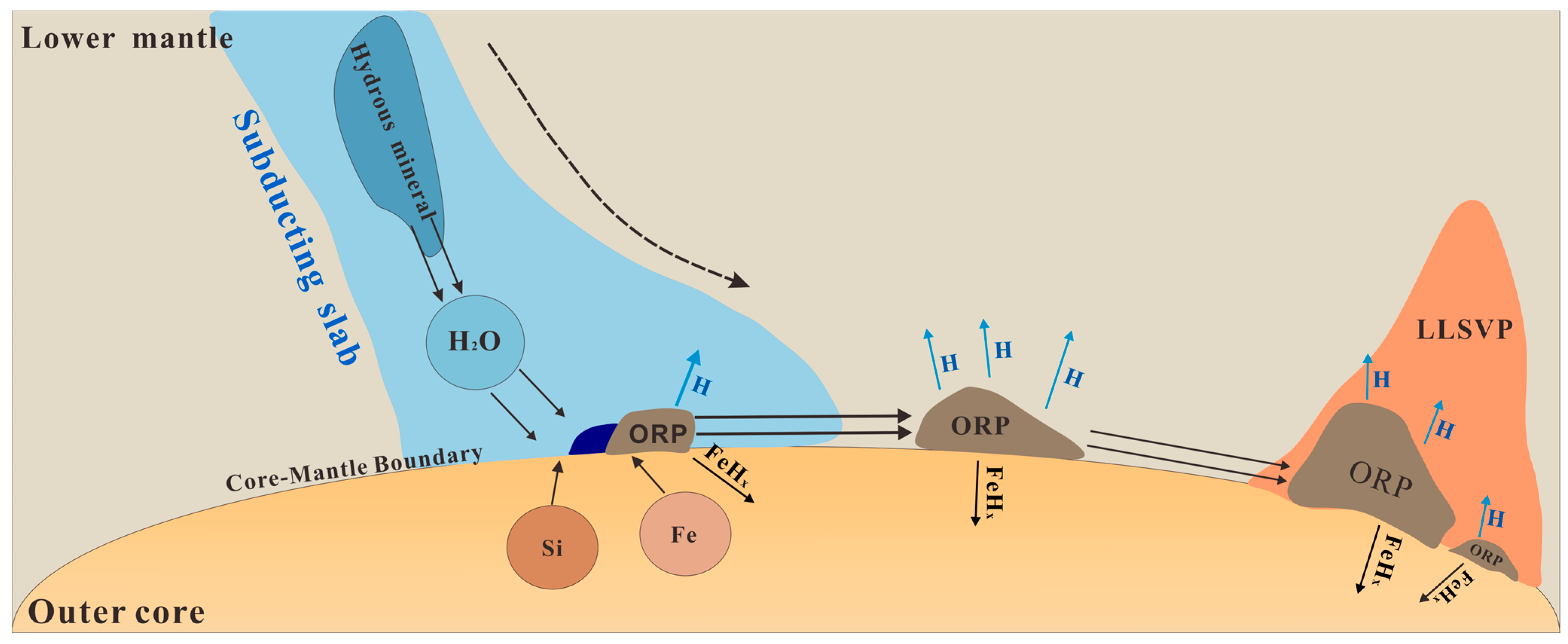
When dense hydrous minerals (e.g., phase δ–AlOOH) transport water to the core–mantle boundary and subsequently dehydrate, the released water can react with iron in the outer core. The FeHx and FeO2Hx (Py-phase) can accumulate at the top of the outer core, forming oxygen-rich patches (ORP), as illustrated in Figure 3 [47,114,115,116]. These oxygen-rich patches are thought to move laterally due to mantle convection, from their cooler formation regions towards hotter areas, and ultimately mix with mantle silicates to form large low-shear-velocity provinces (LLSVP). Some FeHx may melt and incorporate into the outer core as temperature increases, while FeO2Hx may gradually dehydrogenate with increasing temperature and heating duration. The released hydrogen might then migrate to the Earth’s surface through grain boundaries in mantle minerals or by forming hydrocarbons. Alternatively, it could be re-absorbed by iron in the core [115,116,117].
During the cooling and crystallization of the early magma ocean, the formation of the Py-phase would generate hydrogen which would permeate into the liquid outer core and simultaneously oxidize the mantle. In this oxidized environment, it becomes more favorable for the formation of the Py-phase. Concurrently, hydrogen residing within the silicates/oxides would continue to diffuse, potentially in a superionic state, ultimately contributing to a chemically highly heterogeneous core–mantle boundary region [118].
Furthermore, water released from mineral dehydration at the core–mantle boundary can also react with Fe-Si alloys present in the outer core:
Si   +   2 H 2 O   =   4 H   +   SiO 2
Since hydrogen behaves as a siderophile element under high pressure, hydrogen produced by this reaction enters the metallic core to form FeHx, while the SiO2 reacts with ferropericlase to form silicates that remain in the mantle [48,49].
The incorporation of hydrogen into the Earth’s core reduces the density of iron, which can account for the density deficit in the inner core. However, it simultaneously increases the shear wave velocity (Vs), which contradicts seismological observations showing a reduced Vs in the inner core. Therefore, other light elements besides hydrogen might also be present in the inner core [112,119]. Furthermore, Fe–H, Fe–C, and Fe–O alloys may transition into a superionic state under core conditions. In this state, C, H, and O ions can diffuse rapidly through the interstitial sites of the iron lattice, and exhibit fluid-like characteristics that reduce both the shear wave velocity and the density, aligning with seismic observations [120].
On the basis of different core formation models and the experimentally determined metal–silicate partition coefficient of hydrogen, the hydrogen content in the core was estimated to be 0.3–0.6 wt%, equivalent to 37–73 ocean masses of water, which can account for 30%–60% of the density deficit and sound velocity excess of the outer core [7]. However, using machine-learning methods, the inner core was proposed to contain 0.15–0.19 wt% H, equivalent in mass to about one ocean, while the outer core contains 0.31 wt% H, equivalent to about 33 ocean masses [58].

5. Hydrogen Cycle in the Earth’s Interior

5.1. Input of Surface Water into the Earth’s Interior

Terrestrial planets formed from an accretion disk resulting from the collapse of a vast, cold, slowly rotating cloud of gas and dust in the solar system. During planetary formation, water was likely incorporated into the growing planetesimals and planets through adsorption processes [6]. In the Earth’s case, water dissociated into OH was adsorbed onto minerals like olivine. Subsequently, this OH could react with other adsorbed H2, high-energy protons from the solar wind, or other OH groups to form H2O [121]. Wu et al. [122] proposed a nebular ingassing model for hydrogen, suggesting that the Earth’s mantle contains about two ocean masses of water, while the core holds approximately five ocean masses. After the planet’s initial formation, additional water may have been delivered via impacts from comets and asteroids [6]. Water delivered by asteroid and comet impacts likely represents only a minor fraction of the Earth’s water budget, contributing perhaps just a few percent of an ocean mass [123].
After the Earth’s formation, the primary mechanism for surface water entering the Earth’s interior is through the subduction of oceanic crust (Figure 2). At the initial stage of subduction, a significant portion of pore water within the rocks is expelled due to compaction. Most of the residual water is carried into the upper mantle with the subducting oceanic crust. Here, water reacts with peridotite to form hydrous minerals such as chlorite, amphibole, and serpentine. Due to scraping of the mantle wedge base by the subducting slab, hydrated peridotite can be carried deeper into the Earth along the subduction zone [124].
During subduction, metamorphic dehydration and partial melting of minerals facilitate the formation of more stable hydrous minerals, which transport water deeper into the Earth’s interior. At forearc depths, most hydrous minerals dehydrate as temperature and pressure increase. At the sub-arc depth, high-pressure hydrous phases such as lawsonite, zoisite, and phengite, along with hydrated nominally anhydrous minerals like clinopyroxene and garnet, become the primary carriers of water [125].

5.2. Upward Migration of Hydrogen

At shallow depths in subduction zones, hydrous minerals undergo dehydration reactions. The released water migrates upwards and reacts with the peridotite at the base of the mantle wedge, forming serpentine and chlorite. Simultaneously, the subducting slab drags solid material from the mantle wedge downwards. When these hydrous minerals from the base of the mantle wedge reach depths where they become unstable, a dehydration reaction occurs. The released water can form interconnected networks within the peridotite, allowing it to percolate into the overlying, hotter mantle wedge [126,127]. Concurrently, the addition of water lowers the solidus temperature of mantle rocks, leading to the formation of hydrous melts. Because the melt is less dense than the surrounding rock, it rises, and continuously dissolves silicate minerals, eventually forming magma that carries water back to the atmosphere and hydrosphere via arc volcanism [128]. When hydrous minerals are transported into the deep, reduced mantle by the subducting slab, the water released by the dehydration reaction equilibrates with the oxygen fugacity of the surrounding bulk mantle, potentially forming a hydrogen-rich fluid that contains very little water. Due to its low density and viscosity, this fluid tends to migrate upwards [129].
The temperature gradient between the Earth’s outer core and the mantle causes continuous heat flow from the core outwards, which can trigger partial melting of subducted oceanic crust and lower the solidus of mantle material, forming mantle plumes [130]. They can ascend through the mantle driven by thermal buoyancy, and the plume head entrains surrounding mantle material [131,132]. When the mantle plume head reaches the base of the lithosphere, it can cause extensive partial melting, ultimately leading to the formation of Large Igneous Provinces at the surface [133]. Early in the Earth’s formation, hydrogen might have been stored in the deep interior, possibly dissolved in silicate minerals. However, as mantle plumes rise, this hydrogen stored in the lower mantle is transported upwards, and the exothermic reactions of substances (hydrogen and helium) within the mantle plume provide the energy for its ascent [134]. Upon reaching the upper mantle, changes in oxygen fugacity may cause hydrogen to be oxidized to water or OH [43].

6. Summary and Prospectives

Hydrogen within the Earth’s interior plays a pivotal role in the occurrence and evolution of geological processes. Major progress has been made on hydrogen in the form of water (i.e., structurally bound OH in minerals) in the Earth’s interior for several decades, which includes experimental determinations of water solubility in mantle minerals and the water capacity of the deep Earth; investigations of water cycling processes inside the Earth; and understanding the influence of water on the geophysical properties of minerals. In recent years, natural hydrogen gas, as a naturally renewable energy source within the Earth, has gradually gained widespread attention. Serpentinization, as the dominant process of natural hydrogen generation, has been extensively and deeply studied. However, knowledge on the migration and accumulation of natural hydrogen in the lithosphere is currently very limited; correspondingly, experimental and field evidence is required to facilitate the exploration and exploitation of hydrogen in the future.
Even though a lot of advances in the generation, storage and cycling of the deep Earth’s hydrogen have been made, there remains some issues that need to be explored in detail:
(1)
The mechanisms for natural hydrogen formation, particularly for abiotic origin, as well as the impact factors affecting hydrogen generation should be further explored.
(2)
Uncertainty in origin and distribution: While hydrogen in the Earth’s interior is a carbon-free, sustainable resource, current research on natural hydrogen primarily focuses on surface occurrences. The genetic mechanisms and distribution patterns of hydrogen in the Earth’s interior are not yet fully understood and more work is required.
(3)
Limited understanding of production mechanisms: Hydrogen production by the serpentinization process has been studied in detail. By contrast, other hydrogen generation pathways have not yet obtained adequate research. To facilitate the exploitation and exploration of hydrogen energy resources within the Earth, comprehensive studies on these other production processes are also important.
(4)
Discrepancies in water content estimates: Water contents in nominally anhydrous minerals measured under experimental conditions often vary largely among different studies. Accordingly, water content estimates for each layer of the Earth’s interior determined by different methods (e.g., physical property, petrology, geochemistry) have remarkable discrepancies. For accurate determination of the water content in primary constituent minerals and estimates of the water content in the Earth’s interior, the integration of various analytical methods and disciplines is needed.
(5)
Challenges in sampling the deep Earth’s materials and accurately quantifying the water content of the Earth’s interior: Studies on natural samples from the deep Earth remain challenging owing to the present limited drilling depth, and magma trapped in crystals at the surface of the Earth may not originate from a single-source region and undergo significant chemical changes during their ascent, both of which make it difficult to accurately determine the hydration state of different layers in the Earth’s interior.

Author Contributions

Conceptualization: H.H., L.D. and P.W.; Data curation: Y.J., P.W., L.W., J.Z. and S.H.; Funding acquisition: H.H., L.D. and W.S.; Writing—original draft: Y.J. and S.L.; Writing—review and editing: H.H. and L.D. All authors have read and agreed to the published version of the manuscript.

Funding

This study was financially supported by the National Natural Science Foundation of China (42274137), Guizhou Normal University Academic New Talent Fund (GZNUD[2025]10 and GZNUD[2025]12), and Guizhou Provincial Science and Technology Projects (QKHJC-ZD[2026]149 and QKHJC-ZK[2022]YB567).

Data Availability Statement

No new data were created or analyzed in this study.

Acknowledgments

We thank Shenzhen Guangming Science City Development and Construction Co., Ltd. and its Material Genome-Big-Science Facilities Platform.

Conflicts of Interest

The authors declare no conflicts of interest.

References

  1. International Energy Agency. Global Hydrogen Review 2023; International Energy Agency: Paris, France, 2023; Available online: https://www.iea.org/reports/global-hydrogen-review-2023 (accessed on 10 November 2025).
  2. International Energy Agency. The Future of Hydrogen; International Energy Agency: Paris, France, 2019; Available online: https://www.iea.org/reports/the-future-of-hydrogen (accessed on 10 November 2025).
  3. Johnson, N.; Liebreich, M.; Kammen, D.M.; Ekins, P.; McKenna, R.; Staffell, I. Realistic roles for hydrogen in the future energy transition. Nat. Rev. Clean Technol. 2025, 1, 351–371. [Google Scholar] [CrossRef]
  4. Osselin, F.; Soulaine, C.; Fauguerolles, C.; Gaucher, E.C.; Scaillet, B.; Pichavant, M. Orange hydrogen is the new green. Nat. Geosci. 2022, 15, 765–769. [Google Scholar] [CrossRef]
  5. Prinzhofer, A.; Tahara Cissé, C.S.; Diallo, A.B. Discovery of a large accumulation of natural hydrogen in Bourakebougou (Mali). Int. J. Hydrogen Energy 2018, 43, 19315–19326. [Google Scholar] [CrossRef]
  6. Drake, M.J. Origin of water in the terrestrial planets. Meteorit. Planet. Sci. 2005, 40, 519–527. [Google Scholar] [CrossRef]
  7. Tagawa, S.; Sakamoto, N.; Hirose, K.; Yokoo, S.; Hernlund, J.; Ohishi, Y.; Yurimoto, H. Experimental evidence for hydrogen incorporation into Earth’s core. Nat. Commun. 2021, 12, 2588. [Google Scholar] [CrossRef] [PubMed]
  8. Zgonnik, V. The occurrence and geoscience of natural hydrogen: A comprehensive review. Earth-Sci. Rev. 2020, 203, 103140. [Google Scholar] [CrossRef]
  9. Klein, F.; Tarnas, J.D.; Bach, W. Abiotic Sources of Molecular Hydrogen on Earth. Elements 2020, 16, 19–24. [Google Scholar] [CrossRef]
  10. Mccollom, T.M.; Bach, W. Thermodynamic constraints on hydrogen generation during serpentinization of ultramafic rocks. Geochim. Cosmochim. Acta 2009, 73, 856–875. [Google Scholar] [CrossRef]
  11. Pens, M.; Andreani, M.; Daniel, I.; Perrillat, J.-P.; Cardon, H. Contrasted effect of aluminum on the serpentinization rate of olivine and orthopyroxene under hydrothermal conditions. Chem. Geol. 2016, 441, 256–264. [Google Scholar] [CrossRef]
  12. Grozeva, N.G.; Klein, F.; Seewald, J.S.; Sylva, S.P. Experimental study of carbonate formation in oceanic peridotite. Geochim. Cosmochim. Acta 2017, 199, 264–286. [Google Scholar] [CrossRef]
  13. Syverson, D.D.; Tutolo, B.M.; Borrok, D.M.; Seyfried, W.E. Serpentinization of olivine at 300 °C and 500bars: An experimental study examining the role of silica on the reaction path and oxidation state of iron. Chem. Geol. 2017, 75, 122–134. [Google Scholar] [CrossRef]
  14. Wang, J.; Watanabe, N.; Okamoto, A.; Nakamura, K.; Komai, T. Acceleration of hydrogen production during water-olivine-CO2 reactions via high-temperature-facilitated Fe(II) release. Int. J. Hydrogen Energy 2019, 44, 11514–11524. [Google Scholar] [CrossRef]
  15. McCollom, T.M.; Klein, F.; Solheid, P.; Moskowitz, B. The effect of pH on rates of reaction and hydrogen generation during serpentinization. Philos. Trans. R. Soc. A 2020, 378, 20180428. [Google Scholar] [CrossRef] [PubMed]
  16. Huang, R.; Sun, W.; Ding, X.; Zhao, Y.; Li, Y.; Shang, X. The influence of silica on reaction rates and molecular hydrogen (H2) generation during olivine hydrothermal alteration. Sci. China Earth Sci. 2024, 67, 222–233. [Google Scholar] [CrossRef]
  17. Jones, L.C.; Rosenbauer, R.; Goldsmith, J.I.; Oze, C. Carbonate control of H2 and CH4 production in serpentinization systems at elevated P-Ts. Geophys. Res. Lett. 2010, 37, L14306. [Google Scholar] [CrossRef]
  18. Klein, F.; Mccollom, T.M. From serpentinization to carbonation: New insights from a CO2 injection experiment. Earth Planet. Sci. Lett. 2013, 379, 137–145. [Google Scholar] [CrossRef]
  19. Kelemen, P.B.; Matter, J.; Streit, E.E.; Rudge, J.F.; Curry, W.B.; Blusztajn, J. Rates and Mechanisms of Mineral Carbonation in Peridotite: Natural Processes and Recipes for Enhanced, in situ CO2 Capture and Storage. Annu. Rev. Earth Planet. Sci. 2011, 39, 545–576. [Google Scholar] [CrossRef]
  20. Lin, L.-H.; Slater, G.F.; Sherwood Lollar, B.; Lacrampe-Couloume, G.; Onstott, T.C. The yield and isotopic composition of radiolytic H2, a potential energy source for the deep subsurface biosphere. Geochim. Cosmochim. Acta 2005, 69, 893–903. [Google Scholar] [CrossRef]
  21. Wang, W.; Liu, C.; Zhang, D.; Liu, W.; Chen, L.; Liu, W. Radioactive Genesis of Hydrogen Gas under Geological Conditions: An Experimental Study. Acta Geol. Sin. (Engl. Ed.) 2019, 93, 1125–1134. [Google Scholar] [CrossRef]
  22. Kumagai, Y.; Kimura, A.; Taguchi, M.; Nagaishi, R.; Yamagishi, I.; Kimura, T. Hydrogen production in gamma radiolysis of the mixture of mordenite seawater. J. Nucl. Sci. Technol. 2013, 50, 130–138. 10. [Google Scholar] [CrossRef]
  23. Lollar, B.S.; Onstott, T.C.; Lacrampe-Couloume, G.; Ballentine, C.J. The contribution of the Precambrian continental lithosphere to global H2 production. Nature 2014, 516, 379–382. [Google Scholar] [CrossRef]
  24. D’hondt, S.; Spivack, A.J.; Pockalny, R.; Ferdelman, T.G.; Fischer, J.P.; Kallmeyer, J.; Abrams, L.J.; Smith, D.C.; Graham, D.; Hasiuk, F.; et al. Subseafloor sedimentary life in the South Pacific Gyre. Proc. Natl. Acad. Sci. USA 2009, 106, 11651–11656. [Google Scholar] [CrossRef]
  25. Dzaugis, M.; Spivack, A.; Dunlea, A.; Murray, R.; D’Hondt, S. Radiolytic Hydrogen Production in the Subseafloor Basaltic Aquifer. Front. Microbiol. 2016, 7, 76. [Google Scholar] [CrossRef] [PubMed]
  26. Worman, S.L. Global Rates of Free Hydrogen (H2) Production by Serpentinization and Other Abiogenic Processes Within Young Ocean Crust. Ph.D. Thesis, Duke University, Durham, NC, USA, 2015. Available online: https://hdl.handle.net/10161/10490 (accessed on 10 November 2025).
  27. Wakita, H.; Nakamura, Y.; Kita, I.; Fujii, N.; Notsu, K. Hydrogen Release: New Indicator of Fault Activity. Science 1980, 210, 188–190. [Google Scholar] [CrossRef]
  28. Kita, I.; Matsuo, S.; Wakita, H. H2 generation by reaction between H2O and crushed rock: An experimental study on H2 degassing from the active fault zone. J. Geophys. Res. 1982, 87, 789–795. [Google Scholar] [CrossRef]
  29. Freund, F.; Dickinson, J.T.; Cash, M. Hydrogen in rocks: An energy source for deep microbial communities. Astrobiology 2002, 2, 83–92. [Google Scholar] [CrossRef]
  30. Hirose, T.; Kawagucci, S.; Suzuki, K. Mechanoradical H2 generation during simulated faulting: Implications for an earthquake-driven subsurface biosphere. Geophys. Res. Lett. 2011, 38, L17303. [Google Scholar] [CrossRef]
  31. Telling, J.; Boyd, E.S.; Bone, N.; Jones, E.L.; Tranter, M.; MacFarlane, J.W.; Martin, P.G.; Wadham, J.L.; Lamarche-Gagnon, G.; Skidmore, M.L.; et al. Rock comminution as a source of hydrogen for subglacial ecosystems. Nat. Geosci. 2015, 8, 851–855. [Google Scholar] [CrossRef]
  32. Drobner, E.; Huber, H.; Wächtershäuser, G.; Rose, D.; Stetter, K.O. Pyrite formation linked with hydrogen evolution under anaerobic conditions. Nature 1990, 346, 742–744. [Google Scholar] [CrossRef]
  33. Arrouvel, C.; Prinzhofer, A. Genesis of natural hydrogen: New insights from thermodynamic simulations. Int. J. Hydrogen Energy 2021, 46, 18780–18794. [Google Scholar] [CrossRef]
  34. Gallant, R.M.; Von Damm, K.L. Geochemical controls on hydrothermal fluids from the Kairei and Edmond Vent Fields, 23°–25° S, Central Indian Ridge. Geochem. Geophys. Geosyst. 2006, 7, Q06018. [Google Scholar] [CrossRef]
  35. Gaillard, F.; Scaillet, B.; Arndt, N.T. Atmospheric oxygenation caused by a change in volcanic degassing pressure. Nature 2011, 478, 229–232. [Google Scholar] [CrossRef] [PubMed]
  36. Apps, J.A.; Van De Kamp, P.C. Energy gases of abiogenic origin in the Earth’s crust. US Geol. Surv. Prof. Pap. 1993, 1570, 81–132. [Google Scholar]
  37. Hu, H.; Dai, L.; Li, H.; Sun, W.; Li, B. Effect of dehydrogenation on the electrical conductivity of Fe-bearing amphibole: Implications for high conductivity anomalies in subduction zones and continental crust. Earth Planet. Sci. Lett. 2018, 498, 27–37. [Google Scholar] [CrossRef]
  38. Truche, L.; Joubert, G.; Dargent, M.; Martz, P.; Cathelineau, M.; Rigaudier, T.; Quirt, D. Clay minerals trap hydrogen in the Earth’s crust: Evidence from the Cigar Lake uranium deposit, Athabasca. Earth Planet. Sci. Lett. 2018, 493, 186–197. [Google Scholar] [CrossRef]
  39. Wang, L.; Cheng, J.; Jin, Z.; Sun, Q.; Zou, R.; Meng, Q.; Liu, K.; Su, Y.; Zhang, Q. High-pressure hydrogen adsorption in clay minerals: Insights on natural hydrogen exploration. Fuel 2023, 344, 127919. [Google Scholar] [CrossRef]
  40. Wang, L.; Jin, Z.; Liu, Q.; Liu, K.; Meng, Q.; Huang, X.; Su, Y.; Zhang, Q. The occurrence pattern of natural hydrogen in the Songliao Basin, P.R. China: Insights on natural hydrogen exploration. Int. J. Hydrogen Energy 2024, 50, 261–275. [Google Scholar] [CrossRef]
  41. Maiga, O.; Deville, E.; Laval, J.; Prinzhofer, A.; Diallo, A.B. Characterization of the spontaneously recharging natural hydrogen reservoirs of Bourakebougou in Mali. Sci. Rep. 2023, 13, 11876. [Google Scholar] [CrossRef]
  42. Maiga, O.; Deville, E.; Laval, J.; Prinzhofer, A.; Diallo, A.B. Trapping processes of large volumes of natural hydrogen in the subsurface: The emblematic case of the Bourakebougou H2 field in Mali. Int. J. Hydrogen Energy 2024, 50, 640–647. [Google Scholar] [CrossRef]
  43. Yang, X.; Keppler, H.; Li, Y. Molecular hydrogen in mantle minerals. Geochem. Persp. Let. 2016, 2, 160–168. [Google Scholar] [CrossRef]
  44. Klein, F.; Grozeva, N.G.; Seewald, J.S. Abiotic methane synthesis and serpentinization in olivine-hosted fluid inclusions. Proc. Natl. Acad. Sci. USA 2019, 116, 17666–17672. [Google Scholar] [CrossRef]
  45. Grozeva, N.G.; Klein, F.; Seewald, J.S.; Sylva, S.P. Chemical and isotopic analyses of hydrocarbon-bearing fluid inclusions in olivine-rich rocks. Philos. Trans. R. Soc. A 2020, 378, 20180431. [Google Scholar] [CrossRef]
  46. Keppler, H.; Ohtani, E.; Yang, X. The Subduction of Hydrogen: Deep Water Cycling, Induced Seismicity, and Plate Tectonics. Elements 2024, 20, 229–234. [Google Scholar] [CrossRef]
  47. Yuan, L.; Ohtani, E.; Ikuta, D.; Kamada, S.; Tsuchiya, J.; Naohisa, H.; Ohishi, Y.; Suzuki, A. Chemical Reactions Between Fe and H2O up to Megabar Pressures and Implications for Water Storage in the Earth’s Mantle and Core. Geophys. Res. Lett. 2018, 45, 1330–1338. [Google Scholar] [CrossRef]
  48. Li, Y.; Vočadlo, L.; Sun, T.; Brodholt, J.P. The Earth’s core as a reservoir of water. Nat. Geosci. 2020, 13, 453–458. [Google Scholar] [CrossRef]
  49. Kim, T.; O’rourke, J.G.; Lee, J.; Chariton, S.; Prakapenka, V.; Husband, R.J.; Giordano, N.; Liermann, H.-P.; Shim, S.-H.; Lee, Y. A hydrogen-enriched layer in the topmost outer core sourced from deeply subducted water. Nat. Geosci. 2023, 16, 1208–1214. [Google Scholar] [CrossRef]
  50. Jambon, A.; Zimmermann, J.L. Water in oceanic basalts: Evidence for dehydration of recycled crust. Earth Planet. Sci. Lett. 1990, 101, 323–331. [Google Scholar] [CrossRef]
  51. Bolfan-Casanova, N.; Keppler, H.; Rubie, D.C. Water partitioning at 660 km depth and evidence for very low water solubility in magnesium silicate perovskite. Geophys. Res. Lett. 2003, 30, 1905. [Google Scholar] [CrossRef]
  52. Bodnar, R.J.; Azbej, T.; Becker, S.P.; Cannatelli, C.; Fall, A.; Severs, M.J. Whole Earth geohydrologic cycle, from the clouds to the core: The distribution of water in the dynamic Earth system. In The Web of Geological Sciences: Advances, Impacts, and Interactions; Bickford, M.E., Ed.; The Geological Society of America: Boulder, CO, USA, 2013; pp. 431–461. [Google Scholar] [CrossRef]
  53. Hirschmann, M.M.; Aubaud, C.; Withers, A.C. Storage capacity of H2O in nominally anhydrous minerals in the upper mantle. Earth Planet. Sci. Lett. 2005, 236, 167–181. [Google Scholar] [CrossRef]
  54. Fei, H.; Katsura, T. High water solubility of ringwoodite at mantle transition zone temperature. Earth Planet. Sci. Lett. 2020, 531, 115987. [Google Scholar] [CrossRef]
  55. Pearson, D.G.; Brenker, F.E.; Nestola, F.; McNeill, J.; Nasdala, L.; Hutchison, M.T.; Matveev, S.; Mather, K.; Silversmit, G.; Schmitz, S.; et al. Hydrous mantle transition zone indicated by ringwoodite included within diamond. Nature 2014, 507, 221–224. [Google Scholar] [CrossRef]
  56. Peslier, A.H.; Schönbächler, M.; Busemann, H.; Karato, S.-I. Water in the Earth’s Interior: Distribution and Origin. Space Sci. Rev. 2017, 212, 743–810. [Google Scholar] [CrossRef]
  57. Tsuchiya, J. First principles prediction of a new high-pressure phase of dense hydrous magnesium silicates in the lower mantle. Geophys. Res. Lett. 2013, 40, 4570–4573. [Google Scholar] [CrossRef]
  58. Yuan, L.; Steinle-Neumann, G. Hydrogen distribution between the Earth’s inner and outer core. Earth Planet. Sci. Lett. 2023, 609, 118084. [Google Scholar] [CrossRef]
  59. Yang, X.; Xia, Q.; Deloule, E.; Fan, Q.; Hao, Y. Implications of water in granulites for the nature and evolution of the continental lower crust. Progr. Nat. Sci. 2007, 17, 148–162. [Google Scholar] [CrossRef]
  60. Yang, X.; Xia, Q.; Fan, Q.; Deloule, E. Rheological properties of continental lithosphere and water in minerals. Earth Sci. Front. 2008, 15, 96–112. [Google Scholar] [CrossRef]
  61. Stalder, R.; Konzett, J. OH defects in quartz in the system quartz–albite–water and granite–water between 5 and 25 kbar. Phys. Chem. Miner. 2012, 39, 817–827. [Google Scholar] [CrossRef]
  62. Seaman, S.J.; Williams, M.L.; Jercinovic, M.J.; Koteas, G.C.; Brown, L.B. Water in nominally anhydrous minerals: Implications for partial melting and strain localization in the lower crust. Geology 2013, 41, 1051–1054. [Google Scholar] [CrossRef]
  63. Zhang, K.; Yang, T.; Yang, X. Redox-independent low water solubility in quartz and implications for water storage in the crust. J. Geophys. Res. Solid Earth 2023, 128, e2022JB026189. [Google Scholar] [CrossRef]
  64. Mosenfelder, J.L.; Andrys, J.L.; von der Handt, A.; Kohlstedt, D.L.; Hirschmann, M.M. Hydrogen incorporation in plagioclase. Geochim. Cosmochim. Acta 2020, 277, 87–110. [Google Scholar] [CrossRef]
  65. Yang, X. An experimental study of H solubility in feldspars: Effect of composition, oxygen fugacity, temperature and pressure and implications for crustal processes. Geochim. Cosmochim. Acta 2012, 97, 46–57. [Google Scholar] [CrossRef]
  66. Liu, H.; Yang, X. Solubility of hydroxyl groups in pyroxenes: Effect of oxygen fugacity at 0.2–3 GPa and 800–1200 °C. Geochim. Cosmochim. Acta 2020, 286, 355–379. [Google Scholar] [CrossRef]
  67. Jiang, P.; Liu, H.; Skogby, H.; Chen, R.-X.; Yang, X. Water in omphacite fingerprints the thermal history of eclogites. Geology 2021, 50, 316–320. [Google Scholar] [CrossRef]
  68. Colasanti, C.V.; Johnson, E.A.; Manning, C.E. An experimental study of OH solubility in rutile at 500–900 °C, 0.5–2 GPa, and a range of oxygen fugacities. Am. Mineral. 2011, 96, 1291–1299. [Google Scholar] [CrossRef]
  69. Tenner, T.J.; Hirschmann, M.M.; Withers, A.C.; Ardia, P. H2O storage capacity of olivine and low-Ca pyroxene from 10 to 13 GPa: Consequences for dehydration melting above the transition zone. Contrib. Mineral. Petrol. 2012, 163, 297–316. [Google Scholar] [CrossRef]
  70. Grant, K.; Ingrin, J.; Lorand, J.P.; Dumas, P. Water partitioning between mantle minerals from peridotite xenoliths. Contrib. Mineral. Petrol. 2007, 154, 15–34. [Google Scholar] [CrossRef]
  71. Hirschmann, M.; Kohlstedt, D. Water in Earth’s mantle. Phys. Today 2012, 65, 40. [Google Scholar] [CrossRef]
  72. Hauri, E.H.; Gaetani, G.A.; Green, T.H. Partitioning of water during melting of the Earth’s upper mantle at H2O-undersaturated conditions. Earth Planet. Sci. Lett. 2006, 248, 715–734. [Google Scholar] [CrossRef]
  73. Stalder, R. Influence of Fe, Cr and Al on hydrogen incorporation in orthopyroxene. Eur. J. Mineral. 2004, 16, 703–711. [Google Scholar] [CrossRef]
  74. Zhang, K.; Liu, H.; Ionov, D.A.; Yang, X. Effects of Oxygen Fugacity on Hydroxyl Incorporation in Garnet at 1–3 GPa and 800–1000 °C and Implications for Water Storage in the Mantle. J. Geophys. Res. Solid Earth 2022, 127, e2022JB023948. [Google Scholar] [CrossRef]
  75. Yang, X. OH solubility in olivine in the peridotite–COH system under reducing conditions and implications for water storage and hydrous melting in the reducing upper mantle. Earth Planet. Sci. Lett. 2015, 432, 199–209. [Google Scholar] [CrossRef]
  76. Mierdel, K.; Keppler, H. The temperature dependence of water solubility in enstatite. Contrib. Mineral. Petrol. 2004, 148, 305–311. [Google Scholar] [CrossRef]
  77. Rauch, M.; Keppler, H. Water solubility in orthopyroxene. Contrib. Mineral. Petrol. 2002, 143, 525–536. [Google Scholar] [CrossRef]
  78. Bolfan-Casanova, N.; Muñoz, M.; McCammon, C.; Deloule, E.; Férot, A.; Demouchy, S.; France, L.; Andrault, D.; Pascarelli, S. Ferric iron and water incorporation in wadsleyite under hydrous and oxidizing conditions: A XANES, Mössbauer, and SIMS study. Am. Mineral. 2012, 97, 1483–1493. [Google Scholar] [CrossRef]
  79. Mookherjee, M.; Karato, S.-I. Solubility of water in pyrope-rich garnet at high pressures and temperature. Geophys. Res. Lett. 2010, 37, L03310. [Google Scholar] [CrossRef]
  80. Inoue, T.; Wada, T.; Sasaki, R.; Yurimoto, H. Water partitioning in the Earth’s mantle. Phys. Earth Planet. Inter. 2010, 183, 245–251. [Google Scholar] [CrossRef]
  81. Demouchy, S.; Deloule, E.; Frost, D.J.; Keppler, H. Pressure and temperature-dependence of water solubility in Fe-free wadsleyite. Am. Mineral. 2005, 90, 1084–1091. [Google Scholar] [CrossRef]
  82. Fei, H.; Katsura, T. Water Solubility in Fe-Bearing Wadsleyite at Mantle Transition Zone Temperatures. Geophys. Res. Lett. 2021, 48, e2021GL092836. [Google Scholar] [CrossRef]
  83. Liu, D.; Purevjav, N.; Fei, H.; Withers, A.C.; Ye, Y.; Katsura, T. Temperature and compositional dependences of H2O solubility in majorite. Am. Mineral. 2024, 109, 1646–1652. [Google Scholar] [CrossRef]
  84. Yang, Y.-N.; Du, Z.; Lu, W.; Qi, Y.; Zhang, Y.-Q.; Zhang, W.F.; Zhang, P.-F. NanoSIMS analysis of water content in bridgmanite at the micron scale: An experimental approach to probe water in Earth’s deep mantle. Front. Chem. 2023, 11, 1166593. [Google Scholar] [CrossRef]
  85. Murakami, M.; Hirose, K.; Yurimoto, H.; Nakashima, S.; Takafuji, N. Water in Earth’s Lower Mantle. Science 2002, 295, 1885–1887. [Google Scholar] [CrossRef] [PubMed]
  86. Litasov, K.D.; Ohtani, E. Hydrous lower mantle: The water source for wet plumes. In Proceedings of the 8th International Kimberlite Conference: Extended Abstracts, Victoria, BC, Canada, 22–27 June 2003. [Google Scholar] [CrossRef]
  87. Fu, S.; Yang, J.; Karato, S.-I.; Vasiliev, A.; Presniakov, M.Y.; Gavriliuk, A.G.; Ivanova, A.G.; Hauri, E.H.; Okuchi, T.; Purevjav, N.; et al. Water concentration in single-crystal (Al, Fe)-bearing bridgmanite grown from the hydrous melt: Implications for dehydration melting at the topmost lower mantle. Geophys. Res. Lett. 2019, 46, 10346–10357. [Google Scholar] [CrossRef]
  88. Spektor, K.; Nylen, J.; Stoyanov, E.; Navrotsky, A.; Hervig, R.L.; Leinenweber, K.; Holland, G.P.; Häussermann, U. Ultrahydrous stishovite from high-pressure hydrothermal treatment of SiO2. Proc. Natl. Acad. Sci. USA 2011, 108, 20918–20922. [Google Scholar] [CrossRef] [PubMed]
  89. Purevjav, N.; Fei, H.; Ishii, T.; Criniti, G.; Lin, Y.; Mao, H.-K.; Katsura, T. Temperature Dependence of H2O Solubility in Al-Free Stishovite. Geophys. Res. Lett. 2024, 51, e2023GL104029. [Google Scholar] [CrossRef]
  90. Chung, J.I.; Kagi, H. High concentration of water in stishovite in the MORB system. Geophys. Res. Lett. 2001, 29, 16-1–16-4. [Google Scholar] [CrossRef]
  91. Chen, L.; Liu, Z.; Zhao, X.; Xu, C.; Ju, D.; Feng, B.; He, J.; Liu, R.; Li, X.; Du, W.; et al. Water solubility in nominally anhydrous minerals in a silica-rich system at the top lower mantle. Earth Planet. Sci. Lett. 2025, 660, 119360. [Google Scholar] [CrossRef]
  92. Chen, H.; Leinenweber, K.; Prakapenka, V.; Prescher, C.; Meng, Y.; Bechtel, H.; Kunz, M.; Shim, S.-H. Possible H2O storage in the crystal structure of CaSiO3 perovskite. Phys. Earth Planet. Inter. 2020, 299, 106412. [Google Scholar] [CrossRef]
  93. Litasov, K.D. The influence of Al2O3 on the H2O content in periclase and ferropericlase at 25 GPa. Russ. Geol. Geophys. 2010, 51, 644–649. [Google Scholar] [CrossRef]
  94. Kubo, T.; Ohtani, E.; Kato, T.; Shinmei, T.; Fujino, K. Effects of Water on the α-β Transformation Kinetics in San Carlos Olivine. Science 1998, 281, 85–87. [Google Scholar] [CrossRef] [PubMed]
  95. Hosoya, T.; Kubo, T.; Ohtani, E.; Sano, A.; Funakoshi, K. Water controls the fields of metastable olivine in cold subducting slabs. Geophys. Res. Lett. 2005, 32, L17305. [Google Scholar] [CrossRef]
  96. Frost, D.J. The Upper Mantle and Transition Zone. Elements 2008, 4, 171–176. [Google Scholar] [CrossRef]
  97. Bolfan-Casanova, N.; McCammon, C.A.; Mackwell, S.J. Water in Transition Zone and Lower Mantle Minerals. In Earth’s Deep Water Cycle; Jacobsen, S.D., Van Der Lee, S., Eds.; American Geophysical Union: Washington, DC, USA, 2006; pp. 57–68. [Google Scholar] [CrossRef]
  98. Zhang, K.; Yang, X. Water incorporation in garnet under mantle transition zone conditions: A unique infrared absorption band. Geochim. Cosmochim. Acta 2025, 404, 162–171. [Google Scholar] [CrossRef]
  99. Bercovici, D.; Karato, S.-I. Whole-mantle convection and the transition-zone water filter. Nature 2003, 425, 39–44. [Google Scholar] [CrossRef]
  100. Lu, W.; Li, Y. Solubility of water in bridgmanite. Acta Geochim. 2023, 42, 998–1006. [Google Scholar] [CrossRef]
  101. Ohtani, E. Hydrous minerals and the storage of water in the deep mantle. Chem. Geol. 2015, 418, 6–15. [Google Scholar] [CrossRef]
  102. Liu, Z.; Fei, H.; Chen, L.; McCammon, C.; Wang, L.; Liu, R.; Wang, F.; Liu, B.; Katsura, T. Bridgmanite is nearly dry at the top of the lower mantle. Earth Planet. Sci. Lett. 2021, 570, 117088. [Google Scholar] [CrossRef]
  103. Ishii, T.; Ohtani, E.; Shatskiy, A. Aluminum and hydrogen partitioning between bridgmanite and high-pressure hydrous phases: Implications for water storage in the lower mantle. Earth Planet. Sci. Lett. 2022, 583, 117441. [Google Scholar] [CrossRef]
  104. Ono, S. Experimental constraints on the temperature profile in the lower mantle. Phys. Earth Planet. Inter. 2008, 170, 267–273. [Google Scholar] [CrossRef]
  105. Ghosh, S.; Schmidt, M.W. Melting of phase D in the lower mantle and implications for recycling and storage of H2O in the deep mantle. Geochim. Cosmochim. Acta 2014, 145, 72–88. [Google Scholar] [CrossRef]
  106. Ohtani, E.; Amaike, Y.; Kamada, S.; Sakamaki, T.; Hirao, N. Stability of hydrous phase H MgSiO4H2 under lower mantle conditions. Geophys. Res. Lett. 2014, 41, 8283–8287. [Google Scholar] [CrossRef]
  107. Mosenfelder, J.L.; Bureau, H.; Withers, A.C. Hydrogen in the Deep Earth. Elements 2024, 20, 223–228. [Google Scholar] [CrossRef]
  108. Ohira, I.; Ohtani, E.; Sakai, T.; Miyahara, M.; Hirao, N.; Ohishi, Y.; Nishijima, M. Stability of a hydrous δ-phase, AlOOH–MgSiO2(OH)2, and a mechanism for water transport into the base of lower mantle. Earth Planet. Sci. Lett. 2014, 401, 12–17. [Google Scholar] [CrossRef]
  109. Ohtani, E. Hydration and Dehydration in Earth’s Interior. Annu. Rev. Earth Planet. Sci. 2021, 49, 253–278. [Google Scholar] [CrossRef]
  110. Shim, S.H.; Chizmeshya, A.; Leinenweber, K. Water in the crystal structure of CaSiO3 perovskite. Am. Mineral. 2022, 107, 631–641. [Google Scholar] [CrossRef]
  111. Stevenson, D.J. Hydrogen in the Earth’s core. Nature 1997, 268, 130–131. [Google Scholar] [CrossRef]
  112. Umemoto, K.; Hirose, K. Liquid iron-hydrogen alloys at outer core conditions by first-principles calculations. Geophys. Res. Lett. 2015, 42, 7513–7520. [Google Scholar] [CrossRef]
  113. Fukai, Y. The iron–water reaction and the evolution of the Earth. Nature 1984, 308, 174–175. [Google Scholar] [CrossRef]
  114. Iizuka-Oku, R.; Yagi, T.; Gotou, H.; Okuchi, T.; Hattori, T.; Sano-Furukawa, A. Hydrogenation of iron in the early stage of Earth’s evolution. Nat. Commun. 2017, 8, 14096. [Google Scholar] [CrossRef]
  115. Mao, H.-K.; Hu, Q.; Yang, L.; Liu, J.; Kim, D.Y.; Meng, Y.; Zhang, L.; Prakapenka, V.B.; Yang, W.; Mao, W.L. When water meets iron at Earth’s core–mantle boundary. Natl. Sci. Rev. 2017, 4, 870–878. [Google Scholar] [CrossRef]
  116. He, Y.; Kim, D.Y.; Struzhkin, V.V.; Geballe, Z.M.; Prakapenka, V.; Mao, H.-k. The stability of FeHx and hydrogen transport at Earth’s core mantle boundary. Sci. Bull. 2023, 68, 1567–1573. [Google Scholar] [CrossRef]
  117. Okuchi, T. Hydrogen Partitioning into Molten Iron at High Pressure: Implications for Earth’s Core. Science 1997, 278, 1781–1784. [Google Scholar] [CrossRef]
  118. Hu, Q.; Deng, J.; Zhuang, Y.; Yang, Z.; Huang, R. Earth’s core–mantle boundary shaped by the crystallization of a hydrous terrestrial magma ocean. Natl. Sci. Rev. 2024, 11, nwae169. [Google Scholar] [CrossRef] [PubMed]
  119. Caracas, R. The influence of hydrogen on the seismic properties of solid iron. Geophys. Res. Lett. 2015, 42, 3780–3785. [Google Scholar] [CrossRef]
  120. He, Y.; Sun, S.; Kim, D.Y.; Jang, B.G.; Li, H.; Mao, H.-k. Superionic iron alloys and their seismic velocities in Earth’s inner core. Nature 2022, 602, 258–262. [Google Scholar] [CrossRef]
  121. Vattuone, L.; Smerieri, M.; Savio, L.; Asaduzzaman, A.M.; Muralidharan, K.; Drake, M.J.; Rocca, M. Accretion disc origin of the Earth’s water. Philos. Trans. R. Soc. A 2013, 371, 20110585. [Google Scholar] [CrossRef]
  122. Wu, J.; Desch, S.; Schaefer, L.; Elkins-Tanton, L.; Pahlevan, K.; Buseck, P. Origin of Earth’s Water: Chondritic Inheritance Plus Nebular Ingassing and Storage of Hydrogen in the Core. J. Geophys. Res. Planets 2018, 123, 2691–2712. [Google Scholar] [CrossRef]
  123. Gargano, A.M.; Simon, J.I.; Cano, E.; Ziegler, K.; Shearer, C.K.; Day, J.M.D.; Sharp, Z. Constraints on the impactor flux to the Earth–Moon system from oxygen isotopes of the lunar regolith. Proc. Natl. Acad. Sci. USA 2026, 123, e2531796123. [Google Scholar] [CrossRef]
  124. Zheng, Y.; Chen, R.; Xu, Z.; Zhang, S. The transport of water in subduction zones. Sci. China Earth Sci. 2016, 59, 651–682. [Google Scholar] [CrossRef]
  125. Zheng, Y.-F. Fluid regime in continental subduction zones: Petrological insights from ultrahigh-pressure metamorphic rocks. J. Geol. Soc. 2009, 166, 763–782. [Google Scholar] [CrossRef]
  126. Iwamori, H. Transportation of H2O and melting in subduction zones. Earth Planet. Sci. Lett. 1998, 160, 65–80. [Google Scholar] [CrossRef]
  127. Mibe, K.; Fujii, T.; Yasuda, A. Control of the location of the volcanic front in island arcs by aqueous fluid connectivity in the mantle wedge. Nature 1999, 401, 259–262. [Google Scholar] [CrossRef]
  128. Grove, T.L.; Till, C.B.; Krawczynski, M.J. The Role of H2O in Subduction Zone Magmatism. Annu. Rev. Earth Planet. Sci. 2012, 40, 413–439. [Google Scholar] [CrossRef]
  129. Bali, E.; Audétat, A.; Keppler, H. Water and hydrogen are immiscible in Earth’s mantle. Nature 2013, 495, 220–222. [Google Scholar] [CrossRef]
  130. Burke, K.; Steinberger, B.; Torsvik, T.H.; Smethurst, M.A. Plume Generation Zones at the margins of Large Low Shear Velocity Provinces on the core–mantle boundary. Earth Planet. Sci. Lett. 2008, 265, 49–60. [Google Scholar] [CrossRef]
  131. Campbell, I.H.; Griffiths, R.W. Implications of mantle plume structure for the evolution of flood basalts. Earth Planet. Sci. Lett. 1990, 99, 79–93. [Google Scholar] [CrossRef]
  132. Griffiths, R.W.; Campbell, I.H. Stirring and structure in mantle starting plumes. Earth Planet. Sci. Lett. 1990, 99, 66–78. [Google Scholar] [CrossRef]
  133. Coffin, M.F.; Eldholm, O. Large igneous provinces: Crustal structure, dimensions, and external consequences. Rev. Geophys. 1994, 32, 1–36. [Google Scholar] [CrossRef]
  134. Gilat, A.L.; Vol, A. Degassing of primordial hydrogen and helium as the major energy source for internal terrestrial processes. Geosci. Front. 2012, 3, 911–921. [Google Scholar] [CrossRef]
Figure 1. Global sources and uses of hydrogen. (a) The global share of end-use sectors in hydrogen demand; (b) the global share of sources for producing hydrogen (the data from [3]).
Minerals 16 00507 g001
Figure 2. Schematic diagram of internal structure and estimated water capacity of the Earth. The biggest water droplet is equivalent to one ocean mass (1.4 × 10²¹ kg), and the medium and smallest sizes of water droplet are half of and a quarter of it, respectively. Abbreviations: ol, olivine; opx, orthopyroxene; cpx, clinopyroxene; grt, garnet.
Minerals 16 00507 g002
Figure 3. Water from the dehydration of subducting slab minerals reacts with iron and silicon from the outer core at the core–mantle boundary. The ORP region in the diagram represents an oxygen-rich patch composed of FeHx, FeO2Hx, and iron oxides (FeO, Fe2O3, Fe3O4). Within the ORP, partial FeHx melts and integrates into the outer core, while hydrogen released from FeHx and FeO2Hx rises upward, sustaining the hydrogen cycle. Adjacent to the ORP at the base of the subducting slab, the dark blue region represents a silicon-rich structure.
Minerals 16 00507 g003
Table 1. Main abiotic sources of natural hydrogen (the data from [9]).
Source of HydrogenPrinciple of Hydrogen ProductionEstimated Annual Fluxes (mol/a)
Hydrothermal Alteration 3 FeO + H 2 O = Fe 3 O 4 + H 2
FeS + H 2 S = FeS 2 + H 2
1012
Radiolysis of Water U ,   T ,   K     α ,   β ,   γ ,
α ,   β ,   γ   +   H 2 O     H 2
4.7 × 10¹⁰
Rock Fracturing 2 ( Si · ) + H 2 O     H 2 + 2 ( SiOH ) /
Magma Degassing H 2 S + H 2 O = SO 2 + 3 H 2 4.96 × 10⁹
Table 3. Summary of the estimated water content in Earth’s layers.
LayersWater Budget (Ocean Mass)Water ContentReferences
Crust~1.231.3 wt% and 1.5 wt% in continental and oceanic crust, respectively[52]
Upper mantle0.02–0.0750–200 ppm water[53]
Transition zone0.6–2.622000 ppm water[52]
1.4–1.5 wt% water based on experimental and natural samples data[54,55]
Lower mantle0.2–2.9100 ppm water[52]
1340 ppm H2O in average[56]
Core37–730.3–0.6 wt% H based on experimentally determined metal-silicate partition coefficient of hydrogen and machine-learning methods[57,58]
Note: 1 ocean mass is about 1.4 × 10²¹ kg. The water contents of the lower mantle and core have enormous uncertainties due to the samples from these regions for water analyses being unavailable. In the core, H present in metal was calculated as H2O for comparison with the silicate oxide layers of the Earth.
Table 4. Water solubility of major crustal minerals.
MineralWater SolubilityT (K)P (GPa)Data Source
Quartz3.7–32.2 ppm10730.2–1[63]
Plagioclase36–248 ppm973–11230.5[64]
Albite75–80 ppm10230.2[65]
Labradorite90–285 ppm973–11230.2–1[65]
Anorthoclase170–240 ppm1023–10730.2[65]
Orthopyroxene34–117 ppm1073–11730.2–1[66]
Clinopyroxene14–169 ppm1073–11730.2–1[66]
142–1144 ppm873–12731[67]
Rutile48–956 ppm773–11730.5–2[68]
Disclaimer/Publisher’s Note: The statements, opinions and data contained in all publications are solely those of the individual author(s) and contributor(s) and not of MDPI and/or the editor(s). MDPI and/or the editor(s) disclaim responsibility for any injury to people or property resulting from any ideas, methods, instructions or products referred to in the content.