Article

Low-Temperature Alteration of the Central Pacific Ewing Seamount Basalt Constrains the Isotopic Composition of Sr-Nd-Pb-Hf in Seawater and the Growth of Polymetallic Crust

1
College of Earth Sciences, Jilin University, Changchun 130061, China
2
State Key Laboratory of Submarine Geoscience, Second Institute of Oceanography, Ministry of Natural Resources, Hangzhou 310012, China
*
Author to whom correspondence should be addressed.
Minerals 2026, 16(5), 506; https://doi.org/10.3390/min16050506
Submission received: 5 March 2026 / Revised: 2 May 2026 / Accepted: 6 May 2026 / Published: 11 May 2026
(This article belongs to the Section Mineral Geochemistry and Geochronology)

Abstract

Seamount basalts undergoing long-term seawater immersion and percolation are subject to varying degrees of low-temperature alteration, causing a release of substantial amounts of Sr-Nd-Pb-Hf into seawater and thereby providing a sustained, long-term, mantle-derived source for marine material cycling. Such a mantle input mixes with crustal weathering material settled to the ocean via rivers and aeolian dust, resulting in crust-mantle mixing, altogether constraining the Sr-Nd-Pb-Hf isotopic compositions of seawater and polymetallic crusts. Among these, the isotopic compositions of Sr and Pb more closely resemble those of terrigenous input materials, while Nd isotopes indicate a roughly averaged mixing mechanism. The Hf isotopic composition approaches that of enriched mantle-derived Ocean Island Basalts (OIBs). Low-temperature-altered minerals in basalt, such as montmorillonite and phillipsite, possess both permanently negative and variable charges. This causes the formation of an electrostatic field, resulting in an adsorptive potential that facilitates the initial growth of charged Fe and Mn colloidal particles on the surfaces of altered basalt. Simultaneously, Fe, Mn, Co, Ni, and Rare-Earth Elements (REEs) released during the low-temperature alteration process contribute essential material for the growth of a polymetallic crust.

1. Introduction

Similar to weathering of terrestrial rocks, oceanic seamount basalts undergo physical or chemical weathering processes under the influence of the thermal energy of the mantle plume, seawater percolation, and biological activity, e.g., palagonitization, a form of physico-chemical weathering affecting submarine lavas. Organic acids and humic acids produced during marine biological activity accelerate rock fragmentation and promote chemical weathering at the interface of seawater and basalts. During chemical weathering, chemical constituents are exchanged between seawater and basalts so that certain components of basalts are released into seawater, while conversely, some constituents from seawater or deeper basalt structures become enriched in the altered basalt via seawater circulation. Submarine basalt chemical weathering encompasses low-temperature weathering below 70 °C and high-temperature alteration between 70 and 400 °C [1]. The high-temperature alteration primarily involves deuteric autometamorphism in basaltic rocks and hydrothermal metasomatism in surrounding rocks; this alteration is confined to areas near mid-ocean ridges or intraplate volcanoes and has a relatively short duration (100 to 10,000 years). In contrast, the low-temperature alteration is less localized and persists in submarine basalts over long timescales. In regions with undeveloped fracture systems, intense alteration is typically confined to the uppermost few to tens of centimeters of basalt. However, alteration can extend along fractures to depths exceeding 500 m below the seafloor within the oceanic crust in areas with well-developed fracture systems [2]. During low-temperature weathering, seamount basalts typically release Ca, Fe, Mn, Cu, Zn, Mg, and Si, while becoming enriched in K, Cs, Rb, B, Li, and 18O [1]. Therefore, the low-temperature alteration of basalt is critical for the elemental cycling in ocean water and inevitably alters the abundance and isotopic composition of Sr, Nd, Pb, and Hf within seawater and its sediments. Using Sr, Nd, Pb, and Hf isotopic compositions in seawater and marine sediments as tracers is widely applied in various fields, including paleoceanography, continental uplift, seafloor spreading, submarine volcanic-hydrothermal activity, climate change, and ocean current dynamics [3,4,5,6,7,8], becoming essential tools in marine geochemical research. Previous research on contributions to Sr, Nd, Pb, and Hf isotopic compositions has predominantly focused on terrigenous weathering inputs to the ocean, e.g., via rivers and aeolian dust. It has been assumed that Pb isotopes in the ocean are mainly affected by the weathering of different continents, Nd isotopes by variations in weathering inputs from regional volcanic island arcs, and the opening/closing of ocean gateways, while Sr isotopes are influenced by the uplift of the Himalaya-Tibetan Plateau [9]. However, the contribution of the ubiquitous, long-lasting, low-to-high-temperature submarine alteration occurring in oceanic basalts has often been overlooked or underestimated. Previous reports on basalt-seawater alteration have mostly involved simulation experiments or have focused on altered rocks themselves [10,11], lacking direct comparative studies between altered and fresh basalts.
Polymetallic crusts are marine authigenic sediments growing on hard substrate rocks like oceanic seamount basalts. They can record the evolution of paleoceanographic environments since approximately 80 Ma [12] and represent solid mineral resources enriched in Mn, Fe, Co, Cu, Ni, platinum group elements (PGEs), and rare earth elements (REEs). As such, they hold significant value for scientific research and economic development. The proposed formation hypotheses include the “biochemical precipitation theory,” “volcanic-sedimentary theory,” “hydrothermal theory,” “hydrogenous theory,” and “diagenetic theory.” Among these, the metallic constituents in Fe-Mn crusts originate primarily and directly from ambient seawater (hydrogenous origin) and pore water within sediments (diagenetic origin) [13,14], while their ultimate source remains highly debated and includes, among others, continental weathering products delivered by rivers and winds, hydrothermal activity, volcanism, and biological material [15,16,17]. However, the lack of definite, specific evidence allows for multiple interpretations regarding the sources of crust-forming materials. Economically valuable polymetallic crusts frequently grow on intensely altered basalt substrates [13,18,19]. Furthermore, a correlation exists between the crust thickness and the degree of weathering of the substrate rock; thicker crusts often grow on highly weathered rocks [20], which may be related to the fact that Fe, Mn, and other ore-forming metals in oceanic Fe-Mn deposits are primarily derived from the low-temperature alteration of basalts [10]. Nevertheless, no direct evidence exists to confirm whether low-temperature-altered basalts provide a material source for polymetallic crusts. The mechanism of the initial polymetallic crust growth on basalt surfaces remains unclear, and specific research data on this topic are scarce.
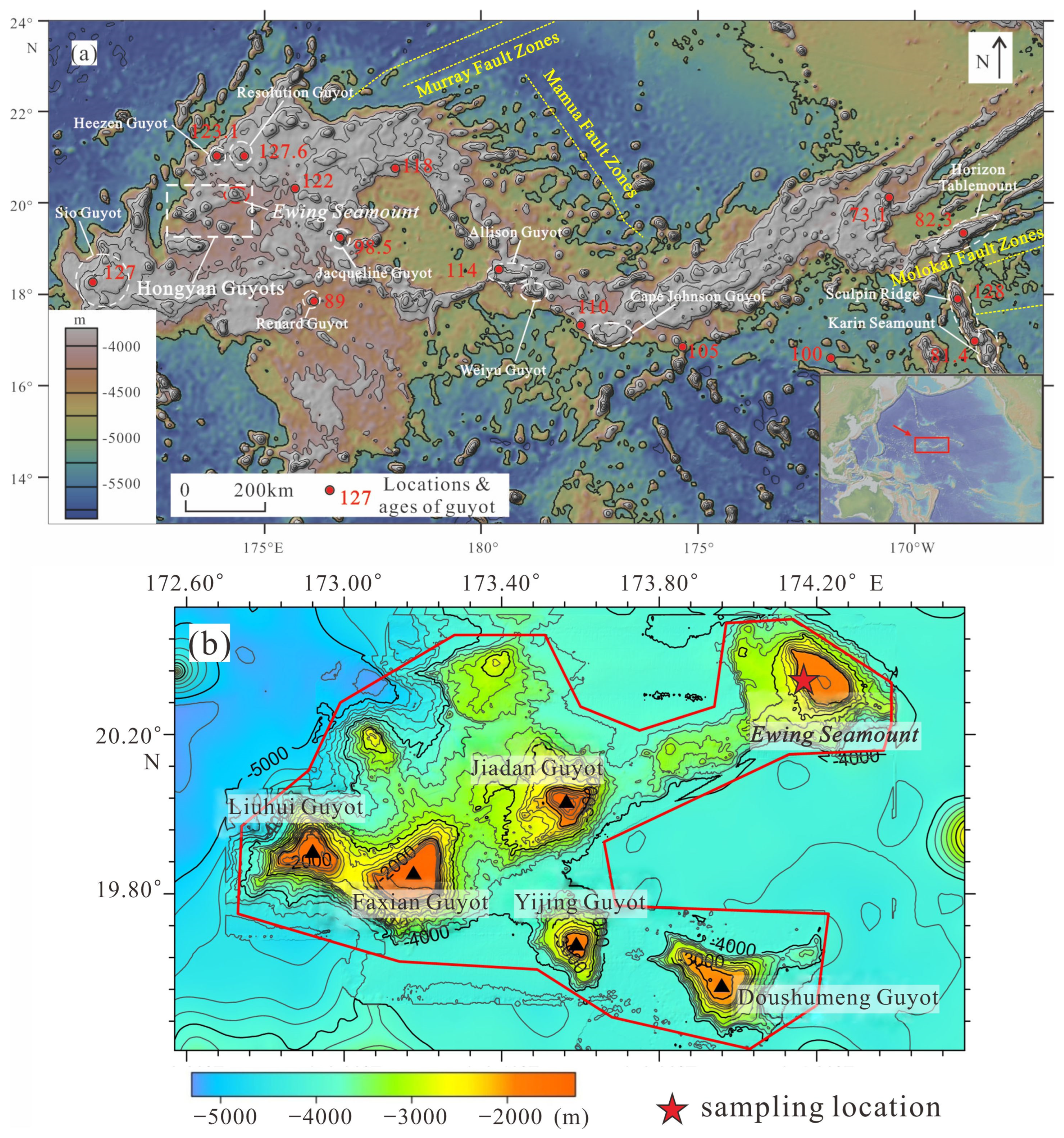
The Central Pacific Seamount Province is situated in the central Pacific Ocean, spanning approximately 15–25° N and 170° E–165° W. It is bounded to the northeast by the Hawaiian-Emperor Seamount Chain, to the southeast by the Line Islands Seamount Chain, to the west by the Marcus-Wake Seamount Group and the Marshall Islands, and extends southward to the Central Pacific Basin (Figure 1a). The seamount province trends roughly east–west, extending for about 2500 km and covering an area of approximately 0.25 × 10⁶ km2, making it the largest seamount cluster in the Pacific Ocean. They are primarily composed of Cretaceous alkaline basalts, basanites, and other basaltic rocks, showing geochemical characteristics of intraplate ocean island basalts (OIBs) [21,22,23,24,25,26,27,28]. Furthermore, compared to the Atlantic, Indian, and Arctic Oceans, polymetallic crusts are most developed in the Pacific region, particularly in the Mid-Pacific seamounts [29,30]. Due to objective constraints, such as challenging sampling and high costs, research data on the Mid-Pacific seamount basalts and polymetallic crusts remain insufficient, unlike those from the western and eastern Pacific seamount basalts, severely restricting the in-depth understanding of the nature of the mantle source region of Mid-Pacific seamounts, as well as the contribution of altered seamount basalts to the Sr, Nd, Pb, and Hf isotopic composition of seawater and the material source of polymetallic crusts.
This study focuses on basalt samples and associated ferromanganese crusts collected from station CXD04 at the Ewing Seamount during the DY105-11 cruise of the Chinese research vessel “Dayang Yihao” (Ocean No. 1). The objectives are (1) to investigate changes in the petrogeochemical composition and the Sr-Nd-Pb-Hf isotopic composition during the low-temperature alteration of seamount basalts and their contributions to oceanic seawater elemental cycling by employing comparative petrogeochemical and Sr-Nd-Pb-Hf isotope studies between altered basalts and polymetallic crusts; and (2) to reveal the initial growth mechanism of polymetallic crusts on the surface of altered basalts based on the mineral composition characteristics of low-temperature altered basalts and the results of X-ray diffraction and electron microprobe analyses of primary laminae in polymetallic crusts.

2. Geological Setting

The Hongyan Guyots, located in the central-western part of the Central Pacific Seamount Province, consist of six flat-topped seamounts. The group measures approximately 197 km in length and 83 km in width (Figure 1b). The largest feature is the Ewing Seamount (20°19.80′ N, 174°13.10′ E), which was first discovered by the USNS VEMA in 1960. Basalt and crust samples were collected during China’s DY105-11 cruise aboard the R/V Dayang Yihao in September 2001. Multibeam bathymetry from this cruise revealed a NW-SE trending “pear-shaped” planform with a size of 44 km × 37 km and a narrow northwest end and a broadened southeast termination. The seamount exhibits a relief of 2475 m, with a minimum water depth of 1775 m at the summit and 4250 m at the base, characterized by a flat top and steep slopes (Figure 1b). Based on trawl samples and seafloor imagery, calcium-rich sedimentary rocks (reef limestone, carbonates), with occasional basalt outcrops, comprise the upper slopes, while the lower slopes predominantly consist of a basaltic basement with localized low-calcium sediments (mudstone). On the basaltic bedrock, hydrogenetic polymetallic crusts are commonly developed [32,33]. Currently, no age data have been published for the basalts or polymetallic crusts of the Hongyan Guyots. However, the basalts from the nearest guyots—Heezen Guyot, Resolution Guyot, and Jacqueline Guyot—yield ages of 123.1 Ma, 127 Ma, and 98.5 Ma, respectively (Figure 1). This suggests that the basaltic eruptions occurred during the Early Cretaceous. The polymetallic crusts overlying the basaltic bedrock exhibit long-term growth characteristics, with initial growth in Central Pacific seamount crusts dated to approximately 80–75 Ma [34]. The samples were collected from Station CXD04 during the DY105-11 cruise at 174°18′18″ E and 20°17′35″ N (bottom contact) and 174°17′49″ E and 20°17′39″ N (off-bottom), at a water depth of 2576 m (Figure 1b).

3. Materials and Methods

3.1. Petrographic Characteristics of Samples

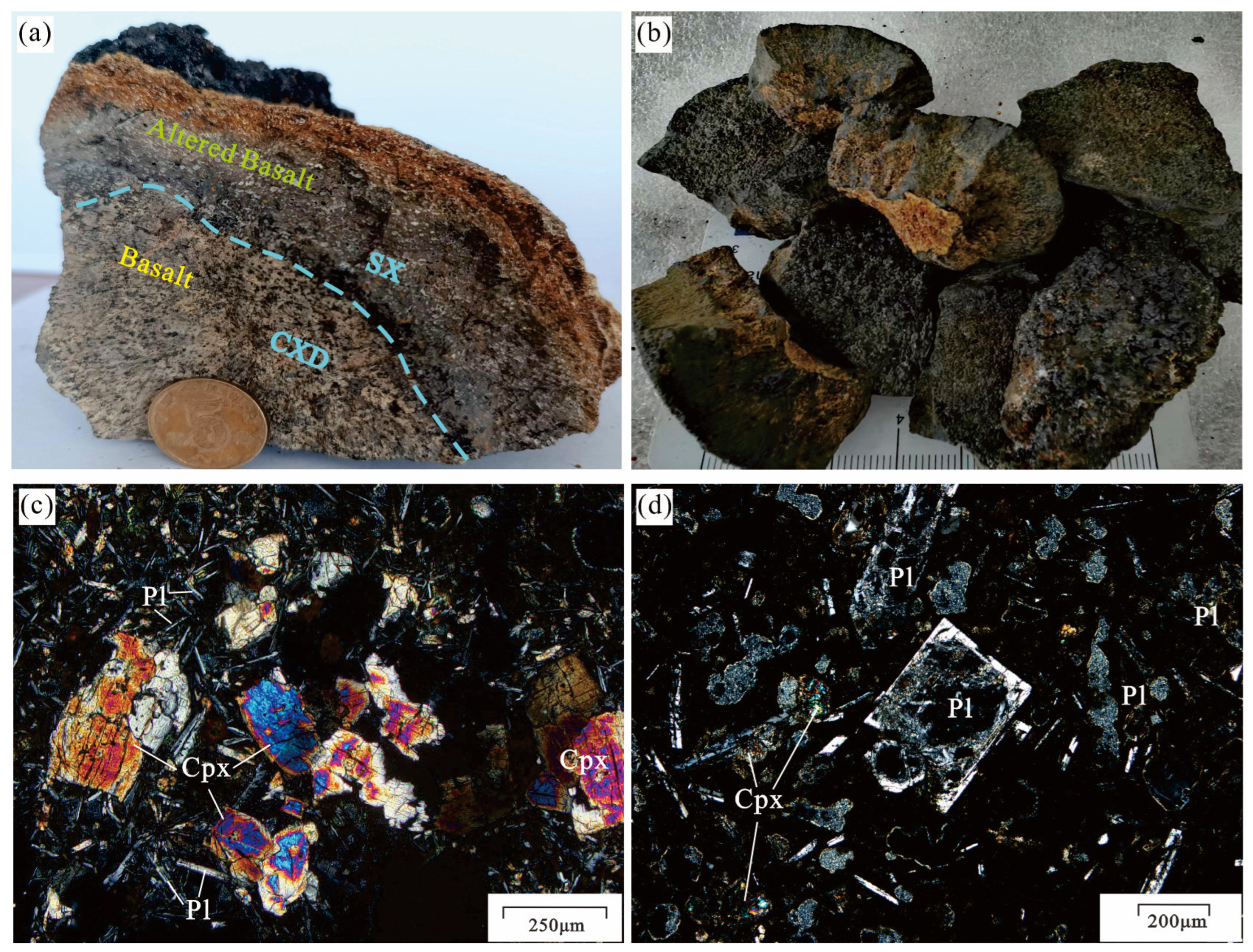
The basalt samples from the Ewing Seamount exhibit a thin, layered crust (2 cm thick) on the surface (Figure 2a), although most of the crustal material was spalled off (Figure 2b). Distinct weathering zones are distinguishable on the basalt: a strongly weathered and altered layer (1–2 cm thick), with a brownish-red color at the top, underlain by a weakly altered layer (2–3 cm thick) of grayish-brown hue. The interior consists of relatively fresh dark gray-colored basalt (Figure 2a). Petrographically, the rock exhibits a porphyritic texture and a massive structure, with well-developed vesicular and amygdaloidal structures. Vesicles are predominantly sub-rounded to irregular in shape, ranging from 1 to 3 mm in diameter (~10% abundance), with no preferred orientation. In the surface basalt, vesicles are partially filled with white minerals (phillipsite, calcite), while those in the fresh interior basalt remain largely unfilled.
Microscopic examination revealed primarily plagioclase and clinopyroxene phenocrysts, while olivine phenocrysts are absent. Plagioclase phenocrysts (8%–10% abundance) exhibit euhedral to subhedral habits, with grains of around 3 mm × 5 mm in size, low first-order gray-white interference colors, low positive relief, and polysynthetic twinning. Moreover, the signs of dissolution and black micropunctures are visible. Clinopyroxene phenocrysts (monoclinic, ~5% abundance) are 1–2 mm in size and appear as short-prismatic grains or anhedral crystals, exhibiting high-order, vivid interference colors, high positive relief, and oblique extinction. The groundmass consists of plagioclase microlites, with minor amounts of pyroxene, magnetite, apatite, and glass. Plagioclase microlites (typically 0.1 mm × 0.02 mm in size) show an intersertal texture, exhibiting euhedral lath-shaped, acicular, dendritic, or feathery morphology. Furthermore, plagioclase microlites are embedded within cryptocrystalline material, showing no preferred orientation but rather a random arrangement (Figure 2c). Compared with fresh basalt, pyroxene, plagioclase matrix, and phenocrysts in the upper altered basalt have undergone intense alteration, with only the outlines of some phenocrysts remaining visible (Figure 2d).
Crust Sample (CXC) is a single-layered tabular crust growing on basalt (Figure 2a,b). It is brownish-black, with a layer thickness of approximately 2 cm, and is relatively dense. The surface exhibits an irregular botryoidal texture. Locally, the crust contains minor irregular inclusions of carbonate fluorapatite, with few impurities such as mineral fragments and biological remains, making it generally pure. Within the typical crust stratigraphic framework (layers R, I (I-1, I-2), II, III) [35,36], the oldest Layer R primarily grew in shallow water near the coast, likely within the photic zone, during the Late Paleocene-Early Eocene in a relatively shallow shelf environment [35]. Consequently, Layer R is typically not developed in the Central Pacific seamount region [33]. Layer I-1, which grew during the Late Paleocene-Early Eocene, and Layer I-2, from the Middle-Late Eocene, exhibit a relatively dense structure. Their MnO content is significantly higher than Fe2O3. Records of the global phosphatization events at ~43–39 Ma and 27–21 Ma are preserved in I-1 and I-2, respectively, resulting in high P2O5 content (usually >5%) [35]. The Miocene Layer II has a more porous structure and is referred to as the “porous layer” [33] or “porous zone” [35]. Its MnO content is generally greater than Fe2O3. In the Central Pacific seamount region, this porous layer is very thin, with an age around 18–12 Ma, possibly corresponding to the period when the upper porous sub-layer developed in samples from other seamount regions. For most samples from the Central Pacific seamounts, Layer III formed between 6 and 0 Ma. In contrast, samples from the Magellan seamount region may possess a relatively older lower sub-layer within the upper dense layer [33]. The MnO content in Layer III is less than Fe2O3 [35]. Based on the structural and chemical characteristics of crust sample CXC, the single-layered tabular crust growing on basalt is identified as belonging to crustal Layer III.

3.2. Analytical Methods

In this study, major and trace element analyses were conducted on samples collected at Station CXD04 from the Ewing Seamount during Cruise DY105-11 of the Chinese R/V Dayang Yihao, including fresh basalt (CXD), altered basalt (SX), and polymetallic ferromanganese crust (CXC). Sr-Nd-Pb-Hf isotope analyses were performed on CXD and CXC samples. The altered basalt sample SX was analyzed using XRD, while EMPA (Electron Microprobe Analysis) was applied to the bottom laminae of the crust. The analytical methods are described in detail as follows:
(1) Major and trace element analyses were conducted at the Key Laboratory of Mineral Resources Evaluation in Northeast Asia, Ministry of Natural Resources, Jilin University, Changchun, China. Fresh portions of the CXD basalt were coarsely crushed, and pristine mineral grains were handpicked under a binocular microscope to avoid interference from vesicle fillings and altered materials. All samples were cleaned, ground, and pulverized to 200-mesh powder for major and trace element analysis. Major elements were measured using an XRF-1500 X-ray fluorescence spectrometer (Shimadzu Corporation in Kyoto City, Japan), with an analytical precision better than 0.01 wt% for both altered and fresh basalts. In the laboratory, the contents of total ferrous oxide (FeOT) and ferrous oxide (FeO) in iron-bearing materials are determined using the magnetic separation-potassium dichromate titration method, which measures metallic iron and ferrous oxide. The content of ferric oxide (Fe2O3) is then calculated from the formula FeOT = FeO + 0.8998 × Fe2O3. For trace and rare earth element analysis, 200-mesh powder of CXD basalt was digested in PTFE vessels with a mixture of HF and HNO3, heated at 100 °C for 72 h, evaporated to dryness, redissolved, and diluted before analysis. Measurements were performed using a Finnigan-MAT ELEMENT double-focusing inductively coupled plasma mass spectrometer (ICP-MS). Data quality was monitored with the certified reference material GSR-2, showing deviations under 5%.
(2) Sr-Nd-Pb-Hf Isotopic Analyses of CXD Basalt and CXC Ferromanganese Crust: The CXD sample was prepared in the same way as explained above. Pure grains of the CXC sample were also hand-picked after coarse crushing and ground to 200-mesh. The chemical separation and isotopic analyses of Sr, Nd, Pb, and Hf were performed at the laboratory of Kehui Testing (Tianjin) Technology Co., Ltd., Tianjin, China. Sr and Nd isotopic compositions were measured using a Neptune plus MC-ICP-MS (Thermo Fisher Scientific in Waltham, MA, USA). The instrumental mass fractionation of Sr isotopes was corrected using the exponential law normalized to 86Sr/88Sr = 8.375209; the Sr isotopic reference material used was NBS 987, with a measured value of 87Sr/86Sr = 0.710247 ± 12 (2SD, n = 52). The Nd isotopic mass fractionation was similarly corrected using the exponential law normalized to 146Nd/144Nd = 0.7219; the Nd isotopic reference material used was GSB Nd, with a measured value of 143Nd/144Nd = 0.512194 ± 10 (2SD, n = 18). Pb isotopic compositions were measured using a Thermo Scientific Neptune Plus MC-ICP-MS device, while the instrumental mass discrimination was corrected using the exponential law normalized to 205Tl/203Tl = 0.418922. The Pb isotopic reference material used was NBS 981, with a measured value of 206Pb/204Pb = 16.9411 ± 0.0015 (2SD, n = 43), 207Pb/204Pb = 15.4992 ± 0.0009 (2SD, n = 43), and 208Pb/204Pb = 36.7236 ± 0.0025 (2SD, n = 43). Hf isotope chemical separation procedures were conducted on a Class 100 laminar flow workbench within a Class 1000 clean laboratory environment. Hf isotopic compositions were analyzed using a Neptune plus MC-ICP-MS (Thermo Fisher Scientific in Waltham, MA, USA). The isobaric interferences of 176Lu and 176Yb on 176Hf were corrected using 176Lu/175Lu = 0.02658 and 176Yb/173Yb = 0.796218, respectively. Hf isotope ratios were normalized for mass bias using the exponential law and 179Hf/177Hf = 0.7325. The Yb isotope ratios used for interference correction were normalized using 173Yb/172Yb = 1.35274. The stability of 176Hf/177Hf measurements was monitored using the in-house standard GSB-Hf, which gave a mean value of 176Hf/177Hf = 0.282208 ± 8 (2SD, n = 10).
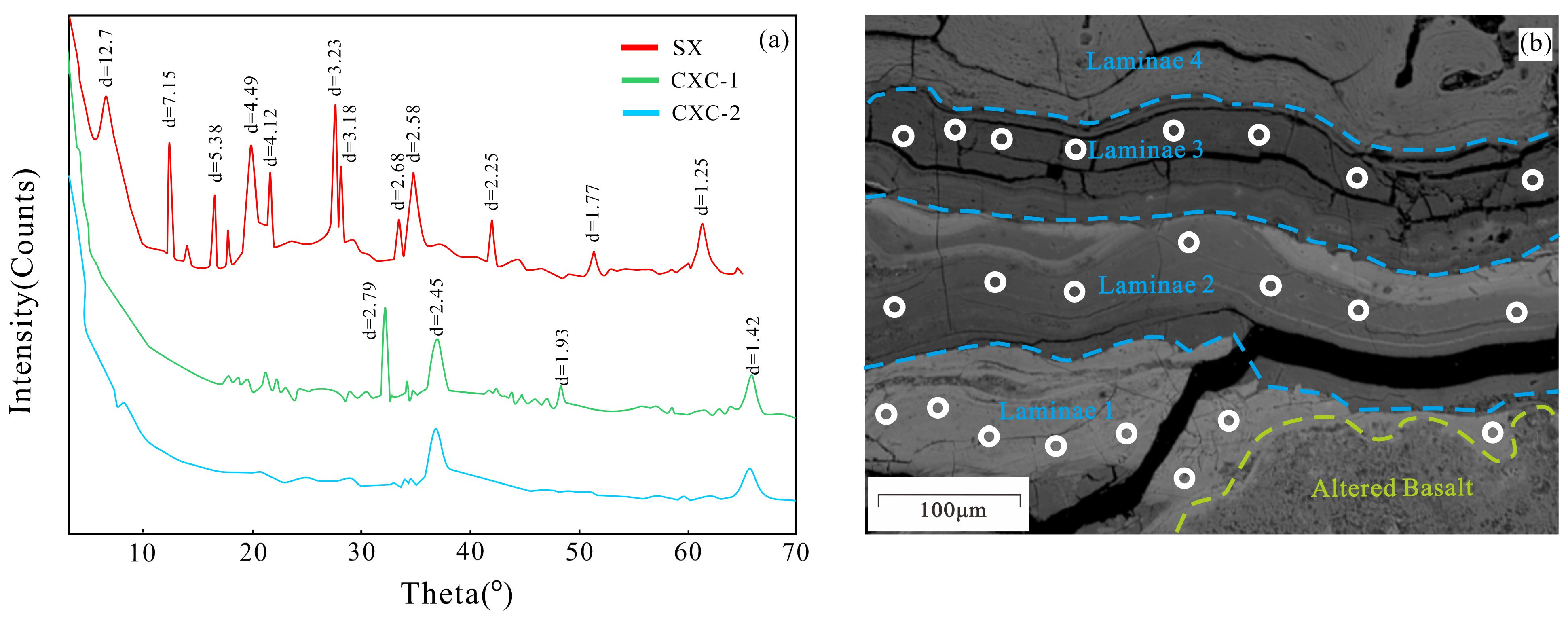
(3) XRD Phase Analysis: Samples were ground in an agate mortar to a 200-mesh powder for X-ray diffraction (XRD) analysis. XRD experiments were conducted at the X-ray Powder Diffraction Laboratory of Jilin University using a Rigaku D/max-2500 powder X-ray diffractometer (Rigaku Corporation in Tokyo, Japan). The experimental parameters included Cu Kα1 radiation with a graphite monochromator, operating at 50 kV and 200 mA, scanning over a 2θ range of 3° to 65° at a scan speed of 2°/min and a step size of 0.02°. The XRD patterns of the altered basalt and the polymetallic crust were obtained (Figure 3).
(4) EPMA of Polymetallic Crust Laminae: The preparation of polished thin sections of polymetallic crust samples, subsequent carbon coating, and compositional analysis were conducted at the Key Laboratory of Mineral Resources Evaluation in Northeast Asia, Ministry of Natural Resources, Jilin University, Changchun, China. The analyses were performed using a JEOL JXA-8100 Electron Probe Microanalyzer (EPMA) (JEOL Ltd., Tokyo, Japan). The procedure involved sample sectioning into 0.05 mm thin sections, followed by their carbon coating using an ion sputter coater to increase electron conductivity, and placing them into the EPMA vacuum chamber until the required vacuum level was achieved. The experimental conditions were as follows: accelerating voltage 20 kV, probe current 1 × 10⁻⁸ A, and counting time 10 s per analysis. Quantitative results were corrected using the ZAF method, achieving a precision better than 0.1%. The used standard reference materials were in accordance with the Chinese National Standard (GB/T 17366-1998) [37].

4. Test Results

4.1. X-Ray Diffraction (XRD)

XRD analysis was conducted to determine the mineral phases present in the altered basalt (SX) and the overlying polymetallic crust. The comparison of the XRD 2θ° values and d-spacings with standard mineral data reveals that the low-temperature altered basalt, SX, primarily consists of montmorillonite and phillipsite. The XRD pattern (Figure 3a) shows that the diffraction peaks at d/2θ° = 1.36 nm/6.48° and 1.27 nm/6.95° correspond to illite-montmorillonite mixed-layer minerals (I/S) [38], while those at d/2θ° = 4.5 nm/19.76°, 2.58 nm/34.7°, 2.24 nm/40.1°, and 1.51 nm/61.1° are characteristic of montmorillonite. The diffraction peaks for phillipsite appear at d/2θ° = 7.16 nm/12.36°, 6.4 nm/16.44°, and 3.1 nm/27.9°.
Ferromanganese crusts typically consist of vernadite (δ-MnO2) and amorphous ferric oxyhydroxide (FeO(OH)) and often contain significant amounts of carbonate-fluorapatite (CFA) due to marine phosphatization [39]. In the XRD analysis of this study, the unselected, phosphatized ferromanganese crust sample (CXC-1) showed crystalline phases dominated by vernadite, with diffraction peaks at d/2θ° values of 2.45 nm/36.6° and 1.41 nm/66°, followed by carbonate-fluorapatite (2.79 nm/31.9°, 1.9 nm/46.9°) (Figure 3a CXC-1). Goethite also exhibits diffraction peaks at 2.45 nm/36.6° and 1.9 nm/46.9°, which overlap with the vernadite peak at 2.45 nm/36.6° and the (carbonate-)fluorapatite peak at 1.9 nm/46.9°, respectively. For further identification, a relatively pure, non-phosphatized ferromanganese crust sample (CXC-2) was selected for comparative XRD analysis. Its diffraction pattern is mainly characterized by the vernadite peaks at 2.45 nm/36.6° and 1.41 nm/66° (Figure 3a CXC-2), indicating that crystalline Fe phases are likely absent in the ferromanganese crusts. Despite the high Fe content in the chemical composition of the crusts (Table 1), these Fe species are primarily present in an amorphous form.

4.2. Electron Probe Microanalysis (EPMA)

The polymetallic crusts growing on the altered basalt substrate exhibit a lamellar structure (Figure 3b). Light and dark bands appear in EBS images upward from the altered basalt substrate. The first layer growing on the altered basalt is bright gray, with a relatively large variation in thickness, approximately from 0 to 100 μm. The major element analysis of Layer 1 on the polymetallic crust was conducted using EPMA (Table 1). Layer 1 is a bright gray Fe-rich and Mn-poor layer, with a high FeOT content (average 40.14%) and a low MnO content (average 7.89%); the average TiO2 and SiO2 contents are relatively high, being 10.51 and 10.06%, respectively, while the CoO, NiO, and CuO contents are relatively low, with average values of 0.25, 0.57, and 0.17%, respectively.
Comparative analyses of Layer 2 (dark gray) and Layer 3 (grayish white) were conducted. Layer 2 exhibits an average FeOT content of 7 test points of 24.55%, while the MnO content is 18.66%, making it an Fe-rich and Mn-poor layer. Layer 3 shows an FeOT content of 8 test points of 11.51% with a MnO content of 37.28%, i.e., Mn-rich and Fe-poor. Since carbonate-fluorapatite commonly occurs as irregular inclusions within polymetallic crust samples, while the electron microprobe analysis (EPMA) spots were taken from relatively pure Fe-Mn crust laminae, the analytical results show low P2O5 content.

4.3. Petrochemistry

4.3.1. Major Element Characteristics

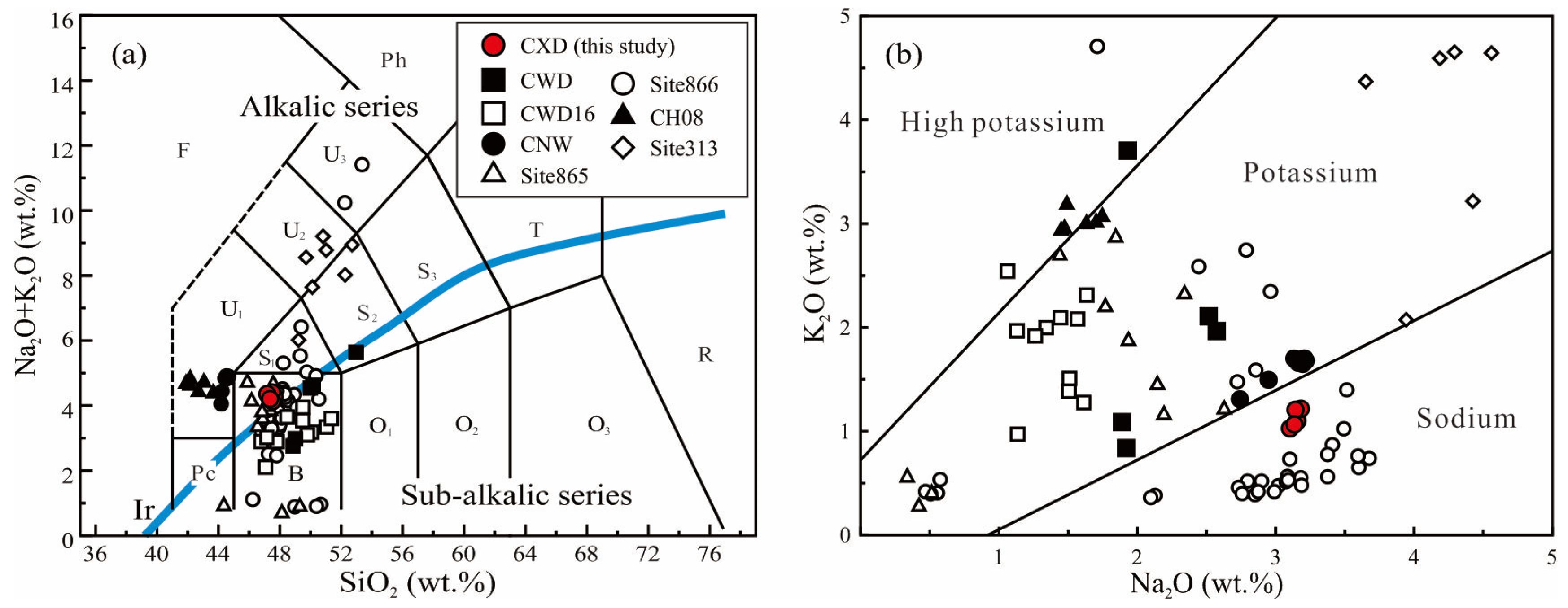
(1) Fresh Basalt (CXD): The loss on ignition (LOI) of the samples ranges from 3.31 to 3.68 (Table 2), exhibiting the characteristic silicate composition of typical ocean island basalts (OIBs) [40], indicating a minimal influence from low-temperature alteration. The SiO2 content of the rocks varies from 45.34 to 45.91%, classifying them as mafic rocks. The Al2O3 content range is from 13.75 to 14.21%, with an A/CNK ratio of 0.62–0.67 (<1), indicating metaluminous rocks. The total iron (FeOT) content range is 11.0–11.1%, the MgO content range is 4.16%–4.62%, and the magnesium number (Mg#) is 39.0–42.3, being significantly lower than the Mg# range of primitive mantle magmas (Mg# = 68–75) [41], classifying them as low-Mg# basalts. Total alkalis (Na2O + K2O) range from 3.98 to 4.23%, with K2O/Na2O ratios of 0.33–0.38, indicating Na-rich compositions. The CaO content range is relatively high (10.76–11.05%), while the TiO2 content range is moderate (2.42%–2.46%). The alkalinity ratio (AR) is 1.38–1.41, and Rittmann’s combination index (σ43) is 3.59–4.25, consistent with alkaline rocks. In the (Na2O + K2O)/SiO2 igneous rock classification diagram, the samples fall within the basalt field, confirming that basalt is the dominant rock type of the Central Pacific Seamounts (Figure 4a). In the Na2O vs. K2O diagram (Figure 4b), all samples are in the sodic rock field, similar to the ODP866 rock samples from the Central Pacific Seamounts.
(2) Altered Basalt (SX): The LOI of the samples ranged from 8.31 to 8.72, indicating a significant influence of low-temperature alteration. The oxide contents of the rocks vary as follows: 43.9%–44.6% for SiO2, 11.1%–14.9% for Al2O3, 16.3%–16.9% for Fe2O3, 0.29%–0.38% for FeO, 14.98%–15.50% for the total iron (FeOT), 2.18%–2.36% for CaO, 2.03%–2.15% for MgO, 3.23%–3.60% for K2O, 2.11%–2.20% for Na2O, with K2O/Na2O ratios of 1.47–1.70, 3.08%–3.32% for TiO2, 0.10%–0.13% for P2O5, and 0.14%–0.25% for MnO.

4.3.2. Rare Earth Elements (REEs) and Trace Elements

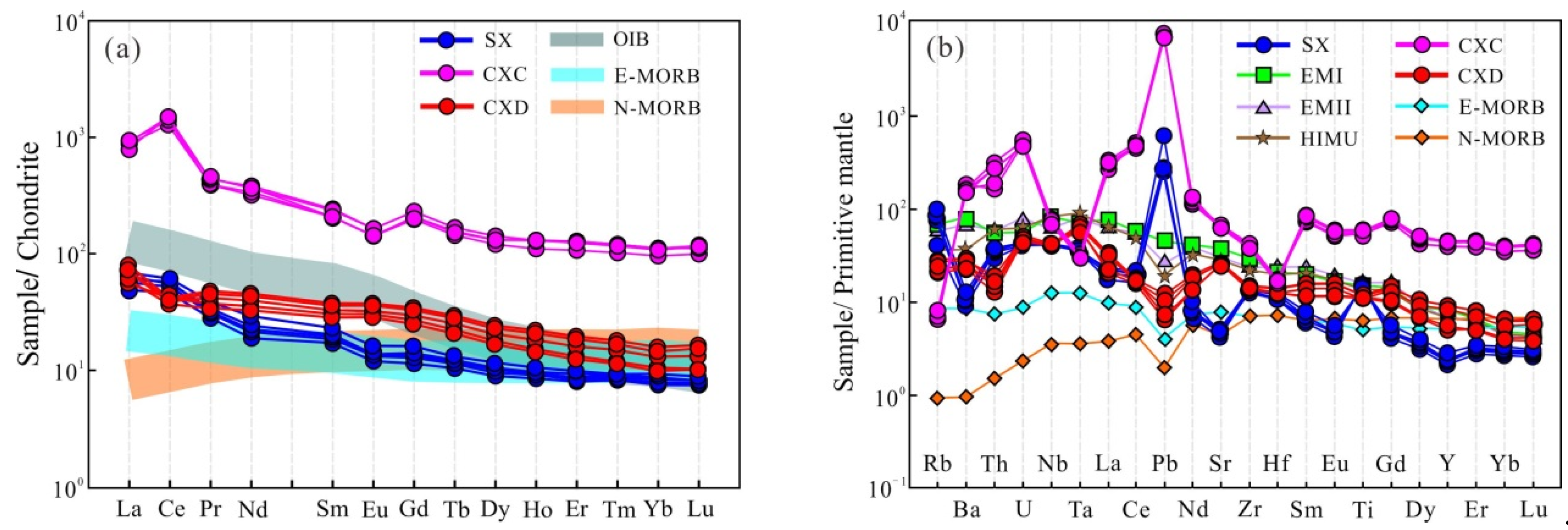
(1) Fresh Basalt CXD Samples: The content of total rare earth elements (∑REE) ranges from 90.1 × 10⁻⁶ to 121.9 × 10⁻⁶ (Table 3), with light rare earth elements (LREEs)/heavy rare earth elements (HREEs) ratios of 3.57 to 4.08, indicating mild fractionation between LREEs and HREEs and suggesting a high degree of partial melting in the magmatic mantle source region. The δEu values range from 1.03 to 1.07, showing no anomalies, which implies a high degree of plagioclase melting in the source region and no plagioclase fractional crystallization during magma evolution. The δCe values are from 0.69 to 0.93, exhibiting negative δCe anomalies, which may have been affected by low-temperature seawater alteration. The REE distribution patterns are right-dipping (Figure 5a), and compared with the REE characteristics of typical OIBs [46], they are depleted in LREEs and slightly enriched in HREEs. In the trace element spider diagram (Figure 5b), the overall pattern is more similar to that of the HIMU end-member. Large ion lithophile elements (LILEs) Rb and Ba are significantly depleted compared to EM I and EM II, approaching HIMU characteristics; high field strength elements (HFSEs) Th and Pb are significantly depleted, showing an E-MORB trend; Nb and Ta are enriched, while Zr and Hf show no obvious anomalies. The content of the mafic-compatible component Cr is relatively high, from 411.4 × 10⁻⁶ to 522.8 × 10⁻⁶, whereas Co (47.04 × 10⁻⁶ to 70.35 × 10⁻⁶) and Ni (113.2 × 10⁻⁶ to 141.0 × 10⁻⁶) contents are low (Table 3).
(2) Altered Basalt SX Samples: The content of total rare earth elements (∑REE) is relatively low, from 63.8 × 10⁻⁶ to 87.5 × 10⁻⁶ (Table 3), with LREE/HREE ratios of 6.43 to 6.92, suggesting that low-temperature alteration led to further fractionation between LREE and HREE in the basalt. The δEu values range from 0.83 to 0.87, showing negative anomalies, indicating that plagioclase alteration resulted in the Eu loss. The δCe values range from 1.20 to 1.27, exhibiting positive anomalies, with the addition of exogenous Ce in the altered basalt. The REE distribution patterns are right-dipping (Figure 5a); except for Ce, their REE contents and total amounts are significantly lower than those of CXD samples. Compared with fresh basalt CXD samples, in terms of trace elements (Table 3, Figure 5b), Li, Sc, Rb, and K LILEs are enriched, while Ba and Sr are depleted; Pb and Ti HFSEs are most significantly enriched, and Nb and Th are slightly increased, while Ta, Zr, Hf, and U are slightly depleted. The contents of mafic-compatible components Co and Ni are slightly lower than in CXD samples, while the contents of hydrothermal activity-related elements, Cu, Pb, and Zn, are relatively high.
(3) CXC Samples: The content of total rare earth elements (∑REE) ranges from 1330 × 10−6 to 1459 × 10−6 (Table 3), i.e., they are significantly more present than in CXD and SX samples, with LREE/HREE ratios of 8.25 to 10.26, indicating significant fractionation between LREEs and HREEs. The δEu values (0.70) show negative anomalies, unlike the δCe values (2.15~2.68) that exhibit relatively high positive anomalies. The REE distribution patterns are right-dipping, with an overall variation trend consistent with that of CXD and SX samples (Figure 5a). In terms of trace elements (Table 3, Figure 5b), all elements are enriched (except for depletion in Li, Sc, Rb, and Ta), with Ba, Sr, Co, Ni, Cu, Th, U, and Pb showing the most significant enrichment.

4.4. Sr-Nd-Pb-Hf Isotopic Compositions

The analysis of the isotopic composition of Sr-Nd-Pb-Hf was conducted on five samples for both basalt (CXD) and polymetallic crust (CXC) (Table 4).
For the basalt (CXD), the 87Sr/86Sr ratio is relatively low, ranging from 0.703757 to 0.703821, with εSr values from −10.1 to −10.7; the 143Nd/144Nd ratios range from 0.513038 to 0.513088, with εNd values ranging from −6.55 to −7.37; for Hf isotopes, the 176Hf/177Hf ratio changes from 0.282940 to 0.282953, with εHf values ranging from +12.17 to +12.80; the characteristic Pb isotopic ratios are: 206Pb/204Pb ranging from 18.82 to 19.35, 207Pb/204Pb ranging from 15.55 to 15.58, and 208Pb/204Pb ranging from 38.86 to 39.14.
For the polymetallic crust (CXC), the 87Sr/86Sr ratio is relatively low, ranging from 0.709187 to 0.709222, with εSr values from 66.5 to 67; the 143Nd/144Nd ratio changes from 0.512454 to 0.512467, with εNd values from −3.34 to −3.59; for Hf isotopes, the 176Hf/177Hf ratio is from 0.282973 to 0.282985, with εHf values ranging from +7.11 to +7.53; the characteristic Pb isotopic ratios are: 206Pb/204Pb ranging from 18.66 to 18.68, 207Pb/204Pb from 15.64 to 15.65, and 208Pb/204Pb from 38.77 to 38.79.

5. Discussion

5.1. Effect of Low-Temperature Alteration on the Chemical Composition of Basalt

5.1.1. Fresh Basalt (CXD)

Vesicular structures, fracture structures, and biological activities developed in seamount basalts facilitate the percolation and circulation of seawater; therefore, shallow seamount basalts are affected by low-temperature alteration to varying degrees. The comparison of the major element composition of CXD samples with typical OIBs (ocean island basalts) shows significantly lower MgO content (4.16%–4.62%) and magnesium number Mg# (39.0–42.3) than in the primary mantle magma (Mg# = 68~75) [41]. This difference may be related, on the one hand, to genetic factors, such as the nature of the source region of enriched mantle, and on the other hand, to compositional changes caused by mild low-temperature alteration.
During the low-temperature alteration of basalt, the amorphous and glassy matrix along with vesicle fillings are altered initially, followed by the alteration of olivine to iddingsite and, finally, the more weathering-resistant plagioclase and pyroxene [11]. Olivine is generally considered the most reactive mineral during weathering. Under low-temperature conditions, olivine alters to iddingsite due to fluid infiltration and oxidation [48]. Low-temperature iddingsite is often distributed along thermal contraction cracks under the microscope, with Mg dissolving from these fractures [49]. Therefore, the iddingsitization of olivine is the main cause of MgO loss during low-temperature alteration. Under the microscope, the basalts from Weiyu Guyot appear relatively fresh overall. However, the cryptocrystalline matrix and the glassy margins of the basalts are slightly palagonitized, while the remaining textures are largely preserved. The primary constituent minerals, pyroxene and plagioclase, show minor alteration (Figure 2). Olivine phenocrysts and iddingsitization are not observed. Furthermore, the geochemical behavior of elements during iddingsitization involves a significant decrease in Si and Mg and a slight decrease in Mn [50], whereas the SiO2 and MnO contents in Weiyu Guyot basalts show no obvious variation. Thus, it is unlikely that substantial MgO loss occurred due to the alteration of olivine phenocrysts. The low MgO content may be primarily related to the nature of the enriched mantle source and secondarily associated with the low-temperature alteration of Mg-rich components in the matrix and pyroxene phenocrysts.
Compared with OIBs, the contents of light rare earth elements (LREEs) and large ion lithophile elements (LILEs) in CXD samples are lower, exhibiting a negative δCe anomaly (0.69~0.93). In addition to genetic influences, such as the magmatic source region, this may be caused by plagioclase alteration and the fractionation and loss of Ce3+→Ce4+ under relatively oxidizing conditions [51]. In conclusion, the CXD basalt samples located in the lower part have undergone mild low-temperature alteration, resulting in the loss of the major elements Mg, LILEs, and LREEs, while the contents of externally introduced elements have remained insignificant.

5.1.2. Altered Basalt (SX)

The XRD analysis showed that the main mineral assemblage is transformed from pyroxene + plagioclase to montmorillonite + phillipsite during the low-temperature alteration of seamount basalts. Montmorillonite is mainly the product of the alteration of mafic minerals such as pyroxene, while plagioclase is mainly weathered into phillipsite [52]. The low-temperature alteration also caused changes in major and trace chemical compositions.
Previous studies have suggested that low-temperature alteration decreases the contents of SiO2, FeO, CaO, and MgO and increases the contents of Al2O3, Fe2O3, K2O, Na2O, TiO2, P2O5, and MnO in basalts (e.g., general trends). However, the main difference between the altered basalt (SX) tested in this study and previous results is that Na2O and P2O5 contents are significantly decreased (rather than increased) while the MnO content is slightly decreased. During the low-temperature alteration of basalts, the main constituting minerals transform from pyroxene and plagioclase to montmorillonite and phillipsite. Al3+ substitution for Si4+ is not developed in pyroxene but is well-developed in newly formed montmorillonite and phillipsite, resulting in the loss of Si4+ and enrichment of Al3+. During pyroxene alteration, Mg leaves its host mineral, part of which enters montmorillonite, while another part is lost. P2O5 mainly occurs in apatite; after apatite alteration, the released P is difficult to enter montmorillonite or phillipsite, thus being lost into seawater, causing its total decrease. CaO is mainly contained in pyroxene and plagioclase; after the alteration, it partially enters montmorillonite and phillipsite, but most of it is released into seawater. Na2O is mainly present in plagioclase, and it partially enters montmorillonite and phillipsite, while the rest is released into seawater after alteration. K2O is one of the main oxides in montmorillonite and phillipsite; its increased content in altered basalt indicates the introduction of external K via isomorphic substitution for Na, Ca, etc. The decreased contents of FeO and MnO upon alteration indicate that Fe and Mn are released into seawater. Nevertheless, the increased contents of Fe2O3 and TiO2 may be related to secondary enrichment caused by the selective adsorption on montmorillonite and phillipsite [53,54,55].
Compared with CXD samples, the contents of rare earth elements (REEs) in SX samples are significantly decreased, except for a slight increase in Ce, indicating that a large amount of REEs are released during the low-temperature alteration of basalt. The increased Ce content is related to the selective adsorption on montmorillonite and phillipsite. The alkali metal elements, Li, Rb, and Cs, are low-valence, large-radius cations, representing cation components in phillipsite and montmorillonite, the contents of which increase significantly after the low-temperature alteration. Ba and Sr mainly occur in plagioclase; however, they are difficult to enter the lattice of phillipsite or montmorillonite in large quantities after the low-temperature alteration due to their higher valence and crystal structure constraints, leading to their release and significant decreases in the final contents.
Nb, Ta, Zr, Hf, Co, and Ni are mainly present in basaltic zircon, magnetite, and pyroxene. Given the extremely low zircon content in basalts and the negligible effect of low-temperature alteration on magnetite, their changes in their contents are mainly related to pyroxene alteration: The Nb content increases, while Ta, Zr, Hf, Co, and Ni contents slightly decrease. The contents of hydrothermal elements (Cu, Pb, Zn) increase significantly, where the Pb enrichment is the most prominent. The overall ability of montmorillonite and zeolite to adsorb metal cations changes in the following order: Pb2+ >> Cu2+ > Co2+ > Zn2+ > Ni2+ [55,56,57,58,59], which is consistent with the low Pb content (1.72) in fresh CXD basalt and the high Pb content (63.75) in altered SX basalt. The Cu, Pb, and Zn enrichments in moderately low-temperature altered basalt are related to the adsorption of Cu2+, Pb2+, and Zn2+ ions released from submarine hydrothermal activity on montmorillonite and zeolite, whereas fresh basalt exhibits outward migration due to the lack of montmorillonite required for adsorption.

5.2. Constraints of Low-Temperature Alteration on the Marine Sr-Nd-Pb-Hf Isotopic Composition

There are two main sources of Sr, Nd, Pb, and Hf elements in seawater: one is the input from continental crust weathering materials, and the other is the input from mantle materials. Continental crust weathering materials enter the ocean via rivers and eolian dust, while the mantle materials enter the ocean via volcanic activities, hydrothermal venting, and seafloor weathering. However, geological events such as orogeny, glaciation, seafloor spreading rate, and climate are local and short-term factors that affect only the intensity of input from different sources rather than the source areas themselves.
Polymetallic crusts (nodules) are usually used in the geological history studies of Sr, Nd, Pb, and Hf compositions. The growth rate of polymetallic crusts is extremely low, mainly 2–3 mm/Ma [60,61,62], making them suitable for studying changes in the paleooceanic environment on million-to ten-million-year scales; however, they cannot timely and accurately respond to or record short-term geological events. The residence times of Sr, Nd, Pb, and Hf isotopes in the ocean also significantly vary: for Sr it is approximately 106 years [63], and the evolution of the seawater Sr isotopic composition mainly reflects the input characteristics and changes in source areas on a near-million-year scale; for Nd it is approximately 500–1000 years [64,65]; previous calculations have suggested that the residence time of Hf in seawater is longer than that of Nd, but the strong heterogeneity of εHf values actually indicates that the residence time of Hf is shorter than that of Nd [66,67]; for Pb it is approximately 0.1 kyr [68]. Finally, the residence times of Nd, Pb, and Hf in seawater are much shorter than the global seawater mixing time of 1.5 kyr.
Constrained by geological processes and isotopic residence times, only those long-term processes in geological history that continuously impacted the Nd, Pb, and Hf isotopic compositions of seawater can be recorded in sediments, e.g., polymetallic crusts. Therefore, in terms of the mantle material sources, short-term geological events, such as volcanic eruptions and hydrothermal venting, are not expected to be recorded in polymetallic crusts, whereas seamount basalts, since their eruption onto the seafloor until the present, have undergone low-temperature alteration of varying intensities, releasing large amounts of Sr, Nd, Hf, and Pb into seawater, thus making an extensive, long-term, and continuous contribution to marine isotopic compositions.

5.2.1. Sr Isotopes

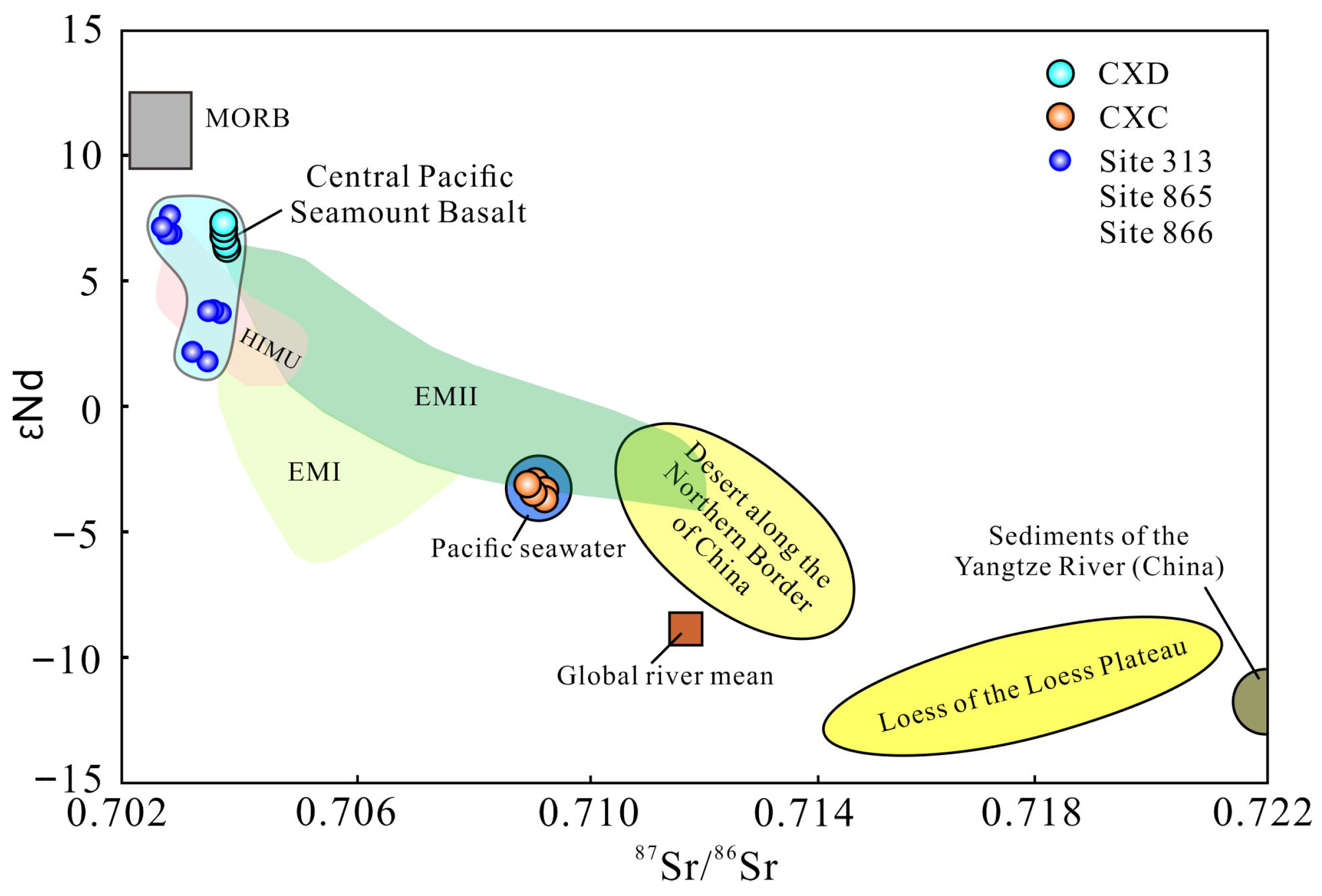
The Rb/Sr ratios (0.003–0.004) in polymetallic crusts are very low, and the half-life of 87Rb is 48.9 × 10⁹ years; therefore, the 87Sr/86Sr values of polymetallic crusts represent a record of the seawater 87Sr/86Sr at the time of formation. The 87Sr/86Sr values of polymetallic crusts from the Ewing Seamount range from 0.709187 to 0.709222, being much higher than the 87Sr/86Sr values (0.703757–0.703821) of the basement Ewing Seamount basalts but similar to that of modern seawater (87Sr/86Sr = 0.709175) [69] (Figure 6), indicating that Sr in polymetallic crusts mainly originates from seawater. Based on the global seawater Sr isotope evolution curve [70,71], their growth age is relatively close to the present. It is widely accepted that the Sr isotopic composition of seawater is mainly determined by continental crust weathering materials introduced via rivers and eolian dust [72]. Continental crust weathering materials have high 87Sr/86Sr values: the weighted average 87Sr/86Sr of 11 major rivers in the Tibetan Plateau is 0.71694 [72], the average 87Sr/86Sr of the Yangtze River sediment samples is 0.722479 [73], and the 87Sr/86Sr of the Chinese Loess Plateau, a source of eolian dust in the Pacific Ocean, is 0.721450 [74]. Modern seawater has 87Sr/86Sr = 0.709175, which is lower than that of loess from the Chinese Loess Plateau, the rivers from the Tibetan Plateau, the Yangtze River sediments, and the average of global terrigenous sediments (0.7119) [75] and the current average of global rivers (0.7116) [76] (Figure 6). Therefore, some Sr had to be added to seawater from a low 87Sr/86Sr source. The mantle and its derivatives exhibit low 87Sr/86Sr values; for example, the 87Sr/86Sr values of Pacific N-MORBs are 0.70240–0.70256 [77], the global average 87Sr/86Sr of basalts is 0.7035 [75], and the 87Sr/86Sr of abyssal hydrothermal fluids is 0.7037 [78]. Thus, the mantle-derived Sr introduced into seawater via submarine volcanic-hydrothermal activity and low-temperature weathering of seamount basalts is the main factor causing the lower 87Sr/86Sr value of seawater than that of continental crust weathering materials. Among mantle sources, abyssal hydrothermal fluids and volcanism are limited in scope and duration, so the main source of mantle Sr in seawater is the extensive and continuous low-temperature alteration of seamount basalts. The Sr content of relatively fresh basalts from the Ewing Seamount is 518–548 × 10−6, while that of altered basalts is 80–102 × 10−6, indicating that a large amount of Sr is leached into seawater during the low-temperature alteration of basalts. In the 87Sr/86Sr-εNd diagram (Figure 6), the values for modern seawater and crust samples fall between Central Pacific seamount basalts and terrigenous weathering materials such as river and loess materials, indicating that the seawater Sr isotopic composition results from the mixing of the terrigenous Sr introduced via rivers and eolian dust and the mantle-derived Sr supplied via low-temperature alteration.
The 87Sr/86Sr ratio of seawater has continued to rise since 40 Ma from 0.7073 to 0.709175 [69], which may be related, on the one hand, to the increased input of terrigenous sediments caused by the uplift of the Tibetan Plateau [72], and on the other hand, to the gradual weakening of the low-temperature alteration of submarine basalts. The thickness of surface sediments on some seamount basalts gradually increases over time, so they become gradually covered by large amounts of impermeable clays, leading to a gradual diminishing of the extent of low-temperature alteration. Consequently, the amount of Sr released and supplied by basaltic low-temperature alteration gradually decreases, continuously raising the seawater 87Sr/86Sr ratio.

5.2.2. Nd Isotopes

Since the residence time of Nd in seawater (500–1000 a) is shorter than the average global seawater mixing time (1500 a), the Nd isotopic composition of seawater is not globally homogeneous. For example, the εNd values in the North Atlantic are −13 to −10 [60], those in the Pacific Ocean are −4 to −2 [5,6], and those in the Southern Ocean and the Indian Ocean lie between the values of the Atlantic Ocean and the Pacific Ocean [82,83]. However, the Nd isotopic composition of seawater is relatively homogeneous within individual oceans on a smaller scale. For instance, in the Pacific Ocean, the εNd values of polymetallic nodules in the western Pacific range from −6.6 to −2.5 [84], and those in the central-northern Pacific range from −5.0 to −3.5 [85], while the εNd values of Fe-Mn nodules in the CC area of the eastern Pacific vary from −4.59 to −3.06 [86].
The εNd values of polymetallic crusts of the Ewing Guyot range from −3.34 to −3.59, falling within the εNd range of the Pacific seawater (−4 to −2) [5,6], and significantly differing from the εNd values of the basaltic basement (+6.55 to +7.37), which implies that Nd isotopes are directly derived from seawater. The Nd isotopes in seawater are mainly terrigenous and mantle-derived. The terrigenous sources and derivatives thereof generally have relatively large negative εNd values: North American rivers from −8 to −6, fluvial sediments from the East Asian continent and North America from −9 to −7, eolian materials derived from the East Asian continent from −13 to −12, and Antarctic Bottom Water (AABW) from −7.9 to −9.3 [87,88]. For the mantle reservoirs and their derivatives, the εNd values are generally large positive values: hydrothermal fluids from the East Pacific Rise (EPR) from −3.6 to +7.9, mid-ocean ridge basalts (MORBs) approximately 10 [88,89], and basalts from the Ewing Guyot obtained in this study from +6.55 to +7.37, showing relatively high positive values. If the Nd isotopic composition of seawater was dominated solely by terrigenous sources, the εNd in seawater would have large negative values; if the Nd isotopic composition of seawater was dominated by mantle sources, the εNd would have large positive values. The εNd values of the Pacific seawater (−4 to −2) [5,6] are small and negative, probably reflecting a homogeneous mixture of terrigenous and mantle-derived sources.
Among mantle-derived sources, the fluxes from hydrothermal fluids and mid-ocean ridges are relatively small, whereas the seamount basalts in the central Pacific are widely distributed and undergo prolonged low-temperature alteration. Considering basalts from the Ewing Guyot, the Nd contents in altered basalts range from 8.95 to 13.59, with an average of 11, while those in fresh basalts vary from 18.43 to 25.56, with an average of 22.51. The altered basalts are significantly depleted in Nd and other REEs in respective distribution patterns, indicating that a large amount of REEs are released into the ocean during basalt alteration, which is the main source of the elevated εNd content in seawater. In the 87Sr/86Sr-εNd diagram (Figure 6), the sample points of modern seawater and crusts fall between the seamount basalts in the central Pacific and terrigenous weathering materials, such as riverine and loess materials, indicating that the Nd isotopic composition of seawater is a result of mixing of terrigenous Nd supplied via rivers and eolian processes and mantle-derived Nd introduced via the low-temperature alteration of basalts. Compared with the North Atlantic, the Southern Ocean, and the Indian Ocean, the seamount areas in the central Pacific exhibit higher εNd values, which may be related to the low-temperature alteration of seamount basalts in the central Pacific and mantle-derived materials supplied by active mantle plumes.

5.2.3. Pb Isotopes

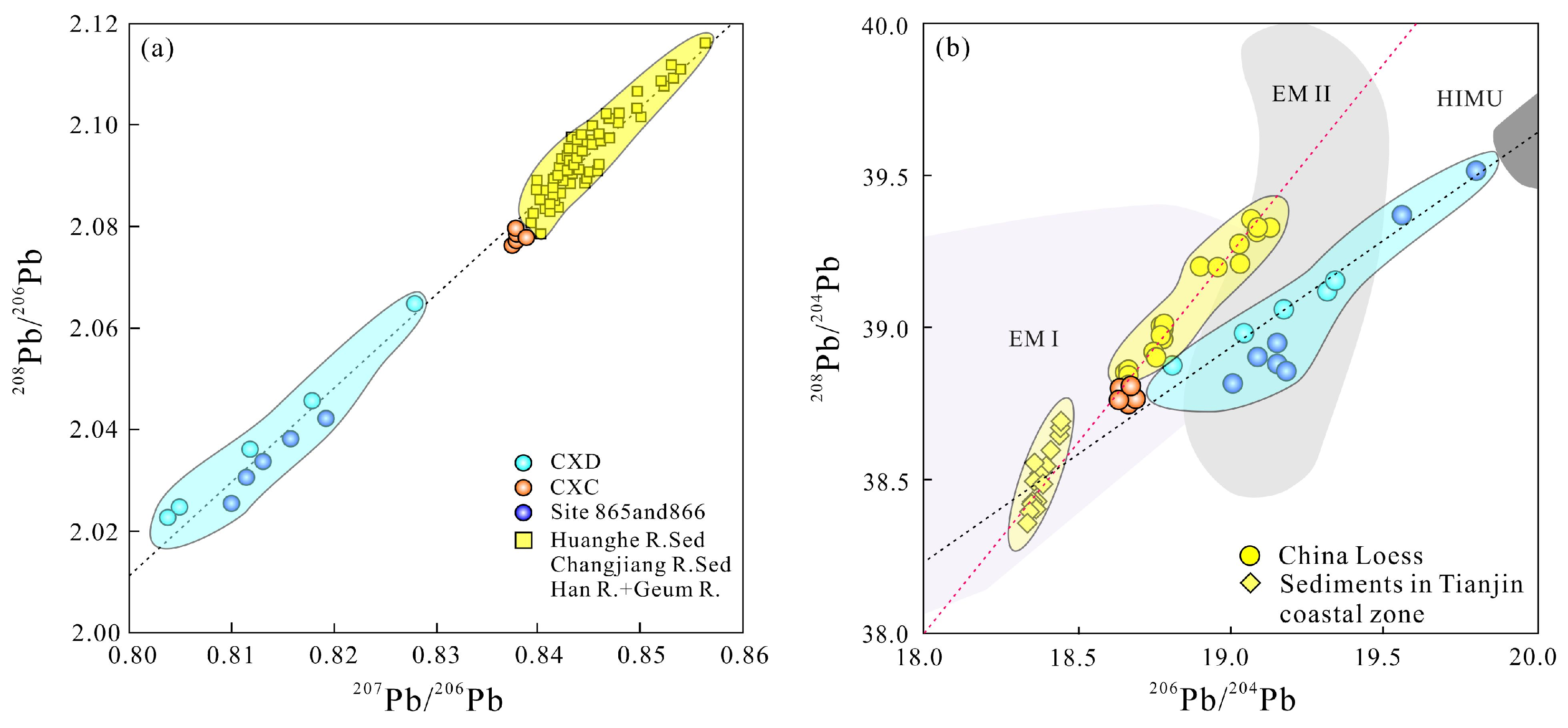
The Pb isotopic composition of seawater is typically characterized by polymetallic crusts (nodules), with a distinct feature of being relatively enriched in radiogenic Pb [90]. Herein, the Pb isotopic composition of polymetallic crusts from the Ewing Guyot, with 207Pb/206Pb from 0.838 to 0.840 and 208Pb/206Pb from 2.076 to 2.079, exhibits significant differences from those of the basement basalt (207Pb/206Pb: 0.803–0.828; 208Pb/206Pb: 2.023–2.065), indicating that the direct source of Pb isotopes is not the basement basalt but seawater.
Currently, the initial sources of Pb in the Pacific Ocean are primarily explained by continental weathering, island arc volcanic activity, and hydrothermal input, while the riverine input was previously considered the primary source. The snapshot of the riverine weathering input from China is as follows: sediments from the Tianjin coastal zone have 208Pb/204Pb of 38.35–38.68, 207Pb/204Pb of 15.58–15.64, 206Pb/204Pb of 18.34–18.45, 208Pb/206Pb of 2.091–2.099, and 207Pb/206Pb of 0.847–0.852 [91]. while natural-source sediments from the Yellow River have average 207Pb/206Pb and 208Pb/206Pb values of 0.8405 and 2.0872, respectively [92]. Constrained by Pb scavenging in estuaries [93] and its short residence time in the ocean, riverine input is likely significant in marginal seas [68,94,95] but exerts a weak influence on the Pb isotopic composition of the central Pacific.
Eolian sources were proposed to be more important in pelagic regions [6,96]. By comparing Pb isotopes of Chinese loess samples, Holocene and Late Quaternary sediment samples from the North Pacific, and Pb compositional trends of cobalt-rich crusts in the central Pacific, it was suggested that the Asian eolian input is the main source of Pb in the Pacific [6]. Chinese loess, the primary source of Asian eolian dust, has average 207Pb/206Pb and 208Pb/206Pb values of 0.8411 and 2.0829, respectively [97], similar to sediments from the Chinese coastal zone and natural-source Yellow River sediments, showing a closer match compared to the polymetallic crusts from the Ewing Guyot. Keeping in mind the long-term and continuous nature of the eolian input, it can be considered an important factor determining the Pb isotopic composition of seawater/polymetallic crusts in the central Pacific.
Furthermore, aerosols generated by volcanic eruptions from circum-Pacific volcanic island arcs and hydrothermal input were proposed to be the main sources of Pb in the central-northern Pacific [98,99,100]. Accordingly, the influence of western Pacific island arc sources increased after 45 Ma in the Cenozoic, being related to the hydrothermal input in the eastern North Pacific. However, the volcanic activity of the island arc is short and far away from the central Pacific seamount area; its transport is further constrained by the ocean’s current circulation, making its sustained influence on the Pb isotopic composition of the central Pacific difficult to expect. The Hawaiian-Emperor Seamount Chain in the northeastern region is geographically distant from the Ewing Seamount in the western Central Pacific. Given that lead (Pb) has a relatively short residence time in the ocean (approximately 0.1 ka) and exhibits significant compositional heterogeneity, and considering that the Antarctic Bottom Water flows east-to-west from the Central Pacific seamounts toward the Hawaiian-Emperor Seamount Chain [101], the magmatic activity and alteration of these seamounts exert minimal influence on the Pb isotopic composition of seawater in the study area. In terms of the hydrothermal input, hydrothermal activity is not well-developed in the central Pacific seamount area, and the most likely source is the East Pacific Rise (EPR). However, the mid-ocean ridge hydrothermal sources are typically depleted in radiogenic Pb; e.g., the TAG hydrothermal field has 208Pb/204Pb of 37.583–37.938, 207Pb/204Pb of 15.408–15.522, and 206Pb/204Pb of 18.218–18.343 [102]. In contrast, the polymetallic crust from the Ewing Guyot is enriched in radiogenic Pb, indicating that hydrothermal Pb has essentially no impact on the central Pacific seamount area, likely because hydrothermal fluids rapidly precipitate after venting on the seafloor, making further long-distance transport to the central Pacific seamount area difficult.
As the central Pacific seamount area is far from the continental part, the riverine input is considerably weak. Within the region, island arc magmatism and hydrothermal activity are short, precluding sustained impacts. Thus, the Pb isotopic composition of seawater in the central Pacific seamount area is primarily influenced by the dual inputs of the low-temperature alteration of seamount basalts and the eolian input of terrigenous weathered materials. In the 208Pb/206Pb-207Pb/206Pb isotopic tracer diagram (Figure 7a), there is a linear relationship between basalts from central Pacific seamounts (including the Ewing Guyot), polymetallic crusts, and Chinese terrigenous sediment samples. The polymetallic crust sample points fall closer to terrigenous sediments and are relatively far from the central Pacific seamount basalt endmember (Figure 7a). In the 206Pb/204Pb-208Pb/204Pb isotopic diagram (Figure 7b), the basalt, polymetallic crust, and terrigenous sediment sample points all lie within the enriched mantle (EM) reservoir field, failing to distinguish between ocean island basalts (OIBs) derived from the enriched mantle and terrigenous materials from continental weathering. Moreover, the polymetallic crust sample points lie at the intersection of the central Pacific seamount trend line and the terrigenous material evolution line, exhibiting a mixing signature between these two.
The main reason why the Pb isotopic composition of the central Pacific seamounts is closer to terrigenous weathered materials, with relatively minor influence from proximal basalt low-temperature alteration, is likely the low Pb concentrations in basalts (1.23 × 10⁻⁶–2.31 × 10⁻⁶). Alteration minerals, such as montmorillonite and thomsonite, selectively adsorb Pb, so most Pb released from the altered basalts adsorbs onto montmorillonitized altered basalts (48.95 × 10⁻⁶–116.0 × 10⁻⁶), reducing its flux into seawater.

5.2.4. Hf Isotopes

The reported εHf values in seawater are significantly heterogeneous across different oceanic regions and water depths. For example, in the Northwest Pacific, the εHf values are all positive, ranging from 3.5 ± 1.4 in surface seawater to 8.6 ± 1.6 in deep seawater, mostly averaging around +5.9 [103], while in the Atlantic Ocean, the εHf values are both positive and negative, ranging from −3.1 in surface seawater to +4.4 in deep seawater [66]. The strong heterogeneity in εHf values indicates that the Hf residence time is shorter than that of Nd [66,67]. Currently, the provenance of Hf in the ocean is still controversial. The potential Hf sources include, among others, continental crustal materials, submarine volcanic activity, submarine hydrothermal fluids, and ocean currents. Extensive data were reported on the influence of continental crustal materials [8,103,104,105,106] and submarine hydrothermal fluids [107,108,109,110,111] on the Hf isotopic composition of seawater, whereas studies on the influence of submarine volcanic activity, ocean currents, and low-temperature alteration of submarine basalts on Hf isotopes are still relatively scarce.
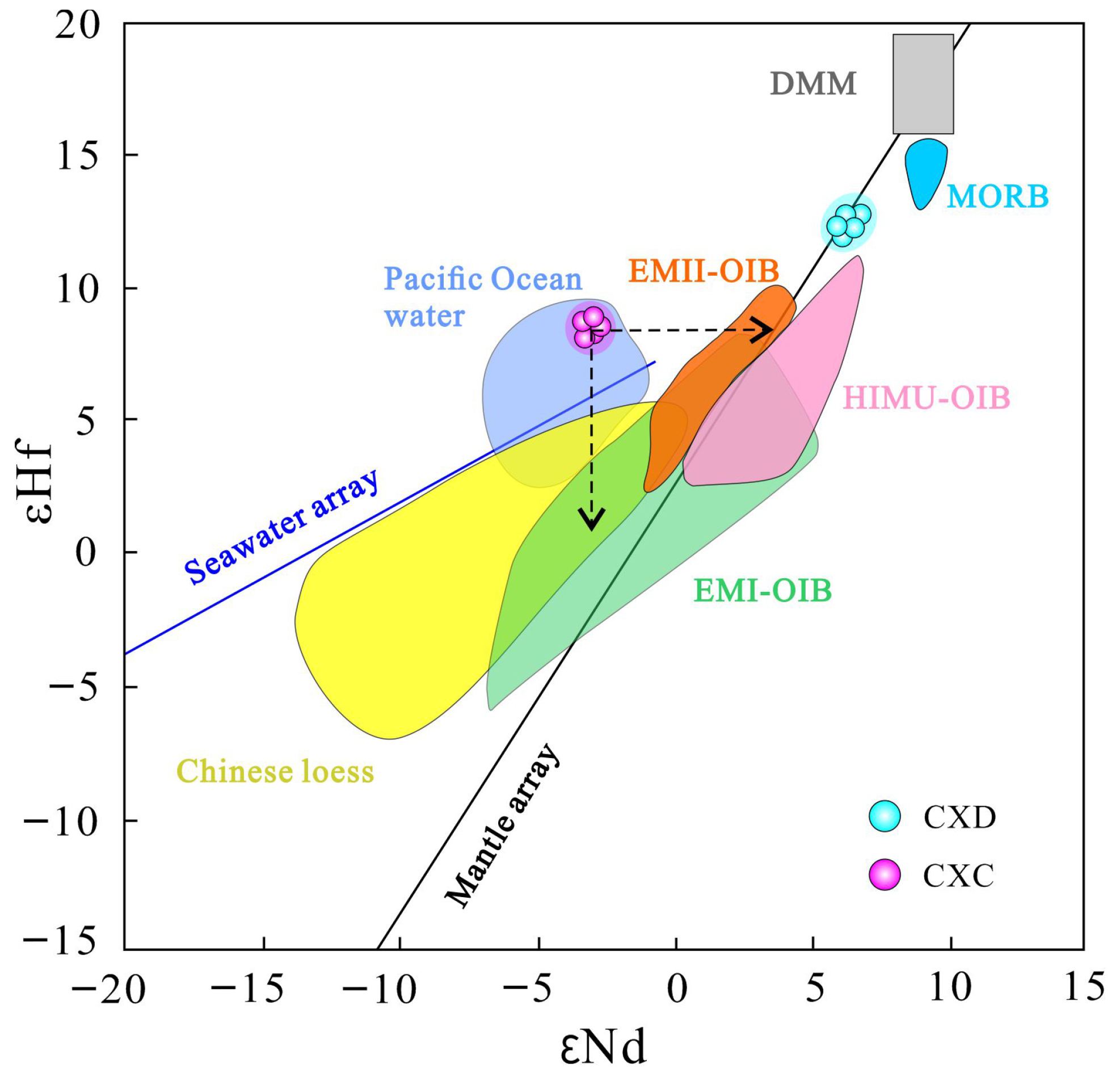
The εHf values of polymetallic crusts from the Ewing Seamount range from +7.11 to +7.53, i.e., they are lower than those of the Ewing Seamount basalts (+12.17 to +12.80) but essentially identical to the εHf values of modern deep seawater in the Northwest Pacific (+8.6 ± 1.6). In terrestrial Hf reservoirs, mantle source regions and their derivatives have relatively high and positive εHf values, whereas the crust and its derivatives have mostly negative or small positive εHf values (Figure 8), indicating that the Hf in the Fe-Mn crusts of the Ewing Seamount and the seawater therein is plausibly derived from the mantle or its derivatives. The previous mainstream standpoint deemed that continental crustal materials are transported into the ocean via rivers and eolian dust (with negative or small positive εHf values), playing a dominant role in determining the Hf isotopic composition of seawater [8,103,104,105,106]. The Chinese Loess Plateau, as the main provenance area for materials transported into the Pacific Ocean via rivers and eolian dust, has, for example, bulk εHf values of −5.53 (average) for the Jingchuan red clay profile, −8.3 for the Lingtai red clay, and −7.07 for the Tai’an red clay [74]; Pettke [95] delineated the end-member εNd values of Asian dust as −9.0 > εNd > −10.8 and +2.5 > εHf > −4; therefore, even if the eolian dust input significantly contributes to the Hf isotopic composition of the Central Pacific, it cannot result in relatively high positive εHf values in the Central Pacific. Zimmermann et al. [112] studied the εHf isotopic compositions of rivers draining into the Arctic Ocean, including the Mackenzie River, Ob River, Yenisey River, and Lena River, reporting the negative or small positive values of −7.1 ± 1.7, 1.5 ± 1.3, 3.0 ± 1.3, and 2.7 ± 1.3, respectively. In addition, riverine Hf entering seawater is likely primarily transported by Fe colloids, which flocculate and precipitate in estuaries [107]. As a result, very little Hf from terrigenous weathering products enters the interior of oceanic regions such as the Central Pacific Seamount Province via rivers, contributing only minimally to the oceanic Hf isotopic composition.
Due to its great distance from continents and the short Hf residence time in seawater, the seawater level of Hf in the Central Pacific Seamount Province is primarily controlled by mantle-derived materials, whose direct sources include volcanic eruptions, submarine hydrothermal activity, and the low-temperature alteration of seamount basalts. Since submarine hydrothermal activity-derived materials primarily originate from the mantle and typically have a relatively high content of radiogenic Hf, e.g., the εHf values of the Vani manganese deposit are from +9.90 ± 6.3 to +9.69 ± 0.67 [113], it was suggested that submarine hydrothermal vents are the cause of relatively high radiogenic Hf in seawater [111,113]; however, some scholars argue that although complex fluorides of Hf occur in hydrothermal systems [66], hydrothermal fluids are not the main source of dissolved Hf in the ocean [109] and only contribute minimally to Hf in seawater [110]. Despite volcanic activity in the Central Pacific Basin since 100 Ma B.P. [114], such-derived magmas or clasts rapidly solidify upon encountering cold seawater, making it difficult to release large amounts of dissolved Hf into seawater extensively and long-term. Instead, the main source should be Hf released from the low-temperature alteration of seamount basalts. The average Hf content of relatively fresh basalts from the Ewing Guyot is 4.52, whereas that of altered basalts is 4.01, indicating the mobilization of Hf during the basalt alteration. In addition, based on the Hf content data of 51 basalt samples from the Central Pacific seamounts [115], ranging from 2.13 to 23.3 with an average of 9.14, the basalts from the Central Pacific seamounts exhibit relatively high Hf contents. Among them, the basalts exposed on seamounts have undergone low-temperature alteration to a varying extent, continuously releasing Hf into seawater and providing a long-term and stable supply to seawater Hf isotopes, which is likely the main factor contributing to the measured relatively high positive εHf values in the Central Pacific.
The εNd-εHf isotopic compositions of modern oceanic seawater and polymetallic crusts exhibit a linear relationship, inconsistent with that of terrestrial rocks [66,103,105,113,116]. At the same Nd isotopic ratios, seawater shows a relatively higher radiogenic Hf isotopic composition than terrestrial rocks, thus forming a “Seawater Line” inconsistent with the “Earth Line” [67] (Figure 8). In the εNd-εHf diagram (Figure 8), the sample points of Pacific seawater and Ewing Seamount polymetallic crusts lie above the terrigenous input area (Chinese loess), having εHf values essentially consistent with those of the enriched mantle ocean island basalt (OIB) region, while the εNd values are relatively low, falling in the overlapping area of enriched mantle basalts and Chinese loess and showing mixed characteristics of these two sources; this indicates that the inconsistent “Seawater Line” or Nd-Hf decoupling is caused by the inconsistent mixing of Nd and Hf from terrigenous (rivers, eolian dust) and mantle-derived (low-temperature alteration of basalts) inputs. Nd exhibits a relatively long residence time in seawater; within a certain region, terrestrial and mantle sources are sufficiently mixed and homogenized, so the εNd represents a mixed characteristic of these two sources. In contrast, the river input contributes minimally to the Central Pacific Hf content due to the short residence time of Hf in seawater and flocculation-precipitation in estuaries; the eolian dust input is also small but insufficient to significantly lower the εHf released from low-temperature alteration of basalts. Thus, the εHf value exhibits mantle-derived characteristics and is relatively high, leading to Nd-Hf decoupling. In addition, significant Nd-Hf isotopic decoupling was observed in seamount basalts from both the Indian and Pacific Oceans [117], so the Nd-Hf isotopic decoupling in seawater or crusts may be inherited from seamount basalts.

5.3. Contribution of Low-Temperature Alteration to the Initial Growth of Polymetallic Crusts

5.3.1. Genetic Types of Polymetallic Crusts

The genetic types of polymetallic nodules/crusts include hydrogenetic, diagenetic, and mixed types. Polymetallic nodules are primarily distributed in abyssal basin areas (e.g., the Clarion-Clipperton Zone in the Eastern Pacific Ocean) and are mostly covered by deep-sea sediments (ooze). Their nodule material is mainly derived from sediment pore water, resulting in a predominance of the diagenetic type [118]. In contrast, polymetallic crusts are exposed on seamount slopes, in direct contact with seawater, and their genetic type differs from that of nodules, being predominantly hydrogenetic [32,33,34]. Hydrogenetic nodules/crusts are characterized by Mn/Fe ≤ 5 and high contents of high field strength elements (HFSE) such as Co, Ce, Ti, REY, Zr, Nb, Ta, and Hf [119], whereas diagenetic nodules typically have Mn/Fe > 5 and are enriched in elements like Ni, Cu, Ba, Zn, Mo, Li, and Ga.
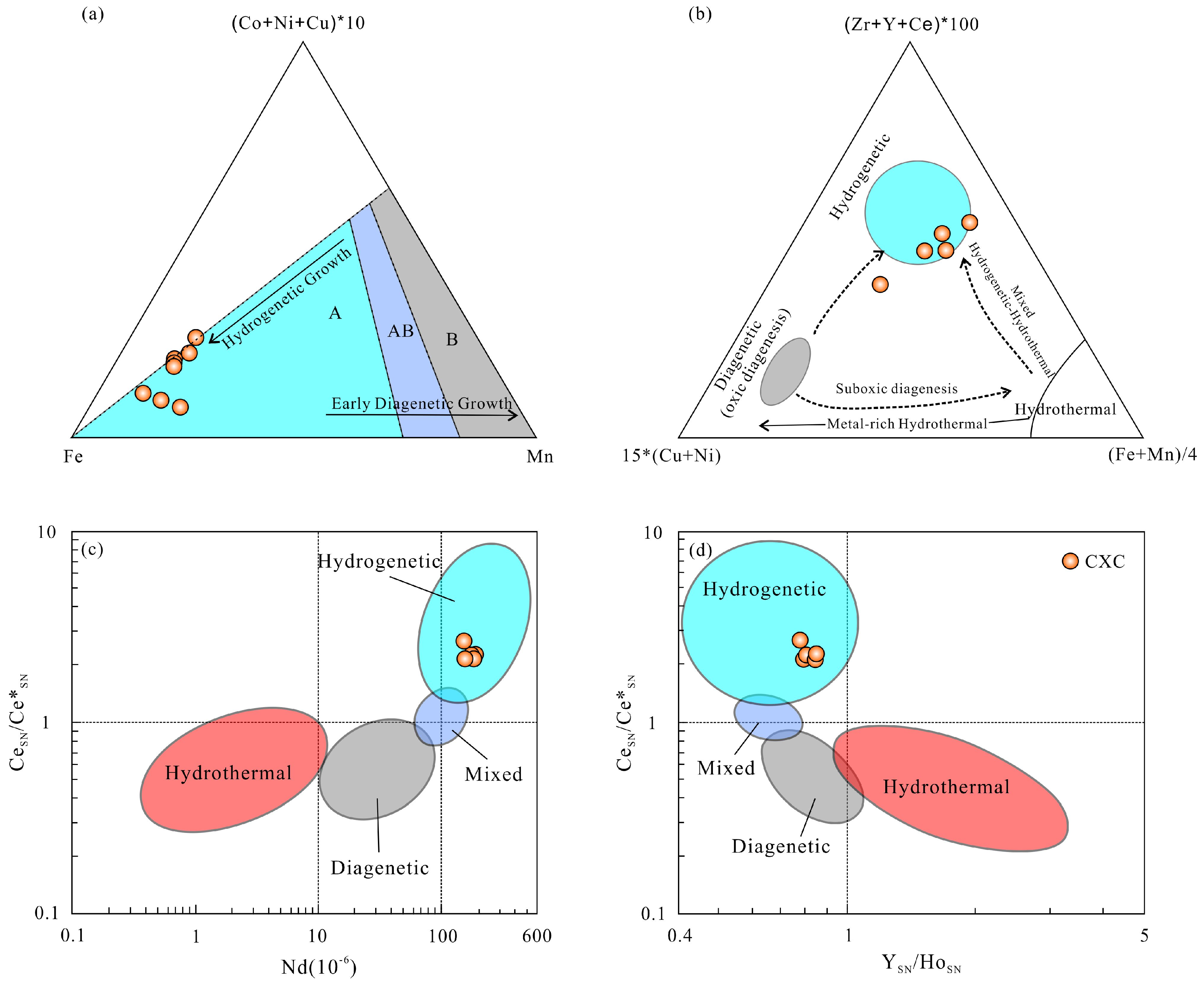
The crusts from the Ewing Seamount exhibit Mn/Fe ratios ranging from 0.13 to 0.27 (≤2.5); high concentrations of Co (9247–9707 ppm), Ce (760.7–875.3 ppm), Ti (9247–9707 ppm), Zr (431.5–457.5 ppm), Nb (47.84–55.26 ppm), Ta (1.2–1.31 ppm), Hf (5.03–5.47 ppm), and REY; along with relatively low contents of Ni (0.07–0.78 wt.%) and Cu (0.06–0.3 wt.%). These chemical characteristics are typical of hydrogenetic polymetallic crusts. In the genetic discrimination diagrams of δCe–Nd and δCe–YSN/HoSN (Figure 9c,d), all samples plot within the hydrogenetic field. Similarly, in the ternary discrimination diagrams of Fe − Mn − (Cu + Ni + Co) × 10 and 15 × (Cu + Ni) − 100 × (Zr + Y + Ce) − (Fe + Mn)/4 (Figure 9a,b), all samples fall within the hydrogenetic domain. These results further confirm a hydrogenetic origin, indicating that the material constituting the polymetallic crusts from the Ewing Seamount is primarily derived from seawater.

5.3.2. Contributions to the Initial Growth of Polymetallic Crusts

Previous studies on the growth models of crusts have primarily focused on factors such as material sources, redox conditions, primary productivity, element occurrence forms, PH, dissolved oxygen, organic matter, and carbon dioxide content. Meanwhile, climatic and tectonic activities also influence crust growth and growth rates by affecting material sources, redox conditions, and primary productivity in the ocean [35,123]. However, there is limited research on whether the initial growth of crusts on substrate materials is solely due to physical precipitation or involves intrinsic chemical processes. Existing studies have shown that polymetallic crusts exhibit topographic selectivity, predominantly occurring on sediment-free, current-swept ridges and seamount slopes [23,39,124]. According to Luan [32], crust coverage is highest on seamount slopes with gradients exceeding 15°, while cobalt-rich crusts become very thin or do not develop at all on the flat tops of guyots. Polymetallic crusts mainly grow on exposed bedrock on seamounts, whereas they are absent on sediment-covered flat tops and bases of seamounts. In contrast, in ocean basins, Mn-Fe and other metallic materials grow around a core to form nodules rather than exhibiting a layered distribution.
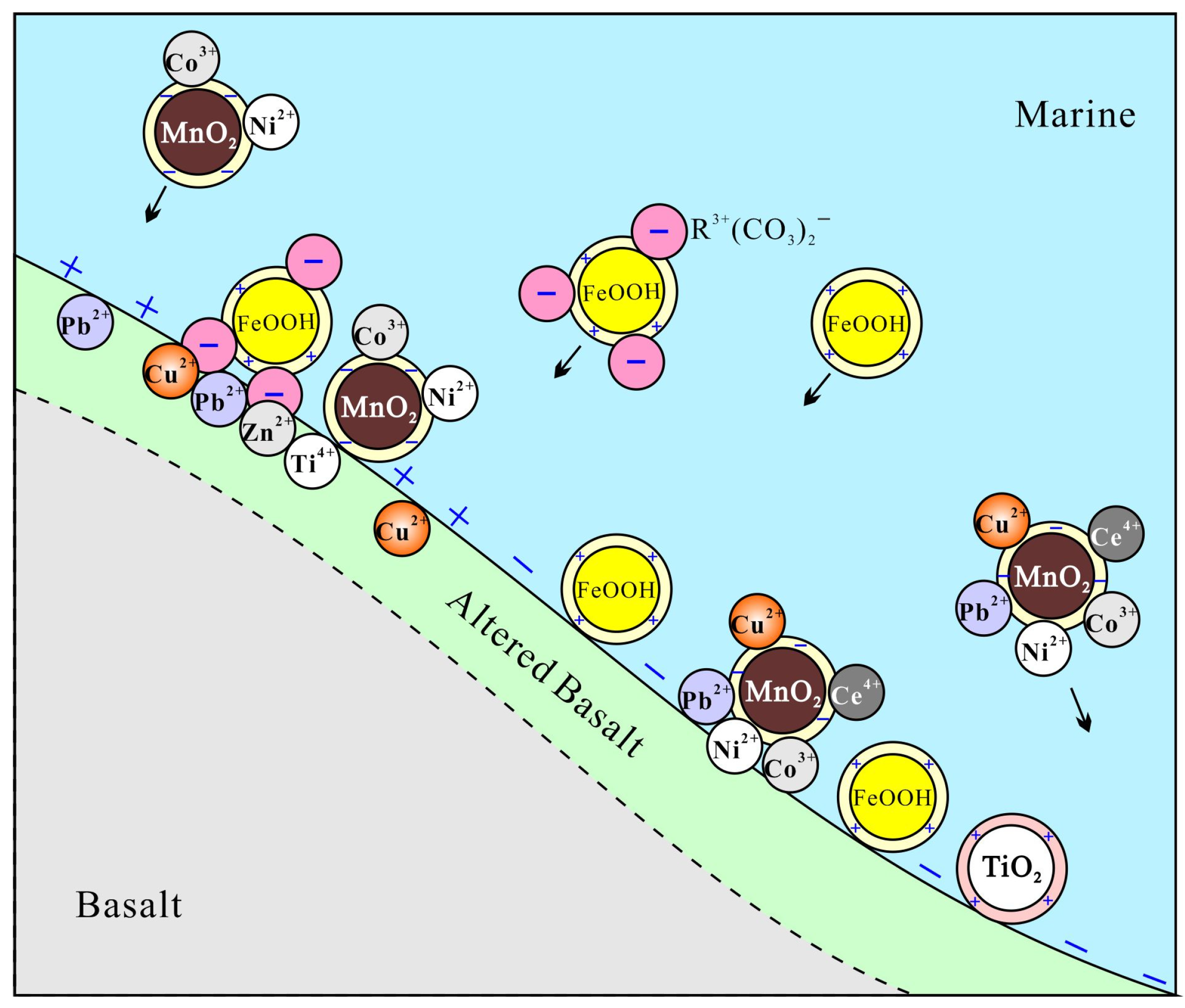
In the most commonly cited model, Fe-Mn crusts form through the direct precipitation of Fe and Mn hydroxides containing elements such as Co, Ni, Cu, Mo, W, REE, and Y from seawater. The distribution characteristics of polymetallic crusts and nodules indicate that during their initial growth, they exhibit selectivity toward substrates and core materials, rather than simply forming through the sedimentation of Mn-Fe and other metallic substances from seawater onto the seafloor. This selectivity may be primarily constrained by the charged properties of Fe-Mn colloids, the electrostatic field provided by the substrate, and chemical adsorption processes. Metal ions and complexes in seawater are adsorbed onto two primary host phases: positively charged FeO(OH) and negatively charged MnO colloids [39]. Even after ion adsorption, these FeO(OH) and MnO colloids retain their surface charges. Therefore, chemical adsorption by substrate and core materials may serve as a critical factor controlling their growth. Similar to the ultraselective enrichment processes observed in ferromanganese nodules [125], the initial growth of polymetallic crusts may also involve selective adsorption of specific trace elements from seawater onto charged mineral surfaces. The initial crust material formed retains colloidal properties and continues to adsorb FeO(OH) or MnO colloids from seawater, thereby sustaining further growth.
The XRD analysis of the CXD sample showed that the primary minerals in the basal altered basalt on which polymetallic crusts grow are montmorillonite and phillipsite. The central ion Si4+ in the silicon-oxygen tetrahedra of montmorillonite is typically substituted by Al3+ (Al3+→Si4+), while the central Al3+ in the aluminum-oxygen octahedra is substituted by lower-valence ions like Fe2+ and Mg2+, resulting in excess negative charge. Since the isomorphic substitution occurs within the crystal lattice and is not affected by the external environment, it generates a permanent charge. Montmorillonite also carries a variable charge: the Al-OH groups in the coordinated octahedra of montmorillonite are amphoteric, dissociating to release H+ in acidic media, rendering the mineral positively charged, and releasing OH in alkaline media, rendering it negatively charged. As seawater is weakly alkaline [126], montmorillonite derived from seamount basalt weathering under alkaline conditions primarily carries a negative charge. Montmorillonite can adsorb metal cations, such as Fe, Ti, Co, Ni, and Cu [53,54,55], via the electrostatic interaction of negative charges and forces generated by asymmetric orbital hybridization [127], thereby acquiring a positive charge. Zeolites are aluminosilicate minerals; when Al3+ is substituted for Si4+ in silicon-oxygen tetrahedra, they carry a negative charge and can adsorb alkali metal, alkaline earth metal, and non-ferrous metal ions, such as Na+, Ca2+, Sr2+, Ba2+, K+, Mg2+, and Cu2+ [128,129]. According to the chemical composition of altered basalt (SX) (Table 2), the increased contents of Fe2O3, TiO2, Cu2+, Pb2+, and Zn2+ indicate that montmorillonite and phillipsite selectively adsorbed metal cations, which became locally enriched on the basalt surface and formed a positive electric field. Therefore, montmorillonite and phillipsite produced by the low-temperature alteration of seamount basalt either carry negative charges themselves or acquire positive charges by adsorbing metal cations, providing an electrostatic field for the chemical adsorption of charged colloidal particles from seawater and the initial growth of polymetallic crusts.
Furthermore, the XRD analysis revealed that polymetallic crusts have low crystallinity and primarily grow in a colloidal form. In seawater under normal Eh-pH conditions (Eh > 0.5 V; pH ≈ 8), Fe, Mn, and Ti tend to oxidize to FeOOH (Fe3+), MnO2 (Mn4+), and TiO2 (Ti4+), respectively. These oxides are poorly soluble in seawater and thus form colloids [13,130]. The surface of MnO2 colloids exhibits a strong negative charge and becomes positively charged by adsorbing cations, whereas d-FeOOH and TiO2 colloidal particles have a double-layer structure with positively charged surfaces, enabling them to adsorb negatively charged ions or ionic groups and thus become negatively charged. The negative or positive charges on montmorillonite and phillipsite in altered basalt will chemically adsorb positively or negatively charged colloidal particles of Fe, Mn, Ti, and some charged ions from seawater onto the basalt surface, initiating initial growth (Figure 10). The high-Fe, Ti laminae in the lower part of the CXC sample (Table 1) primarily result from the adsorption and growth of positively charged d-FeOOH and TiO2 colloidal particles by the negative charge on montmorillonite and phillipsite. Fe3+, Mn4+, and Ti4+ have high valences and thus high ionic potentials (high electric charge), so they are preferentially adsorbed; ions with the same properties as those composing the colloidal core are also preferentially adsorbed; these two reasons explain the high Fe, Ti, and Mn contents in Lamina 1. Additionally, if montmorillonite and phillipsite in altered basalt adsorb excess metal cations, such as Fe3+, Ti4+, Cu2+, Pb2+, and Zn2+, they locally form excess positive charges on the basalt surface (Figure 10); this causes a preferential adsorption of negatively charged colloidal particles, potentially resulting in high Mn contents of the initial laminae of polymetallic crusts. In summary, montmorillonite and phillipsite generated by the low-temperature alteration of basalt render the altered basalt negatively or positively charged, forming different electrostatic fields. These fields further lead to chemical adsorption of positively charged colloidal particles (e.g., δ-FeOOH) and negatively charged colloidal particles (e.g., MnO2), as well as other metal ions from seawater, initiating the initial growth of polymetallic crusts on the surface of altered basalt.
In the substrate materials of crusts, besides basalt, various other volcanic and sedimentary rocks are included [23]. Similar to basalt, these rocks have undergone varying degrees of low-temperature alteration on the seafloor. After low-temperature alteration, volcanic rocks often generate clay minerals, which typically carry charges and possess large specific surface areas, thereby exhibiting adsorptive properties. Moreover, the thickness of crust growth shows a certain correlation with the weathering degree of the host rock—thick crust layers often develop on rocks with higher weathering degrees [20,32]. This further supports the significance of seafloor low-temperature alteration for crust growth. Among carbonate rocks, marlstone inherently contains clay minerals and thus exhibits adsorptive properties. Rocks containing bioclasts, such as reef limestone and bioclastic limestone, contain humic substances. These humic components contain abundant functional groups such as carboxyl (-COOH) and hydroxyl (-OH), which can immobilize FeO(OH) and MnO colloidal particles through adsorption, complexation, and chelation, thereby serving as substrate materials for crust formation. Furthermore, during the low-temperature alteration of basalt, metallic elements such as iron, manganese, cobalt, nickel, and rare earth elements are liberated into seawater, serving as one of the material sources for the growth of crusts.

6. Conclusions

  • Shallow seamount basalts are affected by low-temperature alteration to varying degrees. During the low-temperature alteration of basalts, the mineral transformation follows the path: pyroxene + plagioclase → montmorillonite + phillipsite. For major elements, the contents of SiO2, FeO, CaO, MgO, Na2O, P2O5, and MnO decrease, while those of Al2O3, Fe2O3, K2O, and TiO2 increase. The contents of other REEs decrease significantly, except for a slight increase in the content of Ce. For trace elements, the contents of Li, Rb, Cs, Nb, Cu, Pb, and Zn markedly increase after the alteration, whereas the contents of Ba and Sr decrease significantly; finally, the contents of Ta, Zr, Hf, Co, and Ni slightly decrease.
  • During the low-temperature alteration of basalts, substantial amounts of Sr, Nd, Pb, and Hf are released into the ocean, making extensive, long-term, and continuous contributions to marine isotopic compositions. The isotopic compositions of Sr, Nd, Pb, and Hf in seawater and the presence of polymetallic crusts indicate mixed sources of continental and mantle materials to varying degrees. Specifically, the isotopic compositions of Sr and Pb are closer to terrigenous input materials, and Nd exhibits an approximately average mixing mechanism between continental and mantle sources, while the isotopic composition of Hf is comparable to that of enriched mantle ocean island basalts (OIBs).
  • The formation of polymetallic crusts on the substrate of altered basalt is explained by the following reaction sequence: montmorillonite and phillipsite, the low-temperature alteration minerals of basalt, are permanently negatively charged and exhibit variable charges, endowing the altered basalt with adsorption capacity. These minerals provide an electrostatic field for chemical adsorption, facilitating the initial growth of charged Fe and Mn colloidal particles from seawater on the basalt substrate. Additionally, the low-temperature alteration of basalt supplies material for crust growth by releasing metal Fe, Mn, Co, Ni, and rare earth elements into seawater.

Author Contributions

Conceptualization, J.S.; Formal analysis, J.S.; Writing—original draft, J.S.; Funding acquisition, X.L.; Project administration, X.L.; Resources, X.L.; Supervision, Z.X.; Writing—review and editing, Z.X.; Data curation, K.C.; Software, K.C.; Methodology, K.C.; Investigation, Z.W.; Validation, Z.W.; Visualization, Z.W. All authors have read and agreed to the published version of the manuscript.

Funding

This research was financially supported by the National Key Research and Development Program of China (Grant No. 2023YFC2811205, 2023YFC2811305) and the National Natural Science Foundation of China (Grant No. U2244222).

Data Availability Statement

The authors declare that the data supporting the findings of this study are available within the paper. Should any raw data files be needed in another format, they are available from the corresponding author upon reasonable request.

Conflicts of Interest

The authors declare that they have no known competing financial interests or personal relationships that could have appeared to influence the work reported in this paper.

References

  1. Thompson, G. Metamorphic and hydrothermal processes: Basalt-seawater interactions. In Oceanic Basalts; Springer: Boston, MA, USA, 1991; pp. 148–173. [Google Scholar] [CrossRef]
  2. Furnes, H.; Staudigel, H. Biological mediation in ocean crust alteration: How deep is the deep biosphere? Earth Planet. Sci. Lett. 1999, 166, 97–103. [Google Scholar] [CrossRef]
  3. Abouchami, W.; Goldstein, S.L. A lead isotopic study of Circum-Antarctic manganese nodules. Geochim. Cosmochim. Acta 1995, 59, 1809–1820. [Google Scholar] [CrossRef]
  4. Burton, K.W.; Ling, H.F.; O’Nions, R.K. Closure of the Central American Isthmus and its effect on deep-water formation in the North Atlantic. Nature 1997, 386, 382–385. [Google Scholar] [CrossRef]
  5. Ling, H.F.; Burton, K.W.; O’nions, R.K.; Kamber, B.S.; von Blanckenburg, F.; Gibb, A.J.; Hein, J.R. Evolution of Nd and Pb isotopes in Central Pacific seawater from ferromanganese crusts. Earth Planet. Sci. Lett. 1997, 146, 1–12. [Google Scholar] [CrossRef]
  6. Ling, H.F.; Jiang, S.Y.; Frank, M.; Zhou, H.Y.; Zhou, F.; Lu, Z.L.; Chen, X.M.; Jiang, Y.H.; Ge, C.D. Differing controls over the Cenozoic Pb and Nd isotope evolution of deepwater in the central North Pacific Ocean. Earth Planet. Sci. Lett. 2005, 232, 345–361. [Google Scholar] [CrossRef]
  7. Van de Flierdt, T.; Frank, M.; Halliday, A.N.; Hein, J.R.; Hattendorf, B.; Günther, D.; Kubik, P.W. Deep and bottom water export from the Southern Ocean to the Pacific over the past 38 million years. Paleoceanography 2004, 19, PA1020. [Google Scholar] [CrossRef]
  8. Van de Flierdt, T.; Frank, M.; Halliday, A.N.; Hein, J.R.; Hattendorf, B.; Günther, D.; Kubik, P.W. Tracing the history of submarine hydrothermal inputs and the significance of hydrothermal hafnium for the seawater budget—A combined Pb–Hf–Nd isotope approach. Earth Planet. Sci. Lett. 2004, 222, 259–273. [Google Scholar] [CrossRef]
  9. Zeng, X.l.; Li, J.; Zhang, J.; Yao, H.Q. Study on the evolution and tracing of marine Sr, Nd, and Pb isotopic composition. Geochimica 2022, 51, 598–610. [Google Scholar] [CrossRef]
  10. Bu, W.R.; Shi, X.F.; Peng, J.T.; Liu, J.H.; Zhang, M.J.; Qi, L. Low-temperature alteration of oceanic island basalts and their contribution to transition metal cycle of the ocean. Acta Oceanol. Sin. (Chin. Ed.) 2007, 29, 55–68. [Google Scholar]
  11. Yan, Q.S.; Zhang, P.Y.; Shi, X.F.; Zhang, H.T. Weathering of seafloor lavas and its geological significance. Adv. Mar. Sci. 2017, 35, 369–381. [Google Scholar] [CrossRef]
  12. Zhang, L.M.; Ren, J.B.; Chen, H.J.; Wang, H.Z.; Sun, Z.; Yang, Y.; Zhang, H.D.; Wei, Z.Q.; Zhang, L.X.; Ren, Y.Z.; et al. Fe-Mn Crust δ98Mo Decline Records Tectonic Forcing on Marine Oxide Sink Reduction During the Early Eocene-Early Oligocene. Geophys. Res. Lett. 2026, 53, e2025GL120782. [Google Scholar] [CrossRef]
  13. Hein, J.R.; Morgan, C.L. Influence of substrate rocks on Fe–Mn crust composition. Deep Sea Res. Part I Oceanogr. Res. Pap. 1999, 46, 855–875. [Google Scholar] [CrossRef]
  14. Kuhn, T.; Wegorzewski, A.; Rühlemann, C.; Vink, A. Composition, formation, and occurrence of polymetallic nodules. In Deep-Sea Mining: Resource Potential, Technical and Environmental Considerations; Springer International Publishing: Cham, Switzerland, 2017; pp. 23–63. [Google Scholar] [CrossRef]
  15. Bonatti, E.; Nayudu, Y.R. The origin of manganese nodules on the ocean floor. Am. J. Sci. 1965, 263, 17–39. [Google Scholar] [CrossRef]
  16. Piper, D.Z.; Williamson, M.E. Composition of Pacific Ocean ferromanganese nodules. Mar. Geol. 1977, 23, 285–303. [Google Scholar] [CrossRef]
  17. Schulz, H.D.; Zabel, M. Marine Geochemistry; Springer: New York, NY, USA; Berlin/Heidelberg, Germany, 2006. [Google Scholar] [CrossRef]
  18. De Carlo, E.H.; McMurthy, G.M.; Kim, K.H. Geochemistry of ferromanganese crusts from the Hawaiian Archipelago—I. Northern survey areas. Deep Sea Res. Part A Oceanogr. Res. Pap. 1987, 34, 441–467. [Google Scholar] [CrossRef]
  19. Koschinsky, A.; Stascheit, A.; Bau, M.; Halbach, P. Effects of phosphatization on the geochemical and mineralogical composition of marine ferromanganese crusts. Geochim. Cosmochim. Acta 1997, 61, 4079–4094. [Google Scholar] [CrossRef]
  20. Chen, J.; Zhang, F.; Lin, C.; Shi, J.; Shen, H.; Wang, J.; Ma, W. Biogenesis study of manganese nodules from the Chinese pioneer area in the Pacific Ocean. Acta Geol. Sin. Chin. Ed. 2001, 75, 228–233. [Google Scholar]
  21. Baker, P.E.; Castillo, P.R.; Condliffe, E. Petrology and geochemistry of igneous rocks from Allison and Resolution guyots, Sites 865 and 866. Proc. ODP Sci. Results 1995, 143, 245–261. [Google Scholar]
  22. Chen, S.S.; Liu, J.Q. Geochemical characteristics and geological significance of Cretaceous phonotephrite from the Mid-Pacific Mountains. Sci. China Earth Sci. 2018, 61, 745–764. [Google Scholar] [CrossRef]
  23. Chu, F.Y.; Chen, J.L.; Ma, W.L.; Gao, S.; Wu, G. Petrologic characteristics and ages of basalt in Middle Pacific mountains. Mar. Geol. Quat. Geol. 2005, 25, 55. [Google Scholar] [CrossRef]
  24. Hamilton, E.L. Sunken Islands of the Mid-Pacific Mountains; Geological Society of America: Boulder, CO, USA, 1956; Volume 64. [Google Scholar] [CrossRef]
  25. He, X. Geological and Geochemical Characteristics of Basalts and the Genesis of Cobalt-Rich Crust from the CA Seamount in the Central Pacific. Master’s Thesis, Jilin University, Changchun, China, 2018. [Google Scholar]
  26. Larson, R.L.; Lancelot, Y.; Gardner, J.V.; Moberly, R. Magnetic, Bathymetric, Seismic Reflection, and Positioning Data Collected Underway on Glomar Challenger, Leg 32; Initial Reports of the Deep Sea Drilling Project 32; U.S. Government Printing Office: Washington, DC, USA, 1975; pp. 393–427.
  27. Li, C. Geochemical Characteristics of Basalt and Research on Cobalt-Rich Crust Formation in the Mid-Pacific CH Seamount. Ph.D. Thesis, Jilin University, Changchun, China, 2013. [Google Scholar]
  28. Su, R. Geological Significance of Petrological and Geochemical Characteristics of Basalts from the Central North West Pacific Seamount and Its Influence on the Growth of Cobalt-Rich Crust. Master’s Thesis, Jilin University, Changchun, China, 2015. [Google Scholar]
  29. Hein, J.R.; Koschinsky, A. Deep-ocean ferromanganese crusts and nodules. Treatise Geochem. 2014, 13, 273–291. [Google Scholar] [CrossRef]
  30. Liu, Y.G.; He, G.W.; Yao, H.Q.; Yang, Y.; Ren, J.B.; Guo, L.H.; Mei, Y.X. Global distribution characteristics of seafloor cobalt-rich encrustation resources. Miner. Depos. 2013, 32, 1275–1284. [Google Scholar] [CrossRef]
  31. Chinese Ocean Mineral Resources Research and Development Association Office. Catalogue of Undersea Features on the Ocean Floor of China Ocean (2016); China Ocean Press: Beijing, China, 2016. [Google Scholar]
  32. Luan, X.W. Cobalt-rich ferromanganese crusts formation—Evidences of hydrogenous origin. J. Mar. Sci. 2006, 24, 8–19. [Google Scholar]
  33. Wang, Y. Temporal and Spatial Enrichment of Metallogenic Elements in Polymetallic Crusts from Central and Western Pacific and Its Paleoceanographic Significance. Ph.D. Thesis, China University of Geosciences, Beijing, China, 2020. [Google Scholar]
  34. Wang, Y.; Fang, N.Q. Variation in growth rate of polymetallic crusts in the central and western Pacific Ocean and its constraining factors. Mar. Geol. Quat. Geol. 2020, 40, 162–174. [Google Scholar] [CrossRef]
  35. Peretyazhko, I.S.; Savina, E.A.; Pulyaeva, I.A. Cobalt-Rich Fe-Mn Crusts in the Western Pacific Magellan Seamount Trail: Geochemistry and Chronostratigraphy. Geosciences 2025, 15, 411. [Google Scholar] [CrossRef]
  36. Hein, J.R.; Yeh, H.-W.; Gunn, S.H.; Sliter, W.V.; Benninger, L.M.; Wang, C.-H. Two major Cenozoic episodes of phosphogenesis recorded in equatorial Pacific seamount deposits. Paleoceanography 1993, 8, 293–311. [Google Scholar] [CrossRef]
  37. GB/T 17366-1998; Terminology of Surveying and Mapping for Prospecting to Geology and Mineral Resources. The State Bureau of Quality and Technical Supervision: Beijing, China, 1998.
  38. Lu, Q.; Liu, H.F.; Lei, X.R. Simulating quantitative analysis method-quantitative analysis of clay mineral mixtures of montmorillonite, illite/smectite interstratified clay minerals, illite, chlorite and some others. Acta Mineral. Sin. 1993, 13, 12–20. [Google Scholar] [CrossRef]
  39. Hein, J.R.; Mizell, K.; Koschinsky, A.; Conrad, T.A. Deep-ocean mineral deposits as a source of critical metals for high-and green-technology applications: Comparison with land-based resources. Ore Geol. Rev. 2013, 51, 1–14. [Google Scholar] [CrossRef]
  40. Clague, D.A.; Beeson, M.H. Trace element geochemistry of the East Molokai volcanic series, Hawaii. Am. J. Sci. 1980, 280, 820–844. [Google Scholar]
  41. Wilson, M. Igneous Petrogenesis: A Global Tectonic Approach; Unwin Hyman: London, UK, 1989; pp. 1–466. [Google Scholar] [CrossRef]
  42. Le Maitre, R.W. Igneous Rocks: A Classification and Glossary of Terms: Recommendations of the International Union of Geological Sciences Subcommission on the Systematics of Igneous Rocks; Cambridge University Press: Cambridge, UK, 1989. [Google Scholar] [CrossRef]
  43. Irvine, T.N.; Baragar, W.R.A.F. A guide to the chemical classification of the common volcanic rocks. Can. J. Earth Sci. 1971, 8, 523–548. [Google Scholar] [CrossRef]
  44. Middlemost, E.A. A simple classification of volcanic rocks. Bull. Volcanol. 1972, 36, 382–397. [Google Scholar] [CrossRef]
  45. Shiqi, W.A.N.G.; Xiantao, Y.E.; Chuanlin, Z.H.A.N.G.; Xuefa, S.H.I. Characteristics of phosphatization and its effects on the geochemical compositions of basalts from the Mid-Pacific Mountains. Mar. Geol. Quat. Geol. 2023, 44, 67–80. [Google Scholar] [CrossRef]
  46. Sun, S.S.; McDonough, W.F. Chemical and isotopic systematics of oceanic basalts: Implications for mantle composition and processes. Geol. Soc. Lond. Spec. Publ. 1989, 42, 313–345. [Google Scholar] [CrossRef]
  47. Hu, H.; Yu, X.; Han, X.Q. Quantitative constraints of subduction cycle components on oceanic mantle heterogeneity. Earth Sci. 2022, 47, 2616–2630. [Google Scholar] [CrossRef]
  48. Delvigne, J.; Bisdom, E.B.A.; Sleeman, J.; Stoops, G. Olivines, their pseudomorphs and secondary products. Pedologie 1979, 29, 247–309. [Google Scholar]
  49. Smith, K.L.; Milnes, A.R.; Eggleton, R.A. Weathering of basalt: Formation of iddingsite. Clays Clay Miner. 1987, 35, 418–428. [Google Scholar] [CrossRef]
  50. Peng, H.Z. Characteristics and Genesis of Iddingsite Alteration from Penglai Basalt, Shandong. Master’s Thesis, China University of Geosciences (Beijing), Beijing, China, 2021. [Google Scholar] [CrossRef]
  51. Chen, D.Q. Applied Geochemistry of Rare Earth Elements; Metallurgical Industry Press: Beijing, China, 1990; pp. 59–114. [Google Scholar]
  52. Houghton, R.L.; Rothe, P.; Galehouse, J.S.; Tucholke, B.E. Distribution and Chemistry of Phillipsite, Clinoptilolite, and Associated Zeolites at DSDP Sites 382, 385, and 386 in the Western North Atlantic; Initial Reports of the Deep Sea Drilling Project; US Government Printing Office: Washington, DC, USA, 1979; Volume 43, pp. 463–483. [CrossRef]
  53. He, H.P.; Guo, J.G.; Xie, X.D.; Peng, J.L. State of Cu2+ adsorbed by montmorillonite. Geochimica 2000, 29, 198–201. [Google Scholar] [CrossRef]
  54. Internò, G.; Lenti, V.; Fidelibus, C. Laboratory experiments on diffusion and sorption of heavy metals in a marine clay. Environ. Earth Sci. 2015, 73, 4443–4449. [Google Scholar] [CrossRef]
  55. Proust, D. Sorption and distribution of Zn in a sludge-amended soil: Influence of the soil clay mineralogy. J. Soils Sediments 2015, 15, 607–622. [Google Scholar] [CrossRef]
  56. Anna, B.; Kleopas, M.; Constantine, S.; Anestis, F.; Maria, B. Adsorption of Cd (II), Cu (II), Ni (II) and Pb (II) onto natural bentonite: Study in mono-and multi-metal systems. Environ. Earth Sci. 2015, 73, 5435–5444. [Google Scholar] [CrossRef]
  57. Gou, K.Y. Theoretical Study on Adsorbtion Characteristics of Clay Mineral Montmorillonite. Master’s Thesis, Guangxi University of Science and Technology, Liuzhou, China, 2023. [Google Scholar] [CrossRef]
  58. Shi, T.H.; Lv, C.; Zuo, L.N. Adsorption of heavy metal ions by silylation modified zeolite. Chin. J. Environ. Eng. 2013, 7, 1045–1052. [Google Scholar]
  59. Zamzow, M.J.; Eichbaum, B.R.; Sandgren, K.R.; Shanks, D.E. Removal of heavy metals and other cations from wastewater using zeolites. Sep. Sci. Technol. 1990, 25, 1555–1569. [Google Scholar] [CrossRef]
  60. Burton, K.W.; Lee, D.C.; Christensen, J.N.; Halliday, A.N.; Hein, J.R. Actual timing of neodymium isotopic variations recorded by Fe-Mn crusts in the western North Atlantic. Earth Planet. Sci. Lett. 1999, 171, 149–156. [Google Scholar] [CrossRef]
  61. Chabaux, F.; Cohen, A.S.; Onions, R.K.; Hein, J.R. 238U-234U-230Th chronometry of Fe–Mn crusts: Growth processes and recovery of thorium isotopic ratios of seawater. Geochim. Cosmochim. Acta 1995, 59, 633–638. [Google Scholar] [CrossRef]
  62. Wu, C.H. Research on the Growth and Elemental Geochemical Characteristics of Large-Scale Polymetallic Nodules from the Northern Continental Margin of the South China Sea. Ph.D. Thesis, China University of Geosciences (Beijing), Beijing, China, 2009. [Google Scholar]
  63. Kani, T.; Isozaki, Y.; Hayashi, R.; Zakharov, Y.; Popov, A. Middle Permian (Capitanian) seawater 87Sr/86Sr minimum coincided with disappearance of tropical biota and reef collapse in NE Japan and Primorye (Far East Russia). Palaeogeogr. Palaeoclimatol. Palaeoecol. 2018, 499, 13–21. [Google Scholar] [CrossRef]
  64. Tachikawa, K.; Athias, V.; Jeandel, C. Neodymium budget in the modern ocean and paleo-oceanographic implications. J. Geophys. Res. Ocean. 2003, 108, 3254–3266. [Google Scholar] [CrossRef]
  65. Tachikawa, K.; Jeandel, C.; Roy-Barman, M. A new approach to the Nd residence time in the ocean: The role of atmospheric inputs. Earth Planet. Sci. Lett. 1999, 170, 433–446. [Google Scholar] [CrossRef]
  66. Rickli, J.; Frank, M.; Halliday, A.N. The hafnium–neodymium isotopic composition of Atlantic seawater. Earth Planet. Sci. Lett. 2009, 280, 118–127. [Google Scholar] [CrossRef]
  67. Hu, R.; Ling, H.F.; Chen, T.Y. Marine hafnium isotopic evolution and its implications for continental sources and ocean circulation changes. Acta Oceanol. Sin. 2012, 34, 61–71. [Google Scholar]
  68. Henderson, G.M.; Maier-Reimer, E. Advection and removal of 210Pb and stable Pb isotopes in the oceans: A general circulation model study. Geochim. Cosmochim. Acta 2002, 66, 257–272. [Google Scholar] [CrossRef]
  69. Steuber, T. Strontium isotope stratigraphy of Turonian–Campanian Gosau-type rudist formations in the Northern Calcareous and Central Alps (Austria and Germany). Cretac. Res. 2001, 22, 429–441. [Google Scholar] [CrossRef]
  70. Hess, J.; Bender, M.L.; Schilling, J.G. Evolution of the ratio of strontium-87 to strontium-86 in seawater from Cretaceous to present. Science 1986, 231, 979–984. [Google Scholar] [CrossRef]
  71. McArthur, J.M.; Howarth, R.J.; Bailey, T.R. Strontium isotope stratigraphy: LOWESS version 3: Best fit to the marine Sr-isotope curve for 0–509 Ma and accompanying look-up table for deriving numerical age. J. Geol. 2001, 109, 155–170. [Google Scholar] [CrossRef]
  72. Wu, W.H.; Yang, J.D.; Xu, S.J.; Li, G.J.; Yin, H.W.; Tao, X.C. Sr fluxes and isotopic compositions of the eleven rivers originating from the Qinghai-Tibet Plateau and their contributions to 87Sr/86Sr evolution of seawater. Sci. China Ser. D Earth Sci. 2009, 52, 1059–1067. [Google Scholar] [CrossRef]
  73. Yang, S.Y.; Jiang, S.Y.; Ling, H.F.; Xia, X.P.; Sun, M.; Wang, D. Sr-Nd isotopic compositions of the Changjiang sediments: Implications for tracing sediment sources. Sci. China Ser. D Earth Sci. 2007, 50, 1556–1565. [Google Scholar] [CrossRef]
  74. Cao, L. Study on Hf Isotopic Composition of Jingchuan Red Clay from the Loess Plateau. Master’s Thesis, Kunming University of Science and Technology, Kunming, China, 2020. [Google Scholar] [CrossRef]
  75. Huang, C.G.; Huang, S.J.; Wu, S.J.; Chen, Q.L. Sr-isotope composition and evolvement in sea water over past 100 Ma and control factors. J. Earth Sci. Environ. 2006, 28, 19–24. [Google Scholar]
  76. Davis, A.C.; Bickle, M.J.; Teagle, D.A.H. Imbalance in the oceanic strontium budget. Earth Planet. Sci. Lett. 2003, 211, 173–187. [Google Scholar] [CrossRef]
  77. Yang, X.M.; Yang, X.Y.; Chen, S.X. Petrogeochemistry; Press of University of Science and Technology of China: Hefei, China, 2000; pp. 1–243. [Google Scholar]
  78. Bach, W.; Humphris, S.E. Relationship between the Sr and O isotope compositions of hydrothermal fluids and the spreading and magma-supply rates at oceanic spreading centers. Geology 1999, 27, 1067–1070. [Google Scholar] [CrossRef]
  79. Rao, W.; Chen, J.; Yang, J.; Ji, J.; Li, G.; Tan, H. Sr-Nd isotopic characteristics of eolian deposits in the Erdos Desert and Chinese Loess Plateau: Implications for their provenances. Geochem. J. 2008, 42, 273–282. [Google Scholar] [CrossRef]
  80. Li, G.; Chen, J.; Ji, J.; Yang, J.; Conway, T.M. Natural and anthropogenic sources of East Asian dust. Geology 2009, 37, 727–730. [Google Scholar] [CrossRef]
  81. Chen, J.; Li, G.; Yang, J.; Rao, W.; Lu, H.; Balsam, W.; Ji, J. Nd and Sr isotopic characteristics of Chinese deserts: Implications for the provenances of Asian dust. Geochim. Cosmochim. Acta 2007, 71, 3904–3914. [Google Scholar] [CrossRef]
  82. O’nions, R.K.; Frank, M.; von Blanckenburg, F.; Ling, H.F. Secular variation of Nd and Pb isotopes in ferromanganese crusts from the Atlantic, Indian and Pacific Oceans. Earth Planet. Sci. Lett. 1998, 155, 15–28. [Google Scholar] [CrossRef]
  83. Rutberg, R.L.; Hemming, S.R.; Goldstein, S.L. Reduced North Atlantic Deep Water flux to the glacial Southern Ocean inferred from neodymium isotope ratios. Nature 2000, 405, 935–938. [Google Scholar] [CrossRef]
  84. Albarède, F.; Goldstein, S.L. World map of Nd isotopes in sea-floor ferromanganese deposits. Geology 1992, 20, 761–763. [Google Scholar] [CrossRef]
  85. Zhao, K.D.; Jiang, S.Y.; Zheng, X.Y.; Chen, T.Y.; Ling, H.F. Nd isotope evolution of ocean waters and implications for paleo-ocean circulation. Earth Sci. Front. 2009, 16, 160–171. [Google Scholar] [CrossRef]
  86. Su, R. Research on the Growth Layer Formation Conditions and Metallogenic Mechanism of Polymetallic Nodules in CCZ of East Pacific Ocean. Ph.D. Thesis, Jilin University, Changchun, China, 2023. [Google Scholar] [CrossRef]
  87. Liu, J.H. Nd Isotopic Compositions in Oceanic Environment and Their Geological Implication. Mar. Geol. Quat. Geol. 1998, 18, 35–42. [Google Scholar] [CrossRef]
  88. Ren, J.; He, G.; Deng, X.; Deng, X.; Yang, Y.; Yao, H.; Yang, S. Metallogenesis of Co-rich ferromanganese nodules in the northwestern Pacific: Selective enrichment of metallic elements from seawater. Ore Geol. Rev. 2022, 143, 104778. [Google Scholar] [CrossRef]
  89. Liu, J.H.; Shi, X.F.; Chen, L.R.; Huang, Y.X.; Wang, Y.X.; Cui, Y.C.; Bu, W.R. REEs and ε(Nd) of the clay fraction in sediments from the Eastern Pacific Ocean: Evidence for clay provenance. Sci. China Earth Sci. 2004, 34, 552–561. [Google Scholar] [CrossRef]
  90. Lan, X.H. Research progress in marine isotopic tracing techniques. Mar. Geol. Front. 2001, 11, 6–9. [Google Scholar] [CrossRef]
  91. Liu, G.G. Lead and Strontium Isotope Characteristics and Environmental Significance of Sediments in Tianjin Coastal Zone. Ph.D. Thesis, China University of Geosciences, Beijing, China, 2020. [Google Scholar] [CrossRef]
  92. Liu, M.; Fan, D.J.; Zheng, S.W.; Tian, Y.; Zhang, A.B. Tracking lead origins in the central Bohai Sea based on stable lead isotope composition. Haiyang Xuebao 2016, 38, 36–47. [Google Scholar] [CrossRef]
  93. Nozaki, Y.; Thomson, J.; Turekian, K.K. The distribution of 210Pb and 210Po in the surface waters of the Pacific Ocean. Earth Planet. Sci. Lett. 1976, 32, 304–312. [Google Scholar] [CrossRef]
  94. Claude-Ivanaj, C.; Hofmann, A.W.; Vlastélic, I.; Koschinsky, A. Recording changes in ENADW composition over the last 340 ka using high-precision lead isotopes in a Fe–Mn crust. Earth Planet. Sci. Lett. 2001, 188, 73–89. [Google Scholar] [CrossRef]
  95. Van de Flierdt, T.; Frank, M.; Halliday, A.N.; Hein, J.R.; Hattendorf, B.; Günther, D.; Kubik, P.W. Lead isotopes in North Pacific deep water–implications for past changes in input sources and circulation patterns. Earth Planet. Sci. Lett. 2003, 209, 149–164. [Google Scholar] [CrossRef]
  96. Godfrey, L.V. Temporal changes in the lead isotopic composition of red clays: Comparison with ferromanganese crust records. Chem. Geol. 2002, 185, 241–254. [Google Scholar] [CrossRef]
  97. Choi, M.S.; Yi, H.I.; Yang, S.Y.; Lee, C.B.; Cha, H.J. Identification of Pb sources in Yellow Sea sediments using stable Pb isotope ratios. Mar. Chem. 2007, 107, 255–274. [Google Scholar] [CrossRef]
  98. Chen, T.Y.; Ling, H.F.; Hu, R.; Frank, M.; Jiang, S.Y. Lead isotope provinciality of central North Pacific Deep Water over the Cenozoic. Geochem. Geophys. Geosyst. 2013, 14, 1523–1537. [Google Scholar] [CrossRef]
  99. Klemm, V.; Reynolds, B.; Frank, M.; Pettke, T.; Halliday, A.N. Cenozoic changes in atmospheric lead recorded in central Pacific ferromanganese crusts. Earth Planet. Sci. Lett. 2007, 253, 57–66. [Google Scholar] [CrossRef]
  100. Pettke, T.; Halliday, A.N.; Rea, D.K. Cenozoic evolution of Asian climate and sources of Pacific seawater Pb and Nd derived from eolian dust of sediment core LL44-GPC3. Paleoceanography 2002, 17, 3-1–3-13. [Google Scholar] [CrossRef]
  101. Glasby, G.P. Manganese: Predominant role of nodules and crusts. In Marine Geochemistry; Springer: Berlin/Heidelberg, Germany, 2006; pp. 371–427. [Google Scholar] [CrossRef]
  102. Zeng, Z.G.; Qin, Y.S.; Zhai, S.K. Lead isotope compositions of seafloor surface hydrothermal sediments in the TAG hydrothermal field of Mid-Atlantic Ridge and its geological implications. J. Ocean Univ. Qingdao 2001, 31, 103–109. [Google Scholar] [CrossRef]
  103. Zimmermann, B.; Porcelli, D.; Frank, M.; Rickli, J.; Lee, D.C.; Halliday, A.N. The hafnium isotope composition of Pacific Ocean water. Geochim. Cosmochim. Acta 2009, 73, 91–101. [Google Scholar] [CrossRef]
  104. Pettke, T.; Lee, D.C.; Halliday, A.N.; Rea, D.K. Radiogenic Hf isotopic compositions of continental eolian dust from Asia, its variability and its implications for seawater Hf. Earth Planet. Sci. Lett. 2002, 202, 453–464. [Google Scholar] [CrossRef]
  105. Piotrowski, A.M.; Lee, D.C.; Christensen, J.N.; Burton, K.W.; Halliday, A.N.; Hein, J.R.; Günther, D. Changes in erosion and ocean circulation recorded in the Hf isotopic compositions of North Atlantic and Indian Ocean ferromanganese crusts. Earth Planet. Sci. Lett. 2000, 181, 315–325. [Google Scholar] [CrossRef]
  106. Rickli, J.; Frank, M.; Baker, A.R.; Aciego, S.; De Souza, G.; Georg, R.B.; Halliday, A.N. Hafnium and neodymium isotopes in surface waters of the eastern Atlantic Ocean: Implications for sources and inputs of trace metals to the ocean. Geochim. Cosmochim. Acta 2010, 74, 540–557. [Google Scholar] [CrossRef]
  107. Bau, M.; Koschinsky, A. Hafnium and neodymium isotopes in seawater and in ferromanganese crusts: The “element perspective”. Earth Planet. Sci. Lett. 2006, 241, 952–961. [Google Scholar] [CrossRef]
  108. Bayon, G.; Vigier, N.; Burton, K.W.; Jean Carignan, A.B.; Etoubleau, J.; Chu, N.C. The control of weathering processes on riverine and seawater hafnium isotope ratios. Geology 2006, 34, 433–436. [Google Scholar] [CrossRef]
  109. Firdaus, M.L.; Minami, T.; Norisuye, K.; Sohrin, Y. Strong elemental fractionation of Zr–Hf and Nb–Ta across the pacific ocean. Nat. Geosci. 2011, 4, 227–230. [Google Scholar] [CrossRef]
  110. Van de Flierdt, T.; Goldstein, S.L.; Hemming, S.R.; Roy, M.; Frank, M.; Halliday, A.N. Global neodymium–hafnium isotope systematics—Revisited. Earth Planet. Sci. Lett. 2007, 259, 432–441. [Google Scholar] [CrossRef]
  111. White, W.M.; Patchett, J.; BenOthman, D. Hf isotope ratios of marine sediments and Mn nodules: Evidence for a mantle source of Hf in seawater. Earth Planet. Sci. Lett. 1986, 79, 46–54. [Google Scholar] [CrossRef]
  112. Zimmermann, B.; Porcelli, D.; Frank, M.; Andersson, P.S.; Baskaran, M.; Lee, D.C.; Halliday, A.N. Hafnium isotopes in Arctic Ocean water. Geochim. Cosmochim. Acta 2009, 73, 3218–3233. [Google Scholar] [CrossRef]
  113. Godfrey, L.V.; Lee, D.C.; Sangrey, W.F.; Halliday, A.N.; Salters, V.J.M.; Hein, J.R.; White, W.M. The Hf isotopic composition of ferromanganese nodules and crusts and hydrothermal manganese deposits: Implications for seawater Hf. Earth Planet. Sci. Lett. 1997, 151, 91–105. [Google Scholar] [CrossRef]
  114. Liu, J.H.; Lu, X.Z. Differences in volcanogenic sedimentation between the Central and Eastern Pacific: Mineralogical evidence. Mar. Geol. Lett. 1999, 05, 2–4. [Google Scholar] [CrossRef]
  115. Earth Chem Database. Earth Chem Data Search System [EB/OL]. 2024. Available online: https://ecl.earthchem.org/home.php (accessed on 18 October 2025).
  116. Lee, D.C.; Halliday, A.N.; Hein, J.R.; Burton, K.W.; Christensen, J.N.; Günther, D. Hafnium isotope stratigraphy of ferromanganese crusts. Science 1999, 285, 1052–1054. [Google Scholar] [CrossRef]
  117. Zhang, G.L.; Luo, Q.; Chen, L.H. Geochemical heterogeneity of oceanic mantle: A review. Mar. Geol. Quat. Geol. 2017, 37, 1–13. [Google Scholar] [CrossRef]
  118. Hein, J.R.; Koschinsky, A.; Kuhn, T. Deep-ocean polymetallic nodules as a resource for critical materials. Nat. Rev. Earth Environ. 2020, 1, 158–169. [Google Scholar] [CrossRef]
  119. Halbach, P.; Friedrich, G.; Von Stackelberg, U. The Manganese Nodule Belt of the Pacific Ocean: Geological Environment, Nodule Formation, and Mining Aspects; F. Enke: Stuttgart, Germany, 1988. [Google Scholar]
  120. Bonatti, E.; Kraemer, T.; Rydell, H. Classification and genesis of submarine iron-manganese deposits. In Ferromanganese Deposits on the Ocean Floor; National Science Foundation: Alexandria, VA, USA, 1972. [Google Scholar]
  121. Josso, P.; Pelleter, E.; Pourret, O.; Fouquet, Y.; Etoubleau, J.; Cheron, S.; Bollinger, C. A new discrimination scheme for oceanic Fe–Mn deposits using high field strength and rare earth elements. Ore Geol. Rev. 2017, 87, 3–15. [Google Scholar] [CrossRef]
  122. Bau, M.; Schmidt, K.; Koschinsky, A.; Hein, J.; Kuhn, T.; Usui, A. Discriminating between different genetic types of marine ferromanganese crusts and nodules based on rare earth elements and yttrium. Chem. Geol. 2014, 381, 1–9. [Google Scholar] [CrossRef]
  123. Hein, J.R.; Koschinsky, A.; Bau, M.; Manheim, F.T.; Kang, J.-K.; Roberts, L. Cobalt-rich ferromanganese crusts in the Pacific. In Handbook of Marine Mineral Deposits; Routledge: Abingdon, UK, 2000; Volume 18, pp. 239–273. [Google Scholar] [CrossRef]
  124. Conrad, T.; Hein, J.R.; Paytan, A.; Clague, D.A. Formation of Fe-Mn crusts within a continental margin environment. Ore Geol. Rev. 2016, 87, 25–40. [Google Scholar] [CrossRef]
  125. Ren, J.B.; He, G.W.; Yang, Y.; Yu, M.; Deng, Y.N.; Pang, Y.T.; Zhao, B.; Yao, H.Q. Ultraselective enrichment of trace elements in seawater by Co-rich ferromanganese nodules. Glob. Planet. Change 2024, 239, 104498. [Google Scholar] [CrossRef]
  126. Liu, W.G. Geochemistry of Boron and Chlorine Isotopes in Sedimentary Environment. Ph.D. Thesis, University of Science and Technology of China, Hefei, China, 1999. [Google Scholar]
  127. Li, Q.; Li, R.; Shi, W. Cation adsorption at permanently (montmorillonite) and variably (quartz) charged mineral surfaces: Mechanisms and forces from subatomic scale. Appl. Clay Sci. 2021, 213, 106245. [Google Scholar] [CrossRef]
  128. Chen, Y.S.; Chen, Z.W.; Xiong, D.X.; Chen, X.M.; Wang, Y.K.; Zhang, T.L. Absorption behavior of Ca-montmorillonite and natural zeolite to Cu2+ in wastewater. J. Zhaoqing Univ. 2018, 39, 46–53. [Google Scholar]
  129. Ding, L.R. The Micro-Structure Variation of Modified Clay and Its Absorption Evaluation to Mycotoxins. Master’s Thesis, Nanjing Agricultural University, Nanjing, China, 2011. [Google Scholar]
  130. Koschinsky, A.; Halbach, P. Sequential leaching of marine ferromanganese precipitates: Genetic implications. Geochim. Cosmochim. Acta 1995, 59, 5113–5132. [Google Scholar] [CrossRef]
Figure 1. (a) Distribution of major seamounts and their ages within the Central Pacific seamounts; (b) bathymetric map of the Hongyan Guyots. [Figure (a) is created by GeoMap App (http://www.geomapapp.org, accessed on 27 October 2025), while figure (b) is modified from the [31] (with depth contours at 500 m intervals). The age data is sourced from the EarthChem database.
Minerals 16 00506 g001
Figure 2. (a) and (b) Hand specimen; (c) and (d) photomicrograph of basalts from Ewing Seamount. Abbreviations: Cpx: clinopyroxene; Pl: plagioclase.
Minerals 16 00506 g002
Figure 3. (a) X-ray diffraction patterns and (b) backscattered electron images of basalts from Ewing Seamount of SX and CXC samples (The white circles indicate the test points).
Minerals 16 00506 g003
Figure 4. (a) SiO2 vs. Na2O + K2O diagram (after [42,43]) and (b) Na2O vs. K2O diagram for basalts from Ewing Seamount (after [44]). [F: Foidite; Pc: Picro-basalt; U1: Tephrite/Basanite; U2: Phonotephrite; U3: Tephriphonolite; Ph: Phonolite; S1: Trachy-basalt; S2: Basaltic trachy-andesite; S3: Trachy-andesite; T: Rachyte-trachydacite; B: Basalt; O1: Basaltic andesite; O2: Andesite; O3: Dacite; R: Rhyoite. Samples CWD and CWD16 were collected from Jiugao Guyot and Zitan Guyot, according to [45]. Sample CNW was collected from Sigan Guyots, according to [28]. The drill core samples from Site 865 and Site 866 were retrieved from Resolution Guyot and Allison Guyot, respectively, based on data from the EarthChem Database. Sample CH08 was collected near Hess Tablemount, according to [27]. The drill core samples from Site 313 were obtained near Horizon Tablemount, according to [22]. The blue line represents the boundary dividing the alkalic series from the subalkalic (tholeiitic) series, according to [43].
Minerals 16 00506 g004
Figure 5. Diagram of (a) chondrite-normalized REE patterns and (b) primitive mantle-normalized trace element patterns for basalts from Ewing Seamount (after [47]; chondrite and primitive mantle normalization values according to [46]).
Minerals 16 00506 g005
Figure 6. 87Sr/86Sr vs. εNd diagram for basalts, crusts, and terrigenous materials from Central Pacific seamounts (Loess of the loess plateau, according to [79,80]; Desert along the northern border of China, according to [80,81]; Sediments of the Yangtze River, according to [73]; Global river mean, according to [76]).
Minerals 16 00506 g006
Figure 7. Diagram of (a) 207Pb/206Pb vs. 208Pb/206Pb and (b) 206Pb/204Pb vs. 208Pb/204Pb for basalts, polymetallic crusts, and terrigenous aeolian deposits from the Central Pacific Seamounts region (The data of the drill core samples ODP Leg 143 and China loess were derived from the EarthChem Database. Huanghe R. Sed, Changjiang R. Sed, Han R. + Geum R.: according to [97]. Sediments in the Tianjin coastal zone: according to [91]). The dashed line in subfigure (a) represents the trend line of data distribution, while the black dashed line in subfigure (b) indicates the mantle-derived trend; the red dashed line denotes the terrigenous trend.
Minerals 16 00506 g007
Figure 8. εNd vs. εHf diagram for basalts, ferromanganese crusts, and terrigenous materials from Ewing Seamount (Chinese loess data after [72], The direction of the dashed arrow indicates the source area of the material).
Minerals 16 00506 g008
Figure 9. Discrimination diagrams based on whole-rock data. (a) Fe − Mn − (Cu + Ni + Co) × 10 diagram for genesis of Fe − Mn deposits from [120]. A: hydrogenetic, B: diagenetic, and AB: mixed type; (b) 15 × (Cu + Ni) − 100 × (Zr + Y+ Ce) − (Fe + Mn)/4 discrimination diagram for genesis of Fe − Mn deposits from [121]; (c) δCe − Nd and (d) δCe − YSN/HoSN discrimination diagrams based on geochemical relationships from [122].
Minerals 16 00506 g009
Figure 10. Schematic diagram of initial growth of polymetallic crust on the surface of altered basalt.
Minerals 16 00506 g010
Table 1. Electron Microprobe Analysis results of the basal laminae of crusts from sample CXC.
Point.SiO2Al2O3TiO2CaOMgOK2ONa2OP2O5CoONiOCuOFeOTMnOTotal
CXC-18.022.407.031.291.100.050.300.930.070.120.3745.578.6075.85
CXC-26.141.744.572.341.350.210.640.440.140.090.1336.339.8063.92
CXC-310.472.1511.702.382.110.862.560.310.520.460.1539.497.2080.36
CXC-49.162.2511.852.412.330.752.470.150.710.990.1738.158.0179.40
CXC-510.762.4611.291.781.880.902.140.260.130.340.0739.535.0076.54
CXC-611.982.3912.552.072.491.052.550.180.060.900.1140.487.5984.40
CXC-710.812.1912.212.552.410.922.820.290.260.910.1440.219.2484.96
CXC-813.112.6512.862.142.581.072.260.210.130.730.2541.347.6987.02
Average10.062.2810.512.122.030.721.970.350.250.570.1740.147.8979.06
Table 2. Chemical compositions of major elements (%) of CXD and SX basalts from Ewing Seamount.
Scheme 1.CXD-1CXD-2CXD-3CXD-4CXD-5Avg.SX-2SX-3SX-4SX-5SX-6Avg.
SiO245.9145.6845.3445.7845.7745.744.644.344.244.143.944.22
Al2O314.214.2113.9613.7513.861414.915.1151514.914.98
Fe2O39.8710.2110.899.6210.0810.1316.316.316.416.616.916.5
FeO2.142.211.932.572.342.240.310.380.310.330.290.32
CaO11.0510.7610.8811.4411.411.112.182.292.362.272.412.3
MgO4.344.164.214.624.484.363.773.963.893.923.93.89
K2O1.061.171.160.991.031.083.63.233.313.333.393.37
Na2O3.043.063.022.993.033.032.122.22.112.22.112.15
TiO22.452.462.442.422.442.443.083.133.263.163.323.19
P2O52.041.992.0322.042.020.130.10.110.10.110.11
MnO0.180.220.210.130.140.180.250.140.140.150.150.17
LOI3.513.683.683.43.313.528.498.448.728.78.378.54
Total99.7999.8199.7599.7199.9499.899.399.399.499.499.399.34
FeOT11.0211.411.7311.2311.4111.3614.9815.0515.0715.2715.515.17
Mg#41.2439.4239.0242.3241.1740.6330.9731.9331.5131.3930.9631.37
Table 3. REEs and trace elements (ppm) of basalts and polymetallic crusts from the Ewing Seamount.
SampleCXD-1CXD-2CXD-3CXD-4CXD-5Avg.SX-2SX-3SX-4SX-5SX-6Avg.CXC-1CXC-2CXC-3CXC-4CXC-5Avg.
La21.7123.1722.0214.3715.4719.3516.4114.8515.4613.7511.6314.42178.6196.5206.2203.5206.7198.3
Ce31.1531.7132.1527.9930.1730.6338.0935.1635.0532.5728.5933.89875.3760.7841.7830.3814.1824.4
Pr5.315.455.203.914.104.793.723.093.243.002.653.1436.0337.1542.3942.2441.6739.9
Nd25.0425.5624.3818.4319.1522.5113.5910.7811.4610.288.9511.01149.8157.2175.6177.3172.7166.5
Sm6.756.876.545.205.346.143.553.003.112.872.653.0431.3632.3236.9336.9136.6334.83
Eu2.552.582.421.972.002.300.940.790.810.790.700.818.2798.6029.6369.6189.4969.13
Gd8.238.377.886.106.327.383.352.822.892.682.402.8341.8643.7347.9647.5847.3445.69
Tb1.291.311.230.930.961.140.500.440.450.430.400.445.4315.8956.4386.3996.3696.11
Dy7.177.346.815.105.246.332.982.632.712.472.282.6130.8434.3837.0536.7636.5135.11
Ho1.451.491.350.980.991.250.600.550.550.520.490.546.3997.357.6497.4947.5647.29
Er3.783.873.482.482.533.231.651.471.551.391.321.4818.1721.0821.6621.0721.320.66
Tm0.530.550.500.350.350.460.240.230.230.220.210.232.6533.0783.1323.0613.0883.00
Yb2.953.122.821.962.002.571.601.431.491.351.291.4316.6919.2519.3819.0119.1618.7
Lu0.480.500.440.310.300.410.230.210.210.200.190.212.5933.0383.0262.953.002.92
ΣREE118.4121.9117.290.194.9108.587.577.579.272.563.876.1140413301459144414261413
LREE92.5195.3492.7171.8776.2385.7276.367.6769.1363.2655.1766.31127911921312130012811273
HREE25.8826.5524.5118.2118.6922.7711.159.7810.089.268.589.77124.6137.8146.3144.3144.3139.5
LR/HR3.573.593.783.954.083.766.846.926.866.836.436.7910.268.658.979.018.889.13
δEu1.051.041.031.071.051.040.830.830.830.870.850.840.700.700.700.700.700.70
δCe0.710.690.740.920.930.781.201.271.211.241.261.232.682.182.212.202.152.28
Li9.389.539.788.528.629.1781.0888.8584.875.4678.0381.642.521.652.432.192.12.18
Rb14.3218.0519.0813.7615.7116.1863.3652.552.2947.3625.8748.284.344.555.445.315.314.99
Cs0.780.890.90.730.720.81.441.361.361.250.931.270.310.340.420.430.420.38
Ba190.8198.7181.6159.5165.9179.393.4373.8177.6370.3662.5575.56130110911113103610251113
Sr542.3541.9548.6518.1530.3536.2101.3105.3104.995.3388.9699.16135213871341129612921334
Ni123.7130.2141113.2115.6124.7146.1121.4117.7112.2118.2123.1685353866013545853045803
Co58.1166.9770.3547.0451.0758.771.8641.3142.6239.5141.147.28970792479523972393799516
Zr164.9166.1167.1165.1166.2165.9153.2150.3142.9140.3148.2147445.7457.5435.8438.5431.5441.8
Hf4.224.164.073.923.954.064.053.913.593.613.533.745.475.325.0465.165.035.21
Nb25.825.9526.325.342625.8829.2729.3729.8528.229.529.2455.2652.7348.9149.2847.8450.8
Ta2.632.572.522.372.392.51.431.461.491.41.451.451.311.21.221.231.211.23
Cu128.5130.6139134.7134.8133.5597.7574.6543.3510.4532.4551.7807.7526.8602.6575.1544.2611.3
Zn135.5135.8141.3137.9136137.3534.2504.3489.4455.3467.2490.1494.3397.4458.8412.3407.3434
Pb1.62.312.151.231.321.7211650.0754.5149.248.9563.75130113091258119911651246
Th1.231.261.541.031.331.283.323.033.012.812.532.9414.0215.7622.9424.2222.8519.96
U0.990.990.980.930.930.960.960.890.930.850.850.99.9810.699.89.549.39.86
Table 4. The Sr-Nd-Pb-Hf isotopic data of basalts and polymetallic crusts from the Ewing Seamount.
SampleCXD-1CXD-2CXD-3CXD-4CXD-5CXC-1CXC-2CXC-3CXC-4CXC-5
87Sr/86Sr0.7037680.7038000.7038210.7037720.7037570.7091870.7091950.7092090.7092220.709208
0.0000060.0000060.0000070.0000070.0000070.0000080.0000090.0000080.0000050.000009
εSr−10.3−10.3−10.1−10.2−10.766.566.666.867.066.8
143Nd/144Nd0.5130570.5130700.5130380.5130800.5130880.5124540.5124550.5124670.5124610.512462
0.0000050.0000040.0000050.0000040.0000040.0000050.0000050.0000050.0000040.000005
εNd6.967.246.557.037.37−3.59−3.57−3.34−3.45−3.43
176Hf/177Hf0.2831190.2831240.2831160.2831280.2831340.2829730.2829830.2829760.2829780.282985
0.0000040.0000040.0000040.0000040.0000050.0000030.0000030.0000050.0000040.000004
εHf12.2712.4512.1712.5912.807.117.467.217.297.53
206Pb/204Pb19.1819.0518.8219.3519.3218.6618.6618.6718.6818.67
0.00040.00030.00040.00040.00040.00050.00050.00040.00050.0005
207Pb/204Pb15.5715.5715.5815.5515.5515.6415.6515.6515.6515.64
0.00030.00030.00040.00030.00030.00040.00040.00040.00040.0004
208Pb/204Pb39.0538.9738.8639.1439.1138.7738.7838.7838.7938.78
0.00080.00090.0010.00090.0010.00120.00120.0010.00110.0011
207Pb/206Pb0.8120.8170.8280.8030.8050.8370.8380.8380.8360.840
208Pb/206Pb2.0362.0462.0652.0232.0242.0782.0772.0762.0782.079
Disclaimer/Publisher’s Note: The statements, opinions and data contained in all publications are solely those of the individual author(s) and contributor(s) and not of MDPI and/or the editor(s). MDPI and/or the editor(s) disclaim responsibility for any injury to people or property resulting from any ideas, methods, instructions or products referred to in the content.