Article

Geochemistry and Sulfur Isotopes of Chalcopyrite in the Yuejin II Sandstone-Hosted Uranium Deposit, Qaidam Basin: Implications for Ore-Forming Fluid Sources and Processes

1
State Key Laboratory of Critical Earth Material Cycling and Mineral Deposits, Institute of Geo-Fluids, School of Earth Sciences and Engineering, Nanjing University, Nanjing 210093, China
2
Petro China Qinghai Oilfield Company Exploration Division, CNPC, Dunhuang 736202, China
3
The 11th Geological Brigade of Sichuan, Dazhou 635711, China
*
Authors to whom correspondence should be addressed.
Minerals 2026, 16(5), 446; https://doi.org/10.3390/min16050446
Submission received: 13 March 2026 / Revised: 19 April 2026 / Accepted: 23 April 2026 / Published: 24 April 2026
(This article belongs to the Special Issue Critical Metal Minerals, 2nd Edition)

Abstract

Sandstone-hosted uranium deposits in the western Qaidam Basin are spatially associated with hydrocarbon-bearing structures, yet the specific roles of different sulfur sources in uranium mineralization remain poorly constrained. This study aims to distinguish the contributions of bacterial sulfate reduction and hydrocarbon-associated sulfate reduction to uranium precipitation by integrating detailed petrography, in situ trace element analyses, and sulfur isotope measurements of chalcopyrite from the Yuejin II deposit. Chalcopyrite is restricted to high-grade uranium ores and occurs intergrown with uranium minerals, pyrite, baryte, and carbonate cements. Trace element patterns indicate that oxidizing brines acted as the main transport medium for both uranium and copper, as evidenced by positive correlations between U and brine-related elements (Ba, Sr, Na, K). Positive U-Th correlations with relatively constant Th/U ratios (0.027–0.225) reflect a combination of source composition, fluid transport capacity, and limited thorium remobilization in this near-source, hydrocarbon-rich environment. Correlations between U and high field strength elements (Sn, W) point to a highly evolved granitic origin, with Altyn granitoids likely supplying the copper. Sulfur isotopes show a clear bimodal distribution: one group exhibits heavy δ34S values (+6.9‰ to +18.5‰), while the other shows extremely light values (–36.0‰ to –44.6‰). The light group reflects bacterial sulfate reduction in shallow strata, supported by framboidal pyrite textures, whereas the heavy group corresponds to surface-derived sulfate reduced at hydrocarbon-associated redox fronts, rather than direct incorporation of deep H2S. The lack of intermediate δ34S values indicates that two discrete sulfur reduction mechanisms coexisted within the same deposit, refining genetic models for uranium mineralization in petroliferous basins and challenging frameworks that invoke a single dominant sulfur source.

1. Introduction

Sandstone-hosted uranium deposits constitute a major component of the world’s uranium resources, characterized by shallow burial, substantial reserves, and suitability for in situ leaching [1,2,3,4,5]. Within petroliferous basins, uranium mineralization is frequently linked to hydrocarbon-bearing structures, where reducing fluids derived from oil and gas reservoirs establish geochemical barriers that facilitate uranium precipitation [6,7,8,9,10]. Nevertheless, the specific contributions of different sulfur sources and the mechanisms of reduction—particularly the distinction between thermochemical and microbial processes—remain insufficiently resolved.
The southwestern Qaidam Basin presents an exceptional natural laboratory to address these issues, as it hosts both widespread evaporite sequences and active hydrocarbon systems in close spatial association with sandstone-hosted uranium mineralization, exemplified by the Yuejin II and Qigequan deposits [11,12,13,14,15,16,17]. The Yuejin II deposit occurs in proximity to hydrocarbon-bearing structures, with uranium mineralization hosted in Neogene sandstones of the Shizigou and Qigequan Formations [16]. Preliminary studies indicate that chalcopyrite mineralization is present in both the Yuejin II and Qigequan areas and is closely associated with uranium ores. Importantly, copper deposits within the surrounding orogenic belts are only reported in the Altyn Mountains, offering a key constraint for source attribution.
Chalcopyrite has a singular genetic origin in sedimentary basins. Its formation requires the interaction of oxidized, copper-bearing basinal brines with reduced sulfur-bearing fluids. This specific condition is also the key process that triggers uranium precipitation, as oxidized brines transport both Cu and U. Upon encountering reduced sulphur, copper precipitates as chalcopyrite, while uranium is reduced and immobilized as pitchblende or coffinite [18,19]. Therefore, the trace-element and sulfur-isotope composition of chalcopyrite can directly fingerprint the fluid mixing and redox processes that control uranium mineralization. The sulfur isotope composition of chalcopyrite can further distinguish between the two main reduction mechanisms: bacterial sulfate reduction (BSR) produces H2S with strongly negative δ34S values (typically 20–60‰ lighter than source sulfate) [20,21,22], whereas thermochemical sulfate reduction (TSR) associated with hydrocarbons commonly produces H2S with δ34S values similar to those of the source sulfate [22]. This study investigates chalcopyrite from the Yuejin II uranium deposit through detailed petrography, in situ trace element analysis, and sulfur isotopes, aiming to characterize the geochemical features of chalcopyrite associated with uranium mineralization, distinguish between different sulfur sources and reduction mechanisms recorded in chalcopyrite, and establish a genetic model for the Yuejin II sandstone-hosted uranium deposit with consideration of provenance constraints from the Altyn and East Kunlun Mountains.

2. Geological Setting

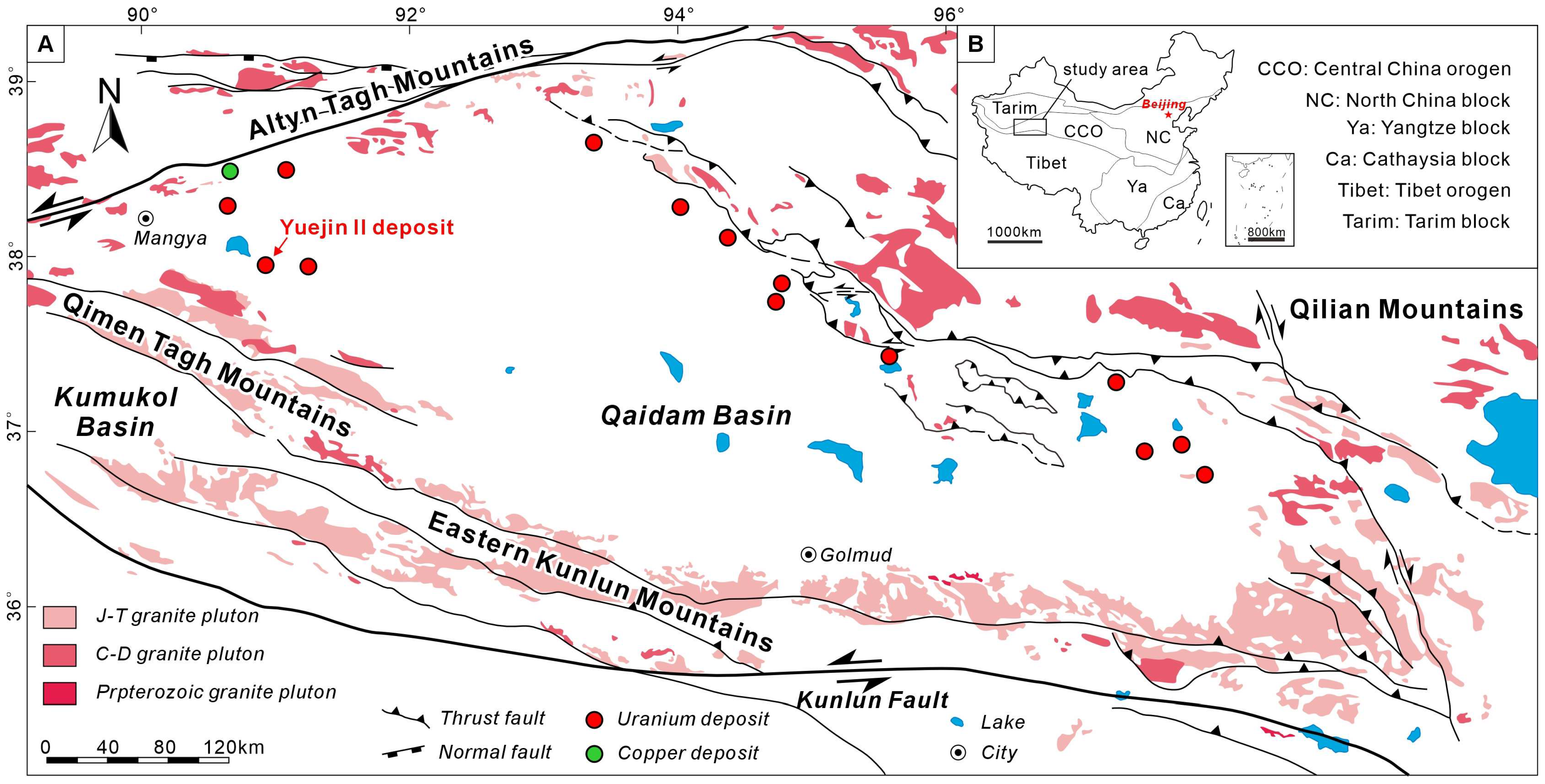
The Qaidam Basin, located in the northeastern Tibetan Plateau, is a large Mesozoic-Cenozoic intracontinental sedimentary basin bounded by the Altyn Mountains to the northwest, the Qilian Mountains to the north, and the East Kunlun Mountains to the south (Figure 1A) [23,24,25]. The basin’s crystalline basement consists of Proterozoic-Paleozoic granitoids and metamorphic complexes, overlain by a Mesozoic clastic succession and an exceptionally thick Cenozoic sedimentary package dominated by fluvio-lacustrine facies, with cumulative thickness reaching approximately 10 km [26,27]. The tectonic evolution of the Qaidam Basin involved Early Jurassic extensional rifting, Middle Jurassic to Early Cretaceous transitional fault-depression, Paleocene to Miocene compressional subsidence, and Pliocene to Quaternary strike-slip compression [23,28].
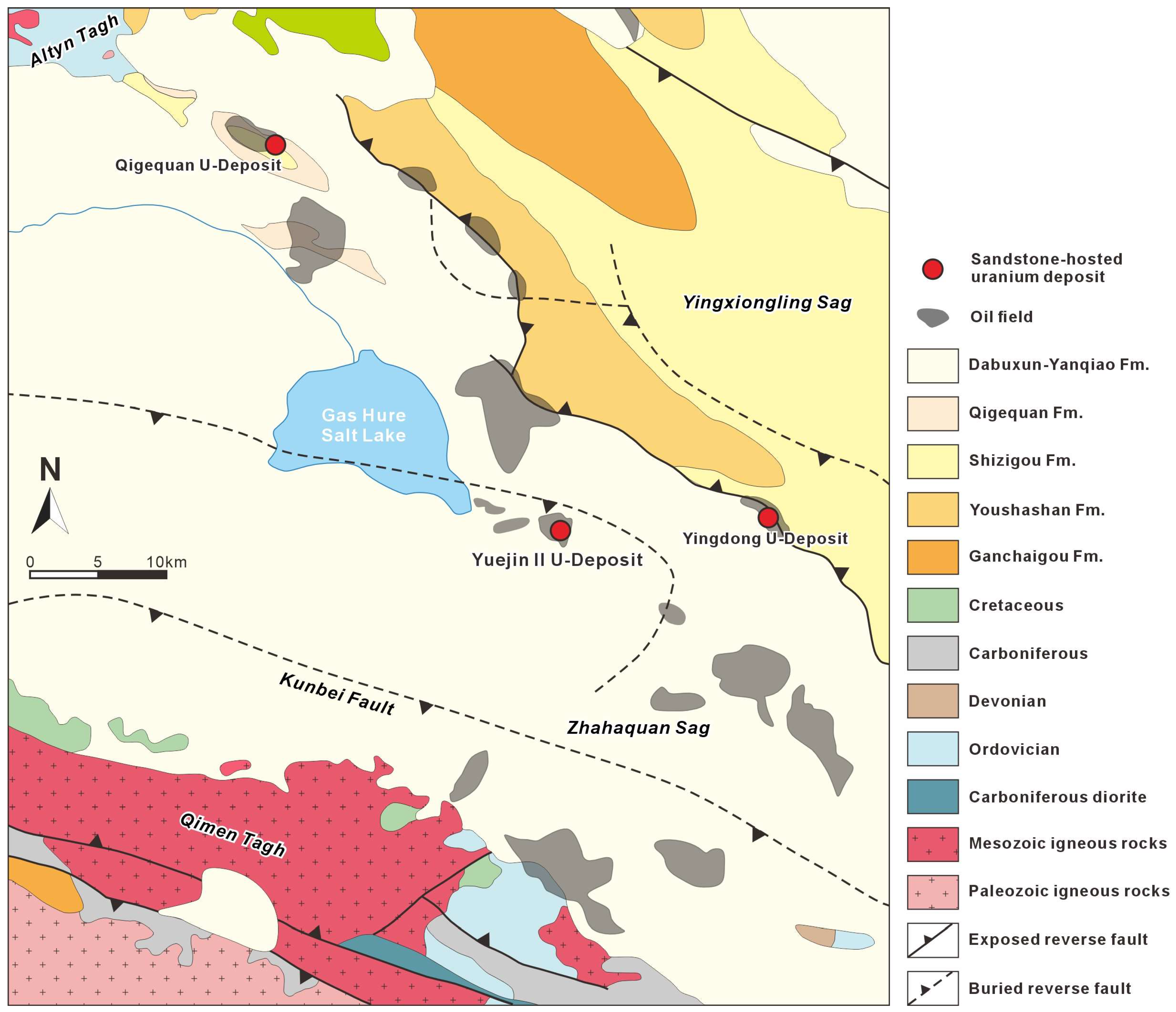
As a multi-energy mineral basin in China, the Qaidam Basin hosts significant resources of uranium, oil, and gas. Sandstone-hosted uranium mineralization is primarily concentrated in Jurassic strata in the Lenghu and Yuka areas and in Neogene-Quaternary strata in the Qigequan and Yuejin II areas (Figure 1). The western Qaidam Basin is characterized by a Paleogene-Neogene saline lacustrine petroleum system [28,30]. Previous studies have shown that the spatial relationship between uranium mineralization and hydrocarbon reservoirs is evident in two distinct geological settings. Jurassic uranium mineralization occurs in interlayer oxidation zones associated with reducing fluids from coal-measure source rocks, while Neogene uranium mineralization is concentrated in sandy reservoirs controlled by reduction barriers formed through vertical migration of deep hydrocarbons [31,32] (Figure 2).
The surrounding orogenic belts relevant to this study exhibit contrasting metallogenic characteristics. The Altyn Mountains contain documented copper deposits and occurrences, with widespread Late Paleozoic to Early Mesozoic granitoids showing elevated copper and uranium contents. In contrast, the East Kunlun Mountains, while also hosting uranium-enriched granitoids, lack significant copper mineralization. This distinction provides important constraints for interpreting the provenance of metals in the Yuejin II deposit. The Yuejin II area, situated at comparable distances from both the Altyn and East Kunlun Mountains, could potentially receive detritus from both sources, whereas the Qigequan area to the northwest lies closer to the Altyn Mountains and exhibits more pronounced copper mineralization, consistent with greater contribution from copper-rich Altyn source rocks.
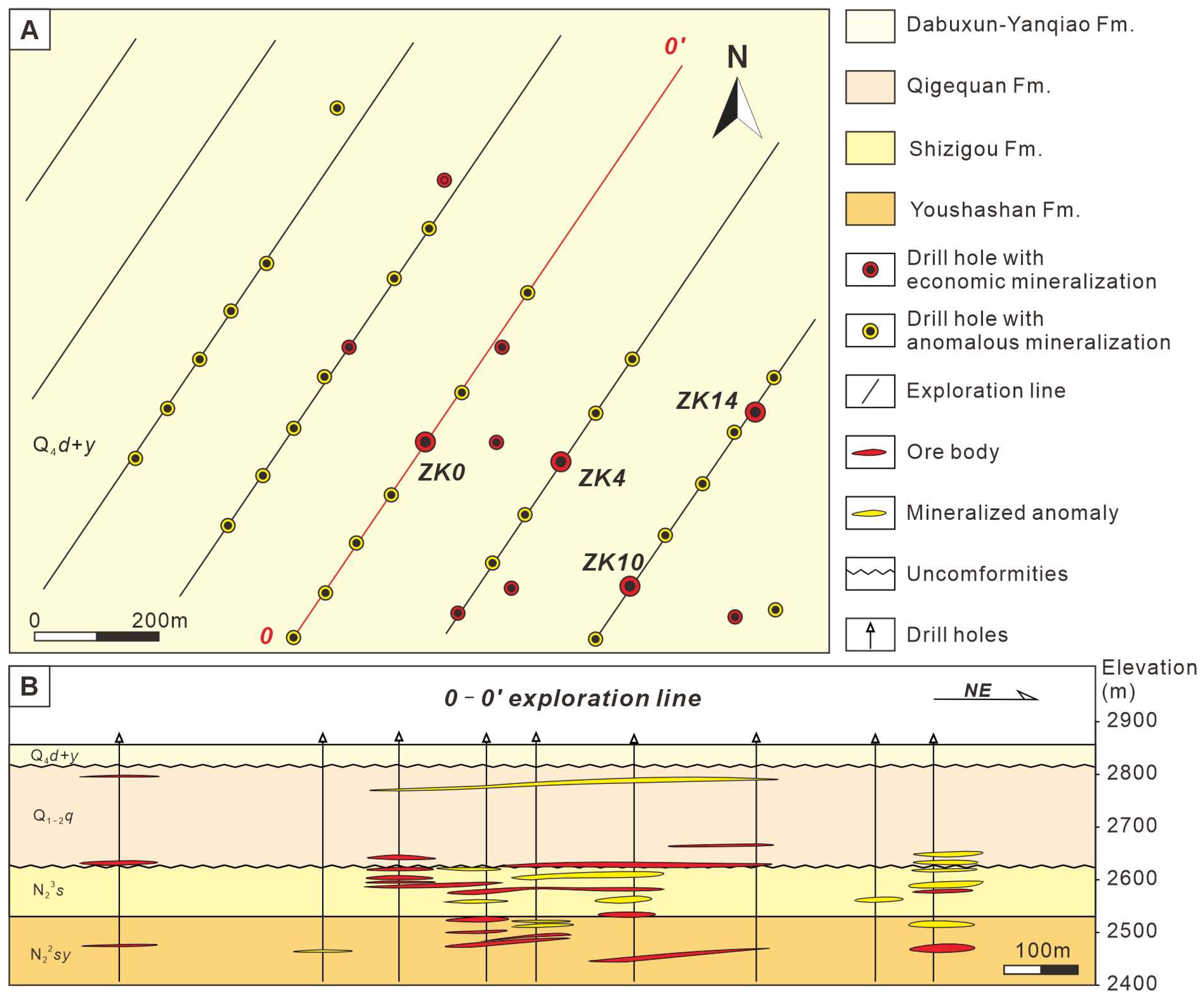
The Yuejin II sandstone-hosted uranium deposit is located in the western depression of the Qaidam Basin, tectonically positioned in the southwestern Yingxiongling Sag, northwest of the Zhahaquan Sag, bounded by the Alar Fault to the north [33] (Figure 2). This area is a significant petroliferous block. Cross-sections along exploration line 0 reveal that the mineralized strata consist, from top to bottom, of the Quaternary Qigequan Formation, the Pliocene Shizigou Formation, and the Upper Youshashan Formation, with a total thickness of approximately 400 m (Figure 3). Individual orebody thicknesses range from 0.5 to 20 m.
The Qigequan Formation comprises yellowish-brown, gray, and grayish-brown sandstone and mudstone with high vertical lithological variability. Uranium anomalies occur locally in its upper part but are not economically significant. The Shizigou Formation unconformably overlies the Qigequan Formation, and the most intense uranium mineralization is developed precisely along this unconformity surface (Figure 3). The lithology of the Shizigou Formation consists mainly of gray and green mudstone and argillaceous siltstone, with minor intercalations of fine sandstone and pebbly sandstone. Uranium mineralization within this formation is predominantly hosted in sandstones, pebbly sandstones, and some conglomerates. The Upper Youshashan Formation is conformably overlain by the Shizigou Formation and hosts weaker uranium mineralization in some intervals. Its lithology is characterized by interbedded gray and grayish-yellow sandstone and mudstone, with evidence of hydrocarbon seepage. The Upper Youshashan Formation serves both as a uranium host and a reservoir for the Yuejin II oilfield.
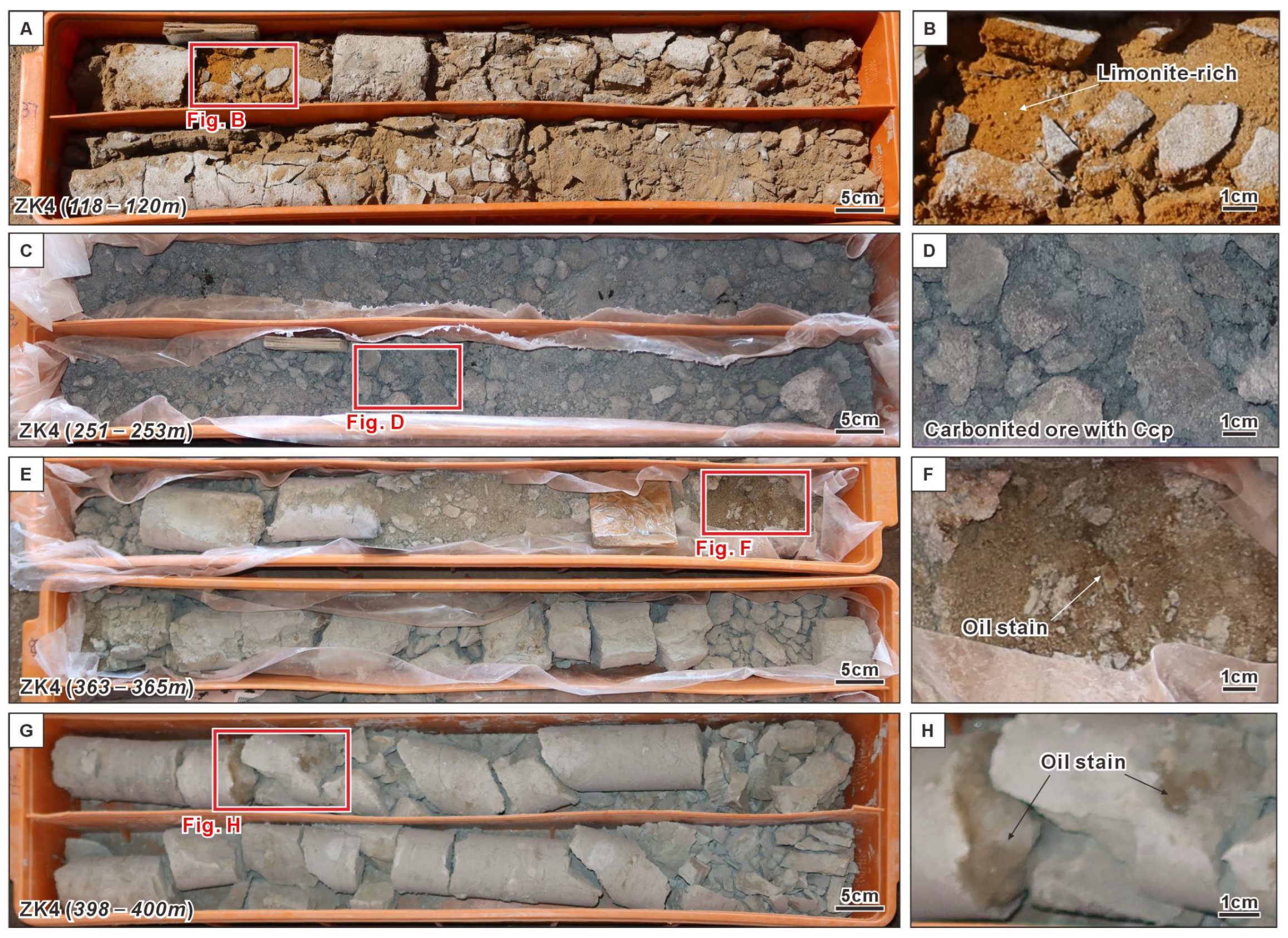
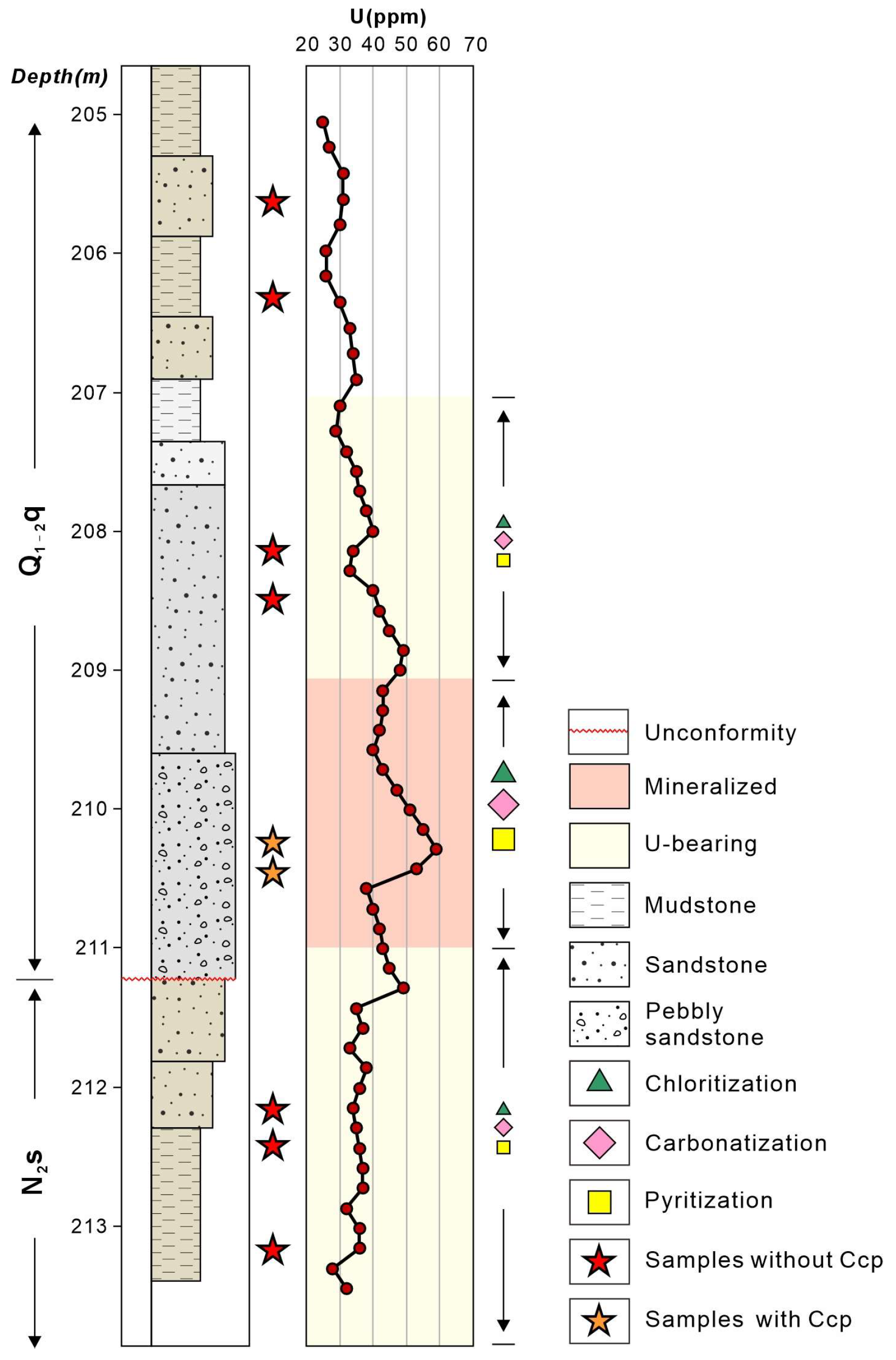
Detailed core logging of borehole ZK4 further elucidates the vertical relationships among lithologies, mineralized intervals, and redox fluid signatures (Figure 4). Near-surface Qigequan Formation sandstones are friable and yellowish-brown due to extensive limonitization, reflecting oxidative conditions in the upper section, where uranium mineralization is minor and predominantly hosted in interbedded mudstone and sandstone (Figure 4A,B). A prominent lithological change occurs at the unconformity between the Qigequan and Shizigou formations. Here, well-cemented pebbly sandstones host high-grade uranium mineralization and exhibit intense carbonatization, chloritization, and pyritization (Figure 4C,D). Chalcopyrite is confined to this high-grade interval, further highlighting the spatial linkage between copper and uranium mineralization (Figure 5). In the deeper Upper Youshashan Formation, gray mudstones display weak uranium mineralization, and fractures contain traces of dark brown oil stains (Figure 4E–H), interpreted as evidence for upward migration of deep hydrocarbons.

3. Sampling and Analytical Methods

Systematic sampling was conducted on core samples from boreholes ZK4, ZK0, ZK10, and ZK14 in the Yuejin II mining area, covering depths from 50 m to 420 m across the Qigequan and Shizigou Formations. A total of 39 samples were collected, representing varying degrees of mineralization. Sample locations are indicated in Figure 3A and Figure 5. Representative mineralized samples were selected for detailed microanalysis based on preliminary hand specimen observation and core logging.

3.1. Scanning Electron Microscopy and Energy Dispersive Spectroscopy

Backscattered electron imaging and energy dispersive spectroscopy analysis were performed at Nanjing Hongchuang Geological Exploration Technology Service Co., Ltd. (Nanjing, China) using a Tescan MIRA3 LM scanning electron microscope (Tescan Orsay Holding, Brno, Czech Republic) equipped with an Oxford EDS system. Polished thin sections were coated with carbon prior to analysis. Operating conditions included an accelerating voltage of 15 kV and a beam current of 10 nA. Backscattered electron imaging was used to identify mineral phases and paragenetic relationships, while energy dispersive spectroscopy provided semi-quantitative compositional information. The EDS system (Oxford X-Max) was calibrated for energy resolution using a cobalt standard. Semi-quantitative analyses were performed using factory-standardized quantification routines. Detection limits are typically ~0.1 wt% for most elements under the operating conditions (15 kV, 10 nA).

3.2. LA-ICP-MS Trace Element Analysis of Chalcopyrite

In situ trace element analysis of chalcopyrite was conducted at Nanjing Hongchuang Geological Exploration Technology Service Co., Ltd. using a Resolution SE 193 nm deep ultraviolet laser ablation system (Applied Spectra, Inc., West Sacramento, CA, USA) coupled to an Agilent 8900 inductively coupled plasma mass spectrometer (Agilent Technologies, Inc., Santa Clara, CA, USA). The laser ablation system was equipped with an S155 two-volume sample cell. Instrument tuning parameters followed Thompson et al. [34]. NIST 612 standard glass (SRM 612; Trace Elements in Glass; National Institute of Standards and Technology, Gaithersburg, MD, USA, 2025) was ablated using a 30 μm spot diameter, 10 Hz repetition rate, 3.5 J/cm2 fluence, and 3 μm/s scan speed to optimize gas flows for high sensitivity and low oxide production. P/A calibration for elements of interest was performed using line scans on NIST 610 standard glass (SRM 610; Trace Elements in Glass; National Institute of Standards and Technology, Gaithersburg, MD, USA, 2025) with a 100 μm spot diameter.
Masses measured included 24Mg, 31P, 45Sc, 49Ti, 51V, 53Cr, 55Mn, 59Co, 60Ni, 66Zn, 69Ga, 72Ge, 75As, 77Se, 85Rb, 88Sr, 89Y, 90Zr, 93Nb, 95Mo, 105Pd, 107Ag, 111Cd, 115In, 118Sn, 121Sb, 125Te, 133Cs, 137Ba, 139La, 140Ce, 141Pr, 146Nd, 147Sm, 151Eu, 157Gd, 159Tb, 163Dy, 165Ho, 166Er, 169Tm, 173Yb, 175Lu, 178Hf, 181Ta, 182W, 185Re, 195Pt, 197Au, 205Tl, 208Pb, 209Bi, 232Th, and 238U, with a total sweep time of approximately 0.31 s.
Before analysis, thin sections were fixed onto sample holders and cleaned with analytical grade methanol. Each ablation spot was pre-ablated with 5 laser pulses to remove potential surface contamination. Analysis was performed using a 30 μm spot diameter, 5 Hz repetition rate, and 4.5 J/cm2 fluence. Data processing used the “3D Trace Element” method in Iolite v4 software for data reduction [35,36]. Reference materials were analyzed between every 10 to 12 sample unknowns, with 20 s of gas background and 40 s of sample signal collected for data processing.

3.3. LA-MC-ICP-MS In Situ Sulfur Isotope Analysis of Chalcopyrite

In situ sulfur isotope analysis of chalcopyrite was performed at Nanjing Hongchuang Geological Exploration Technology Service Co., Ltd. (Nanjing, China) using a Resolution SE 193 nm deep ultraviolet laser ablation system coupled to a Neptune Plus multi-collector (Thermo Fisher Scientific, Bremen, Germany) inductively coupled plasma mass spectrometer. The MC-ICP-MS was operated at medium mass resolution with the magnet positioned off-peak on the low-mass side to monitor 32S free from O-O interferences. The deep UV laser beam was homogenized and focused onto the sulfide surface with a fluence of 3.5 J/cm2. The analytical procedure collected 20 s of gas background followed by 30 s of ablation using a 30 μm spot diameter at 5 Hz. The aerosol was carried by helium gas to the ablation cell, mixed with argon, and introduced into the MC-ICP-MS.
Sulfur isotope mass fractionation was corrected using the sample-standard bracketing method, with Wenshan pyrite (δ34S = +1.5‰ V-CDT) as the external standard. NIST SRM 123 sphalerite (δ34S = +17.1‰) was analyzed periodically as a secondary reference material for quality control. Detailed instrument operating conditions and analytical methods follow Fu et al. [37]. According to Chen et al. [38], using pyrite as an external standard for in situ sulfur isotope analysis of chalcopyrite yields minimal matrix effects, and the δ34S values obtained can be used for tracing ore-forming material sources.

4. Results

4.1. Petrographic Characteristics

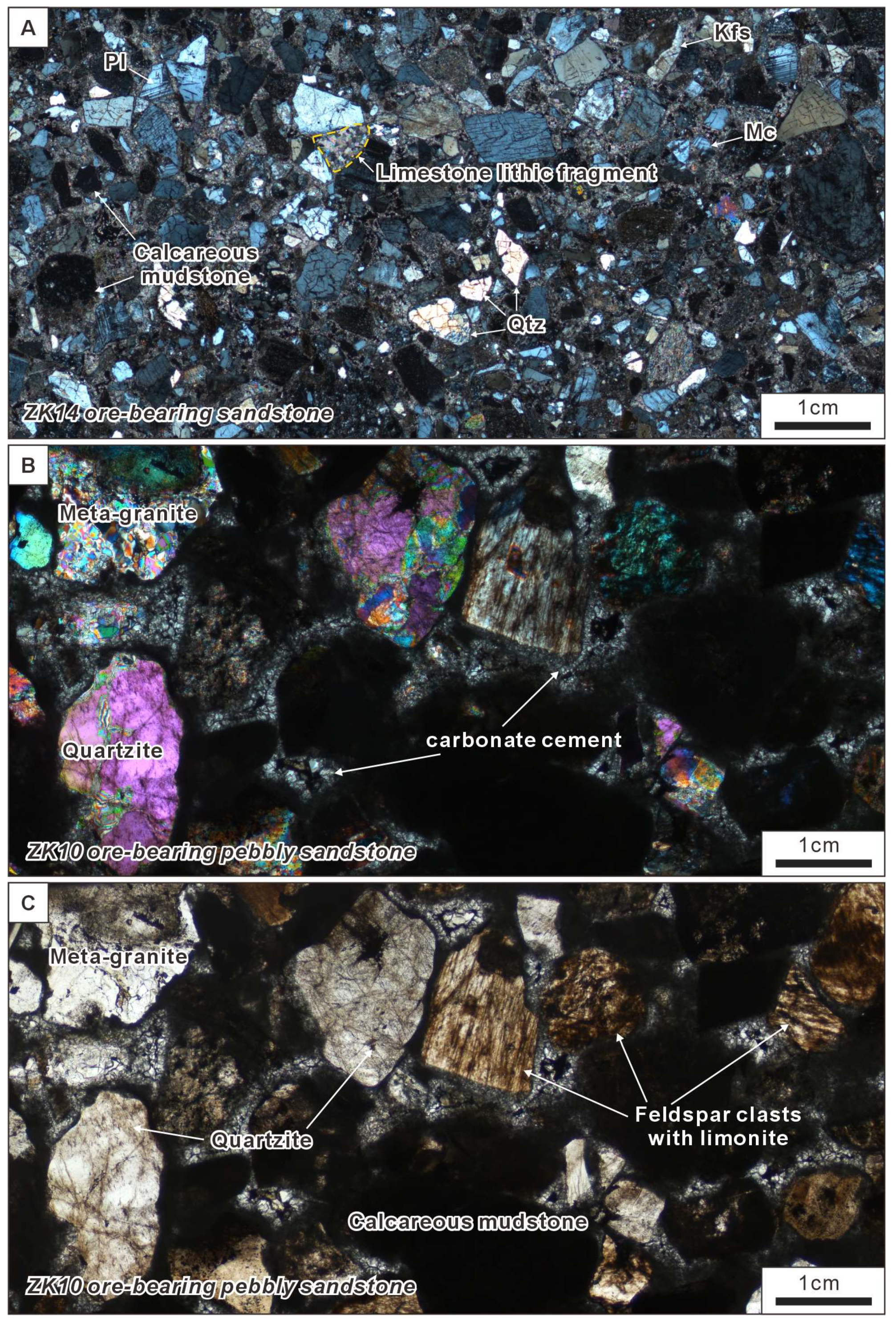
Thin section observations reveal that carbonate cements dominate the pore spaces in mineralized sandstones, representing products of uranium-mineralizing fluids (Figure 6A). Detrital grains in the sandstone are predominantly composed of quartz, alkali feldspar, and plagioclase, with feldspar content reaching up to 60%; minor limestone lithic fragments are also present. Pebbly sandstones near the unconformity show intense carbonatization (Figure 6B,C). The pebbles in these horizons consist mainly of meta-granite, quartzite, calcareous mudstone, and limestone. The fine-grained matrix is dominated by feldspar and quartz detritus. Detrital grains in these pebbly sandstones exhibit faint brownish alteration rims indicative of oxidizing fluid modification (arrows in Figure 6C).
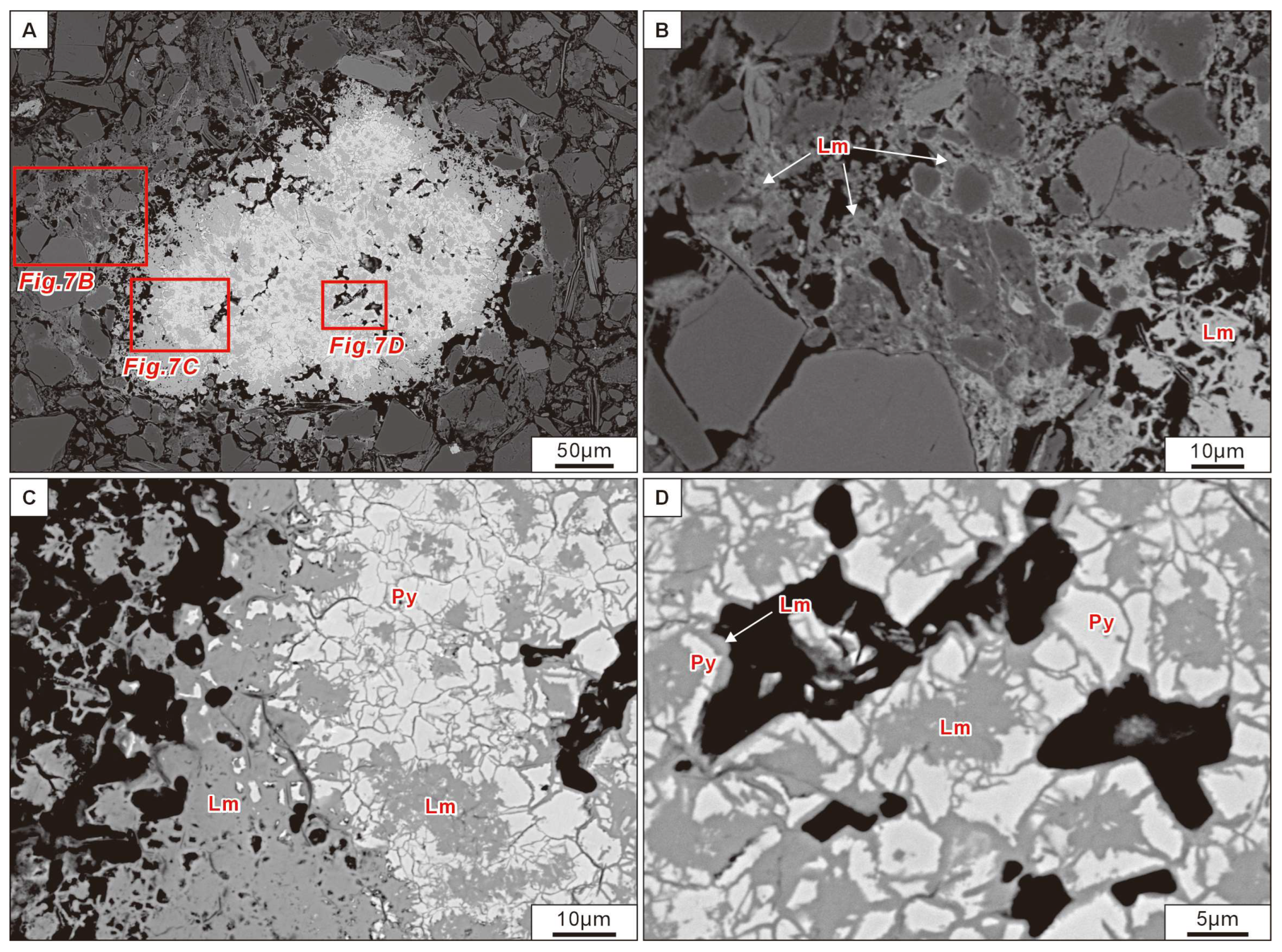
Backscattered electron imaging reveals complex redox relationships (Figure 7). Open cavities in mineralized sandstones are filled by limonite and subsequently replaced by pyrite (Figure 7A), suggesting a possible paragenetic sequence in which limonite precipitation preceded pyrite formation, consistent with an initial influx of oxidizing fluids followed by sulfidation. Intergranular spaces and fractures within detrital grains show limonite filling from oxidizing fluids (Figure 7B). Detailed observations show limonite replaced by pyrite (Figure 7C), and later pyrite partially altered to limonite by weak oxidizing fluids (arrows in Figure 7D), recording multiple redox fluctuations.
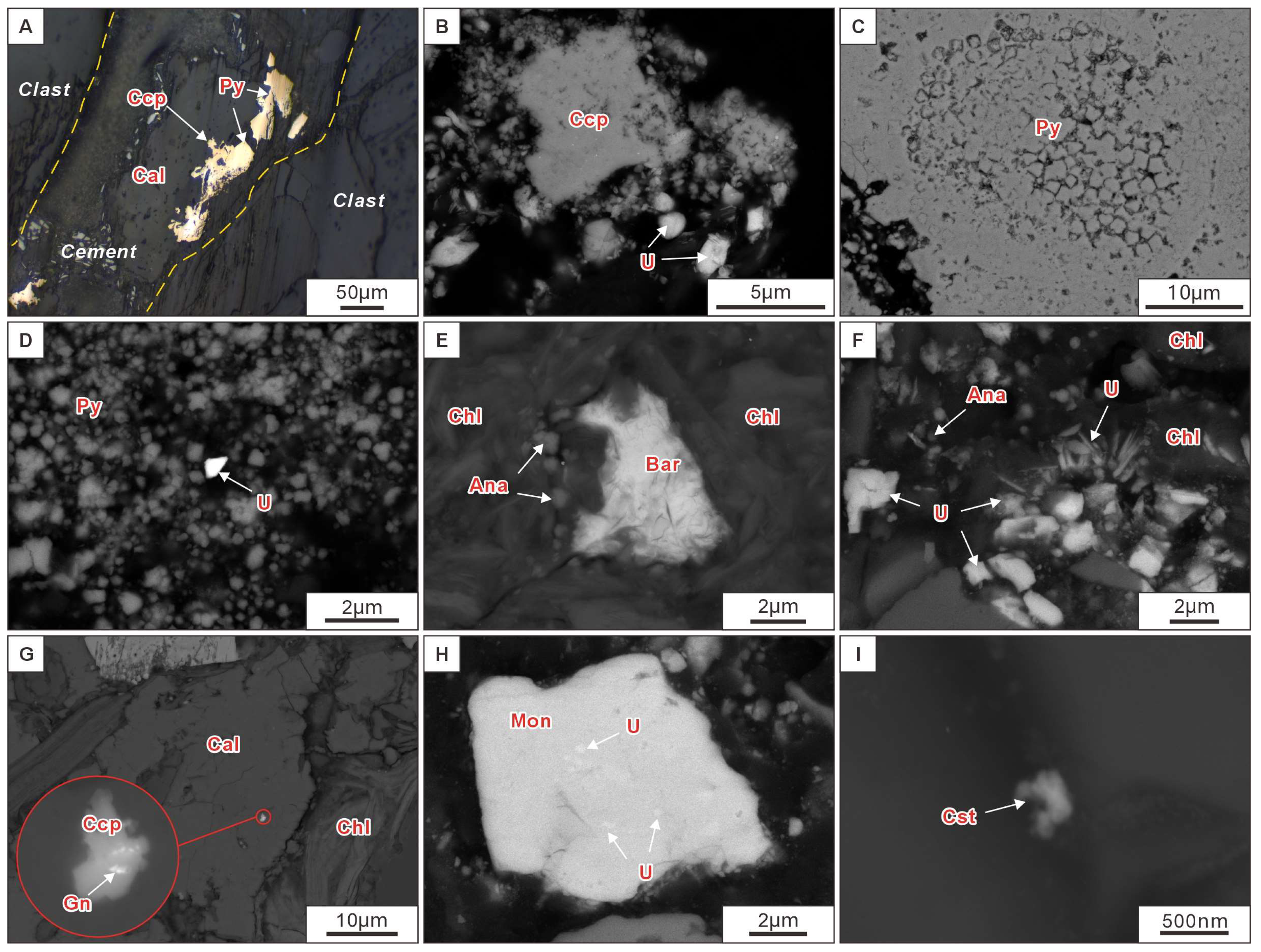
Chalcopyrite occurs as cements between detrital grains, intimately associated with pyrite and calcite (Figure 8A). Crucially, chalcopyrite shows direct intergrowth with uranium minerals (Figure 8B). Framboidal pyrite (Figure 8C) and nanometer-scale pyrite particles (Figure 8D) are closely associated with uranium minerals. The presence of framboidal pyrite is particularly significant, as this texture in sandstone-hosted uranium deposits is predominantly of biogenic origin [39]. Baryte, chlorite, and anatase occur as a paragenetic assemblage (Figure 8E), with chlorite and anatase intimately associated with uranium minerals (Figure 8F). Calcite contains uranium mineral inclusions (Figure 8G), occasionally with minor galena. Monazite clasts contain bright uranium mineral inclusions (Figure 8H), and rare cassiterite clasts are observed (Figure 8I).

4.2. Trace Element Characteristics of Chalcopyrite

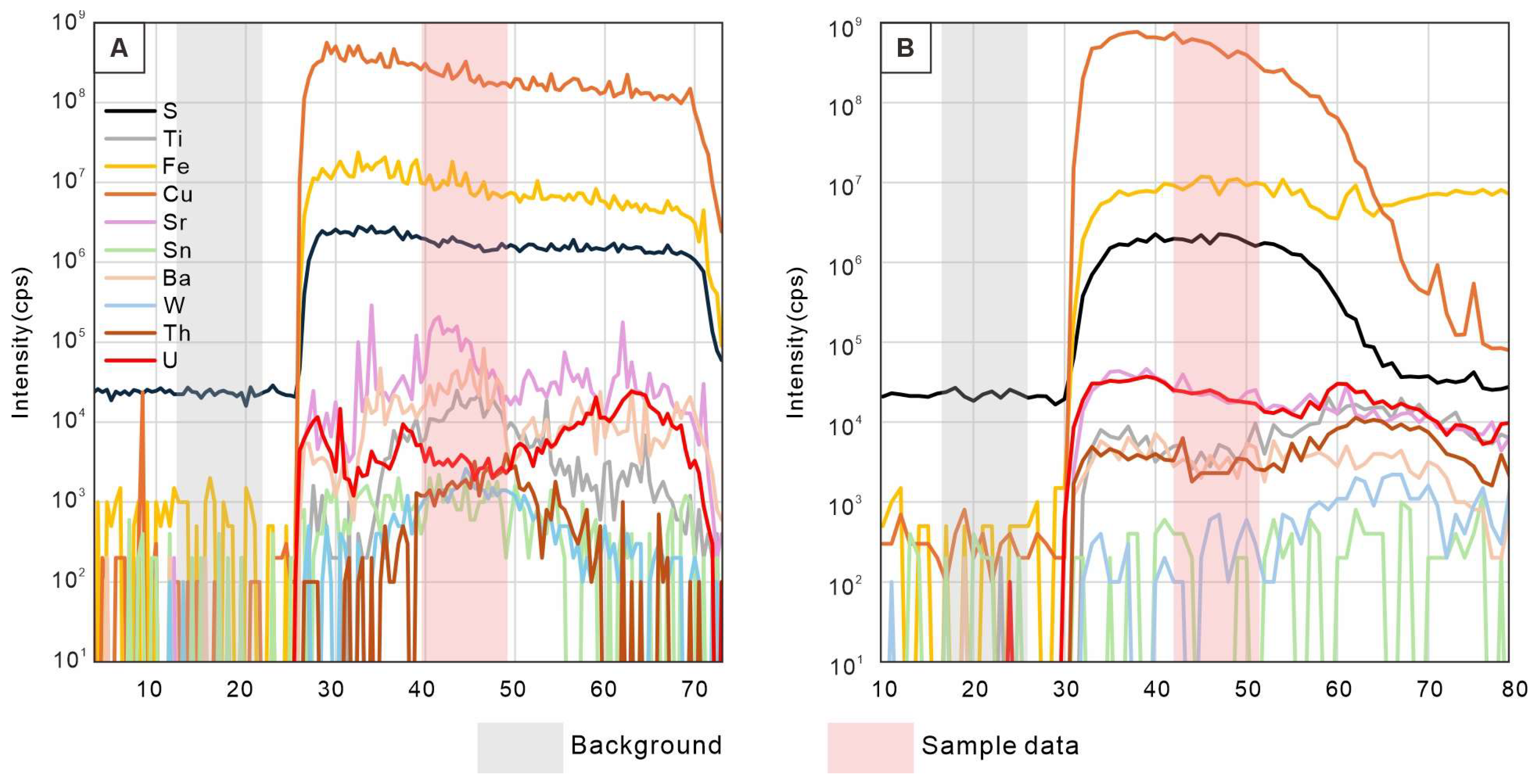
The integrity of the LA-ICP-MS signals was first verified by time-resolved depth profiles. Representative analyses (Figure 9) show flat, stable plateaus for Cu, Fe, and S, confirming ablation of homogeneous chalcopyrite. The uranium signal also exhibits a generally smooth profile without sharp spikes, although its intensity varies somewhat independently of the major elements. This behavior suggests that uranium resides in sub-microscopic U-bearing inclusions within the chalcopyrite, rather than being structurally bound in the lattice. Nevertheless, the absence of abrupt signal spikes confirms that the measured U concentrations are representative of the chalcopyrite as precipitated and are not artifacts of accidental ablation of discrete uraniferous phases.
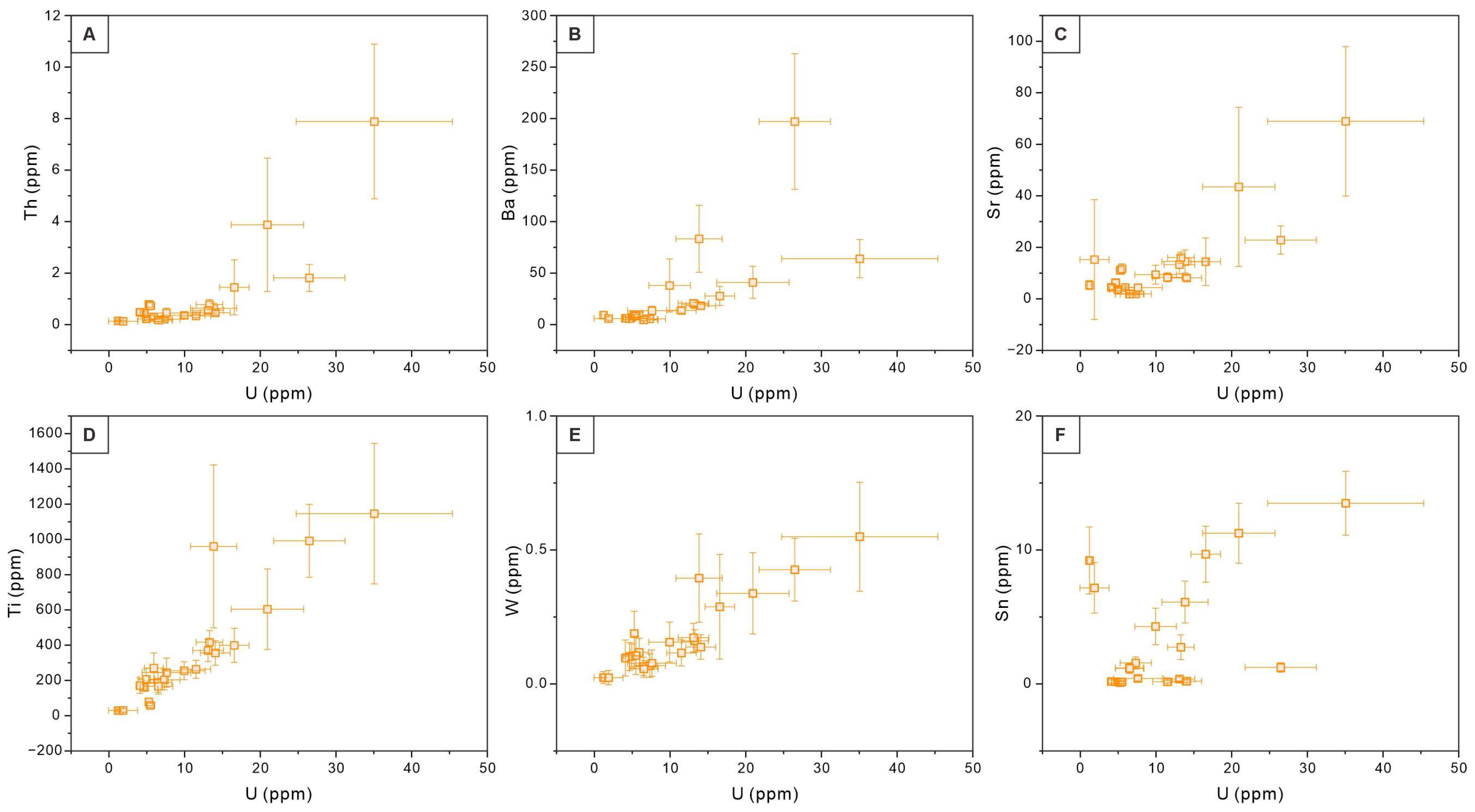
LA-ICP-MS analysis of chalcopyrite reveals systematic correlations between U and other trace elements (Table 1; Figure 10). Uranium shows positive correlations with Th (Figure 10A), Ba (Figure 10B), Sr (Figure 10C), Ti (Figure 10D), W (Figure 10E), and Sn (Figure 10F). The U-Th correlation with Th/U ratios ranging from 0.027 to 0.225 (Table 1) and a relatively narrow spread in Figure 9A suggests that uranium was not completely decoupled from thorium during mineralization. This implies a dominant, possibly local or detrital, uranium source rather than multiple, isotopically distinct sources. The positive U-Ba (ρ = 0.704, p < 0.001) and U-Sr (ρ = 0.674, p = 0.001) correlations indicate that these elements were transported together by the same oxidized brine end-member. The U-W (ρ = 0.745, p < 0.001) and U-Sn (ρ = 0.448, p = 0.047) correlations suggest involvement of a highly evolved granitic source.

4.3. Sulfur Isotope Characteristics of Chalcopyrite

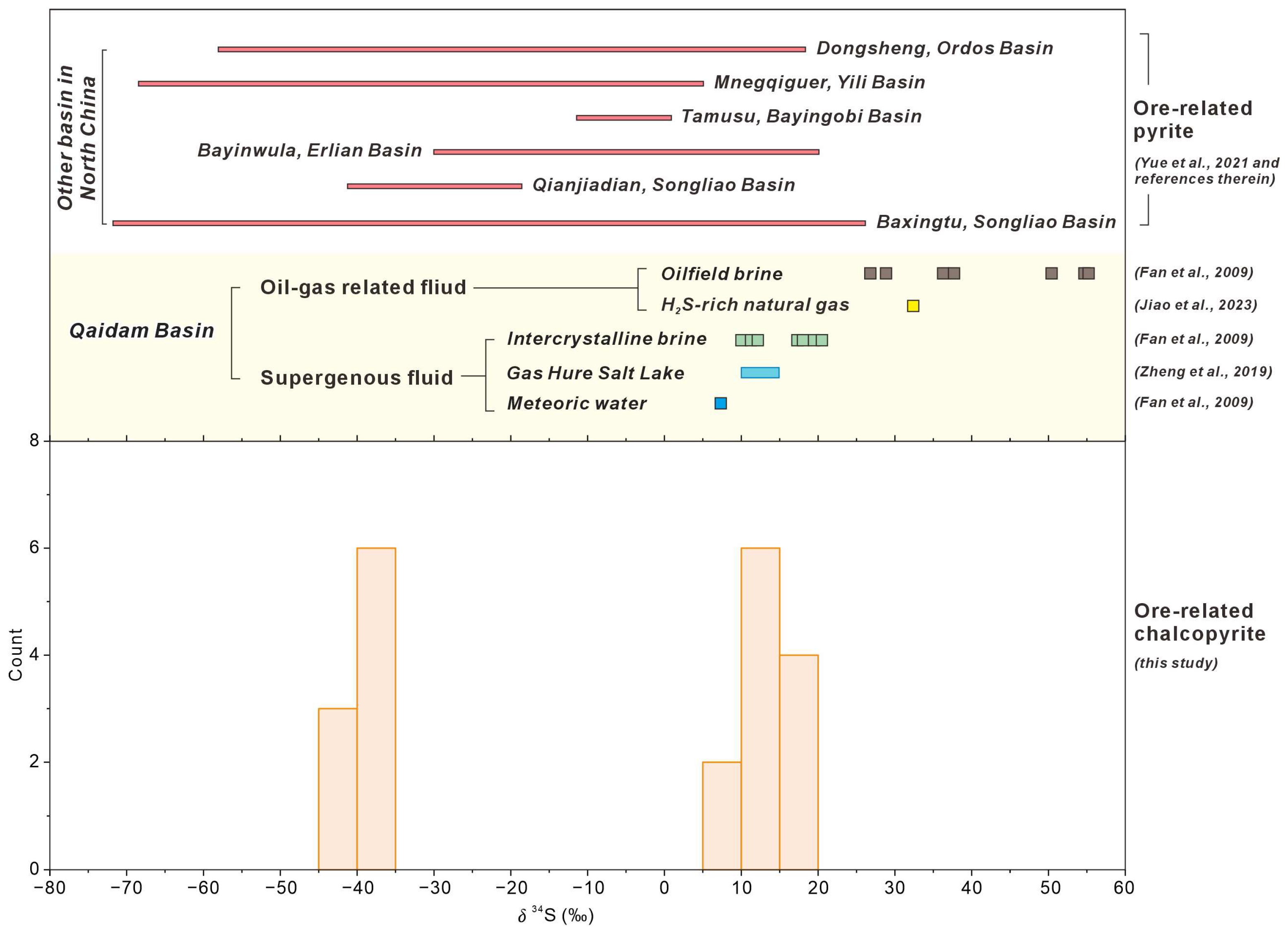
Sulfur isotope analysis of chalcopyrite reveals a striking bimodal distribution (Table 2; Figure 11). One group exhibits heavy δ34S values ranging from +6.9‰ to +18.5‰, with an average of +13.6‰. Another group shows extremely light δ34S values ranging from −36.0‰ to −44.6‰, with an average of −39.7‰. Remarkably, almost no intermediate values are present in the dataset.

5. Discussion

5.1. Chalcopyrite as a Proxy for Coupled Cu-U Mineralization in Hydrocarbon-Bearing Basins

Establishing reliable mineral proxies is fundamental to deciphering ore-forming processes in sandstone-hosted uranium deposits. Chalcopyrite, though less abundant than pyrite, offers a particularly insightful perspective on uranium mineralization due to the specific geochemical constraints governing its formation.
The significance of chalcopyrite as a proxy stems from the close genetic linkage between copper and uranium behavior in sedimentary basins. Both metals share similar transport mechanisms, being predominantly mobilized in oxidized, chlorine-rich basinal brines. Experimental studies have demonstrated that, under oxidizing, high-salinity conditions, copper is transported as monovalent chloride complexes, such as CuCl2 and CuCl32− [19,41], while uranium exhibits analogous behavior as hexavalent uranyl ions or carbonate complexes in the same oxidized fluids [4,42]. The presence of copper in the system and its subsequent fixation in chalcopyrite serves as a geochemical fingerprint for the activity of oxidized, metal-transporting brines that also carry uranium.
Perhaps more importantly, the precipitation of chalcopyrite and uranium is triggered by the same fundamental mechanism: the encounter with reduced sulphur. Chalcopyrite formation requires reduced sulfur, which is supplied by reducing fluids. The sulfur isotope composition of chalcopyrite can be used to distinguish between the two primary reduction pathways. Low-temperature bacterial sulfate reduction produces H2S with strongly negative δ34S values, whereas high-temperature thermochemical sulfate reduction associated with hydrocarbons produces H2S with δ34S values that are similar to, or heavier than, those of the source sulfate [22,43]. These reduced sulphur species are the most effective reductants for converting soluble U(VI) to insoluble U(IV) and for precipitating pitchblende and coffinite [7,8]. Therefore, the presence of chalcopyrite directly indicates the interaction between oxidized metal-bearing brines and reducing sulfur-bearing fluids, as well as the formation of redox interfaces—precisely the key processes governing uranium deposition [10,44,45].
Core logging reveals that chalcopyrite occurs exclusively in high-grade uranium ores near the unconformity between the Qigequan and Shizigou formations (Figure 4C and Figure 5), providing direct evidence for this genetic linkage. Backscattered electron imaging further demonstrates that chalcopyrite is intimately intergrown with uranium minerals, with clear, non-corrosive boundaries indicating direct co-precipitation from the same mineralizing fluids rather than later replacement (Figure 8B). This paragenetic relationship, together with the associated carbonate cements (Figure 6) and baryte (Figure 8E), indicates that chalcopyrite faithfully records the physical and chemical conditions of the fluid system responsible for uranium mineralization.

5.2. Constraints from Chalcopyrite and Associated Mineral Geochemistry on Ore-Forming Fluid Properties and Sources

The trace element composition of chalcopyrite provides valuable insights into the nature and sources of ore-forming fluids. Systematic correlations between U and other trace elements in chalcopyrite from the Yuejin II deposit (Figure 10) reveal important characteristics of the mineralizing system.
The time-resolved LA-ICP-MS signals for U, Th, Ba, Sr, Ti, W and Sn are irregular and fluctuate significantly rather than showing smooth plateaus (Figure 9). This suggests that these elements are not incorporated into the chalcopyrite lattice but occur as discrete, nanometer- to micrometer-sized mineral inclusions (e.g., U-Th-rich phases, carbonates, cassiterite, and Ti-oxides) that were co-precipitated with chalcopyrite. In addition to occurring as micro-inclusions within chalcopyrite, these minerals are also commonly observed as independent phases coexisting with chalcopyrite in BSE imaging (Figure 8). The bulk trace-element signature of chalcopyrite nevertheless provides a useful record of the fluid composition from which it precipitated, because these inclusions were trapped during crystal growth and thus reflect the local chemical environment.
The positive correlations between U and elements such as Ba, Sr, Na, and K are particularly significant (Figure 10B,C). Barium, strontium, sodium, and potassium are typical components of high-salinity basinal brines, with their enrichment levels reflecting fluid salinity and evolution [18,46]. In sedimentary basins, high-salinity brines can form through dissolution of evaporites or intense evaporation of surface waters [47]. The widespread occurrence of gypsum and other evaporite minerals in the Neogene sequences of the southwestern Qaidam Basin [12,17] provides a plausible source for such saline brines. The positive correlations between U and these brine-indicator elements suggest that they were transported together by the same oxidized fluid end-member, which served as the common carrier for both U and Cu. This interpretation is further supported by the presence of baryte intimately associated with chalcopyrite and uranium minerals (Figure 8E), which directly attests to the sulfate-rich nature of the oxidizing brine.
The U contents in chalcopyrite show considerable variation, ranging from 1.21 to 35.1 ppm (Table 1). These values are elevated compared to typical hydrothermal chalcopyrite, which commonly contains less than 1 ppm U [48], indicating that the ore-forming fluid carried appreciable uranium concentrations. This enrichment is consistent with efficient leaching from fertile source rocks.
The positive correlations between U and Sn, as well as U and W (Figure 10E,F), provide important constraints on the nature of the source rocks. Tin and tungsten are typical high field strength elements associated with highly evolved granites, becoming significantly enriched in late-stage melts during magmatic differentiation [49,50]. Uranium, as a highly incompatible element, similarly becomes concentrated in residual melts [4]. The observed Sn-W-U coupling therefore suggests involvement of a highly evolved granitic source. This geochemical signature, combined with the documented occurrence of copper deposits in the Altyn Mountains and their absence in the East Kunlun Mountains, points to the Altyn Mountains as the plausible source for the copper, and by association, for the tin and tungsten as well. The occurrence of rare cassiterite clasts (Figure 8I) provides further mineralogical evidence for tin enrichment in the source area. For uranium, however, the situation is less definitive. Both the Altyn and East Kunlun Mountains contain uranium-enriched granitoids [32,51], and the Yuejin II area is situated at comparable distances from both ranges. Therefore, while the copper and associated high field strength elements point specifically to an Altyn source, the uranium could derive from either or both orogenic belts. Detrital zircon U-Pb geochronology from the Yuejin II area reveals age populations of 343–542 Ma and 200–285 Ma [16], corresponding to Early Paleozoic and Late Paleozoic-Early Mesozoic magmatic events in both the Altyn and East Kunlun Mountains, consistent with mixed provenance.
The positive U–Th correlation and relatively constant Th/U ratios (Figure 10A) warrant careful interpretation. Thorium is generally less mobile than uranium under oxidizing conditions, and a positive correlation could reflect detrital control or limited uranium remobilization rather than simply indicating a dominant uranium source. Re-examination of our data shows that when U concentrations in chalcopyrite are below 20 ppm, U and Th are largely decoupled (Figure 10A, lower left quadrant): Th remains consistently low (<1 ppm) while U varies. This decoupling is consistent with significant mobilization of U by oxidizing brines while Th was left behind. In contrast, at higher U contents (>20 ppm) a positive U–Th correlation appears. This can be explained by the presence of abundant detrital U-Th-rich monazite in the host sandstones (e.g., Figure 8H), which can be partially dissolved by basin fluids, releasing both elements. Under sufficiently high salinity and complexing capacity, the fluid may also transport a limited amount of Th and co-precipitate it with U. Furthermore, the Yuejin II deposit is situated in a hydrocarbon-rich setting, as evidenced by widespread oil-stained sandstones. These strong reducing conditions caused rapid uranium precipitation near the redox front, resulting in a very limited migration distance for uranium. This limited transport prevented complete decoupling from Th, because both elements were released from similar source minerals and precipitated soon afterwards. Therefore, the U–Th correlation in chalcopyrite does not simply indicate a single dominant uranium source; rather, it reflects a combination of source composition, fluid transport capacity (especially at high U concentrations), and limited remobilization in a near-source, hydrocarbon-rich environment. The data, however, cannot definitively distinguish between the Altyn or East Kunlun Mountains as the primary source of uranium.
The positive correlation between U and Ti (Figure 10D) is unlikely to be attributed to the same fluid transport processes, given the generally low solubility of titanium in basinal brines. This may instead point to a different mechanism, such as the co-precipitation of U-bearing and Ti-bearing minerals during a specific alteration event [52]. Petrographic observations reveal a close association between uranium minerals, chlorite, and anatase (Figure 8F). This texture suggests that the breakdown of detrital Fe-Ti oxides such as biotite and ilmenite during chloritization, a common alteration process in reduced zones, released Ti into the local pore fluid. Uranium, precipitating from the mixing zone, was co-precipitated with or scavenged by this newly formed Ti-rich phase, establishing the observed U-Ti correlation. This interpretation is consistent with the common occurrence of anatase in uranium-bearing sandstones (Figure 8E,F) and highlights the role of local mineral reactions in controlling trace element distributions.

5.3. Sulfur Isotope Constraints on Fluid Mixing and Redox Processes

The sulfur isotope composition of chalcopyrite from the Yuejin II deposit exhibits a striking bimodal distribution (Table 2; Figure 11). One group shows δ34S values ranging from +6.9‰ to +18.5‰, while another group displays strongly negative values from −36.0‰ to −44.6‰. Notably, almost no intermediate values are present in the dataset. This bimodal distribution, with its marked absence of intermediate compositions, is consistent with two distinct, coeval sulfur sources rather than continuous fluid mixing. Interpreting these two populations requires placing them within the framework of regional sulfur isotope systematics in the western Qaidam Basin, where multiple sulfur reservoirs have been characterized.
The light sulfur group recording values from −36.0‰ to −44.6‰ represents bacterial sulfate reduction occurring within the shallow ore-hosting strata. The fractionation of approximately 50–60‰ from source sulfate to H2S is characteristic of open-system bacterial sulfate reduction [20,22]. Critically, the presence of framboidal pyrite intimately associated with uranium minerals (Figure 8C,D) provides direct petrographic evidence for bacterial sulfate reduction during mineralization, as framboidal pyrite in sandstone-hosted uranium deposits is predominantly of biogenic origin [39]. The organic carbon required for bacterial sulfate reduction was likely supplied by ascending hydrocarbon fluids, which provided an energy source for microbial metabolism. The occurrence of gypsum with δ34S values as low as −23.3‰ in shallow strata [17] further confirms that bacterial sulfate reduction has been active in the basin-margin setting, and the even lighter values recorded in chalcopyrite reflect more complete fractionation in the ore-forming environment.
The heavy sulfur group with values from +6.9‰ to +18.5‰ requires integration with regional data on both surface-derived and deep hydrocarbon-related fluids. Surface-derived fluids in the western Qaidam Basin exhibit a range of δ34S values that overlap almost entirely with this heavy chalcopyrite group. Shallow lacustrine brines from Gas Hure Salt Lake show δ34S values of 11–14‰ [17], broader analyses of saline lake brines reveal values of 11.39–19.90‰ [40], and meteoric water has been documented with a δ34S value of approximately 7.4‰ [40]. These surface-derived fluids are characterized by their sulfate-rich nature and collectively define a sulfur isotope range of approximately +7‰ to +20‰ for the oxidized, supergene end-member. In contrast, deep hydrocarbon-related fluids define a distinctly heavier sulfur reservoir. Oilfield brines from Paleogene-Neogene and Quaternary strata in the western Qaidam Basin exhibit δ34S values ranging from 26.46‰ to 54.57‰ [40], attributed to the effects of sulfate reduction. More importantly, H2S-rich natural gas from deep sulfurous oil reservoirs in the Yingxiongling area has been documented with δ34S values of +32.2‰ [15]. This H2S represents reduced sulfur generated through thermochemical sulfate reduction at depth that could directly participate in sulfide precipitation.
The heavy chalcopyrite group thus overlaps with the sulfate reservoir of surface-derived fluids but is significantly lighter than the deep hydrocarbon-related H2S and oilfield brines. This observation requires careful consideration of which sulfur species actually participated in chalcopyrite precipitation. The oxidizing brines that transported U and Cu were sulfate-rich, as evidenced by the presence of baryte intimately associated with chalcopyrite and uranium minerals (Figure 8E). These brines carried sulfate with δ34S values inherited from dissolved evaporites, likely in the range of +11‰ to +20‰ based on regional data. When these oxidizing brines encountered deep hydrocarbon fluids carrying thermochemical sulfate reduction-derived H2S at the redox front, two sulfur reservoirs were present: abundant sulfate from the oxidizing brine and limited H2S from the hydrocarbon fluid.
Chalcopyrite precipitation requires reduced sulfur. The sulfur isotope composition recorded in the precipitated chalcopyrite would reflect the source of reduced sulfur actually consumed during mineralization. Several possibilities could explain why the heavy chalcopyrite group is isotopically lighter than the deep hydrocarbon H2S. If the H2S supply from deep fluids was limited, and if ongoing sulfate reduction, either thermochemical or mediated by organic matter, was occurring at the redox front, the reduced sulfur available for chalcopyrite precipitation could have been derived primarily from in situ reduction of sulfate from the oxidizing brine. Experimental and theoretical studies have shown that sulfate reduction can produce H2S that is initially only slightly fractionated relative to source sulfate under certain conditions [22]. Mixing between sulfate-derived sulfur and a minor contribution from deep H2S could also produce intermediate compositions. Alternatively, the deep hydrocarbon fluids themselves may have carried a range of sulfur isotope compositions, and the H2S that actually reached the ore horizon may have been isotopically lighter than the value documented in deep reservoirs due to fractionation during migration.
Regardless of the exact mechanism, the heavy chalcopyrite group records a style of mineralization in which sulfate from oxidizing brines, or a mixture dominated by that sulfate, provided the ultimate sulfur source, with reduction occurring at or near the redox front in association with hydrocarbon fluids. The complex redox history recorded by multiple generations of limonite and pyrite (Figure 7) indicates dynamic fluctuations in redox conditions that could have promoted such sulfate reduction.
The bimodal sulfur isotope distribution, with its conspicuous absence of intermediate values, is critical for distinguishing between two distinct mineralization styles. If the sulfur isotopes reflected simple mixing of two fluid end-members in varying proportions, a continuous range of intermediate δ34S values would be expected. The absence of such intermediates indicates that the two sulfur sources were not mixed in varying proportions within a single fluid system. Instead, they represent two distinct, coeval processes that operated in different microenvironments within the same orebody. Bacterial sulfate reduction-mediated mineralization generates light sulfur chalcopyrite through biogenic H2S, while fluid mixing with associated sulfate reduction generates heavy sulfur chalcopyrite that inherits its isotopic signature primarily from the sulfate reservoir of oxidizing brines. This interpretation is consistent with the complex paragenetic relationships observed (Figure 7 and Figure 8) and the spatial distribution of different alteration assemblages.

5.4. Genetic Model for the Yuejin II Uranium Deposit

Integrating the petrographic, geochemical, and isotopic evidence, we propose a dual-mechanism genetic model for the Yuejin II uranium deposit. This model is consistent with the regional sulfur isotope framework and with broader understandings of sandstone-hosted uranium mineralization in northern China [1,2,3,31].
Regarding metal sources, the trace element signatures of chalcopyrite provide important constraints on provenance. The positive U-Sn and U-W correlations point to involvement of a highly evolved granitic source. Given that copper deposits have only been documented in the Altyn Mountains among the surrounding orogenic belts, the copper in the Yuejin II deposit most plausibly derives from Altyn source rocks. The tin and tungsten signatures further support this interpretation, as these elements are typically associated with the same evolved granitic systems. For uranium, however, the source is less certain. Both the Altyn and East Kunlun Mountains contain uranium-enriched granitoids [32,51], and the Yuejin II area is situated at comparable distances from both ranges. Detrital zircon age populations [16] are consistent with mixed provenance from both orogenic belts. Therefore, while the copper and associated high field strength elements specifically indicate an Altyn source, the uranium could derive from either or both the Altyn and East Kunlun Mountains.
In terms of oxidizing brine formation, meteoric water and surface-derived fluids infiltrated along basin margins, acquiring sulfate through dissolution of evaporite minerals such as gypsum and mirabilite from shallow lacustrine sequences [12,17]. These oxidizing brines carried sulfate with δ34S values in the range of +7‰ to +20‰, as documented in regional saline lakes and surface waters [17,40]. They also transported U, Cu, and Ba2+, as evidenced by the positive correlations between U and brine-indicator elements in chalcopyrite (Figure 10B,C) and the presence of baryte in the ore assemblage (Figure 8E).
Two distinct reduced sulfur sources and associated mineralization styles can be recognized. The first is bacterial sulfate reduction-mediated mineralization. Ascending hydrocarbon fluids provided organic carbon to sulfate-reducing bacteria in the shallow ore-hosting strata. The presence of framboidal pyrite intimately associated with uranium minerals (Figure 8C,D) provides direct textural evidence for biogenic sulfate reduction during mineralization [39]. Bacterial sulfate reduction generated H2S with extremely light δ34S values through large kinetic fractionation [20,22]. This biogenic H2S reacted with U and Cu from oxidizing brines, precipitating uranium minerals and chalcopyrite with light sulfur signatures. The occurrence of −23.3‰ gypsum in shallow strata [17] confirms bacterial sulfate reduction activity in the basin-margin setting, and the even lighter values recorded in chalcopyrite reflect more complete fractionation in the ore-forming environment.
The second is fluid mixing with sulfate reduction. Deep hydrocarbon fluids, including oilfield brines and H2S-rich natural gas, migrated upward along faults and unconformities, as suggested by oil stains in fractures and sandstones of the Upper Youshashan Formation (Figure 4E–H). These fluids carried evidence of thermochemical sulfate reduction at depth, as documented by the heavy sulfur isotope compositions of deep H2S [15]. When these fluids encountered oxidizing U-bearing brines at the redox front, mixing occurred. The sulfate-rich nature of the oxidizing brine is documented by baryte precipitation (Figure 8E). The sulfur isotope composition recorded by chalcopyrite formed in this environment overlaps with the sulfate reservoir of the oxidized brine, indicating that sulfate reduction occurred at or near the mixing interface rather than simply incorporating deeper, isotopically heavier H2S. The complex redox history recorded by multigenerational goethite and pyrite (Figure 7) reflects fluctuating relative contributions of oxidizing and reducing fluids at different stages.
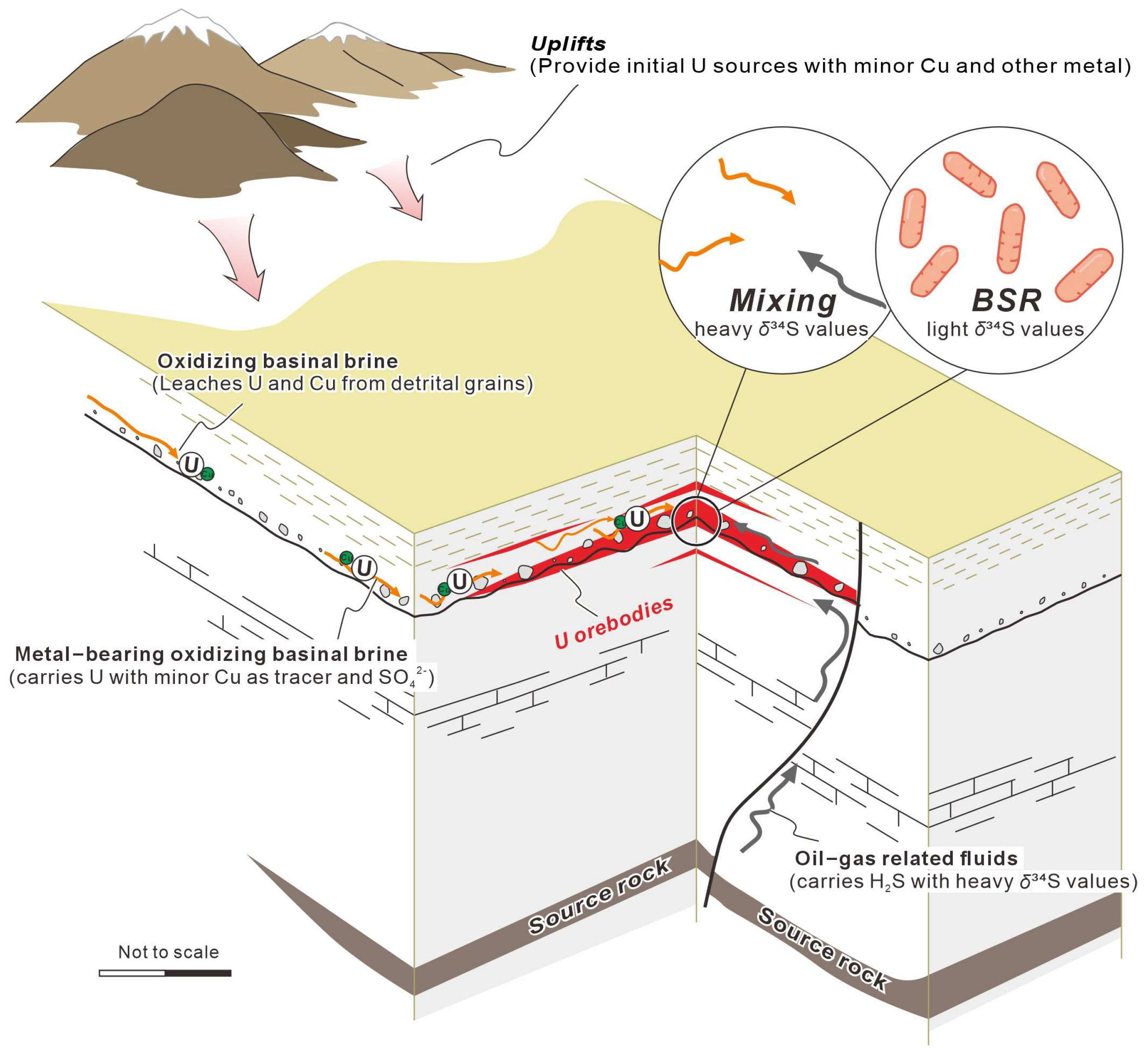
These two processes operated simultaneously in distinct microenvironments within the same deposit, resulting in the observed bimodal sulfur isotope distribution with minimal intermediate values. Regarding the temporal relationship between the two sulfur sources recorded in chalcopyrite, petrographic observations indicate that they were largely coeval. The chalcopyrite grains from both the heavy-sulfur and light-sulfur populations show similar textural relationships with uranium minerals and carbonate cements, with no cross-cutting relationships between the two groups. This suggests that both BSR-derived and TSR-derived sulfur were available simultaneously within different microenvironments of the same ore-forming system. However, a subtle temporal order can be inferred from the occurrence of framboidal pyrite (Figure 8C), which is typically of biogenic origin (BSR). In some samples, framboidal pyrite occurs at the core of sulfide aggregates and is partially replaced by later chalcopyrite. This implies that BSR may have started slightly earlier, generating the first reduced sulfur, while the main chalcopyrite precipitation (incorporating both BSR-derived light sulfur and TSR-derived heavy sulfur) occurred subsequently and overlapped in time. Nevertheless, the overall mineralization event is considered a single, continuous process without a clear hiatus between the two sulfur sources. This dual-mechanism model—combining biogenic reduction via bacterial sulfate reduction and sulfate reduction associated with fluid mixing—corresponds to the two metallogenic scenarios proposed for sandstone-hosted uranium deposits [3] and highlights the importance of considering multiple reduction mechanisms in petroliferous basins (Figure 12). The inferred provenance, with copper primarily sourced from the Altyn Mountains and uranium potentially derived from both the Altyn and East Kunlun Mountains, is consistent with the regional mineralization pattern. In particular, the Qigequan deposit, located nearer to the Altyn Mountains, displays more pronounced copper mineralization.

6. Conclusions

  • Chalcopyrite in the Yuejin II uranium deposit occurs exclusively in high-grade ores, intimately intergrown with uranium minerals, pyrite, baryte, and carbonate cements. Its trace element and sulfur isotope compositions directly record the sources and processes of uranium mineralization.
  • Trace elements show positive correlations between U and brine-indicator elements (Ba, Sr, Na, K), confirming that oxidizing brines transported both U and Cu. The U-Th correlations reflect source composition, fluid transport capacity, and limited Th remobilization. U-W-Sn correlations point to a highly evolved granitic provenance in the surrounding areas of the western Qaidam Basin.
  • Chalcopyrite sulfur isotopes exhibit a bimodal distribution (+6.9‰ to +18.5‰ and −36.0‰ to −44.6‰) with almost no intermediate values. This striking bimodality provides compelling evidence for two distinct, coeval sulfur sources rather than continuous fluid mixing. The heavy-sulfur group records mixing of oxidizing brine SO42− with deep TSR-derived H2S, whereas the light-sulfur group records bacterial sulfate reduction in shallow, organic-rich microenvironments.
  • The bimodal distribution with minimal intermediate values indicates two distinct, coeval mineralization styles rather than continuous fluid mixing. Bacterial sulfate reduction-mediated mineralization generates light sulfur chalcopyrite, while fluid mixing with associated sulfate reduction generates heavy sulfur chalcopyrite. This dual-mechanism model provides a new perspective on uranium mineralization in petroliferous basins and highlights the exploration potential for Cu-U resources in the western Qaidam Basin, with the Altyn Mountains as a potential copper source region. Future work should refine uranium reaction pathways by integrating these models with the observed trace-element and sulfur-isotope constraints to better predict Cu–U resource potential in petroliferous basins such as the western Qaidam.

Supplementary Materials

The following supporting information can be downloaded at: https://www.mdpi.com/article/10.3390/min16050446/s1, Table S1. Detection limits for trace elements in chalcopyrite obtained by LA-ICP-MS. Table S2. EDS spectra of minerals that are difficult to identify in Figure 8.

Author Contributions

Conceptualization, M.-S.F.; methodology, M.-S.F.; software, Y.-H.L.; validation, M.-S.F.; formal analysis, J.-Y.D.; investigation, W.-Y.W. and C.Z.; resources, B.G. and Y.-F.G.; data curation, Z.C.; writing—original draft preparation, Y.-H.L.; writing—review and editing, M.-S.F.; visualization, Y.-H.L.; supervision, M.-S.F., P.N. and J.-Y.P.; project administration, P.N.; funding acquisition, P.N. All authors have read and agreed to the published version of the manuscript.

Funding

This research was funded by the National Key Research and Development Program of China (Grant No. 2023YFC2906703).

Data Availability Statement

The original contributions presented in this study are included in the article/Supplementary Materials. Further inquiries can be directed to the corresponding authors.

Acknowledgments

We sincerely thank the 11th Geological Brigade of Sichuan, Petro China Qinghai Oilfield Company Exploration Division and Tianjin Center of China Geological Survey for their helpful assistance during the field work. We also thank Hao-Ran Dou, Tong-Kai Jin and Qiu-Yun Yuan from Nanjing Hongchuang Geological Exploration Technology Service Co., Ltd. for BSE, TIMA and EPMA analysis.

Conflicts of Interest

Bin Guo was employed by the company China National Petroleum Corporation (CNPC). The remaining authors declare that the research was conducted in the absence of any commercial or financial relationships that could be construed as a potential conflict of interest.

Abbreviations

The following abbreviations are used in this manuscript:
BSRBacterial sulfate reduction
CcpChalcopyrite
LmLimonite
PyPyrite
CalCalcite
UUranium minerals
BarBaryte
AnaAnatase
MonMonazite
CstCassiterite

References

  1. Cheng, Y.H.; Wang, S.Y.; Jin, R.S.; Li, J.G.; Ao, C.; Teng, X.M. Global Miocene tectonics and regional sandstone-style uranium mineralization. Ore Geol. Rev. 2019, 106, 238–250. [Google Scholar] [CrossRef]
  2. Cheng, Y.H.; Jin, R.S.; Cuney, M.; Petrov, V.A.; Miao, P.S. The Strata Constraint on Large Scale Sandstone-type Uranium Mineralization in Meso-Cenozoic Basins, Northern China. Acta Geol. Sin. 2024, 98, 1953–1976. [Google Scholar] [CrossRef]
  3. Cheng, Y.H.; Jin, R.S.; Miao, P.S.; Wang, S.Y.; Teng, X.M. Two Metallogenic Models of Sedimentary-Hosted Uranium Deposit: Jingchuan and Tale Types. Earth Sci. 2025, 50, 46–57. [Google Scholar] [CrossRef]
  4. Cuney, M. The extreme diversity of uranium deposits. Miner. Depos. 2009, 44, 3–9. [Google Scholar] [CrossRef]
  5. Hitzman, M.; Kirkham, R.; Broughton, D.; Thorson, J.; Selley, D. The Sediment-Hosted Stratiform Copper Ore System. In One Hundredth Anniversary Volume; Hedenquist, J.W., Thompson, J.F.H., Goldfarb, R.J., Richards, J.P., Eds.; Society of Economic Geologists: Littleton, CO, USA, 2005. [Google Scholar]
  6. Bonnetti, C.; Cuney, M.; Michels, R.; Truche, L.; Malartre, F.; Liu, X.; Yang, J. The Multiple Roles of Sulfate-Reducing Bacteria and Fe-Ti Oxides in the Genesis of the Bayinwula Roll Front-Type Uranium Deposit, Erlian Basin, NE China. Econ. Geol. 2015, 110, 1059–1081. [Google Scholar] [CrossRef]
  7. Bonnetti, C.; Zhou, L.; Riegler, T.; Brugger, J.; Fairclough, M. Large S isotope and trace element fractionations in pyrite of uranium roll front systems result from internally-driven biogeochemical cycle. Geochim. Cosmochim. Acta 2020, 282, 113–132. [Google Scholar] [CrossRef]
  8. Cai, C.; Li, H.; Qin, M.; Luo, X.; Wang, F.; Ou, G. Biogenic and petroleum-related ore-forming processes in Dongsheng uranium deposit, NW China. Ore Geol. Rev. 2007, 32, 262–274. [Google Scholar] [CrossRef]
  9. Goldhaber, M.B.; Reynolds, R.L.; Rye, R.O. Role of fluid mixing and fault-related sulfide in the origin of the Ray Point uranium district, South Texas. Econ. Geol. 1983, 78, 1043–1063. [Google Scholar] [CrossRef]
  10. Reynolds, R.L.; Goldhaber, M.B.; Carpenter, D.J. Biogenic and nonbiogenic ore-forming processes in the south Texas uranium district; evidence from the Panna Maria deposit. Econ. Geol. 1982, 77, 541–556. [Google Scholar] [CrossRef]
  11. Abudukeyumu, A.; Song, H.; Chi, G.; Li, Q.; Zhang, C. Quaternary uranium mineralization in the Qaidam Basin, northern Tibetan Plateau: Insights from petrographic and C-O isotopic evidences. Ore Geol. Rev. 2022, 140, 104628. [Google Scholar] [CrossRef]
  12. Ao, C.; Teng, X.-M.; Wei, X.-B.; Lei, T.; Wang, D.; Yang, J. Geochemistry of Mudstones/Silty Mudstones from the Qigequan Formation and Shizigou Formation in Yuejin-II Area, Southwestern Area of the Qaidam Basin: Implications for Sedimentary Environment and Sandstone-Type Uranium Mineralization. Minerals 2022, 12, 658. [Google Scholar] [CrossRef]
  13. Shi, Y.; Liu, W.H.; Qiu, L.W.; Gao, X.F.; Dong, D.T.; Wang, Y.Z. Tectonic-sedimentary evolution of the Shizigou and Qigequan Formations in Qigequan Anticline in Qaidam Basin: Implications for the mineralization of sandstone-type uranium deposits. J. Palaeogeogr. 2024, 26, 700–713. [Google Scholar] [CrossRef]
  14. Zhang, S.L.; Chen, Y.J.; Chen, Q.; Gong, Q.F.; Li, T.S. Structural-sedimentary evolution and its control on uranium mineralization in Qigequan area of Qaidam Basin. Uranium Geol. 2023, 39, 228–237. [Google Scholar] [CrossRef]
  15. Jiao, Y.; An, L.; Wang, W.; Ma, J.; Wu, C.; Wu, X. Microbial communities and their roles in the Cenozoic sulfurous oil reservoirs in the Southwestern Qaidam Basin, Western China. Sci. Rep. 2023, 13, 7988. [Google Scholar] [CrossRef]
  16. Zhang, C.; Wang, S.; Cheng, Y.; Tu, J.; Yu, R.a.; Feng, P.; Zuo, Z.; Zang, Y. Geochemical characteristics and UPb chronology of detrital zircon in the Neogene Shizigou Formation, Qigequan area, western Qaidam Basin: Implications for tectonics, paleoclimate, and uranium sources. J. Geochem. Explor. 2025, 277, 107797. [Google Scholar] [CrossRef]
  17. Zheng, X.; Yang, L.; Yi, D.; Wang, P. Distribution of gypsum and sulfur isotopes in the Paleogene strata, western Qaidam Basin, Qinghai. Sediment. Geol. Tethyan Geol. 2019, 39, 65–70. [Google Scholar]
  18. Hitzman, M.W.; Selley, D.; Bull, S. Formation of Sedimentary Rock-Hosted Stratiform Copper Deposits through Earth History. Econ. Geol. 2010, 105, 627–639. [Google Scholar] [CrossRef]
  19. Rose, A.W. The effect of cuprous chloride complexes in the origin of red-bed copper and related deposits. Econ. Geol. 1976, 71, 1036–1048. [Google Scholar] [CrossRef]
  20. Ohmoto, H. Systematics of Sulfur and Carbon Isotopes in Hydrothermal Ore Deposits. Econ. Geol. 1972, 67, 551–578. [Google Scholar] [CrossRef]
  21. Canfield, D.E. Biogeochemistry of Sulfur Isotopes. Rev. Mineral. Geochem. 2001, 43, 607–636. [Google Scholar] [CrossRef]
  22. Machel, H.G. Bacterial and thermochemical sulfate reduction in diagenetic settings—Old and new insights. Sediment. Geol. 2001, 140, 143–175. [Google Scholar] [CrossRef]
  23. Cheng, F.; Jolivet, M.; Guo, Z.; Wang, L.; Zhang, C.; Li, X. Cenozoic evolution of the Qaidam basin and implications for the growth of the northern Tibetan plateau: A review. Earth-Sci. Rev. 2021, 220, 103730. [Google Scholar] [CrossRef]
  24. Meng, Q.-R.; Fang, X. Cenozoic tectonic development of the Qaidam Basin in the northeastern Tibetan Plateau. In Investigations into the Tectonics of the Tibetan Plateau; Burchfiel, B.C., Wang, E., Eds.; Geological Society of America: Boulder, CO, USA, 2008; pp. 1–24. [Google Scholar]
  25. Yin, A.; Rumelhart, P.E.; Butler, R.; Cowgill, E.; Harrison, T.M.; Foster, D.A.; Ingersoll, R.V.; Zhang, Q.; Zhou, X.-Q.; Wang, X.-F.; et al. Tectonic history of the Altyn Tagh fault system in northern Tibet inferred from Cenozoic sedimentation. GSA Bull. 2002, 114, 1257–1295. [Google Scholar] [CrossRef]
  26. Wang, W.T.; Zhang, P.Z.; Duan, L.; Zhang, B.H.; Liu, K.; Huang, R.; Liu, C.C.; Zhang, Z.Q.; Zheng, D.W.; Zheng, W.J.; et al. Cenozoic stratigraphic chronology and sedimentary-tectonic evolution of the Qaidam Basin. Chin. Sci. Bull. 2022, 67, 3452–3475. [Google Scholar] [CrossRef]
  27. Yin, A.; Dang, Y.-Q.; Wang, L.-C.; Jiang, W.-M.; Zhou, S.-P.; Chen, X.-H.; Gehrels, G.E.; McRivette, M.W. Cenozoic tectonic evolution of Qaidam basin and its surrounding regions (Part 1): The southern Qilian Shan-Nan Shan thrust belt and northern Qaidam basin. GSA Bull. 2008, 120, 813–846. [Google Scholar] [CrossRef]
  28. Wu, L.; Xiao, A.; Ma, D.; Li, H.; Xu, B.; Shen, Y.; Mao, L. Cenozoic fault systems in southwest Qaidam Basin, northeastern Tibetan Plateau: Geometry, temporal development, and significance for hydrocarbon accumulation. AAPG Bull. 2014, 98, 1213–1234. [Google Scholar] [CrossRef]
  29. Lin, Y.H.; Fan, M.S.; Ni, P.; Pan, J.Y.; Chi, Z.; Cheng, Z.L.; Wu, W.Y.; Zhang, C.; Qi, B.D.; Wei, X.B. A novel mechanism of uranium mineralization: The role of zircon adsorption at the Qigequan deposit, Qaidam Basin, NW China. Sediment. Geol. 2026, 493, 107027. [Google Scholar] [CrossRef]
  30. Tian, J.; Li, J.; Pan, C.; Tan, Z.; Zeng, X.; Guo, Z.; Wang, B.; Zhou, F. Geochemical characteristics and factors controlling natural gas accumulation in the northern margin of the Qaidam Basin. J. Pet. Sci. Eng. 2018, 160, 219–228. [Google Scholar] [CrossRef]
  31. Cheng, Y.H.; Petrov, V.; Jin, R.S.; Miao, P.S. Neotectonic controls on large-scale uranium mineralization in the Meso-Cenozioc basins, Northern China. Ore Geol. Rev. 2025, 176, 106393. [Google Scholar] [CrossRef]
  32. Dong, D.; Liu, R.; Qiu, L.; Li, Q.; Wang, D.; Li, X.; Yang, Y.; Yu, G.; Ma, P.; Zhou, T.; et al. Source-to-sink analysis of Mesozoic–Cenozoic sandstone-type uranium deposits in the Qaidam Basin. Ore Geol. Rev. 2022, 149, 105049. [Google Scholar] [CrossRef]
  33. Cheng, X.; Fu, S.; Wang, H.; Yu, X.; Cheng, F.; Liu, R.; Du, W.; Guo, Z. Geometry and kinematics of the Arlar strike-slip fault, SW Qaidam basin, China: New insights from 3-D seismic data. J. Asian Earth Sci. 2015, 98, 198–208. [Google Scholar] [CrossRef]
  34. Thompson, J.M.; Meffre, S.; Danyushevsky, L. Impact of air, laser pulse width and fluence on U–Pb dating of zircons by LA-ICPMS. J. Anal. At. Spectrom. 2018, 33, 221–230. [Google Scholar] [CrossRef]
  35. Paton, C.; Woodhead, J.D.; Hellstrom, J.C.; Hergt, J.M.; Greig, A.; Maas, R. Improved laser ablation U-Pb zircon geochronology through robust downhole fractionation correction. Geochem. Geophys. Geosystems 2010, 11, 1–36. [Google Scholar] [CrossRef]
  36. Paul, B.; Petrus, J.; Savard, D.; Woodhead, J.; Hergt, J.; Greig, A.; Paton, C.; Rayner, P. Time resolved trace element calibration strategies for LA-ICP-MS. J. Anal. At. Spectrom. 2023, 38, 1995–2006. [Google Scholar] [CrossRef]
  37. Fu, J.; Hu, Z.; Zhang, W.; Yang, L.; Liu, Y.; Li, M.; Zong, K.; Gao, S.; Hu, S. In situ sulfur isotopes (δ34S and δ33S) analyses in sulfides and elemental sulfur using high sensitivity cones combined with the addition of nitrogen by laser ablation MC-ICP-MS. Anal. Chim. Acta 2016, 911, 14–26. [Google Scholar] [CrossRef] [PubMed]
  38. Chen, L.; Yuan, H.; Chen, K.; Bao, Z.; Zhu, L.; Liang, P. In situ sulfur isotope analysis by laser ablation MC-ICPMS and a case study of the Erlihe Zn-Pb ore deposit, Qinling orogenic belt, Central China. J. Asian Earth Sci. 2019, 176, 325–336. [Google Scholar] [CrossRef]
  39. Yue, L.; Jiao, Y.; Fayek, M.; Wu, L.; Rong, H. Micromorphologies and sulfur isotopic compositions of pyrite in sandstone-hosted uranium deposits: A review and implications for ore genesis. Ore Geol. Rev. 2021, 139, 104512. [Google Scholar] [CrossRef]
  40. Fan, Q.S.; Ma, H.Z.; Tan, H.B.; Li, T.W. Geochemistry Characteristics of Sulfur Isotope in Oilfield Brine of the Qaidam Basin. Bull. Mineral. Petrol. Geochem. 2009, 28, 6. Available online: https://www.sciengine.com/doi/pdf/9296548174D344AAA5D1EFA8F6295CCD (accessed on 19 April 2026).
  41. Brugger, J.; Etschmann, B.; Liu, W.; Testemale, D.; Hazemann, J.L.; Emerich, H.; van Beek, W.; Proux, O. An XAS study of the structure and thermodynamics of Cu(I) chloride complexes in brines up to high temperature (400 °C, 600 bar). Geochim. Cosmochim. Acta 2007, 71, 4920–4941. [Google Scholar] [CrossRef]
  42. Langmuir, D. Uranium solution-mineral equilibria at low temperatures with applications to sedimentary ore deposits. Geochim. Cosmochim. Acta 1978, 42, 547–569. [Google Scholar] [CrossRef]
  43. Subías, I.; Fanlo, I.; Mateo, E.; García-Veigas, J. A model for the diagenetic formation of sandstone-hosted copper deposits in Tertiary sedimentary rocks, Aragón (NE Spain): S/C ratios and sulphur isotope systematics. Ore Geol. Rev. 2003, 23, 55–70. [Google Scholar] [CrossRef]
  44. Granger, H.C.; Warren, C.G. Unstable sulfur compounds and the origin of roll-type uranium deposits. Econ. Geol. 1969, 64, 160–171. [Google Scholar] [CrossRef]
  45. Jiao, Y.; Wu, L.; Rong, H. Model of Inner and Outer Reductive Media Within Uranium Reservoir Sandstone of Sandstone-Type Uranium Deposits and Its Ore-Controlling Mechanism: Case Studies in Daying and Qianjiadian Uranium Deposits. Diqiu Kexue—Zhongguo Dizhi Daxue Xuebao/Earth Sci.—J. China Univ. Geosci. 2018, 43, 459–474. [Google Scholar] [CrossRef]
  46. Davey, J.; Roberts, S.; Wilkinson, J.J. Copper- and cobalt-rich, ultrapotassic bittern brines responsible for the formation of the Nkana-Mindola deposits, Zambian Copperbelt. Geology 2020, 49, 341–345. [Google Scholar] [CrossRef]
  47. Warren, J.K. Salt Dissolution and Pointers to Vanished Evaporites: Karst, Breccia, Nodules and Cement. In Evaporites: A Geological Compendium; Warren, J.K., Ed.; Springer International Publishing: Cham, Switzerland, 2016; pp. 613–761. [Google Scholar]
  48. George, L.L.; Cook, N.J.; Crowe, B.B.P.; Ciobanu, C.L. Trace elements in hydrothermal chalcopyrite. Mineral. Mag. 2018, 82, 59–88. [Google Scholar] [CrossRef]
  49. Lehmann, B. Magmatic enrichment of tin. In Metallogeny of Tin; Springer: Berlin/Heidelberg, Germany, 1990; pp. 45–85. [Google Scholar]
  50. Blevin, P.L.; Chappell, B.W. The role of magma sources, oxidation states and fractionation in determining the granite metallogeny of eastern Australia. In The Second Hutton Symposium on the Origin of Granites and Related Rocks; Brown, P.E., Chappell, B.W., Eds.; Geological Society of America: Boulder, CO, USA, 1992. [Google Scholar]
  51. Zhang, A.; Yuan, W.; Liu, G.; Zhang, Y.; Wang, Z.; Sun, F.; Liu, Z. Metallogenic regularities and exploration directions of strategic metallic minerals around the Qaidam Basin. Earth Sci. Front. 2024, 31, 260–283. [Google Scholar] [CrossRef]
  52. Van Baalen, M.R. Titanium mobility in metamorphic systems: A review. Chem. Geol. 1993, 110, 233–249. [Google Scholar] [CrossRef]
Figure 1. (A) Geological map of the Qaidam Basin and surrounding regions (modified from Cheng et al. [23]), showing distribution of sandstone-type uranium deposits and the Yuejin II deposit in the western basin (Adapted from [29]). Note copper deposit in Altyn-Tagh Mountains. (B) Location of the Qaidam Basin in China.
Minerals 16 00446 g001
Figure 2. Sketch regional map of the Western Qaidam showing uranium deposits associated with oilfield.
Minerals 16 00446 g002
Figure 3. (A) Distribution of exploration lines and uranium drill holes in the Yuejin-II area. (B) Cross-section along exploration line 0 showing the tabular orebodies in the Qigequan Formation, Shizigou Formation and Youshashan Formation.
Minerals 16 00446 g003
Figure 4. Selected drill-core from Yuejin II showing lithology and mineralization: (A) Oxidized barren zone (118–120 m depth); (B) Close-up view of (A), highlighting localized enrichment of limonite; (C) Pebbly sandstone hosted high-grade uranium mineralization with carbonatization at the Qigequan Formation, proximal to the unconformity (251–253 m depth); (D) Mineralized zone exhibiting pronounced carbonatization and consolidation; (E) Gray oil-stained muddy sandstone with uranium mineralization (363–365 m depth, Shizigou Formation); (F) Close-up view of (E), showing localized oil staining associated with hydrocarbon activity related to mineralization; (G) Oil-stained mudstone, barren; (H) Detail of oil staining distributed along fractures in mudstone.
Minerals 16 00446 g004
Figure 5. Schematic core column of a representative mineralized drill core, showing intense mineralization and associated alteration in the area closest to the unconformity. Note that chalcopyrite is only observed in the most intensely mineralized zones.
Minerals 16 00446 g005
Figure 6. (A) Mosaic of photomicrographs of host sandstone (cross-polarized light), showing cements predominantly filled by carbonate, which are products of uranium mineralizing fluid activity. Detrital grains consist mainly of quartz, alkali feldspar, and plagioclase (feldspar content up to 60%), with minor limestone lithic fragments. (B) Mosaic of photomicrographs of host pebbly sandstone (cross-polarized light), mainly distributed near the unconformity, also exhibiting well-developed ore-related carbonate. Pebbles are composed of meta-granite, quartzite, calcareous mudstone, and limestone. The fine-grained matrix is dominated by feldspar and quartz detritus. (C) Corresponding plane-polarized light view of the mosaic shown in (B). Note the brownish tint of detrital grains indicated by arrows, resulting from alteration by oxidizing fluids.
Minerals 16 00446 g006
Figure 7. BSE images showing redox reactions associated with uranium mineralization. (A) Cavities in mineralized sandstone filled with limonite and pyrite. Note the paragenetic sequence: cavities were first filled with limonite, which was subsequently replaced by pyrite; (B) Cavities between detrital grains and fractures within some grains, altered by oxidizing fluids, filled with limonite; (C) Close-up view showing limonite replaced by pyrite; (D) Pyrite subsequently altered by weak oxidizing fluids, resulting in weak limonitization (indicated by white arrows). Black areas in the images represent cavities that remained open as fluid pathways during these fluid events.
Minerals 16 00446 g007
Figure 8. Reflected light and BSE images showing mineral assemblages associated with chalcopyrite and uranium mineralization. The EDS spectra for all key phases include in Table S2. (A) Chalcopyrite, pyrite, and calcite filling intergranular spaces as cements between detrital grains; (B) Chalcopyrite exhibiting clear paragenetic association with uranium minerals; (C) Framboidal pyrite of ore-stage origin; (D) Near-nanometer-scale pyrite grains intergrown with uranium minerals; (E) Intergrowth of baryte, chlorite, and anatase; (F) Intergrowth of chlorite, anatase, and uranium minerals; (G) Intergrowth of calcite and chlorite, with calcite containing uranium mineral inclusions. Detailed observation reveals trace amounts of galena in addition to chalcopyrite within these inclusions; (H) Bright uranium mineral inclusions within a detrital monazite grain; (I) Rarely observed nanometer-scale detrital cassiterite grains.
Minerals 16 00446 g008
Figure 9. (A,B) Time-resolved LA-ICP-MS depth profiles for selected elements in chalcopyrite from Yuejin II.
Minerals 16 00446 g009
Figure 10. Scatter plots of uranium versus other trace elements in chalcopyrite from Yuejin II: (A) U vs. Th; (B) U vs. Ba; (C) U vs. Sr; (D) U vs. Ti; (E) U vs. W; (F) U vs. Sn. Error bars represent 2σ analytical uncertainties.
Minerals 16 00446 g010
Figure 11. Histogram showing the sulfur isotopic composition (δ34S, ‰) of chalcopyrite from this study. Published sulfur isotope data [15,17,39,40] for pyrite from uranium deposits in northern China basins and for ore-related fluids from the Qaidam Basin are plotted as short line segments (or individual points).
Minerals 16 00446 g011
Figure 12. Sketch of genetic model for the Yuejin II uranium deposit.
Minerals 16 00446 g012
Table 1. LA-ICP-MS trace element analytical results of chalcopyrite from the Yuejin II deposit (ppm).
No.1-11-21-32-13-14-14-25-16-17-18-18-28-39-110-111-112-113-113-214-115-115-2
Drill HoleZK14ZK4ZK0
Mg1466735503276768432207827353825816741042336055563414426442922030254182
Pbldbldbldbld161.2bldbldbld42.51bldbldbldbldbld41.2bldbldbldbldbldbld170.7
Sc0.571.170.950.433.441.063.05bld2.600.360.620.580.850.662.59bld0.600.890.55bld1.592.13
Ti189960417207114635699216077.928.920325537027058.630.0167263244171399604
V2.308.386.412.7426.67.4225.02.8739.21.112.724.646.033.3538.20.802.245.335.312.5410.114.2
Crbld3.974.653.4424.15.0215.02.5117.53.10bldbld3.912.1812.02.22bld4.013.52bld15.317.2
Mn6.6919.220.86.2941.07.7444.936.3125144.27.8910.810.66.98133216.15.986.4713.326.918.324.2
Co0.511.370.878.074.542.458.050.75272.5810.240.471.090.938.3625811.060.473.086.290.632.793.53
Ni0.922.732.3414.931.03.3718.22.552006.641.131.862.4416.61629.290.883.8413.81.9516.823.2
Zn65.523272.748.014436.654.960.716457.160.465.766.851.416847.464.534.037.160.397.0139
Ga3.265.014.560.627.182.576.302.700.691.203.463.193.250.640.540.813.151.891.072.693.305.03
Ge70.184.587.515.410568.674.758.2bld17072.171.975.214.4bld14969.859.332.559.283.295.8
As5.756.798.0151.913.913.490.47.11265580.75.725.817.9453.5161073.45.6413.589.05.7210.712.2
Se4.854.554.504.185.954.734.705.5811.910.74.935.344.174.2811.98.465.024.324.765.544.094.01
Rb1.834.865.142.3818.16.3937.92.042.322.312.052.385.013.522.321.461.666.393.511.997.1710.8
Sr1.9914.516.03.6268.98.1422.86.3511.05.371.939.4013.34.4211.715.31.848.364.364.4814.443.5
Y0.270.981.900.526.620.547.301.127.360.560.350.441.110.688.330.160.270.500.641.061.672.80
Zr1.744.932.991.7045.83.5810.91.352.720.671.743.383.102.002.180.681.503.042.211.335.2213.5
Nb0.903.191.820.914.972.086.190.740.280.210.931.101.671.160.260.220.781.471.090.662.773.72
Mo0.511.041.640.651.741.631.920.653424.570.510.842.520.552343.190.381.461.260.782.082.22
Pd10.210.19.929.669.119.649.9410.115.19.769.5210.810.110.115.29.6510.19.5810.110.49.319.10
Ag0.500.511.0727.90.756.8217.61.6933.439.00.340.541.3726.432.040.60.508.4025.71.710.660.73
Cd0.531.090.9018.90.594.8815.51.132.522.290.491.201.5318.02.332.010.596.2217.11.100.910.73
In0.070.260.11bld0.52bld0.03bld0.140.040.100.130.02bld0.140.020.06bld0.02bld0.570.54
Sn1.196.112.74bld13.50.211.230.160.109.221.574.290.37bld0.157.171.170.170.410.199.6811.3
Sb2.113.455.140.655.234.596.962.9113.04.791.923.406.900.779.423.762.004.313.322.724.955.11
Tebldbldbldbldbldbldbldbld0.79bldbldbldbldbld1.44bldbldbldbldbldbldbld
Cs0.210.630.720.311.690.642.410.220.230.280.220.300.440.390.270.240.200.560.370.260.640.85
Ba5.0283.319.67.2164.018.41975.779.499.325.6738.020.89.588.165.894.5813.813.56.1727.841.0
La0.250.722.490.4927.10.522.951.473.280.590.290.391.750.643.110.470.210.380.681.523.5315.5
Ce0.531.583.880.8964.01.146.962.017.161.380.640.983.171.247.060.920.490.920.982.179.9334.2
Pr0.070.210.640.096.630.120.700.380.820.140.090.160.380.130.880.110.070.100.110.401.014.40
Nd0.230.472.490.3823.60.443.041.213.170.490.240.261.810.493.350.300.180.280.461.453.5214.5
Sm0.050.080.460.104.130.100.530.360.900.090.080.050.270.121.020.090.050.070.140.361.002.74
Eu0.010.020.080.020.640.020.120.040.220.010.030.020.050.020.22bld0.010.020.010.050.130.40
Gdbldbld0.33bld2.570.110.610.220.760.08bldbld0.220.080.82bldbld0.140.140.270.851.62
Tb0.010.040.070.010.230.020.160.030.20bldbld0.030.050.020.21bld0.010.020.010.040.090.17
Dy0.050.150.330.121.490.111.130.261.310.090.090.060.330.131.430.070.050.070.160.270.350.65
Ho0.010.050.090.020.360.020.200.040.250.020.010.030.060.030.290.010.010.020.030.040.080.14
Er0.030.100.220.060.980.080.570.080.850.050.020.080.100.080.920.030.030.070.100.080.220.31
Tm0.010.010.030.010.140.010.100.010.130.010.010.010.020.010.140.010.010.010.010.010.030.05
Ybbld0.110.17bld1.33bld0.60bld0.82bldbldbld0.12bld0.98bldbldbldbld0.120.290.51
Lu0.010.020.02bld0.180.010.06bld0.130.01bld0.010.020.010.15bld0.01bld0.010.01bld0.03
Hf0.070.170.120.041.120.100.340.060.04bld0.080.060.120.040.04bld0.060.080.060.030.240.47
Ta0.040.220.110.060.300.140.320.050.020.020.040.100.120.080.030.020.030.120.080.040.190.24
W0.070.400.160.100.550.140.430.100.190.020.070.160.170.120.110.020.060.120.080.100.290.34
Rebldbldbldbldbldbldbldbld0.25bldbldbldbldbld0.16bldbldbldbldbldbld0.01
Ptbldbldbldbldbldbldbldbld0.030.02bldbldbldbldbldbldbldbldbldbldbldbld
Aubld0.030.000.010.03bld0.02bld0.020.010.010.020.010.010.020.01bldbld0.02bld0.040.04
Tl0.040.060.070.790.100.150.420.122.921.230.050.040.070.712.331.170.040.200.260.110.050.05
Pb1751891792281754298463601426380315918726425314573939178466581326248218
Bi0.060.200.130.020.350.050.090.0355.30.140.080.100.050.0356.40.130.050.040.050.030.190.25
Th0.190.640.780.237.880.461.810.450.790.150.210.360.550.280.740.130.180.340.450.481.453.88
U6.4813.813.34.9435.114.126.54.665.271.217.329.9413.15.935.481.876.5311.57.614.0916.620.9
bld: Below the limit of detection. Detection limits for all elements and spots are provided in Table S1 (Supplementary Material).
Table 2. In situ sulfur isotope analytical results of chalcopyrite from the Yuejin II deposit (δ34SV-CDT‰).
No.1-11-22-12-23-14-15-16-16-26-36-46-57-18-19-19-29-39-410-110-210-3
Drill HoleZK14ZK4ZK0
δ34S−38.2 −37.5 −38.4 −39.8 −39.7 −44.0 −36.0 14.4 15.5 12.215.6 18.5 −40.3 −44.6 14.7 15.1 13.8 13.6 8.6 6.9 11.1
2σ error0.44 0.27 0.40 0.21 0.39 0.23 0.23 1.13 0.19 0.88 0.31 0.51 0.30 0.27 0.34 0.27 0.87 0.65 0.20 0.21 0.59
Disclaimer/Publisher’s Note: The statements, opinions and data contained in all publications are solely those of the individual author(s) and contributor(s) and not of MDPI and/or the editor(s). MDPI and/or the editor(s) disclaim responsibility for any injury to people or property resulting from any ideas, methods, instructions or products referred to in the content.