Article

Coordination of Au and Cu in Peridotite Melts Studied by First Principles Molecular Dynamics Simulations


1
College of Earth and Planetary Sciences, University of Chinese Academy of Sciences, Beijing 100049, China
2
National Supercomputing Center in Chengdu, Chengdu 610213, China
3
School of Earth Sciences and Engineering, Sun Yat-sen University, Guangzhou 510275, China
*
Author to whom correspondence should be addressed.
Minerals 2026, 16(5), 442; https://doi.org/10.3390/min16050442
Submission received: 28 February 2026 / Revised: 5 April 2026 / Accepted: 20 April 2026 / Published: 24 April 2026

Abstract

Chlorine (Cl) and sulfur (S) are two crucial mineralizing agents in silicate melts, and are closely related to the genesis of metallic mineral deposits. Magmatic ore deposits usually form in mafic–ultramafic silicate melts by the separation (liquation) of a cooling, sulfur-rich magma into two immiscible liquids. It is not easy to identify the complexation between gold (Au), cooper (Cu) and Cl, S using the current experiment methods, and the coordination of Au and Cu with Cl and S is still unclear in mafic–ultramafic silicate melts. In this study, by using first-principles molecular dynamics technique, we investigated the structure of Au, Cu, Cl and S in the (a) anhydrous and (b) hydrous peridotite melt to reveal their coordination geochemistry. Our results show that Si4+–Cl, Cu+–O2−, Au+–O2−, Cu+–Cl, Au+–Cl, Au+–S2−, and Cu+–S2− cannot form stable ion pairs in silicate melts; therefore, Au+ and Cu+ cannot form stable complexes with S2−, O2− or Cl in the melts. But the diffusion coefficients of Au+, Cu+, S2− and Cl, their RDF values and the bonding time ratio of the silicate melt systems show that, although they cannot form stable complexes, within the range of effective chemical bond lengths, they have a high probability of approaching and interacting with each other, which enables them to form crystal embryos or liquid-phase molecules during magma evolution.

1. Introduction

As two critical elements in technology and world economy, Au and Cu primarily originate from the ore-forming elements of magmatic sulfide ore deposits precipitating in the magmatic–hydrothermal environment [1]. In magmatic–hydrothermal deposits, the contribution of magmas to the Au and Cu budget depends on the solubilities of Au and Cu in silicate melts, which can also affect the partitioning of these metals between the silicate melt and various sulfide minerals or melts, as well as exsolving volatile phases [2]. But the detailed structure of Au and Cu with Cl and S remains one of the great challenges in geosciences.
In silicate melts, oxygen fugacity ranges widely, from 40 ppb to ∼10 ppm, and controls the solubility of Au. For depolymerized basaltic melts, at atmospheric pressure and 1300–1400 °C, as well as at 2 GPa, ∼2000 °C, Au dissolves as Au2O (Au+) over an fO2 range from NNO−3 to NNO+6.7; however, at fO2 values below ∼NNO−3 at 1300 and 1400 °C, dissolution may as AuSix or AuCx species [3,4,5]. When sulfur or chloride aqueous volatile species are saturated in the pressure range of the upper crust (200–400 MPa) in silicate melts, S and Cl can increase the Au solubility of the silicate melt [6,7,8].
X-ray absorption fine structure (XAFS) and Raman spectrometry showed that, in silicate melts, the dominant oxide phase of Cu exists as CuO0.5 [2,9,10,11,12]. In Cl-bearing silicate melts, CuCl is the predominant species [1]. Cu concentrations of mantle-derived magmas are relatively low, from 20 to 140 ppm [13,14]. And not only the differentiation of mantle-derived magma but also subsequent magmatic–hydrothermal processes can lead to Cu enrichment [15,16,17,18,19]. In fertile magmas and ore-forming fluids, the specification of Cu is determined by the redox conditions of the silicate melt and the structures of the dominant species, and this strongly influences its mobility.
S is one of the most abundant volatile elements in magmas and an essential component in forming magmatic sulfide and hydrothermal ore deposits. In silicate melts, S is a ligand for various sulfur-bearing species (e.g., chalcophile), which are the products of the precipitation of numerous ore-forming elements and the main transport medium for metal elements [1,2,15,20,21,22,23,24,25]. Cl is one of the most important volatile compounds and chelating agents in geological mineralization processes, especially in forming porphyry copper, gold and other metal deposits. It can dissolve fluids in the later stage of magma evolution, efficiently extract ore-forming elements (such as Cu, Au) from magma, and efficiently migrate them to shallow enrichment, while controlling the boiling and precipitation of fluids; this means that Cl speciation has an important impact on the solubility of Au and Cu in S-bearing magmatic volatiles [2,20,23,24].
Silicate melts and magmatic–hydrothermal fluids may not only provide various metals but also contain a large quantity of Cl, S, and H2O. The nature of cations, pressure, temperature and the redox state of the melt can determine network properties and coordination numbers (CNs), which are important to know for understanding the detailed structural properties of Au-, Cu-, S- and Cl-bearing silicate melts, as well as the dynamics of metal transport. But experimental and theoretical studies on the coordination structure and network characteristics of melts—from simple compositions to complex multi-component natural samples—are still insufficient.
Many studies on the speciation of metal ions in hydrothermal fluids have been investigated using first principles molecular dynamics [26,27,28]. In silicate melt simulations, many studies have been carried out, such as investigations of MgSiO3 liquid viscosity under Earth’s mantle conditions [29], properties of NaAlSi2O6 liquid at mantle conditions [30], carbon dioxide in silicate melts at upper mantle conditions [30], and properties of FeSiO3 liquid at high pressure [31]. Silicate melt simulation includes studies of Zr4+/Hf4+/Nb5+/Ta5+ coordination in silicate melts [26] and the speciation of Li in hydrothermal fluids and silicate melts [32]. These studies have mainly focused on melt physical properties; the geochemical behavior of Au and Cu has been comparatively overlooked, and their coordination chemistry in silicate melts has not yet been examined by FPMD.
Liquation-type Cu-Ni sulfide deposits form in rocks of basic–ultrabasic composition; they are one of the most important types of copper resources (e.g., Jinchuan copper–nickel sulfide deposit) and produce not only copper but also gold. The formation of liquation-type deposits involves the segregation of magma into two immiscible liquids, silicate and sulfide, which takes place prior to the onset of crystallization [33]. In the present work, FPMD simulations were conducted on Au-, Cu-, S-, and Cl-bearing anhydrous and hydrous peridotite melts, with the aim of elucidating the chemical interactions among these species and resolving the coordination environments of Si4+–Cl, Cu+–O2−, Au+–O2−, Cu+–Cl, Au+–Cl, Cu+–S2−, and Au+–S2− pairs.

2. Materials and Methods

2.1. FPMD Details

First principles molecular dynamics (FPMD) simulations were carried out using the Vienna Ab initio Simulation Package (VASP) Version 6.5 [34,35], using the projector-augmented wave (PAW) method [36,37] and the generalized gradient approximation parameterized by Perdew–Burke–Ernzerhof (GGA-PBE) [38] for the pseudopotentials. The plane-wave energy cutoff was set to 450 eV, and spin polarization was not considered. A time step of 0.5 fs was adopted, with energy and force convergence thresholds of 10−6 eV and 10−4 eV/Å, respectively. All simulations were performed at 3000 K and near 0 GPa in the canonical (NVT) ensemble using a Nosé–Hoover thermostat [39,40,41]. Since pressure is not directly controlled in the NVT ensemble, the cell volumes of the two melts were adjusted such that the resulting simulation pressures remained close to 0 GPa.
Each melt was subjected to FPMD simulation for approximately 50 ps (100,000 FPMD steps) to ensure the system reached equilibrium. Generally, 10–20 ps is adequate for FPMD equilibration; therefore, the analysis in this study for the peridotite melts was performed on the last 25 ps (50,000 steps) of the simulations.

2.2. Peridotite Models

Our peridotite models were derived from PHN1611, an extensively studied natural garnet lherzolite regarded as representative of primitive mantle peridotite and characteristic of the average upper mantle [42]. The density of this composition in the liquid state, as a function of both temperature (at 1 bar) and pressure, has been experimentally constrained in prior work [43,44,45]. Density, expansivity, heat capacity, melt structure, diffusivity and electrical conductivity of the peridotite model were simulated [46].
To analyze the behaviors of Au+ and Cu+ in peridotite melts, Table 1 lists two different peridotite composition melts, anhydrous and hydrous, with H2O content of approximately 10 wt%, based on the literature mentioned above. Because of the limited sizes of our simulation boxes, the melt compositions used in our simulations differ slightly from values reported in the literature. Then, Au, Cu, S, and Cl atoms were added to the system. Considering computing resources, we kept the same total number of atoms for the anhydrous and hydrous systems (Figure S1).

3. Results

3.1. Coordination of O2− Around Si4+ and Al3+ in Peridotite Melts

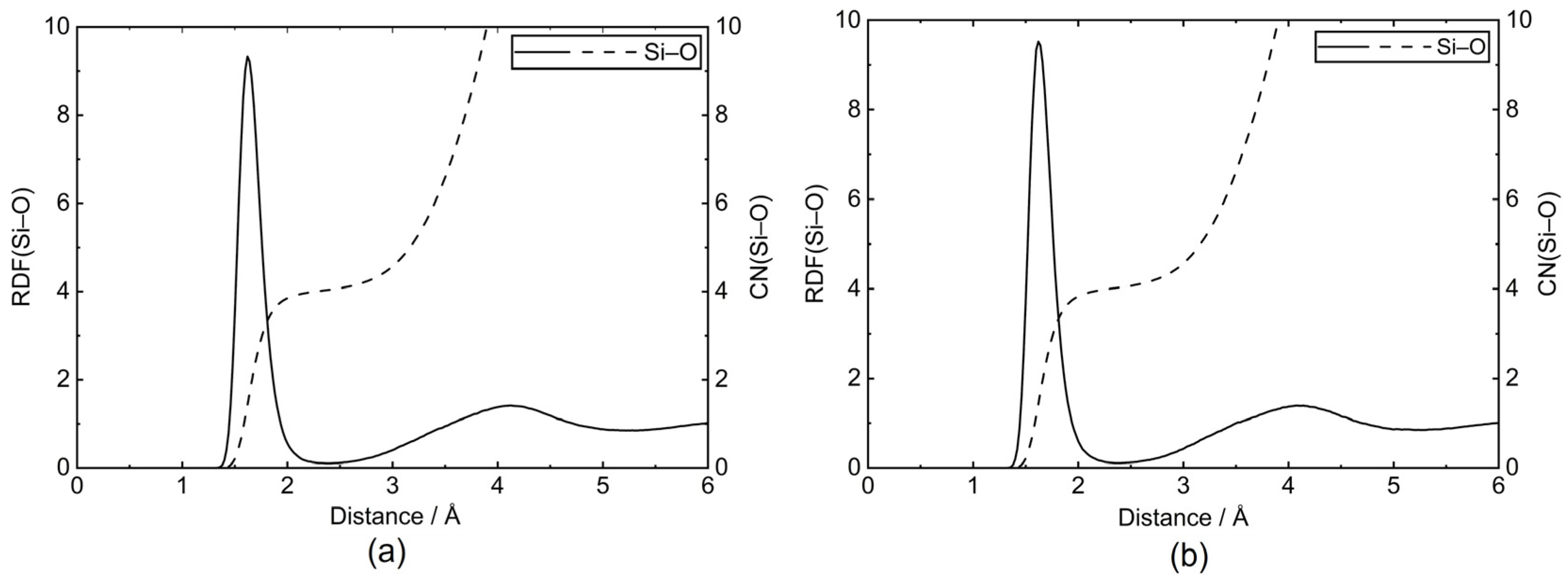
The radial distribution functions (RDFs) and coordination numbers (CNs) of O2− around Si4+ in the anhydrous and hydrous peridotite melts are displayed in Figure 1. For both compositions, the first Si4+–O2− RDF peak is located at 1.62 Å, and the associated CN is close to 4, demonstrating that Si4+ remains tetrahedrally coordinated and that the incorporation of water exerts no significant influence on the local structure of the peridotite melt. These observations are in good agreement with recent FPMD and classical molecular dynamics investigations of silicate melts [26,47,48].
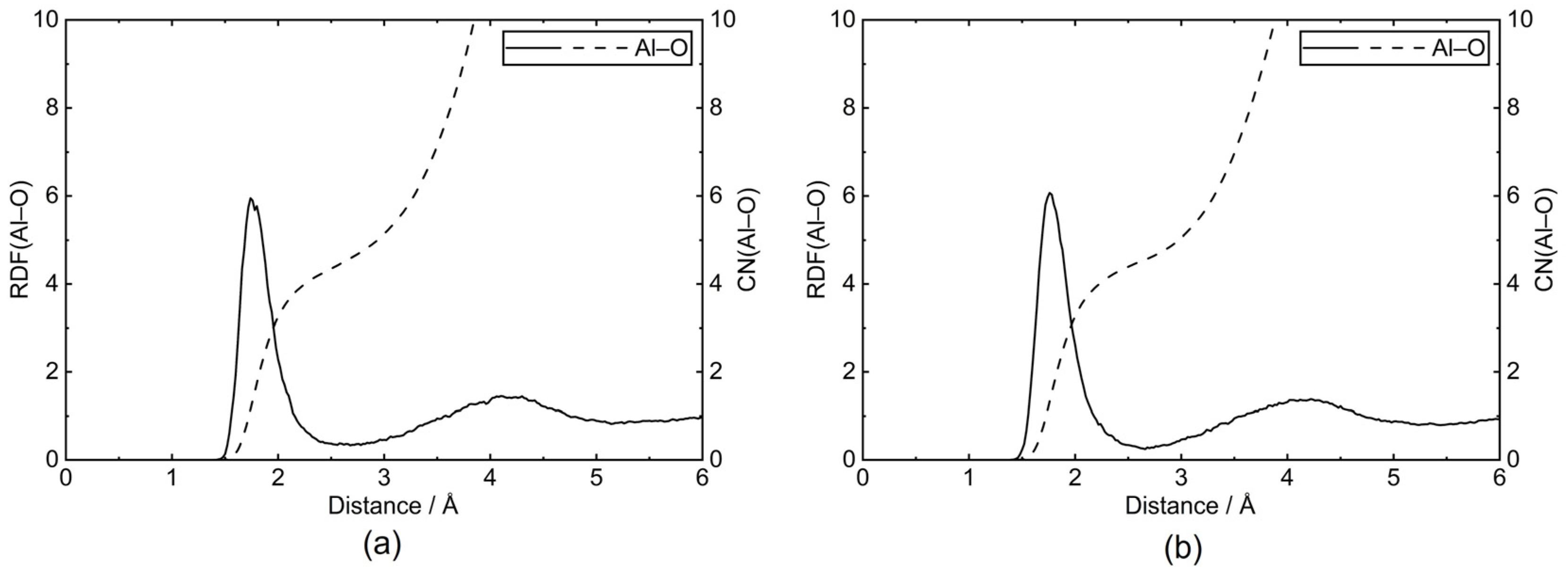
The RDF and CN curves for Al3+–O2− pairs in anhydrous and hydrous peridotite melts are shown in Figure 2. The first RDF peaks of Al3+–O2− are centered at 1.74 Å and 1.76 Å in anhydrous and hydrous peridotite melts, respectively, and the corresponding CNs are approximately 4.5, which indicates that Al3+–O2− is predominantly 4-fold coordinated and that the presence of water has very little effect on the structure of the peridotite melt. In peridotite melts, Al3+ often replaces Si4+ to form Al3+–O2− tetrahedra, and this result is consistent with the well-established role of Al as a network-forming cation in the mantle-derived melts.

3.2. Coordination of S2− and Cl Around Si4+ in Peridotite Melts

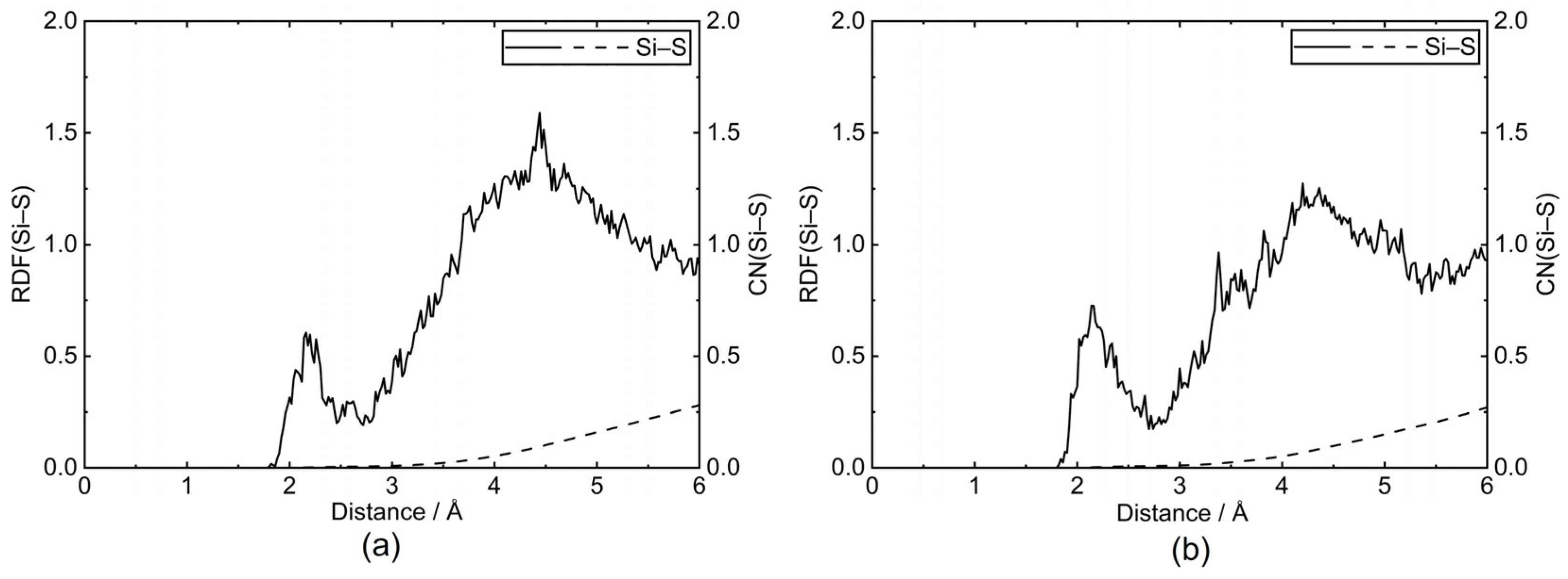
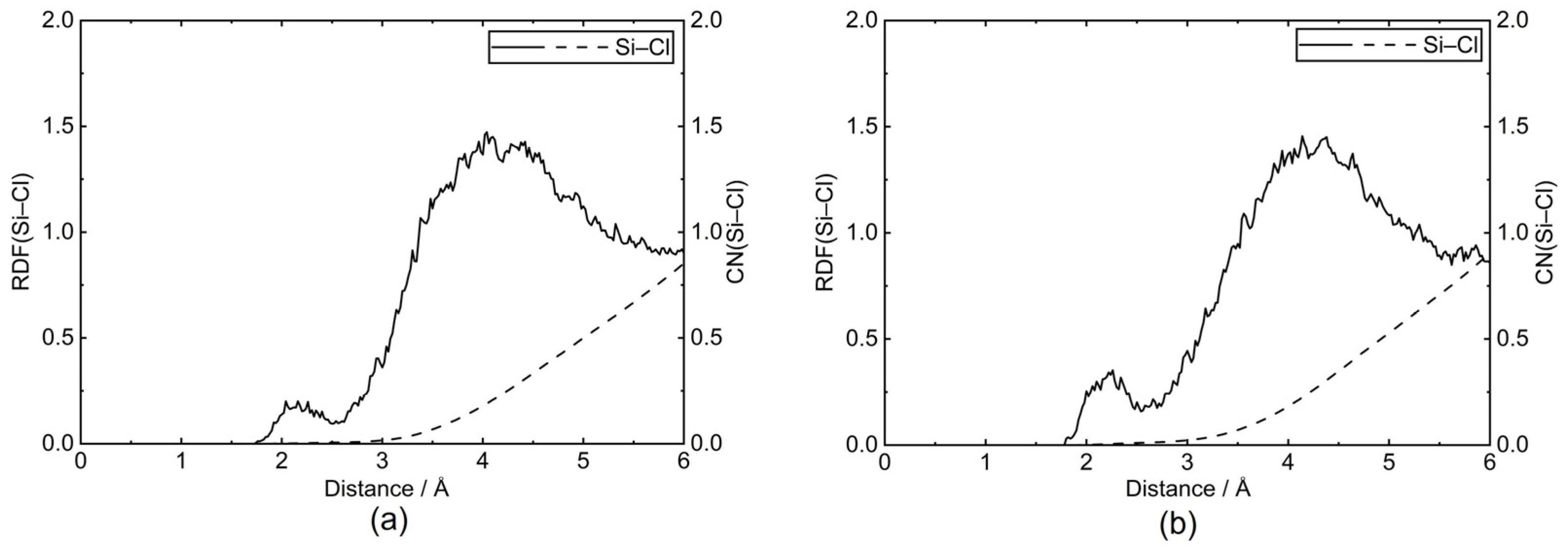
Figure 3 and Figure 4 show the RDF and CN curves for Si4+–S2− and Si4+–Cl pairs in anhydrous and hydrous peridotite melts. For Si4+–S2−, the first RDF peaks are centered at 2.16 Å and 2.14 Å, respectively; however, these are not the strongest peaks, suggesting that Si4+ and S2− do not form stable ion pairs in silicate melts. Similarly, the first Si4+–Cl RDF peaks appear at 2.04 Å and 2.26 Å, but they are also not the strongest peaks, and no stable coordination numbers are observed. These results collectively indicate that neither Si4+–S2− nor Si4+–Cl forms stable ion pairs in silicate melts.

3.3. Coordination of Au+, Cu+ in Peridotite Melts

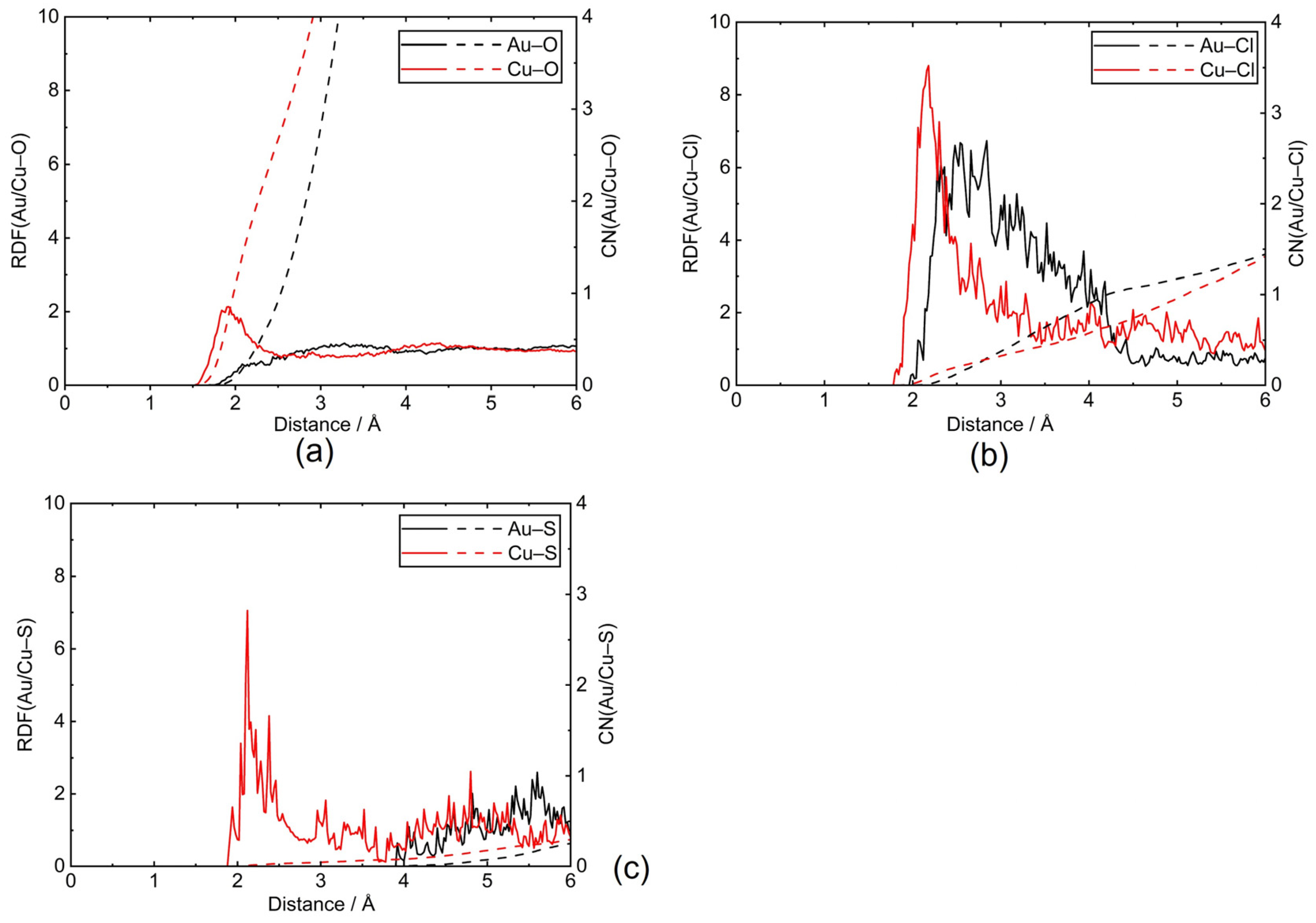
In anhydrous peridotite melts, the first RDF peak of Cu+–O2− is centered at 1.92 Å. In contract, no sharp RDF peak is observed for Au+–O2−; instead, its RDF curve gradually increases to about 3.20 Å and then exhibits only slight fluctuations, indicating a lack of well-defined local coordination between Au+ and O2− (Figure 5). Although the RDF of Cu+–O2− shows a discernible first peak at 1.92 Å, the corresponding CN curve does not reach a clear plateau, indicating the absence of a fixed coordination number. Similarly, the Au+–O2− RDF lacks any sharp peak, further confirming the absence of fixed coordination. Thus, neither Cu+–O2− nor Au+-O2− forms a coordination environment with a well-defined, constant coordination number in the anhydrous peridotite melt. The first RDF peaks of Cu+–Cl, Au+–Cl, Cu+–S2− and Au+–S2− are centered at about 2.18 Å, 2.84 Å, 2.12 Å and 5.6 Å, respectively, and their CN curves and RDF peaks also imply that there is no fixed coordination number for any of these ion pairs. Nevertheless, the RDF peaks of Cu+–Cl, Au+–Cl and Cu+–S2− indicate that within the range of effective chemical bond lengths, they have a high probability of approaching and interacting with each other, which could enable them to form crystal embryos or liquid phase molecules during magma evolution. Figure 5 also shows that in the anhydrous peridotite melt system, the chance of S2− coordinating with Cu+ is much greater than that of S2− coordinating with Au+. However, for Cl, its chances of coordinating with Cu+ and Au+ are not significantly different.
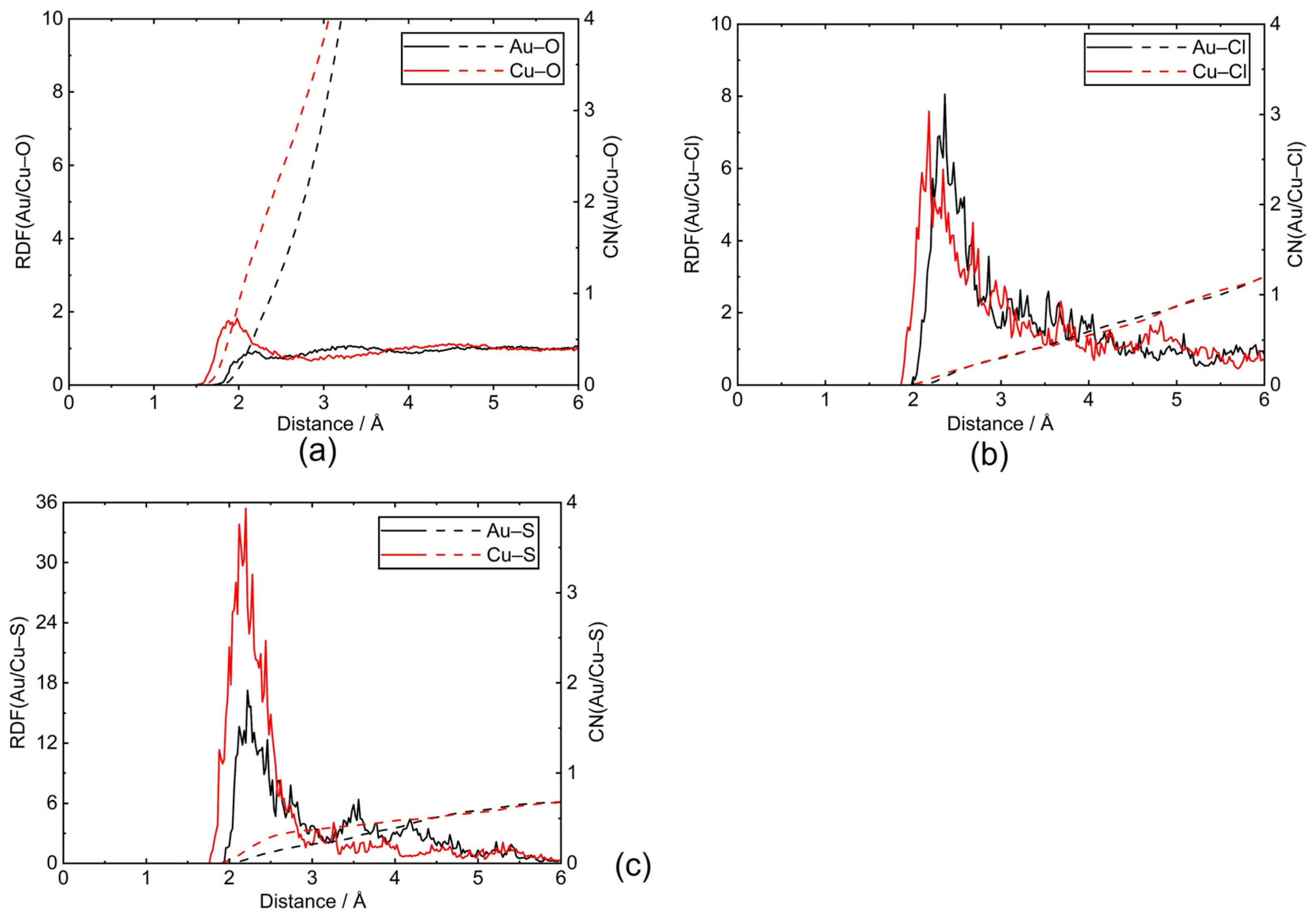
Similar to anhydrous peridotite melts, the CN curves and RDF peaks in hydrous peridotite melts indicate that none of these ion pairs exhibits a fixed coordination number (Figure 6). However, Figure 6 reveals that water has differential effects on the position and intensities of RDF peaks. While the RDF peaks of Cu+–O2− and Au+–O2− remain almost unchanged, water significantly increases the peaks of Au+-S2− (up to 18 at 2.32 Å), Au+–Cl (from 7 at 2.84 Å to 8 at 2.36 Å) and Cu+-S2− (from 7 at 2.12 Å to 38 at 2.2 Å), while only slightly affecting Cu+–Cl (from 9 at 2.18 Å to 8 at 2.18 Å). These results demonstrate that water can enhance the interactions of Au+–S2−, Au+–Cl and Cu+–S2−, thereby contributing to mineralization. Figure 6 also shows that in the hydrous peridotite melt systems, the addition of water has little effect on the coordination of Cl with Cu+ and Au+, but greatly enhances the coordination of S2− with Au+ and Cu+, with a stronger effect on the coordination of Cu+. This means that in ultrabasic melts, magma melts away from the deposit to enrich Cu instead of Au, and the addition of water is more conducive to this enrichment.
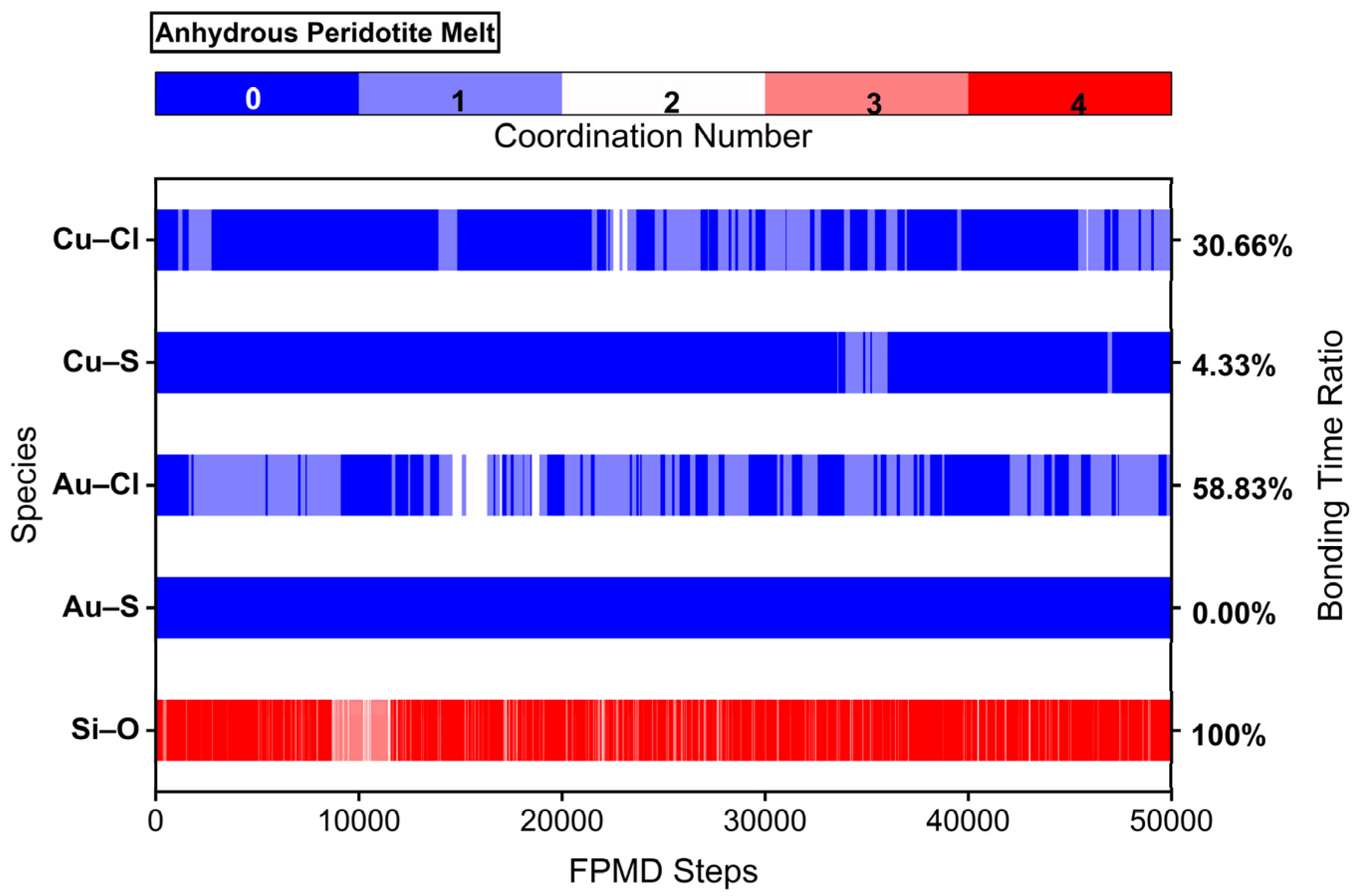
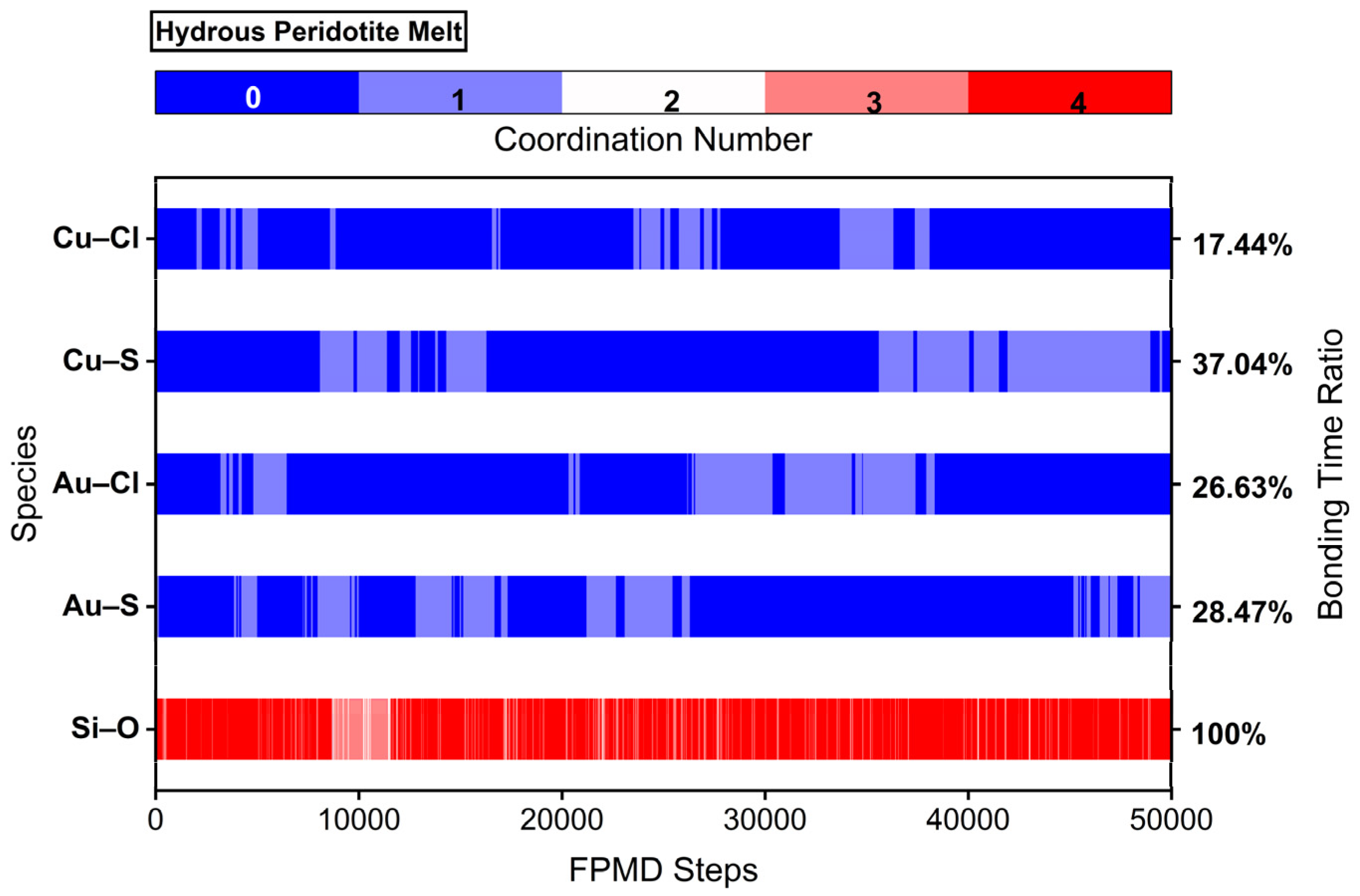
To evaluate the strength of pair bonds, the bonding time distributions of Cu+–Cl, Au+–Cl, Cu+–S2− and Au+–S2− during the FPMD simulations were analyzed (Figure 7 and Figure 8). For comparison, the bonding time ratios of Si4+–O2− are also shown. Generally, the bonds between Si4+ and O2− are stronger than those between Au/Cu and Cl/S. Figure 7 and Figure 8 show that the bonding time ratios of Au/Cu-Cl/S in anhydrous and hydrous peridotite melts vary from 0 to 58.83%, indicating that there is a strong correlation between these atom pairs, even though the numbers of Cu+, Au+, Cl and S2− atoms are much lower than those of Si4+ and O2−.

4. Discussion

4.1. Diffusion Coefficients of Au+, Cu+, O2−, S2− and Cl

The diffusion coefficient is a core transport property that quantitatively describes the mass transfer process of particles in a system due to thermal motion. Many researchers have studied the diffusion coefficients of ionic species in various silicate melts (e.g., [46,49,50,51]), but for O2−, there may be significant differences among data from different studies [46,52,53,54]. For Au+, Cu+ and S2−, there are few data on their diffusivities in a given melt, which makes it is impossible to make a proper comparison between them.
The diffusion coefficients (D) could be deduced from the mean squared displacement (MSD). MSD is a measure of the deviation of the position of an atom with respect to a reference position over time. The MSD at time is defined as
M S D ( t ) | x ( t 0 + t ) x ( t 0 ) | 2 = 1 N i = 1 N   | x ( t 0 + t ) i x ( t 0 ) i | 2
where N is the number of atoms to be calculated in the system, and x ( t 0 + t ) i and x ( t 0 ) i are the positions of the i-th atom at times t 0 + t and t 0 , respectively. MSD is commonly used to characterize diffusion behavior. For long-time FPMD simulations, the diffusion coefficient (D) can be obtained from the MSD:
M S D ( t ) = 2 n D t
where n is the dimension of the system, which is 3 in this study.
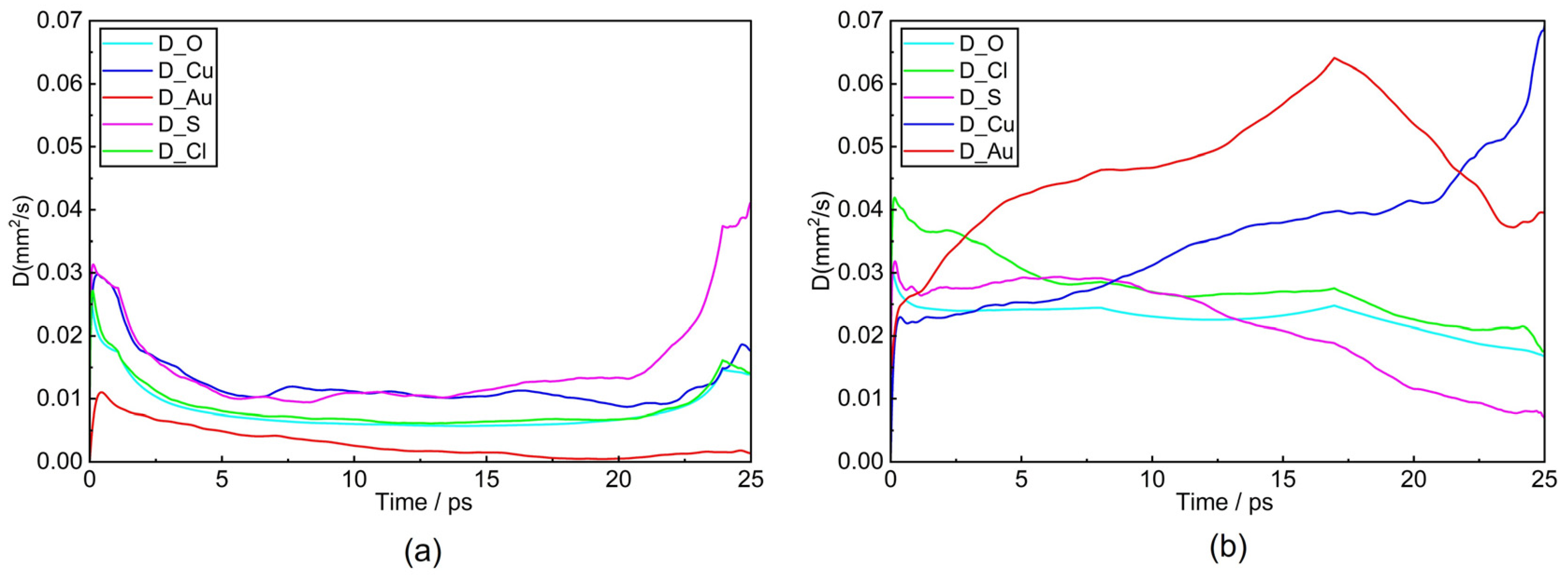
Figure 9 shows the diffusion coefficients of Au+, Cu+, S2−, O2− and Cl in (a) anhydrous and (b) hydrous peridotite melt systems, which were calculated from the final 25 ps of the FPMD simulations. In the anhydrous system, the order of diffusion coefficients is Au+ < O2− ≈ Cl < Cu+ < S2−. In the hydrous system, the order changes to S2− < O2− < Cl < Cu+ < Au+. These results demonstrate that the presence of water decreases the mobility of S2−, enhances the activity of O2− and Cl, and greatly enhances the activity of Cu+ and Au+. This change is highly likely due to the influence of H+.
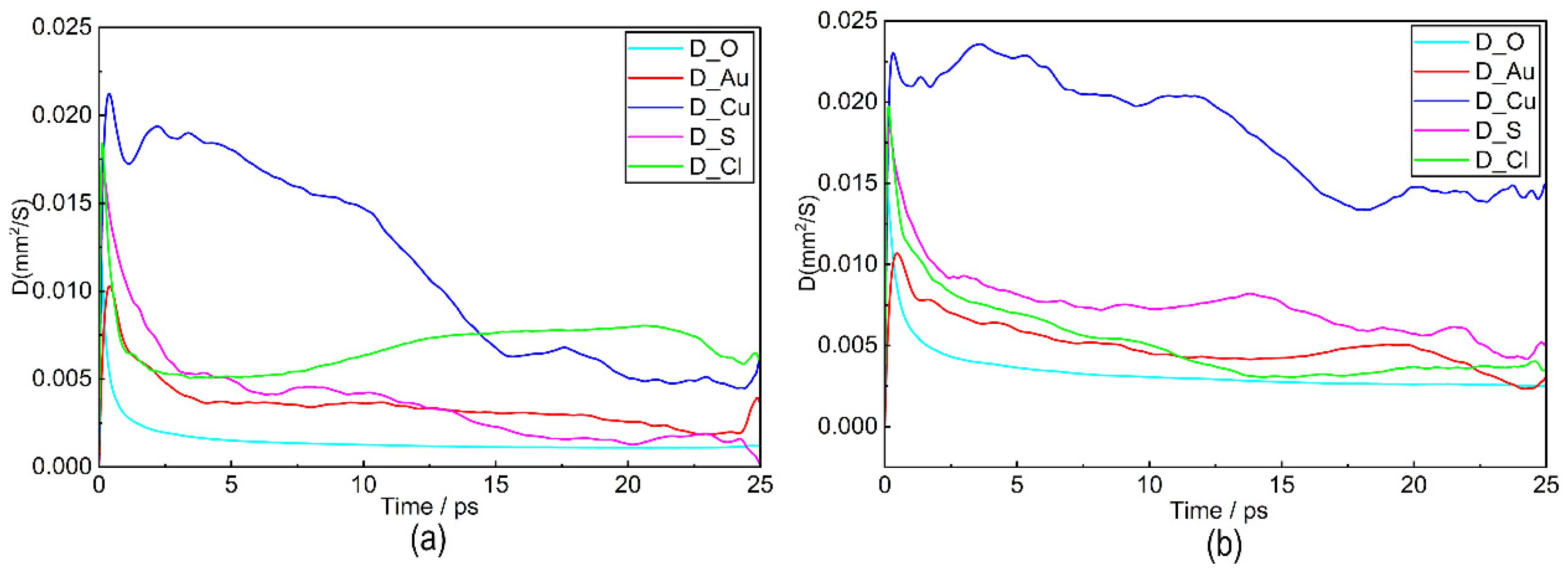
The more silicic the melt, the smaller the diffusion coefficients, as demonstrated by previous studies (e.g., [46,55]). This trend means that, for the same ion, diffusion in acidic silicate melts is lower than that in ultrabasic silicate melts. Figure 10 shows the diffusion coefficients of Au+, Cu+, S2−, O2− and Cl in (a) anhydrous and (b) hydrous granite melt systems. In the anhydrous system, the order of diffusion coefficients is O2− < Au+ ≈ S2− < Cl < Cu+. In the hydrous system, the order changes to O2− < Cl < Au+ < S2− < Cu+. These results reproduce this trend. On the whole, for anhydrous granite melt, the diffusion coefficients of Au+, S2−, and O2− are below 0.005, that of Cl is below 0.010, and that of Cu+ is about 0.01; for anhydrous peridotite melt, those of O2− and Cl are about 0.010, that of Au+ is about 0.005, and those of S2− and Cu+ are about 0.014; for hydrous granite melt, those of Au+, S2−, Cl and O2− are about 0.005, and that of Cu+ is about 0.015; for hydrous peridotite melt, those of O2−, Cl and S2− are about 0.02, and those of Au+ and Cu+ are about 0.04. These results also demonstrate that the presence of water can enhance O2−, Cl, Cu+ and Au+, and this change is also highly likely to be due to the influence of H+.

4.2. Geological Implications

Copper and nickel are metals of considerable economic importance and are indispensable to modern industry, science, and technology. Magmatic Ni–Cu sulfide deposits, typically hosted by mafic–ultramafic intrusions, constitute one of the principal reservoirs of copper, nickel, and platinum-group elements (PGEs) in the Earth’s crust. Magmatic sulfide deposits are conventionally classified into three groups on the basis of their mantle-normalized Ni–Cu–Co–PGE signatures [56]. The first group, Ni–Cu–PGE deposits, exhibits relatively smooth metal patterns and includes the Duluth, Kambalda–Mt Keith–Perseverance, Noril’sk–Talnakh, Raglan, Sudbury, and Thompson deposits. The second group, Ni–Cu–(PGE) deposits, is depleted in PGE relative to Ni–Cu–Co and is exemplified by the Jinchuan, Pechenga, and Voisey’s Bay deposits. The third group, PGE–(Cu)–(Ni) deposits, is enriched in PGE relative to Ni–Cu–Co and includes the Bushveld, Great Dyke, and Stillwater deposits.
These deposits form when mantle-derived mafic and ultramafic magmas reach sulfide saturation and segregate an immiscible sulfide liquid. For ore formation to occur, the parental magmas must not only be capable of segregating a sulfide liquid, but also contain sufficient abundances of ore metals that partition strongly into the sulfide phase [57,58]. Several aspects of the ore-forming process nevertheless remain poorly understood [58]. These include: (1) how mantle melting processes control the PGE contents of mafic–ultramafic magmas; (2) the mechanisms by which sulfur is transferred from wall rocks to ore bodies, whether through bulk assimilation, incongruent melting, or devolatilization; (3) the distances and processes over which dense sulfide melts are transported from their sites of formation to their sites of concentration, either as finely dispersed droplets, segregated layers, or deformation-driven injections of massive sulfide; and (4) the dynamic processes that progressively enrich the ores in metal. The present study shows that in both anhydrous and hydrous peridotite melts, the diffusion coefficients of Au+, Cu+, S2−, and O2− are sufficiently high to promote mutual interactions among these species, thereby facilitating mineralization. Moreover, the presence of water further enhances the Au+–S2−, Au+–Cl, and Cu+–S2− interactions. These findings provide an atomic-scale perspective on the formation of sulfide melts from mafic–ultramafic systems.

5. Conclusions

In this study, by using first principles molecular dynamics (FPMD) technique, we investigated the coordination chemistry of Au+, Cu+, S2−, O2− and Cl in anhydrous and hydrous peridotite melts. Our results show that Si4+–Cl, Cu+–O2−, Au+–O2−, Cu+–Cl, Au+–Cl, Au+–S2−, and Cu+–S2− cannot form stable ion pairs in silicate melts, and therefore, Au+, Cu+ cannot form stable complexes with S2−, O2− and Cl in the melts. But the diffusion coefficients of Au+, Cu+, S2− and Cl in silicate melts and their RDFs show that although they cannot form stable complexes, within the range of effective chemical bond lengths, they have a high probability of approaching and interacting with each other, which enables them to form crystal embryos or liquid-phase molecules during magma evolution. These findings can improve the understanding of coordination chemistry of Au+, Cu+, S2−, O2− and Cl silicate melts, thereby revealing the formation mechanism of magmatic Ni-Cu sulfide deposits.

Supplementary Materials

The following supporting information can be downloaded at https://www.mdpi.com/article/10.3390/min16050442/s1, Figure S1: The simulated structures of (a) anhydrous and (b) hydrous peridotite melt system.

Author Contributions

Conceptualization, Y.Z. and Q.W.; methodology, Y.Z. and Q.W.; software, Y.L. (Yongbing Li); validation, Y.Z., Q.W. and Y.L. (Yonghui Li); investigation, Y.Z., Q.W., Y.L. (Yongbing Li) and Y.L. (Yonghui Li); resources, Y.L. (Yongbing Li), Y.L. (Yonghui Li) and S.L.; data curation, Y.Z., Q.W. and Y.L. (Yonghui Li); writing—original draft preparation, Y.Z. and Q.W.; writing—review and editing, Y.Z., Q.W. and Y.L. (Yongbing Li); visualization, Y.L. (Yongbing Li) and S.L.; supervision, Y.L. (Yongbing Li), Y.L. (Yonghui Li) and S.L.; funding acquisition, Y.L. (Yongbing Li). All authors have read and agreed to the published version of the manuscript.

Funding

This study was supported by the National Key Research and Development Program of China (2022YFC2903304).

Data Availability Statement

The original contributions in this study are included in the article, and you can contact the corresponding author directly for further enquiries.

Conflicts of Interest

The authors declare no conflicts of interest.

References

  1. Barnes, H.L. Geochemistry of Hydrothermal Ore Deposits; Wiley: Hoboken, NJ, USA, 1979. [Google Scholar] [CrossRef]
  2. Zajacz, Z.; Candela, P.A.; Piccoli, P.M.; Wälle, M.; Sanchez-Valle, C. Gold and Copper in Volatile Saturated Mafic to Intermediate Magmas: Solubilities, Partitioning, and Implications for Ore Deposit Formation. Geochim. Cosmochim. Acta 2012, 91, 140–159. [Google Scholar] [CrossRef]
  3. Borisov, A.; Palme, H. Experimental Determination of the Solubility of Au in Silicate Melts. Mineral. Petrol. 1996, 56, 297–312. [Google Scholar] [CrossRef]
  4. Brenan, J.M.; McDonough, W.F. Core Formation and Metal–Silicate Fractionation of Osmium and Iridium from Gold. Nat. Geosci. 2009, 2, 798–801. [Google Scholar] [CrossRef]
  5. Brenan, J.M.; McDonough, W.F.; Ash, R. An Experimental Study of the Solubility and Partitioning of Iridium, Osmium and Gold between Olivine and Silicate Melt. Earth Planet. Sci. Lett. 2005, 237, 855–872. [Google Scholar] [CrossRef]
  6. Botcharnikov, R.E.; Linnen, R.L.; Holtz, F. Solubility of Au in Cl- and S-Bearing Hydrous Silicate Melts. Geochim. Cosmochim. Acta 2010, 74, 2396–2411. [Google Scholar] [CrossRef]
  7. Jégo, S.; Pichavant, M.; Mavrogenes, J.A. Controls on Gold Solubility in Arc Magmas: An Experimental Study at 1000 °C and 4 Kbar. Geochim. Cosmochim. Acta 2010, 74, 2165–2189. [Google Scholar] [CrossRef]
  8. Bell, A.S.; Simon, A.; Guillong, M. Gold Solubility in Oxidized and Reduced, Water-Saturated Mafic Melt. Geochim. Cosmochim. Acta 2011, 75, 1718–1732. [Google Scholar] [CrossRef]
  9. Ripley, E.M.; Brophy, J.G. Solubility of Copper in a Sulfur-Free Mafic Melt. Geochim. Cosmochim. Acta 1995, 59, 5027–5030. [Google Scholar] [CrossRef]
  10. Holzheid, A.; Lodders, K. Solubility of Copper in Silicate Melts as Function of Oxygen and Sulfur Fugacities, Temperature, and Silicate Composition. Geochim. Cosmochim. Acta 2001, 65, 1933–1951. [Google Scholar] [CrossRef]
  11. Candela, P.A.; Holland, H.D. The Partitioning of Copper and Molybdenum between Silicate Melts and Aqueous Fluids. Geochim. Cosmochim. Acta 1984, 48, 373–380. [Google Scholar] [CrossRef]
  12. Lanzirotti, A.; Lee, L.; Head, E.; Sutton, S.R.; Newville, M.; McCanta, M.; Lerner, A.H.; Wallace, P.J. Direct Measurements of Copper Speciation in Basaltic Glasses: Understanding the Relative Roles of Sulfur and Oxygen in Copper Complexation in Melts. Geochim. Cosmochim. Acta 2019, 267, 164–178. [Google Scholar] [CrossRef]
  13. Sun, S.-S. Chemical Composition and Origin of the Earth’s Primitive Mantle. Geochim. Cosmochim. Acta 1982, 46, 179–192. [Google Scholar] [CrossRef]
  14. O’Neill, H.S.C. The Origin of the Moon and the Early History of the Earth—A Chemical Model. Part 2: The Earth. Geochim. Cosmochim. Acta 1991, 55, 1159–1172. [Google Scholar] [CrossRef]
  15. Hedenquist, J.W.; Lowenstern, J.B. The Role of Magmas in the Formation of Hydrothermal Ore Deposits. Nature 1994, 370, 519–527. [Google Scholar] [CrossRef]
  16. Cline, J.S.; Bodnar, R.J. Can Economic Porphyry Copper Mineralization Be Generated by a Typical Calc-Alkaline Melt? J. Geophys. Res. Solid Earth 1991, 96, 8113–8126. [Google Scholar] [CrossRef]
  17. Audétat, A.; Pettke, T.; Heinrich, C.A.; Bodnar, R. The Composition of Magmatic-Hydrothermal Fluids in Barren and Mineralized Intrusions. Econ. Geol. 2008, 103, 877–908. [Google Scholar] [CrossRef]
  18. Sillitoe, R.H. Porphyry Copper Systems. Econ. Geol. 2010, 105, 3–41. [Google Scholar] [CrossRef]
  19. Lee, C.-T.A.; Tang, M. How to Make Porphyry Copper Deposits. Earth Planet. Sci. Lett. 2020, 529, 115868. [Google Scholar] [CrossRef]
  20. Zajacz, Z.; Candela, P.A.; Piccoli, P.M.; Sanchez-Valle, C.; Wälle, M. Solubility and Partitioning Behavior of Au, Cu, Ag and Reduced S in Magmas. Geochim. Cosmochim. Acta 2013, 112, 288–304. [Google Scholar] [CrossRef]
  21. Jégo, S.; Pichavant, M. Gold Solubility in Arc Magmas: Experimental Determination of the Effect of Sulfur at 1000 °C and 0.4 GPa. Geochim. Cosmochim. Acta 2012, 84, 560–592. [Google Scholar] [CrossRef]
  22. Williams-Jones, A. 100th Anniversary Special Paper: Vapor Transport of Metals and the Formation of Magmatic-Hydrothermal Ore Deposits. Econ. Geol. 2005, 100, 1287–1312. [Google Scholar] [CrossRef]
  23. Zajacz, Z.; Seo, J.H.; Candela, P.A.; Piccoli, P.M.; Tossell, J.A. The Solubility of Copper in High-Temperature Magmatic Vapors: A Quest for the Significance of Various Chloride and Sulfide Complexes. Geochim. Cosmochim. Acta 2011, 75, 2811–2827. [Google Scholar] [CrossRef]
  24. Zajacz, Z.; Candela, P.A.; Piccoli, P.M. The Partitioning of Cu, Au and Mo between Liquid and Vapor at Magmatic Temperatures and Its Implications for the Genesis of Magmatic-Hydrothermal Ore Deposits. Geochim. Cosmochim. Acta 2017, 207, 81–101. [Google Scholar] [CrossRef]
  25. Pokrovski, G.; Dubrovinsky, L. The S3- Ion Is Stable in Geological Fluids at Elevated Temperatures and Pressures. Science 2011, 331, 1052–1054. [Google Scholar] [CrossRef] [PubMed]
  26. Wang, T.; Liu, X.; Sun, Y.; Lu, X.; Wang, R. Coordination of Zr4+/Hf4+/Nb5+/Ta5+ in Silicate Melts: Insight from First Principles Molecular Dynamics Simulations. Chem. Geol. 2020, 555, 119814. [Google Scholar] [CrossRef]
  27. Jahn, S.; Dubrail, J.; Wilke, M. Complexation of Zr and Hf Monomers in Supercritical Aqueous Solutions: Insights from Ab Initio Molecular Dynamics Simulations. Chem. Geol. 2015, 418, 30–39. [Google Scholar] [CrossRef]
  28. Brugger, J.; Liu, W.; Etschmann, B.; Mei, Y.; Sherman, D.M.; Testemale, D. A Review of the Coordination Chemistry of Hydrothermal Systems, or Do Coordination Changes Make Ore Deposits? Chem. Geol. 2016, 447, 219–253. [Google Scholar] [CrossRef]
  29. Karki, B.; Stixrude, L. Viscosity of MgSiO3 Liquid at Earth’s Mantle Conditions: Implications for an Early Magma Ocean. Science 2010, 328, 740–742. [Google Scholar] [CrossRef]
  30. Ni, H.; de Koker, N. Thermodynamics, Diffusion and Structure of NaAlSi2O6 Liquid at Mantle Conditions: A First-Principles Molecular Dynamics Investigation. J. Geophys. Res. Solid Earth 2011, 116, B09202. [Google Scholar] [CrossRef]
  31. Sun, Y.; Zhou, H.; Yin, K.; Lu, X. First-Principles Study of Thermodynamics and Spin Transition in FeSiO3 Liquid at High Pressure. Geophys. Res. Lett. 2019, 46, 3706–3716. [Google Scholar] [CrossRef]
  32. Wang, T.; Zhang, X.; Liu, X.; Lu, X.; Wang, R. A Molecular Dynamics Study of Li Speciation in Hydrothermal Fluids and Silicate Melts. Chem. Geol. 2021, 584, 120528. [Google Scholar] [CrossRef]
  33. Nyuppenen, I. Primary Halos of Liquation-Type Magmatic Deposits Proper. J. Min. Inst. 1969, 56, 37–44. [Google Scholar]
  34. Kresse, G.; Hafner, J. Ab Initio Molecular-Dynamics Simulation of the Liquid-Metal--Amorphous-Semiconductor Transition in Germanium. Phys. Rev. B 1994, 49, 14251–14269. [Google Scholar] [CrossRef]
  35. Kresse, G.; Furthmüller, J. Efficient Iterative Schemes for Ab Initio Total-Energy Calculations Using a Plane-Wave Basis Set. Phys. Rev. B Condens. Matter Mater. Phys. 1996, 54, 11169–11186. [Google Scholar] [CrossRef] [PubMed]
  36. Blöchl, P.E. Projector Augmented-Wave Method. Phys. Rev. B 1994, 50, 24. [Google Scholar] [CrossRef]
  37. Kresse, G.; Joubert, D. From Ultrasoft Pseudopotentials to the Projector Augmented-Wave Method. Phys. Rev. B 1999, 59, 1758–1775. [Google Scholar] [CrossRef]
  38. Perdew, J.P.; Burke, K.; Ernzerhof, M. Generalized Gradient Approximation Made Simple. Phys. Rev. Lett. 1996, 77, 3865–3868. [Google Scholar] [CrossRef]
  39. Nosé, S. A Unified Formulation of the Constant Temperature Molecular Dynamics Methods. J. Chem. Phys. 1984, 81, 511–519. [Google Scholar] [CrossRef]
  40. Nosé, S. A Molecular-Dynamics Method for Simulations in the Canonical Ensemble. Mol. Phys. 1984, 52, 255–268. [Google Scholar] [CrossRef]
  41. Hoover, W.G. Canonical Dynamics: Equilibrium Phase-Space Distributions. Phys. Rev. A 1985, 31, 1695–1697. [Google Scholar] [CrossRef]
  42. Nixon, P.H.; Boyd, F.R. Petrogenesis of the Granular and Sheared Ultramafic Nodule Suite. In Kimberlites; Nixon, P.H., Ed.; Lesotho National Development: Maseru, Lesotho, 1973. [Google Scholar]
  43. Courtial, P.; Ohtani, E.; Dingwell, D.B. High-Temperature Densities of Some Mantle Melts. Geochim. Cosmochim. Acta 1997, 61, 3111–3119. [Google Scholar] [CrossRef]
  44. Ohtani, E.; Suzuki, A.; Kato, T. Flotation of Olivine and Diamond in Mantle Melt at High Pressure: Implications for Fractionation in the Deep Mantle and Ultradeep Origin of Diamond. Washington. DC Am. Geophys. Union Geophys. Monogr. Ser. 1998, 101, 227–239. [Google Scholar] [CrossRef]
  45. Suzuki, A.; Ohtani, E. Density of Peridotite Melts at High Pressure. Phys. Chem. Miner. 2003, 30, 449–456. [Google Scholar] [CrossRef]
  46. Guillot, B.; Sator, N. A Computer Simulation Study of Natural Silicate Melts. Part I: Low Pressure Properties. Geochim. Cosmochim. Acta 2007, 71, 1249–1265. [Google Scholar] [CrossRef]
  47. Bajgain, S.K.; Mookherjee, M. Structure and Properties of Albite Melt at High Pressures. ACS Earth Space Chem. 2020, 4, 1–13. [Google Scholar] [CrossRef]
  48. Neilson, R.T.; Spera, F.J.; Ghiorso, M.S. Thermodynamics, Self-Diffusion, and Structure of Liquid NaAlSi3O8 to 30 GPa by Classical Molecular Dynamics Simulations. Am. Mineral. 2016, 101, 2029–2040. [Google Scholar] [CrossRef]
  49. Brady, J.B. Diffusion Data for Silicate Minerals, Glasses, and Liquids; AGU Publications: Washington, DC, USA, 2013; pp. 269–290. [Google Scholar]
  50. Mungall, J.E. Empirical Models Relating Viscosity and Tracer Diffusion in Magmatic Silicate Melts. Geochim. Cosmochim. Acta 2002, 66, 125–143. [Google Scholar] [CrossRef]
  51. Zhabrev, V.A.; Sviridov, S.I. Ion Diffusion in Oxide Glasses and Melts: I. Bibliography. Glass Phys. Chem. 2003, 29, 140–159. [Google Scholar] [CrossRef]
  52. Canil, D.; Muehlenbachs, K. Oxygen Diffusion in an Fe-Rich Basalt Melt. Geochim. Cosmochim. Acta 1990, 54, 2947–2951. [Google Scholar] [CrossRef]
  53. Lesher, C.E.; Hervig, R.L.; Tinker, D. Self Diffusion of Network Formers (Silicon and Oxygen) in Naturally Occurring Basaltic Liquid. Geochim. Cosmochim. Acta 1996, 60, 405–413. [Google Scholar] [CrossRef]
  54. Tinker, D.; Lesher, C.E. Self Diffusion of Si and O in Dacitic Liquid at High Pressures. Am. Mineral. 2001, 86, 1–13. [Google Scholar] [CrossRef]
  55. Giordano, D.; Dingwell, D.B. Non-Arrhenian Multicomponent Melt Viscosity: A Model. Earth Planet. Sci. Lett. 2003, 208, 337–349. [Google Scholar] [CrossRef]
  56. Lu, Y.; Lesher, C.M.; Deng, J. Geochemistry and Genesis of Magmatic Ni-Cu-(PGE) and PGE-(Cu)-(Ni) Deposits in China. Ore Geol. Rev. 2019, 107, 863–887. [Google Scholar] [CrossRef]
  57. Naldrett, A.J. Magmatic Sulfide Deposits, 1st ed.; Springer: Berlin/Heidelberg, Germany, 2004. [Google Scholar]
  58. Barnes, S.-J.; Lightfoot, P. Formation of Magmatic Nickel-Sulfide Ore Deposits and Processes Affecting Their Copper and Platinum-Group Element Contents. In Economic Geology; SCIRP Open Access: Irvine, CA, USA, 2005; Volume 100, pp. 179–213. [Google Scholar]
Figure 1. RDF and CN curves of Si4+–O2− pairs in the (a) anhydrous and (b) hydrous peridotite melt systems, based on final 50,000 steps of the FPMD simulations.
Minerals 16 00442 g001
Figure 2. RDF and CN curves of Al3+–O2− pairs in the (a) anhydrous and (b) hydrous peridotite melt systems, based on final 50,000 steps of the FPMD simulations.
Minerals 16 00442 g002
Figure 3. RDF and CN curves of Si4+–S2− pairs in the (a) anhydrous and (b) hydrous peridotite melt systems, based on the final 50,000 steps of the FPMD simulations.
Minerals 16 00442 g003
Figure 4. RDF and CN curves of Si4+–Cl in the (a) anhydrous and (b) hydrous peridotite melt systems, based on the final 50,000 steps of the FPMD simulations.
Minerals 16 00442 g004
Figure 5. RDF and CN curves for O2−, Cl, and S2− around Au+ and Cu+ in the anhydrous peridotite melt system over the final 50,000 steps of FPMD simulations: (a) O2− around Au+ and Cu+, (b) Cl around Au+ and Cu+ and (c) S2− around Au+ and Cu+.
Minerals 16 00442 g005
Figure 6. RDF and CN curves for O2−, Cl, and S2− around Au+ and Cu+ in the hydrous peridotite melt system over the final 50,000 steps of FPMD simulations: (a) O2− around Au+ and Cu+, (b) S2− around Au+ and Cu+ and (c) Cl around Au+ and Cu+.
Minerals 16 00442 g006
Figure 7. Bonding time ratio and coordination number dynamics of Cu+–Cl, Cu+–S2−, Au+–Cl, Au+–S2− and Si4+–O2− in anhydrous peridotite melt during the final 50,000 steps of FPMD simulation.
Minerals 16 00442 g007
Figure 8. Bonding time ratio and coordination number dynamics of Cu+–Cl, Cu+–S2−, Au+–Cl, Au+–S2− and Si4+–O2− in hydrous peridotite melt during the final 50,000 steps of FPMD simulation.
Minerals 16 00442 g008
Figure 9. Diffusion coefficients of Au+, Cu+, S2−, O2− and Cl in the (a) anhydrous and (b) hydrous peridotite melt systems for the final 25 ps of the FPMD simulations.
Minerals 16 00442 g009
Figure 10. Diffusion coefficients of Au+, Cu+, S2−, O2− and Cl in the (a) anhydrous and (b) hydrous granite melt systems for the final 25 ps of the FPMD simulations.
Minerals 16 00442 g010
Table 1. The content of anhydrous and hydrous peridotite melt systems simulated in this study.
MeltsAnhydrous PeridotiteHydrous Peridotite
CaO3.24 (Ca: 3)2.62 (Ca: 2)
MgO36.43 (Mg: 47)32.99 (Mg: 35)
Al2O31.96 (Al: 2)2.38 (Al: 2)
SiO242.75 (Si: 37)37.94 (Si: 27)
FeO9.67 (Fe: 7)8.40 (Fe: 5)
H2O 8.43 (H: 40)
Au2.07 (Au: 1)2.52 (Au: 1)
Cu1.22 (Cu:1)1.49 (Cu:1)
Cl2.05 (Cl: 3)2.49 (Cl: 3)
S0.62 (S:1)0.75 (S:1)
TOT/wt%100 (atoms: 236)100 (atoms: 236)
Side length (Å)14.60014.221
Data based on [42,43,44,45,46]. The number of atoms of each cation species, except oxygen, employed in the corresponding silicate melt simulations is shown in parentheses. The number of O atoms in the anhydrous peridotite melt system is 134, whereas in the hydrous peridotite melt system it is 119.
Disclaimer/Publisher’s Note: The statements, opinions and data contained in all publications are solely those of the individual author(s) and contributor(s) and not of MDPI and/or the editor(s). MDPI and/or the editor(s) disclaim responsibility for any injury to people or property resulting from any ideas, methods, instructions or products referred to in the content.