Article

Effects of Carbonated Recycled Aggregate on Performance of Cemented Paste Backfill

1
College of Safety and Environmental Engineering, Shandong University of Science and Technology, Qingdao 266590, China
2
College of Earth Science and Engineering, Shandong University of Science and Technology, Qingdao 266590, China
3
College of Resources and Safety Engineering, Henan University of Engineering, Zhengzhou 451191, China
*
Author to whom correspondence should be addressed.
Minerals 2026, 16(4), 420; https://doi.org/10.3390/min16040420
Submission received: 8 March 2026 / Revised: 12 April 2026 / Accepted: 14 April 2026 / Published: 19 April 2026
Editorial Note: Due to an editorial processing error, this article was incorrectly included within the Special Issue Advanced Techniques in Mining Wastewater Treatment and Resource Recovery upon publication. This article was removed from this Special Issue’s webpage on 24 April 2026 but remains within the regular issue in which it was originally published. The editorial office confirms that this article adhered to MDPI's standard editorial process (https://www.mdpi.com/editorial_process).

Abstract

In order to explore the outstanding problems, such as poor mechanical performance, of recycled aggregate from construction waste in the application of backfills, this study innovatively used accelerated carbonation treatment technology to pretreat the recycled aggregates, and systematically investigated the evolution of mechanical properties in carbonated recycled aggregate-based cemented paste backfill (CPB). By carbonizing the waste recycled concrete aggregate (RCA), carbonation recycled concrete aggregates (CRCA) were obtained, and coal gangue was replaced as the filling aggregate at 50% and 100% for mine paste filling. The mechanical properties of the CPB were measured, and the mechanism was analyzed in combination with the changes in the microstructure. The results showed that the physical properties of RCA were significantly improved by carbonation treatment compared with untreated raw RCA: the apparent density of C60d-RCA increased by 2.88% relative to non-carbonated RCA, while its crushing value decreased by 51.45%, resulting in a more stable aggregate structure. In terms of mechanical properties, the compressive strengths of the 28day carbonated backfills with 50% and 100% CRCA contents (denoted as C28d-RCA-50 and C28d-RCA-100) reached 6.38 MPa and 5.32 MPa, representing increases of 61.52% and 46.33%, respectively, compared to the control group. Microstructure and phase composition analysis showed that the carbonation reaction not only produced calcium carbonate (CaCO3) crystals to effectively fill the internal pores and reduce the total porosity of the matrix, but also promoted the generation of monocarboaluminate and provided abundant nucleation sites for calcium silicate hydrate (C-S-H) gel hydration, which significantly optimized the structure of the interfacial transition zone (ITZ) and improved its microhardness. Among all test groups, the CRCA-50 group showed the most optimized microstructure and the best mechanical properties. This study provides a theoretical reference for the resource utilization of this type of 30-year service life RCA in mine filling.

1. Introduction

With the rapid advancement of urbanization in China, the demolition and construction of buildings have generated a large amount of construction waste, which accounts for approximately 40% of the total urban waste and shows an increasing trend year by year [1,2,3]. Currently, the disposal of construction waste primarily involves random stacking and direct landfilling. This approach not only occupies substantial land resources but also leads to urban water pollution and land contamination. Consequently, effective methods for managing construction waste have garnered widespread societal attention [4,5,6]. Coal is a crucial energy resource in China, accounting for approximately 65% to 75% of the nation’s total primary energy production annually [7,8]. In recent years, with the extensive mining of coal resources, problems such as mining area goaf collapse and surface subsidence have occurred frequently [9,10]. During the exploitation and utilization of coal resources, coal-based solid wastes represented by coal gangue and fly ash are also generated. These solid wastes are characterized by a low comprehensive utilization rate and a massive stockpile, which elevates the risk of environmental pollution to water, soil and air, endangers the safety and health of the public, and thus renders the disposal and resourceful utilization of coal-based solid wastes an urgent imperative [11,12,13]. As a typical technology for green mining, CPB mining technology can process these solid wastes into paste or slurry to backfill mining goafs, which can effectively support the surrounding rock, control surface subsidence, and achieve efficient resource utilization [14,15,16].
The integration of construction waste disposal and backfill mining technology can address mine goaf collapse while facilitating the resource utilization of construction waste, which has significant advantages in terms of social, environmental, and economic benefits. Therefore, many scholars have explored the preparation of coal mine CPB paste from treated construction waste, disposing of construction waste to make backfill material and backfilling it into mine goafs, thereby achieving efficient recycling of resources [17,18,19].
Unlike natural aggregates, recycled aggregates exhibit inherent structural defects arising from mechanical crushing, which leads to a lower apparent density and a higher crushing index and thus results in their compressive strength being inferior to that of natural aggregates [20,21]. Carbonated recycled aggregate by CO2 is a novel method that not only improves the performance of recycled aggregates but also helps reduce carbon dioxide emissions. Luo et al. [22] found that after carbonation enhancement, the water absorption of recycled aggregates decreases and the apparent density increases, thereby improving the load-bearing capacity of concrete and the structure formed between the aggregate and the cementitious materials becomes more stable. Jean et al. [23] observed that after carbonation treatment, the surface structure of recycled fine aggregate became significantly densified, the crystal structure was more refined, and no obvious pores or cracks were visible on the surface. The products of the carbonation reaction were able to effectively fill the aggregates. Kaliyavaradhan et al. [24] found that increasing CO2 volume fraction, pressure, and carbonation time all contributed to an increase in the carbonation rate of recycled aggregate. Lin et al. [25] found that under cyclic loading, the incorporation of recycled aggregate exacerbated damage to concrete, but carbonation modification of the recycled aggregate could mitigate this adverse effect. Pan et al. [26] measured the crushing value of recycled fine aggregate, finding that after carbonation, the crushing value of the recycled aggregate decreased, indicating that carbonation significantly enhanced the crushing performance of RCA. Li et al. [27] found that the hydration products in RCA gradually reacted with the ingress of CO2, leading to a more compact microstructure in the ITZ. This resulted in an increased density of the ITZ and enhanced its micromechanical properties. In recent years, scholars have conducted extensive research on CO2 carbonation treatment technology for recycled aggregates. However, existing achievements are mostly concentrated in the field of ordinary concrete materials, and related research on its use as aggregate in backfill applications remains relatively scarce.
In the backfill field, Tekin et al. [28] used construction and demolition waste as aggregate to produce CPB, finding that as the mass fraction of construction and demolition waste in the backfill paste increased, the strength of the backfill paste also increased. Liu et al. [29] prepared backfill paste using construction and demolition waste recycled aggregate and tested its conveying performance, concluding that the optimal conveying performance of the paste was achieved when the mass concentration was between 76% and 78%. Feng et al. [30] found that the compressive strength of CPB was positively correlated with the paste mass concentration and negatively correlated with the cement sand ratio. As the content of mineral powder increased, the strength of the backfill generally showed a trend of first increasing and then decreasing. Zhao et al. [31] investigated the effect of fly ash replacing part of the cement as a cementing material on the strength of CPB, with construction and demolition waste as aggregate, and found that when the mass ratio of fly ash to cement was 8:2, the 28-day strength and yield stress of the backfill were higher. Existing research primarily focuses on the influence of construction and demolition waste on the strength and fluidity of backfill, while studies on the application of CO2 carbonation-modified recycled aggregate in CPB remain relatively limited.
Building on the preceding discussion, current RCA research focuses on its use in conventional concrete or as untreated backfill material, while studies on performance-optimized carbonated RCA for backfill remain limited. Given this context, the present study uses CO2 carbonation to treat RCA, and applies the CRCA to replace gangue as mine paste backfill aggregate, conducting performance tests and micro-mechanism analyses on the prepared backfill material. This approach not only taps industrial solid waste’s CO2 sequestration potential but also yields high-performance CRCA for practical applications. Thus, besides to achieving waste concrete reuse, carbonation-modified RCA acts as a green underground CPB material for disaster prevention, integrating solid waste resource utilization, carbonation and backfilling technologies.

2. Materials and Methods

2.1. Materials

In this experiment, the cement used was Grade 32.5 ordinary Portland cement produced by Shandong Shanshui Cement Group Co., Ltd., Jinan, Shandong, China; the fly ash was obtained from Datang Huangdao Power Generation Co., Ltd., Qingdao, Shandong, China, with a particle size of 0.045 mm and a residue on a 0.045 mm square-mesh sieve of 40.32%; coal gangue was obtained from Daizhuang Coal Mine, Zibo, Shandong, China; and RCA was taken from 30-year service life C30 residential building demolition waste at a single site, to strictly control variables (original concrete strength, attached mortar content, and service environment) and eliminate their interference on test results. The conclusions of this study are mainly applicable to this type of RCA. The main chemical compositions of the cement, fly ash, and coal gangue are presented in Table 1. The basic physical properties of the RCA are summarized in Table 2. The superplasticizer adopted is polycarboxylate-based, with a solid content of 30 wt% and a water reduction rate of 30 wt%.
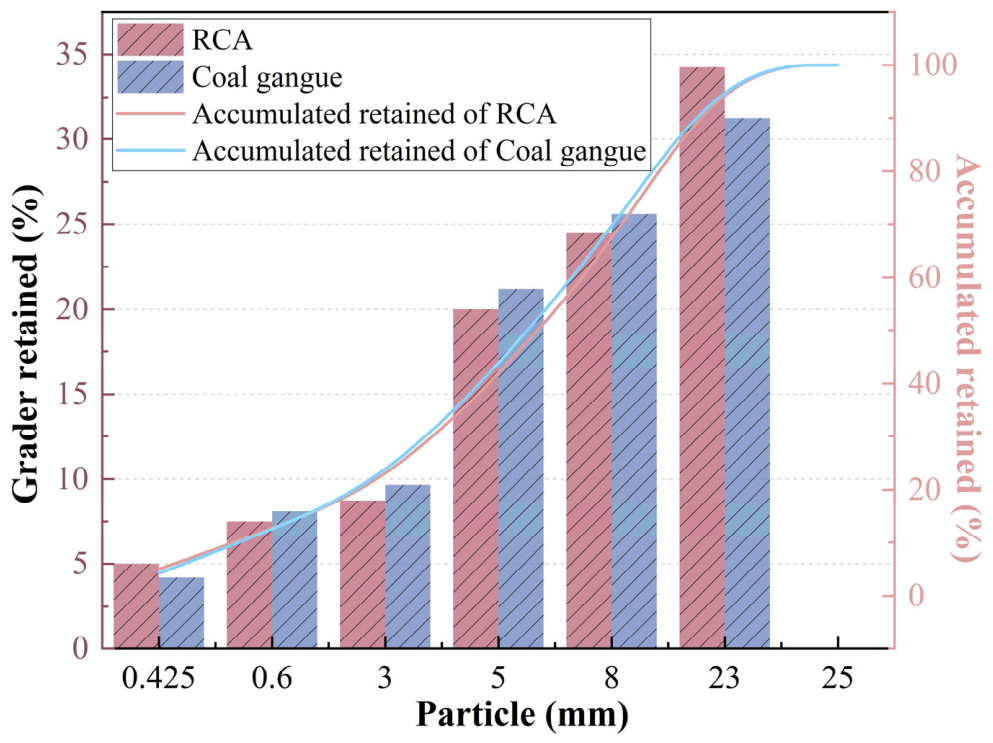
Coal gangue and RCA were crushed and screened into fine aggregate with a particle size of less than 5 mm and coarse aggregate with a particle size of 5–25 mm. The particle size distribution is shown in Figure 1.
The coal gangue and RCA used in this study were required to have a maximum particle size of less than 25 mm, with the fraction ranging from 5 mm to 25 mm constituting 40%–50% by mass. This grading control standard was strictly and uniformly implemented for all test groups to ensure the consistency of raw material parameters across the entire experiment. The experimental water used was tap water that complies with the “Standard of water for concrete” (JGJ63—2006) [32], with a ph greater than 5 and a sulfate ion concentration of less than 1000 mg/L.

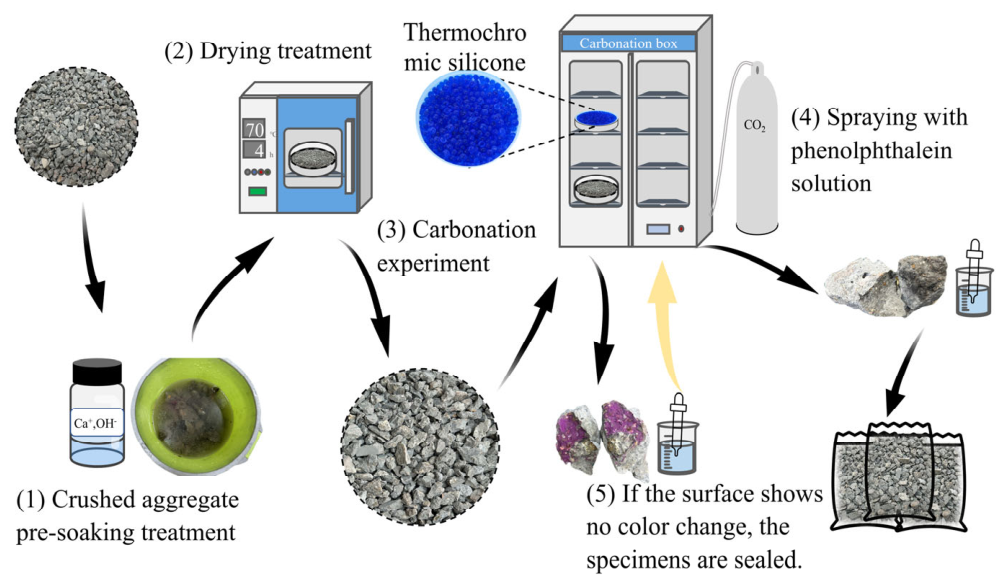
2.2. Pre-Soaking Treatment of RCA

In this test, the RCA was placed in a container, immersed in wastewater from a concrete batching plant containing Ca2+ and OH ions, and subjected to constant stirring. After 24 h of immersion, the aggregate was drained and transferred to a constant temperature and humidity chamber maintained at (22 ± 2) °C with a relative humidity of 60%–70% to ensure the RCA reached its optimum moisture content [33].

2.3. Carbonation of RCA

Based on the carbonation reaction characteristics of RCA and engineering application requirements, the 3 d and 14 d time points were set to capture the early rapid reaction stage of RCA carbonation, to clarify the evolution law of the carbonation process in the initial period of CO2 exposure; the 28 d time point was selected to align with the standard curing age of cement-based materials universally adopted in mine backfill engineering, which also matches the common cycle of on-site aggregate pretreatment in actual engineering practice; and the 60 d time point was set to explore the full carbonation limit state of RCA, to obtain the upper limit of the carbonation modification effect and provide a stable control baseline for in-depth mechanism analysis. Accordingly, the RCA was carbonated for 3, 14, 28, and 60 days using a carbonation chamber equipped with a vacuum extraction function. When the specimens reached the preset carbonation duration, the phenolphthalein colorimetric method specified in GB/T 50082-2009 was employed to determine the carbonation depth on the cross-section of RCA [34]. During the entire carbonation process, the CO2 concentration was maintained at 80%–85%, the chamber temperature was controlled within 18–25 °C, the relative humidity was stabilized at 50%–75% with silica gel, and the CO2 pressure in the chamber was constantly controlled at normal atmospheric pressure (0.10 ± 0.02 MPa) without additional pressurization [35]. Additionally, the ratio of RCA moisture content to water absorption was controlled within the range of 0.3–0.5 [36]. Fully carbonated RCA was obtained after 60 days of carbonation. The pretreatment and carbonation process of RCA are illustrated in Figure 2.
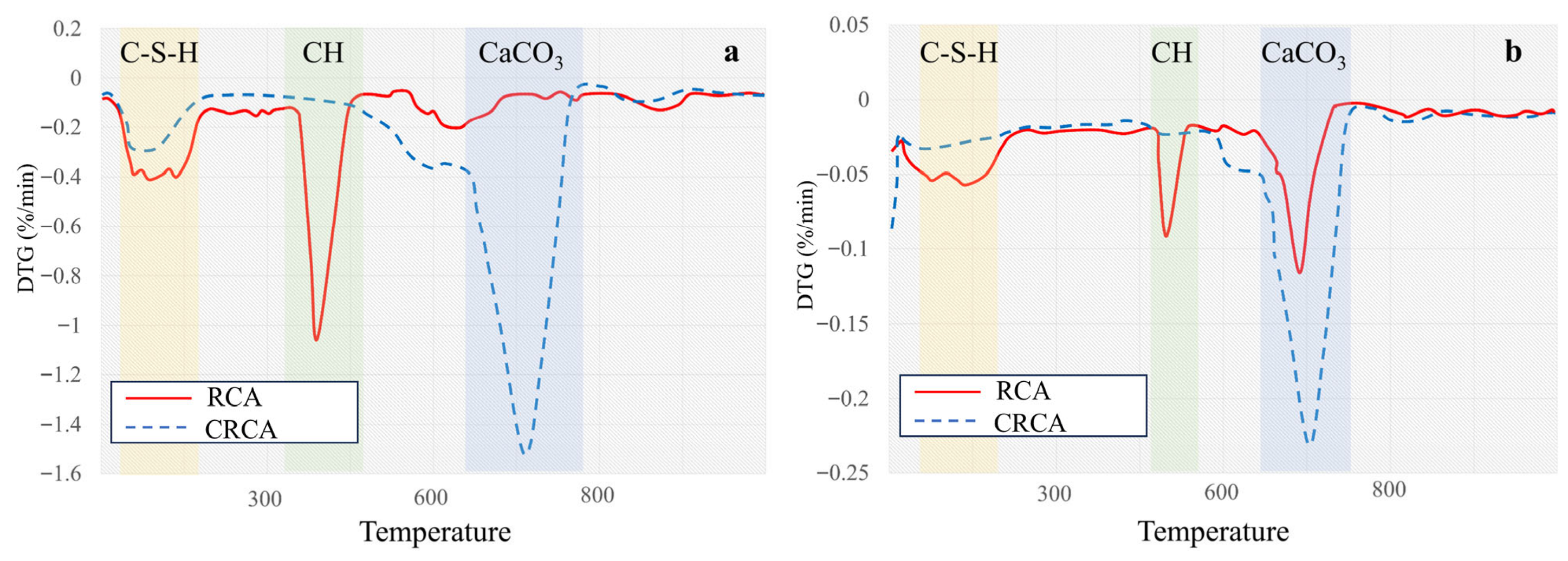
After carbonation treatment, the mortar adhered to the RCA carbonated for 60 days (C60d-RCA) was manually removed using a hammer, collected, and ground for thermogravimetric analysis. The TGA results shown in Figure 3 indicate that the peaks corresponding to C-S-H and calcium hydroxide (CH) were significantly reduced or disappeared from the derivative thermogravimetry (DTG) curve, demonstrating the carbonation of both C-S-H and calcium hydroxide.

2.4. Mixing

Based on preliminary literature review [37], the mix proportion of the backfill was determined as m(cement): m (fly ash): m (coal gangue) = 1:4:6. CRCA with different carbonation ages was used to replace coal gangue as backfill aggregate for mine paste backfilling (with CRCA replacement levels of 50% and 100%, denoted as CRCA-50 and CRCA-100). CPB specimens prepared with 0%, 50%, and 100% RCA replacement levels served as the control groups (denoted as RCA-0, RCA-50, and RCA-100).
The raw materials were mixed according to the proportions in Table 3 and stirred uniformly. Water was then added to continue stirring, preparing a CPB with a concentration of 68%. The slurry was poured into 70.7 mm × 70.7 mm × 70.7 mm cube molds. After initial setting, the specimens were demolded and placed in an HWS-80 standard curing chamber for curing. The chamber maintained a temperature of 20 °C ± 2 °C and a relative humidity above 95%.

2.5. Test Methods

2.5.1. Physical Properties

The physical properties of each sample, such as apparent density and crushing value, were tested in accordance with the Chinese standard JGJ52—2006 [38].

2.5.2. Mechanical Properties Testing

In accordance with GB/T 50107-2010 [39], the uniaxial compressive strength of the specimens was tested at curing ages of 3, 7, 14, 28, 56, and 90 days using a Shimadzu electronic universal testing machine. For each mix proportion at each target curing age, 3 parallel specimens were prepared and tested, and the final reported compressive strength value was taken as the arithmetic mean of valid test results from the parallel specimens.

2.5.3. Microhardness Testing

The specimens for microhardness testing were cured at 20 ± 2 °C and ≥95% relative humidity for 28 days. To facilitate the identification of the rhombic indentations, the surface of each specimen was polished. The prepared specimens were then tested using an FM-700/SVDE-4R Vickers microhardness tester, Future-Tech Corp., Kawasaki, Japan, to observe the old and new ITZ. Subsequently, a load of 0.098 N was applied to the rough areas of the RCA and maintained for 15 s.

2.5.4. Chemical Structure

After curing the backfill specimen blocks for 90 days, small inner fragments were extracted from the test blocks. These fragments were immersed in anhydrous ethanol for several hours to terminate the hydration reaction, and then dried in a vacuum drying oven at 55 °C for 2 h. The dried samples were ground and sieved to obtain powders with a particle size of approximately 40 μm. Subsequently, microstructural analysis was conducted using a D/Max2500PC X-ray diffractometer(XRD), Rigaku Corp., Tokyo, Japan, with a scanning range of 5° to 40°, a scanning speed of 5°/min, and a step size of 0.02°, as well as a Cary 630 ATR-FTIR instrument, Agilent Technologies, Santa Clara, CA, USA.

2.5.5. Pore Characteristics and Scanning Electron Microscope Testing

After the backfill specimen blocks were cured for 28 days, small internal fragments were extracted from the test blocks. The fragments were immersed in anhydrous ethanol for several hours to terminate the hydration reaction, followed by drying in a vacuum drying oven at 55 °C for 2 h. Finally, the sample cross-sections were cut and the microstructure of the backfill specimens was observed using a JSM-6510LV vacuum scanning electron microscope (SEM), JEOL Ltd., Tokyo, Japan. The pore structure characteristics of the tested samples were determined using a Micromeritics AutoPore IV 9510 mercury intrusion porosimeter, Micromeritics Instrument Corp., Norcross, GA, USA.

3. Results and Discussion

3.1. Carbonation Effect Analysis of CRCA

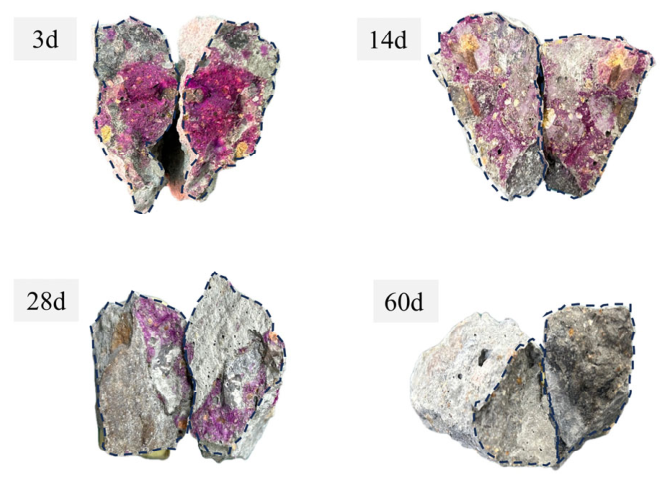
The samples were carbonated following the process shown in Figure 2. After 3, 14, 28, and 60 days of carbonation, the carbonated RCA was split open and sprayed with a phenolphthalein solution. The carbonation depth was determined based on the color change observed on the fracture surface, continuing until the RCA was fully carbonated. Areas on the fracture surface that turned purplish-red were identified as non-carbonated zones, while areas that showed no color change were identified as fully carbonated zones. Figure 4 shows the phenolphthalein color development of the CRCA and the carbonation depth of each specimen at different carbonation ages. This test confirmed that RCA can be effectively carbonated, and demonstrated that the carbonation depth increases with prolonged duration.

3.2. Analysis of Physical Properties of RCA

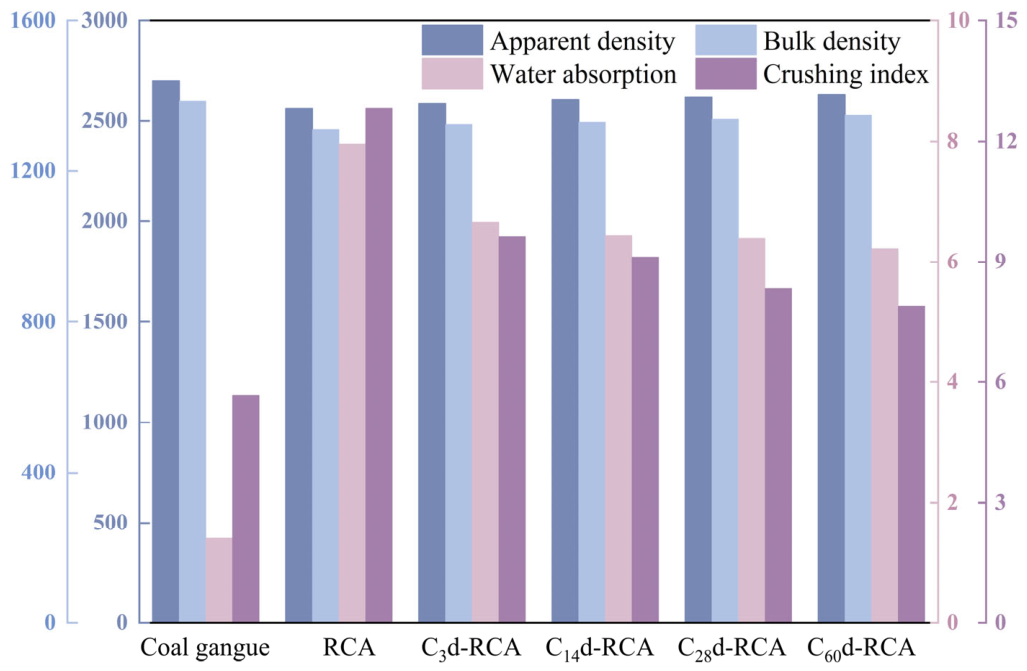
The physical properties of coal gangue, uncarbonated RCA and CRCA with different carbonation ages are presented in Figure 5. As carbonation age increases, the apparent density and bulk density of CRCA gradually increase, while the water absorption and crushing value significantly decrease. Specifically, compared with uncarbonated RCA, C60d-RCA shows a 2.88% increase in apparent density, a 2.87% increase in bulk density, a 21.86% decrease in water absorption and a 51.45% decrease in crushing value.
This improvement in physical properties can be directly attributed to the carbonation reactions of cement hydration products in the adhered old mortar. As confirmed by TGA results (Figure 3), both CH and C-S-H gel in the old mortar react with CO2 to form CaCO3. The carbonation reaction is accompanied by a solid phase volume expansion (approximately 12% volume increase for CH carbonation), which effectively fills the inherent pores and microcracks in the old mortar. This densification effect reduces the porosity of RCA, thereby increasing its density and decreasing its water absorption. Meanwhile, the formation of hard CaCO3 crystals strengthens the weak adhered old mortar layer, significantly reducing the crushing value of RCA and improving its load-bearing capacity. These improved physical properties of CRCA lay a solid foundation for the enhanced mechanical performance of the resulting CPB.

3.3. Analysis of Mechanical Properties of CPB

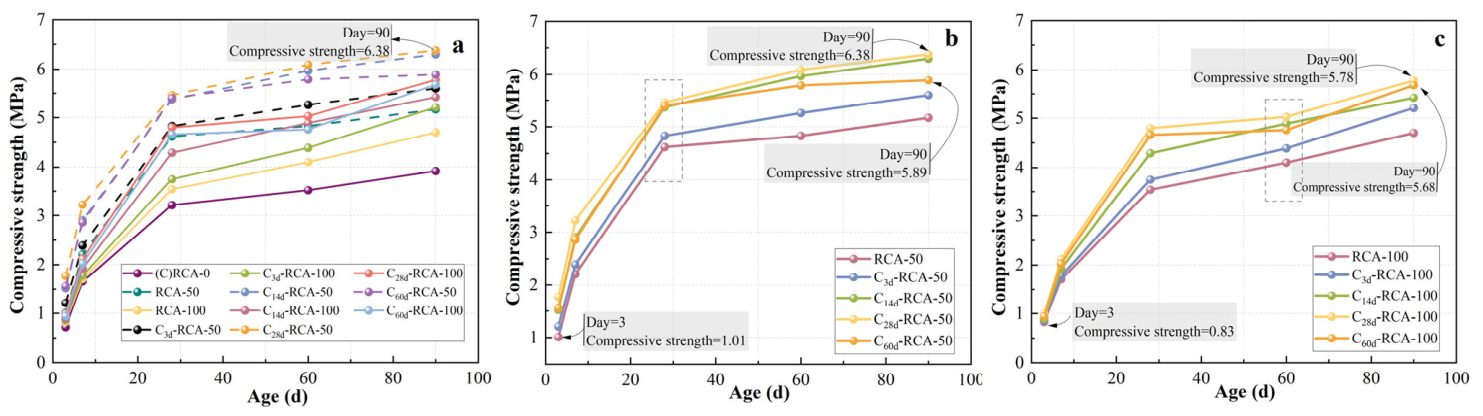
Figure 6 illustrates the evolution law of the macro compressive strength of CPB with curing time (0–100 d) under the coupling conditions of different recycled aggregate replacement ratios (0%, 50%, and 100%) and different carbonation ages (C3d, C14d, C28d, and C60d): all experimental groups exhibit a consistent variation trend in compressive strength, characterized by “rapid growth in the early curing stage (0–20 d) and a gradual slowdown in the growth rate in the later stage (after 20 d)”.
As shown in Figure 6a, the CRCA replacement ratio has a significant effect on the compressive strength of the CPB. With increasing CRCA replacement ratio, the overall compressive strength exhibits a trend of first increasing and then decreasing. At a curing age of 90 d, compared with the RCA-0 control group without CRCA, the compressive strengths of C28d-RCA-50 and C28d-RCA-100 increased by 61.52% and 46.33%, respectively. Among them, C28d-RCA-50 achieved the highest compressive strength of 6.38 MPa at 90 d.
Under the condition of a 50% replacement ratio (Figure 6b), the carbonation age plays a significant role in regulating strength development. With the increase in carbonation age, the compressive strength of CPB shows a trend of first increasing and then decreasing at the same curing age. Among all the tested carbonation ages, C28d-RCA-50 exhibits the optimal performance: at 90 d curing age, its compressive strength reaches 6.38 MPa, which is higher than that of C14d-RCA-50 (6.36 MPa) and C60d-RCA-50 (5.89 MPa), indicating that excessive carbonation duration is unfavorable for further strength improvement of CPB.
Under the condition of a 100% replacement ratio (Figure 6c), the variation in compressive strength with carbonation age is generally consistent with that at a 50% replacement ratio, while the overall strength level is reduced under the same carbonation age and curing time. The peak compressive strength also occurs at C28d-RCA-100, with a value of 5.78 MPa at 90 d, which is 9.4% lower than the optimal value of C28d-RCA-50 at the same curing age. A comparison between Figure 6b,c indicates that, under the same carbonation age and curing age, the compressive strength of CRCA-50 is consistently higher than that of CRCA-100, which confirms that a higher RCA replacement ratio will weaken the enhancement effect of carbonation modification on the mechanical properties of CPB.

3.4. Microstructural Analysis of CPB

3.4.1. Analysis of ITZ Microhardness

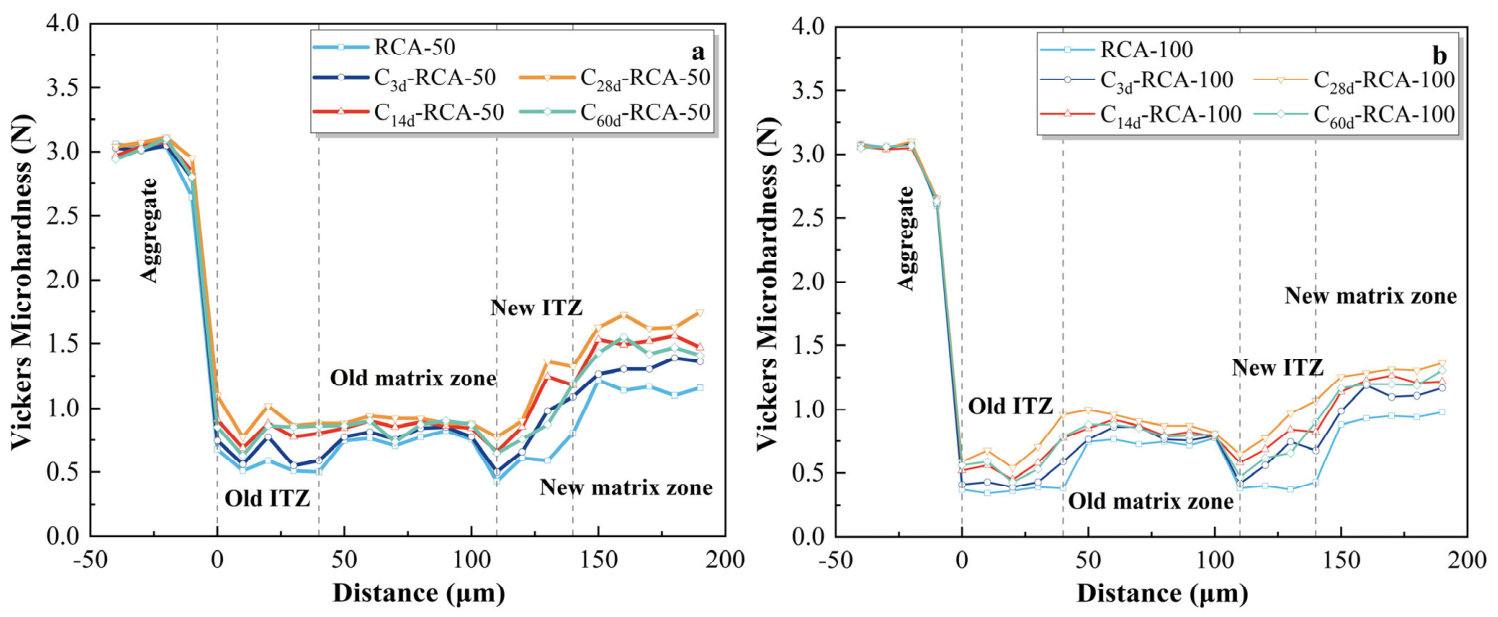
Microhardness serves as a direct mechanical indicator of the microstructural characteristics of cement-based materials. Figure 7a,b show the microhardness distribution in the new and old ITZ of CRCA-based CPB under different replacement ratios and carbonation ages. The results indicate that the microhardness values in the old ITZ of uncarbonated RCA-50 and RCA-100 are only 56.8 HV and 37.8 HV, respectively, and the old ITZ generally exhibits lower microhardness than the new ITZ. After carbonation treatment, the microhardness in the old ITZ of CRCA-50 and CRCA-100 increased by 31.67%–73.33% and 12.83%–34.21%, respectively, demonstrating that carbonation promotes the migration of hydration products such as C-S-H and carboaluminates into the interfacial zone and significantly enhances its mechanical properties.
With carbonation treatment as the only variable (RCA from the same source), the microhardness of the corresponding ITZ shows a consistent increase, and the C28d-RCA-50 group exhibits the highest overall microhardness. Specifically, carbonation reduces the width of the new ITZ in the 50% replacement ratio group from approximately 25 μm to 5 μm, and its average microhardness rises from 62 HV to 96.5 HV, indicating that carbonation significantly optimizes both the thickness and mechanical performance of the new ITZ. In contrast, under the same carbonation duration, the new ITZ width of CRCA-100 is about 15 μm with an average microhardness of only 59 HV. This divergence is attributed to the abundant inherent cracks and pores in RCA: as the RCA replacement ratio increases, the total porosity of CPB rises correspondingly, and the deteriorating effect of pores and cracks on the ITZ gradually outweighs the structural optimization brought by carbonation products, resulting in a wider ITZ and lower interfacial microhardness.
It is worth noting that although the intrinsic strength of CRCA is slightly lower than that of coal gangue, the compressive strength of CRCA-based CPB is significantly higher than that of the pure coal gangue aggregate control group. This is because the macroscopic strength of CPB is mainly controlled by the performance of the aggregate-paste ITZ rather than the intrinsic strength of the aggregate itself. The loose and porous surface of untreated raw RCA forms a weak ITZ with massive microcracks, which becomes the core failure source of CPB; while the strength gain brought by carbonation-induced ITZ optimization and paste matrix densification far exceeds the minor negative impact of the slight difference in aggregate intrinsic strength, which is the core mechanism for the significant improvement of CPB mechanical properties after carbonation modification.

3.4.2. Chemical Structure Analysis

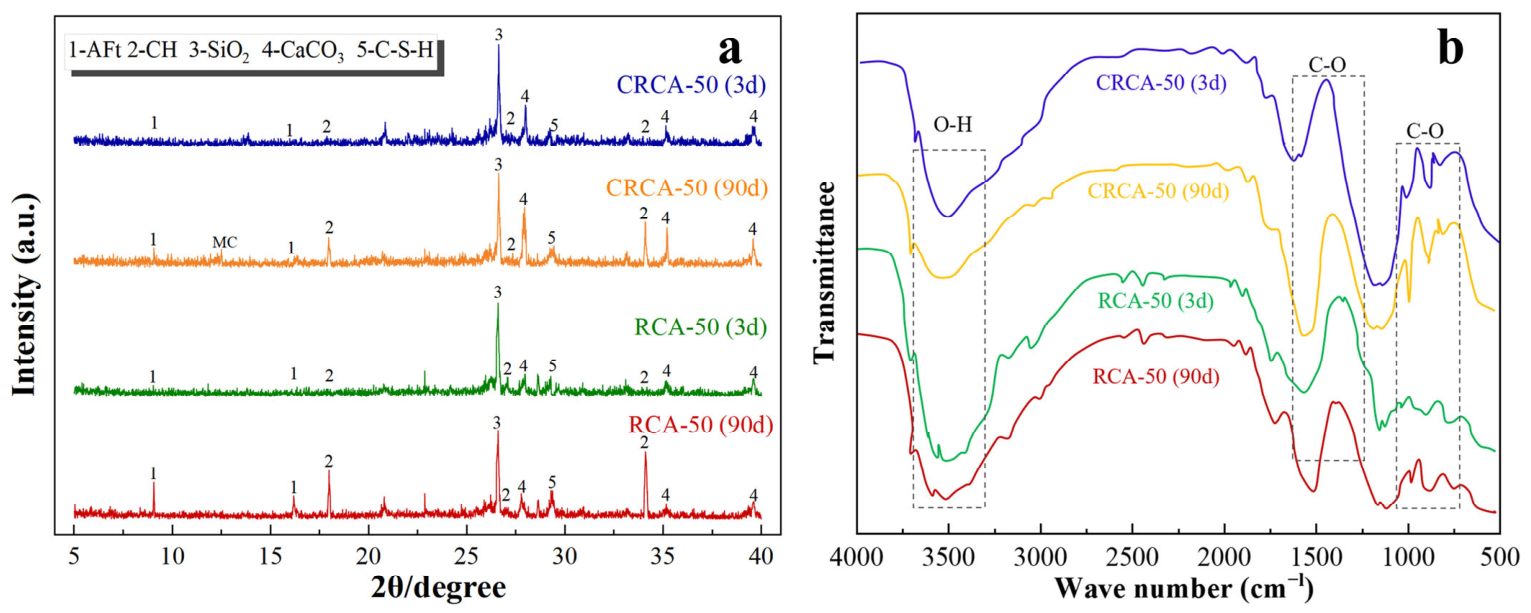
Figure 8a shows the XRD patterns of C60d-RCA-50, C60d-RCA-100, and the uncarbonated control group. A high content of SiO2, primarily originating from the sandy components in the RCA, was detected in all samples. The characteristic diffraction peak of CH is found at 18.0° and 34.1°, the characteristic peak of the carbonation product CaCO3 is located at 29.3°, and the diffraction peak of C-S-H gel presents a diffuse peak near 29.3° overlapping with the CaCO3 peak. In the uncarbonated RCA samples, clear characteristic diffraction peaks of CH and a weak CaCO3 peak were detected, which are typical phases of cement hydration products. After carbonation treatment, the diffraction peak intensity of CH decreased significantly, while the diffraction peak intensity of CaCO3 increased markedly, combined with the DTG curves of the old adhered mortar from uncarbonated RCA and 60-day fully carbonated RCA (Figure 3), three distinct characteristic weight loss peaks are identified for the uncarbonated RCA mortar: the first peak at 50–200 °C is attributed to the dehydration of C-S-H gel and ettringite, the second peak at 400–500 °C corresponds to the decomposition of CH, and the third peak at 600–800 °C arises from the decomposition of a small amount of naturally formed calcium carbonate (CaCO3). For the carbonated RCA mortar, the characteristic CH decomposition peak at 400–500 °C almost completely disappears, the C-S-H gel dehydration peak at 50–200 °C is significantly reduced, and the CaCO3 decomposition peak at 600–800 °C is markedly enhanced, which further confirms that CH in the system has undergone sufficient carbonation reaction to generate CaCO3.
Figure 8b presents the FTIR spectra of the samples. The absorption peak at 3469 cm−1 is attributed to the O–H stretching vibration in CH. The absorption peaks at 1423 cm−1 and 874 cm−1 correspond to the C–O asymmetric stretching and bending vibrations in CaCO3, respectively, and the absorption peak near 970 cm−1 corresponds to the Si-O stretching vibration of C-S-H gel. Comparing the spectra before and after carbonation reveals that the area of the C–O absorption peaks at 1423 cm−1 and 874 cm−1 increases significantly in the carbonated RCA-based CPB samples, while the area of the O–H stretching vibration peak of CH at 3469 cm−1 decreases obviously, which further confirms the consumption of CH and the generation of a large amount of CaCO3 during the carbonation process. The shift of the Si-O absorption peak near 970 cm−1 to higher wavenumbers also verifies the decalcification and polymerization of C-S-H gel after carbonation.
It is worth noting that the characteristic vibrational peak of CH does not disappear completely in the FTIR spectra, which is the result of the combined action of multiple factors in the test system: first, the continuous hydration of cement and fly ash in the CPB cementitious system will continuously generate new CH during the 90-day curing period, leading to the residual CH characteristic peak; second, the carbonation reaction is controlled by CO2 mass transfer, and the CaCO3 generated by the surface reaction will densify the pore structure of the old mortar attached to RCA, block the connected pores, and hinder the further diffusion of CO2 into the deep mortar, making the CH wrapped in the internal C-S-H gel unable to fully contact with CO2 and participate in the reaction; and third, the CH in the 30-year service life old mortar has a high degree of crystallization and stable structure, with lower reaction activity with CO2, which cannot be completely consumed within the set carbonation age.

3.4.3. Pore Characteristics and SEM Analysis

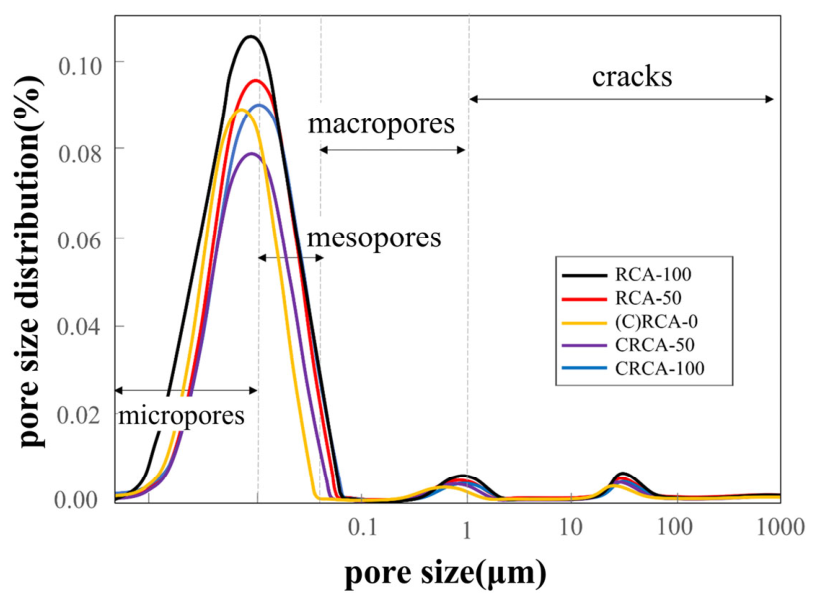
Mercury Intrusion Porosimetry (MIP) was employed to measure the pore size distribution and the variation in total porosity within the prepared CPB specimens.
Based on relevant research findings [40], the internal pores of the specimens were classified into four types according to their size distribution: micropores (D ≤ 0.02 μm, where D is the pore diameter), mesopores (0.02 μm < D ≤ 0.10 μm), macropores (0.10 μm < D ≤ 2 μm), and cracks (D > 2 μm).
Figure 9 illustrates the pore size distribution of CPB. It is evident from the figures that with prolonged carbonation age, the total porosity inside the specimens decreases, and the pore size distribution shifts towards finer pores. C28d-RCA-50 exhibits the lowest porosity. The porosity of CRCA-50 at various carbonation ages is significantly lower than that of RCA-50, with a maximum reduction of 19.75%. This indicates that carbonation products effectively fill the internal voids of the CPB, mitigating the adverse pore effects introduced by the RCA. This matrix densification effect directly translates into the improvement of bulk microhardness. Consistent with the test results in Section 3.4.1, the average microhardness of the new cement matrix in C28d-RCA-50 reaches 96.5 HV, which is 28.7% higher than that of RCA-50 (75.0 HV), precisely reflecting the reduction of internal defects and the enhancement of structural continuity.
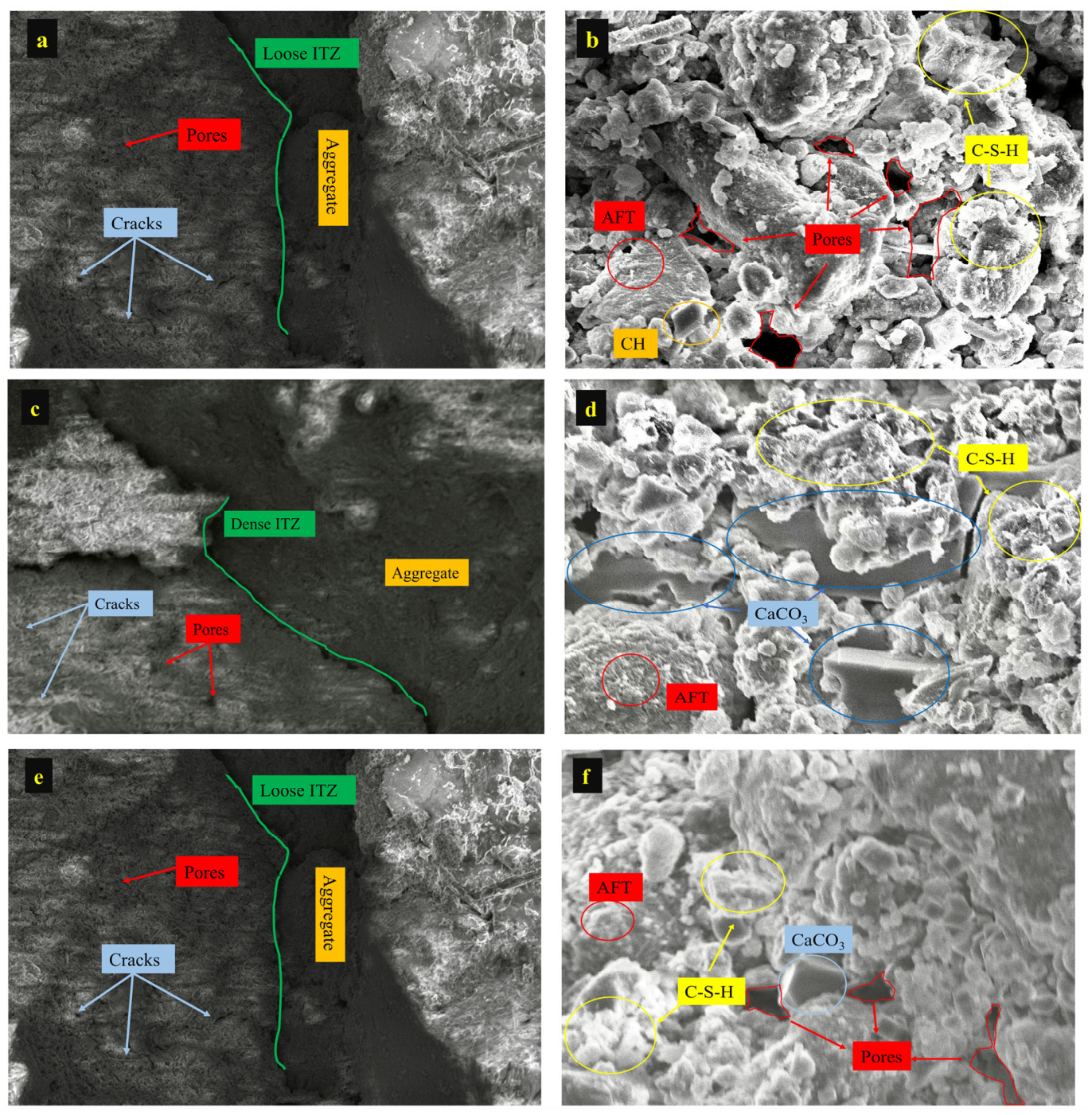
To further investigate the influence of the CRCA replacement rate on the microstructure of the CPB, the specimens were examined using SEM. Figure 10a,b reveal that the interfacial structure of the non-carbonated RCA-50 specimen is loose, containing numerous pores and microcracks. Acicular ettringite, layered C-S-H gel, and platy CH crystals are observed to be disorderly accumulated within the pores, resulting in a loose structure and high porosity.
This is consistent with its inferior mechanical properties and lower microhardness. After carbonation treatment, as shown in Figure 10c,d, the ITZ of C28d-RCA-50 becomes much denser with reduced porosity. The quantities of CH, ettringite, and C-S-H gel are significantly decreased, and a large number of tightly packed rhombic CaCO3 crystals are observed filling the pores. This microstructural densification is the primary reason for the improved microhardness and compressive strength of the specimen. Furthermore, Figure 10d,f show that the surfaces of the carbonate crystals are enveloped by C-S-H gel, indicating their further reaction with aluminates in the cement to form monocarboaluminate. This also provides nucleation sites for C-S-H, promoting further hydration development.
As observed in the SEM images, no significant difference in the types of hydration products is noted between C28d-RCA-100 and C28d-RCA-50. However, in the low-magnification image (Figure 10e), C28d-RCA-100 exhibits more pores and microcracks, along with poorer structural homogeneity. This is likely attributed to the increased interfacial defects between the aggregate and the paste at the higher replacement rate, coupled with insufficient CaCO3 crystals to completely fill the enlarged pore space. This results in an increase in interconnected pores and a degradation of structural performance, consequently explaining why the compressive strength of C28d-RCA-100 is lower than that of C28d-RCA-50.

4. Conclusions

A large amount of concrete construction waste is often generated during the demolition of abandoned buildings, which not only occupies land resources but also tends to cause environmental problems. Addressing the key issue that the performance defects of RCA restrict its resource utilization, this study adopts carbonation modification technology to enhance the performance of RCA, aiming to realize the efficient secondary utilization of RCA. Combining macro mechanical property tests with microstructural mechanism analysis, the research systematically explores the influence law of the content of carbonated modified RCA on the working performance of mine CPB. The main conclusions are summarized as follows:
(1)
Carbonation treatment can significantly improve the physical properties of RCA. Compared with the original RCA, the apparent density and bulk density of CRCA are both increased, and the crushing value is significantly reduced.
(2)
CRCA can significantly enhance the compressive strength of CPB, and the enhancement effect is closely related to the carbonation age and content. The compressive strength of the CPB with the C28d-RCA-50 content group reaches 6.38 MPa, which is 62.76% higher than that of the reference group; the strength of the 100% content group is increased by 47.45%, but lower than that of the 50% content group.
(3)
Microscopic test results show that carbonation can significantly reduce the total porosity of CPB and refine the pore size distribution. The carbonation product CaCO3 can effectively fill internal voids, alleviating the pore deterioration effect introduced by RCA. Under a 50% replacement rate, carbonation can significantly improve the microhardness of each region (increased by 31.67%–73.33%) and reduce the interface width. The defect repair and structural densification effects can offset the impact of aggregate deterioration.
(4)
The optimally proportioned CRCA-50 and CRCA-100 fully meet the mechanical performance requirements for conventional mine CPB, with the advantages of wide raw material sources and solid waste resource utilization attributes. Considering both the mechanical modification effect and RCA resource utilization rate, C28d-RCA-50 exhibits the best overall performance, and it is recommended as the preferred scheme for preparing CPB in practical mine paste filling engineering.

Author Contributions

Conceptualization, S.Z.; Methodology, H.Z.; Formal analysis, S.Z.; Investigation, S.Z. and H.R.; Resources, Y.L.; Data curation, L.M., H.F. and H.R.; Writing – original draft, H.Z.; Visualization, L.M. and H.F.; Supervision, S.Z. and H.L.; Project administration, Y.L.; Funding acquisition, Y.L. and H.L. All authors have read and agreed to the published version of the manuscript.

Funding

This research was funded by the State key Laboratory of Mining Disaster Prevention and Control (Shandong University of Science and Technology), Ministry of Education, Qingdao 266590, China, grant number JMDPC202604 and the National Youth Fund (grant number 52004147).

Data Availability Statement

The data that support the findings of this study are available from the corresponding author upon reasonable request.

Conflicts of Interest

The authors declare that they have no known competing financial interests or personal relationships that could have appeared to influence the work reported in this paper.

Abbreviations

The following abbreviations are used in this manuscript:
CPBCemented paste backfill
RCARecycled concrete aggregate
CRCACarbonation recycled concrete aggregates
ITZInterfacial transition zone
CaCO3Calcium carbonate
C-S-HCalcium Silicate Hydrate
CHCalcium Hydroxide
DTGDerivative thermogravimetry
XRDX-ray diffractometer
SEMScanning electron microscope
SiO2Silicon Dioxide
MIPMercury Intrusion Porosimetry

References

  1. Luo, Y.J.; Zhao, W. The research development of construction and demolition waste resource utilization and its life cycle assessment. Environ. Pollut. Control 2024, 46, 901–907. [Google Scholar]
  2. Duan, Z.H.; Deng, Q.; Xiao, J.Z.; Zhuang, Y.T.; Li, J.L.; Xia, B.; Zhang, S.J.; Xiao, X.W. Building Demolition and Solid Waste Recycling Technologies: Prospects and Paths. Strateg. Study Chin. Acad. Ofengineering 2025, 27, 117–128. [Google Scholar]
  3. Jiao, Y.; Fang, X.W.; Shen, C.N.; Tian, J.; Huang, S.; Jiang, W.C. Research progress on recycling and utilization of brick-concrete construction waste. J. Civ. Environ. Eng. 2025, 27, 117–128. [Google Scholar]
  4. Antunes, A.; Silvestre, J.; Costa, H.; Carmo, R.D.; Júlio, E. Reducing the environmental impact of the end-of-life of buildings depending on interrelated demolition strategies, transport distances and disposal scenarios. J. Build. Eng. 2024, 82, 108197. [Google Scholar] [CrossRef]
  5. Ramalingam, M.; Sivamani, J.; Narayanan, K. Performance studies on recycled aggregate concrete with treated recycled aggregates. Waste Dispos. Sustain. Energy 2023, 5, 451–459. [Google Scholar] [CrossRef]
  6. Huang, B.; Wang, X.; Kua, H.; Geng, Y.; Bleischwitz, R.; Ren, J. Construction and demolition waste management in China through the 3R principle. Resour. Conserv. Recycl. 2018, 129, 36–44. [Google Scholar] [CrossRef]
  7. Zou, Z.; Sun, J.; Liu, K.; Tian, X.; Yan, X.Y. Sustainable security capacity of China’s coal resources: Restructuring occurrence patterns and optimizing development pathways. China Min. Mag. 2025, 34, 1–6. [Google Scholar]
  8. Wu, Z.; Chang, H.; Ou, G.; Zhang, Z.; Li, X.; Xu, P.; Yang, J.; Zhang, H.; Qi, F. Research on China’s coal resource status and progress of clean utilization technology under the “carbon peak and carbon neutrality” background. Appl. Chem. Ind. 2025, 54, 1036–1041. [Google Scholar]
  9. Wang, Y.; Wu, J.; Pu, H. Effect of calcium formate as an accelerator on dilatancy deformation, strength and microstructure of cemented tailings backfill. Chemosphere 2022, 291, 132710. [Google Scholar] [CrossRef]
  10. Qi, C.; Zheng, J.; Yang, X.; Chen, Q.; Wu, M. Application of deep neural network in the strength prediction of cemented paste backfill based on a global dataset. Constr. Build. Mater. 2023, 391, 131827. [Google Scholar] [CrossRef]
  11. Yao, Y.; El Naggar, M.H.; Zhang, J.; Xu, J.; Yang, J.; Li, M. Dynamic mechanical properties of coal-based solid waste cemented backfill material. J. Build. Eng. 2024, 98, 111347. [Google Scholar] [CrossRef]
  12. Zhao, Z.; Ma, L.; Ngo, I.; Yu, K.; Xu, Y.; Zhai, J.; Gao, Q.; Peng, C.; Wang, D.; Alarifi, S.S.; et al. Experimental investigation on hydrophobic alteration of mining solid waste backfill material. Minerals 2024, 14, 580. [Google Scholar] [CrossRef]
  13. Zhou, K.; Gong, K.; Zhou, Q.; Zhao, S.; Guo, H.; Qian, X. Estimating the feasibility of using industrial solid wastes as raw material for polyurethane composites with low fire hazards. J. Clean. Prod. 2020, 257, 120606. [Google Scholar] [CrossRef]
  14. Song, W.; Zhang, J.; Li, M.; Yan, H.; Zhou, N.; Yao, Y.; Guo, Y. Underground disposal of coal gangue backfill in China. Appl. Sci. 2022, 12, 12060. [Google Scholar] [CrossRef]
  15. Zhang, L.M.; Lai, X.P.; Pan, J.L.; Shan, P.F.; Zhang, Y.; Zhang, Y.; Xu, H.C.; Cai, M.F.; Xi, X. Experimental investigation on the mixture optimization and failure mechanism of cemented backfill with coal gangue and fly ash. Powder Technol. 2024, 440, 119751. [Google Scholar] [CrossRef]
  16. Ji, Y.; Xie, L.; Xiao, J.; Zheng, Y.; Ma, S.; Pan, T. Mechanical properties and acoustic emission characteristics of microbial cemented backfill with various particle size distributions of recycled aggregates. Constr. Build. Mater. 2024, 417, 135269. [Google Scholar] [CrossRef]
  17. Jiang, T.; Cao, X.; Duan, H.; Shu, K. Recycling efficiency mechanism of recycled concrete aggregate to improve the CO2 uptake and anti-leakage properties of CO2 sequestration functional backfills. Constr. Build. Mater. 2025, 458, 139663. [Google Scholar] [CrossRef]
  18. Ji, H.; Feng, Y.; Li, H.; Xin, Y.; Li, J.; Zhang, D.; Gao, Z.; Ren, J. Pore-fractal-permeability model and its experimental analysis of construction waste filling body with high fine-particle content. Environ. Earth Sci. 2024, 83, 365. [Google Scholar] [CrossRef]
  19. Ji, H.Y.; Li, H.; Zhang, D.Y.; Gao, Z.G.; Li, J.L.; Xin, Y.J. Analysis of Mechanical Characteristics and Cementation Properties on Construction Waste Filling Specimens. Environ. Eng. 2024, 42, 187–195. [Google Scholar]
  20. Wang, B.; Yan, L.B.; Fu, Q.N.; Kasal, B. A comprehensive review on recycled aggregate and recycled aggregate concrete. Resour. Conserv. Recycl. 2021, 171, 105565. [Google Scholar] [CrossRef]
  21. Kim, J. Influence of quality of recycled aggregates on the mechanical properties of recycled aggregate concretes: An overview. Constr. Build. Mater. 2022, 328, 127071. [Google Scholar] [CrossRef]
  22. Luo, S.; Ye, S.; Xiao, J.; Zheng, J.; Zhu, Y. Carbonated recycled coarse aggregate and uniaxial compressive stress-strain relation of recycled aggregate concrete. Constr. Build. Mater. 2018, 188, 956–965. [Google Scholar] [CrossRef]
  23. Jean, B.; Liu, H.; Zhu, X.; Wang, X.; Yan, X.; Ma, T. Enhancing the mechanical and durability properties of fully recycled aggregate concrete using carbonated recycled fine aggregates. Materials 2024, 17, 1715. [Google Scholar] [CrossRef]
  24. Kaliyavaradhan, S.K.; Ling, T.C. Potential of CO2 sequestration through construction and demolition (C&D) waste—An overview. J. CO2 Util. 2017, 20, 234–242. [Google Scholar]
  25. Lin, W.W.; Hu, R.; Zhou, Y.W.; Xu, W.; Zhuang, J. Effect of carbonation on the cyclic behavior of recycled aggregate concrete: Test, simulation and constitutive model. Constr. Build. Mater. 2024, 452, 138718. [Google Scholar] [CrossRef]
  26. Pan, G.; Zhan, M.; Fu, M.; Wang, Y.; Lu, X. Effect of CO2 curing on demolition recycled fine aggregates enhanced by calcium hydroxide pre-soaking. Constr. Build. Mater. 2017, 154, 810–818. [Google Scholar] [CrossRef]
  27. Li, Y.; Fu, T.H.; Wang, R.J.; Li, Y. An assessment of microcracks in the inter facial transition zone of recycled concrete aggregates cured by CO2. Constr. Build. Mater. 2020, 236, 117543. [Google Scholar] [CrossRef]
  28. Yilmaz, T.; Ercikdi, B.; Deveci, H. Utilisation of construction and demolition waste as cemented paste backfill material for underground mine openings. J. Environ. Manag. 2018, 222, 250–259. [Google Scholar] [CrossRef]
  29. Liu, Y.; Guo, Y.L.; Li, H.; Wang, H. Experimental study on effect of recycled aggregate from construction waste on onveying performance of mine filling paste. J. Shandong Univ. Sci. Technol. (Nat. Sci.) 2020, 39, 59–65. [Google Scholar]
  30. Feng, S.; Jin, J.; Wang, X.B.; Zhao, N.N.; He, Z. Study on the Performance and Hydration Mechanism of Mineral Admixture Cooperate with Construction Waste Filling Materials. Min. Res. Dev. 2023, 43, 77–82. [Google Scholar]
  31. Zhao, B.L.; Liu, S. Study on the Strength Mechanism of Construction Waste-Fly Ash Cementitious Filling Material. Non-Met. Mines 2023, 46, 82–87. [Google Scholar]
  32. JGJ63-2006; Standard of Water for Concrete. China Construction Industry Press: Beijing, China, 2006.
  33. Song, B.C.; Yan, H.; Cui, H.M.; Liu, J.K.; Qin, H.T.; Wang, J. Influence of Carbonation on Chloride Ion Penetration Resistance of CO2 Modified Recycled Aggregate Concrete. Mater. Rev. 2023, 37, 147–150. [Google Scholar]
  34. GB/T50082-2009; Standard for Test Methods of Long-Term Performance and Durability of Ordinary Concrete. China Architecture & Building Press: Beijing, China, 2009.
  35. Kaddah, F.; Ranaivomanana, H.; Amiri, O.; Rozière, E. Accelerated carbonation of recycled concrete aggregates: Investigation on the microstructure and transport properties at cement paste and mortar scales. J. CO2 Util. 2022, 57, 101885. [Google Scholar] [CrossRef]
  36. Zhan, B.J.; Poon, C.S.; Liu, Q.; Kou, S.C.; Shi, C.J. Experimental study on CO2 curing for enhancement of recycled aggregate properties. Constr. Build. Mater. 2014, 67, 3–7. [Google Scholar] [CrossRef]
  37. Liu, Y.; Min, L.; Zhang, S.; Fang, H.; Wang, C.; Du, Y. Study on the thermal-mechanical properties and heat transfer characteristics of low leakage heat storage functional backfill body. J. Energy Storage 2024, 94, 112257. [Google Scholar] [CrossRef]
  38. JGJ52-2006; Quality Standards and Testing Method of Sand and Crushed Stone or Pebbles Used Forordinary Concrete. China Construction Industry Press: Beijing, China, 2006.
  39. GB/T50107-2010; Standard for Evaluation of Concrete Comprehensive Strength. China Architecture & Building Press: Beijing, China, 2010.
  40. Wu, C.R.; Hong, Z.Q.; Zhang, J.L.; Kou, S.C. Pore size distribution and ITZ performance of mortars prepared with different bio-deposition approaches for the treatment of recycled concrete aggregate. Cem. Concr. Compos. 2020, 111, 103631. [Google Scholar] [CrossRef]
Figure 1. Particle size distribution of coal gangue and RCA.
Minerals 16 00420 g001
Figure 2. RCA pretreatment and carbonation process.
Minerals 16 00420 g002
Figure 3. DTG curves of RCA non-carbonated and carbonic acid bonded mortars: (a) 0–5 mm and (b) 5–25 mm.
Minerals 16 00420 g003
Figure 4. Phenolphthalein color development.
Minerals 16 00420 g004
Figure 5. Physical properties of gangue, RCA and CRCA.
Minerals 16 00420 g005
Figure 6. Changes in compressive strength: (a) RCA and CRCA; (b) RCA-50 and CRCA-50; and (c) RCA-100 and CRCA-100.
Minerals 16 00420 g006
Figure 7. Microhardness distribution of CPB with different RCA/CRCA replacement ratios: (a) 50% replacement; (b) 100% replacement.
Minerals 16 00420 g007
Figure 8. Sample Characteristics: (a) XRD profile of the sample; (b) Infrared spectra of the sample.
Minerals 16 00420 g008
Figure 9. Pore size distribution of the CPB.
Minerals 16 00420 g009
Figure 10. ITZ microstructure under scanning electron microscope: (a) RCA-50 100× magnification; (b) RCA-50 1000× magnification; (c) C28d-RCA-50 100× magnification; (d) C28d-RCA-50 1000× magnification; (e) C28d-RCA-100 100× magnification; and (f) C28d-RCA-100 1000× magnification.
Minerals 16 00420 g010
Table 1. Chemical compositions of cement, fly ash, and coal gangue (wt%).
SamplesSiO2Al2O3Fe2O3MgOCaONa2OK2OOthers
Cement18.456.323.873.5161.870.180.145.66
Fly Ash52.5331.212.470.946.841.27-4.74
Coal Gangue59.1018.904.301.418.130.431.895.84
Table 2. Physical and mechanical properties of coal gangue and RCA.
SamplesApparent Density (kg/m3)Bulk Density (kg/m3)Water Absorption (%)Crushing Index (%)
Coal gangue2701.251387.841.415.67
RCA2560.211310.647.9612.81
Table 3. Mix proportion of filling slurry (g).
SamplesCementFly AshAggregateWaterSuperplasticizer
Coal GangueRCACRCA
(C)RCA-03201280192011114.2
RCA-50320128096096011114.2
RCA-1003201280192011114.2
CRCA-50320128096096011114.2
CRCA-1003201280192011114.2
Disclaimer/Publisher’s Note: The statements, opinions and data contained in all publications are solely those of the individual author(s) and contributor(s) and not of MDPI and/or the editor(s). MDPI and/or the editor(s) disclaim responsibility for any injury to people or property resulting from any ideas, methods, instructions or products referred to in the content.