


Abstract
High-pressure grinding rolls (HPGRs) are critical in mineral processing, making comprehensive research and analysis of their performance of great significance. This study focuses on the HPGR-3516 test prototype and develops an analytical model that combines the discrete element method (DEM) with multi-body dynamics (MBD). The influences of feed top size, roll speed, and specific press force on equipment performance were examined using analysis of variance (ANOVA) in conjunction with response surface methodology (RSM). A performance prediction model was established through regression analysis, followed by multi-objective optimization and experimental validation. The results indicate that increasing roll speed under high specific press force significantly reduces the roll gap, while the effect is negligible under low specific press force. Increasing roll speed improves throughput more substantially for fine feed than for coarse feed. The optimal process parameters were determined to be a feed top size of 8 mm, a roll speed of 0.37 m/s, and a specific press force of . In comparison to the original parameters, throughput increased by 15.81%, qualified particle size passing rate (QPR) improved by 7.85%, and roll gap decreased by 10.24%. This study offers valuable insights into predicting the dynamic performance of HPGRs and has significant engineering implications.
1. Introduction
High-pressure grinding rolls (HPGRs) were first introduced in the 1980s, initially serving the cement and diamond industries [1]. They are now extensively utilized for crushing various metal ores, including iron, copper, gold, and diamond ores [2]. The crushing mechanism relies on the inter-particle high-pressure crushing theory developed by Professor Schönert’s team [3], which facilitates ore breakage through slow, high-pressure compression. Compared to traditional crushing equipment, HPGRs present significant advantages, including high throughput capacity, low unit energy consumption, and enhanced operational efficiency [4]. Consequently, a comprehensive analysis of HPGR performance is of considerable importance.
Torres and Casali developed a model to evaluate throughput and energy consumption, incorporating operational parameters, characteristics of the crushing process, and ore properties [5]. Thivierge introduced a continuum theory-based model to predict the particle size distribution of products in the edge region [6,7]. Daniel and Morrell validated models concerning product particle size distribution, throughput, and energy utilization efficiency of HPGRs [8]. Campos systematically examined the effects of critical factors, including feed particle size distribution, roll pressure, roll speed, and moisture content on crushing performance [9]. Solomon investigated the influence of roll gap and feed particle size on product particle size distribution [10]. While these studies provide a valuable theoretical foundation for HPGRs, their conclusions primarily rely on physical experiments. However, the complexity of HPGR operations renders experimental studies both costly and time-consuming.
Recently, the discrete element method (DEM) has been extensively utilized in the simulation of crushing equipment performance, such as HPGRs [11]. Cleary utilized DEM to reveal the roll surface pressure distribution, particle flow behavior, and energy transfer mechanisms during the crushing process [12]. Kumar employed DEM to model the crushing operation of a laboratory-scale HPGR, clarifying the influence of process parameters on throughput and energy consumption [13]. Guo examined the effects of structural parameters and feed particle size on HPGR performance [14]. Zhang simulated the dynamic characteristics of particles in HPGRs using the discrete element method [15]. Consequently, DEM has emerged as an essential tool for investigating HPGRs, providing substantial support for comprehensive analyses of equipment performance.
The comminution performance of HPGRs is influenced by various process parameters, which may exhibit complex interactions. However, existing studies have predominantly focused on single-factor analyses, whether derived from physical experiments or DEM simulations, thus neglecting the intricate interactions among critical process parameters. Nagata and Thivierge overlooked the fact that the effect of specific press force on roll gap varies with roll speed [16,17]; Vander overlooked the fact that the effect of roll speed on throughput varies with feed top size [18]. Therefore, it is of great significance to study the influence of multi-parameter interactions on the performance of high-pressure grinding rolls.
This study systematically investigates the individual and interactive effects of feed top size, roll speed, and specific press force on throughput, qualified particle size passing rate (QPR), and roll gap on HPGRs. A discrete element method (DEM) and multibody dynamics (MBD) co-simulation approach is utilized, along with analysis of variance (ANOVA) and response surface methodology (RSM). Through multi-objective parameter optimization and experimental validation, the optimal combination of process parameters for the HPGR-3516 is determined.
2. Materials and Methods
2.1. Operating Principle of HPGRs
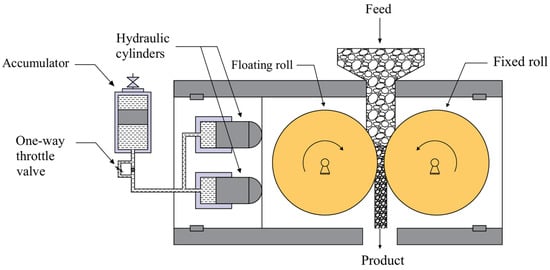
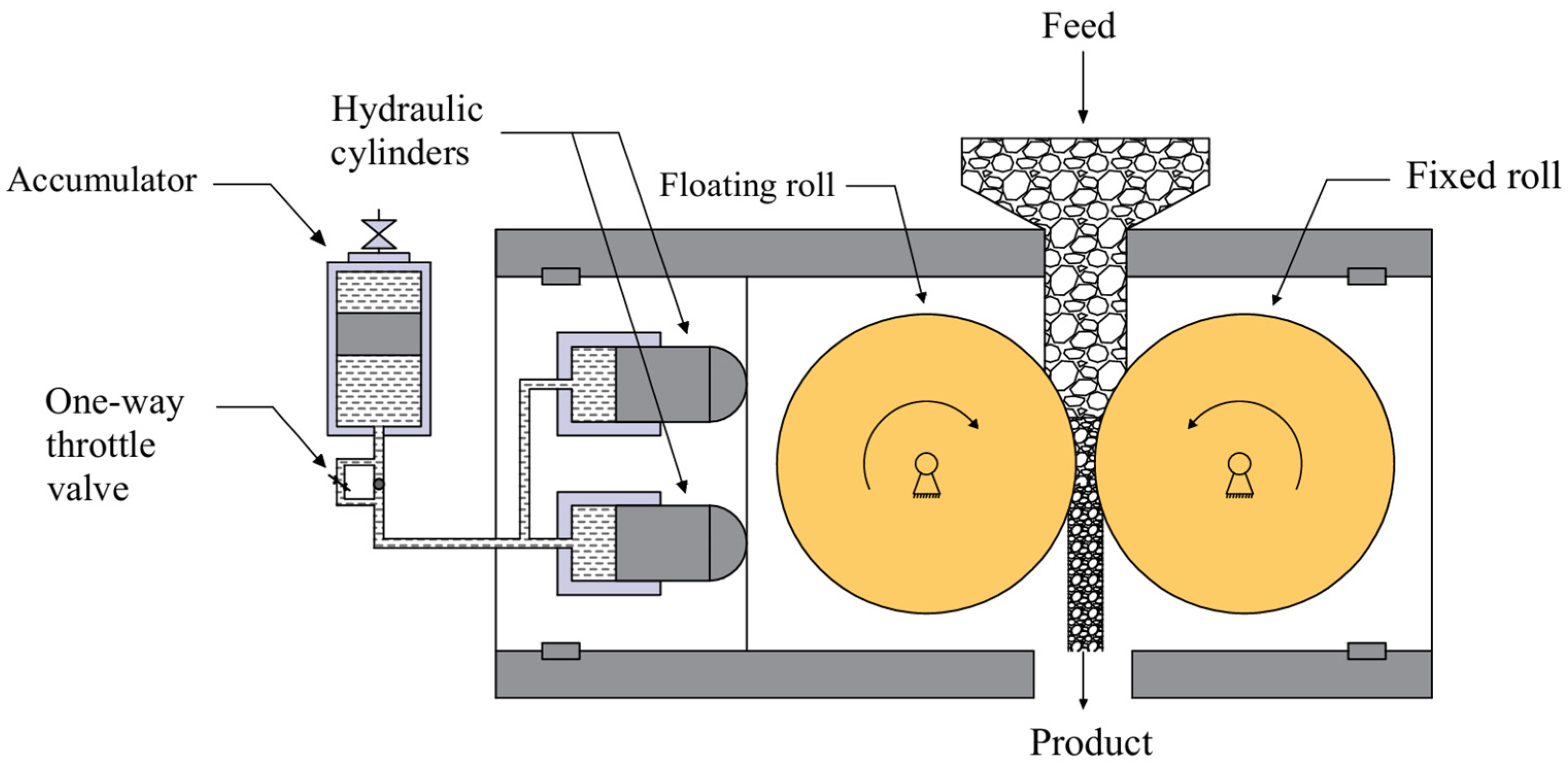
Figure 1 illustrates the structure of the HPGR, which primarily consists of the feed chute, fixed roll, floating roll, hydraulic cylinders, and other key components. The operational principle of the HPGR relies on the application of compressive forces between two counter-rotating rolls, facilitating interparticle breakage through a bed compression mechanism. The throughput model for the HPGR can be derived based on several factors, including roll gap width, roll diameter, roll rotational speed, roll surface length, and the density of the material bed. According to the law of mass conservation, the mass of material within the compression zone remains constant. Assuming no relative slip occurs between the roll surfaces and the material, the unit throughput of the HPGR can be expressed as
Figure 1.
Schematic diagram of the HPGR structure.
In the equation, represents the unit throughput of the HPGR at any central angle , ; represents the material density at any central angle , ; represents the roll gap at any central angle , ; represents the linear speed of the rolls, ; and stands for the roll width, .
Equation (1) provides the theoretical throughput expression based on the law of mass conservation, offering a physical basis for understanding the passage capacity of the HPGR. However, this equation relies on idealized assumptions, such as no slip and constant material bed density, which are difficult to strictly satisfy in actual dynamic crushing processes. Therefore, instead of directly calculating throughput using Equation (1), this study treats it as a theoretical reference. The actual throughput is directly obtained from the mass flow sensor installed at the discharge outlet in EDEM, which more realistically reflects the instantaneous passage capacity during the dynamic crushing process.
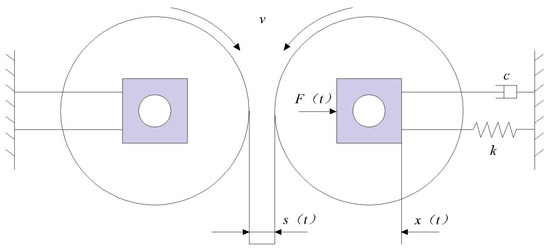
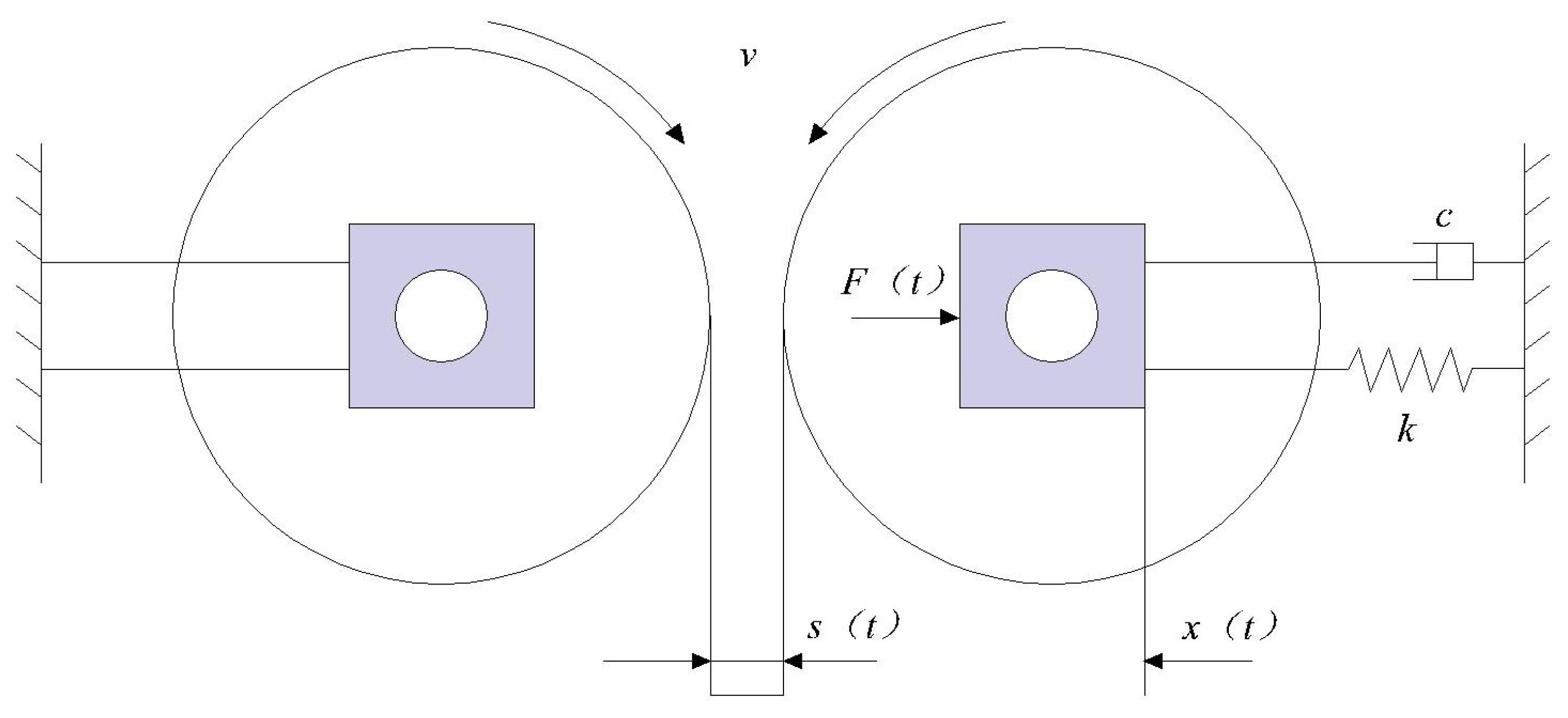
Throughout the comminution process of the HPGR, the rotational speeds of both the floating roll and the fixed roll remain constant. The floating roll undergoes reciprocating transverse displacement due to the compressive forces from the material and counteracting hydraulic forces. This transverse movement resembles a spring–damper system, as illustrated in Figure 2. The dynamic model of the floating roll was first proposed based on the relevant studies by Bauer and has since been widely adopted in the dynamic analysis of HPGRs [19]. Based on this model, Rodriguez developed a dynamic simulation model of the floating roll and systematically investigated the influence of key process parameters on HPGR performance [20].
Figure 2.
Dynamic roll gap model of the HPGR.
As shown in Figure 2, the positive direction is defined as the rightward movement of the floating roll. According to Newton’s second law, the motion of the floating roll can be described by the following differential equation:
In the equation, , , and represent the displacement of the floating roll at the current time, m; velocity, ; and acceleration, . The spring restoring force opposes the displacement and therefore takes a negative sign, . The damping force opposes the velocity and therefore takes a negative sign, . The external force is the force exerted by the material on the floating roll, with the rightward direction taken as positive, . The spring stiffness depends on the equivalent stiffness of the hydraulic system, ; while the damping coefficient reflects the energy dissipation characteristics of the hydraulic oil and sealing system, . is the mass of the floating roll, . is the time interval, .
The explicit Euler method is used to integrate the acceleration over time:
In the equation, , , and represent the displacement of the floating roll at the next time step, m; velocity, ; and acceleration, .
The dynamic roll gap is defined as
where is the roll gap size at the current time, ; is the static roll gap, . The model assumes that the floating roll moves only in the horizontal direction and that both spring and damping forces are linear, which is suitable for describing small-amplitude dynamic fluctuations of the roll gap.
2.2. Ore Particle Model
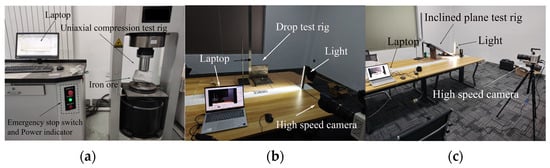
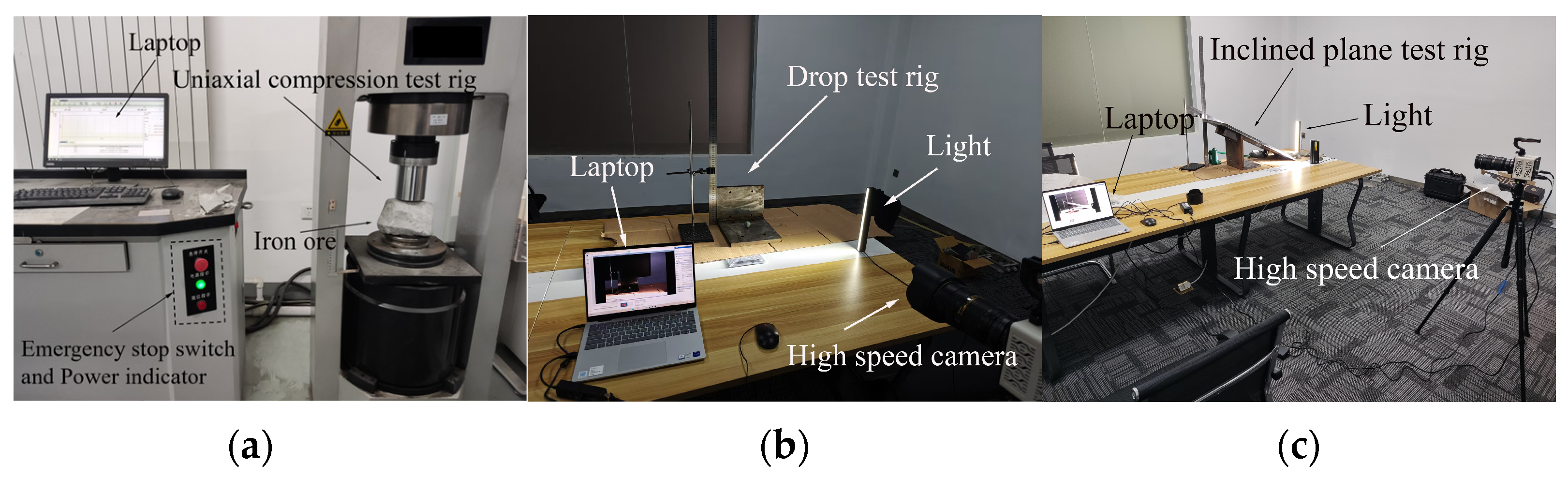
This study investigated vanadium–titanium magnetite obtained from the Chengde region in Hebei Province, China. To establish accurate parameters for simulation, the physical and contact parameters of the ore were calibrated through uniaxial compression tests, collision tests, and friction coefficient experiments. The findings are illustrated in Figure 3a–c and summarized in Table 1 and Table 2. For analysis, the average values from three repetitions of each test were utilized.
Figure 3.
Parameter calibration experiment: (a) uniaxial compression test; (b) elastic collision experiment; (c) inclined plane friction test.
Table 1.
Material physical parameters.
Table 2.
Material contact parameters.
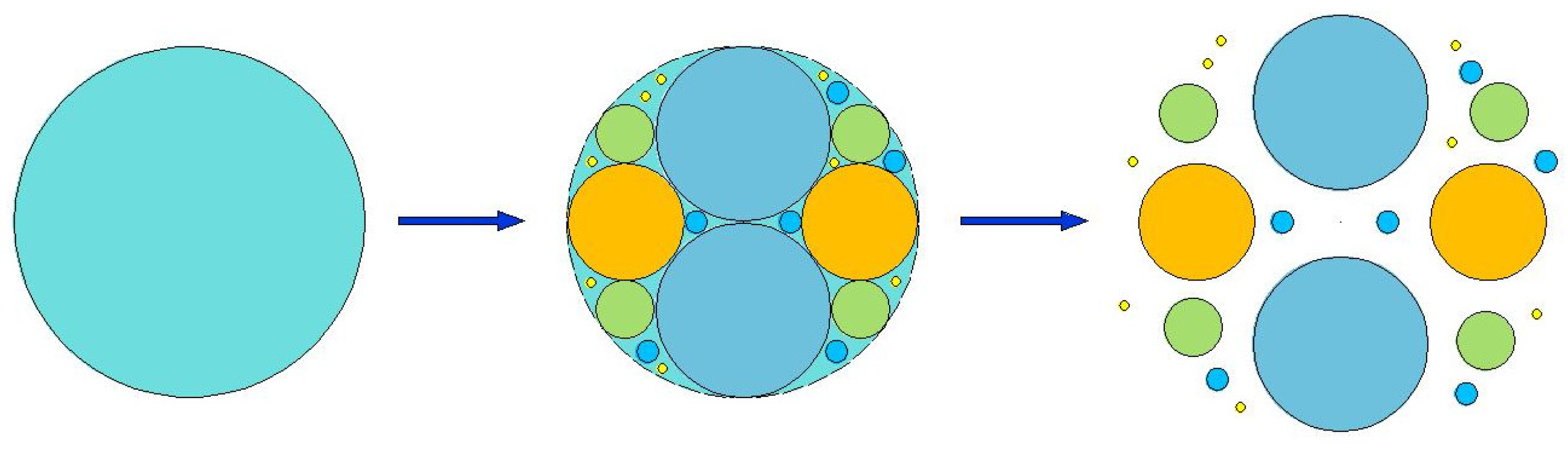
Cleary systematically described the implementation framework for simulating particle breakage using the particle replacement method in DEM [12]. Building on this foundation, Barrios conducted further in-depth research on the particle replacement model [21]. Tavares developed a stochastic particle replacement strategy that enables accurate representation of fragment size distributions and accounts for particle weakening by repeated stressing, which has been systematically implemented and validated for spherical particles in DEM simulations [22]. The Tavares breakage model effectively simulates the crushing of iron ore under high-pressure conditions. This model operates on the principle of energy conservation, where particles break when the impact energy exceeds the breakage energy. Particles that remain intact sustain damage, thereby reducing the breakage energy required for subsequent impacts [23]. Additionally, the model can also statistically predict the particle size distribution after breakage, directly reflecting the crushing performance. A schematic diagram of the Tavares breakage principle is illustrated in Figure 4.
Figure 4.
Tavares crushing principle.
The Tavares breakage model calculates the specific breakage energy assigned to individual particles by considering their size, mean breakage energy, and standard deviation, in accordance with the distribution described by the equation [24,25].
In the equation, represents the breakage energy distribution, ; represents the median value of the energy distribution, ; represents the upper limit of the energy distribution, ; and represents the standard deviation.
In the DEM simulation, the current impact energy is calculated for each contact between particles or between a particle and the roll surface. The normalized impact energy is first calculated using Equation (6) and then substituted into Equation (5) to obtain the breakage probability . A random number uniformly distributed in [0, 1] is generated, and the particle is determined to break if this random number is less than .
The median breakage energy is given by the following formula:
In the equation, represents the ultimate breakage energy, ; and represent the hardness of the particle and steel, ; is a parameter adjusted based on experimental data; and represents the characteristic particle size in the ore, . represents the particle size, .
In the equation, represents the breakage energy of the particle, ; represents the effective collision energy, ; represents the damage coefficient; and represents the damage accumulation coefficient. The Tavares breakage model primarily relies on the parameter .
When a particle is compressed but does not break, its breakage energy is updated according to Equations (8) and (9). The damage coefficient increases with cumulative impact energy, making the particle more susceptible to breakage in subsequent impacts. After each impact, the particle’s current breakage energy is updated as . Damage accumulation is tracked through user-defined particle properties, with each particle independently recording its cumulative damage value.
In the equation, and represent parameters adjusted based on experimental data. A higher value of indicates that the newly generated particles are finer.
When a particle is determined to break, the value is first calculated using Equation (10), which represents the mass percentage of fragments smaller than one-tenth of the parent particle size [26]. Based on the empirical relationship between and the fragment size distribution established by the Tavares team, the complete fragment size distribution is then generated. The number of fragments is automatically calculated based on the parent particle mass and the fragment size distribution, ensuring mass conservation before and after breakage.
Based on the research findings of the Tavares team and referring to the parameter calibration by Rodriguez [20], the obtained fracture parameters are listed in Table 3. , , and were determined by the uniaxial compression test shown in Figure 3a; and were fitted from multiple impact tests; was determined by cyclic loading tests; and was set to 2 mm to avoid excessive computational cost.
Table 3.
Tavares crushing model parameters.
2.3. DEM-MBD Co-Simulation Model
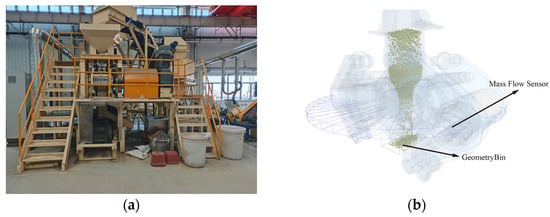
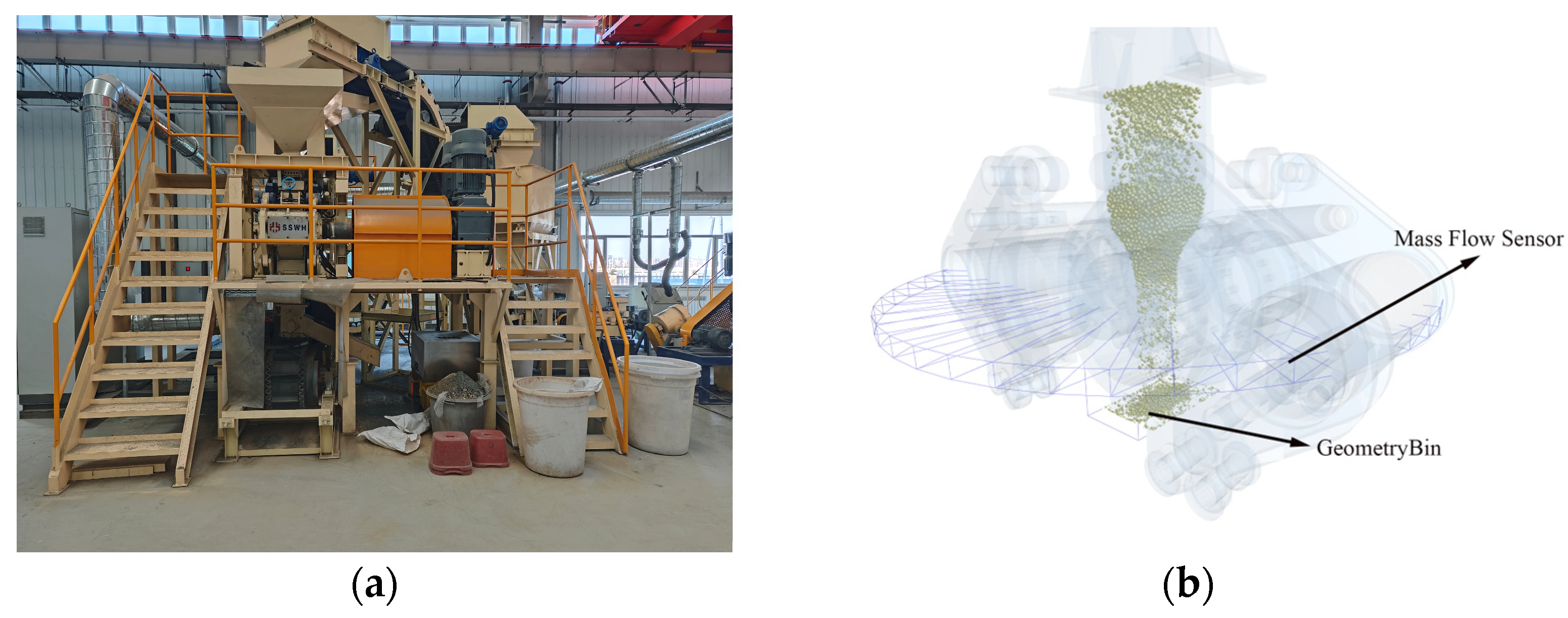
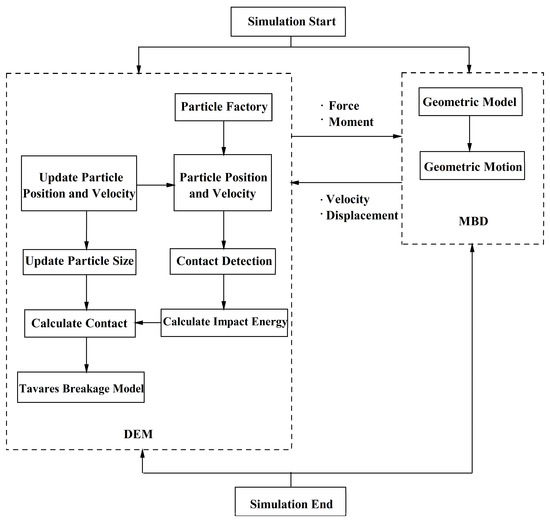
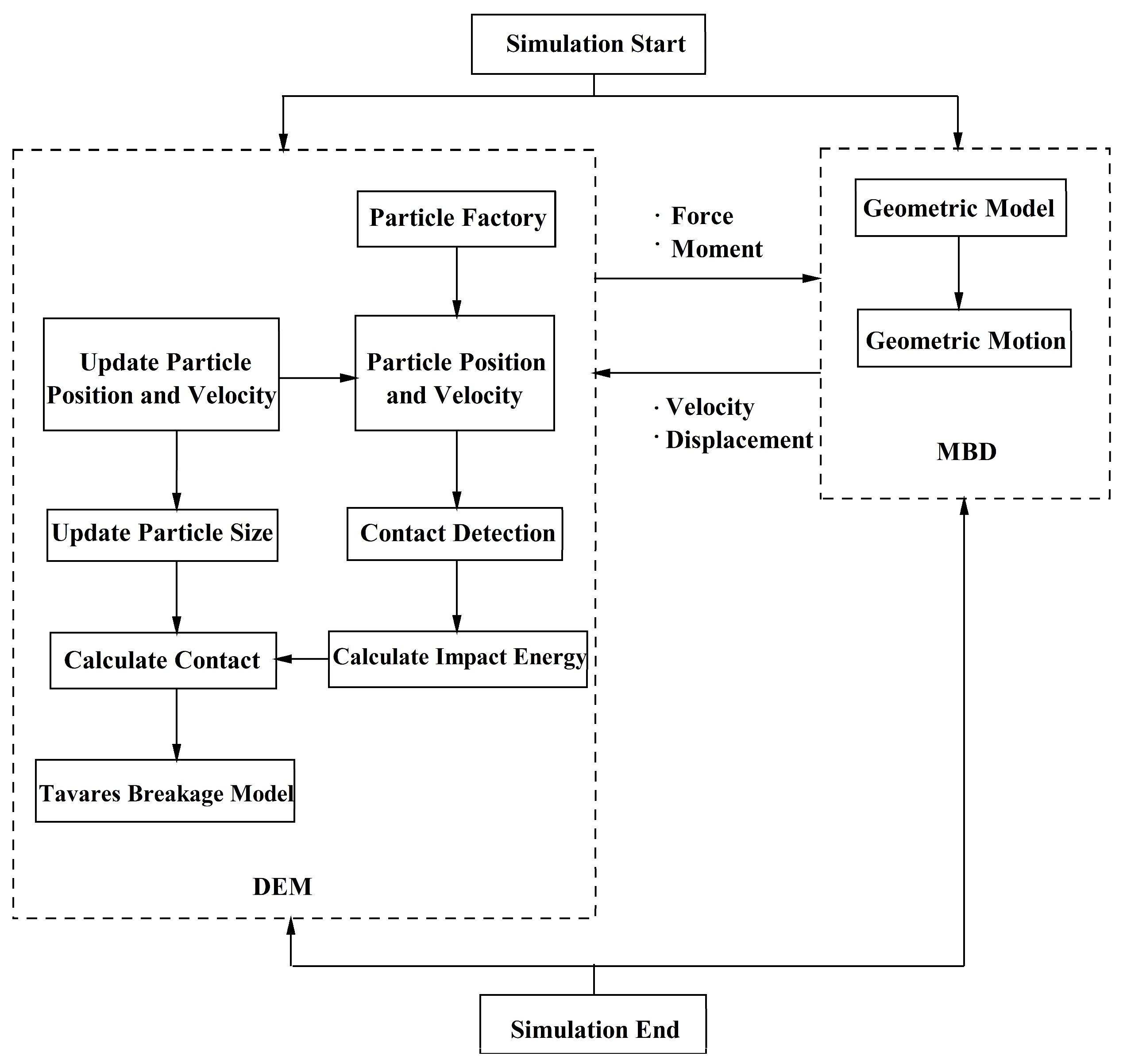
Based on the HPGR-3516 test prototype (Figure 5a) as a foundation, a simulation model of the HPGR was developed, with equipment parameters outlined in Table 4. Based on the geometric structure and kinematic relationships of the test prototype, a discrete element method (DEM) model was created in EDEM software 2022, while a multi-body dynamics (MBD) model was constructed in Recurdyn 2022. Real-time data exchange was facilitated through the co-simulation interface to accurately replicate the motion process of the HPGR. The co-simulation workflow is illustrated in Figure 6.
Figure 5.
Experimental equipment: (a) HPGR-3516; (b) simulation model.
Table 4.
Specific equipment parameters.
Figure 6.
DEM-MBD co-simulation flow chart.
As shown in Figure 5b, a geometry bin and a mass flow sensor were positioned at the discharge outlet within the EDEM 2022 to monitor the particle size of the crushed product and the mass flow rate. The dynamic roll gap was obtained from the displacement output of the floating roll in RecurDyn 2022, which was updated at each time step and accurately reflects the transient variation in the roll gap. This direct measurement approach avoids the deviations introduced by the idealized assumptions in theoretical formulas and is consistent with the measurement methods adopted by Negata and Rodriguez [16,20].
In constructing the simulation model, the force exchange used an explicit coupling scheme. At each time step, EDEM 2022 transferred the contact forces on the rolls to Recurdyn 2022, which then calculated the displacement of the floating roll and updated its position. Both solvers used the same time step of 1 × 10⁻⁶ s, and no time lag was assumed between solvers. The roll motion was treated dynamically, considering the inertia, damping, and spring forces of the floating roll. It was also assumed that the floating roll moves only in the horizontal direction, and both spring and damping forces are linear, which is suitable for describing small-amplitude dynamic fluctuations of the roll gap.
2.4. Feed Condition Settings
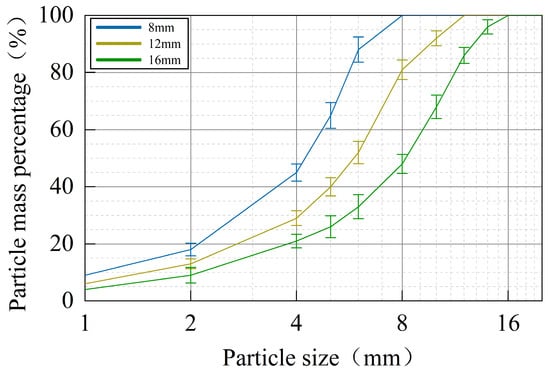
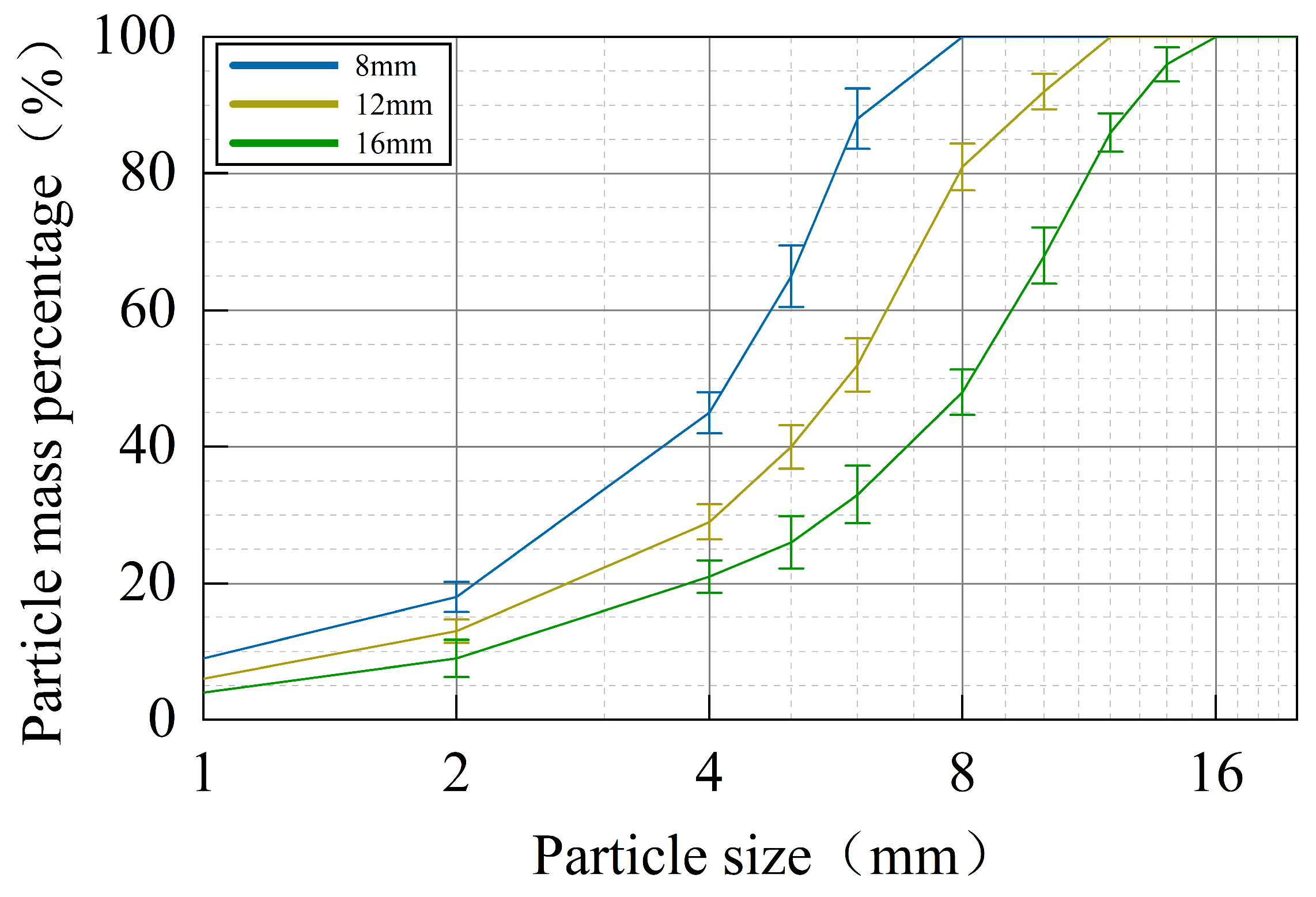
To examine the impact of feed top size on equipment performance, three feed scenarios with varying top sizes (8 mm, 12 mm, and 16 mm) were prepared based on the actual screening results of the run-of-mine ore. To isolate the influence of feed top size, these three feed materials were designed to have similar particle size distribution characteristics. The cumulative particle size distribution curves are presented in Figure 7, and the characteristic parameters for each size fraction are detailed in Table 5. The particle size distributions for the simulation feeds were determined in accordance with the experimental data.
Figure 7.
PSD of different individual fractions.
Table 5.
Characteristic parameters of PSD of feed material fractions.
In the feed settings, spherical particles were used as an approximation, neglecting the effects of particle angularity. Particles within the same size class were assumed to have uniform physical and mechanical properties, with only particle size varying across different size classes. The material was pre-dried to eliminate moisture interference. Furthermore, sidewalls and cheek plates were geometrically included in the model. Since this study primarily focuses on the influence of process parameters on performance, the effects of confinement and pressure buildup are not the main concern. The HPGR-3516 has a relatively large diameter-to-width ratio, and the influence of sidewall friction on pressure accumulation in the central region is limited. Therefore, wall effects were assumed to be secondary. This assumption was based on the findings of Rodriguez [20], who reported that sidewall effects on the pressure distribution in the central region are negligible for HPGRs with a large width-to-diameter ratio.
HPGRs necessitate a specific material column height to exert pressure on the particle bed [27]. According to the findings of Cleary [12], the material height in the hopper should be at least equal to its width. Therefore, in the simulation, the feed height was set equal to the roll width, and only data obtained after the particle accumulation reached this height were deemed valid. Additionally, a constant particle generation rate of 20 kg/s was sustained to ensure a stable crushing process. The material was assumed to be uniformly distributed within the bin, and the material pressure in the bin was assumed to originate solely from the height of the material column, neglecting frictional effects from the bin walls.
2.5. Research Methodology Design
This study investigated the impact of feed top size, roll speed, and specific press force on HPGR performance. Prior to the analysis, the three key performance indicators were defined as follows: Throughput is the total mass of material processed by the HPGR per hour during stable operation (t/h), with larger values indicating better performance. The qualified particle size passing rate (QPR) is the mass percentage of particles smaller than 1 mm in the crushed product, with larger values indicating better performance; here, 1 mm was adopted as the qualified particle size threshold based on the actual product size requirements of the enterprise, reflecting the crushing efficiency of the equipment. The roll gap is the minimum distance between the two roll surfaces (mm), obtained through displacement monitoring in the simulations, with smaller values within the range of 6–16 mm indicating better performance.
The selected roll speed and specific press force were limited by equipment design parameters and complied with the recommended ranges of the national standard GB/T 45682-2025 [28]. The feed top sizes were determined based on the standard’s provision that feed size is generally 2–2.5% of roll diameter, combined with industrial practical experience that the maximum crushable size is 16 mm, effectively covering the actual operating window.
To facilitate an effective simulation study, a three-factor, three-level design was utilized, with detailed specifications outlined in Table 6. This methodology allowed variation in the three key factors across multiple levels, thereby enabling a more thorough assessment of their influence on HPGR performance.
Table 6.
Values and corresponding levels of influencing factors.
To examine the influence of each factor, this study utilized the Box–Behnken design (BBD) for regression analysis [29], consisting of 17 simulation runs, each performed in triplicate, and the results were averaged. BBD is a response surface methodology (RSM) that effectively evaluates interaction effects and nonlinear relationships among various factors, making it suitable for constructing quantitative prediction models between multiple variables and responses [30]. This methodology was employed to develop a performance prediction model for the HPGR using multivariate linear regression. The coded prediction model is
In the equation, is the response value of the performance indicator, represents the coded value of the influencing factor, and represents the corresponding coefficient in coded space, as illustrated in Equation (12).
where represents the coded value of the k-th level of the j-th influencing factor, while N represents the total number of simulation runs.
3. Results and Discussion
3.1. Validation of the Simulation Model
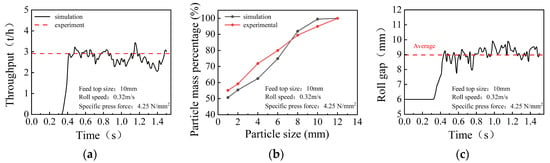
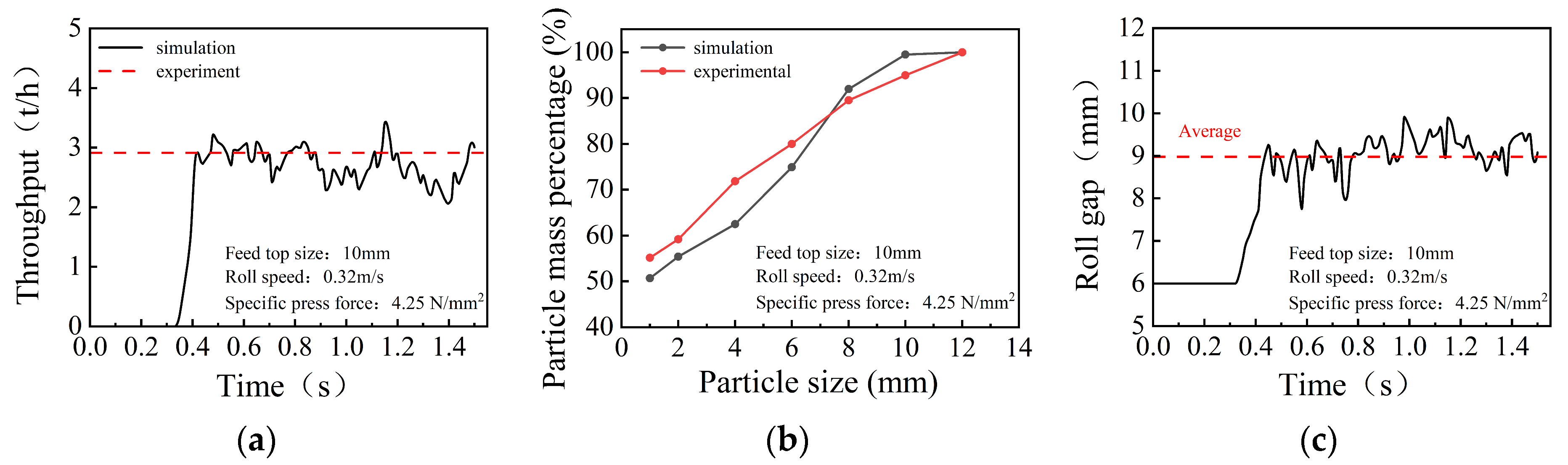
Based on actual operational data from the enterprise, the feed top size for the HPGR-3516 typically does not exceed 10 mm, with a roll speed of 0.32 m/s and a specific press force of 4.25 N/mm2. Under this operating condition, the experiment was repeated three times, and the average value was taken. To evaluate the accuracy of the simulation model, the DEM-MBD simulation results were compared with physical experimental outcomes under these conditions. The validated variables included throughput, QPR, and roll gap. As shown in Figure 8, the simulated throughput is 2.74 , while the experimental value is approximately 2.91 , resulting in a relative error of 5.80%. The simulated QPR is 50.70%, compared to the experimental value of approximately 55.16%, resulting in a relative error of 8.09%. Furthermore, the simulated roll gap of approximately 8.98 mm lies within the dynamic fluctuation range of 6–16 mm observed in actual operations, further affirming the model’s reliability in predicting dynamic responses.
Figure 8.
Comparison of HPGR simulation results: (a) throughput; (b) QPR; (c) roll gap.
The main source of discrepancy between simulations and experiments is the use of ideal spherical particles in the simulation, whereas actual ore particles have irregular shapes, affecting inter-particle interlocking and flow behavior. Feed fluctuations, sampling errors, and measurement uncertainties during experiments also contribute to the observed discrepancies. In previous validation studies of HPGRs, Guo reported relative errors of approximately 8% for throughput and product size distribution [14,31], while the key performance indicators of the model established by Nagata all exhibited relative errors within 10% [16]. The relative errors obtained in this study fall within this commonly accepted range, demonstrating that the developed DEM-MBD model possesses satisfactory engineering reliability, which is consistent with the findings of previous studies.
3.2. Variance Analysis of Influencing Factors
Table 7 presents the detailed design and outcomes of the HPGR performance analysis. Analysis of variance (ANOVA) is a statistical method employed to ascertain the presence of significant differences among group means affected by one or more factors [32]. ANOVA was utilized to evaluate the main effects and interactions of feed top size (), roll speed () and specific press force () on throughput (), QPR () and roll gap (). The subsequent ANOVA was conducted with a confidence level of 95%, including five center-point replicates. The results are presented in Table 8. It is evident that feed top size significantly affects both throughput and roll gap, while roll speed significantly influences throughput and roll gap. Additionally, specific press force has a significant impact on QPR and roll gap, with all corresponding p-values below the 0.0001 significance level. Importantly, the interaction effects among various factor combinations on the performance indicators reveal significant variations: the interaction exerts an extremely significant effect on both throughput and roll gap; the interaction has an extremely significant effect on roll gap, while the interaction shows no significant effect on any of the indicators. These findings highlight a complex coupling mechanism among the process parameters that influence HPGR performance, indicating that a single-factor analysis is inadequate for fully elucidating the underlying mechanisms.
Table 7.
Box–Behnken design with simulation results.
Table 8.
ANOVA results for influencing factors.
3.2.1. Throughput
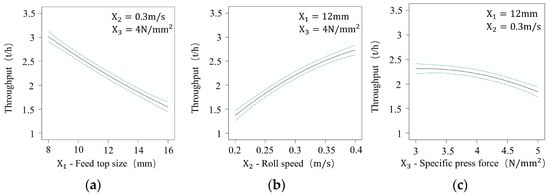
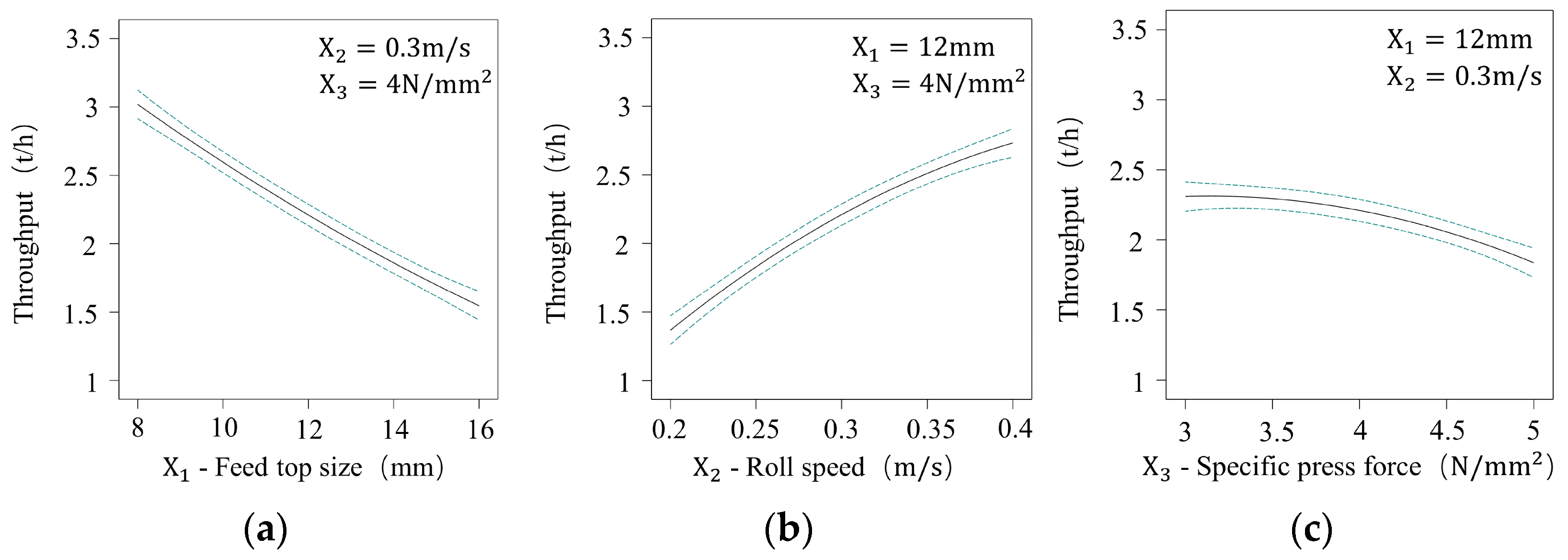
Figure 9 illustrates the throughput curves corresponding to each factor. In these figures, the black curve represents throughput, while the blue-shaded region represents the 95% confidence interval. Within the experimental range, throughput exhibits a gradual decline as the feed top size increases. This decline occurs because coarser particles demonstrate poorer flowability, resulting in a reduced volume of material entering the roll gap per unit time. Conversely, an increase in roll speed is associated with a linear rise in throughput, which can be attributed to the enhanced linear velocity of the material traversing the roll gap. However, as the specific press force increases, throughput experiences a slight decrease. This is consistent with the findings of Vander [18]. This reduction is a consequence of the higher specific press force narrowing the roll gap, thereby diminishing the cross-sectional area available for material passage and leading to a decrease in throughput.
Figure 9.
Impact of individual factors on throughput: (a) feed top size; (b) roll speed; (c) specific press force.
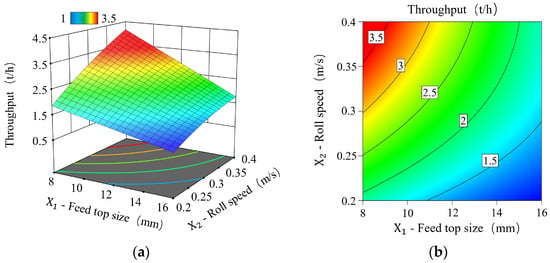
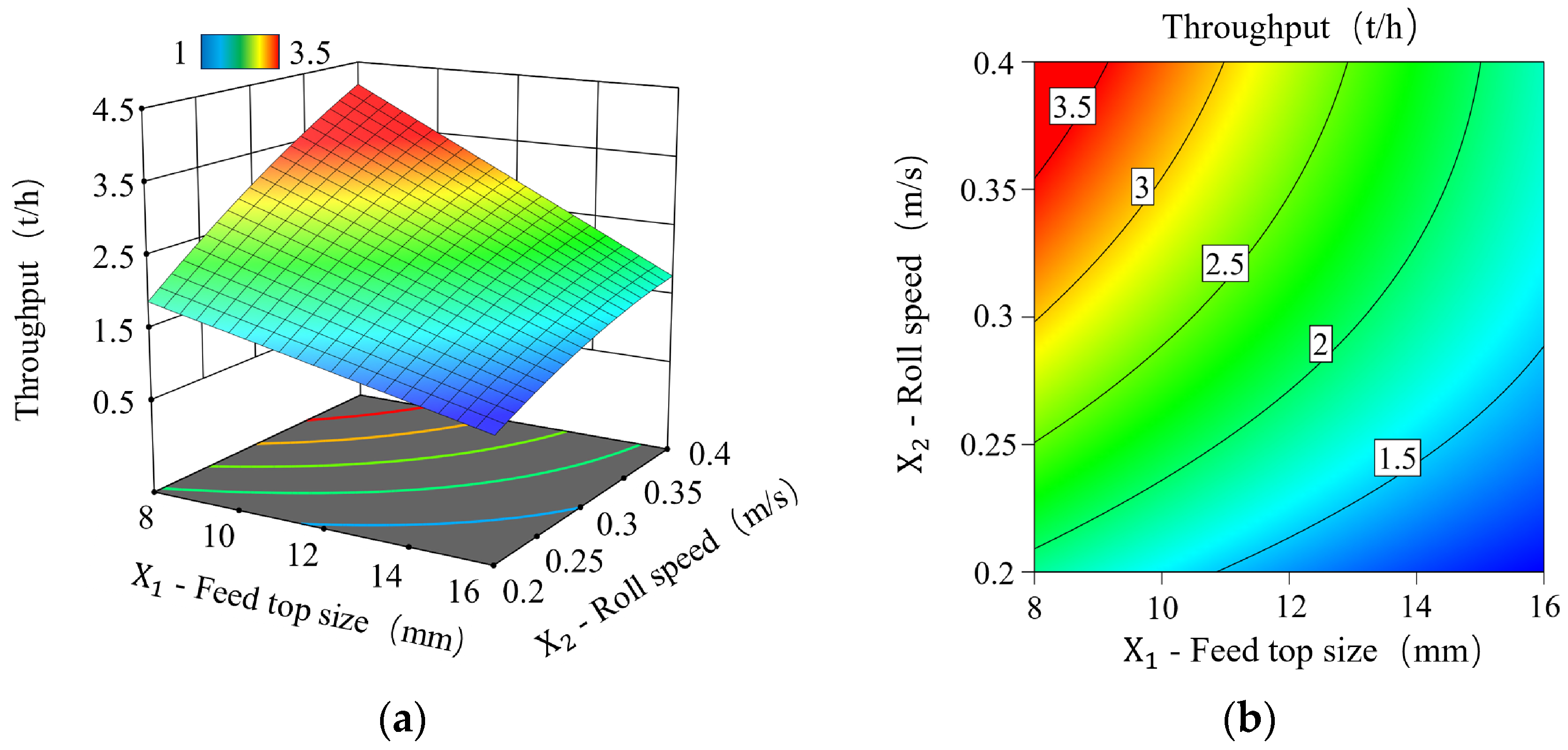
Figure 10 illustrates a three-dimensional surface plot and contour plot of throughput, emphasizing the interactive effects of feed top size and roll speed. This interaction reveals a nonlinear variation in throughput: under the fine feed condition of 8 mm, the contour lines are densely arranged along the roll speed direction, indicating a significant increase in throughput with rising roll speed. Conversely, under the coarse feed condition of 16 mm, the contour lines are more sparsely distributed along the roll speed direction, and the positive impact of roll speed on throughput is markedly diminished. This phenomenon is attributed to the larger inter-particle voids and higher frictional resistance of coarse particles, which reduce the packing density of the material in the nip zone, thereby limiting throughput enhancement even when roll speed is increased. From the perspective of particle-bed behavior, the coarse particle bed undergoes primarily particle rearrangement and void filling in the nip zone, with fewer inter-particle contact points and low stress transmission efficiency, so the flow rate increase brought by higher roll speed is offset by the low packing density. The throughput trends observed in this study are consistent with the model predictions of Torres and Casali [5], validating the applicability of their model to the HPGR-3516. Compared with the DEM simulation model of Guo [14], this study further reveals the interaction between roll speed and feed top size, serving as a complement to existing models.
Figure 10.
Interaction of feed top size and roll speed on throughput: (a) three-dimensional surface plot; (b) contour plot.
3.2.2. QPR
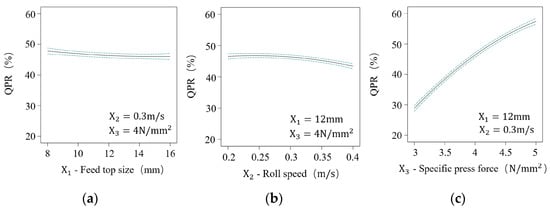
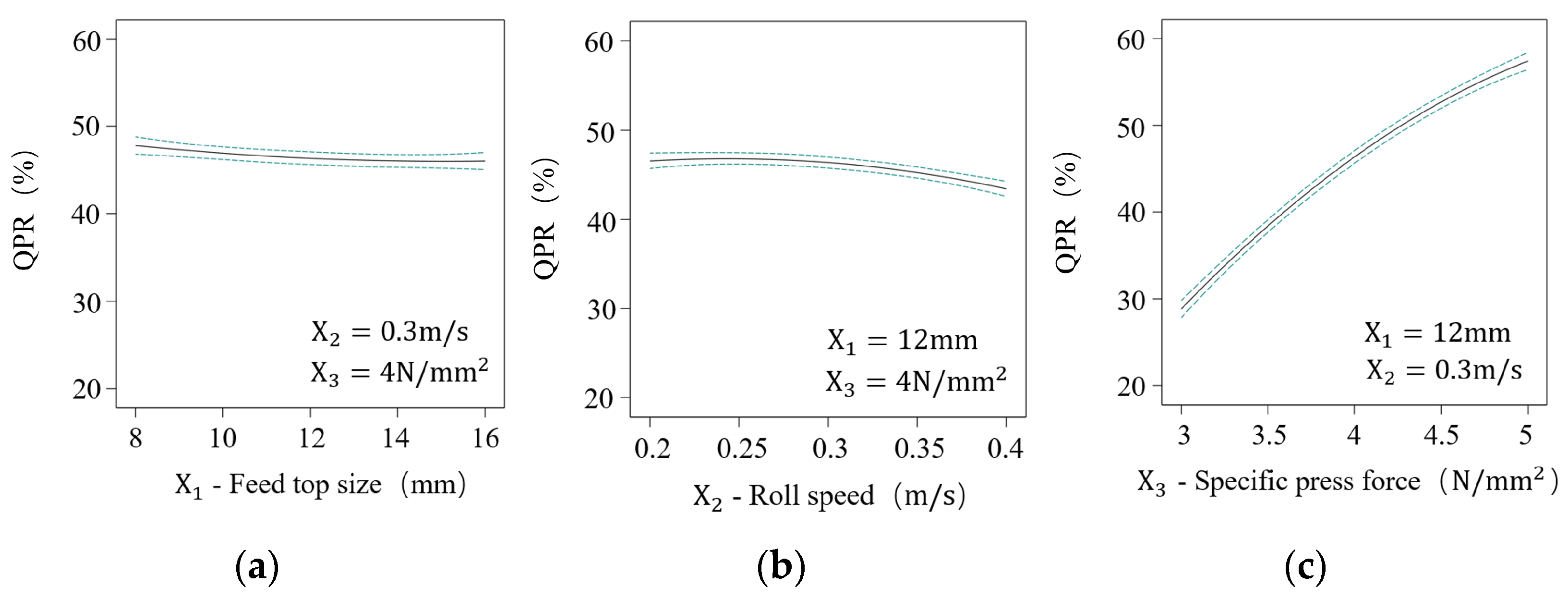
Figure 11 illustrates the QPR curves for each factor. It is clear that QPR is primarily and significantly influenced by specific press force, which increases from approximately % to about 60% as the specific press force rises from to . This increase occurs because a higher specific press force enhances the compaction and breakage effects of the rolls on the material, resulting in a greater number of particles being crushed to the target fineness. The significant increase in QPR with specific press force observed in this study is consistent with the experimental results of Campos on iron ore HPGR [9], confirming the inter-particle crushing theory proposed by Schönert’s team [3]. Notably, although the effect of roll speed on QPR is less pronounced, its trend possesses clear physical significance. As the roll speed increases from to , QPR exhibits minimal variation; however, with a further increase in roll speed from to , QPR exhibits a slight decline. This decline can be attributed to the higher roll speed reducing the residence time of the material in the high-pressure zone, thereby decreasing the likelihood of particles undergoing sufficient breakage. Conversely, the influence of feed top size on QPR is not significant.
Figure 11.
Impact of individual factors on QPR: (a) feed top size; (b) roll speed; (c) specific press force.
Table 8 illustrates that all interaction terms for QPR exhibit p-values exceeding 0.05, indicating the absence of significant effects. This finding implies that QPR is predominantly governed by a single factor and is particularly sensitive to specific press force. Consequently, its optimization mainly depends on elevating the operating pressure, remaining unaffected by the intricate interactions of other parameters.
3.2.3. Roll Gap
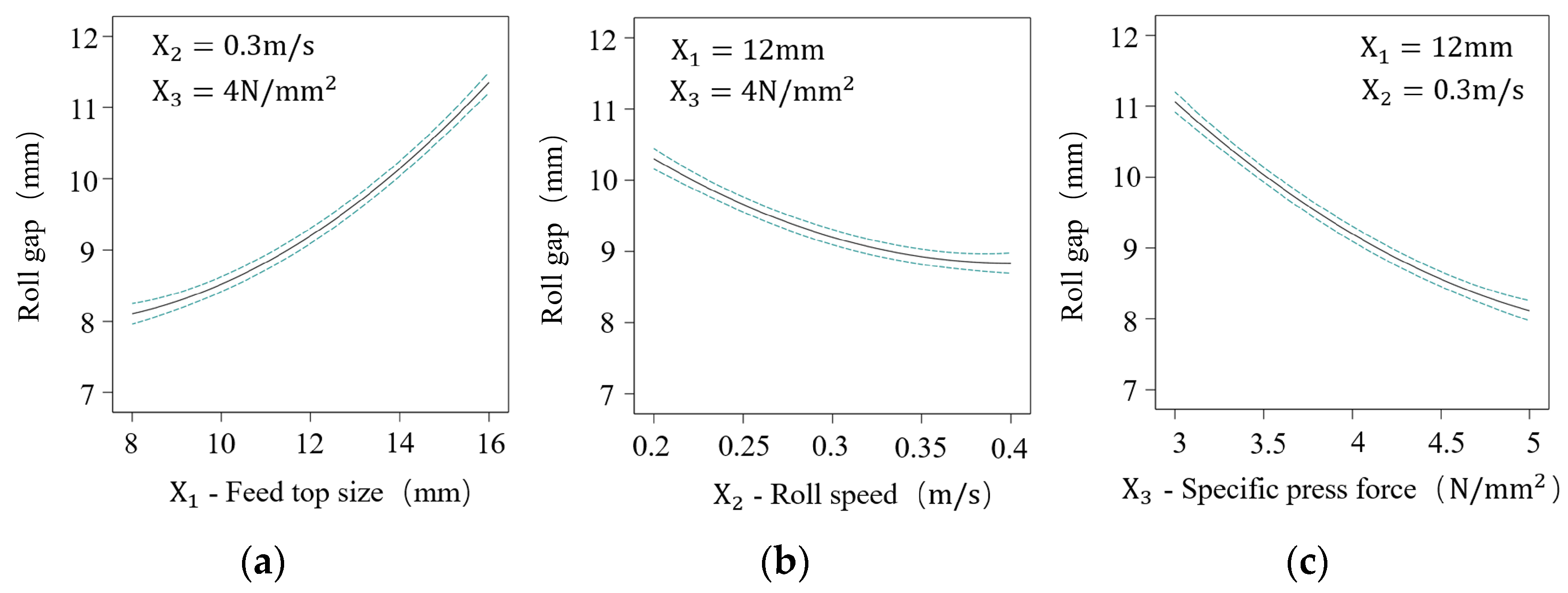
Figure 12 illustrates the roll gap curves for each factor. The roll gap increases progressively with the rise in feed top size, as coarser particles require a larger geometric space to complete the nip process. Conversely, an increase in roll speed leads to a continuous reduction in the roll gap. This phenomenon arises because higher roll speeds accelerate the material passage rate through the crushing zone, promote rapid particle breakage and compaction, and concurrently establish a more continuous material flow that enhances the packing state, thereby allowing the floating roll to maintain a more stable position. Additionally, an increase in specific press force significantly decreases the roll gap, which can be attributed to the enhanced material compaction associated with the elevated specific press force. The effect of specific press force on roll gap observed in this study is consistent with the simulation results of Nagata and Thivierge [16,17].
Figure 12.
Impact of individual factors on roll gap: (a) feed top size; (b) roll speed; (c) specific press force.
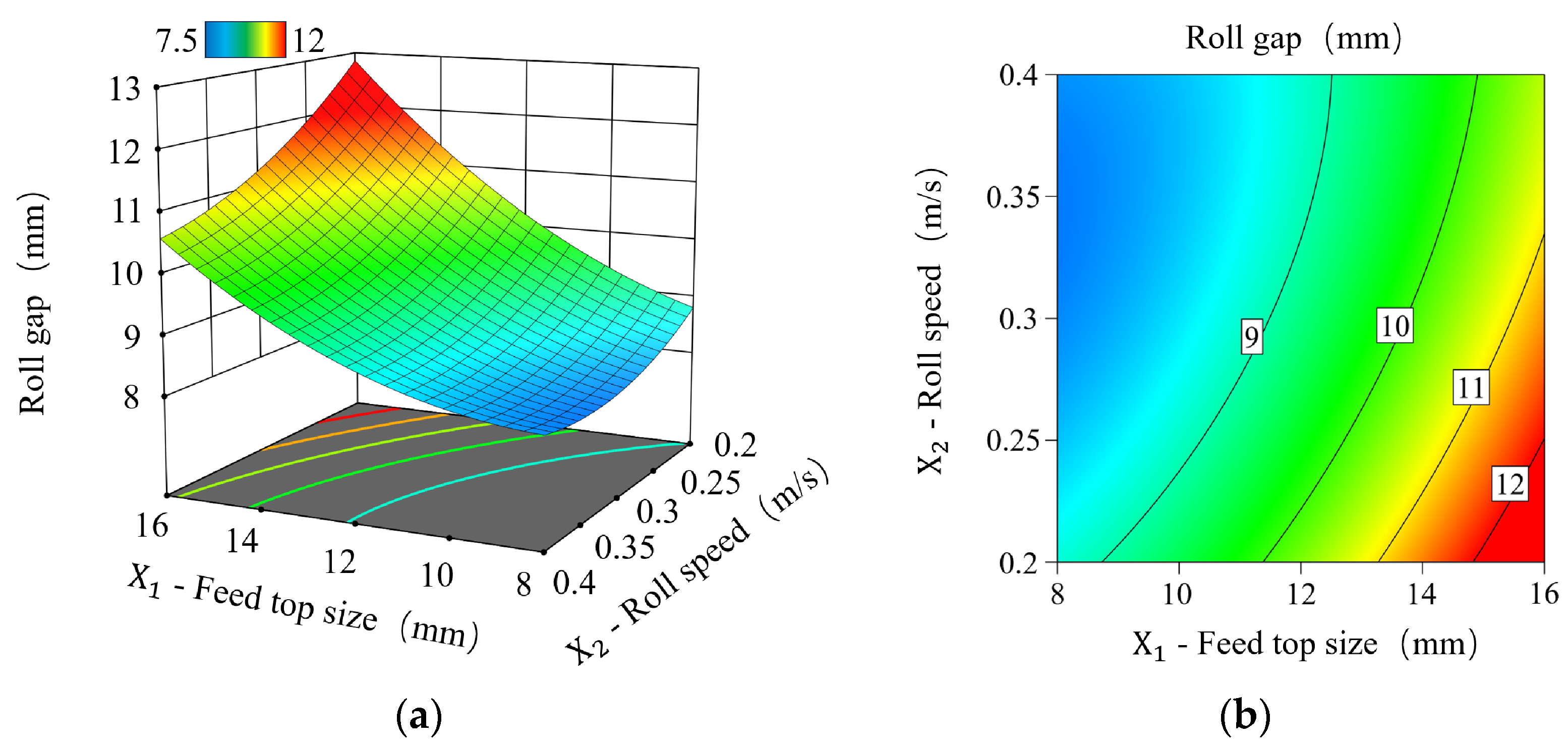
Figure 13 illustrates the three-dimensional surface plot and contour plot of the roll gap, emphasizing the interactive effects of roll speed and feed top size. The contour lines exhibit an arc-shaped trend. The influence of roll speed on the roll gap is influenced by the feed top size. For coarse feed measuring 16 mm, the contour lines are closely spaced in the direction of roll speed, indicating that an increase in roll speed significantly decreases the dynamic roll gap. Conversely, under the fine feed condition of 8 mm, the contour lines are more widely spaced along the roll speed direction, suggesting that the effect of increased roll speed on the roll gap is less pronounced. This phenomenon arises because coarse particles initially create a larger dynamic roll gap with ample compressible space between particles. When roll speed increases, the material passes through rapidly and is quickly compacted, leading to a significant reduction in the roll gap. In contrast, fine particles have a higher initial packing density with smaller inter-particle voids, already approaching a compacted state, leaving limited room for further compression. From the perspective of particle-bed behavior, the coarse particle bed undergoes primarily particle rearrangement and void filling during the initial compression stage, resulting in a large compression amount, whereas the fine particle bed is dominated by particle breakage and deformation, resulting in a small compression amount. Therefore, the effect of roll speed on roll gap adjustment is more pronounced under coarse feed conditions.
Figure 13.
Interaction of feed top size and roll speed on roll gap: (a) three-dimensional surface plot; (b) contour plot.
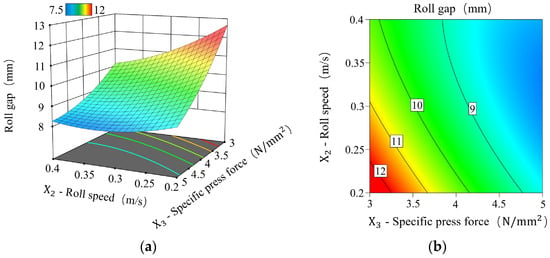
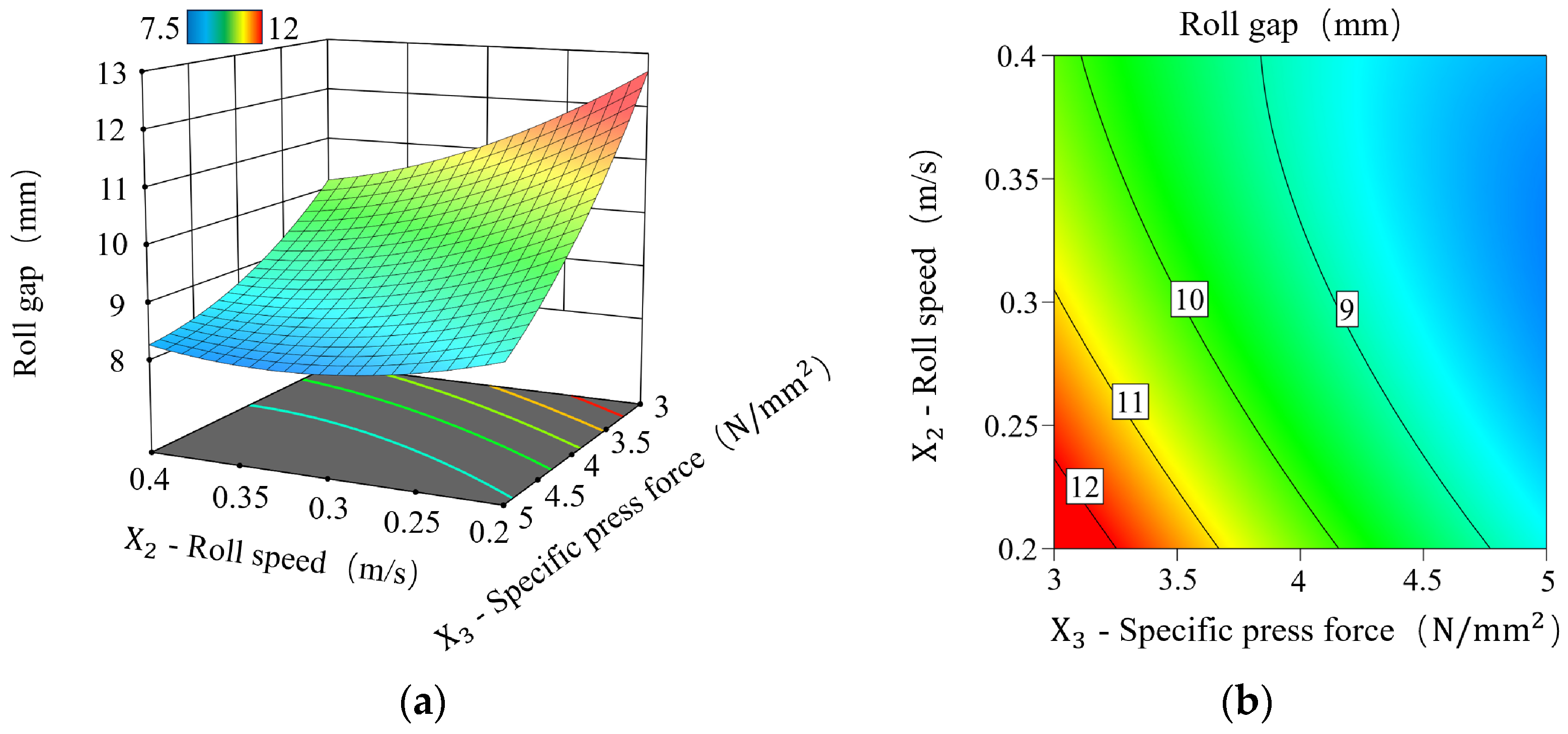
Figure 14 illustrates the three-dimensional surface plot and contour plot of the roll gap, emphasizing the interactive effects of roll speed and specific press force. In the low specific press force range, increased roll speeds result in closely spaced contour lines along the roll speed direction, indicating a substantial influence of roll speed on the roll gap. Conversely, within the high specific press force range, sparsely distributed contour lines suggest that roll speed has little effect on the roll gap. This observation arises from the different states of the particle bed under varying specific press force conditions. Under low specific press force, the particle bed is loose with large inter-particle voids, and the material is not fully compacted. Increasing roll speed promotes rapid material passage and accelerates particle rearrangement and void filling, thereby significantly reducing the roll gap. Under high specific press force, however, the particle bed is compressed to near its limiting density, with minimal inter-particle voids, forming a nearly dense cake. Further compression is extremely limited, so even higher roll speeds cannot significantly change the roll gap. From the perspective of particle-bed behavior, compression under low specific press force occurs primarily in the stage of particle rearrangement and void filling, resulting in a large compression amount, whereas compression under high specific press force enters the stage of particle breakage and densification, where the compression amount approaches saturation. Consequently, the effect of roll speed on roll gap adjustment is significantly diminished under high specific press force conditions.
Figure 14.
Interaction of roll speed and specific press force on roll gap: (a) three-dimensional surface plot; (b) contour plot.
3.3. Performance Indicator Modeling
Equation (13) presents the performance prediction model for the HPGR. A summary of the regression analysis results for each prediction model is presented in Table 9. All performance indicators yielded p-values below 0.0001, indicating robust statistical significance. The values exceed 0.95, indicating that the models adequately account for the variance in the dependent variables. The adjusted values are all greater than 0.95, suggesting that the model structures are appropriate without including redundant independent variables. The predicted values are all greater than 0.90, signifying that the models exhibit strong predictive capability for new data and maintain high accuracy even for data not utilized in the modeling process.
Table 9.
Summary of regression analysis for the performance models.
3.4. Process Parameter Optimization and Experimental Validation
This study aims to optimize the process parameters for the HPGR. Utilizing the response surface analysis results, the data optimization function of the Design Expert 13 was employed for optimization [33,34]. The optimization problem was formulated as follows: within the specified ranges of factor levels (feed top size of , roll speed of , and specific press force of ), find the parameter combination that simultaneously maximizes throughput () and QPR () while minimizing roll gap (). Each of the three objectives was assigned equal weight, and the optimization algorithm utilized the built-in desirability function approach, where composite desirability is represented by the geometric mean of the individual desirability.
The model optimization results are presented in Table 10. The first scheme demonstrates the highest composite desirability (), corresponding to the following process parameters: feed top size of 8 mm, roll speed of , and specific press force of . Notably, the feed top size in this optimal parameter combination is situated at the boundary point of the experimental design. This indicates that within the investigated range, throughput and QPR exhibit a monotonically increasing trend as the feed top size decreases, without reaching a maximum. From an engineering application perspective, further reduction in the feed top size is constrained by the upstream crushing capacity; therefore, the boundary point represents the optimal choice under the current engineering constraints.
Table 10.
Optimization results of the model.
Validation experiments were conducted using the optimal process parameters to verify the accuracy of the predictive model. The experimentally measured throughput and QPR were compared to the model-predicted values. Additionally, considering that the floating roll of the HPGR operates within a sealed chamber, which makes direct measurement of the roll gap difficult, the predicted roll gap values were not directly validated through direct experimentation but were instead compared with data from DEM-MBD simulations. The specific results are presented in Table 11. The relative errors between the experimental and predicted values for throughput and QPR are 8.61% and 7.45%, respectively, while the relative error between the predicted and simulated roll gap values is 6.94%. These errors are all within the acceptable engineering range, thereby confirming the high accuracy of the predictive model.
Table 11.
Comparative validation of predicted values and experimental results.
To further validate the engineering feasibility of the optimized scheme, a comparative experiment was conducted to evaluate the optimal process parameters against the original parameters, which included a feed top size of 10 mm, a roll speed of 0.32 m/s, and a specific press force of . The results are presented in Table 12. Following the implementation of the optimal process parameters, the throughput of the HPGR increases from 2.91 to 3.37 , corresponding to a 15.81% improvement. The QPR increases from 55.16% to 59.49%, corresponding to a 7.85% enhancement. The roll gap decreases from 8.98 mm to 8.06 mm, corresponding to a reduction of 10.24. All core performance indicators exhibit significant improvement, thereby confirming the effectiveness and engineering practicality of the optimized scheme.
Table 12.
Comparison of performance indicators.
3.5. Future Prospects
This study systematically examined the effects of feed top size, roll speed, and specific press force on the crushing performance of HPGRs. It identified the optimal combination of process parameters for the HPGR-3516 test prototype through multi-objective optimization methods. However, limitations in the current research conditions and model configuration suggest that several aspects require further investigation. Future research may focus on the following areas.
While this study focuses on the impact of key operational parameters on HPGR crushing performance, energy consumption was not included as an optimization objective. Nevertheless, an approximate estimation of the power change before and after optimization has been made in this study. When the roll speed increases from the original parameter (0.32 m/s) to the optimal parameter (0.37 m/s), the roll speed increases by 15.6%. Under the conservative assumption of approximately constant torque, power draw is approximately linearly proportional to roll speed, and the power consumption increases by approximately 15.6%. Meanwhile, throughput increases from 2.91 t/h to 3.37 t/h, an increase of 15.8%. Based on these estimates, the specific energy consumption remains essentially unchanged, indicating that the significant improvement in throughput is achieved without increasing the energy consumption per ton of material processed. Future research could derive power curves and specific energy consumption indicators from the existing DEM-MBD model, thereby establishing a multi-objective optimization framework that includes throughput, QPR, roll gap and energy consumption. This approach would facilitate a balance between crushing performance and energy efficiency, thereby enhancing the practical applicability of the research findings. The analytical method presented by Liu for evaluating energy consumption and efficiency in laboratory-scale vertical roller mills provides a valuable reference in this context [35].
Second, the sealed design of the HPGR complicates the direct measurement of dynamic variations in the roll gap. Currently, the validation of the roll gap primarily relies on simulation data, which lacks cross-validation through experimental measurement techniques. Future research should incorporate high-precision displacement sensors or laser ranging devices into the test prototype to facilitate real-time monitoring of movable roll displacement. This methodology would provide more robust experimental support for validating the dynamic roll gap model and enhance confidence in the simulation results.
Furthermore, this study concentrated on the HPGR-3516 test prototype and vanadium–titanium magnetite ore, and the conclusions drawn possess certain limitations. The qualitative trends observed are grounded in interparticle crushing theory and are likely applicable to other medium–hard ores. However, quantitative relationships depend strongly on ore grindability, hardness, and size distribution. Applying the model to other ores would require recalibration of the Tavares breakage model parameters and contact parameters such as density and friction coefficients. Future research may extend the analysis to multiple ore types and industrial-scale equipment by referencing Pamparana and Wei [36,37], thereby improving the generalizability and engineering applicability of the findings.
4. Conclusions
This study developed a dynamic analysis model of the HPGR-3516 utilizing DEM-MBD co-simulation technology. It systematically investigated the influence patterns and interactions of feed top size, roll speed, and specific press force on equipment performance, leading to a multi-objective optimization of process parameters that was experimentally validated. The principal conclusions of this study are as follows:
- (1)
- The influence of key process parameters on HPGR performance has been elucidated. Within the low specific press force range, an increase in roll speed effectively reduces the roll gap. Conversely, in the high specific press force range, the material becomes fully compacted, rendering the effect of roll speed negligible. Under coarse particle feed conditions, an increase in roll speed significantly reduces the roll gap; however, under fine particle feed conditions, the impact of increased roll speed is relatively minor. Additionally, under fine particle feed conditions, throughput increases markedly with roll speed, whereas under coarse particle feed conditions, the advantageous effect of roll speed is considerably diminished.
- (2)
- The validation of the DEM-MBD co-simulation model has been successfully established. Under the current operating parameters, the relative errors for throughput and QPR between simulated and experimental values were 5.80% and 8.09%. Moreover, the simulated roll gap value remained within the actual operational fluctuation range. These findings indicate the model’s capability to accurately replicate the crushing performance and dynamic response of the HPGR.
- (3)
- Prediction models were developed to evaluate the effects of feed top size, roll speed, and specific press force on the performance of HPGRs. All models demonstrated high statistical significance and a good fit. The optimal combination of process parameters was identified through multi-objective optimization, resulting in a feed top size of 8 mm, a roll speed of 0.37 m/s, and a specific press force of . Validation experiments revealed that following optimization, throughput increased by 15.81%, QPR improved by 7.85%, and roll gap decreased by 10.24%. These findings indicate substantial enhancements across all core performance indicators.
This study offers the following recommendations for industrial HPGR operation: Increasing roll speed significantly improves throughput, but the resulting decrease in roll gap should be monitored for equipment load. Specific press force is the key parameter for controlling product fineness and should be prioritized. Increasing roll speed is more effective for fine feeds, whereas a lower roll speed is recommended for coarse feeds to maintain roll gap stability. Dynamic adjustment of process parameters based on feed characteristics is advised.
Author Contributions
Conceptualization, methodology, and drafting manuscript, S.Z.; validation and supervision, Y.R.; software, formal analysis, and data curation, C.F., J.Y. and J.Z.; investigation, project administration, and funding acquisition, B.W. All authors have read and agreed to the published version of the manuscript.
Funding
The authors gratefully acknowledge the Educational Department of Liaoning Province: LJ242410153005 (Grant No. LJ242410153005).
Data Availability Statement
Data will be made available on request.
Acknowledgments
The authors acknowledge Shenyang Shengshi Wuhuan Mining and Metallurgical Engineering Technology Co., Ltd. for providing equipment and technical support. The authors also thank Guodong Yue from Shenyang Jianzhu University for his assistance in manuscript formatting and his guidance during the submission process.
Conflicts of Interest
Bo Wei is an employee of Shenyang Shengshi Wuhuan Mining and Metallurgical Engineering Technology Co., Ltd. The paper reflects the views of the scientists and not the company. The remaining authors declare that the research was conducted in the absence of any commercial or financial relationships that could be construed as a potential conflict of interest.
References
- Morley, C. High pressure grinding rolls—A technology review. In Advances in Comminution; Kawatra, S.K., Ed.; Society for Mining, Metallurgy, and Exploration: Littleton, CO, USA, 2006; pp. 15–39. [Google Scholar]
- Saramak, D. Challenges in raw material treatment at the mechanical processing stage. Minerals 2021, 11, 940. [Google Scholar] [CrossRef] [Scilit]
- Rashidi, S.; Rajamani, R.K.; Fuerstenau, D.W. A review of the modeling of high pressure grinding rolls. KONA Powder Part. J. 2017, 34, 125–140. [Google Scholar] [CrossRef] [Scilit]
- Von Michaelis, H. How energy efficient is HPGR. In World Gold Conference; The Southern African Institute of Mining and Metallurgy: Johannesburg, South Africa, 2009; pp. 7–18. [Google Scholar]
- Torres, M.; Casali, A. A novel approach for the modelling of high-pressure grinding rolls. Miner. Eng. 2009, 22, 1137–1146. [Google Scholar] [CrossRef] [Scilit]
- Thivierge, A.; Bouchard, J.; Desbiens, A. Modelling the product mass flow rate of high-pressure grinding rolls. IFAC-Pap. 2021, 54, 127–132. [Google Scholar] [CrossRef] [Scilit]
- Thivierge, A.; Bouchard, J.; Desbiens, A. Unifying high-pressure grinding rolls models. Miner. Eng. 2022, 178, 107427. [Google Scholar] [CrossRef] [Scilit]
- Daniel, M.J.; Morrell, S. HPGR model verification and scale-up. Miner. Eng. 2004, 17, 1149–1161. [Google Scholar] [CrossRef] [Scilit]
- Campos, T.M.; Bueno, G.; Barrios, G.K.; Tavares, L.M. Pressing iron ore concentrate in a pilot-scale HPGR. Part 1: Experimental results. Miner. Eng. 2019, 140, 105875. [Google Scholar] [CrossRef] [Scilit]
- Solomon, N.; Becker, M.; Mainza, A.; Petersen, J.; Franzidis, J.P. Understanding the influence of HPGR on PGM flotation behavior using mineralogy. Miner. Eng. 2011, 24, 1370–1377. [Google Scholar] [CrossRef] [Scilit]
- Weerasekara, N.S.; Powell, M.S.; Cleary, P.W.; Tavares, L.M.; Evertsson, M.; Morrison, R.D.; Quist, J.; Carvalho, R.M. The contribution of DEM to the science of comminution. Powder Technol. 2013, 248, 3–24. [Google Scholar] [CrossRef] [Scilit]
- Cleary, P.W.; Sinnott, M.D. Axial pressure distribution, flow behavior and breakage within a HPGR investigation using DEM. Miner. Eng. 2021, 163, 106769. [Google Scholar] [CrossRef] [Scilit]
- Kumar, A. Predicting HPGR Performance and Understanding Rock Particle Behavior Through DEM Modelling. Doctoral Dissertation, University of British Columbia, Vancouver, BC, Canada, 2014. [Google Scholar]
- Guo, J.; Wang, S.; Liu, Z.; Wang, G.; Wu, S.; Guan, W.; Zhang, H. Simulation and analysis of high-pressure grinding rolls performance based on DEM-PRM. Miner. Eng. 2024, 218, 109039. [Google Scholar] [CrossRef] [Scilit]
- Zhang, C.; Zou, Y.; Gou, D.; Yu, A.; Yang, R. Experimental and numerical investigation of particle size and particle strength reduction in high pressure grinding rolls. Powder Technol. 2022, 410, 117892. [Google Scholar] [CrossRef] [Scilit]
- Nagata, Y.; Tsunazawa, Y.; Tsukada, K.; Yaguchi, Y.; Ebisu, Y.; Mitsuhashi, K.; Tokoro, C. Effect of the roll stud diameter on the capacity of a high-pressure grinding roll using the discrete element method. Miner. Eng. 2020, 154, 106412. [Google Scholar] [CrossRef] [Scilit]
- Thivierge, A.; Bouchard, J.; Desbiens, A. A steady-state model of the high-pressure grinding rolls. IFAC-Pap. 2020, 53, 11830–11835. [Google Scholar] [CrossRef] [Scilit]
- Van der Meer, F.P.; Leite, I.A. Aspects of HPGR in iron ore pellet feed preparation. In Proceedings of the 6th Brazilian Ore Agglomeration Symposium, São Paulo, Brazil, 2–4 October 2018; pp. 102–115. [Google Scholar]
- Bauer, B.W. Hydropneumatic Suspension Systems; Springer: Berlin/Heidelberg, Germany, 2011. [Google Scholar]
- Rodriguez, V.A.; Barrios, G.K.; Bueno, G.; Tavares, L.M. Investigation of lateral confinement, roller aspect ratio and wear condition on HPGR performance using DEM-MBD-PRM simulations. Minerals 2021, 11, 801. [Google Scholar] [CrossRef] [Scilit]
- Barrios, G.K.P.; Jiménez-Herrera, N.; Tavares, L.M. Simulation of particle bed breakage by slow compression and impact using a DEM particle replacement model. Adv. Powder Technol. 2020, 31, 2749–2758. [Google Scholar] [CrossRef] [Scilit]
- Tavares, L.M.; Rodriguez, V.A.; Sousani, M.; Padros, C.B.; Ooi, J.Y. An effective sphere-based model for breakage simulation in DEM. Powder Technol. 2021, 392, 473–488. [Google Scholar] [CrossRef] [Scilit]
- Tavares, L.M.; de Carvalho, R.M. Modeling ore degradation during handling using continuum damage mechanics. Int. J. Miner. Process. 2012, 112, 1–6. [Google Scholar] [CrossRef] [Scilit]
- Tavares, L.M. Analysis of particle fracture by repeated stressing as damage accumulation. Powder Technol. 2009, 190, 327–339. [Google Scholar] [CrossRef] [Scilit]
- Yang, F.; Li, R.; Wang, X.; Cheng, B.; Gu, R. Optimization of working parameters of high-pressure roller mill based on entropy weight method and response surface method. Sci. Rep. 2024, 14, 28238. [Google Scholar] [CrossRef] [Scilit]
- Saeidi, F.; Tavares, L.M.; Yahyaei, M.; Powell, M. A phenomenological model of single particle breakage as a multi-stage process. Miner. Eng. 2016, 98, 90–100. [Google Scholar] [CrossRef] [Scilit]
- Fuerstenau, D.W.; Shukla, A.; Kapur, P.C. Energy consumption and product size distributions in choke-fed, high-compression roll mills. Int. J. Miner. Process. 1991, 32, 59–79. [Google Scholar] [CrossRef] [Scilit]
- GB/T 45682-2025; Type Selection Test Method of Mine High-Pressure Gringing Roll. Standards Press of China: Beijing, China, 2025.
- Aslan, N.; Cebeci, Y. Application of Box–Behnken design and response surface methodology for modeling of some Turkish coals. Fuel 2007, 86, 90–97. [Google Scholar] [CrossRef] [Scilit]
- Myers, R.H.; Montgomery, D.C. Response Surface Methodology: Process and Product Optimization Using Designed Experiments; John Wiley & Sons: New York, NY, USA, 1995. [Google Scholar]
- Guo, J.; Wang, G.; Liu, Z.; Wang, S.; Guan, W.; Wu, S.; Liu, S.; Ma, C. Optimization and study of roll stud parameters of high-pressure grinding rolls based on DEM-PRM. Miner. Eng. 2025, 234, 109733. [Google Scholar] [CrossRef] [Scilit]
- Sawyer, S.F. Analysis of variance: The fundamental concepts. J. Man. Manip. Ther. 2009, 17, 27E–38E. [Google Scholar] [CrossRef] [Scilit]
- Njoku, C.N.; Otisi, S.K. Application of central composite design with design expert v13 in process optimization. In Response Surface Methodology-Research Advances and Applications; Kayarogannam, P., Ed.; IntechOpen: London, UK, 2023. [Google Scholar]
- Sadangi, J.K.; Das, S.P. Potential of high-pressure grinding roll (HPGR) for size reduction of hard banded iron ore. Trans. Indian Inst. Met. 2022, 75, 1797–1811. [Google Scholar] [CrossRef] [Scilit]
- Liu, C.; Chen, Z.; Mao, Y.; Yao, Z.; Zhang, W.; Ye, W.; Duan, Y.; Xie, Q. Analysis and optimization of grinding performance of vertical roller mill based on experimental method. Minerals 2022, 12, 133. [Google Scholar] [CrossRef] [Scilit]
- Pamparana, G.; Klein, B.; Bergerman, M.G. Methodology and model to predict HPGR throughput based on piston press testing. Minerals 2022, 12, 1377. [Google Scholar] [CrossRef] [Scilit]
- Wei, B.; Yuan, Z.; Feng, Q.; Zhang, Q.; Xu, X.; Meng, Q.; Klein, B.; Li, L. Optimization of High-Pressure Grinding Roll (HPGR) Performance in an Industrial-Scale HPGR/Tower Mill Comminution Circuit. Minerals 2025, 15, 1065. [Google Scholar] [CrossRef] [Scilit]


Disclaimer/Publisher’s Note: The statements, opinions and data contained in all publications are solely those of the individual author(s) and contributor(s) and not of MDPI and/or the editor(s). MDPI and/or the editor(s) disclaim responsibility for any injury to people or property resulting from any ideas, methods, instructions or products referred to in the content. |
© 2026 by the authors. Licensee MDPI, Basel, Switzerland. This article is an open access article distributed under the terms and conditions of the Creative Commons Attribution (CC BY) license.