Article

Comparative Study on the Differential Adsorption Mechanisms of Typical Light/Heavy Rare Earth Ions by Kaolinite and Halloysite

1
School of Minerals Processing and Bioengineering, Central South University, Changsha 410083, China
2
Key Laboratory of Biometallurgy of Ministry of Education of China, Central South University, Changsha 410083, China
*
Author to whom correspondence should be addressed.
Minerals 2026, 16(4), 399; https://doi.org/10.3390/min16040399
Submission received: 9 March 2026 / Revised: 7 April 2026 / Accepted: 8 April 2026 / Published: 14 April 2026
(This article belongs to the Collection Advanced Extraction and Recovery of Rare Earth Elements)

Abstract

The inevitable toxicity and bioaccumulation of rare earth elements (REEs) have posed potential pollution risks to the environment. In this study, two major clay minerals from weathered ion-adsorption rare earth deposits—tubular halloysite and platy kaolinite—were used as research objects, and a series of batch adsorption experiments were conducted on light rare earth elements (La, Eu) and heavy rare earth elements (Y, Dy) at different concentrations, aiming to clarify the adsorption mechanisms of rare earth ions onto clay minerals. The results showed that under the same conditions, the adsorption capacity of halloysite was higher than that of kaolinite. The unit adsorption capacity of both kaolinite and halloysite for REEs increased with rising pH. The adsorption processes of REEs onto kaolinite and halloysite were better fitted by the pseudo-second-order kinetic model and the Langmuir model, indicating that the adsorption was a homogeneous process dominated by chemisorption, with a fast adsorption rate that was basically completed within the first 5 min. The 1/n values fitted by the Freundlich model were all between 0 and 1, suggesting that the adsorption reaction was favorable. Rare earth ions were adsorbed onto halloysite and kaolinite through outer-sphere complexation (electrostatic attraction) and inner-sphere complexation.

1. Introduction

Rare earth elements (REEs) are essential raw materials and important strategic resources for modern industry [1]. New magnetic materials widely used in metallurgy, the petrochemical industry, special glass, precision ceramics, catalysis, high-temperature superconductors, opto-magnetic and other fields are known as industrial vitamins [2,3]. The main sources of REEs are rare earth mines and high net waste residues containing high contents of REEs [4,5]. For example, ionic rare earth ores usually account for more than 50% of the total rare earth content, and ionic-phase REEs are easily extracted by various electrolyte solutions (such as NaCl solutions, (NH4)2SO4 solutions, and MgCl2 solutions) through exchange [6,7]. China is extremely rich in rare earth resources and possesses a large number of large-scale rare earth deposits. Since 2005, China’s rare earth production and export volume have both accounted for more than 90% of the global rare earth demand [8]. Ion-adsorption rare earth deposit is a highly important type of rare earth deposit in China and the predominant global source of heavy rare earth elements (HREE), occupying a pivotal position in the global rare earth market. Kaolinite (Kaol) and halloysite (Hal) are the major clay minerals in ion-adsorption rare earth ores [9,10].
Clay minerals are natural adsorbents that can effectively adsorb REEs in the environment [11]. Clay minerals are layered aluminosilicate minerals composed of a silica tetrahedral layer and an alumina octahedral layer [12]. Kaolinite (Kaol) and halloysite (Hal) are both 1:1 clay minerals. Many surface-active adsorption sites exist on the surface of clay minerals. Moreover, structural defects such as isomorphic replacement occur during the formation of clay minerals, which results in clay minerals always having a negative charge and effectively adsorbing rare earth ions. It is a common natural mineral adsorbent. At present, many researchers have studied the adsorption of REEs by clay minerals. For example, the adsorption of La3+ by kaolinite is divided into three stages: the water-soluble phase lanthanum, the ionic phase lanthanum and the colloidal phase lanthanum [13,14]. Compared with flaky kaolinite, halloysite has a larger specific surface area, an abundant pore structure and a greater number of surface hydroxyl groups because of its tubular morphology [15,16]. Under the same conditions, the unit adsorption capacity of halloysite for Eu3+ is greater than that of kaolinite for Eu3+ [17]. At high background ion concentrations, kaolinite and halloysite preferentially adsorb light rare earth ions. At low background ion strengths, there is no obvious difference, and the adsorption capacity of REEs increases with increasing pH [17,18,19]. However, the mechanism of adsorption of REEs by clay minerals is still not clear, and studies of light and heavy REEs by different clay minerals are relatively rare.
In this study, kaolinite and halloysite, the main clay minerals in weathered elution-type rare earth ores, were selected. La, Eu, Y, and Dy were used as representatives of light and heavy rare earth elements, respectively, to construct a rare earth element adsorption system using clay minerals. The adsorption effects of these minerals on rare earth ions under different conditions were investigated, and the adsorption kinetics and thermodynamics were analyzed. Scanning electron microscopy (SEM), transmission electron microscopy (TEM), X-ray diffraction (XRD), Fourier transform infrared spectroscopy (FTIR), and X-ray photoelectron spectroscopy (XPS) were employed to characterize the morphology and composition of the minerals before and after adsorption. The results are of great significance for clarifying the adsorption mechanism of rare earth ions on clay minerals and provide important theoretical guidance for the development of rare earth extraction technologies.

2. Materials and Methods

2.1. Materials and Chemicals

The kaolinite (CAS: 1318-74-7) and halloysite (CAS: 1332-58-7) used in the experiments were purchased from Shanghai McLean Co., Ltd., Shanghai, China. and are relatively pure clay minerals. The REEs used were lanthanum oxide (99%), yttrium oxide (99.9%), europium oxide (99.9%), and dysprosium oxide (99.99%), which were purchased from Shanghai McLean Co., Ltd., Shanghai, China. The reagents used were nitric acid, sodium hydroxide, and sodium nitrate of reagent grade. Dissolve lanthanum oxide (99%), yttrium oxide (99.9%), euro-pium oxide (99.9%), and dysprosium oxide (99.99%) in nitric acid to obtain solutions of lanthanum nitrate, yttrium nitrate, europium nitrate, and dysprosium nitrate. A certain concentration of europium nitrate solution was then prepared at a constant volume for the adsorption experiments. The background solution was a sodium nitrate solution with a concentration of 0.01 mol/L. All the solutions were prepared with deionized water.

2.2. Analysis and Characterization Methods

The particle sizes of kaolinite and halloysite were determined via laser particle size analysis. The composition of pristine kaolinite and halloysite was determined via X-ray fluorescence spectrometry (XPF, Rigaku ZSX Primus III+, Rigaku Corporation, Takatsuki-shi, Osaka, Japan), the concentration of rare earth ions in the solution before and after adsorption was determined via inductively coupled plasma emission spectrometry (ICP–OES, Spectro Blue, Spectro, Kleve, Germany), the functional groups on the mineral surface before and after adsorption were determined via Fourier transform infrared spectroscopy (FT-IR, Nexus 670, Nicolet, Madison, WI, USA), the phase composition of the mineral sample was analyzed via X-ray diffraction (XRD, Rigaku SmartLab SE, Akishima, Tokyo, Japan), the chemical state changes of the mineral surface elements were determined via X-ray photoelectron spectroscopy (XPS, Thermo Scientific K-Alpha, East Grinstead, UK), and scanning electron microscopy (SEM–EDS, MIRA4 LMH, TESCAN, Tescan, Czech Republic) was used to observe the morphology and elemental composition of the clay minerals before and after adsorption.

2.3. Batch Adsorption Experiment

All batch adsorption experiments were conducted in 50 mL anaerobic flasks on a constant-temperature shaker oscillating at 25 °C and 200 rpm. Kaolinite and halloysite (0.2 g) were added to 20 mL of REE solution with a solid–liquid ratio of 10 g/L. The background solution was a sodium nitrate solution with a concentration of 0.01 mol/L. After mixing evenly, the anaerobic flask was placed in a shaker and shaken for 24 h. The effects of contact time (1, 2, 5, 10, 20, and 60 min), initial REE (Dy3+, Eu3+, La3+, and Y3+) concentration (2.5, 5, 10, 20, 40, 60, 80, and 100 mg/L), and initial pH (2, 3, 4, 5, and 6) on the adsorption of REEs by kaolinite and halloysite were systematically investigated. After adsorption, solid–liquid samples were collected, and the reaction mixture was centrifuged to obtain the supernatant and clay minerals adsorbed with rare earth ions. The mixture was subsequently centrifuged at 10,000 rpm for 5 min. For the adsorbed clay minerals, vacuum freeze-drying was used, and the supernatant after centrifugation was diluted with 10% nitric acid. ICP–OES was used to detect the concentrations of REEs. According to Equation (1), the amount of REEs (Dy3+, Eu3+, La3+, Y3+) adsorbed per unit mass of kaolinite and halloysite was calculated:
Q e = C o C e V m
where Co is the initial concentration of REEs, Ce is the concentration in the solution after adsorption equilibrium is reached, V is the volume of the REE solution in the adsorption system, and m is the mass of the clay minerals in the adsorption system. Qe is the unit adsorption amount of REEs by clay minerals after adsorption equilibrium. Each adsorption experimental group underwent three experiments, effectively reducing experimental errors. All the data are the average of three repeated experiments.

2.4. Adsorption Kinetics Model

Adsorption kinetics can describe the adsorption efficiency of adsorbates and the correlation between the adsorption capacity qt and time t and are used to study the influence of various factors on chemical reaction rates. To investigate the adsorption behavior of REEs on kaolinite and halloysite, pseudo-first-order kinetic equations, pseudo-second-order kinetic equations, and intraparticle diffusion models were used to fit and study the adsorption process.
Pseudo-first-order dynamic equation:
ln q e q t = ln q e k 1 t
Pseudo-second-order dynamic equation:
t q t = 1 k 2 q e 2 + t q e
Intraparticle diffusion model:
q t = k n t 0.5 + C
where k1, k2, and kn are kinetic rate constants representing chemical reaction rates; t represents the amount of REEs adsorbed onto clay minerals at time t; qe represents the maximum adsorption amount at adsorption equilibrium; and C represents a constant determined by the thickness of the boundary layer.

2.5. Adsorption Isotherm

In solid–liquid adsorption systems, the relationship between the adsorption capacity and initial concentration is studied at a certain temperature. The fitting of adsorption isotherms to adsorption experimental data plays an important role in studying the adsorption capacity, adsorption strength, adsorption state, and adsorption process. In this work, the two most commonly used adsorption models, the Freundlich model and Langmuir model, are used to fit the adsorption data at different concentrations.
Langmuir model:
Q =   Q m K L C 1 + K L C
where Q is the adsorption capacity at equilibrium, C is the concentration of rare earth ions at equilibrium, Qm is the maximum adsorption capacity at adsorption equilibrium, and KL is the Langmuir constant.
Freundlich model:
Q = K F C 1 n
where Q is the adsorption capacity at equilibrium, C is the rare earth ion concentration at equilibrium, KF is the distribution coefficient, n is the nonuniformity factor, indicating the degree of nonlinearity between the solution concentration and adsorption, and 1/n is the adsorption constant, which can reflect the influence of the adsorbent on the affinity and binding stability of the adsorbate.

3. Results

3.1. Sample Characterization

The particle sizes of kaolinite and halloysite are shown in Figure S1, with halloysite having a specific surface area of 1.1 m2/g and kaolinite having a specific surface area of 0.9 m2/g. Halloysite has a larger specific surface area than kaolin does, with kaolinite particles ranging from 1.096 μm to 52.481 μm and 90% of the particles being smaller than 31.493 μm. The particle size of halloysite ranges from 0.479 μm to 79.433 μm, with 90% of the particle size being less than 21.042 μm. The XRD patterns of the pristine kaolinite and halloysite samples are shown in Figure S2. The chemical compositions of the pristine kaolinite and halloysite samples are shown in Table S1. The 42.12% Al2O3 and 53.62% SiO2 values of kaolinite and 45.74% Al2O3 and 52.52% SiO2 values of halloysite indicate that kaolinite and halloysite are mainly composed of aluminosilicates with high purity and few impurities and that there are no REEs in the original sample.

3.2. Influence of Adsorption Time

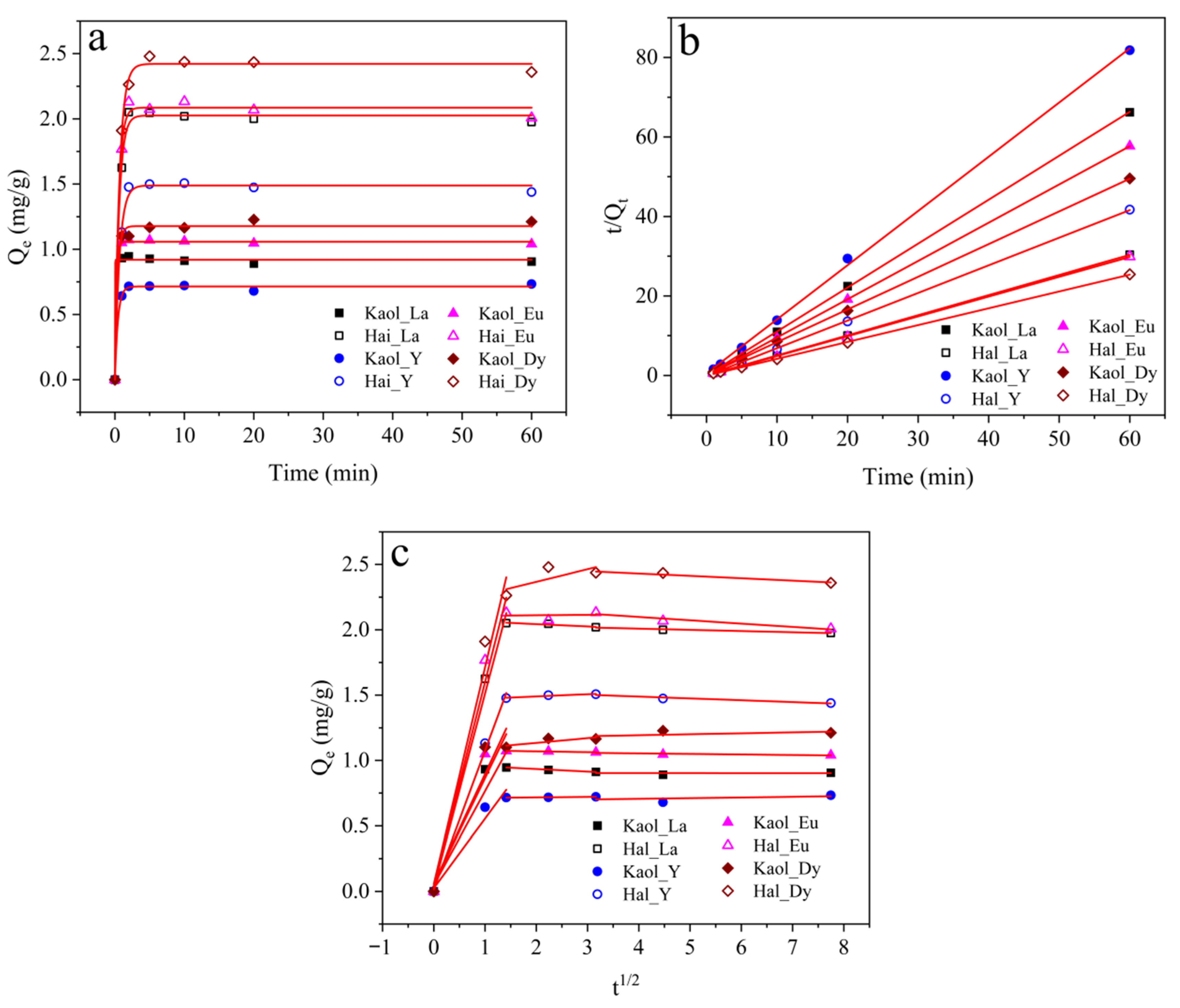
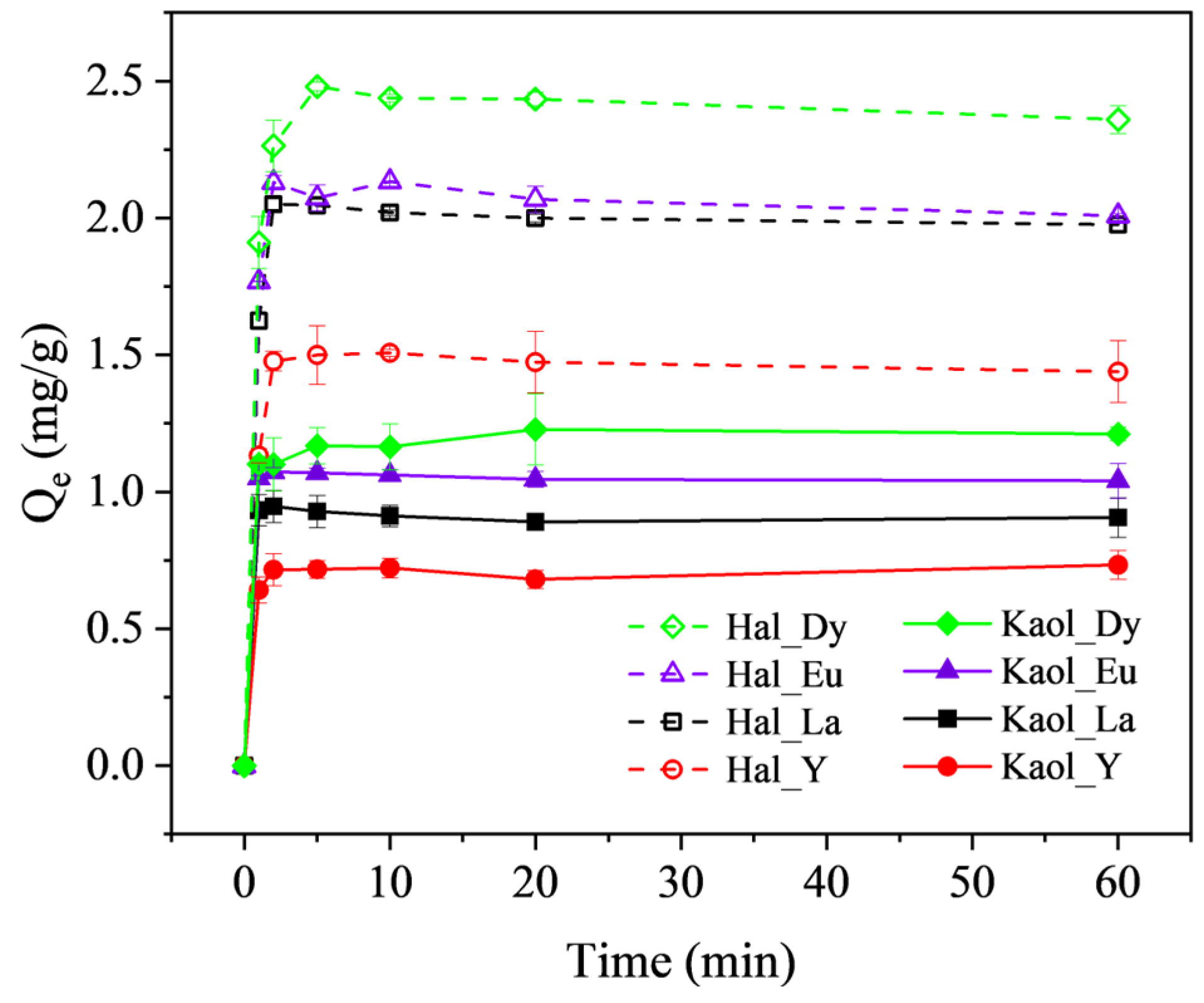
Adsorption time is an important factor in establishing a steady-state concentration. Under the experimental conditions of a solid–liquid ratio (S/L) of 10 g/L, an REE concentration of 60 mg/L, and a pH of 4 at 25 °C, the unit adsorption capacity of halloysite and kaolinite for La3+, Y3+, Eu3+, and Dy3+ varied with time, as shown in Figure 1. The adsorption capacity of kaolinite and halloysite for La3+, Y3+, Eu3+, and Dy3+ increases with time until equilibrium is reached. Under the same conditions, halloysite has a better adsorption capacity for REEs than does kaolinite, and halloysite has a larger specific surface area than does kaolinite. Adsorption occurs rapidly in the first 5 min, with the vast majority of rare earth ions (approximately 95%) already adsorbed in the first 5 min, indicating that the adsorption process mainly occurs in the first 5 min. At equilibrium, the unit adsorption capacities of halloysite for La3+, Y3+, Eu3+ and Dy3+ are 1.975 mg/g, 1.438 mg/g, 2.008 mg/g and 2.359 mg/g, respectively; the unit adsorption capacities of kaolinite for La3+, Y3+, Eu3+ and Dy3+ are 0.905 mg/g, 0.733 mg/g, 1.040 mg/g and 1.211 mg/g, respectively. In the initial stage of adsorption, kaolinite and halloysite have more surface-active sites, and the concentration of rare earth ions in the solution is high. The two quickly combine. As the adsorption process continues, many active sites are occupied, and the number of rare earth ions in the solution decreases. The adsorption rate slows until adsorption and desorption reach dynamic equilibrium. The binding force and electrostatic repulsion on the surface of clay minerals cancel each other out, and adsorption reaches equilibrium.
The adsorption rate is fast, and under the experimental conditions of an REE concentration of 60 mg/L and pH 3, the unit adsorption capacity of these rare earth ions for halloysite and kaolinite is Dy3+ > Eu3+ > La3+ > Y3+. Among them, Y and Dy are heavy REEs, and Eu and La are light REEs, which may be related to the “lanthanide element shrinkage phenomenon” [20].

3.3. Influence of the Solution pH and Initial Concentration

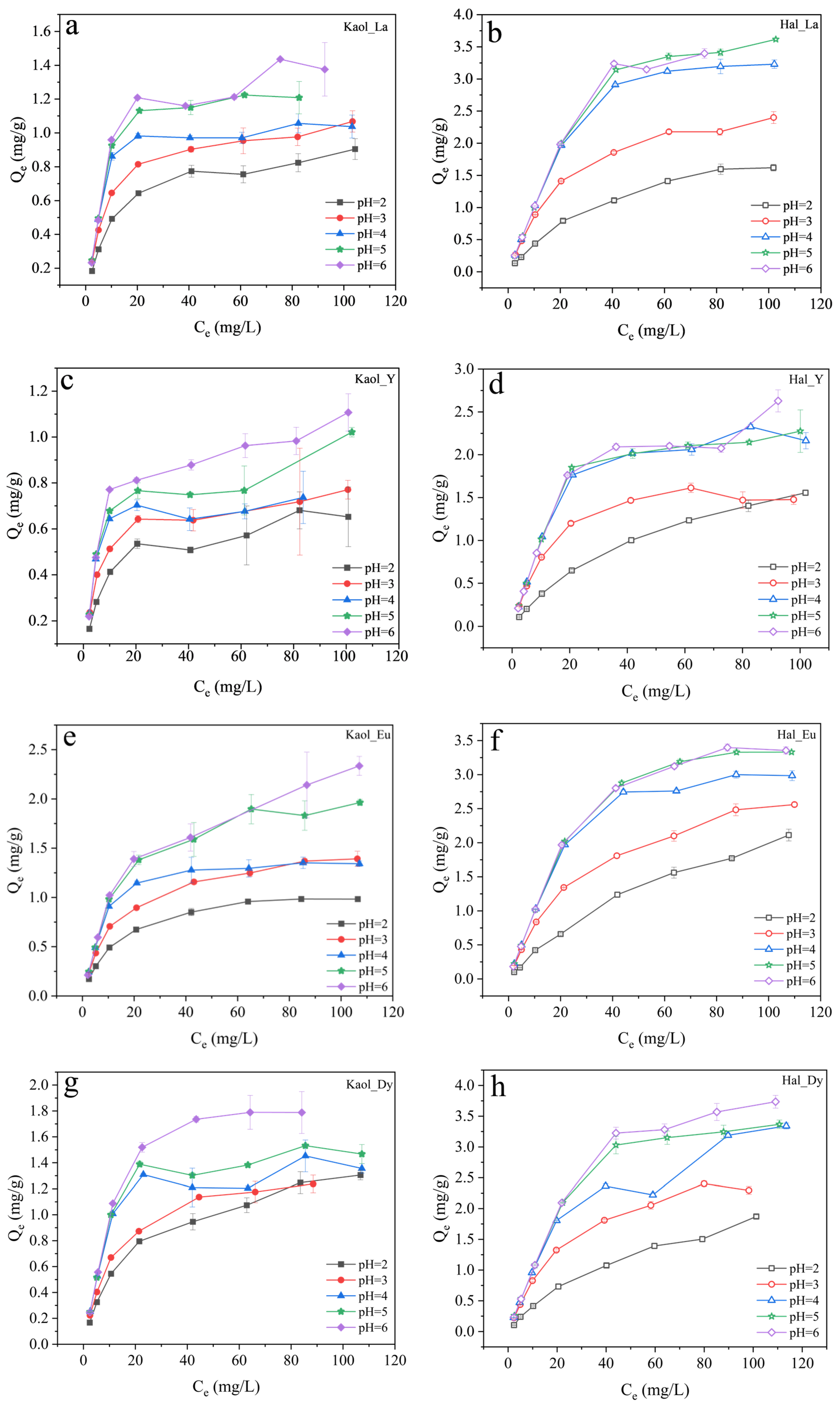
As shown in Figure 2, the adsorption curves of La3+, Y3+, Eu3+, and Dy3+ show similar changes. At the same initial concentration, the amount of the four rare earth ions adsorbed on kaolinite and halloysite increases with increasing pH. The increase in adsorption capacity with increasing solution pH is usually closely related to the deprotonation of hydroxyl groups on the surface of clay minerals. The pH of aqueous solutions plays an important role in the adsorption of REEs by clay minerals through competition between H+ and metal ions. Under strongly acidic conditions, most of the surface of clay minerals is covered by H+. As the pH increases, the concentration of H+ in the aqueous solution decreases, the competitive ability of REEs increases, and the adsorption capacity increases.
According to the literature, REEs can form hydroxide precipitates in alkaline aqueous solutions, which can interfere with the adsorption results [21]. Therefore, a pH range of 2–6 was selected for the experiments on the adsorption of REEs. Under the same pH conditions, the equilibrium adsorption capacity of the four rare earth ions on kaolinite and halloysite increased with increasing initial concentration until equilibrium was reached. The adsorption efficiency decreases with increasing rare earth ion concentration, and the higher the pH is, the higher the adsorption rate. As the initial concentration increases, the content of REEs in the solution increases. With an increase in the number of rare earth ions in contact with kaolinite and halloysite, REEs will occupy more adsorption sites. As the number of adsorption sites decreases, the adsorption efficiency decreases.
Under the same experimental conditions, the adsorption amounts of the four REEs on halloysite were greater than those on kaolinite, indicating that there are more adsorption sites on halloysite than on kaolinite and that halloysite has a stronger adsorption capacity for REEs. This may be due to the small particle size of halloysite, which has a larger specific surface area than kaolinite. Comparing the adsorption of the four rare earth ions by kaolinite and halloysite, the unit adsorption capacity of several rare earth ions on kaolinite and halloysite is La3+ > Dy3+ > Eu3+ > Y3+. This may be related to the ionic radius, as REEs are typically adsorbed on the surface of clay minerals in the form of hydrated outer complexes at 8–9 times their size through inner and outer ring complexation. Light rare earth ions are generally ninefold coordinated, whereas heavy rare earth ions are often eightfold coordinated [22,23,24].

3.4. XRD Analysis

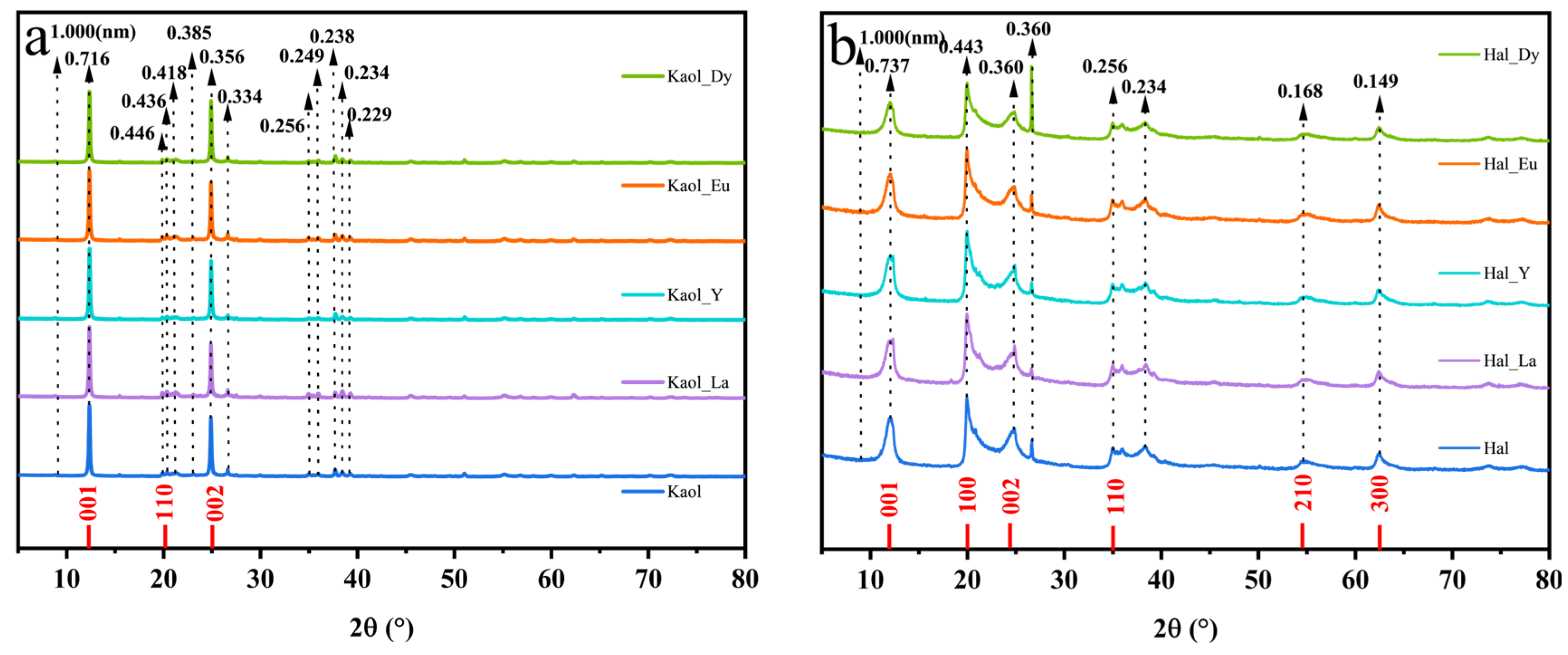
The XRD patterns of kaolinite and halloysite before and after the adsorption of REEs are shown in Figure 3. The d001 and d002 crystal planes of kaolinite and halloysite can characterize the basal plane features such as interlayer spacing and stacking order; the d110 crystal plane and the unique d210 crystal plane of halloysite can reflect the characteristics of edge active sites, lattice framework and tubular structure of minerals [25,26]. The results indicate that both clay minerals used in the adsorption experiments are high-purity clay minerals. After the adsorption of REEs by kaolinite, no new diffraction peaks appeared, and the significant characteristic diffraction reflections did not change significantly. This may be because the amount of REEs adsorbed by kaolinite is too small, resulting in unclear changes in the XRD patterns. After the adsorption of REEs by halloysite, the intensity of the diffraction peak at 26.6° changed, suggesting that this change may be related to the adsorption of different types and concentrations of REEs.

3.5. SEM–EDS Analysis

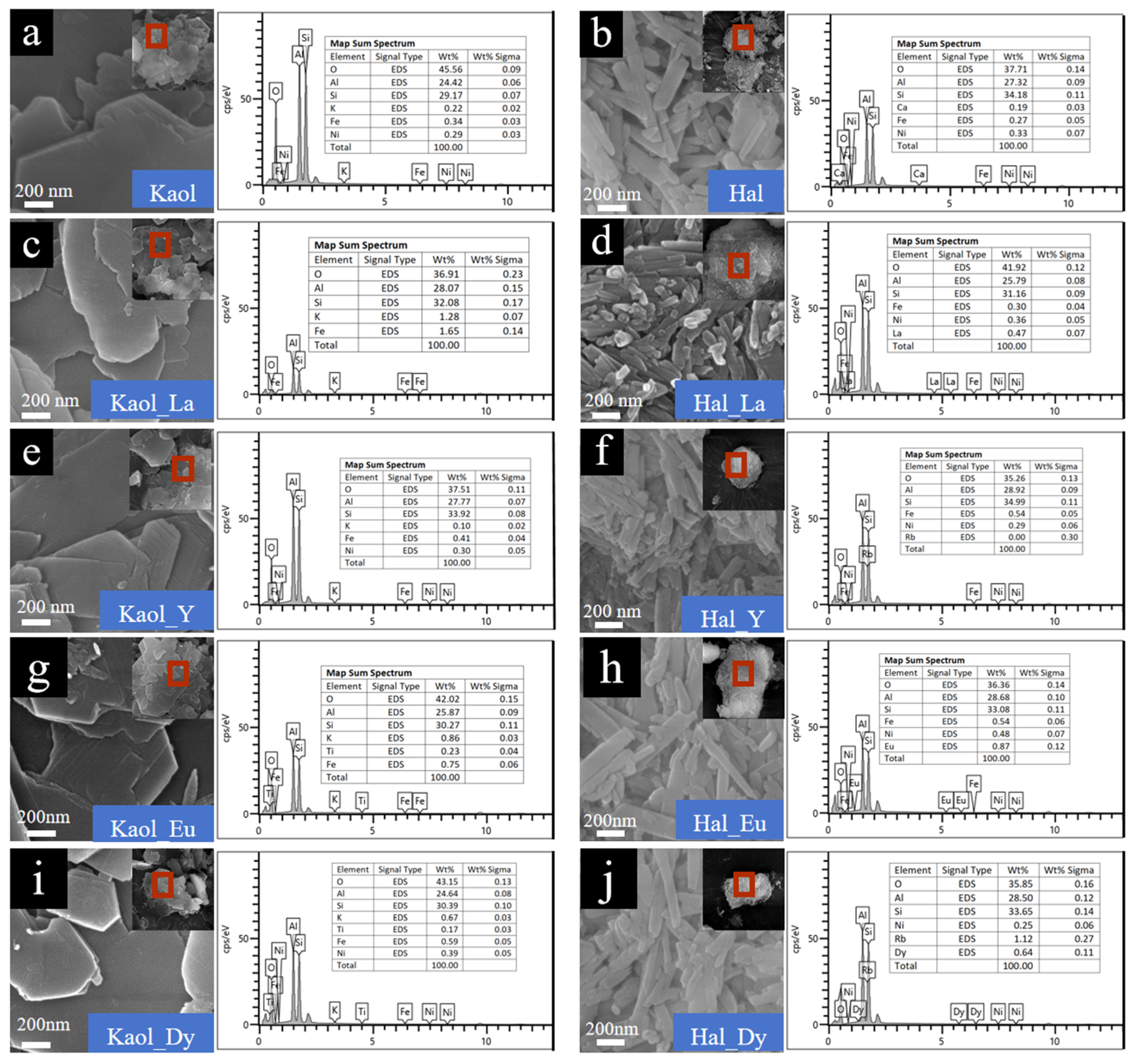
SEM–EDS images of kaolinite and halloysite before and after the adsorption of REEs are shown in Figure 4. Figure 4a shows that kaolinite has a sheet-like morphology. Figure 4b shows that the halloysite sample has a tubular morphology with smaller crystal particles. Similarly, halloysite is significantly smaller than kaolinite. A comparison of Figure 4c,e,g,i and Figure 4d,f,h,j reveals that there is no significant change in the surface morphology of kaolinite and halloysite before and after adsorption; EDS reveals that the main elements of kaolinite and halloysite are O, Si, and Al, which indicates that the clay minerals have high purity and few impurities. REEs were detected in Figure 4d,h,j in the samples of La, Eu, Y and Dy adsorbed by halloysite. This may be due to the high adsorption capacity of these three elements on halloysite, indicating that REEs are adsorbed onto clay minerals and that halloysite has a stronger adsorption capacity for REEs than kaolinite does.

3.6. FTIR Analysis

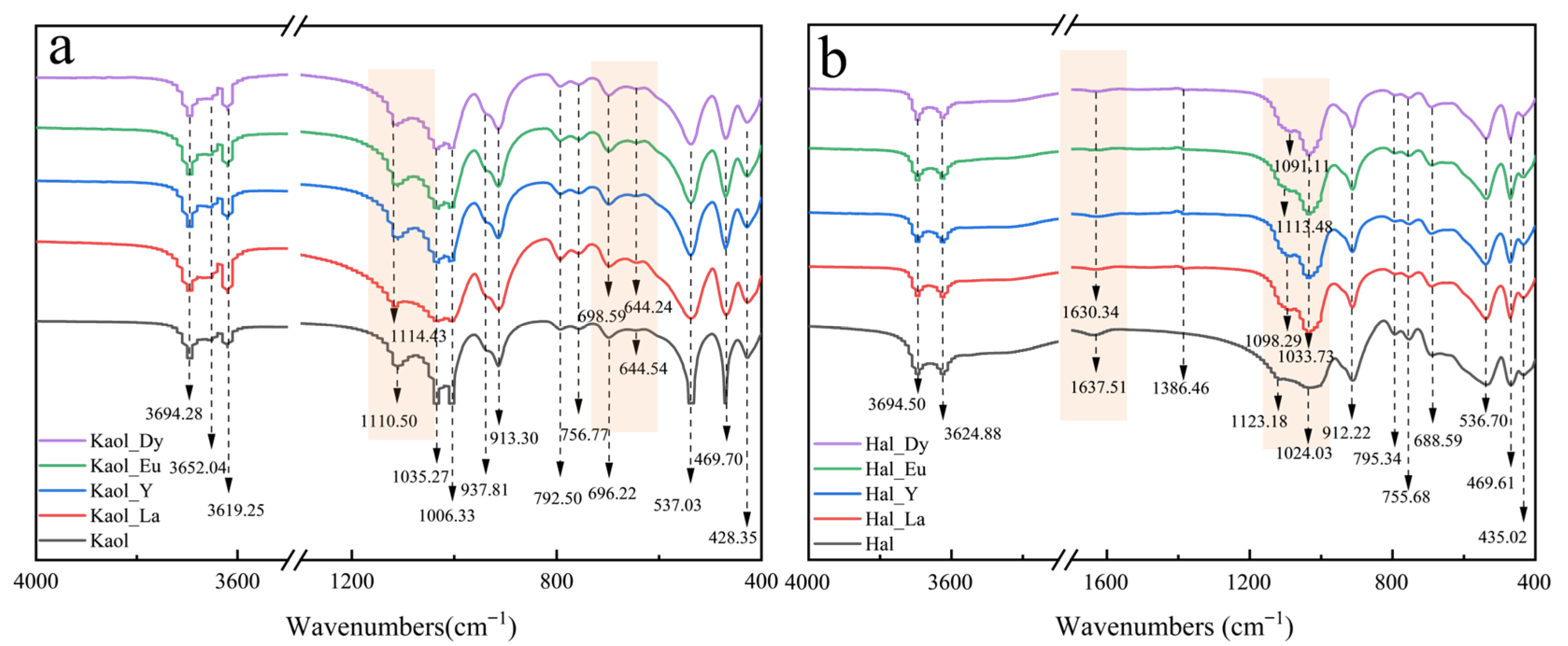
To further investigate the adsorption mechanism of REEs by kaolinite and halloysite, FT-IR was used to characterize kaolinite and halloysite before and after the adsorption of La3+, Y3+, Eu3+, and Dy3+. The characteristic peaks of the infrared results indicate that the sample is high-purity kaolinite and halloysite. The characteristic peaks of Si–O–Si, Al–OH, and Al–O–Si did not significantly change after adsorption, indicating that the adsorption process did not change the basic structure of the clay minerals. There are many hydroxyl groups on the surface of clay minerals. The FT-IR spectra of kaolinite adsorbing four REEs are shown in Figure 5a. The peaks at 3694.28 cm−1, 3652.04 cm−1, and 3619.25 cm−1 are caused by –OH stretching vibrations. The peaks at 1035.27 cm−1 and 1006.92 cm−1 are due to Si–O–Si stretching vibrations. The peak at 1110.50 cm−1 changes to 1114.34 cm−1, indicating that adsorption is related to Si–O–Si. The peaks at 756.77 cm−1 and 700.06 cm−1 are due to Si–O tensile vibration, and the peaks at 913.30 cm−1 and 937.81 cm−1 are caused by the Al–OH bending vibration. The FT-IR spectra of the four REEs adsorbed by halloysite are shown in Figure 5b. The infrared vibration bands attributed to the –OH stretching vibration are at 3694.50 cm−1 and 3624.88 cm−1. The infrared vibration band at 3694.50 cm−1 corresponds to the extension vibration of the inner surface hydroxyl group, and the infrared vibration band at 3624.88 cm−1 corresponds to the stretching vibration of the inner hydroxyl group [27]. The characteristic peak at 1637.51 cm−1 is caused by HOH deformation and stretching vibration, resulting in a shift in the peak after adsorption, as well as a shift in the peak at 1123.18 cm−1. After adsorption, the absorption peak of Al–OH at 912.22 cm−1 weakened, and the band narrowed, indicating that rare earth ions were adsorbed on the surface of the clay minerals, covering the original aluminum hydroxyl groups. This suggests that clay minerals have a good adsorption effect on rare earth ions [28].

3.7. TEM–EDS Analysis

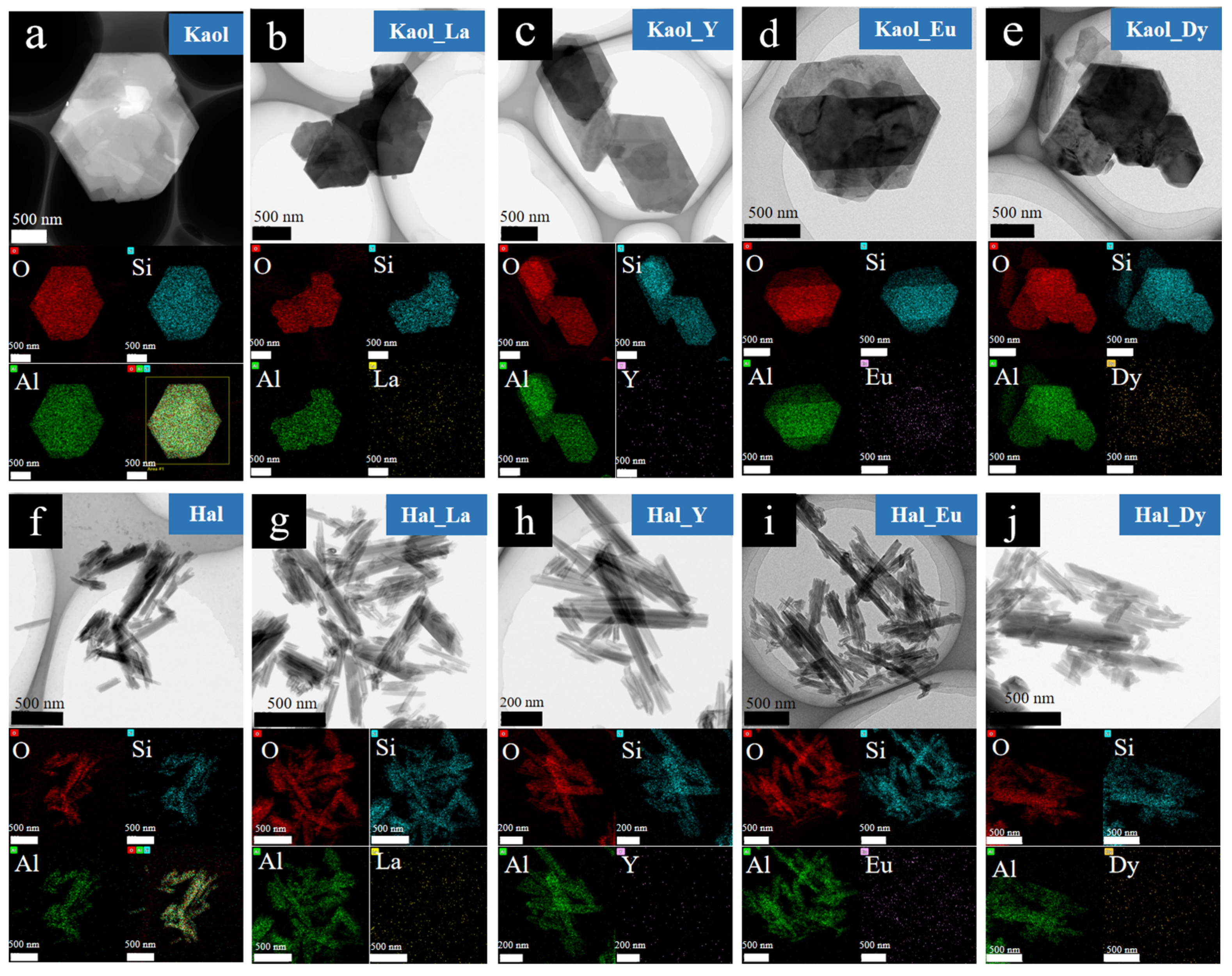
The TEM and EDS images of kaolinite and halloysite before and after the adsorption of REEs are shown in Figure 6. Kaolinite has a sheet-like morphology, whereas halloysite has a tubular structure with smaller particles. Both halloysite and kaolinite have crystal structures, with kaolinite being more pronounced as a single crystal, possibly due to the smaller particle size of halloysite crystals. Adsorption has no significant effect on the surface of clay minerals, and the EDS results indicate that the adsorption capacity of halloysite is greater than that of kaolinite. Meanwhile, the EDS results show that rare earth elements are enriched on clay minerals, indicating that clay minerals can adsorb rare earth elements.
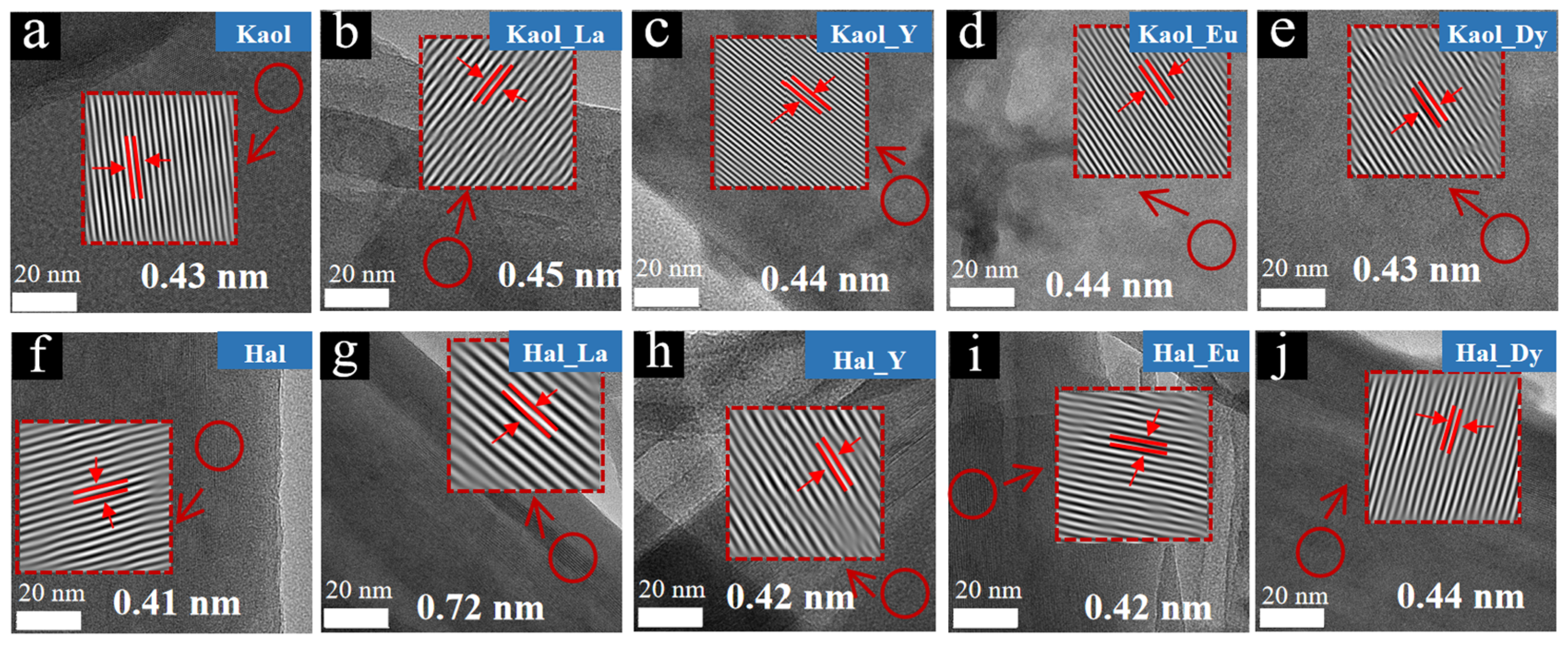
Figure 7 shows the HRTEM results of kaolinite and halloysite before and after the adsorption of REEs. Both kaolinite and halloysite have a single-crystal structure. Before adsorption, the lattice stripe spacings of kaolinite and halloysite were 0.43 nm and 0.41 nm, respectively. After the adsorption of La3+, Y3+, Eu3+, and Dy3+, the lattice stripe spacings of kaolinite increased to 0.45 nm, 0.44 nm, 0.44 nm, and 0.43 nm, respectively. After the adsorption of La3+, Y3+, Eu3+, and Dy3+, the lattice stripe spacings of halloysite increased to 0.72, 0.42, 0.42, and 0.44 nm, respectively. After adsorption, the lattice stripe spacing of kaolinite and halloysite increased to varying degrees, which may be due to rare earth ions entering the interlayer.

3.8. XPS Analysis

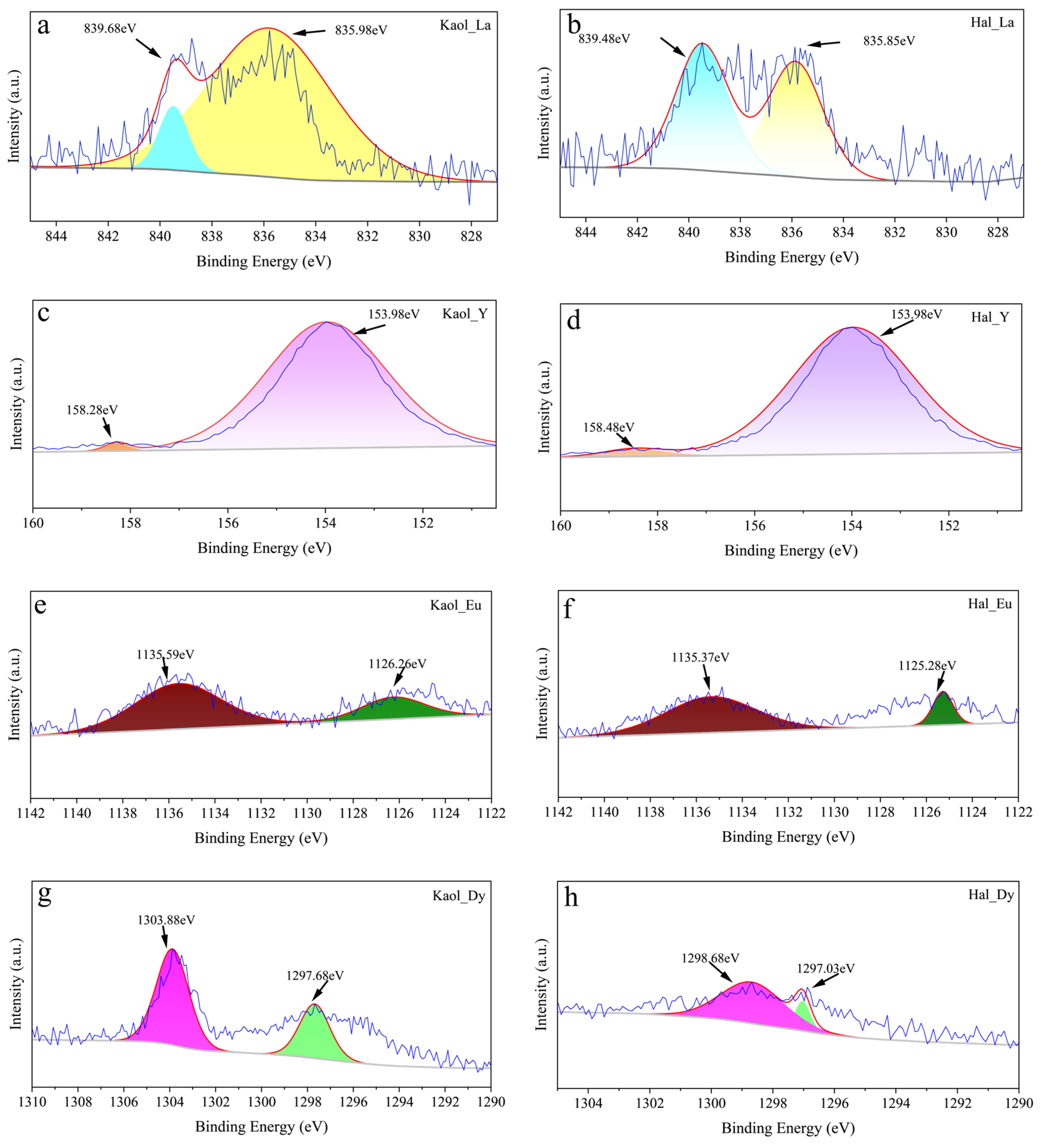
To investigate the chemical states of REEs adsorbed on the surfaces of kaolinite and halloysite. XPS tests were conducted on kaolinite and halloysite samples with adsorbed La3+, Y3+, Eu3+, and Dy3+. The results are shown in Figure 8. The results revealed that REEs were indeed present on the surfaces of kaolinite and halloysite. Peak fitting was performed on the La 3d5/2, Y 3d5/2, Eu 3d5/2, and Dy 3d5/2 XPS spectra, and it was found that the Kaol/La, Hal/La, Kaol/Y, Hal/Y, Hal/Eu, Kaol/Eu, Kaol/Dy, and Hal/Dy samples presented two different binding energy peaks. The relevant fitting parameters are shown in Table 1. Peaks with different binding energies usually indicate different chemical forms of REEs. Taking La as an example, the binding energy of La 3d5/2 in La(OH)3 is 834.5 eV; the binding energy of La 3d5/2 in La2(CO3)3 is 835.0 eV [29,30,31] Therefore, in the XPS spectrum of La 3d5/2 in the Hal/La samples, the two peaks at binding energies of 835.85 eV and 839.48 eV indicate the presence of two different chemical states of La(III) ions in the Hal/La samples.
Previous studies have shown that the inner ring complex is formed by the complexation of aluminum/silicon hydroxyl groups on the surface of clay minerals with rare earth ions, and the outer ring complex is formed by electrostatic gravitation. The energy of the inner ring complex of Eu(III) is 1134.3–1134.89 eV [11,32], indicating that the binding energy of Eu 3d5/2 in Hal/Eu samples at 1135.59 eV was the inner ring complex of Eu(III) ions, and the binding energy at 1126.26 eV was mainly the outer ring complex. The adsorption modes of the Kaol/La, Hal/La, Kaol/Y, Hal/Y, Kaol/Eu, Kaol/Dy, and Hal/Dy samples are similar. REEs are adsorbed on clay minerals in the form of inner ring complexes and outer ring complexes, and most of the inner ring complexes are dominant. In the Kaol/Y and Hal/Y samples, the inner ring complexes were similar. The specific outer ring complexes are 80:1 and 32:1, respectively. This may be because Y is a heavy REE that tends to form inner ring complexes with aluminum/silicon hydroxyl groups on the surface of clay minerals and rare earth ions.

3.9. Adsorption Kinetics

To study the changes in adsorption efficiency over time and the factors affecting the rate during the adsorption process, pseudo-first-order and pseudo-second-order kinetic equations were used to fit the adsorption kinetics curves. The fitted curves and corresponding parameter values are shown in Figure 9 and Table 2 and Table 3. Compared with the pseudo-first-order kinetic fitting coefficients, the pseudo-second-order kinetic fitting coefficients R2 of kaolinite and halloysite for the adsorption of the four REEs are as high as 0.999, all close to 1. After adsorption equilibrium, the theoretical unit adsorption capacities of halloysite for La3+, Y3+, Eu3+ and Dy3+ are 1.976 mg/g, 1.439 mg/g, 2.006 mg/g and 2.362 mg/g, respectively; the theoretical unit adsorption capacities of kaolinite for La3+, Y3+, Eu3+ and Dy3+ are 0.904 mg/g, 0.733 mg/g, 1.039 mg/g and 1.216 mg/g, respectively. The adsorption behavior of La3+, Y3+, Eu3+, and Dy3+ rare earth ions on kaolinite and halloysite is closer to the unit adsorption amount obtained from the experiment. Therefore, the adsorption behaviors of La3+, Y3+, Eu3+, and Dy3+ all conform to pseudo-second-order kinetic equations, indicating that adsorption is chemical adsorption. Chemical factors such as changes in the rare earth ion concentration and the number of active sites on clay minerals affect the adsorption efficiency.

3.10. Adsorption Isotherms

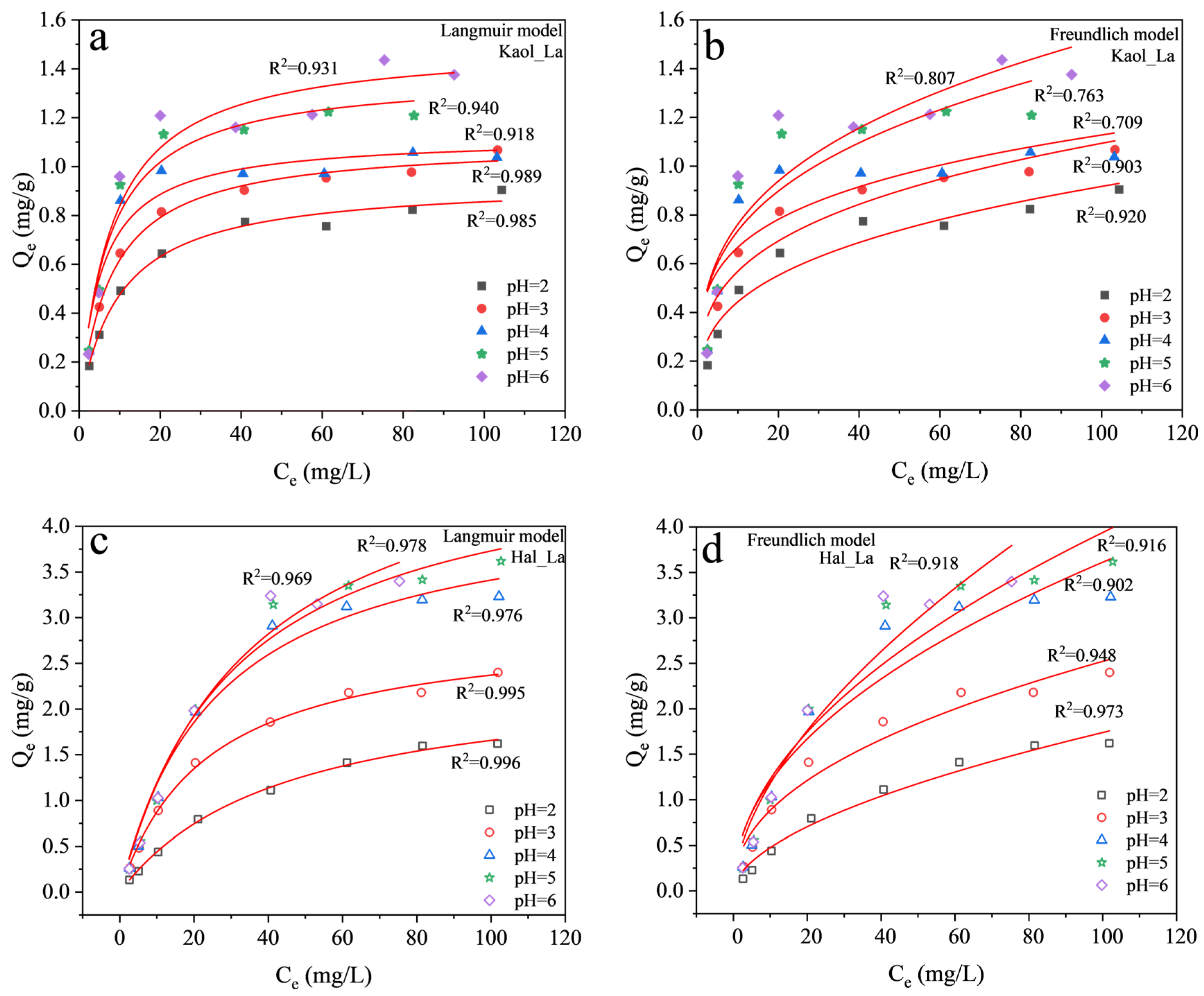
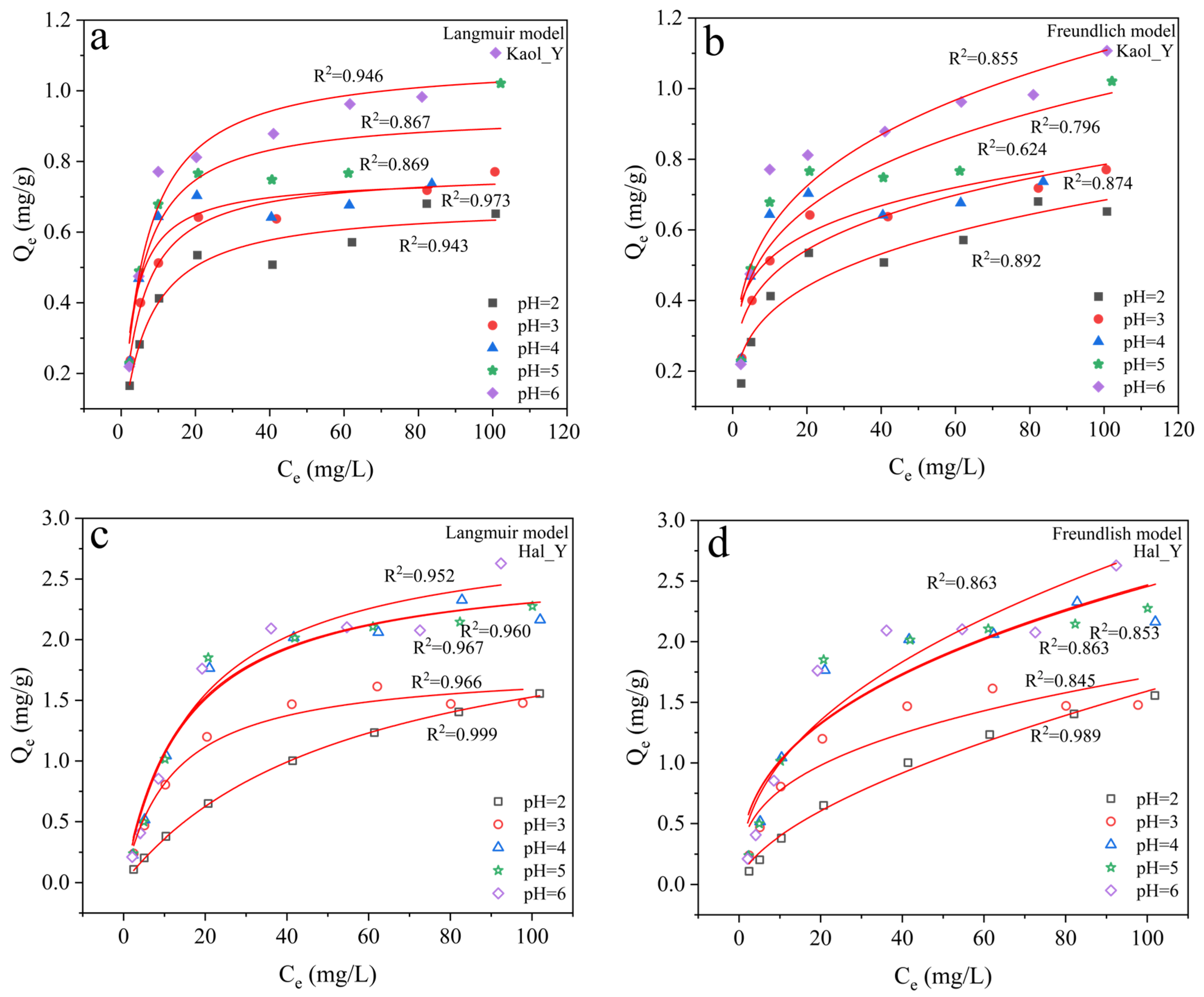
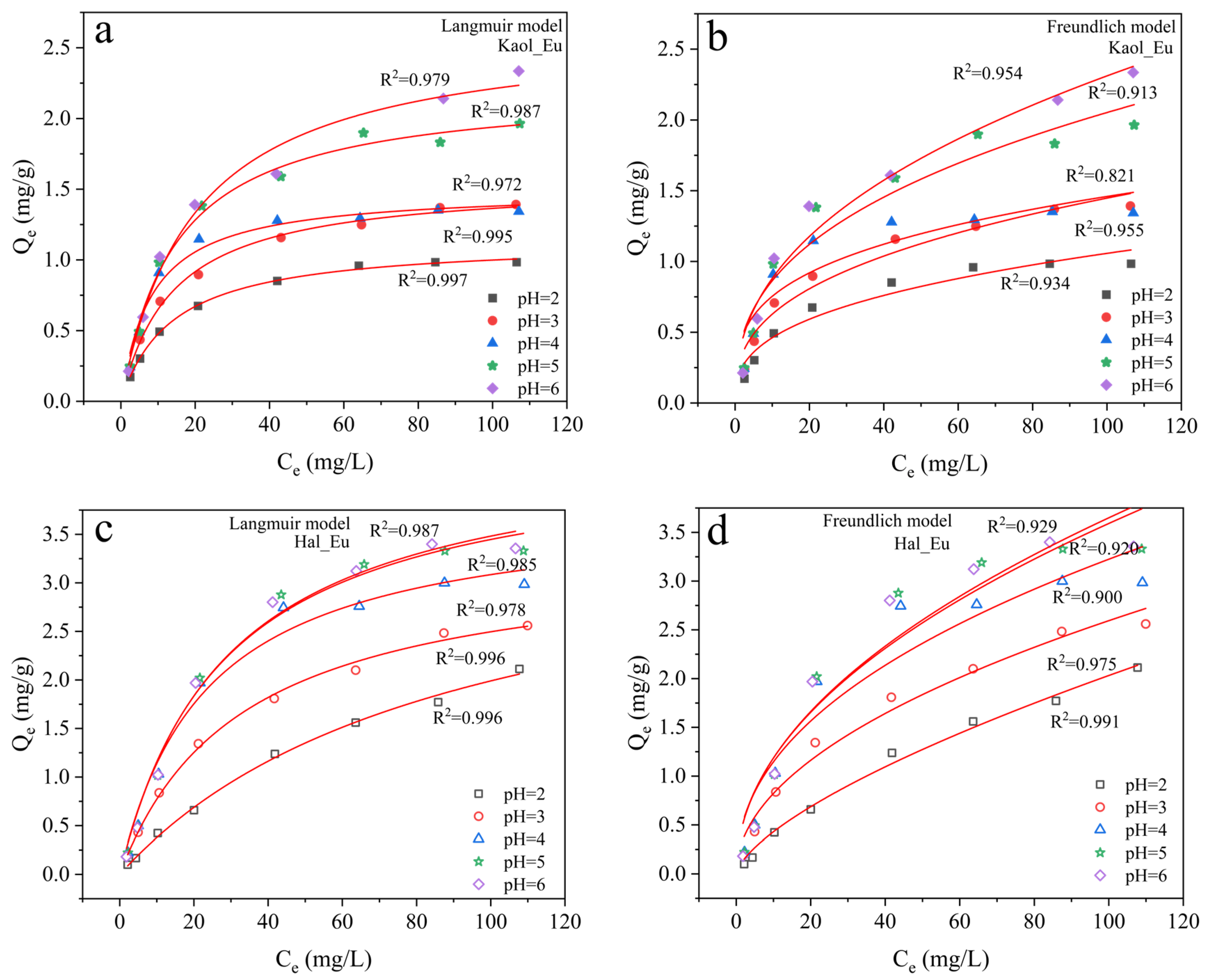
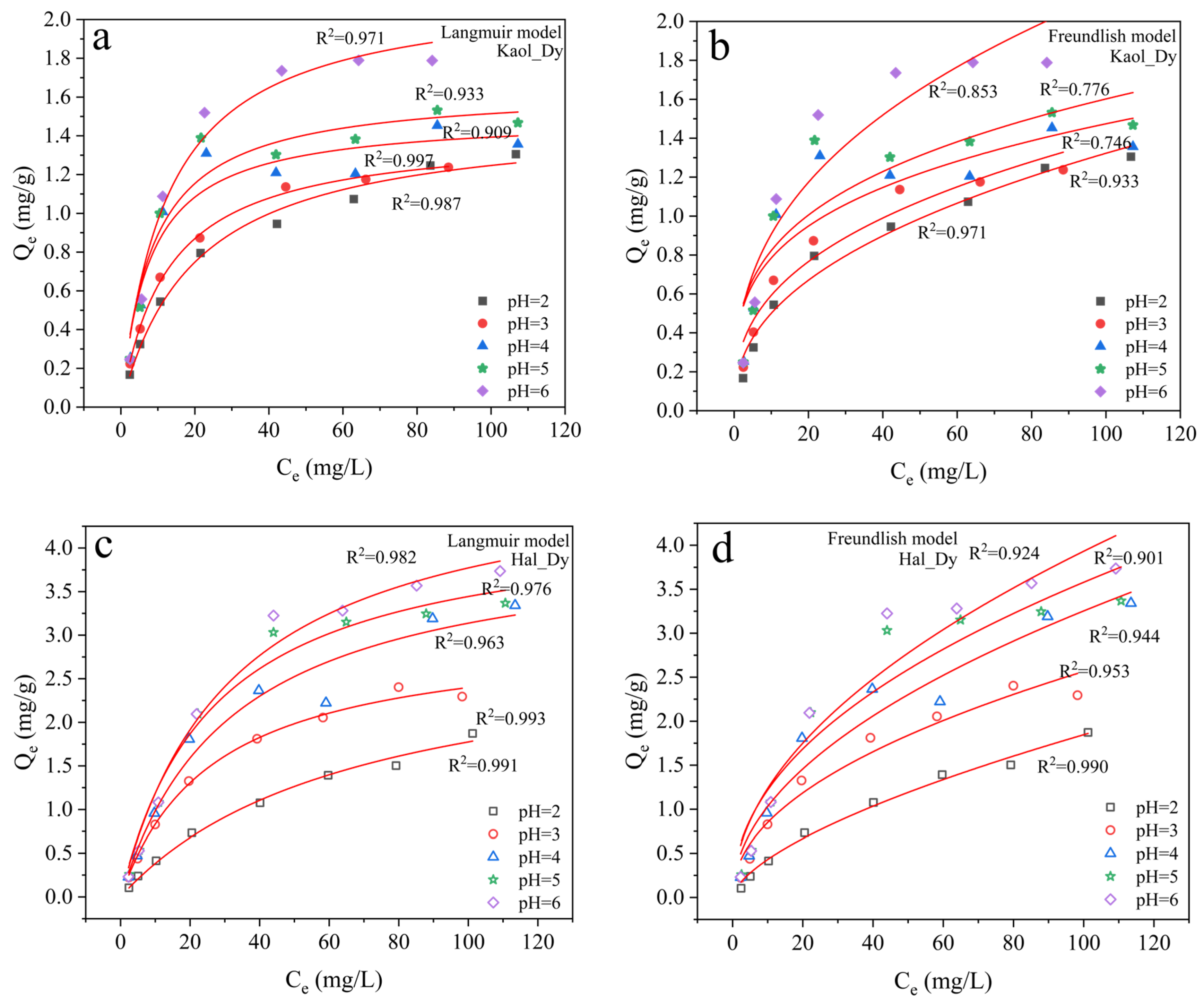
To study the saturated adsorption capacity and adsorption types of kaolinite and halloysite for La3+, Y3+, Eu3+, and Dy3+ rare earth ions, the adsorption data of kaolinite and halloysite for La3+, Y3+, Eu3+, and Dy3+ were fitted with the most common Freundlich and Langmuir models to fit the experimental adsorption equilibrium data in Figure 2. The linear fitting results are shown in Figure 10, Figure 11, Figure 12 and Figure 13, and the fitting correlation coefficients are shown in Table 4, Table 5, Table 6 and Table 7. Figure 10, Figure 11, Figure 12 and Figure 13 show that the adsorption curves of clay minerals adsorbing different REEs are similar and that their adsorption mechanisms are similar. According to the fitting parameters, kaolinite and halloysite have similar adsorption mechanisms. The correlation coefficients of the Langmuir model fit for La3+, Y3+, Eu3+ and Dy3+ adsorption were greater than 0.95, 0.85, 0.97 and 0.90, respectively. The correlation coefficients fitted by the Langmuir model for these four REEs are greater than the R2 values fitted by the Freundlich model under the same conditions. The Langmuir model better described the adsorption process of kaolinite and halloysite adsorbing La3+, Y3+, Eu3+, and Dy3+, indicating that kaolinite and halloysite as adsorbents had uniform adsorption interfaces and that the adsorption of La3+, Y3+, Eu3+, and Dy3+ on the surface was uniform monolayer molecular adsorption and that there was no interaction between the adsorbed rare earth ions. Moreover, under certain experimental conditions, the adsorption and desorption of La3+, Y3+, Eu3+, and Dy3+ by kaolinite and halloysite can reach dynamic equilibrium, resulting in maximum unit adsorption. It is generally believed that multimolecular layer adsorption is controlled by physical adsorption, whereas single-molecular layer adsorption is controlled by chemical adsorption; thus, chemical adsorption is the main speed control step, which is the same as the fitting result of the adsorption kinetic model [23].
According to the data in Table 4, Table 5, Table 6 and Table 7, the Langmuir model theoretical maximum adsorption capacities of kaolinite for La3+, Y3+, Eu3+, and Dy3+ are 1.503 mg/g, 1.086 mg/g, 2.644 mg/g and 2.159 mg/g, respectively; the Langmuir model theoretical maximum adsorption capacities of halloysite for La3+, Y3+, Eu3+, and Dy3+ are 5.256 mg/g, 2.920 mg/g, 4.487 mg/g and 4.978 mg/g, respectively, which are all close to the actual maximum adsorption capacities. For the adsorption of these four rare earth ions, the maximum adsorption capacity of halloysite is greater than that of kaolinite. The 1/n values fitted by the Freundlich model are all between 0 and 1, indicating that the adsorption reaction easily occurs, and the 1/n values fitted by the adsorption of halloysite for La3+, Y3+, Eu3+, and Dy3+ at pH = 2 exceed 0.5, indicating that the adsorption reaction is not conducive to occur at low pH, which may be due to the competitive adsorption of more H+ in the solution and the protonation of clay minerals, resulting in a reduction in the amount of dysprosium at the adsorption site.

3.11. Mechanistic Analysis

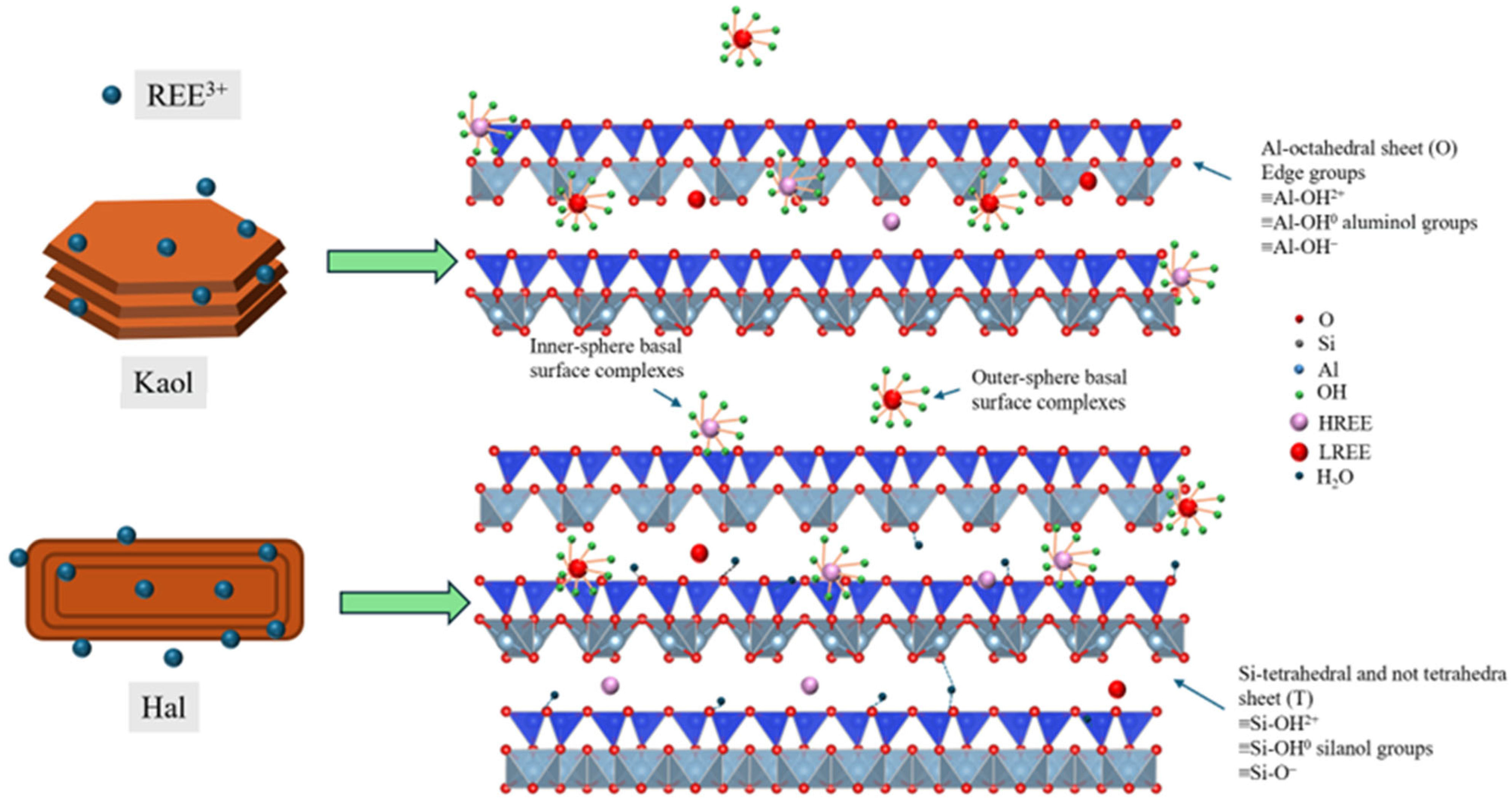
This study selected two typical clay minerals with high contents of weathered and leached rare earth minerals, kaolinite and halloysite, as well as the light REEs La and Eu and the heavy REEs Y and Dy, to study the adsorption mechanism of clay minerals on REEs, which is beneficial for elucidating the environmental and industrial implications of REE recovery. The adsorption of REEs by kaolinite and halloysite is a complex process governed by surface charge, hydroxyl group interactions, and chemical bonding, as shown in Figure 14.
The pseudo-second-order kinetic model and Langmuir monolayer adsorption model accurately describe the adsorption process, indicating that uniform, chemical adsorption is controlled by surface reactions. The formation of inner ring complexes between REE ions and surface hydroxyl groups is the dominant adsorption mechanism, with outer ring complexation contributing to a lesser extent. The influence of the solution pH and ionic radius on the adsorption capacity highlights the need for tailored approaches in REE recovery from diverse sources. These mechanistic insights provide a solid foundation for the development of efficient and sustainable REE extraction technologies.
Clay minerals such as kaolinite and halloysite possess a net negative surface charge due to isomorphic substitution, where lower valence cations (e.g., Al3+ or Fe3+) replace Si4+ in the silica tetrahedral layer [7,18]. This substitution results in a permanent negative charge, which is balanced by cations in the interlayer or on the surface. The surface charge characteristics of these clay minerals play crucial roles in their interactions with REEs. The hydroxyl groups (-OH) present on the basal and edge surfaces of kaolinite and halloysite are pivotal in REE adsorption. These hydroxyl groups can undergo protonation or deprotonation reactions depending on the solution pH, thereby altering the surface charge and enhancing the mineral’s capacity to adsorb cations, including REEs. The deprotonation of surface hydroxyls at higher pH values increases the negative surface charge, facilitating stronger electrostatic interactions with positively charged REE ions [33,34].
The adsorption kinetics of REEs on kaolinite and halloysite, as elucidated in Figure 9 and Table 2 and Table 3, conform to the pseudo-second-order kinetic model. This model suggests that the rate-limiting step involves chemical adsorption, where REE ions form chemical bonds with surface functional groups on clay minerals. The rapid initial adsorption rate, which reached equilibrium within the first five minutes, indicates a high affinity of REEs for clay surfaces. The consistency of the adsorption process with the Langmuir monolayer adsorption model further supports the notion of uniform, chemical adsorption. The Langmuir model assumes a homogeneous surface with finite adsorption sites, where each site can accommodate only one adsorbate molecule [35]. The high correlation coefficients (R2 > 0.95) obtained from fitting the experimental data to the Langmuir model confirm the applicability of this model to REE adsorption by kaolinite and halloysite.
Spectroscopic analyses, including X-ray photoelectron spectroscopy (XPS) and Fourier transform infrared spectroscopy (FTIR), provide insights into the nature of REE-clay interactions. XPS results revealed that REEs are adsorbed on halloysite and kaolinite through both outer ring complexation (electrostatic attraction) and inner ring complexation. The inner ring complexes, formed by the coordination of REE ions with surface hydroxyl groups, are dominant. The FTIR spectra of the clay minerals before and after REE adsorption show characteristic peaks corresponding to Si–O–Si, Al–OH, and Al–O–Si vibrations. The absence of significant shifts in these peaks suggests that the basic structure of the clay minerals remains intact upon REE adsorption. However, subtle changes in peak positions and intensities indicate interactions between REE ions and surface functional groups. Specifically, the weakening and narrowing of the Al-OH absorption peak after REE adsorption suggest that REE ions are coordinated to these hydroxyl groups, forming inner ring complexes.
The effect of the solution pH on REE adsorption is profound. As the pH increases, the deprotonation of surface hydroxyl groups enhances the negative surface charge, thereby increasing the adsorption capacity for REEs. This trend is consistent across both kaolinite and halloysite, although halloysite has a higher adsorption capacity because of its larger specific surface area and greater number of surface hydroxyl groups. The variation in adsorption capacity among different REEs (La, Eu, Y, Dy) can be attributed to differences in ionic radius and the “lanthanide contraction” phenomenon [33]. Compared with heavy REEs (e.g., Y, Dy), light REEs (e.g., La) have larger ionic radii, which affects their coordination chemistry and interaction with clay surfaces [36,37]. The smaller ionic radius of heavy REEs allows for stronger coordination with surface hydroxyl groups, potentially explaining their higher adsorption capacities for clay minerals.
Understanding the mechanistic details of REE adsorption by clay minerals has significant implications for environmental remediation and industrial extraction processes. The ability of kaolinite and halloysite to effectively adsorb REEs from low-concentration sources, such as mine drainage and industrial wastewaters, offers a sustainable and cost-effective solution for REE recovery. Moreover, the selective adsorption of specific REEs on the basis of their ionic radius and coordination chemistry can be exploited to develop tailored adsorption materials for specific applications. Future research should focus on manipulating edge site densities through mineral modification to further increase the adsorption efficiency.

4. Conclusions

The adsorption of REEs by kaolinite and halloysite is a complex process governed by surface charge, hydroxyl group interactions, and chemical bonding. Under the same conditions, the adsorption capacity of halloysite is greater than that of kaolinite, and the unit adsorption capacity of kaolinite and halloysite for REEs increases with increasing pH. The adsorption capacity of different REEs for clay minerals also varies, which may be related to the radius of rare earth ions and the differentiation of light and heavy REEs. The adsorption process of kaolinite and halloysite on REEs is more in line with the pseudo-second-order kinetic model and Langmuir monolayer adsorption model. This indicates that the adsorption process is uniform, is mainly controlled by chemical adsorption, and that the adsorption rate is fast. The adsorption process of rare earth ions by halloysite and kaolinite also involves interactions between the surfaces of two clay minerals and free hydrated rare earth ions. Many hydroxyl groups (such as aluminum hydroxyl groups) on the surface of halloysite and kaolinite minerals can adsorb rare earth ions through inner ring complexation. Owing to atomic substitution, both clay minerals have permanent negative charges and can adsorb rare earth ions through outer ring complexation (electrostatic attraction). These findings provide a solid foundation for the development of efficient and sustainable REE extraction technologies.

Supplementary Materials

The following supporting information can be downloaded at https://www.mdpi.com/article/10.3390/min16040399/s1. Figure S1: (a) Particle size of kaolinite; (b) particle size of halloysite.; Figure S2: XRD patterns of kaolinite and halloysite; Figure S3: (a) XPS spectrum of kaolinite after adsorption of La3+; (b) XPS spectra of halloysite adsorbed with La3+; (c) XPS spectra of kaolinite adsorbed with Y3+; (d) XPS spectra of Y3+ adsorbed onto halloysite; (e) XPS spectra of kaolinite adsorbed with Eu3+; (f) XPS spectra of Eu3+ adsorbed onto halloysite; (g) XPS spectra of kaolinite adsorbed with Dy3+; (h) XPS spectrum of Dy3+ adsorbed onto halloysite.; Table S1: Main components of the clay minerals (analyzed by oxides).

Author Contributions

Conceptualization, methodology, writing—original draft preparation, and writing—review and modification, H.L.; experiment, data curation, and writing—original draft preparation, S.H.; experiment and data curation, M.W.; conceptualization Y.L.; investigation, J.L.; conceptualization and project administration, J.W. All authors have read and agreed to the published version of the manuscript.

Funding

This work was supported by the National Key Research and Development Program of China (No. 2022YFC2105300).

Data Availability Statement

The original contributions involved in this study are all provided in the main text or supplementary materials. For further relevant questions, direct consultation may be made with the corresponding author.

Conflicts of Interest

The authors declare that they have no known competing financial interests or personal relationships that could have appeared to influence the work reported in this paper.

References

  1. Leal, W.; Kotter, R.; Özuyar, P.; Abubakar, I.; Eustachio, J.; Matandirotya, N. Understanding Rare Earth Elements as Critical Raw Materials. Sustainability 2023, 15, 1919. [Google Scholar] [CrossRef]
  2. Li, F.; Xiao, Z.; Zeng, J.; Chen, J.; Sun, X. Recovery of REEs from leaching liquor of ion-adsorbed-type rare earths ores using ionic liquid based on cooking oil. Hydrometallurgy 2020, 196, 105449. [Google Scholar] [CrossRef]
  3. Qiu, T.; Yan, H.; Li, J.; Liu, Q.; Ai, G. Response surface method for optimization of leaching of a low-grade ionic rare earth ore. Powder Technol. 2018, 330, 330–338. [Google Scholar] [CrossRef]
  4. Kegl, T.; Kosak, A.; Lobnik, A.; Novak, Z.; Kralj, A.; Ban, I. Adsorption of rare earth metals from wastewater by nanomaterials: A review. J. Hazard. Mater. 2020, 386, 121632. [Google Scholar] [CrossRef] [PubMed]
  5. He, Q.; Qiu, J.; Chen, J.; Zan, M.; Xiao, Y. Progress in green and efficient enrichment of rare earth from leaching liquor of ion adsorption type rare earth ores. J. Rare Earths 2022, 40, 353–364. [Google Scholar] [CrossRef]
  6. Tian, J.; Yin, J.; Chi, R.; Rao, G.; Jiang, M.; Ouyang, K. Kinetics on leaching rare earth from the weathered crust elution-deposited rare earth ores with ammonium sulfate solution. Hydrometallurgy 2010, 101, 166–170. [Google Scholar] [CrossRef]
  7. Zaera, F. Surface chemistry at the liquid/solid interface. Surf. Sci. 2011, 605, 1141–1145. [Google Scholar] [CrossRef]
  8. Bishop, B.; Alam, M.; Flynn, S.; Chen, N.; Hao, W.; Shivakumar, K.; Swaren, L.; Rueda, D.; Konhauser, K.; Alessi, D.; et al. Rare Earth Element Adsorption to Clay Minerals: Mechanistic Insights and Implications for Recovery from Secondary Sources. Environ. Sci. Technol. 2024, 58, 7217–7227. [Google Scholar] [CrossRef]
  9. Qiu, S.; Yan, H.; Hong, B.; Long, Q.; Xiao, J.; Li, F.; Tong, L.; Zhou, X.; Qiu, T. Desorption of REEs from Halloysite and Illite: A Link to the Exploitation of Ion-Adsorption RE Ore Based on Clay Species. Minerals 2022, 12, 1003. [Google Scholar] [CrossRef]
  10. Erust, C.; Karacahan, M.; Uysal, T. Hydrometallurgical Roadmaps and Future Strategies for Recovery of Rare Earth Elements. Miner. Process. Extr. Metall. Rev. 2023, 44, 436–450. [Google Scholar] [CrossRef]
  11. Xiao, Y.; Huang, L.; Long, Z.; Feng, Z.; Wang, L. Adsorption ability of rare earth elements on clay minerals and its practical performance. J. Rare Earths 2016, 34, 543–548. [Google Scholar] [CrossRef]
  12. Yin, K.; Hong, H.; Li, R.; Han, W.; Wu, Y.; Gao, W.; Jia, J. Mineralogy and Genesis of Mixed-Layer Clay Minerals in the Jiujiang Net-Like Red Soil. Spectrosc. Spectr. Anal. 2012, 32, 2765–2769. [Google Scholar] [CrossRef]
  13. Deng, Z.; Qin, L.; Wang, G.; Luo, S.; Peng, C.; Li, Q. Metallogenic process of ion adsorption REE ore based on the occurrence regularity of La in kaolin. Ore Geol. Rev. 2019, 112, 103022. [Google Scholar] [CrossRef]
  14. He, Y.; Li, D.; Velde, B.; Yang, Y.; Huang, C.; Gong, Z.; Zhang, G. Clay minerals in a soil chronosequence derived from basalt on Hainan Island, China and its implication for pedogenesis. Geoderma 2008, 148, 206–212. [Google Scholar] [CrossRef]
  15. Long, Q.; Yan, H.; Zhou, X.; Qiu, S.; Qiu, T. Adsorption and desorption characteristics of rare earth ions on halloysite surfaces. Physicochem. Probl. Miner. Process. 2024, 60, 185763. [Google Scholar] [CrossRef]
  16. Mbey, J.; Thomas, F.; Razafitianamaharavo, A.; Caillet, C.; Villiéras, F. A comparative study of some kaolinites surface properties. Appl. Clay Sci. 2019, 172, 135–145. [Google Scholar] [CrossRef]
  17. Zhou, J.; Liu, H.; Liu, D.; Yuan, P.; Bu, H.; Du, P.; Fan, W.; Li, M. Sorption/desorption of Eu(III) on halloysite and kaolinite. Appl. Clay Sci. 2022, 216, 106356. [Google Scholar] [CrossRef]
  18. Tombácz, E.; Szekeres, M. Surface charge heterogeneity of kaolinite in aqueous suspension in comparison with montmorillonite. Appl. Clay Sci. 2006, 34, 105–124. [Google Scholar] [CrossRef]
  19. Chen, Z.; He, J.; Chen, L.; Lu, S. Sorption and desorption properties of Eu(III) on attapulgite. J. Radioanal. Nucl. Chem. 2016, 307, 1093–1104. [Google Scholar] [CrossRef]
  20. Wu, Z.; Chen, Y.; Wang, Y.; Xu, Y.; Lin, Z.; Liang, X.; Cheng, H. Review of rare earth element (REE) adsorption on and desorption from clay minerals: Application to formation and mining of ion-adsorption REE deposits. Ore Geol. Rev. 2023, 157, 105446. [Google Scholar] [CrossRef]
  21. Xu, Q.; Yang, L.; Zhang, L.; Li, C.; Wang, D.; Zhou, X.; Zhou, X.; Li, Y. Classification and High Efficient Leaching of Ion Adsorption Rare Earth Based on Its pH Dependence. Chin. J. Inorg. Chem. 2018, 34, 112–122. [Google Scholar] [CrossRef]
  22. Borst, A.; Smith, M.; Finch, A.; Estrade, G.; Villanova-de-Benavent, C.; Nason, P.; Marquis, E.; Horsburgh, N.; Goodenough, K.; Xu, C.; et al. Adsorption of rare earth elements in regolith-hosted clay deposits. Nat. Commun. 2020, 11, 4386. [Google Scholar] [CrossRef]
  23. Yang, J.; Yu, M.; Qiu, T. Adsorption thermodynamics and kinetics of Cr(VI) on KIP210 resin. J. Ind. Eng. Chem. 2014, 20, 480–486. [Google Scholar] [CrossRef]
  24. Padrones, J.T.; Imai, A.; Takahashi, R. Geochemical Behavior of Rare Earth Elements in Weathered Granitic Rocks in Northern Palawan, Philippines. Resour. Geol. 2017, 67, 231–253. [Google Scholar] [CrossRef]
  25. Bastida, J.; Pardo-Ibañez, P. Applications of X-Ray Powder Diffraction Microstructural Analysis in Applied Clay Mineralogy. Minerals 2024, 14, 584. [Google Scholar] [CrossRef]
  26. Ruiz-Hitzky, E.; van Meerbeek, A. Clay mineral and organoclay–polymer Nanocomposite. In Handbook of Clay Science; Chapter 10.3; Developments in Clay Science; Bergaya, F., Theng, B.K.G., Lagaly, G., Eds.; Elsevier Science: Amsterdam, The Netherlands, 2006; Volume 1, pp. 583–621. [Google Scholar]
  27. Semenkova, A.; Romanchuk, A.; Seregina, I.; Mikheev, I.; Svitelman, V.; Kalmykov, S. Eu(III) sorption on kaolinite: Experiments and modeling. Appl. Clay Sci. 2023, 234, 106865. [Google Scholar] [CrossRef]
  28. Chen, Z.; Wang, H.; Chi, R.; Zhang, Z. Adsorption Characteristics of Praseodymium and Neodymium with Clay Minerals. Minerals 2025, 15, 1051. [Google Scholar] [CrossRef]
  29. Fan, Q.; Tan, X.; Li, J.; Wang, X.; Wu, W.; Montavon, G. Sorption of Eu(III) on Attapulgite Studied by Batch, XPS, and EXAFS Techniques. Environ. Sci. Technol. 2009, 43, 5776–5782. [Google Scholar] [CrossRef] [PubMed]
  30. Moldoveanu, G.; Papangelakis, V. Recovery of rare earth elements adsorbed on clay minerals: I. Desorption mechanism. Hydrometallurgy 2012, 117, 71–78. [Google Scholar] [CrossRef]
  31. Guan, X.; Li, P.; Liu, W.; Chang, Q.; Han, Y.; Zhang, J.; Zhang, H.; Li, Q.; Zheng, S. Adsorption mechanism of yttrium ions onto ion-adsorption type rare earths ore. Sep. Purif. Technol. 2022, 299, 121641. [Google Scholar] [CrossRef]
  32. Coppin, F.; Berger, G.; Bauer, A.; Castet, S.; Loubet, M. Sorption of lanthanides on smectite and kaolinite. Chem. Geol. 2002, 182, 57–68. [Google Scholar] [CrossRef]
  33. Zeng, X.; Zeng, B.; Huang, L.; Zhong, L.; Li, X.; Huang, W. Adsorption of Y(III) on the Interface of Kaolinite-H2O: A DFT Study. Minerals 2022, 12, 1128. [Google Scholar] [CrossRef]
  34. Wu, H.; Yan, H.; Zhao, G.; Qiu, S.; Qiu, X.; Zhou, X.; Qiu, T. Influence of impurities on adsorption of hydrated Y3+ ions on the kaolinite (001) surface. Colloids Surf. A Physicochem. Eng. Asp. 2022, 653, 129961. [Google Scholar] [CrossRef]
  35. Gorzin, F.; Abadi, M. Adsorption of Cr(VI) from aqueous solution by adsorbent prepared from paper mill sludge: Kinetics and thermodynamics studies. Adsorpt. Sci. Technol. 2018, 36, 149–169. [Google Scholar] [CrossRef]
  36. Santagata, M.; Johnston, C. A study of nanoconfined water in halloysite. Appl. Clay Sci. 2022, 221, 106467. [Google Scholar] [CrossRef]
  37. He, Y.; Ma, L.; Li, X.; Wang, H.; Liang, X.; Zhu, J.; He, H. Mobilization and fractionation of rare earth elements during experimental bio-weathering of granites. Geochim. Cosmochim. Acta 2023, 343, 384–395. [Google Scholar] [CrossRef]
Figure 1. Time-dependent curves of the unit adsorption capacity of La3+, Y3+, Eu3+, and Dy3+ by kaolinite and halloysite.
Minerals 16 00399 g001
Figure 2. Adsorption curves of La3+ (a,b), Y3+ (c,d), Eu3+ (e,f), and Dy3+ (g,h) by kaolinite (a,c,e,g) and halloysite (b,d,f,h) with different initial REE concentrations at different pH values.
Minerals 16 00399 g002
Figure 3. XRD patterns of kaolinite (a) and halloysite (b) before and after the adsorption of La3+, Y3+, Eu3+, and Dy3+.
Minerals 16 00399 g003
Figure 4. SEM images and EDS results of pristine kaolinite (a), pristine halloysite (b), kaolinite (c,e,g,i) and halloysite (d,f,h,j) after the adsorption of La3+ (c,d), Y3+ (e,f), Eu3+ (g,h) and Dy3+ (i,j).
Minerals 16 00399 g004
Figure 5. FT-IR spectra of kaolinite (a) and halloysite (b) before and after the adsorption of La3+, Y3+, Eu3+, and Dy3+.
Minerals 16 00399 g005
Figure 6. TEM images and EDS results of pristine kaolinite (a) and kaolinite after the adsorption of La3+ (b), Y3+ (c), Eu3+ (d) and Dy3+ (e); TEM and EDS images of pristine halloysite (f) and halloysite after the adsorption of La3+ (g), Y3+ (h), Eu3+ (i) and Dy3+ (j).
Minerals 16 00399 g006
Figure 7. HRTEM images of pristine kaolinite (a) and kaolinite after adsorption of La3+ (b), Y3+ (c), Eu3+ (d) and Dy3+ (e); HRTEM images of pristine halloysite (f) and halloysite after adsorption of La3+ (g), Y3+ (h), Eu3+ (i) and Dy3+ (j).
Minerals 16 00399 g007
Figure 8. REE 3d5/2 XPS spectra of kaolinite (a,c,e,g) and halloysite (b,d,f,h) after the adsorption of La3+ (a,b), Y3+ (c,d), Eu3+ (e,f) and Dy3+ (g,h). (dark blue line: raw data, red line: fitted data, Blue, yellow, orange, purple, brown, dark green, dark purple, and green represent the fitting peaks of La3+, Y3+, Eu3+, and Dy3+ rare earth ions on kaolinite and halloysite, respectively.)
Minerals 16 00399 g008
Figure 9. Pseudo-first-order kinetic model (a), pseudo-first-order kinetic model (b), internal diffusion model (c) of La3+, Y3+, Eu3+, and Dy3+ ions adsorbed by kaolinite and halloysite.
Minerals 16 00399 g009
Figure 10. Isothermal adsorption curves fitted by the Langmuir model (a,c) and Freundlich model (b,d) for La3+ adsorption on kaolinite (a,b) and halloysite (c,d) at different pH values (2.0, 3.0, 4.0, 5.0, and 6.0).
Minerals 16 00399 g010
Figure 11. Isothermal adsorption curves fitted by the Langmuir model (a,c) and Freundlich model (b,d) for Y3+ adsorption on kaolinite (a,b) and halloysite (c,d) at different pH values (2.0, 3.0, 4.0, 5.0, and 6.0).
Minerals 16 00399 g011
Figure 12. Isothermal adsorption curves fitted by the Langmuir model (a,c) and Freundlich model (b,d) for Eu3+ adsorption on kaolinite (a,b) and halloysite (c,d) at different pH values (2.0, 3.0, 4.0, 5.0, and 6.0).
Minerals 16 00399 g012
Figure 13. Isothermal adsorption curves fitted by the Langmuir model (a,c) and Freundlich model (b,d) for Dy3+ adsorption on kaolinite (a,b) and halloysite (c,d) at different pH values (2.0, 3.0, 4.0, 5.0, and 6.0).
Minerals 16 00399 g013
Figure 14. Mechanistic diagram of REE adsorption by kaolinite and halloysite.
Minerals 16 00399 g014
Table 1. Binding energy positions and peak area ratios of the REE 3d5/2 XPS spectra of the adsorbed samples.
Sample NameBinding Energy (eV)The Ratio of the Area of Peaks a and b
Kaol/La835.98 (a), 839.26 (b)~10:1
Hal/La835.85 (a), 839.48 (b)~1:1
Kaol/Y153.98 (a), 158.28 (b)~80:1
Hal/Y153,98 (a), 158,48 (b)~32:1
Kaol/Eu1126.26 (a), 1135.59 (b)~1:3
Hal/Eu1125.28 (a), 1135.37 (b)~5:1
Kaol/Dy1297.68 (a), 1303.88 (b)~1:2
Hal/Dy1297.03 (a), 1298.58 (b)~1:6
Table 2. Adsorption of La3+, Y3+, Eu3+, and Dy3+ by kaolinite and halloysite. Fitting parameters of the pseudo-first-order kinetic model and pseudo-second-order kinetic model.
Rare-Earth ElementAdsorbentPseudo-First-Order Kinetic ModelPseudo-Second-Order Kinetic Model
qe (mg/g)k1 (min−1)R2qe (mg/g)k2 (g/mg·min)R2
La(III)Hal2.0261.7060.9951.976−6.1770.999
Kaol0.91963.0050.9960.904−52.0930.999
Y(III)Hal1.4891.5060.9941.439−4.5660.999
Kaol0.7152.2980.9950.7334.0590.999
Eu(III)Hal2.0861.9570.9942.006−2.1220.999
Kaol1.0584.8780.9981.039−8.8510.999
Dy(III)Hal2.4221.5200.9972.362−3.2860.999
Kaol1.1782.6120.9901.2164.8970.999
Table 3. Fitting parameters of the intraparticle diffusion models for kaolinite and halloysite adsorption of La3+, Y3+, Eu3+, and Dy3+.
Rare-Earth ElementAdsorbentStage IStage IIStage II
C1kd1R2C2kd2R2C3kd3R2
La(III)Hal0.0480.7180.8510.973−0.0190.9840.903−1.684−0.997
Kaol0.0321.4820.9832.079−0.0180.7732.045−0.0090.933
Y(III)Hal0.0240.5300.9250.7100.0030.8310.6850.001−0.613
Kaol0.0161.0600.9911.4550.0170.8171.545−0.0140.894
Eu(III)Hal0.0530.8120.8571.081−0.0060.9031.070−0.0040.511
Kaol0.0481.5540.9662.1050.003−0.9872.200−0.0250.860
Dy(III)Hal0.0590.8370.8361.0620.0360.3441.1620.007−0.456
Kaol0.0571.6570.9592.1740.0960.0792.503−0.0180.878
Table 4. Langmuir and Freundlich isotherms of La3+ adsorption on kaolinite and halloysite.
AdsorbentpHLangmuirFreundlich
qm (mg·g−1)KL (L·g−1)R21/nKF (mg·g−1)·(g·L−1)1/nR2
Hal22.3890.0220.9960.5620.0410.973
32.9270.0420.9950.4550.0640.948
44.3160.0370.9760.4790.0910.902
54.8780.0320.9780.5060.0980.916
65.2560.2890.9690.5780.1040.918
Kaol20.9390.1020.9850.3150.0210.920
31.1000.1270.9890.2830.0230.903
41.1210.1880.9180.2270.0200.709
51.3770.1410.9400.2870.0310.763
61.5030.1260.9310.3000.0340.807
Table 5. Langmuir and Freundlich isotherms of Y3+ adsorption on kaolinite and halloysite.
AdsorbentpHLangmuirFreundlich
qm (mg·g−1)KL (L·g−1)R21/nKF (mg·g−1)·(g·L−1)1/nR2
Hal22.3860.0170.9990.6020.0360.989
31.7840.0830.9660.3440.0410.845
42.6530.0650.9670.3850.0610.863
52.6420.0680.9600.3840.0620.853
62.9200.0560.9520.4380.0690.863
Kaol20.6770.1430.9430.2740.0140.892
30.7730.1930.9730.2280.0140.874
40.7540.3070.8690.1830.0110.624
50.9380.1950.8670.2480.0190.796
61.0860.1620.9460.2630.0220.855
Table 6. Langmuir and Freundlich isotherms of Eu3+ adsorption on kaolinite and halloysite.
AdsorbentpHLangmuirFreundlich
qm (mg·g−1)KL (L·g−1)R21/nKF (mg·g−1)·(g·L−1)1/nR2
Hal23.7720.0110.9960.6740.0410.991
33.3180.0300.9960.4980.0640.975
43.8070.0420.9780.4490.0820.900
54.4180.0350.9850.4810.0900.920
64.4870.0340.9870.4880.0910.929
Kaol21.1380.0710.9970.3600.0260.934
31.5540.0710.9950.3630.0350.955
41.4940.1200.9720.2860.0320.821
52.2220.0680.9870.3750.0510.913
62.6440.0500.9790.4190.0580.954
Table 7. Langmuir and Freundlich isotherms of Dy3+ adsorption on kaolinite and halloysite.
AdsorbentpHLangmuirFreundlich
qm (mg·g−1)KL (L·g−1)R21/nKF (mg·g−1)·(g·L−1)1/nR2
Hal22.9790.0140.9910.6320.0400.990
33.0330.0370.9930.4790.0640.953
44.1450.0310.9630.4990.0810.944
54.3650.0370.9760.4680.0900.900
64.9780.0310.9820.5020.0980.924
Kaol21.4960.0490.9870.4220.0330.971
31.4190.0790.9970.3690.0340.933
41.5000.1300.9090.2730.0310.746
51.6420.1170.9330.2890.0350.776
62.1590.0800.9710.3720.0530.853
Disclaimer/Publisher’s Note: The statements, opinions and data contained in all publications are solely those of the individual author(s) and contributor(s) and not of MDPI and/or the editor(s). MDPI and/or the editor(s) disclaim responsibility for any injury to people or property resulting from any ideas, methods, instructions or products referred to in the content.