Article

Digital Core-Based Characterization and Fracability Evaluation of Deep Shale Gas Reservoirs in the Weiyuan Area, Sichuan Basin, China

1
Institute of Geological Exploration and Development, CNPC Chuanqing Drilling Engineering Company Limited, Chengdu 610051, China
2
College of Earth Sciences and Engineering, Xi’an Shiyou University, Xi’an 710399, China
3
Shale Gas Project Management Department, CNPC Chuanqing Drilling Engineering Company Limited, Chengdu 610059, China
4
Sichuan University of Science and Engineering, Yibin 644000, China
5
State Key Laboratory of Oil & Gas Reservoir Geology and Exploitation, Southwest Petroleum University, Chengdu 610500, China
*
Author to whom correspondence should be addressed.
Minerals 2026, 16(4), 366; https://doi.org/10.3390/min16040366
Submission received: 26 January 2026 / Revised: 18 March 2026 / Accepted: 27 March 2026 / Published: 31 March 2026

Abstract

Deep shale gas reservoirs in the southern Sichuan Basin (Weiyuan area) exhibit strong heterogeneity and complex pore-fracture networks. Traditional reservoir evaluation methods struggle to accurately capture their microscale pore characteristics and fracability, thereby restricting efficient development and precise sweet spot prediction. Therefore, integrating digital core technology with geological analysis is essential to systematically quantify key reservoir parameters, including microscale pore structure, mineral composition, and brittleness characteristics. To clarify the controlling factors of high-quality deep shale gas reservoirs in the Weiyuan area and assess their exploration and development potential, we performed digital core analysis at micron to nanometer scales. Three-dimensional digital core models of representative deep shale gas wells were constructed. Integrating mineral composition, geochemical characteristics, and pore space features, we discuss the geological conditions for deep shale gas accumulation and the fracability of horizontal wells, and we delineate favorable shale reservoir zones. The results show that digital core technology enables quantitative and visual characterization of each sublayer of the Longmaxi Formation shale reservoir, including mineral types, laminae types, pore-throat structures, and organic matter distribution. From the Long 11-1 sublayer to the Long 11-4 sublayer, the pore-throat radius, total pore volume, total throat volume, connected pore-throat percentage, and coordination number all gradually decrease. In the eastern Weiyuan area, the siliceous components in deep shale gas reservoirs at the base of the Longmaxi Formation are primarily of both biogenic and terrigenous origin. Due to local variations in the sedimentary environment, terrigenous input contributes significantly to the total siliceous content in this region. Although the Long 11-1 sublayer of the Longmaxi Formation is lithologically classified as mud shale, its particle size and mineral composition more closely resemble those of clayey siltstone or argillaceous sandstone, suggesting considerable potential for reservoir space development. Typical wells in the eastern Weiyuan area exhibit distinct lithological characteristics, including coarser grain sizes, stronger hydrodynamic conditions during deposition, and abundant terrigenous clastic supply. The rigid framework formed by silt- to sand-sized particles effectively mitigates compaction, thereby facilitating the preservation of intergranular pores and microfractures. High organic matter abundance, appropriate thermal maturity, and a considerable thickness of high-quality shale ensured sufficient hydrocarbon supply. The main types of natural fractures are intergranular and grain-edge fractures formed by differences in sedimentary grain size, and bedding-parallel fractures generated by hydrocarbon generation overpressure. Based on reservoir mineral composition, pore characteristics, areal porosity, and pore size distribution identified via digital core analysis, the bottom 0–3 m of the Long 11-1 sublayer is determined to be the optimal target interval. By delineating the microscopic characteristics of the shale reservoir and predicting rock mechanical parameters, a fracability evaluation index was established from digital core simulations. This guides the selection of target layers in deep shale gas reservoirs and optimizes hydraulic fracturing design.

1. Introduction

Deep shale gas generally refers to shale gas reservoirs with depths greater than 3500 m. Due to the effects of sedimentation, diagenesis, burial depth, temperature, and pressure, deep shale gas reservoirs have more developed bedding laminations, fractures, and natural micro-fractures compared to shallow and intermediate-depth shales [1,2,3,4,5]. They also exhibit larger stress differences and greater variation in rock mechanical parameters, and have more complex pore structures, leading to unclear primary controlling factors for reservoir fracability [6,7,8]. The microscopic structure of a rock consists mainly of its pore structure and associated features. The types, structures, and distribution of pores directly affect reservoir physical properties, adsorption capacity, and seepage behavior [9]. Therefore, an in-depth study of a rock’s microscopic structural characteristics is of great significance. With the discovery and development of numerous shale gas reservoirs, many researchers have investigated shale reservoir pore structure and flow patterns from a microscopic perspective using various experimental methods [10,11,12,13]. However, conventional experiments such as mercury intrusion porosimetry, NMR, and displacement tests have limited resolution for microstructures, and samples used in mercury injection cannot be reused, constraining the determination of microstructure parameters [14,15]. Moreover, shale reservoirs have multi-scale, multi-component pore systems with strong heterogeneity and susceptibility to weathering. Limited core availability and recovery rates make it difficult to obtain representative samples, rendering traditional petrophysical experiments challenging. Therefore, it is necessary to construct a representative multi-scale, multi-component three-dimensional digital core model of deep shale gas reservoirs to simulate rock parameters.
To address the challenges of traditional core analysis, physical cores can be converted into digital cores whose images and data can be processed and permanently stored by computers. This allows multi-dimensional, cross-scale, high-resolution quantitative evaluation of shale reservoirs from “centimeter–nanometer”, “macro–micro”, and “2D–3D” perspectives. Using a combination of CT scanning, focused ion beam scanning electron microscopy (FIB-SEM), and large-area backscattered scanning electron microscopy mosaics (MAPS), rock samples are imaged and then reconstructed with computer image processing techniques, establishing a “high-resolution, multi-dimensional, cross-scale” digital core methodology for shale reservoirs [16,17,18]. Digital core technology is based on real rock samples; through a series of image processing techniques and numerical algorithms, the core is digitized, thereby reflecting the rock’s microscopic pore structure at the pore scale with high fidelity. Recently, commonly used digital core construction methods include physical experimental methods and numerical reconstruction methods. The former directly obtains planar images of cores using high-precision optical instruments, yielding accurate and intuitive results but at high cost and time consumption (e.g., CT scanning, FIB serial imaging, and serial sectioning methods). The latter uses 2D core slices and various mathematical algorithms to indirectly construct a 3D pore structure, including stochastic methods and process-based simulations [19,20,21,22]. This approach is simple and fast, but there is a possibility that the obtained pore structure parameters often differ from those of the real core due to wrong modeling selection or underestimated threshold selection. Nevertheless, imaging methods are limited by resolution and scan size, and can only identify local pore structures at the nano- to micro-scale [23]. They cannot simultaneously capture shale pore information spanning six to seven orders of magnitude, and thus cannot directly yield accurate rock physical parameters from scans. Meanwhile, deep and ultra-deep reservoirs often face high-temperature, high-pressure conditions that current laboratory equipment cannot fully replicate. Additionally, shales have low porosity and low permeability, resulting in long testing times and high costs. One of the best solutions to these problems is to construct a digital core that fully represents the multi-scale pores, fractures, and matrix structure of the shale, and use it as a research medium. With cross-scale theoretical models, the shale’s physical properties under arbitrary reservoir conditions can be simulated on a computer, revealing the underlying mechanisms of how microstructure influences macroscopic physical properties [24,25,26,27].
Considering the limitation mentioned above, in this study, we take the deep shale of the Weiyuan area in the southern Sichuan Basin as an example. Using digital core technology, we conducted analyses from the micron to nanometer scale and constructed 3D digital core models for representative wells. This approach resolves key technical challenges in quantitatively evaluating pore types and pore structure characteristics of deep shale gas reservoirs, and enables reservoir characterization and favorable zone selection for the deep shale gas block. In addition, through detailed characterization of shale reservoir features and engineering characteristics, we established a fracability evaluation model based on the digital core data of Well W15, and applied it for log-based fracability evaluation of the shale gas reservoir.

2. Geological Setting

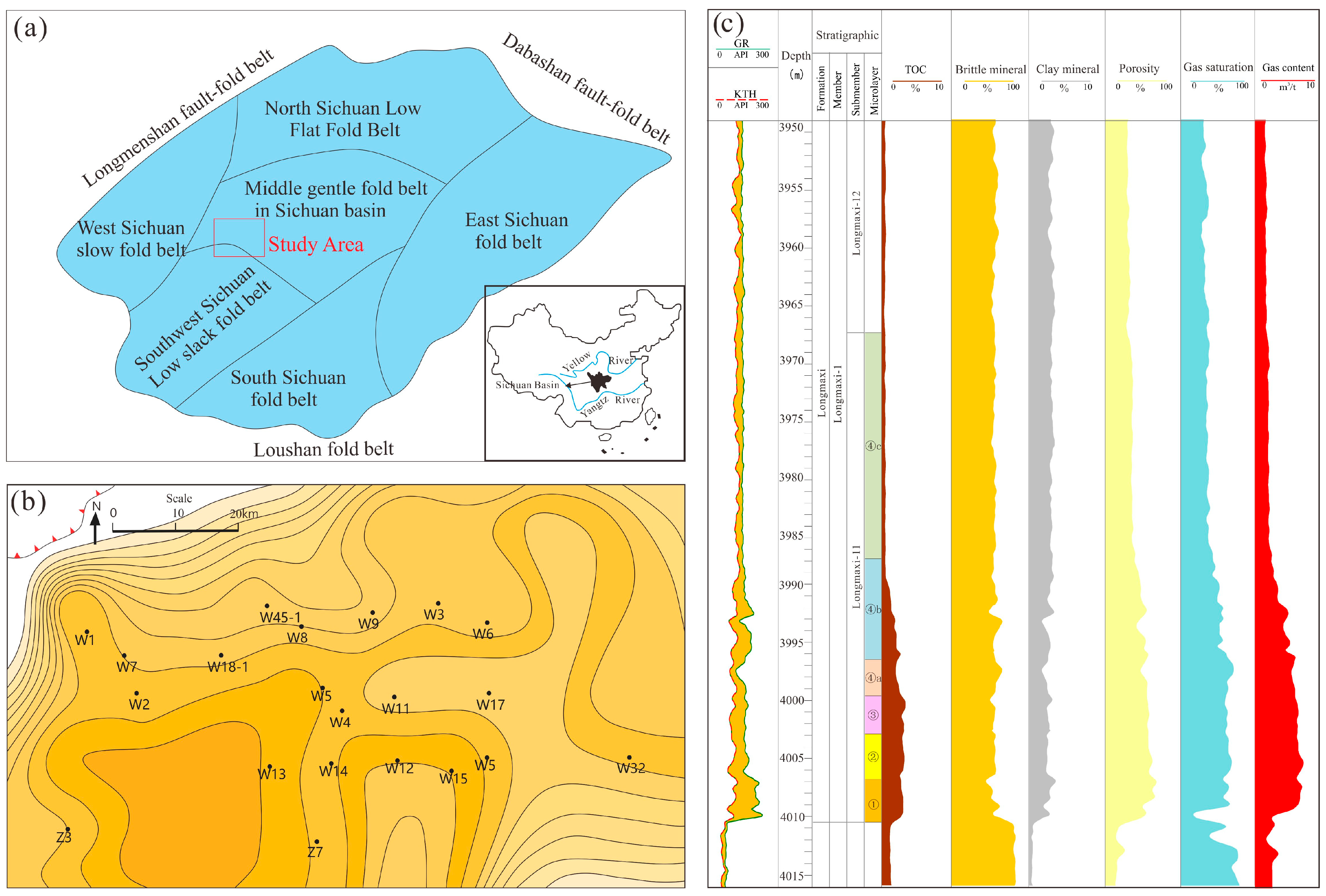
The study area is located in the Weiyuan area of the southern Sichuan Basin. The overall structural pattern is a monocline gently dipping to the southeast, with undeveloped faults. The stratigraphic sequence ranges from the Sinian to the Jurassic (oldest to youngest); however, the Devonian and Carboniferous strata are absent [28,29]. The structural setting is relatively stable, with continuous subduction and suitable conditions for preservation of organic matter. A set of organic-rich shales is developed at the top of the Upper Ordovician Wufeng Formation and the base of the Lower Silurian Longmaxi Formation, which is the main target interval for shale gas exploration and development in the Weiyuan area at present (Figure 1a). The Longmaxi Formation shale is divided into the Long 1 Member and Long 2 Member. The Long 1 Member is further subdivided into two submembers, Long 11 and Long 12; the Long 11 submember is further divided into four small layers: Long 11-1, Long 11-2, Long 11-3, Long 11-4. The Long 11-4 sublayer is in turn subdivided from bottom to top into Long 11-4a, Long 11-4b, and Long 11-4c (Figure 1c) [30,31]. The cumulative thickness of high-quality shale in the Wufeng–Long 11 interval is 39.8–48.1 m (average 44.1 m). Vertically, the middle-lower Long 11-1–Long 11-4a sublayers are relatively thin (average 3–5 m each), while the upper Long 11-4b and Long 11-4c sublayers are thicker, averaging 11.3 m and 17.9 m, respectively.
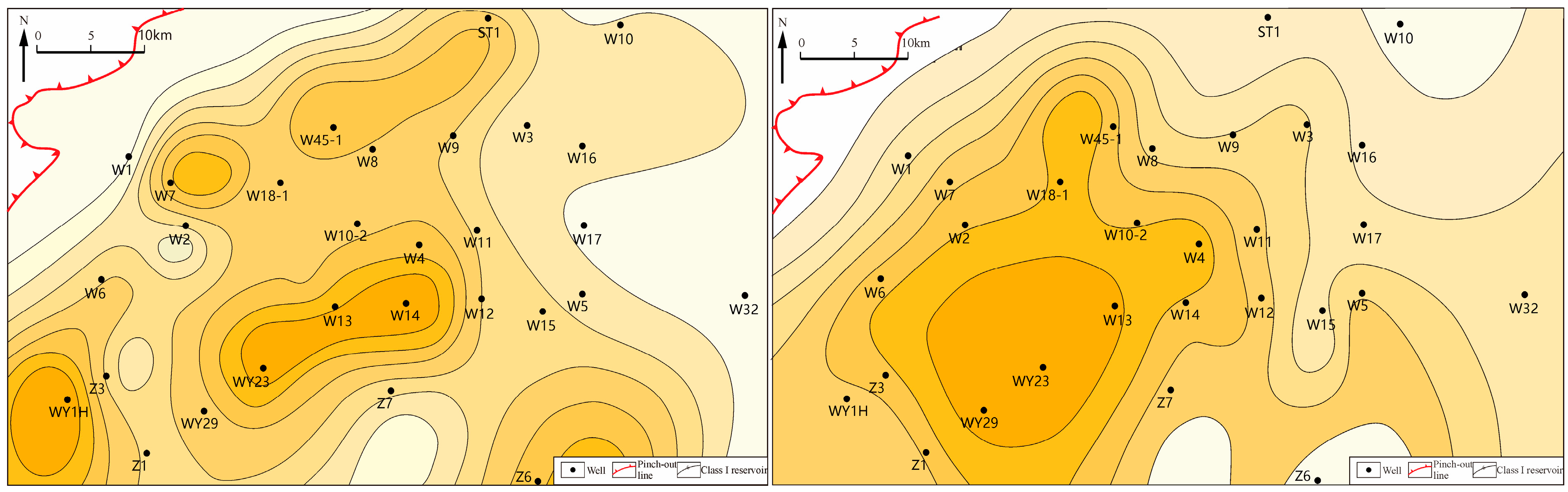
Laterally, the thickness of the high-quality shale varies greatly, with the thickest area in the central part of the area, trending northwest–southeast and thinning toward the flanks (Figure 1b). The high-quality shale interval has a brittle mineral content of 52.3%–68.1% (average 61.3%), total organic carbon (TOC) content of 1.5%–2.7% (avg 2.0%), porosity of 5.1%–6.8% (avg 6.0%), gas content of 2.7–4.4 m3/t (avg 3.6 m3/t), and gas saturation of 50.8%–70.8% (avg 60.8%). Vertically, the Long 11-1 sublayer has the best reservoir quality, characterized by high siliceous (felsic) mineral content, well-developed lamination, and abundant biogenic fragments; the Long 11-3 sublayer is the next most favorable, with characteristics similar to Long 11-1. In the Long 11-1 sublayer, the porosity is 7.0%, TOC 3.8%, and brittle mineral content 60.4%. The Young’s modulus ranges from 27.58 to 31.34 GPa (mean 29.4 GPa), and Poisson’s ratio ranges from 0.20 to 0.24 (mean 0.23). In the deep shale gas area around Well W217, the maximum horizontal principal stress direction is 90–110°, nearly east–west in most of the area. The measured formation temperature is 112–129 °C (average 118.5 °C), which is higher than in other parts of the Weiyuan area and increases from north to south. The formation pressure coefficient ranges from 1.7 to 2.0, with little variation across the area.

3. Samples and Methods

3.1. Samples

In this study, core samples from three wells (W15, W16, W17) in the Wufeng–Longmaxi formations of the deep shale gas reservoir in the Weiyuan area were collected. We conducted multi-scale digital core-based analyses of the shale reservoir microstructure, including multi-scale CT scanning, MAPS, FIB-SEM, and MaipSCAN imaging analysis, building a database of results. Experimental tests of TOC content, thermal maturity (Ro), microscopic pore structure characteristics, and shale porosity were also carried out (Table 1).

3.2. Methods

Experimental analysis was performed on 45 shale samples from wells W15, W16, and W17, spanning observations from micro to macro scales, to systematically characterize the shale. First, micron-scale CT (μCT) scanning was conducted on the samples. Based on the scans, three-dimensional (3D) reconstruction of micron-scale fractures and extraction of fracture parameters were carried out. Then, core samples were cut and prepared for various analyses: energy-dispersive spectroscopy (EDS) mapping to quantitatively analyze mineral composition, 2D large-area SEM mosaics to quantify different types of pores (organic pores, inorganic pores, etc.), and FIB-SEM imaging to quantitatively analyze 3D pore distribution and connectivity. Finally, combining the mineralogical characteristics and multi-scale pore-fracture features, we analyzed the reservoir microscopic characteristics, reconstructed 3D pore–throat models, and clarified the shale reservoir microstructure in the study area.
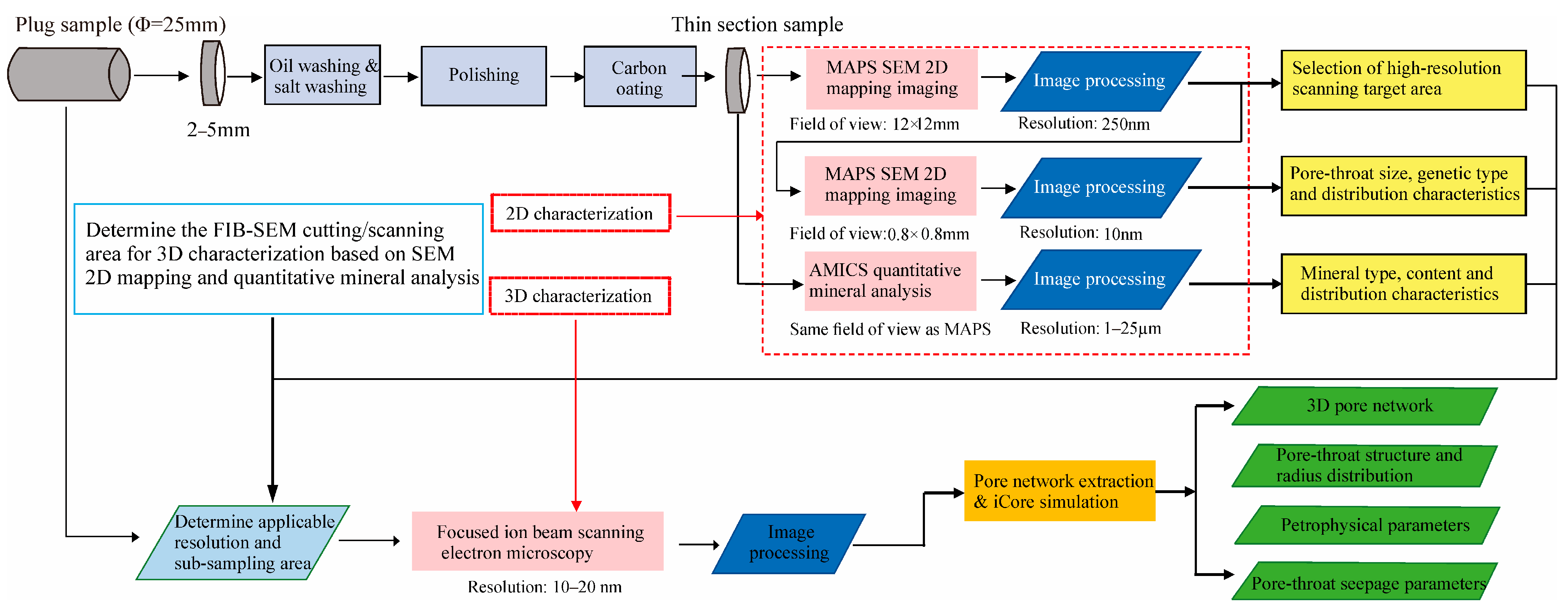
To achieve spatial correlation and integration of imaging data acquired at three different scales—namely, μCT, MAPS, and FIB-SEM—a unified spatial coordinate system is first established as the reference framework. The geometric center of the core plug is set as the origin, and a three-dimensional Cartesian coordinate system is constructed based on orientation markers recorded during sampling. This system defines the spatial coordinate mapping for the three imaging techniques: μCT (micrometer-scale, field of view 12 × 12 mm), MAPS (micrometer-to-submicrometer-scale, field of view 0.8 × 0.8 mm), and FIB-SEM (nanometer-scale, field of view at the micrometer level). All multiscale imaging data are incorporated into this common coordinate system to eliminate spatial misalignment caused by differences in sampling orientation and imaging angle.
To address resolution discrepancies among the three techniques, an interpolation method is applied to upsample low-resolution data, ensuring consistent resolution across scales. Simultaneously, common feature points are extracted from images at each scale to serve as key markers for spatial registration. These points must be identifiable and matchable across scales. A feature-point-based registration algorithm is then employed, using MAPS data as the intermediate bridging scale. First, FIB-SEM (nano-scale) images are registered to MAPS (submicrometer-scale) images, with iterative optimization of feature point correspondences to correct for translation, rotation, and scaling. Subsequently, the registered nano-to-submicrometer dataset is aligned with μCT (micrometer-scale) images, assisted by macro-scale mineral distribution characteristics of the core for auxiliary calibration. This stepwise approach ensures accurate spatial correspondence across scales, thereby achieving seamless correlation from the nanometer to the micrometer scale. The method process is shown in Figure 2.

3.2.1. 3D Digital Core Construction

A Zeiss Xradia 520 Versa X-ray CT scanner (Carl Zeiss, Oberkochen, Germany) was used to scan the samples. Unlike conventional CT, this instrument includes optical objectives similar to a microscope, enabling both geometric and optical magnification to greatly improve image resolution. The operating voltage was 100–220 kV, with an adjustable scan resolution of 0.5–30 μm for sample sizes 1–30 mm. The prepared samples were scanned at a resolution of 9 μm (high-resolution mode), since the samples predominantly contain micro- to nano-scale pores, in order to capture as much information on micron-scale pores and fractures as possible and achieve a comprehensive analysis of pore-fracture features from micron to millimeter scale. The micro-CT scanning procedure was as follows: (1) mount the sample on the μCT stage and close the radiation-proof door; (2) set the X-ray tube voltage, select the scan region and detailed parameters (including exposure time, X-ray source filter, working distance, number of projections, rotation angle, etc.); (3) after scanning, export the 3D projection data for post-processing. The projection data were reconstructed into a 3D volume using Zeiss Reconstructor TM software (version 1.0, Carl Zeiss Microscopy GmbH, Germany). During reconstruction, adjustments were made for any image drift and beam-hardening artifacts, and ring artifacts and noise were removed, resulting in a 3D data volume for subsequent image processing.

3.2.2. FIB-SEM

FIB-SEM provides a novel approach for 3D pore characterization. We used a Zeiss Crossbeam 540 FIB-SEM system, with imaging resolution of 5–15 nm and slice thickness down to 10 nm. The imaged volume for 3D reconstruction was on the order of 10 μm ×10 μm × (5–10) μm, at an SEM imaging resolution of ~0.9 nm and magnification up to 2 million times. The Ga ion beam was operated at 0.1–30 kV with currents of 70 pA to 65 nA, and the electron beam at 1–30 kV with currents of 100 pA to 2.5 nA. The FIB-SEM 3D imaging workflow was as follows: first, each sample was polished in two stages—mechanical polishing to achieve a microscale flat surface, followed by 2–3 h of Ar ion polishing to reach nanometer-scale smoothness. The polished sample was then placed in the FIB-SEM; a target region was selected for serial slicing and imaging, with imaging resolution set in the 5–15 nm range based on pore characteristics. Hundreds of consecutive 2D slice images obtained by iterative FIB slicing and SEM imaging were assembled with software to reconstruct a 3D digital core of the sample. After reconstruction, filtering and image segmentation were applied to isolate pores, minerals, and organic matter. A proprietary algorithm was then used to identify pore types and calculate the proportion of each pore type, pore size distribution (histogram of pore radii and throat radii), and average pore/throat sizes.

3.2.3. MAPS

A Zeiss Merlin field-emission SEM was used for backscattered electron (BSE) large-area mosaic imaging (MAPS). The imaging was performed at 20–25 °C under low voltage (2 kV) and low current (500 pA). Sample sizes of approximately 4 mm × 4 mm up to 5 mm × 10 mm were used. The detector signal was secondary electrons (SE2 mode) with an effective image resolution of ~15–20 nm. The MAPS technique allows high-resolution SEM imaging over a large sample area, and is currently the only method that balances a large field of view with high resolution for rock analysis. In this study, we used a state-of-the-art FE-SEM with a resolution of 5–15 nm to ensure clear imaging of nanometer-scale pores. Since SE imaging offers higher resolution than BSE, an SE detector was used for imaging. To achieve nanometer-scale flatness, two-step polishing (mechanical + ion) was performed as described above. The polished sample was loaded into the SEM, and a target area was selected. Based on the pore characteristics, an imaging resolution of 10–50 nm was set (scanning area from 0.2 mm × 0.4 mm up to 0.5 mm × 2 mm); if pores were exceptionally small, the resolution was increased accordingly. After scanning, thousands of individual images were stitched together using specialized software into one large mosaic image, preserving the original high resolution, to create mineral and pore distribution maps with dynamic visualization. Using a proprietary algorithm, the mosaic image was analyzed to determine pore types, areal porosity, organic matter content, and pore size distribution.

3.2.4. MaipSCAN Automated Mineralogy Analysis

We employed an advanced automated mineral analysis SEM system (MaipSCAN), which uses EDS characteristic X-rays combined for rapid and accurate mineral identification. The MaipSCAN system employed in this study is an automated mineral analysis platform that has been increasingly applied in petroleum exploration and production research in China. It has been successfully utilized in reservoir characterization studies. The mineral identification accuracy of this system is nearly 100%. Samples of 2.5 cm × 2.5 cm were analyzed at 20–25 °C. The system has a dual-resolution mode (2 μm and 64 μm per pixel for different scales), and BSE images were acquired at resolutions of 130 nm, 400 nm, and 1 μm for different magnifications, covering test areas from ~0.4 mm × 1.5 mm up to 5 mm × 2 mm. The MaipSCAN system comprises an SEM, X-ray detectors, and intelligent analysis software. By irradiating the sample with an electron beam, characteristic X-rays are emitted from the atoms in the rock. Using advanced spectral comparison techniques, the system can rapidly and accurately identify mineral types, quantitatively analyze mineral composition, and capture corresponding BSE images.

4. Results

4.1. Reservoir Petrology and Lithofacies Characteristics

Based on quantitative mineral analysis, the Long 11-4b sublayer contains, on average, 35.86% felsic (siliceous) minerals, 12.57% carbonate minerals, and 48.45% clay minerals. The Long 11-4a sublayer averages 44.50% felsic, 27.29% carbonate, and 25.94% clay. The Long 11-3 sublayer averages 48.69% felsic, 17.31% carbonate, and 30.19% clay. The Long 11-2 sublayer averages 42.71% felsic, 23.31% carbonate, and 30.89% clay. The Long 11-1 sublayer averages 45.43% felsic, 11.56% carbonate, and 36.53% clay. Quantitative mineral analysis from well W15 shows that the upper part of the Long 11-4b sublayer has higher clay content; the Long 11-4a and Long 11-2 sublayers have higher average carbonate content than other sublayers; the Long 11-3 and Long 11-1 sublayers have higher average felsic mineral content than others, and notably the Long 11-1 sublayer has a relatively high pyrite content (Figure 3).
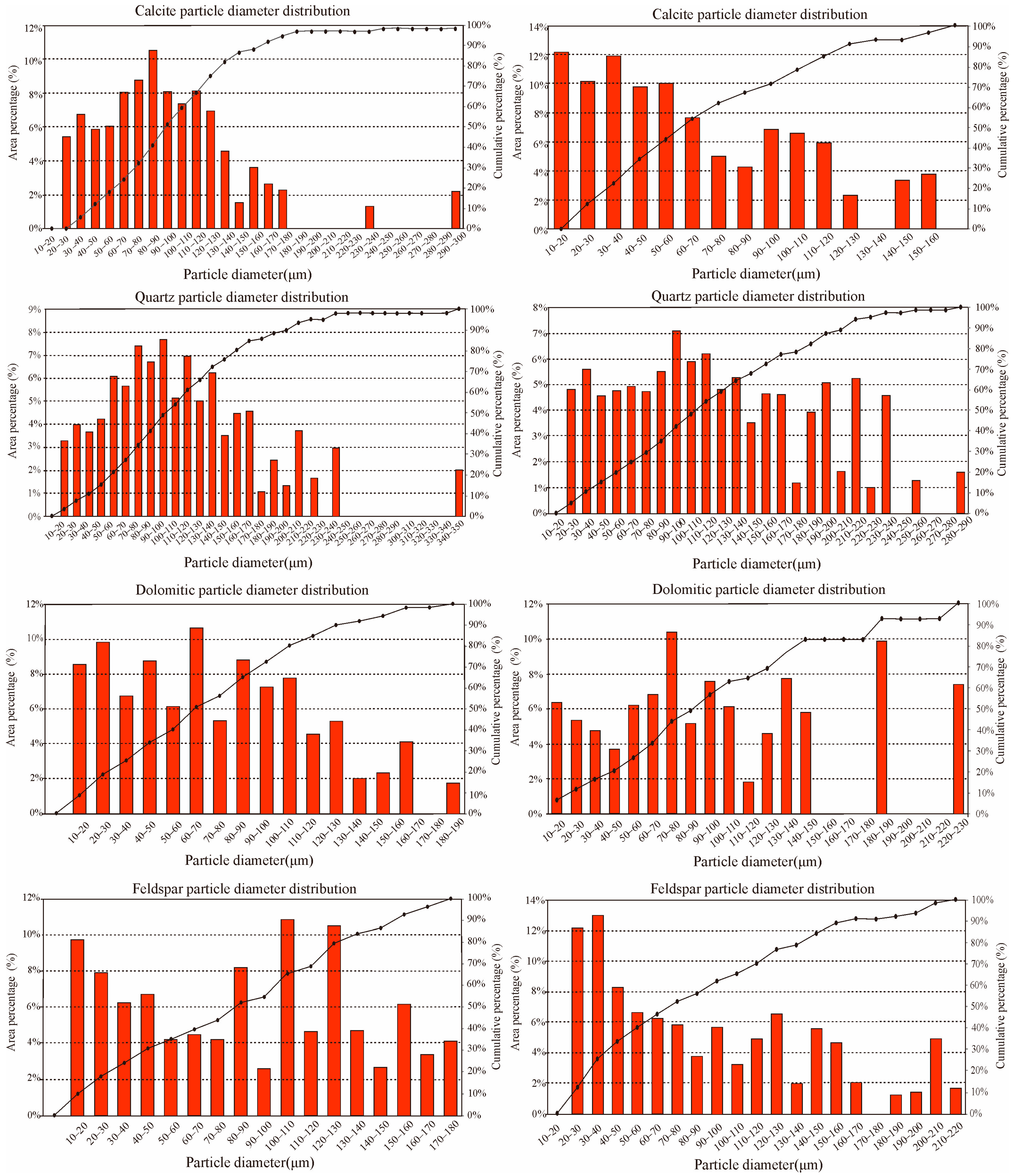
Based on mineralogical analysis, binary segmentation of mineral grains was performed to obtain the grain size distributions of the major detrital minerals. Results indicate that quartz grains range from 23.5 μm to 348.4 μm in diameter, with an average of 59.2 μm, and the main peak falls within the silt to fine sand grade interval (62.5–250 μm). Calcite grain sizes range from 23.5 μm to 297.5 μm (average 50.5 μm), predominantly within the silt grade, with a notable fine sand component. Dolomite and feldspar exhibit grain sizes ranging from 23.5 μm to 188.9 μm, with averages between 43.1 μm and 44.2 μm, and are dominated by silt-grade particles (Figure 4).
A “three-end-member, four-component” lithofacies classification scheme (based on key “lithology–organic matter” indicators) was applied to the Long 11 sublayer of the Longmaxi Formation in Well W15. The submember is dominated by medium-organic felsic mudstone and medium-organic mixed mudstone facies, and log-derived TOC indicates it is overall a medium-organic interval. The classification results show: the Long 11-4b sublayer is dominated by organic-lean argillaceous mud shale; Long 11-4a is dominated by medium-organic mixed mud shale; Long 11-3 sublayer consists mainly of medium-organic felsic mud shale and mixed mud shale; Long 11-2 sublayer is dominated by medium-organic mixed mud shale; and Long 11-1 sublayer is dominated by medium-organic felsic mud shale (Table 2).
According to the Udden–Wentworth grain size scale, the mineral particles in this study are dominated by silt-sized (3.9–62.5 μm) and fine sand-sized (62.5–250 μm) grains, with only a limited proportion of clay-sized (<3.9 μm) particles. Although the Long 11-1 sublayer of the Longmaxi Formation is lithologically classified as mud shale, its grain size and mineral composition more closely resemble those of clayey siltstone or argillaceous sandstone, suggesting favorable reservoir potential. Nevertheless, the relatively coarse grain sizes observed may partly reflect limitations in the measurement resolution of the Maipscan quantitative mineralogical analysis.

4.2. Reservoir Geochemical Characteristics

4.2.1. Organic Matter Content and Thermal Maturity

Overall, the Wufeng–Longmaxi (Long 1) shale in the Well W17 area is characterized by relatively high organic matter abundance. Measured TOC values range from 0.2% to 4.40%, with an average of 2.34%, while log-derived TOC ranges from 0.5% to 3.9% (average 2.4%). Across the Weiyuan area, the Long 11-1–Long 11-3 sublayers have TOC values of 2.3%–4.40% (avg ~3.0%), the Long 11-4 sublayers average ~2.0% TOC, and the Wufeng Formation averages ~1.5% TOC. Vertically, the base of the Longmaxi Formation has higher organic content, which gradually decreases upward; the Long 11-1–Long 11-3 sublayers have higher TOC, whereas the Long 11-4 sublayers are relatively lower. Overall, the organic matter abundance in the Wufeng–Long 1 shale follows the trend Long 11-1 > Long 11-3 > Long 11-2 > Long 11-4a > Wufeng > Long 11-4b > Long 11-4c (Table 3).
Thermal maturity of organic matter was assessed using vitrinite reflectance (Ro), which directly indicates the thermal evolution stage of kerogen. In the Weiyuan area, Ro for the Wufeng–Long 1 shale ranges from 2.12% to 3.14%, with an average of 2.44%, indicating an over-mature stage (dry gas window). With increasing burial depth, Ro values in the W17 area exceed 3.0%, consistent with over-maturity (Table 4).

4.2.2. Organic Matter Types

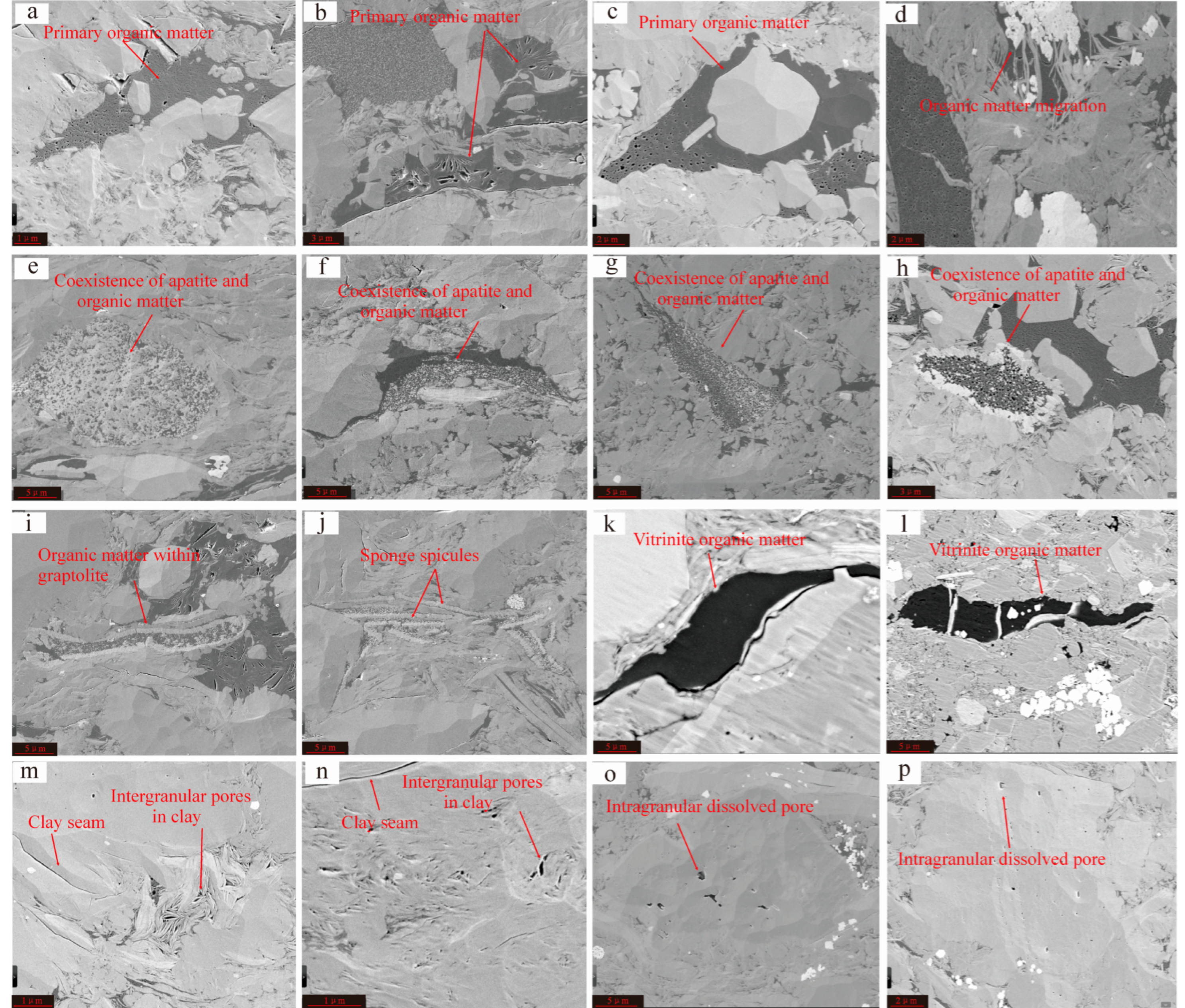
Based on SEM observations of morphological characteristics, the organic matter in the shale can be divided into two categories, Type A and Type B [32,33,34]. Type A organic matter includes amorphous bituminite and solid bitumen, which have no fixed shape or clear outline and typically appear fibrous, cotton-like, or cloud-like; these are highly ductile and mobile, i.e., amorphous organic matter. Type B organic matter includes structured constituents with well-defined shapes, such as alginite, vitrinite, and inertinite, which appear as rounded, elongate, or blocky forms with clear outlines (Figure 5).
Type A organic matter in the Longmaxi shale occurs in three main forms under SEM: (A1) in situ deposited organic matter, (A2) organic matter migrated into inorganic pores, and (A3) organic matter migrated into fractures. Type A (bituminite/bitumen) lacks a fixed morphology or clear boundaries and is largely amorphous. Type B organic matter (alginite/vitrinite/etc.) is present as discrete particles or infill with distinct shapes and edges.

4.3. Reservoir Pore–Fracture System Characteristics

4.3.1. Pore Origin and Distribution

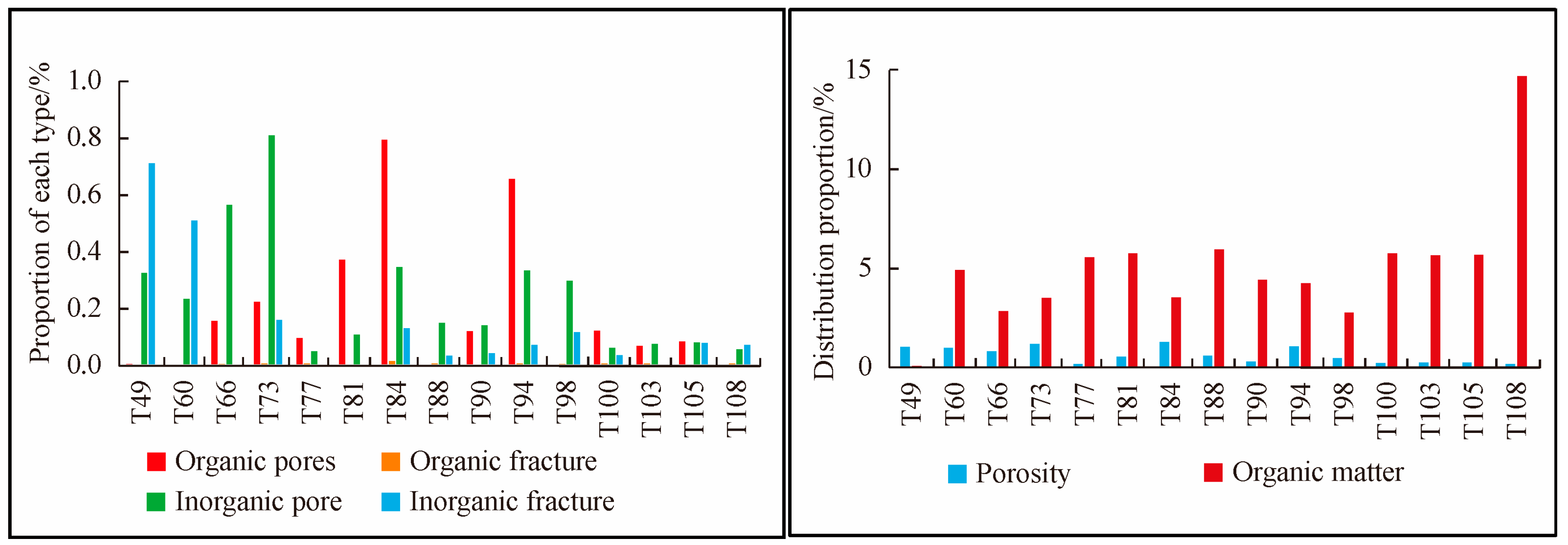
Microscopic analysis results indicate clear differences in pore development among sublayers in Well W15. The Long 11-4 sublayer is dominated by inorganic mineral pores and fractures (clay pores, intergranular pores), and has relatively low organic content. The Long 11-3 sublayer is dominated by organic-matter pores and contains higher organic content than the Long 11-4. A sample from 4004.48 m in the Long 11-2 sublayer shows a high development of organic pores. The Long 11-1 sublayer has higher organic content than the other sublayers, with its primary pore types being both organic pores and inorganic pores (Figure 6).
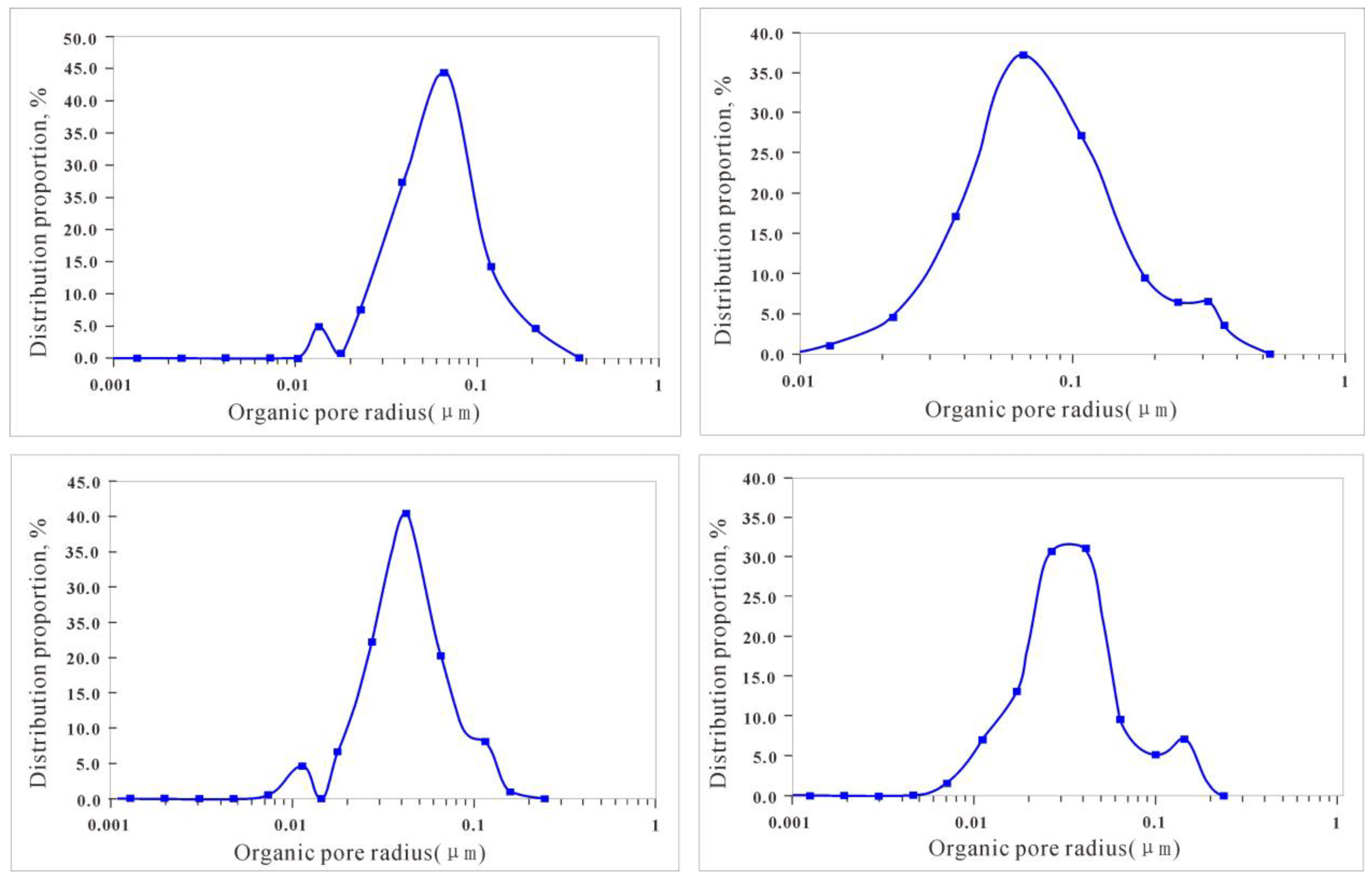
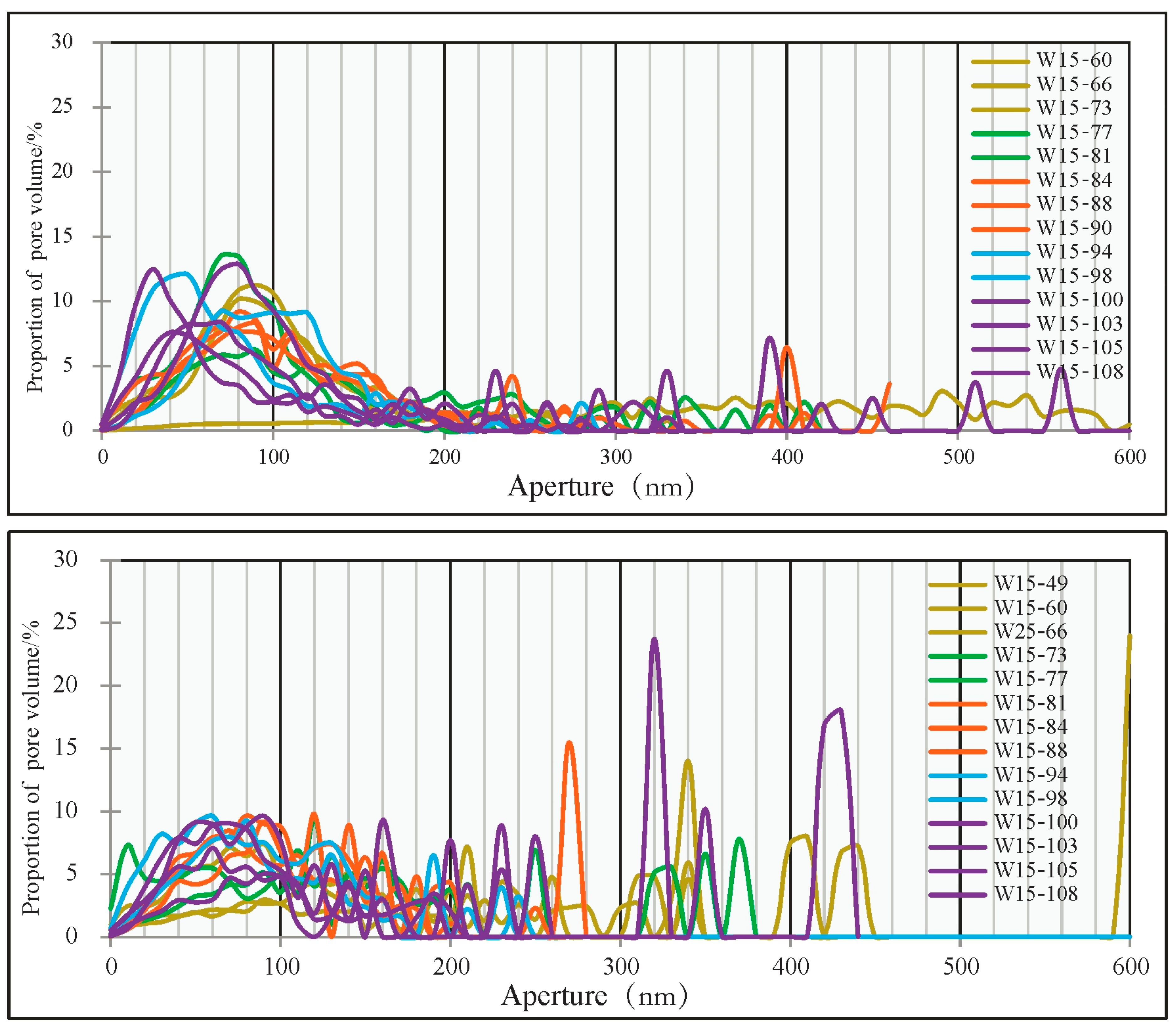
From the pore size distribution data: in Long 11-4 sublayer samples, the pore size exhibits major peaks at ~20–70 nm, 90–3000 nm, and 900–6000 nm. In the Long 11-3 sublayer, the main pore size peaks are ~10–80 nm and 90–300 nm. The Long 11-2 sublayer similarly has peaks at ~10–80 nm and 90–300 nm, with a small number of larger clay-filled fractures (~900–2000 nm). The Long 11-1 sublayer shows peak pore size ranges of ~10–70 nm and 90–300 nm, but the abundance of pores in these ranges is lower than in the other sublayers. In general, organic pores are mainly 10–140 nm in diameter, and inorganic pores are mainly 10–100 nm (with some larger inorganic clay pores up to ~300–440 nm). Overall, the Long 11-4a, Long 11-3, and Long 11-1 sublayers have relatively well-developed nanopores, dominated by organic-matter pores (Figure 7).
A summary of pore types and 2D areal porosity (from image analysis) in Well W15 samples shows distinct sublayer characteristics. In the Long 11-4 sublayer, the areal porosity ranges 0.2%–1.2% and organic matter occupies 0%–5.6% of the area; the pores are predominantly inorganic (mostly clay-hosted). The Long 13 sublayer has an areal porosity of 0.55%–1.29%, organic matter occupying 3.5%–6.0%, and is dominated by organic pores. The Long 12 sublayer has an areal porosity of 0.3%–1.1%, organic matter 2.78%–4.43%, and is dominated by inorganic pores. The Long 11 sublayer has an areal porosity of 0.1%–0.27%, with higher organic content (5.66%–14.71% area); its pore system includes both organic and inorganic pores (Table 5).

4.3.2. Natural Fracture Characteristics

Natural fracture development in the shale directly affects shale gas production and recovery. Generally, higher siliceous mineral content increases shale brittleness and makes it easier for fractures to form, which is a key factor for shale gas enrichment and productivity [35,36,37,38,39]. In the Weiyuan Longmaxi Formation, most non-tectonic (natural) fractures are bedding-parallel fractures and fractures caused by hydrocarbon generation overpressure. Bedding fractures are the most prevalent non-tectonic fractures; they occur parallel to bedding planes [40,41]. In thinly laminated shales, mechanical compaction and weathering create fractures along these mechanically weak bedding planes, forming horizontal (bedding-parallel) fractures that serve as major flow pathways in the reservoir. Hydrocarbon generation (overpressure) fractures are also present, often oriented along bedding as well. These natural fractures provide essential pathways that enhance permeability and gas deliverability.
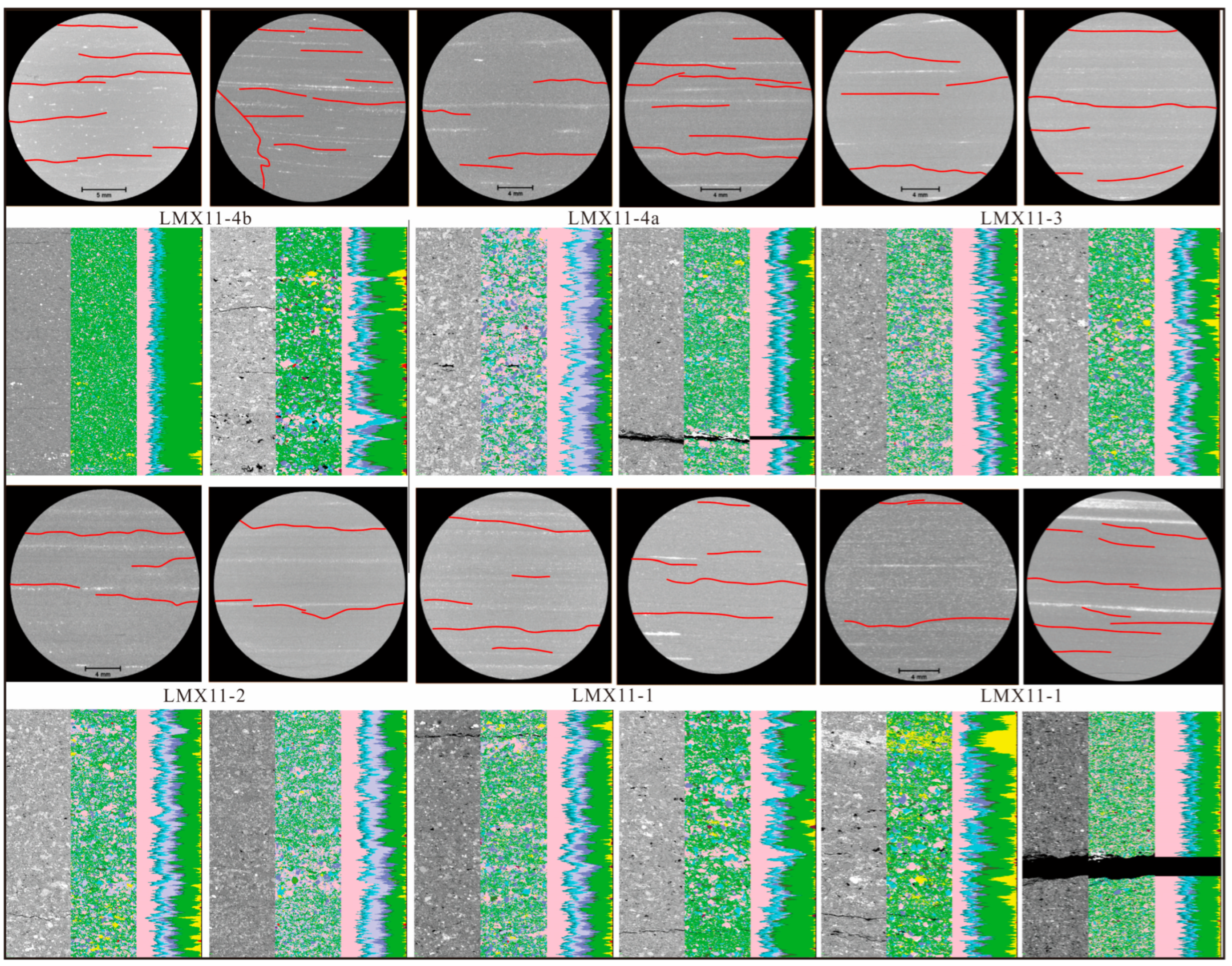
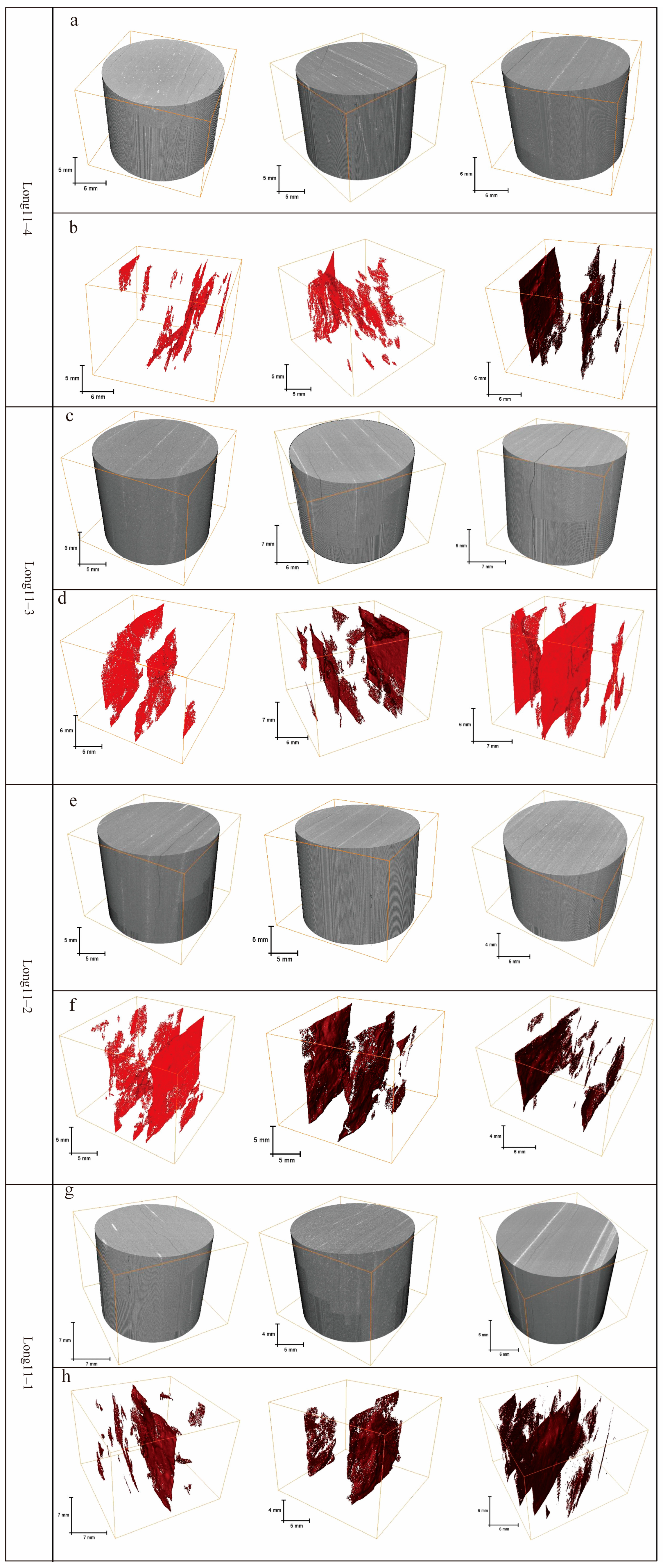
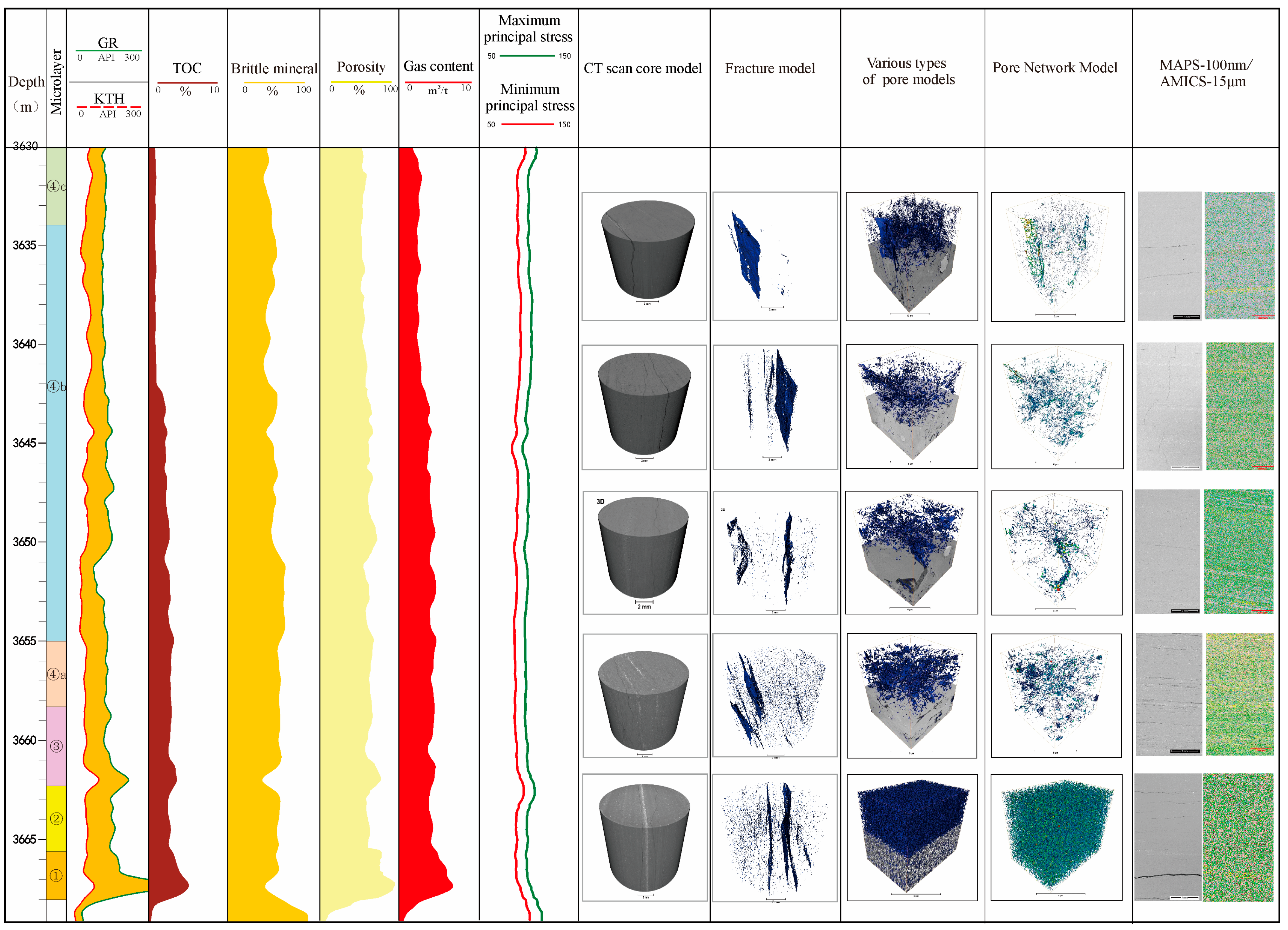
According to the CT scanning results (Figure 8), the 3D fracture porosity of sublayer Long 11-4b is 0.23%. The fracture aperture ranges between 10 and 210 μm, with fractures in the 60–140 μm range accounting for the largest proportion (83%) and contributing 78.08% of the fracture porosity. In sublayer Long 11-4a, the three-dimensional fracture porosity is 0.40%, with fracture apertures ranging from 10 to 120 μm; fractures of 30–70 μm dominate, representing 84.17% of the total, and contribute 86.87% of the fracture porosity. Sublayer Long 11-3 shows a fracture porosity of 0.38%, with apertures between 10 and 180 μm; fractures of 50–170 μm are the most abundant (91.4%) and account for 99.15% of the porosity contribution. In sublayer Long 11-2, the fracture porosity is 0.38%, with apertures between 10 and 190 μm; fractures in the 40–160 μm interval predominate (97.1%) and contribute 98.4% of the porosity. Sublayer Long 11-1 exhibits a fracture porosity of 0.26%, with apertures between 10 and 150 μm; fractures of 60–130 μm dominate (90.9%) and contribute 99.27% of the porosity. Analysis of micro-CT images of plug samples indicates that fracture development mainly occurs in the lower part of Long 14b, as well as in sublayers Long 11-3 and the lower part of Long 11-1, and the fractures are mostly horizontal. Fracture development is positively correlated with felsic mineral content (the higher the felsic mineral content, the more fractures are developed), but negatively correlated with clay mineral content. Fractures are preferentially developed in felsic laminae, while carbonates tend to inhibit fracture development.

4.3.3. Microscopic Pore Structure Characteristics

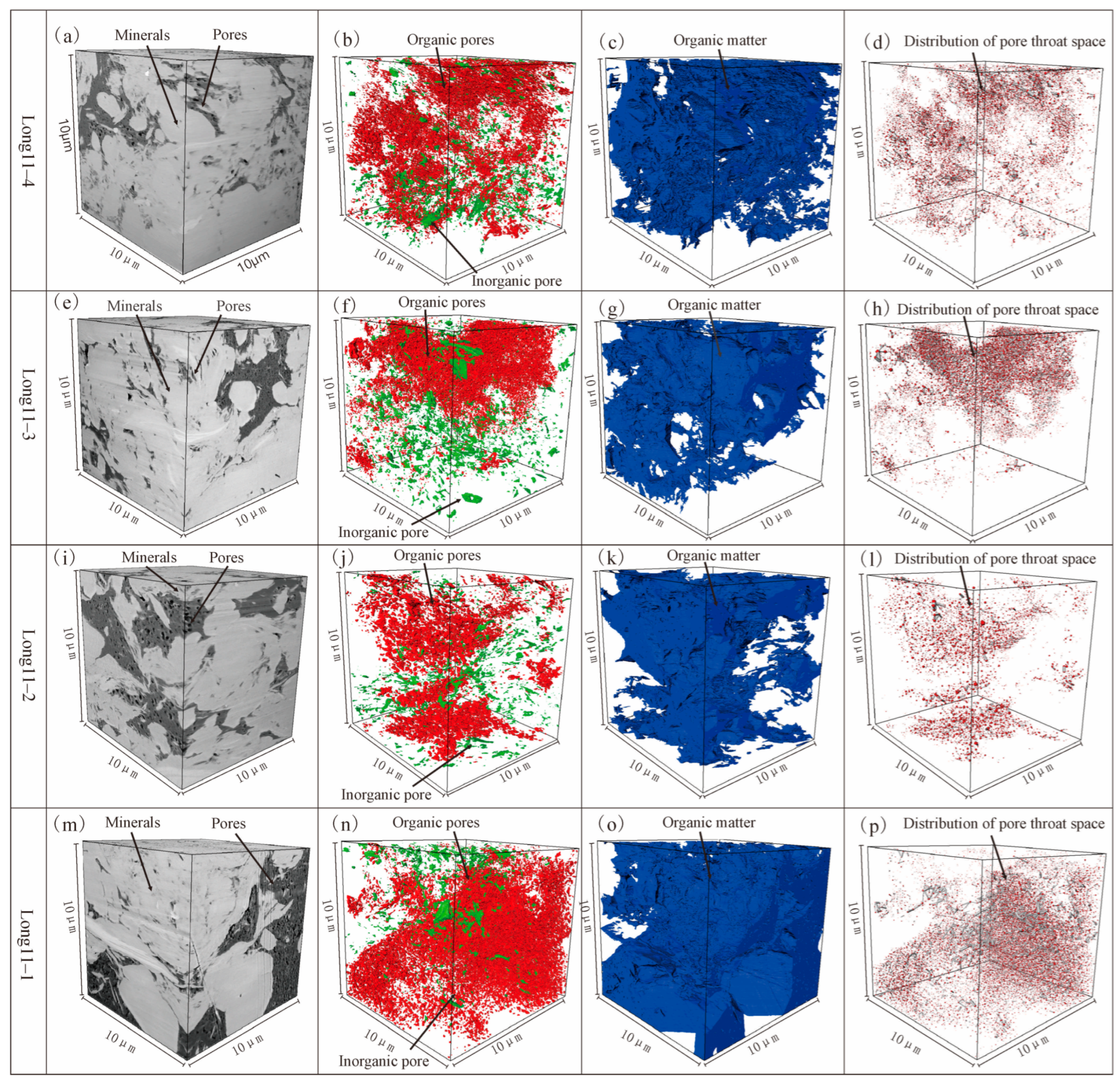
Figure 9 shows the CT scanning images and reconstructed 3D digital cores of the experimental samples. The pore space is dominated by intergranular pores. Pore size, shape distribution, and connectivity exhibit strong heterogeneity. Throat morphologies are mainly sheet-like, curved-sheet, or dot-like; pores connected in sheet-like patterns show relatively good connectivity [42,43,44,45]. Based on the 3D connected digital core model, the calculated porosity of the Long 11-1 sublayer is 3.04%, with organic pores accounting for 2.92% and inorganic pores for 0.12%, and an organic matter content of 37.3%. Within the organic pores (2.92%), 74.17% of the volume falls in the 10–100 nm range, while inorganic pores (0.12%) have 65.85% of the cumulative volume below 100 nm. The porosity of the Long 12 sublayer is 1.18%, with organic pores accounting for 1.01% and inorganic pores for 0.21%, and an organic matter content of 15.21%. For organic pores (1.01%), 54.4% of the volume lies between 10 and 100 nm, whereas inorganic pores (0.21%) have 56.14% of their cumulative volume below 100 nm. The Long 11-3 sublayer has a porosity of 1.40%, including 1.08% organic pores and 0.32% inorganic pores, with an organic matter content of 11.07%. Among organic pores (1.08%), 95.26% of the volume is in the 10–150 nm range, while 97.72% of the inorganic pore volume (0.32%) is below 200 nm. The Long 11-4 sublayer has a porosity of 2.04%, with 1.73% organic pores and 0.31% inorganic pores, and an organic matter content of 16.04%. For organic pores (1.73%), 89.38% of the volume lies within 10–140 nm, while inorganic pores (0.31%) have 24.75% of their volume below 60 nm.
The porosity values measured by focused FIB-SEM are lower than those obtained by gas porosimetry, mainly due to the resolution limitations of CT scanning, which prevents the identification of very small pores and throats [46,47]. Based on the sphere-packing model, a pore–throat network was constructed (Figure 8), and key parameters of the microscopic pore structure—such as pore radius, throat radius, and coordination number—were derived using statistical methods. In Well W15, the average pore radii of organic pores in sublayers Long 11-1, Long 11-2, Long 11-3, and Long 11-4 are 30.18 μm, 26.89 μm, 25.01 μm, and 23.30 μm, respectively. The dominant throat size ranges are 10–100 nm, 10–70 nm, 10–150 nm, and 10–60 nm, respectively. The average coordination numbers are 1.58, 1.24, 1.48, and 1.42, respectively. From Long 11-1 to Long 11-4, pore–throat radius, total pore volume, total throat volume, percentage of connected pores and throats, and coordination number gradually decrease. Notably, sublayers Long 11-1 and Long 11-3 exhibit larger pore radii and dominant throat sizes, reflecting that pore–throat size and connectivity are the key factors controlling reservoir permeability.

5. Discussion

5.1. Control of Silica Origin and Depositional Environment on Organic Matter Enrichment

In the eastern Weiyuan area, the siliceous components in deep shale gas reservoirs at the base of the Longmaxi Formation are primarily of both biogenic and terrigenous origin. Due to local variations in the sedimentary environment, terrigenous input contributes significantly to the total siliceous content in this region [48,49]. The rock mechanical properties of the shale are also crucial, as they determine whether the shale can easily develop natural fractures and the effectiveness of hydraulic fracturing. In general, higher siliceous (quartz) content in the shale leads to greater brittleness and thus more propensity to form fractures, which is one of the main reasons for high shale gas enrichment and production [50,51,52]. In marine shales, terrigenous clastic input is an indispensable source of sediment. Certain elements (e.g., Al, Ti) are relatively inert during weathering and diagenesis and remain stable in ancient marine environments; the relationship between Al, Ti, and SiO2 can indicate the amount and origin of silica, distinguishing biogenic from detrital silica sources. Biogenic siliceous shales are characterized by high SiO2, P2O5, and Fe2O3, and low Al2O3, TiO2, FeO, and MgO. In our samples, Al2O3 and TiO2 show a good correlation (R ≈ 0.53). Wells W15 and W216 have relatively high Al2O3 (4.41%–16.38%, avg 9.34%) and TiO2 (0.47%–0.66%, avg 0.55%) contents. In the eastern part of the Weiyuan area (W15, W216 wells), the basal Longmaxi shale shows a correlation between Al2O3, TiO2, and SiO2 content, indicating that terrigenous detrital material contributed significantly to the silica content.
Silica in shales can originate from normal terrigenous detritus or from special processes such as hydrothermal or biogenic sources. “Excess silica” (Siex) refers to the siliceous mineral content beyond that expected from normal detrital input [53,54]. It can be calculated by the following formula:
S i e x = S i s ( S i / A l ) b g × A l s ,
where Sis and Als are the Si and Al contents of the sample, and (Si/Al) bg = 3.11 is the average Si/Al ratio of shale background. Using this formula and the measured Si and Al data for the Long 11 shale, the excess silica content is calculated to range from 10.6% to 29.6%, with an average of 22.9% (Table 6). The Si/(Si + Al + Fe) ratio serves as a key indicator for discerning the origin of siliceous components. A ratio greater than 0.9 typically indicates a biogenic origin, whereas values below 0.9 suggest a terrigenous source. In the eastern Weiyuan area, organic-rich shale samples from the base of the Longmaxi Formation in wells W15 and W216 yield Si/(Si + Al + Fe) ratios ranging from 0.72 to 0.89, with an average of 0.81. All measured values fall below the 0.9 threshold, indicating a significant contribution from terrigenous detrital material, primarily quartz and aluminosilicate minerals.
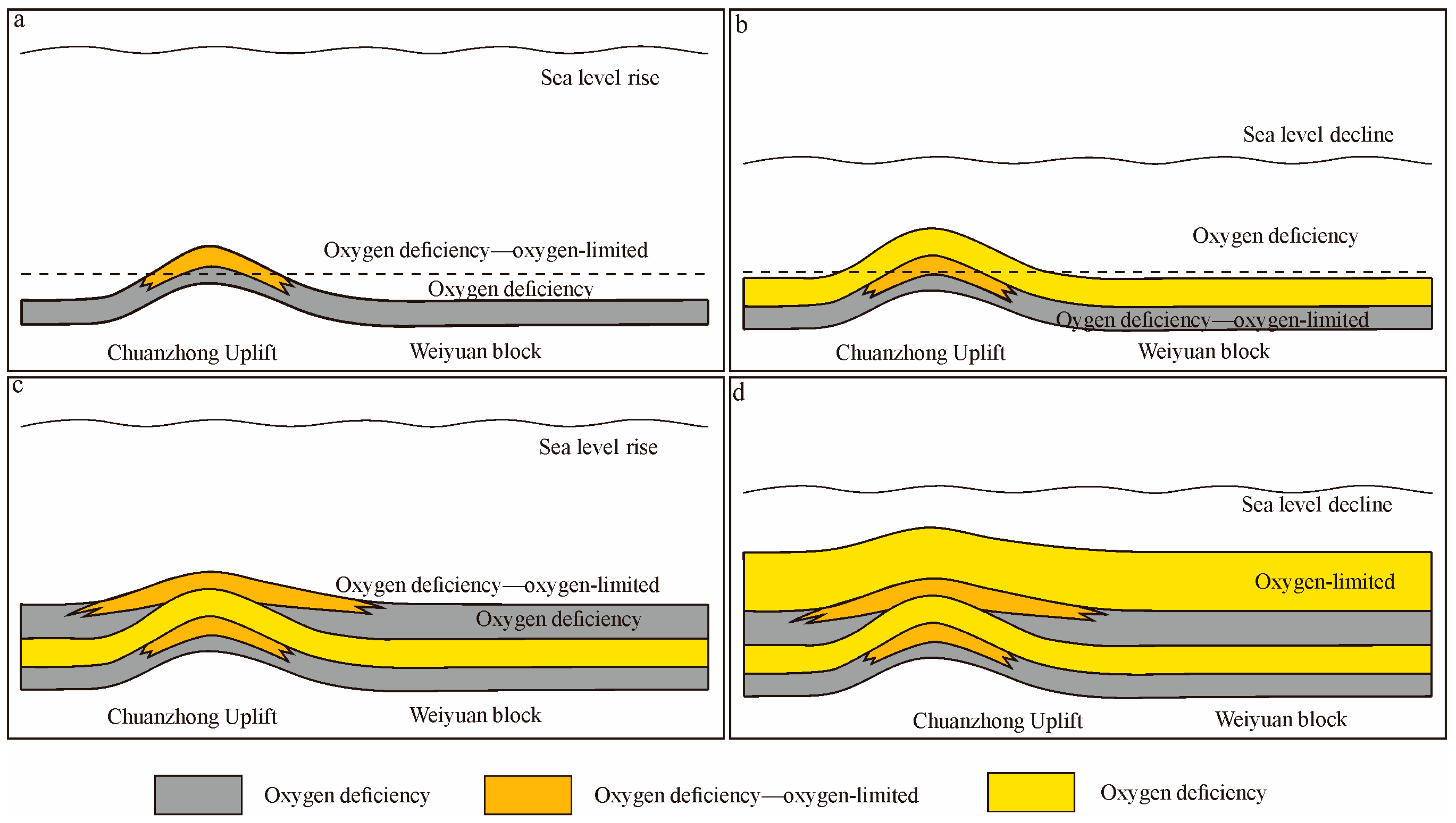
Even under similar redox conditions, variations in organic matter abundance are observed among different sublayers, which may be attributed to differences in paleoproductivity and sedimentation rate [55,56,57]. During the deposition of the Longmaxi Formation in the Sichuan Basin, frequent sea-level fluctuations occurred. The Long 11-2 sublayer was deposited during a regression with relatively low sea level, whereas the Long 11-3 sublayer was deposited during a transgression with relatively high sea level. Thus, under comparable redox conditions, the deeper water column during the deposition of Long 11-3 provided a longer residence time for organic matter, making it more prone to decomposition. Meanwhile, terrestrial input during this stage was relatively limited, resulting in lower nutrient supply and terrestrial organic matter contribution. Consequently, due to these differences in depositional background, the inter-sublayer variations in organic matter abundance can be summarized as Long 11-2 > Long 11-3 (Figure 10).
Integrated with the “three end-members, four components” lithofacies classification scheme, the studied interval—although classified as mud shale—actually represents a transitional lithological assemblage from clayey siltstone to argillaceous sandstone. The relatively coarse grain size is attributed to stronger hydrodynamic conditions and abundant terrigenous clastic supply during deposition. The rigid framework formed by silt- to sand-sized particles effectively mitigates compaction, thereby facilitating the preservation of intergranular pores and microfractures. Pronounced interlayer heterogeneity is observed: the Long 11-1 to Long 11-1 sublayers are dominated by medium-organic-matter felsic and mixed mud shales, characterized by coarser grains and higher brittleness; in contrast, the Long 11-4b sublayer consists of low-organic-matter clayey mud shales with finer grains. These vertical variations are primarily controlled by fluctuations in sea level and changes in provenance supply intensity.

5.2. Synergistic Effect of Sedimentation-Diagenesis and Pore Development

The initial pore structure of sediments is directly governed by depositional conditions—including sedimentary environment, material composition, grain size sorting, and interstitial material content—which collectively determine the primary porosity, pore-throat dimensions, and connectivity of the reservoir. During subsequent burial diagenesis, mechanical compaction and chemical pressure dissolution progressively reduce primary pores. Cementation further occludes pore spaces and enhances reservoir heterogeneity, while dissolution selectively affects feldspar, lithic fragments, and early cements, generating secondary pores and improving pore-throat geometry. Thus, sedimentation establishes the material foundation for pore evolution, and diagenesis—through the coupled effects of compaction-induced porosity loss, cementation-induced densification, and dissolution-induced pore generation—jointly governs the formation, modification, and ultimate distribution of reservoir pores. This interplay constitutes the internal mechanism by which sedimentation and diagenesis control the dynamic evolution of pore structure [58,59,60].
In the Longmaxi Formation deep shale gas reservoirs of the Weiyuan area, variations in organic matter maturity are reflected in the pore sizes of organic matter-hosted pores. Laterally, organic matter in the western part of the study area exhibits relatively low maturity, corresponding to smaller organic pore sizes. This is attributed to the incipient stage of organic pore development, during which pores typically display a honeycomb morphology characterized by small diameters, poor connectivity, and consequently low storage and permeability capacity. As hydrocarbon generation and thermal evolution progress, these small honeycomb pores gradually coalesce into near-circular pores; larger organic pore sizes are associated with better connectivity and enhanced reservoir quality. The observed lateral maturity gradient is closely linked to tectonic uplift following deposition of the Silurian Longmaxi Formation. The Leshan–Longnüsi Paleo-uplift experienced regional uplift and southeastward compression at the end of the Silurian, resulting in shallower maximum burial depths for wells in the western study area. This led to a lower degree of clay mineral transformation, reduced organic matter maturity, smaller organic pore sizes, and a lower overall abundance of organic pores.
Vertically, within the Long 11 Member of the Longmaxi Formation in the Weiyuan area, intervals exhibiting similar redox conditions nonetheless display differences in organic matter content. This phenomenon may be attributed to variations in paleoproductivity and sedimentation rate. The Long 11-1 sublayer, characterized by deeper water conditions, experienced longer organic matter settling times, making it more susceptible to degradation during sedimentation, coupled with relatively limited nutrient and terrestrial organic matter input. The resulting organic matter abundance decreases upward: Long 11-1 sub-layer > Long 11-2 sub-layer > Long 11-3 sub-layer.
Although the overall differences in organic pore size among the Long 11 sublayers are not pronounced, pore characteristics vary primarily in terms of peak position and peak trend of the pore size distribution curve. The peak position (left- or right-skewed) reflects the dominant pore size, with Long 11-1 and Long 11-4a exhibiting relatively larger pores. The peak trend (steep vs. gentle) indicates the range of pore size distribution; Long 11-1 and Long 11-3 display more concentrated distributions, implying greater homogeneity in organic pore size (Figure 11).
(1) Organic matter hosted in intergranular pores of microcrystalline quartz, with pore sizes predominantly exceeding 100 nm, mainly distributed in the Long 11-1 sublayer.
(2) Organic matter hosted in interlayer fractures or intercrystalline pores of clay minerals, exhibiting the widest pore size range (50–150 nm), mainly distributed in the Long 11-2 and Long 11-4a sublayers.
(3) Organic matter hosted in dissolution pores or along mineral dissolution edges, with pore sizes mostly ranging from 50 to 100 nm, mainly distributed in the Long 11-3 and Long 11-4b sublayers.

5.3. Natural Fracture Development and Distribution

In the Well W17 area, natural fractures in the Wufeng–Long 11-1 shale can be divided by aperture into two categories: macro-fractures and micro-fractures. Core observations indicate that in the central “core” area of the field, tectonic fractures are most developed, mainly occurring in the Wufeng Formation and the Long 11-1 sublayer. In the high-quality shale intervals of the core area, the average fracture (crack) density is about 0.47 m−1. Spatially, the northern part of the study area (around well W45-1) has relatively dense fracturing, with fracture densities of 2.2–4.5 m−1 in the Wufeng–Long 11-1. In contrast, the fractures in the W17 well area are mainly concentrated in the Long 11-1 sublayer, with an average fracture density of 0.15 m−1 in the high-quality shale. On the map, the northern wells (e.g., W3 and W16) in the W17 area show more developed fractures; for instance, the Wufeng Formation of Well W3 has 4.0 m-1, and Long 11-1–Long 11-3 sublayers of Well W16 have 0.9–1.1 m−1. The observed tectonic fractures are mostly oblique or high-angle fractures, and they are almost filled with calcite (healed fractures).
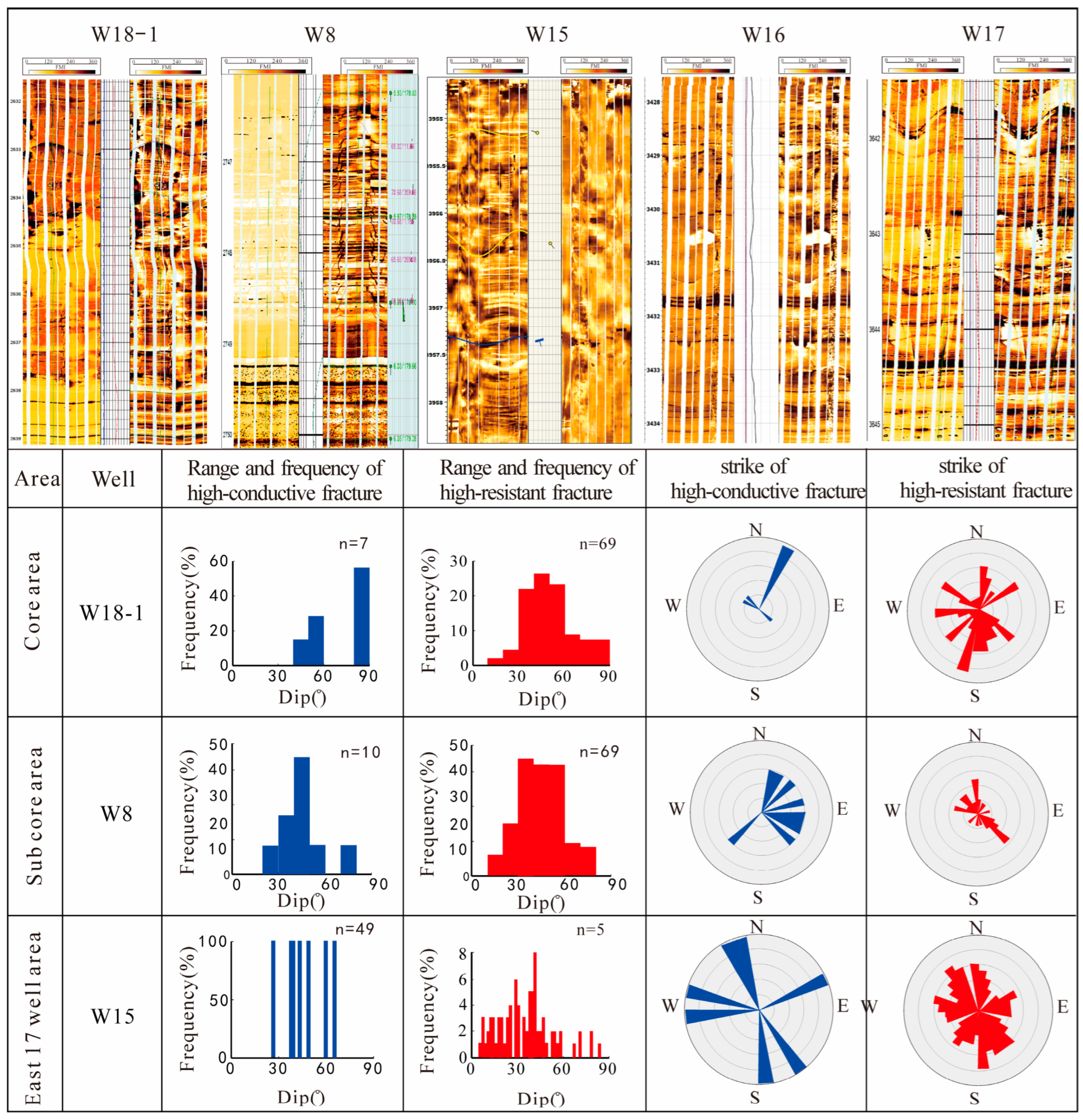
Natural fractures in the Wufeng–Long 11-1 shale are often completely or partially filled by carbonate minerals. In electrical imaging logs, these filled fractures appear as bright resistive features along the fracture edges (Figure 12). Open (unfilled) fractures versus mineral-filled fractures can be distinguished by resistivity: the former typically show distinctly low resistivity, whereas the latter are generally filled with high-resistivity recrystallized minerals like calcite or quartz, or by low-resistivity clays often intermixed with pyrite. FMI image logs across different areas show that fracture orientation, dip, and density vary significantly. In the central “core” area, filled fractures predominantly strike SE (with some NE) and have dip angles in a normal distribution from 10° to 80°; open fractures mainly strike NNE or SEE and show a scattered distribution of dip angles in the 10–80° range. In the W17 area, filled fractures strike NE (with some to SE) and mostly dip less than 50°, while open fractures strike NE, SE, or SWW (southwest-west) with dips also mostly <50°. Overall, the fracture density in the central core area is higher than that in the W17 area. The core area wells (e.g., W8, W13, W18-1) have more abundant fractures, whereas in the W17 area, Well W15 shows relatively more developed fracturing than the others.

5.4. Prediction of Favorable Zones and Optimal Target Interval

In map view, the central “core” region of the study area has the thickest high-quality (Category I) shale reservoirs. For example, between wells W10-1, W4, and W24, the cumulative thickness of Category I reservoir (Wufeng–Long 11) reaches 10–14 m. In the W17 well area further east, the Category I reservoir is thickest toward the west side (8 m at well W11) and thins to 4 m toward the east at well W17, which is thinner than in the central core area. The Long 11-1 sublayer’s Category I reservoir thickness ranges from 1.0 m to 6.0 m, with an average of 3.2 m. Spatially, the distribution of Long 11-1 Category I thickness is relatively uniform across the area, though the western core area has somewhat greater thickness (1–5 m). In the W17 area, a moderately thicker zone (2.0–3.5 m) appears east of well W25. In the eastern, deeper part of the W17 area, the Wufeng–Long 11 exhibits reservoir properties comparable to those in the core area, with relatively good porosity and moderate gas content. The main reservoir in the W17 area lies below 3500 m, and the pressure coefficient is positively correlated with depth, ranging from 1.7 to 1.9. The structure in this area is gentle and lacks large faults, indicating moderate gas content and good preservation conditions. The gentle structure (dip < 5°) and absence of major sliding faults in the target interval also imply good drillability, favorable for horizontal well deployment and fast drilling.
Based on a comprehensive assessment, the southern to southeastern part of the Weiyuan deep shale gas area—connecting wells W4, W14, W11, W12, and W15—is identified as a favorable zone for exploration and development. This area features greater cumulative thickness of Category I (and I + II) reservoirs, higher pressure coefficients, and generally better porosity and gas content, making it a sweet spot for shale gas (Figure 13).
In addition to the regional favorable zone prediction, a detailed characterization of reservoir and engineering features was performed to identify “sweet spots” at the microscale. Using digital core and digital cuttings analysis, criteria for sweet-spot identification were established. It was found that the complexity of induced hydraulic fracture networks is controlled by both the density of bedding laminations and the types of lamination present [61,62,63]. Bedding laminations show systematic vertical variation: using dual-energy CT scanning and large thin-sections, the lamina densities in each sublayer were measured to range from 105 to 480 layers/m, with the lower parts of sublayers 1 and 2 having the highest densities (330–480 layers/m). MAPS analysis reveals that the sublayers with the highest development of organic-matter pores are Long 11-1 (highest), followed by Long 11-2 and Long 11-4, whereas the Long 11-3 sublayer has a relatively lower organic areal porosity. Automated mineralogy (AMICS) indicates that vertically, the Long 11-1 and Long 11-2 sublayers have higher silica (quartz) content, the Long 11-3 sublayer and the upper part of Long 11-4 have higher carbonate content, and the Long 11-4 sublayer has higher clay content. By leveraging digital core technology to quantitatively identify reservoir mineral composition, pore characteristics, areal porosity, and pore size distribution, we determined that the bottom 0–3 m of the Long 11-1 sublayer is the optimal target interval for fracturing (Figure 14). This interval represents the “sweet spot” with the best combination of brittleness, organic richness, porosity, and thickness.

5.5. Fracability Evaluation Model Development and Application

5.5.1. Sensitivity of Factors Influencing Elastic Parameters

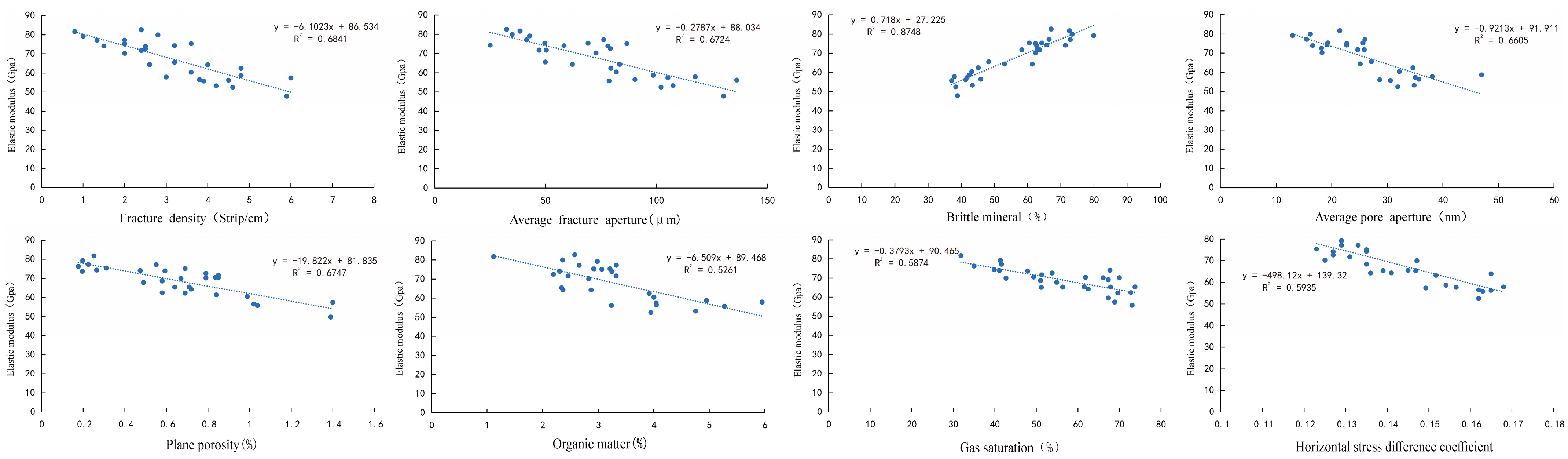
Using the digital core experimental data, we analyzed the correlation between core elastic parameters (notably Young’s modulus, E) and eight potential influencing factors: fracture density, fracture aperture, brittle mineral content, average pore radius, total areal porosity, gas saturation, horizontal stress difference coefficient, and TOC. The results of the correlation and sensitivity analysis are shown in Figure 15. In summary, fracture density, fracture aperture, average pore radius, total areal porosity, gas saturation, and TOC each show a negative correlation with Young’s modulus E, whereas brittle mineral content shows a positive correlation with E. (Additionally, in actual hydraulic fracturing operations, fracture propagation vertically is constrained by the minimum horizontal stress and tends to extend in the direction of maximum horizontal stress; when the differential horizontal stress is smaller, induced fractures more easily connect with natural fractures, reflecting better fracability. Thus, the horizontal stress difference coefficient is inversely correlated with E as well.) Based on the correlation coefficients, the relative sensitivity of the eight factors to the elastic modulus (fracability proxy) can be ranked from highest to lowest as: brittle mineral content, fracture density, fracture aperture, total areal porosity, average pore radius, horizontal stress difference, gas saturation, and TOC. In other words, brittle mineral content has the greatest influence on the rock’s elastic behavior (and thus fracability), whereas gas saturation and TOC have the least influence among the factors considered.

5.5.2. Fracability Evaluation Model Establishment

In this study, the Analytic Hierarchy Process (AHP) was employed to establish a fracability evaluation model for the Long 11 Sub-member of the Longmaxi Formation. AHP is a multi-criteria decision-making method that decomposes complex problems into a hierarchical structure of goals, criteria, and alternatives, enabling both qualitative and quantitative analysis. Using this approach, we integrated multiple parameters—including brittle mineral content, fracture density, total pore surface area, fracture aperture, pore radius, horizontal stress difference coefficient, gas saturation, and total organic carbon (TOC)—to develop a quantitative model for assessing shale gas reservoir fracability in the Long 11 Sub-member [64,65,66].
(1) Construction of the Judgment Matrix. Constructing the judgment matrix involves pairwise comparison of each parameter to determine the weight of each parameter. In this study, according to the correlation between each parameter and the elastic modulus, Santy’s 1-9 scale method was used to determine their importance (Table 7), and the judgment matrix A was constructed as follows:
A = ( a i j ) m × n = a 11 a 1 n a m 1 a m n ,
where aij represents the relative importance of parameter i compared with parameter j, and it satisfies the following conditions: (i) aij > 0; (ii) aij = 1/aji; (iii) aii = 1.
The mathematical method is then used to find the eigenvector corresponding to the maximum eigenvalue of the judgment matrix, so as to obtain the weight coefficients.
Based on the correlation analysis between the elastic modulus and the eight parameters discussed above, the relative importance of these parameters was determined according to the strength of their correlations. The corresponding values were then assigned, and a judgment matrix for the fracability index was established (Table 8).
(2) Using the analytic hierarchy process, the eigenvector of the fracability judgment matrix was obtained as W = (3.7644, 2.6618, 1.8193, 1.2228, 0.8178, 0.5497, 0.3757, 0.2657). The maximum eigenvalue λmax was calculated as 8.2877, and the consistency ratio (C.R.) was 0.0291, which is less than the threshold value of 0.1. This indicates that the consistency of the judgment matrix A is within the acceptable range. Accordingly, the eigenvector was normalized to derive the weight vector for each parameter: Wi = (0.328, 0.232, 0.159, 0.107, 0.071, 0.048, 0.033, 0.023).
Since the evaluated parameters possess different dimensions and units, which may affect the analytical results, data standardization is required to eliminate dimensional influences. Two types of standardization were applied: positive and negative. For positive indicators, larger values correspond to better fracability, whereas for negative indicators, smaller values indicate better fracability. The specific formulas for positive standardization (xi′) and negative standardization (xj′) are as follows:
x i = x i x m i n x m a x x m i n ,
x j = x m a x x j x m a x x m i n ,
wherein: xi and xj are the corresponding parameter values, xmax is the maximum value of the parameter, and xmin is the minimum value of the parameter.
Using these weights, we established a quantitative fracability index (FI) for the reservoir as a weighted sum of the normalized parameters:
D = 0.328 x a + 0.232 x b + 0.159 x c + 0.107 x d + 0.071 x e + 0.048 x f + 0.033 x g + 0.023 x h
where the primed symbols denote normalized values of each parameter ( x a = brittle mineral content, x b = fracture density, x c = total areal porosity, x d = fracture aperture, x e = pore radius, x f = horizontal stress difference coefficient, x g = gas saturation, x h = TOC).
This model provides a fracability coefficient FI (dimensionless, between 0 and 1) that quantitatively evaluates the ease of fracturing for the shale interval, considering both geological and geomechanical factors in combination. It is capable of guiding fracability assessment for the Longmaxi Formation deep shale gas reservoirs in the study area.

5.5.3. Log-Based Fracability Evaluation Application

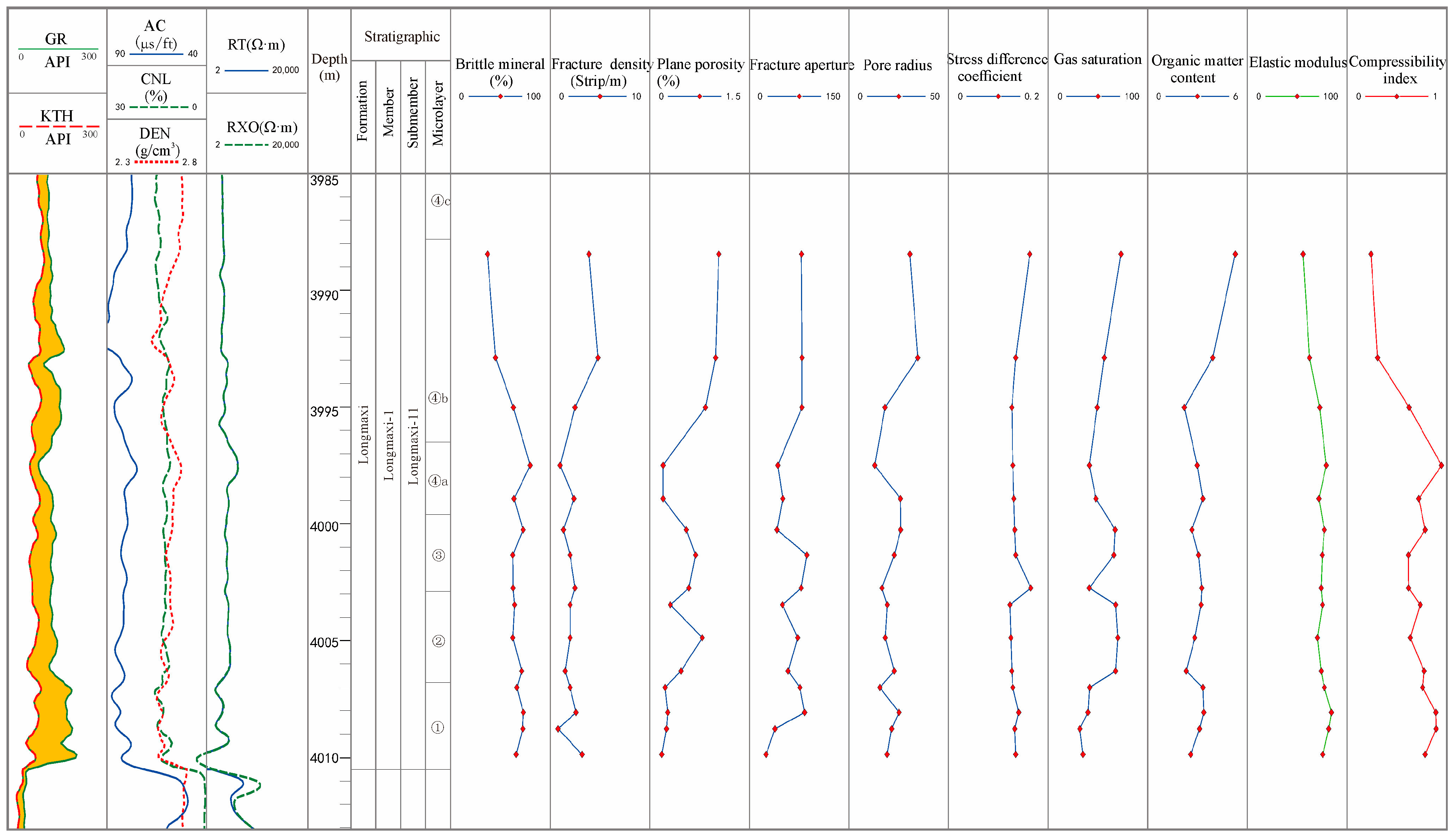
Using the above fracability model, we calculated the fracability index for two example wells (denoted X1 and X3). The modeled fracability curve for each well was compared to that well’s dynamic elastic modulus log. The results show that the modeled fracability index trend is generally consistent with the variation in elastic modulus, with a correlation coefficient of ~0.87, indicating high reliability of the model.
In the Weiyuan area, we further applied the fracability evaluation in conjunction with well log data. By referencing nuclear magnetic resonance (NMR) logging, which provides T2 relaxation spectra, we accounted for the influence of pore size on movable fluid. The NMR indicated gas-bearing favorable intervals in a representative well from 3988.7 m to 4011.4 m, with a cumulative thickness of about 18.3 m identified as gas-bearing sweet spots. Specifically, three depth segments were highlighted: 3988.7–3994.1 m (5.4 m), 3997.0–4001.4 m (4.4 m), and 4002.9–4011.4 m (8.5 m) had strong gas signals.
The most optimal reservoir interval corresponds to the Long 11-1 sublayer, which in this well is a black to dark gray shale with a porosity of 6.3%, TOC of 2.9%, total gas content of 4.0 m3/t, brittle mineral content of 61.2%, and clay mineral content of 28.9%. Upwards from this interval, the porosity, organic carbon, gas content, and brittle mineral content decrease, and the electrical image log shows well-developed argillaceous and pyrite bands that lead to lower resistivity. These features collectively indicate a transition to slightly poorer reservoir quality (classified as Category I–II reservoir).
From the calculated fracability index (FI) curve, in Well X1, the overall FI for the Long 11 through Long 13 remains relatively high, ranging from 0.25 to 0.74 (average ~0.50), with the upper portions of Long 11-1–Long 11-2 reaching FI of 0.42–0.60 (average 0.54) (Figure 16). According to the shale fracability criteria of Rickman et al. [67], and considering the FI values for Well X1, we infer that the Long 11-1–Long 11-2 sublayers in the study area possess relatively favorable fracability. These results demonstrate the utility of the fracability model for guiding the selection of intervals for hydraulic fracturing and stimulation in deep shale gas reservoirs.

6. Conclusions

(1) Using digital core technology, we quantitatively and visually characterized each sublayer of the Longmaxi Formation shale reservoir, revealing the mineral composition, lamination types, pore-throat structure, and organic matter distribution. Multiscale CT imaging further illuminated the spatial development of micro- to nano-scale fractures in each sublayer. Our experimental analyses indicate that parameters such as organic-matter areal porosity, contribution of organic pores and fractures, fracture aperture, fracture density, fracture count distribution, pore structure characteristics, and rock mechanical properties consistently point to the Long 11-1 and Long 11-2 sublayers as the most favorable reservoir intervals in the study area.
(2) Although the Long 11-1 Sub-member of the Longmaxi Formation is lithologically classified as mud shale, its grain size and mineral composition more closely resemble those of clayey siltstone or argillaceous sandstone, suggesting favorable reservoir potential. The relatively coarse grain size is attributed to stronger hydrodynamic conditions and abundant terrigenous clastic supply during deposition. The rigid framework formed by silt- to sand-sized particles effectively mitigates compaction, thereby facilitating the preservation of intergranular pores and microfractures. Pronounced interlayer heterogeneity is observed: the Long 11-1 to Long 11-3 sublayers are dominated by medium-organic-matter felsic and mixed mud shales, characterized by coarser grains and higher brittleness; in contrast, the Long 11-4b sublayer consists of low-organic-matter clayey mud shales with finer grains. These vertical variations are primarily controlled by fluctuations in sea level and changes in provenance supply intensity.
(3) In the deep shale gas of Weiyuan, the base of the Longmaxi Formation contains a significant terrigenous component contributing to the silica content. A high abundance of organic matter, appropriate thermal maturity, and a substantial thickness of high-quality shale have ensured sufficient hydrocarbon generation to charge the reservoirs. The primary types of natural fractures in the deep shale gas reservoirs are intergranular and grain-edge fractures formed due to differences in sedimentary grain size, and bedding-parallel fractures generated by hydrocarbon generation overpressure. Based on our reservoir evaluation and sweet-spot prediction, we identified favorable exploration target zones in the plane. The southeastern region of the Weiyuan deep shale gas area (around wells W4–W14–W11–W12–W15) has relatively greater cumulative thickness of Category I (and I + II) reservoirs, higher pressure coefficients, and better porosity and gas content, and is therefore delineated as a favorable area for exploration and development. Through digital core analysis, we quantitatively identified reservoir mineral composition, pore characteristics, areal porosity, and pore size distribution, and determined that the bottom 0–3 m of the Long 11-1 sublayer is the optimal target interval for hydraulic fracturing.
(4) Digital core simulation allows quantitative analysis of the relative sensitivity of various factors on the shale’s elastic parameters, providing a basis to more accurately determine the weights of these factors in an AHP-based fracability evaluation model. We established a quantitative model for evaluating the fracability of the Longmaxi Formation Long 11 submember shale gas reservoirs in the study area. This model integrates mineralogical, petrophysical, and geomechanical parameters into a fracability index, which has been validated against well log data. The model can be used to guide the selection of target layers and optimize hydraulic fracturing designs for deep shale gas reservoirs in Weiyuan and similar geological settings.

Author Contributions

Conceptualization, J.L., T.H. and H.L.; methodology, J.L., Y.D., B.Y., X.R. and H.L.; software, J.L., Y.D., G.C., B.Y. and X.R.; formal analysis, J.L., Y.D., G.C., B.Y., X.R. and H.L.; investigation, J.L., Y.D. and X.R.; resources, T.H. and B.Y.; data curation, Y.D., G.C. and H.L.; writing—original draft, J.L., G.C. and B.Y.; writing—review and editing, J.L., T.H., X.R. and H.L.; visualization, T.H.; supervision, T.H.; funding acquisition, T.H. and H.L. All authors have read and agreed to the published version of the manuscript.

Funding

The research was supported by the Open Fund (PLN2025-11) of the State Key Laboratory of Oil and Gas Reservoir Geology and Exploitation (Southwest Petroleum University) and the National Natural Science Foundation of China (No. 42572176).

Data Availability Statement

The original contributions presented in this study are included in the article. Further inquiries can be directed to the corresponding author.

Conflicts of Interest

Jing Li, Tingting Huang, Guo Chen and Bei Yang are employees of Institute of Geological Exploration and Development of CNPC Chuanqing Drilling Engineering Company Limited. Xiaohai Ren is employee of Shale gas project management department, CNPC Chuanqing Drilling Engineering Company Limited. The paper reflects the views of the scientists and not the company.

References

  1. Zhan, L.; Fan, C.; Luo, B.; Shi, X.; Mansour, A.; Yang, X.; Tang, W.; Gao, L.; Xu, L.; Liu, D.; et al. Stratigraphic division and sedimentary environment of the Permian Wujiaping Formation in the Longmen-Wushankan area of the Eastern Sichuan Basin: Insights for shale gas exploration. Geomech. Geophys. Geo-Energy Geo-Resour. 2026, 12, 27. [Google Scholar] [CrossRef]
  2. Wang, H.; Shi, Z.; Zhou, T.; Zhao, Q.; Sun, S.; Qi, L.; Liang, P. Types and Characteristics of Sweet Spots of Marine Black Shale and Significance for Shale Gas Exploration: A Case Study of Wufeng–Longmaxi in Southern Sichuan Basin. Energy Geosci. 2023, 3, 152–163. [Google Scholar]
  3. Ren, G.; Guo, W.; Yuan, L. Quantitative Assessment of Shale Gas Preservation in the Longmaxi Formation: Insights from Shale Fluid Properties. J. Geo-Energy Environ. 2025, 1, 8–22. [Google Scholar] [CrossRef]
  4. Yang, X.; Chang, C.; Cheng, Q.; Xie, W.; Hu, H.; Zhang, Z. Experimental Study on Two-Phase Gas–Water Flow in Self-Supported Fractures of Shale Gas Reservoir. J. Min. Strata Control Eng. 2025, 7, 136–152. [Google Scholar]
  5. Li, H.; He, S.; Radwan, A.E.; Xie, J.T.; Qin, Q.R. Quantitative Analysis of Pore Complexity in Lacustrine Organic-Rich Shale and Comparison to Marine Shale: Insights from Experimental Tests and Fractal Theory. Energy Fuels 2024, 38, 16171–16188. [Google Scholar] [CrossRef]
  6. Li, J.Y.; Dou, L.B.; Xi, Z.C.; Li, H.B.; Wang, T.; Cheng, X.B. A New Method for Evaluating Fracability of Shale Reservoirs. Therm. Sci. 2024, 28, 3423–3428. [Google Scholar] [CrossRef]
  7. Ma, C.F.; Dong, C.M.; Lin, C.Y.; Elsworth, D.; Luan, G.Q.; Sun, X.L.; Liu, X.C. Influencing Factors and Fracability of Lacustrine Shale Oil Reservoirs. Mar. Pet. Geol. 2019, 110, 463–471. [Google Scholar] [CrossRef]
  8. Gong, X.; He, J.; Li, J.; Luo, A.; Cao, W.; Liu, X. Professional Evaluation and Distribution Patterns of Shale Gas Reservoirs in the Wufeng Formation-Long 11 Sub-member of Well Block Z205, Sichuan Basin. J. Geo-Energy Environ. 2025, 1, 96–105. [Google Scholar] [CrossRef]
  9. Sakhaee-Pour, A.; Bryant, S.L. Pore Structure of Shale. Fuel 2014, 143, 467–475. [Google Scholar] [CrossRef]
  10. Lan, Y.Z.; Moghanloo, R.G.; Davudov, D. Pore Compressibility of Shale Formations. SPE J. 2017, 22, 1778–1789. [Google Scholar] [CrossRef]
  11. Zhao, W.; Luo, L.; Wang, H.; Dai, J.C.; Xia, Y.X.; Iglauer, S.; Cai, J.C. Lattice Boltzmann Simulation of CO2 Mineral Dissolution Mechanisms in Heterogeneous Shale Pore Structures. Gas Sci. Eng. 2025, 146, 205823. [Google Scholar] [CrossRef]
  12. Dong, Z.T.; Tian, S.S.; Xue, H.T.; Lu, S.F.; Liu, B.; Erastova, V.; Wu, M.; Wu, R.Y. Analysis of Pore Types in Lower Cretaceous Qingshankou Shale Influenced by Electric Heating. Energy Fuels 2024, 38, 20577–20590. [Google Scholar] [CrossRef]
  13. Hu, Z.; Liu, Z.; Du, W.; Bai, Z.; Wang, R.; Sun, C.; Feng, D. Key Geological Factors Governing Sweet Spots in the Wufeng–Longmaxi Shales of the Sichuan Basin. Energy Geosci. 2024, 5, 100268. [Google Scholar] [CrossRef]
  14. Wang, Y.S.; Gu, Y.F.; Cai, G.Y.; Li, X.T.; Zhuang, H.Z.; Jiang, Y.Q. Geological and Geochemical Characterization of Transitional Shale of the Permian Shanxi Formation in the Eastern Ordos Basin, North China. J. Pet. Geol. 2024, 49, 142–159. [Google Scholar] [CrossRef]
  15. Li, H.; Qin, Q.R.; Li, C.B.; Radwand, A.E.; Wang, J.B.; Fan, C.H. Quantitative characterization of complex multi-scale fractures in low-permeable sandstone reservoir: Insights from geological and mathematical approach. Geomech. Geophys. Geo-Energy Geo-Resour. 2026, 12, 39. [Google Scholar] [CrossRef]
  16. Mo, W.L.; Wang, M.; Chen, F.W.; Huang, Z.L.; Li, Y.; Yan, Y.; Jiang, R.; Lin, T.; Cui, J.F. Types and Microstructures of Pores in Shales of the Ordovician Wulalike Formation at the Western Margin of the Ordos Basin, China. Energy Geosci. 2023, 4, 100155. [Google Scholar] [CrossRef]
  17. Li, J.L.; Wang, M.; Wang, M.; Li, J.B.; Zhao, X.B.; Hu, X.Z.; Fu, A.B. Shale Primary Porosimetry Based on 2D Nuclear Magnetic Resonance of T1-T2. Energy Geosci. 2024, 5, 100270. [Google Scholar] [CrossRef]
  18. Liu, W.; Qiao, Y.; Wu, W.; Mou, C.; Chen, L. Geochemistry of the Wufeng–Longmaxi Black Shales in the NW Middle Yangtze Basin: Implications for Provenance, Paleoenvironment, and Heterogeneity of Organic Matter. Geomech. Geophys. Geo-Energy Geo-Resour. 2025, 11, 102. [Google Scholar] [CrossRef]
  19. Zhu, C.F.; Zhang, T.L.; Pan, J.F.; Li, Y.W.; Sheng, J.J.; Ge, D.; Jia, R.; Guo, W. Evolution of the 3D Pore Structure of Organic-Rich Shale with Temperature Based on Micro-Nano CT. Pet. Sci. 2025, 22, 2339–2352. [Google Scholar] [CrossRef]
  20. Wu, S.; Wu, J.F.; Liu, Y.; Yang, X.F.; Zhang, J.; Zhang, J.; Zhang, D.L.; Zhong, B.; Liu, D.C. Lattice Boltzmann Modeling of the Coupled Imbibition-Flowback Behavior in a 3D Shale Pore Structure under Reservoir Condition. Front. Earth Sci. 2023, 11, 1138938. [Google Scholar] [CrossRef]
  21. Gou, Q.Y.; Xu, S.; Hao, F.; Yang, F.; Shu, Z.G.; Liu, R. The Effect of Tectonic Deformation and Preservation Condition on the Shale Pore Structure Using Adsorption-Based Textural Quantification and 3D Image Observation. Energy 2020, 219, 119579. [Google Scholar] [CrossRef]
  22. Sun, W.J.B.; Zuo, Y.J.; Lin, Z.; Wu, Z.H.; Liu, H.; Lin, J.Y.; Chen, B.; Chen, Q.G.; Pan, C.; Lan, B.F. Impact of Tectonic Deformation on Shale Pore Structure Using Adsorption Experiments and 3D Digital Core Observation: A Case Study of the Niutitang Formation in Northern Guizhou. Energy 2023, 278, 127724. [Google Scholar] [CrossRef]
  23. Zheng, H.; Yang, F.; Guo, Q.L.; Liu, K.F. Upscaling Characterizing Pore Connectivity, Morphology and Orientation of Shale from Nano-Scale to Micro-Scale. Mar. Pet. Geol. 2024, 172, 107213. [Google Scholar] [CrossRef]
  24. Liu, Y.W.; Wang, S.P.; Zheng, R.C.; Li, H.S. Quantitative Characterization of Tight Rock Microstructure of Digital Core. Geofluids 2022, 2022, 3554563. [Google Scholar] [CrossRef]
  25. Wang, C.S.; Tian, L.L.; Sun, C.R.; Deng, Y.W.; Zhou, Y.; Nie, X. Multi-Scale Characterization of Tight Carbonate Rocks Based on Digital Cores. Front. Earth Sci. 2025, 13, 1538316. [Google Scholar] [CrossRef]
  26. Setiawan, M.R.; Fatkhan; Latief, F.D.E.; Fauzi, U. Characterization of Diabase Core Anisotropy: Integrating Ultrasonic Measurements and Digital Rock Physics. J. Appl. Geophys. 2025, 238, 105698. [Google Scholar] [CrossRef]
  27. Liu, J.L.; Xie, R.H.; Guo, J.F.; Xu, C.Y.; Wei, H.Y. Multicomponent Digital Core Construction and Three-Dimensional Micro-Pore Structure Characterization of Shale. Phys. Fluids 2023, 35, 082003. [Google Scholar] [CrossRef]
  28. Luo, A.; He, J.; Li, J.; Gong, X.; Cao, W.; Wu, Y. Experimental Study on the Influence of Water-Rock Interaction on the Mechanical Characteristics and Creep Behavior of Shale. J. Geo-Energy Environ. 2025, 1, 61–69. [Google Scholar] [CrossRef]
  29. Wang, H.; Shi, Z.; Zhao, Q.; Liu, D.; Sun, S.; Guo, W.; Liang, F.; Lin, C.; Wang, X. Stratigraphic Framework of the Wufeng-Longmaxi Shale in and around the Sichuan Basin, China: Implications for Targeting Shale Gas. Energy Geosci. 2020, 1, 124–133. [Google Scholar] [CrossRef]
  30. Li, Y.Z.; Li, H.Y.; Huang, Y.F. Seismicity in the Weiyuan-Rongxian Area, Sichuan Basin, SW China. J. Asian Earth Sci. 2024, 272, 106241. [Google Scholar] [CrossRef]
  31. Feng, Z.Q.; Dong, D.Z.; Tian, J.Q.; Qiu, Z.; Wu, W.; Zhang, C. Geochemical Characteristics of Longmaxi Formation Shale Gas in the Weiyuan Area, Sichuan Basin, China. J. Pet. Sci. Eng. 2018, 167, 538–548. [Google Scholar] [CrossRef]
  32. Zhang, Q. Organic Matter Accumulation in Organic-Rich Shales. Front. Earth Sci. 2024, 12, 1347462. [Google Scholar] [CrossRef]
  33. Zou, C.N.; Zhu, R.K.; Chen, Z.Q.; Ogg, J.G.; Wu, S.T.; Dong, D.Z.; Qiu, Z.; Wang, Y.M.; Wang, L.; Lin, S.H. Organic-Matter-Rich Shales of China. Earth-Sci. Rev. 2019, 189, 51–78. [Google Scholar] [CrossRef]
  34. Zhang, K.; Xi, Z.D.; Zhang, S.H.; Tang, S.H.; Lv, J.W.; Nie, H.K.; Lin, D.L. Characteristics of Organic Matter Types and Organic Matter Pore Development in Marine-Continental Transitional Shale. Geol. J. 2025, 60, 2095–2113. [Google Scholar] [CrossRef]
  35. Liu, J.; He, X.; Xue, F.; Dai, J.J.; Yang, J.X.; Huang, H.Y.; Hou, Z.M. Influence of Natural Fractures of Multi-Feature Combination on Seepage Behavior in Shale Reservoirs. J. Min. Strata Control Eng. 2024, 6, 131–140. [Google Scholar]
  36. Zhao, L.; Mao, W.; Liu, Z.; Cheng, S. Research on the Differential Tectonic–Thermal Evolution of Longmaxi Shale in the Southern Sichuan Basin. Adv. Geo-Energy Res. 2023, 7, 152–163. [Google Scholar] [CrossRef]
  37. Li, H.; Tang, H.; Qin, Q.R.; Wang, Q.; Zhong, C. Effectiveness Evaluation of Natural Fractures in Xujiahe Formation of Yuanba Area, Sichuan Basin, China. Arab. J. Geosci. 2019, 12, 194. [Google Scholar] [CrossRef]
  38. Li, H.; Xu, Z.Q.; Gao, X.D.; Xie, J.T.; Qin, Q.R.; Wang, H.J.; He, S. Pore Structure Evolution and Geological Controls in Lacustrine Shale Systems with Implications for Marine Shale Reservoir Characterization. Sci. Rep. 2025, 15, 17702. [Google Scholar] [CrossRef]
  39. Li, H.; Duan, H.T.; Qin, Q.R.; Zhao, T.; Fan, C.; Luo, J. Characteristics and distribution of tectonic fracture networks in low permeability conglomerate reservoirs. Sci. Rep. 2025, 15, 5914. [Google Scholar] [CrossRef]
  40. Li, J.; Li, H.; Jiang, W.; Cai, M.L.; He, J.; Wang, Q.; Li, D.Y. Shale Pore Characteristics and Their Impact on the Gas-Bearing Properties of the Longmaxi Formation. Sci. Rep. 2024, 14, 16896. [Google Scholar] [CrossRef]
  41. Li, J.; Zhang, Q.; Jiang, W.; Li, H.; Li, L.; Xue, T.F.; Wang, Q.; Gao, Z. Lithological Controls on Pore Structure and Their Implications for Deep Shale Gas Reservoir Quality in the Longmaxi Formation, Luzhou Area, Southern Sichuan Basin, China. Energy Fuels 2025, 39, 1541–1558. [Google Scholar] [CrossRef]
  42. Ross, D.J.K.; Bustin, R.M. The Importance of Shale Composition and Pore Structure upon Gas Storage Potential of Shale Gas Reservoirs. Mar. Pet. Geol. 2008, 25, 55–61. [Google Scholar] [CrossRef]
  43. Li, S.; Sun, W.; Li, Y.; Gao, J.; Liu, Z.; Feng, X. Hydrocarbon Accumulation Conditions and Exploration Targets of the Sinian Dengying Formation in Southeastern Sichuan Basin. Energy Geosci. 2023, 4, 100154. [Google Scholar] [CrossRef]
  44. Zhang, B.; Liu, L.; Zheng, A.; Yan, D.; Wang, X.; Wang, J.; Li, K.; Yi, Y. Enhanced Understanding of Carbonate-Rich Shale Heterogeneity through Multifractal Characterization Based on N2 Adsorption Data: A Case Study of the Permian Wujiaping Formation in the Sichuan Basin. Energy Geosci. 2025, 6, 100426. [Google Scholar] [CrossRef]
  45. Zheng, M.; Chen, Y.; Tang, T.; Wu, Y.; Chen, Y.; Chen, J.; Peng, S.; Zhang, J. Multiscale Characterization of Pore Structure and Heterogeneity in Deep Marine Qiongzhusi Shales from Southern Basin, China. Minerals 2025, 15, 515. [Google Scholar] [CrossRef]
  46. Wang, T.; Tian, F.; Deng, Z.; Hu, H. The Characteristic Development of Micropores in Deep Coal and Its Relationship with Adsorption Capacity on the Eastern Margin of the Ordos Basin, China. Minerals 2023, 13, 302. [Google Scholar] [CrossRef]
  47. Yang, Y.; Wei, J.; Liu, Y.; Zeng, Q.; Lin, J.; Li, J. Experimental Study on the Influence of External Fluids on the Pore Structure of Carbonaceous Shale. Geomech. Geophys. Geo-Energy Geo-Resour. 2024, 10, 84. [Google Scholar] [CrossRef]
  48. Liu, G.H.; Zhai, G.Y.; Zou, C.N.; Cheng, L.J.; Guo, X.B.; Xia, X.H.; Shi, D.S.; Yang, Y.R.; Zhang, C.; Zhou, Z. A Comparative Discussion of the Evidence for Biogenic Silica in Wufeng-Longmaxi Siliceous Shale Reservoir in the Sichuan Basin, China. Mar. Pet. Geol. 2019, 109, 70–87. [Google Scholar] [CrossRef]
  49. Yahia, N.B.; Lerari, D.; Bensouilah, R.; Boussen, S.; Sebei, A.; Chaabani, F. Physicochemical Characterization of Biogenic Silica of the Upper Numidian Babouchite Siliceous Rocks, Northwestern Tunisia. J. Afr. Earth Sci. 2022, 194, 104608. [Google Scholar] [CrossRef]
  50. Qi, N.; Li, X.S.; Su, X.H.; Lu, Y.X.; Zou, H.R.; Guo, N. Experimental Investigation on the Evolution of Physicochemical Properties and Dissolution Mechanism of High-Siliceous Shale with Acid Treatment. SPE J. 2025, 30, 81–97. [Google Scholar]
  51. Jiang, T.; Jin, Z.J.; Liu, G.X.; Liu, Q.Y.; Gao, B.; Liu, Z.B.; Nie, H.K.; Zhao, J.H.; Wang, R.Y.; Zhu, T.; et al. Source Analysis of Siliceous Minerals and Uranium in Early Cambrian Shales, South China: Significance for Shale Gas Exploration. Mar. Pet. Geol. 2018, 102, 101–108. [Google Scholar] [CrossRef]
  52. Cao, T.T.; Liu, H.; Pan, A.Y.; Fu, Y.T.; Deng, M.; Cao, Q.G.; Huang, Y.R.; Yu, Y. Pore Evolution in Siliceous Shales and Its Influence on Shale Gas-Bearing Capacity in Eastern Sichuan-Western Hubei, China. J. Pet. Sci. Eng. 2022, 208, 109597. [Google Scholar] [CrossRef]
  53. Liu, C.; Liang, Y.; Wang, K. A Numerical Investigation on Deep Shale Gas Recovery. Energy Geosci. 2021, 2, 274–284. [Google Scholar] [CrossRef]
  54. Zhang, K.; Song, Y.; Jiang, Z.X.; Xu, D.S.; Li, L.T.; Yuan, X.J.; Liu, P.; Han, F.L.; Tang, L.Y.; Wang, X.Y.; et al. Quantitative Comparison of Genesis and Pore Structure Characteristics of Siliceous Minerals in Marine Shale With Different TOC Contents—A Case Study on the Shale of Lower Silurian Longmaxi Formation in Sichuan Basin, Southern China. Front. Earth Sci. 2022, 10, 887160. [Google Scholar] [CrossRef]
  55. Li, Y.F.; Fan, T.L.; Zhang, J.C.; Wei, X.J.; Zhang, J.P. Impact of Paleoenvironment, Organic Paleoproductivity, and Clastic Dilution on the Formation of Organic-Rich Shales: A Case Study about the Ordovician-Silurian Black Shales, Southeastern Chongqing, South China. Arab. J. Geosci. 2015, 8, 10225–10239. [Google Scholar] [CrossRef]
  56. Sajid, Z.; Ismail, M.S.; Zakariah, M.N.A.; Tsegab, H.; Vintaned, J.A.G.; Hanif, T.; Ahmed, N. Impact of Paleosalinity, Paleoredox, Paleoproductivity/Preservation on the Organic Matter Enrichment in Black Shales from Triassic Turbidites of Semanggol Basin, Peninsular Malaysia. Minerals 2020, 10, 915. [Google Scholar] [CrossRef]
  57. Hackley, P.C.; Zhang, T.; Jubb, A.M.; Valentine, B.J.; Dulong, F.T.; Hatcherian, J.J. Geochemical and Petrological Evidence for Genesis of Silica in Shale Samples from the Marcellus, Woodford, and Barnett Shale Unconventional Resource Plays. Int. J. Coal Geol. 2016, 163, 110–120. [Google Scholar]
  58. Lu, D.L.; Chen, H.S.; Li, H.Y.; He, J.; Liu, D.C.; Zhang, D.L. A Method for Rapid Prediction of Fracture Networks in Hydraulic Fracturing. Chem. Technol. Fuels Oils 2025, 61, 456–461. [Google Scholar] [CrossRef]
  59. Wu, M.; Chang, X.; Guo, Y.; Liu, J.; Yang, C.; Suo, Y. Advances, challenges, and opportunities for hydraulic fracturing of deep shale gas reservoirs. Adv. Geo-Energy Res. 2025, 15, 1–4. [Google Scholar] [CrossRef]
  60. Tang, J.Z.; Li, J.Y.; Zhang, Z.; Fan, Y.; Jiang, W.Y.; Meng, S.W.; Zhao, X.Z. Differential Impacts of Multi-Scale Natural Fractures on Hydraulic Fracture Network Formation. Earth-Sci. Rev. 2025, 272, 105315. [Google Scholar] [CrossRef]
  61. Shi, S.; Shan, C.; Zhao, Z.; Fei, Y.; Zhang, J. Organic Geochemical Characteristics and Thermal Evolution Characteristics of Paleogene to Neogene Source Rocks in Mangai Area, Qaidam Basin. J. Geo-Energy Environ. 2026, 2, 56–72. [Google Scholar] [CrossRef]
  62. Ma, B.; Cao, Y.; Eriksson, K.A.; Jia, Y.; Gill, B.C. Depositional and diagenetic controls on deeply-buried Eocene sublacustrine fan reservoirs in the Dongying Depression, Bohai Bay Basin, China. Mar. Petrol. Geol. 2017, 82, 297–317. [Google Scholar] [CrossRef]
  63. O’Neill, S.R.; Jones, S.J.; Kamp, P.J.J. Diagenesis and burial history modeling of heterogeneous marginal marine to shoreface Paleocene glauconitic sandstones, Taranaki Basin, New Zealand. J. Sediment. Res. 2020, 90, 651–668. [Google Scholar] [CrossRef]
  64. Wang, X.Q.; Ge, H.K.; Han, P. A New Model for Fracability Evaluation with Consideration of Natural Cracks. J. Geophys. Eng. 2018, 15, 1492–1505. [Google Scholar] [CrossRef]
  65. Yan, D.D.; Zhao, L.X.; Song, X.H.; Tang, J.Z.; Zhang, F.S. Fracability Evaluation Model for Unconventional Reservoirs: From the Perspective of Hydraulic Fracturing Performance. Int. J. Rock Mech. Min. Sci. 2024, 183, 105912. [Google Scholar] [CrossRef]
  66. Wang, Y.; Gui, H.; Su, S.; Zhou, Q. Sedimentary Environment and Paleoclimate Geochemical Characteristics of Shale in the Wufeng and Longmaxi Formations, Northern Yunnan–Guizhou Area. Energy Geosci. 2022, 2, 653–666. [Google Scholar]
  67. Rickman, R.; Mullen, M.; Petre, E.; Grieser, B.; Kundert, D. A practical use of shale petrophysics for stimulation design optimization: All shale plays are not clones of the Barnett Shale. In Proceedings of the SPE Annual Technical Conference and Exhibition, Denver, CO, USA, 21–24 September 2008. [Google Scholar]
Figure 1. Geological framework of the Wufeng Formation to Long11-1 Sub-member in the Weiyuan area. (a) Sedimentary facies; (b) Stratigraphic thickness; (c) Stratigraphic column.
Minerals 16 00366 g001
Figure 2. Schematic diagram of the construction and workflow of multi-scale digital core technology.
Minerals 16 00366 g002
Figure 3. Correlation of quantitative mineral analysis and fracture development characteristics in the Longmaxi Formation of Well W15.
Minerals 16 00366 g003
Figure 4. Particle size distribution of major minerals in samples from the Long11-4 and Long11-1 sub-layers of Well W15.
Minerals 16 00366 g004
Figure 5. SEM images of organic matter types in the Long11-1 Sub-member of the Weiyuan area. (ad). Primary organic matter; (eh). Coexistence of apatite and organic matter; (i). Organic matter within graptolite; (j). Sponge spicules; (k,l). Vitrinite organic matter; (m,n). Intergranular pore; (o,p). Intragranular dissolved pore.
Minerals 16 00366 g005
Figure 6. Pore types and organic matter proportion in Well W15.
Minerals 16 00366 g006
Figure 7. Pore size distribution of organic and inorganic pores in samples from Well W15.
Minerals 16 00366 g007
Figure 8. Micro-CT 3D scanning image and fracture distribution of Well W15. (a,c,e,g). SEM image; (b,d,f,h). fracture distribution image.
Minerals 16 00366 g008
Figure 9. FIB-SEM imaging results of the sub-layers in the Long11-1 Sub-member of the Weiyuan area.
Minerals 16 00366 g009
Figure 10. Depositional model of the Long11 Sub-member in the Weiyuan area. (a). Long11-1; (b). Long11-2; (c). Long11-3; (d). Long11-4.
Minerals 16 00366 g010
Figure 11. W16 Organic Pore Size Distribution Curve (Long 11-1, Long 11-4a, Long 11-3 and Long 11-4b, respectively).
Minerals 16 00366 g011
Figure 12. Comparison of fracture orientation from core and imaging logging with the present-day maximum principal stress orientation in shale gas wells from the Weiyuan area.
Minerals 16 00366 g012
Figure 13. Planar distribution of Class I reservoir thickness in the deep shale gas of the Wufeng Formation to Long 11-1 Sub-member (left) and the Long 11-11 Sub-layer (right).
Minerals 16 00366 g013
Figure 14. Location optimization of target bodies based on digital core analysis from Well W17.
Minerals 16 00366 g014
Figure 15. Correlation relationships between various parameters from digital core experiments and core elastic parameters in the Weiyuan area.
Minerals 16 00366 g015
Figure 16. Fractability Index Results for the Long11-1 to Long11-4 Sub-layers of Well X1.
Minerals 16 00366 g016
Table 1. Test items and samples.
Test ItemTest Instrument and ModelSamples Number
W15W16W17
Micro-CT ScanningXradia 520 Versa (Carl Zeiss, Oberkochen, Germany)151515
2D Multi-scale Associative Panoramic Scanning Electron Microscopy (MAPS)Zeiss Merlin (Carl Zeiss, Oberkochen, Germany)151515
3D FIB-SEM Nanoscale Fine Scanning ImagingCrossbeam 540 (Carl Zeiss, Oberkochen, Germany)121212
Mineralogy by Artificial Intelligence-powered Scanning Electron MicroscopyThe All-New Generation of Digitally Intelligent Mineral Analysis System (Chinese Academy of Sciences, Beijing, China)181818
TOCTOC-VCPH (Shimadzu Corporation, Kyoto, Japan)414048
RoDM4500P + QDI308 (Leica Microsystems, Wetzlar, Germany)30//
Microscopic pore structureZeiss Merlin/FEI Quanta 650 FEG (FEI Company, Hillsboro, OR, USA)151515
Table 2. Lithofacies division of the Long 11 submember in Well W15.
WellStratumDepth/mTotal Siliceous/%Total Calcium/%Total Clay/%TOC/%Lithofacies
W15Long 11-4b3988.0535.751.3461.230.506Organic-lean argillaceous mud shale
3992.48530.0515.0850.51.745
3994.6241.7721.333.612.098Medium-organic mixed mud shale
Long 11-4a3997.138.1341.7918.522.021
3998.5250.8612.7833.352.444
Long 11-33999.8655.8117.0624.923.391Organic-rich felsic mud shale
4000.9345.6316.7632.533.023
4002.3544.6218.1233.123.223Organic-rich mixed mud shale
Long 11-24003.0640.6923.5731.22.953Medium-organic mixed mud shale
4004.4846.2316.1835.183.246Organic-rich mixed mud shale
4005.941.2230.1826.283.034
Long 11-14006.6141.924.5729.122.745Medium-organic felsic mud shale
4007.6744.118.9544.182.895
4008.3833.239.3942.183.11Organic-rich felsic mud shale
4009.4562.483.3130.643.105
Table 3. TOC for the Wufeng Formation–Long 11 submember in the Well W17 area.
WellStratumDepth/mSample NumberMeasured TOC/%Logging TOC %
Min/%Max/%Ave/%
W15Long 11-4c3968.3~3987.8190.10.90.20.5
Long 11-4b3987.8~3996.591.33.22.01.4
Long 11-4a3996.5~3999.633.03.33.12.2
Long 11-33999.6~4002.932.73.33.03.2
Long 11-24002.9~4006.842.33.22.93.1
Long 11-14006.8~4010.531.13.42.32.9
Wufeng//////
W16Long 11-4c3419.5~3431.5120.11.61.11.3
Long 11-4b3431.55~3442.5121.04.02.52.5
Long 11-4a3442.5~3446.733.03.03.02.9
Long 11-33446.7~3452.162.44.73.43.5
Long 11-23452.1~3456.142.32.52.42.4
Long 11-13456.1~3458.521.83.12.43.2
Wufeng3458.5~3459.312.42.42.41.1
W17Long 11-4c3620.4~3644.6130.11.30.81.0
Long 11-4b3644.6~3655210.84.01.82.4
Long 11-4a3655~3658.342.32.92.72.9
Long 11-33658.3~3662.332.44.03.42.9
Long 11-23662.3~3665.642.13.02.52.7
Long 11-13665.6~366824.04.84.43.9
Wufeng3668~3668.510.650.650.651.1
Table 4. Bitumen reflectance measurement data of the Wufeng Formation–Long 11 submember in the Well W17 area and adjacent wells.
WellDepth/mStratumMeasured NumberBitumen Reflectance/%Vitrinite Reflectance/%
W153994.88Long 11-4b54.193.09
3999.86Long 11-354.223.11
4003.10–4005.57Long 11-2104.243.12
4006.32–4009.31Long 11-1104.273.14
W113497.79–3497.82Long 12102.722.12
3506.84–3506.8762.782.16
3515.89–3515.92Long 11-482.832.20
3526.5–3526.5382.882.23
3536.8–3536.83Long 11-382.972.29
3546.7–3546.731132.31
3555.73–3555.7693.062.35
3566.3–3566.33Wufeng83.112.38
W43500.08–3500.38Long 11-4122.872.22
3504.58–3504.8882.862.22
3509.54–3509.8492.892.23
3514.66–3514.96112.912.25
3520.18–3520.48Long 11-3132.962.28
3525.20–3525.50Long 11-292.952.27
Table 5. Proportion of different pore types and areal porosity in samples from Well W15.
WellDeprh/mStratumLithologyOrganic Pores/%Organic Fractures/%Inorganic Pores/%Inorganic Fractures%Areal Porosity/%Organic Matter/%
W153988.05Long 11-4bArgillaceous mud shale000.3270.7111.0380
3992.480.2390.0050.2350.510.9894.932
3994.62Mixed mud shale0.1580.0010.5660.1110.8362.848
3997.1Long 11-4aMixed mud shale0.2250.0030.8090.1611.1983.506
3999.52Felsic mud shale0.0970.0030.050.0460.1965.563
3999.86Long 11-3Felsic mud shale0.3720.0040.110.0650.5515.762
4000.930.7940.0160.3470.1321.293.541
4002.35Mixed mud shale0.4030.0030.1510.0360.5935.968
4003.06Long 11-2Mixed mud shale0.1220.0040.1410.0440.3114.432
4004.480.6570.0080.3350.0731.0734.258
4005.90.0570.0010.2990.1170.4742.783
4006.61Long 11-1Mixed mud shale0.1230.0020.0630.0370.2255.763
4007.67Felsic mud shale0.070.0080.0760.1110.2655.657
4008.380.0850.0040.0820.080.2525.68
4009.450.0370.0080.0580.0730.17714.708
Table 6. Si/(Si + Al + Fe) ratios and excess silica calculation results of the Longmaxi Formation in Well W15.
WellDepth/mMajor Element Content/%Si/(Si + Al + Fe)Biogenic Silica CalculationTOC
Al2O3TFe2O3SiO2TiO2
W163413.18–3413.2315.326.9159.50.660.728011.851.16
3422.98–3423.0616.386.2661.580.650.731210.641.22
3433.01–3433.0611.404.0650.760.600.766515.312.33
3443.07–3443.128.823.9747.380.540.787419.952.09
3453.09–3453.1512.588.2852.930.520.717313.813.05
W153988.0512.430.8854.840.580.804716.181.57
3992.489.491.8845.350.490.799515.841.92
3994.627.651.5150.690.550.847026.902.20
3997.14.410.842.80.520.891529.082.98
3998.5211.371.4958.410.560.819623.053.32
3999.866.221.0841.370.470.850022.032.66
4000.937.772.3753.720.500.841229.563.06
4002.357.631.9553.260.570.847529.533.25
4003.067.202.2448.820.530.838026.433.21
4004.488.451.2754.90.520.849628.622.83
4005.96.261.1547.840.530.865928.372.31
4006.616.752.0949.350.540.848128.363.32
4007.6710.021.4556.260.580.830725.102.87
4008.389.137.3655.40.500.770627.013.54
4009.457.521.6845.690.560.832422.303.65
Table 7. Scale and Meaning of Judgment Matrix Elements.
ScaleMeaning
1Indicates that compared to the other element, the two elements are of equal importance.
3Indicates that compared to the other element, the former is slightly more important than the latter.
5Indicates that compared to the other element, the former is significantly more important than the latter.
7Indicates that compared to the other element, the former is demonstrably more important than the latter.
9Indicates that compared to the other element, the former is absolutely more important than the latter.
2, 4, 6, 8Represent the intermediate values of the above adjacent judgments.
Reciprocals of 1–9Indicate the comparative importance after swapping the positions of the two corresponding elements (e.g., if A/B = 3, then B/A = 1/3).
Table 8. Scale and meaning of elements in the fractability judgment matrix.
ParameterImportance aij
Brittle MineralsFracture DensityTotal Plane PorosityFracture AperturePore RadiusHorizontal Stress Difference CoefficientGas SaturationTOC
Brittle Minerals12345678
Fracture Density1/21234567
Total Plane Porosity1/31/2123456
Fracture Aperture1/41/31/212345
Pore Radius1/51/41/31/21234
Horizontal Stress Difference Coefficient1/61/51/41/31/2123
Gas Saturation1/71/61/51/41/31/212
TOC1/81/71/61/51/41/31/21
Disclaimer/Publisher’s Note: The statements, opinions and data contained in all publications are solely those of the individual author(s) and contributor(s) and not of MDPI and/or the editor(s). MDPI and/or the editor(s) disclaim responsibility for any injury to people or property resulting from any ideas, methods, instructions or products referred to in the content.