Article

Coloration Mechanism of the Early Cretaceous Hongshanwan Landform in the Lanzhou Basin, China: Constraints from Geochemistry and Detrital Zircon U-Pb Geochronology

1
College of Earth and Environmental Sciences, Center for Glacier and Desert Research, Lanzhou University, Lanzhou 730000, China
2
Geoscience Big Data Engineering Research Center of Gansu Province, Geological Survey of Gansu Province, Lanzhou 730000, China
3
Lanzhou University of Arts and Science, Lanzhou 730010, China
*
Author to whom correspondence should be addressed.
Minerals 2026, 16(4), 360; https://doi.org/10.3390/min16040360
Submission received: 21 February 2026 / Revised: 27 March 2026 / Accepted: 27 March 2026 / Published: 29 March 2026
(This article belongs to the Section Mineral Exploration Methods and Applications)

Abstract

The Early Cretaceous Hongshanwan landform in the Lanzhou Basin hosts distinctive multicolored rhythmic sedimentary layers, yet the factors controlling their coloration remain debated. This study integrates mineralogical observations, whole-rock geochemistry, and detrital zircon U-Pb geochronology to investigate the controls on sediment coloration and basin evolution. Sharp and stratigraphically consistent color boundaries indicate that coloration was largely established during sedimentation and early diagenesis, with limited influence from late-stage weathering. Geochemical data suggest that the sediments were predominantly derived from intermediate-to-mafic igneous rocks under low-to-moderate chemical weathering and dominantly oxidizing conditions. Reddish-brown strata are mainly colored by fine-grained authigenic hematite formed during early diagenesis, whereas bluish-gray and pale-yellow layers inherit their colors from calcareous and mafic components with limited post-depositional alteration. Detrital zircon age distributions reveal three principal age populations (1322–1994 Ma, 331–376 Ma and 217–286 Ma), providing first-order constraints on provenance evolution and episodic sediment supply linked to multiple orogenic cycles in a back-arc foreland basin setting. Overall, the multicolored stratigraphy reflects a coupled influence of provenance composition, depositional redox state, diagenetic processes, and tectonic forcing, offering new insights into the origin and evolution of continental red-bed systems in inland basins of northern China.

1. Introduction

Sedimentary rocks, as the final products of the Earth’s surface material cycle, record complex geochemical information from source weathering to transport, deposition, and lithification [1,2,3,4,5,6,7]. The spatial and temporal distribution and evolution of their compositional characteristics profoundly influence the shaping of landforms and provide crucial insights into the properties of provenance rocks, climate, topography, weathering processes, transport mechanisms, and diagenetic effects [5,8,9,10,11,12,13].
In continental sedimentary basins, red-bed deposits are widely developed, and their color variations are primarily associated with the distribution of iron oxides within the sediments and their subsequent diagenetic evolution. Previous studies have shown that iron oxides such as hematite and goethite commonly form and precipitate on the surfaces of detrital grains during sedimentation and early diagenesis, constituting an important mechanism responsible for the coloration of red beds and multicolored sedimentary rocks [14,15]. The formation and transformation of iron-bearing minerals are typically controlled by multiple factors, including the redox conditions of the depositional environment, weathering processes in the source area, and climatic variations. Consequently, multicolored stratified sedimentary sequences often record complex couplings among sediment provenance, paleoclimate, and basin evolution.
Similar multicolored stratified sedimentary systems occur in many regions worldwide. For example, typical red-bed outcrops are well developed along the northern piedmont of the Qilian Mountains in northwestern China, including the “Ink Danxia” landscape in the Lanzhou area (Figure 1a) and the “Rainbow Danxia” in the Zhangye UNESCO Global Geopark [16] (Figure 1b). At the margin of the Junggar Basin in Xinjiang, the Wucaitan (“Five-Colored Beach”) in Burqin also exhibits distinct multicolored sedimentary bedding structures [17] (Figure 1c). In other parts of the world, Vinicunca (Rainbow Mountain) in the Peruvian Andes (Figure 1d) displays prominent color-banded structures formed by sedimentary rock layers composed of different minerals, whose development is closely related to sedimentary processes, diagenesis, and subsequent tectonic uplift [18,19]. Across the Eurasian continent, the complex sedimentary systems and tectonic units in the Altai region of Russia reflect a close relationship between sedimentation and tectonic evolution [20]. In the Caucasus region, iron-rich layered color bands occur within the Khizi–Siyazan shale deposits of Azerbaijan, and these structures are closely associated with redox conditions of the depositional environment and the distribution of iron minerals [21] (Figure 1e). In addition, the multicolored sedimentary strata developed in the Serranía de Hornocal range in northwestern Argentina—often referred to as the “Mountain of Fourteen Colors”—also exhibit distinct stratified color bands produced by variations in lithology and mineral composition [22] (Figure 1f).
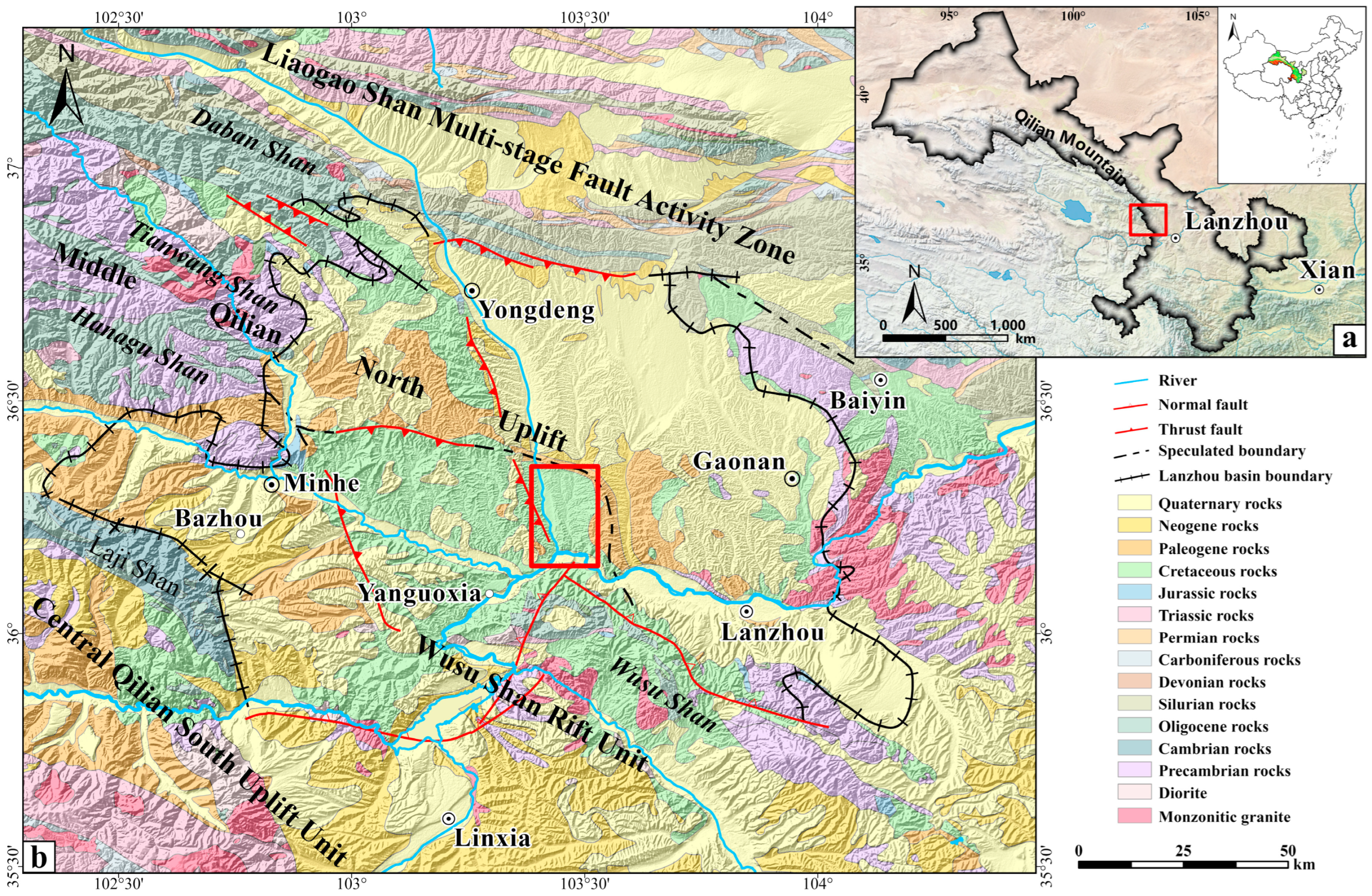
The Lanzhou Basin is located in the eastern segment of the Qilian Mountains, northwestern China (Figure 2a,b), and represents one of the important continental sedimentary basins along the northeastern margin of the Qinghai–Tibet Plateau. Early Cretaceous red-bed deposits are widely developed within the basin. Among them, the Hongshanwan landform represents a distinctive sedimentary geomorphological type characterized by typical multicolored rhythmic stratification. Previous studies suggest that the Hongshanwan landform is mainly composed of sandstone, siltstone, and mudstone, and its formation is closely related to the tectonic tilting of the sedimentary strata. Under prolonged slope wash erosion and weathering processes, the strata have evolved into gently inclined slope landforms with clearly developed rhythmic bedding structures [23].
Existing studies on the Hongshanwan landform have primarily focused on aspects such as sedimentary facies, sequence stratigraphy, sedimentary–tectonic chronology, paleopedology, and paleontological fossils [24,25,26,27,28,29]. However, the coloration mechanism of the multicolored sedimentary rocks is still largely attributed to variations in redox conditions driven by paleoclimatic changes [30]. Systematic analyses of other potentially important factors—such as the diversity of sediment provenance, the intensity of weathering in the source region, and the coupled influence of tectonics and climate—remain relatively limited.
In recent years, rock geochemical methods have been successfully applied to the study of fine-grained clastic rocks [31,32,33]. Geochemical signatures are widely employed as essential indicators for distinguishing provenance areas [1,34,35,36,37,38,39]. Key elements such as Co, Cr, Ni, Sc, Th, V, Y, and rare earth elements (REEs) have low mobility during transport and thus serve as critical markers for determining the provenance of clastic sediments [40,41]. These elements are also applied to reconstruct paleoclimatic conditions [12,42] and to assess ancient weathering processes [3,8,31]. Weathering indices commonly employed in these reconstructions include the Chemical Index of Alteration (CIA), Al2O3 content, K2O/Na2O ratio, Index of Compositional Variability (ICV), Chemical Weathering Alternative Index (CPA), and Plagioclase Index of Alteration (PIA). Additionally, the major elements of the rock can reveal the paleo-humidity and the correlation between mineral composition and weathering trends [5,43,44]. Recent studies on the detrital sediments have also been extensively applied to examine their relationship with landform features [9,45,46,47,48,49], providing new perspectives for quantifying the formation mechanisms of the Hongshanwan landform.
Figure 2. Geological setting and local maps of the study area. (a) Location map of major peripheral blocks and study area around the Tibetan Plateau. (b) Structural and geological sketch map of Lanzhou basin, revised from [50,51].
Minerals 16 00360 g002
Accordingly, this study takes the Hongshanwan landform strata in the Lanzhou Basin as the research object. By integrating mineralogical analysis, whole-rock geochemistry, and detrital zircon U-Pb geochronology, together with geochemical indices such as the Chemical Index of Alteration (CIA), the Index of Compositional Variability (ICV), and ratios of redox-sensitive elements, this study systematically investigates sediment provenance, weathering intensity, and depositional environmental characteristics. The objectives of this study are to: (1) clarify the provenance characteristics of the sediments and their material basis for the formation of the multicolored rhythmic stratification in the Hongshanwan deposits; (2) reveal the controlling mechanisms of paleoclimatic conditions and redox environments on the development of multicolored rhythmic sedimentation; and (3) explore the influence of tectonic evolution in the eastern Qilian Mountains on the sedimentary system and the formation of the Hongshanwan landform, thereby providing new geochemical constraints for understanding the evolution of red-bed sedimentary systems and reconstructing the Early Cretaceous depositional environment.

2. Geological Background

The Lanzhou Basin is a Late Mesozoic intracontinental basin located on the northeastern margin of the Tibetan Plateau, formed as an Early Cretaceous rift basin on a Jurassic sedimentary foundation. The basin is part of the eastern section of the Central Qilian Uplift in the Qilian Orogenic Belt, bordered to the north by the North Qilian “multi-phase fault activity zone” and to the south by the South Qilian Uplift unit (Figure 2a,b) [27,52]. After the early Paleozoic orogeny, the region experienced regional extension during the late Paleozoic, with marine strata deposited on the basement rocks [53]. By the Permian, the ancient Qilian and Longxi blocks had formed a continuous east–west structure, which underwent surface erosion. During the Triassic, the region was influenced by the Indonesian orogeny, and early Jurassic sediments were deposited in local intermontane basins [50,51]. In the Early Cretaceous, the East Asian region experienced a northwest–southeast extension, forming a series of northeast–southwest trending extensional basins, characterized by thick continental sediments and metamorphic core complexes, reflecting the rifting of the North China Craton [27,54]. The basin underwent a faulted expansion phase during the early Yanshan orogeny, gradually transitioning from a rift to a depression. By the late Early Cretaceous, the basin began to uplift due to the Yanshan orogeny, marking the end of its evolutionary history [51]. During the Late Cretaceous, the collision between the Lhasa and Qiangtang blocks, oblique convergence along the southeastern margin of the Eurasian Plate, and the compaction of fine-grained sediments together drove the development of a new fold system within the Hekou Formation [27]. Since the Cenozoic, the Lanzhou Basin has continued to be influenced by the remote effects of compressional stress from the Indian Plate towards the Eurasian Plate, contributing to ongoing deformation associated with the northeastern growth of the Tibetan Plateau [55].
The basement of the Lanzhou Basin is composed of Pre-Paleozoic metamorphic and igneous rocks. The overlying strata, from bottom to top, consist of the Jurassic Xiangtang Formation, the Cretaceous Hekou Group, and early Cenozoic terrigenous sediments [50,51,56,57,58,59,60] (Figure 2b, Figure 3a). Among them, the Early Cretaceous Hekou Group is dominated by sedimentary facies of alluvial fan, delta, and littoral–shallow lake environments, which mainly consist of red clastic deposits interbedded with thin layers of mudstone and siltstone, formed under arid climatic conditions between approximately 143 to 109 Ma [27,60].

3. Materials and Methods

3.1. Sample Collection and Preparation

Field sampling was conducted stratigraphically at the outcrop of the Upper Member of the Second Formation of the Early Cretaceous Hekou Group (K2H2b) in Shuiju Danxia, Lanzhou Basin (Figure 2a). A total of 66 samples were collected, including siltstone and dolomitic mudstone. Among them, 3 samples were used for thin section analysis, 12 samples for whole-rock geochemical analysis, 1 sandstone sample for detrital zircon U–Pb dating, and 50 samples for mineralogical composition analysis.

3.2. Analytical Methods

3.2.1. XRD and SEM Analysis

Semi-quantitative X-ray diffraction (XRD) analysis was performed on 50 selected samples, including 17 red-brown samples (H1–H17), 16 blue-gray samples (L1–L16), and 17 pale-yellow samples (Y1–Y17). Analyses were carried out using a Rigaku SmartLab9 rotating anode XRD with operating conditions of 40 kV and 100 mA, using Cu Kα radiation. Stepwise scanning was conducted at a speed of 4°/min over a 2θ range of 3°–85°. The analytical uncertainty of XRD mineral analysis is estimated to be 2%. The relative content of each mineral was estimated using the K-value method, which represents the positive correlation between the content of a mineral and the intensity of its characteristic diffraction peak. Subsequently, selected section samples were analyzed using field emission scanning electron microscopy (FESEM) with a FEI Quanta 450 FEG Scanning Electron Microscope. The operating conditions included an accelerating voltage of 20 kV, an emission current of 10 µA, and a working distance of 8.5 mm. A secondary electron imaging detector (SE2) was used to observe inelastically scattered electrons generated near the sample surface, while an AsB detector was employed to reveal chemical compositional differences among minerals. To improve electrical conductivity, the samples were coated with a ~10 nm thick platinum layer prior to analysis. Preparation of the XRD and SEM samples and the microscopic observations were carried out at the Northwest Institute of Eco-Environment and Resources, Chinese Academy of Sciences.

3.2.2. Major Element Analysis

Twelve fresh, unweathered samples (YQh01–04 for red-brown siltstone, YQl01–04 for blue-gray dolomitic mudstone, and YQy01–04 for pale-yellow dolomitic mudstone) were crushed to a powder finer than 200 mesh using a sample crusher and analyzed using an X-ray fluorescence spectrometer (XRF) at the Northwest Institute of Eco-Environment and Resources, Chinese Academy of Sciences. The procedure included drying the powdered samples at 105 °C, accurately weighing them, mixing with lithium metaborate flux, and fusing at 1050 °C to produce glass beads for XRF analysis. Loss on ignition (LOI) was determined by measuring the weight loss after ignition at 1000 °C. The analytical precision for major elements was within ±5%.

3.2.3. Trace Element and REE Analysis

Trace and rare earth element concentrations were measured using a Nu AttoM high-resolution inductively coupled plasma mass spectrometer (HR-ICP-MS) at the Northwest Institute of Eco-Environment and Resources, Chinese Academy of Sciences. Precisely weighed sample powders were digested using a HNO3-HF acid mixture in high-pressure Teflon vessels. Reference materials BHVO-2, AGV-2, and W-2 were used for quality control, with relative errors for all elements below 5%.

3.2.4. Detrital Zircon U–Pb Dating

Samples were crushed to about 80 mesh, followed by magnetic and heavy liquid separation. Zircons were hand-picked under a binocular microscope, mounted in epoxy resin, and polished to expose internal structures. Cathodoluminescence (CL) imaging, along with transmitted and reflected light microscopy, was used to observe internal features and select suitable areas for U-Pb dating. Analyses were performed at the Laboratory of the Northwest Institute of Eco-Environment and Resources, Chinese Academy of Sciences, using LA-ICP-MS with a laser spot diameter of 30 μm, energy density of 5–7 J/cm2, and frequency of 6–7 Hz. Standard zircon 91500 (206Pb/238U = 1065.4 ± 0.6 Ma; [61]) was used as an external standard, and zircon GJ-1 (206Pb/238U = 599.8 ± 1.7 Ma; [62]) was used to monitor data quality. Trace element calibration was performed using NIST SRM 610. Isotopic ratios and element concentrations were processed using the GLITTER 4.0 software, and common lead correction followed the method of Andersen [34]. Zircon U-Pb ages and probability density plots were generated using IsoplotR [63].

3.3. Chemical Weathering Indices

In this study, various weathering indices were used to evaluate the paleoenvironmental conditions of the Hongshanwan landform sediments.
The Chemical Index of Alteration (CIA) was used to assess the paleoclimatic conditions, calculated as a mole fraction according to Formula (1) [12]:
CIA = [Al2O3/(Al2O3 + CaO* + Na2O + K2O)] × 100
In this equation, CaO* refers to the CaO content in silicate minerals only (excluding carbonates and phosphates). Since CO2 data were not obtained, the proportion of CaO in carbonate components could not be determined. To calculate CaO*, the molar proportions of CaO and Na2O were compared. If CaO ≤ Na2O, the molar proportion of CaO was accepted; if CaO > Na2O, the molar proportion of Na2O was assumed to be equal to that of CaO [64].
The Index of Compositional Variation (ICV) was used to evaluate the maturity of the sediment, calculated as a mole fraction according to Formula (2) [3]:
ICV = [Fe2O3 + K2O + Na2O + CaO + MgO + TiO2]/Al2O3
The Plagioclase Index of Alteration (PIA) was also used to trace the weathering of plagioclase in the sediments, calculated as a mole fraction according to Formula (3) derived from CIA [8]:
PIA = 100 × [(Al2O3 − K2O)/(Al2O3 + CaO* + Na2O − K2O)]

4. Results

4.1. Geology of the Hongshanwan Landform

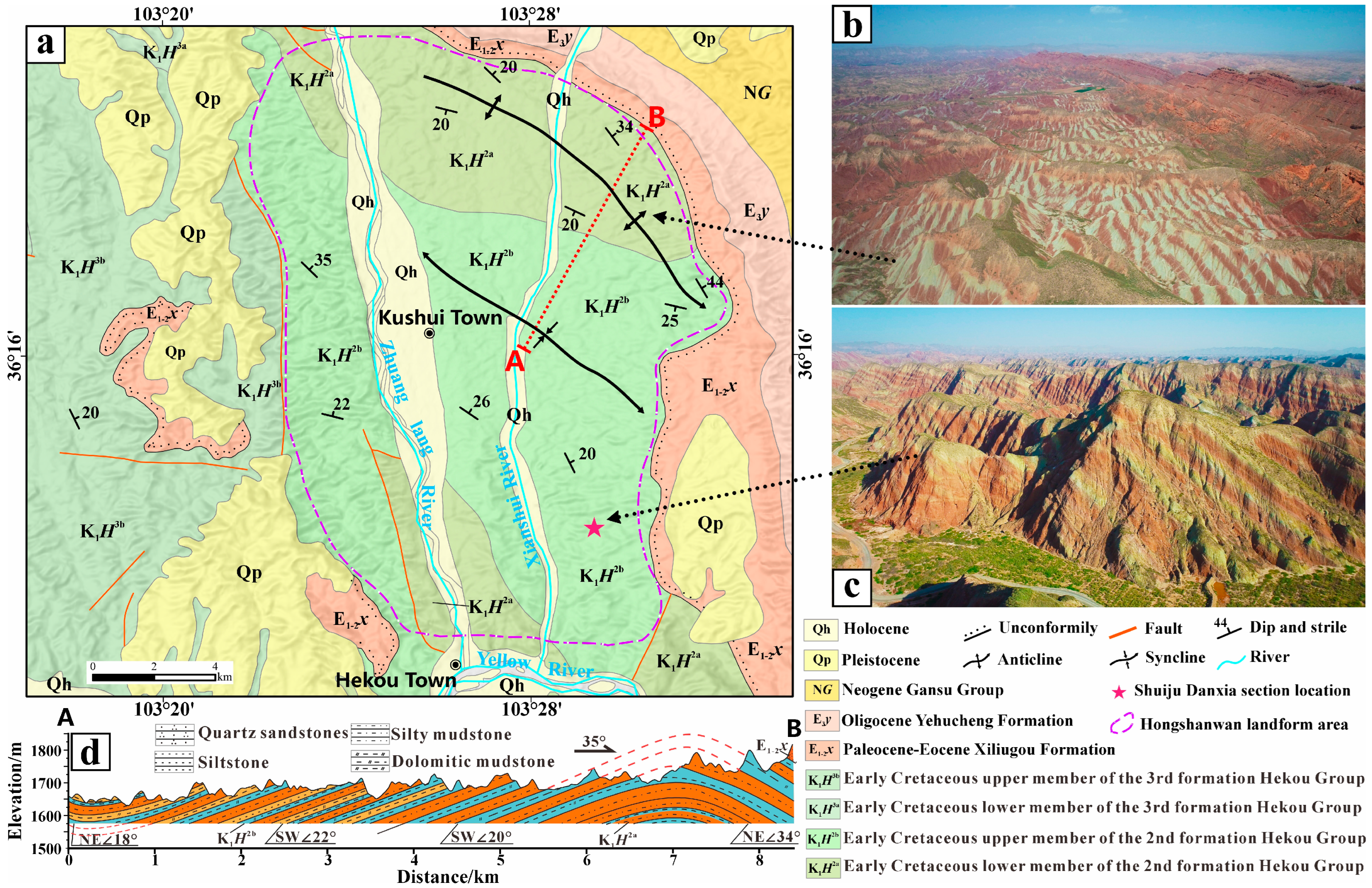
The Hongshanwan landform is primarily located in the central part of the Zhuanglang River and Xianshui River basins (Figure 3a). Based on the color rhythms, the landscape can be divided into two types. One type consists of a red-brown and blue-gray stratigraphic sequence from the lower part of the second member of the Hekou Group (H1H2a), with a nearly 1:1 thickness ratio of interbedded layers forming the Hongshanwan landform landscape (Figure 3b). The other type is characterized by a three-colored sequence of red-brown, blue-gray, and pale yellow from the upper part of the second member of the Hekou Group (H1H2b), with an approximate 2:1:1 thickness ratio, forming the Hongshanwan landform landscape (Figure 3c).
The second member of the Hekou Group is characterized by transgressive–regressive lacustrine cycles, marked by interbedded fine sandstones with wave-generated cross-bedding, blue-gray thin-bedded limestones and mudstones, and medium- to thick-bedded fine sandstones with trace fossils and mud cracks indicative of littoral to shallow lake–semi-deep lake depositional systems [51,58,65,66]. These deposits formed primarily under arid and hot climatic conditions during 127.41–124.19 Ma [67,68].
The lower part of the second member of the Early Cretaceous Hekou Group (K1H2a) is distributed along the northern and southern margins of the basin within the study area (Figure 3a). In the north, it is unconformably overlain by the Paleogene Xiliugou Formation, and in the south (south of the Yellow River), it unconformably contacts the Ordovician Wusushan Group. Lithologically, it consists of red-brown to purplish-red medium–thick-bedded siltstones and silty mudstones interbedded with gray to blue-gray medium–thin-bedded silty mudstones and calcareous mudstones, often displaying ripple marks and burrows [51].
The upper part of the second member (K1H2b) conformably overlies the lower strata (Figure 3a) and together forms a medium-scale open anticline–syncline fold structure trending NW-SE (Figure 3a,d). Lithologies include red-brown medium–thick-bedded silty mudstones interbedded with pale yellow and blue-gray thin-bedded dolomitic mudstones (Figure 3b).
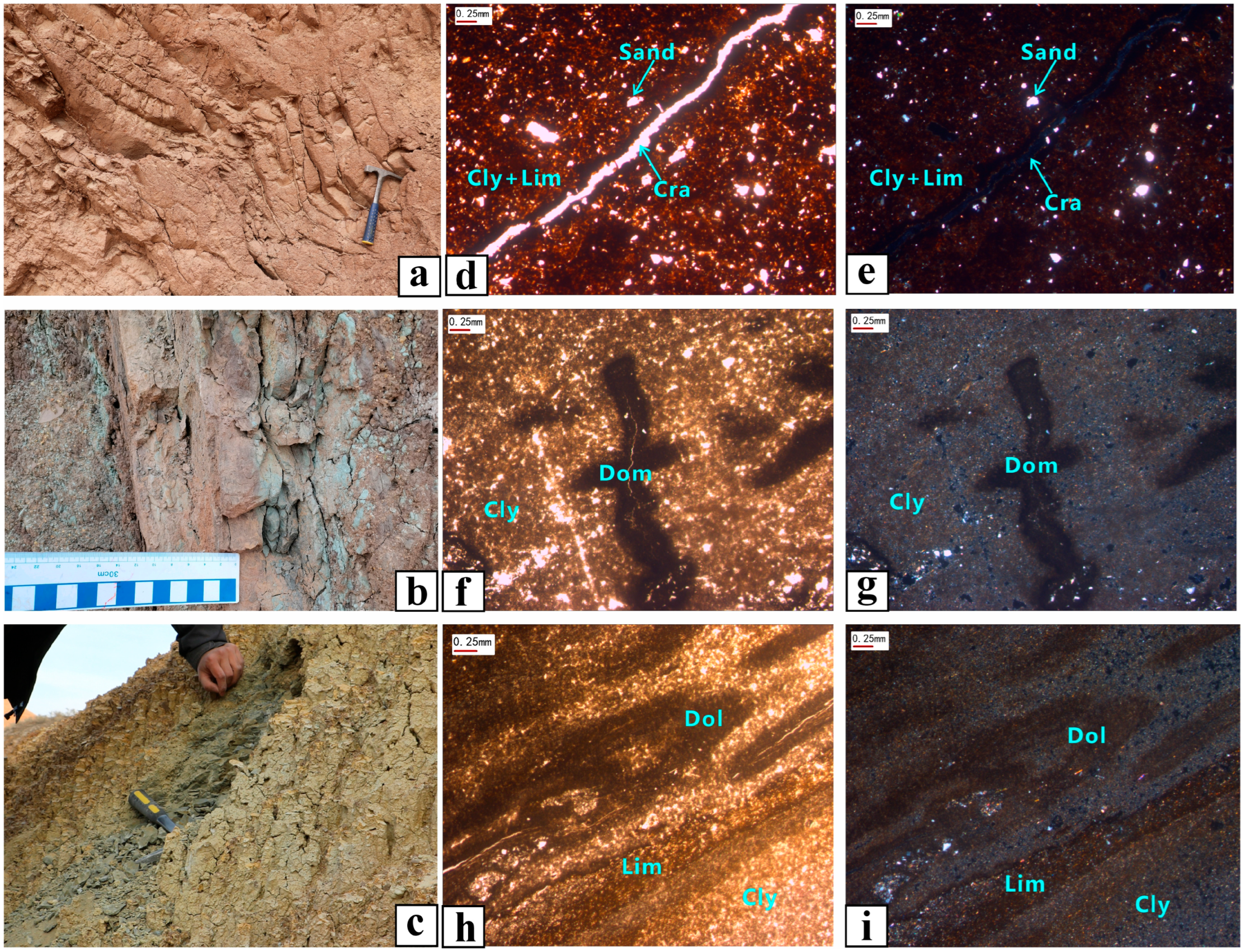
The red-brown silty mudstones (Figure 4a,d–e) exhibit angular to sub-angular textures and are composed of mineral clasts such as feldspar, quartz, mica, and calcite, with grain sizes mainly between 0.005 and 0.05 mm and some up to 0.05 to 0.10 mm, accounting for about 35% of the rock volume. The iron-bearing matrix (Cly+Lim), primarily clay minerals (Cly), dispersed ferruginous material (Lim), and clasts smaller than 0.005 mm make up about 65%. Iron oxides appear as secondary goethite staining in clay minerals, imparting a reddish-brown hue.
The blue-gray dolomitic mudstones (Figure 4b, f–g) locally display lenticular structures and are composed of angular to sub-angular grains primarily between 0.005 and 0.05 mm, and secondarily between 0.05 and 0.10 mm, accounting for ~10% of the rock volume. Micritic dolomite (Dol), with micritic texture and high-order interference colors, occurs in vein-like forms or as rhythmically interlayered with clay-rich layers, with layer thicknesses of 0.5–2 mm, and comprises ~20% of the rock. The clay matrix (Cly), composed of clay minerals and fine felsic, calcareous, and ferruginous clasts (<0.005 mm), alternates rhythmically with dolomitic layers, constituting ~70% of the rock. Bioturbation structures (Dom) are also observed.
The pale-yellow dolomitic mudstones (Figure 4c, h–i) are composed of grains mainly in the 0.005–0.05 mm range, and secondarily in the 0.05–0.10 mm range, accounting for ~10% of the rock. Micritic dolomite occurs similarly as in the blue-gray type, mainly as veins or rhythmically layered with clay layers (0.5–2 mm thick), comprising ~20% of the rock. The clay matrix consists of clay minerals and <0.005 mm felsic, calcareous, and ferruginous debris, rhythmically interbedded with dolomite-rich layers, and makes up ~70% of the rock.

4.2. Mineral Composition

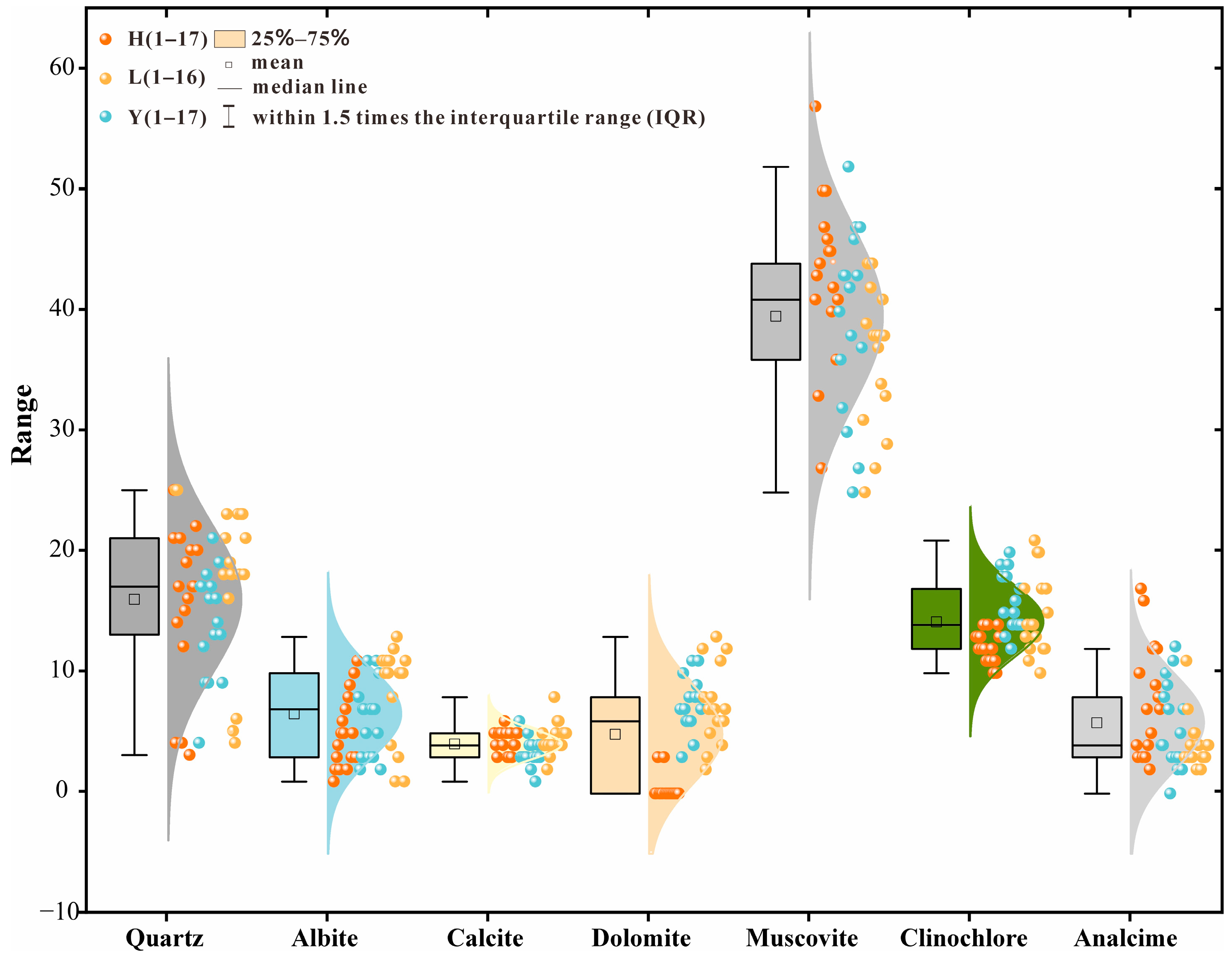
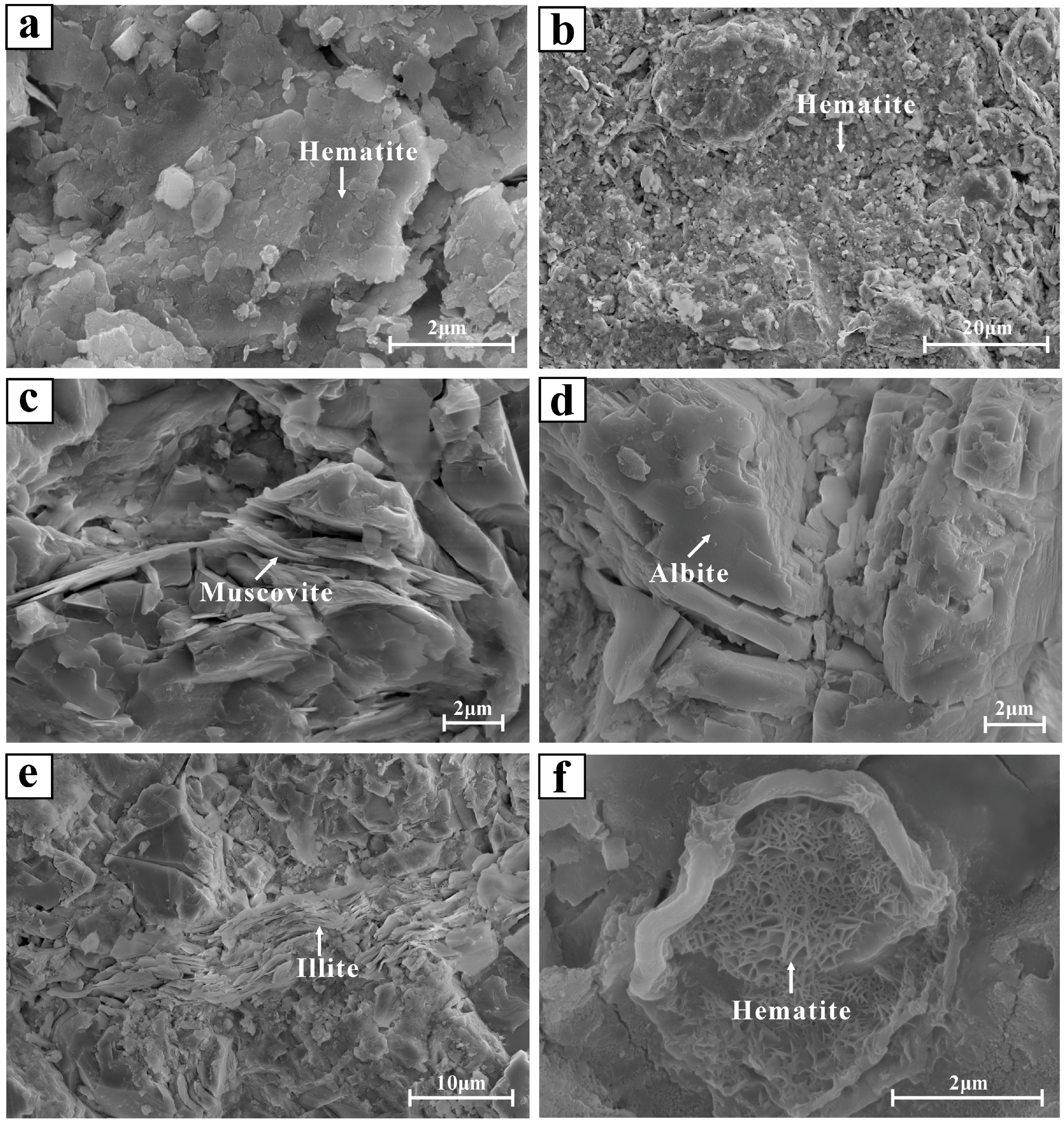
The sediments of the Hongshanwan landform are predominantly composed of muscovite, albite, and clay minerals, with minor iron-bearing detrital components such as hematite (Figure 5). Quartz is present in the mineralogical assembly (Figure 6), but is not illustrated in the SEM image (Figure 5) due to its relatively low proportion. In the red-brown samples (H1-H17), muscovite (average 37.68%), albite (average content 16.60%), chamosite content (average 12.12%) and analcime (average 8.12%) are the dominant minerals, while calcite (average 4.31%) is present in lower amounts. In the blue-gray samples (L1-L16), muscovite (average 35.45%), chamosite (average 15.93%) albite (average content 14.87%) and dolomite (average 7.40%) are significantly enriched, whereas analcime (average 6.00%) and calcite (average 3.37%) are relatively low compared to the red-brown samples. In the pale-yellow samples (Y1-Y17), muscovite (average 30.42%), chamosite (average 14.68%), albite (average content 14.62%) and dolomite (average 7.00%) also occur as dominant minerals, and analcime (average 4.18%) and calcite (average 4.56%) are the minor minerals. On the other hand, the scanning electron microscope observation is inconsistent with the RXD data. The minerals in the red-brown rocks mainly include hematite, sericite, illite, calcite and barite. The blue-gray samples consist of illite, sericite, calcite, barite and minor magnetite and zircon. The minerals in the pale-yellow samples mainly include plagioclase, quartz, calcite and minor hematite, barite and rutile (Figure 6).

4.3. Whole-Rock Geochemistry

The data presented in Table S1 in the Supplementary Materials provide a comprehensive summary of XRF and ICP-MS analytical results, including major element contents (wt.%) and trace and rare earth element values (ppm). In addition, paleoenvironmental indices for the Hongshanwan landform sediments of the Lanzhou Basin are listed, along with reference values for the upper continental crust (UCC) [69] and post-Archean Australian shale (PAAS) [13,70].
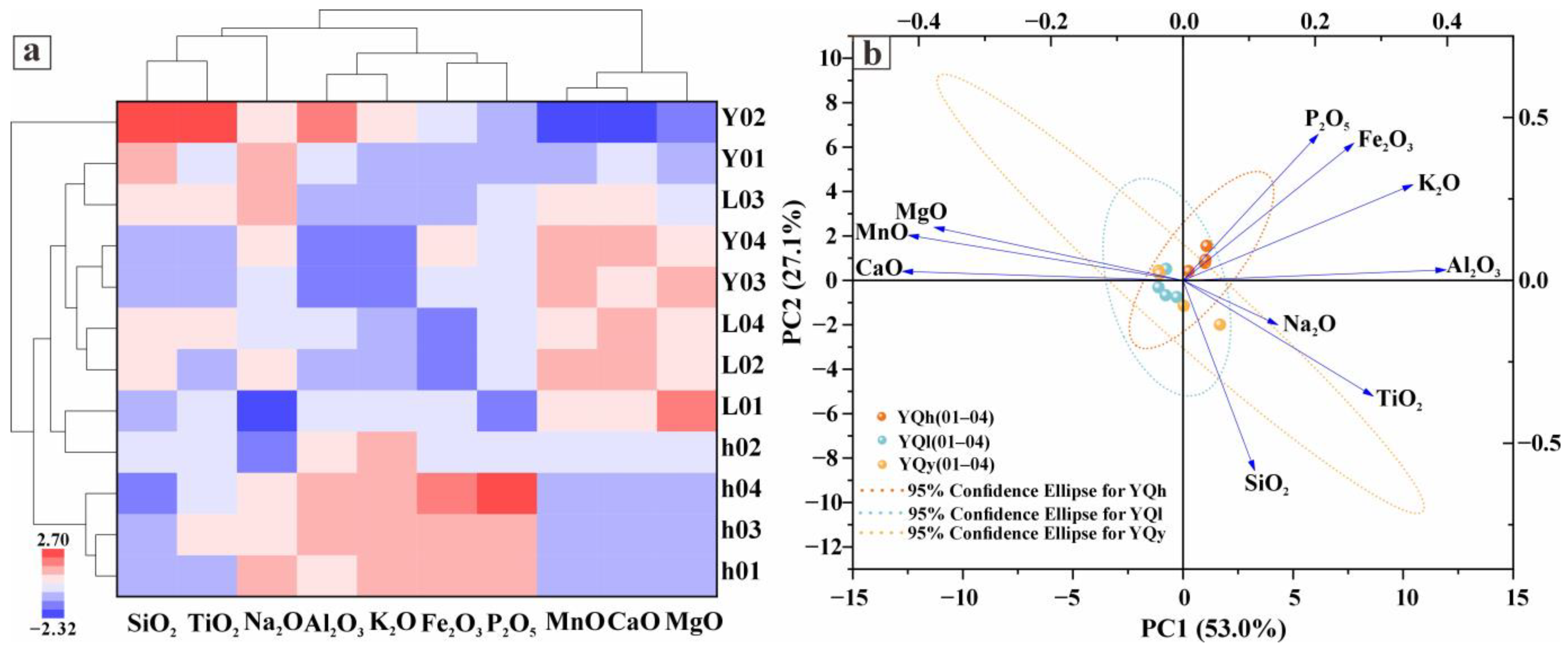
Taken as a whole, major element data indicate that the sediments are characterized by low SiO2 content (average ~43.2 wt.%), moderate Al2O3 levels (15–17.5 wt.%), and notably enriched Fe2O3 (7.95–11.4 wt.%), which are significantly higher than the UCC and PAAS standards [13,70]. However, the three sediment types of the Hongshanwan landform show distinct differences in major element composition (Figure 7). Red-brown samples (H01–H04) are relatively enriched in Al2O3 (average 17 wt.%), Fe2O3 (average 10.8 wt.%), FeO (average 2.4 wt.%), and K2O (average 4.02 wt.%) compared to blue-gray and pale-yellow samples. Blue-gray samples (L01–L04) have the lowest contents of Fe2O3 (average 8.71 wt.%), FeO (average 1.95 wt.%) and Na2O (average 2.35 wt.%), but the highest contents of CaO (average 6.01 wt.%) and MgO (average 4.04 wt.%). Pale-yellow samples (Y01–Y04) show the highest SiO2 content (43.9 wt.%) and intermediate contents of Fe2O3 (average 9.61 wt.%), FeO (average 2.14 wt.%), CaO (average 5.59 wt.%) and MgO (average 3.6 wt.%).
The red-brown samples are enriched in large-ion lithophile elements (LILEs) such as Rb (average 135 ppm) and Cs (average 1.6 ppm), as well as transition trace elements (TTEs) including Cr (average 119 ppm), Zn (average 101 ppm), and Co (average 35 ppm). The blue-gray samples show relative enrichment in U (average 6.9 ppm), Hf (average 5.7 ppm), and Ni (average 43 ppm). The pale-yellow samples exhibit co-enrichment of high-field-strength elements (HFSEs) and LILEs, including Nb (average 13 ppm), Ta (average 1.5 ppm), Th (average 21 ppm), Zr (average 156 ppm), Sr (average 505 ppm), and Ba (average 474 ppm).
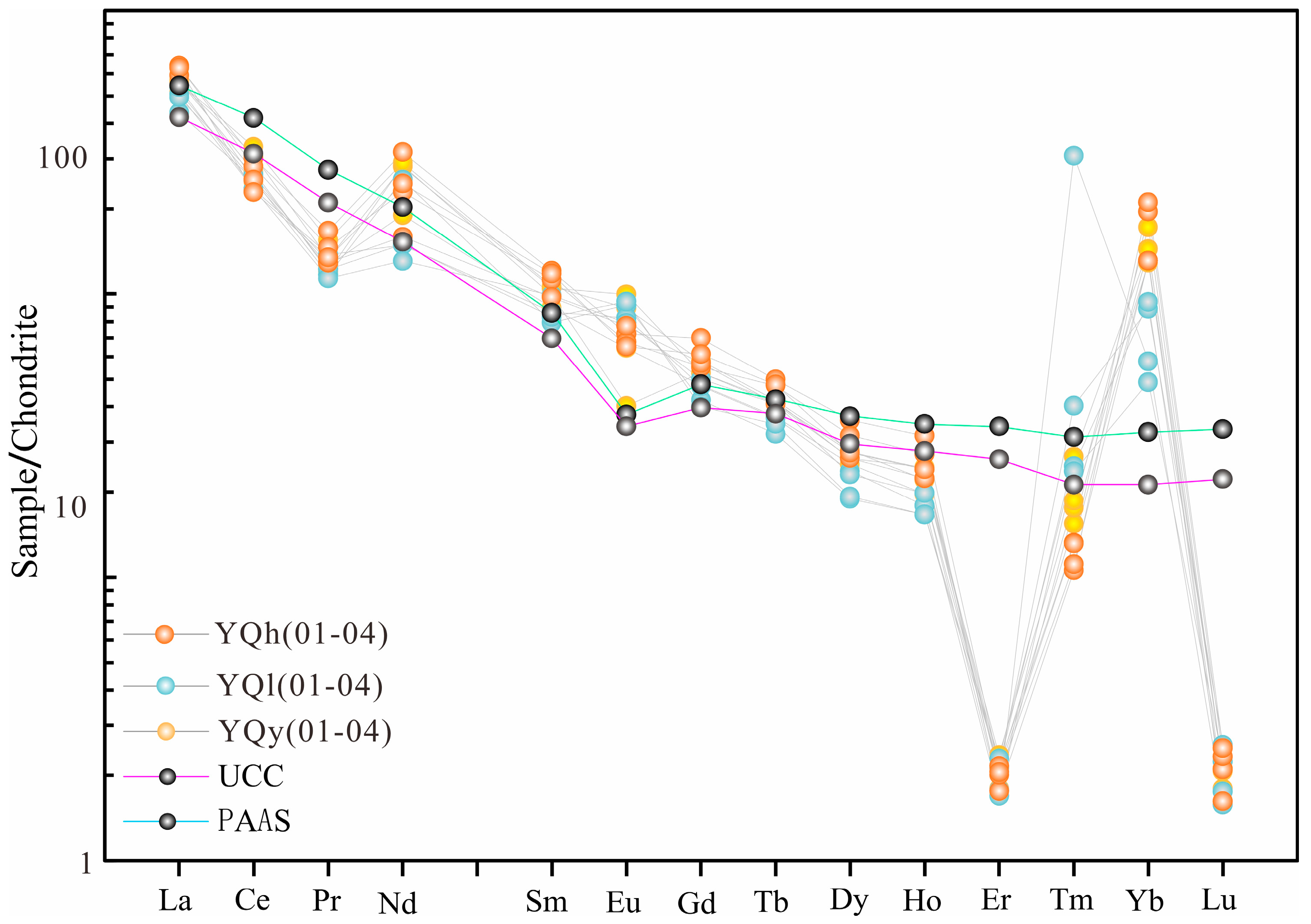
All samples from the Hongshanwan landform display right-inclined chondrite-normalized REE patterns in the spider diagram (Figure 8), characterized by enrichment in light rare earth elements (LREEs) and relative depletion in heavy rare earth elements (HREEs), with an average (LREE/HREE) ratio of 7.59. The samples show negligible Ce anomalies (δCe ≈ 0.99) and weak Eu anomalies (δEu ≈ 1.07), indicating limited fractionation during deposition and diagenesis. Overall, the REE patterns exhibit pronounced HREE depletion with slight enrichment toward Yb, suggesting a dominant control of source composition rather than post-depositional processes.
Significant variations in REE compositions are observed among different lithological units. The red-brown samples are characterized by relatively high total REE contents (ΣREE = 172.48 ppm on average), strong LREE enrichment (LREE = 150.19 ppm; LREE/HREE = 6.77), and HREE depletion (HREE = 22.28 ppm). They show moderate (La/Yb) N values (average 2.99), low (Gd/Yb) N values (0.05), weak negative Eu anomalies (δEu ≈ 0.89), and no significant Ce anomaly (δCe ≈ 0.91). The blue-gray samples exhibit relatively lower ΣREE (144.04 ppm), but the highest LREE/HREE ratios (average 8.47), indicating stronger fractionation. They display slight positive Eu anomalies (δEu ≈ 1.31), no Ce anomaly (δCe ≈ 1.01), and higher (La/Yb) N values (average 5.03), suggesting a mixed provenance with enhanced contribution from mafic components. The pale-yellow samples show REE characteristics similar to those of the red-brown samples, with comparable ΣREE (172.47 ppm), LREE (152.25 ppm), and HREE (20.22 ppm), and an average LREE/HREE ratio of 7.54. Their REE patterns display weak positive Eu and Ce anomalies (δEu ≈ 1.00; δCe ≈ 1.05), indicating a similar provenance and geochemical behavior.
Overall, the REE spider diagram highlights a consistent LREE-enriched pattern with minor interlayer variations, reflecting a predominantly intermediate–mafic provenance with limited influence from post-depositional alteration.

4.4. Detrital Zircon U–Pb Geochronology

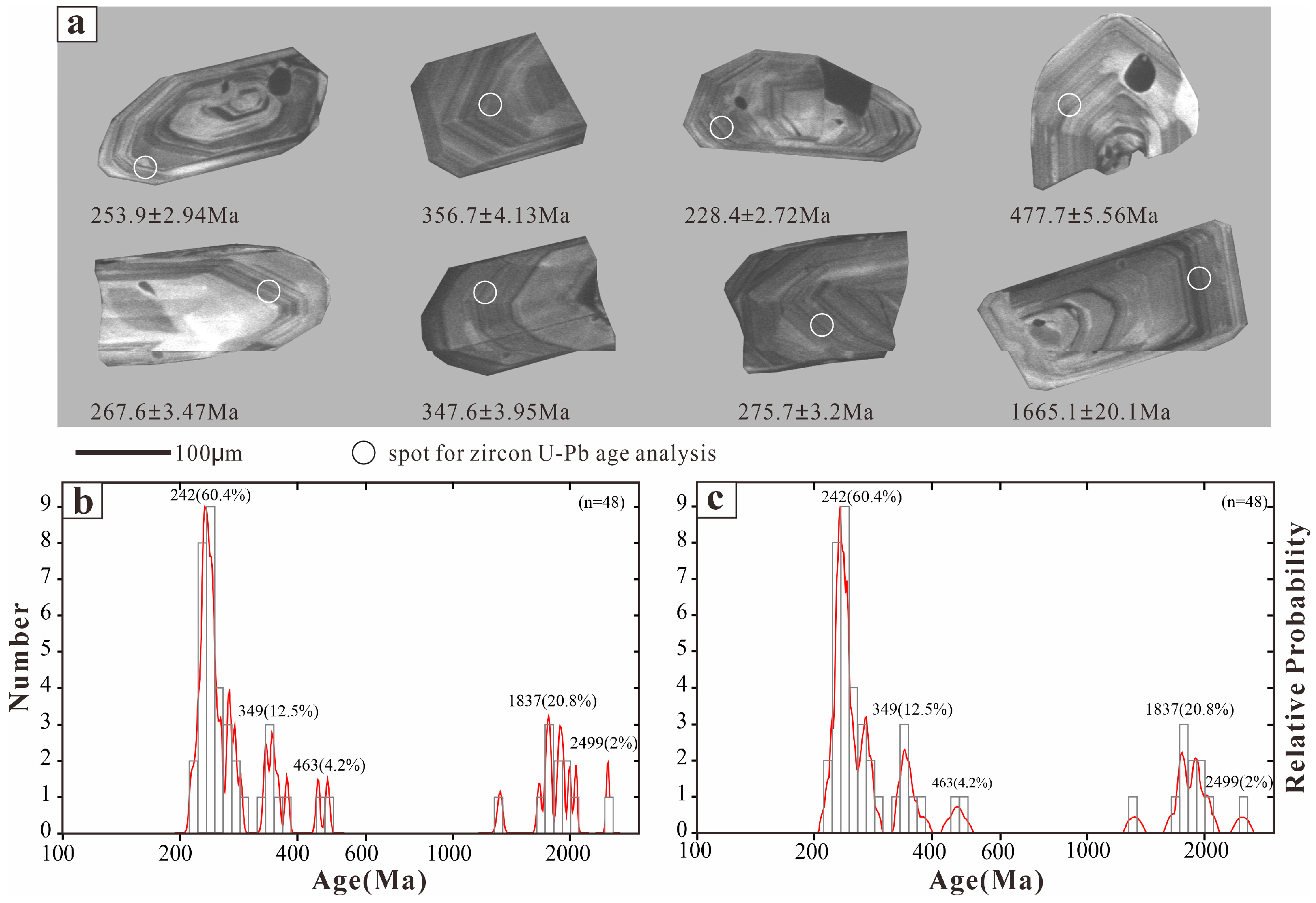
The detrital zircon U–Pb age results of the upper member of the Lower Cretaceous Hekou Group are shown in Table S2 in the Supplementary Materials. Ages range from 217.3 ± 2.45 Ma to 2449.3 ± 20.6 Ma. Both the probability density plots (PDPs) and kernel density estimates (KDEs) exhibit three major age peaks at 242 Ma, 349 Ma, and 1837 Ma (Figure 9a–c). The zircons can be grouped into: 217.3–286.1 Ma (Permian–Triassic, 29 grains, 60.4%), 331.5–376.4 Ma (Devonian–Carboniferous, 6 grains, 12.5%) and 1322.3–1994 Ma (Mesoproterozoic, 10 grains, 20.8%). Cathodoluminescence (CL) images of the zircons reveal variable grain sizes and sub-angular to sub-rounded shapes, with distinct oscillatory zoning indicating magmatic origin [71,72,73]. Th/U ratios > 0.1 further support a magmatic origin [74].

5. Discussion

5.1. Elemental Abundance and Correlation

5.1.1. Elemental Abundance

Geochemical analyses indicate that the sediments of the Hongshanwan landform in the Lanzhou Basin are characterized by low SiO2, moderate Al2O3, and significantly enriched Fe2O3 contents, accompanied by high concentrations of iron-bearing detrital minerals and clay minerals. This enrichment in iron components likely reflects not only the influence of strongly oxidizing depositional environments but also the precipitation of iron-bearing minerals such as hematite and goethite under arid–oxidizing conditions [75]. The red-brown samples exhibit notably high concentrations of large-ion lithophile elements (LILEs) Rb and Cs, as well as transition trace elements (TTEs) Cr, Zn, and Co, and are rich in muscovite and quartz, suggesting a felsic granitic provenance that underwent a certain degree of weathering and sorting [76]. The simultaneous increase in K2O, CaO, and MgO may correspond to rapid erosion in orogenic belts [77,78]. The relative enrichment of CaO and MgO, especially in the blue-gray samples, is associated with elevated contents of chlorite and dolomite, indicating enhanced dolomitic carbonate components characteristic of evaporitic lacustrine deposits or basaltic provenance materials (e.g., residuals from basalt weathering) [9,13]. The co-enrichment of high-field-strength elements (HFSEs) and LILEs in pale-yellow samples suggests input from felsic volcanic provenance of crustal origin [31,79]. Moreover, all samples show significant enrichment of Cr and Co compared to the upper continental crust (UCC), indicating the presence of mafic-ultramafic components in the provenance area, likely related to gabbroic or ultramafic rocks [80,81]. The rare earth element (REE) distribution pattern shows enrichment of light REEs (LREEs) and depletion of heavy REEs (HREEs), forming a right-sloping pattern, which also supports a dominantly felsic provenance with only weak sorting or sedimentary recycling [13,76].

5.1.2. Elemental Correlations

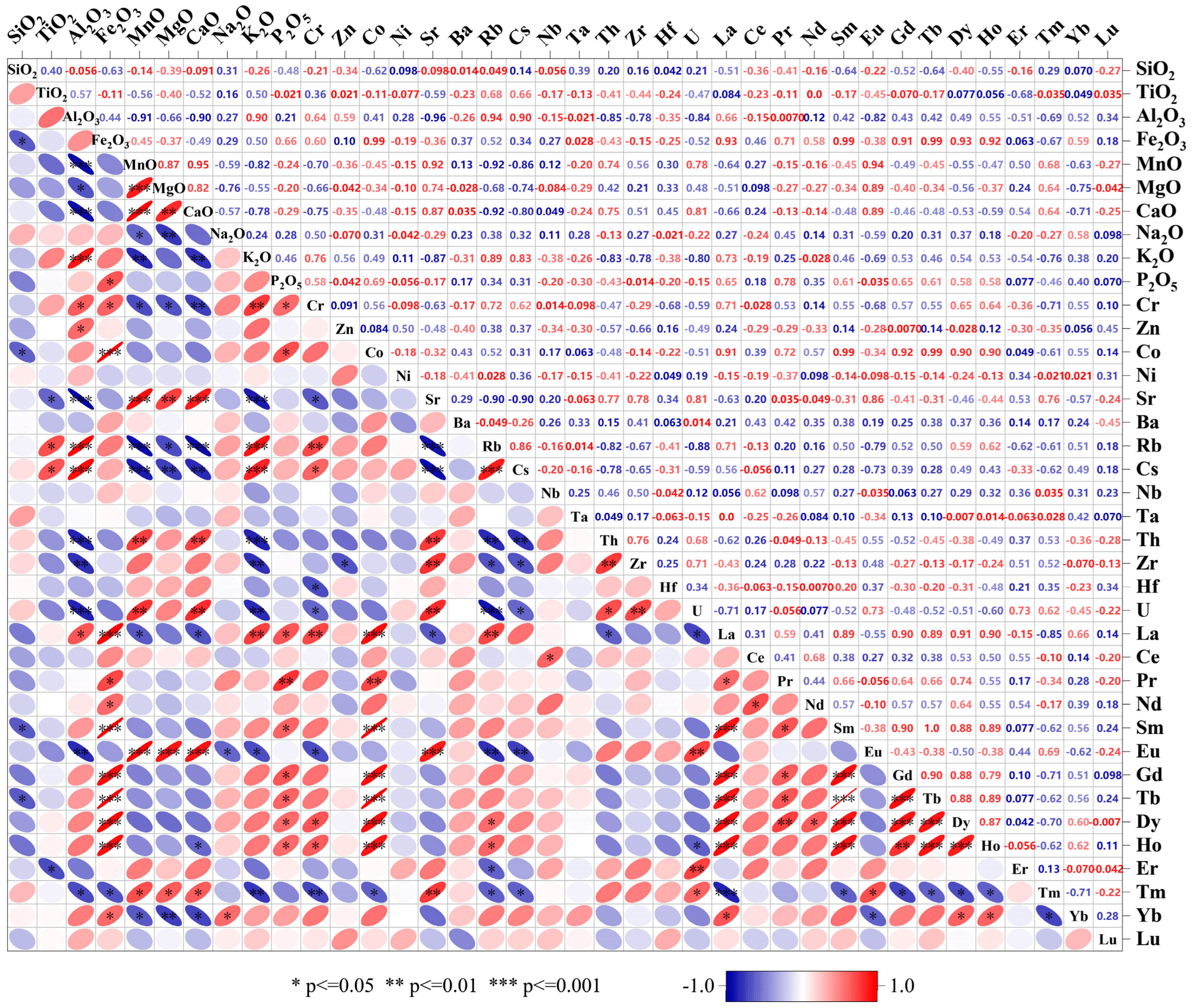
The correlation heatmap of major, trace, and rare earth elements (REEs) in the sediments of the Hongshanwan landform (Figure 10) reveals several meaningful geochemical relationships. Al2O3 is significantly negatively correlated with MnO, MgO, CaO, and Sr, but shows generally positive correlations with transition trace elements (e.g., Cr, Co, Zn) and both light and heavy REEs. This indicates that clay minerals and aluminosilicates are the principal hosts for REEs and TTEs and that they are primarily derived from the weathering residues of felsic igneous rocks [13,76]. In contrast, carbonate-related elements such as MnO, MgO, and CaO show strong positive correlations with high-field-strength elements (HFSEs) including Th, Zr, Hf, and U, as well as with Eu. This pattern suggests that portions of the REEs and HFSEs may co-precipitate with carbonate minerals or derive from heavy minerals (e.g., zircon, monazite) with a felsic crustal provenance [8,31]. Additionally, the positive correlations between Na2O, K2O, P2O5, and REEs, as well as the co-variation of large-ion lithophile elements (LILEs) such as Ba, Rb, and Cs with REEs, further support the interpretation that these elements are mostly hosted in clay minerals and are well preserved during the weathering process [80]. The distribution of Eu shows strong positive correlations with Sr, U, and carbonate-related components (MnO, MgO, and CaO), but negative correlations with clay-associated elements such as Al2O3 and Fe2O3. This suggests differential partitioning of Eu among mineral phases, with its geochemical behavior controlled by redox conditions and the degree of plagioclase fractionation [12,75].

5.2. Paleoweathering and Paleoclimatic

5.2.1. Weathering Indices

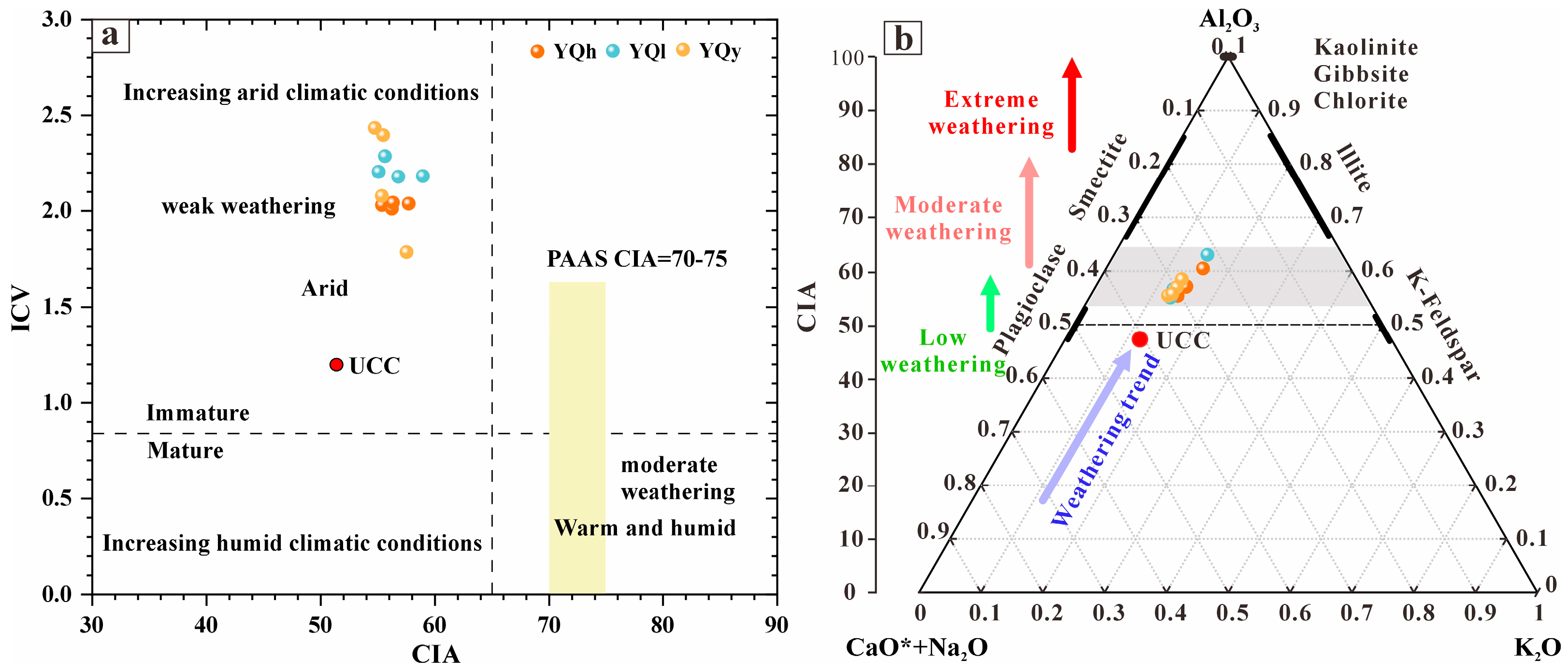
The Chemical Index of Alteration (CIA) is a widely recognized proxy for paleoclimatic conditions, as it quantifies the ratio of alumina to unstable oxides and directly reflects the degree of chemical weathering [82]. The CIA values of sedimentary rocks in the Hongshanwan landform average 56.27, with comparable values across the three color types: red-brown (55.37–57.71, average 56.41), blue-gray (55.07–58.96, average 56.61), and pale yellow (54.74–57.52, average 55.77). These values suggest that the provenance area underwent weak chemical weathering under hot and arid climatic conditions.
The Index of Compositional Variability (ICV) reflects sediment maturity and serves as an important parameter for evaluating sediment recycling and prolonged weathering in the provenance region [3,83]. The ICV values for the three sample groups in the Hongshanwan landform are also similar, with ranges of 2.01–2.04 (average 2.03), 2.18–2.29 (average 2.21), and 1.79–2.43 (average 2.17), respectively. The overall average ICV value of 2.14 indicates that the sediments are compositionally immature. When plotted on the ICV-CIA diagram, these values reflect the combined influence of climatic conditions on the weathering intensity and geochemical maturity of the clastic sediments. The data indicate that the sediments formed under a hot and arid climate are characterized by weak chemical weathering and low geochemical maturity (Figure 11a).
Fedo et al. [8] proposed the Plagioclase Index of Alteration (PIA) by modifying the CIA formula to specifically assess the degree of plagioclase weathering in sedimentary environments. In the study area, PIA values for the three sample types are as follows: 57.50–61.00 (average 59.04) for red-brown, 56.85–62.48 (average 59.02) for blue-gray, and 56.39–60.22 (average 57.80) for pale-yellow samples. The overall average PIA value for the Hongshanwan landform is 58.62, which similarly indicates that the provenance rocks underwent weak chemical weathering [84,85].
On the A–CN–K ternary diagram (Figure 11b), the data points from the study area’s sandstones plot nearly parallel to the A–CN line and slightly above the average upper continental crust (UCC) values, gradually deviating from the plagioclase–K-feldspar join. This pattern suggests that the parent rocks experienced incipient-to-moderate weathering, accompanied by enrichment of Al2O3 during sediment transport.

5.2.2. Element Ratios

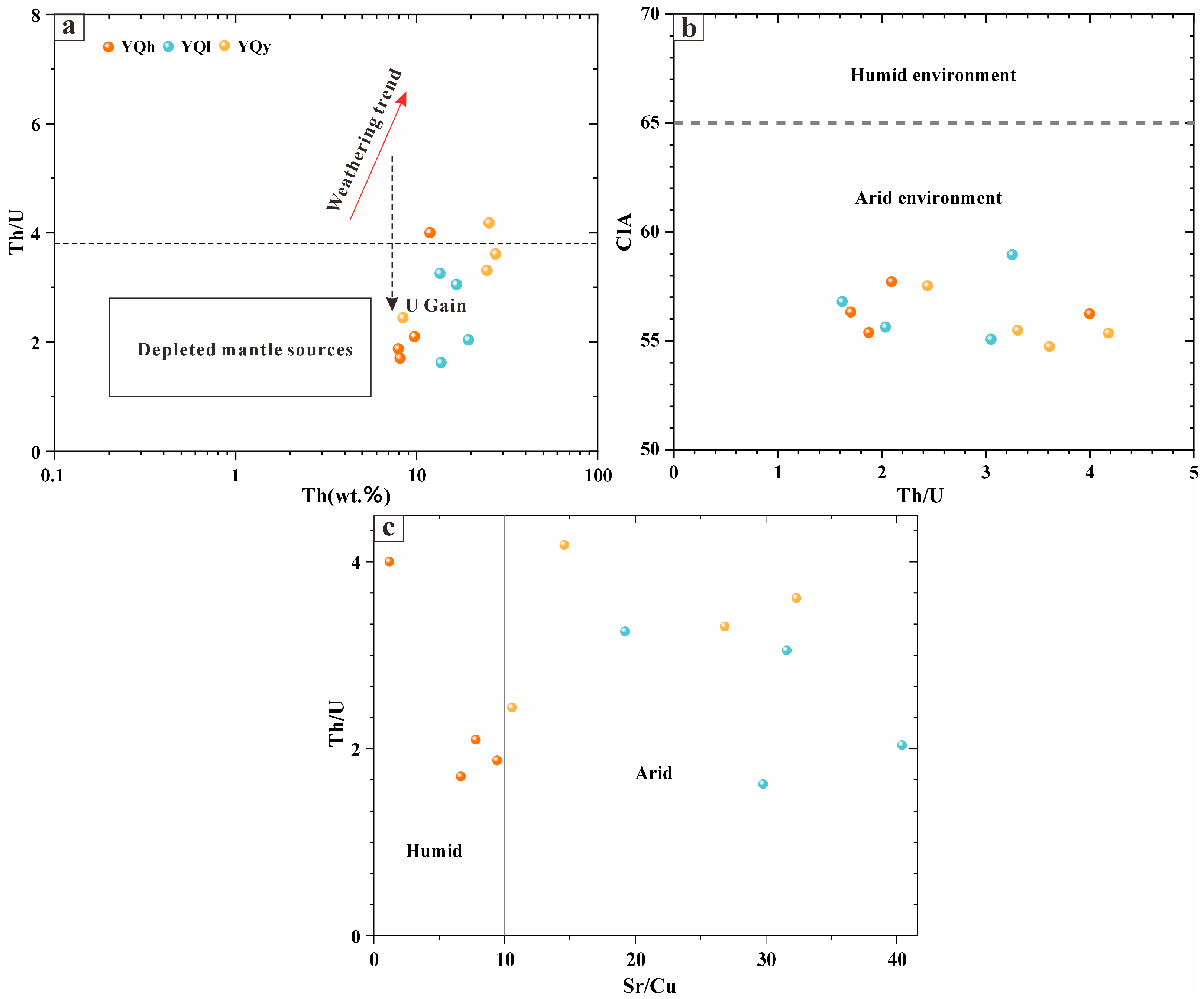
Studies have shown that the Th/U ratio in most upper continental crust (UCC) rocks generally ranges between 3.5 and 4.0 [5]. In this study, the Th/U ratios of the samples are relatively low, with an average value of 2.77, which may indicate that the provenance area experienced weak chemical weathering or limited sedimentary recycling. On the Th/U vs. U plot (Figure 12a), the data correspond to initial-to-moderate weathering conditions in the provenance region. Furthermore, the cross-plot of CIA and Th/U ratios provides additional support that the provenance rocks were formed under arid climatic conditions (Figure 12b).
The mean Sr/Cu ratio of 19.21 in the study area suggests an arid climate setting [42]. Additionally, the Sr/Cu vs. Th/U cross-plot confirms that most samples were deposited under hot and dry conditions (Figure 12c). The SiO2/ (Al2O3 + K2O + Na2O) ratio is also considered a valuable paleoclimatic proxy [86,87]; however, due to the relatively low SiO2 contents of the samples, its applicability is limited in this study and is therefore not further discussed. Moreover, the relatively high Rb/Sr ratio (average 0.35) further supports arid climatic conditions in the study area [88].
In summary, based on a combined system of weathering indices and geochemical characteristics, it is determined that the bedrock of the Hongshanwan landform sedimentary sequence in the Lanzhou Basin experienced initial-to-moderate chemical weathering under arid and hot paleoclimatic conditions. This conclusion is consistent with previous studies on the Hekou Formation, which suggested a predominantly arid depositional environment based on analyses of rock color indices [68] and paleontological assemblages [51,52,89,90].

5.3. Paleoredox Conditions

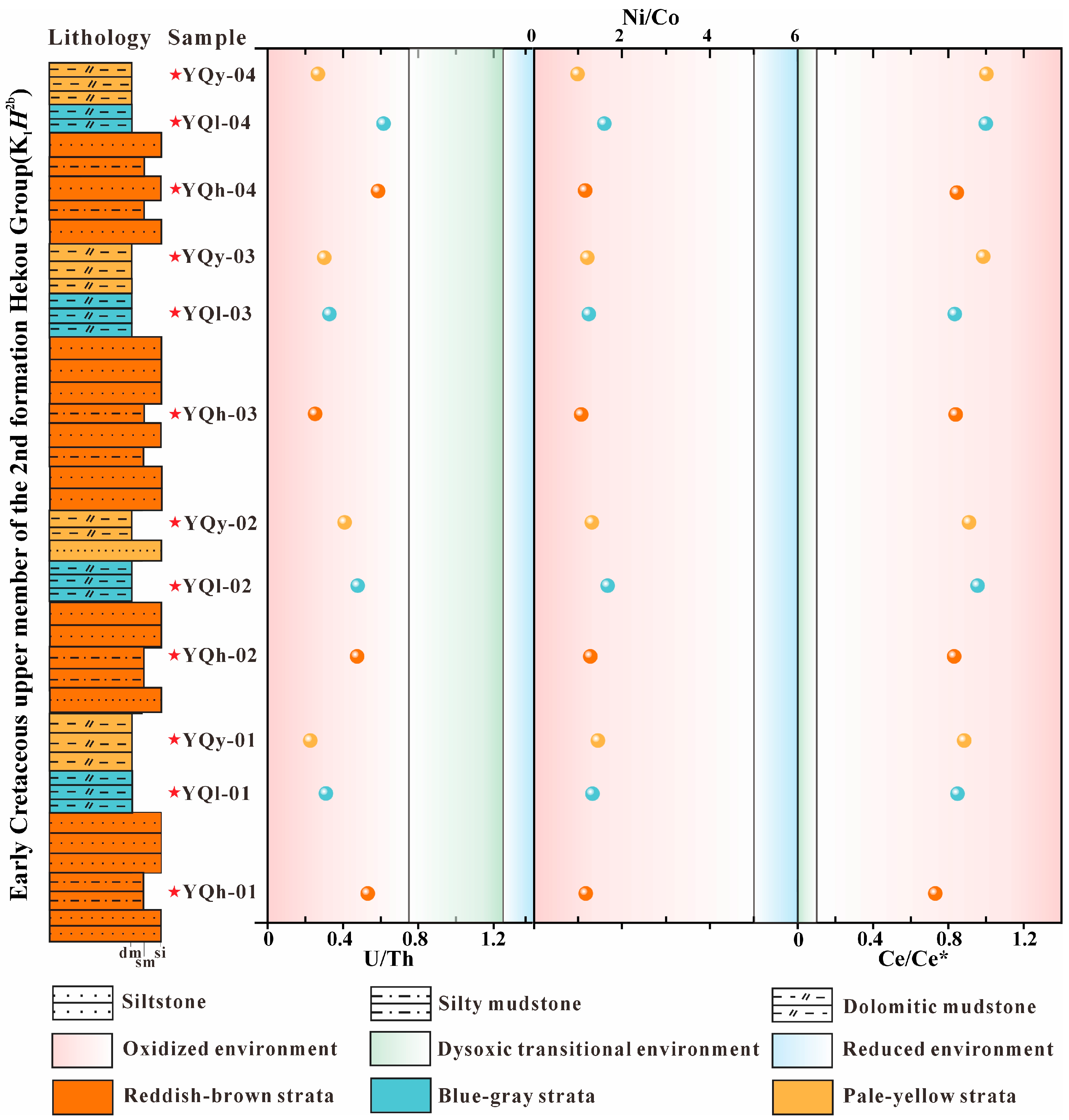
The Cu/Zn ratios of the red-brown, blue-gray, and pale-yellow samples from the study area are 0.92, 0.16, and 0.26, respectively, all indicating relatively low values (average of 0.45), which suggests oxidizing depositional conditions (Figure 13). Based on the U/Th ratio, redox conditions of the Hongshanwan geomorphic sediments can be inferred: U/Th > 1.25 indicates a reducing environment, 0.75–1.25 suggests suboxic-to-dysoxic conditions, and U/Th < 0.75 implies an oxidizing environment [88,91,92]. In this study, the U/Th values of the three sample types are 0.46, 0.44, and 0.31 (average 0.40), all below 0.75, further supporting deposition under oxic conditions (Figure 13). The Ni/Co ratios of the Hongshanwan siltstones and mudstones range from 1.03 to 1.68 (average 1.30), also indicative of oxidizing conditions (Figure 13).
Additionally, the Ce/Ce* ratios in the three sample types range from 0.73 to 1.00 (average 0.89), showing a weak positive Ce anomaly that further supports oxic depositional environments [3] (Figure 13). As shown in the stratigraphic profile, all three color types exhibit geochemical signatures consistent with oxidizing conditions. This supports the interpretation that the Hongshanwan sediments were deposited predominantly under oxic settings and that the high iron content under such conditions likely contributed to the development of reddish fine-grained clastic rocks. Similar conclusions have been drawn by Cai et al. [89] through studies of paleontology and lithofacies paleogeography.
Contrary to traditional views that associate blue-gray and pale-yellow colors with reducing conditions [93,94], the present study finds no evidence of reduction in these layers. Thin-section petrography reveals high dolomite content in these samples, which may reflect carbonate precipitation due to declining lake levels, affecting color development. This aligns with previous colorimetric studies that linked chromatic variation to lake-level changes [68]. The observed rhythmic alternation of sediment colors may also reflect episodic tectonic pulses during sustained uplift of the Qilian Mountains [95].

5.4. Paleotectonic Setting and Provenance

5.4.1. Paleotectonic Setting

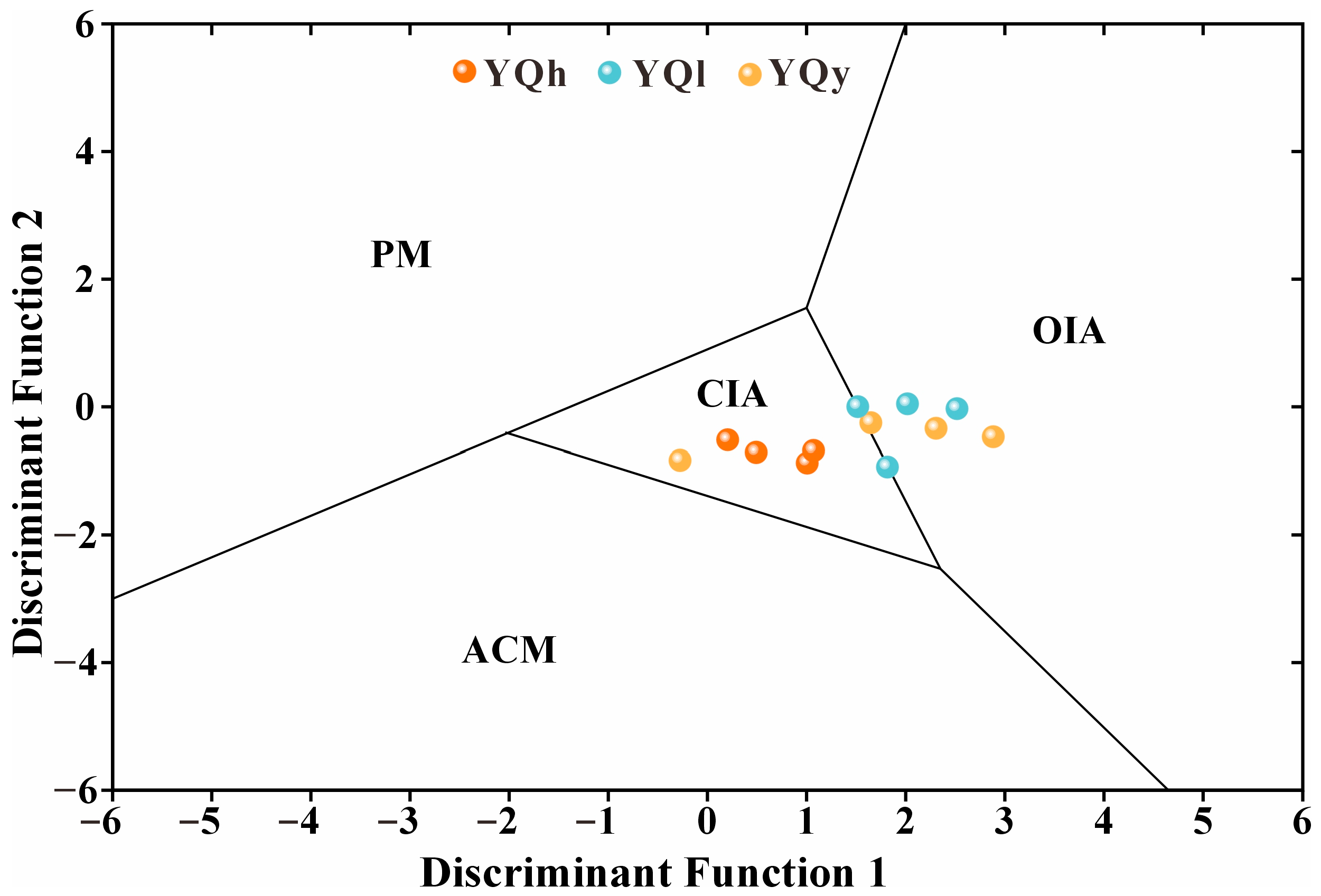
The ancient tectonic environment was analyzed using whole-rock major and trace element geochemical compositions [96,97]. As shown in Figure 14, which illustrates tectonic environment discrimination [96], the Hongshanwan landform sediments from the Lanzhou Basin exhibit characteristics indicative of an island arc tectonic setting. The study samples display a high Al2O3/SiO2 ratio (average 0.38) and low TiO2 content (average 0.62), consistent with typical continental island arc (CIA)/active continental margin (ACM) tectonic environments [96].
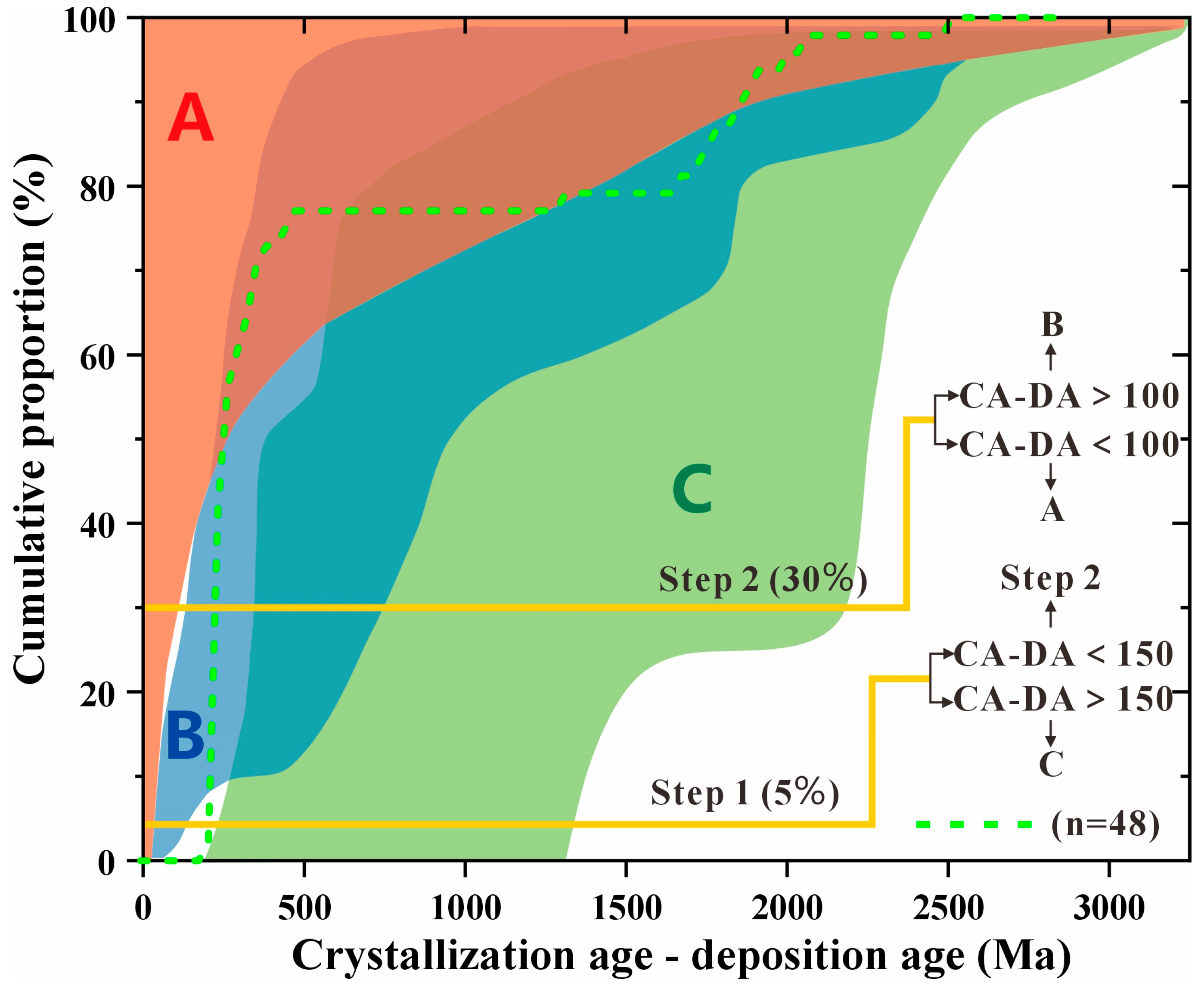
The detrital zircon crystallization-to-deposition age cumulative distribution diagram (Figure 15) shows that all samples plot within the convergent/collisional tectonic setting, indicating that the basin was likely situated in a forearc, trench, back-arc, or foreland basin setting [98]. The presence of a secondary age peak around 2000 Ma suggests the recycling of ancient sediments, thereby ruling out a forearc basin origin. The Hekou Group is rich in fossils, especially ostracods dominated by Cypridea, forming the Cypridea–Lycopterocypris–Djungarica assemblage. This fossil association is consistent with Early Cretaceous lacustrine ostracod assemblages in China and abroad [52], lacking deep-marine deposits and containing shallow-marine fossils, thus excluding a trench basin interpretation.
Additionally, the increasing textural and compositional maturity of the clastic rocks and the transition from unstable to stable depositional environments are consistent with typical foreland basin evolution [99]. The provenance characteristics inferred from detrital zircon age groups and their associated tectonic backgrounds indicate a combination of collisional orogeny and extensional intracontinental orogeny. Geochemical data also reveal a mixed provenance signature dominated by felsic with minor mafic contributions, influenced only weakly by recycled sediments.
In summary, the upper section of the second member of the Hekou Group in the Early Cretaceous primarily received sediment from orogenic belts with minimal sedimentary recycling, along with inputs from arc-related terranes and stable continental blocks. The basin is best interpreted as a back-arc foreland basin.

5.4.2. Provenance

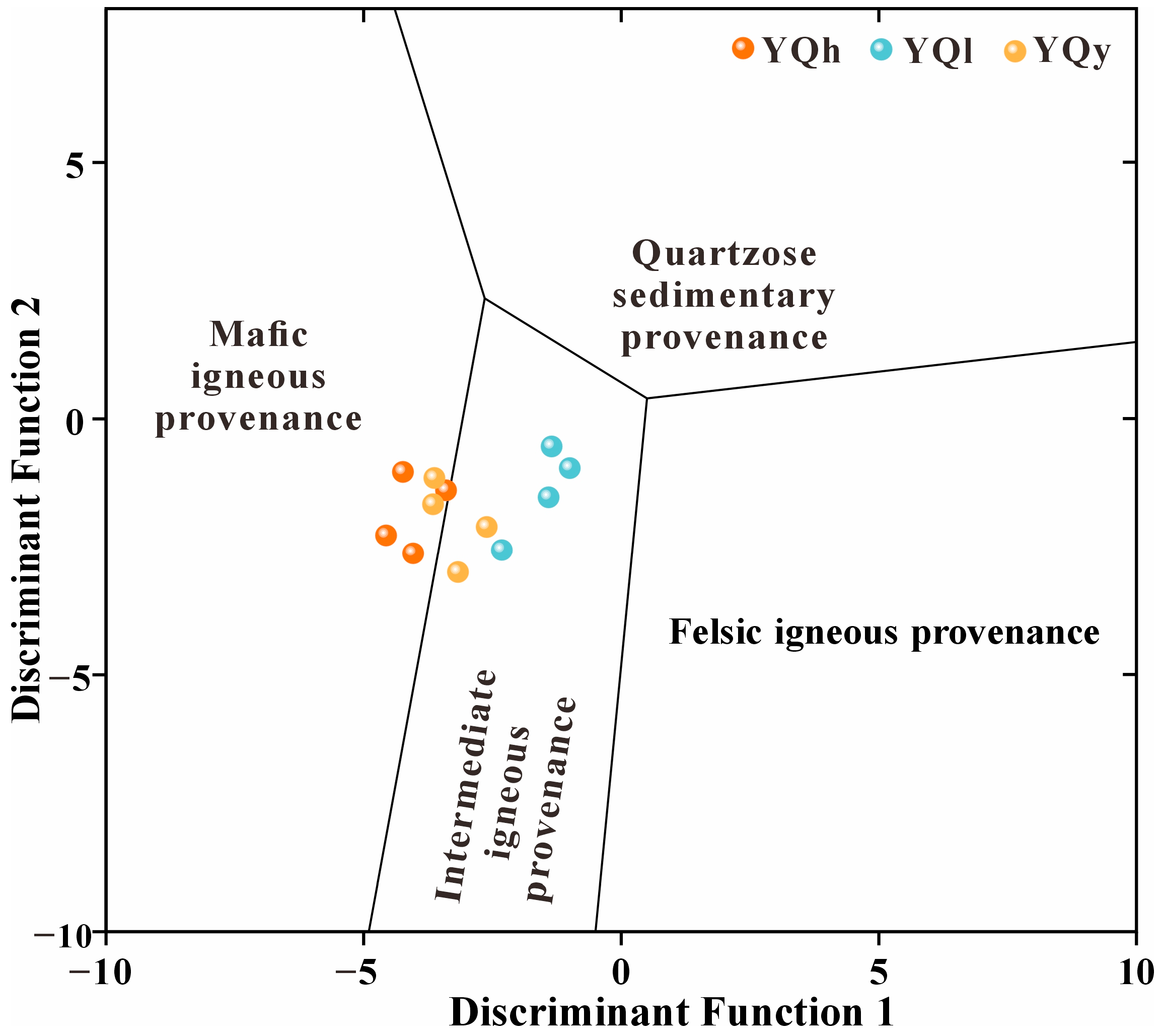
Provenance discriminant analysis (Figure 16, after [97]) shows that sediments from the Hongshanwan landform in the Lanzhou Basin are mainly derived from mafic to intermediate igneous sources, with red-brown samples plotting in the mafic volcanic field and blue-gray samples in the intermediate volcanic field. Elevated K2O and Rb likely reflect enrichment of clay minerals (e.g., muscovite, Figure 6), and low SiO2 (<45%) along with positive Eu anomalies preclude a purely felsic provenance (Figure 8).
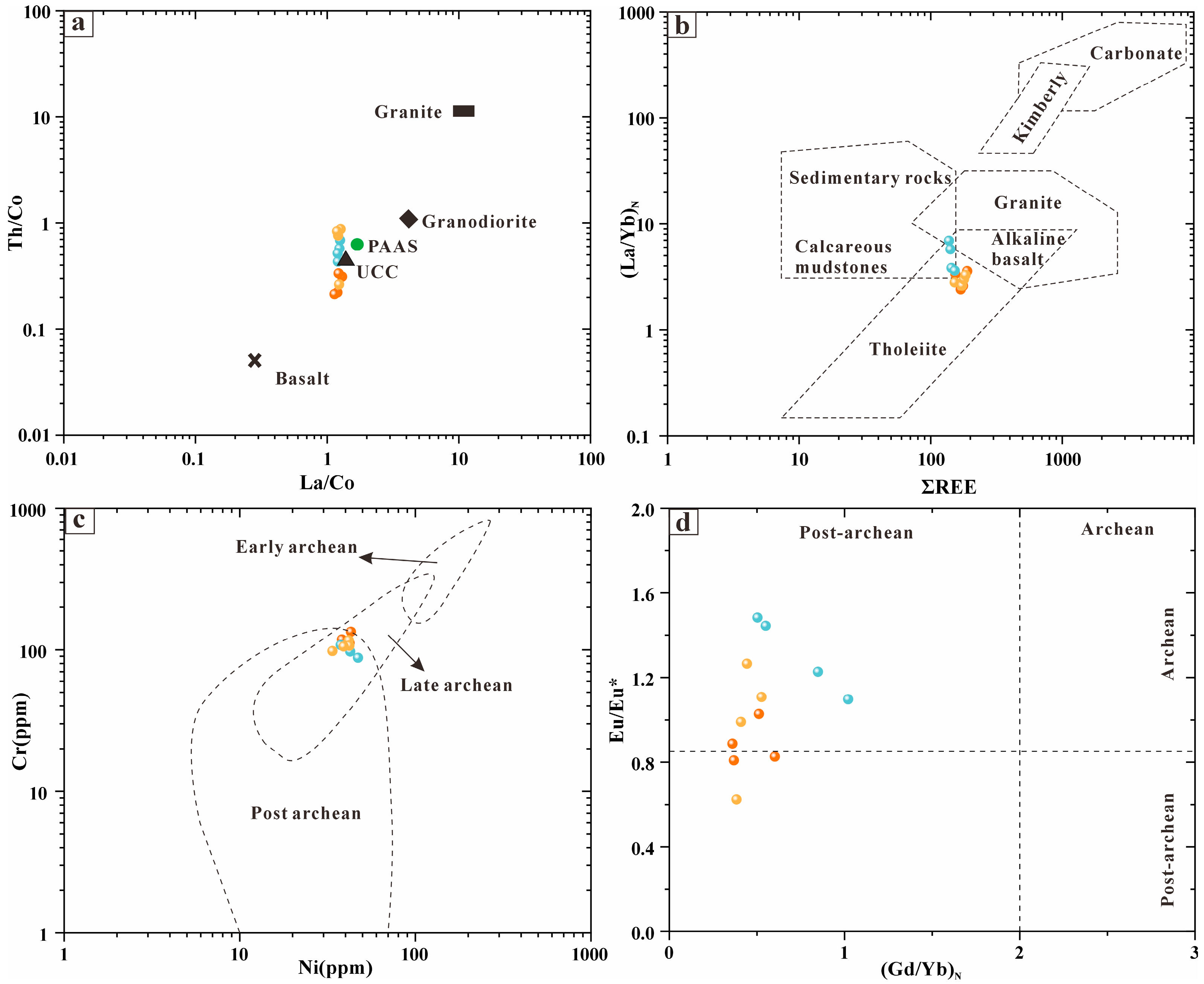
Trace element ratios and rare earth element (REE) compositions further substantiate a mafic-to-intermediate provenance. In the Th/Co-La/Co diagram (Figure 17a), the samples plot near the upper continental crust (UCC) and Post-Archean Australian Shale (PAAS) values, reflecting a generally mixed source. Importantly, however, specific elemental ratios strongly indicate a significant mafic contribution: the Cr/Th and Th/Co ratios are 8.60 and 0.50, respectively, both higher than the UCC values, and the relatively low Th/U ratio (average 2.77) further implies the involvement of mafic rocks [1,31,80].
The average LREE and HREE contents are 143.74 ppm and 19.27 ppm, respectively. While such enrichments and relatively high (La/Yb) N values (average 3.65) might traditionally be interpreted as a felsic signature, the significantly low SiO2 content (<45 wt.%) suggests that this REE enrichment is primarily driven by the adsorption of clay minerals (e.g., illite) during weathering, rather than a granitic provenance. This is corroborated by the weak-to-positive Eu anomalies (Eu/Eu*≥ 0.85 to >1 in most samples), which definitively point toward a mafic-to-intermediate source [69]. In the ΣREE vs. (La/Yb) N discrimination diagram (Figure 17b), the red-brown and pale-yellow samples plot prominently near the tholeiitic basalt field, confirming a mafic volcanic origin. Meanwhile, the blue-gray samples plot between the alkaline basalt and calcareous mudstone fields, reflecting a mixed intermediate-to-mafic provenance. Additionally, the Ni vs. Cr diagram (Figure 17c) and the Eu/Eu* vs. (Gd/Yb) N diagram (Figure 17d) consistently indicate that these intermediate–mafic source rocks were primarily formed in the late Archean to post-Archean. Notably, these mafic source rocks provided abundant iron-bearing minerals, which served as the material basis for the subsequent oxidation and characteristic red coloration of the Hongshanwan landform.
Detrital zircon U–Pb ages indicate that zircon populations in the Hongshanwan landform sediments of the Lanzhou Basin can be grouped into three main stages: Mesoproterozoic–Paleoproterozoic (1322–1994 Ma), Devonian–Carboniferous (331–376 Ma), and Permian–Triassic (217–286 Ma). These age populations, together with geochemical signatures, suggest that the sediments were predominantly derived from intermediate-to-mafic igneous rocks, with minor contributions from felsic rocks and ancient crystalline basement.
During the Mesoproterozoic–Paleoproterozoic, Proterozoic intrusions in the eastern Qilian Mountains and the Maxianshan area along the southern margin of the basin likely record the Columbia supercontinent rifting event [100]. Paleocurrent data indicate a general south-to-north transport direction [90], suggesting that intermediate–mafic igneous bodies in the southern basin (e.g., Maxianshan) served as major sediment sources, mixed with minor input from older basement materials.
From the Middle Cambrian to Silurian, the Qilian region experienced complex subduction-related magmatism. Southward subduction of the North Qilian oceanic crust along the Taolaishan–Upper Heihe line occurred from the Late Early Cambrian to Early Ordovician, followed by the development of Ordovician–Silurian back-arc basins [56,101,102,103,104]. Intermediate-to-mafic magmatic rocks formed during this period likely provided an important sediment source, with limited felsic input from contemporaneous granitic intrusions.
During the Devonian–Carboniferous, magmatic activity weakened and was characterized by localized emplacement of S-type granites in the Maxianshan area [100,103,105]. However, the regional tectonic regime transitioned to intracontinental orogeny after the Middle–Late Devonian [104], and the Qilian Mountains remained a key provenance dominated by intermediate-to-mafic lithologies, consistent with paleocurrent reconstructions [90].
In the Permian–Triassic, following the Caledonian orogeny, the Qilian region entered an intraplate tectonic setting. Mafic–ultramafic intrusions in the Zongwulong area of southern Qilian during the Late Paleozoic and Mesozoic [103,106] likely supplied abundant detritus to the basin. Trace element and REE characteristics of the Hongshanwan sediments further indicate significant input from mafic sources during this stage, reinforcing a provenance dominated by intermediate–mafic igneous rocks.

5.5. Coloration Mechanism of the Hongshanwan Landform

The most distinctive characteristic of the Hongshanwan landform is the development of well-exposed multicolored rhythmic sedimentary sequences. Variations in the color of clastic rocks are widely recognized to be closely linked to mineral composition, provenance characteristics, depositional environment, and diagenetic processes [107,108,109]. Integrated mineralogical, geochemical, and detrital zircon U-Pb geochronological results from this study provide constraints on the mechanisms controlling the formation of these multicolored strata.
The reddish-brown strata are characterized by a provenance dominated by intermediate-to-mafic igneous rocks, accompanied by the enrichment of hematite, dark clay minerals, and iron-rich detrital components (Figure 5 and Figure 6). Iron-bearing phases in these strata likely originate from two principal sources: (1) primary iron-bearing minerals derived from the weathering of mafic source rocks, which impart an inherited coloration; and (2) authigenic iron oxides, particularly hematite, formed during early diagenesis. During sediment burial, Fe2+ released from clay minerals into pore waters was oxidized at redox interfaces and subsequently precipitated as fine-grained hematite with strong pigmenting capacity [110,111].
The dominant reddish coloration of the red-brown units can therefore be interpreted as the combined result of inherited color from iron-rich detrital minerals, authigenic pigmentation during sediment accumulation and early diagenesis, and minor secondary modification during post-depositional alteration or surface weathering. Previous studies indicate that coarse-grained, detrital hematite particles are generally less effective pigments than finely disseminated authigenic hematite. Moreover, the development of laterally extensive and uniformly colored red beds over prolonged geological timescales requires a sustained supply of iron and stable oxidizing conditions [110,111]. The relatively high Fe2O3 (average 10.74 wt.%) and FeO (average 2.39 wt.%) contents in the red-brown strata support this interpretation. In addition, the red-brown layers exhibit well-developed, laterally continuous bedding that coincides with color boundaries (Figure 3b–d), which contrasts with the irregular patchy or vein-like features typically associated with secondary oxidation [108,109]. These observations suggest that authigenic pigmentation during early diagenesis played a dominant role in the development of the red-brown coloration, whereas inherited and secondary colors were of subordinate importance.
Weathering indices and redox-sensitive geochemical proxies indicate that the source rocks experienced low-to-moderate chemical weathering under arid to semi-arid climatic conditions, and that sediment deposition occurred predominantly under oxidizing conditions. Such an environment is favorable for the oxidation of Fe2+ to Fe3+ in pore waters and the precipitation of iron oxides during early diagenesis. Consequently, the red-brown coloration of the Hongshanwan strata is interpreted to be primarily controlled by the formation of authigenic hematite, with only limited influence from inherited detrital iron minerals and late-stage secondary processes.
In contrast, the blue-gray strata are enriched in CaO and MgO and contain abundant clinochlore and dolomite, suggesting derivation from a mixed provenance involving calcareous mudstone and mafic volcanic rocks. These strata display stable color boundaries that are parallel to bedding and laterally persistent (Figure 3b–d), indicating limited post-depositional color modification. Their bluish-gray coloration is therefore interpreted to be mainly inherited from carbonate minerals and dark mafic components rather than produced by diagenetic iron oxidation.
Detrital zircon U-Pb age distributions indicate that the multicolored rhythmic sedimentary sequences of the Hongshanwan landform reflect episodic variations in sediment supply linked to tectonic activity in the surrounding orogenic belts, particularly the Qilian Mountains. Following basin formation, the Lanzhou Basin experienced multiple phases of tectonic deformation [29,55], resulting in tilting and structural modification of the strata. Together with dominant surface processes such as slope-controlled sheet flow, these tectonic and exogenic factors contributed to the modification of the original sedimentary architecture and ultimately shaped the present-day geomorphological expression of the Hongshanwan landform.

6. Conclusions

(1) Geochemical characteristics indicate that the sediments were predominantly derived from intermediate-to-mafic igneous rocks, with minor contributions from felsic rocks and recycled Precambrian basement materials. Trace element ratios and REE patterns (LREE/HREE = 7.59) reflect a mixed but mafic-influenced provenance. Detrital zircon U–Pb ages define three major age populations (1322–1994 Ma, 331–376 Ma, and 217–286 Ma), indicating a composite provenance linked to multiple tectono-magmatic events in the Qilian orogenic system.
(2) Weathering indices (CIA = 56.27, ICV = 2.14) and A–CN–K ternary plots suggest a low degree of weathering in the provenance area, dominated by unstable minerals. Ratios such as U/Th, Ce/Ce*, and Ni/Co indicate an overall oxidizing depositional environment.
(3) The red-brown coloration of the strata is primarily controlled by the presence of authigenic hematite formed during early diagenesis. Iron was likely mobilized in pore fluids under reducing conditions as soluble Fe2+ released from iron-bearing minerals during early burial. Subsequent exposure to oxidizing conditions promoted the oxidation of Fe2+ to Fe3+ and the precipitation of hematite coatings on detrital grains and within the clay matrix. This process ultimately produced the characteristic red coloration of the strata. Similar mechanisms of iron mobilization and hematite precipitation have been widely reported in continental red-bed successions and are considered a fundamental process responsible for red-bed pigmentation [14,15]. In contrast, the blue-gray and pale-yellow strata are dominated by carbonate minerals, with colors inherited from provenance rocks, showing stable hues and minimal redox variation.
(4) Tectonic discrimination diagrams and detrital zircon age spectra indicate that the sedimentary system developed in a back-arc foreland basin within a continental island arc setting. Episodic tectonic activity drove pulses in sediment supply, producing multicolored rhythmic cycles. Subsequent tectonic uplift and deformation, combined with slope-dominated surface processes, shaped the present geomorphic features of the Hongshanwan landform.
(5) The Hongshanwan landform provides a quantitative model for interpreting colorful red-bed mountain landscapes elsewhere, such as Vinicunca (Peru), the Altai Mountains (Russia), and the Quebrada de Humahuaca-Hornocal range (Argentina), demonstrating the universal interplay of provenance, weathering, diagenesis, and tectonics in controlling sedimentary color patterns.

Supplementary Materials

The following supporting information can be downloaded at: https://www.mdpi.com/article/10.3390/min16040360/s1, Table S1: Major oxides (wt.%), geochemical indices, trace element (ppm), and rare earth elements (ppm) of Hongshanwan landform.; Table S2: U–Pb analytical results for zircons from the Early Cretaceous upper member of 2nd formation Hekou Group in the Lanzhou basin.

Author Contributions

Conceptualization, X.L. and N.W.; methodology, X.L. and N.W.; investigation, X.L., H.W., J.W. and H.Z.; data curation, X.L. and H.Z.; writing—original draft preparation, X.L. and J.W.; writing—review and editing, X.L. and N.W.; visualization, H.W.; supervision, X.L. and N.W.; project administration, X.L. and N.W.; funding acquisition, X.L. All authors have read and agreed to the published version of the manuscript.

Funding

This research was funded by the Science and Technology Program of Gansu Province (Grant No. 24JRRA751).

Data Availability Statement

The original contributions presented in this study are included in the article. Further inquiries can be directed to the corresponding authors.

Acknowledgments

We acknowledge the support and assistance provided by the field team in the study area throughout the geological investigation.

Conflicts of Interest

The authors declare that the research was conducted in the absence of any commercial or financial relationships that could be construed as potential conflicts of interest.

References

  1. Armstrong-Altrin, J.S.; Madhavaraju, J.; Vega-Bautista, F.; Ramos-Vázquez, M.A.; Pérez-Alvarado, B.Y.; Kasper-Zubillaga, J.J.; Ekoa Bessa, A.Z. Mineralogy and geochemistry of Tecolutla and Coatzacoalcos beach sediments, SW Gulf of Mexico. Appl. Geochem. 2021, 134, 105103. [Google Scholar] [CrossRef]
  2. Boruah, R.; Laskar, J.J. Geochemical characteristics of Neogene sandstones of the East and West Siang districts of Arunachal Pradesh, NE India: Implications for source-area weathering, provenance, and tectonic setting. Acta Geochim. 2022, 41, 100–120. [Google Scholar] [CrossRef]
  3. Cox, R.; Lowe, D.R.; Cullers, R.L. The influence of sediment recycling and basement composition on evolution of mudrock chemistry in the southwestern United States. Geochim. Et Cosmochim. Acta 1995, 59, 2919–2940. [Google Scholar] [CrossRef]
  4. Hossain, H.M.Z. Major, trace, and REE geochemistry of the Meghna River sediments, Bangladesh: Constraints on weathering and provenance. Geol. J. 2020, 55, 3321–3343. [Google Scholar] [CrossRef]
  5. McLennan, S.M. Weathering and global denudation. J. Geol. 1993, 101, 295–303. [Google Scholar] [CrossRef]
  6. McLennan, S.M.; Taylor, S.R. Th and U in sedimentary rocks: Crustal evolution and sedimentary recycling. Nature 1980, 285, 621–624. [Google Scholar] [CrossRef]
  7. Pettijohn, F.J.; Potter, P.E.; Siever, R. Sand and Sandstone; Springer: New York, NY, USA, 1987. [Google Scholar]
  8. Fedo, C.M.; Nesbitt, H.W.; Young, G.M. Unraveling the effects of potassium metasomatism in sedimentary rocks and paleosols, with implications for paleoweathering conditions and provenance. Geology 1995, 23, 921–924. [Google Scholar] [CrossRef]
  9. Garzanti, E.; Padoan, M.; Setti, M.; Najman, Y.; Peruta, L.; Villa, I.M. Weathering geochemistry and Sr–Nd fingerprints of equatorial Upper Nile and Congo muds. Geochem. Geophys. Geosystems 2013, 14, 292–316. [Google Scholar] [CrossRef]
  10. Hossain, H.M.Z.; Kawahata, H.; Roser, B.P.; Sampei, Y.; Manaka, T.; Otani, S. Geochemical characteristics of modern river sediments in Myanmar and Thailand: Implications for provenance and weathering. Geochemistry 2017, 77, 443–458. [Google Scholar] [CrossRef]
  11. Lupker, M.; France-Lanord, C.; Galy, V.; Lavé, J.; Kudrass, H. Increasing chemical weathering in the Himalayan system since the last glacial maximum. Earth Planet. Sci. Lett. 2013, 365, 243–252. [Google Scholar] [CrossRef]
  12. Nesbitt, H.W.; Young, G.M. Early Proterozoic climates and plate motions inferred from major element chemistry of lutites. Nature 1982, 299, 715–717. [Google Scholar] [CrossRef]
  13. Taylor, S.R.; McLennan, S.M. The Continental Crust: Its Composition and Evolution: An Examination of the Geochemical Record Preserved in Sedimentary Rocks [ILLUSTRATED]; Blackwell Scientific Publications: Oxford, UK, 1985. [Google Scholar]
  14. Houten, F.B.V. Origin of Red Beds a Review-1961-1972. Annu. Rev. Earth Planet. Sci. 1973, 1, 39–61. [Google Scholar] [CrossRef]
  15. Walker, T.R. Diagenetic Origin of Continental Red Beds. In Proceedings of the The Continental Permain in Central, West, and South Europe; Falke, H., Ed.; Springer: Dordrecht, The Netherlands, 1976; pp. 240–282. [Google Scholar]
  16. Sun, X. Study on the Formation Mechanisms of Colored Hills in Zhangye Geopark; Gansu Science and Technology Press: Lanzhou, China, 2019; pp. 1–145. [Google Scholar]
  17. Sun, Y. Burqin·Wucaitan. Contemp. Commun. 2022, 5, 113. (In Chinese) [Google Scholar]
  18. Moreno, F.; Garzione, C.N.; George, S.W.M.; Horton, B.K.; Williams, L.; Jackson, L.J.; Carlotto, V.; Richter, F.; Bandeian, A. Coupled Andean Growth and Foreland Basin Evolution, Campanian–Cenozoic Bagua Basin, Northern Peru. Tectonics 2020, 39, e2019TC005967. [Google Scholar] [CrossRef]
  19. Wikipedia. Vinicunca. Available online: https://en.wikipedia.org/wiki/Vinicunca (accessed on 11 March 2026).
  20. D’yachkov, B.A.; Mizernaya, M.A.; Khromykh, S.V.; Bissatova, A.Y.; Oitseva, T.A.; Miroshnikova, A.P.; Frolova, O.V.; Kuzmina, O.N.; Zimanovskaya, N.A.; Pyatkova, A.P.; et al. Geological History of the Great Altai: Implications for Mineral Exploration. Minerals 2022, 12, 744. [Google Scholar] [CrossRef]
  21. Wikipedia. Candy Cane Mountains. Available online: https://en.wikipedia.org/wiki/Candy_Cane_Mountains (accessed on 11 March 2026).
  22. Wikipedia. Serranía de Hornocal. Available online: https://en.wikipedia.org/wiki/Serran%C3%ADa_de_Hornocal (accessed on 11 March 2026).
  23. Li, X.Q.; Cheng, H.Y.; Wang, N.A. Geomorphic characteristics of the Hongshanwan landform in Zhangye and its differences from Danxia landforms: Implications for classification and nomenclature of red-bed landforms. J. South China Geogr. 2024, 20–31, (In Chinese with English abstract). [Google Scholar] [CrossRef]
  24. Du, D.; Mughal Muhammad, S.; Zhang, C. Petrography, geochemistry and provenance of the Early Cretaceous Yanguoxia Formation, Lanzhou–Minhe Basin, Northwest China. J. Mt. Sci. 2018, 15, 2068–2088. [Google Scholar] [CrossRef]
  25. Mao, X.; Retallack, G.; Liu, X. Identification, Characterization, and Paleoclimatic Implication of Early Cretaceous (Aptian-Albian) Paleosol Succession in Zhangye Danxia National Geopark, Northwestern China. Palaeogeogr. Palaeoclimatol. Palaeoecol. 2022, 601, 111128. [Google Scholar] [CrossRef]
  26. Xue, Y.; Li, G.; Teng, X. Discovery of clam shrimp (Spinicaudata) from the Hekou Group, Lanzhou, NW China: Implications for taxonomy and biostratigraphy. Cretac. Res. 2024, 155, 105781. [Google Scholar] [CrossRef]
  27. Zhang, J.; Ukar, E.; Qu, J.; Zhang, B.; Zhao, H.; Zhang, Y.; Wang, Z. Periclinal fold systems in thick-bedded mudstones: A case study of the Early Cretaceous Hekou Group, Lanzhou Basin, NW China. J. Struct. Geol. 2022, 161, 104678. [Google Scholar] [CrossRef]
  28. He, C.C.; Zhang, Y.Q.; Li, J.; Li, H.L.; Sun, D.X.; Xiong, J.H. Cretaceous–Cenozoic sedimentation and tectonic deformation of the Maxianshan fault zone and adjacent areas, NE Tibetan Plateau. Acta Geosci. Sin. 2019, 40, 563–606, (In Chinese with English abstract). [Google Scholar]
  29. Guo, R.T.; Zhao, X.; Liu, H.G.; Shi, K.B.; Liu, J.; Jiang, Q.C. Lower Cretaceous clastic sequence stratigraphy of the Lanzhou Basin: Sedimentary response to Early Cretaceous uplift of the Qilian Mountains. J. Jilin Univ. (Earth Sci. Ed.) 2016, 321–335, (In Chinese with English abstract). [Google Scholar] [CrossRef]
  30. Liu, X.; Chen, J.; Xie, Q. Relationship between soil magnetic susceptibility enhancement and precipitation in Cretaceous paleosols. Stud. Geophys. Et Geod. 2021, 65, 323–340. [Google Scholar] [CrossRef]
  31. McLennan, S.M.; Hemming, S.; McDaniel, D.K.; Hanson, G.N. Geochemical approaches to sedimentation, provenance, and tectonics. In Processes Controlling the Composition of Clastic Sediments; Johnsson, M.J., Basu, A., Eds.; Geological Society of America: Boulder, CO, USA, 1993. [Google Scholar]
  32. Hassan, S.; Ishiga, H.; Roser, B.P.; Dozen, K.; Naka, T. Geochemistry of Permian–Triassic shales in the Salt Range, Pakistan. Chem. Geol. 1999, 158, 293–314. [Google Scholar] [CrossRef]
  33. Do Campo, M.; Guevara, S.R. Provenance analysis of Neoproterozoic metasedimentary successions in NW Argentina. J. South Am. Earth Sci. 2005, 19, 143–153. [Google Scholar] [CrossRef]
  34. Andersen, T. Correction of common lead in U–Pb analyses without 204Pb. Chem. Geol. 2002, 192, 59–79. [Google Scholar] [CrossRef]
  35. Újvári, G.; Varga, A.; Ramos, F.C.; Kovács, J.; Németh, T.; Stevens, T. Tracking dust provenance using clay mineralogy, Sr–Nd isotopes and zircon U–Pb ages. Chem. Geol. 2012, 304–305, 83–96. [Google Scholar] [CrossRef]
  36. Kettanah, Y.A.; Armstrong-Altrin, J.S.; Mohammad, F.A. Petrography and geochemistry of siliciclastic rocks of the Gercus Formation, northern Iraq. Geol. J. 2021, 56, 2528–2549. [Google Scholar] [CrossRef]
  37. Augustsson, C.; Aehnelt, M.; Olivarius, M.; Voigt, T.; Gaupp, R.; Hilse, U. Provenance from geochemical composition of terrestrial clastic deposits. Sediment. Geol. 2023, 456, 106496. [Google Scholar] [CrossRef]
  38. Cawood, P.A.; Hawkesworth, C.J.; Dhuime, B. Detrital zircon record and tectonic setting. Geology 2012, 40, 875–878. [Google Scholar] [CrossRef]
  39. Kairouani, H.; Zaghloul, M.N.; Abbassi, A.; Micheletti, F.; Fornelli, A.; Mourabet, M.E.; Piccoli, F.; Criniti, S.; Critelli, S. Provenance and source-to-sink of Jurassic sediments in NW Gondwana. Mar. Pet. Geol. 2023, 157, 106492. [Google Scholar] [CrossRef]
  40. Miller, M.D.; Adkins, J.F.; Hodell, D.A. Rhizon sampler alteration of deep ocean sediment interstitial waters. Geochem. Geophys. Geosystems 2014, 15, 2401–2413. [Google Scholar] [CrossRef]
  41. Tamim, U.; Khan, R.; Jolly, Y.N.; Fatema, K.; Das, S.; Naher, K.; Islam, M.A.; Islam, S.A.; Hossain, S.M. Elemental distribution of metals in urban river sediments. Chemosphere 2016, 155, 509–518. [Google Scholar] [CrossRef]
  42. Johnson, T.D.; Oluwajana, O.A.; Omietimi, E.J.; Ayo-Bali, A.E.; Odondiri, O.D.; Igili, C.O.; Lenhardt, N. Elemental geochemistry of Cretaceous deposits in the Dahomey Basin. J. Afr. Earth Sci. 2024, 216, 105311. [Google Scholar] [CrossRef]
  43. Bahlburg, H.; Dobrzinski, N. Chemical index of alteration and Neoproterozoic climate transitions. In The Geological Record of Neoproterozoic Glaciations; Geological Society of London: London, UK, 2011. [Google Scholar]
  44. Nesbitt, H.W.; Young, G.M. Weathering trends of plutonic and volcanic rocks. Geochim. Et Cosmochim. Acta 1984, 48, 1523–1534. [Google Scholar] [CrossRef]
  45. Hofer, G.; Wagreich, M.; Neuhuber, S. Geochemistry of Upper Cretaceous–Paleogene sediments of the Gosau Group. Geosci. Front. 2013, 4, 449–468. [Google Scholar] [CrossRef]
  46. Tao, H.; Sun, S.; Wang, Q.; Yang, X.; Jiang, L. Petrography and geochemistry of Lower Carboniferous clastic rocks, NE Junggar. J. Asian Earth Sci. 2014, 87, 11–25. [Google Scholar] [CrossRef]
  47. Zhang, Y.; Pe-Piper, G.; Piper, D.J.W. Sediment geochemistry as a provenance indicator. Sedimentology 2014, 61, 383–410. [Google Scholar] [CrossRef]
  48. Maharana, C.; Srivastava, D.; Tripathi, J.K. Geochemistry of Ganga Basin river sediments. Chem. Geol. 2018, 483, 1–20. [Google Scholar] [CrossRef]
  49. Edegbai, A.J.; Schwark, L.; Oboh-Ikuenobe, F.E. Campano–Maastrichtian paleoenvironment and provenance of the Anambra Basin. J. Afr. Earth Sci. 2019, 156, 203–239. [Google Scholar] [CrossRef]
  50. Li, Q.L.; Xie, G.Q.; Zhou, L.Q.; Wang, Y.B. Sequence stratigraphic framework of the Hekou Group in the Lanzhou–Minhe Basin. Sediment. Geol. Tethyan Geol. 2002, 73–78, (In Chinese with English abstract). [Google Scholar]
  51. Xiao, L. Geological Map Report of Lanzhou Sheet (1:250,000); Gansu Geological Survey Institute: Lanzhou, China, 2003. (In Chinese) [Google Scholar]
  52. Gansu Institute of Geological Survey. Regional Geology of China: Gansu Volume; Geological Publishing House: Beijing, China, 2023. (In Chinese) [Google Scholar]
  53. Zhang, B.; Zhang, J.; Zhao, H.; Nie, F.; Wang, Y.; Zhang, Y. Tectonic evolution of the western Ordos Basin constrained by detrital zircons. Int. Geol. Rev. 2019, 61, 461–480. [Google Scholar] [CrossRef]
  54. Lin, W.; Wei, W. Late Mesozoic extensional tectonics in the North China Craton. Int. Geol. Rev. 2020, 62, 811–839. [Google Scholar] [CrossRef]
  55. Yuan, D.; Ge, W.; Chen, Z.; Li, C.; Wang, Z.; Zhang, H.; Zhang, P.; Zheng, D.; Zhang, W.; Craddock, W.H.; et al. Growth of northeastern Tibet and continental geodynamics. Tectonics 2013, 32, 1358–1370. [Google Scholar] [CrossRef]
  56. Zhang, X.H.; Liu, J.H.; Xu, J.L.; Niu, H.B.; Zhao, Y.Q. Tectonic framework of Gansu Province revisited. Gansu Geol. 2005. (In Chinese) [Google Scholar]
  57. Zhang, H.F.; Lin, Q.X.; Zhang, Z.Y.; Gu, Y.S.; Cai, X.F.; Yan, X.Q. Sedimentary sequences and facies of the Lower Cretaceous Hekou Group. Geol. Sci. Technol. Inf. 2003, 21–26, (In Chinese with English abstract). [Google Scholar]
  58. Cai, X.F.; Chen, B.; Li, C.A.; Gu, Y.S.; Zhan, C.S. Role of basic sequences and facies analysis in continental stratigraphy. J. Stratigr. 2002, 230–234, (In Chinese with English abstract). [Google Scholar]
  59. Xu, J.L. Geological Map Explanation of the Yanguoxia Sheet (1:50,000); Gansu Geological Bureau: Lanzhou, China, 1992. (In Chinese) [Google Scholar]
  60. Chen, J.; Liu, Y.Q.; Kuang, H.W.; Liu, Y.X.; Peng, N.; Xu, H.; Dong, C.; Liu, H.; Xue, P.L.; Xu, J.L. Sedimentary characteristics of the Lower Cretaceous Hekou Group in the Lanzhou–Minhe Basin and their basin analysis implications. J. Palaeogeogr. 2013, 155–168, (In Chinese with English abstract). [Google Scholar]
  61. Wiedenbeck, M.; Alle, P.; Corfu, F.Y.; Griffin, W.L.; Meier, M.; Oberli, F.V.; Quadt, A.V.; Roddick, J.C.; Spiegel, W. Three natural zircon standards for U–Th–Pb analyses. Geostand. Newsl. 1995, 19, 1–23. [Google Scholar] [CrossRef]
  62. Jackson, S.E.; Pearson, N.J.; Griffin, W.L.; Belousova, E.A. In situ U–Pb zircon dating by LA–ICP–MS. Chem. Geol. 2004, 211, 47–69. [Google Scholar] [CrossRef]
  63. Vermeesch, P. IsoplotR: A free and open toolbox for geochronology. Geosci. Front. 2018, 9, 1479–1493. [Google Scholar] [CrossRef]
  64. Bock, B.; McLennan, S.M.; Hanson, G.N. Geochemistry and provenance of Ordovician sediments. Sedimentology 1998, 45, 635–655. [Google Scholar] [CrossRef]
  65. Li, Q.L. Depositional environment of the Early Cretaceous Lanzhou–Minhe Basin. Sediment. Geol. Tethyan Geol. 2000, 97–103, (In Chinese with English abstract). [Google Scholar]
  66. Chen, J.; Liu, Y.Q.; Kuang, H.W.; Liu, Y.X. Sedimentary characteristics of the Early Cretaceous Hekou Group. In Proceedings of the 12th National Conference on Paleogeography and Sedimentology, Qingdao, China, 18–20 October 2012; pp. 68–69. (In Chinese) [Google Scholar]
  67. Tang, Y.H.; Dai, S.; Huang, Y.B.; Zhu, Q.; Fang, X.M.; Hu, H.F.; Liu, J.W.; Kong, L.; Zhao, J.; Liu, X. Sedimentary facies and magnetic susceptibility of the Hekou Group. Earth Sci. Front. 2008, 261–271, (In Chinese with English abstract). [Google Scholar]
  68. Dai, S.; Liu, J.W.; Zhang, M.Z.; Huang, Y.B.; Kong, L.; Zhao, J.; Liu, X.; Zhu, Q. Climatic variations recorded by sediment color in the Hekou Group (140.66–124.19 Ma), Lanzhou–Minhe Basin. Acta Geol. Sin. 2011, 85, 1058–1067, (In Chinese with English abstract). [Google Scholar]
  69. Rudnick, R.L.; Gao, S. Composition of the continental crust. In Treatise on Geochemistry; Elsevier: Amsterdam, The Netherlands, 2003; pp. 1–64. [Google Scholar]
  70. McLennan, S.M. Trace element composition of sedimentary rocks and upper continental crust. Geochem. Geophys. Geosyst. 2001, 2. [Google Scholar] [CrossRef]
  71. Wu, Y.B. Zircon genesis and constraints on U–Pb age interpretation. Chin. Sci. Bull. 2004, 1589–1604, (In Chinese with English abstract). [Google Scholar]
  72. Hanchar, J.M.; Rudnick, R.L. Cathodoluminescence imaging of zircons. Lithos 1995, 36, 289–303. [Google Scholar] [CrossRef]
  73. Corfu, F. Atlas of zircon textures. Rev. Mineral. Geochem. 2003, 53, 469–500. [Google Scholar] [CrossRef]
  74. Hoskin, P.W.O.; Black, L.P. Metamorphic zircon formation. J. Metamorph. Geol. 2000, 18, 423–439. [Google Scholar] [CrossRef]
  75. Cornell, R.M.; Schwertmann, U. The Iron Oxides; Wiley-VCH: Weinheim, Germany, 2003. [Google Scholar]
  76. Cullers, R.L. Controls on major and trace element variation of shales and sandstones. Geochim. Et Cosmochim. Acta 1994, 58, 4955–4972. [Google Scholar] [CrossRef]
  77. Galy, A.; France-Lanord, C. Higher erosion rates in the Himalaya. Geology 2001, 29, 23–26. [Google Scholar] [CrossRef]
  78. Alonso-Zarza, A.M.; Cabaleri, N.G.; Huerta, P.; Armella, C.; Rodríguez-Berriguete, Á.; Monferran, M.D.; Gallego, O.F.; Ubaldon, M.C.; Nieto, D.S. Lacustrine microbialite pinnacles in Patagonia. Sediment. Geol. 2020, 408, 105742. [Google Scholar] [CrossRef]
  79. Floyd, P.A.; Winchester, J.A.; Park, R.G. Geochemistry and tectonic setting of Proterozoic clastic metasediments. Precambrian Res. 1989, 45, 203–214. [Google Scholar] [CrossRef]
  80. Cullers, R.L.; Podkovyrov, V.N. Geochemistry of Mesoproterozoic shales, Yakutia. Precambrian Res. 2000, 104, 77–93. [Google Scholar] [CrossRef]
  81. Rollinson, H.R. Using Geochemical Data; Routledge: London, UK, 2014. [Google Scholar]
  82. Chukwuma, K.; Tsikos, H.; Wagner, N.; Frazenburg, M. Sea-level and climatic controls on Permian black shales. J. Afr. Earth Sci. 2022, 188, 104495. [Google Scholar] [CrossRef]
  83. Armstrong-Altrin, J.S.; Lee, Y.I.; Verma, S.P.; Ramasamy, S. Geochemistry of Upper Miocene sandstones, southern India. J. Sediment. Res. 2004, 74, 285–297. [Google Scholar] [CrossRef]
  84. Selvaraj, K.; Chen, C.A. Chemical weathering of subtropical Taiwan. J. Geol. 2006, 114, 101–116. [Google Scholar] [CrossRef]
  85. Ramirez-Montoya, E.; Madhavaraju, J.; Monreal, R. Geochemistry of sedimentary rocks, Sonora, Mexico. J. S. Am. Earth Sci. 2021, 106, 103035. [Google Scholar] [CrossRef]
  86. Iqbal, S.; Wagreich, M.; Kuerschner, W.M.; Gier, S.; Bibi, M. Hot-house climate during the Triassic/Jurassic transition. Glob. Planet. Change 2019, 172, 15–32. [Google Scholar] [CrossRef]
  87. Suttner, L.J.; Dutta, P.K. Alluvial sandstone composition and paleoclimate. J. Sediment. Res. 1986, 56, 329–345. [Google Scholar] [CrossRef]
  88. Bai, Y.; Liu, Z.; Sun, P.; Liu, R.; Hu, X.; Zhao, H.; Xu, Y. REE geochemistry of Eocene fine-grained sediments, NE China. J. Asian Earth Sci. 2015, 97, 89–101. [Google Scholar] [CrossRef]
  89. Cai, X.F.; Li, C.A.; Zhan, C.S. Dinosaur footprints and depositional environments in the Lanzhou–Minhe Basin. Reg. Geol. China 2001, 62–66, (In Chinese with English abstract). [Google Scholar]
  90. Chen, J. Sedimentary Characteristics and Paleogeography of the Early Cretaceous Hekou Group. Master’s Thesis, China University of Geosciences (Beijing), Beijing, China, 2014. (In Chinese) [Google Scholar]
  91. Nagender Nath, B.; Bau, M.; Ramalingeswara Rao, B.; Rao, C.M. Trace and REE variations in Arabian Sea sediments. Geochim. Et Cosmochim. Acta 1997, 61, 2375–2388. [Google Scholar] [CrossRef]
  92. Liang, Q.; Tian, J.; Zhang, X.; Sun, X.; Yang, C. Geochemistry of Permian mudstones, North China Basin. Geosci. J. 2020, 24, 17–33. [Google Scholar] [CrossRef]
  93. Ding, H.W.; Wang, S.Y.; Yao, X.R.; Kang, L.; Ying, Z.; Zhang, X.R. Geological genesis of Zhangye Danxia and colorful hills. Gansu Geol. 2014, 23, 70–77, (In Chinese with English abstract). [Google Scholar]
  94. Zhang, H.S.; Cui, Z.Q. Formation and landscape characteristics of Zhangye Danxia landform. Chin. J. Desert Res. 2007, 942–945, (In Chinese with English abstract). [Google Scholar]
  95. Tang, Y.; Dai, S.; Huang, Y.; Zhu, Q.; Fang, X.; Hu, H.; Liu, J.; Kong, L.; Zhao, J.; Liu, X. Sedimentary Facies and Magnetic Susceptibility of the Hekou Group in the Lanzhou-Minhe Basin: Records of the Cretaceous Uplift of the Qilian Mountains. Earth Sci. Front. 2008, 15, 261–271. (In Chinese) [Google Scholar]
  96. Bhatia, M.R. Plate tectonics and geochemical composition of sandstones. J. Geol. 1983, 91, 611–627. [Google Scholar] [CrossRef]
  97. Roser, B.P.; Korsch, R.J. Provenance signatures of sandstone–mudstone suites. Chem. Geol. 1988, 67, 119–139. [Google Scholar] [CrossRef]
  98. Gao, S.; Xu, Z.; Xie, C.; Ma, Z.; Deng, P.; Liu, H. Late Triassic sedimentary environments and detrital zircon provenance, Tibetan Plateau. Palaeogeogr. Palaeoclimatol. Palaeoecol. 2025, 657, 112601. [Google Scholar] [CrossRef]
  99. Heller, P.L.; Angevine, C.L.; Winslow, N.S.; Paola, C. Two-phase stratigraphic model of foreland basins. Geology 1988, 16, 501–504. [Google Scholar] [CrossRef]
  100. Zhu, X.H.; Chen, D.L.; Feng, Y.M.; Ren, Y.F.; Zhang, X. Granitic magmatism and tectonic evolution of the Qilian Mountains. Earth Sci. Front. 2022, 29, 241–260, (In Chinese with English abstract). [Google Scholar]
  101. Song, S.G.; Wu, Z.Z.; Yang, L.M.; Li, S. Ophiolite belts and Proto-Tethys evolution of the Qilian Mountains. Acta Petrol. Sin. 2019, 35, 2948–2970, (In Chinese with English abstract). [Google Scholar]
  102. Zhang, X.H. Tectono-stratigraphic evolution of the Qilian–Beishan orogenic belts. Gansu Geol. 1993, 80–86. (In Chinese) [Google Scholar]
  103. Li, P.; Gao, X.F.; Lü, P.R.; Zhu, X.H.; Chen, J.L. Spatiotemporal distribution of magmatism in the Qilian–Qaidam region. Northwestern Geol. 2023, 56, 283–317, (In Chinese with English abstract). [Google Scholar]
  104. Chen, X.H.; Shao, Z.G.; Xiong, X.S.; Rui, G.; Liu, X.; Wang, C.; Li, B.; Wang, Z.; Zhang, Y.; Wang, Z.; et al. Fault systems and tectonic evolution of the Qilian orogen. Geol. China 2019, 46, 995–1020, (In Chinese with English abstract). [Google Scholar]
  105. Liang, M.H.; Zhang, X.H.; Liu, J.H.; Ding, S.P. Intrusive rocks and structural assemblages of Gansu Province. Gansu Geol. 2014, 23, 1–8, (In Chinese with English abstract). [Google Scholar]
  106. Dong, Z.C.; Gu, P.Y.; Jiao, H.; Cha, X.F.; Chen, R.M.; Zhang, M.D. Geochemistry and geochronology of gabbros in the northern Qaidam margin. Chin. J. Geol. 2014, 49, 1132–1149, (In Chinese with English abstract). [Google Scholar]
  107. Tucker, M.E.; Jones, S.J. Sedimentary Petrology, 4th ed.; Wiley: Hoboken, NJ, USA, 2023. [Google Scholar]
  108. Jiang, Z.X.; Chen, D.Z. Sedimentology; Sinopec Press: Beijing, China, 2022. (In Chinese) [Google Scholar]
  109. Lu, F.X.; Sang, L.K. Petrology; Geological Publishing House: Beijing, China, 2002. (In Chinese) [Google Scholar]
  110. Šimíček, D.; Bábek, O.; Weinerová, H.; Ackerman, L.; Kapusta, J.; Magna, T. Sediment colour as a marker of syn-depositional and early diagenetic processes. Sediment. Geol. 2024, 470, 106703. [Google Scholar] [CrossRef]
  111. Liu, M.; Fang, C.; Chen, D. Syndepositional and diagenetic pigmentation of Ordovician carbonate red beds, South China. Sediment. Geol. 2024, 470, 106722. [Google Scholar] [CrossRef]
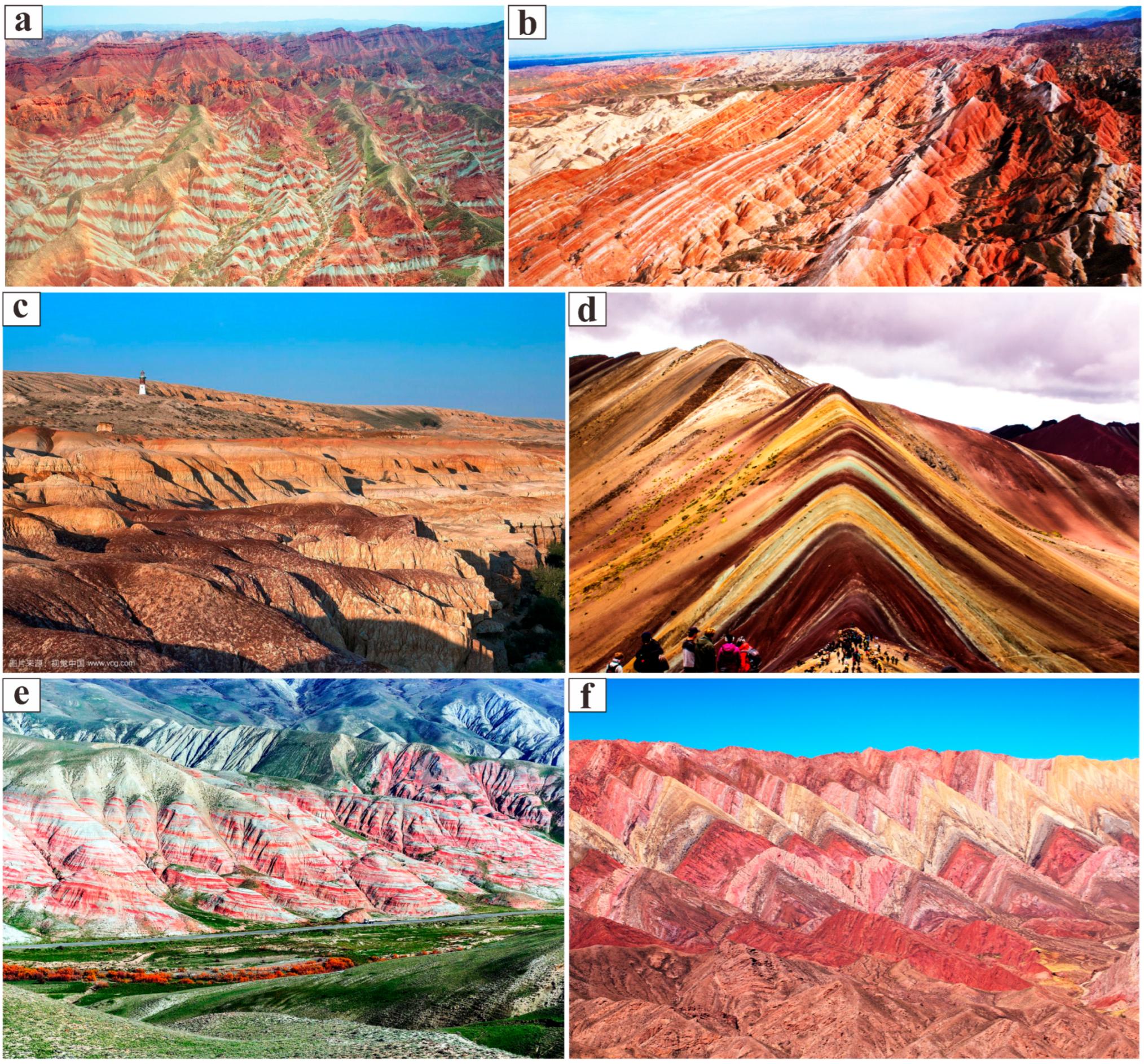
Figure 1. Representative global colorful red-bed landform landscapes. (a) “Ink-and-Wash Danxia” landform, Lanzhou region, China; (b) “Rainbow Danxia” landform, Zhangye UNESCO Global Geopark, China; (c) “Five-Color Beach” red-bed landform, Xinjiang, China; (d) Vinicunca (Rainbow Mountain), Andes, Peru [Photo: Diego Aldrin Abanto Ricce, Wikimedia Commons, CC BY-SA 4.0, https://commons.wikimedia.org/wiki/File:Monta%C3%B1aarcoirisperuabanto.jpg]; (e) Candy Cane Mountains, Caucasus, Azerbaijan [Image: Azerbaijan.travel, https://azerbaijan.travel/hike-candy-cane-mountains#gallery-3]; (f) Serranía de Hornocal, near Humahuaca, northwestern Argentina [Photo: Havardtl, Wikimedia Commons, CC BY-SA 4.0, https://commons.wikimedia.org/wiki/File:Serran%C3%ADa_de_Hornocal_up_close_near_Humahuaca.jpg].
Minerals 16 00360 g001
Figure 3. Geological structural map and Hongshanwan landform in the study area. (a) Geological structural map of the study area (according to 1:200,000 /250,000 Lanzhou regional geological map revision); (b) Hongshanwan landform in the Early Cretaceous lower member of the 2nd formation Hekou Group (H1H2a); (c) Hongshanwan landform in the Early Cretaceous upper member of the 2nd formation Hekou Group (H1H2b); (d) A-B geological profile.
Minerals 16 00360 g003
Figure 4. Field photographs and photomicrographs of the upper member of the second lithologic unit of the Early Cretaceous Hekou Group at the Shuiju Danxia section in the Lanzhou Basin. (a) Field photograph of reddish-brown silty mudstone; (b) field photograph of bluish-gray dolomitic mudstone; (c) field photograph of pale-yellow dolomitic mudstone; (d,e) photomicrographs of reddish-brown silty mudstone under plane-polarized light (PPL) (d) and cross-polarized light (XPL) (e), showing clay minerals (Cly), dispersed iron oxides (Lim), and fractures (Cra); (f,g) photomicrographs of bluish-gray dolomitic mudstone under plane-polarized light (PPL) (f) and cross-polarized light (XPL) (g), showing burrow-like bioturbation remnants (Dom) and clay minerals (Cly); (h,i) photomicrographs of pale-yellow dolomitic mudstone under plane-polarized light (PPL) (h) and cross-polarized light (XPL) (i), showing micritic dolomite (Dol), clay minerals (Cly), and dispersed iron oxides (Lim).
Minerals 16 00360 g004
Figure 5. SEM images of sedimentary minerals from the Hongshanwan landform in the Lanzhou Basin. (a,b) Red-brown silty mudstone showing flaky hematite (a) and aggregates of microgranular hematite (b). (c,d) Blue-gray dolomitic mudstone displaying platy muscovite crystals (c) and plagioclase crystals (d). (e,f) Pale-yellow dolomitic mudstone containing dominant clay mineral illite crystals (e) and honeycomb-like hematite crystals (f).
Minerals 16 00360 g005
Figure 6. Boxplot and normal distribution diagram of mineral compositions in sediment samples from the Hongshanwan landform, Lanzhou Basin.
Minerals 16 00360 g006
Figure 7. Major oxide abundance characteristics of the three types of sediment samples from the Hongshanwan landform in the Lanzhou Basin. (a) Cluster analysis diagram of major oxides. (b) Principal component analysis (PCA) diagram of major oxides.
Minerals 16 00360 g007
Figure 8. Chondrite-normalized rare earth element (REE) patterns of sediments from the Hongshanwan landform. Comparative data for the upper continental crust (UCC) and Post-Archean Australian Shale (PAAS) are from [13,69,70].
Minerals 16 00360 g008
Figure 9. Representative detrital zircon CL images and age distribution histograms from the upper section of the Early Cretaceous Hekou Group in the Lanzhou Basin. (a) Representative detrital zircon CL image. (b) Detrital zircon probability density plot (PDP). (c) Detrital zircon kernel density estimates plot (KDE).
Minerals 16 00360 g009
Figure 10. Spearman correlation heatmap of geochemical elements in sediment samples from the Hongshanwan landform, Lanzhou Basin.
Minerals 16 00360 g010
Figure 11. Discrimination diagrams for the paleoweathering intensity of the parent rocks of the Hongshanwan landform sediments in the Lanzhou Basin. (a) Relationship diagram of the Chemical Index of Alteration (CIA) vs. Index of Compositional Variation (ICV) for Hongshanwan landform sediments (fields after [10]); (b) Al2O3-(CaO* + Na2O)-K2O discrimination diagram for Hongshanwan landform sediments (fields after [44]). UCC = upper continental crust composition (fields after [13]).
Minerals 16 00360 g011
Figure 12. Elemental ratio diagrams for interpreting paleoclimatic conditions of the Hongshanwan landform sediments in the Lanzhou Basin. (a) Th-Th/U diagram (fields after [8]); (b) Th/U-CIA diagram (fields after [42]); (c) Sr/Cu-Th/U diagram (fields after [42]).
Minerals 16 00360 g012
Figure 13. Distribution characteristics of U/Th, Ni/Vo, and Ce/Ce* ratios in sediments from the Hongshanwan landform, Lanzhou Basin.
Minerals 16 00360 g013
Figure 14. Tectonic environment discrimination function of major elements for the Hongshanwan landform sediments in the Lanzhou Basin (fields after [96]), OIA = Oceanic Island Arc, CIA = Continental Island Arc, ACM = Active Continental Margin, PM = Passive Continental Margin.
Minerals 16 00360 g014
Figure 15. Cumulative probability plot of detrital zircon U-Pb ages relative to the depositional age of the Early Cretaceous upper member of the 2nd formation Hekou Group. Tectonic settings are after [38] (A: Convergent, B: collisional, C: extensional settings).
Minerals 16 00360 g015
Figure 16. Provenance discriminant function diagram for the sediments of the Hongshanwan landform in the Lanzhou Basin (fields after [97]).
Minerals 16 00360 g016
Figure 17. Trace element and REE provenance discrimination diagrams for the sediments of the Hongshanwan landform. (a) Th/Co vs. La/Co diagram; (b) ΣREE vs. (La/Yb) N diagram; (c) Ni vs. Cr diagram; (d) Eu/Eu* vs. (Gd/Yb) N diagram. Note: Eu* is the theoretical value for no chondrite-normalized Eu anomaly (Eu/Eu* = Eu N/ [(Sm N) (Gd N)1/2]) and subscript “N” represents a chondrite-normalized value (normalizing values after [13]).
Minerals 16 00360 g017
Disclaimer/Publisher’s Note: The statements, opinions and data contained in all publications are solely those of the individual author(s) and contributor(s) and not of MDPI and/or the editor(s). MDPI and/or the editor(s) disclaim responsibility for any injury to people or property resulting from any ideas, methods, instructions or products referred to in the content.