Article

Mineralogical Characteristics and Leaching Behavior of Sandstone-Hosted Uranium Ore: Implications for In Situ Recovery in the Zhenyuan Deposit, SW Ordos Basin, China

1
Beijing Research Institute of Chemical Engineering and Metallurgy, CNNC, Beijing 101149, China
2
PetroChina Changqing Oilfield Company, Xi’an 710018, China
3
China Shaanxi Nuclear Industry Group Geological Survey Institute Co., Ltd., Xi’an 710100, China
*
Author to whom correspondence should be addressed.
Minerals 2026, 16(4), 340; https://doi.org/10.3390/min16040340
Submission received: 24 February 2026 / Revised: 14 March 2026 / Accepted: 19 March 2026 / Published: 24 March 2026
(This article belongs to the Section Mineral Processing and Extractive Metallurgy)

Abstract

The mineralogical composition, textural characteristics, and uranium occurrence of sandstone-hosted uranium ores significantly influence the leaching performance during in situ recovery. This study investigates ore samples from the Zhenyuan uranium deposit, China, utilizing SEM, EPMA, XRD, and XRF to characterize their texture and mineralogy. Combined with thin-section leaching tests, batch stirring experiments, and pressurized column leaching experiments, the leaching behavior of pitchblende, associated gangue minerals, and the whole rocks were evaluated. The results indicate that: Uranium mainly occurs as nano-spherical and film-like pitchblende distributed along the edges of detrital grains and Ti-oxides. Minor uranium is incorporated into Ti-oxides and dolomite lattices via isomorphic substitution or adsorbed by chlorite. Under CO2 + O2 leaching conditions, pitchblende was almost completely dissolved, while U-bearing Ti-oxides experienced slight corrosion. Dolomite underwent partial dissolution, providing bicarbonate ions and improving rock permeability. Pyrite dissolution was limited during the early stage of leaching. The high dolomite content, low clay abundance, favorable pore structure, and easily leachable pitchblende suggest that the Zhenyuan deposit is well suited for CO2 + O2 in situ recovery. Increasing CO2 pressure is recommended to enhance dolomite dissolution and improve uranium recovery efficiency.

1. Introduction

With increasing global demand for clean and stable energy, nuclear power continues to play a vital role in energy transition strategies. Uranium, as the primary fuel for nuclear power generation, has become strategically important. Sandstone-hosted uranium deposits represent the most important uranium resource type in China and are predominantly exploited using in situ recovery (ISR) technology [1].
In ISR, groundwater is first pumped to the surface via extraction wells. Leaching reagents are then added to the groundwater, which is injected back into the ore-bearing aquifer through injection wells, dissolving uranium minerals and mobilizing uranium from the solid phase into the groundwater. The uranium-bearing groundwater is subsequently extracted to the surface and uranium is subsequently recovered at the surface using ion-exchange resins [1].
ISR uranium extraction is classified by the type of chemical reagent added: Acid leaching (sulfuric acid), alkaline leaching (sodium bicarbonate + ammonium bicarbonate), and CO2 + O2 leaching [1]. Since ISR minimally alters the ore’s original texture and mineral composition, ISR performance is strongly controlled by the mineralogical composition, textural features, and uranium occurrence of the ores [2,3,4,5,6,7]. Uranium minerals are typically the primary hosts of uranium in deposits [8], but different uranium minerals exhibit different dissolution kinetics under varying lixiviant systems, including acidic, alkaline, and CO2 + O2 systems [9,10,11]. Even the same uranium mineral may display different leaching behaviors depending on impurity content and crystal chemistry [12,13]. Generally, uranium minerals leach faster and more completely under acid conditions compared to other reagents. Beyond uranium mineral types, their contact relationships with other minerals and degree of liberation also affect leaching [14,15]. For instance, highly liberated uranium minerals have a greater contact area with leaching agents, facilitating extraction. Uranium minerals encapsulated by insoluble silicates like feldspar-quartz are difficult to access and leach. Those encapsulated by soluble minerals like calcite require higher CO2 concentrations to dissolve the calcite and increase uranium liberation. Additionally, other gangue minerals in the ore can significantly influence leaching process selection. Carbonate minerals significantly influence leaching chemistry. In acid systems, their dissolution increases acid consumption and may lead to CaSO4 precipitation, causing pore clogging and permeability reduction [7,16,17,18]. In contrast, under CO2 + O2 conditions, carbonate dissolution provides bicarbonate ligands necessary for uranyl complexation [13]. Sulfide minerals such as pyrite may consume oxygen and produce Fe(OH)3 precipitates, potentially impairing permeability [4,13,19,20,21]. Therefore, detailed mineralogical characterization is essential for optimizing ISR strategies.
This study focuses on the Zhenyuan sandstone-hosted uranium deposit in the southwestern Ordos Basin. By integrating mineralogical analysis with laboratory leaching experiments, we evaluate uranium occurrence, the dissolution behavior of uranium and gangue minerals, and identify the most suitable leaching process.

2. Geological Setting

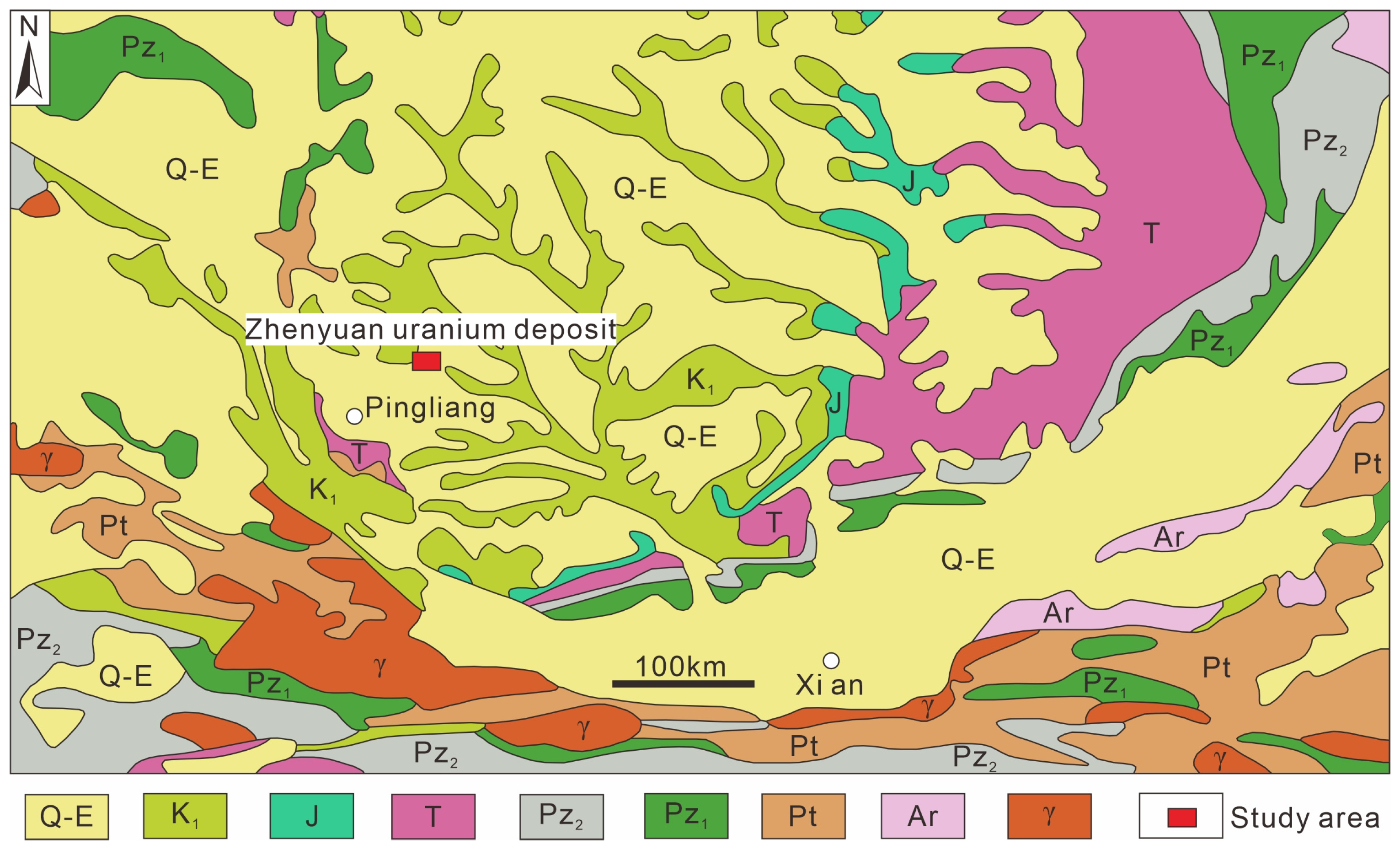
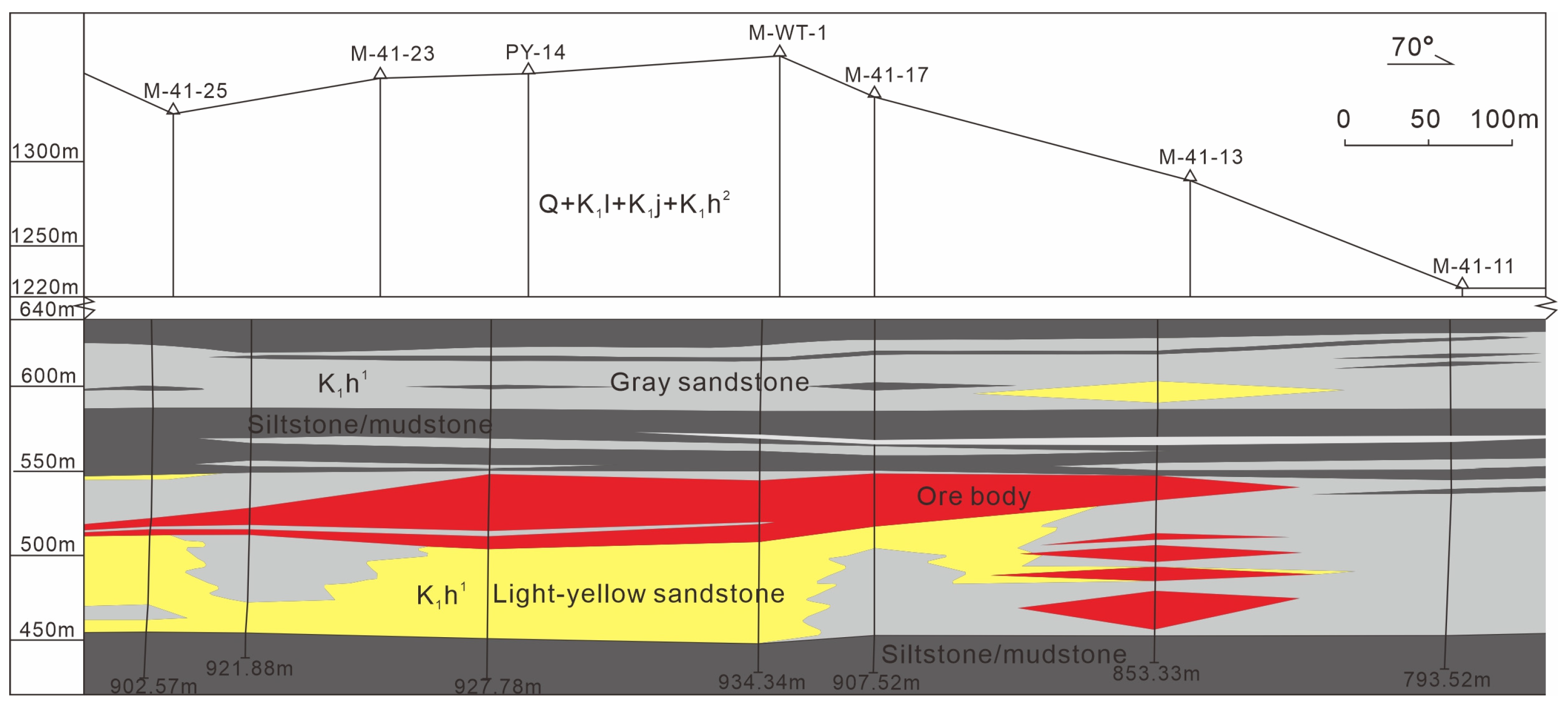
The Zhenyuan uranium deposit is located in the southwestern Ordos Basin and hosted in the Lower Cretaceous Huanhe Formation (Figure 1 and Figure 2). The Huanhe Formation conformably contacts the overlying Luohandong Formation and underlying Luohe Formation. Based on lithological assemblages, the Huanhe Formation is divided into upper and lower members. The upper member consists mainly of thick mudstone and siltstone, while the lower member features medium- to fine-grained sandstone interbedded with thin siltstone and mudstone. The ore bodies mainly occur within the lower member of the formation along oxidation–reduction transition zones. Orebody is approximately 4.5 km wide (north–south). It is hosted in gray to light-yellow sandstones at depths ranging from 681 to 932 m, with an average thickness of 15.95 m and an average grade of 0.0261% U.

3. Materials and Methods

Thirty core samples from five drills were collected for mineralogical investigation and leaching experiments. Thin sections were prepared for SEM observation and in-suit leaching tests. SEM analysis was conducted using a ThermoFisher (Waltham, MA, USA) Nova Nano SEM450 at the Beijing Research Institute of Uranium Geology, with an accelerating voltage of 15 kV and working distance of 5–10 mm. XRD analysis was performed using a Bruker (Billerica, MA, USA) Panalytical X’Pert PRO X-Ray diffractometer at the Beijing Research Institute of Uranium Geology, with operating conditions of 40 kV and 40 mA, and a scanning range of 5–70°. EPMA analyses were performed on JEOL (Tokyo, Japan) JXA-IHP200F at the Beijing Research Institute of Uranium Geology, with an accelerating voltage of 15 kV, working current of 10−8 A, working distance of 5–10 mm.
Thin-section leaching test: Thin-section leaching was conducted under conditions of 0.2 MPa CO2 + 1 MPa O2. The process involved introducing 0.2 MPa CO2 for 4 h, followed by 1 MPa O2 for 7 days at room temperature. Before leaching, the morphology of pitchblende and gangue minerals was observed, and their locations were documented using SEM. After leaching, the pre-observed uranium and gangue minerals were relocated for morphological comparison.
Acid Stirring Leaching: Each experiment used 60 g of ore sample mixed with 300 mL of sulfuric acid solution prepared with groundwater in ore-bearing aquifer, stirred for 24 h at room temperature.
Alkaline Stirring Leaching: Each experiment used 60 g of ore sample mixed with 300 mL of NH4HCO3 solution prepared with ore-bearing aquifer water, stirred for 72 h at room temperature.
CO2 + O2 Pressurized Stirring Leaching: Each experiment used 60 g of ore sample with 300 mL of ore-bearing aquifer water. During the experiment, 0.2 MPa CO2 was introduced for 3 h every 48 h, while O2 was introduced for the remaining time until the end.
CO2 + O2 Pressurized Column Leaching Test: The column leaching test was conducted under the following conditions: 700 g of ore sample was packed into a stainless-steel column with an inner diameter of 25 mm, resulting in a packing height of approximately 1000 mm, a packed volume of 491 mL, and a packing density of 1.43 kg/L. After packing, a certain volume of ore-bearing aquifer water was first passed through the column to pre-wet the ore bed. The effluent from this pre-wetting stage was collected and analyzed. A cumulative volume of 1200 mL of ore-bearing aquifer water effluent was obtained, with a uranium concentration of 14 mg/L. This corresponded to the leaching of 0.0168 g of metallic uranium, yielding an initial recovery of 7.74%. Subsequently, the formal CO2 + O2 pressurized leaching commenced by injecting a leaching agent prepared by saturating ore-bearing aquifer water with carbon dioxide and oxygen. The gas pressures were set at 0.2 MPa for CO2 and 1.0 MPa for O2. The effluent flow rate was controlled to simulate the hydrodynamic conditions of an underground in situ leaching operation. The effluent volume and uranium concentration were recorded daily. The leaching process continued until the uranium concentration in the effluent consistently fell below 3 mg/L, which lasted for a total of 68 days from the start of lixiviant injection. The final liquid (mL)-to-solid (mg) (L/S) ratio reached 5.18, and the cumulative leaching recovery was 68.45%.

4. Results

4.1. Mineralogical and Chemical Composition

Whole-rock and clay XRD analyses indicate that the mineral composition of sandstone samples from the Zhenyuan deposit is relatively consistent, primarily consisting of quartz (average 86.36 wt%), plagioclase (average 4.53 wt%), K-feldspar (average 2.72 wt%), dolomite (average 5.45 wt%) (Table 1). Clay minerals are mainly illite (average 85 wt%), kaolinite, and minor chlorite. Calcite content varies between 0 wt% and 5.3 wt%, present only in a few ore samples. Clay mineral content varies between 0.3 wt% and 4.4 wt% (average 1.68 wt%).
The chemical composition of ore from the lower Huanhe Formation is essentially similar to that of the surrounding rock, dominated by Si, Al, Ca, K, Mg, and Fe. SiO2 content is high, with average values of 83.97% in ore and 84.25% in wall rock, consistent with the high quartz content. Average Al2O3 content is 4.95% in ore and 5.06% in wall rock. The average content of the sensitive element CaO during ISR is 2.36% in ore and 2.13% in wall rock. Average MgO content is 1.16% and 1.11%, respectively. Average Fe2O3 content is 1.17% in both.

4.2. Ore Texture

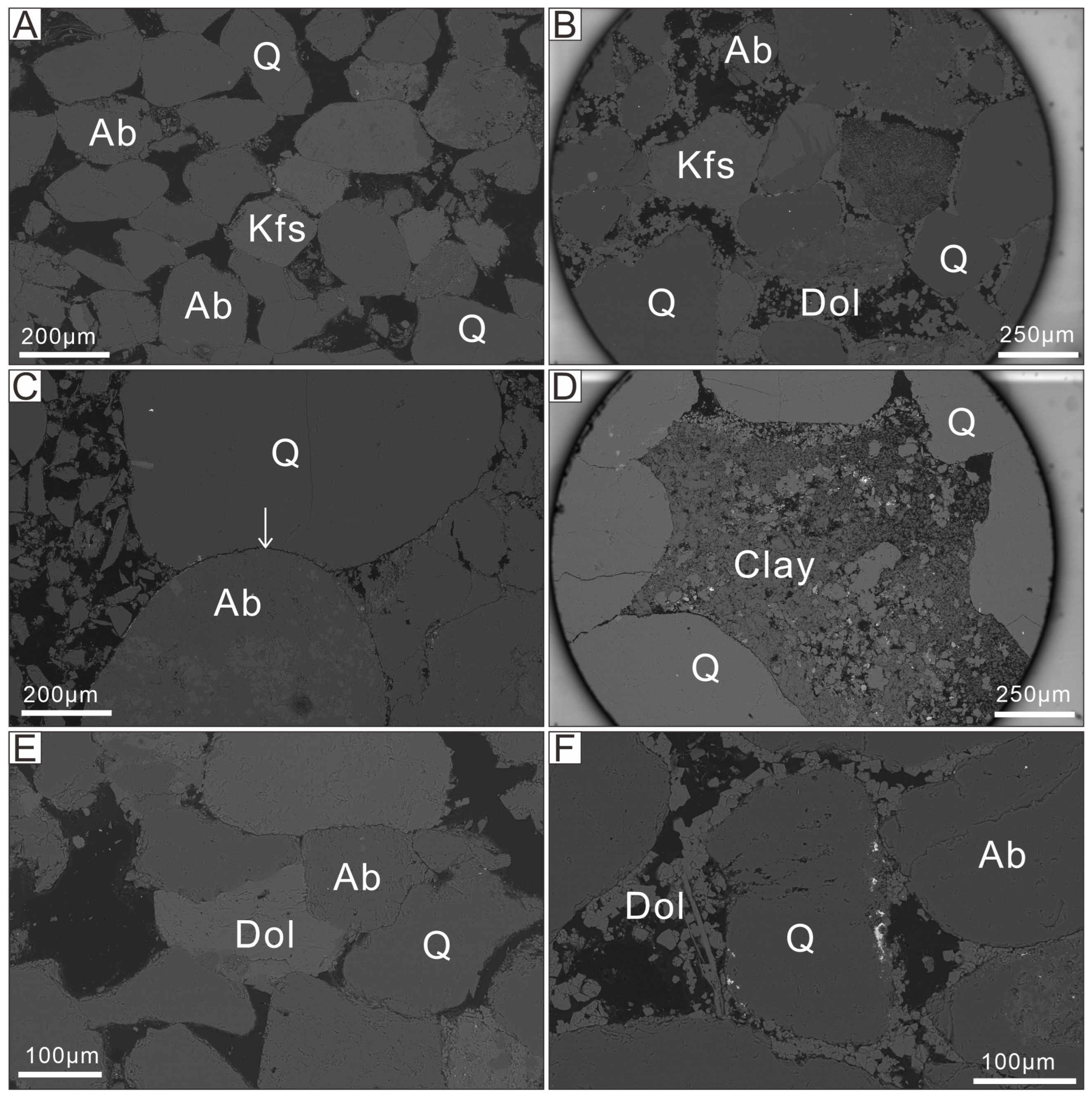
The ore is primarily light gray to gray, fine- to medium-grained feldspathic lithic sandstone and medium- to fine-grained feldspathic quartz sandstone. The ore is mainly composed of quartz, dolomite, plagioclase, K-feldspar, and clay minerals (Table 1), along with heavy minerals such as rutile, anatase, pyrite, and zircon. The ore exhibits an inequigranular sandy texture, with moderate to good sorting and subangular to subrounded roundness, primarily in a grain-supported framework with point contacts (Figure 3A,B). Cement is mainly dolomite, followed by minor sericite, chlorite, biotite, and iron oxides, distributed along intergranular spaces and edges of quartz and feldspar clasts (Figure 3C–F).
Feldspar and quartz constitute the sandstone framework (Figure 3A,B). Quartz mostly displays anhedral granular texture with relatively good roundness (subangular to subrounded). Some grains show secondary overgrowths at edges, with particle sizes ranging from 0.2 mm to 0.8 mm. Some grains contain micro-fractures. Pressure solution structures, forming stylolites or pressure-solution embayments, are common at contacts between quartz and other minerals (Figure 3C). Feldspar, primarily plagioclase and K-feldspar, is mostly subangular, with a minor portion being subrounded, and particle sizes ranging from 0.1 mm to 0.5 mm. Feldspar grains often contain micro-fractures. Plagioclase exhibits polysynthetic twinning and alterations such as argillization and sericitization. K-feldspar is mainly microcline, displaying cross-hatched twinning.
Carbonate minerals in the ore are predominantly dolomite and calcite (Table 1). Based on morphology, dolomite can be classified into two types (Figure 3E,F): Euhedral dolomite and anhedral dolomite. Euhedral dolomite particles exhibit rhombohedral structures, approximately 10 μm in size, distributed along the edges of feldspar and quartz clasts or filling pores (Figure 3F). Anhedral dolomite is elliptical, approximately 100–200 μm in size. Calcite particles show euhedral rhombic crystal structures, about 10 μm in size. Dolomite and calcite are independently distributed in the ore, with only a few samples containing both. Clay minerals fill pores in a flaky or vermicular form and are unevenly distributed, often occurring in clusters (Figure 3D).

4.3. Porosity and Permeability

Porosity measurements indicate ore porosity ranges between 18% and 29%, with an average of approximately 25% (Table 2). Over 90% of tested samples have porosity exceeding 20%. Gas permeability among samples varies between 67 mD and 2214 mD, with an average of approximately 640 mD. Over 80% of tested samples have gas permeability exceeding 200 mD. Liquid permeability ranges from 206 mD to 873 mD. Both gas and liquid permeability show a positive correlation with sample porosity. However, the variation in permeability is significantly greater than that in porosity, especially among samples with higher porosity, where permeability differences are more pronounced compared to samples with lower porosity.

4.4. Uranium Occurrence

SEM and EPMA results show that uranium in the Zhenyuan sandstone uranium deposit primarily exists as pitchblende. Additionally, a minor amount of uranium occurs in isomorphism within Ti-oxides and dolomite. Some uranium is also adsorbed by chlorite.
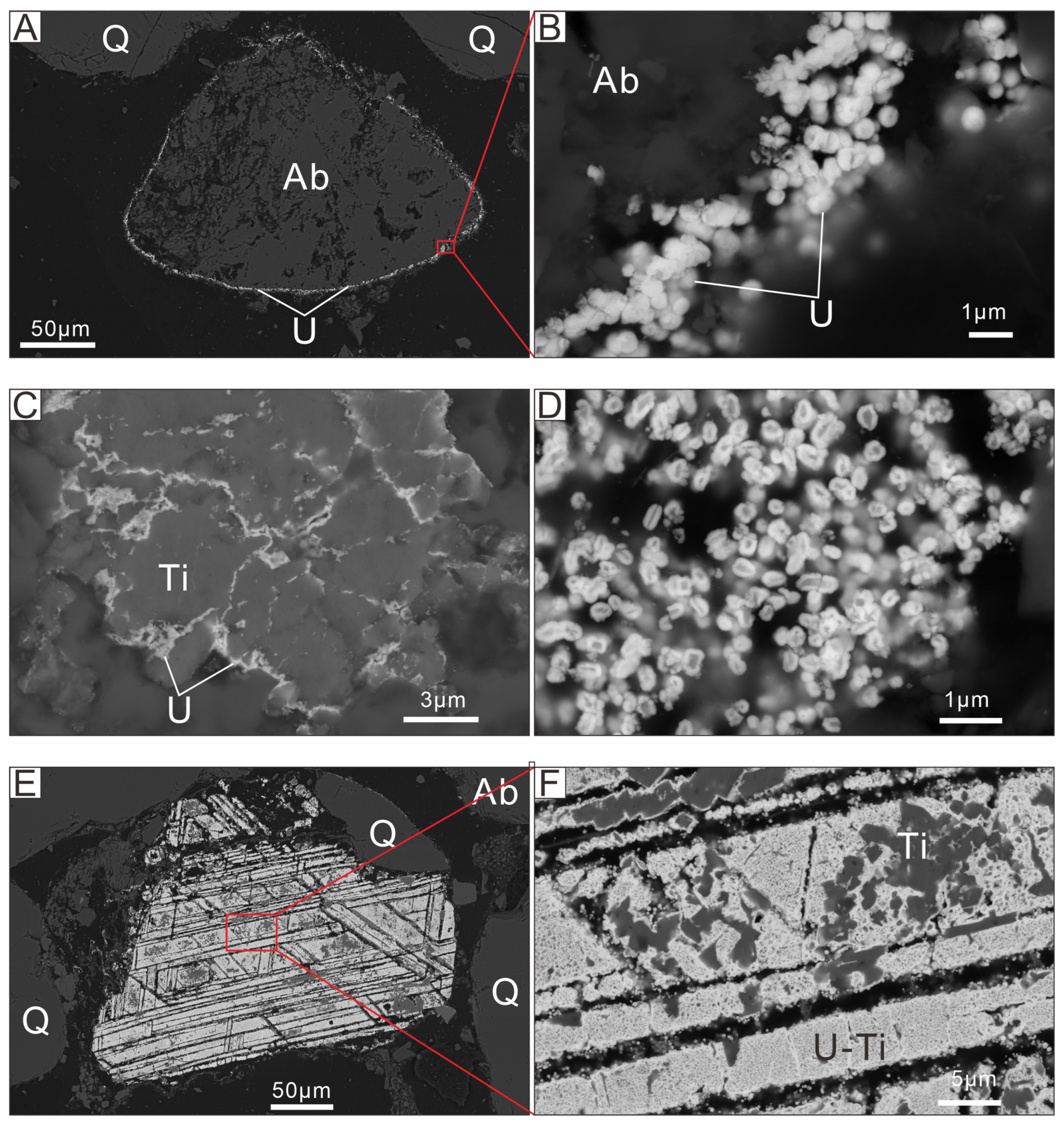
Pitchblende is primarily composed of uranium, with UO2 content ranging from 51.89 wt% to 82.15 wt% (average 71.6 wt%). It also contains certain amounts of Ca, Si, Ti, Na, P, S, Al, Pb, Fe, etc. Among these, Ca, Si, and Ti contents exceed 2 wt%, while other elements are generally below 2 wt% (Table 3). Uranium content in pitchblende shows a coordinated variation trend with calcium content, whereas silicon and titanium contents show an inverse relationship with uranium content. Based on morphology, pitchblende can be divided into two categories (Figure 4): One consists of nano-spherical particle aggregates (200–300 nm in diameter), mainly distributed along the edges of feldspar-quartz clasts or surrounding clay and organic matter (Figure 4A,B). Some nano-spherical uranium minerals are closely associated with Ti-oxides, distributed along the edges of euhedral Ti-oxides particles, forming core-mantle structures. Some nano-spherical pitchblende grows around nano-sized Ti-oxide cores (Figure 4D). Pitchblende also occurs as films growing on the edges of Ti-oxides (Figure 4C). Some titanium oxide and pitchblende intergrowths, forming Ti-oxides and pitchblende aggregates (Figure 4E,F).
Uranium occurring in isomorphism is mainly hosted in Ti-oxides and dolomite (Figure 5). Uranium content in Ti-oxides varies between 0 wt% and 9.2 wt%. Uranium content in clay varies between 0% and 0.68%, while in dolomite it varies between 0% and 0.09% (Tables S2–S4).

4.5. Leaching Experiments

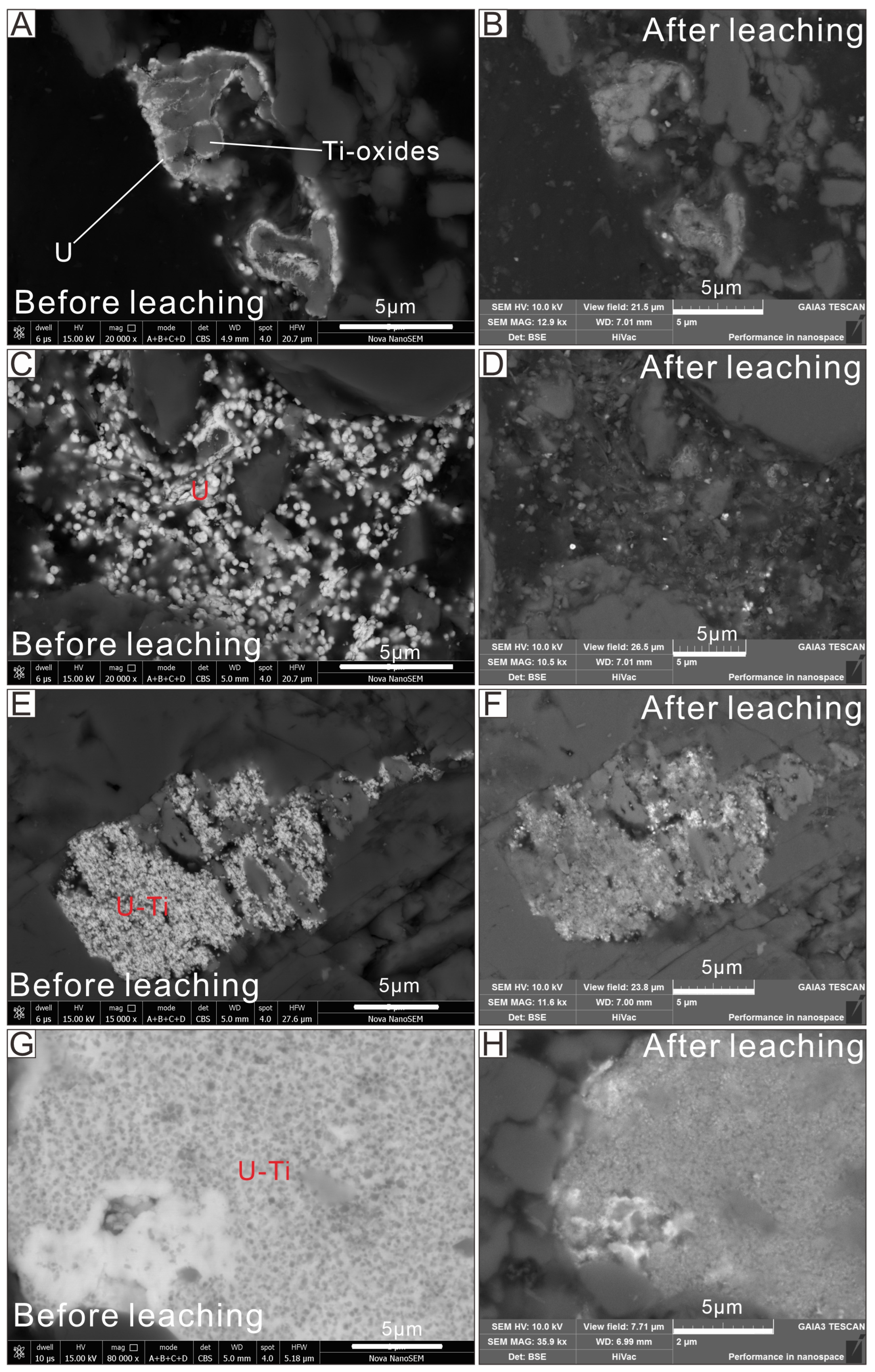
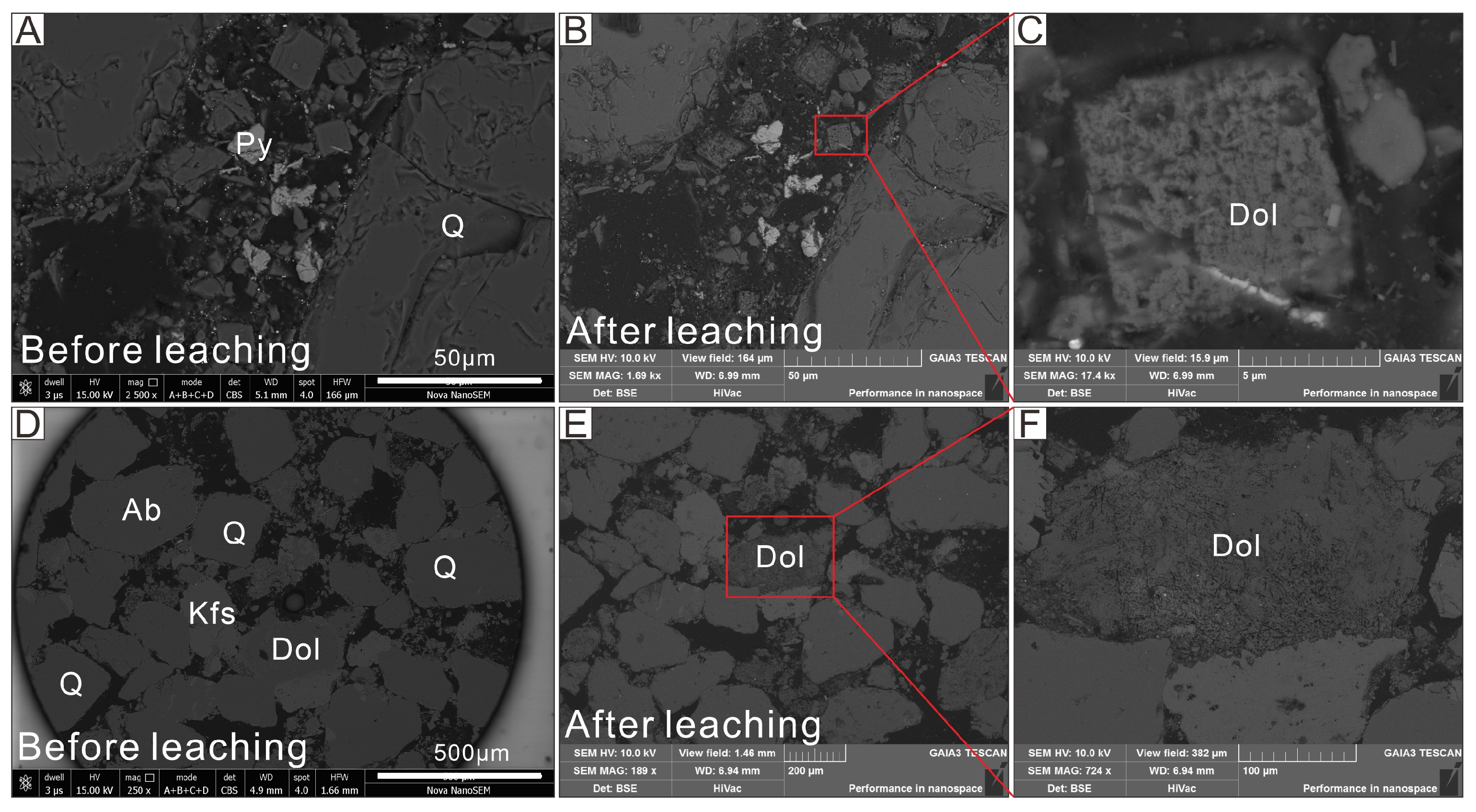
Thin-section leaching test: SEM observations revealed that nano-spherical pitchblende, film-like pitchblende distributed along Ti-oxides edges, and pitchblende forming aggregates with Ti-oxides all underwent significant dissolution, with most pitchblende dissolved and disappeared (Figure 6). Uranium-bearing Ti-oxides particles also exhibited partial dissolution (Figure 6B). Quartz and feldspar showed no observable dissolution features (Figure 6). Both euhedral and anhedral dolomite particles underwent partial dissolution during leaching, forming dissolution pits on mineral surfaces (Figure 7). Pyrite also showed slight dissolution, with surfaces becoming rougher after leaching compared to before (Figure 7).
For stirred leaching experiments, powder samples were derived from ores of different drill holes. These ores were crushed to their natural grain size and mixed. The major elements in the ore were quantitatively analyzed using XRF (Table 4), and uranium content was determined by chemical titration, yielding a value of 0.031%.
Acid Stirring Leaching: The leaching results show that as acid concentration increased from 5 g/L to 25 g/L, pH continuously decreased. Uranium concentration in the leachate increased from 9 mg/L to 56 mg/L, accompanied by an increase in leaching recovery from 14.52 wt% to 90.32 wt%. However, acid consumption per ton of ore also increased from 25 kg/t to 79.2 kg/t. Residual acid only appeared in the solution when sulfuric acid concentration exceeded 15 g/L, after which the rate of increase in acid consumption slowed significantly (Table 5).
Alkaline Stirring Leaching: Results showed that as NH4HCO3 concentration increased from 1.5 g/L to 3.0 g/L, uranium concentration increased from 30 mg/L to 38.0 mg/L, and leaching recovery increased from 48.39% to 61.29%. Using a 3 mg/L NH4HCO3 solution with additions of 0.1 g/L and 0.2 g/L KMnO4 showed that leaching recovery increased substantially with oxidant addition, exceeding 90%, indicating oxidizers effectively promote uranium leaching (Table 6).
CO2 + O2 Pressurized Stirring Leaching: Results showed that under an 8-day leaching cycle, as O2 pressure increased from 1 MPa to 2 MPa, leaching recovery increased from 70.97% to 82.26%. Under 1 MPa O2, as leaching duration increased from 5 days to 10 days, recovery increased from 69.35% to 74.19% (Table 7).
CO2 + O2 Pressurized Column Leaching Test: The results showed that final liquid (mL)-to-solid (mg) (L/S) ratio reached 5.18, and the cumulative leaching recovery was 68.45%. A peak uranium concentration of 158 mg/L was observed during the leaching, with an average concentration of 36.4 mg/L in the leachate. Compared to the results from previous CO2 + O2 pressurized column leaching tests on different ore samples, the outcome of this test was considered favorable.
During the leaching process, when the L/S ratio reached approximately 3.20, a continuous decline in both uranium and bicarbonate (HCO3) concentrations in the leachate was observed. To address this, the leaching agent preparation tank was depressurized, and fresh CO2 was injected at an increased pressure of 0.3 MPa to replenish the carbonate source. After 24 h of CO2 addition, O2 was introduced under pressure at 1.0 MPa. Subsequently, when the L/S ratio reached about 3.49, the O2 pressure was further increased to 1.3 MPa. Shortly after these adjustments in CO2 and O2 pressures, a minor peak of slightly elevated uranium concentration appeared in the leachate. Following this small peak, the uranium concentration continued to decrease until the end of the leaching experiment.

5. Discussion

The uranium occurrence state, the types and abundance of gangue minerals, and the pore structure of the ore are critical factors influencing the ISR efficiency of sandstone-hosted uranium deposits [2]. The combined observations and analyses by SEM-EDS and EPMA confirm that uranium in the Zhenyuan Deposit primarily exists as pitchblende (Figure 4). Additionally, a small fraction occurs as solid solution within Ti-oxides and dolomite lattices, while a trace amount is adsorbed onto chlorite (Figure 5, Table 3 and Tables S2–S4).
Pitchblende (uraninite) is the most economically significant uranium mineral globally. Compared to other economically important uranium minerals like coffinite and brannerite, pitchblende is more amenable to leaching [8]. The dissolution of pitchblende under CO2 + O2 leaching condition involves: (1) The oxidation of tetravalent uranium (U4+) to hexavalent uranium (U6+) on the surface; (2) binding of HCO32− at the U(VI) sites of the oxidized layer; and (3) detachment of the U(VI)-carbonato surface complex [21,22]. In the CO2 + O2 leaching system, oxygen (O2) acts as the primary oxidant. Meanwhile, dissolved CO2 forms carbonic acid (H2CO3), which dissociates to provide bicarbonate ions (HCO3). Additionally, the reaction between H2CO3 and carbonate minerals such as calcite and dolomite, produce HCO3, which then serves as a complexing ligand for uranyl ions (UO22+). The oxidation of U4+ under weakly acidic to near-neutral conditions is a pseudo-first-order reaction. The oxidation mechanism involves the adsorption of oxygen onto the pitchblende surface, the formation of pentavalent uranium (U5+), and its subsequent reaction with oxygen. Once sufficient U6+ accumulates, its reaction with remaining U4+ to form U5+ may become the rate-limiting step [8,12]. Ultimately, U6+ reacts with bicarbonate to form soluble uranyl carbonate complexes, predominantly uranyl tricarbonate [UO2(CO3)3]4− [6]. The thin-section leaching results demonstrate that pitchblende particles were completely dissolved under the experimental conditions of 0.2 MPa CO2 for 4 h followed by 1 MPa O2 for 7 days (Figure 6). This confirms the high leachability of pitchblende in this deposit. Moreover, both stirred tank and column leaching experiments yielded high uranium recovery rates, substantiating the effectiveness of the CO2 + O2 method for Zhenyuan ores. Importantly, SEM observations reveal that pitchblende in the Zhenyuan Deposit predominantly occurs as nano-spherical particles and as thin films (<2 μm thick) coating the surfaces of Ti-oxides. Such morphologies substantially increase the specific surface area of the uranium-bearing phases, maximizing the contact area with the lixiviant and thus favoring rapid dissolution (Figure 4). Furthermore, pitchblende was not found to be encapsulated by either refractory silicate minerals (e.g., quartz, feldspar) or readily soluble carbonates (e.g., calcite), indicating a high degree of mineral liberation. A high liberation degree is also conducive to efficient contact and reaction between uranium minerals and the leaching reagents. In addition to pitchblende, uranium also exists within Ti-oxide and dolomite lattices. The SEM observations from thin-section leaching experiments confirmed that both Ti-oxide and dolomite underwent partial dissolution to varying degrees. Therefore, this portion of uranium can also be extracted during the leaching process. In summary, the favorable uranium occurrence characteristics in Zhenyuan ores—primarily as accessible pitchblende with high specific surface area and liberation degree—are all advantageous for uranium extraction.
The types and abundances of gangue minerals also significantly influence uranium leaching. In Zhenyuan ores, quartz and feldspar account for an average of approximately 93.6 wt%, with quartz content typically exceeding 85 wt%. These framework silicate minerals are chemically stable under leaching conditions and react minimally with lixiviants, which is beneficial for the process. However, the ores also contain more than 5 wt% of dolomite and calcite. These carbonates are primarily distributed along the edges of quartz-feldspar framework grains, creating more complex and variable pore structures. Such complexity can increase turbulence and hydraulic resistance during the injection-production cycle, leading to higher injection pressures. Our analysis further indicates that in samples with comparable porosity, the presence of dolomite significantly reduces both gas and liquid permeability, suggesting a damaging effect on rock permeability. Under sulfuric acid leaching conditions, dolomite would react vigorously, resulting in unacceptably high acid consumption and increased economic costs for deposit exploitation. Moreover, this reaction promotes gypsum (CaSO4·2H2O) precipitation, potentially clogging the ore-bearing aquifer. Given the high carbonate mineral content in this deposit and the high acid consumption confirmed by stirred leaching tests, the sulfuric acid leaching method is not suitable for the Zhenyuan Deposit. In contrast, under CO2 + O2 leaching conditions, calcite dissolves completely, and dolomite undergoes significant partial dissolution (Figure 7). The dissolution of carbonate minerals enhances the bicarbonate concentration in the groundwater, providing essential ligands for uranium complexation and thus facilitating uranium extraction. The column leaching test results showed that when the L/S ratio reached approximately 3.2, the bicarbonate concentration in the leachate began to decrease, accompanied by a synchronous decline in uranium concentration (Table 8). This likely indicates that the inherent carbonate minerals in the ore were insufficient to supply the HCO3 required for sustained leaching. Notably, increasing the CO2 pressure subsequently led to a temporary increase in uranium concentration, highlighting the role of carbonate dissolution. In a practical ISR operation, where ore-bearing aquifer water is continuously recirculated between injection and production wells, bicarbonate ions would accumulate over time, further promoting leaching. Furthermore, porosity and permeability tests indicate that the Zhenyuan Deposit possesses relatively high porosity and permeability (Table 2). Both XRD and SEM results show that the clay mineral content in the ore is very low (Table 1 and Figure 1). The intergranular pore spaces are primarily filled with dolomite and calcite, or these minerals line the framework grain boundaries (Figure 1). Therefore, the dissolution of these carbonates during CO2 + O2 leaching can also improve the overall permeability of the deposit [23]. Additionally, the well-consolidated nature of the ore, coupled with low contents of clay and fine-grained quartz/feldspar particles within the pores, will help minimize particles migration during leaching. This reduces the risk of aquifer clogging and the associated decline in injection and production rates often encountered during ISR operations due to particle clogging. While the thin-section leaching confirmed that the dissolution of dolomite was limited at 0.2 MPa CO2, it also demonstrated that its dissolution not only contributes to bicarbonate ions but also enhances permeability. Thus, we recommend employing higher CO2 injection pressure during actual mining operations.
The Zhenyuan ores also contain minor pyrite. Pyrite is considered a significant oxygen-consuming mineral during CO2 + O2 leaching. Furthermore, its oxidation produces sulfate ions, which can combine with calcium ions to form gypsum precipitates, while ferric iron (Fe3+) forms iron hydroxide colloids, both potentially clogging the ore-bearing aquifer. However, the thin-section leaching results suggest that the degree of pyrite dissolution under 0.2 MPa CO2 + 1 MPa O2 was far less pronounced compared to pitchblende and dolomite (Figure 7). Therefore, in the initial leaching stages, pyrite may not be the primary oxygen consumer. Due to its relatively slow dissolution rate, the negative impact of its oxidation products (e.g., gypsum, Fe(OH)3) on permeability may also be limited initially. Nonetheless, as leaching progresses with continued pyrite dissolution, the permeability damage from these precipitates could increase over time.
Overall, the key characteristics of the Zhenyuan Deposit—high content of stable framework silicates (quartz, feldspar), well-consolidated rock fabric, significant but manageable carbonate mineral content, low sulfide (e.g., pyrite) abundance, and uranium primarily occurring in highly leachable pitchblende forms—collectively indicate excellent leachability. These features strongly suggest that the deposit is well-suited for exploitation using the CO2 + O2 ISR process. Additionally, we recommend that appropriately increasing the CO2 injection pressure during operation to enhance dolomite dissolution would further optimize leaching efficiency.


6. Conclusions

(1)
Uranium in the Zhenyuan Deposit predominantly exists as nano-spherical and film-like pitchblende. A minor portion occurs as solid solution within the crystal lattices of Ti-oxides and dolomite, while a trace amount is adsorbed onto clay minerals.
(2)
Under CO2 + O2 leaching conditions, pitchblende is effectively and completely dissolved. Dolomite undergoes significant partial dissolution, while pyrite exhibits the least dissolution among the studied minerals.
(3)
The Zhenyuan Sandstone Uranium Deposit is well-suited for exploitation using the CO2 + O2 in situ leaching process. Furthermore, to optimize the process, it is advisable to increase the CO2 injection pressure appropriately during operation to promote more extensive dolomite dissolution, thereby enhancing bicarbonate availability and ore permeability.

Supplementary Materials

The following supporting information can be downloaded at: https://www.mdpi.com/article/10.3390/min16040340/s1, Table S1: Porosity, gas permeability and liquid permeability of ore sample; Table S2: EPMA results of Ti-oxides; Table S3: EPMA results of clay; Table S4: EPMA results of dolomite.

Author Contributions

Conceptualization, C.H.; methodology, C.H.; investigation, C.H., S.C., Y.Z. (Ying Zhang), Z.L., X.X., J.D., Y.Z. (Yuhan Zou) and W.L.; data curation, J.D. and Y.Z. (Yuhan Zou); writing—original draft preparation, C.H.; writing—review and editing, C.H.; funding acquisition, C.H. and W.L. All authors have read and agreed to the published version of the manuscript.

Funding

This research was funded by China National Nuclear Corporation (Grant No. CNNC-JCYJ-202689 and CNNC-JCYJ-202332) and National Key Laboratory of Uranium Resources Exploration-Mining and Nuclear Remote Sensing (Grant No. NKLUR-WDZC-2025-05 and NKLUR-WDZC-2024-HHYY-03).

Data Availability Statement

The data in this article has been submitted to MDPI.

Acknowledgments

We would like to thank three anonymous reviewers for their constructive reviews. We also thank Liumin Deng at Beijing Research Institute of Uranium Geology for support during SEM, EPMA and XRD analysis.

Conflicts of Interest

Authors Chunru Hou, Zhengbang Liu, Jinxun Deng, Yuhan Zou and Wensheng Liao were employed by the company CNNC. Authors Shihai Chen and Ying Zhang were employed by the PetroChina Changqing Oilfield Company. Author Xiansheng Xie was employed by the company China Shaanxi Nuclear Industry Group Geological Survey Institute Co., Ltd. All authors declare that the research was conducted in the absence of any commercial or financial relationships that could be construed as a potential conflict of interest.

Abbreviations

The following abbreviations are used in this manuscript:
ISRIn situ recovery
QQuartz
AbAlbite
KfsK-feldspar
UPitchblende
TiTi-oxide
Chlchlorite

References

  1. Li, G.; Yao, J. A Review of In Situ Leaching (ISL) for Uranium Mining. Mining 2024, 4, 120–148. [Google Scholar] [CrossRef]
  2. Qiao, P.; Xiong, Q.; Ge, L.; Song, H.; Yu, H.; Yang, Y.; Wang, R.; Kang, S.; Zhou, Y.; Fan, Y. The influence of mineralogical characteristics and pH on uranium extraction via in-situ leaching: Preliminary case analysis of the Hadatu uranium deposit, China. Hydrometallurgy 2025, 235, 106492. [Google Scholar] [CrossRef]
  3. Ram, R.; Charalambous, F.A.; Mcmaster, S.; Pownceby, M.I.; Tardio, J.; Bhargava, S.K. Chemical and micro-structural characterisation studies on natural uraninite and associated gangue minerals. Miner. Eng. 2013, 45, 159–169. [Google Scholar] [CrossRef]
  4. Wang, B.; Luo, Y.; Li, X.; Liu, Y.Z.; Xu, C.R.; Zheng, Y.X.; Zhang, Y.H.; Zhou, Y.R. Water–Rock reactions in the acid leaching of Uranium: Hydrochemical characteristics and reaction mechanisms. J. Hydrol. 2024, 641, 131798. [Google Scholar] [CrossRef]
  5. Wang, P.; Tan, K.; Li, Y.; Liu, Z.; Li, C.; Tan, W.; Tian, Y.; Huang, W. Effect of Pyrite on the Leaching Kinetics of Pitchblende in the Process of Acid In Situ Leaching of Uranium. Minerals 2022, 12, 570. [Google Scholar] [CrossRef]
  6. Weng, H.; Yuan, Y.; Liu, Z.; Hou, C. Simulation study on mineral dissolution and precipitation during the “CO2+O2” in-situ leaching process. Uranium Min. Metall. 2025, 4, 19–84. [Google Scholar]
  7. Youlton, B.J.; Kinnaird, J.A. Gangue–reagent interactions during acid leaching of uranium. Miner. Eng. 2013, 52, 62–73. [Google Scholar] [CrossRef]
  8. Shilov, V.P.; Yusov, A.B.; Peretrukhin, V.F.; Delegard, C.H.; Gogolev, A.V. Oxidation of U(IV) by atmospheric oxygen in pH 1.5–7.4 aqueous solutions. J. Alloys Compd. 2007, 444, 333–338. [Google Scholar] [CrossRef]
  9. Casas, I.; de Pablo, J.; Gimenez, J.; Torrero, M.E.; Bruno, J.; Cera, E.; Finch, R.J.; Ewing, R.C. The role of pe, pH, and carbonate on the solubility of UO2 and uraninite under nominally reducing conditions. Geochim. Cosmochim. Acta 1998, 62, 2223–2232. [Google Scholar] [CrossRef]
  10. De Pablo, J.; Casas, I.; Giménez, J.; Molera, M.; Rovira, M.; Duro, L.; Bruno, J. The oxidative dissolution mechanism of uranium dioxide. i. The effect of temperature in hydrogen carbonate medium. Geochim. Cosmochim. Acta 1999, 63, 3097–3103. [Google Scholar] [CrossRef]
  11. Torrero, M.E.; Baraj, E.; Pablo, J.D.; Giménez, J.; Casas, I. Kinetics of corrosion and dissolution of uranium dioxide as a function of ph. Int. J. Chem. Kinet. 1997, 29, 261–267. [Google Scholar] [CrossRef]
  12. Eary, L.E.; Cathles, L.M. A Kinetic Model of UO2 Dissolution in Acid, H2O2 Solutions That Includes Uranium Peroxide Hydrate Precipitation. Metall. Trans. B 1982, 14, 325–334. [Google Scholar] [CrossRef]
  13. Qiu, W.; Yang, Y.; Song, J.; Que, W.; Liu, Z.; Weng, H.; Wu, J.; Wu, J. What chemical reaction dominates the CO2 and O2 in-situ uranium leaching? Insights from a three-dimensional multicomponent reactive transport model at the field scale. Appl. Geochem. 2022, 148, 105522. [Google Scholar] [CrossRef]
  14. Avasarala, S.; Torres, C.; Ali, A.M.S.; Thomson, B.M.; Spilde, M.N.; Peterson, E.J.; Artyushkova, K.; Dobrica, E.; Lezama-Pacheco, J.S.; Cerrato, J.M. Effect of bicarbonate and oxidizing conditions on U(IV) and U(VI) reactivity in mineralized deposits of New Mexico. Chem. Geol. 2019, 524, 345–355. [Google Scholar] [CrossRef] [PubMed]
  15. Vogt, T.C.; Strom, E.T.; Johnson, W.F.; Venuto, P.B. In-situ leaching of Crownpoint, NM, uranium ore. iii. laboratory study of strong leaching systems: Sodium hypochlorite. Soc. Pet. Eng. J. 1985, 25, 875–880. [Google Scholar] [CrossRef]
  16. Hu, M.; Niu, Q.; Yuan, W.; Wang, W.; Chang, J.; Du, Z.; Wang, Q.; Zheng, Y.; Shangguan, S.; Qi, X.; et al. Evolution characteristic and mechanism of microstructure, hydraulic and mechanical behaviors of sandstone treated by acid-rock reaction: Application of in-situ leaching of uranium deposits. J. Hydrol. 2024, 643, 131948. [Google Scholar] [CrossRef]
  17. Zhang, T.; Sun, T.; Miao, A. Preliminary Exploration Report on the Mengba Uranium Deposit, Zhenyuan County, Gansu Province, from Exploration Lines M5 to M49; China National Nuclear Corporation (CNNC): Beijing, China, 2024.
  18. Zhao, K.; Sun, Z.; Du, C.; Zhou, Y.; Li, G.; Lui, J.; Xu, L. Blockage and uranium migration via CO2+O2 leaching within autoclave: A test study from Mengqiguer deposit in Yili Basin, Northwest of China. J. Radioanal. Nucl. Chem. 2022, 331, 2631–2644. [Google Scholar] [CrossRef]
  19. Fan, Y.; Song, H.; Wang, Z.; Gan, N.; Zhang, C.; Zhao, B.; Xu, Z.; Tan, Y. The behavior of pyrite during in-situ leaching of uranium by CO2+ O2: A case study of the Qianjiadian uranium deposit in the Songliao Basin, northeastern China. Ore Geol. Rev. 2024, 169, 106085. [Google Scholar] [CrossRef]
  20. Luo, J.; Cui, G.; Yang, D.; Huo, C.; He, G.; Fu, H.; Yang, C. Impact of the existence of carbonate minerals on the performance of CO2+O2 during in situ leaching in uranium deposits. Nucl. Eng. Technol. 2025, 57, 103821. [Google Scholar] [CrossRef]
  21. Niu, Q.; Wang, J.; He, J.; Yuan, W.; Chang, J.; Wang, W.; Yuan, J.; Wang, Q.; Zheng, Y.; Shang, S. Evolution of pore structure, fracture morphology and permeability during CO2+O2 in-situ leaching process of fractured sandstone. Energy 2025, 315, 134348. [Google Scholar] [CrossRef]
  22. Reynolds, H.S.; Ram, R.; Pownceby, M.I.; Yang, Y.; Chen, M.; Tardio, J.; Jones, J.; Bhargava, S.K. Kinetics of uranium extraction from coffinite—A comparison with other common uranium minerals. Trans. Nonferrous Met. Soc. China 2018, 28, 2135–2142. [Google Scholar] [CrossRef]
  23. Luquot, L.; Gouze, P. Experimental determination of porosity and permeability changes induced by injection of CO2 into carbonate rocks. Chem. Geol. 2009, 265, 148–159. [Google Scholar] [CrossRef]
Figure 1. Geological map of Zhenyuan sandstone-hosted uranium deposit [17]. Q-E: Neogene to Quaternary; K1: Upper Cretaceous; J: Jurassic; T: Triassic; Pz2: Upper Paleozoic; Pz1: Lower Paleozoic; Pt: Proterozoic; Ar: Archean.
Minerals 16 00340 g001
Figure 2. Geological cross-section of Zhenyuan sandstone-hosted uranium ore body [17].
Minerals 16 00340 g002
Figure 3. Microstructures of ore samples in Zhenyuan uranium deposit. (A) Quartz and feldspar constitute the framework of ore, with detrital grains exhibiting an elliptical shape, grain sizes averaging around 200 μm, and good sorting; (B) Dolomite acts as the cementing material, filling the majority of the pore spaces; (C) Pressure-solution structures are developed at the contact interfaces between quartz and feldspar (White arrow); (D) Clay minerals partially fill the pores within the sandstone; (E) Anhedral dolomite displays an interstitial texture, forming the cement; (F) Dolomite grains distributed along grain boundaries. Q: Quartz; Ab: Ablite; Kfs: K-feldspar; Dol: Dolomite.
Minerals 16 00340 g003
Figure 4. (A,B) Nano-spherical pitchblende distributed along the edges of Albite grains; (C) Pitchblende developed along the internal fissures of titanium oxides; (D) Film-like pitchblende occurring along the edges of micro-nano titanium oxide particles; (E,F) Dense symbiotic aggregates formed by pitchblende and titanium oxides. Q: Quartz; Ab: Ablite; Dol: Dolomite; U: Pitchblende; Ti: Ti-oxides; U-Ti: Pitchblende and Ti-oxides aggregates.
Minerals 16 00340 g004
Figure 5. (A,B) Uranium hosted in titanium oxide crystals; (C,D) Uranium associated with clay minerals; (E,F) Uranium occurring in dolomite. The number with plus sign indicates the location of EPMA analysis. Dol: Dolomite; Q: Quartz; Ab: Albite; Chl: Chlorite.
Minerals 16 00340 g005
Figure 6. The morphology of pitchblende before and after leaching under CO2 + O2 condition. (A,B) Film-like pitchblende completely dissolved and disappeared after leaching, while uranium-bearing titanium oxides exhibited slight corrosion, showing reduced particle size and curved edges; (C,D) Nano-spherical pitchblende fully dissolved after leaching; (EH) Pitchblende closely symbiotic with titanium oxides completely dissolved, leaving behind residual titanium oxides.
Minerals 16 00340 g006
Figure 7. The morphology of dolomite and pyrite before and after leaching under CO2 + O2 condition. (AC) The dissolution pits and cavities were developed in euhedral dolomite grains after CO2 + O2 leaching. The surface of pyrite grains becomes rougher. (DF) Quartz, plagioclase and K-feldspar grains show no evidence of dissolution, dissolution occur in dolomite grains.
Minerals 16 00340 g007
Table 1. XRD results of ore samples in Zhenyuan uranium deposit (wt%).
Sample NumberQuartzK-FeldsparPlagioclaseCalciteDolomiteClay
M-WT-5-KY-00180.64.76.7/6.51.5
M-WT-5-KY-00584.02.95.8/6.11.1
M-WT-5-KY-00679.14.94.7/8.23.1
M-WT-5-KY-00782.13.24.6/8.02.2
M-WT-5-KY-01088.01.93.0/5.91.3
M-WT-5-KY-01288.71.72.4/5.71.5
M-29-31-KY-00187.63.03.84.0/1.5
M-29-31-KY-00287.44.07.4//1.2
M-29-31-KY-00385.73.76.31.21.81.3
M-29-31-KY-00489.03.16.4//1.5
M-29-31-KY-00592.32.2/5.3/0.3
M-29-31-KY-00885.92.34.3/5.71.9
17-15-KY-00188.92.22.9/4.11.9
17-15-KY-00289.20.8//8.21.7
17-15-KY-00488.32.12.3/6.90.3
17-15-KY-00587.62.54.3/4.90.7
17-15-KY-00792.41.31.9/3.90.6
M-47-15B-KY-00286.12.53.53.7/4.1
M-47-15B-KY-00486.32.93.34.42.60.4
M-47-15B-KY-00889.11.93.1/4.31.5
M-47-15B-KY-01092.41.8//4.01.8
M-47-15B-KY-01391.41.02.4/3.02.3
M-47-15B-KY-01486.22.63.5/6.61.2
M-47-15B-KY-01591.71.33.2/2.80.9
M-37-21-24(10/12)80.93.66.9/4.24.4
M-37-21-26(6/36)89.52.73.3/3.11.4
M-37-21-27(10/19)81.73.97.4/6.50.4
M-37-21-28(2/28)79.23.37.5/7.22.8
M-37-21-28(7/28)82.53.04.6/8.01.9
M-37-21-30(5/7)77.14.56.8/8.13.6
Table 2. Porosity, liquid permeability, and gas permeability of ore samples.
Sample NumberPorosity (%)Liquid Permeability (mD)Gas Permeability (mD)
M-37-21 26(6/36)29.27389.22443.08
M-37-21 20(19/24)25.18792.561692.04
M-37-21 28(7/28)26.54430.28678.71
M-29-31 KY00120.35205.97202.87
M-29-31 KY00223.38589.31916.00
M-29-31 KY00427.84873.432214.13
Table 3. EPMA results of pitchblende in ore samples (wt%).
CaOUO2Y2O3SiO2MgOTiO2FeOLa2O3Ce2O3ZrO2P2O5SO3PbOAl2O3Na2OTotal
12.8252.070.126.830.271.130.830.000.210.100.640.100.694.200.6670.67
23.6764.270.059.110.033.560.450.000.460.050.830.070.812.842.1788.37
33.1168.490.033.500.054.530.430.000.000.040.350.080.700.280.5382.12
42.7053.490.026.140.743.810.920.110.160.150.280.090.743.940.9674.25
53.0879.910.001.810.241.230.560.250.440.130.650.060.350.321.4590.48
63.8579.760.002.340.001.080.470.000.030.040.400.050.000.370.6088.99
73.8580.280.004.150.090.740.460.000.000.000.320.000.101.190.4691.64
83.5972.320.222.640.002.880.700.000.131.290.360.050.080.360.3684.98
93.4678.930.141.020.001.900.340.000.000.100.340.150.210.170.4587.21
103.5272.010.002.970.013.500.380.000.410.000.320.020.160.710.4484.45
113.0769.580.000.910.004.340.150.070.000.000.340.010.100.090.6179.27
123.8482.150.002.090.003.080.140.000.220.180.270.100.040.680.4293.21
133.8167.950.032.380.453.260.840.000.250.130.360.030.090.310.3580.24
143.2979.850.001.460.002.380.230.280.060.270.380.100.040.130.5188.98
155.1073.940.082.090.003.070.460.140.220.171.370.160.170.390.5687.92
163.5770.7.00.025.820.122.140.390.000.290.120.360.050.000.750.3484.67
174.673.830.003.190.42.541.500.250.220.000.670.030.110.650.3288.31
184.7881.630.090.930.010.380.240.070.000.090.920.070.080.160.3189.76
194.6473.160.0011.500.330.040.560.190.000.000.580.050.062.010.4993.61
204.7778.930.062.170.061.380.370.000.000.020.810.020.120.590.4289.72
214.5351.890.006.760.000.000.160.330.030.000.800.040.211.480.9067.13
224.4271.250.040.710.033.640.330.000.060.000.800.030.100.160.5082.07
234.7480.020.021.250.010.670.540.070.220.120.910.020.130.110.3289.15
243.6363.460.059.490.120.000.090.000.230.000.640.051.752.961.5384.00
254.4070.940.042.090.040.000.240.000.000.050.660.021.850.680.6981.7
263.1257.410.0011.570.040.060.270.230.400.040.540.011.495.211.8982.28
273.7858.280.0412.730.020.000.170.000.000.000.680.011.484.051.8383.07
284.6471.290.072.400.221.940.480.000.190.080.880.011.800.540.2784.81
294.0279.970.050.980.030.500.280.000.220.000.730.012.160.070.4189.43
304.1879.150.001.780.141.620.470.000.090.000.550.020.290.280.2788.84
314.4568.640.021.210.033.830.220.000.660.020.870.080.410.280.481.12
324.2876.940.051.220.003.280.320.00.000.130.470.020.520.080.3087.61
330.0077.340.003.720.202.570.430.000.280.100.400.000.211.250.5887.08
343.3464.820.002.500.114.850.710.220.190.100.330.040.553.160.3581.27
353.4771.060.001.440.023.220.390.610.030.300.460.100.521.210.4383.26
363.2164.60.005.130.134.160.410.250.350.130.450.040.530.911.0681.36
373.5469.370.001.010.083.050.330.320.280.110.370.120.480.320.4879.86
383.4874.540.021.320.084.820.570.420.220.090.420.000.570.280.5087.33
393.7566.560.021.150.113.570.430.140.130.140.430.140.490.480.3477.88
403.6972.950.070.990.083.180.510.000.160.170.730.110.840.270.8784.62
413.8279.820.080.790.102.040.140.140.430.170.730.120.920.080.8490.22
423.8381.060.060.760.102.220.510.180.030.160.650.070.850.070.5491.09
433.5873.930.020.640.095.380.560.000.370.060.710.120.650.080.4686.65
Table 4. XRF results of experimental samples before leaching (wt%).
SiO2CaOAl2O3MgOK2ONa2OFe2O3TiO2P2O5
78.7006.9006.1703.2001.9701.4600.8860.2000.178
SO3WO3UMnOClSrORb2OZrO2ZnO
0.1520.0280.0270.0260.0260.0110.0060.0060.003
Table 5. Sulfuric acid Stirring leaching results.
H2SO4 (g/L)pHEh (mv)U (mg/L)Residual Acid (g/L)Acid Consumption of Ore (kg/t)Leaching Rate (wt%)
55.8910390.0025.014.52
105.2412160.0050.08.06
152.49291450.0075.072.58
201.26357564.1779.290.32
Table 6. Alkaline Stirring Leaching results.
NH4HCO3 (g/L)U (mg/L)pHEh (mV)Leaching Rate (wt%)
1.530.08.3313148.39
2.034.08.2912954.84
2.537.08.2216059.68
3.038.08.2315561.29
Table 7. CO2 + O2 Pressurized Stirring Leaching results.
O2 Pressure (MPa)U (mg/L)pHEh (mV)Leaching Rate (wt%)
1.044.07.2219770.97
1.545.07.1420372.58
2.051.07.8318882.26
Table 8. The results of CO2 + O2 Pressurized Column Leaching Test.
Leachate Volume (mL)Total Volume (mL)U (g/L)U (g)Leaching Rate (wt%)Liquid-Solid RatiopHEh (mV)
3153150.15800.0497730.680.458.54170
653800.08800.0057233.310.548.60170
604400.12400.0074436.740.638.36184
905300.12300.0110741.840.768.36197
746040.08200.0060744.640.868.44200
646680.05700.0036546.320.958.15209
657330.05200.0033847.891.058.22213
768090.04600.0035049.491.168.21214
949030.03700.0034851.091.298.31216
589610.03300.0019051.971.378.37216
8210430.03300.0027153.221.498.18221
9011330.02800.0025254.381.628.10222
8812210.02500.0022055.401.748.08227
8913100.02100.0018756.261.878.08234
10414140.01700.0017757.072.027.88239
9315070.01700.0015857.802.157.95239
9516020.01500.0014358.462.297.90242
8616880.01400.0012059.012.417.86243
7617640.01400.0010659.502.527.85247
7718410.01300.0010059.962.63
6519060.01400.0009160.382.72
12020260.01500.0018061.212.898.13200
12321490.01500.0018562.063.078.10204
9022390.01500.0013562.693.207.58194
10323420.01500.0015563.403.35
3923810.01600.0006263.683.40
3024110.01700.0005163.923.44
3124420.01700.0005364.163.498.22207
3024720.01700.0005164.403.538.00209
5525270.01900.0010564.883.617.79214
5525820.01700.0009465.313.697.68217
3926210.01500.0005965.583.748.26350
10727280.01200.0012866.173.908.50351
8028080.01000.0008066.544.018.53345
15029580.00800.0012067.094.238.56336
13030880.00700.0009167.514.418.50334
11031980.00600.0006667.824.578.50331
13033280.00500.0006568.124.758.31334
11534430.00200.0002668.244.928.06341
18036230.00260.0004768.455.187.61361
Disclaimer/Publisher’s Note: The statements, opinions and data contained in all publications are solely those of the individual author(s) and contributor(s) and not of MDPI and/or the editor(s). MDPI and/or the editor(s) disclaim responsibility for any injury to people or property resulting from any ideas, methods, instructions or products referred to in the content.