Article

The Geochronology and Geochemistry of Zircon and Apatite from the Shenshan Epimetamorphic Rocks in Ningdu, China: Implications for Ion-Adsorption-Type REE Metallogenesis


1
National Key Laboratory of Uranium Resources Exploration-Mining and Nuclear Remote Sensing, East China University of Technology, Nanchang 330013, China
2
Key Laboratory of Ionic Rare Earth Resources and Environment, Ministry of Natural Resources, Ganzhou 341000, China
3
Chinese Academy of Geological Sciences, Beijing 100037, China
4
The 7th Geological Team of Jiangxi Provincial Bureau of Geology, Ganzhou 341000, China
5
Chongqing Institute of Geology and Mineral Resources, Chongqing 401120, China
*
Author to whom correspondence should be addressed.
Minerals 2026, 16(3), 324; https://doi.org/10.3390/min16030324
Submission received: 22 January 2026 / Revised: 10 March 2026 / Accepted: 17 March 2026 / Published: 19 March 2026
(This article belongs to the Special Issue Advances in Granite Geochronology and Geochemistry)

Abstract

In recent decades, ion-adsorption-type rare earth element (iREE) deposits have been widely documented in the weathering crusts of granitic and volcanic rocks and their geological characteristics and genetic mechanisms extensively studied. Ion-adsorption-type REE mineralization was documented for the first time in the weathered crust overlying the epimetamorphic rocks in Ningdu County, China. In contrast to well-documented granite-derived weathering profiles, investigations of epimetamorphic rocks as protoliths for such REE deposits remain limited, particularly regarding the mineralogy of REE-bearing phases and the geochronology and geochemistry of their parent rocks. To address this gap, the present study combines comprehensive petrographic and mineralogical analyses of REE-mineralized Shenshan Formation phyllites with the U–Pb dating of zircon and apatite and trace element geochemical investigations. U–Pb zircon and apatite geochronology yields a protolith age of ca. 785 Ma for Shenshan Formation metamorphic rocks, consistent with mid-Neoproterozoic magmatism. REE-bearing minerals in the Shenshan Formation phyllites comprise allanite-(Ce), apatite, cerianite-(Ce), monazite-(Ce), rhabdophane-(La), rutile, Y-bearing thorianite and xenotime-(Y). Among these, apatite is the most abundant and likely the principal source of ionic REEs in the deposit. Ti-in-zircon thermometry indicates crystallization temperatures of 641–749 °C (mean ~704 °C), reflecting a prolonged magmatic–hydrothermal evolution. This extended history chiefly controlled the differentiation and redistribution of rare earth elements (REEs), thus governing their availability for subsequent supergene enrichment. Zircon-based oxygen fugacity (fO2) estimates a range from −31.4 to −9.9 (mean −17.9), consistent with reduced magmatic conditions. Trace element correlation diagrams for zircon and apatite indicate that the intrusion underwent an extensive fractional crystallization of accessory phases (zircon, monazite, apatite, titanite, rutile) and plagioclase. The distribution patterns of trace elements further suggest that the Shenshan Formation protolith formed in a continental margin arc or arc-related orogenic belt setting, with geochemical signatures characteristic of an S-type granite. The Shenshan Formation phyllites in southern Jiangxi exhibit high REE abundances and host a labile assemblage of weatherable REE-bearing minerals, providing an optimal material framework for ion-adsorption-type REE deposits and indicating substantial mineralization potential.

1. Introduction

Rare earth elements (REEs) comprising lanthanides with atomic numbers 57–71, together with yttrium (Y, Z = 39) and scandium (Sc, Z = 21), are economically important for a wide range of high-technology applications and are often referred to as “industrial vitamins” or rare earth metals [1,2]. Numerous countries have designated these minerals as strategic critical mineral resources [3]. China remains the world’s foremost producer of rare earth elements, particularly heavy rare earth minerals [2,4,5].
Since 1969, hundreds of ion-adsorption rare earth element (iREE) deposits have been identified in South China [6]. More recently, similar deposits have also been reported in Brazil [7], Laos [8], Madagascar [9], Malawi [10], and Vietnam [11]. IREE deposits form through the weathering and leaching of REE-enriched parent rocks, such as volcanic, metamorphic, basaltic, and carbonate rocks [12]. Among these, granite is the most significant progenitor rock and is uniquely capable of generating heavy rare earth element deposits [2,13,14]. The conventional view holds that sedimentary and metamorphic rocks are generally unsuitable as parent rocks for the formation of iREE deposits [6]. First, monazite, xenotime, and zircon are highly resistant to weathering, which limits the release of dissolved rare earth ions. Second, muddy siltstone and phyllite are dense and relatively impermeable and develop only thin weathering crusts, conditions that restrict the enrichment of rare earth elements [6].
The recent discovery of iREE mineralization in weathering crusts developed on low-grade metamorphic rocks in the Ganzhou region [6,15,16,17,18,19,20] has expanded exploration models beyond traditional granite-hosted systems. However, progress in fundamental understanding has lagged: whereas magmatic geochemical indicators reliably predict REE enrichment in granites, no analogous framework exists for metamorphic protoliths. Prior work has documented whole-rock geochemistry [16,17,18,21], vertical weathering profiles [16,17,18,19,21], and clay mineralogy [6,22], but these studies remain largely descriptive and lack mechanistic integration. Critical gaps include (i) the formation age and tectonic setting of the metamorphic protolith; (ii) the genetic and provenance relationship between that protolith and iREE mineralization; and (iii) the identity and paragenesis of the REE-bearing mineral assemblage and the controls on its development. Establishing a comprehensive genetic model—linking the protolith’s tectono-sedimentary origin through metamorphic and hydrothermal evolution to supergene weathering—is therefore essential to unravel iREE mineralization processes in low-grade metamorphic terrains and to build predictive exploration frameworks.
To evaluate the potential of epimetamorphic rocks to host viable ion-adsorbed rare earth element (iREE) deposits, we investigated: (1) the age and origin of their protolith; (2) the identity and abundance of REE-bearing minerals; and (3) the magmatic–geochemical conditions that preconditioned these rocks for mineralization. Our objectives are to date the protolith, elucidate its petrogenesis and source materials, and thereby establish a foundation for mineralization modeling and theoretical research on iREE deposits.

2. Geological Setting

Ningdu County, in southern Jiangxi Province under the jurisdiction of Ganzhou City, lies on the inner margin of the Cathaysian Block along the Eurasian–West Pacific subduction zone [6,15] (Figure 1a). It straddles the junction of the Wuyi and Luoxiao blocks—on the western flank of the Wuyi Uplift and within the central Luoxiao Fold Belt—and occupies the northern sector of the eastern Nanling tectonic zone, where it merges into the Wuyi–Daiyun neocathaysian structural system. The region also forms the southeastern segment of the Mesozoic circum–Pacific tectonic belt and coincides with the intersection of the eastern Nanling latitudinal belt and the southern Wuyishan NE–NNE-trending belt. Stratigraphy is dominated by Proterozoic, Cambrian, Cretaceous, and Quaternary formations [15,16]. Intense tectonism and episodic magmatism have driven the exceptional enrichment of tungsten, tin, niobium, tantalum, uranium, and rare earth elements [6].
Epimetamorphic rocks in Ganzhou are predominantly Neoproterozoic and Cambrian in age. Neoproterozoic strata, in ascending order, comprise the Shenshan, Kuli, Shangshi, Shabahuang, Hongshan, Bali, Xiafang, and Laohutang formations; Cambrian units include the Niujiuhe, Gaotan, and Shuishi formations [16,18,19]. Except for a continuous belt in northeastern Ganzhou, these metamorphic sequences occur sporadically—fragmented by Mesozoic granitic intrusions and locally overlain by Mesozoic to Quaternary sedimentary cover [18].
Ganzhou lies at the southern margin of the subtropical zone, with a mean annual temperature of 20 °C and approximately 1400 mm of rainfall [6,18]. Its hilly, gently sloping terrain promotes intense chemical weathering and the formation of thick weathering crusts [6]. Both granitic- and metamorphic-derived crusts are notably enriched in rare earth elements. In Ningdu County, the weathering of metamorphic rocks has yielded confirmed REE reserves of nearly 50,000 tons [15]. Across the region, some 600 km2 of similar exposed metamorphic formations suggests significant potential for further exploration [15,18]. The Shenshan Formation, in the southern Jiangnan Orogenic Belt (Ningdu County, Ganzhou City, Jiangxi Province), comprises epimetamorphic rocks of the Nanhua System, deposited in the Neoproterozoic within a post-arc basin along the Cathaysia Block’s northern margin. This formation is a key host for ion-adsorption-type rare earth element (REE) deposits.

3. Sampling and Analytical Methods

3.1. Geological Overview of Sampling Location

The sampling sites were located on a small hill within the scope of the REE exploration area in Ningdu County (Figure 1b). To ensure the representativeness of the samples, weakly weathered bedrocks from the Shenshan Formation were collected from multiple locations.
The sampling site lies within an intermontane basin and dome-shaped, low- to moderate-elevation hills (elevation 220–500 m; relative relief 40–100 m), where erosion is subdued. Well-developed folds characterize a stratified sequence of shallowly metamorphosed, late Proterozoic Qianbailou Group rocks. The Shenshan Formation occupies anticline axial zones, whereas the Kuli Formation fills synclinal cores; together they form tight, linear folds that generate complex, predominantly east–west-trending structural patterns. Regional magmatic lithologies are dominated by Caledonian granites. Exposed stratigraphic units include the Shenshan and Kuli formations (Qianbailou Group); the Shangshi, Shabahuang, and Hongshan formations (Nanhua Group); and the Sinian and Cambrian systems (Figure 1b). Primary iREE ore hosts are lateritic weathering crusts developed on the Shenshan and Kuli formations. The Shenshan Formation comprises principally phyllite with subordinate schist, whereas the Kuli Formation consists predominantly of metamorphosed tuffaceous and clastic lithologies [17,18,19].

3.2. Analytical Methods

Six samples were prepared as thin sections, while the remainder were ground to a 40–60-mesh fraction. Zircon and apatite grains were hand-picked under a binocular microscope, mounted in epoxy resin, and polished for subsequent analysis.
Petrographic thin sections were examined under plane- and cross-polarized light using a ZEISS Axio Scope A1 polarizing microscope. OP-CL images of apatite were acquired using a CITL CL8200 MK5-2 cathodoluminescence microscope. Zircon and apatite backscattered electron (BSE) and cathodoluminescence (CL) imaging, U-Pb geochronology, and trace element analyses were performed at the National Key Laboratory of Uranium Resources Exploration-Mining and Nuclear Remote Sensing, East China University of Technology (Nanchang, China). BSE and CL images were acquired on a ZEISS Sigma 300 VP scanning electron microscope equipped with HDBSD and CL8200 MK5 detectors and an Oxford energy-dispersive X-ray spectrometer, operating at ~15 kV and 100 nA [23].
Zircon and apatite were selected for U–Pb dating and trace element analysis because they serve as robust chronometers, preserve magmatic signatures, and host rare earth elements in the study lithology. The U-Pb dating of zircon and apatite was carried out using an Agilent 7900 inductively coupled plasma mass spectrometer (ICP-MS) coupled with a GeoLasHD 193 nm laser ablation (LA) system. Helium gas carrying the ablated sample aerosol was mixed with the argon make-up gas via a T-connector into the ICP-MS [24]. Zircon U-Pb isotopic analyses were conducted using laser ablation parameters of a 5 Hz repetition rate, a 32 μm spot size, and an energy density of 3.5 J cm−2. Zircon standard 91500 [25] served as the external standard for mass bias correction, and the Plešovice standard [26] was used to monitor analytical accuracy. Apatite U-Pb isotopic analyses utilized a 5 Hz repetition rate, a 44 μm spot size, and an energy density of 4 J cm−2. The MAD apatite standard [27] was used for the external correction of U-Pb ratios and apatite standard 401 [28] for quality control. For trace element analyses of both minerals, the NIST SRM 610 glass standard [29] was used to correct for elemental fractionation. Each analytical measurement included 20 s of background signal acquisition followed by 45 s of sample ablation. Offline data processing—including the selection of sample and blank intervals, correction for instrumental sensitivity drift, and calculation of elemental concentrations, U-Th-Pb isotope ratios, and ages—was conducted with ICPMSDataCal 11.0 [30,31]. Zircon U-Pb concordia diagrams, weighted mean age calculations, and apatite U-Pb Tera–Wasserburg diagrams were generated with Isoplot/Ex_ver3 [32]. In situ trace element analyses of zircon and apatite were performed using a laser ablation system operated at a frequency of 6 Hz, with a spot size of 44 μm and a laser energy density of 4 J/cm2. For the quantification of trace element concentrations in individual minerals, glass reference materials NIST 610, NIST 612, BHVO-2G, BCR-2GA, and BIR-1G [29,33] were employed for multi-standard external calibration without the use of an internal standard [30]. Each time-resolved analysis consisted of approximately 20 s of background signal acquisition followed by 40 s of sample ablation signal collection. The offline processing of the analytical data—including the selection of sample and background intervals, correction for instrumental sensitivity drift, and the calculation of elemental concentrations—was carried out using the software ICPMSDataCal 11.0 [31].

4. Results

4.1. Petrography and Micromineralogy

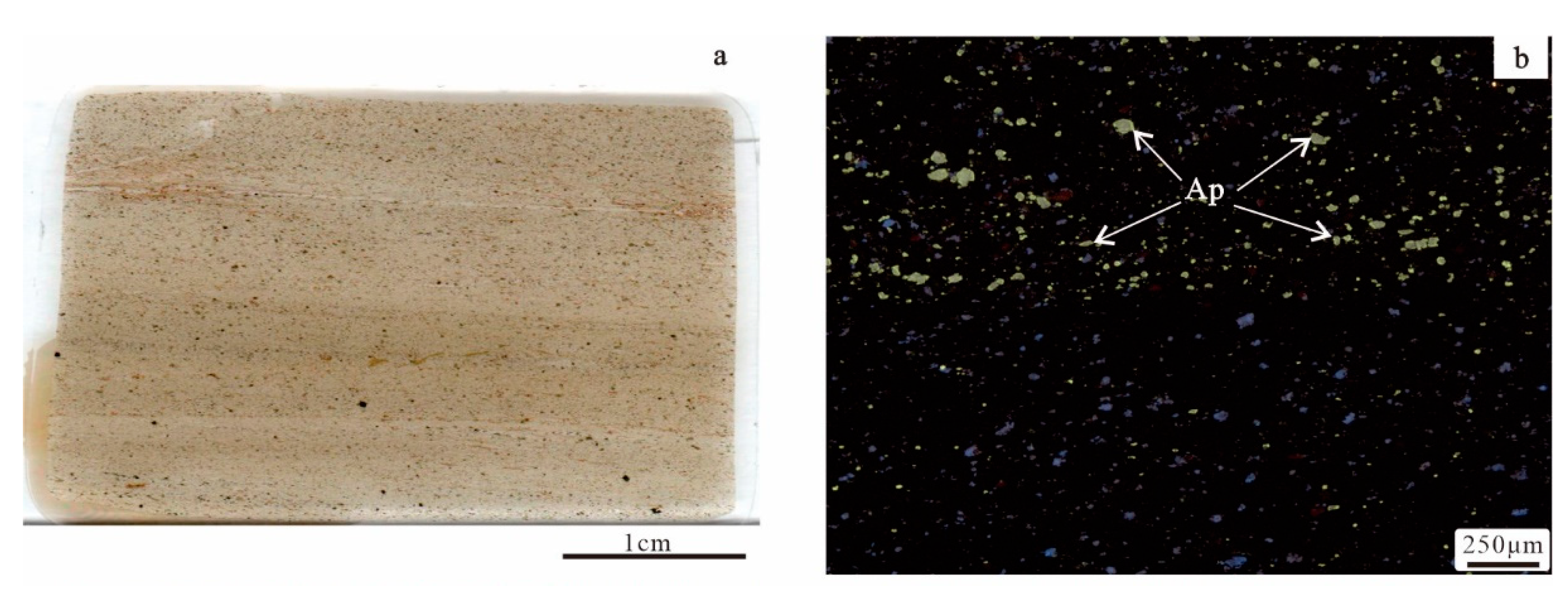
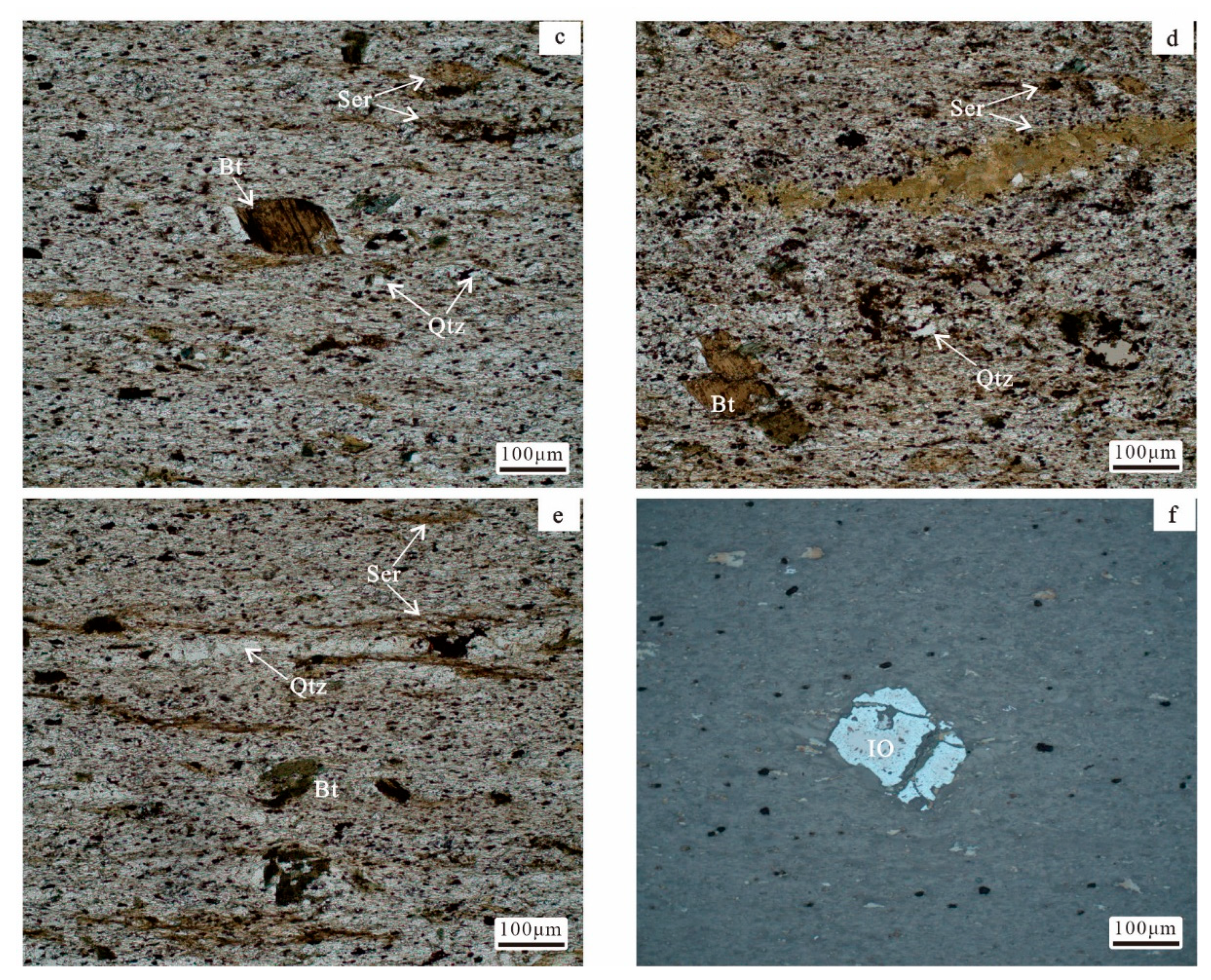
Rock samples from the Shenshan Formation are predominantly light-gray phyllites (Figure 2) with a microscopic foliated metamorphic structure and silky phyllitic texture. Muscovite flakes (0.05–0.10 mm) with a preferred orientation compose ~70% of the rock volume; the remainder consists of uniformly distributed, subangular quartz grains (0.01–0.06 mm). Some thin sections show distinct layering (Figure 2a). The mineral assemblage includes sericite, quartz, plagioclase, biotite, and abundant apatite grains (Figure 2b).
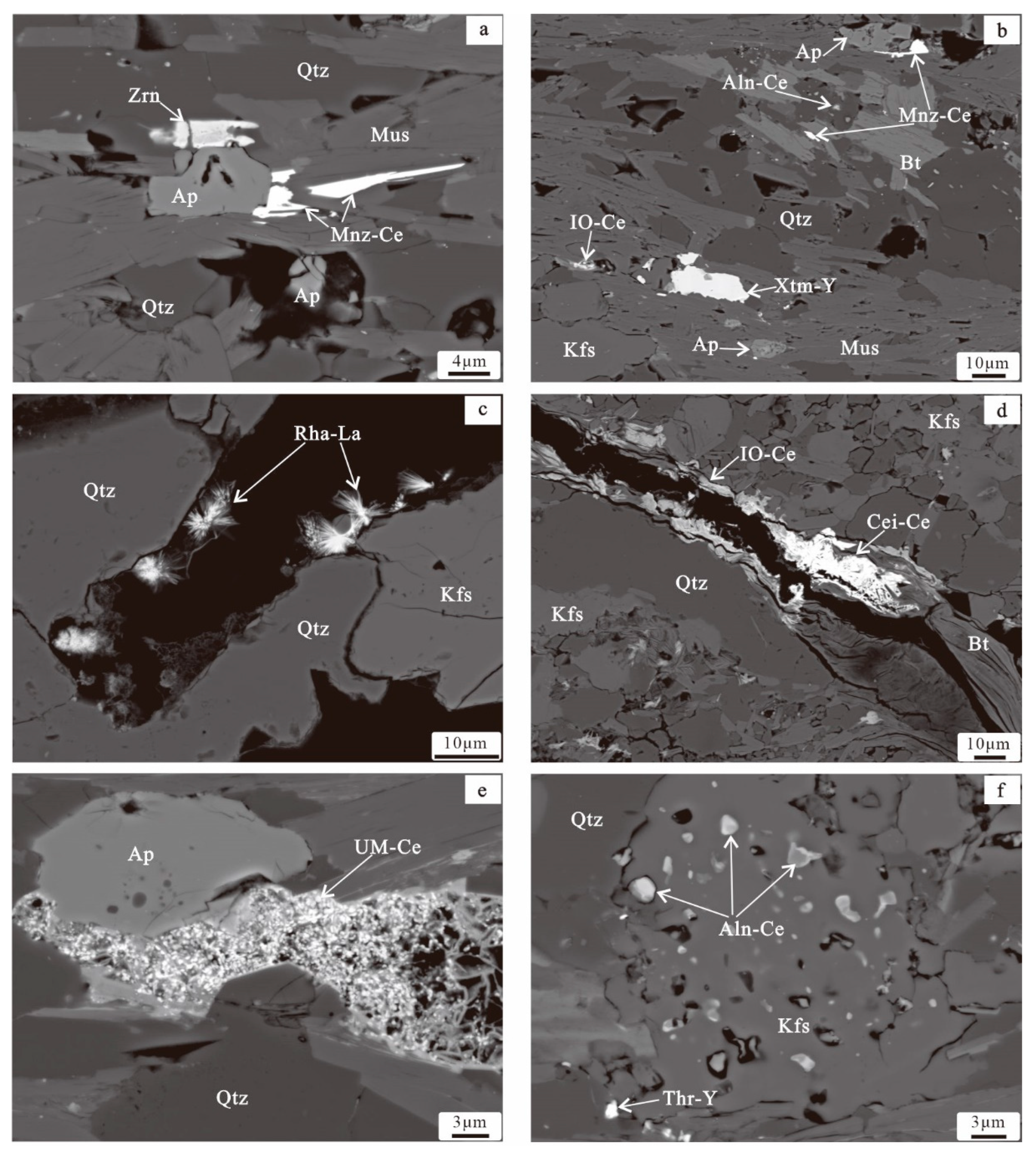
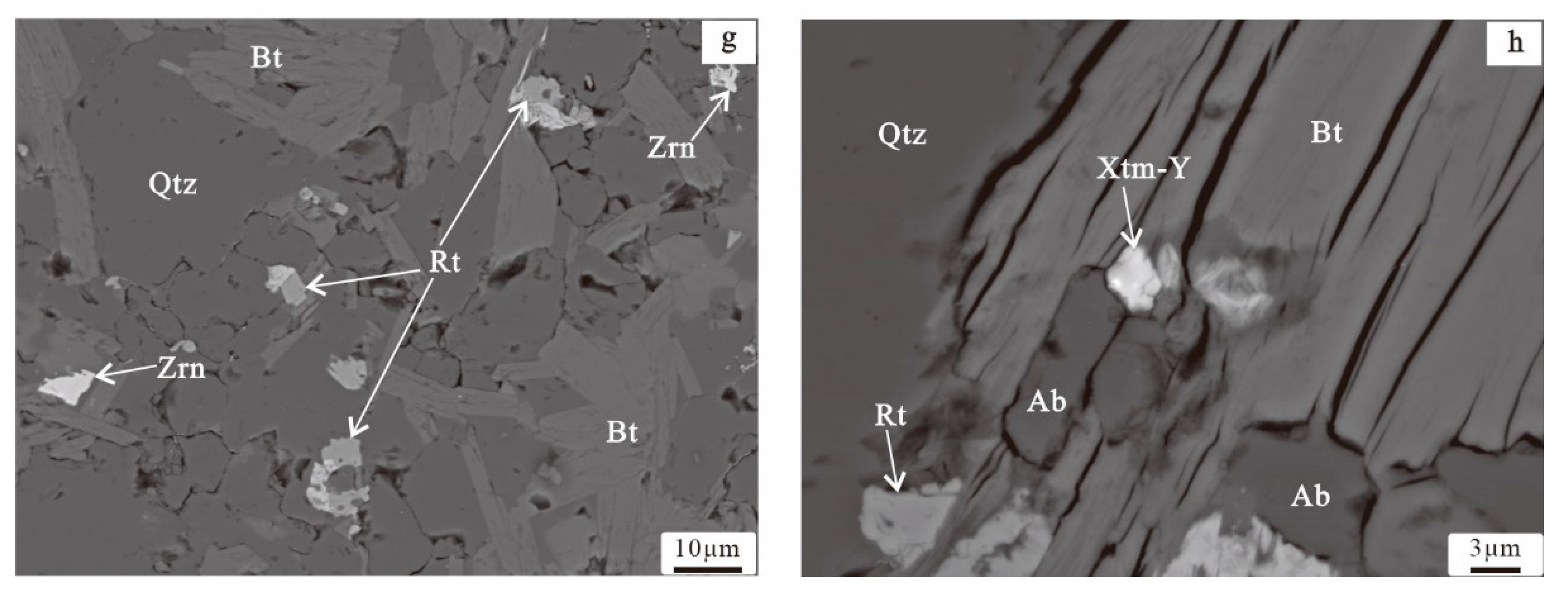
SEM–EDS analyses of the Shenshan bedrock identified three rare earth mineral groups: phosphates, silicates, and oxides. REE phosphates: (i) Apatite commonly occurs in thin sections, exhibiting well-developed columnar morphologies with granular cross-sections (Figure 2b and Figure 3a,e). Grain sizes are in the range of 1 μm ~ >100 μm. The crystals occur interstitially among feldspar and quartz or as inclusions in black mica fragments, indicating a detrital origin. EDS analysis shows a rare earth composition dominated by light rare earth elements, with minor yttrium. (ii) Monazite-(Ce), enriched in light rare earth elements, is widespread in metamorphic bedrock. Grain sizes vary widely, most measuring several tens of micrometers. Under the microscope, monazite often appears as impregnated aggregates along intergranular fractures in biotite and can be difficult to distinguish. Discrete grains occur as well-formed elliptical or irregular crystals, sometimes flattened (Figure 3a,b). (iii) Xenotime-(Y), a mineral enriched in heavy rare earth elements, is widely distributed but typically occurs at lower concentrations compared to monazite-(Ce). It commonly occurs in intergranular fractures of host minerals and may coexist with phases such as rutile and monazite. It generally exhibits well-defined ellipsoidal or irregular granular morphologies, with fine particle sizes predominantly ranging from 1 to 10 μm (Figure 3b,h). (iv) Rhabdophane-(Ce) occurs sporadically as microcrystalline aggregates or veinlets in quartz fissures (Figure 3c). Grains are typically <10 μm. Chemical analyses show enrichment in light rare earth elements. REE silicates: Allanite-(Ce), enriched in light rare earth elements, occurs sparingly compared to other rare earth minerals. It appears as rounded or elliptical grains within K-feldspar and other host minerals and along grain boundaries and intergranular fractures, with sizes typically <10 μm (Figure 3b,f). REE oxides: (i) REE-rutile, enriched in yttrium and heavy rare earth elements, occurs less commonly than other rare earth minerals. It appears as granular or irregularly altered grains associated with muscovite (Figure 3g), with sizes averaging ~10 μm. (ii) REE-thorite, enriched in heavy rare earth elements, occurs sparingly. It appears as interstitial grains among feldspar, quartz, and muscovite, with sizes of a few micrometers (Figure 3f). (iii) Zircon, widely distributed and typically well-crystallized, occurs predominantly as detrital grains with sizes of 1~100 μm. It commonly contains significant rare earth elements, with REE cations partially substituting at Zr sites. (iv) Cerianite-(Ce), a rare earth mineral of the simple oxide type, is primarily enriched in cerium. It is widely distributed and commonly occurs in irregular granular form with particle sizes ranging from approximately 10 to 50 μm. The mineral is predominantly hosted in intergranular fissures or cracks within other minerals, exhibiting an impure composition and containing significant amounts of mixed impurities (Figure 3d). (v) Unnamed REE-bearing iron oxide, enriched in cerium, is widely distributed. It appears as irregular granules (10~50 μm) within intergranular fissures of host minerals and exhibits an impure composition (Figure 3d). In addition, REE-bearing minerals, potentially formed as weathering products of apatite, are observed within the apatite crystal frameworks. These minerals are generally minute in size but occur as aggregates. Their precise composition remains undetermined; EDS analysis indicates that the primary constituent elements are Ce, Fe, P, Al, and O (Figure 3e).

4.2. Zircon U-Pb Dating

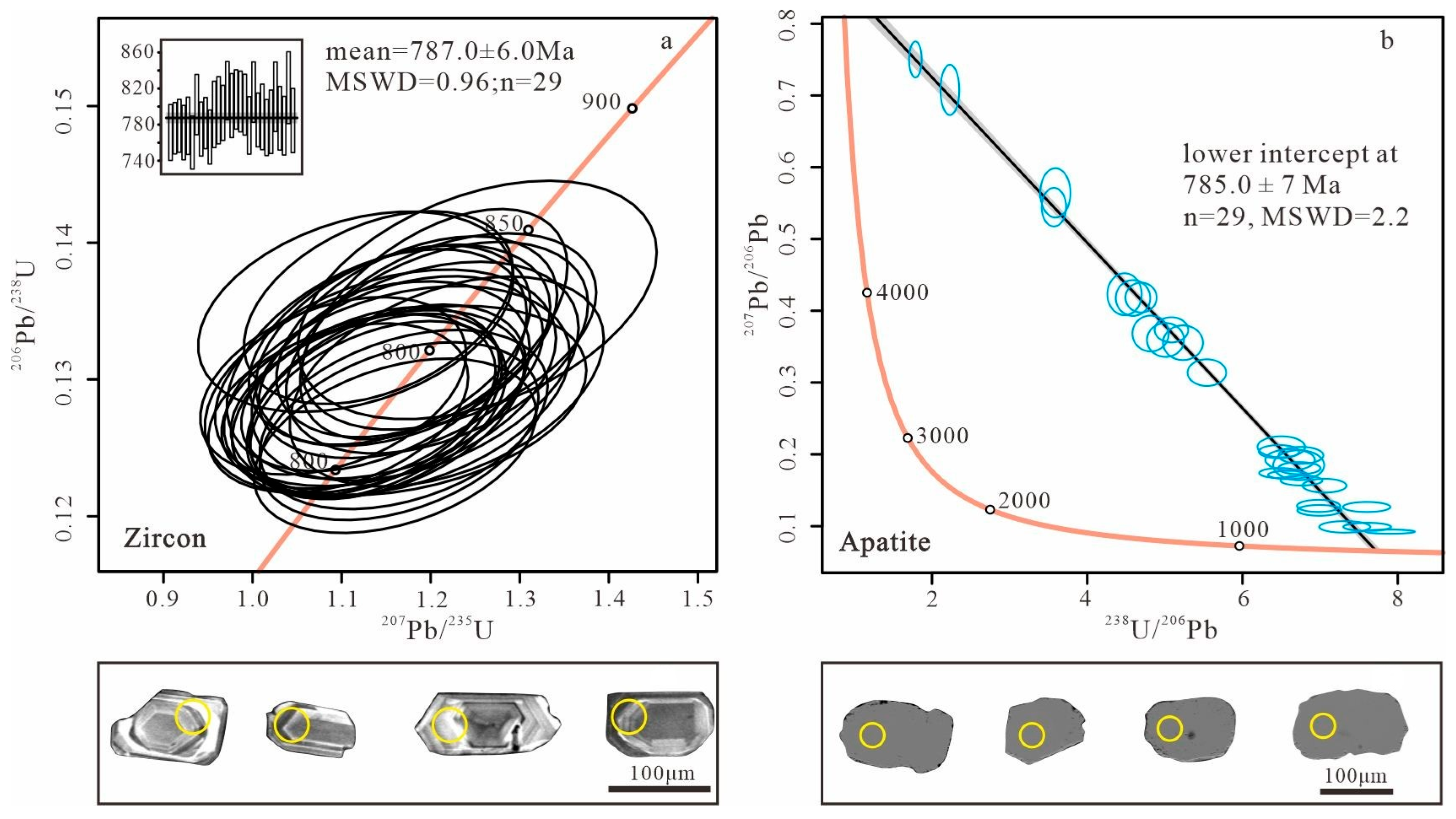
Zircon U–Pb age data for the Shenshan epimetamorphic rocks are listed in Supplementary Materials Table S1. The zircon grains are predominantly colorless and euhedral and range from prismatic to short-prismatic morphologies (length-to-width ratios of 1:1 to 3:1), with well-defined crystal faces. Cathodoluminescence (CL) imaging reveals straight, oscillatory magmatic zoning (Figure 4a), consistent with a magmatic origin [34]. Grain sizes range from 50 to 200 μm, and the crystals exhibit high structural integrity.
Thorium (Th) and uranium (U) concentrations in zircon range from 86.4 × 10⁻⁶ to 410.9 × 10⁻⁶ and from 106.5 × 10⁻⁶ to 467.5 × 10⁻⁶, respectively. The resulting Th/U ratios span 0.33–1.82 (mean = 0.97), consistent with typical magmatic zircon [34]. All 29 analyses are >95% concordant and plot on or near the concordia curve (Figure 5a). The 206Pb/238U ages range from 734 to 824 Ma, yielding a weighted mean average age of 787.0 ± 6.0 Ma (MSWD = 0.96; n = 29; Figure 4a), which dates the crystallization of the protolith to the mid-Neoproterozoic.

4.3. Apatite U-Pb Dating

Apatite grains in Shenshan rocks are predominantly euhedral to subhedral granular crystals and transparent to pale yellow and range from 50 to 170 μm in diameter. BSE imaging reveals homogeneous brightness with rare pores, fractures, or inclusions (Figure 4b), indicating a magmatic origin [35]. The apatite U–Pb dating results are presented in Supplementary Materials Table S2. In a Tera–Wasserburg concordia diagram, 29 analyses define a lower-intercept age of 785.0 ± 7.0 Ma (MSWD = 2.2), consistent within uncertainty with zircon U–Pb ages. This agreement implies the co-crystallization of both minerals during a mid-Neoproterozoic magmatic event, supporting the formation of the metamorphic protolith at that time.

4.4. Chemical Compositions of Zircon

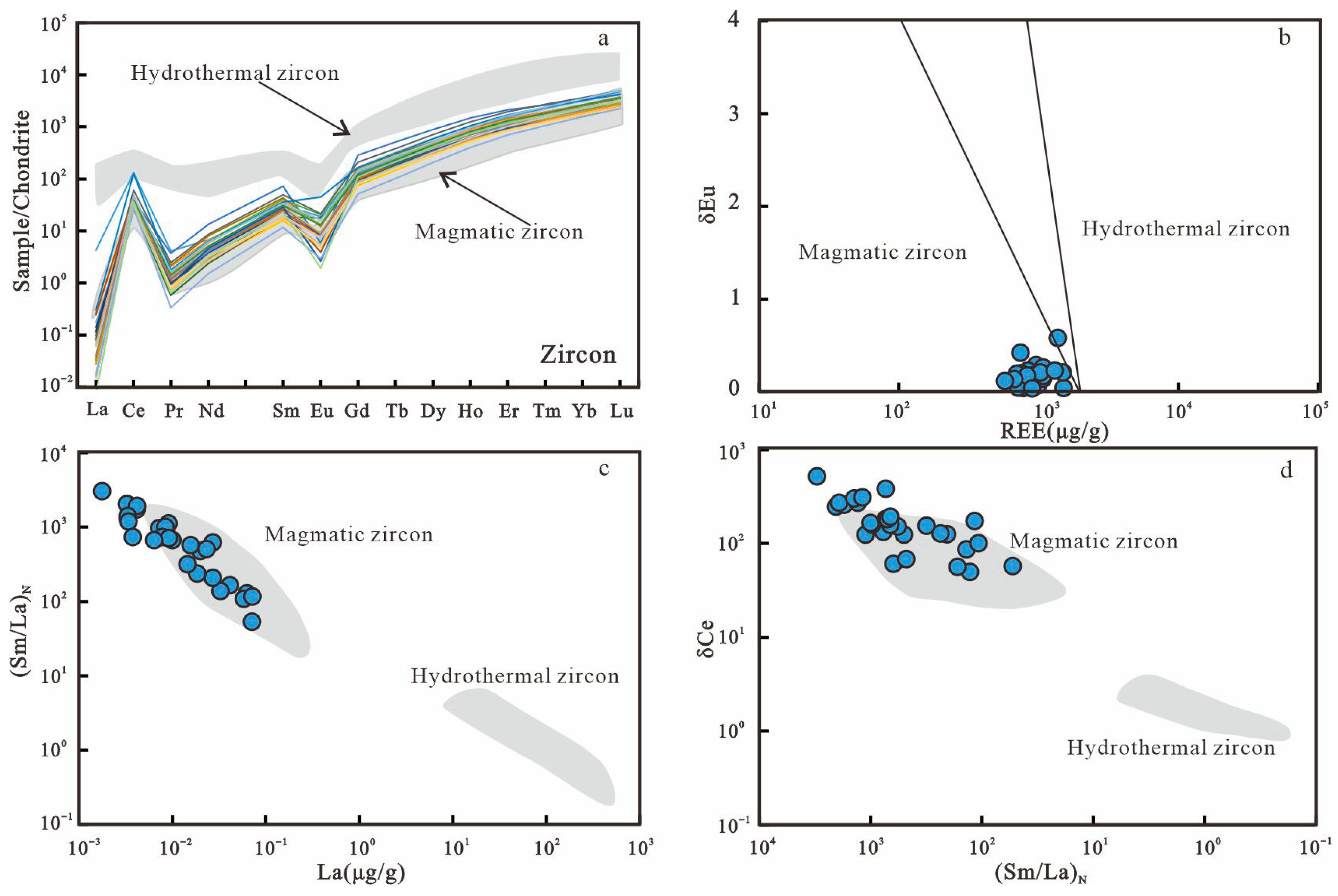
Trace element data for zircon samples are listed in Supplementary Materials Table S3. Total rare earth element (∑REE) contents range from 572.6 × 10⁻⁶ to 1506.4 × 10−6 μg/g, showing light REE depletion, heavy REE enrichment, and variable positive Ce and negative Eu anomalies (Figure 5a), features typical of magmatic zircons [36]. In zircon genesis discrimination diagrams (Figure 5b–d), all analyses plot within or adjacent to the magmatic zircon field and are clearly separated from hydrothermal zircons [36].
Figure 5. (a) Zircon chondrite-normalized REE patterns and discriminant diagrams (bd). Normalized values are from Sun and McDonough (1989) [37], (b) after Li et al. (2018) [38], (c) and (d) after Hoskin (2005) [36].
Minerals 16 00324 g005

4.5. Chemical Compositions of Apatite

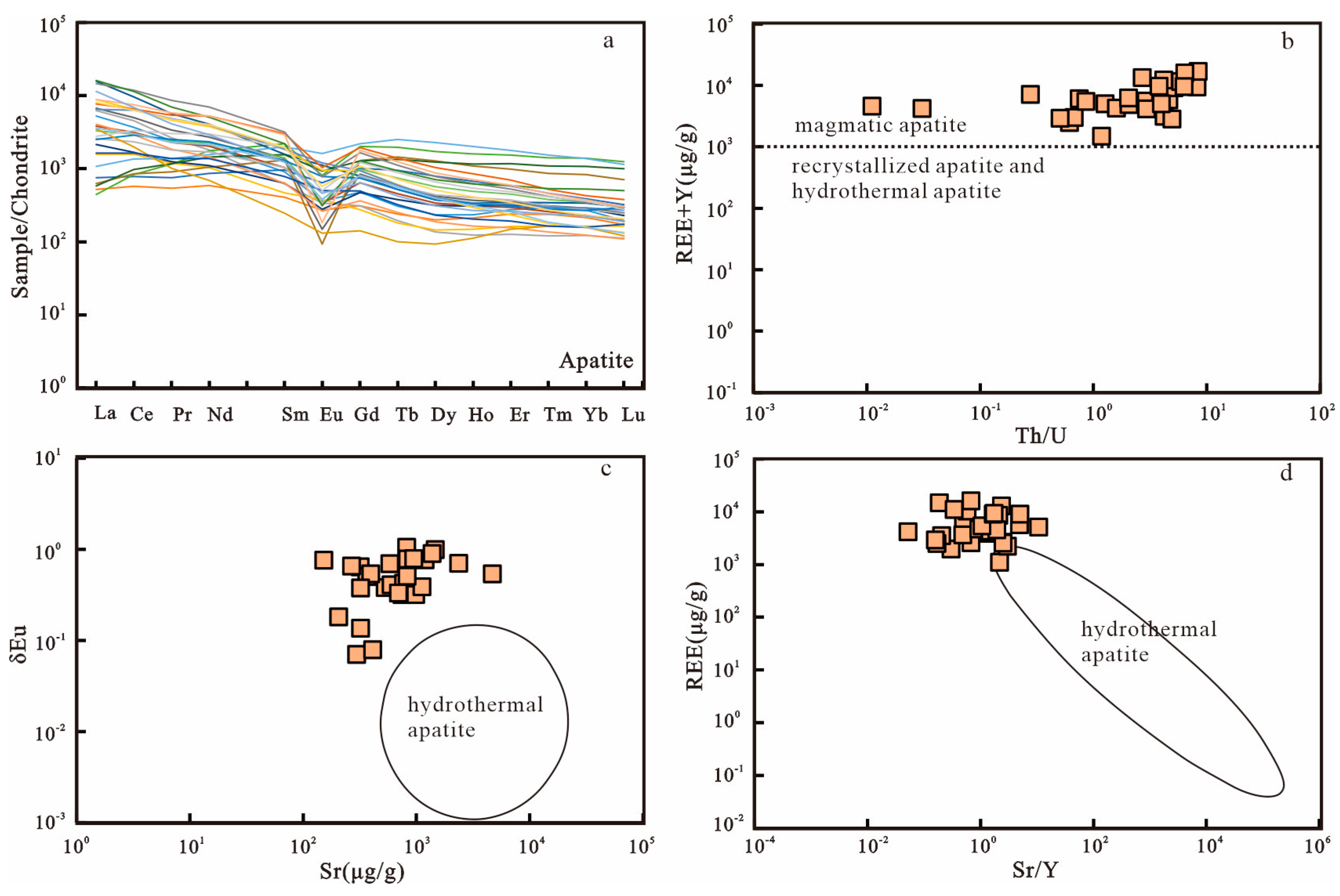
Trace element data for apatite are listed in Supplementary Materials Table S4. ΣREE values range from 1103 to 160,026 × 10−6 μg/g (mean = 6049 × 10−6 μg/g), indicating pronounced REE enrichment. Chondrite-normalized REE patterns show strong LREE enrichment, HREE depletion, and a pronounced negative Eu anomaly. In the ΣREE + Y–Th/U, REE–Sr/Y, and δEu–Sr discrimination diagrams (Figure 6b–d), all samples plot within the magmatic apatite field, indicating preserved primary magmatic trace element signatures with minimal hydrothermal overprinting. Thus, the apatites are of magmatic origin, and their trace element compositions reliably reflect both the magma source characteristics and the crystallization and evolution of the host magmas.

5. Discussions

5.1. Occurrence of Rare Earth Minerals and Implications for Mineralization

IREE deposits develop in parent rocks enriched in REEs, particularly from mineral phases susceptible to chemical weathering. In granitic protoliths, hydrothermal alteration introduces additional REEs and converts resistant minerals into more readily weatherable assemblages, thereby enhancing the potential for economically significant ion-adsorption mineralization [6,40,41]. REE ions originate from the weathering of accessory REE-bearing minerals in the bedrock, whose differential stability governs the rate of REE release [40]. BSE images reveal that REE minerals in Shenshan metamorphic rocks are dominated by phosphate phases, with subordinate silicate and oxide phases, and apatite is the principal phosphate mineral (Figure 2 and Figure 3). Weathering preferentially attacks grain boundaries, rounding grains and forming dissolution pits. Ultimately, residual apatite and authigenic REE minerals persist in situ (Figure 3e), indicating that apatite is a key source of ions for regional ion-adsorption-type REE deposits.
Although rock-forming minerals in the Shenshan rocks comprise over 90% of the total composition, they contain only trace amounts of REEs. In contrast, accessory minerals, constituting less than 2% of the rock, are highly enriched in REEs. Previous calculations indicate that these accessory minerals contribute nearly all of the REEs in the bulk rock, and their occurrence and abundance therefore directly determine the rock’s REE content [19]. Because most weathering-susceptible rare earth minerals in the bedrock are hydrothermal in origin, the REEs released during weathering become enriched in the residual regolith via ion exchange. Accordingly, this study proposes that hydrothermal alteration is a primary control on REE mineralization in epimetamorphic rocks. Hydrothermal fluids alter apatite chemistry through dissolution–reprecipitation, enriching it in mobile elements (Sr, Y, and MREEs) while inducing lattice defects and nanoscale porosity. This structural degradation reduces apatite’s chemical stability and increases its susceptibility to acid-driven decomposition during surface weathering. Consequently, REEs are mobilized before weathering onset and incorporated into readily leachable secondary phases. In iREE deposits, high parent rock REE contents and the weatherability of REE-bearing minerals favor mineralization [40]. Shenshan Formation samples average 406  ×  10−6 total REE (unpublished data), well above the Nanling threshold of 150  ×  10−6 [18]. Moreover, these rocks are enriched in easily weathered REE accessory minerals, particularly apatite, providing abundant source material for leaching and subsequent REE concentration.

5.2. The Characteristics of the Shenshan Parent Rock

Hoskin (2005) introduced the use of REE–δEu, La/(Sm/La)N, and (Sm/La)N–δCe diagrams to distinguish magmatic from hydrothermal zircons by their contrasting rare earth element signatures [36]. Magmatic zircons typically exhibit depletion in LREEs, enrichment in HREEs, a pronounced positive Ce anomaly, and a negative Eu anomaly [42]. Hydrothermal and magmatic zircons differ markedly in origin and characteristics. Hydrothermal zircons crystallize either directly from zircon-saturated fluids or by fluid-mediated alteration in metamict zircons. They typically lack cathodoluminescence signatures, show no internal zoning, and have Th/U ratios below 0.1. When hydrothermal fluids interact with pre-existing magmatic zircons, the resulting grains often exhibit a sponge-like texture [34,36,42,43,44]. In contrast, zircons from the Shenshan Formation are euhedral prisms with well-defined magmatic zoning and elevated Th/U ratios (0.33–1.82), attributes that together confirm a magmatic genesis [36,43]. The zircon types identified in Shenshan Formation samples (Figure 5) reliably indicate the initial magma composition [34].

5.2.1. Temperature

Zircon faithfully records magma crystallization temperatures because tetravalent titanium (Ti4+) substitutes for silicon (Si4+) in its crystal lattice. The logarithm of Ti concentration in zircon correlates linearly with the inverse of temperature (1/T) [45], enabling the precise determination of crystallization temperatures via Ti-in-zircon thermometry [46]. This study estimates zircon crystallization temperatures using the widely adopted Ti-in-zircon thermometer of Ferry and Watson (2007) [46], according to the following equation: T(K) = (4800 ± 86)/(5.711 ± 0.072 − log(Ti) − log αSiO2 + log αTiO2). Zircon Ti-in-zircon thermometry requires knowledge of TiO2 and SiO2 activities in the coexisting melt (αTiO2, αSiO2) [45,47]. In Shenshan samples, coexisting quartz and rutile (Figure 3g) justify assuming αSiO2 = αTiO2 = 1 [45]. Under these conditions, Ti-in-zircon temperatures span 641–749 °C (mean ≈ 704 °C). These values are slightly lower than Zr saturation temperatures in mineralized southern Jiangxi granites (~744 °C [48]).

5.2.2. Oxygen Fugacity

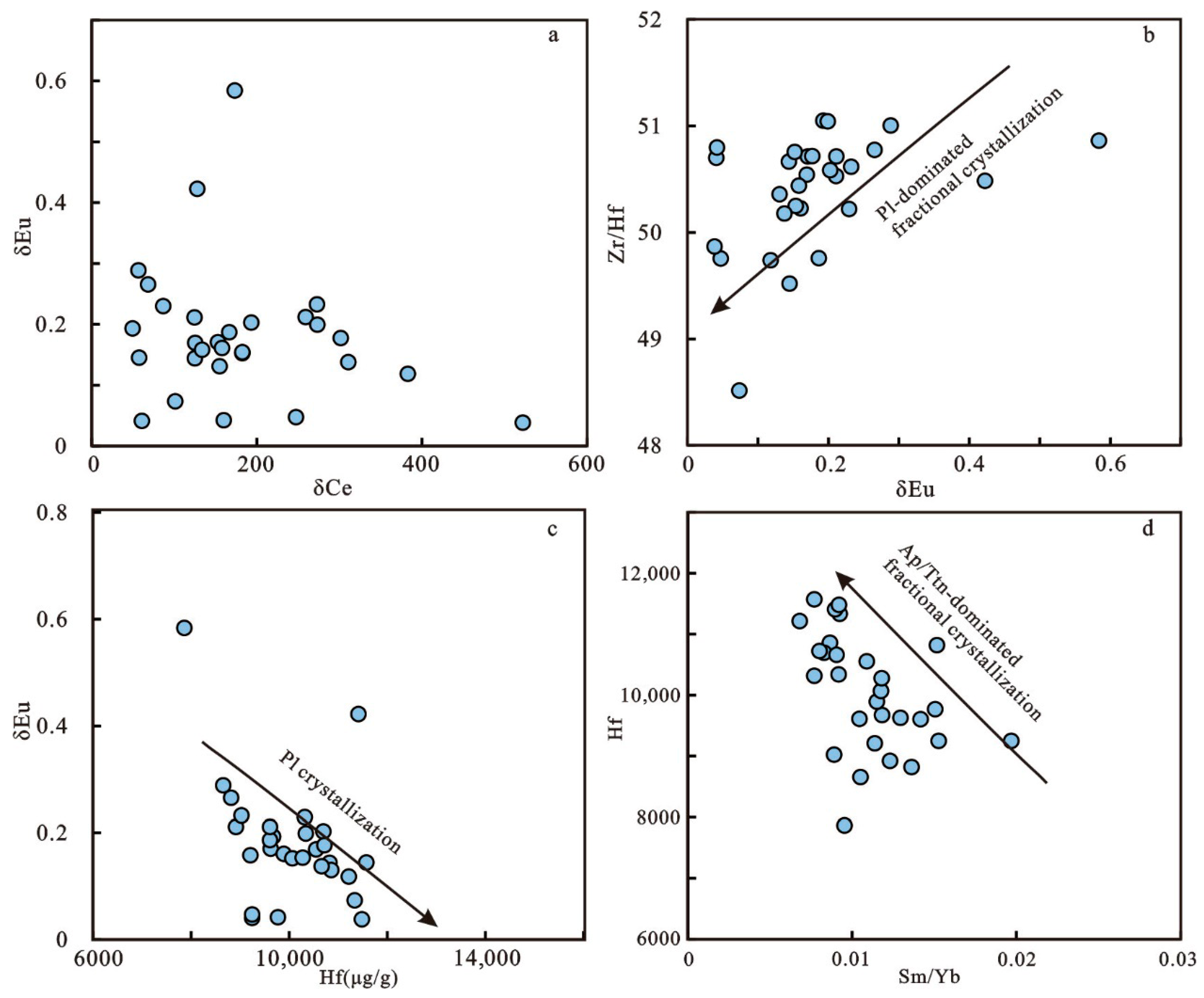
The partition coefficients of redox-sensitive elements vary strongly with melt oxygen fugacity, making them robust proxies for magmatic redox conditions [49,50]. Among the rare earths, Eu and Ce exhibit dual valences (Eu2+/Eu3+, Ce3+/Ce4+), and their higher-valence forms (Eu3+, Ce4+) have ionic radii similar to Zr4+, promoting their incorporation into the zircon lattice [51]. Consequently, Eu and Ce anomalies in zircon record magmatic oxygen fugacity with high sensitivity [52]. Plots show no covariation between Eu and Ce anomalies (δEu, δCe) in zircons from Shenshan phyllites (Figure 7a). By contrast, δEu declines as Zr/Hf decreases and Hf content rises (Figure 7b,c), indicating that plagioclase fractional crystallization, rather than oxygen fugacity, predominantly controls the Eu anomaly [53]. Moreover, Sm/Yb falls with increasing Hf (Figure 7d), suggesting that apatite crystallization also modulates the Ce4+/Ce3+ ratio; thus, Ce anomalies may not independently record magmatic redox conditions [51,53].
Trail et al. (2012) developed an empirical formula to estimate melt oxygen fugacity from lanthanum (La) and praseodymium (Pr) concentrations [54]. However, low La and Pr abundances in magmatic zircons—often below detection limits and altered by mineral inclusions—often yield unreliable fO2 values [55,56]. To overcome these issues, Loucks et al. (2020) [57] introduced a model requiring only zircon Ce, U, and Ti concentrations, eliminating the need for melt composition. This method reduces the effects of fractional crystallization, water content, and inclusions, producing more robust fO2 estimates. Applying this model to Shenshan Formation zircons yields log fO2 values between −31.4 and −9.9 (mean −17.9).

5.2.3. Protolith

In 1965, the Jiangxi Provincial Regional Geological Survey Team designated the shallowly metamorphosed rock sequence in southern Xinyu City as the Shenshan Formation. The formation’s lower unit comprises predominantly gray-black carbonaceous phyllite and carbonaceous siltitic phyllite, interbedded with metamorphic sheet sandstone. The upper unit consists primarily of gray-green, sericite-rich sandy phyllite and phyllitic siltstone, locally intercalated with metamorphic basalt and diabase. Tuffaceous limestone also occurs in the Pingxiang area. The formation attains a maximum thickness of approximately 3480 m. Research on this metamorphic series remains limited, with only a few studies to date [12,58].
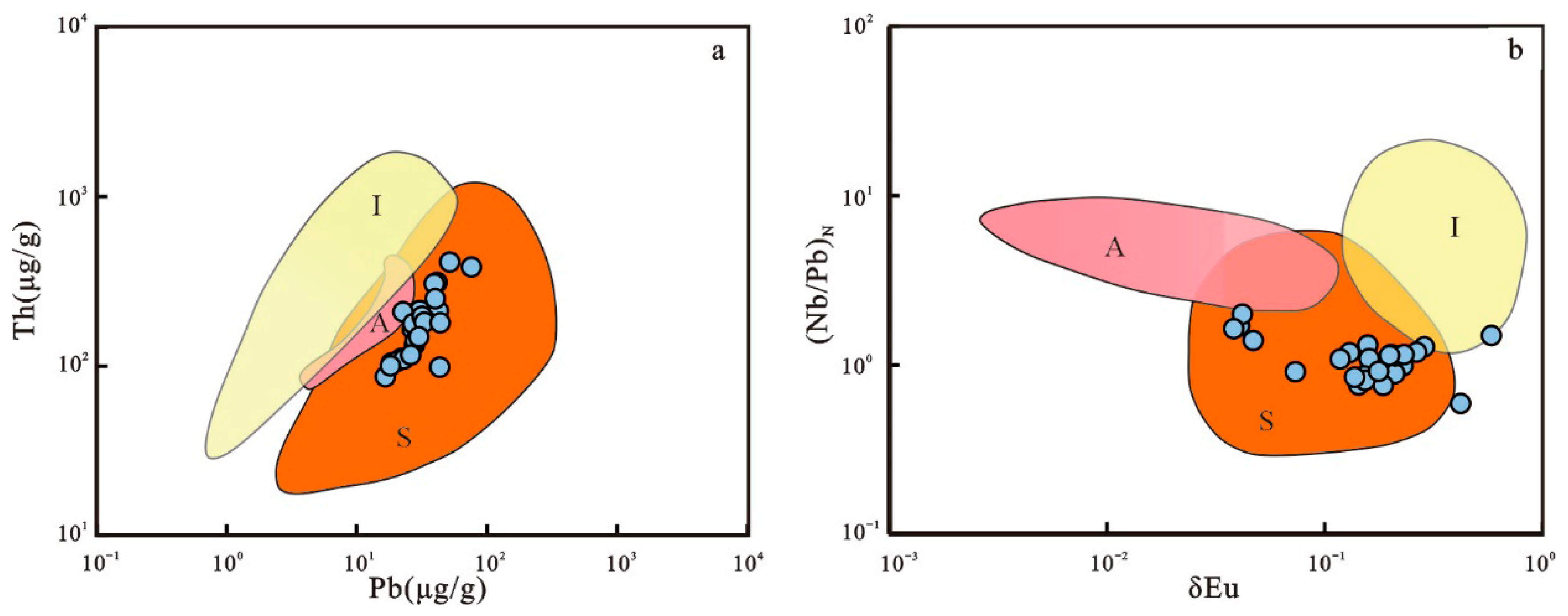
In the Th–Pb (Figure 8a) and (Nb/Pb)N–δEu (Figure 8b) discrimination diagrams, zircons from the Shenshan Group plot within the S-type granitic field and its adjacent margins, implying detrital input from felsic magmatic sources. The Cr/Zr–Th/Sc and La/Th–Hf ratios (Wang et al. 2022 [58]) reinforce this interpretation, indicating a peraluminous granite protolith produced by the partial melting of upper-crustal sediments. The source region likely comprised predominantly metamorphosed mudstones and related crustal sediments, consistent with a continental collision or subduction setting.
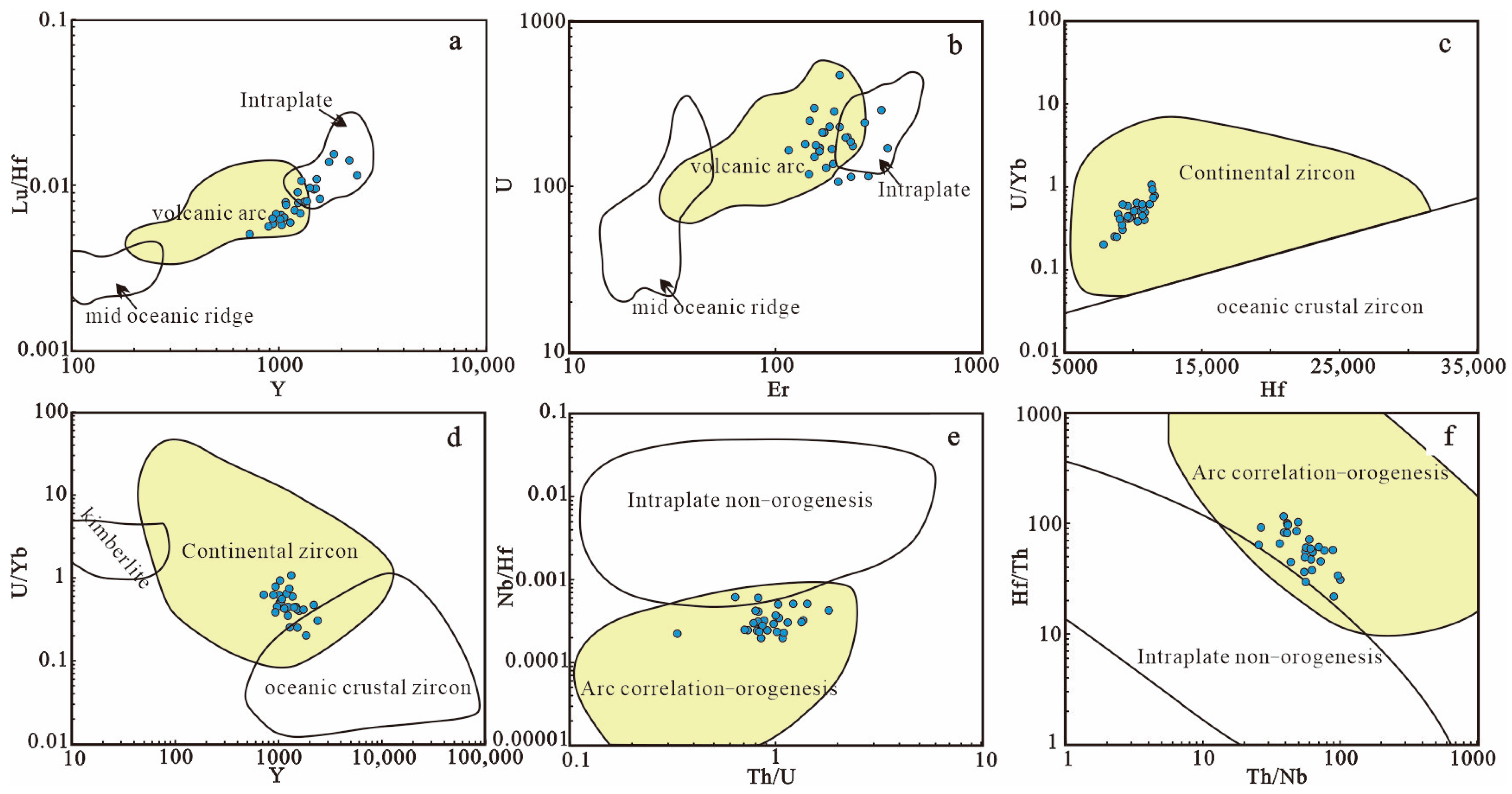
Zircon’s high closure temperature and resistance to alteration preserve primary chemical and isotopic signatures. The covariation of trace elements (U, Yb, Y, Th, Nb, Hf, Lu) effectively constrains magmatic environments [53,59]. In the Lu/Hf–Y and U–Er diagrams (Figure 9a,b), most data plot in the volcanic arc field. The U/Yb–Hf and U/Yb–Y diagrams (Figure 9c,d) place all samples within continental zircon compositional ranges, with elevated U/Yb ratios (0.20–1.07) versus oceanic values (<0.1 [60]), indicating crystallization in continental crust. The Nb/Hf–Th/U and Hf/Th–Th/Nb discrimination plots (Figure 9e,f) further locate the samples in arc-related orogenic belts. These geochemical signatures collectively imply that the Shenshan Formation protolith formed in a volcanic arc or active continental margin setting. Such magmatism likely resulted from the dehydration of a subducting oceanic slab, which released fluids or melts that metasomatized the overlying depleted mantle wedge, triggering the partial melting of that wedge and generating granitic magmas.
Figure 8. Plots of Th vs. Pb (a) and (Nb/Pb)N vs. δEu (b) of zircon from the Shenshan samples (after Wang et al., 2012 [61]).
Minerals 16 00324 g008

5.2.4. Fractional Crystallization

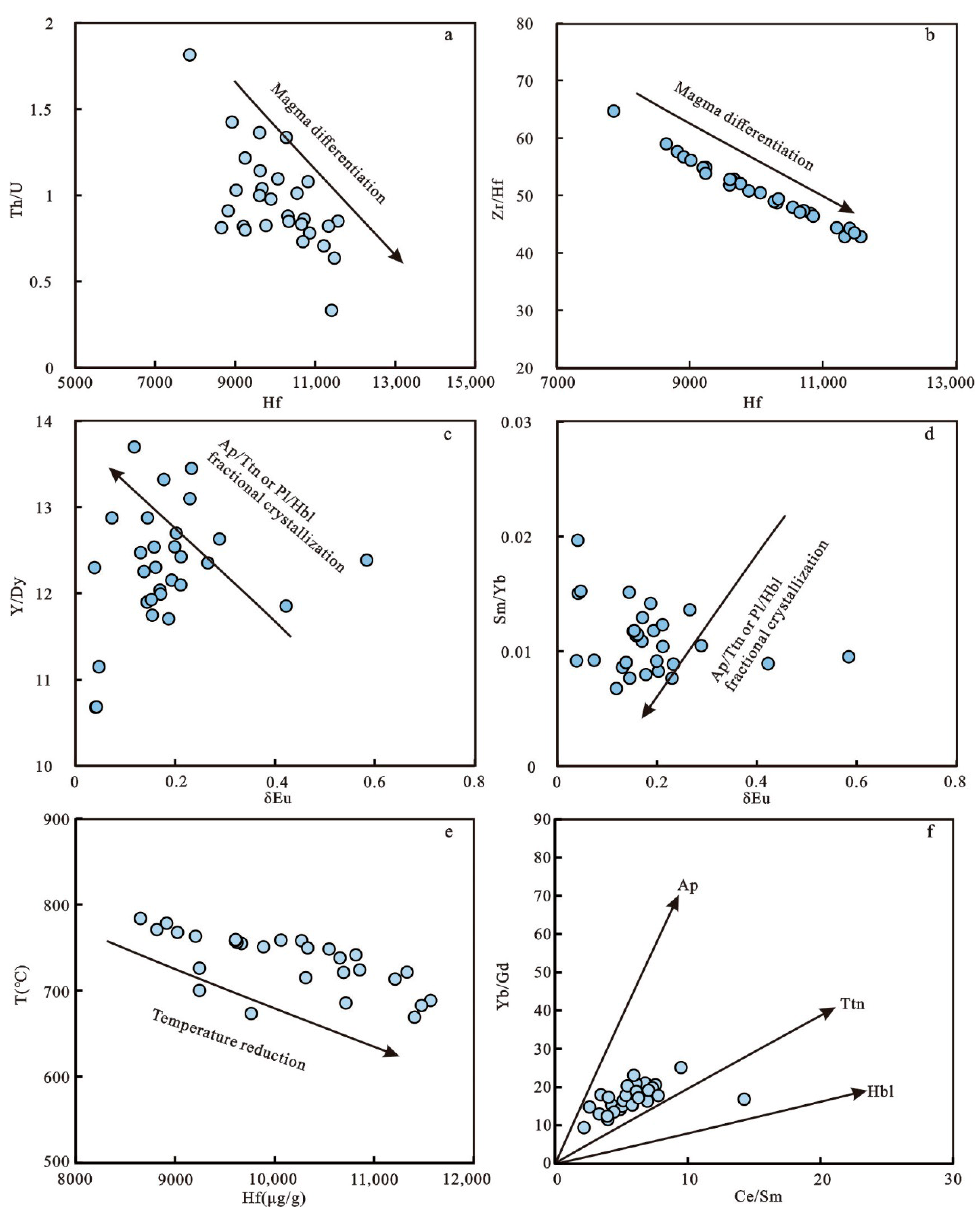
During magmatic differentiation, zircon typically shows elevated Hf concentrations accompanied by declining Zr/Hf and Th/U ratios [64]. In Figure 10a, all analyzed zircons display Th/U > 0.1, and Figure 10b reveals a clear negative correlation between Zr/Hf and Hf content, confirming their magmatic origin [38,65]. These geochemical signatures are thus robust proxies for magma differentiation [49,66]. In Figure 10c,d, zircon trace element compositions define linear correlations, indicating the fractional crystallization of titanite, apatite, amphibole and plagioclase during magmatic evolution. Likewise, Figure 10f supports apatite and titanite fractionation under similar magmatic conditions. This extensive fractional crystallization produced pronounced geochemical differentiation, imparting highly evolved characteristics to the protoliths of the Shenshan Formation samples, which thus exhibit features typical of highly differentiated granites.
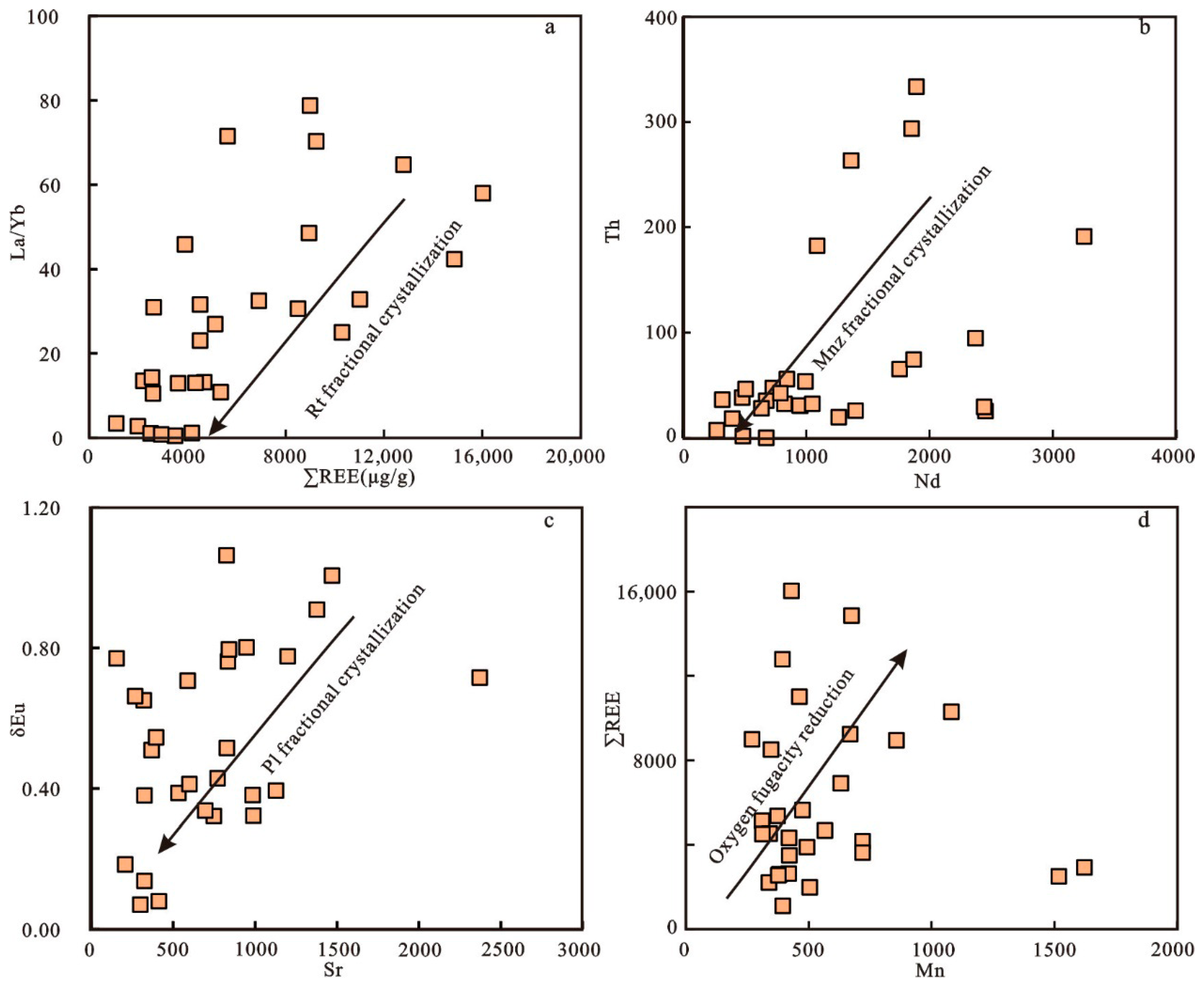
Apatite can enrich REE, Sr, Y, U, Th and other trace elements from the residual melt during crystallization [67]. As crystallization continues, co-crystallizing phases, zircon, titanite, monazite, brown almandine, pyrochlore, amphibole and feldspar, compete for these elements, resulting in significant variations in apatite’s trace element composition [67,68,69]. Plagioclase fractionation preferentially removes Eu and Sr, producing a stronger negative Eu anomaly in apatite, an elevated La/Sm ratio and lower Sr content [70,71]. In the apatite δEu–Sr plot (Figure 11c), decreasing Sr coincides with declining δEu values, underscoring plagioclase’s role during magmatic evolution. Titanite fractionation generates a positive correlation between La/Yb and ΣREE in apatite [67]. As shown in the La/Yb–ΣREE diagram (Figure 11a), lower total REE contents correspond to reduced La/Yb ratios, indicating titanite removal during differentiation. Monazite fractionation depletes Th and Nd in coexisting apatite [72]. The positive correlation between Th and Nd in apatite (Figure 11b) further confirms monazite crystallization. Together, zircon and apatite trace element signatures record a progressive melt evolution marked by the fractional crystallization of zircon, monazite, apatite, titanite, rutile and plagioclase in the Shenshan magmatic system.

5.2.5. Crystallization Age and Tectonic Context

The zircon U–Pb dating of phyllite from the Shenshan Formation in Ningdu, Jiangxi Province, yields 787 ± 6 Ma, and apatite U–Pb dating gives 785 ± 7 Ma. These concordant ages place the protolith in the mid-Neoproterozoic. Between 850 and 740 Ma, South China experienced widespread rift-related magmatism, with sheet-like intrusions emplaced along the western Yangtze Block margin–Jiangnan Orogen–western Cathaysia Block. This interval marks the second magmatic peak of that multi-stage rifting episode, including a pronounced pulse at ∼780 Ma [73]. Tectonic–magmatic coupling within the South China Block establishes the primary provenance framework for Shenshan Formation rocks and provides abundant magmatic–hydrothermal materials essential for their widespread diagenetic evolution.
During the early Neoproterozoic (1000–900 Ma), subduction beneath the Paleo–South China Sea generated an oceanic volcanic arc. Between 900 and 880 Ma, the northward advance of the Cathaysia Block consumed a small oceanic basin and established an intracontinental arc. From 880 to 860 Ma, arc–continent collision ensued. The continued subduction of Cathaysia from 860 to 830 Ma produced an island arc and back arc basin system. The Yangtze and Cathaysia blocks finally amalgamated between 830 and 800 Ma. From 800 to 750 Ma, episodic slab rollback triggered back arc extension accompanied by coeval arc- and rift-related magmatism [58,73,74,75]. The Shenshan Formation protoliths crystallized in this intracontinental arc setting from a source region enriched in crustal components. During the middle Neoproterozoic slab retreat phase, asthenospheric upwelling heated arc-derived sediments, inducing partial melting and rapid solidification into coherent rock units.

5.3. Exploration Potential of Metamorphic Rocks

IREE deposits require both sufficient primary REE in the protolith and intense chemical weathering. In the Ningdu epimetamorphic district, thick saprolitic crusts developed on metamorphic and sedimentary tuffs host the ore, whereas phyllite- and schist-dominated areas, including carbonaceous phyllite, produce only thin, economically unviable weathering profiles. Metamorphic sandstones can yield thick regolith, but REE content varies widely due to heterogeneous REE mineral distribution and uneven weathering [16].
In southern Jiangxi Province, shallowly metamorphosed rocks of the Kuli and Shangshi formations cover some 583 km2 [21], collectively exceeding the minimum REE threshold for ion-adsorption deposits. Their abundant exposures of metamorphic sedimentary tuff and well-developed regolith make them prime exploration targets. Nonetheless, secondary REE enrichment is strongly governed by topography, geomorphology and weathering intensity; only areas with moderate crustal thickness and sufficiently advanced weathering host economic mineralization.

6. Conclusions

Zircon and apatite are robust recorders of mineralization processes. Thin-section and single-mineral analyses of samples from the Ningdu ion-adsorption REE district (Jiangxi, China) yield the following:
(i)
U–Pb zircon and apatite geochronology yields a protolith age of ca. 785 Ma for metamorphic rocks of the Shenshan Formation in Ningdu County, Jiangxi, China, indicating mid-Neoproterozoic magmatism in the South China Block.
(ii)
The Shenshan Formation hosts abundant REE-bearing phases—including allanite-(Ce), apatite, cerianite-(Ce), monazite-(Ce), rhabdophane-(La), rutile, Y-bearing thorianite and xenotime-(Y). Apatite is the most pervasive phase and likely the principal source of ionic REEs in this deposit.
(iii)
Zircon and apatite trace element data indicate an S-type granitic protolith, crystallized at 641–749 °C (mean ~704 °C) under oxygen fugacities −31.4 to −9.9 (mean −17.9), consistent with a relatively reduced magmatic environment. Accessory phases (zircon, monazite, apatite, titanite, rutile, plagioclase) underwent extensive fractional crystallization during magmatic evolution.
(iv)
Epimetamorphic rocks preserved high REE concentrations and generated a suite of weatherable REE minerals, establishing a favorable material framework for ion-adsorption REE deposits and indicating strong potential for economic mineralization.

Supplementary Materials

The following supporting information can be downloaded at https://www.mdpi.com/article/10.3390/min16030324/s1, Table S1: LA-ICP-MS zircon U–Pb dating data of the Shenshan rocks; Table S2: LA-ICP-MS apatite U–Pb dating data of the Shenshan rocks; Table S3: LA-ICP-MS zircon trace elements data of the Shenshan rocks; Table S4: LA-ICP-MS apatite trace elements data of the Shenshan rocks.

Author Contributions

Conceptualization, H.F., W.W. and S.W.; methodology, S.W. and W.W.; investigation, H.F., S.W., W.W., L.Z. and D.W.; experimental analysis, W.W., S.W. and J.W.; plotting, S.W., W.W. and J.W.; writing—original draft preparation, S.W., W.W. and H.F.; writing—review and editing, H.F., S.W., W.W., L.Z., D.W. and J.W. All authors have read and agreed to the published version of the manuscript.

Funding

This study is supported by Key Laboratory of Ionic Rare Earth Resources and Environment, Ministry of Natural Resources (No. 2023IRERE102).

Data Availability Statement

All data generated or analyzed during this study are included in this article.

Conflicts of Interest

The authors declare that they have no known competing financial interests or personal relationships that could have appeared to influence the work reported in this paper.

References

  1. Goodenough, K.M.; Wall, F.; Merriman, D. The Rare Earth Elements: Demand, Global Resources, and Challenges for Resourcing Future Generations. Nat. Resour. Res. 2018, 27, 201–216. [Google Scholar] [CrossRef] [Scilit]
  2. Shi, A.; Xu, C.; Fan, C.; Chakhmouradian, A.R.; Brenna, M.; Wei, C. Structural Defects of Heavy Rare Earth Element Minerals in Granite Accelerate Their Decomposition and Facilitate Mineralization During Weathering. Econ. Geol. 2024, 119, 871–883. [Google Scholar] [CrossRef] [Scilit]
  3. Fu, H.; Alariqi, M. Critical Mineral Supply Chains and the Economics of Energy Transition: A Carbon Decomposition Perspective of Growth and Decoupling. Geosci. Front. 2026, 17, 102181. [Google Scholar] [CrossRef] [Scilit]
  4. Lee, J.C.K.; Wen, Z. Pathways for Greening the Supply of Rare Earth Elements in China. Nat. Sustain. 2018, 1, 598–605. [Google Scholar] [CrossRef] [Scilit]
  5. Xu, C.; Shi, A.; Brenna, M.; Liu, P.; Li, Q.; Fan, C. Degassing-Driven Oxidation Promotes HREE Enrichment in South China Granites. J. Petrol. 2024, 65, egae064. [Google Scholar] [CrossRef] [Scilit]
  6. Huang, Y.; He, H.; Liang, X.; Bao, Z.; Tan, W.; Ma, L.; Zhu, J.; Huang, J.; Wang, H. Characteristics and Genesis of Ion Adsorption Type REE Deposits in the Weathering Crusts of Metamorphic Rocks in Ningdu, Ganzhou, China. Ore Geol. Rev. 2021, 135, 104173. [Google Scholar] [CrossRef] [Scilit]
  7. Giese, E.C.; de Souza, A.C.S.P. Recovery of Rare-Earth Elements from Brazilian Ion-Adsorption Clay: A Preliminary Study. Orbital Electron. J. Chem. 2022, 14, 10–14. [Google Scholar] [CrossRef] [Scilit]
  8. Sanematsu, K.; Murakami, H.; Watanabe, Y.; Duangsurigna, S.; Siphandone, V. Enrichment of Rare Earth Elements (REE) in Granitic Rocks and Their Weathered Crusts in Central and Southern Laos. Bull. Geol. Surv. Jpn. 2009, 60, 527–558. [Google Scholar] [CrossRef] [Scilit]
  9. Berger, A.; Janots, E.; Gnos, E.; Frei, R.; Bernier, F. Rare Earth Element Mineralogy and Geochemistry in a Laterite Profile from Madagascar. Appl. Geochem. 2014, 41, 218–228. [Google Scholar] [CrossRef] [Scilit]
  10. Ibad, S.M.; Tsegab, H.; Siddiqui, N.A.; Adam, M.; Mishra, S.; Ridha, S.; Ahmed, N.; Azmi, A. The Upstream Rare Earth Resources of Malaysia: Insight into Geology, Geochemistry, and Hydrometallurgical Approaches. Geosci. Front. 2024, 15, 101899. [Google Scholar] [CrossRef] [Scilit]
  11. Okamura, K.; Watanabe, K.; Yonezu, K.; Dang, H.T.; Do, D.C.; Tran, T.A. Geochemical behavior of REE associated with Laterization process in Daklak Province, Southern Viet Nam. Sci. Technol. Dev. J. 2014, 17, 69–75. [Google Scholar] [CrossRef] [Scilit]
  12. Chen, B.F.; Peng, L.L.; Yang, B.; Zeng, Z.L.; Li, J.Z.; Zhao, Z.; Huang, B. Analysis of ore-bearing formations, mineralization processes, and exploration potential of weathering crust ion-adsorption type rare earth deposits in Southern Jiangxi, China. Geol. Bull. China 2025, 44, 2087–2103, (In Chinese with English abstract). [Google Scholar]
  13. You, S.; Zhang, D.; Liu, H.; Tang, M.; Pang, X.; Wang, Y.; Zhang, Z. Petrogenesis of Jurassic Granite from the Shuitou Pluton in South Jiangxi Province, South China: Implications for Ion-Adsorption Rare Earth Element Enrichment. Minerals 2025, 15, 476. [Google Scholar] [CrossRef] [Scilit]
  14. Li, Y.H.M.; Zhao, W.W.; Zhou, M.-F. Nature of Parent Rocks, Mineralization Styles and Ore Genesis of Regolith-Hosted REE Deposits in South China: An Integrated Genetic Model. J. Asian Earth Sci. 2017, 148, 65–95. [Google Scholar] [CrossRef] [Scilit]
  15. Liu, R.S.; Li, Q.; Gong, M.; Zou, D.F.; Miao, X.L.; Liu, X. The New Resources Prospect of Ion Adsorption Type Rare Earth Resources in Metamorphic Rock’s Weathering Crust, South Jiangxi. Adv. Geosci. 2014, 4, 419–425. [Google Scholar] [CrossRef]
  16. Zhao, Z.; Chen, Z.H.; Zou, X.Y.; Wang, D.H.; Chen, Z.Y. REE Mineralization of Epimetamorphic Rocks from an Ion-Adsorption Type REE Deposit in Southern Jiangxi Province. Earth Sci.-J. China Univ. Geosci. 2018, 43, 3652. [Google Scholar] [CrossRef] [Scilit]
  17. Zhou, X.G.; Wang, S.L.; Yuan, C.X.; Gong, M.; Zou, D.F.; Miao, X.L.; Xi, L. Geochemistry characteristics of ion-absorbed rare earth deposits in low-grade metamorphic rock in the Ningdu area, southern Jiangxi Province and its prospecting significance. East China Geol. 2018, 39, 194–201. [Google Scholar] [CrossRef]
  18. Wang, Z.; Zhao, Z.; Zou, X.Y.; Chen, Z.Y.; Tu, X.J. Petrogeochemical Characteristics and Metallogenetic Potential of Epimetamorphic Rocks in South Jiangxi Province. Rock Miner. Anal. 2018, 37, 96–107, (In Chinese with English abstract). [Google Scholar]
  19. Wang, Z.; Chen, Z.Y.; Zhao, Z.; Chen, B.F.; Zou, X.Y. REE mineral and geochemical characteristics of Neoproterozoic metamorphic rocks in South Jiangxi Province. Miner. Depos. 2019, 38, 837–850, (In Chinese with English abstract). [Google Scholar]
  20. Liu, H.B.; Chen, B.F.; Peng, L.L.; Zhao, Z.; Zhang, X.W. Characteristics and genesis of the ion adsorption REE deposit in Jiangbei metamorphic weathering crust, Southern Jiangxi Province. East China Geol. 2020, 41, 315–324. [Google Scholar] [CrossRef]
  21. Chen, B.F.; Zou, X.Y.; Peng, L.L.; Zhou, X.H.; Que, X.H.; Zhang, Q. Geological characteristics and prospecting direction of the metamorphic rock ion adsorption REE ore deposit in South Jiangxi. East China Geol. 2019, 40, 143–151. [Google Scholar] [CrossRef]
  22. Ding, Y.; Han, S.C.; Wan, H.; Qu, C.; Jiang, Y.; Chen, B.F.; Zou, X.Y. Characteristics of Element Migration in Weathering Crust Profile of Getenzui REE Deposits, Southern Jiangxi. Jiangxi Sci. 2023, 41, 127–135. [Google Scholar] [CrossRef]
  23. Wang, D.; Liu, Y.; Zhen, S.; Kong, Y.; Wang, X.; Leng, C.-B. Multiple Eocene−Miocene Tin Mineralization Events in Southeastern Tibet. Geol. Soc. Am. Bull. 2025. [Google Scholar] [CrossRef] [Scilit]
  24. Hu, Z.; Zhang, W.; Liu, Y.; Gao, S.; Li, M.; Zong, K.; Chen, H.; Hu, S. “Wave” Signal-Smoothing and Mercury-Removing Device for Laser Ablation Quadrupole and Multiple Collector ICPMS Analysis: Application to Lead Isotope Analysis. Anal. Chem. 2015, 87, 1152–1157. [Google Scholar] [CrossRef] [Scilit]
  25. Wiedenbeck, M.; Hanchar, J.M.; Peck, W.H.; Sylvester, P.; Valley, J.; Whitehouse, M.; Kronz, A.; Morishita, Y.; Nasdala, L.; Fiebig, J.; et al. Further Characterisation of the 91500 Zircon Crystal. Geostand. Geoanal. Res. 2004, 28, 9–39. [Google Scholar] [CrossRef] [Scilit]
  26. Sláma, J.; Košler, J.; Condon, D.J.; Crowley, J.L.; Gerdes, A.; Hanchar, J.M.; Horstwood, M.S.A.; Morris, G.A.; Nasdala, L.; Norberg, N.; et al. Plešovice Zircon—A New Natural Reference Material for U–Pb and Hf Isotopic Microanalysis. Chem. Geol. 2008, 249, 1–35. [Google Scholar] [CrossRef] [Scilit]
  27. Thomson, S.N.; Gehrels, G.E.; Ruiz, J.; Buchwaldt, R. Routine Low-damage Apatite U-Pb Dating Using Laser Ablation–Multicollector–ICPMS. Geochem. Geophys. Geosyst. 2012, 13. [Google Scholar] [CrossRef] [Scilit]
  28. Thompson, J.; Meffre, S.; Maas, R.; Kamenetsky, V.; Kamenetsky, M.; Goemann, K.; Ehrig, K.; Danyushevsky, L. Matrix Effects in Pb/U Measurements during LA-ICP-MS Analysis of the Mineral Apatite. J. Anal. At. Spectrom. 2016, 31, 1206–1215. [Google Scholar] [CrossRef] [Scilit]
  29. Pearce, N.J.G.; Perkins, W.T.; Westgate, J.A.; Gorton, M.P.; Jackson, S.E.; Neal, C.R.; Chenery, S.P. A Compilation of New and Published Major and Trace Element Data for NIST SRM 610 and NIST SRM 612 Glass Reference Materials. Geostand. Newsl. 1997, 21, 115–144. [Google Scholar] [CrossRef] [Scilit]
  30. Liu, Y.; Hu, Z.; Gao, S.; Günther, D.; Xu, J.; Gao, C.; Chen, H. In Situ Analysis of Major and Trace Elements of Anhydrous Minerals by LA-ICP-MS without Applying an Internal Standard. Chem. Geol. 2008, 257, 34–43. [Google Scholar] [CrossRef] [Scilit]
  31. Liu, Y.; Gao, S.; Hu, Z.; Gao, C.; Zong, K.; Wang, D. Continental and Oceanic Crust Recycling-Induced Melt-Peridotite Interactions in the Trans-North China Orogen: U-Pb Dating, Hf Isotopes and Trace Elements in Zircons from Mantle Xenoliths. J. Petrol. 2010, 51, 537–571. [Google Scholar] [CrossRef] [Scilit]
  32. Ludwig, R.K. Isoplot/Ex, a Geochronological Toolkit for Microsoft Excel, Version 3.00; Berkeley Geochronology Center: Berkeley, CA, USA, 2003.
  33. Jochum, K.P.; Willbold, M.; Raczek, I.; Stoll, B.; Herwig, K. Chemical Characterisation of the USGS Reference Glasses GSA-1G, GSC-1G, GSD-1G, GSE-1G, BCR-2G, BHVO-2G and BIR-1G Using EPMA, ID-TIMS, ID-ICP-MS and LA-ICP-MS. Geostand. Geoanal. Res. 2005, 29, 285–302. [Google Scholar] [CrossRef] [Scilit]
  34. Hoskin, P.W.O.; Schaltegger, U. The Composition of Zircon and Igneous and Metamorphic Petrogenesis. Rev. Mineral. Geochem. 2003, 53, 27–62. [Google Scholar] [CrossRef] [Scilit]
  35. Feng, W.; Zheng, J. Apatite Trace Elements and O-Sr Isotopes Reveal Different Magmatic Sources of Fe-Ti Oxide Deposits in the Eastern Tianshan, NW China. Ore Geol. Rev. 2023, 163, 105764. [Google Scholar] [CrossRef] [Scilit]
  36. Hoskin, P.W.O. Trace-Element Composition of Hydrothermal Zircon and the Alteration of Hadean Zircon from the Jack Hills, Australia. Geochim. Cosmochim. Acta 2005, 69, 637–648. [Google Scholar] [CrossRef] [Scilit]
  37. Sun, S.-S.; McDonough, W.F. Chemical and Isotopic Systematics of Oceanic Basalts: Implications for Mantle Composition and Processes. Geol. Soc. Lond. Spec. Publ. 1989, 42, 313–345. [Google Scholar] [CrossRef] [Scilit]
  38. Li, H.; Li, J.-W.; Algeo, T.J.; Wu, J.-H.; Cisse, M. Zircon Indicators of Fluid Sources and Ore Genesis in a Multi-Stage Hydrothermal System: The Dongping Au Deposit in North China. Lithos 2018, 314–315, 463–478. [Google Scholar] [CrossRef] [Scilit]
  39. Guo, B.-E.; Zhao, K.-D.; Liu, G.-Q.; Li, Q.; Chen, W.; Jiang, S.-Y.; Yaxley, G.M. Magmatic Evolution and Late Hydrothermal Activity in the Yashan Rare-Metal Granites, South China: Insights from Apatite Geochronology and Geochemistry. Ore Geol. Rev. 2026, 188, 107023. [Google Scholar] [CrossRef] [Scilit]
  40. He, H.P.; Wang, H.; Li, X.R.; Ma, L.Y.; Zhu, J.X.; Yang, W.B. Remobilization and transferring of rare earth elements in the formation of regolith-hosted REE deposits. J. Geomech. 2024, 30, 707–722, (In Chinese with English abstract). [Google Scholar]
  41. Xu, C.; Kynický, J.; Smith, M.P.; Kopriva, A.; Brtnický, M.; Urubek, T.; Yang, Y.; Zhao, Z.; He, C.; Song, W. Origin of Heavy Rare Earth Mineralization in South China. Nat. Commun. 2017, 8, 14598. [Google Scholar] [CrossRef] [Scilit]
  42. Zhao, Z.D.; Liu, D.; Wang, Q.; Zhu, D.C.; Dong, G.C.; Zhou, S.; Mo, X.X. Zircon trace elements and their use in probing deep processes. Earth Sci. Front. 2018, 25, 124–135. [Google Scholar] [CrossRef]
  43. Zhong, S.; Feng, C.; Seltmann, R.; Li, D.; Qu, H. Can Magmatic Zircon Be Distinguished from Hydrothermal Zircon by Trace Element Composition? The Effect of Mineral Inclusions on Zircon Trace Element Composition. Lithos 2018, 314–315, 646–657. [Google Scholar] [CrossRef] [Scilit]
  44. Li, H.; Watanabe, K.; Yonezu, K. Zircon Morphology, Geochronology and Trace Element Geochemistry of the Granites from the Huangshaping Polymetallic Deposit, South China: Implications for the Magmatic Evolution and Mineralization Processes. Ore Geol. Rev. 2014, 60, 14–35. [Google Scholar] [CrossRef] [Scilit]
  45. Watson, E.B.; Harrison, T.M. Zircon Thermometer Reveals Minimum Melting Conditions on Earliest Earth. Science 2005, 308, 841–844. [Google Scholar] [CrossRef] [Scilit]
  46. Ferry, J.M.; Watson, E.B. New Thermodynamic Models and Revised Calibrations for the Ti-in-Zircon and Zr-in-Rutile Thermometers. Contrib. Mineral. Petrol. 2007, 154, 429–437. [Google Scholar] [CrossRef] [Scilit]
  47. Schulz, B.; Klemd, R.; Brätz, H. Host Rock Compositional Controls on Zircon Trace Element Signatures in Metabasites from the Austroalpine Basement. Geochim. Cosmochim. Acta 2006, 70, 697–710. [Google Scholar] [CrossRef] [Scilit]
  48. Su, H.; Jiang, S. A Comparison Study of Tungsten-Bearing Granite and Related Mineralization in the Northern Jiangxi-Southern Anhui Provinces and Southern Jiangxi Province in South China. Sci. China Earth Sci. 2017, 60, 1942–1958. [Google Scholar] [CrossRef] [Scilit]
  49. Lee, R.G.; Dilles, J.H.; Tosdal, R.M.; Wooden, J.L.; Mazdab, F.K. Magmatic Evolution of Granodiorite Intrusions at the El Salvador Porphyry Copper Deposit, Chile, Based on Trace Element Composition and U/Pb Age of Zircons. Econ. Geol. 2017, 112, 245–273. [Google Scholar] [CrossRef] [Scilit]
  50. Konecke, B.A.; Fiege, A.; Simon, A.C.; Linsler, S.; Holtz, F. An Experimental Calibration of a Sulfur-in-Apatite Oxybarometer for Mafic Systems. Geochim. Cosmochim. Acta 2019, 265, 242–258. [Google Scholar] [CrossRef] [Scilit]
  51. Ballard, J.R.; Palin, J.M.; Campbell, I.H. Relative Oxidation States of Magmas Inferred from Ce(IV)/Ce(III) in Zircon: Application to Porphyry Copper Deposits of Northern Chile. Contrib. Mineral. Petrol. 2002, 144, 347–364. [Google Scholar] [CrossRef] [Scilit]
  52. Shen, P.; Hattori, K.; Pan, H.; Jackson, S.; Seitmuratova, E. Oxidation Condition and Metal Fertility of Granitic Magmas: Zircon Trace-Element Data from Porphyry Cu Deposits in the Central Asian Orogenic Belt. Econ. Geol. 2015, 110, 1861–1878. [Google Scholar] [CrossRef] [Scilit]
  53. Deering, C.D.; Keller, B.; Schoene, B.; Bachmann, O.; Beane, R.; Ovtcharova, M. Zircon Record of the Plutonic-Volcanic Connection and Protracted Rhyolite Melt Evolution. Geology 2016, 44, 267–270. [Google Scholar] [CrossRef] [Scilit]
  54. Trail, D.; Watson, E.B.; Tailby, N.D. The Oxidation State of Hadean Magmas and Implications for Early Earth’s Atmosphere. Nature 2011, 480, 79–82. [Google Scholar] [CrossRef] [Scilit]
  55. Zhu, J.-J.; Hu, R.; Bi, X.-W.; Hollings, P.; Zhong, H.; Gao, J.-F.; Pan, L.-C.; Huang, M.-L.; Wang, D.-Z. Porphyry Cu Fertility of Eastern Paleo-Tethyan Arc Magmas: Evidence from Zircon and Apatite Compositions. Lithos 2022, 424–425, 106775. [Google Scholar] [CrossRef] [Scilit]
  56. Zou, X.; Qin, K.; Han, X.; Li, G.; Evans, N.J.; Li, Z.; Yang, W. Insight into Zircon REE Oxy-Barometers: A Lattice Strain Model Perspective. Earth Planet. Sci. Lett. 2019, 506, 87–96. [Google Scholar] [CrossRef] [Scilit]
  57. Loucks, R.R.; Fiorentini, M.L.; Henríquez, G.J. New Magmatic Oxybarometer Using Trace Elements in Zircon. J. Petrol. 2020, 61., egaa034. [Google Scholar] [CrossRef] [Scilit]
  58. Wang, L.; Zhang, K.; Lin, S.; He, W.; Yin, L. Origin and Age of the Shenshan Tectonic Mélange in the Jiangshan-Shaoxing-Pingxiang Fault and Late Early Paleozoic Juxtaposition of the Yangtze Block and the West Cathaysia Terrane, South China. GSA Bull. 2022, 134, 113–129. [Google Scholar] [CrossRef] [Scilit]
  59. Yan, L.-L.; He, Z.-Y.; Beier, C.; Klemd, R. Zircon Trace Element Constrains on the Link between Volcanism and Plutonism in SE China. Lithos 2018, 320–321, 28–34. [Google Scholar] [CrossRef] [Scilit]
  60. Grimes, C.B.; John, B.E.; Kelemen, P.B.; Mazdab, F.K.; Wooden, J.L.; Cheadle, M.J.; Hanghøj, K.; Schwartz, J.J. Trace Element Chemistry of Zircons from Oceanic Crust: A Method for Distinguishing Detrital Zircon Provenance. Geology 2007, 35, 643–646. [Google Scholar] [CrossRef] [Scilit]
  61. Wang, Q.; Zhu, D.-C.; Zhao, Z.-D.; Guan, Q.; Zhang, X.-Q.; Sui, Q.-L.; Hu, Z.-C.; Mo, X.-X. Magmatic Zircons from I-, S- and A-Type Granitoids in Tibet: Trace Element Characteristics and Their Application to Detrital Zircon Provenance Study. J. Asian Earth Sci. 2012, 53, 59–66. [Google Scholar] [CrossRef] [Scilit]
  62. Hawkesworth, C.J.; Kemp, A.I.S. Using Hafnium and Oxygen Isotopes in Zircons to Unravel the Record of Crustal Evolution. Chem. Geol. 2006, 226, 144–162. [Google Scholar] [CrossRef] [Scilit]
  63. Lin, M.S.; Xu, K.; Wang, L.Y.; Liu, W.Y. Genesis of the Host Rock Andesite from Jama Deposit, Timok Ore Cluster Area, Serbia: Constraints from U-Pb age, Trace Elements and Hf Isotopes of the Andesite Zircons. Geol. J. China Univ. 2025, 31, 439–450. [Google Scholar] [CrossRef]
  64. Yan, L.-L.; He, Z.-Y.; Klemd, R.; Beier, C.; Xu, X.-S. Tracking Crystal-Melt Segregation and Magma Recharge Using Zircon Trace Element Data. Chem. Geol. 2020, 542, 119596. [Google Scholar] [CrossRef] [Scilit]
  65. Yang, W.-B.; Niu, H.-C.; Shan, Q.; Sun, W.-D.; Zhang, H.; Li, N.-B.; Jiang, Y.-H.; Yu, X.-Y. Geochemistry of Magmatic and Hydrothermal Zircon from the Highly Evolved Baerzhe Alkaline Granite: Implications for Zr–REE–Nb Mineralization. Miner. Depos. 2014, 49, 451–470. [Google Scholar] [CrossRef] [Scilit]
  66. Grimes, C.B.; Wooden, J.L.; Cheadle, M.J.; John, B.E. “Fingerprinting” Tectono-Magmatic Provenance Using Trace Elements in Igneous Zircon. Contrib. Mineral. Petrol. 2015, 170, 46. [Google Scholar] [CrossRef] [Scilit]
  67. Wang, H.; Cai, K.; Sun, M.; Xia, X.-P.; Lai, C.-K.; Li, P.; Wan, B.; Zhang, Z. Apatite as a Magma Redox Indicator and Its Application in Metallogenic Research. Lithos 2022, 422–423, 106749. [Google Scholar] [CrossRef] [Scilit]
  68. Jonsson, E.; Harlov, D.E.; MaJka, J.; Högdahl, K.; Persson-Nilsson, K. Fluorapatite-Monazite-Allanite Relations in the Grängesberg Apatite-Iron Oxide Ore District, Bergslagen, Sweden. Am. Mineral. 2016, 101, 1769–1782. [Google Scholar] [CrossRef] [Scilit]
  69. Miles, A.J.; Graham, C.M.; Hawkesworth, C.J.; Gillespie, M.R.; Hinton, R.W.; Bromiley, G.D. Apatite: A New Redox Proxy for Silicic Magmas? Geochim. Cosmochim. Acta 2014, 132, 101–119. [Google Scholar] [CrossRef] [Scilit]
  70. Liu, L.; Hu, R.-Z.; Zhong, H.; Yang, J.-H.; Kang, L.-F.; Zhang, X.-C.; Fu, Y.-Z.; Mao, W.; Tang, Y.-W. Petrogenesis of Multistage S-Type Granites from the Malay Peninsula in the Southeast Asian Tin Belt and Their Relationship to Tethyan Evolution. Gondwana Res. 2020, 84, 20–37. [Google Scholar] [CrossRef] [Scilit]
  71. Bruand, E.; Storey, C.; Fowler, M. Accessory Mineral Chemistry of High Ba–Sr Granites from Northern Scotland: Constraints on Petrogenesis and Records of Whole-Rock Signature. J. Petrol. 2014, 55, 1619–1651. [Google Scholar] [CrossRef] [Scilit]
  72. Zhou, B.; Sun, J.; Yang, J. In-Situ Apatite Geochemical and Isotopic Insights into the Petrogenesis of Granitoids. Acta Petrol. Sin. 2022, 38, 3853–3867. [Google Scholar] [CrossRef] [Scilit]
  73. Zhuo, J.W.; Jiang, Z.F.; Jiang, X.S.; Wang, J.; Cai, J.J.; Xiaong, G.Q.; Lu, J.Z.; Cui, X.Z.; Liu, J.H. SHRIMP Zircon U-Pb Ages for the Stratotype Section of Neoproterozoic Suxiong Formation in Western Sichuan Province and Their Geological Significance. Geol. Rev. 2017, 63, 177–188. [Google Scholar] [CrossRef]
  74. Zhou, J.; Li, X.-H.; Ge, W.; Li, Z.-X. Age and Origin of Middle Neoproterozoic Mafic Magmatism in Southern Yangtze Block and Relevance to the Break-up of Rodinia. Gondwana Res. 2007, 12, 184–197. [Google Scholar] [CrossRef] [Scilit]
  75. Yao, J.; Shu, L.; Santosh, M.; Li, J. Neoproterozoic Arc-Related Andesite and Orogeny-Related Unconformity in the Eastern Jiangnan Orogenic Belt: Constraints on the Assembly of the Yangtze and Cathaysia Blocks in South China. Precambrian Res. 2015, 262, 84–100. [Google Scholar] [CrossRef] [Scilit]
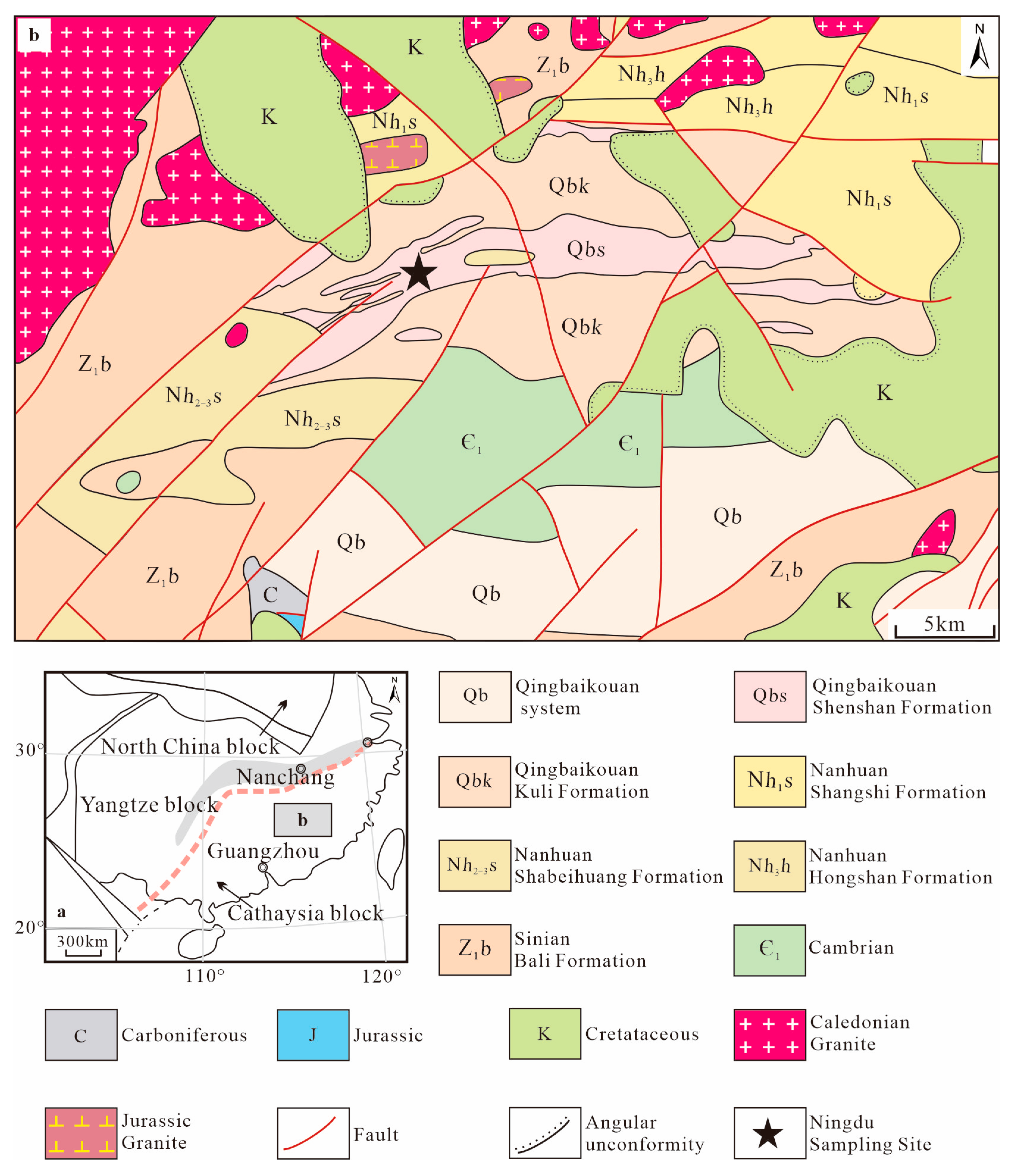
Figure 1. Sketch of tectonic map of South China (a) and geological map of Ningdu County, Jiangxi Province (b) (after Zhao et al., 2018 [16]).
Minerals 16 00324 g001
Figure 2. Petrography and mineralogy of Shenshan metamorphic bedrocks. (a) Photo of thin section. (b) OP-CL image of Ap (bright yellow). (ce) Corresponding plane-polarized light photomicrographs. (f) Photomicrograph under cross-polarized light. Abbreviations: Ap, apatite; Bt, biotite; Qtz, quartz; Ser, sericite; IO, iron oxide.
Minerals 16 00324 g002aMinerals 16 00324 g002b
Figure 3. Backscattered electron images of REE-bearing minerals in the metamorphic bedrocks. (a) Apatite, zircon, and xenotime-(Y) grains occupy interstitial spaces between muscovite flakes. (b) Allanite-(Ce), apatite, REE-bearing iron oxides, monazite-(Ce), and xenotime-(Y) occur interstitially between muscovite and biotite. (c) Acicular rhabdophane-(La) aggregates occur interstitially between quartz and potassium feldspar grains. (d) Micrograined cerianite and REE-bearing iron oxides occur interstitially between mineral grains. (e) An unidentified Ce-bearing REE mineral, formed through the alteration of apatite, predominantly consists of Ce, Fe, P, Al, and O elements. (f) Ce-bearing allanite and Y-bearing thorite occur as inclusions within potassium feldspar. (g,h) Rutile, zircon, quartz, albite and biotite occur together. Abbreviations: Ab = albite; Aln-Ce = allanite-(Ce); Ap = apatite; Bt = biotite; Cei-Ce = cerianite-(Ce); Kfs = K-feldspar; Mnz-Ce = monazite-(Ce); Mus = muscovite; Qtz = quartz; Rha-La = rhabdophane-(La); Rt = rutile; Thr-Y = Y-bearing thorite; Xtm-Y = xenotime-(Y); Zrn = zircon.
Minerals 16 00324 g003aMinerals 16 00324 g003b
Figure 4. (a) Zircon U-Pb concordia diagrams and the weighted average age. (b) Tera–Wasserburg concordia plots of apatites.
Minerals 16 00324 g004
Figure 6. (a) Apatite chondrite-normalized REE patterns and discriminant diagrams (bd). Normalized values are from Sun and McDonough (1989) [37], (bd) after Guo et al. (2026) [39].
Minerals 16 00324 g006
Figure 7. Plots of δEu vs. δCe (a), Zr/Hf vs. δEu (b), δEu vs. Hf (c), Hf vs. Sm/Yb (d), zircon from the Shenshan samples.
Minerals 16 00324 g007
Figure 9. Zircon Lu/Hf vs. Y (a), U vs. Er (b), U/Yb vs. Hf (c), U/Yb vs. Y (d), Nb/Hf vs. Th/U (e), Hf/Th vs. Th/Nb (f). (b,e) after Grimes et al., 2007 [60], (c) after Hawkesworth and Kemp, 2006 [62], (f) after Lin et al., 2025 [63].
Minerals 16 00324 g009
Figure 10. Plots of Th/U vs. Hf (a), Zr/Hf vs. Hf (b), Y/Dy vs. δEu (c), Sm/Yb vs. δEu (d), T vs. Hf (e), Yb/Gd vs. Ce/Sm (f), zircon from the Shenshan samples. Abbreviations: Ap = apatite; Hbl = hornblende; Pl = plagioclase; Ttn = titanite. After Lee et al., 2017 [49].
Minerals 16 00324 g010
Figure 11. Plots of La/Yb vs. ∑REE (a), Th vs. Nd (b), δEu vs. Sr (c), ∑REE vs. Mn (d), apatite from the Shenshan samples. Abbreviations: Rt = rutile; Mnz = Monazite; Pl = plagioclase.
Minerals 16 00324 g011
Disclaimer/Publisher’s Note: The statements, opinions and data contained in all publications are solely those of the individual author(s) and contributor(s) and not of MDPI and/or the editor(s). MDPI and/or the editor(s) disclaim responsibility for any injury to people or property resulting from any ideas, methods, instructions or products referred to in the content.