Article

Petrogenesis of Epimetamorphic Rock from an Ion-Adsorption-Type REE Deposit in Ningdu County, Southern Jiangxi, China: Contraints from U–Pb Geochronology and the Geochemistry of Zircon and Apatite


1
National Key Laboratory of Uranium Resources Exploration-Mining and Nuclear Remote Sensing, East China University of Technology, Nanchang 300013, China
2
Key Laboratory of Ionic Rare Earth Resources and Environment, Ministry of Natural Resources, Ganzhou 341000, China
3
Key Laboratory of Geochemical Exploration, Institute of Geophysical and Geochemical Exploration, Chinese Academy of Geological Sciences, Langfang 065000, China
4
Chinese Academy of Geological Sciences, Beijing 100037, China
5
Jiangxi Bureau of Geology, Nanchang 330036, China
6
Institute of Mineral and Resources, Chinese Academy of Geological Sciences, Beijing 100037, China
7
CNNC Inner Mongolia Energy Co., Ltd., Hohhot 010020, China
*
Author to whom correspondence should be addressed.
Minerals 2026, 16(3), 283; https://doi.org/10.3390/min16030283
Submission received: 22 January 2026 / Revised: 4 March 2026 / Accepted: 6 March 2026 / Published: 9 March 2026
(This article belongs to the Special Issue Advances in Granite Geochronology and Geochemistry)

Abstract

In recent years, an ion-adsorption type REE deposit has been discovered for the first time in the weathering crust of epimetamorphic rocks in Ningdu County, Jiangxi Province, which provides a new idea for the exploration of ion-adsorption-type REE deposits. However, most previous studies on the ore-forming parent rocks of ion-adsorption-type REE deposits have focused on granites and volcanic rocks, while studies on epimetamorphic rocks remain extremely scarce. In this paper, petrographic analysis of epimetamorphic rocks, LA-ICP-MS U–Pb dating and trace element analysis of zircon and apatite were conducted on the metamorphic tuff from the Kuli Formation in Ningdu County, Jiangxi Province, so as to constrain the formation age and tectonic dynamic setting of the rock mass, investigate the petrogenesis and material source of the rock mass, and reveal the metallogenic potential of the rock mass. The results of zircon and apatite U–Pb dating show that the protolith of the metamorphic tuff from the Kuli Formation formed at ca. 770 Ma, representing a product of mid-Neoproterozoic magmatic activity. The protolith restoration of metamorphic rocks suggests that the protolith of the metamorphic tuff from the Kuli Formation is magmatic rock. The estimated results of zircon Ti thermometry indicate that the magmatic crystallization temperature ranges from 623 to 723 °C, with an average value of approximately 696 °C, and the calculated zircon oxygen fugacity values vary from −18.7 to −9.4, with an average of −13.8, implying that the rock formed under conditions of relatively low temperature and high oxygen fugacity. The correlation diagrams of trace elements and element ratios in zircon and apatite reveal that the magmatic evolution involved extensive fractional crystallization of minerals such as zircon, monazite, apatite, titanite, rutile, and plagioclase during the formation of the rock mass. The discrimination diagrams of trace elements in zircon and apatite demonstrate that the metamorphic tuff from the Kuli Formation was formed in a continental margin arc or arc-related orogenic belt, and the magmatic source is characterized by crust–mantle mixing. Combined with previous research findings on regional tectonic-magmatic activities, it can be concluded that the metamorphic tuff from the Kuli Formation was formed in a tectonic setting of back-arc extension and intra-arc rifting caused by the rollback of the subducting oceanic slab. The upwelling of the asthenospheric mantle induced the partial melting of arc-derived sediments in the continental crust, which was subsequently mixed with mantle-derived magma, ultimately generating the parent magma of the metamorphic tuff. The metamorphic tuff from the Kuli Formation in Ningdu County, Jiangxi Province, has high REE abundance and relatively easily weathered REE mineral assemblages, which can provide sufficient material sources for ion-adsorption REE mineralization and have a great metallogenic potential for ion-adsorption REE deposits.

1. Introduction

REE ore is the dominant mineral resource in China. In North China, there is the world’s largest Bayan Obo LREE deposit [1], while in South China, there are abundant ion-adsorption-type REE deposits [2,3], which are almost the only source of HREE resources in the world, supplying 90% of the global HREE resources [4,5]. The ion-adsorption-type REE deposit was first discovered in Longnan County, southern Jiangxi Province, China, in 1969 [6]. Subsequently, Chinese researchers performed nationwide geological surveys for ion-adsorption-type REE deposits and identified several ion-adsorption-type REE deposits in South China [7,8,9], making it a world-renowned REE resource producer. In recent decades, with the increasing attention paid by foreign countries to the exploration of ion-adsorption-type REE deposits, this type of deposit has also been indentified in countries including Brazil [10], the United States [11], Madagascar [12], Palawan Island of Philippines [13], Phuket Island of Thailand [14], and Myanmar [15].
The southern Jiangxi region, where hundreds of ion-adsorption-type REE deposits are widely distributed [16], has become an important ore-concentrated area for REE deposits. The REE deposits in southern Jiangxi are not only numerous in quantity, but also have the advantages of large scale and comprehensive distribution patterns of LREE, MREE, and HREE. Currently, its proven and exploited reserves of REE ores rank first in China, earning it the reputation of the “Kingdom of REE”. Traditional viewpoints suggest that the ore-forming parent rocks of REE deposits in the southern Jiangxi region include granites [17,18,19,20,21,22], volcanic rocks [23], and migmatites [24,25]. Among all the ore-forming parent rocks, granites are most widely distributed and have the highest level of research. REE mineralization is mainly related to Caledonian (460–430 Ma) [17,18], Indosinian (240–205 Ma) [19,20], and Yanshanian (190–150 Ma) [21,22] granites. For a long time, most geological researchers have predominantly focused on the study of metallogenic sources related to granites, while ignoring the metallogenic potential of other rock types. To some extent, studies mainly focusing on the relationship between ion-adsorption-type REE deposits and granites have constrained the prospecting direction of geologists. Moreover, with the increasing global demand for REE resources, REE resources have gradually become critical resources, and there has arisen a critical necessity to conduct prospecting and theoretical research on new types of REE deposits.
In recent years, an ion-adsorption-type REE deposit was first identified in the weathering crust of epimetamorphic rocks in Ningdu County, Jiangxi Province [26,27]. The discovery of this type of REE deposit enriches the types of the ore-forming parent rocks for ion-adsorption-type REE deposits and broadens the prospecting direction for ion-adsorption-type REE deposits. Metamorphic rocks are widely distributed in southern Jiangxi with an exposed area of approximately 14.605 km2, accounting for 37.1% of the urban area [28]. Previous studies show that metamorphic rocks in this region may have metallogenic potential for ion-adsorption-type REE deposits [26], especially the Qingbaikouan metamorphic tuff and metamorphic sedimentary tuff weathering crusts distributed in the central and southern Jiangxi have good metallogenic potential for REE deposits [27]. At present, the research on REE ore-forming parent rocks mainly centers on granites and volcanic rocks, whereas the research on epimetamorphic rocks is fairly limited and urgently needs further development. In particular, the ion-adsorption-type REE deposit in the weathering crust of epimetamorphic rocks in Ningdu County has been discovered only recently and has a relatively low level of research. The genesis of the ore-forming parent rock is still unclear.
In this study, the metamorphic tuff from the Kuli Formation in the newly discovered ion-adsorption-type REE deposit in Ningdu County was selected as the research object. Petrographic analysis of metamorphic rocks, U–Pb geochronology, and trace element analysis of zircon and apatite were carried out to determine the protolith properties of metamorphic rocks, constrain the formation age and tectonic dynamic setting of the rock mass, investigate the genesis and material source of the rock mass, and reveal the relationship between the rock mass and REE mineralization. The results will provide a basis for further metallogenic prediction and theoretical research on this type of ion-adsorption REE deposit.

2. Regional Geology

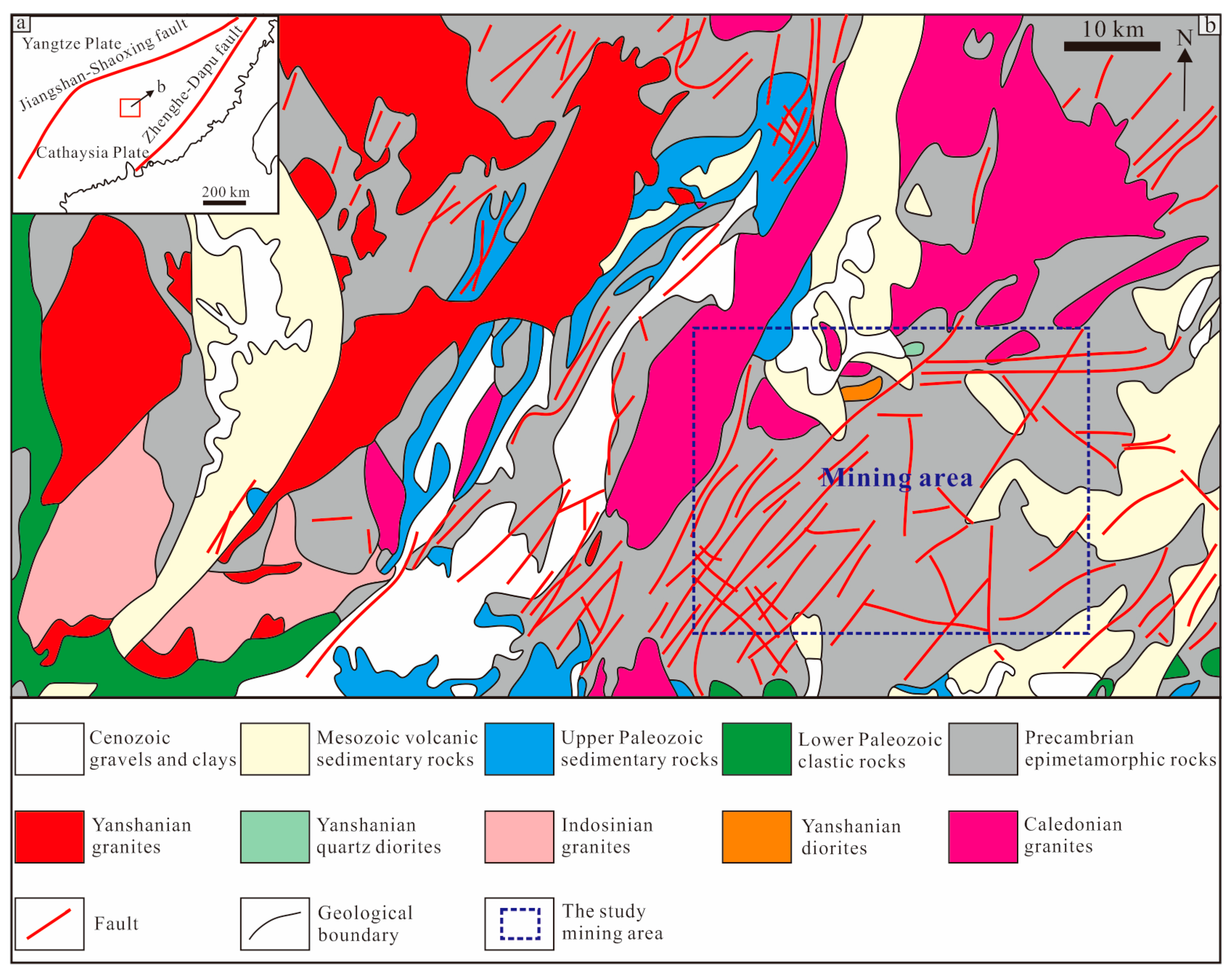
The southern Jiangxi region is located in the central part of the Cathaysia Plate and belongs to the intersection of the eastern segment of the Nanling EW-trending metallogenic belt and the western segment of the Wuyishan NE-trending metallogenic belt [9] (Figure 1a). The northern part is bounded by the Jiangshan–Shaoxing fault zone and separated from the Yangtze Plate, whereas the southern part is bounded by the Zhenghe–Dapu fault zone and the late Mesozoic volcanic rock belt along the southeast coast [29]. The regional stratigraphic development is relatively complete; except for the missing Silurian strata, strata ranging from Proterozoic to Quaternary are all well developed [27]. The Proterozoic strata constitute the metamorphic crystalline basement, among which the Mesoproterozoic crystalline basement is sporadically distributed, and is dominated by schists and gneisses of the Xunwu Formation. The overlying strata consist of low-grade metamorphic volcano-clastic sedimentary rock series of Qingbaikouan–Nanhuan strata, as well as graptolite-facies clastic rock series of the Sinian, Cambrian, and Ordovician strata characterized by rhythmic pelitic-sandy beds. The sedimentary cover is composed of unmetamorphosed neritic carbonate rocks and pelitic-sandstone rocks of the Upper Devonian, Carboniferous, Permian, and Lower Triassic strata, together with continental clastic-volcanic rocks of the Upper Triassic, Jurassic, Cretaceous, and Paleogene strata. The Quaternary strata are mainly distributed along valleys, plains, and foothills [30]. The regional structural features are complex, and long-term multi-stage tectonic evolution has resulted in well-developed folds and faults. Regional fold structures mainly include basement folds and cover folds. Basement folds were formed mainly during the Caledonian period and are exposed in the southern part of the mining area along the NE–NNE direction, and are mainly composed of the Late Proterozoic and Sinian strata. Cover folds were formed mainly during the Hercynian–Indosinian periods, distributed in the western part of the mining area, among which the Yinkeng Syncline is the most typical cover fold. Its core consists of Cretaceous strata, and its two limbs are composed of Devonian–Carboniferous strata [26]. Regional faults are predominantly NE-trending faults, superimposed by NE-trending and NW-trending faults; the NE-trending and NW-trending faults are intertwined to form a network architecture. The NE-trending faults in this region can be divided into two types: thrust nappe faults and associated faults of cover folds. Thrust nappe faults are distributed in the area from Qiaotou to Quyang, and were mainly formed during the Indosinian and Yanshanian periods. Associated faults of cover folds occur on the northwest limb of the Ma’an Syncline and on both limbs of the Yinkeng Syncline, and primarily formed in the Indosinian period [31]. The regional magmatic activities are frequent and characterized by multiple periods and stages, leading to extensive emplacement of granites and large-scale volcanic activities [28]. Magmatic activities occurred from the Caledonian period to the Yanshanian period, forming more than 400 magmatic intrusions (Figure 1b), among which magmatic activties during the Caledonian and Yanshanian periods were large in scale, widely distributed, and most closely related to REE mineralization; whereas magmatic activities during the Hercynian and Indosinian periods was small in scale and limited in distribution [24]. The epimetamorphic rocks are widely distributed from the Neoproterozoic to the Cambrian in the northeastern part of southern Jiangxi, while in other areas, the epimetamorphic rocks are mostly interspersed and fragmented by Mesozoic granites or covered by Mesozoic sedimentary rocks, and exhibit a sporadic distribution [32,33].

3. Deposit Geology

The ion-adsorption-type REE mining area in the weathering crust of metamorphic rocks in Ningdu County is dominated by intermountain basins and hills. The topography of the study area is higher in the southwestern part and lower in the central part, and is characterized by crisscrossing valleys. The exposed elevation of the weathering crust is 230–410 m, and the relative cutting depth is less than 150 m. The weathering denudation is not strong, and the weathering crust has a surface distribution, with a thickness of 1.4–20.3 m and an average thickness of 9.53 m. The mountains are mostly irregularly rounded in shape, and the gullies are radial. The weathering crust is mainly distributed on gentle mountain tops and slopes. The weathering crust profile consists of a topsoil layer, a fully weathered layer, a semi-weathered layer, and bedrock in sequence from top to bottom [28].
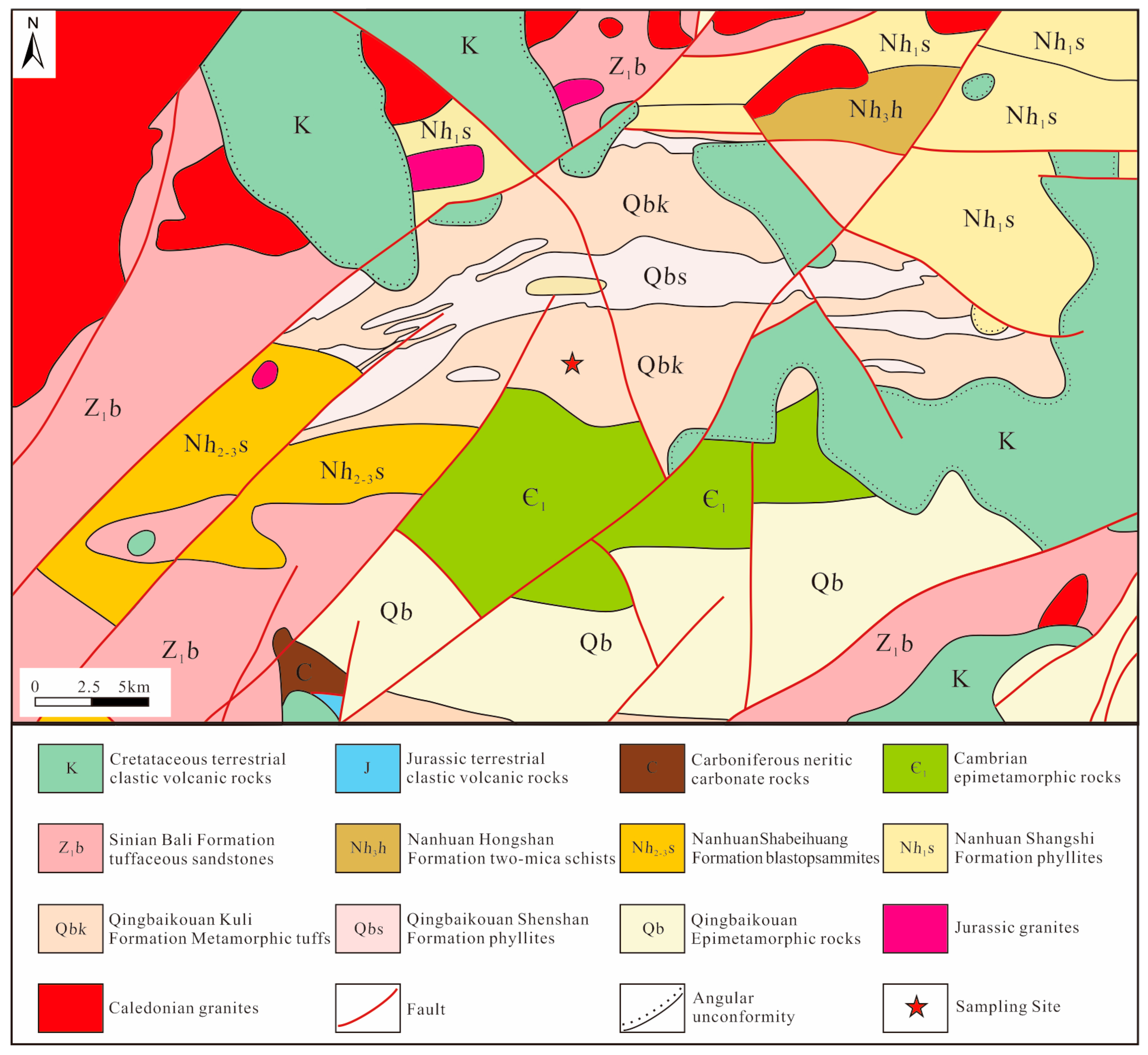
The exposed strata in the mining area are mainly the Qingbaikouan Shenshan Formation phyllites, the Kuli Formation metamorphic tuffs, the Nanhuan Shangshi Formation phyllites, the Shaba Huangzu blastopsammites, the Hongshan Formation two-mica schists, the Sinian Bali Formation tuffaceous sandstones, and the Cambrian epimetamorphic rock strata [9] (Figure 2). The faults in the mining area are relatively developed, with trends in the NE, NW, and near EW directions. The NE-trending and NW-trending faults control the distribution of ore-bearing strata [26]. The mining area has experienced multi-stage tectonic-magma events from the Neoproterozoic to the Cenozoic, accompanied by frequent magmatic activities and complex geological structures. The main exposed magmatic rocks in the mining area are Caledonian granite, Jurassic granite, and Jurassic quartz diorite [9,32].
The ore bodies are principally hosted in the weathering crust of metamorphic rocks from the Kuli Formation and the Shenshan Formation. The ore bodies are mostly broad-leaf, elliptical, or bun-shaped in the plane, and stratiform-like in the profile. The ore bodies are formed continuously along the trend of the strata with a length of 1000–3000 m, a width of 500–2000 m, and a thickness of 1.1–8 m. Among the 231 ore-bearing projects, 123 engineering ore bodies have been exposed to the surface, indicating that the weathering denudation in the mining area is strong [27]. The grade of the REE leaching phase in a single engineering sample is 0.035%–0.139%, and the average grade is 0.07% [28].
The ore minerals are mainly composed of clay minerals, quartz, residual feldspar, and mica, followed by magnetite and apatite that are difficult to weather and decompose in the metamorphic rocks. The clay minerals of the ores are predominantly kaolinite, halloysite, and hydromica. During the formation of the weathering crust, clay minerals are effective carriers for rare earth ions [28,32].

4. Methods

The samples of metamorphic rocks were collected from the Kuli Formation in the ion-adsorption-type REE mining area in Ningdu County. A total of 10 rock samples were collected for the preparation of polished thin sections and for the separation of zircon and apatite monominerals. Petrographic analysis, zircon and apatite U–Pb geochronology, and in situ trace element analysis of zircon and apatite were conducted on these rock samples.
Zircon and apatite monomineral separation and sample mount preparation were completed at the Hebei Institute of Geological Surveying and Mapping. The metamorphic tuff samples were first crushed to an appropriate grain size (60–200 mesh). Zircon and apatite grains were then separated using a shaking table, panning, electromagnetic separation, and gravity separation. High-purity grains were handpicked under a binocular microscope. After cleaning, the separated zircons and apatites were mounted in epoxy resin to form sample mounts, respectively. The zircon and apatite mounts were subsequently ground and polished for further analysis.
Petrographic analysis of metamorphic rocks and graphical observation of zircon and apatite via cathodoluminescence (CL), backscattered electron (BSE), transmitted light, and reflected light were completed using a ZEISS Axio Scope A1 optical microscope and a ZEISS Sigma 300VP field emission scanning electron microscope (FESEM) at the State Key Laboratory of Nuclear Resources and Environment, East China University of Technology, China.
U–Pb isotopic analysis of zircon and apatite was performed using a GeoLasHD 193 nm ArF excimer laser ablation (LA) system coupled with an Agilent 7900 quadrupole inductively coupled plasma mass spectrometer (Q-ICP-MS) at the State Key Laboratory of Nuclear Resources and Environment, East China University of Technology, China. During the testing process, the LA system employed helium as the carrier gas and argon as the make-up gas; the two gases were mixed into the ICP-MS through a T-shaped glass connector. A signal smoothing device was installed between the T-shaped glass connector and the LA system to obtain a smooth analytical signal [34]. For zircon U–Pb isotopic analysis, the laser repetition rate, spot diameter, and laser energy density were set at 5 Hz, 32 μm, and 3.5 J/cm2, respectively. The international zircon standard 91500 [35] was used as an external standard to correct U–Pb isotopic fractionation, while the international standard Plešovice [36] was applied to monitor the analytical quality. For apatite U–Pb isotopic analysis, the laser repetition rate, spot diameter, and laser energy density were set at 5 Hz, 44 μm, and 4 J/cm2, respectively. The international apatite standard MAD [37] served as an external standard for correcting U–Pb isotopic fractionation, whereas the international apatite standard 401 [38] was used to monitor the analytical quality. Trace element contents were calibrated using the NIST SRM 610 glass reference material [39]. Each analytical point included a 20 s gas background signal, followed by a 45 s sample ablation signal and a 25 s washout interval. The offline processing of the analysis data, including selection of sample and blank signals, correction of instrument sensitivity drift, calculation of element contents, U-Th-Pb isotopic ratios, and ages, was performed using ICPMSDataCal 11.0 [40]. The zircon U–Pb concordia age diagram, the calculation of the zircon weighted average age, and the apatite Tera-Wasserburg concordia age diagram were conducted employing Isoplot/Ex_ver3 [41].
In situ trace element analysis of zircon and apatite was conducted using a GeoLasHD 193 nm ArF excimer LA system coupled with an Agilent 7900 Q-ICP-MS at the State Key Laboratory of Nuclear Resources and Environment, East China University of Technology, China. The laser repetition rate, spot diameter, and laser energy density were set at 6 Hz, 44 μm, and 4 J/cm2, respectively. The processing of trace element contents in monominerals employed glass reference materials containing NIST SRM 610, NIST SRM 612, BHVO-2G, BCR-2G, and BIR-1G [39,42] for multiple external standard calibration without an internal standard [40]. Each analytical point involved a 20 s blank signal, a 40 s sample signal collection, and a 30 s washout. The offline processing of the analysis data, comprising selection of sample and blank signals, correction of instrument sensitivity drift, and calculation of element contents, was performed using ICPMSDataCal 11.0 [40].

5. Results

5.1. Petrographic Features

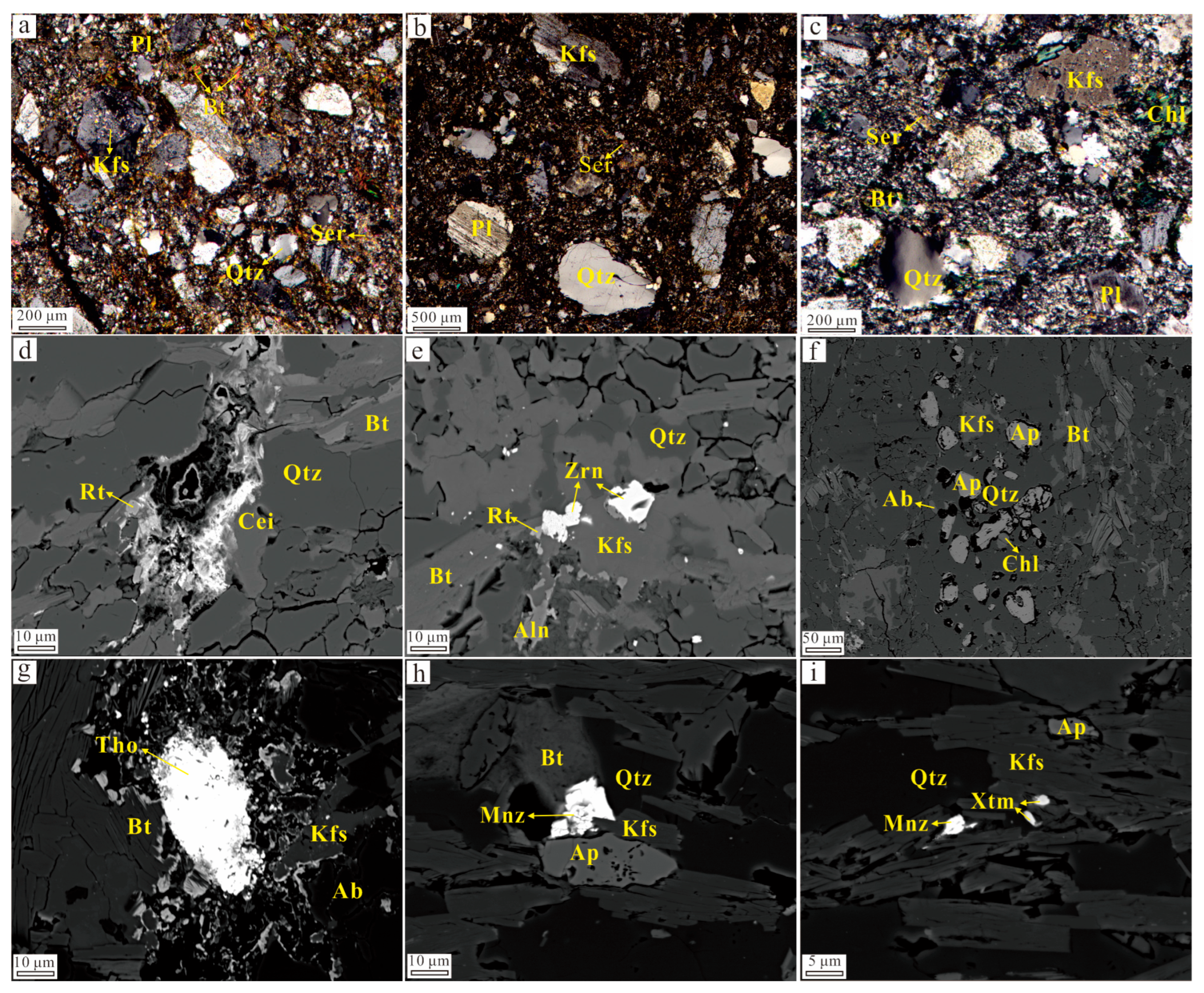
The collected rock samples from the Kuli Formation are principally earth-yellow metamorphic tuffs with a tuffaceous texture and a compact, massive structure. The content of crystal and lithic fragments is relatively high, exceeding 25%. Crystal fragments are dominated by quartz and feldspar, with minor amounts of mica (Figure 3a–c). Quartz grains with a grain size of 0.1–0.6 mm and feldspar grains with a grain size of 0.2–1 mm display well-formed morphologies (Figure 3a–c). Quartz grains commonly occur as euhedral to subhedral grains or fractured grains (Figure 3b), while feldspar grains are mostly euhedral to subhedral granular or columnar (Figure 3b,c), with plagioclase showing prominent polysynthetic twinning (Figure 3b). Metallic minerals are present in only minor quantities.
The SEM-EDS analysis of the metamorphic tuff identified a series of rare earth accessory minerals, including apatite, monazite, xenotime, zircon, cerianite, rutile, thorianite, allanite, and chlorite: (1) Apatite is widely distributed in rock thin sections, exhibiting euhedral to subhedral granular or columnar morphologies. It can be found in the intergranular fractures and within the grains of quartz and feldspar (Figure 3f,h,i), with a wide range of grain sizes from 5 to 50 μm. Apatite is a mineral enriched in LREE. (2) Monazite is widespread in rock thin sections, occurring as euhedral to subhedral granular or irregular grains in the intergranular fractures of quartz, feldspar, and biotite (Figure 3h,i). The grain sizes are relatively small, mostly 5–10 μm, and are characterized by enrichment in LREE. (3) Xenotime is a HREE-enriched mineral with a relatively wide distribution in rock thin sections, but its content is lower than that of monazite. Xenotime occurs in the intergranular fractures of host minerals, exhibits rounded or elliptical morphologies with small grain sizes ranging from 1 to 5 μm, and can coexist with monazite and apatite (Figure 3i). (4) Zircon, widely distributed in rock thin sections and well-crystallized, exhibits euhedral granular or columnar morphologies and occurs in intergranular fractures of quartz and feldspar, with grain sizes ranging from 1 to 100 μm (Figure 3e). Zircon contains a certain amount of rare earth elements, and Zr can be substituted by rare earth elements. (5) Cerianite is a Ce-rich REE oxide mineral that is relatively widespread in rock thin sections. It exhibits granular or vein-like aggregates in intergranular fractures of host minerals, with grain sizes of 5–20 μm (Figure 3d). Its composition is impure and contains some impurities. (6) Rutile is a HREE-enriched mineral that occurs sparingly in rock thin sections. It exists as subhedral granular grains within quartz or feldspar grains, associated with cerianite or zircon, and has small grain sizes of approximately 5 μm (Figure 3d,e). (7) Thorianite is a Y-rich rare earth oxide mineral that occurs rarely in rock thin sections. It is hosted in the intergranular fractures of quartz and feldspar in the form of granular aggregates, with small grain sizes of only a few micrometers (Figure 3d). (8) Allanite is a LREE-enriched mineral, sporadically distributed in rock thin sections. It occurs as irregular grains in the intergranular fractures of quartz and feldspar, with grain sizes less than 10 μm (Figure 3e). (9) Only one grain of chlorite was observed. It occurs as a rounded grain at the margin of apatite and is hosted in quartz grains, with a grain size of less than 10 μm. Chlorite is a LREE-enriched mineral (Figure 3f).

5.2. Zircon U–Pb Age

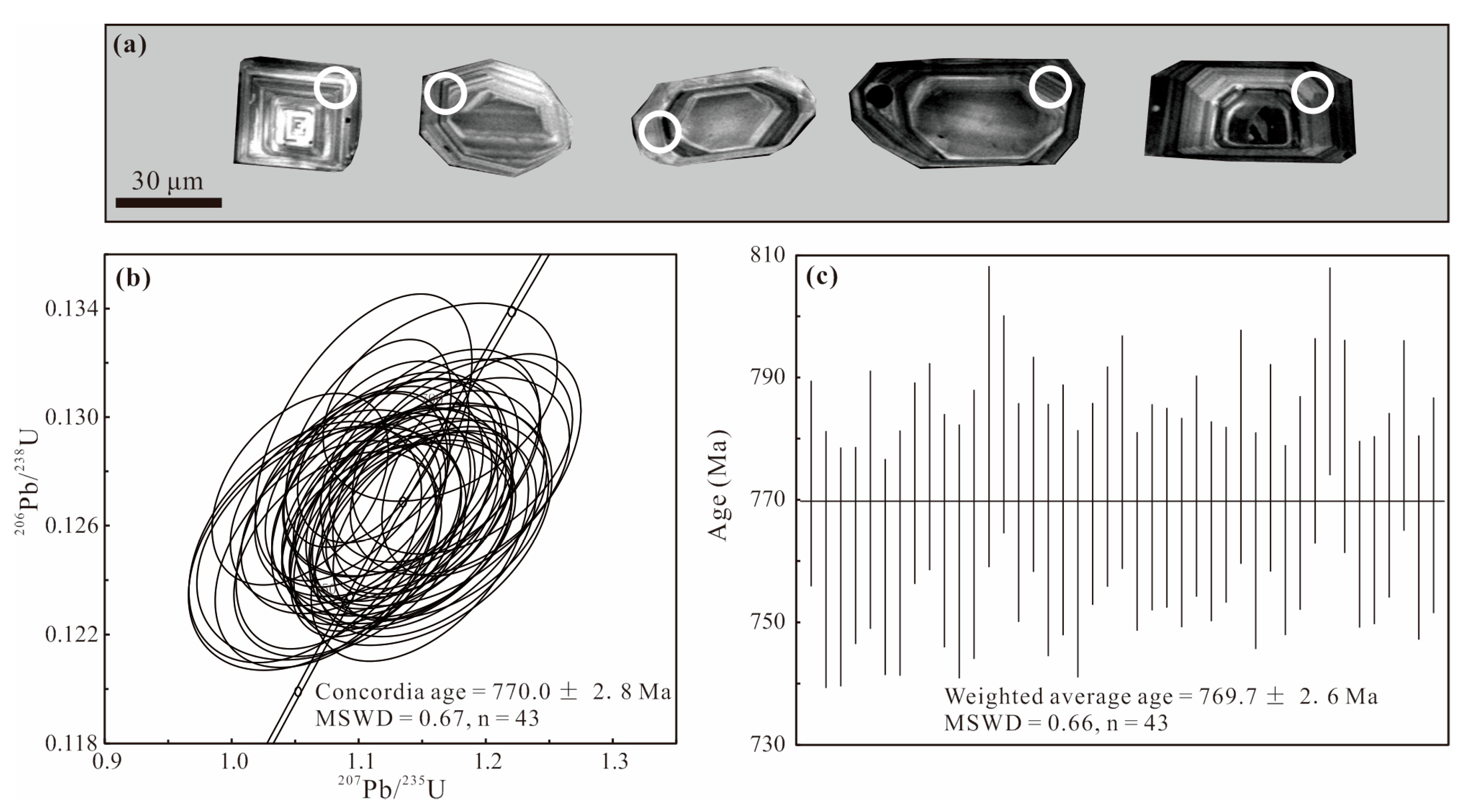
Zircons from the metamorphic tuff are mostly euhedral to subhedral, granular or columnar, and are transparent or slightly yellowish brown with a length of 100–200 μm and an aspect ratio of 1:1–3:1. The zircon CL images show clear magmatic oscillatory girdles (Figure 4a), indicating the magmatic genesis of these zircons [43]. The rims of some zircons show dark girdles in the CL images because of their high Th and U contents [44]. The zircon analytical points are positioned on the oscillatory girdles of zircons, and the results of zircon U–Pb geochronology are displayed in Supplementary Materials Table S1. The U and Th contents of zircons are in the range of 119.2 × 10⁻⁶–516.7 × 10⁻⁶ and 93.8 × 10⁻⁶–451.4 × 10⁻⁶, respectively. The ratio of Th/U ranges from 0.5 to 1.86, and is greater than 0.1, which is consistent with the characteristics of typical magmatic zircons [43]. All zircon analytical spots are located on the U–Pb concordia curve (Figure 4b) with a concordia degree of more than 95%, and the concordia age is 770 ± 2.8 Ma (MSWD = 0.67, n = 43). The weighted average 206Pb/238U age of 769.7 ± 2.8 Ma (MSWD = 0.66, n = 43, Figure 4c) represents the crystallization age of the protolith of the metamorphic rock, suggesting that it was formed in the middle Neoproterozoic.

5.3. Zircon Trace Elements

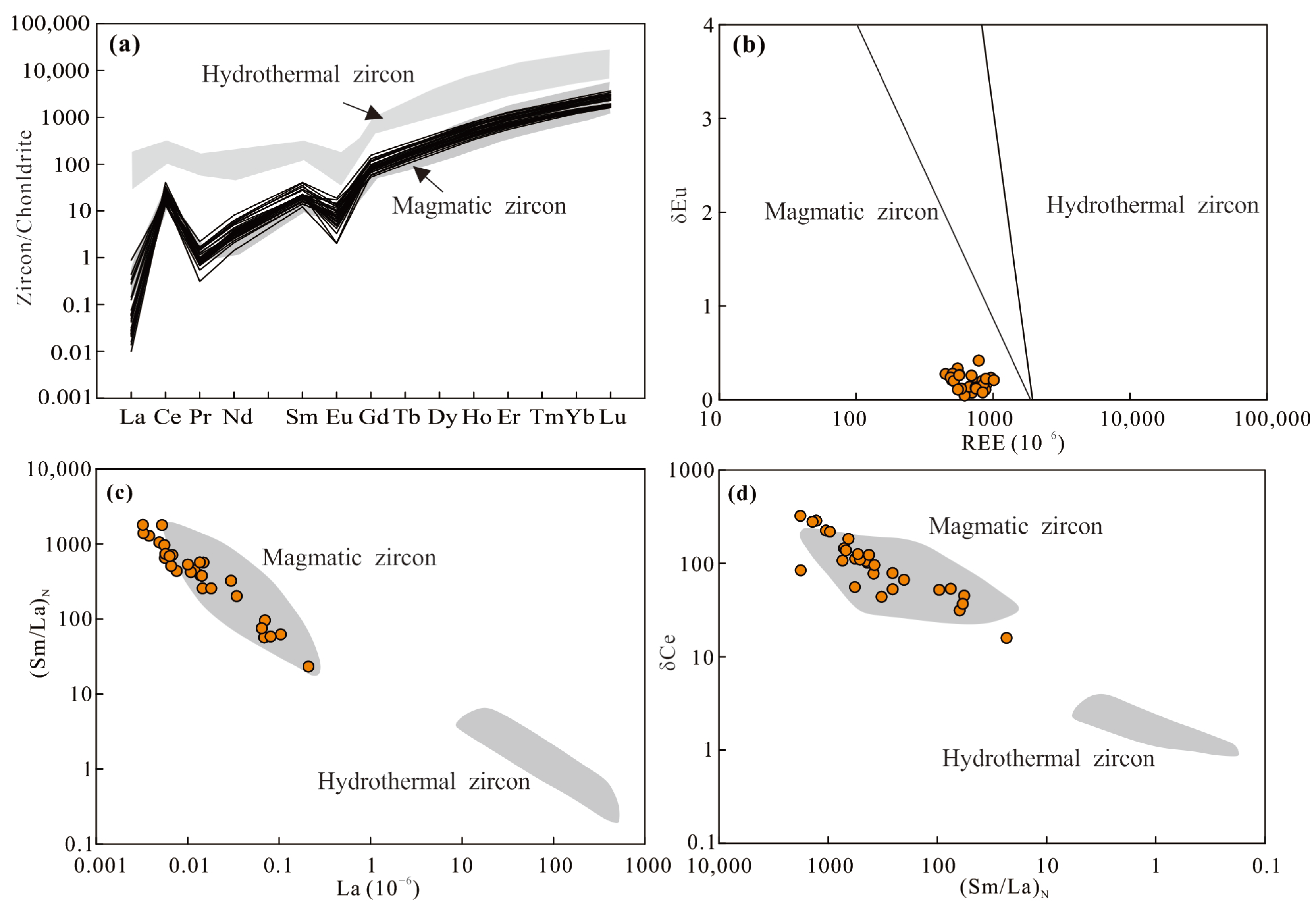
Previous studies indicate that zircons usually contain fine mineral inclusions such as apatite, monazite, and titanite, some of which exist in the form of sub-micrometer fine particles, resulting in significant deviations in the trace element composition of zircons [45]. Therefore, based on previous studies, a screening criterion of La ≤ 0.1 μg/g was employed to exclude zircons contaminated by inclusions, retain “clean zircons”, and exclude zircons with La > 0.1 μg/g [45]. The results of zircon trace element analysis are presented in Supplementary Materials Table S2. The REE content ranges from 450 × 10−6 to 1010 × 10−6, with an average value of 692 × 10−6. The LREE/HREE ratio varies from 0.021 to 0.041, with an average value of 0.031, suggesting obvious fractionation between LREE and HREE. The δEu and δCe values are 0.05–0.42 and 15.89–321.54, respectively. The chondrite-normalized REE patterns of zircons show high consistency (Figure 5a). All zircons exhibit LREE depletion, HREE enrichment, positive Ce anomalies, and negative Eu anomalies, which are typical features of magmatic zircons [46]. In the genetic discrimination diagrams of zircons (Figure 5b–d), all zircons in this paper are apparently different from hydrothermal zircons and are distributed within and adjacent to the magmatic zircon field [46,47].

5.4. Apatite U–Pb Age

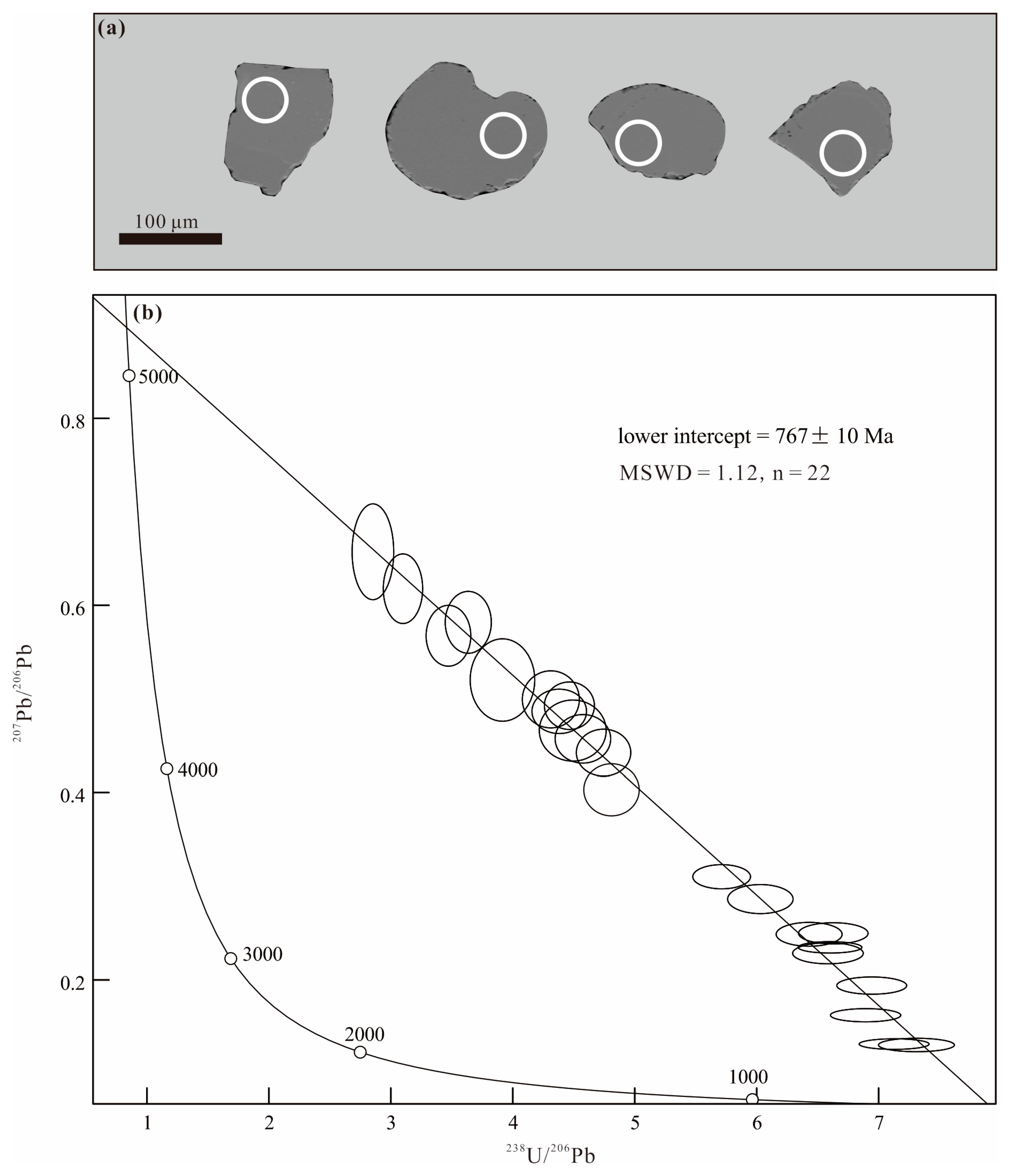
Apatites from the metamorphic tuff are mostly euhedral–subhedral granular crystals and are transparent or slightly pale yellow with a diameter of 80–160 μm. It is clear from the apatite BSE images that apatites show homogeneous luminescence with pores, fractures, and inclusions being extremely rare (Figure 6a), indicating that they are magmatic apatites [49].
The results of apatite U–Pb geochronology are shown in Supplementary Materials Table S3. The 22 analytical points for apatite yielded a lower intercept age of 767 ± 10 Ma (MSWD = 1.12, Figure 6b), which is basically consistent with the age obtained by zircon U–Pb dating within the error range (Figure 4), demonstrating that they are the products of the same period of magmatic activity, which further proves that the protolith of the metamorphic rock was formed in the middle of the Neoproterozoic.

5.5. Apatite Trace Elements

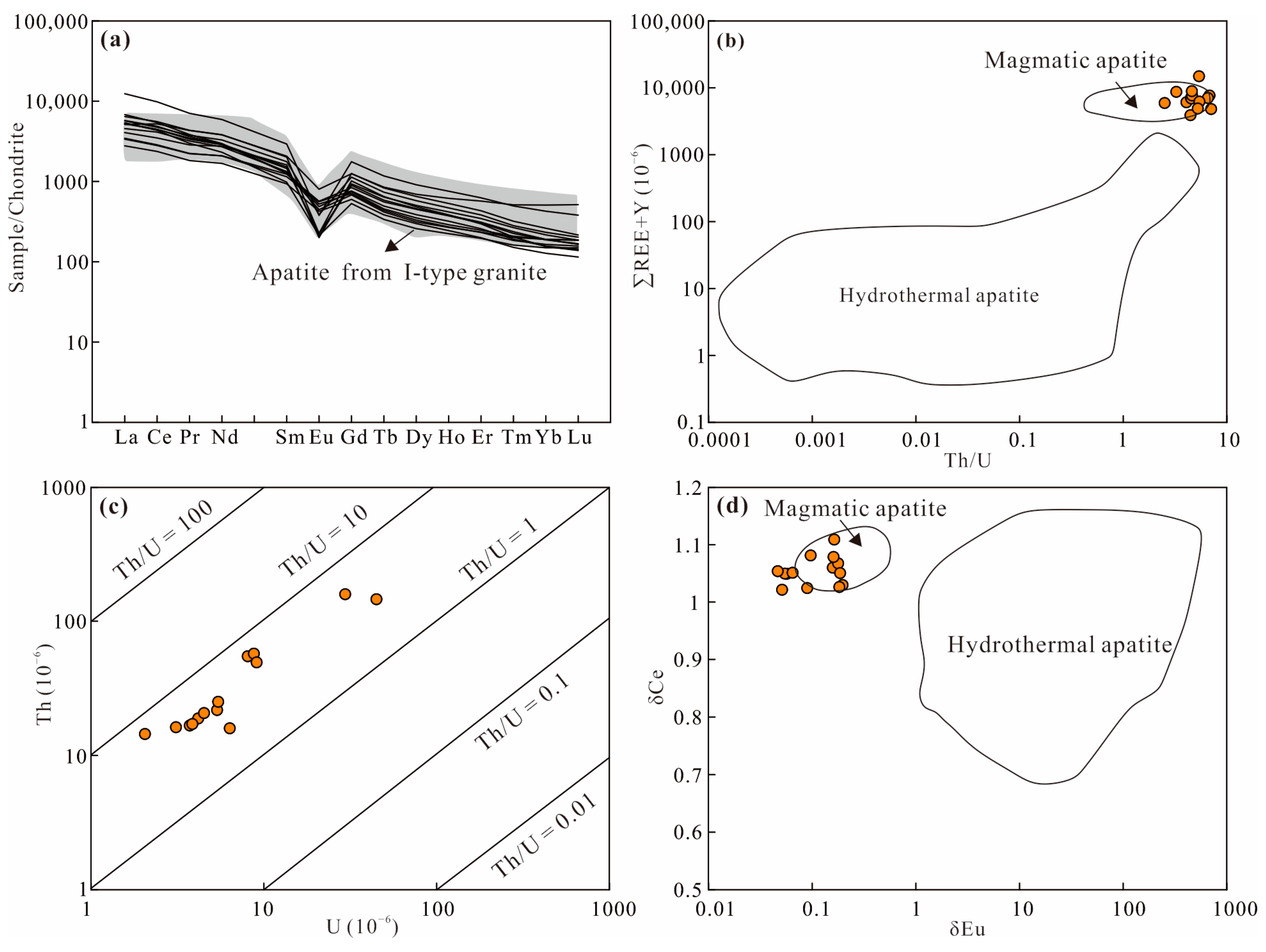
The results of apatite trace element analysis are displayed in Supplementary Materials Table S4. Apatites have a high U content of 2.05 × 10⁻⁶–44.84 × 10⁻⁶ and a Th content of 14.4 × 10⁻⁶–159 × 10−6, and the ratio of Th/U is in the range of 2.51–7.04, which is more than 1 (Figure 7c), inferring that they are magmatic apatites [49]. In addition, the REE content in apatites ranges from 450 × 10−6 to 1010 × 10−6, with an average value of 692 × 10−6, which is greater than 1000 × 10−6. The ratio of LREE/HREE is 9.3–20.8, with an average of 13.7, reflecting the obvious differentiation of LREE and HREE. The values of δEu and δCe are 0.05–0.20 and 1.02–1.11, respectively. The chondrite-normalized REE patterns of apatites show that apatites have the characteristics of LREE enrichment, HREE depletion, and clear negative Eu anomalies (Figure 7a), which correspond to the chondrite-normalized REE patterns of apatites from I-type granite [50]. As can be seen from the diagrams of ∑REE + Y-Th/U and δCe-δEu, all apatites are distributed within and adjacent to the magmatic apatite field (Figure 7b,d). In summary, it is believed that all apatites in this study belong to magmatic apatites. Therefore, their trace element characteristics can be used to explore the properties of the magmatic source area of the rock mass and the magmatic evolution characteristics during the diagenetic process.

6. Discussion

6.1. Protolith Restoration of Metamorphic Rocks

When performing the protolith restoration of metamorphic rocks, reliable results cannot be obtained solely based on the geological occurrence, paragenetic rock assemblages, and petrographic indicators. It is necessary to analyze the protolith properties by examining certain differences in petrologic and geochemical features. The petrologic and geochemical features of metamorphic rocks can fundamentally reflect the physical and chemical properties of the protoliths, and are mainly constrained by the genetic features of the protoliths. In the process of protolith restoration, a series of petrogeochemical parameters and petrogeochemical diagrams constructed from these parameters can be applied to the identification of metamorphic rocks [52].
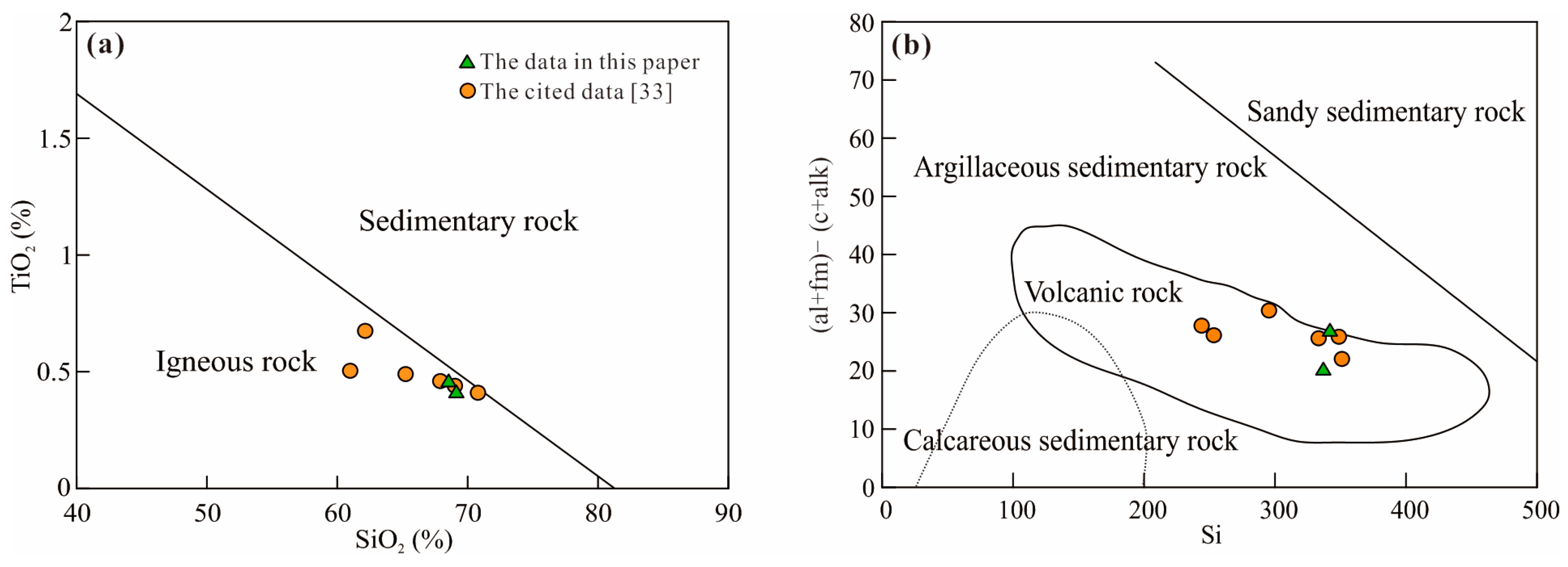
The DF discriminant function is commonly used to distinguish the protolith properties of metamorphic rocks. If the DF value of a metamorphic rock is greater than 0, the protolith is an igneous rock; conversely, if the DF value is less than 0, the protolith is a sedimentary rock [53]. Based on the research data in this paper and the published data from previous studies [33] (Table 1), the calculated DF values range from 0.92 to 4.07, and are all greater than 0, indicating that the protolith of the metamorphic tuff in Ningdu County, Jiangxi Province, is an igneous rock. The SiO2–TiO2 diagram and the Si-((al + fm)-(c + alk)) diagram can effectively discriminate between the protolith types of metamorphic rocks. In the SiO2–TiO2 diagram (Figure 8a), the metamorphic tuff sample points are predominantly in the igneous rock field. In the Si-((al + fm)-(c + alk)) diagram (Figure 8b), the metamorphic tuff sample points are distributed mainly within the volcanic rock field. To sum up, the protolith of the metamorphic tuff in this study is confirmed to be an igneous rock, which is consistent with the magmatic origin of zircons and apatites mentioned above.

6.2. Petrogenesis

6.2.1. Property of the Magmatic Source Area

Zircon has a strong capability to preserve primary chemical features and isotopic ratio information because of its high closure temperature and strong resistance to alteration. Therefore, geochemical features of trace elements such as U, Yb, Y, Sm, Th, Nb, Hf, Lu, and Ta in zircon can better constrain its magmatic source and formation environment [56,57].
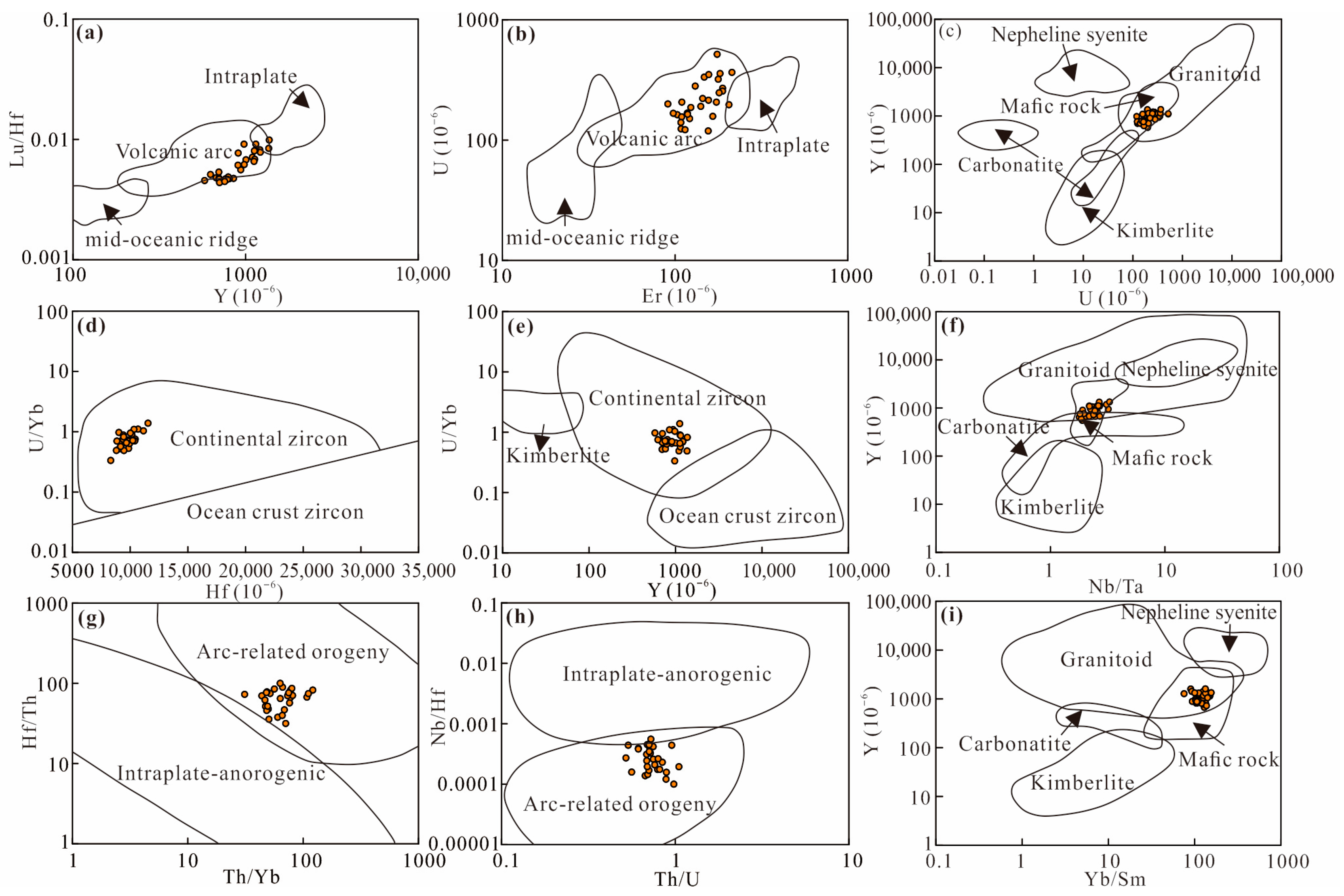
It is clear from the diagrams of zircon Lu/Hf-Y and U-Er (Figure 9a,b) that almost all zircons are distributed within the volcanic arc field. In the diagrams of zircon U/Yb-Hf and U/Yb-Y (Figure 9d,e), all zircons are in the continental zircon field, revealing that they crystallized in a continental crust setting. Moreover, all zircons have relatively high U/Yb values ranging from 0.33 to 1.39. For reference, continental zircon typically has a U/Yb value of 0.1–4, whereas oceanic crust zircon generally has a U/Yb value below 0.1 [58]. It can be seen from the diagrams of zircon Hf/Th-Th/Yb and Nb/Hf-Th/U (Figure 9g,h) that all zircons are situated in the field of arc-related orogenic settings. It is obvious from the diagrams of zircon Y-U, Y-Nb/Ta, and Y-Yb/Sm (Figure 9c,f,i) that all zircons fall in the overlapping field of granitoids and mafic rocks, indicating that the magmatic source is characterized by crust–mantle mixing.
Apatite is a widely distributed accessory mineral in igneous rocks [63], and the different sites of its crystal structure can be subjected to isomorphous substitution by various anions and cations, including F, Cl, Mn, Sr, Th, U, Pb, and REE [64]. The abundances of these elements in apatite are generally controlled by melt-phosphate mineral equilibrium, enabling apatite to well preserve and record information about the initial magmatic state. In addition, apatite is stable in various geological settings and processes, and is not susceptible to metamorphism, alteration, or weathering [65]. Therefore, apatite is commonly used to study the petrogenesis, trace the magmatic source area, and indicate the magmatic evolution process [51,66,67].
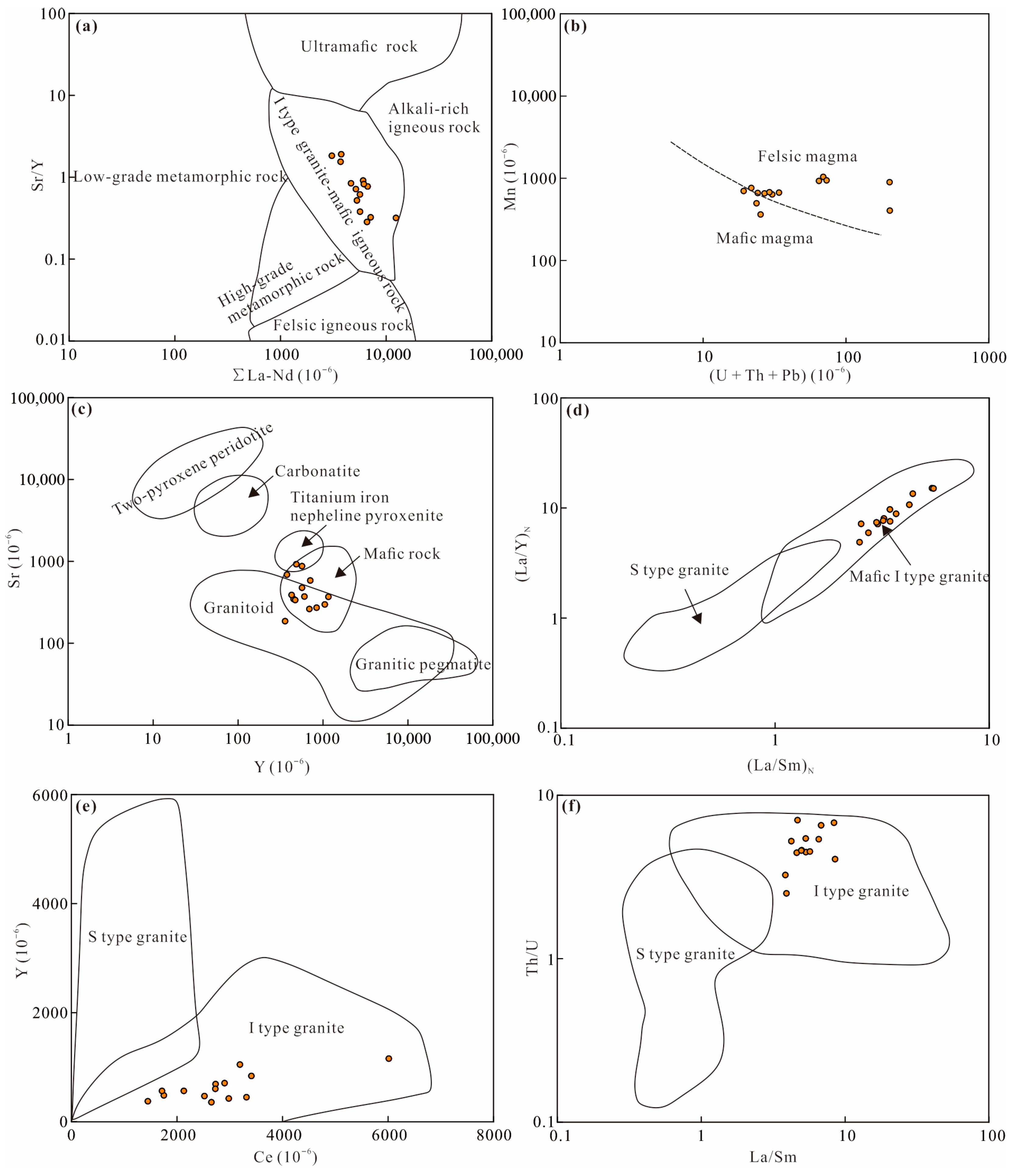
It can be found from the diagrams of apatite Sr/Y-∑La-Nd, (La/Y)N-(La/Sm)N, Y-Ce, and Th/U-La/Sm (Figure 10a,d–f) that the apatites are distributed within the I-type granite-mafic igneous rock field, mafic I-type granite field, or I-type granite field, suggesting that the diagenetic magma has a crust–mantle mixed origin. In the diagram of apatite Mn-(U + Th + Pb) (Figure 10b), most apatites fall in the felsic magma field, while some apatites fall in the mafic magma field, reflecting the magmatic source characterized by crust–mantle mixing. It is apparent from the diagram of apatite Sr-Y (Figure 10c) that the majority of apatites lie in the overlapping field of granitoids and mafic rocks, implying that the magmatic source area exhibits the features of crust–mantle mixing.
Based on a comprehensive analysis of the trace element characteristics of zircon and apatite, it can be concluded that the metamorphic tuff from the Kuli Formation in Ningdu County, Jiangxi Province, was formed in a continental margin volcanic arc or arc-related orogenic setting, and its magmatic source area is characterized by crust–mantle magma mixing.

6.2.2. Estimation of Diagenetic Temperature and Oxygen Fugacity

Zircon is a mineral that can reliably reflect magmatic formation temperature. Ti generally maintains a closure behavior during periods of intensive geological activities, serving as a sensitive indicator of magmatic formation temperature and being widely applied to estimating the temperature of magmatic formation [70]. In this paper, the widely used zircon Ti thermometer proposed by Ferry and Watson (2007) [70] was adopted, with the calculation formula as follows:
T = (4800 ± 86)/(5.711 ± 0.072-log(Ti)-logαSiO2 + logαTiO2) − 273
In this formula, T denotes the zircon crystallization temperature, Ti denotes the Ti content in zircon, and αSiO2 and αTiO2 correspond to SiO2 and TiO2 activities in magma, respectively. Normally, the value of αSiO2 ranges from 0.5 to 1. As for αTiO2, when zircon is present, the value of αTiO2 is greater than or equal to 0.5; when ilmenite is present, the value of αTiO2 is greater than or equal to 0.6; when titanite and titanomagnetite are present, the value of αTiO2 is greater than or equal to 0.7; when rutile is present, the value of αTiO2 is greater than or equal to 1 [71]. In this study, since quartz and rutile are present in the rock, the values ofαSiO2 and αTiO2 are both set to 1. The calculated zircon crystallization temperatures range from 623 to 723 °C, with an average value of approximately 696 °C, indicating that the magma during the formation of the metamorphic tuff from the Kuli Formation in Ningdu County, Jiangxi, was characterized by a relatively low crystallization temperature.
The research findings have shown that the trace element chemical compositions of zircon can be used to estimate the oxygen fugacity of magma. Ballard et al. (2002) [72] proposed a linear fitting method to determine the Ce4+/Ce3+ ratio of zircon for estimating magmatic oxygen fugacity. However, the accurate determination of the Ce4+/Ce3+ ratio is difficult in practical applications, resulting in significant deviations in the estimation of magmatic oxygen fugacity [45]. Trail et al. (2012) [73] put forward an empirical formula for calculating magmatic oxygen fugacity based on La and Pr contents to estimate the Ce4+/Ce3+ ratio. Nevertheless, the La and Pr contents of magmatic zircon are frequently below the detection limit, which causes the actually calculated oxygen fugacity to be strongly influenced by factors such as mineral inclusions and fractures in zircon, making it difficult to obtain reliable estimated results of oxygen fugacity [45]. Loucks et al. (2020) [74] developed a new oxygen fugacity calculation method independent of melt composition. This method calculates magmatic oxygen fugacity based on the Ce, U, and Ti contents in zircon, which can avoid the impacts of other mineral crystallization processes, mineral inclusions, and magmatic water content on oxygen fugacity, thus enabling the acquisition of more reliable oxygen fugacity data. In this study, the method proposed by Loucks et al. (2020) [74] was employed. The calculated values of magmatic oxygen fugacity (logfO2) during zircon crystallization range from −18.7 to −9.4, with an average value of −13.8. The relative oxygen fugacity values (ΔFMQ) vary from −1.5 to 7.5, with a mean value of 3.2. The results reveal that the magma during the formation of the metamorphic tuff from the Kuli Formation in Ningdu County, Jiangxi, had relatively high oxygen fugacity.

6.2.3. Magmatic Fractional Crystallization

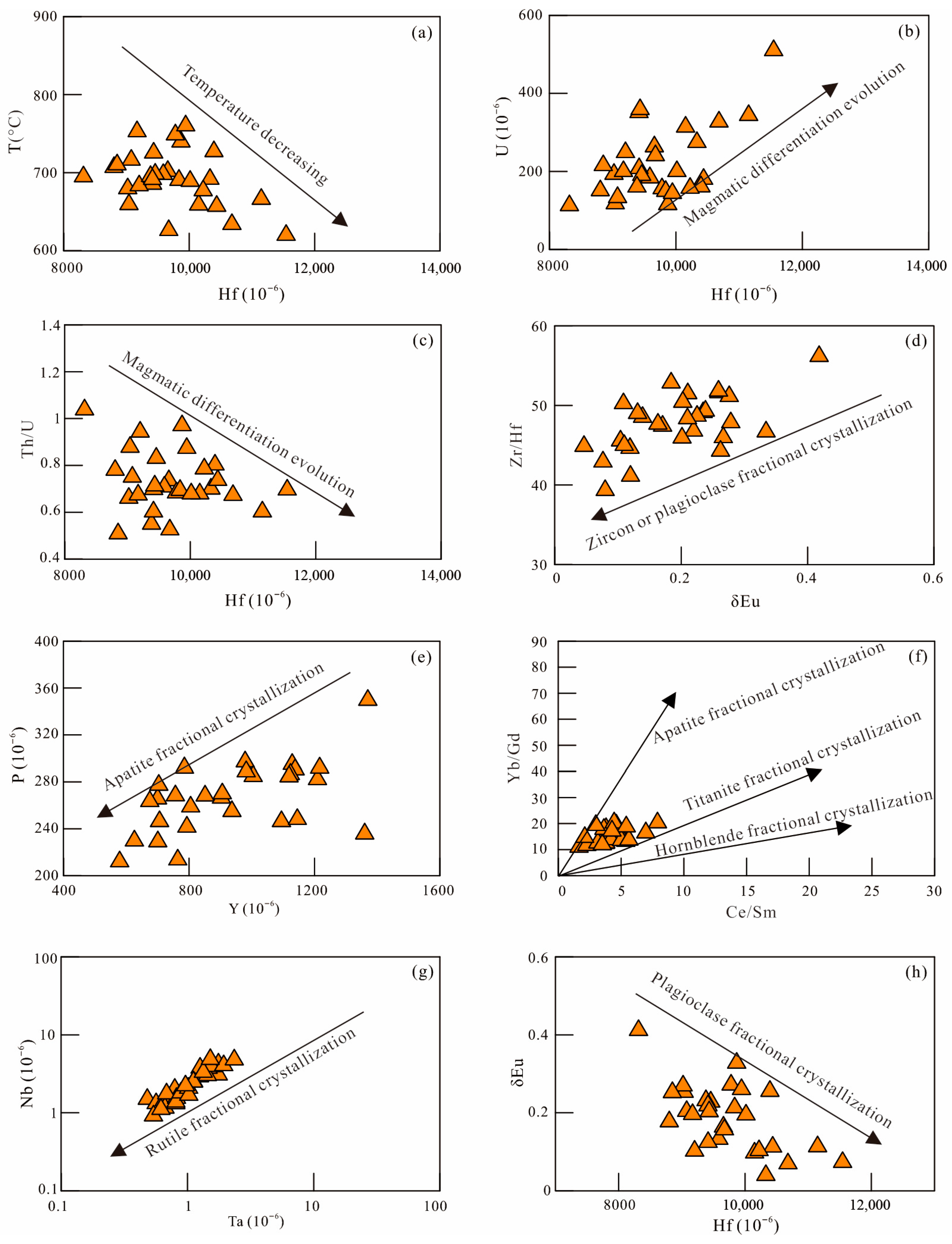
The previous studies have indicated that the trace element contents and element ratio variations in zircon mainly reflect the compositional changes and the paragenetic mineral phases of crystallized melts, which can effectively trace the magmatic fractional crystallization and evolution processes [75,76]. Generally, with the progression of magmatic differentiation and evolution, the trace element characteristics of zircon exhibit a trend of increasing contents of Hf and U coupled with decreasing ratios of Zr/Hf and Th/U. Consequently, the Hf and U contents as well as the Zr/Hf and Th/U ratios of zircon can be used as indicators for magmatic differentiation and evolution [77].
The diagrams of zircon T-Hf, U-Hf, and Th/U-Hf (Figure 11a–c) show that with the gradual increase of zircon Hf content, the U content increases progressively, the zircon crystallization temperature and the Th/U ratios decrease gradually, implying the magmatic differentiation and evolution process. When MREE-rich minerals such as apatite, titanite, and hornblende in the melt undergo fractional crystallization, the residual melt will be relatively depleted in MREE elements, including Sm and Gd, resulting in the gradual increase of Ce/Sm and Yb/Gd ratios of zircon crystallized from the melt during magmatic evolution [75]. The diagram of zircon Yb/Gd-Ce/Sm reveals that the primary magma of the metamorphic tuff experienced the fractional crystallization of apatite and titanite during the evolution process. Zircon P and Y contents present a positive correlation (Figure 11e), further confirming the occurrence of apatite fractional crystallization during magmatic evolution. It can be seen from the diagrams of zircon Zr/Hf-δEu, Nb-Ta, and δEu-Hf (Figure 11d–h) that the magmatic evolution also involved the fractional crystallization of zircon, rutile, and plagioclase.
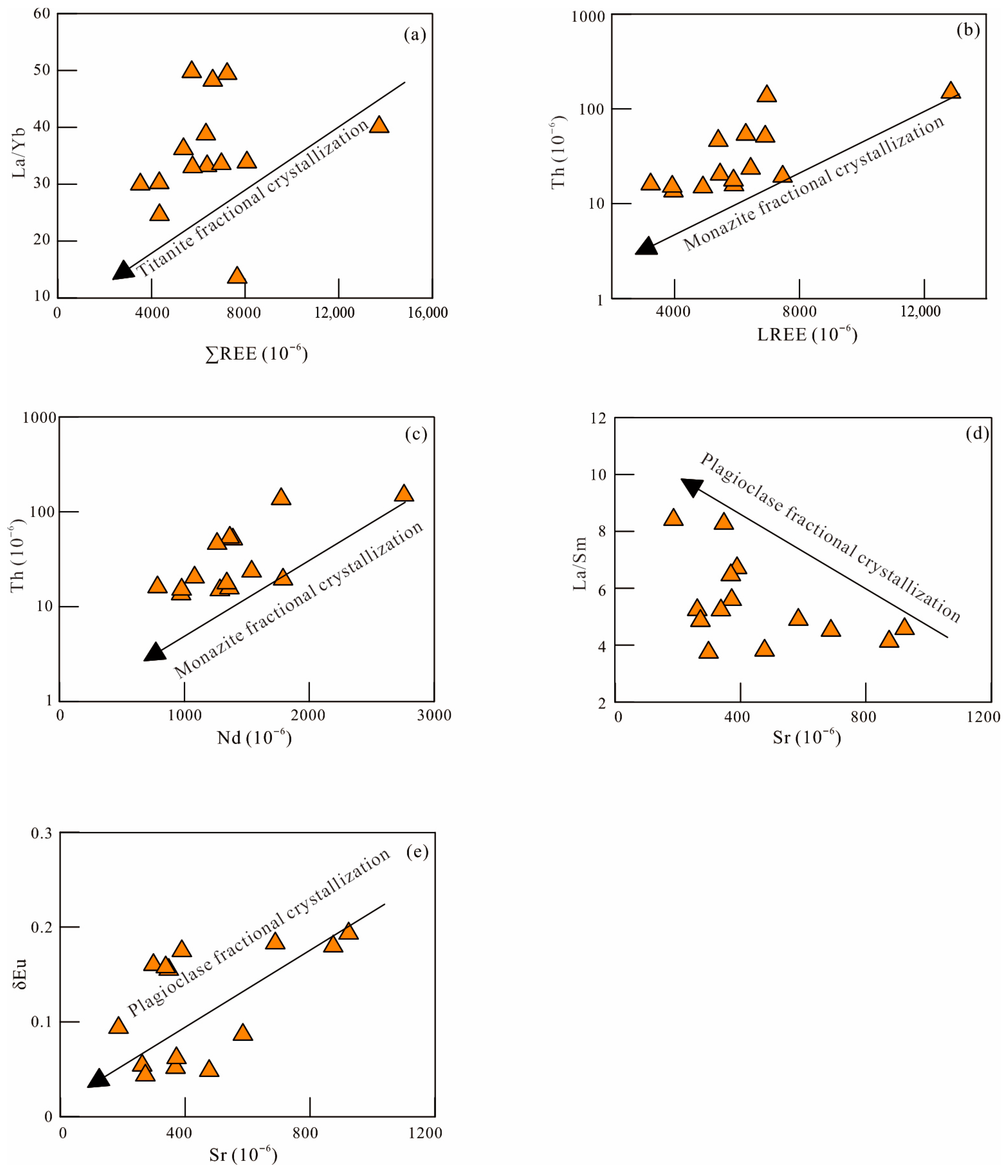
Apatite can enrich elements including REE, Sr, Y, U, and Th in the melt during its crystallization process [60]. However, with the progression of the crystallization process, minerals including zircon, titanite, monazite, allanite, xenotime, hornblende, and feldspar produce a competitive effect with apatite for trace elements in the melt, leading to changes in the trace element composition of apatite [78]. The fractional crystallization of plagioclase will reduce the Eu and Sr contents in the melt, resulting in the enhancement of the negative Eu anomaly, an increase in the La/Sm ratio, and a decrease in the Sr content of apatite [79]. The apatite δEu-Sr and La/Sm-Sr diagrams (Figure 12d,e) show that with the decrease of Sr content, the δEu values decrease and the La/Sm ratio increases, suggesting that the magmatic evolution underwent plagioclase fractional crystallization. The fractional crystallization of titanite can result in a positive correlation between La/Yb and ∑REE in apatite [80]. It is clear from the diagrams of apatite La/Yb-∑REE (Figure 12a) that the REE content decreases with the reduction of the La/Yb ratio, demonstrating that the magmatic evolution involved fractional crystallization of titanite. The monazite fractional crystallization can cause the depletion of Th, Nd, and LREE in coexisting apatite [81]. The diagrams of apatite Th-LREE and Th-Nd (Figure 12b,c) exhibit a distinct positive correlation between Th content and the contents of Nd and REE, indicating that the magmatic evolution experienced monazite fractional crystallization.
Based on the magmatic evolution characteristics reflected by the trace element compositions of zircon and apatite, it is inferred that the magma was subjected to the fractional crystallization of minerals such as zircon, monazite, apatite, titanite, rutile and plagioclase during the evolution process, finally cooled and consolidated to form the parent rock of the metamorphic tuff from the Kuli Formation in Ningdu County, Jiangxi.

6.3. Diagenetic Age and Tectonic Dynamic Setting

The U–Pb geochronological results of zircons and apatites from the metamorphic tuff in Ningdu County, Jiangxi are all approximately 770 Ma, indicating that the metamorphic tuff formed in the middle Neoproterozoic. The Neoproterozoic magmatism in the South China Block was extremely intense, generating a large number of Neoproterozoic mafic rocks, felsic rocks, and minor intermediate rocks intruding into the Meso-Neoproterozoic metamorphic basement rock series, most of which are unconformably overlain by the Nanhuan or Sinian strata [82]. The magmatic rocks formed at approximately 770 Ma are widely distributed in different regions of the South China Block (Table 2), which is consistent with the formation age of the metamorphic tuff in this paper, suggesting that these rocks may be products of the same period of volcanic-magmatic activity. The 770 Ma tectono-magmatic event in the South China Block provided the magmatic source and material supply for the formation of the metamorphic tuff investigated in this paper.
The previous studies have shown that the early Neoproterozoic (1000–900 Ma) of the South China Plate was dominated by intra-oceanic subduction, forming an oceanic volcanic arc [91]. During the period of 900–880 Ma, the Cathaysia Plate thrusted northward together with the newly formed oceanic volcanic arc, causing the back-arc basin or the small oceanic basin with intracontinental rift property to subduct toward the Yangtze Plate, thus forming the continental margin volcanic arc [92]. Between 880 and 860 Ma, the South China Plate entered the stage of the arc-continent collision [93]. From 860 Ma to 830 Ma, the Cathaysia Plate subducted beneath the Yangtze Plate, generating an island arc and back-arc basin system [94]. During the period of 830–800 Ma, the Yangtze Plate collided and amalgamated with the Cathaysia Plate, forming the unified South China Plate [95]. From 800 Ma to 750 Ma, the multi-stage rollback of the oceanic slab subducted beneath the South China Plate triggered back-arc extension and intra-arc rifting, accompanied by asthenospheric mantle upwelling and lithospheric thinning, which resulted in the regional co-occurrence of arc-type and rift-type magmatic assemblages [96].
The trace element characteristics of zircon and apatite suggest that the metamorphic tuff from the Kuli Formation in Ningdu County, Jiangxi, formed in a continental margin volcanic arc or an arc-related orogenic setting, and its magma source area was characterized by crust–mantle magma mixing. Combined with the Neoproterozoic tectono-magmatic evolution history of the South China Block, it is concluded that the tectonic dynamic setting for the formation of the metamorphic tuff corresponds to the middle Neoproterozoic stage of back-arc extension and intra-arc rifting induced by the rollback of the subducting oceanic slab. With the upwelling of the asthenospheric mantle, the overlying lithosphere and continental crust were heated, leading to the partial melting of arc-derived sediments, which mixed with mantle-derived magma, thereby generating the parent magma of the metamorphic tuff.

6.4. Ore-Forming Potential of the Metamorphic Tuff

The REEs in ion-adsorption-type REE deposits are mainly inherited from the parent rock. The content and distribution pattern of REE-bearing minerals in the parent rock determine the REE content and distribution pattern of the ore-forming parent rock [24]. During the weathering process, the REE-bearing minerals in the parent rock decompose and release REEs. Some of the REEs are eventually enriched in the weathering crust through leaching action to form REE deposits [26]. In general, higher REE abundances in the parent rock and higher weathering degrees of REE-bearing minerals are more favorable for ore formation. The total REE content of the metamorphic tuff in this paper is more than 300 × 10−6 (Table 1), which is significantly higher than the threshold value (150 × 10−6) required for REE mineralization of the parent rock in the Nanling Region [28]. Moreover, the metamorphic tuff has a relatively easily weathered REE mineral assemblages including zircon, monazite, apatite, xenotime, REE-bearing rutile, REE-bearing thorianite and cerianite [32], which provides favorable preconditions for the mineralization of ion-adsorption-type REE deposits. In addition, the formation of ion-adsorption-type REE deposits in southern Jiangxi is not only related to the internal factors such as REE abundances of ore-forming parent rock and REE mineral assemblages, but also associated with the supergene conditions in southern Jiangxi. Southern Jiangxi has a subtropical monsoon climate with abundant rainfall and high humidity, where intense chemical weathering of rocks is conducive to the formation of thick weathering crusts. Since the Quaternary, the overall tectonic framework of southern Jiangxi has been dominated by differential uplift and subsidence, forming a typical low-mountain denudation landform with gentle slopes, which is favorable for the preservation of the weathering crusts [25]. In summary, it is considered that the metamorphic tuff from the Kuli Formation in Ningdu County, Jiangxi, has good REE ore-forming potential.

7. Conclusions

(1) The results of LA-ICP-MS zircon and apatite U–Pb dating show that the metamorphic tuff from the Kuli Formation in Ningdu County, Jiangxi, formed at approximately 770 Ma, and is a product of the middle Neoproterozoic magmatic activity in the South China Plate.
(2) The protolith restoration of metamorphic rocks indicates that the protolith of the metamorphic tuff from Kuli Formation in Ningdu County, Jiangxi, is igneous rock, which is consistent with the result of magmatic origin obtained from the trace element discrimination diagrams of zircon and apatite.
(3) The trace element characteristics of zircon and apatite reveal that the magmatic temperature for the formation of the metamorphic tuff from the Kuli Formation in Ningdu County, Jiangxi, ranges from 623 to 723 °C, with an average value of approximately 696 °C, and the oxygen fugacity varies from −18.7 to −9.4, with an average value of −13.8. The magma underwent the fractional crystallization of minerals, including zircon, monazite, apatite, titanite, rutile, and plagioclase, during the evolution process and finally cooled and consolidated to form the parent rock of the metamorphic tuff.
(4) The trace element characteristics of zircon and apatite demonstrate that the metamorphic tuff from the Kuli Formation in Ningdu County, Jiangxi, formed in a continental margin volcanic arc or an arc-related orogenic setting, and the magma source area was characterized by crust–mantle magma mixing. Combined with the regional tectono-magmatic evolution history, it is believed that the tectonic dynamic setting for the formation of the metamorphic tuff corresponds to the middle Neoproterozoic stage of back-arc extension and intra-arc rifting caused by the rollback of the subducting oceanic slab.
(5) The metamorphic tuff from the Kuli Formation in Ningdu County, Jiangxi, has high REE abundances and a relatively easily weathered REE mineral assemblages including zircon, monazite, apatite, xenotime, REE-bearing rutile, REE-bearing thorianite, and cerianite, occurring as discrete grains in the intergranular fractures of host minerals, which can provide sufficient material sources for the mineralization of ion-adsorption-type REE deposits, showing considerable ore-forming potential for ion-adsorption-type REE deposits.

Supplementary Materials

The following supporting information can be downloaded at: https://www.mdpi.com/article/10.3390/min16030283/s1, Table S1: The results of LA-ICP-MS Zircon U-Pb isotopic analysis of the the metamorphic tuff from the Kuli Formation in Ningdu County, Jiangxi; Table S2: Zircon trace element contents (10−6) of the the metamorphic tuff from the Kuli Formation in Ningdu County, Jiangxi; Table S3: The results of LA-ICP-MS apatite U-Pb isotopic analysis of the the metamorphic tuff from the Kuli Formation in Ningdu County, Jiangxi; Table S4: Apatite trace element contents (10−6) of the the metamorphic tuff from the Kuli Formation in Ningdu County, Jiangxi.

Author Contributions

Conceptualization and methodology, W.W., H.F. and S.W.; investigation, W.W., H.F., S.W., D.W. and F.Q.; experimental analysis, W.W., S.W. and G.X.; writing–original draft preparation, W.W. and H.F.; writing–review and editing, W.W., Z.C. and B.Z.; plotting, W.W., H.F. and S.W. All authors have read and agreed to the published version of the manuscript.

Funding

This research was financially supported by the Key Laboratory of Ionic Rare Earth Resources and Environment, Ministry of Natural Resources (No. 2023IRERE102), and the National Nonprofit Institute Research Grant of the Institute of Geophysical and Geochemical Exploration (AS2022P03).

Data Availability Statement

The data presented in this study are available on request from the corresponding author due to restrictions related to privacy and ethical considerations.

Acknowledgments

The authors thank the Key Laboratory of Ionic Rare Earth Resources and Environment, Ministry of Natural Resources, for funding this research. The authors also thank their colleagues for assistance with collecting rock samples and interpret analytical results. The authors are also grateful to Mingqi Wang for providing technical and theoretical suggestions during the analytical work and the preparation of the manuscript.

Conflicts of Interest

Fuyong Qi is employed by Jiangxi Bureau of Geology and Guangming Xu is employed by CNNC Inner Mongolia Energy Co., Ltd. The paper reflects the views of the scientists and not the companies.

References

  1. Li, X.C.; Zhan, Y.X.; Fan, H.R.; Yang, K.F. The REE mineralization and remobilization history of the giant Bayan Obo deposit, Inner Mongolia, China: Constraint from in-situ Sm-Nd isotopes of REE minerals. Acta Petrol. Sin. 2022, 38, 2920–2932, (In Chinese with English Abstract). [Google Scholar]
  2. Hou, G.S.; Wu, C.B.; Li, Y.J.; Wei, S.P.; Zhang, Y.L.; Qi, Y.A.; Xiang, S.H. Discovery and geological significance of REE deposit in southern Songxian County, East Qinling, China. Ore Geol. Rev. 2021, 129, 103841. [Google Scholar] [CrossRef]
  3. Zhao, Z.; Wang, D.H.; Wang, C.H.; Wang, Z.; Zou, X.Y.; Feng, W.J.; Zhou, H.; Huang, X.P.; Huang, H.G. Progress in prospecting and research of ion-adsorption type REE deposits. Acta Geol. Sin. 2019, 93, 1454–1465, (In Chinese with English Abstract). [Google Scholar]
  4. Bern, C.R.; Yesavage, T.; Foley, N.K. Ion-Adsorption REEs in regolith of the Liberty Hill pluton, South Carolina, USA: An effect of hydrothermal alteration. J. Geochem. Explor. 2017, 172, 29–40. [Google Scholar] [CrossRef]
  5. Li, M.Y.H.; Zhou, M.F. The role of clay minerals in formation of the regolith-hosted heavy rare earth element deposits. Am. Mineral. 2020, 105, 92–108. [Google Scholar] [CrossRef]
  6. Wang, D.H.; Zhao, Z.; Yu, Y.; Zhao, T.; Li, J.K.; Dai, J.J.; Liu, X.X.; He, H.H. Progress, problems and research orientation of ion-adsorption type rare earth resources. Rock. Miner. Anal. 2013, 32, 796–802, (In Chinese with English Abstract). [Google Scholar]
  7. Wang, J.X.; Fang, X.; Chu, K.L.; Fan, H.H.; Zheng, W.; Huang, B.; Wu, D.H. Geochronology, geochemistry and Sr-Nd-Pb isotopes of the early-middle Jurassic highly fractionated granites in southern Jiangxi, and their implications for the rare-earth mineralization: Examples from the Muzishan, Xiahu, and Zudong deposits. Acta Geol. Sin.-Engl. 2025, 99, 995–1012. [Google Scholar] [CrossRef]
  8. Zhang, Q.; Chen, B.F.; Zhang, X.W. Geological, geochemical characteristics and significance of Fengshan HREE deposit in Ganxian district, Jiangxi Province. East. China Geol. 2020, 41, 359–367, (In Chinese with English Abstract). [Google Scholar]
  9. Huang, Y.F.; He, H.P.; Liang, X.L.; Bao, Z.W.; Tan, W.; Ma, L.Y.; Zhu, J.X.; Huang, J.; Wang, H. Characteristics and genesis of ion adsorption type ree deposits in the weathering crusts of metamorphic rocks in Ningdu, Ganzhou, China. Ore Geol. Rev. 2021, 135, 104173. [Google Scholar] [CrossRef]
  10. Costa, N.O.; Botelho, N.F.; Garnier, J. Concentration of rare earth elements in the Faixa Placha Tin Deposit, Pedra Branca a-type granitic massif, Central Brazil, and its potential for ion-adsorption-type REE-Y mineralization. Ore Geol. Rev. 2020, 123, 103606. [Google Scholar] [CrossRef]
  11. Foley, N.; Ayuso, R. REE enrichment in granite-derived regolith deposits of the Southeastern United States: Prospective source rocks and accumulation processes. In Symposium on Strategic and Critical Materials Proceedings, Victoria, British Columbia, 13-14 November 2015; British Columbia Ministry of Energy and Mines: Victoria, BC, Canada, 2015. [Google Scholar]
  12. Berger, A.; Janots, E.; Gnos, E.; Frei, R.; Bernier, F. Rare earth element mineralogy and geochemistry in a laterite profile from Madagascar. Appl. Geochem. 2014, 41, 218–228. [Google Scholar] [CrossRef]
  13. Padrones, J.T.; Imai, A.; Takahashi, R. Geochemical behavior of rare earth elements in weathered granitic rocks in northern Palawan, Philippines. Resour. Geol. 2017, 67, 231–253. [Google Scholar] [CrossRef]
  14. Sanematsu, K.; Kon, Y.; Imai, A. Influence of phosphate on mobility and adsorption of REEs during weathering of granites in Thailand. J. Asian Earth Sci. 2015, 111, 14–30. [Google Scholar] [CrossRef]
  15. Sanematsu, K.; Ejima, T.; Kon, Y.; Manaka, T.; Zaw, K.; Morita, S.; Seo, Y. Fractionation of rare-earth elements during magmatic differentiation and weathering of calc-alkaline granites in southern Myanmar. Mineral. Mag. 2016, 80, 77–102. [Google Scholar] [CrossRef]
  16. Yuan, Z.X.; Li, J.K.; Wang, D.H.; Zheng, G.D. Metallogenic Regularity of Rare Earth Element Deposits in China; Geological Publishing House: Beijing, China, 2012; pp. 45–87. [Google Scholar]
  17. Huang, Y.F.; Tan, W.; Bao, Z.W.; He, H.P.; Liang, X.L.; Huang, J.; Wang, H. Constraints of parent rocks on the formation of ion adsorption HREE deposit in the weathering crust of the Shangyou Granite batholith. Geotecton. Metallog. 2022, 46, 303–317, (In Chinese with English Abstract). [Google Scholar]
  18. Zhang, D.F.; Wang, X.G.; He, T.; Cao, M.X.; Lv, T.T.; Gong, L.X.; Xu, J. Petrogenesis and geological significance of the Caledonian heavy rare earth ore parent rock in southern Jiangxi Province. Geoscience 2024, 38, 959–976, (In Chinese with English Abstract). [Google Scholar]
  19. Zeng, L.; Chen, Z.H.; Sun, F.Y.; Wang, J.H.; Sun, Y.C.; Chen, Z.Y. U-Pb dating of zircons and ore-bearing potential of Zhulanbu intrusions in the southern Jiangxi Province. Rock. Miner. Anal. 2016, 35, 199–207, (In Chinese with English Abstract). [Google Scholar]
  20. Chen, B.F.; Zou, X.Y.; Peng, L.L.; Qi, F.Y.; Que, X.H.; Zhang, Q.; Zhou, X.H. Geological characteristics and heavy rare earth ore prospecting potential of Qingxi pluton rare earth deposit. Chin. Rare. Earths. 2019, 40, 20–31, (In Chinese with English Abstract). [Google Scholar]
  21. Li, M.Y.H.; Zhou, M.F.; Williams-Jones, E.W. The genesis of regolith-hosted heavy rare earth element deposits: Insights from the world-class Zudong deposit in Jiangxi Province, South China. Econ. Geol. 2019, 114, 541–568. [Google Scholar] [CrossRef]
  22. Yang, Y.Y.; Li, N.B.; Jiang, Y.H.; Zhao, X. Geochemical differences of parent rocks for ion-adsorption LREE and HREE deposits: A case study of the Guanxi and Dabu granite plutons. Geotecton. Metallog. 2024, 48, 232–247, (In Chinese with English Abstract). [Google Scholar]
  23. Cen, T.; Li, W.X.; Xing, G.F.; Zhao, X.L.; Xing, G.F. Geochronology, geochemistry and zircon Hf-isotope characteristics of the Banshi-Caifang volcanic rocks in southern Jiangxi and their geological implications. Geotecton. Metallog. 2017, 41, 933–949, (In Chinese with English Abstract). [Google Scholar]
  24. Zhao, Z.; Wang, D.H.; Chen, Z.Y.; Guo, N.X.; Liu, X.X.; He, H.H. Metallogenic specialization of rare earth mineralized igneous rocks in the eastern Nanling region. Geotecton. Metallog. 2014, 38, 255–263, (In Chinese with English Abstract). [Google Scholar]
  25. Zhang, L.; Wu, K.X.; Chen, L.K.; Zhu, P.; Ouyang, H. Overview of mineralization characteristics of ion-adsorption rare earth deposits in southern Jiangxi. J. Chin. Soc. Rare. Earths. 2015, 33, 10–17, (In Chinese with English Abstract). [Google Scholar]
  26. Wang, Z.; Zhao, Z.; Zou, X.Y.; Chen, Z.Y.; Tu, X.J. Petrogeochemical characteristics and metallogenetic potential of epimetamorphic rocks in South Jiangxi Province. Rock. Miner. Anal. 2018, 37, 96–107, (In Chinese with English Abstract). [Google Scholar]
  27. Zhao, Z.; Chen, Z.H.; Zou, X.Y.; Wang, D.H.; Chen, Z.Y. REE mineralization of epimetamorphic rocks from an ion-adsorption type REE deposit in southern Jiangxi Province. Earth Sci. 2018, 43, 3652–3663, (In Chinese with English Abstract). [Google Scholar]
  28. Chen, B.F.; Zou, X.Y.; Peng, L.L.; Zhou, X.H.; Que, X.H.; Zhang, Q. Geological characteristics and prospecting direction of the metamorphic rock ion-adsorption REE ore deposit in South Jiangxi. East. China. Geol. 2019, 40, 143–151, (In Chinese with English Abstract). [Google Scholar]
  29. Shu, L.S. An analysis of principal features of tectonic evolution in South China Block. Geol. Bull. China. 2012, 31, 1035–1053, (In Chinese with English Abstract). [Google Scholar]
  30. Su, X.Y.; Guo, C.L.; Chen, Z.Y.; Zhao, Z.; Guo, N.X.; Zhao, Z. Zircon U-Pb age, geochemistry and mineralization prospective of the Caledonian Doushui granitic pluton in southern Jiangxi province. Geotecton. Metallog. 2014, 38, 334–346, (In Chinese with English Abstract). [Google Scholar]
  31. Li, J.K.; Wang, D.H.; Liang, T.; Xu, Y.M.; Zhang, Y.J.; Liang, H.Y.; Lu, H.Z.; Zhao, B.; Li, J.G.; Qu, W.J.; et al. Progress of research on metallogenic regularity and deep exploraiton in Nanling region and its indication for W-Sn exploraiton in Tibet. Acta Geosci. Sin. 2013, 34, 58–74, (In Chinese with English Abstract). [Google Scholar]
  32. Wang, Z.; Chen, Z.Y.; Zhao, Z.; Chen, B.F.; Zou, X.Y. REE mineral and geochemical characteristics of Neoproterozoic metamorphic rocks in South Jiangxi Province. Miner. Deposits. 2019, 38, 837–850, (In Chinese with English Abstract). [Google Scholar]
  33. Zhou, X.G.; Wang, S.L.; Yuan, C.X.; Gong, M.; Zou, D.F.; Miao, X.L.; Liu, Q. Geochemistry characteristics of ion-absorbed rare earth deposits in low-grade metamorphic rock in the Ningdu area, southern Jiangxi Province and its prospecting significance. East. China. Geol. 2018, 39, 194–201, (In Chinese with English Abstract). [Google Scholar]
  34. Hu, Z.C.; Zhang, W.; Liu, Y.S.; Gao, S.; Li, M.; Zong, K.Q.; Chen, H.H.; Hu, S.H. “Wave” signal-smoothing and mercury-removing device for laser ablation quadrupole and multiple collector ICPMS analysis: Application to lead isotope analysis. Anal. Chem. 2015, 87, 1152–1157. [Google Scholar] [CrossRef] [PubMed]
  35. Wiedenbeck, M.; Hanchar, J.M.; Peck, W.H.; Sylvester, P.; Valley, J.; Whitehouse, M.; Kronz, A.; Morishita, Y.; Nasdala, L.; Fiebig, J.; et al. Further characterisation of the 91500 zircon crystal. Geostand. Geoanal. Res. 2004, 28, 9–39. [Google Scholar] [CrossRef]
  36. Sláma, J.; Košler, J.; Condon, D.J.; Crowley, J.L.; Gerdes, A.; Hanchar, J.M.; Horstwood, M.S.A.; Morris, G.A.; Nasdala, L.; Norberg, N.; et al. Plešovice zircon-A new natural reference material for U-Pb and Hf isotopic microanalysis. Chem. Geol. 2008, 249, 1–35. [Google Scholar] [CrossRef]
  37. Thomson, S.N.; Gehrels, G.E.; Ruiz, J.; Buchwaldt, R. Routine Low-damage apatite U-Pb dating using laser ablation-multicollector-ICPMS. Geochem. Geophy. Geosy. 2012, 13, Q0AA21. [Google Scholar] [CrossRef]
  38. Thompson, J.; Meffre, S.; Maas, R.; Kamenetsky, V.; Kamenetsky, M.; Goemann, K.; Ehrig, K.; Danyushevsky, L. Matrix effects in Pb/U measurements during LA-ICP-MS analysis of the mineral apatite. J. Anal. Atom. Spectrom. 2016, 31, 1206–1215. [Google Scholar] [CrossRef]
  39. Roy, P.; Tarique, M.; Ranjan, S.; Misra, S.; Redkar, B.L.; Laluraj, C.M.; John Kurian, P. Determination of lead isotopes and trace elements in synthetic and geological glass materials (NIST-610, BHVO-2G, BIR-1G, BCR-2G, TB-1, and GSD-1G) using LA-HR-ICPMS. Rapid Commun. Mass Spectrom. 2026, 40, e10160. [Google Scholar] [CrossRef]
  40. Liu, Y.S.; Hu, Z.C.; Gao, S.; Gunther, D.; Xu, H.; Gao, C.G.; Chen, H.H. In situ analysis of major and trace elements of anhydrous minerals by LA-ICP-MS without applying an internal standard. Chem. Geol. 2008, 257, 34–43. [Google Scholar] [CrossRef]
  41. Ludwig, K.R. Isoplot/Ex, Version 3.0: A Geochronological Toolkit for Microsoft Excel; Berkeley Geochronology Center Special Publication: Berkeley, CA, USA, 2003; pp. 1–67. [Google Scholar]
  42. Jochum, K.P.; Willbold, M.; Raczek, I.; Stoll, B.; Herwig, K. Chemical characterisation of the USGS reference glasses GSA-1G, GSC-1G, GSD-1G, GSE-1G, BCR-2G, BHVO-2G and BIR-1G using EPMA, ID-TIMS, ID-ICP-MS and LA-ICP-MS. Geostand. Geoanal. Res. 2005, 29, 285–302. [Google Scholar] [CrossRef]
  43. Hoskin, P.W.O.; Schaltegger, U. The composition of zircon and igneous and metamorphic petrogenesis. Rev. Mineral. Geochem. 2003, 53, 27–62. [Google Scholar] [CrossRef]
  44. Corfu, F. Atlas of zircon textures. Rev. Mineral. Geochem. 2003, 53, 469–500. [Google Scholar] [CrossRef]
  45. Zou, X.Y.; Qin, K.Z.; Han, X.L.; Li, G.M.; Evans, N.J.; Li, Z.Z.; Yang, W. Insight into zircon REE oxy-barometers: A lattice strain model perspective. Earth Planet. Sci. Lett. 2019, 506, 87–96. [Google Scholar] [CrossRef]
  46. Hoskin, P.W.O. Trace-element composition of hydrothermal zircon and the alteration of Hadean zircon from the Jack Hills, Australia. Geochim. Cosmochim. Acta 2005, 69, 637–648. [Google Scholar] [CrossRef]
  47. Li, H.; Li, J.W.; Algeo, T.J.; Wu, J.H.; Cisse, M. Zircon indicators of fluid sources and ore genesis in a multi-stage hydrothermal system: The Dongping Au deposit in North China. Lithos 2018, 314–315, 463–478. [Google Scholar] [CrossRef]
  48. Sun, S.S.; McDonough, W.F. Chemical and isotopic systematics of oceanic basalts: Implications for mantle composition and processes. Geol. Soc. Spec. Publ. 1989, 42, 313–345. [Google Scholar] [CrossRef]
  49. Feng, W.Y.; Zheng, J.H. Apatite trace elements and O-Sr isotopes reveal different magmatic sources of Fe-Ti oxide deposits in the eastern Tianshan, NW China. Ore Geol. Rev. 2023, 163, 105764. [Google Scholar] [CrossRef]
  50. Sha, L.K.; Chappell, B.W. Apatite chemical composition, determined by electron microprobe and laser-ablation inductively coupled plasma mass spectrometry, as a probe into granite petrogenesis. Geochim. Cosmochim. Acta 1999, 63, 3861–3881. [Google Scholar] [CrossRef]
  51. Zhang, X.N.; Pan, J.Y.; Lehmann, B.; Li, J.X.; Yin, S.; Ouyang, Y.P.; Wu, B.; Fu, J.L.; Zhang, Y.; Sun, Y.; et al. Diagnostic REE patterns of magmatic and hydrothermal apatite in the Zhuxi tungsten skarn deposit, China. J. Geochem. Explor. 2023, 252, 107271. [Google Scholar] [CrossRef]
  52. Zhao, J.C.; Tang, Q.Y.; Liu, Y.G.; Su, T.B.; Wang, Z.; Hu, X.C.; Yang, Z.X.; Song, H.; Zhang, J.H. Geological characteristics of the deposits, protolith restoration and paleoenvironment of the Aobaoshan crystalline graphite deposit concentrated area in Dunhuang block. Geol. China 2023, 50, 557–572, (In Chinese with English Abstract). [Google Scholar]
  53. Shaw, D.M. The origin of the Apsley gneiss, Ontario. Can. J. Earth Sci. 1972, 9, 18–35. [Google Scholar] [CrossRef]
  54. Tarney, J. Geochemistry of Archaean high-grade gneisses, with implications as to the origin and evolution of the Precambrian crust. In The Early History of the Earth; Windley, B.F., Ed.; John Wiley & Sons: New York, NY, USA, 1976; pp. 405–417. [Google Scholar]
  55. Simonen, A. Stratigraphy and sedimentation of the Svecofennidic, early Archean supracrustal rocks in southwestern Finland. Bull. Geol. Soc. Finl. 1953, 160, 1–64. [Google Scholar]
  56. Deering, C.D.; Keller, B.; Schoene, B.; Bachmann, O.; Beane, R.; Ovtcharova, M. Zircon record of the plutonic-volcanic connection and protracted rhyolite melt evolution. Geology 2016, 44, 267–270. [Google Scholar] [CrossRef]
  57. Yan, L.L.; He, Z.Y.; Beier, C.; Klemd, R. Zircon trace element constrains on the link between volcanism and plutonism in SE China. Lithos 2018, 320–321, 28–34. [Google Scholar] [CrossRef]
  58. Grimes, C.B.; Wooden, J.L.; Cheadle, M.J.; John, B.E. “Fingerprinting” tectono-magmatic provenance using trace elements in igneous zircon. Contrib. Mineral. Petrol. 2015, 170, 46. [Google Scholar] [CrossRef]
  59. Schulz, B.; Klemd, R.; Brätz, H. Host rock compositional controls on zircon trace element signatures in metabasites from the Austroalpine basement. Geochim. Cosmochim. Acta 2006, 70, 697–710. [Google Scholar] [CrossRef]
  60. Belousova, E.; Griffin, W.; O’Reilly, S.Y.; Fisher, N. Igneous zircon: Trace element composition as an indicator of source rock type. Contrib. Mineral. Petrol. 2002, 143, 602–622. [Google Scholar] [CrossRef]
  61. Lin, M.S.; Xu, K.; Wang, L.Y.; Liu, W.Y. Genesis of the host rock andesite from Jama deposit, Timok ore cluster area, Serbia: Constraints from U-Pb age, trace elements and Hf isotopes of the andesite zircons. Geol. J. China Univ. 2025, 31, 439–450, (In Chinese with English Abstract). [Google Scholar]
  62. Hawkesworth, C.; Kemp, A.I.S. Using hafnium and oxygen isotopes in zircons to unravel the record of crustal evolution. Chem. Geol. 2006, 226, 144–162. [Google Scholar] [CrossRef]
  63. Garzanti, E. The maturity myth in sedimentology and provenance analysis. J. Sediment. Res. 2017, 87, 353–365. [Google Scholar] [CrossRef]
  64. Hughes, J.M.; Rakovan, J.F. Structurally robust, chemically diverse: Apatite and apatite supergroup minerals. Elements 2015, 11, 165–170. [Google Scholar] [CrossRef]
  65. Bouzari, F.; Hart, C.J.R.; Bissig, T.; Barker, S. Hydrothermal alteration revealed by apatite luminescence and chemistry: A potential indicator mineral for exploring covered porphyry copper deposits. Econ. Geol. 2016, 111, 1397–1410. [Google Scholar] [CrossRef]
  66. Stokes, T.N.; Bromiley, G.D.; Potts, N.J.; Saunders, K.E.; Miles, A.J. The effect of melt composition and oxygen fugacity on manganese partitioning between apatite and silicate melt. Chem. Geol. 2019, 506, 162–174. [Google Scholar] [CrossRef]
  67. Yang, F.; Santosh, M.; Glorie, S.; Xue, F.; Zhang, S.; Zhang, X.H. Apatite geochronology and chemistry of Luanchuan granitoids in the East Qinling Orogen, China: Implications for petrogenesis, metallogenesis and exploration. Lithos 2020, 378–379, 105797. [Google Scholar] [CrossRef]
  68. O’Sullivan, G.; Chew, D.; Kenny, G.; Henrichs, I.; Mulligan, D. The trace element composition of apatite and its application to detrital provenance studies. Earth-Sci. Rev. 2020, 201, 103044. [Google Scholar] [CrossRef]
  69. Li, J.; Ye, C.Y.; Ying, J.F. In situ geochemical and Sr-Nd isotope analyses of apatite from the Shaxiongdong alkaline-carbonaite complex (south Qinling, China): Implication for magma evolution and mantle source. Minerals 2022, 12, 587. [Google Scholar]
  70. Ferry, J.; Watson, E. New thermodynamic models and revised calibrations for the Ti-in-zircon and Zr-in-rutile thermometers. Contrib. Mineral. Petrol. 2007, 154, 429–437. [Google Scholar] [CrossRef]
  71. Hayden, L.A.; Watson, E.B. Rutile saturation in hydrous siliceous melts and its bearing on Ti-thermometry of quartz and zircon. Earth Planet. Sci. Lett. 2007, 258, 561–568. [Google Scholar] [CrossRef]
  72. Ballard, J.R.; Palin, J.M.; Campbell, I.H. Relative oxidation states of magmas inferred from Ce4+/Ce3+ in zircon: Aplication to porphyry copper deposits of northern Chile. Contrib. Mineral. Petrol. 2002, 144, 347–364. [Google Scholar] [CrossRef]
  73. Trail, D.; Bruce, W.E.; Tailby, N.D. Ce and Eu anomalies in zircon as proxies for the oxidation state of magmas. Geochim. Cosmochim. Acta 2012, 97, 70–87. [Google Scholar] [CrossRef]
  74. Loucks, R.R.; Fiorentini, M.L.; Henríquez, G.J. New magmatic oxybarometer using trace elements in zircon. J. Petrol. 2020, 61, egaa034. [Google Scholar] [CrossRef]
  75. Lee, R.G.; Dilles, J.H.; Tosdal, R.M.; Wooden, J.L.; Mazdab, F.K. Magmatic evolution of granodiorite intrusions at the El Salvador porphyry copper deposit, Chile, based on trace element composition and U-Pb age of zircons. Econ. Geol. 2017, 112, 245–273. [Google Scholar] [CrossRef]
  76. Xu, M.; Duan, X.X.; Chen, B.; Wang, Z.Q.; Chen, Y.J.; Li, X.F. Trace elements in zircon: Constrain on magmatic differentiation-A case study on Triassic Wangxianling granitoid in southern Hunan Province. Geol. Rev. 2020, 66, 665–685, (In Chinese with English Abstract). [Google Scholar]
  77. Samperton, K.M.; Schoene, B.; Cottle, J.M.; Keller, C.B.; Crowley, J.L.; Schmitz, M.D. Magma emplacement, differentiation and cooling in the middle crust: Integrated zircon geochronological -geochemical constraints from the Bergell intrusion, central Alps. Chem. Geol. 2015, 417, 322–340. [Google Scholar] [CrossRef]
  78. Jonsson, E.; Harlov, D.E.; MaJka, J.; Högdahl, K.; Persson-Nilsson, K. Fluorapatite-monazite-allanite relations in the Grängesberg apatite-iron oxide ore district, Bergslagen, Sweden. Am. Mineral. 2016, 101, 1769–1782. [Google Scholar] [CrossRef]
  79. Bruand, E.; Storey, C.; Fowler, M. Accessory mineral chemistry of high Ba-Sr granites from northern Scotland: Constraints on petrogenesis and records of whole-rock signature. J. Petrol. 2014, 55, 1619–1651. [Google Scholar] [CrossRef]
  80. Xu, S.H. Apatite Geochemical Constraints on Petrogenesis and Metallogenesis of Mafic-Ultramafic Intrusions in the Emeishan Large Igneous Province. Ph.D. Thesis, Lanzhou University, Lanzhou, China, 2022. (In Chinese with English Abstract). [Google Scholar]
  81. Zhou, B.Q.; Sun, J.F.; Yang, J.H. In-situ apatite geochemical and isotopic insights into the petrogenesis of granitiods. Acta Petrol. Sin. 2022, 38, 3853–3867, (In Chinese with English Abstract). [Google Scholar]
  82. Cai, Y.F.; Wang, Y.J.; Liu, H.C.; Ma, L.Y.; Xing, X.W.; Liu, L. Geochronological and geochemical characteristics of the Neoproterozoic amphibolite from Ailaoshan zone, western Yunnan and its tectonic implications. Geotecton. Metallog. 2014, 38, 168–180. [Google Scholar]
  83. Zheng, Y.F.; Wu, R.X.; Wu, Y.B.; Zhang, S.B.; Yuan, H.L.; Wu, F.Y. Rift melting of juvenile arc-derived crust: Geochemical evidence from Neoproterozoic volcanic and granitic rocks in the Jiangnan orogen, South China. Precambrian Res. 2008, 163, 351–383. [Google Scholar] [CrossRef]
  84. Wang, X.L.; Shu, L.S.; Xing, G.F.; Zhou, J.C.; Tang, M.; Shu, X.J.; Qi, L.; Hu, Y.H. Post-orogenic extension in the eastern part of the Jiangnan Orogen: Evidence from ca 800–760 Ma volcanic rocks. Precambrian. Res. 2012, 222–223, 404–423. [Google Scholar] [CrossRef]
  85. Gao, L.Z.; Yang, M.G.; Ding, X.Z.; Liu, Y.X.; Liu, X.; Ling, L.L.; Zhang, C. SHRIMP U-Pb zircon dating of tuff in the Shuangqiaoshan and Heshangzhen groups in South China-constraints on the evolution of the Jiangnan Neoproterozoic orogenic belt. Geol. Bull. China 2008, 27, 1744–1751, (In Chinese with English Abstract). [Google Scholar]
  86. Wang, Q.; Wyman, D.A.; Li, Z.X.; Bao, Z.W.; Zhao, Z.H.; Wang, Y.X.; Jian, P.; Yang, Y.H.; Chen, L.L. Petrology, geochronology and geochemistry of ca. 780Ma A-type granites in South China: Petrogenesis and implications for crustal growth during the breakup of the supercontinent Rodinia. Precambrian. Res. 2010, 178, 185–208. [Google Scholar] [CrossRef]
  87. Wang, X.L.; Zhou, J.C.; Griffin, W.L.; Wang, R.C.; Qiu, J.S.; O’Reilly, S.Y.; Xu, X.; Liu, X.M.; Zhang, G.L. Detrital zircon geochronology of Precambrian basement sequences in the Jiangnan Orogen: Dating the assembly of the Yangtze and Cathaysia Blocks. Precambrian. Res. 2007, 159, 117–131. [Google Scholar] [CrossRef]
  88. Zhou, J.; Li, X.H.; Ge, W.; Li, Z.X. Age and origin of middle Neoproterozoic mafic magmatism in southern Yangtze Block and relevance to the break-up of Rodinia. Gondwana. Res. 2007, 12, 184–197. [Google Scholar] [CrossRef]
  89. Liu, Y.Z.; Qin, Y.; Feng, Z.H.; Li, S.S.; Wan, L.; Wang, C.Z. New geochronological and geochemical data of the Longsheng mafic-ultramafic suite in northern Guangxi, China, and their implications in Rodinia breakup. Arab. J. Geosci. 2021, 14, 88. [Google Scholar] [CrossRef]
  90. Qi, L.; Xu, Y.J.; Cawood, P.A.; Wang, W.; Du, Y.S. Implications of 770 Ma Rhyolitic Tuffs, eastern South China Craton in constraining the tectonic setting of the Nanhua Basin. Lithos 2019, 324–325, 842–858. [Google Scholar] [CrossRef]
  91. Yao, J.L.; Shu, L.S.; Santosh, M.; Li, J.Y. Neoproterozoic arc-related andesite and orogeny-related unconformity in the eastern Jiangnan orogenic belt: Constraints on the assembly of the Yangtze and Cathaysia Blocks in South China. Precambrian. Res. 2015, 262, 84–100. [Google Scholar] [CrossRef]
  92. Xue, H.M.; Ma, F.; Song, Y.Q.; Xie, Y.P. Geochronology and geochemisty of the Neoproterozoic granitoid association from eastern segment of the Jiangnan orogen, China: Constraints on the timing and process of amalgamation between the Yangtze and Cathaysia blocks. Acta Petrol. Sin. 2010, 26, 3215–3244, (In Chinese with English Abstract). [Google Scholar]
  93. Wang, X.L.; Zhou, J.C.; Chen, X.; Zhang, F.F.; Sun, Z.M. Formation and evolution of the Jiangnan orogen. Bull. Miner. Petrol. Geochem. 2017, 36, 714–735, (In Chinese with English Abstract). [Google Scholar]
  94. Zhang, J.B.; Liu, Y.X.; Ding, X.Z.; Zhang, H.; Shi, C.L. Geochronology of the Dengshan Group in the eastern Jiangnan orogen, and its tectonic significance. Earth Sci. 2020, 45, 2011–2029, (In Chinese with English Abstract). [Google Scholar]
  95. Yao, J.L.; Cawood, P.A.; Shu, L.S.; Zhao, J.C. Jiangnan orogen, South China: A ~970–820 Ma Rodinia margin accretionary belt. Earth-Sci. Rev. 2019, 196, 102872. [Google Scholar] [CrossRef]
  96. Zhou, M.F.; Yan, D.P.; Wang, C.L.; Qi, L.; Kennedy, A. Subduction-related origin of the 750 Ma Xuelongbao adakitic complex (Sichuan Province, China): Implications for the tectonic setting of the giant Neoproterozoic magmatic event in South China. Earth Planet. Sci. Lett. 2006, 248, 286–300. [Google Scholar] [CrossRef]
Figure 1. Tectonic location map (a) and regional geological map (b) of southern Jiangxi, China (Modified from [27]).
Minerals 16 00283 g001
Figure 2. Geological map of the ion-adsorption-type REE deposit in the weathering crust of epimetamorphic rocks in Ningdu County, Jiangxi Province (Modified from [27]).
Minerals 16 00283 g002
Figure 3. Microscopic images (ac) and BSE images (di) of the metamorphic tuff from the Kuli Formation in Ningdu County, Jiangxi. Qtz: quartz; Pl: plagioclase; Kfs: K-feldspar; Ab: albite; Bi: biotite; Ser: sericite; Chl: chlorite; Zrn: zircon; Ap: apatite; Xtm: xenotime; Cei: cerianite; Aln: allanite; Rt: rutile; Mnz: monazite; Tho: thorianite.
Minerals 16 00283 g003
Figure 4. Zircon CL images (a), zircon U–Pb concordia age diagram (b), and weighted average age diagram (c) of the metamorphic tuff from the Kuli Formation in Ningdu County, Jiangxi.
Minerals 16 00283 g004
Figure 5. Chondrite-normalized REE patterns ((a), normalized data after [48]; REE data of magmatic and hydrothermal zircons after [46]) and genetic discrimination ((b), after [47]; (c,d), after [46]) diagrams of zircons from the metamorphic tuff of the Kuli Formation in Ningdu County, Jiangxi.
Minerals 16 00283 g005
Figure 6. Apatite BSE images (a) and apatite Tera-Wasserburg concordia age diagram (b) of the metamorphic tuff from the Kuli Formation in Ningdu County, Jiangxi.
Minerals 16 00283 g006
Figure 7. Chondrite-normalized REE patterns ((a), normalized data after [48]; REE data of apatites from I-type granites after [50]) and genetic discrimination ((bd), after [51]) diagrams of apatites from the metamorphic tuff of the Kuli Formation in Ningdu County, Jiangxi.
Minerals 16 00283 g007
Figure 8. Diagrams of protolith restoration of the metamorphic tuff from the Kuli Formation in Ningdu County, Jiangxi ((a), after [54]; (b), after [55]).
Minerals 16 00283 g008
Figure 9. Diagrams of zircon Lu/Hf-Y ((a), after [59]), U-Er ((b), after [59]), Y-U ((c), after [60]), U/Yb-Hf ((d), after [58]), U/Yb-Y ((e), after [58]), Y-Nb/Ta ((f), after [60]), Hf/Th-Th/Yb ((g), after [61]), Nb/Hf-Th/U ((h), after [62]) and Y-Yb/Sm ((i), after [60]) of the metamorphic tuff from the Kuli Formation in Ningdu County, Jiangxi.
Minerals 16 00283 g009
Figure 10. Diagrams of apatite Sr/Y-∑La-Nd ((a), after [68]), Mn-(U + Th + Pb) ((b), after [69]), Sr-Y ((c), after [60]), (La/Y)N-(La/Sm) ((d), after [50]), Y-Ce ((e), after [69]), and Th/U-La/Sm ((f), after [69]) of the metamorphic tuff from the Kuli Formation in Ningdu County, Jiangxi.
Minerals 16 00283 g010
Figure 11. Diagrams of zircon T-Hf (a), U-Hf (b), Th/U-Hf (c), Zr/Hf-δEu (d), P-Y (e), Yb/Gd-Ce/Sm ((f), after [75]), Nb-Ta (g), and δEu-Hf (h) of the metamorphic tuff from the Kuli Formation in Ningdu County, Jiangxi.
Minerals 16 00283 g011
Figure 12. Diagrams of apatite La/Yb-∑REE (a), Th-LREE (b), Th-Nd (c), La/Sm-Sr (d), and δEu-Sr (e) of the metamorphic tuff from the Kuli Formation in Ningdu County, Jiangxi.
Minerals 16 00283 g012
Table 1. Major element (%) and trace element (10−6) contents of the metamorphic tuff from the Kuli Formation in Ningdu County, Jiangxi.
NumberAl2O3 CaO TFe2O3 K2O MgO MnO Na2O P2O5 SiO2 TiO2 LaCe Data Source
114.41 2.11 3.41 3.74 0.78 0.04 3.57 0.08 68.5 0.46 86.7 100 This study
214.68 1.89 3.31 3.87 1.13 0.04 2.99 0.08 69.1 0.42 76.8 127
317.84 1.61 5.29 6.18 1.19 0.02 3.64 0.08 62.1 0.68 52.5 108 [33]
416.02 1.65 2.79 6.80 0.81 0.06 1.50 0.07 67.9 0.46 78.1 131
515.72 1.49 2.67 6.84 0.77 0.06 1.42 0.07 69.0 0.44 76.3 128
617.52 0.30 3.43 6.00 0.97 0.07 3.65 0.03 65.2 0.49 69.8 101
713.94 1.24 3.44 4.50 0.97 0.07 3.78 0.08 70.8 0.41 59.1 146
816.44 4.21 4.43 3.26 1.50 0.11 2.48 0.13 61.6 0.51 66.7 132
NumberPr Nd Sm Eu Gd Tb Dy Ho Er Tm Yb REEData source
116.12 59.3 9.35 1.65 9.06 1.34 7.30 1.40 4.28 0.61 3.62 301 This study
213.23 52.3 8.56 1.72 6.97 1.26 6.78 2.39 3.67 0.70 3.85 305
312.72 48.6 8.34 1.08 6.44 0.83 4.57 0.90 2.78 0.46 3.25 250 [33]
415.60 54.2 8.68 1.28 6.60 1.03 5.79 1.27 3.45 0.52 3.48 311
516.00 56.2 9.00 1.36 7.10 1.08 6.17 1.37 3.72 0.55 3.46 310
617.30 62.0 10.80 1.46 8.80 1.41 7.91 1.59 4.58 0.64 4.23 292
714.60 53.1 9.28 1.54 7.63 1.15 6.48 1.30 3.92 0.59 4.04 309
814.5051.18.31 1.377.07 0.98 6.34 1.043.130.463.06296
Table 2. Statistics of Zircon U–Pb Ages of igneous rocks from different regions of the South China Block.
Sampling LocationRock UnitAnalytical MethodAge (Ma)Data Source
Southern AnhuiLianhuashan graniteSHRIMP771 ± 17[83]
Puling Formation rhyoliteLA-ICP-MS765 ± 7[84]
Likou Group daciteLA-ICP-MS773 ± 7[83]
Western ZhejiangShangsu Formation tuffSHRIMP765 ± 5[85]
Qixitian graniteLA-ICP-MS775 ± 5[83]
Northern ZhejiangDaolinshan graniteSHRIMP775 ± 13[86]
Heshangzhen Group volcanic rockSHRIMP767 ± 5[85]
Western HunanTongdao ultramafic rockSHRIMP772 ± 11[87]
Banxi Group diabaseSHRIMP768 ± 28[88]
northern GuangxiSanmenjie Formation rhyodaciteSHRIMP765 ± 14[88]
Danzhou Group diabaseLA-ICP-MS775 ± 5[89]
southwestern FujianLouqian Formation tuffLA-ICP-MS770 ± 4[90]
Disclaimer/Publisher’s Note: The statements, opinions and data contained in all publications are solely those of the individual author(s) and contributor(s) and not of MDPI and/or the editor(s). MDPI and/or the editor(s) disclaim responsibility for any injury to people or property resulting from any ideas, methods, instructions or products referred to in the content.