Article

Chemical Signatures of Apatite in the AQW2 Deposit: Petrogenetic Insights on a Wide Archean–Paleoproterozoic Iron Oxide–Copper–Gold Mineral System in the Carajás Mineral Province

by
Ligia Stama
1,
Lena V. S. Monteiro
1,*,
Nazaré A. Barbosa
1,
Luiz F. Dutra
2,
Giovanna C. Moreira
1,
Sarah A. S. Dare
3,
Rodrigo Oliveira de Araujo Mabub
4 and
Fernando Martins Vieira Matos
5
1
Geoscience Institute, University of São Paulo, Rua do Lago, 562, São Paulo 05508-080, SP, Brazil
2
Departamento de Geologia, Escola de Minas, Universidade Federal de Ouro Preto, Rua Nove, S/N, Morro do Cruzeiro, Ouro Preto 35402-163, MG, Brazil
3
Département des Sciences Appliquées, Université du Québec à Chicoutimi, Saguenay, QC G7H 2B1, Canada
4
Vale S/A, Av. Getúlio Vargas 671/13, Belo Horizonte 30112-020, MG, Brazil
5
Servigeo Geologia e Geofísica Ltda., Avenida Amazonas, 2904, Prado, Belo Horizonte 30180-001, MG, Brazil
*
Author to whom correspondence should be addressed.
Minerals 2026, 16(3), 308; https://doi.org/10.3390/min16030308
Submission received: 11 February 2026 / Revised: 9 March 2026 / Accepted: 11 March 2026 / Published: 15 March 2026

Abstract

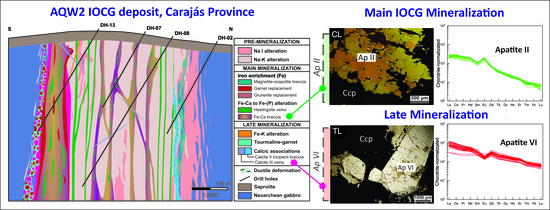
Iron oxide–copper–gold (IOCG) deposits are widespread throughout the Carajás Province, Brazil, reflecting multiple Precambrian hydrothermal events. The Aquiri region is a relatively unexplored geological frontier in the northwestern Carajás Province. The AQW2 IOCG deposit is hosted by a Neoarchean mafic intrusive suite within metavolcano–sedimentary rocks. The pre-mineralization (Na and Na-K) and mineralization (Fe-Ca and Fe-P) hydrothermal stages appear as replacement fronts and as cement within ductile-deformed breccias. Late-mineralization (Fe-K, chlorite, and calcic-rich) assemblages occur in multidirectional veins controlled by brittle structures. Early- and main-mineralization apatite (Ap I-III) is enriched in F, Mn, and Sr, depleted in Y, shows unusually high Fe and Si (Ap III), and exhibits a pronounced positive Eu anomaly (Ap II). These characteristics indicate an alkaline fluid composition, substantial fluid–rock interaction, and episodic CO2 degassing with the release of overpressured fluids, resulting in multiple brecciation events. A rapid decrease in temperature due to boiling is interpreted as a principal mechanism for copper precipitation. Late-mineralization apatite (Ap V–VI) is characterized by relatively higher Cl, Y, and LREE contents, lower Sr and Mn, and negative Eu-anomaly ratios, suggesting control by shallower paleostructures and more oxidizing conditions associated with the influx of basinal brines. These results highlight the evolution of the AQW2 deposit within a broader IOCG system and provide new insights into the metallogenic processes responsible for copper resources essential to the clean energy transition.

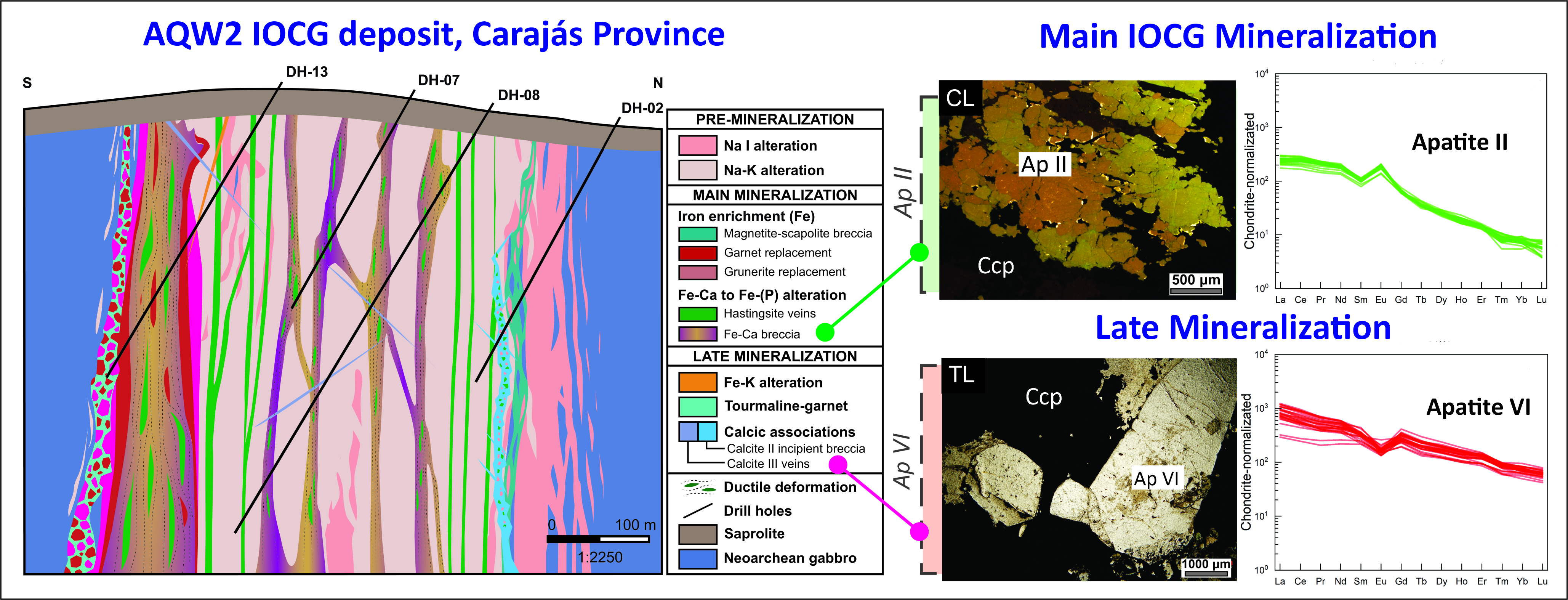
Graphical Abstract

1. Introduction

Apatite (Ca5(PO4)3(OH, F, Cl)) is a phosphate mineral commonly found in igneous (e.g., carbonatites, granites, alkaline, mafic and ultramafic rocks), sedimentary (e.g., phosphorites), metamorphic rocks, and hydrothermal deposits, including iron oxide–apatite (IOA) and iron oxide–copper–gold (IOCG) [1,2,3].
Apatite also exhibits high weathering resistance, making it a valuable tracer mineral across various geological environments. It is a hydrated mineral that incorporates halogens (F and Cl) and -OH, providing clues about the role of ligands in hydrothermal systems [4,5]. Important cationic substitutions into apatite Ca sites (e.g., Sr2+, Ba2+, Mg2+, Mn2+, Fe2+, Cd2+, Na+, Eu2+, Ga2+, Y3+, and REE3+) are notable for their physical–chemical sensitivity [1,2,6,7,8]. Substitutions into smaller P sites (e.g., Si4+, S6+, As5+, V5+) are related to source chemistry and fluid–rock interaction [9], and might be controlled by redox conditions, especially for As and S [10,11].
These characteristics make apatite an excellent mineral for in situ studies, which are increasingly utilized in geological investigations [2]. In magmatic–hydrothermal systems, especially in Cu-Mo porphyry and skarn deposits, apatite may record magma composition and serve as a fertility proxy. These applications highlight that magma differentiation, oxidation state, and volatile content are critical to mineralization, with metals, water, Cl and S playing essential roles [11,12,13].
In IOA and IOCG deposits, in which the relationships with a parental magma may be obscure, apatite is a suitable geochemical tracer of hydrothermal evolution [4,5,7,12,14,15,16]. Apatite chemistry may unravel the formation from magmatic–hydrothermal fluids derived from regional magmas and the relative importance of externally derived fluids, including basinal brines [5]. It also stands out in the investigation of the Metasomatic Iron and Alkali-Calcic (MIAC) system, once the superposition of events is expected, tracking the physical–chemical parameters (e.g., temperature, pH, redox conditions), fluid compositions, available ligands, and evolution (e.g., mixing and mechanisms of fluid–rock interaction) recorded by multiple apatite generations [4,5,7,15,16,17,18,19].
The Carajás Mineral Province, located in the Amazonian Craton, hosts globally renowned Archean–Paleoproterozoic IOCG deposits [20] that are important for their copper reserves, which are needed to drive the clean energy transition. However, deciphering the evolution of the long-lived IOCG mineral system is challenging because multiple hydrothermal events have been recorded at Carajás.
In these IOCG deposits, the overprinting of hydrothermal events during the Neoarchean (ca. 2.75–2.68 Ga [21,22,23,24,25,26] and ca. 2.57 Ga [27,28,29,30]) and Paleoproterozoic (ca. 2.06 Ga [24], ca. 2.01 Ga [31], ca. 1.88 Ga [22,23,32]) was recognized in previous studies.
In recent years, studies of apatite chemistry in the Carajás Province have focused on the relationship between magmatism and hydrothermal processes within the IOCG system [33], the mechanisms of trace-element mobilization linked to apatite formation [34] and petrochronological characterization [35]. These previous studies have provided significant advances in constraining the metallogenetic processes of the Carajás Province, but are restricted to a few deposits with documented superposition processes.
In this paper, we investigate the apatite chemistry of the AQW2 IOCG deposit in the Aquiri region, a poorly explored geological frontier in the northwestern sector of the Carajás Province. Unlike IOCG deposits situated in the eastern domain [30,36,37], the AQW2 is an IOCG deposit hosted by mafic rocks (e.g., gabbro and minor basalt) characterized by a well-preserved and clear hydrothermal zonation. Our study establishes a paragenetic framework and geochemical constraints on hydrothermal fluids in AQW2, based on drill core logging, petrographic observations, CL imaging, SEM-BSE, EPMA, and LA-ICP-MS trace-element analyses on apatite. Multiple hydrothermal stages are described, shedding light on the metallogenetic process in large-scale hydrothermal IOCG systems.

2. Geological Setting of the Carajás Province

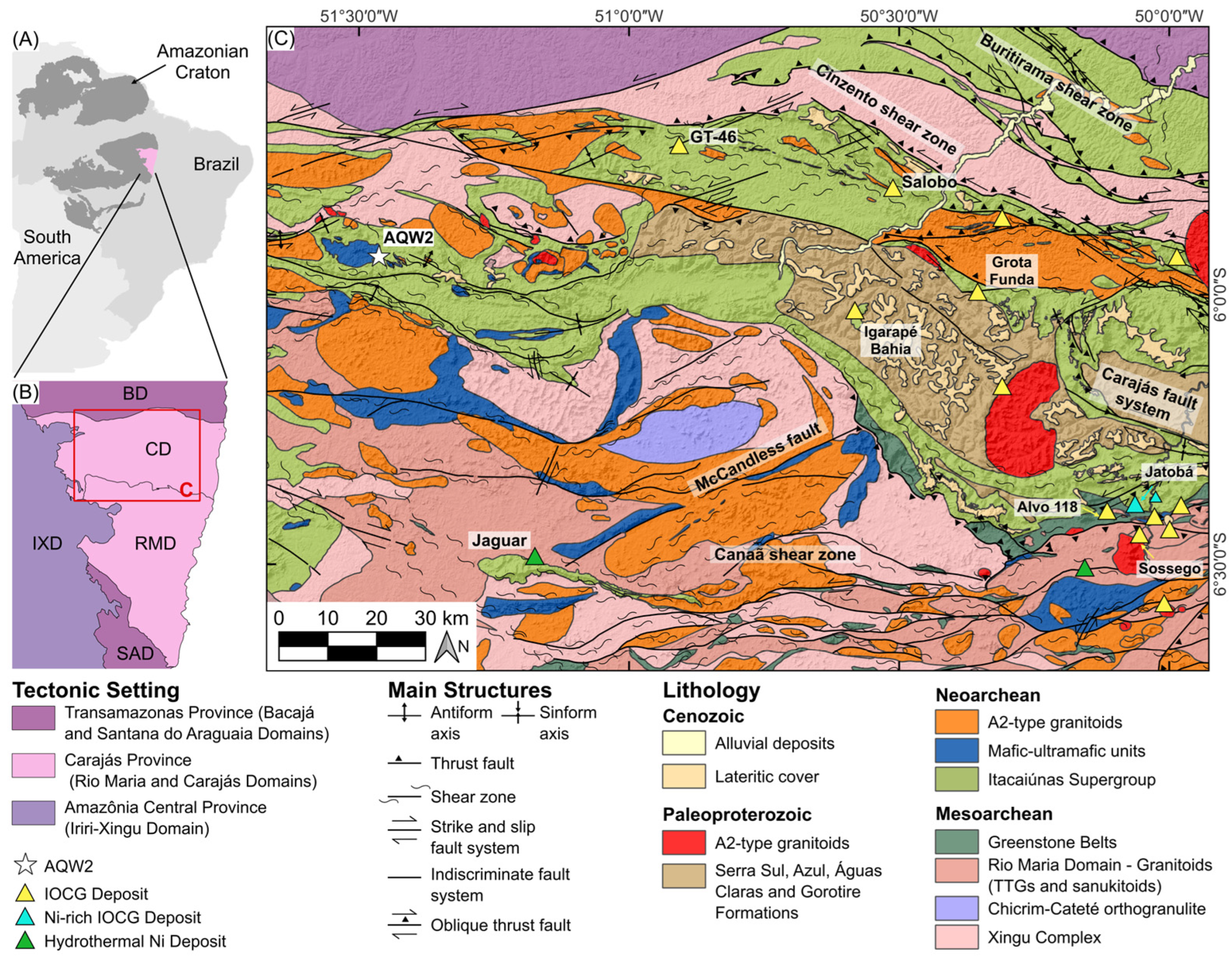
The Carajás Province (Figure 1A) is an Archean segment of the southern Amazonian Craton comprising two tectonic domains, the Rio Maria in the south and Carajás in the north [38] (Figure 1B). The Rio Maria Domain is mainly composed of greenstone belts, tonalite–trondhjemite–granodiorite (TTG), sanukitoids, granites, and potassic leucogranites, interpreted to have formed in intra-oceanic orogenic settings [39,40,41]. The Carajás Domain (Figure 1C) encompasses Mesoarchean mafic to felsic granulites from the Chicrim-Cateté Orthogranulite and tonalitic gneisses, trondhjemites and migmatites from the Xingu Complex [26,42,43,44]. Additionally, Mesoarchean greenstone belt sequences (e.g., Sequeirinho Group) are overlain by the Neoarchean volcanic–sedimentary sequences of the Itacaiúnas Supergroup and intruded by Neoarchean mafic–ultramafic and alkaline (A2-type) granites [45].
There were three major extensional–compressional cycles: Carajás—Rio Maria; Bacajá—Carajás; and the Sereno Event [46,47,48]. The main resulting structural framework consists of the Itacaiúnas Shear Zone [49,50], which is divided into major east–west transcurrent systems, named Cinzento, Carajás and Canaã. They likely served as pathways for fluid channelization, structurally linking IOCG deposits and configuring the so-called Southern Copper Belt (SCB) and Northern Copper Belt (NCB). The Sossego, Jatobá, Bacabá, Castanha and Bacuri deposits are IOCG examples from SCB [23,24,36,51], whereas the Salobo, Igarapé Bahia, Grota-Funda and GT-46 deposits are located in the NCB [30,34,52].
The Itacaiúnas Supergroup deposition and the mafic–ultramafic and granite magmatism were coeval and associated with a post-orogenic setting, following the Carajás-Rio Maria collision [46,47,48]. The Itacaiúnas Supergroup comprises banded iron formations, graywackes, volcaniclastic deposits, and mafic to felsic volcanic rocks [42,53,54]. Its most prominent unit is the Grão Pará Group, which unconformably overlies the basement in the central sigmoidal region of the “Carajás Basin” [55,56]. The basal mafic volcanic sequences of this group are dated at ca. 2.74–2.75 Ga [57]. The deposition of the Itacaiúnas Supergroup was influenced by the E–W strike-slip system of the Carajás Domain [48], which controlled the development of several distal depocenters, locally described under different group names [58,59].
The Neoarchean mafic–ultramafic bodies, distributed along E-W and N-S directions [60], host important Cr, Ni-PGE, and lateritic nickel deposits [49,57,61,62]. On the other hand, A2-type granites of alkaline to metaluminous composition [63] are spatially associated with several IOCG deposits and are commonly deformed along major shear zones. Along the Carajás Shear Zone, these granites (e.g., Estrela, Igarapé Gelado, and the Planalto Suite) were emplaced at ca. 2.76–2.70 Ga [64,65,66,67].
The Paleoproterozoic cover comprises Siderian–Rhyacian glacial units of the Serra Sul Formation, deposited at ca. 2.58–2.06 Ga [68]; transgressive–regressive successions of the Azul and Águas Claras formations, with deposition ages of ca. 2.37–2.06 Ga [56,69,70,71]; and alluvial to fluvial units of the Gorotire Formation, with a maximum depositional age of ca. 2.0 Ga [49,71,72]. Additionally, within-plate A1-type granites at ca. 1.88 Ga are widespread across large areas of the craton [42,73]. In the Carajás Domain, this magmatism is represented by alkaline granites of the Serra dos Carajás Suite, like the Cigano, Serra dos Carajás, Young Salobo, Jamon and Pojuca Granites [53,74,75,76].
Figure 1. Geological map of the Carajás Province, showing: (A) regional location of the Carajás Province at the Amazonian Craton, Brazil; (B) tectonic setting of the Carajás Province, and its respective domains (CD: Carajás Domain, RMD: Rio Maria Domain), as well as its neighbors (BD: Bacajá Domain; SAD: Santana do Araguaia Domain; IXD: Iriri-Xingu Domain), modified from Cordani et al. [77] and Vasquez et al. [78]; (C) simplified geological map, modified from Costa et al. [79], exhibiting the study area and showing the location of hydrothermal deposits.
Minerals 16 00308 g001

3. Materials and Methods

3.1. Drill Core Description and Petrography

The AQW2 paragenetic evolution was based on the description of drill core samples provided by VALE S.A. from the drill holes PKC-AQW2-DH02, PKC-AQW2-DH07, PKC-AQW2-DH08, and PKC-AQW2-DH13 and detailed petrographic analysis of thirty samples in which apatite was recognized. Photomicrographs were obtained using a LEICA DM2700 P microscope (Leica Microsystems CMS GmbH, Wetzlar, Germany) with a digital image capture system. Optical cathodoluminescence (CL) images were obtained with a CITL MK5-2 coupled stage (Cambridge Image Technology Ltd., Hertfordshire, UK) under operating conditions of 15 kV and 300 mA. Images were acquired with exposure times ranging from 3 to 7 s using a Leica DFC7000 T digital camera (Leica Microsystems CMS GmbH, Wetzlar, Germany). Scanning electron microscopy (SEM) analyses were performed using a Phenom XL G2 (Thermo Fisher Scientific/FEI Europe BV, GG Eindhoven, The Netherlands) electron microscope, with a spatial resolution of <40 nm and an energy-dispersive X-ray spectroscopy (EDS) (Thermo Fisher Scientific/FEI Europe BV, GG Eindhoven, The Netherlands) detector. Backscattered scanning electron (BSE) images were acquired at an accelerating voltage of 20 kV, a chamber pressure of 60 Pa, a working distance (WD) of 7.848 mm and a field width (FW) of 180 µm. All petrographic analyses were performed in the GeoFluid Laboratory (Institute of Geosciences, University of São Paulo—IGc USP).

3.2. Electron Probe Microanalyses

Electron Probe Microanalysis (EPMA) with a high spatial resolution (<10 μm) of apatite major and minor elements was conducted using a JEOL JXA-8230 (JEOL Ltd., Akishima, Japan) in Wavelength-Dispersive Spectroscopy (WDS) mode at the Electron Microprobe Laboratory (IGc USP). Na, Si, Y, Fe, Mn, Nd, Sm, Pr, Gd, Dy, Cl, Ca, Ti, La, Ce, P, Sr, Th, F and Al were investigated for apatite generations I (n = 20), II (n = 44), III (n = 57), IV (n = 9), V (n = 45) and VI (n = 20). Selected minerals were analyzed using a voltage of 29 kV, a beam current of 50 nA, and spots of 5 and 10 µm. Stoichiometric calculations were performed following Ketcham [80], using “Approach 1”, including corrections for F and Cl contents and the calculation of hydroxyl (OH). Only data above the detection limit (DL) were considered. BSE images were also obtained. The analytical standards, the detection limit (DL) range for each element and the complete dataset are included in the Supplementary Materials (Tables S1 and S2).

3.3. Laser Ablation Inductively Coupled Plasma Mass Spectrometry (LA-ICP-MS)

In situ chemical analyses of apatite through laser ablation inductively coupled plasma mass spectrometry (LA-ICP-MS) were conducted at the Laboratoire des Matériaux Terrestres, Université du Québec in Chicoutimi. The apatite generations II (n = 23) and VI (n = 24) were analyzed for 46 different elements, including Na, Mg, Al, P, Sc, Ti, V, Cr, Mn, Fe, Co, Ni, Cu, Zn, Ga, As, Rb, Sr, Y, Sn, Ba, W, Pb, Th, and REE. The analyses were carried out using a RESOlution M-50 Excimer 193 nm Laser Ablation System (Resonetics-Australian Scientific Instruments, Canberra, Australia), equipped with a Laurin Technic S-155 dual-volume cell, and coupled to an Agilent 7900 (Agilent Technologies, Inc., Tokyo, Japan) quadrupole mass spectrometer. Analyses of reference material were performed before and after sample analyses for calibration and to verify procedural accuracy. The results are available in the Supplementary Materials (Table S3). Line scans of 300–600 μm length were carried out across mineral surfaces using a beam size of 25 μm. Each analysis included a gas blank for 30 s, followed by apatite ablation for at least 60 s. Analytical conditions for the laser and spectrometer routine were similar to those described in Mansur et al. [81], i.e., a laser frequency of 10 Hz, a scan speed of 5–10 μm/s, a dwell time of 7.5 ms, a power of 5 mJ/pulse and a fluence of 5 J/cm2. Ablated material was transported to the spectrometer with an Ar-He gas mixture at a rate of 0.8–1 L/min for Ar, 350 mL/min for He, and 2 mL/min for N2 addition.
Data reduction was processed using Iolite 4 [82,83]. Element concentrations and detection limits were determined using a software package based on the method of Longerich et al. [84], with reference materials from the USGS and GeoReM databases [85]. NIST610 was used as the calibrant, using Ca as the internal standard, obtained through EPMA.
The following reference materials were analyzed as unknowns to monitor calibration quality: synthetic glasses (NIST 612, NIST 614, NIST 616, GSE-1g, and GSD-1g) and natural apatite (UQAC-APA-1 and Durango). The results indicate that the data are both accurate and precise (<10%) for most elements, even at concentrations of a few wt-ppm (e.g., NIST 614; Table S3). However, Si, S, and Cl show limited accuracy and precision at such low concentrations in apatite, and EMPA data are therefore preferred for these elements [86]. Nevertheless, Si and S were used to screen for silicate and sulfide inclusions during LA-ICP-MS data processing of apatite.
Results were normalized to chondrites following McDonough and Sun [87]. Eu and Ce anomalies were calculated using Equations (1) and (2) from Mao et al. [12]. Complete data are presented in the Supplementary Materials (Tables S4 and S5).
E u / E u * = E u N / S m N · G d N
C e / C e * = C e N / L a N · P r N

4. Results

4.1. Geological Setting and Host Rocks of the AQW2 Deposit

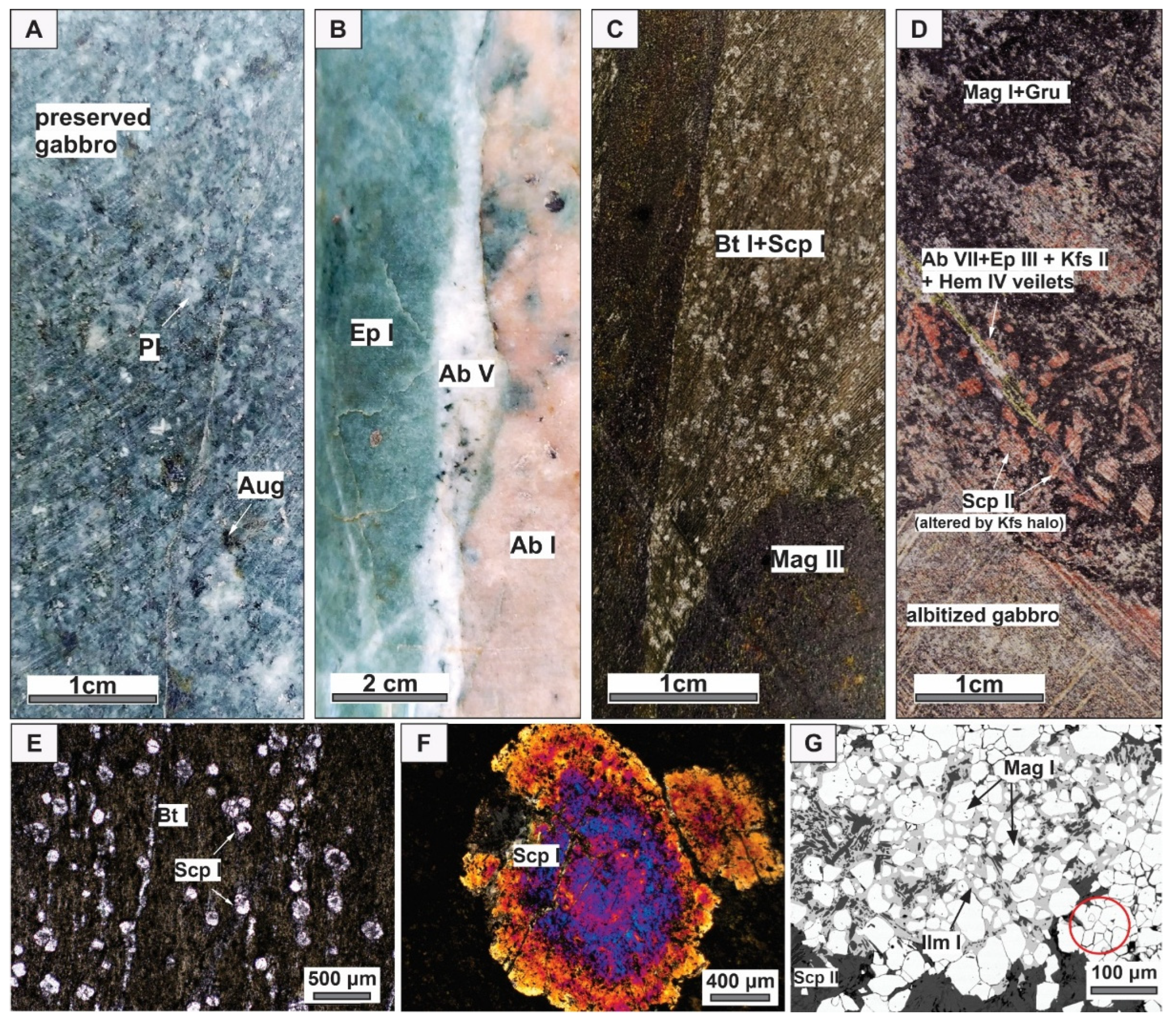
The AQW2 deposit is hosted in a gabbroic unit and a metavolcano–sedimentary sequence of the Itacaiúnas Supergroup. Both units are in tectonic contact with basement rocks of the Xingu Complex, bounded by the Cabeceiras Thrust Fault Zone to the north, and the Anaporã Transcurrent Fault Zone to the south. The gabbro is intrusive in the Itacaiúnas Supergroup units. It is deformed into a WNW–ESE-oriented lenticular body (Figure 2), with preserved isotropic portions with plagioclase (labradorite–bytownite) laths, augite, hornblende, and interstitial ilmenite (Figure 3A). It is coarse- to medium-grained, with subophitic to granonematoblastic textures. The metavolcano–sedimentary units are represented mainly by pervasively hydrothermally altered amygdaloidal metabasalts, with barely any preservation of their original composition.

4.2. Hydrothermal Alteration and Apatite Textures

The AQW2 mineralization is controlled by an anastomosed brittle–ductile shear zone (E-W), aligned along a NW-SE regional trend. Different hydrothermal alteration zones were observed (Figure 2). Special attention and detail were given to apatite-bearing paragenesis.

4.2.1. Pre-Mineralization—Hydrothermal Alteration

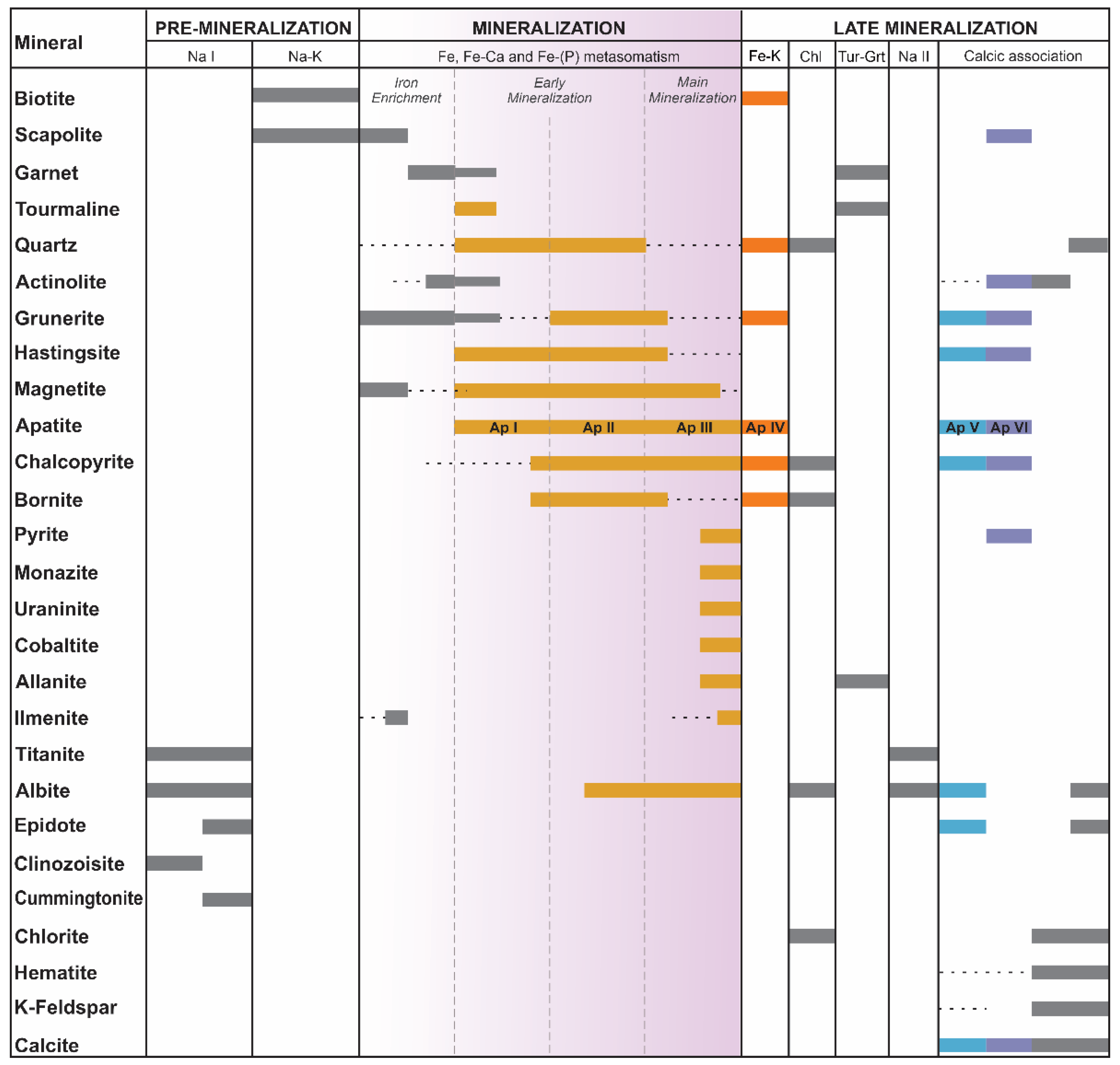
Pre-mineralization alteration includes Sodic Alteration (Na I), which is characterized by extensive distal replacement of the host gabbro by pinkish albite (I) + titanite (I). Epidotization (Ep I) was considered simultaneous (Figure 3B). In addition, Na–K alteration comprises the widespread pervasive substitution of biotite (I) + marialitic scapolite (I) (Figure 3C). This paragenesis completely replaces the primary gabbro mineralogy and locally preserves relic volcanic textures of metabasalts through selective fronts (Figure 3E,F).

4.2.2. Mineralization—Hydrothermal Alteration

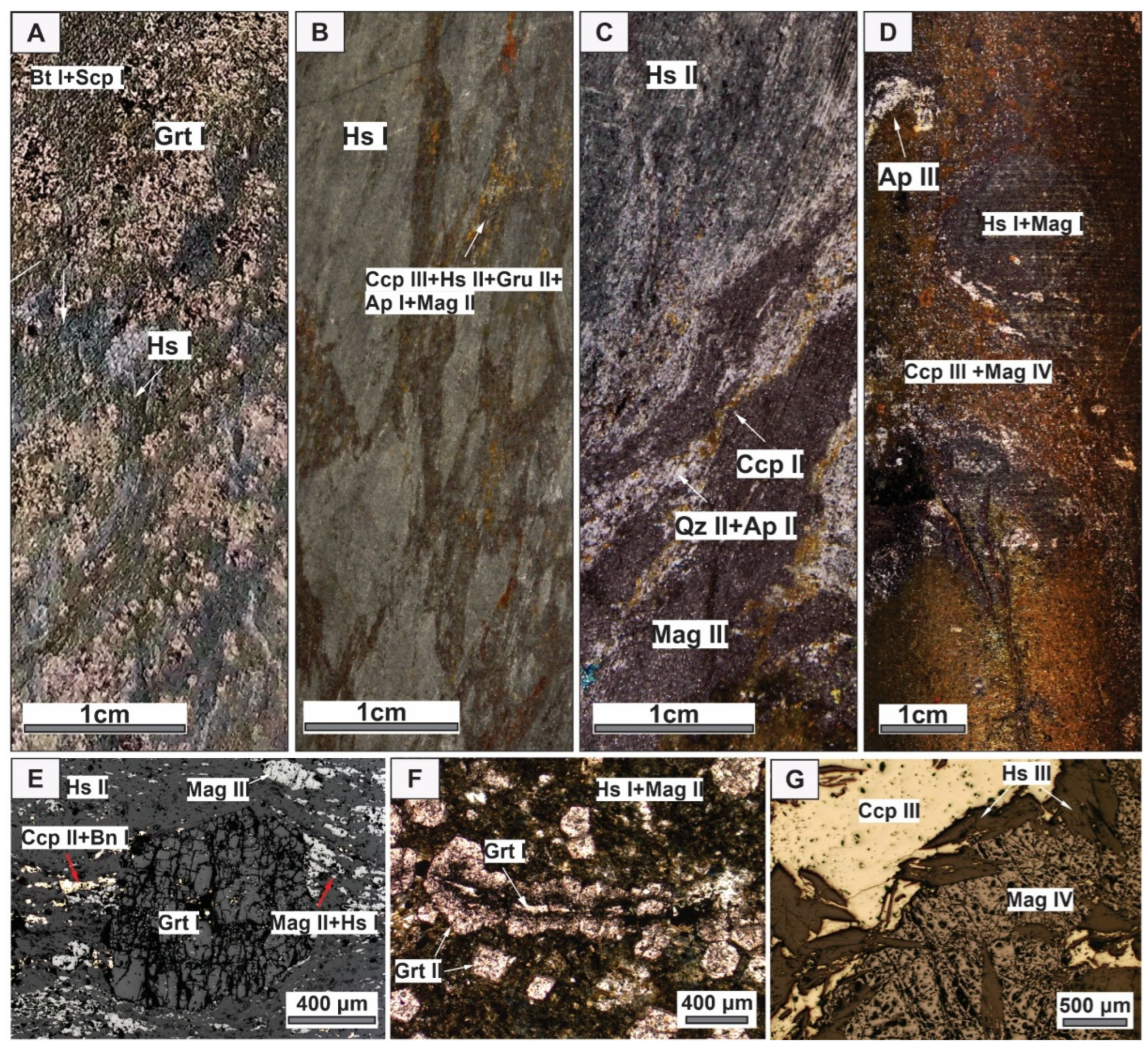
The initial onset of the mineralization occurred during the iron enrichment (Fe) stage, marked by a ductile-controlled breccia cemented by magnetite (I) + marialitic scapolite (II), with minor grunerite (I) (Figure 3D). This breccia crosscuts the gabbroic unit, which had been previously altered by albite (I). Deformation is evidenced by annealing features in magnetite and comminuted crystals associated with interstitial ilmenite (I) (Figure 3G). Garnet (I) forms progressively advancing replacement fronts, with medium to coarse subdimorphic habit and almandine composition (Figure 4A). In Fe-Ca breccias, garnet crystals are deformed, with strain shadows, inclusion patterns and oblique fracturing features (Figure 4E). Garnet (II) occurs as fine-grained, smooth overgrowth rims on garnet (I) and as idiomorphic crystals, with unclear blastese signs (Figure 4F). Grunerite (II) + actinolite (I) forms a light-green, very fine-grained replacement mass, locally overprinting garnet and occasionally associated with early chalcopyrite (I).
Fe–Ca alteration is observed in the AQW2 deposit and is spatially related to steeply verticalized, deformed breccias that host the main copper mineralization, represented mainly by chalcopyrite and minor bornite. Cement of at least three types of Fe–Ca mineral assemblages was identified, all bearing apatite. Pervasive replacement fronts of bluish hastingsite (I) affect host-rock fragments in all Fe–Ca breccias (Figure 4A) and are associated with tourmaline (I) and silicification.
The early breccia is foliated and composed of elongated altered host fragments within hydrothermal cement composed of fine-grained magnetite (II) + hastingsite (I) + chalcopyrite (I) + apatite (I), with minor grunerite (III) ± quartz (I) ± bornite (I) (Figure 4B). Magnetite predominates in the breccia cement, often exhibiting stretched, xenomorphic habits, with porous cores and clearer rims. In turn, chalcopyrite occurs as fine, dispersed filaments and mineral inclusions (Early Mineralization).
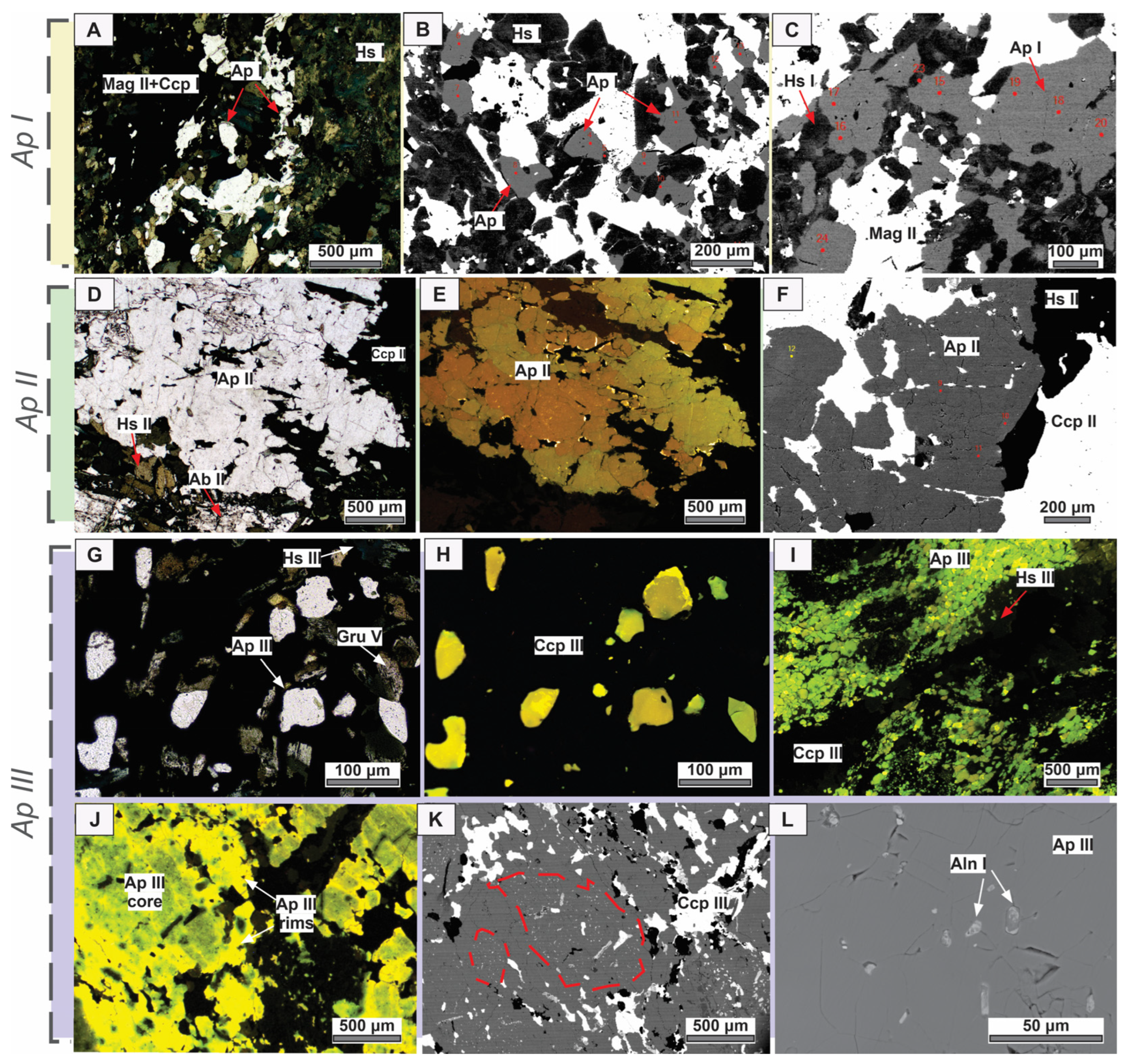
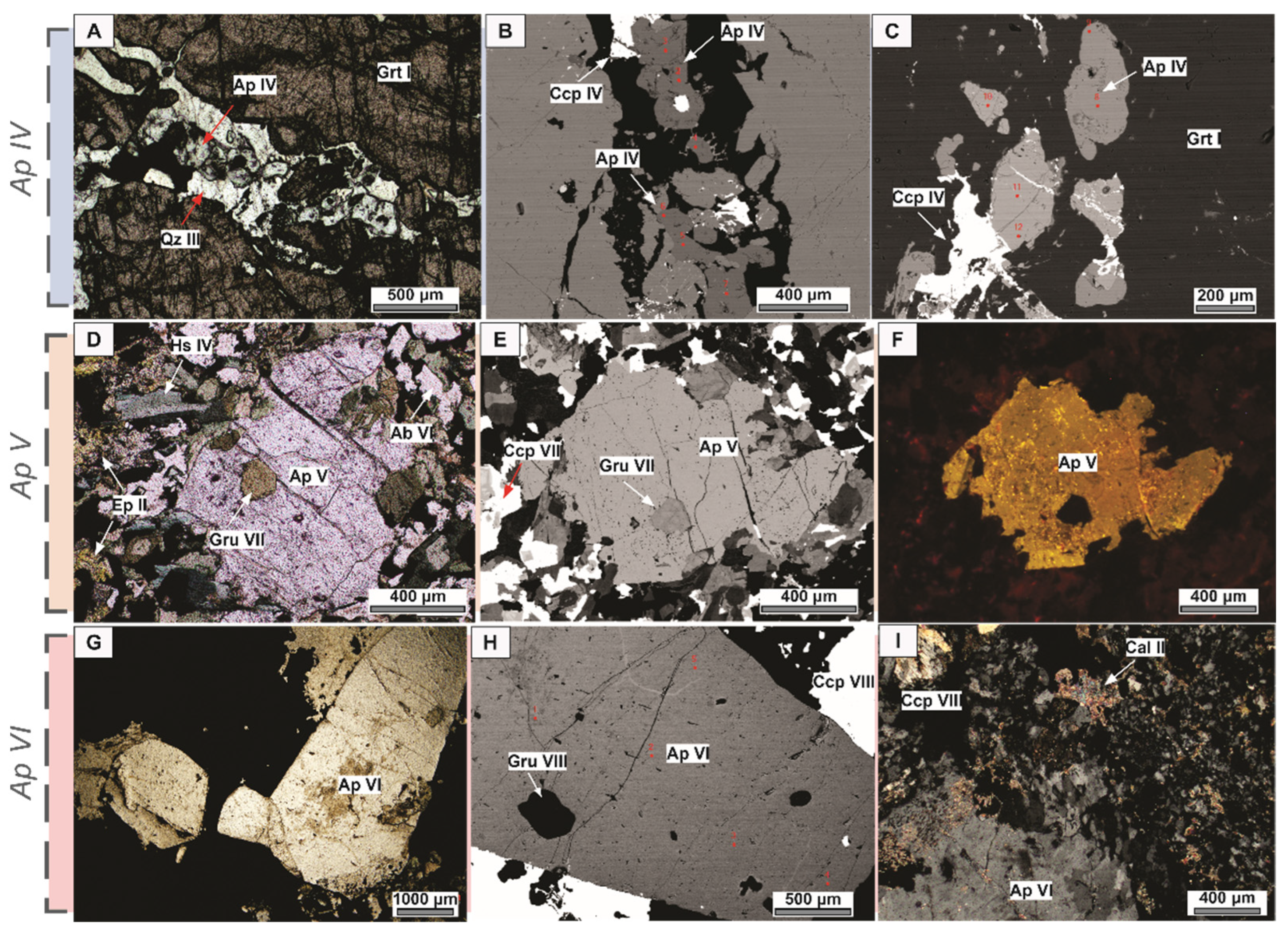
Very fine to fine subidiomorphic crystals of apatite (Ap I, Figure 5A) occur dispersed in the breccia cement as smooth, monotonous crystals under BSE imaging (Figure 5B,C), with neither inclusions nor zoning observed.
As part of an evolving system, breccia cemented by medium to coarse crystals of magnetite (III) + chalcopyrite (II) + apatite (II) + grunerite (IV) + hastingsite (II) and with minor quartz (II) ± bornite (II) ± albite (II) is also deformed and foliated (Figure 4C). Apatite (Ap II, Figure 5D) occurs as coarse crystals with subdimorphic habit, usually fractured and coalesced in apatite-rich zones. Under cathodoluminescence (CL), it displays orange coloration with slightly greenish to yellowish rims, whereas, in BSE images, it appears homogeneous gray (Figure 5E,F).
The most prominent copper mineralization is associated with the progression toward Fe-(P) assemblages, in which ferro-calcic amphiboles became subordinate phases and apatite–magnetite predominated in the breccia cement (main mineralization). It is an infill assemblage of chalcopyrite (III) + magnetite (IV) + apatite (III) + pyrite (I), with minor albite (III) ± hastingsite (III) ± grunerite (V) (Figure 4D,G). Allanite (I), monazite (I), uraninite (I), and cobaltite (I) are accessory (<2%). Apatite (Ap III; Figure 5L) occurs as fine crystal inclusions with yellow CL light, dispersed within chalcopyrite (Figure 5H). However, in some domains, it appears in coalesced zones as (a) recrystallized fine crystals deformed along foliation, displaying polygonal grain boundaries and green CL, with discrete yellow patches related to monazite inclusions (Figure 5I); or (b) coarse crystals with allanite inclusions in green CL cores, partially replaced by yellow CL zones (Figure 5J–L).

4.2.3. Late Mineralization—Hydrothermal Alterations

Most late hydrothermal stages are associated with ductile–brittle to essentially brittle structure-controlled veins, veinlets, and breccia systems, often hosting minor copper mineralization, represented mainly by chalcopyrite. The most prominent are described below.
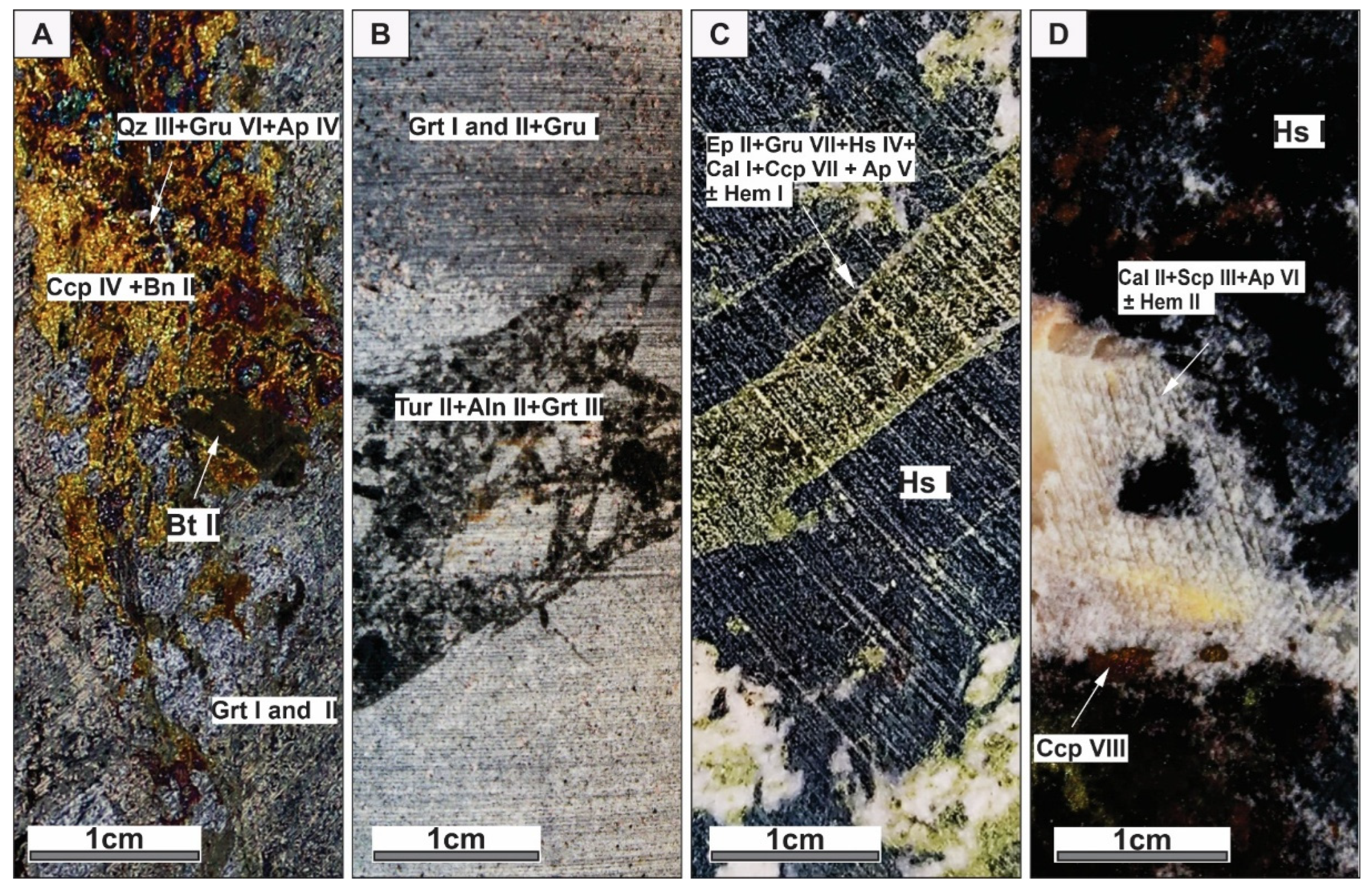
Ferro-Potassic Association comprises centimeter-sized veins infilled by biotite (II) + grunerite (VI) + chalcopyrite (IV) + quartz (III) + apatite (IV) ± bornite (II). Those veins are controlled by ductile structures and occur cross-cutting previous garnet-rich zones (Figure 6A) and grunerite-rich associations. Apatite (IV) is subordinate, occurring as fine-granular crystals (Figure 7A). In BSE images, it appears as smooth, homogeneous crystals, occasionally fractured by chalcopyrite (Figure 7B,C). Chlorite also occurs, associated with ductile-deformed structures, as the infill of multiple veinlets of chlorite (I) + albite (IV) + quartz (IV) + bornite (III) ± chalcopyrite (VI), and as a distal pervasive chloritization (II) zone.
Tourmaline–garnet association occurs as cement in a brittle structure-controlled breccia that sealed the mineralization event. The breccia has angular and decametric fragments—previously replaced by garnet and grunerite—and a hydrothermal cement composed of fine-grained tourmaline (II) + garnet (III) + allanite (II) (Figure 6B).
Sodic Alteration II (Na II) occurs as brittle veins and breccia infilling by white albite (V) + titanite (II) (Figure 3B). Calcic associations also infill brittle structures. Calcite (I and II) occurs in apatite-bearing veins. Calcite (I) occurs in centimeter-sized veins and in incipient breccias, with epidote (II) + grunerite (VII) + hastingsite (IV) + apatite (V) + chalcopyrite (VII) + albite (VI) ± hematite (I) (Figure 6C). Apatite (V) occurs predominantly as medium crystals (Figure 7D) with shades of dark-yellow CL cores and altered light-yellow CL rims (Figure 7E). BSE images highlight fractures and indistinct fine inclusions (Figure 7F).
Calcite (II) infills centimeter- to decimeter-sized brittle veins (Figure 6D), with scapolite (III) + chalcopyrite (VIII) + apatite (VI), and minor hastingsite (V), grunerite (VIII), actinolite (III), pyrite (II) and hematite (II). Apatite (VI) occurs mainly as coarse crystals (mm to cm) with idiomorphic habit (Figure 7G), with visible fine crystal inclusions of Fe-amphiboles (Figure 7H). Apatite deformation textures were observed at crystal edges, associated with late calcite and chalcopyrite (Figure 7I), occasionally developing bulging and undulose extinction.

4.3. Mineral Chemistry

Six apatite generations were recognized in the AQW2 deposit associated with mineralization (early, main and late; Figure 8). The first three are associated with Fe–Ca to Fe–(P) breccias: scarce apatite associated with incipient brecciation (Ap I) and apatite-rich zones in prominent magnetite-rich breccias (Ap II) are related to the Early Mineralization stage; whereas apatite related to the main mineralization stage (Ap III) occurs either as inclusions in chalcopyrite or as coarse crystals in rich zones, displaying inclusion patterns and evidence of a retrograde alteration process. Apatite (IV), (V) and (VI) are related to the late mineralization stage, including ferro-potassic ductile-deformed veins with apatite as a minor or accessory phase (Ap IV) and calcic associations, with apatite in minor (Ap V) and large quantities (Ap VI) infilling brittle structures.
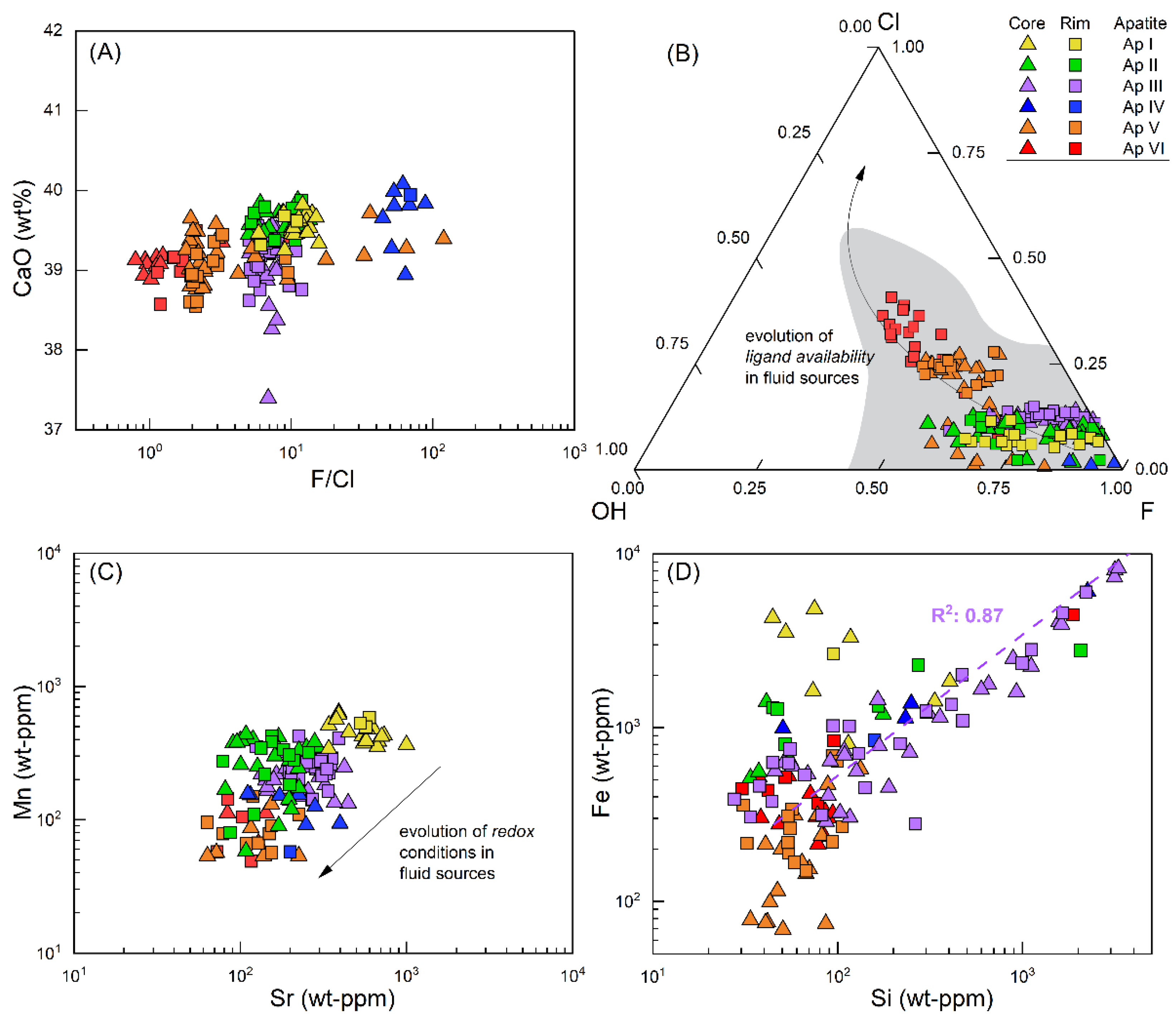
Apatite associated with mineralization (I–III) and apatite IV are fluorapatite, whereas the later apatite generations (V and VI) are chloro-fluorapatite (Table 1). No clear differences regarding core and rim analyses were observed. The data obtained show clear trends in halogen content, distinguishing each apatite generation by chlorine (Cl) enrichment and dispersion patterns. Fluorine and chlorine ratios (F/Cl) show three orders of variation (0.8–119; Figure 9A). Cl contents in apatite (I–III) show more consistent and lower values (Ap I: 0.13–0.29 wt.%; Ap II: 0.04–0.33 wt.%; Ap III: 0.17–0.37 wt.%) than apatite (V–VI) data (Ap V: 0.02–0.77 wt.%; Ap VI: 0.18–1.32 wt.%). The opposite is observed in F contents, with higher values and greater dispersions in apatite (I–III) data (Ap I: 1.64–2.23 wt.%; Ap II: 1.46–2.36 wt.%; Ap III: 1.53–2.14 wt.%;) compared to apatite (V-VI) analysis (Ap V: 1.35–1.94 wt.%; Ap VI: 1.04–1.75 wt.%). Only apatite (IV) diverges, showing the highest F (2.01–2.41 wt.%), and the lowest Cl (0.02–0.05 wt.%) values. The calculated hydroxyl (OH) values were similar for all generations (Figure 9B; up to 0.98 wt.%), but the relative proportion of OH to F increases in late apatite generations.
Some analyses show values below the detection limit (<DL). The DL range is reported in Table S1. A positive correlation is observed between manganese (Mn) and strontium (Sr) contents of apatite (Figure 9C), with a clear decrease in both elements following the order of apatite generations: apatite I (Mn: 340–637 wt-ppm; Sr: 340–999 wt-ppm), apatite II (Mn: 51–436 wt-ppm; Sr: <DL—292 wt-ppm), apatite III (Mn: 133–423 wt-ppm; Sr: 125–446 wt-ppm), apatite (Mn:<DL—156 wt-ppm; Sr:111–397 wt-ppm), apatite V (Mn: <DL—159 wt-ppm; Sr: <DL—226 wt-ppm) and apatite VI (Mn: <DL—143 wt-ppm; Sr: <DL—214 wt-ppm). Calcium (Ca) shows a similar trend to Mn and Sr, but with a less pronounced decrease (Figure 9A) and a higher dispersion in apatite (III) compared to others (33.42–39.65 wt.%). Silicon (Si) and iron (Fe) values from generation (I) (Si: <DL—403 wt-ppm; Fe: 705–4825 wt-ppm) and (II) (Si: <DL—450 wt-ppm; Fe: 272–2775 wt-ppm), outliers excluded, are slightly higher than generations (IV-VI) (Si: <DL—250 wt-ppm; Fe: <DL—1837 wt-ppm), whereas apatite (III) displays clearly higher concentrations (Si: <DL—8755 wt-ppm; Fe: 278–28216 wt-ppm), with a strong linear correlation (R2 = 0.87; Figure 9D).
The LA-ICP-MS trace-element signatures for mineralization and late mineralization stages are well represented by the apatite (II) and apatite (VI) results (Table 2), respectively. For data below the detection limit (<DL), the DL range is reported in Tables S4 and S5.
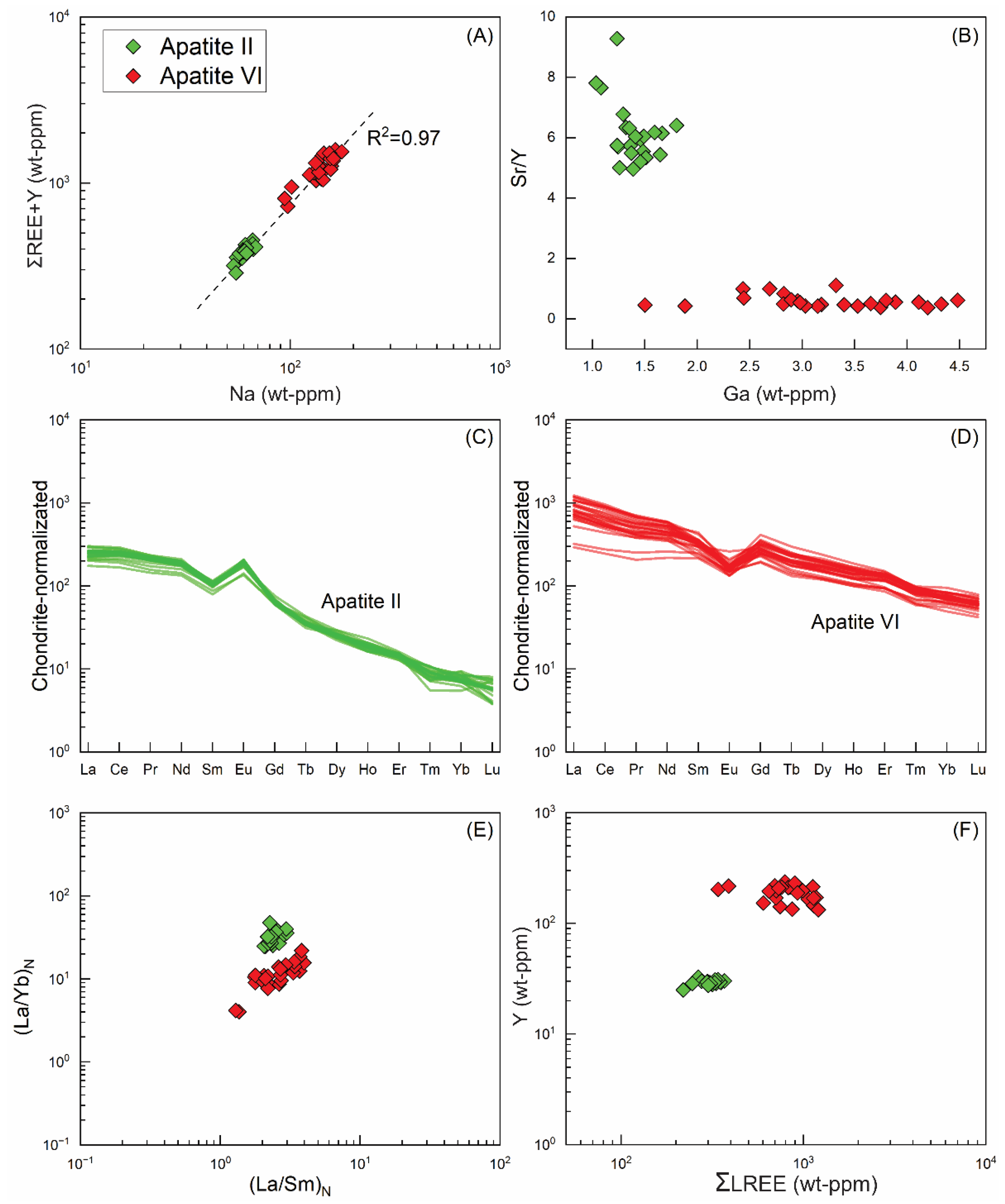
Sodium (Na), yttrium (Y), and ΣREE results show higher values in apatite (VI) (Na: 94–176 wt-ppm; Y: 133–237 wt-ppm; ΣREE: 522–1377 wt-ppm) than in Ap II (Na: 54–68 wt-ppm; Y: 25–33 wt-ppm; ΣREE: 263–422wt-ppm), within a strong-positive correlation pattern observed between Na and the REE+Y comparison (Figure 10A; R2 = 0.97). Equally, the same trends are observed in Sr/Y ratios (Ap II: 5–9; Ap VI: 0.37–1), but gallium (Ga) results, although very low, present the opposite, with higher apatite VI values (Ap II: 1.03–1.80 wt-ppm; Ap VI: 1.50–4.48 wt-ppm) (Figure 10B).
Sr and Mn contents are equivalent to those obtained by EPMA analyses for apatite II (Sr: 136–266 wt-ppm; Mn: 311–384 wt-ppm) and apatite VI (Sr: 65–152 wt-ppm; Mn: 80–89 wt-ppm). Moreover, the amounts of thorium (Th), vanadium (V), uranium (U) and arsenic (As) are generally very low (up to 2 wt-ppm), as shown in Tables S4 and S5.
In REE-normalized diagrams, both apatite II and apatite VI data present similar slope curves, with an enrichment of LREE relative to HREE (Figure 10C,D). This feature is also expressed by the LaN/YbN ratios (Ap II: 25–48; Ap VI: 4–22). Conversely, the relationship between LREE and middle rare earth elements (MREEs) within each sample is reflected by the LaN/SmN ratios (Ap II: 220–369 wt-ppm; Ap VI: 341–1207 wt-ppm) (Figure 10E). Nonetheless, ∑LREE is clearly higher in apatite VI (341–1207 wt-ppm) than in apatite II (220–369 wt-ppm), as are the Y concentrations (Figure 10F).
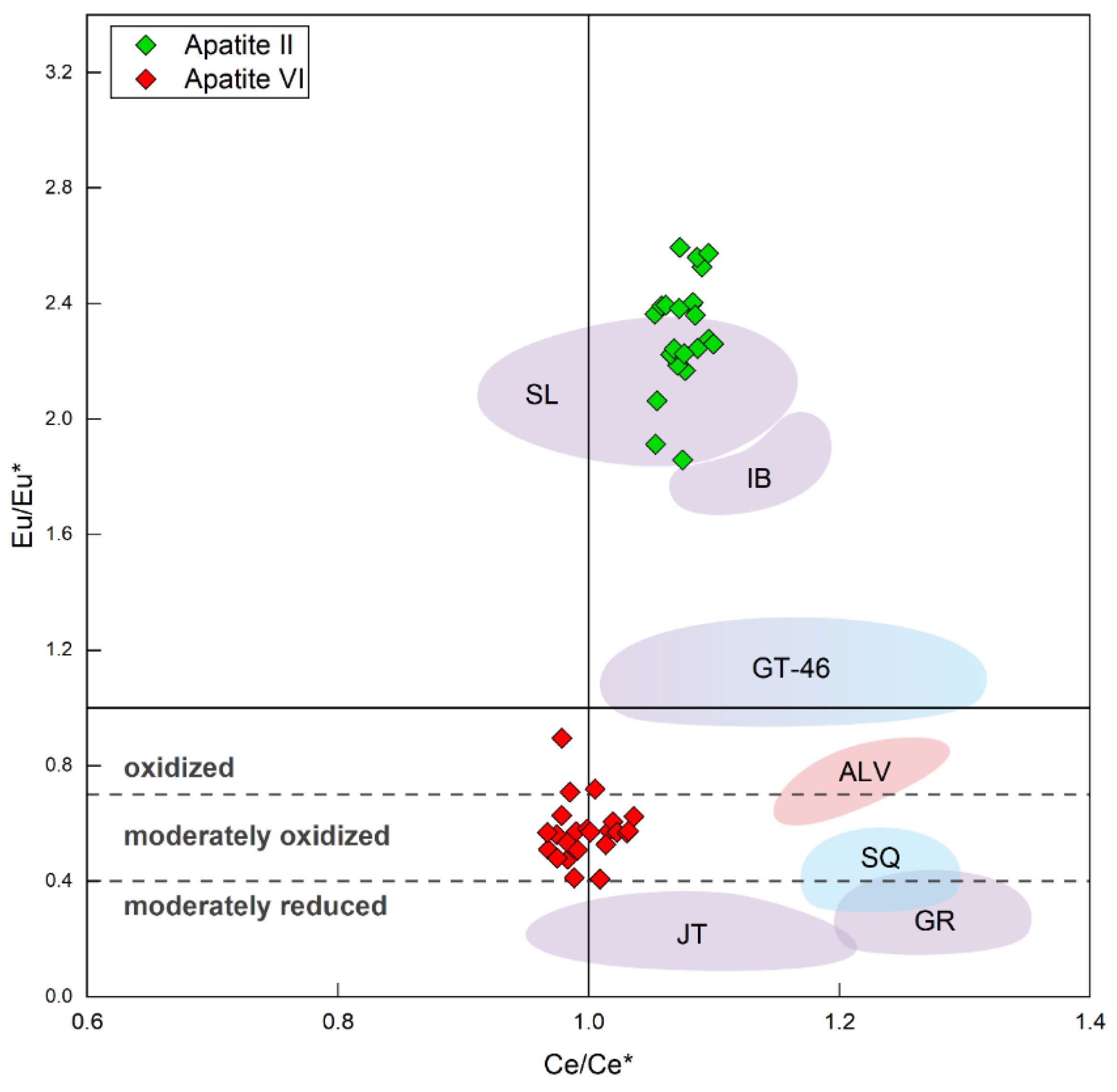
Europium anomalies are strongly positive in apatite II (Eu/Eu*: 1.86–2.59) to moderately negative in apatite VI (Eu/Eu*: 0.41–0.90), while cerium anomalies (Ce/Ce*) are nearly absent (Ap II: 1.05–1.10; Ap VI: 0.97–1.04) (Figure 11).

5. Discussion

5.1. The AQW2 IOCG Hydrothermal System

The AQW2 deposit comprises several overlapping hydrothermal stages related to at least two distinct events. It is hosted within a Neoarchean gabbroic unit of the Cateté Suite [92], which intrudes metavolcanic–sedimentary sequences of the Aquiri Group [58,59]. Coeval mafic–ultramafic intrusions in the Carajás Province yield Neoarchean ages, including the Serra da Onça at 2766 ± 6 Ma [61], Luanga at 2763 ± 6 Ma [42] and Lago Grande at 2722 ± 53 Ma [93].
The Aquiri Group represents a distal depositional sector of the Itacaiúnas Super-group, located in the westernmost portion of the Serra dos Carajás, and is likely coeval with the Grão Pará Group [58,59], being controlled by the E–W strike-slip system of the Carajás Domain [94]. Accordingly, the volcanic units are probably related to the Parauapebas Formation [46,95], with rhyolites dated at 2758 ± 39 Ma [53] and basalts at 2749 ± 6.5 and 2745 ± 5 Ma [57]. Therefore, the gabbroic intrusion was likely emplaced shortly after or contemporaneously with the Grão Pará volcanism [42,57,96].
Intense, pervasive pre-mineralization alkaline alteration comprises pinkish albite replacement (Na I) distal to the ore zone, and sodic–potassic (Na–K) parageneses with biotite–marialitic scapolite. These alteration stages are followed by progressive iron enrichment, resulting in scapolite–magnetite assemblages and almandine- and grunerite-rich zones. Garnet growth features indicate formation prior to and coeval with Fe–Ca alteration. Mineralization (early and main) occurs during the Fe–Ca to Fe–(P) stages in multiple vertical breccia systems (amphibole–magnetite–chalcopyrite–apatite), controlled by steeply dipping E–W structures. Multiple brecciation stages suggest the episodic release of overpressured volatile-rich fluids. The ductile-deformed pattern is consistent with evolution controlled by the Carajás-Canaã shear zone installation and reactivation, which also controls other IOCG deposits at regional and local scales [97].
The late mineralization stage occurs as veins developed under ductile–brittle to brittle regimes, which host minor chalcopyrite ± bornite mineralization within iron–potassic (Fe–K; biotite–grunerite–quartz) and chlorite-rich veins (chlorite–albite–quartz). Post-ore sodic (Na II) and calcic (Ca) associations in multidirectional brittle-controlled veins and breccias represent another common late feature of IOCG deposits in the Carajás Province [25,36,51]. The carbonate and hematite-bearing veins indicate oxidized, alkaline fluids involved in the later hydrothermal stages [31,36,98].
Spatially, the AQW2 deposit is closer to the IOCG deposits of the NCB (e.g., Salobo, GT-46 and Igarapé Bahia), where sodic, calcic–potassic and potassic–iron enrichment (e.g., biotite–almandine–grunerite) represent pre-mineralization stages [20,22,25,27,30,99,100]. The main ore stage in these deposits is strongly associated with the intensification of potassic–iron and iron alteration [30,99,100], generating massive magnetite-rich bodies. At the GT-46 deposit, this is expressed by major magnetite–chalcopyrite–bornite mineralization, dated at 2718 ± 56 Ma [25], crosscut by chalcopyrite–magnetite ± chlorite–calcite–quartz veins and breccias, dated at 2612 ± 1.5 and 2600 ± 8 [22,25]. At the Igarapé Bahia deposit, mineralization is defined by magnetite–chalcopyrite–apatite bodies related to strong carbonate alteration dated at 2575 ± 12 and 2559 ± 34 Ma [28,30], synchronous to the main mineralization stage recorded at Salobo at 2576 ± 8 and 2562 ± 8 Ma [27].
In these NCB deposits, metavolcanic–sedimentary rocks and (meta)-granitoids predominate, although mafic dikes are ubiquitous [25,30]. Carvalho et al. [100] report the spatial relationship between mafic rocks and albitites in the Deep Salobo Cu-Au Orebody. The prevalence of distal albitite and syn-ore Ca-Fe alteration in the AQW2 deposit likely resulted from the progressive metasomatic alteration of the gabbroic body. This is similar to the predominant and intense Na and Ca-Fe alteration in the Sequeirinho-Baiano orebodies (2712 ± 4.7 Ma) in the Sossego Mine Complex, in the SCB, in which a gabbronorite (2739 ± 5.9 Ma) represents a significant proportion of the host rock [23]. Thus, the AQW2 records the inheritance of its mafic host through fluid–rock interaction processes, and understanding its evolution is crucial to unravel hydrothermal zoning patterns and vectoring in the Carajás Province.
In addition, brittle deformation-controlled veins and breccias observed in the deposit could be related to younger events, with chalcopyrite–pyrite mineralization in calcite-rich paragenesis (late mineralization). This suggests more oxidizing fluids and a shallower depth of emplacement. These paragenetic and structural patterns are comparable to those described in the SCB, including: the Bacaba and Borrachudo deposits, with mineralization ages of 2060 ± 9.6 Ma [24] and 2011 ± 6.8 Ma [31], respectively; the Sossego-Curral orebodies (Sossego Complex Mine), dated at 1879 ± 4.1 Ma [23]; and the Alvo 118 deposit, with mineralization age of 1869 ± 7 Ma [32,37]. Therefore, distinct ages and origins for the fluids responsible for the late mineralization stage at the AQW2 may be considered, as discussed in the next section.

5.2. Fluid Evolution and Copper Precipitation in the AQW2 Deposit Revealed from Apatite

Petrographic observations combined with mineral–chemical analyses provide valuable insights into the processes controlling the formation of distinct apatite generations within the AQW2 deposit. Halogen contents are considerably helpful in elucidating fluid sources.
Apatites I-III are associated with Fe–Ca to Fe–(P) breccias of the main mineralization stage, and apatites IV-VI are related to the late mineralization stage. Apatites I–III are fluorapatite, characterized by low chlorine contents with a relatively flat dispersion pattern and a stepwise enrichment across generations, possibly reflecting the evolution of a high-temperature system [16]. Apatite IV is also fluorapatite, but has a distinctive F/Cl ratio trend (Figure 9A). In contrast, apatite types V-VI are chloro-fluorapatites and display a marked increase in chlorine content, suggesting a distinct evolutionary trend.
Considering volatile diffusion in apatite during EPMA analyses, which depends on crystallographic orientation in polished thin sections, F and Cl contents may vary from 0 up to approximately 40% [90,91], potentially affecting the results as illustrated by the light-gray field in Figure 9D. However, the data obtained in this study are considered robust, as the F/Cl ratios span three orders of magnitude (Figure 9D), whereas analytical uncertainty reaches only about a factor of two (1.4F/0.6Cl ≈ 2.3 F/Cl) [5,90,91].
From an early high-temperature (>500 °C) F-Cl-bearing fluid, fluorine would be strongly partitioned into apatite [9,101]. Thus, fluorine-enriched apatite is commonly associated with magmatic to magmatic–hydrothermal systems, indicating limited fluid–crystal interaction, as frequently reported in IOA-type deposits [16]. Similar F-rich compositions of apatite (I-III) have been documented in the GT-46 and Salobo ore zones [33]. The Cl-bearing scapolite in pre-mineralization suggests that the early F-Cl-bearing fluid at the AQW2 was similar to high-temperature (>500 °C), hypersaline CaCl2–NaCl-bearing magmatic brines identified using fluid inclusion and stable isotope data in other Neoarchean Carajás IOCG deposits [98,102]. Apatite (IV) is compositionally distinct compared to the others and has the highest Ca and F contents and the lowest Mn and Cl values (Figure 9C). Its distinct F/Cl ratio trend may suggest crystallization from separate fluid pulses with different salinities [5,103]. In contrast, redox parameters are consistent and reflect deep percolation and fluid–rock interaction processes [104,105]. Apatite (IV) occurs crosscutting almandine–grunerite-rich zones and Fe-Ca associations and can be either associated with the final evolution of the IOCG metallogenetic event of the AQW2 deposit, after the main mineralization stage, or related to a younger reactivation. In this context, Fe-K veins may reveal episodic pulses of hot F-Cl-bearing fluids and even suggest fluid influx during the ca. 2.57 Ga event at the AQW2 deposit.
In contrast, Cl-rich and chloro-fluorapatite varieties (Ap V-VI) may reflect different processes or fluid compositions [5]. The progressive F consumption from a single hydrothermal fluid bearing F and Cl could lead to the crystallization of Cl-apatite [101]. Alternatively, the influx of Cl-rich fluids [16], typically linked to externally derived hydrothermal sources [5,102], may also explain the higher Cl content in apatite. Such Cl-rich apatite is often interpreted as indicative of basinal brines with evaporitic signatures [106,107]. The recurrence of scapolite in late veins in paragenesis with apatite (VI) may reinforce late saline fluid input (Figure 8). Indeed, apatite (VI) presented a higher Na and HREE content (Figure 10A,C), which is consistent with lower HREE stability in Cl-rich brines [108,109]. In this case, the incorporation of HREE occurs through substitution mechanisms that also favor increased Na incorporation [5]. Paleoproterozoic IOCG deposits from Carajás commonly exhibit similar basinal brine characteristics based on fluid-inclusion studies, such as the Alvo 118 deposit [37].
Trace elements and REE patterns further support distinctions among fluid sources for the main and late mineralization stages. At the AQW2 deposit, Mn and Ce are robust redox-sensitive proxies. In magmatic and hydrothermal systems, Ce3+ is more compatible in apatite than Ce4+. Under more oxidizing conditions, a greater proportion of Ce occurs as Ce4+, reducing the availability of Ce3+ and, consequently, decreasing total Ce incorporation, leading to negative Ce anomalies. Conversely, positive Ce anomalies in apatite reflect more reducing conditions, characterized by higher Ce3+ contents [5,110]. Manganese appears to be redox-sensitive, with Mn2+ being more readily incorporated into apatite than Mn3+ [5,12,14,111]. In magmatic environments, Mn has more complex behavior and can also be linked to melt polymerization end evolution [111,112]. A systematic decrease in Mn content is observed from apatite (I) to apatite (VI) (Figure 9C). Ce anomalies are similar, but a slight decrease in Ce/Ce* ratios from apatite II to apatite VI (Figure 11) is consistent with an overall oxidizing trend [113]. Nevertheless, Y and Sr can be more effectively used to distinguish sources. While Y increases from apatite II to VI (Figure 10B), Sr concentrations decrease, displaying a positive correlation with Mn (Figure 9C).
The Eu behavior is quite different (Figure 11). Apatite favors the Eu3+ incorporation relative to Eu2+ into the two Ca2+ sites, which have coordination numbers of 7 (VIICa2+) and 9 (IXCa2+), due to the similar ionic radii of VIIEu3+ and IXEu3+, respectively [5,114]. Consequently, under reducing conditions—with relatively lower oxygen fugacity (fO2)—apatite is expected to incorporate less Eu3+, resulting in negative Eu anomalies [8,12,113]. Apatite II occurs in a Fe-Ca mineral assemblage dominated by magnetite–chalcopyrite and is characterized by high Mn contents (51–436 wt-ppm), both of which indicate relatively reducing redox conditions in many IOCG deposits [5,12,34,115,116], yet displays strongly positive Eu anomalies (Eu/Eu* = 1.85–2.89). In contrast, apatite VI is associated with a mineral assemblage typical of more oxidizing environments (chalcopyrite–calcite–hematite–pyrite) [34,36] and exhibits the lowest Eu anomaly values (Eu/Eu* = 0.4–0.9). This mismatch indicates that additional geological processes, beyond simple redox control, are required to explain Eu partitioning during apatite crystallization.
Figure 11. Values of Eu/Eu* and Ce/Ce* anomalies. Dotted lines split oxidized to moderately reduced fields, based on compilations of apatite from hydrothermal environments by Mukherjee et al. [117] and Mercer et al. [5]. Colored fields correspond to ore-zone apatite signatures from IOCG deposits, separated according to main events of Carajás Province: Neoarchean mineralization at ca. 2.72 Ga [23] is represented by the Sequeirinho orebody (SQ), shown in blue [34]; Neoarchean deposits at ca. 2.57 Ga [27,30,52] are shown in purple and include the Salobo (SL) [33], Igarapé Bahia (IB) and Grota Funda (GR) [34] and Jatobá (JT) [35] deposits; Paleoproterozoic mineralization at ca. 1.90 Ga [32] is represented by the Alvo 118 deposit (ALV), shown in orange [34]. The GT-46 deposit (GT-46) data [33] record both ca. 2.72 and 2.57 Ga ages [25] and are shown as a blue-to-purple field.
Minerals 16 00308 g011
The AQW2 deposit is hosted by a gabbroic rock that was intensely modified by fluid–rock interaction. The gabbro REE pattern is controlled by the fractional crystallization of calcic plagioclase, which typically shows strong positive Eu anomalies due to the incorporation of Eu2+. Progressive metasomatic reactions involving the host gabbro at the AQW2 deposit generated distal massive albitite and proximal Ca-Fe zones (amphibole–apatite–magnetite), resulting in the total destruction of the original labradorite–bytownite and augite assemblage of the gabbro host rock. According to Kontonikas-Charos et al. [118], during regional-scale alteration, the pronounced positive Eu anomalies typical of magmatic feldspars are likely transferred first to the fluid, and subsequently to apatite crystallizing from that fluid. Although apatite preferentially incorporates Eu3+ [5], it can readily incorporate Eu2+ [15].
Albitite formation is typically associated with strong negative Eu anomalies [119], enabling Eu2+ incorporation in apatite. At the AQW2, fragments of strongly albitized gabbro occur within magnetite–scapolite breccias (Figure 3D), indicating that albitite likely predated the mineralization (Figure 8). Genna et al. [120] also discussed Eu partitioning during fluid–rock interaction and proposed Eu/Eu* as a vector toward zones of intense fluid–rock interaction, proximal to mineralization in volcanogenic massive sulfide (VMS) settings. Not only Eu, but also Sr and LREE are very mobile under hydrothermal conditions [86,104,120,121,122]. In this context, fluid leaching within the mineralization zones of the AQW2 deposit may also have contributed to the development of positive Eu anomalies in apatite (II).
A similar positive Eu anomaly in apatite from magnetite-rich ore bodies at the Salobo [33] and Igarapé Bahia [34] deposits (Figure 11) was recognized. To a lesser extent, the GT-46 deposit may record a comparable process, showing a lower—yet still positive—Eu anomaly [33]. Interestingly, positive Eu anomalies in apatite are also characteristic of high-grade bornite ores in the Olympic Dam, Wirrda Weel, and Acropolis IOCG deposits, Australia [7,15]. The Eu signature serves as a reliable proxy for pH in hydrothermal fluids, as Eu2+ is readily oxidized to Eu3+ under the high-pH conditions characteristic of alkaline hydrothermal systems. This process results in positive Eu anomalies in apatite [7,15,120]. According to Krneta et al. [15], the crystallization of apatite from an alkaline, CO2–HCO3-buffered fluid could account for the positive Eu anomaly observed at Olympic Dam.
At the AQW2 deposit, the chemical signature of the F-rich apatite (II) associated with Ca, Mg and Fe weak mobility also indicates an alkaline fluid affiliation [123,124]. However, the late-mineralization apatite (VI), associated with carbonate and hematite, was also likely crystallized from an oxidized and alkaline fluid, having lower Eu/Eu* values. Thus, an additional factor may have controlled apatite chemistry. Alternatively, in the AQW2 deposit, CO2 degassing due to boiling associated with the episodic release of overpressured fluids and multiple brecciation stages might result in a pH increase, favoring the conversion of Eu2+ liberated during the labradorite–bytownite replacement by albite to Eu3+ and its incorporation into apatite. In addition, the sharp decrease in temperature associated with fluid ascension may represent an effective mechanism for copper precipitation.
Nevertheless, apatite (III) shows clear evidence of retrograde alteration, with overgrown rims and porous cores filled with allanite inclusions (Figure 5J–L). During coupled substitution processes, an increase in impurities such as Na, S, Fe, and Si is expected, particularly due to exchange reactions involving (REE+Y)3+, which typically show a positive correlation with these elements [2,5,125]. Consistently, EPMA data for apatite (III) show anomalously high Si and Fe contents, with a clear linear relationship (R2 = 0.87; Figure 9D).
The equally strong correlation between (REE+Y) and Na in apatite (II) and (VI) (R2 = 0.97; Figure 10A) indicates fluid-mediated dissolution–reprecipitation processes, likely due to interaction with late-diluted fluids at the AQW2 deposit, which overprinted earlier hydrothermal stages. As REY3+ can substitute into apatite through cationic coupled substitution mechanisms, typically Na+ and Si4+, the removal of Na and Si by hydrothermal fluids causes a charge imbalance and liberates REE3+. The free REE3 forms monazite or allanite inclusions in altered apatite (III) by reacting with P [30,126].
Apatite II shows lower Ga contents than apatite VI (Figure 10B). Nevertheless, given that the concentrations from both samples are very low (up to 5 wt-ppm) and do not display significant variation (no order-of-magnitude differences), this pattern may not be representative. In reduced systems, Ga2+ is more readily incorporated into the Ca2+ site and, therefore, would be expected to be more enriched in apatite II [8,34,113]. Wang et al. [127] also report a lack of correlation between Ga contents and fO2 in magmatic rocks and higher Ga contents related to more evolved magmas. Gallium concentrations at AQW2 likely indicate differences in fluid sources or varying degrees of fluid–rock interaction, rather than redox conditions.
Overall, the interpretation of apatite proxies requires a multifactorial approach, and the association of distinct processes may have contributed to the AQW2 evolution (fluid–rock interaction involving mafic rocks and pH increase due to boiling), resulting in the unusual positive Eu anomaly in the AQW2 IOCG-related apatite.
The halogen content, high Sr and low Y, along with Mn signatures of late-mineralization apatite (VI), are indicative of more oxidizing conditions, consistent with hematite stability. In this case, the negative Eu/Eu* were able to form during moderately oxidized to oxidized conditions, similar to those of the Paleoproterozoic Alvo 118 deposit [34].

5.3. Evolution of the AQW2 Deposit Within the Carajás IOCG System

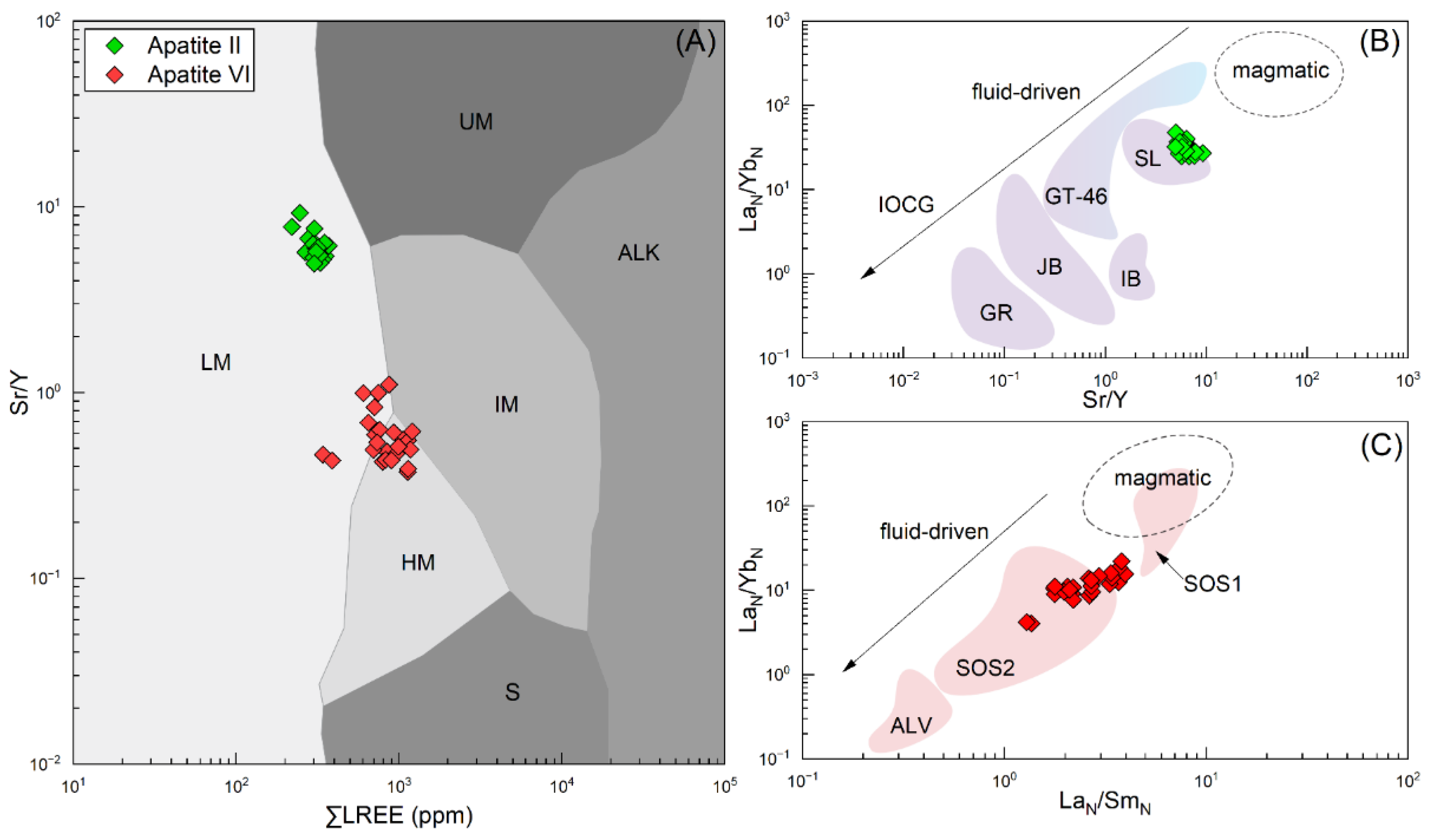
Considering the compilations of O’Sullivan et al. [2,128] of apatite chemistry signatures from distinct geological settings (Figure 12A), it is possible to observe a clear distinction between the composition of the mineralization (apatite II) and the late mineralization (Apatite VI) stages, which form distinct signatures. If all alteration phases had derived from the same fluid, a progressive depletion in LREE would be expected during crystallization [5], and thus later generations of apatite should have lower REE contents. Thus, the fact that the later apatite generation (VI) has higher REE contents, along with a flatter La-Lu trend, suggests that it formed from a distinct fluid pulse, possibly less evolved. Furthermore, whereas apatite II is restricted to the LM (low-grade metamorphism/metasomatic rocks) field, indicating a predominantly hydrothermal signature, most apatite VI plots within the HM (high-grade metamorphism) field, consistent with melt formation [2,128]. The two generations, apatite (II) and apatite (VI), however, have almost identical Y/Ho ratios (26.5 and 26.2), which are consistent with mantle-derived igneous fluids [129].
In Figure 12B,C, LaN/YbN, LaN/SmN, and Sr/Y ratios are used to evaluate fluid evolution trends based on the compilation of Lu et al. [130], which assumes an initial alkaline magmatic source related to carbonatites. Based on the previously discussed paragenetic, petrographic, and geochemical similarities between the AQW2 mineralization event and those associated with the ca. 2.57 Ga event [27,30,52], apatite (II) was compared in Figure 12B exclusively with apatite data from the NCB IOCG deposits of similar ages [33,34]. The Jatobá deposit, although located in the SCB [51], was recently dated at ca. 2.5 and 2.0 Ga [35] and was also included. The apatite (II) signature overlaps those of the Salobo and GT-46 deposits [33], suggesting a relatively primitive fluid composition, whereas the Grota Funda deposit [34] represents the most evolved hydrothermal fluids within the NCB.
Similarly, the late-mineralization event of the AQW2 deposit (Apatite VI) was compared with data from the Sossego and Alvo 118 deposits [34], which are related to a younger ca. 1.88 Ga event [23,73] (Figure 12C). If this age correlation is correct, it may also reflect magmatic fluid-driven processes, since it has a similar signature to those of altered apatite from Na-Ca (actinolite–magnetite) alteration zones (SOS 2—Sossego Deposit), in the ca. 2.74 Ga granophyric granite host [34]. Although the involvement of magmatic fluids in the Sossego ore formation is debated by many authors [102,131], the data from Hunger et al. [34] suggest remobilization trends between SOS-1 apatite—which aligns closely with the magmatic field—and SOS-2 apatite, associated with the input of Cl-rich fluids [34,102]. In this context, the late apatite (VI) signature could represent a similar chlorine-rich signature in the AQW2 deposit. Apatite data from the Alvo 118 deposit [34] could represent a fluid evolution endmember of a similar process, with more intense fractionation between HREE and LREE and a similar chlorine-rich fluid composition [37].
Overall, the fluid source of late-mineralization apatite (Apatite VI) at the AQW2 could be linked to regional fluid circulation during basin-scale reactivation, overprinting older hydrothermal alteration zones, as also proposed for the Borrachudo and Bacabá deposits [24,31,98].

6. Conclusions

The AQW2 deposit comprises at least two major events with different hydrothermal signatures typical of IOCG deposits. The main IOCG mineralization comprises a ferro-calcic alteration related to a chalcopyrite–magnetite breccia system controlled and deformed by ductile structures. On the other hand, late-mineralization multidirectional chalcopyrite–pyrite–calcite veins and breccia record a brittle regime. Apatite mineral chemistry provides important insights for the AQW2 deposit formation:
  • Fluorapatite from magnetite–chalcopyrite bodies (Fe–Ca alteration) shows clear trends of redox evolution among different generations. A progressive decrease in initial F-, Sr- and Mn-rich apatite (I-III), concomitant with an increase in Cl, reflects gradually increasing fO2 and evolving fluid–rock interaction. It also indicates that the F–Na–Fe–Ca system evolution may be linked to metasomatism, likely formed by the unmixing of CO2-rich mantle fluids to generate hypersaline mineralizing systems, similar to several ca. 2.70 and 2.57 Ga IOCG deposits from the Northern Copper Belt.
  • The ore-related apatite (II) has a strong positive Eu anomaly similar to those of giant IOCG deposits worldwide (e.g., Olympic Dam, Australia; Salobo, Carajás). This indicates an alkaline fluid composition, fluid–rock interaction with remobilization of mafic host rocks and previously altered zones (e.g., gabbro and albitite), and episodic CO2 degassing related to the release of overpressured fluids, causing multiple brecciation stages. A sharp decrease in temperature associated with boiling may be a key mechanism for copper precipitation.
  • The unusually high Si and Fe contents of apatite (III) may reflect late-stage fluid overprint, linked to complex coupled substitution and dissolution–reprecipitation processes.
  • Late-mineralization chloro-fluorapatite (V) and (VI) display relatively higher Cl, Y, and LREE contents, lower Mn concentration and Ce anomalies, and distinct LaN/YbN, LaN/SmN and Sr/Y ratios, probably reflecting the input of late, oxidized basinal brines in shallower paleo-structures, like those related to Paleoproterozoic IOCG deposits in the Southern Copper Belt of the Carajás Province.
  • The Aquiri region, located in the distal and western part of the regional structural setting of the Carajás Domain, may exhibit mixing features between Cinzento and Canaã shear zones, representing a unique opportunity to unify studies of IOCG hydrothermal events in the Carajás Mineral Province. These results highlight the evolution of the AQW2 deposit within a broader IOCG mineral system, expanding the frontier to mineral exploration of copper resources essential to the clean energy transition.

Supplementary Materials

The following supporting information can be downloaded at: https://www.mdpi.com/article/10.3390/min16030308/s1, Table S1: EPMA analytical standards. Two separate EPMA sessions were conducted (I and II), with the following counting times, detection limits, X-ray lines and crystals; Table S2: Electron Probe Microanalysis (wt.%) of apatite generations from AQW2 IOCG deposit. “<DL” = below detection limit; “ID” = identification. Stoichiometric calculations were performed following Ketcham [80], using “Approach 1”, including correction of F and Cl contents and calculation of OH; Table S3: Analytical results and quality control (QA/QC) for reference materials in the LA-ICP-MS dataset (wt-ppm). “Min” = minimum; “Max” = maximum; “<LD” = below detection limit; “%Diff = relative difference from the accepted value (accuracy); “%RSD= relative standard deviation (precision); Table S4: LA-ICP-MS dataset from apatite II generation (wt-ppm). “<DL” = below detection limit; “ID” = identification; Table S5: LA-ICP-MS dataset from apatite VI generation (wt-ppm). “<DL” = below detection limit; “ID” = identification.

Author Contributions

Conceptualization, L.S., L.V.S.M. and F.M.V.M.; Investigation, L.S.; Methodology, L.S., L.V.S.M., L.F.D., S.A.S.D. and G.C.M.; Formal analysis, L.S., L.F.D. and L.V.S.M.; Data curation, L.S.; Writing—original draft preparation, L.S., L.V.S.M., N.A.B., R.O.d.A.M. and F.M.V.M., Writing—review and editing, L.S., L.V.S.M., N.A.B., L.F.D., G.C.M., S.A.S.D., R.O.d.A.M. and F.M.V.M.; Supervision, L.V.S.M.; Project administration, L.V.S.M.; Funding acquisition, L.V.S.M. All authors have read and agreed to the published version of the manuscript.

Funding

This research was funded by the São Paulo Research Foundation (FAPESP, grant 2021/13414-4) and by ADIMB–VALE–Universities Collaborative Project “Strategic studies on the exploration of iron, base and precious metal systems in the Carajás (PA) and Quadrilátero Ferrífero (QF) mineral provinces”.

Data Availability Statement

The original contributions presented in this study are included in the article/Supplementary Materials. Further inquiries can be directed to the corresponding author(s).

Acknowledgments

The authors gratefully acknowledge the GeoFluid Laboratory and the Electron Microprobe Laboratory of the University of São Paulo for their assistance with petrographic and EPMA analyses, as well as the LabMaTer at Université du Québec à Chicoutimi, especially to D. Savard and A. Lavoie for their assistance during LA-ICP-MS analyses. We also extend our appreciation to VALE S.A. for continuous support and access to drill-core samples from the AQW2 deposit, and to Iolite Team for providing an academic license for data processing. L.V.S. Monteiro is a Research Fellow of CNPq (Brazilian National Council for Scientific and Technological Development—310514/2022-3), and acknowledges the support through research grants.

Conflicts of Interest

Author Rodrigo Oliveira de Araujo Mabub was employed by the Vale S/A. Author Fernando Martins Vieira Matos works at the company Servigeo Geologia e Geofísica Ltda. The remaining authors declare that the research was conducted in the absence of any commercial or financial relationships that could be construed as a potential conflict of interest.

References

  1. Piccoli, P.M.; Candela, P.A. Apatite in Igneous Systems. Rev. Mineral. Geochem. 2002, 48, 255–292. [Google Scholar] [CrossRef]
  2. O’Sullivan, G.; Chew, D.; Kenny, G.; Henrichs, I.; Mulligan, D. The Trace Element Composition of Apatite and Its Application to Detrital Provenance Studies. Earth Sci. Rev. 2020, 201, 103044. [Google Scholar] [CrossRef]
  3. Decrée, S.; Deloule, E.; Barros, R.; Mercadier, J.; Höhn, S.; Peiffert, C.; Baele, J.M. Processes Controlling Rare Earth Element Distribution in Sedimentary Apatite: Insights from Spectroscopy, in Situ Geochemistry and O and Sr Isotope Composition. Sedimentology 2024, 71, 713–744. [Google Scholar] [CrossRef]
  4. Krneta, S.; Ciobanu, C.L.; Cook, N.J.; Ehrig, K.; Kontonikas-Charos, A. Apatite at Olympic Dam, South Australia: A Petrogenetic Tool. Lithos 2016, 262, 470–485. [Google Scholar] [CrossRef]
  5. Mercer, C.N.; Watts, K.E.; Gross, J. Apatite Trace Element Geochemistry and Cathodoluminescent Textures—A Comparison between Regional Magmatism and the Pea Ridge IOAREE and Boss IOCG Deposits, Southeastern Missouri Iron Metallogenic Province, USA. Ore Geol. Rev. 2020, 116, 103129. [Google Scholar] [CrossRef]
  6. Harlov, D.E. Apatite: A Fingerprint for Metasomatic Processes. Elements 2015, 11, 171–176. [Google Scholar] [CrossRef]
  7. Krneta, S.; Cook, N.J.; Ciobanu, C.L.; Ehrig, K.; Kontonikas-Charos, A. The Wirrda Well and Acropolis Prospects, Gawler Craton, South Australia: Insights into Evolving Fluid Conditions through Apatite Chemistry. J. Geochem. Explor. 2017, 181, 276–291. [Google Scholar] [CrossRef]
  8. Pan, L.C.; Hu, R.Z.; Wang, X.S.; Bi, X.W.; Zhu, J.J.; Li, C. Apatite Trace Element and Halogen Compositions as Petrogenetic-Metallogenic Indicators: Examples from Four Granite Plutons in the Sanjiang Region, SW China. Lithos 2016, 254–255, 118–130. [Google Scholar] [CrossRef]
  9. Kusebauch, C.; John, T.; Whitehouse, M.J.; Klemme, S.; Putnis, A. Distribution of Halogens between Fluid and Apatite during Fluid-Mediated Replacement Processes. Geochim. Cosmochim. Acta 2015, 170, 225–246. [Google Scholar] [CrossRef]
  10. Zhang, Y.W.; Zhu, J.J.; Pan, L.C.; Huang, M.L.; Wang, D.Z.; Zou, Z.C. Apatite as a Record of Magmatic–Hydrothermal Evolution and Metallogenic Processes: The Case of the Hongshan Porphyry–Skarn Cu–Mo Deposit, SW China. Minerals 2024, 14, 373. [Google Scholar] [CrossRef]
  11. Wang, L.; Qin, B.; Chiaradia, M.; Qin, K.Z.; Cao, M.J. Application of Explainable Machine Learning to Characterizing Apatite Fertility in Porphyry-Skarn Deposits. Ore Geol. Rev. 2025, 186, 106926. [Google Scholar] [CrossRef]
  12. Mao, M.; Rukhlov, A.S.; Rowins, S.M.; Spence, J.; Coogan, L.A. Apatite Trace Element Compositions: A Robust New Tool for Mineral Exploration. Econ. Geol. 2016, 111, 1187–1222. [Google Scholar] [CrossRef]
  13. Ge, Y.Z.; Zhang, Z.J.; Zhou, Y.Z.; Li, Q.; Zhang, F. Explainable Machine Learning Reveals Apatite Fertility and Porphyry Copper Mineralization Processes in the Syn- and Post-Subduction Settings. Ore Geol. Rev. 2025, 183, 106679. [Google Scholar] [CrossRef]
  14. Belousova, E.A.; Griffin, W.L.; O’Reilly, S.Y.; Fisher, N.I. Apatite as an Indicator Mineral for Mineral Exploration: Trace-Element Compositions and Their Relationship to Host Rock Type. J. Geochem. Explor. 2002, 76, 45–69. [Google Scholar] [CrossRef]
  15. Krneta, S.; Ciobanu, C.L.; Cook, N.J.; Ehrig, K.; Kontonikas-Charos, A. Rare Earth Element Behaviour in Apatite from the Olympic Dam Cu–U–Au–Ag Deposit, South Australia. Minerals 2017, 7, 135. [Google Scholar] [CrossRef]
  16. Palma, G.; Barra, F.; Reich, M.; Valencia, V.; Simon, A.C.; Vervoort, J.; Leisen, M.; Romero, R. Halogens, Trace Element Concentrations, and Sr-Nd Isotopes in Apatite from Iron Oxide-Apatite (IOA) Deposits in the Chilean Iron Belt: Evidence for Magmatic and Hydrothermal Stages of Mineralization. Geochim. Cosmochim. Acta 2019, 246, 515–540. [Google Scholar] [CrossRef]
  17. Prowatke, S.; Klemme, S. Trace Element Partitioning between Apatite and Silicate Melts. Geochim. Cosmochim. Acta 2006, 70, 4513–4527. [Google Scholar] [CrossRef]
  18. Migdisov, A.; Williams-Jones, A.E.; Brugger, J.; Caporuscio, F.A. Hydrothermal Transport, Deposition, and Fractionation of the REE: Experimental Data and Thermodynamic Calculations. Chem. Geol. 2016, 439, 13–42. [Google Scholar] [CrossRef]
  19. Corriveau, L.; Montreuil, J.F. Metasomatic Mineral Systems with IOA, IOCG, and Affiliated Critical and Precious Metal Deposits: A Review from a Field Geology Perspective. Minerals 2025, 15, 365. [Google Scholar] [CrossRef]
  20. Hitzman, M.W.; Oreskes, N.; Einaudi, M.T. Geological Characteristics and Tectonic Setting of Proterozoic Iron Oxide (CuUAuREE) Deposits. Precambrian Res. 1992, 58, 241–287. [Google Scholar] [CrossRef]
  21. Tassinari, C.C.G.; Mellito, K.M.; Babinski, M. Age and Origin of the Cu (Au-Mo-Ag) Salobo 3A Ore Deposit, Carajás Mineral Province, Amazonian Craton, Northern Brazil. Episodes 2003, 26, 2–9. [Google Scholar] [CrossRef]
  22. Silva, M.G.; Teixeira, J.B.G.; Vasconcelos, P.M.; Arielo, A.; Rocha, W.J.S.F. Geologia e Mineralizações de Fe-Cu-Au Do Alvo GT-46 (Igarapé Cinzento), Carajás. In Caracterização de Depósitos Minerais em Distritos Mineiros da Amazônia; Marini, O.J., Queiroz, E.T., Ramos, B.W., Eds.; DNPM-FINEP-ADIMB: Brasília, Brazil, 2005; pp. 94–151. [Google Scholar]
  23. Moreto, C.P.N.; Monteiro, L.V.S.; Xavier, R.P.; Creaser, R.A.; DuFrane, S.A.; Tassinari, C.C.G.; Sato, K.; Kemp, A.I.S.; Amaral, W.S. Neoarchean and Paleoproterozoic Iron Oxide-Copper-Gold Events at the Sossego Deposit, Carajás Province, Brazil: Re-Os and U-Pb Geochronological Evidence. Econ. Geol. 2015, 110, 809–835. [Google Scholar] [CrossRef]
  24. Moreto, C.P.N.; Monteiro, L.V.S.; Xavier, R.P.; Creaser, R.A.; DuFrane, S.A.; Melo, G.H.C.; Silva, M.A.D.; Tassinari, C.C.G.; Sato, K. Timing of Multiple Hydrothermal Events in the Iron Oxide–Copper–Gold Deposits of the Southern Copper Belt, Carajás Province, Brazil. Miner. Depos. 2015, 50, 517–546. [Google Scholar] [CrossRef]
  25. de Freitas Toledo, P.I.; Moreto, C.P.N.; Xavier, R.P.; Gao, J.; da Silva Nogueira de Matos, J.H.; de Melo, G.H.C. Multistage Evolution of the Neoarchean (ca. 2.7 Ga) Igarapé Cinzento (GT-46) Iron Oxide Copper-Gold Deposit, Cinzento Shear Zone, Carajás Province, Brazil. Econ. Geol. 2019, 114, 1–34. [Google Scholar] [CrossRef]
  26. Silva, M.A.D.; Monteiro, L.V.S.; Moreto, C.P.N.; Faustinoni, J.; Santos, T.J.S.; Sousa, S.D.; Xavier, R.P. From Source to Sink: U-Pb Geochronology and Lithochemistry Unraveling the Missing Link Between Mesoarchean Anatexis and Magmatism in the Carajás Province, Brazil. Minerals 2025, 15, 265. [Google Scholar] [CrossRef]
  27. Réquia, K.; Stein, H.; Fontboté, L.; Chiaradia, M. Re-Os and Pb-Pb Geochronology of the Archean Salobo Iron Oxide Copper-Gold Deposit, Carajás Mineral Province, Northern Brazil. Miner. Depos. 2003, 38, 727–738. [Google Scholar] [CrossRef]
  28. Tallarico, F.H.B.; Figueiredo, B.R.; Groves, D.I.; Kositcin, N.; McNaughton, N.J.; Fletcher, I.R.; Rego, J.L. Geology and SHRIMP U-Pb Geochronology of the Igarapé Bahia Deposit, Carajás Copper-Gold Belt, Brazil: An Archean (2.57 Ga) Example of Iron-Oxide Cu-Au-(U-REE) Mineralization. Econ. Geol. 2005, 100, 7–28. [Google Scholar] [CrossRef]
  29. Borba, M.L.; Tassinari, C.C.G.; Matos, F.M.V.; Sato, K.; Huhn, S.; Ferreira, S.N.; Medeiros, C.A. Tracking Hydrothermal Events Using Zircon REE Geochemistry from the Carajás Mineral Province, Brazil. J. Geochem. Explor. 2021, 221, 106679. [Google Scholar] [CrossRef]
  30. Melo, G.H.C.; Monteiro, L.V.S.; Xavier, R.P.; Moreto, C.P.N.; Santiago, E. Tracing Fluid Sources for the Salobo and Igarapé Bahia Deposits: Implications for the Genesis of the Iron Oxide Copper-Gold Deposits in the Carajás Province, Brazil. Econ. Geol. 2019, 114, 697–718. [Google Scholar] [CrossRef]
  31. Previato, M.; Monteiro, L.V.S.; da Silveira Bello, R.M.; Gonçales, L.C.G. Evolution of Brines and CO2-Rich Fluids and Hydrothermal Overprinting in the Genesis of the Borrachudo Copper Deposit, Carajás Province. Ore Geol. Rev. 2020, 121, 103561. [Google Scholar] [CrossRef]
  32. Tallarico, F.H.B. O Cinturão Cupro-Aurífero de Carajás, Brasil. Ph.D. Thesis, Universidade Estadual de Campinas, Instituto de Geociências, Campinas, Brazil, 2003. [Google Scholar]
  33. Diniz, A.C.; de Melo, G.H.C.; Lana, C.d.C.; Queiroga, G.N.; de Castro, M.P.; Reis, H.L.S. Unravelling Magmatic-Hydrothermal Processes at Salobo and GT-46 IOCG Deposits, Carajás Mineral Province, Brazil: Constraints from Whole-Rock Geochemistry and Trace Elements in Apatite. J. South Am. Earth Sci. 2023, 125, 104290. [Google Scholar] [CrossRef]
  34. Hunger, R.B.; Moreto, C.P.N.; Xavier, R.P.; de Melo, G.H.C.; Monteiro, L.V.S.; Queiroga, G.N.; Lana, C.d.C.; Liao, W.; Zhao, X.F.; Poliana, P.I. Apatite Cathodoluminescence and Trace Element Geochemistry of Neoarchean and Paleoproterozoic Iron Oxide-Copper-Gold (IOCG) Deposits of the Carajás Domain, Brazil: Implications for Fluid Evolution and Metallogenesis. Miner. Depos. 2025, 61, 189–218. [Google Scholar] [CrossRef]
  35. Campo-Rodriguez, Y.T.; Ciobanu, C.L.; Gilbert, S.; Wade, B.; Cook, N.J.; Schutesky, M.E.; Ehrig, K. Coupled Lu-Hf and U-Pb Apatite Geochronology of Jatobá Orebody Supports ∼2.5 Ga Metamorphism in Deep Shear Zones from Southern Copper Belt, Carajás Domain, Brazil. Precambrian Res. 2025, 421, 107753. [Google Scholar] [CrossRef]
  36. Monteiro, L.V.S.; Xavier, R.P.; de Carvalho, E.R.; Hitzman, M.W.; Johnson, C.A.; de Souza Filho, C.R.; Torresi, I. Spatial and Temporal Zoning of Hydrothermal Alteration and Mineralization in the Sossego Iron Oxide–Copper–Gold Deposit, Carajás Mineral Province, Brazil: Paragenesis and Stable Isotope Constraints. Miner. Depos. 2008, 43, 129–159. [Google Scholar] [CrossRef]
  37. Torresi, I.; Xavier, R.P.; Bortholoto, D.F.A.; Monteiro, L.V.S. Hydrothermal Alteration, Fluid Inclusions and Stable Isotope Systematics of the Alvo 118 Iron Oxide-Copper-Gold Deposit, Carajás Mineral Province (Brazil): Implications for Ore Genesis. Miner. Depos. 2012, 47, 299–323. [Google Scholar] [CrossRef]
  38. Santos, J.D. Geotectônica Dos Escudos Das Guianas e Brasil-Central. In Geologia, Tectônica e Recursos Minerais do Brasil; Bizzi, L.A., Schobbenhaus, C., Vidotti, R.M., Gonçalves, J.H., Eds.; CPRM—Serviço Geológico do Brasil: Brasília, Brazil, 2003; Volume 4, pp. 169–226. ISBN 85-230-0790-3. [Google Scholar]
  39. Huhn, S.R.B.; Santos, A.B.S.; Amaral, A.F.; Ledsham, E.J.; Gouveia, J.L.; Martins, L.B.P.; Costa, V.G. O Terreno Granito-Greenstone da Região de Rio Maria-Sul do Pará. In Proceedings of the 35° Congresso Brasileiro de Geologia; Sociedade Brasileira de Geologia (SBG): Belém, Brazil, 1988; pp. 1438–1452. [Google Scholar]
  40. de Arimatéia Costa de Almeida, J.; Dall’Agnol, R.; de Oliveira, M.A.; Macambira, M.J.B.; Pimentel, M.M.; Rämö, O.T.; Guimarães, F.V.; da Silva Leite, A.A. Zircon Geochronology, Geochemistry and Origin of the TTG Suites of the Rio Maria Granite-Greenstone Terrane: Implications for the Growth of the Archean Crust of the Carajás Province, Brazil. Precambrian Res. 2011, 187, 201–221. [Google Scholar] [CrossRef]
  41. Feio, G.R.L.; Dall’Agnol, R.; Dantas, E.L.; Macambira, M.J.B.; Santos, J.O.S.; Althoff, F.J.; Soares, J.E.B. Archean Granitoid Magmatism in the Canaã Dos Carajás Area: Implications for Crustal Evolution of the Carajás Province, Amazonian Craton, Brazil. Precambrian Res. 2013, 227, 157–185. [Google Scholar] [CrossRef]
  42. Machado, N.; Lindenmayer, Z.; Krogh, T.E.; Lindenmayer, D. U-Pb Geochronology of Archean Magmatism and Basement Reactivation in the Carajás Area, Amazon Shield, Brazil. Precambrian Res. 1991, 49, 329–354. [Google Scholar] [CrossRef]
  43. Pidgeon, R.T.; Macambira, M.J.B.; Lafon, J.M. Th-U-Pb Isotopic Systems and Internal Structures of Complex Zircons from an Enderbite from the Pium Complex, Carajas Province, Brazil: Evidence for the Ages of Granulite Facies Metamorphism and the Protolith of the Enderbite. Chem. Geol. 2000, 166, 159–171. [Google Scholar] [CrossRef]
  44. Silva, M.A.D.; Monteiro, L.V.S.; Moreto, C.P.N.; Sousa, S.D. Metamorfismo e Geoquímica do Complexo Xingu na Região de Canaã dos Carajás: Implicações para a Evolução Mesoarqueana do Domínio Carajás, Província Carajás. In Proceedings of the Contribuições à Geologia da Amazônia; Sociedade Brasileira de Geologia (SBG): Belém, Brazil, 2015; Volume 9, pp. 251–270. [Google Scholar]
  45. Justo, A.P.; Freitas-Silva, F.H.; Schorscher, J.H.D.; do Nascimento, J.A.S.; Dantas, E.L. Derrames Komatiíticos do Greenstone Belt a Sul da Serra Sul, Província Mineral de Carajás, Pará, Brasil. In Proceedings of the Recursos Minerais da Amazônia e Suas Implicações Socioeconômicas: Anais; Sociedade Brasileira de Geologia (SBG): Belém, Brazil, 2015; pp. 114–117. [Google Scholar]
  46. Gibbs, A.K.; Wirth, K.R.; Hirata, W.K.; Olszewski, W.J., Jr. Age and Composition of the Grão Pará Group Volcanics, Serra Dos Carajás. Rev. Bras. Geocienc. 1986, 16, 201–211. [Google Scholar] [CrossRef]
  47. Pinheiro, R.V.L.; Holdsworth, R.E. Evolução Tectonoestratigráfica dos Sistemas Transcorrentes Carajás e Cinzento, Cinturão Itacaiúnas, na Borda Leste do Cráton Amazônico, Pará. Rev. Bras. Geocienc. 2000, 30, 597–606. [Google Scholar] [CrossRef]
  48. Tavares, F.M.; Trouw, R.A.J.; da Silva, C.M.G.; Justo, A.P.; Oliveira, J.K.M. The Multistage Tectonic Evolution of the Northeastern Carajás Province, Amazonian Craton, Brazil: Revealing Complex Structural Patterns. J. South Am. Earth Sci. 2018, 88, 238–252. [Google Scholar] [CrossRef]
  49. Araújo, O.D.; Maia, R.G.N.; João, X.D.S.J.; Costa, J.B.S. A Megaestruturação Arqueana da Folha Serra dos Carajás. In Proceedings of the VII Congresso Latino-Americano de Geologia; Sociedade Brasileira de Geologia, Deparamento Nacional de Produção Mineral, Eds.; Sociedade Brasileira de Geologia (SBG): Belém, Brazil, 1988; pp. 324–333. [Google Scholar]
  50. Holdsworth, R.E.; Pinheiro, R.V.L. The Anatomy of Shallow-Crustal Transpressional Structures: Insights from the Archaean Carajas Fault Zone, Amazon, Brazil. J. Struct. Geol. 2000, 22, 1105–1123. [Google Scholar] [CrossRef]
  51. Veloso, A.S.R.; Monteiro, L.V.S.; Juliani, C. The Link between Hydrothermal Nickel Mineralization and an Iron Oxide-Copper–Gold (IOCG) System: Constraints Based on Mineral Chemistry in the Jatobá Deposit, Carajás Province. Ore Geol. Rev. 2020, 121, 103555. [Google Scholar] [CrossRef]
  52. Hunger, R.B.; Xavier, R.P.; Moreto, C.P.N.; Gao, J.F. Hydrothermal Alteration, Fluid Evolution, and Re-Os Geochronology of the Grota Funda Iron Oxide Copper-Gold Deposit, Carajás Province (Pará State), Brazil. Econ. Geol. 2018, 113, 1769–1793. [Google Scholar] [CrossRef]
  53. Wirth, K.R.; Gibbs, A.K.; Olszewski, W.J., Jr. U-Pb Ages of Zircons from the Grão-Pará Group and Serra Dos Carajás Granite, Pará, Brazil. Rev. Bras. Geocienc. 1986, 16, 195–200. [Google Scholar] [CrossRef]
  54. DOCEGEO Revisão Litoestratigráfica da Província Mineral de Carajás. In Proceedings of the 35° Congresso Brasileiro de Geologia; SBG: Belém, Brazil, 1988; pp. 11–56.
  55. Dreher, A.M.; Xavier, R.P.; Martini, S.L. Fragmental Rocks of the Igarapé Bahia CU-AU Deposit, Carajas Mineral Province, Brazil. Rev. Bras. Geocienc. 2005, 35, 359–368. [Google Scholar] [CrossRef]
  56. Araújo Filho, R.C.; Nogueira, A.C.R.; Araújo, R.N. New Stratigraphic Proposal of a Paleoproterozoic Siliciclastic Succession: Implications for the Evolution of the Carajás Basin, Amazonian Craton, Brazil. J. South Am. Earth Sci. 2020, 102, 102665. [Google Scholar] [CrossRef]
  57. Martins, P.L.G.; Toledo, C.L.B.; Silva, A.M.; Chemale, F.; Santos, J.O.S.; Assis, L.M. Neoarchean Magmatism in the Southeastern Amazonian Craton, Brazil: Petrography, Geochemistry and Tectonic Significance of Basalts from the Carajás Basin. Precambrian Res. 2017, 302, 340–357. [Google Scholar] [CrossRef]
  58. Silva, G.H.; Leal, J.W.L.; Salum, O.A.L.; Dall’Agnol, R.; Basei, M.A.S. Esboço Geológico de Parte Da Folha SC.21 Juruena. In Proceedings of the 28° Congresso Brasileiro de Geologia, Anais; SGB: Porto Alegre, Brazil, 1974; pp. 309–320. [Google Scholar]
  59. Soares, A.D.V.; Bernardelli, A.L.; Medeiros Filho, C.D.; Bastos, J.M.E.; Martins, L.P.B.; Lourenço, R.S. Geologia Regional Das Cabeceiras Do Igarapé Aquiri, Extremo Oeste Da Província Mineral de Carajás (PA). In Proceedings of the 35th Congresso Brasileiro de Geologia; Sociedade Brasileira de Geologia (SBG): Belém, Brazil, 1988; pp. 2704–2712. [Google Scholar]
  60. Macambira, E.M.B.; Ferreira Filho, C.F. Fracionamento Magmático dos Corpos Máfico-Ultramáficos da Suíte Intrusiva Catete—Sul do Pará. In Proceedings of the Contribuições a Geologia da Amazônia; Klein, E.L., Vasquez, M.L., Rosa Costa, L.T., Eds.; SGB—Núcleo Norte: Belém, Brazil, 2002; Volume 3, pp. 105–114. [Google Scholar]
  61. Lafon, J.M.; Macambira, M.J.B.; Pidgeon, R.T. Zircon U-Pb SHRIMP Dating of Neoarchean Magmatism in the Southwestern Part of the Carajás Province (Eastern Amazonian Craton, Brazil). In Proceedings of the 31st International Geological Congress, Rio de Janeiro, Brazil, 6–17 August 2000; pp. 6–17. [Google Scholar]
  62. Siepierski, L. Geologia, Petrologia e Potencial para Mineralizações Magmáticas dos Corpos Máfico-Ultramáficos da Região de Canaã dos Carajás, Província Mineral de Carajás. Ph.D. Thesis, Universidade de Brasília, Brasília, Brazil, 2016. [Google Scholar]
  63. Dall’Agnol, R.; da Cunha, I.R.V.; Guimarães, F.V.; de Oliveira, D.C.; Teixeira, M.F.B.; Feio, G.R.L.; Lamarão, C.N. Mineralogy, Geochemistry, and Petrology of Neoarchean Ferroan to Magnesian Granites of Carajás Province, Amazonian Craton: The Origin of Hydrated Granites Associated with Charnockites. Lithos 2017, 277, 3–32. [Google Scholar] [CrossRef]
  64. Barros, C.E.M.; Sardinha, A.S.; Barbosa, J.P.O.; Krimski, R.; Macambira, M.J.B.; Buenano, M.J. Pb-Pb and U-Pb Zircon Ages of Archean Syntectonic Granites of the Carajas Metallogenic Province, Northern Brazil. In Proceedings of the 3th South American Symposium on Isotope Geology, Pucon, Chile, 21–24 October 2001; pp. 94–97. [Google Scholar]
  65. Barros, C.E.d.M.; Macambira, M.J.B.; Barbey, P.; Scheller, T. Dados Isotópicos Pb-Pb em Zircão (Evaporação) e Sm-Nd do Complexo Granítico Estrela, Província Mineral de Carajás, Brasil: Implicações Petrológicas e Tectônicas. Rev. Bras. Geocienc. 2004, 34, 531–538. [Google Scholar] [CrossRef]
  66. Barbosa, J.d.P.d.O. Geologia Estrutural, Geoquímica, Petrografia e Geocronologia de Granitoides da Região do Igarapé Gelado, Norte da Província Mineral de Carajás. Master’s Thesis, Instituto de Geociências, Universidade Federal do Pará, Belém, Brazil, 2004. [Google Scholar]
  67. Feio, G.R.L.; Dall’Agnol, R.; Dantas, E.L.; Macambira, M.J.B.; Gomes, A.C.B.; Sardinha, A.S.; Oliveira, D.C.; Santos, R.D.; Santos, P.A. Geochemistry, Geochronology, and Origin of the Neoarchean Planalto Granite Suite, Carajás, Amazonian Craton: A-Type or Hydrated Charnockitic Granites? Lithos 2012, 151, 57–73. [Google Scholar] [CrossRef]
  68. Araujo, R.; Nogueira, A. Serra Sul Diamictite of the Carajas Basin (Brazil): A Paleoproterozoic Glaciation on the Amazonian Craton. Geology 2019, 47, 1166–1170. [Google Scholar] [CrossRef]
  69. Mougeot, R.; Respaut, J.P.; Briqueu, L.; Ledru, P.; Milesi, J.P.; Macambira, M.J.; Huhn, S.B. Geochronological Constraints for the Age of the Águas Claras Formation (Carajás Province, Pará, Brazil). In Proceedings of the 39th Congresso Brasileiro de Geologia; SGB: Salvador, Brazil, 1996; Volume 6, pp. 579–581. [Google Scholar]
  70. Araújo, R.N.; Sousa, M.J. Áreas de Relevante Interesse Mineral—Província Mineral de Carajás, PA: Estratigrafia e Ánalise do Minério de Mn de Carajás: Área Azul, Sereno, Buritirama e Antônio Vicente. In Informe de Recursos Minerais, Série Províncias Minerais do Brasil, 16th ed.; CPRM: Belém, Brazil, 2018; p. 198. ISBN 978-85-7499-420-8. [Google Scholar]
  71. Justo, A.P.; Dantas, E.L.; Freitas-Silva, F.H.; Rodrigues, J.B. Detrital Zircon Populations in the Neoarchean to Paleoproterozoic Sedimentary Coverage of Carajás, Amazon Craton, Brazil. In Proceedings of the 49° Congresso Brasileiro de Geologia; SBG: Rio de Janeiro, Brazil, 2018; p. 1890. [Google Scholar]
  72. Nascimento, M.d.S.; Oliveira, D.A. Ambiente Deposicional e Proveniência da Formação Gorotire, Província Carajás, Sudeste do Cráton Amazônico; Gorayeb, P., Meiguins, A., Eds.; SBG-Norte: Belém, Brazil, 2015; Volume 9. [Google Scholar]
  73. Tallarico, F.H.B.; McNaughton, N.J.; Groves, D.I.; Fletcher, I.R.; Figueiredo, B.R.; Carvalho, J.B.; Rego, J.L.; Nunes, A.R. Geological and SHRIMP II U-Pb Constraints on the Age and Origin of the Breves Cu-Au-(W-Bi-Sn) Deposit, Carajás, Brazil. Miner. Depos. 2004, 39, 68–86. [Google Scholar] [CrossRef]
  74. Dall’Agnol, R.; Lafon, J.M.; Macambira, M.J.B. Proterozoic Anorogenic Magmatism in the Central Amazonian Province, Amazonian Araton: Geochronological, Petrological and Geochemical Aspects. Mineral. Petrol. 1994, 50, 113–138. [Google Scholar] [CrossRef]
  75. Dall’Agnol, R.; Costi, H.T.; Da, A.A.; De Magalhães, M.S.; Teixeira, N.P. Rapakivi Granites from Brazil and Adjacent Areas. Precambrian Res. 1999, 95, 9–39. [Google Scholar] [CrossRef]
  76. Pimentel, M.M.; Lindenmayer, Z.G.; Laux, J.H.; Armstrong, R.; de Araújo, J.C. Geochronology and ND Isotope Geochemistry of the Gameleira Cu-Au Deposit, Serra Dos Carajás, Brazil: 1.8-1.7 Ga Hydrothermal Alteration and Mineralization. J. S. Am. Earth Sci. 2003, 15, 803–813. [Google Scholar] [CrossRef]
  77. Cordani, U.G.; Ramos, V.A.; Fraga, L.M.; Cegarra, M.; Delgado, I.; de Souza, K.G.; Gomes, F.E.M.; Schobbenhaus, C. Tectonic Map of South America 2016; Commission for the Geological Map of the World (CGMW): Paris, France, 2016. [Google Scholar]
  78. Vasquez, M.L.; Sousa, C.S.; Carvalho, J.M.A. Mapa Geológico e de Recursos Minerais Do Estado Do Pará, 1:1,000,000. In Programa Geologia do Brasil (PBG), Integração, Atualização e Difusão de Dados da Geologia do Brasil; CPRM: Belém, Brazil, 2008. [Google Scholar]
  79. Costa, U.A.P.; Paula, R.R.; Silva, D.P.B.; Barbosa, J.P.O.; Silva, C.M.G.; Tavares, F.M.; Oliveira, J.K.M.; Justo, A.P. Mapa de Integração Geológico-Geofísica Da ARIM Carajás. In Programa Geologia do Brasil (PBG); CPRM: Belém, Brazil, 2016. [Google Scholar]
  80. Ketcham, R.A. Technical Note: Calculation of Stoichiometry from EMP Data for Apatite and Other Phases with Mixing on Monovalent Anion Sites. Am. Mineral. 2015, 100, 1620–1623. [Google Scholar] [CrossRef]
  81. Mansur, E.T.; Dare, S.A.S.; Filho, C.F.F.; Miranda, A.C.R.; Monteiro, L.V.S. The Distribution of Trace Elements in Sulfides and Magnetite from the Jaguar Hydrothermal Nickel Deposit: Exploring the Link with IOA and IOCG Deposits within the Carajás Mineral Province, Brazil. Ore Geol. Rev. 2023, 152, 105256. [Google Scholar] [CrossRef]
  82. Woodhead, J.D.; Hellstrom, J.; Hergt, J.M.; Greig, A.; Maas, R. Isotopic and Elemental Imaging of Geological Materials by Laser Ablation Inductively Coupled Plasma-Mass Spectrometry. Geostand. Geoanal. Res. 2007, 31, 331–343. [Google Scholar] [CrossRef]
  83. Paton, C.; Hellstrom, J.; Paul, B.; Woodhead, J.; Hergt, J. Iolite: Freeware for the Visualisation and Processing of Mass Spectrometric Data. J. Anal. At. Spectrom. 2011, 26, 2508–2518. [Google Scholar] [CrossRef]
  84. Longerich, H.P.; Jackson, S.E.; Günther, D. Laser Ablation Inductively Coupled Plasma Mass Spectrometric Transient Signal Data Acquisition and Analyte Concentration Calculation. J. Anal. At. Spectrom. 1996, 11, 899–904. [Google Scholar] [CrossRef]
  85. Jochum, K.P.; Nohl, U.; Herwig, K.; Lammel, E.; Stoll, B.; Hofmann, A.W. GeoReM: A New Geochemical Database for Reference Materials and Isotopic Standards. Geostand. Geoanal. Res. 2005, 29, 333–338. [Google Scholar] [CrossRef]
  86. Kieffer, M.A.; Dare, S.A.S.; Namur, O. The Use of Trace Elements in Apatite to Trace Differentiation of a Ferrobasaltic Melt in the Sept-Iles Intrusive Suite, Quebec, Canada: Implications for Provenance Discrimination. Geochim. Cosmochim. Acta 2023, 342, 169–197. [Google Scholar] [CrossRef]
  87. McDonough, W.F.; Sun, S.-s. The Composition of the Earth. Chem. Geol. 1995, 120, 223–253. [Google Scholar] [CrossRef]
  88. Mabub, R.O.d.A. O Depósito de Cobre AQW2, Região do Aquiri, Província Mineral de Carajás, Pará: Timing da Mineralização IOCG e História Evolutiva. Master’s Thesis, University of São Paulo, São Paulo, Brazil, 2023. [Google Scholar]
  89. Whitney, D.L.; Evans, B.W. Abbreviations for Names of Rock-Forming Minerals. Am. Mineral. 2010, 95, 185–187. [Google Scholar] [CrossRef]
  90. Adams, D.T.; Koenig, A.E.; Lowers, H. Apatite Revisited: The Role of Anisotropy in Apatite Analysis. Microsc. Microanal. 2010, 16, 1212–1213. [Google Scholar] [CrossRef]
  91. Goldoff, B.; Webster, J.D.; Harlov, D.E. Characterization of Fluor-Chlorapatites by Electron Probe Microanalysis with a Focus on Time-Dependent Intensity Variation of Halogens. Am. Mineral. 2012, 97, 1103–1115. [Google Scholar] [CrossRef]
  92. Costa, U.A.P.; Fraga, L.M.B.; Silva, C.M.G. Província Mineral de Carajás, PA: Geologia e Recursos Minerais do Setor Aquiri. In Programa Mineração Segura e Sustentável; Serviço Geológico do Brasil: Brasília, Brazil, 2024; pp. 1–151. [Google Scholar]
  93. Teixeira, A.S. Geologia, Petrologia e Geocronologia do Complexo Acamadado Lago Grande: Evidência para Uma Suíte Magmática Mineralizada a EGP na Província Mineral de Carajás, Brasil. Master’s Thesis, Universidade de Brasília, Brasília, Brazil, 2013. [Google Scholar]
  94. Macambira, E.M.B.; Vale, A.G. São Félix Do Xingu: Folha SB. 22-YB, Estado Do Pará. In Programa Levantamentos Geológicos Básicos do Brasil; CPRM: Belém, Brazil, 1997; pp. 1–384. [Google Scholar]
  95. Zucchetti, M. Rochas Máficas do Grupo Grão Pará e sua Relação com a Mineralização de Ferro dos Depósitos N4 E N5, Carajás, PA. Ph.D. Thesis, Universidade Federal de Minas Gerais, Belo Horizonte, Brazil, 2007. [Google Scholar]
  96. Ferreira Filho, C.F.; Cançado, F.; Correa, C.; Macambira, E.M.B.; Siepierski, L.; Junqueira-Brod, T.C. Mineralizações Estratiformes de EGP-Ni Associadas a Complexos Acamadados em Carajás: Os Exemplos de Luanga e Serra da Onça. In Contribuições à Geologia da Amazônia; CPRM: Belém, Brazil, 2007; Volume 5, pp. 1–14. ISBN 978-85-88692-04-6. [Google Scholar]
  97. Dutra, L.F.; Louro, V.H.A.; Monteiro, L.V.S. The Southern IOCG and Hydrothermal Nickel Mineralization Trend of the Carajás Mineral Province: Airborne Geophysical and Remote Sensing Evidences for Structural Controls and Hydrothermal Signature. J. Appl. Geophy. 2023, 213, 105016. [Google Scholar] [CrossRef]
  98. Pestilho, A.L.S.; Monteiro, L.V.S.; de Melo, G.H.C.; Moreto, C.P.N.; Juliani, C.; Fallick, A.E.; Xavier, R.P. Stable Isotopes and Fluid Inclusion Constraints on the Fluid Evolution in the Bacaba and Castanha Iron Oxide-Copper-Gold Deposits, Carajás Mineral Province, Brazil. Ore Geol. Rev. 2020, 126, 103738. [Google Scholar] [CrossRef]
  99. Marschik, R.; Mathur, R.; Ruiz, J.; Leveille, R.A.; de Almeida, A.J. Late Archean Cu-Au-Mo Mineralization at Gameleira and Serra Verde, Carajás Mineral Province, Brazil: Constraints from Re-Os Molybdenite Ages. Miner. Depos. 2005, 39, 983–991. [Google Scholar] [CrossRef]
  100. de Araújo Carvalho, J.; Moreira Silva, A.; Labouré Bemfica Toledo, C.; Martins Vieira Matos, F.; Augusto de Medeiros Filho, C. Hydrothermal Footprint of the Salobo Profundo Cu-Au Orebody, Carajás Mineral Province, Brazil. Econ. Geol. 2025, 120, 1437–1468. [Google Scholar] [CrossRef]
  101. Andersson, S.S.; Wagner, T.; Jonsson, E.; Fusswinkel, T.; Whitehouse, M.J. Apatite as a Tracer of the Source, Chemistry and Evolution of Ore-Forming Fluids: The Case of the Olserum-Djupedal REE-Phosphate Mineralisation, SE Sweden. Geochim. Cosmochim. Acta 2019, 255, 163–187. [Google Scholar] [CrossRef]
  102. Monteiro, L.V.S.; Xavier, R.P.; Hitzman, M.W.; Juliani, C.; de Souza Filho, C.R.; Carvalho, E.d.R. Mineral Chemistry of Ore and Hydrothermal Alteration at the Sossego Iron Oxide–Copper–Gold Deposit, Carajás Mineral Province, Brazil. Ore Geol. Rev. 2008, 34, 317–336. [Google Scholar] [CrossRef]
  103. Mercer, C.N.; Reed, M.H. Porphyry Cu-Mo Stockwork Formation by Dynamic, Transient Hydrothermal Pulses: Mineralogic Insights from the Deposit at Butte, Montana. Econ. Geol. 2013, 108, 1347–1377. [Google Scholar] [CrossRef]
  104. Naulot, R.; Genna, D.; Dare, S.A.S.; Fortin-Rhéaume, J.D. The Use of Trace Elements in Pyrite and Carbonate Minerals as a Petrogenetic and Exploration Tool for Carbonate-Bearing Archean VMS: Example from B26, Abitibi, Canada. Miner. Depos. 2025, 61, 459–490. [Google Scholar] [CrossRef]
  105. Rodriguez-Mustafa, M.A.; Simon, A.C.; del Real, I.; Thompson, J.F.H.; Bilenker, L.D.; Barra, F.; Bindeman, I.; Cadwell, D. A Continuum from Iron Oxide Copper-Gold to Iron Oxide-Apatite Deposits: Evidence from Fe and O Stable Isotopes and Trace Element Chemistry of Magnetite. Econ. Geol. 2020, 115, 1443–1459. [Google Scholar] [CrossRef]
  106. Barton, M.D.; Johnson, D.A. Evaporitic-Source Model for Igneous-Related Fe Oxide–(REE-Cu-Au-U) Mineralization. Geology 1996, 24, 259. [Google Scholar] [CrossRef]
  107. Hitzman, M.W. Iron Oxide-Cu-Au Deposits: What, Where, When and Why; PGC Publishing: Adelaide, Australia, 2000; Volume 1. [Google Scholar]
  108. Tropper, P.; Manning, C.E.; Harlov, D.E. Experimental Determination of CePO4 and YPO4 Solubilities in H2O-NaF at 800 °C and 1 GPa: Implications for Rare Earth Element Transport in High-Grade Metamorphic Fluids. Geofluids 2013, 13, 372–380. [Google Scholar] [CrossRef]
  109. Broom-Fendley, S.; Brady, A.E.; Wall, F.; Gunn, G.; Dawes, W. REE Minerals at the Songwe Hill Carbonatite, Malawi: HREE-Enrichment in Late-Stage Apatite. Ore Geol. Rev. 2017, 81, 23–41. [Google Scholar] [CrossRef]
  110. Bromiley, G.D. Do Concentrations of Mn, Eu and Ce in Apatite Reliably Record Oxygen Fugacity in Magmas? Lithos 2021, 384–385, 105900. [Google Scholar] [CrossRef]
  111. Miles, A.J.; Graham, C.M.; Hawkesworth, C.J.; Gillespie, M.R.; Hinton, R.W.; Bromiley, G.D. Apatite: A New Redox Proxy for Silicic Magmas? Geochim. Cosmochim. Acta 2014, 132, 101–119. [Google Scholar] [CrossRef]
  112. Stokes, T.N.; Bromiley, G.D.; Potts, N.J.; Saunders, K.E.; Miles, A.J. The Effect of Melt Composition and Oxygen Fugacity on Manganese Partitioning between Apatite and Silicate Melt. Chem. Geol. 2019, 506, 162–174. [Google Scholar] [CrossRef]
  113. Cao, M.; Li, G.; Qin, K.; Seitmuratova, E.Y.; Liu, Y. Major and Trace Element Characteristics of Apatites in Granitoids from Central Kazakhstan: Implications for Petrogenesis and Mineralization. Resource Geology 2012, 62, 63–83. [Google Scholar] [CrossRef]
  114. Shannon, R.D. Revised Effective Ionic Radii and Systematic Studies of Interatomic Distances in Halides and Chalcogenides. Acta Crystallogr. Sect. A 1976, 32, 751–767. [Google Scholar] [CrossRef]
  115. Liu, Q.; Pan, L.C.; Wang, X.S.; Yan, J.; Xing, L.Z. Apatite Geochemistry as a Proxy for Porphyry-Skarn Cu Genesis: A Case Study from the Sanjiang Region of SW China. Front. Earth Sci. 2023, 11, 1185964. [Google Scholar] [CrossRef]
  116. Palma, G.; Reich, M.; Barra, F.; Ovalle, J.T.; del Real, I.; Simon, A.C. Thermal Evolution of Andean Iron Oxide–Apatite (IOA) Deposits as Revealed by Magnetite Thermometry. Sci. Rep. 2021, 11, 18424. [Google Scholar] [CrossRef] [PubMed]
  117. Mukherjee, R.; Venkatesh, A.S. Fareeduddin Chemistry of Magnetite-Apatite from Albitite and Carbonate-Hosted Bhukia Gold Deposit, Rajasthan, Western India—An IOCG-IOA Analogue from Paleoproterozoic Aravalli Supergroup: Evidence from Petrographic, LA-ICP-MS and EPMA Studies. Ore Geol. Rev. 2017, 91, 509–529. [Google Scholar] [CrossRef]
  118. Kontonikas-Charos, A.; Ciobanu, C.L.; Cook, N.J.; Ehrig, K.; Ismail, R.; Krneta, S.; Basak, A. Feldspar Mineralogy and Rare-Earth Element (Re)Mobilization in Iron-Oxide Copper Gold Systems from South Australia: A Nanoscale Study. Mineral. Mag. 2018, 82, S173–S197. [Google Scholar] [CrossRef]
  119. Oliver, N.H.S.; Cleverley, J.S.; Mark, G.; Pollard, P.J.; Fu, B.; Marshall, L.J.; Rubenach, M.J.; Williams, P.J.; Baker, T. Modeling the Role of Sodic Alteration in the Genesis of Iron Oxide-Copper-Gold Deposits, Eastern Mount Isa Block, Australia. Econ. Geol. 2004, 99, 1145–1176. [Google Scholar] [CrossRef]
  120. Genna, D.; Gaboury, D.; Roy, G. Evolution of a Volcanogenic Hydrothermal System Recorded by the Behavior of LREE and Eu: Case Study of the Key Tuffite at Bracemac-McLeod Deposits, Matagami, Canada. Ore Geol. Rev. 2014, 63, 160–177. [Google Scholar] [CrossRef]
  121. Kieffer, M.A.; Dare, S.A.S.; Namur, O.; Mansur, E.T. Apatite Chemistry as a Petrogenetic Indicator for Mafic Layered Intrusions. J. Petrol. 2024, 65, egae022. [Google Scholar] [CrossRef]
  122. Kieffer, M.A.; Dare, S.A.S.; Gendron, M. Trace Element Discrimination Diagrams to Identify Igneous Apatite from I-, S- and A-Type Granites and Mafic Intrusions: Implications for Provenance Studies and Mineral Exploration. Chem. Geol. 2024, 649, 121965. [Google Scholar] [CrossRef]
  123. Azimov, P.Y.; Bushmin, S.A. Solubility of Minerals of Metamorphic and Metasomatic Rocks in Hydrothermal Solutions of Varying Acidity: Thermodynamic Modeling at 400–800 °C and 1–5 Kbar. Geochem. Int. 2007, 45, 1210–1234. [Google Scholar] [CrossRef]
  124. Montreuil, J.F.; Potter, E.G.; Corriveau, L.; Davis, W.J. Element Mobility Patterns in Magnetite-Group IOCG Systems: The Fab IOCG System, Northwest Territories, Canada. Ore Geol. Rev. 2016, 72, 562–584. [Google Scholar] [CrossRef]
  125. Pan, Y.; Fleet, M.E. Compositions of the Apatite-Group Minerals: Substitution Mechanisms and Controlling Factors. Rev. Mineral. Geochem. 2002, 48, 13–49. [Google Scholar] [CrossRef]
  126. Harlov, D.E.; Wirth, R.; Förster, H.J. An Experimental Study of Dissolution-Reprecipitation in Fluorapatite: Fluid Infiltration and the Formation of Monazite. Contrib. Mineral. Petrol. 2005, 150, 268–286. [Google Scholar] [CrossRef]
  127. Wang, H.; Cai, K.; Sun, M.; Xia, X.P.; Lai, C.K.; Li, P.; Wan, B.; Zhang, Z. Apatite as a Magma Redox Indicator and Its Application in Metallogenic Research. Lithos 2022, 422–423, 106749. [Google Scholar] [CrossRef]
  128. O’Sullivan, G.J.; Thakurdin, Y.; Bolhar, R.; Horváth, P.; Hoare, B.C.; Collerson, K.D. The Great Falls Tectonic Zone after the Assembly of Laurentia: Evidence for Long-Term Tectonic Stability from Xenolith Apatite. Lithos 2021, 384–385, 105977. [Google Scholar] [CrossRef]
  129. Bau, M.; Bau, M. Controls on the Fractionation of Isovalent Trace Elements in Magmatic and Aqueous Systems: Evidence from Y/Ho, Zr/Hf, and Lanthanide Tetrad Effect. Contrib. Mineral. Petrol. 1996, 123, 323–333. [Google Scholar] [CrossRef]
  130. Lu, J.; Chen, W.; Ying, Y.; Jiang, S.; Zhao, K. Apatite Texture and Trace Element Chemistry of Carbonatite-Related REE Deposits in China: Implications for Petrogenesis. Lithos 2021, 398–399, 106276. [Google Scholar] [CrossRef]
  131. Chiaradia, M.; Banks, D.; Cliff, R.; Marschik, R.; Haller, A. Origin of Fluids in Iron Oxide-Copper-Gold Deposits: Constraints from Δ37Cl, 87Sr/86Sri and Cl/Br. Miner. Depos. 2006, 41, 565–573. [Google Scholar] [CrossRef]
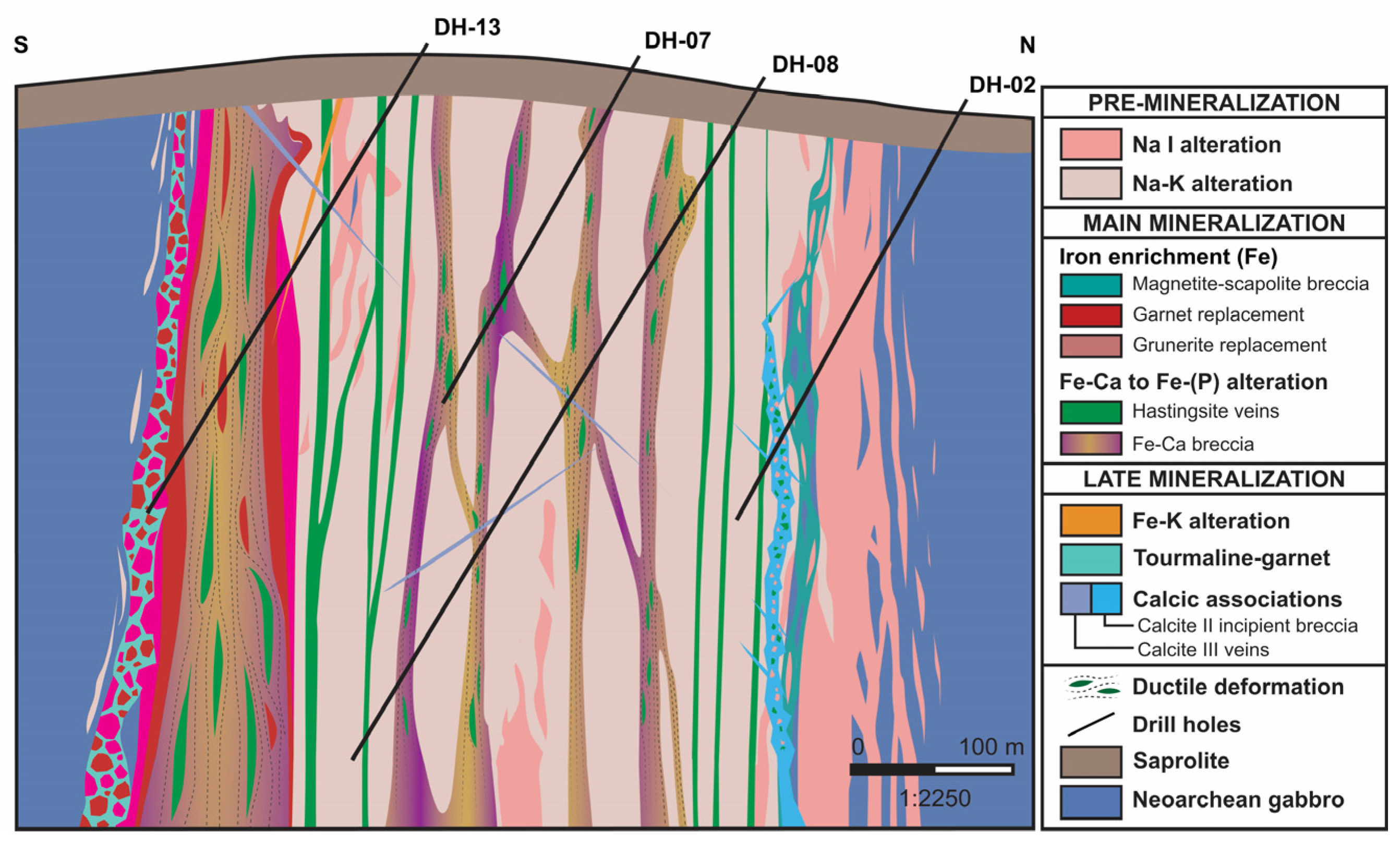
Figure 2. Geological cross-section of the AQW2 deposit, depicting the host gabbro and altered zones developed from gabbro and metavolcano–sedimentary units. Modified from VALE S.A. [88].
Minerals 16 00308 g002
Figure 3. Pre-mineralization hydrothermal alteration stages and iron enrichment features. (A) Isotropic preserved medium-grained gabbro with plagioclase + augite; (B) alteration of gabbro by pinkish albite (I) in association with olive-green epidote (I), all of which are subsequently cut by white albite (V) vein; (C) selective front of Na-K alteration, where former volcanic textures were replaced by scapolite (I) and biotite (I) and intersected by magnetite (III) veins; (D) gabbro fragments altered by albite (I) and subsequently fragmented by a magnetite (I) + scapolite (II) breccia. K-feldspar (II) halos from late calcite (III) + albite (VII) + epidote (III) ± hematite (IV) veinlets alter scapolite as pseudomorphs; (E) biotite (I) + scapolite (I) selective front (transmitted light; parallel polars—TL-PP); (F) zoned scapolite (I) selectively replacing former volcanic texture (transmitted light; crossed polars—TL-CP); (G) interstitial ilmenite (I) within very fine crystals of magnetite (I) Red circles indicate annealing features associated with magnetite recrystallization. Mineral abbreviations according to [89].
Minerals 16 00308 g003
Figure 4. Iron enrichment and ore-related hydrothermal alteration stages (Fe-Ca superimposed breccias). (A) Pervasive garnet (I) replacement cut by bluish hastingsite (I) veins; (B) ductile-deformed breccia, with cement predominantly composed of magnetite (II) + hastingsite (II) + grunerite (II), with minor apatite (I) that occurs dispersed as fine crystals; (C) apatite (II) concentrated in enriched zones of breccia cement, associated with quartz (II) + magnetite (III) + hastingsite (II) + chalcopyrite (I); (D) the main ore stage, observed in breccia cement associated with expressive chalcopyrite (III) + magnetite (IV)+ apatite (III); (E) fine crystals of garnet (I) porphyroblast with strain shadows filled by magnetite (II), hastingsite (I) and chalcopyrite (II), fracturing oblique to the main foliation with magnetite (III) and hastingsite (II) subsequent generation (reflected light—RL); (F) deformed and coarse crystals of garnet (I) within an Fe-Ca breccia cement, and with overgrowth-mantled rims associated with fine euhedral garnet (II) crystals (TL-PP); (G) chalcopyrite (III) with massive magnetite (IV) intersected by medium crystals of hastingsite (III) (RL). Mineral abbreviations according to [89].
Minerals 16 00308 g004
Figure 5. Representative petrographic, BSE and CL images for apatite from the AQW2 deposit mineralization stage (Ap I, II and III). (AC) Apatite (I) dispersed along magnetite (II) + chalcopyrite (I) breccia (A) as fine crystals with subdimorphic habit (TL-PP); (B,C) monotone BSE image of light-gray color and inclusion-free, dispersed along oxide and amphibole paragenesis. Red dots correspond to EPMA analytical spots. (DF) Apatite (II) in magnetite (III) + chalcopyrite (II) breccia cement (D) with medium-grained texture, fractured by chalcopyrite (II) (TL-PP); (E) the same as (D), under CL light with orange coloration; (F) the same as (D,E), under BSE image displaying monotone dark gray color. (GI) Apatite (III) in ore-zone breccia cement (G) as fine crystals with subidiomorphic habit dispersed within chalcopyrite (III) + hastingsite (II) + grunerite (V) paragenesis (TL-PP); (H) the same as (G), under CL light with a yellow color; (I) apatite (III) deformed along the main foliation as fine coalesced crystals with polygonal boundaries (CL). (JL) Medium to coarse apatite (III), occurring in coalesced rich-zones (J) under CL image, showing preserved green CL cores and altered yellow CL rims; (K) same area in BSE image, slightly shifted, with red-dotted line highlighting inclusion pattern within the cores; (L) BSE image of apatite core with allanite (I) inclusions. Mineral abbreviations according to [89].
Minerals 16 00308 g005
Figure 6. Late-mineralization hydrothermal alteration stages, with late chalcopyrite–(bornite) mineralization. (A) Fe-K vein infilled with biotite (II) + grunerite (VI) ± apatite (IV), intercepting previous garnet (I and II) replacement; (B) breccia with angular fragments, previously obliterated by garnet (I and II) and grunerite (I), and cement of tourmaline (II) + garnet (III) + allanite (II); (C) calcic vein infilled by epidote (II) + calcite (II) + hastingsite (I) + apatite (V) ± albite (VI) ± hematite (I), intercepting distal hastingsite replacement (I); (D) calcic vein with calcite (II) + apatite (VI) + scapolite (III) ± hematite (II) intercepting early hastingsite replacement (I). Mineral abbreviations according to [89].
Minerals 16 00308 g006
Figure 7. Representative petrographic, BSE and CL images for apatite from the AQW2 deposit late mineralization stages, with late chalcopyrite–bornite mineralization. (AC) Apatite (IV) in ferro-potassic (Fe-K) paragenesis with biotite (II) + grunerite (VI) (A) occurring in very fine to fine crystals, in low quantities, fracturing previous garnet (I and II) replacement (TL-PP); (B,C) the same as (A), as monotone BSE image of light-gray color, fractured by chalcopyrite (IV). (DF) Apatite (V) infilling brittle-controlled calcic vein with epidote (II) + calcite (I) + hastingsite (IV) formation (D) occurring with fine to medium texture, with grunerite (VII) inclusions (TL-PP); (E) the same as (D), in BSE image with light-gray color and with fractured edges by chalcopyrite (VII); (F) the same as (D) and (E), under CL light, with yellow dark core and altered yellow-light rims. (GI) Apatite (VI) infilling calcic vein with calcite (II) + scapolite (III) + chalcopyrite (VIII) (G) as large to centimeter-size crystals with idiomorphic texture; (H) the same as (G), as BSE image, highlighting fine crystals of grunerite (VIII) inclusions; (I) deformed by chalcopyrite (VIII) and calcite (II) (TL-CP). Mineral abbreviations according to [89]. Other types of post-ore (non-mineralized) calcic veins occur in the absence of apatite, including: centimetric-sized veins with a calcite (III) + actinolite (IV) ± hematite (III) ± K-feldspar (I) paragenesis; centimetric-sized veins with whitish-pink albite (VII) + epidote (III) ± hematite (IV), with K-feldspar (II) alteration halos (Figure 3D); and multi-directional veinlets consisting solely of calcite (IV) ± quartz (IV). Stilpnomelane was occasionally observed as an accessory mineral. The paragenetic sequence established for the AQW2 deposit is shown in Figure 8, including pre-, early-, main- and late-mineralization events.
Minerals 16 00308 g007
Figure 8. Paragenetic sequence established for the AQW2 IOCG deposit, showing the main hydrothermal alteration and mineralization stages. Alterations containing apatite are displayed in color, while the other hydrothermal phases of the deposit are shown in gray-toned columns. Mineral abbreviations according to [89].
Minerals 16 00308 g008
Figure 9. Main EPMA results for apatite generations. (A) Ca (wt %) and F/Cl variation; (B) halogen (F-Cl) content and calculated OH, following the stoichiometric calculation “Approach 1” from Ketcham [80]. The light-gray field represents the possible range of F and Cl variations resulting from random crystallographic orientations in polished thin sections, assuming F overestimation and Cl underestimation of 0 to 40% (F × 0.6 and Cl × 1.4) [5,90,91]; (C) Mn (wt-ppm) versus Sr (wt-ppm); (D) Fe (wt-ppm) versus Si (wt-ppm) with linear fitting of apatite (III) generation core and rim data (R2 = 0.87). Ap = apatite.
Minerals 16 00308 g009
Figure 10. Main LA-ICP-MS results for apatite. (A) ΣREE+Y versus Na; (B) Sr/Y versus Ga (wt-ppm); (C,D) apatite II and VI normalized REE pattern in multielemental distribution; (E) LaN/YbN versus LaN/SmN; (F) Y (wt-ppm) versus ΣLREE (wt-ppm). REE normalization patterns are from McDonough and Sun [87].
Minerals 16 00308 g010
Figure 12. Discrimination diagrams. (A) Sr/Y versus ΣLREE plot, with geological fields defined by O’Sullivan et al. [2,128]: IM = mafic I-type granitoids and mafic igneous rocks; UM = ultramafic igneous rocks; S = S-type granitoids and high aluminum saturation index—“felsic” I-types; ALK = alkali-rich igneous rocks; LM = low- and medium-grade metamorphic and metasomatic rocks; HM = leucosomes/high-grade metamorphic rocks. (B,C) fluid evolution pathway diagrams proposed by [130] showing magmatic, fluid-driven, and IOCG-related signatures: (B) LaN/YbN versus Sr/Y diagram, with mineralization apatite (II) data. Purple fields represent ca. 2.57 Ga IOCG deposits of the Carajás Province [27,30,52], comprising apatite data from Salobo (SL) [33], Igarapé Bahia (IB) and Grota Funda (GR) [34] and Jatobá (JT) [35] deposits. The GT-46 deposit (GT-46) data [33] record both ca. 2.72 and 2.57 Ga ages [25] and are shown as a blue-to-purple field; (C) LaN/YbN versus LaN/SmN diagram, in which apatite (VI) is compared with data provided by Hunger et al. [34], representing Paleoproterozoic ca. 1.90 Ga IOCG settings in the Carajás Province [32]. “SOS1” and “SOS2” correspond to altered apatite signatures from Sossego deposit host rocks, whereas “ALV” represents ore-zone apatite from the Alvo 118 deposit [34]. IOCG = iron oxide–copper–gold.
Minerals 16 00308 g012
Table 1. Representative EPMA analyses of the six apatite generations in the AQW2 IOCG deposit. Stoichiometric calculations followed “Approach 1” from Ketcham [80], with corrections of F and Cl values and OH calculation. “<DL” = below detection limit. “ID” = identification.
Drill Hole/DeepDH7/153DH7/63DH7/234DH13/230DH2/278DH13/84
ApatiteAp IAp IIAp IIIAp IVAp VAp VI
Sample (ID)15283842213
EPMA (wt.%)
CaO55.5855.8052.3355.7054.0154.83
SrO0.070.020.020.030.020.01
Na2O<DL<DL<DL<DL<DL<DL
Ce2O3<DL0.020.02<DL0.01<DL
La2O3<DL0.030.03<DL<DL<DL
MnO0.050.040.030.020.010.01
FeO0.100.103.170.180.050.03
Y2O3<DL<DL0.04<DL0.04<DL
Nd2O3<DL<DL<DL<DL<DL<DL
Sm2O3<DL0.02<DL0.02<DL<DL
Pr2O3<DL0.02<DL<DL<DL0.05
Gd2O3<DL<DL<DL<DL0.02<DL
Dy2O3<DL<DL0.03<DL<DL0.04
TiO20.01<DL<DL<DL<DL<DL
ThO2<DL<DL0.01<DL<DL<DL
Al2O30.01<DL0.30<DL0.01<DL
P2O542.5042.4240.3342.6142.4441.76
SiO20.020.011.870.050.010.02
F (Corrected)2.231.761.772.411.351.22
Cl (Corrected)0.170.150.260.050.700.98
OH (Calculated)−0.170.560.46−0.340.820.84
Corrected Total100.58100.97100.66100.7299.4999.78
F/Cl12.9211.766.8753.261.931.24
Table 2. Representative LA-ICP-MS analyses from apatite generations (II) and (VI) of the AQW2 IOCG deposit. Normalization patterns are from McDonough and Sun [87]. “<DL” = below detection limit; “ID” = identification.
Element (wt-ppm)
Drill Hole/DeepSample (ID)Apatite23Na24Mg27Al31P45Sc47Ti51V53Cr55Mn56Fe57Fe59Co60Ni63Cu66Zn
DH07/6313Ap II59.952.40.7205081.60.41.6<DL<DL341.31116.11137.80.02<DL0.61.5
DH13/845Ap VI160.419.20.7205947.70.41.60.7<DL84.8352.7444.8<DL0.31.30.9
71Ga75As85Rb88Sr89Y90Zr93Nb95Mo118Sn133Cs137Ba139La140Ce141Pr146Nd
DH07/6313Ap II1.30.9<DL185.529.2<DL<DL<DL<DL<DL<DL58.7149.618.982.6
DH13/845Ap VI3.42.3<DL93.3198.8<DL<DL<DL<DL<DL0.5232.9452.652.5205.0
147Sm153Eu157Gd159Tb161Dy165Ho166Er169Tm172Yb175Lu178Hf181Ta182W208Pb232Th
DH07/6313Ap II14.510.113.11.25.91.12.40.21.30.2<DL<DL0.2<DL<DL
DH13/845Ap VI43.89.052.26.940.27.621.32.413.11.7<DL<DL0.20.20.3
238UREEREE+YLREESr/YLaN/SmNLaN/YbNCeN/YbNEu/Eu*Ce/Ce*
DH07/6313Ap II1.1356.7385.9306.86.32.535.735.22.21.1
DH13/845Ap VI0.41162.41361.2963.80.53.311.98.90.61.0
Anomaly formula following Mao et al. [12], Equations (1) and (2).
Disclaimer/Publisher’s Note: The statements, opinions and data contained in all publications are solely those of the individual author(s) and contributor(s) and not of MDPI and/or the editor(s). MDPI and/or the editor(s) disclaim responsibility for any injury to people or property resulting from any ideas, methods, instructions or products referred to in the content.