Article

Petrogenesis of Rhyolitic Porphyry Hosting the Newly Discovered Dengshang Mo Deposit, Northern Hebei Province

1
State Key Laboratory of Geological Processes and Mineral Resources, Frontiers Science Center for Deep-Time Digital Earth, School of Earth Sciences and Resources, China University of Geosciences, Beijing 100083, China
2
Northeast Geological S&T Innovation Center of China Geological Survey, Shenyang Geological Survey Center, Shenyang 110000, China
3
The Fourth Geological Team of Hebei Bureau of Geology and Mineral Resources, Chengde 067000, China
4
Key Laboratory of Resource Exploration Research of Hebei Province, Hebei University of Engineering, Handan 056038, China
*
Author to whom correspondence should be addressed.
Minerals 2026, 16(3), 249; https://doi.org/10.3390/min16030249
Submission received: 31 December 2025 / Revised: 16 February 2026 / Accepted: 25 February 2026 / Published: 27 February 2026
(This article belongs to the Special Issue Gold–Polymetallic Deposits in Convergent Margins)

Abstract

The Dengshang Mo deposit is a recently recognized porphyry-type system within the Yanliao Mo metallogenic belt of northern Hebei Province. However, its ore-hosting rhyolitic porphyry emplacement age and petrogenesis remain insufficiently understood. This study integrates petrography, zircon U–Pb geochronology, Lu–Hf isotope analysis, zircon trace element geochemistry, and whole-rock major- and trace element data to investigate the petrogenesis of the Dengshang rhyolitic porphyry and its genetic relationship with Mo mineralization. The ore-hosting porphyry is predominantly composed of quartz and plagioclase phenocrysts. LA-ICP-MS zircon U–Pb dating yields an emplacement age of 168.3 ± 1.2 Ma, indicating that the rhyolitic porphyry was emplaced during a Middle Jurassic magmatic episode. Petrological and geochemical characteristics classify the Dengshang rhyolitic porphyry as an I-type granite. Zircon εHf(t) values range from −0.93 to −7.29, corresponding to two-stage model ages (TDM2) of 1.27–1.67 Ga, which suggests derivation from partial melting of the Mesoproterozoic lower crust. Zircon trace elements display significant positive Ce anomalies (δCe = 10.14–332.85), and calculated oxygen fugacities (ΔFMQ = −0.65 to +2.77; median = +0.51) indicate moderately oxidized magmatic conditions conducive to Mo enrichment. These results collectively imply that the Dengshang rhyolitic porphyry was emplaced at ~168 Ma associated with paleo-Pacific plate subduction. This geodynamic setting triggered partial melting of Mesoproterozoic lower crust, producing oxidized magmas that experienced fractional crystallization prior to shallow emplacement. Our findings elucidate the petrogenesis of the Dengshang rhyolitic porphyry and its control on Mo mineralization, and contribute new insight for understanding porphyry Mo genesis within the complex tectonic evolution of the Yanliao Mo Belt.

1. Introduction

Porphyry deposits are among the most important metal resources worldwide, providing approximately 95% of molybdenum, three-quarters of global copper, substantial quantities of lead, zinc, gold and silver, and thus hold great economic importance [1,2,3,4]. The mineralization of porphyry deposits is generally closely linked to magmatic activity [5,6]. Therefore, understanding of the petrogenesis of ore-related magmas is fundamental to advancing mineral exploration and resource development [7,8].
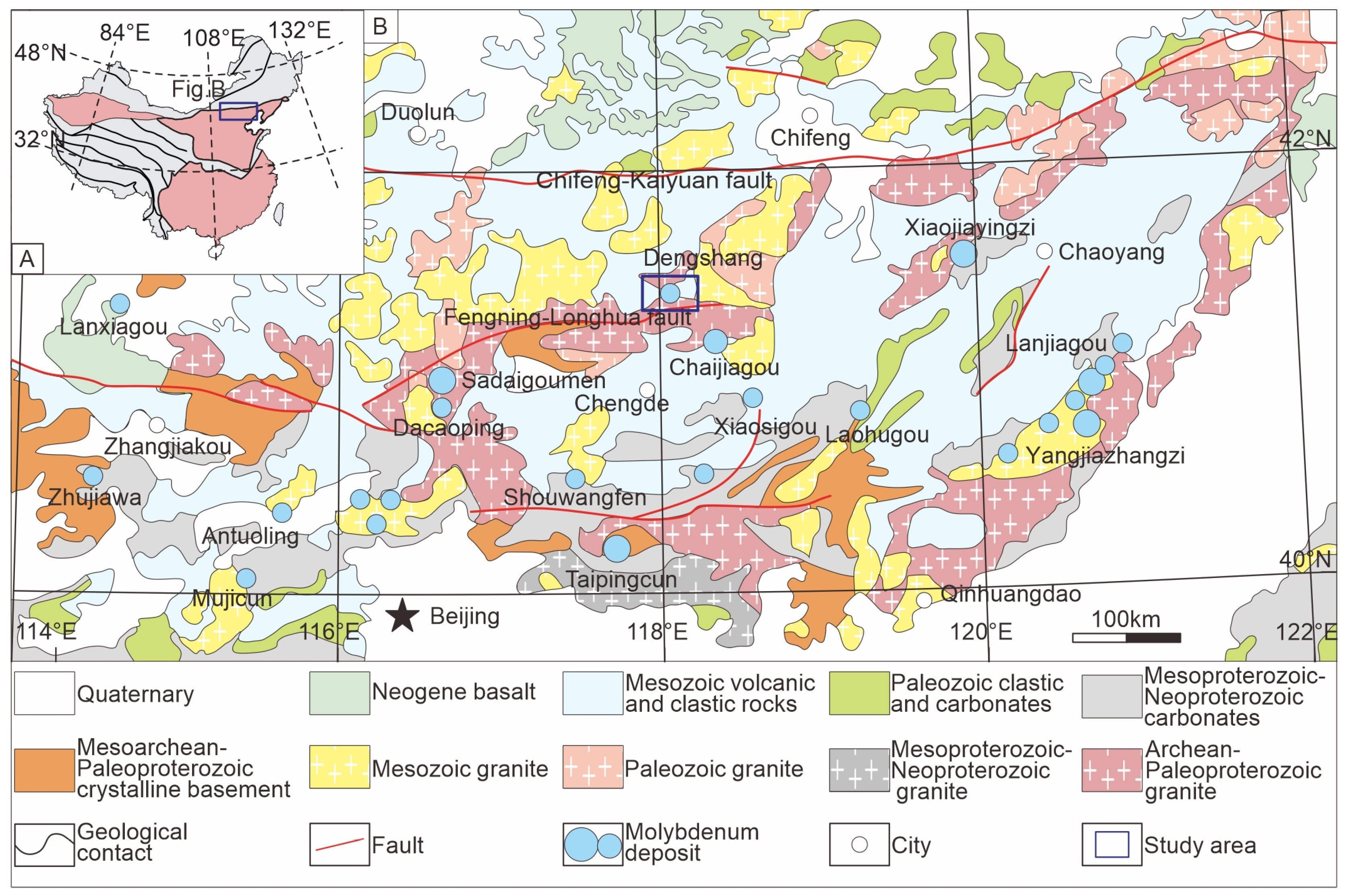
The Yanliao Mo Belt is located along the northern North China block (NCB), and represents one of the most important Mo metallogenic provinces in northern China (Figure 1). Over 30 Mo deposits have been identified in this region, including several large and medium-sized deposits such as Sadaigoumen, Lanjiagou, and Taipingcun, which together constitute the third largest Mo metallogenic cluster in China [9,10,11,12]. Previous research reveals that the belt has experienced a multistage tectonic evolution, including the closure of the Paleo-Asian Ocean, the collision between the Siberian Craton and the NCB, the closure of the Mongol–Okhotsk Ocean, the subduction of the paleo-Pacific plate, and subsequent lithospheric thinning. These geodynamic processes triggered multiple episodes of magmatism and metallogenesis in the region [13,14,15,16]. Studies on the Sadaigoumen deposit have revealed that around 230 Ma, collisional tectonics associated with the closure of the Paleo-Asian Ocean may also have initiated porphyry Mo mineralization in this region [11,17]. Within the Yanliao Mo Belt, Mo mineralization was primarily concentrated during the Yanshanian period [18]. This mineralization is commonly linked to an extensional tectonic environment resulting from westward subduction of the paleo-Pacific plate [19]. During this period, partial melting of ancient lower crustal material gave rise to the ore-forming magmatism [9,11,12,20,21,22,23]. These findings imply that porphyry Mo mineralization in the Yanliao Mo Belt may not be restricted to a single tectonic regime. Its petrogenesis is more complex, involving the superposition and interaction of multiple tectonic events.
The Dengshang Mo deposit, located in northern Hebei Province within the Yanliao Mo Belt, is a newly discovered deposit that has been only sparsely studied. Early exploration in the Dengshang area (1970s–1980s) focused primarily on the pyrite mineralization developed in the upper part of the cryptoexplosive breccia. Most drillholes were terminated once only weak molybdenum mineralization was encountered, resulting in poor definition of the orebody and failure to identify the mineralized parent intrusion. It was not until recent systematic deep drilling (to depths of up to 1200 m) that a concealed porphyry-type Mo system was revealed, confirming that the major mineralization is hosted within the rhyolitic porphyry [24]. Its magmatic timing, petrogenetic characteristics, and genetic link to Mo mineralization remain unclear. In most Mo deposits of the Yanliao Mo Belt, mineralization is primarily hosted in granitic intrusions; however, the Dengshang Mo mineralization is mainly hosted in rhyolitic porphyry. This unusual host rock association may reflect a unique tectonomagmatic setting for mineralization. Therefore, a comprehensive investigation into the geochronology and petrogenesis of the Dengshang rhyolitic porphyry is essential for clarifying the genesis of the deposit and improving our understanding of Mo metallogenesis in the Yanliao Mo Belt. We conducted integrated whole-rock geochemistry, zircon U–Pb dating, trace element analysis, and Lu–Hf isotopic studies of the Dengshang rhyolitic porphyry, in combination with published geochemical data from other representative porphyry Mo deposits in the region. This study specifically seeks to (1) determine the petrogenesis of the ore-hosting rhyolitic porphyry at Dengshang, and (2) examine the links between magmatic evolution and regional tectonics, so as to provide novel insights and constraints that help elucidate the metallogenic evolution of porphyry Mo deposits in the Yanliao Mo Belt.
Figure 1. Map showing the geographic setting of the study area (A) and geological sketch map of the Yanliao Mo Belt (B) [25].
Minerals 16 00249 g001

2. Geological Background

2.1. Regional Geology

The NCB was assembled through the amalgamation of its Eastern and Western blocks along a Paleoproterozoic orogenic belt and had largely achieved crustal stability by ~1.8 Ga (Luliang Orogeny) [15,26]. The Yanliao aulacogen developed on its northeastern margin during the Mesoproterozoic. Between the Paleozoic and Late Permian, the northern NCB experienced subduction and collision associated with the Paleo-Asian Ocean, culminating in the formation of the North China–Mongolia composite plate. During the Middle to Late Triassic, intracontinental extension was indicated by metamorphic core complexes and alkaline magmatism [27,28,29,30,31]. During the Middle Jurassic, the westward subduction of the paleo-Pacific plate primarily governed the tectonic evolution of the Yanliao region, coupled with the ongoing closure of the Mongol–Okhotsk Ocean to its north (Figure 1) [32,33,34,35]. These processes induced intense deformation and widespread magmatism. Regional EW and NE-trending faults strongly controlled deposit distribution and mineralization.
Stratigraphically, the region comprises Archean basement rocks overlain by Proterozoic to Paleozoic sedimentary successions, including the marine–continental sequences of the Changcheng and Jixian groups. These supracrustal sequences, together with multiple intrusive phases, provided favorable host rocks and structural traps for mineralization. Mesozoic magmatism was particularly prolific, with early Yanshanian activity characterized by intermediate to felsic intrusions (monzogranite, high Sr/Y granite), and late Yanshanian activity featuring mafic–intermediate volcanism, A-type and highly fractionated I-type granites, and alkaline complexes [36,37,38]. These magmas provided the essential material and thermal energy for mineralization in the belt.

2.2. Deposit Geology

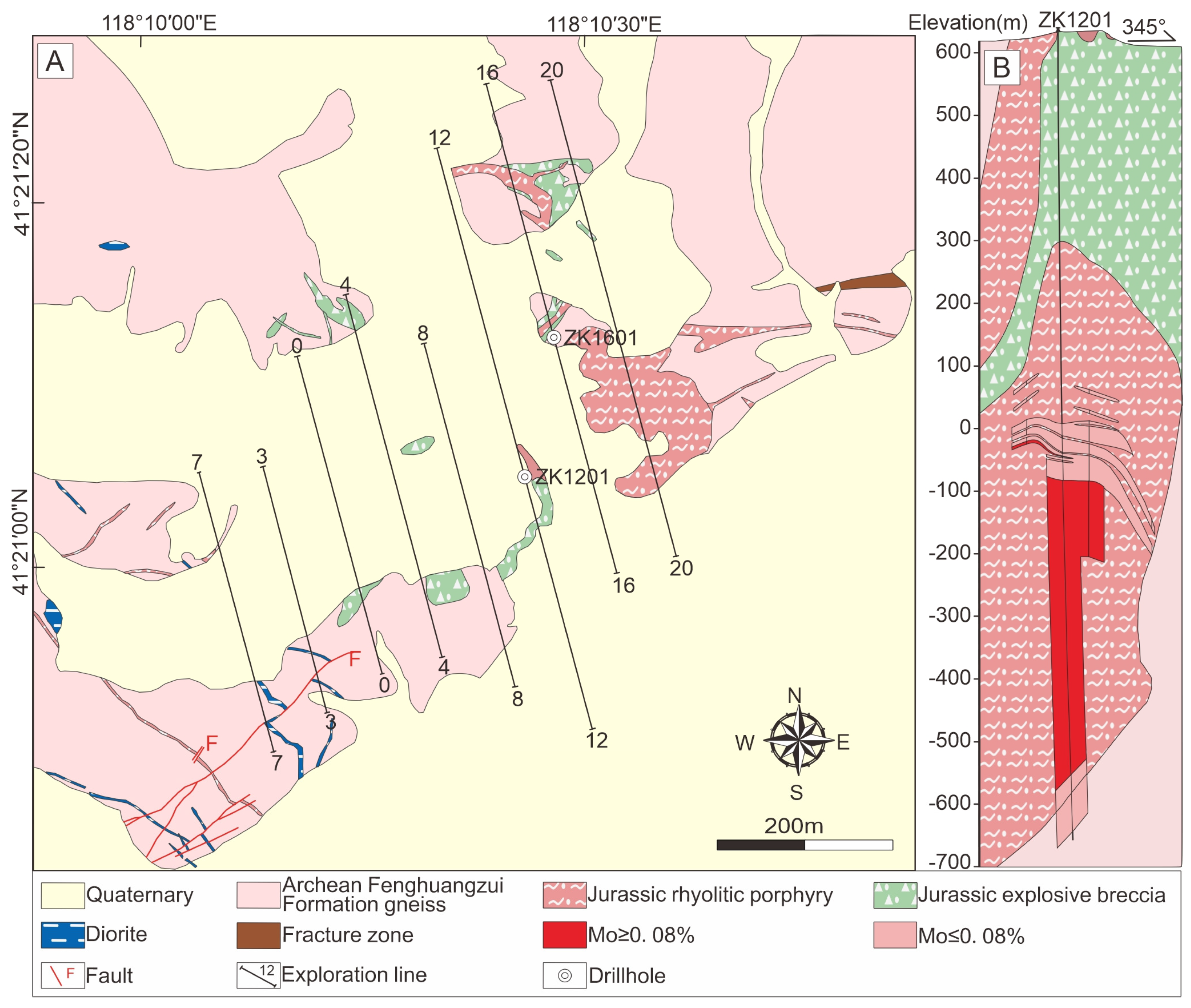
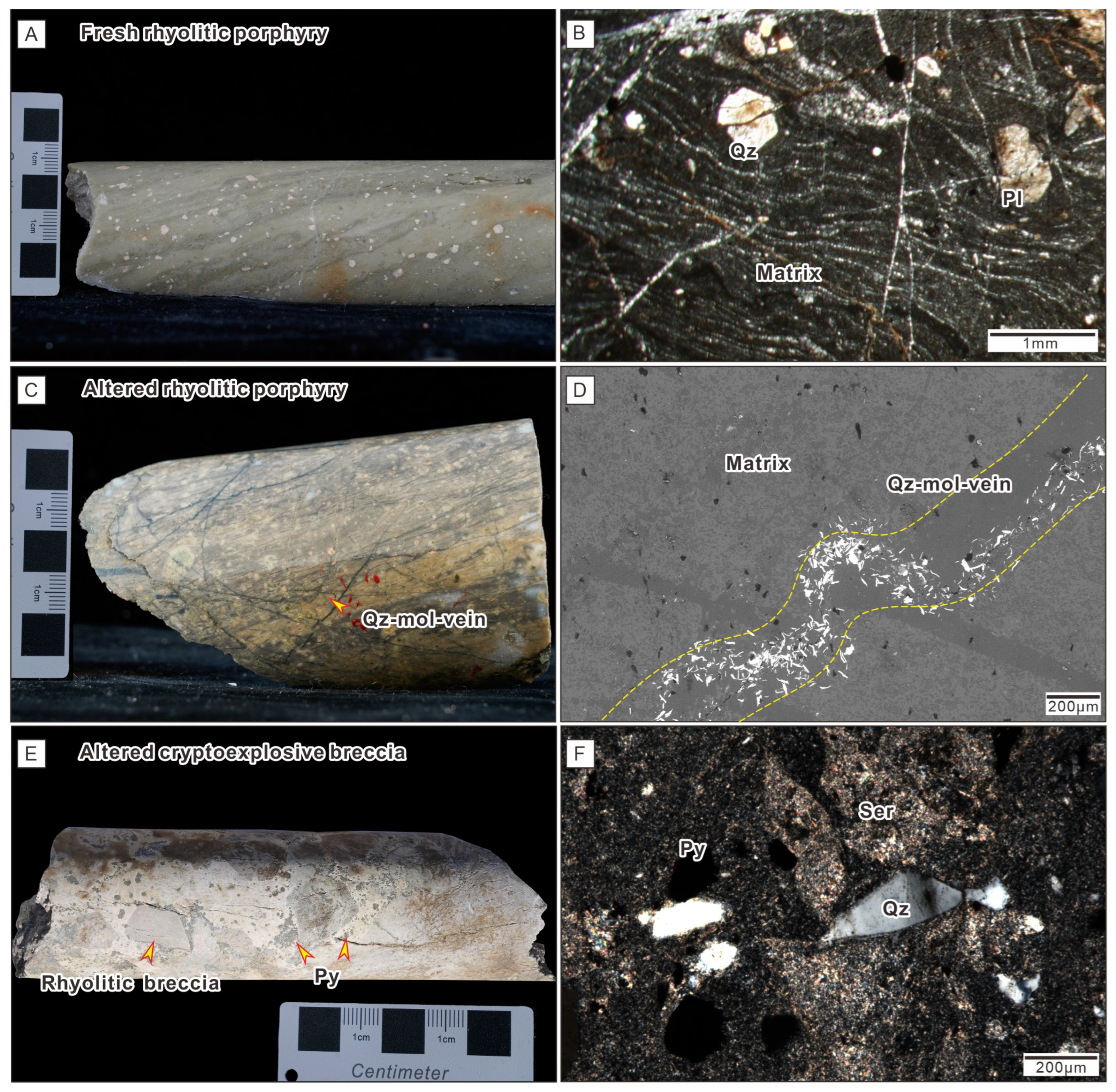
The Dengshang Mo deposit is situated in Chengde city [39], Hebei Province. Tectonically, it lies north of the NCB, separated by the Chifeng–Kaiyuan Fault, within the Fengning–Longhua fault. The deposit has an estimated Mo resource of 5108.6 t with an average grade of 0.108%. The mining area are mainly Archean hornblende gneiss of the Dantazi Group, Fenghuangzui Formation, and Quaternary sediments (Figure 2). Magmatic rocks intrude into the gneiss as dikes, trending NE and NW. They are dominated by Jurassic rhyolitic porphyry accompanied by cryptoexplosive breccia, and subordinately by intermediate dikes of diorite, with individual dikes extending 40–70 m in length and 1.5–3 m in thickness. The rhyolitic porphyry displays a porphyritic texture, with phenocrysts of quartz and plagioclase and the matrix is cryptocrystalline quartz, feldspar, no significant vitreous phase is detected (Figure 3A,B). Developed within the deposit are several NE-trending faults. The ore bodies are mainly hosted by rhyolitic porphyry at depth, occurring as stratiform and vein at elevations of −100 to −600 m, representing concealed mineralization. Minor disseminated molybdenite mineralization is observed in the cryptoexplosive breccia and gneiss, but does not form economic orebodies. The ores are characterized by stockwork and veinlet-style. Stockwork ores within the rhyolitic porphyry contain abundant quartz–molybdenite veinlets, in which molybdenite commonly occurs as fine flakes or aggregates (Figure 3C,D). The cryptoexplosive breccia consists mainly of rhyolitic porphyry clasts and lithic fragments, with pyrite disseminated both within the clasts and the altered matrix (Figure 3E). Pyrite occurs as fine disseminations, and quartz grains are typically surrounded by intense sericitization, indicating strong hydrothermal alteration (Figure 3F) [40]. Typical hydrothermal alteration zoning is developed in the deposit, and the alteration is predominantly distributed around the rhyolitic porphyry intrusion and its peripheral areas. The alteration zoning progresses outward from an inner zone dominated by potassic alteration (K-feldspar, sericite), which is primarily developed within the rhyolitic porphyry intrusion; the outer zone is characterized by propylitization (chlorite, carbonate), which is mostly distributed in the cryptoexplosive breccia and gneiss at the intrusion periphery [24]. In addition, silicification and sericitization are developed, accompanied by pyritization, magnetitization, and local Pb–Zn mineralization.

3. Materials and Methods

3.1. Materials

The rhyolitic porphyry represents the main ore-hosting intrusion of the Dengshang Mo deposit, and it is predominantly exposed within the central sector of the mining area (Figure 2B). Eight fresh rhyolitic porphyry core samples (24DS106–24DS113) were collected for this study. They were obtained from drill hole ZK1201. Sample 24DS106 was used for zircon U–Pb dating, Lu–Hf isotope analysis, and zircon trace element analysis. The remaining seven samples (24DS107–24DS113) were used for whole-rock major and trace element geochemical analyses. The rocks exhibit a gray to grayish-white color with prominent flow banding and a porphyritic texture (Figure 3A). Phenocrysts constitute approximately 5%–10% of the rock and are composed essentially of quartz and plagioclase, with grain sizes ranging from 0.5 to 5 mm. The groundmass is predominantly cryptocrystalline and dominated by quartz and feldspar (Figure 3B).

3.2. Methods

3.2.1. Whole-Rock Major and Trace Element Analyses

These analyses were determined at Langfang Geological Exploration Technology Co., Ltd. (Langfang, China) prior to analysis. Loss on ignition (LOI) was measured gravimetrically after heating to 1000 °C. For major elements, glass beads prepared from ~0.5 g of sample powder fused with lithium borate were analyzed by X-ray fluorescence (XRF) [41]. Trace elements, including rare earth elements (REEs), were quantified by inductively coupled plasma-mass spectrometry (ICP-MS) following high-pressure digestion of ~50 mg of powder in an HF–HNO3 mixture at 150 °C. Analytical precision, based on replicate measurements, was better than 2% for major oxides and within 5% for trace elements. Accuracy, monitored using certified reference materials (GBW-07123), was within 5% of the certified value [42].

3.2.2. Zircon LA-ICP-MS U–Pb Dating and Trace Element Analyses

This analysis was performed at Beijing GeoAnalysis Co., Ltd. (Beijing, China) using LA-ICP-MS. Sample preparation included embedding zircon grains in epoxy, polished, and cleaned ultrasonically in ultrapure water followed by methanol rinsing. We used a 30 μm laser spot, 6 Hz repetition rate, and energy density of ~5 J/cm2. Before measurement, each analysis location was pre-cleaned with ~5 laser pulses (~0.3 μm depth) to remove surface contamination. The zircon standard 91500 served as the primary reference material, and Plesovice zircon was used for quality control. Trace element contents were calibrated against NIST 610 glass, with 29Si as the internal standard. During the analytical session, standard 91500 yielded a concordant age of 1061.5 ± 3.2 Ma (2σ), consistent with its reference value. Unknown age zircon Plesovice returned a weighted mean 206Pb/238U age of 337.5 ± 1.5 Ma (2σ), matching the recommended age within uncertainty [43]. Data reduction was conducted using the ICPMASDataCal 11.8 software [44] and age calculations were performed with Isoplot 3.0 [45].

3.2.3. In Situ Zircon Lu–Hf Isotope Analyses

Lu–Hf isotopic compositions were analyzed in situ on zircon domains concurrent with U–Pb dating, using a RESO 193 nm laser system (Australian Scientific Instruments, Canberra, Australia) linked to a Neptune Plus MC-ICP-MS (Thermo Fisher Instruments, Waltham, MA, USA). Operating conditions included laser spot diameter of 40 μm and helium as the carrier gas. The measured 176Hf/177Hf ratio for the Plešovice reference zircon was 0.282480 ± 0.000016 (2σ), matching its certified values [43].
For εHf(t) calculation, present-day chondrite ratios 176Hf/177Hf = 0.282772 and 176Lu/177Hf = 0.0332 were adopted, along with depleted mantle values of 0.28325 and 0.0384, respectively. Two-stage model ages (TDM2) were computed assuming 176Lu/177Hf = 0.015 for the average continental crust [43].

4. Results

4.1. Zircon U–Pb Ages and Trace Element Analyses

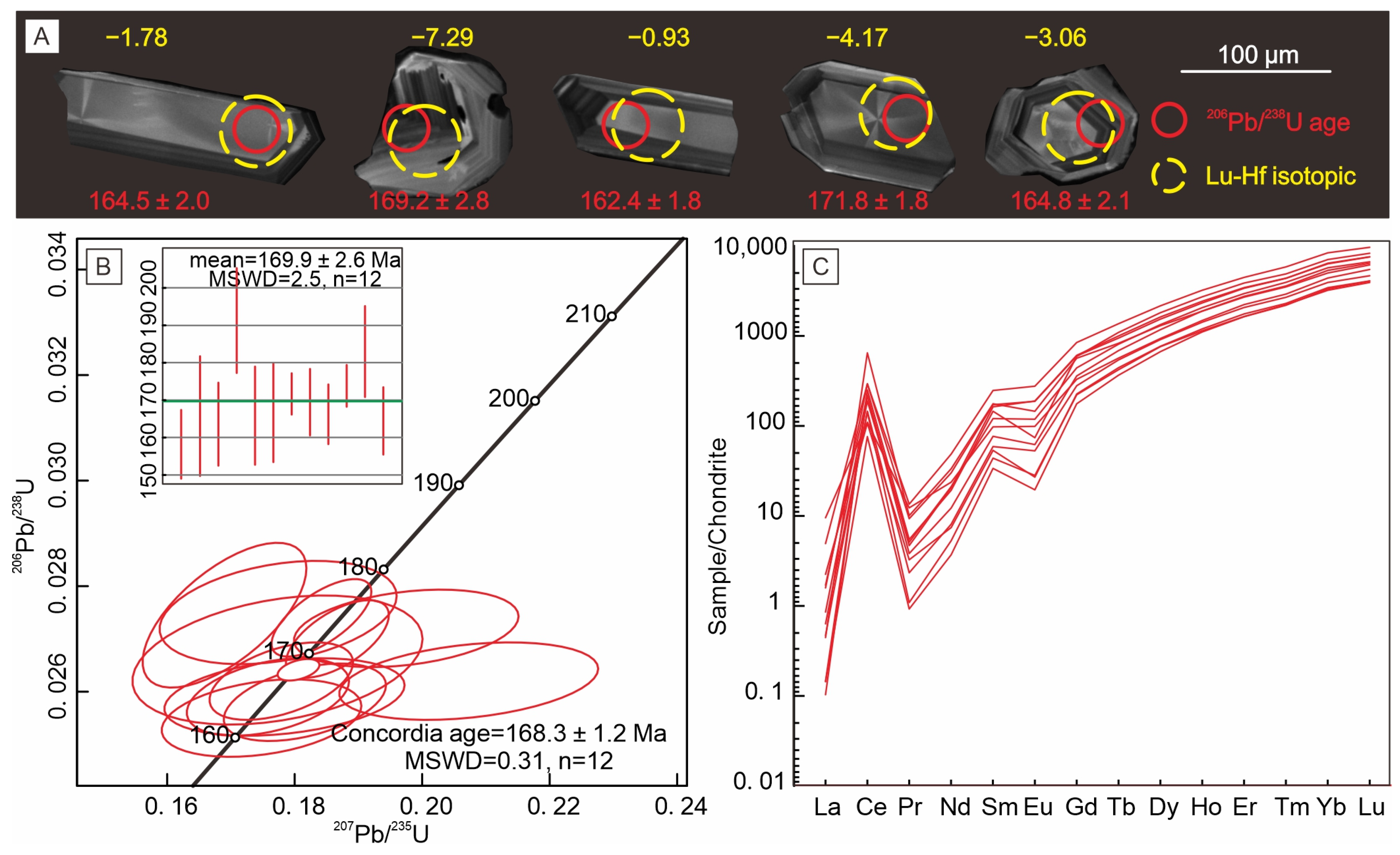
Cathodoluminescence (CL) images show that zircons from the rhyolitic porphyry sample 24DS106 of the Dengshang Mo deposit are mostly pristine and prismatic and exhibit euhedral to subhedral. The majority of crystals are 100 to 200 μm long, length/width between 1.5:1 and 4:1. They are generally well-preserved and display distinct oscillatory zoning, typical of magmatic zircons. In contrast, some grains exhibit inherited characteristics, such as weak or absent zoning (Figure 4A). Zircons from the rhyolitic porphyry are characterized by Th contents of 131.56–751.75 × 10⁻⁶ and U contents of 149.44–563.59 × 10⁻⁶, and Th/U ratios between 0.62 and 2.49. Twelve analysis spots produced concordant 206Pb/238U ages between 162.4 and 175.0 Ma, which yield a weighted mean of 168.3 ± 1.2 Ma (MSWD = 0.31, n = 12; Supplementary Table S1, Figure 4B).
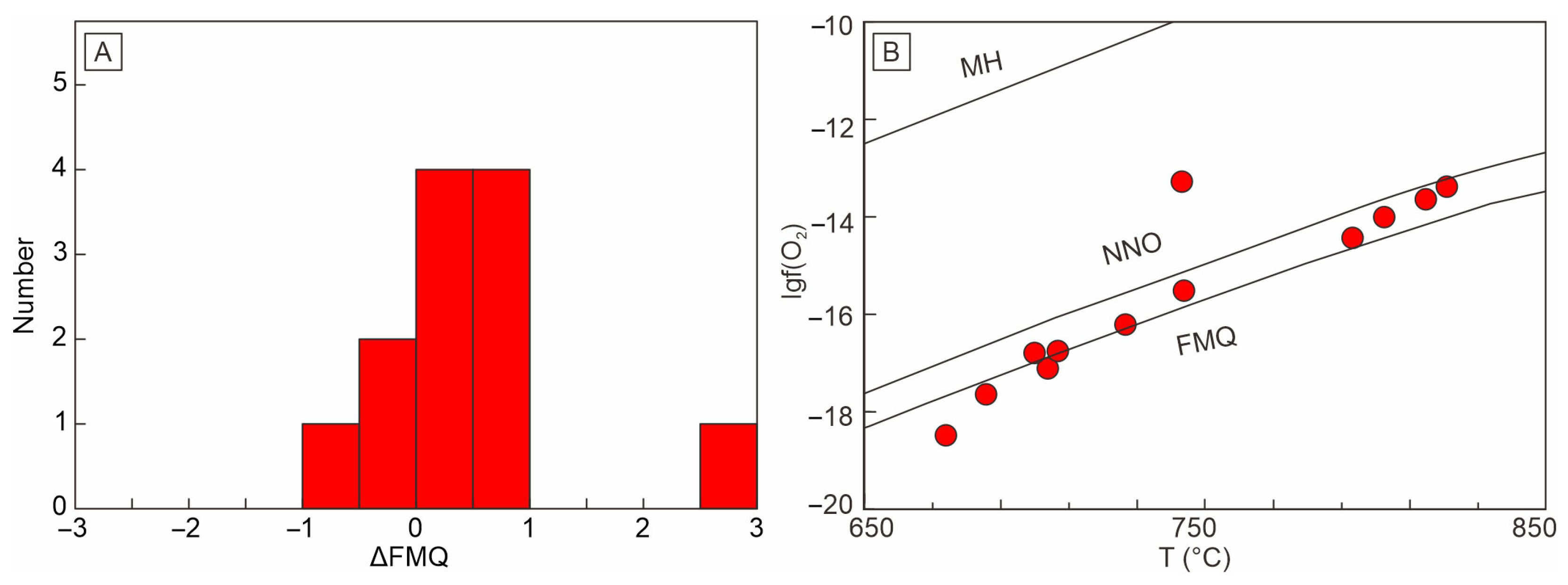
Zircons from the rhyolitic porphyry (sample 24DS106) exhibit significant positive Ce and negative Eu anomalies in their chondrite-normalized REE patterns (Figure 4C). The calculated δCe values vary widely between 10.14 and 332.85, with an average of 146.41, where δEu anomalies, between 0.25 and 0.60, with an average of 0.43. The zircon crystallization temperatures (T) range from 674.08 to 821.02 °C, with a mean value of 743.06 °C. Oxygen fugacity was calculated using an algorithm in MATLAB R2019b software [46,47,48]. The logarithmic oxygen fugacity (log fO2) ranges from −18.48 to −13.28, with an average of −15.60. Relative oxygen fugacity values (ΔFMQ) vary between −0.65 and +2.77, averaging +0.51, median = +0.4 (Supplementary Table S2).

4.2. Whole-Rock Major and Trace Element Geochemistry

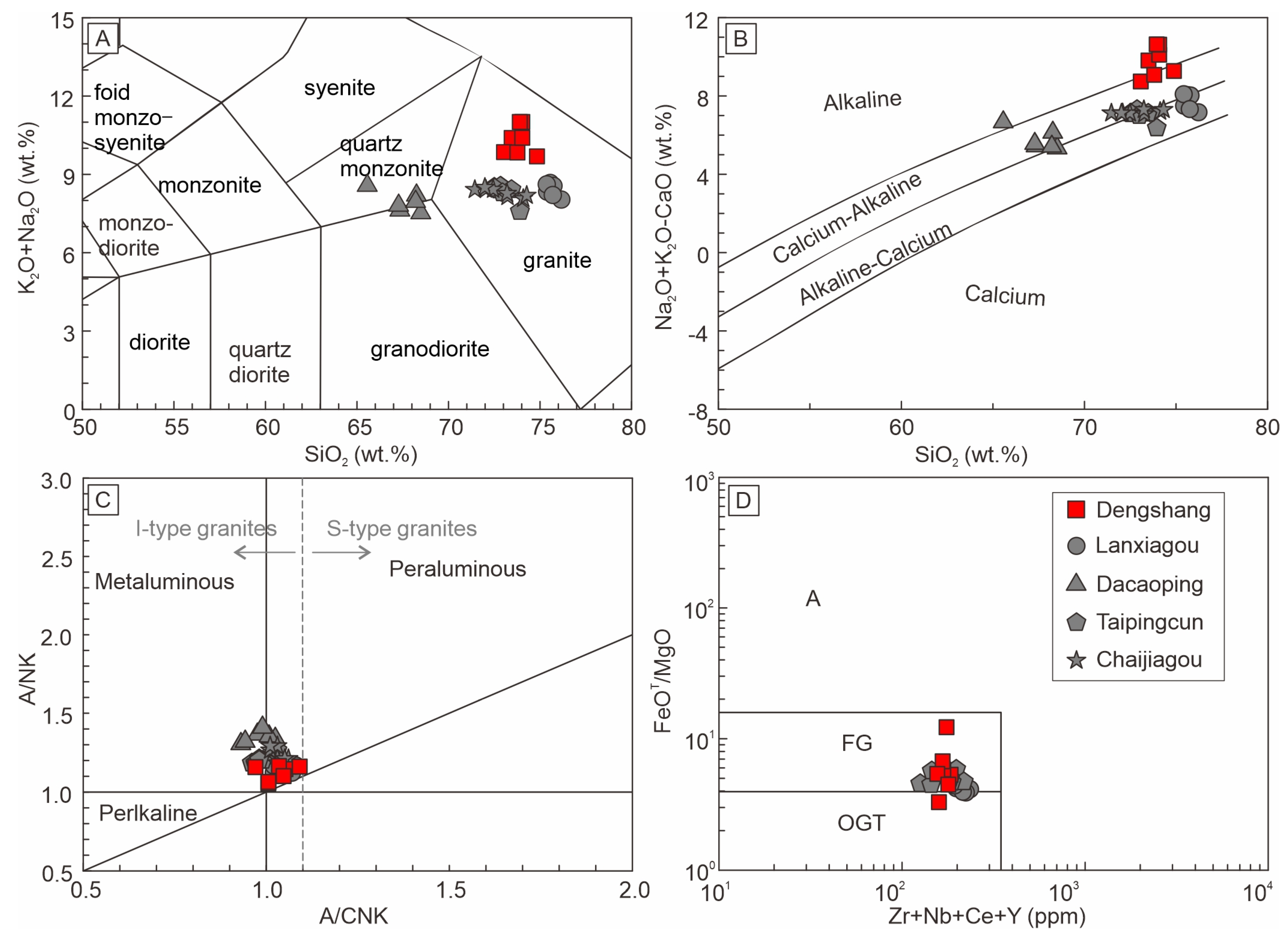
Major and trace element concentrations were measured for seven rhyolitic porphyry samples (24DS107-24DS113); the complete dataset is listed in Supplementary Table S3. The rhyolitic porphyry has high SiO2 contents ratios of 73.07–74.88 wt.% and Al2O3 with ratios of 11.91–13.27 wt.%, with low TiO2 (0.041–0.071 wt.%) and MgO (0.09–0.19 wt.%). In the TAS classification diagram, the samples plot within the rhyolite–granite field (Figure 5A). On the SiO2–(Na2O + K2O–CaO) diagram, the samples display calc-alkaline to alkali–calcic affinities (Figure 5B). Alumina saturation indices (A/CNK = 0.97–1.09; A/NK = 1.02–1.15) fall within the metaluminous to weakly peraluminous spectrum (Figure 5C). Furthermore, all data fall within the fractionated granite (FG) field on the FeOT/MgO vs. (Zr + Nb + Ce + Y) discrimination diagram (Figure 5D), indicating the highly evolved nature of the Dengshang rhyolitic porphyry.
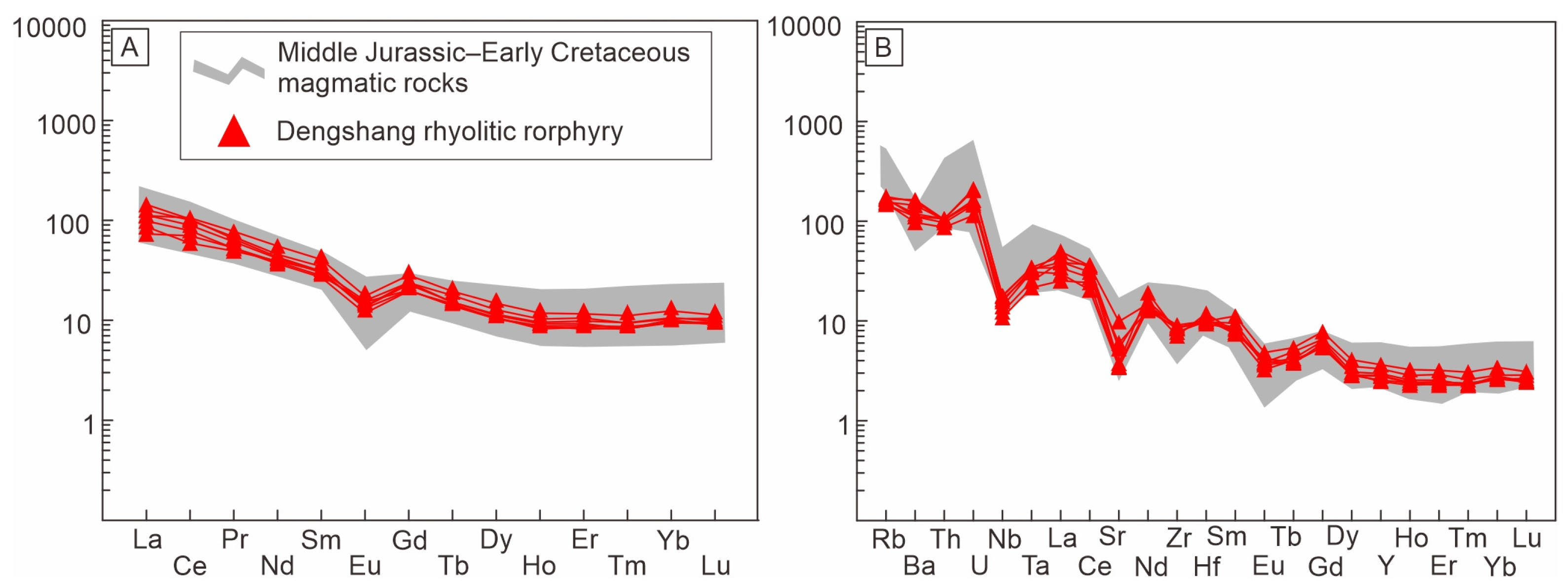
Geochemical analyses reveal pronounced light to heavy rare earth element (REE) fractionation in the rhyolitic porphyry, with total REE contents (ΣREE) ranging from 93.0 × 10⁻⁶ to 136.8 × 10⁻⁶, LREE/HREE between 9.3 and 11.62, and (La/Yb)N between 9.7 and 18.9. The rocks display moderate negative Eu anomalies (δEu = 0.47–0.63) (Figure 6A). Primitive mantle-normalized trace element spectra exhibit pronounced spikes at Ba and Rb (LILEs) coupled with troughs at Sr, Nb, and Ta (HFSEs) (Figure 6B).

4.3. Lu–Hf Isotope

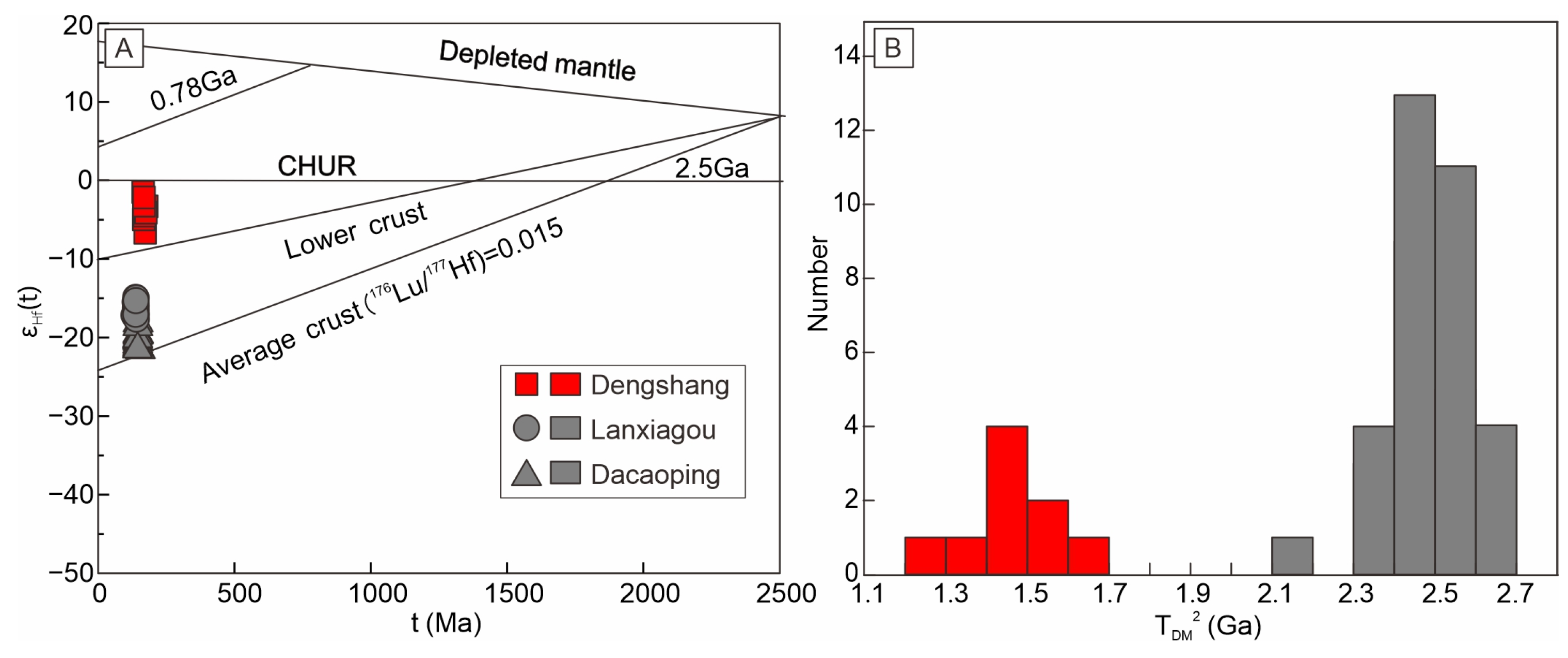
TDM2 were computed assuming a mean continental crustal 176Lu/177Hf ratio of 0.015 [58,59,60]. Supplementary Table S4 reports the full Lu–Hf isotopic dataset. Analyses of ten zircon grains yield 176Hf/177Hf ratios between 0.282467 and 0.282787, 176Lu/177Hf values between 0.001793 and 0.004259. The resulting εHf(t) values vary from −7.29 to −0.93, all values lie beneath the chondritic uniform reservoir (CHUR) reference curve. The corresponding to TDM2 of 1.27–1.67 Ga (Figure 7).

5. Discussion

5.1. Emplacement Age of the Rhyolitic Porphyry and Its Constraints on Mo Mineralization

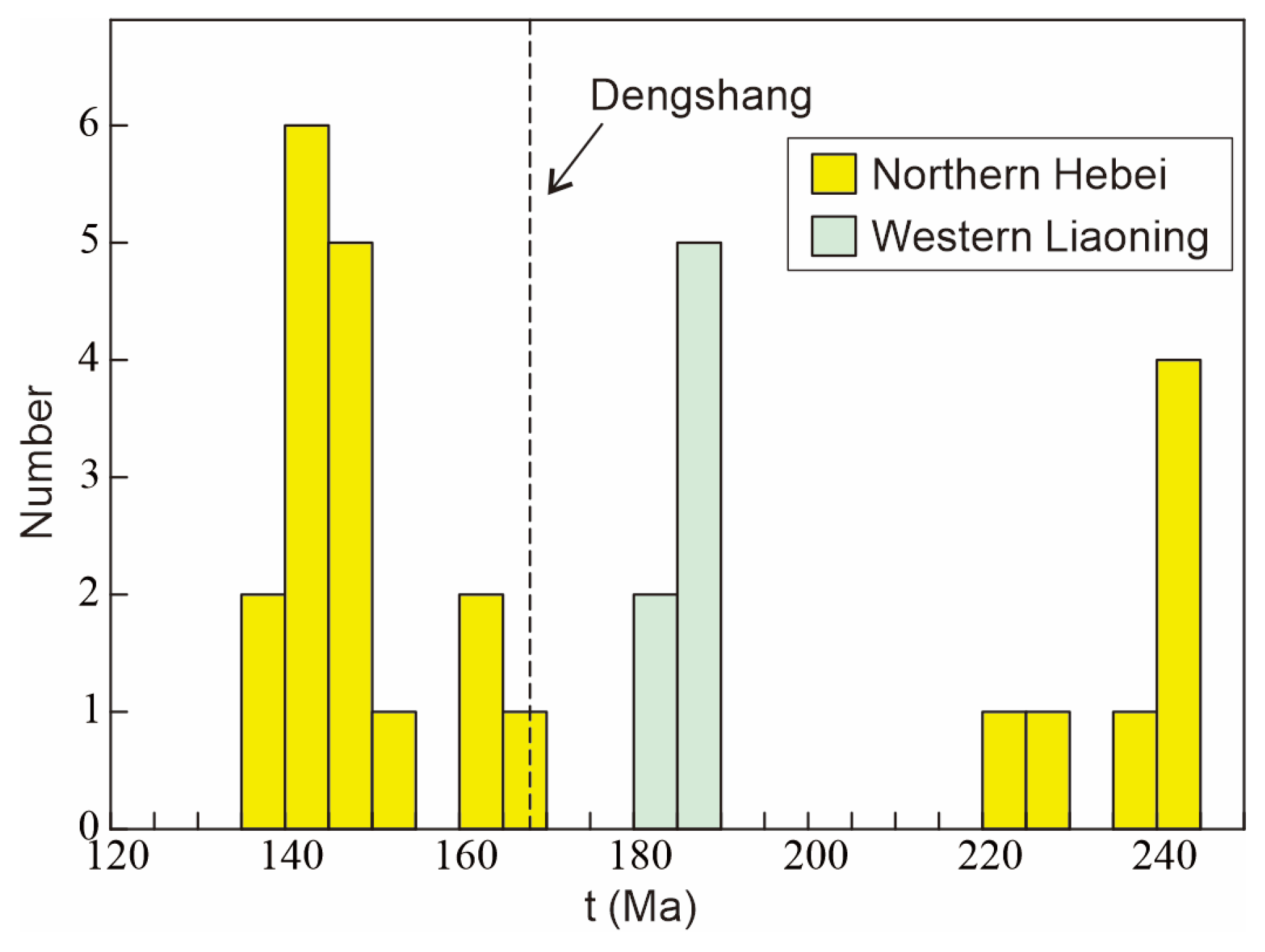
Zircon U–Pb dating constrains the crystallization age of the ore-hosting rhyolitic porphyry at the Dengshang Mo deposit to 168 ± 2.5 Ma. This age places its emplacement within a Middle Jurassic magmatic event. It has been demonstrated that the Yanliao Mo Belt experienced three major Mo mineralization events at 220–250 Ma, 180–200 Ma, and 130–160 Ma (Figure 8) [23]. In northern Hebei Province, magmatic activity is documented during only the 250–220 Ma and 160–130 Ma stages. The 250–220 Ma magmatism is mainly developed in the Zhangbei–Fengning area of northern Hebei Province, including the Sadaigoumen (240–257 Ma) [11,17,63,64]. The 185–180 Ma magmatism is mainly developed in western Liaoning, including the Lanjiagou (185~189 Ma) and Yangjiazhangzi (183~188 Ma) [12,65]. The 160–130 Ma magmatism is concentrated in the southern Zhangjiakou–Xinglong area, including the Lanxiagou (134.9 Ma), Dacaoping (142.4 Ma), Taipingcun (161.8 Ma), and Chaijiagou (163.9 Ma) [12,22,53,54,55] (Figure 1). These data suggest that Mo mineralization in the belt displays both temporal and spatial heterogeneity.
In this study, zircon U–Pb dating by LA-ICP-MS confirms an emplacement age of 168 Ma for the Dengshang rhyolitic porphyry (Figure 4B). This age is broadly coeval with that of the Taipingcun intrusion (161.8 Ma) and the Chaijiagou intrusion (163.9 Ma) [54,55], suggesting a genetic link to the third large-scale Mo metallogenic event (160–130 Ma).

5.2. Magma Source and Petrogenetic Evolution

The Dengshang rhyolitic porphyry shows elevated K2O contents (9.49–10.97 wt.%), high SiO2 contents (73.07–74.88 wt.%), very low MgO (0.09–0.19 wt.%) and exhibits metaluminous to weakly peraluminous characteristics (A/CNK < 1.1, A/NK > 1.0) (Figure 5B). The rocks are devoid of typical alkaline mafic minerals and strongly peraluminous phases, and their geochemical affinities resemble those of I-type granites [66,67]. The rhyolitic porphyry shows high Sr/Y ratios and low Cr contents (8.9–13.4 ppm) (Table S3), consistent with the geochemical profile of the 160–130 Ma porphyry Mo deposits ore-hosting intrusions in the Yanliao Mo Belt (Figure 5).
The trace element patterns are marked by LREE enrichment and heavy HREE depletion, with significant Nb depletion, indicative of typical continental crustal signatures. Weak negative Eu anomalies (δEu = 0.47–0.63) are consistent with plagioclase fractionation or a plagioclase-bearing source residue [68]. The relatively flat HREE patterns imply negligible residual garnet [69]. In addition, FeOT/MgO ratios combined with Zr + Nb + Ce + Y contents classify it as a fractionated granite (FG) in the discrimination diagram (Figure 5D), confirming that the magma underwent extensive fractional crystallization, and the depletion in HFSE (Nb, Ta) and enrichments in LILE (Ba, Rb) collectively point to partial melting of lower crustal material (Figure 6) [66,70,71].
The magma source is further elucidated by zircon Lu–Hf isotopes. Negative εHf(t) values (–0.93 to −7.29) reflect a major contribution from ancient crustal materials [72,73]. The data plot below the CHUR line, indicating a source in reworked ancient continental lower crust [74,75]. TDM2 range from 1.27 to 1.67 Ga, clustering mainly between 1.4 and 1.6 Ga (Figure 7), these data indicate that the magma derivation primarily from partial melting of Mesoproterozoic lower crust. The consistently high SiO2 contents (73.07–74.88 wt.%) coupled with low Mg# values (11.63–35.71) provide additional support for this model, which are characteristic of crustal-derived felsic magma. (Supplementary Table S3, Figure 5A) [76,77,78].
During the Middle Jurassic–Early Cretaceous, the Mo ore-hosting magmatic rocks in northern Hebei Province yield zircon Lu–Hf compositions characterized by εHf(t) values of −10 to −25, and TDM2 of 2.7–2.1 Ga (Figure 7) [52,62]. Compared with these intrusions, zircons from the Dengshang rhyolitic porphyry exhibit elevated εHf(t) values and younger TDM2 ages. This indicates that Middle Jurassic–Early Cretaceous magmatism in northern Hebei derived from Paleoproterozoic–Mesoproterozoic lower crustal melting.

5.3. Tectonic Setting and Metallogenesis

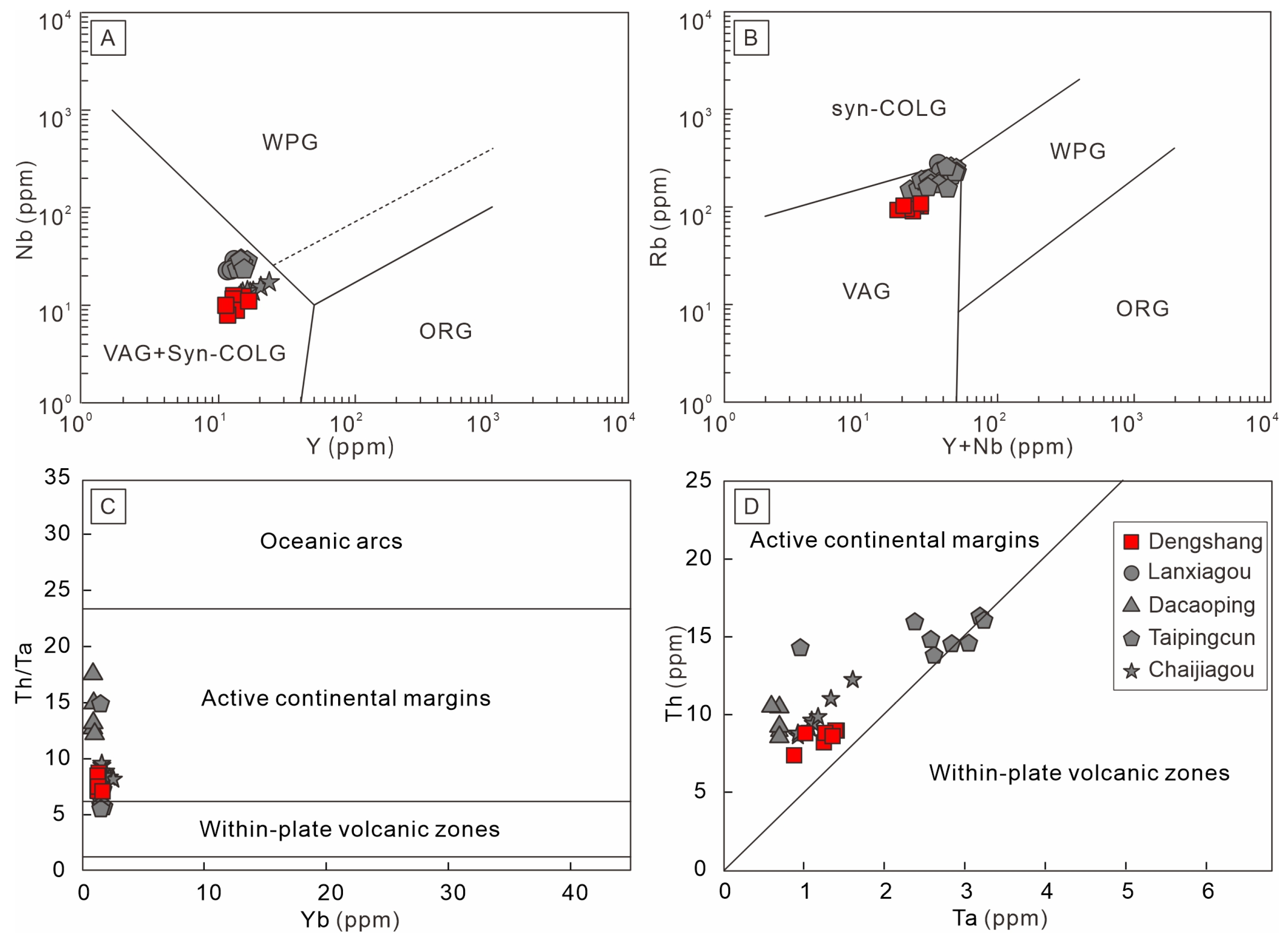
The emplacement of the Dengshang rhyolitic porphyry falls within the Middle Jurassic magmatic pulse, as constrained by zircon U–Pb geochronology (Figure 4B). This age is distinctly younger than the Late Permian to Middle Triassic amalgamation history involving the Paleo-Asian Ocean and the collision of the Siberian and NCB [33,79,80,81,82]. Magmatic products associated with this tectonic regime are typically characterized by alkaline complexes, mafic–ultramafic rocks, and minor A-type and I-type granites [33]. In contrast, the Dengshang porphyry is a metaluminous to weakly peraluminous I-type granite that experienced significant fractional crystallization. It exhibits a pronounced arc-like geochemical signature marked by enrichment in LILE Rb, Ba and depletion in HFSE Nb, Ta (Figure 6) [83,84]. The Dengshang rhyolitic porphyry and other regional ore-hosting intrusions consistently plot within the volcanic-arc field on tectonic discrimination diagrams (Figure 9A,B), pointing to a subduction-related magma source. This interpretation is reinforced by their Th, Ta, and Yb contents, which cluster in the active continental margin fields (Figure 9C,D), thereby arguing against a collisional or intraplate setting.
Accretionary complexes along the eastern Asian margin testify to sustained westward subduction of the paleo-Pacific plate beneath Eurasia from Jurassic to Early Cretaceous time. Porphyry Mo mineralization dated at 180–135 Ma is attributed to a continental magmatic arc regime, where subduction-driven magmatism and back-arc extension prevailed [9,29,33,85,86]. During the Middle Jurassic, the Mongol–Okhotsk oceanic tectonic regime exerted negligible influence on the eastern NCB, since no evidence supports the subduction of this oceanic plate beneath the region at that time [33]. Independent evidence for a Jurassic subduction setting comes from contemporaneous igneous rocks, such as the ~167 Ma Nianziyu appinite. Its high water content and isotopic features, including elevated zircon δ18O values, indicate metasomatism by subduction-derived fluids [33]. Together, these features indicate that the Dengshang rhyolitic porphyry formed in an active continental margin setting controlled by the subduction of the paleo-Pacific plate.
Within this subduction-related tectonic setting, a series of intermediate to felsic magmas were generated. Zircons from the Dengshang rhyolitic porphyry exhibit chondrite-normalized REE patterns characterized by significant positive Ce anomalies, weak negative Eu anomalies, depletion in LREE, and relative enrichment in HREE (Figure 4C). All analyzed zircons contain Ta > 0.2 × 10⁻⁶ and display Yb/Gd ratios < 20 (Table S1), indicating that ilmenite fractionation exerted little control on magma evolution [87]. The calculated zircon crystallization temperatures range from 674.08 to 821.02 °C, with log fO2 values between −18.48 and −13.28. The relative oxygen fugacity (ΔFMQ) varies from −0.65 to +2.77, with a median value of +0.4, clustering around or slightly above the FMQ buffer (Figure 10, Table S2). These oxidation states indicate the Dengshang rhyolitic porphyry was derived from a moderately oxidized magma. Previous studies have shown that the oxygen fugacity (fO2) exerts a primary control on Mo valence states in magmas. Under high-fO2 conditions, Mo primarily occurs as Mo6+ in the form of molybdate ions (MoO42−) [47,48,88]. This highly soluble species prevents Mo from substituting for Ti in crystallizing Fe-/Ti-bearing minerals or combining with reduced sulfur to form MoS2, thereby promoting its enrichment in the residual melt as a highly incompatible element and subsequently migrates and precipitates along structurally favorable zones [89,90,91]. Comparison with other Mo deposits, such as the Lanxiagou deposit (log fO2 = −16.07~−13.86) [52], shows that similarly high fO2 characteristics are common among ore-hosting intrusions. This further confirms that high oxygen fugacity is a fundamental geochemical condition for porphyry Mo mineralization [92].
Figure 9. Tectonic discrimination diagrams for Middle Jurassic–Early Cretaceous ore-hosting magmatic rocks in the Yanliao Mo Belt and Dengshang Rhyolitic Porphyry. Nb vs. Y (A). Rb vs. Y + Nb diagram (B) [93]. Th/Ta vs. Yb (C) [34,94]. Th vs. Ta (D) [34,93]. The dashed line marks the upper compositional limit for ORG derived from anomalous ridge segments. Syn-COLG: syn-collisional granites; VAG: volcanic arc granites; WPG: within plate granites; ORG: ocean ridge granites (date form [52,53,54,55]).
Minerals 16 00249 g009
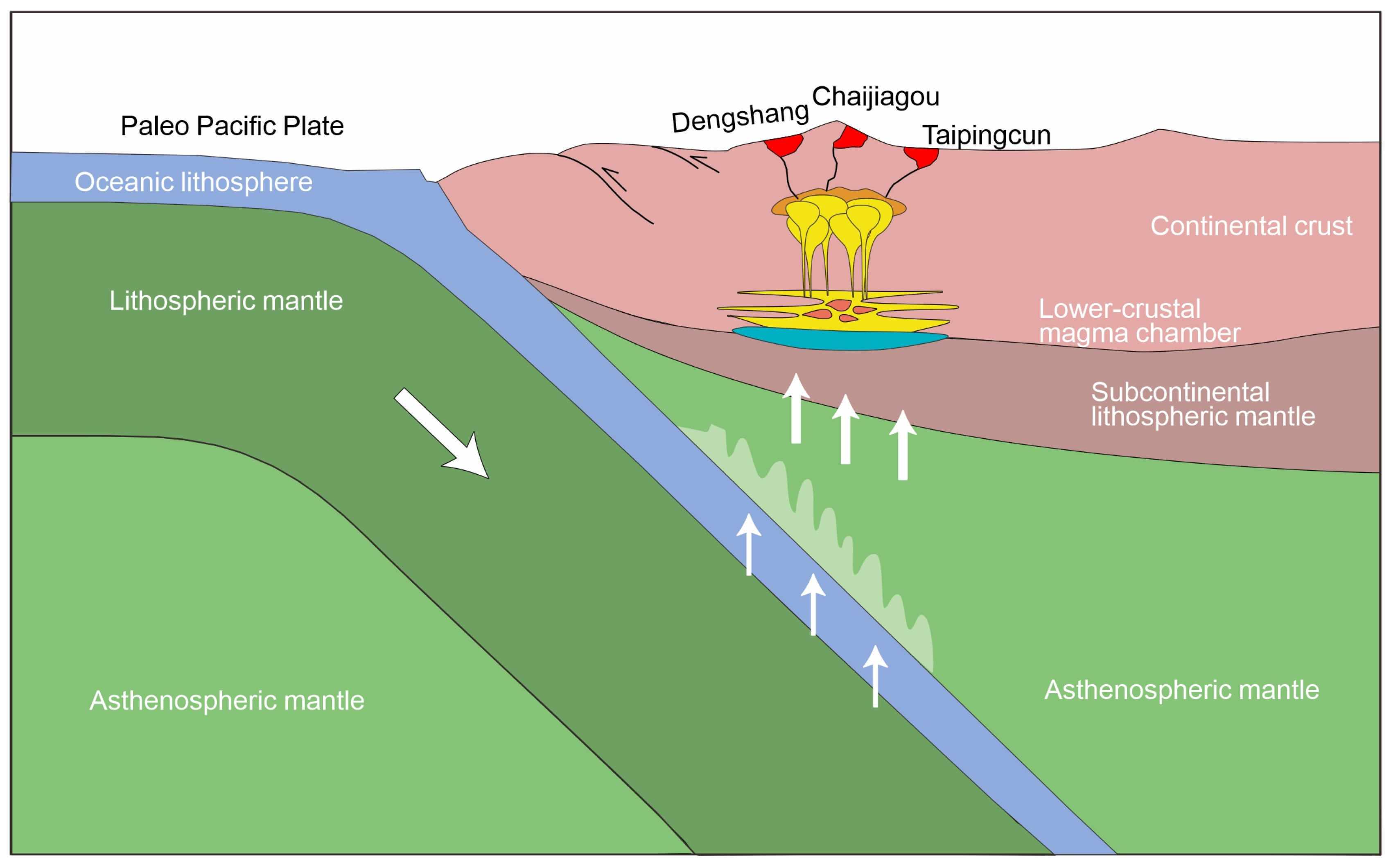
Integrated with Dengshang rhyolitic porphyry highly fractionated I-type granite affinity, predominantly crustal magma sources, and subduction-related volcanic arc signature, this study proposes that Middle Jurassic westward subduction of the paleo-Pacific plate controlled the northern NCB. Fluids released from the subducting slab supplied volatiles and heat to the lower crust, triggering partial melting of the Paleoproterozoic–Mesoproterozoic lower crust and generating oxidized felsic magmas. Accompanied by intense hydrothermal activity and extraction–enrichment of molybdenum, these processes ultimately led to the formation of the Dengshang porphyry Mo deposit within the Yanliao Mo belt, making the porphyry a magmatic host for Mo mineralization in this metallogenic episode (Figure 11).

6. Conclusions

(1)
Petrographic observations reveal that the rhyolitic porphyry exhibits a porphyritic texture characterized predominantly by quartz and plagioclase phenocrysts. Zircon U–Pb analyses of the Dengshang rhyolitic porphyry constrain its crystallization age to 168.3 ± 1.2 Ma. This result indicates that the porphyry was emplaced during the Middle Jurassic, contemporaneous with the subduction of the paleo-Pacific plate, and related to the third major Mo metallogenic event (160–130 Ma) in the Yanliao Mo Belt.
(2)
The Dengshang rhyolitic porphyry is metaluminous to weakly peraluminous and belongs to the calc-alkaline to alkali-calcic series. Its geochemical features are consistent with I-type granites. Combined geochemical and isotopic evidence indicates that the magma originated predominantly from partial melting of Mesoproterozoic lower crust.
(3)
Tectonic discrimination diagrams indicate that the porphyry formed in an active continental margin setting, linked to paleo-Pacific subduction. The magma was moderately oxidized (ΔFMQ = −0.65 to +2.77), with zircon crystallization temperatures ranging from 674.08 to 821.02 °C. Such conditions are conducive to Mo enrichment in the melt and its subsequent transfer into hydrothermal systems, highlighting the significant metallogenic potential of the Dengshang porphyry.
(4)
This study clarifies the petrogenesis of the ore-hosting intrusion in a newly discovered Dengshang Mo deposit and demonstrates a genetic link between Middle Jurassic subduction, oxidized crust-derived magmatism, and Mo mineralization. The results indicate that magmatic oxidation state is a key control on the fertility of porphyry Mo systems in continental margin settings and suggest that moderately oxidized, I-type felsic intrusions are favorable targets for regional exploration in the Yanliao Belt.

Supplementary Materials

The following supporting information can be downloaded at: https://www.mdpi.com/article/10.3390/min16030249/s1, Table S1. LA-ICP-MS zircon U–Pb age of rhyolitic porphyry samples 24DS106 in the Dengshang Mo deposit; Table S2. Trace element concentration, and calculated Ti-in-zircon temperatures (T), logarithmic oxygen fugacity (logfO2), and ΔFMQ of zircons from the rhyolitic porphyry samples 24DS106; Table S3. Major (wt%) and trace elements (ppm) analytical results for the rhyolitic porphyry samples 24DS107-24DS113. Table S4. LA-ICP-MS zircon Lu–Hf isotopic of rhyolitic porphyry samples 24DS106.

Author Contributions

Conceptualization, J.-H.Z. and N.J.; methodology and investigation, Q.-F.M., X.-D.W. and S.-M.L.; data curation, J.-H.Z., X.-X.L., M.-L.L. and Z.-E.T.; funding acquisition, N.J. and Q.-F.M.; writing, J.-H.Z. and N.J. All authors have read and agreed to the published version of the manuscript.

Funding

This research was funded by National Science and Technology Major Project of Deep Earth Exploration: “Multi-scale Prospecting Prediction and Exploration of Gold Deposits in the Eastern Segment of the Northern Margin of North China” (No. 2025ZD1006400), The Funding Project Of Northeast Geological S&T Innovation Center of China Geological Survey (No. QCJJ2023-06), Hebei Bureau Of Geology And Mineral Resources Exploration (No. 13000025P003294103391), China University of Geosciences Beijing College Students’ Innovative Entrepreneurial Training Plan Program (No. X202511415018), the Fundamental Research Funds for the Central Universities, China (No. 2652024008), and the Frontiers Science Center for Deep-time Digital Earth (No. 2652023001).

Data Availability Statement

All data supporting this study are contained within the article and its Supplementary Materials.

Acknowledgments

Sincere thanks go to Hao-Cheng Yu and Shan-Shan Li for their field guidance and constructive discussions. And to Jia-Dong Ma and Xian-Fa Xue for their technical support with figures and manuscript preparation. Constructive feedback from the anonymous reviewers and journal editors is also sincerely acknowledged.

Conflicts of Interest

The authors declare no conflicts of interest.

References

  1. Qiu, K.F.; Song, K.R.; Song, Y.H. Magmatic-hydrothermal fluid evolution of the Wenquan porphyry molybdenum deposit in the north margin of the West Qinling, China. Acta Petrol. Sin. 2015, 31, 3391–3404. [Google Scholar]
  2. Sillitoe, R.H. Porphyry copper systems. Econ. Geol. 2010, 105, 3–41. [Google Scholar] [CrossRef]
  3. Qiu, K.F.; Li, N.; Taylor, R.D.; Song, Y.H.; Song, K.R.; Han, W.Z.; Zhang, D.F. Timing and duration of metallogeny of the Wenquan deposit in the West Qinling, and its constrain on a proposed classification for porphyry molybdenum deposits. Acta Petrol. Sin. 2014, 30, 2631–2643. [Google Scholar]
  4. Fu, Q.X.; Cen, R.; Hong, B.; Xing, Z.F. Analysis of metallogenic regularity and resource potential of Mo deposits in Hainan Province. Contrib. Geol. Miner. Resour. Res. 2025, 40, 189–196. [Google Scholar]
  5. Ma, Z.Y.; Zhang, Y.; Li, J.; Ma, Q. Discussion on metallogenic model of Qingshuihedonggou Mo deposit in East Kunlun area. Contrib. Geol. Miner. Resour. Res. 2024, 39, 293–300. [Google Scholar]
  6. He, D.Y.; Qiu, K.F.; Yu, H.C.; Jowitt, S.M.; Zheng, X.; Mazumder, R.; Deng, J. Lithospheric architecture and evolution of the Qinling Orogen of Central China and associated controls on metallogeny. Earth-Sci. Rev. 2025, 264, 105092. [Google Scholar]
  7. Qiu, K.F.; Taylor, R.D.; Song, Y.H.; Yu, H.C.; Song, K.R.; Li, N. Geologic and geochemical insights into the formation of the Taiyangshan porphyry copper–molybdenum deposit, Western Qinling Orogenic Belt, China. Gondwana Res. 2016, 35, 40–58. [Google Scholar] [CrossRef]
  8. Richards, J. Tectono-magmatic precursors for porphyry Cu-(Mo-Au) deposit formation. Econ. Geol. 2003, 98, 1515–1533. [Google Scholar] [CrossRef]
  9. Zeng, Q.D.; Liu, J.M.; Qin, K.Z.; Fan, H.R.; Chu, S.X.; Wang, Y.B.; Zhou, L.L. Types, characteristics, and time–space distribution of molybdenum deposits in China. Int. Geol. Rev. 2013, 55, 1311–1358. [Google Scholar] [CrossRef]
  10. Sun, Z.J.; Wang, Z.Q.; Yu, H.; Song, W.Y.; Wang, C.Y.; Liu, G.H.; Tang, L. Geochemistry, zircon U–Pb, and molybdenite Re–Os geochronology of the Mo deposit in Fengning region, Hebei Province, China. Geol. J. 2018, 54, 3619–3642. [Google Scholar] [CrossRef]
  11. Jiang, S.H.; Liang, Q.L.; Bagas, L. Re–Os ages for molybdenum mineralization in the Fengning region of northern Hebei Province, China: New constraints on the timing of mineralization and geodynamic setting. J. Asian Earth Sci. 2014, 79, 873–883. [Google Scholar] [CrossRef]
  12. Zeng, Q.D.; Chu, S.X.; Liu, J.M.; Sun, S.K.; Chen, W.J. Mineralization, alteration, structure, and Re–Os age of the Lanjiagou porphyry Mo deposit, North China Craton. Int. Geol. Rev. 2012, 54, 1145–1160. [Google Scholar] [CrossRef]
  13. Chen, Y.J.; Zhai, M.G.; Jiang, S.Y. Significant achievements and open issues in study of orogenesis and metallogenesis surrounding the North China continent. Acta Petrol. Sin. 2009, 25, 2695–2726. [Google Scholar]
  14. Davis, G.A.; Zheng, Y.D.; Wang, C.; Darby, B.J.; Zhang, C.H.; Gehrels, G. Mesozoic tectonic evolution of the Yanshan fold and thrust belt, with emphasis on Hebei and Liaoning provinces, northern China. Paleoz. Mesoz. Tecton. Evol. Cent. Asia Cont. Assem. Intracont. Deform. 2001, 194, 171–191. [Google Scholar]
  15. Dai, J.Z.; Mao, J.W.; Yang, F.Q.; Ye, H.C.; Zhao, C.S.; Xie, G.Q.; Zhang, C.Q. Geological characteristics and geodynamic background of molybdenum (copper) deposits along Yanshan-Liaoning metallogenic belt on the northern margin of North China block. Miner. Depos. 2006, 25, 598. [Google Scholar]
  16. Gao, P.; Zhang, Y.J.; Liu, Z.P.; Wang, P.F.; Li, J.Y.; Li, S.B. Polymetallic metallogenic law and mineral resources prediction in Shanghuangqi Banner area in North Hebei province. Contrib. Geol. Miner. Resour. Res. 2024, 39, 35–44. [Google Scholar]
  17. Chen, P.W.; Zeng, Q.D.; Zhou, T.C. Petrogenesis and Mo prospecting significance of Sadaigoumen granites on the northern margin of the North China Craton. J. Geochem. Explor. 2020, 214, 106536. [Google Scholar] [CrossRef]
  18. Goldfarb, R.J.; Mao, J.W.; Qiu, K.F.; Goryachev, N. The great Yanshanian metallogenic event of eastern Asia: Consequences from one hundred million years of plate margin geodynamics. Gondwana Res. 2021, 100, 223–250. [Google Scholar] [CrossRef]
  19. Deng, J.; Qiu, K.F.; Wang, Q.F.; Goldfarb, R.; Yang, L.Q.; Zi, J.W.; Geng, J.Z.; Ma, Y. In situ dating of hydrothermal monazite and implications for the geodynamic controls on ore formation in the Jiaodong gold province, eastern China. Econ. Geol. 2020, 115, 671–685. [Google Scholar] [CrossRef]
  20. Feng, H.; Wu, C.Z.; Zheng, Y.C.; Gu, L.X.; Jiang, S.Y.; Sun, H.T.; Gao, L. Geochronology, Geochemistry and Petrogenic & Metallogenic Settings of the Yangmadian Porphyry Molybdenum Deposit in the Yanshan- Liaoning Metallogenic Belt, North China. J. Jilin Univ. (Earth Sci. Ed.) 2012, 42, 1711–1729. [Google Scholar]
  21. Li, M.; Zhang, X.; Han, L.; Gong, E.-P.; Wang, G.-G. The metallogenic setting of the Jiangjiatun Mo deposit, North China: Constraints from a combined zircon U–Pb and molybdenite Re–Os isotopic study. Minerals 2019, 9, 723. [Google Scholar] [CrossRef]
  22. Duan, H.; Qin, Z.; Lin, X.; Zhang, B.; Liu, X.; Zhang, X.; Guo, P.; Han, F.; Qin, L.; Dai, J. Zircon U-Pb ages of intrusive bodies in Dacaoping molybdenum ore district, Fengning County, Hebei Province. Miner. Depos. 2007, 26, 634. [Google Scholar]
  23. Liu, Q.F.; Zhao, J.L.; Li, X.L.; Bai, M.; Xiao, S.Y.; Zhang, K.; Cao, L.; Jiang, C.W.; Fu, L.B. Geochemical characteristics of orc-forming intrusions of porphyry molybdenum deposits in Yanshan-Liaoning metallogenic belt. Resour. Environ. Eng. 2025, 39, 248–257. [Google Scholar]
  24. Prospecting Report of the Dengshang Mo–Polymetallic Deposit, Chengde County, Hebei Province. Intern. Geol. Rep. 2025.
  25. Wu, G.; Li, X.Z.; Xu, L.Q.; Wang, G.R.; Liu, J.; Zhang, T.; Quan, Z.X.; Wu, H.; Li, T.G.; Zeng, Q.T. Age, geochemistry, and Sr–Nd–Hf–Pb isotopes of the Caosiyao porphyry Mo deposit in Inner Mongolia, China. Ore Geol. Rev. 2017, 81, 706–727. [Google Scholar] [CrossRef]
  26. Tang, L.; Santosh, M. Neoarchean-Paleoproterozoic terrane assembly and Wilson cycle in the North China Craton: An overview from the central segment of the Trans-North China Orogen. Earth-Sci. Rev. 2018, 182, 1–27. [Google Scholar] [CrossRef]
  27. Zhai, M.G. Cratonization and the Ancient North China Continent: A summary and review. Sci. China Earth Sci. 2011, 54, 1110–1120. [Google Scholar] [CrossRef]
  28. Zhu, R.X.; Fan, H.R.; Li, J.W.; Meng, Q.R.; Li, S.R.; Zeng, Q.D. Decratonic gold deposits. Sci. China Earth Sci. 2015, 58, 1523–1537. [Google Scholar] [CrossRef]
  29. Deng, J.F.; Zhao, G.C.; Su, S.G.; Liu, C.; Chen, Y.H.; Li, F.N.; Zhao, X.G. Structure overlap and tectonic setting of Yanshan orogenic belt in Yanshan era. Geotecton. Metallog. 2005, 29, 157–165. [Google Scholar]
  30. Dong, C.Y.; Wang, Q.F.; Gregory, D.D.; Li, H.J.; Weng, W.J.; Yang, L.; Deng, J. Control of crustal deformation on orogenic Au mineralization in Himalaya: A case study from Buzhu. J. Struct. Geol. 2024, 188, 105269. [Google Scholar] [CrossRef]
  31. Zhu, R.X.; Chen, L.; Wu, F.; Liu, J. Timing, scale and mechanism of the destruction of the North China Craton. Sci. China Earth Sci. 2011, 54, 789–797. [Google Scholar] [CrossRef]
  32. Zhang, T.; Qiu, H.N.; Wu, Y.; Zhang, D.H. Petrogenesis of Middle Jurassic mafic dikes and granites in the eastern Hebei district, North China Craton, China: Implications for westward subduction of the Paleo-Pacific plate. J. Asian Earth Sci. 2024, 272, 106248. [Google Scholar] [CrossRef]
  33. Fan, W.B.; Jiang, N.; Xu, X.Y.; Hu, J.; Zong, K.Q. Petrogenesis of the middle Jurassic appinite and coeval granitoids in the Eastern Hebei area of North China Craton. Lithos 2017, 278–281, 331–346. [Google Scholar] [CrossRef]
  34. He, X.F.; Santosh, M.; Ganguly, S. Mesozoic felsic volcanic rocks from the North China craton: Intraplate magmatism associated with craton destruction. Geol. Soc. Am. Bull. 2017, 129, 947–969. [Google Scholar] [CrossRef]
  35. Li, S.; Wilde, S.A.; He, Z.; Jiang, X.; Liu, R.; Zhao, L. Triassic sedimentation and postaccretionary crustal evolution along the Solonker suture zone in Inner Mongolia, China. Tectonics 2014, 33, 960–981. [Google Scholar] [CrossRef]
  36. Zhang, S.H.; Zhao, Y.; Liu, X.C.; Liu, D.Y.; Chen, F.; Xie, L.W.; Chen, H.H. Late Paleozoic to Early Mesozoic mafic–ultramafic complexes from the northern North China Block: Constraints on the composition and evolution of the lithospheric mantle. Lithos 2009, 110, 229–246. [Google Scholar] [CrossRef]
  37. Zhang, S.H.; Zhao, Y.; Davis, G.A.; Ye, H.; Wu, F. Temporal and spatial variations of Mesozoic magmatism and deformation in the North China Craton: Implications for lithospheric thinning and decratonization. Earth-Sci. Rev. 2014, 131, 49–87. [Google Scholar]
  38. Li, S.; Chung, S.L.; Wilde, S.A.; Jahn, B.M.; Xiao, W.J.; Wang, T.; Guo, Q.Q. Early-Middle Triassic high Sr/Y granitoids in the southern Central Asian Orogenic Belt: Implications for ocean closure in accretionary orogens. J. Geophys. Res. Solid Earth 2017, 122, 2291–2309. [Google Scholar]
  39. Wang, J. Geological characteristics and genesis discussed of the Dengshang Molybdenum and Pyrite Deposit. World Nonferrous Met. 2017, 8, 60+62. [Google Scholar]
  40. Liu, Y.H.; Mao, J.W.; Hu, J.; Ma, J.D.; Wang, L.; Xu, D.M.; Zhao, Z.X.; Bishikwabo, G.K.; Gamboa-Herrera, J.; Fan, C. Element migration and hydrothermal alteration of the Tuwaishan orogenic gold deposit in West Hainan Island, South China. Ore Geol. Rev. 2025, 180, 106568. [Google Scholar] [CrossRef]
  41. Li, S.S.; Qiu, K.F.; Hernández-Uribe, D.; Gao, Y.X.; Santosh, M.; Huang, H.C.; Zheng, Z.Y.; Zhang, Z.L.; Gao, S.C. Water Recycling in the Deep Earth: Insights From Integrated μ-XRF, THz-TDS Spectroscopy, TG, and DCS of High-Pressure Granulite. J. Geophys. Res. Solid Earth 2023, 128, e2022JB025915. [Google Scholar] [CrossRef]
  42. Zhao, H.Q.; Lyu, Q.B.; Sun, H.B.; Zhang, B.K.; Zhu, Y. Uncertainty evaluation for the determination of 47 elements in rock by inductively coupled plasma mass spectrometry. Chem. Anal. Meterage 2020, 29, 115–120. [Google Scholar]
  43. Sláma, J.; Košler, J.; Condon, D.J.; Crowley, J.L.; Gerdes, A.; Hanchar, J.M.; Horstwood, M.S.; Morris, G.A.; Nasdala, L.; Norberg, N. Plešovice zircon—A new natural reference material for U–Pb and Hf isotopic microanalysis. Chem. Geol. 2008, 249, 1–35. [Google Scholar] [CrossRef]
  44. Lin, J.; Liu, Y.S.; Yang, Y.H.; Hu, Z.C. Calibration and correction of LA-ICP-MS and LA-MC-ICP-MS analyses for element contents and isotopic ratios. Solid Earth Sci. 2016, 1, 5–27. [Google Scholar] [CrossRef]
  45. Ludwig, K.R. ISOPLOT 3.0: A Geochronological Toolkit for Microsoft Excel; Berkeley Geochronology Center Special Publication: Berkeley, CA, USA, 2003. [Google Scholar]
  46. Smythe, D.J.; Brenan, J.M. Magmatic oxygen fugacity estimated using zircon-melt partitioning of cerium. Earth Planet. Sci. Lett. 2016, 453, 260–266. [Google Scholar] [CrossRef]
  47. Yu, H.C.; Guo, C.A.; Qiu, K.F.; McIntire, D.; Jiang, G.P.; Gou, Z.Y.; Geng, J.Z.; Pang, Y.; Zhu, R.; Li, N.B. Geochronological and geochemical constraints on the formation of the giant Zaozigou Au-Sb deposit, West Qinling, China. Minerals 2019, 9, 37. [Google Scholar] [CrossRef]
  48. Yu, H.C.; Qiu, K.F.; Pang, Y.; Zhou, J.L.; Geng, J.Z.; Gou, Z.Y.; Wang, Y. Constraints of magmatic oxidation state on mineralization in the Wenquan porphyry molybdenum deposit, West Qinling, China. Earth Sci. Front. 2019, 26, 255. [Google Scholar]
  49. Middlemost, E.A. Naming materials in the magma/igneous rock system. Earth-Sci. Rev. 1994, 37, 215–224. [Google Scholar] [CrossRef]
  50. Frost, B.R.; Barnes, C.G.; Collins, W.J.; Arculus, R.J.; Ellis, D.J.; Frost, C.D. A geochemical classification for granitic rocks. J. Petrol. 2001, 42, 2033–2048. [Google Scholar] [CrossRef]
  51. Whalen, J.B.; Currie, K.L.; Chappell, B.W. A-type granites: Geochemical characteristics, discrimination and petrogenesis. Contrib. Mineral. Petrol. 1987, 95, 407–419. [Google Scholar] [CrossRef]
  52. Ren, Y.W.; Wang, H.; Zheng, Y.; Meng, K.K.; Li, H.B.; Zhang, C.; Liang, J.L.; Dong, G.C. The petrogenesis of granite and its significance on mineralization in Lanxiagou Mo deposit of northern Hebei. ACTA Petrol. Mineral. 2025, 44, 556–572. [Google Scholar]
  53. Guo, Z.; Xiao, C.D.; Wang, Z.L. Geological Characteristics and Genetic Discussion of the Dacaoping Molybdenum Deposit, Northern Hebei. Contrib. Geol. Miner. Resour. Res. 2011, 26, 28–33. [Google Scholar]
  54. Sun, J.L. Geological, Geochemical Characteristics and Genesis of Taipingcun Mo Deposit in XinglongCounty, Hebei Province. Master‘s Thesis, Jilin University, Changchun, China, 2017. [Google Scholar]
  55. Miao, G.; Dong, G.C.; Chen, Z.; Zhao, H.R.; Ren, L.; Quan, R.; Xu, Y.M.; Liu, X.Y. Origin of the granite porphyry and their geological significances in the Chaijiagou molybdenum deposit, northern Hebei. China Min. Mag. 2016, 25, 306–313. [Google Scholar]
  56. Sun, S.S.; McDonough, W.F. Chemical and isotopic systematics of oceanic basalts: Implications for mantle composition and processes. Geol. Soc. Lond. Spec. Publ. 1989, 42, 313–345. [Google Scholar] [CrossRef]
  57. Boynton, W.V. Cosmochemistry of the rare earth elements: Meteorite studies. In Developments in Geochemistry; Elsevier: Amsterdam, The Netherlands, 1984; Volume 2, pp. 63–114. [Google Scholar]
  58. Qiu, K.F.; Deng, J.; Taylor, R.D.; Song, K.R.; Song, Y.H.; Li, Q.Z.; Goldfarb, R.J. Paleozoic magmatism and porphyry Cu-mineralization in an evolving tectonic setting in the North Qilian Orogenic Belt, NW China. J. Asian Earth Sci. 2016, 122, 20–40. [Google Scholar] [CrossRef]
  59. Qiu, K.F.; Marsh, E.; Yu, H.C.; Pfaff, K.; Gulbransen, C.; Gou, Z.Y.; Li, N. Fluid and metal sources of the Wenquan porphyry molybdenum deposit, Western Qinling, NW China. Ore Geol. Rev. 2017, 86, 459–473. [Google Scholar] [CrossRef]
  60. Griffin, W.L.; Wang, X.; Jackson, S.E.; Pearson, N.J.; O’Reilly, S.Y.; Xu, X.S.; Zhou, X.M. Zircon chemistry and magma mixing, SE China: In-situ analysis of Hf isotopes, Tonglu and Pingtan igneous complexes. Lithos 2002, 61, 237–269. [Google Scholar] [CrossRef]
  61. Qiu, K.F.; Deng, J. Petrogenesis of granitoids in the Dewulu skarn copper deposit: Implications for the evolution of the Paleotethys ocean and mineralization in Western Qinling, China. Ore Geol. Rev. 2017, 90, 1078–1098. [Google Scholar] [CrossRef]
  62. Sun, Z.J.; Wang, Z.Q.; Yu, H.; Yu, X.H.; Liu, G.H.; Wang, C.Y. Geochronology, geochemistry, and Hf Isotope of the granites from the Mo deposits in Fengning region, China: Implications for tectonic evolution and mineralization of the North China Craton. Arab. J. Geosci. 2019, 12, 434. [Google Scholar] [CrossRef]
  63. Zhang, L.L.; Jiang, S.H.; Li, H.M.; Wu, D.; Kang, H. Metallogenic and Petrogenic Geochronology and Geochemical Features of the Ore-related Granite in the Sadaigoumen Mo Deposit, Fengning, Hebei Province. Acta Geosci. Sin. 2019, 40, 708–724. [Google Scholar] [CrossRef]
  64. Wu, H.; Wu, G.; Tao, H.; Zhang, M.Y.; Wang, G.R.; Chen, J.Q.; Yang, N.N. Geochronology, geochemistry and Hf isotope of granitic complex in Dasuji porphyry Mo deposit of Inner Mongolia and their geological implications. Miner. Depos. 2018, 2, 311–338. [Google Scholar]
  65. Xu, X.C.; Zhang, X.X.; Zheng, C.Q.; Cui, F.H.; Gao, Y.; Gao, F. Geochemistry and chronology characteristics of the intrusive rocks and its relationship with mineralization in Yangjiazhangzi area, the western Liaoning Province. J. Jilin Univ. 2015, 45, 804–819. [Google Scholar]
  66. Chappell, B. Aluminium saturation in I-and S-type granites and the characterization of fractionated haplogranites. Lithos 1999, 46, 535–551. [Google Scholar] [CrossRef]
  67. Qiu, K.F.; Deng, J.; Li, S.S.; Jowitt, S.; Hetherington, C.J.; Balen, D. Roles and perspectives of A-and I-type magmas in rare earth element and gold mineralization. Bulletin 2024, 136, 1238–1250. [Google Scholar] [CrossRef]
  68. Xu, F.; Shen, H.X.; Yang, J.L.; Lei, S.; Xing, N.Z. Chronology, geochemical characteristics and ore-forming potential of Caishan Au-bearing intrusion in Dongzhi county, Anhui province. Contrib. Geol. Miner. Resour. Res. 2024, 39, 493–503. [Google Scholar]
  69. Moyen, J.F. High Sr/Y and La/Yb ratios: The meaning of the “adakitic signature”. Lithos 2009, 112, 556–574. [Google Scholar] [CrossRef]
  70. Clemens, J.D.; Stevens, G.; Farina, F. The enigmatic sources of I-type granites: The peritectic connexion. Lithos 2011, 126, 174–181. [Google Scholar] [CrossRef]
  71. Ma, J.D.; Wu, M.Q.; Diao, X.; He, D.Y.; Cui, T.; Long, Z.Y.; Qiu, K.F. Na-metasomatism and hematization implication of Zr and Nb-Be-REE mineralization: Case study of the Baerzhe deposit in Inner Mongolia. Acta Petrol. Sin. 2023, 39, 432–444. [Google Scholar] [CrossRef]
  72. Geng, J.Z.; Qiu, K.F.; Gou, Z.Y.; Yu, H.C. Tectonic regime switchover of Triassic Western Qinling Orogen: Constraints from LA-ICP-MS zircon U–Pb geochronology and Lu–Hf isotope of Dangchuan intrusive complex in Gansu, China. Geochemistry 2017, 77, 637–651. [Google Scholar] [CrossRef]
  73. Janne, B.T.; Francis, A. The Lu-Hf isotope geochemistry of chondrites and the evolution of the mantle-crust system. Earth Planet. Sci. Lett. 1997, 148, 243–258. [Google Scholar]
  74. Yang, J.H.; Wu, F.Y.; Wilde, S.A.; Xie, L.W.; Yang, Y.H.; Liu, X.M. Tracing magma mixing in granite genesis: In situ U–Pb dating and Hf-isotope analysis of zircons. Contrib. Mineral. Petrol. 2007, 153, 177–190. [Google Scholar] [CrossRef]
  75. Zheng, J.P.; Griffin, W.L.; O’Reilly, S.Y.; Lu, F.X.; Yu, C.M.; Zhang, M.; Li, H.M. U–Pb and Hf-isotope analysis of zircons in mafic xenoliths from Fuxian kimberlites: Evolution of the lower crust beneath the North China craton. Contrib. Mineral. Petrol. 2004, 148, 79–103. [Google Scholar] [CrossRef]
  76. Blatter, D.L.; Sisson, T.W.; Hankins, W.B. Crystallization of oxidized, moderately hydrous arc basalt at mid-to lower-crustal pressures: Implications for andesite genesis. Contrib. Mineral. Petrol. 2013, 166, 861–886. [Google Scholar] [CrossRef]
  77. Rapp, R.P.; Watson, E.B. Dehydration melting of metabasalt at 8–32 kbar: Implications for continental growth and crust-mantle recycling. J. Petrol. 1995, 36, 891–931. [Google Scholar] [CrossRef]
  78. Xue, X.F.; Qiu, K.F.; He, D.Y.; Huang, Y.Q.; Zhu, R.; Yu, H.C.; Jiang, G.P. Petrogenesis of the quartz diorite porphyry in the Zaozigou, West Qinling and its geological implications. Acta Petrol. Sin. 2023, 39, 463–483. [Google Scholar] [CrossRef]
  79. Chen, B.; Jahn, B.M.; Wilde, S.; Xu, B. Two contrasting Paleozoic magmatic belts in northern Inner Mongolia, China: Petrogenesis and tectonic implications. Tectonophysics 2000, 328, 157–182. [Google Scholar] [CrossRef]
  80. Dobretsov, N.L.; Berzin, N.A.; Buslov, M.M. Opening and tectonic evolution of the Paleo-Asian Ocean. Int. Geol. Rev. 1995, 37, 335–360. [Google Scholar] [CrossRef]
  81. Xiao, W.J.; Windley, B.F.; Huang, B.C.; Han, C.M.; Yuan, C.; Chen, H.L.; Sun, M.; Sun, S.; Li, J.L. End-Permian to mid-Triassic termination of the accretionary processes of the southern Altaids: Implications for the geodynamic evolution, Phanerozoic continental growth, and metallogeny of Central Asia. Int. J. Earth Sci. 2009, 98, 1189–1217. [Google Scholar] [CrossRef]
  82. Zeng, Q.D.; Liu, J.M.; Xiao, W.J.; Chu, S.X.; Wang, Y.B.; Duan, X.X.; Sun, Y.; Zhou, L.L. Mineralizing types, geological characteristics and geodynamic background of Triassic molybdenum deposits in the northern and southern margins of North China Craton. Acta Petrol. Sin. 2012, 28, 357–371. [Google Scholar]
  83. Qiu, K.F.; Long, Z.Y.; Romer, R.L.; Halama, R.; Williams-Jones, A.; Yu, H.C.; Li, S.S.; Wu, M.Q.; Deng, J. The mantle source of REE-rich alkaline silicate magmas can be enriched by continent-derived sediment subduction. Nat. Commun. 2025, 16, 11191. [Google Scholar] [CrossRef] [PubMed]
  84. Zhang, J.Y.; Qiu, K.F.; Yin, R.; Long, Z.Y.; Feng, Y.C.; Yu, H.C.; Gao, Z.Y.; Deng, J. Lithospheric mantle as a metal storage reservoir for orogenic gold deposits in active continental margins: Evidence from Hg isotopes. Geology 2024, 52, 423–428. [Google Scholar] [CrossRef]
  85. Guo, F.; Fan, W.M.; Li, X.Y.; Li, C.W. Geochemistry of Mesozoic mafic volcanic rocks from the Yanshan belt in the northern margin of the North China Block: Relations with post-collisional lithospheric extension. Geol. Soc. Lond. Spec. Publ. 2007, 280, 101–129. [Google Scholar] [CrossRef]
  86. Liu, Y.H.; Mao, J.W.; Miggins, D.P.; Qiu, K.F.; Hu, J.; Wang, L.; Xu, D.M.; Goldfarb, R.J. 40Ar/39Ar geochronology constraints on formation of the Tuwaishan orogenic gold deposit, Hainan Island, China. Ore Geol. Rev. 2020, 120, 103438. [Google Scholar] [CrossRef]
  87. Loader, M.A.; Wilkinson, J.J.; Armstrong, R.N. The effect of titanite crystallisation on Eu and Ce anomalies in zircon and its implications for the assessment of porphyry Cu deposit fertility. Earth Planet. Sci. Lett. 2017, 472, 107–119. [Google Scholar] [CrossRef]
  88. Shen, P.; Hattori, K.; Pan, H.; Jackson, S.; Seitmuratova, E. Oxidation condition and metal fertility of granitic magmas: Zircon trace-element data from porphyry Cu deposits in the Central Asian orogenic belt. Econ. Geol. 2015, 110, 1861–1878. [Google Scholar] [CrossRef]
  89. Mengason, M.J.; Candela, P.A.; Piccoli, P.M. Molybdenum, tungsten and manganese partitioning in the system pyrrhotite–Fe–S–O melt–rhyolite melt: Impact of sulfide segregation on arc magma evolution. Geochim. Cosmochim. Acta 2011, 75, 7018–7030. [Google Scholar] [CrossRef]
  90. Yu, H.C.; Qiu, K.F.; Wang, J.; Zhang, P.C.; Smeraglia, L.; Tassara, S.; Ma, J.D.; Xue, X.F.; Li, D.P.; Deng, J. Competency contrast-driven extension veining and sequential orogenic au-sb mineralization: Insights from the zaorendao deposit, China. Geol. Soc. Am. Bull. 2025. [Google Scholar] [CrossRef]
  91. Wang, J.; Yu, H.C.; Petrella, L.; Duo, D.W.; Wang, L.; Yang, F.; Zhou, H.Y.; Li, C.; Qiu, K.F. Fluid evolution and genesis of the Yidinan granitoid-hosted orogenic gold deposit (China). Geol. Soc. Am. Bull. 2025, 137, 1945–1963. [Google Scholar] [CrossRef]
  92. Sun, W.D.; Li, C.Y.; Ling, M.X.; Ding, X.; Yang, X.Y.; Liang, H.Y.; Zhang, H.; Fan, W.M. The geochemical behavior of molybdnum and mineralization. Acta Petrol. Sin. 2015, 31, 1807–1817. [Google Scholar]
  93. Pearce, J.A.; Harris, N.B.; Tindle, A.G. Trace element discrimination diagrams for the tectonic interpretation of granitic rocks. J. Petrol. 1984, 25, 956–983. [Google Scholar] [CrossRef]
  94. Pearce, J.A.; Peate, D.W. Tectonic implications of the composition of volcanic arc magmas. Annu. Rev. Earth Planet. Sci. 1995, 23, 251–286. [Google Scholar] [CrossRef]
  95. Chen, H.Y.; Wu, C. Metallogenesis and major challenges of porphyry copper systems above subduction zones. Sci. China Earth Sci. 2020, 63, 899–918. [Google Scholar] [CrossRef]
  96. Wilkinson, J.J. Triggers for the formation of porphyry ore deposits in magmatic arcs. Nat. Geosci. 2013, 6, 917–925. [Google Scholar] [CrossRef]
Figure 2. Plan view of the Dengshang Mo deposit (A) with corresponding cross-section along line 12 (B) [24].
Minerals 16 00249 g002
Figure 3. Core samples of fresh rhyolitic porphyry and photomicrograph under cross polarized light (A,B), showing quartz and plagioclase phenocrysts; veinlet-style rhyolitic porphyry ore and a back scattered electron (BSE) image obtained by scanning electron microscopy (SEM) of quartz–molybdenite veinlets (C,D); altered cryptoexplosive breccia and photomicrograph under cross polarized light (E,F), showing sericitic alteration and disseminated pyrite. Pl = plagioclase, Qz = quartz, Py = pyrite, and Mol = molybdenite, Ser = sericite.
Minerals 16 00249 g003
Figure 4. Representative CL images of zircons (A) and LA-ICP-MS U–Pb concordia diagrams for the fresh rhyolitic porphyry (B) and zircon chondrite-normalized REE patterns of fresh rhyolitic porphyry (C).
Minerals 16 00249 g004
Figure 5. Geochemical classification diagrams of the Middle Jurassic–Early Cretaceous ore-hosting magmatic rocks in the Yanliao Mo Belt and Dengshang rhyolitic porphyry. Total alkali (Na2O + K2O) vs. SiO2 (TAS) diagram (A) [49]. Plots of Na2O + K2O + CaO vs. SiO2 (B). A/NK vs. A/CNK diagram (C) [50]. FeOT/MgO vs. Zr + Nb + Ce + Y diagram (D). FG = fractionated I-, S-, and M-type granites; OGT = unfractionated I-, S-, and M-type granites; A: A-type granites [51] (Data form [52,53,54,55]).
Minerals 16 00249 g005
Figure 6. Chondrite-normalized REE patterns (A) and primitive mantle-normalized trace element spider diagrams (B) for the Middle Jurassic–Early Cretaceous ore-hosting magmatic rocks in the Yanliao Mo Belt and Dengshang rhyolitic porphyry (chondrite and primitive mantle normalizing values are from [56,57], data form [52,53,54,55]).
Minerals 16 00249 g006
Figure 7. Plots showing εHf(t) values against zircon U–Pb ages (Ma) for the Dengshang rhyolitic porphyry and other Middle Jurassic–Early Cretaceous ore-hosting magmatic in the Yanliao Mo Belt (A) [61]. Histograms of corresponding TDM2 (B) (data form [52,62]).
Minerals 16 00249 g007
Figure 8. Histogram showing the age distribution of ore-hosting intrusions in the Yanliao Mo Belt [23].
Minerals 16 00249 g008
Figure 10. Oxygen fugacity discrimination diagrams of the Dengshang rhyolitic porphyry. Histogram of relative oxygen fugacity ΔFMQ (A). lgf(O2) vs. T diagram (B). MH: magnetite–hematite buffer; NNO: nickel–nickel oxide buffer; FMQ: fayalite–magnetite–quartz buffer [48].
Minerals 16 00249 g010
Figure 11. Genetic model showing Jurassic magma and associated with Mo mineralization modified from [95,96].
Minerals 16 00249 g011
Disclaimer/Publisher’s Note: The statements, opinions and data contained in all publications are solely those of the individual author(s) and contributor(s) and not of MDPI and/or the editor(s). MDPI and/or the editor(s) disclaim responsibility for any injury to people or property resulting from any ideas, methods, instructions or products referred to in the content.