Article

The Suitability of Stratiform Ore Deposits for the Narrow Reef Mining Equipment Method: Geological, Morphological, and Economic Criteria


by
Ema Vokić
1,
Sibila Borojević Šoštarić
1,*,
Vječislav Bohanek
1 and
Paulo Pleše
2
1
Faculty of Mining, Geology and Petroleum Engineering, University of Zagreb, 10000 Zagreb, Croatia
2
DOK-ING Mining Ltd., 10000 Zagreb, Croatia
*
Author to whom correspondence should be addressed.
Minerals 2026, 16(3), 250; https://doi.org/10.3390/min16030250
Submission received: 31 December 2025 / Revised: 16 February 2026 / Accepted: 24 February 2026 / Published: 27 February 2026
(This article belongs to the Section Mineral Exploration Methods and Applications)

Abstract

Thin, stratiform ore bodies pose persistent challenges for conventional underground mining due to limited thickness, high ore-grade dilution, and restricted operating space. This study introduces a morphology-based scoring framework for assessing the suitability of ore deposits for the Narrow Reef Mining Equipment method—an ultra-low-profile mechanized technique designed for stoping width up to 1.7 m and inclination up to 22°. A dataset comprising 178 ore deposits/mines was evaluated using integrated geological, morphological, and economic criteria. The results demonstrate that NRE suitability is primarily controlled by ore morphology, which is governed by the genetic model. The highest compatibility is associated with stratiform mineralization formed in layered mafic–ultramafic intrusions (e.g., Bushveld Complex, Great Dyke) and sediment-hosted stratiform copper and gold deposits developed along laterally extensive depositional or redox-controlled interfaces (e.g., Kupferschiefer, Witwatersrand). Although genetic origin defines deposit-scale suitability, secondary geological disturbances—post-genetic tectonism and hydrothermal overprinting—restrict NRE applicability to individual ore bodies within otherwise favourable deposits. By formalizing ore body dip and thickness into standardized efficiency and suitability classes, the proposed scoring system provides a reproducible early-stage geological screening methodology for evaluating NRE applicability during initial mine project development. Economic evaluation based on data from the Unki Mine provides operational validation of the proposed scoring framework and demonstrates that NRE increases monthly output at reduced stoping widths while maintaining ore grades and improving operational safety compared to conventional methods.

1. Introduction

Stratiform ore deposits occur as tabular or sheet-like ore bodies, extending laterally over significant distances conformable with the layering of the host rocks. Their thickness and orientation are controlled by the primary magmatic, sedimentary, or hydrothermal processes, and therefore appear across a range of geological settings [1]. Magmatic sulphide deposits (Cu, Ni, PGE—Platinum Group of Elements) develop stratiform, horizontal to gently inclined layers (“reefs”) through the gravitational settling of sulphide and chromite droplets through the magma column, or by in situ growth from basally emplaced magma batches already saturated in immiscible sulphide or oxide liquids at the chamber floor [2]. In sediment-hosted copper deposits, stratification occurs while metal-rich fluids migrate through permeable sedimentary strata, precipitating copper (± Au, Co, Pb, Zn) along redox-controlled horizons, typically at the sharp contact between oxidized red-bed clastic sediments and overlying organic-rich shales [3]. Sedimentary gold deposits (e.g., Witwatersrand Basin) obtain their layered character through a combination of primary detrital deposition of gold-bearing sediments and subsequent hydrothermal remobilization, where organic matter and microbial activity facilitate metal trapping and the formation of laterally extensive gold-bearing reefs [4]. Volcanogenic massive sulphide (VMS) and sedimentary-exhalative (SEDEX) deposits exhibit stratiform morphologies due to the discharge of metal-rich hydrothermal fluids onto or just below the seafloor, depositing sulphides in layers that reflect thermal and chemical gradients (as well as seafloor topography), producing vertically and laterally zoned accumulations of sulphides [5]. In this study, ore deposits are treated as geological systems composed of multiple ore bodies. These ore bodies may differ in thickness, dip, and structural preservation, resulting in variable compatibility with the NRE method. Despite the variety of formation processes, if buried stratiform ore bodies are narrow (i.e., <1.7 m of thickness), they face similar underground operational challenges: (i) high dilution risk using classical Low Profile (LP) underground mining methods (stoping width 1.8–2.1 m), or (ii) safety hazards associated with narrow reef conventional mining activities (stoping width 1.3–1.7 m) in limited working space.
For stratiform ore bodies located at depths greater than 300 m, extraction methods are broadly classified as conventional, hybrid, or mechanized mining. Conventional mining relies on scraper winches for ore cleaning in production stopes, resulting in high labor intensity and low productivity and safety. Hybrid mining methods combine the low dilution and higher shaft head grade of conventional mining with the increased development rates and improved safety of mechanized approaches [6]. Mechanized mining alternatives include drilling-and-blasting and mechanical rock-cutting methods. By minimizing personnel exposure at the working face, mechanization improves operational safety and productivity [7]. For narrow reefs, specialized techniques such as the Narrow Reef Mining Equipment method (NRE) are employed. The NRE comprises ultra-low-profile, mechanized machines designed for stoping width up to 1.7 m and inclination up to 22°. It consists of three primary machines, each dedicated to a specific phase of the mining cycle: drilling, cleaning, and bolting in narrow reef environments [8]. Technical specifications of an NRE fleet are summarized in Supplementary Materials File S1 Although NRE has been successfully implemented in several PGE operations in southern Africa, its broader applicability to ore deposits worldwide has not been comprehensively evaluated. Moreover, the impact of varying intensity and spatial distribution of secondary structural modifications—such as late-stage tectonic deformation—on the assessment of NRE suitability at deposit, ore body, and panel scale remains poorly constrained [9,10,11,12].
This study summarizes data on thin, subhorizontal stratiform ore deposits located at depths greater than 300 m, extracted using various underground mining methods. The objectives are to (i) develop and formalize a morphology-based scoring framework that translates ore body dip and thickness into standardized NRE efficiency and suitability classes; (ii) apply this scoring system to a dataset of stratiform ore deposits belonging to four genetic groups—magmatic, sediment-hosted Cu, sediment-hosted Au, and hydrothermal VMS and SEDEX deposits; (iii) validate the operational and economic implications of the scoring results through a comparative case study of the Unki Mine.

2. Assessment of Stratiform Ore Deposits Suitable for Narrow Reef Mining Equipment Method

2.1. Magmatic Sulphide Deposits

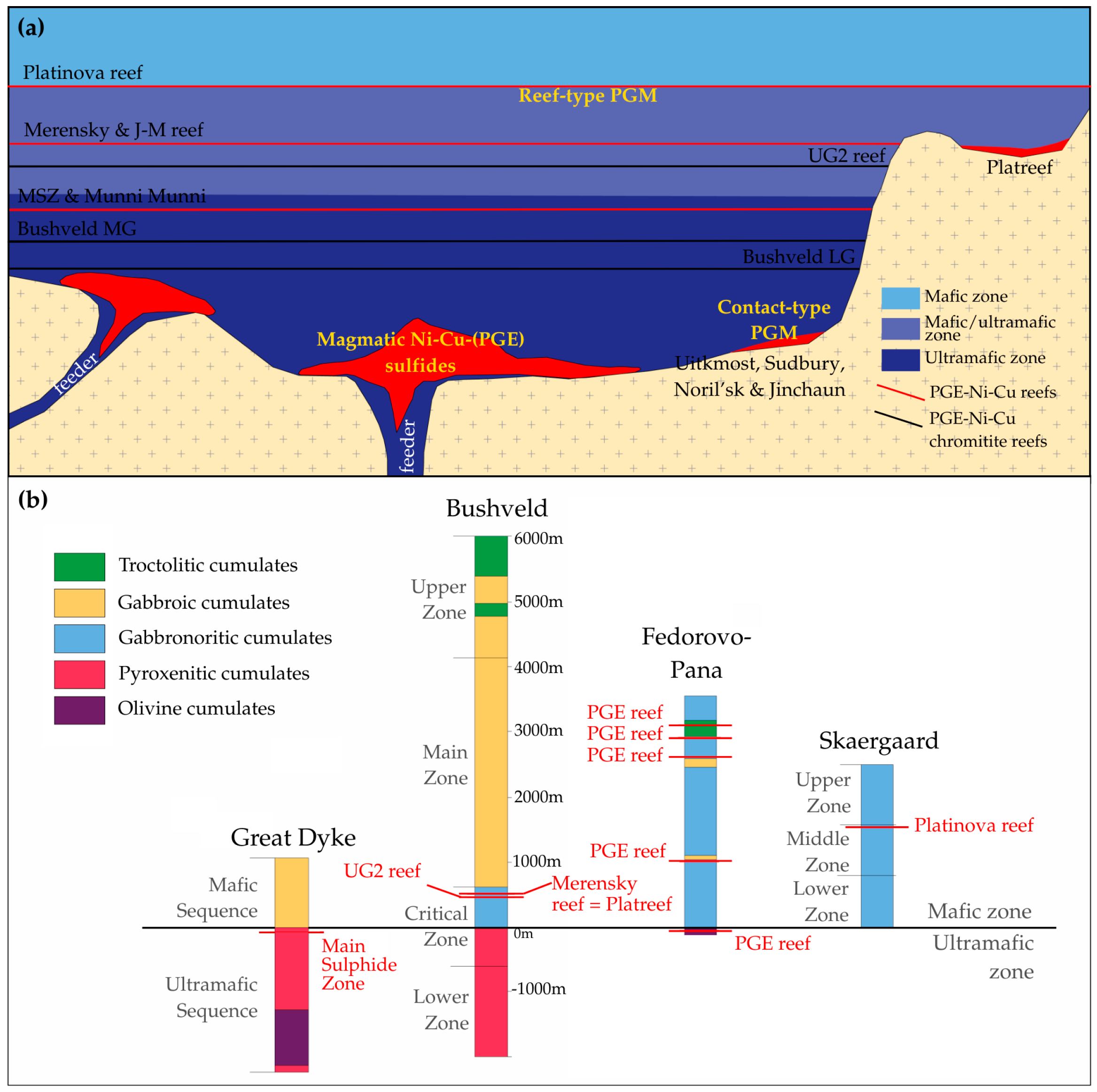
Magmatic sulphide deposits are typically classified according to their morphology into three main forms: Ni-Cu-(PGE)/PGE-Ni-Cu contact-type, Ni-Cu-(PGE) feeder-type and PGE reef-type (Figure 1a). Contact-type (e.g., Sudbury, Platreef, Munni Munni) and feeder-type deposits (e.g., Norilsk-Talnakh, Kambalda, Uitkomst, Duluth) generally do not host ore bodies compatible with the NRE method due to steeper dips and significant thicknesses, commonly up to 20–30 m [13].
PGE reef-type deposits (hereafter referred to as “PGE reefs”) represent the dominant magmatic setting-hosting laterally continuous ore bodies that may fall within the operational constrains of NRE method. Within the Bushveld Complex, the Merensky and UG2 reefs host numerous NRE-compatible ore bodies, with more than 40 operating mines. Similarly, the Great Dyke in Zimbabwe hosts 10 (out of 11 analyzed) mines containing laterally continuous ore bodies compatible with NRE. Mine-scale morphological parameters for Muskox (Canada), Skaergaard (Greenland, Denmark) and Vuruchuaivench (Russia) are incomplete; however, the available scientific literature confirms the presence of reef-type ore bodies that locally satisfy NRE criteria [14].
In contrast, the J-M Reef (Stillwater Complex), Monchegorsk’s PGE reef, PGE reefs of Penikat&Portimo intrusions, and the Ferguson Reef (Munni Munni Intrusion) are hosted within steeply dipping (30–70°), post-magmatically deformed layered intrusions, and the available online data do not indicate the presence of localized, undeformed ore bodies [15,16,17]. NRE compatibility is restricted to structurally intact ore bodies. Fedorova-Pana (Russia) intrusions host localized ore bodies compatible with NRE, rather than uniformly suitable ore deposits [18].
Figure 1. (a) Schematic diagram showing a layered mafic–ultramafic intrusion and morphological types of Ni-Cu-(PGE) deposits (modified from [19]). (b) Stratigraphic columns showing mafic–ultramafic series and PGE reef positions within Great Dyke, Bushveld, Fedorova-Pana, and Skaergaard (modified from [16]).
Minerals 16 00250 g001

2.1.1. Geology

PGE reefs are associated with large igneous provinces (LIPs) formed within Archean to Proterozoic cratons and shield regions (e.g., Bushveld Intrusion and Great Dyke) and Russia’s layered intrusions of the Kola Peninsula (Fedorova-Pana and Vuruchuaivench) or with younger continental rift-related magmatic systems (Paleogene Skaergaard Intrusion) [20,21,22,23].
Stratigraphically, LIPs comprise three main zones:
  • Lower ultramafic zone, composed of dunite, harzburgite, pyroxenite, and chromitite;
  • Mafic zone, composed of gabbro, norite, pyroxenite, and chromitite;
  • Uppermost granodioritic zone.
PGE reefs are present in the form of layers or lenses within mafic zones (Bushveld, Skaergaard, Vuruchuaivench, Fedorova-Pana,) or at the contact of ultramafic/mafic zones (Great Dyke) in the intrusion (Figure 1b) [15,23,24]. Disseminated, interstitial to net-textured mineralization comprises sulphides (pentlandite, pyrrhotite, chalcopyrite), oxides (chromite, Ti-V magnetite), and platinum-group minerals (PGMs). PGMs include PGE sulphides and tellurides (e.g., merenskyite), PGE arsenides and sulphoarsenides (e.g., sperrylite), and platinoids. The highest PGE concentrations typically occur at the base of the PGE reef, whereas Ni and Cu reach their maximum grades toward the top of the reef [22,25]. The distribution of base metals and PGE is strongly influenced by the intensity of hydrothermal alteration. As observed in the MSZ, hydrothermal alteration is characterized by the formation of actinolite-rich aureoles where chalcopyrite and pentlandite occur as inclusions within actinolite or as intergrowths. Palladium is especially mobile in these settings and is often found remobilized from pentlandite to Pd-rich fracture fillings [24].

2.1.2. Ore Morphology

In the Bushveld Complex, both the Merensky and UG2 reefs can be traced continuously for more than 300 km along two arcuate outcrop belts of the Bushveld Complex [21,26,27]. The Merensky reef generally dips between 10° and 25° [28]. Its thickness is typically 0.3–1 m but locally varies between ~0.2 and 1.5 m, depending on potholing and lithological irregularities [21,29]. The UG2 chromitite layer exhibits a similar morphological pattern, 0.2–1.5 m in thickness, with regional dips commonly in the range of 10–25°. Regional fault zones, including the Welgevonden Fault Zone, the Zebedelia Fault, and associated structural lineaments, generate spatially variable and locally steepened dips (up to 60°) of the Merensky and UG2 reefs [28,29].
In the Great Dyke of Zimbabwe, the Main Sulphide Zone (MSZ) forms a laterally continuous, stratiform mineralized horizon that can be traced almost along the full length of the intrusion, which extends for ~550 km and is approximately 2–6 km wide [12,22,30]. The MSZ typically dips at 5–20° but locally exhibits steeper dips in faulted northern segments [30]. The thickness of the MSZ is variable, from 2 to 8 m [27]. Although the geological thickness of the MSZ commonly exceeds the nominal NRE limit, mining operations selectively exploit narrow intervals of 2 m (Supplementary Material File S2).
In the Skaergaard layered intrusion (East Greenland, Denmark), PGE mineralization is concentrated within the Platinova Reef, a stratiform and laterally persistent mineralized horizon developed within the upper part of the Layered Series. The Skaergaard intrusion has an aerial extent of approximately 8 × 11 km and preserves a vertical stratigraphy of ~4 km, and tilts towards the sea by 10–20° [31]. Platinova Reef is typically 1–3 m thick and maintains a consistent stratigraphic position with local offsets related to late-stage brittle faulting [32,33].
In the Muskox layered intrusion (Nunavut, Canada), PGE mineralization is developed within chromitite- and sulphide-bearing stratigraphic horizons. The Muskox intrusion extends for approximately 120 km in length, is ~11 km wide, and is ~1.8 km thick [34,35] and references therein. The mineralized horizons can be traced for several tens of kilometres along the strike, although local thinning and splitting of individual layers occur. Ore bodies compatible with the NRE mining system are associated with meter-scale mineralized layers that remain laterally continuous and gently dipping (3–5°) [35].
Layered intrusions of the Kola Peninsula (Russia)—Fedorova-Pana and Vuruchuaivench—both host NRE-suitable ore bodies. In the Vuruchuaivench intrusion, PGE mineralization occurs as a stratiform reef-type horizon developed within the upper part of the intrusion. The reef zone can be traced for approximately 2 km along the strike and is structurally segmented into three fault-bounded blocks (southern, central, and northern). Reef thickness is typically 1–3 m, locally decreasing to a few decimetres, and individual reef segments reach 300–500 m in length. The reef dips gently at ~15° towards the southeast [36]. In the Fedorova-Pana intrusion, PGE reefs form stratiform horizons traceable for several kilometres, but with thickness of 3–6 m, dips of 25–70°, and structural segmentation, which restrict NRE compatibility to thinner and less deformed ore bodies [18].

2.1.3. Economic Significance

Bushveld Complex and Great Dyke (together with NRE-unsuitable Stillwater Complex) account for approximately 94% of the world’s PGE reserves [37,38]. The PGE-bearing MSZ of Great Dyke contains up to 5 ppm PGE and up to 8% sulphides, while the Bushveld Intrusion contains grades of 5–7 g/t of PGE within the Merensky reef and up to 7 g/t within the UG2 reef [26,27]. Other layered intrusions (Muskox, Fedorova-Pana, Vuruchuaivench, Skaergaard) host PGE grades but generally at relatively low grades of 1–5 g/t [39,40].

2.2. Sediment-Hosted Stratiform Copper Deposits

Sediment-hosted stratiform Cu deposits display two contrasting morphological domains: basin-center ore bodies, which are typically thick, irregular and structurally modified (do not satisfy NRE criteria), and basin-margin ore bodies, characterized by thin and gently dipping morphology (NRE-suitable). Sediment-hosted Cu deposits within the Kupferschiefer Formation (Poland) and the White Pine district (USA) are highly suitable due to their uniform lateral extent and narrow, subhorizontal morphology [41,42]. Thin and subhorizontal ore bodies located along the basinal margins within the Chambishi-Nkana Basin of the Central African Copperbelt (Zambia and DR Congo) are suitable, whereas ore bodies in the central part of the Copperbelt fall into unsuitable group due to significant thickness and steeper dips [43]. The Dzhezkazgan Cu deposit in Kazakhstan is characterized by subhorizontal dips combined with average thicknesses of 3–5 m, which exceed the thickness constraints required for the NRE method [44].

2.2.1. Geology

SSC deposits are hosted within intracratonic basins (Central African Copperbelt), passive margin basins (Kupferschiefer), or rift basins (White Pine). Typical stratigraphy in SSC deposits includes oxidized sedimentary base (red-beds) that transition to reduced sediments (grey-beds), with mineralization being precipitated at stratigraphic or structural redox boundaries and locally capped by evaporites [45] (Figure 2a). Mineralization is hosted by a wide range of marine or lacustrine sedimentary rocks—carbonaceous shale, carbonate, sandstone, dolomite, argillite, and silt [46]. The footwall comprises a variety of siliciclastic, argillaceous, and dolomitic lithologies (Central African Copperbelt); sandstone, limestone and conglomerate (Kupferschiefer); and interbedded sandstone and clast-supported pebble conglomerate (White Pine) [47,48,49,50].
These ore deposits are primarily composed of copper sulphides, such as chalcocite, digenite, covellite, bornite, and chalcopyrite, associated with copper-arsenic ore minerals—tennantite and enargite—occurring as bedding-parallel streaks and lenses [51]. Ore assemblages often contain a variety of trace elements, including silver, lead, zinc, cobalt, molybdenum, nickel, and vanadium. Mineralization is predominantly stratiform and exhibits lateral and vertical zonation. A model based on Kupferschiefer shows zones from an oxidized red-bed and hematite layer to native copper and sulphur-poor sulphides, then to marine/lacustrine shales containing bornite, chalcopyrite, and Pb/Zn/Co sulphides with pyrite [46] (Figure 2b). Hydrothermal alterations are spatially and genetically linked to redox gradients within sedimentary basins. While Kupferschiefer alteration is characterized by Fe-calcite, Mg-rich chlorite, and oxidized zones with albitization, hematitization, and quartz overgrowths, the White Pine copper deposit shows a distinctly different alteration style. At White Pine, the dominant carbonate phase is siderite rather than Fe-calcite, and alteration is closely tied to diagenetic, reducing conditions within organic-rich mudstones, which promote the precipitation of Cu sulphides. In the White Pine, mineralization is controlled largely by early diagenetic processes, reductive trapping, and interaction with organic matter rather than by oxidizing fluid fronts [44].

2.2.2. Ore Morphology

The Central African Copperbelt is a Neoproterozoic sediment-hosted Cu-Co province that extends for roughly 500–700 km along strike and is <100–150 km wide, comprising multiple structurally and stratigraphically distinct basins [52]. Within the Zambian part of the Central African Copperbelt, the Chambishi-Nkana Basin hosts stratiform ore bodies developed in basin-margin settings. These ore bodies are typically 1–3 m thick, dip very gently (<15–20°), and occur from near-surface to depths of several hundred meters, locally exceeding ~1 km in structurally deeper parts of the basin. The mineralized horizons follow a NW–SE-trending basin axis and are developed within a synclinorial basin that is up to ~40 km wide at its broadest point [43].
In the Kupferschiefer basin, mineralization forms bedding-parallel layers and lenses that can be traced continuously over distances of several hundred kilometres across the Southern Permian Basin, extending from the UK through Poland into Germany, and is therefore considered regionally continuous on a basin scale [45,46]. The mineralized horizon occurs from near surface to depths of several hundred meters and locally reaches 1000–1500 m in structurally deeper parts of the basin. The mineralized horizon is very thin, with typical thickness in the decimetre to meter range (commonly <1 m) [45]. In the Polish Fore-Sudetic Monocline, the Kupferschiefer ore layer is subhorizontal to very gently dipping, with Zechstein sediments dipping 1–6° towards the NE. Locally, thickness and dips increase near basin-margin normal faults due to block rotation and later tectonic deformation [46,53].
At White Pine, copper mineralization forms a stratiform, bedding-parallel ore deposit hosted within the Nonesuch Shale of the Upper Keweenawan Supergroup. Rather than forming a single continuous layer, the White Pine ore deposit is distributed in multiple bedding-parallel ore bodies, typically 1–3 km long, which are laterally offset by syn-rift normal faults and locally terminated by facies-controlled pinch-outs [42,54]. The ore deposit is exposed at surface in the central part of the district and was mined underground to depths of approximately 300–600 m. In structurally down-faulted blocks, mineralization was intersected at depths approaching ~900 m, representing the deepest documented occurrences within the White Pine system [45,54]. Ore bodies are thin and laterally variable, with thickness most commonly in the range of 0.3–1.0 m, and local thickening to 2–3 m [54]. Thinner, discontinuous ore bodies dominate towards basin margins and in areas affected by synsedimentary deformation. The ore bodies are flat-lying to very gently dipping, with reported dips typically <3–5° in mined panels. Locally, dips increase adjacent to syn-rift normal faults, where block rotation produces steeper inclinations and a local thickening or thinning of the horizon [42].

2.2.3. Economic Significance

The Central African Copperbelt hosts more than 80 stratiform copper–cobalt deposits, with an estimated resource of 152 million metric tons of copper (reserve unknown). The ore grades commonly range from 1.5% to 4.0% Cu, and up to 0.5% Co [54]. Kupferschiefer represents one of the largest sediment-hosted copper systems in Europe, with estimated reserves exceeding 60 Mt of Cu. The average ore grades typically range from 1.5% to 2.0% Cu, with significant silver enrichment reaching up to 50–60 g/t Ag ([49] and references therein). The White Pine deposit was mined until 1995; ore averaged ~1.0% Cu. The site is under evaluation for reopening, with plans for modern underground mining. The preliminary economic assessment completed in 2023 projects a 21.8-year mine life at a processing rate of 15,000 metric tons per day [55].

2.3. Sediment-Hosted Stratiform Gold Deposits

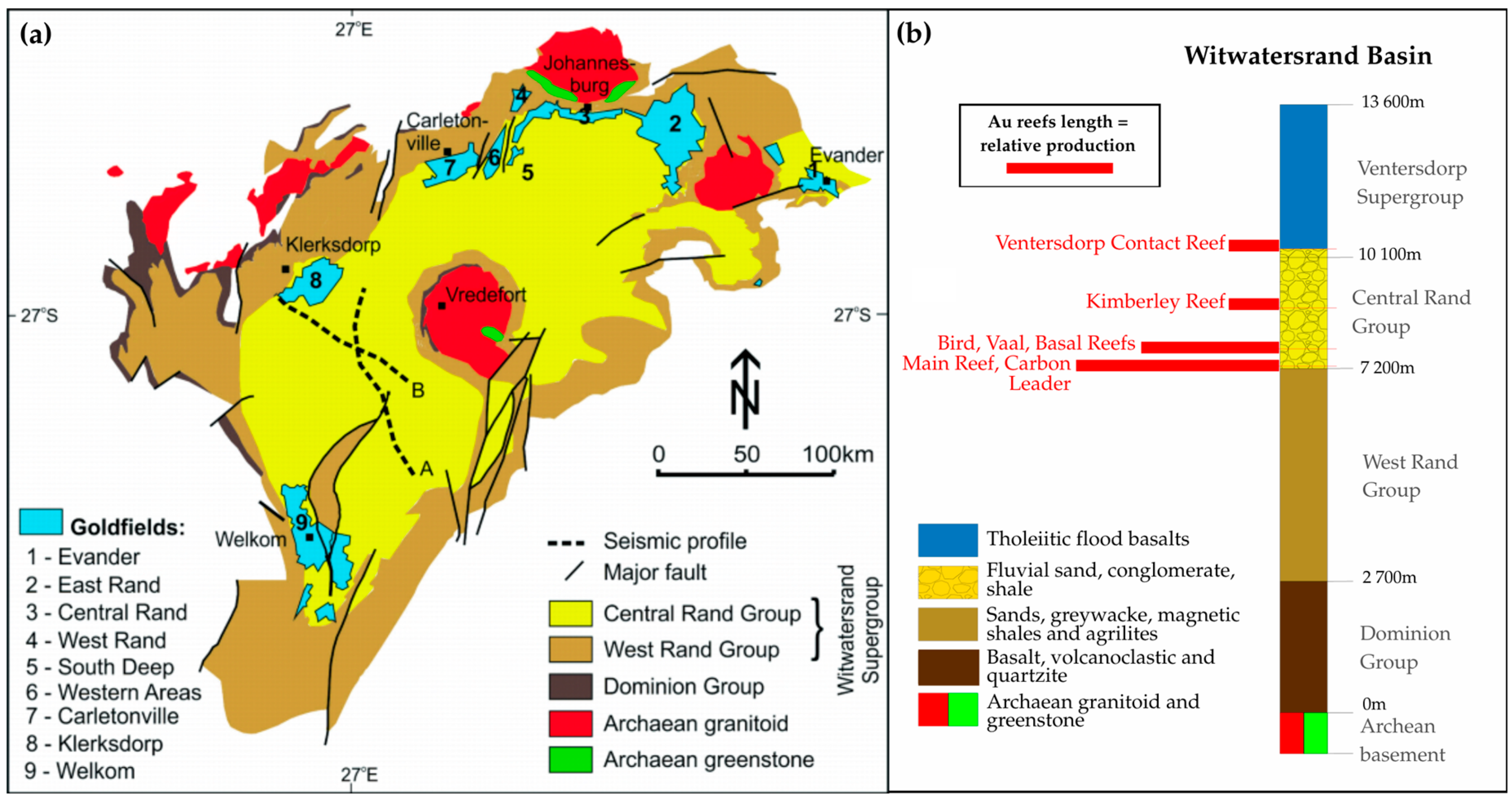
Within the group of sediment-hosted stratiform gold deposits, paleoplacer gold reefs in the Witwatersrand Basin (South Africa) and the Tarkwaian Group (Ghana) were studied. In the Witwatersrand Basin, six of the eleven analyzed mines received the highest NRE-suitability grade. However, deformation varies across the basin and locally influences mining suitability. Notably, two mines are unsuitable due to steeper reef dips of approximately 45° [56]. The Tarkwaian deposit includes two NRE-suitable principal gold reefs, the Main Reef and the West Reef [57].

2.3.1. Geology

Placer gold deposits are sediment-hosted ore systems developed within intracratonic to foreland sedimentary basins, where detrital gold is concentrated by mechanical erosion, transport, and hydrodynamic sorting. Mineralization is stratigraphically controlled and confined to coarse-grained sedimentary horizons, predominantly conglomerates and gravels, forming thin, laterally extensive, stratiform ore bodies with limited vertical distribution [58,59]. NRE-suitable placer gold deposits are exemplified by the Witwatersrand Basin (South Africa) and the Tarkwaian Group (Ghana).
The Witwatersrand Basin is an Archean intracratonic basin developed on a granite-greenstone basement of the Kaapvaal Craton and comprises four major stratigraphic sequences (Figure 3a). The principal gold mineralization is hosted by conglomerates of the Central Rand Group (~3 km thick), including the Main Reef, Bird Reef, and Kimberley Reef groups, deposited at ca. 2815 ± 6 Ma (Figure 3b) [60,61]. The succession is overlain by the Ventersdorp Supergroup, composed of bimodal volcanic rocks and hosting the auriferous Ventersdorp Contact Reef, and capped by the Transvaal Supergroup, dominated by carbonates and sandstones with minor gold mineralization in the Black Reef [61,62]. The Tarkwaian Group represents a Paleoproterozoic, post-orogenic clastic succession within the Birimian-Tarkwaian terrane of the West African Craton, unconformably overlying Birimian volcanic and sedimentary rocks. It consists predominantly of quartzites, sandstones, and polymict conglomerates, with gold mineralization restricted to laterally continuous basal conglomeratic units, principally the Main Reef and the West Reef [57,63].
Ore assemblages within placer deposits are dominated by detrital native gold, with subordinate gold occurring as inclusions in pyrite and uraninite. Associated heavy minerals include uraninite, zircon, monazite, and chromite. Although placer deposits are primarily sedimentary in origin (i.e., Tarkwaian), they commonly record post-depositional modification by diagenetic, hydrothermal, and low- to medium-grade metamorphic processes, resulting in the remobilization of gold and uranium and precipitation of secondary authigenic minerals, mainly pyrite and chlorite (i.e., Witwatersrand) [57,64].
Figure 3. (a) Geological map showing goldfields position within the Witwatersrand Basin [65]. (b) Stratigraphy of Witwatersrand basin with marked positions of gold reefs together with their relative production (modified from [62]).
Minerals 16 00250 g003

2.3.2. Ore Morphology

In Witwatersrand Basin, gold mineralization is distributed across multiple stratigraphic groups. Thin, laterally extensive, and low-angle conglomerate reefs are developed within the Central and West Rand Groups. In these groups, individual reefs are typically 0.5–2 m thick and maintain subhorizontal to gentle dips (<15°) that can be traced continuously for ~2–5 km along the strike over the basin [66]. Reef dips increase to 40–45° in disturbed areas, particularly along the eastern and northeastern margins of the basin, and in proximity to the Vredefort impact structure [66].
Gold mineralization within the Tarkwaian Group is hosted by stratiform conglomerate reefs developed within distinct stratigraphic members of the Tarkwaian succession. The most extensively developed reefs are the Main Reef and the West Reef, which are best exposed and mined within the Tarkwa-Damang and Iduapriem mining districts. Within these districts, the Main Reef can be traced continuously for approximately 5–10 km along the strike, based on surface mapping and mine-scale correlations. The reef is typically 1–2 m thick, locally thinning to <1 m, and exhibits low-angle dips, preserved within the central parts of the basin [57,64]. The West Reef forms a stratigraphically distinct conglomerate horizon parallel to the Main Reef and shows comparable lateral continuity. Individual West Reef segments are typically ~1–2 m thick and can be traced continuously for ~3–8 km along strike within the Tarkwa-Damang district. Reported reef dips are gentle to moderate (15–35°), except at the Pepe North and Kottraverchy, where they can dip up to 70° [57].

2.3.3. Economic Significance

Witwatersrand gold reefs have been the source of ~ 30% of all the gold produced over the last 6000 years, i.e., 50,000 t out of 175,000 t [67]. Witwatersrand gold mining is primarily deep-level underground mining, with depths exceeding 4000 m in some operations. Ore grades typically range between 8 and 10 g/t Au, and in some cases up to 30 g/t. In addition, uranium is also extracted as a by-product from the Brid reefs group (Vaal reef) of Central Rand Group. Total uranium production in 2015 was 448 t. Production was expected to reach 700 t U by the end of 2018, but newer data is not yet available [63].

2.4. Hydrothermal Volcanogenic Massive Sulphide and Sedimentary Exhalative Deposits

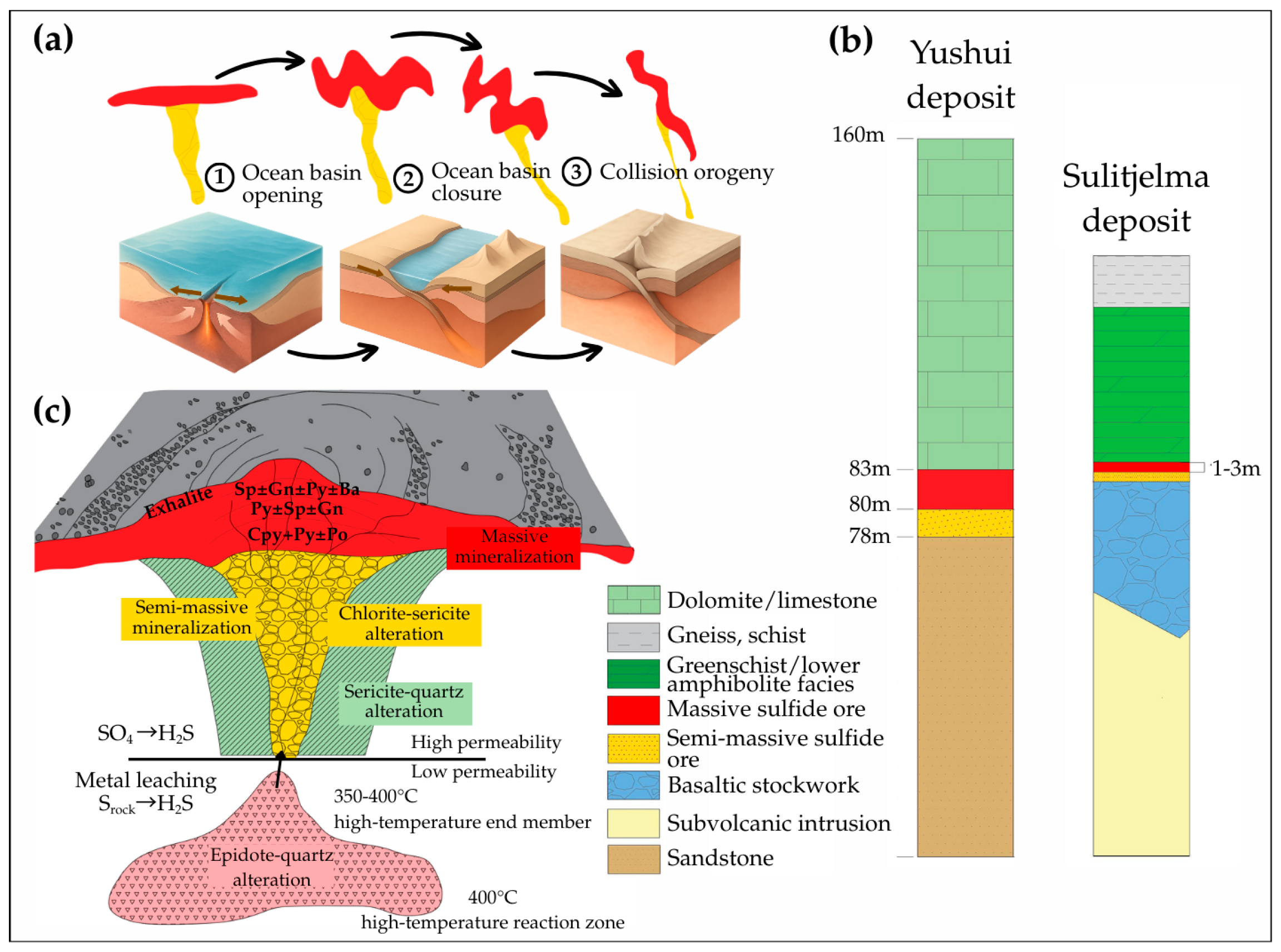
Hydrothermal volcanogenic massive sulphide deposits (VMS) and sedimentary exhalative (SEDEX) deposits are generally unsuitable for the NRE method due to irregular ore-body morphology and limited lateral continuity; only locally preserved thin stratiform lenses may have conditional applicability [68] (Figure 4a). Two partial exceptions exist, where stratiform, gently dipping, thin massive sulphide ore bodies occur: (i) Yushui, characterized by stratiform Cu-Pb-Zn ore bodies dipping 10–25° and averaging 2–3 m in thickness, and (ii) Sulitjelma, where massive sulphides are present as lenticular subhorizontal ore bodies < 1.7 m thick. Stratigraphic overview of those two NRE-suitable VMS deposits is shown in Figure 4b.

2.4.1. Geology

VMS/SEDEX deposits typically form stratiform to lenticular ore bodies within extensional tectonic settings, including volcanic arcs and back-arc basins (e.g., Yushui), as well as rift-related basins and ophiolitic sequences (e.g., Sulitjelma). VMS deposits are genetically associated with submarine magmatism, where hydrothermal fluids are driven by magmatic heat and uplift through volcanic and subvolcanic rocks [5,69,70] (and references therein). In contrast, SEDEX deposits form in sediment-dominated extensional basins through the discharge of metal-bearing basinal brines along synsedimentary faults at or near the sediment-water interface [71].
In VMS systems, massive sulphide ore bodies are commonly overlain by or gradational into ferrous chert or jasperite exhalites, consisting of Fe-rich silica precipitated from hydrothermal plumes. A well-developed stockwork or stringer zone is often present beneath the massive sulphides, characterized by quartz-chlorite ± sulphide veining and representing focused subseafloor fluid upflow [5]. In contrast, SEDEX deposits are typically hosted by fine-grained siliciclastic or carbonate sediments and are commonly associated with barite, iron-rich chemical sediments, and organic-rich shales [71,72]. Stockwork zones are absent, and mineralization occurs as laterally extensive, stratabound sulphide layers precipitated from oxidized, saline basinal fluids [72]. The general cross-section of Yushui and Sullitjelma is shown in Figure 4c. In both Yushui and Sulitjelma, such zoning is partially preserved, expressed by localized stockwork structures, Cu-rich cores, and Zn-Pb-rich outer zones [73].
The Yushui massive sulphide zone is developed at the dolostone–sandstone contact and is overlain by red jasperite exhalates, while vent-proximal massive Cu lenses grade laterally and vertically into Pb-Zn-rich lenses [74,75]. In contrast, the Sulitjelma deposit is hosted within Paleozoic amphibolites and metavolcanic rocks forming part of the extensively deformed Sulitjelma ophiolite complex [5]. The ore bodies consist of several Cu-Zn-Pb-(Ag) massive sulphide lenses underlain by stockwork zones developed within amphibolites [5,76].

2.4.2. Ore Morphology

The Yushui ore body dips gently, typically in the range of 10–25° and has an average thickness of approximately 2–3 m. Along the strike, this morphology can be traced continuously for several hundred meters, before grading into thicker, irregular massive sulphide lenses. The most NRE-suitable portions correspond to the laterally continuous, stratiform ore bodies, whereas vent-proximal lenses are thicker and do not correspond to NRE compatibility [74,75,76]. In the Sulitjelma, massive sulphide ore bodies occur as multiple lenses with variable morphology. Locally, structurally flattened ore bodies form subhorizontal to gently dipping massive sulphide lenses, typically <1.7 m thick and traceable for hundreds of meters along strike before transitioning into steeply dipping, discontinuous lenses. NRE-suitable morphologies are therefore restricted to these thin, low-angle ore bodies, which represent only a minor fraction of the overall deposit [5,77].

2.4.3. Economic Significance

The polymetallic Cu-Pb-Zn-Ag Yushui deposit contains ~102.1 kt Cu (≈3.5% Cu), ~186.6 kt Pb (≈4.29% Pb), ~117.6 kt Zn (≈2.91% Zn), and ~339 t Ag (≈112 g/t Ag) [75]. The Sulitjelma mining district historically produced > 25 Mt of ore between 1887 and 1991, with average grades of ~1.84% Cu, ~0.86% Zn, ~10 g/t Ag, and ~0.25 g/t Au [5,78]. The newest resource estimate reports ~17 Mt inferred at 1.06% Cu and 0.21% Zn [79].

3. Case Study: Unki Mine (Great Dyke, Zimbabwe)

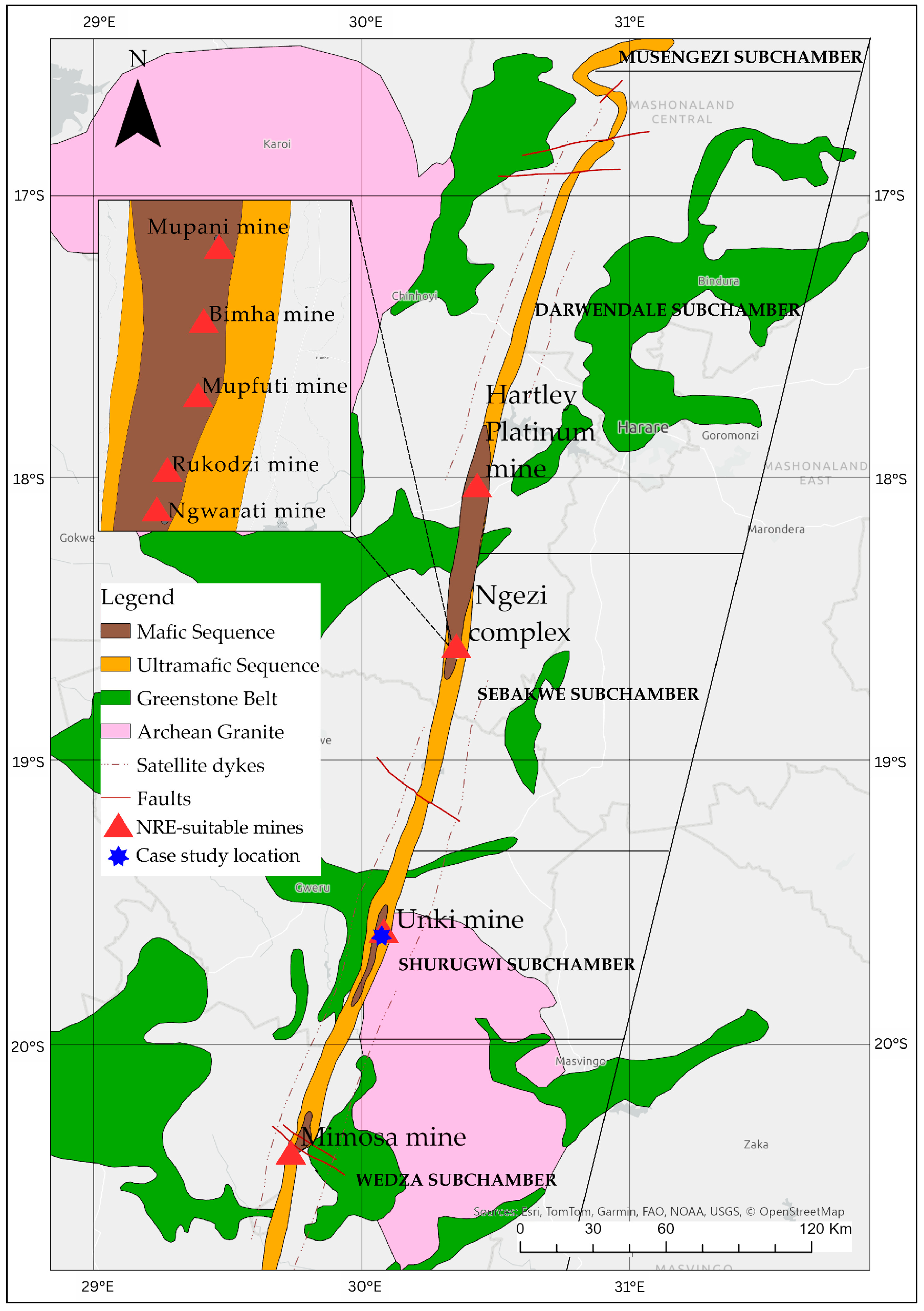
The layered mafic–ultramafic intrusion Great Dyke of Zimbabwe hosts significant reserves of nickel, copper, chromium, and PGEs within the Main Sulphide Zone reef. It is divided into five sub-chambers—Musengezi, Darwendale, Sebakwe, Shurugwi, and Wedza—by the variations in lithology and the thickness of rock units [37]. Unki Mine is situated in the Shurugwi sub-chamber, which is bounded by the greenstone belt along its western margin zone and Archean granite along its eastern margin zone (Figure 5).
The western margin zone is characterized by high oxidation levels, serpentinite–magnetite assemblages, and Fe-rich pegmatoids, whereas the eastern margin zone contains granite dykes, pyroxene–amphibole assemblages, and magnetite diorite [80]. The MSZ forms a 3.2 m thick continuous layer hosted by plagioclase orthopyroxenite. Mineralization is affected by varying degrees of alteration, which results in a redistribution of metals. Fresh host rocks contain Ni = 6698 ppm, Cu = 4019 ppm, and S concentrations up to 6.6 wt.%. In contrast, highly altered plagioclase orthopyroxenite contains Ni = 449 ppm, Cu = 100 ppm, and S values below the detection limit (<0.004 wt.%). In highly altered host rocks, nickel is present in talc (willemseite). Samples affected by near-surface weathering are enriched in nickel by several orders of magnitude (highly altered rocks: Ni = 12,488 ppm, compared to fresh rocks: Ni = 3625 ppm). It is determined that, in highly altered host rocks, nickel is hosted in spinel (nichromite), serpentine (pecoraite), and chlorite (nimite). The redistribution of PGEs is not detected in this study [81].

4. Materials and Methods

4.1. Ore Deposit Database and Data Sources

This study is based on the analysis of 178 ore deposits/ore bodies/mines classified by genetic origin [1] into the following types: 146 magmatic sulphide deposits, 29 sediment-hosted deposits, and 3 hydrothermal deposits. The dataset was compiled from peer-reviewed scientific publications, national geological surveys (e.g., USGS), publicly available mining databases (e.g., MDO Data Online Inc., Vancouver, BC, Canada), company technical reports, and internal industry datasets provided by DOK-ING Mining Ltd. (Zagreb, Croatia) and is, together with appropriate references, presented in Supplementary Material File S2.

4.2. Selection of Laterally Continuous Stratiform Ore Bodies

Ore deposits were treated as composite systems of multiple ore bodies, and only those hosting laterally continuous stratiform mineralization were included in the assessment. Minimum lateral dimensions were defined to ensure the economic viability of panel-scale mechanized mining rather than to reflect geological continuity per se. These criteria correspond to the minimum panel sizes required to offset development costs and enable continuous operation of the NRE fleet. For ore deposits located at depths of approximately 300–600 m (e.g., the majority of reef-type PGE deposits in the Bushveld Complex and the Great Dyke of Zimbabwe), minimum ore body dimensions of approximately 150 × 200 m are considered sufficient to meet NRE operational requirements at the panel scale. For ore deposits located at greater depths, such as the Kupferschiefer deposits in Europe (down to ~1 km) or the Witwatersrand gold deposits in South Africa (down to ~4 km), larger laterally continuous ore bodies are required, with minimum dimensions determined primarily by economic considerations.
The presented evaluation framework is based on published morphological parameters of selected ore deposits and operating mines (Supplementary Material File S2 and references therein). As the available data originates from heterogeneous literature sources, the level of detail and spatial resolution varies between case studies, requiring a consistent but flexible interpretative approach. Accordingly, NRE suitability was evaluated at different spatial scales, depending on data availability and geological heterogeneity. Where detailed mine- or ore-body-scale morphological data were available, suitability was assessed at the panel scale, whereas cases constrained only by regional or deposit-scale data were evaluated at the ore body scale. This distinction is explicitly indicated in Supplementary Material File S2 to avoid the overgeneralization of NRE applicability.

4.3. Morphological Screening Criteria for NRE Suitability

Laterally continuous ore deposits were screened based on the availability of morphological data (ore thickness and dip) from mines currently operating within those deposits. Where data were incomplete (e.g., missing dip or geological thickness) or where no mines were in operation, the ore deposit was included only if these parameters could be reasonably constrained using multiple literature sources (Supplementary Material File S2). The selected ore deposits were then evaluated using the technical criteria that define the applicability of NRE:
  • Maximum ore body thickness of 1.7 m,
  • Ore body dip not exceeding 22°.

4.4. Scoring Methodology and Efficiency/Suitability Classification

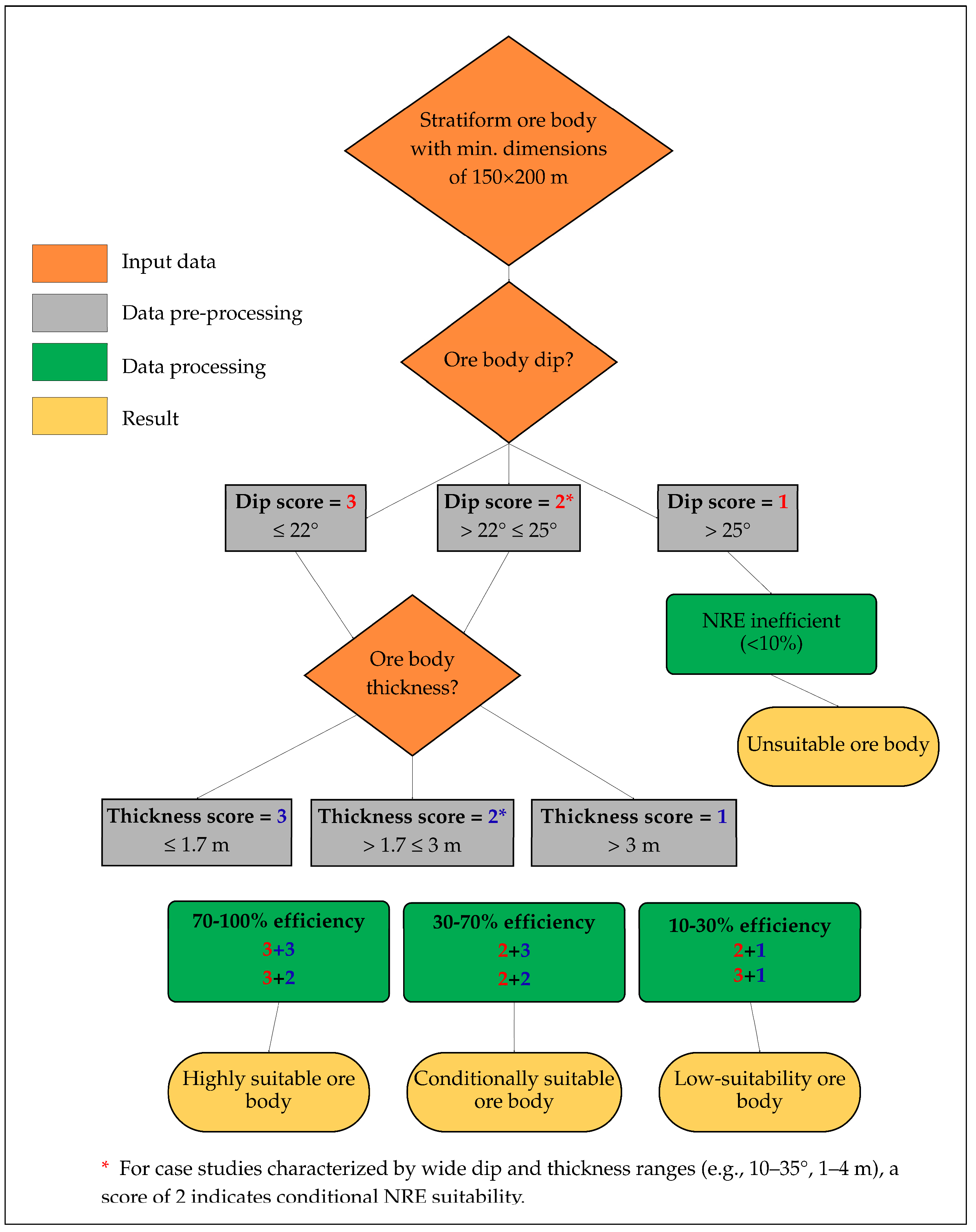
The efficiency of the NRE fleet is primarily controlled by ore body dip, whereas thickness plays a secondary but corrective role. Ore deposits/ore bodies/mines were evaluated using a simple scoring system in which each morphological parameter (thickness and dip) was scored independently on a scale from 1 to 3.
A score of 3 was assigned to ore bodies with dips ≤22° and thickness ≤1.7 m, corresponding directly to the design specifications of the NRE fleet. A score of 2 was assigned to ore bodies with dips between 22° and 25° and thickness up to 3 m. The dip flexibility of up to 3° beyond the nominal NRE design limit is based on observed mine layout adaptations and operational testing at Amandebult mine, where localized deviations from design dip were accommodated without compromising equipment performance [82]. The upper thickness limit of this category represents a methodological assumption in which the reported geological thickness is treated as the maximum mineralized interval, without implying that the entire thickness is economically extractable. A score of 1 was assigned to ore bodies with dips exceeding 25°, as such morphologies deviate from the operational parameters of the NRE. Regardless of thickness, ore bodies with dips > 25° were therefore classified as unsuitable for NRE application, corresponding to expected operational efficiencies below 10%. Where parameter ranges are reported, evaluation is performed relative to NRE operational limits. Deposits or ore bodies exceeding these limits may still be classified as conditionally suitable where laterally continuous segments with dip angles ≤25° and thickness ≤3 m are documented.
The evaluation procedure was implemented in two steps. First, individual mines were assessed at the mine or panel scale, reflecting locally documented morphological conditions under which NRE deployment may be technically feasible. Second, generalized entries were compiled for each deposit or mining district based on regional-scale morphological parameters. Comparison of mine-scale and deposit-scale NRE suitability classifications allows discrimination between locally favorable conditions and deposit-wide suitability classes. The combined scores were translated into qualitative efficiency classes reflecting the expected operational suitability and potential utilization of the NRE fleet. The scoring workflow and the resulting efficiency and suitability classes are summarized schematically in Figure 6.

4.5. Economic Evaluation and Comparative Assessment of Mining Methods

To validate the operational and economic implications of the scoring results, a simplified economic comparative analysis between the NRE method, the conventional method, and the LP method has been conducted using the case study of the Unki Mine (Main Sulphide Zone, Great Dyke, Zimbabwe). The economic evaluation was carried out by integrating production outputs, ore grades, and stoping widths to determine the monthly quantity and value of extracted PGE metals for each mining method. Production data for the LP and conventional methods were obtained from Unki Mine, where established underground operations provided reliable information on ore tonnage, face dimensions, and grade profiles representative of Main Sulphide Zone conditions. Operational parameters for the NRE method were derived from equipment trials conducted at the Bokoni Mine, where testing under comparable geological settings supplied productivity indicators, unit advance rates, and equipment-specific cost inputs. Operating costs were quantified at the panel level and included labor, equipment, and supply requirements based on site production records, equipment specifications, and trial-derived performance data. Economic performance was calculated by comparing monthly revenues with total operating costs, while development, ventilation, transportation, and other infrastructure expenses were excluded to isolate panel-scale productivity and allow a consistent comparison of the NRE, LP, and conventional mining methods.

5. Results

5.1. NRE-Suitable Ore Deposits

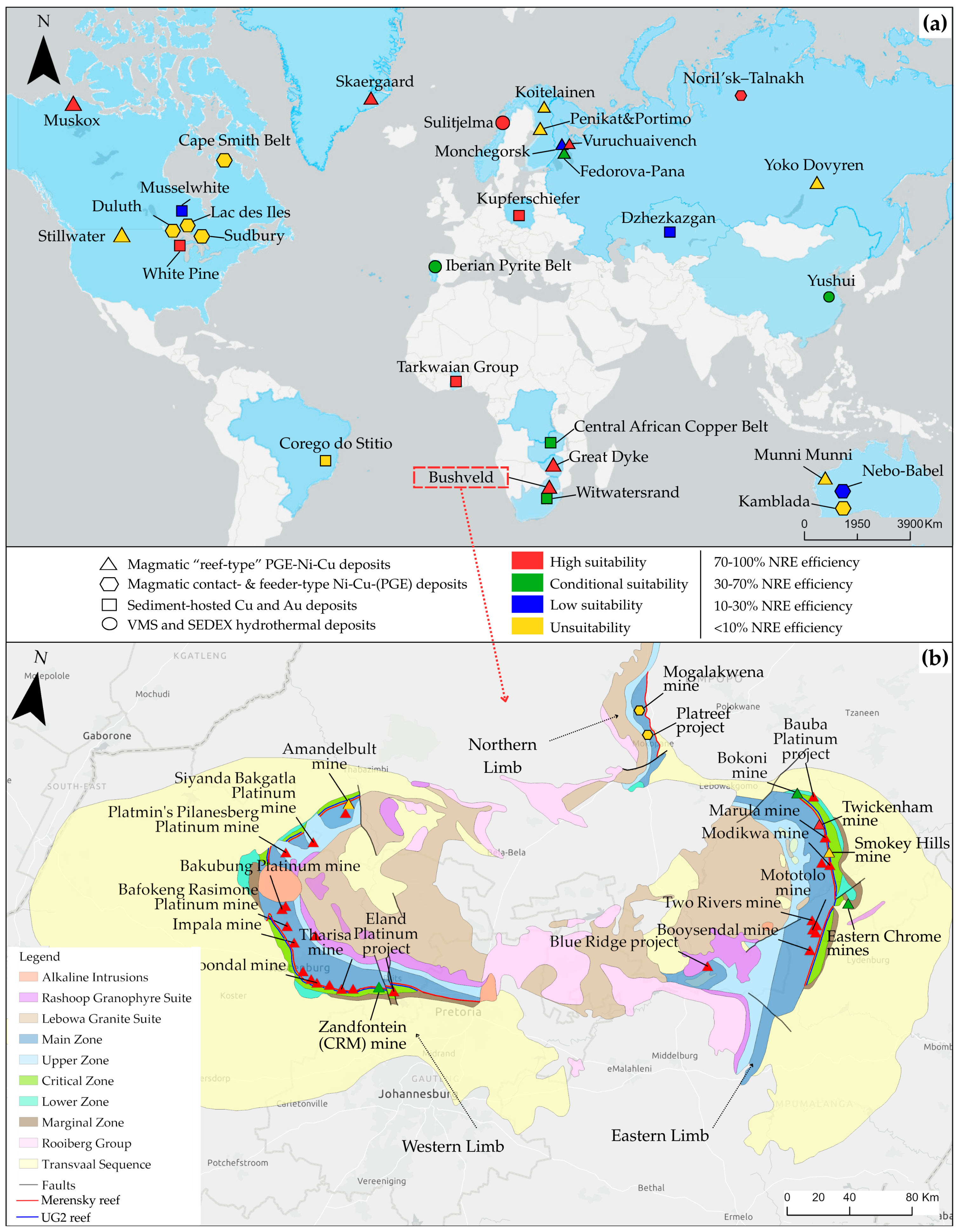
Among the 178 analysed mines/ore bodies/ore deposits, 68 are classified as having high NRE suitability, 30 as conditional, 15 as low, and 41 as unsuitable, while 24 case studies were classified as not assessable (NA) due to insufficient data (Supplementary Materials File S2). These results are further illustrated by a graphical distribution of deposits by type and suitability class provided in Figure 7, while an overview of geological characteristics and thickness/dip parameters for NRE suitable ore deposits are provided in Table 1.

5.2. Economic Analysis of the Underground Mining Methods: Case Study of Unki Mine, Great Dyke, Zimbabwe

5.2.1. Input Parameters and Evaluation Framework

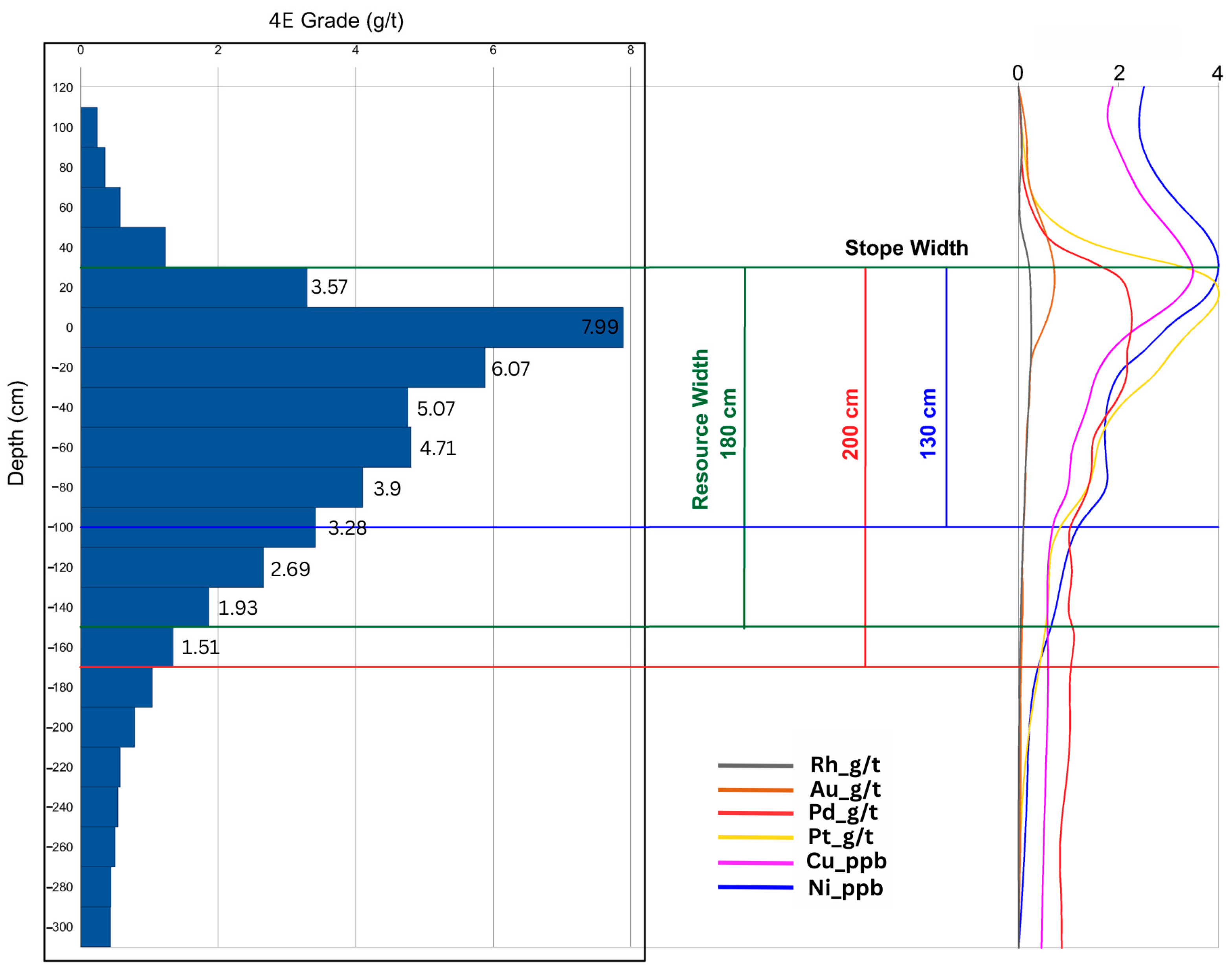
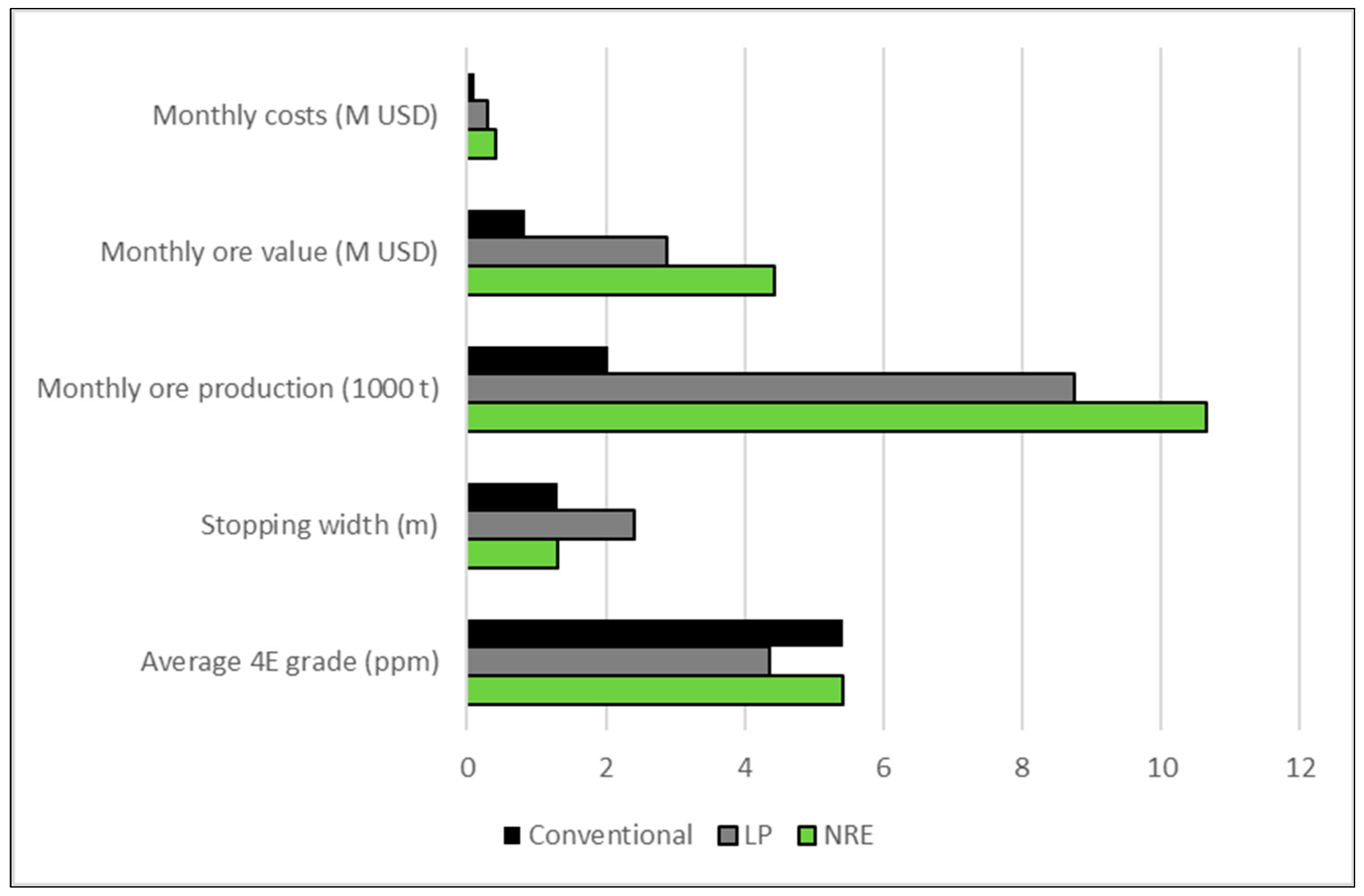
The simplified economic comparative analysis between the NRE method, the conventional method, and LP method has been conducted. The Unki Mine was selected as a representative example of the LP method, because its MSZ ore-body morphology (2–3.2 m geological width, ~200 cm mineable thickness, dip < 11°) closely aligns with NRE design parameters. The comparison includes only the methods based on drilling and blasting, while mechanical cutting methods have not been considered. In addition, the analysis considered only extraction within the panel, excluding the development of drifts and the associated costs of ventilation, transportation, and other auxiliary activities; therefore, the resulting production is lower than the total production of mine. The costs of drilling, blasting, mucking, and ground support, as well as labor, equipment, explosives, maintenance, and consumable materials, were included in the analysis. Mining productivity and mining costs were evaluated monthly. Data on efficiencies and the quantity of mined ore were obtained from Unki Mine production reports and from the test-work of NRE equipment conducted during trial operations at various mines. The equipment capital costs and their maintenance, plus labor and consumable material, were similarly obtained from the same sources. Ore grade profiles are used for resource and mineral content calculations together with stoping width for NRE and conventional method (130 cm) and LP method (200 cm) are shown in Figure 8.
In addition to the stoping width, the mining layouts also differ. In the NRE and conventional methods, a breast mining layout with a face length of 30.6 m is used, while the LP method used a board and pillar layout with a face length of 8.6 m. Face parameters are shown in Table 2 and monthly production, quantity and value of ore for each method are in Table 3.
The following categories of the monthly mining costs at the panel level were calculated: labor requirements, equipment costs, and supply requirements (Table 4).
Labor costs account for the salaries of all personnel required for each mining method, reflecting the number and the position of workers involved. For the mechanized methods, NRE and LP, nine workers are needed, including six high-skilled workers (two electricians, two mechanics, and two maintenance workers) and three low-skilled machine operators. In contrast, the conventional method requires nineteen workers, comprising four high-skilled staff (two shift superiors and two team leaders) and fifteen low-skilled personnel, including RDOs, winch operators, stock timbers, and miners. Consequently, labor costs are highest for the conventional method (23,000 USD/month) due to the larger workforce needed for manual underground operations, while mechanized methods require fewer personnel (15,300 USD/month). Note: salary data are applicable for Zimbabwe and will proportionally increase if a similar calculation is running for other parts of the world.
Equipment costs encompass the purchase, depreciation, and monthly maintenance of required machinery. Mechanized methods encounter higher monthly equipment costs (65,400 USD for NRE; 101,400 USD for LP) due to the intensive use of specialized machinery (drill rigs, dozers, stope jumbos, loaders, ANFO loaders). In conventional mining, most work is conducted manually, resulting in significantly lower equipment expenditures (jack leg drifters, a scraper winch, a chainsaw), equivalent to only 1400 USD monthly.
Supply requirements include all other operational costs (explosives, detonators, drill bits, drill steel, fresh water and compressed air piping, electric cables, ventilation tubing, rock bolts, support timber in the case of conventional mining). These costs vary heavily depending on the mining method and panel design, and create the largest difference in overall expenditure. Very high monthly supply costs for the NRE mining method (335,600 USD) are driven by expensive rock bolts and accompanying resin, compared to only 174,000 USD for LP and 85,000 USD for the conventional method.
Overall, the total monthly operating costs for various mining methods vary significantly, with NRE being 30% more expensive compared to LP (NRE = 416,300 USD/monthly vs. LP = 290,700 USD/monthly) and 75% more expensive compared to conventional (109,400 USD/monthly; Table 4).

5.2.2. Quantities vs. Recovery

The NRE method demonstrated the highest operational efficiency among the three methods (Table 3 and Table 4; Figure 9). Reported data are consistent with the available literature [84,85,86]. At a stoping width of 130 cm, NRE produced 10,642 tons of ore monthly, significantly exceeding the LP output of 8744 tons and more than five times the production of the conventional method (2026 tons per month). NRE also achieved the highest ore recovery, producing the largest quantities of PGE while maintaining strong grades (5.41 g/t for four elements). In contrast, LP mining, with a wider stoping width of 200 cm, experienced greater dilution, reducing the effective 4E (Pt + Pd + Rh + Au) grade to 4.36 g/t despite moderate recovery. Conventional mining recorded the lowest ore recovery due to its limited production and low stoping efficiency.
Dilution is directly related to stoping width. The narrower NRE widths allow for more precise extraction, resulting in minimal dilution and higher ore grades. LP’s wider stopes increase dilution, lowering the effective grade, while conventional methods are less controlled and less efficient, contributing to both low recovery and higher relative dilution.

5.2.3. Costs vs. Revenues

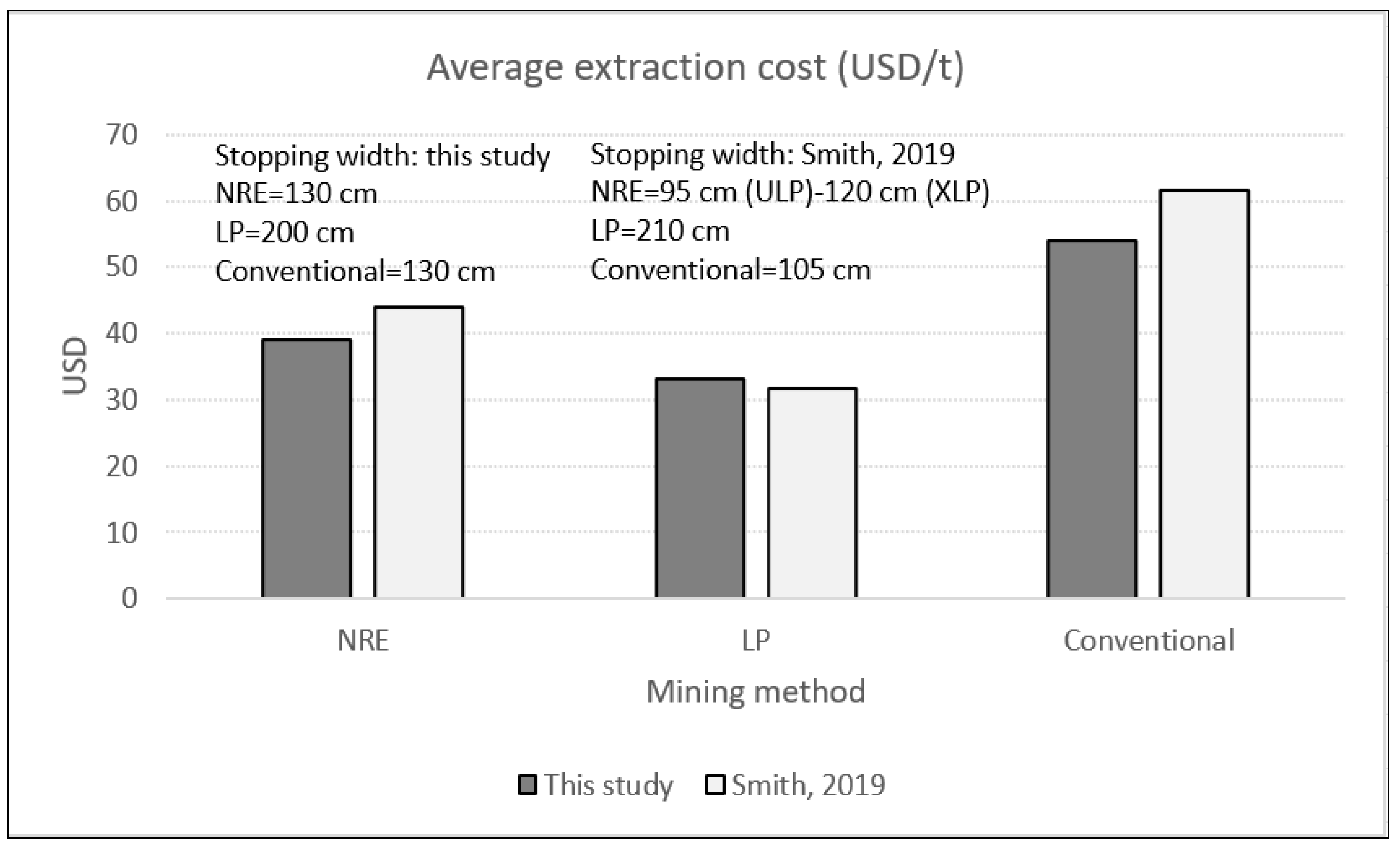
Economic analysis indicates that the NRE method is the most profitable option for thin, sub-horizontal ore deposits. Average extraction costs from this study were 39 USD/t for NRE, 33 USD/t for LP, and 54 USD/t for conventional, consistent with values reported by [87]; 44, 32, and 62 USD/t, respectively), calculated for Anglo-American platinum mines in Bushveld and Zimbabwe (Figure 10).
Despite 15% higher unit costs compared to LP, the higher ore recovery and grades achieved by NRE translate into the highest total production ore value (4.42 million USD/month) and production profit (4.0 million USD/month), with costs remaining below 10% of the extracted ore value. The LP mining method shows significantly lower production profit (2.59 million USD/month) with broader stoping width leading to dilution and lower ore grades (4E = 4.36 ppm). Conventional mining is the least economically attractive, with low production values (only 27% of NRE levels) and high costs, resulting in the smallest profitability of 0.73 million USD/month.
Furthermore, assuming maximum regional salaries based on international mining benchmarks (e.g., Canada: 6080 USD/month, Norway: 6060 USD/month; SalaryExpert), total operating costs would increase from 416,300 to 446,900 USD/month for NRE, from 290,700 to 321,300 USD/month for LP, and from 109,400 to 155,400 USD/month for conventional mining. Average extraction costs remain relatively stable for NRE (39 → 42 USD/t) and LP (33 → 37 USD/t), while conventional mining becomes significantly more expensive (54 → 76 USD/t), indicating that NRE and LP are more resilient to high regional labor costs.
An analysis of NRE-suitable deposits (Supplementary Material File S2) shows that the majority are in South Africa (36%), Canada (16.6%), and Russia (11.2%), with smaller shares in Australia, Zimbabwe, China, US and other countries. Best-case tariffs (e.g., Canada under CETA or South Africa with preferential agreements) keep equipment costs low, while worst-case tariffs (e.g., China, certain US or Russian imports) of 15–25% would have higher influence on total expenses in all analyzed cases (NRE 39 → 49 USD/t; LP 33 → 41 USD/t; conventional 54 → 65 USD/t); however, monthly production as well as grade remains higher for NRE.

6. Discussion

6.1. Genetic and Morphological Controls on NRE Suitability in Stratiform Ore Deposits

The suitability of stratiform ore deposits for NRE mining is primarily controlled by deposit morphology, which is directly governed by the genetic type of mineralization. Secondary disturbances, including post-genetic tectonism, stratigraphic irregularities (e.g., potholes), and hydrothermal alteration, further influence the local suitability of ore bodies within deposits that are otherwise favorable based on their genetic origin. Across all deposit categories, high NRE suitability is restricted to ore bodies characterized by low dip angles, limited effective mining thickness, and sufficient lateral continuity at the panel scale. Conversely, deposits defined by steep dips, excessive thickness, or disrupted lateral continuity are consistently excluded from NRE applicability. Differences between panel-scale and deposit-scale evaluations demonstrate that NRE suitability is strongly scale-dependent. In many districts, favorable conditions are limited to structurally preserved segments rather than entire deposits, so conditional classifications reflect geological heterogeneity rather than methodological uncertainty.

6.1.1. Magmatic Sulphide Deposits

Reef-type PGE deposits consistently show higher NRE suitability than contact- and feeder-type Ni-Cu deposits, despite comparable grades. This reflects the tabular morphology and lateral continuity of reef horizons, which favor continuous autonomous excavation, whereas feeder-type systems are commonly characterized by irregular morphologies and abrupt thickness variations that reduce NRE operational efficiency.
  • Contact- and feeder-type Ni-Cu-(PGE) deposits
Primary mantle-derived basaltic magmas contain variable amounts of sulphur that depend on the degree of partial melting of the mantle source. Even relatively high degrees of melting (e.g., ~25% of a source containing 250 ppm S) produce magmas with ~1000 ppm S, which is insufficient to achieve sulphur saturation at temperatures of 1200–1400 °C during early olivine crystallization [88]. Because Ni2+ closely substitutes for Mg2+ in olivine, nickel behaves as a highly compatible element and is progressively removed from the melt if sulphur saturation is delayed.
Economic sulphide mineralization therefore requires the assimilation of crustal material enriched in Si, CO32−, H2O, or sulphur, promoting sulphide immiscibility and segregation [89]. This process typifies contact-style Ni-Cu-PGE deposits developed along intrusion margins, as well as feeder-style deposits that demand large, open magma conduit systems. Mass-balance constraints illustrate this requirement, with the Noril’sk deposits implying a circulation of ~1000 km3 of magma and, in the Jinchuan system, at least ~300 km3, despite much smaller intrusion volumes [90].
As a result, sulphide-rich Ni-Cu-(PGE) ore bodies are commonly thick, irregular, and structurally complex, reflecting control by intrusive contacts or feeder zones. Contact-style deposits in komatiitic settings (e.g., Kambalda and the Cape Smith Belt) and feeder-related deposits in mafic–ultramafic intrusions (e.g., Noril’sk–Talnakh and Uitkomst) only rarely exhibit morphologies compatible with Narrow Reef Equipment and are therefore generally unsuitable for systematic NRE application.
  • Reef-type PGE deposits
Sulphide-poor Ni-Cu-PGE deposits (<3% total sulphides) are dominantly represented by reef-type PGE mineralization hosted by large layered mafic–ultramafic intrusions. Major examples include the Bushveld, Stillwater, and Great Dyke complexes. Despite ongoing debate regarding their precise genetic mechanisms—including magma mixing at stratigraphic interfaces, fractional crystallization accompanied by transient sulphide saturation, or the redistribution of PGE by late-stage magmatic fluids—the chalcophile behavior of PGE indicates that sulphur plays a fundamental role in their concentration at both magmatic and hydrothermal temperatures [88] (and references therein).
Irrespective of the formation model, reef-type PGE deposits are characterized by laterally continuous, thin, and gently dipping mineralized horizons. This ore body morphology closely matches the design parameters of Narrow Reef Equipment. Consequently, PGE reef-type deposits constitute the most favorable magmatic setting for NRE deployment. The highest degree of compatibility is observed in the Bushveld Complex, where more than 40 of the 46 analyzed mines satisfy NRE criteria, and in the Great Dyke, where all analyzed operations (8/8) are NRE-compatible. Additional examples include the Muskox and Skaergaard intrusions, each hosting a limited number of mines or advanced projects with reef morphologies suitable for NRE application.

6.1.2. Sediment-Hosted Stratiform Copper Deposits

Copper enrichment in sediment-hosted stratiform copper deposits is controlled by redox-driven aqueous geochemistry, whereby copper is transported over basin-scale distances by oxidized, saline basinal brines in which Cu-Cl complexes (e.g., CuCl2) are stable under high Eh conditions typical of deep sedimentary basins [44]. Geochemically, this process involves the reduction of Cu2+-Cl complexes to lower valence states that are no longer soluble. The most effective reductants in sedimentary basins include reduced sulphur species (e.g., H2S derived from organic matter or hydrocarbons) and Fe2+ from reduced iron-bearing phases.
Unlike magmatic sulphide environments, where metal enrichment requires physical saturation and immiscible sulphide segregation, SSC deposits form through chemical trapping, with copper precipitating precisely where redox conditions change. This mechanism produces stratigraphically confined, laterally extensive mineralized horizons that closely follow sedimentary bedding planes [13,44,46]. A systematic geochemical zonation develops across the redox front as fluids evolve along their flow paths. In oxidized domains, copper remains mobile due to the stability of Cu-Cl complexes, whereas, at the redox boundary, decreasing Eh and increasing sulphur activity promote copper precipitation. Further into reduced facies, continued changes in sulphur activity and fluid composition result in variations in copper speciation and associated trace element distributions. This zonation reflects equilibrium shifts in copper speciation controlled by redox state and sulphur activity, rather than localized structural trapping [46].
The key genetic implication is that SSC deposits are inherently predisposed to form thin, subhorizontal, and laterally persistent ore bodies, as precipitation is tied to laterally extensive chemical boundaries rather than discrete structural or lithologic traps. This genetic control directly explains why SSC deposits represent one of the most favorable geological settings for the application of the NRE mining method [44,46,91].

6.1.3. Sediment-Hosted Stratiform Gold Deposits

Primary gold concentration in Witwatersrand and Tarkwaian Reefs is due to mechanical placer processes, where detrital gold was eroded from surrounding Archean mountains and deposited by rivers to high-energy fluvial conglomerates under an anoxic atmosphere [92,93]. After initial deposition, synsedimentary enrichment occurs, especially in Witwatersrand, where a part of the gold was transported via aqueous solutions and precipitates due to redox changes onto the organic matter, authigenic pyrite or at the surface of detrital pyrite. Therefore, carbonaceous-rich layers played the role of redox trap for synsedimentary enrichment. Later greenschist-facies metamorphism caused further gold remobilization and local upgrading [92]. Therefore, the initial depositional environment and carbon enrichment of reefs played a key role in the development of the gold-enriched reefs suitable for the NRE method.

6.1.4. Volcanogenic Massive Sulphide and Sedimentary Exhalative Deposits

The generally low suitability of VMS and SEDEX deposits for the NRE mining method is a direct consequence of their ore-forming geochemical processes, which promote rapid sulphide precipitation and accumulation in morphologically irregular and vertically developed ore bodies. In VMS deposits, metals are transported as chloride complexes in high-temperature hydrothermal fluids and precipitated when reduced, metal-rich fluids mix with cold, oxidized seawater, causing rapid cooling, oxidation, and sulphide saturation. This process localizes mineralization around vent sites and produces thick, lens-shaped or mound-like massive sulphide bodies with limited lateral continuity [5,94]. SEDEX deposits form through the discharge of oxidized, saline basinal brines into marine basins, where metal precipitation is triggered by interaction with reduced sulphur in bottom waters or sediments. Although this mechanism can generate broadly stratiform mineralization, sulphide deposition is typically episodic and spatially variable, resulting in stacked or discontinuous sulphide lenses rather than a single, thin, laterally persistent horizon [71,72].
From a genetic perspective, both deposit types are governed by dynamic fluid discharge and rapid chemical disequilibrium, rather than by stable, laterally extensive chemical boundaries such as redox fronts in sediment-hosted stratiform copper deposits. Consequently, NRE compatibility is generally limited to local occurrences of unusually thin, gently dipping stratiform sulphide lenses (e.g., Sullitjelma’s sulphide lenses), which represent minor and atypical expressions of these deposit types rather than their dominant ore-body morphology.

6.1.5. Local Secondary Disturbances Controlling NRE Suitability

Although genetic origin and primary morphology define the baseline suitability of stratiform ore deposits for NRE mining, the analyzed deposits show that secondary geological disturbances frequently fragment or modify otherwise favorable ore deposits, confining NRE applicability to locally preserved ore bodies.
In magmatic PGE and Ni-Cu-(PGE) deposits, reef continuity is primarily degraded by stratigraphic and structural disturbances. The potholing of PGE reefs (e.g., Merensky, MSZ) represents one of the most critical stratigraphic disruptions, producing abrupt thickness variations and a local loss of lateral continuity that directly limit NRE-compatible panels [28]. Brittle faulting further segments layered intrusions into structurally isolated blocks, as documented in several European mafic intrusions (Fedorova-Pana, Vuruchuaivench PGE reefs) [18,20]. In addition, hydrothermal alteration locally overprints primary magmatic layering, particularly in the Great Dyke, where the fluid-mediated remobilization of PGE and base metals results in localized grade dilution [91,95].
In sediment-hosted stratiform copper deposits, secondary deformation is dominated by tectonic overprinting. In the Central African Copperbelt, originally stratiform Cu-Co mineralization hosted by the Katanga Supergroup was strongly modified during the Pan-African Lufilian Orogeny through basin inversion, fold-and-thrust belt development, and thrust stacking. These processes steepened stratigraphy and segmented ore horizons, producing along-strike variability in ore-body morphology within the basin interior, whereas NRE suitability is largely restricted to structurally less deformed ore bodies at basin margins [93].
In sediment-hosted stratiform gold deposits, secondary disturbances such as faulting and metamorphism affect primary reef morphology. In the Witwatersrand Basin, post-depositional faulting, folding, and impact-related deformation associated with the Vredefort structure disrupted reef continuity and locally modified dip, restricting mechanized narrow reef mining to structurally favorable blocks rather than entire reef trends [66]. Comparable structural segmentation characterizes the Tarkwaian gold deposits in Ghana, where deformation along major shear zones and thrust systems produces localized NRE-compatible ore [57].
Hydrothermal VMS and SEDEX deposits are commonly affected by deformation and metamorphism in subduction-related and collisional orogenic belts. These secondary processes enhance the fundamentally unfavorable primary morphologies of lens- and mound-shaped sulphide bodies, further reducing lateral continuity and reinforcing their general incompatibility with NRE mining, except for rare, locally preserved thin stratiform lenses (e.g., Sullitjelma’s narrow, subhorizontal lenses) [5].

6.2. Applicability of the NRE Screening Approach in Early-Stage Mine Project Development

The morphology-based scoring methodology applied in this study is intended as an early-stage screening tool corresponding to a scoping or Preliminary Economic Assessment (PEA) level within the mine project development workflow. Its purpose is to identify stratiform ore bodies whose morphologic characteristics are compatible with Narrow Reef Equipment, using heterogeneous geological information compiled from the published literature, public databases, technical reports, and industry datasets. In internationally recognized frameworks, scoping or PEA-level studies are distinguished from pre-feasibility and feasibility studies by simplified assumptions, limited data resolution, and the exclusion of comprehensive modifying-factor analyses required for Mineral Reserve declaration and final investment decisions [95,96].
Consistent with this scope, the present evaluation framework does not attempt to optimize mine layouts, production schedules, or full economic outcomes, nor does it incorporate capital development, ventilation, or infrastructure constraints. Instead, it provides a geology-based compatibility filter that precedes deposit-specific engineering and economic optimization, in line with established early-stage mining evaluation practice [6,97]. The applied scoring approach therefore differs fundamentally from multi-criterion decision analysis (MCDA) methods, including the Analytic Hierarchy Process (AHP), which are commonly used at later project stages for mining method selection and decision-making. MCDA and AHP-based studies integrate geological, geotechnical, economic, operational, safety, and environmental parameters using explicit weighting schemes derived from expert judgement [98,99,100,101]. While suitable for a deposit-scale comparison of established mining methods, such approaches require extensive input data and are sensitive to subjective weighting. In contrast, the present methodology avoids expert-derived weighting and excludes economic and operational optimization parameters, enabling consistent application across a large number of deposits using publicly available geological information.
The parameter set used in this study is restricted to ore-body morphology, specifically ore-body dip and thickness, which represent the primary physical constraints controlling NRE applicability and operational efficiency. Ore-body morphology has long been recognized as a first-order control on mining method applicability, preceding economic and operational considerations [6,97,101]. Dip is treated as the dominant control on NRE efficiency, while thickness acts as a secondary corrective parameter. Both parameters are classified into three discrete score categories based on operational thresholds derived from NRE design specifications and underground trials. The use of discrete classes for morphology-based screening is consistent with early-stage mining method selection and rock-mass classification approaches, where simplified categorical frameworks are applied to heterogeneous and incomplete datasets [97,102].
The application of the scoring framework across the compiled dataset demonstrates that NRE suitability is governed primarily by ore-body morphology, whereas genetic classification exerts only indirect control through its influence on thickness distribution, dip, and lateral continuity of mineralization. As a result, deposits of different genetic affinity may exhibit comparable NRE suitability where locally preserved morphologies fall within the operational envelope defined by dip and effective mining thickness. Reef-type magmatic Ni-Cu-PGE deposits represent the most consistently suitable geological setting, reflecting their thin, gently dipping, and laterally continuous ore morphology, which corresponds closely to the operational limits of ultra-low-profile mechanized mining.
Although direct precedents for NRE-focused suitability scoring are not available, analogous geology-based ranking approaches are well-established in mineral prospectivity mapping, where multiple geological evidence layers are integrated into favorability indices for early-stage targeting [103]. The present methodology applies the same screening principle to ore-body morphology and mining system compatibility, using operational thresholds rather than statistical weighting. The scoping-level nature of the methodology is further supported by the comparative case study of the Unki Mine, where the plausibility of NRE implementation was evaluated against Low Profile (LP) and conventional mining methods in terms of operational efficiency, ore recovery, dilution, and economic feasibility. In the absence of dedicated NRE economic models, productivity and cost data from XLP operations in PGE reef mines were used as proxies [87]. Comparable stoping widths between NRE (approximately 0.9–1.7 m) and conventional XLP operations (typically 1.2–1.7 m) allow direct performance comparison with LP and conventional mining.
Although the scoring framework itself excludes full economic modelling, the case study demonstrates that morphology-based suitability classifications are consistent with observed operational and economic trends and can indicate improved panel-scale productivity and economic performance under NRE deployment. The methodology therefore fulfils its intended role as an early-stage geological screening tool that complements, rather than replaces, MCDA-based evaluations and feasibility-level analyses conducted at later stages of project development.

7. Conclusions

The primary criterion showing the suitability of ore deposits for the NRE mining method is the presence of laterally continuous ore bodies with favorable morphology (dip up to 22° and thickness not exceeding 1.7 m). Secondary disturbances (i.e., potholes, post-genetic faulting and folding, ore dilution as a result of hydrothermal alterations) do not invalidate NRE suitability but reduce the portion of mineable ore bodies by restricting NRE applicability to morphologically undeformed ore bodies.
PGE reef-type deposits hosted by layered mafic–ultramafic intrusions represent the deposit group containing the highest number of NRE-suitable ore bodies. According to the economic significance, they can be divided into high-grade deposits (5–7 g/t PGE; e.g., Merensky, UG2, Main Sulphide Zone) and low-grade deposits (1–5 g/t PGE; e.g., Muskox, Fedorov-Pana, Vuruchuaivench, Skaergaard). On the other hand, contact- and feeder-type Ni-Cu-(PGE) deposits are not suitable for this mining method due to irregular, thick and steeply dipping morphology.
Sediment-hosted stratiform copper deposits also exhibit high NRE suitability, primarily controlled by the genetic development of thin, laterally continuous ore horizons along redox-controlled interfaces. In post-genetically deformed basins (e.g., the Central African Copperbelt), NRE suitability is generally confined to ore bodies located at basin margins, where primary stratiform morphology is better preserved, whereas ore bodies in the basin interior are commonly steepened, segmented, and therefore unsuitable for NRE application. In contrast, weakly deformed basins such as the Kupferschiefer host laterally extensive, subhorizontal ore bodies that are broadly compatible with NRE mining.
Sediment-hosted stratiform gold deposits characterized by reef-type mineralization may locally satisfy NRE requirements where primary stratiform morphology is preserved. In Witwatersrand-type deposits, auriferous reefs with typical grades of ~5–15 g/t Au were originally deposited as laterally extensive sedimentary horizons; however, subsequent faulting, folding, and impact-related deformation have disrupted reef continuity and locally increased dip angles. As a result, NRE applicability is restricted to structurally favorable reef blocks. Similar conditions apply to Tarkwaian gold reefs in Ghana.
Volcanogenic massive sulphide (VMS) and sedimentary exhalative (SEDEX) deposits are generally incompatible with NRE mining due to their genetic development as lens- or mound-shaped sulphides with limited lateral continuity and highly variable thickness, commonly exceeding several meters. Later-stage deformation and metamorphism in convergent and collisional orogenic belts further intensify these unfavorable morphologies. Only rare occurrences of thin, stratiform sulphide lenses—such as narrow, subhorizontal horizons locally preserved within the Sullitjelma district—approach NRE compatibility.
The economic advantage of the NRE method is not driven by lower unit costs, but by superior ore selectivity and recovery efficiency. Although NRE exhibits higher monthly operating costs than LP and conventional mining (USD 416,300/month compared to USD 290,700 and USD 109,400, respectively), its narrow stoping width (130 cm) minimizes dilution and preserves in situ grades. Sensitivity tests using high-labor-cost scenarios (Canada, Norway) and unfavorable equipment tariff conditions show that this advantage is preserved, as NRE maintains the highest monthly ore production (10,642 t) and total metal value (USD 4.43 million/month), with operating costs accounting for less than 10% of the extracted metal value.
NRE enables a step-change in productivity and profitability of thin stratiform ore bodies while reducing workforce requirements and operational exposure. At the panel scale, NRE produces more than five times the ore tonnage of conventional mining and approximately 20% more than LP mining, while requiring less than half the workforce of conventional operations (9 versus 19 workers). This combination results in the highest monthly production profit (USD 4.0 million/month), compared to USD 2.6 million/month for LP and only USD 0.73 million/month for conventional mining.
This study demonstrates that morphology-based, multi-scale screening provides an effective first-order approach for evaluating the applicability of Narrow Reef Mining Equipment across stratiform ore deposits. Explicit distinction between mine-, ore body-, and deposit-scale applicability allows local NRE-compatible morphologies to be identified without extrapolating mine-scale observations to the entire deposit. The resulting suitability classes should be interpreted as indicators of documented morphology conditions rather than as predictive statements of continuous mineability.
The proposed morphology-based framework provides a practical geology-driven screening tool for the early-stage evaluation of NRE suitability and supports informed decision-making prior to detailed engineering mine design. Given the increasing need for selective, low-dilution mining of deep and thin ore bodies, morphology-driven equipment selection represents a critical step in improving resource efficiency and operational safety.

Supplementary Materials

The following supporting information can be downloaded at: https://www.mdpi.com/article/10.3390/min16030250/s1, Supplementary Material File S1: Technical details of the NRE equipment (NRE Dozer, NRE Drill Rig and NRE Support Rig); Supplementary Material File S2: Database of ore deposits evaluated for their suitability for Narrow Reef mining Equipment (NRE), based on key morphological parameters including ore body dip and thickness.

Author Contributions

E.V.: writing, methodology, graphical preparation—review and editing; S.B.Š.: writing, methodology, conceptualization, funding; P.P.: formal analysis, calculation; V.B.: formal analysis, methodology, writing, funding. All authors have read and agreed to the published version of the manuscript.

Funding

The research is funded by EIT Raw Materials as part of project 23024—NRE-ElectRA (Electric, Remote Control, Automatic Narrow Reef Mining Equipment). The work of doctoral student Ema Vokić has been fully supported by the “Young researchers’ career development project—training of doctoral students” of the Croatian Science Foundation.

Data Availability Statement

The database for this study is large and complex. Therefore, it is available on request from corresponding author.

Acknowledgments

The authors would like to thank DOK-ING Mining Ltd. for their assistance in the preparation of table of suitable ore deposits for the NRE fleet and Valterra Platinum Ltd. for sharing production report data.

Conflicts of Interest

Paulo Pleše is the employee of DOK-ING Mining Ltd. The paper reflects the views of the scientists and not the company.

Abbreviations

The following abbreviations are used in this manuscript:
NRENarrow Reef Equipment
LIPLarge Igneous Province
PGEPlatinum Group of Elements
SSCSediment-hosted stratiform copper deposits
LPLow Profile
MSZMain Sulphide Zone
SEDEXSedimentary Exhalative
NANot assessable
VMSVolcanogenic massive sulphide
UG2Upper Group 2 chromitite layer

References

  1. Robb, L.J. Introduction to Ore-Forming Processes; Blackwell Publishing: Oxford, UK, 2005. [Google Scholar]
  2. Latypov, R.; O’Driscoll, B.; Lavrenchuk, A. Towards a Model for the In Situ Origin of PGE Reefs in Layered Intrusions: Insights from Chromitite Seams of the Rum Eastern Layered Intrusion, Scotland. Contrib. Mineral. Petrol. 2013, 166, 309–327. [Google Scholar] [CrossRef]
  3. Sawlowicz, Z. On the Origin of Copper Mineralization in the Kupferschiefer: A Sulphur Isotope Study. Terra Nova 1989, 1, 339–343. [Google Scholar] [CrossRef]
  4. Mathur, R.; Godfrey, L.; Frimmel, H.E.; Yee, N.; Mossman, D.; Baran, P.; Valencia, V.A. Copper Isotopic Evidence of Microbial Gold Fixation in the Mesoarchean Witwatersrand Basin. Geochim. Cosmochim. Acta 2025, 388, 114–126. [Google Scholar] [CrossRef]
  5. Franklin, J.M.; Gibson, H.L.; Jonasson, I.R.; Galley, A.G. Volcanogenic Massive Sulfide Deposits. In Economic Geology 100th Anniversary Volume; Society of Economic Geologists: Littleton, CO, USA, 2005; pp. 523–560. [Google Scholar]
  6. Hartman, H.L.; Mutmansky, J.M. Introductory Mining Engineering, 2nd ed.; Wiley: New York, NY, USA, 2002. [Google Scholar]
  7. Egerton, F.M.G. Presidential Address: The Mechanisation of UG2 Mining in the Bushveld Complex UG2 Chromitite Layer. J. S. Afr. Inst. Min. Metall. 2004, 104, 439–450. [Google Scholar]
  8. Pickering, R.G.B.; Leon, F. The Implementation of Mechanized Breast Mining and the Development of XLP Equipment. In Platinum in Transformation; Southern African Institute of Mining and Metallurgy (SAIMM): Johannesburg, South Africa, 2008; pp. 269–275. [Google Scholar]
  9. Bohanek, V.; Pleše, P.; Borojević Šoštarić, S.; Purkić, R.; Vokić, E. Influence of Mining Layout on Efficiency of NRE Drill Rig. Mining 2025, 5, 6. [Google Scholar] [CrossRef]
  10. Pickering, R.G.B. Has the South African Narrow Reef Mining Industry Learnt How to Change? J. S. Afr. Inst. Min. Metall. 2007, 107, 557–565. [Google Scholar]
  11. Bohanek, V.; Petro, L.; Borojević Šoštarić, S. Narrow Reef Mining (NRM)—Innovative Mining Technology for Narrow, Sub-Horizontal PGE Ore Bodies. Mater. Proc. 2023, 15, 9. [Google Scholar] [CrossRef]
  12. Fourie, F.; Valicek, P.; Krafft, G.; Sevenoaks, J. Narrow-Reef Mechanized Mining Layout at Anglo American Platinum. J. S. Afr. Inst. Min. Metall. 2017, 117, 263–274. [Google Scholar] [CrossRef][Green Version]
  13. Naldrett, A.J. Magmatic Sulfide Deposits; Springer: Berlin/Heidelberg, Germany, 2004. [Google Scholar] [CrossRef]
  14. Pripachkin, P.; Rundkvist, T.; Groshev, N. Paleoproterozoic East Pana Layered Intrusion (Kola Peninsula, Russia): Geological Structure, Petrography, Geochemistry and Cu–Ni–PGE Mineralization. Minerals 2023, 13, 681. [Google Scholar] [CrossRef]
  15. Kislov, E.V.; Khudyakova, L.I. Yoko–Dovyren Layered Massif: Composition, Mineralization, Overburden and Dump Rock Utilization. Minerals 2020, 10, 682. [Google Scholar] [CrossRef]
  16. Zientek, M.L. Magmatic Ore Deposits in Layered Intrusions—Descriptive Model for Reef-Type PGE and Contact-Type Cu–Ni–PGE Deposits; U.S. Geological Survey Open-File Report 2012-1010; U.S. Geological Survey: Reston, VA, USA, 2012.
  17. Jenkins, M.C.; Mungall, J.E.; Zientek, M.L.; Holick, P.; Butak, K. The Nature and Composition of the J-M Reef, Stillwater Complex, Montana, USA. Econ. Geol. 2020, 115, 1799–1826. [Google Scholar] [CrossRef]
  18. Yu, G.N.; Korchagin, U.; Ivanov, N. Ore Formation and PGE Prospectivity of the Fedorova–Pana Layered Complex, Kola Region, Russia. In The Fennoscandian School of Ore Genesis in Layered Intrusions; GI KSC RAS: Apatity, Russia, 2021. [Google Scholar] [CrossRef]
  19. Forum Energy Metals Corp. Love Lake Magmatic Nickel/Copper/Platinum/Palladium Project. Forum Energy Metals. Available online: https://forumenergymetals.com/project-3/love-lake-magmatic-nickel-copper-platinum-palladium-project/ (accessed on 26 October 2025).
  20. Schissel, D.; Tsvetkov, A.A.; Mitrofanov, F.P.; Korchagin, A.U. Basal Platinum-Group Element Mineralization in the Federov Pansky Layered Mafic Intrusion, Kola Peninsula, Russia. Econ. Geol. 2002, 97, 1657–1677. [Google Scholar] [CrossRef]
  21. Oberthür, T. Platinum-Group Element Mineralization of the Main Sulfide Zone, Great Dyke, Zimbabwe. In Magmatic Ni–Cu and PGE Deposits: Geology, Geochemistry, and Genesis; Society of Economic Geologists: Littleton, CO, USA, 2019. [Google Scholar] [CrossRef]
  22. Cawthorn, R.G. Geological Interpretations from the PGE Distribution in the Bushveld Merensky and UG2 Chromitite Reefs. J. S. Afr. Inst. Min. Metall. 2011, 111, 67–79. [Google Scholar]
  23. Naldrett, A.J.; Wilson, A.; Kinnaird, J.; Chunnett, G. PGE Tenor and Metal Ratios within and below the Merensky Reef, Bushveld Complex: Implications for Its Genesis. J. Petrol. 2009, 50, 625–659. [Google Scholar] [CrossRef]
  24. Li, C.; Ripley, E.M.; Oberthür, T.; Miller, J.D.; Joslin, G.D. Textural, Mineralogical and Stable Isotope Studies of Hydrothermal Alteration in the Main Sulfide Zone of the Great Dyke, Zimbabwe and the Precious Metals Zone of the Sonju Lake Intrusion, Minnesota, USA. Miner. Depos. 2008, 43, 97–110. [Google Scholar] [CrossRef]
  25. Cawthorn, R.G.; Lee, C.A.; Schouwstra, R.P.; Mellowship, P. Relationship between PGE and PGM in the Bushveld Complex. Can. Mineral. 2002, 40, 311–328. [Google Scholar] [CrossRef]
  26. Oberthür, T.; Locmelis, M. The Oxidized Ores of the Main Sulphide Zone, Great Dyke, Zimbabwe: Turning Resources into Minable Reserves—Mineralogy Is the Key. J. S. Afr. Inst. Min. Metall. 2013, 113, 647–672. [Google Scholar]
  27. Letts, S.; Torsvik, T.H.; Webb, S.J.; Ashwal, L.D. Palaeomagnetism of the 2054 Ma Bushveld Complex (South Africa): Implications for Emplacement and Cooling. Geophys. J. Int. 2009, 179, 850–872. [Google Scholar] [CrossRef]
  28. Chistyakova, S.; Latypov, R.; Hunt, E.J.; Barnes, S. Merensky-Type Platinum Deposits and a Reappraisal of Magma Chamber Paradigms. Sci. Rep. 2019, 9, 45288. [Google Scholar] [CrossRef]
  29. Stoch, B.; Basson, I.J.; Miller, J.A. Implicit Geomodelling of the Merensky and UG2 Reefs of the Bushveld Complex from Open-Source Data: Implications for the Complex’s Structural History. Minerals 2020, 10, 975. [Google Scholar] [CrossRef]
  30. Wilson, A.H.; Prendergast, M.D. Platinum-Group Element Mineralisation in the Great Dyke, Zimbabwe, and Its Relationship to Magma Evolution and Magma Chamber Structure. S. Afr. J. Geol. 2001, 104, 319–342. [Google Scholar] [CrossRef]
  31. Holness, M.B.; Nielsen, T.F.D.; Tegner, C. The Skaergaard Intrusion of East Greenland: Paradigms, Problems and New Perspectives. Elements 2017, 13, 391–396. [Google Scholar] [CrossRef]
  32. Miller, J.D.; Andersen, J.C. Attributes of Skaergaard-Type PGE Reefs. In Extended Abstracts, Proceedings of the 9th International Platinum Conference; Geological Association of Canada Short Course Notes: Ottawa, ON, Canada, 21–25 July 2002; Geological Association of Canada: St. John’s, NL, Canada, 2002; pp. 305–308. [Google Scholar]
  33. Rudashevsky, N.S.; Nielsen, T.F.D.; Rudashevsky, V.N. The PGE–Au Mineralisation of the Skaergaard Intrusion: Precious Metal Minerals, Petrography and Ore Genesis. GEUS Bull. 2023, 54, 1–66. [Google Scholar] [CrossRef]
  34. Irvine, T.N. Crystallization Sequences in the Muskox Intrusion and Other Layered Intrusions—II. Origin of Chromitite Layers and Similar Deposits of Other Magmatic Ores. Econ. Geol. 1975, 70, 1386–1417. [Google Scholar] [CrossRef]
  35. Scoates, J.S.; Scoates, R.F.J. The Muskox Intrusion: Overview of a Major Open-System Layered Intrusion and Its Role as a Sub-Volcanic Magma Reservoir in the Mackenzie Large Igneous Province. Lithos 2024, 474–475, 107560. [Google Scholar] [CrossRef]
  36. Grokhovskaya, T.L. Mineral Assemblages and the Genesis of Platinum Metal Mineralization of the Vuruchuaivench Intrusion (Kola Peninsula, Russia). Geol. Ore Depos. 2024, 66, 769–795. [Google Scholar] [CrossRef]
  37. Chaumba, J.B. Hydrothermal Alteration in the Main Sulfide Zone at Unki Mine, Shurugwi Subchamber of the Great Dyke, Zimbabwe: Evidence from Petrography and Silicates Mineral Chemistry. Minerals 2017, 7, 127. [Google Scholar] [CrossRef]
  38. Barnes, S.J.; Holwell, D.A.; Le Vaillant, M. Magmatic Sulfide Ore Deposits. Elements 2016, 12, 89–94. [Google Scholar] [CrossRef]
  39. Chamberlain, J.A.; McLeod, C.R.; Traill, R.J.; Lachance, G.R. Native metals in the Muskox intrusion. Can. J. Earth Sci. 1965, 2, 188–215. [Google Scholar] [CrossRef]
  40. Musa, C.T.; Chaumba, J.B.; Du Toit, A. Great Dyke of Zimbabwe; SEG Guidebook Series; Society of Economic Geologists: Littleton, CO, USA, 2024; Volume 69, ISBN 978-1-629495-06-4. [Google Scholar]
  41. Chmielewski, A.; Oszczepalski, S. Replacement Processes of the Early-Stage Sulphides in the Kupferschiefer Series of SW Poland. In Proceedings of the 14th SGA Biennial Meeting, Québec City, QC, Canada, 20–23 August 2017; pp. 1159–1162. [Google Scholar]
  42. Mauk, J.L.; Hieshima, G.B. Organic Matter and Copper Mineralization at White Pine. Chem. Geol. 1992, 99, 189–211. [Google Scholar] [CrossRef]
  43. Ndonfack, K.I.A.; Yang, Z.; Zhang, J.; Whattam, S.A.; Xie, Y. Geology, Geochemistry, and Exploration of the Central African Copperbelt: A Review. Int. Geol. Rev. 2025, 67, 1098–1131. [Google Scholar] [CrossRef]
  44. Cox, D.P.; Lindsey, D.A.; Singer, D.A.; Moring, B.C.; Diggles, M.F. Sediment-Hosted Copper Deposits of the World: Deposit Models and Database; U.S. Geological Survey Open-File Report 03–107; USGS: Liston, VA, USA, 2003.
  45. Brown, A.C. Stratiform Sediment-Hosted Copper Deposits. In Geology of Stratiform Copper Deposits; Geological Association of Canada Special Paper; Geological Association of Canada: St. John’s, NL, Canada, 1954. [Google Scholar]
  46. Hitzman, M.W.; Selley, D.; Bull, S. Formation of Sedimentary Rock-Hosted Stratiform Copper Deposits through Earth History. Econ. Geol. 2010, 105, 627–639. [Google Scholar] [CrossRef]
  47. Cailteux, J.L.H.; Kampunzu, A.B.; Lerouge, C.; Kaputo, A.K.; Milesi, J.P. Genesis of Sediment-Hosted Stratiform Copper–Cobalt Deposits, Central African Copperbelt. J. Afr. Earth Sci. 2005, 42, 134–158. [Google Scholar] [CrossRef]
  48. Koziy, L.; Bull, S.; Large, R.; Selley, D. Salt as a Fluid Driver, and Basement as a Metal Source, for Stratiform Sediment-Hosted Copper Deposits. Geology 2009, 37, 1107–1110. [Google Scholar] [CrossRef]
  49. Walther, S.; Borg, G.; Kopp, J. The Significance of Footwall and Hanging Wall Ore in the German Kupferschiefer of Richelsdorf and Spremberg/Weisswasser. Minerals 2012, 2, 310–356. [Google Scholar]
  50. Jones, S.M.; Cloutier, J.; Prave, A.R.; Raub, T.D.; Stüeken, E.E.; Stein, H.J.; Yang, G.; Boyce, A.J. Fluid Flow, Alteration, and Timing of Cu–Ag Mineralization at the White Pine Sediment-Hosted Copper Deposit, Michigan, USA. Econ. Geol. 2023, 118, 1431–1465. [Google Scholar] [CrossRef]
  51. Keith, S.B.; Spieth, V.; Rasmussen, J.C. Zechstein-Kupferschiefer Mineralization Reconsidered as a Product of Ultra-Deep Hydrothermal, Mud-Brine Volcanism. In Contributions to Mineralization; IntechOpen: London, UK, 2018. [Google Scholar] [CrossRef][Green Version]
  52. Stephens, J.; Killick, D.; Wilmsen, E.; Denbow, J.; Miller, D. Lead Isotopes Link Copper Artefacts from Northwestern Botswana to the Copperbelt of Katanga Province, Congo. J. Archaeol. Sci. 2020, 117, 105124. [Google Scholar] [CrossRef]
  53. Oszczepalski, S.; Speczik, S.; Zieliński, K.; Chmielewski, A. The Kupferschiefer Deposits and Prospects in SW Poland: Past, Present and Future. Minerals 2019, 9, 592. [Google Scholar] [CrossRef]
  54. Brown, A.C. Sediment-Hosted Stratiform Copper. Geosci. Can. 1954, 19, 125–141. [Google Scholar]
  55. Martin, A.K. Preliminary Economic Assessment: White Pine North Project; G Mining Services: Grand Rapids, MI, USA, 2023. [Google Scholar]
  56. Tucker, R.F.; Viljoen, R.P.; Viljoen, M.J. A Review of the Witwatersrand Basin—The World’s Greatest Goldfield. Episodes 2016, 39, 104–133. [Google Scholar] [CrossRef]
  57. Pigois, J.P.; Groves, D.I.; Fletcher, I.R.; McNaughton, N.J.; Snee, L.W. Age Constraints on Tarkwaian Palaeoplacer and Lode-Gold Formation in the Tarkwa–Damang District, SW Ghana. Miner. Depos. 2003, 38, 695–714. [Google Scholar] [CrossRef]
  58. Robb, L.J.; Meyer, F.M. The Witwatersrand Basin, South Africa: Geological Framework and Mineralization Processes. Rev. Econ. Geol. 1995, 6, 49–75. [Google Scholar] [CrossRef]
  59. Frimmel, H.E. Archaean Atmospheric Evolution: Evidence from the Witwatersrand Gold Fields, South Africa. Earth-Sci. Rev. 2005, 70, 1–46. [Google Scholar] [CrossRef]
  60. Kositcin, N.; Krapež, B. Relationship between Detrital Zircon Age-Spectra and the Tectonic Evolution of the Late Archaean Witwatersrand Basin, South Africa. Precambrian Res. 2004, 129, 141–168. [Google Scholar] [CrossRef]
  61. McCarthy, T.S.; Corner, B.; Lombard, H.; Beukes, N.J.; Armstrong, R.A.; Cawthorn, R.G. The Pre-Karoo Geology of the Southern Portion of the Kaapvaal Craton, South Africa. S. Afr. J. Geol. 2018, 121, 1–22. [Google Scholar] [CrossRef]
  62. Phillips, N.; Vearncombe, J.; Craw, D.; Day, A. The Temporal Distribution of the Host Rocks to Gold, the Archean Witwatersrand Basin, South Africa. Minerals 2024, 14, 199. [Google Scholar] [CrossRef]
  63. Kenan, A.O.; Chirenje, E. Uranium in South Africa: Exploration and Supply Capacity. Nat. Resour. Conserv. 2016, 4, 25–33. [Google Scholar] [CrossRef]
  64. Milési, J.-P.; Ledru, P.; Feybesse, J.-L.; Dommanget, A.; Marcoux, E. Early Proterozoic Ore Deposits and Tectonics of the Birimian Orogenic Belt, West Africa. Precambrian Res. 1992, 58, 305–344. [Google Scholar] [CrossRef]
  65. Frimmel, H.E. The Witwatersrand Basin and Its Gold Deposits. In The Witwatersrand Basin and Its Gold Deposits; Springer: Cham, Switzerland, 2019; pp. 255–275. [Google Scholar] [CrossRef]
  66. Minter, W.E.L. Irrefutable Detrital Origin of Witwatersrand Gold and Evidence of Eolian Signatures. Econ. Geol. 1999, 94, 665–670. [Google Scholar] [CrossRef]
  67. Phillips, G.N.; Powell, R. Origin of Witwatersrand Gold: A Metamorphic Devolatilisation–Hydrothermal Replacement Model. Trans. Inst. Min. Metall. B 2012, 120, 112–129. [Google Scholar] [CrossRef]
  68. Galley, A.G.; Jonasson, I.R. Volcanogenic Massive Sulphide Deposits; Geological Association of Canada Short Course Notes; Geological Association of Canada: St. John’s, NL, Canada, 2007. [Google Scholar]
  69. Hannington, M.D.; Jonasson, I.R.; Herzig, P.M.; Petersen, S. Physical and chemical processes of seafloor mineralization at mid-ocean ridges. Am. Geophys. Union Geophys. Monogr. Ser. 1995, 91, 115–157. [Google Scholar]
  70. Taylor, C.D.; Zierenberg, R.A.; Goldfarb, R.J.; Kilburn, J.E.; Seal, R.R., II; Kleinkopf, M.D. Volcanic-Associated Massive Sulfide Deposits (Models 24a–b, 28a). In Preliminary Compilation of Descriptive Geoenvironmental Mineral Deposit Models; du Bray, E.A., Ed.; U.S. Geological Survey Open-File Report; United States Geological Survey (USGS): Reston, Virginia, USA, 1995; pp. 95–831. [Google Scholar]
  71. Emsbo, P.; Seal, R.R.; Breit, G.N.; Diehl, S.F.; Shah, A.K. Sedimentary Exhalative (SEDEX) Zinc–Lead–Silver Deposit Model; U.S. Geological Survey Scientific Investigations Report 2010–5070–N; United States Geological Survey (USGS): Reston, VA, USA, 2016. [Google Scholar] [CrossRef]
  72. Goodfellow, W.D. Anoxic Stratified Oceans as a Source of Sulphur in Sediment-Hosted Stratiform Zn–Pb Deposits (Selwyn Basin, Yukon, Canada). Chem. Geol. 1987, 63, 245–268. [Google Scholar] [CrossRef]
  73. Leach, D.L.; Sangster, D.F.; Kelley, K.D.; Large, R.R.; Garven, G.; Allen, C.R.; Gutzmer, J.; Walters, S. Sediment-Hosted Lead–Zinc Deposits: A Global Perspective. Econ. Geol. 2010, 105, 593–625. [Google Scholar] [CrossRef]
  74. Chen, G.; Chen, M.; Ke, C.; Tang, Y. Paleozoic VMS-Type Stratiform Mineralization Overprinted by Mesozoic Vein-Type Mineralization in the Yushui Copper Deposit, Eastern Guangdong, South China. Ore Geol. Rev. 2023, 158, 105498. [Google Scholar] [CrossRef]
  75. Huang, Y.; Wang, Y.; Wu, Z.; Sun, X.; Yang, F.; Shi, G.; Guan, Y.; Yin, Z. Fe–Cu Isotope Characteristics and Geological Significance of the Yushui Seafloor Massive Sulfide Deposit in the Late Paleozoic Marine Depression, Eastern Guangdong Province. Minerals 2023, 13, 1071. [Google Scholar] [CrossRef]
  76. Chen, G.; Yang, X.; Ke, C.; Tang, Y.; Chen, M. The Shallow Marine VMS Copper Deposit of Yushui, Eastern Guangdong, South China: Evidence from Geology, Geochronology, and Geochemistry. Miner. Depos. 2024, 59, 815–835. [Google Scholar] [CrossRef]
  77. Birkeland, A. Ore Petrography and Fluid Evolution in the Cu-(Zn) VMS Deposits at Sulitjelma, Northern Norway; NGU Report; Geological Survey of Norway: Trondheim, Norway, 2018.
  78. NGU. NGU Report; Geological Survey of Norway: Trondheim, Norway, 2023.
  79. Blue Moon Metals. Blue Moon Sulitjelma Project; Blue Moon Metals: Toronto, ON, Canada, 2026.
  80. Markwitz, V.; Gonzalez-Alvarez, I.; Maier, W.D.; McCuaig, T.C.; Porwal, A. Nickel Sulphide Deposits in Archaean Greenstone Belts in Zimbabwe: Review and Prospectivity Analysis. Ore Geol. Rev. 2009, 35, 203–224. [Google Scholar]
  81. Anderson, E.; Graham, G. (Eds.) SGA Proceedings; e-SGA: Seoul, Korea, 2025; Volume 2. [Google Scholar]
  82. Warr, L.N. IMA–CNMNC Approved Mineral Symbols. Mineral. Mag. 2021, 85, 291–320. [Google Scholar] [CrossRef]
  83. Metals Daily. Live Price. Available online: https://www.metalsdaily.com/live-price (accessed on 28 October 2025).
  84. Valicek, P.; Fourie, F.; Krafft, G.; Sevenoaks, J. Optimization of Mechanized Mining Layout Within Anglo American Platinum; SAIMM: Johannesburg, South Africa, 2012. [Google Scholar]
  85. Harrison, G.A. Implementation of Extra Low Profile (XLP) Mechanized Equipment in Anglo Platinum. In Narrow Vein and Reef 2008; SAIMM: Johannesburg, South Africa, 2008. [Google Scholar]
  86. Andrews, M.; Pickering, R.G.B. A Systematic Approach to the Optimization of Extra Low Profile (XLP) Mine Productivity for Narrow Reef Platinum Mines. In The 4th International Platinum Conference, Platinum in Transition “Boom or Bust”; SAIMM: Johannesburg, South Africa, 2010. [Google Scholar]
  87. Smith, G.L. The Business of Mining; Anglo American Platinum Limited, Technical, Safety and Sustainability Division: 2019. Available online: https://www.valterraplatinum.com/~/media/Files/V/Valterra-Platinum/Platinum/investor-presentations/2019/noah-capital-conference-the-business-of-mining.pdf (accessed on 19 January 2026).
  88. Simon, A.C.; Ripley, E.M. The Role of Magmatic Sulfur in the Formation of Ore Deposits. Rev. Mineral. Geochem. 2011, 73, 513–578. [Google Scholar] [CrossRef]
  89. Ripley, E.M.; Li, C. Sulfide Saturation in Mafic Magmas: Is External Sulfur Required for Magmatic Ni–Cu–(PGE) Ore Genesis? Econ. Geol. 2013, 108, 45–58. [Google Scholar] [CrossRef]
  90. Zaccarini, F.; Garuti, G. Zoned Laurite from the Merensky Reef, Bushveld Complex, South Africa: “Hydrothermal” in Origin? Minerals 2020, 10, 373. [Google Scholar] [CrossRef]
  91. Torremans, K.; Muchez, P.; Sintubin, M. Non-Cylindrical Parasitic Folding and Strain Partitioning during the Pan-African Lufilian Orogeny in the Chambishi–Nkana Basin, Central African Copperbelt. Solid Earth 2018, 9, 1011–1033. [Google Scholar] [CrossRef]
  92. Aerden, D. The Interrelationship between Deformation and Metamorphism. J. Metamorph. Geol. 2012, 30, 623–624. [Google Scholar] [CrossRef]
  93. Smith, A.J.B.; Henry, G.; Frost-Killian, S. A Review of the Birimian Supergroup- and Tarkwaian Group-Hosted Gold Deposits of Ghana. Episodes 2016, 39, 150–170. [Google Scholar] [CrossRef]
  94. Leach, D.; Marsh, E.; Bradley, D.; Gardoll, S.; Huston, D. The Distribution of SEDEX Pb–Zn Deposits through Earth History. In Mineral Deposit Research: Meeting the Global Challenge; Mao, J., Bierlein, F.P., Eds.; Springer: Berlin/Heidelberg, Germany, 2005; pp. 145–148. [Google Scholar] [CrossRef]
  95. Canadian Securities Administrators. National Instrument 43-101; Standards of Disclosure for Mineral Projects; CSA: Quebec City, QC, Canada, 2011. [Google Scholar]
  96. CIM Standing Committee on Reserve Definitions. CIM Definition Standards for Mineral Resources & Mineral Reserves; Canadian Institute of Mining, Metallurgy and Petroleum: Quebec City, QC, Canada, 2014. [Google Scholar]
  97. Nicholas, D.E. Method Selection—A Numerical Approach. In Design and Operation of Caving and Sublevel Stoping Mines; SME-AIME: New York, NY, USA, 1981. [Google Scholar]
  98. Saaty, R.W. The Analytic Hierarchy Process—What It Is and How It Is Used. Math. Model. 1987, 9, 161–176. [Google Scholar] [CrossRef]
  99. Bitarafan, M.R.; Ataei, M. Mining Method Selection by Multiple Criteria Decision Making Tools. J. S. Afr. Inst. Min. Metall. 2004, 104, 493–498. [Google Scholar]
  100. Musingwini, C.; Minnitt, R.C.A. Ranking the Efficiency of Selected Platinum Mining Methods Using the Analytic Hierarchy Process. In Platinum in Transformation; SAIMM: Johannesburg, South Africa, 2008; pp. 319–326. [Google Scholar]
  101. Mining Information Services. Mining Methods and Equipment; McGraw-Hill: London, UK, 1981; 218p. [Google Scholar]
  102. Laubscher, D.H. A Geomechanics Classification System for the Rating of Rock Mass in Mine Design. J. S. Afr. Inst. Min. Metall. 1977, 77, 257–273. [Google Scholar]
  103. Carranza, E.J.M. (Ed.) Geochemical Anomaly and Mineral Prospectivity Mapping in GIS. In Handbook of Exploration and Environmental Geochemistry; Elsevier: Amsterdam, The Netherlands, 2009; Volume 11, p. 351. ISBN 978-0-444-51325-0. [Google Scholar]
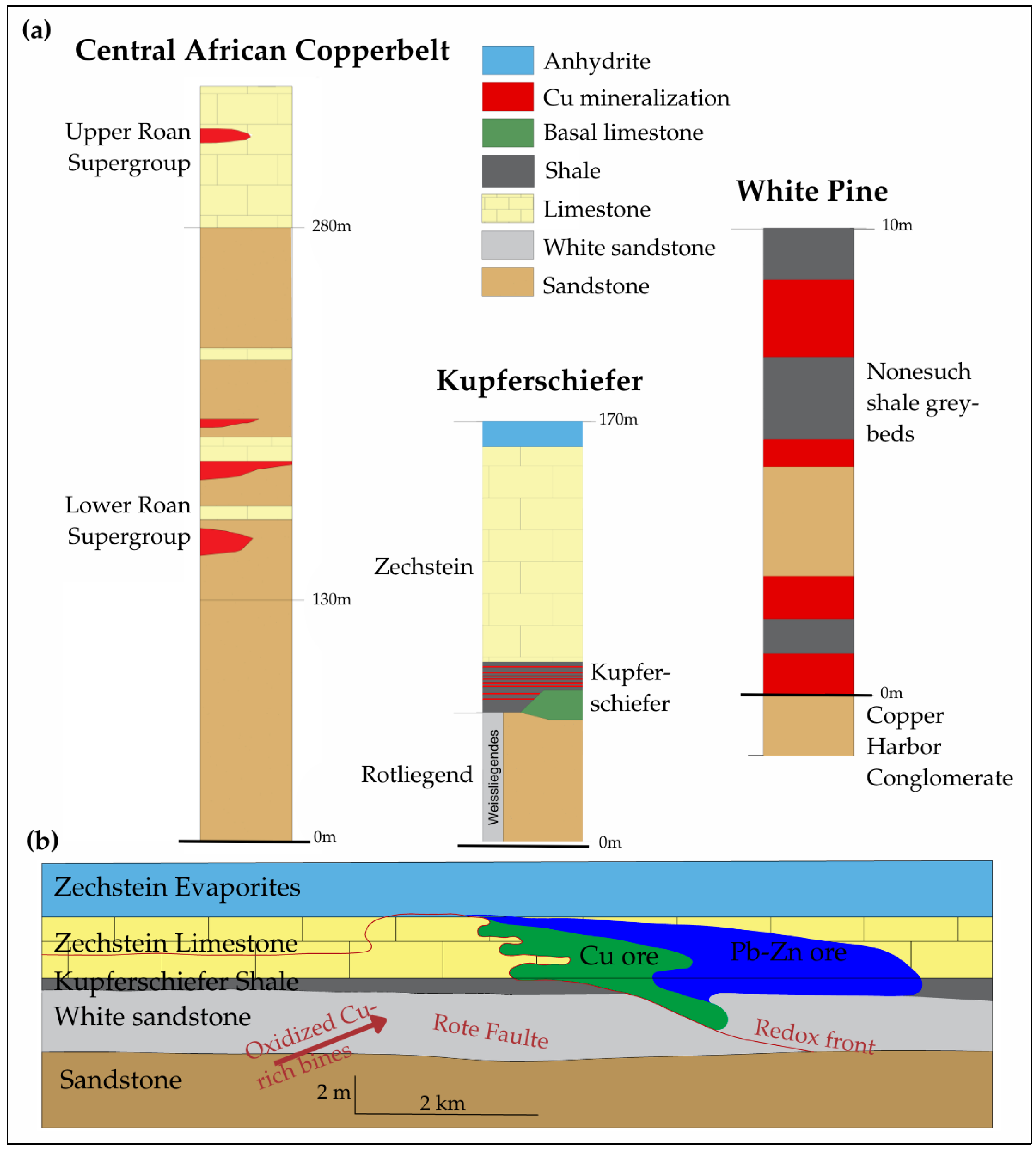
Figure 2. (a) Stratigraphic columns showing positions of Cu mineralization in the Kupferschiefer, Central African Copperbelt and White Pine formations (modified from [45,46]). (b) A model based on Kupferschiefer shows zones from an oxidized red-bed and hematite layer to native copper and sulphur-poor sulphides, then to Cu and Pb/Zn/Co sulphides with pyrite [41,46].
Minerals 16 00250 g002
Figure 4. (a) Deformation of primary VMS ore-body morphology in relation to the geodynamic environment and tectonic regime at different stages of the Wilson Cycle, (b) stratigraphy through Yushui and Sulitjelma deposits with marked mineralization intervals (based on [5]), (c) cross-section through typical VMS deposit showing physical and chemical processes of seafloor mineralization and metal zonation (modified from [69]).
Minerals 16 00250 g004
Figure 5. Geological map showing location of Unki Mine and mines that are suitable for implementation of NRE method (modified from [37]).
Minerals 16 00250 g005
Figure 6. Workflow for evaluating the suitability of stratiform ore bodies for Narrow Reef Mining Equipment (NRE), from geological input data to final NRE suitability classification. Geological data are first pre-processed by classifying ore body dip and thickness into discrete score categories. These scores are then combined to estimate NRE efficiency and assign the ore body to a suitability class (high, conditional, low, or unsuitable). For case studies characterized by wide dip and/or thickness ranges (e.g., dip 10–35°, thickness 1–4 m), a dip or thickness score of 2 represents conditional NRE suitability, reflecting uncertainty related to data scale (panel or ore body/mine scale).
Minerals 16 00250 g006
Figure 7. (a) Distribution of representative stratiform ore deposits evaluated in this study, classified by deposit type and their relative suitability for Narrow Reef Mining Equipment. The upper panel illustrates the global spatial distribution of major magmatic PGE-Ni-Cu deposits (reef-type and contact-/feeder-type), sediment-hosted Cu and Au deposits, and VMS and SEDEX hydrothermal deposits, color-coded according to NRE suitability classes and corresponding NRE efficiency ranges. (b) Geological and mining overview of the Bushveld Complex, which represents the most favorable stratiform ore system for NRE implementation. Individual mining operations shown in the lower panel are additionally color-coded according to the NRE scoring results.
Minerals 16 00250 g007
Figure 8. The 4E grade (g/t) profiles with stoping width for NRE and conventional method (130 cm) and LP method (200 cm) (modified from [40]).
Minerals 16 00250 g008
Figure 9. Graphical view of key elements impacting extraction and recovery; data taken from Table 3 and Table 4 (this study).
Minerals 16 00250 g009
Figure 10. Average extraction costs in USD/t calculated from Table 3 and Table 4 (this study) and taken from [87] for comparison.
Minerals 16 00250 g010
Table 1. Overview of stratigraphy, host rocks, ore minerals and thickness/dip parameters for NRE-suitable ore deposits (Supplementary Materials File S2). Abbreviations: Azurite (Azu); Bornite (Bn); Carrollite (Cli); Chalcocite (Cc); Chalcopyrite (Ccp); Chromite (Chr); Cobaltite (Cbt); Gold (Au); Magnetite (Mag); Malachite (Mlc); Marcasite (Mrc); Native copper (Cu); Pentlandite (Pn); Pyrite (Py); Pyrrhotite (Pyh); Uraninite (Urn) [82]. Lateral continuity was classified as: deposit-scale (tens to hundreds of kilometres), ore body-scale (several kilometres), or panel-scale (hundreds of meters to 1–2 km).
Locality/Ore DepositAgeHost RocksOre
Assemblages
General
Thickness/Dip
Lateral
Continuity
NRE-
Suitability
BushveldMerensky Reef~2.1 Ga(Pegmatitic)
pyroxenite
Pyh, Pn, Ccp, Bg,
Cpe, Spy, Chr
1.5 m/
10–20°
Deposit-
scale
High
UG2 reefChromititeChr, Pyh, Pn, Lrt,
Cpe, Bg
0.8–1.8 m/
10–20°
Deposit-
scale
High
MG, LGChromititePyh, Ccp, Pn, Cpe, Bg~1.7 m/
10–20°
Deposit-
scale
High
Great DykeMain
Sulphide Zone
~2.57 GaOrthopyroxenite,
websterite
Pyh, Pn, Ccp, Spy, Mcr, Mrk, Mnc, Mln, Hst, Rck, Vln, Alt, Hlw, Gdf, El2–8 m/
5–20°
Deposit-
scale
High
MuskoxPGE reef~1.27 GaChromititePyh, Ccp, Pn, Bg,
Spy, Chr
10′s of cm/
3–5°
Ore body-scaleHigh
Fedorova PanaNorth Reef~2.5 GaGabbronoritePyh, Pn, Spy, Bg3–6 m/
25–70°
Panel-
scale
Conditional
VuruchuaivenchPGE reef~2.5 GaGabbronorite,
anorthosite
Pd-As, Bi-Te, Pln, Au, El, Kus, Nau, Hst, Cth, Cbt, Gdf1–3 m/
15°
Panel-
scale
High
SkaergaardPlatinova
Reef
~55 MaGabbro,
ferro gabbro
Bn, Cc, Skg, Tac, Ccp, Mag, Pyh, Mcc1–3 m/
20°
Ore body-scaleHigh
Kupferschiefer~290 MaShale,
sandstone,
carbonate
Ccp, Bn, Cc, Aca,
Mlc, Azu
~1 m/
2–6°
Deposit-
scale
High
Central African
Copperbelt
NeoproterozoicSandstone,
agrilite,
dolomite, shale
Ccp, Mlc,
Azu, Cli
1–3 m/
15–40°
Ore body-scaleConditional
White PinePrecambrianSandstone,
siltstone, shale
Cc, Cu, Pyavg. 2 m/
3–5°
Panel-
scale
High
Witwatersrand
(Main, Bird, and
Kimberley Reef groups)
3–2.7 GaQuartz pebble
conglomerate
Urn, Au, Py,
pyrobitumen
0.5–2 m/
2–45°
Ore body-scaleConditional
Yushui mining
district
~308 MaDolostone,
sandstone
Py, Ccp, Bn, Sph, Gn, Hmt, Sd2–3 m/
10–25°
Panel-
scale
Conditional
Sulitjelma
mining district
PaleozoicAmphiboliteCcp, Py, Gn, Sph<1.7 m/
<20
Panel-
scale
High
Table 2. Mining face parameters for NRE, LP and conventional method. Data source: NRE and conventional mining method taken from Bokoni Mine using breast mining layout (DOK-ING Ltd., Bokoni test site internal report) and LP method taken from Unki Mine internal report using Board and Pillar mining layout.
Parameter/Mining MethodNRELPConventional
Stoping width (cm)130200130
Face Length (m)30.68.6130.6
Face Height (m)1.32.021.3
Face Area (m2)39.7817.3939.78
Drilling Holes per Face10463104
Advance (m)12.941.9
Table 3. Monthly production and value of extracted elements for NRE, LP and conventional mining methods. Data source: Production—Unki Mine internal report, Low Profile using Board and Pillar mining layout and Bokoni Mine, NRE and conventional mining method using breast mining layout (DOK-ING, Bokoni test site internal report); Grade—Unki mine internal report. Prices per gram: Platinum—53.34 USD/g, Palladium—47.15 USD/g, Gold—139.72 USD/g, Rhodium—254.01 USD/g, and Iridium—145.46 USD/g; [83]. Price per ton: Nickel—15,310 USD/t, Copper—15,310 USD/t [83].
ParameterNRELPConventional
Production m22558.161442.86487.00
Production m33325.612914.58633.10
Ore (t)10,64287442026
Pt grade (g/t)2.802.142.80
Pt metal (t)0.029800.018710.00567
Pt value (USD)1,588,382997,441302,382
Rh grade (g/t)0.270.220.27
Rh metal (t)0.002870.001920.00055
Rh value (USD)729,799488,583138,933
Pd grade (g/t)1.971.731.97
Pd metal (t)0.020960.015130.00399
Pd value (USD)988,126712,966188,111
Au grade (g/t)0.370.270.37
Au metal (t)0.003940.002360.00075
Au value (USD)550,179329,870104,738
Total PGE value (USD)3,856,4852,528,860734,163
Ni grade (ppm)229317672293
Cu grade (ppm)172113291721
Ni metal (t)24.4015.454.65
Cu metal (t)18.3111.623.49
Ni value (USD)373,596236,54971,124
Cu value (USD)194,925123,68037,109
TOTAL (Cu + Ni) (USD)568,521360,229108,233
TOTAL metals value (USD)4,425,0062,889,089842,396
Table 4. Monthly costs and profit for each mining method.
Cost CategoryNRE
(USD/Month)
LP
(USD/Month)
Conventional
(USD/Month)
Labor Requirements15,30015,30023,000
Equipment Costs65,400101,4001400
Supply Requirements335,600174,00085,000
Total Operating Costs416,300290,700109,400
Production Profit4,008,7062,598,389732,996
Disclaimer/Publisher’s Note: The statements, opinions and data contained in all publications are solely those of the individual author(s) and contributor(s) and not of MDPI and/or the editor(s). MDPI and/or the editor(s) disclaim responsibility for any injury to people or property resulting from any ideas, methods, instructions or products referred to in the content.