Article

Interstitial Microstructures in the Baima Gabbro Pegmatite, SW China: Constraints on the Late-Stage Evolution Processes in Mafic Pegmatites

1
School of Geosciences, Yangtze University, Wuhan 430100, China
2
Key Laboratory of Coalbed Methane Resources and Reservoir Formation Process, Ministry of Education, China University of Mining and Technology, Xuzhou 221116, China
3
Key Laboratory of Strategic Mineral Resources in the Upper Yellow River, Ministry of Natural Resources, Lanzhou Mineral Exploration Institute of Gansu Nonferrous Metal Geological Exploration Bureau, Lanzhou 730000, China
*
Author to whom correspondence should be addressed.
Minerals 2026, 16(3), 245; https://doi.org/10.3390/min16030245
Submission received: 20 January 2026 / Revised: 21 February 2026 / Accepted: 22 February 2026 / Published: 27 February 2026
(This article belongs to the Section Mineral Geochemistry and Geochronology)

Abstract

Interstitial microstructures in igneous rocks record key evidence of late-stage evolution processes. In order to constrain the late-stage evolution of a Baima gabbro pegmatite (Panxi region, SW (Southwestern Sichuan Province), China), we investigated its mineral compositions and late-stage microstructures. These microstructures include replacive symplectites and fish-hook clinopyroxene. Replacive symplectites include fine-grained lamellar intergrowths of anorthite (An)-rich plagioclase + clinopyroxene/amphibole/biotite that are rooted to Fe-Ti oxides and replacing nearby plagioclase primocrysts (Type I) and intergrowths of An-rich plagioclase + clinopyroxene/amphibole that are rooted to olivine and replacing nearby plagioclase primocrysts (Type II). Rare replacive symplectites composed of biotite + plagioclase are also present. Those replacive symplectites and fish-hook clinopyroxene grew at a late magmatic stage with temperatures of 867–1023 °C. An-rich plagioclase in the replacive symplectites and fish-hook textures have An contents up to 94 mol.%, much higher than those of plagioclase primocrysts. Interstitial microstructures are interpreted to reflect interaction between primocrysts and an Fe-rich residual interstitial liquid, consistent with separation and migration of conjugate immiscible melts in a crystal mush. We propose that the hydrous interstitial melt in the Baima gabbro pegmatite may have undergone silicate immiscibility during late-stage magma crystallization. As the crystal fraction increased, crystal-mush compaction and porous melt migration likely became the primary controls on the evolution of the late-stage interstitial melt, rather than convection or diffusion.

1. Introduction

Mafic pegmatites including pyroxenite, gabbro, and norite are common in mafic plutonic and hypabyssal rocks [1,2]. After emplacement, magma begins to solidify and forms a crystal mush composed of a framework of crystals and interstitial liquid, which may exchange mass and heat with the adjacent bulk magma. The exchange of interstitial liquid with the bulk magma was considered to be an important process driving the differentiation of basaltic magma [3]. Despite several studies focused on the differentiation of the main magma body responsible for the formation of a mafic pegmatite [4,5,6,7], studies concerning the evolution of interstitial liquid have received less attention [8].
Commonly, the evolution of interstitial liquid critically depends on the liquid mobility within the crystal mush [9]. During this process, the interstitial liquid can move through the crystal mush, react with primocrysts, and even undergo silicate immiscibility [9,10,11]. In mafic pegmatite systems, pegmatite-forming melts are commonly enriched in fluxing volatile components (notably H2O and Cl), which can strongly modify melt properties and crystallization kinetics; moreover, significant undercooling may occur during emplacement (e.g., injection of residual melt into colder host rocks), generating diagnostic comb-like or skeletal growth textures [12,13,14]. Another factor is cooling rate, which controls the extent to which diffusive processes can operate during the super-solidus history of the mush [9]. These factors may have a significant impact on the evolution of the interstitial liquid, but their effects remain poorly constrained.
The Baima gabbro pegmatite in the Panxi area, SW China, is exposed along the eastern side of the Baima layered intrusion. In this study, we document abundant microstructures that can record and constrain the evolution of interstitial melt in a crystal mush [9,10,15]. Our observations suggest that silicate immiscibility may have occurred in the interstitial liquid of the Baima gabbro pegmatite. Volatile components may have remained influential during late-stage solidification. Pegmatitic textures may therefore develop in response to high-temperature volatile enrichment of a nominally basaltic intercumulus melt.
This study focuses on the Baima gabbro pegmatite and aims to constrain the late super-solidus evolution of interstitial melts in a volatile-rich crystal mush. We systematically document and classify reaction microstructures, including replacive symplectites and fish-hook clinopyroxene, and integrate mineral chemistry with bulk symplectite and bulk melt inclusion compositions to evaluate whether silicate liquid immiscibility and conjugate-liquid segregation occurred. We further discuss the dominant mechanisms controlling the mobility and redistribution of interstitial liquids during the super-solidus stage.

2. Geological Background

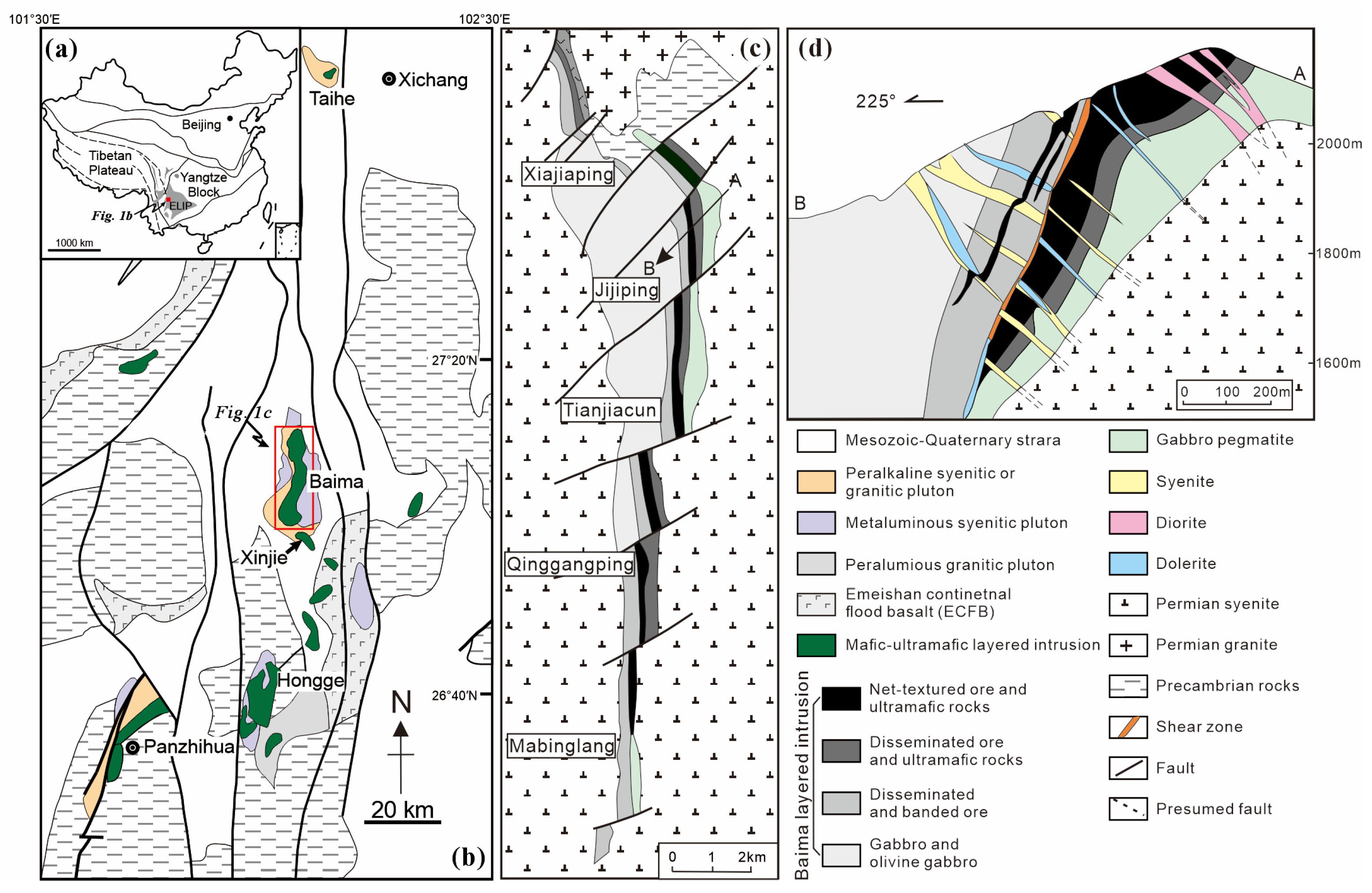
The Emeishan large igneous province (ELIP) is neighbored by the Tibetan Plateau to the west and the Yangtze Block to the east [16] (Figure 1a). The Baima Complex is located along the N–S trending fault belt in the central part of the ELIP (Figure 1a). It intruded the metamorphic rocks of the Precambrian Huili Group, which consist of marbles, schists and migmatitic granites, as well as the carbonates of the Sinian Dengying Formation. Hornfels commonly occur along the contact between the country rocks and the intrusion. The Baima Complex consists of the Baima layered rocks and the Baima gabbro pegmatite in the middle, and is associated with coeval syenitic and granitic plutons. Syenite dikes locally intrude the gabbro pegmatite [17]. The Baima layered rocks are cut and displaced by a series of NE–SW-trending faults into the Xiajiaping, Jijiping, Tianjiacun, Qinggangping and Mabinglang segments from north to south (Figure 1c).
The Baima gabbro pegmatite is exposed on the eastern side of the layered intrusion and intrudes along its lower part (Figure 1c,d and Figure 2a). It strikes near north–south and dips westward at 40–60°, extending for ~16 km along strike and ranging from 100 to 800 m in width. The gabbro pegmatite locally engulfs and encloses parts of the overlying Fe-Ti oxide–rich layers in the Baima layered intrusion. The mineral grain size at the bottom of the Baima layered rocks in contact with the pegmatite is apparently coarser than other parts of the Baima intrusion.

3. Petrography

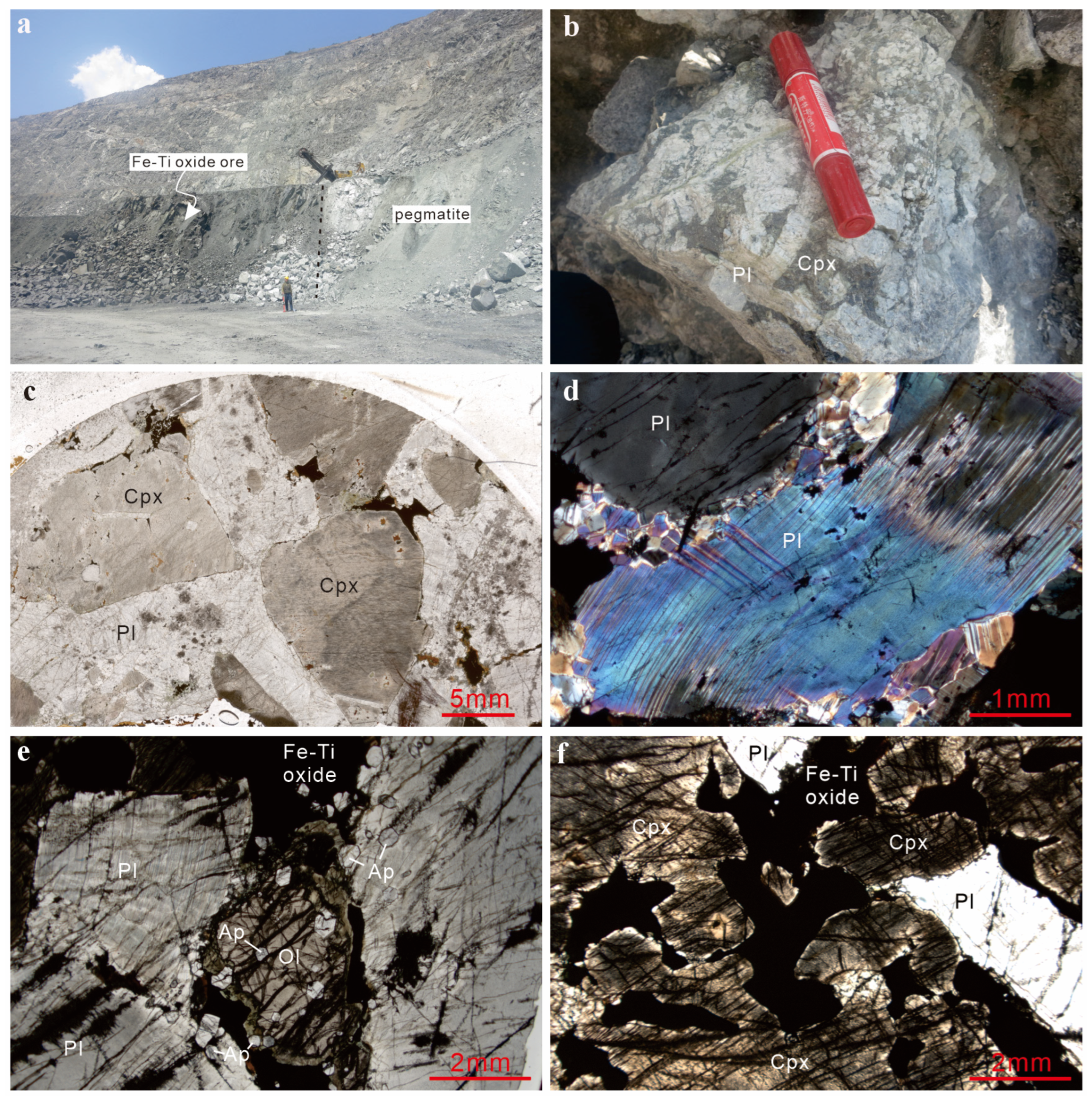
The Baima gabbro pegmatite mainly consists of clinopyroxene and plagioclase grains, with some Fe-Ti oxides, olivine, and minor apatite (Figure 2b–f). The plagioclase is commonly subhedral to euhedral with a size > 1 cm (Figure 2b). The clinopyroxene grains are comparable to plagioclase in size. Some plagioclase grains exhibit bent polysynthetic twins and are adjacent to fine-grained plagioclase aggregates (Figure 2d). Olivine grains are 0.3–5 mm in size (Figure 2e), and some have been altered to serpentine. Euhedral apatite occurs in the interstitial domains; some grains remain interstitial, whereas others are locally enclosed by olivine and plagioclase (Figure 2e). Fe-Ti oxides contain magnetite and ilmenite. Anhedral Fe-Ti oxides occur mainly as an interstitial network along grain boundaries between clinopyroxene and plagioclase (Figure 2f).

4. Late-Stage Microstructures in the Baima Gabbro Pegmatite

Late-stage microstructures including fish-hook texture and replacive symplectites can be observed in the Baima gabbro pegmatite. Replacive symplectites appear as lamellar clinopyroxene/amphibole/biotite + An-rich plagioclase.

4.1. Fish-Hook Texture

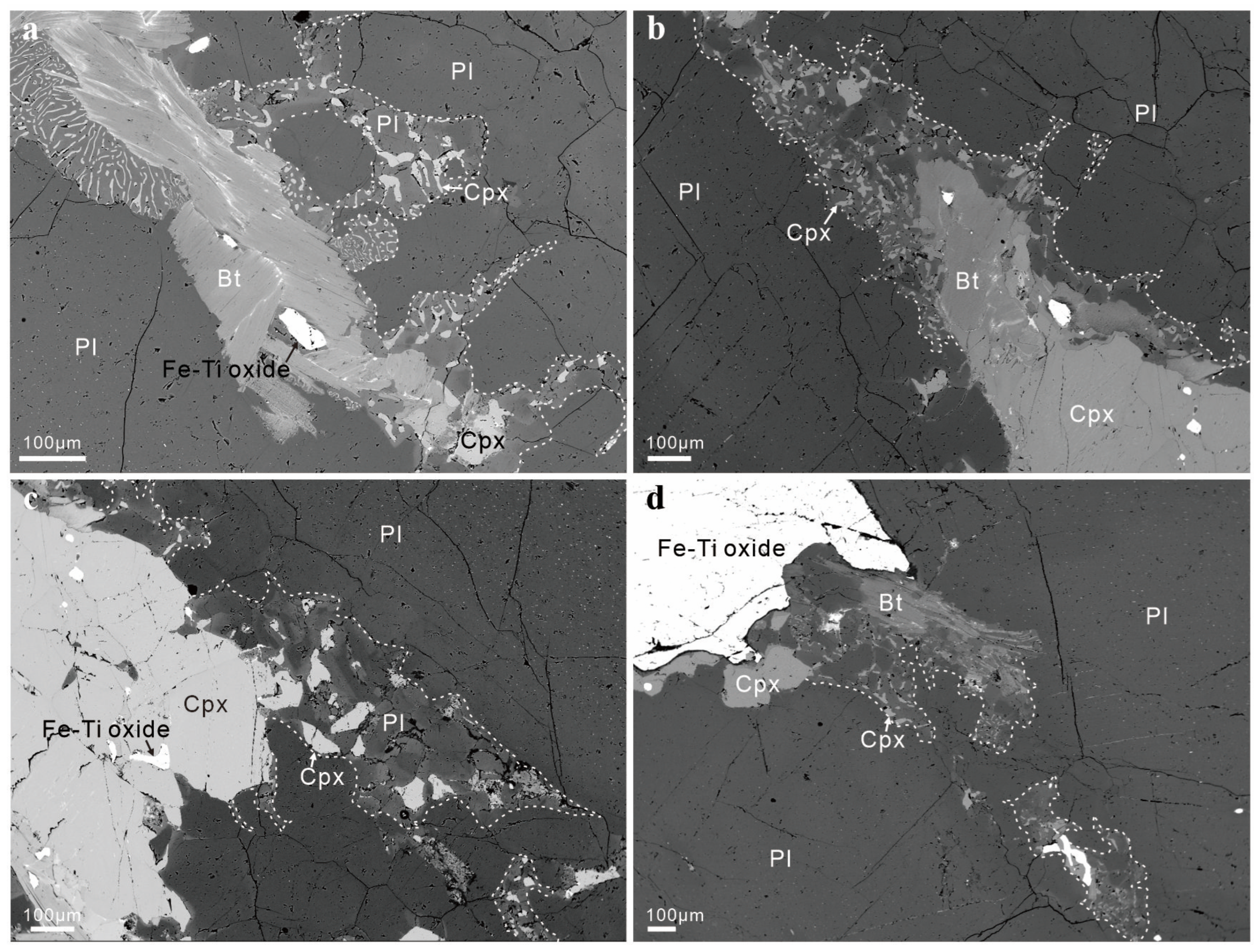
Fish-hook texture comprises irregular filaments of clinopyroxene, intergrown with An-rich plagioclase (Figure 3a–d). The clinopyroxene filaments are <20 μm. They are found on plagioclase–plagioclase grain boundaries, commonly extending from the corners and the edges of the pyroxene (Figure 3a–c) or beside interstitial biotite (Figure 3a,d). Clinopyroxene crystals in the fish-hook form string-like elongate groups (Figure 3a,b). In some cases, fish-hook filaments occur adjacent to replacive symplectites and locally appear to transition into finer replacive symplectites (Figure 3c,d).

4.2. Replacive Symplectite

The replacive symplectites in the Baima gabbro pegmatite are composed of fine-grained lamellar intergrowths of An-rich plagioclase with mafic silicates as pyroxene ± amphibole ± biotite. The symplectitic intergrowth and the root phase are separated by a mono-mineralic rim or substrate, with a thickness of <200 μm. According to the root phase, the replacive symplectites can be divided into two types. Type I symplectite is defined as the symplectite that bears a root phase of Fe-Ti oxide, whereas when the root phase is olivine, the symplectite is named Type II symplectite.

4.2.1. Type I Symplectite

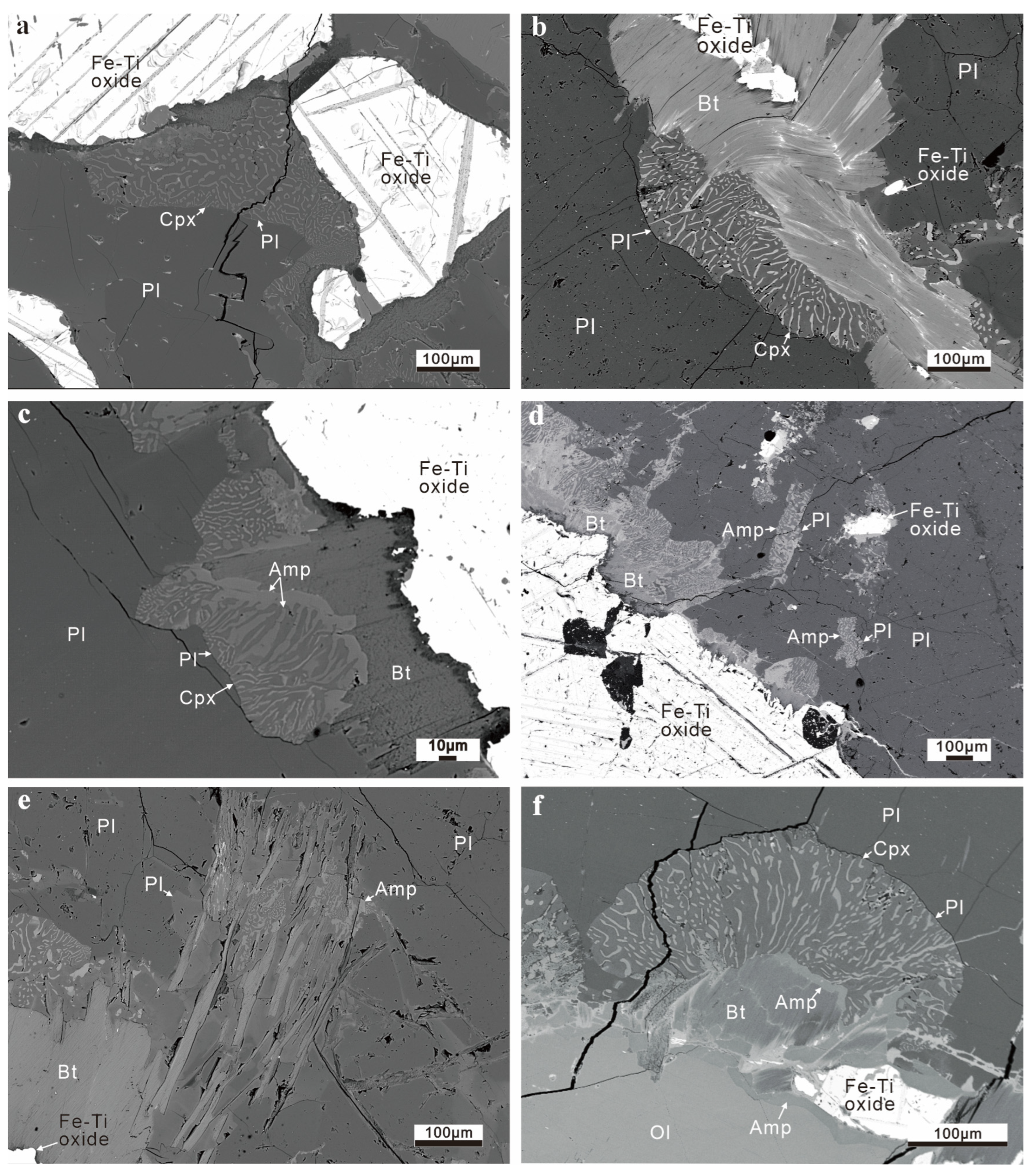
Type I symplectite rooted to Fe-Ti oxides commonly extends from the oxides and consumes adjacent plagioclase primocrysts (Figure 4a–d). Fe-Ti oxides roots are typically irregular in shape. The mafic silicate lamellae include pyroxene (Type I-a), amphibole (Type I-b) or biotite (Type I-c) (Figure 4a–d) with thicknesses varying from 1 to 20 μm.
The Type I-a symplectite comprises clinopyroxene and An-rich plagioclase (Figure 4a,b). Clinopyroxene lamellae form wormlike intergrowths with a thickness of 2–10 μm, and the lamellae become progressively thinner toward the rim. Occasionally, amphibole randomly occurs in the symplectites (Figure 4a). A substrate of biotite, ranging in width from several micrometers to 100 μm, grows between the Fe-Ti oxide and the symplectite. Although similar symplectites were described in Skaergaard, they contain no amphibole lamellae in the symplectite and have biotite and olivine as substrates [9].
Type I-b symplectite differs from Type I-a in that it contains amphibole (magnesio-hastingsite–pargasite), both as substrate surrounding the oxides and as vermicules in the symplectite itself (Figure 4c). Amphibole wormlike lamellae vary in thickness from 2 to 20 μm. The amphibole vermicules grade out along the growth direction into clinopyroxene. The grain size of amphibole in Type I-b symplectite vermicules is generally coarser than clinopyroxene vermicules. A substrate of amphibole and biotite, ranging in width from several micrometers to 100 μm, grows between the Fe-Ti oxide and the symplectite. Similar symplectites were described in Sept Iles, although they may contain orthopyroxene instead of clinopyroxene [11]. In rare cases, the amphibole + An-rich plagioclase symplectites appear with no Fe-Ti oxide root.
The Type I-c symplectite comprises biotite and An-rich plagioclase (Figure 4e). Biotite lamellae have a thickness of 1−10 μm. A substrate of biotite, ranging in width from 80 to 200 μm, grows between the Fe-Ti oxide and the symplectite. Amphibole wormlike lamellae sometimes grow in spaces between biotite lamellae.

4.2.2. Type II Symplectite

Olivine roots are typically granular in shape in the Type II symplectite. Type II symplectite comprises clinopyroxene and An-rich plagioclase (Figure 4f). Clinopyroxene lamellae form wormlike intergrowths with a thickness of 2−10 μm, and the lamellae become progressively thinner toward the rim. A substrate of amphibole or biotite, ranging in width from several micrometers to 100 μm, grows between the olivine and the symplectite. Some amphibole lamellae occur randomly near the amphibole substrate.

5. Method

Mineral compositions were determined using a JEOL JXA-8100 electron microprobe at the Key Laboratory of Mineralogy and Metallogeny, Guangzhou Institute of Geochemistry, Chinese Academy of Sciences. Analyses were performed using an accelerating voltage of 15 kV and a current of 20 nA with a beam of 1−2 μm.
The standards used for magnetite analyses were garnets for Si, Mg, Al, rutile for Ti, vanadium metal for V, chromium oxide for Cr, magnetite for Fe, manganese oxide for Mn, and olivine for Ni. The analytical error was 2% for Cr and Fe and 5% for other elements. For silicate (olivine, clinopyroxene, orthopyroxene, amphibole, mica) analyses, olivine was used for Si, Mg, Fe and Ni, garnet for Al and Ca, feldspar for Na, rutile for Ti, and MnO for Mn. Analytical error was 2% for Si, Fe and Mg and 5% for other elements. Amphibole cation site occupancies were estimated on the basis of 23O atoms using the Esawi (2004) spreadsheet [20] and were classified according to Leake et al. (1997) [21].

6. Results

6.1. Primocryst Composition

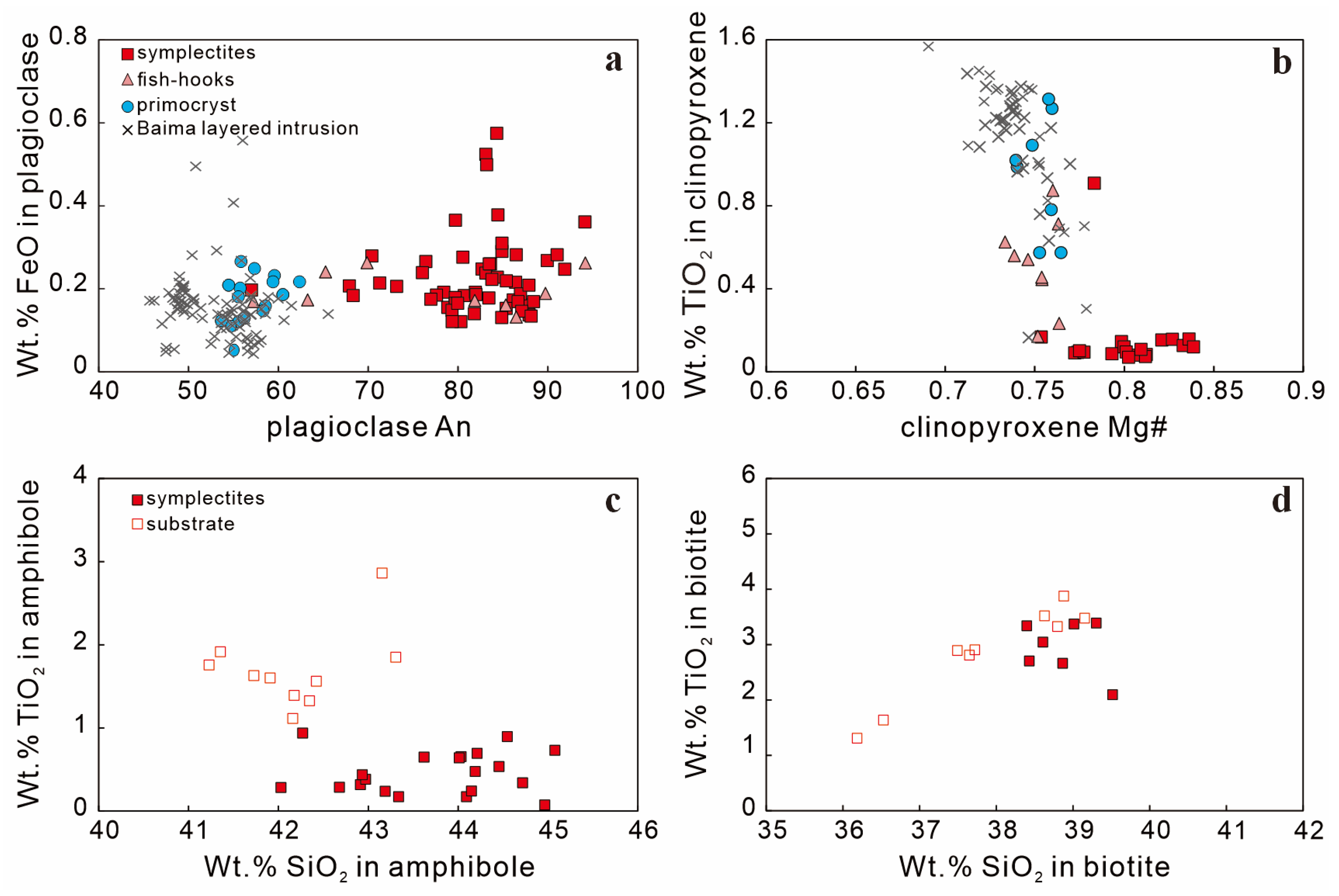
The primocryst compositions are listed in Supplementary Material File S1. Plagioclase primocrysts contain 54–62 mol.% anorthite (An), 0.05–0.27 wt.% FeO and <0.25 wt.% TiO2 (Figure 5a). Clinopyroxene primocrysts contain 74–76 Mg# (100[Mg/(Mg + Fe)]) mol.%, 0.57–1.31 wt.% TiO2, 1.88–3.98 wt.% Al2O3 (Figure 5b). Olivine grains contain a narrow range of Mg# (70–72) and MnO (0.43–0.44 wt.%). Most TiO2 contents are below the detection limit. No obvious zonation has been observed in plagioclase, clinopyroxene and olivine primocrysts. The compositions of plagioclase (An) and clinopyroxene (Mg#) are comparable to those from the Baima layered rocks (Figure 5a,b).
Other minor minerals, including apatite and Fe-Ti oxide data, are in Supplementary Material File S1. Apatite contains 1.79–2.55 wt.% F and 0.08–0.70 wt.% Cl.

6.2. Compositions of Minerals from Microstructures

The compositions of minerals from microstructures are listed in Supplementary Material File S2. Plagioclase in symplectites contains 57–94 mol.% An and 0.12–0.58 wt.% FeO, whereas plagioclase from fish-hooks contains 57–94 mol.% An and 0.13–0.26 wt.% FeO. Overall, plagioclase associated with these microstructures spans similarly high An contents and shows overlapping FeO contents, and plagioclase in both microstructures extend to higher An–FeO values than plagioclase primocrysts in the Baima gabbro pegmatite (Figure 5a).
Clinopyroxene in symplectites contains 75–84 Mg#, 0.76–5.27 wt.% Al2O3, and <0.91 wt.% TiO2. Clinopyroxene in fish-hooks contains 73–76 Mg#, 0.82–2.32 wt.% Al2O3 and 0.17–0.87 wt.% TiO2. The clinopyroxene in fish-hooks and replacive symplectites has slightly higher Mg# and CaO content and lower minor element concentrations (Ti, Mn and Na) than primocryst clinopyroxene (Figure 5b for Ti and Mg#; see Supplementary Material File S2).
Amphibole lamellae in symplectites contains 66–79 Mg#, 42.03–45.08 wt.% SiO2, 0.08–0.94 wt.% TiO2. Amphibole substrate contains similar Mg# (69–77) while higher TiO2 contents (1.12–2.86 wt.%) and lower SiO2 (41.23–43.31 wt.%) than lamellae (Figure 5c).
Biotite lamellae contains a lower range of Mg# and similar TiO2 contents than biotite substrate (78–82 and 81–84, respectively; 2.10–3.39 wt.% and 1.31–3.88 wt.%, respectively) (Figure 5d). SiO2 contents of biotite lamellae are comparable to those of biotite substrate.

6.3. Minerals from Texture Traverse

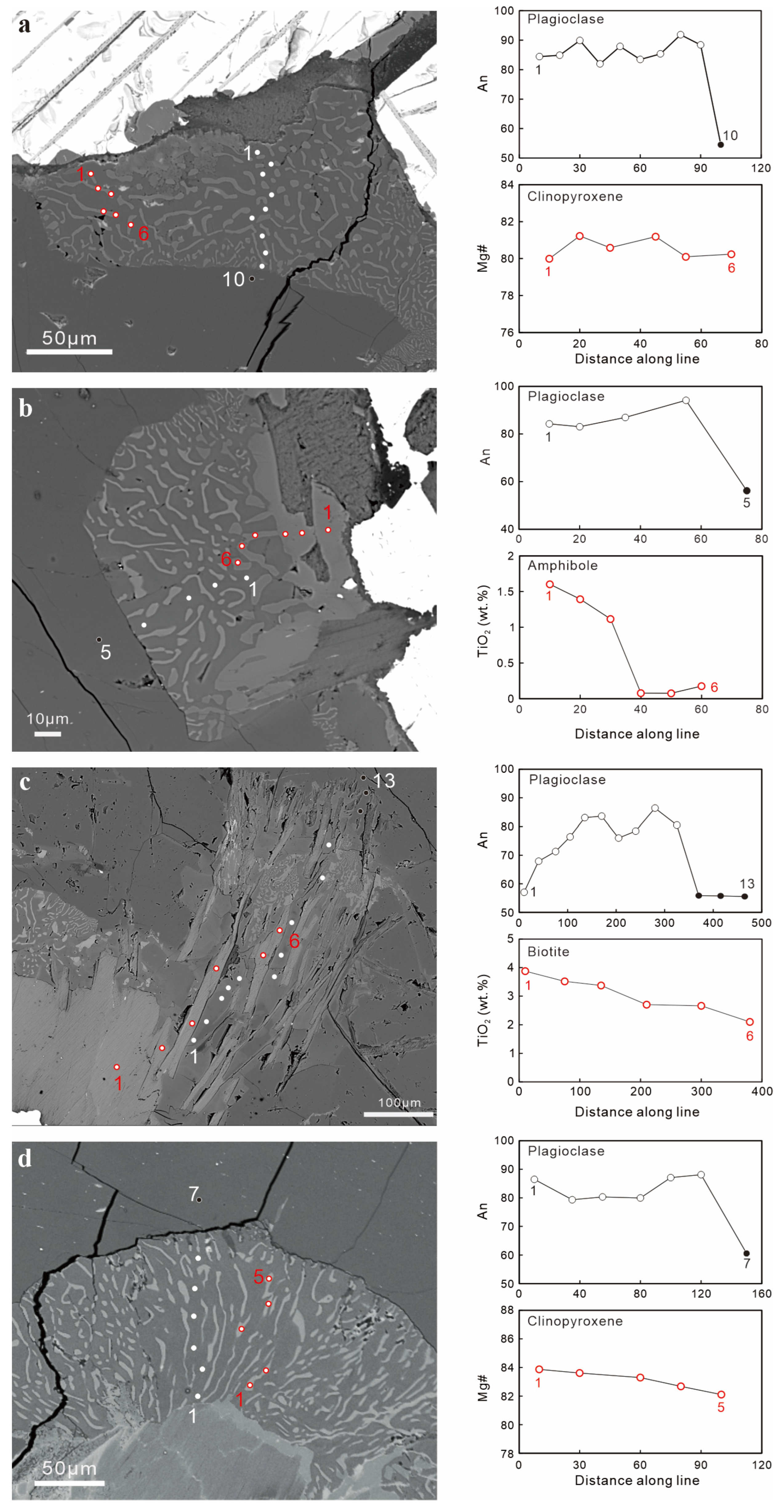
For both Type I and II symplectites, there are no well-defined and consistent com-positional spatial variations in anorthite content within every single symplectite (Figure 6, Supplementary Material File S2). Instead, the An content varies in distinct ‘pulses’ and can either monotonically increase or decrease, or oscillate along the growth direction. Within a symplectite, the composition can vary by up to 30 mol.% An (Figure 6c). In each symplectite, plagioclase vermicules contain much higher An contents (as much as 38 mol.% An) than the primocryst plagioclase that is being replaced.
The clinopyroxene vermicules in the replacive symplectite are commonly too narrow for microprobe analyses (<1 μm), so only three clinopyroxene traverses were obtained. For the Type I-a and Type II replacive symplectites, compositional trends of Mg# vary. They show oscillatory compositional trends or continual decreasing/increasing trends in Mg# before decreasing or increasing systematically in Mg# by 1–3 mol.% along the growth direction (Figure 6a,d, Supplementary Material File S2). Apparent continuous increasing trends or oscillatory compositional trends in Al2O3 can also be observed. The TiO2 contents show an overall consistent decrease along the growth direction (Figure 6, Supplementary Material File S2).
The amphibole vermicules in Type I-b symplectite show consistent compositional trends of decreasing systematically in TiO2 contents (Figure 6b). If the rim is present, the symplectite has an initial composition similar to the amphibole rim. The biotite vermicules in Type I-c symplectite show similar decreasing TiO2 contents as amphibole in the I-b (Figure 6c).

7. Discussion

7.1. Formation of the Reactive Microstructures in the Baima Gabbro Pegmatite

Five kinds of reactive microstructures are documented in the Baima gabbro pegmatite. Similar microstructures have been reported in several layered intrusions [9,11,22,23,24]. However, the fish-hooks and replacive symplectites documented here contain more hydrous minerals, such as biotite and amphibole. Biotite commonly occurs as a substrate in most symplectites in the Baima gabbro pegmatite (Figure 4). Type I-b, some Type I-c, and Type II symplectites contain considerable amounts of amphibole lamellae. The observations suggest that volatile influence may have been more pronounced in the Baima gabbro pegmatite than in the Skaergaard intrusion, as indicated by the common occurrence of amphibole and biotite in the reaction textures (Figure 4) [9,11]. However, the volatile contents of the reactive/interstitial liquid cannot be quantified with the present dataset.
The formation temperatures of replacive symplectites are constrained using different thermometers. The amphibole thermometer of [25] indicates that amphibole substrates and amphibole lamellae in replacive symplectites formed at 867–1023 °C (average, 928 °C) and 950–1017 °C (average, 996 °C), respectively. Pairs of amphibole and adjacent plagioclase yield a similar temperature range of 894–936 °C, with an average of 913 °C, calculated using the thermodynamic model of [26]. Such high temperatures are likely a consequence of a late-stage super-solidus magmatic process [9]. These temperatures are interpreted as approximate estimates for late-stage super-solidus conditions.
The bulk compositions of replacive symplectites are obtained by the mass-balance methods of [9,11]. The results show that all symplectite types in the Baima gabbro pegmatite involve the loss of Si, Al, and Na and the gain of Fe and Mg (Table 1). Therefore, they likely formed in a super-solidus magmatic open system.
Super-solidus open-system signatures in crystal mushes can be generated by different processes. One involves migration of hydrous fluids and/or melts through partially solidified rocks (reactive porous flow), producing infiltration–reaction textures [27,28,29,30,31,32]. Another involves silicate liquid immiscibility in interstitial melt followed by preferential migration and/or loss of a buoyant Si-rich conjugate, leaving a residual Fe-rich conjugate that is strongly out of equilibrium with primocryst phases and can trigger replacive reactions [9,11,22,33,34,35]. In some layered intrusion case studies, conjugate separation and Si-rich loss have been discussed in connection with late-stage mush conditions at temperatures on the order of ~1020 °C in specific stratigraphic settings [9,11,22,33,34,35]; however, the effectiveness of conjugate separation depends not only on temperature but also on the occurrence of immiscibility and the permeability/connectivity of the mush.
In the Baima gabbro pegmatite, we did not observe pervasive plagioclase resorption textures commonly reported in some reactive porous flow examples (e.g., irregular dissolution fronts, fingering-related compositional zoning, and widespread loss of primary grain shapes) [11]. Orthopyroxene, reported in certain reactive porous flow assemblages, was also rare in our samples. Therefore, our microstructural observations provide limited support for reactive porous flow as the dominant mechanism, although it cannot be excluded solely on the basis of a single criterion. Instead, we suggest that the replacive symplectites may have developed predominantly through reaction between a residual Fe-rich conjugate and surrounding primocrysts after preferential migration/loss of the buoyant Si-rich conjugate.
The very high An contents of plagioclase in the late-stage intergrowths, together with the sharp compositional contrast with adjacent plagioclase primocrysts even at direct contacts, have also been documented in classic layered intrusions [9,11]. At these contacts, plagioclase primocrysts locally show embayed/irregular margins, consistent with interface-controlled dissolution–reprecipitation during localized replacement. In particular, symplectitic plagioclase has been shown to be commonly more anorthitic and Fe-rich (and poorer in TiO2) than coexisting primocrysts, with sharp boundaries between the two; similarly, anorthitic plagioclase may also develop along stepped grain boundaries intergrown with fish-hook pyroxene [9]. Cathodoluminescence (CL) observations further show that high-An domains can be concentrated within reactive intergrowths and along grain boundaries or within the outer few microns of primocrysts, whereas lower-An cores may remain preserved, consistent with localized replacement fronts rather than pervasive re-equilibration of primocryst interiors [11]. CL mapping of Baima plagioclase was not conducted in this study, so the grain-scale distribution of such domains cannot be directly evaluated here. Accordingly, the high-An plagioclase and its sharp contrast with primocrysts can be explained without invoking wholesale re-equilibration of primocryst interiors, and are compatible with an open-system melt-mediated process in which chemically distinct interstitial liquids migrated through the grain boundary network during the late super-solidus stage, potentially including conjugate liquids produced by silicate liquid immiscibility.
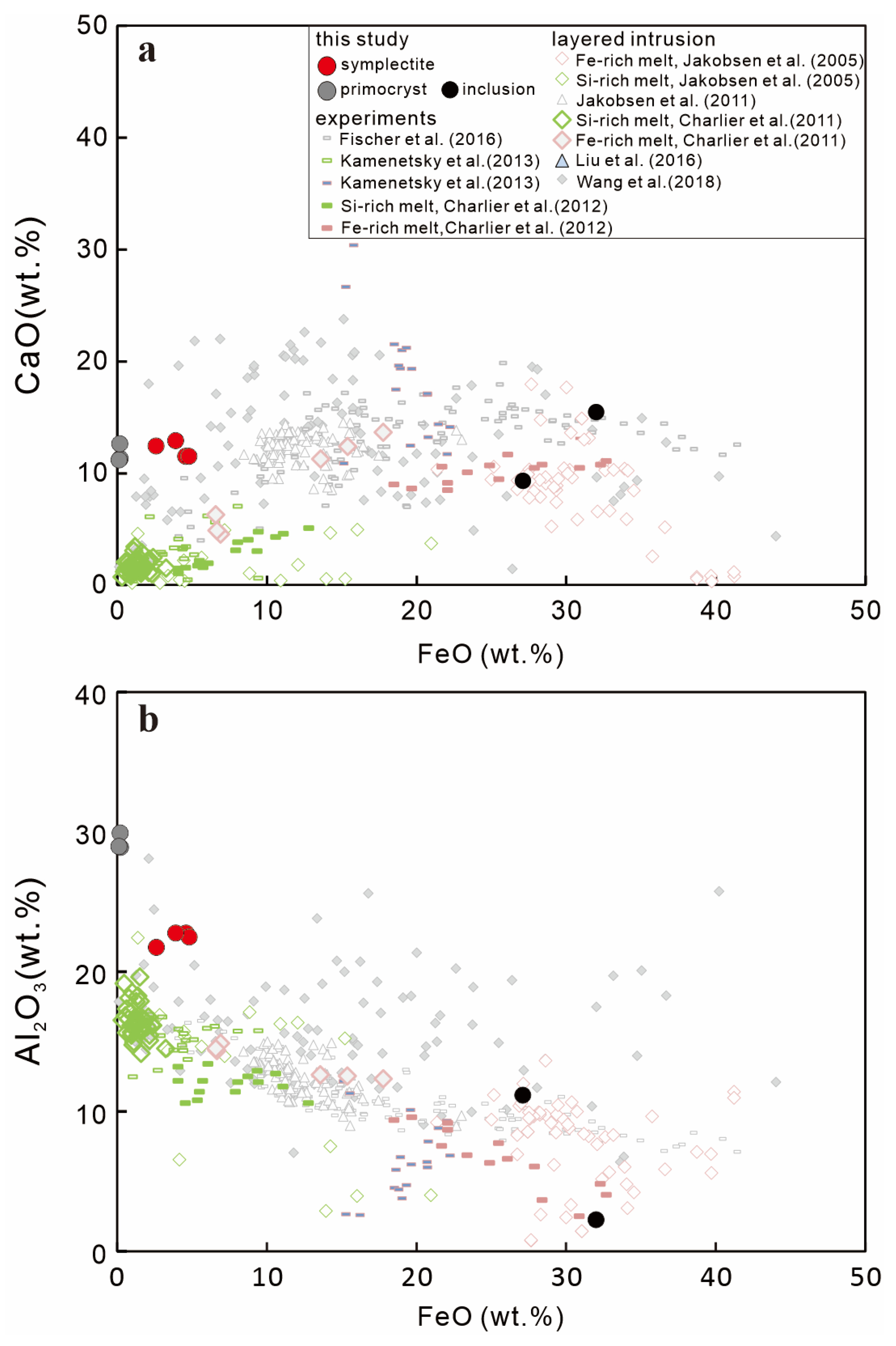
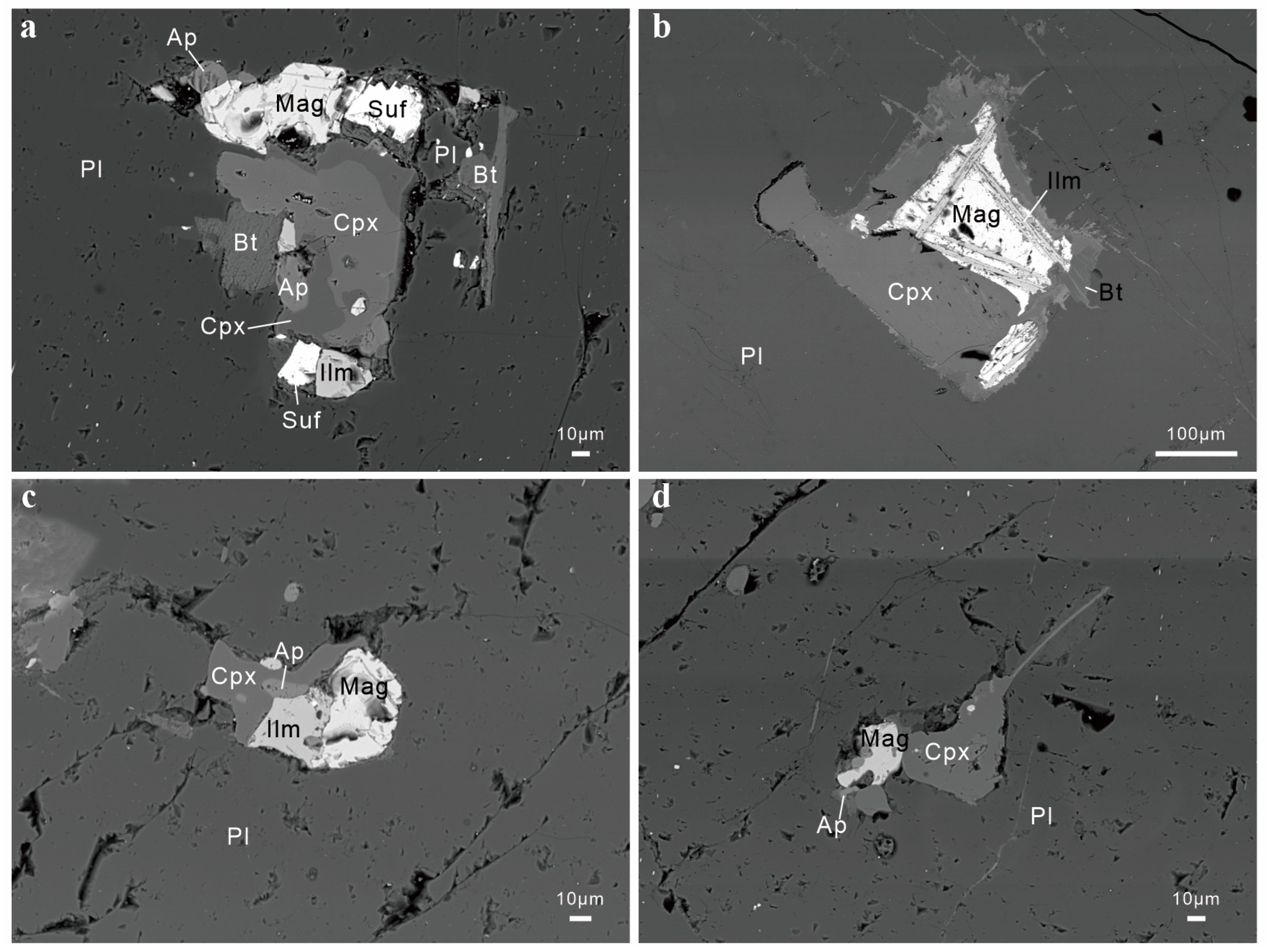
Abundant melt inclusions trapped in plagioclase in the Baima gabbro pegmatite are composed of magnetite + clinopyroxene ± biotite/ilmenite/sulfide/apatite in different proportions. We analyzed the compositions of minerals in some inclusions and estimated their bulk compositions. The averaged compositions are comparable to the immiscible Fe-rich melt in other intrusions and experiments (Figure 7; Table 1), and representative examples are shown in Figure 8. The bulk compositions of the symplectitic intergrowths can be reproduced by mixing an Fe-rich endmember with a plagioclase component (Figure 7a,b), consistent with the model of [9,11]. The greater abundance of amphibole/biotite lamellae and biotite substrates in the Baima gabbro pegmatite, relative to many layered intrusion examples, may be consistent with an enhanced volatile influence during late-stage evolution of the interstitial melt.

7.2. Evolution of Interstitial Melt in the Baima Gabbro Pegmatite

Although amphibole and biotite are abundant within the reactive microstructures, we treat this mainly as evidence for an inferred volatile influence during late super-solidus evolution rather than as a quantitative constraint on melt volatile contents. Direct constraints on H2O, F and Cl in the interstitial melt are not available for Baima at present. Apatite contains 1.79–2.55 wt.% F and 0.08–0.70 wt.% Cl (Supplementary Material File S1), indicating that halogens were present in the late-stage interstitial melt. However, F–Cl data for amphibole and biotite are not available in the current dataset, so halogen partitioning among apatite, amphibole and biotite cannot be quantified. Systematic F–Cl analyses of amphibole and biotite from different interstitial sites would be needed to evaluate possible halogen redistribution and/or degassing during late-stage evolution.
Reactive microstructures interpreted to record reactions between an immiscible Fe-rich liquid and primocryst minerals have been documented in several layered intrusions [9,11,24,43]. These classic examples are generally linked to basaltic systems with low fluid contents, whereas gabbro pegmatites are commonly inferred to crystallize from volatile-enriched melts, with volatiles remaining influential during the late stages of solidification [8,44,45]. In Baima, amphibole and biotite occur predominantly within replacive microstructures rather than as early primocrysts, suggesting that volatile influence persisted into a late, super-solidus stage, and that a volatile phase may have been present or exsolved during this interval [8]. Such volatile enrichment could lower melt viscosity, modify crystallization kinetics, and thereby influence mass transport and chemical exchange during interstitial-melt evolution.
Importantly, we acknowledge that an Fe-rich residual melt does not uniquely require silicate liquid immiscibility. Volatile-bearing residual melts could also evolve toward Fe-enriched compositions without unmixing because volatiles can modify phase equilibria and crystallization kinetics, potentially affecting when and how efficiently Fe–Ti oxides crystallize. Volatiles may also influence late-stage plagioclase compositions during fluid-assisted replacement and thus contribute to the development of An-rich plagioclase in the replacive microstructures. We therefore treat immiscibility as a plausible interpretation rather than a unique requirement.
If silicate liquid immiscibility was attained, cooling rate and the mechanisms of mass transport in a solidifying mush zone control the separation and relative movement of conjugate immiscible liquids, which ultimately generate these microstructures [9]. Rapid heat loss to cooler wall rocks can produce substantial liquidus undercooling (ΔT, i.e., cooling below the equilibrium liquidus), which has been widely invoked as a first-order control on the development of pegmatitic textures [12,13,46,47]. Textures commonly linked to appreciable undercooling include graphic/granophyric intergrowths and comb-like fabrics; therefore, their absence in the Baima pegmatite suggests that undercooling was unlikely to be the primary control on the rock- and microstructure-forming processes [13,46,48].
High cooling rates—typically highest near intrusion margins and along the walls of dike-like bodies—can rapidly “freeze” interstitial melt within a crystal mush, suppressing melt mobility and limiting the separation and relative movement of immiscible conjugate liquids [9]. Under such conditions, the formation of abundant reaction-related microstructures driven by conjugate–liquid segregation would be inefficient [9]. However, abundant reactive microstructures are developed in the Baima gabbro pegmatite. The Baima gabbro pegmatite occurs as a dike-like body ∼100–800 m wide, so rapid cooling would likely have been strongest at the margins, whereas the interior could have retained heat for longer. The abundance of reactive microstructures therefore implies that interstitial melt was not quenched rapidly enough everywhere within the body to completely inhibit melt redistribution. A comparatively prolonged high-temperature history in parts of the dike may have been facilitated by its thickness, limited heat loss from the interior, and/or sustained heat input during emplacement (e.g., incremental injection).
The mechanisms of mass transport in a solidifying mush include diffusion, compositionally driven convection, and compaction [3]. In Baima, if dissolved volatile contents (particularly H2O) were elevated, they could lower melt viscosity and enhance mass and chemical transport, potentially promoting rapid crystal growth and contributing to coarse-grained pegmatitic textures [8]. If silicate liquid immiscibility occurred, the lower-density Si-rich conjugate could migrate upward through a permeable mush under buoyancy, leaving a relatively Fe-rich residual interstitial melt behind.
As crystallization proceeds and mush permeability decreases, compositionally driven convection becomes increasingly hindered [33]. Under such low-permeability conditions, compaction may play a key role in promoting the segregation and relative migration of immiscible conjugate liquids. In cumulate rocks, bulk rock enrichments in elements that are strongly concentrated in the melt can serve as a qualitative proxy for the trapped melt fraction and may therefore be used to infer relative degrees of melt retention and melt expulsion. The wide range of P2O5 contents reported for the Baima pegmatite (0.06–0.57 wt.% [18]) may thus be consistent with variable degrees of compaction and associated variations in interstitial melt retention and expulsion within the mush. Microstructural indicators such as bent plagioclase twin lamellae and fine-grained plagioclase–clinopyroxene aggregates surrounding larger cumulus grains (Figure 2d) are consistent with deformation during mush compaction. Compaction-driven porous flow, together with buoyancy, could have facilitated localized redistribution of a two-phase interstitial liquid through the mush [9].
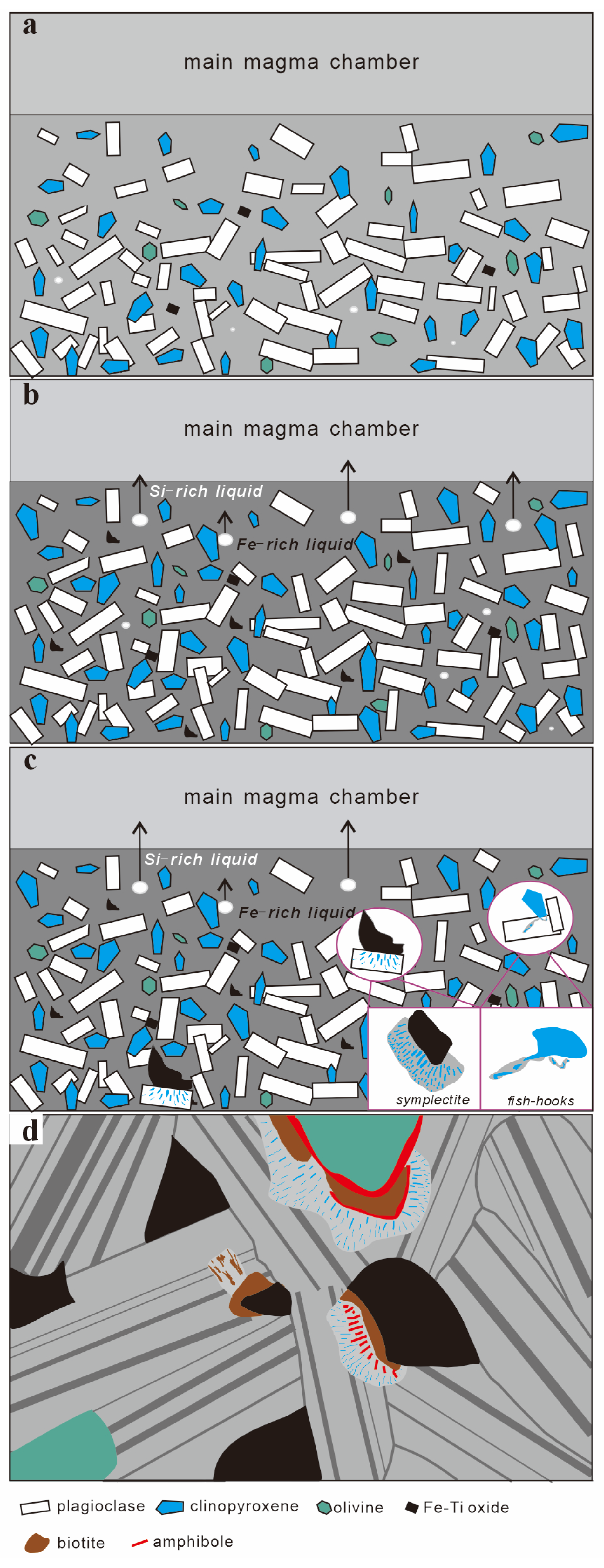
To conclude, we propose a conceptual model for the evolution of interstitial liquid in the Baima gabbro pegmatite (Figure 9). Once the crystals began to crystallize, convection and diffusion became vigorous. As crystallization proceeded and porosity decreased, compaction became increasingly important and could expel interstitial melt through the pore network, accompanied by deformation of cumulus plagioclase and clinopyroxene. If silicate liquid immiscibility was attained while the mush remained sufficiently permeable, the interstitial melt may separate into Si-rich and Fe-rich conjugate liquids. Buoyancy-driven migration of the lower-density Si-rich conjugate would leave a relatively Fe-rich residual liquid that could react with adjacent minerals and may have contributed to the formation of the observed reactive microstructures. However, granophyric pockets or lenses have not been identified in or near the Baima gabbro pegmatite. The ultimate fate of the Si-rich conjugate therefore remains unresolved and requires further research.

8. Conclusions

Five kinds of late-stage reactive microstructures were documented and classified in the Baima gabbro pegmatite in the Panxi area, SW China, including fish-hook clinopyroxene and replacive symplectites. The replacive symplectites include clinopyroxene/amphibole/ biotite + An-rich plagioclase replacing primocryst plagioclase. These late-stage microstructures are consistent with reactions between primocrysts and an interstitial Fe-rich melt, potentially in a setting where immiscible Si-rich and Fe-rich liquids were present and the Si-rich liquid was preferentially removed or redistributed. Accordingly, silicate liquid immiscibility remains a plausible late-stage process for the melt system that formed the Baima pegmatite.

Supplementary Materials

The following supporting information can be downloaded at: https://www.mdpi.com/article/10.3390/min16030245/s1, Supplementary Material File S1: Compositions of primocrysts of the Baima gabbro pegmatite; Supplementary Material File S2: Microprobe analyses for replacive microstructures.

Author Contributions

Writing—original draft preparation, X.W.; writing—review and editing, X.W. and H.D.; software, H.D. and K.W.; investigation, X.W., H.D., K.W. and S.Y.; funding acquisition, H.D. All authors have read and agreed to the published version of the manuscript.

Funding

This study was supported by the National Natural Science Foundation of China (No. 41802085), the National Science and Technology Major Project of China (No. 2025ZD1404303), and the Key Laboratory of Mineralization and Exploration of the Upper Yellow River, Ministry of Natural Resources (No. YSMRKF202509).

Data Availability Statement

Data are contained within the article or Supplementary Material.

Acknowledgments

We sincerely thank the four anonymous reviewers for their constructive comments, which were very helpful in improving the manuscript.

Conflicts of Interest

The authors declare no conflicts of interest.

References

  1. Beard, J.S.; Day, H.W. Origin of Gabbro Pegmatite in the Smartville Intrusive Complex, Northern Sierra Nevada, California. Am. Mineral. 1986, 71, 1085–1099. [Google Scholar]
  2. Walker, B.A., Jr.; Bergantz, G.W.; Otamendi, J.E.; Ducea, M.N.; Cristofolini, E.A. A MASH Zone Revealed: The Mafic Complex of the Sierra Valle Fértil. J. Petrol. 2015, 56, 1863–1896. [Google Scholar] [CrossRef]
  3. Holness, M.B.; Tegner, C.; Nielsen, T.F.D.; Charlier, B. The thickness of the mushy layer on the floor of the Skaergaard magma chamber at apatite saturation. J. Petrol. 2017, 58, 909–932. [Google Scholar] [CrossRef]
  4. Cawthorn, R.G.; Latypov, R.; Klemd, R.; Vuthuza, A. Origin of Discordant Ultramafic Pegmatites in the Bushveld Complex from Externally-Derived Magmas. S. Afr. J. Geol. 2018, 121, 287–310. [Google Scholar] [CrossRef]
  5. Larsen, R.B.; Brooks, C.K. Origin and Evolution of Gabbroic Pegmatites in the Skaergaard Intrusion, East Greenland. J. Petrol. 1994, 35, 1651–1679. [Google Scholar] [CrossRef][Green Version]
  6. Beard, J.S. Gabbroic Pegmatite Intrusions, Iberia Abyssal Plain, ODP Leg 173, Site 1070: Magmatism during a Transition from Non-Volcanic Rifting to Sea-Floor Spreading. J. Petrol. 2002, 43, 885–905. [Google Scholar] [CrossRef]
  7. Kerr, A.C. Mafic Pegmatites Intruding Oceanic Plateau Gabbros and Ultramafic Cumulates from Bolivar, Colombia: Evidence for a “Wet” Mantle Plume? J. Petrol. 2004, 45, 1877–1906. [Google Scholar] [CrossRef]
  8. Beard, J.S.; Scott, S.R. A Model for the High-Temperature Origin and Paradoxical Distribution of Pegmatites in Mafic Plutons, Smartville Complex, California. J. Petrol. 2018, 59, 3–10. [Google Scholar] [CrossRef]
  9. Holness, M.B.; Stripp, G.; Humphreys, M.C.S.; Veksler, I.V.; Nielsen, T.F.D.; Tegner, C. Silicate Liquid Immiscibility within the Crystal Mush: Late-Stage Magmatic Microstructures in the Skaergaard Intrusion, East Greenland. J. Petrol. 2011, 52, 175–222. [Google Scholar] [CrossRef]
  10. Koepke, J.; Berndt, J.; Horn, I.; Fahle, J.; Wolff, P.E. Partial Melting of Oceanic Gabbro Triggered by Migrating Water-Rich Fluids: A Prime Example from the Oman Ophiolite. Geol. Soc. Lond. Spec. Publ. 2014, 392, 195–212. [Google Scholar] [CrossRef]
  11. Keevil, H.A.; Namur, O.; Holness, M.B. Microstructures and Late-Stage Magmatic Processes in Layered Mafic Intrusions: Symplectites from the Sept Iles Intrusion, Quebec, Canada. J. Petrol. 2020, 61, egaa071. [Google Scholar] [CrossRef]
  12. London, D.; Morgan, G.B. Experimental Crystallization of the Macusani Obsidian, with Applications to Lithium-rich Granitic Pegmatites. J. Petrol. 2017, 58, 1005–1030. [Google Scholar] [CrossRef]
  13. Heckmann, P.; Palinkaš, S.S.; Hansen, H.; Marziano, G.I.; Rajič, K.; Forien, M.; Bergh, S.G. Petrogenesis of zoned and unzoned mafic pegmatites: An insight from the Palaeoproterozoic mafic-ultramafic Hamn intrusion, Northern Norway. Lithos 2022, 428–429, 106818. [Google Scholar] [CrossRef]
  14. Heckmann, P.; Marziano, G.I.; Palinkaš, S.S. An experimental study of the effect of water and chlorine on plagioclase nucleation and growth in mafic magmas: Application to mafic pegmatites. Eur. J. Mineral. 2023, 35, 1111–1124. [Google Scholar] [CrossRef]
  15. Xie, Q.; Zhang, Z.; Cheng, Z.; Santosh, M. Interstitial Microstructures in Ji’nan Mafic Intrusion, North China Craton: Magmatic or Hydrothermal Origin? Eur. J. Mineral. 2017, 29, 839–850. [Google Scholar] [CrossRef]
  16. Chung, S.-L.; Jahn, B.; Genyao, W.; Lo, C.-H.; Bolin, C. The Emeishan Flood Basalt in SW China: A Mantle Plume Initiation Model and Its Connection with Continental Breakup and Mass Extinction at the Permian-Triassic Boundary. In Geodynamics Series; Flower, M.F.J., Chung, S., Lo, C., Lee, T., Eds.; American Geophysical Union: Washington, DC, USA, 1998; Volume 27, pp. 47–58. [Google Scholar]
  17. Zhou, M.-F.; Arndt, N.T.; Malpas, J.; Wang, C.Y.; Kennedy, A.K. Two Magma Series and Associated Ore Deposit Types in the Permian Emeishan Large Igneous Province, SW China. Lithos 2008, 103, 352–368. [Google Scholar] [CrossRef]
  18. Liu, P.-P.; Zhou, M.-F.; Wang, C.Y.; Xing, C.-M.; Gao, J.-F. Open Magma Chamber Processes in the Formation of the Permian Baima Mafic–Ultramafic Layered Intrusion, SW China. Lithos 2014, 184–187, 194–208. [Google Scholar] [CrossRef]
  19. Whitney, D.L.; Evans, B.W. Abbreviations for names of rock-forming minerals. Am. Mineral. 2010, 95, 185–187. [Google Scholar] [CrossRef]
  20. Esawi, E.K. AMPH-CLASS: An Excel Spreadsheet for the Classification and Nomenclature of Amphiboles Based on the 1997 Recommendations of the International Mineralogical Association. Comput. Geosci. 2004, 30, 753–760. [Google Scholar] [CrossRef]
  21. Leake, B.E.; Woolley, A.R.; Arps, C.E.S.; Birch, W.D.; Gilbert, M.C.; Grice, J.D.; Hawthorne, F.C.; Kato, A.; Kisch, H.J.; Krivovichev, V.G.; et al. Nomenclature of Amphiboles: Report of the Subcommittee on Amphiboles of the International Mineralogical Association, Commission on New Minerals and Mineral Names. Can. Mineral. 1997, 35, 219–246. [Google Scholar]
  22. Namur, O.; Charlier, B.; Holness, M.B. Dual Origin of Fe–Ti–P Gabbros by Immiscibility and Fractional Crystallization of Evolved Tholeiitic Basalts in the Sept Iles Layered Intrusion. Lithos 2012, 154, 100–114. [Google Scholar] [CrossRef]
  23. Wang, K.; Wang, C.Y.; Ren, Z.-Y. Apatite-Hosted Melt Inclusions from the Panzhihua Gabbroic-Layered Intrusion Associated with a Giant Fe–Ti Oxide Deposit in SW China: Insights for Magma Unmixing within a Crystal Mush. Contrib. Mineral. Petrol. 2018, 173, 59. [Google Scholar] [CrossRef]
  24. Wang, M.; Wang, C.Y.; Tan, W. Compositional Evolution of Interstitial Liquid After Onset of Abundant Fe–Ti Oxide Crystallization in Crystal Mush: Insights from Late-Stage Microstructures and Mineral Compositions of the Bijigou Layered Intrusion, Central China. J. Petrol. 2022, 63, egac025. [Google Scholar] [CrossRef]
  25. Putirka, K. Amphibole Thermometers and Barometers for Igneous Systems and Some Implications for Eruption Mechanisms of Felsic Magmas at Arc Volcanoes. Am. Mineral. 2016, 101, 841–858. [Google Scholar] [CrossRef]
  26. Holland, T.; Blundy, J. Non-Ideal Interactions in Calcic Amphiboles and Their Bearing on Amphibole-Plagioclase Thermometry. Contrib. Mineral. Petrol. 1994, 116, 433–447. [Google Scholar] [CrossRef]
  27. Koepke, J.; Feig, S.T.; Snow, J. Hydrous Partial Melting within the Lower Oceanic Crust. Terra Nova 2005, 17, 286–291. [Google Scholar] [CrossRef]
  28. Koepke, J.; Feig, S.; Snow, J. Late Stage Magmatic Evolution of Oceanic Gabbros as a Result of Hydrous Partial Melting: Evidence from the Ocean Drilling Program (ODP) Leg 153 Drilling at the Mid-Atlantic Ridge: Magmatic Evolution of Oceanic Gabbros. Geochem. Geophys. Geosystems 2005, 6, Q02001. [Google Scholar] [CrossRef]
  29. Wolff, P.E.; Koepke, J.; Feig, S.T. The Reaction Mechanism of Fluid-Induced Partial Melting of Gabbro in the Oceanic Crust. Eur. J. Mineral. 2013, 25, 279–298. [Google Scholar] [CrossRef]
  30. Lissenberg, C.J.; MacLeod, C.J.; Howard, K.A.; Godard, M. Pervasive Replacive Melt Migration through Fast-Spreading Lower Oceanic Crust (Hess Deep, Equatorial Pacific Ocean). Earth Planet. Sci. Lett. 2013, 361, 436–447. [Google Scholar] [CrossRef]
  31. Lissenberg, C.J.; MacLeod, C.J. A Replacive Porous Flow Control on Mid-Ocean Ridge Magmatic Evolution. J. Petrol. 2016, 57, 2195–2220. [Google Scholar] [CrossRef]
  32. Namur, O.; Humphreys, M.C.S.; Holness, M.B. Lateral Replacive Infiltration in a Vertical Gabbroic Crystal Mush, Skaergaard Intrusion, East Greenland. J. Petrol. 2013, 54, 985–1016. [Google Scholar] [CrossRef]
  33. Humphreys, M.C.S. Silicate Liquid Immiscibility within the Crystal Mush: Evidence from Ti in Plagioclase from the Skaergaard Intrusion. J. Petrol. 2011, 52, 147–174. [Google Scholar] [CrossRef]
  34. Hou, T.; Charlier, B.; Namur, O.; Schütte, P.; Schwarz-Schampera, U.; Zhang, Z.; Holtz, F. Experimental Study of Liquid Immiscibility in the Kiruna-Type Vergenoeg Iron–Fluorine Deposit, South Africa. Geochim. Cosmochim. Acta 2017, 203, 303–322. [Google Scholar] [CrossRef]
  35. Hou, T.; Charlier, B.; Holtz, F.; Veksler, I.; Zhang, Z.; Thomas, R.; Namur, O. Immiscible Hydrous Fe–Ca–P Melt and the Origin of Iron Oxide-Apatite Ore Deposits. Nat. Commun. 2018, 9, 1415. [Google Scholar] [CrossRef]
  36. Jakobsen, J.K.; Veksler, I.V.; Tegner, C.; Brooks, C.K. Immiscible Iron- and Silica-Rich Melts in Basalt Petrogenesis Documented in the Skaergaard Intrusion. Geology 2005, 33, 885. [Google Scholar] [CrossRef]
  37. Jakobsen, J.K.; Veksler, I.V.; Tegner, C.; Brooks, C.K. Crystallization of the Skaergaard Intrusion from an Emulsion of Immiscible Iron- and Silica-Rich Liquids: Evidence from Melt Inclusions in Plagioclase. J. Petrol. 2011, 52, 345–373. [Google Scholar] [CrossRef]
  38. Charlier, B.; Namur, O.; Toplis, M.J.; Schiano, P.; Cluzel, N.; Higgins, M.D.; Auwera, J.V. Large-Scale Silicate Liquid Immiscibility during Differentiation of Tholeiitic Basalt to Granite and the Origin of the Daly Gap. Geology 2011, 39, 907–910. [Google Scholar] [CrossRef]
  39. Charlier, B.; Grove, T.L. Experiments on Liquid Immiscibility along Tholeiitic Liquid Lines of Descent. Contrib. Mineral. Petrol. 2012, 164, 27–44. [Google Scholar] [CrossRef]
  40. Liu, P.-P.; Zhou, M.-F.; Ren, Z.; Wang, C.Y.; Wang, K. Immiscible Fe- and Si-Rich Silicate Melts in Plagioclase from the Baima Mafic Intrusion (SW China): Implications for the Origin of Bi-Modal Igneous Suites in Large Igneous Provinces. J. Asian Earth Sci. 2016, 127, 211–230. [Google Scholar] [CrossRef]
  41. Kamenetsky, V.S.; Charlier, B.; Zhitova, L.; Sharygin, V.; Davidson, P.; Feig, S. Magma Chamber–Scale Liquid Immiscibility in the Siberian Traps Represented by Melt Pools in Native Iron. Geology 2013, 41, 1091–1094. [Google Scholar] [CrossRef]
  42. Fischer, L.A.; Wang, M.; Charlier, B.; Namur, O.; Roberts, R.J.; Veksler, I.V.; Cawthorn, R.G.; Holtz, F. Immiscible Iron- and Silica-Rich Liquids in the Upper Zone of the Bushveld Complex. Earth Planet. Sci. Lett. 2016, 443, 108–117. [Google Scholar] [CrossRef]
  43. Dong, H.; Wang, C.Y.; Xing, C.-M. Microstructures in the Baima Layered Intrusion, SW China: Constraints on the Late-Stage Magmatic Processes during Solidification of a Crystal Mush. J. Asian Earth Sci. 2023, 255, 105774. [Google Scholar] [CrossRef]
  44. Boudreau, A.E. Volatile Fluid Overpressure in Layered Intrusions and the Formation of Potholes. Aust. J. Earth Sci. 1992, 39, 277–287. [Google Scholar] [CrossRef]
  45. Boudreau, A. Fluid Fluxing of Cumulates: The J-M Reef and Associated Rocks of the Stillwater Complex, Montana. J. Petrol. 1999, 40, 755–772. [Google Scholar] [CrossRef][Green Version]
  46. Sirbescu, M.-L.C.; Schmidt, C.; Veksler, I.V.; Whittington, A.G.; Wilke, M. Experimental Crystallization of Under-cooled Felsic Liquids: Generation of Pegmatitic Texture. J. Petrol. 2017, 58, 539–568. [Google Scholar] [CrossRef]
  47. Devineau, K.; Champallier, R.; Pichavant, M. Dynamic Crystallization of a Haplogranitic Melt: Application to Peg-matites. J. Petrol. 2020, 61, egaa054. [Google Scholar] [CrossRef]
  48. Maneta, V.; Baker, D.R. Exploring the Effect of Lithium on Pegmatitic Textures: An Experimental Study. Am. Miner-al. 2014, 99, 1383–1403. [Google Scholar] [CrossRef]
Figure 1. (a) Simplified regional geology of the Panxi area, Emeishan large igneous province, SW China; (b) the location of mafic–ultramafic intrusions that host Fe-Ti-(V) oxide ore deposits (modified after the Panzhihua 1:200,000 geological map of the Panzhihua Geological Survey, see scale bar) [18]; (c) geology of the Baima layered intrusion and the Baima gabbro pegmatite. The Baima layered intrusion has been tectonically divided into the Xiajiaping, Jijiping, Tianjiacun, Qinggangping, and Mabinglang segments from north to south. The Baima gabbro pegmatite is located on the eastern side of the Baima layered intrusion. The location of the section is indicated in (b); (d) representative cross-section of the Jijiping segment showing the distribution and morphology of rock types and ores. The Baima gabbro pegmatite occurs as dikes alongside the layered intrusion.
Minerals 16 00245 g001
Figure 2. Field photographs and photomicrographs of the mineral textures in the Baima gabbro pegmatite. (a) Field photograph of the Baima layered intrusion and Baima gabbro pegmatite. (b,c) The Baima gabbro pegmatite shows large plagioclase and clinopyroxene grains. (d) Large plagioclase grain shows bent polysynthetic twinning and is surrounded by small plagioclase grains forming a fine cataclastic texture. Sample BM12217. (e) Fe-Ti oxides occur together with olivine and apatite within the interstitial domains between plagioclase grains; apatite occurs both as interstitial grains and as grains locally enclosed by olivine and plagioclase. Sample BM12214. (f) Fe-Ti oxides form an interstitial network along grain boundaries among clinopyroxene and plagioclase. Sample BM12214. Note that the pictures in (a,b) were taken using an autofocus camera, the image in (d) was taken under cross-polarized and transmitted light, and (c,e,f) were taken under plane-polarized and transmitted light. Abbreviations: Pl, plagioclase; Cpx, clinopyroxene; Ol, olivine; Ap, apatite [19].
Minerals 16 00245 g002
Figure 3. BSE images of fish-hook pyroxenes in the Baima gabbro pegmatite. (a) Fish-hook clinopyroxenes intergrown with An-rich plagioclase adjacent to biotite substrate. Note that a symplectite can be observed. Sample BM12217. (b,c) Fish-hook clinopyroxenes intergrown with An-rich plagioclase extending down the plagioclase–plagioclase grain boundaries adjacent to a pyroxene grain. Sample BM12217. (d) Fish-hook clinopyroxene adjacent to a replacive symplectite; a local textural transition is visible. Sample BM12217. Areas of An-rich plagioclase are outlined by a white dashed line. Abbreviations: Bt, biotite; other mineral abbreviations are the same as in Figure 2 [19].
Minerals 16 00245 g003
Figure 4. BSE images of replacive symplectites. (a) Type I-a symplectite rooted to Fe-Ti oxide. Amphibole occasionally occurs, Sample BM12217. (b) Type I-a symplectite. A substrate of biotite, ranging in width from several micrometers to 100 μm, grows between the Fe-Ti oxide and the symplectite. Sample BM12214. (c) Type I-b symplectite. Amphibole as substrate surrounding the oxides and as vermicules in the symplectite. The amphibole vermicules grade out along the growth direction into clinopyroxene. Sample BM12217. (d) Type I-b symplectite consisting of amphibole + An-rich plagioclase; no Fe-Ti oxide root is visible in this field of view. Sample BM12217. (e) Type I-c symplectite comprising biotite and An-rich plagioclase. Sample BM12217. (f) Type II symplectite from Sample BM12217. Abbreviations: Amp, amphibole; other abbreviations are the same as in Figure 2 and Figure 3 [19].
Minerals 16 00245 g004
Figure 5. Compositions of minerals in microstructures and primocrysts of the Baima gabbro pegmatite, and minerals of the Baima layered intrusion. Plot of (a) FeO vs. An for plagioclase. (b) TiO2 vs. Mg# for clinopyroxene. (c) TiO2 vs. SiO2 for amphibole. (d) TiO2 vs. SiO2 for biotite. Data for the Baima layered intrusion are from our unpublished paper.
Minerals 16 00245 g005
Figure 6. Variation in mineral composition with position in representative symplectites. For all images, dots indicate microprobe data points. Black dots are primocryst values, white dots are symplectite plagioclase values, white dots with red circles are symplectite (a) clinopyroxene, (b) amphibole, (c) biotite, or (d) clinopyroxene values. (a) Left: BSE image with analyzed position of a Type I-a symplectite from Sample BM12217. Right: Graph of An content of plagioclase (above) and Mg# of clinopyroxene (below) vs. distance along growth direction in the same sample. (b) Left: BSE image with analyzed position of a Type I-b symplectite from Sample BM12214. Right: Graph of An content of plagioclase (above) and TiO2 content of amphibole (below) vs. distance along growth direction in the same sample. (c) Left: BSE image with analyzed position of a Type I-c symplectite from Sample BM12217. Right: Graph of An content of plagioclase (above) and TiO2 content of biotite (below) vs. distance along symplectite growth direction for the same sample. (d) Left: BSE image with analyzed position of a Type II symplectite from Sample BM12217. Right: Graph of An content of plagioclase (above) and Mg# of clinopyroxene (below) vs. distance along growth direction in the same sample. Abbreviations are the same as Figure 2 and Figure 3. For the full dataset of analyses see Supplementary Material File S2.
Minerals 16 00245 g006
Figure 7. Plots of (a) CaO vs. FeO and (b) Al2O3 vs. FeO for bulk symplectite compositions and bulk melt inclusion compositions from this study, together with published compositions of immiscible silicate melts. Red circles represent bulk symplectite compositions, gray circles represent primocryst plagioclase compositions, and black circles represent bulk melt inclusion compositions. Literature data include experimentally produced immiscible melts and immiscible melts reported from layered intrusions; symbols are as defined in the legend ([23,36,37,38,39,40,41,42]).
Minerals 16 00245 g007
Figure 8. BSE images of crystallized melt inclusions hosted in plagioclase in the Baima gabbro pegmatite. (a) A melt inclusion composed of An-rich plagioclase, magnetite, ilmenite, clinopyroxene, biotite, sulfide and apatite. Sample BM12217; (b) A melt inclusion composed of clinopyroxene and magnetite with ilmenite exsolution. Sample BM12214; (c) A melt inclusion composed of clinopyroxene, ilmenite, magnetite and apatite. Sample BM12214; (d) A melt inclusion composed of magnetite, clinopyroxene, and apatite. Sample BM12214. Abbreviations: Mag, magnetite; Ilm, ilmenite; Suf, sulfide; other mineral abbreviations are the same as in Figure 2 [19].
Minerals 16 00245 g008
Figure 9. Conceptual model illustrating late-stage evolution of a crystal mush in the Baima gabbro pegmatite, potentially involving the separation of Si-rich and Fe-rich conjugate liquids and the development of reactive microstructures. (a) Development of a crystal mush, where primocryst grains accumulate and form a framework with interstitial melt within the gabbro pegmatite body. (b) If silicate liquid immiscibility is attained, the interstitial melt may separate into Si-rich and Fe-rich conjugate liquids; buoyant Si-rich droplets can migrate upward and be redistributed out of the mush. (c) Reactions between plagioclase primocrysts and the remaining Fe-rich interstitial liquid may produce clinopyroxene + plagioclase symplectites and fish-hook clinopyroxene intergrowths (insets). (d) Schematic close-up view of late-stage hydrous reactions that can generate amphibole/biotite-bearing symplectites and monomineralic biotite substrates at oxide–symplectite contacts. Symbols as in legend.
Minerals 16 00245 g009
Table 1. Bulk composition produced from qualitative mass balances calculations on symplectites and melt inclusions from the Baima gabbro pegmatite.
MicrostructuresType I-a SymplectitePl PrimocrystType I-b SymplectiteType I-b SymplectitePl PrimocrystType II SymplectitePl PrimocrystMelt Inclusion in Pl
SiO251.6754.4049.9549.7954.4244.2352.7635.0034.33
TiO20.340.050.170.130.050.890.042.662.05
Al2O321.7628.9022.7922.5028.9922.7729.9311.192.26
FeO2.600.214.594.800.123.900.1927.0831.98
MgO5.800.015.435.880.009.430.017.579.63
MnO0.030.000.050.050.020.040.000.280.23
CaO12.4311.2911.5011.5111.1912.9212.619.3215.47
Na2O3.545.184.023.955.281.304.470.640.22
K2O1.150.050.290.300.092.700.111.090.00
P2O5 1.480.00
Total99.39100.0999.4399.22100.1498.45100.1096.5596.17
Note: Pl primocryst is referring to the neighboring plagioclase that is being replaced by the symplectite.
Disclaimer/Publisher’s Note: The statements, opinions and data contained in all publications are solely those of the individual author(s) and contributor(s) and not of MDPI and/or the editor(s). MDPI and/or the editor(s) disclaim responsibility for any injury to people or property resulting from any ideas, methods, instructions or products referred to in the content.