Article

Water Weakening Effects on Dislocation Creep of Polycrystalline Diopside Aggregates

1
State Key Laboratory of Deep Earth Processes and Resources, Guangzhou Institute of Geochemistry, Chinese Academy of Sciences, Guangzhou 510640, China
2
University of Chinese Academy of Sciences, Beijing 100049, China
3
School of Mining Engineering, Heilongjiang University of Science and Technology, Harbin 150022, China
*
Author to whom correspondence should be addressed.
Minerals 2026, 16(3), 232; https://doi.org/10.3390/min16030232
Submission received: 19 January 2026 / Revised: 10 February 2026 / Accepted: 24 February 2026 / Published: 25 February 2026

Abstract

To understand the dislocation creep behavior of water-saturated clinopyroxene in the upper mantle, we conducted high-temperature triaxial compression experiments on hot-pressed diopside aggregates under water-saturated conditions at confining pressures of ~300 MPa and temperatures of 1373–1473 K using a Paterson gas-medium apparatus. Fourier transform infrared measurements of the water contents revealed that all experiments were performed under water-saturated conditions. Fitting the mechanical data with a power flow law yielded a stress exponent n of 2.2 ± 0.6, an activation energy Q of 442 ± 33 kJ/mol, and a material-dependent parameter A of 106.9±0.5 MPa−2.2 s−1. For comparison, a single deformation experiment was performed under anhydrous conditions at a temperature of 1473K. The mechanical results show that the water-saturated diopside aggregates deform approximately 1.5–3 orders of magnitude faster than their anhydrous counterpart, indicating a pronounced water-weakening effect. Furthermore, under water-saturated conditions, our mantle-derived diopside aggregates have comparable strengths to that of Fe-rich Sleaford Bay clinopyroxene at 1473 K and laboratory strain rates but significantly weaker than that of olivine aggregates. The results in this study provide key experimental constraints on the flow behavior of mantle-derived clinopyroxene aggregates under water-saturated conditions.

1. Introduction

Despite its moderate average abundance (~13%) [1,2] in the upper mantle, clinopyroxene (Cpx) can form highly enriched domains (locally ~80%) through processes such as mantle metasomatism, melt-rock interaction, and crustal recycling [3,4,5], thereby potentially exerting a dominant control on local rheology. Field studies further indicate that upper mantle deformation is commonly localized within lithological heterogeneities, particularly pyroxene-rich domains in peridotites and pyroxenites, emphasizing the importance of constraining the rheology of Cpx in heterogeneous mantle rocks [6,7]. The rheological behavior of Cpx is particularly critical for understanding mantle geodynamics because it has an exceptional capacity to incorporate structurally bound hydrogen, reaching up to ~3020 ppm H2O [8], which is the highest among major upper mantle minerals. Given that water markedly weakens nominally anhydrous silicates (e.g., [9,10,11,12,13,14,15]), even small variations in water content may strongly affect Cpx rheology.
Since the 1960s, numerous high-temperature deformation experiments have been conducted on both single crystals and polycrystalline aggregates to constrain the rheological properties of Cpx (e.g., [16,17,18,19,20,21]). After excluding data from low-stress-resolution apparatuses and early experiments with poorly monitored water contents, robust flow law parameters have been obtained for diopside single crystals and for crustal-derived Sleaford Bay Cpx. For diopside single crystals, deformation at lower temperatures is accommodated by slip on the {110}1/2<a ± b> system, with an activation energy of Q ≈ 440 kJ/mol, while a combination of {110}1/2<a ± b> and (100) [001] slip operates at higher temperatures, characterized by Q ≈ 740 kJ/mol [22,23,24]. For the Sleaford Bay Cpx and for hot-pressed polycrystalline aggregates synthesized from its mineral separates, the dislocation creep parameters under dry conditions are a stress exponent of n = 4.7 ± 0.2 and Q = 760 ± 40 kJ/mol [25], whereas diffusion creep yields n ≈ 1 and Q = 760 ± 40 kJ/mol [26]. Under water-saturated conditions, dislocation creep gives n = 2.7 ± 0.3 and Q = 670 ± 40 kJ/mol [10], and diffusion creep gives Q = 340 ± 30 kJ/mol [26].
In contrast, the rheological properties of low-iron (~3 at.% Fe) [27,28,29,30] polycrystalline Cpx aggregates of mantle origin remain poorly constrained [18,31,32]. Studies on olivine, a fellow Mg–Fe solid-solution mineral, demonstrate that Fe content significantly influences rheological strength and flow parameters [33,34]. This observation raises questions regarding the applicability of flow laws derived from Fe-rich, crustal Cpx to their mantle counterparts. To address this gap, Li et al. [35] recently investigated the rheology of polycrystalline diopside aggregates under water-unsaturated conditions. To more comprehensively understand the rheology of low-Fe, mantle-derived Cpx under varying water activities, the present study employs the same diopside starting material as Li et al. [35] and conducts deformation experiments under water-saturated conditions with oxygen fugacity buffered by Ni/NiO (NNO). Our aim is to quantify the influence of water on the rheological behavior of low-Fe mantle Cpx.

2. Experimental Details

2.1. Starting Material and Sample Preparation

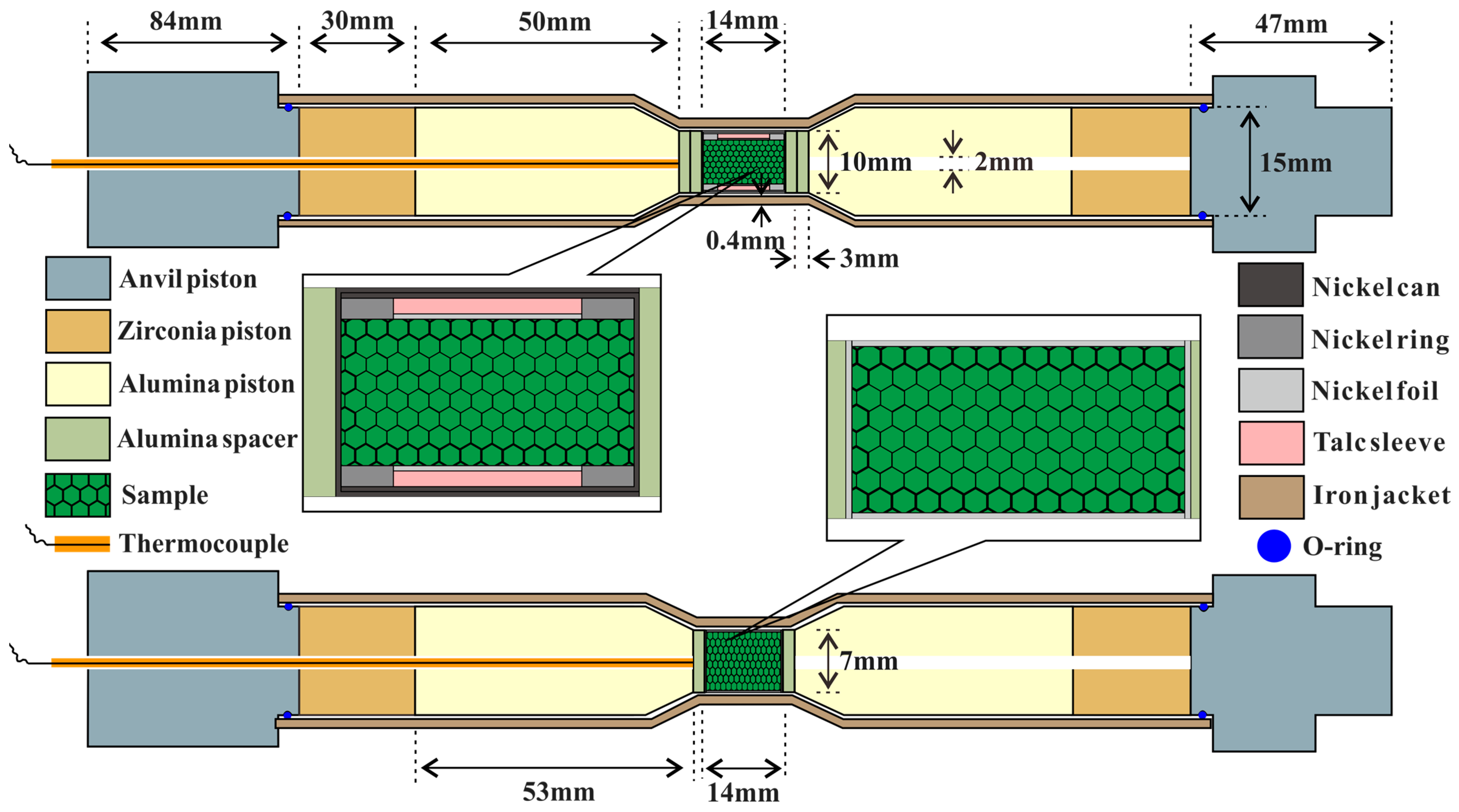
The starting material was natural clinopyroxene identical to that used in Li et al. [35]. It consisted of gem-quality, dark-green transparent crystals collected from Russia. Electron microprobe analysis (EMPA) indicates that the crystals correspond to a Cr-bearing diopside with a composition of Ca0.98Na0.015Mg0.99Fe0.044Cr0.012Al0.008Si1.98O6. Polarized FTIR measurements on several crystals indicate that the undeformed starting material contained structurally bound hydrogen with an average concentration of ~120 ppm by weight using the calibration of Bell et al. [36]. The crystals were ground to a fine powder, and a grain size of ∼100 μm was isolated by Stokes settling. The well sorted powder was uniaxially cold-pressed at ∼200 MPa into nickel capsules (9 mm inner diameter, 20 mm length), during which a few drops of deionized water (~2 wt.%) were added in several batches in order to incorporate hydrogen into the diopside structure during subsequent hot-pressing. The capsules were sealed and hot-pressed at 300 MPa and 1423 K for 4 h in a Paterson gas-medium apparatus. The nickel capsules buffered the NNO oxygen fugacity. The resulting aggregates were machined into cylinders (∼14 mm long, 7 mm diameter), wrapped in 0.025 mm thick Ni foil and then enclosed in a talc sleeve, which served as an external water source during deformation (Figure A1). To prevent the strengthening associated with talc dehydration at high temperature from affecting the measured sample strength, low-strength nickel rings were placed at both ends of the talc sleeve. Finally, the hydrous sample cylinder, which was already wrapped in Ni foil and enclosed within a talc sleeve with nickel end-rings, was sealed inside two tightly fitting, open-ended nickel cans. This water-saturated assembly (Figure A1) follows the designs of Mei and Kohlstedt [13] and Chen et al. [10].
For comparison, a deformation experiment was performed under anhydrous conditions, for which the sample assembly preparation was slightly different. The well sorted powder (~100 μm) was first dehydrated at 1448 K for 15 h in a tube furnace under a CO/CO2 gas mixture to remove structurally bound water and then cold-pressed into nickel capsules similarly. The hot-pressing conditions (300 MPa, 1423 K, 4 h) and machining steps were identical to those for the hydrous samples. The final cylindrical specimen was re-dehydrated under the same CO/CO2 conditions at 1448 K for 15 h and wrapped in 0.025 mm-thick Ni foil to maintain NNO buffering during deformation (Figure A1).

2.2. Deformation Experiments

The sample assemblies for the anhydrous and water-saturated experiments were similar in design and layout, following the configuration described in Li et al. [37,38] (Figure A1), with only minor dimensional differences between the two. In each case, either a Ni foil-wrapped anhydrous sample or a Ni-can-sealed hydrous sample was placed between 3 mm-thick alumina spacers together with ~50 mm-long alumina pistons and 30 mm-long zirconia pistons. The entire stack was inserted into a low-carbon iron jacket (inner diameter 15 mm, wall thickness 0.25 mm) to isolate the sample from the argon gas confining pressure medium.
Both the hot-pressing and triaxial deformation experiments were performed using a Paterson gas-medium apparatus [39] at the Guangzhou Institute of Geochemistry, Chinese Academy of Sciences [40,41]. Temperature was regulated and monitored using an R-type thermocouple (Pt–13%Rh/Pt) placed adjacent to the upper surface of the ~3 mm-thick alumina spacer immediately above the specimen. Pre-experimental furnace calibrations indicated a nearly uniform thermal field within the central hot zone, with an axial temperature variation smaller than ±2 K along the sample length. The differential load was applied by a servo-controlled drive system and measured using an internal load cell. Axial shortening of the sample assembly was monitored by a linear variable differential transformer (LVDT) located inside the pressure vessel. For more details about the experimental techniques, please refer to Li et al. [35]. After reaching the target temperature and confining pressure, a half-hour interval was maintained before deformation commenced to ensure thermal equilibration in the anhydrous experiments and to allow sufficient time for talc dehydration and the establishment of water equilibrium in the water-saturated experiments. To ensure the reproducibility of the mechanical data, deformation experiments on water-saturated samples were conducted using both stress-stepwise and strain-rate-stepwise load modes. That is, deformation was applied in a stepwise manner, with either the applied load force or the imposed strain rate held constant during each step. Once steady-state flow was attained, as indicated by a constant strain rate or differential stress with time, the corresponding strain rate or differential stress was recorded. Given the significant weakening of water-saturated diopside aggregates compared to their anhydrous counterparts, the applied differential stress in the water-saturated experiments was adjusted to ensure that the resulting strain rates remained within a laboratory-acceptable range (~10−7 to 10−4 s−1). This adjustment allowed full utilization of the water released from the talc sleeve during deformation over a period of approximately 4 h. A total of six water-saturated experiments and one anhydrous deformation experiment were conducted at a confining pressure of ~300 MPa and temperatures of 1373–1473 K. Detailed descriptions of the apparatus and data processing methods can be found in Shao et al. [40] and Li et al. [35,37,38], respectively.

2.3. Water Content Analysis

We ensured that deformation experiments were conducted under either water-saturated or anhydrous conditions by measuring the water content of samples before and after deformation using Fourier-transform infrared (FTIR) spectroscopy. First, ~1 mm-thick discs were cut from hot-pressed sample cylinders or post-deformation samples using a low-speed diamond saw. The discs were then thinned to ~200 μm and polished on both sides with up to 3000-grit sandpaper. After cleaning with an ultrasonic oscillator, the samples were dried in a ventilated oven for at least 24 h to remove adsorbed free water. Next, 6–10 infrared absorption spectra were collected from the center to the edge of each disc using FTIR spectroscopy. Infrared spectra were collected through a 100 × 100 μm2 aperture over the wavenumber range of 3000–4000 cm−1 using 256 co-added scans at a spectral resolution of 2 cm−1. To minimize contamination from atmospheric moisture during acquisition, the microscope chamber was continuously purged with dry air throughout the measurements [35]. The obtained absorption spectra were normalized to a 1 cm sample thickness, and the water content corresponding to each spectrum was calculated based on the method reported by Bell et al. [36]. The mean value derived from the 6–10 spectra was taken as the bulk water content of the sample.
C OH = 1 I γ K v ˜ d   v ˜
where COH is the hydroxyl content in ppm by weight;  I  is the internal extinction coefficient given by 7.09 cm−2 ppm−1 for Cpx; γ is the orientation factor, which is equal to 1/3 for unpolarized spectra of polycrystalline samples; and K v ˜ is the absorption coefficient at wave number   v ˜ . Water contents expressed as ppm H2O by weight and as H/106 Si are related by a constant conversion factor of approximately 12 for diopside (e.g., [35]). In this study, water contents are reported in units of ppm H2O by weight to facilitate direct comparison with previous petrological and mineralogical studies.

2.4. Microstructural Analysis

Thin sections were prepared parallel to the compression axis for microstructural analyses of all hot-pressed and deformed samples. Microstructure evolution during deformation was examined using a Leica optical microscopy. For representative samples both before and after deformation, the equivalent circular diameters of ~150 grains were measured from images based on their grain-area equivalents and multiplied by 4/π to correct for sectioning effects of spherical grains [42]. Electron backscatter diffraction (EBSD) analysis was not performed because the imposed strain was relatively low (≤15%) and insufficient to develop a detectable crystallographic preferred orientation.

2.5. Mechanical Data Analysis

Real-time recordings of confining pressure, temperature, axial displacement, and loading force constituted the primary mechanical dataset. After the experiments, the temporal records of axial displacement and loading force were corrected to derive strain rate and differential stress, respectively. These corrections accounted for apparatus distortion, iron jacket strength, and specimen cross-sectional area (based on the assumption of constant sample volume during deformation) [38].
The deformation results can be well described by a power form flow law:
  ε ˙ = A   σ n f H 2 O r   exp Q R T
where ε ˙ is the strain rate (s−1), A is a material-dependent parameter, σ is the differential stress (MPa), n is the stress exponent, fH2O is the water fugacity (MPa), r is the water fugacity exponent, Q is the activation energy (kJ/mol), R is the gas constant with a value of 8.314 J/(mol·K), and T is the absolute temperature (K).
At a constant confining pressure and over a narrow change in temperatures, the variation in water fugacity, which is a function of temperature and pressure, is limited from 313 to 325 MPa as temperature increases from 1373 to 1473 K at a pressure of 300 MPa [43]. As the variation in the value of water fugacity in our experiments is too narrow to quantify the water fugacity exponent r, the f H 2 O r term that remains approximately a constant is incorporated into A, and then, Equation (2) can be simplified to
ε ˙ = A   σ n   exp Q R T
The flow law parameters were determined sequentially to minimize covariance among fitting parameters. The stress exponent n was first obtained from the slope of log (strain rate) versus log (stress) at constant temperature. The activation energy Q was then determined from the temperature dependence of normalized strain rates at a reference stress of 200 MPa. After fixing n and Q, the material-dependent parameter A was calculated by nonlinear least-squares fitting of Equation (3) to the entire dataset.

3. Results

3.1. Water Contents

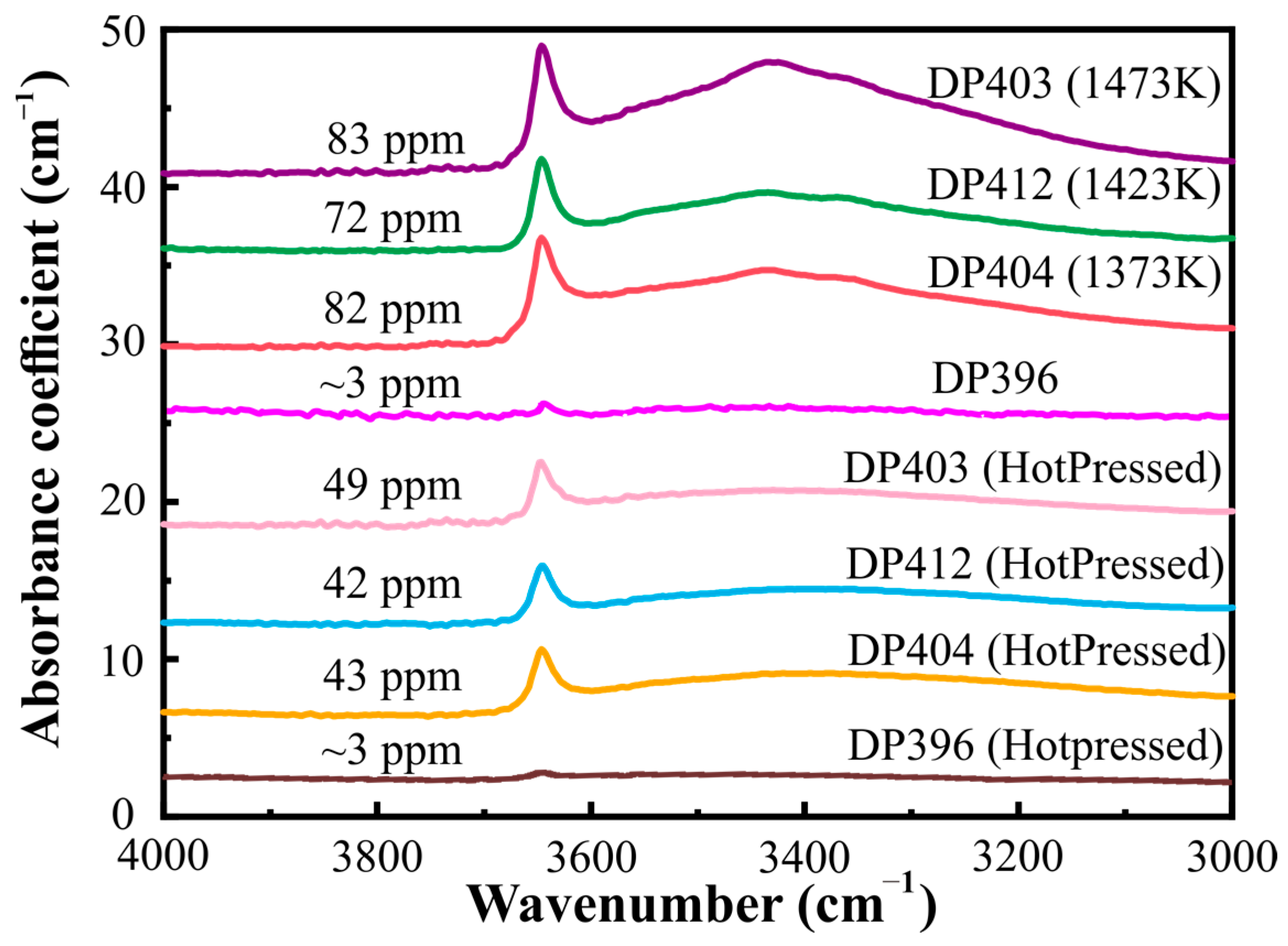
Figure 1 presents the FTIR spectra for hot-pressed and subsequently deformed diopside aggregates under both anhydrous and hydrous conditions. Under anhydrous conditions, spectra acquired from samples both before and after deformation exhibit negligible to minor absorption near 3646 cm−1, corresponding to water contents below ~3 ppm.
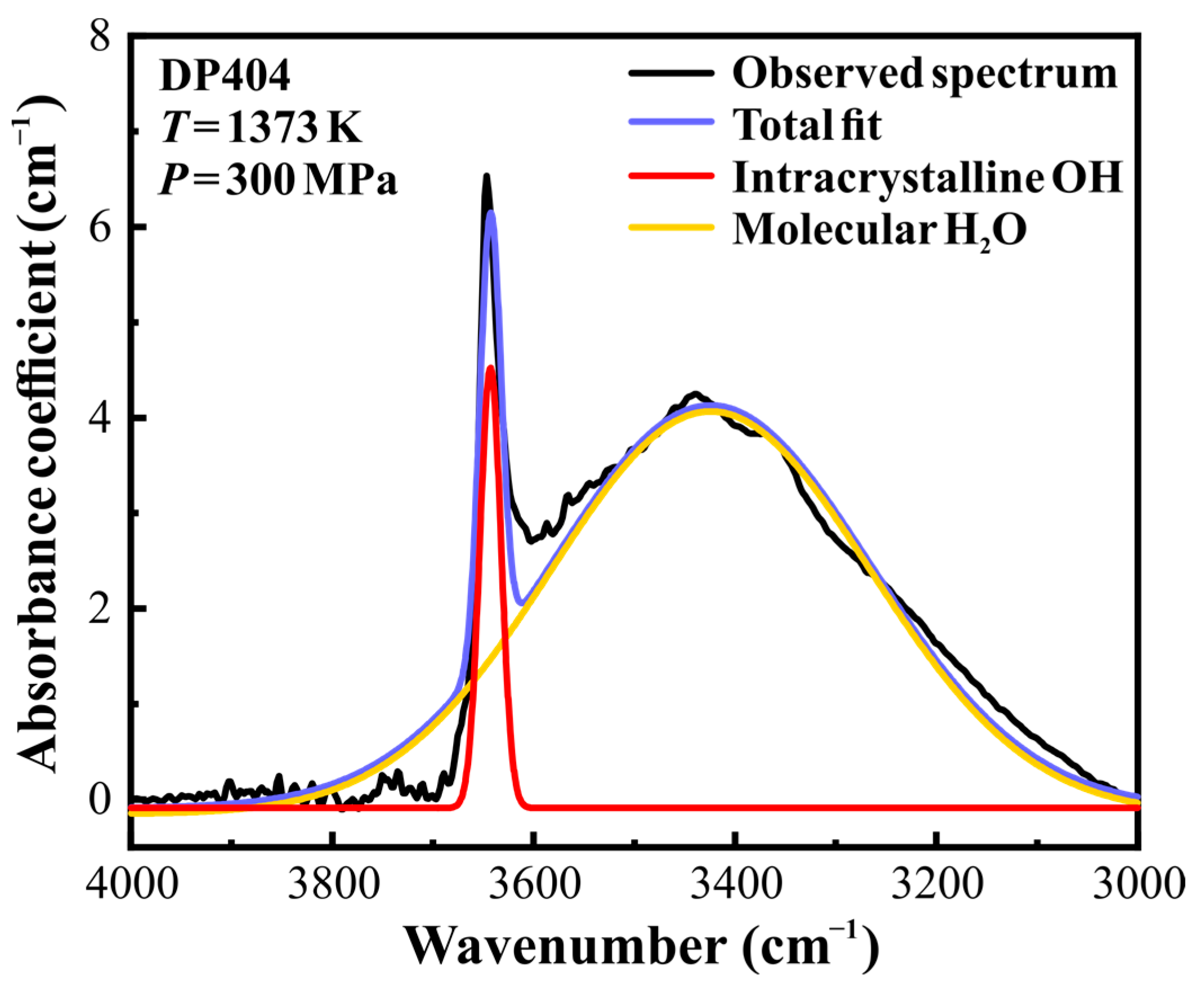
For experiments conducted under hydrous conditions, the spectra of hot-pressed (pre-deformation) samples are characterized by a sharp absorption band centered at ~3646 cm−1, attributable to structurally incorporated hydroxyl (OH), superimposed on a broad absorption feature spanning ~3700–3000 cm−1 that is assigned to molecular water (H2O) residing along grain boundaries. Following spectral deconvolution to remove the contribution from grain-boundary water, the intracrystalline OH content of these hot-pressed samples is estimated at ~45 ppm. Figure A2 illustrates a representative spectrum and the Gaussian components used to distinguish the sharp structural OH band from the broad absorption attributed to molecular H2O.
In contrast, spectra from the deformed samples display a distinct sharp absorption band at ~3646 cm−1 and a relatively weak absorption band at ~3456 cm−1, along with a more pronounced broad absorption feature in the ~3700–3000 cm−1 range. Spectral analysis yields calculated intracrystalline OH contents of 82, 72, and 81 ppm for samples deformed at 1473, 1423, and 1373 K, respectively.

3.2. Microstructures

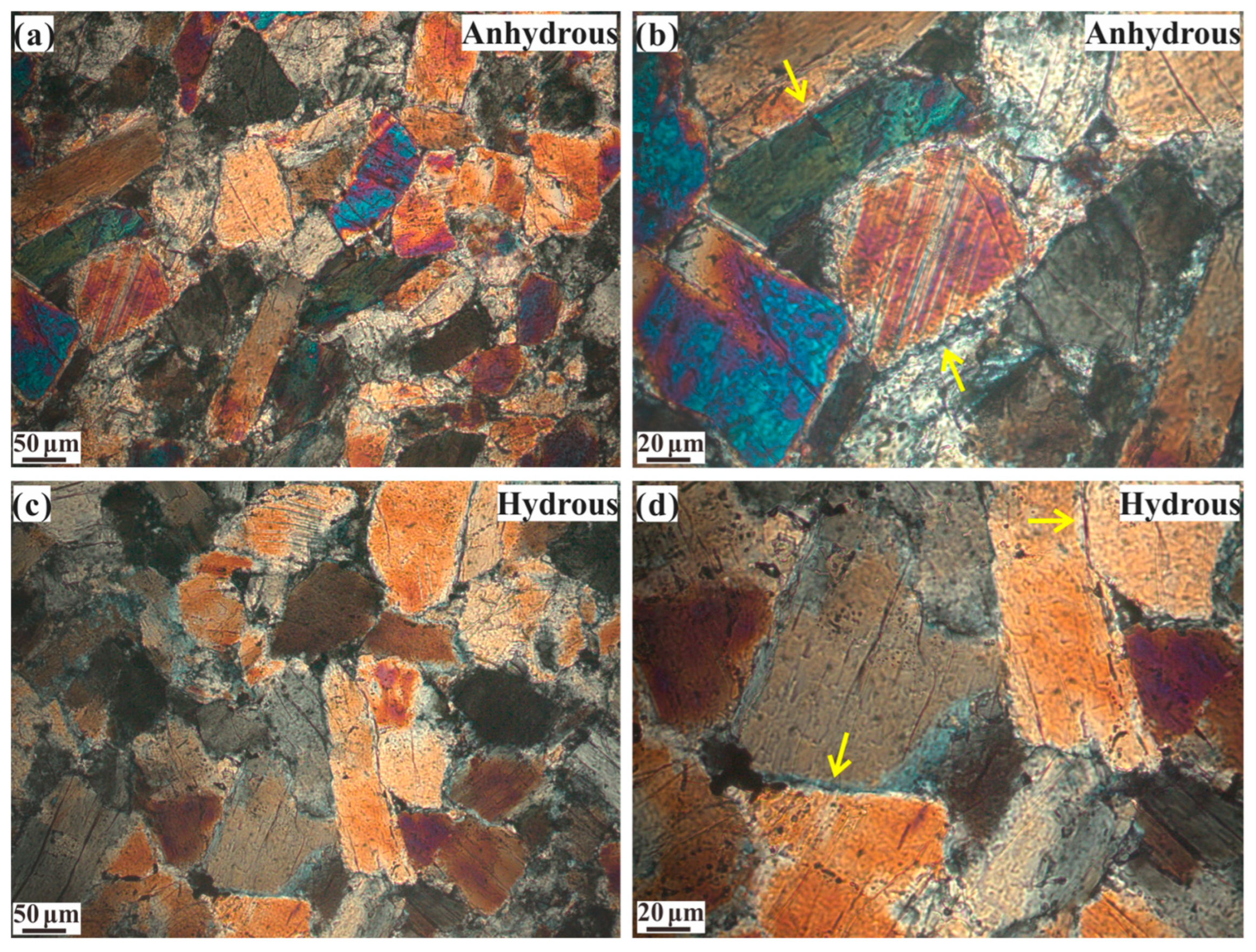
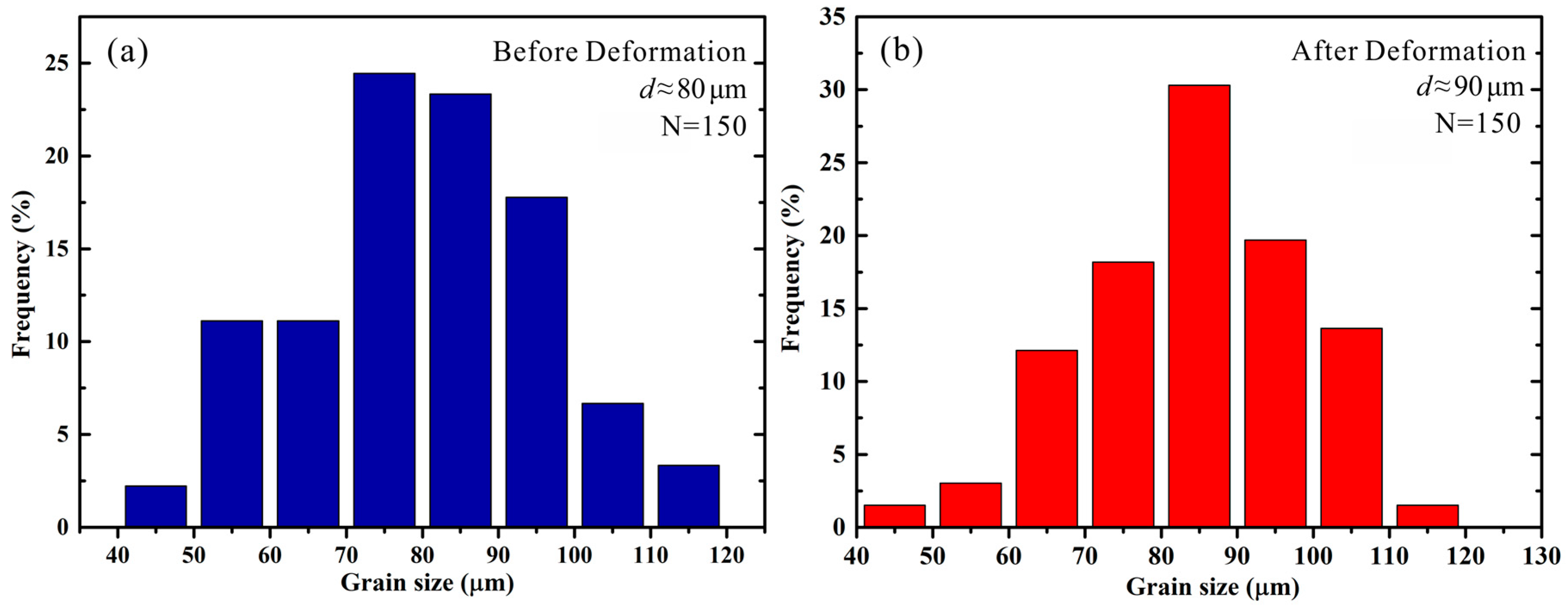
Optical microscopy reveals that diopside grains in hot-pressed samples exhibit an equigranular texture with straight and sharp grain boundaries and uniform extinction and lack a distinct shape preferred orientation (Figure A3). Grain size analysis yields an initial average grain size of ~80 μm for the starting material (Figure A4a).
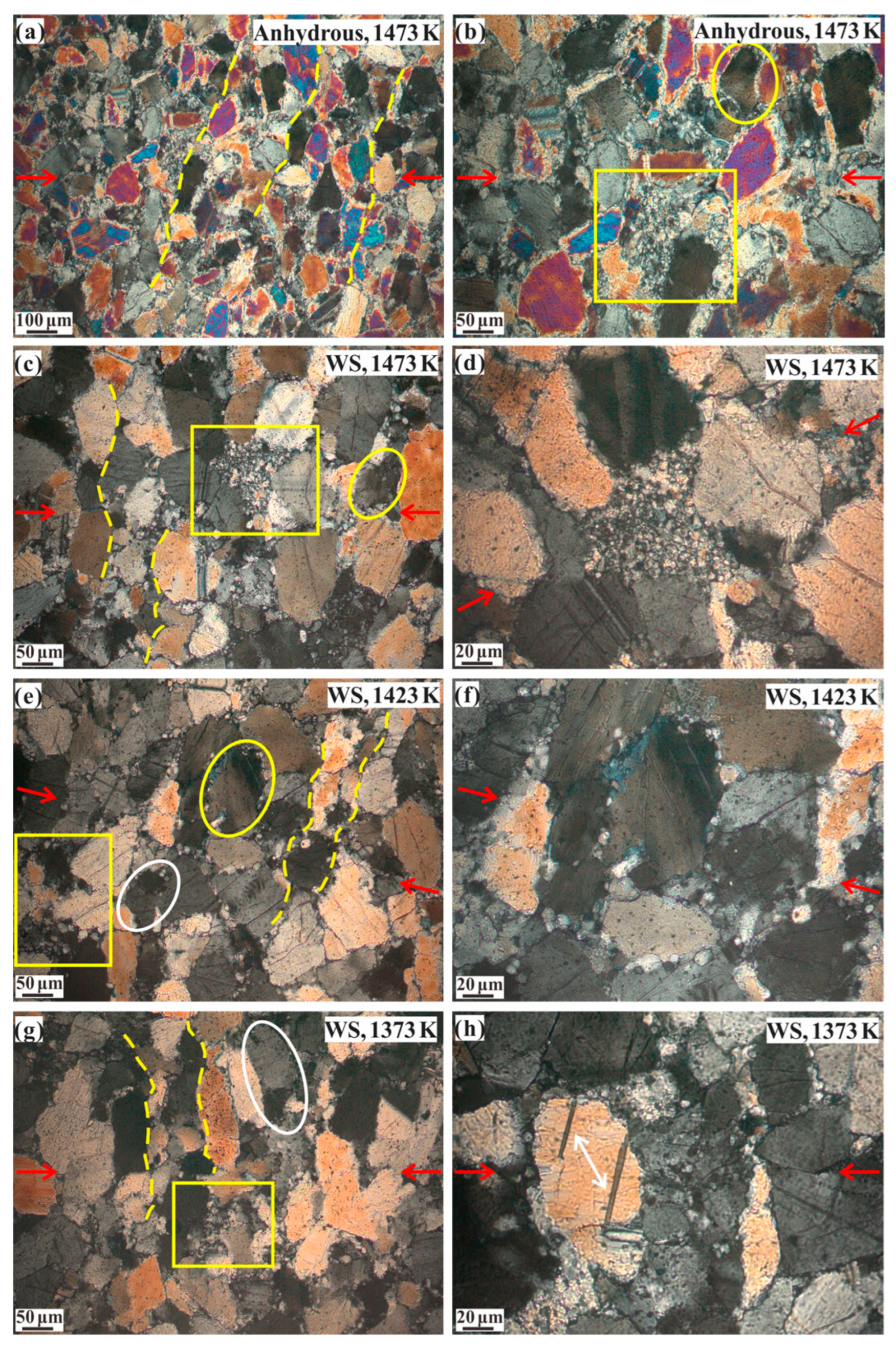
After deformation, diopside grains develop a significant shape preferred orientation with the long axis near perpendicular to the compressional direction, sutured to lobate grain boundaries, widespread undulatory extinction, subgrains, and fine recrystallized grains (Figure 2). Lenticular mechanical twins are also sporadically observed (Figure 2h). Compared to the anhydrous samples, those deformed under water-saturated conditions display more lobate grain boundaries, more prominent subgrains and recrystallized grains, whereas the anhydrous samples exhibit more intense undulatory extinction.
Grain size statistics indicate that the coarse-grained matrix in the deformed samples has an average grain size of ~90 μm (Figure A4b), comparable to that of the starting material, while recrystallized grains (2–10 μm) constitute ~6% of the total area in the anhydrous samples and between 8 and 12% in the water-saturated samples, based on visual estimation.

3.3. Mechanical Results

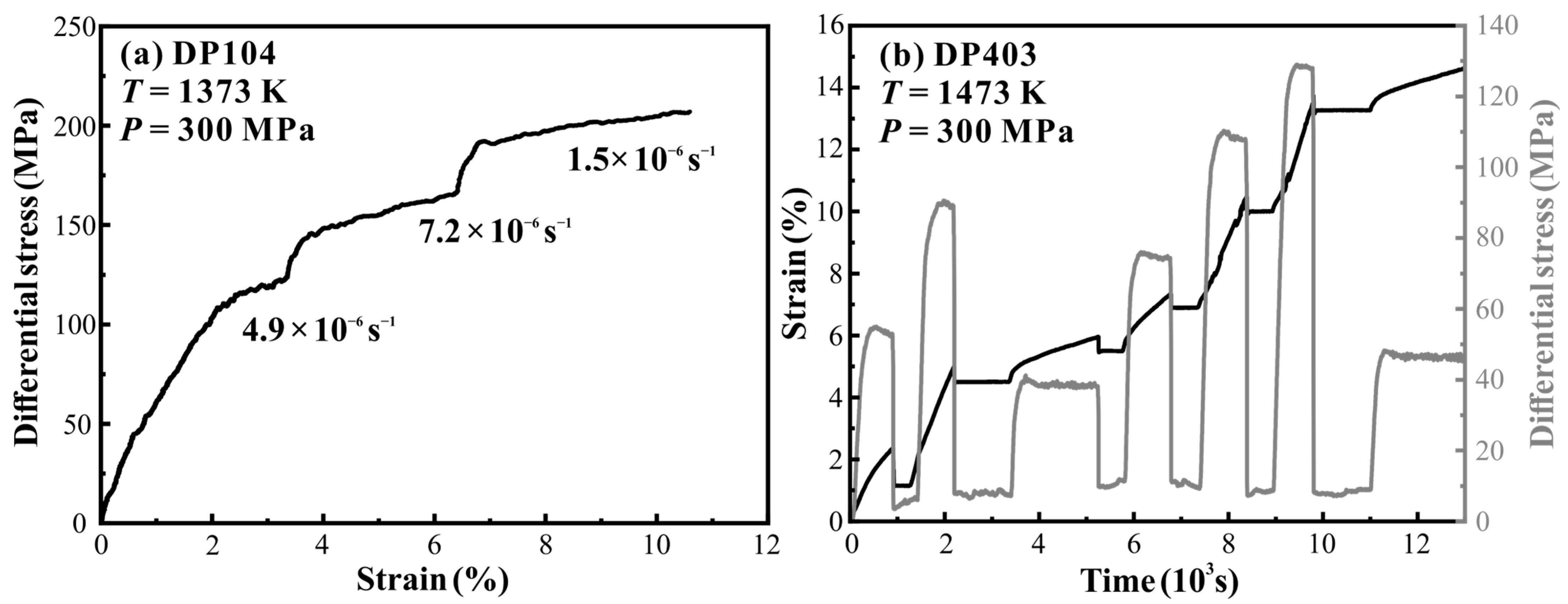
A total of four stress-stepwise experiments and three strain-rate-stepwise experiments were performed on diopside aggregate samples, with six under water-saturated conditions and one under anhydrous conditions (Table 1). Representative differential stress–strain curves are shown in Figure A5. Under water-saturated conditions, the six samples were deformed at 1373, 1423, and 1473 K, with differential stresses restricted to 30–202 MPa, and the corresponding strain rates were from 3.0 × 10⁻⁶ s−1 to 5.4 × 10⁻⁵ s−1. Under anhydrous conditions, the sample deformed at 1473 K, and differential stress from 178 to 289 MPa resulted in strain rates that ranged from 7.4 × 10⁻⁷ s−1 to 5.0 × 10⁻⁶ s−1. The substantially lower strain rates observed under anhydrous conditions, despite much higher applied stresses, indicate a pronounced water-weakening effect.
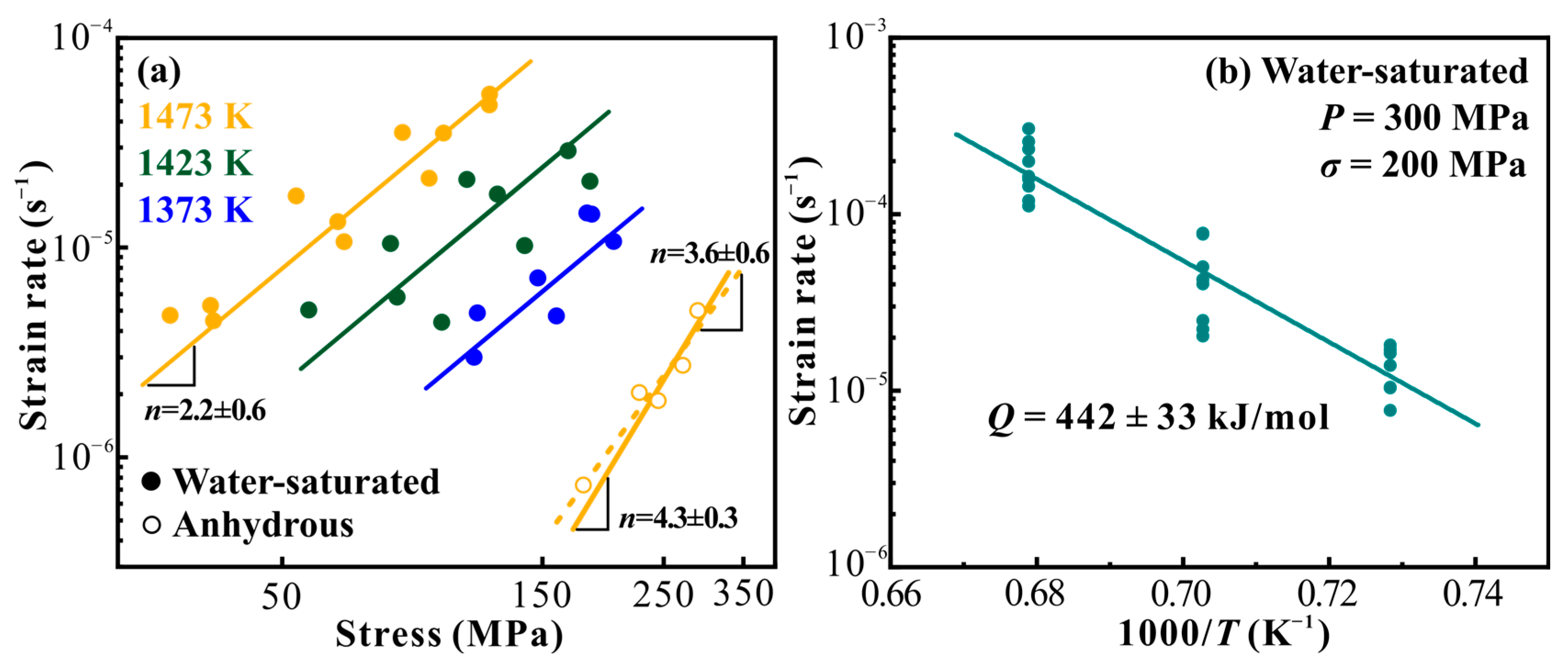
Mechanical data is plotted as strain rate versus stress on log-log axes in Figure 3a. No systematic difference in steady-state flow behavior was observed between the stress-stepwise and strain-rate-stepwise loading modes within experimental uncertainty, except for a moderate scatter in the data obtained at 1423 K. Accordingly, data obtained using both loading modes are jointly analyzed in the following flow law fitting. Linear least squares fit to water-saturated data yields a stress exponent of 2.2 ± 0.6. In the normalized strain rate (σ = 200 MPa) versus reciprocal temperature diagram (Figure 3b), linear least squares fit to the data yields an activation energy of 442 ± 33 kJ/mol for samples deformed under water-saturated conditions. With the known stress exponent and activation energy, nonlinear least squares fit to data yields a material-dependent parameter of 106.9±0.5 MPa−2.2 s−1. Hence, the flow law for the diopside aggregates under water-saturated conditions is
ε ˙ = 10 6.9 ± 0.5 σ 2.2 ± 0.6   exp 442   ±   33 R T

4. Discussion

4.1. Water Conditions for Deformation

FTIR spectroscopy measurements indicate that both the hot-pressed starting material and the deformed sample from experiments DP396 have low OH contents of less than 3 ppm. These values are near the FTIR detection limit, confirming that these experiments were performed under anhydrous conditions. In contrast, the hydrous samples contain significantly higher intracrystalline OH concentrations, approximately 80 ppm. Based on the dependence of water solubility in Cr-bearing diopside on water fugacity, pressure, and temperature established by Bromiley et al. [44], the water contents determined in the deformed samples reached the solubility level of Cr-bearing diopside under conditions of ∼300 MPa and 1373–1473 K, indicating that the deformation process occurred under water-saturated conditions. The FTIR spectra of the hydrous samples also exhibit a broad absorption band attributed to molecular H2O along grain boundaries, consistent with the presence of excess fluid during deformation.

4.2. Effect of Water on the Creep of Diopside

The only sample deformed under anhydrous conditions exhibits well-developed, widespread undulatory extinction and subgrains, sporadic lenticular mechanical twins and a small fraction (~6%) of fine recrystallized grains along grain boundaries. In contrast, under water-saturated conditions, deformed samples are characterized by a higher abundance of subgrains and recrystallized grains (8%–12%), while mechanical twins are relatively rare. Such microstructural evidence suggests that the dominant deformation mechanism was dislocation creep under both anhydrous and water-saturated conditions, and the presence of water enhances recovery processes driven by dislocation climb.
Using the same starting material, diopside, Li et al. [35] conducted deformation experiments on diopside aggregates under water-unsaturated conditions, with comparative experiments performed under anhydrous and water-saturated conditions. They established a flow law for dislocation creep in diopside under water-unsaturated states and found that, at CH2O = 3 ppm, the flow law can effectively predict the deformation behavior of diopside aggregates under anhydrous conditions. However, all their experiments were conducted under the oxygen fugacity (fO2) of Fe/FeO (IW) buffer. Although Bystricky and Mackwell [25] reported that oxygen fugacity has little effect on the rheology of Cpx, we performed an additional deformation experiment on a diopside aggregate under anhydrous conditions at the NNO oxygen fugacity (DP396). The separate fit to the mechanical data of DP396 yields a stress exponent n = 3.6 ± 0.6 (Figure 3a), which is consistent within error with the stress exponent reported by Li et al. [35]. Moreover, the data are well predicted by the flow law of Li et al. [35], with CH2O = 3 ppm as well. This indicates that, under anhydrous conditions, oxygen fugacity has a very limited influence on the rheological behavior of diopside aggregates and the deformation of diopside aggregates under NNO oxygen fugacity and anhydrous conditions still follows the flow law reported by Li et al. [35] (with CH2O = 3 ppm), which can be simplified to the form of Equation (3), with n = 4.3 ± 0.3, Q = 427 ± 31 kJ mol−1, and A = 10−0.7 MPa−4.3 s−1.
In contrast, the diopside aggregates deformed under water-saturated conditions obey a power flow law with a lower stress exponent n = 2.2 ± 0.6 and comparable Q value (442 ± 33 kJ/mol). Although the stress exponent is lower than typical values expected for dislocation creep, the microstructures indicate that deformation is primarily accommodated by dislocation activity. The samples display widespread undulatory extinction, abundant subgrains, recrystallized grains, and lobate grain boundaries, all of which are characteristic of dislocation creep. The dynamically recrystallized grains are fine (2–10 μm) but constitute only ~8%–12% of the sample area and occur locally along grain boundaries, whereas the coarse-grained matrix remains continuous. These fine-grained domains may deform by grain-size-sensitive mechanisms such as diffusion creep or grain-boundary sliding, which can lower the apparent stress exponent. In addition, the similar activation energies obtained under anhydrous and water-saturated conditions are consistent with deformation controlled by the {110}1/2<a ± b> slip system. Therefore, we interpret that dislocation creep dominates the bulk deformation, while a minor contribution from grain-size-sensitive processes reduces the apparent stress exponent.
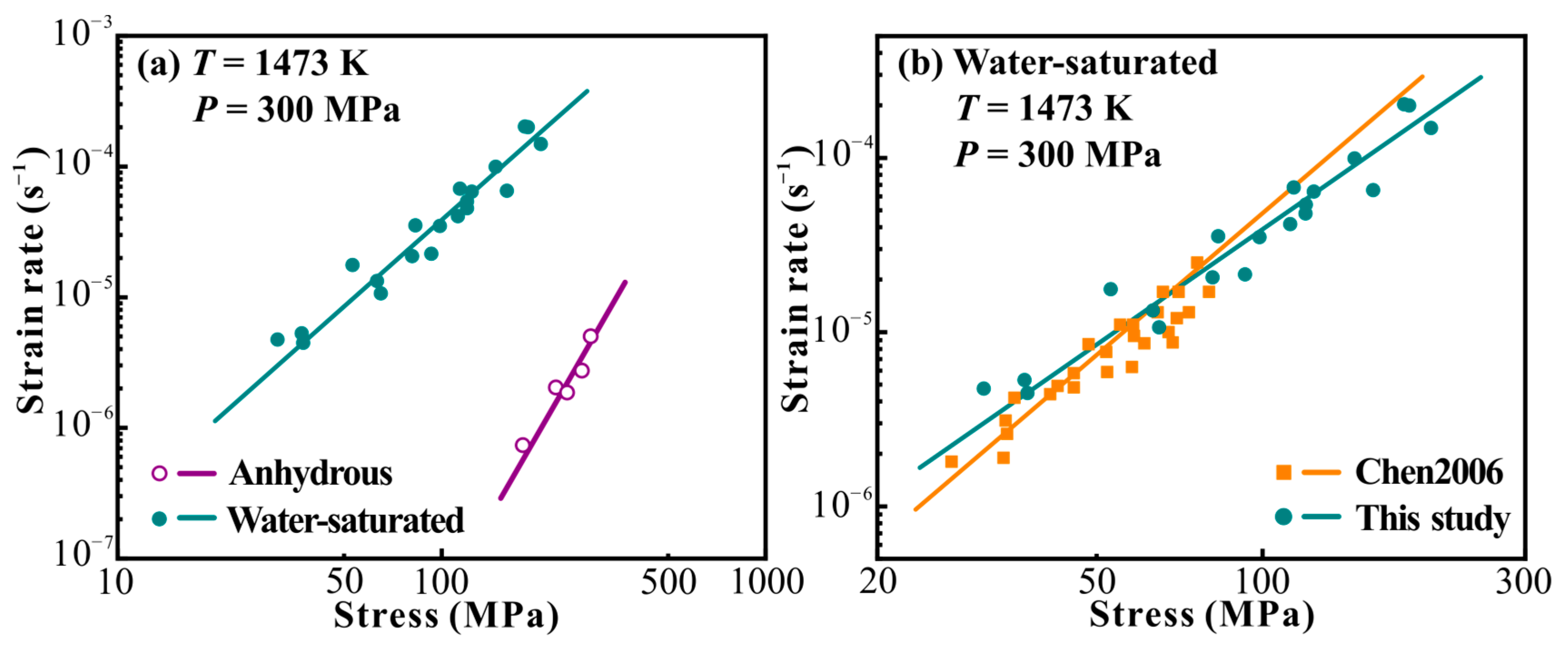
The presence of water significantly weakens the diopside aggregate. For instance, at a pressure of 300 MPa, temperature of 1473 K, and a differential stress of ~150 MPa, the creep rate of water-saturated samples is ~70 times faster than that of their anhydrous counterparts (Figure 4a). The water-weakening mechanism in nominally anhydrous minerals is generally attributed to hydrogen-enhanced defect mobility and dislocation climb, consistent with the behavior observed here, which has been well-discussed in previous studies (e.g., [10,12,13,14]).

4.3. Comparison to Cpx with High Fe Content

Numerous mineralogical and geochemical studies have shown that Cpx from different provenances often exhibit distinct chemical compositions. Specifically, crust-derived Cpx, such as those from Sleaford Bay, are relatively enriched in Fe and Al, whereas mantle-derived Cpx, like the diopside used in this study, are characterized by higher Mg contents. A comparative investigation of the rheological differences between these two types of Cpx is crucial for a comprehensive understanding of the rheological behavior of the lower crust and upper mantle.
The rheological behavior of Sleaford Bay Cpx has been extensively investigated in previous experimental studies, including under water-saturated conditions [10]. Under water-saturated conditions, the Sleaford Bay Cpx deforming by dislocation creep has a stress exponent of n = 2.7 ± 0.3, slightly higher than the n = 2.2 ± 0.6 for diopside. Its activation energy Q = 670 ± 40 kJ/mol is slightly reduced compared to under anhydrous conditions but remains significantly higher than that of diopside. It should be noted that Chen et al. [10] reported water contents of ~60 ppm (using the calibration method of Paterson [45]) and ~20 ppm (using the calibration of Bell et al. [36]) for Sleaford Bay Cpx under 300 MPa water-saturated conditions, which are lower than the water contents observed in our diopside samples under similar conditions. Given these differences in water solubility and composition, further investigation into the exact nature of water incorporation in Sleaford Bay Cpx under saturated conditions would be beneficial for a clearer comparison.
If the deformation of Sleaford Bay Cpx reported by Chen et al. [10] did occur under water-saturated conditions, its rheological strength under laboratory temperature and strain rate conditions remains comparable to the diopside in this work, especially at 1473 K (Figure 4b). Comparing deformation under anhydrous (see Figure 6 in reference [35]) and water-saturated conditions reveals that the degree of water weakening in Sleaford Bay Cpx is comparable to that observed in diopside. Under water-saturated conditions, the creep rate is approximately two orders of magnitude faster than under anhydrous conditions. This is the case despite their different chemical compositions, particularly given that Fe3+ and Al3+ ions can influence water solubility in Cpx [46,47,48].

4.4. Comparison with Other Minerals

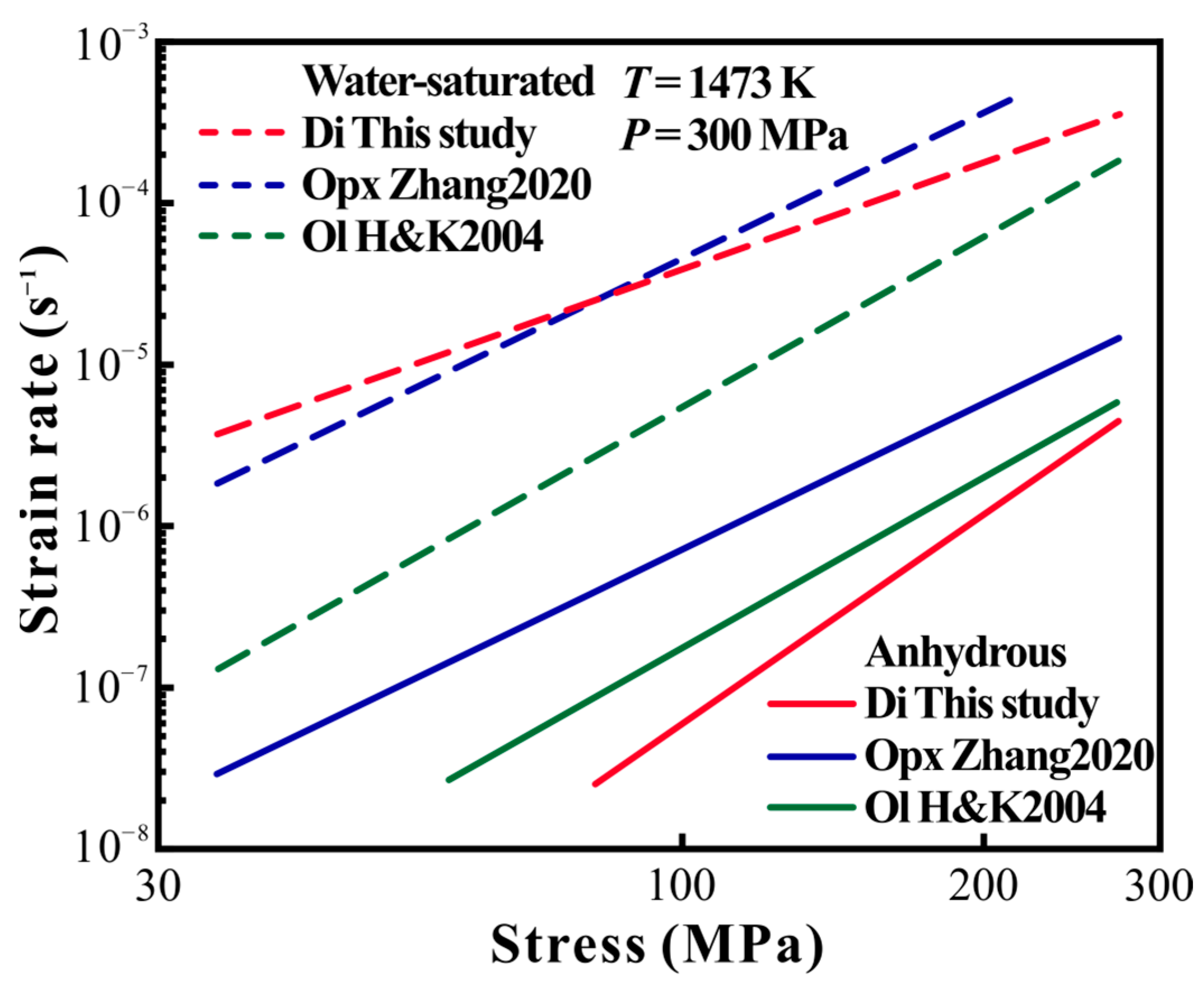
To further compare the water weakening effects on mantle minerals, the flow laws of olivine from Hirth and Kohlstedt [49], of enstatite from Zhang et al. [12] and of diopside in this study were plotted in Figure 5. Under anhydrous conditions, diopside is slightly stronger than orthopyroxene and broadly comparable to olivine in laboratory conditions. This observation is consistent with previous experimental studies (e.g., [10,26,35]) suggesting that Cpx is not intrinsically weaker than other mantle silicates under dry conditions, despite its more complex crystal structure.
In contrast, under water-saturated conditions, diopside becomes dramatically weaker. At a given differential stress, water-saturated diopside plots are close to water-saturated orthopyroxene and systematically weaker than water-saturated olivine over the stress range shown. Water-saturated diopside exhibits the largest offset relative to its anhydrous counterpart, about 1.5–3 orders of magnitude weakening, indicating a much stronger sensitivity of diopside rheology to the presence of water. Our results, which are consistent with extrapolations by Li et al. [35], indicate Cpx (diopside) is comparable in strength to olivine under anhydrous conditions but much weaker than olivine under water-saturated conditions at laboratorial confining pressure and temperature.
Although Cpx is not the volumetrically dominant mineral in the peridotitic upper mantle, its mechanical role cannot be evaluated solely from modal abundance. Increasing geochemical and petrological evidence indicates that the mantle commonly contains lithological heterogeneities in which pyroxene-rich rocks are concentrated. These include mantle pyroxenites formed by melt–rock reaction, metasomatized mantle domains enriched in Cpx, and recycled oceanic crust transformed into eclogite or garnet pyroxenite and incorporated into both lithospheric and asthenospheric mantle reservoirs [3,5]. In subduction-zone environments, pyroxenite may also participate directly in melting and mantle wedge dynamics [4]. In such lithologies, Cpx may constitute a substantial fraction of the rock and thus influence the bulk mechanical behavior.
Accordingly, the flow law derived in this study is not intended to represent the rheology of average peridotitic mantle but rather to constrain the strength of Cpx-rich mantle heterogeneities. If these domains are water-saturated, their reduced strength relative to surrounding olivine-rich peridotite may facilitate localized deformation and strain partitioning in specific geological settings, such as metasomatized mantle regions, recycled crustal bodies, and pyroxenite-bearing mantle wedges.

4.5. Limitations

The applicability of the present flow law to mantle conditions is subject to several limitations. First, experiments were conducted at 300 MPa, significantly lower than typical upper mantle pressures (≥1 GPa). Because hydrogen solubility in clinopyroxene increases with pressure [44], deformation at mantle depths is expected to be weaker than predicted by our flow law. Second, the water fugacity exponent and activation volume were not independently calibrated due to the restricted pressure range of the Paterson gas-medium apparatus. Consequently, the derived parameters represent apparent values applicable to the experimental conditions and should be used cautiously when applied to mantle P–T conditions.

5. Conclusions

We conducted a series of high-temperature deformation experiments on mantle-derived diopside aggregates to quantify the effect of water on their rheological behavior under water-saturated and anhydrous conditions. Mechanical data obtained in the dislocation creep regime were fitted to a power-law flow equation. Under water-saturated conditions, the best-fit parameters are n = 2.2 ± 0.6, Q = 442 ± 33 kJ/mol, and A = 106.9±0.5 MPa−2.2 s−1. Under the experimental stress conditions, water-saturated samples deform approximately 1.5–3 orders of magnitude faster than anhydrous samples, demonstrating a pronounced water-weakening effect. Notably, under water-saturated conditions, the strength of our diopside was closely comparable to that of Sleaford Bay Cpx reported by Chen et al. [10] at a temperature of 1473 K. Under water-saturated conditions, diopside is significantly weaker than olivine yet exhibits strengths comparable to those of enstatite in experimental conditions. The results in this study provide key experimental constraints on the flow behavior of water-saturated, mantle-derived Cpx.

Author Contributions

Conceptualization, M.S.; methodology, J.L., X.W. and Z.J.; validation, Z.J., J.L. and X.Z.; formal analysis, Z.J., X.W. and X.Z.; investigation, Z.J., X.W. and X.Z.; resources, M.S.; data curation, Z.J. and X.W.; writing—original draft preparation, Z.J.; writing—review and editing, J.L.; visualization, Z.J. and X.Z.; supervision, M.S. and J.L.; project administration, M.S. and J.L.; funding acquisition, M.S. and J.L. All authors have read and agreed to the published version of the manuscript.

Funding

This research was funded by the National Natural Science Foundation of China, grant 42172243 and 42374122.

Data Availability Statement

The data for this study are available from Jiang, Zhexuan; Zheng, Xiaodong; Wang, Xiaoning; Li, Jianfeng; Song, Maoshuang (2026), “Water Weakening Effects on Dislocation Creep of Polycrystalline Diopside Aggregates”, Mendeley Data, V1. https://doi.org/10.17632/9jkw66kd2y.1 (accessed on 23 February 2026).

Acknowledgments

We thank Xing Ding from the Guangzhou Institute of Geochemistry, Chinese Academy of Sciences for providing access to the Leica optical microscope. We thank the anonymous reviewers for their constructive comments and suggestions, which improved the manuscript.

Conflicts of Interest

The authors declare no conflicts of interest.

Appendix A

Figure A1. Sketch diagram of the sample assembly used for experiments under water-saturated (top) and anhydrous (bottom) conditions.
Minerals 16 00232 g0a1
Figure A2. Example of FTIR spectral deconvolution (sample thickness normalization to 1 cm). The broad absorption band between ~3000 and 3700 cm−1, attributed to molecular H2O along grain boundaries, was separated from the sharp OH bands by peak deconvolution using multiple Gaussian components. Only the sharp absorption peak centered near ~3646 cm−1 was integrated to determine structurally bound hydroxyl, while the broad component was excluded from water-content calculation. A much weaker band near ~3456 cm−1 was observed in some spectra; however, its intensity was close to the noise level and could not be reliably resolved during peak fitting. Inclusion of this peak would introduce uncertainty larger than the signal itself. Therefore, this band was not included in the water-content calculation, and only the well-resolved ~3646 cm−1 peak was used to determine hydroxyl concentration.
Minerals 16 00232 g0a2
Figure A3. Cross-polarized light optical micrographs of hot-pressed diopside aggregates synthesized under (a,b) anhydrous and (c,d) hydrous conditions. Straight grain boundaries are marked with yellow arrows.
Minerals 16 00232 g0a3
Figure A4. Histograms of grain size distributions in hydrous diopside (a) before deformation and (b) after deformation. Grain size measurements were performed on the coarse-grained matrix grains only; fine recrystallized grains along grain boundaries were excluded because they are localized and cannot be reliably quantified using optical microscopy.
Minerals 16 00232 g0a4
Figure A5. Representative stress–strain curves for (a) strain-rate-stepwise experiments (DP104) and (b) stress-stepwise experiments (DP403).
Minerals 16 00232 g0a5

References

  1. Ringwood, A.E. A Model for the Upper Mantle. J. Geophys. Res. 1962, 67, 857–867. [Google Scholar] [CrossRef]
  2. Anderson, D.L.; Bass, J.D. Mineralogy and Composition of the Upper Mantle. Geophys. Res. Lett. 1984, 11, 637–640. [Google Scholar] [CrossRef]
  3. Yang, Z.-F.; Li, J.; Liang, W.-F.; Luo, Z.-H. On the Chemical Markers of Pyroxenite Contributions in Continental Basalts in Eastern China: Implications for Source Lithology and the Origin of Basalts. Earth Sci. Rev. 2016, 157, 18–31. [Google Scholar] [CrossRef]
  4. Bowman, E.E.; Ducea, M.N. Pyroxenite Melting at Subduction Zones. Geology 2023, 51, 383–386. [Google Scholar] [CrossRef]
  5. Ren, Z.-Y.; Wu, Y.-D.; Zhang, L.; Nichols, A.R.L.; Hong, L.-B.; Zhang, Y.-H.; Zhang, Y.; Liu, J.-Q.; Xu, Y.-G. Primary Magmas and Mantle Sources of Emeishan Basalts Constrained from Major Element, Trace Element and Pb Isotope Compositions of Olivine-Hosted Melt Inclusions. Geochim. Cosmochim. Acta 2017, 208, 63–85. [Google Scholar] [CrossRef]
  6. Beard, C.D.; Van Hinsberg, V.J.; Stix, J.; Wilke, M. Clinopyroxene/Melt Trace Element Partitioning in Sodic Alkaline Magmas. J. Petrol. 2019, 60, 1797–1823. [Google Scholar] [CrossRef]
  7. Lusk, A.D.; Chatzaras, V.; Aldanmaz, E.; Tikoff, B. Hydration State and Rheologic Stratification of the Lithospheric Mantle Beneath the North Anatolian Fault, Turkey. Geochem. Geophys. Geosyst. 2023, 24, e2023GC011096. [Google Scholar] [CrossRef]
  8. Katayama, I.; Nakashima, S. Hydroxyl in Clinopyroxene from the Deep Subducted Crust: Evidence for H2O Transport into the Mantle. Am. Miner. 2003, 88, 229–234. [Google Scholar] [CrossRef]
  9. Kohlstedt, D.L. The Role of Water in High-Temperature Rock Deformation. Rev. Mineral. Geochem. 2006, 62, 377–396. [Google Scholar] [CrossRef]
  10. Chen, S.; Hiraga, T.; Kohlstedt, D.L. Water Weakening of Clinopyroxene in the Dislocation Creep Regime. J. Geophys. Res. Solid Earth 2006, 111, B08203. [Google Scholar] [CrossRef]
  11. Griggs, D.T.; Blacic, J.D. Quartz: Anomalous Weakness of Synthetic Crystals. Science 1965, 147, 292–295. [Google Scholar] [CrossRef]
  12. Zhang, G.; Mei, S.; Song, M. Effect of Water on the Dislocation Creep of Enstatite Aggregates at 300 MPa. Geophys. Res. Lett. 2020, 47, e2019GL085895. [Google Scholar] [CrossRef]
  13. Mei, S.; Kohlstedt, D.L. Influence of Water on Plastic Deformation of Olivine Aggregates: 1. Diffusion Creep Regime. J. Geophys. Res. Solid Earth 2000, 105, 21457–21469. [Google Scholar] [CrossRef]
  14. Mei, S.; Kohlstedt, D.L. Influence of Water on Plastic Deformation of Olivine Aggregates: 2. Dislocation Creep Regime. J. Geophys. Res. Solid Earth 2000, 105, 21471–21481. [Google Scholar] [CrossRef]
  15. Karato, S.-I.; Jung, H. Effects of Pressure on High-Temperature Dislocation Creep in Olivine. Philos. Mag. 2003, 83, 401–414. [Google Scholar] [CrossRef]
  16. Amiguet, E.; Raterron, P.; Cordier, P.; Couvy, H.; Chen, J. Deformation of Diopside Single Crystal at Mantle Pressure. 1: Mechanical Data. Phys. Earth Planet. Inter. 2009, 177, 122–129. [Google Scholar] [CrossRef]
  17. Avé Lallemant, H. Experimental Deformation of Diopside and Websterite. Tectonophysics 1978, 48, 1–27. [Google Scholar] [CrossRef]
  18. Ghosh, S.; Koizumi, S.; Hiraga, T. Diffusion Creep of Diopside. J. Geophys. Res. Solid Earth 2021, 126, e2020JB019855. [Google Scholar] [CrossRef]
  19. Griggs, D.T.; Turner, F.J.; Heard, H.C. Chapter 4: Deformation of Rocks at 500° to 800 °C. In Rock Deformation (A Symposium); Geological Society of America: Boulder, CO, USA, 1960. [Google Scholar] [CrossRef]
  20. Kollé, J.J.; Blacic, J.D. Deformation of Single-Crystal Clinopyroxenes: 1. Mechanical Twinning in Diopside and Hedenbergite. J. Geophys. Res. 1982, 87, 4019–4034. [Google Scholar] [CrossRef]
  21. Kollé, J.J.; Blacic, J.D. Deformation of Single-Crystal Clinopyroxenes: 2. Dislocation-Controlled Flow Processes in Hedenbergite. J. Geophys. Res. 1983, 88, 2381–2393. [Google Scholar] [CrossRef]
  22. Ingrin, J.; Doukhan, N.; Doukhan, J.C. High-Temperature Deformation of Diopside Single Crystal: 2. Transmission Electron Microscopy Investigation of the Defect Microstructures. J. Geophys. Res. Solid Earth 1991, 96, 14287–14297. [Google Scholar] [CrossRef]
  23. Ingrin, J.; Doukhan, N.; Doukhan, J.C. Dislocation Glide Systems in Diopside Single Crystals Deformed at 800–900 °C. Eur. J. Mineral. 1992, 4, 1291–1302. [Google Scholar] [CrossRef]
  24. Raterron, P.; Jaoul, O. High-Temperature Deformation of Diopside Single Crystal: 1. Mechanical Data. J. Geophys. Res. Solid Earth 1991, 96, 14277–14286. [Google Scholar] [CrossRef]
  25. Bystricky, M.; Mackwell, S. Creep of Dry Clinopyroxene Aggregates. J. Geophys. Res. Solid Earth 2001, 106, 13443–13454. [Google Scholar] [CrossRef]
  26. Hier-Majumder, S.; Mei, S.; Kohlstedt, D.L. Water Weakening of Clinopyroxenite in Diffusion Creep. J. Geophys. Res. Solid Earth 2005, 110, B07406. [Google Scholar] [CrossRef]
  27. McGuire, A.V.; Stern, R.J. Granulite Xenoliths from Western Saudi Arabia: The Lower Crust of the Late Precambrian Arbian-Nubian Shield. Contrib. Mineral. Petrol. 1993, 114, 395–408. [Google Scholar] [CrossRef]
  28. Embey-Isztin, A.; Downes, H.; Kempton, P.D.; Dobosi, G.; Thirlwall, M. Lower Crustal Granulite Xenoliths from the Pannonian Basin, Hungary. Part 1: Mineral Chemistry, Thermobarometry and Petrology. Contrib. Mineral. Petrol. 2003, 144, 652–670. [Google Scholar] [CrossRef]
  29. Ortega-Gutiérrez, F.; Gómez-Tuena, A.; Elías-Herrera, M.; Solari, L.A.; Reyes-Salas, M.; Macías-Romo, C. Petrology and Geochemistry of the Valle de Santiago Lower-Crust Xenoliths: Young Tectonothermal Processes beneath the Central Trans-Mexican Volcanic Belt. Lithosphere 2014, 6, 335–360. [Google Scholar] [CrossRef]
  30. Zhou, Y.; Hou, Z.; Zheng, Y.C.; Xu, B.; Wang, R.; Luo, C.H. Granulite xenoliths in Liuhe area: Evidence for composition and genetic mechanism of the lower crust from the Neoproterozoic to Cenozoic. Acta Petrol. Sin. 2017, 33, 2143–2160. [Google Scholar]
  31. Dimanov, A.; Dresen, G. Rheology of Synthetic Anorthite-Diopside Aggregates: Implications for Ductile Shear Zones. J. Geophys. Res. Solid Earth 2005, 110, B07203. [Google Scholar] [CrossRef]
  32. Dimanov, A.; Lavie, M.P.; Dresen, G.; Ingrin, J.; Jaoul, O. Creep of Polycrystalline Anorthite and Diopside. J. Geophys. Res. Solid Earth 2003, 108, 2061. [Google Scholar] [CrossRef]
  33. Zhao, Y.-H.; Zimmerman, M.E.; Kohlstedt, D.L. Effect of Iron Content on the Creep Behavior of Olivine: 1. Anhydrous Conditions. Earth Planet. Sci. Lett. 2009, 287, 229–240. [Google Scholar] [CrossRef]
  34. Zhao, Y.-H.; Zimmerman, M.E.; Kohlstedt, D.L. Effect of Iron Content on the Creep Behavior of Olivine: 2. Hydrous Conditions. Phys. Earth Planet. Inter. 2018, 278, 26–33. [Google Scholar] [CrossRef]
  35. Li, J.; Song, M.; Wang, H.; Zhang, G.; Mei, S.; Zheng, X.; Wang, X.; Jiang, Z. Dislocation Creep of Diopside Aggregates Under Unsaturated Hydrous Conditions at a Confining Pressure of 300 MPa. J. Geophys. Res. Solid Earth 2024, 129, e2024JB029472. [Google Scholar] [CrossRef]
  36. Bell, D.R.; Ihinger, P.D.; Rossman, G.R. Quantitative Analysis of Trace OH in Garnet and Pyroxenes. Am. Miner. 1995, 80, 465–474. [Google Scholar] [CrossRef]
  37. Li, J.; Shao, T.; Song, M.; Wang, H. Low-Temperature Plasticity and Dislocation Creep of Fangshan Dolomite. J. Geophys. Res. Solid Earth 2021, 126, e2020JB021439. [Google Scholar] [CrossRef]
  38. Li, J.; Song, M.; Shao, T.; Zheng, X.; Jiang, Z. Mechanical Data Corrections for Triaxial Compression Testing at High Pressures and High Temperatures with a Paterson Gas-Medium Mechanical Testing Apparatus. Rev. Sci. Instrum. 2023, 94, 083907. [Google Scholar] [CrossRef] [PubMed]
  39. Paterson, M.S. Rock Deformation Experimentation. In The Brittle-Ductile Transition in Rocks; American Geophysical Union (AGU): Washington, DC, USA, 1990; pp. 187–194. ISBN 978-1-118-66408-7. [Google Scholar]
  40. Shao, T.; Ji, S.; Li, J.; Wang, Q.; Song, M. Paterson Gas-Medium High-Pressure High-Temperature Testing System and Its Applications in Rheology of Rocks. Geotecton. Metallog. 2011, 35, 457–476. [Google Scholar]
  41. Song, M.; Shao, T.; Li, J.; Ji, S.; Wang, Q. Experimental study of deformation of Carrara marble at high pressure and high temperature. Acta Petrol. Sin. 2014, 30, 589–596. [Google Scholar]
  42. Faul, U.H.; Scott, D. Grain Growth in Partially Molten Olivine Aggregates. Contrib. Mineral. Petrol. 2006, 151, 101–111. [Google Scholar] [CrossRef]
  43. Pitzer, K.S.; Sterner, S.M. Equations of State Valid Continuously from Zero to Extreme Pressures for H2O and CO2. J. Chem. Phys. 1994, 101, 3111–3116. [Google Scholar] [CrossRef]
  44. Bromiley, G.D.; Keppler, H.; McCammon, C.; Bromiley, F.A.; Jacobsen, S.D. Hydrogen Solubility and Speciation in Natural, Gem-Quality Chromian Diopside. Am. Miner. 2004, 89, 941–949. [Google Scholar] [CrossRef]
  45. Paterson, M. The Determination of Hydroxyl by Infrared Absorption in Quartz, Silicate Glasses and Similar Materials. Bull. Mineral. 1982, 105, 20–29. [Google Scholar] [CrossRef]
  46. Skogby, H. OH Incorporation in Synthetic Clinopyroxene. Am. Miner. 1994, 79, 240–249. [Google Scholar]
  47. Skogby, H.; Rossman, G.R. OH- in Pyroxene; an Experimental Study of Incorporation Mechanisms and Stability. Am. Miner. 1989, 74, 1059–1069. [Google Scholar]
  48. Smyth, J.R.; Bell, D.R.; Rossman, G.R. Incorporation of Hydroxyl in Upper-Mantle Clinopyroxenes. Nature 1991, 351, 732–735. [Google Scholar] [CrossRef]
  49. Hirth, G.; Kohlstedt, D. Rheology of the Upper Mantle and the Mantle Wedge: A View from the Experimentalists. In Inside the Subduction Factory; American Geophysical Union (AGU): Washington, DC, USA, 2004; pp. 83–105. ISBN 978-1-118-66857-3. [Google Scholar]
Figure 1. FTIR spectra of deformed and hot-pressed diopside aggregates collected using an unpolarized infrared beam (sample thickness normalization to 1 cm).
Minerals 16 00232 g001
Figure 2. Optical micrographs under cross-polarized light of anhydrous (a,b) DP396 and water-saturated (ch) diopside aggregates deformed at 1373 K (c,d) DP404, 1423 K (e,f) DP412 and 1473 K (g,h) DP403. Red arrows indicate the compression directions; yellow dash lines mark shape preferred orientation; yellow rectangles highlight dynamically recrystallized grains; white circles outline subgrains; yellow circles enclose areas of undulatory extinction; and white double-headed arrows denote lenticular mechanical twins. Abbreviation: WS, water saturated.
Minerals 16 00232 g002
Figure 3. Mechanical results for water-saturated and anhydrous diopside aggregates. (a) Strain rate versus differential stress for anhydrous (open circles) and water-saturated (solid circles) samples. The solid orange line represents the flow law extrapolated from Li et al. [35] for anhydrous diopside at 1473 K (CH2O = 40 H/106 Si, ~3 ppm by weight). The dashed line is a least-squares linear fit to the present anhydrous data, yielding a stress exponent of n = 3.6 ± 0.6. For the water-saturated samples deformed at 1373–1473 K, the corresponding fit gives n = 2.2 ± 0.6. (b) Normalized strain rate (at σ = 200 MPa) versus reciprocal temperature (1000/T) for water-saturated experiments. The fitted line corresponds to an activation energy Q = 442 ± 33 kJ/mol.
Minerals 16 00232 g003
Figure 4. (a) Comparison of mechanical data for diopside aggregates under water-saturated (solid circles) and anhydrous (open circles) conditions. All data were normalized to 1473 K using the derived flow law parameters. (b) Comparison between water-saturated creep data from this study (dark green circles, normalized to 1473 K) and from Chen et al. [10] for Sleaford Bay Cpx (orange squares). The dark green and orange lines show the best-fit flow laws for water-saturated diopside (XFe = 0.042) obtained in this study and for hydrous Sleaford Bay Cpx (XFe = 0.245, fH2O = 280 MPa) reported by Chen et al. [10], respectively. Despite differences in Fe content and geological origin, the two hydrous datasets exhibit nearly identical creep strengths at 1473 K.
Minerals 16 00232 g004
Figure 5. Comparative flow laws of major upper mantle minerals. Strain rate as a function of differential stress is shown for diopside, orthopyroxene (enstatite), and olivine under anhydrous and water-saturated conditions at 1473 K and 300 MPa in the dislocation creep regime. The solid and dashed red lines represent the flow laws for anhydrous and water-saturated diopside, respectively; the former is extrapolated to CH2O = 3 ppm from Li et al. [35], and the latter is determined in this study. Solid and dashed blue lines denote the corresponding anhydrous and water-saturated flow laws for orthopyroxene from Zhang et al. [12]. Solid and dashed green lines indicate the anhydrous and water-saturated flow laws for olivine, respectively, from Hirth and Kohlstedt [49]. Abbreviations: Di, diopside; Opx, orthopyroxene; Ol, olivine.
Minerals 16 00232 g005
Table 1. Testing conditions and mechanical results for diopside aggregates.
ExperimentTemperaturePressureStressStrain Rate C H 2 O HP C H 2 O AD
(K)(MPa)(MPa)(s−1)(ppm)(ppm)
Water-saturated
DP4031473305531.8 × 10−54983
833.5 × 10⁻⁵
314.7 × 10⁻⁶
631.3 × 10⁻⁵
993.5 × 10⁻⁵
3041204.8 × 10−5
374.5 × 10⁻⁶
DP4121423309815.8 × 10−64272
1241.8 × 10−5
3081672.9 × 10−5
984.4 × 10⁻⁶
1391.0 × 10−5
1832.1 × 10−5
DP40413732991851.4 × 10−54382
1123.0 × 10−6
1594.7 × 10−6
2021.1 × 10−5
DP1051473300375.3 × 10−679
651.1 × 10⁻⁵
932.1 × 10⁻⁵
1205.4 × 10−5
DP1031423300565.0 × 10−689
791.0 × 10⁻⁵
1092.1 × 10−5
DP10413732981144.9 × 10−685
1477.2 × 10−6
1811.5 × 10−5
Anhydrous
DP39614733111787.4 × 10−7~3~3
2252.0 × 10−6
2712.74× 10−6
2441.9 × 10−6
2895.0 × 10−6
HP: Hot-pressed samples; AD: samples after deformation; —: not measured.
Disclaimer/Publisher’s Note: The statements, opinions and data contained in all publications are solely those of the individual author(s) and contributor(s) and not of MDPI and/or the editor(s). MDPI and/or the editor(s) disclaim responsibility for any injury to people or property resulting from any ideas, methods, instructions or products referred to in the content.