Article

The Role of Clinopyroxene on the Rheology of Dry Olivine–Clinopyroxene Aggregates

1
State Key Laboratory of Deep Earth Processes and Resources, Guangzhou Institute of Geochemistry, Chinese Academy of Sciences, Guangzhou 510640, China
2
College of Earth and Planetary Sciences, University of Chinese Academy of Sciences, Beijing 100049, China
*
Author to whom correspondence should be addressed.
Minerals 2026, 16(2), 218; https://doi.org/10.3390/min16020218
Submission received: 15 January 2026 / Revised: 15 February 2026 / Accepted: 18 February 2026 / Published: 20 February 2026

Abstract

To investigate the influence of a second-phase mineral on the rheology of mantle peridotite, we conducted high-temperature deformation experiments on dry olivine–clinopyroxene (Ol-Cpx) aggregates. Cylindrical samples were manufactured using hot-isostatic pressing techniques, with Ol as the matrix phase and Cpx added at volume fractions of fCpx = 0.1, 0.3, and 0.5. Deformation experiments were performed in a Paterson gas-medium apparatus at a confining pressure of ~300 MPa, temperatures ranging from 1423 to 1523 K, and strain rates of ~5 × 10⁻⁶ s−1, ~1 × 10⁻⁵ s−1, ~2 × 10⁻⁵ s−1, and ~5 × 10⁻⁵ s−1. The stress exponents (n = 3.4–4.3) for two-phase aggregates are comparable to those reported for both pure Ol and pure Cpx, indicating that dislocation creep remains the dominant deformation mechanism. Increasing Cpx content does not induce a transition of dominant mechanism but leads to a slight decrease in activation energy, consistent with predictions from two-phase rheological models and reflecting the increasing contribution of Cpx to bulk deformation. Normalized flow stresses fall between the Ol and Cpx end-members within the Taylor–Sachs bounds, indicating moderate strain partitioning between phases. Aggregates with fCpx = 0.5 show slightly reduced strength and lower effective stress exponents. This is attributed to enhanced dynamic recrystallization, which triggers grain-size reduction and thereby increases the contribution of diffusion-assisted deformation, even though dislocation creep remains the dominant mechanism. These results suggest that under dry conditions, Cpx primarily modulates the rheology of olivine-rich aggregates through microstructural evolution and strain partitioning rather than by altering the dominant deformation mechanism.

1. Introduction

The upper mantle is predominantly composed of four minerals: olivine (Ol), orthopyroxene (Opx), clinopyroxene (Cpx) and garnet (Grt). Due to its major volume fraction (>60%) and presumed weakest strength, Ol has long been thought to govern the deformation behavior of the upper mantle. Rheological properties of Ol have thus been extensively investigated [1,2,3,4,5,6,7,8,9,10,11,12,13,14,15,16]. To gain a more accurate understanding of the rheology of the upper mantle, the deformation of minor phase minerals, such as Opx, Cpx and Grt, have also attracted increasing attention in the past four decades [17,18,19,20,21,22,23,24,25,26,27,28,29,30,31,32].
Several recent experimental studies have demonstrated that Opx or Cpx can be weaker than Ol under certain conditions, including in the shallow lithosphere [33,34] or under water-saturated circumstances [30]. This finding challenges the long-standing assumption that Ol is the weakest mineral in the upper mantle. Although the rheology of the upper mantle can be initially estimated from the flow laws of its constituent minerals and two-phase mixing laws [35,36,37,38,39,40,41,42,43,44,45], the actual behavior of polyphase rocks often shows significant deviations from these predictions. These deviations arise primarily from the complex microstructures of the constituent phases and their interactions [46].
Numerous high-pressure and high-temperature deformation experiments have been conducted on two-phase aggregates of olivine (Ol) + pyroxene (Py). The presence of Py has been shown to weaken Ol aggregates during diffusion creep through various mechanisms such as the Zener pinning effect [43,47,48], phase nucleation along grain boundaries [40,41,49], and phase boundary reactions [50,51]. For example, Zhao et al. [45] reported a weakening phenomenon attributed to enhanced kinetics of intergranular deformation, leading to an abnormal weakening effect wherein 50-50 mixtures of Ol + Cpx deformed approximately 30 times more rapidly than either of the end-members when normalized to the same experimental conditions. However, most of these experiments have focused on fine-grained aggregates (<10 μm) deformed by diffusion creep or grain boundary sliding regimes. In contrast, whether such phase-mixing weakening effects operate in the dislocation creep regime remains poorly investigated. This gap thus limits our understanding of upper mantle rheology, for which dislocation creep is a key mechanism [52,53,54].
To address this gap, this study conducted triaxial compression experiments on Ol-Cpx aggregates with specific fCpx = 0.1, 0.3 and 0.5. We determined the flow laws for these different compositions, revealing clear trends in both the rheological parameters and mechanical strength of the aggregates as a function of Cpx content. These findings are significant for the development of dynamical models of the Earth’s interior.

2. Experimental Methods

2.1. Starting Material and Sample Preparation

The Ol used as the matrix was collected from Damaping, Hebei Province, China. Electron microprobe analysis (EMPA) determined it to be a forsterite with a chemical composition of (Mg1.864Fe0.121Ni0.004Ca0.008Mn0.002Ti0.001)SiO4, similar to the San Carlos Ol [10,11]. Conversely, the gem-quality Cpx was bought from Russia, with a chemical composition of diopside (Di), Ca0.98 Na0.015 Mg0.99 Fe0.044 Cr0.012 Al0.008 Si1.98 O6, similar to the chrome diopside reported by Kollé and Blacic [18] and Raterron and Jaoul [22]. FTIR analysis showed that the Ol was anhydrous, while the Cpx contained ~120 ppm water by weight, based on the measurements of Li et al. [55].
Gem-quality Ol grains with a diameter of ~5 mm and Cpx grains with a diameter of ~9 mm were pulverized into fine powders using an alumina mortar. Subsequently, these powders underwent Stokes sedimentation in high-purity alcohol to obtain a particle size distribution ranging from 80 to 120 μm. In addition to the pure Ol and Cpx powders, three mixed powders were prepared by blending Ol and Cpx in volume ratios of 9:1, 7:3 and 5:5, respectively, in high-purity alcohol with the aid of an electric stirrer.
Prior to cold pressing, all powders were dried at 1448 K for 15 h in a tube furnace with CO/CO2 (volume ratio 1:9) mixture controlling oxygen fugacity at the Ni/NiO level to remove adsorbed and/or dissolved water. Subsequently, the dried powder was stored in an oven at 120 °C until cold pressing to prevent moisture adsorption.
To fabricate cylindrical samples for deformation tests, the obtained powders were cold-pressed into nickel capsules measuring 20 mm in length and 9 mm in inner diameter under a hydraulic pressure at ~125 MPa, ensuring that the oxygen fugacity was buffered at the Ni/NiO level throughout the entire deformation process.

2.2. Hot Pressing and Deformation Tests

We adopt a sample assembly design similar to that described by Li et al. [56], in which cold-pressed powder encapsulated in nickel capsules was used in place of their natural rock sample. Hot-pressing and triaxial compressive experiments were performed in a servo-controlled, internally heated gas-medium Paterson-type deformation apparatus (Paterson gas-medium apparatus) installed at the Guangzhou Institute of Geochemistry, Chinese Academy of Sciences [57,58,59]. The procedures for temperature control, stress application and measurement, and axial displacement measurement during experiments followed those described by Li et al. [60].
Prior to deformation, the cold-pressed powders in the capsule were hot-isostatic-pressed at 300 MPa and 1423 K for 4 h to fabricate densified rock samples. Following hot pressing, the samples were annealed again at 1448 K for 15 h in a furnace to remove any potential incorporation of water or hydrogen during the preceding cold-pressing and hot-pressing stages. Subsequently, thin sections were sliced from both ends of the sample for pre-deformation microstructural or other analyses. The remainder of the sample was then machined into a cylindrical specimen (~7 mm diameter × ~14 mm height). Both the sections and the final cylinder were stored in an oven to maintain dryness prior to further use.
The assembly for the deformation experiments was identical to that used for hot-pressing, with the exception that the specimen cylinder had a size of ~7 mm diameter × ~14 mm height, and a 25 μm-thick nickel foil was employed in place of the nickel capsule to buffer the oxygen fugacity at the Ni/NiO equilibrium. The deformation tests were conducted at a confining pressure of ~300 MPa and temperatures of 1423–1523K, with strain rate decreased stepwise from ~5 × 10⁻⁵ s−1 to ~2 × 10⁻⁶ s−1.

2.3. Mechanical Data Analysis

The mechanical behavior during deformation was quantified based on continuous measurements of the loading force and axial displacement. After applying corrections for jacket effects, system compliance, and evolving sample geometry [56,60,61], the processed data were used to evaluate stress–strain rate relationships. Stress values were determined from the corrected force normalized to the instantaneous cross-sectional area of the sample, while strain rates were calculated from the displacement rate normalized by the sample length. Further details of the data processing procedure are described in Li et al. [56].
The strain rate versus differential stress data were fitted to the constitutive equation of a power flow law:
ε ˙ = A σ n e x p ( Q R T )
where ε ˙ is the strain rate in unit of s−1, A is an empirical parameter for the pre-exponential term in unit of s−1 * MPa−n, σ is the differential stress in unit of MPa, n is the stress exponent, Q is the activation energy in unit of kJ/mol, R is the gas constant and its value is 8.314 J/(K*mol), and T is the absolute temperature in unit of K.

2.4. Microstructure Analysis

For microstructural analysis, thin sections were prepared by cutting samples parallel to the cylindrical axis. The sections were sequentially polished using diamond lapping films (down to ~0.5 μm grit) and finished with a 3 h polish using a 0.05 μm colloidal silica suspension. Preliminary microstructural observations were conducted using a Leica optical microscope to identify deformation features such as recrystallization and undulatory extinction. Selected representative samples, in both undeformed (hot-pressed) and deformed states, were further examined by scanning electron microscope (SEM). Backscattered electron (BSE) imaging was performed using a TESCAN MIRA3 field-emission SEM operated at an accelerating voltage of 20 kV and a working distance of 15 mm. In addition, the deformed sample with fCpx = 0.5 was chosen for detailed microstructural characterization via Electron Backscatter Diffraction (EBSD). EBSD analysis was performed at the State Key Laboratory of Geological Processes and Mineral Resources, China University of Geosciences (Wuhan), using a Quanta 450 Field Emission Gun (FEG) SEM, equipped with an EBSD detector. Data were acquired at an accelerating voltage of 15 kV and a working distance of 15 mm and processed using the Channel 5 software suite (version 5.12, 2019). EBSD mapping provided band contrast and Euler orientation images, which were used to identify dynamic recrystallization along grain boundaries. Finally, grain sizes of Ol and Cpx in the fCpx = 0.5 sample, both before and after deformation, were quantified using the line-intercept method [62].

3. Results

3.1. Mechanical Data

Triaxial compression deformation experiments were conducted on ten Ol-Cpx samples with fCpx of 0.1, 0.3 and 0.5. These experiments were performed at a high pressure of ~300 MPa and temperatures ranging from 1423 K to 1523 K. The experimental conditions and corresponding mechanical results are listed in Table 1. The strain accumulated in each deformation stage was measured, with total strains for all samples ranging from approximately 12% to 21%. Steady-state flow was achieved in most strain-rate steps, although initial strain hardening was observed in the first deformation stage of a few samples. The mechanical data show that differential stress values range from 177 MPa to 579 MPa, while the strain rates vary from ~5 × 10⁻⁶ s−1 to ~5 × 10⁻⁵ s−1.

3.2. Fitting Results of Rheological Parameters

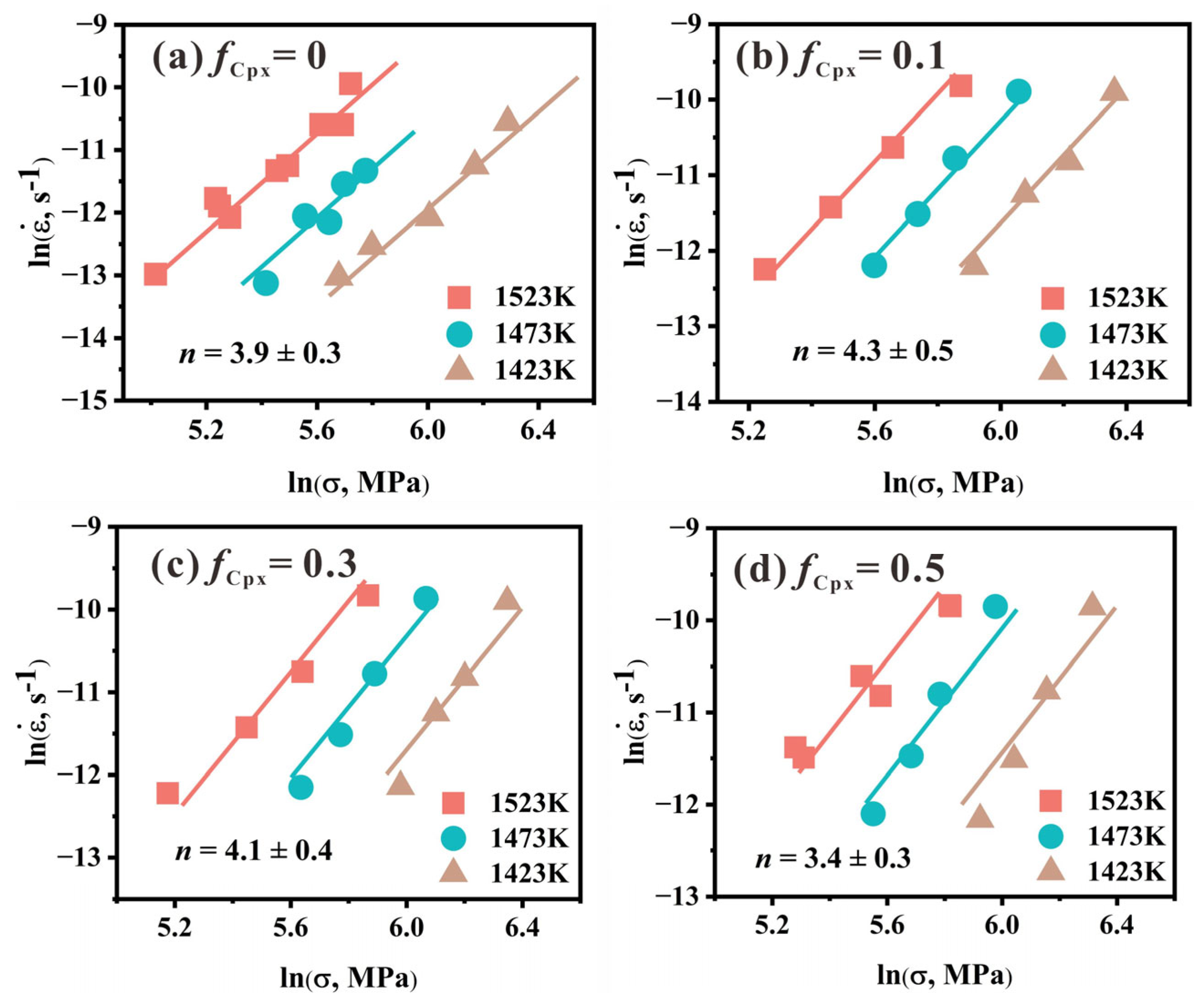
The rheological parameters for the Ol-Cpx aggregates (fCpx = 0.1, 0.3 and 0.5) were determined by fitting the mechanical data for each composition (Table 1) to Equation (1) using a global fitting procedure. The resulting parameters are summarized in Table 2 and visualized in Figure 1. The obtained n values range from 3.4 to 4.3, the Q values range from approximately 432 to 479 kJ/mol, and the pre-exponential factor A spans several orders of magnitude across the different compositions. To enable direct comparison, data for pure olivine aggregates (fCpx = 0) from Jiang et al. [63] and the unpublished flow law for pure, dry clinopyroxene (fCpx = 1) from our laboratory [64] (Table S1) are incorporated. Rheological parameters for these end-member compositions, derived using the same global fitting approach, are also summarized in Table 2.
The reliability of the fitting procedure and the data distribution are visualized in the double-logarithmic plots (Figure 1), which use all experimental data from Table 1. The linear alignment of data points at each temperature and their consistency with the corresponding fitting curves confirm the robustness of the parameter determination.
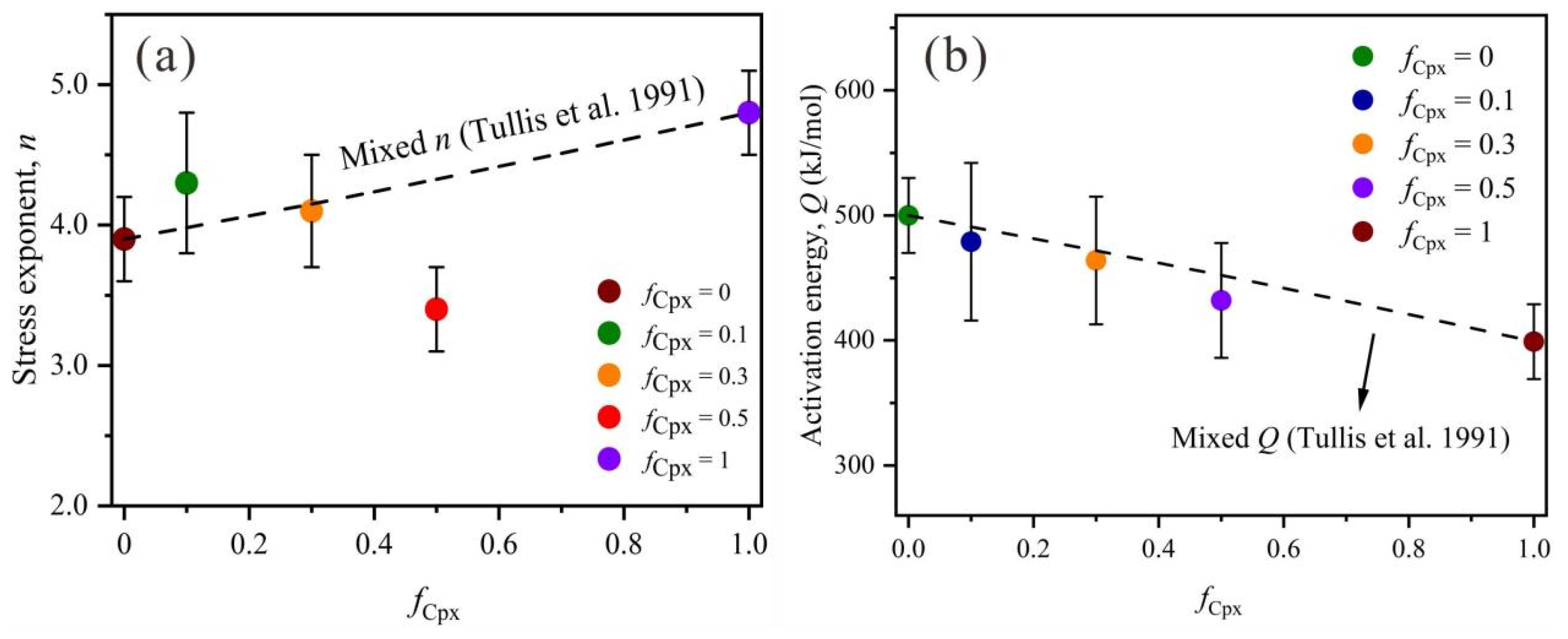
To systematically illustrate how the rheological parameters vary with composition, the stress exponent (n) and activation energy (Q) are plotted against fCpx in Figure 2. The figure includes data for the three compositions (fCpx = 0.1, 0.3, 0.5) of two-phase aggregates in this study, two pure end-members from Jiang et al. [63], and unpublished work of our laboratory [64] (Table S1), with error bars for both parameters representing the standard error derived from the global fitting. For reference, a dashed line calculated using the end-member parameters based on the model of Tullis et al. [35] is also included. Figure 2a shows that with the exception of the composition at fCpx = 0.5, the stress exponent (n) generally increases with higher fCpx. Figure 2b displays a gradual, progressive decrease in activation energy (Q) with increasing fCpx.

3.3. Microstructures

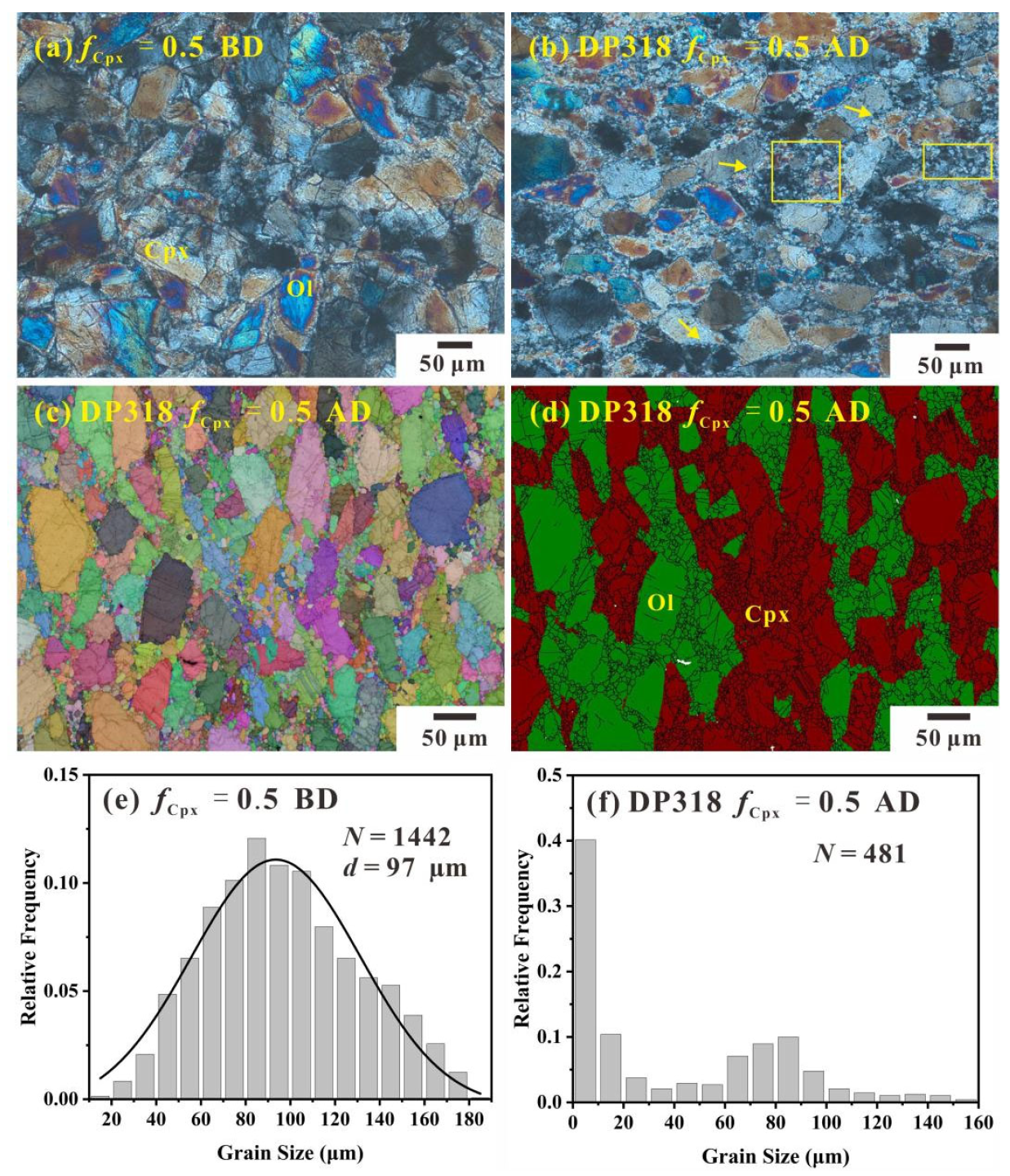
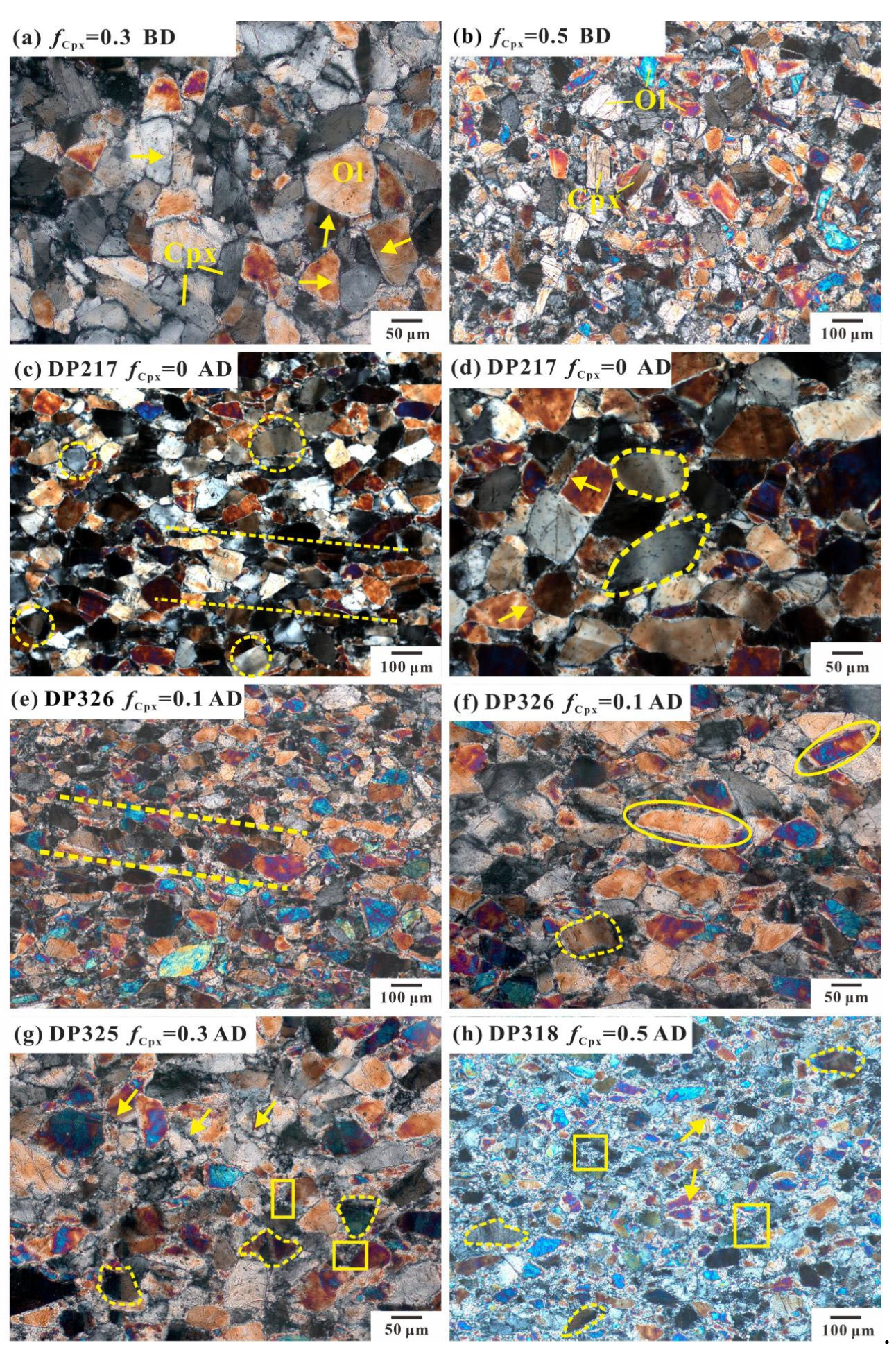
Optical observations under cross-polarized light revealed that the pre-deformed samples (hot-pressed aggregates) of all compositions were characterized by a homogeneous, nearly equigranular texture, with relatively straight and sharp grain boundaries and uniform extinction (Figure 3a and Figure 4a,b).
Triaxial compression induced significant microstructural evolution. A common set of deformation features was observed across all compositions, including a pronounced shape-preferred orientation (SPO), with their long axes aligned perpendicular to the compression direction (Figure 4c,e); widespread undulatory extinction (Figure 4c,d); the development of serrated grain boundaries (Figure 4d); and the formation of new fine recrystallized grains along the boundaries of original coarse grains. The extent of dynamic recrystallization showed a clear positive correlation with fCpx. Recrystallization was limited in pure Ol aggregates (fCpx = 0) and in samples with fCpx = 0.1. With increasing fCpx, the microstructure became progressively dominated by fine, dynamically recrystallized grains, particularly along the boundaries of the original coarse grains (Figure 4g,h). In samples with fCpx = 0.3, new fine recrystallized grains constitute only a small fraction of the area and are distributed locally along original grain boundaries. In contrast, in samples with fCpx = 0.5, fine recrystallized grains constitute a large fraction of the area, surrounding the isolated original coarse grains and resulting in significant grain-size reduction (Figure 3 and Figure 4h).
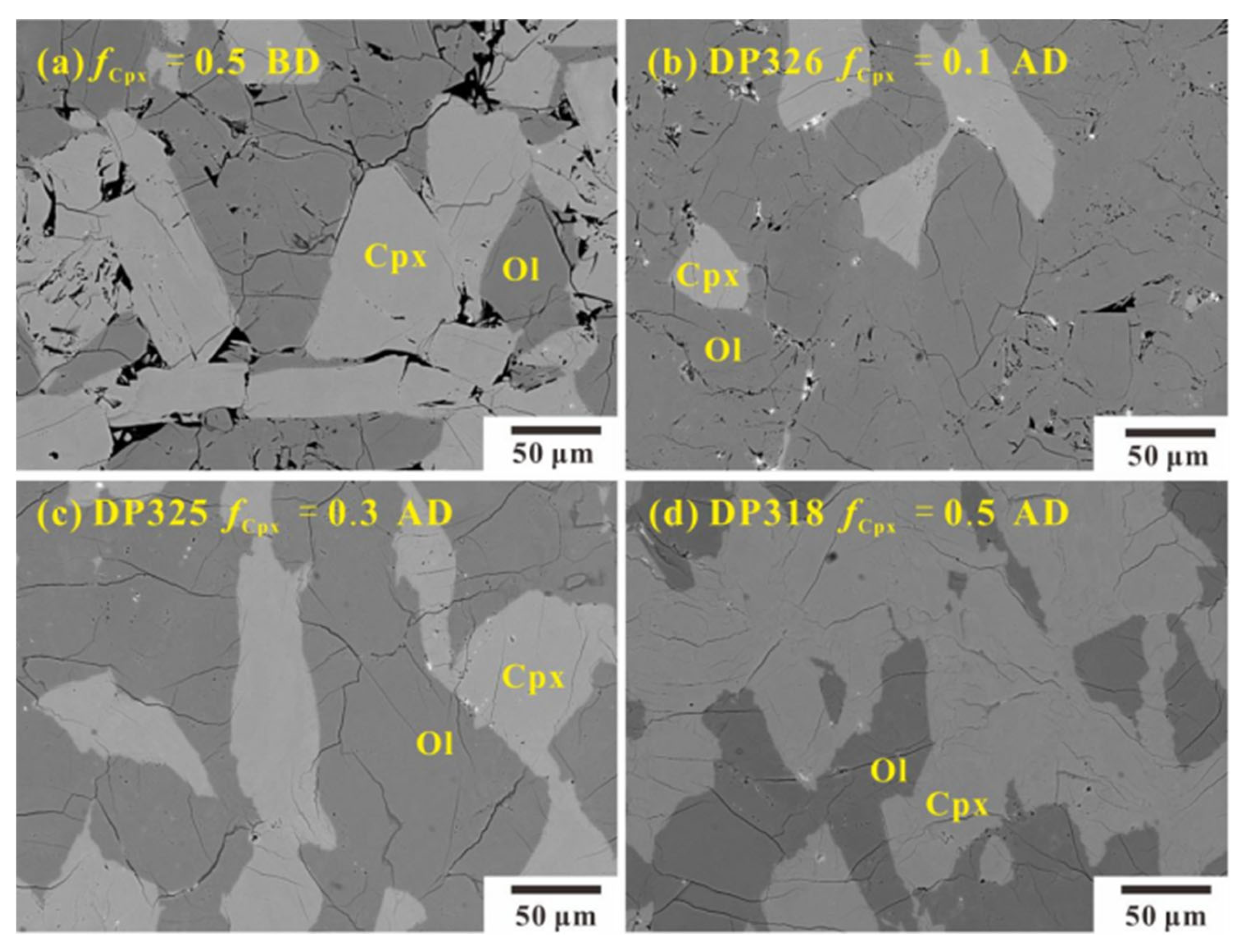
In high-resolution backscattered electron (BSE) images of representative samples, the phase boundaries between olivine and clinopyroxene exhibit sharp and uniformly high contrast, with no clear evidence of diffusion-induced zoning. Microcracks are observed both before (Figure 5a) and after deformation (Figure 5b–d), particularly within olivine grains, suggesting that a significant portion of these cracks are pre-existing. Cleavage traces are also commonly found within clinopyroxene grains in both undeformed and deformed samples. Importantly, no systematic increase in microcrack density is detected following deformation.
To further characterize dynamic recrystallization, we performed EBSD analysis on the sample with fCpx = 0.5. The crystal orientation map (Figure 3c) reveals that recrystallization preferentially occurred along original grain boundaries. Furthermore, the phase map (Figure 3d) indicates that dynamic recrystallization took place in both constituent phases, olivine and clinopyroxene. To quantify grain-size variations before and after deformation in the fCpx = 0.5 aggregate, grain-size distributions were determined using the linear intercept method in optical images for undeformed samples and in EBSD orientation maps for deformed samples (Figure 3e,f). In the undeformed samples, the grain-size distribution is approximately normal (Figure 3e), with a mean grain size of ~97 μm, which is consistent with the initially sieved mean grain size of ~100 μm. In the deformed samples, the grain-size distribution exhibits a clear bimodal pattern (Figure 3f). The fine-grained population exhibits a frequency peak within the 1–10 μm size range, whereas the coarse-grained population shows a main peak around 80–90 μm. To further quantify microstructural changes after deformation, the area fraction of fine recrystallized grains in the deformed fCpx = 0.5 sample was estimated from EBSD maps. In a representative area of 500 × 480 μm2, recrystallized fine grains account for approximately 30% of the total area.

4. Discussion

4.1. Deformation Mechanisms

This study aims to constrain the high-temperature rheological behavior of dry Ol-Cpx aggregates with varying Cpx content. Our experimental results demonstrate that dislocation creep is the dominant deformation mechanism for all samples across the investigated clinopyroxene volume fractions (fCpx = 0.1, 0.3 and 0.5). Importantly, variations in Cpx content do not induce a change in the dominant deformation mechanism.
This conclusion is supported primarily by the measured stress exponent n. The obtained values range from 3.4 to 4.3 (Table 2 and Figure 2), which fall within the characteristic range (n = 2–5) for dislocation creep according to the theoretical model of Weertman [65].
For the pure Ol phase (fCpx = 0), a vast body of experimental studies has established that dislocation creep typically yields n = 3–4, a range widely used to model upper mantle rheology [13,66]. Systematic experiments on Cpx by Li et al. [55] confirm that it also deforms predominantly by dislocation creep under similar pressure–temperature conditions. Their reported stress exponent of n = 4.3 ± 0.3 is in good agreement with the value reported by Jiang et al. [64] (Table S1) for the pure Cpx (n = 4.8 ± 0.3). These findings indicate that both end-members deform plastically via dislocation creep under our experimental conditions.
On this basis, the deformation behavior of the two-phase aggregates can be evaluated within the framework of existing two-phase rheological model [35]. For samples with fCpx = 0.1 and 0.3, the fitted rheological parameters, including the stress exponent n and activation energy Q, closely follow the model predictions of Tullis et al. [35]. This consistency indicates that variations in Cpx content do not lead to a change in the dominant deformation mechanism of the aggregates but instead primarily influence strain partitioning between phases and the bulk mechanical strength.
Microstructural observations provide independent and complementary evidence supporting dislocation creep as the dominant deformation mechanism across all compositions. In all deformed samples, features such as SPO (Figure 4c,e), undulatory extinction (Figure 3b and Figure 4c,d,g,h), serrated grain boundaries (Figure 3b and Figure 4d,g,h), and/or dynamic recrystallization (Figure 3b,c and Figure 4g,h) are observed. These microstructures are widely recognized as direct evidence of dislocation activity. Importantly, their consistent presence across samples with varying Cpx contents demonstrates that the addition of Cpx does not alter the dominant deformation mechanism of the aggregates.
Notably, microcracks are observed in both undeformed and deformed samples (Figure 5), indicating that fracturing was not exclusively deformation-induced. Their preferential occurrence within olivine grains suggests that many microcracks were inherited from the starting materials or introduced during sample preparation, particularly during cold pressing. These intragranular cracks rarely transect adjacent grains, and observable offset along these fractures is minimal. Critically, no systematic increase in microcrack density was detected after deformation. No abrupt stress drops were recorded during the experiments, and the deformed samples showed no evidence of macroscopic fracturing or sample-scale failure. These observations confirm that unstable brittle failure did not occur. We therefore infer that although intragranular flaws (cracks/cleavages) may accommodate a minor portion of the strain and slightly enhance the strain rate locally, their overall influence on the bulk rheological behavior is secondary. This interpretation is further supported by the systematic variation in rheological parameters with clinopyroxene content. The derived stress exponents (n = 3.4–4.3) align well with the dislocation creep model of Weertman [65], consistent with crystal–plastic processes dominating the bulk deformation. While microcracks may contribute to local strain accommodation—especially at higher stresses—they do not alter the dominant deformation mechanism. Nevertheless, their potential effect on absolute strain rates should be considered when interpreting the flow-law parameters.
It is noteworthy that the stress exponent obtained for the fCpx = 0.5 sample is lower than that predicted by Tullis et al. [35]’s model. This deviation can be attributed to the significantly higher degree of dynamic recrystallization observed in this sample, which produced a high density of fine grains. The resulting grain-size reduction likely enhanced the relative contribution of grain-size-sensitive creep to the bulk strain. As discussed by Warren and Hansen [67], deformation is not accommodated by a single mechanism alone; instead, multiple mechanisms may operate concurrently, with their relative contributions varying as a function of deformation conditions. In our experiments, the dominant deformation mechanism remains dislocation creep. However, dynamic recrystallization produces abundant fine grains, which increases the relative contribution of grain-size-sensitive creep, thereby lowering the stress exponent.
Such a decrease in the stress exponent associated with changes in grain size, as well as the corresponding change in deformation mechanisms, has been previously discussed. For instance, Tasaka et al. [42] conducted torsion experiments on Ol-Opx aggregates and observed a reduction in the stress exponent n for samples with fOpx = 0.35. They attributed this behavior to the transition in deformation mechanism under high strain, where grain refinement caused dislocation-accommodated grain boundary sliding (disGBS) to evolve from involving subgrain boundaries to occurring without subgrain boundaries.

4.2. Variation in Rheological Parameters with Clinopyroxene Fraction

The rheological parameters obtained from global fitting of the experimental data exhibit systematic variations with fCpx (Table 2; Figure 2). Both the stress exponent n and the activation energy Q show gradual, composition-dependent trends rather than abrupt changes, indicating a continuous rheological response to increasing Cpx content.
The stress exponent n varies within a relatively narrow range (3.4–4.8) across all investigated compositions. For aggregates with low to moderate Cpx content (fCpx = 0–0.3), n remains close to values typically reported for dislocation creep of Ol-dominated systems, consistent with experimental and theoretical expectations for two-phase aggregates deforming by dislocation-controlled mechanisms [35,44,68]. This compositional range shows good agreement with model predictions for two-phase systems in which both phases deform by dislocation creep and strain is partitioned without a change in the dominant deformation mechanism.
At higher clinopyroxene fractions (fCpx = 0.5), the fitted stress exponent is lower than the trend predicted by the two-phase model of Tullis et al. [35]. Importantly, this deviation is modest and does not constitute a discontinuity in n but rather reflects a progressive reduction in stress sensitivity. Such behavior is consistent with microstructural observations showing enhanced dynamic recrystallization and pronounced grain-size reduction at higher Cpx contents. Grain-size-sensitive processes may therefore contribute more effectively to the overall strain accommodation, reducing the apparent stress exponent while the dominant deformation mechanism remains unchanged.
The activation energy Q shows a slight decreasing trend with increasing fCpx, from values characteristic of Ol-rich aggregates toward lower values in Cpx-rich compositions (Table 2; Figure 2). This trend is in good agreement with the predictions of the two-phase rheological model proposed by Tullis et al. [35] and reflects the increasing contribution of the Cpx phase to the bulk rheological behavior.

4.3. Effect of Clinopyroxene Content on Aggregate Strength

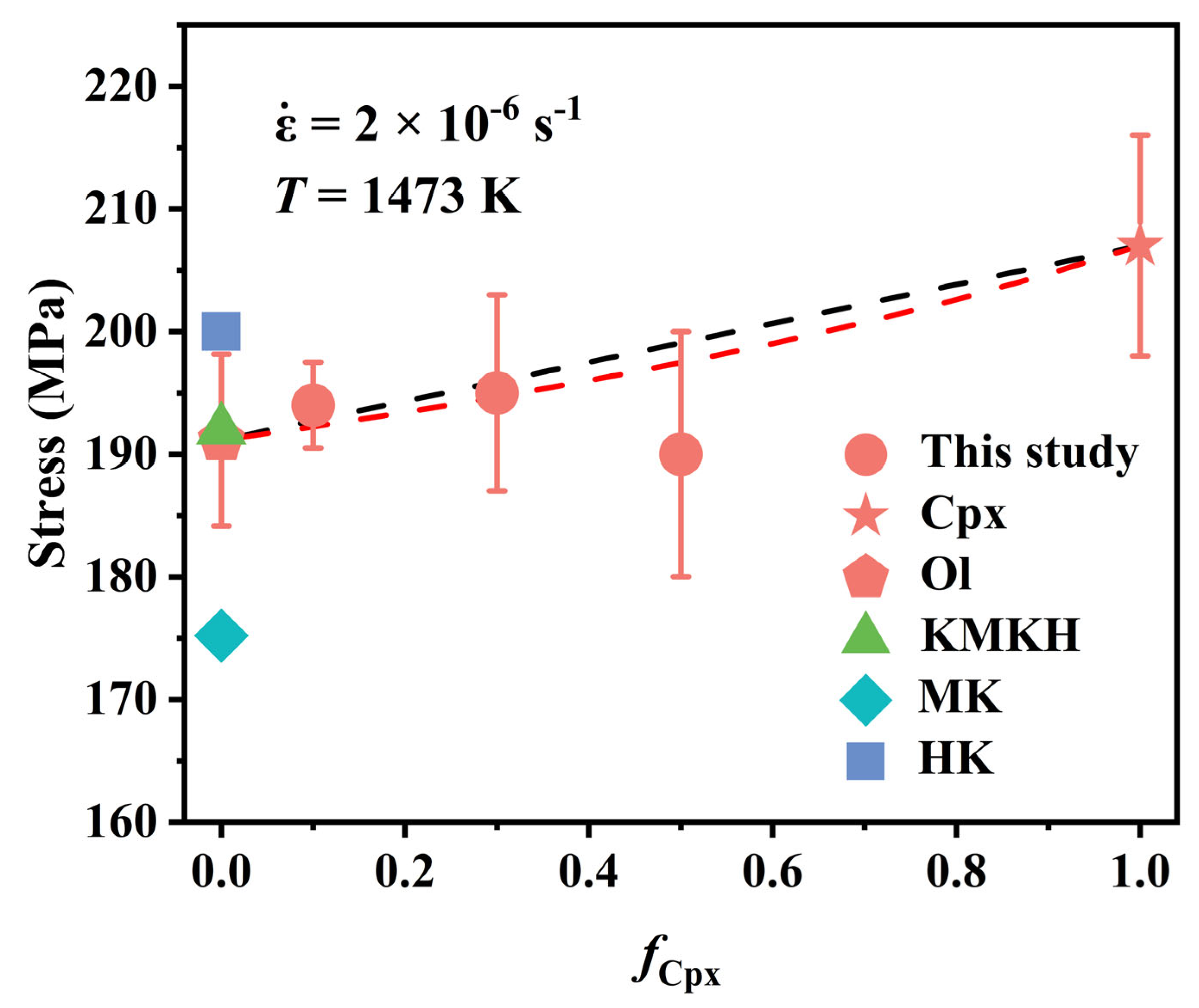
To characterize the effect of Cpx content on the strength of Ol-Cpx aggregates, experimental data were normalized to a reference strain rate of 2 × 10⁻⁶ s−1 and a temperature of 1473 K using the derived flow law (Figure 6). This normalization removes the influence of differences in strain rate and temperature among experiments, allowing direct comparison of aggregate strength across compositions under identical conditions.
For the end-members, pure Ol is weaker than pure Cpx, consistent with the long-standing view that Ol is the weakest major phase in the upper mantle [69,70]. The olivine strength adopted in this study, taken from Jiang et al. [63], is consistent with the dry dislocation creep data for Aheim dunite reported by Keefner et al. [16]. In contrast, Ol strengths reported by Jiang et al. [63] and flow laws of Hirth and Kohlstedt [66] are systematically higher than those reported for fine-grained, dry Ol aggregates by Mei and Kohlstedt [11], a discrepancy commonly attributed to the increased role of grain-boundary diffusion and sliding in fine-grained aggregates [66,68].
For two-phase aggregates, samples with fCpx = 0.1 and 0.3 show a slight increase in strength with increasing Cpx content, and all mixed composition strengths fall between the Ol and Cpx end-members. Although the strength of the fCpx = 0.5 sample remains within uncertainty of this trend, it is somewhat lower. This modest weakening correlates with the pronounced microstructural changes observed at higher Cpx contents, including enhanced dynamic recrystallization and significant grain-size reduction. While dislocation creep remains dominant, grain-size reduction likely increases the contribution of diffusion-assisted processes, leading to a reduced bulk strength. Overall, in the absence of a transition in the dominant deformation mechanism, the strength of two-phase aggregates is effectively bounded by the strengths of their end-members.
For viscous polyphase materials, uniform strain rate (Taylor bound) and uniform stress (Sachs bound) models provide rigorous upper and lower bounds on aggregate strength [35]. Because the strength contrast between Ol and Cpx end-members is small in this study, the Taylor and Sachs bounds are close spaced. As shown by the dashed lines in Figure 6, all two-phase aggregates plot within or near the Taylor–Sachs envelope, suggesting intermediate strain partitioning between Ol and Cpx.

4.4. Comparison with Previous Studies

Recent deformation experiments on Ol-bearing two-phase materials have demonstrated that polyphase aggregates can exhibit markedly different mechanical behaviors, depending on phase assemblage, microstructural evolution, and deformation conditions. Specifically, Sundberg and Cooper [51] deformed Ol-Opx aggregates with Opx volume fractions ranging from 0 to 65 vol% in general shear and found that the two-phase aggregates were systematically weaker than the Ol end-member under comparable conditions. They attributed this weakening to the fact that long-range diffusion of Si4+ is not required in such pseudobinary two-phase systems, thereby facilitating deformation.
Similarly, Tasaka et al. [40,41] reported that Ol + Opx aggregates were initially stronger than pure Ol at low shear strains. However, at large strains (shear strain ≥ 20), the aggregates exhibited pronounced weakening, which the authors attributed to a change in the dominant deformation mechanism associated with grain-size reduction caused by a Zener pinning effect. In contrast, although the fCpx = 0.5 samples in our study also developed abundant fine grains as a result of dynamic recrystallization, they did not display comparably strong weakening. This discrepancy may arise from the lower strain in our compression experiments (approximately 0.15), much smaller than the shear strains in Tasaka et al. [40,41]. Higher strains could promote phase mixing, potentially altering the deformation mechanism and significantly affecting the mechanical behavior [40,41].
Zhao et al. [45] observed that aggregates composed of 50:50 mixtures of San Carlos Ol and Damaping Cpx were significantly weaker than either single-phase end-member. Although weakening is also observed in our fCpx = 0.5 samples, this weakening is attributed to an increased contribution of grain-size-sensitive creep to the overall deformation, rather than to phase-boundary sliding as proposed by Zhao et al. [45]. The mechanical role of phase boundaries has also been emphasized by Wiesman et al. [43,44], who showed that olivine–ferropericlase (Ol + Per) aggregates deformed to large strains exhibited strengths exceeding those predicted by simple mixing laws. In that case, deformation was interpreted to be controlled by interactions between dislocations and phase boundaries, leading to strengthening rather than weakening. In contrast to these studies, we find no evidence that phase boundaries exert dominant control on deformation in our Ol-Cpx aggregates. Instead, our results closely resemble those reported by Bystricky et al. [68] for olivine–enstatite aggregates deformed in compression, where the dislocation creep strengths of two-phase aggregates consistently fall between the uniform stress (Sachs) and uniform strain rate (Taylor) bounds. The similarity between these results suggests that, under dislocation creep-dominated conditions and in the absence of strong phase-boundary-controlled deformation, the mechanical behavior of two-phase aggregates is primarily governed by the relative strengths of the constituent phases. It should be noted that although the experiments of Wiesman et al. [43,44] and Bystricky et al. [68] also involved deformation associated with dislocation activity, the mineral assemblages differ from those investigated in this study. Therefore, our comparison is limited to general rheological characteristics of two-phase aggregates. A truly meaningful comparison would require experiments conducted on similar materials under comparable deformation conditions.

5. Conclusions

We investigated the high-temperature rheological behavior of dry Ol-Cpx aggregates with varying fCpx (0.1, 0.3 and 0.5) using compression experiments conducted to total strains of approximately 0.15 and compared it with the flow laws of pure Ol (Jiang et al. [63]) and pure Cpx (Jiang et al. [64]) end-members. The main conclusions are as follows:
All samples deform predominantly by dislocation creep, as indicated by stress exponents (n = 3.4–4.3). Variations in Cpx content do not induce a transition in the dominant deformation mechanism.
The activation energy (Q) spans a range of 432–479 kJ/mol and exhibits a slight decreasing trend with increasing fCpx. This trend is consistent with predictions from two-phase rheological models and reflects the growing contribution of Cpx to the bulk mechanical response.
When normalized to common temperature and strain-rate conditions, the strengths of all two-phase aggregates lie between those of the Ol and Cpx end-members and are bounded by the Taylor and Sachs limits, indicating moderate strain partitioning between phases.
Aggregates with fCpx = 0.5 exhibit slightly reduced strength and lower stress exponents, attributed to enhanced dynamic recrystallization and grain-size reduction. This weakening reflects an increased contribution of diffusion-assisted processes, while dislocation creep remains dominant.

Supplementary Materials

The following supporting information can be downloaded at: https://www.mdpi.com/article/10.3390/min16020218/s1, Table S1: Experimental conditions and mechanical results for clinopyroxene aggregates.

Author Contributions

Conceptualization, M.S. and J.L.; methodology, X.Z. and Z.J.; software, X.Z. and Z.J.; validation, X.Z., Z.J., J.L. and M.S.; formal analysis, X.Z. and Z.J.; investigation, X.Z., Z.J. and J.L.; resources, M.S.; data curation, X.Z., Z.J. and J.L.; writing—original draft preparation, X.Z.; writing—review and editing, X.Z. and J.L.; visualization, X.Z. and Z.J.; supervision, J.L. and M.S.; project administration, J.L. and M.S.; funding acquisition, J.L. and M.S. All authors have read and agreed to the published version of the manuscript.

Funding

This research was financially supported by the National Natural Science Foundation of China (Grant Nos. 42374122 and 42172243).

Data Availability Statement

The data for this study are available from the Mendeley Data (Zheng, Xiaodong; Jiang, Zhexuan; Li, Jianfeng; Song, Maoshuang (2026), “The Role of Clinopyroxene on the Rheology of Dry Olivine-Clinopyroxene Aggregates”, Mendeley Data, V1, https://doi.org/10.17632/smzx46w4sr.1).

Acknowledgments

We are grateful to Wenlong Liu for performing the EBSD analysis. We also thank Tongbin Shao for his valuable comments, which have greatly improved the quality of this manuscript. We also extend our sincere thanks to the two anonymous reviewers for their constructive comments, which have significantly enhanced the quality of this paper.

Conflicts of Interest

The authors declare no conflicts of interest.

References

  1. Carter, N.L.; Avé Lallemant, H.G. High temperature flow of dunite and peridotite. Geol. Soc. Am. Bull. 1970, 81, 2181–2193. [Google Scholar] [CrossRef]
  2. Chopra, P.N.; Paterson, M.S. The experimental deformation of dunite. Tectonophysics 1981, 78, 453–473. [Google Scholar] [CrossRef]
  3. Chopra, P.N.; Paterson, M.S. The role of water in the deformation of dunite. J. Geophys. Res. 1984, 89, 7861–7876. [Google Scholar] [CrossRef]
  4. Zeuch, D.H.; Green, H.W. Experimental deformation of a synthetic dunite at high-temperature and pressure. 1. Mechanical-behavior, optical microstructure and deformation mechanism. Tectonophysics 1984, 110, 233–262. [Google Scholar] [CrossRef]
  5. Mackwell, S.J.; Kohlstedt, D.L.; Paterson, M.S. The role of water in the deformation of olivine single-crystals. J. Geophys. Res. Solid Earth Planets 1985, 90, 1319–1333. [Google Scholar] [CrossRef]
  6. Karato, S.I.; Paterson, M.S.; Fitz Gerald, J.D. Rheology of synthetic olivine aggregates—Influence of grain-size and water. J. Geophys. Res. Solid Earth Planets 1986, 91, 8151–8176. [Google Scholar] [CrossRef]
  7. Borch, R.S.; Green, H.W. Deformation of peridotite at high-pressure in a new molten-salt cell—Comparison of traditional and homologous temperature treatments. Phys. Earth Planet. Inter. 1989, 55, 269–276. [Google Scholar] [CrossRef]
  8. Hirth, G.; Kohlstedt, D.L. Experimental constraints on the dynamics of the partially molten upper-mantle—Deformation in the diffusion creep regime. J. Geophys. Res. Solid Earth 1995, 100, 1981–2001. [Google Scholar] [CrossRef]
  9. Hirth, G.; Kohlstedt, D.L. Experimental constraints on the dynamics of the partially molten upper-mantle 2. Deformation in the dislocation creep regime. J. Geophys. Res. Solid Earth 1995, 100, 15441–15449. [Google Scholar] [CrossRef]
  10. Mei, S.; Kohlstedt, D.L. Influence of water on plastic deformation of olivine aggregates 1. Diffusion creep regime. J. Geophys. Res. Solid Earth 2000, 105, 21457–21469. [Google Scholar] [CrossRef]
  11. Mei, S.; Kohlstedt, D.L. Influence of water on plastic deformation of olivine aggregates 2. Dislocation creep regime. J. Geophys. Res. Solid Earth 2000, 105, 21471–21481. [Google Scholar] [CrossRef]
  12. Bystricky, M.; Kunze, K.; Burlini, L.; Burg, J.P. High shear strain of olivine aggregates: Rheological and seismic consequences. Science 2000, 290, 1564–1567. [Google Scholar] [CrossRef]
  13. Karato, S.I.; Jung, H. Effects of pressure on high-temperature dislocation creep in olivine. Philos. Mag. 2003, 83, 401–414. [Google Scholar] [CrossRef]
  14. Durham, W.B.; Mei, S.; Kohlstedt, D.L.; Wang, L.; Dixon, N.A. New measurements of activation volume in olivine under anhydrous conditions. Phys. Earth Planet. Inter. 2009, 172, 67–73. [Google Scholar] [CrossRef]
  15. Raterron, P.; Amiguet, E.; Chen, J.H.; Li, L.; Cordier, P. Experimental deformation of olivine single crystals at mantle pressures and temperatures. Phys. Earth Planet. Inter. 2009, 172, 74–83. [Google Scholar] [CrossRef]
  16. Keefner, J.W.; Mackwell, S.J.; Kohlstedt, D.L.; Heidelbach, F. Dependence of dislocation creep of dunite on oxygen fugacity: Implications for viscosity variations in Earth’s mantle. J. Geophys. Res. Solid Earth 2011, 116, B05201. [Google Scholar] [CrossRef]
  17. Avé Lallemant, H.G. Experimental deformation of diopside and websterite. Tectonophysics 1978, 48, 1–27. [Google Scholar] [CrossRef]
  18. Kollé, J.J.; Blacic, J.D. Deformation of single-crystal clinopyroxenes: 1. Mechanical twinning in diopside and hedenbergite. J. Geophys. Res. 1982, 87, 4019–4034. [Google Scholar] [CrossRef]
  19. Kollé, J.J.; Blacic, J.D. Deformation of single-crystal clinopyroxenes: 2. Dislocation-controlled flow processes in hedenbergite. J. Geophys. Res. 1983, 88, 2381–2393. [Google Scholar] [CrossRef]
  20. Kirby, S.H.; Kronenberg, A.K. Deformation of clinopyroxenite—Evidence for a transition in flow mechanisms and semibrittle behavior. J. Geophys. Res. 1984, 89, 3177–3192. [Google Scholar] [CrossRef]
  21. Boland, J.N.; Tullis, T.E. Deformation behavior of wet and dry clinopyroxenite in the brittle to ductile transition region. In Mineral and Rock Deformation: Laboratory Studies; American Geophysical Union: Washington, DC, USA, 1986; Volume 36, pp. 35–49. [Google Scholar]
  22. Raterron, P.; Jaoul, O. High-temperature deformation of diopside single crystal, 1. Mechanical data. J. Geophys. Res. Solid Earth Planets 1991, 96, 14277–14286. [Google Scholar] [CrossRef]
  23. Ingrin, J.; Doukhan, N.; Doukhan, J.C. High-temperature deformation of diopside single-crystal 2. transmission electron-microscopy investigation of the defect microstructures. J. Geophys. Res. Solid Earth Planets 1991, 96, 14287–14297. [Google Scholar] [CrossRef]
  24. Ingrin, J.; Doukhan, N.; Doukhan, J.C. Dislocation glide systems in diopside single-crystals deformed at 800–900 °C. Eur. J. Mineral. 1992, 4, 1291–1302. [Google Scholar] [CrossRef]
  25. Jaoul, O.; Raterron, P. High-temperature deformation of diopside crystal: 3. Influences of pO2 and SiO2 precipitation. J. Geophys. Res. Solid Earth 1994, 99, 9423–9439. [Google Scholar] [CrossRef]
  26. Raterron, P.; Doukhan, N.; Jaoul, O.; Doukhan, J.C. High-temperature deformation of diopside IV—Predominance of {110} glide above 1000 °C. Phys. Earth Planet. Inter. 1994, 82, 209–222. [Google Scholar] [CrossRef]
  27. Mauler, A.; Bystricky, M.; Kunze, K.; Mackwell, S. Microstructures and lattice preferred orientations in experimentally deformed clinopyroxene aggregates. J. Struct. Geol. 2000, 22, 1633–1648. [Google Scholar] [CrossRef]
  28. Bystricky, M.; Mackwell, S. Creep of dry clinopyroxene aggregates. J. Geophys. Res. Solid Earth 2001, 106, 13443–13454. [Google Scholar] [CrossRef]
  29. Hier-Majumder, S.; Mei, S.H.; Kohlstedt, D.L. Water weakening of clinopyroxenite in diffusion creep. J. Geophys. Res. Solid Earth 2005, 110, B07201. [Google Scholar] [CrossRef]
  30. Chen, S.; Hiraga, T.; Kohlstedt, D.L. Water weakening of clinopyroxene in the dislocation creep regime. J. Geophys. Res. Solid Earth 2006, 111, B08201. [Google Scholar] [CrossRef]
  31. Amiguet, E.; Raterron, P.; Cordier, P.; Couvy, H.; Chen, J.C. Deformation of diopside single crystal at mantle pressure. 1: Mechanical data. Phys. Earth Planet. Inter. 2009, 177, 122–129. [Google Scholar] [CrossRef]
  32. Amiguet, E.; Cordier, P.; Raterron, P. Deformation of diopside single crystals at mantle pressure. TEM characterization of dislocation microstructures. Eur. J. Mineral. 2010, 22, 181–187. [Google Scholar] [CrossRef]
  33. Raterron, P.; Fraysse, G.; Girard, J.; Holyoke, C.W. Strength of orthoenstatite single crystals at mantle pressure and temperature and comparison with olivine. Earth Planet. Sci. Lett. 2016, 450, 326–336. [Google Scholar] [CrossRef]
  34. Zhang, G.N.; Mei, S.H.; Song, M.S.; Kohlstedt, D.L. Diffusion creep of enstatite at high pressures under hydrous conditions. J. Geophys. Res. Solid Earth 2017, 122, 7718–7728. [Google Scholar] [CrossRef]
  35. Tullis, T.E.; Horowitz, F.G.; Tullis, J. Flow laws of polyphase aggregates from end-member flow laws. J. Geophys. Res. Solid Earth Planets 1991, 96, 8081–8096. [Google Scholar] [CrossRef]
  36. Ji, S.C.; Zhao, P.L.; Xia, B. Flow laws of multiphase materials and rocks from end-member flow laws. Tectonophysics 2003, 370, 129–145. [Google Scholar] [CrossRef]
  37. Handy, M.R. The Solid-State Flow of Polymineralic Rocks. J. Geophys. Res. Solid Earth Planets 1990, 95, 8647–8661. [Google Scholar] [CrossRef]
  38. Herwegh, M.; Linckens, J.; Ebert, A.; Berger, A.; Brodhag, S.H. The role of second phases for controlling microstructural evolution in polymineralic rocks: A review. J. Struct. Geol. 2011, 33, 1728–1750. [Google Scholar] [CrossRef]
  39. Tasaka, M.; Hiraga, T. Influence of mineral fraction on the rheological properties of forsterite + enstatite during grain-size-sensitive creep: 1. Grain size and grain growth laws. J. Geophys. Res. Solid Earth 2013, 118, 3970–3990. [Google Scholar] [CrossRef]
  40. Tasaka, M.; Zimmerman, M.E.; Kohlstedt, D.L. Rheological Weakening of Olivine plus Orthopyroxene Aggregates Due to Phase Mixing: 1. Mechanical Behavior. J. Geophys. Res. Solid Earth 2017, 122, 7584–7596. [Google Scholar] [CrossRef]
  41. Tasaka, M.; Zimmerman, M.E.; Kohlstedt, D.L.; Stunitz, H.; Heilbronner, R. Rheological Weakening of Olivine plus Orthopyroxene Aggregates Due To Phase Mixing: Part 2. Microstructural Development. J. Geophys. Res. Solid Earth 2017, 122, 7597–7612. [Google Scholar] [CrossRef]
  42. Tasaka, M.; Zimmerman, M.E.; Kohlstedt, D.L. Rheological Weakening of Olivine plus Orthopyroxene Aggregates Due to Phase Mixing: Effects of Orthopyroxene Volume Fraction. J. Geophys. Res. Solid Earth 2020, 125, e2020JB019888. [Google Scholar] [CrossRef]
  43. Wiesman, H.S.; Zimmerman, M.E.; Kohlstedt, D.L. The Effect of Secondary-Phase Fraction on the Deformation of Olivine + Ferropericlase Aggregates: 1. Microstructural Evolution. J. Geophys. Res. Solid Earth 2023, 128, e2022JB025723. [Google Scholar] [CrossRef]
  44. Wiesman, H.S.; Zimmerman, M.E.; Kohlstedt, D.L. The Effect of Secondary-Phase Fraction on the Deformation of Olivine + Ferropericlase Aggregates: 2. Mechanical Behavior. J. Geophys. Res. Solid Earth 2023, 128, e2022JB025724. [Google Scholar] [CrossRef]
  45. Zhao, N.L.; Hirth, G.; Cooper, R.F.; Kruckenberg, S.C.; Cukjati, J. Low viscosity of mantle rocks linked to phase boundary sliding. Earth Planet. Sci. Lett. 2019, 517, 83–94. [Google Scholar] [CrossRef]
  46. Ji, S.C.; Zhao, P.L. Flow laws of multiphase rocks calculated from experimental data on the constituent phases. Earth Planet. Sci. Lett. 1993, 117, 181–187. [Google Scholar] [CrossRef]
  47. McDonnell, R.D.; Peach, C.J.; van Roermund, H.L.M.; Spiers, C.J. Effect of varying enstatite content on the deformation behavior of fine-grained synthetic peridotite under wet conditions. J. Geophys. Res. Solid Earth 2000, 105, 13535–13553. [Google Scholar] [CrossRef]
  48. Farla, R.J.M.; Karato, S.I.; Cai, Z.Y. Role of orthopyroxene in rheological weakening of the lithosphere via dynamic recrystallization. Proc. Natl. Acad. Sci. USA 2013, 110, 16355–16360. [Google Scholar] [CrossRef]
  49. Précigout, J.; Stünitz, H. Evidence of phase nucleation during olivine diffusion creep: A new perspective for mantle strain localisation. Earth Planet. Sci. Lett. 2016, 455, 94–105. [Google Scholar] [CrossRef][Green Version]
  50. Wheeler, J. Importance of pressure solution and coble creep in the deformation of polymineralic rocks. J. Geophys. Res. Solid Earth 1992, 97, 4579–4586. [Google Scholar] [CrossRef]
  51. Sundberg, M.; Cooper, R.F. Crystallographic preferred orientation produced by diffusional creep of harzburgite: Effects of chemical interactions among phases during plastic flow. J. Geophys. Res. Solid Earth 2008, 113, B12208. [Google Scholar] [CrossRef]
  52. Asaadi, N.; Ribe, N.M.; Sobouti, F. Inferring non linear mantle rheology from the shape of the Hawaiian swell. Nature 2011, 473, 501–504. [Google Scholar] [CrossRef] [PubMed]
  53. Becker, T.W.; Kustowski, B.; Ekstrom, G. Radial seismic anisotropy as a constraint for upper mantle rheology. Earth Planet. Sci. Lett. 2008, 267, 213–227. [Google Scholar] [CrossRef]
  54. van Hunen, J.; Zhong, S.; Shapiro, N.M.; Ritzwoller, M.H. New evidence for dislocation creep from 3-D geodynamic modeling of the Pacific upper mantle structure. Earth Planet. Sci. Lett. 2005, 238, 146–155. [Google Scholar] [CrossRef]
  55. Li, J.F.; Song, M.S.; Wang, H.; Zhang, G.N.; Mei, S.H.; Zheng, X.D.; Wang, X.N.; Jiang, Z.X. Dislocation creep of diopside aggregates under unsaturated hydrous conditions at a confining pressure of 300 MPa. J. Geophys. Res. Solid Earth 2024, 129, e2024JB029472. [Google Scholar] [CrossRef]
  56. Li, J.F.; Song, M.S.; Shao, T.B.; Zheng, X.D.; Jiang, Z.X. Mechanical data corrections for triaxial compression testing at high pressures and high temperatures with a Paterson gas-medium mechanical testing apparatus. Rev. Sci. Instrum. 2023, 94, 084501. [Google Scholar] [CrossRef]
  57. Paterson, M.S. Rock deformation experimentation. In Deformation of Ceramic Materials; Bradt, R.C., Tressler, R.E., Eds.; Springer: Boston, MA, USA, 1990. [Google Scholar]
  58. Shao, T.B.; Ji, S.C.; Wang, Q. Rheology of Partially Molten Rocks: A State-of-the-art Overview. Geol. Rev. 2011, 57, 851–869. [Google Scholar]
  59. Song, M.S.; Shao, T.B.; Li, J.F.; Ji, S.C.; Wan, Q. Experimental study of deformation of Carrara marble at high pressure and high temperature. Acta Petrol. Sin. 2014, 30, 589–596. [Google Scholar]
  60. Li, J.F.; Shao, T.B.; Song, M.S.; Wang, H. Low-Temperature Plasticity and Dislocation Creep of Fangshan Dolomite. J. Geophys. Res. Solid Earth 2021, 126, e2020JB021439. [Google Scholar] [CrossRef]
  61. Frost, H.J.; Ashby, M.F. Deformation-Mechanism Maps: The Plasticity and Creep of Metals and Ceramics; Pergamon Press: Oxford, UK, 1982; 167p. [Google Scholar]
  62. Underwood, E.E. Quantitative Stereology; Addison-Wesley Publishing Company: Reading, MA, USA, 1969. [Google Scholar] [CrossRef]
  63. Jiang, Z.X.; Zheng, X.D.; Li, J.F.; Song, M.S. Determination of the rheological constitutive equation of dislocation creep of olivine in Damaping, Hebei Province. Geotecton. Metallog. 2025, 49. [Google Scholar] [CrossRef]
  64. Jiang, Z.X.; Wang, X.N.; Zheng, X.D.; Li, J.F.; Mei, S.H.; Song, M.S. High-Temperature Dislocation Creep of Hot-Pressed Diopside Aggregates Under Anhydrous Conditions and the Effect of Oxygen Fugacity. In Mendeley Data, version 1; Elsevier: Amsterdam, The Netherlands, 2026; Available online: https://data.mendeley.com/datasets/xhs33js3k8/1 (accessed on 22 January 2026).
  65. Weertman, J. Microstructural mechanisms of creep. In Mechanics and Materials: Fundamentals and Linkages; Meyers, M.A., Armstrong, R.W., Kirschner, H., Eds.; John Wiley & Sons: New York, NY, USA, 1999; pp. 451–488. [Google Scholar]
  66. Hirth, G.; Kohlstedt, D.L. Rheology of the upper mantle and the mantle wedge: A view from the experimentalists. In Inside the Subduction Factory; Eiler, J., Ed.; American Geophysical Union: Washington, DC, USA, 2003; pp. 83–106. [Google Scholar] [CrossRef]
  67. Warren, J.M.; Hansen, L.N. Ductile Deformation of the Lithospheric Mantle. Annu. Rev. Earth Planet. Sci. 2023, 51, 581–609. [Google Scholar] [CrossRef]
  68. Bystricky, M.; Lawlis, J.; Mackwell, S.; Heidelbach, F. High-Temperature Deformation of Enstatite-Olivine Aggregates. J. Geophys. Res. Solid Earth 2024, 129, e2023JB027699. [Google Scholar] [CrossRef]
  69. Kirby, S.H.; Kronenberg, A.K. Rheology of the lithosphere: Selected topics. Rev. Geophys. 1987, 25, 1219–1244. [Google Scholar] [CrossRef]
  70. Kohlstedt, D.L.; Evans, B.; Mackwell, S.J. Strength of the lithosphere: Constraints imposed by laboratory experiments. J. Geophys. Res. 1995, 100, 17587–17602. [Google Scholar] [CrossRef]
Figure 1. Double logarithmic plots of the strain rate versus stress for olivine–clinopyroxene aggregates with various volume fractions of clinopyroxene (fCpx). (a) fCpx = 0, pure olivine aggregates; data from Jiang et al. [63] included here for ease of reference and comparison. (b) fCpx = 0.1, (c) fCpx = 0.3, and (d) fCpx = 0.5. The global fitting results for rheological parameters n and Q are presented in the plots for each composition of fCpx. The solid lines represent the fitting results of the obtained flow laws.
Minerals 16 00218 g001
Figure 2. Variation in (a) stress exponent and (b) activation energy with the clinopyroxene content (fCpx) for the olivine–clinopyroxene aggregates. The data for fCpx = 0 and fCpx = 1 are sourced from Jiang et al. [63] and Song et al. [64], respectively. Error bars for both parameters represent the standard error derived from global fitting. The black dashed curves are predictive models for n and Q in two-phase mixtures, respectively, as proposed by Tullis et al. [35], calculated based on the corresponding values for the end-members (fCpx = 0 and 1) obtained in this study.
Minerals 16 00218 g002
Figure 3. Microstructures of the sample with fCpx = 0.5 before and after deformation (BD and AD, respectively). (a) Cross-polarized optical micrograph of the sample before deformation. Grain boundaries are relatively straight, and no fine recrystallized grains are present. (b) Cross-polarized optical micrograph of the sample after deformation (compression direction is vertical). Features include fine recrystallized grains (solid rectangle) and serrated grain boundaries (yellow arrows). (c,d) EBSD maps of the same region after deformation (compression direction is horizontal). (c) Euler map (orientation contrast) showing grain morphology, with fine recrystallized grains distributed along original grain boundaries. (d) Phase map: Ol in green and Cpx in red; black lines denote grain boundaries. (e) and (f) show frequency histograms of grain-size distributions for the fCpx = 0.5 samples before and after deformation, respectively, determined using the linear intercept method. (e) Grain-size frequency histogram before deformation. Grain sizes of 1442 grains were measured, yielding a mean grain size of 97 µm. (f) Grain-size frequency histogram after deformation. Grain sizes of 481 grains were measured. The resulting grain-size frequency histogram exhibits a clear bimodal distribution, with a coarse-grained peak occurring in the 80–90 µm range and a significant fine-grained peak, interpreted as dynamically recrystallized grains, occurring in the 1–10 µm range.
Minerals 16 00218 g003
Figure 4. Optical microstructures of samples with different clinopyroxene fractions before and after deformation under cross-polarized light. BD denotes undeformed samples, and AD denotes deformed samples. (a,b) Undeformed samples (BD). (a) Sample with fCpx = 0.3, showing relatively straight grain boundaries (yellow arrows), absence of fine-grained material, and uniform extinction. (b) Sample with fCpx = 0.5, in which mineral grains display no preferred orientation and exhibit clear, well-defined grain boundaries. (ch) Deformed samples (AD) observed under cross-polarized light, with the compression direction oriented vertically in all images. (c,d) Sample with fCpx = 0. (c) Grains are preferentially aligned perpendicular to the compression direction (parallel dashed lines), and undulatory extinction (yellow dashed circles) is observed. (d) Serrated grain boundaries (yellow arrows) and undulatory extinction (dashed circles) are evident. (e,f) Sample with fCpx = 0.1. (e) Grains show a preferred alignment perpendicular to the compression direction (parallel dashed lines). (f) Elongated grains (yellow solid ellipses) and undulatory extinction (dashed circles) are observed. (g) Sample with fCpx = 0.3, showing undulatory extinction (yellow dashed circles), dynamically recrystallized grains (yellow rectangles), and serrated grain boundaries (yellow arrows). (h) Sample with fCpx = 0.5, characterized by abundant fine-grained dynamically recrystallized grains (yellow rectangles), together with undulatory extinction (yellow dashed circles) and serrated grain boundaries (yellow arrows).
Minerals 16 00218 g004
Figure 5. Backscattered electron (BSE) images of representative Ol-Cpx aggregates showing microstructural characteristics before and after deformation. The compression direction is horizontal. (a) fCpx = 0.5 sample before deformation (BD). (bd) Microstructures after deformation (AD) for samples with fCpx = 0.1, 0.3, and 0.5, respectively. Scale bars: 50 µm.
Minerals 16 00218 g005
Figure 6. Flow stress versus fCpx at a strain rate of 2 × 10⁻⁶ s−1 and a temperature of 1473 K in olivine–clinopyroxene aggregates. The dashed black and orange lines represent the uniform strain rate (Taylor) and uniform stress (Sachs) bounds, respectively, based on the data from Jiang et al. [63] and Jiang et al. [64]. The square, triangular, and diamond data points correspond to sources Hirth & Kohlstedt [66] (HK), Keefner et al. [16] (KMKH), and Mei and Kohlstedt [11] (MK), respectively. These data were derived by applying the respective authors’ flow laws to calculate (or normalize) values at a strain rate of 2 × 10⁻⁶ s−1 and a temperature of 1473 K.
Minerals 16 00218 g006
Table 1. Experimental conditions and mechanical results for olivine–clinopyroxene aggregates.
ExperimentfCpxPTStressStrain RateStrain a
(MPa)(K)(MPa)(s−1) (%)
DP3260.130014235795.0 × 10−56.04
5022.0 × 10−53.32
4361.3 × 10−53.21
3715.0 × 10−62.75
DP3270.130014734275.1 × 10−56.75
3492.1 × 10−53.02
3101.0 × 10−53.87
2705.1 × 10−62.95
DP3560.130015233565.4 × 10−59.93
2872.4 × 10−54.93
2351.1 × 10−53.28
1914.8 × 10−63.12
DP3240.330014235715.0 × 10−55.74
4932.0 × 10−52.83
4461.3 × 10−52.91
3955.4 × 10−63.24
DP3250.330014734315.2 × 10−56.36
3612.1 × 10−52.99
3211.0 × 10−53.05
2805.3 × 10−62.92
DP3540.330015233535.4 × 10−59.66
2822.1 × 10−53.70
2321.1 × 10−53.81
1774.9 × 10−63.66
DP3160.530014235525.3 × 10−55.50
4712.1 × 10−52.86
4201.0 × 10−53.42
3745.2 × 10−62.70
DP3170.530014733945.3 × 10−55.43
3252.0 × 10−53.04
2941.0 × 10−52.91
2575.6 × 10−62.88
DP3180.530015233375.3 × 10−56.56
2642.0 × 10−53.31
2021.0 × 10−52.82
DP3530.530015233365.4 × 10−59.65
2472.5 × 10−53.83
1961.1 × 10−53.58
fCpx denotes the volume fraction of clinopyroxene in the samples; P represents the confining pressure and T represents the temperature. a Strain refers to the incremental strain at each deformation step.
Table 2. Flow law parameters for olivine–clinopyroxene aggregates.
CompositionA (MPa−ns−1)nQ (kJ/mol)
a fCpx = 0103.0 ± 0.83.9 ± 0.3500 ± 30
fCpx = 0.1101.3 ± 0.34.3 ± 0.5479 ± 63
fCpx = 0.3101.3 ± 0.24.1 ± 0.4464 ± 51
fCpx = 0.5102.1 ± 1.13.4 ± 0.3432 ± 46
b fCpx = 110−2.5 ± 0.84.8 ± 0.3399 ± 30
a The rheological parameters for dry olivine are derived from Jiang et al. [63]. b The rheological parameters for dry clinopyroxene are derived from experimental data generated within our laboratory (experiments conducted by Jiang et al. [64], see Table S1). They are included here to enable a comparative discussion of potential rheological contrasts.
Disclaimer/Publisher’s Note: The statements, opinions and data contained in all publications are solely those of the individual author(s) and contributor(s) and not of MDPI and/or the editor(s). MDPI and/or the editor(s) disclaim responsibility for any injury to people or property resulting from any ideas, methods, instructions or products referred to in the content.