New Insights into the Xiongbaxi–Yalongri Cu-W(-Mo) Deposit (Tibet): Scheelite Geochemistry and Machine Learning Constraints on Ore-Forming Fluid Evolution and Genetic Type



Abstract
1. Introduction
2. Regional Geological Background
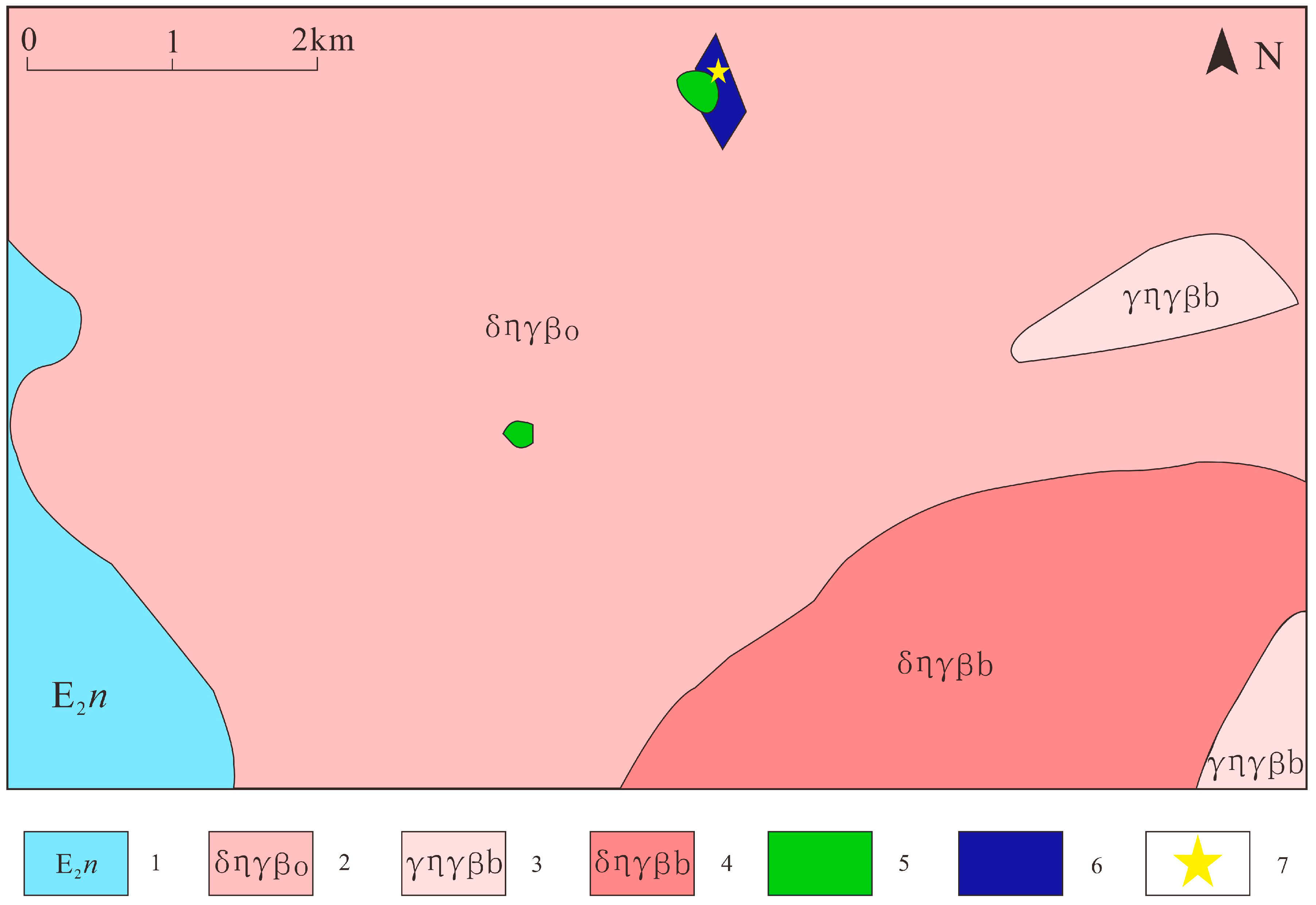
3. Geological Characteristics of the Deposit
4. Sample Description and Analytical Methods
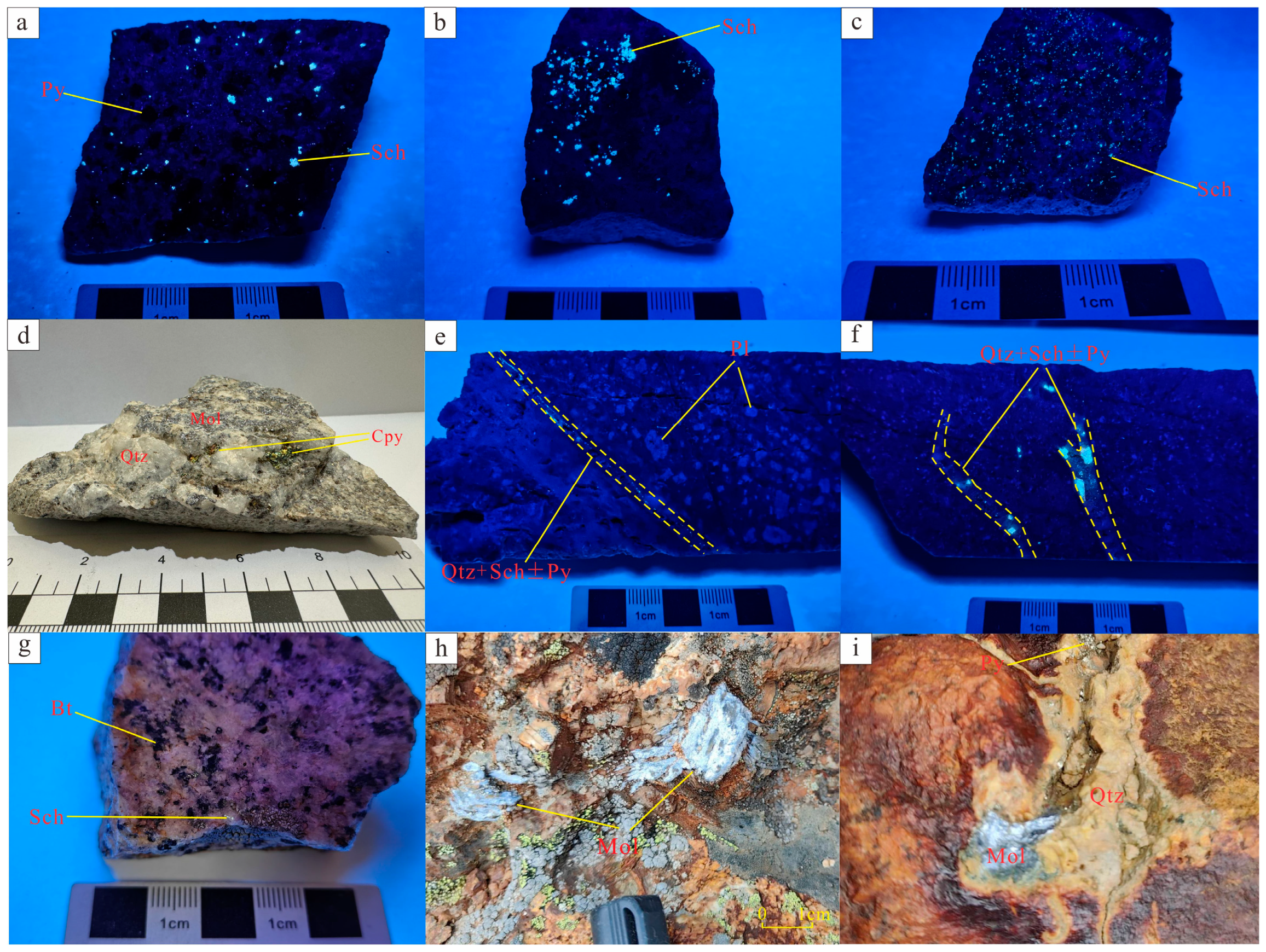
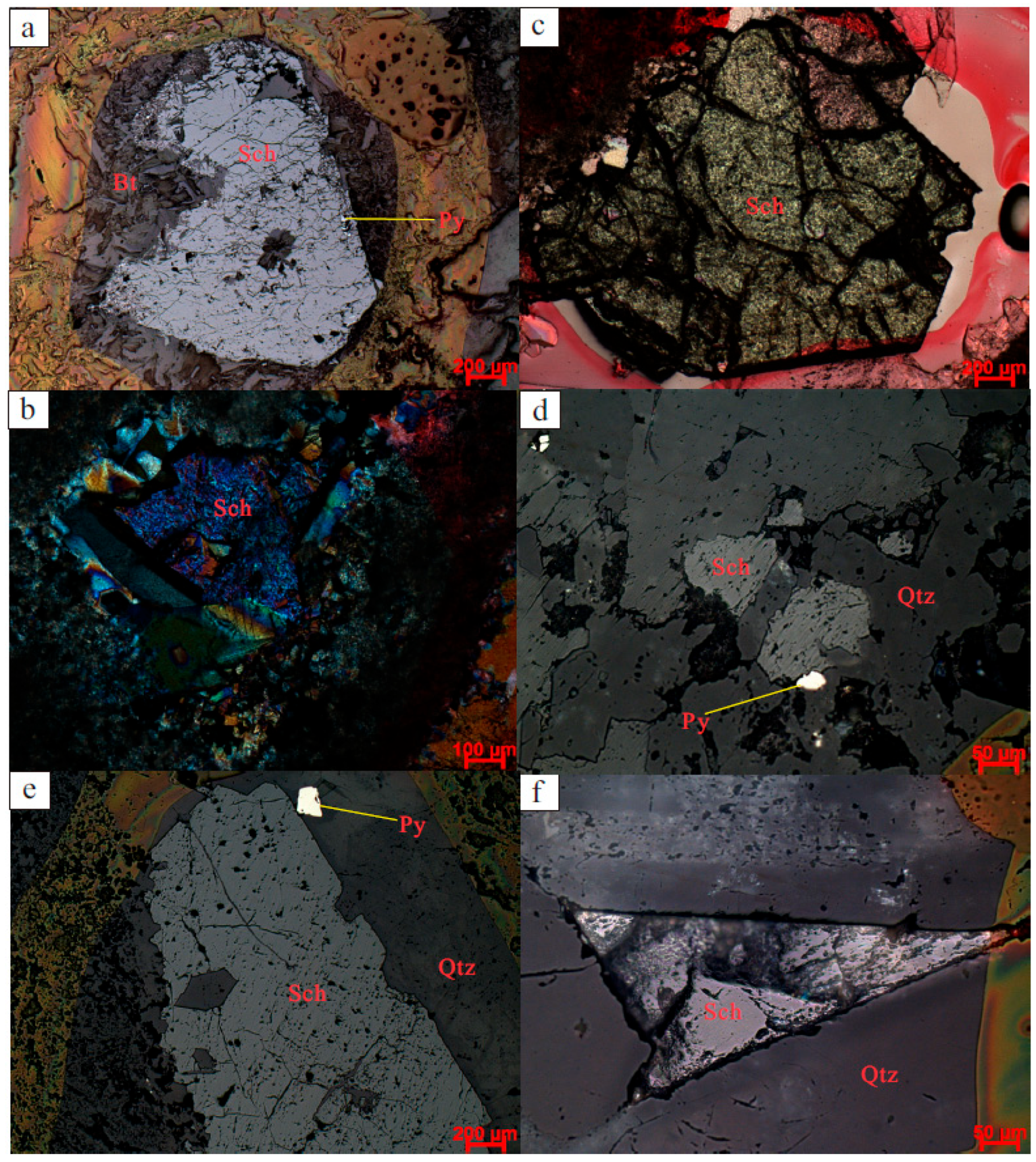
4.1. Sample Location and Selection
4.2. Sample Limitations
4.3. Analytical Methods
4.3.1. Major Element Analyses of Scheelite
4.3.2. Trace Element Analyses of Scheelite
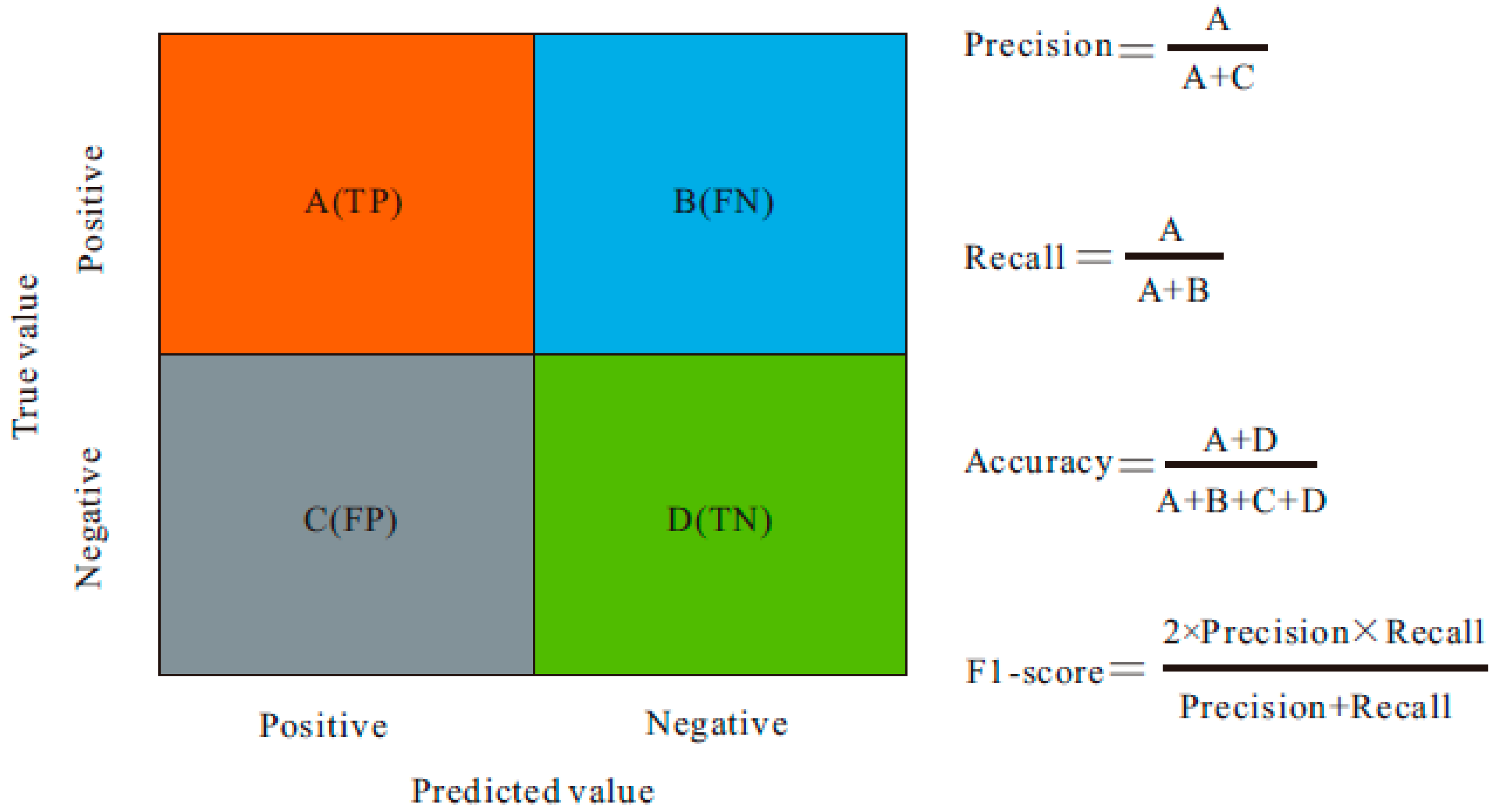
4.3.3. Machine Learning
5. Analytical Results
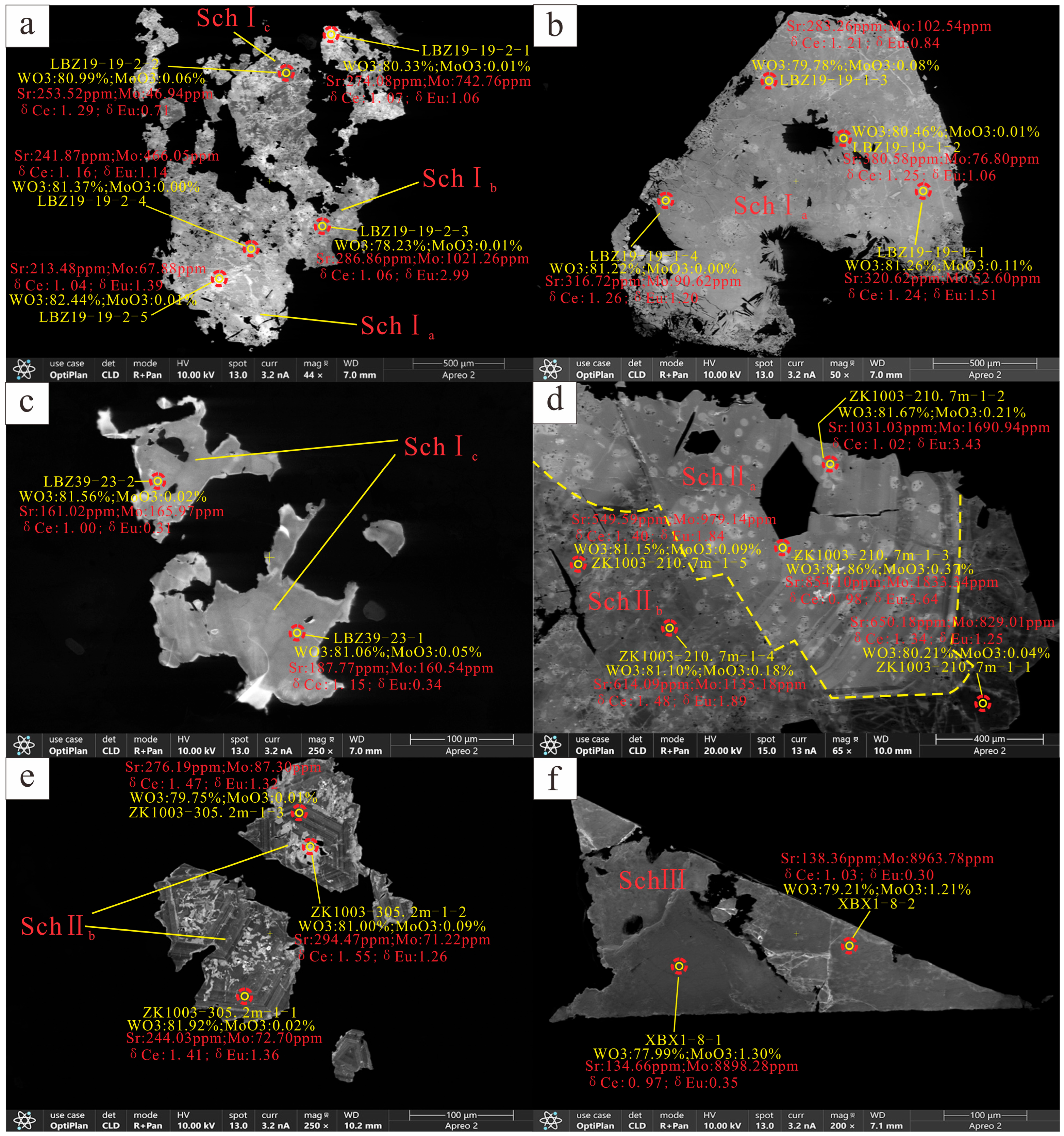
5.1. Major Elements of Scheelite
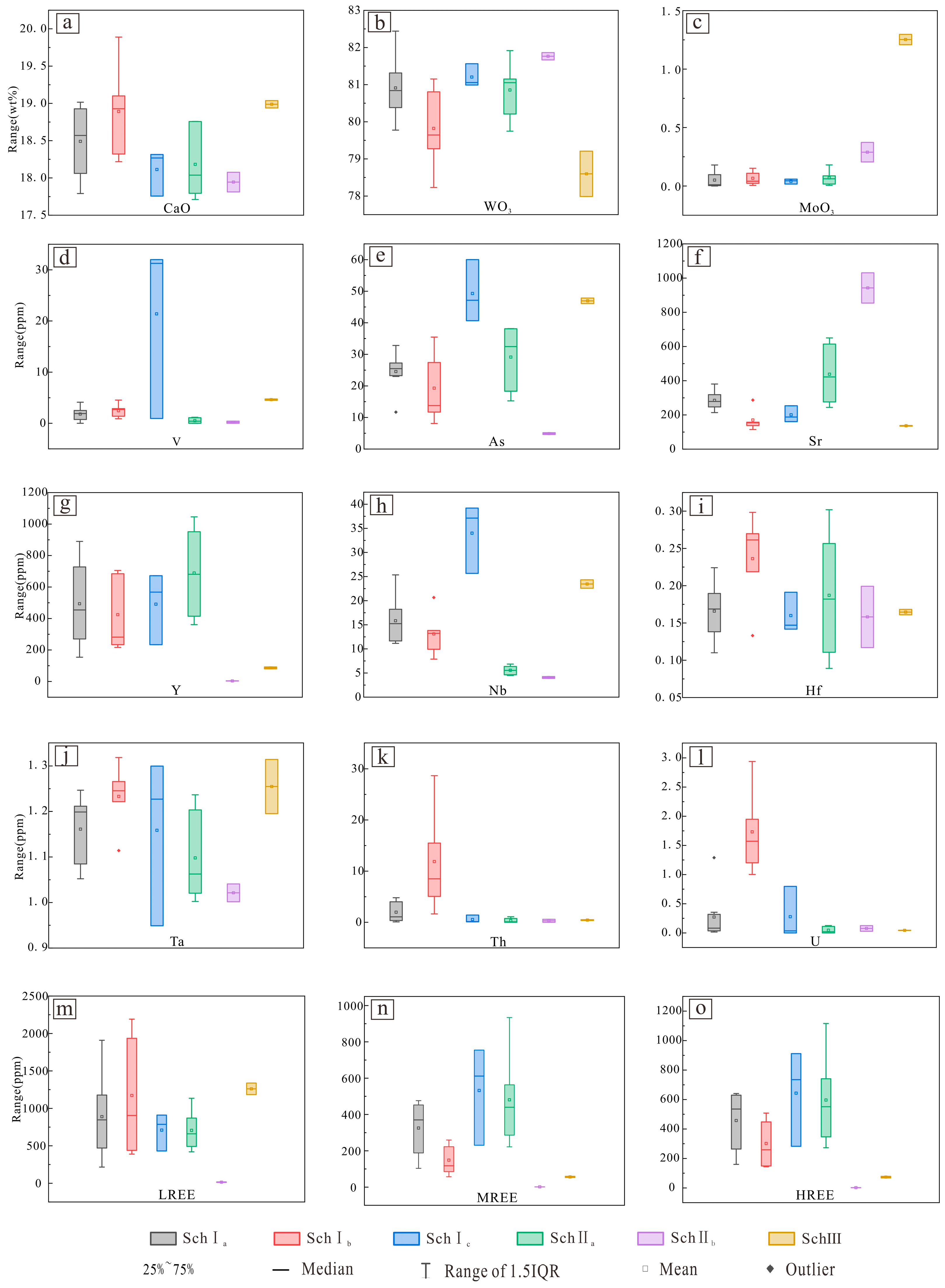
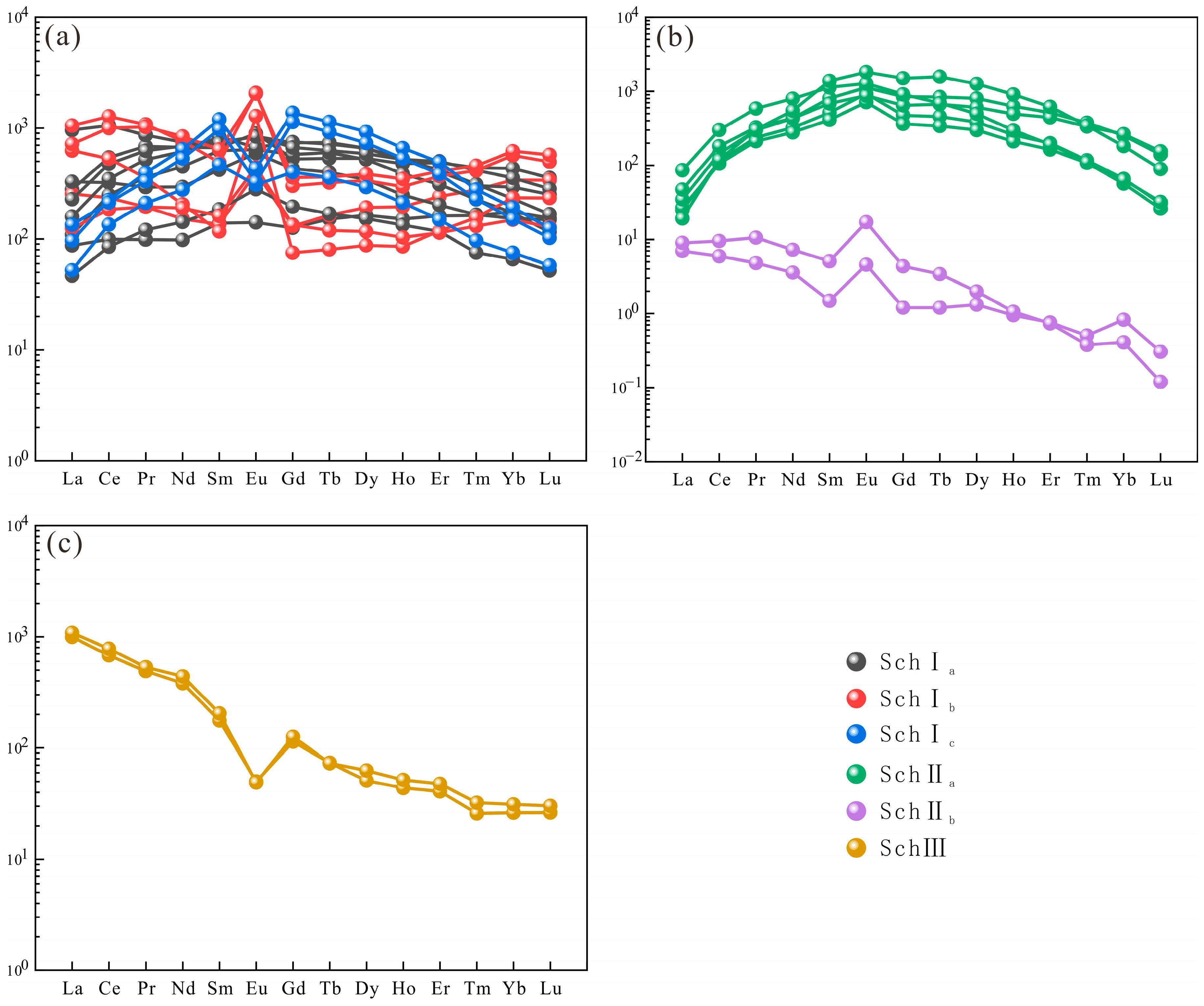
5.2. Trace Elements of Scheelite
5.3. Random Forests of Trace Elements
6. Discussion
6.1. Substitution Mechanisms in Scheelite
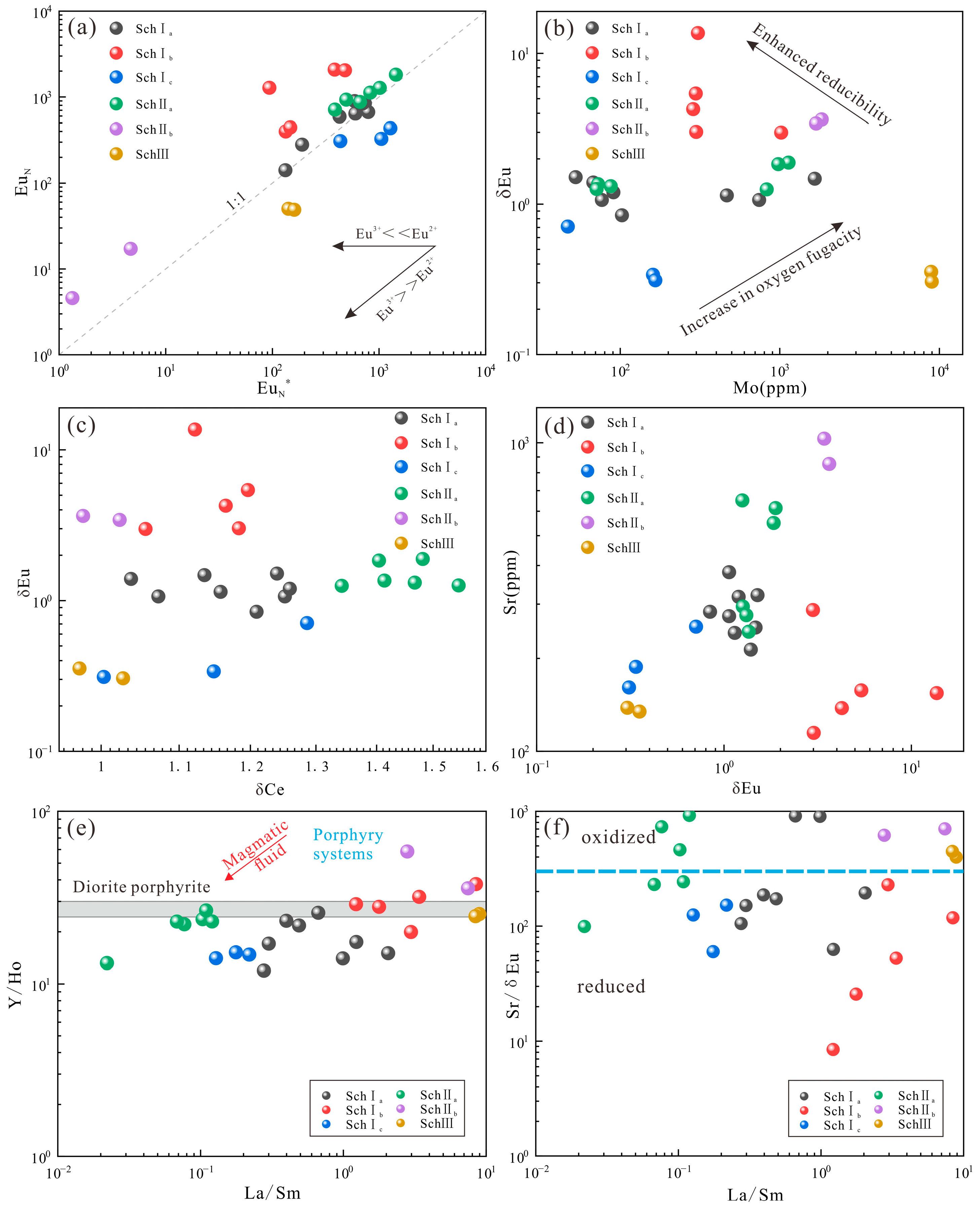
6.2. Physicochemical Conditions of the Hydrothermal Fluids
6.3. Constraints on Fluid Evolution from Scheelite
6.4. Fingerprinting Deposit Types
7. Conclusions
- (1)
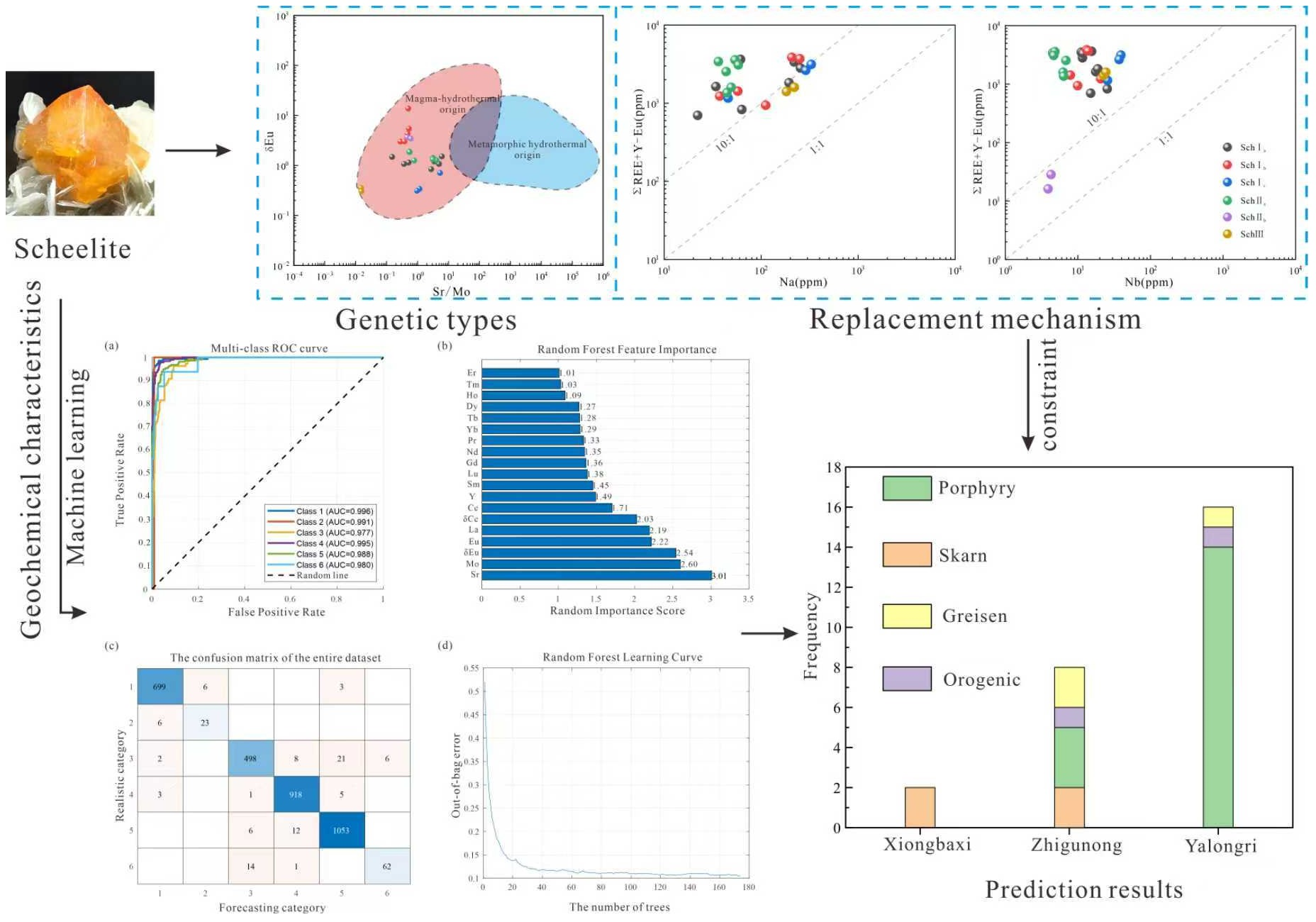
- Based on REE distribution patterns and cathodoluminescence (CL) imaging, scheelite in the Zhunuo ore district can be divided into multiple generations. Three generations are recognized in the Yalongri area, from late to early: Sch I a, Sch I b, and Sch I c. Two generations occur in the Zhigunong area, from early to late: Sch II a and Sch II b. Scheelite from the Xiongbaxi area comprises a single generation: Sch III.
- (2)
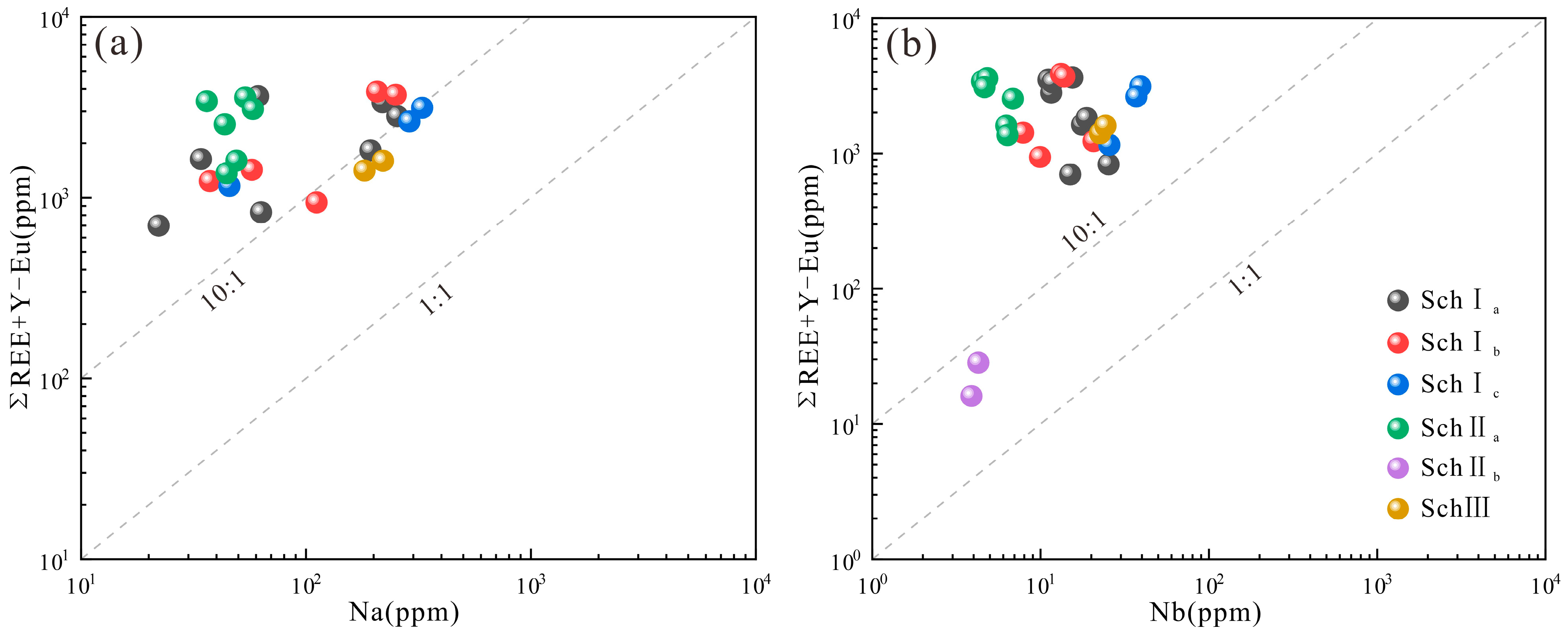
- Scheelite from the Zhunuo district exhibits Na and Nb contents significantly lower than ΣREE + Y-Eu and relatively flat REE patterns, indicating that the dominant substitution mechanism is 3Ca2+ = 2REE3+ + □Ca. The δEu values of Sch I a, Sch I b, Sch II a, and Sch II b are mostly ≥1, reflecting reducing ore-forming fluids, whereas Sch I c and Sch III show δEu < 1, indicating oxidizing conditions.
- (3)
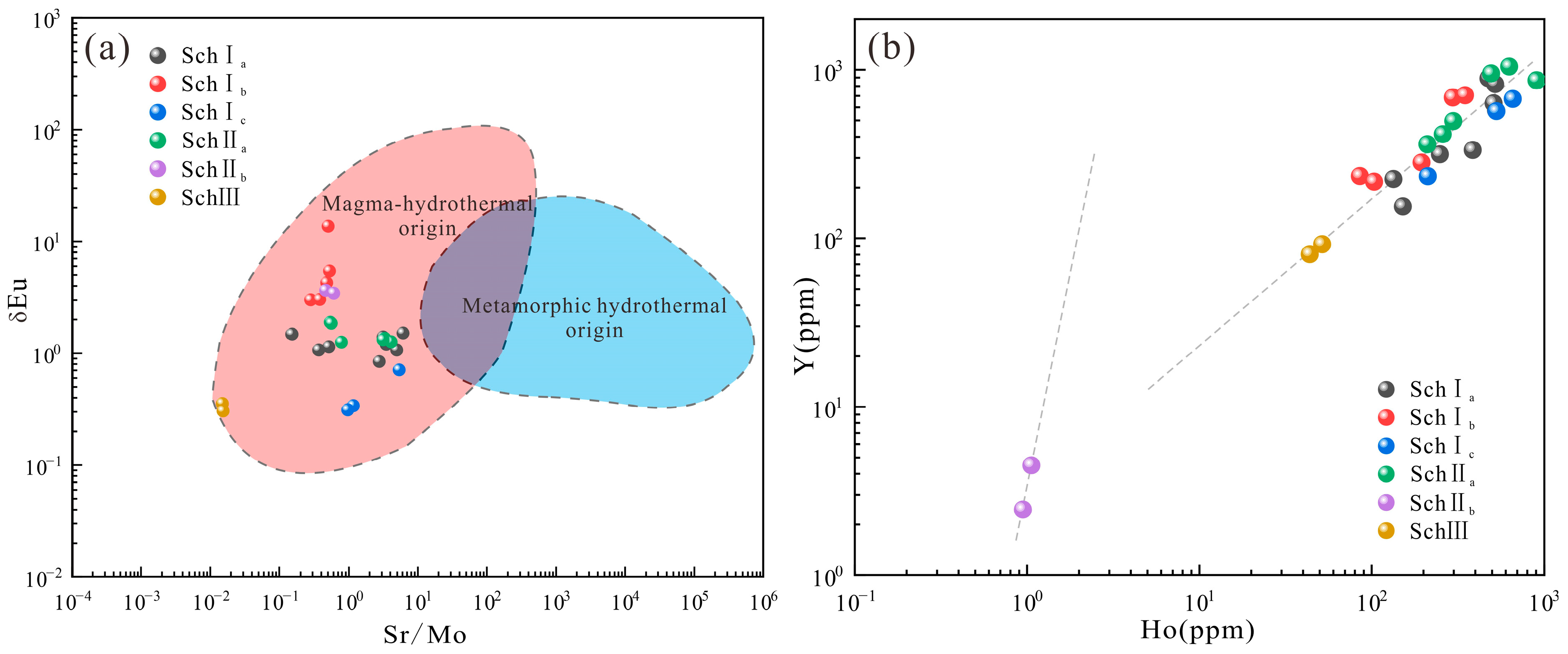
- REE patterns and trace element characteristics indicate that ore-forming fluids in the Yalongri area evolved from oxidizing to reducing conditions, with late-stage scheelite forming through dissolution–reprecipitation processes. The Zhigunong area records two fluid stages: an early REE-rich, Mo-poor stage and a later REE-poor, Mo-rich stage. The Xiongbaxi area records a single oxidizing stage characterized by REE- and Mo-rich fluids. Scheelite from the district shows low to moderate Sr/Mo ratios (0.02–6.10), consistent with a magmatic-hydrothermal origin, and relatively uniform Y/Ho ratios (12–59), indicating a stable crystallization environment.
- (4)
- Random Forest model predictions classify scheelite from the Zhunuo ore district into four genetic types. Scheelite from the Yalongri area is predominantly porphyry type, with minor greisen and orogenic affinities. In the Zhigunong area, scheelite spans porphyry, skarn, greisen, and orogenic types, whereas scheelite from the Xiongbaxi area is classified as skarn type.
Supplementary Materials
Author Contributions
Funding
Data Availability Statement
Acknowledgments
Conflicts of Interest
References
- Sun, K.; Chen, B. Trace Elements and Sr-Nd Isotopes of Scheelite: Implications for the W-Cu-Mo Polymetallic Mineralization of the Shimensi Deposit, South China. Am. Mineral. 2017, 102, 1114–1128. [Google Scholar] [CrossRef]
- Cao, J.; Yang, X.; Zhang, D.; Yan, F. In Situ Trace Elements and Sr Isotopes in Scheelite and S-Pb Isotopes in Sulfides from the Shiweidong W–Cu Deposit, Giant Dahutang Ore Field: Implications to the Fluid Evolution and Ore Genesis. Ore Geol. Rev. 2020, 125, 103696. [Google Scholar] [CrossRef]
- Sciuba, M.; Beaudoin, G.; Grzela, D.; Makvandi, S. Trace Element Composition of Scheelite in Orogenic Gold Deposits. Miner. Depos. 2020, 55, 1149–1172. [Google Scholar] [CrossRef]
- Cao, J.; Li, H.; Algeo, T.J.; Yang, L.; Tamehe, L.S. Two-Stage Magmatism and Tungsten Mineralization in the Nanling Range, South China: Evidence from the Jurassic Helukou Deposit. Am. Mineral. 2021, 106, 1488–1502. [Google Scholar] [CrossRef]
- Chai, F.; Zhang, Z.; Wang, W.; Xie, Q.; Huang, H.; Zhang, Y.; Qi, D.; Zhang, X. New Insights into the Multiple Magmatic Fluid Generations from Scheelite in the Bastielieke W-Polymetallic Deposit, Chinese Altay (NW, China). Geosci. Front. 2023, 14, 101532. [Google Scholar] [CrossRef]
- Nie, L.; Wang, F.; White, N.C.; Zhang, D.; Yan, C.; Wang, X. Scheelite Trace Element Compositions: A Robust New Tool for Mineral Exploration. Ore Geol. Rev. 2023, 155, 105338. [Google Scholar] [CrossRef]
- Chen, Z.-Y.; Zhang, L.; Sun, X.-W.; Sun, S.-C.; Shen, G.-W.; Yu, T.-W.; Chen, X.-G.; Ning, Z.-W.; Xu, Y.-H.; Wang, J.-Y. Tungsten Mineralization in the Huangjindong Gold Deposit, Southern China: Insights from Scheelite Texture, in-Situ Trace Elements and Sr Isotope Compositions. Ore Geol. Rev. 2024, 166, 105960. [Google Scholar] [CrossRef]
- Raimbault, L.; Baumer, A.; Dubru, M.; Benkerrou, C.; Croze, V.; Zahm, A. REE Fractionation between Scheelite and Apatite in Hydrothermal Conditions. Am. Mineral. 1993, 78, 1275–1285. [Google Scholar]
- Ghaderi, M.; Palin, J.M.; Campbell, I.H.; Sylvester, P.J. Rare Earth Element Systematics in Scheelite from Hy-drothermal Gold Deposits in the Kalgoorlie-Norseman Region, Western Australia. Econ. Geol. 1999, 94, 423–437. [Google Scholar] [CrossRef]
- Liu, Y.; Deng, J.; Li, C.; Shi, G.; Zheng, A. REE Composition in Scheelite and Scheelite Sm-Nd Dating for the Xuebaoding W-Sn-Be Deposit in Sichuan. Chin. Sci. Bull. 2007, 52, 2543–2550. [Google Scholar] [CrossRef]
- Dostal, J.; Kontak, D.J.; Chatterjee, A.K. Trace Element Geochemistry of Scheelite and Rutile from Metaturbid-ite-Hosted Quartz Vein Gold Deposits, Meguma Terrane, Nova Scotia, Canada: Genetic Implications. Mineral. Petrol. 2009, 97, 95–109. [Google Scholar] [CrossRef]
- Su, S.-Q.; Qin, K.-Z.; Li, G.-M.; Olin, P.; Thompson, J. Cathodoluminescence and Trace Elements of Scheelite: Constraints on Ore-Forming Processes of the Dabaoshan Porphyry Mo-W Deposit, South China. Ore Geol. Rev. 2019, 115, 103183. [Google Scholar] [CrossRef]
- Zhan, Q.; Gao, X.-Y.; Meng, L.; Zhao, T.-P. Ore Genesis and Fluid Evolution of the Sandaozhuang Supergiant W-Mo Skarn Deposit, Southern Margin of the North China Craton: Insights from Scheelite, Garnet and Clinopy-roxene Geochemistry. Ore Geol. Rev. 2021, 139, 104551. [Google Scholar] [CrossRef]
- Nassau, K. On the distribution of minor components during the formation of minerals. Am. Mineral. J. Earth Planet. Mater. 1964, 49, 321–324. [Google Scholar]
- Brugger, J.; Bettiol, A.A.; Costa, S.; Lahaye, Y.; Bateman, R.; Lambert, D.D.; Jamieson, D.N. Mapping REE Dis-tribution in Scheelite Using Luminescence. Mineral. Mag. 2000, 64, 891–903. [Google Scholar] [CrossRef]
- Chiaradia, M. The evolution of tungsten sources in crustal mineralization from Archean to Tertiary inferred from lead isotopes. Econ. Geol. 2003, 98, 1039–1045. [Google Scholar] [CrossRef]
- Roberts, S.; Palmer, M.R.; Waller, L. Sm-Nd and REE Characteristics of Tourmaline and Scheelite from the Bjorkdal Gold Deposit, Northern Sweden: Evidence of an Intrusion-Related Gold Deposit? Econ. Geol. 2006, 101, 1415–1425. [Google Scholar] [CrossRef]
- Soloviev, S.G.; Kryazhev, S.G.; Dvurechenskaya, S.S. Geology, Mineralization, and Fluid Inclusion Characteristics of the Lermontovskoe Reduced-Type Tungsten (±Cu, Au, Bi) Skarn Deposit, Sikhote-Alin, Russia. Ore Geol. Rev. 2017, 89, 15–39. [Google Scholar] [CrossRef]
- Zheng, Y.; Chen, X.; Luo, S.; Ci, Q.; Zhang, L.; Wei, J.; Gao, S.; Lin, H. A Modified Genetic Model for Multiple Pulsed Mineralized Processes at the Giant Qulong Porphyry Cu-Mo Mineralization System. Am. Mineral. 2024, 109, 1705–1716. [Google Scholar] [CrossRef]
- Song, G.; Qin, K.; Li, G.; Evans, N.J.; Chen, L. Scheelite Elemental and Isotopic Signatures: Implications for the Genesis of Skarn-Type W-Mo Deposits in the Chizhou Area, Anhui Province, Eastern China. Am. Mineral. 2014, 99, 303–317. [Google Scholar] [CrossRef]
- Poulin, R.S.; McDonald, A.M.; Kontak, D.J.; McClenaghan, M.B. On the Relationship Between Cathodolumi-nescence and the Chemical Composition of Scheelite From Geologically Diverse Ore-Deposit Environments. Can. Mineral. 2016, 54, 1147–1173. [Google Scholar] [CrossRef]
- Li, Y.-J.; Ying, Y.-C.; Li, W.-C.; Jiang, X.-J.; Liu, Y.-D.; Chen, W.; Jiang, S.-Y. Genesis of W Mineralization in the Yangla Cu-Polymetallic Deposit (NW Yunnan, China): Constraints from Scheelite Microstructure, Trace Element, U-Pb Dating and Sr Isotope Geochemistry. Ore Geol. Rev. 2024, 169, 106098. [Google Scholar] [CrossRef]
- Di, H.; Shao, Y.-J.; Chew, D.; Chen, J.-F.; Fang, W.-J.; Xiong, Y.-Q. Genesis and Magmatic-Hydrothermal Evolu-tion of the Silurian Pingtan W Deposit, Nanling Range, South China: Constraints from Scheelite and Apatite Geo-chemistry and Geochronology. J. Geochem. Explor. 2025, 279, 107884. [Google Scholar] [CrossRef]
- Hou, Z.Q.; Qu, X.M.; Huang, W.; Gao, Y.F. The Gangdese porphyry copper metallogenic belt is expected to become a second “Yulong” copper belt in Tibet. Geol. China 2001, 27, 27–29, (In Chinese with English Abstract). [Google Scholar]
- Zheng, Y.Y.; Wang, B.S.; Fan, Z.H.; Zhang, H.P. Analysis of tectonic evolution in the eastern section of the Gangdise mountains, Tibet and the metallogenic potentialities of copper gold polymetal. Geol. Sci. Technol. Inf. 2002, 21, 55–60, (In Chinese with English Abstract). [Google Scholar]
- Zheng, Y.Y.; Zhang, G.Y.; Xu, R.K.; Gao, S.B.; Pang, Y.C.; Cao, L.; Du, A.D.; Shi, Y.R. Constraints on the dia-genetic and metallogenic ages of the Zhunuo porphyry copper deposit in the Gangdese, Tibet. Chin. Sci. Bull. 2007, 52, 2542–2548, (In Chinese with English Abstract). [Google Scholar] [CrossRef]
- Zheng, Y.Y.; Wu, S.; Ci, Q.; Chen, X.; Gao, S.B.; Liu, X.F.; Jiang, X.W.; Zheng, S.L.; Li, M.; Jiang, X.J. Cu-Mo-Au polymetallic mineralization and metallogenic series in the Gangdese composite orogenic belt. Earth Sci. 2021, 46, 1909–1940, (In Chinese with English Abstract). [Google Scholar]
- Wu, S. The Zhunuo Giant Porphyry Copper Deposit in the Gangdese, Tibet: Magmatism and Mineralization. Ph.D. Thesis, China University of Geosciences (Beijing), Beijing, China, 2016. (In Chinese with English Abstract). [Google Scholar]
- Lin, B.; Fang, X.; Wang, Y.Y.; Yang, H.H.; He, W. Petrogenesis of ore-bearing porphyry in the Tiegelongnan su-per-large Cu (Au, Ag) deposit, Tibet and its implications for the Early Cretaceous metallogenic geodynamic mechanism in the Duolong area. Acta Petrol. Sin. 2019, 35, 642–664, (In Chinese with English Abstract). [Google Scholar]
- Lin, B.; Tang, J.X.; Tang, P.; Zhou, A.; Sun, M.; Qi, J.; Chen, G.L.; Zhang, Z.K.; Zhang, Z.B.; Wu, C.N.; et al. Preliminary understanding from the first 3000 m scientific deep drillhole in the Jiama porphyry metallogenic system, Tibetan Plateau. Miner. Deposit 2021, 40, 1119–1134, (In Chinese with English Abstract). [Google Scholar]
- Ying, L.J.; Wang, D.H.; Wang, H.; Zheng, W.B.; Sun, Y.; Zhong, W.T.; Hu, Z.H. Occurrence characteristics of scheelite in the Jiama copper polymetallic deposit, Tibet and its prospecting significance. Miner. Deposit 2011, 30, 318–326, (In Chinese with English Abstract). [Google Scholar]
- Yan, G.Q.; Ding, J.; Huang, Y.; Li, G.M.; Dai, J.; Wang, X.X.; Bai, J.G. Trace and rare earth element geochemistry of the Nuri scheelite deposit, Tibet: Implications for ore-forming fluids and deposit genesis. Acta Mineral. Sin. 2015, 35, 87–94, (In Chinese with English Abstract). [Google Scholar]
- Wu, Z.S.; Tang, L.W.; Basang, Y.; Chen, W.; Chen, B.; Du, Q.; Hou, H.; Miao, H. In-situ trace elements and Sr isotopic characteristics of scheelite from the Nuri Cu-W-Mo deposit, Tibet and their implications. Sediment. Geol. Tethyan Geol. 2024, 44, 723–739, (In Chinese with English Abstract). [Google Scholar]
- Zhao, Y.Y.; Luo sang, D.Z.; Wang, T.J.; Bai ma, L.J.; Liu, Y.C.; Li, J.; Liu, X.F.; Mi ma, W.J.; Gong, Z.F.; Ni, J.H.; et al. Discovery and significance of scheelite in the Zhigunong area, Zhunuo ore cluster, Tibet. Gansu Geol. 2025, 34, 23–28, (In Chinese with English Abstract). [Google Scholar]
- Yin, A.; Harrison, T.M. Geologic Evolution of the Himalayan-Tibetan Orogen. Annu. Rev. Earth Planet. Sci. 2000, 28, 211–228, (In Chinese with English Abstract). [Google Scholar] [CrossRef]
- Li, T.D. New advances in geological scientific research of the Tibetan Plateau. Geol. Bull. China 2002, 21, 370–376, (In Chinese with English Abstract). [Google Scholar]
- Zhu, D.C.; Zhao, Z.D.; Niu, Y.L.; Wang, Q.; Yildirim, D.; Dong, G.C.; Mo, X.X. Origin and Paleozoic tectonic evolution of the Lhasa terrane. Geol. J. China Univ. 2012, 18, 1–15, (In Chinese with English Abstract). [Google Scholar]
- Wen, D.R. The Gangdese Batholith, Southern Tibet: Ages, Geochemical Characteristics and Petrogenesis. Un-Published Ph.D. Thesis, National Taiwan University, Taipei City, Taiwan, 2007. [Google Scholar]
- Ji, W.-Q.; Wu, F.-Y.; Chung, S.-L.; Li, J.-X.; Liu, C.-Z. Zircon U-Pb Geochronology and Hf Isotopic Constraints on Petrogenesis of the Gangdese Batholith, Southern Tibet. Chem. Geol. 2009, 262, 229–245. [Google Scholar] [CrossRef]
- Ji, W.-Q.; Wu, F.-Y.; Liu, C.-Z.; Chung, S.-L. Early Eocene Crustal Thickening in Southern Tibet: New Age and Geochemical Constraints from the Gangdese Batholith. J. Asian Earth Sci. 2012, 53, 82–95. [Google Scholar] [CrossRef]
- Mo, X.; Hou, Z.; Niu, Y.; Dong, G.; Qu, X.; Zhao, Z.; Yang, Z. Mantle Contributions to Crustal Thickening during Continental Collision: Evidence from Cenozoic Igneous Rocks in Southern Tibet. Lithos 2007, 96, 225–242. [Google Scholar] [CrossRef]
- Mo, X.; Niu, Y.; Dong, G.; Zhao, Z.; Hou, Z.; Zhou, S.; Ke, S. Contribution of Syncollisional Felsic Magmatism to Continental Crust Growth: A Case Study of the Paleogene Linzizong Volcanic Succession in Southern Tibet. Chem. Geol. 2008, 250, 49–67. [Google Scholar] [CrossRef]
- Chung, S.-L.; Liu, D.; Ji, J.; Chu, M.-F.; Lee, H.-Y.; Wen, D.-J.; Lo, C.-H.; Lee, T.-Y.; Qian, Q.; Zhang, Q. Ada-kites from Continental Collision Zones: Melting of Thickened Lower Crust beneath Southern Tibet. Geology 2003, 31, 1021–1024. [Google Scholar] [CrossRef]
- Chung, S.-L.; Chu, M.-F.; Ji, J.; O’Reilly, S.Y.; Pearson, N.J.; Liu, D.; Lee, T.-Y.; Lo, C.-H. The Nature and Timing of Crustal Thickening in Southern Tibet: Geochemical and Zircon Hf Isotopic Constraints from Postcollisional Adakites. Tectonophysics 2009, 477, 36–48. [Google Scholar] [CrossRef]
- Zheng, Y.-C.; Hou, Z.-Q.; Li, W.; Liang, W.; Huang, K.-X.; Li, Q.-Y.; Sun, Q.-Z.; Fu, Q.; Zhang, S. Petrogenesis and Geological Implications of the Oligocene Chongmuda-Mingze Adakite-Like Intrusions and Their Mafic En-claves, Southern Tibet. J. Geol. 2012, 120, 647–669. [Google Scholar] [CrossRef]
- Zheng, Y.-C.; Hou, Z.-Q.; Li, Q.-Y.; Sun, Q.-Z.; Liang, W.; Fu, Q.; Li, W.; Huang, K.-X. Origin of Late Oligocene Adakitic Intrusives in the Southeastern Lhasa Terrane: Evidence from in Situ Zircon U–Pb Dating, Hf–O Isotopes, and Whole-Rock Geochemistry. Lithos 2012, 148, 296–311. [Google Scholar] [CrossRef]
- Hou, Z.; Yang, Z.; Qu, X.; Meng, X.; Li, Z.; Beaudoin, G.; Rui, Z.; Gao, Y.; Zaw, K. The Miocene Gangdese Porphyry Copper Belt Generated during Post-Collisional Extension in the Tibetan Orogen. Ore Geol. Rev. 2009, 36, 25–51. [Google Scholar] [CrossRef]
- Zheng, Y.; Sun, X.; Gao, S.; Wu, S.; Xu, J.; Jiang, J.; Chen, X.; Zhao, Z.; Liu, Y. Metallogenesis and the Minero-genetic Series in the Gangdese Polymetallic Copper Belt. J. Asian Earth Sci. 2015, 103, 23–39. [Google Scholar] [CrossRef]
- Zheng, Y.Y.; Wu, S.; Ci, Q.; Chen, S.Y.; Shi, S.D.; Chen, X.; Liu, P.; Li, J.Z. Metallogenic series and prospecting breakthrough in the Zhunuo ore cluster, Tibet. Miner. Deposit 2024, 43, 1295–1315, (In Chinese with English Abstract). [Google Scholar]
- Dong, G.C.; Mo, X.X.; Zhao, Z.D.; Wang, L.; Zhou, S. A new discussion on the stratigraphic sequence of the Linzizong volcanic rocks in the Linzhou Basin, northern Lhasa, Tibet. Geol. Bull. China 2005, 24, 549–557, (In Chinese with English Abstract). [Google Scholar]
- Pearce, N.J.G.; Perkins, W.T.; Westgate, J.A.; Gorton, M.P.; Jackson, S.E.; Neal, C.R.; Chenery, S.P. A Compilation of New and Published Major and Trace Element Data for NIST SRM 610 and NIST SRM 612 Glass Reference Materials. Geostand. Newsl. 1997, 21, 115–144. [Google Scholar] [CrossRef]
- Liu, Y.; Hu, Z.; Gao, S.; Günther, D.; Xu, J.; Gao, C.; Chen, H. In Situ Analysis of Major and Trace Elements of Anhydrous Minerals by LA-ICP-MS without Applying an Internal Standard. Chem. Geol. 2008, 257, 34–43. [Google Scholar] [CrossRef]
- Zhou, Y.Z.; Wang, J.; Zuo, R.G.; Xiao, F.; Shen, W.J.; Wang, S.G. Machine learning, deep learning and imple-mentation languages in geology. Acta Petrol. Sin. 2018, 34, 3173–3178, (In Chinese with English Abstract). [Google Scholar]
- Breiman, L. Random Forests. Mach. Learn. 2001, 45, 5–32. [Google Scholar] [CrossRef]
- Dong, S.N.; Wang, D.; Ma, G.T.; Wei, S.C.; Dai, K.G.; Zhang, X.X.; Xu, D.X. Application of machine learn-ing-based sphalerite trace element characteristics in the identification of lead-zinc deposit types. J. Chengdu Univ. Technol. (Sci. Technol. Ed.) 2024, 51, 614–629, (In Chinese with English Abstract). [Google Scholar]
- Boynton, W.V. Cosmochemistry of the Rare Earth Elements: Meteorite Studies. In Developments in Geochemistry; Henderson, P., Ed.; Elsevier: Amsterdam, The Netherlands, 1984; Volume 2, pp. 63–114. [Google Scholar]
- Hazarika, P.; Mishra, B.; Pruseth, K.L. Scheelite, Apatite, Calcite and Tourmaline Compositions from the Late Archean Hutti Orogenic Gold Deposit: Implications for Analogous Two Stage Ore Fluids. Ore Geol. Rev. 2016, 72, 989–1003. [Google Scholar] [CrossRef]
- Raju, P.V.S.; Hart, C.J.R.; Sangurmath, P. Scheelite Geochemical Signatures by LA-ICP-MS and Potential for Rare Earth Elements from Hutti Gold Mines and Fingerprinting Ore Deposits. J. Afr. Earth Sci. 2016, 114, 220–227. [Google Scholar] [CrossRef]
- Tikhomirov, P.L.; Prokof’ev, V.Y.; Kal’ko, I.A.; Apletalin, A.V.; Nikolaev, Y.N.; Kobayashi, K.; Nakamura, E. Post-Collisional Magmatism of Western Chukotka and Early Cretaceous Tectonic Rearrangement in Northeastern Asia. Geotectonics 2017, 51, 131–151. [Google Scholar] [CrossRef]
- Nie, L.Q.; Zhou, T.F.; Wang, F.Y.; Zhang, D.Y.; Chen, X.F.; Xiao, Q.L.; Li, X.X.; Wei, O.X. In-situ trace element characteristics of scheelite from the Dongyuan porphyry tungsten deposit, Anhui Province and their implications. Miner. Deposit 2018, 37, 1237–1246, (In Chinese with English Abstract). [Google Scholar]
- Plotinskaya, O.Y.; Baksheev, I.A.; Minervina, E.A. REE Distribution in Scheelite from the Yubileinoe Porphyry Gold Deposit, South Urals: Evidence from LA-ICP-MS Data. Geol. Ore Depos. 2018, 60, 355–364. [Google Scholar] [CrossRef]
- Han, J.; Chen, H.; Hong, W.; Hollings, P.; Chu, G.; Zhang, L.; Sun, S. Texture and Geochemistry of Multi-Stage Hydrothermal Scheelite in the Tongshankou Porphyry-Skarn Cu-Mo(-W) Deposit, Eastern China: Implications for Ore-Forming Process and Fluid Metasomatism. Am. Mineral. 2020, 105, 945–954. [Google Scholar] [CrossRef]
- Nie, L.; Zhou, T.; Chen, X.; Wang, F.; Xiao, X. Cathodoluminescence and Trace Element Composition of Scheelite from the Middle-Lower Yangtze River Metallogenic Belt (MLYB): Implications for Mineralization and Exploration. Acta Geol. Sin. 2020, 94, 1977–1996. [Google Scholar] [CrossRef]
- Fu, Y.; Hollings, P.; Li, D.; Liu, Q.; Li, S.; Sun, X. Geochemistry of Multi-Stage Scheelite in the Skarn: Constraints on Ore-Forming Processes of the Machangqing Cu-Mo Polymetallic Deposit in Yunnan Province, Southwest China. Ore Geol. Rev. 2021, 138, 104370. [Google Scholar] [CrossRef]
- Dai, Z.-W.; Li, G.-M.; Xie, Y.-L.; Yang, Z.-M.; Marten Huizenga, J.; Liang, W.; Fu, J.-G.; Cao, H.-W. Source and Evolution of the Ore-Forming Fluid of the Cuonadong Sn-W-Be Polymetallic Deposit (Southern Tibet, China): Constraints from Scheelite Trace Element and Sr Isotope Geochemistry. Ore Geol. Rev. 2022, 142, 104570. [Google Scholar] [CrossRef]
- Ji, Y.; Xie, G.; Romer, R.L.; Li, W.; Zhu, Q.; Fu, B. Scheelite Composition Fingerprints Pulsed Flow of Magmatic Fluid in the Fujiashan W Skarn Deposit, Eastern China. Am. Mineral. 2024, 109, 747–763. [Google Scholar] [CrossRef]
- Poulin, R.S.; Kontak, D.J.; McDonald, A.; McCLenaghan, M.B. Assessing Scheelite As an Ore-Deposit Discrim-inator Using Its Trace-Element and REE Chemistry. Can. Mineral. 2018, 56, 265–302. [Google Scholar] [CrossRef]
- Weng, G.; Liu, J.; Carranza, E.J.M.; Zhai, D.; Wang, J.; Wang, H.; Zhang, B.; Zhang, F.; Wang, Y.; Jiang, D.; et al. Scheelite Texture and Geochemistry as a Recorder of Nature and Timing of Metallogenesis: An Example from the Zhaishang Au–Sb–W Deposit, Western Qinling, Central China. Contrib. Mineral. Petrol. 2024, 179, 14. [Google Scholar] [CrossRef]
- Su, Q.; Mao, J.; Sun, J.; Zhao, L.; Xu, S.; Su, Q.; Mao, J.; Sun, J.; Zhao, L.; Xu, S. Geochemistry and Origin of Scheelites from the Xiaoyao Tungsten Skarn Deposit in the Jiangnan Tungsten Belt, SE China. Minerals 2020, 10, 271. [Google Scholar] [CrossRef]
- Poitrenaud, T.; Poujol, M.; Augier, R.; Marcoux, E. The Polyphase Evolution of a Late Variscan W/Au Deposit (Salau, French Pyrenees): Insights from REE and U/Pb LA-ICP-MS Analyses. Miner. Depos. 2020, 55, 1127–1147. [Google Scholar] [CrossRef]
- Flynn, R.T.; Burnham, C.W. An Experimental Determination of Rare Earth Partition Coefficients between a Chloride Containing Vapor Phase and Silicate Melts. Geochim. Cosmochim. Acta 1978, 42, 685–701. [Google Scholar] [CrossRef]
- Chen, L.; Qin, K.; Li, G.; Li, J.; Xiao, B.; Zhao, J. In Situ Major and Trace Elements of Garnet and Scheelite in the Nuri Cu-W-Mo Deposit, South Gangdese, Tibet: Implications for Mineral Genesis and Ore-Forming Fluid Records. Ore Geol. Rev. 2020, 122, 103549. [Google Scholar] [CrossRef]
- Hsu, L.C.; Galli, P.E. Origin of the Scheelite-Powellite Series of Minerals. Econ. Geol. 1973, 68, 681–696. [Google Scholar] [CrossRef]
- Linnen, R.L.; Williams-Jones, A.E. Evolution of Aqueous-Carbonic Fluids during Contact Metamorphism, Wall-Rock Alteration, and Molybdenite Deposition at Trout Lake, British Columbia. Econ. Geol. 1990, 85, 1840–1856. [Google Scholar] [CrossRef]
- Kempe, U.; Belyatsky, B.; Krymsky, R.; Kremenetsky, A.; Ivanov, P. Sm-Nd and Sr Isotope Systematics of Scheelite from the Giant Au(-W) Deposit Muruntau (Uzbekistan): Implications for the Age and Sources of Au Mineralization. Miner. Depos. 2001, 36, 379–392. [Google Scholar] [CrossRef]
- Song, G.; Cook, N.J.; Li, G.; Qin, K.; Ciobanu, C.L.; Yang, Y.; Xu, Y. Scheelite Geochemistry in Porphyry-Skarn W-Mo Systems: A Case Study from the Gaojiabang Deposit, East China. Ore Geol. Rev. 2019, 113, 103084. [Google Scholar] [CrossRef]
- Yuan, L.; Chi, G.; Wang, M.; Li, Z.; Xu, D.; Deng, T.; Geng, J.; Hu, M.; Zhang, L. Characteristics of REEs and Trace Elements in Scheelite from the Zhuxi W Deposit, South China: Implications for the Ore-Forming Conditions and Processes. Ore Geol. Rev. 2019, 109, 585–597. [Google Scholar] [CrossRef]
- Bau, M.; Dulski, P.; Moeller, P. Yttrium and Holmium in South Pacific Seawater: Vertical Distribution and Possible Fractionation Mechanisms. Geochemistry 1995, 55, 1–15. [Google Scholar]
- Miranda, A.C.R.; Beaudoin, G.; Rottier, B.; Pašava, J.; Bohdálek, P.; Malec, J. Trace Element Signatures in Scheelite Associated with Various Deposit Types: A Tool for Mineral Targeting. J. Geochem. Explor. 2024, 266, 107555. [Google Scholar] [CrossRef]
- Li, W.-S.; Ni, P.; Pan, J.-Y.; De Vivo, B.; Albanese, S.; Fan, M.-S.; Gao, Y.; Zhang, D.-X.; Chi, Z. Co-Genetic Formation of Scheelite- and Wolframite-Bearing Quartz Veins in the Chuankou W Deposit, South China: Evidence from Individual Fluid Inclusion and Wall-Rock Alteration Analysis. Ore Geol. Rev. 2022, 142, 104723. [Google Scholar] [CrossRef]
- Li, X.; Aibai, A.; He, X.; Tang, R.; Chen, Y. Chemical Composition and Strontium Isotope Characteristics of Scheelite from the Doranasai Gold Deposit, NW China: Implications for Ore Genesis. Minerals 2022, 12, 637. [Google Scholar] [CrossRef]
- Miranda, A.C.R.; Beaudoin, G.; Rottier, B. Scheelite Chemistry from Skarn Systems: Implications for Ore-Forming Processes and Mineral Exploration. Miner. Depos. 2022, 57, 1469–1497. [Google Scholar] [CrossRef]
- Deng, J.-T.; Zhu, J.-J.; Hu, R.; Hollings, P.; Bi, X.-W.; Huang, M.-L.; Yang, Z.-Y.; Pan, L.-C.; Wang, D.-Z. Magmatic-Hydrothermal Redox State and Ore-Controlling Factors for the Yangla Skarn Cu Deposit, Sanjiang Region, SW China. Ore Geol. Rev. 2024, 168, 106040. [Google Scholar] [CrossRef]






Disclaimer/Publisher’s Note: The statements, opinions and data contained in all publications are solely those of the individual author(s) and contributor(s) and not of MDPI and/or the editor(s). MDPI and/or the editor(s) disclaim responsibility for any injury to people or property resulting from any ideas, methods, instructions or products referred to in the content. |
© 2026 by the authors. Licensee MDPI, Basel, Switzerland. This article is an open access article distributed under the terms and conditions of the Creative Commons Attribution (CC BY) license.
Share and Cite
Li, Q.; Zhang, J.; Wu, J.; Jiang, X.; Pang, B. New Insights into the Xiongbaxi–Yalongri Cu-W(-Mo) Deposit (Tibet): Scheelite Geochemistry and Machine Learning Constraints on Ore-Forming Fluid Evolution and Genetic Type. Minerals 2026, 16, 217. https://doi.org/10.3390/min16020217
Li Q, Zhang J, Wu J, Jiang X, Pang B. New Insights into the Xiongbaxi–Yalongri Cu-W(-Mo) Deposit (Tibet): Scheelite Geochemistry and Machine Learning Constraints on Ore-Forming Fluid Evolution and Genetic Type. Minerals. 2026; 16(2):217. https://doi.org/10.3390/min16020217
Chicago/Turabian StyleLi, Qinggong, Jinshu Zhang, Jianhui Wu, Xiaojia Jiang, and Bei Pang. 2026. "New Insights into the Xiongbaxi–Yalongri Cu-W(-Mo) Deposit (Tibet): Scheelite Geochemistry and Machine Learning Constraints on Ore-Forming Fluid Evolution and Genetic Type" Minerals 16, no. 2: 217. https://doi.org/10.3390/min16020217
APA StyleLi, Q., Zhang, J., Wu, J., Jiang, X., & Pang, B. (2026). New Insights into the Xiongbaxi–Yalongri Cu-W(-Mo) Deposit (Tibet): Scheelite Geochemistry and Machine Learning Constraints on Ore-Forming Fluid Evolution and Genetic Type. Minerals, 16(2), 217. https://doi.org/10.3390/min16020217