Article

S-O Stable Isotopes and Geological Considerations of Ba–Sr Deposits from Neuquén Basin, Northwest Patagonia, Argentina


by
Raúl E. de Barrio
1,
Clemente Recio
2,*,
Ricardo O. Etcheverry
3,
Francisco Javier Rios
4,
Miguel A. Del Blanco
3 and
Eduardo A. Domínguez
5,†
1
Consultant Geologist, Calle 14c N° 46, City Bell 1896, Argentina
2
Departamento de Geología, Facultad de Ciencias, Universidad de Salamanca (USAL), Plaza de los Caídos s/n, 37008 Salamanca, Spain
3
Instituto de Recursos Minerales (INREMI), Facultad de Ciencias Naturales y Museo, Universidad Nacional de La Plata (UNLP), Paseo del Bosque s/n, La Plata 1900, Argentina
4
Centro de Desenvolvimento da Tecnologia Nuclear (CDTN), Belo Horizonte 31270-901, MG, Brazil
5
Departamento de Geología, Universidad Nacional del Sur (UNS), Bahía Blanca 8000, Argentina
*
Author to whom correspondence should be addressed.
Deceased.
Minerals 2026, 16(2), 215; https://doi.org/10.3390/min16020215
Submission received: 26 January 2026 / Revised: 12 February 2026 / Accepted: 16 February 2026 / Published: 20 February 2026
(This article belongs to the Section Mineral Geochemistry and Geochronology)

Abstract

Jurassic–Cretaceous marine–continental carbonate–evaporitic sequences in the Neuquén Basin of Argentina host numerous stratabound Ba–Sr deposits. Mineralization (Sr–barite, Ba–celestine, and minor Pb–Zn–Cu–Fe sulphides) occurs as bedding parallel lenses and crosscutting veins. The stratiform mineralization is formed by replacements of carbonate and gypsum beds and often exhibits typical zebra textures. Dissolution processes associated with Neogene regional uplift produced karstic cavities where a new generation of barite was deposited. Regionally, W to E distribution of carbonates/evaporites and that of Ba–Sr deposits is coincidental. Lower Cretaceous Sr–Ba deposits are spatially related to large N-S reverse faulting, frequently limited to the eastern limb of the folded structures. Average δ18O and δ34S of stratiform and crosscutting vetiform mineralization do not differ significantly, suggesting a common source of sulphate and cations. Deposits spatially linked to areas with magmatic activity and those that are not have similar isotopic values, compatible with bacterial and/or thermochemical reduction of contemporaneous seawater sulphate, although sulphides only occur in deposits with evidence of nearby magmatic activity. Thermal convection of basinal brines leached metals from the Mesozoic sedimentary pile; Ba and Sr were extracted from siliciclastic and carbonate rocks, and sulphur from evaporite layers. Fluids related to Tertiary magmatism helped producing an epithermal mineral association composed of barite, quartz, adularia, and minor sulphides/sulphosalts hosted by veins. Arroyo Nuevo mine (Ba) is different, as it seems to be the product of hydrothermal SedEx deposition onto the anoxic seafloor.

Graphical Abstract

1. Introduction

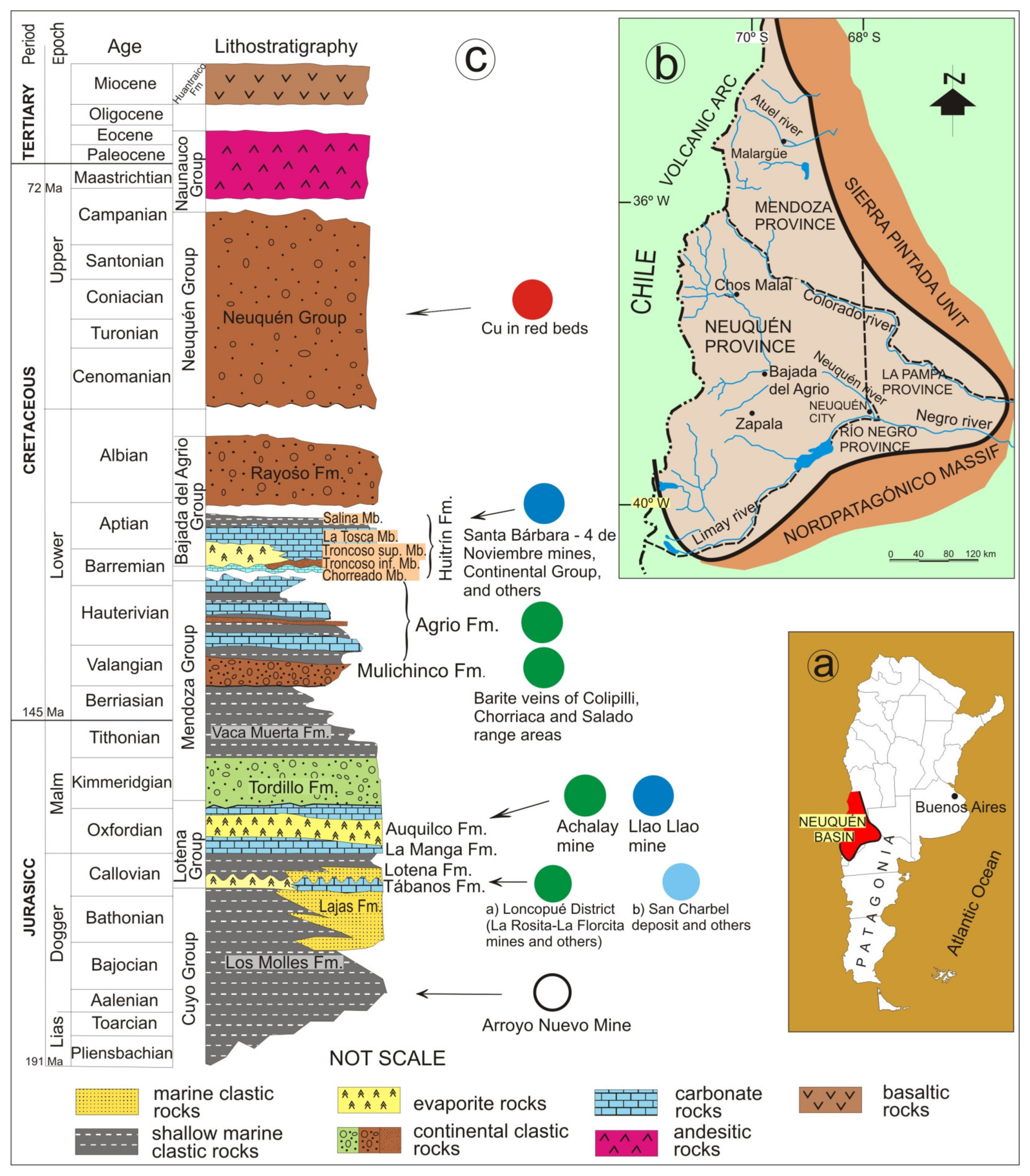
The Neuquén Basin, located in the northwestern sector of Patagonia, Argentina, extends over approximately 120,000 km2 (Figure 1a). It comprises a sedimentary sequence of great economic interest, with significant oil and gas resources. The Neuquén Basin consists of a large morphostructural unit characterized by a >6000 m thick stratigraphic sequence deposited between the Upper Triassic and the Lower Tertiary [1,2]. This sequence shows several Jurassic and Cretaceous alternating marine and continental cycles that record a complex geological evolution. Andesitic magmatism represented by the Naunauco Group appears as stocks, laccoliths, dikes, and lava-flows that define an important tectono-magmatic episode of Upper Cretaceous–Paleogene age in the western part of the basin. In addition, andesitic to basaltic rocks of Miocene age (Huantraico volcanites) crop out at the northern part. These regional geological events are significant for understanding the processes that controlled the genesis and distribution of the Ba–Sr deposits.
The Ba–Sr mineralizations of the Neuquén Basin were first studied in the mid-twentieth century by Argentinian National Institutions such as Banco Nacional de Desarrollo and Dirección Nacional de Minería y Geología, among others, which focused on the main geological features and economic potential. In the second half of the twentieth century, more detailed work was aimed at elucidating the origin of the mineralizations. Hayase and Bengochea [4] concluded that the Neuquén Ba–Sr mineralizations were of an epigenetic type formed by selective replacement of carbonate rocks and infilling of fractures by hydrothermal fluids of magmatic origin. Brodtkorb et al. [5,6,7] and Brodtkorb and Danieli [8] suggested a syngenetic origin for most Neuquén Ba–Sr deposits associated with evaporitic depositional environments (celestine deposits) or chemical precipitation in coastal marine environments (barite deposits) with subsequent diagenetic processes. Angelelli et al. [9] pointed out an epithermal origin for some vein deposits linked to the Tertiary andesitic magmatism and indicated that the stratified deposits hosted by the Lower Cretaceous sequence were formed by replacement of a calcareous horizon that had been karstified with extensive cavity development. Several fluid inclusion studies (Collao et al. [10], among others) pointed out the generalized hydrothermal character of the main forming fluids of both the vein and bedded Ba–Sr mineralizations. In addition, de Barrio [11] and de Barrio et al. [12] pointed out a replacement origin for the celestine deposits of the Lower Cretaceous Huitrín Fm. and summarized the main geological characteristics of the Ba–Sr deposits of the Neuquén Basin.
Finally, the most recent descriptions of the geological characteristics of the barite and celestine deposits from Bajada del Agrio, Continental Group, and Colipilli districts are those of Escobar [13], Salvioli [14], and Salvioli et al. [15,16].
This article presents the main stable isotope characteristics of the Ba–Sr mineralizations of the Neuquén Basin and postulates some genetic considerations. In addition, regional zoning and stratigraphic–structural controls are described.

2. Geological Setting

The Neuquén Basin (Figure 1a) is located near the western edge of the South American Plate, between the emplaced volcanic arc to the west and the western flank of the foreland (Figure 1b). It represents a back-arc depocenter produced by extensional tectonic processes, beginning in the Middle Triassic, controlled by the early break-up phases of western Gondwana fragmentation. The infilling of the basin is made up of more than 6000 m of clastic, carbonate, evaporitic, pyroclastic, and magmatic rocks [3], spanning from the Triassic to the Upper Tertiary.
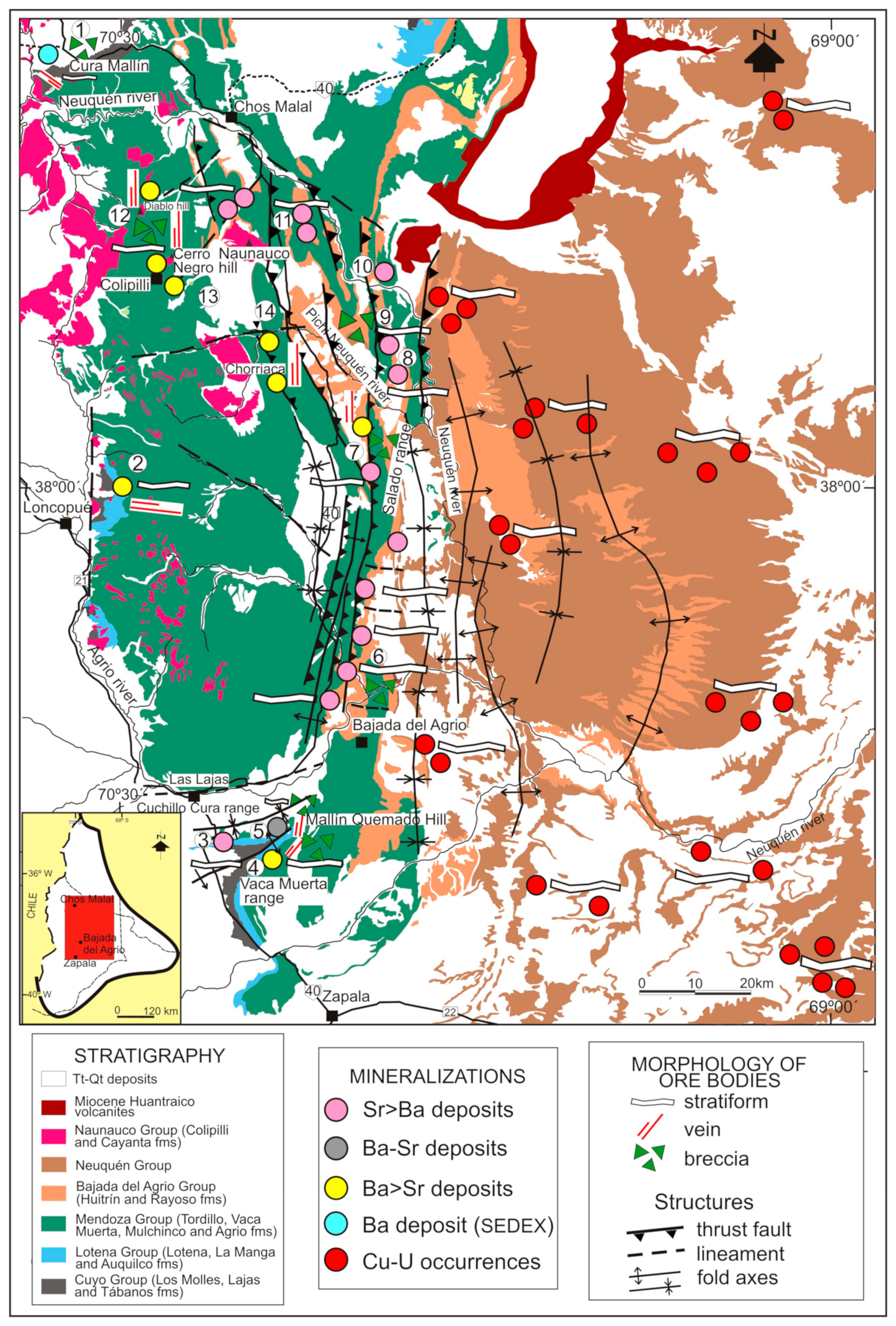
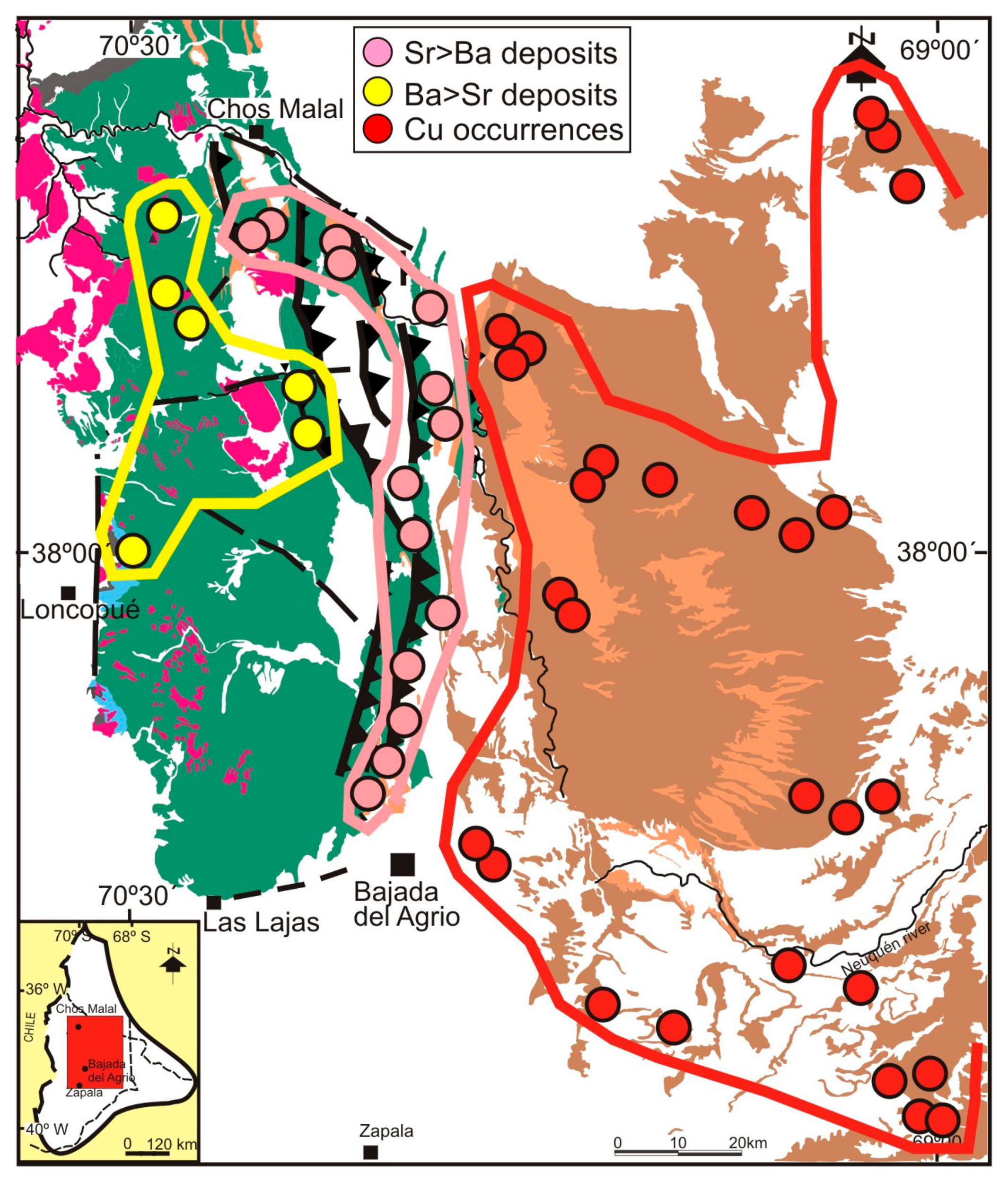
The stratigraphic sequence of the basin between the Lower Jurassic and the Miocene, and the Ba–Sr–Cu deposits related, is briefly summarized in Figure 1c. Ba–Sr mineralizations and Cu occurrences are shown in Figure 2.
The sedimentary sequence is characterized by marked cyclicity, especially during the Jurassic–Cretaceous, when marine and continental successions alternate. Each cycle records a similar environmental evolution of lateral variation from alluvial facies in the eastern side, to marine platform, slope, and basinal facies toward the west [17,18], resulting in three main carbonate–evaporitic–clastic sequences: (a) Cuyan (Lower Jurassic) with Los Molles, Lajas, and Tábanos Formations; (b) Lotenian (Middle to Upper Jurassic) with Lotena, La Manga, and Auquilco Formations, and (c) Andean (Tithonian to Campanian) with the Mendoza, Bajada del Agrio (Huitrín and Rayoso Formations [19]), and Neuquén Groups.
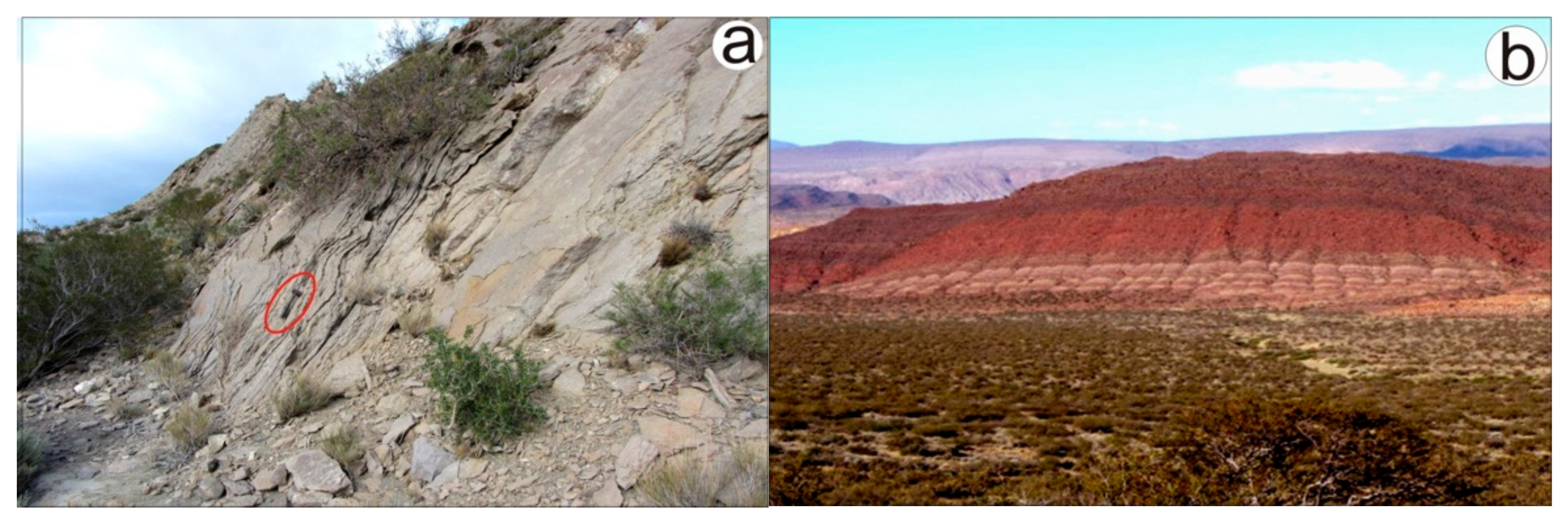
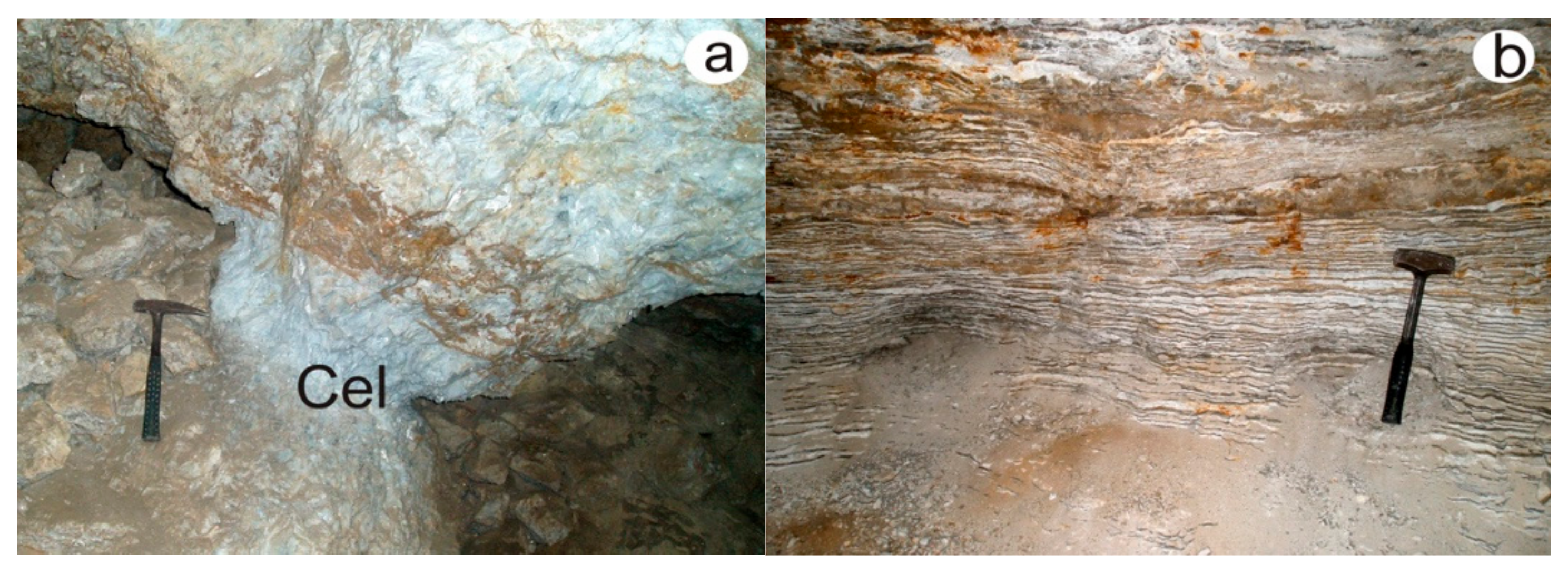
The Tábanos (Callovian) and Auquilco (Oxfordian) Formations represent periods of strong desiccation leading to restricted hypersaline environments. In addition, the Huitrín Fm. (Upper Barremian–Lower Aptian) is divided into five members, from the base upwards Chorreado (limestones and shales), Troncoso Inferior (continental sandstones and siltstones), Troncoso Superior (gypsum evaporites and minor laminated microbial limestones, Figure 3a), La Tosca (fossiliferous limestones), and Salina (claystones). These units represent the transition from a continental environment, with eolian and fluvial sedimentary rocks, to a restricted hypersaline shallow water coastal–neritic environment that evolved to almost total desiccation and subsequent subaerial exposure.
Moreover, at the end of the Lower Cretaceous regional uplift occurred, recorded by the deposition of red sandstones and varicoloured claystones of the Rayoso Formation (Upper Aptian–Albian, Figure 3b). During the Upper Cretaceous, deposition of the conglomerates, sandstones, and mudstones of the Neuquén Group (Cenomani–an–Campanian) occurred in a continental environment. These rocks host numerous red-bed Cu occurrences [19,20,21].
The andesitic to basaltic magmatism of the central–northeastern sector of the Neuquén Basin is represented by two important units: the Naunauco Group (Upper Cretaceous–Eocene) and the Huantraico volcanites (Miocene). The first unit is made up of the Colipilli Formation (andesitic intrusive facies: sills, dikes, and laccoliths [22]) and the Cayanta Formation (extrusive facies with amphibole-bearing andesitic lavas and breccias [23]). These igneous units, especially the Naunauco Group, crop out in areas with numerous Ba–Sr mineralizations (e.g., Naunauco, Colipilli, Loncopué, and Mallín Quemado areas; Figure 2).

3. Materials and Methods

Detailed geological and mining maps were drawn for the most conspicuous areas and more than one hundred and fifty rock and mineral samples, representative of the different deposits and mineralization styles, were subjected to petro-chalcographic, electron microprobe, and stable isotope analyses, as appropriate.
Electron microprobe analyses (n = 50) were performed with a CAMECA (Gennevilliers Cedex, France) Camebax SX-100 microprobe at the Universidad de Oviedo, Spain, using current acceleration of 15 kV, an electrical current of 10–20 nA, and a beam diameter of 1–2 μm. Calibrations were performed using natural and synthetic standards.
Sulphur and Oxygen stable isotope determinations were performed at the Servicio General de Análisis de Isótopos Estables, Universidad de Salamanca, Spain. Sulphur isotope analysis was performed on sulphates (Sr–barite, Ba–celestine, and gypsum; n = 13) and sulphides (pyrite, galena, and sphalerite; n = 13) in 26 hand-picked pure separate samples from different Ba–Sr ore deposits. The 34S/32S isotope ratio was measured by spectroscopic methods on SO2 obtained in a high vacuum line by combustion in a tubular furnace at 1070 °C (sulphides) and 1150 °C (sulphates). The procedures for the combustion of the samples followed the method of Robinson and Kusakabe [24] for sulphides, with modifications by Coleman and Moore [25] for sulphates. Isotopic ratios were measured in a VG Isotech SIRA-II mass spectrometer. Sulphur isotope ratios are expressed in delta per mil notation with respect to the Canyon Diablo Troilite (V-CDT) standard.
The 18O/16O isotope ratio of sulphates (n = 36) was determined using CO gas obtained by pyrolizing them in a Eurovector elemental analyzer, coupled in-line to an ISOPRIME (Micromass) continuous flow mass spectrometer, and using He as carrier gas, as described by Morrison et al. [26]. To avoid interference by hydration oxygen, prior to analysis, gypsum samples were converted to BaSO4 by dissolution in hot (80 °C) 2.5 M HCl, and SO42− precipitation by addition of 5% (w/v) BaCl2. Multiple analyses of NBS-127 indicate reproducibility better than ±0.1‰. The isotopic relationships are reported in delta notation (δ ‰) relative to V-SMOW (Vienna “standard mean ocean water”).

4. Results

4.1. The Barite–Celestine Mineralizations of the Neuquén Basin
The Ba–Sr ore deposits of the Neuquén Basin were exploited approximately from 1930 onwards. Individual deposits are usually small, with no more than a few thousand tonnes of mineral reserves, except for two cases, the Arroyo Nuevo and Achalay barite mines, which have been active for several decades in the twentieth century. Otherwise, most mines are currently closed, although some have been reactivated in recent years but with scarce, intermittent production.
The Ba–Sr mineralizations are distributed throughout a large area between approximate coordinates 36°00′–39°00′ S and 70°00′–70°30′ W (Figure 2), showing a clear tendency to cluster in several discrete sectors, where they are hosted by the Jurassic–Cretaceous carbonate–evaporite sequence. The mineral paragenesis is usually simple and made of celestine and barite (normally Ba–celestines and Sr–barites) as largely dominant minerals, occasionally accompanied by very minor amounts of sulphides (galena, sphalerite, pyrite, and chalcopyrite) and calcite, dolomite, and quartz as gangue minerals [12].
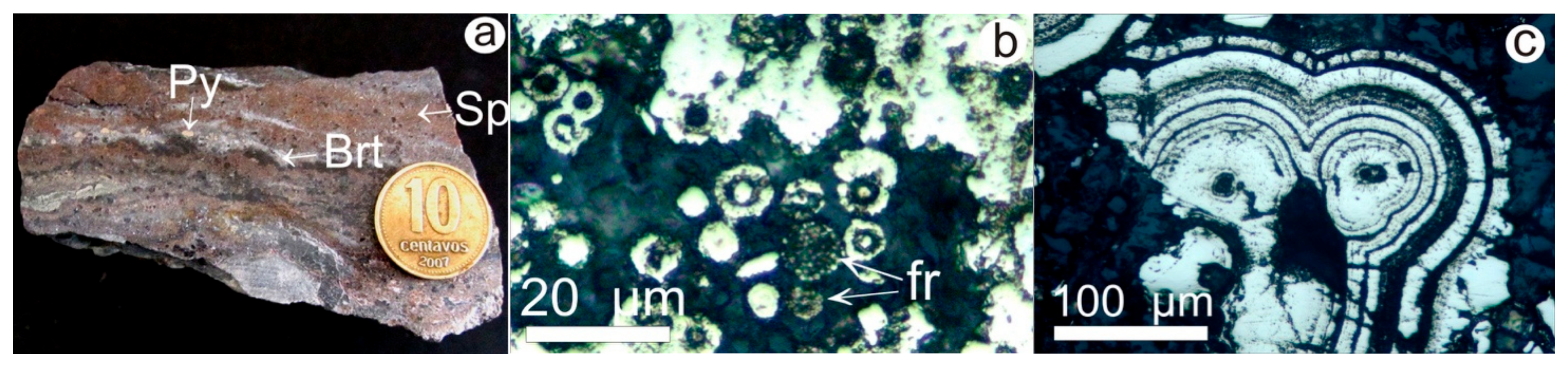
At the Arroyo Nuevo mine, primary sedimentary–exhalative mineral deposition onto the seafloor from syngenetic hydrothermal fluids seems to have occurred concurrently with the submarine sedimentation of black shales of the Los Molles Formation (Figure 4a–c) in an anoxic environment.
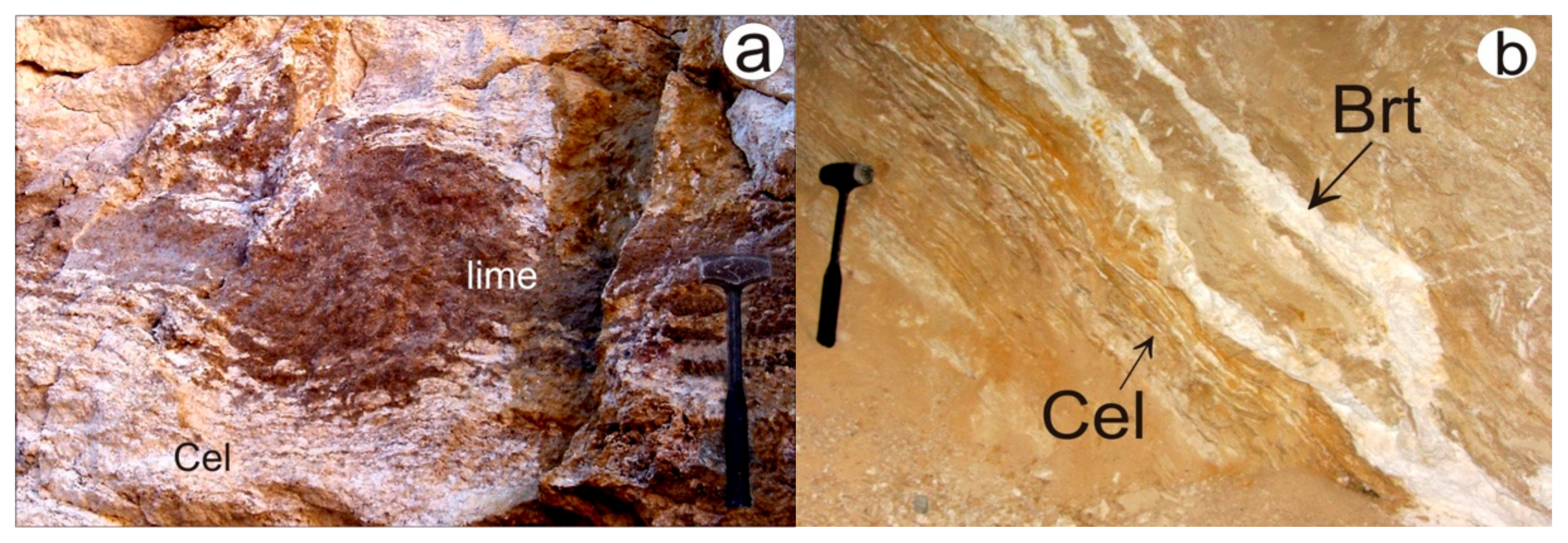
Other Ba–Sr ore deposits are hosted by limestone and gypsum beds of the Tábanos (Callovian), Auquilco (Oxfordian), and Huitrín (Barremian-Aptian) Formations. The textures and spatial relationships recognized indicate that these mineralizations are epigenetic stratabound deposits, mainly formed by the replacement of carbonate and gypsum layers (Figure 5a) and in some cases, by the infilling of fractures and cavities resulting from remobilization processes (Figure 5b) by hydrothermal or supergene fluids.
Barite and celestine form incomplete solid solutions. BaO content in Sr–barites varies between 62.3 and 65.3% while SrO contents ranged between 0.6 and 3.20% (most frequently between 1 and 2%). Celestites have % SrO contents from 52.1 to 56.1 while BaO varies between 0.5 and 4.1%.
The barites exhibit coarse-tabular, powdery, stalactitic, and fibrous-banded habits and are colorless, whitish, light blue, or yellowish. Individual crystals range from a few mm up to some cms. Celestite crystals are colorless, light blue, yellowish, light brown, and whitish and have a prismatic–tabular to granular habit, also from millimetric to centimetric sizes.
Barite veins show sharp contacts both in the footwall and in the hangingwall. Grainsize may be uniform across the vein, or larger in the vein margins, decreasing towards the center.
Figure 5. (a) Limestone (lime) replacement by Ba–celestine (cel), Troncoso Superior member of Huitrín Formation from the 4 de Noviembre mine. (b) Underground photograph showing barite vein hosted by laminated limestones of the Troncoso Superior member, Huitrín Formation, Santa Bárbara mine.
Minerals 16 00215 g005
On the other hand, the deposits seem to show two different locations: (1) in areas with magmatic activity, as evidenced by the Tertiary igneous rock outcrops, and (2) in areas without magmatic rock outcrops.
The epigenetic hydrothermal Ba–Sr ore deposits located in areas with igneous rock outcrops appear as two main types: (a) stratiform or bedded (“mantos”), and (b) vein, usually very closely related to each other.
The stratiform or bedded deposits in areas with magmatic rocks have been identified in four sectors: (a) Loncopué District, (b) Achalay and Llao Llao mines area, (c) Don Candelario–Clementina–Taquimilán mines area, and (d) Colipilli district (Figure 2). They are hosted by microbial laminated boundstones and gypsum beds of the Tábanos, Auquilco, and Huitrín Formations nearby to the andesitic stocks of the Naunauco Group.
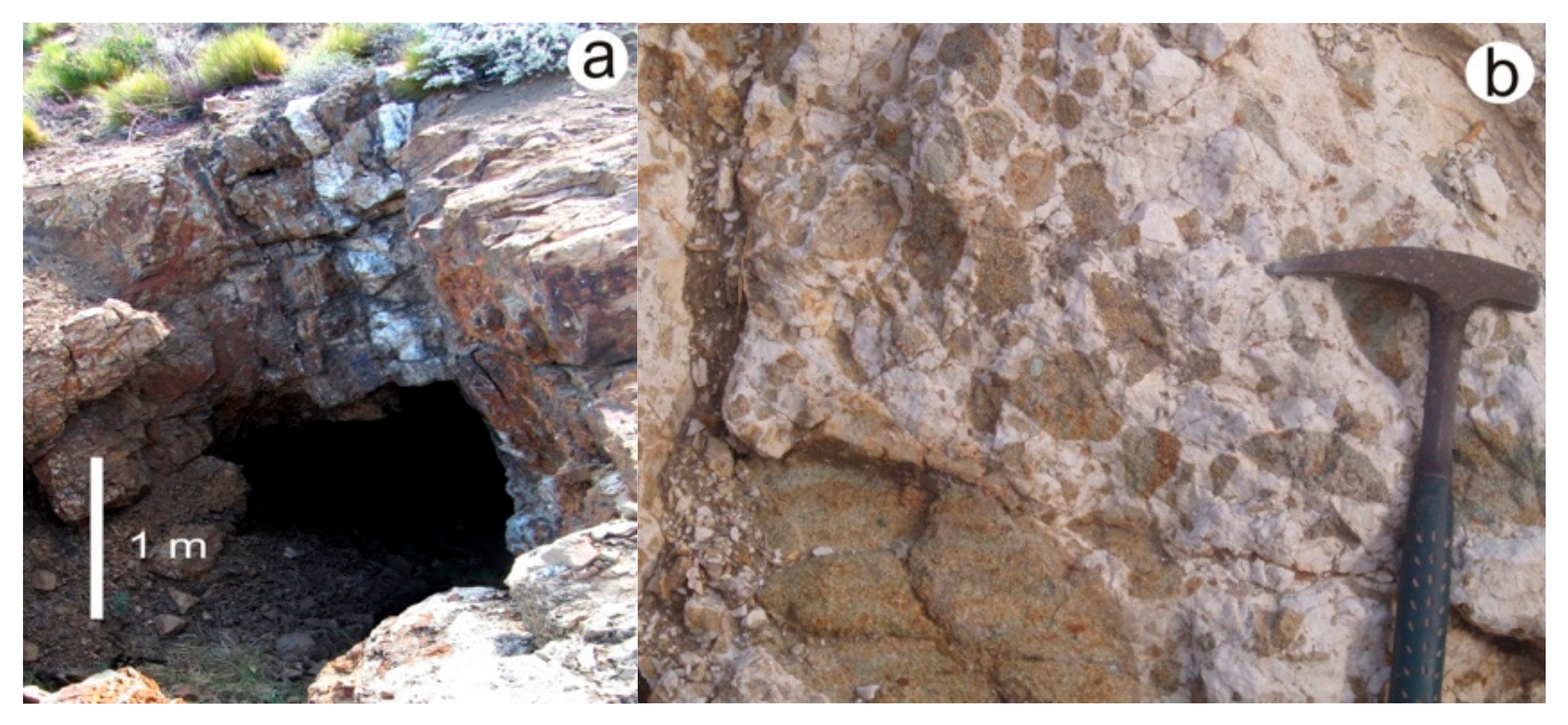
The most important districts of the vein type deposits are Loncopué (La Rosita and La Florcita mines, among others), Cerro Negro of the Colipilli area (Julio César and Diablo Hill veins, among others, Figure 6a), Mallín Quemado (Achalay, Figure 6b, Rio Agrio and La Porfía mines), and Salado Range (Figure 2). The veins often show breccia texture and crop out along narrow shear zones located in the Agrio and Huitrín Formations. In general, they are 1 to 2 m thick, with a maximum of 4 m, and consist mainly of barite with minor amounts of galena.
In addition, in the Achalay mine the mineral paragenesis consists of barite, silica, adularia, and minor sulphides, mainly galena, sphalerite and sulphosalts (e.g., tetrahedrite [28]).
The epigenetic hydrothermal Ba–Sr deposits located in areas without igneous rock outcrops have been recognized on two well-defined stratigraphic horizons: carbonate beds of the Tábanos Formation, at the southern foothills of the Cuchillo Cura Cordillera (San Charbel mine, Figure 7a, and others) and carbonate and/or gypsum layers of the Troncoso Superior and La Tosca members (Huitrín Formation, Lower Cretaceous).
The stratabound Sr–Ba deposits associated with the Lower Cretaceous Troncoso Superior and La Tosca members of Huitrín Formation are located in an approximately 100 km long N-S belt, between Zapala and Chos Malal cities (Figure 2). The most representative mineralized areas are, from S to N, Bajada del Agrio district (3, 4, and 5 de Noviembre, Santa Bárbara, and Santa Ana mines, among others), Chorriaca range, Salado Range (Dios Alado, El Minarete, and Los Robertos mines, among others), the Continental Group (Cecilia, Graciela, La Alondra, and other mines), Santa Elena, and Barda Klein mines. The mineralized layers show a conspicuous zebra texture (Figure 7b) with thin alternating bands, varying between a few millimetres and 2 cm in thickness, composed of carbonate and celestine/barite.
Numerous red-bed type Cu-(V-U) stratiform deposits are widely distributed in the eastern side of the Neuquén Basin (Figure 2). Their general metallogenic aspects have been described by Pons et al. [20] and Rainoldi et al. [21,29]. Mineralization is hosted by the secondary porosity of the permeable and bleached sandstones of the Huincul Fm (Neuquén Group, Upper Cretaceous). The primary paragenesis consists of chalcocite and minor chalcopyrite and bornite. The supergene Cu-(V-U) minerals are covellite, brochantite, malachite, cuprite, and Cu-K-Ba vanadates and uranovanadates. The epigenetic model proposed [21,22] involves fluid flow related to the reactivation of brittle faults during the Tertiary Andean tectonism, combined with the circulation of basinal waters rich in Ba, hydrocarbons, and Cu-chloride brines that mixed with interstitial sulphate-containing waters of the upper Cretaceous sandstones and conglomerates.

4.2. Supergene Processes

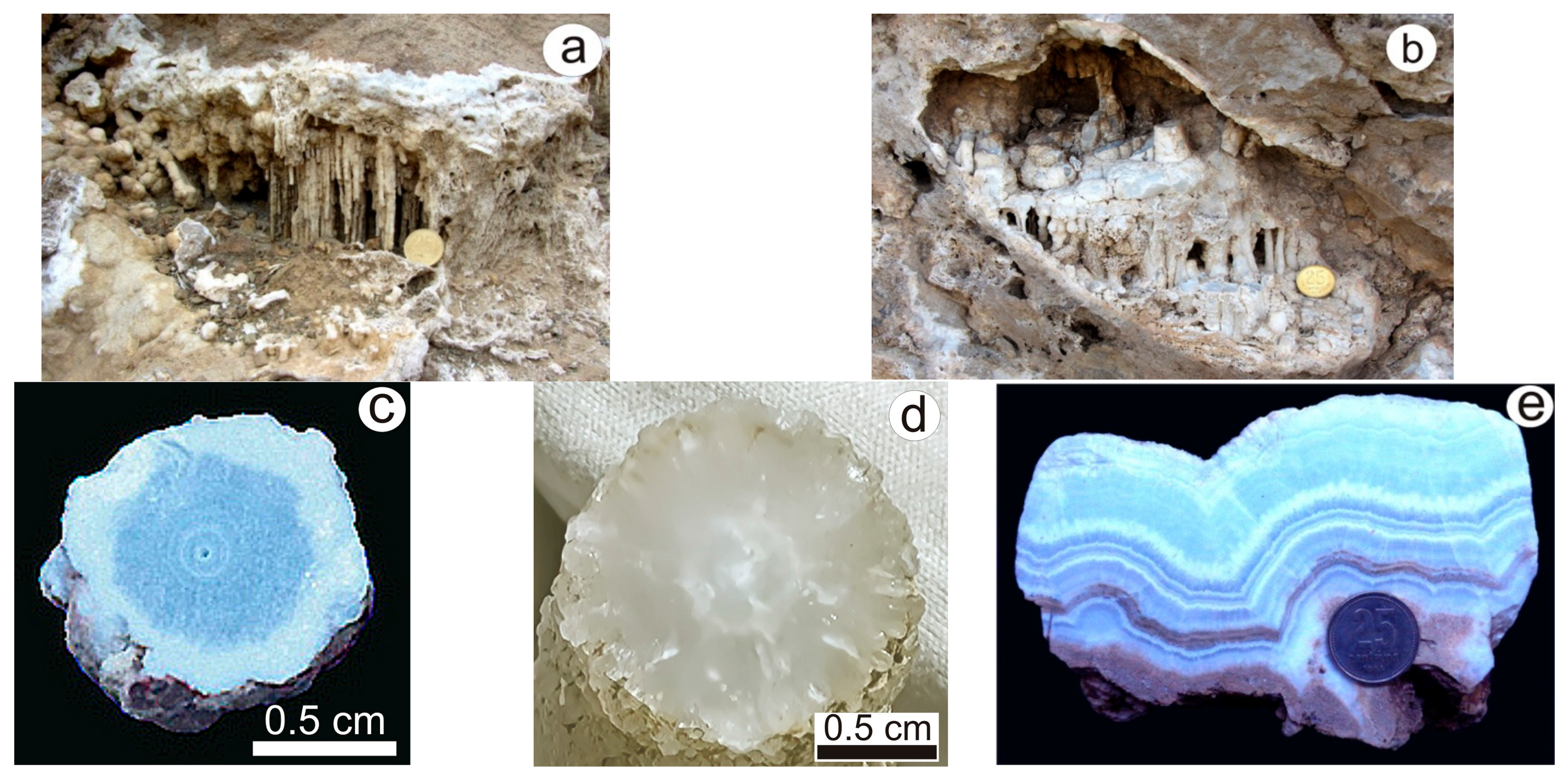
The subaerial exposure of carbonate and gypsum layers of the Troncoso Superior Member resulted in karstification characterized by numerous cavities and holes formed by the circulation of hypersaline aqueous fluids. These cavities vary from a few millimeters to several meters in diameter. They often have elongated morphologies favored by the laminar texture of the boundstones, and numerous stalactites (Figure 8a) and stalagmites (Figure 8b) remain inside. The best examples of karst environment appear in the Continental Group (mainly Graciela and Cecilia mines), Santa Elena, and Barda Klein located between the Pichi Neuquén and Neuquén rivers. Less relevant examples are the 4 de Noviembre and Santa Bárbara mines (Bajada del Agrio area).
The stalactitic structures are made of by white, light grey, or light blue barites (Figure 8c,d), all of them with very similar composition, as determined by electron microprobe analysis. BaO values vary between 62.31 and 65.34%, close to the theoretical mineral content, with an average of 64.10%, while SrO contents ranged between 0.58 and 3.17%, with most frequent values between 1 and 2%. Aside from this, in numerous cavities barite precipitates like fine concretional lamination also with high BaO contents (Figure 8e). These values, together with numerous analytical determinations carried out by X-ray diffraction analysis, confirm that the original materials were predominantly Sr > Ba rich previous to remobilization processes, but precipitated afterwards as Ba-rich sulphates.
For many years, mining operations have mostly targeted these Ba-rich karst structures (high density) using artisanal manual techniques.

4.3. Stable Isotopes: Results and Discussion
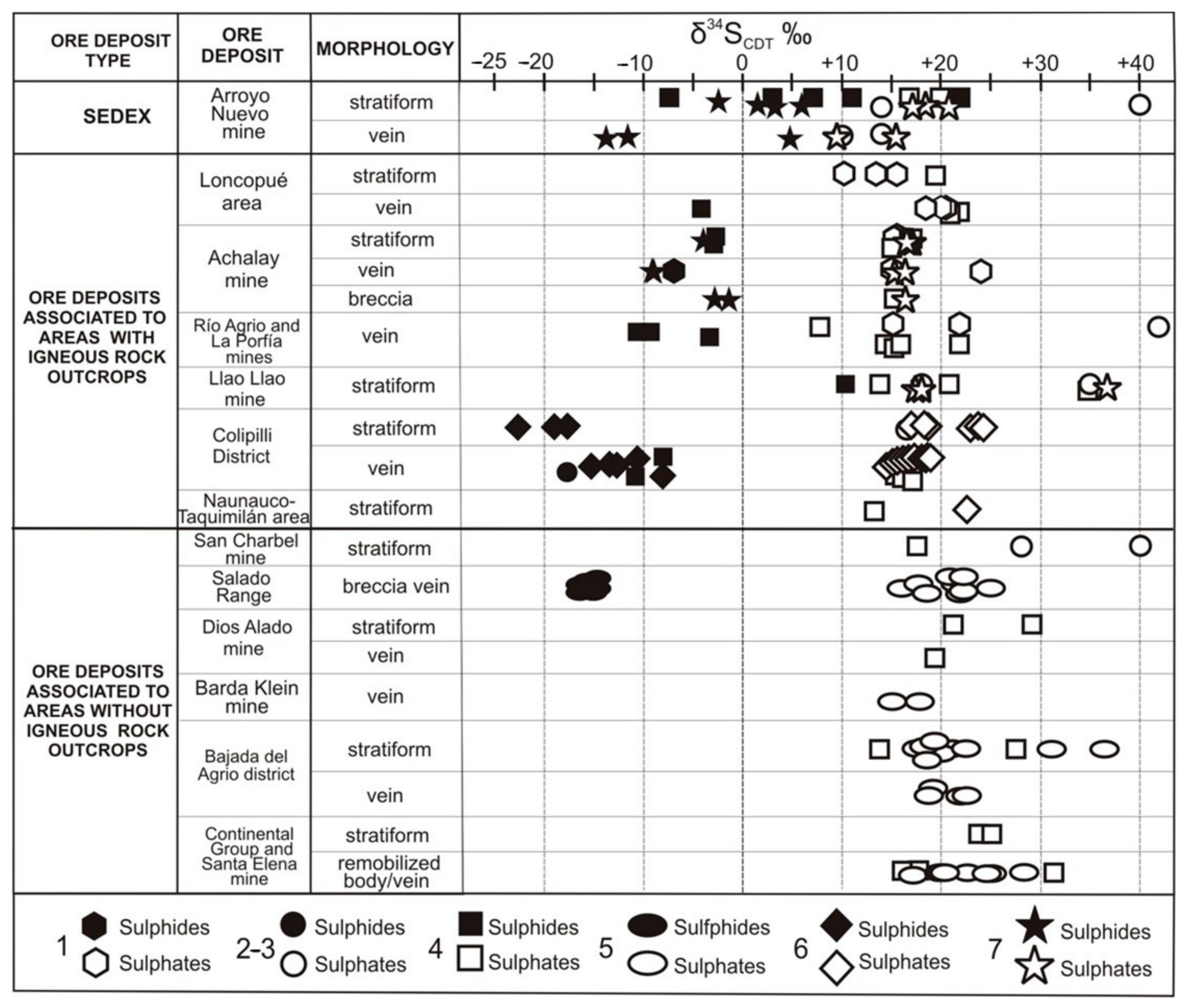
Results obtained (both our own and some from the literature, although largely from the same research group) from stable isotope analysis of the Ba–Sr ores and associated sulphides in Neuquén Basin are shown in Table 1 and Figure 9 and Figure 10.
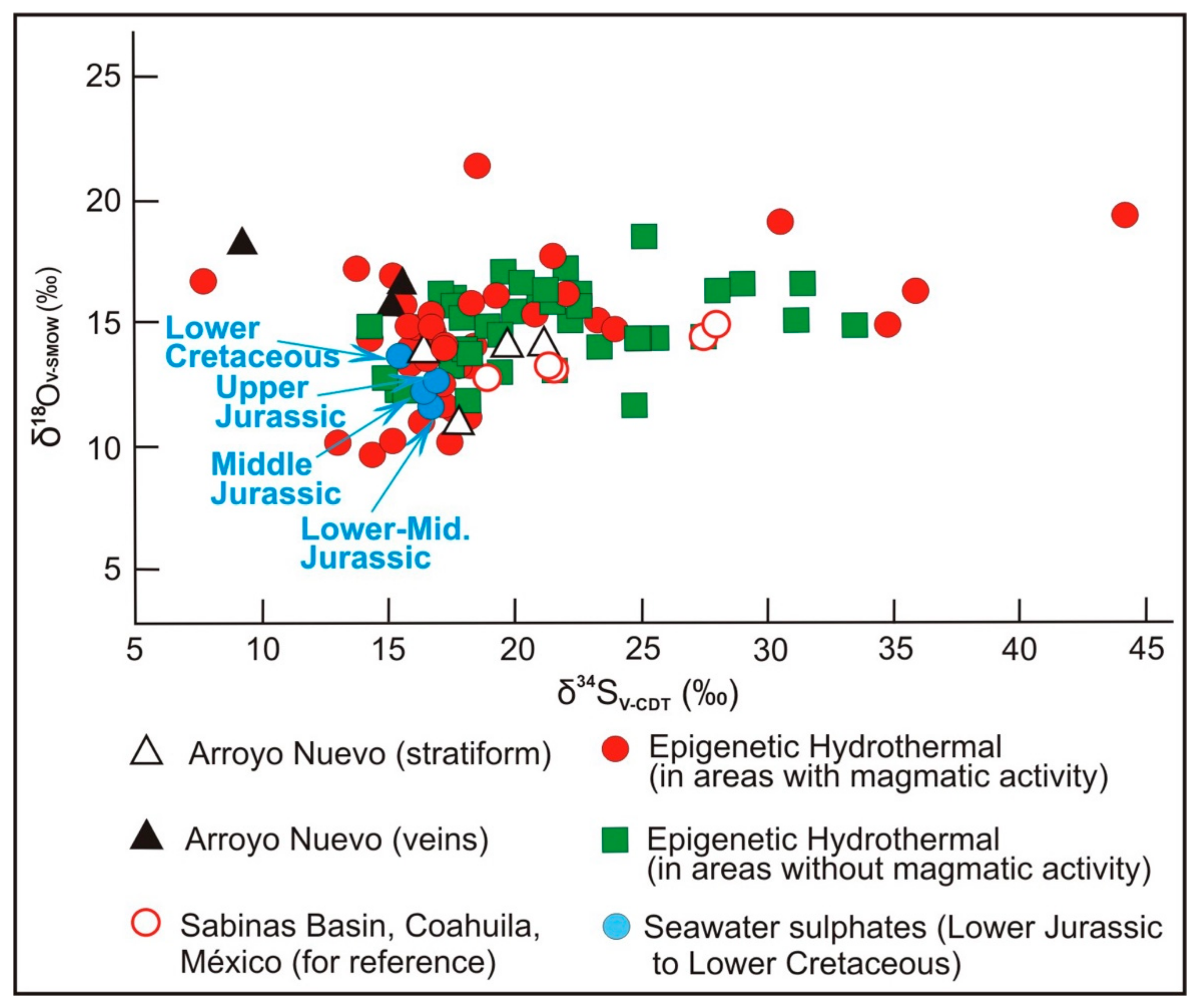
From Figure 9, dissolved sulphate in contemporaneous seawater (Lower Jurassic to Lower Cretaceous) plots at the lower end of the values measured in the sulphates of the Neuquén Basin. Stratiform barite mineralization at Arroyo Nuevo has slightly higher δ18O and δ34S than Lower Jurassic seawater sulphate, as might be expected due to isotopic fractionation between dissolved sulphate and the solid mineral ([31]; see also [32]). Remobilized (infilling) Arroyo Nuevo samples have lower δ34S and higher δ18O.
Epigenetic deposits from areas with magmatic activity have very similar δ18O (15.3 ± 1.6‰; n = 41), but widely ranging δ34S, starting from values similar to seawater sulphate and extending to values as high as δ34S ≈ +35‰. Such variation is compatible with progressively higher proportions of residual sulphate left after bacterial sulphate reduction. Average values do not differ significantly between stratiform and vein deposits, so a common source of sulphate and cations is inferred.
As it regards the epigenetic deposits not spatially linked to areas with magmatic activity, isotopic values are more widely distributed, with δ18O = +14.8 ± 2.4‰; n = 48 and δ34S = 18.0 ± 7.4‰; n = 69. As before, there are no significant differences between stratiform and vein samples, but deposits from areas with magmatic activity show both the highest and lowest δ18O and δ34S values measured.
δ18O is more variable in vein than in stratiform occurrences. Stratiform sulphates have δ18O values ranging from similar to Jurassic seawater-sulphate (δ18O ≈ +12.5‰ [31]) to heavier values, consistent with a source of SO4= from contemporaneous seawater subjected to different extents of sulphate reduction, either bacterial (BSR, at ambient temperature) or thermogenic (TSR, at higher temperatures). δ18O in Ba–Sr veins is indicative of remobilization processes, probably at elevated and more variable temperatures, therefore resulting in more variable isotopic values.
The sulphates of the Neuquén Basin have similar to lower δ18O and largely higher δ34S than stratabound barite and celestine deposits from NE Mexico, included in Figure 9 for reference.
Preliminary studies of strontium, oxygen, and sulphur isotopes carried out by Lo Forte et al. [33] on Ca-sulphate facies of Jurassic marine evaporites (Tábanos and Auquilco Fms) in the northern part of the Neuquén Basin in southern Mendoza, show mean δ18O values of +13.25‰ and δ34S ≈ +17.80‰, consistent with those of Jurassic marine evaporites [31]. Lo Forte et al. [33] consider that the original marine isotopic signal was apparently unaffected by diagenesis and additionally concluded that those results also suggest the absence of a significant contribution of continental waters or hydrothermal solutions to that area of the basin.
87Sr/86Sr average is 0.70704 at Arroyo Nuevo [34,35], consistent with middle Jurassic seawater (0.70707 ± 0.00013 [36]), although values are slightly higher (0.70694–0.70752) in stratiform-barite than in vein-barite (0.70689).
Epigenetic deposits of middle Jurassic age nearby magmatic outcrops average 87Sr/86Sr ≈ 0.70711, whereas those from the upper Jurassic (seawater: 0.70699 ± 0.00011 [36]) are marginally higher at ≈0.70748 [12,34,35,37]. Lower Cretaceous mineralization shows intermediate average values at 87Sr/86Sr ≈ 0.70719 (as compared with Valanginian–Aptian average 87Sr/86Sr ≈ 0.70734 [36]).
Deposits not obviously related with magmatism average 87Sr/86Sr ≈ 0.70712 in the middle-upper Jurassic and 87Sr/86Sr ≈ 0.70764 in the lower Cretaceous.
As for sulphides, δ34S in pyrite yielded values from −2.3 ‰ to +6.0‰, and galena varies between −12.1 and −13.4‰ at Arroyo Nuevo. These values are similar to the SedEx type deposit of Rammelsberg, Germany [38]. The wide variation of δ34S values suggests a polygenic sulphur source and some light δ34S values indicate bacteriogenic sulphide, while other ones would suggest a predominantly magmatic source. However, negative δ34S values may also result from thermochemical abiotic reduction of sea water sulphate, while positive δ34S values may correspond to a hydrothermal source.
In the Mallín Quemado area, δ34S values obtained in galena crystals from the mineralized bed and the breccia vein of the Achalay mine were −2.8, −3.0, and −4.0 ‰ ([12] and this work) and −1.1 and −2.9‰ (this work), respectively. These δ34S values would suggest a magmatic hydrothermal origin for both stratiform and vein deposits. The δ34S values of the vein are more negative, revealing certain fractionation caused by remobilization processes.
Figure 10. Stable isotope data from the main Ba–Sr ore deposits of the Neuquén Basin. 1: Brodtkorb and Danieli [8]; 2: Brodtkorb et al. [35]; 3: Brodtkorb and Danieli [37]; 4: de Barrio et al. [12]; 5: Escobar [13]; 6: Salvioli [14]. Data from this work.
Minerals 16 00215 g010
Escobar [13] reported δ34S values for celestine, barite, and galena from stratiform and vein deposits at Bajada del Agrio, Continental Group, and Salado Range areas (Table 1). Very light δ34SGn values in breccia veins (−16.9 to −13.8‰ [13]) do not favor a magmatic source, rather suggesting basinal brines instead. Similar conclusions were obtained by de Barrio et al. [12] and Salvioli [14] from the study of barite deposits from the Colipilli district. The very low δ34S values obtained on galena, between −13.2 and −22.7‰, point out a non-magmatic source, although the thermal effect of Paleogene magmatism on mineralizing fluids should not be ruled out, as suggested by Llambías and Malvicini [39].
Table 1. Stable isotope data δ34SV-CDT and δ18OV-SMOW of sulphates and sulphides of the main Ba–Sr mineralizations of the Neuquén province.
Provenance/Stratigraphic UnitOre DepositShape of OrebodyMineral Analyzedδ34SCDT (‰) δ34SCDT (‰)δ18OSMOW (‰)δ34SCDT (‰)δ18OSMOW (‰)
Del Blanco et al. [34]Brodtkorb et al. [35]de Barrio et al. [12]Escobar [13]Salvioli [14]This Work
SedExJurassic black shale (Los Molles Fm)Arroyo Nuevo minestratiformbarite 14.0, 40.016.8, 19.9 16.60, 17.9, 21.314.3, 14.6, 14.4, 11.4, 14.6
pyrite −7.4, 7.1, 21.9 −2.3, 1.8, 6.0, 3.1
galena 3.0
sphalerite 11.4
veinbarite 10.0, 14.0 9.3, 15.2, 15.618.6, 16.2 17.0
galena −12.1, −13.4
pyrite 17.5 4.716.3
Ore Deposits Associated to Areas With Magmatic ActivityJurassic limestone (Tábanos Fm)La Rosita minestratiformbarite10.6, 13.7 19.4 16.4
veinbarite20.6 21.8 17.8
Jurassic sandstone (Lotena Fm)La Florcita mineveinsphalerite −3.9
barite20.0 20.9 15.8
Jurassic limestone/evaporite (Auquilco Fm)Achalay minestratiformbarite15.3, 15.5 16.4, 16.7 16.913.7, 15.0
galena −2.8, −3.0 −4.0
gypsum/anhydrite15.3, 16.2 17.6, 17.8, 18.9 10.5, 11.8, 13.6
veinbarite15.2, 15.0 16.2, 15.6, 16.215.2, 15.9, 15.1
sphalerite −2.9
galena−7.0 −1.1, −8.9, −9.0
Auquilco Fm/Tordillo FmRío Agrio mineveinbarite15.0, 21.8 15.2, 14.4, 16.0 14.8, 13.7
chalcopyrite −9.4
galena −10.7, −3.4
Auquilco Fm/Tordillo FmLa Porfía mineveinbarite 41.821.8, 7.7 44.116.9, 19.8
Jurassic evaporite (Auquilco Fm)Llao Llao minestratiformcelestine 18.0, 23.0, 33.0, 35.020.7, 34.8, 17.9 16.8, 15.4
barite 13.8 36.017.4, 16.8
pyrite 10.3
gypsum 18.311.5
Cretaceous limestone (Huitrín Fm)Colipilli District (San Eduardo and La Bienvenida mines; Julio César, Carlita and Cerro Diablo veins, and others)stratiformbarite 23.4, 22,2, 18.4, 17.4, 17.2, 24.1, 18.315.5, 16.8, 14.2, 13.9, 12.0, 15.1, 15.9
galena −18.1
veinbarite 16.515.3, 16.0, 17.2 12.2 up to 18.4 (16 samples)9.9 up to 17.08 (13 samples) 10.4, 12.7, 12.8
galena −17.7−10.8 −13.2, −18.1, −18.6
chalcopyrite −8.1
Naunauco Hill area (Don Candelario, Clementina, Taquimilán and other mines)stratiformcelestine 13.2 22.816.23 10.3
pyrite −7.2
barite 18.6, 30.721.7, 19.4
Ore Deposits Associated to Areas Without Magmatic ActivityJurassic limestone. Cuchillo Cura range (Tábanos Fm)San Charbel minestratiformcelestine 28.0, 40.0
Cretaceous evaporite (Huitrín Fm)Bajada del Agrio area (3 de Noviembre mine)gypsum 17.513.6
Bajada del Agrio area (Santa Bárbara mine)gypsum 18.5, 19.513.3
Cretaceous limestone (Huitrín Fm)Bajada del Agrio area (4 de Noviembre mine)barite 27.6 14.9
gypsum 18.414.0
Bajada del Agrio area (Santa Bárbara mine)stratiformcelestine 14.4, 33.6 15.2, 15.4
Salado range (Dios Alado mine and others)barite 21.8, 29.2 13.4, 17.0
stalactitebarite 15.812.6
veincelestine 19.7 16.01
barite 21.1, 22.2, 22.4, 25.0, 18.316.4, 17.5, 15.5, 14.8, 12.2
galena −13.8, −14.8, −15.7, −16.0, −16.9
stratiformcelestine 33.218.34
Cecilia mine (Continental Group)stratiformcelestine 23.522.214.4, 14.5
stalactiticbarite 31.5, 17.7, 20.10, 20.40, 16.019.7, 22.715.9, 17.0, 12.6, 17.4, 15.8, 16.9, 16.5
Santa Elena minestratiformcelestine 25.027.8, 20.412.0, 14.2, 14.8
barite 28.015.5
In summary, the δ18OV-SMOW and δ34SV-CDT data of sulphates from the Ba–Sr ore deposits of the Neuquén Basin (Figure 10 and Figure 11) show similar variation, regardless if the deposits are or are not linked to areas with magmatic outcrops, although sulphides are almost exclusively associated with deposits with nearby igneous rock outcrops (with the exception of the Brt–Gn breccia veins that intruded the Cretaceous Agrio Formation rocks, Salado range area). They show a wide range of variation, approximately between −1 and −18 ‰, denoting mixing of basinal and magmatic fluids. The dominant role of basinal fluids as a source of sulphate (at least; maybe of Ba and Sr as well) is pointed out by the similar δ18O values measured in Neuquén sulphates as compared with contemporaneous seawater (Figure 9 and Figure 10).
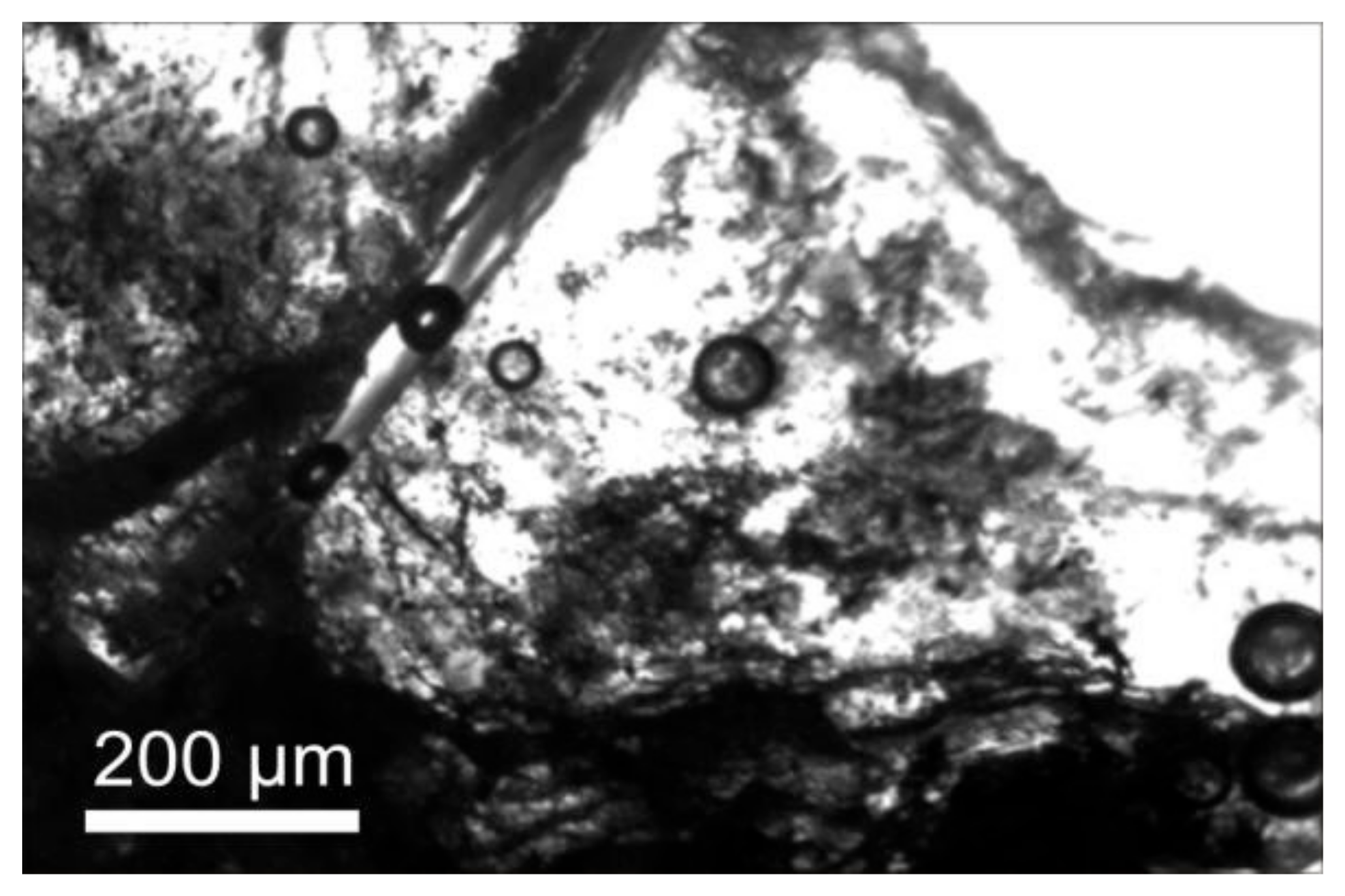
δ34S values extending from seawater-like to quite high ones (up to ≈45‰) are suggestive of bacterial sulphate reduction. Anaerobic bacterial activity was facilitated by organic matter (evidence for hydrocarbons has been recognized, and is recorded by some carbonates from Tábanos Formation (La Florcita mine) and Auquilco Formation (Achalay mine) with low to extremely low δ13C (down to δ13C = −24.5‰ [40]), where HCO3 for carbonate precipitation could derive either from oxidation of sedimentary organic matter or from oxidation of hydrocarbons (i.e., [41,42]), as suggested by the presence of methane. This fact was checked by experimentally crushing celestine crystals from the Don Candelario mine in kerosene, that allowed identifying methane bubbles (Figure 12). Salvioli et al. [16] had also recognized hydrocarbons within FI on barite crystals from Colipilli district, near the Naunauco hill.

5. Regional Zoning of Ore Deposits

5.1. Lithostratigraphic Controls

From the close spatial association between Ba–Sr and Cu deposits with the Jurassic–Cretaceous stratigraphic units, a marked regional W-E zoning shows up. As such, the Ba–Sr deposits are mainly related with platform carbonates and evaporitic rocks to the west, while the Cu deposits are spatially associated with continental red-beds of the Upper Cretaceous Neuquén Group to the east (Figure 2 and Figure 12). A similar distribution is observed in the Ba–Sr deposits of the Sabinas Basin (NE Mexico) where the older stratiform Ba deposits are hosted by Upper Jurassic Units, while the celestine deposits are associated with Cretaceous carbonate sequences.
In general, barite-rich deposits (mainly Loncopué and Cerro Negro areas) are hosted by older stratigraphic units towards the west (Tábanos and Auquilco Formations) while celestine rich deposits are hosted mostly by Lower Cretaceous units (Bajada del Agrio and Continental Group districts, among others) to the east (Figure 2).
At the Achalay mine, the textural characteristics of the Ba–Pb mineral association, the infilling and replacement features, together with S stable isotope data indicate that the stratiform ore deposit is of epigenetic origin, possibly associated with hydrothermal fluids of magmatic provenance. Moreover, the Achalay, Río Agrio, and La Porfía vein deposits have conspicuous mineral associations that are compatible with precipitation from low-temperature epithermal fluids possibly derived from the Naunauco magmatism, mixed with meteoric waters that infilled fractures and tectonic and hydrothermal breccias.
Mineralization morphologies and spatial relationships with host rocks are diverse in the Colipilli area. The San Eduardo and La Bienvenida mines represent stratabound ore deposits placed concordantly with the stratification of laminated carbonate rocks of the Troncoso Superior Member. These mineralizations respond to a genetic model, already suggested by Llambías and Malvicini [39], by replacement of the limestones linked to the circulation of basinal waters that leached the sedimentary Jurassic–Cretaceous sequence. Later remobilization processes, possibly triggered by the Tertiary magmatic activity, generated Ba (-Pb) veins, which cut the whole sequence, even Tertiary igneous bodies, as in the Diablo Hill and Cerro Negro of Colipilli areas (Figure 2). Salvioli et al. [16] considered the same origin for these vein deposits.
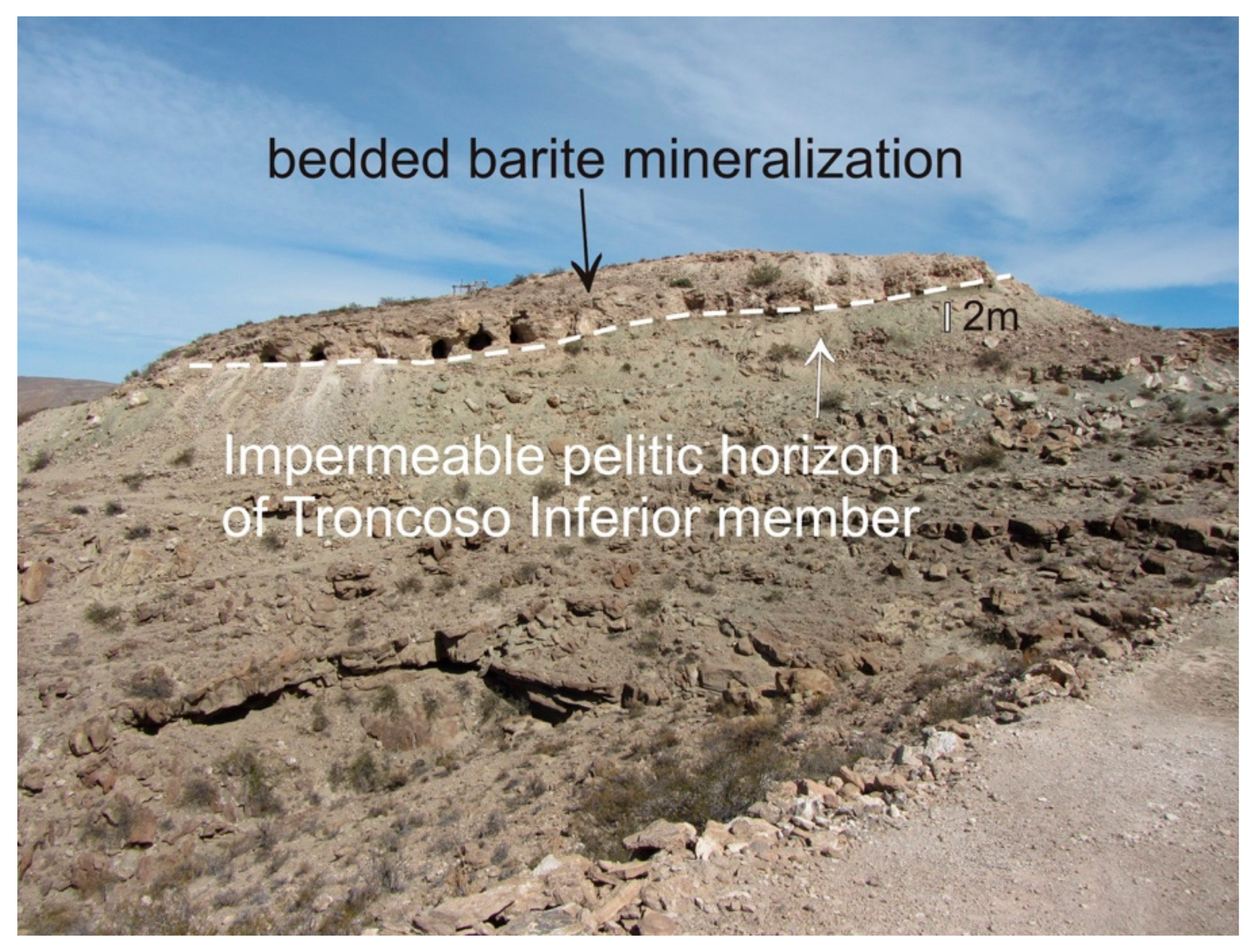
The mineralogical textures of the Ba–Sr deposits, especially those at the Cuchillo Cura range, Bajada del Agrio, and Salado Range areas, are compatible with replacement processes; in some cases with a very weak dolomitization. The porosity of laminated microbial carbonate (boundstone) and gypsum layers played a relevant role in the genetic processes, especially in those developing the Sr (Ba) deposits of the Troncoso Superior Member. These layers represent permeable beds for the circulation of reactive hydrothermal fluids for subsequent dissolution and replacement processes. Furthermore, a ubiquitous pelitic bed (Figure 13) composed of a greenish gray argillaceous siltstone and very fine sandstones, attributable to the top of the Troncoso Inferior Member and located below the mineralized layers, probably acted as impermeable barrier for the hydrothermal fluids (3, 4, and 5 de Noviembre, Santa Bárbara, Santa Elena mines, and Continental group, among others).
Towards the eastern side of the Neuquén Basin, mineralization of the red-bed Cu-(V-U) occurrences is spatially associated with the sandstones of the Upper Cretaceous Huincul Formation (Neuquén Group). Secondary porosity and the consequent major permeability of the bleached sandstones controlled the precipitation of Cu sulphides, which are often spatially related to impregnations of bitumen [20,22].
This general metallogenic framework shares some similar features to those present in the Jurassic–Cretaceous Sabinas Basin, Coahuila state, north-eastern México [30]. In either case a regional relationship with barite–celestine deposits associated to Jurassic-Cretaceous carbonate and gypsum layers was recognized. In contrast to the Mexican deposits, the Neuquén red-bed copper mineralizations are hosted by younger Upper Cretaceous units. Aside from this, fluorite deposits were never recognized in either the Jurassic or Cretaceous sequences of the Neuquén Basin. This fact may be due to the lack of significant F contents in the neighboring areas of the mineralized belts.

5.2. Structural Controls

Tectonic activity and ensuing deformation have been active in the Neuquén Basin since the Triassic, with diverse levels of intensity and locations. Such deformation results in a complex mosaic of modern morphostructural units [22], mostly involving shortening, which, in the pre-Andean region, formed the Agrio Fold and Thrust Belt (AFTB). This complex structure was started in the Upper Cretaceous and continued up to the Miocene. The deformation began with a gentle shallowing of the oceanic subducted slab, which shifted the volcanic arc towards the foreland [42]. The AFTB is characterized by a series of east-verging folds and related faults which developed a complex thrust front with duplex structures and underthrusts, bordering to the east with an area of gentle folds [33,43,44]. Thus, the Sr–Ba deposits hosted by the Cretaceous sequence (mainly Huitrín Formation) show a marked N-S orientation, closely coincident with the general strike of the regional inverse faults and restricted to the eastern limb of the folded structures (see Figure 2 and Figure 12).
Sedimentary basins are subjected to diverse efforts and pressures that are known to cause large-scale fluid migration. Tectonic compression and thrusting produce large overpressures near continental margins [45]. Thus, the thrust faults possibly played an important role in the circulation of hydrothermal fluids like those that generated the Ba–Sr ore deposits of the Cretaceous sequence. Folding and thrusting in a tectonically driven compressional flow regime would also facilitate new contacts between permeable and non-permeable rocks. A similar structural scenario was pointed out by Salvioli et al. [16] for the stratiform and vein barite deposits of the Colipilli area, west of Naunauco Hill. These authors invoked the Andean compression for the mobilization of connate waters, additionally favored by the heat provided by Cretaceous–Paleocene magmatism.
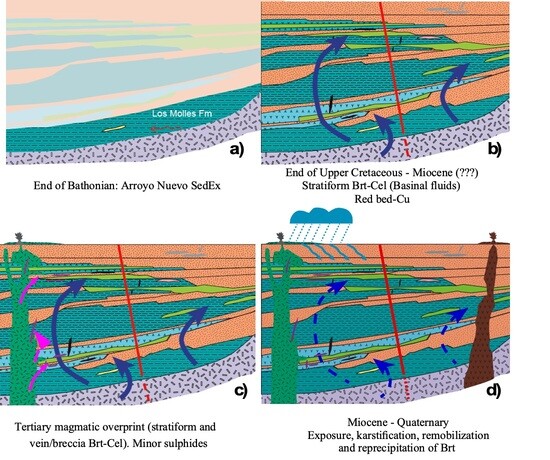
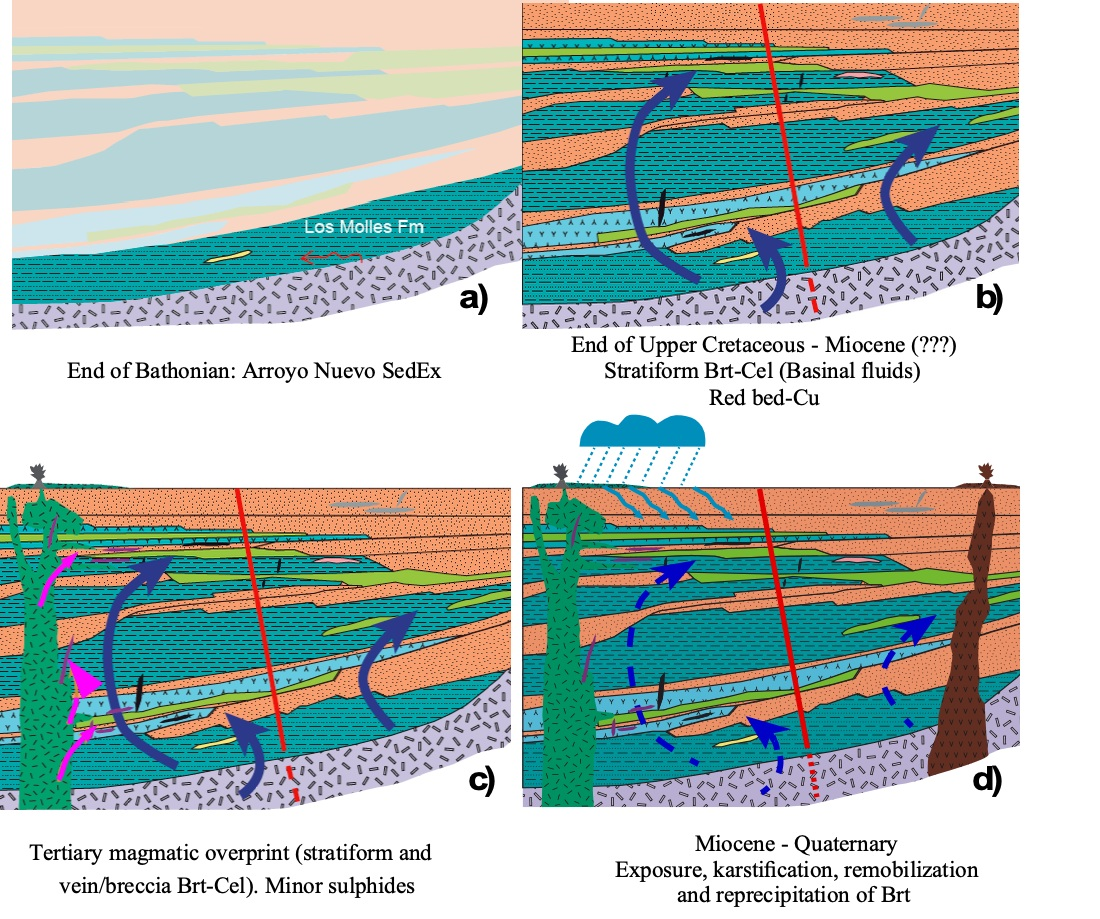
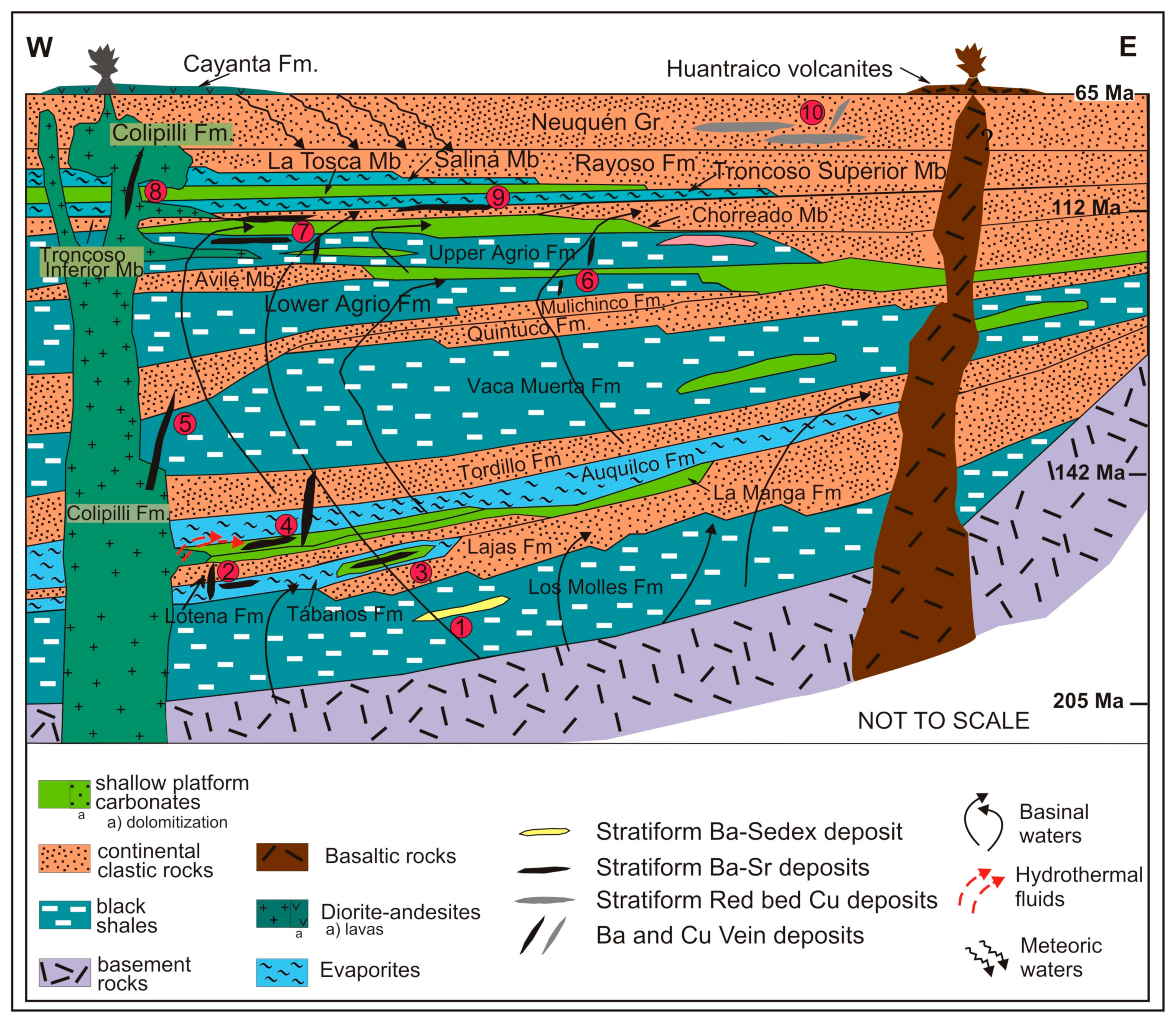
We assume that the sediment-hosted stratiform Ba–Sr systems benefited from the circulation of basinal waters, which leached the Jurassic-Cretaceous carbonate–evaporitic sequence, contributing metals to the deposits (Figure 14). The initial mobilization would have occurred by burial heating and overpressure, which triggered the convective circulation of these saline brines, stripping metals (Ba–Sr–Pb) from the sedimentary sequence.

6. Conclusions

  • Stratigraphical, mineralogical, petrographic, textural, and geochemical data support an epigenetic character for the bedded and vein Ba–Sr deposits of the Neuquén Basin.
  • Only the Arroyo Nuevo deposit would correspond to a syngenetic origin. There is no direct relationship between this barite mineralization and any kind of Jurassic volcanic activity in this area. The textural and mineralogical characteristics of the barite–sulphide mineral association suggest paragenetic equilibrium. Moreover, the finely laminated texture of the sulphides reflects that the ore formed in a low energy environment with euxinic conditions. This conclusion is in agreement with Zappetini [47], who assigned the Arroyo Nuevo deposit to the Ba SedEx type.
  • The Ba–Sr ore deposits found in areas without igneous outcrops show some mineralogical and sedimentological affinities with the Mesozoic Ba–Sr deposits of the Sabinas Basin (NE Mexico), which are considered as Mississippi Valley Type. In addition, they are closely linked with the large NNW–SSE structural alignments of the Agrio Fold and Thrust Belt. The regional thrust faults possibly were favorable conduits for the ascent of the mineralizing hydrothermal fluids.
  • Negative and low δ34S isotope values in sulphides (mean −14‰) and high values in sulphates (+17/+24‰) discard magmatic sources of S in several Ba–Sr deposits such as the Colipilli and Salado range districts. In contrast, some contribution of a magmatic component is likely at the Mallín Quemado and Loncopué areas. Overall, however, the main source of S that contributed to the formation of the deposits studied would appear to be contemporaneous seawater sulphate, subjected to different extents of reduction, be this bacterial or thermochemical.
The age of the epigenetic Ba–Sr deposits of the Neuquén Basin still remains unknown. A first stage of generation would be related to the installation of a compressional tectonic regime. This deformation cycle possibly favored the subsequent circulation of the basinal waters from the Upper Cretaceous onwards, which mainly formed the Ba–celestine bedded deposits by replacement of favorable sedimentary horizons (microbial boundstone and gypsum layers). A second stage, during the Upper Cretaceous-Eocene, comprises a tectonic inversion event, which led to a new extensional regime. This process was concurrent with the development of the andesitic magmatism of the Naunauco Group. From then on, remobilization processes occurred by the action of hydrothermal fluids possibly heated by this igneous activity and produced Sr–barite veins. Later, the Miocene Huantraico volcanism may have produced remobilizations in the Sr–Ba stratabound deposits generating new Ba–(Pb) veins simultaneously with strong compression efforts of the Andean tectonics.

Author Contributions

Conceptualization, R.E.d.B.; methodology, C.R., F.J.R., R.O.E., and M.A.D.B.; validation, C.R. and F.J.R.; investigation, R.E.d.B., C.R., F.J.R., R.O.E., M.A.D.B., and E.A.D.; resources, R.E.d.B.; data curation, R.E.d.B. and C.R.; writing—original draft preparation, R.E.d.B. and C.R.; writing—review and editing, F.J.R., R.O.E., and M.A.D.B.; supervision, R.E.d.B.; project administration, R.E.d.B., C.R., F.J.R., and R.O.E.; funding acquisition, R.E.d.B., C.R., R.O.E., and E.A.D. All authors have read and agreed to the published version of the manuscript.

Funding

This research was largely supported by PIP-CONICET 0285, 11N540, and 11N692 FCNyM-UNLP projects (Argentina). A number of isotopic analyses were possible thanks to funding by research project PID2022-14713NB-100 of the MCIN/AEI/10.13039/501100011033/and FEDER “Una manera de hacer Europa”.

Data Availability Statement

All data mentioned are available in the text and in the references cited.

Acknowledgments

We greatly appreciate the excellent reviews and helpful comments on earlier versions of the manuscript by Agustín Martín-Izard (Universidad de Oviedo, Spain) and Jorge Rabassa (Universidad Nacional de Tierra del Fuego-CONICET, Argentina). The comments of three anonymous reviewers were helpful and have mostly been implemented in the final version offered.

Conflicts of Interest

The authors declare no conflicts of interest. This is a purely Academic study, and the funders, always Public Agencies, had no role in the design of the study; in the collection, analyses, or interpretation of data; in the writing of the manuscript; or in the decision to publish the results.

References

  1. Howell, J.A.; Schwarz, E.; Spalletti, L.A.; Veiga, G. The Neuquén Basin: An overview. In The Neuquén Basin, Argentina: A Case Study in Sequence Stratigraphy and Basin Dynamics; Veiga, G.D., Spalletti, L.A., Howell, J.A., Schwarz, E., Eds.; Geological Society of London: London, UK, 2005; Volume 252, pp. 1–14. [Google Scholar]
  2. Legarreta, L.; Gulisano, C. Análisis estratigráfico secuencial de la Cuenca Neuquina (Triásico superior–Terciario Inferior). In Cuencas Sedimentarias Argentinas, Serie de Correlación Geológica 6; Chebli, G., Spalletti, L., Eds.; Instituto Superior de Correlación Geológica, Universidad Nacional de Tucumán: San Miguel de Tucumán, Argentina, 1989; pp. 221–243. [Google Scholar]
  3. Leanza, H.A. Mapa geológico de la provincia del Neuquén, escala 1:500-000; Instituto de Geología y Recursos Minerales, SEGEMAR: Buenos Aires, Argentina, 2011. [Google Scholar]
  4. Hayase, K.; Bengochea, A.L. Consideraciones sobre la génesis de algunos yacimientos de baritina-celestina, provincia de Neuquén, República Argentina. In Proceedings of the 2nd Congreso Ibero-Americano de Geología Económica, Buenos Aires, Argentina, 10–14 October 1975; Volume 2, pp. 295–314. [Google Scholar]
  5. Brodtkorb, M.K.; de Ramos, V.A.; Ametrano, S. Los yacimientos estratoligados de celestina-baritina de la Formación Huitrín y su origen evaporítico. In Proceedings of the 2nd Congreso Ibero-Americano de Geología Económica, Buenos Aires, Argentina, 10–14 October 1975; Volume 2, pp. 143–168. [Google Scholar]
  6. Brodtkorb, M.K.; de Ramos, V.A.; Barbieri, M.; Ametrano, S. The evaporitic celestine-barite deposits of Neuquén, Argentina. Miner. Depos. 1982, 17, 423–436. [Google Scholar] [CrossRef]
  7. Brodtkorb, M.K.; de Schalamuk, I.B.; Ametrano, S. Celestine and barite stratabound orefields in Argentina. In Non-Metalliferous Stratabound Orefields; de Brodtkorb, M.K., Ed.; Van Nostrand: New York, NY, USA, 1989; pp. 41–68. [Google Scholar]
  8. Brodtkorb, M.K.; de Danieli, J.C. El depósito de baritina Arroyo Nuevo, Neuquén. In Recursos Minerales de la República Argentina; Zappettini, E., Ed.; Instituto de Geología y Recursos Minerales, SEGEMAR: Buenos Aires, Argentina, 1999; pp. 1047–1049. [Google Scholar]
  9. Angelelli, V.; Schalamuk, I.B.; Arrospide, A. Los Yacimientos no Metalíferos y Rocas de Aplicación de la Región Patagonia-Comahue; Secretaría de Estado de Minería: Buenos Aires, Argentina, 1976; Volume 17, pp. 1–146. [Google Scholar]
  10. Collao, S.; de Brodtkorb, M.K.; Etcheverry, R.O. Inclusiones fluidas en celestinas de los yacimientos de la Formación Huitrín, provincia de Neuquén, Argentina. In Proceedings of the 40th Congreso Brassileiro de Geologia, Belo Horizonte, Brazil, 26–30 August 1998; p. 174. [Google Scholar]
  11. de Barrio, R.E. Los depósitos de celestina (baritina) relacionados a la Formación Huitrín, provincia del Neuquén. In Recursos minerales de la República Argentina; Zappettini, E., Ed.; SEGEMAR: Buenos Aires, Argentina, 1999; Volume 35, pp. 1095–1102. [Google Scholar]
  12. de Barrio, R.E.; Etcheverry, R.O.; Del Blanco, M.A.; Domínguez, E.A.; Recio Hernández, C.; Escobar, R.I.; Salvioli, M.A. Nuevos datos y esquemas genéticos de los depósitos barítico-celestínicos vinculados a la secuencia jurásico-cretácica de la Cuenca Neuquina en la provincia del Neuquén. Rev. Asoc. Geológica Argent. 2014, 71, 184–200. [Google Scholar]
  13. Escobar, R.I. Geología y Génesis de Las Mineralizaciones Barítico-Celestínicas Asociadas a la Secuencia Sretácica Entre las Localidades de Bajada del Agrio y Chos Malal, Provincia del Neuquén. Ph.D. Thesis, Facultad de Ciencias Naturales y Museo (Universidad Nac. de La Plata), La Plata, Argentina, 2016; p. 207, Unpublished. Available online: https://naturalis.fcnym.unlp.edu.ar/handle/628872547/42845 (accessed on 27 June 2025).
  14. Salvioli, M.A. Geología y Génesis de Los Depósitos Barítico-Polimetálicos (Ba-Fe- Pb-Cu-ZnMn) del área de Colipilli, Sector centro-Occidental de la Cuenca Neuquina. Ph.D. Thesis, Universidad Nacional de La Plata, La Plata, Argentina, 2017; p. 187. Available online: https://naturalis.fcnym.unlp.edu.ar/handle/628872547/42090 (accessed on 27 June 2025).
  15. Salvioli, M.A.; Lanfranchini, M.E.; Recio, C.; de Barrio, R.E. El magmatismo cretácico-terciario y su relación con sistemas hidrotermales polimetálicos en la región de Colipilli, Naunauco, provincia del Neuquén. Rev. Asoc. Geológica Argent. 2018, 75, 46–63. [Google Scholar]
  16. Salvioli, M.A.; Justiniano, C.B.; Lajoinie, M.F.; de la Cal, H.; Ruiz, R.; Cesaretti, N.; Lanfranchini, M.E. Hydrocarbon-bearing sulphate-polymetallic deposits at the Colipilli area, Neuquén Basin, Argentina: Implications in the petroleum system modeling. Mar. Pet. Geol. 2021, 126, 104925. [Google Scholar] [CrossRef]
  17. Gulisano, C.A.; Gutiérrez Pleimling, A.R.; Digregorio, R.E. Esquema estratigráfico de la secuencia jurásica al oeste de la provincia del Neuquén. In Proceedings of the 9th Congreso Geológico Argentino, San Carlos de Bariloche, Argentina, 1–5 October 1984; Volume 1, pp. 236–259. [Google Scholar]
  18. Gulisano, C.A.; Gutiérrez Pleimling, A.R.; Digregorio, R.E. Análisis estratigráfico del intervalo Tithoniano-Valanginiano (Formaciones Vaca Muerta, Quintuco y Mulichinco) en el suroeste de la provincia del Neuquén. In Proceedings of the 9th Congreso Geológico Argentino, San Carlos de Bariloche, Argentina, 1–5 October 1984; Volume 1, pp. 221–235. [Google Scholar]
  19. Leanza, H.A.; Hugo, C. Hoja Geológica 3969-I Zapala, provincia del Neuquén; SEGEMAR: Buenos Aires, Argentina, 2005; Volume 275, pp. 1–132. [Google Scholar]
  20. Pons, M.J.; Franchini, M.; Giusiano, A.; Maydagán, L.; Rainoldi, A.L. Mineralización de Cu (V-U) en la Formación Huincul, Prospecto Tordillos, Cuenca Neuquina. Rev. Asoc. Geológica Argent. 2014, 71, 537–552. [Google Scholar]
  21. Rainoldi, A.L.; Franchini, M.; Beaufort, D.; Patrier, P.; Giusiano, A.; Impiccini, A.; Pons, M.J. Large-scale bleaching of red beds related to upward migration of hydrocarbons: Los Chihuidos High, Neuquén Basin, Argentina. J. Sediment. Res. 2014, 84, 373–393. [Google Scholar] [CrossRef]
  22. Llambías, E.J.; Rapela, C.W. Las vulcanitas de Colipilli, Neuquén, y su relación con otras unidades paleógenas de la Cordillera. Rev. Asoc. Geológica Argent. 1989, 44, 224–236. [Google Scholar]
  23. Rapela, C.W.; Llambías, E.J. La secuencia andesítica terciaria de Andacollo, Neuquén, Argentina. In Proceedings of the 4th Congreso Geológico Chileno, Antofagasta, Chile, 18–22 October 1985; Volume 4, pp. 458–488. [Google Scholar]
  24. Robinson, B.W.; Kusakabe, M. Quantitative preparation of sulfur dioxide for 34S/32S analyses from sulphides by combustion with cuprous oxide. Anal. Chem. 1975, 47, 1179–1181. [Google Scholar] [CrossRef]
  25. Coleman, M.L.; Moore, M.P. Direct reduction of sulfates to sulfate dioxide for isotopic analysis. Anal. Chem. 1978, 50, 1594–1595. [Google Scholar] [CrossRef]
  26. Morrison, J.; France-Lanord, C.H.; Pierson-Wickman, A.C.; Mower, A. Oxygen–Sulphur isotopic measurement in continuous flow mode. Application to the origin of dissolved sulphates in Himalayan river using EA-IRMS. In Proceedings of the SIMSUG 2000, Grange-Over-Sand, UK, 18–19 January 2000. [Google Scholar]
  27. Whitney, D.L.; Evans, B.W. Abbreviations for names of rock-forming minerals. Am. Mineral. 2010, 95, 185–187. [Google Scholar] [CrossRef]
  28. Del Blanco, M.A.; de Barrio, R.E.; Ramis, A.; Canafoglia, M.E. Tetraedrita de la mina Achalay, Mallín Quemado, Cuenca Neuquina. Consideraciones metalogenéticas. In Proceedings of the 13th Congreso de Mineralogía, Petrología ígnea y Metamórfica, y Metalogénesis, Córdoba, Argentina, 7–9 August 2019; pp. 293–299. [Google Scholar]
  29. Rainoldi, A.L.; Franchini, M.B.; Boyce, A.J.; Giusiano, A.; Cesaretti, N.N.; Pons, M.J.; Ríos, F.J. Stable isotope and fluid inclusion study of sediment-hosted stratiform copper deposits from the Neuquén Basin, Argentina. Miner. Depos. 2019, 54, 415–436. [Google Scholar] [CrossRef]
  30. González-Sánchez, F.; Camprubí, A.; González-Partida, E.; Puente-Solís, R.; Canet, C.; Centeno García, E.; Atudorei, V. Regional stratigraphy and distribution of epigenetic stratabound celestine, fluorite, barite and Pb–Zn deposits in the MVT province of northeastern Mexico. Miner. Depos. 2009, 44, 343–361. [Google Scholar] [CrossRef]
  31. Claypool, G.E.; Holser, W.T.; Kaplan, I.R.; Sakai, H.; Žak, I. The age curves of sulphur and oxigen isotopes in marine sulphates and their mutual interpretation. Chem. Geol. 1980, 28, 199–260. [Google Scholar] [CrossRef]
  32. Johnson, C.A.; Emsbo, P.; Poole, F.G.; Rye, R.O. Sulphur- and oxygen-isotopes in sediment-hosted stratiform barite deposits. Geochim. Cosmochim. Acta 2009, 73, 133–147. [Google Scholar] [CrossRef]
  33. Lo Forte, G.; Orti, F.; Rosell, L. Isotopic characterization of Jurassic evaporites: Aconcagua-Neuquén Basin, Argentina. Geol. Acta 2005, 3, 155–161. [Google Scholar] [CrossRef]
  34. Del Blanco, M.A.; de Brodtkorb, M.K.; Hladíková, J.; Žák, K.; Barbieri, M. Composición isotópica de azufre y estroncio de depósitos de baritina y celestina relacionados a las Formaciones Tábanos y Auquilco de la cuenca Neuquina y su interpretación. In Proceedings of the 4th Reunión Argentina de Sedimentología, La Plata, Argentina, 5–9 October 1992; pp. 183–190. [Google Scholar]
  35. De Brodtkorb, M.K.; Barbieri, M.; Zák, K.; Hladíková, J.; Tassinari, C.; Ametrano, S.; Etcheverry, R.; de Barrio, R.E.; Del Blanco, M.; Danieli, J.C. Isotope Data on barite and celestine deposits related to three Mesozoic evaporitic events of the Neuquén Basin, Argentina. Int. Geol. Rev. 1997, 39, 307–316. [Google Scholar] [CrossRef]
  36. McArthur, J.M.; Howarth, R.J.; Shields, G.A. Strontium Isotope Stratigraphy. In The Geologic Time Scale; Chapter 7; Gradstein, F.M., Ogg, J.G., Schmitz, M., Ogg, G., Eds.; Elsevier, B.V.: Amsterdam, The Netherlands. [CrossRef]
  37. Brodtkorb, M.K.; de Danieli, J.C. Yacimientos de baritina y celestina. In Relatorio Geología y Recursos Naturales de la provincia del Neuquén, Buenos Aires; Leanza, H., Arregui, C., Carbone, O., Danieli, J.C., Vallés, J., Eds.; Asociación Geológica Argentina: Buenos Aires, Argentina, 2011; pp. 745–754. [Google Scholar]
  38. Rollinson, H. Using Geochemical Data: Evaluation, Presentation, Interpretation. In Longman Geochemistry Series; J. Wiley & Sons: New York, NY, USA, 1993. [Google Scholar]
  39. Llambías, E.J.; Malvicini, L. Geología, petrología y metalogénesis del área de Colipilli, provincia del Neuquén, República Argentina. Rev. Asoc. Geológica Argent. 1978, 33, 257–276. [Google Scholar]
  40. de Barrio, R.E.; Recio, C. Stable Isotope Data (δ13C) from Carbonates of the Tábanos Formation (La Florcita Mine) and Auquilco Formation (Achalay mine); Instituto de Recursos Minerales: La Plata, Argentina; UNLP: Buenos Aires, Argentina, 2020. [Google Scholar]
  41. Jørgensen, B.B.; Kasten, S. Sulphur cycling and methane oxidation. In Marine Geochemistry, 2nd ed; Schulz, H.D., Zabel, M., Eds.; Springer: Berlin, Germany, 2006; pp. 271–309. [Google Scholar]
  42. Zamora Valcarce, G.; Zapata, T.; Ramos, V.A. La faja plegada y corrida del Agrio. In Relatorio Geología y Recursos Naturales de la Provincia del Neuquén; Leanza, H.A., Arregui, C., Carbone, O., Danieli, J.C., Vallés, J.M., Eds.; Asociación Geológica Argentina: Buenos Aires, Argentina, 2011; pp. 367–374. [Google Scholar]
  43. Ramos, V.A. Control geotectónico de las cuencas triásicas de Cuyo. Boletín de Informaciones Petroleras. Terc. Época 1992, 9, 2–9. [Google Scholar]
  44. Manceda, R.; Figueroa, D. Inversion of the Mesozoic Neuquén rift in the Malargüe Foldthrust Belt, Mendoza, Argentina. In Petroleum basins of south America; Tankard, A.T., Suárez, R., Welsink, H.J., Eds.; American Association of Petroleum Geologists: Tulsa, OK, USA, 1995; Volume 62, pp. 369–382. [Google Scholar]
  45. Garven, G.; Raffensperger, J.P. Hydrogeology and geochemistry of ore genesis in sedimentary basins. In Geochemistry of Hydrothermal ore Deposits; Barnes, H.L., Ed.; John Wiley & Sons: New York, NY, USA, 1997; pp. 125–189. [Google Scholar]
  46. Legarreta, L.; Laffitte, G.A.; Minniti, S. Cuenca Neuquina: Múltiples posibilidades en las series jurásico-cretácicas del depocentro periandino. In Proceedings 4th Congreso de Exploración y Desarrollo de Hidrocarburos, Instituto Argentino del Petroleo y del Gas; Buenos Aires, Chebli, G., Ed.; 1999; Volume 1, pp. 145–175. [Google Scholar]
  47. Zappettini, E. Clasificación de depósitos minerales de Argentina. In Recursos Minerales de la República Argentina; Zappettini, E., Ed.; SEGEMAR: Buenos Aires, Argentina, 1999; Volume 35, pp. 75–103. [Google Scholar]
Figure 1. (a,b) Location maps of the Neuquén Basin; (c) sketch section of the Lower Jurassic–Miocene stratigraphic sequence (modified from [1,3]). White circle: SedEx barite deposit; green circles: barite deposits; light blue circle: celestine deposits; blue circles: celestine–barite deposits; red circle: red bed Cu deposits.
Minerals 16 00215 g001
Figure 2. Regional geologic map of the study area with location of the main Ba–Sr and Cu mineralizations. (1) Arroyo Nuevo mine. (2) Loncopué area (La Rosita and La Florcita mines). (3) San Charbel mine. (4) Achalay mine. (5) Llao Llao mine. (6) Bajada del Agrio District (3, 4, and 5 de Noviembre, Santa Bárbara and Santa Ana mines). (7) Salado Range (Dios Alado mine and others). (8) Continental Group (Cecilia and Graciela mines, and others). (9) Santa Elena mine. (10) Barda Klein mine. (11) Naunauco–Taquimilán area (Don Candelario and Clementina mines). (12) Diablo Hill mine. (13) Colipilli District (San Eduardo and Julio César mines, and others). (14) Chorriaca area (Daphne mine and others).
Minerals 16 00215 g002
Figure 3. (a) Laminated microbial limestone of Troncoso Superior Member, Huitrín Fm, Santa Bárbara mine. Geologist’s hammer is marked by a red oval; (b) continental red beds of the Rayoso Formation, north of Bajada del Agrio locality.
Minerals 16 00215 g003
Figure 4. Arroyo Nuevo mine. (a) Hand specimen from the main bed of barite showing fine lamination of sphalerite and pyrite; coin diameter = 16 mm. Mineral abbreviations after Whitney and Evans [27]. (b) Photomicrograph showing pyrite framboids (fr) and concentrically zoned shell-like pyrite. The central grains are about the size of the so-called mineralized bacteria; reflected light, PPL. (c) Photomicrograph showing rhythmic concentric structures of melnikovite–pyrite, reflected light, PPL.
Minerals 16 00215 g004
Figure 6. (a) Barite vein intruding into pelites of Agrio Fm from Cerro Negro, Colipilli area, (b) Barite breccia from Achalay mine, Mallín Quemado area.
Minerals 16 00215 g006
Figure 7. (a) Underground photograph showing a celestine bed from San Charbel mine, Cuchillo Cura range. (b) Zebra texture of bedded barite–celestine from Santa Elena mine.
Minerals 16 00215 g007
Figure 8. (a) White barite stalactites from Barda Klein mine, (b) White barite stalagmites, (c,d) Stalactite cross sections showing concentrical texture marked by different light blue and light grey barite laminae; (e) concretional texture of light blue barite. The dark laminae are composed of CaCO3. Photographs (be) from Santa Elena mine. Coin diameter: 23 mm.
Minerals 16 00215 g008
Figure 9. δ18O vs. δ34S plot of sulphates from the Neuquén Basin. Sabinas Basin, Coahuila, Mexico values are from stratabound celestine and barite deposits [30] and are included for reference. Values for seawater sulphates are from Claypool et al. [31].
Minerals 16 00215 g009
Figure 11. Simplified geological map of the study area (references as in Figure 2) showing the clustering of the Ba–Sr and Cu deposits closely related with the stratigraphic units and controlled by the main regional structures.
Minerals 16 00215 g011
Figure 12. Photomicrograph shows the escape of methane bubbles during a crushing experience with kerosene in celestine crystals from the Don Candelario mine. Transmitted light, PPL.
Minerals 16 00215 g012
Figure 13. Impermeable pelitic bed (Troncoso Inferior Member) underlying the mineralized Ba–Sr bed (Troncoso Superior Member), Huitrín Formation, Cecilia mine, Continental Group.
Minerals 16 00215 g013
Figure 14. Schematic regional W-E section (modified from [46]) showing the main ore Ba–Sr–Cu stratabound deposits in the Neuquén Basin. 1. Arroyo Nuevo mine; 2. Loncopué area; 3. San Charbel mine and others; 4. Mallín Quemado and Llao Llao mines area; 5. Diablo Hill; 6. Salado range; 7–8. Colipilli-Cerro Negro area; 9. Bajada del Agrio and Continental areas; 10. Stratiform red-bed Cu deposits.
Minerals 16 00215 g014
Disclaimer/Publisher’s Note: The statements, opinions and data contained in all publications are solely those of the individual author(s) and contributor(s) and not of MDPI and/or the editor(s). MDPI and/or the editor(s) disclaim responsibility for any injury to people or property resulting from any ideas, methods, instructions or products referred to in the content.