


Abstract
The Himalayan metallogenic belt is a globally significant province for leucogranites and pegmatites. Recent exploration has yielded major breakthroughs in the exploration of pegmatite-type Li-Be-Nb-Ta rare-metal deposits within its eastern segment. Discoveries such as the Qiongjiagang and Lhozhag deposits underscore the region’s substantial mineralization potential. In contrast, the western Himalayan segment remains comparatively underexplored. This study presents the geology and geochronology of the newly identified Zhaguopu Li-Be-Nb-Ta deposit in the Gyirong area, providing critical new insights. The deposit is centered on the Gyirong granite dome, which features a core of tourmaline-bearing leucogranite surrounded by a peripheral zone of beryl-bearing pegmatites and vein- to lens-shaped spodumene pegmatites, all hosted within metamorphosed sandstone, slate, and marble. The largest individual spodumene pegmatite vein exceeds 400 m in length, with thicknesses ranging from 0.5 to 4 m and a cumulative thickness surpassing 50 m. Principal ore minerals include spodumene, beryl, and columbite-group minerals. U-Pb geochronology of zircon, monazite, and columbite-group minerals from the leucogranite and pegmatite units constrains the rare-metal mineralization to a tight interval of 25–23 Ma, contemporaneous with the Qiongjiagang and Lhozhag deposits. Whole-rock geochemical data define a coherent fractional crystallization sequence from tourmaline granite through beryl pegmatite to spodumene pegmatite, characterized by increasing SiO2 and peraluminosity, and extreme depletion in Ba, Sr, Eu and Nb/Ta ratios. This geochemical trend underscores the critical role of extreme magmatic differentiation in rare-metal enrichment. Field relationships and these coeval ages strongly support a genetic model in which the mineralized pegmatites originated from the extreme fractional crystallization of a common, cogenetic magmatic suite. The timing of this mineralization event correlates precisely with the post-collisional extension of the Himalayan orogen and the activity of the Southern Tibet Detachment System. We conclude that the interplay between this large-scale tectonism and magmatic differentiation is the fundamental driver for rare-metal enrichment. The discovery of the Zhaguopu deposit highlights the significant and previously underestimated potential for major pegmatite-type rare-metal deposits in the western Himalayan belt.
1. Introduction
Lithium is a critical emerging industrial resource extensively utilized in medicine, electronics, and new energy technologies, often referred to as the “energy metal of the 21st century” [1]. While brine deposits currently dominate global lithium supply, granitic pegmatite deposits represent another vital source of lithium and other rare metals, such as beryllium [2]. Globally, rare-metal-mineralized granitic pegmatites exhibit distinct spatial and temporal distributions, forming fields, belts, provinces, and world-class ore clusters [3]. Consequently, petrological and mineralization studies of leucogranites and granite pegmatites are scientifically significant for advancing mineral exploration [4,5,6].
The Himalayan region hosts an extensive, east–west-trending leucogranite belt stretching over 2000 km, representing a world-class leucogranite and pegmatite province [4,5,7]. Recent exploration in the eastern segment of this belt has led to significant breakthroughs. These include the discovery of the Qiongjiagang lithium deposit [8,9] and the Gabo lithium deposit in the Lhozhag area, and the identification of spodumene pegmatite outcrops at Pushila, Requ, and Kuku [10,11]. Other occurrences, such as Qianjingou [10], have also garnered widespread attention. In contrast, the western Himalayan orogenic belt has witnessed limited exploration breakthroughs, and its resource potential remains poorly constrained. Nevertheless, recent investigations have begun to reveal rare-metal prospects in the Gyirong area, such as the Tsalung and Gangbu occurrences, indicating that this segment may also hold mineralization potential [12,13].
This study focuses on the newly discovered Zhaguopu Li-Be-Nb-Ta deposit in the western Himalayan belt [14]. While major breakthroughs in pegmatite-type rare-metal exploration have been well-documented in the eastern Himalayan belt (e.g., Qiongjiagang, Gabo) [8,15], the western segment has remained comparatively enigmatic and underexplored, with its resource potential poorly constrained. The discovery in the Gyirong area therefore represents a critical link and a strategic test case for evaluating the continuity and uniformity of rare-metal mineralization across the entire orogen. Although a comprehensive mineralogical characterization is beyond the scope of this paper, we present a comprehensive analysis of the Zhaguopu deposit, integrating detailed field geology, high-precision U-Pb geochronology (zircon, monazite, columbite–tantalite), and systematic whole-rock geochemistry. These datasets collectively constrain the timing of mineralization, elucidate the magmatic evolution path, and clarify the genetic link to regional tectono-magmatic processes. By comparing our findings with rare-metal granite–pegmatite deposits in the eastern segment [8], this study provides critical insights into the regional metallogenic framework and offers theoretical support for future lithium exploration in the western Himalayan belt.
2. Geological Setting and Ore Geology
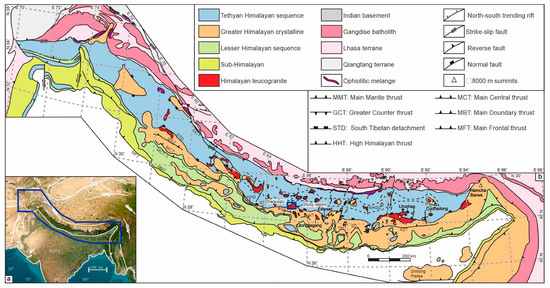
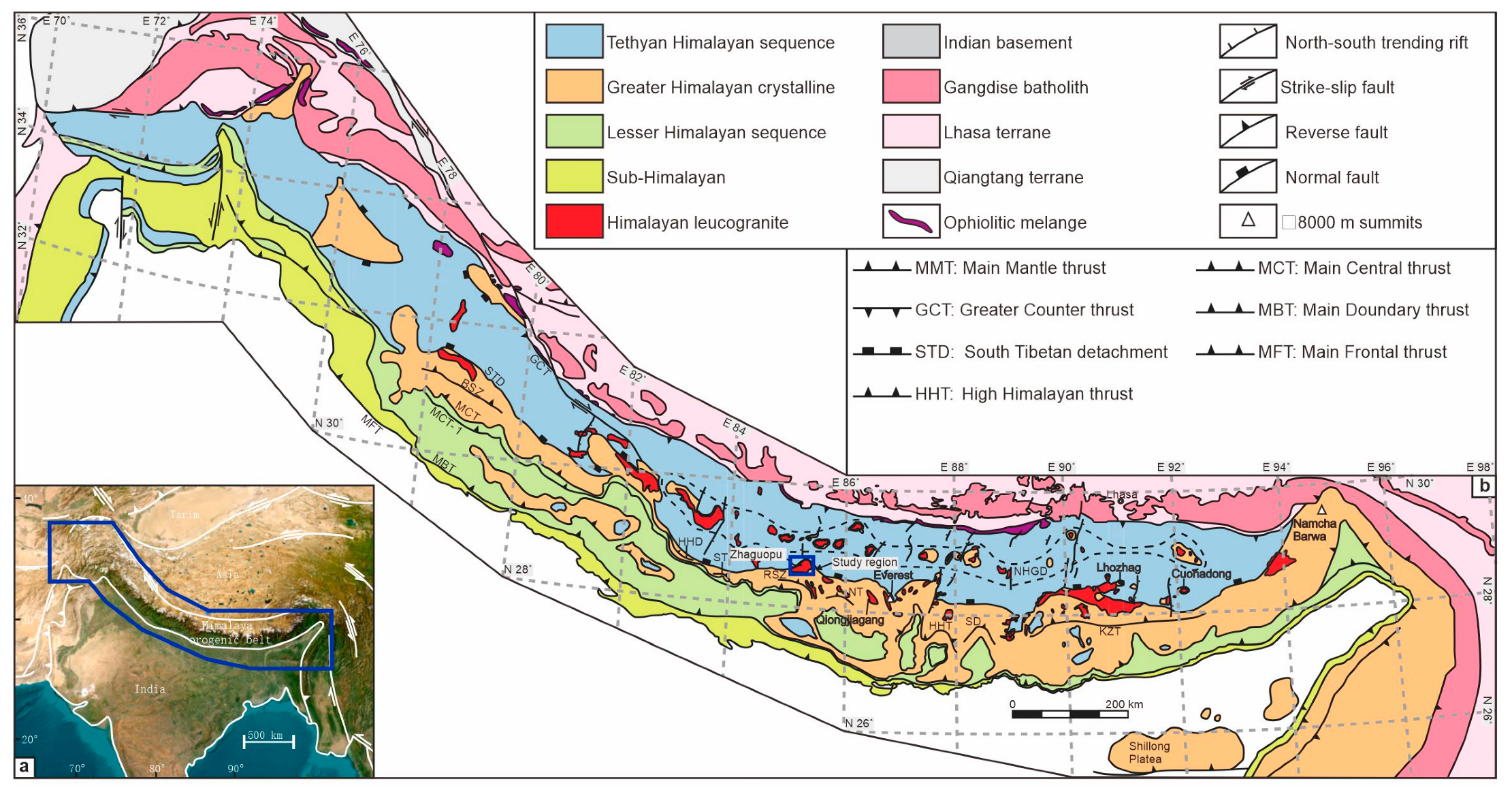
The Himalayan orogenic belt is bounded to the south by the Greater Counter Thrust (GCT) and to the north by the Yarlung Zangbo Suture Zone (YZSZ), which separates it from the Gangdese orogenic belt [16]. From south to north, the belt comprises four major tectonic units: the Sub-Himalaya, the Lesser Himalayan sequence, the Greater Himalayan crystalline, and the Tethyan Himalayan sequence. These units are separated by the Main Boundary Thrust (MBT), the Main Central Thrust (MCT), and the South Tibet Detachment System (STDS; Figure 1). The formation of the Himalayan orogenic belt is primarily attributed to the collision between the Indian and Eurasian plates, initiating around 65–55 Ma [17,18]. Accompanying this protracted orogeny, the region has experienced five major episodes of magmatic activity at approximately 60–44 Ma, 44–26 Ma, 26–13 Ma, 13–7 Ma, and 7–0 Ma [4]. Two parallel belts of leucogranite occur within the Greater Himalaya and Tethyan Himalaya. These granites typically intrude as sills or dykes into metamorphic sequences within crustal-scale dome structures, and their emplacement is often associated with pegmatitic, hydrothermal veins and skarn deposits [19]. Within the Greater Himalaya, leucogranites mainly form sill-like bodies, the spatial distribution of which is significantly controlled by the STDS [20,21,22]. Significant Li-Be-Nb-Ta mineralization is predominantly hosted in pegmatites, such as those at Qiongjiagang and Gabo in the Lhozhag area [8,15]. U-Pb dating of zircon and columbite–tantalite indicates that these pegmatites formed during the early Miocene (25–23 Ma), with mineralization timing coinciding with the peak activity of the South Tibet Detachment System [8,9,15,22,23]. Mineral chemical analysis and Nd isotope data from spodumene pegmatites suggest crystallization from highly evolved granite melt, with source characteristics similar to those of the High Himalayan metamorphic basement [9,24].
Figure 1.
(a) Topographic map of the Himalayan orogen and adjacent area; (b) geological map of the Himalayan orogen (modified by Wang et al. [24]). The blue rectangle in (a) outlines the approximate location of (b) and corresponds to the broader region of the Gyirong area detailed in Figure 2.
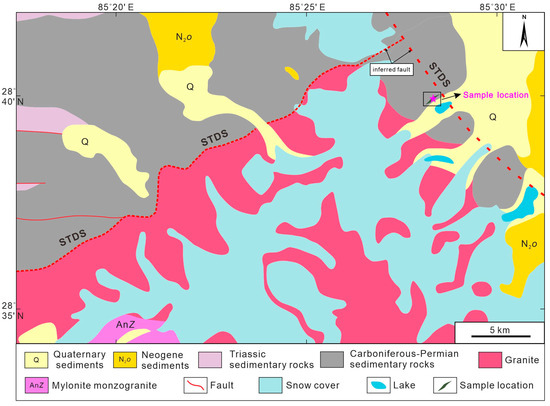
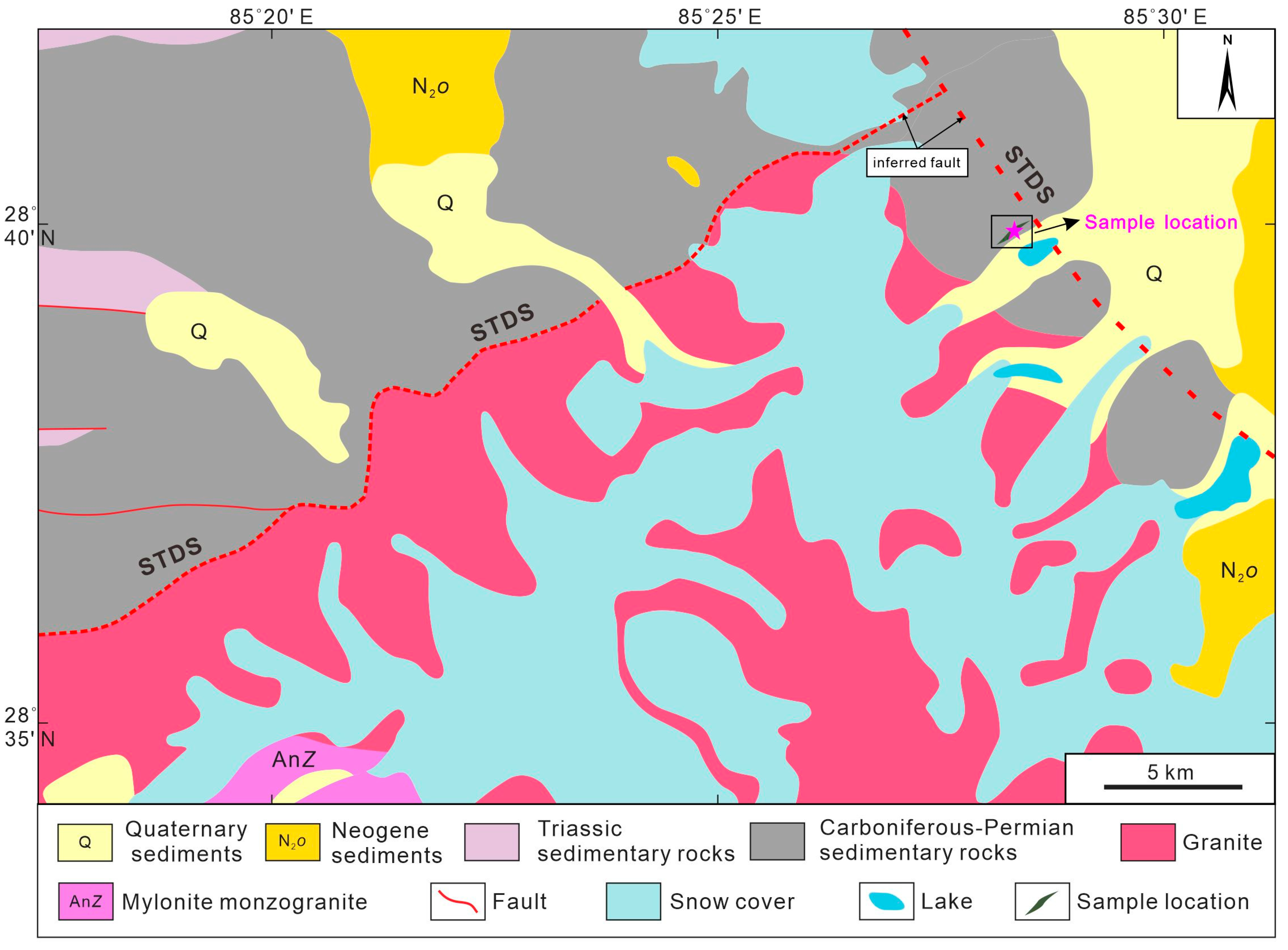
The Gyirong area, from north to south, is primarily composed of the Tethyan Himalayan sedimentary series, a granite dome, and the Greater Himalayan crystalline series (Figure 2) [24,25,26,27]. The Tethyan Himalayan sequence consists mainly of interbedded sandstone, shale, and phyllite, exhibiting a generally low grade of metamorphism [28]. This low-grade metasedimentary series is separated from the Greater Himalaya basement by the low-angle STDS. The Greater Himalaya gneiss has a formation age of 499–476 Ma, representing early Paleozoic magmatic activity typically considered the product of an Andean-type orogeny related to the subduction of the Proto-Tethys Ocean along the northern margin of Gondwana [29]. The Greater Himalaya metasedimentary rocks are predominantly schist and marble [28], which commonly contain light-colored veins formed mainly between 22 and 16 Ma [30]. The Gyirong granite intrudes the upper part of the STDS. Its lithology is primarily tourmaline-bearing leucogranite, beryl pegmatite, and spodumene pegmatite. Tectonic deformation is localized within parts of the STDS, while undeformed leucogranite intrudes irregularly as stocks or plutons into the upper sections of the STDS and the Greater Himalaya crystalline series [30].
Figure 2.
The geological map of the Gyirong area (modified after Zheng et al. [14]). STDS—South Tibet Detachment System.
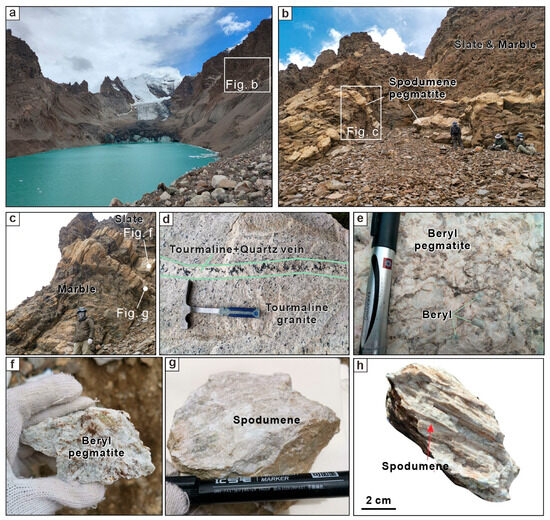
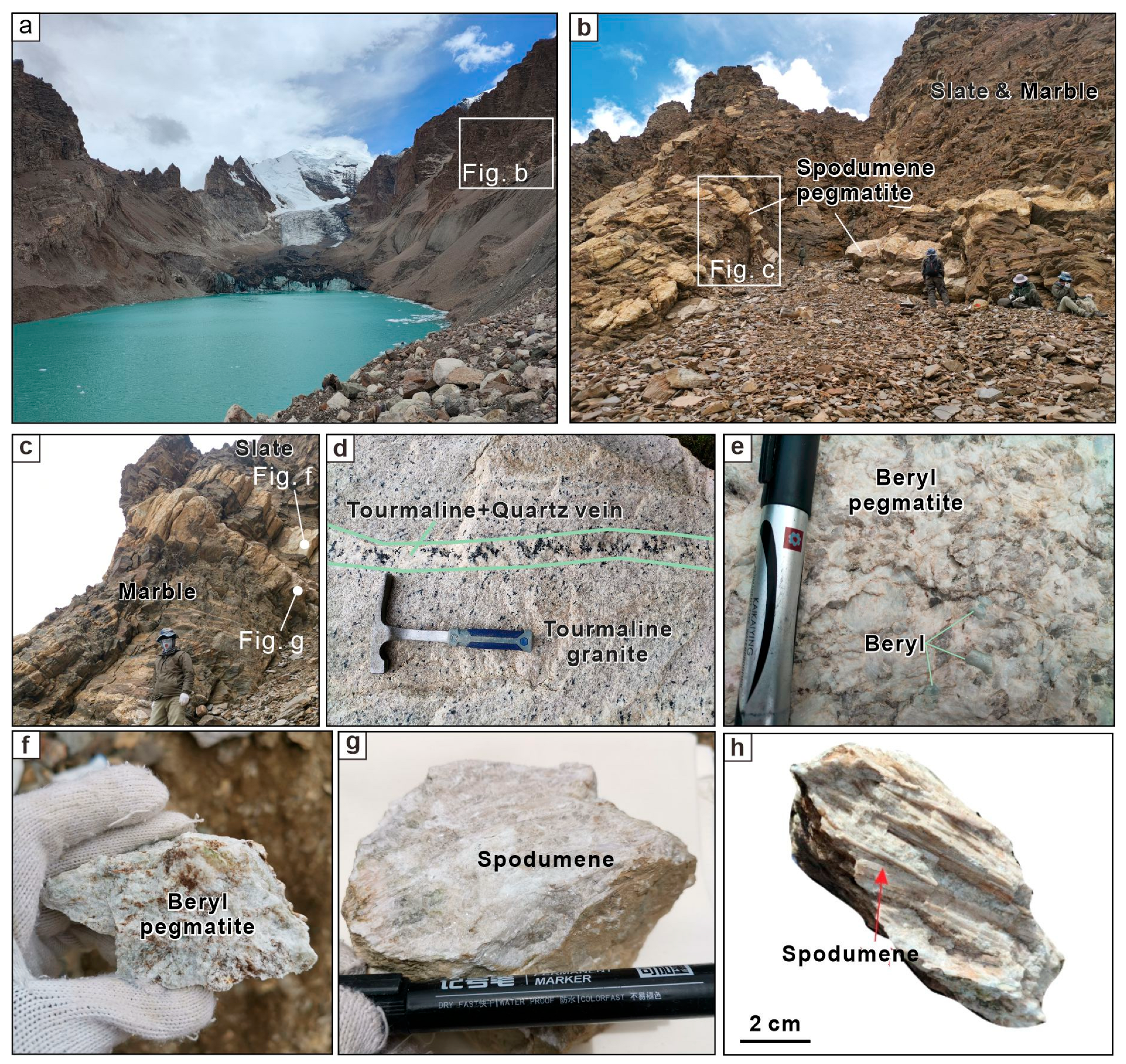
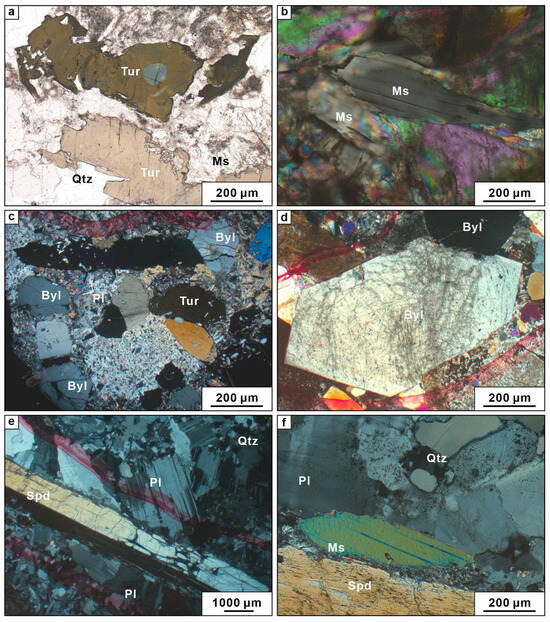
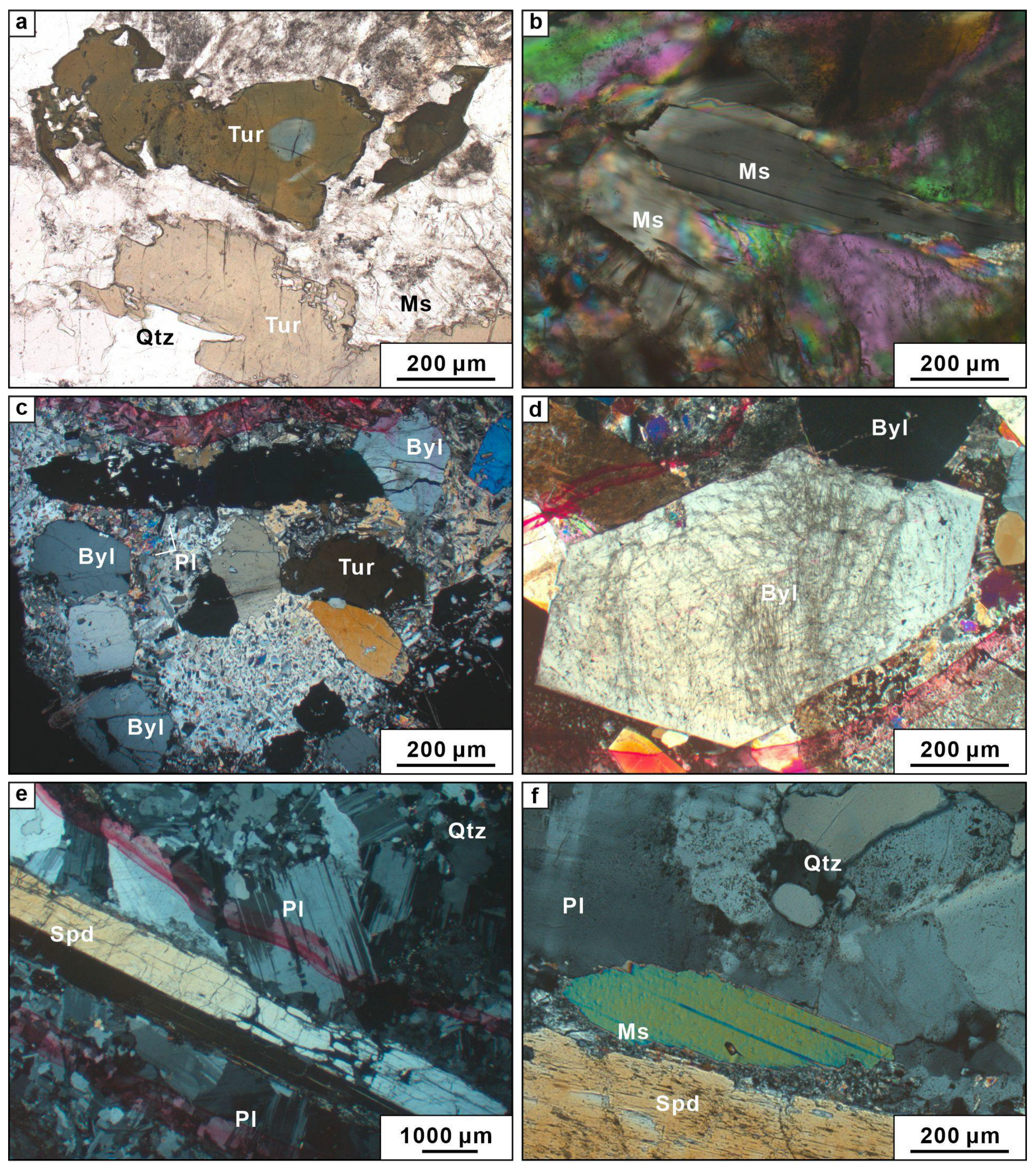
The Zhaguopu rare-metal deposit exhibits a distinct spatial and genetic architecture centered on the Gyirong granite dome (Figure 2) [14]. The deposit is characterized by well-defined zonation: a core of tourmaline-bearing leucogranite is sequentially surrounded by peripheral zones of beryl-bearing pegmatites and spodumene-bearing pegmatites, with the latter constituting the primary ore bodies. These spodumene pegmatite ore bodies are hosted within Carboniferous–Permian metasedimentary rocks (sandstone, shale, and limestone) of the Tethyan Himalayan sedimentary sequence (Figure 3a–c), spatially associated with the upper structural levels of the STDS. The newly discovered primary outcrops of spodumene pegmatite are located mainly on the eastern side of the Gyirong area, near the snow line (Figure 3a–c). River valleys contain abundant tourmaline-bearing leucogranites (Figure 3a and Figure 4a,b) and beryl pegmatites (Figure 3e,f and Figure 4c,d). Beryl crystals are euhedral and range in size from 0.5 mm to 4 cm (Figure 3e,f and Figure 4c,d). Another notable feature is the widespread occurrence of marble or skarn alteration halos at the contacts between pegmatite veins and the carbonate-rich host rocks (Figure 3g,h). This alteration serves as a prominent field indicator for mineralization and suggests fluid–rock interaction between the highly evolved pegmatitic melts/fluids and the calcareous wall rocks, which may have played a role in ore precipitation. The largest individual spodumene pegmatite vein exceeds 400 m in length, with thickness ranging from 0.5 to 4.0 m and a cumulative thickness exceeding 50 m. Principal ore minerals include spodumene (occurring in white, pink, and light-green varieties; Figure 3g,h and Figure 4e,f), beryl, and columbite-group minerals. Geochemical assays indicate Li2O grades ranging from 0.52% to 2.36%, BeO from 0.04% to 0.084%, and combined Nb2O5, Ta2O5 from 0.007% to 0.014%. Notably, the lithium grades (particularly the higher values within this range) are comparable to those reported from the major Qiongjiagang deposit in the eastern Himalaya (Li2O: ~0.02%–3.30%, mean 1.30%) [8,9], underscoring the economic potential of the Zhaguopu deposit.
Figure 3.
(a–c) Spodumene pegmatites intruded into Carboniferous–Permian sedimentary rocks of Greater Himalayan sequence; (d) tourmaline–quartz veins transect tourmaline granite; (e,f) the beryl pegmatite intruded into the Carboniferous–Permian sedimentary rocks; (g,h) spodumene pegmatite veins and lenses intruded into marble and phyllite of the Carboniferous–Permian sedimentary rocks.
Figure 4.
Optical microscopy photomicrographs showing the mineralogy of the Zhaguopu intrusive suite. (a,b) The tourmaline-bearing leucogranite with the main mineral assemblage of tourmaline, muscovite, and quartz. (c,d) Beryl and tourmaline grains occur in the beryl pegmatite; (e,f) spodumene intergrow with plagioclase, k-feldspar, and muscovite. (a) Plane-polarized light (PPL); (b–f) cross-polarized light (XPL). Mineral abbreviations: Tur, tourmaline; Qtz, quartz; Ms, muscovite; Pl, plagioclase; Byl, beryl; Spd, spodumene.
3. Methodology
3.1. In Situ U-Pb Geochronology of Accessory Minerals
Zircon, monazite, and columbite–tantalite grains were separated from approximately 5 kg samples of granite, beryl pegmatite, and spodumene pegmatite by standard methods involving crushing, sieving, and heavy-liquid and magnetic separation. Selected grains were hand-picked under a binocular microscope, mounted in epoxy resin, and polished to expose approximately one-third of their thickness for analysis. Cathodoluminescence (CL) and backscattered electron (BSE) imaging were performed at the Guangzhou Tuoyan In-situ Analysis Laboratory using a scanning electron microscope (JSM-IT100) (JEOL Ltd., Tokyo, Japan) equipped with a GATAN MINICL system (Gatan, Inc., Pleasanton, CA, USA). These images were used to characterize grain size, morphology, and internal structure, guiding the selection of spots for subsequent U-Pb dating and trace element analysis.
In situ U-Pb dating and trace element analysis of zircon were performed by LA-ICP-MS at Wuhan Sample Solution Analytical Technology Co., Ltd. (Wuhan, Hubei, China). The instrumental setup, operating conditions, and data reduction procedures followed Zong et al. [31]. Ablation was conducted using a GeolasPro system (Electro Optics, Canberra, Australia) equipped with a COMPexPro 102 ArF excimer laser (193 nm wavelength, 200 mJ maximum energy) and a MicroL as optical system (Coherent Corp., Saxonburg, PA, USA). An Agilent 7700e ICP-MS (Agilent Technologies, Santa Clara, CA, USA) was used for signal acquisition. Helium served as the carrier gas, with argon as the make-up gas mixed via a T-connector. The system incorporates a “wave” signal smoothing device [32]. Analyses employed a 24 µm spot size and 80 Hz repetition rate. Zircon 91500 and NIST610 glass (Sigma-Aldrich, Burlington, MA, USA) were used as primary reference materials for U-Pb dating and trace element calibration, respectively [33]. Each analysis comprised ~20–30 s of background acquisition followed by 50 s of ablation signal. Offline data processing, including background and signal integration, time-drift correction, and quantitative calibration, was performed using ICPMSDataCal software 10.9 [34,35]. Repeated analysis of zircon 91500 (n = 10) yielded a weighted mean 206Pb/238U age of 1063.0 ± 1.1 Ma (MSWD = 0.74), consistent with its reference age of 1062.4 ± 0.4 Ma [36]. Trace element data quality, monitored via NIST610, showed agreement with recommended values within 5%–10% for most elements [37,38].
Monazite U-Pb dating was conducted by LA-ICP-MS at the Wuhan SampleSolution Analytical Technology Co., Ltd. (Wuhan, Hubei, China). The laser system was identical to that used for zircon. An Agilent 7900 ICP-MS (Agilent Technologies, Santa Clara, CA, USA) was used for signal measurement. A “wave” signal smoothing enabled stable signals at low repetition rates [32,39]. Monazite standard 44069 [37,38] and glass NIST610 (Sigma-Aldrich, Burlington, MA, USA) were used as primary reference materials [37,38,40]. Analysis of monazite 44069 (n = 8) gave a weighted mean 206Pb/238U age of 424.5 ± 1.3 Ma (MSWD = 0.82), matching its reference age of 424.9 ± 0.4 Ma. A 32 µm spot size and 5 Hz repetition rate were used. Each analysis included ~20 s of background and 40 s of ablation signal.
Columbite–tantalite U-Pb dating was performed by LA-ICPMS at the State Key Laboratory for Mineral Deposit Research, Nanjing University (Nanjing, Jiangsu, China). NIST610 was used for trace element calibration [37,38]. The OXF standard (262.85 ± 0.61 Ma) [41] was used for instrumental mass bias correction. Analysis of OXF (n = 10) yielded a weighted mean 206Pb/238U age of 263.0 ± 1.2 Ma (MSWD = 0.31), verifying the accuracy of the procedure. Each analysis consisted of ~15 s blank 40 s sample signal. Ablation parameters were a 44 µm spot, 80 mJ energy density, and 2 Hz frequency. Data were processed offline using Iolite software 4.0 [42] for signal selection, drift correction, ratio calculation, and age determination.
U-Pb concordia diagrams and weighted mean age calculations were generated using IsoplotR 6.8.4 [43]. All geochronological results are provided in Supplementary Tables S1–S6.
3.2. Whole-Rock Major and Trace Element Analysis
Whole-rock major and trace element analyses were conducted on representative samples of tourmaline granite (n = 3), beryl pegmatite (n = 3), and spodumene pegmatite (n = 5). Major element oxides were determined by wavelength-dispersive X-ray fluorescence (XRF) spectrometry on fused glass beads using a Rigaku ZSX Primus II spectrometer at Wuhan Sample Solution Analytical Technology Co., Ltd. (Wuhan, Hubei, China) Operating conditions were 50 kV and 60 mA using a Rh tube. Calibration was based on a suite of Chinese certified reference materials (CRMs: GBW07101-14, GSS07401-08, GBW07302-12, [31]). Data were corrected using the theoretical alpha coefficient method. Replicate analyses of CRMs indicated an analytical precision better than 2% relative standard deviation (RSD) for major oxides.
Trace element concentrations were analyzed by inductively coupled plasma–mass spectrometry (ICP-MS) using an Agilent 7700e instrument (Agilent Technologies, Santa Clara, CA, USA) at the same laboratory. Sample digestion involved high-pressure acid dissolution in Teflon bombs. Approximately 50 mg of powdered sample was digested with 1 mL HNO3 and 1 mL HF at 190 °C for over 24 h. The solution was evaporated to incipient dryness, re-treated with HNO3, and then re-dissolved in 1 mL HNO3 with 1 mL deionized water and 1 mL of a 1 ppm in internal standard solution for 12 h at 190 °C. The final solution was diluted to 100 g with 2% HNO3 for analysis. Accuracy and reproducibility were monitored by processing international rock reference materials GSR-1 and GSR-2 alongside the samples. Precision for most trace elements was better than 5%–10% relative standard deviation. One spodumene pegmatite sample was excluded from the final trace element dataset due to incomplete digestion based on quality control criteria.
4. Results
4.1. Zircon U-Pb Dating
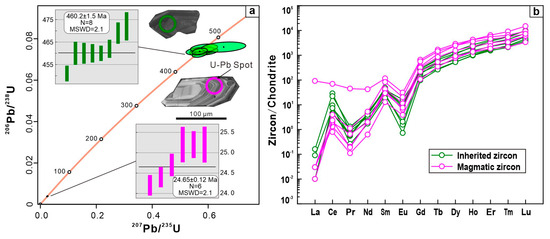
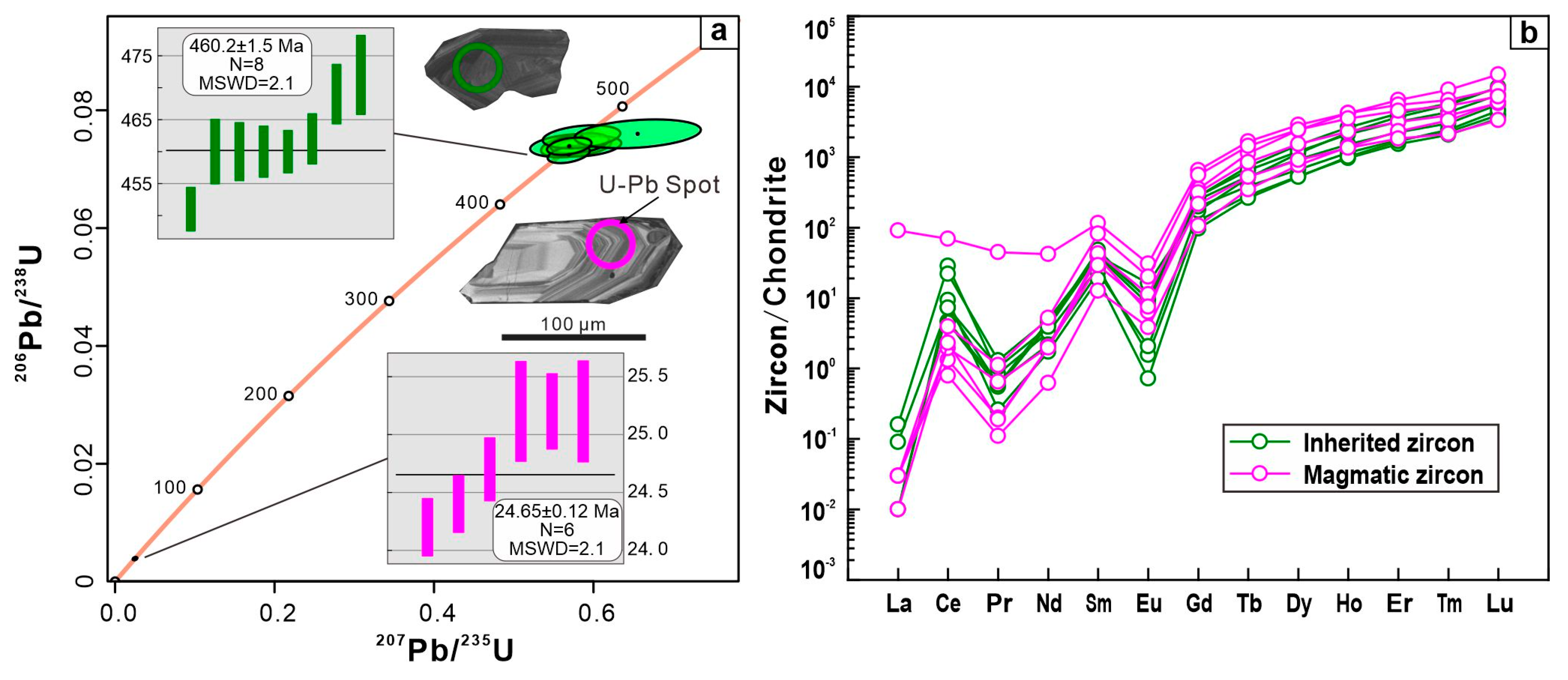
The zircon U-Pb data for the tourmaline granite (D0294) are listed in Table S1. A total of 14 spots were analyzed on this sample. The zircon crystals are light yellow and exhibit a euhedral-to-subhedral columnar habit, with grain sizes of 100–120 μm and length-to-width ratios of approximately 2:1. Some grains exhibit oscillatory zoning (Figure 5a). Their rare-earth element (REE) patterns, characterized by steep heavy REE (HREE) enrichment, are typical of magmatic zircon (Figure 5b; Table S2). Thorium (Th) and uranium (U) concentrations range from 116 to 1992 ppm and 849 to 47,624 ppm, respectively. The ratios of Th/U vary from 0.02 to 0.83. The lower end of this range (e.g., 0.02) is atypical for pristine magmatic zircon (typically Th/U > 0.1) [44]. This may indicate varying degrees of metamictization due to extremely high U concentrations in some grains (up to ~4.8 wt.%) and/or a hydrothermal overprint, processes that are known to modify trace element systematics and complicate U-Pb dating in such evolved systems [45,46]. These observations align with the broader challenges of dating zircons in highly fractionated leucogranite–pegmatite systems discussed in Section 5.1. The data form two distinct groups on a 206Pb/238U-207Pb/235U concordia diagram. The younger group (six spots) yields a 206Pb/238U weighted mean age of 24.65 ± 0.12 Ma (1σ). The 206Pb/238U weighted mean age of the old group (eight spots) is 460.2 ± 1.5 Ma (MSWD = 2.1) (Figure 5a), which represents the inherited age.
Figure 5.
Zircon textures, U-Pb ages, and rare-earth element patterns from tourmaline granite (D0294) at Zhaguopu deposit. (a) Zircon textures and U-Pb ages; (b) chondrite-normalized REE patterns (chondrite data from Sun and McDonough [45]).
4.2. Monazite U-Pb Dating
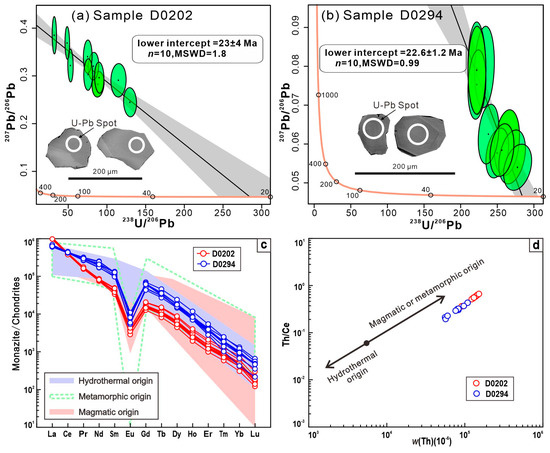
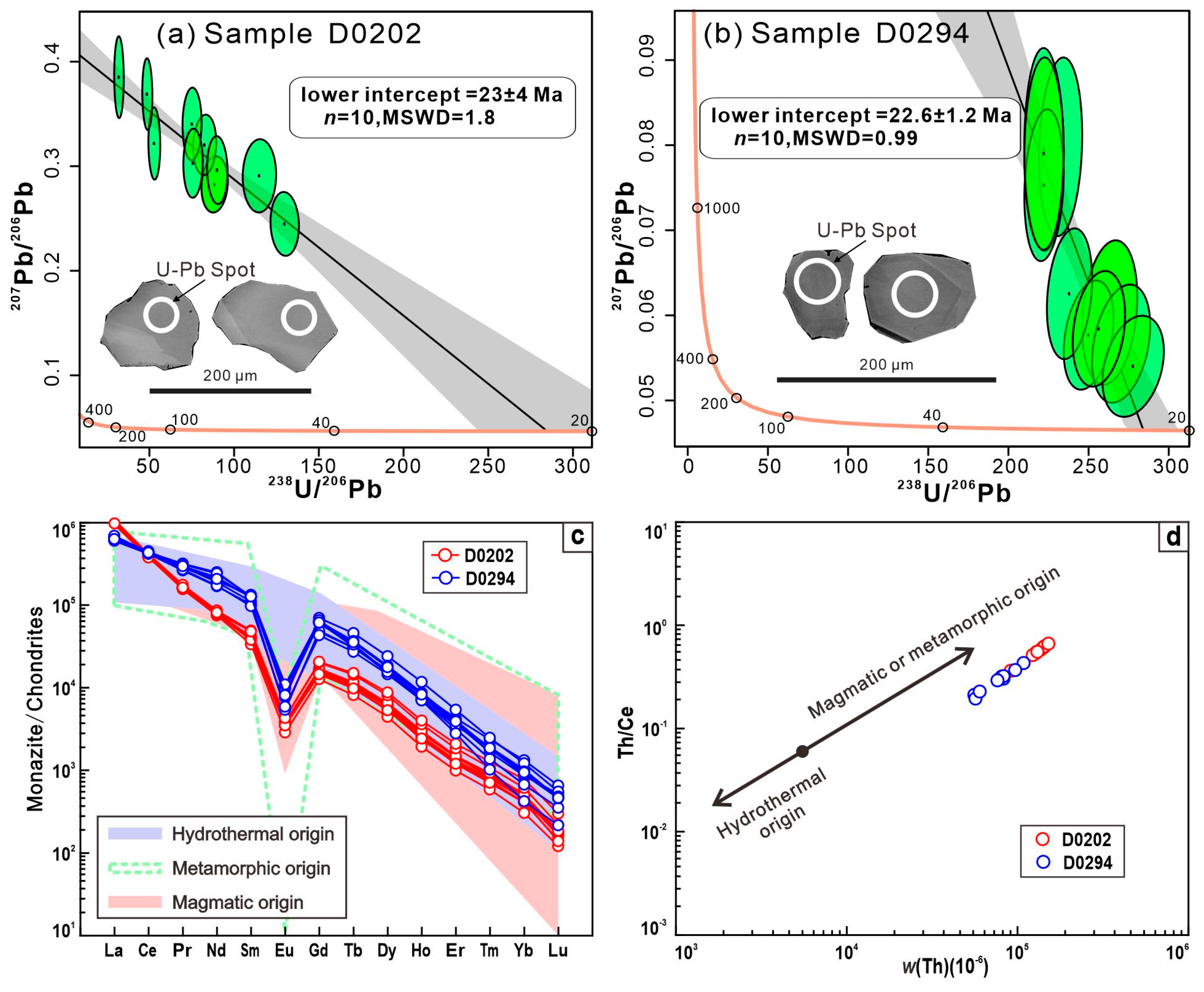
We performed ten spot analyses for monazite U-Pb dating from the tourmaline granite (D0294) and beryl pegmatite (D0202), with the results listed in Table S3. The monazite crystals generally develop clear internal textures, with most grains showing distinct oscillatory zoning (Figure 6a,b). Their REE contents are characteristic of magmatic monazite (Figure 6c,d; Table S4). However, the high Th and common Pb contents typical of monazite in High Himalayan leucogranite and metamorphic rocks result in elevated measured 207Pb/206Pb ratios. Therefore, a common Pb correction was applied.
Figure 6.
Monazite textures, U-Pb ages, and trace elements from beryl pegmatite (D0202) and tourmaline granite (D0294) at Zhaguopu deposit. (a) Monazite textures and U-Pb ages of sample D0202; (b) monazite textures and U-Pb ages of sample D0294; (c) chondrite-normalized REE patterns (chondrite data from Sun and McDonough [47]); (d) Th/Ce-Th diagram (after Wu et al. [48]). Fields for typical magmatic, hydrothermal, and metamorphic monazite are based on Bergemann et al. [49] and Itano et al. [50].
For sample D0202 (beryl pegmatite), Th and U contents range from 122,850 to 141,688 ppm and 256 to 606 ppm, respectively, yielding extremely high Th/U ratios of 238–840. In contrast, monazite from sample D0294 (tourmaline granite) contains 56,039–108,639 ppm Th and 2591–11,504 ppm U, with lower Th/U ratios of 7.17–44.2. The measured isotopic ratios for D0202 (207Pb/206Pb = 0.2666–0.4487; 207Pb/235U = 0.2598–1.6561; 206Pb/238U = 0.0087–0.0312) are significantly higher than those for D0294 (207Pb/206Pb = 0.0542–0.0821; 207Pb/235U = 0.0289–0.0493; 206Pb/238U = 0.0038–0.0045). These elevated ratios in D0202 indicate substantial incorporation of common (non-radiogenic) Pb during mineral growth or subsequent alteration. Consequently, isotopic data for both samples were processed using a Tera–Wasserburg concordia approach to correct for this variable common Pb. The ten analytical spots for each sample define lower intercept ages of 23.0 ± 4.0 Ma (MSWD = 1.8; Figure 6a) for D0202 and 22.54 ± 0.8 Ma (MSWD = 0.99; Figure 6b) for D0294.
4.3. Columbite-Group Mineral U-Pb Dating and Element Compositions
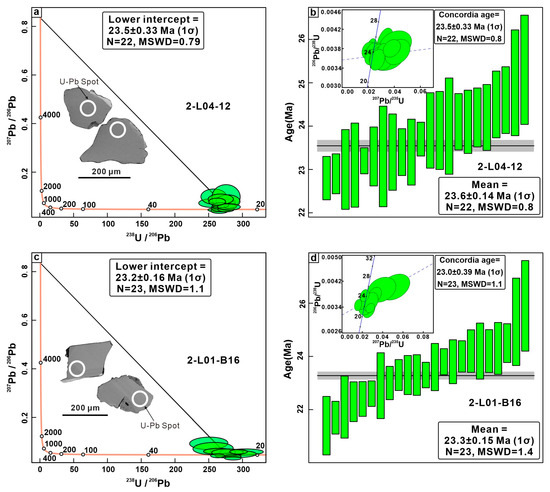
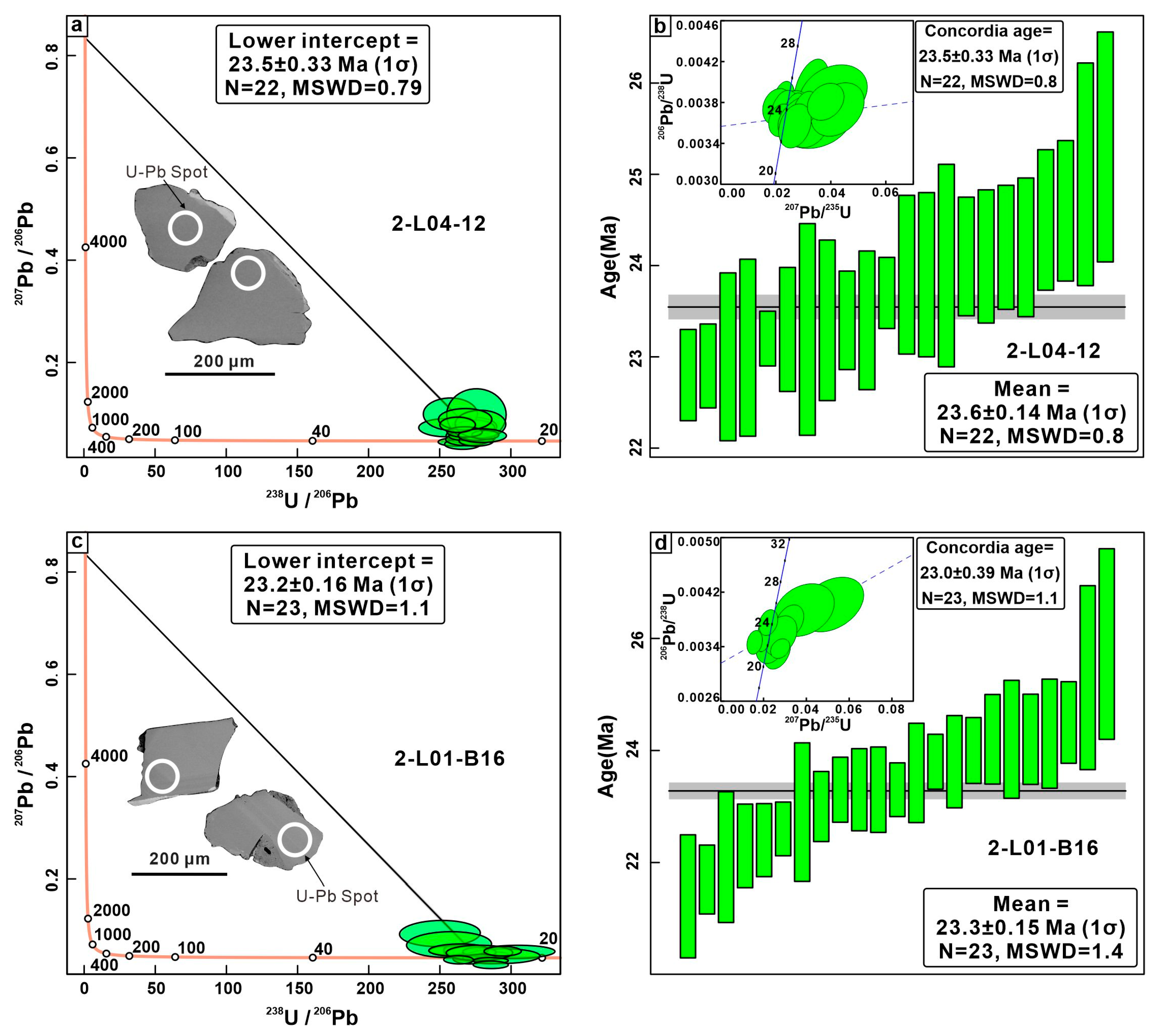
A total of 22 spots from sample 2-L04-12 and 23 spots from sample 2-L01-B16 (both spodumene pegmatites) were analyzed for U-Pb dating of columbite-group minerals. The results are summarized in Table S5. The columbite-group mineral grains are euhedral to subhedral and granular, with sizes ranging from 80 to 400 μm. Backscattered electron (BSE) imaging reveals simple crystal textures, with most grains displaying oscillatory zoning (Figure 7a,c). Some grains appear turbid in cathodoluminescence (CL) images, suggesting hydrothermal alteration, and a few contain inherited cores.
Figure 7.
Columbite-group mineral textures and U-Pb ages from spodumene pegmatite (2-L04-12 and 2-L01-B16) at Zhaguopu deposit. (a) Mineral textures and Tera–Wasserburg ages of sample 2-L04-12; (b) weighted mean age of sample 2-L04-12; (c) mineral textures and Tera–Wasserburg ages of sample 2-L01-B16; (d) weighted mean age of sample 2-L01-B16.
U-Pb dating yielded consistent results for the two samples (Table S5). For sample 2-L04-12 (22 spots), U and Th concentrations range from 127 to 3365 ppm and 2.43 to 198 ppm, respectively, with 206Pb/238U and 207Pb/206Pb ratios of 0.00355–0.00393 and 0.04023–0.09906. For sample 2-L01-B16 (23 spots), the corresponding ranges are 90.4–1187 ppm for U, 1.53–31.3 ppm for Th, 0.00333–0.00402 for 206Pb/238U, and 0.03253–0.12743 for 207Pb/206Pb. On Tera–Wasserburg diagrams, the analyses yield lower intercept ages of 23.5 ± 0.33 Ma (MSWD = 0.79; Figure 7a) for sample 2-L04-12 and 23.2 ± 0.16 Ma (MSWD = 1.1; Figure 7c) for sample 2-L01-B16. Weighted mean 206Pb/238U ages were calculated from a subset of analyses showing no evidence of inheritance, alteration, or excessive common Pb based on BSE/CL imaging and chemical criteria. These ages are 23.6 ± 0.14 Ma (Figure 7b) and 23.3 ± 0.15 Ma (Figure 7d) for samples 2-L04-12 and 2-L01-B16, respectively, robustly constraining the crystallization age of the spodumene pegmatites.
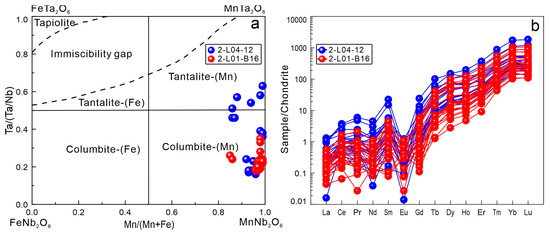
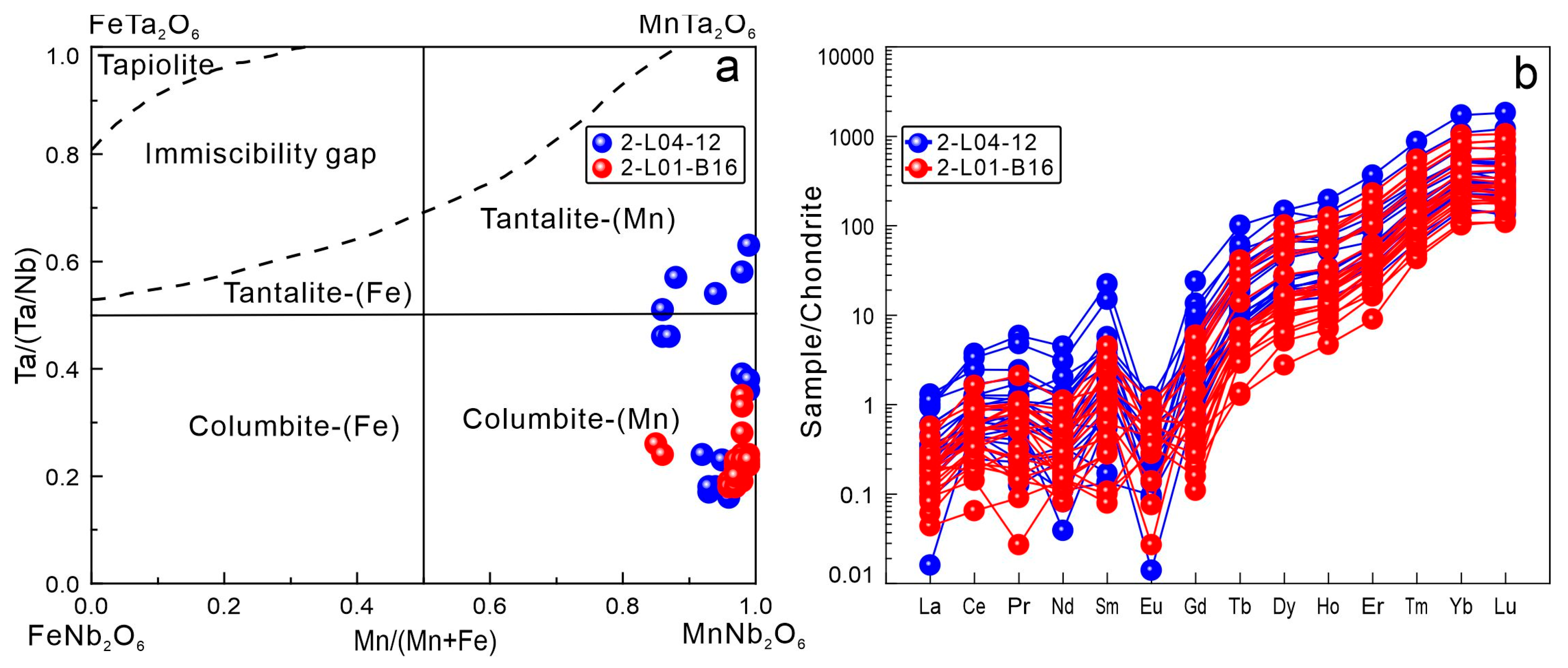
The major and trace element compositions of the two samples (2-L04-12 and 2-L01-B16) are similar (Table S6). A discrimination diagram (Figure 8a) indicates that most analyzed grains are columbite-(Mn), with a minor proportion classified as tantalite-(Mn). Their compositions are variable, with Ta/(Nb+Ta) and Mn/(Fe+Mn) ratios ranging from 0.16 to 0.63 and 0.85 to 0.99, respectively (Figure 8a). Chondrite-normalized REE patterns are characterized by depletion in light rare-earth elements (LREEs), enrichment in heavy rare-earth elements (HREEs), and a pronounced negative Eu anomaly (Figure 8b). Furthermore, concentrations of the heaviest REEs (e.g., Er, Tm, Yb, Lu) are higher than those of middle HREEs (e.g., Gd, Tb, Dy).
Figure 8.
Columbite-group mineral element compositions from spodumene pegmatite (2-L04-12 and 2-L01-B16) at Zhaguopu deposit. (a) Discrimination diagram of columbite-group minerals; (b) chondrite-normalized REE patterns (chondrite data from Sun and McDonough [47]).
4.4. Whole-Rock Geochemistry
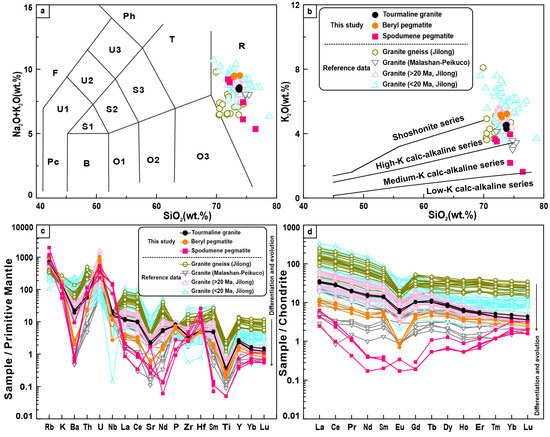
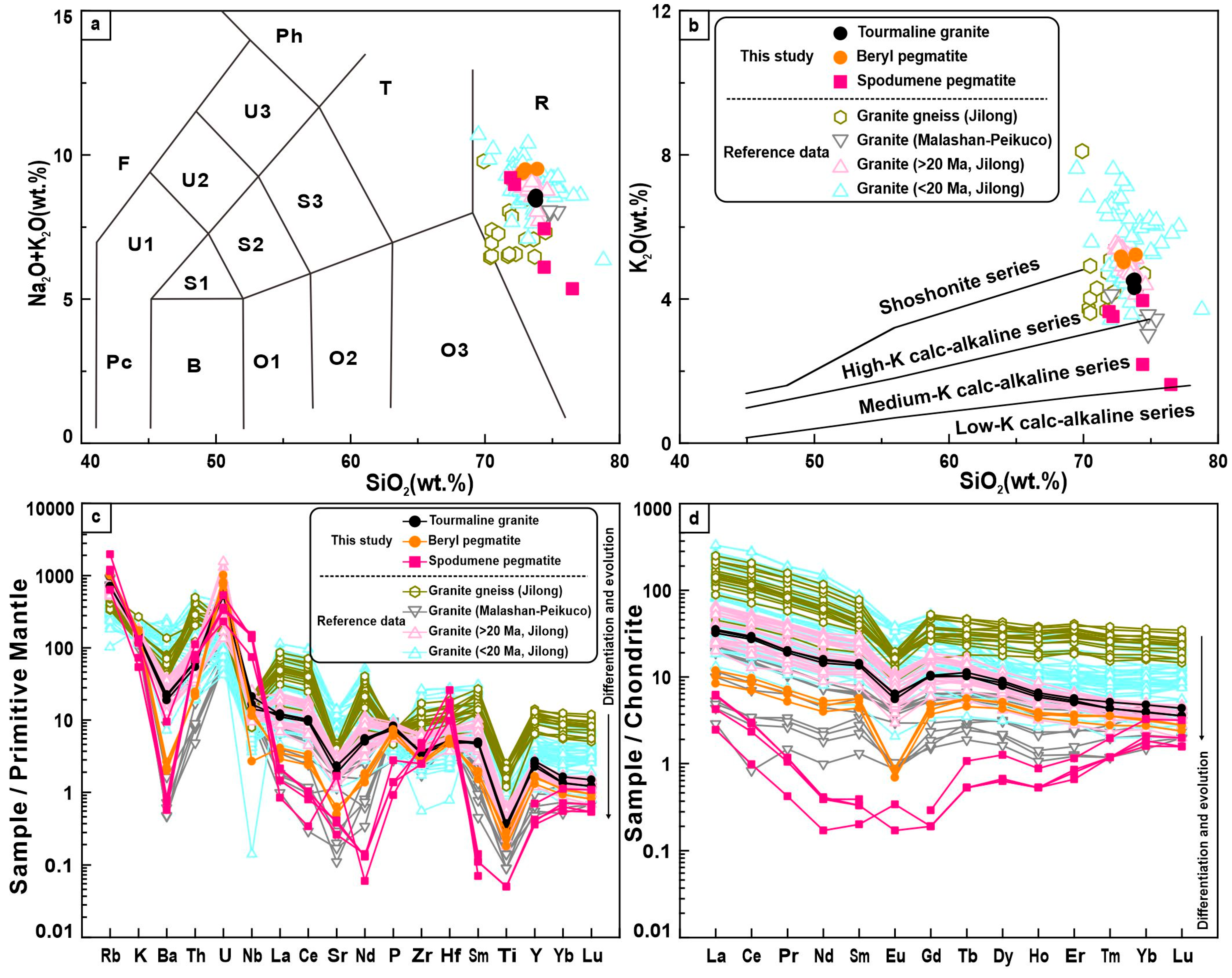
Whole-rock major and trace element compositions for the tourmaline granite, beryl pegmatite, and spodumene pegmatite are summarized in Supplementary Table S7 and illustrated in Figure 9.
Figure 9.
Petrological geochemical classification and magma series. (a) Na2O+K2O vs. SiO2 (after Le Maitre [51]); (b) K2O vs. SiO2 (after Peccerillo and Taylor [52]; Middlemost [53]); (c) primitive mantle-normalized trace element patterns of the rocks; (d) chondrite-normalized rare-earth element patterns of the rocks (chondrite and primitive mantle values after Sun and McDonough [47]). Pc: Picrite basalt; B: basalt; O1: Basaltic andesite; O2: Andesite; O3: Dacite; S1: Trachybasalt; S2: Basaltic trachyandesite; S3: trachyandesite; U1: Tephrite, Basanite; U2: Phonotephrite; U3: Tephriphonolite; F: Phonolite; Ph: Phonolitic trachyte; T: trachyte; R: Rhyolite.
Tourmaline granite exhibits high SiO2 (73.7–73.8 wt.%), high alkali (Na2O+K2O = 8.41–8.57 wt.%), and peraluminous characteristics (A/CNK = 1.22–1.25). Total REE contents range from 42.4 to 45.1 ppm, with moderate LREE enrichment (LaN/YbN = 6.72–8.95) and pronounced negative Eu anomalies (δEu = 0.47–0.53). Primitive mantle-normalized trace element diagrams show marked depletions in Ba and Sr, and enrichment in incompatible elements such as U (Figure 9).
Beryl pegmatite shows geochemical affinities with the tourmaline granite but indicates further differentiation: SiO2 = 72.8–73.9 wt.%; Na2O+K2O = 9.37–9.51 wt.%; and A/CNK = 1.13–1.15. REE contents are significantly lower (ΣREE = 12.6–16.8 ppm), with stronger negative Eu anomalies (δEu = 0.17–0.19) and flatter REE patterns (LaN/YbN = 3.10–3.79). Depletions in Ba and Sr are more pronounced, while U remains enriched (Figure 9).
Spodumene pegmatite represents the most evolved unit, with highly variable SiO2 (71.9–76.5 wt.%) and alkali contents (Na2O+K2O = 5.36–9.21 wt.%) and strongly peraluminous signatures (A/CNK up to 1.95). These rocks are extremely depleted in Fe2O3T, MgO, TiO2, and P2O5. REE contents are the lowest among the three rock types (ΣREE = 2.12–4.38 ppm), with generally weak Eu anomalies (δEu = 0.68–1.77). Trace element patterns show extreme depletion in Ba, Sr, and Ti, coupled with elevated concentrations of Hf and U (Figure 9).
Collectively, the whole-rock data define a coherent differentiation sequence of tourmaline granite → beryl pegmatite → spodumene pegmatite. This trend is characterized by increasing SiO2 and Al2O3, decreasing Fe-Mg-Ti-P, and progressive depletion in compatible elements (Ba, Sr, Eu), consistent with advanced fractional crystallization of a common peraluminous granitic magma.
5. Discussion
5.1. Geochronological Constraints on Rare-Metal Mineralization
Accurately determining the timing of mineralization remains a pivotal yet challenging objective in pegmatite deposit studies. Nonetheless, constraining these ages is fundamental for deciphering genetic mechanisms, unraveling mineralization processes, and establishing robust metallogenic models [54,55]. Previous geochronological work on rare-metal pegmatites has demonstrated that zircon grains within associated leucogranites and pegmatites are frequently inherited or captured, with a scarcity of newly crystallized zircon. Even when present, magmatic zircon often exhibits substantial alteration or metamictization [45,46], posing significant challenges for precise age determination. Recent advancements in in situ dating techniques, however, have facilitated breakthroughs in U-Pb geochronology for these systems. There is now widespread application of U-Pb dating directly on rare-metal ore minerals such as monazite, cassiterite, and columbite–tantalite [55,56,57]. As primary ore phases, these minerals typically maintain robust U-Pb isotopic closure systems, providing a powerful method to accurately constrain the timing of rare-metal enrichment and mineralization events.
The mineralogical and geochemical features documented at Zhaguopu—including the concentric zonation (tourmaline granite → beryl pegmatite → spodumene pegmatite), the composition of columbite-group minerals (predominantly columbite-(Mn) with high Mn/(Fe+Mn) ratios), and the strongly fractionated REE patterns—collectively point to an extremely high degree of magmatic fractionation. This pattern aligns with the well-established model for rare-metal enrichment in fractionated pegmatite systems globally and mirrors features observed in eastern Himalayan deposits (e.g., Qiongjiagang). The precise geochronological framework provided here firmly anchors this common petrogenetic process within the 25–23 Ma tectonic window. In the tourmaline granite sample (D0294), zircon yields two distinct age populations: 460 ± 2 Ma and 24.6 ± 0.1 Ma. Cathodoluminescence (CL) imaging reveals a clear correlation between age and CL brightness: the older (460 Ma) zircons exhibit uniformly darker responses, whereas the younger (24.6 Ma) zircons are brighter (Figure 5a). This visual distinction is corroborated by their trace element chemistry; the dark-CL, 460 Ma zircons possess considerably lower U contents (Table S1), a feature known to quench CL intensity and commonly associated with inherited grains in highly evolved melts [45,46]. Therefore, the 460 Ma age is interpreted as an inherited component from the source region. In contrast, the younger (24.6 Ma) population, characterized by well-defined oscillatory zoning, represents newly crystallized magmatic zircon, constraining the emplacement age of the tourmaline granite. Monazite from the same sample (D0294) is locally abundant and intergrown with quartz and tourmaline. Its high Th content (9.1–15.2 wt.%) is characteristic of magmatic monazite, as opposed to hydrothermal monazite, which typically contains <1 wt.% Th [58]. The monazite U-Pb age of 22.6 ± 1.2 Ma is, within error, consistent with the 24.6 Ma zircon age, collectively indicating tourmaline granite formation between 25 and 23 Ma.
In the beryl pegmatite (D0202), monazite yields a weighted average age of 23 ± 4 Ma. The similarly high Th content (5.72–11.2 wt.%) in these grains further supports a magmatic origin and suggests crystallization of the beryl-(spodumene) pegmatite at approximately 23 Ma. For the spodumene pegmatites (2-L04-12 and 2-L01-B16), columbite–tantalite—the primary ore minerals—yield weighted average U-Pb ages between 23.2 and 23.5 Ma. Although these columbite–tantalite grains show compositional variations suggestive of subsequent hydrothermal alteration, their ages robustly constrain the primary magmatic crystallization of the spodumene pegmatites to between 23 and 24 Ma.
Notably, this 25–23 Ma mineralization event is not an isolated event but represents a major regional episode. Geochronological data from across the orogen reveal a consistent pattern: In the Everest region, muscovite leucogranites and spodumene pegmatites yield U-Pb ages of 25–23 Ma [59]. The Li-Be-Nb mineralized Qiongjiagang spodumene pegmatite was emplaced between 25 and 24 Ma [9]. In the central-western Himalayas, the Gangbu Li mineralized spodumene pegmatite (Shisha Pangma region) formed at ~25 Ma [13]. The Kuqu Li mineralized spodumene pegmatite in the east also crystallized at ~25 Ma [11]. Slightly younger ages of 23–18 Ma are reported for the Li-Be-Rb mineralized pegmatite at Luozha in the eastern Himalayas [60]. The consistency of these data clearly indicates that the entire Himalayan orogen experienced a widespread pulse of rare-metal mineralization predominantly between 25 and 23 Ma, spatially associated with the Southern Tibetan Detachment System (STDS).
Based on the coeval nature of magmatism, mineralization, and extensional tectonics documented here and across the orogen, we propose a genetic model for the Zhaguopu and other Himalayan rare-metal pegmatites that hinges on tectono-magmatic coupling during post-collisional extension. This model integrates the following key processes:
- Triggering of Melting and Deep Magma Differentiation: The onset of accelerated north–south extension along the STDS at ~25–23 Ma [61,62,63] facilitated decompression melting of the thickened Himalayan mid-crust, generating voluminous leucogranitic magmas. The prolonged thermal regime allowed for extended residence and extreme fractional crystallization at depth, enriching incompatible elements (Li, Be, Nb, Ta) and volatiles in the residual melt [20,24,62].
- Focused Melt Transport and Structural Control: The STDS and associated shear zones acted as crustal-scale conduits [55,64], providing low-pressure pathways for the rapid ascent of buoyant, volatile-rich, evolved melts. The intimate spatial association of the pegmatites with the STDS and their vein- to lens-like morphology parallel to the detachment fabric strongly support this structure-controlled transport mechanism.
- Shallow Emplacement and Zonation: Upon reaching shallow levels within the upper plate (Tethyan Himalayan sequence), melts were emplaced as sheet-like or lensoid bodies along secondary fractures and bedding planes [8,10]. The observed concentric zonation (tourmaline granite → beryl pegmatite → spodumene pegmatite) around domal structures like Gyirong reflects the final stage of in situ crystallization differentiation of a common magma batch.
- Fluid–Rock Interaction and Ore Localization: Interaction between late-stage pegmatitic fluids and reactive calcareous wall rocks (e.g., marble), evidenced by the widespread skarn alteration halos at Zhaguopu, may have been a critical local factor enhancing metal precipitation at specific lithological contacts [65,66,67].
- In summary, the 25–23 Ma rare-metal mineralization in the Himalaya was the direct result of a specific geodynamic scenario. The synchronized timing implies that post-collisional crustal extension, manifested by STDS activity, was the fundamental driver that (i) initiated and sustained magma generation and differentiation, (ii) provided architectural pathways for melt extraction and ascent, and (iii) created the shallow structural traps for final emplacement. The Zhaguopu deposit is a clear manifestation of this model within the western Himalayan segment. The synchronous emplacement ages (25–23 Ma) established above provide a crucial temporal framework. To decipher the petrogenetic processes and the extent of magmatic evolution responsible for metal enrichment, we now turn to the whole-rock geochemical data.
5.2. Geochemical Constraints on Magma Evolution and Rare-Metal Enrichment
The whole-rock major and trace element data provide critical insights into the petrogenetic evolution of the Zhaguopu intrusive suite and its implications for rare-metal mineralization. The systematic geochemical variations among tourmaline granite, beryl pegmatite, and spodumene pegmatite—characterized with increasesing in SiO2 and Al2O3 and decreases in Fe2O3T, MgO, TiO2, P2O5, Ba, Sr, and Eu—define a clear fractional crystallization trend (Figure 9). Such trends are hallmarks of highly fractionated peraluminous granitic systems worldwide and mirror those documented in eastern Himalayan pegmatite deposits (e.g., Qiongjiagang) [9].
Notably, the extreme depletion in Ba and Sr, along with pronounced negative Eu anomalies in the tourmaline granite and beryl pegmatite, indicates extensive feldspar fractionation during early-to-intermediate stages of magma evolution. The spodumene pegmatite exhibits the most evolved signatures, with near-total depletion of compatible elements and very low REE contents, consistent with crystallization from a highly fractionated, volatile-rich residual melt. These geochemical features, combined with the consistent 25–23 Ma emplacement ages, strongly support a model in which the three rock types represent different crystallization products from a common, progressively fractionating magma batch.
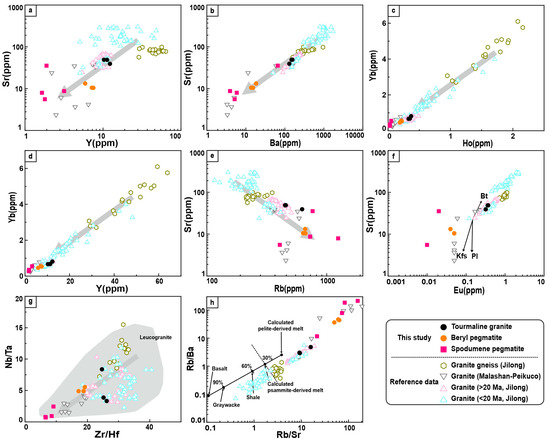
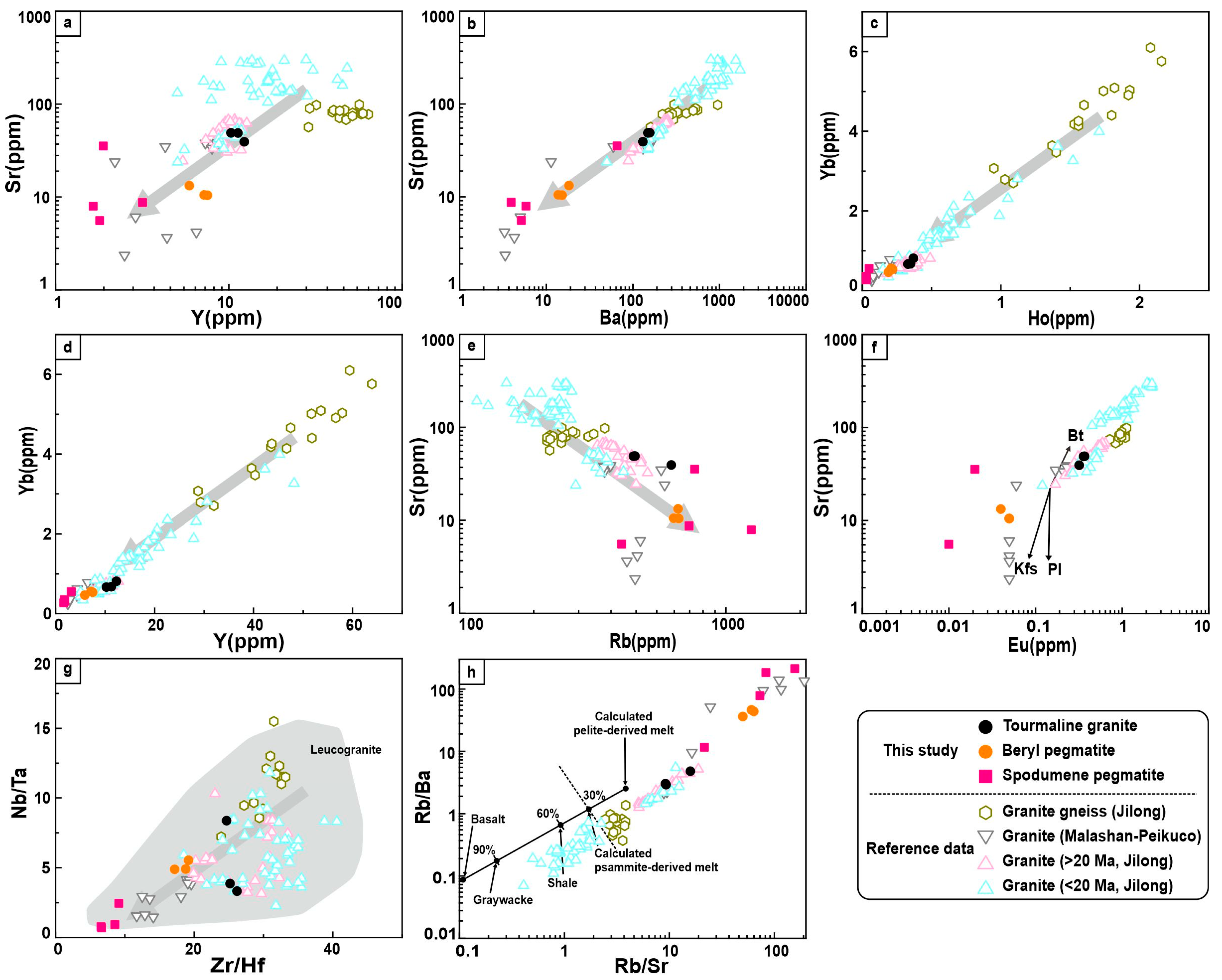
Furthermore, comparison with regional granitoids (e.g., Gyirong gneiss, >20 Ma Gyirong granites [30]; Malashan granites [25,26,27]) reveals that the Zhaguopu intrusive suite extends toward more evolved compositions in element variation diagrams (e.g., Sr vs. Rb, Ba vs. Rb; Figure 10). This geochemical continuity suggests a shared source—likely the metasedimentary rocks of the Greater Himalayan Crystalline Sequence—and underscores the role of protracted fractional crystallization in concentrating incompatible elements such as Li, Be, Nb, and Ta [68,69].
Figure 10.
Binary diagrams of trace element associations. (a) Sr vs. Y; (b) Sr vs. Ba; (c) Yb vs. Ho; (d) Yb vs. Y; (e) Sr vs. Rb; (f) Sr vs. Eu; (g) Nb/Ta vs. Zr/Hf; (h) Rb-Ba vs. Rb-Sr (after Sylvester [70]).
The strong correlation between the degree of fractionation (indicated by indices such as Rb/Sr, K/Rb) and rare-metal enrichment highlights magmatic differentiation as a key mechanism for ore formation. When coupled with the contemporaneous tectonic extension along the STDS, which facilitated melt extraction and emplacement, these geochemical constraints reinforce a genetic model where post-collisional crustal melting, extended crystal fractionation, and structurally controlled melt ascent collectively drove the formation of the Zhaguopu rare-metal pegmatites.
5.3. Geological Significance
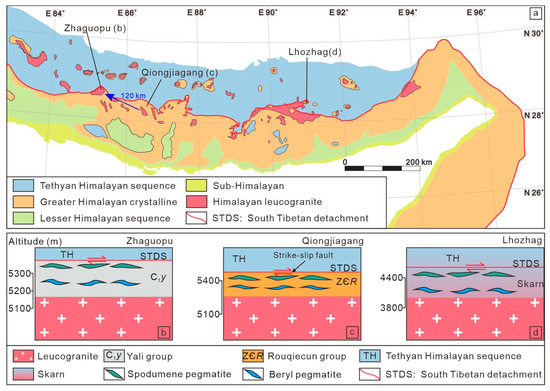
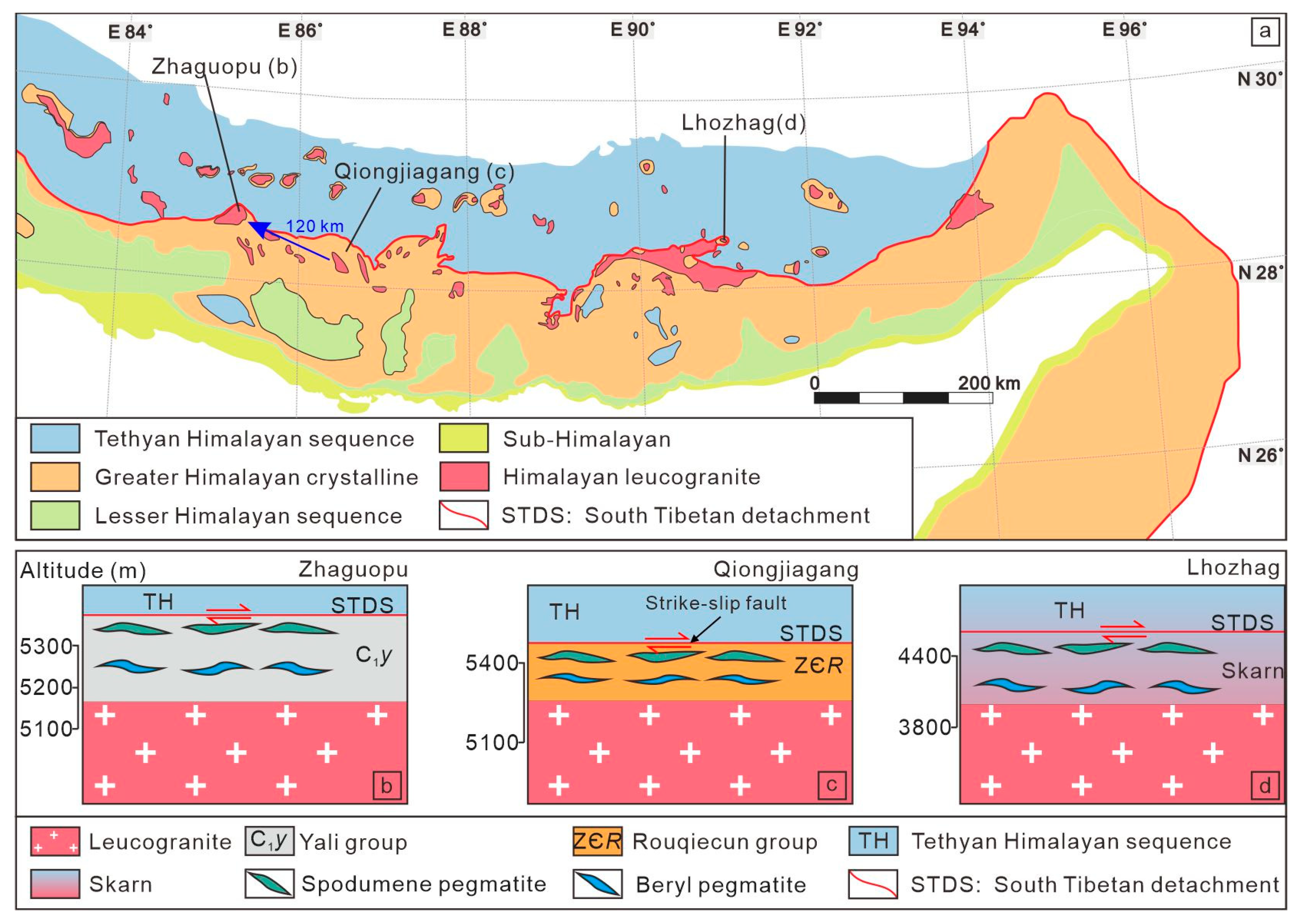
The discovery of multiple Li-Be-Nb-Ta pegmatite ore bodies distributed concentrically around the Gyirong granite dome highlights the significant rare-metal mineralization potential of this region. This mineralization exhibits a consistent vertical lithofacies sequence observed across the Himalayan belt, including the Zhaguopu, Qionjagang-Pushila-Requ-Nibu Xiaoba, and Luoza regions [8,9,10]. The characteristic zonation progresses from bottom to top as follows: light-colored tourmaline granite → beryl pegmatite → spodumene pegmatite (Figure 11) [13,67]. This pattern reflects progressive magmatic differentiation and volatile enrichment during pegmatite formation. The nature of surrounding rocks plays a crucial role in mineralization quality. While host rocks vary from Carboniferous–Permian sedimentary sequences to Precambrian metamorphic rocks and granite, mineralization appears particularly enhanced where marble is present. This observation supports the fundamental geological principle that granite dome peripheries represent favorable environments for rare-metal mineralization.
Figure 11.
Spatial distribution and metallogenic model of lithium-bearing (spodumene) pegmatites in the Himalaya orogenic belt (a). Modified from Liu et al. [67]. The characteristic zonation progresses from bottom to top as follows: light-colored tourmaline granite (b) → beryl pegmatite (c) → spodumene pegmatite (d).
The Zhaguopu Li-Nb-Ta-Be deposit, located approximately 120 km west of the Qiongjiagang deposit, shows remarkable similarities in spatial distribution, deposit type, and metallogenic age. This discovery represents a major breakthrough for the western Himalayan metallogenic belt, effectively extending the known rare-metal mineralized zone westward by 120 km. The consistent characteristics between these geographically separated deposits strengthen the concept of a regional-scale Himalayan lithium polymetallic metallogenic belt. These findings provide crucial guidance for future exploration strategies. Priority should be given to: (1) large-scale structural features associated with the Southern Tibetan Detachment System; (2) dome structures and their higher-altitude peripheral zones; (3) upper structural layers above the Proterozoic Rongbu Group; and (4) the outer margins of beryl-rich leucogranite–pegmatite zones. This guidance is supported by our geochemical findings that these locations are favorable for the emplacement of the most highly fractionated, and thus most fertile, pegmatitic melts. Systematic field mapping and investigation of these target areas will be essential for expanding mineral exploration achievements in the Himalayas, potentially leading to discoveries of larger reserves and higher-grade ores, and the development of updated exploration models. The extension of the metallogenic belt significantly enhances the strategic importance of the Himalayan region as a potential source of critical mineral resources.
6. Conclusions
The discovery of the Zhaguopu Li-Be-Nb-Ta rare-metal deposit, together with earlier identified deposits at Qiongjiagang and Gabo (Lhozhag area), represents a substantial advancement in rare-metal exploration within the western Himalayan metallogenic belt. The following conclusions can be drawn from this study:
- U-Pb geochronological analyses of zircon, monazite, and columbite–tantalite indicate that the tourmaline granite, beryl pegmatite, and spodumene pegmatite at Zhaguopu were emplaced at approximately 25–23 Ma. This age constraint places the rare-metal mineralization event within the Neohimalayan stage of Himalayan evolution.
- The granite–pegmatite dome exhibits a well-defined zonation pattern, with tourmaline granite at the core surrounded by successive zones of beryl pegmatite and spodumene pegmatite. This zonation is robustly supported by continuous whole-rock geochemical trends characterized by increasing SiO2 and peraluminosity, coupled with systematic depletion in compatible elements (Fe, Mg, Ti, P, Ba, Sr, Eu), delineating a clear path of extreme fractional crystallization. The consistent crystallization ages of these units support a petrogenetic model in which they originated through progressive differentiation from a common magmatic source.
- The Li-Be-Nb-Ta mineralization in the Gyirong area shows a clear temporal and spatial relationship with post-collisional extensional tectonics and large-scale detachment faulting within the Himalayan orogenic belt. This correlation indicates that the 25–23 Ma rare-metal mineralization was genetically associated with activity along the South Tibetan Detachment System (STDS), representing a clear example of tectono-magmatic coupling.
- The Zhaguopu discovery extends the known extent of Himalayan rare-metal mineralization ~120 km westward. This finding provides both theoretical insights into regional metallogeny and practical guidance for future exploration strategies. It underscores the strong potential for identifying additional pegmatite-hosted rare-metal deposits in this previously underexplored region and significantly advances our understanding of geological processes and mineralization mechanisms in the western Himalayan segment.
Supplementary Materials
The following supporting information can be downloaded at: https://www.mdpi.com/article/10.3390/min16020208/s1, Table S1: LA-ICP-MS U-Pb isotopic compositions of zircon from the newly discovered Gyirong rare metal deposit; Table S2: Trace element concentration (ppm) of zircon from the newly discovered Gyirong rare metal deposit; Table S3: LA-ICP-MS U-Pb isotopic compositions of monazite from the newly discovered Gyirong rare metal deposit; Table S4: Trace element concentration (ppm) of monazite from the newly discovered Gyirong rare metal deposit; Table S5: LA-ICP-MS U-Pb isotopic compositions of columbite-tantalite from the newly discovered Gyirong rare metal deposit; Table S6: Major and trace element (ppm) compositions of columbite-tantalite from the newly discovered Gyirong rare metal deposit; Table S7: Whole-rock geochemical composition of the newly discovered Gyirong rare metal deposit.
Author Contributions
G.C.: Geological context and introduction, field mapping and field relationships, sample collection, petrography, discussion and interpretations. H.L.: Fieldwork, geochemical and isotope data processing, discussion and interpretation of data documentation. H.C.: Fieldwork, sample collection, some petrography and data processing. X.H.: parts of the Analytical Methods section, petrography, discussion and interpretations. All authors have read and agreed to the published version of the manuscript.
Funding
Fieldwork and analytical costs for this project were supported by funding from Science and Technology Projects of Xizang Autonomous Region, Research and Development and Application Demonstration of Shortwave-Infrared and Thermal Infrared Spectral Exploration Technology in Special Landscape Areas of Xizang (XZ202401JD0017), Research on Metallogenic Regularity and Prospecting Targeting of Sn-Ag Polymetallic Deposits in the Continental Volcanic Rock Areas of Western Xizang (XZ202502JD0013), and Tibet Julong Copper Industry Limited Company of project—the Research on the Development Practice of Technological Innovation Empowering Julong Copper Mine to Build a Chinese Modernized Green Mine.
Data Availability Statement
The original contributions presented in this study are included in the article and its Supplementary Material. Further inquiries can be directed to the corresponding author.
Conflicts of Interest
The co-author Gen Chen is affiliated with the Tibet Julong Copper Industry Limited Company. The remaining authors declare that the research was conducted in the absence of any commercial or financial relationships that could be construed as a potential conflict of interest.
References
- Kesler, S.E.; Gruber, P.W.; Medina, P.A.; Keoleian, G.A.; Everson, M.P.; Wallington, T.J. Global lithium resources: Relative importance of pegmatite, brine and other deposits. Ore Geol. Rev. 2012, 48, 55–69. [Google Scholar] [CrossRef] [Scilit]
- Černý, P.; Ercit, T.S. The Classification of Granitic Pegmatites Revisited. Can. Mineral. 2005, 43, 2005–2026. [Google Scholar] [CrossRef] [Scilit]
- Lu, J.; Chen, X.; Jiang, J.; Schertl, H.P.; Cao, L.; Jiang, X. Chemical and boron isotope composition of multiple generations of tourmaline from the Nassarawa lithium-rich pegmatites, Nigeria: Implications for the mechanism of lithium enrichment. Lithos 2025, 494, 107936. [Google Scholar]
- Wu, F.Y.; Liu, X.C.; Liu, Z.C.; Wang, R.C.; Xie, L.; Wang, J.M.; Ji, W.Q.; Yang, L.; Liu, C.; Khanal, G.P. Highly fractionated Himalayan leucogranites and associated rare-metal mineralization. Lithos 2020, 352–353, 105319. [Google Scholar] [CrossRef] [Scilit]
- Wu, F.Y.; Liu, X.C.; Hu, F.Y.; Xie, L.; Wang, R.C. Himalayan Leucogranites: Rare-metal Resources. Elements 2024, 20, 401–408. [Google Scholar] [CrossRef] [Scilit]
- Teng, F.Z.; Wu, F.Y. Himalayan Leucogranites: Petrogenesis and Significance. Elements 2024, 20, 367–372. [Google Scholar] [CrossRef] [Scilit]
- Wang, Z.Z.; Teng, F.Z.; Zeng, L.S.; Liu, Z.C. Himalayan Leucogranites: A Geochemical Perspective. Elements 2024, 20, 395–400. [Google Scholar] [CrossRef] [Scilit]
- Qin, K.Z.; Zhao, J.X.; He, C.T.; Shi, R.Z. Discovery of the Qongjiagang giant lithium pegmatite deposit in Himalaya, Tibet, China. Acta Petrol. Sin. 2021, 37, 3277–3286, (In Chinese with English abstract). [Google Scholar] [CrossRef] [Scilit]
- Zhao, Z.; Yang, X.Y.; Lu, S.M.; Lu, Y.Y.; Sun, C.; Chen, S.S.; Zhang, Z.Z.; Ibrahim Bute, S.; Zhao, L.L. Genesis of Late Cretaceous granite and its related Nb–Ta–W mineralization in Shangbao, Nanling Range: Insights from geochemistry of whole-rock and Nb–Ta minerals. Ore Geol. Rev. 2021, 131, 103975. [Google Scholar] [CrossRef] [Scilit]
- Liu, X.C.; Wu, F.; Wang, R.C.; Liu, Z.C.; Wang, J.M.; Liu, C.; Hu, F.Y.; Yang, L.; He, S.X. Discovery of spodumene-bearing pegmatites from Ra Chu in the Mount Qomolangma region and its implications for studying rare-metal mineralization in the Himalayan orogen. Acta Petrol. Sin. 2021, 37, 3295–3304. [Google Scholar] [CrossRef] [Scilit]
- Xie, L.; Wang, R.C.; Tian, E.N.; Tao, X.Y.; Zhou, W.; Liu, X.C.; Wu, F.Y. The rare-metal mineralogical study on the Kuqu Li-Be-rich granitic pegmatite from the eastern Himalaya. Acta Petrol. Sin. 2024, 40, 404–432, (In Chinese with English abstract). [Google Scholar] [CrossRef] [Scilit]
- Hu, F.Y.; Liu, X.C.; He, S.X.; Wang, J.M.; Wu, F.Y. Cesium-rubidium mineralization in Himalayan leucogranites. Sci. China (Earth Sci.) 2023, 66, 2827–2852. [Google Scholar] [CrossRef] [Scilit]
- Hu, F.Y.; Pu, H.L.; Guo, Z.; Lin, T.J.; Liu, X.C.; He, S.X.; Wu, F.Y. Discovery of the Gangbu spodumene-bearing pegmatite in the Shisha Pangma region and its geological significance. Acta Petrol. Sin. 2024, 40, 1489–1509, (In Chinese with English abstract). [Google Scholar] [CrossRef] [Scilit]
- Zheng, Y.Y.; Chen, X.; Gao, S.B.; Li, H.Q.; Jiang, X.J.; Zheng, S.L. Discovery and Prospecting Significance of Zhaguopu Li-Nb-Ta Deposit in the Western Himalayan Metallogenic Belt. Earth Sci. 2024, 49, 1555–1564, (In Chinese with English abstract). [Google Scholar] [CrossRef] [Scilit]
- Xie, L.; Tao, X.; Wang, R.; Wu, F.; Liu, C.; Liu, X.; Li, X.; Zhang, R. Highly fractionated leucogranites in the eastern Himalayan Cuonadong dome and related magmatic Be-Nb-Ta and hydrothermal Be-W-Sn mineralization. Lithos 2020, 354, 105286. [Google Scholar] [CrossRef] [Scilit]
- Srikantia, S.V. Himalayan Thrusts and Structural Belts. J. Geol. Soc. India 1988, 31, 210–229. [Google Scholar] [CrossRef] [Scilit]
- Beck, R.A.; Burbank, D.W.; Sercombe, W.J.; Olson, T.L.; Khan, A.M. Organic carbon exhumation and global warming during the early Himalayan collision. Geology 1995, 23, 387–390. [Google Scholar] [CrossRef] [Scilit]
- Rowley, D.B. Age of initiation of collision between India and Asia: A review of stratigraphic data. Earth Planet. Sci. Lett. 1996, 145, 1–13. [Google Scholar] [CrossRef] [Scilit]
- Zheng, Y.Y.; Wang, D.; Yi, J.Z.; Yu, Z.Z.; Jiang, Z.Y.; Li, X.X.; Shi, G.W.; Xu, J.; Liang, Y.C.; Dou, X.F.; et al. Antimony mineralization and prospecting orientation in the North Himalayan Metallogenic Belt, Tibet. Earth Sci. Front. 2022, 29, 220–230, (In Chinese with English abstract). [Google Scholar]
- Weinberg, R.F. Himalayan leucogranites and migmatites: Nature, timing and duration of anatexis. J. Metamorph. Geol. 2016, 34, 821–843. [Google Scholar] [CrossRef] [Scilit]
- Liu, Z.C.; Wu, F.Y.; Liu, X.C.; Wang, J.G.; Yin, R.; Qiu, Z.L.; Ji, W.Q.; Yang, L. Mineralogical evidence for fractionation processes in the Himalayan leucogranites of the Ramba Dome, southern Tibet. Lithos 2019, 340–341, 71–86. [Google Scholar] [CrossRef] [Scilit]
- Cao, H.W.; Pei, Q.M.; Santosh, M.; Li, G.M.; Zhang, L.K.; Zhang, X.F.; Zhang, Y.H.; Zou, H.; Dai, Z.W.; Lin, B.; et al. Himalayan leucogranites: A review of geochemical and isotopic characteristics, timing of formation, genesis, and rare metal mineralization. Earth-Sci. Rev. 2022, 234, 104229. [Google Scholar] [CrossRef] [Scilit]
- Liu, Y.C.; Qin, K.Z.; Zhao, J.X.; Zhou, Q.F.; Shi, R.Z.; He, C.T.; Gao, Y.Y. Feldspar traces mineralization processes in the Qongjiagang giant lithium ore district, Himalaya, Tibet. Ore Geol. Rev. 2023, 157, 105451. [Google Scholar] [CrossRef] [Scilit]
- Wang, J.M.; Wu, F.Y.; Zhang, J.J.; Khanal, G.; Yang, L. The Himalayan Collisional Orogeny: A Metamorphic Perspective. Acta Geol. Sin.-Engl. Ed. 2022, 96, 1842–1866, (In Chinese with English abstract). [Google Scholar] [CrossRef] [Scilit]
- Gao, L.E.; Zeng, L.S.; Asimow, P.D. Contrasting geochemical signatures of fluid-absent versus fluid-fluxed melting of muscovite in metasedimentary sources: The Himalayan leucogranites. Geology 2017, 45, 39–42. [Google Scholar] [CrossRef] [Scilit]
- Gao, L.E.; Zeng, L.S.; Zhao, L.H.; Hou, K.J.; Guo, C.L.; Gao, J.H.; Wang, Y.Y. Geochemical behavior of rare metals and high field strength elements during granitic magma differentiation: A record from the Borong and Malashan Gneiss Domes, Tethyan Himalaya, southern Tibet. Lithos 2021, 398–399, 106344. [Google Scholar] [CrossRef] [Scilit]
- Gao, L.E.; Zeng, L.S.; Zhao, L.H.; Yan, L.L.; Hou, K.J.; Wang, Q. Fluid-fluxed melting in the Himalayan orogenic belt: Implications for the initiation of E-W extension in southern Tibet. GSA Bull. 2023, 136, 989–1002. [Google Scholar] [CrossRef] [Scilit]
- Zhang, J.J.; Santosh, M.; Wang, X.X.; Guo, L.; Yang, X.Y.; Zhang, B. Tectonics of the northern Himalaya since the India–Asia collision. Gondwana Res. 2012, 21, 939–960. [Google Scholar] [CrossRef] [Scilit]
- Wang, X.X.; Zhang, J.J.; Yang, X.Y.; Zhang, B. Zircon SHRIMP U-Pb ages, Hf isotopic features and their geological significance of the Greater Himalayan Crystalline Complex augen gneiss in Gyirong Area, south Tibet. Earth Sci. Front. 2011, 18, 127–139, (In Chinese with English abstract). [Google Scholar]
- Wang, X.X.; Zhang, J.J.; Yang, X.Y. Geochemical Characteristics of the Leucogranites from Gyirong, South Tibet: Formation Mechanism and Tectonic Implications. Geotecton. Metallog. 2017, 41, 354–368, (In Chinese with English abstract). [Google Scholar]
- Zong, K.Q.; Klemd, R.; Yuan, Y.; He, Z.Y.; Guo, J.L.; Shi, X.L.; Liu, Y.S.; Hu, Z.C.; Zhang, Z.M. The assembly of Rodinia: The correlation of early Neoproterozoic (ca. 900 Ma) high-grade metamorphism and continental arc formation in the southern Beishan Orogen, southern Central Asian Orogenic Belt (CAOB). Precambrian Res. 2017, 290, 32–48. [Google Scholar] [CrossRef] [Scilit]
- Hu, Z.C.; Zhang, W.; Liu, Y.S.; Gao, S.; Li, M.; Zong, K.Q.; Chen, H.H.; Hu, S.H. “Wave” signal smoothing and mercury removing device for laser ablation quadrupole and multiple collector ICP-MS analysis: Application to lead isotope analysis. Anal. Chem. 2015, 87, 1152–1157. [Google Scholar] [CrossRef] [Scilit]
- Hu, Z.C.; Li, X.H.; Luo, T.; Zhang, W.; Crowley, J.; Li, Q.L.; Ling, X.X.; Yang, C.; Li, Y.; Feng, L.P.; et al. Tanz zircon megacrysts: A new zircon reference material for the microbeam determination of U-Pb ages and Zr-O isotopes. J. Anal. At. Spectrom. 2021, 36, 2715–2734. [Google Scholar] [CrossRef] [Scilit]
- Liu, Y.S.; Hu, Z.C.; Gao, S.; Günther, D.; Xu, J.; Gao, C.G.; Chen, H.H. In situ analysis of major and trace elements of anhydrous minerals by LA-ICP-MS without applying an internalstandard. Chem. Geol. 2008, 257, 34–43. [Google Scholar] [CrossRef] [Scilit]
- Liu, Y.S.; Gao, S.; Hu, Z.C.; Gao, C.G.; Zong, K.Q.; Wang, D.B. Continental and oceanic crust recycling-induced melt-peridotite interactions in the Trans-North China Orogen: U-Pb dating, Hf isotopes and trace elements in zircons of mantle xenoliths. J. Petrol. 2010, 51, 537–571. [Google Scholar] [CrossRef] [Scilit]
- Wiedenbeck, M.; Alle, P.; Corfu, F.Y.; Griffin, W.L.; Meier, M.; Oberli, F.; Von Quadt, A.; Roddick, J.C.; Spiegel, W. Three natural zircon standards for U-Th-Pb, Lu-Hf, trace element and REE analyses. Geostand. Newsl. 1995, 19, 1–23. [Google Scholar] [CrossRef] [Scilit]
- Pearce, N.J.G.; Perkins, W.T.; Westgate, J.A.; Gorton, M.P.; Jackson, S.E.; Neal, C.P.; Chenery, S.P. A compilation of new and published major and trace element data for NIST SRM 610 and NIST SRM 612 glass reference materials. Geostand. Newsl. 1997, 21, 115–144. [Google Scholar] [CrossRef] [Scilit]
- Rocholl, A.B.E.; Simon, K.; Jochum, K.P.; Bruhn, F.; Gehann, R.; Kramar, U.; Luecke, W.; Molzahn, M.; Pernicka, E.; Seufert, M.; et al. Chemical Characterisation of NIST Silicate Glass Certified Reference Material SRM 610 by ICP-MS, TIMS, LIMS, SSMS, INAA, AAS and PIXE. Geostand. Newsl. 1997, 21, 101–114. [Google Scholar] [CrossRef] [Scilit]
- Zong, K.Q.; Chen, J.Y.; Hu, Z.C.; Liu, Y.S.; Li, M.; Fan, H.H.; Meng, Y.N. In-situ U-Pb dating of uraninite by fs-LA-ICP-MS. Sci. China Earth Sci. 2015, 58, 1731–1740. [Google Scholar] [CrossRef] [Scilit]
- Aleinikoff, J.N.; Schenck, W.S.; Plank, M.O.; Srogi, L.; Fanning, C.M.; Kamo, S.L.; Bosbyshell, H. Deciphering igneous and metamorphic events in high-grade rocks of the wilmington complex, delaware: Morphology, cathodoluminescence and backscattered electron zoning, and shrimp u-pb geochronology of zircon and monazite. GSA Bull. 2006, 118, 39–64. [Google Scholar] [CrossRef] [Scilit]
- Qing, L.Y.; Luo, T.; Hu, Z.C.; Li, Y.; Tu, J.R.; Zhang, L.L.; Zhang, W.; Zong, K.Q. OXF: A new natural reference material for use in LA-ICP-MS U–Pb columbite–tantalite geochronology. J. Anal. At. Spectrom. 2024, 39, 2066–2077. [Google Scholar] [CrossRef] [Scilit]
- Paton, C.; Hellstrom, J.; Paul, B.; Woodhead, J.; Hergt, J. Iolite: Freeware for the visualisation and processing of mass spectrometric data. J. Anal. At. Spectrom. 2011, 26, 2508–2518. [Google Scholar] [CrossRef] [Scilit]
- Vermeesch, P. IsoplotR: A free and open toolbox for geochronology. Geosci. Front. 2018, 9, 1479–1493. [Google Scholar] [CrossRef] [Scilit]
- Hoskin, P.W.O. Trace-Element Composition of Hydrothermal Zircon and the Alteration of Hadean Zircon from the Jack Hills,Australia. Geochim. Cosmochim. Acta 2005, 69, 637–648. [Google Scholar] [CrossRef] [Scilit]
- Guitreau, M.; Flahaut, J. Record of low-temperature aqueous alteration of Martian zircon during the late Amazonian. Nat. Commun. 2019, 10, 2457. [Google Scholar] [CrossRef] [Scilit]
- Han, J.; Hanchar, J.M.; Pan, Y.; Hollings, P.; Chen, H. Hydrothermal alteration, not metamictization, is the main trigger for modifying zircon in highly evolved granites. GSA Bull. 2024, 136, 1878–1888. [Google Scholar] [CrossRef] [Scilit]
- Sun, S.S.; McDonough, W.F. Chemical and Isotopic Systematics of Oceanic Basalts: Implications for Mantle Composition and Processes; Special Publications; Geological Society: London, UK, 1989; Volume 42, pp. 313–345. [Google Scholar]
- Wu, L.G.; Li, X.H.; Ling, X.X.; Yang, Y.H.; Li, C.F.; Li, Y.L.; Mao, Q.; Li, Q.L.; Putlitz, B. Further Characterization of the RW-1 Monazite: A New Working Reference Material for Oxygen and Neodymium Isotopic Microanalysis. Minerals 2019, 9, 583. [Google Scholar] [CrossRef] [Scilit]
- Bergemann, C.; Gnos, E.; Berger, A.; Whitehouse, M.; Mullis, J.; Wehrens, P.; Pettke, T.; Janots, E. Th-Pb ion probe dating of zoned hydrothermal monazite and its implications for repeated shear zone activity: An example from the Central Alps, Switzerland. Tectonics 2017, 36, 671–689. [Google Scholar] [CrossRef] [Scilit]
- Itano, K.; Iizuka, T.; Hoshino, M. REE-Th-U and Nd isotope systematics of monazites in magnetite- and ilmenite-series granitic rocks of the Japan arc: Implications for its use as a tracer of magma evolution and detrital provenance. Chem. Geol. 2018, 484, 69–80. [Google Scholar] [CrossRef] [Scilit]
- Le Maitre, R.W.; Dudek, P.; Keller, A.; Lameyre, J.; Le Bas, J.; Sabine, M.J.; Schmid, P.A.; Sorensen, R.; Streckeisen, H.; Woolley, A.; et al. A Classification of Igneous Rocks and Glossary of Terms—Recommendations of the International Union of Geological Sciences, Sub commission On the Systematics of Igneous Rocks, International Union of Geological Sciences; Blackwell Science: Oxford, UK, 1989; p. 236. [Google Scholar]
- Peccerillo, A.; Taylor, S.R. Geochemistry of Eocene calc-alkaline volcanic rocks from the Kastamonu area, northern Turkey. Contrib. Mineral. Petrol. 1976, 58, 63–81. [Google Scholar] [CrossRef] [Scilit]
- Middlemost, E.A.K. Towards a comprehensive classification of igneous rocks and magmas. Earth-Sci. Rev. 1991, 31, 73–87. [Google Scholar] [CrossRef] [Scilit]
- Kendall-Langley, L.A.; Kemp, A.I.; Grigson, J.L.; Hammerli, J. U-Pb and reconnaissance Lu-Hf isotope analysis of cassiterite and columbite group minerals from Archean Li-Cs-Ta type pegmatites of Western Australia. Lithos 2020, 352, 105231. [Google Scholar] [CrossRef] [Scilit]
- Cao, L.; Chen, X.; Jiang, J.; Garba, A.A.; Li, H.; Chao, N.; Lv, X. Geochronology of cassiterite in the Nassarawa-Keffi rare metal pegmatite belt, Nigeria: Tectonic linkages to the Gondwana-forming orogeny. Ore Geol. Rev. 2024, 175, 106339. [Google Scholar] [CrossRef] [Scilit]
- Smith, S.R.; Foster, G.L.; Romer, R.L.; Tindle, A.G.; Kelley, S.P.; Noble, S.R.; Horstwood, M.; Breaks, F.W. U-Pb columbite-tantalite chronology of rare-element pegmatites using TIMS and Laser Ablation-Multi Collector-ICP-MS. Contrib. Mineral. Petrol. 2004, 147, 549–564. [Google Scholar] [CrossRef] [Scilit]
- Dewaele, S.; Henjes-Kunst, F.; Melcher, F.; Sitnikova, M.; Burgess, R.; Gerdes, A.; Fernandez, M.A.; De Clercq, F.; Muchez, P.; Lehmann, B. Late Neoproterozoic overprinting of the cassiterite and columbite-tantalite bearing pegmatites of the Gatumba area, Rwanda (Central Africa). J. Afr. Earth Sci. 2011, 61, 10–26. [Google Scholar] [CrossRef] [Scilit]
- Schandl, E.S.; Gorton, M.P. A textural and geochemical guide to the identification of hydrothermal monazite: Criteria for selection of samples for dating epigenetic hydrothermal ore deposits. Econ. Geol. 2004, 99, 1027–1035. [Google Scholar] [CrossRef]
- Liu, C.; Wang, R.C.; Wu, F.Y.; Xie, L.; Liu, X.C.; Li, X.K.; Yang, L.; Li, X.J. Spodumene pegmatites from the Pusila pluton in the higher Himalaya, South Tibet: Lithium mineralization in a highly fractionated leucogranite batholith. Lithos 2020, 358–359, 105421. [Google Scholar] [CrossRef] [Scilit]
- Yang, L.; He, Y.; Wang, J.M.; Hou, K.S.; Tian, Y.L. Geochemical and geochronological study of beryl-bearing granitic pegmatite in the Mount Shisha Pangma Himalaya region. Acta Petrol. Sin. 2024, 40, 1548–1564, (In Chinese with English abstract). [Google Scholar] [CrossRef] [Scilit]
- Yin, A. Cenozoic tectonic evolution of the Himalayan orogen as constrained by along-strike variation of structural geometry, exhumation history, and foreland sedimentation. Earth-Sci. Rev. 2006, 76, 1–131. [Google Scholar] [CrossRef] [Scilit]
- Searle, M.P.; Cottle, J.M.; Streule, M.J.; Waters, D.J. Crustal melt granites and migmatites along the Himalaya: Melt source, segregation, transport and granite emplacement mechanisms. Earth Environ. Sci. Trans. R. Soc. Edinb. 2009, 100, 219–233. [Google Scholar] [CrossRef] [Scilit]
- Jessup, M.J.; Cottle, J.M. Progression from South-Directed Extrusion to Orogen-Parallel Extension in the Southern Margin of the Tibetan Plateau, Mount Everest Region, Tibet. J. Geol. 2010, 118, 467–486. [Google Scholar] [CrossRef] [Scilit]
- Martin, R.F.; De Vito, C. The patterns of enrichment in felsic pegmatites ultimately depend on tectonic setting. Can. Mineral. 2005, 43, 2027–2048. [Google Scholar] [CrossRef] [Scilit]
- Wu, F.Y.; Liu, X.C.; Ji, W.Q.; Wang, J.M.; Yang, L. Highly fractionated granites: Recognition and research. Sci. China Earth Sci. 2017, 60, 1201–1219. [Google Scholar] [CrossRef] [Scilit]
- Wu, F.Y.; Wang, R.C.; Liu, X.C.; Xie, L. New breakthroughs in the studlies of Himalayan rare-metal mineralization. Acta Petrol. Sin. 2021, 37, 3261–3276. [Google Scholar] [CrossRef] [Scilit]
- Liu, X.C.; Kohn, M.J.; Wang, J.M.; He, S.X.; Wang, R.C.; Wu, F.Y. Formation of lithium-rich pegmatites via rapid crystallization and shearing—Case study from the South Tibetan Detachment, Himalaya. Earth Planet. Sci. Lett. 2024, 629, 118598. [Google Scholar] [CrossRef] [Scilit]
- Harris, N.B.W.; Inger, S. Trace element modeling of pelite-derived granites. Contrib. Mineral. Petrol. 1992, 110, 46–56. [Google Scholar] [CrossRef] [Scilit]
- Harrison, M.T.; Grove, M.; Mckeegan, K.D.; Coath, C.D.; Lovera, Q.M.; Le Fort, P. Origin and episodic emplacement of the Manaslu intrusive complex, central Himalaya. J. Petrol. 1999, 40, 3–19. [Google Scholar] [CrossRef]
- Sylvester, P.J. Post-collisional strongly peraluminous granites. Lithos 1998, 45, 29–44. [Google Scholar] [CrossRef] [Scilit]
Disclaimer/Publisher’s Note: The statements, opinions and data contained in all publications are solely those of the individual author(s) and contributor(s) and not of MDPI and/or the editor(s). MDPI and/or the editor(s) disclaim responsibility for any injury to people or property resulting from any ideas, methods, instructions or products referred to in the content. |
© 2026 by the authors. Licensee MDPI, Basel, Switzerland. This article is an open access article distributed under the terms and conditions of the Creative Commons Attribution (CC BY) license.