Review

From Waste to Resource: Critical Mineral Recovery and Environmental Impact Mitigation in Copper Smelting Slag †
by
Aleksandar N. Nikoloski
1,*,
Pritam Singh
1 and
Tina Chanda Phiri
2
1
Extractive Metallurgy Hub, Harry Butler Institute (Centre for Water Energy and Waste), Murdoch University, Perth, WA 6168, Australia
2
School of Mines and Mineral Sciences, Copperbelt University, Kitwe P.O. Box 21962, Zambia
*
Author to whom correspondence should be addressed.
This article is a revised and expanded version of a paper entitled “An overview of global copper smelting slag production and reprocessing approaches” in Nikoloski, A.N.; Singh, P.; Phiri, T. An overview of global copper smelting slag production and reprocessing approaches. In Proceedings of the XVI International Mineral Processing and Recycling Conference (IMPRC 2025), Belgrade, Serbia, 28–30 May 2025.
Minerals 2026, 16(2), 206; https://doi.org/10.3390/min16020206
Submission received: 15 October 2025 / Revised: 23 November 2025 / Accepted: 7 February 2026 / Published: 17 February 2026

Abstract

Copper and cobalt are critically important metals for the transition to renewable energy and various aspects of modern life. Their production from primary sources, ores, necessitates metallurgical separation from the unwanted host materials, resulting in the generation of a huge amount of waste. Copper smelting slag is one of these metallurgical wastes, with 39 million tonnes of slag generated and discarded globally each year. These massive amounts of slag occupy a considerable and growing land footprint, often close to residential areas, and present a hazard that potentially releases contaminants into the environment. On the other hand, they also represent a material that often contains a significant residual amount of valuable copper and cobalt. To better understand and address the challenge of reducing the adverse impacts of the waste, as well as the possible commercial opportunity the contained critical metals present, this study reviews global smelting slag production over the last 25 years, its composition, and technical reprocessing options. A summary of the chemical and mineralogical characterization of the copper slag from diverse research is thus provided, as well as a comprehensive overview of the processing strategies for metal recovery from copper slag, such as flotation, pyrometallurgy, and hydrometallurgy. The study demonstrates that a huge amount of smelting slag has been produced, with great variation and complexity, which represents a major potential resource for cobalt and copper metals. The chemical and mineralogical composition of smelting slag varies from location to location, depending on the properties of the feed concentrate, type of fluxes, furnace type, and cooling rates employed during and after the smelting processes. The overview of the production trends and reprocessing techniques shows that while some notable effective options exist or are emerging, further research is needed into the reprocessing of smelting slag waste in order to create economic value, improve energy efficiency in metal production, increase critical metal supply, and reduce negative environmental impacts.

1. Introduction

Copper smelting slag is a waste product generated during the pyrometallurgical processing of copper concentrates. Global production of smelting slag is estimated at 37.7 million tons per year [1]. A considerable amount of smelting slag containing hazardous elements is often dumped in a slag disposal pit, and most of it is not fully utilized [1,2,3,4,5,6]. These hazardous substances are toxic and can accumulate in organisms, causing serious health risks to all organisms [7,8]. With fewer available sites for dumping smelting slag and stricter environmental regulations, the copper smelting industry faces an enormous challenge in managing the slag waste. As a result, it is becoming increasingly important to reduce waste disposal by making better use of copper slag as a valuable resource of critical minerals.
Copper slag contains significant amounts of essential metals such as (Cu), cobalt (Co), silver (Ag), nickel (Ni), zinc (Zn), lead (Pb), cadmium (Cd), and iron (Fe) in oxide, sulphide, and/or metallic forms [1]. This has sparked increased interest in recovering these valuable metals from copper slag using various techniques, including flotation, hydrometallurgy, pyrometallurgy, and a combination of pyrometallurgy and hydrometallurgy. The flotation process employs various collectors, modifiers, frothers, and depressants to extract entrained metal compounds from copper slag [9,10,11,12]. The hydrometallurgy technique for leaching copper slag with various lixiviants has been widely exploited [12,13,14,15,16,17,18]. The pyrometallurgical approach includes calcination, carbothermic reduction/smelting reduction, and reduction roasting, followed by magnetic separation. This technique has mostly been used to extract metals from copper slag via carbothermic reduction at temperatures ranging from 1400 to 1800 °C [19]. An integration of pyrometallurgy and hydrometallurgy for processing copper smelter slag that involves roasting the smelting slag followed by water or acid leaching has also been suggested [16,20,21,22]. However, no commercial application has been found for the extraction of valuable metals from smelting slag using these techniques.
Copper slag exhibits pronounced chemical and mineralogical heterogeneity, resulting in wide compositional variability. Consequently, comprehensive characterisation of copper slag is essential for selecting appropriate metal recovery techniques, conducting robust environmental impact assessments, and developing effective utilisation strategies. Gorai et al. [2] presented a comprehensive review of copper slag characterisation, with particular emphasis on metal recovery and utilisation technologies. Piatak et al. [23] examined the properties of ferrous and non-ferrous slags, highlighting their environmental impacts and potential as valuable secondary resources for reuse and recycling. Potysz et al. [6] synthesised existing knowledge on metallurgical slags, focusing on chemical and phase compositions, metal recovery potential, environmental risks, and long-term fate. More recently, Phiri et al. [24] provided an in-depth review of the chemical and mineralogical characteristics of copper slag, together with processing methodologies and utilisation pathways for copper smelting slags. Tian et al. [25] systematically evaluated metallurgical techniques for recycling and further purification of copper slag. Additionally, Phiri et al. [1] assessed global copper smelting slag generation as a potential secondary source of copper and cobalt within a circular economy framework. Collectively, these studies establish a comprehensive understanding of copper slag as both a metallurgical by-product and a valuable secondary resource. Early reviews by Gorai et al. [2] and Piatak et al. [23] provided foundational insights into slag characterization, environmental implications, and reuse potential, while Potysz et al. [6] deepened this knowledge by integrating chemical, mineralogical, and ecological aspects. More recent works by Phiri et al. [1,24] and Tian et al. [25] extend this framework by highlighting modern recovery techniques, circular-economy perspectives, and the emerging strategic importance of copper and cobalt in green-energy transitions. Together, these contributions underscore copper slag’s dual role as an environmental liability and a critical resource reservoir, emphasizing the need for innovative, sustainable recovery technologies to transform it into a viable resource for future metal supply chains.
Metallurgical recycling and processing solutions for copper smelting slag are still at the development stage, despite intensive research over the last several decades. Therefore, a review of current knowledge is required to guide the further development of techniques capable of leveraging the resource potential of copper smelting slag for the extraction of critical metals. The primary objective of this study is to present a comprehensive review of global copper smelting slag generation, as well as the various proposed approaches tested to date for extracting critical metals from copper smelting slag. Finally, the technical challenges and development bottlenecks of copper slag metallurgical processes, as well as potential measures to overcome these barriers, are summarized in order to provide useful and significant guidance for efficient copper slag processing and utilization.

2. World Overview of Copper Smelting Slag

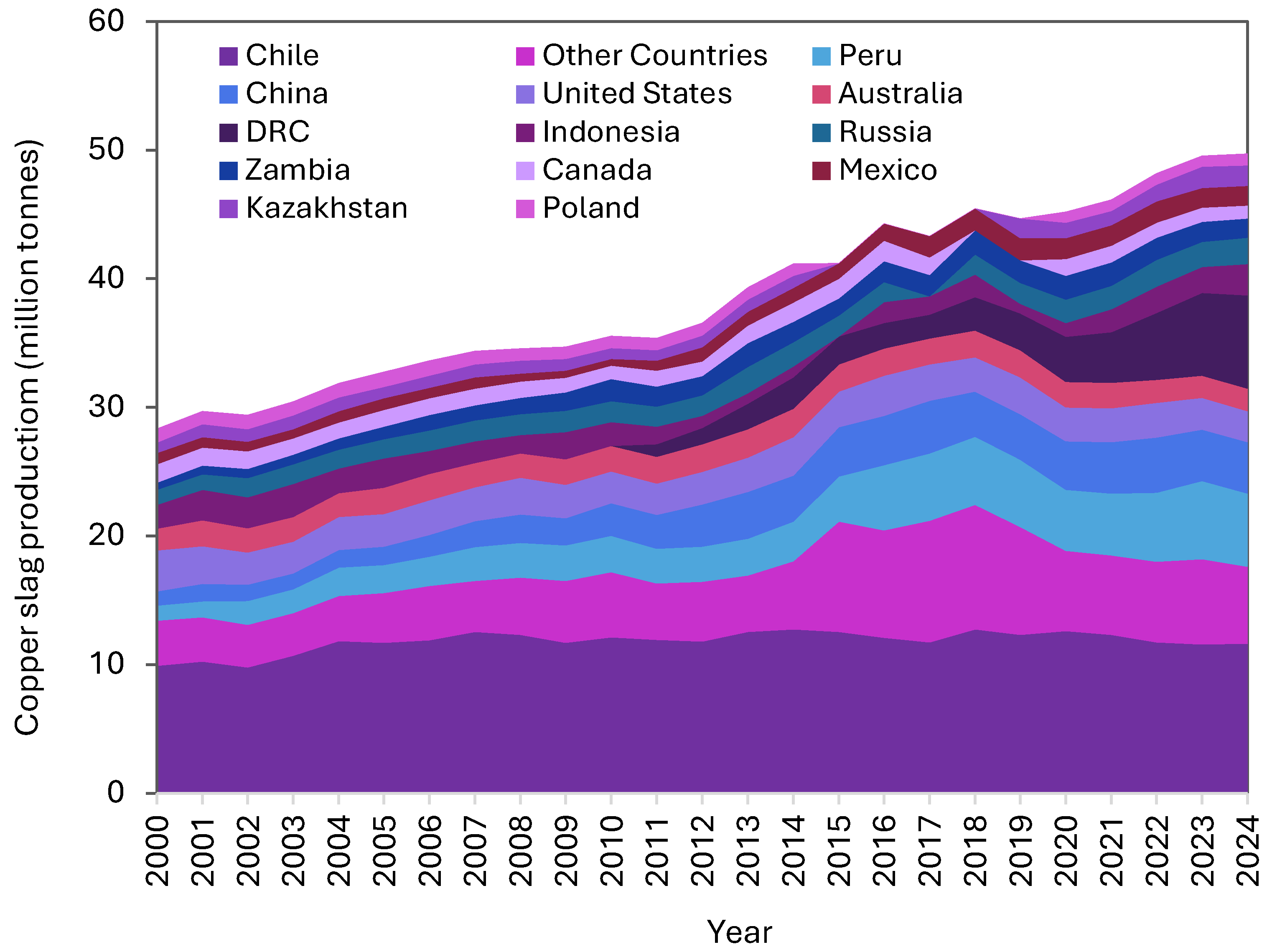
The global copper slag production is estimated at 966 million tons for the period between 2000 and 2024 from the 13 main producing countries (Figure 1). Copper smelting slag is considered a potential world resource owing to the huge amounts being produced worldwide, which contain substantial amounts of valuable metals [24]. The production figures for the period between 2000 and 2024 serve as evidence that huge amounts of copper slag waste are generated every year, and the upward trend in these figures is expected to continue in the coming decade due to the increase in global population, economic growth, and technological advancement. The average annual production is estimated at 38.6 million tons (Figure 1).

3. Furnace Technologies Producing Copper Slag

Copper slag generation is inherently linked to the type of furnace and the thermochemical processing route used in pyrometallurgical copper production. Each furnace design exhibits unique operational characteristics, reaction environments, and matte–slag separation efficiencies, resulting in significant variation in slag composition and copper losses. The following section reviews the principal furnace types, including reverberatory, electric, flash smelting, top-submerged lance (TSL), Peirce–Smith converter, and Teniente converter systems, and synthesizes key findings from the metallurgical literature.

3.1. Reverberatory Furnace

Reverberatory furnaces once formed the backbone of global copper smelting, operating at temperatures of approximately 1100–1300 °C. Their broad, pool-type bath geometry provides limited turbulence and slow matte–slag separation, conditions that inherently promote high copper losses to slag. Resulting slags typically contain 1.5–4.5 wt.% Cu, with levels reaching ~6 wt.% under sub-optimal operating conditions [27]. Copper reporting to the slag is predominantly associated with mechanically entrained matte droplets, dissolved Cu2O, and Cu–Fe–O spinel phases. Although central to early industrial copper production, reverberatory furnaces have been largely phased out due to their low thermal efficiency, high fuel consumption, and the large slag volumes they generate, which diminish overall metal recovery [28].

3.2. Electric Furnace (Electric Settling Furnaces)

Electric furnaces play a critical role in modern copper smelting flowsheets, primarily as slag-cleaning units that enhance matte–slag separation through high-intensity resistive heating. Operating at temperatures typically exceeding 1200–1500 °C [29], these furnaces generate strong convective currents and provide extended residence times, both of which promote the reduction and settling of entrained matte droplets. As a result, electric furnace slags usually contain only 0.5–1.5 wt.% Cu, ranking among the cleanest slags produced in pyrometallurgical copper processing [30]. Their ability to recover copper and other valuable metals from both primary smelting slags and converter slags makes electric furnaces indispensable components of contemporary, high-efficiency smelting operations.

3.3. Flash Smelting Furnace Slags (Outokumpu/INCO)

Flash smelting is the leading primary copper smelting technology worldwide and accounts for over half of global matte production [27]. In this process, finely ground copper concentrate is oxidized in suspension using oxygen-enriched air, enabling extremely rapid reaction kinetics, high heat generation, and autogenous smelting. Sulfide minerals such as chalcopyrite (CuFeS2) react almost instantaneously with the oxidant stream, producing sufficient exothermic heat to melt the feed and yielding a stable operating environment characterized by automatic temperature and composition control. Flash smelting has been widely adopted due to its high energy efficiency, effective sulfur capture, and elevated copper throughput [27,31]. The process typically produces a Cu–Fe–S matte containing 60–75% Cu alongside an iron–silicate slag with 0.8–2 wt.% Cu, depending on furnace conditions and feed characteristics [27]. Copper losses mainly arise from fine matte droplet entrainment and the formation of magnetite-rich slag phases [31] Importantly, flash furnaces generate significantly lower slag volumes than reverberatory furnaces due to reduced flux demand and more complete oxidation. Overall, flash smelting is considered the most economical and environmentally favorable industrial route for copper concentrate smelting and is central to achieving more sustainable metallurgical operations.

3.4. Top-Submerged Lance (TSL) Furnaces (Isasmelt/Ausmelt)

The Top-Submerged Lance (TSL) reactor is a highly adaptable, intensively mixed smelting technology whose efficiency is largely dictated by lance configuration and operation. The lance serves as the central functional element of the system, delivering oxidant gas, auxiliary fuels, and fine or dried concentrates directly into the molten bath, while additional feed can be supplied through overhead ports. Through the controlled delivery of these streams, the lance effectively regulates the oxygen partial pressure (pO2) within the furnace,a key variable influencing reaction pathways, matte and slag formation, and overall process thermodynamics [32]. Slags produced in TSL operations typically contain 0.8–1.5 wt.% Cu, with further reductions commonly achieved via electric furnace settling downstream of the main reactor [27,28]. Although the intrinsic turbulence of TSL operation can increase matte entrainment, modern monitoring and process control strategies significantly limit this effect. Owing to its compact design, lower operating and capital requirements, and strong environmental performance, TSL technology has become an increasingly preferred alternative to traditional smelting methods in both primary and secondary copper processing.

3.5. Peirce–Smith Converter

The Peirce–Smith Converter (PSC) is a batch oxidative smelting vessel widely used in copper production to convert copper matte (typically 65–75% Cu) into blister copper (98–99% Cu). Air or oxygen-enriched air is blown through tuyeres located along the converter barrel, oxidizing iron sulfide to form an FeO–SiO2 slag and driving the evolution of SO2 gas. The process proceeds in two main stages: the slag-forming (iron blow) stage, during which FeS is preferentially oxidized and removed as slag, followed by the copper blow, where remaining copper sulfide is oxidized to blister copper. Peirce–Smith Converter operation is influenced by high magnetite (Fe3O4) formation, which increases slag viscosity and contributes to copper losses through matte entrainment and Cu–Fe–O spinel formation [33]. Typical converter slags contain 1–2 wt.% Cu [34,35]. Despite drawbacks such as noise, high energy use, and discontinuous operation, PSCs remain dominant globally due to their robustness, operational simplicity, and compatibility with existing smelting flowsheets.

3.6. Teniente Converter

The Teniente converter is a continuous conversion reactor widely used in Chile and the United States. It uses a large cylindrical furnace with submerged tuyeres (35 to 50 tuyeres) of approximately 4 to 5 m and blows oxygen-enriched air through the tuyeres into molten matte. The dried concentrate, flux, reverts, coal/coke, recycle materials, and scrap are blown into the furnace through 3 or 4 dedicated tuyeres. The concentrate oxidation is achieved by blowing oxygen-enriched air through tuyeres into the furnace. Teniente converter typically contains 1–2 wt.% Cu, with losses influenced by blowing intensity, slag viscosity, and magnetite formation [27,30]. Thermodynamic studies have clarified the behavior of Cu–Fe–O–SiO2 phases in this system, highlighting the importance of oxygen potential control [27]. Teniente converters allow smoother operation and reduced fugitive emissions relative to Peirce–Smith Converters.
The variation in copper content among slags reflects the efficiency and operating philosophy of different furnaces. Reverberatory systems exhibit the highest copper losses due to slow settling, while electric furnaces provide the cleanest slags. Flash smelting and TSL furnaces represent modern high-efficiency technologies that balance productivity with low copper losses. Converter slags, particularly from PSC and Teniente systems, remain important targets for secondary recovery. Understanding these furnace-dependent slag characteristics is essential for optimizing copper extraction, minimizing losses, and designing effective slag treatment strategies.

4. Characterization of Smelting Slag

4.1. Chemical Composition

The bulk chemical composition of copper smelting slags is largely governed by the metallurgical conditions under which they are generated, including the mineralogy of the feed concentrate, furnace type, flux addition, and cooling regime [2,6,23,36]. Major constituents of copper smelter slags typically include silica (SiO2), ferrous oxide (FeO), ferric oxide (Fe2O3), calcium oxide (CaO), and alumina (Al2O3), which together define the physicochemical behavior of the slag during solidification and subsequent weathering. Copper smelter slags exhibit pronounced chemical and mineralogical heterogeneity, as reflected in the wide compositional ranges reported in Table 1. This variability is strongly influenced by cooling mechanisms, with air-cooled and water-quenched slags displaying markedly different phase assemblages. Cooling rate plays a critical role in controlling crystallization processes and phase diversity within the slag matrix. Ravindra et al. [37]) reported that fayalite (Fe2SiO4) is the dominant mineral phase in copper slags, constituting up to 57% of air-cooled slags compared to approximately 15% in quenched slags. Consistent with these observations, Potysz et al. [6] found that rapidly quenched slags are characterized by reduced crystalline phase diversity relative to slowly cooled slags. During slow cooling, crystallization occurs under conditions closer to thermodynamic equilibrium, promoting the development of multiple, well-defined mineral phases [38]. In contrast, rapid quenching suppresses extensive crystallization, resulting in a predominantly glassy matrix with limited crystalline content. These differences in cooling history have important implications for the physicochemical properties, environmental behavior, and potential secondary utilization of copper smelting slags.
These findings are consistent with previous observations that rapid cooling causes the formation of amorphous phases and metal oxide segregation, whereas slow cooling leads to the formation of vitreous and crystalline components [2,6,23,37]. This demonstrates that the cooling rate of the slag has a significant impact on phase composition. Table 1 summarises the average chemical composition of copper smelter slags derived from over 80 studies across 21 different countries. The average chemical composition of copper slag was calculated by considering studies conducted in each country at various copper smelting locations. The studies demonstrate substantial amounts of metals and metalloids, with an average of 3.05 wt.% Ca and 2.59 wt.% Al, 1.83 wt.% Zn, 1.67 wt.% Ag, 1.36 wt.% Mg, 1.19 wt.% Cu, 0.94 wt.% Pb, and 0.48 wt.% Co (Table 1). Other metals and metalloids such as As, Ti, Ni, Mn, Sb, and Mo were also detected but in much lesser amounts (lower than 0.4 wt.%).
The grade of Co and Cu in the slag exceeds the average ore grade for most mines due to the depletion of high- grade deposits in recent years. These minor elements exist in the slag as entrained sulfides, oxides, and metallic elements. Under high-temperature conditions, elements such as Cu, Co, and Ni preferentially form sulfide droplets that may become mechanically trapped within the silicate melt. Simultaneously, more oxidized conditions promote the formation of oxide and spinel phases (Fe3O4, Fe2SiO4) that incorporate trace metals through solid solution. During cooling, varying redox potentials and melt viscosities prevent full phase segregation, causing metallic copper and sulfide particles to remain dispersed within the glassy matrix. Consequently, the coexistence of these phases reflects non-equilibrium solidification, variable oxidation states, and mechanical entrapment of metal-rich phases, which together govern the mineralogical complexity and metal recoverability of copper slags.

4.2. Mineralogy of Copper Slag

Copper slag is primarily composed of fayalite (Fe2SiO4) and silicate glassy matrices, with crystalline oxides, sulfides, metallic elements, alloys, and intermetallic compounds as minor constituents [16,23,39,40,41,42]. The fayalite structure in copper slags is formed when pyrite is oxidized to iron oxide in the presence of silica and may contain minor amorphous silica phases [24,43]. In our recent study, the silicate phase was described as principally fayalite and kirschsteinite from the olivine group, while the copper phase was made up of copper matte and metallic copper [42]. Meanwhile, the magnetite phase was primarily found interbedded with the fayalite and kirschsteinite phases, forming a coherent structure with iron and other metallic components. Other research discovered certain common silicates with compositions equivalent to Melilite ((Ca, Na)2(Al, Mg, Fe2+)(Si, Al)2O7) and willemite (Zn2SiO4) [7,36,44]. Granulated slags were discovered to contain a significant amount of calcium and chloride, as well as iron in the form of magnetite, fayalite, and ferrosilite. The other sulfide phases that have been found to be present within the copper slags are pyrite (FeS2), galena (PbS), sphalerite ((Zn,Fe)S), pyrrhotite (Fe(1-X)S) and wurtzite ((Zn,Fe)S) whereas covellite (CuS), cubanite (CuFe2S3), digenite (Cu9S5), troilite (FeS), and pentlandite ((Fe,Ni)9S8) are rarely observed [23,36,45].
Potysz et al. [6] discovered that copper slags comprised several synthetic forms of naturally occurring mineral phases. Copper slags commonly contain sulfide minerals such as bornite (Cu5FeS4), chalcocite (Cu2S), and chalcopyrite (CuFeS2) [21,46,47]. The principal iron oxide minerals found in copper slag are fayalite (Fe2SiO4), spinels (MgAl2O4), hematite (Fe2O3), magnetite (Fe3O4) and wustite (FeO) 1 [23,36,37]. Copper slags can contain trace amounts of oxides, including leucite (K(AlSi2O6)), hercynite (FeAl2O4) [38,48,49]. Pyroxene group minerals like diopside (FeCaSi2O6) and hedenbergite (CaFeSi2O6), as well as the olivine group minerals like kirschsteinite (CaFe2+SiO4) and forsterite (Mg2SiO4) are also found in copper slags 1 [23,42,44,46].

5. Embedment of Critical Metals in the Smelting Slag

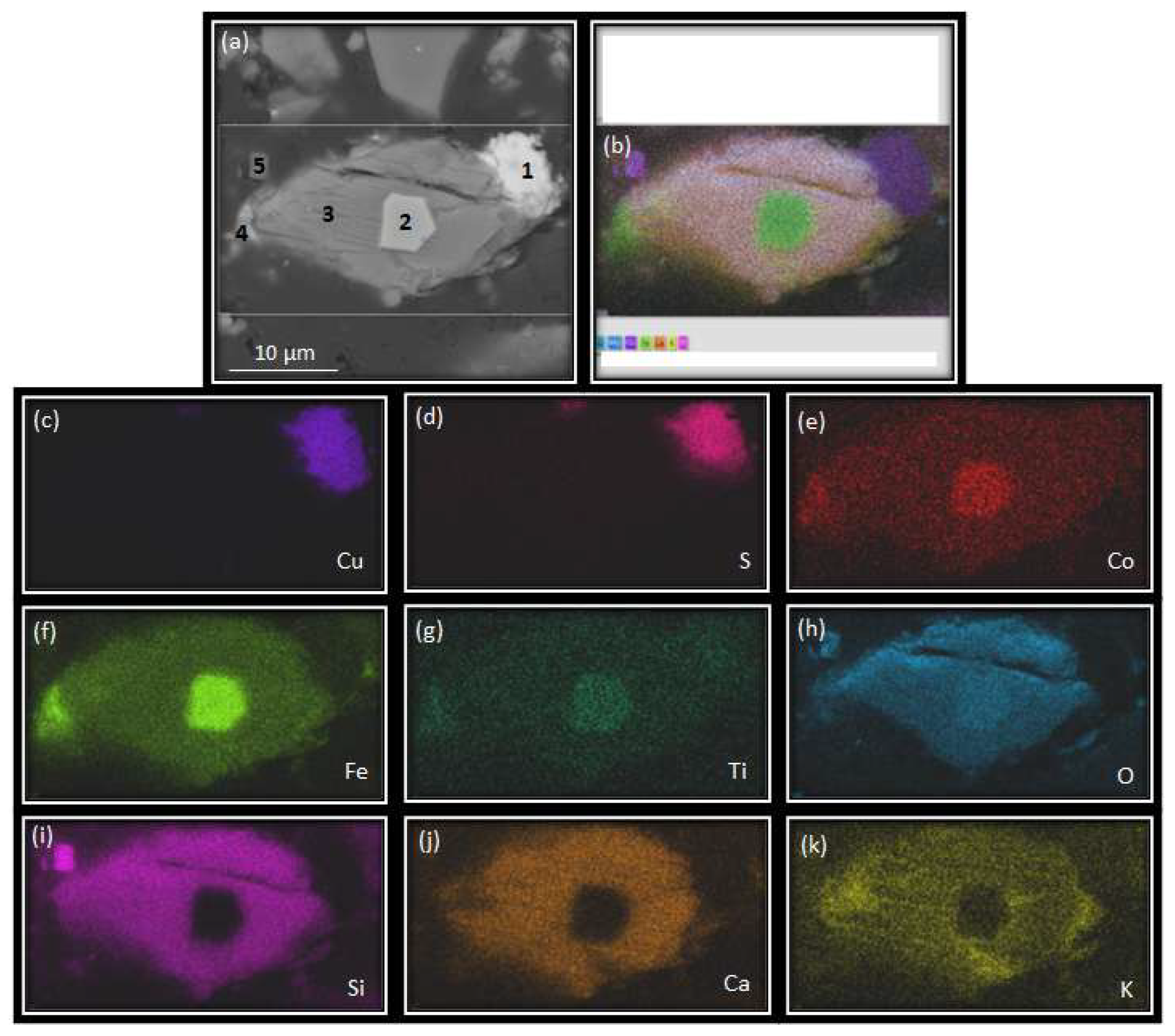
To show the embedment of critical metals in copper slag, backscattered electron (BSE) imaging was used to examine the polished surface of the smelting slag sample [42]. Figure 2 depicts the BSE images and mapping results for all the detectable metals in the smelting slag.
The distribution of copper in the mapped area (Figure 2b) is not uniform, and a significant concentration of copper can only be observed in Area 1 (Figure 2c). The considerable overlap between copper and sulfur at point 1 in the mapping area shows that this region is made up of CuS or Cu2S [42]. The principal types of copper metal were copper matte and metallic copper, which were interbedded with the silicate matrix. Also embedded were relatively small amounts of Co, Fe, Si, O, Ca, Al, and K, which were evenly distributed throughout the copper slag. This is consistent with earlier research findings that show copper is lost to the slag in the form of copper matte [2,23,46]. Highly oxidized slags from converting and/or direct-to-blister smelting methods contain copper in the form of iron and copper-bearing oxides such as delafossite [50].
In the study by Phiri et al. [42], the area labelled 2 in Figure 2a exhibited a perfect euhedral structure typical of iron oxide spinels. This area showed Co overlapping with other metallic elements, including Fe, Ti, and O as depicted in Figure 2f–h. Si was not detected in this area, suggesting the presence of magnetite containing embedded Co and Ti metals. The mapping area labelled 3 revealed identical features for Co, Fe, Si, Ti, K, Mg, Ca, and O, suggesting the presence of a complex silicate matrix with multiple metal encapsulations. The distribution of Co in the copper slag in the area labelled 4 matched the distribution of Fe and Ti, implying the presence of a Co-Ti-Fe alloy. The images also showed that copper was primarily dispersed as copper sulfide, but it was also found in an alloy with Fe. Overall, the mapping results show that substantial amounts of cobalt and other valuable metals (such as Cu, Ti, Fe, Si, K, Mg, and Ca) were embedded in the complex silicate matrix and magnetite phase, making extraction challenging.

5.1. Copper Embedment in the Smelting Slag

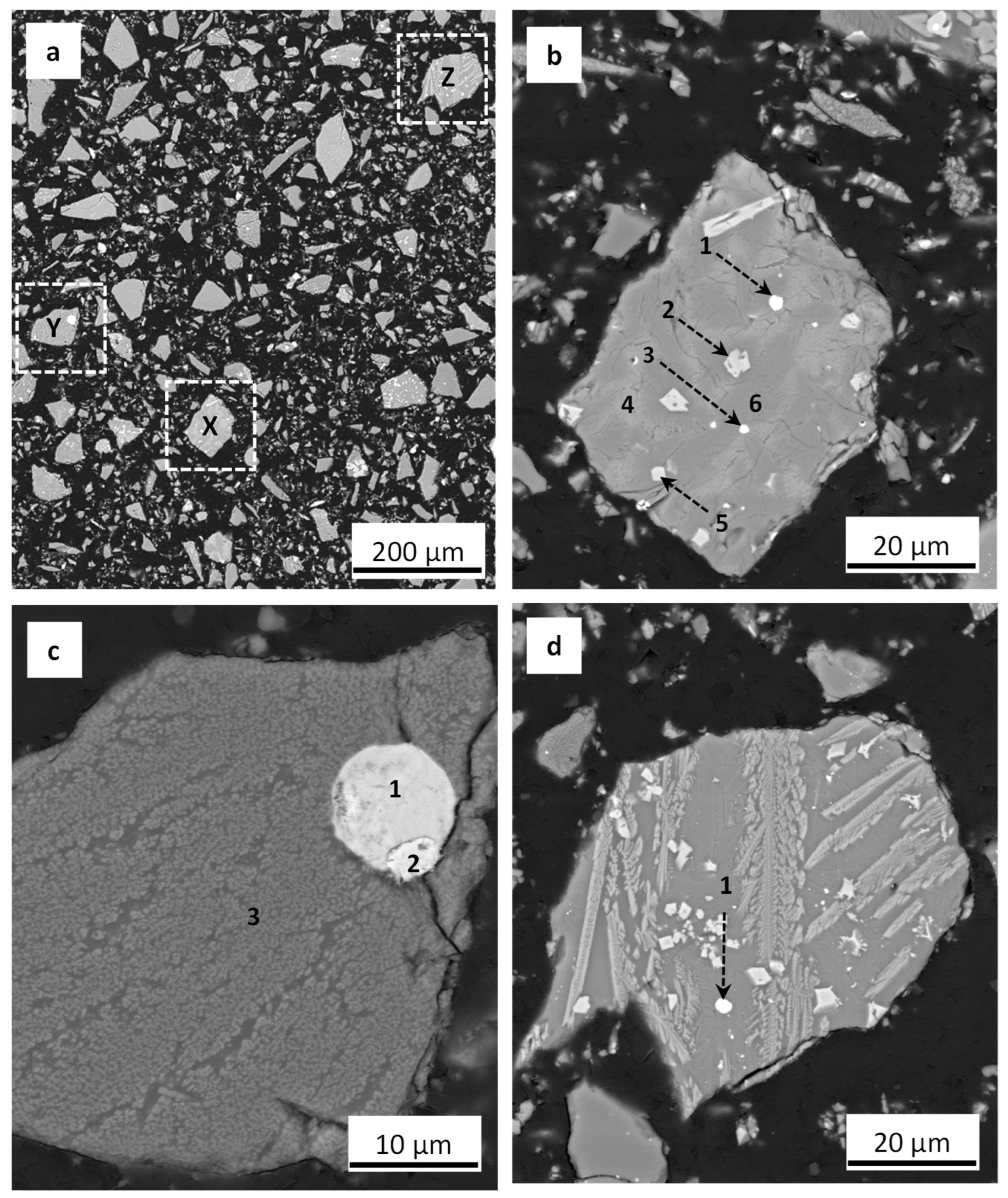
To further illustrate mineral embedment in the smelting slag, Figure 3a presents an additional BSE image showing multiple interconnected mineral phases within the copper slag. To get comprehensive BSE microstructure information, the highlighted areas X, Y, and Z in Figure 3a were deconvoluted, and the results are presented in Figure 3b, c, and d, respectively. Table 2 and Table 3 display the corresponding compositions at various points in Figure 3b, c, respectively.
Backscattered electron (BSE) imaging (Figure 3b,c), together with the quantitative data presented in Table 2 and Table 3, indicates that copper is predominantly distributed among silicate phases, copper matte, and metallic copper phases. The corresponding Cu contents reach up to 5.08 wt.% in silicate phases, 73.52 wt.% in copper matte, and 89.62 wt.% in metallic copper. Consistent with these observations, Zhang et al. [51] reported that although copper metal occurs at higher weight percentages within iron-bearing phases compared to fayalite (Fe2SiO4) and magnetite (Fe3O4), fayalite exhibits a stronger affinity for heavy metal incorporation. The study demonstrated that 89.7% of As, 85.0% of Pb, and 76.9% of Cu were preferentially embedded within the fayalite phase [51]. Previous studies have similarly shown that Cu can be structurally incorporated into fayalite through substitution at Fe lattice sites [43,51,52]. Furthermore, Zhou et al. [53], through analysis of Cu–Fe binary phase diagrams, demonstrated that Cu and Fe exhibit extensive mutual solid solubility, a behaviour attributed to their comparable chemical characteristics and crystal chemistry. This miscibility provides a mechanistic explanation for the observed incorporation of Cu into Fe-bearing silicate phases.

5.2. Cobalt Embedment in Mineral Phases of the Copper Slag

In the study by Phiri et al. [42], cobalt in copper smelting slag was mostly discovered embedded in the silicate and magnetite phases (Table 2 and Table 3). Cobalt was also consistently found in various phases of copper slag, interspersed with other metals such as Cu, Fe, Ca, K, Al, Ti, and S. According to the backscattered electron (BSE) images in Figure 3b and Table 2, the Co content was uniformly distributed in the magnetite, silicate, and copper matte phases, with up to 1.85 wt.%, 1.44 wt.%, and 0.38 wt.%, respectively. This finding is consistent with the research undertaken by Yang et al. [17], who found that Co predominantly occurs in the fayalite phase, specifically in the form of silicate and ferrite. Vítková, et al. [46] report that Co substitutes for Fe in olivine-group silicates (such as fayalite) up to 7.15 wt.% CoO, and also occurs in oxide/spinel phases. This aligns with the idea that Co is stabilized in silicate phases due to substitution for iron.

6. Critical Metal Processing Strategies for Smelting Slag

6.1. Recovery of Copper from Smelting Slag Using Flotation

The froth flotation technique has been found to be an essential operation in the recovery of copper from smelting slag [5,9,10,11,54,55]. The copper values in the smelting slag that are present either as independent metallic particles or in the form of sulfides can be floated effectively. Flotation has been studied for the recovery of metals from copper slag employing various collectors, frothers, modifiers, and depressants. Froth flotation uses the differences in surface characteristics of minerals to separate valuable minerals from unwanted gangue minerals. The process produces an enriched concentrate, and the gangue or unwanted material reports to the tailings. Middlings are a third product composed of valuable and gangue minerals that have remained locked together. This material is typically reground to liberate the valuable mineral particles. Copper slag flotation resembles sulfide ore flotation [20]. The main parameters investigated for the flotation technique are particle size, collector dosage, and pH. The copper slag is fed into the flotation unit, where the sulfide minerals (Cu2S, Cu5FeS4) are floated using collector and frother reagents to produce a concentrate.

6.1.1. Recovery of Copper from Smelting Slag Using Xanthate Collectors

Xanthates are one of the most common commercial collectors used in copper sulfide flotation and are known to be strongly chemisorbed on the surfaces of many valuable minerals [56]. Sarrafi et al. [9] explored copper recovery from reverberatory furnace slag using flotation. The following parameters were investigated: cooling rate, particle size, collector dosage, pH, and flotation time. The results demonstrated that for an air-cooled slag at optimum conditions of pH 11.5, R407 collector dosage of 30 g/t., solid in pulp of 30% and flotation time of 12.5 min, a copper recovery of 72% was obtained in one-stage flotation with a copper concentrate grade of 12.6%. In a similar work, Das et al. [10] investigated the recovery of copper values from an Indian smelter slag through flotation using conventional sodium isopropyl xanthate (SIPX) as the collector. The effects of flotation parameters like pH and collector concentration were studied. The results under optimum flotation conditions showed a copper grade of approximately 21% with copper recovery of more than 80% at xanthate concentration of 600 g/ton and slightly alkaline pH of 9. Copper recovery from smelting slag employing butyl xanthate as the collector was investigated [11]. The copper slag sample was primarily composed of bornite (Cu5FeS4) as the major Cu-bearing mineral. The sample was ground to a particle size of 80% passing 74 μm and floated at pH 10 with sodium carbonate as a pH modifier and 50 g/t butyl xanthate [11]. The results showed a 14.47% concentrate copper grade with copper recovery of around 79.66%. The authors reported that reagent type, reagent dosage, particle size, and pH were the significant operating parameters governing the flotation process. Similarly, Li et al. [57] investigated the recovery of metals from copper slag waste using butyl xanthate collectors. The results indicated that using flotation butyl xanthate as the collector and terpene oil as the frother resulted in a flotation concentrate copper grade of 21.50% with a recovery rate of 77.78%. Meanwhile, Roy et al. [5] examined the flotation of copper sulfide from copper smelter slag using mixtures of several collectors containing sodium isopropyl xanthate (SIPX), sodium di-ethyl dithiophosphate (DTP), and alkyl hydroxamate at different dosages. The results demonstrated that using a 40:160 g/t mixture of sodium isopropyl xanthate and di-ethyl dithiophosphate resulted in a greater copper recovery of 84.82%, compared to 78.11% when using the best performing single collector at pH 9 [5]. Similarly, a 160:40 g/t mixture of sodium isopropyl xanthate and alkyl hydroxamate resulted in a relatively high copper recovery of 83.07%. The influence of grinding duration on flotation recovery of copper smelter slags in the Bardaskan district of Iran was studied by Shamsi et al. [55]. After grinding the material for 85 min to a particle size of 80% passing 48 µm, copper recovery of 79.89% was achieved.

6.1.2. Recovery of Copper from Smelting Slag Using Thionocarbamate Collectors

Several attempts have been made to identify alternatives to xanthates. to improve metal recovery. Thionocarbamate collectors, for example, have been reported in the literature primarily for the flotation of copper-bearing minerals such as chalcocite, covellite, chalcopyrite, and bornite, either in combination with xanthates or alone [58,59,60]. Thionocarbamates can form stable chelating complexes with metal ions on the surface of particles containing copper by using C=S and N-H bonds [60]. Štirbanovič et al. [61] examined the use of thionocarbamates in copper slag flotation. The results showed a 22.34% enrichment in copper content at a recovery of 83–87% from a 3.56% feed at pH 9. Thionocarbamates’ selective nature, which makes them suitable for adsorption on copper-bearing sulfide minerals, aids in their separation from other sulfides, such as pyrite, arsenopyrite, galena, and sphalerite.

6.1.3. Recovery of Copper from Smelting Slag Using Xanthate with Secondary Collectors

Several research studies have shown that combining xanthates with some secondary collectors can improve Cu recovery [13,55,62]. Mixed collectors appear to have a synergistic effect, which reduces reagent usage, improves selectivity, and increases coarse particle recovery [63]. Roy et al. [5] evaluated the efficacy of a mixed collector system using sodium isopropyl xanthate (SIPX) and di-ethyl dithiophosphate (DTP) for recovering copper values from smelting slag, versus SIPX alone. The copper in the smelting slag took the form of Cu5FeS4. The combination of collectors, when used in the ratio of 40:160 g/t, resulted in a greater copper recovery of 84.82%, compared to the best recovery values of a single collector system (78.11% Cu). The research also investigated a combination of SIPX and alkyl hydroxamate at a ratio of 160:40 g/t, which resulted in an 83.07% copper recovery. The primary collector SIPX was effective at adsorbing fines, while DTP and alkyl hydroxamates interacted with SIPX to efficiently recover unliberated coarse copper-bearing particles. These findings were consistent with the experimental results reported by Shamsi et al. [55] who conducted flotation experiments using a single collector system of potassium amyl xanthate (PAX), resulting in a copper recovery of 62.23%, then repeated the experiments in a mixed collector system containing PAX and sodium isopropyl xanthate (SIPX), resulting in a substantially increased recovery of 80.27% at pH of 11.

6.1.4. Disadvantages of the Flotation Method on the Recovery of Copper and Cobalt from Smelting Slag

Studies have indicated that the majority of the copper and cobalt in the slag are in the oxide phase, which cannot be treated directly using the flotation process [21]. Conversely, Hara and Jha [64] made similar observations, stating that most of the copper in the slag is in the oxide phase, and virtually all the cobalt is chemically bound with silica, iron, calcium, and/or aluminum oxides, making flotation extremely difficult. A study on the surface modification of oxide minerals using ethanediamine [65] found that oxide minerals are more difficult to float than sulfide minerals due to their higher solubility and extensive hydration. The direct flotation of copper oxides using collectors such as fatty acids, hydroxamates, and petroleum sulfonates has been extensively studied. Despite promising performance at a laboratory scale, these collectors have so far not been successful in plant-scale trials. Moreover, these collectors have been used for copper oxide minerals only. Their application for Cu slag flotation has not been reported.
A more recent study found that difficulties using the flotation technique for the recovery of copper oxides may be ascribed to the presence of dangling ionic bonds, which enable water molecule adsorption on oxide surfaces via polarization [63]. As a result of electrostatic attraction, a thick and stable layer of hydrophilic hydration film forms on the oxide mineral surface, preventing the collector from penetrating and then adsorbing onto it. Kundu et al. [63] suggested investigating the possibility of improving the flotation performance of copper-bearing oxides by employing sulphidation reagents, such as sodium sulfide. Sulphidation treatment alters the surface of Cu bearing oxides by adsorbing S2− and HS ions, resulting in a metal sulfide coating that promotes collector adsorption [66]. Extensive study on the flotation of Cu slag, using xanthates with sulphidation reagents, has been conducted.

6.1.5. Economic Viability of the Flotation Approach for Reprocessing of Copper Slag

The froth flotation process remains one of the most economically viable and operationally established techniques for the recovery of copper from smelting slags. Its economic appeal lies in its low energy requirement, moderate reagent cost, and compatibility with existing flotation circuits used in sulfide ore processing. The technique effectively recovers metallic and sulphidic copper species, which commonly occur in slag as discrete metallic particles or as sulfide minerals such as bornite (Cu5FeS4) and chalcocite (Cu2S). Numerous studies [5,9,10,11,48,54,55] have demonstrated that flotation under optimized conditions can achieve 70–85% Cu recovery with concentrate grades ranging between 12% and 23% Cu, depending on slag mineralogy, particle size, and reagent system.
Economically, flotation benefits from low operating and reagent costs compared with hydrometallurgical approaches. Collectors such as xanthates (sodium isopropyl xanthate, butyl xanthate) are inexpensive and widely available, while mixed collector systems—combining xanthates with diethyl dithiophosphate (DTP) or alkyl hydroxamates—have exhibited synergistic improvements in selectivity and coarse particle recovery, yielding 84–86% copper recovery with limited reagent dosages [5]. Moreover, the process can be readily implemented within existing concentrator infrastructure, thereby reducing capital investment and promoting near-plant slag valorization.
Nevertheless, the economic feasibility of flotation diminishes when copper is predominantly present in oxide or silicate-bound phases. As reported by Dimitrijevic et al. [21] and Hara and Jha [64], the flotation of oxidized slags is challenging due to the hydrophilic nature of oxide minerals and the strong bonding of copper with iron and silica matrices, which leads to poor recovery and high reagent consumption. To address this, sulphidation pretreatment using sodium sulfide (Na2S) has been proposed to convert oxides into sulfides, enhancing collector adsorption and improving overall flotation performance [63,66]. Although this additional step increases reagent costs, the corresponding rise in copper recovery can restore process profitability and enhance overall metal yield.
In summary, the flotation approach is economically viable for slags containing significant sulphidic or metallic copper, offering low-cost, high-throughput recovery with rapid payback potential. Its advantages—namely, scalability, operational simplicity, and low energy input—make it a preferred first-stage beneficiation process. However, for highly oxidized slags, the integration of flotation with sulphidation or subsequent hydrometallurgical treatment is essential to maintain economic efficiency and ensure comprehensive metal recovery. When combined with mechanical activation or selective acid leaching, flotation can serve as a cost-effective and sustainable component of an integrated copper slag valorization strategy.

6.2. Copper and Cobalt Recovery from Smelting Slag Using Hydrometallurgy

The hydrometallurgical route via leaching is the most common approach for recovering metals from low-grade materials like smelting slag. Because of its economic benefits and relatively minimal environmental impact, the hydrometallurgical technique offers a high potential for effective metal extraction. The hydrometallurgical technique for metal extraction from smelting slag has been examined using various parameters such as leaching system, extractant concentration, temperature, solid/liquid ratio, and leaching period. The emphasis has been on atmospheric leaching using lixiviants such as acids, bases, and salts. Many of these lixiviants form aqueous solutions that can dissolve metals from ores, concentrates, and slag.

6.2.1. Recovery of Copper and Cobalt Using Sulfuric Acid

Sulfuric acid (H2SO4) is the most widely employed lixiviant for metal recovery from copper slags due to its low cost, high reactivity, and widespread availability. It is particularly effective for the leaching of metal oxides and is one of the strongest inorganic acids, being completely miscible with water at all concentrations. Sulfuric acid may be applied in dilute or concentrated form, or in combination with oxidising agents such as oxygen to enhance leaching kinetics. Its suitability for on-site application is further supported by its availability as a common by-product of copper smelting operations. Numerous studies have demonstrated the effectiveness of sulfuric acid as a leaching agent for copper slags, reporting high metal extraction efficiencies [13,16,17,67,68,69,70,71]. For example, Yang et al. [17] achieved metal recoveries of 98% for cobalt, 97% for zinc, and 89% for copper using sulfuric acid leaching. In addition to high extraction efficiencies, the process enabled faster solid–liquid separation and significantly mitigated the adverse effects of silica and ferric oxides on target metal recovery. Despite these advantages, challenges remain, particularly the high consumption of acid and neutralising agents such as lime. Further research is therefore required to optimise reagent usage, improve process economics, and enhance the overall sustainability of sulfuric acid leaching for copper slag treatment.
Mussapyrova et al. [72] investigate how mechanical activation (high-energy milling) alters the structure of copper smelter slag and enables selective, high-efficiency copper leaching at room temperature, without the need for high-temperature or aggressive chemical conditions. Mechanical activation produces dramatic changes in reactivity, allowing copper to be leached using dilute sulfuric acid (0.1 M H2SO4) at 25 °C, which is normally ineffective for untreated slag. Subsequent Taguchi-designed leaching tests identified distinctly different optimal leaching conditions for maximizing copper recovery depending on the milling device. For attritor-activated slag, the optimum was 0.15 M K2Cr2O7, 0.5 M H2SO4, 120 min, L:S = 75:1, yielding a copper recovery of 87.31% and Cu selectivity of 95.44%. Planetary-activated slag achieved optimum recovery under 0.03 M K2Cr2O7, 0.1 M H2SO4, 120 min, L:S = 200:1, producing 84.63% Cu recovery and 97.87% selectivity [72]. These results show that planetary milling induces higher amorphization and requires lower oxidant concentrations for similar or improved performance.
Autoclaves have been employed to examine oxidative high-pressure sulfuric acid leaching by Baghalha et al. [71]. Leaching with sulfuric acid at increased pressure resulted in improved leaching extraction and solid-liquid separation [67]. Bese [70] explored how ultrasonic energy affects the solubility of copper from copper converter slag during sulfuric acid leaching. The effects of temperature, acid concentration, ferric sulphate concentration, and time were investigated. The results showed that copper, zinc, cobalt, and iron extraction efficiencies were 89.28%, 51.32%, 69.87%, and 13.73%, respectively, whereas in the absence of ultrasound, the efficiencies were lower, 80.41%, 48.28%, 64.52%, and 12.16%, respectively [70]. The amorphous structure of copper slags has a variety of negative effects on sulfuric acid leaching, increasing the viscosity of the leach liquor by forming silica gel, as illustrated in Equation (1).
2FeO·SiO2 + 2H2SO4 → 2FeSO4 + H4SiO4
Overall, acid leaching studies have consistently demonstrated a positive correlation between acid concentration and metal extraction efficiency across a range of leaching conditions [14,16,17,49,67,69,71]. However, several investigations have reported that, despite high extraction efficiencies, the treatment of slags with elevated silica contents is associated with excessive sulfuric acid consumption and the formation of silica gel [16,17,49,64,67]. This behaviour arises from the occurrence of metals such as cobalt and copper within spinel oxides, ferrites, and silicate phases, which require aggressive leaching conditions for dissolution. The resulting high consumption of sulfuric acid and neutralising agents (e.g., lime), together with poor solid–liquid separation caused by the formation of iron hydroxide precipitates and silica gel, significantly constrains the practical applicability of conventional acid leaching processes [17,64]. In response to these limitations, alternative approaches have been explored, including the use of combined acid–oxidant systems to enhance metal recovery from copper slags while mitigating reagent consumption and process inefficiencies [24].

6.2.2. Recovery of Copper and Cobalt Using Citric Acid

Citric acid, an r-hydroxyl tricarboxylic acid, is widely known for its chemical adaptability in leaching transition metal ions. Citric acid leaching of Cu, Co, Ni, and Fe from copper granulated slag was investigated by Meshram et al. [41]. The process involves leaching the copper slag with 2 N citric acid to extract Co, Ni, and Fe, followed by leaching the residual with a high copper content with 2 M sulfuric acid. The study found that the first stage of leaching with citric acid at room temperature and 10% pulp density resulted in maximum extractions of 4.47% Cu, 88.3% Co, 95% Ni, and 93.8% Fe, whereas the second stage extracted 66–72% of the copper from the leach residue.

6.2.3. Recovery of Copper and Cobalt Using Nitric Acid

Nitric acid (HNO3) is a strong oxidizing agent that reacts aggressively with many metallic compounds during leaching. Tshiongo et al. [73] compared the use of nitric acid and ammonia solution as leaching agents for copper slags formed under different cooling conditions, including water quenching, air cooling, and furnace cooling. They discovered that the slag cooling rate affected base metal leaching by altering the phase distribution in the slag as well as the base metal distribution within the phases. Tshiongo et al. [73] discovered that quick cooling of the slag inhibited crystallization and resulted in an amorphous phase containing the base metals. However, they discovered that the amorphous slags were more leachable in nitric acid than in basic medium (NH4OH), with best resulting extractions of 46% Cu, 95% Co, 85% Zn, 92% Pb and 79% Fe.
These studies demonstrate that nitric acid is a highly effective leachant for copper smelting slags, particularly when applied to amorphous or finely comminuted materials and when adequate acid strength is maintained. High nitric acid concentrations can achieve near-quantitative recoveries of Cu, Pb, Zn, Co, and Fe, depending on slag composition and mineralogy. However, structural characteristics—most notably cooling history and degree of crystallinity, exert a strong influence on leaching behaviour and ultimately constrain achievable extraction efficiencies. Consequently, nitric acid leaching represents a potent and versatile approach for copper slag processing, with its performance governed by the interplay between slag structure, acid concentration, and redox conditions.

6.2.4. Recovery of Copper and Cobalt Using Amino Acids

Amino acids have received a lot of interest in hydrometallurgy over the last decade as a highly selective and environmentally benign way to extract metals from various sources [74]. Glycine is the most common amino acid tested and is distinguished by the presence of a carboxyl group and an amino group [75,76]. Glycine is widely used for effectively extracting critical metals from various natural resources [74,75,76,77]. Our recent study demonstrated that substantially higher amount of copper can be extracted from the copper smelting slag, suggesting that glycine is effective for leaching copper. Oraby et al. [77] investigated the extraction of nickel and cobalt from a flotation tailings material using an alkaline glycine-based lixiviant system. The findings indicate that the highest extractions of 90% Co and 88% Ni were achieved at a fine particle size of 15 µm. Guo et al. [78] revealed that copper exhibits superior coordination ability to glycine compared to other transition metals in the first series. Huang et al. [76] observed a significant drop in the NH2CH2COOH fraction in the species distribution of glycine as the pH value increased from 8 to 10. Thus, by increasing the pH of the solution to an alkaline level, NH2CH2COOH undergoes dehydrogenation to produce NH2CH2COO- and form a stable complexation with Cu2+ and Co2+, resulting in the formation of Cu(NH2CH2COO)2 and Co(NH2CH2COO)2, respectively.

6.2.5. Recovery of Copper and Cobalt Using Oxidants or Acid/Oxidant Combinations

Oxidants are excellent leaching agents for naturally occurring minerals that are vulnerable to oxidation reactions. Liquids such as oxygen, hydrogen peroxide, sodium chlorate, and Fe(II)/Fe(III) are thought to be effective oxidants for leaching of copper slag [13,67,69,71]. The use of oxidants as leaching agents can be an effective option for solving the problem of silica gel formation while also removing iron from solution via the oxidation process. Banza et al. [13] investigated hydrogen peroxide (H2O2) as an oxidant for the extraction of metals from copper slag while preventing the problem of silica gel formation. The study achieved extraction efficiencies of 80% of Cu, 90% of Co, 90% of Zn, and Fe extraction was reduced to 5%. A similar study revealed that the use of oxidants such as sodium chlorate (NaClO3) combined with using calcium hydroxide (Ca(OH)2) as a neutralizing agent reduced silica gel formation, and facilitated filtration of the solution [17]. The results achieved metal extractions of 89%, 98%, 97% for Cu, Co, and Zn, respectively, while the iron extraction was as low as 0.02%. Sodium chlorate (NaClO3) was found to prevent the formation of silica gel due to the oxidation of Fe2+ to Fe3+. Acid leaching using sulfuric acid in the presence of hydrogen peroxide was found to overcome the issue of silica gel formation by the simultaneous oxidation of iron and sulfide, followed by the removal of iron-bearing impurities [63]. The iron dissolution from copper slag is illustrated in the following Equations (2)–(4) [63]:
CuS + 2H2SO4 + 2H2O2 = CuSO4 + 2H2SO3 + 2H2O
FeO + H2SO4 = FeSO4 + H2O
2FeSO4 + H2O2 + 2H2O = 2FeOOH + 2H2SO4
The leaching investigations produced silica gel-free solutions containing dissolved metal values, which could be readily filtered. An alternative strategy for recovering metals from copper slag while suppressing silica gel formation was reported by Yang et al. [17]. This approach involved sulfuric acid leaching in the presence of sodium chlorate as an oxidising agent, followed by neutralisation with lime to enhance precipitate filtration. The combined use of an oxidant and controlled neutralisation effectively mitigated the adverse effects associated with silica gel precipitation. The effects of key operating parameters, including acid and oxidant consumption, reaction temperature, and leaching duration, were systematically evaluated. Lime addition was identified as a critical step for the selective precipitation of silica and ferric oxides prior to filtration. Under optimised conditions, an overall copper extraction efficiency of 89% was achieved.
Anand et al. [67] conducted research on the leaching of copper slag using high oxygen pressure, and the results showed improved metal extraction efficiencies of 90% of Cu and 98% of Co. It was observed that oxygen availability was an important factor for the oxidation of Fe2+, which minimized the extraction of iron. For example, at lower oxygen pressure, the extraction efficiency of Fe was 1.2%, whereas at higher oxygen pressure, it was 0.81% Fe. These findings were consistent with the study conducted by Basir and Rabah [69], who found that oxygenated conditions can improve copper and cobalt extraction efficiencies while simultaneously achieving a low iron extraction.
The influence of sulfuric acid and potassium dichromate concentrations on the extraction of metals from copper slag has been extensively investigated [14,15,18]. In particular, Altundoǧan et al. (2004) [14] studied the leaching of copper converter slag using sulfuric acid (H2SO4) in the presence of potassium dichromate (K2Cr2O7). The optimal lixiviant composition was identified as 0.25 M H2SO4 and 0.1 M K2Cr2O7, with a solid-to-liquid ratio of 10 g/L, a temperature of 25 °C, and a contact time of 120 min. Under these conditions, the presence of K2Cr2O7 facilitated a copper extraction efficiency of 81.15%, while significantly limiting the extraction of other metals, with Co, Zn, and Fe recoveries of 12.0%, 10.27%, and 3.15%, respectively. In contrast, using 1.0 M H2SO4 without potassium dichromate under the same operating conditions (contact time of 120 min, slag-to-solution ratio of 10 g/L, and 298 K), the extraction efficiencies for Cu, Co, Fe, and Zn were 20.5%, 66.6%, 62.1%, and 65.7%, respectively. These results highlight the critical role of oxidants such as K2Cr2O7 in selectively enhancing copper recovery, while also illustrating the trade-offs in the extraction of other metals.
In a related study, Boyrazli et al. [15] investigated the effects of temperature (25–70 °C), leaching time (5–240 min), and solid-to-liquid ratio (5–400 g/L) on metal extraction from copper slag. The highest copper extraction efficiency of 99.6% was achieved at 0.25 M H2SO4, 0.1 M K2Cr2O7, 70 °C, and 120 min of leaching. In contrast, the extraction efficiencies for Co, Zn, and Fe under these conditions were substantially lower, at 42.09%, 49.86%, and 27.59%, respectively. The study noted that the extraction of Co, Zn, and Fe improved only at elevated temperatures, likely due to the reduced adsorption of dichromate ions, which are responsible for passivation effects on these metals. These findings are consistent with more recent investigations of the H2SO4–K2Cr2O7 system for leaching copper, Zn, and Fe from copper smelter slag [18]. The study reported that dichromate presence enhanced copper recovery, achieving 68% Cu extraction, while significantly suppressing Zn and Fe recovery to 4% and 5%, respectively, under the same conditions. The authors attributed the decreased extraction of non-copper metals to precipitation and surface passivation effects induced by dichromate ions, while noting that copper extraction improved with increasing dichromate concentration [18].

6.2.6. Recovery of Copper and Cobalt Using Bases and Salts

Several studies have investigated the leaching of copper slag using bases and salts such as ferric chloride [79], ferric sulphate [39,48,70], ammonium sulphate [68], ammonium chloride [47,80], chlorine solution [62,70] and ammonium hydroxide [81,82]. Hydrochloric acid with ammonium hydroxide has also been investigated [69]
A number of studies have shown that using hydrochloric acid with ammonium hydroxide has several advantages and can eliminate problems associated with leaching using common acids [6,81,82]. For example, ammonium hydroxide (NH4OH), which is also known as aqua ammonia in aqueous solutions, can dissolve various metal oxides and hydroxides, such as copper (II) hydroxide, to form ammine complexes. Ammonium chloride is a safe, non-volatile agent and an environmentally friendly crystalline substance at room temperature. The physico-chemical principles for metal recovery using ammonia and ammonium are based on the behavior of the H2O–NH3–NH4Cl system containing metal amines, and the phase equilibria for liquid and solid, and liquid and vapor [81]. The following Equations (5) and (6) show the dissolution of metals in an aqueous solution of NH4OH [81].
Several studies have demonstrated that the use of hydrochloric acid in combination with ammonium hydroxide (NH4OH) offers distinct advantages and can overcome limitations associated with conventional acid leaching [6,81,82]. Ammonium hydroxide, also referred to as aqua ammonia in aqueous solution, can dissolve various metal oxides and hydroxides, such as copper(II) hydroxide, by forming stable ammine complexes. Ammonium chloride, a non-volatile and environmentally benign crystalline compound at room temperature, is commonly used as a supporting agent in these systems. The physicochemical principles underlying metal recovery with ammonia and ammonium are based on the behaviour of the H2O–NH3–NH4Cl system, which governs the formation of metal–amine complexes as well as the phase equilibria between liquid–solid and liquid–vapor states [81]. The dissolution of metals in aqueous NH4OH solutions can be represented by the following reactions (Equations (5) and (6)) [81].
MO + 4NH3(sol) + nH2O → [M(NH3)4](OH)2 + (n − 1)H2O
O + xNH3(sol) + 2NH4Cl(sol) → [M(NH3)n]2 + 2Cl + H2O
where M = metals, e.g., Cu; n = x + 2
Equation (5) shows the dissolution of metals in the absence of Cl ions, and Equation (6) in the presence of Cl ions.
Overall, the reviewed studies demonstrate that oxidative and complexing leaching systems are most effective for copper recovery from smelting slags. Ferric-based oxidants (FeCl3, Fe2(SO4)3) consistently achieve the highest copper dissolution rates, often exceeding 70–85% recovery by oxidizing metallic and sulfide copper phases. Ammonium salts and hydroxides, on the other hand, offer greater selectivity by forming stable copper–ammonia complexes while minimizing iron dissolution. Chloride- and chlorine-based systems further enhance solubility but pose environmental and corrosion challenges. Collectively, these findings confirm that the choice of leaching reagent, redox potential, and pH control are critical for optimizing copper extraction efficiency and selectivity from copper smelting slags.

6.2.7. Recovery of Copper and Cobalt Using Chlorination Roast-Water Leach

Chlorination roasting followed by water leaching relies on the formation of stable, water-soluble metal chlorides during a roast, which can then be readily leached out in water to recover the metallic values. Anand et al. [79] investigated the leaching of copper slag using ferric chloride and observed that the extraction of copper increased with an increase in ferric ions. The chlorination reactions are summarized in the following Equations (7) and (8).
Cu2S + 2FeCl3 → 2CuCl + 2FeCl2 + S
Cu + FeCl3 → CuCl + FeCl2
The study demonstrated that ferric chloride is the most effective chloride for direct leaching of copper minerals, achieving copper extraction of 92%. Herreros et al. [62] investigated the leaching of copper from reverberatory slag using a chlorine solution. In this slag, most copper was present as metallic copper, chalcocite (Cu2S), bornite (Cu5FeS4), and other complex sulphides, with mineral liberation occurring at particle sizes below 20 µm. The study evaluated the effects of stirring speed, particle size, initial chlorine and chloride concentrations, and temperature on the leachability of the copper. Maximum copper extraction reached 80%, while iron solubilisation remained low at approximately 5%. In a similar investigation, Bese et al. [70] examined the treatment of converter slag using chlorine-saturated water. The study identified optimum conditions for copper dissolution that minimized iron dissolution, achieving a copper extraction efficiency of 98.35%.
Borisov et al. [80] observed that the reaction of chloride with oxides and sulfides of some metal-bearing compounds, such as CaO, ZnO, CuS, FeS, ZnS, and Fe2O3, leads to the formation of chloro–metallate complexes such as (NH4)2ZnCl4 and (NH)4CuCl3. These complexes could be further decomposed into chlorides. The results revealed that oxides of Si and Al did not react with ammonium chloride, which makes it a good leaching agent for silicate materials. Ammonia solutions containing ammonium chloride were found to be effective for the extraction of Cu and Zn from copper smelter slag [81]. The study used the central composite rotatable design and approximation method to determine the optimum conditions for the recovery of copper and zinc. The model successfully predicted the responses, and maximum copper and zinc recoveries of 81.16% and 56.48%, respectively, were obtained. In a recent study by Aracena et al. [82] a high copper recovery of 87.7% has been reported using an ammonia column system for the leaching of copper converter slag.

6.2.8. Recovery of Copper and Cobalt Using Ultraviolet Radiation

The application of ultraviolet (UV) radiation in hydrometallurgical leaching has emerged as an innovative approach for enhancing the dissolution of valuable metals from refractory mineral residues. Recent investigations, including Sari and Turan [83] and [84], provide complementary insights into the role of UV-induced photochemical processes in improving the recovery of metals, such as copper and cobalt, from complex slag matrices.
Sari and Turan [83] evaluated the direct photooxidative leaching of copper slag under UV irradiation and demonstrated that high-energy UV wavelengths, specifically vacuum ultraviolet (VUV, 185 nm) and UVC (254 nm), significantly enhance copper dissolution compared with conventional acid leaching. Under optimal conditions (1.5 mol/L H2SO4, 55 °C, 180 min), copper extraction increased from 70.7% in non-UV conditions to 85.1% under 185 nm irradiation. Iron dissolution exceeded 90% in both conditions. The authors attributed these improvements to the in-situ generation of potent oxidative radicals arising from the photolysis of water and sulfate species under high-energy UV irradiation. These radicals promote the oxidation of both oxide and sulfide copper phases, accelerating their dissolution into Cu2+.
Complementary mechanistic understanding is provided by Deng et al. [84], whose work demonstrates the fundamental ability of UV radiation to drive rapid redox transformations in aqueous metal–ligand complexes. Under 254 nm irradiation, Fe(III)-oxalate complexes were photochemically reduced and precipitated as Fe(II)-oxalate with efficiencies exceeding 97% within 30 min. This redox behavior parallels the photooxidative and photoreductive mechanisms observed in UV-enhanced leaching of copper slag, emphasizing UV’s capacity to manipulate metal oxidation states and promote dissolution of complex phases [84]. For copper slag, where copper and cobalt are commonly hosted in fayalite, magnetite, and complex silicate matrices, UV-generated radicals accelerate decomposition of the silicate network, promote oxidation of Cu(I) and Co(II) species, and enhance the dissolution kinetics of Fe-bearing phases.

6.2.9. Economic Viability of the Hydrometallurgy Approach for Reprocessing of Copper Slag

These findings underscore the broader potential of UV-based photochemical recovery of metals from copper slag. By leveraging photon-driven radical chemistry, UV irradiation offers a pathway toward higher metal recovery efficiencies, reduced chemical consumption, and improved processing of refractory waste materials. Hydrometallurgical processing has emerged as a technically efficient and economically feasible method for recovering valuable metals, particularly copper and cobalt, from copper smelting slags. Among the various lixiviants examined, sulfuric acid (H2SO4) remains the most widely applied due to its low cost, strong leaching capability, and ready availability as a smelter byproduct, allowing on-site integration without significant reagent import or waste disposal costs. Numerous investigations [13,14,17,67,70] have demonstrated high metal extraction efficiencies up to 98% Co, 97% Zn, and 89% Cu, under optimized temperature, pressure, and acid concentration conditions.
However, conventional acid leaching suffers from high acid and lime consumption, excessive silica gel formation, and poor filtration characteristics caused by iron hydroxide precipitation. To overcome these economic and operational constraints, researchers have introduced mechanochemical activation and acid–oxidant hybrid systems. Mussapyrova et al. [72] demonstrated that mechanical activation via high-energy milling substantially increases slag reactivity, enabling selective copper leaching (84–87%) using dilute acid (0.1–0.5 M H2SO4) at room temperature a major reduction in both reagent and energy costs. Similarly, oxidant-assisted leaching systems (e.g., H2SO4–H2O2 or H2SO4–NaClO3) have achieved high metal recoveries (>90%) while minimizing silica gel formation and iron dissolution [13,17,63].
Complementary work using alternative organic lixiviants such as citric acid [41], nitric acid [73], and amino acids like glycine [74,75,76] demonstrates growing interest in eco-efficient and recyclable leaching systems. Although these reagents are more expensive, they provide cleaner solutions, reduced waste generation, and greater metal selectivity, aligning with circular-economy and low-carbon processing goals. Overall, the reviewed studies confirm that hydrometallurgical leaching, particularly sulfuric-acid-based and oxidant-enhanced processes, offers a commercially viable pathway for valorizing copper slags. The combination of mechanical activation, controlled oxidation, and reagent recycling significantly reduces energy intensity and reagent costs, transforming slag from a metallurgical residue into a sustainable secondary resource for critical metals essential to the global clean-energy transition.

6.3. Pyrometallurgical Approaches for Processing of Copper Slag

Pyrometallurgy involves chemical reactions of solids, gases, or molten materials at elevated temperatures in a furnace.

Recovery of Copper and Cobalt Using Carbothermal Reduction

In carbothermic reduction, carbon serves as a reductant to convert minerals in the slag into metallic phases at elevated temperatures. Yucel et al. [19] investigated the treatment of ancient Kure copper slag using a carbothermal reduction method in a DC arc furnace at 1430–1480 °C, achieving maximum recoveries of 95.7% for cobalt and 90% for copper in a closed system. Hara and Jha [64] developed an alternative approach involving the reduction and sulphurisation of copper slag with activated charcoal, attaining a copper recovery of 90% at 1323 K. Zhang et al. [85] reported that gas-phase diffusion, with an activation energy of 118.06 kJ mol−1, was the rate-limiting step during isothermal reduction of carbon-bearing copper slag pellets. Despite these successes, pyrometallurgical reduction requires substantial energy input, with operating temperatures exceeding 1200 °C, largely due to the high melting point of fayalite in copper slag [57,85]. The presence of significant amounts of fayalite further complicates the reduction process [86]. Moreover, this approach has the potential to generate considerable environmental contamination, as it produces multiple types of solid waste.

6.4. Pyro-Hydrometallurgical Approach for Processing Copper Slag

The most common method for pyro-hydrometallurgical processing of copper smelting slag is roasting, followed by water or acid leaching. The pyro-hydrometallurgy involves the study of the effects of roasting time, acid/slag ratio, and roasting temperature, and the effect of thermal decomposition prior to leaching on metal dissolution was examined. The roasting of copper sulfide produces a calcine, which is then treated using the hydrometallurgical technique. Extensive studies have been done on the roasting of copper slag using roasting agents such as sulfuric acid (H2SO4) [16,20,21,68], pyrite (FeS2) [87], ferric sulphate (Fe2(SO4)2) [39], graphite [48] and ammonium sulphate ((NH4)2SO4) [68] to yield metal sulphates.

6.4.1. Recovery of Copper and Cobalt Using Sulphation Roasting-Water Leach

Sulphation roasting involves the addition of sulphate salts, sulfuric acid, or SO3 gas during roasting, producing stable and water-soluble metal sulphate complexes. It is among several low-temperature methods reported for recovering metals from copper slag. Tümen and Bailey [86] investigated the sulphation roasting of primary and secondary slags with pyrite, followed by hot water leaching of the calcines. The addition of pyrite enhanced copper recovery from primary converter slag to 95%, with minimal iron contamination of approximately 2%. However, this approach was less effective for other metals, achieving only 58%, 35%, and 29% extraction efficiencies for Co, Ni, and Zn, respectively. Mututubanya [88] applied solid-state carbothermic reduction in an inert nitrogen atmosphere using charcoal as a reductant at 600–1000 °C, followed by sulfuric acid leaching. This process selectively reduced Co, Ni, and Cu oxides while retaining the majority of Fe in the slag. Cobalt extraction reached 52% at 950 °C. Subsequent experiments incorporating pyrite and cobalt sulphide concentrates as sulphating agents improved cobalt recovery to 72% at a 1:1 slag-to-pyrite ratio. Altundoǧan and Tümen [39] proposed an alternative approach involving roasting with ferric sulphate at 500 °C followed by water leaching. Ferric sulphate promoted sulphation of copper slag constituents, yielding extraction efficiencies of 93% for Cu, 38% for Co, 13% for Ni, and 59% for Zn.
The recovery of Cu, Co and Zn from copper smelter and converter slags by roasting with sulfuric acid was conducted by Arslan and Arslan [20]. The study investigated the effects of roasting time, roasting temperature, and acid/slag ratio. Metal extractions of 88% of Cu, 87% of Co, 93% of Zn and 83% of Fe were achieved after two hours of roasting at 150 °C and with a 3:1 acid/slag ratio. The authors observed that increasing the roasting time to four hours further increased the extraction of copper to 95%. However, high iron content would make further treatment of the leach liquor difficult. In a similar study, Sukla et al. [68] studied roasting of copper converter slag using sulfuric acid and achieved recoveries for Cu, Ni and Co of 95%, 90% and 99%, respectively. It was observed that the Fe contamination was 60–80% and removal of most of the Fe from the leach liquors was achieved with ammonia liquor and lime as precipitants, bringing the Fe level to about 3%. A recent study has shown that increasing the sulphation temperature could reduce the iron content in the leach liquor [21]. The method involved roasting the slag in the presence of sulfuric acid at an initial temperature of 250 °C, achieving maximum copper extraction efficiency of about 94% with iron dissolution of 55%. When further experiments were carried out by roasting at a much higher temperature of 600 °C, the iron extraction efficiency was reduced to about 6%; however, the copper recovery was also reduced to 79%.
The use of ammonium sulphate in the roasting was found to be effective and maximum copper recovery levels of over 80% were obtained. Rudnik et al. (2009) [89] explored the roasting of slag in reducing conditions to produce Cu–Co–Fe–Pb alloy, and thereafter electrolytic dissolution of the alloy in an ammonium chloride solution was conducted. The results indicated that 99.9% high purity copper was deposited, while cobalt recovery of 92.0% was obtained during the selective electrowinning process. Other roast-leach approaches have involved roasting the copper slag with a combination of sulfuric acid and ammonium sulphate (Sukla et al.,1986 [68]). This study was carried out by roasting the slag at 150 °C, leading to the sulphation of the metals of interest. The leaching was conducted in water in an agitated system using a particle size of −150 μm. Similar investigations were conducted by Hamamci and Ziyadanogullari [90] on the influence of roasting with ammonium sulphate on the extraction of copper. Copper extraction of up to 88% was achieved at particle sizes of less than 100 mesh at a roasting temperature of 400 °C for 60 min. The preliminary conversion of Cu and Co in copper slag to Cu2S and CoS using H2S gas has been shown to attain high extraction efficiencies for copper and cobalt metals [91]. The recoveries after roasting and leaching with agitation in water at a particle size of 149 μm were 100% of the Cu and 70.7% of the Co. Deng and Ling [16] demonstrated that thermal acid aging followed by water leaching was an effective method for recovery of metal values from copper slag, giving an extraction efficiency of 93% of the Cu. Grudinsky et al. [92] investigated the efficacy of sulphatising roasting using iron sulphates, followed by water leaching, to extract copper values from discarded slags rich in silica content. The copper slag sample was ground to a particle size of 100% passing 100 μm and mixed with pure iron sulphates for 24 h. The recovery of copper was up to 79% at a roasting temperature of 625 °C for 6 h.

6.4.2. Recovery of Copper and Cobalt Using Carbothermal Reduction-Sulfuric Acid Leach

The carbothermal reduction of copper slag in a submerged DC arc furnace was investigated by Acma [93]. The study demonstrated that copper slag could be carbothermally smelted with partial reduction of iron oxide (FeO) to a metallic phase containing copper and other metals at temperatures of 1400–1800 °C. The reduced material was subsequently leached with H2SO4, and copper was recovered as CuS following purification with H2S, while iron precipitated as goethite. Bulut [48] studied the reduction of copper slag using graphite in a DC arc furnace, followed by hot sulfuric acid leaching at 60 °C with an acid concentration of 120 g L−1 for 2 h. The process achieved extraction efficiencies of 71.5% for Fe, 78% for Cu, and 90% for Co. More recently, Phiri et al. [22] investigated low-temperature carbothermic reduction of copper slag using charcoal in the presence of borax, followed by H2SO4 leaching. Thermochemical calculations, phase characterisation, and experimental results demonstrated that borax addition lowered the temperature required for fayalite reduction and promoted the transformation of copper slag microstructures into amorphous and metallic phases. Subsequent leaching yielded high extraction efficiencies for Cu, Co, and Fe, reaching 83.8%, 84.8%, and 85.7% at 850 °C, respectively.

6.4.3. Economic Viability of the Pyrometallurgy Approach for Reprocessing of Copper Slag

Pyrometallurgical processing remains an established but energy-intensive and capital-demanding route for the recovery of copper and cobalt from smelting slags. The process relies on high-temperature reactions between molten, solid, and gaseous phases to reduce oxides and form metallic or sulphidic products suitable for further refining. Although pyrometallurgy offers rapid reaction kinetics and high metal recoveries, its economic viability is constrained by high energy consumption, complex furnace operation, and environmental control costs associated with off-gas and solid waste management.
Among pyrometallurgical methods, carbothermal reduction has been widely studied for its capacity to recover over 90% Cu and 95% Co at temperatures above 1400 °C [19,64]. However, the requirement for sustained high-temperature operation increases both operating and maintenance costs, making the process economically feasible only when integrated into existing smelter infrastructure. Moreover, the high melting point of fayalite (Fe2SiO4) in the slag [85] necessitates additional fluxing or reductant additives to lower melting temperatures, further increasing reagent expenditure. The process also generates substantial solid waste residues and CO2 emissions, which add to environmental compliance costs and reduce the net economic margin.
To improve efficiency, hybrid pyro-hydrometallurgical routes have been developed, wherein roasting precedes acid or water leaching to enhance metal solubility. Studies on sulphation roasting followed by leaching have achieved copper recoveries of 88–95%, cobalt recoveries of 70–87%, and zinc recoveries above 90% under moderate roasting temperatures (150–600 °C) and acid-to-slag ratios of 3:1 [20,39,68,88]. These hybrid systems operate at significantly lower energy inputs than direct reduction smelting, improving their economic outlook. However, they still require thermal energy for roasting, acid neutralization reagents, and multi-step solid–liquid separation systems, which increase processing costs compared to purely hydrometallurgical options.
Recent innovations, such as borax-assisted carbothermal reduction [22], have shown promise in lowering operational temperatures to below 900 °C while maintaining high extraction efficiencies (Cu: 83.8%, Co: 84.75%, Fe: 85.69%). These modifications improve the energy-to-yield ratio, thereby enhancing process economics and sustainability. Similarly, sulphation roasting with ferric sulphate or ammonium sulphate provides a cost advantage by achieving metal recoveries exceeding 90% at 500 °C, compared to >1200 °C in conventional smelting [39,90].
Economically, pyrometallurgical routes are most viable when implemented in conjunction with existing copper smelter operations, utilizing available heat, gas-handling systems, and byproduct acid streams. However, as stand-alone processes, they are generally less competitive than hydrometallurgical or flotation methods due to higher energy input, infrastructure costs, and environmental constraints. The pyro-hydrometallurgical hybrid approach, especially sulphation roasting followed by leaching, represents a balanced compromise between metallurgical efficiency and operational cost, achieving high recovery yields with reduced energy demand.
Overall, while pyrometallurgical and pyro-hydrometallurgical methods can deliver high copper and cobalt recoveries, their economic viability depends heavily on process integration, waste minimization, and thermal efficiency improvements. Emerging low-temperature reduction and sulphation roasting technologies, combined with selective leaching, offer a pathway toward cost-effective and environmentally responsible valorization of copper smelting slags.

7. Conclusions

This study reviewed global smelting slag production over the last 25 years, and the results demonstrate that huge amounts of smelting slag have been produced. This represents a significant potential resource for cobalt and copper metals. The chemical and mineralogical characterization of smelting slag has shown that it is highly heterogeneous and chemically diverse. However, the high metal content in smelting slag has attracted extensive research in finding innovative processing strategies to reprocess the critical metals. The recovery of copper and cobalt from copper slag could significantly augment the supply of these metals, which are essential to facilitating the transition to green energy, while simultaneously addressing environmental concerns regarding slag disposal. The important aspects of various processing techniques for recovering copper and cobalt from the smelting slag have been discussed. Froth flotation using xanthates is a well-known beneficiation technique for the recovery of copper from copper slags worldwide. A mixed collector system, with xanthates as one of the collectors, works better than any single collector. The mixed collectors have higher adsorption and selectivity on the slag surface, thereby inducing higher separation efficiency. However, froth flotation is ineffective for the recovery of copper from oxides. Therefore, sulphidation treatment of copper oxide-containing slags is essential for slag flotation. Although some collectors, such as hydroxamates, have been employed in the flotation of copper oxide minerals without sulfidation treatments, their efficacy at large scale or for Cu slags is yet to be studied. However, cobalt cannot be recovered by the flotation technique because it is embedded in silicate and magnetite structures.
The traditional hydrometallurgical approach by leaching is the most common method used for extracting critical metals from smelting slag. However, the high consumption of sulfuric acid and lime, as well as poor settling and filtration characteristics caused by the formation of iron hydroxide precipitates and silica gel, limit the application of the process. The use of oxidants is promising in overcoming these challenges. The pyrometallurgical methods for the recovery of copper and cobalt from slag at high temperatures are the most effective approaches. However, they necessitate considerable energy consumption with temperatures over 1200 °C and cause considerable environmental contamination. The combustion of carbonaceous reductants and oxidation of sulfide minerals release large quantities of sulfur dioxide, carbon monoxide, and carbon dioxide, contributing to air pollution and greenhouse gas accumulation. Trace volatile metals such as As, Pb, Zn, and Cd may also vaporize and condense as fine particulates, posing health and environmental risks. Research has shown that the use of basicity flux can lower the temperature for fayalite disaggregation. A pyro-hydrometallurgical process involves the transformation of the smelting slag using roasting and reduction. The products after roasting and reduction are subsequently leached in water or acid to recover the critical metals of interest. However, pilot-scale studies need to be conducted to ascertain the economic viability of this processing route.

Author Contributions

Conceptualization, A.N.N. and T.C.P.; methodology, A.N.N. and T.C.P.; software, T.C.P.; validation, A.N.N., T.C.P. and P.S.; formal analysis, T.C.P.; investigation, A.N.N. and T.C.P.; resources, A.N.N. and T.C.P.; data curation, T.C.P.; writing—original draft preparation, T.C.P.; writing—review and editing, A.N.N. and T.C.P.; visualization, T.C.P.; supervision, A.N.N. and P.S.; project administration, A.N.N.; funding acquisition, A.N.N. and T.C.P. All authors have read and agreed to the published version of the manuscript.

Funding

The research was supported by the Schlumberger Foundation.

Data Availability Statement

The raw data supporting the conclusions of this article will be made available by the authors on request.

Conflicts of Interest

The authors declare no conflict of interest.

References

  1. Phiri, T.C.; Singh, P.; Nikoloski, A.N. The potential for copper slag waste as a resource for a circular economy: A review—Part II. Miner. Eng. 2022, 180, 107474. [Google Scholar] [CrossRef]
  2. Gorai, B.; Jana, R.K. Characteristics and utilisation of copper slag—A review. Resour. Conserv. Recycl. 2003, 39, 299–313. [Google Scholar] [CrossRef]
  3. Alp, I.; Deveci, H.; Süngün, H. Utilisation of flotation wastes of copper slag as raw material in cement production. J. Hazard. Mater. 2008, 159, 390–395. [Google Scholar] [CrossRef] [PubMed]
  4. Chen, W.L.; Liu, Z.H.; Ding, Y.G. Study on comprehensive recovery of copper and iron from a copper smelting slag. Nonferrous Met. (Miner. Process. Sect.) 2019, 4, 58–62. [Google Scholar]
  5. Roy, S.; Datta, A.; Rehani, S. Flotation of copper sulphide from copper smelter slag using multiple collectors and their mixtures. Int. J. Miner. Process. 2015, 143, 43–49. [Google Scholar] [CrossRef]
  6. Potysz, A.; Hullebusch, E.D.V.; Kierczak, J.; Grybos, M.; Lens, P.N.L.; Guibaud, G. Copper Metallurgical Slags—Current Knowledge and Fate: A Review. Crit. Rev. Environ. Sci. Technol. 2015, 45, 2424–2488. [Google Scholar] [CrossRef]
  7. Ettler, V.; Piantone, P.; Touray, J.C. Mineralogical control on inorganic contaminant mobility in leachate from lead-zinc metallurgical slag: Experimental approach and long-term assessment. Mineral. Mag. 2003, 67, 1269–1283. [Google Scholar] [CrossRef]
  8. Kambole, C.; Paige-Green, P.; Kupolati, W.K.; Ndambuki, J.M.; Adeboje, A. Comparison of technical and short-term environmental characteristics of weathered and fresh blast furnace slag aggregates for road base applications in South Africa. Case Stud. Constr. Mater. 2019, 11, e00239. [Google Scholar] [CrossRef]
  9. Sarrafi, A.; Rahmati, B.; Hassani, H.R.; Shirazi, H.H. Recovery of copper from reverberatory furnace slag by flotation. Miner. Eng. 2004, 17, 457–459. [Google Scholar] [CrossRef]
  10. Das, B.; Mishra, B.K.; Angadi, S.; Pradhan, S.K.; Prakash, S.; Mohanty, J.K. Characterisation and recovery of copper values from discarded slag. Waste Manage. Res. 2010, 28, 561–567. [Google Scholar] [CrossRef]
  11. Fan, J.; Li, H.; Wei, L.; Li, C.; Sun, S. The Recovery of Copper from Smelting Slag by Flotation Process; The Minerals, Metals & Materials Society: Pittsburgh, PA, USA, 2017. [Google Scholar]
  12. Sanchez, R.M.I.; Rivera, J.; Frias, M.; Esteban, J.L.; Olaya, M. Leaching characteristics of blended mortars containing copper slag. ACI Spec. Publ. 2004, 221, 925–940. [Google Scholar]
  13. Banza, A.N.; Gock, E.; Kongolo, K. Base metals recovery from copper smelter slag by oxidizing leaching and solvent extraction. Hydrometallurgy 2002, 67, 63–69. [Google Scholar] [CrossRef]
  14. Altundoğan, H.S.; Boyrazli, M.; Tümen, F. A study on the sulphuric acid leaching of copper converter slag in the presence of dichromate. Miner. Eng. 2004, 17, 465–467. [Google Scholar] [CrossRef]
  15. Boyrazli, M.; Altundoğan, H.S.; Tümen, F. Recovery of Metals from Copper Converter Slag by Leaching with K2Cr2O7-H2SO4. Can. Metall. Q. 2006, 45, 145–152. [Google Scholar] [CrossRef]
  16. Deng, T.; Ling, Y. Processing of copper converter slag for metal reclamation. Part I: Extraction and recovery of copper and cobalt. Waste Manage. Res. 2007, 25, 440–448. [Google Scholar] [CrossRef]
  17. Yang, Z.; Rui-lin, M.; Wang-dong, N.; Hui, W. Selective leaching of base metals from copper smelter slag. Hydrometallurgy 2010, 103, 25–29. [Google Scholar] [CrossRef]
  18. Nadirov, R.K.; Mussapyrova, L.A. Copper Smelter Slag Leaching by using H2SO4 in the presence of Dichromate. J. Chem. Technol. Metall. 2019, 54, 657–662. [Google Scholar]
  19. Yucel, O.; Addemir, O.; Tekin, A.; Nizamoglu, S. Recovery of Cobalt from Copper Slags. Mineral Process. Extr. Metall. Rev. 1992, 10, 99–107. [Google Scholar] [CrossRef]
  20. Arslan, C.; Arslan, F. Recovery of copper, cobalt and zinc from copper smelter and converter slags. Hydrometallurgy 2002, 67, 1–7. [Google Scholar] [CrossRef]
  21. Dimitrijević, M.D.; Urošević, D.M.; Janković, Z.D.; Milić, S.M. Recovery of Copper from Smelting Slag by Sulphation Roasting and Water Leaching. Physicochem. Probl. Miner. Process. 2016, 52, 409–421. [Google Scholar]
  22. Phiri, T.C.; Singh, P.; Hara, Y.S.; Siame, J.; Nikoloski, A.N. Carbothermic Reduction of Copper Slag in the Presence of Borax. Mineral Process. Extr. Metall. Rev. 2023, 46, 165–176. [Google Scholar] [CrossRef]
  23. Piatak, N.M.; Parsons, M.B.; Seal, R.R., II. Characteristics and environmental aspects of slags: A review. Appl. Geochem. 2014, 57, 236–266. [Google Scholar] [CrossRef]
  24. Phiri, T.C.; Singh, P.; Nikoloski, A.N. The potential for copper slag waste as a resource for a circular economy: A review—Part I. Miner. Eng. 2021, 172, 107150. [Google Scholar] [CrossRef]
  25. Tian, H.; Guo, Z.; Wang, D.; Pan, J.; Zhu, D.; Yang, C.; Xue, Y.; Li, S. Comprehensive review on metallurgical recycling and cleaning of copper slag. Resour. Conserv. Recycl. 2021, 168, 105366. [Google Scholar] [CrossRef]
  26. U.S. Geological Survey. USGS Mineral Commodity Summaries (2001–2025); U.S. Geological Survey: Reston, VA, USA, 2025. [Google Scholar]
  27. Davenport, W.G.; King, M.; Schlesinger, M.; Biswas, A.K. Extractive Metallurgy of Copper, 4th ed.; Elsevier: Amsterdam, The Netherlands, 2002; pp. 1–452. [Google Scholar]
  28. Jones, R.T. Pyrometallurgy of copper. J. S. Afr. Inst. Min. Metall. 2014, 114, 239–248. [Google Scholar]
  29. Warczok, A.; Riveros, G.; Echeverría, P.; Díaz, C.M.; Schwarze, H.; Sánchez, G. Factors Governing Slag Cleaning in an Electric Furnace. Can. Metall. Q. 2002, 41, 465–473. [Google Scholar] [CrossRef]
  30. Shen, H.; Forssberg, E. An overview of recovery of metals from slags. Waste Manag. 2003, 23, 933–949. [Google Scholar] [CrossRef]
  31. Davenport, W.G.; Partelpoeg, E.H. Flash Smelting: Analysis, Control and Optimization; Pergamon Press: Oxford, UK, 2015. [Google Scholar]
  32. Kandalam, A.; Reuter, M.A.; Stelter, M.; Reinmöller, M.; Gräbner, M.; Richter, A.; Charitos, A. A Review of Top-Submerged Lance (TSL) Processing—Part I: Plant and Reactor Engineering. Metals 2023, 13, 1728. [Google Scholar] [CrossRef]
  33. Jak, E.; Hayes, P. Slag phase equilibria and viscosities in ferronickel smelting slags. In Proceedings of the 12th International Ferroalloys Congress, Sustainable Future, Helsinki, Finland, 6–9 June 2010. [Google Scholar]
  34. Gupta, C.K.; Krishnamurthy, N. Extractive metallurgy of rare earths. Int. Mater. Rev. 1992, 37, 197–248. [Google Scholar] [CrossRef]
  35. Mackey, P. Evolution of the Large Copper Smelter—1800s to 2013. In Celebrating the Megascale: Proceedings of the Extraction and Processing Division Symposium on Pyrometallurgy in Honor of David G.C. Robertson; Wiley: Hoboken, NJ, USA, 2014. [Google Scholar]
  36. Lottermoser, B.G. Mobilisation of heavy metals from historical smelting slag dumps, north Queensland, Australia. Mineral. Mag. 2002, 66, 475–490. [Google Scholar] [CrossRef]
  37. Ravindra, K.; OBE, D.; Brito, J.D.; Mangabhai, R.; Lye, C.Q. Sustainable Construction Materials: Copper Slag; Woodhead Publishing: Sawston, UK, 2017; pp. 28–86. [Google Scholar]
  38. Kierczak, J.; Pietranik, A. Mineralogy and composition of historical Cu Slags from the Rudawy Janowickie Mountains. Southwestern Poland. Can. Mineral. 2011, 49, 1281–1296. [Google Scholar] [CrossRef]
  39. Altundoğan, H.S.; Tümen, F. Metal recovery from copper converter slag by roasting with ferric sulphate. Hydrometallurgy 1997, 44, 261–267. [Google Scholar] [CrossRef]
  40. Kaksonen, A.H.; Särkijärvi, S.; Puhakka, J.A.; Peuraniemi, E.; Junnikkala, S.; Tuovinen, O.H. Chemical and bacterial leaching of metals from a smelter slag in acid solutions. Hydrometallurgy 2016, 159, 46–53. [Google Scholar] [CrossRef]
  41. Meshram, P.; Bhagat, L.; Prakash, U.; Pandey, B.D.; Abhilash. Organic acid leaching of base metals from copper granulated slag and evaluation of mechanism. Can. Metall. Q. 2017, 56, 168–178. [Google Scholar] [CrossRef]
  42. Phiri, T.C.; Singh, P.; Elsayed, O.; Nikoloski, A.N. Mineralogical characterisation of copper slag and phase transformation after carbocatalytic reduction for hydrometallurgical extraction of copper and cobalt. Metals 2024, 14, 1119. [Google Scholar] [CrossRef]
  43. Li, Y.; Perederiy, I.; Papangelakis, V.G. Cleaning of waste smelter slag and recovery of valuable metals by pressure oxidative leaching. J. Hazard. Mater. 2008, 152, 607–615. [Google Scholar] [CrossRef]
  44. Manasse, A.; Mellini, M. Chemical and textural characterisation of medieval slags from the Massa Marittima smelting sites (Tuscany, Italy). J. Cult. Herit. 2002, 3, 187–198. [Google Scholar] [CrossRef]
  45. Ettler, V.; Johan, Z.; Kříbek, B.; Šebek, O.; Michaljevič, M. Mineralogy and environmental stability of slags from Tsumeb smelter, Namibia. Appl. Geochem. 2009, 24, 1–15. [Google Scholar] [CrossRef]
  46. Vítková, M.; Ettler, V.; Johan, Z.; Kříbek, B.; Šebek, O.; Mihaljevič, M. Primary and secondary phases in copper-cobalt smelting slags from the Copperbelt Province. Zambia. Mineral. Mag. 2010, 74, 581–600. [Google Scholar] [CrossRef]
  47. Nadirov, R.K.; Syzdykova, L.I.; Zhussupova, A.K.; Usserbaev, M.T. Recovery of value metals from copper smelter slag by ammonium chloride treatment. Int. J. Miner. Process. 2013, 124, 145–149. [Google Scholar] [CrossRef]
  48. Bulut, G. Recovery of copper and cobalt from ancient slag. Waste Manage. Res. 2006, 24, 118–124. [Google Scholar] [CrossRef] [PubMed]
  49. Potysz, A.; Kierczak, J.; Fuchs, Y.; Grybos, M.; Guibaud, G.; Lens, P.N.L.; Hullebusch, E.D.V. Characterisation and pH-dependent leaching behaviour of historical and modern copper slags. J. Geochem. Explor. 2016, 160, 1–15. [Google Scholar] [CrossRef]
  50. Gargul, K. Ammonia leaching of slag from direct-to-blister copper smelting technology. AIMS Mater. Sci. 2020, 7, 565–580. [Google Scholar] [CrossRef]
  51. Zhang, S.; Zhu, N.; Shen, W.; Wei, X.; Li, F.; Ma, W.; Mao, F.; Wu, P. Relationship between mineralogical phase and bound heavy metals in copper smelting slags. Resour. Conserv. Recycl. 2022, 178, 106098. [Google Scholar] [CrossRef]
  52. Zhao, Z.; Wang, Z.; Peng, N.; Peng, B.; Liang, Y.; Qu, S.; Dong, Z.; Zeng, W. Copper behavior and fayalite microstructure changes influenced by Cu2O dissolution. JOM 2019, 71, 2891–2898. [Google Scholar] [CrossRef]
  53. Zhou, S.; Wei, Y.; Li, B.; Wang, H. Effect of Iron Phase Evolution on Copper Separation from Slag Via Coal-Based Reduction. Metall. Mater. Trans. B 2018, 49, 3086–3096. [Google Scholar] [CrossRef]
  54. Kim, B.S.; Jo, S.K.; Shin, D.; Lee, J.C.; Jeong, S.B. A physico-chemical separation process for upgrading iron from waste copper slag. Int. J. Miner. Process. 2013, 124, 124–127. [Google Scholar] [CrossRef]
  55. Shamsi, M.; Noparast, M.; Shafaie, S.Z.; Gharabaghi, M.; Aslani, S. Effect of grinding time on flotation recovery of copper smelting slags in Bardaskan district. J. Min. Environ. 2015, 6, 237–249. [Google Scholar]
  56. Andreev, G.N.; Barzev, A. Raman spectroscopic study of some chalcopyrite–xanthate flotation products. J. Mol. Struct. 2003, 661–662, 325–332. [Google Scholar] [CrossRef]
  57. Li, H.; Oraby, E.; Eksteen, J. Cyanide consumption minimisation and concomitant toxic effluent minimisation during precious metals extraction from waste printed circuit boards. Waste Manag. 2021, 125, 87–97. [Google Scholar] [CrossRef]
  58. Liu, G.; Zhong, H.; Dai, T.-G. The separation of Cu/Fe sulfide minerals at slightly alkaline conditions by using ethoxycarbonyl thionocarbamates as collectors: Theory and practice. Miner. Eng. 2006, 19, 1380–1384. [Google Scholar] [CrossRef]
  59. Buckley, G.A.; Hope, G.; Lee, K.C.; Petrovic, E.A.; Woods, R. Adsorption of O-isopropyl-N-ethyl thionocarbamate on cu sulfide ore minerals. Miner. Eng. 2014, 69, 120–132. [Google Scholar] [CrossRef]
  60. Wills, B.A.; Finch, J.A. Wills’ Mineral Processing Technology—An Introduction to the Practical Aspects of Ore Treatment and Mineral Recovery, 8th ed.; Elsevier Science & Technology Books; Elsevier: Amsterdam, The Netherlands, 2016. [Google Scholar]
  61. Štirbanović, Z.; Urošević, D.; Đorđević, M.; Sokolović, J.; Aksič, N.; Živadinović, N.; Milutinović, S. Application of thionocarbamates in copper slag flotation. Metals 2022, 12, 832. [Google Scholar] [CrossRef]
  62. Herreros, O.; Quiroz, R.; Manzano, E.; Bou, C.; Viñals, J. Copper extraction from reverberatory and flash furnace slags by chlorine leaching. Hydrometallurgy 1998, 49, 87–101. [Google Scholar] [CrossRef]
  63. Kundu, T.; Senapati, S.; Das, S.K.; Angadi, S.I.; Rath, S.S. A comprehensive review on the recovery of copper values from copper slag. Powder Technol. 2023, 426, 118693. [Google Scholar] [CrossRef]
  64. Hara, Y.; Jha, A. Carbothermic Processing of Copper–Cobalt Mineral Sulphide Concentrates and Slag Waste for the Extraction of Metallic Values. In Sustainability in the Mineral and Energy Sectors; CRC Press: Boca Raton, FL, USA, 2016; Chapter 7; pp. 105–124. [Google Scholar]
  65. Feng, Q.; Zhao, W.; Wen, S. Surface modification of malachite with ethanediamine and its effect on sulphidisation flotation. Appl. Surf. Sci. 2018, 436, 823–831. [Google Scholar] [CrossRef]
  66. Wu, D.D.; Mao, Y.B.; Deng, J.S.; Wen, S.M. Activation mechanism of ammonium ions on sulfidation of malachite surface by DFT study. Appl. Surf. Sci. 2017, 410, 126–133. [Google Scholar] [CrossRef]
  67. Anand, S.; Rao, K.S.; Jena, P.K. Pressure leaching of copper converter slag using dilute sulphuric acid for the extraction of cobalt, nickel and copper values. Hydrometallurgy 1983, 10, 305–312. [Google Scholar] [CrossRef]
  68. Sukla, L.B.; Panda, S.C.; Jena, P.K. Recovery of cobalt, nickel and copper from converter slag through roasting with ammonium sulphate and sulphuric acid. Hydrometallurgy 1986, 16, 153–165. [Google Scholar] [CrossRef]
  69. Basir, S.M.A.; Rabah, M.A. Hydrometallurgical recovery of metal values from brass melting slag. Hydrometallurgy 1999, 53, 31–44. [Google Scholar] [CrossRef]
  70. Bese, A.V. Effect of ultrasound on the dissolution of copper from copper converter slag by acid leaching. Ultrason. Sonochem. 2007, 14, 790–796. [Google Scholar] [CrossRef] [PubMed]
  71. Baghalha, M.; Papangelakis, V.G.; Curlook, W. Factors affecting the leachability of Ni/Co/Cu slags at high temperature. Hydrometallurgy 2007, 85, 42–52. [Google Scholar] [CrossRef]
  72. Mussapyrova, L.; Nadirov, R.; Bal, P.; Raj, M.; Bure, R.; Bal, M. Selective room-temperature leaching of copper from mechanically activated copper smelter slag. J. Mater. Res. Technol. 2021, 12, 2011–2025. [Google Scholar] [CrossRef]
  73. Tshiongo, N.; Mbaya, R.K.K.; Maweja, K.; Tshabalala, L.C. Effect of Cooling Rate on base Metals Recovery from Copper Matte Smelting Slags. World Acad. Sci. Eng. Technol. 2010, 4, 236–240. [Google Scholar]
  74. Li, H.; Deng, Z.; Oraby, E.; Eksteen, J. Amino acids as lixiviants for metals extraction from natural and secondary resources with emphasis on glycine: A literature review. Hydrometallurgy 2023, 216, 106008. [Google Scholar] [CrossRef]
  75. Eksteen, J.J.; Oraby, E.A.; Nguyen, V. Leaching and ion exchange based recovery of nickel and cobalt from a low grade, serpentine-rich sulphide ore using an alkaline glycine lixiviant system. Miner. Eng. 2020, 145, 106072. [Google Scholar] [CrossRef]
  76. Huang, Y.; Wang, D.; Liu, H.; Fan, G.; Peng, W.; Cao, Y. Selective complexation leaching of copper from copper smelting slag with the alkaline glycine solution: An effective recovery method of copper from secondary resource. Sep. Purif. Technol. 2023, 326, 124619. [Google Scholar] [CrossRef]
  77. Oraby, E.A.; Li, H.; Eksteen, J.J. An Alkaline Glycine-Based Leach Process of Base and Precious Metals from Powdered Waste Printed Circuit Boards. Waste Biomass Valorization 2019, 11, 3897–3909. [Google Scholar] [CrossRef]
  78. Guo, H.Z.X.; Jia, J.; Yang, J.; Meng, X. Density functional theory study on coordination ability of glycine and the first series transition metals. J. Nanjing Univ. Nat. Sci. 2019, 55, 1040–1046. [Google Scholar] [CrossRef]
  79. Anand, S.; Rao, P.K.; Jena, P.K. Recovery of metal values from copper converter and smelter slags by ferric chloride leaching. Hydrometallurgy 1980, 5, 355–365. [Google Scholar] [CrossRef]
  80. Borisov, V.A.; D’yachenko, A.N.; Kraidenko, R.I. Reaction of ammonium chloride with the copper (II) sulfide and oxide, and identification of the reaction products. Russ. J. Gen. Chem. 2011, 81, 1430–1433. [Google Scholar] [CrossRef]
  81. Nadirov, R.K.; Syzdykova, L.; Zhussupova, A. Copper smelter slag treatment by ammonia solution: Leaching process optimisation. J. Cent. South Univ. 2017, 24, 2799–2804. [Google Scholar] [CrossRef]
  82. Aracena, A.; Fern´andez, F.; Jerez, O.; Jaques, A. Converter slag leaching in ammonia medium/column system with subsequent crystallisation with NaSH. Hydrometallurgy 2019, 188, 31–37. [Google Scholar] [CrossRef]
  83. Sari, Z.A.; Turan, M.D. Leaching of copper slags by direct photooxidation mechanism using ultraviolet light. J. Cent. South Univ. 2024, 31, 1476−1493. [Google Scholar] [CrossRef]
  84. Deng, B.; Li, X.; Zhang, Y. Photochemical redox transformation of iron–oxalate complexes under UV irradiation and its implications for aqueous metal systems. J. Photochem. Photobiol. A Chem. 2018, 364, 617–625. [Google Scholar] [CrossRef]
  85. Zhang, H.; Wang, G.; Zhang, S. Direct reduction kinetics of copper slag. Nonferrous Met. Sci. Eng. 2019, 10, 28–33. [Google Scholar]
  86. Lan, C.; Zhang, S.; Liu, R.; Lyu, Q.; Yan, G.; Wang, B. Thermodynamic and kinetic behaviours of copper slag carbothermal reduction process. Ironmak. Steelmak. Process. Prod. Appl. 2023, 50, 123–133. [Google Scholar] [CrossRef]
  87. Tümen, F.; Bailey, N. Recovery of metal values from copper smelter slags by roasting with pyrite. Hydrometallurgy 1990, 25, 317–328. [Google Scholar] [CrossRef]
  88. Mututubanya, A. Cobalt Recovery from Old Nkana Copper Slag via Solid State Carbothermic Reduction and Sulphation. Master’s Thesis, University of Zambia, Lusaka, Zambia, 2013. [Google Scholar]
  89. Rudnik, E.; Burzyńska, L.; Gumowska, W. Hydrometallurgical recovery of copper and cobalt from reduction-roasted copper converter slag. Miner. Eng. 2009, 22, 88–95. [Google Scholar] [CrossRef]
  90. Hamamci, C.; Ziyadanoğullari, B. Effect of roasting with ammonium sulfate and sulfuric acid on the extraction of copper and cobalt from copper converter slag. Sep. Sci. Technol. 1991, 26, 1147–1154. [Google Scholar] [CrossRef]
  91. Ziyadanoğullari, R. A new method for recovering Fe(II) sulphate, copper, and cobalt from converter slag. Sep. Sci. Technol. 1992, 27, 389–398. [Google Scholar] [CrossRef]
  92. Grudinsky, P.I.; Podjelnikova, E.S.; Dyubanov, V.G. Research on the process of sulphatizing roasting of copper slag flotation tailings using iron sulphates. IOP Conf. Ser. Earth Environ. Sci. 2020, 459, 042004. [Google Scholar] [CrossRef]
  93. Acma, E.; Sesigur, H.; Addemir, O.; Tekin, A. Processing of Kure (Turkey) copper slag for the recovery of copper and cobalt and the production of gamma Fe2O3. Trans. Indian Inst. Met. 1997, 50, 147–151. [Google Scholar]
Figure 1. Global copper smelting slag production for the period 2000 to 2024 from the 13 main producing countries. Approximately 966 million tons of copper slag waste has been produced in the last 25 years. Data Source: [26].
Minerals 16 00206 g001
Figure 2. Backscattered electron images of the polished surface of copper slag (a), mapping images overview (b), and mapping images for Cu (c), S (d), Co (e), Fe (f), Ti (g), O (h), Si (i), Ca (j), K (k) [42]. Numbers 1–5 in (a) indicate distinct Areas of the sample discussed in the text.
Minerals 16 00206 g002
Figure 3. Backscattered electron micrograph of the polished surface in copper slag (a) and deconvoluted images of areas marked X (b), Y (c), and Z (d) [42]. The numbers in Figure 3b and c correspond to the points in Table 2 and Table 3, respectively.
Minerals 16 00206 g003
Table 1. Average chemical composition of copper smelter slag for minor elements from over 80 studies globally [24].
ComponentCaAlZnAgMgCuPbCoAsTiNiMnSbMo
Content (wt.%)3.052.591.831.671.361.190.940.480.380.280.240.220.100.06
Table 2. Elemental composition (wt.%) of the main phases in the copper slag in Figure 3b [42].
Mineral PhasePoint CoCuSFeSiOCaAlMgTiK
Copper matte10.3857.5620.811.012.344.760.60.64 0.46
Magnetite21.85 51.333.9424.871.432.490.341.141.08
Silicate31.35.082.0424.9114.0724.814.712.290.760.121.49
Silicate41.25 31.1116.2928.372.513.90.390.143.52
Silicate51.44 25.2412.2625.962.071.80.430.91
Silicate61.32 20.919.4431.467.983.432.410.161.18
Table 3. Elemental composition (wt.%) of the main phases in the copper slag in Figure 3c [42].
Mineral PhasePoint CoCuSFeSiOCaAlMgTiK
Copper matte10.1173.5218.362.50.080.67
Copper metallic 20.1489.620.123.170.371.380.08
Silicate31.050.54 22.423.2540.91.735.172.250.452.82
Disclaimer/Publisher’s Note: The statements, opinions and data contained in all publications are solely those of the individual author(s) and contributor(s) and not of MDPI and/or the editor(s). MDPI and/or the editor(s) disclaim responsibility for any injury to people or property resulting from any ideas, methods, instructions or products referred to in the content.