Article

Lithofacies Identification and Gas-Bearing Potential Evaluation of Shallow Shale Gas in China: A Case Study of the Wufeng-Longmaxi Formations, Northern Guizhou

1
School of Geosciences, Yangtze University, Wuhan 430100, China
2
College of Geosciences, China University of Petroleum (Beijing), Beijing 102249, China
3
Guizhou Wujiang Shale Gas Exploration Co., Ltd., Zunyi 563400, China
4
School of Energy Resources, China University of Geosciences (Beijing), Beijing 100083, China
5
Institutes of Science and Development, Chinese Academy of Sciences (CAS), Beijing 100190, China
*
Authors to whom correspondence should be addressed.
These authors contributed equally to this work.
Minerals 2026, 16(2), 203; https://doi.org/10.3390/min16020203
Submission received: 14 January 2026 / Revised: 9 February 2026 / Accepted: 15 February 2026 / Published: 16 February 2026

Abstract

Gas-bearing potential in marine shales is governed by lithofacies-scale mineralogical heterogeneity and its coupling with organic-matter enrichment. We analyzed 40 core samples from the Lower Silurian Longmaxi Formation in the Zheng’an area, northern Guizhou (wells AD-2, AD-3, and AD-4), using whole-rock XRD, total organic carbon (w(TOC) %), and in situ gas content (cm3/g). A normalized quartz–clay–carbonate ternary diagram was applied to classify samples into siliceous shale (S), clay-rich shale (CM), calcareous shale (C), and mixed shale (M), and further into subfacies (e.g., S-1, S-2, and CM-1). Most samples plotted within the siliceous–clay transition field. Against this compositional background, w(TOC) mainly ranged from 4% to 6%, with the 4%–5% bin accounting for 57.5%; well AD-4 showed a relatively stable distribution, whereas wells AD-2 and AD-3 exhibited stronger vertical variability. In situ gas content varied systematically with lithofacies: CM displayed higher and more concentrated values (maximum 4.78 cm3/g), whereas S was more dispersed, with persistently low values in the continuous S-2 interval (minimum 0.15 cm3/g). Favorable intervals were associated with the continuous development of CM-1 and S-1, whereas S-2 required interval-specific assessment under an overall low-carbonate background.

1. Introduction

Shale gas is a strategic component of China’s unconventional natural gas resources and plays an important role in expanding domestic reserves and production while supporting cleaner and more efficient utilization of natural gas [1,2,3,4]. Following large-scale development of marine shale gas in the Wufeng-Longmaxi interval of the Sichuan–Chongqing region, research has progressively advanced in lithofacies classification, identification of organic-rich intervals, and interpretation of gas-content variability. These efforts underpin refined reservoir evaluation and sweet-spot targeting in Lower Paleozoic marine shales [5,6,7,8,9,10,11,12].
In this context, lithofacies integrates mineral composition and rock fabric and thus reflects the combined effects of provenance, depositional conditions, and diagenetic modification. Through mineral assemblages and microstructure, lithofacies influences organic-matter enrichment and hydrocarbon generation potential, pore-system development and connectivity, and mechanical behavior (e.g., brittleness/fracturability), thereby constraining shale-gas occurrence, storage, and producibility [13,14,15,16,17,18,19,20,21]. For fine-grained marine successions, quantitative lithofacies frameworks based on mineral ternary diagrams have been widely adopted to enable cross-well and cross-area comparisons and to support reproducible sweet-spot screening workflows [22,23,24,25,26,27,28,29].
However, many commonly used sweet-spot criteria have been derived largely from relatively deeper and better-preserved plays in the Sichuan Basin and its surroundings, where structural preservation is widely regarded as a first-order control on pore-system evolution and gas retention [30,31,32]. Beyond structural preservation, facies evolution and migration within the Wufeng-Longmaxi system have also been linked to basin-scale shale-facies distribution and shale-gas heterogeneity [31]. In contrast, northern Guizhou (including the Zheng’an area) is characterized by stronger tectonic segmentation and more variable preservation conditions, and the targets examined here occur within a shallower present-day burial-depth window of 1243–1362 m. In such a setting, sweet-spot prediction is likely to depend more strongly on the coupled effects of lithofacies, pore effectiveness, and preservation state, rather than on lithofacies relationships alone. Practically, this calls for an internally consistent lithofacies–TOC–gas evaluation workflow anchored by micro-scale evidence. Such a framework helps avoid transferring empirical assumptions (e.g., “silica-rich” necessarily implies “gas-rich”) to shallow and variably preserved intervals without explicit testing.
Accordingly, this study examined 40 Longmaxi Formation core samples from wells AD-2, AD-3, and AD-4 in the Zheng’an area. Using a normalized quartz–clay–carbonate ternary framework, samples were classified into major lithofacies and subfacies, and lithofacies- and subfacies-scale variations in w(TOC) and in situ gas content were quantified under a single, internally consistent set of analytical criteria. Thin-section petrography and FE-SEM observations were further integrated to constrain lithofacies-dependent pore effectiveness and pore–fracture connectivity, allowing micro-scale evidence to be linked directly to the observed gas-content heterogeneity. Throughout the paper, the present-day burial-depth window and local structural setting are treated as boundary conditions for interpretation; basin-scale quantification of stress/pressure fields is beyond what the available dataset can robustly support and is therefore not introduced as an explicit controlling parameter.

2. Regional Geological Background

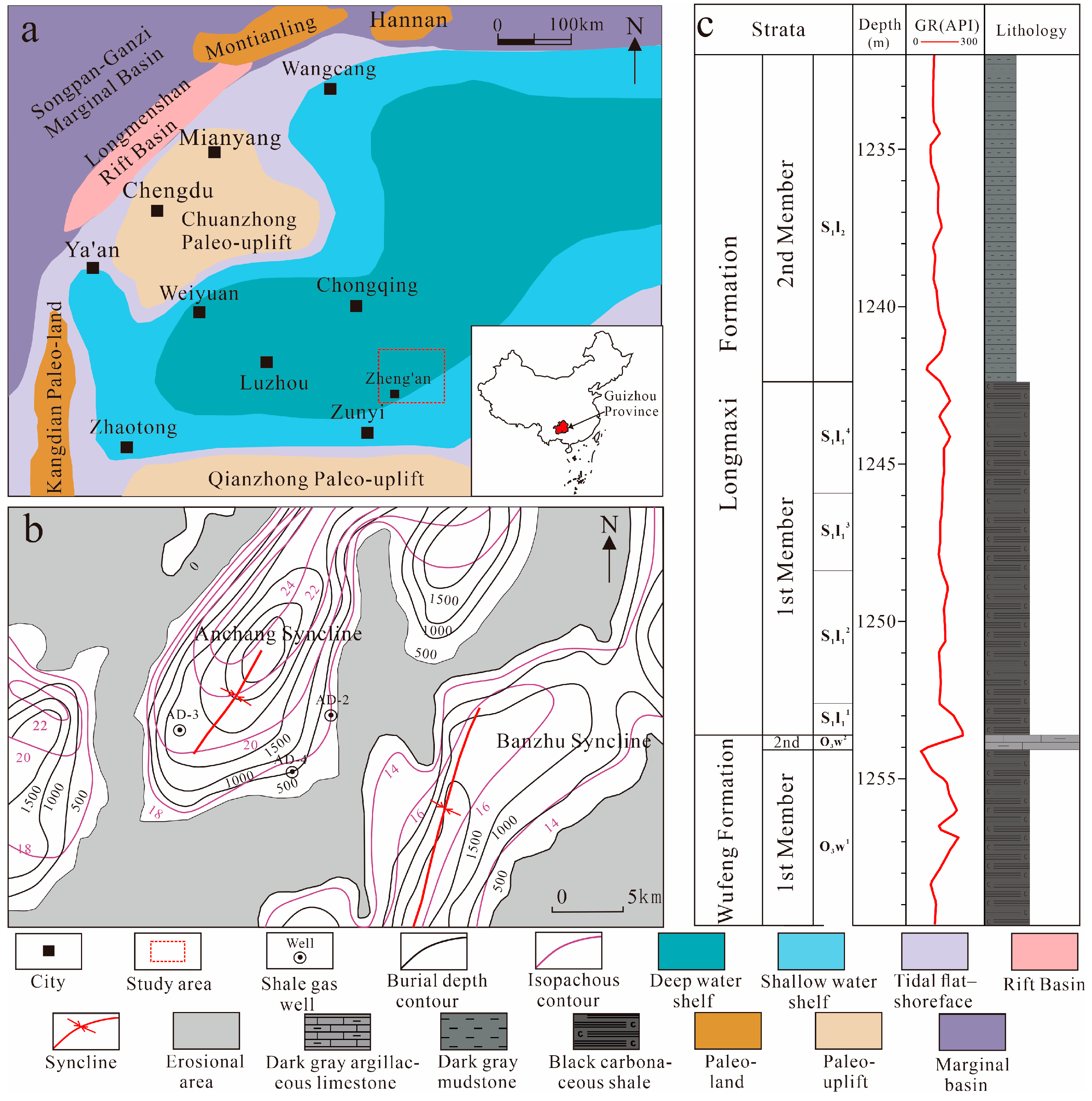
The study area is located in the Zheng’an region of northeastern Guizhou Province (Figure 1a), within the tectonic transition zone between the southeastern margin of the Upper Yangtze Block and the outer rim of the Sichuan Basin. Regional structures are strongly controlled by the East Sichuan–Wuling fold-and-fault belt, where NE-trending folds and associated faults produce pronounced tectonic segmentation [33,34,35,36,37]. The study wells are situated in the Anchang Syncline; together with adjacent fold units, this structural framework governs burial-depth zoning and structural styles of the target intervals (Figure 1b) [38,39,40]. The investigated Wufeng-Longmaxi cores from wells AD-2, AD-3, and AD-4 occur within a present-day burial-depth window of 1243–1362 m. In this paper, “shallow” is defined strictly by the present-day burial depth of the studied cores (i.e., a quantitative definition and regional comparison criterion), rather than by depositional water depth. From a preservation perspective, fold–fault segmentation and multi-level detachment deformation can partition the same stratigraphic unit into adjacent structural positions with contrasting fault/fracture overprint intensity and sealing effectiveness, which is widely recognized to exert first-order control on pore-system evolution and gas retention in Lower Paleozoic shale-gas systems [30].
The target strata comprise the Upper Ordovician Wufeng Formation and the Lower Silurian Longmaxi Formation black shales (Figure 1c) which, together with the Lower Cambrian Niutitang Formation, constitute the major marine shale successions in northern Guizhou [23,41,42,43]. Deposited in a Late Ordovician–Early Silurian shelf system, the Wufeng-Longmaxi interval occupies a regional transition between deep- and shallow-water shelf environments. This basin- to region-scale facies evolution and migration has been linked to shale-facies distribution and shale-gas heterogeneity at the basin scale [31].
Against this regional setting, Longmaxi shales in the Zheng’an area are generally characterized by siliceous–argillaceous dominance under an overall low-carbonate regime, although local carbonate enrichment may occur in discrete intervals. It should be noted that “regional background ranges” reported in the literature may not be strictly comparable with statistics derived from a specific sampling window and well set because sampling coverage, analytical protocols, and statistical criteria can differ. Therefore, unless otherwise stated, background information is used here to provide regional context, whereas cross-well and cross-lithofacies comparisons in this study were performed using internally consistent criteria. Detailed mineralogical statistics are reported in the Results section.

3. Samples and Methods

3.1. Sample Collection and Lithological Overview

This study investigated 40 core samples collected from Longmaxi Formation shale intervals in wells AD-2, AD-3, and AD-4 in the Zheng’an area, northern Guizhou. The target strata are dominated by dark gray to black, fine-grained mudstone/shale, commonly displaying horizontal bedding and fine lamination. Sampling in well AD-3 covered multiple stratigraphic levels of the Longmaxi Formation and extended downward into the underlying Wufeng Formation, providing a relatively continuous section for comparing coordinated variations in mineral composition, w(TOC), and in situ gas content. Petrographic observations of representative samples indicate that the matrix is mainly composed of fine-grained siliceous–argillaceous material, locally interbedded with minor carbonate debris and/or diagenetic carbonate crystals, suggesting an overall compositional background of siliceous–argillaceous dominance with localized carbonate enrichment.

3.2. Analytical Items, Instruments, and Procedures

3.2.1. XRD Mineralogy

Whole-rock mineral compositions and clay-mineral contents were determined using a Rigaku D/max-2500PC automated powder X-ray diffractometer (Rigaku, Akishima, Tokyo, Japan). Sample preparation, testing, and data processing followed the China Petroleum and Natural Gas Industry Standard SY/T 5163-2018 [44], X-ray Diffraction Analysis Methods for Clay Minerals and Common Non-Clay Minerals in Sedimentary Rocks. Samples were crushed, ground to powder, and scanned over a 2θ range of 5°–70°. Quantitative calculations were used to obtain mass fractions of major mineral groups, including quartz, clay minerals, and carbonate minerals. For selected samples, clay-mineral assemblages were further resolved (e.g., illite, illite/smectite mixed layers, and chlorite) following the same standard to characterize variability within the clay endmember.

3.2.2. FE-SEM Observation

Microtextures and pore–microfracture characteristics were examined using a ZEISS field-emission scanning electron microscope (ZEISS; Carl Zeiss Microscopy Deutschland GmbH, Oberkochen, Germany). Analytical procedures followed the China Petroleum and Natural Gas Industry Standard SY/T 5162-1997 [45], Scanning Electron Microscopy Analysis Method for Rock Samples. Fresh fracture surfaces and/or polished surfaces were prepared and coated for conductivity. High-resolution images were acquired under appropriate accelerating-voltage and working-distance conditions to identify mineral contacts, fabric/foliation features, and the morphology and development of pores and microcracks. Interpretation terminology and criteria were applied consistently throughout the dataset.

3.2.3. w(TOC) and In Situ Gas Content

Total organic carbon, w(TOC) (%), was measured by high-temperature combustion after acid pretreatment to remove inorganic carbon; instrument calibration followed routine laboratory procedures. In situ gas content (cm3/g) was compiled from core gas-content test reports provided for the three wells and was used as the final reported value for cross-well and cross-lithofacies comparisons. Because this study is based on reported gas-content results rather than re-testing, detailed operational information (e.g., desorption protocol and the treatment of lost gas) is not reproduced here; accordingly, strict screening criteria were applied to ensure internal consistency. Only gas-content data reported using the same unit standard (cm3/g; 1 cm3/g ≈ 1 m3/t) and within the studied depth intervals were included. The values are interpreted primarily in a comparative sense among lithofacies within the same regional and stratigraphic context.

3.3. Lithofacies Classification and Data Processing

Although shale lithofacies classification schemes vary, mineral composition remains the primary discriminant, commonly supplemented by organic matter abundance and sedimentary structures for refinement [11,42,46,47,48,49]. Mineral assemblages not only record depositional signals (e.g., provenance and hydrochemical/hydrodynamic conditions) but also directly influence brittle-mineral proportions and mechanical behavior, thereby affecting fracability and reservoir effectiveness [50,51].
Accordingly, lithofacies were classified using a quartz–clay–carbonate ternary discrimination scheme based on XRD-derived mass fractions, where quartz, clay minerals, and carbonates represent the siliceous, argillaceous, and carbonate endmembers, respectively. To enhance reproducibility, all samples were normalized to Qz–Clay–Carb percentages (Qz + Clay + Carb = 100), and lithofacies fields were assigned using explicit numerical thresholds. Specifically, siliceous shale (S) was defined when siliceous minerals exceeded 50%, clay-rich shale (CM) when clay minerals exceeded 50%, and calcareous shale (C) when carbonate minerals were ≥50%. Mixed shale (M) occupied the residual compositional domain where carbonate minerals were <50% and no single endmember exceeded 50%, representing a transitional mixing field rather than an overlapping category. To minimize ambiguity at compositional boundaries, a consistent decision sequence was used: carbonate enrichment (C) was evaluated first, followed by S and CM, and M was assigned only to samples that did not meet the above criteria [52,53,54,55].
Within each primary lithofacies, subfacies (S-1 to S-3, CM-1 to CM-3, C-1 to C-3, and M-1 to M-3) were further delineated by endmember-proportion tiers in ternary space, such that each subfacies corresponds to a defined compositional interval and can be reproduced directly from normalized Qz–Clay–Carb values [53,54,55,56,57,58,59,60,61,62]. For statistical comparability, subfacies were aggregated as needed into the four primary lithofacies (S/CM/C/M) or into three broader classes (siliceous, clay-rich, and mixed). w(TOC) and in situ gas content were evaluated on the same lithofacies scale to examine coupled relationships among mineral composition, organic enrichment, and gas-bearing response.

4. Results

4.1. Mineral Composition and Vertical Variation

XRD whole-rock mineralogy and clay-mineral assemblage data were used to quantify mineral composition and its vertical variability within Longmaxi Formation shales in the study area. The results show that samples were dominated by quartz and clay minerals, whereas carbonate minerals were generally minor but exhibited pronounced enrichment in several discrete intervals. Overall, quartz ranged from 5.0% to 71.9%, clay minerals from 17.7% to 82.0%, and carbonate minerals from 0% to 50.0%. Most samples plotted within the siliceous–argillaceous transition field, indicating that bulk composition was primarily controlled by siliceous and clay components. The occurrence of carbonate-rich samples further indicates stratigraphic heterogeneity and localized carbonate input and/or diagenetic enhancement.
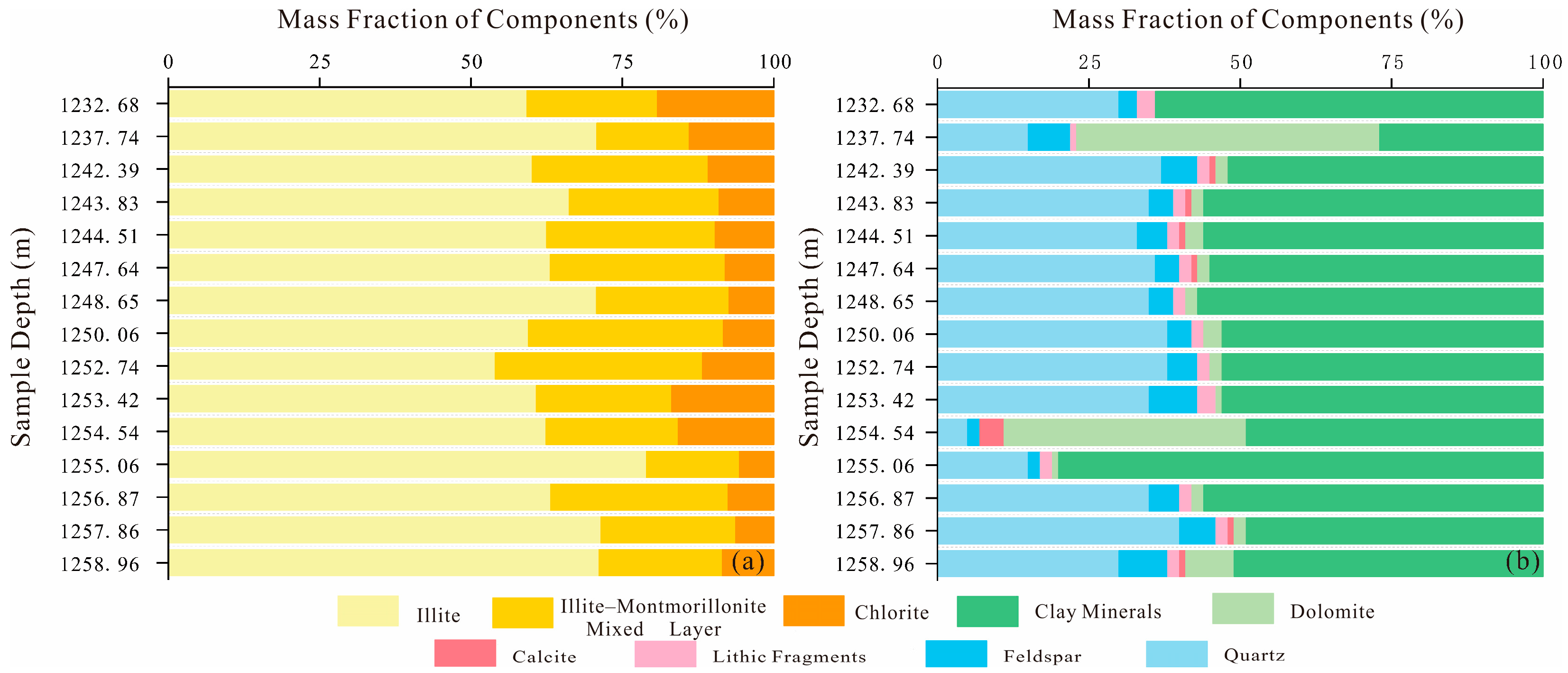
Taking well AD-3 as a representative example, the clay-mineral assemblage was dominated by illite, illite/smectite mixed layers (I/S), and chlorite (Figure 2a). Illite varied from 54.03% to 78.96% (mean 65.74%), I/S from 15.27% to 34.20% (mean 23.68%), and chlorite from 5.68% to 19.21% (mean 10.58%). This assemblage indicated an illite-dominated clay system in AD-3, while the variable proportions of I/S and chlorite along the profile implied that the internal composition of the clay endmember was not uniform and changed vertically.
Whole-rock mineralogy in well AD-3 showed that clay minerals ranged from 27% to 80% (mean 54.73%) and quartz from 5% to 40% (mean 30.00%), with minor feldspar (2%–8%, mean 4.93%) and rock fragments (1%–3%, mean 2.13%) (Figure 2b). Carbonate minerals were generally scarce; calcite occurred only sporadically at ~1%. In contrast, dolomite exhibited distinct enrichment at specific depths, reaching 50% at 1237.74 m and 40% at 1255.54 m, indicating interval-scale strengthening of carbonate components within an otherwise siliceous–argillaceous shale succession. Collectively, these mineralogical characteristics confirm that Longmaxi shales in the Zheng’an area are dominated by siliceous–clay materials with localized carbonate enrichment, providing a compositional basis for subsequent lithofacies partitioning and interpretation of vertical stratigraphic variability.

4.2. Lithofacies Types and Three-Endmember Distribution

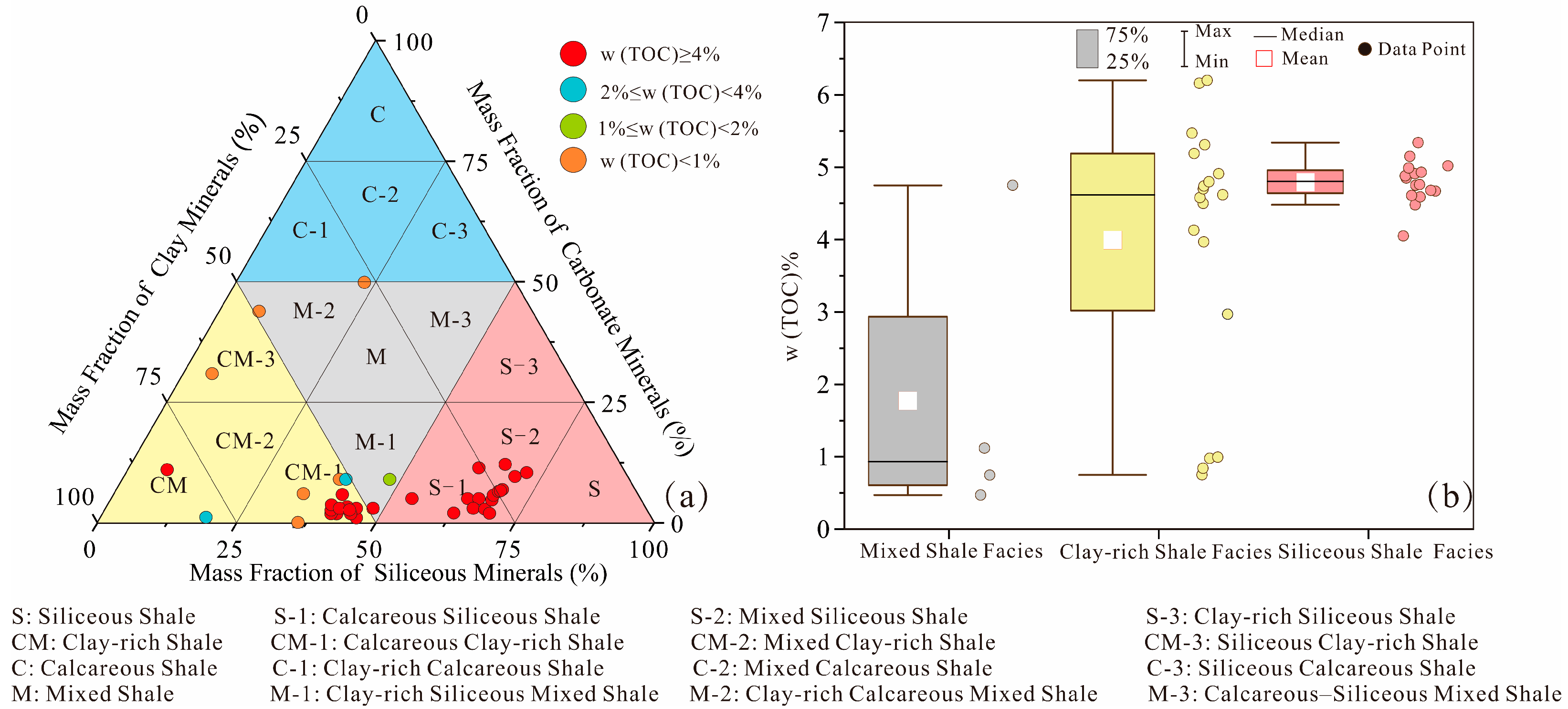
Based on XRD-derived mineral mass fractions, all samples were projected onto a quartz–clay–carbonate ternary diagram (Figure 3a) to identify lithofacies and evaluate compositional distributions. Data points were distributed mainly along the quartz–clay join and cluster between the siliceous and clay-rich endmembers, indicating that shale mineralogy in the study area was primarily governed by siliceous and argillaceous components, whereas the carbonate endmember was generally subordinate. According to the criteria in Section 3.3, siliceous shale (S) and clay-rich shale (CM) constituted the dominant lithofacies, followed by mixed shale (M), whereas calcareous shale (C) was least represented. Notably, only two samples from well AD-3 plotted in the carbonate-enriched field (carbonate ≥ 50%), suggesting that carbonate enrichment was stratigraphically localized rather than regionally pervasive.
Subfacies distributions further defined the compositional framework of the shale succession (Figure 3a). Within the S group, S-1 (high quartz–low clay) and S-2 (moderate quartz–moderately high clay) were the principal subfacies. The CM group was dominated by CM-1 (high clay–low quartz), whereas CM-2 and CM-3 occurred only sporadically. Mixed-shale samples preferentially plotted toward the siliceous side of ternary space and were represented mainly by M-1 and M-2, indicating that even the mixed facies were biased toward siliceous assemblages. Overall, the ternary distribution defined a regional mineralogical pattern characterized by siliceous–clay dominance with localized carbonate enhancement.
When w(TOC) classes were superimposed on the ternary diagram (Figure 3a), samples with higher w(TOC) (≥4%) clustered within the quartz-rich and clay-rich fields, whereas samples closer to the central mixed domain or trending toward the carbonate endmember tended to exhibit lower w(TOC). Taken together, these observations indicate a consistent association between organic enrichment and mineral endmembers: siliceous–argillaceous dominance was commonly consistent with sustained fine-grained deposition and conditions favorable for organic-matter preservation, whereas elevated carbonate proportions and/or enhanced mixing may reflect more variable inputs and may dilute organic matter, resulting in lower and more dispersed w(TOC) [23,34,37,42]. Box-and-whisker statistics (Figure 3b) were consistent with this trend, with overall higher w(TOC) in S and CM and lower, more variable w(TOC) in M.
From a depositional perspective, the dominance of siliceous shale (S) and clay-rich shale (CM) indicated that the target interval was deposited mainly in a continental-shelf setting characterized by persistent low-energy, fine-grained sedimentation. The S facies was interpreted to record enhanced biogenic/hydrothermal or authigenic silica supply under relatively distal and quiescent shelf conditions, whereas the CM facies reflected sustained terrigenous mud input under low-energy hydrodynamic regimes. Despite differences in sediment sources, both facies were consistent with comparatively stable bottom-water conditions and limited clastic dilution, which would favor organic-matter preservation and the development of organic-rich intervals.
In contrast, the mixed shale (M) facies exhibited more complex mineral assemblages, suggesting depositional regimes prone to fluctuations and/or episodic changes in material supply. Increased carbonate and other components likely enhanced dilution, making w(TOC) more susceptible to reduction and dispersion, consistent with the scattered w(TOC) pattern of M on the ternary plot (Figure 3a). Although samples were largely collected from organic-rich sections and therefore showed overall elevated w(TOC), systematic differences among lithofacies persisted, indicating that ternary-based lithofacies classification provides a practical first-order constraint on organic-matter distribution. For screening purposes, S and CM should be prioritized; however, heterogeneity within S (e.g., S-1 versus S-2) remained substantial, and subfacies-scale evaluation was needed to avoid masking key contrasts by aggregation at the main-facies level.

4.3. Thin-Section and Microscopic Characteristics (Ar-Ion Polishing FE-SEM)

To validate lithofacies classification at the microscopic scale and clarify reservoir-space types, representative samples from typical stratigraphic intervals were selected for thin-section petrography and argon-ion polishing FE-SEM observations. Following conventional mudstone/shale reservoir descriptions, reservoir space was grouped into pores and fractures. Pores included intergranular, intragranular, and dissolution-related pores (with locally developed pores associated with pyrite aggregates), whereas fractures were dominated by bedding-parallel microfractures. The morphology, scale, and connectivity of pore–fracture systems varied systematically with lithofacies (Figure 4 and Figure 5).

4.3.1. Thin-Section Petrography

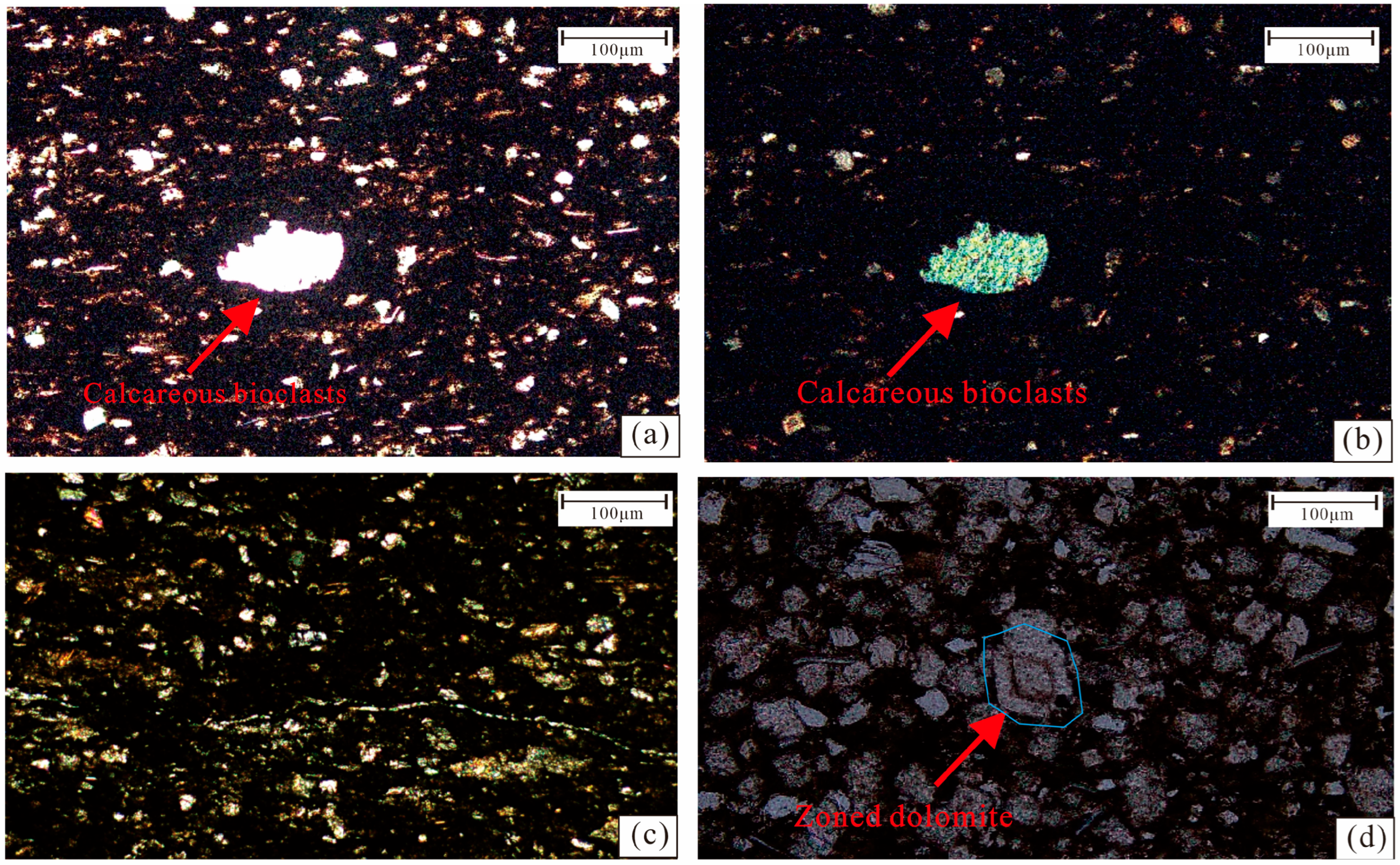
Thin-section observations (Figure 4) confirmed the mineralogical background of siliceous–clay dominance with localized carbonate enhancement and further showed lithofacies-dependent microfabrics. In clay-rich shale CM-1 (AD-2, Long-1 interval, 1349.22 m), plane-polarized light revealed a dark, fine-grained clayey matrix with uniformly dispersed fine particles (Figure 4a). Locally, scattered calcareous bioclastic fragments (red arrows) exhibited sharp boundaries and irregular outlines; under cross-polarized light, these fragments displayed clear interference colors (Figure 4b), consistent with a carbonate composition. This fabric represents a mud-dominated matrix with punctate carbonate components, consistent with the low-carbonate background indicated by XRD and compatible with episodic carbonate input. In siliceous shale S-1 (AD-4, 1331.45 m), bedding/lamination was well developed, and bright grains were preferentially aligned along bedding under cross-polarized light (Figure 4c), indicating depositional segregation between siliceous grains and clay-rich components. Mixed shale M-2 (AD-3, 1237.44 m) exhibited a grain–matrix mosaic texture under plane-polarized light (Figure 4d), with disseminated dolomite crystals within the matrix; locally, zoned dolomite (arrows) suggested dolomitization and recrystallization during diagenesis. This petrographic evidence was consistent with the high dolomite contents identified by XRD at the same stratigraphic level, implying that carbonate enrichment in this interval may have been influenced by diagenetic modification rather than solely by primary carbonate detritus input [48,51,52].

4.3.2. Pore-Fracture Characteristics by Lithofacies (FE-SEM)

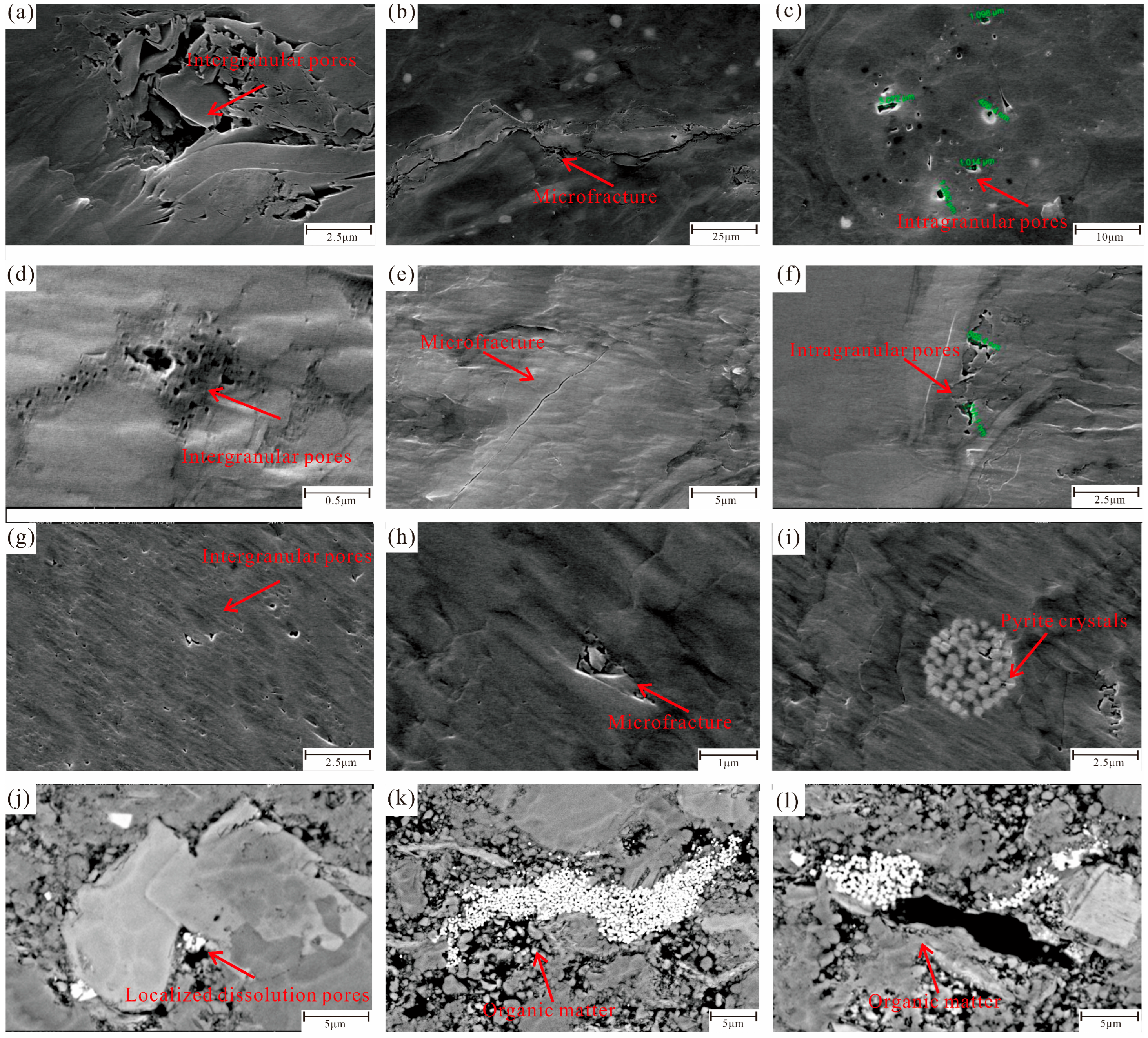
FE-SEM images (Figure 5) showed that lithofacies-related differences in reservoir space were expressed mainly by the pore-size spectrum and the degree of pore–fracture connectivity. The following descriptions are based on representative fields of view and are used as qualitative constraints on pore effectiveness and connectivity, rather than as quantitative measurements of porosity/permeability or sealing capacity.
(1)
CM-1 (AD-2, 1327.57 m). Open intergranular pores were widely observed between clay platelets and fine-grained particles (Figure 5a). Pores were typically banded, wedge-shaped, or irregular, and locally formed pore belts along bedding. Through-going microfractures were present (Figure 5b), with widths of ~1–3 μm, linking intergranular and intragranular pores. At higher magnification, intragranular pores were evident (Figure 5c), with diameters of ~1–3 μm, comparable to intergranular pore sizes. Overall, the co-occurrence of intergranular pores, intragranular pores, and bedding-parallel microfractures suggests comparatively favorable short-range connectivity within the imaged areas, which is generally considered beneficial for free-gas storage and potential flow pathways under similar boundary conditions [15,16,17,18,19,56].
(2)
By contrast, S-1 (AD-2, 1351.30 m) showed more tightly packed particles, and intergranular pores were markedly smaller, mostly < 1 μm (Figure 5d). Bedding-related microfractures remained visible (Figure 5e) but were commonly elongated and on the order of hundreds of nanometers, primarily connecting a limited number of locally larger pores. Intragranular pores were also small (Figure 5f), with diameters of ~0.5–0.7 μm. These observations suggest narrower pore throats, and effective connectivity likely depends more strongly on the continuity and interconnection of microfractures within this lithofacies.
(3)
Similarly, M-2 (AD-3, 1256.87 m) was characterized by a dense matrix and sparse pores in the observed areas (Figure 5g). A cross-cutting microfracture was developed (Figure 5h; width ~2 μm), whereas pores on both sides were poorly developed, suggesting that fractures may contribute disproportionately to connectivity where matrix pores are limited. Regular polyhedral pores (Figure 5i) with diameters of ~100–300 nm occurred within pyrite aggregates. These pores may provide local storage, but their contribution to bulk flow capacity is likely constrained where linkage to the broader matrix pore system is limited.
(4)
Notably, S-2 (AD-4, 1327.80 m) contained identifiable intergranular pores and localized dissolution pores (diameter ~1–2 μm) at grain boundaries (Figure 5j). In representative fields of view, parts of the pore space and/or pore throats appeared to be partially occluded by solid organic matter (Figure 5k). Elongated microfractures also showed organic-matter filling/bridging (Figure 5l), which may reduce effective pore-throat openness and pore–fracture connectivity. This interpretation is stated cautiously: the microscopic evidence suggests a plausible mechanism by which S-2 may exhibit reduced pore effectiveness and connectivity, potentially contributing to the persistently low gas response observed in the continuous S-2 interval; however, the SEM evidence is qualitative and does not quantify the degree of blocking or its sealing efficiency at the core or reservoir scale.
Overall, FE-SEM observations corroborate lithofacies-dependent contrasts in pore-size distribution and pore–fracture connectivity (Figure 5) and provide micro-scale constraints consistent with lithofacies-scale patterns of in situ gas content described in Section 4.5. Here, micro–macro integration is achieved by comparing, on the same lithofacies/subfacies scale, qualitative indicators of pore effectiveness and connectivity (e.g., pore openness, throat narrowing, and microfracture linkage) with the statistical distribution and vertical persistence of in situ gas content. Accordingly, FE-SEM evidence is used to support cautious “consistent with/may contribute to” interpretations rather than definitive causal statements. Within this framework, CM-1 and S-1 showed microstructural attributes indicative of comparatively more effective connectivity, whereas M-2 was characterized by a denser matrix and locally constrained pore development, and S-2 showed partially occluded pores and microfractures. This contrast was consistent with their divergent gas-content behavior within the studied shallow interval.

4.4. w(TOC) Distribution and Lithological (Lithofacies) Correlation

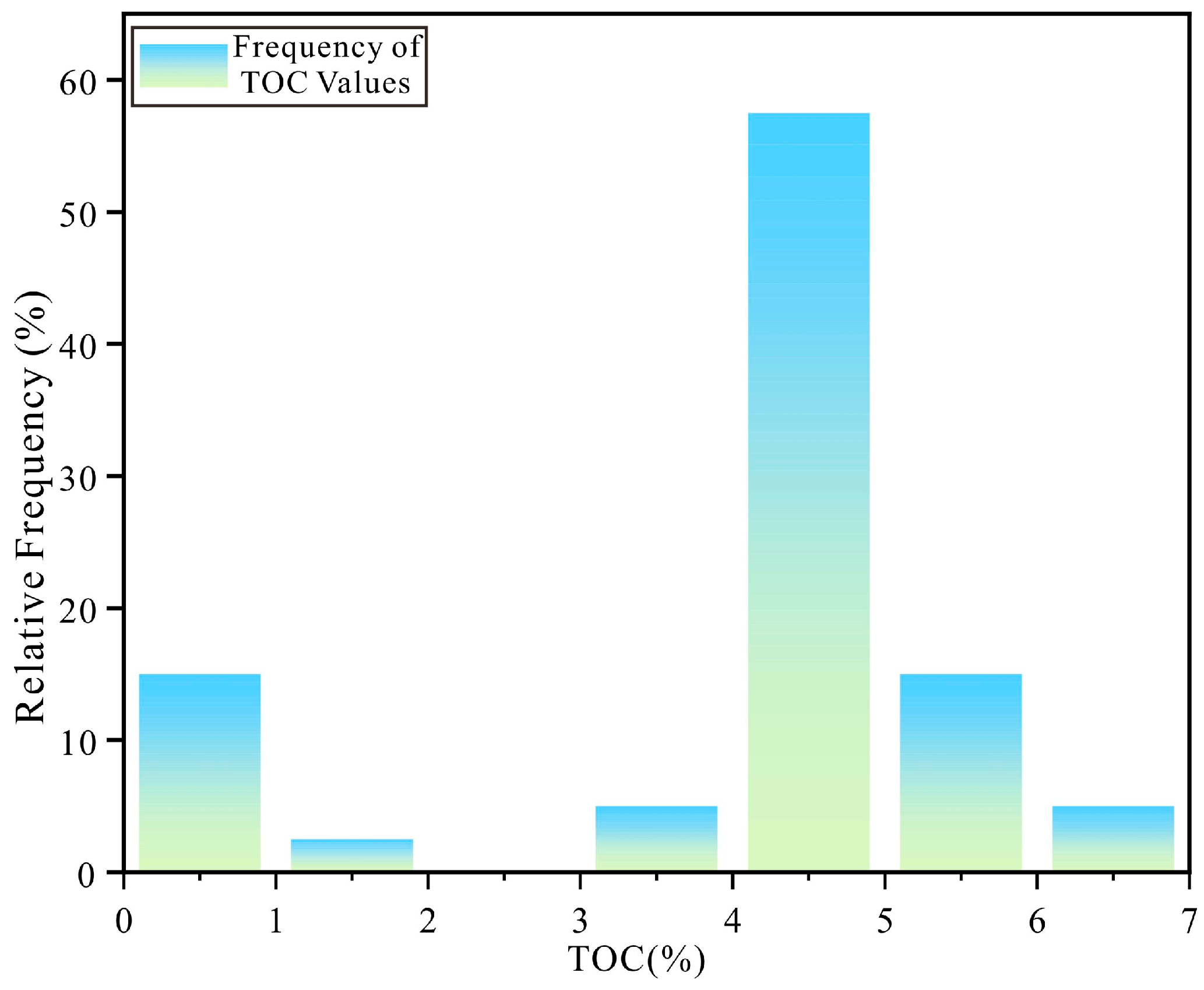
Organic-matter abundance is a primary indicator of hydrocarbon generation capacity in marine source rocks and provides the material basis for shale-gas formation. In the studied Longmaxi shale samples, w(TOC) ranged from 0.47% to 6.20% (Figure 6) and was generally high. Most samples (77.5%) fell within 4%–6%, and the 4%–5% interval accounted for the largest proportion (57.5%). Only 7.5% of samples had w(TOC) < 2%, whereas 12.5% exceeded 6%. This frequency distribution indicates a strong organic-matter background in the sampled interval, with organic-rich shales (w(TOC) ≥ 4%) dominating the dataset. Such a pattern is consistent with deposition in a Late Ordovician–Early Silurian shelf setting, where low-energy conditions and anoxic to weakly oxic bottom-water environments favor organic enrichment and preservation. Nevertheless, a small number of samples yielded w(TOC) values below 1% (approaching 0.5%), indicating the presence of organic-lean thin layers or interbeds within the organic-rich shale succession. These organic-poor layers are interpreted to reflect short-term increases in bottom-water oxygenation and/or enhanced terrigenous input, which would strengthen dilution and weaken organic-matter preservation, consistent with locally interbedded non-black lithologies (e.g., gray-green mudstone interlayers noted in Section 3.1).
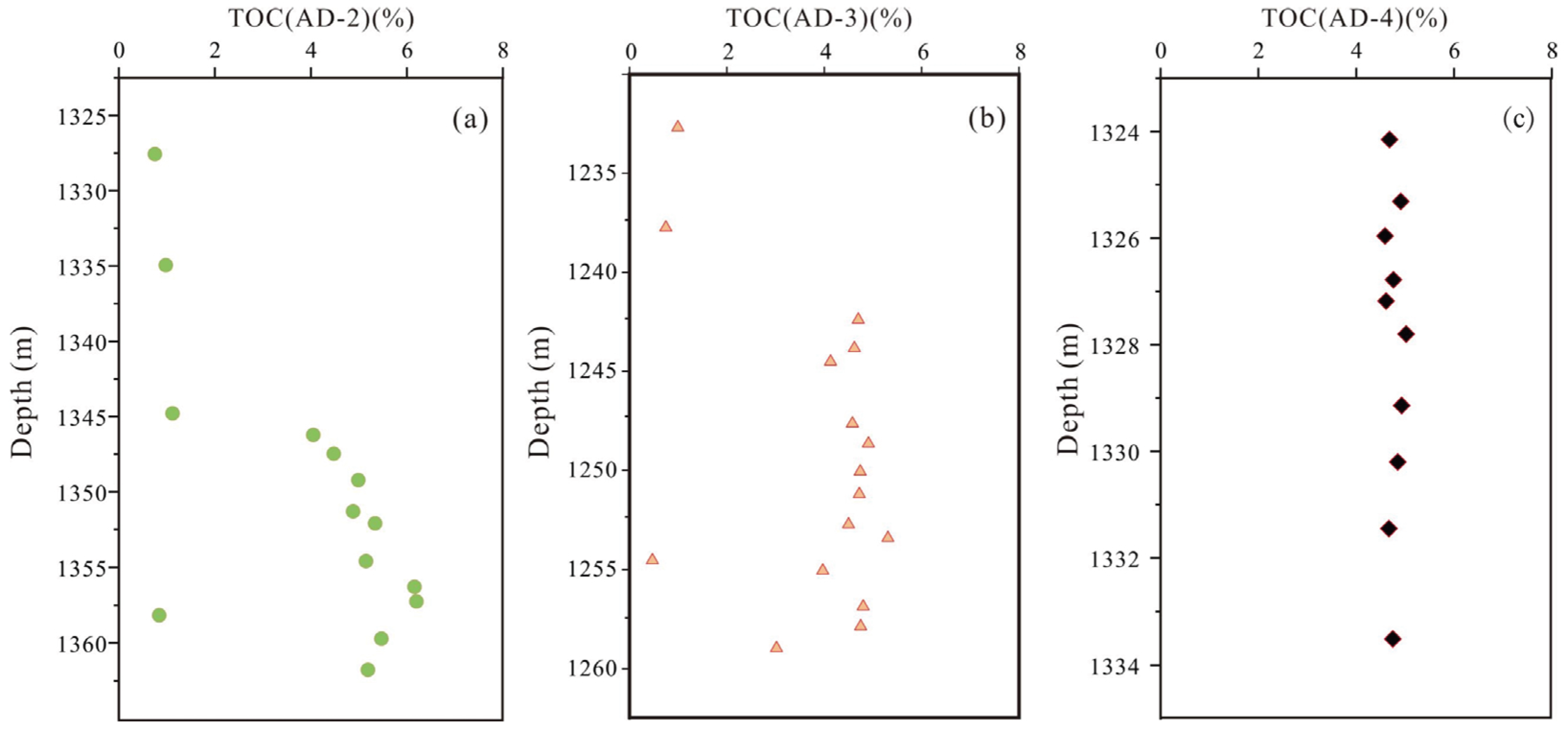
Vertical w(TOC) profiles further indicated that organic enrichment varies among wells and is coupled with stratigraphic position and lithofacies assemblages (Figure 7). Well AD-4 showed a concentrated and stable w(TOC) range: all 10 samples fell within 4.59%–5.02%, suggesting sampling from a relatively continuous organic-rich black shale package deposited under comparatively stable conditions. In contrast, w(TOC) in well AD-2 ranged from 0.75% to 6.20%, and in well AD-3 from 0.47% to 5.31%, with alternating highs and lows and pronounced vertical variability. These fluctuations suggest that the sampled sections included transitions from organic-rich black shale to more ordinary mudstone/shale, recording repeated shifts between enrichment and depletion driven by changing depositional conditions and lithological interbeds. The inter-well difference was consistent with sampling strategy: AD-4 mainly targeted the lower, more stable organic-rich section, whereas AD-2 and AD-3 included upper or transitional strata with more diverse facies types and stronger vertical heterogeneity.
Lithofacies-scale statistics revealed a clear association between w(TOC) and mineral composition (Figure 3a,b). Median w(TOC) values for S and CM were approximately 4.5%, slightly higher than those for M (~4.0%). S and CM distributions were concentrated mainly within 4%–6%, whereas M exhibits exhibited lower values and greater dispersion. Although overlaps existed among facies, the overall trend indicates that, under the low-carbonate background of the study area, siliceous-rich and clay-rich facies are more likely to host elevated w(TOC). These facies commonly corresponded to relatively stagnant shelf environments characterized by sustained fine-grained sedimentation and more reducing bottom-water conditions, where organic matter is less prone to oxidation and dilution is comparatively weak. In contrast, mixed facies more often reflected fluctuating depositional regimes and/or enhanced input of non-organic components, which may dilute organic matter and disrupt the continuity of enrichment, resulting in lower and more variable w(TOC) [23,50,54,60]. In this dataset, higher w(TOC) values are preferentially associated with S-1 and CM-1, whereas lower w(TOC) values occurred more frequently in S-2 and M-type samples, implying that environmental shallowing and/or episodic changes in sediment supply may have weakened organic enrichment.
Moreover, high-frequency w(TOC) fluctuations in wells AD-2 and AD-3 commonly coincided with frequent lithofacies transitions, suggesting that lithofacies continuity partly governs the continuity of organic-carbon enrichment. Where S-1 or CM-1 developed continuously, w(TOC) tended to remain stably high; conversely, repeated facies alternations were often accompanied by weakening or termination of enrichment near facies boundaries, producing pronounced vertical variability [54,60]. This relationship has direct implications for identifying organic-rich targets: under comparable structural and preservation conditions, priority should be given to thicker and laterally/vertically continuous intervals dominated by S-1 and/or CM-1, which likely reflect more stable depositional conditions with limited oxidation and reduced detrital dilution and are therefore more favorable for shallow shale-gas sweet-spot delineation [40,51,58].

4.5. Variations in In Situ Gas Content with Depth and Lithofacies Dependence

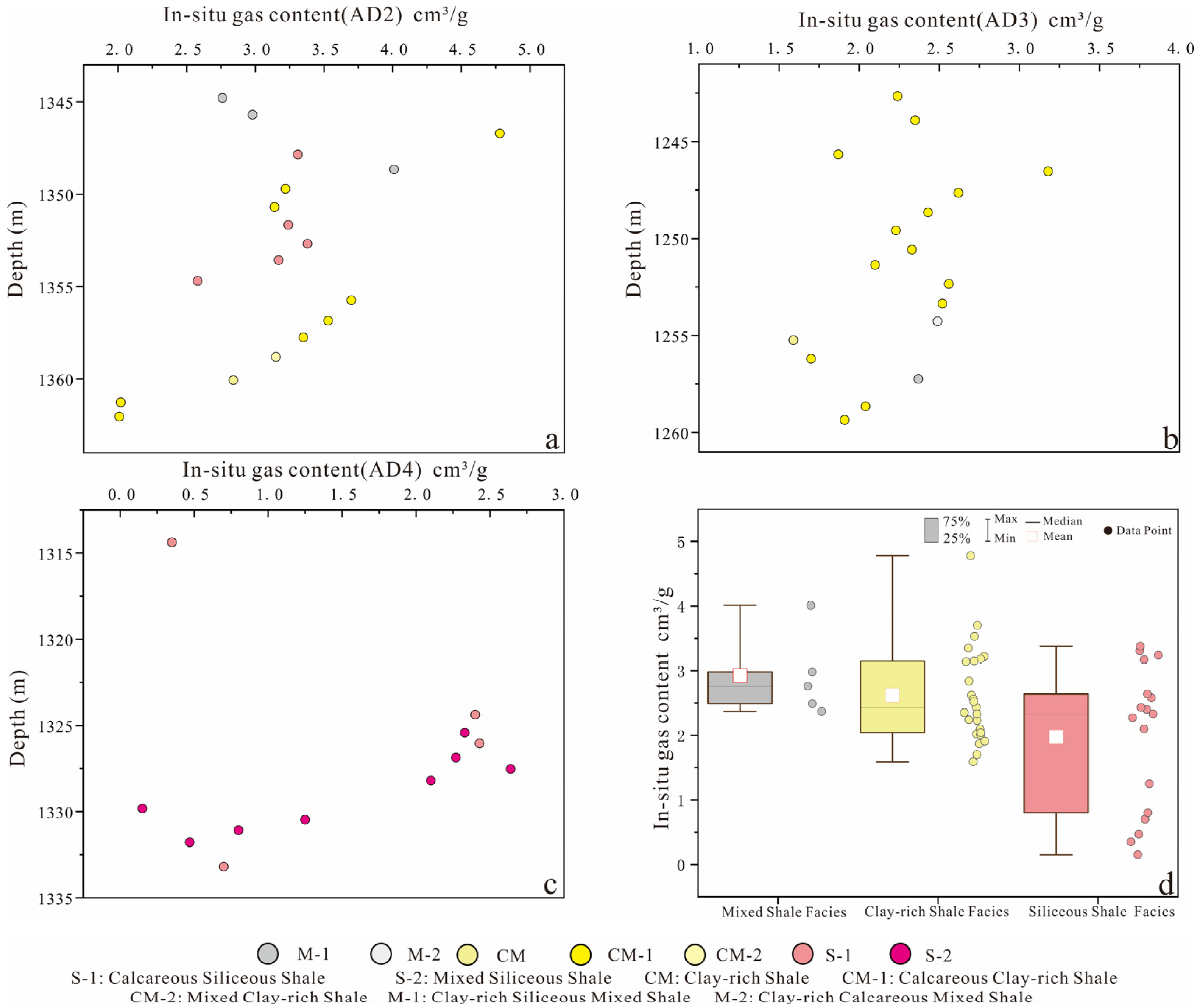
Depth profiles of field-reported in situ gas content for the three wells were plotted to illustrate vertical variability and lithofacies-related differences (Figure 8; 1 cm3/g ≈ 1 m3/t). Overall, gas content ranged from 0.15 to 4.78 cm3/g, and higher values generally coincided with the continuous development of favorable lithofacies along the stratigraphic profile. Given the narrow present-day burial-depth window (1243–1362 m), comparisons here emphasize lithofacies-related differences under broadly comparable depth conditions.
In well AD-2 (Figure 8a), 14 samples from 1344.8 to 1362.0 m were dominated by CM-1 and S-1, with minor intercalated M-type samples. Gas content was relatively high (2.37–4.78 cm3/g; average ~3.3 cm3/g) but showed noticeable point-to-point fluctuations. The maximum value (4.78 cm3/g) occurred at 1346.71 m within CM-1, and adjacent samples remained mostly > 3 cm3/g, defining a continuous medium-to-high gas interval. Gas contents in S-1 were slightly lower overall (~2.5–3.4 cm3/g) but still represented a stable moderate-to-high level. The few M-type samples yielded locally high values (2.76–4.01 cm3/g), yet they were scattered and did not define a continuous gas-rich interval, limiting their contribution to the vertical gas pattern.
Well AD-3 (Figure 8b) included 16 samples from 1242.7 to 1259.3 m and was lithofacies-simple, being dominated by CM-1 with one CM-2 and one M-2 sample. Consistent with this lithofacies continuity, gas content was comparatively concentrated: most values fell within 2.0–2.6 cm3/g (average ~2.3 cm3/g), with smaller overall variability than in AD-2. A local low value of 1.59 cm3/g occurred at 1255.24 m (CM-2), whereas a relative high of 3.18 cm3/g occurred at 1246.53 m; however, no extreme discontinuities were observed. These results suggest that where a single favorable lithofacies (CM-1) develops continuously, in situ gas content tends to remain at a stable, moderate level.
Well AD-4 (Figure 8c) contained 10 samples from 1314.4 to 1333.2 m and was characterized by alternations between S-1 and S-2, accompanied by clear vertical zonation in gas content. The 1314–1317 m interval (S-1) yielded ~2.3–2.4 cm3/g, whereas gas content decreased sharply upon entering a continuous S-2 interval, dropping from 2.64 cm3/g to a minimum of 0.15 cm3/g. Persistently low values (0.47, 0.35, and 1.25 cm3/g) occurred within 1330–1332 m (all S-2), followed by a rebound to 2.43 cm3/g at 1333.19 m (S-1). This pattern indicates that subfacies within the siliceous shale group can differ by nearly an order of magnitude in gas content and that S-2 is the primary contributor to the strong dispersion observed for S-type samples.
Lithofacies-based statistics for all samples (Figure 8d) further quantified these differences. CM samples (n = 26) ranged from 1.59 to 4.78 cm3/g (median 2.43 cm3/g) and showed the highest upper limit and a relatively concentrated distribution. S samples (n = 17) ranged from 0.15 to 3.38 cm3/g (median 2.27 cm3/g) but exhibited a pronounced low-end tail, reflecting continuous low-gas S-2 intervals. M samples (n = 4) ranged from 2.37 to 4.01 cm3/g (median 2.88 cm3/g), but the small sample size and scatter limit representativeness. Overall, CM showed the most stable and consistently high gas-bearing behavior, whereas S exhibited strong internal heterogeneity that requires subfacies-scale discrimination.
Combined with thin-section and FE-SEM observations (Figure 4 and Figure 5), lithofacies-dependent variability in in situ gas content was assessed by comparing, on the same lithofacies/subfacies scale, qualitative indicators of pore effectiveness and pore–fracture connectivity with the statistical distribution and vertical persistence of gas content. Micro-scale observations are used here as qualitative constraints rather than quantitative measures of porosity/permeability or sealing efficiency, supporting cautious “consistent with/may contribute to” interpretations within the studied burial-depth window and structural setting [15,16,17,18,19]. CM-1 displayed co-developed intergranular/intragranular pores and bedding-parallel microfractures (Figure 5a–c), consistent with its relatively concentrated medium-to-high gas-content distribution. In contrast, S-2 contained identifiable intergranular/dissolution pores and microfractures, but representative fields of view showed partial pore/throat occlusion by solid organic matter (Figure 5j–l), which plausibly weakens effective connectivity and aligns with the persistently low gas response of the continuous S-2 interval. The M facies was generally matrix-dense with sparse pores (Figure 5g–i); localized pores (e.g., within pyrite aggregates) appeared to have limited linkage to a broader pore–fracture network, consistent with the absence of laterally/vertically continuous gas-rich behavior in this dataset.
Accordingly, for favorable-interval selection in the shallow Longmaxi shale of the Zheng’an area, intervals where CM-1 and S-1 develop continuously and w(TOC) remains high represent the most robust sweet-spot candidates. For intervals dominated by S-2, stratigraphic-scale evaluation should explicitly consider the extent of organic-matter filling, effective porosity, and fracture effectiveness, rather than inferring gas richness solely from silica enrichment.

5. Conclusions

Based on the normalized quartz–clay–carbonate ternary discrimination, the Longmaxi Formation shale samples from the study area mostly plotted within the siliceous–clay transition field, indicating dominance of siliceous and argillaceous components. Carbonates were generally subordinate but exhibited discrete interval-scale enrichment in a few horizons. Accordingly, the lithofacies assemblage was dominated by siliceous shale (S) and clay-rich shale (CM), followed by mixed shale (M), whereas calcareous shale (C) was relatively scarce. The principal subfacies were concentrated in S-1, S-2, and CM-1, and lithofacies variability was mainly expressed by shifts in the relative proportions of quartz and clay minerals.
Organic matter abundance was overall high, with w(TOC) mainly ranging from 4% to 6% and the 4%–5% bin accounting for the largest proportion. Well AD-4 showed a narrow and stable w(TOC) distribution, whereas wells AD-2 and AD-3 displayed more pronounced vertical fluctuations. Lithofacies-based statistics indicated that CM and S facies generally had higher w(TOC) than M facies, and high-w(TOC) samples tended to occur in the quartz-rich and clay-rich domains of the ternary space. This pattern suggests that, under an overall low-carbonate regime, siliceous–argillaceous fine-grained deposition is more conducive to sustaining organic enrichment, whereas enhanced compositional mixing may dilute organic matter and increase variability.
In situ gas content differed markedly among lithofacies. The CM facies exhibited higher overall gas contents, a higher upper limit, and a more concentrated distribution (maximum 4.78 cm3/g). In contrast, the S facies showed stronger fluctuations and a wider dispersion with a distinct low-end tail, which was mainly driven by persistently low values in the continuous S-2 interval (minimum 0.15 cm3/g), highlighting substantial internal heterogeneity within the siliceous shale category. It should be emphasized that the comparative analysis in this study is restricted to a present-day burial-depth window of 1243–1362 m, and the maturity context is framed by published regional evidence indicating high maturity to overmaturity in northern Guizhou. Because pressure coefficient and in situ pressure data were not available for the studied cores, preservation-related parameters are not quantified here, and Ro variability is discussed only as regional background rather than as a primary explanatory variable. Under these boundary conditions, the lithofacies–TOC–gas–microstructure relationships reported here are intended for relative comparison and sweet-spot screening within the shallow Zheng’an setting; future work integrating pressure and stress-state measurements is required to better parameterize preservation controls.
Considering the combined responses of w(TOC) and in situ gas content, CM-1 and S-1 emerge as the more consistently favorable and reproducible facies combinations. Although S-2 is widely developed in the studied interval, its gas-bearing behavior is strongly differentiated, requiring stratigraphic subdivision and interval-specific assessment rather than direct inference based solely on “silica-rich” composition. Meanwhile, local carbonate enrichment at 1237.74 m and 1255.54 m in well AD-3 is consistent with thin-section evidence of calcareous bioclastic fragments and zoned (annular) dolomite, implying episodic carbonate input and/or diagenetic dolomitization. This compositional anomaly provides contextual clues for reservoir heterogeneity in specific horizons; however, its impacts on organic matter abundance and pore–permeability architecture remain to be verified with additional data and constraints.

Author Contributions

Conceptualization, P.L. and J.Y.; methodology, M.X.; software, M.X.; validation, P.L., J.Y. and D.L.; formal analysis, D.S.; investigation, Y.D.; resources, G.L.; data curation, J.Y.; writing—original draft preparation, P.L.; writing—review and editing, P.L.; visualization, J.Y.; supervision, X.C.; project administration, D.S. All authors have read and agreed to the published version of the manuscript.

Funding

This research received no external funding.

Data Availability Statement

All data and materials are available on request from the corresponding author. The data are not publicly available due to ongoing research using a part of the data.

Conflicts of Interest

Jiliang Yu, Dan Lu, and Gangquan Li were employed by Guizhou Wujiang Shale Gas Exploration Co., Ltd., Guizhou 563400, China. The remaining authors declare that the research was conducted in the absence of any commercial or financial relationships that could be construed as a potential conflict of interest.

References

  1. Zou, C.N.; Dong, D.Z.; Wang, S.J.; Li, J.Z.; Li, X.J.; Wang, Y.M.; Li, D.H.; Cheng, K.M. Geological characteristics and resource potential of shale gas in China. Pet. Explor. Dev. 2010, 37, 641–653. [Google Scholar] [CrossRef]
  2. Zou, C.N.; Dong, D.Z.; Wang, Y.M.; Li, X.J.; Huang, J.L.; Wang, S.F.; Guan, Q.Z.; Zhang, C.C.; Wang, H.Y.; Liu, H.L.; et al. Shale gas in China: Characteristics, challenges and prospects (II). Petrol. Explor. Dev. 2016, 43, 166–178. [Google Scholar] [CrossRef]
  3. Jiao, F. Re-recognition of “unconventional” in unconventional oil and gas: On unconventionality of oil and gas and its standardization. Petrol. Explor. Dev. 2019, 46, 847–855. [Google Scholar] [CrossRef]
  4. Zheng, M.; Li, J.; Wu, X.; Wang, S.; Guo, Q.; Yu, J.; Zheng, M.; Chen, N.; Yi, Q. China’s conventional and unconventional natural gas resources: Potential and exploration targets. J. Nat. Gas Geosci. 2018, 3, 295–309. [Google Scholar] [CrossRef]
  5. Guo, T.; Zhang, H. Formation and enrichment mode of Jiaoshiba shale gas field, Sichuan Basin. Petrol. Explor. Dev. 2014, 41, 31–40. [Google Scholar] [CrossRef]
  6. Nie, H.; Li, D.; Liu, G.; Lu, Z.; Wang, H.; Wang, R.; Zhang, G. An overview of the geology and production of the Fuling shale gas field, Sichuan Basin, China. Energy Geosci. 2020, 1, 147–164. [Google Scholar] [CrossRef]
  7. Liang, F.; Bai, W.; Zou, C.; Wang, H.; Wu, J.; Ma, C.; Zhang, Q.; Guo, W.; Sun, S.; Zhu, Y.; et al. Shale gas enrichment pattern and exploration significance of Well WuXi-2 in northeast Chongqing, NE Sichuan Basin. Pet. Explor. Dev. 2016, 43, 386–394. [Google Scholar] [CrossRef]
  8. Jiang, Z.; Song, Y.; Tang, X.; Li, Z.; Wang, X.; Wang, G.; Xue, Z.; Li, X.; Zhang, K.; Chang, J.; et al. Controlling factors of marine shale gas differential enrichment in southern China. Pet. Explor. Dev. 2020, 47, 661–673. [Google Scholar] [CrossRef]
  9. Hu, Z.; Liu, Z.; Du, W.; Bai, Z.; Wang, R.; Sun, C.; Feng, D. Key geological factors governing sweet spots in the Wufeng-Longmaxi shales of the Sichuan Basin, China. Energy Geosci. 2024, 5, 100268. [Google Scholar] [CrossRef]
  10. Wang, G.; Ju, Y.; Huang, C.; Long, S.; Peng, Y. Longmaxi-Wufeng Shale lithofacies identification and 3-D modeling in the northern Fuling Gas Field, Sichuan Basin. J. Nat. Gas Sci. Eng. 2017, 47, 59–72. [Google Scholar] [CrossRef]
  11. Chen, L.; Lu, Y.; Jiang, S.; Li, J.; Guo, T.; Luo, C. Heterogeneity of the Lower Silurian Longmaxi marine shale in the southeast Sichuan Basin of China. Mar. Pet. Geol. 2015, 65, 232–246. [Google Scholar] [CrossRef]
  12. Zhao, J.; Jin, Z.; Hu, Q.; Liu, K.; Jin, Z.; Hu, Z.; Nie, H.; Du, W.; Yan, C.; Wang, R. Mineral composition and seal condition implicated in pore structure development of organic-rich Longmaxi shales, Sichuan Basin, China. Mar. Pet. Geol. 2018, 98, 507–522. [Google Scholar] [CrossRef]
  13. Slatt, R.M.; O’Brien, N.R. Pore types in the Barnett and Woodford gas shales: Contribution to understanding gas storage and migration pathways in fine-grained rocks. AAPG Bull. 2011, 95, 2017–2030. [Google Scholar] [CrossRef]
  14. Loucks, R.G.; Reed, R.M.; Ruppel, S.C.; Hammes, U. Spectrum of pore types and networks in mudrocks and a descriptive classification for matrix-related mudrock pores. AAPG Bull. 2012, 96, 1071–1098. [Google Scholar] [CrossRef]
  15. Sondergeld, C.H.; Newsham, K.E.; Comisky, J.T.; Rice, M.C.; Rai, C.S. Petrophysical considerations in evaluating and producing shale gas resources. In Proceedings of the SPE Unconventional Gas Conference, Pittsburgh, PA, USA, 23–25 February 2010; Society of Petroleum Engineers: Richardson, TX, USA, 2010; SPE-131768-MS. [Google Scholar] [CrossRef]
  16. Curtis, J.B. Fractured Shale-Gas Systems. AAPG Bull. 2002, 86, 1921–1938. [Google Scholar] [CrossRef]
  17. Ross, D.J.K.; Bustin, R.M. The Importance of Shale Composition and Pore Structure upon Gas Storage Potential of Shale Gas Reservoirs. Mar. Pet. Geol. 2009, 26, 916–927. [Google Scholar] [CrossRef]
  18. Chalmers, G.R.; Bustin, R.M.; Power, I.M. Characterization of Gas Shale Pore Systems by Porosimetry, Pycnometry, Surface Area, and Field Emission Scanning Electron Microscopy/Transmission Electron Microscopy Image Analyses: Examples from the Barnett, Woodford, Haynesville, Marcellus, and Doig Units. AAPG Bull. 2012, 96, 1099–1119. [Google Scholar] [CrossRef]
  19. Curtis, M.E.; Cardott, B.J.; Sondergeld, C.H.; Rai, C.S. Development of Organic Porosity in the Woodford Shale with Increasing Thermal Maturity. Int. J. Coal Geol. 2012, 103, 26–31. [Google Scholar] [CrossRef]
  20. Rickman, R.; Mullen, M.J.; Petre, J.E.; Grieser, W.V.; Kundert, D. A Practical Use of Shale Petrophysics for Stimulation Design Optimization: All Shale Plays Are Not Clones of the Barnett Shale. In Proceedings of the SPE Annual Technical Conference and Exhibition, Denver, CO, USA, 21–24 September 2008. [Google Scholar] [CrossRef]
  21. Aguilera, R. Shale gas reservoirs: Theoretical, practical and research issues. Pet. Res. 2016, 1, 10–26. [Google Scholar] [CrossRef]
  22. Liang, C.; Jiang, Z.; Zhang, C.; Guo, L.; Yang, Y.; Li, J. The shale characteristics and shale gas exploration prospects of the Lower Silurian Longmaxi shale, Sichuan Basin, South China. J. Nat. Gas Sci. Eng. 2014, 21, 636–648. [Google Scholar] [CrossRef]
  23. Liang, C.; Jiang, Z.; Cao, Y.; Zhang, J.; Guo, L. Sedimentary characteristics and paleoenvironment of shale in the Wufeng-Longmaxi Formation, North Guizhou Province, and its shale gas potential. J. Earth Sci. 2017, 28, 1020–1031. [Google Scholar] [CrossRef]
  24. Tribovillard, N.; Algeo, T.J.; Lyons, T.; Riboulleau, A. Trace metals as paleoredox and paleoproductivity proxies: An update. Chem. Geol. 2006, 232, 12–32. [Google Scholar] [CrossRef]
  25. Hatch, J.R.; Leventhal, J.S. Relationship between inferred redox potential of the depositional environment and geochemistry of the Upper Pennsylvanian (Missourian) Stark Shale Member of the Dennis Limestone, Wabaunsee County, Kansas, U.S.A. Chem. Geol. 1992, 99, 65–82. [Google Scholar] [CrossRef]
  26. Passey, Q.R.; Creaney, S.; Kulla, J.B.; Moretti, F.J.; Stroud, J.D. A Practical Model for Organic Richness from Porosity and Resistivity Logs. AAPG Bull. 1990, 74, 1777–1794. [Google Scholar] [CrossRef]
  27. Chai, B.; Zhao, F.; Ji, Y.; Chen, L.; Cheng, Q. Lithofacies Types and Reservoir Characteristics of Mountain Shale in Wufeng Formation-Member 1 of Longmaxi Formation in the Complex Structural Area of Northern Yunnan–Guizhou. ACS Omega 2023, 8, 2085–2097. [Google Scholar] [CrossRef]
  28. Hao, F.; Zou, H.Y.; Lu, Y.C. Mechanisms of Shale Gas Storage: Implications for Shale Gas Exploration in China. AAPG Bull. 2013, 97, 1325–1346. [Google Scholar] [CrossRef]
  29. Mews, K.S.; Alhubail, M.M.; Barati, R.G. A Review of Brittleness Index Correlations for Unconventional Tight and Ultra-Tight Reservoirs. Geosciences 2019, 9, 319. [Google Scholar] [CrossRef]
  30. Xiang, M.; Xu, S.; Wen, Y.-R.; Gou, Q.-Y.; Liu, B.-C. Influence of Tectonic Preservation Conditions on the Nanopore Structure of Shale Reservoir: A Case Study of Wufeng-Longmaxi Formation Shale in the Western Hubei Area, South China. Pet. Sci. 2024, 21, 2203–2217. [Google Scholar] [CrossRef]
  31. Hu, Z.; Du, W.; Sun, C.; Wu, J.; Zhu, T.; Zhao, J.; Yan, C. Evolution and Migration of Shale Facies and Their Control on Shale Gas: A Case Study from the Wufeng-Longmaxi Formations in the Sichuan Basin and Its Surroundings. Interpretation 2018, 6, SN57–SN70. [Google Scholar] [CrossRef]
  32. Yu, W.; Yuan, S.; Tang, H.; Luo, C.; Wu, W.; Liu, J.; Yang, Y.; Zhong, K.; He, L. The Effect of Structural Preservation Conditions on Pore Structure of Marine Shale Reservoir: A Case Study of the Wufeng-Longmaxi Formation Shale, Southern Sichuan Basin, China. Front. Earth Sci. 2024, 12, 1360202. [Google Scholar] [CrossRef]
  33. Liu, S.; Yang, Y.; Deng, B.; Zhong, Y.; Wen, L.; Sun, W.; Li, Z.; Jansa, L.; Li, J.; Song, J.; et al. Tectonic evolution of the Sichuan Basin, Southwest China. Earth-Sci. Rev. 2021, 213, 103470. [Google Scholar] [CrossRef]
  34. Li, C.; He, D.; Sun, Y.; He, J.; Jiang, Z. Structural characteristic and origin of intra-continental fold belt in the eastern Sichuan basin, South China Block. J. Asian Earth Sci. 2015, 111, 206–221. [Google Scholar] [CrossRef]
  35. He, W.; Zhou, J.; Yuan, K. Deformation evolution of Eastern Sichuan-Xuefeng fold-thrust belt in South China: Insights from analogue modelling. J. Struct. Geol. 2018, 109, 74–85. [Google Scholar] [CrossRef]
  36. Wang, Y.-S.; Xu, M.; Yang, Y.-N.; Xia, Q.; Jiang, B.; Yang, C.; Zhang, H. Structural Characteristics and Deformation Evolution of an Intra-Continental Fold-Thrust Belt in Eastern Sichuan: Insights Into Analogue Sandbox Models. Front. Earth Sci. 2022, 10, 897882. [Google Scholar] [CrossRef]
  37. Feng, Q.; Qiu, N.; Wu, H.; Koyi, H. Thermo-Kinematic Constraints on Restoration of the Eastern Sichuan Fold-And-Thrust Belt, South China. Tectonics 2023, 42, e2022TC007630. [Google Scholar] [CrossRef]
  38. Lan, B.; Zhao, F.; Li, S.; Jiang, H.; Liu, S.; Zhang, Z. Investigation of the Enrichment and Accumulation of Normal Pressure Shale Gas in Anchang Syncline Outside of Sichuan Basin. Front. Earth Sci. 2022, 9, 802142. [Google Scholar] [CrossRef]
  39. Wang, H.; Shi, Z.; Sun, S.; Zhao, Q.; Zhou, T.; Cheng, F.; Bai, W. Microfacies types and distribution of epicontinental shale: A case study of the Wufeng-Longmaxi shale in southern Sichuan Basin, China. Petrol. Explor. Dev. 2023, 50, 57–71. [Google Scholar] [CrossRef]
  40. Shi, S.; Wang, G.; Mou, Y.; Wei, X. Structural detachment influences the shale gas preservation in the Wufeng-Longmaxi Formation, Northern Guizhou Province. Open Geosci. 2024, 16, 20220653. [Google Scholar] [CrossRef]
  41. Du, W.; Yang, W.; Li, X.; Shi, F.; Lin, R.; Wang, Y.; Zhang, D.; Chen, Y.; Sun, Z.; Zhao, F. Differential Reservoir-Forming Mechanisms of the Lower Paleozoic Wufeng-Longmaxi and Niutitang Marine Gas Shales in Northern Guizhou Province, SW China: Theories and Models. Energies 2022, 15, 5137. [Google Scholar] [CrossRef]
  42. Li, X.; Du, W.; Feng, X.; Shi, F.; Chen, Y.; Wang, Y.; Jiang, Z.; Luo, Q. Pressure Evolution Mechanism of Marine Shale Reservoirs and Shale Gas Accumulation Model: Evidence from Fluid Inclusions in the Wufeng-Longmaxi Formation in the Basin Margin Structural Transition Zone in Northern Guizhou Province, China. Minerals 2023, 13, 241. [Google Scholar] [CrossRef]
  43. Liu, Y.; Jin, J.; Pan, R.; Li, X.; Zhu, Z.; Xu, L. Normal Pressure Shale Gas Preservation Conditions in the Transition Zone of the Southeast Basin Margin of Sichuan Basin. Water 2022, 14, 1562. [Google Scholar] [CrossRef]
  44. SY/T 5163-2018; Analysis Method for Clay Minerals and Ordinary Non-Clay Minerals in Sedimentary Rocks by the X-ray Diffraction. Petroleum Industry Press: Beijing, China, 2018.
  45. SY/T 5162-1997; Analytical Method of Rock Sample by Scanning Electron Microscope. Petroleum Industry Press: Beijing, China, 1997.
  46. Guo, T.L.; Zeng, P. The Structural and Preservation Conditions for Shale Gas Enrichment and High Productivity in the Wufeng-Longmaxi Formation, Southeastern Sichuan Basin. Energy Explor. Exploit. 2015, 33, 259–276. [Google Scholar] [CrossRef]
  47. Ren, G.; Guo, W.; Yuan, L. Quantitative Assessment of Shale Gas Preservation in the Longmaxi Formation: Insights from Shale Fluid Properties. J. Geo-Energy Environ. 2025, 1, 8–22. [Google Scholar] [CrossRef]
  48. Xie, W.; Chen, S.; Gan, H.; Wang, H.; Wang, M.; Vandeginste, V. Preservation conditions and potential evaluation of the Longmaxi shale gas reservoir in the Changning area, southern Sichuan Basin. Geosci. Lett. 2023, 10, 36. [Google Scholar] [CrossRef]
  49. Qin, Y.; Lei, Y.; Jiang, S.; Zhang, R.; Zhang, L.; Cen, W.; Lu, B. Shale gas accumulation conditions and resource potential evaluation of member 1 of the Lower Carboniferous Luzhai Formation in the northern Guizhong depression. Pet. Sci. Bull. 2022, 7, 139–154. [Google Scholar] [CrossRef]
  50. Liu, Z.; Li, H.; Zhang, X.; Fang, K.; Luo, P.; Zhu, H. Sedimentary facies distribution and evolution of the Lower Silurian Longmaxi Formation in the southern Sichuan-northern Guizhou area. Sediment. Tethyan Geol. 2021, 41, 436–445. [Google Scholar] [CrossRef]
  51. Hang, F.; Huang, Y.; Lan, B.; Li, L.; Liu, T.; Liu, R.; Jiang, D. Characteristics and controlling factors of shale reservoir in Wufeng Formation-Longmaxi Formation of the Zheng’an area. Bull. Geol. Sci. Technol. 2021, 40, 49–56. [Google Scholar] [CrossRef]
  52. Fan, Y.; Liu, Y.; Wen, Z.; Wang, Z.; Zhang, L.; Tang, P.; Xu, Y.; Tian, Y.; Chen, J.; Yan, G. Characteristics of thermal maturity of graptolite-bearing shales in Wufeng-Longmaxi Formations on northern margin of Xuefeng Mountain. Earth Sci. 2019, 44, 3725–3735. [Google Scholar] [CrossRef]
  53. Gamero-Diaz, H.; Miller, C.K.; Lewis, R.E. sCore: A Mineralogy Based Classification Scheme for Organic Mudstones. In Proceedings of the SPE Annual Technical Conference and Exhibition, New Orleans, LA, USA, 30 September–2 October 2013. Paper SPE-166284-MS. [Google Scholar] [CrossRef]
  54. Tang, Q.; Zhou, L.; Chen, L.; Tan, X.; Wang, G. Development Characteristics of Shale Lithofacies in the Longmaxi Formation and their Main Controlling Factors in the Changning Area, South Sichuan Basin, SW China. Front. Earth Sci. 2021, 9, 775657. [Google Scholar] [CrossRef]
  55. He, J.; Zhu, S.; Shi, X.; Zhao, S.; Cao, L.; Pan, S.; Wu, F.; Wang, M. Characteristics of Lithofacies in Deep Shale Gas Reservoirs in the Southeast Sichuan Basin and Their Influence on Pore Structure. Front. Earth Sci. 2022, 10, 857343. [Google Scholar] [CrossRef]
  56. Mandile, A.J.; Hutton, A.C. Quantitative X-ray Diffraction Analysis of Mineral and Organic Phases in Organic-Rich Rocks. Int. J. Coal Geol. 1995, 28, 51–69. [Google Scholar] [CrossRef]
  57. Xue, B.; Zhang, J.; Tang, X.; Yang, C.; Chen, Q.; Man, X.; Dang, W. Micro-pore Structure and Gas Accumulation Characteristics of Shale in the Longmaxi Formation, Northwest Guizhou. Pet. Res. 2016, 1, 191–204. [Google Scholar] [CrossRef]
  58. Qian, C.; Li, X.; Shen, W.; Zhang, Q.; Guo, W.; Hu, Y.; Cui, Y.; Jia, Y. Study on the Pore Structure and Fractal Characteristics of Different Lithofacies of Wufeng-Longmaxi Formation Shale in Southern Sichuan Basin, China. ACS Omega 2022, 7, 8724–8738. [Google Scholar] [CrossRef] [PubMed]
  59. Aplin, A.C.; Macquaker, J.H.S. Mudstone diversity: Origin and implications for source, seal, and reservoir properties in petroleum systems. AAPG Bull. 2011, 95, 2031–2059. [Google Scholar] [CrossRef]
  60. Jiang, Z.; Duan, H.; Liang, C.; Wu, J.; Zhang, W.; Zhang, J. Classification of hydrocarbon-bearing fine-grained sedimentary rocks. J. Earth Sci. 2017, 28, 963–976. [Google Scholar] [CrossRef]
  61. Xiao, J.; Song, Y.; Li, Y. Comparison of Quantitative XRD Methods for Determining Mineral Composition in Shales: Implications for Lithofacies Classification. Minerals 2023, 13, 566. [Google Scholar] [CrossRef]
  62. Ali, A.; Chiang, Y.W.; Santos, R.M. X-ray Diffraction Techniques for Mineral Characterization: A Review with Applications in Fine-Grained Sediments. Minerals 2022, 12, 205. [Google Scholar] [CrossRef]
Figure 1. Study area location and stratigraphic correlation of the Longmaxi Formation [32]. (a) Tectono–sedimentary framework of the Upper Yangtze region, showing the location of the Zheng’an study area (red dashed box). (b) Structural sketch map of the Anchang and Banzhu synclines, illustrating the shale-gas well locations (AD-2, AD-3, AD-4), fault distribution, and burial-depth and isopach contours. (c) Integrated stratigraphic–lithologic column and GR log for the Wufeng–Longmaxi interval, indicating stratigraphic subdivision and the main lithologic assemblages.
Minerals 16 00203 g001
Figure 2. Vertical variations in mineral composition of Well AD-3. (a) Clay mineral assemblages; (b) whole-rock major mineral components.
Minerals 16 00203 g002
Figure 3. Quartz-clay-carbonate ternary diagram for lithofacies classification and TOC distribution. (a) Lithofacies fields on the ternary diagram; symbol size and color denote w(TOC) levels of the samples. (b) Box-and-whisker plots of w(TOC) for the main lithofacies groups (siliceous shale, S; clay-rich shale, CM; mixed shale, M).
Minerals 16 00203 g003
Figure 4. Representative thin-section photomicrographs of typical lithofacies from the study area. (a) Well AD-2, Longmaxi Formation, Section 1, 1349.22 m; plane-polarized light (PPL); scale bar = 60 μm. Clay-rich shale (CM-1) with calcareous bioclastic/detrital fragments (red arrow). (b) Same field of view as (a) under cross-polarized light (XPL), showing microfabric characteristics. (c) Well AD-4, Longmaxi Formation, Section 1, 1331.45 m; cross-polarized light (XPL); scale bar = 100 μm. Siliceous shale (S-1) with well-developed bedding/lamination. (d) Well AD-3, Longmaxi Formation, Section 1, 1237.44 m; plane-polarized light (PPL); scale bar = 60 μm. Mixed shale (M-2) containing zoned dolomite (red arrow).
Minerals 16 00203 g004
Figure 5. FE-SEM images showing pore and microfracture characteristics of different lithofacies in the Wufeng-Longmaxi shales, Zheng’an area. (ac) Clay-rich shale (CM-1; Well AD-2, 1327.57 m): micrometer-scale intergranular pores and bedding-parallel microfractures are well developed; intragranular pores are also evident, with typical pore sizes of ~1–3 μm. (df) Siliceous shale (S-1; Well AD-2, 1351.30 m): reduced pore sizes, dominated by <1 μm intergranular pores and submicron intragranular pores; connectivity is mainly provided by elongated microfractures. (gi) Mixed shale (M-2; Well AD-3, 1256.87 m): dense matrix with sparse pores; locally developed cross-cutting microfractures and intercrystalline/intergranular pores within pyrite aggregates. (jl) Continuous siliceous shale (S-2; Well AD-4, 1327.80 m): intergranular and dissolution pores occur but show partial organic-matter filling/bridging in pores and microfractures, which may reduce effective pore-throat openness and connectivity.
Minerals 16 00203 g005
Figure 6. Frequency distribution histogram of w(TOC).
Minerals 16 00203 g006
Figure 7. w(TOC) versus depth for the three wells. (a) Well AD-2; (b) Well AD-3; (c) Well AD-4.
Minerals 16 00203 g007
Figure 8. Depth profiles and lithofacies-based statistics of in situ gas content. (a) Well AD-2; (b) Well AD-3; (c) Well AD-4. (d) Box-and-whisker plots of in situ gas content for the main lithofacies groups (mixed shale, M; clay-rich shale, CM; siliceous shale, S).
Minerals 16 00203 g008
Disclaimer/Publisher’s Note: The statements, opinions and data contained in all publications are solely those of the individual author(s) and contributor(s) and not of MDPI and/or the editor(s). MDPI and/or the editor(s) disclaim responsibility for any injury to people or property resulting from any ideas, methods, instructions or products referred to in the content.