Hadean–Neoarchean Crustal Evolution of the Northeastern North China Craton: Evidence Derived from the Zircon U–Pb–Hf Isotopes of Supracrustal Rock from the Jiapigou Terrane



Abstract
1. Introduction
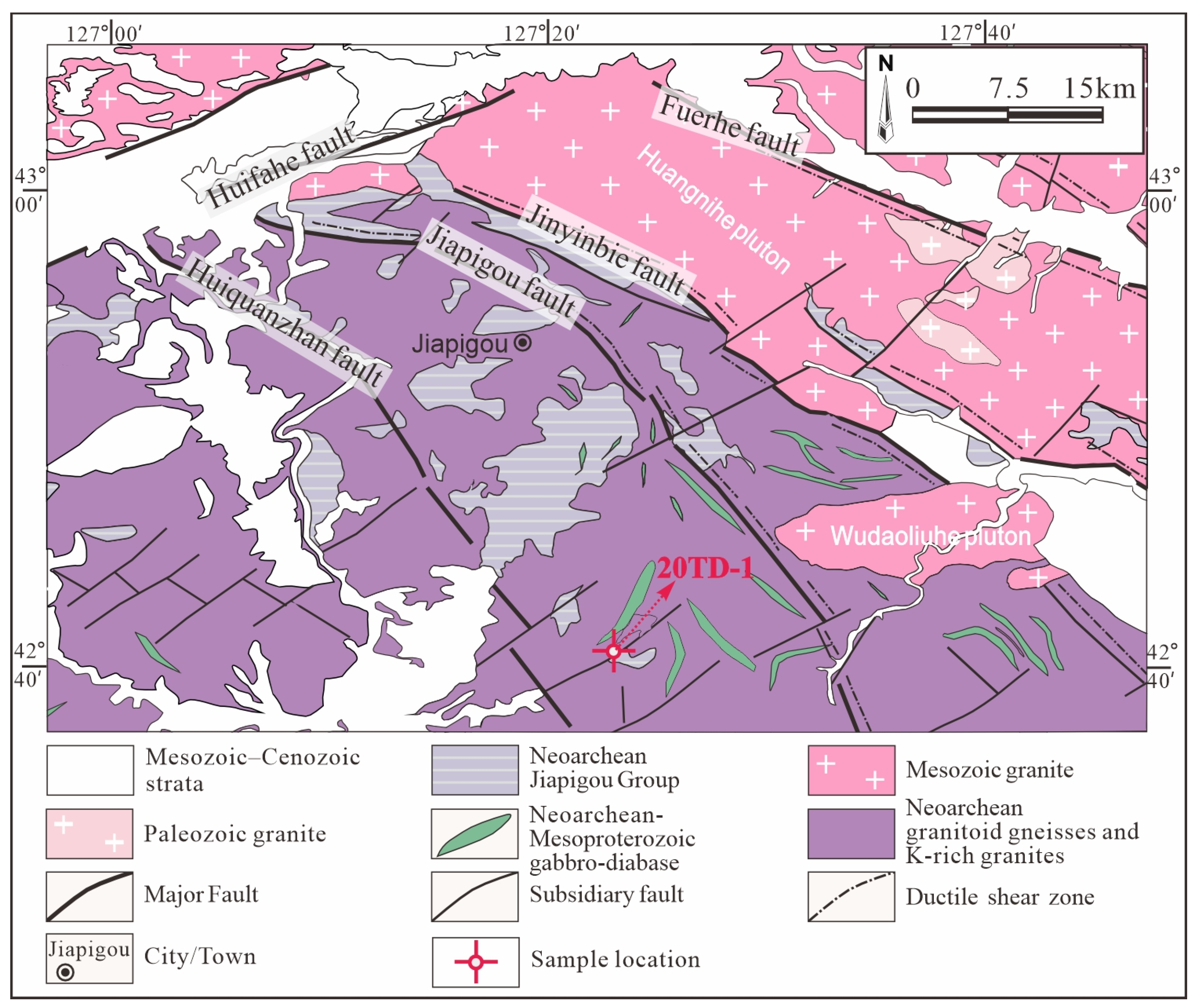
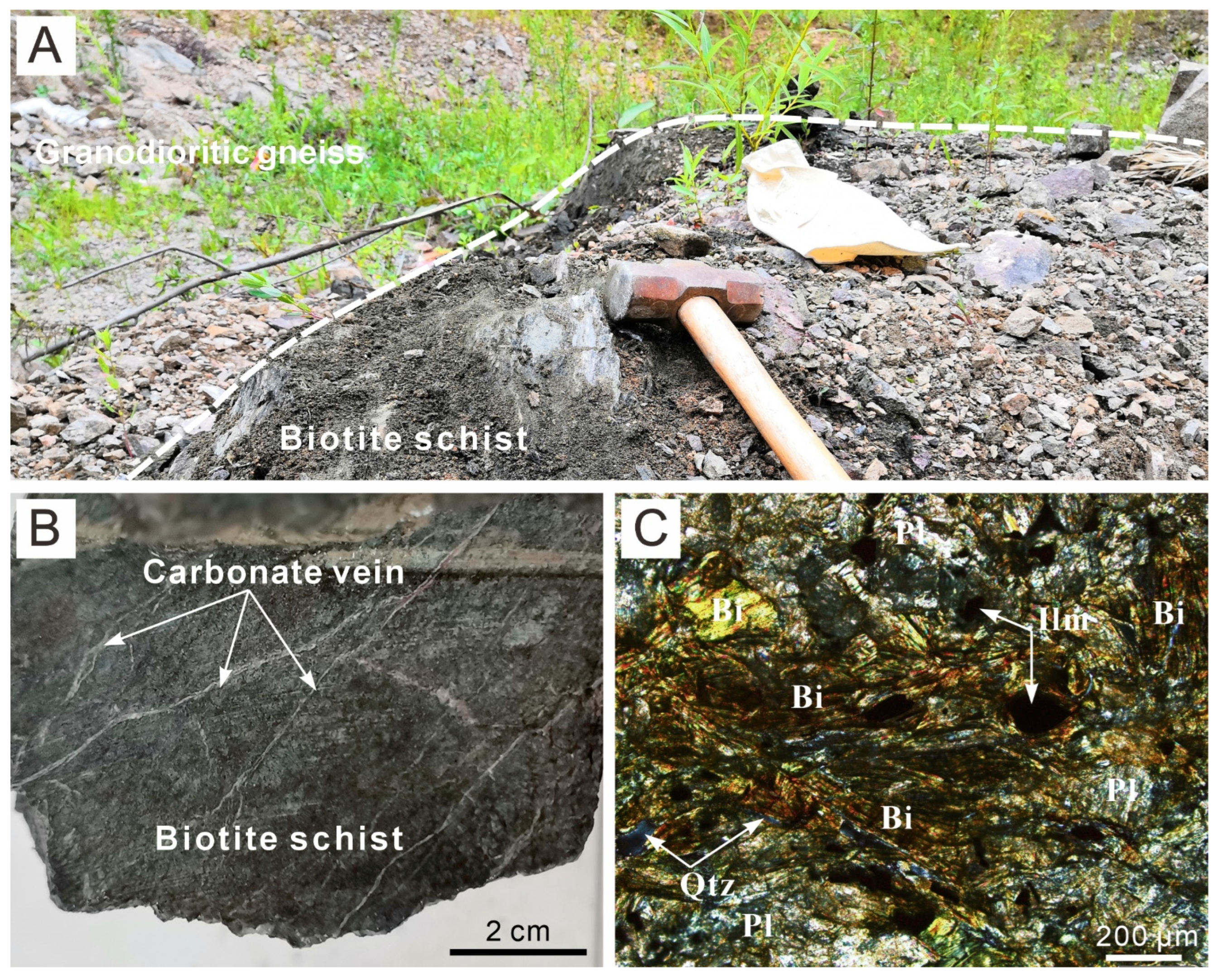
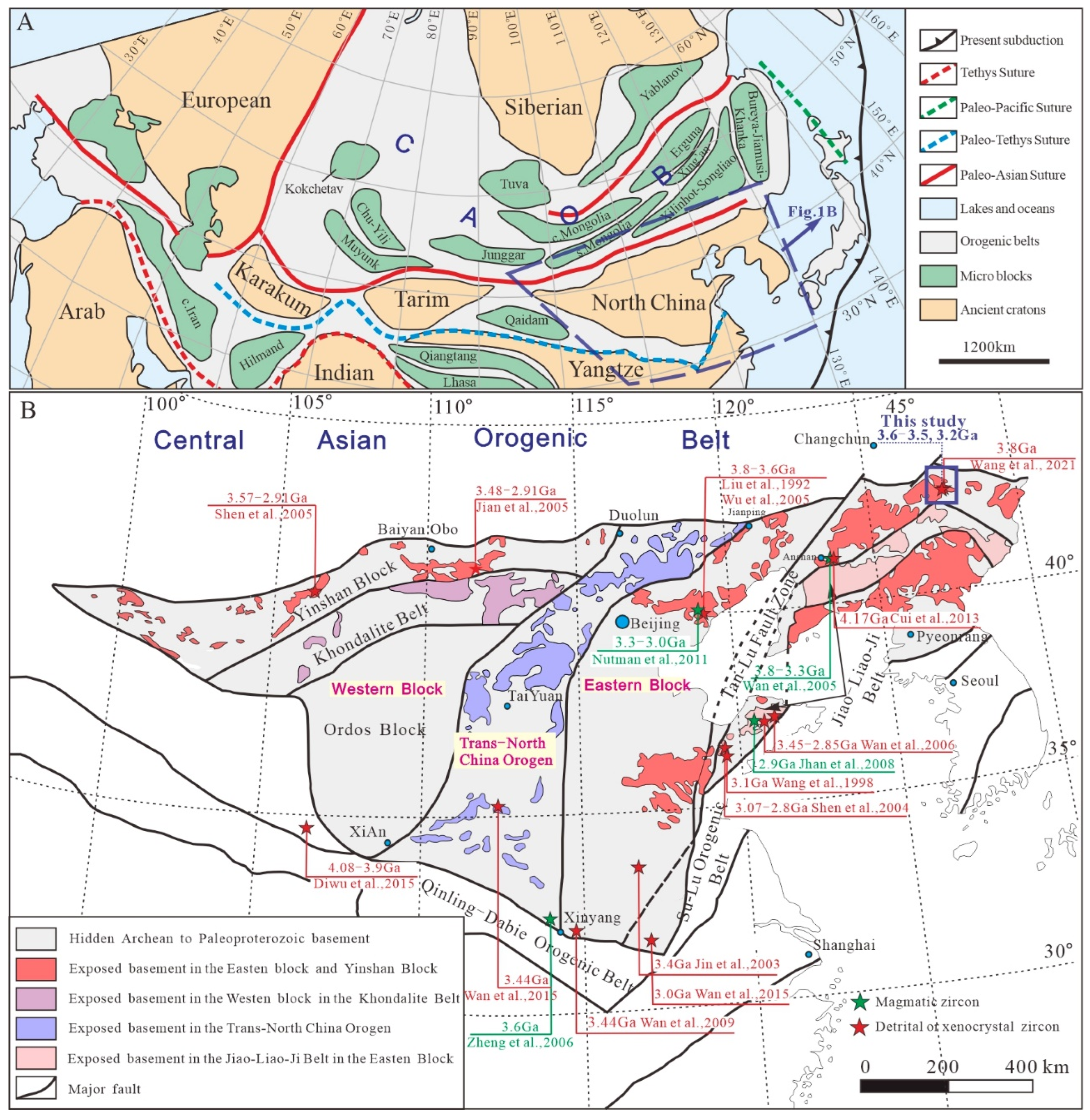
2. Regional Geology and Sampling
3. Analytical Methods
4. Results
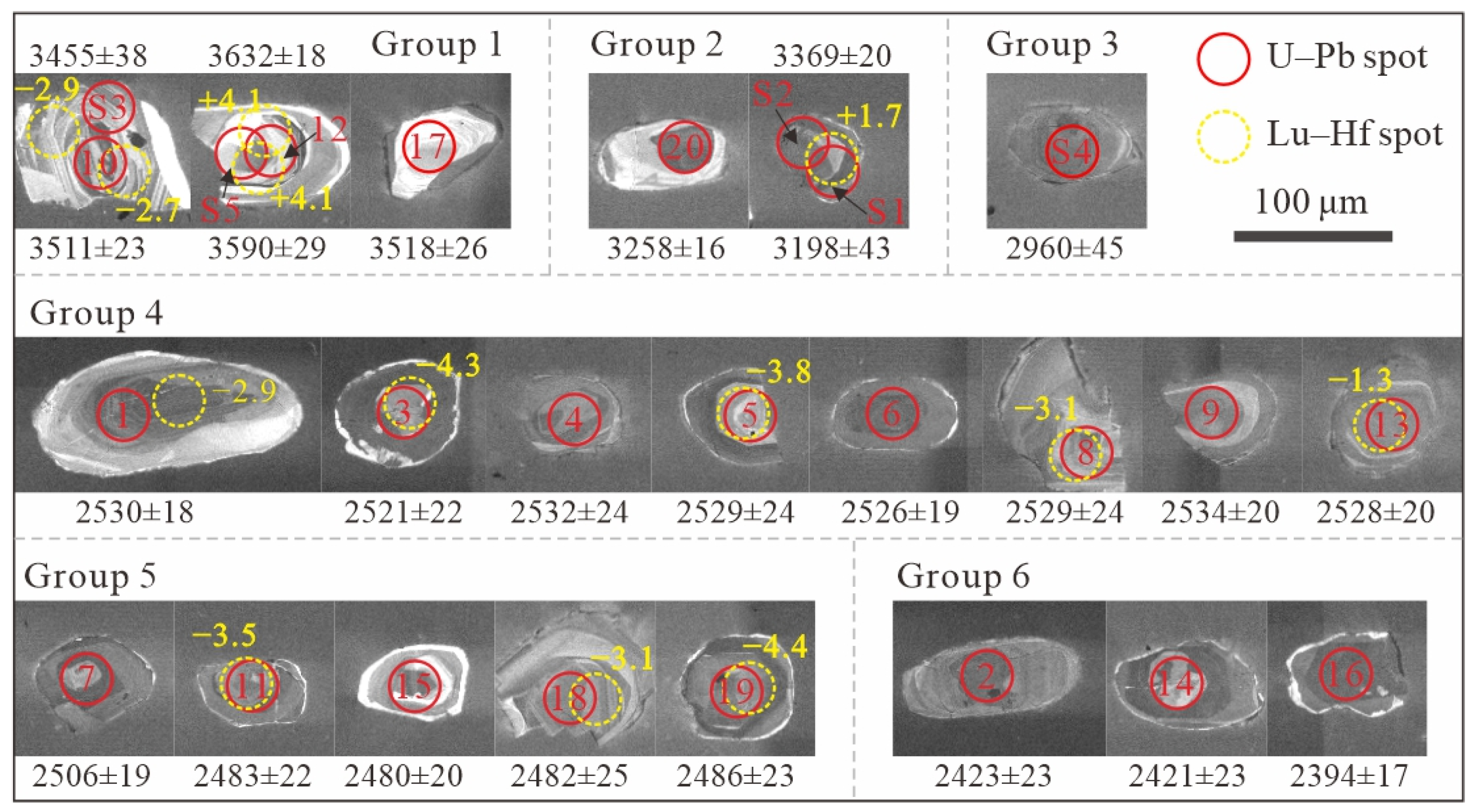
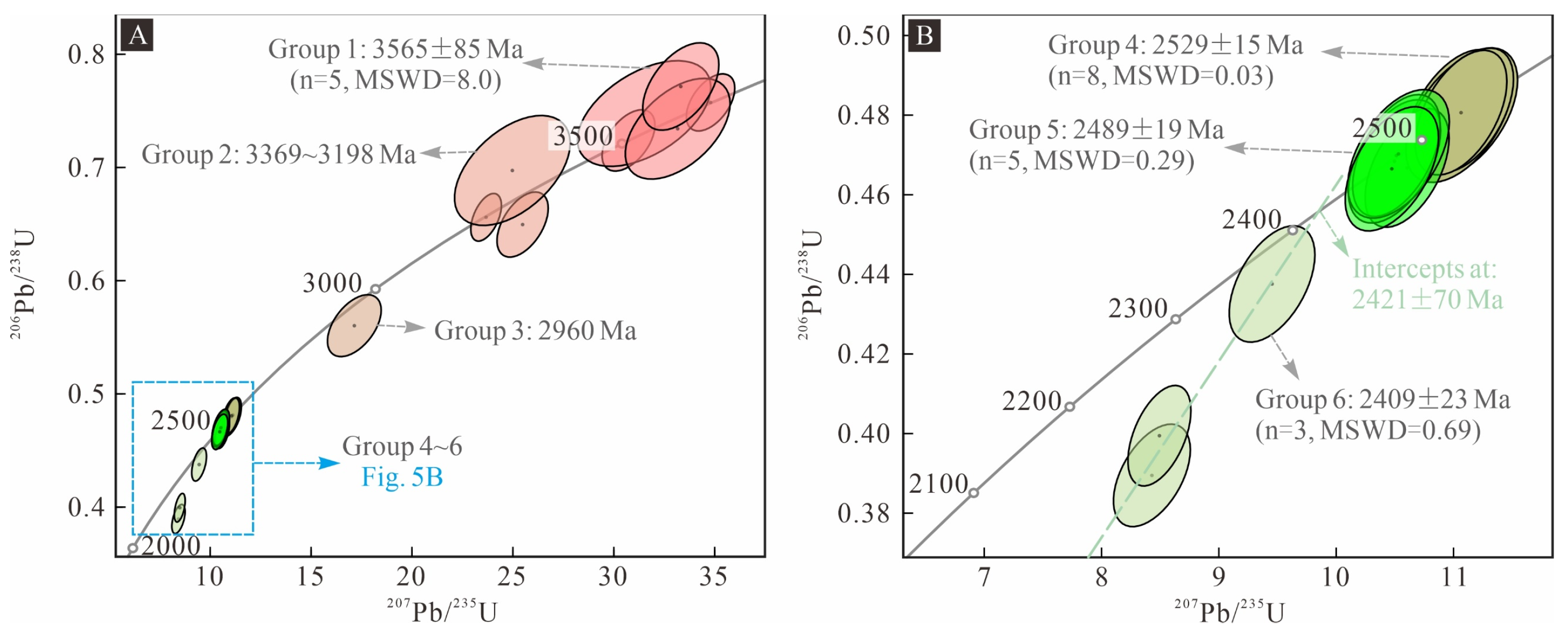
4.1. Zircon U–Pb Ages
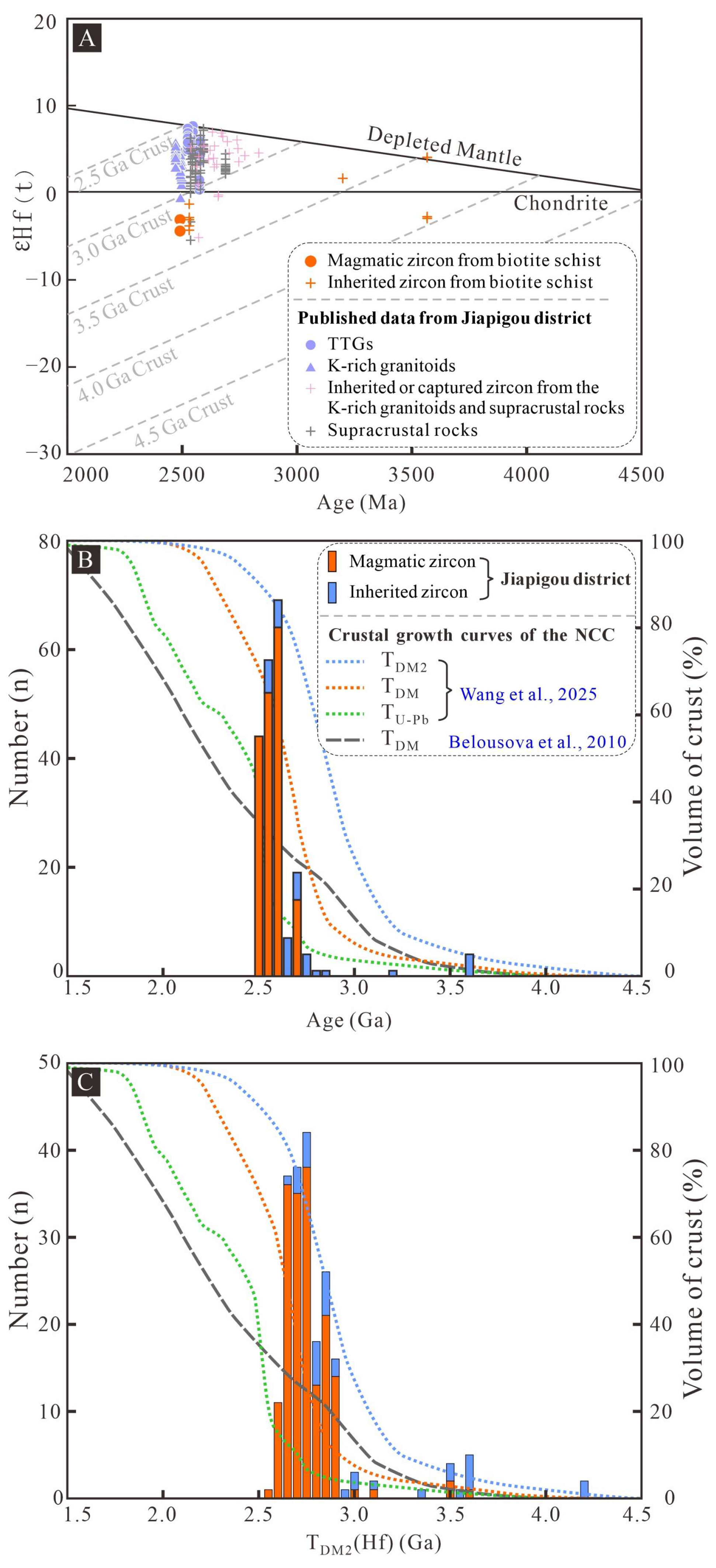
4.2. Zircon Hf Isotopic Compositions
5. Discussion
5.1. Existence of Unexposed Hadean–Paleoarchean Crust Beneath the Jiapigou Terrane
5.2. Multiple Paleo–Neoarchean Crustal Reworking Events in the Jiapigou Terrane
6. Conclusions
- (1)
- The geochronology results, combined with the internal structures and Th/U ratios of the tested zircons, reveal that the zircons derived from the supracrustal rock can be divided into two types: magmatic zircons with ages of 3.57, 3.37–3.20, 2.96, 2.53, and 2.49 Ga and metamorphic zircons with ages of 2.41 Ga. For the magmatic zircons, the youngest zircon age (2.49 Ga) is considered to represent the crystallization timing of the protolith of the supracrustal rock (i.e., Neoarchean), whereas the others were likely captured or inherited from their magma sources.
- (2)
- In conjunction with the zircon Hf isotopes, we propose that unexposed Hadean–Paleoarchean crust (4.18–3.57 Ga) occurs beneath the Jiapigou terrane and that its growth history can be traced back to the Hadean period.
- (3)
- The evidence obtained in this work and in previous studies indicates that the Jiapigou terrane underwent multiple episodes of crustal evolution during the Paleo–Neoarchean, including Paleoarchean crustal recycling events from 3.37–3.20 Ga and at 2.96 Ga during the Paleo–Mesoarchean, multiple episodes of Paleo- and/or Neoarchean crustal reworking at 2.53 Ga and 2.49 Ga during the Neoarchean, and later metamorphism at 2.41 Ga.
Author Contributions
Funding
Data Availability Statement
Acknowledgments
Conflicts of Interest
References
- Condie, K.C.; Bickford, M.E.; Aster, R.C.; Belousova, E.; Scholl, D.W. Episodic zircon ages, Hf isotopic composition, and the preservation rate of continental crust. GSA Bull. 2011, 123, 951–957. [Google Scholar] [CrossRef] [Scilit]
- Hawkesworth, C.J.; Kemp, A.I.S. Using hafnium and oxygen isotopes in zircons to unravel the record of crustal evolution. Chem. Geol. 2006, 226, 144–162. [Google Scholar] [CrossRef] [Scilit]
- Hui, B.; Dong, Y.; Qu, H.; Sun, S.; Neubauer, F.; Zhang, F.; Zang, R.; Yan, S.; Wang, G. Xenocrystic zircons from mafic volcanic rocks in the Bikou Terrane: A window to trace the Paleoarchean to Mesoproterozoic crustal evolution of the northwestern Yangtze Block, South China. Precambrian Res. 2024, 403, 107327. [Google Scholar] [CrossRef] [Scilit]
- Wan, Y.; Xie, H.; Xie, S.; Liu, S.; Ma, M.; Dong, C.; Li, P.; Li, Y. Formation and evolution of Hadean–Archean continental crust worldwide. Acta Geol. Sin. 2025, 99, 1–22. [Google Scholar] [CrossRef]
- Laurent, O.; Guitreau, M.; Bruand, E.; Moyen, J.-F. At the Dawn of Continents: Archean Tonalite-Trondhjemite-Granodiorite Suites. Elements 2024, 20, 174–179. [Google Scholar] [CrossRef] [Scilit]
- Shen, Z.; Huang, G. Crustal maturation of the Yangtze Block during the Meso-Neoarchean. Precambrian Res. 2025, 417, 107664. [Google Scholar] [CrossRef] [Scilit]
- Zhai, M.; Guo, J.; Liu, W. Neoarchean to Paleoproterozoic continental evolution and tectonic history of the North China Craton: A review. J. Asian Earth Sci. 2005, 24, 547–561. [Google Scholar] [CrossRef] [Scilit]
- Drüppel, K.; McCready, A.J.; Stumpfl, E.F. High-K granites of the Rum Jungle Complex, N-Australia: Insights into the Late Archean crustal evolution of the North Australian Craton. Lithos 2009, 111, 203–219. [Google Scholar] [CrossRef] [Scilit]
- Yu, R.; Sun, J.; Wang, S.; Han, J.; Liu, Y. Neoarchean–early Paleoproterozoic crustal evolution in the Jiapigou terrane in the northeastern part of the North China Craton: Geochemistry, zircon U–Pb dating and Hf isotope constraints from the potassic granitic complex. Precambrian Res. 2021, 364, 106341. [Google Scholar] [CrossRef] [Scilit]
- Bolhar, R.; Hofmann, A.; Kamber, B.S.; Whitehouse, M.J.; Maas, R.; Vervoort, J.D.; Jeon, H.; Botero, M.; Kabete, J. Eoarchean TTG formation via melt-solid interaction at the base of the Tanzania Craton inferred from multi-proxy detrital zircon data. Earth Planet. Sci. Lett. 2026, 676, 119701. [Google Scholar] [CrossRef] [Scilit]
- Horstwood, M.S.A.; Nesbitt, R.W.; Noble, S.R.; Wilson, J.F. U-Pb zircon evidence for an extensive early Archean craton in Zimbabwe: A reassessment of the timing of craton formation, stabilization, and growth. Geology 1999, 27, 707–710. [Google Scholar] [CrossRef] [Scilit]
- Hofmann, A.; Dirks, P.G.; Jelsma, H.A. Late Archaean clastic sedimentary rocks (Shamvaian Group) of the Zimbabwe craton: First observations from the Bindura-Shamva greenstone belt. Can. J. Earth Sci. 2002, 39, 1689–1708. [Google Scholar] [CrossRef] [Scilit]
- Hickman, A.H. Review of the Pilbara Craton and Fortescue Basin, Western Australia: Crustal evolution providing environments for early life. Isl. Arc 2012, 21, 1–31. [Google Scholar] [CrossRef] [Scilit]
- Arthur, H.H.; Martin, J.V.K. Early Earth evolution: Evidence from the 3.5–1.8 Ga geological history of the Pilbara region of Western Australia. Int. Union Geol. Sci. 2012, 35, 283–297. [Google Scholar] [CrossRef] [Scilit]
- Jodder, J.; Hofmann, A.; Xie, H.; Elburg, M.A.; Wilson, A. Geochronology of the Daitari Greenstone Belt, Singhbhum Craton, India. Precambrian Res. 2023, 388, 106997. [Google Scholar] [CrossRef] [Scilit]
- Hofmann, A.; Jodder, J.; Xie, H.; Bolhar, R.; Whitehouse, M.; Elburg, M. The Archaean geological history of the Singhbhum Craton, India—A proposal for a consistent framework of craton evolution. Earth-Sci. Rev. 2022, 228, 103994. [Google Scholar] [CrossRef] [Scilit]
- Dey, S.; Topno, A.; Liu, Y.; Zong, K. Generation and evolution of Palaeoarchaean continental crust in the central part of the Singhbhum craton, eastern India. Precambrian Res. 2017, 298, 268–291. [Google Scholar] [CrossRef] [Scilit]
- Kaur, P.; Zeh, A.; Chaudhri, N.; Eliyas, N. Unravelling the record of Archaean crustal evolution of the Bundelkhand Craton, northern India using U–Pb zircon–monazite ages, Lu–Hf isotope systematics, and whole-rock geochemistry of granitoids. Precambrian Res. 2016, 281, 384–413. [Google Scholar] [CrossRef] [Scilit]
- Mohanty, S.P. The Bastar Craton of Central India: Tectonostratigraphic evolution and implications in global correlations. Earth-Sci. Rev. 2021, 221, 103770. [Google Scholar] [CrossRef] [Scilit]
- Miller, S.; Mueller, P.; Meert, J.; Kamenov, G. Detrital zircons reveal evidence of Hadean crust in the Singhbhum Craton, India. J. Geol. 2017, 126, 541–552. [Google Scholar] [CrossRef] [Scilit]
- Srivastava, R.K.; Söderlund, U.; Ernst, R.E.; Mondal, S.K.; Samal, A.K. Precambrian mafic dyke swarms in the Singhbhum craton (eastern India) and their links with dyke swarms of the eastern Dharwar craton (southern India). Precambrian Res. 2019, 329, 5–17. [Google Scholar] [CrossRef] [Scilit]
- Nutman, A.P.; Friend, C.R.L.; Bennett, V.C. Convergent plate boundary environments for formation of ≥3800 Ma mafic–ultramafic assemblages (Isua area, Greenland): Implications for early global geodynamics. Geosci. Front. 2024, 15, 101794. [Google Scholar] [CrossRef] [Scilit]
- Bolhar, R.; Tappe, S.; Wilson, A.H.; Ireland, T.; Avila, J.; Anhaeusser, C. A petrochronology window into near-surface fluid/rock interaction within Archaean ultramafic-mafic crust: Insights from the 3.25 Ga Stolzburg Complex, Barberton Greenstone Belt. Chem. Geol. 2021, 569, 120130. [Google Scholar] [CrossRef] [Scilit]
- Liu, D.Y.; Nutman, A.P.; Compston, W.; Wu, J.S.; Shen, Q.H. Remnants of ≥3800 Ma crust in the Chinese part of the Sino-Korean craton. Geology 1992, 20, 339–342. [Google Scholar] [CrossRef] [Scilit]
- Zeh, A.; Stern, R.A.; Gerdes, A. The oldest zircons of Africa—Their U–Pb–Hf–O isotope and trace element systematics, and implications for Hadean to Archean crust–mantle evolution. Precambrian Res. 2014, 241, 203–230. [Google Scholar] [CrossRef] [Scilit]
- Byerly, B.L.; Lowe, D.R.; Drabon, N.; Coble, M.A.; Burns, D.H.; Byerly, G.R. Hadean zircon from a 3.3 Ga sandstone, Barberton greenstone belt, South Africa. Geology 2018, 46, 967–970. [Google Scholar] [CrossRef] [Scilit]
- Lowe, D.R.; Drabon, N.; Byerly, G.R.; Byerly, B.L. Windblown Hadean zircons derived by erosion of impact-generated 3.3 Ga uplifts, Barberton Greenstone Belt, South Africa. Precambrian Res. 2021, 356, 106111. [Google Scholar] [CrossRef] [Scilit]
- Mojzsis, S.J.; Harrison, T.M. Establishment of a 3.83-Ga magmatic age for the Akilia tonalite (southern West Greenland). Earth Planet. Sci. Lett. 2002, 202, 563–576. [Google Scholar] [CrossRef] [Scilit]
- Harley, S.L.; Kelly, N.M. Chapter 3.2 Ancient Antarctica: The Archaean of the East Antarctic Shield. In Developments in Precambrian Geology; van Kranendonk, M.J., Smithies, R.H., Bennett, V.C., Eds.; Elsevier: Amsterdam, The Netherlands, 2007; Volume 15, pp. 149–186. [Google Scholar]
- Chaudhuri, T.; Wan, Y.; Mazumder, R.; Ma, M.; Liu, D. Evidence of Enriched, Hadean Mantle Reservoir from 4.2–4.0 Ga zircon xenocrysts from Paleoarchean TTGs of the Singhbhum Craton, Eastern India. Sci. Rep. 2018, 8, 7069. [Google Scholar] [CrossRef] [Scilit]
- Bhattacharjee, S.; Mulder, J.A.; Roy, S.; Chowdhury, P.; Cawood, P.A.; Nebel, O. Unravelling depositional setting, age and provenance of the Simlipal volcano-sedimentary complex, Singhbhum craton: Evidence for Hadean crust and Mesoarchean marginal marine sedimentation. Precambrian Res. 2021, 354, 106038. [Google Scholar] [CrossRef] [Scilit]
- Cui, P.; Sun, J.; Sha, D.; Wang, X.; Zhang, P.; Gu, A.; Wang, Z. Oldest zircon xenocryst (4.17 Ga) from the North China Craton. Int. Geol. Rev. 2013, 55, 1902–1908. [Google Scholar] [CrossRef] [Scilit]
- Lu, Y.; Cao, J.; Fu, J.; Liu, L.; Wu, Q.; Yang, X.; Yang, S.; Cheng, S.; Qiu, X.; He, D. Discovery of a Hadean xenocrystic zircon in the Cathaysia Block. Sci. Bull. 2022, 67, 2416–2419. [Google Scholar] [CrossRef] [Scilit] [PubMed]
- Zhai, M.; Santosh, M. The early Precambrian odyssey of the North China Craton: A synoptic overview. Gondwana Res. 2011, 20, 6–25. [Google Scholar] [CrossRef] [Scilit]
- Zhao, G.; Cawood, P.A.; Li, S.; Wilde, S.A.; Sun, M.; Zhang, J.; He, Y.; Yin, C. Amalgamation of the North China Craton: Key issues and discussion. Precambrian Res. 2012, 222–223, 55–76. [Google Scholar] [CrossRef] [Scilit]
- Ding, N.; Hawkesworth, C.; Wang, X.-L.; Ge, R.-F.; Hofmann, A.; Li, J.-Y. Tectonic thickening in stagnant to mobile lid transition facilitated the stabilization of Archean cratons. Chem. Geol. 2025, 696, 123093. [Google Scholar] [CrossRef] [Scilit]
- Vandenburg, E.D.; Nebel, O.; Smithies, R.H.; Capitanio, F.A.; Miller, L.; Cawood, P.A.; Millet, M.-A.; Bruand, E.; Moyen, J.-F.; Wang, X.; et al. Spatial and temporal control of Archean tectonomagmatic regimes. Earth-Sci. Rev. 2023, 241, 104417. [Google Scholar] [CrossRef] [Scilit]
- Chowdhury, P.; Cawood, P.A.; Mulder, J.A. Subaerial Emergence of Continents on Archean Earth. Annu. Rev. Earth Planet. Sci. 2025, 53, 443–478. [Google Scholar] [CrossRef] [Scilit]
- Gunawardana, P.M.; Chowdhury, P.; Morra, G.; Cawood, P.A. Correlating mantle cooling with tectonic transitions on early Earth. Geology 2024, 52, 230–234. [Google Scholar] [CrossRef] [Scilit]
- Frost, C.D.; Mueller, P.A.; Mogk, D.W. Creating Continents: Archean Cratons Tell the Story. GSA Today 2023, 33, 4–10. [Google Scholar] [CrossRef] [Scilit]
- Moyen, J.F.; McCoy-West, A.J.; Bruand, E.; Millet, M.A.; Nebel, O.; Cawood, P.A.; Saji, N.; Ladwig, A.; Klaver, M.; Elburg, M. Felsic crust development in the Kaapvaal Craton, South Africa: A reference sample collection to investigate a billion years of geological history. Earth-Sci. Rev. 2024, 250, 104680. [Google Scholar] [CrossRef] [Scilit]
- Wang, X.; Wang, X.; Chen, J.; Meng, Y. Growth and evolution of the North China craton: Evidence from zircon U–Pb geochronology, trace elements and Hf–O isotopes. Acta Geol. Sin. 2025, 99, 2463–2478. [Google Scholar] [CrossRef]
- Wan, Y.; Xie, H.; Wang, H.; Liu, S.; Chu, H.; Xiao, Z.; Li, Y.; Hao, G.; Li, P.; Dong, C.; et al. Discovery of early Eoarchean–Hadean zircons in eastern Hebei, North China Craton. Acta Geol. Sin. 2021, 95, 277–291. [Google Scholar]
- Han, J.; Deng, J.; Zhang, Y.; Sun, J.; Wang, Q.; Zhang, Y.; Zhang, X.; Liu, Y.; Zhao, C.; Yang, F.; et al. Au mineralization-related magmatism in the giant Jiapigou mining district of Northeast China. Ore Geol. Rev. 2022, 141, 104638. [Google Scholar] [CrossRef] [Scilit]
- Wang, S.; Sun, J.; Yu, R.; Han, J.; Liu, Y.; Chu, X.; Zhang, X. Zircon U–Pb geochronology from a Paleoproterozoic mafic dyke in the Jiapigou terrane (North China Craton): Inferences about formation and evolution of the early crust. Arab. J. Geosci. 2021, 14, 2396. [Google Scholar] [CrossRef] [Scilit]
- Kröner, A.; Kovach, V.; Belousova, E.; Hegner, E.; Armstrong, R.; Dolgopolova, A.; Seltmann, R.; Alexeiev, D.V.; Hoffmann, J.E.; Wong, J.; et al. Reassessment of continental growth during the accretionary history of the Central Asian Orogenic Belt. Gondwana Res. 2014, 25, 103–125. [Google Scholar] [CrossRef] [Scilit]
- Zhao, G.; Sun, M.; Wilde, S.A.; Sanzhong, L. Late Archean to Paleoproterozoic evolution of the North China Craton: Key issues revisited. Precambrian Res. 2005, 136, 177–202. [Google Scholar] [CrossRef] [Scilit]
- Wan, Y.; Liu, D.; Dong, C.; Nutman, A.P.; Wilde, S.A.; Wang, W.; Xie, H.; Yin, X.; Zhou, H. The oldest rocks and zircons in China. Acta Petrol. Sin. 2009, 25, 1793–1807. [Google Scholar]
- Shen, Q.; Geng, Y.; Song, B.; Wan, Y. New information from the surface outcrops and deep crust of Archean rocks of the North China and Yangtze Blocks, and Qinling-Dabie Orogenic Belt. Acta Geol. Sin. 2005, 79, 616–627. [Google Scholar]
- Jian, P.; Zhang, Q.; Liu, D.; Jin, W.; Jia, X.; Qian, Q. SHRIMP dating and geological significance of Late Achaean high-Mg diorite (sanukite) and hornblende-granite at Guyang of Inner Mongolia. Acta Geol. Sin. 2005, 21, 151–157. [Google Scholar]
- Wu, F.; Zhao, G.; Wilde, S.A.; Sun, D. Nd isotopic constraints on crustal formation in the North China Craton. J. Asian Earth Sci. 2005, 24, 523–545. [Google Scholar] [CrossRef] [Scilit]
- Wan, Y.; Liu, D.; Song, B.; Wu, J.; Yang, C.; Zhang, Z.; Geng, Y. Geochemical and Nd isotopic compositions of 3.8Ga meta-quartz dioritic and trondhjemitic rocks from the Anshan area and their geological significance. J. Asian Earth Sci. 2005, 24, 563–575. [Google Scholar] [CrossRef] [Scilit]
- Wan, Y.; Song, B.; Liu, D.; Wilde, S.A.; Wu, J.; Shi, Y.; Yin, X.; Zhou, H. SHRIMP U–Pb zircon geochronology of Palaeoproterozoic metasedimentary rocks in the North China Craton: Evidence for a major Late Palaeoproterozoic tectonothermal event. Precambrian Res. 2006, 149, 249–271. [Google Scholar] [CrossRef] [Scilit]
- Jahn, B.; Liu, D.; Wan, Y.; Song, B.; Wu, J. Archean crustal evolution of the Jiaodong Peninsula, China, as revealed by zircon SHRIMP geochronology, elemental and Nd-isotope geochemistry. Am. J. Sci. 2008, 308, 232–269. [Google Scholar] [CrossRef] [Scilit]
- Wang, L.G.; Qiu, Y.; McNaughton, N.J.; Groves, D.I.; Luo, Z.K.; Huang, J.Z.; Miao, L.C.; Liu, Y.K. Constraints on crustal evolution and gold metallogeny in the Northwestern Jiaodong Peninsula, China, from SHRIMP U–Pb zircon studies of granitoids. Ore Geol. Rev. 1998, 13, 275–291. [Google Scholar] [CrossRef] [Scilit]
- Shen, Q.; Song, B.; Xu, H.; Geng, Y.; Shen, K. Emplacement and metamorphism ages of the Caiyu and Dashan igneous bodies, Yishui County, Shandong Province: Zircon SHRIMP chronology. Geol. Rev. 2004, 50, 275–284. [Google Scholar]
- Diwu, C.; Sun, Y.; Dong, Z.C.; Wang, H.L.; Chen, D.L.; Chen, L.; Zhang, H. In situ U-Pb geochronology of Hadean zircon xenocryst(4.1-3.9Ga) from the western of the Northern Qinling Orogenic Belt. Acta Petrol. Sin. 2010, 26, 1171–1174. [Google Scholar]
- Wan, Y.; Dong, C.; Xie, H.; Liu, S.; Ma, M.; Xie, S.; Ren, P.; Sun, H.; Liu, D. Some progress in the study of archean basement of the North China Craton. Acta Geosci. Sin. 2015, 36, 685–700. [Google Scholar]
- Zheng, J.; Griffin, W.L.; O’Reilly, S.Y.; Lu, F.; Wang, C.; Zhang, M.; Wang, F.; Li, H. 3.6 Ga lower crust in central China: New evidence on the assembly of the North China craton. Geology 2004, 32, 229–232. [Google Scholar] [CrossRef] [Scilit]
- Jin, K.; Xu, W.; Wang, Q.; Gao, S.; Liu, X. Formation time and sources of the Huaiguang "Migmatitic Granodiorite" in Bengbu, Anhui Province: Evidence from SHRIMP zircon U-Pb geochronology. Acta Geosicientia Sin. 2003, 24, 331–335. [Google Scholar]
- Guo, B.; Liu, S.; Zhang, J.; Wang, W.; Fu, J.; Wang, M. Neoarchean Andean-type active continental margin in the northeastern North China Craton: Geochemical and geochronological evidence from metavolcanic rocks in the Jiapigou granite-greenstone belt, Southern Jilin Province. Precambrian Res. 2016, 285, 147–169. [Google Scholar] [CrossRef] [Scilit]
- Guo, B.; Liu, S.; Chen, X.; Wang, W.; Guo, R.; Yan, M. K-rich granitoid magmatism at the Archean–Proterozoic transition in southern Jilin: Insights into the Neoarchean crustal evolution of the northeastern part of the North China Craton. Gondwana Res. 2018, 58, 87–104. [Google Scholar] [CrossRef] [Scilit]
- Han, J.; Sun, J.; Zhang, X.; Liu, Y.; Xu, Z.; Wang, S.; Xu, Z.; Li, X. Comparison of vein- and breccia-type Au-mineralization in the giant Jiapigou mining district of Northeast China. Ore Geol. Rev. 2022, 150, 105173. [Google Scholar] [CrossRef] [Scilit]
- Zhang, X.; Sun, J.; Han, J.; Feng, Y. Genesis and ore-forming process of the Benqu mesothermal gold deposit in the Jiapigou ore cluster, NE China: Constraints from geology, geochronology, fluid inclusions, and whole-rock and isotope geochemistry. Ore Geol. Rev. 2021, 130, 103956. [Google Scholar] [CrossRef] [Scilit]
- Song, B.; Zhang, Y.; Liu, D. Introduction to the Naissance of SHRIMP and its contribution to isotope geology. J. Chin. Mass Spectrom. Soc. 2002, 23, 58–62. [Google Scholar]
- Griffin, W.L.; Wang, X.; Jackson, S.E.; Pearson, N.J.; O’Reilly, S.Y.; Xu, X.; Zhou, X. Zircon chemistry and magma mixing, SE China: In-situ analysis of Hf isotopes, Tonglu and Pingtan igneous complexes. Lithos 2002, 61, 237–269. [Google Scholar] [CrossRef] [Scilit]
- Andersen, T. Correction of common lead in U–Pb analyses that do not report 204Pb. Chem. Geol. 2002, 192, 59–79. [Google Scholar] [CrossRef] [Scilit]
- Ludwig, K.R. Isoplot 3.00: A geochronological toolkit for Microsoft Excel. Berkeley Geochronol. Cent. Spec. Publ. 2003, 4, 70. [Google Scholar]
- Hu, X.; Ding, Z.; He, M.; Yao, S.; Zhu, B.; Shen, J.; Chen, B. A porphyry-skarn metallogenic system in the Lesser Xing’an Range, NE China: Implications from U–Pb and Re–Os geochronology and Sr–Nd–Hf isotopes of the Luming Mo and Xulaojiugou Pb–Zn deposits. J. Asian Earth Sci. 2014, 90, 88–100. [Google Scholar] [CrossRef] [Scilit]
- Belousova, E.A.; Kostitsyn, Y.A.; Griffin, W.L.; Begg, G.C.; O’Reilly, S.Y.; Pearson, N.J. The growth of the continental crust: Constraints from zircon Hf-isotope data. Lithos 2010, 119, 457–466. [Google Scholar] [CrossRef] [Scilit]
- Li, P. Neoarchean Tectonomagmatic Events and Crustal Evolution in the Baishan Area of the Northeastern North China Craton. Ph.D. Thesis, Jilin University, Changchun, China, 2019. [Google Scholar]
- Kostrovitsky, S.I.; Skuzovatov, S.Y.; Yakovlev, D.A.; Sun, J.; Nasdala, L.; Wu, F.-Y. Age of the Siberian craton crust beneath the northern kimberlite fields: Insights to the craton evolution. Gondwana Res. 2016, 39, 365–385. [Google Scholar] [CrossRef] [Scilit]
- Wan, Y.; Dong, C.; Xie, H.; Liu, S.; Ma, M.; Li, P.; Li, Y.; Wang, Y.; Wang, K.; Liu, D. Formation and evolution of archean continental crust in the Anshan-Benxi area, North China Craton: A review. Earth Sci. 2024, 49, 3855–3878. [Google Scholar]
- Wan, Y.; Dong, C.; Xie, H.; Nutman, A.P.; Xie, S.; Wang, Y.; Liu, D. SHRIMP U-Pb zircon dating and geochemistry of the 3.8–3.1 Ga Hujiamiao Complex in Anshan (North China Craton) and the significance of the trondhjemites for early crustal genesis. Precambrian Res. 2023, 388, 106975. [Google Scholar] [CrossRef] [Scilit]
- Dong, C.; Liu, S.; Nutman, A.P.; Li, P.; Xie, H.; Li, Y.; Liu, D.; Wan, Y. New discovery of 3.84–3.64 Ga diverse granitoids in eastern Hebei, North China Craton: Petrogenesis and significance. GSA Bull. 2024, 136, 5249–5261. [Google Scholar] [CrossRef] [Scilit]
- Diwu, C.; Sun, Y.; Gao, J.-F.; Fan, L. Early Precambrian tectonothermal events of the North China Craton: Constraints from in situ detrital zircon U-Pb, Hf and O isotopic compositions in Tietonggou Formation. Chin. Sci. Bull. 2013, 58, 3760–3770. [Google Scholar] [CrossRef] [Scilit]
- Li, S.; Zhao, G. SHRIMP U–Pb zircon geochronology of the Liaoji granitoids: Constraints on the evolution of the Paleoproterozoic Jiao-Liao-Ji belt in the Eastern Block of the North China Craton. Precambrian Res. 2007, 158, 1–16. [Google Scholar] [CrossRef] [Scilit]



| Sample No. | Group | Content (ppm) | Isotopic Ratios | Isotopic Ages (Ma) | ||||||||||||
|---|---|---|---|---|---|---|---|---|---|---|---|---|---|---|---|---|
| Th | U | Th/U | 207Pb/206Pb | 1s | 207Pb/235U | 1s | 206Pb/238U | 1s | 207Pb/206Pb | 1s | 207Pb/235U | 1s | 206Pb/238U | 1s | ||
| 20TD-1-1 | 4 | 440 | 960 | 0.46 | 0.16717 | 0.00183 | 11.00888 | 0.14691 | 0.47765 | 0.00608 | 2530 | 18 | 2524 | 12 | 2517 | 27 |
| 20TD-1-2 | 6 | 372 | 903 | 0.41 | 0.15697 | 0.00217 | 8.42914 | 0.13180 | 0.38949 | 0.00518 | 2423 | 23 | 2278 | 14 | 2121 | 24 |
| 20TD-1-3 | 4 | 318 | 355 | 0.90 | 0.16628 | 0.00224 | 11.01757 | 0.16954 | 0.48059 | 0.00640 | 2521 | 22 | 2525 | 14 | 2530 | 28 |
| 20TD-1-4 | 4 | 150 | 203 | 0.74 | 0.16746 | 0.00244 | 11.09624 | 0.18095 | 0.48063 | 0.00655 | 2532 | 24 | 2531 | 15 | 2530 | 29 |
| 20TD-1-5 | 4 | 150 | 279 | 0.54 | 0.16716 | 0.00236 | 11.06551 | 0.17641 | 0.48016 | 0.00649 | 2529 | 24 | 2529 | 15 | 2528 | 28 |
| 20TD-1-6 | 4 | 355 | 519 | 0.68 | 0.16685 | 0.00186 | 11.06250 | 0.14894 | 0.48092 | 0.00616 | 2526 | 19 | 2528 | 13 | 2531 | 27 |
| 20TD-1-7 | 5 | 97 | 509 | 0.19 | 0.16479 | 0.00186 | 10.60416 | 0.14398 | 0.46674 | 0.00600 | 2506 | 19 | 2489 | 13 | 2469 | 26 |
| 20TD-1-8 | 4 | 132 | 157 | 0.84 | 0.16709 | 0.00245 | 11.04389 | 0.18108 | 0.47943 | 0.00657 | 2529 | 24 | 2527 | 15 | 2525 | 29 |
| 20TD-1-9 | 4 | 135 | 265 | 0.51 | 0.16760 | 0.00202 | 11.11964 | 0.15750 | 0.48126 | 0.00627 | 2534 | 20 | 2533 | 13 | 2533 | 27 |
| 20TD-1-10 | 1 | 222 | 207 | 1.07 | 0.30792 | 0.00470 | 30.72689 | 0.52726 | 0.72384 | 0.01089 | 3511 | 23 | 3510 | 17 | 3510 | 41 |
| 20TD-1-11 | 5 | 231 | 265 | 0.87 | 0.16257 | 0.00214 | 10.49697 | 0.15796 | 0.46838 | 0.00623 | 2483 | 22 | 2480 | 14 | 2476 | 27 |
| 20TD-1-12 | 1 | 108 | 170 | 0.64 | 0.33323 | 0.00386 | 34.79351 | 0.48285 | 0.75741 | 0.01014 | 3632 | 18 | 3633 | 14 | 3635 | 37 |
| 20TD-1-13 | 4 | 109 | 234 | 0.47 | 0.16699 | 0.00202 | 11.06437 | 0.15707 | 0.48063 | 0.00630 | 2528 | 20 | 2529 | 13 | 2530 | 27 |
| 20TD-1-14 | 6 | 146 | 271 | 0.54 | 0.15672 | 0.00216 | 9.45321 | 0.14689 | 0.43758 | 0.00588 | 2421 | 23 | 2383 | 14 | 2340 | 26 |
| 20TD-1-15 | 5 | 167 | 330 | 0.51 | 0.16231 | 0.00198 | 10.51315 | 0.14994 | 0.46986 | 0.00616 | 2480 | 20 | 2481 | 13 | 2483 | 27 |
| 20TD-1-16 | 6 | 59 | 1255 | 0.05 | 0.15425 | 0.00159 | 8.49349 | 0.10797 | 0.39946 | 0.00508 | 2394 | 17 | 2285 | 12 | 2167 | 23 |
| 20TD-1-17 | 1 | 113 | 181 | 0.62 | 0.31090 | 0.00512 | 33.31803 | 0.75953 | 0.77148 | 0.01552 | 3518 | 26 | 3583 | 23 | 3688 | 58 |
| 20TD-1-18 | 5 | 135 | 184 | 0.73 | 0.16247 | 0.00242 | 10.53125 | 0.17407 | 0.47026 | 0.00650 | 2482 | 25 | 2483 | 15 | 2485 | 29 |
| 20TD-1-19 | 5 | 247 | 280 | 0.88 | 0.16289 | 0.00219 | 10.47419 | 0.16001 | 0.46651 | 0.00628 | 2486 | 23 | 2478 | 14 | 2468 | 28 |
| 20TD-1-20 | 2 | 331 | 523 | 0.63 | 0.26181 | 0.00276 | 23.67134 | 0.30496 | 0.65597 | 0.00846 | 3258 | 16 | 3255 | 13 | 3252 | 33 |
| 20TD-1-S1 | 2 | 210 | 589 | 0.36 | 0.25487 | 0.00648 | 24.97320 | 1.15326 | 0.69730 | 0.01953 | 3198 | 43 | 3276 | 51 | 3399 | 75 |
| 20TD-1-S2 | 2 | 144 | 216 | 0.67 | 0.28184 | 0.00356 | 25.48201 | 0.51057 | 0.64955 | 0.01156 | 3369 | 20 | 3322 | 20 | 3222 | 45 |
| 20TD-1-S3 | 1 | 77 | 142 | 0.54 | 0.29965 | 0.00741 | 31.50066 | 1.32898 | 0.74758 | 0.01878 | 3455 | 38 | 3514 | 42 | 3590 | 69 |
| 20TD-1-S4 | 3 | 106 | 495 | 0.21 | 0.21923 | 0.00560 | 17.14310 | 0.53516 | 0.56023 | 0.01099 | 2960 | 45 | 2939 | 31 | 2864 | 45 |
| 20TD-1-S5 | 1 | 115 | 167 | 0.69 | 0.32507 | 0.00602 | 33.16341 | 1.04432 | 0.73419 | 0.01789 | 3590 | 29 | 3578 | 31 | 3541 | 66 |
| Sample Name | Age (Ma) | 176Yb/177Hf | 2σ | 176Lu/177Hf | 2σ | 176Hf/177Hf | 2σ | 176Hf/177Hfi | εHf(0) | εHf(t) | TDM1 (Ma) | TDM2 (Ma) | fLu/Hf |
|---|---|---|---|---|---|---|---|---|---|---|---|---|---|
| 20TD-1-1 | 2529 | 0.027685 | 0.000058 | 0.000730 | 0.000002 | 0.281122 | 0.000014 | 0.281087 | −58.4 | −2.9 | 2946 | 3479 | −0.98 |
| 20TD-1-3 | 2529 | 0.020409 | 0.000157 | 0.000664 | 0.000005 | 0.281079 | 0.000021 | 0.281047 | −59.9 | −4.3 | 2999 | 3600 | −0.98 |
| 20TD-1-5 | 2529 | 0.059045 | 0.000422 | 0.002245 | 0.000018 | 0.281171 | 0.000025 | 0.281063 | −56.6 | −3.8 | 2998 | 3553 | −0.93 |
| 20TD-1-8 | 2529 | 0.026738 | 0.000307 | 0.000835 | 0.000014 | 0.281121 | 0.000017 | 0.281081 | −58.4 | −3.1 | 2956 | 3498 | −0.97 |
| 20TD-1-10 | 3565 | 0.031711 | 0.000524 | 0.000956 | 0.000021 | 0.280480 | 0.000016 | 0.280415 | −81.0 | −2.7 | 3826 | 4156 | −0.97 |
| 20TD-1-S3 | 3565 | 0.041836 | 0.000312 | 0.001527 | 0.000010 | 0.280513 | 0.000033 | 0.280408 | −79.9 | −2.9 | 3839 | 4176 | −0.95 |
| 20TD-1-11 | 2489 | 0.016997 | 0.000074 | 0.000549 | 0.000003 | 0.281124 | 0.000017 | 0.281098 | −58.3 | −3.5 | 2931 | 3499 | −0.98 |
| 20TD-1-12 | 3565 | 0.033536 | 0.000294 | 0.001170 | 0.000010 | 0.280685 | 0.000019 | 0.280604 | −73.8 | 4.1 | 3573 | 3583 | −0.96 |
| 20TD-1-S5 | 3565 | 0.032831 | 0.000266 | 0.001194 | 0.000008 | 0.280688 | 0.000017 | 0.280606 | −73.7 | 4.1 | 3571 | 3578 | −0.96 |
| 20TD-1-13 | 2529 | 0.021693 | 0.000167 | 0.000732 | 0.000005 | 0.281167 | 0.000015 | 0.281132 | −56.8 | −1.3 | 2886 | 3341 | −0.98 |
| 20TD-1-S1 | 3198 | 0.012063 | 0.000105 | 0.000391 | 0.000002 | 0.280803 | 0.000015 | 0.280779 | −69.6 | 1.7 | 3346 | 3537 | −0.99 |
| 20TD-1-18 | 2489 | 0.082864 | 0.001944 | 0.003047 | 0.000075 | 0.281251 | 0.000025 | 0.281106 | −53.8 | −3.1 | 2949 | 3473 | −0.91 |
| 20TD-1-19 | 2489 | 0.034921 | 0.000264 | 0.000871 | 0.000005 | 0.281112 | 0.000015 | 0.281071 | −58.7 | −4.4 | 2971 | 3582 | −0.97 |
Disclaimer/Publisher’s Note: The statements, opinions and data contained in all publications are solely those of the individual author(s) and contributor(s) and not of MDPI and/or the editor(s). MDPI and/or the editor(s) disclaim responsibility for any injury to people or property resulting from any ideas, methods, instructions or products referred to in the content. |
© 2026 by the authors. Licensee MDPI, Basel, Switzerland. This article is an open access article distributed under the terms and conditions of the Creative Commons Attribution (CC BY) license.
Share and Cite
Tian, N.; Han, J.; Zhang, X.; Zhang, Y.; Wang, S. Hadean–Neoarchean Crustal Evolution of the Northeastern North China Craton: Evidence Derived from the Zircon U–Pb–Hf Isotopes of Supracrustal Rock from the Jiapigou Terrane. Minerals 2026, 16, 176. https://doi.org/10.3390/min16020176
Tian N, Han J, Zhang X, Zhang Y, Wang S. Hadean–Neoarchean Crustal Evolution of the Northeastern North China Craton: Evidence Derived from the Zircon U–Pb–Hf Isotopes of Supracrustal Rock from the Jiapigou Terrane. Minerals. 2026; 16(2):176. https://doi.org/10.3390/min16020176
Chicago/Turabian StyleTian, Nan, Jilong Han, Xueni Zhang, Yong Zhang, and Shu Wang. 2026. "Hadean–Neoarchean Crustal Evolution of the Northeastern North China Craton: Evidence Derived from the Zircon U–Pb–Hf Isotopes of Supracrustal Rock from the Jiapigou Terrane" Minerals 16, no. 2: 176. https://doi.org/10.3390/min16020176
APA StyleTian, N., Han, J., Zhang, X., Zhang, Y., & Wang, S. (2026). Hadean–Neoarchean Crustal Evolution of the Northeastern North China Craton: Evidence Derived from the Zircon U–Pb–Hf Isotopes of Supracrustal Rock from the Jiapigou Terrane. Minerals, 16(2), 176. https://doi.org/10.3390/min16020176