Article

Zircon U-Pb Geochronology and Lu-Hf Isotopic Constraints on Early Cretaceous Volcanism and Zircon Provenance in the Dehui Graben, Southern Songliao Basin, NE China

1
School of Earth Sciences and Engineering, Xi’an Shiyou University, Xi’an 710065, China
2
Engineering Research Center of Development and Management for Low to Ultra-Low Permeability Oil & Gas Reservoirs in West China, Ministry of Education, Xi’an 710065, China
3
College of Petroleum Engineering, Xi’an Shiyou University, Xi’an 710065, China
4
Exploration and Development Research Institute, PetroChina Jilin Oilfield Company, Songyuan 138000, China
*
Authors to whom correspondence should be addressed.
Minerals 2026, 16(7), 742; https://doi.org/10.3390/min16070742
Submission received: 18 June 2026 / Revised: 10 July 2026 / Accepted: 12 July 2026 / Published: 16 July 2026

Abstract

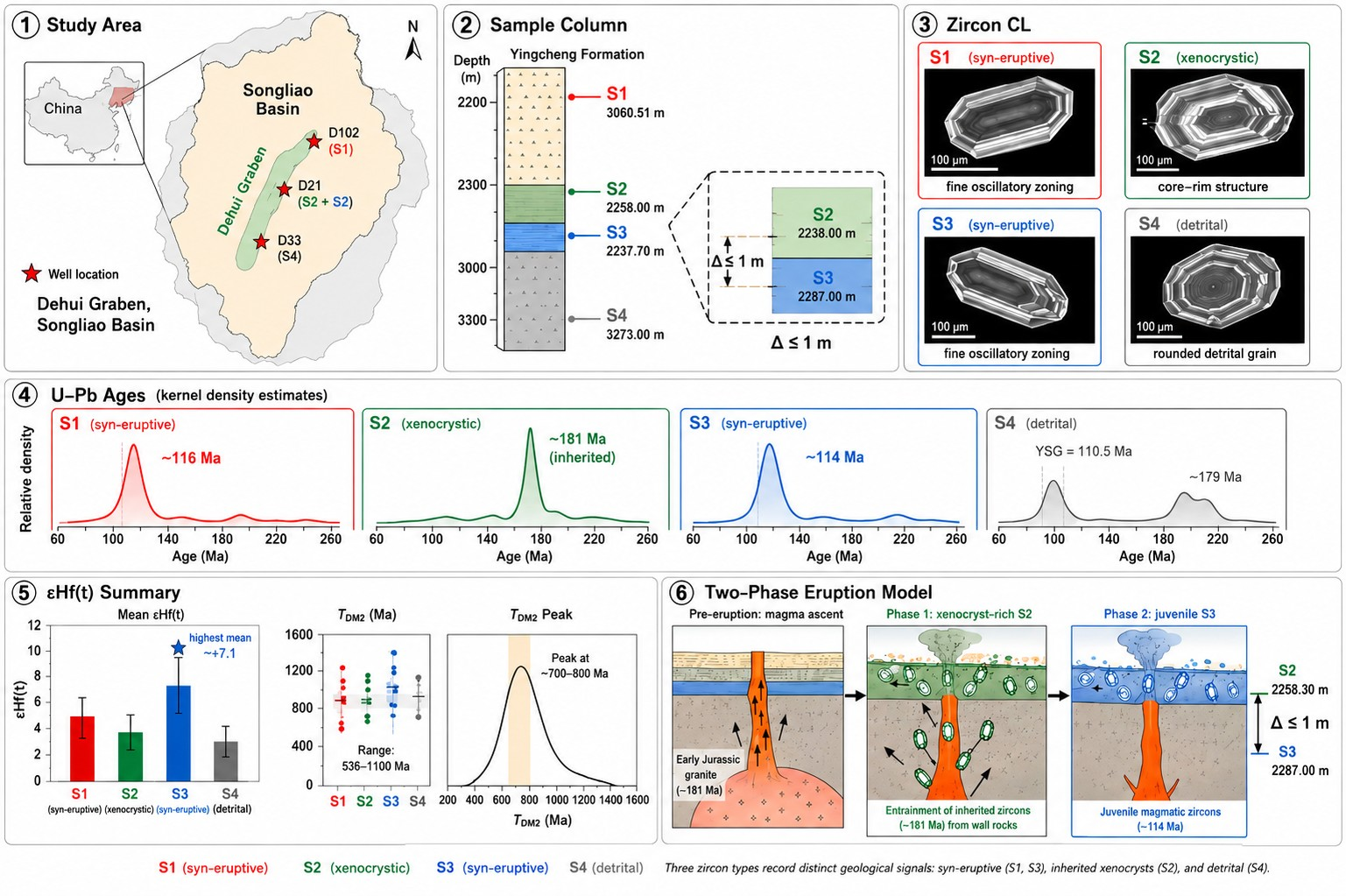
The Lower Cretaceous volcanic–sedimentary succession in the Dehui Graben of the southern Songliao Basin preserves critical records of syn-rift volcanism and basin filling in NE China. This study presents an integrated dataset of zircon cathodoluminescence (CL) imaging, LA-ICP-MS U-Pb geochronology, trace-element geochemistry, and LA-MC-ICP-MS Lu-Hf isotopic analyses for four representative Yingcheng Formation samples collected from three boreholes (D102, D21, and D83) in the Dehui Graben. Zircon grains from samples S1 (gray crystal-vitric tuff, Well D102, 3050.5 m) and S3 (gray tuff, Well D21, 2287 m) are predominantly euhedral to subhedral with well-developed oscillatory zoning, elevated Th/U ratios (>0.4), and chondrite-normalized REE patterns characterized by depletion in light REEs, enrichment in heavy REEs, and pronounced negative Eu anomalies, all of which are diagnostic of a magmatic origin. The 37 zircon analyses from S1 yield 206Pb/238U ages ranging from 109 to 122 Ma, with a KDE peak at ~116 Ma and two inherited grains at 158 Ma and 262 Ma, whereas the 43 analyses from S3 define a narrow age population between 110 and 123 Ma with a KDE peak at ~114 Ma and a single inherited grain at 145 Ma. Together, these ages constrain Yingcheng Formation felsic volcanism in the Dehui Graben to the Aptian stage of the Early Cretaceous. In marked contrast, the 54 zircon analyses from S2 (dark gray crystal-rich tuff, Well D21, 2288 m) exhibit a polymodal distribution dominated by an Early Jurassic population (KDE peak ~181 Ma), with subordinate Permian–Triassic (~251 Ma) and Carboniferous (~325 Ma) components and a complete absence of Cretaceous-aged zircons. We interpret this population entirely as inherited (xenocrystic) zircons entrained from conduit wall rocks during the incipient phase of volcanic eruption. Notably, S2 and S3 were collected from the same well at depths separated by only 1 m, yet they display fundamentally contrasting zircon age spectra. This abrupt vertical discontinuity is consistent with a two-phase eruptive model in which an early xenocryst-rich volcaniclastic unit (S2), possibly related to conduit-wall entrainment during the initial eruptive stage, was rapidly followed by a juvenile magma-derived tuff (S3). Sample S4 (gray coarse sandstone, Well D83, 3273 m) contains 84 detrital zircon grains spanning 112 to 440 Ma, with a dominant Early Jurassic peak (~179 Ma) that correlates with widespread granitoids in the Zhangguangcai Range and a youngest single-grain age of 110.5 Ma that constrains the maximum depositional age of the Yingcheng Formation. All 86 zircon Lu-Hf analyses yield positive εHf(t) values (+0.8 to +9.2), with two-stage Hf model ages (TDM2) clustering between 536 and 1100 Ma and peaking at ~700–800 Ma (Neoproterozoic). These data indicate that the parental magmas were predominantly derived from partial melting of Neoproterozoic juvenile crust extracted from a depleted mantle source. Among the four samples, S3 records the highest mean εHf(t) (+7.1) and the youngest mean TDM2 (~672 Ma), which may indicate a relatively stronger depleted-mantle affinity during the extensional stage at ca. 114 Ma. The positive εHf(t) values of the ~181 Ma S2 xenocrysts further imply that the Early Jurassic magmatic event in this region also sampled juvenile Neoproterozoic crust, which thus served as the common source basement for both episodes of magmatism. A regional compilation reveals a systematic north-to-south younging trend of syn-rift volcanism across the Songliao Basin (Yingtai ~119 Ma, Dehui ~115 Ma, Wangfu ~110 Ma), with the Dehui Graben occupying a critical intermediate position that is consistent with the southeastward migration of back-arc extension possibly related to Paleo-Pacific slab rollback.

Graphical Abstract

1. Introduction

The Songliao Basin, situated in Northeast China, is the largest Mesozoic–Cenozoic terrestrial hydrocarbon-bearing basin in the region. Its deep fault-depression systems host thick Jurassic–Cretaceous volcanic–sedimentary sequences that constitute the principal targets for deep natural gas exploration [1,2,3]. The Dehui Graben, located in the southeastern uplift of the Songliao Basin and bounded to the east by the Zhangguangcai Range, covers an area of approximately 3500 km2 with estimated natural gas resources of ca. 3115 × 108 m3 [4,5]. The basin basement comprises predominantly Paleozoic metamorphic rocks and granitoids, and the deep stratigraphy is subdivided, from base to top, into the Huoshiling (K1h), Shahezi (K1sh), Yingcheng (K1y), and Denglouku (K1d) Formations, which together record a complete evolutionary cycle from Late Jurassic–Early Cretaceous rifting through Late Cretaceous thermal sag [6,7]. Among these units, the Yingcheng Formation represents a volcanic–sedimentary succession deposited during the waning rift stage and consists largely of felsic rhyolite, tuff, and volcanic breccia intercalated with clastic rocks; it is the principal volcanic reservoir interval in the Dehui Graben [8,9]. However, whereas systematic zircon U-Pb geochronological studies have been conducted in the Xujiaweizi Graben to the north and the Changling Graben to the south, precise age constraints for volcanic rocks in the Dehui Graben remain scarce, limiting our ability to resolve stratigraphic correlations and reconstruct the tectonic–magmatic evolution of this region. More critically, previous studies have commonly treated zircon ages derived from volcanic rocks, volcaniclastic rocks, and clastic sedimentary rocks as equivalent signals, without systematically distinguishing among syn-eruptive crystallization ages, inherited components, and detrital provenance ages—a distinction that is fundamental to correctly interpreting the timing of volcanism and the history of basin filling.
Considerable progress has been made in establishing the geochronological framework of deep volcanic rocks in the Songliao Basin and in tracing sedimentary provenance. Wang et al. [6,7] established a basin-wide chronostratigraphic framework through systematic zircon U-Pb dating, assigning the Huoshiling Formation to 124–135 Ma, the Shahezi Formation to 118–124 Ma, and the Yingcheng Formation to 106–118 Ma. Pei et al. [8] reported Yingcheng Formation volcanic ages of 110–120 Ma from the southeastern basin margin and attributed their genesis to back-arc extension associated with Paleo-Pacific subduction. Zhang et al. [9] and Qu et al. [10] further refined the geochronology of the Xujiaweizi Graben and the broader deep-basin volcanic succession, respectively. In terms of provenance analysis, Song et al. [11] employed detrital zircon U-Pb ages and Lu-Hf isotopes to document a syn-rift to post-rift provenance transition, and Gao and Li [12] provided chronostratigraphic constraints on basin filling using detrital zircons from the Shahezi Formation in borehole SK-2. Li et al. [13] and Zang et al. [14] respectively constrained the provenance of the Quantou Formation on the southeastern basin margin and the Yaojia Formation in the southern basin. With regard to regional magmatism, voluminous Early Mesozoic granitoids are exposed in the Zhangguangcai, Lesser Xing’an, and Greater Xing’an ranges surrounding the Songliao Basin. Their zircon U-Pb ages cluster in three principal intervals—Early Jurassic (200–180 Ma), Middle Jurassic (175–160 Ma), and Early Cretaceous (130–110 Ma) [15,16,17]—and these plutonic bodies serve as the primary detrital sources for the Cretaceous basin fill. Nevertheless, the aforementioned studies have focused largely on the northern and central graben systems or on provenance tracing during the post-rift stage, and integrated zircon U-Pb-Hf isotopic investigations of the syn-rift volcanic–sedimentary successions in the Dehui Graben remain absent. In particular, the question of whether the older zircon populations hosted in volcaniclastic and sedimentary rocks represent xenocrysts entrained from conduit wall rocks during eruption or reworked detrital components derived from distal sources—a distinction that carries fundamentally different implications for basin evolution—has yet to be systematically evaluated.
The zircon Lu-Hf isotopic system provides a powerful means of tracing magma source characteristics and crustal evolution [18,19]. Positive εHf(t) values and young two-stage Hf model ages (TDM2) indicate derivation from a depleted mantle source or remelting of juvenile crust, whereas negative values imply the involvement of ancient crustal materials [20]. Wu et al. [20] demonstrated through a regional compilation that Phanerozoic granitoids across NE China are characterized by predominantly positive εHf(t) values and that the Neoproterozoic (ca. 500–1000 Ma) represents a major period of crustal extraction from the depleted mantle. However, integrated zircon U-Pb-Hf-trace-element studies on the deep fault depressions in the Songliao Basin are scarce. To address these gaps, we present here a comprehensive dataset of zircon CL images, LA-ICP-MS U-Pb ages, trace-element compositions, and LA-MC-ICP-MS Lu-Hf isotopic data for four representative Yingcheng Formation samples collected from three wells (D102, D21, and D83) in the Dehui Graben. The principal objectives of this study are to (1) precisely constrain the eruption ages of Yingcheng Formation volcanic rocks in the Dehui Graben; (2) distinguish among syn-eruptive magmatic, inherited, and detrital zircon populations and thereby constrain the maximum depositional age of the Yingcheng Formation; (3) evaluate zircon petrogenesis using Th/U ratios and REE patterns; (4) characterize the magma source and crustal evolution through zircon Lu-Hf isotopes; and (5) provide new geochronological and isotopic constraints for the Early Cretaceous tectonic–magmatic evolution of the southeastern Songliao Basin.

2. Geological Background and Samples

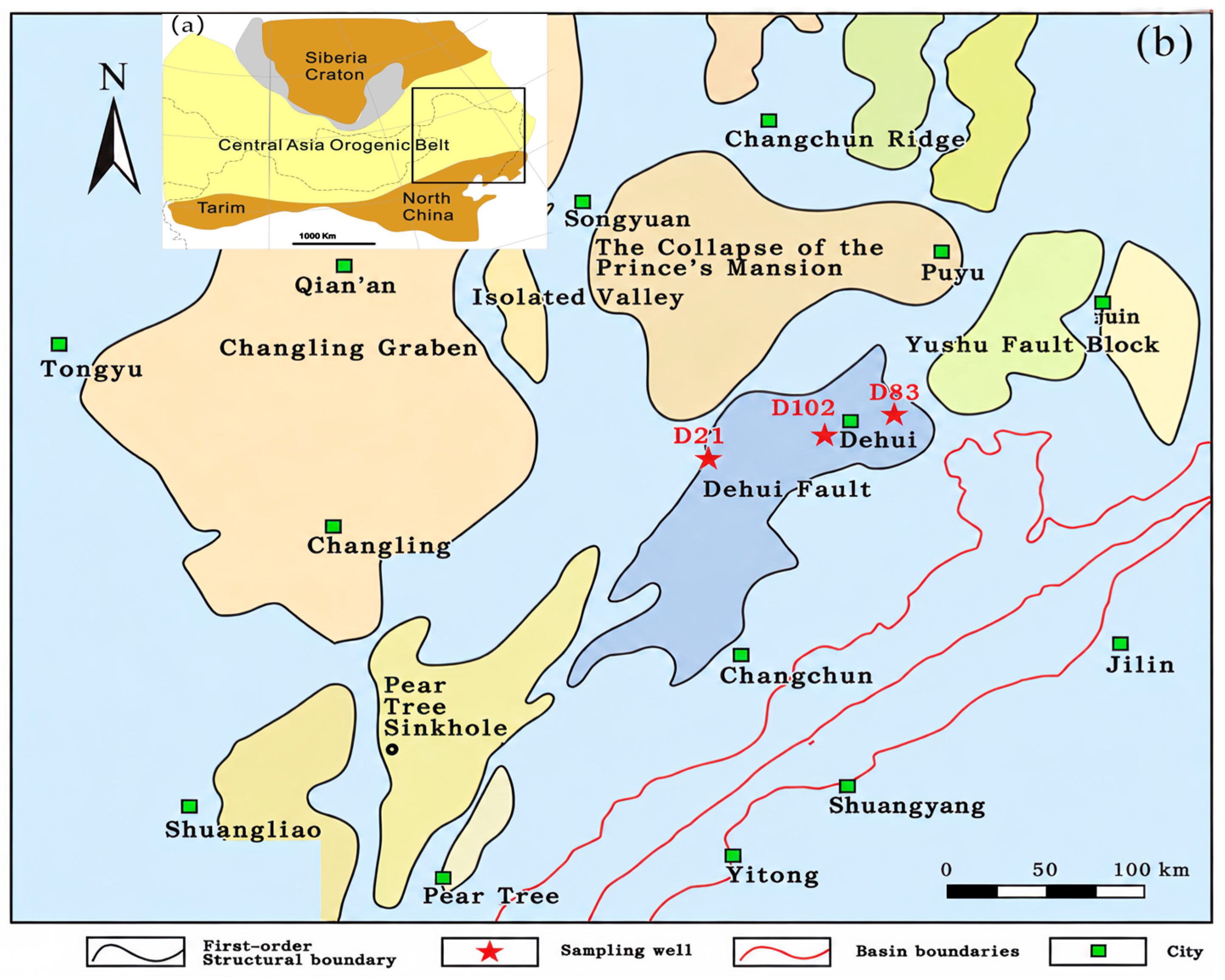
The Songliao Basin is situated in the eastern segment of the Central Asian Orogenic Belt, between the Siberian Craton and the North China Craton, and represents the largest Mesozoic–Cenozoic continental sedimentary basin in NE China [1,2]. The basin evolved through three principal stages—Late Jurassic to Early Cretaceous rifting, late Early Cretaceous to Late Cretaceous thermal sag, and Cenozoic tectonic inversion—producing a basement of Paleozoic metamorphic rocks and granitoids overlain by a thick Mesozoic–Cenozoic volcanic–sedimentary cover exceeding 10,000 m in total thickness [3,4,5]. The Dehui Graben occupies the northern part of the southeastern uplift of the Songliao Basin, bordered to the east by the Zhangguangcai Range and to the west by the Wangfu Graben, and extends in a NNE direction over an area of approximately 3500 km2 with estimated natural gas resources of ca. 3115 × 108 m3 [6,7]. During the Late Jurassic to Early Cretaceous, subduction of the Paleo-Pacific Plate beneath the eastern Eurasian margin generated a back-arc extensional regime that drove intense fault-controlled subsidence and large-scale volcanic eruptions in the Dehui area [8,9,10]. The deep stratigraphy of the graben comprises, from base to top, the Huoshiling (K1h), Shahezi (K1sh), Yingcheng (K1y), and Denglouku (K1d) Formations: the Huoshiling Formation consists of intermediate to felsic volcanic rocks with interbedded clastic deposits recording initial rifting; the Shahezi Formation comprises thick lacustrine dark mudstones and sandstones deposited during peak subsidence, with localized volcanic interbeds; the Yingcheng Formation is a volcanic–sedimentary succession dominated by rhyolite, tuff, and volcanic breccia with subordinate clastic intercalations that hosts the principal volcanic reservoirs in the Dehui Graben; and the Denglouku Formation consists of fluvial–deltaic sandstones and mudstones marking the rift-to-sag transition [6,11,12]. Systematic zircon U-Pb dating has established the following chronostratigraphic framework: Huoshiling Formation 124–135 Ma, Shahezi Formation 118–124 Ma, Yingcheng Formation 106–118 Ma, and Denglouku Formation 100.5–106 Ma [6,13,14]. Regionally, voluminous Mesozoic granitoids are exposed in the Zhangguangcai, Lesser Xing’an, and Greater Xing’an ranges surrounding the Songliao Basin, with zircon U-Pb ages clustering in three principal intervals: Early Jurassic (200–180 Ma), Middle Jurassic (175–160 Ma), and Early Cretaceous (130–110 Ma) [15,16,17]. The Early Jurassic magmatic pulse is particularly well developed in the Zhangguangcai Range (182 ± 3 Ma) and has been attributed to either subduction of the Mongol-Okhotsk Ocean or the early stages of Paleo-Pacific subduction [15,18]; these plutons served as a major detrital source for Early Cretaceous basin sedimentation. Previous zircon Hf isotope studies have demonstrated that Phanerozoic granitoids and volcanic rocks across this region are characterized by predominantly positive εHf(t) values and relatively young TDM2 ages, indicating significant Phanerozoic crustal growth, with the Neoproterozoic to Early Paleozoic representing the principal period of crustal extraction from the depleted mantle [19,20]. Four representative samples were collected from three wells in the Dehui Graben, all assigned to the Yingcheng Formation (Figure 1, Table 1).
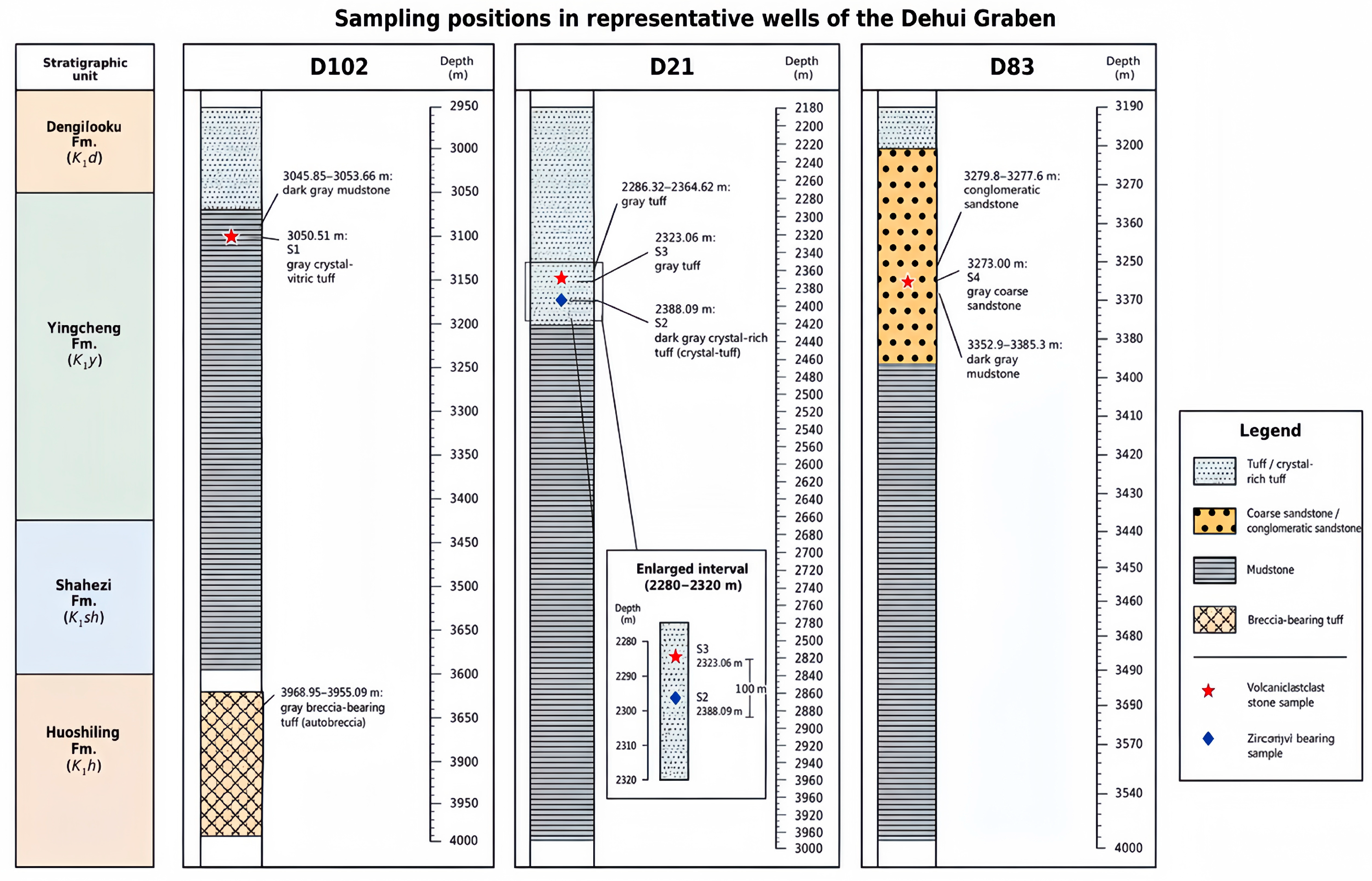
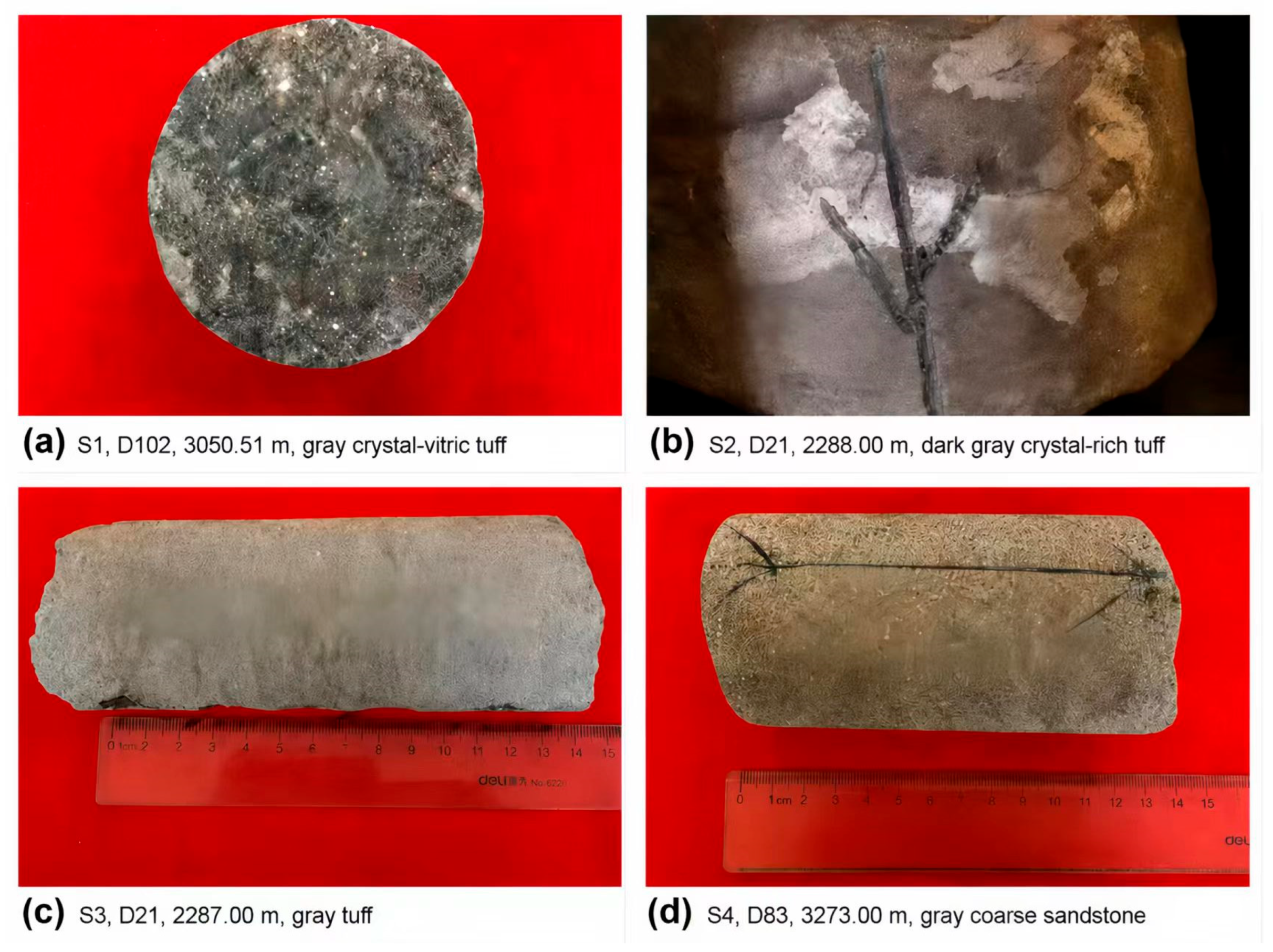
Sample S1 is a gray crystal-vitric tuff recovered from Well D102 at 3050.5 m, containing abundant feldspar and quartz crystal fragments within a fine-grained tuffaceous matrix exhibiting a dense, massive texture. The cored interval at 3045.65–3053.66 m in this well is assigned to the Yingcheng Formation, whereas the Huoshiling Formation occurs deeper at 3918.95–3935.09 m, thereby confirming the stratigraphic assignment of S1. Samples S2 and S3 were both collected from Well D21, at depths of 2288 m and 2287 m, respectively, within the First Member of the Yingcheng Formation (cored interval 2286.32–2304.02 m, gray tuff). S2 is a dark gray, fine-to-silt-grade tuff with moderate sorting and feldspar-dominated crystal fragments, whereas S3 is a gray tuff that locally displays rhyolitic characteristics in thin section, with a relatively uniform grain-size distribution. Critically, these two samples are separated by only 1 m vertically, yet they exhibit diametrically opposed zircon age populations: S2 consists entirely of inherited zircons lacking any Cretaceous component, whereas S3 is composed exclusively of syn-eruptive magmatic zircons. This abrupt vertical discontinuity constitutes the principal evidence for the two-phase eruptive model developed in this study. Sample S4 is a gray coarse sandstone collected from Well D83 at 3273 m, within the Second Member of the Yingcheng Formation (cored interval 3270.8–3277.6 m, pebbly sandstone). The detrital grains are moderately sorted and subangular to subrounded, comprising quartz, feldspar, and lithic fragments. Together, these four samples span volcanic (S1), volcaniclastic (S2, S3), and clastic sedimentary (S4) lithologies (Figure 2 and Figure 3), thereby permitting a systematic comparison of zircon age spectra among contrasting rock types.

3. Materials and Methods

Rock samples were crushed and subjected to conventional heavy-liquid and magnetic separation, after which zircon grains with euhedral morphology, minimal fractures, and few inclusions were handpicked under a binocular microscope (Nikon Corporation, Tokyo, Japan). Selected grains were mounted in 25 mm epoxy resin discs, polished to expose internal surfaces, and imaged by cathodoluminescence (CL) to reveal internal structures—oscillatory zoning, inherited cores, fractures, and metamict domains—for the purpose of guiding laser-ablation spot placement. All zircon U-Pb dating, trace-element analyses, and Lu-Hf isotopic analyses were completed at the Petroleum and Natural Gas Engineering Experimental Center of Xi’an Shiyou University. Zircon U-Pb dating and simultaneous trace-element analyses were performed using an Analytik Jena PQMS Elite inductively coupled plasma mass spectrometer (ICP-MS) (ICP-MS; Analytik Jena GmbH, Jena, Germany) coupled to an ESI NWR193 193 nm ArF excimer laser ablation system (Elemental Scientific Lasers, Omaha, NE, USA), with helium as the carrier gas and single-spot ablation in peak-jumping data-acquisition mode. Prior to analysis, the system was flushed with high-purity argon and purified helium for approximately 2 h, after which backgrounds of 204Pb and 202Hg stabilized at <100 cps. Key operating parameters were as follows: laser spot diameter 30 μm, repetition rate 6 Hz, fluence approximately 4.5 J/cm2, dwell times of 20 ms per Pb isotope (204, 206, 207, 208) and 10 ms per Th (232) and U (238), with 20 s of gas background acquisition followed by 40 s of signal acquisition for each analysis. The standard zircon 91500 served as the primary external standard for U-Pb isotopic fractionation correction [21], and NIST SRM 610 glass was used as the external standard for trace-element concentration calculations with Si as the internal standard [22,23]; 91500 was analyzed after every six unknown spots, and NIST 610, together with the secondary monitor zircon GJ-1, after every twelve. Time-dependent drift of U-Th-Pb isotopic ratios was corrected by linear interpolation of the 91500 measurements, and common-Pb correction followed the method of Andersen [24]. Data reduction was performed using GLITTER 4.0 software [25], and the Plešovice reference zircon yielded a measured 206Pb/238U age of 336.5 ± 1.1 Ma (n = 3, 2-sigma), in agreement with the recommended value of 337.13 ± 0.37 Ma (2-sigma) [26], confirming the reliability of instrumental conditions. For zircons younger than 1000 Ma, 206Pb/238U ages were adopted for geological interpretation, whereas 207Pb/206Pb ages were used for older grains. Wetherill concordia diagrams, weighted mean age calculations, kernel density estimates (KDEs), and probability density plots (PDPs) were all generated using IsoplotR software (version 6.0) [27]., and the Plesovice reference zircon yielded a measured 206Pb/238U age of 336.5 ± 1.1 Ma (n = 3, 2-sigma), in agreement with the recommended value of 337.13 ± 0.37 Ma (2-sigma) [25], confirming the reliability of instrumental conditions. For zircons younger than 1000 Ma, 206Pb/238U ages were adopted for geological interpretation, whereas 207Pb/206Pb ages were used for older grains. Wetherill concordia diagrams, weighted mean age calculations, kernel density estimates (KDEs), and probability density plots (PDPs) were all generated using IsoplotR software (version 6.0) [26]. Weighted mean ages were computed using only analyses with concordance exceeding 90% (concordance = 206Pb/238U age/207Pb/235U age × 100%), with outliers rejected by an iterative 2-sigma clipping procedure. Individual spot ages are reported at the 1-sigma level; concordia ellipses and weighted mean age uncertainties are reported at the 2-sigma level. For datasets in which the MSWD significantly exceeds the expected critical value for the population size, KDE peak ages or robust weighted mean ages are reported as supplementary constraints, and the elevated MSWD is interpreted as reflecting geological dispersion beyond analytical uncertainty.
In situ zircon Lu-Hf isotopic analyses were carried out using a Thermo Fisher Neptune multi-collector ICP-MS (Thermo Fisher Scientific, Bremen, Germany) equipped with an NWR193 193 nm laser ablation system (Elemental Scientific Lasers, Omaha, NE, USA), following the procedures described by Hou et al. [28]. The laser spot diameter was 32 μm, and the ablated aerosol was transported in helium carrier gas with minor Ar and N2 added downstream to enhance sensitivity. All Lu-Hf analysis spots were placed at the same sites as, or immediately adjacent to, the corresponding U-Pb dating spots to ensure one-to-one correspondence between age and Hf isotope data. The standard zircon GJ-1, analyzed after every ten unknown spots, yielded a weighted mean 176Hf/177Hf of 0.282030 ± 40 (2SE). Isobaric interference corrections employed the scheme of Chu et al. [29] using 176Lu/175Lu = 0.02655 and 176Yb/172Yb = 0.5887. εHf(t) values were calculated using the present-day chondritic uniform reservoir (CHUR) values of 176Hf/177Hf = 0.282772 and 176Lu/177Hf = 0.0332 [30], together with depleted mantle (DM) present-day values of 176Hf/177Hf = 0.28325 and 176Lu/177Hf = 0.0384 [31]. The 176Lu decay constant of lambda = 1.867 × 10⁻¹¹ yr−1 was adopted [32]. Single-stage Hf model ages (TDM1) were calculated assuming direct derivation of the zircon Hf isotopic composition from depleted mantle melting; two-stage model ages (TDM2) assume a mean continental crustal 176Lu/177Hf ratio of 0.015 for the source region between mantle extraction and zircon crystallization [33]. Elemental concentrations of 14 rare earth elements (La to Lu) plus Ti, Y, Nb, Hf, Ta, Th, and U were determined simultaneously with U-Pb dating.

4. Results

4.1. Zircon Morphology, CL Characteristics, and Th/U Ratios

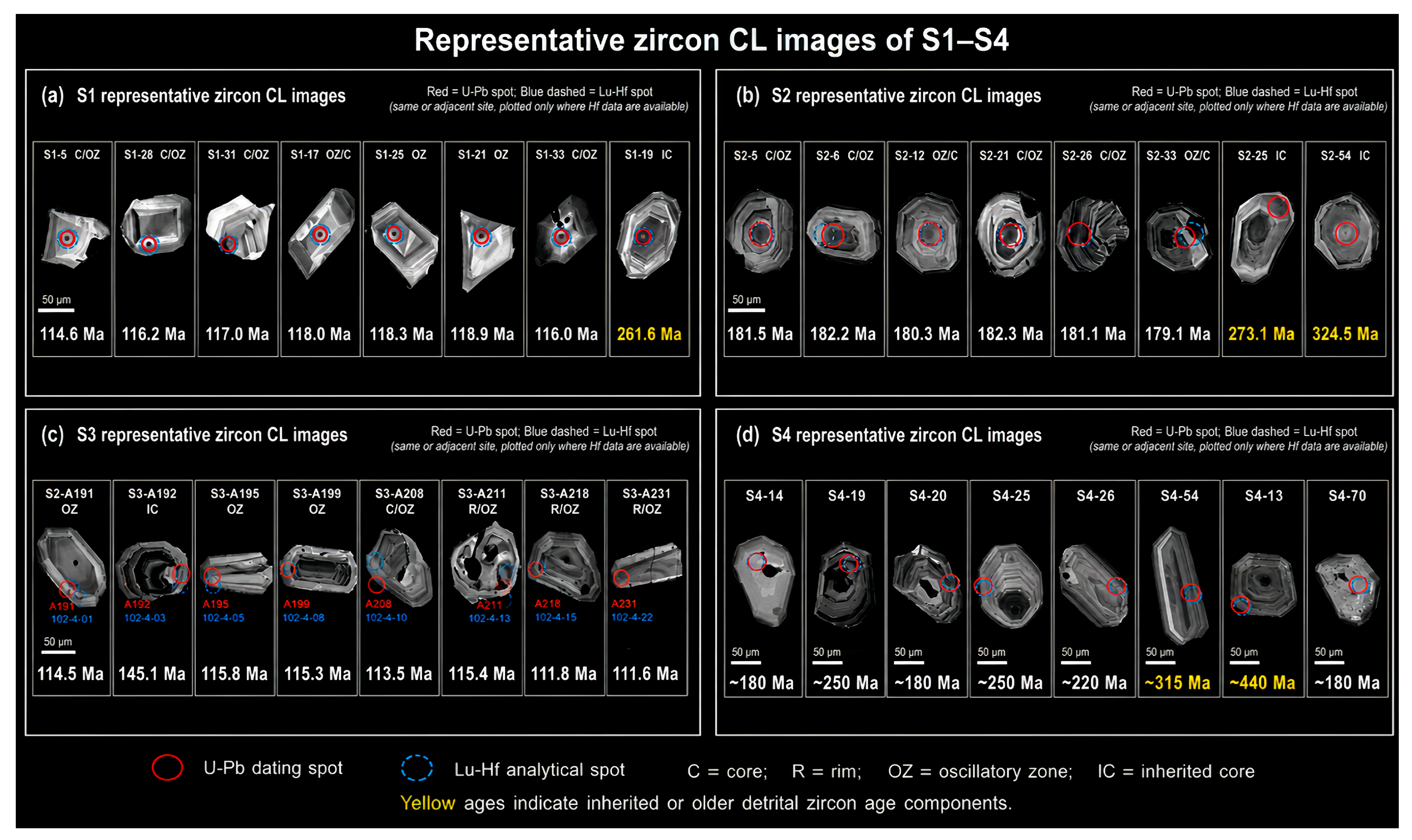
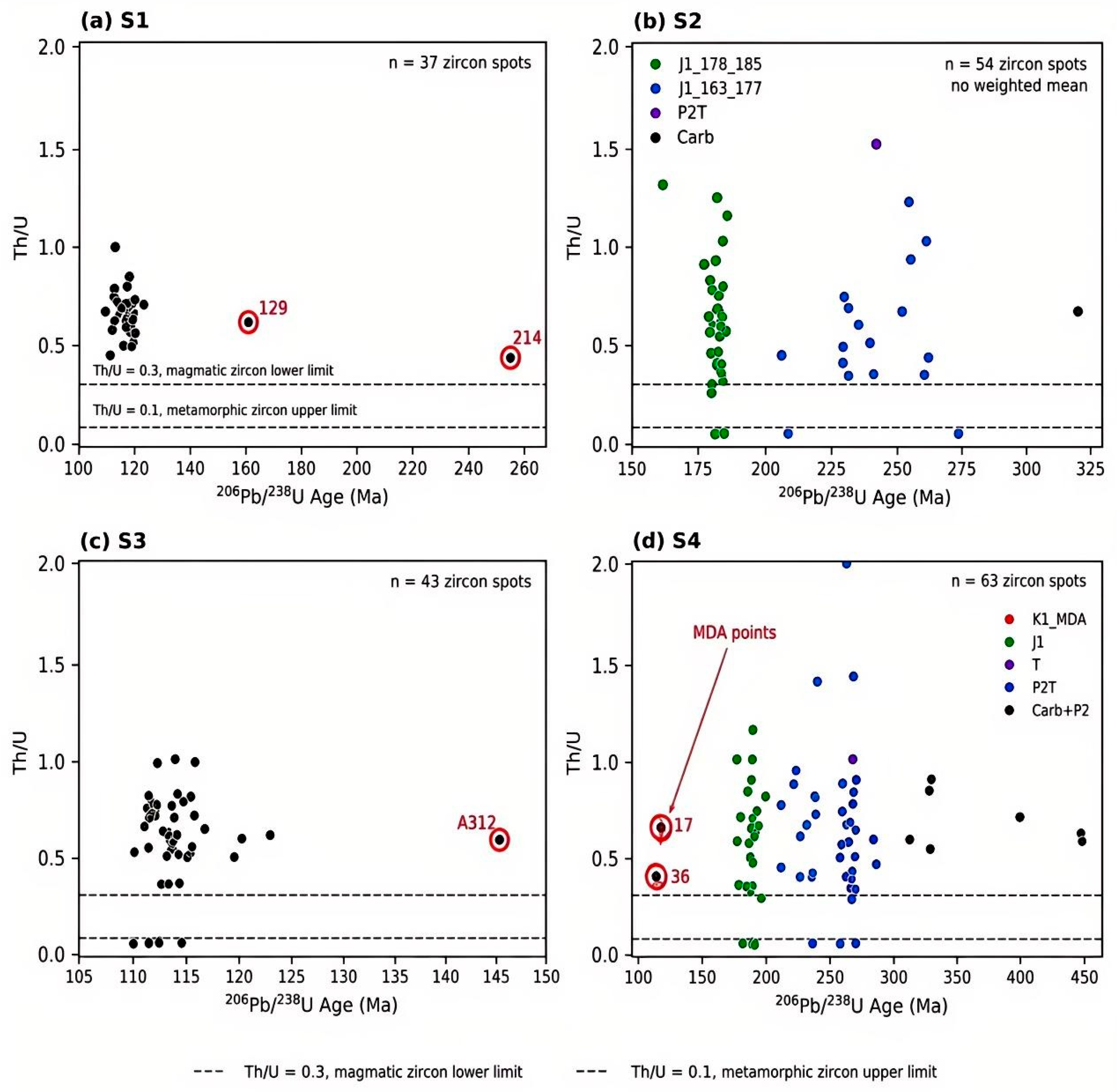
Representative zircon CL images for the four samples are presented in Figure 4, and Th/U ratios plotted against age are shown in Figure 5. Zircons from S1 and S3 are predominantly euhedral to subhedral and range from short- to long-prismatic (60–200 μm in length, aspect ratios 2:1 to 4:1). Their CL images reveal fine, uniform oscillatory zoning (Figure 4a,c) that is diagnostic of magmatic zircon crystallized from a compositionally stable melt. In contrast, zircons from S2 display distinctly wider oscillatory zoning bands and common core-rim structures (Figure 4b), features that are more typical of plutonic than volcanic zircon. S4 zircons exhibit the greatest morphological diversity, including subrounded detrital grains, fragmented crystals with abraded edges, and grains with prominent core-rim structures in which the core displays weak CL luminescence and the rim exhibits clear oscillatory zoning (Figure 4d), consistent with a multi-source, detrital origin. Th/U ratios (median ± 1 SD) are as follows: S1 = 0.52 ± 0.11 (n = 37), S2 = 0.60 ± 0.18 (n = 54), S3 = 0.71 ± 0.15 (n = 43), S4 = 0.54 ± 0.21 (n = 63, excluding unmatched and standard analyses). All samples have Th/U ratios predominantly exceeding 0.3, with more than 95% of analyses above 0.4 (Figure 5), which is consistent with the established diagnostic threshold for magmatic zircon (Th/U > 0.3–0.4) [14,16]. S3 exhibits the highest median Th/U ratio, whereas S4 displays the greatest dispersion (Figure 5d), in keeping with its detrital, multi-source zircon assemblage. A small number of analyses with Th/U < 0.1 are attributable to residual NIST 610 standard material and are excluded from zircon interpretation. Taken together, the oscillatory zoning observed in CL images and the consistently elevated Th/U ratios confirm that the analyzed zircons are predominantly of magmatic origin.
Figure 5. Th/U versus 206Pb/238U age diagrams.The dashed line at Th/U = 0.3 marks the lower boundary of magmatic zircon. Red circles in (a,c) denote inherited zircon grains. Colors in (b,d) correspond to age populations defined in Figure 6. The vast majority of analyses plot above Th/U = 0.3, consistent with a magmatic origin.
Minerals 16 00742 g005
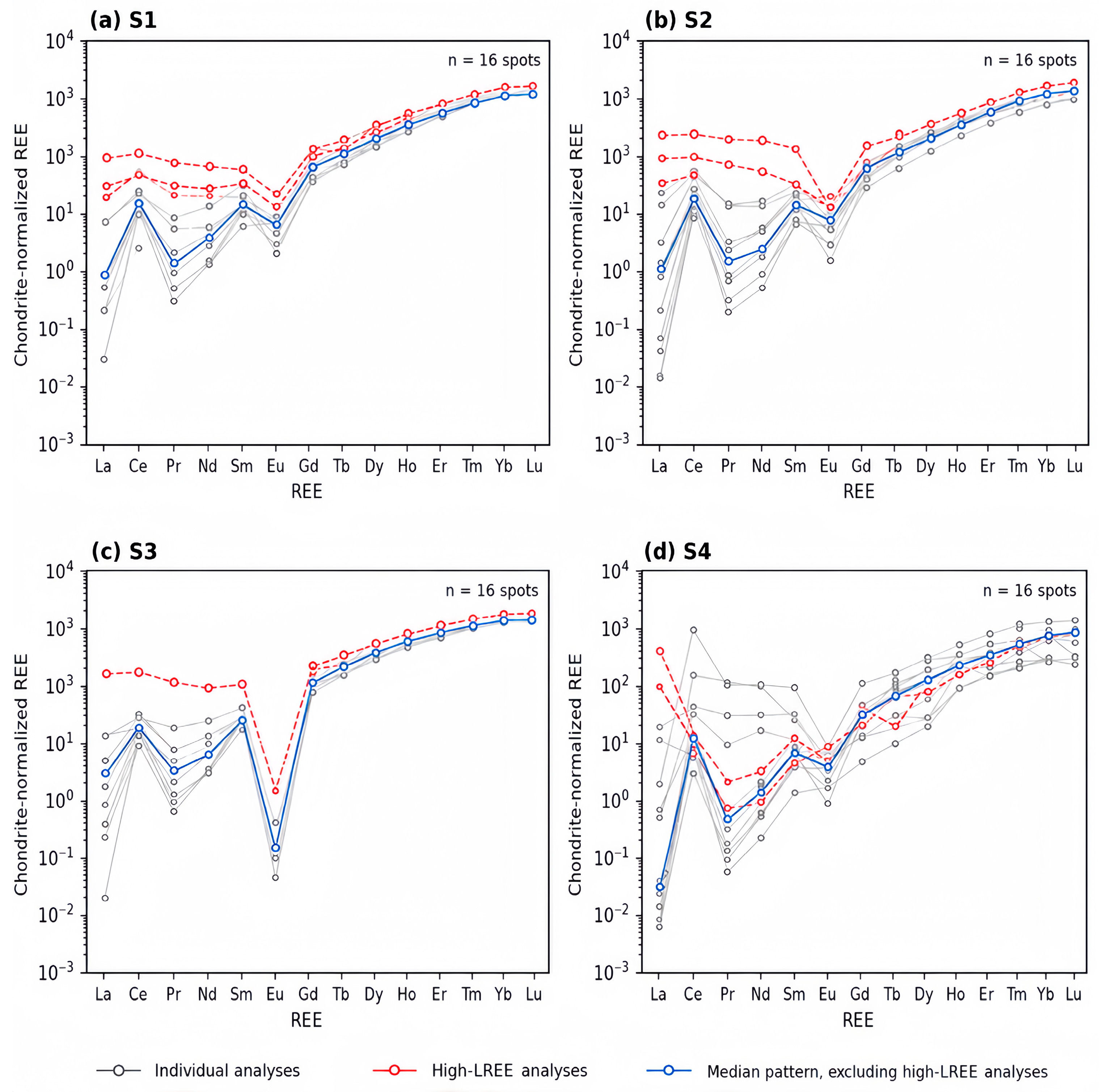
Figure 6. Chondrite-normalized REE patterns of zircons. Gray solid lines = individual spot analyses; red dashed lines = spots with anomalously high LREE (La > 10 ppm), indicating mineral inclusions; blue bold line = median pattern excluding high-LREE outliers. All samples exhibit LREE depletion, positive Ce anomalies, negative Eu anomalies, and HREE enrichment, consistent with magmatic zircon.
Minerals 16 00742 g006

4.2. Trace Element Characteristics of Zircon

Chondrite-normalized REE patterns for all four samples are plotted in Figure 6 (normalization values after Sun and McDonough, 1989 [34]). All analyzed spots exhibit REE patterns that are diagnostic of magmatic zircon, characterized by relative depletion in light REEs (LREE: La–Nd), pronounced enrichment in heavy REEs (HREE: Gd–Lu), positive Ce anomalies, and negative Eu anomalies (Figure 6a–d). Quantitative trace-element parameters are as follows: (Sm/La) N ratios range from 12 to 78 (mean 35) for S1, 8 to 65 (mean 28) for S2, 18 to 95 (mean 42) for S3, and 5 to 55 (mean 22) for S4; Ce/Ce* median values are 8.5 (S1), 7.2 (S2), 9.8 (S3), and 5.6 (S4); and Eu/Eu* median values are 0.25 (S1), 0.28 (S2), 0.22 (S3), and 0.30 (S4). S3 exhibits the most pronounced negative Eu anomaly, which may indicate a higher degree of plagioclase fractionation in its parental magma. The REE patterns of S1 and S3 are relatively uniform, with small inter-spot variability (Figure 6a,c), reflecting derivation from compositionally homogeneous magmatic systems. In contrast, S2 and S4 display greater variability (Figure 6b,d), consistent with their complex, multi-source zircon age populations. A small number of analyses with anomalously elevated LREE concentrations (La > 10 ppm, shown as dashed lines in Figure 6) may reflect the presence of microscopic mineral inclusions or localized alteration, but their Th/U ratios and CL characteristics remain within the magmatic zircon range and thus do not affect the overall interpretation.

4.3. Zircon U-Pb Geochronology

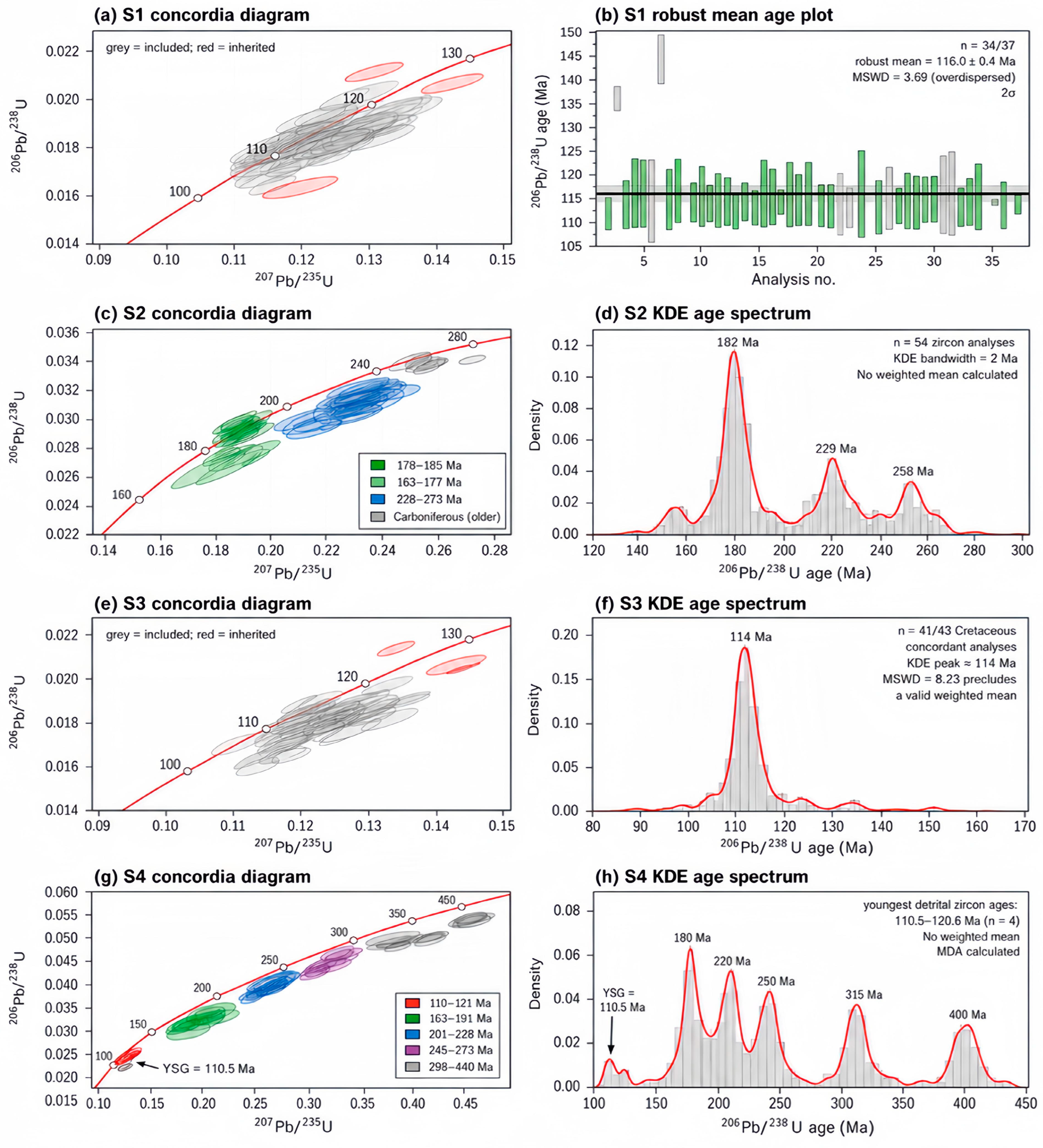
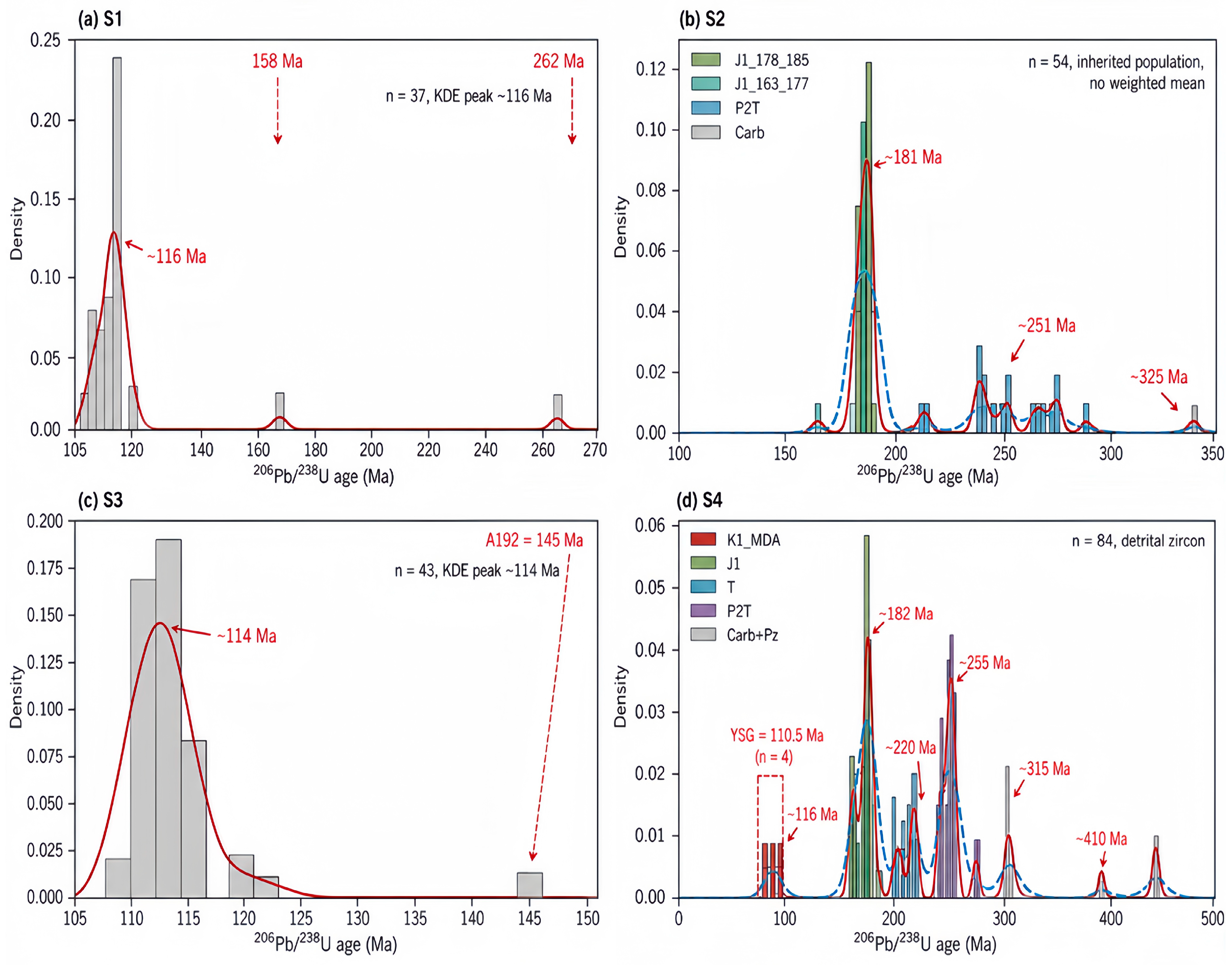
A total of 218 valid U-Pb analyses were obtained from the four samples (complete dataset in Table S1), with Wetherill concordia diagrams presented in Figure 7, kernel density estimate (KDE) age distributions in Figure 8, and a summary of results in Table 2. These data reveal three compositionally distinct zircon age signals that correspond systematically to host-rock lithology. In this study, the term “xenocrystic–inherited zircons” is used for older zircon grains that are foreign to the host magma and were mechanically entrained from conduit wall rocks or country rocks during magma ascent or eruption. This usage differs from “antecrysts,” which refer to crystals derived from earlier stages of the same magmatic system. The term “detrital zircons” is used for zircon grains deposited through sedimentary transport in clastic rocks. S1 and S3 are both dominated by Early Cretaceous zircon populations: the 37 analyses from S1 yield 206Pb/238U ages of 109–122 Ma (Figure 7a), with a KDE peak at ~116 Ma (Figure 8a) after excluding two inherited grains (A129 = 158.2 Ma, A144 = 261.6 Ma; red ellipses in Figure 7a) and one anomalously young grain (A149 = 109.0 Ma, possibly reflecting Pb loss), whereas the 43 analyses from S3 define a narrow, near-unimodal population at 110–123 Ma (Figure 7e) with a KDE peak at ~114 Ma (Figure 8c) after excluding a single inherited grain A 192 = 145.1   M a . Both S1 and S3 display geological overdispersion (MSWD >> 1), and KDE peak ages are therefore reported as the primary age constraints. In striking contrast, S2 and S3 were collected from the same well at depths separated by only 1 m; yet S2 yielded 54 analyses with a polymodal distribution spanning 163–325 Ma (Figure 7c and Figure 8b) that is dominated by an Early Jurassic population (KDE peak ~181 Ma, ~65% of analyses) with subordinate Permian–Triassic (228–273 Ma) and minor Carboniferous (~325 Ma) components and—critically—a complete absence of Cretaceous-aged zircons. Given its volcaniclastic host and the uniform pre-Cretaceous ages, we interpret the S2 zircon population as xenocrystic–inherited zircons, most likely mechanically entrained from conduit wall rocks or country rocks during the early stage of eruption, an interpretation further supported by the plutonic-style CL zoning and core-rim structures of S2 zircons (Figure 4b); no weighted mean age is calculated for S2. The meter-scale juxtaposition of a xenocrystic–inherited zircon population in S2 and a syn-eruptive magmatic zircon population in S3 is difficult to explain by a simple gradual depositional model alone and therefore supports the two-phase eruptive scenario discussed in Section 5.2. Finally, S4 yielded 84 detrital zircon analyses spanning 110–440 Ma (Figure 7g and Figure 8d), with major KDE peaks at ~179 Ma (Early Jurassic, ~37%), ~253 Ma (Permo-Triassic, ~35%), and ~225 Ma (Triassic, ~15%), together with minor Carboniferous and Early Paleozoic groups and a youngest Cretaceous cluster at 110–121 Ma (n = 4, red bars in Figure 8d). Because the four youngest grains do not form a statistically coherent population, the youngest single-grain age of 110.5 Ma (youngest single grain (YSG), spot A184) is adopted to constrain the maximum depositional age of the Yingcheng Formation at Well D83 [35].

4.4. Lu-Hf Isotopic Composition of Zircon

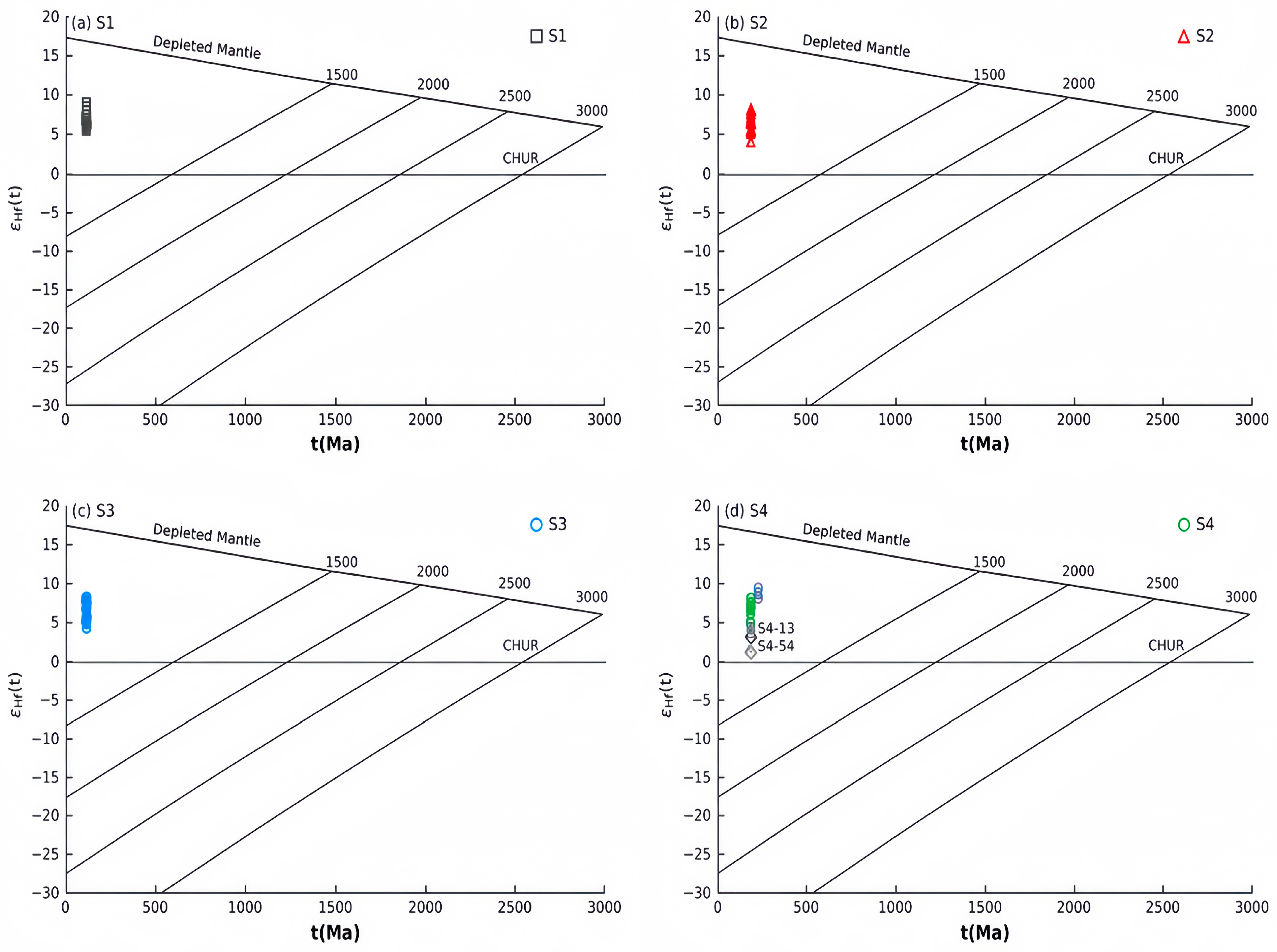
A total of 86 in situ Lu-Hf isotope analyses were performed on selected zircon grains from the four samples (complete data in Table S4), with results summarized in Table 3 and Figure 9. All 86 analyses yield positive εHf(t) values (+0.8 to +9.2), and all data points plot between the CHUR and DM evolutionary lines on the εHf(t) versus age diagram (Figure 9a–d). The 176Lu/177Hf ratios are predominantly below 0.003, indicating negligible post-crystallization accumulation of radiogenic Hf and confirming that the measured ratios closely approximate the initial Hf isotopic composition of the host magma at the time of zircon crystallization. Two-stage Hf model ages (TDM2) cluster between 536 and 1100 Ma, with a prominent peak at 700–800 Ma (Neoproterozoic). S1 (Figure 9a) and S3 (Figure 9c) exhibit relatively elevated εHf(t) values and younger TDM2 (mean ~680 Ma and ~670 Ma, respectively), indicating derivation largely from Neoproterozoic juvenile crust with a significant depleted mantle component. The inherited zircons of S2 (~181 Ma, Figure 9b) also display positive εHf(t) values (+4.1 to +8.3), implying that their source rocks—the Early Jurassic granitoids constituting the conduit wall rocks—were themselves derived from juvenile crust. S4 exhibits the largest dispersion in εHf(t) (Figure 9d), reflecting the multi-source nature of its detrital zircon population: the Early Jurassic group (Figure 9d) has Hf isotopic compositions comparable to those of S2 xenocrysts, consistent with a common derivation from Zhangguangcai Range granitoids, whereas the Carboniferous and Early Paleozoic groups (gray symbols) display lower εHf(t) values (down to +0.8) and older TDM2 (up to 1100 Ma), indicating the involvement of more ancient crustal materials in their source regions.

5. Discussion

5.1. Timing of Early Cretaceous Volcanism and Regional Comparison

The KDE peak ages of S1 (~116 Ma) and S3 (~114 Ma) provide robust constraints on the timing of Yingcheng Formation felsic volcanism in the Dehui Graben. Both ages fall within the established chronostratigraphic range of the Yingcheng Formation (106–118 Ma) [6,7] and correspond to the middle to late Aptian stage of the Early Cretaceous [36]. The two ages, taken together, indicate that the principal phase of volcanic activity spanned approximately 2 Myr, from ca. 116 to 114 Ma. This age range is consistent with the drilling record at Well D102, where the cored interval containing S1 (3045.65–3053.66 m) is assigned to the Yingcheng Formation, and the Huoshiling Formation is encountered only at greater depth (3918.95–3935.09 m). The sharply defined KDE peak of S3 (Figure 8c) suggests that this tuff represents the product of a discrete, relatively short-lived eruptive event with minimal contamination by extraneous zircon components.
Placing the Dehui Graben ages within the broader regional context (Table 4) reveals a systematic north-to-south younging trend in syn-rift volcanism across the Songliao Basin. The northern Yingtai Graben records volcanic peaks at ~119–118 Ma, the central Dehui Graben at ~116–114 Ma, the southern Wangfu Graben at ~112–110 Ma, and the southeastern Lishu Graben (Huoshiling Formation) at ~125 Ma. We note that the age data from the other grabens listed in Table 4 derive from the same research program and were acquired using identical sampling, preparation, analytical, and data-processing protocols as this study, ensuring direct inter-comparability. The observed spatio-temporal pattern is consistent with the model of southeastward migration of back-arc extension driven by Paleo-Pacific slab rollback during the Early Cretaceous [8], and the Dehui Graben, with its volcanic peak at 114–116 Ma, occupies a critical intermediate position within this migration sequence.
It should be acknowledged that the Cretaceous zircon populations in both S1 and S3 display a degree of geological overdispersion (MSWD significantly exceeding the critical value), indicating that they do not represent statistically rigorous single-age populations. Such overdispersion is not uncommon in LA-ICP-MS datasets from volcanic rocks and may arise from protracted, multi-pulse eruptive activity spanning 1–3 Myr, minor entrainment of antecrysts, or localized Pb loss affecting individual analyses. We therefore report KDE peak ages as the primary age constraints, with weighted mean ages considered supplementary when MSWD exceeds unity.

5.2. Origin of Older Zircon Populations: Inherited Versus Detrital Zircon

S2 and S4 represent two fundamentally contrasting types of pre-Cretaceous zircon populations whose correct discrimination carries critically different implications for basin evolution. S2 exemplifies the inherited (xenocrystic) end-member: all 54 zircon analyses yield ages between 163 and 325 Ma with a dominant KDE peak at ~181 Ma and a complete absence of Cretaceous-aged zircons—a composition that cannot be reconciled with normal sedimentary processes, since a typical volcaniclastic deposit should contain at least some proportion of contemporaneous (~114 Ma) volcanic zircons. The uniform pre-Cretaceous ages, together with CL characteristics more typical of plutonic than volcanic zircon (wider oscillatory zoning bands, common core-rim structures; Figure 4b), collectively indicate that these zircons were mechanically stripped from Early Jurassic granitoid wall rocks and their older country rocks during magma ascent and incorporated into the initial eruptive products. The decisive constraint is provided by the vertical relationship between S2 and S3, which were collected from the same well at depths separated by only 1 m yet exhibit diametrically opposed zircon age populations—S2 is entirely xenocrystic, whereas S3 is entirely syn-eruptive (110–123 Ma). This meter-scale discontinuity is most parsimoniously explained by a two-phase eruptive model in which an early conduit-clearing phase, during which the ascending magma eroded and entrained abundant xenocrysts from the conduit walls, deposited a crystal-rich tuff (S2) whose zircon cargo consisted almost entirely of wall-rock material, and was rapidly succeeded by a main eruptive phase that, following clearance of loose crystalline debris, deposited a tuff dominated by juvenile magmatic zircons (S3). The ~181 Ma inherited population records an Early Jurassic magmatic event that is regionally expressed in the Zhangguangcai Range (182 ± 3 Ma) [15] and more broadly across NE China (178–185 Ma) [2]; the euhedral morphology, magmatic CL zoning, and positive εHf(t) values of these xenocrysts collectively indicate a primary magmatic origin, suggesting that Early Jurassic granitoid intrusions exist in the subsurface beneath the Dehui Graben and were sampled by the ascending Early Cretaceous magma—implying that the deep basin fill may include Jurassic intrusive complexes that have yet to be penetrated by drilling. Similar two-phase eruptive phenomena, in which early deposits are enriched in wall-rock xenocrysts and late deposits are dominated by juvenile magmatic crystals, have been documented in volcanic systems worldwide, including the Lava Creek Tuff of Yellowstone [37] and the Campi Flegrei eruptions in Italy [38].
In marked contrast, S4 represents the detrital end-member, with 84 zircons spanning 110 to 440 Ma in a polymodal distribution (Figure 8d) that fundamentally differs from the single-source character of S2. The dominant Early Jurassic peak (~179 Ma) correlates with Zhangguangcai Range granitoids [15], the Permo-Triassic (~253 Ma) and Triassic (~225 Ma) peaks record Late Paleozoic to Early Mesozoic magmatic events in the eastern Central Asian Orogenic Belt [17], the Carboniferous and Early Paleozoic groups correspond to older orogenic basement, and the youngest cluster of four Cretaceous zircons (110–121 Ma) reflects syn-depositional volcanic ash input. The diverse zircon morphologies—subrounded grains with abraded edges (Figure 4d)—further attest to a history of sedimentary transport, indicating that by the time of Yingcheng Formation deposition at Well Deshen 83, the Dehui Graben had evolved into an open basin receiving bidirectional sediment supply from the eastern Zhangguangcai Range and from contemporaneous volcanic activity. The youngest single grain (YSG) age of 110.5 Ma (spot A184) provides a maximum depositional age constraint that is temporally consistent with the regional rift-to-sag transition in the Songliao Basin at ca. 110–100 Ma [3,5]. It should be noted that the two-phase eruptive model proposed here remains a working interpretation based mainly on zircon age spectra, CL textures, and the close stratigraphic relationship between S2 and S3. Because volcaniclastic rocks may naturally contain mixed zircon populations, sedimentary recycling or reworking cannot be completely excluded. Further tests of this model require more detailed stratigraphic logging of the S2–S3 contact, petrographic identification of conduit-clearing or wall-rock entrainment textures, and whole-rock geochemical comparison between S2 and S3. These additional data would help determine whether the sharp zircon age spectrum contrast reflects eruptive conduit processes, local reworking, or a combination of both.

5.3. Magma Source Characteristics: Constraints from Zircon Hf Isotopes

The exclusively positive εHf(t) values (+0.8 to +9.2) of all 86 analyzed zircons, together with their position between the CHUR and DM evolutionary lines (Figure 9), effectively preclude significant involvement of ancient cratonic crust in the magma source and instead point toward a predominantly juvenile crustal source with ultimate derivation from a depleted mantle reservoir [18,19,20], an observation consistent with the regional Hf isotope background of NE China, where Phanerozoic granitoids and volcanic rocks are characterized by predominantly positive εHf(t) values and young TDM2 ages that record significant mantle input and juvenile crustal growth [2,20]. The TDM2 values for all samples cluster at 536–1100 Ma with a prominent peak at 700–800 Ma (Neoproterozoic), coinciding with the Hf model age peak (500–1000 Ma) reported for Phanerozoic granitoids across NE China [2,20] and with the Neoproterozoic crustal growth events widely recognized in the eastern Central Asian Orogenic Belt [18,19]. These data indicate that the source materials of the Yingcheng Formation volcanic rocks in the Dehui Graben were predominantly Neoproterozoic juvenile mafic lower crust extracted from the depleted mantle at ca. 700–800 Ma—possibly in association with Rodinia supercontinent breakup-related rift magmatism [20]—and subsequently remelted during the Early Cretaceous in response to thermal perturbations induced by Paleo-Pacific Plate subduction, generating the felsic volcanic rocks of the Dehui Graben.
Inter-sample Hf isotopic differences reveal source heterogeneity within the Dehui Graben: S3 yields the highest mean εHf(t) (+7.1) and the youngest mean TDM2 (~670 Ma) values that are distinct from those of S1 (mean εHf(t) ~+5.9, TDM2 ~680 Ma) and S2 (mean εHf(t) +6.4, TDM2 ~750 Ma). The elevated εHf(t) and younger TDM2 of S3 are consistent with a greater proportion of depleted mantle-derived component in its source region, an inference that aligns with the temporal sequence in which S3 (ca. 114 Ma) represents the peak extensional phase when asthenospheric upwelling was most intense and crustal thinning was at a maximum, thereby maximizing the mantle contribution to crustal melting, whereas S1 (ca. 116 Ma) records a slightly earlier phase of extension and its lower εHf(t) may reflect a greater degree of crustal assimilation. The S2 inherited zircons (ca. 181 Ma) similarly yield positive εHf(t) values (+4.1 to +8.3), indicating that their source rocks—the Early Jurassic granitoids comprising the conduit wall rocks—were themselves juvenile crustal derivatives. This implies that Neoproterozoic juvenile crust served as the common source basement for two discrete melting episodes: an Early Jurassic event (ca. 181 Ma) that produced the Zhangguangcai Range granitoids and the subsurface intrusions beneath the Dehui Graben, followed by an Early Cretaceous event (ca. 114 Ma) that produced the Yingcheng Formation volcanic rocks. It should be stressed, however, that in the absence of independent whole-rock Sr-Nd isotope data, the inferred mantle contribution rests primarily on zircon Hf isotope evidence, and the inter-sample differences in εHf(t) are modest (~0.5–1.0 ε units). A more conservative formulation is therefore that the Hf isotopic characteristics of S3 are consistent with enhanced depleted mantle input during peak extension, but additional geochemical evidence would be required to substantiate this interpretation.
The S4 detrital zircon Hf isotopes, when grouped by age population, display an age-dependent pattern that independently corroborates the multi-source character of the S4 zircon assemblage: the Early Jurassic group (~179 Ma, in Figure 9d) yields εHf(t) values comparable to those of the S2 xenocrysts, consistent with a shared provenance in the Zhangguangcai Range Early Jurassic granitoids, whereas the Permo-Triassic and older Paleozoic groups exhibit lower εHf(t) values (as low as +0.8) and older TDM2 (up to 1100 Ma), reflecting more heterogeneous source regions with greater contributions from older, more evolved crustal materials. This age-dependent Hf isotopic pattern provides independent geochemical evidence for the multi-source provenance of detrital zircons in the Dehui Graben and underscores the value of combining U-Pb geochronology with Lu-Hf isotopic analysis in provenance studies.

5.4. Tectonic Implications

The integrated geochronological and Hf isotopic results support the following tectonic–magmatic evolutionary sequence for the Dehui Graben during the Early Cretaceous: (1) pre-Yingcheng stage (>118 Ma), characterized by intense fault-controlled subsidence and thick lacustrine sedimentation with localized volcanism; (2) early Yingcheng Formation (ca. 116 Ma), during which back-arc extension triggered the first pulse of felsic volcanism (recorded by S1), with magma derived primarily from partial melting of Neoproterozoic juvenile lower crust and minor crustal contamination; (3) late Yingcheng Formation (ca. 114 Ma), when extension reached its peak and triggered a second volcanic pulse (recorded by S3) carrying the strongest depleted mantle signature, reflecting maximum asthenospheric upwelling and crustal thinning, while the xenocryst-rich tuff S2 was deposited during the conduit-clearing phase immediately prior to, or at the onset of, this eruption; and (4) late Yingcheng to early Denglouku Formations (ca. 112–100 Ma), when rifting waned and the basin began receiving clastic sediment from the Zhangguangcai Range (recorded by S4), marking the progressive transition from a syn-rift enclosed basin to a post-rift open basin. This evolutionary model is broadly consistent with regional tectonic reconstructions invoking southeastward migration of back-arc extension driven by Paleo-Pacific slab rollback [8]. The Dehui Graben, situated at the intermediate position between the northern Yingtai Graben (peak volcanism ca. 119–118 Ma) and the southern Wangfu Graben (volcanism extending to ca. 112–110 Ma), provides a critical chronostratigraphic tie-point for constraining the spatio-temporal migration of Early Cretaceous volcanism in the Songliao Basin.

6. Conclusions

(1) Felsic volcanism of the Yingcheng Formation in the Dehui Graben occurred during the Aptian stage of the Early Cretaceous (ca. 116–114 Ma), spanning approximately 2 Myr. The KDE peak ages of S1 (~116 Ma) and S3 (~114 Ma) constrain the timing of volcanic eruptions, while the youngest detrital zircon of S4 (YSG = 110.5 Ma) provides a maximum depositional age for the Yingcheng Formation.
(2) Systematic comparison of zircon age spectra reveals three genetically distinct zircon types: syn-eruptive magmatic zircons (S1, S3), which directly date volcanic activity; inherited–xenocrystic zircons (S2, KDE peak ~181 Ma), which record conduit wall-rock entrainment during the incipient phase of eruption; and detrital zircons (S4, 110–440 Ma), which document multi-source sediment provenance. The contrasting age populations of S2 and S3, collected from the same well at depths separated by only 1 m, are consistent with a two-phase eruptive model in which an early xenocryst-rich volcaniclastic unit was rapidly followed by a juvenile magma-derived tuff, although further petrographic and whole-rock geochemical evidence is needed to test this interpretation. The ~181 Ma xenocrysts in S2 suggest the presence of previously unrecognized Early Jurassic intrusions beneath the Dehui Graben.
(3) Zircon Th/U ratios (predominantly > 0.4), oscillatory zoning, LREE-depleted and HREE-enriched REE patterns with negative Eu anomalies (Eu/Eu* = 0.12–0.45), and consistent positive εHf(t) values (+0.8 to +9.2) with TDM2 clustering at 536–1100 Ma (peak ~700–800 Ma) collectively indicate that the analyzed zircons are of magmatic origin and that the parental magmas were derived predominantly from Neoproterozoic juvenile crust extracted from a depleted mantle source. S3 records the highest mean εHf(t) (+7.1) and youngest TDM2 (~670 Ma), consistent with enhanced mantle input during peak extension at ca. 114 Ma. The positive εHf(t) values of the S2 xenocrysts further imply that Neoproterozoic juvenile crust served as the common source basement for both the Early Jurassic and Early Cretaceous magmatic events.
(4) Syn-rift volcanism across the Songliao Basin exhibits a systematic north-to-south younging trend (Yingtai ~119 Ma to Dehui ~115 Ma to Wangfu ~110 Ma), and the Dehui Graben, with its volcanic peak at 114–116 Ma, occupies a critical intermediate position within this migration sequence. This spatio-temporal pattern provides geochronological evidence for the southeastward migration of back-arc extension driven by Paleo-Pacific slab rollback.

Supplementary Materials

The following supporting information can be downloaded at: https://www.mdpi.com/article/10.3390/min16070742/s1, Table S1: LA-ICP-MS zircon U-Pb dating data for samples from the Dehui Graben; Table S2: Zircon trace-element and chondrite-normalized REE data for samples from the Dehui Graben; Table S3: Zircon Th and U concentrations and Th/U ratios for samples from the Dehui Graben; Table S4: In situ zircon Lu-Hf isotopic data for samples from the Dehui Graben.

Author Contributions

Conceptualization, Y.W. and R.W.; methodology, Y.W., R.W. and J.L.; validation, R.W., J.L. and J.S.; formal analysis, Y.W. and R.W.; investigation, Y.W., J.L., J.S., R.W., G.G. and Y.G.; resources, J.Z.; data curation, Y.W., J.L. and X.X.; writing—original draft preparation, Y.W.; writing—review and editing, R.W., J.L., J.S. and J.Z.; visualization, Y.W., X.X. and Y.G.; supervision, R.W. All authors have read and agreed to the published version of the manuscript.

Funding

This research was funded by the National Science and Technology Major Project of China, grant number 2025ZD1404300, under the project “Mechanisms and New Technologies for Enhancing Tight-Gas Recovery”.

Data Availability Statement

The data generated and analyzed in this study are available in the article and its Supplementary Materials. Further inquiries can be directed to the corresponding authors.

Acknowledgments

The authors thank the School of Earth Sciences and Engineering, Xi’an Shiyou University, and the Shaanxi Key Laboratory of Petroleum Accumulation Geology, Xi’an Shiyou University, for their support during sample preparation, zircon cathodoluminescence imaging, LA-ICP-MS U-Pb dating, trace-element analysis, and Lu-Hf isotope analysis.

Conflicts of Interest

Author JunTing Zhou was employed by PetroChina Jilin Oilfield Company. The remaining authors declare that the research was conducted in the absence of any commercial or financial relationships that could be construed as a potential conflict of interest.

References

  1. Meng, Q.R.; Zhou, Z.H.; Zhu, R.X.; Xu, Y.G.; Guo, Z.T. Cretaceous basin evolution in northeast Asia: Tectonic responses to the Paleo-Pacific plate subduction. Natl. Sci. Rev. 2022, 9, nwab088. [Google Scholar] [CrossRef] [Scilit] [PubMed]
  2. Wu, F.Y.; Sun, D.Y.; Ge, W.C.; Zhang, Y.B.; Grant, M.L.; Wilde, S.A.; Jahn, B.M. Geochronology of the Phanerozoic granitoids in northeastern China. J. Asian Earth Sci. 2011, 41, 1–30. [Google Scholar] [CrossRef] [Scilit]
  3. Feng, Z.Q.; Jia, C.Z.; Xie, X.N.; Zhang, S.; Feng, Z.H.; Cross, T.A. Tectonostratigraphic units and stratigraphic sequences of the nonmarine Songliao Basin, northeast China. Basin Res. 2010, 22, 79–95. [Google Scholar] [CrossRef] [Scilit]
  4. Zhang, F.Q.; Chen, H.L.; Yu, X.; Dong, C.W.; Yang, S.F.; Pang, Y.M.; Batt, G.E. Early Cretaceous volcanism in the northern Songliao Basin, NE China, and its geodynamic implication. Gondwana Res. 2011, 19, 163–176. [Google Scholar] [CrossRef] [Scilit]
  5. Wang, P.-J.; Mattern, F.; Didenko, N.A.; Zhu, D.-F.; Singer, B.; Sun, X.-M. Tectonics and cycle system of the Cretaceous Songliao Basin: An inverted active continental margin basin. Earth-Sci. Rev. 2016, 159, 82–102. [Google Scholar] [CrossRef] [Scilit]
  6. Wang, P.J.; Chen, S.M. Cretaceous volcanic rocks of the Songliao Basin: Ages and nature of eruption. Acta Geol. Sin. (Engl. Ed.) 2015, 89, 609–625. [Google Scholar] [CrossRef] [Scilit]
  7. Wang, T.; Wang, C.; Ramezani, J.; Wan, X.; Yu, Z.; Gao, Y.; He, H.; Wu, H. High-precision geochronology of the Early Cretaceous Yingcheng Formation and its stratigraphic implications for Songliao Basin, China. Geosci. Front. 2022, 13, 101386. [Google Scholar] [CrossRef] [Scilit]
  8. Xu, W.L.; Pei, F.P.; Wang, F.; Meng, E.; Ji, W.Q.; Yang, D.B.; Wang, W. Spatial-temporal relationships of Mesozoic volcanic rocks in NE China: Constraints on tectonic overprinting and transformations between multiple tectonic regimes. Earth-Sci. Rev. 2013, 123, 18–53. [Google Scholar]
  9. Song, Y.; Ren, J.; Liu, K.; Lyu, D.; Feng, X.; Liu, Y.; Stepashko, A. Syn-rift to post-rift tectonic transition and drainage reorganization in continental rifting basins: Detrital zircon analysis from the Songliao Basin, NE China. Geosci. Front. 2022, 13, 101377. [Google Scholar] [CrossRef] [Scilit]
  10. Gao, X.; Li, T. Detrital zircon provenance of the Lower Cretaceous Shahezi Formation in the Songliao Basin, Northeast China: Insights from LA-ICP-MS U-Pb geochronology. Cretac. Res. 2025, 176, 106200. [Google Scholar] [CrossRef] [Scilit]
  11. Zeng, F.; Liu, B.; Zhang, C.; Zhang, G.; Gao, J.; Liu, J.; Ostadhassan, M. Accumulation and distribution of natural gas reservoir in volcanic active area: A case study of the Cretaceous Yingcheng Formation in the Dehui Fault Depression, Songliao Basin, NE China. Geofluids 2021, 2021, 2900224. [Google Scholar] [CrossRef] [Scilit]
  12. Yu, Y.; Xu, H.; Bai, Y.; Niu, W.; Tian, L.; Zhang, H. CT-based 3D pore-fracture network analysis of volcanic reservoirs of Lower Cretaceous Yingcheng Formation in southern Songliao Basin, China: Impact on natural gas migration. Geoenergy Sci. Eng. 2023, 223, 211581. [Google Scholar] [CrossRef] [Scilit]
  13. Fan, W.; Wang, Z.; Song, X.; Li, Z.; Zhang, G.; Li, L.; Yu, Z.; Jiang, Y. Characteristics and controlling factors of tuff reservoirs of Huoshiling Formation in Dehui Fault Depression, Songliao Basin, NE China. Geol. J. 2024, 59, 225–244. [Google Scholar]
  14. Hoskin, P.W.O.; Schaltegger, U. The composition of zircon and igneous and metamorphic petrogenesis. Rev. Mineral. Geochem. 2003, 53, 27–62. [Google Scholar] [CrossRef] [Scilit]
  15. Belousova, E.A.; Griffin, W.L.; O’Reilly, S.Y.; Fisher, N.I. Igneous zircon: Trace element composition as an indicator of source rock type. Contrib. Mineral. Petrol. 2002, 143, 602–622. [Google Scholar] [CrossRef] [Scilit]
  16. Rubatto, D. Zircon trace element geochemistry: Partitioning with garnet and the link between U-Pb ages and metamorphism. Chem. Geol. 2002, 184, 123–138. [Google Scholar] [CrossRef] [Scilit]
  17. Hawkesworth, C.J.; Kemp, A.I.S. Using hafnium and oxygen isotopes in zircons to unravel the record of crustal evolution. Chem. Geol. 2006, 226, 144–162. [Google Scholar] [CrossRef] [Scilit]
  18. Jahn, B.M.; Wu, F.Y.; Chen, B. Granitoids of the Central Asian Orogenic Belt and continental growth in the Phanerozoic. Trans. R. Soc. Edinb. Earth Sci. 2000, 91, 181–193. [Google Scholar] [CrossRef] [Scilit]
  19. Kröner, A.; Kovach, V.; Belousova, E.; Hegner, E.; Armstrong, R.; Dolgopolova, A.; Seltmann, R.; Alexeiev, D.V.; Hoffmann, J.E.; Wong, J.; et al. Reassessment of continental growth during the accretionary history of the Central Asian Orogenic Belt. Gondwana Res. 2014, 25, 103–125. [Google Scholar] [CrossRef] [Scilit]
  20. Li, Z.X.; Bogdanova, S.V.; Collins, A.S.; Davidson, A.; De Waele, B.; Ernst, R.E.; Fitzsimons, I.C.W.; Fuck, R.A.; Gladkochub, D.P.; Jacobs, J.; et al. Assembly, configuration, and break-up history of Rodinia: A synthesis. Precambrian Res. 2008, 160, 179–210. [Google Scholar] [CrossRef] [Scilit]
  21. Wiedenbeck, M.; Allé, P.; Corfu, F.; Griffin, W.L.; Meier, M.; Oberli, F.; von Quadt, A.; Roddick, J.C.; Spiegel, W. Three natural zircon standards for U-Th-Pb, Lu-Hf, trace element and REE analyses. Geostand. Newsl. 1995, 19, 1–23. [Google Scholar] [CrossRef] [Scilit]
  22. Liu, Y.S.; Hu, Z.C.; Gao, S.; Günther, D.; Xu, J.; Gao, C.G.; Chen, H.H. In situ analysis of major and trace elements of anhydrous minerals by LA-ICP-MS without applying an internal standard. Chem. Geol. 2008, 257, 34–43. [Google Scholar] [CrossRef] [Scilit]
  23. Yuan, H.L.; Gao, S.; Liu, X.M.; Li, H.M.; Günther, D.; Wu, F.Y. Accurate U-Pb age and trace element determinations of zircon by laser ablation-inductively coupled plasma-mass spectrometry. Geostand. Geoanal. Res. 2004, 28, 353–370. [Google Scholar] [CrossRef] [Scilit]
  24. Andersen, T. Correction of common lead in U-Pb analyses that do not report 204Pb. Chem. Geol. 2002, 192, 59–79. [Google Scholar] [CrossRef] [Scilit]
  25. Jackson, S.E.; Pearson, N.J.; Griffin, W.L.; Belousova, E.A. The application of laser ablation-inductively coupled plasma-mass spectrometry to in situ U-Pb zircon geochronology. Chem. Geol. 2004, 211, 47–69. [Google Scholar] [CrossRef] [Scilit]
  26. Sláma, J.; Košler, J.; Condon, D.J.; Crowley, J.L.; Gerdes, A.; Hanchar, J.M.; Horstwood, M.S.A.; Morris, G.A.; Nasdala, L.; Norberg, N.; et al. Plešovice zircon—A new natural reference material for U-Pb and Hf isotopic microanalysis. Chem. Geol. 2008, 249, 1–35. [Google Scholar] [CrossRef] [Scilit]
  27. Vermeesch, P. IsoplotR: A free and open toolbox for geochronology. Geosci. Front. 2018, 9, 1479–1493. [Google Scholar] [CrossRef] [Scilit]
  28. Hou, K.J.; Li, Y.H.; Zou, T.R.; Qu, X.M.; Shi, Y.R.; Xie, G.Q. Laser ablation-MC-ICP-MS technique for Hf isotope microanalysis of zircon and its geological applications. Acta Petrol. Sin. 2007, 23, 2595–2604, (In Chinese with English Abstract). [Google Scholar]
  29. Chu, N.C.; Taylor, R.N.; Chavagnac, V.; Nesbitt, R.W.; Boella, R.M.; Milton, J.A.; German, C.R.; Bayon, G.; Burton, K. Hf isotope ratio analysis using multi-collector inductively coupled plasma mass spectrometry: An evaluation of isobaric interference corrections. J. Anal. At. Spectrom. 2002, 17, 1567–1574. [Google Scholar] [CrossRef] [Scilit]
  30. Blichert-Toft, J.; Albarède, F. The Lu-Hf isotope geochemistry of chondrites and the evolution of the mantle-crust system. Earth Planet. Sci. Lett. 1997, 148, 243–258. [Google Scholar] [CrossRef] [Scilit]
  31. Griffin, W.L.; Pearson, N.J.; Belousova, E.; Jackson, S.E.; van Achterbergh, E.; O’Reilly, S.Y.; Shee, S.R. The Hf isotope composition of cratonic mantle: LAM-MC-ICPMS analysis of zircon megacrysts in kimberlites. Geochim. Cosmochim. Acta 2000, 64, 133–147. [Google Scholar] [CrossRef] [Scilit]
  32. Söderlund, U.; Patchett, P.J.; Vervoort, J.D.; Isachsen, C.E. The 176Lu decay constant determined by Lu-Hf and U-Pb isotope systematics of Precambrian mafic intrusions. Earth Planet. Sci. Lett. 2004, 219, 311–324. [Google Scholar] [CrossRef] [Scilit]
  33. Griffin, W.L.; Wang, X.; Jackson, S.E.; Pearson, N.J.; O’Reilly, S.Y.; Xu, X.; Zhou, X. Zircon chemistry and magma mixing, SE China: In-situ analysis of Hf isotopes, Tonglu and Pingtan igneous complexes. Lithos 2002, 61, 237–269. [Google Scholar] [CrossRef] [Scilit]
  34. Sun, S.-S.; McDonough, W.F. Chemical and isotopic systematics of oceanic basalts: Implications for mantle composition and processes. In Magmatism in the Ocean Basins; Saunders, A.D., Norry, M.J., Eds.; Geological Society Special Publication: London, UK, 1989; Volume 42, pp. 313–345. [Google Scholar]
  35. Dickinson, W.R.; Gehrels, G.E. Use of U-Pb ages of detrital zircons to infer maximum depositional ages of strata: A test against a Colorado Plateau Mesozoic database. Earth Planet. Sci. Lett. 2009, 288, 115–125. [Google Scholar] [CrossRef] [Scilit]
  36. Gradstein, F.M.; Ogg, J.G.; Schmitz, M.D.; Ogg, G.M. Geologic Time Scale 2020; Elsevier: Amsterdam, The Netherlands, 2020. [Google Scholar]
  37. Christiansen, E.H. The Quaternary and Pliocene Yellowstone Plateau volcanic field of Wyoming, Idaho, and Montana. U.S. Geol. Surv. Prof. Pap. 2001, 729-G, 1–145. [Google Scholar]
  38. Pappalardo, L.; Piochi, M.; D’Antonio, M.; Civetta, L.; Petrini, R. Evidence for multi-stage magmatic evolution during the past 60 kyr at Campi Flegrei (Italy) deduced from Sr, Nd, and Pb isotope data. J. Petrol. 2002, 43, 1415–1434. [Google Scholar] [CrossRef] [Scilit]
Figure 1. Tectonic setting and sampling locations of the Dehui Graben in the southern Songliao Basin, NE China. (a) Regional tectonic location of the Songliao Basin in NE China. (b) Distribution of major grabens in the southern Songliao Basin and locations of the sampling wells D102, D21, and D83. Base map modified from Gao and Li [10].
Minerals 16 00742 g001
Figure 2. Stratigraphic positions and lithologic columns of Lower Cretaceous samples from the Dehui Graben.
Minerals 16 00742 g002
Figure 3. Core photographs of the analyzed Lower Cretaceous samples from the Dehui Graben. (a) S1, gray crystal-vitric tuff from D102 at 3050.5 m; (b) S2, dark gray crystal-rich tuff from D21 at 2288 m; (c) S3, gray tuff from D21 at 2287 m; (d) S4, gray coarse sandstone from D83 at 3273 m.
Minerals 16 00742 g003
Figure 4. Representative zircon cathodoluminescence (CL) images. (a) S1; (b) S2; (c) S3; (d) S4. Red solid circles = U-Pb analysis spots; blue dashed circles = Lu-Hf analysis spots. Spot labels: C = core, R = rim, OZ = oscillatory zone, IC = inherited core. Numbers below grains are 206Pb/238U ages (Ma).
Minerals 16 00742 g004
Figure 7. Zircon U–Pb concordia diagrams and age-distribution plots for samples S1–S4. (a,c,e,g) Wetherill concordia diagrams for S1, S2, S3, and S4, respectively. In (a,e), gray ellipses represent concordant analyses included in the interpreted main age populations, whereas red ellipses represent inherited zircon grains excluded from the age calculations. In (c,g), differently colored ellipses indicate distinct zircon age populations, as shown in the legends. (b) Robust mean age plot for S1; green bars represent analyses included in the robust mean age calculation, gray bars represent excluded inherited or discordant analyses, and the black horizontal line indicates the robust mean age. (d,f,h) Kernel density estimate (KDE) age spectra for S2, S3, and S4, respectively; the red curves represent KDE distributions, and the labeled peaks indicate the major zircon age populations. The symbols and color schemes in each panel are explained in the corresponding legends. YSG in (g,h) denotes the youngest single grain age.
Minerals 16 00742 g007
Figure 8. Kernel density estimates (KDEs) and histograms of zircon 206Pb/238U ages. gray bars = histogram (bin width = 2 Ma); red curve = KDE (bandwidth = 2 Ma); blue dashed curve = probability density plot (PDP) in (b,d). Red arrows in (a,c) indicate inherited zircon ages excluded from KDE. YSG = youngest single grain age. Inset color bars in (b,d) correspond to age populations identified via KDE peak deconvolution. No weighted mean age is calculated for S2, which is interpreted as a xenocrystic–inherited zircon population, or for S4, which represents a detrital zircon assemblage.
Minerals 16 00742 g008
Figure 9. Zircon εHf(t) versus 206Pb/238U age diagrams. DM = depleted mantle evolution line; CHUR = chondritic uniform reservoir. Error bars = 2SE. All analyses plot between the CHUR and DM lines, indicating derivation from juvenile crust with depleted mantle affinity. In (d), symbol colors correspond to S4 age populations as defined in Figure 6. Colored horizontal bars in (ac) indicate the range of two-stage Hf model ages (TDM2) for each sample.
Minerals 16 00742 g009
Table 1. Basic information on the Lower Cretaceous samples from the Dehui Graben.
SampleWellStratigraphic UnitDepth (m)Lithology
S1 D102 Yingcheng Fm 3050.5 Gray crystal-vitric tuff
S2 D21 Yingcheng Fm (MBR 1) 2288 Dark gray crystal-rich tuff
S3 D21 Yingcheng Fm (MBR 1) 2287 Gray tuff
S4 D83 Yingcheng Fm (MBR 2) 3273 Gray coarse sandstone
Table 2. Summary of U-Pb zircon dating results for samples from the Dehui Graben.
SamplenAge Range (Ma)Dominant Age PopulationAnalytical ApproachGeological Interpretation
S1 37 109–122 (+158, 262) KDE peak~116 Ma Robust mean/KDE Magmatic crystallization age
S2 54 163–325 KDE peak~181 Ma KDE + PDP Xenocrystic–inherited zircons
S3 43 110–123 (+145) KDE peak~114 Ma KDE Volcanic eruption age
S4 84 110–440 KDE peak~179 Ma KDE + PDP Detrital zircons; YSG = 110.5 Ma
Table 3. Summary of zircon Lu-Hf isotopic compositions.
Samplen176Hf/177Hf RangeεHf(t) RangeεHf(t) Mean ± 2SDTDM2 Range (Ma)
S1 22 0.282806–0.282965 +3.6 to +7.5 +5.9 ± 1.2 536–884
S2 22 0.282783–0.282898 +4.1 to +8.3 +6.4 ± 1.2 641–896
S3 22 0.282864–0.282965 +5.6 to +9.2 +7.1 ± 1.5 536–753
S4 20 0.282688–0.282889 +0.8 to +8.9 +5.5 ± 2.3 632–1100
Table 4. Regional comparison of zircon U-Pb ages of volcanic rocks from major graben systems in the Songliao Basin.
GrabenWellSampleStratigraphic UnitLithologyAge (Ma)
YingtaiYS303-7B1Yingcheng Fmgray rhyolite119.9 ± 1.0
YingtaiLS204B2Yingcheng Fmgray rhyolite118.8 ± 1.8
DehuiD102S1Yingcheng Fmgray crystal-vitric tuff~116 (KDE)
DehuiD21S3Yingcheng Fmgray tuff~114 (KDE)
WangfuCS608C1Shahezi Fmgray-white rhyolite119.0 ± 1.5
WangfuCS6C2Shahezi Fmgray volcanic breccia116.9 ± 1.0
WangfuCS9C3Huoshiling Fmgray-white rhyolite112.4 ± 1.0
ChanglingF23E1Yingcheng Fmgray pebbly sandstone115.8 ± 1.0
LishuLN4G1Huoshiling Fmgray-green crystal tuff124.9 ± 1.0
Note: Ages from the Dehui Graben are from this study. Ages from other graben systems are unpublished data from the same research program and were obtained using comparable sampling, zircon separation, LA-ICP-MS U-Pb analytical methods, and data-processing procedures.
Disclaimer/Publisher’s Note: The statements, opinions and data contained in all publications are solely those of the individual author(s) and contributor(s) and not of MDPI and/or the editor(s). MDPI and/or the editor(s) disclaim responsibility for any injury to people or property resulting from any ideas, methods, instructions or products referred to in the content.