Article

Determination of the Jiufeng–Gandong Ductile Shear Zone in Northern Guangxi and Its Geological Significance


1
Guangxi Key Laboratory of Hidden Metallic Ore Deposits Exploration, College of Earth Sciences, Guilin University of Technology, Guilin 541004, China
2
Collaborative Innovation Center for Exploration of Nonferrous Metal Deposits and Efficient Utilization of Resources in Guangxi, Guilin University of Technology, Guilin 541004, China
3
Editorial Office of Journal of Guilin University of Technology, Guilin University of Technology, Guilin 541004, China
*
Authors to whom correspondence should be addressed.
Minerals 2026, 16(2), 169; https://doi.org/10.3390/min16020169
Submission received: 29 December 2025 / Revised: 28 January 2026 / Accepted: 29 January 2026 / Published: 2 February 2026
(This article belongs to the Section Mineral Geochemistry and Geochronology)

Abstract

The ductile shear zones in northern Guangxi provide a crucial window for understanding Paleozoic collisional deformation and the tectonic evolution of the South China Block. The Jiufeng–Gandong ductile shear zone is located in the western part of the Motianling pluton in northern Guangxi. The penetrative mylonitic foliation within the ductile zone dips toward the ESE at angles of 55°–85°. Kinematic analyses indicate that the Jiufeng–Gandong ductile shear zone experienced sinistral thrust shearing. Anisotropy of magnetic susceptibility (AMS) results show that the shear zone generally strikes in an NNE direction, with a length exceeding 30 km and a maximum width of more than 2.5 km. The flattening degree (E value) of the magnetic susceptibility ellipsoid suggests that deformation within the shear zone is dominated by flattening strain, accompanied by a component of extensional strain. Quartz dynamic recrystallization mechanisms and electron backscatter diffraction (EBSD) analyses indicate that the sinistral thrust shearing occurred at deformation temperatures of approximately 350–650 °C. LA–ICP–MS U–Pb dating of zircons from a mafic mylonite yields a crystallization age of 443.0 ± 2.8 Ma. By integrating macro- and microstructural observations, magnetic fabric data, quartz EBSD fabric analyses, regional published geochronological constraints, and hydrothermal zircon U–Pb ages obtained in this study, we propose that the Jiufeng–Gandong ductile shear zone developed during Caledonian thrusting of the Cathaysia Block onto the Yangtze Block from SE to NW. Under collisional compression, the shear zone underwent medium- to high-temperature sinistral thrust shearing accompanied by dominant flattening strain. These results elucidate the geometry, strain characteristics, and tectonic regime of the Jiufeng–Gandong ductile shear zone, providing new insights into the Caledonian tectonic evolution of South China.

Graphical Abstract

1. Introduction

Thrust-related ductile zones of high strain are regions with non-coaxial strain histories localized in planar or curviplanar collision zones and such high-strain shear zones are encountered commonly in crystalline basement rocks and are useful for geometric and kinematic analyses [1,2,3]. These zones, at all scales from sub-microscopic shear bands to zones of intense deformation tens of kilometers wide, occur in the different tectonic settings [1,4]. Mylonitic rocks in ductile zones reflect zones of high-strain rate where dominantly ductile deformation at variable temperatures has been localized either along terrane boundaries or along later dislocations within a single terrane [5,6,7,8,9,10]. Moreover, the mineral assemblages and geometries of structures within mylonites are good indicators for evaluation of the kinematics of these high-strain zones.
The South China Craton consists of the Yangtze Block in the northwest and the Cathaysia Block in the southeast, which are separated by the ENE–WSW-striking Jiangnan Orogenic Belt (Figure 1a). This tectonic assemblage has been the focus of numerous studies related to global tectonic evolution [11,12,13,14,15]. northern Guangxi, located in the southwestern segment of the Jiangnan Orogenic Belt, represents a key region for investigating the Early Paleozoic tectonic evolution of the South China Craton due to its unique geotectonic position [11,16,17,18,19,20,21]. As a region that experienced multiple orogenic events during the collision and amalgamation of the Yangtze and Cathaysia blocks, Northern Guangxi is characterized by the widespread development of NNE–SSW-striking ductile shear zones. These shear zones truncate Precambrian sedimentary and igneous rocks (Figure 1b) and are primarily interpreted as products of NW–SE-directed crustal shortening associated with the Kwangsian Orogeny [15,20,22,23,24,25,26,27]. From west to east, the major ductile shear zones include the Jiufeng–Gandong, Motianling, Sibao, West Yuanbaoshan, and East Yuanbaoshan ductile shear zones (Figure 1b).
The Jiufeng–Gandong ductile shear zone is located in the western part of the Motianling pluton (Figure 1b), which hosts numerous Sn deposits. Significant advancements have been made in the studies concerning the petrology, structure [24,25,28,29] and its genetic relationship with the Jiufeng Sn deposit [22]. A consensus has been made that the Jiufeng–Gandong ductile shear zone is characterized by sinistral thrust shearing and the deformation temperature during the ductile shearing is estimated to be lower than 650 °C [22,24]. However, the deformation age of the ductile shear zone, especially the deformation age of the mafic mylonite, has not been well-constrained yet. In this contribution, we investigate the ductile deformation mechanisms and tectonic setting of the Jiufeng–Gandong ductile shear zone based on detailed field investigations, microstructural analyses, electron backscatter diffraction (EBSD) measurements, magnetic fabric (anisotropy of magnetic susceptibility; AMS) analyses, and LA–ICP–MS U–Pb dating of hydrothermal zircons. Integration of these results with published geochronological data allows a refined interpretation of the Paleozoic tectonic deformation history and geodynamic evolution of the western Jiangnan Orogen.

2. Geological Setting

Northern Guangxi is widely underlain by Upper Proterozoic and Paleozoic strata [24,30]. From oldest to youngest, these include the Upper Proterozoic Sibao Group, Danzhou Group, Nanhuan System, and Sinian System; the Lower Paleozoic Cambrian System; and the Upper Paleozoic Devonian and Carboniferous Systems (Figure 1b). The Upper Proterozoic Sibao Group, Danzhou Group, and Nanhuan System are mainly distributed around the Motianling and Yuanbaoshan composite anticlines (Figure 1b).
The Sibao Group, the oldest exposed stratigraphic unit in the study area, is subdivided upward into the Jiuxiao, Wentong, and Yuxi formations [30]. It consists predominantly of thick volcaniclastic sequences interlayered with multiple mafic–ultramafic rock units. The Danzhou Group unconformably overlies the Sibao Group at a high angle and is subdivided into the Baizhu, Hetong, and Gongdong formations, representing a sedimentary succession. Granitoids and mafic–ultramafic intrusions are abundant in the region and together constitute approximately 50% of the exposed bedrock [23,30,31,32]. The granitic intrusions are dominated by biotite granites and two-mica granites, with subordinate granodiorite, whereas the mafic–ultramafic intrusions typically occur as layered sills [18,20,24,33].
The Nanhuan System is characterized by glacially derived deposits, mainly composed of pebbly sandstones. It is overlain by locally distributed Upper Proterozoic Sinian strata and the Lower Paleozoic Cambrian System, followed upward by the Upper Paleozoic Devonian and Carboniferous Systems (Figure 1b).
The Motianling pluton is one of the largest granitic plutons in northern Guangxi and mainly consists of Neoproterozoic granitic intrusions surrounded by metasedimentary rocks of the Sibao and Danzhou groups [21,23,31,33,34,35]. The Jiufeng–Gandong ductile shear zone is located in the western part of the Motianling pluton and extends for approximately 30 km along an NNE–SSW trend, with a width ranging from 30 to 200 m. The shear zone is crosscut by NW–SE- and E–W-striking faults (Figure 1a).
Previous studies based on field structural observations, microstructural analysis and geochronological data for the Sibao and Danzhou Groups in the southwestern Jiangnan Orogen of northern Guangxi suggest that there are three major deformation events [11,12,13,14,17,18,19,20,29]. The earliest event occurred between 840–800 Ma. It generated E–W-trending high-angle tight linear and overturned isoclinal folds in the Sibao Group. The fold axial planes of these structures dip to the south, which was marked by an angular unconformity between Sibao and Danzhou groups. The second deformation event occurred during the early Palaeozoic time (460–410 Ma). It resulted from a WNW–ESE-oriented intracontinental shortening process. This event generated a series large-scale NNE–SSW-trending ductile shear zones, such as Jiufeng ductile shear zone, Motianling ductile shear zone, west Yuanbaoshan ductile shear zone, east Yuanbaoshan ductile shear zone and Sibao ductile shear zone [20,24,25,26]. In these shear zones, mylonites are relatively well-developed in local areas, which can effectively determine the shear characteristics and scale. However, in some areas where deformation is weaker, the scale of the ductile shear zone is determined primarily through AMS technique. For example, AMS studies of the Sibao shear zone delineate a strain zone over 10 km wide and 30 km long, with a high-strain core approximately 4 km wide [25]. The latest deformation event resulted from an NW-SE-direction crustal extension during the late Palaeozoic (410–350 Ma) Kwangsian (Caledonian) orogenic collapse, and generated normal-sense shearing along the pre-existing NNW-SSW-striking shear zones [20,24,28].
The ductile shear zone is characterized by various types of mylonites, which can be broadly divided into granitic mylonites and mafic mylonites (Table 1). Their protoliths are interpreted as biotite granites and diabase/gabbro, respectively. Previous LA–ICP–MS U–Pb zircon dating yielded ages of 835–825 Ma for gneissic to mylonitic granites, representing the crystallization ages of the granitic protoliths [23]. Zircons from mafic rocks, including gabbro and porphyritic diorite, yielded similar LA–ICP–MS U–Pb ages of 833–825 Ma [20].

3. Methods

3.1. Magnetic Fabric Analytical Method

Magnetic Fabric refers to Anisotropy of Magnetic Susceptibility (AMS) in general; it is an important petrofabric, and it a sensitive strain indicator in weakly deformed sedimentary regions [36,37]. Magnetic fabric analyses were conducted at 79 sites across the Jiufeng–Gandong ductile shear zone. At each site, un-weathered and fresh oriented samples were collected. Prior to measurement, all samples were cut into cubes with a side length of 2 cm.
Anisotropy of magnetic susceptibility (AMS) measurements were performed using an MFK1-A/CS-4 Kappa bridge rotating single-frequency susceptibility meter at the Guangxi Key Laboratory of Hidden Metallic Ore Deposits Exploration, Guilin, China. For each cubic specimen, magnetic susceptibility was measured in 15 different orientations, allowing determination of the magnitude and orientation of the principal susceptibility axes, including the maximum (k1), intermediate (k2), and minimum (k3) axes of the magnetic susceptibility ellipsoid.
The shape and orientation of the susceptibility ellipsoid at each site were calculated by fitting the measurement data from multiple specimens using Anisoft software (Version 4.2). Subsequently, the mean susceptibility (Km), corrected degree of anisotropy (P), magnetic foliation (F), magnetic lineation (L), and ellipticity (E) of the magnetic susceptibility ellipsoid were calculated. In this study, AMS measurements were conducted at 79 sites across the Jiufeng–Gandong ductile shear zone, including 27 samples from the Huama–Nandao’ao section (A–A′), 14 samples from the Gaopei–Guichao section (B–B′), and 38 samples from the Jiufeng section (C–C′). The analytical results are summarized in Table 2.

3.2. Electron Backscatter Diffraction Fabric Analytical Method

Quartz c-axis fabrics of three oriented samples from the Jiufeng–Gandong ductile shear zone were analyzed using optical microscopy and electron backscatter diffraction (EBSD, Oxford Instruments, High Wycombe, UK). Oriented thin sections were prepared perpendicular to foliation and parallel to lineation (XZ plane).
Crystallographic orientation data were acquired using an Oxford Instruments HKL Nordlys II EBSD detector mounted on a FEI Quanta 450 field emission gun (FEG) scanning electron microscope (SEM) at the Guangxi Key Laboratory of Hidden Metallic Ore Deposits Exploration, Guilin, China. Operating conditions were as follows: 20 kV accelerating voltage, 17–23 mm working distance, and 70° specimen tilt. More than 250 crystals per sample were measured manually grain by grain, and the computerized indexation of the diffraction pattern was visually checked for each orientation. All index data represent points with a mean angular deviation of <1°. The acquisition distance was varied from 14 to 20 mm and the spot size was kept constant at 6 μm. EBSD data were collected and processed using Channel 5+ software (Oxford Instruments, High Wycombe, UK). Lower-hemisphere equal-area pole figures were generated and contoured to illustrate the distribution of quartz [c]-axis (<0001>) crystallographic orientations.

3.3. Zircon U-Pb Dating Method

Zircon grains were extracted from a mafic mylonite sample collected within the Jiufeng–Gandong ductile shear zone in northern Guangxi. The sample was crushed to 40–60 mesh, and the zircon grains were separated using standard heavy liquid and magnetic separation techniques. The grains were hand-picked under a binocular microscope and then mounted on epoxy resin disks. Zircon separation, mounting, imaging, and cathodoluminescence (CL) observations were conducted at the Hebei Institute of Geological and Mineral Survey (Langfang, China).
LA–ICP–MS U–Pb zircon analyses were performed at the Guangxi Key Laboratory of Hidden Metallic Ore Exploration, Guilin University of Technology (Guilin, China). Zircon Th, U, and Pb isotopic compositions were measured using a laser ablation inductively coupled plasma mass spectrometry (LA–ICP–MS) system, consisting of an Agilent 7500a quadrupole ICP–MS (Agilent Technologies, Santa Clara, CA, USA) coupled with a GeoLas HD laser ablation system (The Coherent LaserSystems GmbH & Co. KG, Göttingen, Germany) equipped with a 193 nm ArF excimer laser and an automatic positioning system.
Isotopic ratios and elemental concentrations were calculated using GLITTER software (version 4.4.1). Common Pb corrections followed the method described in [38]. U–Pb age calculations and concordia plots were generated using ISOPLOT 3.0 [39].

4. Macrostructural Characteristics

The NNE-striking Jiufeng–Gandong ductile shear zone exhibits brittle–ductile deformation and is characterized by moderately-to-strongly developed ductile deformation fabrics, including mylonites, pervasive schistosity, S–C fabrics, stretching lineation, porphyroblast rotation, and bookshelf structures.
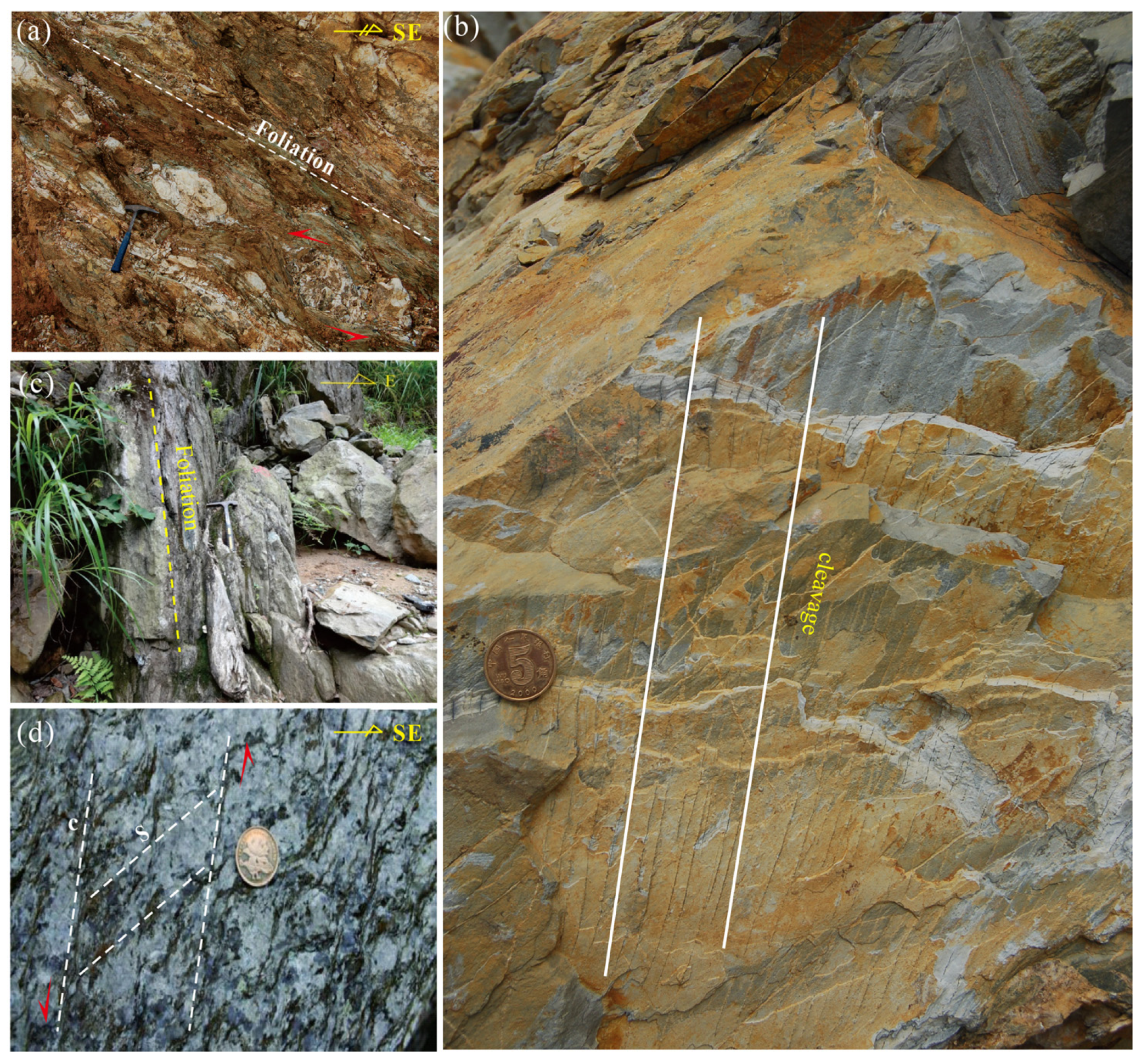
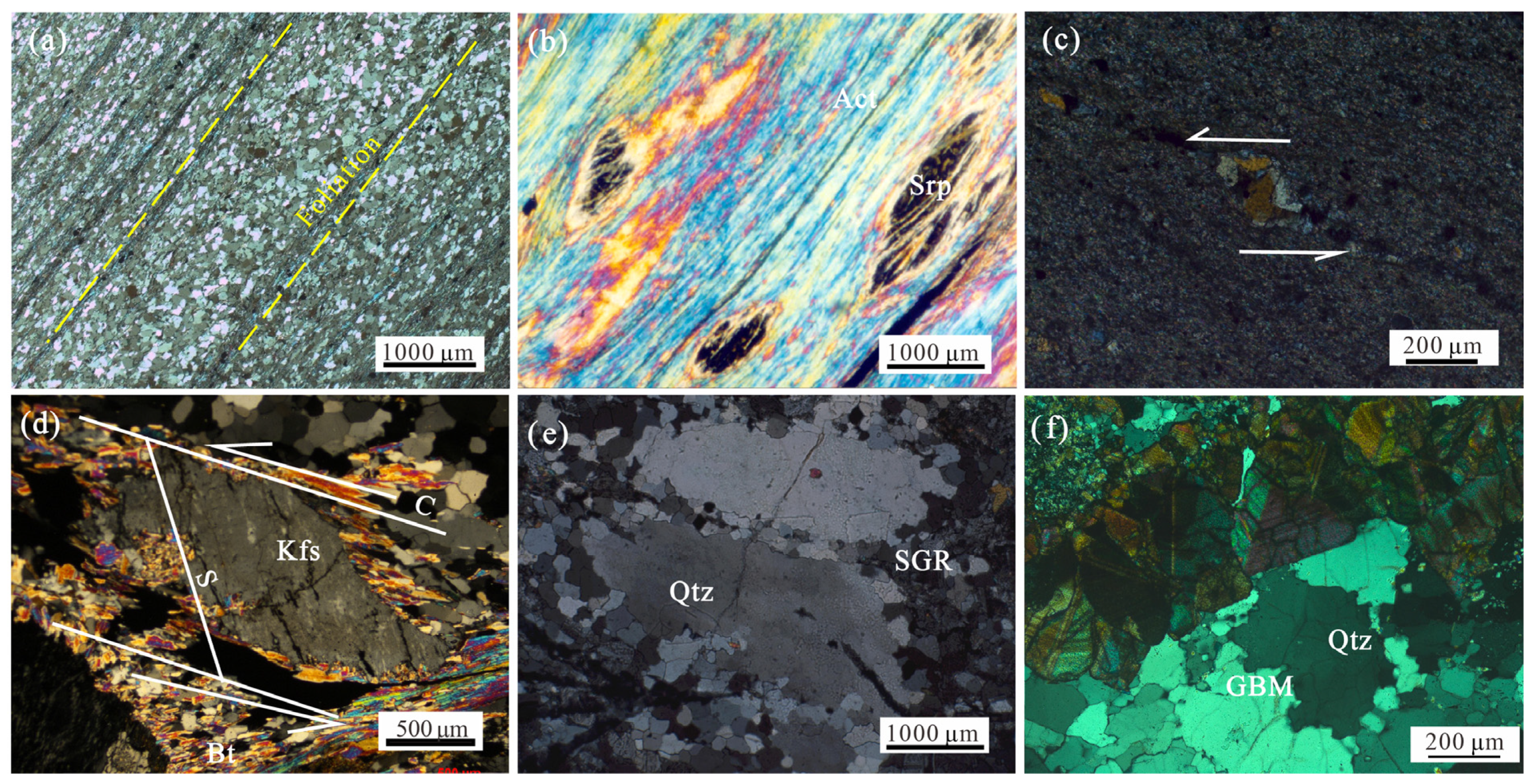
In the field, mylonitic rocks are mainly hosted within stratified rocks of the Upper Proterozoic Wentong and Yuxi formations of the Sibao Group. Stretching lineation is particularly well-developed in meta-sandstones of the Sibao Group. In some areas, the penetrative mylonitic foliation has intensely transformed the rocks, such that the original bedding can no longer be recognized (Figure 2a). In some segments of the shear zone, deformation intensity is relatively weak and is mainly manifested by cleavage development (Figure 2b). Pre-existing quartz veins within the Upper Proterozoic strata are intensely sheared into asymmetric augen or lenticular structures (Figure 2a). These asymmetric augen are commonly aligned parallel to the newly formed foliation but locally intersect it at small angles, forming well-developed macroscopic sigma-type porphyroclasts.
Mylonitic rocks within the Jiufeng–Gandong ductile shear zone can be divided into mafic mylonites (Figure 2c) and granitic mylonites (Figure 2d). Mylonitic foliation in the ductile zone dips to the SE at 55–85°. Mafic mylonites are commonly strongly altered and display pervasive foliation dipping toward the SE, with mineral stretching lineations plunging toward the SE at angles of 37°–62° (Figure 2c). Granitic mylonites are mainly distributed in the Nandao’ao area and along the Gandong segment at the western margin of the Motianling pluton (Figure 2d). Well-developed S–C fabrics occur in granitic mylonites and consist of preferred orientations of quartz and feldspar porphyroclasts that are partially recrystallized along the S-planes (Figure 2d). Fine-grained quartz and mica aggregates are concentrated along the Sc-planes (Figure 2d). Field measurements of the C-foliation in granitic mylonite yield an average orientation of 120°∠68°. The mesoscopic sigma-type porphyroclasts (Figure 2a), mineral stretching lineations (Figure 2c) and S–C fabrics (Figure 2d) indicate sinistral thrust shearing.

5. Microstructures

The Jiufeng–Gandong ductile shear zone exhibits widespread and diverse microscopic deformation features, including micro-mylonitic foliation, core-and-mantle structures, microscopic S–C fabrics, micro-bookshelf structures, asymmetric pressure shadows, microscopic rotational fragment systems, and dynamically recrystallized quartz (Table 1).
In Upper Proterozoic metasedimentary rocks, micro-mylonitic foliation is defined by the strong preferred orientation of newly formed sericite and muscovite, with elongate quartz grains distributed between foliation planes (Figure 3a). In mafic–ultramafic mylonites, serpentine and other alteration porphyroclasts, together with matrix minerals such as actinolite and serpentine asbestos, are aligned to form a penetrative micro-mylonitic foliation (Figure 3b). Feldspar and euhedral pyroxene porphyroblasts within mafic mylonites are elongated and rotated during ductile shearing, forming σ-type rotational porphyroblasts (Figure 3c), which consistently indicate top-to-NW shearing. In granitic mylonites, asymmetric quartz and mica tails surrounding rotated feldspar porphyroclasts also indicate top-to-NW shear sense (Figure 3d).
Quartz dynamic recrystallization mechanisms are always used to determine the structural deformation temperature of mylonite [1,3,4]. Generally, quartz with bulging recrystallization (BLG) was dominant between ~280 and 400 °C; sub-grain rotation recrystallization (SGR) in the 400–500 °C interval and grain boundary migration recrystallization (GBM) occurred at 500~650 °C [3]. Core-and-mantle structures are mainly developed in granitic mylonites, where fine-grained recrystallized quartz rims surround coarse quartz porphyroclasts (Figure 3e), indicating dominantsub-grainn rotation recrystallization (SGR). Recrystallized quartz grains with irregular shapes and lobate grain boundaries are locally observed (Figure 3f), indicating grain-boundary migration (GBM) recrystallization, whereas cassiterite adjacent to the quartz exhibits brittle deformation.

6. Magnetic Fabric Measurement and Analysis

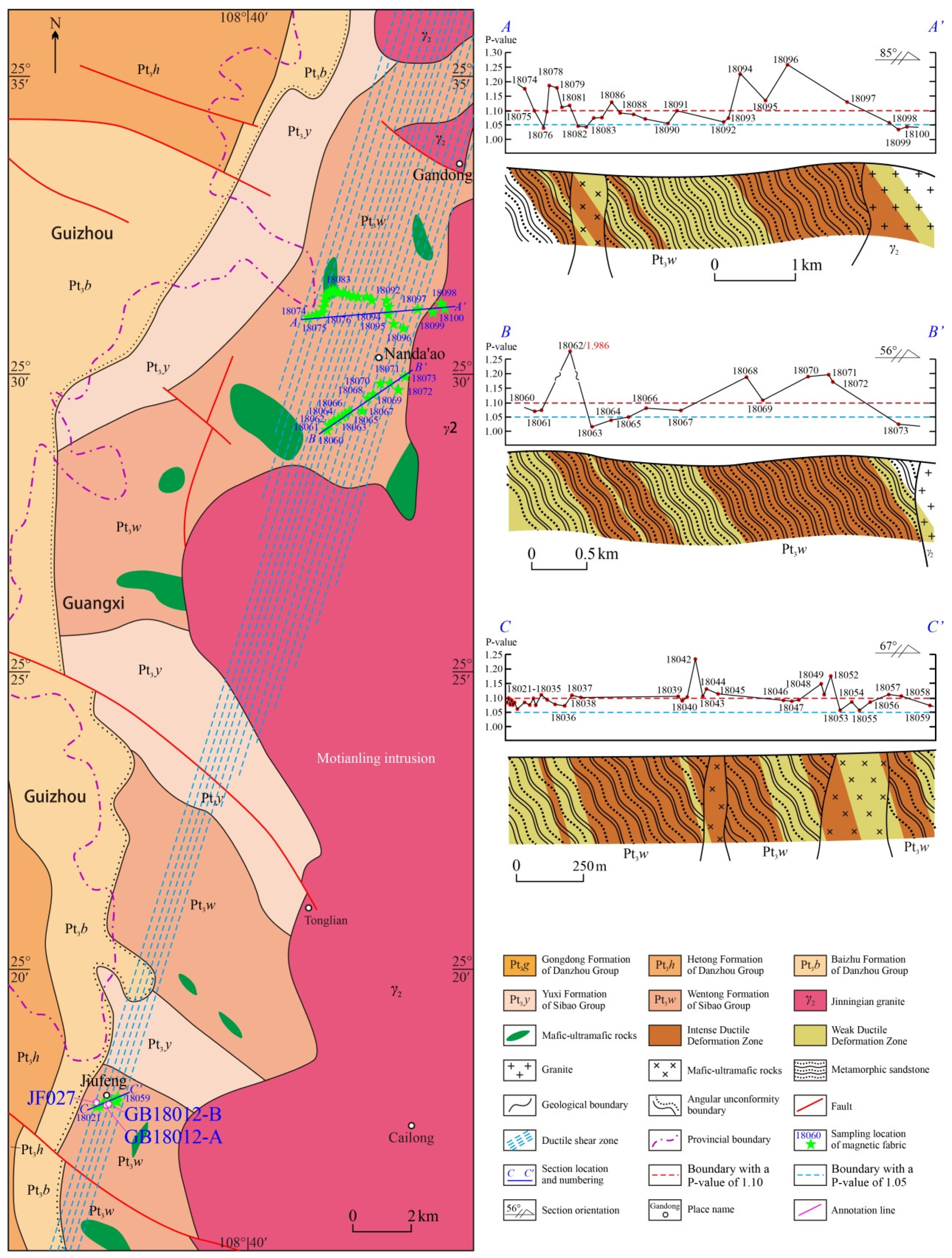
The Huama–Nandao’ao section extends from Huama Village in Gandong Township toward Nandao’ao along a 265° direction, transecting the Motianling granite, the Wentong Formation of the Upper Proterozoic Sibao Group, and mafic–ultramafic rocks (Figure 4). Among the 27 samples from this section, 22 samples yield p values greater than 1.05, including 12 samples with p > 1.10 and 10 samples with p values between 1.05 and 1.10 (Table 2). The Gaopei–Guichao section extends from Gaopei Village toward Guichao Village along a 236° direction and cuts through the Motianling granite and the Wentong Formation of the Upper Proterozoic Sibao Group (Figure 4). Of the 14 samples collected from this section, 10 samples show p values > 1.05, including six samples with p > 1.10 and four samples with p values between 1.05 and 1.10. The Jiufeng section is located near the Jiufeng tin deposit and trends approximately 67°, cutting across the Wentong Formation of the Upper Proterozoic Sibao Group and mafic–ultramafic rocks (Figure 4). All 38 samples from this section yield p values > 1.05, with 15 samples having p > 1.10 and 23 samples having p values between 1.05 and 1.10.
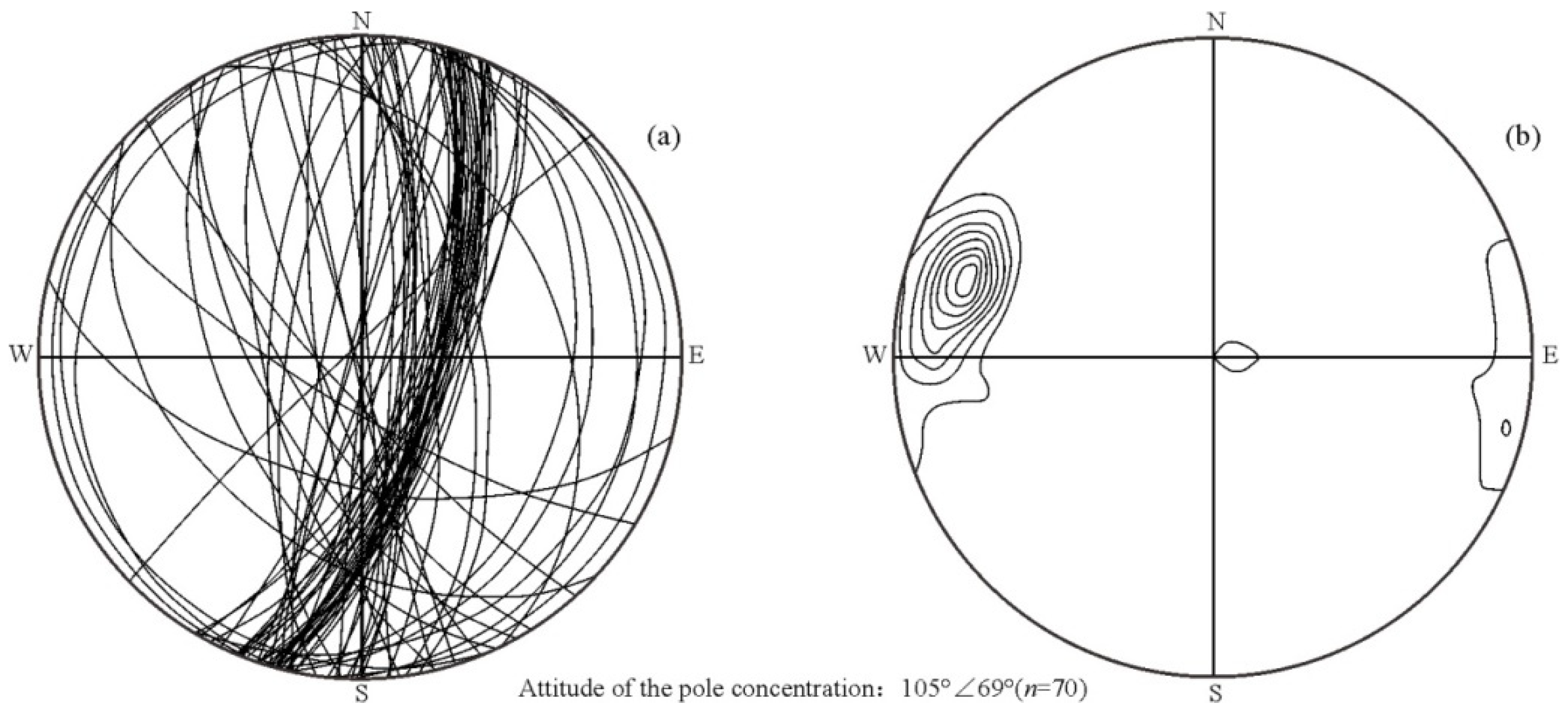
Based on magnetic foliation data from 70 samples with p > 1.05, the approximate spatial extent of the Jiufeng–Gandong ductile shear zone can be delineated. The shear zone generally trends NNE, with a length exceeding 30 km and a maximum width of more than 2.5 km (Figure 4). Stereographic projection of the magnetic foliation (F) attitudes of these 70 samples indicates dip directions ranging from 60° to 316° with dip angles between 4° and 90°, and the pole density maximum is oriented at 105°∠69° (Figure 5).
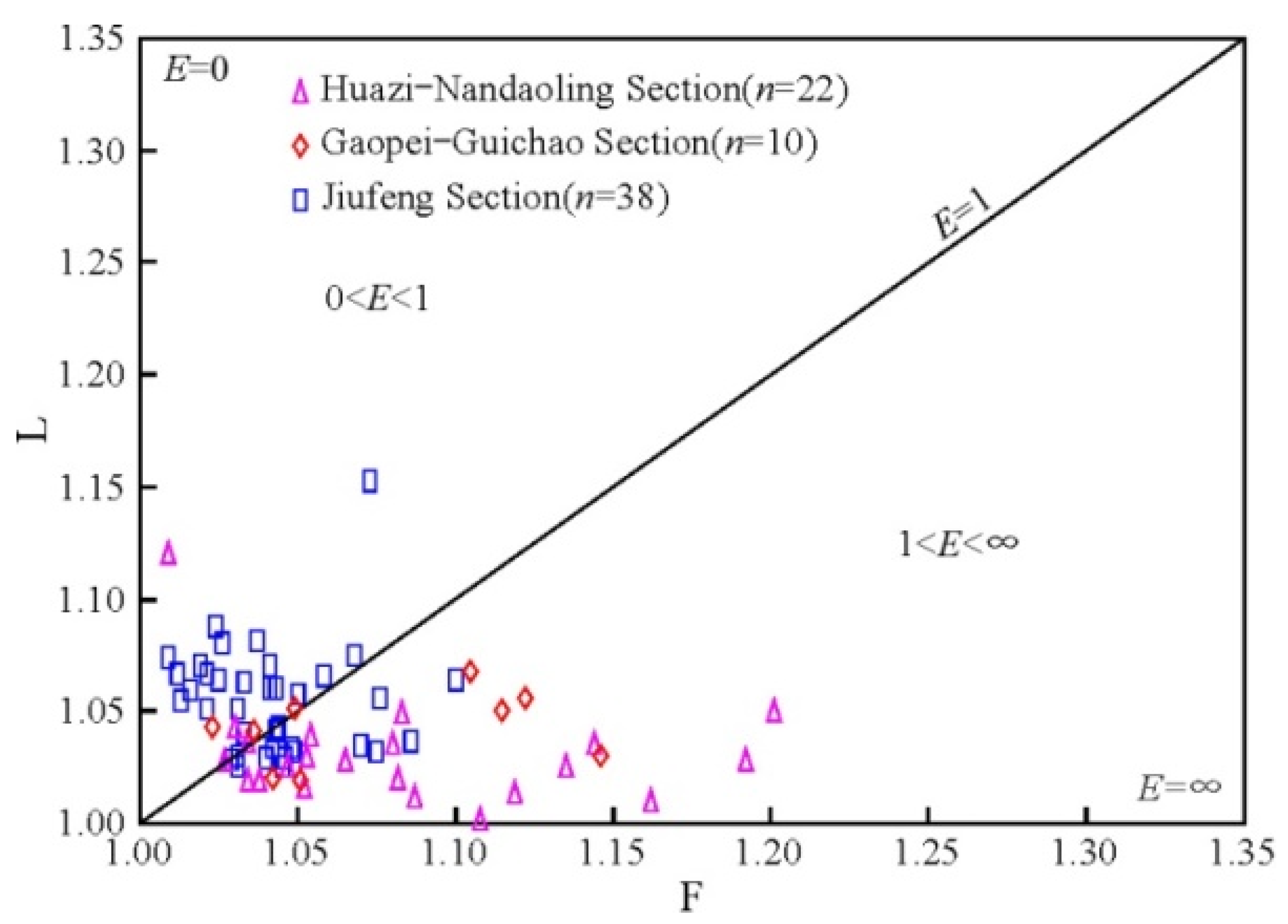
The ellipticity of the magnetic susceptibility ellipsoid (E = F/L) is commonly used to evaluate strain geometry. Ellipsoids with E > 1 represent compressive strain and extrusion deformation, whereas those with E < 1 represent elongation deformation and stretching strain, and E = 1 represent plane strain [8,37]. A plot of magnetic foliation (F) versus magnetic lineation (L) for the 70 samples with p ≥ 1.05 from the Jiufeng–Gandong ductile shear zone is shown in Figure 6. For the 22 samples from the Huama–Nandao’ao section, E values range from 0.900 to 1.160; only four samples have E < 1, whereas the remaining eighteen samples have E > 1. In the Gaopei–Guichao section, ten samples yield E values ranging from 0.980 to 1.224, with three samples showing E < 1 and seven samples showing E > 1. For the 38 samples from the Jiufeng section, E values range from 0.930 to 1.046; seventeen samples have E < 1, whereas twenty-one samples have E > 1. These results indicate that deformation within the Jiufeng–Gandong ductile shear zone is predominantly characterized by flattening strain, accompanied by a component of stretching strain. Previous magnetic fabric analysis of mylonites shows that the Yuanbaoshan ductile shear zone [24,40] and Sibao ductile shear zone [25] are also dominated by E values larger than 1, consistent with the results of this study.
The AMS technique can be added to classical structural analysis and the measurement of crystallographic orientations when assessing the strain geometry and kinematics of a naturally deformed rock, and the angular relationship between the macroscopic rock foliation and the magnetic foliation can be used to determine the movement direction along the shear zone [18,36]. As mentioned above, stereographic projection of the magnetic foliation (F) shows a pole density maximum of 105°∠69° (Figure 5). It is clear, therefore, that the orientations of the magnetic fabrics are consistent with mesostructural shear sense indicators, with the Kmin axis (the pole of the magnetic foliation, the plane defined by the Kmax and Kint axes) parallel to the mean pole of S or in an intermediate position between the S and C poles. For our specimens, the attitudes of the magnetic foliation and the shear plane indicate a sinistral thrusting sense of shear.

7. Electron Backscatter Diffraction Fabric Analysis

Quartz is one of the principal deformation minerals in ductile shear zones, and its crystallographic preferred orientation (CPO) patterns provide insights into the active slip systems during deformation. These slip systems are primarily controlled by deformation temperature, strain rate, strain path, fluid–rock interactions and the presence of hydrolytic weakening [2,3,10,41,42,43].
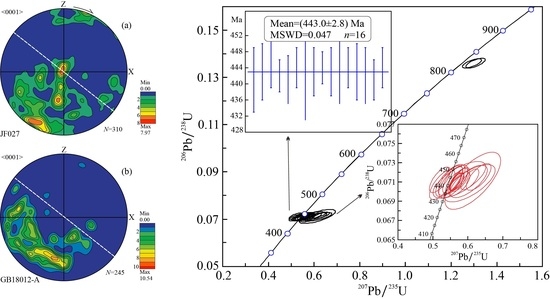
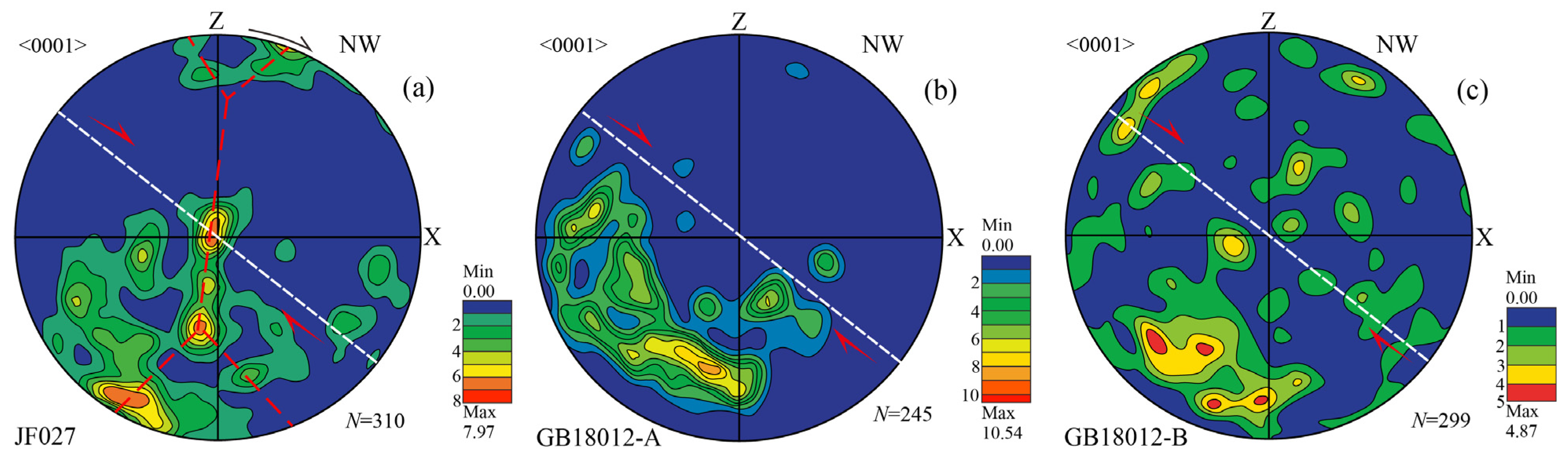
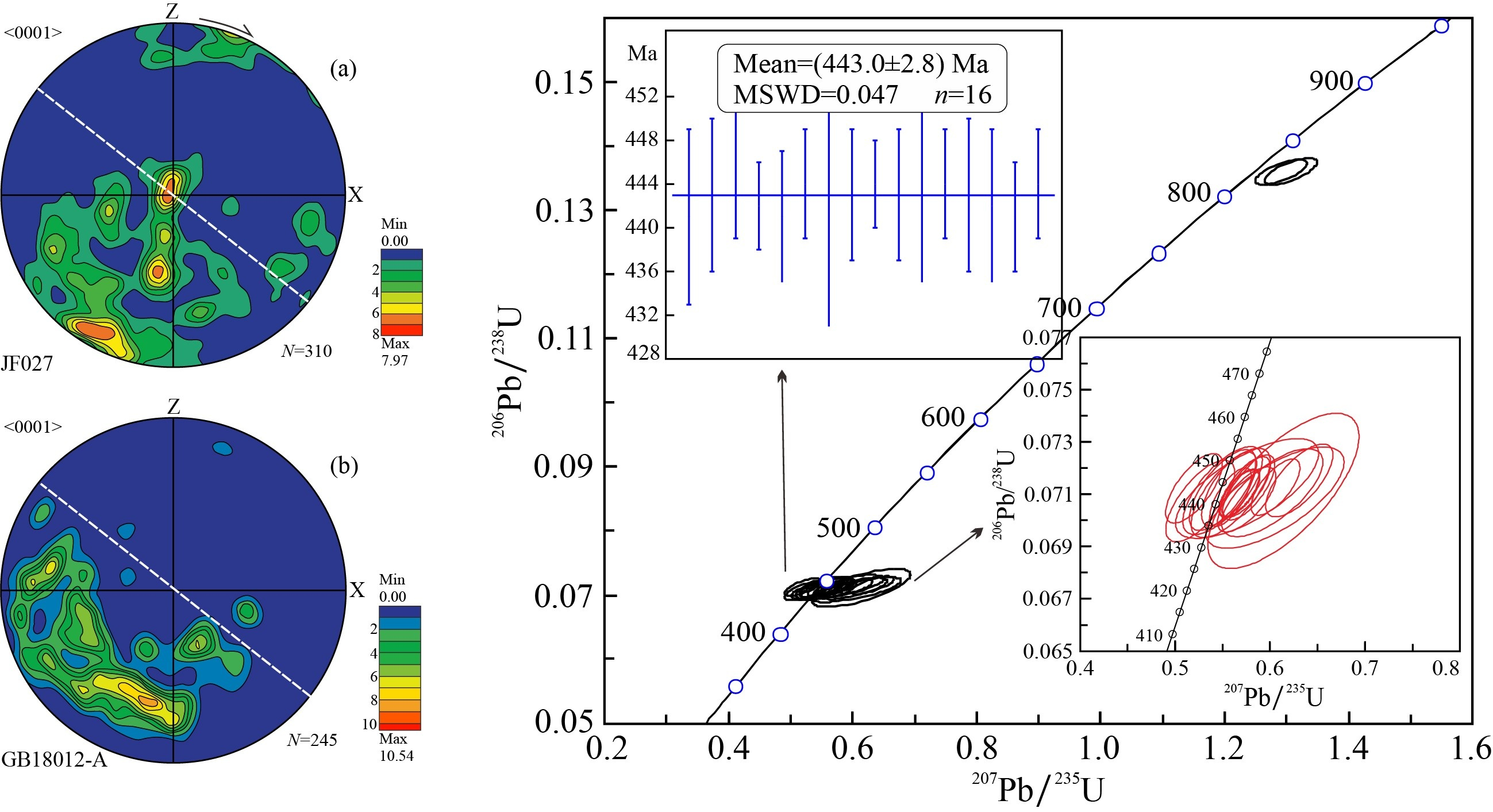
In this study, three oriented mylonitic meta-sandstone samples (JF027, GB18012-A and GB18012-B) from the Jiufeng–Gandong ductile shear zone were selected for EBSD fabric analysis. The mylonitic foliations of the mylonitic meta-sandstones with dip to SE at the angles of 32°–74°. The lineations plunge SE at the angles of 40°–70° on foliation planes. Sample JF027 exhibits a crossed-girdle quartz c-axis fabric pattern, characterized by a maximum near the Y-axis and a secondary maximum along the great circle (XZ plane), forming an asymmetric girdle distribution (Figure 7a). This fabric pattern suggests a combination of rhomb ⟨a⟩, prism ⟨a⟩, and basal ⟨a⟩ slip systems. The clockwise rotation of the quartz c-axis fabric relative to the Z-axis indicates a sinistral thrust sense of shear, consistent with field observations and microstructural evidence.
Quartz c-axis fabrics in samples GB18012-A and GB18012-B show main and secondary maxima located near the periphery and intermediate positions of the pole figures, respectively, indicating dominant basal ⟨a⟩ and rhomb ⟨a⟩ slip systems (Figure 7b,c).

8. Zircon U-Pb Geochronology

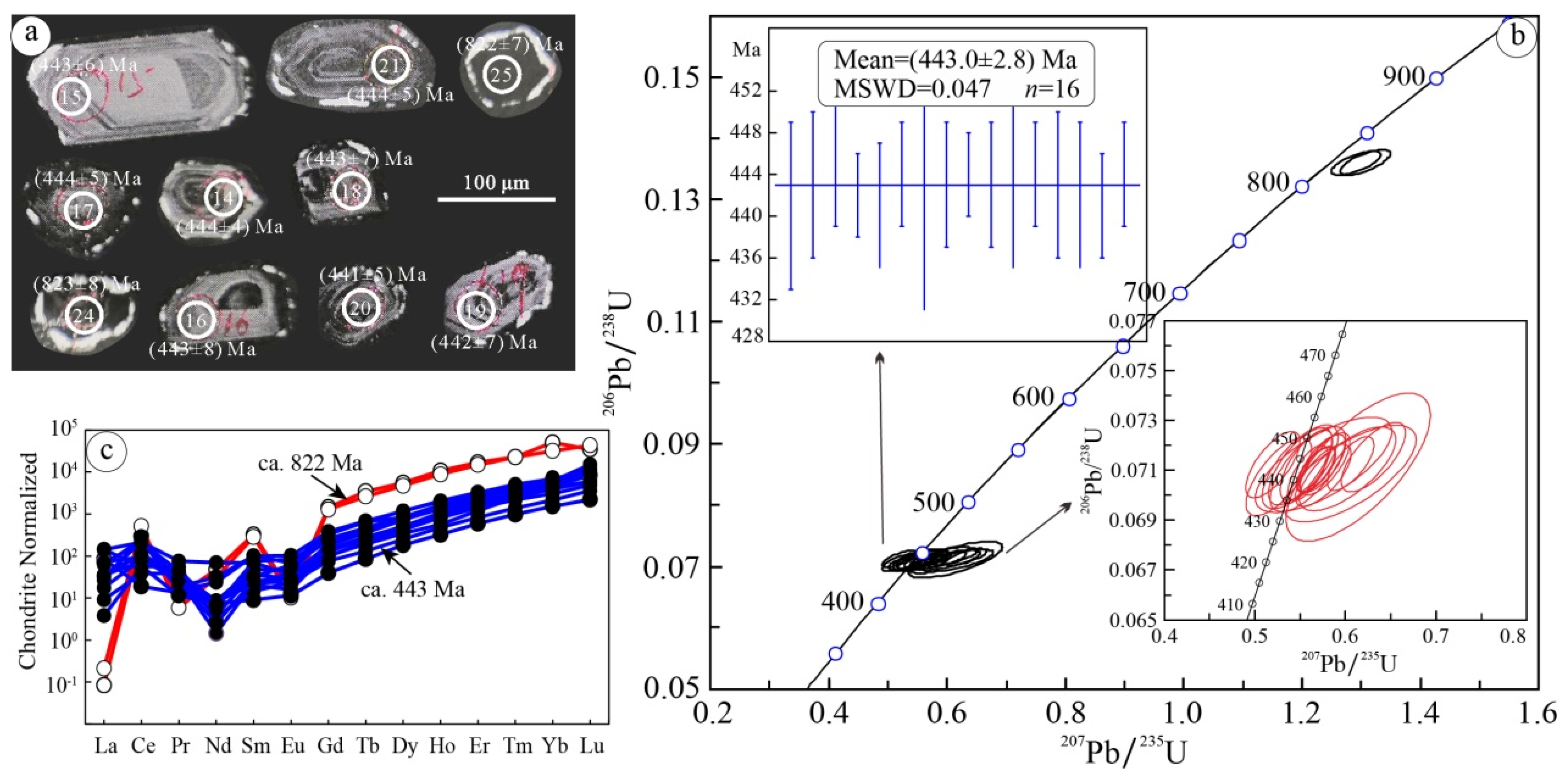
Zircon grains from the mafic mylonite sample are predominantly subhedral to anhedral, with short prismatic to irregular morphologies. Grain sizes range from 50 to 120 μm, with length-to-width ratios of approximately 1:1 to 3:1. They generally display dark cathodoluminescence (CL) responses and are characterized by porous and irregular zoning internal textures (Figure 8a), consistent with typical hydrothermal zircon features.
Among the 18 analyzed zircon grains, 16 yield a weighted mean U–Pb age of 443.0 ± 2.8 Ma (MSWD = 0.047; Figure 8b; Table 3). The chondrite-normalized rare earth element (REE) patterns of these zircons are characterized by elevated total REE concentrations (554-2839 ppm), gently sloping light-REE segments [(La/Sm)N = 0.11–10.38], and generally weak Ce anomalies (Ce/Ce* = 0.56–12.89) (Figure 8c; Table 4). These geochemical characteristics collectively indicate a hydrothermal origin [44], and thus the obtained age is interpreted as the timing of ductile deformation within the Jiufeng–Gandong shear zone.
Two additional zircon grains were analyzed on core domain yield ages of approximately 822 Ma (Table 3), consistent with ages of the regional intruded granite [13,20,23,33,35]. These two zircons show internal structure with dark core and bright rim parts in BSE imaging. Chondrite-normalized REE patterns are characterized by having generally much higher abundances of the REE (11968-15516 ppm) and Ce anomalies (Ce/Ce* = 300–460) (Figure 8c; Table 4). These features indicate magmatic origin and hydrothermal overgrowth. Therefore, the zircons which yielded ages of ca. 822 Ma could be interpreted as having recorded the protolith age of the mafic mylonite, or as having been captured from the regional intruded granite by hydrothermal fluid during the ductile shear process.

9. Discussions

9.1. Estimation of Deformation Temperature

Deformation conditions during mylonitization can be constrained by microstructural characteristics of major rock-forming minerals [1,2,3,45]. In quartz-bearing mylonites, dynamic recrystallization mechanisms provide a widely used semi-quantitative indicator of deformation temperature. Stipp et al. (2002) [3] summarized the temperature ranges of the principal quartz recrystallization mechanisms in naturally deformed rocks, including bulging recrystallization (~280–400 °C), sub-grain rotation recrystallization (SGR; ~400–500 °C), and grain-boundary migration recrystallization (GBM; ~500–650 °C).
Samples from the Jiufeng–Gandong ductile shear zone exhibit intense mylonitization, characterized by significant grain-size reduction and pervasive recrystallization of felsic minerals. Quartz microstructures are dominated by a combination of sub-grain rotation and grain-boundary migration recrystallization (Figure 3). This recrystallization behavior constrains the deformation temperature to a range of approximately 400–650 °C [3].
Quartz crystallographic preferred orientations (CPOs) further provide insights into temperature variations during deformation, as the activation of specific quartz slip systems is strongly temperature dependent [9,10,41,45]. With increasing temperature, the dominant slip systems in quartz generally evolve from basal ⟨a⟩ (<400 °C), to rhomb ⟨a⟩ (400–500 °C), prism ⟨a⟩ (550–650 °C), and finally prism ⟨c⟩ (>650 °C) [1,10]. The observed quartz c-axis fabric patterns from the Jiufeng–Gandong ductile shear zone can be classified into single maxima and crossed girdles (Figure 7).
The coexistence of basal ⟨a⟩, rhomb ⟨a⟩, and prism ⟨a⟩ slip systems in sample JF027 suggests deformation under a range of temperature conditions, potentially involving both medium–high and lower-temperature regimes. Samples GB18012-A and GB18012-B are characterized by basal ⟨a⟩ and rhomb ⟨a⟩ slip systems, indicating deformation temperatures mainly within the range of 350–500 °C. Taken together, microstructural observations and quartz c-axis EBSD fabric analyses indicate that the Jiufeng–Gandong ductile shear zone experienced an early stage of medium- to high-temperature deformation, followed by superimposed deformation under relatively lower-temperature conditions.

9.2. Geological Significance

Northern Guangxi is located along the southwestern segment of the Yangtze–Cathaysia collision suture and is characterized by a series of NNE-trending ductile shear zones. These structures are widely considered to have formed during the Caledonian orogeny and to represent major boundary faults between the Yangtze and Cathaysia blocks during the Early Paleozoic period [24,25,27,36,46,47]. Precise characterization of these ductile shear zones is therefore critical for understanding the deformation mechanisms and temporal evolution of the Caledonian collision–amalgamation process in South China.
Kinematic indicators identified in this study—including S–C fabrics, rotated feldspar porphyroclasts, bookshelf structures, and mineral lattice preferred orientations (LPOs)—consistently indicate that the Jiufeng–Gandong ductile shear zone experienced sinistral thrust shearing. In addition, strain analysis based on the ellipticity (E value) of the magnetic susceptibility ellipsoid reveals a deformation regime dominated by flattening strain, accompanied by a subordinate extensional component. Regarding the timing of shear deformation, previous K–Ar and ^40Ar/^39Ar geochronological studies suggest that ductile shearing within the Motianling shear zone occurred between ca. 377 and 430 Ma [24,25,26,47]. In this study, hydrothermal zircons extracted from mafic mylonite within the Jiufeng–Gandong ductile shear zone yield a LA–ICP–MS U–Pb age of approximately 443 Ma (Figure 8). When considered together, these geochronological constraints suggest that ductile shearing in the Jiufeng–Gandong shear zone likely occurred during the interval from ca. 443 to 377 Ma. In terms of the early Palaeozoic event, the Sibao ductile shear zone has been interpreted as the product of low-angle underthrusting of the Cathaysia Block beneath the Yangtze Block from SE to NW during the Caledonian orogeny [25]. Subsequent studies documented a progressive northwestward decrease in pre-Devonian deformation intensity along the southeastern margin of the Yangtze Block [29], supporting the interpretation that the primary tectonic driving force of the Caledonian event originated from the southeastern side. The pronounced clustering of magnetic foliation poles (105°∠69°) observed in the Jiufeng–Gandong ductile shear zone in this study further supports this regional tectonic framework. Therefore, when integrated with microstructural evidence and quartz c-axis EBSD fabric analyses, the results of this study indicate that Caledonian collision between the Yangtze and Cathaysia blocks generated a medium- to high-temperature tectonic regime, resulting in compressional deformation and sinistral thrust shearing within the Jiufeng–Gandong ductile shear zone.

10. Conclusions

  • The Jiufeng–Gandong ductile shear zone trends predominantly in an NNE direction, with a total length exceeding 30 km and a maximum width of more than 2.5 km. Kinematic analyses indicate that the shear zone is characterized by sinistral thrust shearing.
  • Quartz dynamic recrystallization microstructures combined with electron backscatter diffraction (EBSD) fabric analyses indicate that the sinistral thrust shearing occurred under deformation temperatures ranging from approximately 350 to 650 °C.
  • LA–ICP–MS U–Pb dating of zircons extracted from a mafic mylonite suggests an age of 443.0 ± 2.8 Ma. Combined with structural and microstructural evidence, this age is interpreted to indicate that the Jiufeng–Gandong ductile shear zone likely developed during the Caledonian thrusting of the Cathaysia Block onto the Yangtze Block from SE to NW.

Author Contributions

Conceptualization, Y.B. and R.H.; methodology, Y.B., S.L. (Saisai Li) and Z.F.; software, Y.B.; validation, R.H., Y.Q., J.W. and C.Z.; formal analysis, R.H.; investigation, Z.F., S.L. (Shehong Li) and Y.B.; resources, Z.F. and R.H.; data curation, Y.B.; writing—original draft preparation, Y.B., S.L. (Saisai Li) and R.H.; writing—review and editing, R.H. and S.L. (Saisai Li); visualization, Y.B., Y.Q., C.Z. and J.W.; supervision, Z.F. and R.H.; project administration, Z.F. and R.H.; funding acquisition, Z.F. and R.H. All authors have read and agreed to the published version of the manuscript.

Funding

This work was funded by the Natural Science Foundation of China (Grant 42072259), the Guangxi Natural Science Foundation (Grants 2025GXNSFAA069323; 2025GXNSFAA069322 and 2022GXNSFAA035570).

Data Availability Statement

The data that supports the findings of this study are available on request from the corresponding authors.

Acknowledgments

We gratefully acknowledge the Editorial Board Member and three anonymous reviewers for their constructive comments and reviews.

Conflicts of Interest

Yuming Bai is a member of Editorial Office of Journal of Guilin University of Technology. The authors declare that they have no known competing financial interests or personal relationships that could have appeared to influence the work reported in this paper.

References

  1. Passchier, C.W.; Trouw, R.A. Microtectonics; Springer: Berlin, Germay, 2005; p. 372. [Google Scholar]
  2. Kurz, W.; Fritz, H.; Tenczer, V.; Unzog, W. Tectonometamorphic evolution of the Koralm Complex (Eastern Alps): Constraints from microstructures and textures of the ‘Plattengneis’ shear zone. J. Struct. Geol. 2002, 24, 1957–1970. [Google Scholar] [CrossRef]
  3. Stipp, M.; Stünitz, H.; Heilbronner, R.; Schmid, S.M. The eastern Tonale fault zone: A ‘natural laboratory’ for crystal plastic deformation of quartz over a temperature range from 250 to 700 °C. J. Struct. Geol. 2002, 24, 1861–1884. [Google Scholar] [CrossRef]
  4. Ramsay, J.G. Shear zone geometry: A review. J. Struct. Geol. 1980, 2, 83–99. [Google Scholar] [CrossRef]
  5. Brogi, A.; Liotta, D.; Zucchi, M.; Caggianelli, A. Rifting dismantling an orogenic belt: The interplay between polyphase extensional structures and magmatism in the northern Tyrrhenian Sea (Elba Island, inner Northern Apennines, Italy). Int. Geol. Rev. 2025, 67, 1561–1596. [Google Scholar] [CrossRef]
  6. Sanità, E.; Lardeaux, J.-M.; Marroni, M.; Pandolfi, L. Kinematics of the Helminthoid Flysch–Marguareis Unit tectonic coupling: Consequences for the tectonic evolution of Western Ligurian Alps. C. R. Géosci 2022, 354, 141–157. [Google Scholar] [CrossRef]
  7. Di Rosa, M.; Sanità, E.; Malasoma, A.; Pandolfi, L.; Marroni, M. Switching from contractional to extensional tectonics along the Alpine Front: Structural and metamorphic evidence from the Balagne area (northern Corsica, France). J. Struct. Geol. 2025, 199, 105471. [Google Scholar] [CrossRef]
  8. Zhou, Y.; Zhou, P.; Wu, S.M.; Shi, X.B.; Zhang, J.J. Magnetic fabric study across the Ailao Shan–Red River shear zone. Tectonophysics 2002, 346, 137–150. [Google Scholar] [CrossRef]
  9. Law, R.D. Deformation thermometry based on quartz c-axis fabrics and recrystallization microstructures: A review. J. Struct. Geol. 2014, 66, 129–161. [Google Scholar] [CrossRef]
  10. Toy, V.G.; Prior, D.J.; Norris, R.J. Quartz fabrics in the Alpine Fault mylonites: Influence of pre-existing preferred orientations on fabric development during progressive uplift. J. Struct. Geol. 2008, 30, 602–621. [Google Scholar] [CrossRef]
  11. Faure, M.; Shu, L.; Wang, B.; Charvet, J.; Choulet, F.; Monie, P. Intracontinental subduction: A possible mechanism for the Early Palaeozoic Orogen of SE China. Terra Nova 2009, 21, 360–368. [Google Scholar] [CrossRef]
  12. Wang, L.J.; Lin, S.F.; Xiao, W.J. Yangtze and Cathaysia blocks of South China: Their separate positions in Gondwana until early Paleozoic juxtaposition. Geology 2023, 51, 723–727. [Google Scholar] [CrossRef]
  13. Shu, L.S.; Wang, J.Q.; Yao, J.L. Tectonic evolution of the eastern Jiangnan region, South China: New findings and implications on the assembly of the Rodinia supercontinent. Precambrian Res. 2019, 322, 42–65. [Google Scholar] [CrossRef]
  14. Liu, H.C.; Zi, J.-W.; Cawood, P.A.; Cui, X.; Zhang, L.M. Reconstructing South China in the Mesoproterozoic and its role in the Nuna and Rodinia supercontinents. Precambrian Res. 2020, 337, 105558. [Google Scholar] [CrossRef]
  15. Hu, R.G.; Feng, Z.H.; Wu, J.; Li, S.S.; Qin, Y.; Liu, S.Y.; Guo, A.L. Mineral feature and temperature conditions of mylonitization of the Yuanbao Mountain ductile shear zone, northern Guangxi. Geochimica 2022, 51, 176–193. [Google Scholar]
  16. Cawood, P.A.; Zhao, G.; Yao, J.; Wang, W.; Xu, Y.; Wang, Y. Reconstructing South China in Phanerozoic and Precambrian supercontinents. Earth-Sci. Rev. 2018, 186, 173–194. [Google Scholar] [CrossRef]
  17. Charvet, J. The Neoproterozoic–Early Paleozoic tectonic evolution of the South China Block: An overview. J. Asian Earth Sci. 2013, 74, 198–209. [Google Scholar] [CrossRef]
  18. Li, J.H.; Zhang, Y.Q.; Zhao, G.C.; Johnston, S.T.; Dong, S.W.; Koppers, A.; Miggins, D.P.; Sun, H.S.; Wang, W.B.; Xin, Y.J. New insights into Phanerozoic tectonics of South China: Early Paleozoic sinistral and Triassic dextral transpression in the east Wuyishan and Chencai domains, NE Cathaysia. Tectonics 2017, 36, 819–853. [Google Scholar] [CrossRef]
  19. Xu, Y.J.; Cawood, P.A.; Du, Y.S. Intraplate orogenesis in response to Gondwana assembly: Kwangsian Orogeny, South China. Am. J. Sci. 2016, 316, 329–362. [Google Scholar] [CrossRef]
  20. Li, S.S.; Cao, J.; Feng, Z.H.; Liu, X.Y.; Qin, Y.; Hu, R.G.; Wang, C.Z. Neoproterozoic to Palaeozoic tectonic deformation history of the western Jiangnan Orogen, South China: Insights from new structural and geochronological data from northern Guangxi. Geol. J. 2022, 57, 292–316. [Google Scholar] [CrossRef]
  21. Shu, L.S.; Yao, J.L.; Wang, B.; Faure, M.; Charvet, J.; Chen, Y. Neoproterozoic plate tectonic process and Phanerozoic geodynamic evolution of the South China Block. Earth-Sci. Rev. 2021, 216, 103596. [Google Scholar] [CrossRef]
  22. Li, S.S.; Feng, Z.H.; Qin, Y.; Pang, C.J.; Dai, Y.; Li, S.H.; Cao, J.; Bai, Y.M.; Wang, C.Z. The relationship between ductile shear zone and mineralization in the Jiufeng Sn deposit, northern Guangxi, South China: Evidence from structural analysis and cassiterite U-Pb dating. Ore Geol. Rev. 2020, 124, 103655. [Google Scholar] [CrossRef]
  23. Yao, J.L.; Shu, L.S.; Zhao, G.C.; Han, Y.G.; Liu, Q. Ca. 835–823 Ma doming extensional tectonics in the west Jiangnan accretionary orogenic belt, South China: Implication for a slab roll-back event. J. Geodyn. 2021, 148, 101879. [Google Scholar] [CrossRef]
  24. Zhang, G.L. Kinematics and Dynamics of Pre-DevonianTectonic Evolution at South Margin of Yangtze Block in North Guangxi. Ph.D. Thesis, Central South University, Changsha, China, 2004; p. 193. [Google Scholar]
  25. Zhang, X.F.; Meng, X.G.; Hang, J.E.; Shao, Z.G.; Zhang, D. Discovery of the Ductile Shear Zone in the Sibao Area of Northern Guangxi and Its Tectonic Significance. Acta Geosci. Sin. 2015, 36, 161–167, (In Chinese with English Abstract). [Google Scholar]
  26. Chen, F.; Yan, D.P.; Qiu, L.; Yang, W.X.; Tang, S.L.; Guo, Q.Y.; Zhang, Y.X. The brittle-ductile shearing and uranium metallogenesis of the Motinaling dome in the southwestern Jiangnan Orogenic Belt. Acta Petrol. Sin. 2019, 35, 2637–2659. [Google Scholar]
  27. Qin, Y.; Feng, Z.H.; Hu, R.G.; Li, S.S.; Wang, C.Z. Timing of the Early Paleozoic Yangtze and Cathysian Convergence: Constraint from U-Pb Geochronology of Hydrothermal Zircons from Mafic Mylonite within the Shoucheng-Piaoli Ductile Shear Zone, Northern Guangxi. Acta Geol. Sin. Engl. Ed. 2018, 92, 2030–2031. [Google Scholar] [CrossRef]
  28. Qiu, L.; Yan, D.P.; Tang, S.L.; Chen, F.; Song, Z.D.; Gao, T.; Zhang, Y.X. Insights into post-orogenic extension and opening of the Palaeo-Tethys Ocean recorded by an Early Devonian core complex in South China. J. Geodyn. 2020, 135, 101708. [Google Scholar] [CrossRef]
  29. Ma, X. The Early Paleozoic Structural Deformation Mechanism and Evolution Proccess in East Guizhou and its Neighbor Area. Ph.D. Thesis, China University of Geosciences, Beijing, China, 2018; p. 147. [Google Scholar]
  30. BGMRGX. Regional Geology of the Guangxi Zhuang Autonomous Region; Geological Publishing House: Beijing, China, 1985; p. 862. (In Chinese) [Google Scholar]
  31. Wang, Y.J.; Zhang, Y.Z.; Fan, W.M.; Geng, H.Y.; Zou, H.P.; Bi, X.W. Early Neoproterozoic accretionary assemblage in the Cathaysia Block: Geochronological, Lu–Hf isotopic and geochemical evidence from granitoid gneisses. Precambrian Res. 2014, 249, 144–161. [Google Scholar] [CrossRef]
  32. Wang, W.; Zhou, M.F.; Yan, D.P.; Li, J.W. Depositional age, provenance, and tectonic setting of the Neoproterozoic Sibao Group, southeastern Yangtze Block, South China. Precambrian Res. 2012, 192–195, 107–124. [Google Scholar] [CrossRef]
  33. Yao, J.L.; Shu, L.S.; Santosh, M. Neoproterozoic arc-trench system and breakup of the South China Craton: Constraints from N-MORB type and arc-related mafic rocks, and anorogenic granite in the Jiangnan orogenic belt. Precambrian Res. 2014, 247, 187–207. [Google Scholar] [CrossRef]
  34. Qiu, L.; Yan, D.-P.; Tang, S.-L.; Arndt, N.T.; Fan, L.-T.; Guo, Q.-Y.; Cui, J.-Y. Cooling and exhumation of the oldest Sanqiliu uranium ore system in Motianling district, South China Block. Terra Nova 2015, 27, 449–457. [Google Scholar] [CrossRef]
  35. Li, X.H. U–Pb zircon ages of granites from the southern margin of the Yangtze Block: Timing of Neoproterozoic Jinning: Orogeny in SE China and implications for Rodinia Assembly. Precambrian Res. 1999, 97, 43–57. [Google Scholar] [CrossRef]
  36. Borradaile, G.J.; Jackson, M. Anisotropy of magnetic susceptibility (AMS): Magnetic petrofabrics of deformed rocks. Geol. Soc. Lond. Spec. Publ. 2004, 238, 299–360. [Google Scholar] [CrossRef]
  37. Rathore, J. Application of magnetic susceptibility anisotropy technique to the study of geological structures in the Armorican massif, France. Tectonophysics 1979, 60, 207–216. [Google Scholar] [CrossRef]
  38. Andersen, T. Correction of common lead in U–Pb analyses that do not report 204Pb. Chem. Geol. 2002, 192, 59–79. [Google Scholar] [CrossRef]
  39. Ludwig, K.R. User’s manual for Isoplot 3.00: A Geochronological Toolkit for Microsoft Excel. Berkeley Geochronol. Cent. Spec. Publ. 2003, 5, 75. [Google Scholar]
  40. Guo, A.L. Structural Characteristics and Rheological Parameter Estimation of Yuanbaoshan Ductile Shear Zone in Northern Guangxi. Master’s Thesis, Guilin University of Technology, Guilin, Guangxi, 2017; p. 80. [Google Scholar]
  41. Xu, Z.Q.; Wang, Q.; Liang, F.H.; Chen, F.Y.; Xu, C.P. Electron backscatter diffraction (EBSD) technique and its application to study of continental dynamics. Acta Petrol. Sin. 2009, 25, 1721–1736. [Google Scholar]
  42. Airaghi, L.; Lanari, P.; de Sigoyer, J.; Guillot, S. Microstructural vs compositional preservation and pseudomorphic replacement of muscovite in deformed metapelites from the Longmen Shan (Sichuan, China). Lithos 2017, 282–283, 262–280. [Google Scholar] [CrossRef]
  43. Sanità, E.; Di Rosa, M.; Lardeaux, J.M.; Marroni, M.; Tamponi, M.; Lezzerini, M.; Pandolfi, L. Deciphering the pressure–temperature path in low-grade metamorphic rocks by combining crystal chemistry, thermobarometry and thermodynamic modelling: An example in the Marguareis Massif, Western Ligurian Alps, Italy. Mineral. Mag. 2024, 89, 203–224. [Google Scholar] [CrossRef]
  44. Hoskin, P.W.O. Trace-element composition of hydrothermal zircon and the alteration of Hadean zircon from the Jack Hills, Australia. Geochim. Cosmochim. Acta 2005, 69, 637–648. [Google Scholar] [CrossRef]
  45. Kruhl, J.H. Prism- and basal-plane parallel subgrain boundaries in quartz: A microstructural geothermobarometer. J. Metamorph. Geol. 1996, 14, 581–589. [Google Scholar] [CrossRef]
  46. Bai, Y.M. Relationship Between Ductile Shear Zone and Tin Mineralization in Jiuwandashan Area, Northern Guangxi—Taking Jiufeng Tin Mine as An Example. Master’s Thesis, Guilin University of Technology, Guilin, China, 2019; p. 98. [Google Scholar]
  47. Tang, S.K.; Ma, X.; Yang, K.G.; Deng, X.; Dai, C.G.; Zhang, H.; Zhou, Q. Characteristics and Genesis of Two Types of Tectonic Deformation During Caledonian in Eastern Guizhou and Northern Guangxi. Geoscience 2014, 28, 109–118. [Google Scholar]
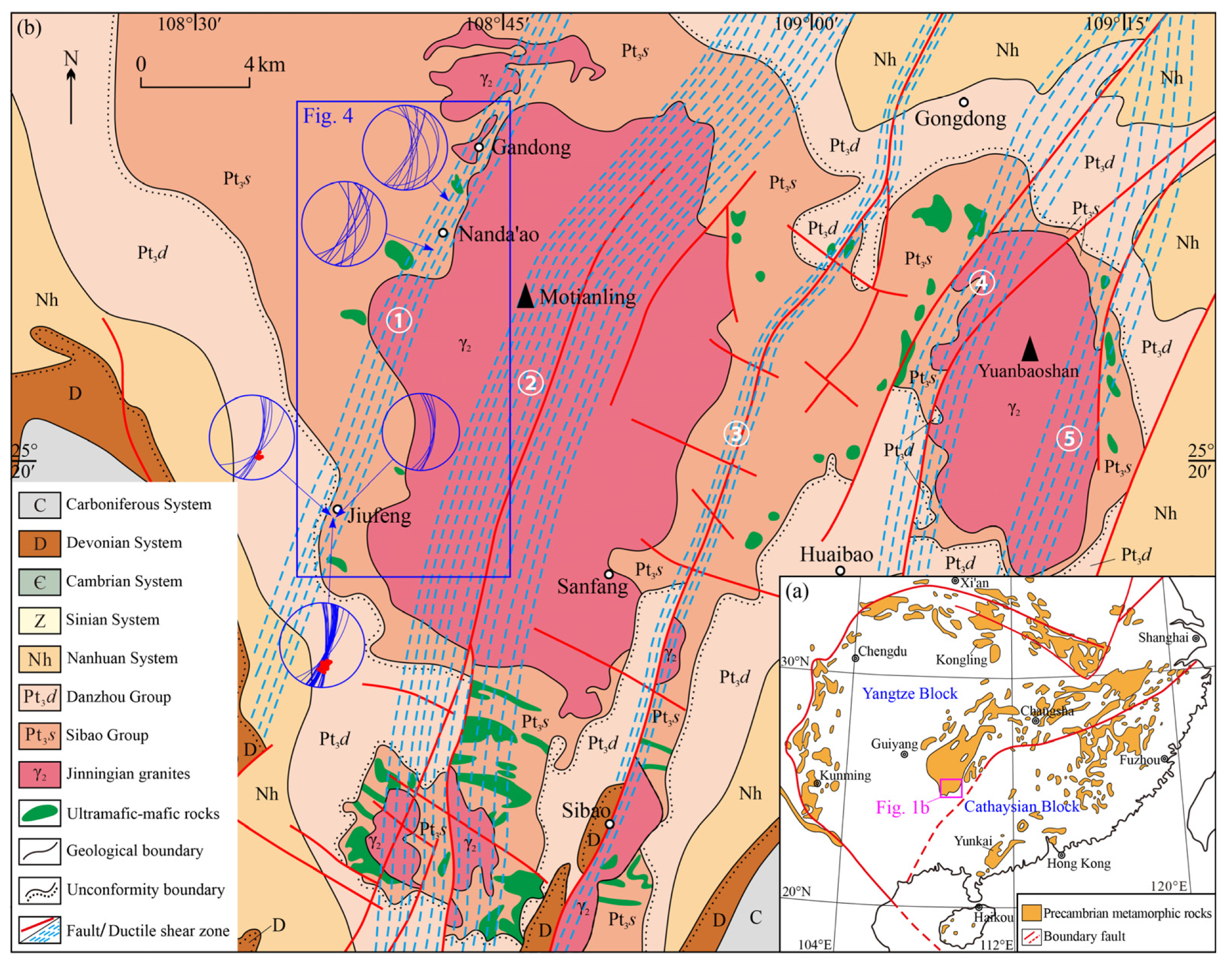
Figure 1. (a) The tectonic diagram of the South China and (b) sketch map of northern Guangxi and stereoplots (equal-area lower-hemisphere) illustrating the foliations and lineations of the Jiufeng–Gandong shear zone (modified after Li et al. [20,22]). Major shear zones: ① Jiufeng ductile shear zone; ② Motianling ductile shear zone; ③ Sibao ductile shear zone; ④ West Yuanbaoshan ductile shear zone; ⑤ East Yuanbaoshan ductile shear zone.
Minerals 16 00169 g001
Figure 2. Field macro-characteristics of Jiufeng–Gandong ductile shear zone. (a) Quartz veins are sheared into asymmetrical augen or structural lenses, which indicate top-to-NW shearing; dotted white lines illustrate the penetrative foliations; (b) the penetrative cleavages; (c) nearly N-S striking mylonitic foliation in mafic mylonite; (d) S-C fabric in granitic mylonite indicates top-to-NW shearing.
Minerals 16 00169 g002
Figure 3. Microstructural features of Jiufeng–Gandong ductile shear zone. (a) Microscopic foliation in mica quartz schist; (b) micro-mylonitic texture and lenticels of serpentine–actinolite mylonite; (c) “Sigma-type” rotated porphyroclasts in mafic mylonite indicate top-to-NW shearing; (d) K-feldspar porphyroclasts in granitic mylonite indicate top-to-NW shearing; (e) core-mantle structure and sub-grain rotation recrystallization (SGR) in granitic mylonite; (f) quartz grains with grain boundary migration (GBM) in granitic mylonite. Act: Actinolite; Bt: biotite; Chl: chlorite; Kfs: K-feldspar; Qtz: quartz; Srp: serpentine.
Minerals 16 00169 g003
Figure 4. Distribution and magnetic fabric profile map of the Jiufeng–Gandong ductile shear zone in northern Guangxi.
Minerals 16 00169 g004
Figure 5. (a) Stereoplot and (b) pole iso-dense diagrams of magnetic occurrence of Jiufeng–Gandong ductile shear zone.
Minerals 16 00169 g005
Figure 6. F-L diagram of mylonites from Jiufeng–Gandong ductile shear zone.
Minerals 16 00169 g006
Figure 7. The quartz c-axis pole plots of mylonites from the Jiufeng–Gandong ductile shear zone. The plots show lower-hemisphere equal-area projections of the quartz crystallographic direction <0001> = c-axes. The foliation is horizontal and the shear sense indicated is top-to-NW shearing. The dashed lines indicate the shear plane. (a) Sample JF027; (b) sample GB18012-A; (c) sample GB18012-B.
Minerals 16 00169 g007
Figure 8. (a) Cathodoluminescence (CL) image; (b) U-Pb concordia diagram and weighted mean age; and (c) trace-element characteristics of representative zircons from Jiufeng–Gandong mafic mylonite. The plot (c) shows that hydrothermal zircons from the mafic mylonite, with an age of ~443 Ma, have distinct REE characteristics compared to zircons dated at ~882 Ma, which were likely captured from the intruded granite in the region.
Minerals 16 00169 g008
Table 1. Representative kinematic and deformation temperature data for samples in the Jiufeng–Gandong ductile shear zone.
LithologyKinematic IndicatorInferred Shear Sense/Deformation TemperatureFigure Panel
mafic myloniteσ-type porphyroclastsinistral shearFigure 3c
granitic myloniteσ-type porphyroclast/S-C fabricsinistral shearFigure 3d
granitic myloniteSub-grain Rotation Recrystallization400–550 °CFigure 3e
granitic myloniteGrain Boundary Migration>550 °CFigure 3f
Table 2. Site-mean AMS directional and scalar data of mylonites from Jiufeng–Gandong ductile shear zone of northern Guangxi.
SectionsSiteKmaxKintKminKmaxKintKminLFpEMagnetic Foliation (°)
DgIgDgIgDgIgDip DirectionDip
C-C’180211.0440.9930.963164.851.224.931.6281.920.11.0511.0311.0840.98110270
180221.0530.9930.954160.251.811.633.9270.815.51.0601.0411.1040.9829175
180231.0361.0020.962176.949.135.234.2291.119.61.0341.0421.0771.00711170
180241.0431.0000.958166.945.534.233.7285.725.41.0431.0441.0891.00110665
180251.0370.9970.965174.841.637.439.7286.822.91.0401.0331.0750.99310767
180261.0421.0000.958170.647.935.232.8289.123.31.0421.0441.0881.00210967
180271.0301.0000.970169.053.027.030.7285.518.61.0301.0311.0621.00110671
180281.0371.0050.958174.444.330.039.8283.718.71.0321.0491.0821.01710471
180291.0341.0050.961180.738.735.345.8285.818.01.0291.0461.0761.01610672
180301.0520.9900.958163.754.225.428.3284.120.01.0631.0331.0980.97210470
180311.0321.0030.964173.449.327.935.4284.917.61.0291.0401.0711.01110573
180321.0321.0060.963171.347.134.734.1288.222.81.0261.0451.0721.01810867
180331.0650.9790.956170.148.3314.235.858.118.41.0881.0241.1140.94123872
180341.0520.9830.965171.248.1328.939.768.411.21.0701.0191.0900.95224879
180351.0440.9860.970176.348.837.033.6292.321.01.0591.0161.0760.96011269
180361.0400.9860.973165.147.8342.142.273.41.51.0551.0131.0690.96125389
180371.0590.9900.951167.552.09.935.8271.911.01.0701.0411.1140.9739279
180381.0540.9940.953164.149.69.637.5269.512.81.0601.0431.1060.9849077
180391.0451.0100.944156.462.1313.726.048.39.31.0351.0701.1071.03422881
180401.0510.9850.965169.852.723.632.3282.816.61.0671.0211.0890.95710373
180411.0451.0130.942163.771.0297.413.430.613.21.0321.0751.1091.04221177
180421.1210.9720.906171.143.834.637.1285.623.41.1531.0731.2370.93010667
180431.0610.9820.957153.153.229.822.3287.427.61.0801.0261.1090.95010763
180441.0611.0050.934179.356.831.229.1292.814.71.0561.0761.1361.01911375
180451.0620.9960.941172.741.1357.048.8264.52.21.0661.0581.1290.9938588
180461.0510.9790.970157.951.4271.817.913.832.91.0741.0091.0840.94019457
180471.0480.9820.970181.248.536.435.9292.718.01.0671.0121.0800.94911372
180481.0500.9870.963169.245.9345.244.077.12.01.0641.0251.0900.96325788
180491.0710.9960.933167.342.119.943.0273.317.01.0751.0681.1480.9939373
180501.0540.9960.949167.755.112.632.3275.111.81.0581.0501.1110.9929578
180521.0741.0090.917174.936.212.352.5271.18.41.0641.1001.1711.0349182
180531.0271.0010.971168.547.018.538.9275.615.41.0261.0311.0581.0059675
180541.0411.0000.959174.043.034.139.4285.421.31.0411.0431.0861.00210569
180551.0281.0000.972163.154.129.426.5287.622.31.0281.0291.0581.00110868
180561.0381.0040.958179.655.241.427.4300.719.81.0341.0481.0841.01412170
180571.0521.0140.934187.741.936.744.3291.515.01.0371.0861.1261.04611275
180581.0650.9850.950163.656.7342.133.372.60.71.0811.0371.1210.95925389
180591.0400.9900.970162.058.220.126.0281.517.01.0511.0211.0720.97210273
B-B’180601.0360.9930.971204.139.6348.644.698.018.61.0431.0231.0670.98027871
180611.0291.0100.9611.643.1202.045.1101.410.41.0191.0511.0711.03228280
180621.3111.0290.660182.014.539.272.0274.710.41.2741.5591.9861.2249580
180631.0070.9990.995192.146.550.836.6304.920.21.0081.0041.0120.99612570
180641.0151.0070.977197.311.864.772.8290.012.31.0081.0311.0391.02311078
180651.0201.0080.972204.27.8325.575.2112.412.51.0121.0371.0491.02529378
180661.0390.9980.963198.310.186.164.8292.622.81.0411.0361.0790.99511368
180671.0271.0070.966184.571.028.417.5296.17.21.0201.0421.0631.02211683
180681.0651.0340.902133.025.536.812.7282.761.11.0301.1461.1811.11310329
180691.0500.9990.952140.844.811.732.4262.227.71.0511.0491.1030.9988262
180701.0781.0090.913197.423.924.465.9288.62.61.0681.1051.1811.03410987
180711.0751.0180.907153.224.252.023.2283.755.31.0561.1221.1851.06310435
180721.0691.0180.913169.11.8259.36.964.382.81.0501.1151.1711.0622458
180731.0130.9970.990169.652.154.818.1313.032.01.0161.0071.0230.99113358
A-A’180741.0551.0450.899187.252.840.532.4299.816.31.0101.1621.1741.15112074
180751.0391.0190.942193.529.459.650.9297.623.31.0201.0821.1031.06111867
180761.0131.0050.981202.126.4321.144.492.534.01.0081.0241.0331.01627356
180771.0391.0110.949121.016.1211.10.2301.773.91.0281.0651.0951.03712216
180781.0681.0310.901153.725.731.647.9260.330.81.0361.1441.1851.1058059
180791.0591.0320.909219.859.5338.315.776.025.41.0261.1351.1651.10625665
180801.0351.0330.932187.651.0316.727.061.025.81.0021.1081.1111.10624164
180811.0491.0130.938164.230.723.652.4266.319.51.0361.0801.1181.0438671
180821.0201.0040.976173.921.934.961.9270.816.61.0161.0291.0451.0139173
180831.0181.0040.978227.751.22.929.7106.622.51.0141.0271.0411.01228768
180841.0380.9950.966191.23.6311.382.8100.86.21.0431.0301.0750.9872814
180851.0321.0060.96116.213.0204.376.8106.61.81.0261.0471.0741.02028788
180861.0461.0320.92218.39.8124.858.5282.729.61.0141.1191.1341.1041036
180871.0431.0040.953188.333.936.052.8287.613.51.0391.0541.0941.01410877
180881.0371.0070.956202.736.4337.443.793.124.41.0301.0531.0851.02327366
180891.0271.0110.961222.676.0351.18.882.810.81.0161.0521.0691.03626379
180901.0241.0050.972228.039.642.150.3135.62.91.0191.0341.0531.01531687
180911.0351.0230.9413.324.0184.066.093.40.31.0121.0871.1001.07527490
180921.0251.0060.969238.339.9141.87.742.949.11.0191.0381.0581.01922341
180931.0360.9990.966186.546.118.243.3282.65.91.0371.0341.0720.99710384
180941.0761.0470.878195.211.62.178.1104.72.61.0281.1921.2261.16028587
180951.0581.0090.932193.240.8311.528.864.835.81.0491.0831.1351.03224554
180961.0931.0410.867155.86.964.213.3272.675.01.0501.2011.2611.1449315
180971.0810.9640.955356.616.797.632.3243.452.71.1211.0091.1320.9006438
180981.0081.0040.98880.33.7348.723.8178.765.81.0041.0161.0201.01235924
180991.0270.9990.973208.73.0299.412.7105.676.91.0281.0271.0550.99928613
181001.0280.9870.986186.222.8342.965.492.48.71.0421.0011.0430.96127381
Table 3. LA-ICP-MS U-Pb data of zircons from mafic mylonite from the Jiufeng–Gandong ductile shear zone.
SpotThUTh/U207Pb/206Pb207Pb/235U206Pb/238U207Pb/206Pb207Pb/235U206Pb/238U
No.ppm RatioRatioRatioAge (Ma)Age (Ma)Age (Ma)
PA 01-01// 0.068200.006010.605180.048040.070870.00128874136481304418
PA 01-0366.08292.50.230.065790.005400.602330.035200.071060.0011180097479224437
PA 01-042889.431523.231.90.069720.003040.630860.023420.071530.0009292055497154456
PA 01-06566.17745.270.760.057520.002340.558340.014480.070890.000745113945094424
PA 01-07407.73584.120.70.055750.003180.526520.023870.070740.0010344375429164416
PA 01-08424.69702.30.60.057370.002550.574380.017060.071280.0007650646461114445
PA 01-09// 0.070450.005930.614090.052500.071130.001969411304863344312
PA 01-11335.15437.090.770.053810.002900.556850.019170.071200.0009336354449134436
PA 01-142012.791437.891.40.063550.002610.605760.017000.071270.0007172743481114444
PA 01-15364.81442.920.820.056900.003260.550070.023050.071160.0010248867445154436
PA 01-16449.92417.871.080.051930.007520.575850.049740.071220.00126282163462324438
PA 01-17288.85360.820.80.036620.003160.519880.019720.071230.00088−9285425134445
PA 01-18382.61631.270.610.056320.003550.549980.027660.071140.0011146584445184437
PA 01-19267.89356.070.750.060990.003590.558630.027550.071050.0011363979451184427
PA 01-201316.181053.001.250.063130.002660.575470.020330.070800.0008271255462134415
PA 01-211198.861118.301.070.061680.002700.577630.018010.071260.0008266347463124445
PA 01-245196.851860.302.790.072490.002951.307000.027980.136120.00137100027849128238
PA 01-258173.742262.863.610.068460.003331.290780.027680.135980.0012988229842128227
Table 4. LA-ICP-MS U-Pb REE data of zircons from mafic mylonite from the Jiufeng–Gandong ductile shear zone.
Spot No.LaCePrNdSmEuGdThDyHoErTmYbLu∑(REE)δEuδCe(Sm/
La)N
∑LREE∑HREELREE/
HREE
PA01-0320.1311.621.293.531.380.678.193.2046.5318.4298.1225.06260.0756.11554.320.610.560.1138.62515.690.07
PA01-0414.83148.971.4111.1615.583.9578.0024.34211.8192.18416.18103.591243.45185.002550.450.357.981.63195.912354.540.08
PA01-0617.3657.252.740.683.471.4420.238.14112.2253.18286.0170.99792.99209.711636.420.532.040.3182.961553.470.05
PA01-0733.57130.177.1832.4510.492.1437.1313.57184.2982.17443.03111.261154.85294.372536.680.332.060.48216.002320.680.09
PA01-0834.2034.345.261.433.170.9227.409.98129.7254.65287.4863.67666.41147.861466.470.300.630.1479.311387.160.06
PA01-118.3744.773.181.672.241.3515.504.9263.1627.14137.5235.29367.1591.46803.730.702.130.4161.57742.150.08
PA01-146.32176.361.7814.7715.415.9477.8225.50296.98116.23543.11120.261176.35261.752838.590.5212.893.77220.582618.010.08
PA01-158.3270.482.761.865.531.6326.329.62109.2246.40235.3055.70521.70123.451218.280.413.611.0390.581127.700.08
PA01-167.5968.573.233.773.382.3521.267.2187.1531.87199.8363.191029.90384.071913.380.853.400.6988.891824.480.05
PA01-170.9035.161.083.476.031.5541.7614.59189.4574.95341.9578.21742.90150.981682.990.308.7810.4348.181634.800.03
PA01-182.1823.703.734.027.542.4967.7524.32300.00113.04525.73129.011160.93252.202616.630.342.045.3643.662572.980.02
PA01-194.1751.092.471.183.951.7130.5310.56127.8860.26310.7979.64927.26226.571838.080.483.901.4764.571773.500.04
PA01-207.49137.472.642.9711.394.8752.5417.53213.9789.04407.2295.88953.11232.122228.230.617.582.36166.822061.410.08
PA01-2116.23128.364.183.314.893.5447.5917.27213.6490.16458.45109.321129.47259.942486.350.713.820.47160.522325.840.07
PA01-240.05314.290.5614.3343.730.59263.1898.501200.23500.272448.41575.995411.451096.9711,968.550.02460.251354.8373.5511,595.000.03
PA01-250.02181.621.1022.3249.800.77297.41128.051400.34606.902792.54580.798574.05879.8315,515.540.02299.843856.9255.6315,259.910.02
Disclaimer/Publisher’s Note: The statements, opinions and data contained in all publications are solely those of the individual author(s) and contributor(s) and not of MDPI and/or the editor(s). MDPI and/or the editor(s) disclaim responsibility for any injury to people or property resulting from any ideas, methods, instructions or products referred to in the content.