Article

Manganobadalovite, NaNaMn(MgFe3+)(AsO4)3, a New Alluaudite-Group Mineral from the Tolbachik Volcano, Kamchatka, Russia

by
Natalia N. Koshlyakova
1,*,
Igor V. Pekov
1,
Dmitry I. Belakovskiy
2,
Marina F. Vigasina
1,
Natalia V. Zubkova
1,
Atali A. Agakhanov
2,
Sergey N. Britvin
3,
Anna G. Turchkova
1,
Elena S. Zhitova
4,
Evgeny G. Sidorov
4,† and
Dmitry Yu. Pushcharovsky
1
1
Faculty of Geology, Lomonosov Moscow State University, Vorobievy Gory, 119991 Moscow, Russia
2
Fersman Mineralogical Museum of the Russian Academy of Sciences, Leninsky Prospekt 18-2, 119071 Moscow, Russia
3
Department of Crystallography, St. Petersburg State University, University Embankment 7/9, 199034 St. Petersburg, Russia
4
Institute of Volcanology and Seismology, Far Eastern Branch of Russian Academy of Sciences, Piip Boulevard 9, 683006 Petropavlovsk-Kamchatsky, Russia
*
Author to whom correspondence should be addressed.
Deceased 20 March 2021.
Minerals 2026, 16(2), 142; https://doi.org/10.3390/min16020142
Submission received: 18 December 2025 / Revised: 25 January 2026 / Accepted: 26 January 2026 / Published: 28 January 2026
(This article belongs to the Collection New Minerals)

Abstract

The new alluaudite-group mineral manganobadalovite (IMA 2020-035), ideally NaNaMn(MgFe3+)(AsO4)3, was found in the Arsenatnaya fumarole, the Second scoria cone of the Northern Breakthrough of the Great Tolbachik Fissure Eruption 1975–1976, Tolbachik volcano, Kamchatka peninsula, Far-Eastern Region, Russia. Manganobadalovite is a fumarolic mineral, and its aggregates are found overgrowing basalt scoria or exhalative hematite crystal crusts. Associated minerals are badalovite, hematite, cassiterite, sanidine, glauberite and metathénardite. Manganobadalovite occurs as prismatic to equant crystals up to 0.8 mm long typically combined in open-work clusters; it also forms grains that are irregular in shape and cavernous granular crusts up to 0.5 cm. The mineral is transparent, with vitreous luster, and its color varies from red to yellow. Manganobadalovite is brittle and has a noticeable cleavage in one direction and uneven fracture. The calculated density is 4.108 g cm−3. Manganobadalovite is optically biaxial (+), α = 1.790 (7), β = 1.800 (7), γ = 1.815 (8) and 2Vmeas = 80 (5)°. Chemical composition (wt.%, electron-microprobe): Na2O 8.75, K2O 0.17, MgO 5.32, CaO 3.68, MnO 10.09, CuO 0.42, Al2O3 0.18, Fe2O3 13.90, V2O5 0.42, As2O5 56.75, total 99.68. The empirical formula calculated based on 12 O apfu is Na1.69K0.02Ca0.39Mn0.85Mg0.79Cu0.03Fe3+1.04Al0.02(As2.96V0.03)∑2.99O12. The crystal structure was solved using single-crystal XRD data, R = 2.30%. Manganobadalovite is monoclinic, C2/c, a = 12.1848(5), b = 12.8924(4), c = 6.6970(3) Å, β = 113.113(5)°, V = 967.60(7) Å3 and Z = 4. The strongest reflections of the powder XRD pattern are [d,Å(I)(hkl)]: 6.43(30)020, 3.589(32)(−131, 310), 3.215(38)(040, −112), 3.079(23)(221, 002), 2.941(32)(−312, −222, −331), 2.852(15)(041), 2.788(100)(330, 400, 240, 022), 2.649(22)(−402, 112), 2.626(25)(−132). Manganobadalovite is named as an analogue of badalovite NaNaMg(MgFe3+)(AsO4)3 with Mn2+ prevailing in the M(1) site.

1. Introduction

Manganobadalovite NaNaMn(MgFe3+)(AsO4)3 is a new alluaudite-group arsenate found in exhalations of the Arsenatnaya fumarole located at the apical part of the Second scoria cone of the Northern Breakthrough of the Great Tolbachik Fissure Eruption 1975–1976, Tolbachik volcano, Kamchatka peninsula, Far-Eastern Region, Russia (55°41′ N, 160°14′ E, 1200 m asl) [1].
Arsenatnaya is an active, high-temperature, oxidizing type fumarole, with unique and extremely rich exhalative mineral assemblages. More than 210 (!) mineral species have been identified here, and for 73 of them Arsenatnaya is the type locality. The name to the Arsenatnaya fumarole was given due to the abundance in the exhalations of diverse anhydrous high-temperature arsenates, among which the alluaudite-group minerals are particularly notable for their abundance and chemical variability. Therefore, the Arsenatnaya fumarole offers an exceptional opportunity to study the crystal chemistry of this mineral group. Fourteen out of the sixteen anhydrous arsenates of the alluaudite group (except arseniopleite and caryinite) occur in the volcanic exhalations here, and the majority of them were first discovered in Arsenatnaya and remain endemic to the locality. The first discovered alluaudite-group arsenates are as follows: leybovite-K [2], magnesiohatertite [3], manganohaterite [4], calciohatertite [5], paraberzeliite [6], khrenovite [7], calciojohillerite [8], badalovite [9] and manganobadalovite. In addition, in the samples from the locality the existence of extensive solid solutions between all present alluaudite-type arsenates was verified [10]. For the alluaudite-type mineral johillerite, one of the most abundant arsenates in the fumarole, the crystal chemistry and chemistry of solid solutions were studied in detail [11].
A description of Arsenatnaya and its mineralization is given in [10,12,13], and an overview of the unique fumarolic systems of the Tolbachik volcano, including the list of all new Tolbachik minerals discovered prior to 2020, is given in [14].
Manganobadalovite is named according to the current alluaudite group nomenclature [15] as an analogue of badalovite NaNaMg(MgFe3+)(AsO4)3, with Mn2+ prevailing in the octahedral M(1) site. The new mineral and its name have been approved by the IMA Commission on New Minerals, Nomenclature and Classification, IMA2020–035. The IMA-accepted symbol is Mbdl. The type specimen is deposited in the systematic collection of the Fersman Mineralogical Museum of the Russian Academy of Sciences, Moscow, with the catalogue number 97014.

2. Methods

The Raman spectrum of manganobadalovite was obtained on a randomly oriented crystal using an EnSpectr R532 instrument (Chernogolovka, Russia) at the Department of Mineralogy, Lomonosov Moscow State University with a green laser (532 nm) at room temperature. The output power of the laser beam was about 14 mW. The spectrum was processed using the EnSpectr expert mode program in the range from 100 to 4000 cm−1 with the use of a holographic diffraction grating with 1800 lines mm−1 and a resolution of 6 cm−1. The diameter of the laser spot on the sample was about 5 μm. The backscattered Raman signal was collected with a 40× objective; the acquisition time for a single scan was 1000 ms; and the signal was averaged over 100 scans. The mineral is stable under a laser beam.
The determination of the chemical composition of mandanobadalovite (Table 1) was carried out in the Laboratory of Analytical Techniques of High Spatial Resolution, Dept. of Petrology, Moscow State University, using a JEOL JXA 8230 Superprobe instrument (Jeol, Japan). Electron microprobe analyses (EMPAs) were carried out in WDS mode (20 kV and 20 nA; the beam diameter is 3 μm). The reference materials used are as follows: jadeite (Na, Al), KTiOPO4 (K), CaSiO3 (Ca), olivine (Mg), MnTiO3 (Mn), Cu (Cu), FeS2 (Fe), V (V) and GaAs (As). The contents of other elements with atomic numbers higher than carbon are below detection limits.
The powder X-ray diffraction (XRD) study of manganobadalovite was performed at the Center for X-Ray Diffraction Research of the Science Park of St. Petersburg State University. Diffraction data (Table 2) were collected with a Rigaku R-AXIS Rapid II diffractometer (Rigaku Corporation, Tokyo, Japan) equipped with a cylindrical image plate detector using Debye–Scherrer geometry and CoKα radiation, at an accelerating voltage of 40 kV, current of 15 mA and exposure time of 15 min. The distance between the sample and the detector was 127.4 mm. The data were integrated using the software package Osc2Tab [16].
Single-crystal X-ray diffraction studies were carried out at the Dept. of Crystallography and Crystal Chemistry, Moscow State University. The data was obtained at room temperature using an Xcalibur S diffractometer equipped with a CCD detector (Oxford Diffraction, Oxford, UK) (for details see Table 3). Data reduction was performed using CrysAlisPro Version 1.171.39.46 [17]. The crystal structure was solved by direct methods and refined with the use of SHELX software package (version 2018/3) [18]. The final R was 2.3% for 1303 unique and observed (I > 2σ(I)) reflections after merging 7942 measured reflections to 1418 unique reflections with Rint = 4.21%.

3. Results

3.1. Occurrence and General Appearance

The samples with manganobadalovite were collected by us in July 2018 from the deep level of the Arsenatnaya fumarole, about 2.5 m below the earth surface. The temperatures measured using a chromel–alumel thermocouple in this zone during sampling were 350–400 °C.
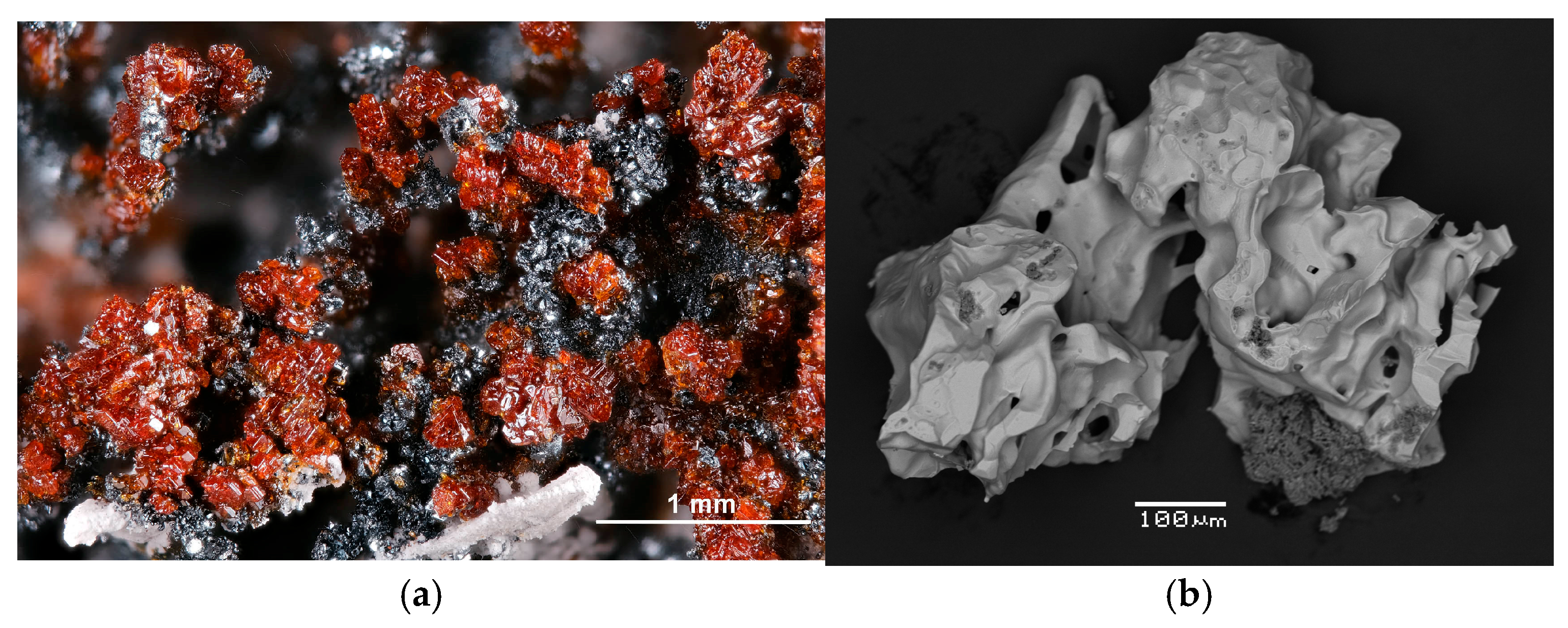
Aggregates of manganobadalovite overgrow exhalative hematite crystal crusts or directly basalt scoria altered by fumarolic gas. Manganobadalovite occurs as oblique-angled prismatic to equant crystals up to 0.8 mm long and up to 0.5 mm thick typically combined in open-work clusters (Figure 1a) up to 0.5 cm across. Blocky crystals are common. The mineral also forms grains that are irregular in shape and thin, cavernous granular crusts (Figure 1b) up to 3 × 5 mm2 in area.
Closely associated minerals are badalovite, hematite, cassiterite, sanidine, glauberite and metathénardite.
We believe that manganobadalovite is formed at temperatures not lower than 400–450 °C. It likely formed as a result of the interaction between fumarolic gas and basalt scoria. The latter could be a source of Mg and Ca which have very low volatilities in such post-volcanic systems at temperatures up to 400–500 °C [19].

3.2. Physical Properties and Optical Data

Manganobadalovite ranges in color from red, brownish-red and orange-to-orange-yellow and honey-colored. It is transparent when individual and translucent in aggregates, with a white-to-pale-yellowish streak and vitreous luster. The mineral is brittle, has uneven fracture and a noticeable cleavage in one direction (orientation undetermined). Neither density nor Mohs hardness were measured directly because crystal clusters and granular aggregates are cavernous and typically contain hematite inclusions. The calculated density of the holotype, based on the empirical formula and unit-cell volume obtained from single-crystal X-ray diffraction data, is 4.108 g cm−3. The Mohs hardness is presumably about 3, by analogy with other alluaudite-group arsenates.
Manganobadalovite is optically biaxial (+), α = 1.790 (7), β = 1.800 (7), γ = 1.815 (8) (589 nm); 2V (meas.) = 80 (5)° (estimated by the curve of the conoscopic figures on the sections perpendicular to the optical axes), 2V (calc.) = 79°. Dispersion of optical axes is noticeable, r > v. Like other alluaudite-group arsenates, the optical orientation is assumed to be Y = b. In plane-polarized transmitted light, manganobadalovite is reddish-brown and non-pleochroic.

3.3. Raman Spectroscopy

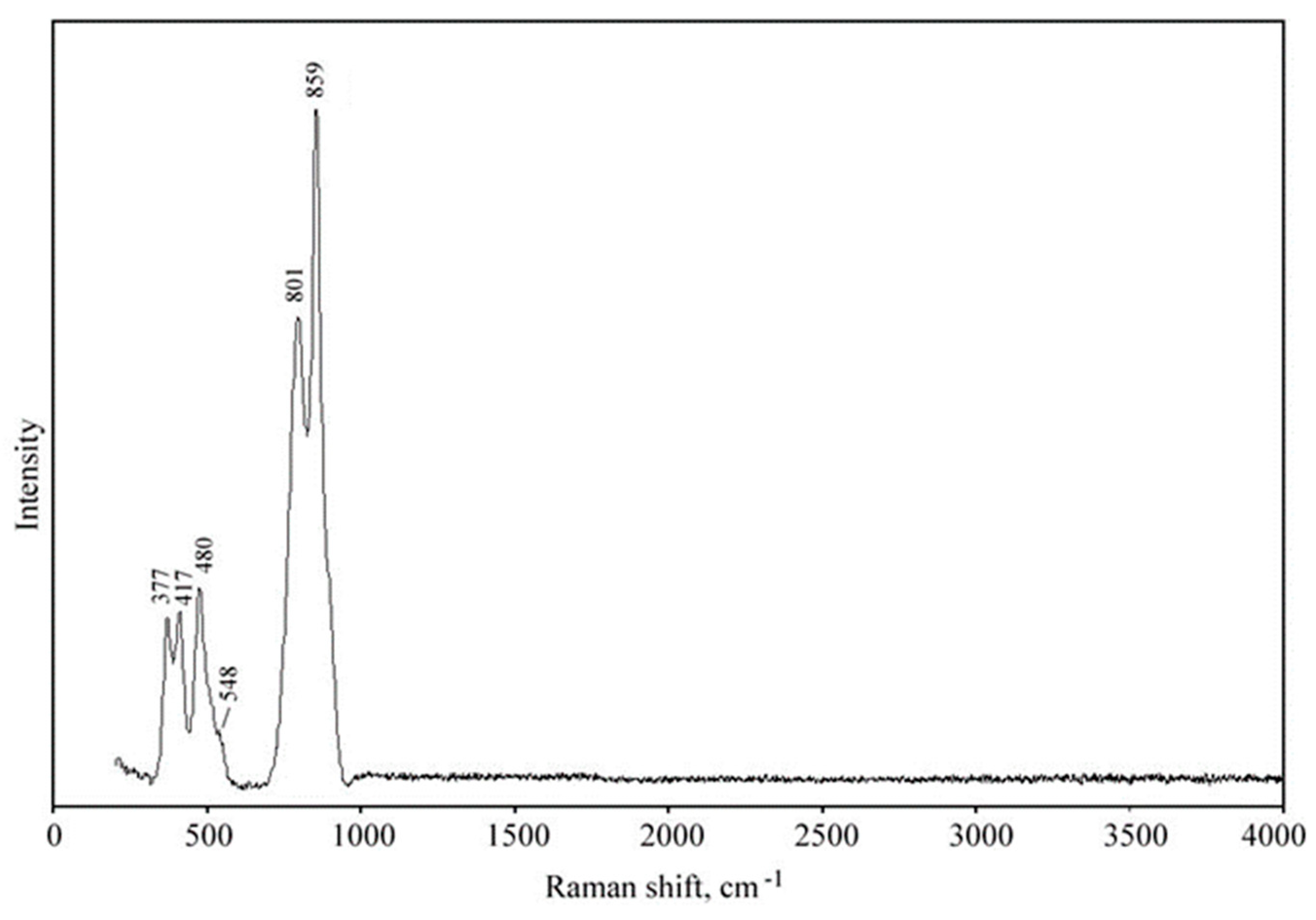
The Raman spectrum of manganobadalovite (Figure 2) was interpreted according to [20]. The strongest bands 859 and 801 cm−1 correspond to stretching vibrations of AsO43− distorted tetrahedra. The bands with maxima at 480, 417 and 377 cm−1 correspond to triply degenerate bending vibrations of the same tetrahedra.
The weaker band with maximum at 548 cm−1 can be assigned to Fe3+–O stretching vibrations.
The absence of bands with frequencies higher than 950 cm−1 indicates the absence of groups with O–H, C–H, C–O, N–H, N–O and B–O bonds in manganobadalovite.

3.4. Chemical Composition

The chemical composition of the holotype sample of manganobadalovite, averaged over five spot analyses, is given in Table 1. Fe is considered as Fe3+, and Mn as Mn2+, based on the crystal structure data (see below) and taking into account the strongly oxidizing conditions of mineral formation in the Arsenatnaya fumarole: only Fe3+ minerals are found there [10].
The empirical formula calculated on the basis of 12 O atoms per formula unit (apfu) is Na1.69K0.02Ca0.39Mn0.85Mg0.79Cu0.03Fe3+1.04Al0.02(As2.96V0.03)∑2.99O12.
The simplified formula, based on EMPA and crystal structure data is (Na,Ca,□)2(Mn,Ca)(MgFe3+)(AsO4)3, and the idealized formula is Na2MnMgFe3+(AsO4)3 which requires Na2O 10.37, MgO 6.74, MnO 11.87, Fe2O3 13.36, As2O5 57.66, total 100 wt.%.
The end-member crystal chemical formula, according to the actual nomenclature of the alluaudite supergroup [15] is NaNaMn(MgFe3+)(AsO4)3.
The correctness of the obtained data is confirmed by the superior value of the Gladstone–Dale compatibility index [21]: 1 − (Kp/Kc) = −0.007.

3.5. X-Ray Crystallography and Crystal Structure

Powder XRD data of manganobadalovite (for CoKα) are given in Table 2. The unit-cell parameters refined from the powder data are as follows: a = 12.15 (2), b = 12.876 (9), c = 6.690 (9) Å, β = 112.89 (7)° and V = 967.60 (7) Å3.
Crystal data, data collection information and structure refinement details are presented in Table 3. Coordinates and thermal displacement parameters of atoms and bond valence sums are given in Table 4, refined site-scattering factors and assigned occupancies for mixed-occupied cation sites in Table 5 and selected interatomic distances in Table 6.

4. Discussion

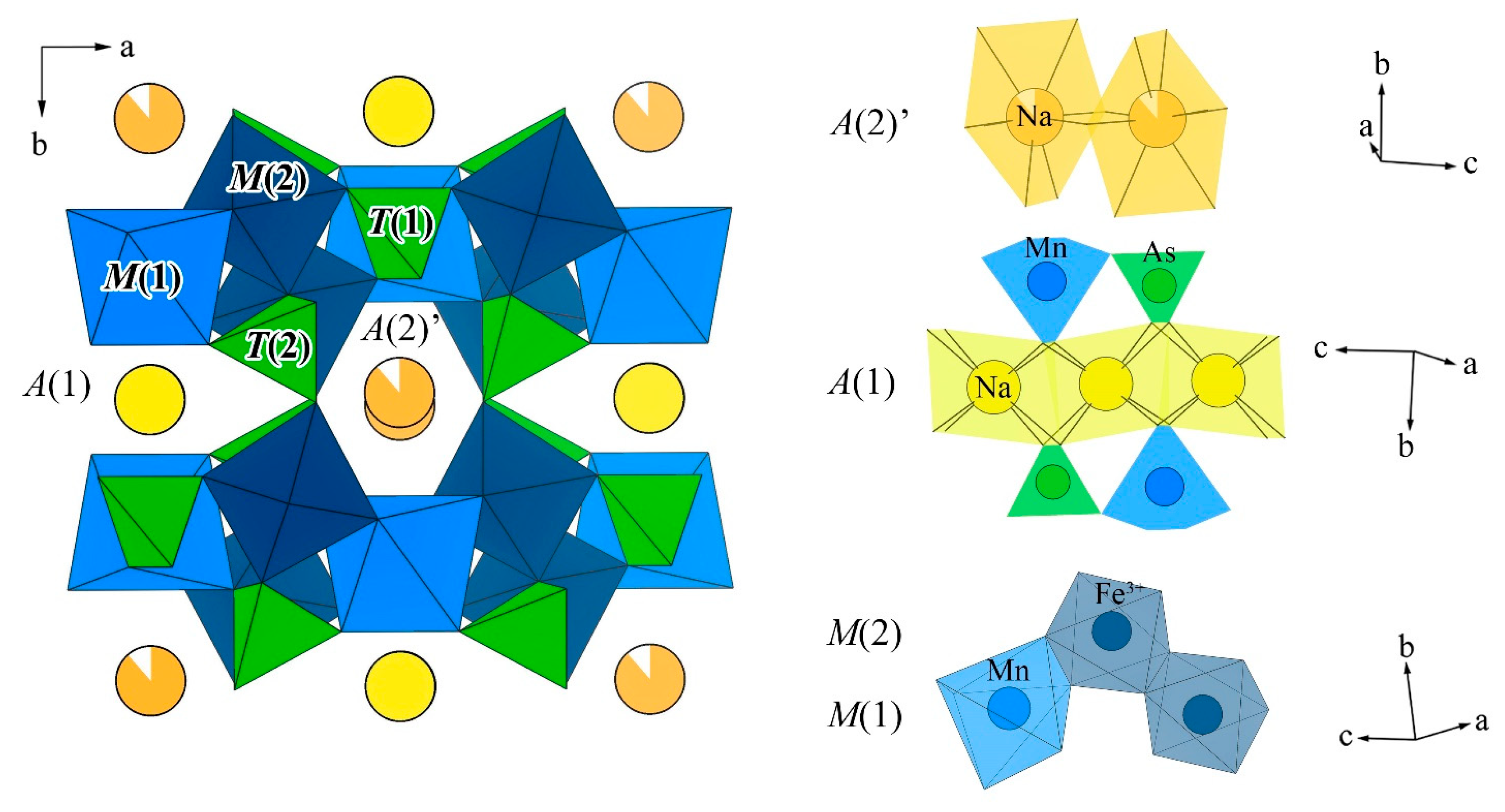
Manganobadalovite belongs to the alluaudite group and adopts the alluaudite structure type, the same as badalovite and all other anhydrous alluaudite-group arsenates. The H-free alluaudite-group arsenates are minerals with the general formula A(2)’A(1)M(1)M(2)2(AsO4)3 in which the species-defining M and A cations are as follows: M = Mg, Mn2+, Fe3+, Cu2+, Zn, Ca or Na; A = Na, K, Ca, Cu2+ or vacancy [15]. The alluaudite-type structure contains zig-zag chains formed by the [M(2)2O10] dimers connected with each other via distorted M(1)O6 octahedra isolated from each other. T(1)O4 tetrahedra share all vertices with the M-centered octahedra, forming the (010) layers, while each T(2)O4 tetrahedron shares three vertices with the M-centered octahedra of one layer and the fourth vertex with the octahedron of an adjacent layer, thus linking the layers into a three-dimensional framework. The framework contains channels of two types in which the large cation positions A(1), A(1)’, A(1)” and A(2), A(2)’ and A(2)” are located ([15] and references therein).
In the structure of manganobadalovite (Figure 3), both A(1) and A(2)’ sites are predominantly occupied by Na; the average A(1)–O distance is 2.434 Å and that of A(2)’–O is 2.729 Å. None of other A sites in the channels are filled. The M(1) site is occupied by Mn2+ with admixtures of Ca, Mg and Na; the average M(1)–O distance is 2.239 Å. The M(2) site is occupied by Fe3+, Mg and subordinate Mn; the average M(2)–O distance is 2.049 Å. Both tetrahedral sites are occupied by As5+ with similar average T–O distances of 1.683 Å.
The crystal-chemical formula of the studied crystal calculated based on both structure refinement and electron microprobe data is A(1)(Na0.79Ca0.21)∑1.00A(2)(Na0.80Ca0.05)∑0.85M(1)(Mn2+0.55Ca0.18Mg0.15Na0.12)∑1.00M(2)(Fe3+1.05Mg0.65Mn0.30)∑2.00(AsO4)3. The simplified crystal-chemical formula can be written as A(1)NaA(2)NaM(1)Mn2+M(2)(Mg0.5Fe3+0.5)2(AsO4)3.
Manganobadalovite, ideally NaNaMn(MgFe3+)(AsO4)3, is an analogue of badalovite NaNaMg(MgFe3+)(AsO4)3 and magnesiohatertite NaNaCa(MgFe3+)(AsO4)3 with Mn2+ as a prevailing cation in the M(1) site. For this new mineral, we used the rootname “badalovite” but not “hatertite” in agreement with the actual nomenclature of the alluaudite group [15], because both hatertite NaNaCa(CuFe3+)(AsO4)3 and magnesiohatertite contain Ca as a dominant cation in M(1) and differ from one another in species-defining M(2) cations.
Two phosphates of the alluaudite group, varulite NaNaMn(MnFe3+)(PO4)3 and hagendorfite NaNaMn(Fe2+Fe3+)(PO4)3 [15], are analogues of manganobadalovite in the ideal composition of the A and M(1) sites.
The Raman spectrum of manganobadalovite is in general similar to the spectra of other anhydrous alluaudite-group arsenates [6,7,9]. To our knowledge, there is no synthetic analogue of manganobadalovite.

Author Contributions

Conceptualization, I.V.P., N.N.K. and D.Y.P.; methodology, I.V.P., N.V.Z., N.N.K. and S.N.B.; fieldworks I.V.P., A.A.A., A.G.T., N.N.K., E.G.S. and E.S.Z.; investigation, N.N.K., I.V.P., D.I.B., N.V.Z., M.F.V., A.A.A., S.N.B. and A.G.T.; writing—original draft preparation, N.N.K. and I.V.P.; writing—N.N.K., I.V.P. and N.V.Z.; visualization, N.N.K.; supervision, I.V.P. and D.Y.P. Author Evgeny G. Sidorov passed away prior to the publication of this manuscript. All authors have read and agreed to the published version of the manuscript.

Funding

This work in part of mineralogical studies, crystal chemical analysis and crystal structure solution was supported by the Russian Science Foundation, grant no. 25-17-00005 (I.V.P., D.Y.P., N.V.Z. and M.F.V.). The powder XRD study was performed at the Center for X-Ray Diffraction Research of the Science Park of St. Petersburg State University within the framework of project 125021702335-5.

Data Availability Statement

The original contributions presented in this study are included in the article. Further inquiries can be directed to the corresponding author.

Acknowledgments

We thank Maria D. Milshina for color photograph of manganobadalovite.

Conflicts of Interest

The authors declare no conflicts of interest.

References

  1. Fedotov, S.A.; Markhinin, Y.K. (Eds.) The Great Tolbachik Fissure Eruption; Cambridge University Press: New York, NY, USA, 1983; p. 341. [Google Scholar]
  2. Bosi, F.; Hatert, F.; Pasero, M.; Mills, S.J. IMA Commission on New Minerals, Nomenclature and Classification (CNMNC)–Newsletter 86. Eur. J. Mineral. 2025, 37, 549–553. [Google Scholar] [CrossRef]
  3. Hålenius, U.; Hatert, F.; Pasero, M.; Mills, S.J. New minerals and nomenclature modifications approved in 2016. Mineral. Mag. 2016, 80, 1315–1321. [Google Scholar] [CrossRef][Green Version]
  4. Bosi, F.; Hatert, F.; Pasero, M.; Mills, S.J. IMA Commission on New Minerals, Nomenclature and Classification (CNMNC)–Newsletter 77. Eur. J. Mineral. 2024, 36, 165–172. [Google Scholar] [CrossRef]
  5. Miyawaki, R.; Hatert, F.; Pasero, M.; Mills, S.J. IMA Commission on New Minerals, Nomenclature and Classification (CNMNC)–Newsletter 62. Eur. J. Mineral. 2021, 33, 479–484. [Google Scholar] [CrossRef]
  6. Pekov, I.V.; Koshlyakova, N.N.; Belakovskiy, D.I.; Vigasina, M.F.; Zubkova, N.V.; Agakhanov, A.A.; Britvin, S.N.; Sidorov, E.G.; Pushcharovsky, D.Y. New arsenate minerals from the Arsenatnaya fumarole, Tolbachik volcano, Kamchatka, Russia. XVII. Paraberzeliite, NaCaCaMg2(AsO4)3, an alluaudite-group member dimorphous with berzeliite. Mineral. Mag. 2022, 86, 103–111. [Google Scholar] [CrossRef]
  7. Pekov, I.V.; Koshlyakova, N.N.; Belakovskiy, D.I.; Vigasina, M.F.; Zubkova, N.V.; Agakhanov, A.A.; Britvin, S.N.; Sidorov, E.G.; Pushcharovsky, D.Y. New arsenate minerals from the Arsenatnaya fumarole, Tolbachik volcano, Kamchatka, Russia. XVIII. Khrenovite, Na3Fe3+2(AsO4)3, the member with the highest sodium in the alluaudite supergroup. Mineral. Mag. 2022, 86, 897–902. [Google Scholar] [CrossRef]
  8. Pekov, I.V.; Koshlyakova, N.N.; Agakhanov, A.A.; Zubkova, N.V.; Belakovskiy, D.I.; Vigasina, M.F.; Turchkova, A.G.; Sidorov, E.G.; Pushcharovsky, D.Y. New arsenate minerals from the Arsenatnaya fumarole, Tolbachik volcano, Kamchatka, Russia. XV. Calciojohillerite, NaCaMgMg2(AsO4)3, a member of the alluaudite group. Mineral. Mag. 2021, 85, 215–223. [Google Scholar] [CrossRef]
  9. Pekov, I.V.; Koshlyakova, N.N.; Agakhanov, A.A.; Zubkova, N.V.; Belakovskiy, D.I.; Vigasina, M.F.; Turchkova, A.G.; Sidorov, E.G.; Pushcharovsky, D.Y. New arsenate minerals from the Arsenatnaya fumarole, Tolbachik volcano, Kamchatka, Russia. XIV. Badalovite, NaNaMg(MgFe3+)(AsO4)3, a member of the alluaudite group. Mineral. Mag. 2020, 84, 616–622. [Google Scholar] [CrossRef]
  10. Pekov, I.V.; Koshlyakova, N.N.; Zubkova, N.V.; Lykova, I.S.; Britvin, S.N.; Yapaskurt, V.O.; Agakhanov, A.A.; Shchipalkina, N.V.; Turchkova, A.G.; Sidorov, E.G. Fumarolic arsenates—A special type of arsenic mineralization. Eur. J. Mineral. 2018, 30, 305–322. [Google Scholar] [CrossRef]
  11. Koshlyakova, N.N.; Zubkova, N.V.; Pekov, I.V.; Giester, G.; Sidorov, E.G. Crystal chemistry of johillerite. Can. Mineral. 2018, 56, 189–201. [Google Scholar] [CrossRef]
  12. Pekov, I.V.; Zubkova, N.V.; Yapaskurt, V.O.; Belakovskiy, D.I.; Lykova, I.S.; Vigasina, M.F.; Sidorov, E.G.; Pushcharovsky, D.Y. New arsenate minerals from the Arsenatnaya fumarole, Tolbachik volcano, Kamchatka, Russia. I. Yurmarinite, Na7(Fe3+,Mg,Cu)4(AsO4)6. Mineral. Mag. 2014, 78, 905–917. [Google Scholar] [CrossRef]
  13. Shchipalkina, N.V.; Pekov, I.V.; Koshlyakova, N.N.; Britvin, S.N.; Zubkova, N.V.; Varlamov, D.A.; Sidorov, E.G. Unusual silicate mineralization in fumarolic sublimates of the Tolbachik volcano, Kamchatka, Russia—Part 1: Neso-, cyclo-, ino- and phyllosilicates. Eur. J. Mineral. 2020, 32, 101–119. [Google Scholar] [CrossRef]
  14. Pekov, I.V.; Agakhanov, A.A.; Zubkova, N.V.; Koshlyakova, N.N.; Shchipalkina, N.V.; Sandalov, F.D.; Yapaskurt, V.O.; Turchkova, A.G.; Sidorov, E.G. Oxidizing-type fumaroles of the Tolbachik volcano, a mineralogical and geochemical unique. Russ. Geol. Geophys. 2020, 61, 675–688. [Google Scholar] [CrossRef]
  15. Hatert, F. A new nomenclature scheme for the alluaudite supergroup. Eur. J. Mineral. 2019, 31, 807–822. [Google Scholar] [CrossRef]
  16. Britvin, S.N.; Dolivo-Dobrovolsky, D.V.; Krzhizhanovskaya, M.G. Software for processing the X-Ray powder diffraction data obtained from the curved image plate detector of Rigaku RAXIS Rapid II diffractometer. Zap. Ross. Mineral. Obs. 2017, 146, 104–107. (In Russian) [Google Scholar]
  17. Rigaku Oxford Diffraction. CrysAlisPro Software System, version 1.171.39.46; Rigaku Corporation: Oxford, UK, 2018.
  18. Sheldrick, G.M. Crystal structure refinement with SHELXL. Acta Crystallogr. 2015, 71, 3–8. [Google Scholar]
  19. Symonds, R.B.; Reed, M.H. Calculation of multicomponent chemical equilibria in gas-solid-liquid systems; calculation methods, thermo-chemical data, and applications to studies of high-temperature volcanic gases with examples from Mount St. Helens. Am. J. Sci. 1993, 293, 758–864. [Google Scholar] [CrossRef]
  20. Nakamoto, K. Infrared and Raman Spectra of Inorganic and Coordination Compounds; John Wiley & Sons: New York, NY, USA, 1986. [Google Scholar]
  21. Mandarino, J.A. The Gladstone–Dale compatibility of minerals and its use in selecting mineral species for further study. Can. Mineral. 2007, 45, 1307–1324. [Google Scholar] [CrossRef]
  22. Gagné, O.C.; Hawthorne, F.C. Comprehensive derivation of bond-valence parameters for ion pairs involving oxygen. Struct. Sci. 2015, 71, 562–578. [Google Scholar] [CrossRef] [PubMed]
Figure 1. Aggregates of manganobadalovite: (a) clusters of prismatic red crystals up to 0.5 mm in size with white metathénardite on dark steel-grey hematite. Photograph: Maria D. Milshina; (b) fragment of cavernous granular crust, SEM (BSE) image.
Minerals 16 00142 g001
Figure 2. Raman spectrum of manganobadalovite.
Minerals 16 00142 g002
Figure 3. The crystal structure of manganobadalovite in the projection along the c axis (left figure) and motifs of AO8 and MO6 polyhedra.
Minerals 16 00142 g003
Table 1. Averaged chemical composition of manganobadalovite holotype sample.
ConstituentWt.%RangeStand. Dev.Probe Standard
Na2O8.758.60–8.890.15jadeite
K2O0.170.16–0.190.01KTiOPO4
MgO5.324.72–5.950.51Olivine
CaO3.683.21–3.870.31CaSiO3
MnO 110.099.82–10.570.33MnTiO3
CuO0.420.35–0.440.05Cu
Al2O30.180.09–0.270.09Jadeite
Fe2O3 113.913.83–13.950.05FeS2
V2O50.420.27–0.690.13V
As2O556.7556.23–57.620.63GaAs
Total99.68
1 Fe is considered as Fe3+ and Mn as Mn2+ based on the crystal structure data (see below).
Table 2. Powder X-ray diffraction data (d in Å) of manganobadalovite.
IobsdobsIcalc 1dcalc 2hkl
28.4218.46110
306.43346.45020
15.8615.88−111
155.58225.60200
34.44624.453021
74.39564.398111
124.216144.229220
104.089104.099−221
14.00524.013130
113.766123.782−311
323.58924, 213.602, 3.588−131, 310
23.29523.301−202
383.2156, 503.223, 3.216040, −112
63.16073.165131
233.07910, 143.086, 3.080221, 002
322.94133, 14, 22.951, 2.938, 2.911−312, −222, −331
152.852202.856041
1002.78810, 47, 100, 102.819, 2.802, 2.794, 2.779330, 400, 240, 022
62.73962.749−421
222.64913, 222.655, 2.652−402, 112
252.626382.628−132
62.56182.570420
32.44852.455−422
22.33832.339202
32.3083, 32.317, 2.306331, −242
32.29422.292132
92.20192.208510
22.16522.169−313
92.1167, 32.122, 2.119350, −531
12.06222.049−442
52.0344, 22.037, 2.029−152, 061
82.016142.021−532
61.9883, 3, 41.995, 1.991, 1.987312, −423, 530
121.96012, 2, 11.964, 1.959, 1.956−352, −333, 023
41.94141.942−133
21.92321.929−621
31.8872, 51.893, 1.891242, −622
101.8671, 101.872, 1.868113, 152
121.8276, 151.835, 1.827−243, 332
21.79931.801−262
61.7716, 21.774, 1.768−171, −533
21.75221.755−461
21.7312, 21.732, 1.724133, 531
41.7093, 2, 3, 11.714, 1.712, 1.709, 1.707171, −641, −712, −623
61.6914, 31.695, 1.692422, 550
71.68312, 11.686, 1.674−642, −353
151.6611, 211.663, 1.661−153, −204
131.61117, 21.616, 1.612640, 080
41.5833, 21.589, 1.583710, −514
71.57110, 21.574, 1.571−372, 621
21.5573, 21.559, 1.551081, 461
81.5414, 5, 41.543, 1.542, 1.535442, −281, 512
71.52961.530371
101.5218, 7, 3, 41.523, 1.520, 1.519, 1.516172, −802, 243, −604
61.4972, 5, 1, 21.503, 1.500, 1.498, 1.495−733, 730, 024, −534
111.46712, 41.469, 1.465−444, 281
21.4301, 41.435, 1.433−572, −752
41.4201, 4, 21.424, 1.423, 1.421−481, 570, 190
41.41141.412−373
51.4066, 41.406, 1.401−173, 800
71.39091.389044
21.3732, 11.376, 1.375602, −842
71.3562, 81.359, 1.355−841, 204
31.34421.348731
41.33451.336−573
41.3254, 2, 11.326, 1.324, 1.320552, −843, 173
61.3142, 41.316, 1.315571, −192
1 For the calculated pattern, only reflections with intensities ≥ 1 are given. 2 For the unit-cell parameters obtained from single-crystal data. The strongest reflections are marked with bold type.
Table 3. Crystal data, data collection information and structure refinement details for manganobadalovite.
FormulaA(1)(Na0.79Ca0.21)Σ1.00
A(2)’(Na0.80Ca0.05)Σ0.85
M(1)(Mn0.55Ca0.18Mg0.15Na0.12)Σ1.00
M(2)(Fe3+1.05Mg0.65Mn0.30)Σ2.00
T(AsO4)3
Formula weight598.50
Crystal system, space group, ZMonoclinic, C2/c, 4
a, b, c (Å)12.1848(5), 12.8924(4), 6.6970(3)
β (°)113.113(5)
V3)967.60(7)
F(000)1123
µ (mm−1)13.303
Absorption correctiongaussian
Crystal dimensions (mm)0.12 × 0.13 × 0.20
DiffractometerXcalibur S CCD
Temperature (K)293
RadiationMoKα, λ = 0.71073 Å
θ range (°)3.160–30.623
Range of h, k, l−17 ⟶ 16, −17 ⟶ 18, −9 ⟶ 9
No. of measured, independent and
observed [I > 2σ(I)] reflections
7942, 1418, 1303
Rint0.0421
Structure solutiondirect methods
Refinement onF2
Extinction coefficient0.00053(9)
R1 and wR2 for I > 2σ(I)0.0230, 0.0457
R1 and wR2 for all data0.0277, 0.0475
No. of parameters refined99
Δρmax, Δρmin (e Å−3)0.649, −0.666
GooF1.097
Weighting schemew = 1/[σ2(Fo2) + (0.0144P)2 + 2.0540P]
P = ([max of (0 or Fo2)] + 2Fc2)/3
Table 4. Coordinates and equivalent displacement parameters (Ueq, in Å2) of atoms and bond-valence sums (BVS) for manganobadalovite.
Site 1WyckoffxyzUeqBVS 2
A(1)4b0.5000.0244(7)1.19
A(2)’4e00.9889(2)0.250.0365(10)0.68
M(1)4e00.26621(6)0.250.0121(2)1.89
M(2)8f0.28084(4)0.65626(4)0.36949(8)0.00977(16)2.46
T(1)4e00.71652(3)0.250.00872(10)5.05
T(2)8f0.23700(3)0.89104(2)0.12751(4)0.00979(9)5.06
O(1)8f0.45605(18)0.70881(16)0.5254(3)0.0138(4)2.01
O(2)8f0.10503(19)0.36634(17)0.7439(4)0.0191(5)2.00
O(3)8f0.33349(18)0.66891(16)0.1141(3)0.0136(4)2.00
O(4)8f0.11800(19)0.40465(16)0.3127(3)0.0163(4)2.04
O(5)8f0.22280(18)0.81846(16)0.3269(3)0.0131(4)1.92
O(6)8f0.3328(2)0.50558(16)0.3902(4)0.0181(5)1.96
1 Refined occupancy of the A(1) site is Na 0.788(12) and Ca 0.212(12). For occupancies of the A(2)’ and M sites see Table 6; the T sites are occupied by As5+. 2 Bond-valence parameters were taken from [22]. Bond-valence sums were calculated taking into account cation distribution (see Table 6).
Table 5. Selected interatomic distances (Å) in the crystal structure of manganobadalovite.
A(1)O6 polyhedronA(1)–O(4)x22.366(2)
A(1)–O(2)x22.374(2)
A(1)–O(4)x22.563(2)
<A(1)–O>2.434
A(2)’O8 polyhedronA(2)’–O(6)x22.471(2)
A(2)’–O(6)x22.565(2)
A(2)’–O(1)x22.900(3)
A(2)’–O(3)x22.980(3)
<A(2)’–O>2.729
M(1)O6 octahedronM(1)–O(4)x22.226(2)
M(1)–O(1)x22.239(2)
M(1)–O(3)x22.251(2)
<M(1)–O>2.239
M(2)O6 octahedronM(2)–O(2)1.992(2)
M(2)–O(6)2.031(2)
M(2)–O(3)2.056(2)
M(2)–O(1)2.087(2)
M(2)–O(5)2.077(2)
M(2)–O(5)2.190(2)
<M(2)–O>2.049
T(1)O4 tetrahedronT(1)–O(1)x21.6865(19)
T(1)–O(2)x21.680(2)
<T(1)–O>1.683
T(2)O4 tetrahedronT(2)–O(4)1.660(2)
T(2)–O(6)1.685(2)
T(2)–O(3)1.6917(19)
T(2)–O(5)1.6940(19)
<T(2)–O>1.683
Table 6. Refined site-scattering factors and assignment for cation sites in the structure of manganobadalovite (SC—scattering curve used to refine site occupancy; SOF—refined site-occupancy factor; SSFexp and SSFcalc—experimental and calculated site-scattering factors).
SiteSCSOFSSFexpAssigned Site OccupancySSFcalc
A(2)’Na0.889.68Na0.80Ca0.059.80
M(1)Mn0.8320.75Mn2+0.55Ca0.18Mg0.15Na0.1220.47
M(2)Fe0.8221.32Fe3+0.53Mg0.32Mn0.1521.37
Disclaimer/Publisher’s Note: The statements, opinions and data contained in all publications are solely those of the individual author(s) and contributor(s) and not of MDPI and/or the editor(s). MDPI and/or the editor(s) disclaim responsibility for any injury to people or property resulting from any ideas, methods, instructions or products referred to in the content.