
Article

Trace Element Characteristics of Magnetite and Hematite from the Heshangqiao Iron Oxide–Apatite Deposit in Eastern China: Implications for the Ore-Forming Processes

1
Faculty of Land Resources Engineering, Kunming University of Science and Technology, Kunming 650093, China
2
MNR Key Laboratory of Metallogeny and Mineral Assessment, Institute of Mineral Resources, Chinese Academy of Geological Sciences, Beijing 100037, China
3
School of Earth Sciences and Resources, China University of Geosciences, Beijing 100083, China
4
Nanshan Mine Company, Maanshan Iron and Steel Group Mining Company, Maanshan 243033, China
5
Anhui Chemical Industry Geological Exploration Institute, Maanshan 243031, China
*
Authors to whom correspondence should be addressed.
Minerals 2026, 16(1), 7; https://doi.org/10.3390/min16010007 (registering DOI)
Submission received: 7 November 2025 / Revised: 11 December 2025 / Accepted: 18 December 2025 / Published: 21 December 2025
(This article belongs to the Section Mineral Deposits)

Abstract

Iron oxide–apatite (IOA) deposits are important for the global supply of iron resources. Currently, there is considerable debate regarding the evolution of their mineralization mechanisms. The Heshangqiao iron deposit is a significant IOA deposit situated within the Ningwu ore district of the Middle–Lower Yangtze River Metallogenic Belt in China. This deposit exhibits distinct characteristics of multi-stage mineralization, forming disseminated ores, brecciated ores, and vein-type ores, from early to late stages. This study undertook a systematic elemental analysis of the magnetite and hematite from three mineralization stages of the Heshangqiao deposit. In the three mineralization stages of the Heshangqiao deposit, the elemental genesis indicators of ore genesis suggest that the hematite and magnetite both have magmatic hydrothermal genesis, characterized by high Ti and low Mg/Al and relatively high Ti and low Ni/Cr, respectively. The Cr and Sn contents of magnetite and hematite exhibit similar variation from the first to third mineralization stage, with an increase followed by a subsequent decrease. Meanwhile, the contents of V, Co, Ni, and Mn in magnetite and hematite exhibited an opposite trend, declining from the first to the second stage but eventually increasing from the second to the third stage. These changes in the genesis indicator also suggest that the multiple mineralization stages of the Heshangqiao deposit are independent of one another. The replacement of magnetite by hematite in each mineralization stage is not caused by the superposition of subsequent fluids, but rather by the residual fluid. It is noted that in the replacement the elements Cr, Co, and Ga were minimally migrated. These elements remained relatively stable and can be considered new potential discriminant indicators for the genesis of iron oxides.

1. Introduction

Iron oxide–apatite (IOA) deposits represent a significant category of global iron resource supply, encompassing essential elements such as rare earths, uranium, cobalt, and phosphorus, along with a diverse array of accessory minerals. The ore body typically exhibits a mineral assemblage comprising magnetite and apatite, characterized by significant alterations rich in sodium, calcium, and potassium [1,2,3]. IOA deposits are extensively distributed over all the world and across geologic time [3] and are found in areas such as EI Laco, northern Chile [4,5], north and central regions of Sweden [6,7], the western United States [4,8,9], the Ningwu and Luzong ore district in eastern China [10,11,12], central Iran, northwestern Canada, and central Mexico [13,14,15]. In recent years, two genesis theories of mineral deposits have gained majority agreement [16,17,18,19]: (1) The model of ore-forming fluid genesis posits that andesitic parental magma undergoes immiscibility and subsequent evolution, resulting in the formation of iron-rich melts, and these melts subsequently evolve into low-salinity gas and water–rock fluids, which give rise to ore-forming fluids that permeate the surrounding rocks, ultimately leading to mineralization [17]. (2) In the hydrothermal genesis model, magnetite initially crystallizes from the magma melt, resulting in the formation of magmatic magnetite. The edges of these particles are subsequently coated with fluids enriched in Fe and Cl, leading to the formation of a localized core surrounded by an iron-rich fluid bubble containing FeCl2. This bubble then rises and accumulates within the melt. As the environment cools and experiences depressurization, suspended materials rapidly aggregate to form hydrothermal magnetite ore bodies [2,19,20,21,22]. In addition, recent studies have also demonstrated that the evaporite layer from surrounding rocks plays a crucial role in the formation of IOA deposits [12,23,24,25,26,27].
IOA deposits represent a distinct category of mineral deposits characterized by multi-stage mineralization [28,29,30]. The ambiguity surrounding the evolution of mineralization processes is a significant factor in the ongoing controversy over their genesis. Magnetite and hematite are two crucial indicators of the mineralization process, and of the presence of substantial ore and alteration minerals in IOA deposits. The elemental characteristics of magnetite and hematite can provide valuable geological information, such as temperature, oxygen fugacity, and the intensity of water–rock interactions during various stages of mineralization and can highlight changes in ore-forming conditions throughout the mineralization process [1,31,32,33,34,35,36].
The Heshangqiao deposit is a typical large IOA deposit located in the central part of the Ningwu ore district in eastern China, characterized by multi-stage mineralization and providing an excellent example for studying mineralization processes. In this study, EPMA and LA-ICP-MS analysis were performed on magnetite and hematite from the Heshangqiao deposit. This approach further elucidates the interrelationships and genetic evolution processes associated with each stage of mineralization in this deposit, thereby providing new insights into the genesis of IOA deposits.

2. Geological Setting of the Ore District and Deposit

2.1. Ningwu Ore District

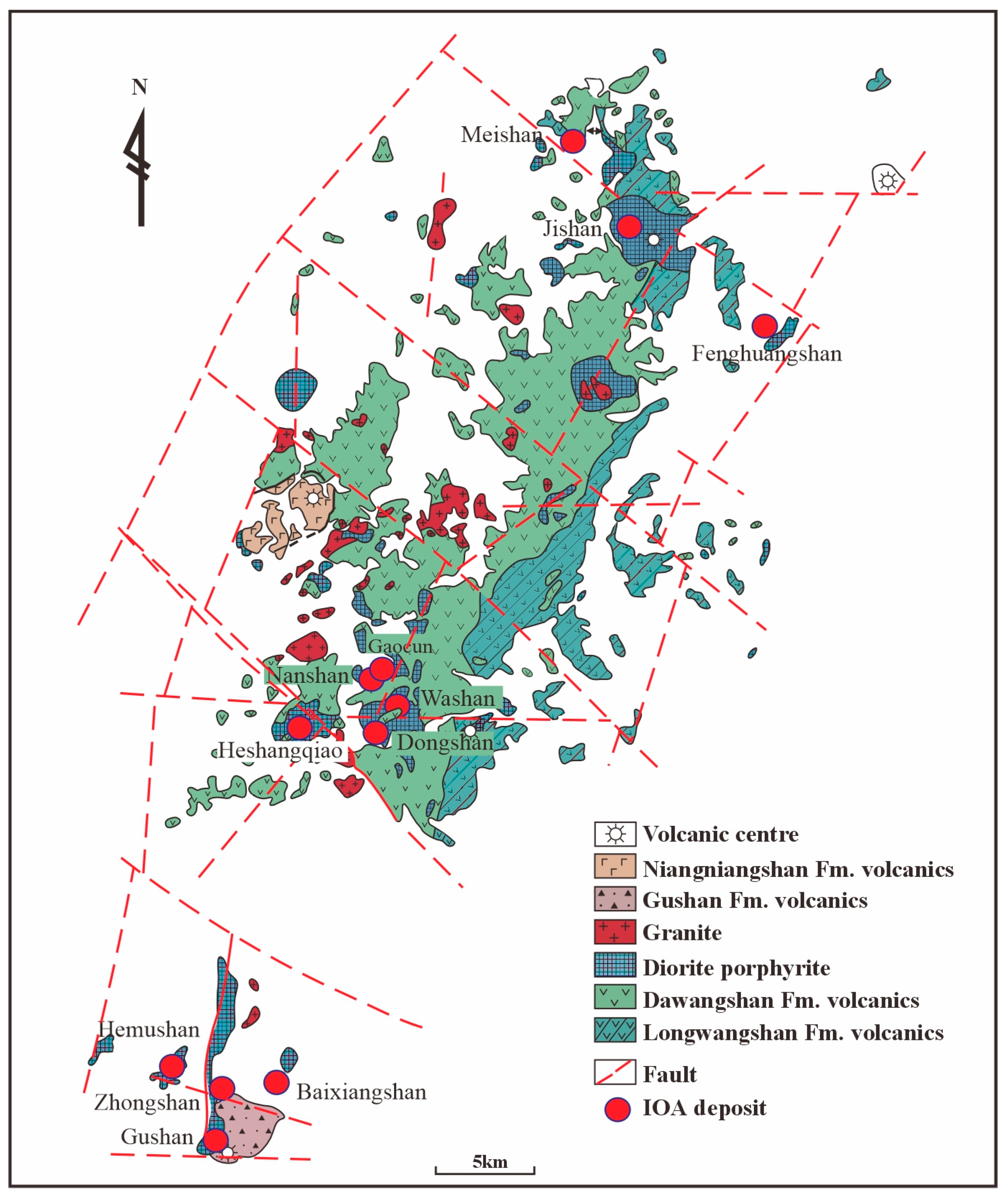
The Heshangqiao IOA deposit is located in the middle part of the Ningwu ore district, which is an important component of the Middle–Lower Yangtze River Metallogenic Belt in eastern China (Figure 1), containing more than 30 typical IOA deposits [30,37,38,39,40]. The stratigraphic sequence in the Ningwu ore district is composed of carbonates, evaporites (gypsum), and clastic rocks of the Shangqinglong, Zhuchongcun, and Huangmaqing formations of the Triassic, Jurassic Xiangshan Group and Xihengshan Formation, and Early Cretaceous volcanic rocks, which are overlain by the Late Cretaceous Pukou and Chisha formations and Tertiary sediments [41].
Volcanic activity was particularly intense during the Cretaceous period, characterized by the occurrence of four distinct cycles of volcanic rock eruptions and effusions. From the early developed volcanic spillage and swirl to the late, they are, respectively, the Longwangshan Formation (lower tuff, silty mudstone, volcanic agglomerate and upper craszeolite, olivine craszeolite, amphibole craszeolite), the Dawangshan Formation, characterized by a distinct stratification (the lower section primarily consists of pyroxene-rich coarse rocks, the middle section features purple–red andesite, and the upper section comprises grayish-red and light gray coarse-grained rocks along with coarsely textured fused tuff), the Gushan Formation (andesite, dacite, pyroclastic rock and sedimentary rock), and the Niangniangshan Formation (pseudoleucite phonolite and hauyne phonolite).
Intrusive rocks can be categorized into two primary groups, i.e., pyroxene diorite porphyry and granite. The IOA mineralization is closely associated with the former, which is the major type formed during the late stages of the DWS volcanic cycle [10,30,37,39,41,42,43]. The granite was formed during the late stages of the GS and NNS volcanic cycles and is situated in the central region of the ore district [44]. The lithology primarily comprises quartz monzonite, quartz diorite, quartz monzonite porphyry, quartz diorite porphyry, biotite granite, and granitic porphyry.

2.2. Heshangqiao IOA Deposit

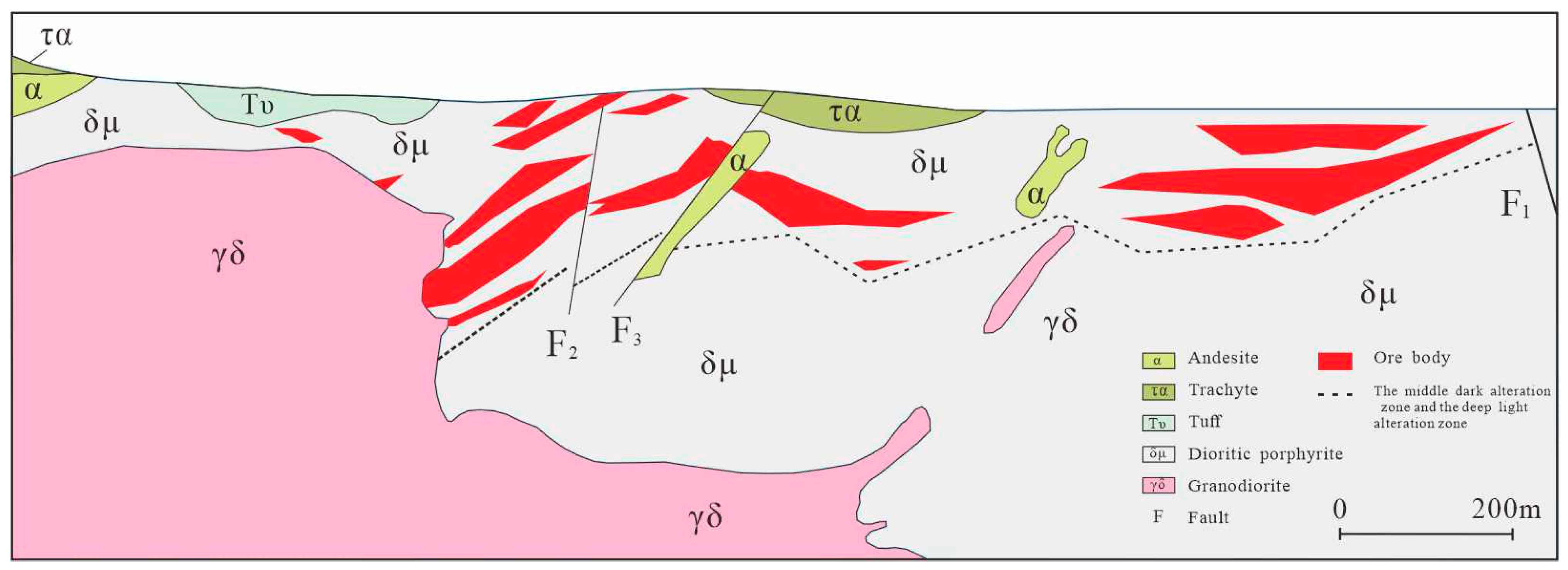
The Heshangqiao IOA deposit is situated in the central region of the Ningwu ore district. In this deposit, ore bodies primarily occur within the diorite porphyry intrusion, exhibiting a gradual relationship with the surrounding rock. A minor occurrence of vein-type ores is developed in the volcanic rocks of the Dawangshan Formation, which overlies the diorite porphyry. Three distinct vertical alteration zones have been divided from the base upwards (Figure 2).
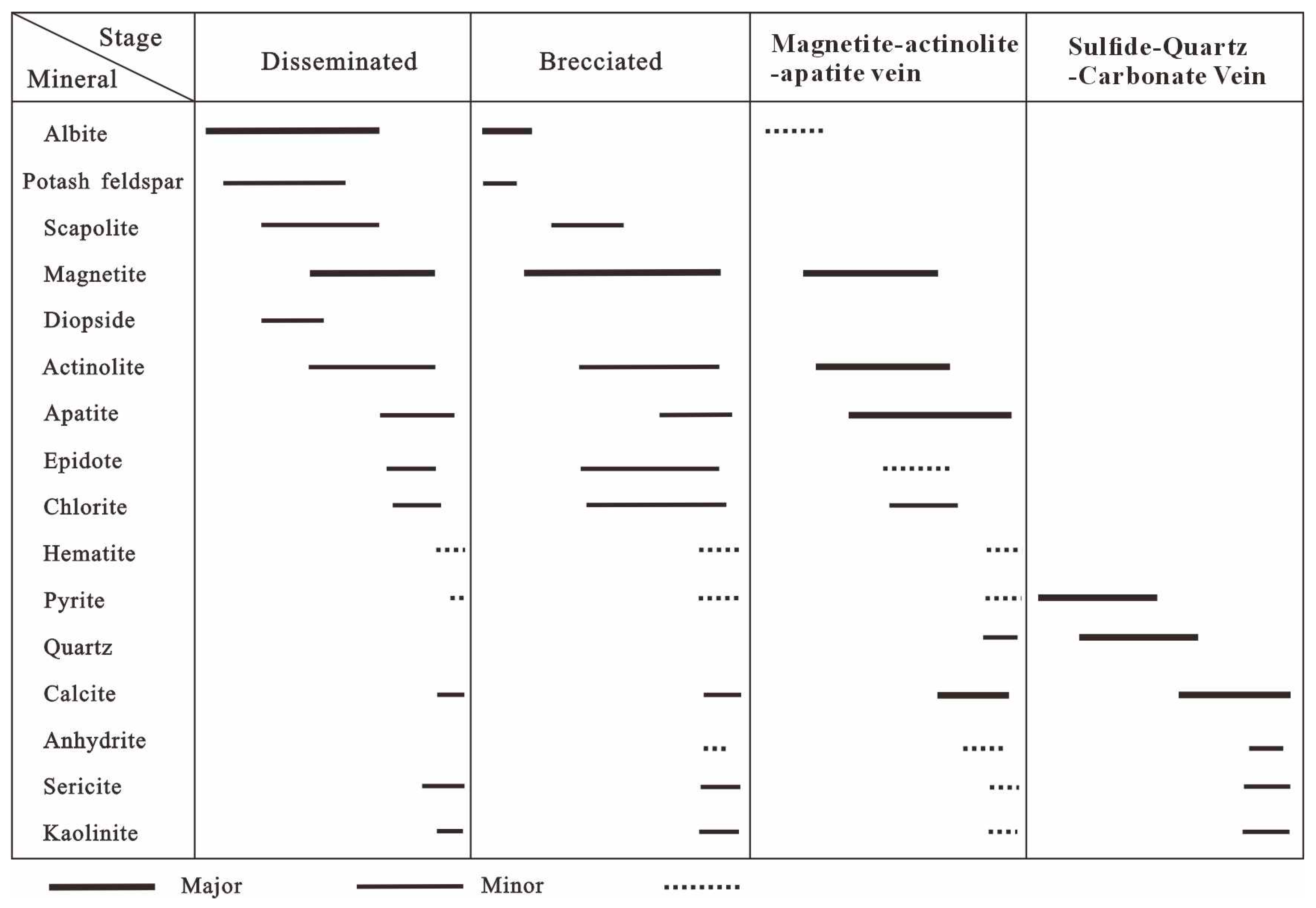
The alteration zone is primarily categorized into three distinct sections: (1) the upper, light-colored alteration zone, characterized by argillaceous rock; (2) the middle, dark alteration zone, characterized as a cyanide-like igneous zone; (3) the lower light alteration zone, characterized as the sodium feldspar zone. Iron ore bodies are predominantly found within the middle alteration zone. The formation of the Heshangqiao deposit occurred in multiple stages, characterized by the development of disseminated, brecciated, and vein-type ores from the early to late stages. After the mineralization of magnetite, pyrite veins formed and were subsequently intersected by numerous gypsum veins (Figure 3).
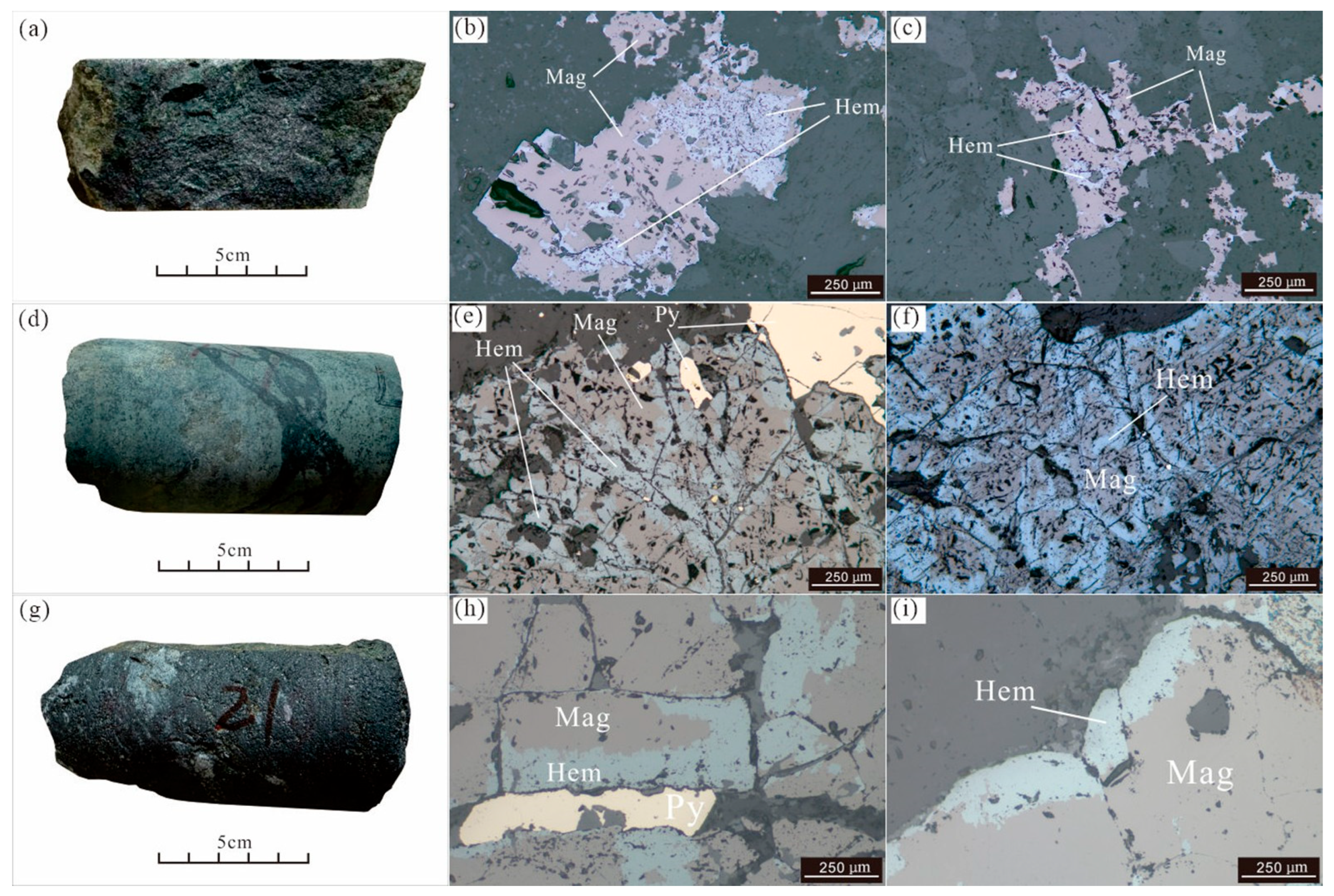
Disseminated ores are the predominant type represented in the Heshangqiao deposit, occurring within the surrounding diorite porphyry. The particle size of magnetite (Mag I), as observed under microscopic examination, is approximately 100 to 300 μm. After magnetite precipitation, hematite (Hem I) replaces magnetite along its lattice fractures and localized edges, and it does not fully overprint the magnetite (Figure 4a,b). Brecciated ore is less extensively developed. The breccia content ranges from 50% to 70%, exhibits variable shapes and sizes, and is characterized by poor roundness. As in the first mineralization stage, after magnetite (Mag II) crystallizes, hematite (Hem II) replaces it. However, it is important to note that hematite is not entirely converted into magnetite (Figure 4c,d). The production of pyrite was also documented at this stage. The late-developed pyrite vein exhibits transmission characteristics that cut through brecciated ore. A limited quantity of vein-type magnetite ores has been identified, with the primary minerals present in these magnetite veins being magnetite and apatite, with the content of magnetite ranging from 30% to 50%. Gypsum and pyrite-type veins were also identified in the samples, cutting magnetite veins. At this stage, magnetite (Mag III) was formed and subsequently underwent metasomatism along its lattice fractures and edges due to the residual fluid from the same stage, resulting in the formation of hematite (Hem III) (Figure 4e,f).

3. Analytical Methods

3.1. Sampling

In this study, fourteen typical samples were collected from three Fe mineralization stages, including six disseminated ore samples (HSQ13-04, HSQ13-14-2, HSQ13-14-3, and HSQ13-17-1 from an open pit, and rock cores SK2404-57, SK2404-78, and SK2606 from a drilling core), four brecciated magnetite ore samples (HSQ12-11, HSQ12-15-6, HSQ12-15-7, and HSQ25-3-2 from the Heshangqiao open pit, and the rock core SK2404-21 from the drilling core), and four vein-type magnetite ore samples (HSQ13-09 from the open pit, and rock cores HSQ13-19-1, HSQ13-19-3, HSQ13-20-8, HSQ13-20-9, and SK2606-78 from the drilling core).

3.2. Methods

3.2.1. EPMA Analysis

After grinding the probe pieces from 14 representative ore samples from the Heshangqiao deposit, the samples were examined under a microscope.
Electron probe microanalysis was performed at the Electron Probe Laboratory of the Institute of Mineral Resources, Chinese Academy of Geological Sciences. The accomplishment was achieved utilizing the JXA-IHP200F Electron probe microanalyzer (JEOL Inc., Tokyo, Japan), which is equipped with a 5-channel spectrometer. The sample must be coated with a carbon film that is as uniform as possible, approximately 20 nm in thickness, prior to entering the instrument. The working conditions for the test are as follows: an acceleration voltage of 15 kV, an acceleration current of 20 nA, and a beam spot diameter of 5 μm. The materials utilized include natural minerals such as quartz (Si), corundum (Al), olivine (Ni), chromite (Cr), cobalt oxide (Co), hematite (Fe), fluorapatite (P), and rutile (Ti), as well as synthetic oxides NaAlSi2O6, ZnWO4, and V-P-K as standard samples.

3.2.2. LA-ICP-MS Analysis

Trace element analyses of magnetite and hematite were performed in two analysis cycles. Micro-area analyses of magnetite and hematite in samples HSQ12-11, HSQ12-15-6, HSQ12-15-7, HSQ13-04, HSQ13-14-2, HSQ13-14-3, HSQ13-17-1, HSQ13-19-1, HSQ13-19-3, HSQ13-20-8, and HSQ13-20-9 were performed at the Key Laboratory of Mineralization and Resource Evaluation, Ministry of Natural Resources, which is affiliated with the Institute of Mineral Resources, Chinese Academy of Geological Sciences. The LA-ICP-MS system used in the experiment consisted of a RESOlution S-155 193nm excimer laser ablation system (Applied Spectra Inc., Sacramento, CA, USA) and a Thermo Fisher Element XR inductively coupled-plasma mass spectrometer (Thermo Fisher Scientific (China) Inc., Bremen, Germany). The laser ablation process employs helium as the carrier gas and argon as the compensating gas to fine-tune sensitivity. Prior to entering the plasma, these two gases are mixed through a T-joint. Each sample analysis lasts approximately 80 s, comprising about 20 s of blank signal and 40 s of sample signal. The diameter of the laser beam spot is 30 μm, with an energy density of 5 J/cm2 and an ablation frequency of 6 Hz. Each sample must undergo a purge interval of 20 s. The glass reference material NIST 610, along with the USGS reference glasses (GSE-1G, BCR-2G, BIR-1G), should be incorporated as standard and monitoring samples at every tenth sample test point. Iolite software (v4.9.1) was employed to process the experimental data. NIST 610 served as the external standard, while Fe was utilized as the internal standard for the correction method, enabling a quantitative calculation of the elemental content. During processing, efforts were made to minimize the influence of abnormal peaks resulting from fine inclusions or fissures, thereby ensuring an accurate determination of the trace element content in magnetite and hematite.
The in situ analysis of trace element content within the magnetite–hematite micro-area of SK2404-57, SK2404-78, SK2404-21, SK2606-74, SK2606-78, and HSQ25-3-2 samples was conducted using LA-ICP-MS at the Key Laboratory of Isotope Geology, Ministry of Natural Resources, Institute of Geology, Chinese Academy of Geological Sciences. The laser ablation system consists of a RESOlution S155 ArF excimer laser operating at 193 nm (Applied Spectra Inc., Sacramento, CA, USA) and an Agilent 7900 quadrupole mass spectrometer (Agilent Technologies Inc., Singapore). Prior to entering the plasma, these two gases are mixed through a T-joint. The diameter of the laser beam spot is 30 μm, with an energy density of 5 J/cm2 and an ablation frequency of 6 Hz. We inserted the glass reference material NIST 610 and USGS reference glasses (GSE-1G, BCR-2G, BIR-1G) as standard samples and monitored samples at every tenth sample testing point. NIST 610 served as the external standard, while Fe was utilized as the internal standard for the correction method. Each time-resolved analysis dataset comprised approximately 20 to 30 s of blank signal followed by 50 s of sample signal. The offline processing of the analytical data, which included the selection of samples and blank signals, correction for instrument sensitivity drift, and calculation of elemental content, was performed using ICPMS Data Cal software (v11.4) [45].

4. Analytical Results

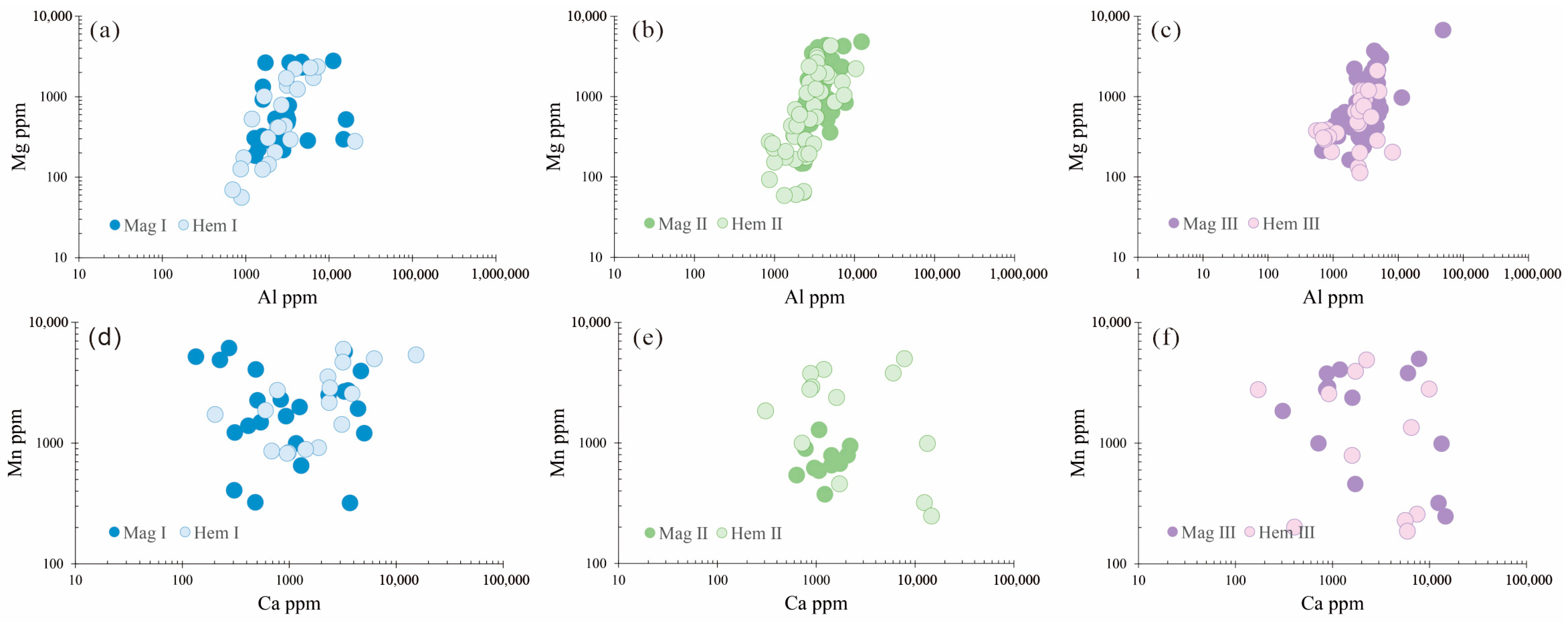
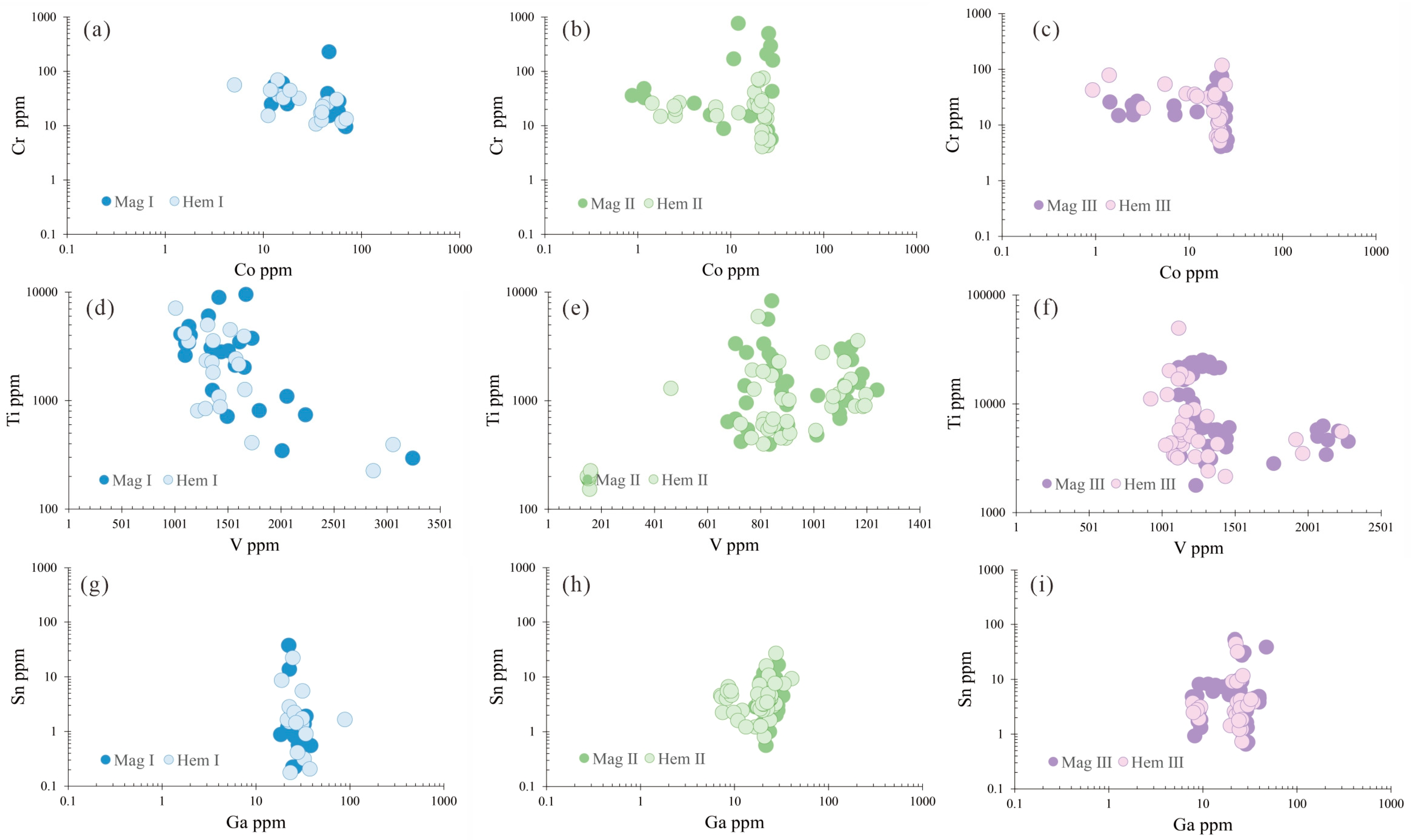
Major and trace element analyses of magnetite and hematite in the Heshangqiao deposit were conducted (Figure 5 and Figure 6). The data are listed in Tables S1–S4.

4.1. Magnetite Chemistry

In the first stage (disseminated ores), the magnetite median content of TiO2 was 0.17% (range 0.02%–1.13%), the median content of V was 1437.7 ppm (range 1056.7–3242.3 ppm), the median content of MgO was 0.01% (range 0.01%–0.22%), the median content of MnO was 0.09% (range 0.01%–0.60%), the median content of Cr was 21.90 ppm (range 9.6–229.1 ppm), the median content of Co was 46.8 ppm (range 12.1–69.4 ppm), the median content of Ga was 25.2 ppm (range 18.4–38.3 ppm), and the median content of Sn was 1.1 ppm (range 0.2–37.6 ppm).
In the second stage (brecciated ores), the magnetite median content of TiO2 was 0.17% (range 0.01%–0.16%), the median content of V was 881.7 ppm (range 677.5–1238.9 ppm), the median content of MgO was 0.02% (range 0.01%–6.61%), the median content of MnO was 0.09% (range 0.02%–0.41%), the median content of Cr was 34.3 ppm (range 5.7–767.7 ppm), the median content of Co was 9.6 ppm (range 0.8–30.3 ppm), the median content of Ga was 25.7 ppm (range 16.7–32.5 ppm), and the median content of Sn was 4.1 ppm (range 0.6–16.6 ppm).
In the third-stage (vein-type ores), the magnetite median content of TiO2 was 0.31% (range 0.08%–4.07%), the median content of V was 1258.6 ppm (range 1114.4–2276.8 ppm), the median content of MgO was 0.05% (range 0.01%–0.62%), the median content of MnO was 0.14% (range 0.01%–4.05%), the median content of Cr was 16.2 ppm (range 4.1–193.1 ppm), the median content of Co was 19.8 ppm (range 1.4–25.7 ppm), the median content of Ga was 26.0 ppm (range 7.8–47.4 ppm), and the median content of Sn was 3.9 ppm (range 0.7–53.2 ppm).

4.2. Hematite Chemistry

The characteristics of hematite metasomatized magnetite were observed across all stages of magnetite mineralization. In the first stage (disseminated ores), the hematite median content of TiO2 was 0.15% (range 0.01%–3.60%), the median content of V was 1384.0 ppm (range 1009.1–3057.3 ppm), the median content of MgO was 0.02% (range 0.01%–0.76%), the median content of MnO was 0.13% (range 0.01%–0.70%), the median content of Cr was 23.8 ppm (range 10.2–69.5 ppm), the median content of Co was 36.5 ppm (range 5.1–70.1 ppm), the median content of Ga was 24.0 ppm (range 16.0–88.5 ppm), and the median content of Sn was 1.6 ppm (range 0.2–22.2 ppm).
In the second-stage (brecciated ores), the hematite median content of TiO2 was 0.11% (range 0.01%–4.08%), the median content of V was 852.3 ppm (range 148.1–1199.9 ppm), the median content of MgO was 0.03% (range 0.01%–0.22%), the median content of MnO was 0.03% (range: 0.01%–0.36%), the median content of Cr was 29.7 ppm (range 2.9–267.5 ppm), the median content of Co was 8.9 ppm (range 0.3–28.6 ppm), the median content of Ga was 20.8 ppm (range 7.2–40.6 ppm), and the median content of Sn was 4.1 ppm (range 0.8–27.1 ppm).
In the third-stage (vein-type ores), the hematite median content of TiO2 was 0.19% (range 0.04%–6.47%), the median content of V was 1140.0 ppm (range 922.8–2232.3 ppm), the median content of MgO was 0.04% (range 0.01%–0.86%), the median content of MnO was 0.12% (range 0.01%–1.99%), the median content of Cr was 20.2 ppm (range 5.1–117.6 ppm), the median content of Co was 19.4 ppm (range 0.9–24.3 ppm), the median content of Ga was 23.4 ppm (range 7.8–34.4 ppm), and the median content of Sn was 2.8 ppm (range 0.7–44.9 ppm).

4.3. Comparative Analysis of Magnetite and Hematite

The major and trace element contents of magnetite and hematite at the same stage have been compared. In the first stage, the TiO2 (0.91), V (0.96), MnO (0.89), Cr (1.08), Co (0.78) and Ga (0.95) ratios of hematite to magnetite (Hem/Mag) remained stable, with variations in MgO (4.4).
In the second stage, the V (0.97), Cr (0.86), Co (0.92) and Ga (0.81) ratios of hematite to magnetite (Hem/Mag) remained stable, with variations of TiO2 (1.29), MgO (1.71), and MnO (0.36).
In the third stage, the TiO2 (0.91), MnO (0.87), Co (0.98), Ga (0.90) ratios of hematite to magnetite (Hem/Mag) remained stable, with variations in MgO (0.78), Cr (1.25).

4.4. Magmatic Magnetite Temperature

To estimate the formation temperature of magnetite, Canil et al. [46] applied a TMag-mag geothermal thermometer through systematic experimental calibration. This quantitative tool utilizes the empirical relationship between parameter X M g = [ M g M g + F e t o t ] and the crystallization temperature in the magnetite system. Based on this, this study adopts the same temperature equation to investigate the formation temperature of the Heshangqiao magnetite. The empirical formula is
T ° C = 8344 l n X M g 4.1 273.14
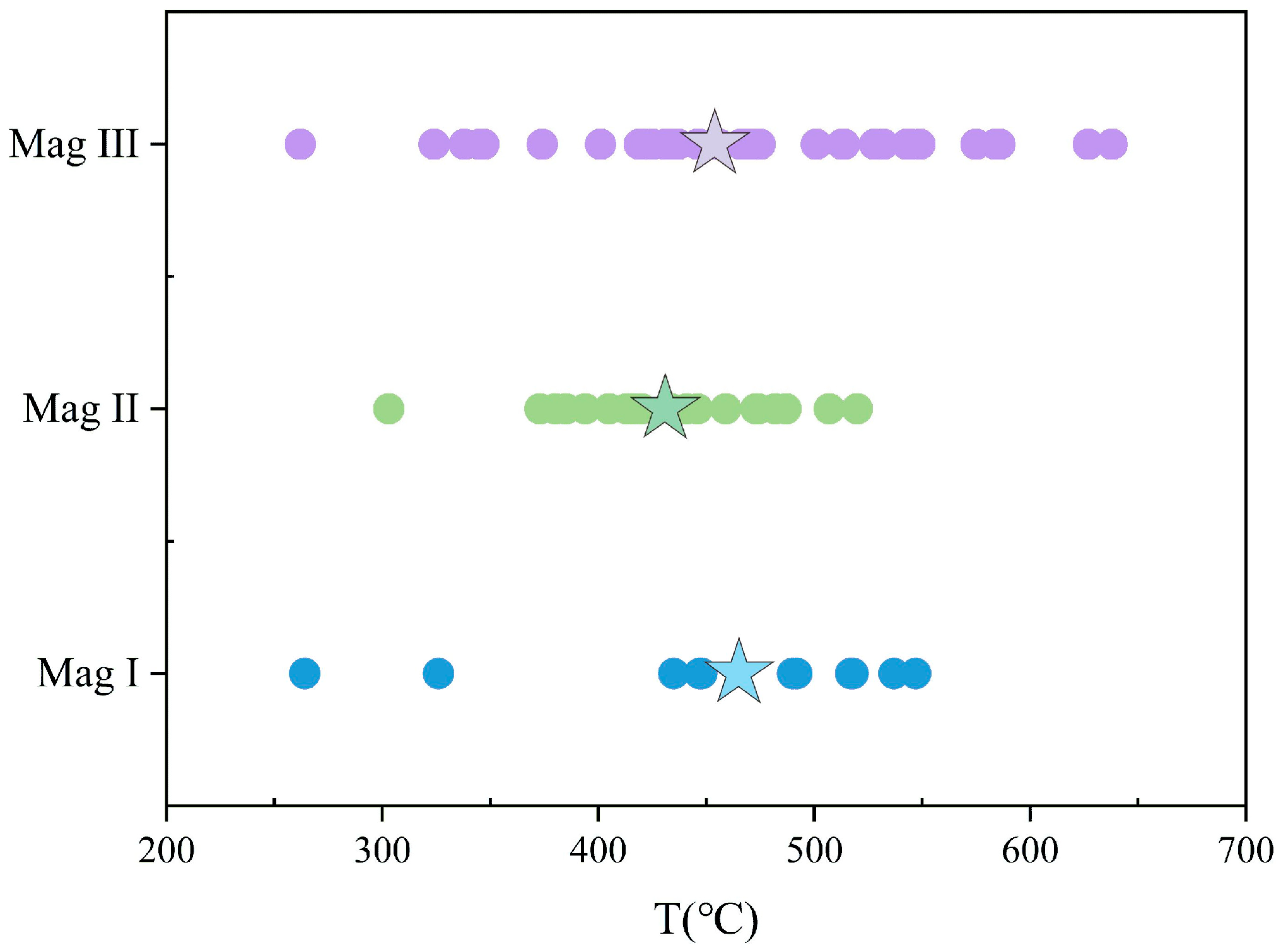
Through empirical formula calculation, the median value of the Heshangqiao magnetite T Mag I is found to be 465 °C, T Mag II is 431 °C, and T Mag III is 454 °C (Figure 7), which is basically consistent with the previous calculations of the deposits in this area [47].

5. Discussion

5.1. Genesis of Magnetite

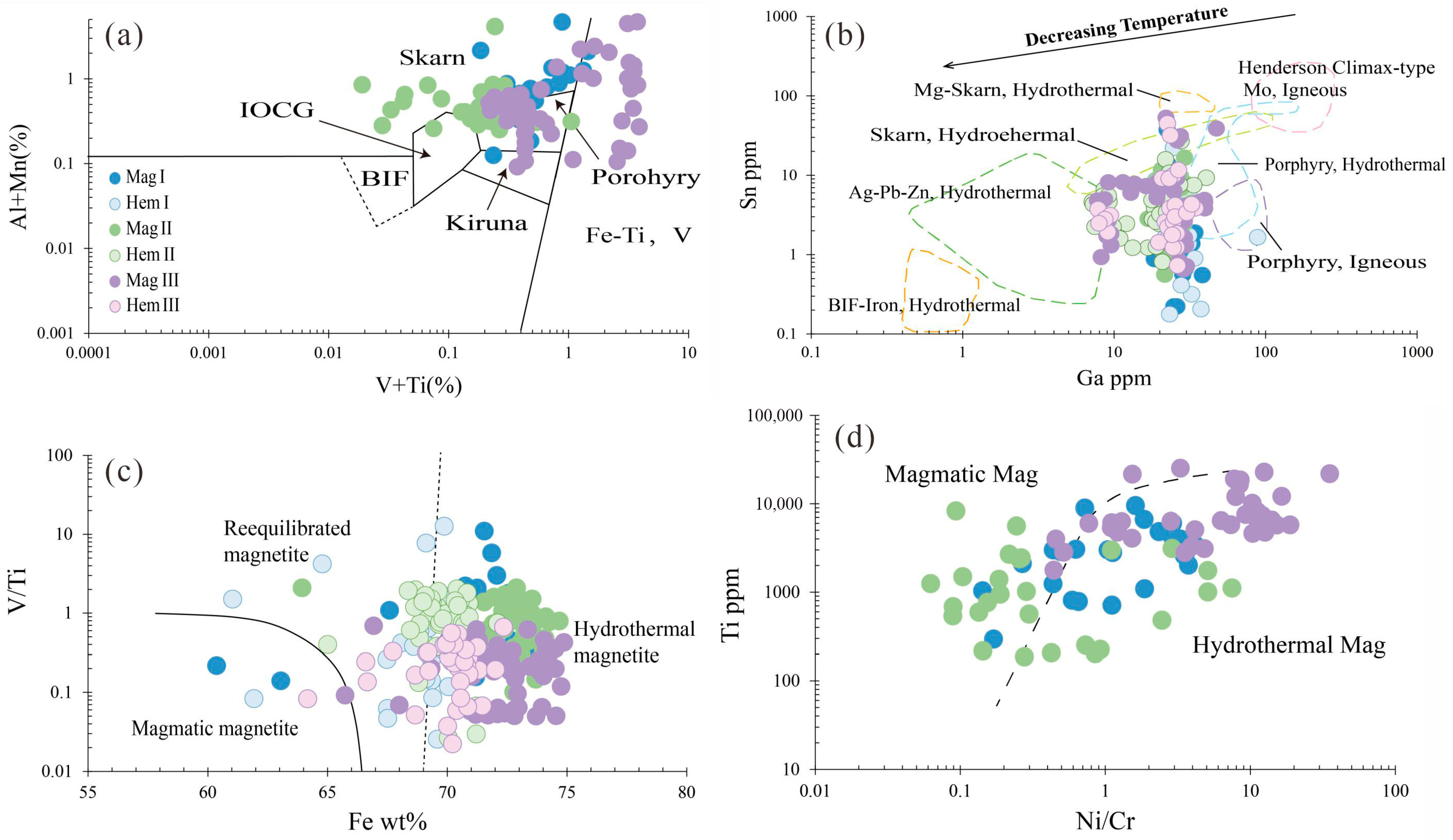
The trace elements of magnetite serve as significant geological indicators, providing insights into the genesis and mineralization conditions of ore deposits, and they are also valuable tools for exploration [1,32,48,49,50,51,52,53,54]. For magnetite genesis, in Figure 8a, almost all magnetite from the Heshangqiao deposit is plotted into the skarn genesis area, which contains more Al + Mn content than the Kiruna genesis (IOA deposit) [31]. In Figure 8b, all magnetite is distributed in the skarn and hydrothermal genesis area. Additionally, magnetite is highly susceptible to dissolution, migration, and re-enrichment under the influence of melt or hydrothermal/fluid conditions. Wen et al. [55] proposed a discriminant diagram based on Fe and V/Ti to differentiate these changes in the magnetite. In this discrimination diagram (Figure 8c), magnetite from all three mineralization stages falls in the hydrothermal area. This indicates a magmatic–hydrothermal genesis of magnetite from the Heshangqiao deposit, consistent with previous studies [28,39]. However, in the Ti-Ni/Cr magnetite genesis discrimination diagram (Figure 8d), some magnetite from the breccia ores is plotted in the magmatic genesis, which would be caused by the magmatic–hydrothermal fluid being resupplied [39]. Hence, the Heshangqiao deposit has hydrothermal genesis and shares similar characteristics with other types of hydrothermal deposits in the region [12,26,39,47].
The elemental composition of magnetite could reflect its geological and physicochemical characteristics. Nadoll et al. [31] suggested a comparative diagram illustrating the magnetite content associated with different genetic types in the Ga-Sn diagram, which also implies magnetite precipitation temperature (Figure 8b). In this figure, the magnetite shows a similar precipitation temperature. Based on empirical formula calculations, the formation temperatures of magnetite from the mineralization stages of the Heshangqiao deposit are relatively consistent. However, the temperature in Mag II is slightly lower than in Mag I and Mag III, showing an overall U-shaped change trend (Figure 7). This data further indicated that each mineralization stage is closely related, but that independent mineralization processes have taken place.
It is worth noting that, from Mag I to Mag III, the Ni/Cr ratios initially decrease and then increase; however, the temperature variation during mineralization is not significant (Figure 8d). On the other hand, there are distinct phases in the ore-forming fluids, indicating that fluid replenishment takes place during intervals between different stages of ore formation.

5.2. Genesis of Hematite

Hematite is widely found in hydrothermal deposits, and its trace-element composition is primarily influenced by factors such as temperature, pressure, fluid composition, oxygen fugacity, the types of associated minerals, and alteration processes [56,57,58,59]. The trace elements of hematite are often employed to infer the composition, temperature, oxygen fugacity, and other environmental parameters of ore-forming fluids [56,59].
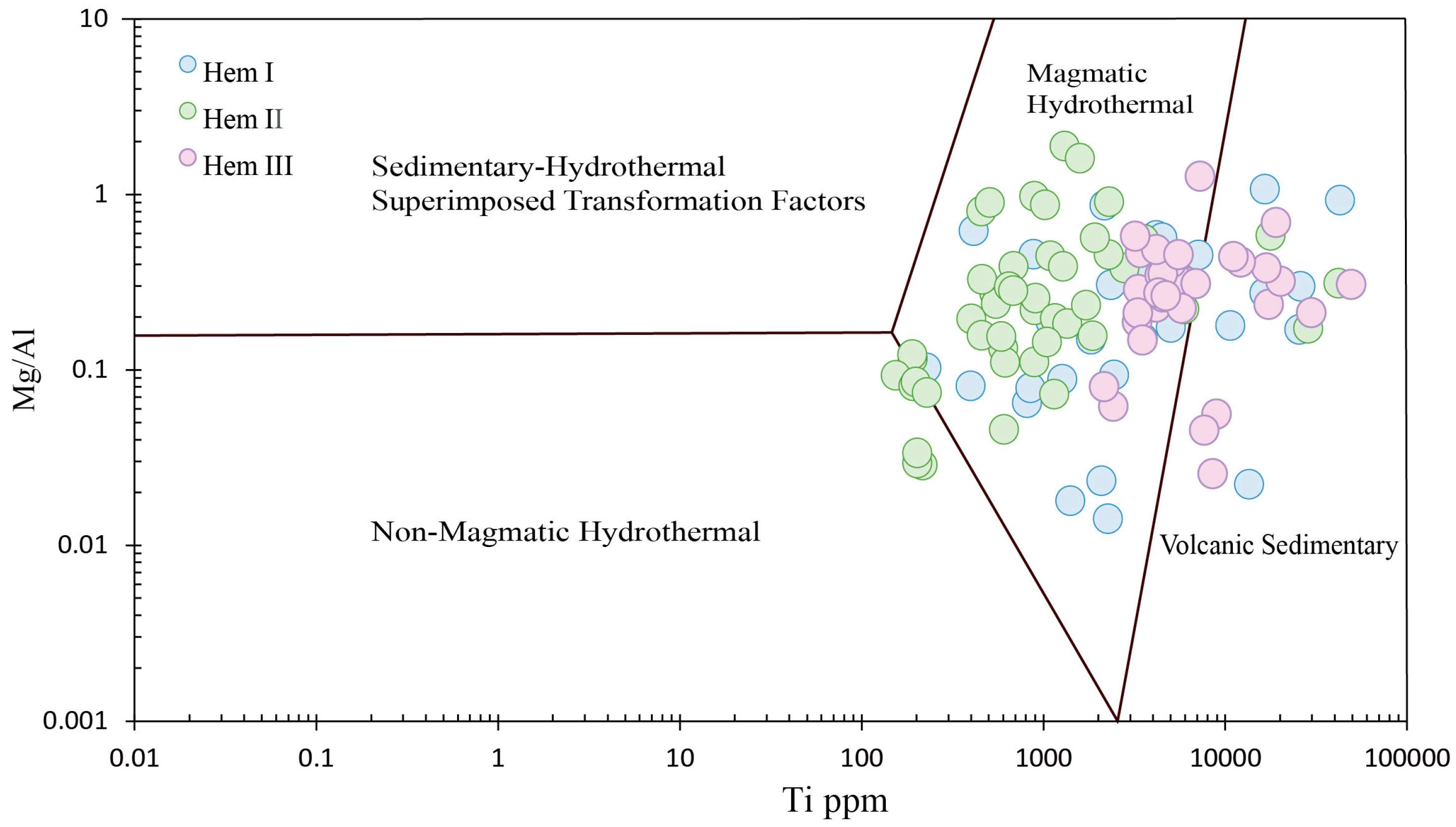
Dong [34] summarized different genesis types of hematite from the Middle–Lower Yangtze River Metallogenic Belt, and established a diagram to distinguish the genesis of hematite based on Ti contents and Mg/Al ratios. In this discriminant diagram, the hematite from the Heshangqiao deposit was almost plotted in the magmatic hydrothermal genesis area, with minor occurrences in the volcanic sedimentary genesis area. In addition, volcanic sedimentary hematite exhibits a relatively low Mg/Al ratio and a comparatively high Ti content. The sedimentary superimposed modified hematite is characterized by a relatively high Mg/Al ratio and lower Ti content. The Ti content of the magmatic hydrothermal hematite falls between that of volcanic sedimentary hematite and sedimentary superimposed modified hematite, while its Mg/Al ratio remains relatively low [34]. The hematite from Heshangqiao exhibits characteristics consistent with magmatic hydrothermal hematite (Figure 9), displaying a relatively low Mg/Al ratio. The Ti content is primarily influenced by temperature, resulting in a comparatively high Ti content in the hematite. Consequently, the Ti and Mg/Al diagrams serve as effective tools for distinguishing between different genesis types of hematite.
In addition, when comparing the Heshangqiao magnetite with hematite using the Fe-V/Ti diagram (Figure 8c), the V/Ti ratio of magnetite and hematite remains the same at each stage, suggesting a close genetic relationship between these two minerals. The increase in Fe content leads to the transition of hematite from the rebalancing area to the hydrothermal area. It indicates that hematite is formed from magnetite through metasomatism, which is consistent with the geological characteristics of the test sample. It is important to note that hematite is not formed through later hydrothermal modification; instead, hematite is formed by the residual fluid after magnetite precipitation in the same mineralization stage.

5.3. Implications for the Mineralization Processes

As mentioned above, trace elements of magnetite are influenced by various geological conditions, including the intensity of water–rock interactions, the composition of the hydrothermal fluid, and the crystallization processes of associated minerals [31]. Notably, both magnetite and hematite from the Heshangqiao deposit exhibit peak Al and Mg contents at Mag II (Hem III), which provides compelling evidence for the most pronounced water–rock reaction intensity occurring during the second mineralization episode.
V can efficiently enter the lattice structure of magnetite through cation exchange [36]. This geochemical characteristic makes it a key indicator element for differentiating hydrothermal mineralization from magmatic mineralization [31,60]. It is worth noting that the occurrence state of V in magnetite is closely related to the oxygen fugacity (fO2) of the precipitation environment—under high oxygen fugacity conditions, an increase in the Fe3+/Fe2+ ratio will significantly promote the reduction transformation of V5+ to V3+. Through Electron Probe/Trace element analysis, it was found that Mag I–Mag III (Hem I–Hem III) all showed significant enrichment characteristics of V-Ti elements (with an average V2O3 content of 0.19 wt% and TiO2 content of 0.9 wt%). Combined with the comprehensive judgment of the regional mineralization background [12,23,24,39], this indicates that this deposit has continuously maintained a relatively high oxidation state environment during the main mineralization stages. This stable high fO2 condition not only restricts the saturation sequence of metal sulfides but also provides the necessary physicochemical prerequisite for the subsequent replacement of hematite to magnetite.
In addition, the Heshangqiao deposit exhibits characteristics of independent evolution at each stage of mineralization. It is specifically manifested in the changes in trace elements in magnetite and hematite. For example, the contents of Sn and Cr showed a parabolic content change trend in Mag I–Mag III (Hem I–Hem III). On the other hand, V, Co, Ni and Mn showed a U-shaped content change trend in Mag I–Mag III. This content variation also exists in hematite. The inconsistent element content in each mineralization stage indicated the existence of fluid replenishment and the formation of new minerals. This also proved that each stage of the deposit evolved independently rather than continuously.
Variations in the hematite-to-magnetite ratio (Hem/Mag) can reflect the migration characteristics of elements during fluid metasomatism. The Hem/Mag ratio of Ti and Ni exhibited a significant increase to a higher value in the second stage. In contrast, the ratio decreased from the second to the third stage. These variations retained the characteristics of magnetite, indicating that the residual fluid, rather than the hydrothermal fluid of a later stage, had replaced the magnetite. A similar observation was made in the ratios of Al and Mn (Hem/Mag), which also indicate that the residual fluids after magnetite precipitation at each stage replace magnetite with hematite.
In addition, it is worth noting that the ratios (Hem/Mag) of Cr, Co, and Ga remained relatively stable across the three stages. These three stable elements possess the potential to serve as key determinants in understanding the genesis of iron oxides.

6. Conclusions

The Heshangqiao IOA deposit is a multi-stage magmatic–hydrothermal deposit. Its three mineralization stages formed independently, from disseminated ore to breccia ore to vein-type ore, rather than continuously. After magnetite precipitated during each mineralization stage, hematite formed, replacing magnetite and being generated by residual fluids rather than subsequent fluid metasomatism. Cr, Co, and Ga are less migratory in this replacement, which could be valuable indicators of the genesis of iron oxide.

Supplementary Materials

The following supporting information can be downloaded at: https://www.mdpi.com/article/10.3390/min16010007/s1, Table S1. Electron probe major element analysis data (EPMA) of magnetite in the Heshangqiao deposit (wt%); Table S2. Analysis of trace element (LA-ICP-MS) of magnetite in Heshangqiao deposit (ppm); Table S3. Electron probe major element analysis data (EPMA) of hematite in Heshangqiao deposit (wt%); Table S4. Analysis of trace element (LA-ICP-MS) of hematite in Heshangqiao deposit (ppm).

Author Contributions

Conceptualization, C.D.; Investigation, Y.H., C.D., K.H., Z.K., S.Y., C.W., B.Y., X.Y. and X.C.; Data curation, Y.H., J.Z. and X.G.; Writing—original draft, Y.H.; Writing—review & editing, C.D., Y.H., K.H., Z.K. and S.Y.; Supervision, C.D. and K.H. All authors have read and agreed to the published version of the manuscript.

Funding

This research was funded by the National Natural Science Foundation of China [grant number 42172102] and the National Key Research and Development Program of China [grant number 2022YFC2903703].

Data Availability Statement

The original contributions presented in this study are included in the article. Further inquiries can be directed to the corresponding authors.

Acknowledgments

We are grateful to Xiaodan Chen, Yuwei She, and Ze Liu for providing experimental instruments and technical support on EPMA and LA-ICP-MS analysis. We thank Xiang Qian and Lei Bao from the 321 Geological Brigade of the Anhui Bureau of Geology and Mineral Exploration for their invaluable assistance during the fieldwork. We also thank Maria Economou-Eliopoulos and another anonymous reviewer for their helpful suggestions and comments for improving this manuscript.

Conflicts of Interest

Authors Conglin Wang and Bingyang Yang were employed by the Nanshan Mine Company. The remaining authors declare that the research was conducted in the absence of any commercial or financial relationships that could be construed as a potential conflict of interest.

References

  1. Palma, G.; Barra, F.; Reich, M.; Simon, A.C.; Romero, R. A review of magnetite geochemistry of Chilean iron oxide-apatite (IOA) deposits and its implications for ore-forming processes. Ore Geol. Rev. 2020, 126, 103748. [Google Scholar] [CrossRef]
  2. Reich, M.; Simon, A.C.; Barra, F.; Palma, G.; Hou, T.; Bilenker, L.D. Formation of iron oxide-apatite deposits. Nat. Rev. Earth Environ. 2022, 3, 758–775. [Google Scholar] [CrossRef]
  3. Tornos, F.; Hanchar, J.M.; Steele-MacInnis, M.; Crespo, E.; Kamenetsky, V.S.; Casquet, C. Formation of magnetite- (apatite) systems by crystallizing ultrabasic iron-rich melts and slag separation. Miner. Depos. 2024, 59, 189–225. [Google Scholar] [CrossRef]
  4. Bain, W.M.; Steele-macinnis, M.; Tornos, F.; Hanchar, J.M.; Creaser, E.C.; Pietruszka, D.K. Evidence for iron-rich sulfate melt during magnetite (-apatite) mineralization at El Laco, Chile. Geology 2021, 49, 1044–1048. [Google Scholar] [CrossRef]
  5. Pietruszka, D.K.; Hanchar, J.M.; Tornos, F.; Wirth, R.; Graham, N.A.; Severin, K.P.; Velasco, F.; Steele-Maclnnis, M.; Bain, W.M. Magmatic immiscibility and the origin of magnetite-(apatite) iron deposits. Nat. Commun. 2023, 14, 8424. [Google Scholar] [CrossRef]
  6. Martinsson, O.; Billström, K.; Broman, C.; Weihed, P.; Wanhainen, C. Metallogeny of the Northern Norrbotten Ore Province, northern Fennoscandian Shield with emphasis on IOCG and apatite-iron ore deposits. Ore Geol. Rev. 2016, 78, 447–492. [Google Scholar] [CrossRef]
  7. Rojas, P.A.; Barra, F.; Deditius, A.; Reich, M.; Simon, A.C.; Roberts, M.; Rojo, M. New contributions to the understanding of Kiruna-type iron oxide-apatite deposits revealed by magnetite ore and gangue mineral geochemistry at the El Romeral deposit, Chile. Ore Geol. Rev. 2018, 93, 413–435. [Google Scholar] [CrossRef]
  8. Coble, M.A.; Mahood, G.A. Geology of the High Rock caldera complex, northwest Nevada, and implications for intense rhyolitic volcanism associated with flood basalt magmatism and the initiation of the Snake River Plain-Yellowstone trend. Geosphere 2015, 12, 58–113. [Google Scholar] [CrossRef]
  9. Bain, W.M.; Steele-Macinnis, M.; Li, K.; Li, L.; Mazdab, F.K.; Marsh, E.E. A fundamental role of carbonate–sulfate melts in the formation of iron oxide–apatite deposits. Nat. Geosci. 2020, 13, 751–757. [Google Scholar] [CrossRef]
  10. Mao, J.W.; Xie, G.Q.; Duan, C.; Pirajno, F.; Ishiyama, D.; Chen, Y.C. A tectono–genetic model for porphyry–skarn–stratabound Cu–Au–Mo–Fe and magnetite–apatite deposits along the middle-lower Yangtze River Valley, Eastern China. Ore Geol. Rev. 2011, 43, 294–314. [Google Scholar] [CrossRef]
  11. Zhou, T.F.; Fan, Y.; Yuan, F.; Zhong, G.X. Progress of geological study in the Middle-Lower Yangtze River Valley metallogenic belt. Acta Petrol. Sin. 2012, 28, 3051–3066, (In Chinese with English abstract). [Google Scholar]
  12. Duan, C.; Li, Y.H.; Mao, J.W.; Zhu, Q.Q.; Xie, G.Q.; Wan, Q.; Jian, W.; Hou, K.J. The role of evaporite layers in the ore-forming processes of iron oxide-apatite and skarn Fe deposits: Examples from the middle-lower Yangtze River metallogenic Belt, East China. Ore Geol. Rev. 2021, 138, 104352. [Google Scholar] [CrossRef]
  13. Corriveau, L.; Montreuil, J.F.; Potter, E.G. Alteration facies linkages among iron oxide copper-gold, iron oxide-apatite, and affiliated deposits in the Great Bear Magmatic Zone, Northwest Territories, Canada. Econ. Geol. 2016, 111, 2045–2072. [Google Scholar] [CrossRef]
  14. Levresse, G.; Tornos, F.; Velasco, F.; Corona-Esquivel, R. Subaerial explosive deposition of magnetite-apatite mineralization: The Artillero deposit, Peña Colorada district, Colima, Mexico. Ore Geol. Rev. 2020, 126, 103736. [Google Scholar] [CrossRef]
  15. Sepidbar, F.; Ghorbani, G.; Simon, A.C.; Ma, J.L.; Palin, R.M.; Homam, S.M. Formation of the Chah-Gaz iron oxide-apatite ore (IOA) deposit, Bafq District, Iran: Constraints from halogens, trace element concentrations, and Sr-Nd isotopes of fluorapatite. Ore Geol. Rev. 2022, 140, 104599. [Google Scholar] [CrossRef]
  16. Dare, S.A.S.; Barnes, S.; Beaudoin, G. Did the massive magnetite “lava flows” of El Laco (Chile) form by magmatic or hydrothermal processes? New constraints from magnetite composition by LA-ICP-MS. Miner. Depos. 2015, 50, 607–617. [Google Scholar] [CrossRef]
  17. Tornos, F.; Velasco, F.; Hanchar, J.M. Iron-rich melts, magmatic magnetite, and superheated hydrothermal systems: The El laco deposit, Chile. Geology 2016, 44, 427–430. [Google Scholar] [CrossRef]
  18. Tornos, F.; Velasco, F.; Hanchar, J.M. The magmatic to magmatic-hydrothermal evolution of the El Laco deposit (Chile) and its implications for the genesis of magnetite–apatite deposits. Econ. Geol. 2017, 112, 1595–1628. [Google Scholar] [CrossRef]
  19. Knipping, J.L.; Bilenker, L.D.; Simon, A.C.; Reich, M.; Barra, F.; Deditius, A.P.; Wälle, M.; Heinrich, C.A.; Holtz, F.; Munizaga, R. Trace elements in magnetite from massive iron oxide-apatite deposits indicate a combined formation by igneous and magmatic-hydrothermal processes. Geochim. Cosmochim. Acta 2015, 171, 15–38. [Google Scholar] [CrossRef]
  20. Li, W.; Audétat, A.; Zhang, J. The role of evaporites in the formation of magnetite–apatite deposits along the Middle and Lower Yangtze River, China: Evidence from LA–ICP–MS analysis of fluid inclusions. Ore Geol. Rev. 2015, 67, 264–278. [Google Scholar] [CrossRef]
  21. Hofstra, A.H.; Meighan, C.J.; Song, X.Y.; Samson, L.; Marsh, E.E.; Lowers, H.A.; Emsbo, P.; Hunt, A.G. Mineral thermometry and fluid inclusion studies of the Pea Ridge iron oxide–apatite–rare earth element deposit, Mesoproterozoic St. Francois Mountains terrane, Southeast Missouri, USA. Econ. Geol. 2016, 111, 1985–2016. [Google Scholar] [CrossRef]
  22. Cofré, E.; Reich, M.; Ovalle, J.T.; Palma, G.; Barra, F.; Deditius, A.; Simon, A.C.; Roberts, M.; Jicha, B.R. Origin of Volcanic-Hosted magnetite at the Laguna Del Maule Complex, Chile: A new example of Andean iron oxide-apatite mineralization. Econ. Geol. 2024, 199, 1393–1411. [Google Scholar] [CrossRef]
  23. Li, Y.H.; Xie, G.Q.; Duan, C.; Han, D.; Wang, C.Y. Effect of sulfate evaporate salt layer over the formation of skarn-type iron ores. Acta Geol. Sci. 2013, 87, 1324–1334, (In Chinese with English abstract). [Google Scholar] [CrossRef]
  24. Li, Y.H.; Duan, C.; Han, D.; Chen, X.W.; Wang, C.L.; Yang, B.Y.; Zhang, C.; Liu, F. Effect of sulfate evaporate salt layer for formation of porphyrite iron ores in the Middle-Lower Yangtze River area. Acta Petrol. Sin. 2014, 30, 1355–1368, (In Chinese with English abstract). [Google Scholar]
  25. Xu, X.Y.; Bain, W.M.; Tornos, F.; Hanchar, J.M.; Lamadrid, H.M.; Lehmann, B.; Xu, X.C.; Steadman, J.A.; Bottrill, R.S.; Soleymani, M.; et al. Magnetite-apatite ores record widespread involvement of molten salts. Geology 2024, 52, 417–422. [Google Scholar] [CrossRef]
  26. Zhao, X.F.; Zeng, L.P.; Liao, W.; Fan, Y.Z.; Hofstra, A.H.; Emsbo, E.; Hu, H.; Wen, G.; Li, J.W. Iron oxide-apatite deposits form from hydrosaline liquids exsolved from subvolcanic intrusions. Miner. Depos. 2024, 59, 655–669. [Google Scholar] [CrossRef]
  27. Zeng, L.P.; Spandler, C.; Liu, Y.Y.; Hammerli, J.; Liao, W.; Hu, H.; Olsson, S.; Zhang, D.X.; He, T.; Li, J.W.; et al. The role of evaporites in Kiruna-type iron oxide-apatite deposits in the Northern Norrbotten region, Sweden: Evidence from in situ halogen analyses of scapolite. Chem. Geol. 2025, 694, 123009. [Google Scholar] [CrossRef]
  28. Duan, C.; Li, Y.H.; Mao, J.W.; Wang, C.L.; Yang, B.Y.; Hou, K.J.; Wang, Q.; Li, W. Study on the ore-forming process of the Heshangqiao IOA deposit in the Ningwu ore district: Insight from magnetite LA-ICP-MS in-situ analysis data. Acta Petrol. Sin. 2017, 33, 3471–3483, (In Chinese with English abstract). [Google Scholar]
  29. Yuan, S.D.; Hou, K.J.; Liu, M. Timing of mineralization and geodynamic framework of iron-oxide-apatite deposits in Ningwu Cretaceous basin in the Middle-Lower Reaches of the Yangtze River, China Conatraints form Ar-Ar dating on phlogopites. Acta Petrol. Sin. 2010, 26, 797–808, (In Chinese with English abstract). [Google Scholar]
  30. Yu, J.J.; Chen, Y.C.; Mao, J.W.; Pirajno, F.; Duan, C. Review of geology, alteration and origin of iron oxide-apatite deposit in the Cretaceous Ningwu basin, Lower Yangtze River Valley, eastern China: Implications for ore genesis and geodynamic setting. Ore Geol. Rev. 2011, 43, 170–181. [Google Scholar] [CrossRef]
  31. Nadoll, P.; Thomas, A.; Jeffrey, L.M.; David, F.; John, W. The chemistry of hydrothermal magnetite: A review. Ore Geol. Rev. 2014, 61, 1–32. [Google Scholar] [CrossRef]
  32. Dare, S.A.S.; Barnes, S.J.; Beaudoin, G.; Méric, J.; Boutroy, E.; Potvin-Doucet, C. Trace elements in magnetite as petrogenetic indicators. Miner. Depos. 2014, 49, 785–796. [Google Scholar] [CrossRef]
  33. Huang, X.W.; Qi, L.; Meng, Y.M. Trace element geochemistry of magnetite from the Fe (-Cu) deposits in the Hami region, eastern Tianshan Orogenic Belt, NW China. Acta Geol. Sin. 2014, 88, 176–195. [Google Scholar] [CrossRef]
  34. Dong, H. Study on Mineralogical and Geochemical Characteristics of Different Genesis Types of Hematite in the Middle-Lower Yangtze River Valley Metallogenic Belt. Master’s Thesis, Hefei University of Technology, Hefei, China, 2018. (In Chinese with English abstract). [Google Scholar]
  35. Huang, X.W.; Boutroy, É.; Makvandi, S.; Beaudoin, G.; Corriveau, L.; De Toni, A.F. Trace element composition of iron oxides from IOCG and IOA deposits: Relationship to hydrothermal alteration and deposit subtypes. Miner. Depos. 2019, 54, 525–552. [Google Scholar] [CrossRef]
  36. Nederbo, J. Vanadium Partitioning Between Magnetite, Hematite, and a Hydrothermal Fluid: Implications for IOCG and IOA Deposits. Master’s Thesis, Northern Illionis University, DeKalb, IL, USA, 2023. [Google Scholar]
  37. Zhou, T.F.; Fan, Y.; Yuan, F.; Zhang, L.J.; Ma, L.; Qian, B.; Xie, J. Petrogensis and Metallogeny Study of Volcanic Basins in the Middle and Lower Yangtze Metallogenic Belt. Acta Geol. Sin. 2011, 85, 712–730, (In Chinese with English abstract). [Google Scholar]
  38. Zhang, M.M.; Zhou, T.F.; Yuan, F.; Li, X.H.; Li, X.Y.; Jia, C. Reserves Estimation of Porphyry Iron Deposit in the Middle-Lower Reaches of Yangtze River Area, China. Acta Geol. Sin. 2011, 85, 1215–1222, (In Chinese with English abstract). [Google Scholar]
  39. Duan, C.; Li, Y.H.; Mao, J.W.; Hou, K.J.; Wang, C.L.; Yang, B.Y.; Wang, Q.; Li, W. Ore formation at the Washan iron oxide–apatite deposit in the Ningwu Ore District, eastern China: Insights from in situ LA-ICP-MS magnetite trace element geochemistry. Ore Geol. Rev. 2019, 112, 103064. [Google Scholar] [CrossRef]
  40. Zhao, X.F.; Zeng, L.P.; Liao, W.; Li, W.T.; Hu, H.; Li, J.W. An overview of recent advances in porphyrite iron (iron oxide-apatite, IOA) deposits in the Middle-Lower Yangtze River Valley Metallogenic Belt and its implication for ore genesis. Earth Sci. Front. 2020, 27, 197–217, (In Chinese with English abstract). [Google Scholar] [CrossRef]
  41. Ningwu Research Group. Magnetite Porphyry Deposits in Ningwu Area; Geological Publishing House: Beijing, China, 1978; pp. 1–196. (In Chinese) [Google Scholar]
  42. Mao, J.W.; Duan, C.; Liu, J.L.; Zhang, C. Metallogeny and corresponding mineral deposit model of the Cretaceous terrestrial volcanic-intrusive rocks-related polymetallic iron deposits in Middle-Lower Yangtze River Valley. Acta Petrol. Sin. 2012, 28, 1–14, (In Chinese with English abstract). [Google Scholar]
  43. Duan, C.; Li, Y.H.; Mao, J.W.; Wan, Q.; He, S.; Wang, C.L.; Yang, B.Y.; Hou, K.J. Zircon u–pb ages, hf-o isotopes and trace elements of the multi-volcanism in the Ningwu ore district, eastern China: Implications for the magma evolution and fertility of iron oxide–apatite (IOA) deposits. Gondwana Res. 2023, 116, 149–167. [Google Scholar] [CrossRef]
  44. Duan, C.; Li, Y.H.; Mao, J.W.; Hou, K.J.; Yuan, S.D. Zircon trace element characteristics of intrusions in the Washan iron deposit of Ningwu volcanic basin and their geological significance. China Geol. 2012, 39, 1874–1884, (In Chinese with English abstract). [Google Scholar]
  45. Liu, Y.S.; Hu, Z.C.; Gao, S.; Günther, D.; Xu, J.; Gao, C.G.; Chen, H.H. In situ analysis of major and trace elements of anhydrous minerals by LA-ICP-MS without applying an internal standard. Chem. Geol. 2008, 257, 34–43. [Google Scholar] [CrossRef]
  46. Canil, D.; Lacourse, T. Geothermometry using minor and trace elements in igneous and hydrothermal magnetite. Chem. Geol. 2020, 541, 119576. [Google Scholar] [CrossRef]
  47. Qian, X.; Hou, T.; Wang, X.D.; Qin, J.Y.; Wang, S.J.; Yang, B.W.; Yu, Y.Y. Genesis of magnetite in volcanic-hosted iron ores of Zhonggu ore field in Ningwu Basin and its geological significance. Miner. Depos. 2025, 44, 969–982. [Google Scholar] [CrossRef]
  48. Dupuis, C.; Beaudoin, G. Discriminant diagrams for iron oxide trace element fingerprinting of mineral deposit types. Miner. Depos. 2011, 46, 319–335. [Google Scholar] [CrossRef]
  49. Nadoll, P.; Mauk, J.L.; Hayes, T.S.; Koenig, A.E.; Box, S.E. Geochemistry of magnetite from hydrothermal ore deposits and host rocks of the Mesoproterozoic Belt Supergroup, United States. Econ. Geol. 2012, 107, 1275–1292. [Google Scholar] [CrossRef]
  50. Broughm, S.G.; Hanchar, J.M.; Tornos, F.; Westhues, A.; Attersley, S. Mineral chemistry of magnetite from magnetite-apatite mineralization and their host rocks: Examples from Kiruna, Sweden, and El Laco, Chile. Miner. Depos. 2017, 52, 1223–1244. [Google Scholar] [CrossRef]
  51. Adak, S.; Pal, D.C. Texture and geochemistry of magnetite in banded magnetite quartzite from Turamdih and Mohuldih, Singhbhum Shear Zone, eastern India: Implications for their origin. J. Earth Syst. Sci. 2025, 134, 120. [Google Scholar] [CrossRef]
  52. Lindsley, D.H. Experimen staudies of oxide minerals. Rev. Mineral. Geochem. 1991, 25, 69–106. [Google Scholar]
  53. Rapp, J.F.; Klemme, S.; Butler, I.B.; Harley, S.L. Extremely high solubility of rutile in chloride and fluoride: An experimental investigation. Geology 2010, 38, 323–326. [Google Scholar] [CrossRef]
  54. Hu, H.; Lentz, D.; Li, J.; McCarron, T.; Zhao, X.; Hall, D. Reequilibration processes in magnetite from iron skarn deposits. Econ. Geol. 2015, 110, 1–8. [Google Scholar] [CrossRef]
  55. Wen, G.; Li, J.W.; Hofstra, A.H.; Koenig, A.E.; Lowers, H.A.; Adams, D. Hydrothermal reequilibration of igneous magnetite in altered granitic plutons and its implications for magnetite classification schemes: Insights from the handan-xingtai iron district, north china craton. Geochim. Cosmochim. Acta 2017, 213, 255–270. [Google Scholar] [CrossRef]
  56. Keyser, W.; Ciobanu, C.L.; Cook, N.J.; Dmitrijeva, M.; Courtney-Davies, L.; Feltus, H.; Gilbert, S.; Johnson, G.; Ehrig, K. Iron-oxides constrain BIF evolution in terranes with protracted geological histories: The Iron Count prospect, Middleback Ranges, South Australia. Lithos 2019, 324–325, 20–38. [Google Scholar] [CrossRef]
  57. Huang, X.W.; Zhou, M.F.; Qiu, Y.Z.; Qi, L. In-situ LA-ICP-MS trace elemental analyses of magnetite: The Bayan Obo Fe-REE-Nb deposit, North China. Ore Geol. Rev. 2015, 65, 884–899. [Google Scholar] [CrossRef]
  58. Huang, X.W.; Gao, J.F.; Qi, L.; Meng, Y.C.; Dai, Z.H. In-situ LA–ICP–MS trace elements analysis of magnetite: The Fenghuangshan Cu–Fe–Au deposit, Tongling, Eastern China. Ore Geol. Rev. 2016, 72, 746–759. [Google Scholar] [CrossRef]
  59. Keyser, W.; Ciobanu, L.C.; Cook, N.J.; Johnson, G.; Feltus, H.; Johnson, S.; Dmitrijeva, M.; Ehrig, K.; Nguyen, P.T. Petrography and trace element signatures of iron-oxides in deposits from the Middleback Ranges, South Australia: From banded iron formation to ore. Ore Geol. Rev. 2018, 93, 337–360. [Google Scholar] [CrossRef]
  60. Toplis, M.J.; Corgne, A. An experimental study of element partitioning between magnetite, clinopyroxene and iron-bearing silicate liquids with particular emphasis on vanadium. Contrib. Mineral. Petrol. 2002, 144, 22–37. [Google Scholar] [CrossRef]
Figure 1. Geological map of the Ningwu ore district (after the Ningwu Research Group [41]).
Minerals 16 00007 g001
Figure 2. Cross-section of the No. 25 line in the Heshangqiao deposit (after Duan et al. [28]).
Minerals 16 00007 g002
Figure 3. Paragenetic sequence of mineralization and alteration minerals in the Heshangqiao deposit.
Minerals 16 00007 g003
Figure 4. Photomicrographs of magnetite in the Heshangqiao deposit at different stages of mineralization (ac)—disseminated ores; (df)—breccia ores; (gi)—vein-type ores. Mag—magnetite; Hem—hematite; Py—pyrite.
Minerals 16 00007 g004
Figure 5. Geochemistry of magnetite and hematite from three stages of the Heshangqiao deposit (ac) Al vs. Mg; (df) Ca vs. Mn.
Minerals 16 00007 g005
Figure 6. Geochemistry of magnetite–hematite from three stages of the Heshangqiao deposit (a–c) Co vs. Cr; (d–f) V vs. Ti; (g–i) Ga vs. Sn.
Minerals 16 00007 g006
Figure 7. EPMA analysis points and calculated crystallization temperature distribution of magnetite from the Heshangqiao deposit (the asterisks represent the median formation temperature of magnetite).
Minerals 16 00007 g007
Figure 8. Discrimination diagrams of magnetite. (a) Ti + V vs. Al + Mn magnetite discrimination diagram (after Nadoll et al. [31]); (b) Ga vs. Sn diagram (after Nadoll et al. [31]); (c) Fe vs. V/Ti diagram (after Wen et al. [55]); (d) Ti vs. Ni/Cr diagram (after Knipping et al. [19]).
Minerals 16 00007 g008
Figure 9. Scheme of genetic classification of trace elements of hematite in Heshangqiao deposit (reference fields from Dong [34]).
Minerals 16 00007 g009
Disclaimer/Publisher’s Note: The statements, opinions and data contained in all publications are solely those of the individual author(s) and contributor(s) and not of MDPI and/or the editor(s). MDPI and/or the editor(s) disclaim responsibility for any injury to people or property resulting from any ideas, methods, instructions or products referred to in the content.