Abstract
Some mining sites generate acid mine drainage (AMD)—a highly acidic, metal-rich waste stream that affects bodies of water. Passive treatment systems are widely being adapted, particularly for abandoned or closed mines, due to their cost-effectiveness and lower environmental impact. However, novel strategies and approaches still need to be developed, especially in their implementation. Through batch experiments, this study identifies the effective sequence of three locally available treatment media, namely limestone (LS), steel slag (SS), and activated carbon (AC), using various water quality and pollution indices (WQPIs). The performance of the sequences was assessed based on their ability to improve various in situ parameters (pH, oxidation–reduction potential (ORP), dissolved oxygen (DO), and electrical conductivity (EC)) and their efficiency in removing Fe, Mn, Cu, and SO42−. Six sequences of media were identified and ranked by calculating a score based on comparisons with the Philippine General Effluent Standard (GES) by normalization and specific WQPIs for AMD and AMD-impacted waters, such as the CCMEWQI, MAMDI, and WPI-AMD. Analysis showed that the sequence of LS-AC-SS and SS-LS-AC yielded the highest removal for heavy metals (98.78% for Fe and Mn and 89.92% for Cu). However, limited removal of SO42− was observed (14.96%), which suggests that additional treatment beyond the materials explored must be considered. Considering all the parameters and assessing them through normalization and WQPIs, the sequence of SS-LS-AC achieved the overall best treatment performance. Differences were observed in the ranking between the methods, with WQPIs successfully capturing actual water quality, demonstrating its robustness as an assessment tool. This study shows that the treatment media sequence is a factor in treating AMD, specifically utilizing AC, SS, and LS.
1. Introduction
Considered an issue second only to global warming, the occurrence of acid mine drainage (AMD) is an environmental problem that plagues the mining industry [1]. It is caused by the exposure of sulfidic ores to the atmosphere and is often characterized by low pH and elevated concentrations of heavy metals and sulfates, threatening biodiversity in land and aquatic systems [1,2,3,4]. Demand for low-carbon technology is increasing to achieve carbon neutrality by 2050, requiring increased consumption and mining of minerals and metals, such as copper (Cu), manganese (Mn), and rare earth elements (REEs), to accommodate and achieve this goal [5,6,7]. Thus, intensified occurrence of AMD is expected to be observed, which requires intervention.
Strategies for treating AMD typically involve neutralization. Numerous studies have attempted to assess the viability of various treatment media to generate alkalinity and remove dissolved metals [8,9,10]. Among these materials, limestone (LS) is widely used due to its availability, cost, and proven effectiveness [1,8,10,11,12,13]. However, this medium may be unfavorable when used independently due to armoring upon contact with ferric iron (Fe3+), which decreases its dissolution rate [13,14]. In turn, this prevents LS from generating alkalinity to treat AMD. Given its limitations as a single medium, its use in combination with other treatment media has been explored.
Process trains have been a strategy for water treatment. In principle, they consist of a sequential arrangement of treatment stages or units that work together to achieve a specific treatment goal. For AMD, a series of constructed wetlands, limestone leach beds, and other passive treatment methods have been conceptualized to maximize the removal of target pollutants [14,15,16]. Although this has been shown to be an effective strategy, the focus on using individual treatment media, optimizing their use, and identifying their effective sequence has been limited [9,10]. This will be crucial in developing compact passive treatment strategies such as permeable reactive barriers (PRBs), which take advantage of the complementary treatment capability of each media [17,18,19,20,21].
One material of interest aside from LS is steel slag (SS), which is a waste product of industrial steelmaking process. Given the ubiquity of steel usage across various industries, the surplus of SS poses a major challenge to solid waste management, as it is stockpiled in large areas and can potentially leach out pollutants into the surrounding bodies of land and water [22,23,24]. Consequently, methods to repurpose SS have been widely explored, including its potential as a medium for wastewater treatment [23,25], specifically AMD [26,27,28]. Previous works [27,29,30,31] suggest that due to its neutralization and adsorption capabilities, SS can act as an effective substrate in the treatment of AMD. However, its efficiency may be further improved if it is used in conjunction with other treatment media. Activated carbon (AC) has been utilized for different treatment applications; it acts as an absorption medium that can minimize heavy metal and sulfate levels in AMD [32,33]. However, its application for AMD is limited, particularly for target pollutants that are challenging to remove, such as Mn and SO42− [32,34,35,36]. Provided that LS, SS, and AC have been studied individually for AMD treatment, using them in sequence and proving their effectiveness can provide additional valorization pathways.
A more robust assessment of the water quality of effluents can be performed using environmental indices such as a water quality or pollution index (WQPI). By definition, it is a tool that is used to aggregate an extensive number of quantitative and qualitative parameters into a single value or index [37]. This provides ease of interpretation for assessment of water quality. Over the years, several indices have been developed specifically for the assessment of AMD and AMD-impacted waters, namely the Canadian Council of Ministers of the Environment Water Quality Index (CCMEWQI) [38], the Modified AMD Index (MAMDI) [39], and the Water Pollution Index for AMD and AMD-impacted waters (WPI-AMD) [40], which consider a wide range of parameters and use different aggregation techniques. These WQPIs provide a quick overview of effluent quality through a single score. They also allow us to compare different treatment systems by assessing them through a systematic method that minimizes bias through preventing misleading conclusions that may arise when comparing individual parameters.
A method explored previously [9] identified the best performing sequences in treating AMD by comparing them with relevant effluent standards. However, a critique of this method is that it gives equal importance to all of the parameters. This can possibly eclipse or hide problematic parameters due to the process of aggregation [41,42]. For instance, a water sample that has a high concentration of sulfates but minimal dissolved metals may be rated as good-quality despite exceeding standards. Additionally, the normalization method does not provide any context regarding water quality, as it only ranks the scores relative to each identified sequence.
This study aims to assess the treatment capability of local LS, SS, and AC as treatment media for sequential AMD treatment and identify their most effective arrangement using various WQPIs. Each combination will be assessed in terms of improving various in situ parameters, namely pH, dissolved oxygen (DO), electrical conductivity (EC), and oxidation–reduction potential (ORP), as well as the removal of Fe, Mn, Cu, and SO42−, through normalization and through the use of WQPIs, specifically CCMEWQI, MAMDI, and WPI-AMD. These WQPIs were selected as they were developed specifically for application in AMD and AMD-impacted waters.
The paper is divided into four main sections. Section 2 outlines the materials and methods used for material characterization, simulated AMD preparation, and performance assessment of each media sequence. The section also outlines the WQPIs that are used to compare with aggregation via normalization, as used by Turingan et al. [9], specifically CCMEWQI, MAMDI, and Modified WPI-AMD. Section 3 discusses the results and performance of the media sequences, including the comparison of rankings using normalization and WQPIs. Lastly, Section 4 discusses the conclusions and suggests future work for the sequential treatment of AMD using LS, SS, and AC.
2. Materials and Methods
The methodology used in this study is mainly based on a previous study by Turingan et al. (2022) [9]. However, modifications were made to include performance assessment of each sequence using WQPIs, namely CCMEWQI, MAMDI, and WPI-AMD. These indices were selected as they are used for AMD and AMD-impacted waters, which this study tested. Several preparations were made, including material characterization and simulated AMD preparation. These are discussed accordingly in the following sections.
2.1. Media Characterization
The media used to treat AMD were characterized using X-ray Diffraction (XRD) (Shimadzu LabX XRD-6100, Shimadzu Corporation, Kyoto, Japan). The SS used was collected from a metal processing company in Metro Manila, the Philippines. LS was collected from a rock trading business in Bulacan, the Philippines. Moreover, AC was purchased from a processor and distributor of products for water treatment service in Rizal, the Philippines.
2.2. Simulated AMD
A total of 45 L of simulated AMD was prepared following the geochemical characteristics of an actual AMD collected from an operating copper mine identified in a previous study [10]. Different reagent-grade chemicals were used, namely Al2(SO4)3·18H2O, CaSO4·2H2O, CuSO4·2H2O, FeSO4·7H2O, MgSO4·7H2O, MnSO4·H2O, NiSO4·6H2O, ZnSO4·7H2O, Na2SiO3, and concentrated H2SO4. The amounts of each of the reagents used are summarized in Table 1 below.
Table 1.
Amounts of reagents used for simulated AMD.
The in situ parameters of the simulated AMD, specifically pH, oxidation–reduction potential (ORP), dissolved oxygen (DO), and electrical conductivity (EC), were measured using a multimeter (Hach HQ40D, Hach, Loveland, CO, USA). Dissolved Fe, Mn, and Cu were measured using inductively coupled plasma–optical emission spectroscopy (ICP-OES) (Agilent 5110, Agilent Technologies, Santa Clara, CA, USA). SO42− concentration was quantified via the turbidimetric method using UV-Vis (Shimadzu UV1900i, Shimadzu Corporation, Kyoto, Japan). Sample preparation and preservation were performed following the Standard Methods for the Examination of Water and Wastewater (SMEWW) [43]. Table 2 summarizes the geochemical properties of the simulated AMD used for the experiments.
Table 2.
Geochemical properties of simulated AMD.
The average measured value of a given parameter was used for the performance assessment of a given sequence of media.
2.3. Media Sequence
A full factorial design of experiments was used to identify the effective sequence of media for the treatment of AMD. A summary of the orders of treatment tested is provided in Table 3.
Table 3.
Sequences of AMD treatment media.
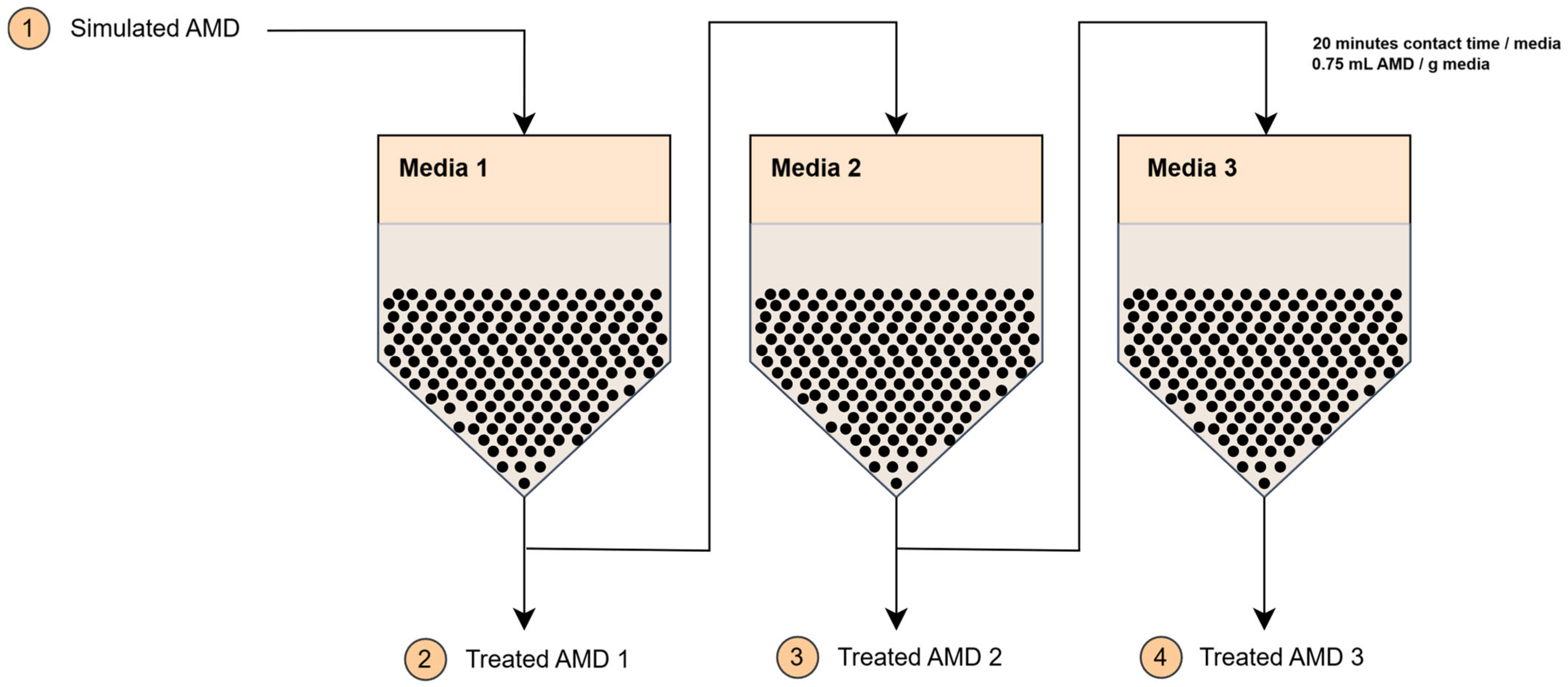
Based on previous studies, the effective liquid-to-solid ratio for a batch treatment of AMD using locally available neutralizing agents is 0.75 mL AMD/g media and a contact time of 20 min [9,10]. Using these conditions, the experiments were performed following the schematic diagram illustrated in Figure 1.
Figure 1.
Schematic diagram of experimental procedure. A combination of a series of three media is assessed.
To maintain a liquid-to-solid ratio of 0.75 mL AMD/g media, the mass of the media and the volume of AMD were adjusted accordingly to account for losses due to sample collection and absorption. A summary of the mass of media and volume of AMD used for each of the sequences may be found in Supplementary File S1.
2.4. Data Analysis
Using various aggregation techniques, a score or index was calculated for each sequence. These scores were calculated based on the resulting geochemical properties after treatment, and the sequences were ranked from best to worst. The parameters pH, Fe, Mn, Cu, and SO42− were considered to assess the performance of the sequences and were compared against the Philippine effluent standards stipulated under the Department of Environment and Natural Resources (DENR) Administrative Order (DAO) 2016-08 and DAO 2021-19, specifically under class C waters [44,45].
A total of four aggregation techniques were used to assess the sequences: normalization, as outlined by Turingan et al. [9], CCMEWQI [38], MAMDI [39], and WPI-AMD [40]. Each aggregation method is outlined in the following subsections.
2.4.1. Aggregation via Normalization
Equation (1) shows how a normalized score value is calculated for a given sequence of media.
In this equation, is the effluent value, is the initial value, and is the standard value. The index, , pertains to the parameters being considered and refers to the number of parameters considered.
2.4.2. CCMEWQI
The CCMEWQI is an index developed by the Canadian Council of Ministers of the Environment in 2017 [38]. It requires at least four parameters for it to be applied as an evaluation tool. Equations for calculating the CCMEWQI are shown below.
In this equation, F1, F2, and F3 are defined as follows:
In Equation (5), nse is referred to as the normalized sum of excursions, which is calculated using Equation (6).
If a given parameter fails and falls below the standard, the excursion value is calculated using Equation (7).
Conversely, if a parameter fails and exceeds the standard, the excursion value is calculated using Equation (8).
The calculated index is interpreted using the water quality classes summarized in Table 4 [38].
Table 4.
Water classification and description using CCMEWQI [38].
2.4.3. MAMDI
Developed by Kuma et al. [39], MAMDI is an index that builds upon the Gray AMD index (AMDI) developed by Gray et al. [46,47]. It allows different parameters to be used in calculating the index. It provides a score for a given value of a parameter using the water quality ratings developed by Kuma et al. [39]. Ultimately, MAMDI is calculated using Equation (9).
2.4.4. Modified WPI-AMD
WPI-AMD, developed by Balboa et al. [40], is a water pollution index intended for AMD and AMD-impacted waters. It integrates more than 20 parameters, ranging from heavy metals, anions, and other water quality parameters. It is a weighted aggregated sum product assessment (WASPAS) method that combines both a multiplicative and additive aggregation. The WPI-AMD is calculated through Equation (10).
In this equation, is considered to be the calibrating parameter, which is set at 0.60. is the weight of a given parameter, while and are the additive and multiplicative subindices, respectively. Weights are calculated using ratings collected from a literature review and summarized in Balboa et al. [40].
Since this study only considered four parameters, the values of were modified accordingly based on the review of the literature conducted by Balboa et al. [40]. These revised weights are summarized in Table 5.
Table 5.
Modified weights for calculation of WPI-AMD.
Compared with the other WQPIs, WPI-AMD provides a higher score for more polluted waters; that is, the higher the score, the lower the water quality. Therefore, ranking the sequences using the WQPIs will be in ascending order.
2.4.5. Removal Efficiency
Removal efficiencies of Fe, Mn, Cu, and SO42− were calculated following Equation (11).
In this equation, is the initial value of a given parameter, while is the effluent value of the parameter being evaluated.
2.5. Method Limitations
The tests conducted to assess the effective treatment performance were limited to batch tests, with pH, DO, EC, ORP, Fe, Mn, Cu, and SO42− as the only parameters monitored. These parameters exceed the GES based on the actual AMD collected. Moreover, the WQPIs CCMEWQI, MAMDI, and WPI-AMD were selected because these are specifically designed to handle the unique, multi-parameter nature of AMD, which single-parameter analysis or simple comparison against regulatory standards cannot do. Additional tests are needed for method scale-up before it is implemented as a pilot or full-scale passive treatment system, which is not covered in this study.
3. Results
3.1. Raw Material Characterization
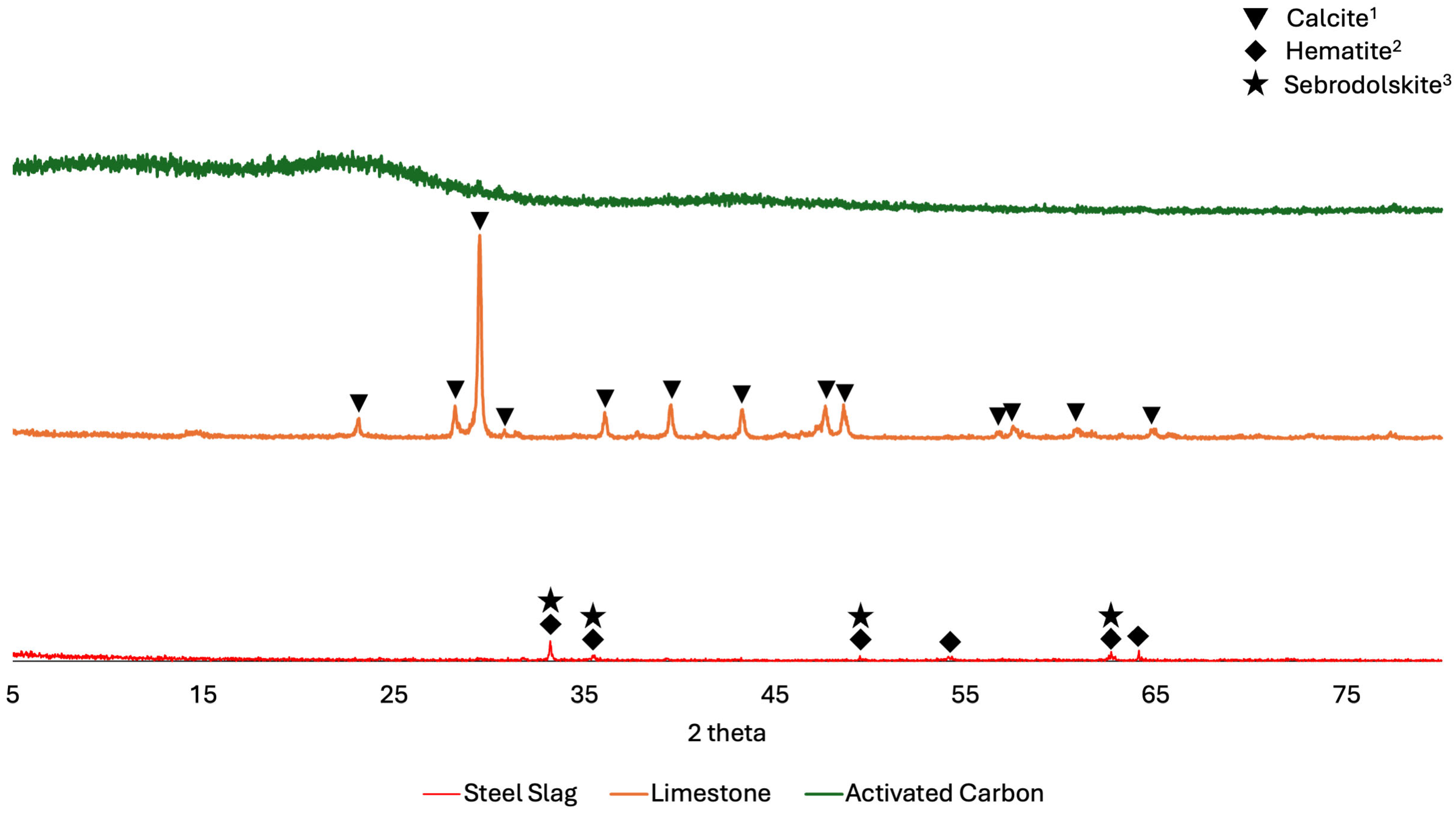
Characterization of the media to identify their mineralogy was performed via XRD. The results are plotted and indexed in Figure 2.
Figure 2.
XRD spectra of the three media (from top to bottom): activated carbon, limestone, and steel slag. No significant peaks were observed for AC, suggesting that the media do not have any significant crystalline phases. Moreover, the LS used was mainly in its calcite form, while SS contained hematite (Fe2O3) and sebrodolskite (Ca2Fe2O5), which confirms the identity of the media used for the treatment. 1 [48]; 2 [49]; 3 [50].
3.2. Sequential Batch Test
The primary goal of the sequential batch test was to evaluate the treatment efficiencies of the six (6) treatment materials used. This was achieved by comparing the parameters of the treated AMD with DAO 2016-08 and 2021-19 [44,45], calculating the removal efficiencies for Cu, Mn, Fe, and SO42−, and ranking the best overall process train by calculating a score or index using the different methodologies identified, aggregating the obtained parameters from the treated samples.
3.2.1. In Situ Parameter Monitoring
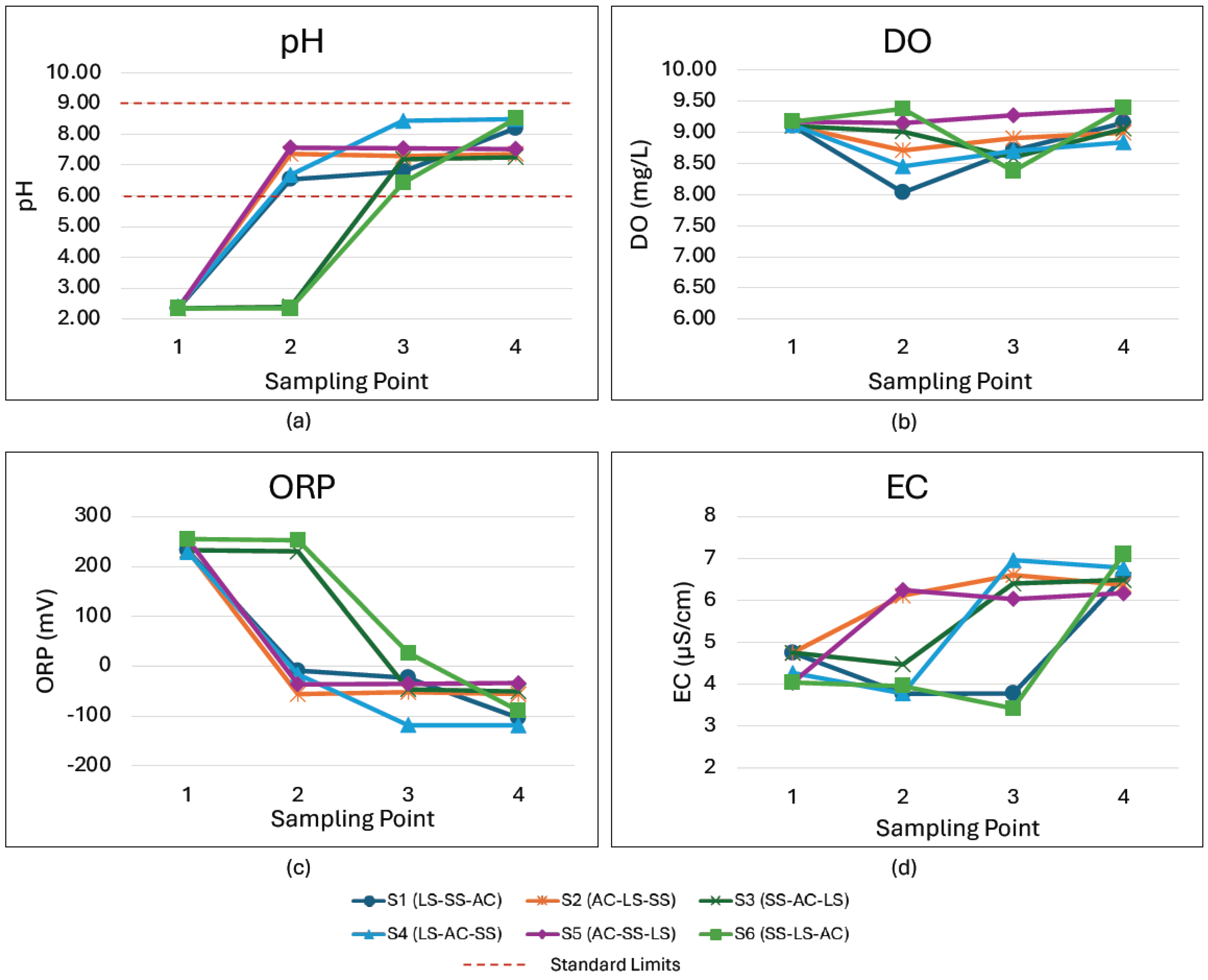
The changes observed in terms of pH, DO, ORP, and EC at each monitoring point, compared to the effluent standard limits, are plotted in Figure 3. Individual plots for each sequence are also available in Supplementary File S2. All sequences were able to meet the standards for pH. For DO, only S6 (SS-LS-AC) had a different trend than the other sequences, wherein a decrease was observed compared to other media. Additionally, a decreased ORP for all the sequences indicates a change to a more reductive state, which prevents further oxidation of sulfidic ores and decreases hydrogen ion concentration [14,51]. An increased EC for all sequences also indicates higher concentration of salts and ions (metals and sulfates, among others) that are dissolved in the AMD, although it is not indicative of the species in the solution [42,46].
Figure 3.
Measured in situ parameters for each treatment sequence. (a) pH, (b) DO, (c) ORP, and (d) EC after each treatment medium.
The changes that took place in the geochemical parameters of the AMD were different based on where the simulated AMD passed through. The pH of the solution was greatly increased when passing through LS and AC, while a minimal to no increase was observed when passing through SS. This suggests that SS does not generate alkalinity, which could potentially help in removing metal contaminants via precipitation—an observation that is different from previous studies [26,27,52]. AC showed a non-stabilizing increase in pH for the treatment sequence, but it was also in an acceptable range of effluent standards. There was a minimal increase after passing through SS observed in S3 and S6, which were below the acceptable pH range. The effect of the different treatment media on increasing the pH value of the simulated AMD showed potential in neutralizing the acidity of AMD, with LS achieving the most significant rise towards neutrality.
3.2.2. Metal and Sulfate Removal Efficiency
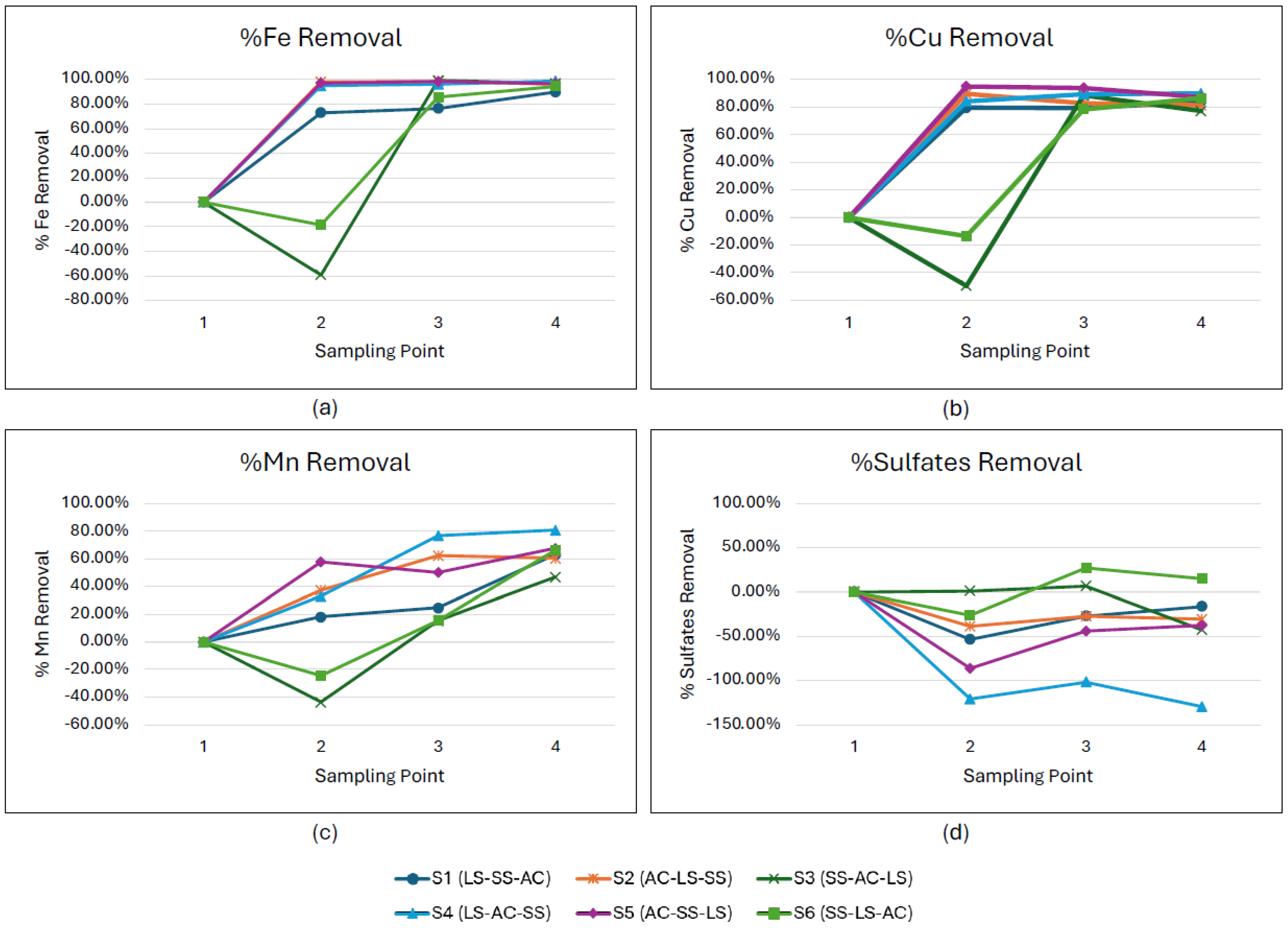
Figure 4 shows a summary of the trends in the concentration of Fe, Mn, Cu, and SO42− with respect to the measuring points identified in the schematic diagram of the sequential treatment illustrated in Figure 1. Individual plots for each sequence may also be found in Supplementary File S2.
Figure 4.
Percentage removal for different parameters in each treatment sequence. (a) Fe, (b) Cu, (c) Mn, and (d) SO42− after each treatment medium.
Heavy metal concentrations in the effluent decreased significantly under all of the identified sequences. However, there are certain measuring points at which the concentrations of these metals increased, particularly for sequences that initially used SS as the first medium (S3 and S6). This implies that leaching or dissolution of the metals occurred upon contact with the simulated AMD. This could be due to the low pH of AMD, dissolving the metals that are present on the surface of SS, which explains the increase in Fe, Mn, and Cu. However, when a medium such as LS or AC was used prior to SS, the dissolution of these metals was limited. In fact, SS contributed to the treatment performance of the sequence, decreasing the metal concentration by 45.45% when used as the second medium and 67.86% when used as the third medium.
For sulfates, none of the sequences were able to effectively remove a significant amount from the influent. Instead, most of the sulfates from the materials leached out, causing the AMD to further worsen in quality and not meet effluent standards. S3 (SS-AC-LS) and S6 (SS-LS-AC) increased the pollutant concentrations, which can be identified to be caused by SS, only to be compensated by the succeeding materials of either LS or AC. This is reflective of the challenges in removing sulfates from AMD, especially for passive treatment systems, which require longer contact and hydraulic retention times [53,54] and which this study did not implement.
Focusing on each sampling point, using LS and AC could potentially lower the concentration of Fe of an AMD. LS is the material most often used in AMD treatment due to its neutralizing capabilities, especially in passive treatment systems [8,10,11,12,13,55]. Moreover, AC has been known for its heavy metal (e.g., Fe) adsorption efficiency due to its porous characteristics, which has been observed repeatedly in previous studies [33,36,56]. These factors may have contributed to the positive results of using LS and AC as treatment media for the sequences.
The highest overall percent removal recorded for Fe (98.78%), Mn (98.78%), and Cu (89.92%) was observed for S4 (LS-AC-SS). On the other hand, a maximum removal of sulfates was observed for S6 (SS-LS-AC), at a removal rate of 14.96%. Nonetheless, the majority of the sequences were able to reduce the pollutants to levels within the effluent standards, except for SO42−.
3.3. Rating and Ranking of Media Sequences Using Normalization and WQPIs
Table 6 summarizes the comparison of the obtained effluent parameters with DAO 2016-08 and 2021-19 [44,45] to observe whether the treated AMD meets the standards for class C water bodies.
Table 6.
Summary of measured quality of effluent for each sequence. Values in bold red font do not meet the effluent standard.
Using these data, scores were calculated following the methodology for normalization [9], CCMEWQI [38], MAMDI [39], and WPI-AMD [40]. These were then ranked by decreasing quality. Note that a higher score of WPI-AMD indicates a lower water quality. Scores and rankings are summarized in Table 7. Detailed calculation of the scores can also be found in Supplementary File S1.
Table 7.
Summary of scores and rankings for each sequence using different indices.
S6 (SS-LS-AC) was ranked in first place using CCMEWQI, MAMDI, and WPI-AMD. On the other hand, S3 (SS-AC-LS) and S4 (LS-AC-SS) were ranked first and second for the normalization method. The high ranking for S6 can be associated with the low SO42−, Fe, Mn, and Cu concentrations compared to other sequences. Although the ranking is only based on the effluent and does not capture the individual performance of the media, S6 is ultimately the best performing sequence due to the significant removal of SO42− when compared to other sequences. The worst performing sequences identified by all methods were S3 (SS-AC-LS) and S4 (LS-AC-SS), except for the normalization method, which identified S6 (SS-LS-AC) and S1 (LS-SS-AC) as the worst. Despite being able to remove more Fe, Mn, and Cu than S5 and S6, these sequences were highlighted by the different aggregation methods used due to the high levels of SO42−.
To compare the rankings determined by each methodology, a Spearman rank correlation was calculated and summarized in a matrix in Table 8. The ranking using WPI-AMD and CCMEWQI had a strong positive correlation, suggesting that they had a similar ranking for the sequences identified. A strong correlation was also observed between the WPI-AMD and MAMDI methods, with the top two sequences being the same. Interestingly, all of the WQPIs were negatively correlated with the normalization method, suggesting that this method identifies and ranks the sequences differently. This may also imply that the normalization method does not capture the same parameters as the WQPIs, which are claimed to provide a robust assessment of water quality. For instance, S4 was identified to be the best performing sequence while being identified as the worst sequence by WQPIs. The normalization method overestimates the effect of a low metal concentration, despite this sequence having the highest sulfate concentration. That is, the distance of the metal concentration from the standard is highlighted and eclipses the extreme values of SO42−. This finding provides a crucial insight: when assessing treatment technologies, a systematic and holistic evaluation, such as one using WQPIs, should be conducted.
Table 8.
Spearman rank correlation matrix of methods for sequence scoring and ranking.
Given this correlation matrix, rankings determined using MAMDI, CCMEWQI, and WPI-AMD are positively correlated with each other, suggesting that the rankings are similar. Assessing both the removal performance and ranking, S6 (SS-LS-AC) holistically treated the AMD in terms of the parameters considered, removing 94.32% Fe, 66.40% Mn, 86.53% Cu, and 14.96% SO42−. Conversely, S3 (SS-AC-LS) and S4 (LS-AC-SS) performed the worst due to the elevated SO42−, exceeding the standard limit by almost four times.
It is important to note, however, that the rankings have inconsistencies between the WQPIs. For instance, the least performing sequence assessed using WPI-AMD and MAMDI was ranked third by CCMEWQI. This difference in rankings could be related to the way in which these WQPIs were developed. Compared to WPI-AMD and MAMDI, CCMEWQI was developed to be a flexible and objective-based framework that compares parameters against regulatory standards [38]. Although this is also the case for WPI-AMD and MAMDI, it is a more tailored index that is only applicable for AMD and AMD-impacted waters. CCMEWQI can consider other parameters that might not be relevant to AMD, which can ultimately affect its assessment. Nonetheless, the method of using multiple WQPIs can help assess the performance of the sequence in an objective framework beyond the typical comparison with regulatory standards.
4. Conclusions and Future Works
This study evaluated the AMD treatment performance of three locally available media—LS, SS, and AC—and determined the sequence with the best performance overall. The parameters considered were Fe, Mn, Cu, and SO42−, while other in situ water quality parameters (pH, ORP, DO, EC) were also monitored. Six media sequences were identified and their performance was assessed through batch tests using a simulated AMD.
The combination of LS and AC demonstrated a significant effect in reducing heavy metal concentrations (Fe, Mn, and Cu) to meet the regulatory standards set by the DENR DAO 2016-08 and 2021-19 [44,45]. However, SS required a neutralizing pretreatment stage to prevent leaching and dissolution of additional metals into the treated water. The media used were unable to significantly remove SO42−. S6 (SS-LS-AC) offered the highest removal rate (14.96%). In terms of heavy metal removal, S4 (LS-AC-SS) emerged as the most effective in terms of removal rates, achieving 98.79% for Fe, 80.86% for Mn, and 89.02% for Cu. Nonetheless, further evaluation of each sequence in terms of the collected effluent by calculating a score via the normalization, CCMEWQI, MAMDI, and modified WPI-AMD methods revealed that S6 (SS-LS-AC) had superior treatment performance in terms of effluent quality. On the other hand, S3 (SS-AC-LS) and S4 (LS-AC-SS) performed the worst, despite being able to remove the majority of Fe, Mn, and Cu. These differences in the best performing sequences, compared using the assessment of percentage removal and rating using various WQPIs, reveal that assessing treatment performance goes beyond comparison with standards and regulations. Additionally, the results also exemplify the need to consider multiple objective frameworks, such as WQPIs, to offer perspectives on capturing water quality through a single score or index.
The methods presented in the study exemplify the need to develop, improve, and adopt assessment tools for treatment technologies beyond sequences. This would involve integration of expert opinions beyond the basic comparison of water quality with existing standards, as well as considering the concerns raised by potential end-users of the technology. Beyond technical performance, further assessments of economic and operational feasibility and environmental impacts through life cycle assessments must performed to ensure the robustness of the identified sequence, should it be implemented at a pilot or field scale. Additionally, the case presented demonstrates the need to explore a novel approach to address the problem of SO42− due to the difficulty in its removal. Technologies such as sulfate-reducing bacteria (SRBs) and ettringite processes may be applicable and may integrate with the identified sequence, but their practicality may become an issue. This approach may also be used in the development of PRBs in determining effective arrangement of treatment media.
Supplementary Materials
The following supporting information can be downloaded at https://www.mdpi.com/article/10.3390/min16010064/s1, Supplementary File S1—Treatment media sequence and calculation of scores and rankings; Supplementary File S2—Individual plots for in situ parameters and removal performance.
Author Contributions
Data curation, J.P.P., L.D., J.M., R.E.P. and F.C.Q.; formal analysis, J.P.P., L.D., J.M., R.E.P. and F.C.Q.; investigation, J.P.P., L.D., J.M., R.E.P. and F.C.Q.; methodology, L.D., J.M., R.E.P., F.C.Q., M.A.B.P. and A.H.O.; resources, M.A.B.P. and A.H.O.; supervision, M.A.B.P. and A.H.O.; validation, J.P.P., M.A.B.P. and A.H.O.; visualization, J.P.P., L.D., J.M. and F.C.Q.; writing—original draft, J.P.P., L.D., J.M., R.E.P., F.C.Q., M.A.B.P. and A.H.O. All authors have read and agreed to the published version of the manuscript.
Funding
This research received no external funding.
Data Availability Statement
Data that supports the conclusions of the study that is not available in this article will be made available by the authors on request.
Conflicts of Interest
The authors declare no conflicts of interest.
Abbreviations
The following abbreviations are used in this manuscript:
| AC | Activated Carbon |
| AMD | Acid Mine Drainage |
| CCMEWQI | Canadian Council of Ministers for the Environment Water Quality Index |
| DAO | DENR Department Administrative Order |
| DENR | Philippine Department of Environment and Natural Resources |
| DO | Dissolved Oxygen |
| EC | Electrical Conductivity |
| GES | General Effluent Standard |
| ICP-OES | Inductively Coupled Plasma—Optical Emission Spectroscopy |
| LS | Limestone |
| MAMDI | Modified Acid Mine Drainage Index |
| ORP | Oxidation–Reduction Potential |
| PRB | Permeable Reactive Barrier |
| REE | Rare Earth Elements |
| SMEWW | Standard Methods for the Examination of Water And Wastewater |
| SRB | Sulfate-Reducing Bacteria |
| SS | Steel Slag |
| WPI-AMD | Water Pollution Index for AMD and AMD-impacted waters |
| WQPI | Water Quality and Pollution Index |
| XRD | X-ray Diffraction |
References
- Daraz, U.; Li, Y.; Ahmad, I.; Iqbal, R.; Ditta, A. Remediation Technologies for Acid Mine Drainage: Recent Trends and Future Perspectives. Chemosphere 2023, 311, 137089. [Google Scholar] [CrossRef]
- Neuman, D.R.; Jennings, S.R.; Jacobs, J.A. Acid Drainage and Aquatic Resources. In Acid Mine Drainage, Rock Drainage, and Acid Sulfate Soils; Jacobs, J.A., Lehr, J.H., Testa, S.M., Eds.; Wiley: Hoboken, NJ, USA, 2014; pp. 131–137. ISBN 978-0-470-48786-0. [Google Scholar]
- Moeng, K. Community Perceptions on the Health Risks of Acid Mine Drainage: The Environmental Justice Struggles of Communities near Mining Fields. Environ. Dev. Sustain. 2019, 21, 2619–2640. [Google Scholar] [CrossRef]
- Bu, C.; Li, X.; Li, Q.; Li, L.; Wu, P. Spatiotemporal Distributions, Sources, and Health Risks of Heavy Metals in an Acid Mine Drainage (AMD)-Contaminated Karst River in Southwest China. Appl. Water Sci. 2024, 14, 251. [Google Scholar] [CrossRef]
- Brown, D.; Zhou, R.; Sadan, M. Critical Minerals and Rare Earth Elements in a Planetary Just Transition: An Interdisciplinary Perspective. Extr. Ind. Soc. 2024, 19, 101510. [Google Scholar] [CrossRef]
- Hwang, Y.K.; Díez, Á.S.; Inglesi-Lotz, R. The Effects of Critical Mineral Endowments on Green Economic Growth in Latin America. Resour. Policy 2024, 98, 105355. [Google Scholar] [CrossRef]
- Paris Agreement; United Nations Framework Convention on Climate Change: Bonn, Germany, 2016; p. 18.
- Skousen, J.G.; Ziemkiewicz, P.F.; McDonald, L.M. Acid Mine Drainage Formation, Control and Treatment: Approaches and Strategies. Extr. Ind. Soc. 2019, 6, 241–249. [Google Scholar] [CrossRef]
- Turingan, C.O.A.; Cordero, K.S.; Santos, A.L.; Tan, G.S.L.; Tabelin, C.B.; Alorro, R.D.; Orbecido, A.H. Acid Mine Drainage Treatment Using a Process Train with Laterite Mine Waste, Concrete Waste, and Limestone as Treatment Media. Water 2022, 14, 1070. [Google Scholar] [CrossRef]
- Pocaan, J.; Turingan, C.O.A.; Tabelin, C.B.; Zoleta, J.B.; Arima, T.; Park, I.; Ito, M.; Orbecido, A.H. A Mixed Media Approach Using Locally Available Neutralizing Materials for the Passive Treatment of Acid Mine Drainage. Heliyon 2025, 11, e41984. [Google Scholar] [CrossRef]
- Santomartino, S.; Webb, J.A. Estimating the Longevity of Limestone Drains in Treating Acid Mine Drainage Containing High Concentrations of Iron. Appl. Geochem. 2007, 22, 2344–2361. [Google Scholar] [CrossRef]
- Turingan, C.O.A.; Singson, G.B.; Melchor, B.T.; Alorro, R.D.; Beltran, A.B.; Orbecido, A.H. Evaluation of Efficiencies of Locally Available Neutralizing Agents for Passive Treatment of Acid Mine Drainage. Minerals 2020, 10, 845. [Google Scholar] [CrossRef]
- Ziemkiewicz, P.F.; Skousen, J.G.; Brant, D.L.; Sterner, P.L.; Lovett, R.J. Acid Mine Drainage Treatment with Armored Limestone in Open Limestone Channels. J. Environ. Qual. 1997, 26, 1017–1024. [Google Scholar] [CrossRef]
- Skousen, J.; Zipper, C.E.; Rose, A.; Ziemkiewicz, P.F.; Nairn, R.; McDonald, L.M.; Kleinmann, R.L. Review of Passive Systems for Acid Mine Drainage Treatment. Mine Water Environ. 2017, 36, 133–153. [Google Scholar] [CrossRef]
- Nguegang, B.; Ambushe, A.A. Sustainable Acid Mine Drainage Treatment: A Comprehensive Review of Passive, Combined, and Emerging Technologies. Environ. Eng. Res. 2024, 30, 240592. [Google Scholar] [CrossRef]
- Nguegang, B.; Masindi, V.; Msagati Makudali, T.A.; Tekere, M. Effective Treatment of Acid Mine Drainage Using a Combination of MgO-Nanoparticles and a Series of Constructed Wetlands Planted with Vetiveria Zizanioides: A Hybrid and Stepwise Approach. J. Environ. Manag. 2022, 310, 114751. [Google Scholar] [CrossRef]
- Wang, Y.; Wang, C.; Feng, R.; Li, Y.; Zhang, Z.; Guo, S. A Review of Passive Acid Mine Drainage Treatment by PRB and LPB: From Design, Testing, to Construction. Environ. Res. 2024, 251, 118545. [Google Scholar] [CrossRef]
- Cocos, I.A.; Zagury, G.J.; Clément, B.; Samson, R. Multiple Factor Design for Reactive Mixture Selection for Use in Reactive Walls in Mine Drainage Treatment. Water Res. 2002, 36, 167–177. [Google Scholar] [CrossRef]
- Sanchez-Ramos, D.; López-Bellido Garrido, F.J.; Acosta Hernández, I.; Rodríguez Romero, L.; Villaseñor Camacho, J.; Fernández-Morales, F.J. Sustainable Use of Wastes as Reactive Material in Permeable Reactive Barrier for Remediation of Acid Mine Drainage: Batch and Continuous Studies. J. Environ. Manag. 2023, 345, 118765. [Google Scholar] [CrossRef] [PubMed]
- Gibert, O.; Cortina, J.L.; De Pablo, J.; Ayora, C. Performance of a Field-Scale Permeable Reactive Barrier Based on Organic Substrate and Zero-Valent Iron for in Situ Remediation of Acid Mine Drainage. Environ. Sci. Pollut. Res. 2013, 20, 7854–7862. [Google Scholar] [CrossRef]
- Gibert, O.; Rötting, T.; Cortina, J.L.; de Pablo, J.; Ayora, C.; Carrera, J.; Bolzicco, J. In-Situ Remediation of Acid Mine Drainage Using a Permeable Reactive Barrier in Aznalcóllar (Sw Spain). J. Hazard. Mater. 2011, 191, 287–295. [Google Scholar] [CrossRef]
- Hu, R.; Xie, J.; Wu, S.; Yang, C.; Yang, D. Study of Toxicity Assessment of Heavy Metals from Steel Slag and Its Asphalt Mixture. Materials 2020, 13, 2768. [Google Scholar] [CrossRef]
- Das, P.; Upadhyay, S.; Dubey, S.; Singh, K.K. Waste to Wealth: Recovery of Value-Added Products from Steel Slag. J. Environ. Chem. Eng. 2021, 9, 105640. [Google Scholar] [CrossRef]
- He, Y.; Jia, S.; Yi, H.; Tang, X.; Yu, Q.; Gao, F.; Kang, D.; Zhao, S. Utilization of Steel Slag in Air Pollution and Greenhouse Gas Emission Reduction-Application, Mechanism and Challenge: A Review. J. Environ. Chem. Eng. 2024, 12, 114090. [Google Scholar] [CrossRef]
- Roychand, R.; Kumar Pramanik, B.; Zhang, G.; Setunge, S. Recycling Steel Slag from Municipal Wastewater Treatment Plants into Concrete Applications—A Step towards Circular Economy. Resour. Conserv. Recycl. 2020, 152, 104533. [Google Scholar] [CrossRef]
- Yang, L.; Tang, Y.; Cao, D.; Yang, M. Remediation of Acid Mine Drainage (AMD) Using Steel Slag: Mechanism of the Alkalinity Decayed Process. Int. J. Environ. Res. Public Health 2023, 20, 2805. [Google Scholar] [CrossRef]
- Yang, M.; Lu, C.; Zhang, S.; Wang, Y.; Xu, R.; Zhang, M.; Wen, J.; Li, Z. Concurrent Removal of Fe(II), Cu(II), and Zn(II) Cations from Acid Mine Drainage by an Industrial Solid Waste—Steel Slag: Behaviors and Mechanisms. Environ. Res. 2024, 263, 120105. [Google Scholar] [CrossRef] [PubMed]
- Kennedy, A.M.; Arias-Paić, M. Application of Powdered Steel Slag for More Sustainable Removal of Metals from Impaired Waters. J. Water Process Eng. 2020, 38, 101599. [Google Scholar] [CrossRef]
- Kruse, N.A.; Mackey, A.L.; Bowman, J.R.; Brewster, K.; Riefler, R.G. Alkalinity Production as an Indicator of Failure in Steel Slag Leach Beds Treating Acid Mine Drainage. Environ. Earth Sci. 2012, 67, 1389–1395. [Google Scholar] [CrossRef]
- Name, T.; Sheridan, C. Remediation of Acid Mine Drainage Using Metallurgical Slags. Miner. Eng. 2014, 64, 15–22. [Google Scholar] [CrossRef]
- Zheng, Q.; Zhang, Y.; Zhang, Z.; Li, H.; Wu, A.; Shi, H. Experimental Research on Various Slags as a Potential Adsorbent for the Removal of Sulfate from Acid Mine Drainage. J. Environ. Manag. 2020, 270, 110880. [Google Scholar] [CrossRef]
- Levio-Raiman, M.; Briceño, G.; Schalchli, H.; Bornhardt, C.; Diez, M.C. Alternative Treatment for Metal Ions Removal from Acid Mine Drainage Using an Organic Biomixture as a Low Cost Adsorbent. Environ. Technol. Innov. 2021, 24, 101853. [Google Scholar] [CrossRef]
- Suliestyah; Novi Hartamai, P.; Permata Sari, I.; Alexander, E. The Fe (II) and Mn (II) Adsorption in Acid Mine Drainage Using Various Granular Sizes of Activated Carbon and Temperatures. IOP Conf. Ser. Earth Environ. Sci. 2021, 882, 012065. [Google Scholar] [CrossRef]
- Hong, S.; Cannon, F.S.; Hou, P.; Byrne, T.; Nieto-Delgado, C. Sulfate Removal from Acid Mine Drainage Using Polypyrrole-Grafted Granular Activated Carbon. Carbon 2014, 73, 51–60. [Google Scholar] [CrossRef]
- Hong, S.; Cannon, F.S.; Hou, P.; Byrne, T.; Nieto-Delgado, C. Adsorptive Removal of Sulfate from Acid Mine Drainage by Polypyrrole Modified Activated Carbons: Effects of Polypyrrole Deposition Protocols and Activated Carbon Source. Chemosphere 2017, 184, 429–437. [Google Scholar] [CrossRef]
- Dube, V.; Phiri, Z.; Kuvarega, A.T.; Mamba, B.B.; De Kock, L.-A. Exploring Acid Mine Drainage Treatment through Adsorption: A Bibliometric Analysis. Environ. Sci. Pollut. Res. 2024, 31, 59659–59680. [Google Scholar] [CrossRef]
- Uddin, M.G.; Nash, S.; Olbert, A.I. A Review of Water Quality Index Models and Their Use for Assessing Surface Water Quality. Ecol. Indic. 2021, 122, 107218. [Google Scholar] [CrossRef]
- Canadian Council of Ministers of the Environment. CCME Water Quality Index User’s Manual 2017 Update. In Canadian Environmental Quality Guidelines, 1999; Canadian Council of Ministers of the Environment: Winnipeg, MB, Canada, 2017; Available online: https://ccme.ca/en/res/wqimanualen.pdf (accessed on 10 August 2025).
- Kuma, J.S.; Younger, P.L.; Buah, W.K. Numerical Indices of the Severity of Acidic Mine Drainage: Broadening the Applicability of the Gray Acid Mine Drainage Index. Mine Water Environ. 2011, 30, 67–74. [Google Scholar] [CrossRef]
- Balboa, C.J.P.; Pocaan, J.P.; Baute, R.; Orbecido, A.H.; Beltran, A.; Santos, A.; Jungblut, A.D.; Plancherel, Y.; Brito-Parada, P.R.; Tabelin, C.B.; et al. A Novel Water Pollution Index for Domestic Water Quality Assessment in Acid Mine Drainage-Impacted Mining Areas. Miner. Eng. 2025, 234, 109730. [Google Scholar] [CrossRef]
- Ott, W.R. Environmental Indices: Theory and Practice; Ann Arbor Science Publishers, Inc.: Ann Arbor, MI, USA, 1978. [Google Scholar]
- Smith, J.; Sheridan, C.; Van Dyk, L.; Harding, K.G. Critical Evaluation of the Chemical Composition of Acid Mine Drainage for the Development of Statistical Correlations Linking Electrical Conductivity with Acid Mine Drainage Concentrations. Environ. Adv. 2022, 8, 100241. [Google Scholar] [CrossRef]
- American Public Health Association. Standard Methods for the Examination of Water and Wastewater, 23rd ed.; American Public Health Association: Washington, DC, USA, 2017; ISBN 0-87553-287-X. [Google Scholar]
- Department of Environment and Natural Resources. Water Quality Guidelines and General Effluent Standards of 2016; Environmental Management Bureau: Quezon City, Philippines, 2016; pp. 1–34.
- Department of Environment and Natural Resources. Updated Water Quality Guidelines (WQG) and General Effluent Standards (GES) for Selected Parameters; Environmental Management Bureau: Quezon City, Philippines, 2021.
- Gray, N.F. Field Assessment of Acid Mine Drainage Contamination in Surface and Ground Water. Environ. Geol. 1996, 27, 358–361. [Google Scholar] [CrossRef]
- Gray, D.; Harding, J. Acid Mine Drainage Index (AMDI): A Benthic Invertebrate Biotic Index for Assessing Coal Mining Impacts in New Zealand Streams. N. Z. J. Mar. Freshw. Res. 2012, 46, 335–352. [Google Scholar] [CrossRef][Green Version]
- Ondrus, P.; Veselovsky, F.; Gabasova, A.; Hlousek, J.; Srein, V.; Vavrnn, I.; Skala, R.; Sejkora, J.; Drabek, M. Primary Minerals of the Jáchymov Ore District. J. Czech Geol. Soc. 2003, 48, 19–147. [Google Scholar]
- Maslen, E.N.; Streltsov, V.A.; Streltsova, N.R.; Ishizawa, N. Electron Density and Optical Anisotropy in Rhombohedral Carbonates. III. Synchrotron X-Ray Studies of CaCO3, MgCO3 and MnCO3. Acta Crystallogr. Sect. B 1995, 51, 929–939. [Google Scholar] [CrossRef]
- Bertaut, E.F.; Blum, P.; Sagnières, A. Structure Du Ferrite Bicalcique et de La Brownmillerite. Acta Crystallogr. 1959, 12, 149–159. [Google Scholar] [CrossRef]
- Tang, H.; Luo, J.; Zheng, L.; Liu, C.; Li, H.; Wu, G.; Zeng, M.; Bai, X. Characteristics of Pores in Coals Exposed to Acid Mine Drainage. Energy Rep. 2021, 7, 8772–8783. [Google Scholar] [CrossRef]
- Yang, M.; Lu, C.; Quan, X.; Cao, D. Mechanism of Acid Mine Drainage Remediation with Steel Slag: A Review. ACS Omega 2021, 6, 30205–30213. [Google Scholar] [CrossRef]
- Larraguibel, A.; Navarrete-Calvo, A.; García, S.; Armijos, V.F.; Caraballo, M.A. Exploring Sulfate and Metals Removal from Andean Acid Mine Drainage Using CaCO3-Rich Residues from Agri-Food Industries and Witherite (BaCO3). J. Clean. Prod. 2020, 274, 123450. [Google Scholar] [CrossRef]
- Torres, E.; Lozano, A.; Macías, F.; Gomez-Arias, A.; Castillo, J.; Ayora, C. Passive Elimination of Sulfate and Metals from Acid Mine Drainage Using Combined Limestone and Barium Carbonate Systems. J. Clean. Prod. 2018, 182, 114–123. [Google Scholar] [CrossRef]
- Alcolea, A.; Vázquez, M.; Caparrós, A.; Ibarra, I.; García, C.; Linares, R.; Rodríguez, R. Heavy Metal Removal of Intermittent Acid Mine Drainage with an Open Limestone Channel. Miner. Eng. 2012, 26, 86–98. [Google Scholar] [CrossRef]
- Suliestyah; Jamal Tuheteru, E.; Permata Sari, I.; Wisnu Fajar, M. Effectiveness of Carbon Active Processed from Coal in Treating the Acid Mine Drainage at a Laboratory Scale. IOP Conf. Ser. Earth Environ. Sci. 2021, 882, 012066. [Google Scholar] [CrossRef]
Disclaimer/Publisher’s Note: The statements, opinions and data contained in all publications are solely those of the individual author(s) and contributor(s) and not of MDPI and/or the editor(s). MDPI and/or the editor(s) disclaim responsibility for any injury to people or property resulting from any ideas, methods, instructions or products referred to in the content. |
© 2026 by the authors. Licensee MDPI, Basel, Switzerland. This article is an open access article distributed under the terms and conditions of the Creative Commons Attribution (CC BY) license.