Article

Apatite Geochemical Signatures of REE Ore-Forming Processes in Carbonatite System: A Case Study of the Weishan REE Deposit, Luxi Terrane

1
State Key Laboratory of Geological Processes and Mineral Resources, Frontiers Science Center for Deep-Time Digital Earth, School of Earth Sciences and Resources, China University of Geosciences, Beijing 100083, China
2
Shandong Key Laboratory of Mineralization Processes and Resources Utilization of Strategic Metal Minerals (Preparatory), Key Laboratory of Gold Mineralization Processes and Resource Utilization Subordinated to the Ministry of Land and Resources, Shandong Institute of Geological Sciences, Jinan 250013, China
3
Shandong Provincial Lunan Geology and Exploration Institute (Shandong Provincial Bureau of Geology and Mineral Resources No. 2 Geological Brigade), Rare Mineral Exploration and Comprehensive Utilization Engineering Research Center of Shandong Province, Jining 272100, China
*
Authors to whom correspondence should be addressed.
Minerals 2026, 16(1), 112; https://doi.org/10.3390/min16010112
Submission received: 3 December 2025 / Revised: 28 December 2025 / Accepted: 16 January 2026 / Published: 21 January 2026
(This article belongs to the Special Issue Gold–Polymetallic Deposits in Convergent Margins)

Abstract

The Weishan rare earth element (REE) deposit, located in western Shandong, North China Block, is a typical carbonatite REE deposit and constitutes the third largest light REE resource in China. Its mineralization is closely related to the multi-stage evolution of a carbonatite magma–hydrothermal system. However, the mechanisms governing REE enrichment, migration, and precipitation remain insufficiently constrained from a mineralogical perspective, which hampers the understanding of the ore-forming processes and the establishment of predictive exploration models. Apatite is a pervasively developed REE phase in the Weishan deposit which occurs in multiple generations, and thus represents an ideal recorder of the magmatic–hydrothermal evolution. In this study, different generations of apatite hosted in carbonatite orebodies from the Weishan deposit were investigated using cathodoluminescence (CL), electron probe microanalysis (EPMA), and in situ LA-ICP-MS trace element analysis. Three types of apatite were identified. In paragenetic sequence, Ap-1 occurs as polycrystalline aggregates coexisting with calcite, is enriched in Na, Sr, and LREEs, and shows high (La/Yb)N ratios, suggesting crystallization from an evolved carbonatite magma. Ap-2 and Ap-3 display typical replacement textures: both contain abundant dissolution pits and dissolution channels within the grains, which are filled by secondary minerals such as monazite and ancylite, and thus exhibit characteristic features of fluid-mediated dissolution–reprecipitation during the hydrothermal stage. Ap-2 is commonly associated with barite and strontianite, whereas Ap-3 is associated with pyrite and monazite and is characterized by relatively sharp grain boundaries with adjacent minerals. From Ap-1 to Ap-3, total REE contents decrease systematically, whereas Na, Sr, and P contents increase. All three apatite types lack Eu anomalies but display positive Ce anomalies. Discrimination diagrams involving LREE-Sr/Y and log(Ce)-log(Eu/Y) indicate that apatite in the Weishan REE deposit formed during the magmatic to hydrothermal evolution of a carbonatite, and that the dissolution of early magmatic apatite, followed by element remobilization and mineral reprecipitation, effectively records the progressive evolution of the ore-forming fluid.

1. Introduction

Rare earth elements (REEs) are strategic critical metals that are indispensable to modern high-technology industries, low-carbon energy technologies, national defense, and advanced manufacturing [1,2,3,4]. Among these, carbonatite-associated REE deposits, characterized by being large-scale and high-grade and a predominance of light rare earth elements (LREEs), have become the primary global source of rare earth resources, especially elements like cerium (Ce), lanthanum (La), and neodymium (Nd). Representative world-class examples of such deposits include the Bayan Obo deposit in China and the Mountain Pass deposit in the United States [5,6,7,8,9]. Compared to granite-associated or ion-adsorption-type REE deposits, carbonatite REE deposits stand out due to the presence of ore-forming carbonatitic magmas [10,11,12,13,14]. Carbonatites are widely considered to derive from low-degree partial melting of an enriched mantle source, and they are inherently rich in REEs and volatile components, such as CO2, F, Cl, and S [15,16,17,18,19]. However, REE-rich primary carbonatite magma alone is generally insufficient to produce economic mineralization, implying that additional magmatic–hydrothermal processes are required to concentrate REEs to ore grades [20,21,22]. The process by which REEs transition from a dispersed state to highly concentrated, economically viable orebodies involves a series of complex steps, including crystallization, differentiation of magma, exsolution of immiscible fluid phases, fluid migration, and fluid–rock interactions with surrounding rocks [23,24,25]. Therefore, accurately understanding the REE ore-forming process, from source, through migration, to enrichment and ore formation, remains a central scientific objective in research on carbonatite-hosted REE systems and is directly relevant to exploration targeting and resource evaluation [6,26,27,28,29,30,31].
Apatite is a common REE-bearing mineral in carbonatite REE deposits, and its chemistry is highly sensitive to subtle variations in formation conditions [19,32,33]. Apatite can incorporate a large quantity of REEs, and its REE distribution patterns, anomaly features (such as Eu and Ce anomalies), and covariant relationships with other trace elements (e.g., Sr, Y) record the composition of parental melts/fluids, oxygen fugacity, crystallization temperature, and fluid involvement, making it an effective tracer of ore-forming processes [34,35,36,37]. Petrographic observations, coupled with geochemical and geochronological studies, have provided key constraints on magmatic–hydrothermal ore-forming processes, including the partitioning behavior of volatile components (e.g., F and Cl) among melt, fluid, and mineral phases [38,39,40]. Experimental petrology of apatite has shown that, in hydrothermal systems, apatite is not always formed directly by crystallization. Fluid-mediated dissolution–reprecipitation processes are key mechanisms that control its compositional, structural, and mineralogical variations [41,42,43,44]. These processes can mobilize the internal chemical composition of apatite without altering its original morphology, thus providing an effective pathway for the activation and re-enrichment of ore-forming elements. Some scholars have also utilized machine learning techniques to establish geochemical databases for discriminating the genesis of apatite [45,46].
Multiple generations of apatite in the Weishan REE deposit provide a valuable archive for reconstructing mineralization; however, how their chemistry records fluid evolution and contributes to extreme REE enrichment remains poorly constrained. Addressing this issue requires detailed petrography integrated with a robust paragenetic framework. Here, we investigate the trace element geochemistry of apatite from carbonatite-associated REE mineralization, with the aim of (i) identifying the mechanisms of element transport and sequestration in apatite, (ii) tracking the evolution of ore-forming fluids, and (iii) assessing the implications for REE enrichment. Our results offer new mineralogical constraints on the ore-forming processes of the Weishan REE deposit in the Luxi terrane.

2. Regional Geology

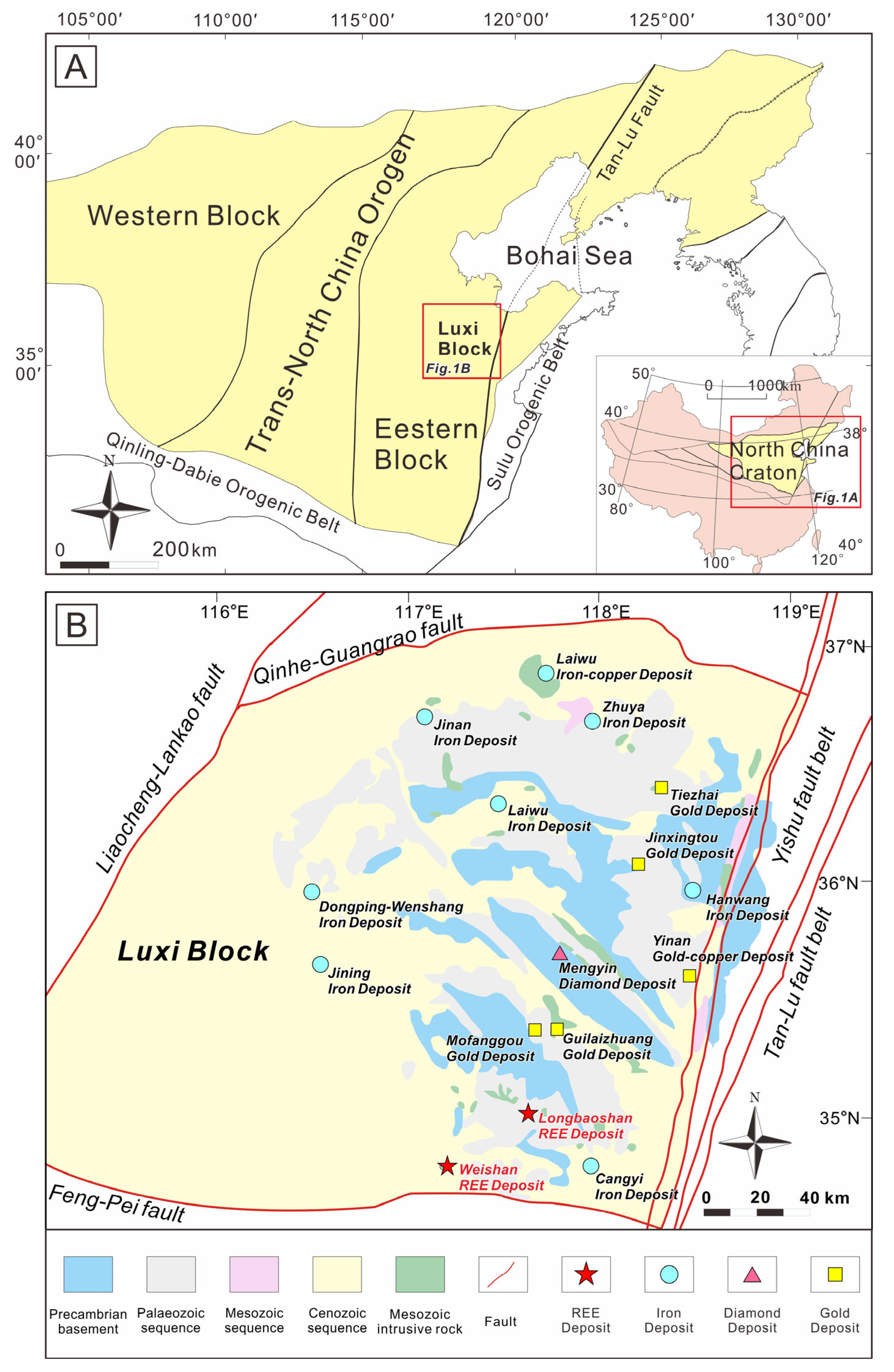
The North China Block (NCB) is one of the Earth’s most ancient and well-preserved cratonic regions (Figure 1A). Its geological development encompasses the formation of an early continental core, followed by crustal growth, the amalgamation of micro-continental blocks, and extensive magmatic, metamorphic, and cratonization processes [47,48,49,50]. In later stages, the NCB underwent several episodes of metasomatism linked to subduction and lithospheric thinning, along with multiple large-scale metallogenic events that led to the formation of various critical mineral resources, including iron, copper, gold, and rare metals [30,51,52,53,54,55,56]. The Luxi Terrane, which lies along the southeastern boundary of the NCB (Figure 1B), is defined by four major fault zones: the Fengpei, Qihe-Guangrao, Liaocheng-Lankao, and Yishui faults. The Luxi Terrane, with its eastern margin defined by the NE–SW-trending Tan-Lu Fault, preserves a complex stratigraphic record formed through multiple tectonic events, in a temporal manner, the Archean gneisses, amphibolite, and trondhjemite–tonalite–granodiorite (TTG, ca.2.5 Ga) [57], the Neoproterozoic marine clastic rocks which consist of sandstone, shale, and limestone, as well as the Palaeozoic marine sedimentary rocks including dolomite, shale, and sandstone. Quaternary sediments mainly consist of clay and mudstone. Active magmatism in this region from the Jurassic to the Cretaceous formed a large amount of alkaline and carbonatitic igneous rocks that are spatially and temporally related to REEs and Au [31,55,56,58,59,60,61]. These intrusive bodies show diverse shapes and are found as plutons, stocks, and dikes and their spatial and temporal distribution is closely tied to the regional fault structure, reflecting sustained and active tectono-magmatic processes beneath the Luxi Terrane.

3. Deposit Geology

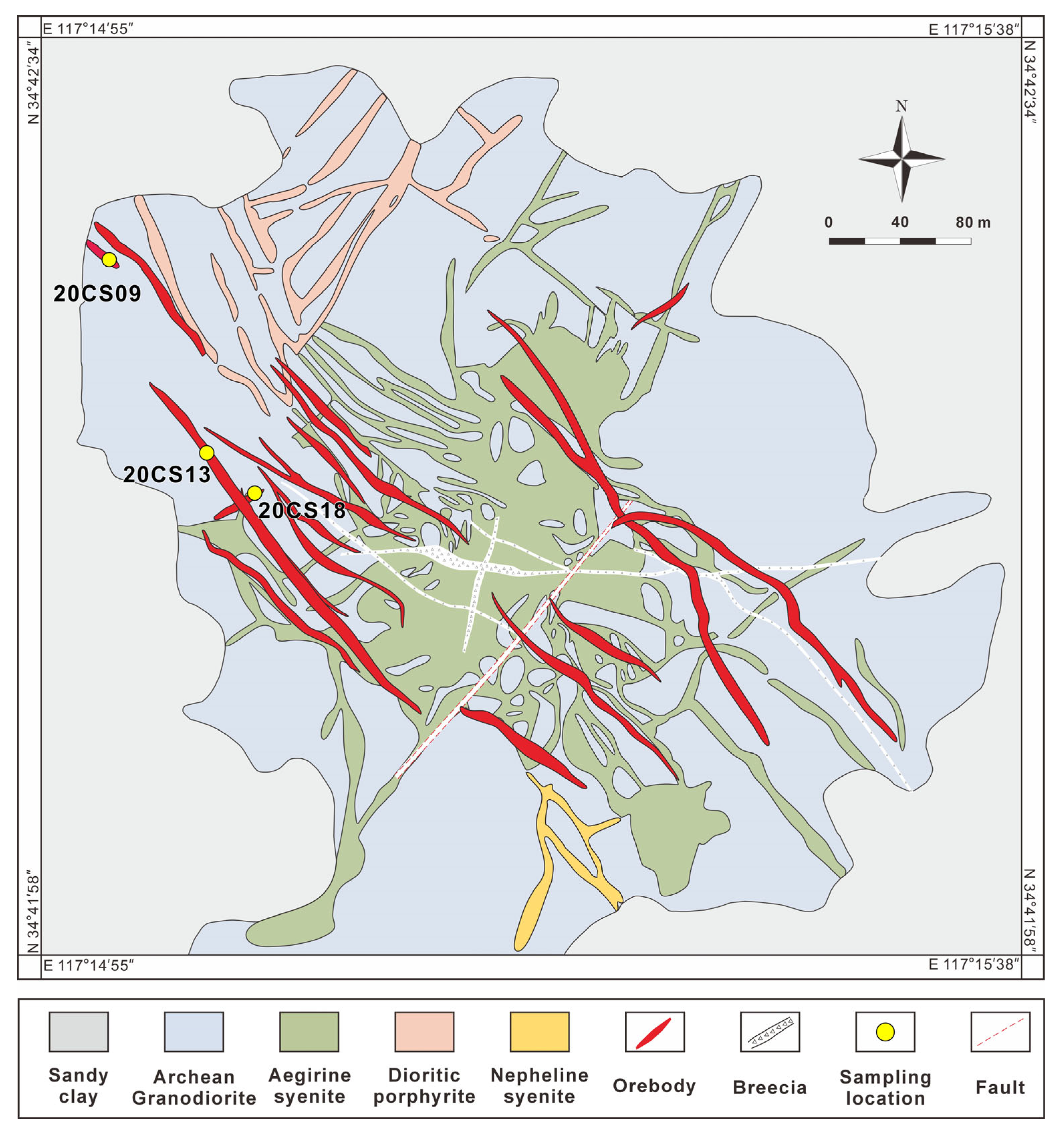
The Weishan REE deposit in the southern Luxi Terrane (Figure 1B) is a giant alkaline–carbonatite-associated deposit and represents the largest REE deposit in the region, as well as the third-largest light rare earth production base in China. Magmatic activity in this region is prominently characterized by Yanshanian syenite (including quartz syenite and aegirine-augite quartz syenite) and alkaline granites, which comprise the Weishan alkaline complex (Figure 2). The complex covers an area of approximately 0.5 km2, extending in a NE–SW direction. It intrudes the Archean gneisses, forming distinct, sharp contacts, and displays localized alkaline metasomatic alteration along its boundaries. Based on mineral assemblages, earlier studies subdivided the carbonatite of the Weishan deposit into REE-bearing quartz-barite-carbonatite, REE-bearing aegirine granite porphyry, aegirine-bearing veins, and monazite-bearing apatite veins [63,64]. The dominant REE minerals are bastnaesite, with minor occurrences of parisite-(Ce), strontianite phases, silicotitanates, ancylite, monazite, and apatite-(Ce). The ore is characterized by diverse and spatially heterogeneous mineral assemblages. Geochronological data support that the broadly coeval crystallization of alkaline intrusions overextend geological time, with zircon U-Pb ages for syenites (130–122 Ma) and bastnaesite Th-Pb ages (129 Ma) for carbonatites [57,64,65,66]. Geochronology data also support the relatively young age of carbonatite with mica Rb-Sr of 119 Ma [67].

4. Samples and Analytical Methods

4.1. Sample Descriptions

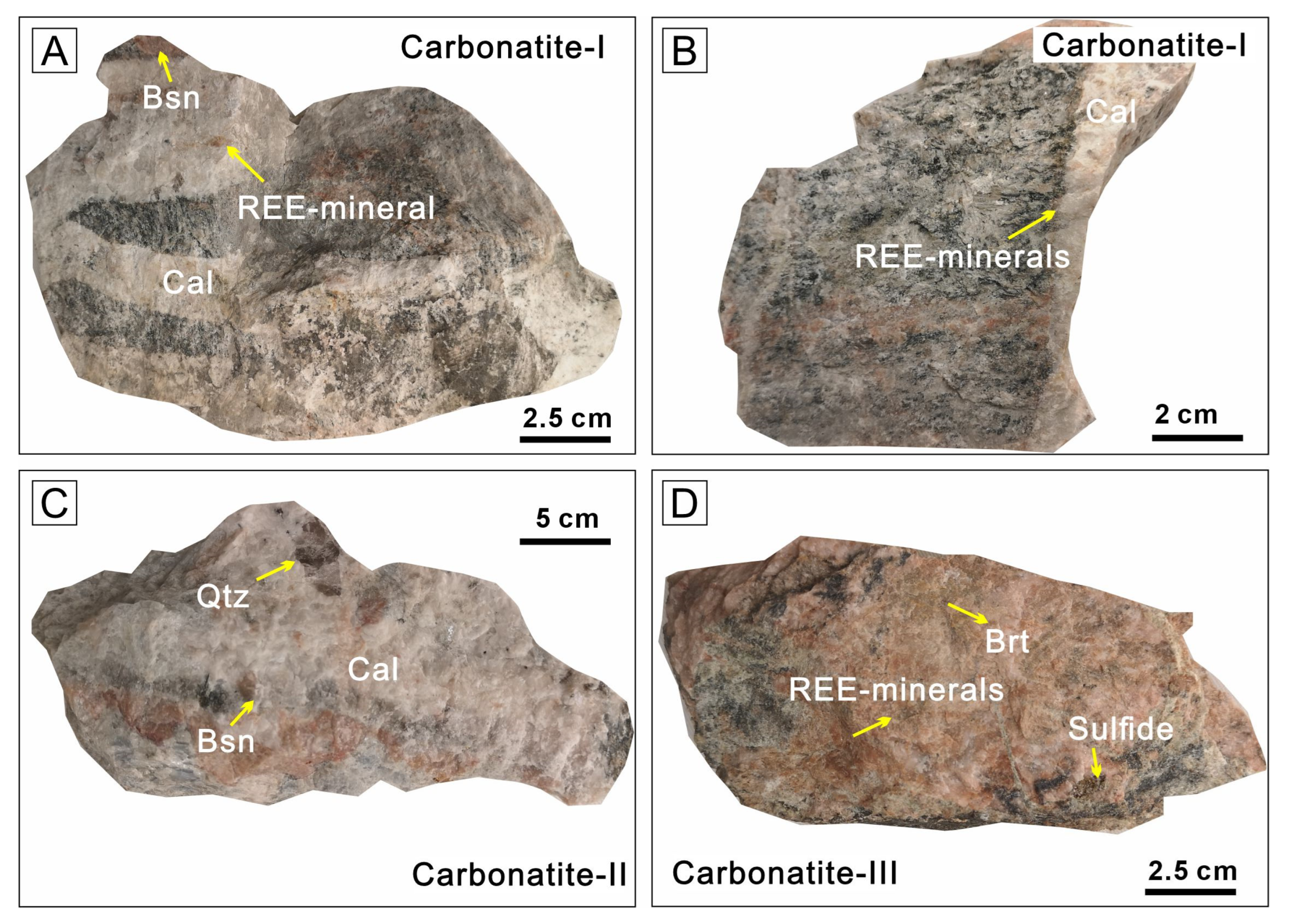
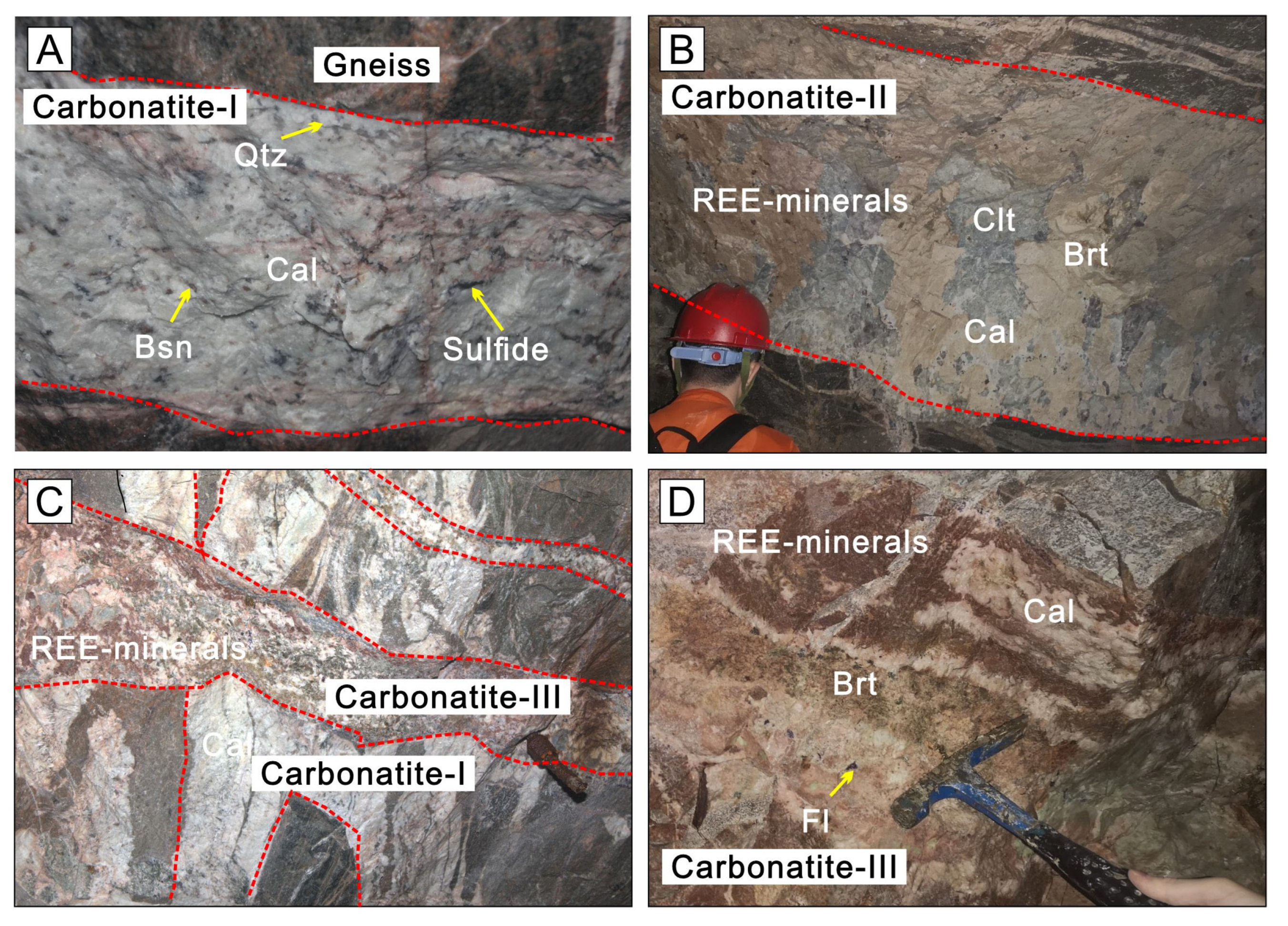
Based on previous work, this study conducted systematic sampling across different ore types within the Weishan REE deposit. Detailed petrographic observations were performed on apatite occurring in three representative ore types of contrasting mineralization (Figure 3): quartz-calcite carbonatite (20CS13), REE-barite carbonatite (20CS18), and REE-fluorite carbonatite (20CS09).
The quartz-calcite carbonatite and its adjacent alkaline metasomatic gneiss (Figure 3A) exhibit a grayish-white color, medium-grained texture, and a veined structural fabric. Ore minerals are dominated by bastnaesite and parasite, whereas gangue minerals include calcite, quartz, fluorite, barite, celestine, and minor sulfides such as pyrite, chalcopyrite, and sphalerite. The wall rock, composed of Neoarchean gneiss, displays a flesh-red to gray-white color and a granular texture with gneissic foliation. The flesh-red portions, representing intense alkaline alteration, are characterized by a mineral assemblage of K-feldspar (50%), plagioclase (30%), quartz (15%), calcite (10%), and minor REE minerals. The gray-white portions record weaker alkaline alteration and consist of plagioclase (55%), biotite (25%), K-feldspar (10%), and quartz (5%), along with minor calcite and REE minerals. Accessory phases in both domains include rutile, zircon, and apatite (Figure 4A,C). The REE-barite carbonatite (Figure 3B) is brownish to gray-white, medium-grained, and massive in structure (20CS18). The ore minerals are dominated by synchysite-(Ce), with minor bastnaesite and calcite. Gangue minerals include calcite, celestine, barite, and quartz (Figure 4D). The REE-fluorite carbonatite (Figure 3C,D) exhibits a brownish to dark-gray coloration, medium- to coarse-grained texture, and a disseminated structure. Ore minerals consist primarily of bastnaesite, synchysite, monazite, and ancylite, whereas the gangue assemblage comprises calcite, quartz, fluorite, barite, celestine, and minor sulfides including pyrite, chalcopyrite, and sphalerite (Figure 4B).

4.2. Analytical Methods

Cathodoluminescence (CL): Microscopic petrographic observations, cathodoluminescence (CL) imaging, and back-scattered electron (BSE) imaging of the apatite samples were conducted at the China University of Geosciences (Beijing, China) and the Research Institute of Petroleum Exploration and Development, PetroChina (Beijing, China). The analyses were performed using a CLF-2 cathodoluminescence system (BII, Whitby, ON, Canada) coupled with a Zeiss Axio Imager multifunctional microscope (Carl Zeiss AG, Jena, Germany). Operating conditions were 12.5 V accelerating voltage and 900 mA beam current. Grain microtextures including crack, zonation, and fluid inclusion were checked by the CL and BSE images, produced by JXA-8800 electron microprobe (JEOL Ltd., Tokyo, Japan) with operating conditions of 20 kV and 20 nA. Suitable sites were chosen within crystal grains for apatite geochemistry.
EPMA: The major element concentrations in apatite crystals from the quartz-barite-carbonatite, REE-barite carbonatite, and REE-fluorite carbonatite were analyzed following thin-section carbon coating using an electron probe microanalyzer JXA-8230 (JEOL Ltd., Tokyo, Japan) at the Shandong Institute of Geological Sciences (Jinan, China) with an accelerating voltage of 20 Kv, a probe current of 20 nA, a beam size of 5 μm, and a counting time of 20 s. Different well-characterized minerals were used as standards. The reference materials selected for calibration include F (topaz), Na and Si (jadeite), Mg (forsterite), P and Ca (apatite), Ti (rutile), K (K-feldspar), Fe (hematite), Cl (halite), S (barite), Mn (manganese oxide), and REE (LaP5O14, Ce P5O14, etc.). Its OH content was calculated from the measured total water content of apatite.
LA-ICP-MS: In situ laser ablation inductively coupled plasma mass spectrometry (LA-ICP-MS) was employed for apatite trace element analysis. The analyses were conducted at the National Research Center for Geoanalysis, Chinese Academy of Geological Sciences. The laser ablation system used was an NWR193HE ArF high-energy excimer laser ablation system (ESL GmbH, Bozeman, MT, USA), coupled with an Agilent 8900 ICP-MS instrument (Agilent Technologies Inc., Santa Clara, CA, USA). During laser ablation, helium served as the carrier gas and argon as the make-up gas to adjust sensitivity; both gases were homogenized using a gas homogenizer before entering the ICP. The laser spot size was 30 μm, the repetition rate was set to 6 Hz, and the laser fluence was 6 J/cm2. Each time-resolved analysis cycle consisted of 20 s of background signal acquisition followed by 40 s of sample signal acquisition.

5. Results

5.1. Petrography and Texture of Apatite

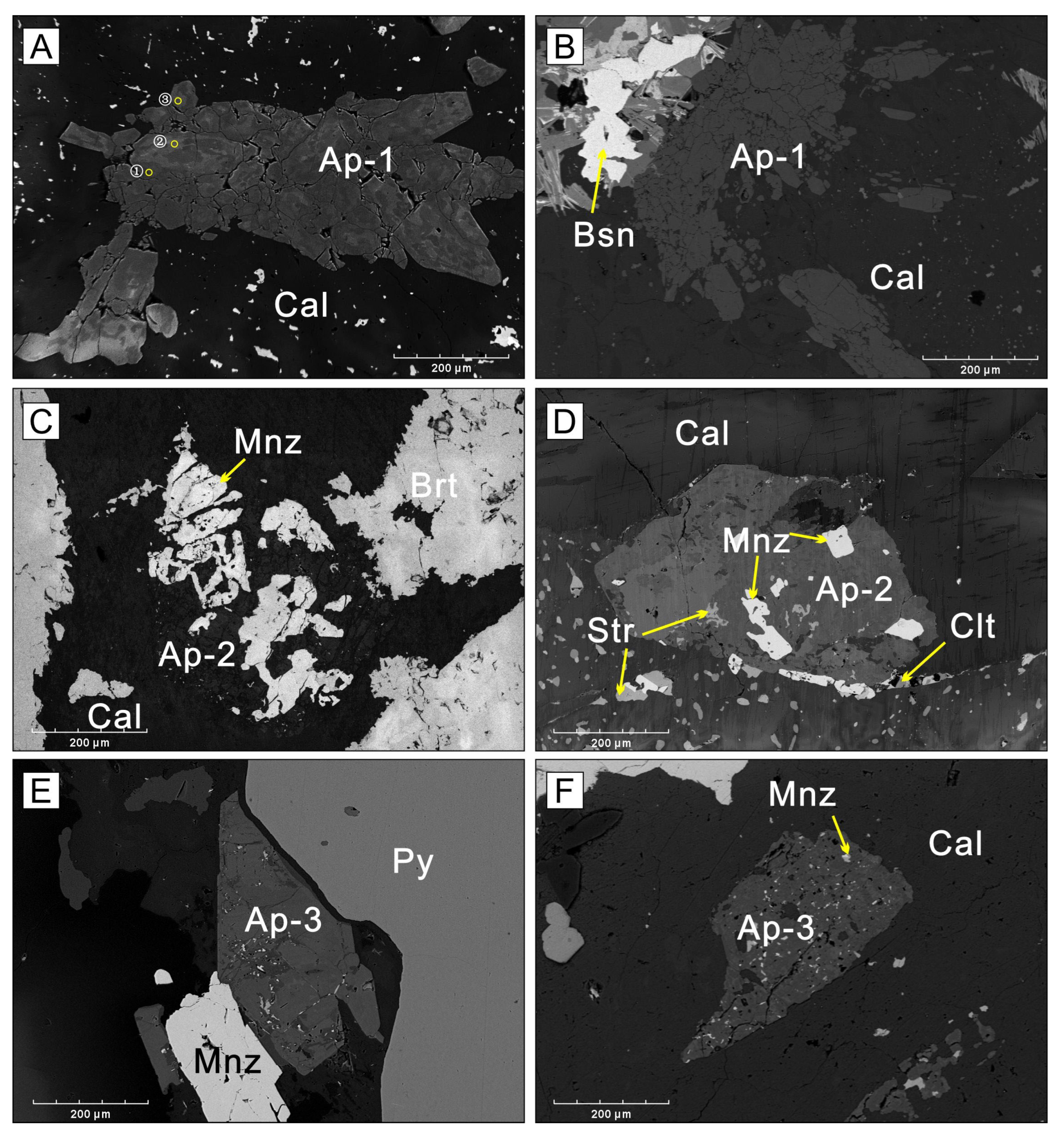
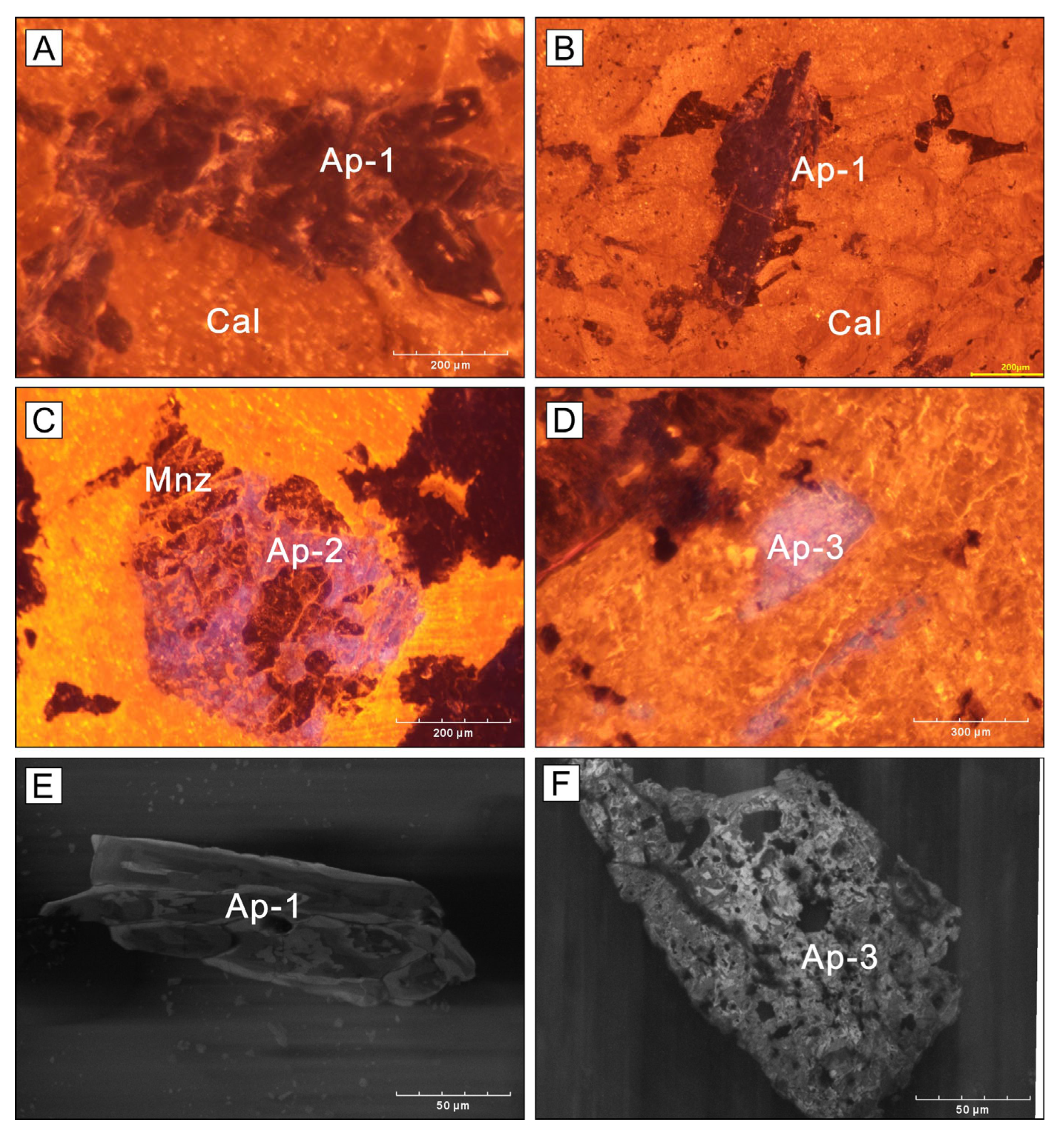
Apatite grains from carbonatites of the Weishan REE deposit were examined using polarized light microscopy, scanning electron microscopy (SEM), and cathodoluminescence (CL) techniques. Based on the morphological features and CL color characteristics, three types of apatite were identified (Figure 5 and Figure 6). Ap-1, collected from low-grade ores, occurs as subhedral grains (Figure 5A,B) with sharp boundaries and relatively clean interiors. The grains, 100–200 µm in size, are commonly intergrown aggregates. Under optical CL, Ap-1 displays a deep brown luminescence (Figure 6A,B), and SEM-CL shows zones of compositional heterogeneity (Figure 6E). Minor rhombohedral strontianite, monazite, and parasite occur along grain margins. The mineral assemblage includes calcite, celestine, quartz, and minor REE minerals. Ap-2, derived from the NE-trending carbonatite, occurs as anhedral to subhedral grains with diameters ranging from 300 µm to 1 mm (Figure 5C,D). Some crystals exhibit pseudo-hexagonal outlines, and their cores and rims contain abundant inclusions of ancylite and strontianite, closely intergrown with monazite. Optical CL shows a pinkish-violet emission (Figure 6C). The coexisting mineral assemblage comprises calcite, muscovite, strontianite, celestine, barite, monazite, and ancylite. Ap-3, from the NW-trending high-grade orebody, appears as anhedral grains (200–300 µm) with heavily altered rims (Figure 5E,F). The grains contain abundant REE-bearing mineral inclusions, such as bastnaesite and monazite. In transmitted-light CL images, Ap-3 exhibits pale pink luminescence (Figure 6D), and SEM-CL show patchy zones. The associated minerals include calcite, celestine, barite, quartz, fluorite, bastnaesite, and pyrite.

5.2. Trace and Rare Earth Elements Geochemistry

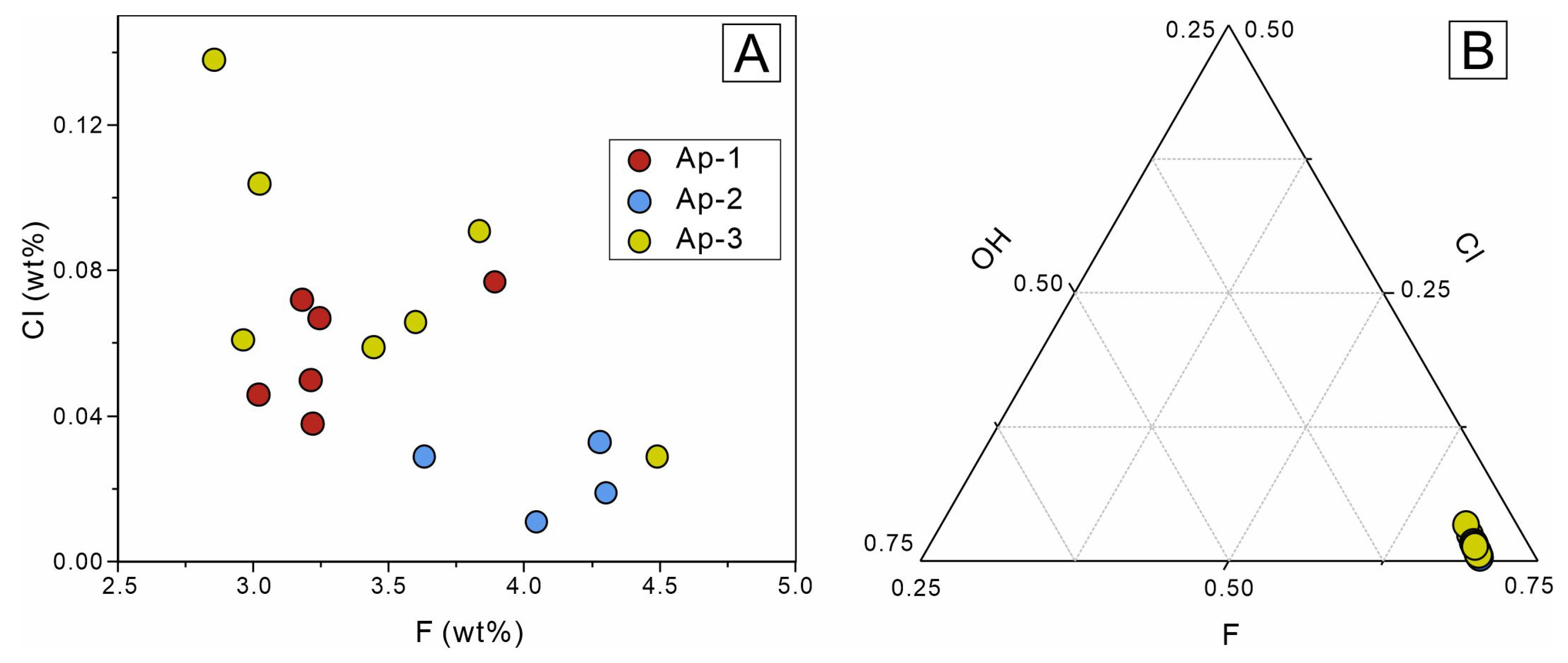
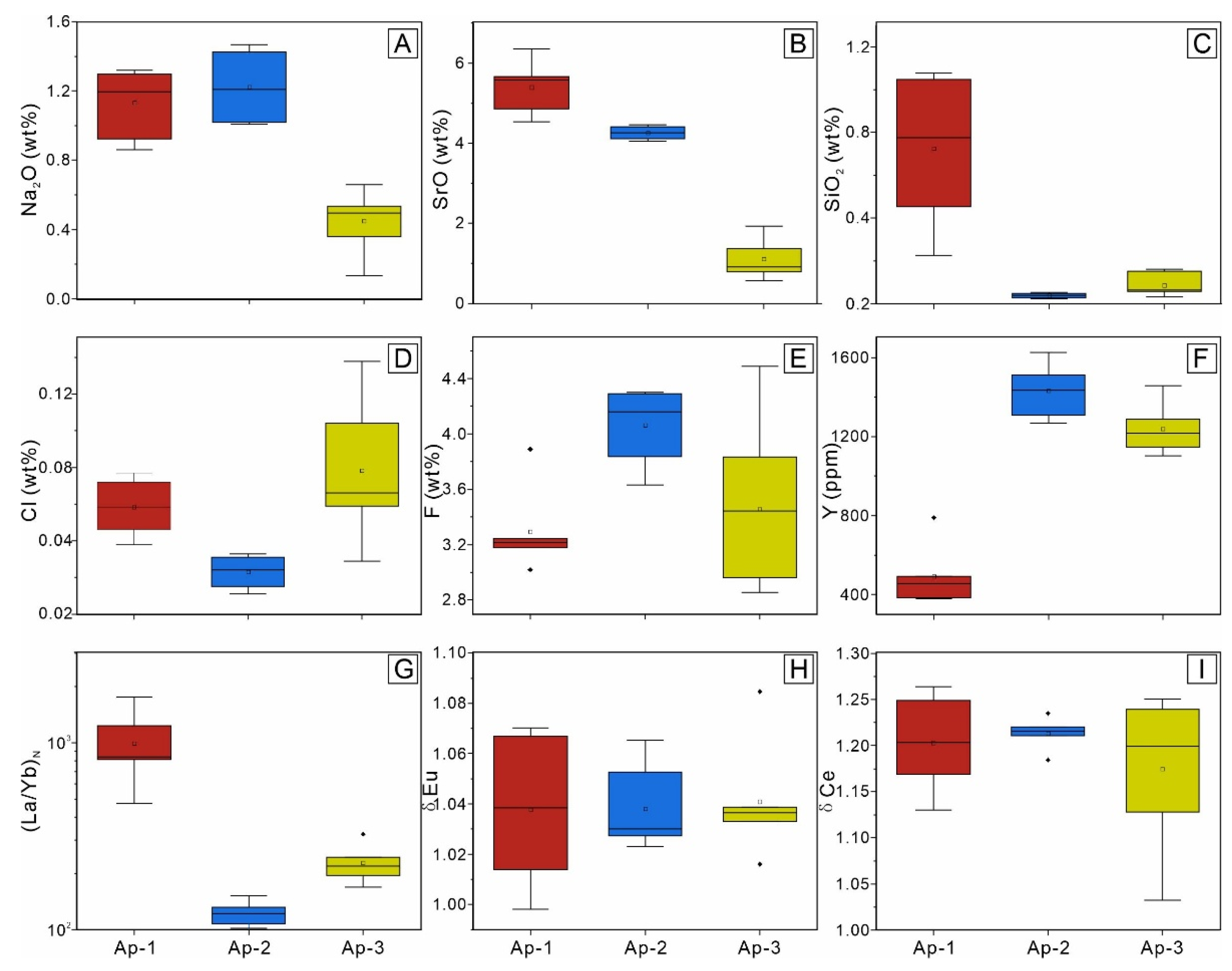
Major element compositions of apatite determined by in situ electron microprobe analysis are presented in Table 1. The results show distinct variations. The CaO contents of the three apatite types range from 41.66 to 44.63 wt%, 45.59 to 48.46 wt%, and 50.77 to 52.73 wt%, respectively, whereas P2O5 contents range from 36.66 to 37.95 wt%, 37.64 to 39.78 wt%, and 39.40 to 41.63 wt%. These systematic differences may reflect variable degrees of major element mobility during late-stage hydrothermal alteration. The Na2O contents range from 0.86 to 1.32 wt% in Ap-1, 1.00 to 1.46 wt% in Ap-2, and 0.13 to 0.66 wt% in Ap-3. Striking contrasts are also observed in SrO contents, which vary between 4.53 and 6.35 wt% (Ap-1), 4.05 and 4.46 wt% (Ap-2), and 0.56 and 1.92 wt% (Ap-3). Notably, Na and Sr concentrations display an inverse correlation with Ca and P, suggesting coupled substitution mechanisms during hydrothermal modification. Fluorine contents in all apatite types vary between 2.85 and 4.30 wt%, whereas Cl contents are consistently low (<0.13 wt%) and show negligible inter-type differences. A weak negative correlation between F and Cl is observed (Figure 7). In the F-Cl-OH ternary diagram, all apatite samples plot close to the F apex and secondarily toward the OH apex, indicating a predominance of fluorapatite compositions across the Weishan deposit.
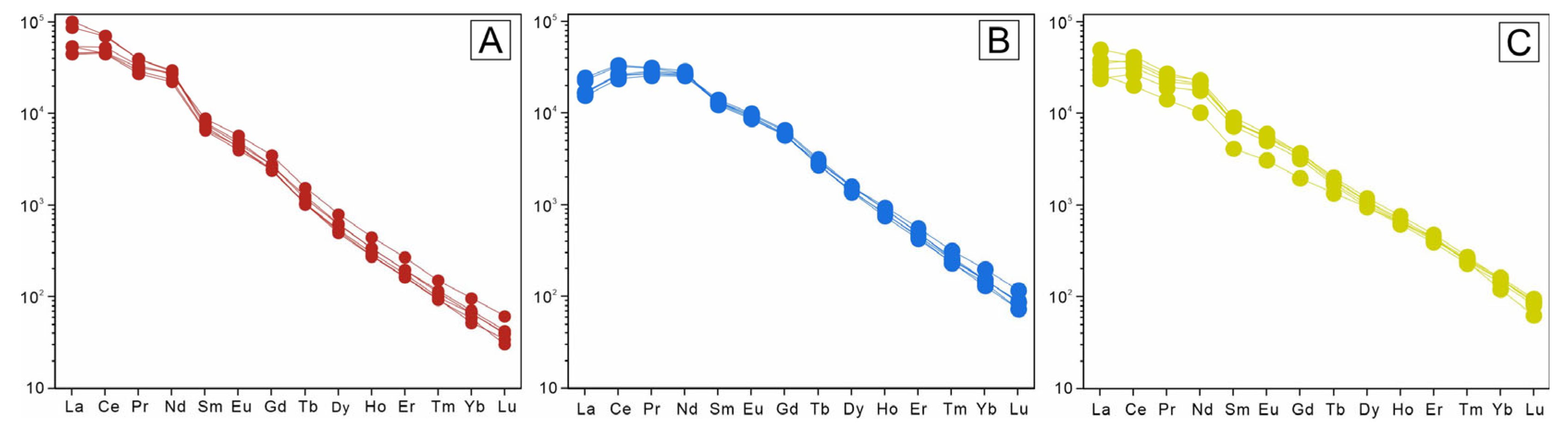
Trace element compositions obtained by in situ LA-ICP-MS are presented in Table 2. Thorium and uranium incorporate into the apatite lattice via Th4+ = 2Ca2+ and U4+ = 2Ca2+ substitution. U contents show limited variation among the three apatite types. Th contents are generally low (<75 ppm in most analyses). Ap-2 contains the lowest U, whereas Ap-1 and Ap-3 show slightly higher averages of 1.28 ppm and 4.27 ppm, respectively. Chondrite-normalized REE patterns (Figure 8) reveal marked differences in total REE abundances and distribution among the three types. Both Ap-2 and Ap-3 exhibit reduced ΣREE + Y concentrations relative to Ap-1, with averages of 67,332 ppm and 42,612 ppm, respectively. LREE contents likewise decrease in Ap-2 (39,221 ppm) and Ap-3 (40,228 ppm), slightly lower than Ap-1. In contrast, HREE contents are modestly elevated in Ap-2 (1875 ppm) and Ap-3 (1144 ppm), compared with Ap-1 (822 ppm).
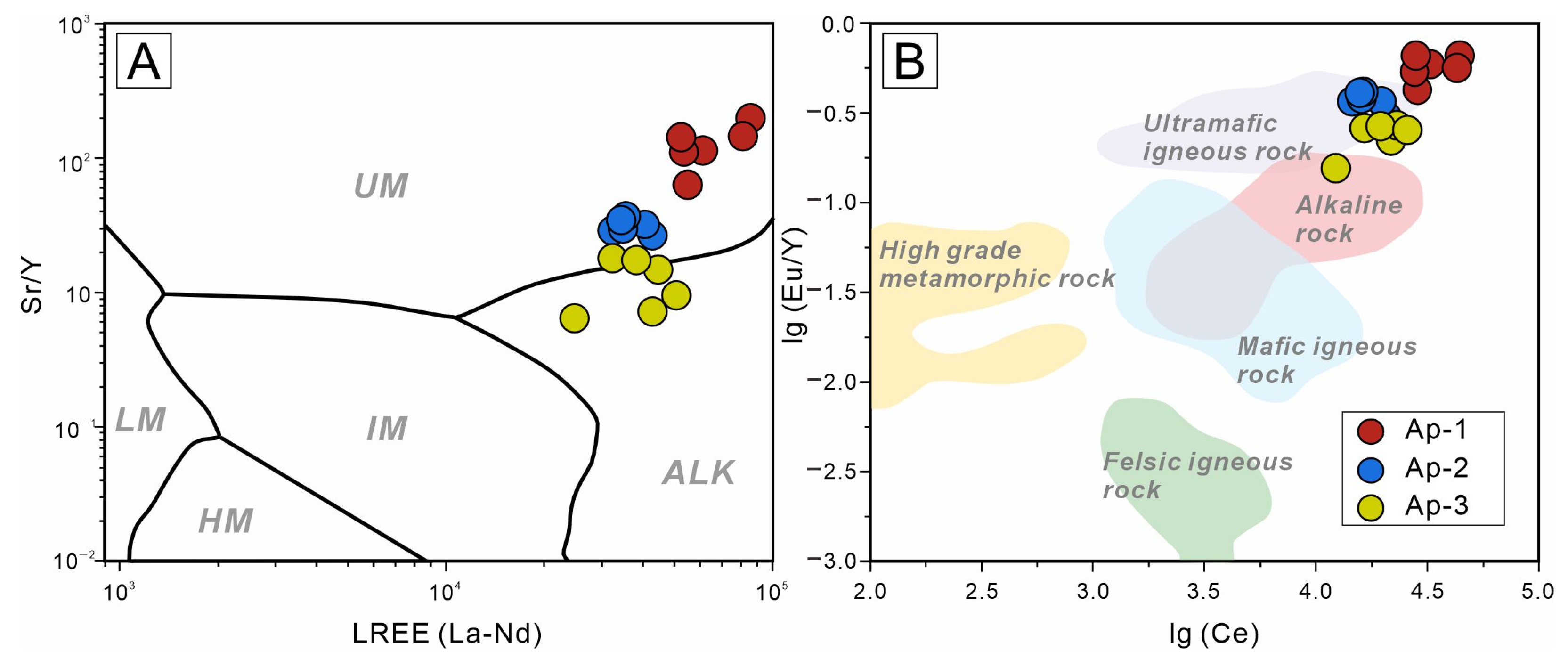
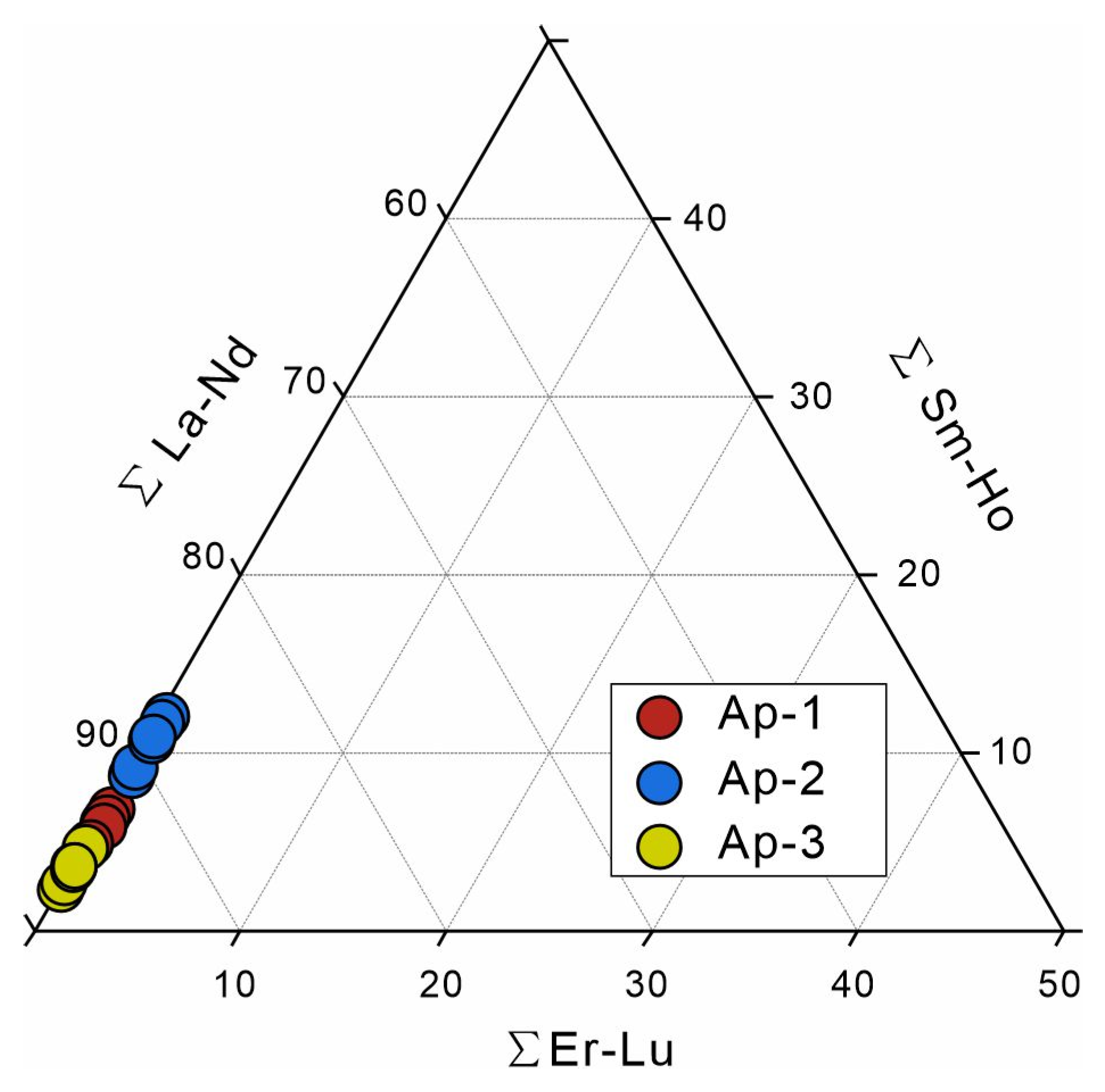
In the Sr/Y-LREE (La-Nd) and log(Eu/Y)-log(Ce) apatite discrimination diagrams, all samples plot within the field of ultramafic–mafic igneous rocks (including carbonatites), with some Ap-3 analyses lying near the boundary between ultramafic and alkaline rocks (Figure 9). In the ΣLa-Nd-ΣSm-Ho-ΣEr-Lu ternary diagram (Figure 10), most apatite analyses fall within the mantle field, with several Ap-1 and Ap-2 analyses plotting along the mantle–crust boundary, suggesting that the components were dominantly derived from a mantle source. All apatite types display Eu/Eu* values of 0.99–1.08, indicating the absence of significant Eu anomalies. Ce/Ce* values between 1.03 and 1.25 show slightly positive Ce anomalies (Figure 11H,I).

6. Discussion

6.1. Precipitation Mechanisms of Apatite

Calcium in apatite can be substituted by a variety of cations. In the system considered here, Sr2+ is isovalent with Ca2+ and therefore readily occupies Ca2+ sites via simple isomorphous substitution [70]. By contrast, cation substitutions involving a charge imbalance typically require coupled mechanisms, most commonly incorporating REE3+ or compensating anionic species such as PO43−, CO32−, or SO42− to maintain electroneutrality [71,72,73]. In the context of this study, trivalent cations that substitute for Ca2+, particularly REE3+ and Y3+, are of primary interest. The incorporation of REE3+ into the apatite structure predominantly proceeds through two principal substitution mechanisms [36]:
REE3+ + Na+ ↔ 2Ca2+
REE3+ + SiO44− ↔ Ca2+ + PO43−
Given the observed correlation between REEs and Na, Na+ is inferred to be the main charge-balancing cation associated with REE incorporation in the apatite types examined here. Several coupled substitution mechanisms could compensate for Na+ incorporation, including co-substitution with trivalent cations other than REEs, SO42−, CO32−, or F, and in some cases the formation of vacancies [40]. Although the substitution of Ca2+ by trivalent cations such as Bi3+ and Cr3+ has been reported in synthetic apatite, such mechanisms are unlikely to occur in natural systems and have not been documented in apatite from other carbonatite complexes [74,75,76]. Substitution involving SO42− is similarly improbable, as sulfur concentrations in the apatite examined here fall below the detection limit of EPMA.
In typical silicate alkaline–carbonatite magmatic systems, apatite is generally not among the earliest rock-forming phases to crystallize; instead, it becomes abundant only after the evolving magma reaches phosphate saturation [77,78,79,80]. Experimental studies have shown that apatite solubility and its saturation temperature are jointly controlled by SiO2 content in melt, aluminum saturation (A/CNK), Ca activity, and ambient P-T conditions. With progressive magmatic differentiation and increasing SiO2, the solubility of P2O5 in the melt decreases, thereby favoring apatite crystallization at intermediate to late magmatic stages [41,81]. At Weishan, Ap-1 exhibits zones of compositional heterogeneity, whereas CL locally reveals weak banding, suggesting crystallization during magmatic fractional differentiation. Petrographically, both Ap-2 and Ap-3 show clear evidence of replacement, and contain abundant inclusions of REE minerals, mainly parasite, ancylite, and monazite. Altered apatite is characterized by lower LREE, Na, Sr, and Si contents, but slightly higher F, Cl, and HREE abundances relative to unaltered magmatic apatite (Ap-1). These systematic compositional shifts, together with the replacement textures, suggest that Ap-2 and Ap-3 formed via fluid-mediated dissolution–reprecipitation. This process, well established as a fundamental reaction mechanism, is a widely recognized mechanism which replaces a primary mineral in the presence of a reactive fluid by a compositionally modified equivalent phase and/or a new mineral phase [36,37,71]. Owing to molar volume differences and subtle solubility contrasts between the precursor and product phases, the recrystallized domains typically develop interconnected microporosity and abundant fluid inclusions [44]. During dissolution–reprecipitation, parasite inclusions precipitate within Ap-3, and LREEs are mobilized outward from the apatite, whereas the F content remains essentially unchanged. This indicates that F was supplied by late-stage fluids rather than being solely inherited from the primary apatite. Coexisting coarse fluorite further supports this inference, because in F-rich reactive fluids REEs are commonly transported as [REEF]2+ complexes and thus can be highly mobile [82,83,84]. In CO2-rich fluids, REEs also exhibit high mobility, commonly as [REECO3]+ complexes, with REE solubility increasing with fluid salinity, pH, and alkalinity [85,86,87,88]. Finally, the occurrence of calcite inclusions within barite from the Weishan orebodies indicate elevated activities of CO32− and Ca2+ in the fluid at this stage [67].
Although the Ap-3-bearing orebodies have high REE grades (up to ~20%), the total volume of REE mineral inclusions within the apatite is relatively small, suggesting that these inclusions formed largely at the expense of primary magmatic apatite (Ap-1) rather than being entirely introduced by the external fluid. The presence of fine-grained, disseminated parasite crystals in the ores further implies precipitation under relatively high temperatures followed by rapid cooling. Overall, Ap-2 and Ap-3 apatite record different intensities of fluid-mediated modification: compared with Ap-2, Ap-3 underwent more extensive element mobility and a more complete dissolution–reprecipitation overprint.

6.2. Evolution of Ore-Forming Fluid

Apatite is commonly considered a chemically robust, alteration-resistant accessory mineral in igneous and hydrothermal systems [89,90]. However, under intense late-stage hydrothermal alteration, its morphology, internal textures, chemical composition, and even fundamental physicochemical properties may be significantly modified, resulting in partial or complete transformation into altered apatite [37,80,91,92]. Studies of porphyry Cu and iron oxide–apatite (IOA) deposits show that the systematic compositional contrasts between altered and unaltered apatite can be used to constrain the source, character, and evolution of magmatic–hydrothermal fluids [93].
In the Weishan REE deposit, the three apatite types correspond to distinct stages of carbonatite magma evolution and the associated fluid activity, as evidenced by the petrographic and geochemical constraints discussed above. Although both Ap-2 and Ap-3 formed through fluid-mediated dissolution–reprecipitation during late hydrothermal alteration, they differ markedly in element redistribution patterns, inclusion assemblages, and paragenetic relationships. These contrasts suggest overprinting by two late-stage fluid regimes with distinct compositions and/or physicochemical conditions. Ap-1 apatite is characterized by extremely high Sr contents, elevated Sr/Y ratios, and strong LREE enrichment, consistent with crystallization from a highly evolved and strongly fractionated carbonatite melt [14,43,94,95,96,97]. During the fractional crystallization of carbonatite magma, the crystallization of apatite, calcite, and other early carbonate and phosphate phases progressively depletes the melt in compatible components, while incompatible elements such as REEs and Sr become increasingly enriched in the residual melt [20]. The high Sr/Y ratios of Ap-1 further imply advanced fractionation, because Y partitions more strongly into apatite than Sr [43,97,98]. Continued crystallization thus causes Sr/Y in the residual melt, and in apatite crystallizing from it, to increase. With further cooling and the onset of volatile saturation (H2O, CO2, F, Cl), an REE-rich fluid exsolves from the residual melt. At this stage, apatite begins to record transitional characteristics: Sr decreases, likely because Sr is preferentially retained in the melt and/or sequestered into early carbonate minerals during melt–fluid partitioning, while the system-wide REE budget approaches its maximum. Fluid exsolution represents a critical step in the mineralization process, as it efficiently extracts REEs from a large-volume silicate–carbonatite melt and concentrates them into a much smaller-volume fluid phase, thereby creating the fundamental geochemical precondition for the formation of economically significant REE mineralization.
Ap-2 apatite occurs in REE-barite carbonatite ores and typically forms subhedral grains in which rims and internal domains are partly infilled by strontianite, together with abundant REE-mineral precipitation dominated by ancylite and monazite. Compositionally, Ap-2 shows the same general trends in Ca, P, Sr, REE, and Na as Ap-3, but the magnitudes of these changes are significantly smaller, whereas HREE contents show only a slight increase. Together with its weaker replacement textures, these features indicate lower-intensity hydrothermal overprint and a less advanced stage of fluid-mediated dissolution–reprecipitation than in Ap-3. Although abundant strontianite fills the rims and microfractures within Ap-2, and the dominant REE mineral inclusions shift from parasite in Ap-3 to ancylite in Ap-2, the bulk Sr content of apatite decreases only modestly [72,99]. This implies that Sr in the associated assemblage was supplied largely by the fluid rather than derived solely from apatite, and that the fluid was likewise enriched in CO32. The scarcity of fluorite in the ore and the change in REE inclusion assemblage also indicate that the F content of the fluid responsible for Ap-2 alteration was lower than that of the fluid that modified Ap-3. Monazite commonly occurs along apatite grain boundaries rather than as inclusions, consistent with precipitation during fluid–rock interaction [37,71,87,93]. This implies that the fluid was enriched in LREEs such as La, Ce, and Nd, which combined with PO43− liberated from apatite to precipitate monazite. In contrast, Ap-3 displays much stronger evidence of chemical modification: LREE, Na, and Sr decrease markedly, whereas Ca and P increase to some extent, and F, Cl, Si, and HREE remain essentially unchanged. Combined with the distinct paragenesis of the REE-fluorite carbonatite ores relative to earlier carbonatites, these compositional features provide powerful constraints on the composition of the altering fluid. During dissolution–reprecipitation, synchysite inclusions precipitated within Ap-3, while LREEs were mobilized outward from the apatite. The near-constant F content in Ap-3 suggests relatively low free F activity in the fluid, with F preferentially complexed with REEs; consequently, REEs were transported mainly as [REEF]2+ species.

6.3. Implications for REE Mineralization

The geochemical record preserved in apatite clearly demonstrates that mineralization at Weishan is not produced by a single-stage process, but rather the cumulative product of multiple episodes of fluid evolution [63,64,91]. A highly fractionated carbonatite magma provided the fundamental metal source for REE mineralization; without this stage of pre-enrichment, the REE concentrations in the original melt would have been insufficient to generate a large-scale ore deposit (Figure 2). The high REE contents of magmatic apatite provide direct evidence of this early enrichment process. The exsolution of F- and Cl-rich fluids marks the critical transition from REE “dispersion” in a large magma volume to their “concentration” in a much smaller fluid phase [78,100]. During this stage, REEs previously locked in rock-forming minerals (e.g., early apatite or silicates) or retained in the residual melt are remobilized and efficiently transferred into the fluid phase, thereby generating a REE-rich hydrothermal medium capable of ore formation. Driven by tectonic structures, these fluids migrate into favorable traps such as faults, fractures, and intrusive contacts. Within these sites, water–rock interactions, fluid boiling, and redox changes collectively trigger the rapid and voluminous precipitation of REE minerals (e.g., bastnaesite, monazite) together with hydrothermal apatite [38,39,101]. This process chain ultimately governs orebody geometry, tonnage, and grade. The widespread development of hydrothermal apatite therefore represents a major mineralization event and provides a durable mineralogical archive of the ore-forming system [73,89,102,103].
Field observations and petrographic evidence from the Weishan REE deposit indicate that the ore-forming system experienced multiple stages of metasomatic re-equilibration and elemental redistribution. During early mineralization, the system was dominated by carbonatite magma, whereas in the later stages, progressive changes in physicochemical conditions (e.g., temperature, pressure, and pH) during alkaline metasomatism with the wall rocks promoted a transition to a hydrothermal regime. As the carbonatite magma evolved to its late stage, a derivative ore-forming hydrothermal fluid was generated [104,105,106,107]. This fluid overprinted and altered the early-crystallized minerals, and through a series of complex chemical exchanges and renewed mineral crystallization, produced REE-enriched carbonatite. Geochemical evidence from apatite further suggests that, although the primitive, relatively undifferentiated carbonatite magma was already relatively enriched in REEs, subsequent magmatic–hydrothermal evolution was required to achieve ore-grade enrichment.
During this evolution, early-crystallized magmatic apatite was overprinted and partially replaced by later hydrothermal fluids, giving rise to new generations of hydrothermal apatite. Ap-1 is widely developed in quartz-calcite carbonatite at Weishan and represents a typical early carbonatite-associated REE mineralization stage; Ap-1 corresponds to apatite crystallized directly from carbonatite magma. In contrast, Ap-2 and Ap-3 occur in REE-fluorite carbonatite and REE-barite carbonatite, respectively. These latter orebodies are characterized by higher REE grades and coarser crystal sizes, and they demonstrably cut across the earlier carbonatite in the field, indicating that they are products of later fluid precipitation.

7. Conclusions

The Weishan REE deposit is a typical carbonatite-associated REE deposit in which mineralization is governed by the multi-stage evolution of a carbonatite magma–hydrothermal system. Three generations of apatite (Ap-1, Ap-2, Ap-3) from carbonatite document progressive overprinting by compositionally different fluids. Magmatic Ap-1 crystallized from carbonatite melt, whereas Ap-2 and Ap-3 formed by fluid-mediated dissolution–reprecipitation, accompanied by systematic decreases in LREE, Na, and Sr, increases in Na-Sr-P (relative proportions), and incorporation of REE mineral inclusions (e.g., ancylite-, monazite, parasite), reflecting element remobilization and redistribution during hydrothermal alteration. Systematic variations in REE patterns, Sr/Y ratios, and Ce-Eu anomalies among the apatite demonstrate that the geochemistry effectively traces the transition from magmatic to hydrothermal stages, the evolution of F-CO2-Ba-SO42−-bearing fluids, and the associated REE enrichment and precipitation. Apatite thus provides robust mineralogical constraints on the ore-forming process of the Weishan carbonatite REE deposit and offers a useful tool for understanding and exploring similar deposits.

Author Contributions

Conceived the ideas, Y.-X.G., S.-S.L. and C.-P.L.; map compilation, Y.-Z.S.; data curation, formal analysis, and investigation, Y.-X.G., M.-Q.W., Z.S., Y.-Z.S., Z.-Y.Y., S.-S.L. and K.-F.Q.; writing, Y.-X.G. and S.-S.L. All authors have read and agreed to the published version of the manuscript.

Funding

This study was financially supported by the Open Project of Weihai Key Laboratory of Energy and Mineral Resources Investigation and Evaluation (No. LDKF-2023WH-02), the Open Research Project from Shandong Provincial Lunan Geology and Exploration Institute and Shandong Engineering Research Center of Rare Elements Exploration and Comprehensive Utilization (LNY202301), the Open Research Fund Program of Key Laboratory of Gold Mineralization Processes and Resource Utilization Subordinated to the Ministry of Natural Resources, the Shandong Key Laboratory of Metallogenic Geological Process and Resources Utilization (KFKT202403), the Fundamental Research Funds for the Central Universities (2-9-2023-055), and the Young Elite Scientists Sponsorship Program of BAST (BYESS2024122).

Data Availability Statement

The data set is presented directly in the present study.

Acknowledgments

We are grateful to Ya-Qi Huang and De-Jian Li for providing valuable field guidance and engaging in constructive discussions. We appreciate Xin-Yi Wang for assistance with figure preparation. We are deeply grateful to the anonymous reviewers and editors for their insightful comments and suggestions.

Conflicts of Interest

The authors declare no conflicts of interest.

References

  1. Fan, H.-R.; Yang, K.-F.; Hu, F.-F.; Liu, S.; Wang, K.-Y. The giant Bayan Obo REE-Nb-Fe deposit, China: Controversy and ore genesis. Geosci. Front. 2016, 7, 335–344. [Google Scholar] [CrossRef]
  2. Liu, Y.; Chakhmouradian, A.R.; Hou, Z.; Song, W.; Kynický, J. Development of REE mineralization in the giant Maoniuping deposit (Sichuan, China): Insights from mineralogy, fluid inclusions, and trace-element geochemistry. Mineral. Depos. 2018, 54, 701–718. [Google Scholar] [CrossRef]
  3. Xie, Y.; Xia, J.; Cui, K.; Qu, Y.; Liang, P.; Zhong, R. Rare earth elements deposits in China: Spatio-temporal distribution and ore-forming processes. Chin. Sci. Bull. 2020, 65, 3794–3808. [Google Scholar] [CrossRef]
  4. Chakhmouradian, A.R.; Wall, F. Rare Earth Elements: Minerals, Mines, Magnets (and More). Elements 2012, 8, 333–340. [Google Scholar] [CrossRef]
  5. Smith, M.P.; Campbell, L.S.; Kynicky, J. A review of the genesis of the world class Bayan Obo Fe–REE–Nb deposits, Inner Mongolia, China: Multistage processes and outstanding questions. Ore Geol. Rev. 2015, 64, 459–476. [Google Scholar] [CrossRef]
  6. Smith, M.P.; Henderson, P.; Campbell, L.S. Fractionation of the REE during hydrothermal processes: Constraints from the Bayan Obo Fe-REE-Nb deposit, Inner Mongolia, China. Geochim. Cosmochim. Acta 2000, 64, 3141–3160. [Google Scholar] [CrossRef]
  7. Wei, C.; Deng, M.; Xu, C.; Chakhmouradian, A.R.; Smith, M.P.; Kynicky, J.; Song, W.; Chen, W.; Fu, B. Mineralization of the Bayan Obo Rare Earth Element Deposit by Recrystallization and Decarbonation. Econ. Geol. 2022, 117, 1327–1338. [Google Scholar] [CrossRef]
  8. Yang, K.-F.; Fan, H.-R.; Santosh, M.; Hu, F.-F.; Wang, K.-Y. Mesoproterozoic carbonatitic magmatism in the Bayan Obo deposit, Inner Mongolia, North China: Constraints for the mechanism of super accumulation of rare earth elements. Ore Geol. Rev. 2011, 40, 122–131. [Google Scholar] [CrossRef]
  9. Yang, K.; Fan, H.; Pirajno, F.; Li, X. The Bayan Obo (China) giant REE accumulation conundrum elucidated by intense magmatic differentiation of carbonatite. Geology 2019, 47, 1198–1202. [Google Scholar] [CrossRef]
  10. Aranha, M.; Porwal, A.; Sundaralingam, M.; González-Álvarez, I.; Markan, A.; Rao, K. Rare earth elements associated with carbonatite–alkaline complexes in western Rajasthan, India: Exploration targeting at regional scale. Solid Earth 2022, 13, 497–518. [Google Scholar] [CrossRef]
  11. Chakhmouradian, A.R. High-field-strength elements in carbonatitic rocks: Geochemistry, crystal chemistry and significance for constraining the sources of carbonatites. Chem. Geol. 2006, 235, 138–160. [Google Scholar] [CrossRef]
  12. Gittins, J.; Mitchell, R.H. The genesis of calcite and dolomite carbonatite-forming magma by liquid immiscibility: A critical appraisal. Geol. Mag. 2023, 160, 1463–1480. [Google Scholar] [CrossRef]
  13. Liu, Y.; Hou, Z. A synthesis of mineralization styles with an integrated genetic model of carbonatite-syenite-hosted REE deposits in the Cenozoic Mianning-Dechang REE metallogenic belt, the eastern Tibetan Plateau, southwestern China. J. Asian Earth Sci. 2017, 137, 35–79. [Google Scholar] [CrossRef]
  14. Ryabchikov, I.D.; Orlova, G.P.; Senin, V.G.; Trubkin, N.V. Partitioning of rare earth elements between phosphate-rich carbonatite melts and mantle peridotites. Mineral. Petrol. 1993, 49, 1–12. [Google Scholar] [CrossRef]
  15. Verplanck, P.L. The Role of Fluids in the Formation of Rare Earth Element Deposits. Procedia Earth Planet. Sci. 2017, 17, 758–761. [Google Scholar] [CrossRef]
  16. Verplanck, P.L.; Hitzman, M.W. Rare Earth and Critical Elements in Ore Deposits; Society of Economic Geologists: Littleton, CO, USA, 2016; Volume 18. [Google Scholar]
  17. Wall, F.; Rollat, A.; Pell, R. Responsible Sourcing of Critical Metals. Elements 2017, 13, 313–318. [Google Scholar] [CrossRef]
  18. Xie, Y.; Verplanck, P.L.; Hou, Z.; Zhong, R. Mineral Deposits of China; Society of Economic Geologists: Littleton, CO, USA, 2019; pp. 509–552. [Google Scholar]
  19. Zheng, X.; Liu, Y.; Smith, M.P.; Kynický, J.; Hou, Z. Carbonatitic Magma Fractionation and Contamination Generate Rare Earth Element Enrichment and Mineralization in the Maoniuping Giant REE Deposit, SW China. J. Petrol. 2023, 64, egad037. [Google Scholar] [CrossRef]
  20. Mitchell, R.H. Carbonatites and Carbonatites and Carbonatites. Can. Mineral. 2005, 43, 2049–2068. [Google Scholar] [CrossRef]
  21. Siegel, K.; Vasyukova, O.V.; Williams-Jones, A.E. Magmatic evolution and controls on rare metal-enrichment of the Strange Lake A-type peralkaline granitic pluton, Québec-Labrador. Lithos 2018, 308–309, 34–52. [Google Scholar] [CrossRef]
  22. Tang, L.; Wagner, T.; Fusswinkel, T.; Zhang, S.-T.; Xu, B.; Jia, L.-H.; Hu, X.-K. Magmatic-hydrothermal evolution of an unusual Mo-rich carbonatite: A case study using LA-ICP-MS fluid inclusion microanalysis and He–Ar isotopes from the Huangshui’an deposit, Qinling, China. Mineral. Depos. 2021, 56, 1133–1150. [Google Scholar] [CrossRef]
  23. Moore, M.; Chakhmouradian, A.R.; Mariano, A.N.; Sidhu, R. Evolution of rare-earth mineralization in the Bear Lodge carbonatite, Wyoming: Mineralogical and isotopic evidence. Ore Geol. Rev. 2015, 64, 499–521. [Google Scholar] [CrossRef]
  24. O’Brien, H. Mineral Deposits of Finland; Elsevier: Amsterdam, The Netherlands, 2015; pp. 291–303. [Google Scholar]
  25. Verplanck, P.L.; Farmer, G.L.; Kettler, R.M.; Lowers, H.A.; Johnson, C.A.; Koenig, A.E.; Blessington, M.J. Petrogenesis and rare earth element mineralization of the Elk Creek carbonatite, Nebraska, USA. Ore Geol. Rev. 2022, 146, 104953. [Google Scholar] [CrossRef]
  26. Anenburg, M.; Broom-Fendley, S.; Chen, W. Formation of Rare Earth Deposits in Carbonatites. Elements 2021, 17, 327–332. [Google Scholar] [CrossRef]
  27. Chakhmouradian, A.R.; Zaitsev, A.N. Rare Earth Mineralization in Igneous Rocks: Sources and Processes. Elements 2012, 8, 347–353. [Google Scholar] [CrossRef]
  28. Smith, M.P.; Moore, K.; Kavecsánszki, D.; Finch, A.A.; Kynicky, J.; Wall, F. From mantle to critical zone: A review of large and giant sized deposits of the rare earth elements. Geosci. Front. 2016, 7, 315–334. [Google Scholar] [CrossRef]
  29. Beard, C.D.; Goodenough, K.M.; Borst, A.M.; Wall, F.; Siegfried, P.R.; Deady, E.A.; Pohl, C.; Hutchison, W.; Finch, A.A.; Walter, B.F.; et al. Alkaline-Silicate REE-HFSE Systems. Econ. Geol. 2023, 118, 177–208. [Google Scholar] [CrossRef]
  30. Long, Z.-Y.; Qiu, K.-F.; Halama, R.; Yu, H.-C.; Zhang, J.-Y.; Li, S.-S.; Han, G.-L.; Gao, Z.-Y.; Ding, Z.-J.; Deng, J. Reappraisal of potassium isotopic composition of the continental lithospheric mantle: Insights from calc-alkaline lamprophyres in the eastern North China Craton. GSA Bull. 2025, 137, 4399–4412. [Google Scholar] [CrossRef]
  31. Qiu, K.-F.; Long, Z.-Y.; Romer, R.L.; Halama, R.; Williams-Jones, A.E.; Yu, H.-C.; Li, S.-S.; Wu, M.-Q.; Deng, J. The mantle source of REE-rich alkaline silicate magmas can be enriched by continent-derived sediment subduction. Nat. Commun. 2025, 16, 11191. [Google Scholar] [CrossRef]
  32. Schleicher, H. In-situ Determination of Trace Element and REE Partitioning in a Natural Apatite-Carbonatite Melt System using Synchrotron XRF Microprobe Analysis. J. Geol. Soc. India 2019, 93, 305–312. [Google Scholar] [CrossRef]
  33. Yu, H.-C.; Qiu, K.-F.; Hetherington, C.; Chew, D.; Huang, Y.-Q.; He, D.; Geng, J.-Z.; Xian, H.-Y. Apatite as an alternative petrochronometer to trace the evolution of magmatic systems containing metamict zircon. Contrib. Mineral. Petrol. 2021, 176, 68. [Google Scholar] [CrossRef]
  34. Anenburg, M.; Mavrogenes, J.A.; Bennett, V.C. The Fluorapatite P–REE–Th Vein Deposit at Nolans Bore: Genesis by Carbonatite Metasomatism. J. Petrol. 2020, 61, egaa003. [Google Scholar] [CrossRef]
  35. Apukhtina, O.B.; Kamenetsky, V.S.; Ehrig, K.; Kamenetsky, M.B.; Maas, R.; Thompson, J.; McPhie, J.; Ciobanu, C.L.; Cook, N.J. EARLY, deep magnetite-fluorapatite mineralization at the olympic dam Cu-U-Au-Ag deposit, South Australia. Econ. Geol. 2017, 112, 1531–1542. [Google Scholar] [CrossRef]
  36. Broom-Fendley, S.; Styles, M.T.; Appleton, J.D.; Gunn, G.; Wall, F. Evidence for dissolution-reprecipitation of apatite and preferential LREE mobility in carbonatite-derived late-stage hydrothermal processes. Am. Mineral. 2016, 101, 596–611. [Google Scholar] [CrossRef]
  37. Harlov, D.E. Apatite: A fingerprint for metasomatic processes. Elements 2015, 11, 171–176. [Google Scholar] [CrossRef]
  38. Li, X.; Zhou, M.-F. Multiple stages of hydrothermal REE remobilization recorded in fluorapatite in the Paleoproterozoic Yinachang Fe–Cu–(REE) deposit, Southwest China. Geochim. Cosmochim. Acta 2015, 166, 53–73. [Google Scholar] [CrossRef]
  39. Lorenz, M.; Altenberger, U.; Trumbull, R.B.; Lira, R.; López de Luchi, M.; Günter, C.; Eidner, S. Chemical and textural relations of britholite- and apatite-group minerals from hydrothermal REE mineralization at the Rodeo de los Molles deposit, Central Argentina. Am. Mineral. 2019, 104, 1840–1850. [Google Scholar] [CrossRef]
  40. Pan, Y.; Fleet, M.E. Rare earth element mobility during prograde granulite facies metamorphism: Significance of fluorine. Contrib. Mineral. Petrol. 1996, 123, 251–262. [Google Scholar] [CrossRef]
  41. Harlov, D.E.; Wirth, R.; Förster, H.J. An experimental study of dissolution-reprecipitation in fluorapatite: Fluid infiltration and the formation of monazite. Contrib. Mineral. Petrol. 2005, 150, 268–286. [Google Scholar] [CrossRef]
  42. Harlov, D.E.; Wirth, R.; Hetherington, C.J. The relative stability of monazite and huttonite at 300–900 °C and 200–1000 MPa: Metasomatism and the propagation of metastable mineral phases. Am. Mineral. 2007, 92, 1652–1664. [Google Scholar] [CrossRef]
  43. Klemme, S.; Dalpé, C. Trace-element partitioning between apatite and carbonatite melt. Am. Mineral. 2003, 88, 639–646. [Google Scholar] [CrossRef]
  44. Putnis, A. Mineral Replacement Reactions. Rev. Mineral. Geochem. 2009, 70, 87–124. [Google Scholar] [CrossRef]
  45. Qiu, K.-F.; Zhou, T.; Chew, D.; Hou, Z.; Müller, A.; Yu, H.-C.; Lee, R.; Chen, H.; Deng, J. Apatite trace element composition as an indicator of ore deposit types: A machine learning approach. Am. Mineral. 2024, 109, 303–314. [Google Scholar] [CrossRef]
  46. Zhou, T.; Qiu, K.; Wang, Y.; Yu, H.; Hou, Z. Apatite Eu/Y-Ce discrimination diagram: A big data based approach for provenance classification. Acta Petrol. Sin. 2022, 38, 291–299. [Google Scholar]
  47. Zhai, M.G. Tectonic evolution and metallogenesis of North China Craton. Mineral. Depos. 2010, 29, 24–36. [Google Scholar] [CrossRef]
  48. Zhao, G.; Sun, M.; Wilde, S.A.; Sanzhong, L. Late Archean to Paleoproterozoic evolution of the North China Craton: Key issues revisited. Precambrian Res. 2005, 136, 177–202. [Google Scholar] [CrossRef]
  49. Zhao, J.-H.; Zhou, M.-F. Neoproterozoic adakitic plutons in the northern margin of the Yangtze Block, China: Partial melting of a thickened lower crust and implications for secular crustal evolution. Lithos 2008, 104, 231–248. [Google Scholar] [CrossRef]
  50. Li, S.-S.; Santosh, M.; Teng, X.-M.; He, X.-F. Paleoproterozoic arc-continent collision in the North China Craton: Evidence from the Zanhuang Complex. Precambrian Res. 2016, 286, 281–305. [Google Scholar] [CrossRef]
  51. Mao, J.-W.; Xie, G.-Q.; Zhang, Z.-H.; Li, X.-F.; Wang, Y.-T.; Zhang, C.-Q.; Li, Y.-F. Mesozoic large-scale metallogenic pulses in North China and corresponding geodynamie settings. Acta Petrol. Sin. 2005, 21, 171–190. [Google Scholar]
  52. Long, Z.-Y.; Moynier, F.; Bögels, T.; Fang, L.; Caracas, R.; Paquet, M.; Jourdan, F.; Luu, T.-H.; Rigoussen, D.; Qiu, K.-F.; et al. Impact-induced sublimation drives volatile depletion in carbonaceous meteorites. Nat. Commun. 2025, 16, 6146. [Google Scholar] [CrossRef]
  53. Qiu, K.-F.; Deng, J.; Laflamme, C.; Long, Z.-Y.; Wan, R.-Q.; Moynier, F.; Yu, H.-C.; Zhang, J.-Y.; Ding, Z.-J.; Goldfarb, R. Giant Mesozoic gold ores derived from subducted oceanic slab and overlying sediments. Geochim. Cosmochim. Acta 2023, 343, 133–141. [Google Scholar] [CrossRef]
  54. Qiu, K.-F.; Deng, J.; Sai, S.-X.; Yu, H.-C.; Tamer, M.T.; Ding, Z.-J.; Yu, X.-F.; Goldfarb, R. Low-Temperature Thermochronology for Defining the Tectonic Controls on Heterogeneous Gold Endowment Across the Jiaodong Peninsula, Eastern China. Tectonics 2023, 42, e2022TC007669. [Google Scholar] [CrossRef]
  55. Qiu, K.-F.; Romer, R.L.; Long, Z.-Y.; Williams-Jones, A.E.; Yu, H.-C.; Turner, S.; Wang, Q.-F.; Li, S.-S.; Zhang, J.-Y.; Duan, H.-R.; et al. The role of an oxidized lithospheric mantle in gold mobilization. Sci. Adv. 2024, 10, eado6262. [Google Scholar] [CrossRef] [PubMed]
  56. Qiu, K.-F.; Romer, R.L.; Long, Z.-Y.; Yu, H.-C.; Turner, S.; Wan, R.-Q.; Li, X.-Q.; Gao, Z.-Y.; Deng, J. Potassium isotopes as a tracer of hydrothermal alteration in ore systems. Geochim. Cosmochim. Acta 2024, 368, 185–196. [Google Scholar] [CrossRef]
  57. Liang, Y.W.; Lai, Y.; Hu, H.; Zhang, F. Zircon U-Pb Ages and Geochemical Characteristics Study of Syenite from Weishan REE Deposit, Western Shandong. Acta Sci. Nat. Univ. Pekin. 2017, 53, 652–666. [Google Scholar] [CrossRef]
  58. Qiu, K.-F.; Deng, J.; Li, S.-S.; Jowitt, S.; Hetherington, C.J.; Balen, D. Roles and perspectives of A- and I-type magmas in rare earth element and gold mineralization. GSA Bull. 2023, 136, 1238–1250. [Google Scholar] [CrossRef]
  59. Long, Z.-Y.; Moynier, F.; Debret, B.; Qiu, K.-F.; Dai, W.; Sun, H.-X.; Deng, J.; Bertrand, H.; Burton, K.; Inglis, E.; et al. Heavy potassium isotopes in carbonatites reveal oceanic crust subduction as the driver of deep carbon cycling. Sci. Adv. 2025, 11, eadt1023. [Google Scholar] [CrossRef]
  60. Long, Z.-Y.; Moynier, F.; Dai, W.; Zuilen, M.; Deng, J.; Qiu, K.-F. Revisiting the Eoarchean Akilia quartz-pyroxene rock with potassium isotopes: Implications for early-ocean sedimentation. Proc. Natl. Acad. Sci. USA 2025, 122, e2510228122. [Google Scholar] [CrossRef] [PubMed]
  61. He, D.; Qiu, K.-F.; Simon, A.; Pokrovski, G.; Yu, H.-C.; Connolly, J.; Li, S.-S.; Turner, S.; Wang, Q.-F.; Yang, M.-F.; et al. Mantle oxidation by sulfur drives the formation of giant gold deposits in subduction zones. Proc. Natl. Acad. Sci. USA 2024, 121, e2404731121. [Google Scholar] [CrossRef]
  62. Yang, Z.; Wu, M.; Li, S.; Yu, H.; Diao, X.; Gao, Y.; Jiadong, M.; Zhi, C.; Shang, Z.; Xi, J.; et al. The origin of glimmerite and its significance to rare earth element mineralization: Insights from the Longbaoshan deposit in North China Craton. Ore Geol. Rev. 2025, 184, 106698. [Google Scholar] [CrossRef]
  63. Yu, X.; Tang, H.; Han, Z.; Li, C. Geological Characteristics and Origin of Rare Earth Elements Deposits Related with Alkaline Rock in the Chishan-Longbaoshan Area, Shandong Province. Acta Geol. Sin. 2012, 84, 407–417. [Google Scholar]
  64. Zhao, L.-Y.; Lan, T.-G.; Fan, H.-R.; Lan, J.; Wang, H.; Terry Chen, W.; Hu, H.-L.; Li, D.-J. Origin and mineralization processes of REE during magmatic-hydrothermal evolution: Insights from in-situ geochemistry of calcite from the Weishan REE deposit, eastern North China Craton. Ore Geol. Rev. 2023, 162, 105676. [Google Scholar] [CrossRef]
  65. Wang, C.; Liu, J.; Zhang, H.; Zhang, X.; Zhang, D.; Xi, Z.; Wang, Z. Geochronology and mineralogy of the Weishan carbonatite in Shandong province, eastern China. Geosci. Front. 2019, 10, 769–785. [Google Scholar] [CrossRef]
  66. Zeng, X.; Li, X.; Fan, H.; Lan, T.; Lan, J.; Su, J.; Zhang, P.; Yang, K.; Zhao, X. Generation of REE-rich syenite-(carbonatite) complex through lithosphere-asthenosphere interaction: An in-situ Sr–Nd–O isotopic study of the Mesozoic Weishan pluton, Northern China. J. Asian Earth Sci. 2022, 230, 105191. [Google Scholar] [CrossRef]
  67. Lan, T.G.; Fan, H.R.; Hu, F.F.; Yang, K.F.; Wang, Y. Genesis of the Weishan REE deposit, Shandong Province: Evidence from Rb-Sr isochron age, LA-MC-ICPMS Nd isotopic compositions and fluid inclusions. Geochamica 2012, 40, 428–442. [Google Scholar]
  68. Sun, S.S.; McDonough, W. Chemical and Isotopic Systematics of Oceanic Basalts: Implications for Mantle Composition and Processes; Geological Society: London, UK, 1989; Volume 42. [Google Scholar]
  69. Belousova, E.; Griffin, W.; O’Reilly, S.; Fisher, N. Apatite as an indicator mineral for mineral exploration: Trace-element compositions and their relationship to host rock type. J. Geochem. Explor. 2002, 76, 45–69. [Google Scholar] [CrossRef]
  70. Schwinn, G.; Markl, G. REE systematics in hydrothermal fluorite. Chem. Geol. 2005, 216, 225–248. [Google Scholar] [CrossRef]
  71. Hughes, J.; Rakovan, J. Structurally Robust, Chemically Diverse: Apatite and Apatite Supergroup Minerals. Elements 2015, 11, 165–170. [Google Scholar] [CrossRef]
  72. Rakovan, J.; Hughes, J. Strontium in the apatite structure: Strontian fluorapatite and belovite-(Ce). Can. Mineral. 2000, 38, 839–845. [Google Scholar] [CrossRef]
  73. Rakovan, J. Growth and Surface Properties of Apatite. Rev. Mineral. Geochem.-REV Miner. Geochem. 2002, 48, 51–86. [Google Scholar] [CrossRef]
  74. Chen, W.; Simonetti, A. In-situ determination of major and trace elements in calcite and apatite, and U-Pb ages of apatite from the Oka carbonatite complex: Insights into a complex crystallization history. Chem. Geol. 2013, 353, 151–172. [Google Scholar] [CrossRef]
  75. Kjarsgaard, I. Rare Earth Elements in Sovitic Carbonatites and their Mineral Phases. J. Petrol. 1998, 39, 2105–2121. [Google Scholar] [CrossRef]
  76. Xu, C.; Kynicky, J.; Chakhmouradian, A.; Campbell, I.; Allen, C.M. Trace-element modeling of the magmatic evolution of rare-earth-rich carbonatite from the Miaoya deposit, Central China. Lithos 2010, 118, 145–155. [Google Scholar] [CrossRef]
  77. Anenburg, M. Rare earth mineral diversity controlled by REE pattern shapes. Mineral. Mag. 2020, 84, 629–639. [Google Scholar] [CrossRef]
  78. Bhattacharjee, S.; Chakrabarty, A.; Mitchell, R.H.; Patel, S.C.; Kozlov, E.N.; Fomina, E.N.; Dey, M.; Pal, S. The role of magmatic-to-carbohydrothermal processes in rare earth mineralization in Hogenakkal carbonatites, India. Lithos 2024, 464–465, 107431. [Google Scholar] [CrossRef]
  79. Bodeving, S.; Williams-Jones, A.E.; Swinden, S. Carbonate–silicate melt immiscibility, REE mineralising fluids, and the evolution of the Lofdal Intrusive Suite, Namibia. Lithos 2017, 268–271, 383–398. [Google Scholar] [CrossRef]
  80. Bühn, B.; Wall, F.; Le Bas, M. Rare-earth element systematics of carbonatitic fluorapatites, and their significance for carbonatite magma evolution. Beiträage Zur Mineral. Und Petrogr. 2001, 141, 572–591. [Google Scholar] [CrossRef]
  81. Barker, D. Calculated silica activities in carbonatite liquids. Contrib. Mineral. Petrol. 2001, 141, 704–709. [Google Scholar] [CrossRef]
  82. Migdisov, A.; Williams-Jones, A.E.; Brugger, J.; Caporuscio, F.A. Hydrothermal transport, deposition, and fractionation of the REE: Experimental data and thermodynamic calculations. Chem. Geol. 2016, 439, 13–42. [Google Scholar] [CrossRef]
  83. Migdisov, A.A.; Williams-Jones, A.E. Hydrothermal transport and deposition of the rare earth elements by fluorine-bearing aqueous liquids. Mineral. Depos. 2014, 49, 987–997. [Google Scholar] [CrossRef]
  84. Milani, L.; Bolhar, R.; Frei, D.; Harlov, D.E.; Samuel, V.O. Light rare earth element systematics as a tool for investigating the petrogenesis of phoscorite-carbonatite associations, as exemplified by the Phalaborwa Complex, South Africa. Mineral. Depos. 2017, 52, 1105–1125. [Google Scholar] [CrossRef]
  85. Bau, M.; Dulski, P. Comparative study of yttrium and rare-earth element behaviours in fluorine-rich hydrothermal fluids. Contrib. Mineral. Petrol. 1995, 119, 213–223. [Google Scholar] [CrossRef]
  86. Broom-Fendley, S.; Wall, F.; Spiro, B.; Ullmann, C.V. Deducing the source and composition of rare earth mineralising fluids in carbonatites: Insights from isotopic (C, O, 87Sr/86Sr) data from Kangankunde, Malawi. Contrib. Mineral. Petrol. 2017, 172, 96. [Google Scholar] [CrossRef]
  87. Bühn, B.; Schneider, J.; Dulski, P.; Rankin, A.H. Fluid–rock interaction during progressive migration of carbonatitic fluids, derived from small-scale trace element and Sr, Pb isotope distribution in hydrothermal fluorite. Geochim. Cosmochim. Acta 2003, 67, 4577–4595. [Google Scholar] [CrossRef]
  88. Harlov, D.E.; Förster, H.J. Fluid-induced nucleation of (Y+REE)-phosphate minerals within apatite: Nature and experiment. Part II. Fluorapatite. Am. Mineral. 2003, 88, 1209–1229. [Google Scholar] [CrossRef]
  89. Lu, J.; Chen, W.; Ying, Y.-C.; Jiang, S.; Zhao, K. Apatite texture and trace element chemistry of carbonatite-related REE deposits in China: Implications for petrogenesis. Lithos 2021, 398–399, 106276. [Google Scholar] [CrossRef]
  90. Mororó, E.A.A.; Berkesi, M.; Zajacz, Z.; Guzmics, T. Rare earth element transport and mineralization linked to fluids from carbonatite systems. Geology 2024, 52, 240–244. [Google Scholar] [CrossRef]
  91. Cao, M.; Evans, N.; Hollings, P.; Cooke, D.; McInnes, B.; Qin, K.Z. Apatite Texture, Composition, and O-Sr-Nd Isotope Signatures Record Magmatic and Hydrothermal Fluid Characteristics at the Black Mountain Porphyry Deposit, Philippines. Econ. Geol. 2021, 116, 1189–1207. [Google Scholar] [CrossRef]
  92. Li, H.; Hermann, J. Apatite as an indicator of fluid salinity: An experimental study of chlorine and fluorine partitioning in subducted sediments. Geochim. Cosmochim. Acta 2015, 166, 267–297. [Google Scholar] [CrossRef]
  93. Hoshino, M.; Watanabe, Y.; Kon, Y. Implication of Apatite and Anhydrite for Formation of an Iron-Oxide-Apatite (IOA) Rare Earth Element Prospect, Benjamin River, Canada: Benjamin River IOA REE prospect, Canada. Resour. Geol. 2017, 67, 361–383. [Google Scholar] [CrossRef]
  94. Guzmics, T.; Zajacz, Z.; Mitchell, R.H.; Szabó, C.; Wälle, M. The role of liquid–liquid immiscibility and crystal fractionation in the genesis of carbonatite magmas: Insights from Kerimasi melt inclusions. Contrib. Mineral. Petrol. 2015, 169, 17. [Google Scholar] [CrossRef]
  95. Jones, A.; Genge, M.; Carmody, L. Carbonate Melts and Carbonatites. Rev. Mineral. Geochem. 2013, 75, 289–322. [Google Scholar] [CrossRef]
  96. Kamenetsky, V.S.; Mitchell, R.H.; Maas, R.; Giuliani, A.; Gaboury, D.; Zhitova, L. Chlorine in mantle-derived carbonatite melts revealed by halite in the St.-Honoré intrusion (Québec, Canada). Geology 2015, 43, 687–690. [Google Scholar] [CrossRef]
  97. Martin, L.H.J.; Schmidt, M.W.; Mattsson, H.B.; Guenther, D. Element Partitioning between Immiscible Carbonatite and Silicate Melts for Dry and H2O-bearing Systems at 1–3 GPa. J. Petrol. 2013, 54, 2301–2338. [Google Scholar] [CrossRef]
  98. Li, X.-C.; Fan, H.-R.; Su, J.-H.; Groves, D.I.; Yang, K.-F.; Zhao, X.-F. Giant Rare Earth Element Accumulation Related to Voluminous, Highly Evolved Carbonatite: A Microanalytical Study of Carbonate Minerals From the Bayan Obo Deposit, China. Econ. Geol. 2024, 119, 373–393. [Google Scholar] [CrossRef]
  99. She, H.-D.; Fan, H.-R.; Santosh, M.; Li, X.-C.; Yang, K.-F.; Wang, Q.-W.; Wei, W.; Liu, Y.-J.; Liu, S.; Liu, S.-L. Paleozoic remelting of carbonatite in Bayan Obo (China): Further insights into the formation of a giant REE deposit. Gondwana Res. 2023, 119, 172–185. [Google Scholar] [CrossRef]
  100. Chakhmouradian, A.R.; Reguir, E.P.; Zaitsev, A.N.; Couëslan, C.; Xu, C.; Kynický, J.; Mumin, A.H.; Yang, P. Apatite in carbonatitic rocks: Compositional variation, zoning, element partitioning and petrogenetic significance. Lithos 2017, 274–275, 188–213. [Google Scholar] [CrossRef]
  101. Huang, L.; Li, X.; Su, J.-H.; Zeng, X.; Fan, H.; Lan, J.; Lan, T.; Yang, K.; Hu, F. Genesis of the Hujiazhuang apatite-rich carbonatite complex in North China and its implication for the REE fertility of the carbonatite system. J. Asian Earth Sci. 2024, 267, 106149. [Google Scholar] [CrossRef]
  102. Pan, Y.M.; Fleet, M. Compositions of the Apatite-Group Minerals: Substitution Mechanisms and Controlling Factors. Rev. Mineral. Geochem.-REV Miner. Geochem. 2002, 48, 13–49. [Google Scholar] [CrossRef]
  103. Ronsbo, J.G. Coupled substitutions involving REEs and Na and Si in apatites in alkaline rocks from the Ilimaussaq intrusion, South Greenland, and the petrological implications. Am. Mineral. 1989, 74, 896–901. [Google Scholar]
  104. Chayka, I.F.; Kamenetsky, V.S.; Vladykin, N.V.; Kontonikas-Charos, A.; Prokopyev, I.R.; Stepanov, S.Y.; Krasheninnikov, S.P. Origin of alkali-rich volcanic and alkali-poor intrusive carbonatites from a common parental magma. Sci. Rep. 2021, 11, 17627. [Google Scholar] [CrossRef]
  105. Duraiswami, R.; Shaikh, T. Fluid-rock interaction in the Kangankunde Carbonatite Complex, Malawi: SEM based evidence for late stage pervasive hydrothermal mineralisation. Open Geosci. 2014, 6, 476–491. [Google Scholar] [CrossRef]
  106. Hou, Z.; Liu, Y.; Tian, S.; Yang, Z.; Xie, Y. Formation of carbonatite-related giant rare-earth-element deposits by the recycling of marine sediments. Sci. Rep. 2015, 5, srep10231. [Google Scholar] [CrossRef] [PubMed]
  107. Walter, B.F.; Giebel, R.J.; Steele-MacInnis, M.; Marks, M.A.W.; Kolb, J.; Markl, G. Fluids associated with carbonatitic magmatism: A critical review and implications for carbonatite magma ascent. Earth Sci. Rev. 2021, 215, 103509. [Google Scholar] [CrossRef]
Figure 1. (A) Schematic map showing the position of the Luxi Block (modified after [62]). (B) Simplified geologic map showing the position of Weishan area in the Luxi Terrane (modified after [63]).
Minerals 16 00112 g001
Figure 2. Simplified geological map of the Weishan REE deposit (modified after [63]).
Minerals 16 00112 g002
Figure 3. Carbonatites occurred in the Weishan REE deposit. (A) Carbonatite-I: quartz-calcite carbonatite intruded into Archean basement metamorphic rocks with a clear boundary. (B) Carbonatite-II: REE-barite carbonatite with quartz, REE-bearing minerals, calcite, and barite. (C,D) Carbonatite-III: REE-fluorite carbonatite. Crosscutting relationship between Carbonatite-I and Carbonatite-III shows the carbonatite sequences. Cal = calcite; Qtz = quartz; Bsn = bastnaesite; Clt = celestine; Brt = barite; Fl = fluorite.
Minerals 16 00112 g003
Figure 4. Representative hand specimen photograph of different carbonatites from the Weishan REE deposit. (A,B) Photograph of a hand specimen representing Carbonatite-I. The sample displays a medium-grained texture with crystals of bastnäsite, REE-bearing minerals, and calcite. (C) Photograph of a hand specimen representing Carbonatite-II. The sample features a coarse-grained texture with distinct crystals of quartz and calcite adjacent to a patch of bastnäsite. (D) Photograph of a hand specimen representing Carbonatite-III. The sample shows a fine- to medium-grained texture dominated by barite and contains patches of REE-bearing minerals in association with sulfide minerals. Cal = calcite; Bsn = bastnaesite; Brt = barite; Qtz = quartz.
Minerals 16 00112 g004
Figure 5. Representative BSE images show textures and mineral assemblages of different generations of apatite. (A,B) Type 1 apatite (Ap-1) coexists with calcite. Yellow circle and the circled numbers denote the geochemical analytical spots. (C,D) Type 2 apatite (Ap-2) occurs with celestite and barite, and develops rare earth mineral inclusions such as calcite and monazite. (E,F) Type 3 apatite (Ap-3) coexists with metasomatic textures and is infilled with monazite and pyrite. Dissolution pits and channels occur in apatite crystals. Ap = apatite; Cal = calcite; Bsn = bastnaesite; Brt = barite; Mnz = monazite; Str = Strontianite; Clt = celestine; Py = pyrite. ① = 20CS13-1-01; ② = 20CS13-1-02; ③ = 20CS13-1-03.
Minerals 16 00112 g005
Figure 6. Cathodoluminescence characteristics of apatite. (A,B) Ap-1 exhibits a brownish luminescence, with calcite partially filling intergranular spaces. (C,D) Ap-2 and Ap-3 display a pale pink CL emission and show internally mottled textures. (E,F) SEM-CL imaging further reveals that Ap-1 contains compositionally heterogeneous domains and faint zoning, whereas Ap-3 is characterized by a strongly mottled structure. Ap = apatite; Cal = calcite; Mnz = monazite.
Minerals 16 00112 g006
Figure 7. (A) Binary diagram of Cl/F content of apatite from the Weishan by EPMA. (B) Ternary diagram of F-Cl-OH content of apatite from the Weishan by EPMA, Ap-1 and Ap-2 are largely overlapped by those of Ap-3 in this diagram.
Minerals 16 00112 g007
Figure 8. Chondrite-normalized REE patterns of apatite from different generations. (A) Type 1 apatite show higher LREE content. (B) Type 2 apatite show relatively flat LREE pattern. (C) Type 2 apatite show LREE enrichment and HREE depletion. Standardized values of chondrites are from [68] (Sun and McDonough, 1989).
Minerals 16 00112 g008
Figure 9. Discriminant diagram for genetic apatite from different geological settings (standardized values of chondrites are from [46,69]). (A) the discriminant diagrams of Sr/Y vs. LREE(La-Nd), (B) the discriminant diagrams of lg(Eu/Y) vs. lg(Ce).
Minerals 16 00112 g009
Figure 10. Ternary diagram showing ∑La-Nd-∑Sm-Ho-∑Er-Lu characteristics of apatite.
Minerals 16 00112 g010
Figure 11. Box diagram of geochemical composition of apatite from different generations. (AF) Major element content by EPMA. (GI) Trace element content by LA-ICP-MS.
Minerals 16 00112 g011
Table 1. Major elements for the apatite from the Weishan carbonatite by EPMA.
GenerationAp-1Ap-1Ap-1Ap-1Ap-1Ap-1Ap-1Ap-2Ap-2
Samples20CS13-1-0120CS13-1-0220CS13-1-0320CS13-1-0420CS13-1-0520CS13-1-0620CS13-1-0720CS18-2-0120CS18-2-02
SrO5.234.855.586.364.545.675.754.174.36
Y2O30.000.000.000.000.000.000.000.000.00
K2O0.040.020.020.000.020.010.050.050.00
CaO42.5242.0941.6744.6443.7443.1042.8346.1447.26
MnO0.000.030.100.020.130.100.140.060.00
FeO0.000.000.050.060.000.000.000.090.08
F3.213.183.893.223.023.243.003.634.28
Na2O1.301.321.300.861.090.921.131.471.01
MgO0.000.000.000.000.030.000.020.000.00
Al2O30.010.000.010.000.000.000.000.000.00
BaO0.000.000.000.000.000.000.000.000.00
Ce2O34.434.054.552.443.213.663.631.391.16
Nd2O32.162.012.121.191.511.691.950.000.00
P2O536.4036.8936.6737.4937.9537.4637.1938.7238.99
SiO21.080.971.050.230.450.580.850.050.04
SO30.160.190.190.180.160.200.150.710.30
Cl0.050.070.080.040.050.070.080.030.03
OH1.361.351.651.361.281.381.281.531.81
Total95.2294.3295.5995.3594.6395.3095.4794.9795.70
GenerationAp-2Ap-2Ap-3Ap-3Ap-3Ap-3Ap-3Ap-3Ap-3
Samples20CS18-2-0320CS18-2-0420CS09-1-0120CS09-1-0220CS09-1-0320CS09-1-0420CS09-1-0520CS09-1-0620CS09-1-07
SrO4.064.470.560.791.330.911.381.930.87
Y2O30.130.030.010.000.210.290.140.000.20
K2O0.000.000.090.130.100.070.000.020.05
CaO48.4745.5951.2850.7752.0351.9651.4552.7452.67
MnO0.000.020.000.000.000.000.130.130.00
FeO0.010.000.060.100.080.000.130.090.09
F4.304.043.022.853.832.963.444.493.60
Na2O1.041.380.360.660.500.530.440.520.13
MgO0.020.000.020.010.030.000.010.010.01
Al2O30.000.000.010.020.000.000.030.000.02
BaO0.070.000.010.000.060.010.070.000.02
Ce2O31.161.410.450.750.400.420.670.830.16
Nd2O30.070.000.110.240.130.180.380.450.11
P2O539.7837.6440.3939.4041.0540.2741.1441.6341.14
SiO20.020.030.030.160.060.070.060.060.15
SO30.270.870.190.210.250.460.280.340.07
Cl0.020.010.100.140.090.060.060.030.07
OH1.811.701.301.231.631.261.461.901.53
Total97.6093.7995.4195.0098.5096.9498.34101.3797.81
Table 2. LA-ICP-MS analyses of apatite from the Weishan REE deposit.
Apatite TypeAp-1Ap-1Ap-1Ap-1Ap-1Ap-2Ap-2Ap-2
Spot20CS13-1-0120CS13-1-0220CS13-1-0320CS13-1-0420CS13-1-0520CS18-2-0120CS18-2-0220CS18-2-03
Li26.55.711.011.28.326.55.711.0
Be0.10.20.20.20.30.10.20.2
B1.72.51.93.02.11.72.51.9
S64013531553141087764013531553
Sc0.120.290.200.000.060.120.290.20
V0.220.600.640.600.440.220.600.64
Cr3.9415.119.107.650.003.9415.119.10
Co0.030.540.410.560.220.030.540.41
Ni0.000.000.000.940.000.000.000.00
Cu0.091.010.881.140.640.091.010.88
Zn1.240.911.240.130.521.240.911.24
Ga36823232125498368232321
Ge11488109963411488109
As7762746347776274
Se131525196131525
Rb0.100.130.140.110.150.100.130.14
Sr11,95920,08219,25720,687741311,95920,08219,257
Y12561102128811791148125611021288
Zr0.20.10.20.12.50.20.10.2
Nb5.317.93.51.35019.85.317.93.5
Mo0.30.90.30.71.10.30.90.3
Ag0.00.0 0.00.10.00.0
Ba93966709396
La11,830568583407159627311,83056858340
Ce25,62216,47122,83819,40512,23825,62216,47122,838
Pr26231834244721121347262318342447
Nd10,539825710,7609453476110,539825710,760
Sm1245110513971224632124511051397
Eu320287351318179320287351
Gd712654768717403712654768
Tb6962716550696271
Dy274241281259241274241281
Ho3835393637383539
Er7164736873716473
Tm66766667
Yb2624282620262428
Lu2.192.082.422.301.592.192.082.42
Hf0.020.010.020.030.070.020.010.02
Ta0.000.010.000.000.060.000.010.00
W0.160.170.160.192.630.160.170.16
Au17.73.213.324.00.617.73.213.3
Pb6.37.97.86.811.66.37.97.8
Bi0.00.30.20.20.10.00.30.2
Th73.432.844.441.366.773.432.844.4
U17.313.718.37.812.817.313.718.3
Apatite TypeAp-2Ap-2Ap-2Ap-3Ap-3Ap-3Ap-3Ap-3
Spot20CS18-2-0420CS18-2-0520CS18-2-0620CS09-1-0120CS09-1-0220CS09-1-0320CS09-1-0420CS09-1-05
Li0.00.00.026.55.711.011.28.3
Be0.00.00.10.10.20.20.20.3
B0.21.10.71.72.51.93.02.1
S12041107868640135315531410877
Sc0.000.170.020.120.290.200.000.06
V0.080.100.070.220.600.640.600.44
Cr0.000.000.003.9415.119.107.650.00
Co0.010.030.010.030.540.410.560.22
Ni0.000.000.000.000.000.000.940.00
Cu0.960.830.650.091.010.881.140.64
Zn0.810.180.171.240.911.240.130.52
Ga16817016036823232125498
Ge979593114881099634
As8783857762746347
Se502623131525196
Rb0.120.100.130.100.130.140.110.15
Sr45,10647,50445,40011,95920,08219,25720,6877413
Y14941270130912561102128811791148
Zr0.00.10.10.20.10.20.12.5
Nb0.00.00.05.317.93.51.35019.8
Mo0.10.00.00.30.90.30.71.1
Ag0.00.00.00.00.0 0.00.1
Ba6549396670
La38994034395811,8305685834071596273
Ce15,90316,31915,68125,62216,47122,83819,40512,238
Pr25562665254826231834244721121347
Nd12,46212,49311,96010,539825710,76094534761
Sm2151204619831245110513971224632
Eu573531535320287351318179
Gd134612151190712654768717403
Tb1181011026962716550
Dy406348353274241281259241
Ho5042453835393637
Er8170737164736873
Tm76666766
Yb2622242624282620
Lu2.171.851.872.192.082.422.301.59
Hf0.010.030.040.020.010.020.030.07
Ta0.000.000.000.000.010.000.000.06
W0.020.030.010.160.170.160.192.63
Au0.20.20.217.73.213.324.00.6
Pb12.214.312.46.37.97.86.811.6
Bi0.00.00.00.00.30.20.20.1
Th9.65.57.273.432.844.441.366.7
U0.20.20.117.313.718.37.812.8
Disclaimer/Publisher’s Note: The statements, opinions and data contained in all publications are solely those of the individual author(s) and contributor(s) and not of MDPI and/or the editor(s). MDPI and/or the editor(s) disclaim responsibility for any injury to people or property resulting from any ideas, methods, instructions or products referred to in the content.