The Genesis and Geological Significance of the Chaluo Granite in Yidun Magmatic Arc, Western Sichuan, China: Constraints from the Zircon U-Pb Chronology, Elemental Geochemistry and S-Pb-Hf Isotope

Abstract
1. Introduction
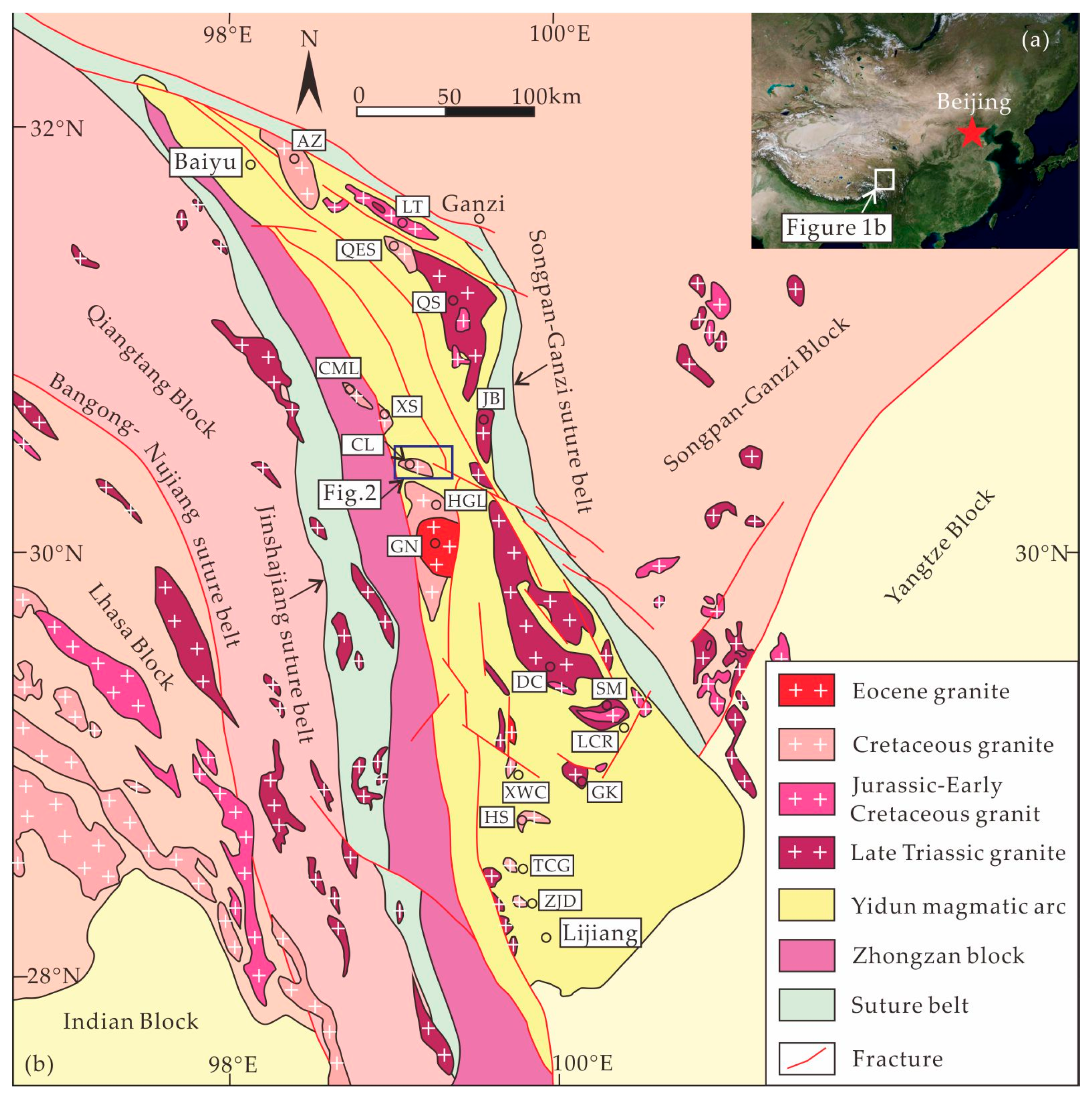
2. Regional Geological Background and Petrological Characteristics
3. Sampling and Analytical Methods
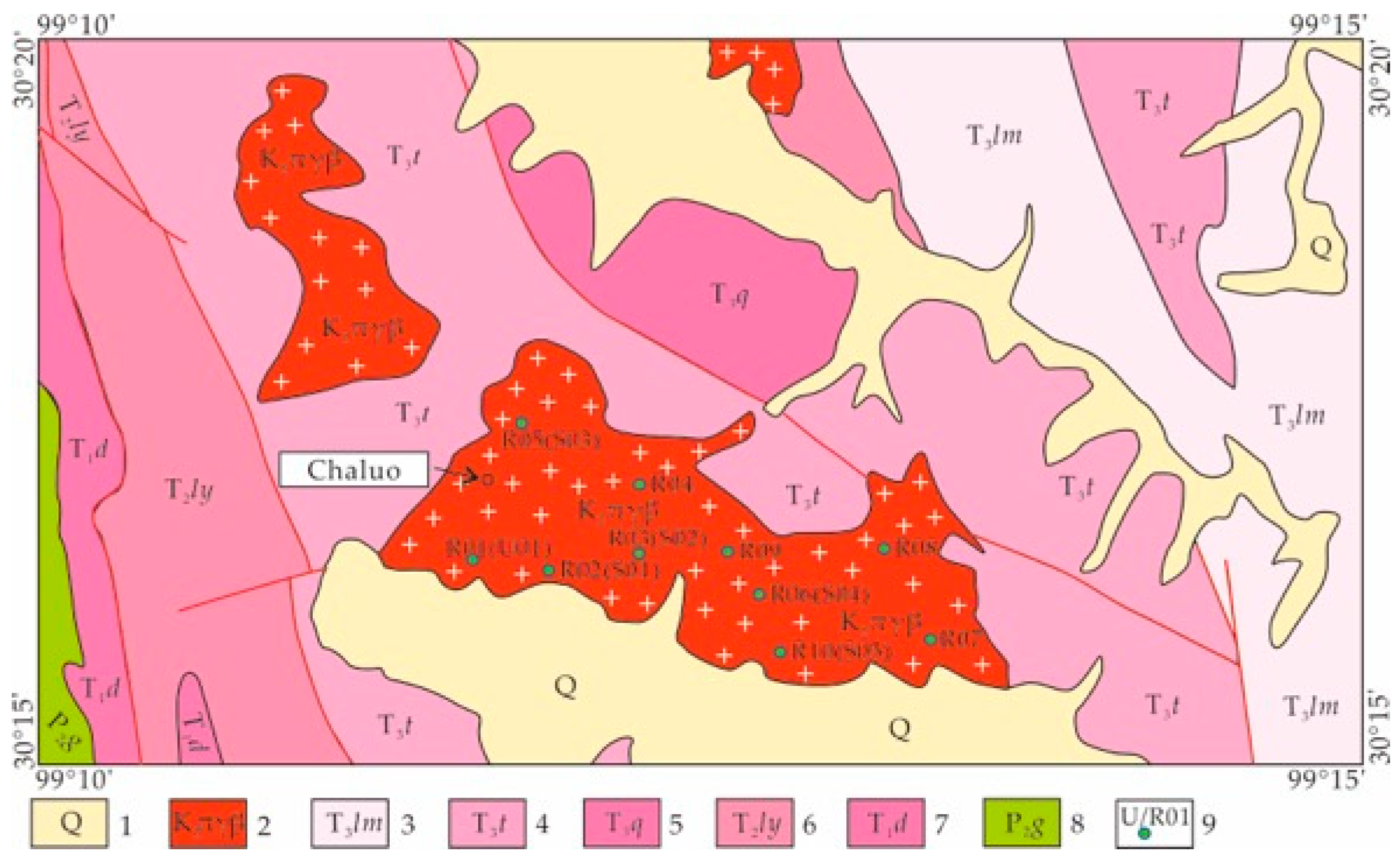
3.1. Sampling
3.2. Analytical Techniques
3.2.1. Whole-Rock Geochemical Analyses
3.2.2. LA-ICP-MS Zircon U-Pb Isotope Analyses
3.2.3. In Situ Zircon Hf Isotope Ratio Analysis
3.2.4. Whole-Rock S and Pb Isotope Ratio Analysis
4. Results
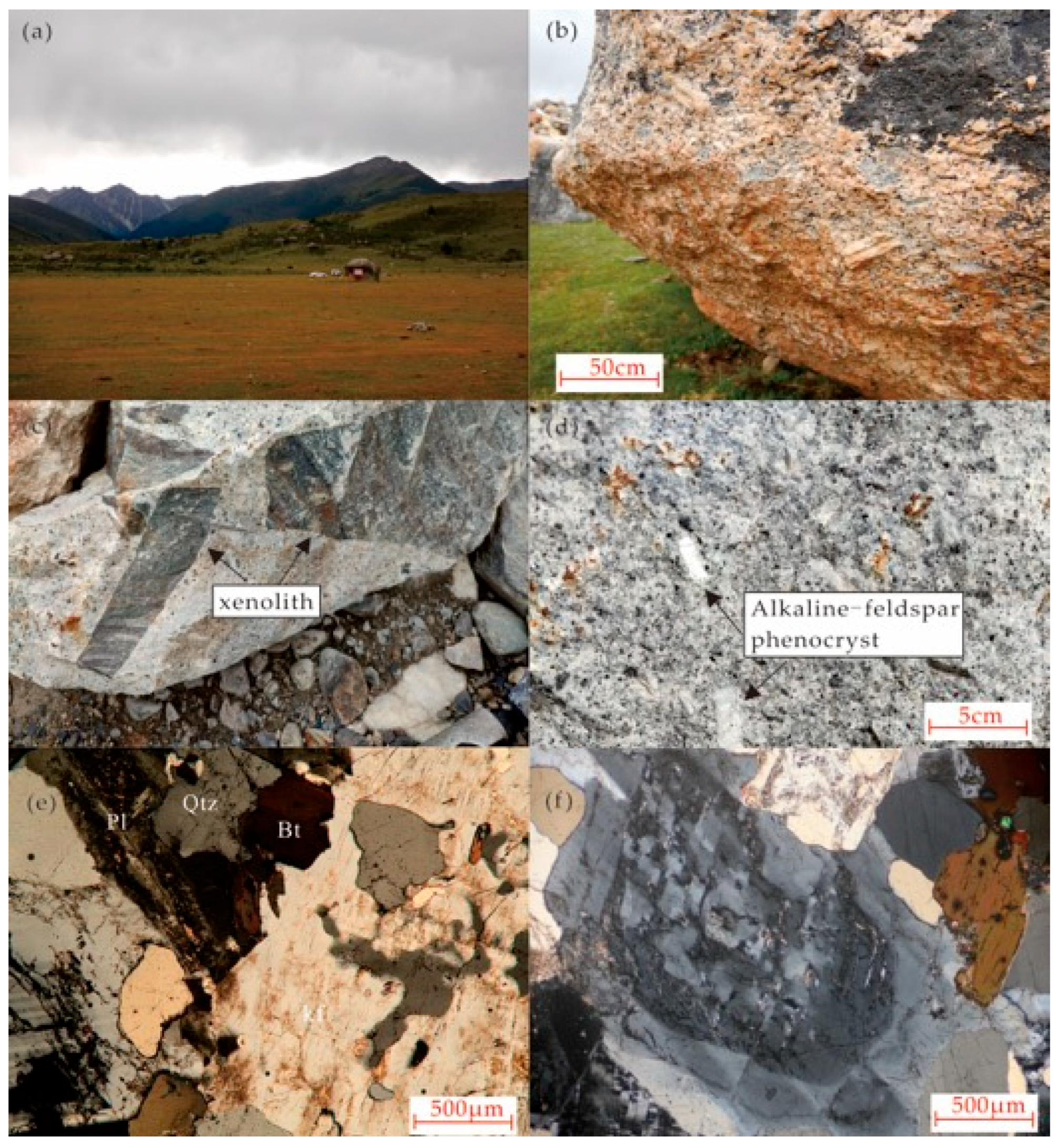
4.1. Mineralogical Characteristics
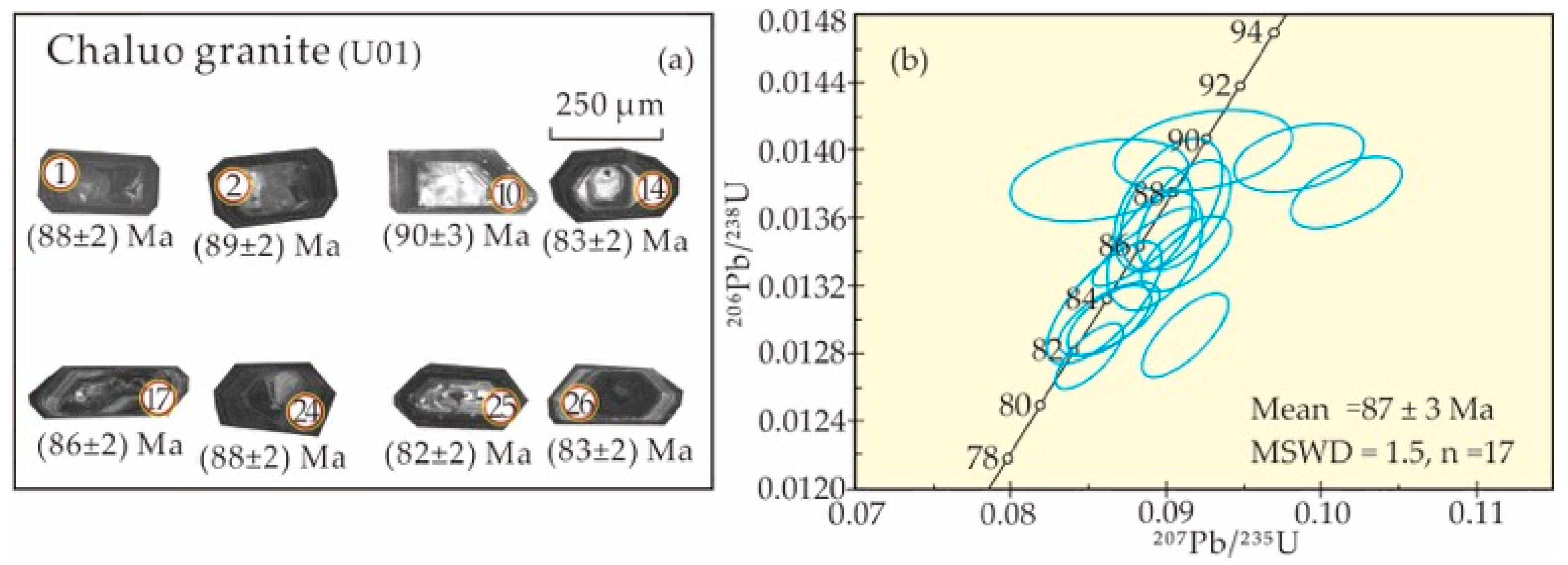
4.2. Zircon U-Pb Geochronology
4.3. Zircon In Situ Hf Isotope
4.4. Whole-Rock Geochemistry
4.4.1. Major Elements
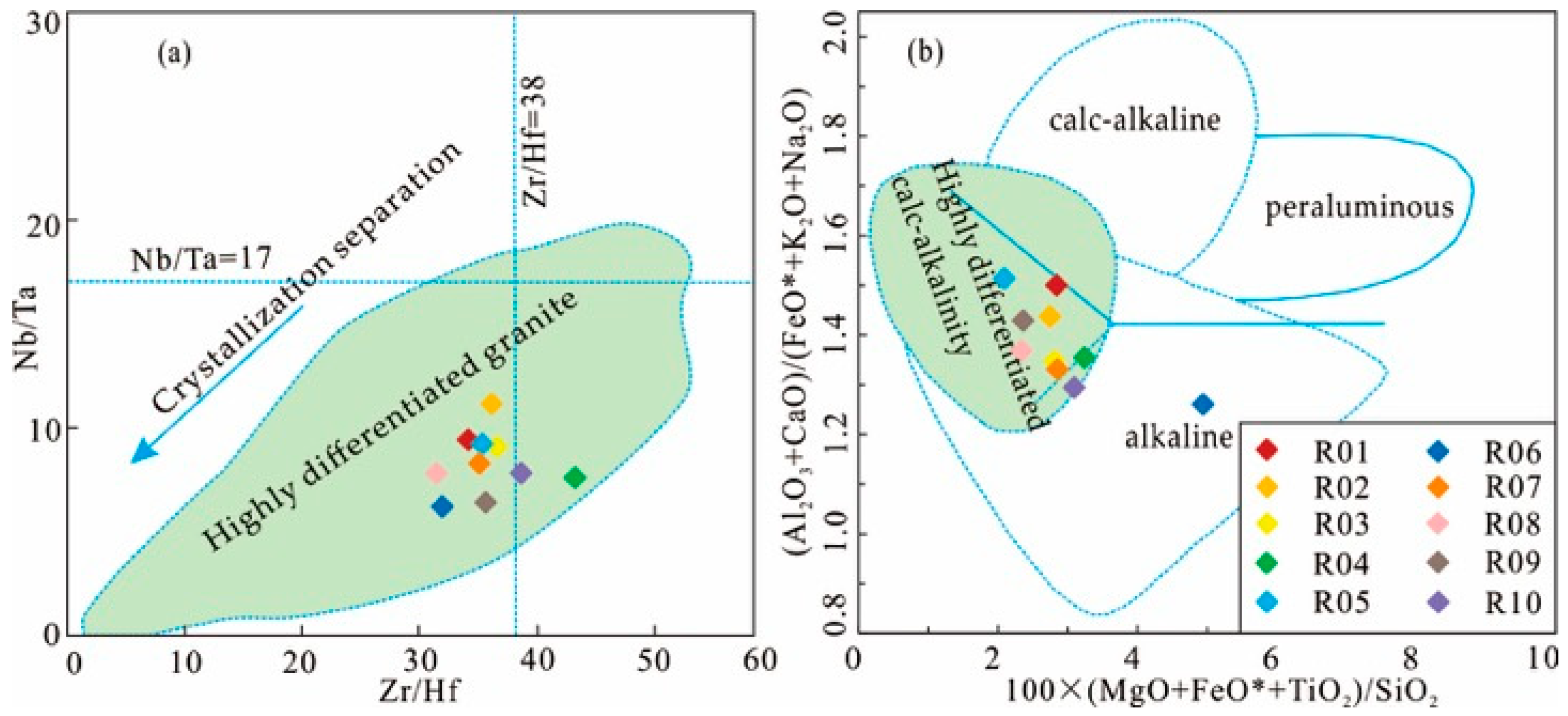
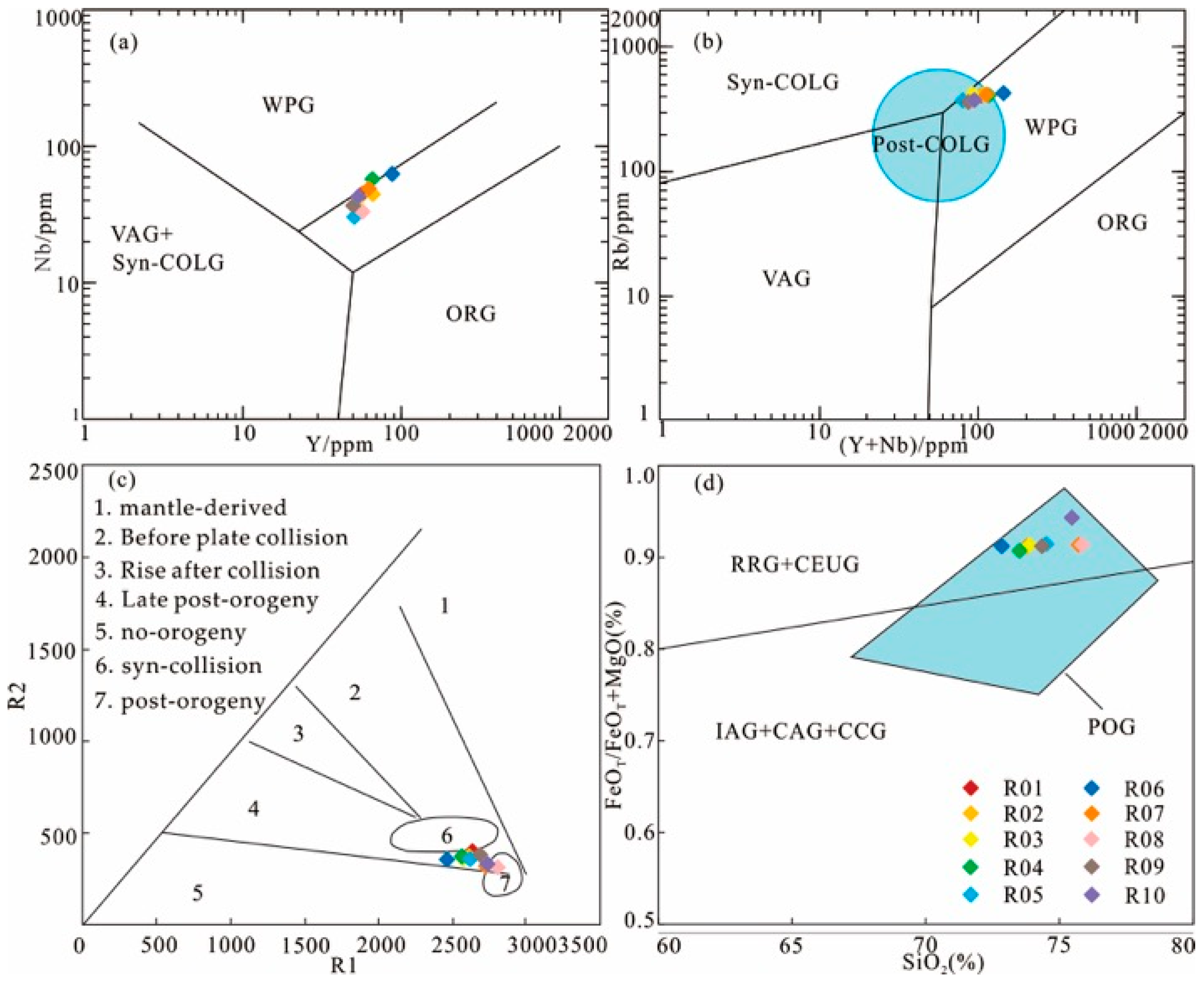
4.4.2. Trace Elements
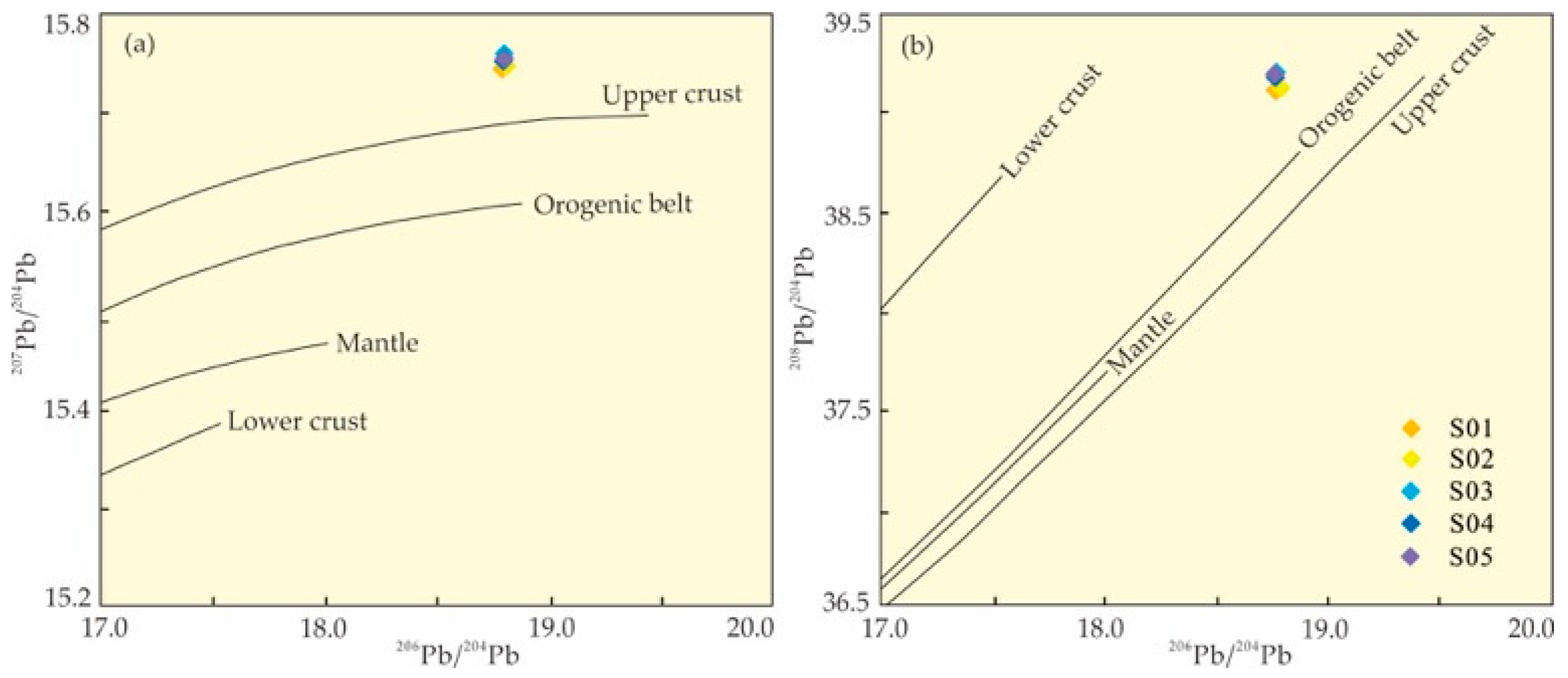
4.4.3. S-Pb Isotope
5. Discussion
5.1. Petrogenesis of the Chaluo Granite
5.1.1. The I-Type Affinity of the Chaluo Granite
5.1.2. Magma Source of the Chaluo Granite
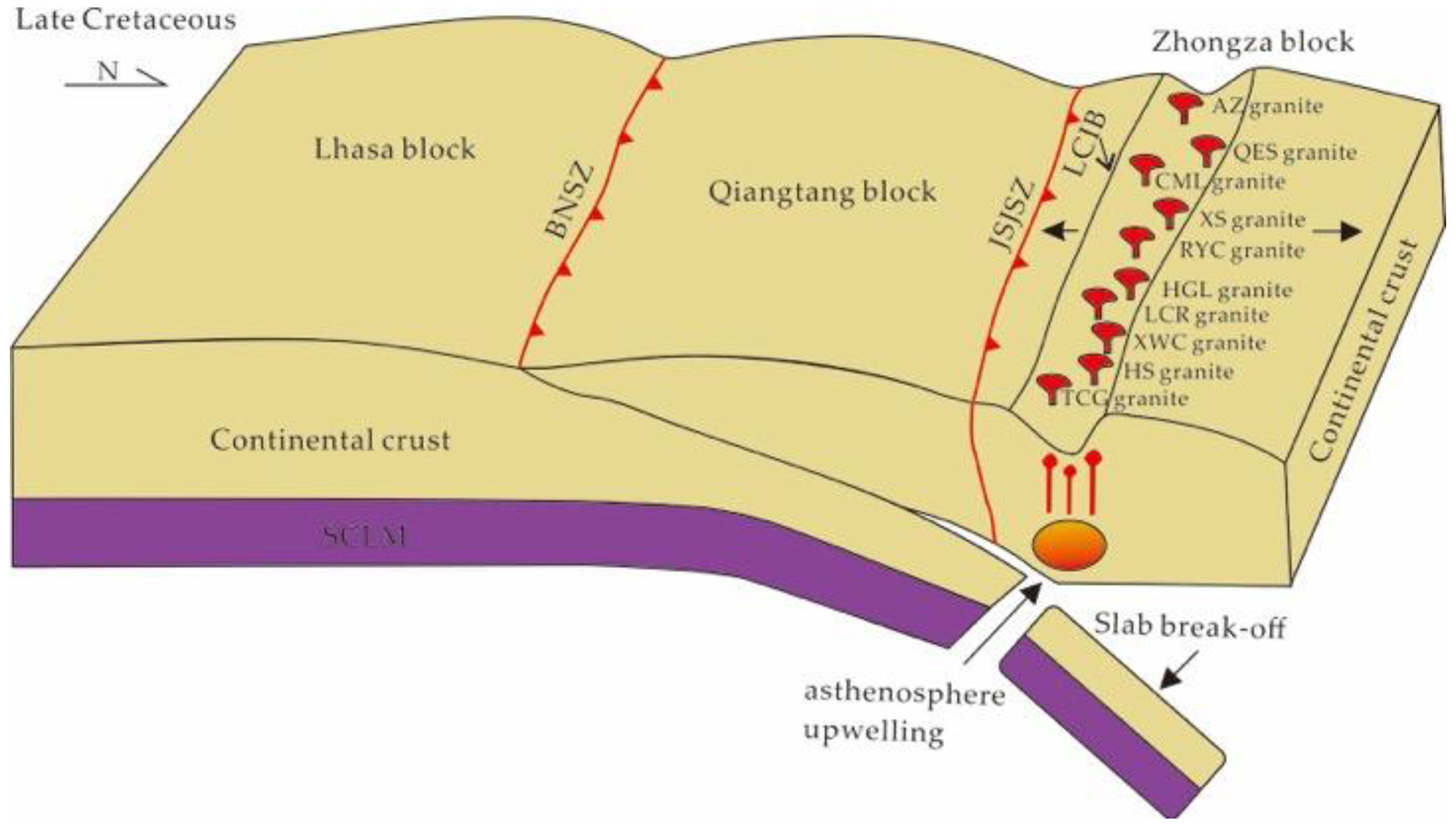
5.2. Geological Significance
6. Conclusions
Author Contributions
Funding
Data Availability Statement
Acknowledgments
Conflicts of Interest
References
- Huang, J.Q.; Chen, B.W. The Tethys Sea Evolution of China and Its Adjacent Area; Geological Publishing House: Beijing, China, 1987; pp. 1–109. [Google Scholar]
- Ren, J.S.; Xie, G.L. Proceeding of First International Symposium on Gondwana Dispersion and Asian Accretion-Geological Evolution of Eastern Tethys: November 25 December 1; China University of Geosciences Press: Beijing, China, 1991. [Google Scholar]
- Zhong, D.L. Paleotethysides in West Yunnan and Sichuan; Science Press: Beijing, China, 1998; pp. 1–231. [Google Scholar]
- Lu, S.N. From Rodinia to Gondwana Supercontinents-Thingking about problems of Researching Neoproterozoic Supercontinents. Earth Sci. Front. 2001, 8, 8, (In Chinese with English Abstract). [Google Scholar]
- Guo, F.X. Paleozoic Tectonics-Paleobiogeography of Xinjiang, China. Xinjiang Geol. 2001, 19, 7, (In Chinese with English Abstract). [Google Scholar]
- Stampfli, G.M.; Borel, G.D. A plate tectonic model for the Paleozoic and Mesozoic constrained by dynamic plate boundaries and restored synthetic oceanic isochrones. Earth Planet. Sci. Lett. 2002, 196, 17–33. [Google Scholar] [CrossRef] [Scilit]
- Blakey, R.; Wong, T. Carboniferous-Permian paleogeography of the assembly of Pangaea. In Proceedings of the XVth International Congress on Carboniferous and Permian Statigraphy, Utrecht, The Netherlands, 10–16 August 2003; pp. 443–456. [Google Scholar]
- Yu, X.; Xu, X.C.; Han, X.Q. The proposition of Holo-Tethys Ocean and the generalized Tethyan tectonic domain. Acta Geol. Sin. 2022, 96, 4131–4139, (In Chinese with English Abstract). [Google Scholar]
- Metcalfe, I. Multiple Tethyan Ocean basins and orogenic belts in Asia. Gondwana Res. 2021, 100, 87–130. [Google Scholar] [CrossRef] [Scilit]
- Sengör, A.M.C. The Cimmeride orogenic system and the tectonics of Eurasia. In Spacial Paper; The geological Society of America: Boulder, CO, USA, 1984; Volume 195. [Google Scholar]
- Sengör, A.M.C. Plate tectonics and orogenic research after 25 years: A Tethyan perspective. Earth Sci. Rev. 1990, 27, 1–201. [Google Scholar]
- Sengör, A.M.C.; Natalin, B.A.; Burtman, V.S. Evolution of the Altaidtectonic collage and Palaeozoic crustal growth in Eurasia. Nature 1993, 364, 299–307. [Google Scholar] [CrossRef] [Scilit]
- Natal’in, B.A.; Sengor, A.M.C. Late Palaeozoic to Triassic evolution of the Turan and Scythian platforms: The pre-history of the Palaeo-Tethyan closure. Tectonophysics 2005, 404, 175–202. [Google Scholar] [CrossRef] [Scilit]
- Pan, G.T.; Zhu, D.C.; Wang, L.Q. Bangong Lake-Nu River suture zone-the northern boundary of Gondwanal and: Evidence from geology and geophysics. Earth Sci. Front. 2004, 11, 371–382, (In Chinese with English Abstract). [Google Scholar]
- Pan, G.T.; Wang, L.Q.; Li, R.S. Tectonic model of archipelagic arc-basin systems: The key to the continental geology. Sediment. Geol. Tethyan Geol. 2012, 32, 1–20, (In Chinese with English Abstract). [Google Scholar]
- Pan, G.T.; Wang, L.Q.; Geng, Q.R. Space-time structure of the Bangonghu-Shuanghu-Nujiang-Changning-Menglian Mega-suture zone: A discussion on geology and evolution of the Tethys Ocean. Sediment. Geol. Tethyan Geol. 2020, 40, 1–19, (In Chinese with English Abstract). [Google Scholar]
- Pan, G.T.; Wang, L.Q.; Yin, F.G. Researches on geological-tectonic evolution of Tibetan Plateau: A review, recent advances, and directions in the future. Sediment. Geol. Tethyan Geol. 2022, 42, 151–175, (In Chinese with English Abstract). [Google Scholar]
- Wang, L.Q.; Pan, G.T.; Li, D.M. The spatio-temporal framework and geological evolution of the Jinshajiang arc basin system. Acta Geol. Sin. 1999, 73, 206–218. [Google Scholar]
- Wang, L.Q.; Wang, B.D.; Li, G.M. Major progresses of geological survey and research in East Tethys: An overview. Sediment. Geol. Tethys Geol. 2021, 41, 283–296, (In Chinese with English Abstract). [Google Scholar]
- Zhang, K.X.; He, W.H.; Xu, Y.D. Reconstruction of main types for oceanic plate strata in the subduction-accretionary complex and feature of sequence for each type: An example from the Qinghai-Tibet Tethyan Permian strata. Sediment. Geol. Tethyan Geol. 2021, 41, 137–151, (In Chinese with English Abstract). [Google Scholar]
- Pan, G.T.; Xu, Q.; Wang, L.Q. The frame mechanism of multiple island arc-basin system in Tibetan Plateau. Miner. Pet. 2001, 21, 186–189. [Google Scholar]
- Zhu, T.X.; Feng, X.T.; Wang, X.F. Summary of the Late Triassic tectonic paleogeography in the Qinghai-Tibetan Plateau, China. Sediment. Geol. Tethyan Geol. 2020, 40, 59–71, (In Chinese with English Abstract). [Google Scholar]
- Mo, X.X.; Lu, F.X.; Shen, S.Y. Sanjiang Tethyan Volcanism and Related Mineralization; Geological Publishing House: Beijing, China, 1993; pp. 1–267. [Google Scholar]
- Mo, X.X.; Pan, G.T. From the Tethys to the formation of the Qinghai-Tibet Plateau: Constrained by tectonic magmatic events. Earth Sci. Front. 2006, 6, 43–51, (In Chinese with English Abstract). [Google Scholar]
- Reid, A.J.; Wilson, C.J.L.; Liu, S. Structural evidence for the Permo-Triassic tectonic evolution of the Yidun Arc, easterm Tibetan Plateau. J. Struct. Geol. 2005, 27, 119–137. [Google Scholar] [CrossRef] [Scilit]
- Reid, A.J.; Wilson, C.J.L.; Shun, L.; Pearson, N.; Belousova, E. Mesozoic plutons of the Yidun Arc, SW China: U/Pb geochronology and Hf isotopic signature. Ore Geol. Rev. 2007, 31, 88–106. [Google Scholar] [CrossRef] [Scilit]
- Song, S.G.; Zhang, L.F.; Niu, Y.L. Evolution from Oceanic Subduction to Continental Collision: A Case Study of the Northern Tibetan Plateau Inferred from Geochemical and Geochronological Data. J. Petrol. 2006, 47, 435–455. [Google Scholar] [CrossRef] [Scilit]
- Xiao, L.; He, Q.; Pirajno, F. Possible correlation between a mantle plume and the evolution of Paleo-Tethys Jinshajiang Ocean: Evidence from a volcanic rifted margin in the Xiaru-Tuoding area, Yunnan, SW China. Lithos 2008, 100, 112–126. [Google Scholar] [CrossRef] [Scilit]
- Hou, Z.Q.; Yang, Y.Q.; Wang, H.P.; Qu, X.M.; Lu, Q.T.; Huang, D.H.; Wu, X.Z.; Yu, J.J.; Tang, S.H.; Zhao, J.H. Collision-Orogenic Processes and Mineralization Systems of the Yidun Arc; Geological Publishing House: Beijing, China, 2003; pp. 154–187. (In Chinese) [Google Scholar]
- Hou, Z.Q.; Yang, Y.Q.; Qu, X.M.; Huang, D.H.; Lu, Q.T.; Wang, H.P.; Yu, J.J.; Tang, S.H. Tectonic evolution and mineralization systems of the Yidun arc orogen in Sanjiangregion, China. Acta Geol. Sin. 2004, 78, 109–120, (In Chinese with English Abstract). [Google Scholar]
- Hou, Z.Q.; Duan, L.F.; Lu, Y.J. Lithospheric architecture of the Lhasa Terran and its control on ore deposits in the Himalayan-Tibetan Orogen. Econ. Geol. 2015, 110, 1541–1575. [Google Scholar] [CrossRef] [Scilit]
- Hou, Z.Q.; Zhang, H.R. Geodynamics and metallogeny of the eastern Tethyan metallogenic domain. Ore Geol. Rev. 2015, 70, 346–384. [Google Scholar] [CrossRef] [Scilit]
- Liu, Z.Q.; Li, X.Z.; Ye, Q.T. Classification of Tectonic Magmatic Zones and Distribution of Mineral Resources in the Sanjiang Region; Geological Publishing House: Beijing, China, 1993; pp. 1–246. (In Chinese) [Google Scholar]
- Pan, G.T.; Wang, L.Q.; Li, X.Z. The tectonic framework and spatial allocation of the archipelagic arc-basin systems on the Qinghai-Xizang Plateau. Sediment. Geol. Tethyan Geol. 2001, 21, 1–26. [Google Scholar]
- Deng, Y.F. The preliminary study of the characters and the age of the volcanic mélange strata of the marine rift in the Luhuo belt, western Sichuan. Contrib. Geol. Qinghai-Xizang Plateau 1984, 91–100. [Google Scholar]
- Luo, G.; Wang, Q.W.; Qin, Y.L. Divisions and their basic characteristics of tectonic units in Sichuan Province. Sediment. Geol. Tethyan Geol. 2021, 41, 633–647, (In Chinese with English Abstract). [Google Scholar]
- Zhang, F.Y.; Lai, S.C.; Qin, J.F. Petrogenesis and Geological Significance of the Late Cretaceous Haizishan Monzogranite from the Yidun Island Arc. Geol. J. China Univ. 2018, 24, 340–352, (In Chinese with English Abstract). [Google Scholar]
- Wang, N.; Wu, C.L.; Qin, H.P. Mineralogical, Geochemical Features of Typical Mesozoic Granites in the Yidun Arc, Western Sichuan and a Discussion on the Magma Origin. Geol. Rev. 2017, 63, 981–1000, (In Chinese with English Abstract). [Google Scholar]
- Li, Y.J.; Wei, J.H.; Chen, H.Y.; Li, H.; Chen, C.; Hou, B.J. Petrogenesis of the Xiasai Early Cretaceous A-type Granite from the Yidun Island Arc Belt, SW China: Constraints from Zircon U-Pb Age, Geochemistry and Hf Isotope. Geotecton. Metallog. 2014, 38, 939–953, (In Chinese with English Abstract). [Google Scholar]
- Wang, X.S.; Bi, X.W.; Leng, C.B.; Zhang, H.; Tang, H.F.; Chen, Y.W.; Yin, G.H.; Huang, D.Z.; Zhou, M.F. Geochronology and geochemistry of Late Cretaceous igneous intrusions and Mo-Cu-(W) mineralization in Yidun Arc, SW China: Implications for the southern metallogenesis and geodynamic setting. Ore Geol. Rev. 2014, 61, 939–953. [Google Scholar] [CrossRef] [Scilit]
- Wang, X.S.; Hu, R.Z.; Bi, X.W.; Leng, C.B.; Pan, L.C.; Zhu, J.J.; Chen, Y.W. Petrogenesis of late Cretaceous I-type granites in the southern Yidun Terrane: New constraints on the Late Mesozoic tectonic evolution of the eastern Tibetan Plateau. Lithos 2014, 208–209, 202–219. [Google Scholar] [CrossRef] [Scilit]
- Wang, X.F.; Metcalfe, I.; Jian, P.; He, L.Q.; Wang, C.S. The JinshajiangAiloshan Suture Zone, China: Tectonostratigraphy, age and evolution. J. Asian Earth Sci. 2000, 18, 675–690. [Google Scholar] [CrossRef] [Scilit]
- Wang, C.Y.; Han, W.B.; Wu, J.P. Crustal structure beneath the eastern margin of the Tibetan Plateau and its tectonic implications. J. Geophys. Res. 2007, 112, B07307. [Google Scholar] [CrossRef] [Scilit]
- Wang, B.Q.; Zhou, M.F.; Chen, W.T.; Gao, J.F.; Yan, D.P. Petrogenesis and tectonic implications of the Triassic volcanic rocks in the northern Yidun Terrane, Eastern Tibet. Lithos 2013, 175–176, 285–301. [Google Scholar] [CrossRef] [Scilit]
- Hou, Z.Q.; Qu, X.M.; Zhou, J.R.; Yang, Y.Q.; Huang, D.H.; Lü, Q.T.; Tang, S.H.; Yu, J.J.; Wang, H.P.; Zhao, J.H. Collision-orogenic processes of the Yidun Arc in the Sanjiang region: Record of granites. Acta Geol. Sin. 2001, 75, 484–497. [Google Scholar]
- Wu, T.; Xiao, L.; Ma, C.Q. U-Pb geochronology of detrital and inherited zircons in the Yidun arc belt, eastern Tibet Plateau and its tectonic implications. J. Earth Sci. 2016, 27, 461–473. [Google Scholar] [CrossRef] [Scilit]
- Lai, Q.Z.; Ding, L.; Wang, H.W. Constraining the stepwise migration of the eastern Tibetan Plateau margin by apatite fission track thermochronology. Sci. China Ser. D Earth Sci. 2007, 50, 172–183. [Google Scholar] [CrossRef] [Scilit]
- Wang, N.; Wu, C.L.; Qin, H.P.; Lei, M.; Guo, W.F.; Zhang, X.; Chen, H.J. Zircon U-Pb Geochronology and Hf Isotopic Characteristics of the Daocheng Granite and Haizishan Granite in the Yidun Arc, Western Sichuan, and Their Geological Significance. Geojournals 2016, 11, 3227–3245. [Google Scholar]
- Peng, T.P.; Zhao, G.C.; Fan, W.M. Zircon geochronology and Hf isotopes of Mesozoic intrusive rocks from the Yidun terrane, Eastern Tibetan Plateau: Petrogenesis and their bearings with Cu mineralization. J. Asian Earth Sci. 2014, 80, 18–33. [Google Scholar] [CrossRef] [Scilit]
- Lv, B.X.; Wang, Z.; Zhang, N.D. Granite Types and Their Ore-Forming Specialization in the Sanjiang Region; Geological Publishing House: Beijing, China, 1993. [Google Scholar]
- Yin, A.; Harrison, T.M. Geologic evolution of the Himalayan-Tibetan orogen. Annu. Rev. Earth Planet. Sci. 2000, 28, 211–280. [Google Scholar] [CrossRef] [Scilit]
- Russell, W.A.; Papanastassiou, D.A.; Tombrello, T.A. Ca isotope fractionation on the earth and other solar system materials. Geochim. Cosmochim. Acta 1978, 42, 1075–1090. [Google Scholar] [CrossRef] [Scilit]
- Zhang, W.; Hu, Z.C. Estimation of isotopic reference values for pure materials and geological reference materials. At. Spectrosc. 2020, 41, 93–102. [Google Scholar] [CrossRef] [Scilit]
- Zhang, W.; Hu, Z.C.; Liu, Y.S. Iso-Compass: New freeware software for isotopic data reduction of LA-MC-ICP-MS. J. Anal. At. Spectrom. 2020, 35, 1087–1096. [Google Scholar] [CrossRef] [Scilit]
- Baker, J.; Peate, D.; Waight, T.; Meyzen, C. Pb isotopic analysis of standards and samples using a 207Pb–204Pb double spike and thallium to correct for mass bias with a double-focusing mc-icp-ms. Chem. Geol. 2004, 211, 275–303. [Google Scholar] [CrossRef] [Scilit]
- Hu, Z.C.; Zhang, W.; Liu, Y.S.; Gao, S.; Li, M.; Zong, K.Q.; Chen, H.H.; Hu, S.H. “Wave” Signal-Smoothing and Mercury-Removing Device for Laser Ablation Quadrupole and Multiple Collector ICPMS Analysis: Application to Lead Isotope Analysis. Anal. Chem. 2015, 87, 1152–1157. [Google Scholar] [CrossRef] [Scilit]
- Hu, Z.C.; Liu, Y.S.; Gao, S.; Liu, W.; Yang, L.; Zhang, W.; Tong, X.; Lin, L.; Zong, K.Q.; Li, M.; et al. Improved in situ Hf isotope ratio analysis of zircon using newly designed X skimmer cone and Jet sample cone in combination with the addition of nitrogen by laser ablation multiple collector ICP-MS. J. Anal. At. Spectrom. 2012, 27, 1391–1399. [Google Scholar] [CrossRef] [Scilit]
- Woodhead, J.; Hergt, J.; Shelley, M.; Eggins, S.; Kemp, R. Zircon Hf-isotope analysis with an excimer laser, depth profiling, ablation of complex geometries, and concomitant age estimation. Chem. Geol. 2004, 209, 121–135. [Google Scholar] [CrossRef] [Scilit]
- Fisher, C.M. Guidelines for reporting zircon Hf isotopic data by LA-MC-ICPMS and potential pitfalls in the interpretation of these data. Chem. Geol. 2014, 363, 125–133. [Google Scholar] [CrossRef] [Scilit]
- Blichert-Toft, J.; Chauvel, C.; Albarède, F. Separation of Hf and Lu for high-precision isotope analysis of rock samples by magnetic sector-multiple collector ICP-MS. Contrib. Mineral. Petrol. 1997, 127, 248–260. [Google Scholar] [CrossRef] [Scilit]
- Andersen, T. Correction of common lead in U-Pb analyses that donot report 204Pb. Chem. Geol. 2002, 192, 59–79. [Google Scholar] [CrossRef] [Scilit]
- Ludwig, K.R. Isoplot 3.00: A Geochronological Toolkit for Microsoft Excel; Special Publication No.4; Berkeley Geochronology 608 Center: Berkeley, CA, USA, 2003; pp. 1–70. [Google Scholar]
- Liu, Y.S.; Hu, Z.C.; Gao, S. In situ analysis of major and trace elements of anhydrous minerals byLA-ICP-MS without applying an internal standard. Chem. Geol. 2008, 257, 34–43. [Google Scholar] [CrossRef] [Scilit]
- Liu, Y.S.; Gao, S.; Hu, Z.C.; Gao, C.G.; Zong, K.Q.; Wang, D.B. Continental and oceanic crust recycling-induced melt-peridotite interactions in the Trans-North China Orogen: U-Pb dating, Hf isotopes and trace elements in zircons of mantle xenoliths. J. Petrol. 2010, 51, 537–571. [Google Scholar] [CrossRef] [Scilit]
- Liu, Y.S.; Hu, Z.C.; Zong, K.Q. Reappraisement and refinement of zircon U-Pb isotope and trace element analyses byLA-ICP-MS. Chin. Sci. Bull. 2010, 55, 1535–1546. [Google Scholar] [CrossRef] [Scilit]
- Zhang, W.; Hu, Z.C.; Gunther, D.; Liu, Y.S.; Ling, W.L.; Zong, K.Q.; Chen, H.H.; Gao, S.; Xu, L. Direct lead isotope analysis in Hg-rich sulfides by LA-MC-ICP-MS with a gas exchange device and matrix-matched calibration. Anal. Chim. Acta 2016, 948, 9–18. [Google Scholar] [CrossRef] [Scilit]
- Wu, F.Y.; Li, X.H.; Zheng, Y.F.; Gao, S. Lu-Hf isotopic systematics and their applications in petrology. Acta Petrol. Sin. 2007, 23, 185–220. [Google Scholar]
- Maniar, P.D.; Piccoli, P.M. Tectonic discrimination of granitoids. Geol. Soc. Am. Bull. 1989, 101, 635–643. [Google Scholar] [CrossRef] [Scilit]
- Irvine, T.N.; Barager, W.R.A. A guide to the chemical classification of the common volcanic rocks. Can. J. Earth Sci. 1971, 8, 523–548. [Google Scholar] [CrossRef] [Scilit]
- Boynton, W.V. Cosmochemistry of the Rare Earth Elements: Meteorite Studies. Rare Earth Elem. Geochem. 1984, 2, 63–114. [Google Scholar]
- Sun, S.S.; McDonough, W.F. Chemical and isotopic systematics of oceanic basalts: Implications formantle compositions and processes. Geol. Soc. Lond. Spec. Publ. 1989, 42, 313–345. [Google Scholar] [CrossRef] [Scilit]
- Yuan, Y.B.; Yuan, S.D.; Liu, X.F.; Mi, J.R.; Xuan, Y.S.; Zhao, P.L. Sulfur Isotopic Characteristics of the Huangshaping Granite and Their Geological Significance in Southern Hunan Province. Acta Geol. Sin. 2014, 12, 2437–2442. [Google Scholar]
- Ding, T.; Ma, D.S.; Lu, J.J.; Zhang, R.Q.; Xie, Y.C. Sulfur and lead isotopic compositions of granitoids and fluid inclusions in Baoshan deposit, Hunan Province. Miner. Depos. 2016, 4, 663–676. [Google Scholar]
- Zhang, Y.; Pan, J.Y.; Zhou, Q.Q.; Liu, Y.; Ma, C.J.; Hu, C.C.; Zhong, F.J.; Zhou, W.T. S and Pb isotopic constraints on the multi-metal (W-Cu-Mo-U) mineralization of Ziyunshan Intrusive Rocks, Jiangxi Province. Geochimica 2016, 5, 510–526. [Google Scholar]
- Cheng, Y.S. Sulfur lead isotope geochemistry of intrusive rock mass in Dachang, Guangxi. Acta Geol. Sin. 2015, 89, 313–314. [Google Scholar]
- Wu, F.Y.; Li, X.H.; Yang, J.H. Discussions on the petrogenesis of granites. Acta Petrol. Sin. 2007, 23, 1217–1238. [Google Scholar]
- Barbarin, B. A review of the relationships between granitoid types, their origins and their geodynamic environments. Lithos 1999, 46, 605–626. [Google Scholar] [CrossRef] [Scilit]
- Chappell, B.W. Aluminium saturation in I-and S-type granites and the characterization of fractionated haplo granites. Lithos 1999, 46, 535–551. [Google Scholar] [CrossRef] [Scilit]
- Watson, E.B. Zircons aturation in felsic liquids: Experimental results and applications to trace element geochemistry. Contrib. Mineral. Petrol. 1979, 70, 407–419. [Google Scholar] [CrossRef] [Scilit]
- Watson, E.B.; Harrison, T.M. Zircons at uration revisited: Temperature and composition effects in avariety of crustal magmatypes. Earth Planet. Sci. Lett. 1983, 64, 295–304. [Google Scholar] [CrossRef] [Scilit]
- King, P.L.; Chappell, B.W.; Allen, C.M. Are A-type granites the high-temperature felsic granites? Evidence from fractionated granites of the Wangrah Suite. Aust. J. Earth Sci. 2001, 48, 501–514. [Google Scholar] [CrossRef] [Scilit]
- Miller, C.F.; McDowell, S.M.; Mapes, R.W. Hot and cold granites? Implications of zircon saturation temperatures and preservation of inheritance. Geology 2003, 31, 529–532. [Google Scholar] [CrossRef] [Scilit]
- Liu, C.S.; Chen, X.M.; Chen, P.R. Subdivision, discrimination criteria and genesis for A type rock suites. Geol. J. China Univ. 2003, 9, 573–591. [Google Scholar]
- Chappell, B.W.; White, A.J.R. Two contrasting granite types. Pac. Geol. 1974, 8, 173–174. [Google Scholar]
- Whalen, J.B.; Currie, K.L.; Chappell, B.W. A-type granites: Geochemical characteristics, discrimination and petrogenesis. Contrib. Mineral. Petrol. 1987, 95, 407–419. [Google Scholar] [CrossRef] [Scilit]
- Collins, W.J.; Beams, S.D.; White, A.J.R. Nature and origin of A-type granites with particular reference to Southeastern Australia. Contrib. Mineral. Petrol. 1982, 80, 189–200. [Google Scholar] [CrossRef] [Scilit]
- Taylor, S.R.; McLennan, S.M. The Continental Crust: Its Composition and Evolution; Blackwell: Oxford, UK, 1985; pp. 1–312. [Google Scholar]
- Gao, P.; Zheng, Y.F.; Zhao, Z.F. Distinction between S-type and peraluminous I-type granites: Zircon versus whole-rock geochemistry. Lithos 2016, 258–259, 77–91. [Google Scholar] [CrossRef] [Scilit]
- Sylvester, P.J. Past-collisional alkaline granites. J. Geol. 1989, 97, 261–280. [Google Scholar] [CrossRef] [Scilit]
- Zartman, R.E.; Doe, B.R. Plumbo tectonics-the model. Tectonophysics 1981, 75, 135–162. [Google Scholar] [CrossRef] [Scilit]
- Wu, F.Y.; Liu, X.C.; Ji, W.Q. Highly fractionated granites: Recognition and research. Sci. China Earth Sci. 2017, 47, 745–765. [Google Scholar] [CrossRef] [Scilit]
- Liu, S.W.; Wang, Z.Q.; Yan, Q.R. Indosinian tectonic setting of the Southern Yidun Arc: Constraints from SHRIMP zircon chronology and geochemistry of dioritic porphyries and granites. Acta Geol. Sin. 2006, 80, 387–399. [Google Scholar]
- Wang, B.Q.; Zhou, M.F.; Li, J.W. Late Triassic porphyritic instructions and associated volcanic rocks from the Shangri-La region, Yidun terrane, Eastern Tibetan Plateau: Adakitic magmatism and porphyry copper mineralization. Lithos 2011, 127, 24–38. [Google Scholar] [CrossRef] [Scilit]
- Wang, B.Q.; Wang, W.; Chen, W.T. Constraints of detrital zircon U-Pb ages and Hf isotopes on the provenance of the Triassic Yidun Group and tectonic evolution of the Yidun Terrane, Eastern Tibet. Sediment. Geol. 2013, 289, 74–98. [Google Scholar] [CrossRef] [Scilit]
- Yang, T.N.; Ding, Y.; Zhang, H.R. Two-phase subduction and subsequent collision defines the Paleo-tethyan tectonics of the southeastern Tibetan Plateau: Evidence from zircon U-Pb dating, geochemistry, and structural geology of the Sanjiang orogenic belt, southwest China. Geol. Soc. Am. Bull. 2014, 126, 1652–1682. [Google Scholar] [CrossRef] [Scilit]
- Huan, W.J.; Yuan, W.M.; Li, N. Study on the mineral electron microprobe evidence of the formation conditions and fission track of gold deposits in Ganzi-Litang Gold Belt’ western Sichuan Province. Geoscience 2011, 25, 261–270. [Google Scholar]
- Chen, J.L.; Xu, J.F.; Ren, J.B. Geochronology and geochemical characteristics of Late Triassic porphyritic rocks from the Zhongdian arc, eastern Tibet, and their tectonic and metallogenic implications. Gondwana Res. 2014, 26, 492–504. [Google Scholar] [CrossRef] [Scilit]
- Pearce, J.A.; Harris, N.B.W.; Tindle, A.G. Traceelementdiscriminationdiagramsforthetectonicinterpretationofgraniticrocks. J. Petrol. 1984, 25, 956–983. [Google Scholar] [CrossRef] [Scilit]
- Batchelor, R.A.; Bowden, P. Petrogenetic interpretation of granitoid rock series using multicationic parameters. Chem. Geol. 1985, 48, 43–55. [Google Scholar] [CrossRef] [Scilit]
- Li, Y.L.; He, H.Y.; Wang, C.S. Early Cretaceous (ca. 100 Ma) magmatism in the southern Qiangtang subterrane, central Tibet: Product of slab break-off? Int. J. Earth Sci. 2017, 106, 1289–1310. [Google Scholar] [CrossRef] [Scilit]



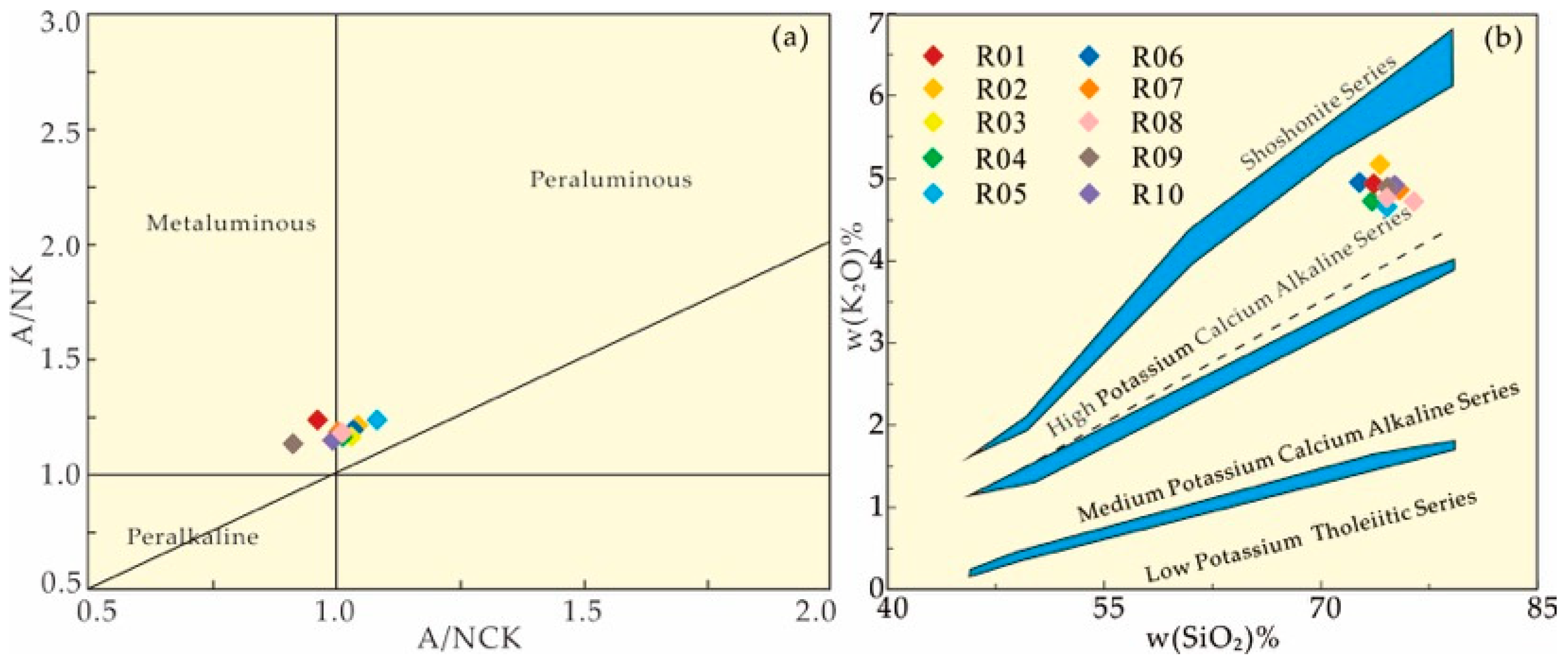
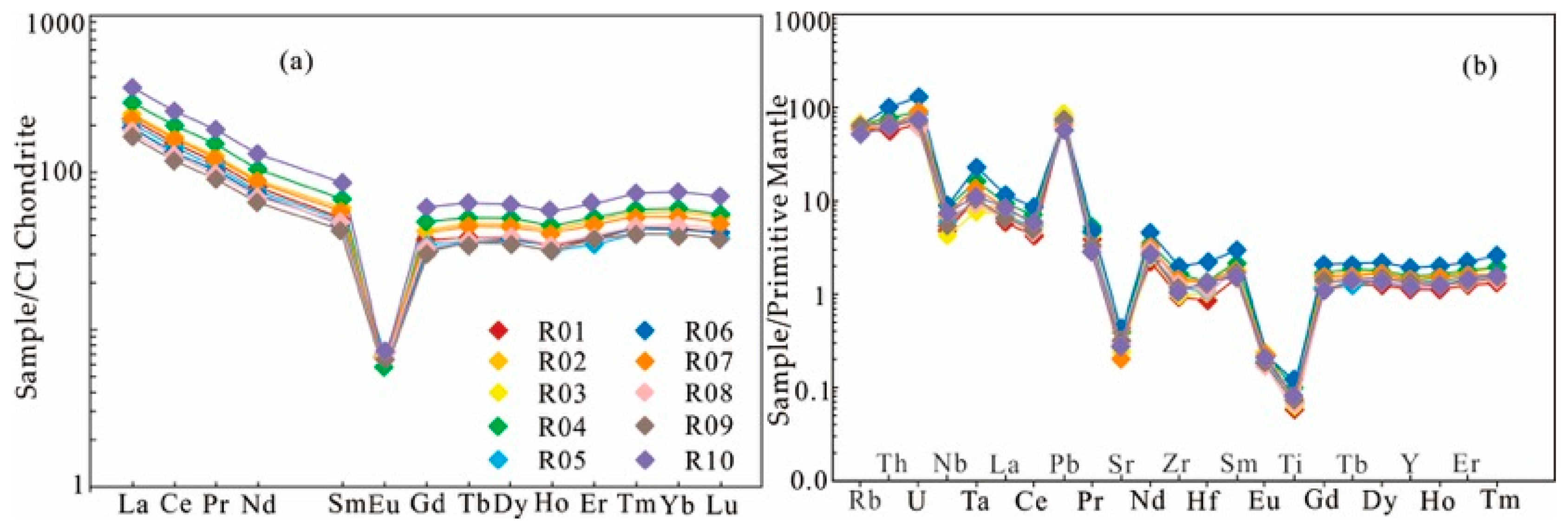
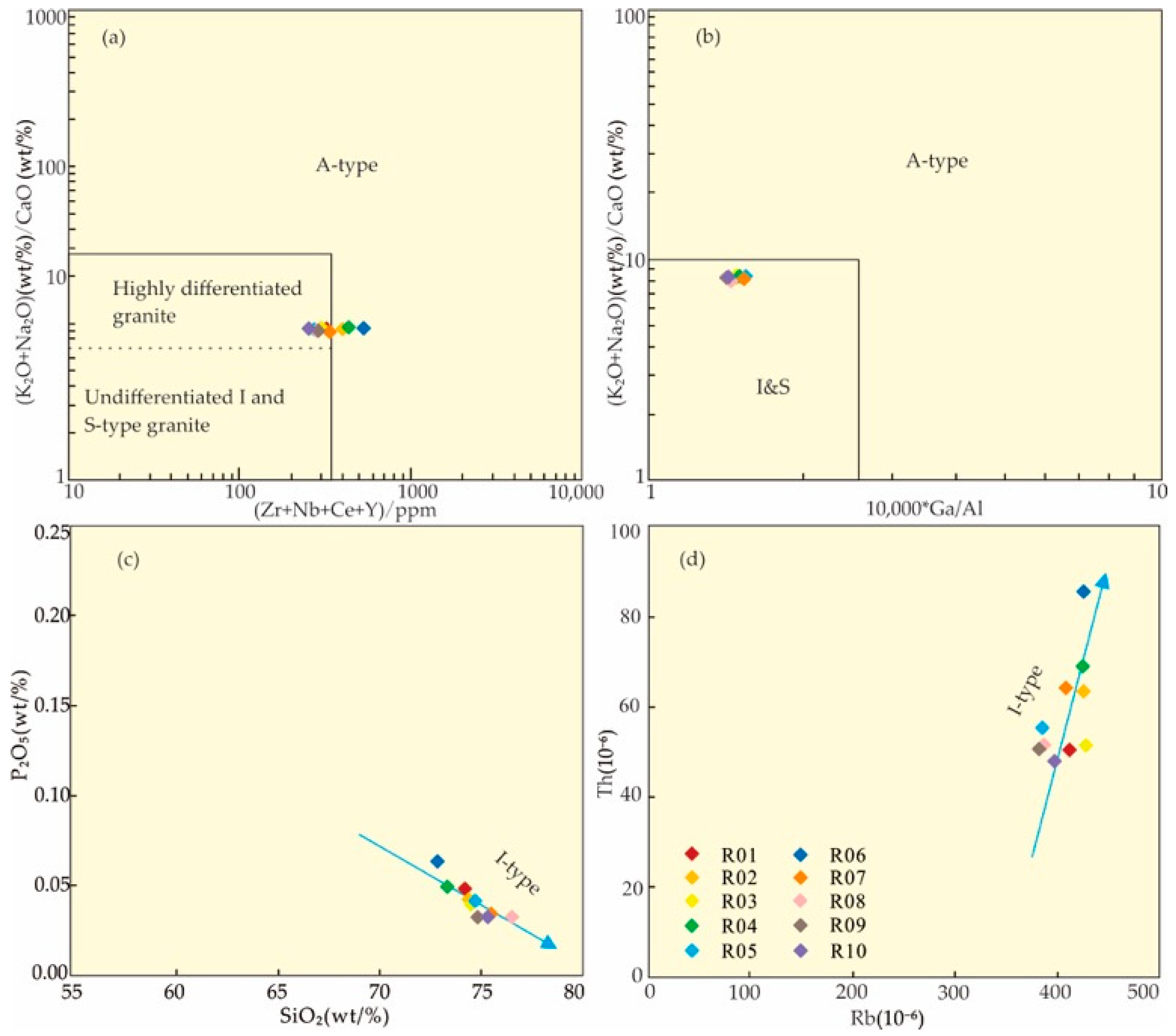
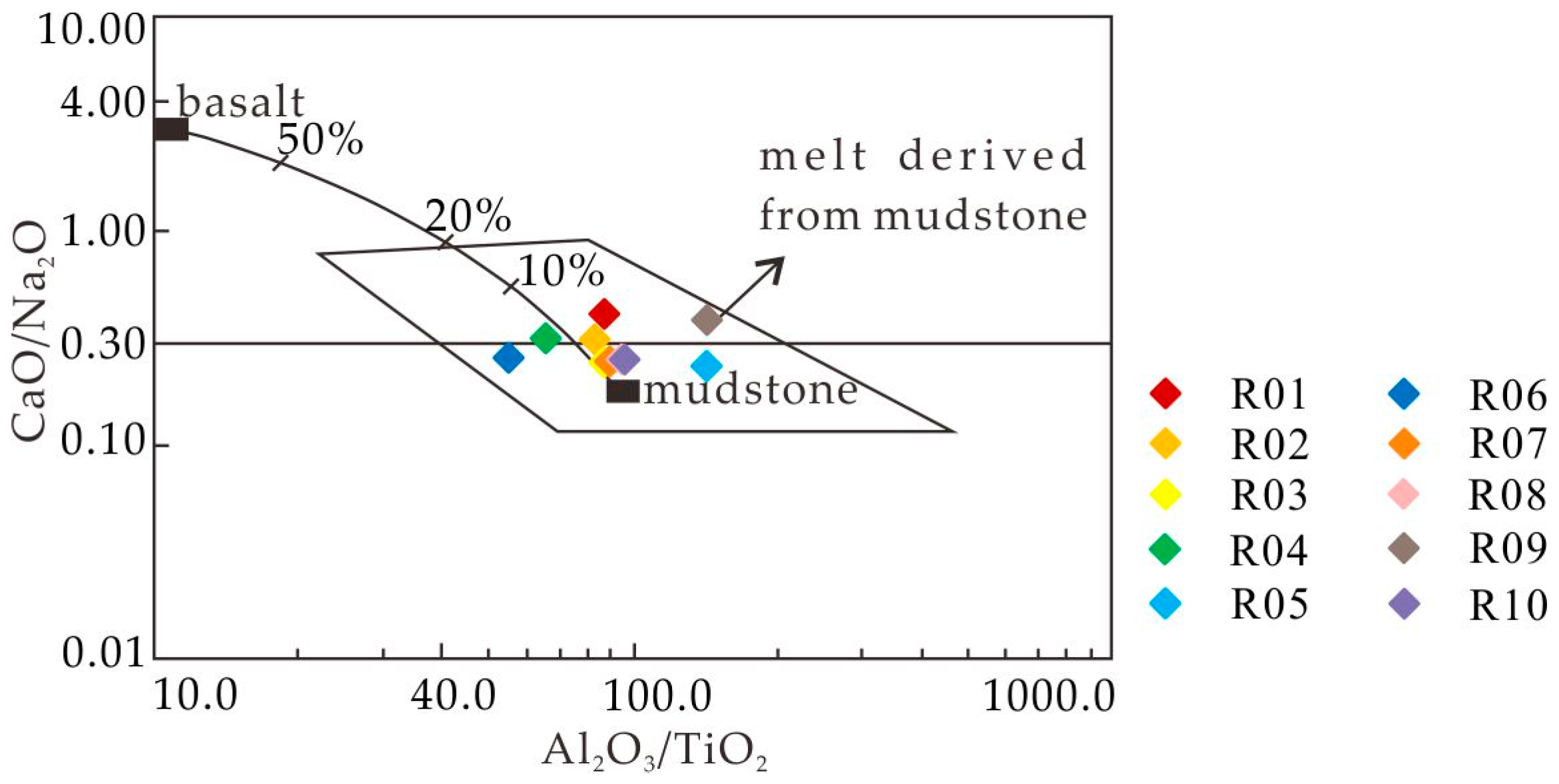

| Spot | Content (×10−6) | Isotope Ratio | Age (Ma) | |||||||||||||
|---|---|---|---|---|---|---|---|---|---|---|---|---|---|---|---|---|
| U01 | Pb | Th | U | 207Pb/ 206Pb | 1σ | 207Pb/ 235U | 1σ | 206Pb/ 238U | 1σ | Th/U | 206Pb/ 238U | 1σ | 207Pb/ 235U | 1σ | 207Pb/ 206Pb | 1σ |
| 1 | 6.86 | 194 | 328 | 0.0454 | 0.0020 | 0.0859 | 0.0038 | 0.0138 | 0.0002 | 0.59 | 88 | 2 | 84 | 1 | 93 | 3 |
| 2 | 24.1 | 719 | 1217 | 0.0512 | 0.0013 | 0.0986 | 0.0026 | 0.0139 | 0.0001 | 0.59 | 89 | 2 | 96 | 1 | 92 | 2 |
| 3 | 189.9 | 3128 | 13017 | 0.0620 | 0.0018 | 0.1067 | 0.0031 | 0.0125 | 0.0001 | 0.24 | 80 | 3 | 103 | 1 | 104 | 4 |
| 4 | 397 | 1624 | 15719 | 0.1254 | 0.0055 | 0.2208 | 0.0086 | 0.0130 | 0.0001 | 0.10 | 83 | 1 | 203 | 1 | 639 | 36 |
| 5 | 171 | 2577 | 9098 | 0.0954 | 0.0017 | 0.1655 | 0.0025 | 0.0126 | 0.0001 | 0.28 | 81 | 2 | 156 | 1 | 157 | 6 |
| 7 | 266 | 2811 | 15516 | 0.0823 | 0.0016 | 0.1481 | 0.0032 | 0.0130 | 0.0001 | 0.18 | 83 | 3 | 140 | 1 | 188 | 6 |
| 10 | 10.81 | 256 | 653 | 0.0479 | 0.0019 | 0.0924 | 0.0037 | 0.0140 | 0.0002 | 0.39 | 90 | 3 | 90 | 1 | 88 | 3 |
| 14 | 88.0 | 2792 | 4700 | 0.0512 | 0.0008 | 0.0912 | 0.0018 | 0.0129 | 0.0002 | 0.59 | 83 | 2 | 89 | 1 | 95 | 2 |
| 15 | 189 | 762 | 5384 | 0.1372 | 0.0094 | 0.2843 | 0.0230 | 0.0144 | 0.0002 | 0.14 | 92 | 3 | 254 | 1 | 687 | 77 |
| 17 | 37.9 | 684 | 2686 | 0.0495 | 0.0010 | 0.0913 | 0.0018 | 0.0134 | 0.0001 | 0.25 | 86 | 2 | 89 | 1 | 88 | 2 |
| 18 | 36.4 | 776 | 2139 | 0.0535 | 0.0019 | 0.1064 | 0.0040 | 0.0144 | 0.0002 | 0.36 | 92 | 4 | 103 | 1 | 95 | 2 |
| 24 | 201.9 | 1496 | 15478 | 0.0535 | 0.0010 | 0.1017 | 0.0022 | 0.0137 | 0.0001 | 0.10 | 88 | 2 | 98 | 1 | 138 | 5 |
| 25 | 27.3 | 595 | 2875 | 0.0483 | 0.0011 | 0.0852 | 0.0016 | 0.0128 | 0.0001 | 0.21 | 82 | 2 | 84 | 1 | 102 | 2 |
| 26 | 41.3 | 585 | 3182 | 0.0482 | 0.0009 | 0.0864 | 0.0018 | 0.0130 | 0.0002 | 0.18 | 83 | 2 | 84 | 1 | 103 | 2 |
| 27 | 67.7 | 2461 | 4200 | 0.0733 | 0.0012 | 0.1277 | 0.0025 | 0.0126 | 0.0001 | 0.59 | 81 | 2 | 122 | 1 | 58 | 1 |
| 28 | 109.5 | 971 | 7699 | 0.0624 | 0.0015 | 0.1097 | 0.0022 | 0.0129 | 0.0001 | 0.13 | 82 | 2 | 106 | 1 | 170 | 7 |
| 30 | 41.0 | 674 | 3107 | 0.0477 | 0.0009 | 0.0829 | 0.0016 | 0.0126 | 0.0001 | 0.22 | 81 | 2 | 81 | 1 | 99 | 2 |
| Point | Age (Ma) | 176Yb/177Hf | 176Lu/177Hf | 176Hf/177Hf | ±2σ | εHf (0) | εHf (t) | ±2σ | TDM1 (Hf) (Ma) | ±2σ | TDM2 (Hf) (Ma) | ±2σ | fLu/Hf |
|---|---|---|---|---|---|---|---|---|---|---|---|---|---|
| 1 | 88 | 0.039009 | 0.001092 | 0.282645 | 0.000030 | −4.5 | −2.60 | 0.00 | 861 | 0 | 1101 | 0.0001 | −0.97 |
| 2 | 89 | 0.060036 | 0.001628 | 0.282768 | 0.000030 | −0.1 | 1.72 | 0.00 | 698 | 0 | 875 | 0.0001 | −0.95 |
| 3 | 80 | 0.077677 | 0.001436 | 0.282656 | 0.000021 | −4.1 | −2.42 | 0.00 | 854 | 0 | 1085 | 0.0001 | −0.96 |
| 4 | 83 | 0.153702 | 0.001261 | 0.282673 | 0.000024 | −3.5 | −1.76 | 0.00 | 826 | 0 | 1053 | 0.0001 | −0.96 |
| 5 | 81 | 0.157196 | 0.001243 | 0.282730 | 0.000025 | −1.5 | 0.21 | 0.00 | 745 | 0 | 948 | 0.0001 | −0.96 |
| 7 | 83 | 0.129135 | 0.001665 | 0.282663 | 0.000026 | −3.9 | −2.14 | 0.00 | 850 | 0 | 1073 | 0.0001 | −0.95 |
| 10 | 90 | 0.020399 | 0.000585 | 0.282665 | 0.000025 | −3.8 | −1.84 | 0.00 | 822 | 0 | 1062 | 0.0001 | −0.98 |
| 14 | 83 | 0.113589 | 0.001048 | 0.282689 | 0.000028 | −3.0 | −1.20 | 0.00 | 799 | 0 | 1023 | 0.0001 | −0.97 |
| 15 | 92 | 0.140473 | 0.001775 | 0.282633 | 0.000026 | −4.9 | −3.03 | 0.00 | 896 | 0 | 1126 | 0.0001 | −0.95 |
| 17 | 86 | 0.045561 | 0.001256 | 0.282668 | 0.000023 | −3.7 | −1.87 | 0.00 | 833 | 0 | 1060 | 0.0001 | −0.96 |
| 18 | 92 | 0.043819 | 0.001250 | 0.282722 | 0.000030 | −1.8 | 0.17 | 0.00 | 756 | 0 | 959 | 0.0001 | −0.96 |
| 24 | 88 | 0.113438 | 0.001348 | 0.282726 | 0.000022 | −1.6 | 0.23 | 0.00 | 752 | 0 | 952 | 0.0001 | −0.96 |
| 25 | 82 | 0.048762 | 0.001363 | 0.282628 | 0.000025 | −5.1 | −3.36 | 0.00 | 892 | 0 | 1135 | 0.0001 | −0.96 |
| 26 | 83 | 0.039832 | 0.001138 | 0.282615 | 0.000024 | −5.6 | −3.80 | 0.00 | 905 | 0 | 1160 | 0.0001 | −0.97 |
| 28 | 82 | 0.204525 | 0.001132 | 0.282833 | 0.000030 | 2.2 | 3.92 | 0.00 | 595 | 0 | 754 | 0.0001 | −0.97 |
| 30 | 81 | 0.046690 | 0.001321 | 0.282622 | 0.000023 | −5.3 | −3.59 | 0.00 | 899 | 0 | 1147 | 0.0001 | −0.96 |
| Sample | Chaluo Granite | |||||||||
|---|---|---|---|---|---|---|---|---|---|---|
| R01 (U01) | R02 (S01) | R03 (S02) | R04 | R05 (S03) | R06 (S04) | R07 | R08 | R09 | R10 (S05) | |
| SiO2 | 73.74 | 74.07 | 74.21 | 73.69 | 74.80 | 72.83 | 75.51 | 76.63 | 74.81 | 75.26 |
| TiO2 | 0.15 | 0.16 | 0.15 | 0.20 | 0.13 | 0.24 | 0.14 | 0.13 | 0.12 | 0.13 |
| Al2O3 | 13.05 | 13.18 | 13.05 | 13.16 | 13.56 | 13.19 | 12.53 | 12.24 | 12.56 | 12.49 |
| Fe2O3 | 0.52 | 0.87 | 0.24 | 0.40 | 0.63 | 0.63 | 0.45 | 0.25 | 0.06 | 0.17 |
| FeO | 1.31 | 0.94 | 1.56 | 1.63 | 0.71 | 2.56 | 1.48 | 1.33 | 1.48 | 2.02 |
| FeO* | 1.78 | 1.72 | 1.78 | 1.99 | 1.28 | 3.13 | 1.88 | 1.55 | 1.53 | 2.17 |
| MnO | 0.034 | 0.036 | 0.033 | 0.042 | 0.029 | 0.055 | 0.036 | 0.031 | 0.029 | 0.034 |
| MgO | 0.15 | 0.15 | 0.13 | 0.20 | 0.10 | 0.26 | 0.14 | 0.12 | 0.13 | 0.13 |
| CaO | 1.68 | 1.05 | 0.86 | 1.09 | 0.90 | 0.95 | 0.89 | 0.93 | 1.52 | 0.92 |
| Na2O | 3.30 | 3.36 | 3.36 | 3.49 | 3.54 | 3.42 | 3.34 | 3.29 | 3.47 | 3.29 |
| K2O | 4.73 | 4.85 | 5.15 | 4.92 | 4.70 | 4.94 | 4.86 | 4.71 | 4.87 | 4.91 |
| P2O5 | 0.049 | 0.043 | 0.038 | 0.050 | 0.044 | 0.063 | 0.038 | 0.035 | 0.035 | 0.035 |
| LOI | 0.93 | 0.56 | 0.47 | 0.25 | 0.41 | 0.45 | 0.11 | 0.45 | 0.39 | 0.29 |
| Total | 99.64 | 99.27 | 99.25 | 99.12 | 99.55 | 99.59 | 99.52 | 100.15 | 99.47 | 99.68 |
| K2O/Na2O | 1.43 | 1.44 | 1.53 | 1.41 | 1.33 | 1.44 | 1.46 | 1.43 | 1.40 | 1.49 |
| K2O + Na2O | 8.03 | 8.21 | 8.51 | 8.41 | 8.24 | 8.36 | 8.20 | 8.00 | 8.34 | 8.20 |
| A/CNK | 0.96 | 1.04 | 1.03 | 1.01 | 1.08 | 1.04 | 1.01 | 1.00 | 0.91 | 1.01 |
| A/NK | 1.24 | 1.22 | 1.17 | 1.19 | 1.24 | 1.20 | 1.16 | 1.16 | 1.14 | 1.16 |
| Ti | 904 | 868 | 825 | 1166 | 718 | 1466 | 825 | 698 | 665 | 634 |
| Y | 58.6 | 66.9 | 52.7 | 68.6 | 50.1 | 89.0 | 62.9 | 57.8 | 50.0 | 53.5 |
| V | 9.79 | 7.46 | 7.95 | 8.50 | 6.32 | 8.12 | 7.07 | 6.99 | 6.62 | 6.50 |
| Cr | 17.5 | 0.84 | 1.00 | 0.14 | 0.55 | 3.33 | 2.84 | 0.76 | 0.85 | 3.66 |
| Co | 1.64 | 1.55 | 1.30 | 1.70 | 1.00 | 2.31 | 1.57 | 1.27 | 1.12 | 1.40 |
| Ga | 19.8 | 20.4 | 20.3 | 21.2 | 20.4 | 21.7 | 20.1 | 19.0 | 17.9 | 18.9 |
| Rb | 409 | 421 | 425 | 423 | 384 | 423 | 408 | 385 | 377 | 392 |
| Sr | 52.7 | 51.2 | 56.4 | 73.4 | 59.0 | 50.6 | 50.2 | 47.0 | 62.7 | 50.3 |
| Zr | 145.00 | 145.00 | 124.00 | 179.00 | 108.00 | 221.00 | 134.00 | 121.00 | 120.00 | 101.00 |
| Nb | 45.1 | 45.7 | 39.4 | 58.6 | 30.3 | 62.6 | 49.4 | 34.4 | 36.7 | 41.7 |
| Hf | 4.36 | 4.03 | 3.42 | 4.12 | 3.12 | 6.85 | 3.84 | 3.76 | 3.28 | 2.60 |
| Ta | 4.60 | 3.97 | 4.22 | 6.87 | 3.18 | 9.49 | 6.17 | 4.42 | 5.33 | 4.79 |
| Pb | 53.8 | 54.1 | 54.0 | 52.9 | 53.1 | 51.3 | 52.8 | 51.4 | 51.9 | 52.0 |
| Th | 55.3 | 63.4 | 53.7 | 67.9 | 56.6 | 85.8 | 64.2 | 52.1 | 51.3 | 47.2 |
| U | 19.6 | 18.7 | 13.0 | 19.0 | 14.1 | 27.6 | 18.5 | 15.8 | 14.2 | 16.4 |
| La | 51.1 | 56.2 | 51.7 | 65.9 | 48.4 | 82.0 | 55.4 | 42.1 | 45.2 | 39.8 |
| Ce | 94.4 | 103 | 93.7 | 122 | 88.5 | 149 | 102 | 78.7 | 81.7 | 72.5 |
| Pr | 11.2 | 12.3 | 11.0 | 14.4 | 10.4 | 17.7 | 12.1 | 9.37 | 9.84 | 8.66 |
| Nd | 38.2 | 42.2 | 37.4 | 49.3 | 35.5 | 61.3 | 41.2 | 32.7 | 33.7 | 30.0 |
| Sm | 8.23 | 9.19 | 7.90 | 10.4 | 7.56 | 13.2 | 8.87 | 7.43 | 7.19 | 6.64 |
| Eu | 0.38 | 0.38 | 0.41 | 0.38 | 0.41 | 0.36 | 0.37 | 0.34 | 0.31 | 0.34 |
| Gd | 8.00 | 8.92 | 7.56 | 10.03 | 7.13 | 12.34 | 8.61 | 7.27 | 6.80 | 6.60 |
| Tb | 1.57 | 1.78 | 1.45 | 1.92 | 1.37 | 2.38 | 1.70 | 1.47 | 1.34 | 1.36 |
| Dy | 10.6 | 12.1 | 9.75 | 13.0 | 9.04 | 15.9 | 11.5 | 9.92 | 8.89 | 9.44 |
| Ho | 2.19 | 2.45 | 1.94 | 2.63 | 1.79 | 3.20 | 2.34 | 2.02 | 1.80 | 1.95 |
| Er | 7.12 | 7.95 | 6.27 | 8.50 | 5.82 | 10.37 | 7.67 | 6.57 | 5.83 | 6.35 |
| Tm | 1.28 | 1.42 | 1.12 | 1.49 | 1.04 | 1.88 | 1.35 | 1.17 | 1.03 | 1.13 |
| Yb | 8.63 | 9.53 | 7.54 | 9.99 | 7.05 | 12.61 | 9.00 | 8.05 | 6.96 | 7.51 |
| Lu | 1.20 | 1.33 | 1.06 | 1.38 | 0.99 | 1.78 | 1.25 | 1.14 | 0.96 | 1.06 |
| δEu | 0.14 | 0.13 | 0.16 | 0.11 | 0.17 | 0.09 | 0.13 | 0.14 | 0.13 | 0.16 |
| (La/Yb)N | 4.25 | 4.23 | 4.91 | 4.73 | 4.93 | 4.66 | 4.42 | 3.75 | 4.66 | 3.80 |
| ΣLREE | 203.50 | 223.41 | 202.07 | 262.57 | 190.80 | 323.34 | 219.88 | 170.61 | 177.99 | 157.94 |
| ΣHREE | 40.61 | 45.45 | 36.70 | 48.95 | 34.23 | 60.46 | 43.46 | 37.61 | 33.60 | 35.39 |
| ΣLREE/ΣHREE | 5.01 | 4.92 | 5.51 | 5.36 | 5.57 | 5.35 | 5.06 | 4.54 | 5.30 | 4.46 |
| ΣREE | 244.10 | 268.86 | 238.77 | 311.52 | 225.04 | 383.80 | 263.33 | 208.23 | 211.59 | 193.33 |
| TZr (°C) | 771 | 780 | 766 | 794 | 759 | 815 | 772 | 764 | 751 | 748 |
| 10,000 × Ga/Al | 1.51 | 1.55 | 1.55 | 1.61 | 1.50 | 1.65 | 1.60 | 1.55 | 1.43 | 1.51 |
| Zr + Nb + Ce + Y | 343.16 | 360.67 | 309.76 | 428.32 | 276.80 | 521.34 | 348.28 | 291.94 | 288.46 | 268.70 |
| Quartz (Q) | 32.62 | 33.63 | 32.29 | 31.32 | 34.27 | 30.28 | 34.68 | 36.56 | 32.43 | 33.92 |
| Anorthite (An) | 6.91 | 4.99 | 4.07 | 5.14 | 4.21 | 4.34 | 4.19 | 4.4 | 4.35 | 4.36 |
| Albite (Ab) | 28.29 | 28.8 | 28.78 | 29.87 | 30.21 | 29.19 | 28.43 | 27.92 | 29.63 | 28.01 |
| K-feldspar (FK) | 28.32 | 29.04 | 30.81 | 29.41 | 28.02 | 29.45 | 28.89 | 27.92 | 29.05 | 29.19 |
| Diopside (Di) | 1.05 | 2.65 | ||||||||
| Hyersthene (Hy) | 1.65 | 1.3 | 2.84 | 2.94 | 0.91 | 4.57 | 2.55 | 2.38 | 1.49 | 3.76 |
| Ilmenite (Il) | 0.29 | 0.31 | 0.29 | 0.38 | 0.25 | 0.46 | 0.27 | 0.25 | 0.23 | 0.25 |
| Magnetite (Mt) | 0.76 | 1.22 | 0.35 | 0.59 | 0.9 | 0.92 | 0.66 | 0.36 | 0.09 | 0.25 |
| Apatite (Ap) | 0.11 | 0.1 | 0.09 | 0.12 | 0.1 | 0.15 | 0.09 | 0.08 | 0.08 | 0.08 |
| Corundum (C) | 0.6 | 0.48 | 0.23 | 1.13 | 0.65 | 0.25 | 0.12 | 0.17 | ||
| R1 | 2650 | 2615 | 2566 | 2531 | 2629 | 2480 | 2707 | 2833 | 2631 | 2705 |
| R2 | 449 | 383 | 359 | 389 | 370 | 377 | 350 | 347 | 419 | 352 |
| Differentiation index (DI) | 89.22 | 91.48 | 91.88 | 90.60 | 92.49 | 88.91 | 92.00 | 92.4 | 91.11 | 91.12 |
| Sample | δ34SV-CDT‰ |
|---|---|
| S01 S02 S03 S04 S05 | −21.38 −26.35 −22.41 −25.63 −23.17 |
| Sample | 206Pb/204Pb | 2σ | 207Pb/204Pb | 2σ | 208Pb/204Pb | 2σ |
|---|---|---|---|---|---|---|
| S01 S02 S03 S04 S05 | 18.7592 18.7705 18.7684 18.7624 18.7631 | 0.0005 0.0005 0.0004 0.0004 0.0004 | 15.7322 15.7326 15.7333 15.7329 15.7332 | 0.0005 0.0005 0.0004 0.0004 0.0004 | 39.1680 39.1733 39.1956 39.1849 39.1861 | 0.0013 0.0014 0.0012 0.0010 0.0012 |
Disclaimer/Publisher’s Note: The statements, opinions and data contained in all publications are solely those of the individual author(s) and contributor(s) and not of MDPI and/or the editor(s). MDPI and/or the editor(s) disclaim responsibility for any injury to people or property resulting from any ideas, methods, instructions or products referred to in the content. |
© 2025 by the authors. Licensee MDPI, Basel, Switzerland. This article is an open access article distributed under the terms and conditions of the Creative Commons Attribution (CC BY) license (https://creativecommons.org/licenses/by/4.0/).
Share and Cite
Yang, W.; Cheng, T.; Zhang, X.; Guo, L.; Cheng, X.; Duo, X.; Fan, H.; Gao, H.; Tu, L.; Zhao, M.; et al. The Genesis and Geological Significance of the Chaluo Granite in Yidun Magmatic Arc, Western Sichuan, China: Constraints from the Zircon U-Pb Chronology, Elemental Geochemistry and S-Pb-Hf Isotope. Minerals 2025, 15, 916. https://doi.org/10.3390/min15090916
Yang W, Cheng T, Zhang X, Guo L, Cheng X, Duo X, Fan H, Gao H, Tu L, Zhao M, et al. The Genesis and Geological Significance of the Chaluo Granite in Yidun Magmatic Arc, Western Sichuan, China: Constraints from the Zircon U-Pb Chronology, Elemental Geochemistry and S-Pb-Hf Isotope. Minerals. 2025; 15(9):916. https://doi.org/10.3390/min15090916
Chicago/Turabian StyleYang, Wenjing, Tianshe Cheng, Xuebin Zhang, Lijun Guo, Xujiang Cheng, Xingfang Duo, Hangyu Fan, Hongsheng Gao, Lipeng Tu, Meng Zhao, and et al. 2025. "The Genesis and Geological Significance of the Chaluo Granite in Yidun Magmatic Arc, Western Sichuan, China: Constraints from the Zircon U-Pb Chronology, Elemental Geochemistry and S-Pb-Hf Isotope" Minerals 15, no. 9: 916. https://doi.org/10.3390/min15090916
APA StyleYang, W., Cheng, T., Zhang, X., Guo, L., Cheng, X., Duo, X., Fan, H., Gao, H., Tu, L., Zhao, M., & Dong, W. (2025). The Genesis and Geological Significance of the Chaluo Granite in Yidun Magmatic Arc, Western Sichuan, China: Constraints from the Zircon U-Pb Chronology, Elemental Geochemistry and S-Pb-Hf Isotope. Minerals, 15(9), 916. https://doi.org/10.3390/min15090916