Abstract
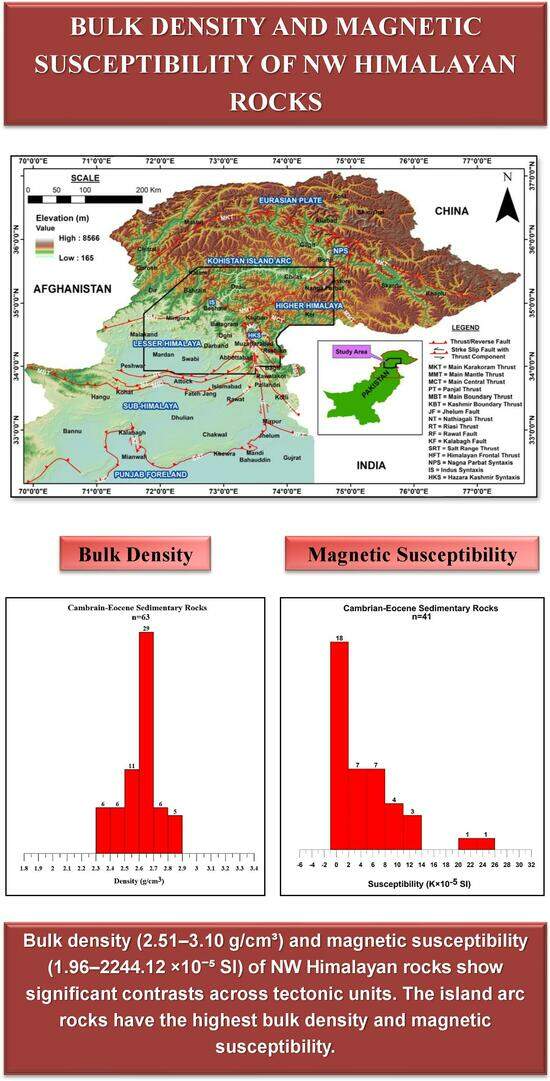
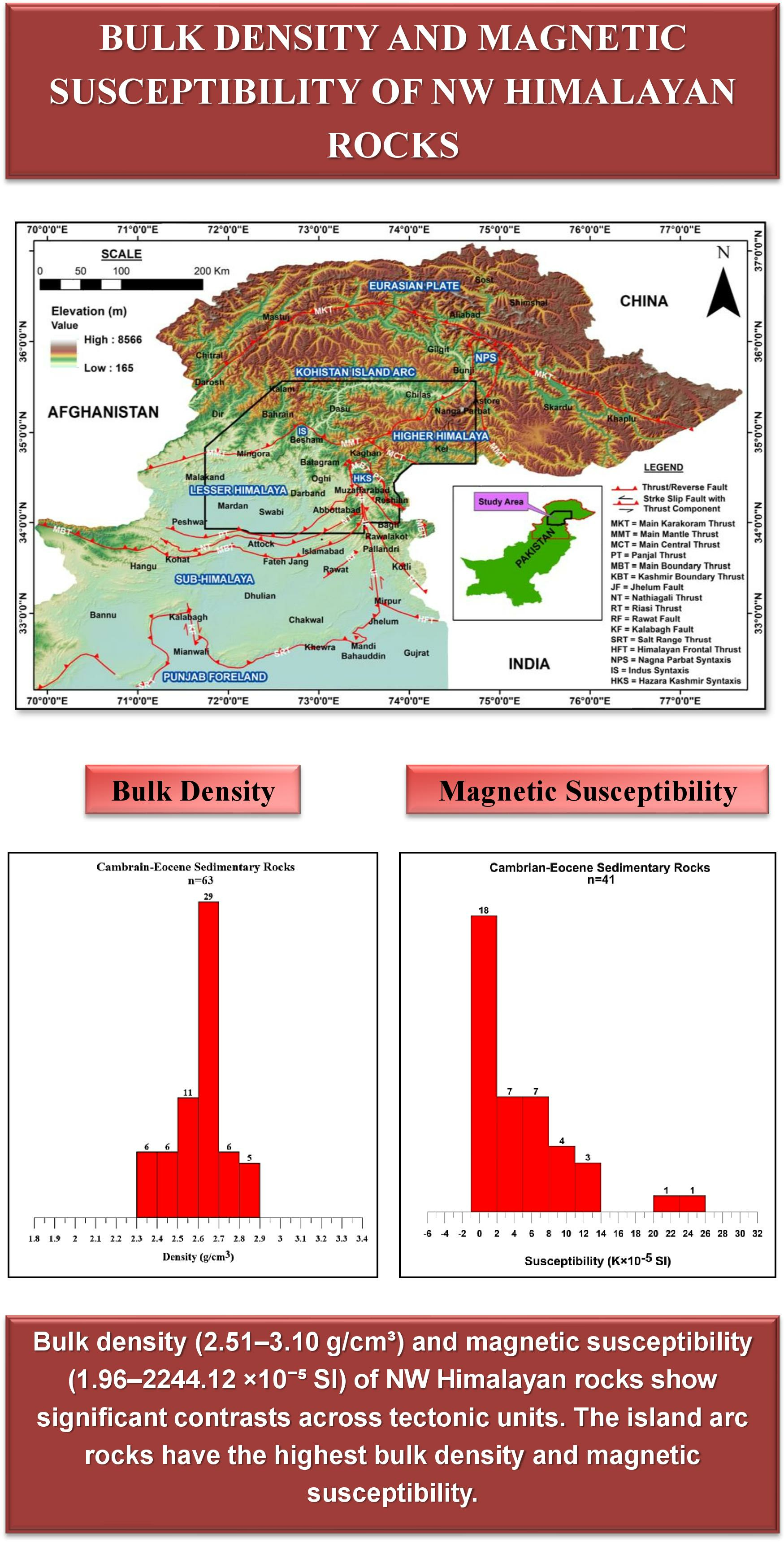
The present study provides a detailed compilation and analysis of the bulk density and magnetic susceptibility of the rocks from the northwest Himalayas, Pakistan. The area is tectonically extremely complex and comprises sedimentary, metamorphic, and igneous rocks. These rocks range in age from Early Proterozoic to Recent. During the fieldwork, 476 rock samples were collected for density measurements and 410 for magnetic susceptibility measurements from the major rock units exposed in the study area. The measured physical parameters reveal a significant difference in the density and susceptibility of the rocks present in the investigated area. The sedimentary rock units belonging to the Indian Plate show the lowest mean values for bulk density, followed by metasedimentary rocks, Early Proterozoic rocks, igneous and metaigneous rock units of the Indian Plate, Indus Suture Melange Zone, and Kohistan Island Arc rocks, respectively. The magnetic susceptibility of sedimentary rock units of the Indian Plate has the lowest mean values, followed by metasedimentary rocks of the Indian Plate, igneous and metaigneous rock units of the Indian Plate, Early Proterozoic rocks of the Indian Plate, Kohistan Island Arc rocks, and Indus Suture Melange Zone. In brief, the sedimentary rocks of the Indian Plate have the lowest bulk density and magnetic susceptibility values, whereas the Kohistan Island Arc rocks have the highest values. Overall, the bulk density and magnetic susceptibility of rock units in the study area follow those predicted for different types of rocks. These measurements can be used to develop possible potential field models of the northwest Himalayas to better understand the tectonics of the ongoing continental-to-continental collision, as well as for many other geological analyses.
1. Introduction
The northwest Himalayas in Pakistan exhibit a tectonically complex regime because of the continuous, ongoing continental-to-continental collision of the Eurasian and Indian plates (Figure 1). This collision greatly deformed the rocks present in the area. Generally, the deformation in the rocks affects both the magnetic susceptibility and the bulk density. Therefore, the understanding of these physical properties is essential not only for petrological and geological studies but also for the planning of geophysical surveys, processing of the geophysical data set, and interpretation of geophysical anomalies [1,2,3,4,5,6,7,8,9,10,11,12,13,14,15].
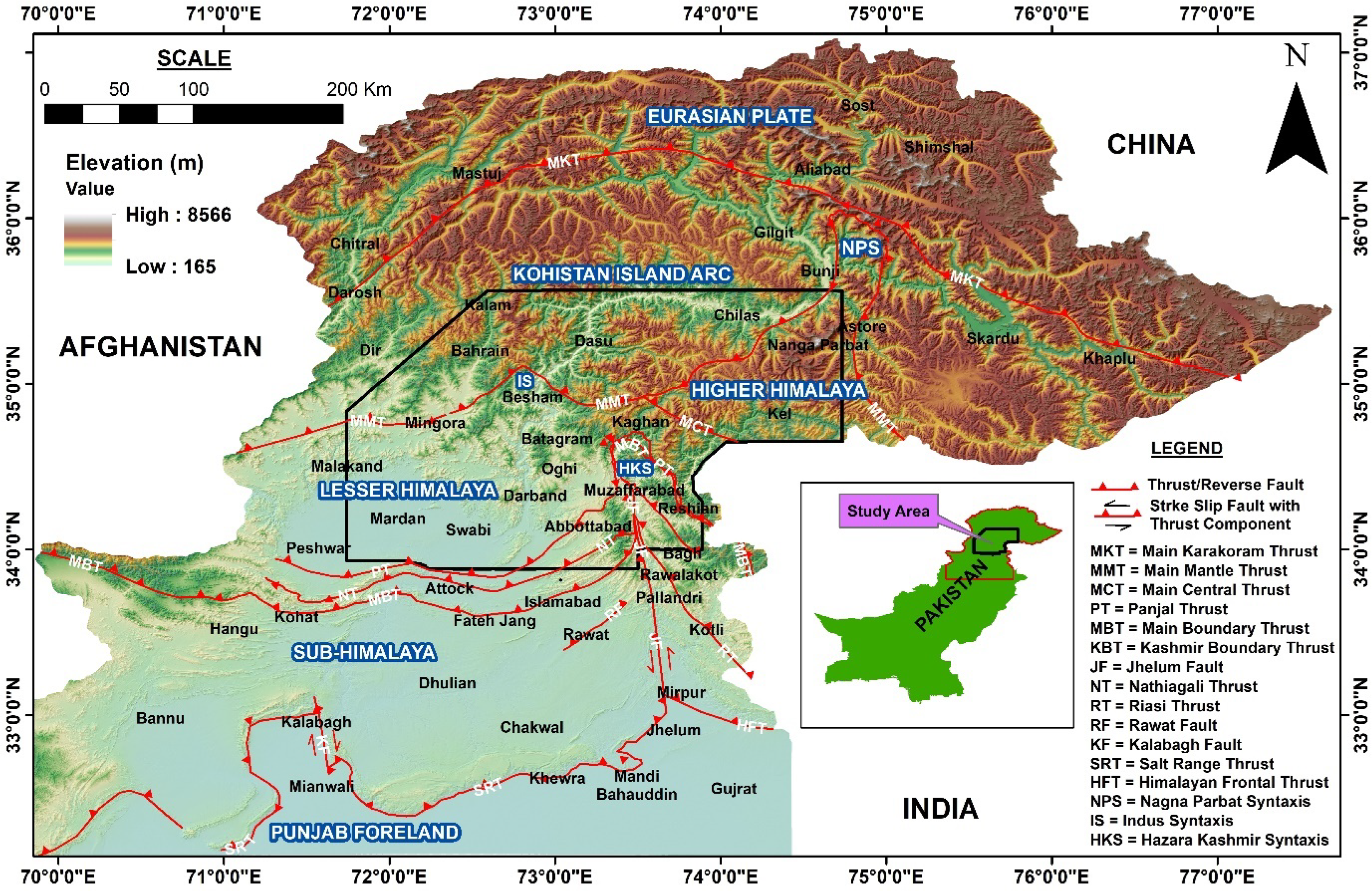
Figure 1.
The shaded relief map of the northwest Himalayas, Pakistan, prepared using Digital Elevation Model taken from the Shuttle Radar Topography Mission (SRTM) and tectonic elements from [16,17,18,19,20,21]. The black polygon shows the location of the study area.
Bulk density is an important petrophysical property that represents the mass of a rock unit per unit volume, encompassing both solids and pore spaces [22,23,24]. It plays a vital role in understanding the Earth material’s physical behaviour and is an important part of many geoscientific analyses [22,23]. In sedimentary settings, it aids in estimating porosity, depositional environment, and reservoir quality [25,26], whereas deviations from typical values in igneous and metamorphic rocks may suggest mineralogical changes or hydrothermal alterations [23,27,28]. Bulk density is also important in mining for the mineral resource estimation [23,27,28], slope stability and foundation design in geotechnical engineering [29], and volcanic eruption dynamics investigations [30]. These numerous applications highlight its relevance across different geological disciplines.
Magnetic susceptibility, on the other hand, is a key petrophysical property that quantifies the degree to which a material can be in an external field. It mainly reflects the concentration, grain size, and type of magnetic mineral, such as magnetite, hematite, and pyrrhotite, in a rock unit [31,32,33]. Measurement of magnetic susceptibility has extensive applications in geology. In a sedimentary basin, the magnetic susceptibility aids in paleoenvironmental reconstruction, sea-level changes, reservoir properties, and stratigraphic correlation [34,35,36,37]. In igneous and metamorphic igneous settings, it is useful for the identification of mineral assemblages and deformation patterns [38,39]. In mineral exploration, it helps in delineating lithological variations and locating ore deposits [40,41]. In tectonically active areas, the variation in the magnetic susceptibility helps to interpret the structural trends, crustal deformation, and lithological boundaries [39,42,43,44]. Despite these broad applications, the origin of magnetic susceptibility changes is frequently complex, influenced not only by the type and size of magnetic minerals but also by their genesis through magmatic, metamorphic, or diagenetic processes [32,34].
Geophysical surveys such as gravity and magnetic utilise lateral variations in rock density and magnetic susceptibility to delineate the geological structures and subsurface lithology [23]. The integration of density with magnetic susceptibility and geochemical data improves the subsurface interpretation across a range of geological settings. Furthermore, knowledge of these physical properties is essential for potential field forward modelling and inversion to produce geologically realistic results and reduce non-uniqueness [1,23,26,28,45,46,47,48].
The Himalayas are one of the world’s most complex and seismically active areas with several large earthquakes, the most recent of which included the 2015 Nepal earthquake of Mw 7.8 and the 2005 Kashmir earthquake of Mw 7.6. Therefore, geophysical measurements are not only essential for crustal material studies but also important for understanding the crustal structures to better understand the mechanism of earthquakes [13,15,49]. One of the extremely essential bases for analysing and interpreting the crust’s material and structure based on geophysical data is the petrophysical characteristics of rocks [13,15,49]. Despite the extensive use of bulk density and magnetic susceptibility in geosciences, limited data exist in the Northwest Himalayas, Pakistan. Therefore, this study aims to fill this gap by providing a detailed dataset of this complex region along with the geological interpretation of these physical properties, thereby contributing valuable understanding of the geological and tectonic settings of the area.
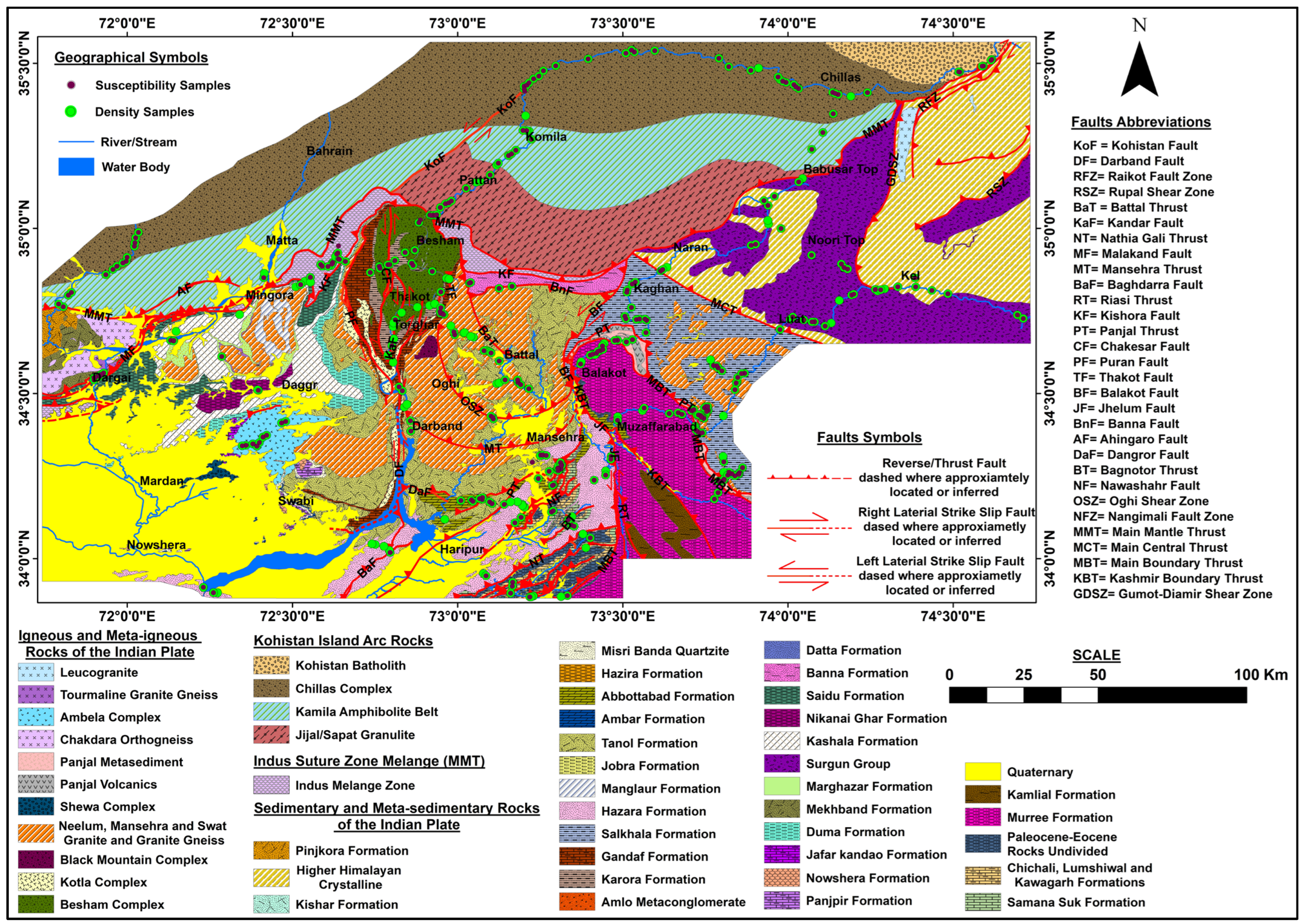
In this study, rock samples were collected from the various geological units exposed in the area to calculate their bulk density and magnetic susceptibility (Figure 2). These rock samples were collected during gravity and magnetic survey campaigns conducted in the northwest Himalayas of Pakistan in recent years. The raw measurements of bulk density and magnetic susceptibility for all analysed rock samples are provided in the supplementary materials (Tables S1 and S2). The current study statistically analysed the density and susceptibility of the rocks according to their tectonic setting and lithological composition. A brief description of all the rocks in the study region is given in Table 1.
Geologically and geophysically, these measured petrophysical properties of the rocks are noteworthy. In many gravity and magnetic studies, the densities and magnetic susceptibilities of the rock units are considered from the available compilations due to the limitation of resources and time [26]. Many surveys need this; however, if the information is scarce within a survey region, determining the rock densities and magnetic susceptibility is desirable. Furthermore, surveys require a certain level of accuracy, which is impossible to accomplish with currently available tabulations. As a result, assessing rock densities and susceptibilities in a survey region is extremely desirable.
The density measurements should, in general, display a normal distribution, allowing the arithmetic mean and standard deviation (SD) to be calculated [23,28]. Previous research has shown that the bulk densities of the rocks overlap significantly, and their distribution within specific rock units is broad and generally skewed to the lower side due to secondary processes [23,28].
Figure 2.
The geological map of the investigated area, compiled from [16,17,18,19,20,21,50,51,52,53,54,55,56,57,58,59,60,61,62,63,64] and references therein. The circles represent the samples collected for the bulk density and magnetic susceptibility measurement.
Table 1.
The geological sequence of the research area compiled from [16,17,18,19,20,21,50,51,52,53,54,55,56,59,63].
Table 1.
The geological sequence of the research area compiled from [16,17,18,19,20,21,50,51,52,53,54,55,56,59,63].
| Age | Formation | Lithology | |
|---|---|---|---|
| Quaternary | Quaternary | Unconsolidated gravel, silt, sand, and clay deposits | |
| Sedimentary and metasedimentary rocks of the Indian Plate | |||
| Early to Middle Miocene | Kamlial Formation | Sandstone, shales, and siltstone interbedded with intraformational conglomerates | |
| Murree Formation | The cyclic deposits of siltstone, sandstone, shales, and mudstone | ||
| Early to Late Eocene | Kuldana Formation | Shales (variegated colour) with siltstone, sandstone and limestone lenses | |
| Chorgali Formation | Thinly bedded limestone with shales | ||
| Margala Hill Limestone | Nodular limestone with shales intercalations | ||
| Early to Late Paleocene | Patala Formation | Grey colour shale with subordinate limestone and marl beds | |
| Lockhart Limestone | Dark grey to grey nodular limestone with shales and marls intercalations | ||
| Hangu Formation | Ferruginous sandstone, Bauxite, Laterite and shales. Coal is also present | ||
| Cretaceous | Kawagarh Formation | Micritic and well-bedded limestone with few shale beds and marl | |
| Lumshiwal Formation | Ferruginous and glauconitic sandstone with shales | ||
| Chichali Formation | Black coloured splintery shales with minor sandstone | ||
| Jurassic | Samana Suk Formation | Bedded limestone that is intercalated with marls and shales | |
| Datta Formation | Sandstone (Ferruginous) and quartzite | ||
| Late Triassic to Jurassic | Banna Formation | Chlorite and graphitic schist, slates and marble | |
| Saidu Formation | Schist, graphitic phyllite with some calcite marble | ||
| Nikanai Ghar Formation | Calcite marble, dolomitic marble and minor phyllites | ||
| Triassic | Kashala Formation | Dolomitic marble, calcite marble, calcareous marble, schistose marble, and calc-garnet schist, | |
| Permian to Triassic | Surgun Group | Paragneisses, calcschist, mica schists, quartzites, marble, minor amphibolites and minor level of meta-conglomerates | |
| Late Carboniferous to Triassic | Marghazar Formation | Amphibolite, metapsammite, biotite schist, garnetiferous schist, hornblende schist, schistose marble, and marble | |
| Mekhband Formation | Amphibolite and schistose marble | ||
| Duma Formation | Phyllite, greenschist, biotite schist, quartzite, amphibolite, graphitic phyllite and marble argillite | ||
| Carboniferous | Jagfar Kandao Formation | Limestone, argillite, calcareous as well as argillaceous quartzite, with conglomerates | |
| Devonian | Nowshera Formation | Limestone, sandy dolomite, calcareous argillite, marble and calcareous quartzite | |
| Silurian | Panjpir Formation | Metasiltstone, argillite, Phyllite, minor argillaceous quartzite with some basal conglomerates | |
| Ordovician | Misri Banda Quartzite | Feldspathic quartzite, minor argillite with some local basal conglomerate | |
| Cambrian | Hazira Formation | Reddish to brownish coloured shales, sandstone and siltstone | |
| Abbottabad Formation | Dolomitic limestone, dolomite, calcareous sandstone and quartzite. Phosphate deposits are also present | ||
| Ambar Formation | Sandy dolomite, minor argillite and some basal conglomerate | ||
| Early to Late Proterozoic | Tanol Formation | Quartzose schist, quartzite, muscovite schist, biotite schist, garnet schist and some marble as well | |
| Jobra Formation | Garnet-biotite schist, quartzite, marble and amphibolite | ||
| Manglaur Formation | Muscovite-quartz schist, Garnet schist, marble, quartzite and some graphitic schist | ||
| Hazara Formation | Dominantly slates and phyllites, as well as minor gypsum and limestone | ||
| Salkhala Formation | Psammitic-pelitic meta-sedimentary quartz-mica schist and talc schist with some quartzite and marble | ||
| Gandaf Formation | Metapsammite, phyllite, graphitic slate, schist, graphitic garnet schist, argillite, quartzite and marble | ||
| Karora Group | Karora Formation | Graphitic schist, dolomite, marble and calcite, fine-grained and dark metapsammite | |
| Amlo Meta-conglomerate Member | Meta-conglomerate, graphitic schist and quartzite | ||
| Pinjkora Formation | Biotite gneiss, micaceous schist, pegmatite, leucogneiss, marble, and amphibolite | ||
| Higher Himalayan Crystalline | Dominantly ortho- and para-gneisses complex, relics of granulitic texture with minor metabasites, marble, granite and amphibolite | ||
| Kishar Formation | Dark, non-schistose and biotite-bearing quartzo-feldspathic rocks and gneisses, calc-silicate marble and quartzite | ||
| Indus Suture Melange Zone (MMT) | |||
| Mainly Cretaceous | Indus Melange Zone | Greenstones, phyllite, serpentinite, talc-carbonate schist, blueschist, greenschist, meta-gabbro, marble and ultramafics | |
| Kohistan Island Arc rocks | |||
| Cretaceous to Miocene | Kohistan Batholith | Diorite, granite, granodiorite, leucogranite, hornblendite and gabbro with some meta-volcanics and schist | |
| Chillas Complex | Pyroxene diorite-tonalite, olivine gabbro, gabbronorite with some peridotite, pyroxenite, dunite, hornblendite and anorthosite | ||
| Kamila Amphibolite Belt | Amphibolite, plagiogranite, hornblendite, pegmatite, diorite, as well as minor gabbro | ||
| Jijal/Sapat Complex | Dunite, pyroxenite, peridotite, high-pressure-garnet granulites and rare chromite with anorthosite and gabbro | ||
| Igneous and metaigneous rocks of the Indian Plate | |||
| Neogene | Leucogranite | Potash-quartz-feldspar-plagioclase- biotite-tourmaline-muscovite-garnet bearing leucogranites, aplite and pegmatites dykes | |
| Paleogene | Tourmaline Granite Gneiss | Tourmaline-muscovite bearing leucogranitic gneiss with some fine-grained biotite bearing granite gneiss | |
| Carboniferous to Permian | Ambela Complex | Nepheline syenite, syenite and alkali granite. Minor biotite-muscovite granite and carbonatite. The complex is intruded by tourmaline and diabase pegmatite | |
| Chakdara Orthogneiss | Leucocratic muscovite-biotite-quartz-plagioclase-potash feldspar granite gneiss | ||
| Panjal Formation | Panjal Metasediments | Meta-carbonates, quartzites and graphitic phyllites. Meta-psammitic to meta-pelitic rocks with some lenses of volcanics | |
| Panjal Volcanics | Basaltic lava flows with tuff layers, greenstones, lenses and intercalations of schistose and limestone rocks | ||
| Shewa Complex | Alkaline microgranites and porphyry. The complex is intruded by diorites | ||
| Cambrian to Ordovician | Neelum, Mansehra and Swat Granite and Granitic Gneiss | Primarily mega-crystal granite as well as granite gneiss, tourmaline bearing granite and pegmatite | |
| Late Proterozoic | Black Mountain Complex | Orthogneiss, mafic intrusions and pegmatites having minor garnet-bearing or biotite-bearing gneisses | |
| Early Proterozoic | Kotla Complex | Biotite-muscovite orthogneiss, pegmatite, mafic intrusions and leucogneiss | |
| Besham Complex | Shang hornblende-biotite bearing granodiorite gneisses, Lahor leucogranites, pegmatites, biotite bearing orthogneisses, leucogneisses and mafic intrusions | ||
When the scale of variation is bigger than the size of a sample, bimodal distributions can occur from naturally heterogeneous lithotypes such as gneisses, layered intrusions, and banded iron units [23]. The number of samples necessary to accurately characterise the actual distribution is determined by the formation’s homogeneity. The fewer samples are taken, the more homogeneous the rock. The risk of taking an unrepresentative large number of samples of lithotypes that are resistant to erosion and hence outcrop, like with any geological sampling, exists [23,28]. The magnetic susceptibility, on the other hand, is not evenly distributed but rather follows a roughly bimodal pattern due to the existence of diverse populations of magnetic minerals in the dataset [28]. Even when lithology appears to be homogeneous, a single-mode distribution is uncommon [28]. The susceptibility is highly dependent upon the proportion of component minerals and the shape and size of the magnetic mineral grains; therefore, for a given mineral composition, a variety of susceptibilities is possible [23,28,65]. However, in addition to mineral grain size and composition, the observed magnetic susceptibility variations also reflect differences in rock genesis and post-depositional processes. The factors like chemical weathering, changes in depositional environment, and mineralogical transformations during diagenesis and metamorphism can alter the concentration and distribution of magnetic minerals [23,28,40,41]. The magnetic susceptibility of the rocks may be quantified in the field on the outcrops of rocks as well as in the laboratory [23].
Previous researchers carried out the reconnaissance study on the bulk densities and magnetic susceptibilities of the rocks in the area [20,21,66,67,68,69,70,71]. Most of them investigated individual aspects, either density or magnetic susceptibility. Malinconico [66] was the first to analyse the magnetic susceptibility and bulk density of the rocks in northern Pakistan along some selected profiles. However, the author neither mentioned how many samples were collected nor provided their locations. Duroy [67] only estimated the densities of the rocks in northern Pakistan from the previous density data of [66], some seismic lines in the Potwar Plateau and Salt Range area, from the deep seismic sounding data of [72,73], and also the short-period earthquake seismic data of [74] carried out in northern Pakistan and India [68]. Measured the magnetic susceptibility in the north of the current survey area, across the northern suture zone, i.e., Main Karakoram Thrust (MKT). They have collected a few samples from the region to analyse the magnetic susceptibility. Khan [69] calculated the bulk density and magnetic susceptibility of the rocks from the Hazara Kashmir Syntaxis (HKS) area to establish different zones of bulk density and magnetic susceptibility. The researchers [20,70,71] only calculated the bulk density of the rocks exposed in HKS and its surroundings.
2. Geological and Tectonic Setting
The collision of the Eurasian and Indian plates, which resulted in the closing of the Tethys Ocean, is a recent example of a continent-continent collision. The remarkable rise of the Himalayas is the geological manifestation of this collision [75] and is responsible for the tectonic activity that is continuing at present [76]. The Indus Suture Zone is the distinguishable border between the Indian and Eurasian plates in northern India [77,78]. However, westward in northern Pakistan, the Indus Suture Zone is divided into the Main Mantle Thrust (MMT) and the MKT, separated by the Kohistan Island Arc (KIA) (Figure 1). The KIA between the striking Indian and the Eurasian plates is thrust on the Indian plate [79,80,81]. In the northern suture zone, MKT separates the highly metamorphosed rocks of the Eurasian Plate from the KIA, whereas in the southern junction area, MMT divides the metasediments of the Indian Plate from the KIA. The Indian and Eurasian plates have rocks with comparatively low density and susceptibility as compared to the rocks in the KIA. After suturing, crustal shortening along the various thrusts accommodated the Eurasian and Indian plates’ ongoing convergence. The shortening has been carried out by underthrusting of the Indian Plate underneath the Eurasian Plate and stacking of thrust sheets mainly along the Main Central Thrust (MCT), Main Boundary Thrust (MBT), Panjal Thrust (PT), Nathia Gali Thrust (NT), Kashmir Boundary Thrust (KBT), and Salt Range Thrust (SRT) [70,77,82] (Figure 1). In the western Himalayas, the collision of Eurasian and Indian plates formed south-verging folds and thrust belts over the basement rocks of the Indian shield. Specifically, in Kashmir and Northern Pakistan, three large-scale syntaxes have been formed, namely, Indus Syntaxis (IS), Nanga Parbat Syntaxis (NPS), and HKS (Figure 1).
The Himalayas in Pakistan are divided into three parts: Higher Himalayas, Lesser Himalayas, and Sub-Himalayas, which are separated by several crustal-scale faults [77,82,83,84] (Figure 1). This fault system has brought into contact the rocks of different densities and susceptibilities; it is considered that the coverage of the area may allow the generation of potential field models to explain the lithostructures of the crust. A detailed description of the rock units present in the area is given along with their ages in Table 1.
3. Methodology
The following sections describe in detail the methods used to determine the bulk density and magnetic susceptibility of different rock units exposed in the study area.
3.1. Bulk Density Measurement
The project area is geologically extremely complex and comprises sedimentary, metamorphic, and igneous rocks ranging in age from Precambrian to Recent. A total of 476 samples have been collected in the field from these rocks to measure the bulk density. In the field, it was ensured that the samples were fresh with a minimum weight of 500 g and dimensions greater than 5 cm in one direction. The bulk density measurements were made using Archimedes’ principle with a precision electronic balance. All the rock specimens have been weighed three times, i.e., dry weight in the air (), saturated weight in water (), and saturated weight in the air (). To obtain the dry weight in the air (), the samples were dried in an oven at 105 °C for 48 h and then weighed to the nearest 0.01 g. The samples were then immersed in water for 48 h so that the water was drawn into pores by the combined action of capillary forces and the external atmospheric pressure. At the end of this period, samples were removed from the water bath at once, and their surface was dried with a damp cloth. The samples were weighted to the nearest 0.01 g to get the saturated weight in the air (). In the next step, saturated specimens were weighed again to the nearest 0.01 g during their suspension in water to obtain the saturated weight in water (). For a satisfactory means of weighing the samples in the water, a wire basket was used to suspend the sample in a vessel of water.
In the end, the bulk density was calculated using the following formula and is reported in g/cm3.
3.2. Magnetic Susceptibility Measurement
For the susceptibility measurement, a total of 410 fresh samples were collected from the sedimentary, igneous, and metamorphic rocks from the area under investigation. The Bartington MS3 magnetic susceptibility meter, along with the MS2B sensor, has been used for the susceptibility measurement in laboratory conditions. The measurements have been made using Bartsoft instrumentation software (Version 4.2.1.3). The 1 × 1-inch drill core of all rock samples was prepared to measure the susceptibility. Each sample was measured three times, and its arithmetic mean was calculated and used in the analysis. For the current study, the magnetic susceptibilities were reported in the International System of Units (SI). The magnetic susceptibility values are skewed due to the varying mineral content within each rock unit; therefore, they are multiplied by a factor of 10−5 to present the result.
To ensure measurement accuracy, each sample was measured three times, and mean values with standard deviations were reported. Reproducibility was verified through repeated calibration using a standard calibration sample.
3.3. Bulk Density and Magnetic Susceptibility Tables
Based on rock type, lithology, and tectonic setting, the calculated bulk density and magnetic susceptibility were divided into distinct zones. The tables have been prepared to represent the different rock units with their zones, the number of samples collected, minimum and maximum values, and arithmetic mean and SD.
3.4. Frequency Histograms, Box and Whisker Plots and Henkel’s Plot
To better understand the distribution of bulk density and magnetic susceptibility data and their mutual relationship, frequency histograms were generated using the GrapherTM (Golden Software, LLC, Golden, CO, USA, Version 9.4.819), whereas box and whisker and Henkel’s plots were prepared in Microsoft Excel.
3.5. Spatial Distribution Maps of Bulk Density and Magnetic Susceptibility
The spatial distribution maps of the measured bulk density and magnetic susceptibility have been prepared using Geosoft Oasis Montaj Software (Version 8.4). The interpolation was performed using the minimum curvature gridding technique, which enabled the spatial distribution of these physical properties across the survey region. The geological faults have also been plotted onto the interpolated grids to understand the variations of these physical properties in relation to tectonic features.
4. Results and Discussion
4.1. Analysis of the Density and Magnetic Susceptibility Data
The fresh rock samples for bulk density and magnetic susceptibility measurement were collected from the research area. The densities and susceptibility are reported in g/cm3 and SI units, respectively. The frequency histograms (Figure 3, Figure 4, Figure 5, Figure 6, Figure 7, Figure 8 and Figure 9) represent the bulk density and magnetic susceptibility distribution within each rock unit or group of rock units. Table 2 and Table 3 present the bulk density and magnetic susceptibility values of the collected rock samples, including their minimum, maximum, arithmetic mean, and SD. To effectively analyse the statistical distribution of these physical properties across different rock units, the box and whisker plots were also generated (Figure 10 and Figure 11). Additionally, Henkel’s plot of bulk density versus logarithm of magnetic susceptibility to analyse the mutual relationship between these two physical properties (Figure 12). Based on the type of rock, lithology differences, and the tectonic setting, the bulk density and magnetic susceptibility analysis have been divided into the following zones.
4.1.1. Bulk Density and Magnetic Susceptibility of the Sedimentary Rocks of the Indian Plate
The density of the sedimentary rocks depends on their mineral content, porosity, pore fluid type, cementation, age and depth of burial, and tectonic processes [22,23,26]. The average density of chemical sedimentary rocks, including limestone, dolomite, and siliceous rocks, is higher than that of the clastic sedimentary rocks, such as sandstone, mudstone, and siltstone [23]. In chemical sedimentary rocks, carbonate rocks (dolomite and limestone) have a higher average value than siliceous rocks [23]. Among clastic rocks, mudstone has the greatest average value, whereas siltstone has the lowest average value [13]. The magnetic susceptibility of the sedimentary rocks primarily depends on the composition and accessory mineral content, such as iron hydroxides, hematite, and magnetite [8,13,23,33,35,37,65,85]. It is not unusual to observe variations in magnetic susceptibility of several orders of magnitude for different rock samples. In addition, there may be significant overlap in the measured magnetic susceptibilities [23].
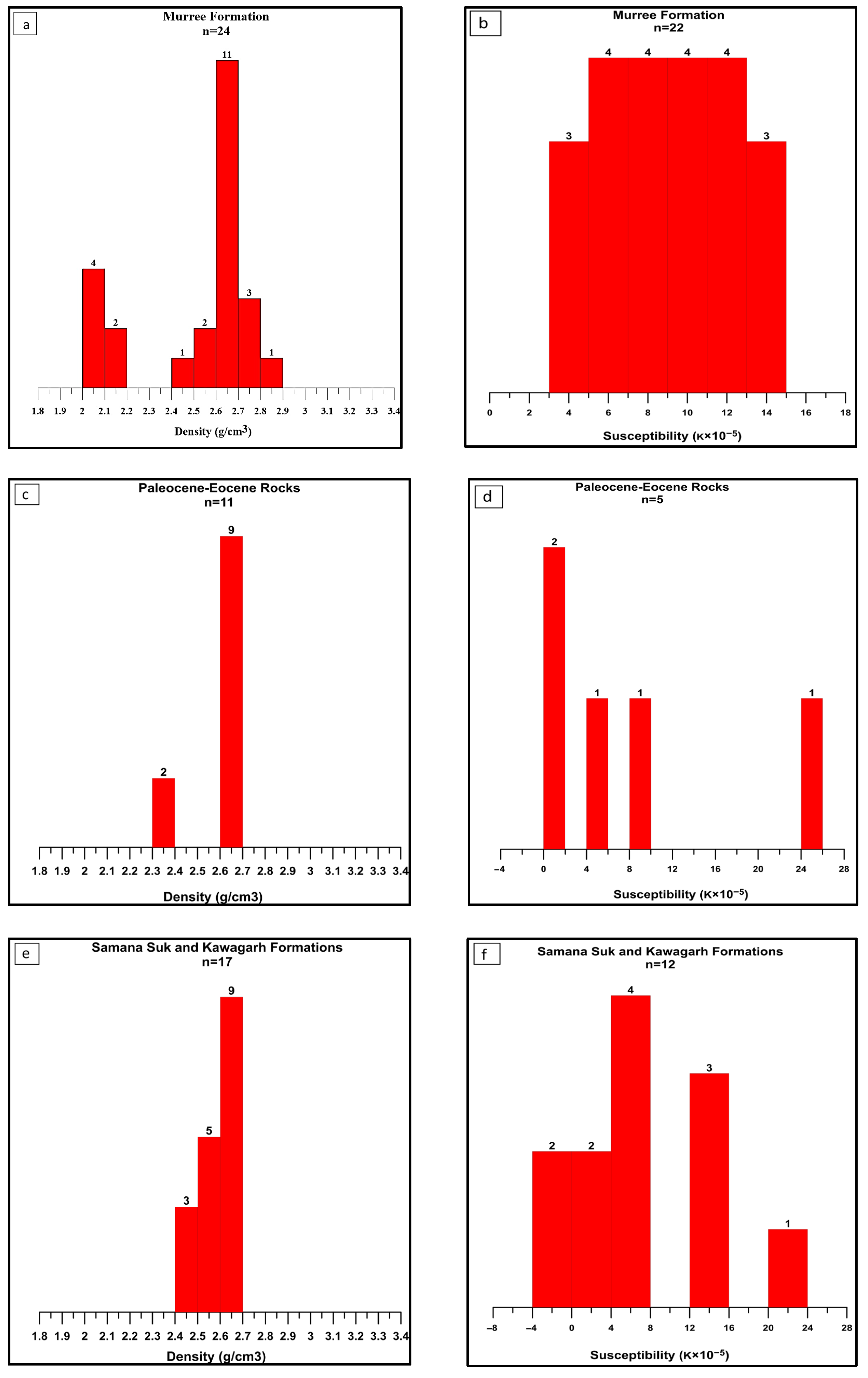
The sedimentary rocks of the Indian Plate are classified into the Murree Formation of Miocene age, Palaeocene and Eocene rocks, including Lockhart Limestone, Margalla Hill Limestone and Kuldana Formation, Samana Suk and Kawagarh formations of Jurassic and Cretaceous ages, respectively, Hazira and Abbottabad formations of Cambrian age (Figure 2). A total of 24 rock samples for bulk density measurement and 22 for magnetic susceptibility measurements were collected from the Murree Formation with varying lithologies such as sandstone, siltstone, mudstone, and shale (Figure 2). The histogram (Figure 3a) shows the distribution of bulk density across this formation with dominant values around 2.6–2.7 g/cm3; however, some shales, siltstone, and mudstones represent low-density values as well. The sandstone of this formation is well compacted and hard, thereby having less porosity and high density (Figure 3a). The bulk density of this formation ranges from 2.026–2.874 g/cm3, and the arithmetic mean is calculated as 2.510 g/cm3 with an SD of 0.262 (Table 2). The histogram (Figure 3b) shows the normal distribution of susceptibility across this formation with dominant values around 5 × 10⁻⁵–13 × 10−5 SI. The magnetic susceptibility of this rock formation ranges from 3.087 × 10⁻⁵ to 14.417 × 10⁻⁵ SI, having an arithmetic mean of 9.081 × 10⁻⁵ SI and an SD of 3.249 (Table 3). The measured magnetic susceptibility shows weak positive susceptibility values across this rock unit.
A total of 11 rock samples for bulk density measurement and 5 samples for magnetic susceptibility measurement were gathered from the Paleocene-Eocene rocks, including Lockhart Limestone, Margalla Hill Limestone, and Kuldana Formation. The reason for the smaller number of samples collected from these rocks is the limited availability of outcrops in the study area (Figure 2). The collected samples were mainly from limestone, sandstone, and shales. The histogram (Figure 3c) shows a dominant bulk density range around 2.6–2.7 g/cm3, whereas the histogram (Figure 3d) represents different ranges of magnetic susceptibility due to the limited number of samples. As a whole, the calculated bulk density of this formation varies from 2.390–2.684 g/cm3 and the arithmetic mean is calculated as 2.601 g/cm3 with an SD of 0.105 (Table 2). The magnetic susceptibility, on the other hand, ranges from 0.505 × 10⁻⁵ to 25.939 × 10⁻⁵ SI, having an arithmetic mean of 8.733 × 10⁻⁵ SI and an SD of 10.267 (Table 3). The shales from the Kuldana Formation show low density but high magnetic susceptibility, whereas the limestone from Lockhart and Margalla represents high density and low magnetic susceptibility. In general, these rocks also show weak positive susceptibility.

Figure 3.
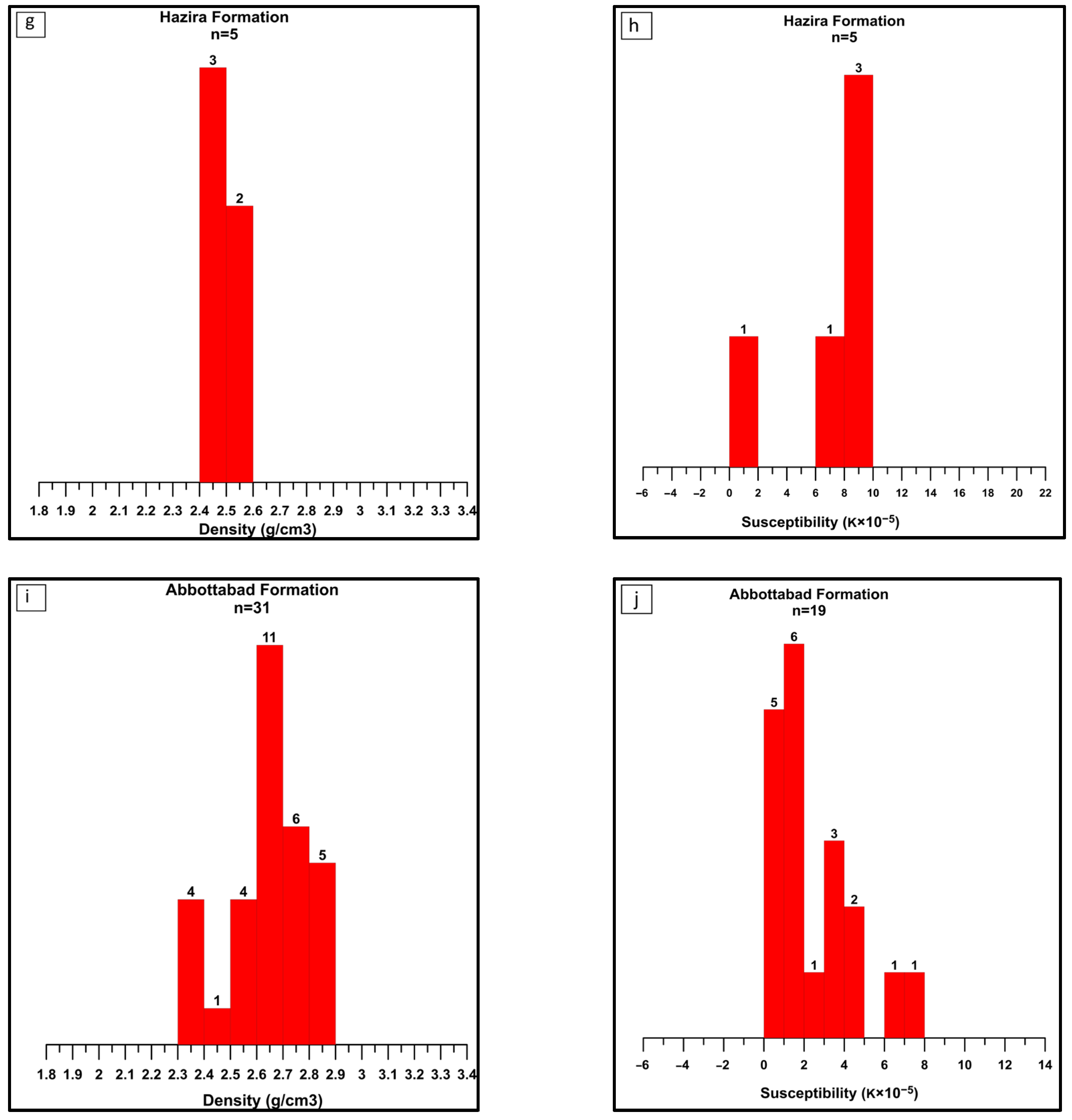
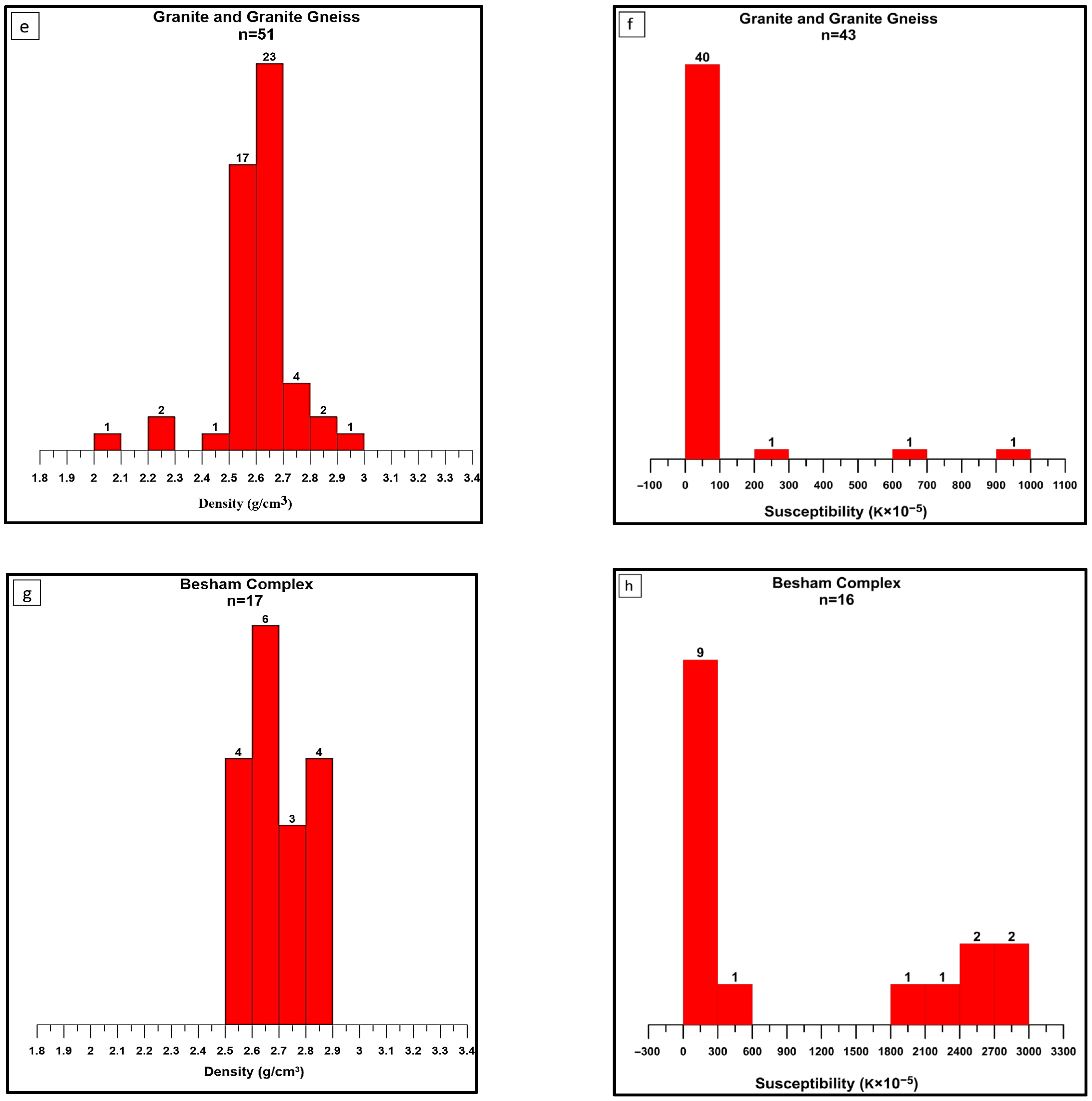
The histograms of the bulk density and magnetic susceptibility of sedimentary rock samples from the Indian Plate: (a,b) Murree Formation; (c,d) undivided Paleocene-Eocene rocks; (e,f) Combined Samana Suk and Kawagarh formations; (g,h) Hazira Formation and (i,j) Abbottabad Formation.
Figure 4.
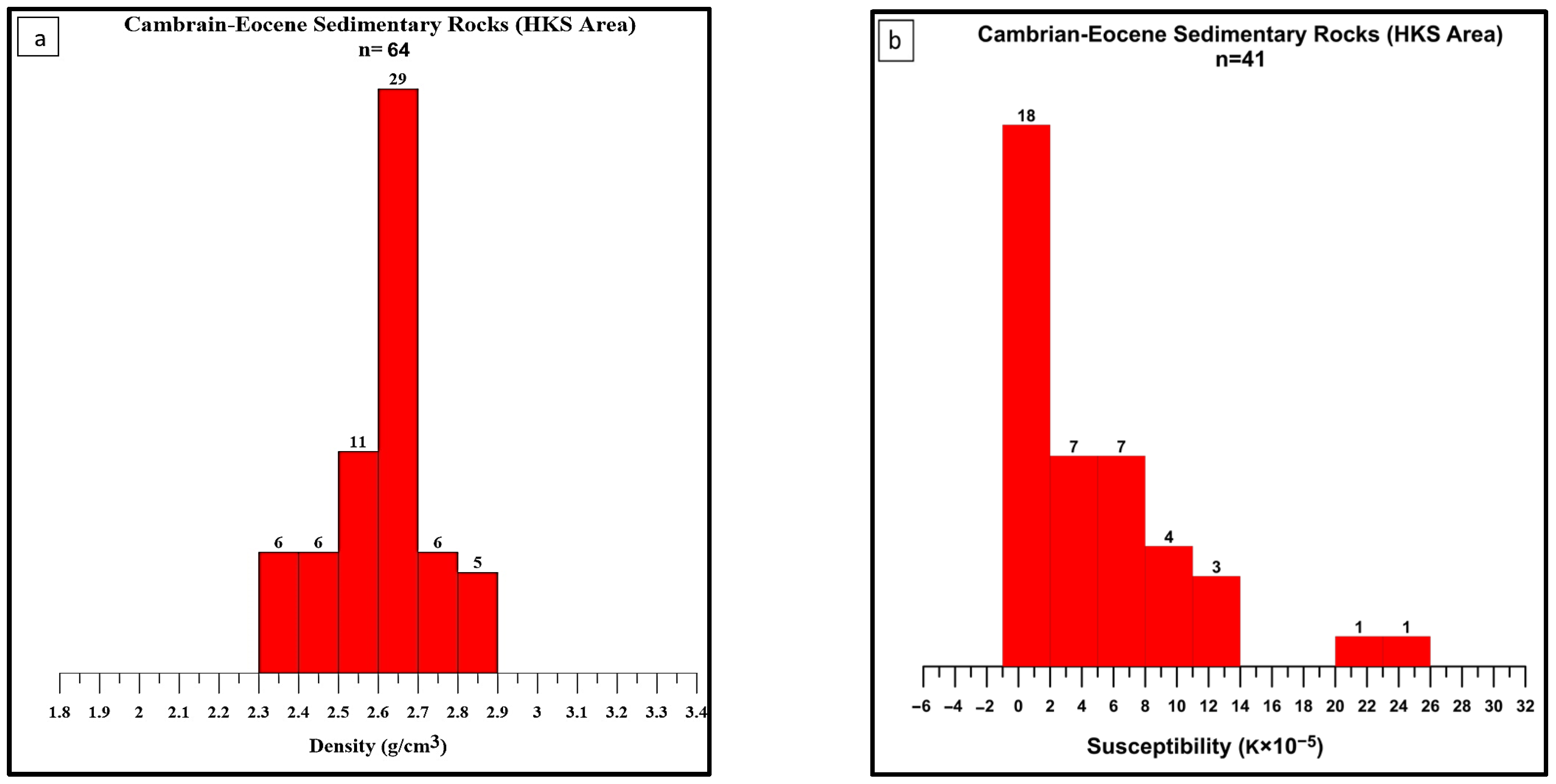
The histograms of the (a) bulk density and (b) magnetic susceptibility of sedimentary rock samples from the Indian Plate. These included combined Cambrian to Eocene rock units, particularly in the HKS area, including Abbottabad, Hazira, Samana Suk, Kawagarh formations, Lockhart and Margalla Hill Limestone, and Kuldana Formation.


Figure 5.
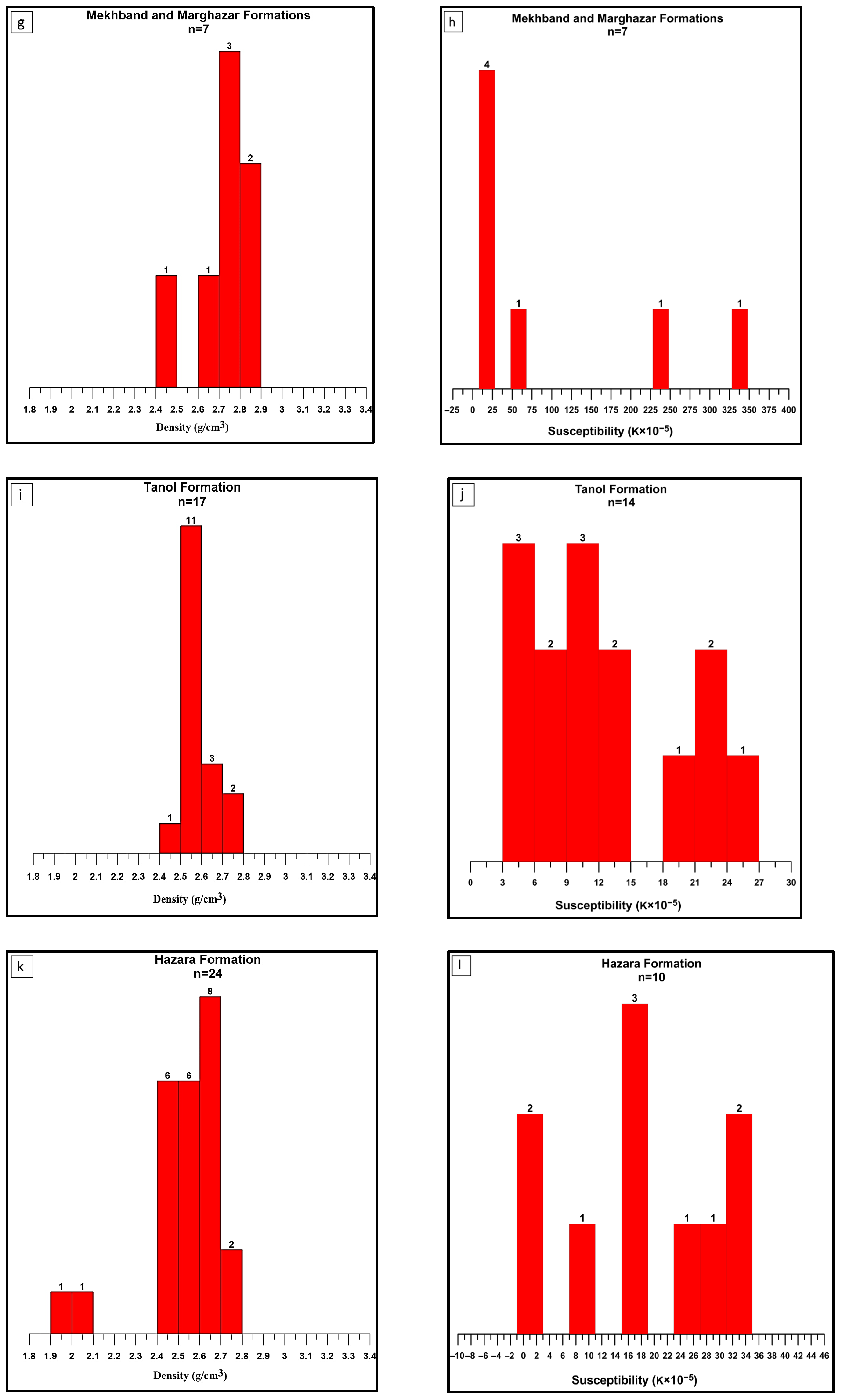
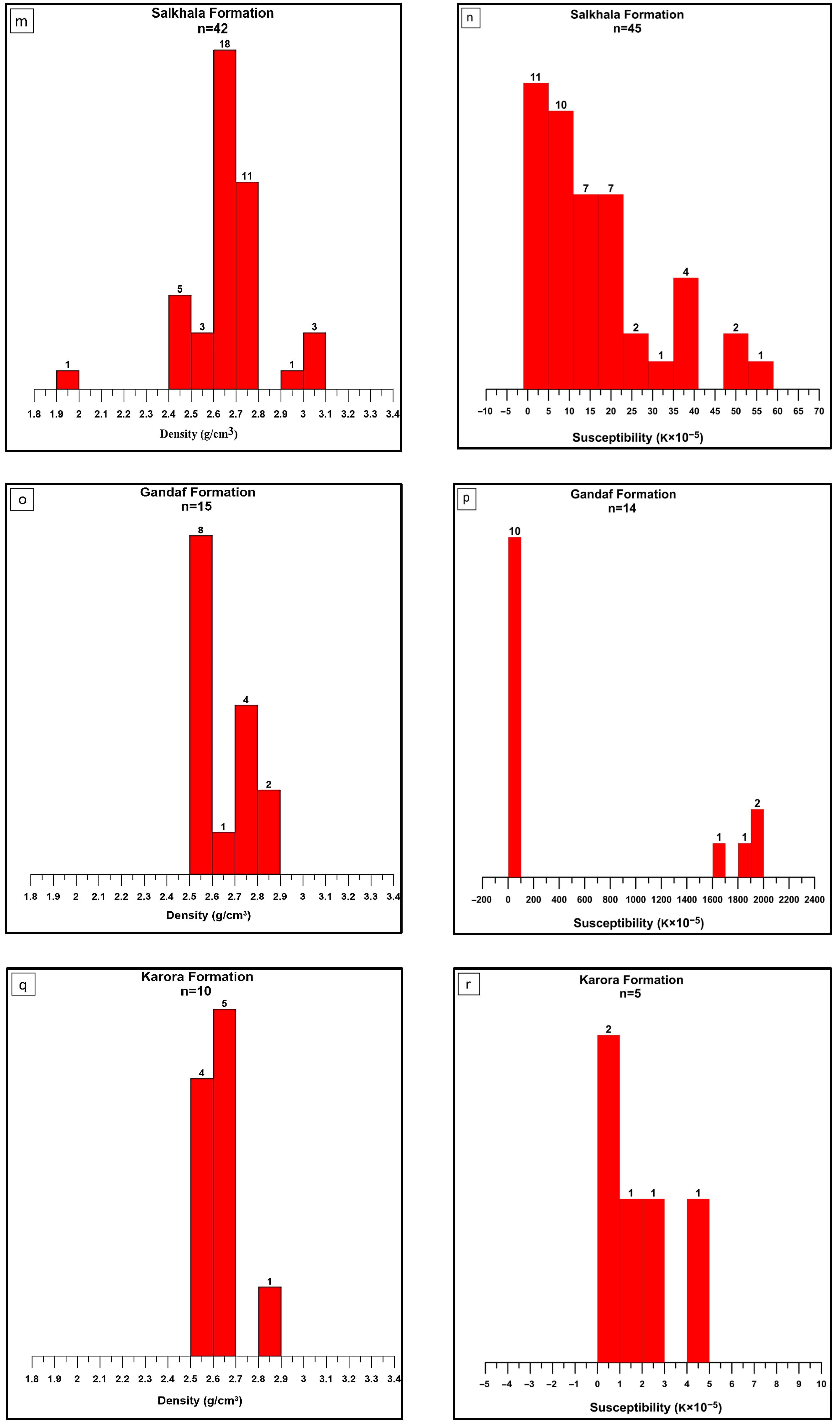
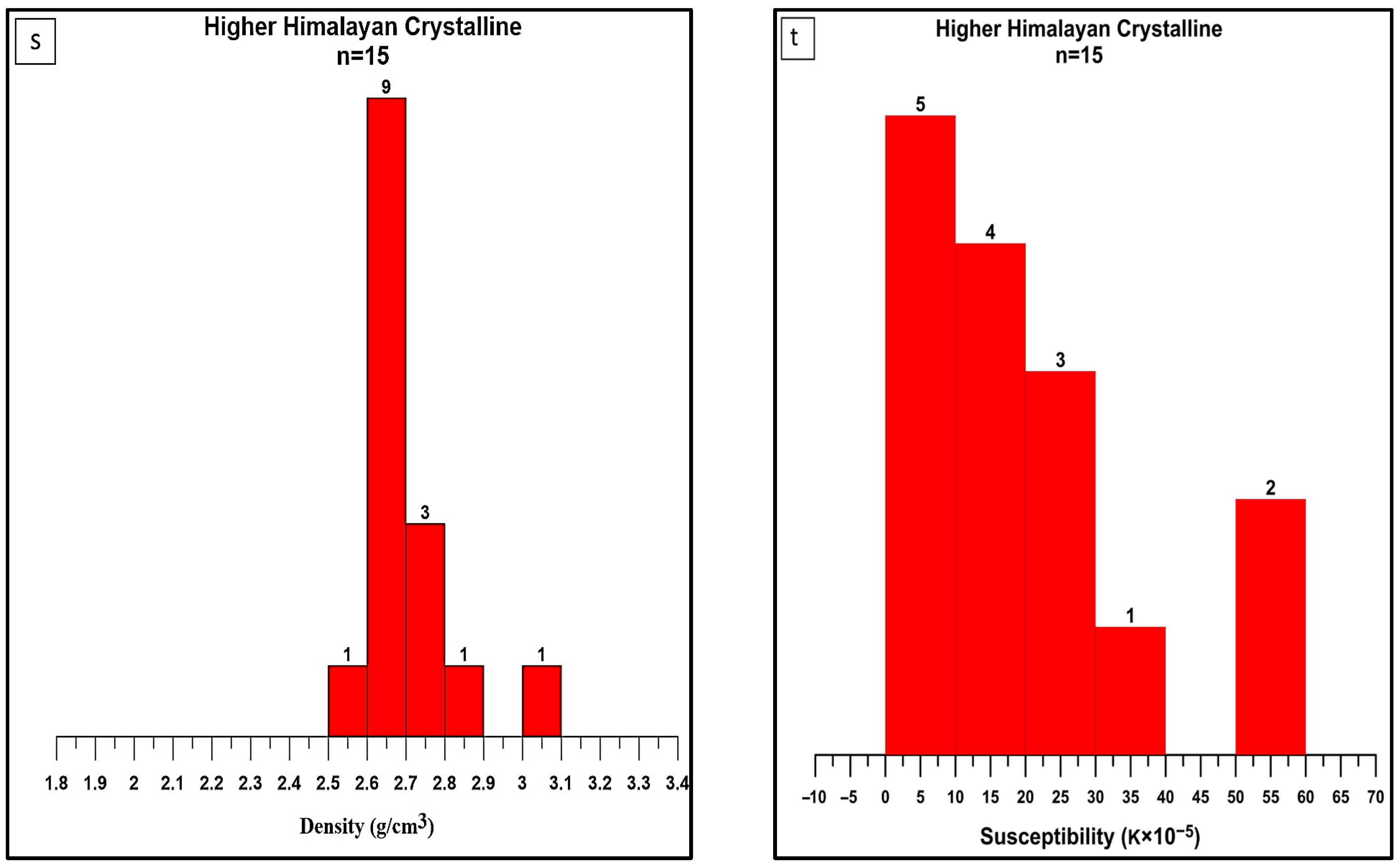
The histograms of the bulk density and magnetic susceptibility of metasedimentary rock samples from the Indian Plate: (a,b) Banna Formation; (c,d) Kashala, Nikanai Ghar and Saidu formations; (e,f) Surgun Group; (g,h) Mekhband and Marghazar formations; (i,j) Tanol Formation; (k,l) Hazara Formation; (m,n) Salkhala Formation; (o,p) Gandaf Formation; (q,r) Karora Formation and (s,t) Higher Himalayan Crystalline.
Figure 6.
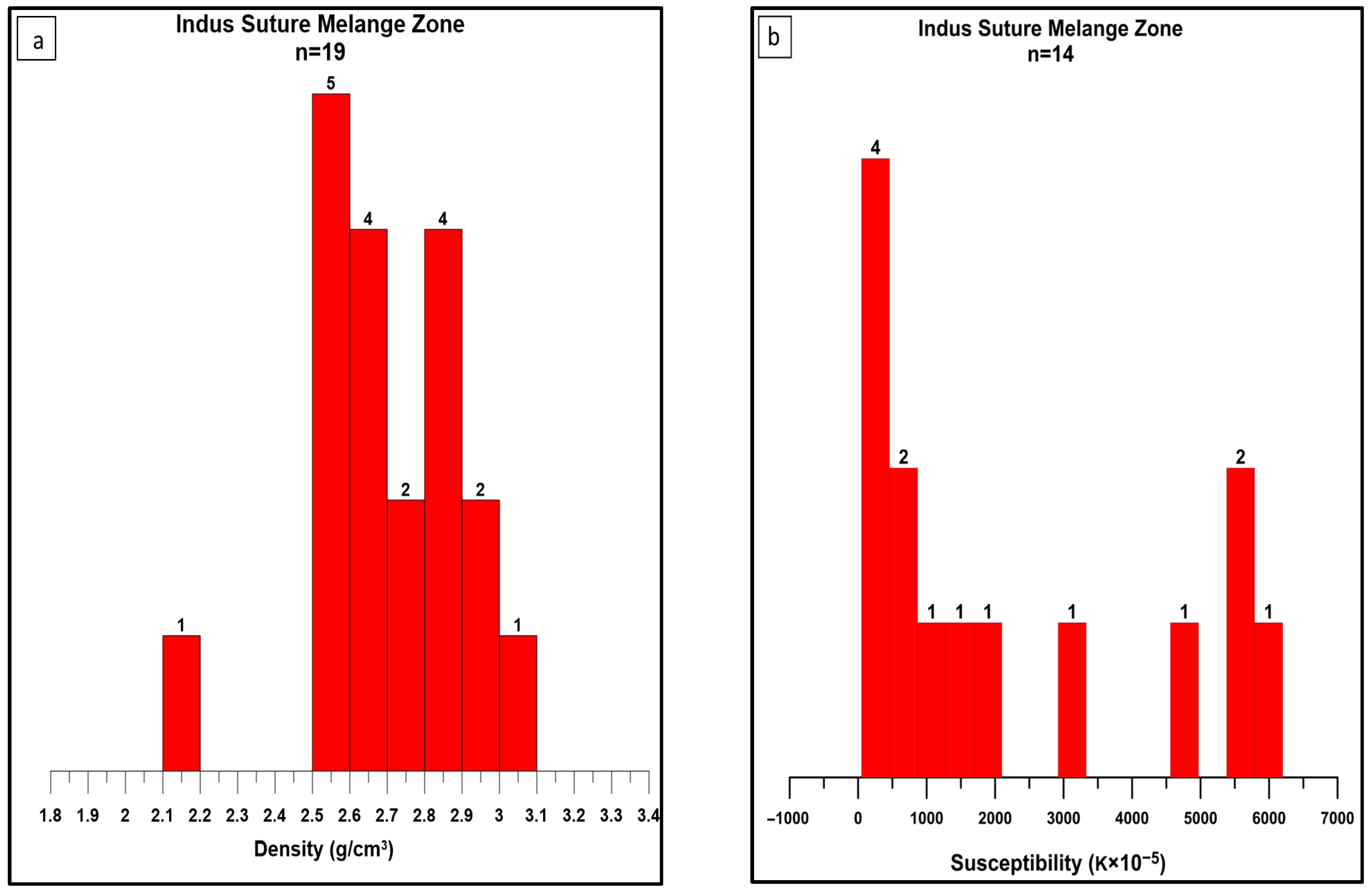
The histogram of the (a) bulk density and (b) magnetic susceptibility of the rocks in the Indus Suture Melange Zone between the Indian Plate and KIA.

Figure 7.
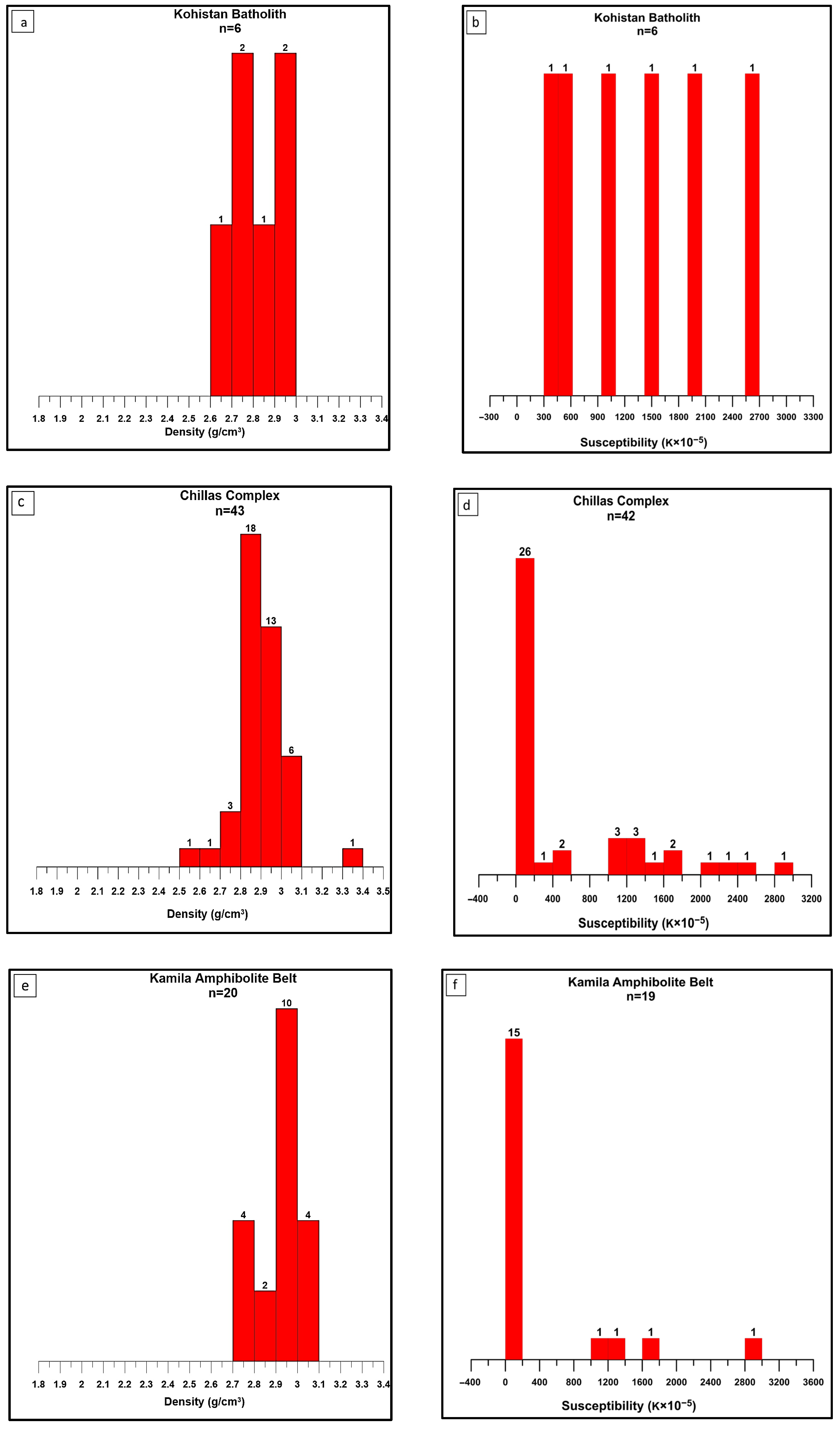
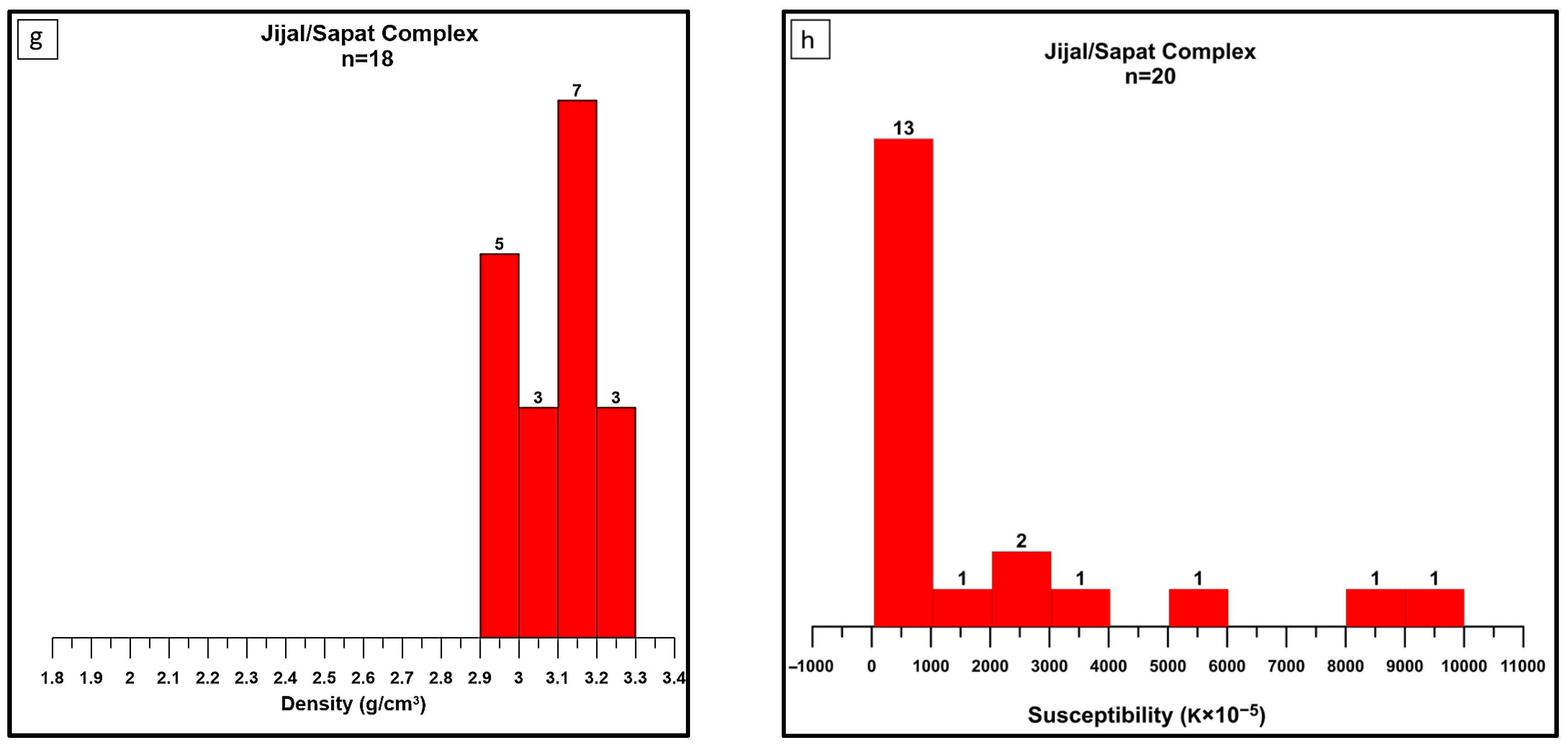
The histograms of the bulk density and magnetic susceptibility of rock samples from KIA: (a,b) Kohistan Batholith; (c,d) Chillas Complex; (e,f) Kamila Amphibolite Belt, and (g,h) Jijal/Sapat Complex.

Figure 8.
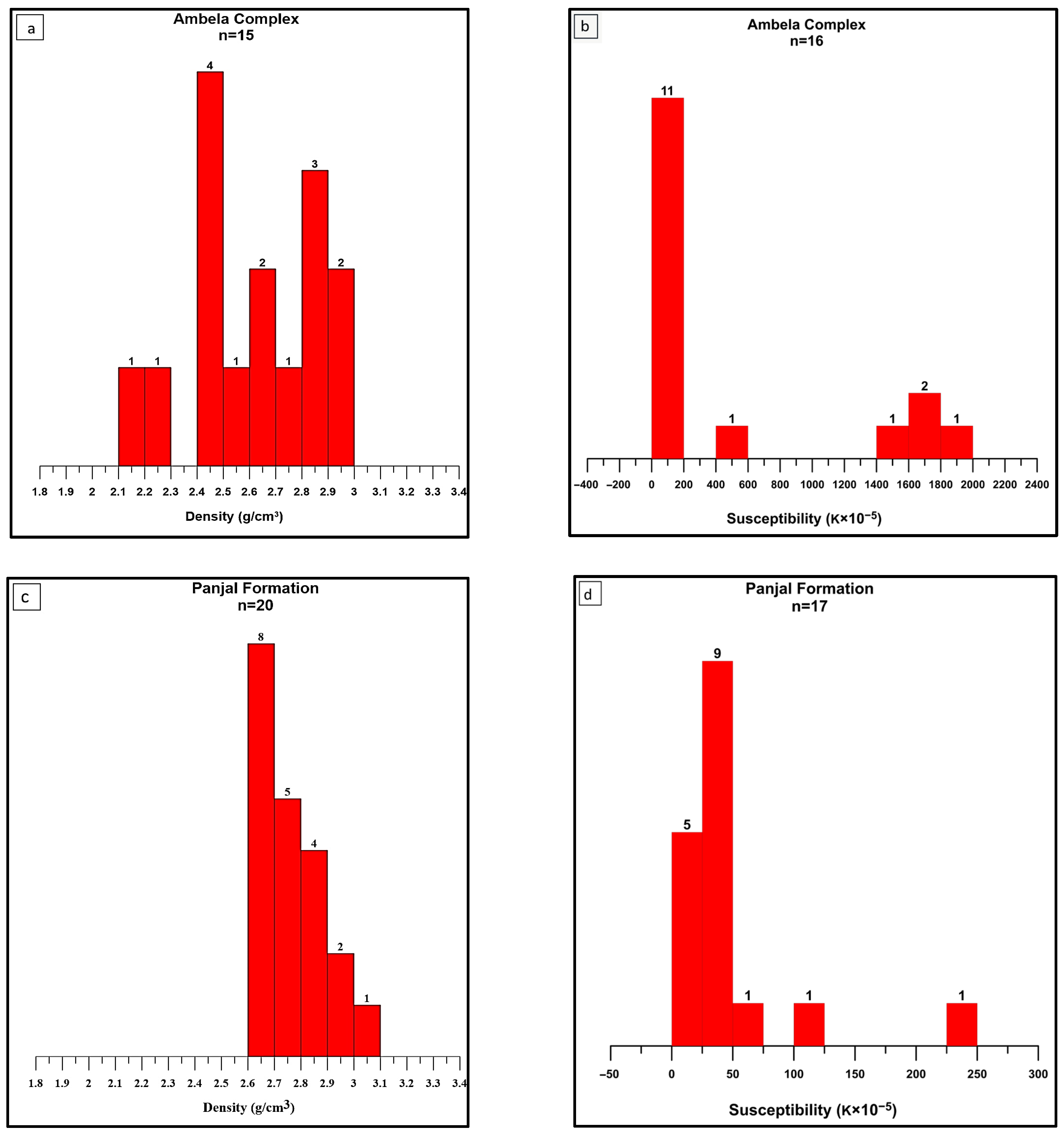
The histograms of bulk density and magnetic susceptibility of the igneous and metaigneous rock samples from the Indian Plate: (a,b) Ambela Complex; (c,d) Panjal Formation, including volcanics and metasedimentary rocks; (e,f) Swat, Mansehra, and Neelum Granite and Granitic Gneiss, and (g,h) Besham Complex.
Figure 9.
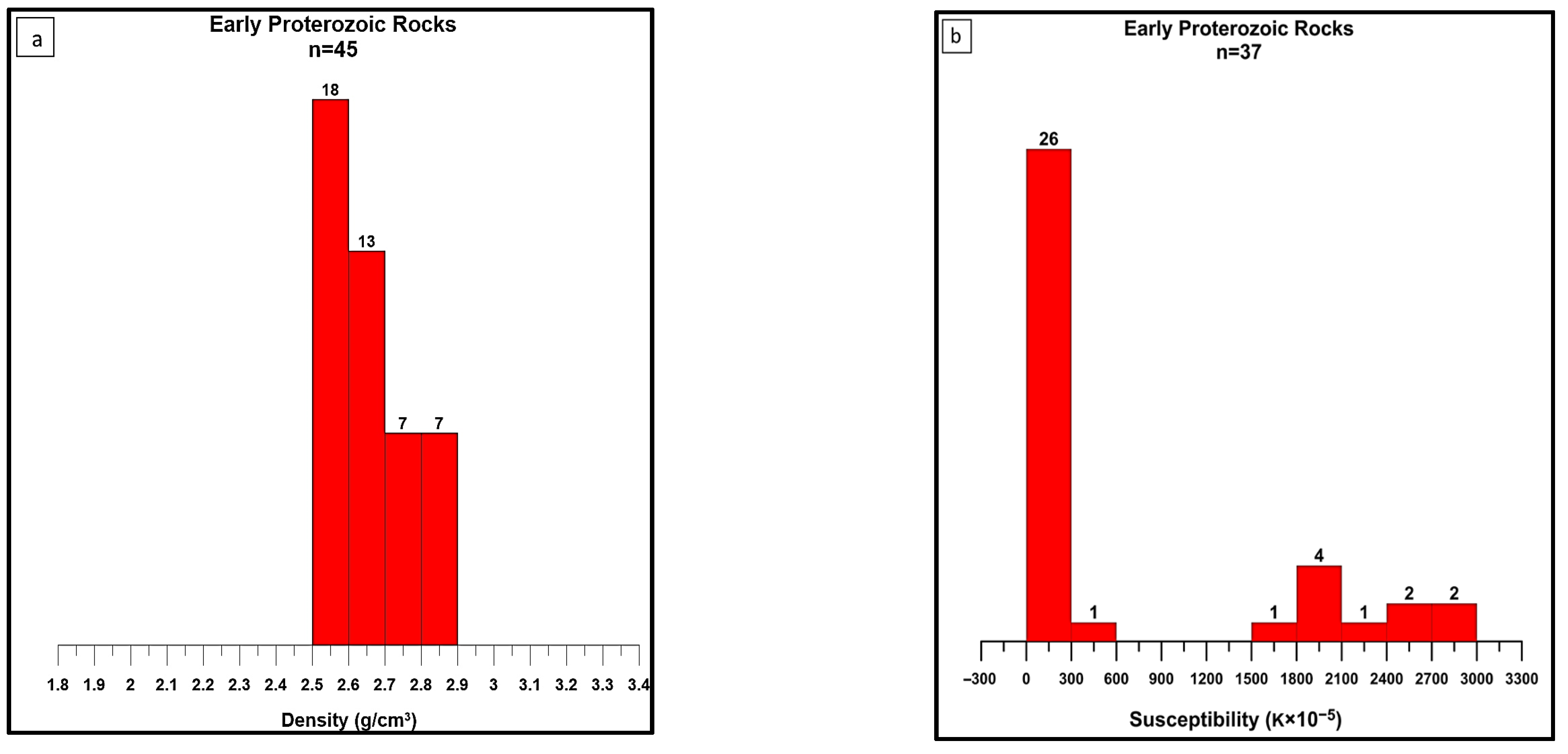
The histograms of (a) bulk density and (b) magnetic susceptibility of the undivided Early Proterozoic rock samples from the Besham and surrounding areas of the Indian Plate, including Besham and Kotla complexes, Karora and Gandaf formations.
Table 2.
The details of the bulk densities of the various rock samples collected from the research area and its surroundings.
Table 2.
The details of the bulk densities of the various rock samples collected from the research area and its surroundings.
| Formation | No. of Samples (n) | Minimum and Maximum Density (g/cm3) | Arithmetic Mean (g/cm3) | Standard Deviation (SD) | |
|---|---|---|---|---|---|
| Sedimentary rocks of the Indian Plate | |||||
| Murree Formation | 24 | 2.026–2.874 | 2.510 | 2.585 | 0.262 |
| Paleocene and Eocene Rocks (Lockhart Limestone, Margalla Hill Limestone and Kuldana Formation) | 11 | 2.390–2.684 | 2.601 | 0.105 | |
| Samana Suk and Kawagarh formations | 17 | 2.480–2.696 | 2.598 | 0.081 | |
| Hazira Formation | 5 | 2.463–2.520 | 2.496 | 0.022 | |
| Abbottabad Formation | 31 | 2.354–2.878 | 2.644 | 0.142 | |
| Undivided Cambrian to Eocene Sedimentary Rocks from HKS area | |||||
| Undivided Cambrian to Eocene Sedimentary Rocks (Abbottabad, Hazira, Samana Suk and Kawagarh formations, Lockhart Limestone, Margalla Hill Limestone and Kuldana Formation) | 64 | 2.354–2.878 | 2.613 | 0.121 | |
| Metasedimentary rocks of the Indian Plate | |||||
| Banna Formation | 05 | 2.555–2.636 | 2.603 | 2.652 | 0.029 |
| Kashala, Nikanai Ghar, and Saidu formations | 13 | 2.494–2.828 | 2.680 | 0.119 | |
| Surgun Group | 28 | 2.588–3.073 | 2.745 | 0.118 | |
| Mekhband and Marghazar formations | 07 | 2.472–2.851 | 2.735 | 0.135 | |
| Tanol Formation | 17 | 2.485–2.771 | 2.587 | 0.081 | |
| Hazara Formation | 24 | 1.999–2.734 | 2.531 | 0.186 | |
| Salkhala Formation | 42 | 1.971–3.059 | 2.659 | 0.178 | |
| Gandaf Formation | 15 | 2.502–2.894 | 2.653 | 0.129 | |
| Karora Formation | 10 | 2.531–2.821 | 2.627 | 0.086 | |
| Higher Himalayan Crystalline | 15 | 2.600–3.010 | 2.700 | 0.101 | |
| Indus Suture Melange Zone | |||||
| Indus Suture Melange Zone | 19 | 2.107–3.072 | 2.700 | 0.220 | |
| KIA rocks | |||||
| Kohistan Batholith | 06 | 2.691–2.967 | 2.842 | 2.946 | 0.112 |
| Chillas Complex | 43 | 2.515–3.382 | 2.904 | 0.127 | |
| Kamila Amphibolite Belt | 20 | 2.756–3.098 | 2.930 | 0.103 | |
| Jijal/Sapat Complex | 18 | 2.953–3.256 | 3.100 | 0.099 | |
| Igneous and metaigneous rocks of the Indian Plate | |||||
| Ambela Complex | 15 | 2.168–2.988 | 2.619 | 2.653 | 0.242 |
| Panjal Formation (volcanic and metasediments) | 20 | 2.615–3.060 | 2.761 | 0.132 | |
| Granite/Granite Gneiss (Neelum, Manshera and Swat) | 51 | 2.040–2.980 | 2.608 | 0.142 | |
| Besham Complex | 17 | 2.550–2.843 | 2.694 | 0.101 | |
| Undivided Early Proterozoic Rocks of the Indian Plate in Besham and surrounding areas | |||||
| Undivided Early Proterozoic rocks including Besham and Kotla complexes, Karora and Gandaf formations | 45 | 2.502–2.894 | 2.658 | 0.109 | |
Table 3.
The details of the magnetic susceptibility of the various rock samples collected from the research area and its surroundings.
Table 3.
The details of the magnetic susceptibility of the various rock samples collected from the research area and its surroundings.
| Formation | No. of Samples (n) | Minimum and Maximum Susceptibility (k × 10−5 SI) | Arithmetic Mean (k × 10−5 SI) | Standard Deviation (SD) | |
|---|---|---|---|---|---|
| Sedimentary rocks of the Indian Plate | |||||
| Murree Formation | 22 | 3.087–14.417 | 9.081 | 6.438 | 3.249 |
| Paleocene and Eocene Rocks (Lockhart Limestone, Margalla Hill Limestone and Kuldana Formation) | 5 | 0.505–25.939 | 8.733 | 10.267 | |
| Samana Suk and Kawagarh formations | 12 | −0.230–20.700 | 6.886 | 6.669 | |
| Hazira Formation | 5 | 0.330–9.298 | 6.546 | 3.598 | |
| Abbottabad Formation | 19 | 0.287–7.273 | 2.463 | 2.044 | |
| Undivided Cambrian to Eocene Sedimentary Rocks from HKS area | |||||
| Undivided Cambrian to Eocene Sedimentary Rocks (Abbottabad, Hazira, Samana Suk and Kawagarh formations, Lockhart Limestone, Margalla Hill Limestone and Kuldana Formation) | 41 | −0.230–25.939 | 5.020 | 5.667 | |
| Metasedimentary rocks of the Indian Plate | |||||
| Banna Formation | 7 | −0.179–23.159 | 9.713 | 73.702 | 9.768 |
| Kashala, Nikanai Ghar and Saidu formations | 8 | 2.535–22.998 | 11.615 | 7.062 | |
| Surgun Group | 27 | 2.556–351.879 | 46.128 | 75.866 | |
| Mekhband and Marghazar formations | 7 | 8.265–347.543 | 100.817 | 133.882 | |
| Tanol Formation | 14 | 3.681–25.968 | 12.642 | 7.020 | |
| Hazara Formation | 10 | −0.645–35.000 | 18.111 | 12.743 | |
| Salkhala Formation | 45 | −0.923–59.000 | 15.979 | 14.724 | |
| Gandaf Formation | 14 | 2.998–2001.975 | 551.086 | 871.338 | |
| Karora Formation | 5 | 0.399–4.523 | 1.959 | 1.666 | |
| Higher Himalayan Crystalline | 15 | 0.884–59.570 | 19.229 | 17.687 | |
| Indus Suture Melange Zone | |||||
| Indus Suture Melange Zone | 14 | 77.820–6172.863 | 2244.121 | 2258.127 | |
| KIA rocks | |||||
| Kohistan Batholith | 6 | 348.680–2660.867 | 1354.662 | 870.694 | 898.402 |
| Chillas Complex | 42 | 5.798–2942.107 | 573.526 | 809.634 | |
| Kamila Amphibolite Belt | 19 | 3.305–2967.406 | 395.771 | 801.269 | |
| Jijal/Sapat Complex | 20 | 40.098–9929.903 | 1800.733 | 2858.599 | |
| Igneous and metaigneous rocks of the Indian Plate | |||||
| Ambela Complex | 16 | 8.299–1914.250 | 513.785 | 293.543 | 740.667 |
| Panjal Formation (volcanics and metasediments) | 17 | 0.594–240.010 | 47.340 | 56.025 | |
| Granite/Granite Gneiss (Neelum, Manshera and Swat) | 43 | 0.134–987.610 | 53.281 | 176.680 | |
| Besham Complex | 16 | 0.849–2928.463 | 980.600 | 1235.772 | |
| Undivided Early Proterozoic Rocks of the Indian Plate in Besham and surrounding areas | |||||
| Undivided Early Proterozoic rocks including Besham and Kotla complexes, Karora and Gandaf formations | 37 | 0.399–2928.463 | 633.627 | 1021.431 | |
From the Samana Suk and Kawagarph formations, 17 samples for bulk density measurement and 12 samples for magnetic susceptibility measurement were acquired. Both these rock units were grouped because of their similar lithologies. The collected samples were mainly from limestone. The histogram (Figure 3e) shows a dominant bulk density range around 2.6–2.7 g/cm3, whereas the histogram (Figure 3f) represents the normal distribution of susceptibility across these formations with dominant values around 4 × 10⁻⁵–8 × 10⁻⁵ SI. Overall, the measured bulk density of these formations ranged from 2.480–2.696 g/cm3 with an arithmetic mean of 2.598 g/cm3 with an SD of 0.081 (Table 2). The magnetic susceptibility varies from −0.230 × 10⁻⁵ to 20.700 × 10⁻⁵ SI, having an arithmetic mean of 6.886 × 10⁻⁵ SI and an SD of 6.669 (Table 3). The impure limestone samples have low density and vice versa. Overall, these formations represent weak positive susceptibility, except for a few calcite-rich samples, which show negative susceptibility.
Only five rock samples were collected from the Hazira Formation for bulk density and magnetic susceptibility measurement because of the limited outcrop availability in the study area (Figure 2). The samples were mainly collected from sandstone and siltstone. The histogram (Figure 3g) shows a dominant bulk density range around 2.4–2.5 g/cm3, whereas the histogram (Figure 3h) shows the normal distribution of susceptibility with dominant values around 8 × 10⁻⁵–10 × 10−5 SI. The bulk density of this formation varies from 2.463–2.520 g/cm3, and the arithmetic mean is calculated as 2.496 g/cm3 with an SD of 0.022 (Table 2). The magnetic susceptibility, on the other hand, ranges from 0.330 × 10⁻⁵ to 9.298 × 10⁻⁵ SI, having an arithmetic mean of 6.546 × 10⁻⁵ SI and an SD of 3.598 (Table 3). The rock samples from this formation show weak positive susceptibility.
A total of 31 samples for bulk density measurement and 19 samples for magnetic susceptibility measurement were collected from the Abbottabad Formation. This formation has varied lithology consisting of dolomitic limestone, dolomite, calcareous sandstone, quartzite, and phosphate. The histogram (Figure 3g) illustrates a dominant bulk density range around 2.6–2.7 g/cm3, whereas the histogram (Figure 3h) represents dominant susceptibility values around 1 × 10⁻⁵–2 × 10⁻⁵ SI. Overall, the measured bulk density of these formations ranged from 2.354–2.878 g/cm3 with an arithmetic mean of 2.644 g/cm3 with an SD of 0.142 (Table 2). The magnetic susceptibility varies from 0.287 × 10⁻⁵ to 7.273 × 10⁻⁵ SI, having an arithmetic mean of 2.463 × 10⁻⁵ SI and an SD of 2.044 (Table 3). The rock samples of phosphate and dolomite show high density compared to the calcareous sandstone and quartzite. Overall, the collected rock samples show weak positive susceptibility due to the presence of diamagnetic materials. The Abbottabad Formation has dominantly dolomitic limestone and dolomite. Dolomitization is a distinct diagenetic process that changes the properties of rocks by replacing the calcite with dolomite, thereby significantly affecting both bulk density and magnetic susceptibility [23]. The dolomitic rock samples show low-density values because the process of dolomitization leads to the development of porosity within the rocks. On the other hand, these rock samples show variable but comparatively high magnetic susceptibility because the process often involves the introduction of magnetic minerals into the dolomite structure. The limited but distinct petrophysical response of these rock samples suggests that the process of dolomitization, even in a small number, can be a key to diagenetic control.
The Cambrian-Eocene rock units comprising Abbottabad, Hazira, Samana Suk, Kawagarh Formation, Lockhart Limestone, Margalla Hill Limestone, and Kuldana Formation were further combined into a distinct zone. A detailed description of their lithologies is given in Figure 2. Overall, a total of 64 rock samples for bulk density and 41 for magnetic susceptibility measurement are collected from these rock units from different lithologies like limestone, dolomite, quartzite, marble, sandstone, siltstone, phosphate, and shales. The histograms (Figure 4a,b) represent the distribution of bulk density and magnetic susceptibility of these rock units, whereas their minimum, maximum, arithmetic mean, and SD values are presented in Table 1 and Table 2. The density histogram (Figure 4a) shows dominant values ranging from 2.6 to 2.7 g/cm3. Generally, rocks such as limestone, dolomite, and phosphate have higher density values as compared to sandstone, siltstone, and shale. The bulk density of these formations varies from 2.354–2.878 g/cm3, having an arithmetic mean density of 2.613 g/cm3 with an SD of 0.121 (Table 2). The susceptibility histogram (Figure 4b) indicates that the magnetic susceptibility of these rock units with dominant values ranges between −1 × 10⁻⁵ and 2 × 10⁻⁵ SI. The negative magnetic susceptibility values represent the presence of diamagnetic materials like marble and quartzite. The magnetic susceptibility of these rock units varies from −0.230 × 10⁻⁵ to 25.939 × 10⁻⁵ SI, having an arithmetic mean of 5.020 × 10⁻⁵ SI and an SD of 5.667 (Table 3). Factors like chemical weathering, changes in depositional environment, and mineralogical transformation during diagenesis have altered the concentration and distribution of magnetic minerals in the sedimentary rocks of the region.
4.1.2. Bulk Density and Magnetic Susceptibility of the Metasedimentary Rocks of the Indian Plate
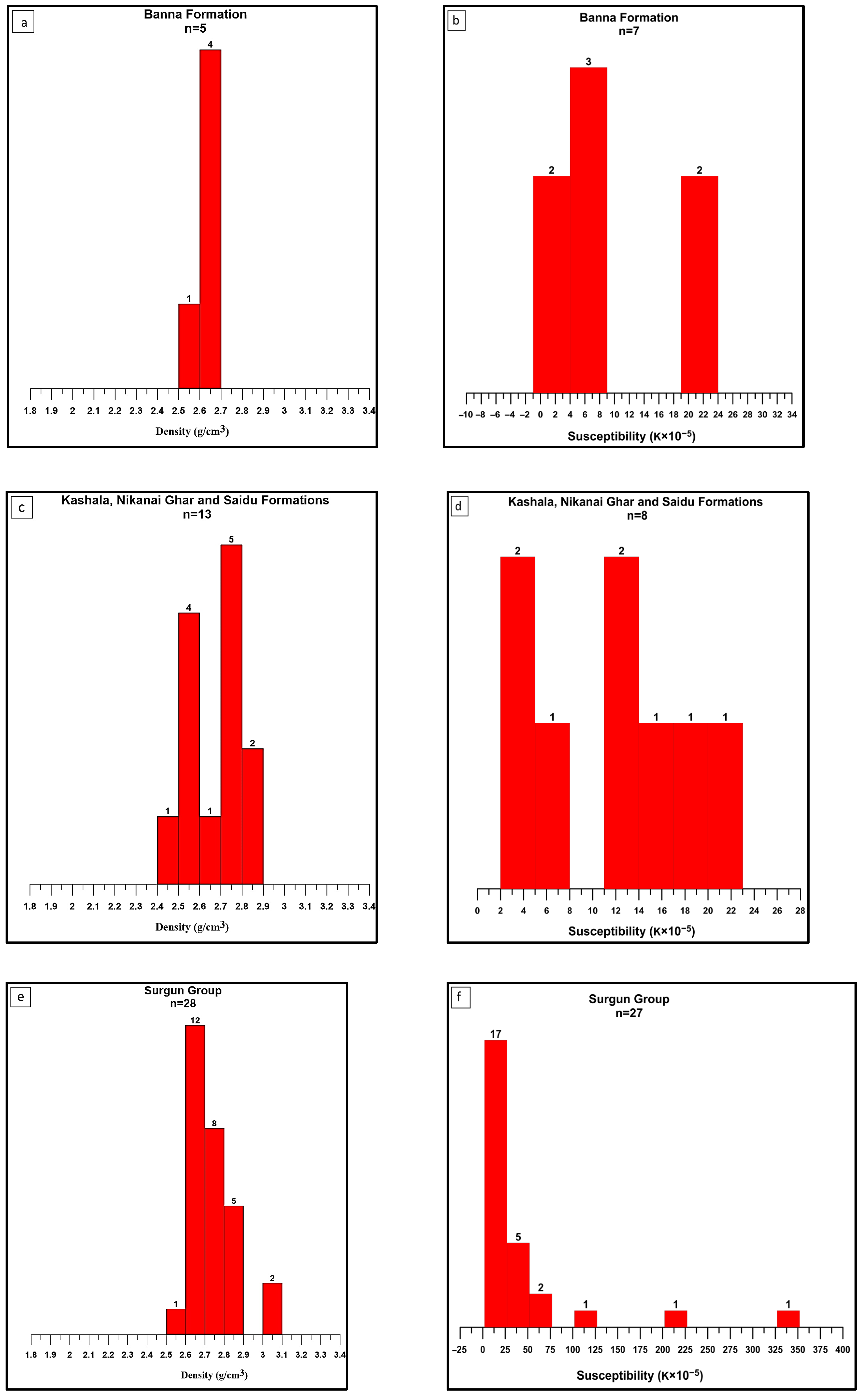
The density of metamorphic rocks increases with decreasing acidity and rising metamorphism grade. These rocks generally have strong magnetic susceptibility, which depends upon the composition of the parent material and the alteration processes [8,13,23,33,35,37,65,85]. The rock samples were collected from metasedimentary rocks of the Indian Plate, including the Banna, Kashala, Nikanai Ghar, and Saidu formations of the Triassic to the Jurassic age, Surgun Group of Permian to Triassic age, Mekhband and Marghazar formations of Late Carboniferous to Triassic age, Tanol, Hazara, Salkhala, Gandaf, and Karora formations, and the Higher Himalayan Crystalline of the Early to Late Proterozoic age. These rock units are exposed on the northern periphery of the Indian plate below MMT (Figure 2). Mostly, the grade of metamorphism increases from south to north across the northern periphery of the Indian Plate, except for the Banna Formation, which has low-grade metamorphic rocks. The bulk density also increases with the increase in the grade of metamorphism, as indicated by the histograms of these rock units.
A total of five samples were collected from the Banna Formation for bulk density and seven for magnetic susceptibility measurement. The histograms (Figure 5a,b) indicate the dominant bulk density and magnetic susceptibility distribution around 2.6–2.7 g/cm3 and −1 × 10⁻⁵ to 10 × 10−5 SI, respectively. The bulk density of this formation ranges from 2.555–2.636 g/cm3, having an arithmetic mean of 2.603 g/cm3 and an SD of 0.029 (Table 2). The measured magnetic susceptibility varies from −0.179 × 10⁻⁵ to 23.159 × 10⁻⁵ SI, having an arithmetic mean of 9.713 × 10⁻⁵ SI and an SD of 9.768 (Table 3).
From the Kashala, Nikanai Ghar, and Saidu formations, 13 rock samples were collected for the density measurement and 8 for the magnetic susceptibility measurement. The density of these formations varies from 2.494–2.828 g/cm3, having an arithmetic mean of 2.680 g/cm3 and an SD of 0.119 (Table 2). The frequency histogram (Figure 5c) specifies that the dominant density ranges from 2.5–2.6 g/cm3 and 2.7–2.8 g/cm3. The magnetic susceptibility of these formations ranges from 2.535 × 10⁻⁵ to 22.998 × 10⁻⁵ SI, having an arithmetic mean of 11.615 × 10⁻⁵ SI and an SD of 7.062 (Table 3). The frequency histogram (Figure 5d) represents the distribution of magnetic susceptibilities across these formations.
From the Surgun Group, 28 samples were picked for bulk density analysis and 27 for magnetic susceptibility. The measurement reveals that the bulk density varies from 2.588–3.073 g/cm3. The arithmetic mean of this group is measured as 2.745 g/cm3 with an SD of 0.118 (Table 2). The histogram (Figure 5e) indicates that the dominant density is in the range of 2.6–2.7 g/cm3. Some high-density values are due to the presence of amphibolites and paragneisses in the Surgun Group. The measured magnetic susceptibility of this group ranges from 2.556 × 10⁻⁵ to 351.879 × 10⁻⁵ SI, having an arithmetic mean of 46.128 × 10⁻⁵ SI and an SD of 75.866 (Table 3). The histogram (Figure 5f) displays a wide range of magnetic susceptibility due to varied mineral content; however, the dominant magnetic susceptibility ranges from 2.556 × 10⁻⁵ to 27 × 10−5 SI. Some high magnetic susceptibility values are due to the existence of amphibolites and paragneisses in the Surgun Group.
A total of 7 samples were gathered from the Mekhband and Marghazar formations for the bulk density and magnetic susceptibility analysis. The bulk density of these rock units ranges from 2.472–2.851 g/cm3, and the arithmetic mean of these formations is calculated as 2.735 g/cm3 with an SD of 0.135 (Table 2). The histogram plot (Figure 5g) demonstrates that the dominant density ranges from 2.7–2.8 g/cm3. The magnetic susceptibility of these formations ranges from 8.265 × 10⁻⁵ to 347.543 × 10⁻⁵ SI, having an arithmetic mean of 100.817 × 10⁻⁵ SI with an SD of 133.882 (Table 3). The histogram (Figure 5h) shows a wide range of magnetic susceptibility because of varied mineral content.
From the Tanol Formation, 17 samples were collected for bulk density and 14 for magnetic susceptibility measurements. The histogram (Figure 5i) represents the dominant density range from 2.5–2.6 g/cm3. The bulk density of this formation is measured from 2.485–2.771 g/cm3, having an arithmetic mean of 2.587 g/cm3 and an SD of 0.081 (Table 2). The histogram (Figure 5j) indicates a comparatively narrow range of magnetic susceptibility across the formation. The magnetic susceptibility measurements show a range from 3.681 × 10⁻⁵ to 25.968 × 10⁻⁵ SI, having an arithmetic mean of 12.642 × 10⁻⁵ SI and an SD of 7.020 (Table 3).
A total of 24 samples for bulk density and 10 for magnetic susceptibility measurements were taken from the Hazara Formation. The histogram (Figure 5k) shows that the dominant density ranges from 2.6–2.7 g/cm3. Nevertheless, the gypsum present in this formation displays low density. This formation has a bulk density range of 2.485–2.771 g/cm3, having an arithmetic mean of 2.531 g/cm3 and an SD of 0.186 (Table 2). The magnetic susceptibility of this rock unit varies from −0.645 × 10⁻⁵ to 35 × 10−5 SI. The arithmetic mean is calculated as 18.111 × 10⁻⁵ SI with an SD of 12.743 (Table 3). The histogram (Figure 5l) displays the magnetic susceptibility range where the negative magnetic susceptibility values in this formation resulted from the existence of gypsum.
From the Salkhala Formation, 42 samples were taken for bulk density and 45 for magnetic susceptibility examination. The histogram (Figure 5m) represents a dominant density range of 2.6–2.7 g/cm3. However, the paragneisses present in this formation show high density, while gypsum shows the least density. The bulk density of this formation is measured from 1.971–3.059 g/cm3, having an arithmetic mean of 2.659 g/cm3 with an SD of 0.178 (Table 2). The histogram (Figure 5n) reveals the dominant magnetic susceptibility of this formation from −0.923 × 10⁻⁵ to 11 × 10−5 SI, where the negative values indicate the presence of marble, gypsum, and quartzite, and high values due to paragneisses. The magnetic susceptibility of this rock unit is analysed from −0.923 × 10⁻⁵–59.000 × 10⁻⁵ SI, having an arithmetic mean of 15.979 × 10⁻⁵ SI and an SD of 14.724 (Table 3).
A total of 15 samples for bulk density and 14 for magnetic susceptibility analysis were taken from the Gandaf Formation. The histogram (Figure 5o) reveals a short range of bulk density with the dominant values ranging from 2.5–2.6 g/cm3. The density of this formation is measured from 2.502–2.894 g/cm3, having an arithmetic mean of 2.653 g/cm3 and an SD of 0.129 (Table 2). The histogram (Figure 5p) represents a wide range of magnetic susceptibility across this unit, with a dominant range from 2.998 × 10⁻⁵–200 × 10−5 SI. The high magnetic susceptibility values correspond to the presence of high magnetic content. The magnetic susceptibility of this formation ranges from 2.998 × 10⁻⁵ to 2001.975 × 10−5 SI, having an arithmetic mean of 551.086 × 10⁻⁵ SI and an SD of 871.338 (Table 3).
From the Karora Formation, 10 samples were collected for bulk density and 5 for magnetic susceptibility analysis. The histogram (Figure 5q) shows the dominant density of around 2.5–2.7 g/cm3. The density of this formation is calculated between 2.531 and 2.821 g/cm3, having an arithmetic mean of 2.627 g/cm3 and an SD of 0.086 (Table 2). The histogram (Figure 5r) indicates a narrow range of magnetic susceptibility may be due to the limited number of samples from this formation. The magnetic susceptibility of this formation ranges between 0.399 × 10⁻⁵ and 4.523 × 10⁻⁵ SI, having an arithmetic mean of 1.959 × 10⁻⁵ SI and an SD of 1.666 (Table 3).
A total of 15 rock samples for the bulk density and magnetic susceptibility calculation were acquired from the Higher Himalayan Crystalline. The histogram (Figure 5s) represents a dominant density range of 2.6–2.7 g/cm3 and generally indicates the high-density rocks. The bulk density of this unit was measured from 2.600–3.010 g/cm3, having an arithmetic mean of 2.700 g/cm3 and an SD of 1.101 (Table 2), whereas the magnetic susceptibility varies from 0.884 × 10⁻⁵–59.570 × 10⁻⁵ SI, having an arithmetic mean of 19.229 × 10⁻⁵ SI and an SD of 17.687 (Table 3). The histogram (Figure 5t) represents a comparatively narrow range of magnetic susceptibility with dominant values between 0.884 × 10⁻⁵ and 10 × 10−5 SI.
Overall, the bulk density and magnetic susceptibility of the metasedimentary rocks of the Indian Plate show high variations because of the changes in the original composition, variations in the grade of metamorphism, and the mineral transformation during metamorphism. When these rocks underwent compaction, metamorphism, and recrystallisation, their bulk density increased. The magnetic susceptibility variations in these metasedimentary rocks are attributed to the differences in original lithology and metamorphic overprinting during different phases of Himalayan regional metamorphism.
4.1.3. Bulk Density and Magnetic Susceptibility of the Rocks in the Indus Suture Zone Melange
The Indus Suture Zone Melange comprises different rock packages that are present between the KIA (north) and the Indian Plate (south). These rock units are mainly of Cretaceous age. A detailed description of the rock units present in this melange zone is given in Table 1. A total of 19 samples were taken from this zone for bulk density and 14 for magnetic susceptibility analysis. The histograms (Figure 6a,b) indicate a wide range of bulk density and magnetic susceptibility. The low- to medium-grade metasedimentary rocks in these zones, such as phyllite, schist, and marble, display low-density and low-susceptibility values, whereas the ultramafics, metagabbro, and greenstone have high-density and high-susceptibility values. These rocks originated from the mafic magma, which was rich in iron and magnesium that crystallised to form the dense and magnetically susceptible minerals such as olivine, pyroxene, magnetite, and ilmenite. As a whole, the bulk density of this tectonic unit was measured from 2.107–3.072 g/cm3, having an arithmetic mean of 2.700 g/cm3 and an SD of 0.220 (Table 2), whereas the magnetic susceptibility varies from 77.820 × 10⁻⁵ to 6172.863 × 10−5 SI, having an arithmetic mean of 2244.121 × 10−5 SI and an SD of 2258.127 (Table 3).
4.1.4. Bulk Density and Magnetic Susceptibility of the Rocks in the KIA
The rocks present in the north of MMT have high bulk density and magnetic susceptibility values compared to other rock units in the study area, except the Indus Suture Zone, which shows the highest average magnetic susceptibility. The samples for density analysis were collected from the Kohistan Batholith of Cretaceous to Miocene age, Chillas Complex, Kamlila Amphibolite Belt, and Jijal/Sapat Complex of Cretaceous age (Figure 2). Generally, due to the presence of ultramafics and mafics in these complexes, they have the highest densities and susceptibilities. Igneous rocks are usually denser than sedimentary rocks, with silica content predominantly controlling the density. As a result, basic rocks are denser than acidic rocks, with ultrabasic rocks being the densest. The magnetic susceptibility in igneous rocks increases considerably with the decrease in the silica content. The lowest values are found in acidic rocks, followed by the intermediate, mafic, and ultramafic rocks, which have the highest values [8,13,23,33,35,37,65,85,86].
From the Kohistan Batholith, only six samples were taken for the analysis of bulk density and magnetic susceptibility. The histogram (Figure 7a) shows that the dominant density values range between 2.7–2.8 g/cm3 and 2.9–3.0 g/cm3. The bulk density of this batholith is calculated from 2.691–2.967 g/cm3, having an arithmetic mean of 2.842 g/cm3 and an SD of 0.112. The histogram (Figure 7b) represents a wide range of magnetic susceptibility in this rock unit due to varying magnetic mineral content. Overall, the magnetic susceptibility ranges from 348.680 × 10⁻⁵ to 2660.867 × 10−5 SI, having an arithmetic mean of 1354.662 × 10−5 SI and an SD of 898.402.
A total of 43 rock samples for bulk density and 42 for magnetic susceptibility examination were taken from the Chillas Complex. The histogram (Figure 7c) indicated a dominant density range of 2.8–2.9 g/cm3. The high-density values are due to the presence of ultramafics and mafics in this complex. The bulk density varies among this complex from 2.515–3.382 g/cm3, having an arithmetic mean of 2.904 g/cm3 and an SD of 0.127 (Table 2). The histogram (Figure 7d) suggested a wide range of magnetic susceptibility with a dominant range of 5.798 × 10⁻⁵–200 × 10−5 SI. The high magnetic susceptibility is because of the existence of ultramafics and mafics in this complex. The magnetic susceptibility of this complex varies from 5.798 × 10⁻⁵–2942.107 × 10−5 SI, having an arithmetic mean of 573.526 × 10⁻⁵ SI and an SD of 809.634 (Table 3).
From the Kamila Amphibolite Belt, 20 samples for bulk density and 19 for magnetic susceptibility were collected. The histogram (Figure 7e) indicated the short bulk density distribution with a dominant range from 2.9–3.0 g/cm3. Overall, this belt shows high-density values due to the presence of amphibolites, gabbros, hornblendite, and diorites. The bulk density of this belt is measured from 2.756–3.098 g/cm3, having an arithmetic mean of 2.930 g/cm3 and an SD of 0.103 (Table 2). The other histogram (Figure 7f) represents a wide range of magnetic susceptibility across this belt due to the varying magnetic mineral content; however, dominantly the magnetic susceptibility ranges from 2.756 × 10⁻⁵–200 × 10−5 SI. The magnetic susceptibility ranges from 3.305 × 10⁻⁵–2967.406 × 10−5 SI, having an arithmetic mean of 395.771 × 10⁻⁵ SI and an SD of 801.269 (Table 3).
A total of 18 samples for bulk density and 20 for magnetic susceptibility calculation were collected from the Jijal/Sapat Complex. The histogram (Figure 7g) indicates that the dominant density ranges from 3.1–3.2 g/cm3. This complex shows the highest density values due to the existence of ultramafic rocks. Overall, the bulk density of the measured samples varies from 2.953–3.256 g/cm3, having an arithmetic mean of 3.100 g/cm3 and an SD of 0.099 (Table 2). The histogram (Figure 7h) represents the widest range of magnetic susceptibility, with the highest values being related to the presence of ultramafics in this complex. The dominant magnetic susceptibility across this complex ranges from 40.098 × 10⁻⁵–1036 × 10−5 SI. The magnetic susceptibility of this complex varies from 40.098 × 10⁻⁵–9929.903 × 10−5 SI, having an arithmetic mean of 1800.733 × 10−5 SI and an SD of 2858.599 (Table 3).
The rocks containing ultramafics and mafics, i.e., the Jijal/Sapat Complex, Chillas Complex, and Kamila amphibolite belt, have high bulk density and magnetic susceptibility because these originated from the mafic magma, which was rich in iron and magnesium, that crystallised to form the dense and magnetically susceptible minerals such as olivine, pyroxene, magnetite, and ilmenite.
4.1.5. Bulk Density and Magnetic Susceptibility of the Igneous and Metaigneous Rocks of the Indian Plate
The samples are also collected from the igneous and metaigneous rocks exposed on the northern boundary of the Indian Plate south of MMT. These rocks include the Ambela Complex and Panjal Formation of Carboniferous to Permian age, Granite/Granite Gneiss of Cambrian to Ordovician age, and the Besham Complex of Early Proterozoic age. The Ambela Complex has alkaline igneous rocks intruded by diabase and pegmatite veins. The Panjal Formation includes Panjal volcanics and Panjal metasediments. The Panjal metasediments are associated with the Panjal volcanics and, therefore, placed in this zone. The granites and granite gneisses comprise the Swat, Mansehra, and Neelum bodies. The Besham Complex involves the oldest rocks exposed in the core of IS south of MMT. A detailed description and location of these rock units are given in Table 1 and Figure 2.
A total of 15 samples for bulk density and 16 for magnetic susceptibility analysis were collected from the Ambela Complex. The histograms (Figure 8a,b) show a wide density and magnetic susceptibility range because of the presence of various lithologies and magnetic mineral content. The intrusive bodies like diabase show high-density and high-magnetic values. The bulk density of this complex varies from 2.168–2.988 g/cm3, having an arithmetic mean of 2.619 g/cm3 and an SD of 0.242 (Table 2). The magnetic susceptibility of the measured samples from this complex ranges from 8.299 × 10⁻⁵ to 1914.250 × 10−5 SI, having an arithmetic mean of 513.785 × 10⁻⁵ SI and an SD of 740.667 (Table 3).
From the Panjal Formation, 20 samples were collected for bulk density and 17 for magnetic susceptibility measurements. The histogram (Figure 8c) displays a narrow density range with dominant values from 2.6–2.7 g/cm3, whereas the histogram (Figure 8d) indicates a relatively wide range of magnetic susceptibility with dominant values from 25 × 10−5–50 × 10−5 SI. The volcanic rocks in this formation show high-density and high-susceptibility values, while low-density and low-susceptibility values are associated with the metasediments. The bulk density across this formation varies from 2.615–3.060 g/cm3, having an arithmetic mean of 2.761 g/cm3 and an SD of 0.132 (Table 2). The magnetic susceptibility ranges from 0.594 × 10⁻⁵ to 240.010 × 10⁻⁵ SI, having an arithmetic mean of 47.340 × 10⁻⁵ SI with an SD of 56.025 (Table 3).
From Swat, Mansehra, and Neelum Granite and Granite Gneiss, 51 samples were taken for bulk density and 43 for magnetic susceptibility calculation. The histogram (Figure 8e) represents a wide bulk density distribution with dominant values ranging from 2.6–2.7 g/cm3. The bulk density across these granites and granite gneisses varies from 2.040–2.980 g/cm3, having an arithmetic mean of 2.608 g/cm3 and an SD of 0.142 (Table 2). The histogram (Figure 8f) also shows a wide range of magnetic susceptibility with dominant values from 0.134 × 10⁻⁵–100 × 10−5 SI. Overall, the magnetic susceptibility ranges from 0.134 × 10⁻⁵ to 987.610 × 10⁻⁵ SI, having an arithmetic mean of 53.281 × 10⁻⁵ SI and an SD of 176.680 (Table 3).
A total of 17 samples for bulk density and 16 for magnetic susceptibility calculation were taken from the Besham Complex. The histogram (Figure 8g) illustrates the narrow range across this complex, with dominant density values ranging from 2.6–2.7 g/cm3. The histogram (Figure 8h) demonstrates the wide distribution of magnetic susceptibility with dominant values between 0.849 × 10⁻⁵ and 300 × 10−5 SI. The wide distribution of magnetic susceptibility is due to the varying magnetic mineral content. The relatively high density and high susceptibility values are because this complex comprises basement rocks. The bulk density in this complex is measured from 2.550–2.843 g/cm3, having an arithmetic mean of 2.694 g/cm3 and an SD of 0.101 (Table 2). The measured magnetic susceptibility across this complex ranges from 0.849 × 10⁻⁵ to 2928.463 × 10−5 SI, having an arithmetic mean of 980.600 and an SD of 1235.772 (Table 3).
4.1.6. Bulk Density and Magnetic Susceptibility of Undivided Early Proterozoic Rocks of the Indian Plate in Besham and Surrounding Areas
The samples that were collected from the Early Proterozoic rocks of the Besham and surrounding areas, exposed on the northern periphery of the Indian Plate south of MMT, have been combined to estimate the overall bulk density and magnetic susceptibility across these basement rocks. These rocks include the Kotla and Besham complexes and the Gandaf and Karora formations. The details of their bulk density and magnetic susceptibility analysis can be found in previous sections. A total of 45 samples for bulk density and 37 for magnetic susceptibility were collected from these rocks. The histogram (Figure 9a) demonstrates a short distribution of bulk density with a dominant range from 2.5–2.6 g/cm3. However, the histogram (Figure 9b) illustrates a wide range of magnetic susceptibility distribution across these rock units, with dominant values ranging from 0.339 × 10⁻⁵ to 300 × 10−5 SI. Overall, the bulk density is measured from 2.502–2.894 g/cm3, having an arithmetic mean of 2.658 g/cm3 and an SD of 0.109 (Table 2). The magnetic susceptibility ranges from 0.399 × 10⁻⁵ to 2928.463 × 10−5 SI, having an arithmetic mean of 633.627 × 10⁻⁵ SI and an SD of 1021.431 across these rocks (Table 3).
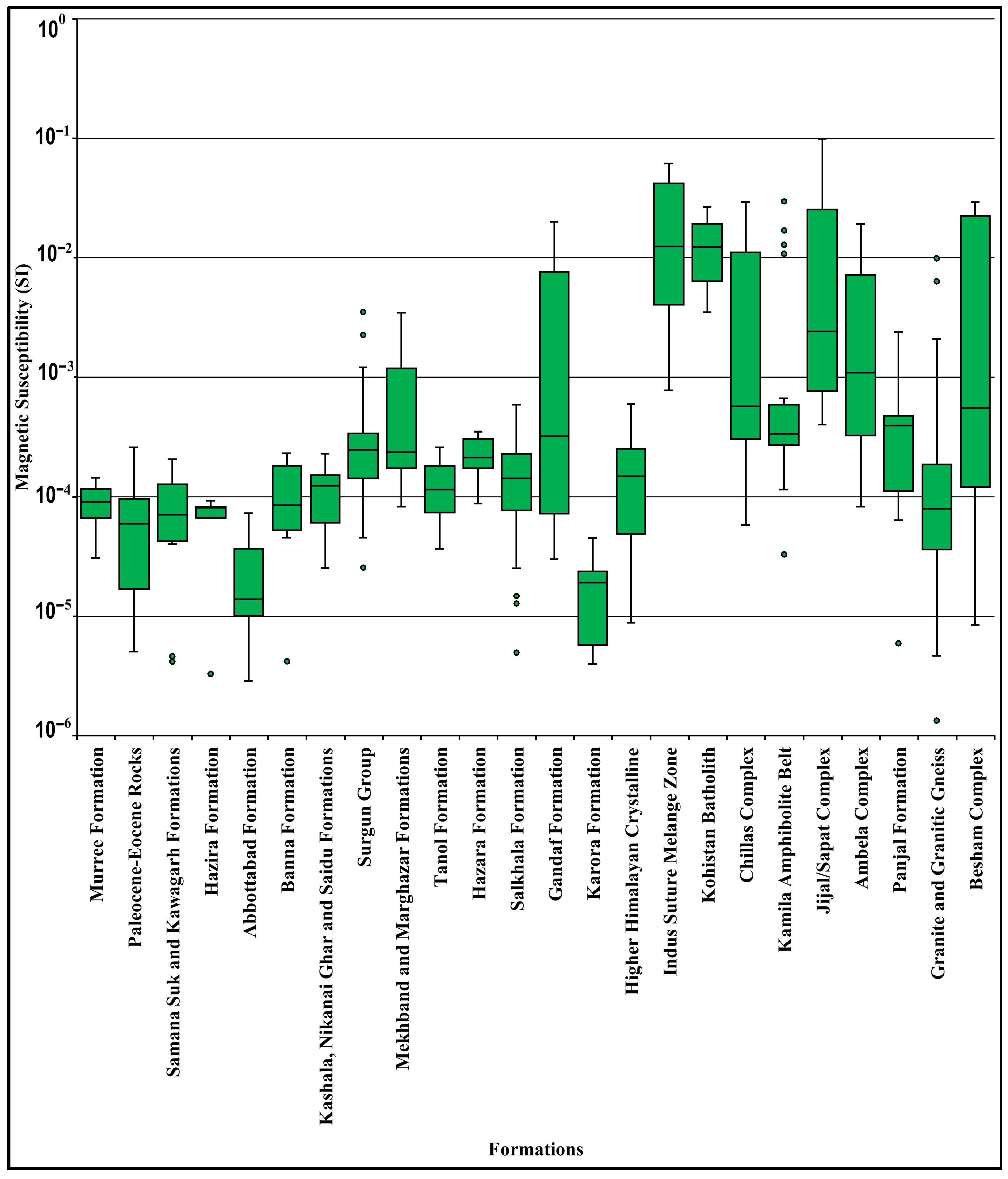
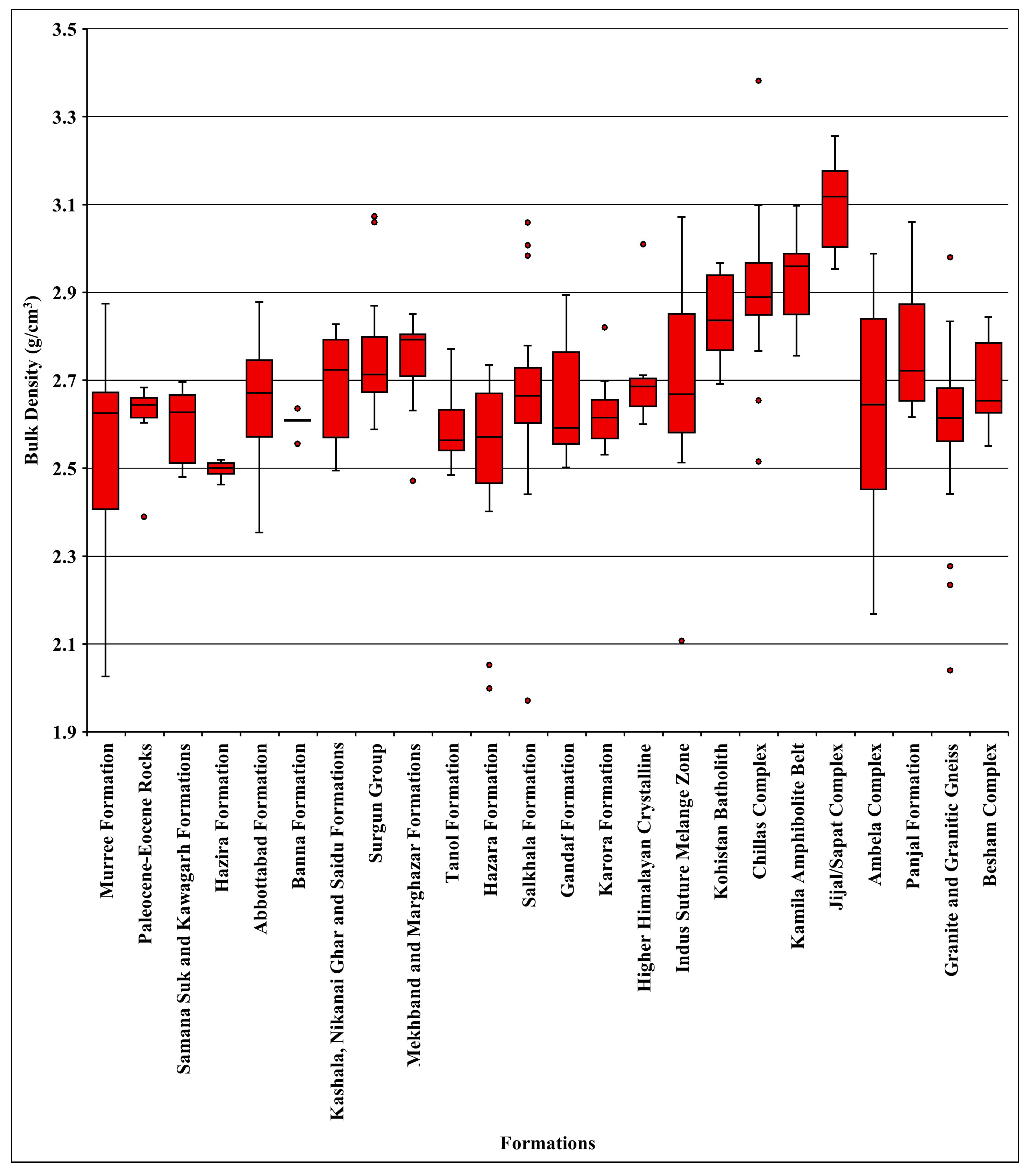
To summarise the results of this study, box and whisker plots of the bulk density (Figure 10) and magnetic susceptibility (Figure 11) were generated for all the rock types, including sedimentary, metasedimentary, igneous, and metaigneous, of the northwest Himalayas, Pakistan. Each formation exhibits a distinct range and interquartile spread of bulk density and magnetic susceptibility values. Outliers, indicating extreme values, were observed in some rock units, suggesting potential localised anomalies. The box and whisker plot of bulk density (Figure 10) reveals significant variability across the rock units, with density ranging from 1.971 to 3.382 g/cm3. Most formations display tightly clustered box and whiskers plots, except the Murree Formation, Indus Suture Melange Zone, and Ambela Complex, which exhibit high internal density variability. The box and whisker plot for magnetic susceptibility (Figure 11) also indicates considerable variability across formations, with notable internal heterogeneity in the Gandaf Formation, Indus Suture Melange Zone, Chillas Complex, Jijal/Sapat Complex, Ambela Complex, and Besham Complex. Generally, in contrast to the bulk density, the magnetic susceptibility plot indicates high internal variability. Overall, the rocks of the KIA display the highest bulk density and magnetic susceptibility values.
Figure 10.
The box and whisker plot of the bulk density.
Figure 11.
The box and whisker plot of the magnetic susceptibility.
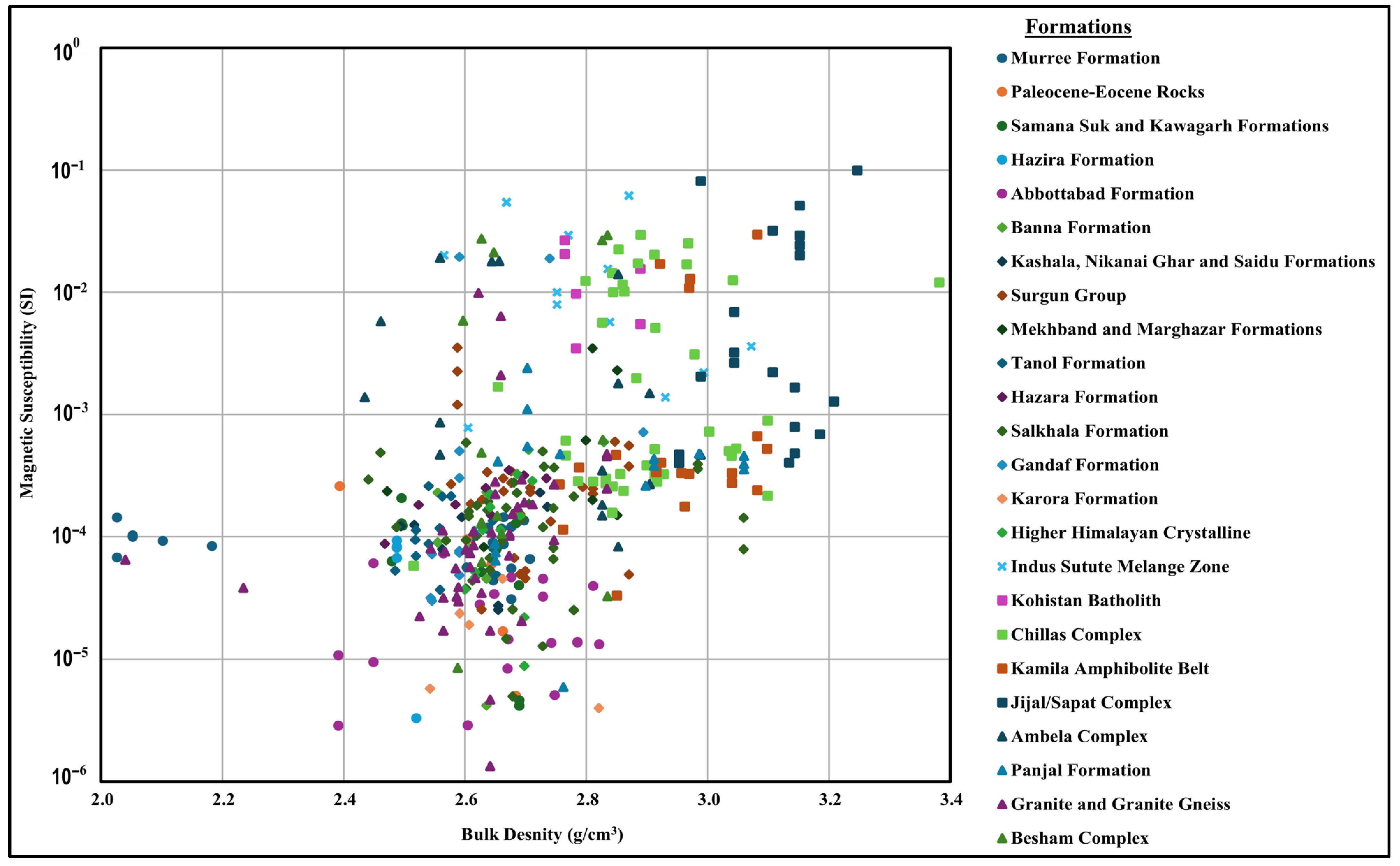
To investigate the mutual relationship between bulk density and magnetic susceptibility, a Henkel’s plot, a cross plot of density against the logarithmic magnetic susceptibility of rock samples [1,28,45,46,47] was prepared (Figure 12). This plot effectively relates geophysical data with the geological interpretation [47] and typically reveals two main trends: a paramagnetic trend or a magnetite trend [1,28,45,46,47]. In this study, a prominent paramagnetic trend is observed, with logarithmic magnetic susceptibilities ranging from 10−6 to 10−3 SI and bulk densities 2.0 to 2.8 g/cm3, predominantly in sedimentary, metasedimentary, igneous and metaigneous rocks of the Indian Plate, except for a few samples from Besham and Ambela complexes. In contrast, the magnetite trend, characterised by logarithmic magnetic susceptibility from 10−2 to 10−1 SI and bulk densities from 2.8 to 3.4 g/cm3 is scattered and less pronounced, limited to a few samples from the Besham Complex, Ambela Complex, Jijal/Sapat Complex, Kamila Amphibolite Belt, Chillas Complex, Kohistan Batholith, and Indus Suture Zone. The high bulk density and high magnetic susceptibility of Besham, Ambela, and the Indus Suture Melange Zone suggest close proximity to the MMT. Additionally, the rocks from the KIA, including the Jijal/Sapat Complex, Kamila Amphibolite Belt, and Chillas Complex, are magnetite-rich mafic and ultramafic rocks. The low density and low magnetic susceptibility suggest siliciclastic or low-grade metamorphic rocks dominated by the paramagnetic minerals.
The calculated magnetic susceptibilities and bulk densities of the rock samples in the present research work are in good agreement with the previously published data [20,21,66,67,68,69,70,71]. However, compared to the earlier work, this study involves denser sampling over a broader survey region (Figure 2), thereby contributing significantly to the understanding of magnetic susceptibility and bulk density in the Northwest Himalayas, Pakistan.
4.2. Interpretation of Spatial Distribution Maps of Bulk Density and Magnetic Susceptibility
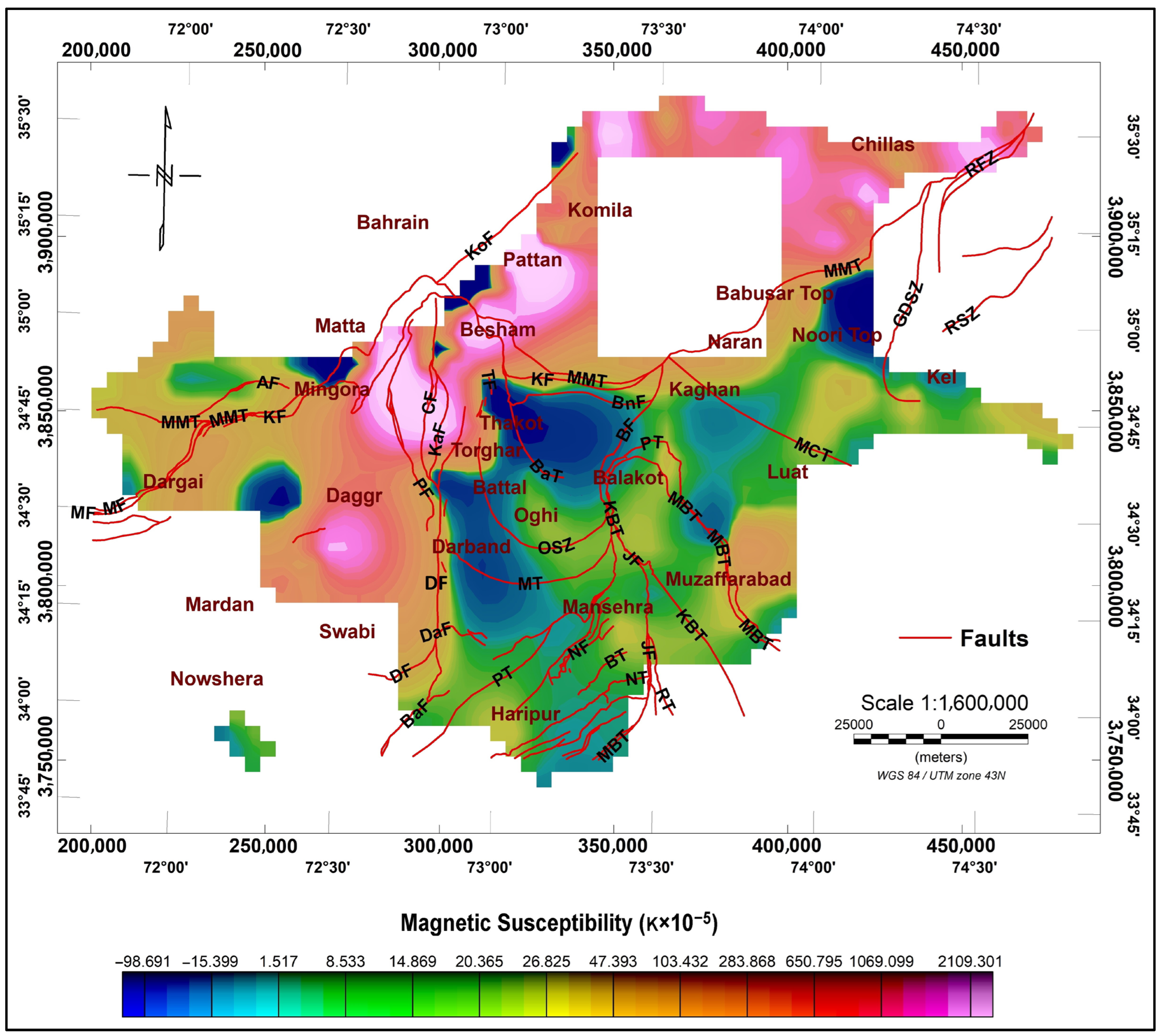
The spatial distribution of the bulk density (Figure 13) and magnetic susceptibility maps (Figure 14) was prepared to understand the variations of these petrophysical properties in relation to the structural and tectonic features in the project area. There are certain gaps in the spatial distribution maps because of the inaccessibility of the high terrains of the Northwest Himalayas. The cool colours of the maps (Figure 13 and Figure 14) represent low-bulk density and magnetic susceptibility, whereas the warm colours show high values of bulk density and magnetic susceptibility. Multiple factors can change the density and susceptibility of the rocks as discussed in the above sections, but here we will focus particularly on the variations caused by the structural features and tectonic setting.
Figure 12.
Henkel’s plot of bulk density versus logarithmic magnetic susceptibility.
Figure 13.
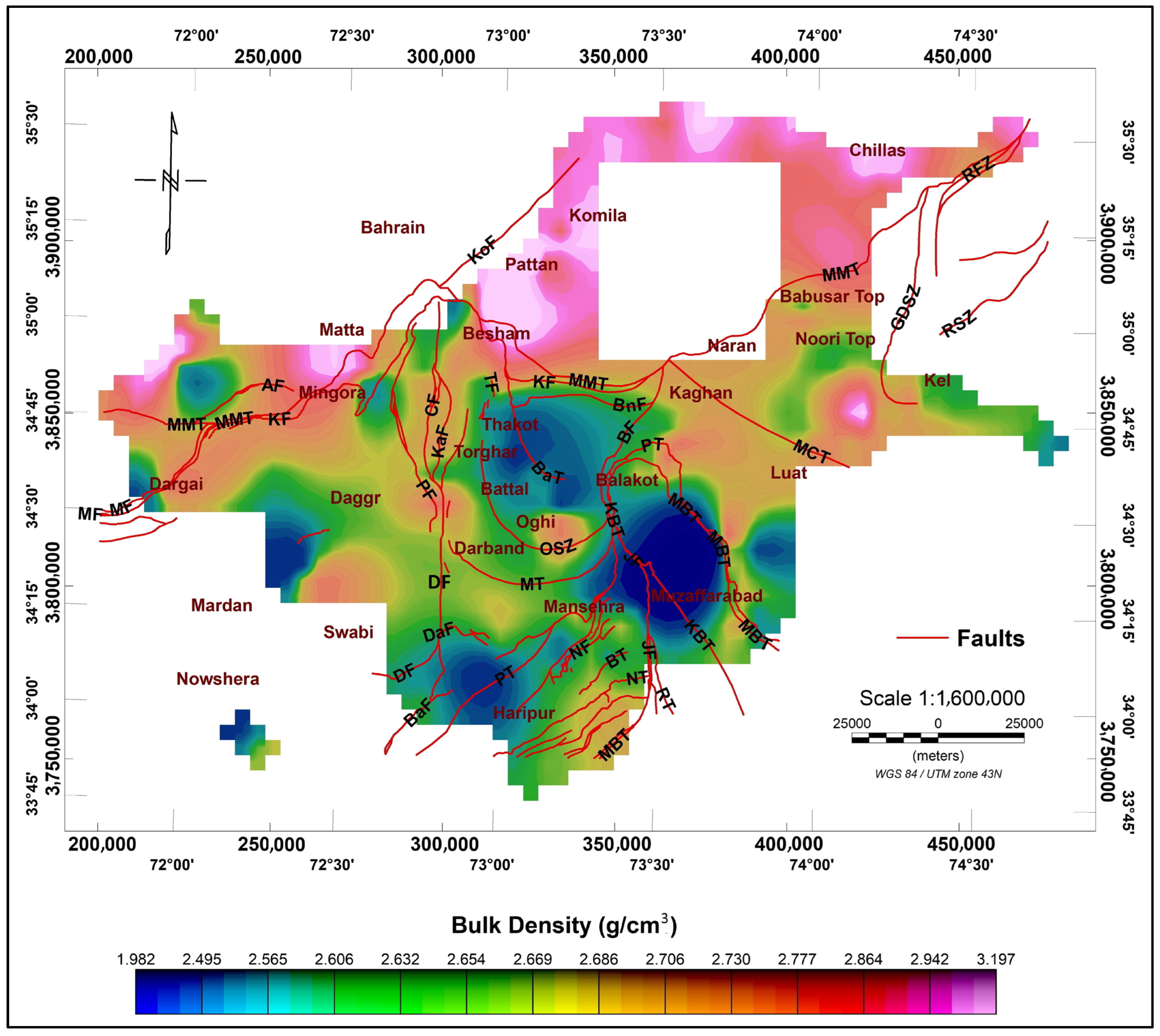
The spatial distribution map of the bulk density.
The spatial distribution map of the bulk density of the investigated area shows that the bulk density ranges between 1.982 g/cm3 and 3.197 g/cm3 (Figure 13). The map (Figure 10) shows significantly high varaitions in bulk density across the major structures in the region. The highest variations are observed across the MMT, which is a major suture zone separating the sedimentary-metasedimentary rocks of the Indian Plate in the south from the mafic and ultramafic rocks of the KIA in the north. The regions such as Matta, Jijal, Pattan, Komila, and Chillas show the highest values of bulk density because of the presence of high-density ultramafic and mafic rocks such as the Jijal-Sapat Complex, Chillas Complex, and Komila Amphibolites. The significant variations in the bulk density have also been observed along the MCT, PT, and MBT (Figure 13). In the northeast of Balakot, low-density values have been observed because of the comparatively low-density Tanol Formation (metasediments), which is further deformed due to the presence of different faults, such as the Battal Thrust (BaT) and Oghi Shear Zone (OSZ). The high-density values have been observed in the Besham area. These high values are attributed to the Besham Complex rocks. Further, in the south-east of Besham, there are high variations in the bulk density because of the structural features such as the Chakesar Fault (CF), Kandar Fault (KaF), and Puran Fault (PF). The variable density contrast has also been observed in the western limb of HKS due to the presence of different structural features like PT, Nawashahr Fault (NF), Bagnotor Thrust (BT), NT, and MBT. In the core of HKS, particularly in Muzaffarabad and surrounding regions, the low-density values show the presence of the dominantly Murree Formation, which is further deformed because of the KBT and Jhelum Fault (JF) (Figure 13).
The spatial distribution map of the magnetic susceptibility (Figure 14) indicates that the magnetic susceptibility varies significantly from −98.691 × 10⁻⁵ SI to 2109.301 × 10−5 SI in the study area. The map also shows abrupt variations of magnetic susceptibility across MMT, thereby indicating the presence of two different tectonic regimes, i.e., the Indian Plate in the south and KIA in the north. The high magnetic susceptibility, particularly near the Chillas, Pattan, and Jijal areas, represents the presence of mafic and ultramafic rocks. The magnetic susceptibility variations can also be observed along the MCT, PT and MBT; however, these are comparatively less as compared to MMT. Similarly, magnetic susceptibility variations have also been observed along the other faults in the region, such as KBT, JF, NT, BT, and NF in the HKS area. The low magnetic susceptibilities in Thakot, Battal, and Darband areas represent the presence of the Mansehra Thrust (MT), OSZ, and BaT (Figure 14). The map also shows a high magnetic susceptibility contrast across the Darband Fault (DF), thereby indicating the presence of different tectonic settings. This fault separates the Hazara region from the Peshawar Basin.
5. Conclusions
This study presents the results of bulk density and susceptibility of rocks from the northwest Himalayas, Pakistan, which will particularly aid in the geological understanding of the area. The measured physical properties would be useful for the interpretation of geophysical anomalies, depositional environment studies, stratigraphic correlation, lithological boundary identification and mineral exploration. Furthermore, knowledge of these properties is essential for potential field forward modelling and inversion to produce geologically realistic results and reduce non-uniqueness. The highest limit of the average bulk density of all formations is calculated as 3.1 g/cm3, whereas the Indian Plate has an arithmetic mean of 2.652 g/cm3, and the Early Proterozoic rocks of the Indian Plate have the lowest limit of 2.51 g/cm3. This high-density contrast would result in variable gravity anomalies in the area. The bulk density of sedimentary rock units of the Indian Plate has the lowest arithmetic mean of 2.586 g/cm3, followed by metasedimentary rocks of the Plate with an arithmetic mean of 2.658 g/cm3, igneous and metaigneous rocks of the Indian Plate with an arithmetic mean of 2.671 g/cm3, the Indus Suture Melange Zone with an arithmetic mean of 2.7 g/cm3, and KIA rocks with an arithmetic mean of 2.946 g/cm3. On the other hand, the highest average magnetic susceptibility is measured as 2244.121 × 10−5 SI, while the lowest is 1.959 × 10⁻⁵ SI. This high susceptibility difference would produce complex magnetic anomalies in the area. The magnetic susceptibility of sedimentary rock units of the Indian Plate has the lowest arithmetic mean of 6.438 × 10⁻⁵ SI, followed by metasedimentary rocks of the Indian Plate with an arithmetic mean of 73.702 × 10⁻⁵ SI, igneous and metaigneous rocks of the Indian Plate with an arithmetic mean of 293.543 × 10⁻⁵ SI, Early Proterozoic rocks of the Indian Plate with an arithmetic mean of 633.627 × 10⁻⁵ SI, KIA rocks with an arithmetic mean of 870.694 × 10⁻⁵ SI, and the Indus Suture Melange Zone with an arithmetic mean of 2244.121 × 10−5 SI. The Indus Suture Zone melange shows the highest magnetic susceptibility due to the presence of high-grade metamorphic rocks and ultramafic and mafic rocks. The spatial distribution maps of bulk density and magnetic susceptibility represent significant variations in these physical properties across the study area because of lithological variations, structural features, and tectonic settings. Overall, the island arc rocks have high bulk density and magnetic susceptibility due to the presence of high-density and high-susceptibility ultramafic and mafic rocks.
Figure 14.
The spatial distribution map of the magnetic susceptibility.
Supplementary Materials
The following supporting information can be downloaded at: https://www.mdpi.com/article/10.3390/min15080781/s1. Table S1: The raw measurements of bulk density; Table S2: The raw measurements of magnetic susceptibility.
Author Contributions
Conceptualization, F.H. and M.R.K.; methodology, F.H.; software, F.H.; validation, M.R.K., Y.W. and M.A.B.; formal analysis, F.H.; investigation, F.H., M.R.K.; resources, J.T., Y.W., M.A.B., C.W., M.S.M. and A.N.; data curation, F.H.; writing—original draft preparation, F.H.; writing—review and editing, F.H., M.R.K., Y.W., M.A.B., J.T., C.W., M.S.M. and A.N.; visualization, M.R.K., Y.W., M.A.B., M.S.M., A.N. and C.W.; supervision, M.R.K. and Y.W.; project administration, M.R.K., J.T., Y.W. and C.W.; funding acquisition, M.R.K., J.T., Y.W. and F.H. All authors have read and agreed to the published version of the manuscript.
Funding
This research has been supported by several grants and contracts, including those from the Key Project of R&D of Xinjiang Uygur Autonomous Region of China (2022A03010-4, 2022A03010), National Natural Science Foundation of China (42230810), Ministry of Natural Resources of China (ZKKJ202419), National Key R&D Program of China (2021YFC2901801, 2023YFC2906903, 2023YFC2907105), and Higher Education Commission, Pakistan (20-4373/NRPU/R&D/HEC/14/132).
Data Availability Statement
Raw bulk density and magnetic susceptibility data are provided in the Supplementary Material.
Acknowledgments
The authors would like to thank the Higher Education Commission (HEC), Pakistan, for providing financial support and the Director, Institute of Geology, University of Azad Jammu and Kashmir, Muzaffarabad, for giving the laboratory facilities. The authors acknowledge Shahid Saleem Bilali, Owais Rabnawaz, Qammar Manzoor, Asim Mumtaz, Muhammad Liaqat, and Muhammad Niaz for their assistance during the fieldwork and laboratory work.
Conflicts of Interest
The authors declare no conflicts of interest.
Abbreviations
The following abbreviations are used in this manuscript:
| SRTM | Shuttle Radar Topography Mission |
| Mw | Moment Magnitude |
| SD | Standard Deviation |
| MKT | Main Karakoram Thrust |
| HKS | Hazara Kashmir Syntaxis |
| MMT | Main Mantle Thrust |
| KIA | Kohistan Island Arc |
| MCT | Main Central Thrust |
| MBT | Main Boundary Thrust |
| PT | Panjal Thrust |
| NT | Nathia Gali Thrust |
| KBT | Kashmir Boundary Thrust |
| SRT | Salt Range Thrust |
| IS | Indus Syntaxis |
| NPS | Nanga Parbat Syntaxis |
| Wa | Dry Weight in Air |
| Ww | Saturated Weight in Water |
| Ws | Saturated Weight in Air |
| SI | International System of Units |
| Battal Thrust | BaT |
| Oghi Shear Zone | OSZ |
| Chakesar Fault | CF |
| Kandar Fault | KaF |
| Puran Fault | PF |
| Nawashahr Fault | NF |
| Bagnotor Fault | BT |
| Jhelum Fault | JF |
| Mansehra Thrust | MT |
| Darband Fault | DF |
References
- Henkel, H. Studies of density and magnetic properties of rocks from Northern Sweden. Pure Appl. Geophys. PAGEOPH 1976, 114, 235–249. [Google Scholar] [CrossRef]
- Rochette, P.; Jackson, M.; Aubourg, C. Rock magnetism and the interpretation of anisotropy of magnetic susceptibility. Rev. Geophys. 1992, 30, 209. [Google Scholar] [CrossRef]
- Tarling, D.H.; Hrouda, F. The Magnetic Anisotropy of Rocks; Chapman and Hall: London, UK, 1993. [Google Scholar]
- Berckhemer, H.; Rauen, A.; Winter, H.; Kern, H.; Kontny, A.; Lienert, M.; Nover, G.; Pohl, J.; Popp, T.; Schult, A.; et al. Petrophysical properties of the 9-km-deep crustal section at KTB. J. Geophys. Res. Solid Earth 1997, 102, 18337–18361. [Google Scholar] [CrossRef]
- Clark, D. Magnetic Petrophysics and Magnetic Petrology; Aids to Geological Interpretation of Magnetic Surveys. AGSO J. Aust. Geol. Geophys. 1997, 17, 83–103. [Google Scholar]
- Rybakov, M.; Goldshmidt, V.; Rotstein, Y.; Fleischer, L.; Goldberg, I. Petrophysical constraints on gravity/magnetic interpretation in Israel. Lead. Edge 1999, 18, 269–272. [Google Scholar] [CrossRef]
- Bosch, M.; McGaughey, J. Joint inversion of gravity and magnetic data under lithologic constraints. Lead. Edge 2001, 20, 877–881. [Google Scholar] [CrossRef]
- Törnberg, R.; Sturkell, E. Density and magnetic susceptibility of rocks from the Lockne and Tvären marine impact structures. Meteorit. Planet. Sci. 2005, 40, 639–651. [Google Scholar] [CrossRef]
- Lundin, A.I.; Bastani, M. Analysis of petrophysical properties of some granitoids in Sweden. J. Appl. Geophys. 2007, 62, 74–87. [Google Scholar] [CrossRef]
- Williams, N.C. Geologically-Constrained UBC–GIF Gravity and Magnetic Inversions with Examples from the Agnew-Wiluna Greenstone Belt, Western Australia. Ph.D. Thesis, University of British Columbia, Vancouver, BC, Canada, 2008. [Google Scholar]
- Heincke, B.; Jegen, M.; Moorkamp, M.; Chen, J.; Hobbs, R.W. Adaptive coupling strategy for simultaneous joint inversions that use petrophysical information as constraints. In SEG Technical Program Expanded Abstracts 2010; Society of Exploration Geophysicists: Houston, TX, USA, 2010; pp. 2805–2809. [Google Scholar]
- Akinyemi, O.; Alabi, A.; Ojo, A.; Adewusi, O. Characterization of Density and Porosity of Rocks Samples from Ogun State of Nigeria. Earth Sci. Res. 2012, 1, 98–105. [Google Scholar] [CrossRef]
- Yang, T.; Gao, J.; Gu, Z.; Dagva, B.; Tserenpil, B. Petrophysical Properties (Density and Magnetization) of Rocks from the Suhbaatar-Ulaanbaatar-Dalandzadgad Geophysical Profile in Mongolia and Their Implications. Sci. World J. 2013, 2013, 791918. [Google Scholar] [CrossRef] [PubMed]
- Kamm, J.; Lundin, I.A.; Bastani, M.; Sadeghi, M.; Pedersen, L.B. Joint inversion of gravity, magnetic, and petrophysical data—A case study from a gabbro intrusion in Boden, Sweden. Geophysics 2015, 80, B131–B152. [Google Scholar] [CrossRef]
- Wildan, D.; Akbar, A.; Novranza, K.; Sobirin, R.; Permadi, A.; Supriyanto. The importance of bulk density determination in gravity data processing for structure interpretation. AIP Conf. Proc. 2017, 1862, 030175. [Google Scholar] [CrossRef]
- Calkins, J.A.; Offield, T.W.; Abdullah, S.K.M.; Ali, S.T. Geology of the Southern Himalaya in Hazara, Pakistan, and Adjacent Areas; Geological Survey Professional Paper 716–C; United States Government Printing Office: Washington, DC, USA, 1975. [Google Scholar] [CrossRef]
- Searle, M.P.; Khan, M.A. Geological Map of North Pakistan and Adjacent Areas of Northern Ladakh and Western Tibet. Scale 1:650,000; Oxford University: Oxford, UK, 1996. [Google Scholar]
- Chaudhry, M.N.; Spencer, D.A.; Ghazanfar, M.; Hussain, S.S.; Dawood, H. The location of the main central thrust in the Northwest Himalaya of Pakistan: Tectonic implications. Geol. Bull. Punjab Univ. 1997, 31–32, 1–19. [Google Scholar]
- DiPietro, J.A.; Ahmad, I.; Hussain, A. Cenozoic kinematic history of the Kohistan fault in the Pakistan Himalaya. Geol. Soc. Am. Bull. 2008, 120, 1428–1440. [Google Scholar] [CrossRef]
- Khan, M.R.; Hameed, F.; Mughal, M.S.; Basharat, M.; Mustafa, S. Tectonic study of the Sub-Himalayas based on geophysical data in Azad Jammu and Kashmir and northern Pakistan. J. Earth Sci. 2016, 27, 981–988. [Google Scholar] [CrossRef]
- Hameed, F.; Khan, M.R.; Dentith, M. Crustal study based on integrated geophysical techniques in the Northwestern Himalayas, Pakistan. Geol. J. 2023, 58, 1523–1549. [Google Scholar] [CrossRef]
- Telford, W.M.; Geldart, L.P.; Sheriff, R.E. Applied Geophysics, 2nd ed.; Cambridge University Press: Cambridge, UK, 1990. [Google Scholar]
- Dentith, M.; Mudge, S. Geophysics for the Mineral Exploration Geoscientist; Cambridge University Press: Cambridge, UK, 2014. [Google Scholar] [CrossRef]
- Schon, J.H. Physical Properties of Rock: Handbook of Petroleum Exploration and Production; Elsevier: Amsterdam, The Netherlands, 2011; Volume 8, pp. 120–121. [Google Scholar]
- Ellis, D.V.; Singer, J.M. Well Logging for Earth Scientists, 2nd ed.; Springer: Berlin/Heidelberg, Germany, 2007. [Google Scholar] [CrossRef]
- Eshaghi, E.; Smith, R.S.; Ayer, J. Petrophysical Characterisation (I.E. Density and Magnetic Susceptibility) of Major Rock Units Within the Abitibi Greenstone Belt; publication number MERC-ME-2019-144; Laurentian University Mineral Exploration Research Centre: Sudbury, ON, Canada, 2019. [Google Scholar]
- Moon, C.J.; Whateley, M.K.G.; Evans, A.M. Introduction to Mineral Exploration, 2nd ed.; Blackwell Publishing: Hoboken, NJ, USA, 2006. [Google Scholar]
- Dentith, M.; Enkin, R.J.; Morris, W.; Adams, C.; Bourne, B. Petrophysics and mineral exploration: A workflow for data analysis and a new interpretation framework. Geophys. Prospect. 2020, 68, 178–199. [Google Scholar] [CrossRef]
- Coduto, D.P.; Yeung, M.R.; Kitch, W.A. Geotechnical Engineering: Principles and Practices, 2nd ed.; Pearson Education: London, UK, 2010. [Google Scholar]
- Houghton, B.F.; Carey, R.J. The Encyclopedia of Volcanoes, 2nd ed.; Academic Press: Cambridge, MA, USA, 2015. [Google Scholar]
- Dearing, J.A. Environmental Magnetic Susceptibility Using the Bartington MS2 System; Chi Publishing: Kenilworth, UK, 1999. [Google Scholar]
- Hrouda, F. Magnetic anisotropy of rocks and its application in geology and geophysics. Geophys. Surv. 1982, 5, 37–82. [Google Scholar] [CrossRef]
- Hansen, R.O.; Racic, L.; Grauch, V.J.S. Magnetic Methods in near-Surface Geophysics. In Near-Surface Geophysics; Butler, D.K., Ed.; Society of Exploration Geophysicists: Houston, TX, USA, 2005; pp. 151–176. [Google Scholar]
- Rochette, P. Magnetic susceptibility of the rock matrix related to magnetic fabric studies. J. Struct. Geol. 1987, 9, 1015–1020. [Google Scholar] [CrossRef]
- Da Silva, A.C.; Whalen, M.T.; Hladil, J.; Chadimova, L.; Chen, D. Magnetic Susceptibility Application: A Window onto Ancient Environments and Climatic Variations: Foreword; Special Publications 414; Geological Society: London, UK, 2015; pp. 1–13. [Google Scholar] [CrossRef]
- Abd El Rahman, A.A.; Elnaggar, O.M.; Mohamed, S.F. Magnetic susceptibility as an indication of reservoir properties of the Nubia Group in Aswan-Komombo, Southern Egypt. Egypt. J. Pet. 2023, 32, 31–41. [Google Scholar] [CrossRef]
- Messaoud, J.H.; Yaich, C. Middle–upper Eocene sediments and sea-level dynamics in central Tunisia. Mediterr. Geosci. Rev. 2024, 7, 51–67. [Google Scholar] [CrossRef]
- Anggraeni, F.K.A. Two dimensional modeling (2D) gravity method for interpreting subsurface structure of mount Merapi. J. Phys. Conf. Ser. 2021, 1832, 012002. [Google Scholar] [CrossRef]
- Dong, C.; Chen, B.; Wang, C. Magnetic anomaly characteristics and magnetic basement structure in earthquake-affected Changning area of Southern Sichuan Basin, China: A new perspective from land-based stations. Remote Sens. 2022, 15, 23. [Google Scholar] [CrossRef]
- Cisowski, S.M.; Fuller, M. The generation of magnetic anomalies by combustion metamorphism of sedimentary rock, and its significance to hydrocarbon exploration. Geol. Soc. Am. Bull. 1987, 99, 21–29. [Google Scholar] [CrossRef]
- Boroomand, M.; Safari, A.; Bahroudi, A. Magnetic susceptibility as a tool for mineral exploration (Case study: Southern of Zagros Mountains). Int. J. Min. Geo-Eng. 2015, 49, 57–66. [Google Scholar] [CrossRef]
- Borradaile, G.J. Magnetic susceptibility, petrofabrics and strain. Tectonophysics 1988, 156, 1–20. [Google Scholar] [CrossRef]
- Hrouda, F. Models of magnetic anisotropy variations in sedimentary thrust sheets. Tectonophysics 1991, 185, 203–210. [Google Scholar] [CrossRef]
- Lee, T.Q.; Angelier, J. Tectonic significance of magnetic susceptibility fabrics in Plio-Quaternary mudstones of southwestern foothills, Taiwan. Earth Planets Space 2000, 52, 527–538. [Google Scholar] [CrossRef]
- Henkel, H. Petrophysical properties (density and magnetization) of rocks from the northern part of the Baltic Shield. Tectonophysics 1991, 192, 1–19. [Google Scholar] [CrossRef]
- Henkel, H. Standard diagrams of magnetic properties and density—A tool for understanding magnetic petrology. J. Appl. Geophys. 1994, 32, 43–53. [Google Scholar] [CrossRef]
- Enkin, R.J.; Hamilton, T.S.; Morris, W.A. The Henkel petrophysical plot: Mineralogy and lithology from physical properties. Geochem. Geophys. Geosystems 2020, 21, e2019GC008818. [Google Scholar] [CrossRef]
- Eshaghi, E.; Vayavur, R.; Smith, R.S.; Mancuso, C.; Della Justina, F.; Ayer, J. Density and magnetic susceptibility of major rock types within the Abitibi greenstone belt: A compilation with examples of its use in constraining inversion. Explor. Geophys. 2023, 54, 647–669. [Google Scholar] [CrossRef]
- Tavakoli, S.; Elming, S.; Thunehed, H. Geophysical modelling of the central Skellefte district, Northern Sweden; an integrated model based on the electrical, potential field and petrophysical data. J. Appl. Geophys. 2012, 82, 84–100. [Google Scholar] [CrossRef]
- Latif, M.A. Explanatory notes on the geology of south eastern Hazara, to accompany the revised geological map. Jahrb. Geol. Sogischen Bundesanst. Wien Sonderband 1970, 15, 5–19. [Google Scholar]
- Greco, A.M.; Spencer, D.A. A section through the Indian Plate, Kaghan Valley, NW Himalaya, Pakistan. Geol. Soc. Lond. Spec. Publ. 1993, 74, 221–236. [Google Scholar] [CrossRef]
- Schneider, D.A.; Edwards, M.A.; Kidd, W.S.F.; Khan, M.A.; Seeber, L.; Zeitler, P.K. Tectonics of Nanga Parbat, western Himalaya: Synkinematic plutonism within the doubly vergent shear zones of a crustal-scale pop-up structure. Geology 1999, 27, 999–1002. [Google Scholar] [CrossRef]
- Edwards, M.A.; Kidd, W.S.F.; Khan, M.A.; Schneider, D.A. Tectonics of the SW margin of the Nanga Parbat-Haramosh massif. Geol. Soc. Lond. Spec. Publ. 2000, 170, 77–100. [Google Scholar] [CrossRef]
- Fontan, D.; Schouppe, M.; Hunziker, C.J.; Martinotti, G.; Verkaeren, J. Metamorphic evolution, 40Ar-39Ar chronology and tectonic model for the Neelum valley, Azad Kashmir, NE Pakistan. Geol. Soc. Lond. Spec. Publ. 2000, 170, 431–453. [Google Scholar] [CrossRef]
- DiPietro, J.A.; Isachsen, C.E. U-Pb zircon ages from the Indian plate in northwest Pakistan and their significance to Himalayan and pre-Himalayan geologic history. Tectonics 2001, 20, 510–525. [Google Scholar] [CrossRef]
- Pêcher, A.; Giuliani, G.; Garnier, V.; Maluski, H.; Kausar, A.; Malik, R.; Muntaz, H. Geology, geochemistry and Ar–Ar geochronology of the Nangimali ruby deposit, Nanga Parbat Himalaya (Azad Kashmir, Pakistan). J. Asian Earth Sci. 2002, 21, 265–282. [Google Scholar] [CrossRef]
- Akhtar, S.S.; Waliullah Hussain, A.; Muhammad, R. Geological Map of the Dhirkot Area, Muzaffarabad and Bagh Districts, AJK and Parts of Rawalpindi and Abbottabad Districts, NWFP, Pakistan; Geological Survey of Pakistan: Quetta, Pakistan, 2004. [Google Scholar]
- Hussain, A.; Mughal, N.; Haq, I.; Latif, A. Geological Map of the Ghari Habibullah Area, District Mansehra and Parts of Muzaffarabad District, AJK; Geological Survey of Pakistan: Quetta, Pakistan, 2004. [Google Scholar]
- Hussain, A.; DiPietro, J.A.; Pogue, K.R.; Ahmad, I. Geological Map of the 43B Degree Sheet, NWFP, Pakistan; Geological Survey of Pakistan Degree Sheet Map Series, Geological Map; Geological Survey of Pakistan: Quetta, Pakistan, 2004. [Google Scholar]
- Iqbal, S.; Nasir, S.; Hussain, A. Geological Map of the Nauseri Area, District Muzaffarabad, AJK; Geological Survey of Pakistan: Quetta, Pakistan, 2004. [Google Scholar]
- Nasir, S.; Latif, A.; Hussain, A. Geological Map of the Mahandri Area, Mansehra District and Parts of Muzaffarabad District, AJK; Geological Survey of Pakistan: Quetta, Pakistan, 2004. [Google Scholar]
- Latif, A.; Afridi, A.G.K.; Majid, A.N.; Hussain, A. Geological Map of the Balakot Quadrangle (Earthquake Affected Area), District Mansehra, NWFP, Pakistan; Geological Survey of Pakistan: Quetta, Pakistan, 2008. [Google Scholar]
- Shah, S.M.I. Stratigraphy of Pakistan; Memoir of the Geological Survey of Pakistan; Geological Survey of Pakistan: Quetta, Pakistan, 2009; Volume 22, pp. 1–308. [Google Scholar]
- Afridi, A.G.K.; Hussain, A. Geological Map of the Nathia Gali Quadrangle, Abbottabad and Mansehra Districts, Khyber Pakhtunkhwa, and Parts of Rawalpindi and Muzaffarabad Districts; Geological Survey of Pakistan: Quetta, Pakistan, 2010. [Google Scholar]
- Hinze, W.; Von Frese, R.; Saad, A. Gravity and Magnetic Exploration: Principles, Practices, and Applications; Cambridge University Press: Cambridge, UK, 2012. [Google Scholar] [CrossRef]
- Malinconico, L.L., Jr. Structure of the Himalayan Suture Zone in Pakistan Interpreted from Gravity and Magnetic Data. Ph.D. Thesis, Dartmouth College, Hanover, NH, USA, 1982. [Google Scholar]
- Duroy, Y. Subsurface Densities & Lithospheric Flexure of the Himalayan Foreland in Pakistan, Interpreted from Gravity Data. Master’s Thesis, Oregon State University, Corvallis, OR, USA, 1986. Available online: https://ir.library.oregonstate.edu/concern/graduate_thesis_or_dissertations/tx31qk76m (accessed on 15 December 2019).
- Pudsey, C.J.; Maguire, P.K. Magnetic profiles across the northern suture, Kohistan, NW Pakistan. Geol. Bull. Univ. Peshawar 1986, 19, 47–60. [Google Scholar]
- Khan, M.R. Tectonic Modelling of Hazara and Its Adjoining Areas (Gravity Modelling). Ph.D. Thesis, Quaid-i-Azam University, Islamabad, Pakistan, 1994. [Google Scholar]
- Khan, M.R.; Ali, M. Tectonics of the Hazara and adjoining areas, based on gravity data, Northwest Himalaya, Pakistan. Geol. Bull. Univ. Peshawar 1997, 30, 273–283. [Google Scholar]
- Khan, M.R.; Bilali, S.S.; Hameed, F.; Rabnawaz, A.; Mustafa, S.; Azad, N.; Basharat, M.; Niaz, A. Application of gravity and magnetic methods for the crustal study and delineating associated ores in the western limb of Hazara Kashmir Syntaxis, Northwest Himalayas, Pakistan. Arab. J. Geosci. 2018, 11, 131. [Google Scholar] [CrossRef]
- Finetti, L.; Giorgetti, F.; Poretti, G. The Pakistani segment of the DSS-profile Nanga Parbat-Karakul (1974–1975). Boll. Geofis. Teor. Appl. 1979, 21, 159–171. [Google Scholar]
- Kaila, K. Structure and seismotectonics of the Himalaya-Pamir Hindukush region and the Indian plate boundary. Zagros Hindu Kush Himalaya: Geodyn. Evol. 1981, 3, 272–293. [Google Scholar] [CrossRef]
- Menke, W.; Jacob, K. Seismicity patterns in Pakistan and northwestern India associated with continental collision. Bull. Seismol. Soc. Am. 1976, 66, 1695–1711. [Google Scholar] [CrossRef]
- Molnar, P.; Tapponnier, P. Cenozoic Tectonics of Asia: Effects of a Continental Collision: Features of recent continental tectonics in Asia can be interpreted as results of the India-Eurasia collision. Science 1975, 189, 419–426. [Google Scholar] [CrossRef] [PubMed]
- Dewey, J.; Bird, J. Mountain belts and the new global tectonics. J. Geophys. Res. 1970, 75, 2625–2647. [Google Scholar] [CrossRef]
- Gansser, A. Geology of the Himalayas; Wiley InterScience: New York, NY, USA, 1964. [Google Scholar]
- Molnar, P. The geologic history and structure of the Himalaya. Am. Sci. 1986, 74, 144–154. [Google Scholar]
- Tahirkheli, R.A.K.; Mattauer, M.; Proust, F.; Tapponnier, P. The India Eurasia suture zone in northern Pakistan: Synthesis and interpretation of recent data at plate scale. In Geodynamics of Pakistan; Geological Survey of Pakistan: Quetta, Pakistan, 1979; pp. 125–130. [Google Scholar]
- Bard, J.P.; Maluski, H.; Matte, P.; Proust, F. The Kohistan sequence: Crust and mantle of an obducted island arc. Geol. Bull. Univ. Peshawar 1980, 13, 87–94. [Google Scholar]
- Molnar, P. A review of geophysical constraints on the deep structure of the Tibetan Plateau, the Himalaya and the Karakoram, and their tectonic implications. Philos. Trans. R. Soc. London. Ser. A Math. Phys. Sci. 1988, 326, 33–88. [Google Scholar] [CrossRef]
- Le Fort, P. Himalayas: The collided range. Present knowledge of the continental arc. Am. J. Sci. 1975, 275, 144. [Google Scholar]
- Yin, A. Cenozoic tectonic evolution of the Himalayan orogen as constrained by along-strike variation of structural geometry, exhumation history, and foreland sedimentation. Earth-Sci. Rev. 2006, 76, 1–131. [Google Scholar] [CrossRef]
- Martin, A.J. A review of Himalayan stratigraphy, magmatism, and structure. Gondwana Res. 2017, 49, 42–80. [Google Scholar] [CrossRef]
- Carmichael, R.S. Practical Handbook of Physical Properties of Rocks and Minerals; CRC Press: Boca Raton, FL, USA, 1989. [Google Scholar] [CrossRef]
- Pueyo, E.L.; Román-Berdiel, T.; Calvín, P.; Bouchez, J.L.; Beamud, E.; Ayala, C.; Loi, F.; Soto, R.; Clariana, P.; Margalef, A.; et al. Petrophysical Characterization of Non-Magnetic Granites; Density and Magnetic Susceptibility Relationships. Geosciences 2022, 12, 240. [Google Scholar] [CrossRef]
Disclaimer/Publisher’s Note: The statements, opinions and data contained in all publications are solely those of the individual author(s) and contributor(s) and not of MDPI and/or the editor(s). MDPI and/or the editor(s) disclaim responsibility for any injury to people or property resulting from any ideas, methods, instructions or products referred to in the content. |
© 2025 by the authors. Licensee MDPI, Basel, Switzerland. This article is an open access article distributed under the terms and conditions of the Creative Commons Attribution (CC BY) license (https://creativecommons.org/licenses/by/4.0/).