1. Introduction
Deep geological formations are being investigated worldwide by many countries for the final disposal of radioactive waste. In Germany, the three types of host rock, salt, clay, and crystalline rock (granite), are being considered as sites for a future repository of high-level radioactive waste (HAW) [
1,
2]. After site selection, construction, and operation of the repository, the emplacement areas have to be sealed with suitable geotechnical barriers, i.e., with sealing elements to close shafts and drifts, after completion of the operating phase. The sealing elements, therefore, must be positioned in the intact rock to prevent or minimize possible flow paths. In the host rock salt, inhomogeneities can become preferred flow paths if they consist of easily soluble minor components (e.g., veins or nests of potash salts) that are arranged unfavourably and are not recognized by the previous methods of geological exploration or investigation [
3]. Up to now, the mineral phase composition has only been determined by point-by-point individual analyses of drill core material or material from the post-cut. An in situ mineral analysis using handheld Raman systems might be not targeted, as these systems usually feature low spectral resolution, making the identification of compounds having closer Raman peak positions difficult [
4]; low spectrometer sensitivity and thereby need longer signal acquisition time [
5]; fluorescence background obscure the Raman signal peaks in the measured spectrum, even with near-infrared excitation wavelengths [
4]; and longer spectra pre-processing time [
6]. This was also observed in our individual test measurements with loaner units. We have therefore started with our own developments.
As a result of these, we describe in this paper a Raman measurement method that is suitable for non-contact underground analysis of the wall, floor, or ceiling minerals in salt mines without sampling and demonstrate its performance. During the development of the measuring method, special attention was paid to the challenges that its upcoming underground use will bring. These challenges are (i) vibrations or (ii) extraneous light, both of which occur when machinery (e.g., trucks or wheel loaders) moves in the vicinity of the measuring device, (iii) short measuring times so that the material analysis can be carried out at as many measuring points as possible per time unit, and (iv) insensitivity to trace fluorescing substances like rare-earth elements that must not distort the evaluation of the material analysis.
The commonly used Raman measurement method for mineral analysis in the laboratory is Fourier-transformed (FT) Raman spectroscopy at a near-infrared excitation wavelength of usually 1064 nm [
7]. The choice of the near-infrared excitation wavelength is intended to ensure that virtually no interfering fluorescence emissions are excited in addition to the Raman signal [
8,
9]. The red-shifted Raman spectrum with respect to the excitation wavelength is calculated from an interferogram by Fast Fourier transformation [
7,
10]. Because interferograms react sensitively to vibrations and extraneous light that is not constant during the measurement time, this measurement method is not suitable for the intended underground use. Another obstacle would be long measurement times of several seconds to minutes per spectrum [
7,
8,
10,
11,
12,
13]. In addition, the fluorescence might still be observed with 1064 nm excitation, either from the impurities existing in the sample or due to the crystal orientation within the sample [
14,
15].
In contrast to FT Raman spectrometers, dispersive (diffraction-based) Raman spectrometers are robust against vibrations. Although extraneous light influences have an effect on the detected spectra, they can be mathematically eliminated afterwards. The near-infrared dispersive Raman spectrometers (excitation wavelength 1064 nm) also largely avoid the laser-induced excitation of interfering fluorescence emissions. However, they suffer from considerable dark currents and the associated high thermal noise due to the small band gap of the detector array materials used [
16,
17]. If shorter excitation wavelengths are used, (thermally) lower-noise silicon-based standard detectors can be used [
18]. A further significant advantage of shorter excitation wavelengths is that the Raman scattering cross-section increases by approximately the fourth power of the inverse excitation wavelength. So, for the same laser power, short-wavelength lasers generate a disproportionately higher signal than a long-wavelength laser. Unfortunately, the risk of interfering laser-induced fluorescence emissions increases as the excitation wavelength decreases [
9,
16,
19,
20]. In order to still be able to use the easy-to-handle and low-noise silicon-based detectors, excitation wavelengths in the red spectral range between 630 nm and 800 nm are often chosen, and the interfering fluorescence emissions that then occur are accepted, provided that these can be attenuated/eliminated by additional experimental precautions during the measurement or subsequently by mathematical methods. Examples of experimental methods are the Shifted Excitation Raman Difference Spectroscopy (SERDS) technique [
21,
22,
23,
24] or the Sequentially shifted Excitation (SSE) technique [
25,
26]. Examples of the mathematical methods are U-Net deep learning model, Whittaker smoothing based algorithms or polynomial based algorithms [
27,
28,
29,
30,
31]. Both SSE and SERDS are based on Kasha’s rule [
32] and are able to remove both narrow and broad fluorescence interference from the Raman spectrum, while the mathematical methods are only able to remove broad fluorescence interference present in the spectrum. Unlike SERDS, more than two excitation wavelengths are used in SSE. Since the processing time for the reconstruction algorithm in SSE depends on the number of excitation wavelengths used and also needs additional penalty time while switching between excitation wavelengths, the total acquisition time could be more in SSE in comparison with SERDS [
6,
25,
26,
33].
When analyzing minerals by Raman spectroscopy, their entire Raman spectrum should be taken into account, which includes both the so-called fingerprint region up to 2000 cm
−1 and the so-called large Raman shift region between 2500 cm
−1 and 4200 cm
−1. Both spectral regions contain information about the chemical composition of the mineral, the large Raman shift region in particular about water molecules incorporated into the crystal structure. Methods are known in which both spectral regions are excited one after the other using two different excitation wavelengths, and thus both spectral regions can be detected one after the other with the same spectrometer and high spectral resolution [
16,
34,
35,
36].
We here report a Raman method which
Provides spectrally highly resolved Raman spectra that cover the fingerprint and the large Raman shift range from 380 cm−1 to 4200 cm−1;
Eliminates spectrally broad fluorescence interferences;
Eliminates spectrally narrow fluorescence interferences, which could easily be misinterpreted as Raman signals;
Provides a quasi-noise-free spectrum, which is ideally qualified for the identification of all spectral peaks using peak finding algorithms.
All this has been achieved by the combination and further development of several experimental and mathematical methods. The performance of the proposed method is demonstrated by comparing the obtained spectra with the literature spectra of gypsum and anhydrite.
2. Materials and Methods
2.1. Materials
The inorganic minerals used in this work are the following:
Gypsum sample (CaSO
4·2H
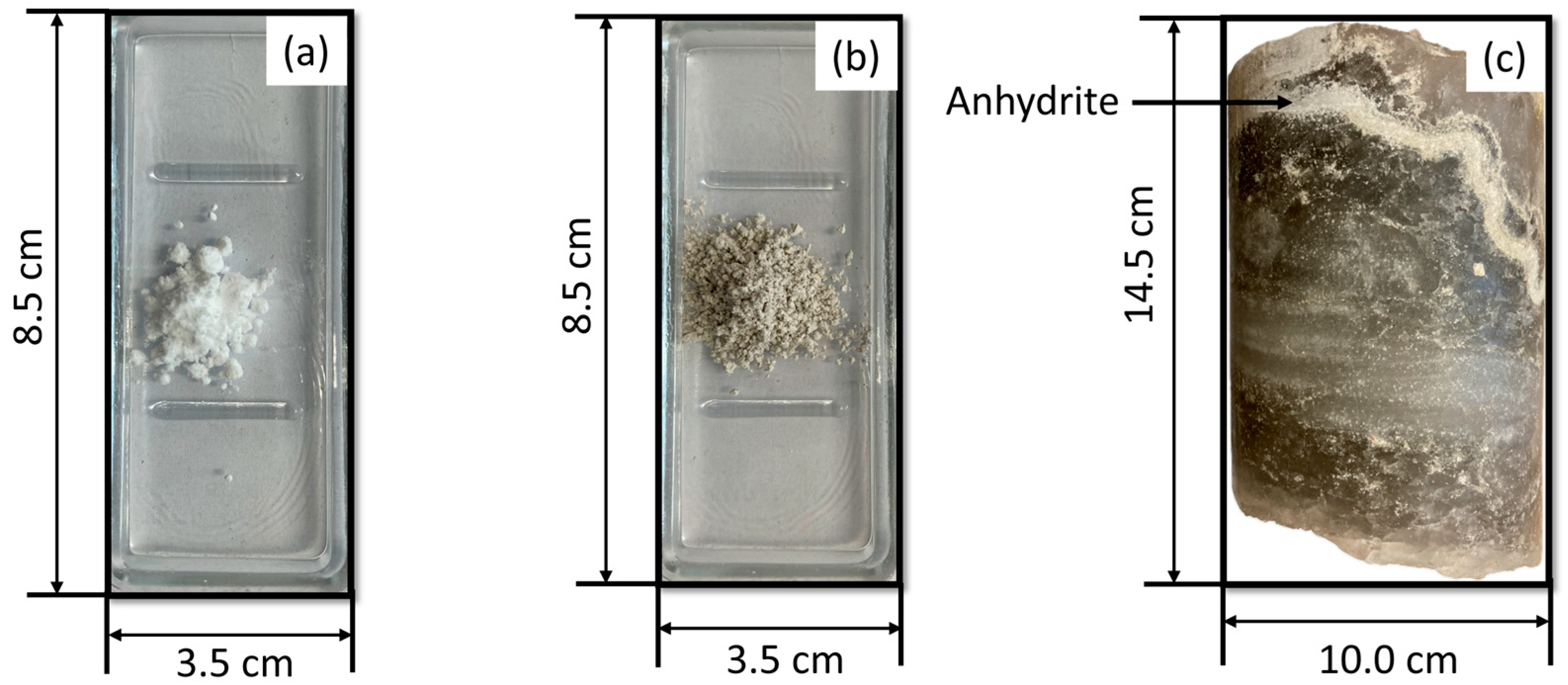
2O): Merck KGaA, Darmstadt, Germany, (CAS number: 10101-41-4), p.a.-grade (
Figure 1a).
Anhydrite sample 1 (CaSO
4): Synthetic anhydrite powder (technical by-product of hydrofluoric acid production provided by Fluorchemie Stulln GmbH, Stulln, Germany). This sample was chosen due to its significant fluorescence activity compared to other anhydrite sources. The raw material CaF
2 (due to its origin from natural deposits in China or South America) may contain traces of rare-earth elements (and therefore also the anhydrite), which are responsible for the observed fluorescence effects [
37,
38,
39]. (
Figure 1b).
Anhydrite sample 2 (CaSO
4): A drill core sample was taken from a depth of approx. 700 m below the surface of a rock salt horizon in the salt mine Sondershausen (Germany), drilled, and provided by the Institut für Gebirgsmechanik GmbH (IfG), Leipzig, Germany. The main body consists of halite (NaCl), with the white band of anhydrite throughout the core (
Figure 1c), analyzed in advance using non-destructive X-ray diffraction.
For gypsum and anhydrite, the Raman peak positions of both samples look similar in the fingerprint region, and only gypsum has Raman peaks in the large Raman shift region. A Raman spectrum free of background and noise is needed to clearly distinguish between anhydrite and gypsum in the fingerprint region. In addition, the existence of peaks in the large Raman shift region helps in identifying the presence of gypsum more easily. Hence, by using the mineral samples of gypsum and anhydrite, this work explains the ability of the proposed method in obtaining background and quasi-noise-free Raman spectra of minerals, and thereby its suitability for identification. The proposed method, however, could also be applied to other mineral samples.
2.2. Experimental Setup
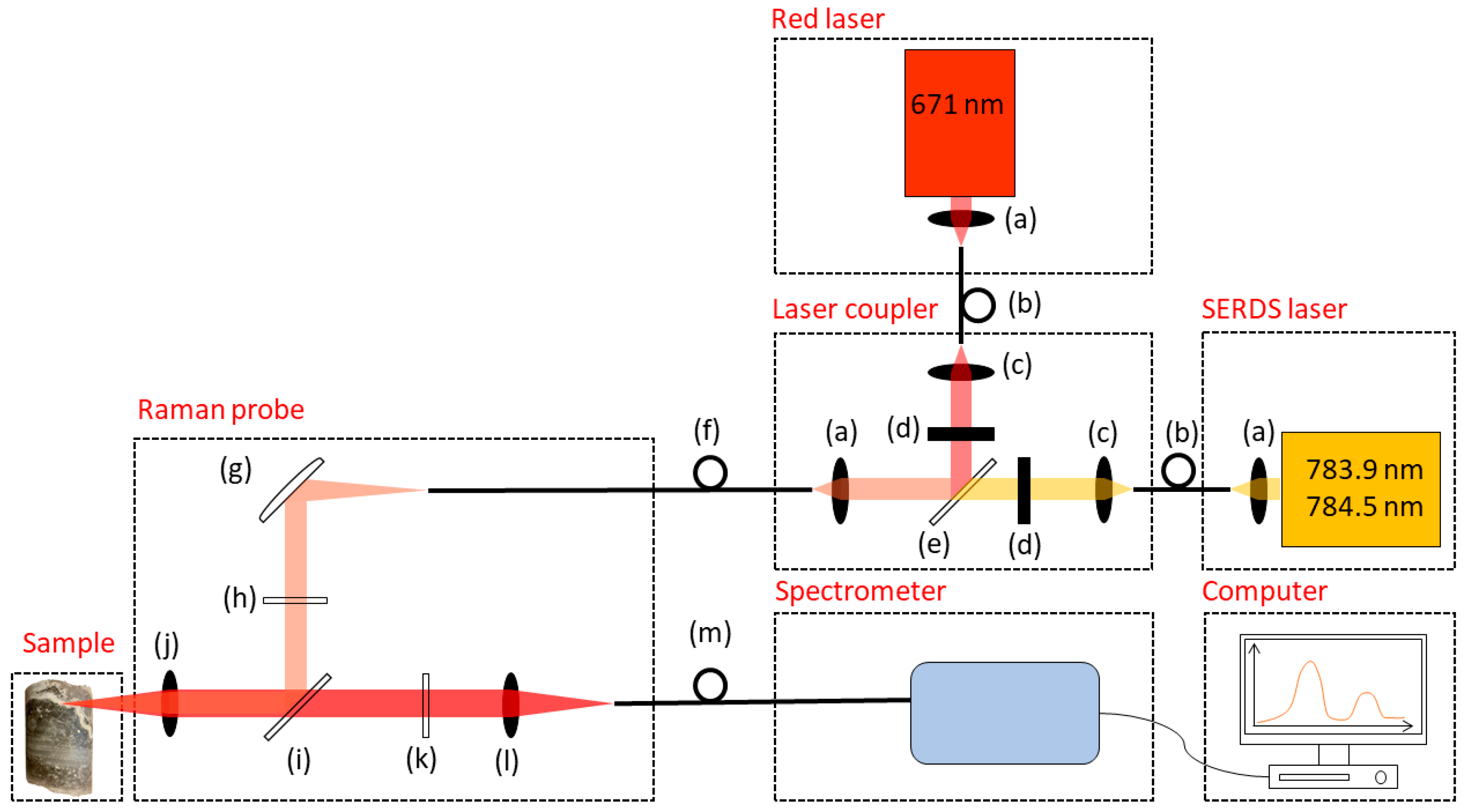
As shown in
Figure 2, the laser radiations from the “Red laser” (MLL-FN-671-800 mW laser, PhotonTec Berlin GmbH, Berlin, Germany; emission wavelength 671 nm) and the “SERDS laser” (dual wavelength-Y-DBR-RW-Diode laser, Ferdinand-Braun-Institut gGmbH, Berlin, Germany; emission wavelengths tuneable and switchable between two wavelengths in the vicinity of 785 nm) are focussed into the glass fibres of 50 µm core diameter (b) using focussing lenses (a) and are brought to the laser coupler. The laser coupler enables the alignment of the red and the SERDS laser radiations into a single Raman probe. Using the collimating lenses (c) and a beam splitter (e), another collimator (a) launches the radiation into the so-called excitation glass fibre of 200 µm core diameter (f), which carries the excitation radiation into the Raman probe. Electrically driven laser shutters (d) are installed between the beam splitter (e) and collimating lens (c) for the alternate turning OFF/ON of the radiation coming from the red or the SERDS laser. They assure that the radiation of the red and the SERDS laser is transferred to the Raman probe one after the other.
In the Raman probe, a reflective collimator (g) collimates the radiation leaving the excitation fibre. The collimated beam then passes through a short pass filter (h), with a cut-off wavelength at 800 nm onto the beam splitter (i). The short pass filter eliminates any radiation that might have emerged from light–matter interactions in the previous fibres and that would result in undesired interferences, if detected along with the Raman signal. The beam splitter (i) reflects the incoming laser radiation onto the achromatic lens (j) of 35 mm focal length, which in turn focusses the laser radiation onto the mineral sample. Hence, the working distance of the sample surface from the Raman probe is 35 mm. The diameter of the laser focussing spot on the mineral sample is 0.12 mm. We refer to the laser focal spot on the mineral sample as the measurement spot.
The radiation (signal) emerging due to the light–matter interaction in the measurement spot is detected in back-scattering direction and collimated by the same achromatic lens (j). The collimated signal beam passes through the beam splitter (i) and a long pass filter (k) with a cut-off wavelength at 800 nm onto another achromatic lens (l) with a focal length of 60 mm. The long pass filter (k) and the beam splitter (i) separate the undesired elastically scattered signals from the signal. The achromatic lens (l) focusses the Raman signals into the glass fibre of 600 µm core diameter (m). This glass fibre (m) is also called detection fibre, since it carries the detected signals into the standard spectral range (802 nm to 934 nm) spectrometer (WP-785-C-SR-IC, Wasatch Photonics, Morrisville, NC, USA), with a back-thinned CCD detector array for obtaining the signal spectrum of the sample. The average full-width half-maximum (FWHM) spectral resolution of the spectrometer is 10 cm−1.
2.3. Measurement Method
Raman measurements of the vertically positioned drill core (
Figure 1c) were made with a horizontally oriented Raman probe, as shown in
Figure 2. The synthetic powder samples (
Figure 1a,b) were presented in open glass containments. They were measured with a vertically oriented Raman probe in order to optically access the powders from the top. This measure avoids the excitation of the powdered sample through the walls of the glass containment, which would result in glass-born interferences.
In any case, at first, an averaged spectrum of 16 Raman spectra of the sample with an excitation wavelength of 783.9 nm was acquired using the SERDS laser. Then, the excitation wavelength of the SERDS laser was shifted to 784.5 nm, and another averaged spectrum of 16 Raman spectra of the sample was acquired. The two laser excitation wavelengths are obtained by switching between two laser diodes available within the laser [
33]. The two excitation wavelengths provide a wavelength difference of 0.6 nm. This wavelength difference was chosen because the spectrometer’s spectral resolution of 10 cm
−1 (FWHM of a Raman peak) is approximately 0.6 nm at 802 nm. Thus, the wavelength difference of 0.6 nm is desirable for both an efficient experimental fluorescence rejection and a successful reconstruction of meaningful refined Raman spectra using the SERDS technique [
24]. The wavelengths were chosen in the vicinity of 785 nm because a quickly switchable laser is available in this spectral range, undesired fluorescence interferences can be reduced to an acceptable degree, and Si-based CCD detectors can detect the fingerprint spectral range of the Raman spectrum with an acceptable quantum efficiency between 46 and 66%. In this case, the spectrometer used covers solely the spectral region up to 2000 cm
−1, which contains the fingerprint range. Finally, another averaged Raman spectrum of 16 Raman spectra was acquired with an excitation wavelength of 671 nm using the red laser. The choice of the 671 nm excitation wavelength implied that now the same spectrometer covers the large Raman shift range of the Raman spectrum from 2500 cm
−1 to 4200 cm
−1 with the same quantum efficiency as the fingerprint spectral range. Thus, one spectrometer is sufficient for the spectrally highly resolved detection of the entire Raman spectrum, not simultaneously, but one after the other, with first the fingerprint and then the large Raman shift range. The excitation power in the measurement spot was around 67 mW for the red laser and 59 mW for the SERDS laser. Each spectrum used in calculating the averaged spectrum was obtained with a signal integration time of 50 ms. The averaged spectrum, therefore, corresponds to approximately 800 ms.
3. Results and Discussion
3.1. Pre-Processing
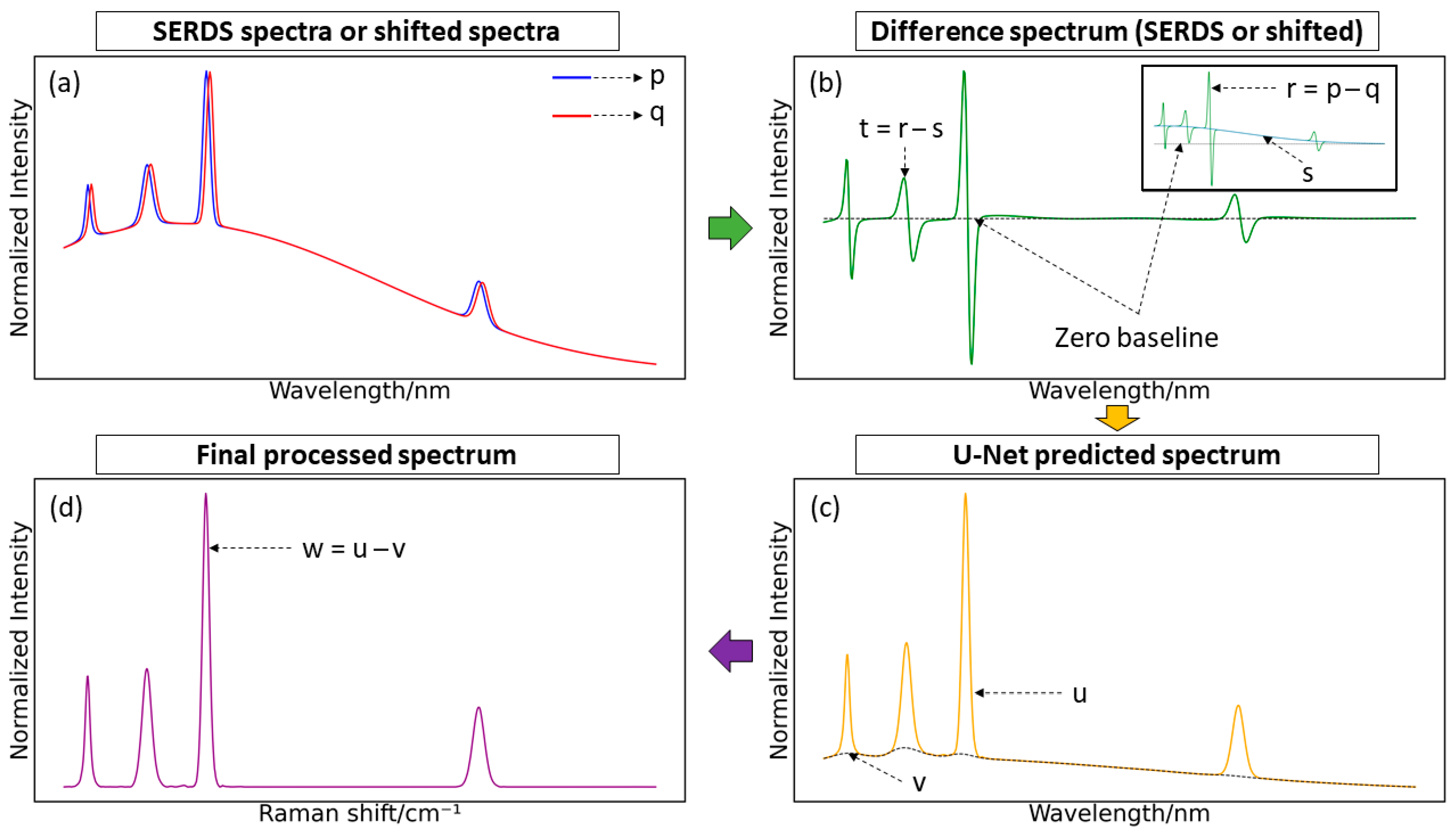
The pre-processing method of the raw Raman spectra is shown in
Figure 3. In order to underline its general applicability, a simulated spectrum is utilized as raw Raman spectrum in this subsection. In the fingerprint region, two Raman spectra of any mineral sample are acquired, one excited with 783.9 nm and the other one with 784.5 nm. They are labelled as (p) and (q) in
Figure 3. After z-score normalization, the difference spectrum (r) is calculated by subtracting spectrum (q) from spectrum (p) [
24]. The difference spectrum (r) is baseline corrected using the baseline (s) determined with a third-order asymmetric least squares (AsLS) fitting [
27,
30,
31]. The baseline correction compensates effects due to fluorescence quenching, excitation-dependent fluorescence quantum yields, or noise [
23,
40]. The baseline-corrected difference spectrum (t) is normalized between −1 and 1 in order to enhance the features that are represented by small peaks. The difference spectrum (t) is then given as input to a deep learning based trained U-Net model developed in our working group to predict the background and noise-corrected Raman spectrum (u) [
28]. The enormous noise reduction capability of the U-Net model is not visible in
Figure 3, as the considered raw spectrum features a high signal-to-noise (SNR) ratio. But the noise reduction capability can be seen in [
28] or in the figures that follow. The U-Net model was trained using TensorFlow API in the Python programming language on a dataset containing 300,000 simulated difference spectra obtained by subtracting a shifted version from the unshifted version of raw simulated Raman spectra. Each simulated raw Raman spectrum is created using a random sum of the Voigt, Gaussian, and Lorentzian profiles. The maximum number of profiles in the simulated raw Raman spectrum for model training is less than 50 [
28]. The trained U-Net model was tested using Raman spectra of liquid solvents and biological samples. The model was able to successfully remove the noise and background from the testing Raman spectra [
28]. Since the model was trained on a simulated dataset, the model could also be used for SERDS reconstruction as well as fluorescence removal in the fingerprint and large Raman shift region of Raman spectra of minerals. Further details of the U-Net architecture and the data used for creating the model are explained in [
41] and [
28], respectively.
The next step is solely required if the U-Net predicted spectrum (u) should be represented by a sequence of pseudo-Voigt peaks [
42,
43], whose number and position can be used later for mineral identification. This next step involves subtracting a third-order asymmetrically reweighted penalized least squares (arPLS) baseline (v) [
29]. Finally, the so obtained spectrum (w) is deconstructed into pseudo-Voigt peaks.
For the large Raman shift region of the Raman spectra, the pre-processing method is almost the same as that of the fingerprint region. Since only one excitation wavelength of 671 nm is available (p), a second spectrum (q) for calculating the difference spectrum (r) is mathematically synthesized by shifting the spectrum obtained with 671 nm by 0.15 nm. As we did not shift the excitation wavelength in this case but the spectrum, we refer to the resulting difference spectrum in the large Raman shift region as difference spectrum, while we refer to the resulting difference spectrum in the fingerprint region as SERDS spectrum. A shift of 0.15 nm corresponds to the minimum wavelength difference between two pixels. The minimum value is chosen to have minimum noise in the non-peak regions when the difference spectrum is calculated. The U-Net model was trained on full-range Raman spectra (0 cm
−1 to 4200 cm
−1) with 1024 pixels [
28]. In our current study, only the large Raman shift range is detected on 1024 pixels. As a result, the broader peaks in the large Raman shift region Raman spectra could be mistaken for broadband fluorescence. Therefore, in order to avoid this, the large Raman shift region Raman spectra were first compressed in order to adjust the width (in the form of the number of pixels) of the OH band to the training data. Some pixels had to be added at the beginning of the spectrum by extrapolation after the compression in order to also meet the total number of pixels of the training spectra. A normalization between −1 and 1 for the difference spectrum is not performed in the large Raman shift region difference spectra, as anhydrous salts, like anhydrite, do not have peaks in large Raman shift regions; so, a normalization between −1 and 1 would just amplify the noise. Also, the large Raman shift region Raman spectra have larger peaks in comparison with fingerprint region Raman spectra. Hence, large Raman shift region peaks are well represented in the difference spectra without the normalization between −1 and 1.
The pre-processing method is implemented in the Python 3.9 programming language. The pre-processing method took around 100 milliseconds for processing both the fingerprint and large Raman shift region Raman spectra of a single mineral (Windows 11 PC with 32 GB RAM and AMD Ryzen 7 Pro processor).
3.2. Gypsum Raman Spectrum
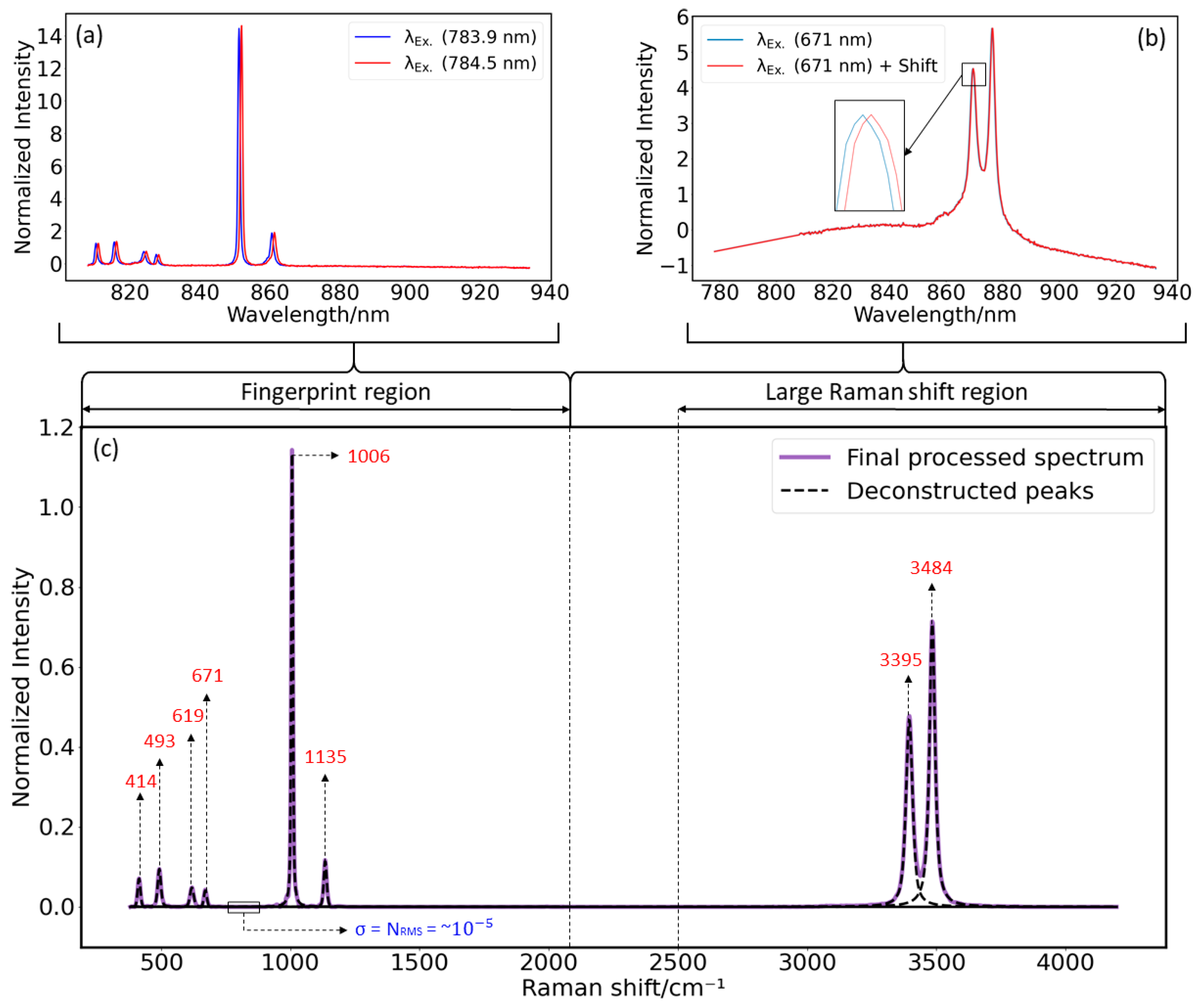
Figure 4a,b are the z-score-normalized fingerprint and large Raman shift region Raman spectra of the gypsum sample. The fingerprint spectra are quasi-fluorescence-free, and the broad fluorescence background is only seen in the large Raman shift region. The obtained final processed spectra of the fingerprint and large Raman shift region (by the method described in 3.1) are concatenated to obtain the full Raman spectrum of the synthetic gypsum shown in
Figure 4c. The proposed method was able to completely remove the broad fluorescence background existing in the large Raman shift region. The root mean square (RMS) noise (same as the standard deviation) calculated using the signal-free region between 800 cm
−1 to 900 cm
−1 is around 10
−5. Thus, the method provides a quasi-noise-free spectrum.
For the pseudo-Voigt profile peaks shown in
Figure 4c, the absolute differences between the obtained spectrum and the modelled spectrum were the least. The Raman shifts in the peaks given in
Figure 4c are the central peak positions of the pseudo-Voigt profiles. The peaks in fingerprint regions are due to bending and stretching vibration modes of sulphate ions, and the peaks in the large Raman shift regions are due to OH stretching vibrations.
Table 1 shows a comparison of the Raman peak positions of the final processed spectrum with the literature values. The determined peak positions are in similar ranges to those of the literature Raman shift values. The Raman shift values of the peaks are susceptible to small changes depending upon the measuring instrument resolution and the measurement conditions.
3.3. Anhydrite Raman Spectrum
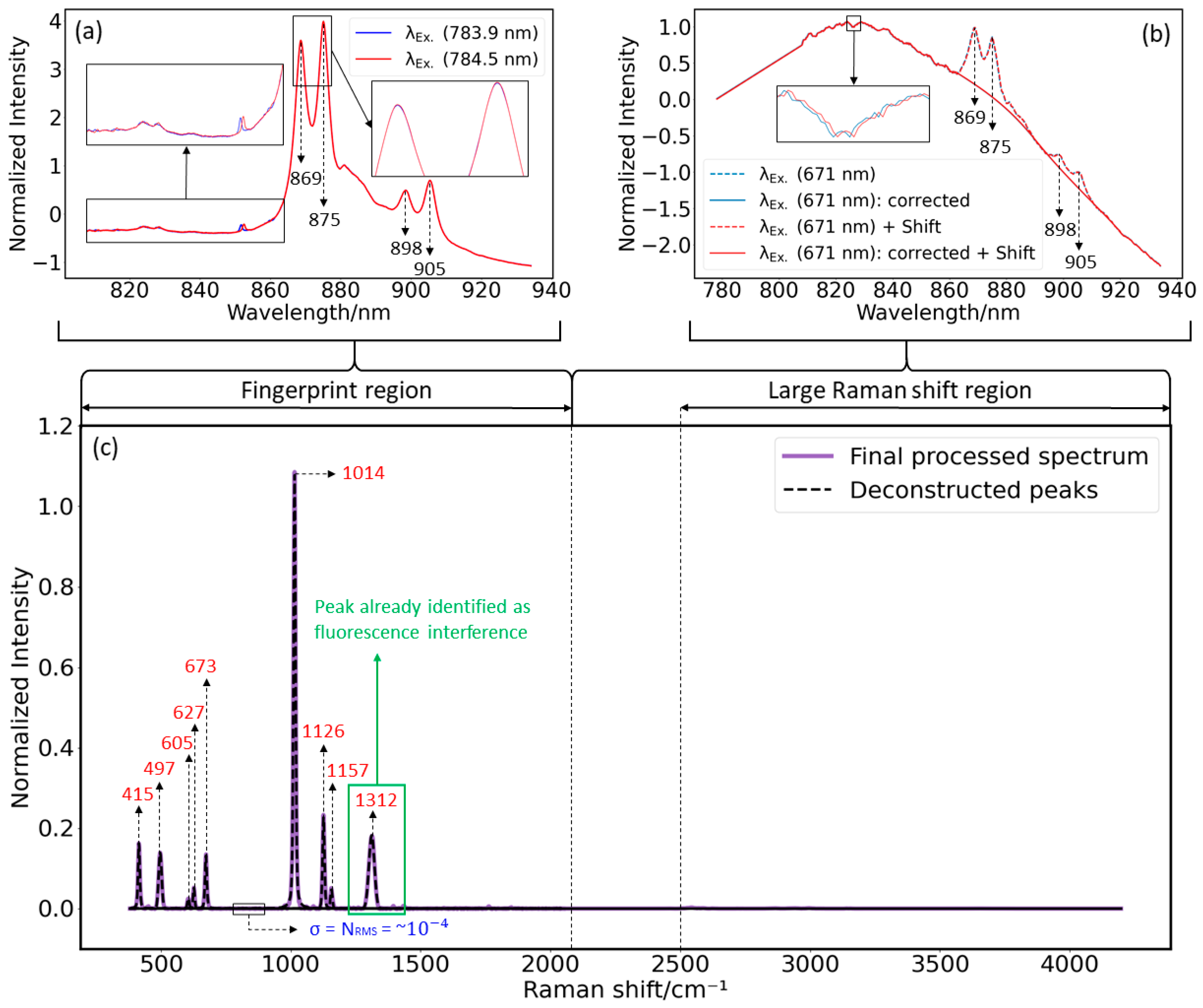
Figure 5 shows the z-score-normalized and finally processed spectra of anhydrite sample 1. It is shown that the large narrow peaks in
Figure 5a, which—due to their shape—could easily be taken as Raman peaks, do not shift with the excitation wavelength. They thus can be clearly identified as interfering fluorescence emissions. Spectrally rather narrow fluorescence emissions could be due to the rare-earth elements (lanthanide group elements) associated with the mineral’s particular phase or structure [
14,
15,
26]. The proposed method provides in
Figure 5c a fluorescence-cleared fingerprint Raman spectrum. It has been shown in [
50,
51] that the wavelength of the fluorescence emissions of rare earths is not a function of the excitation wavelength, and the probability of absorption at 785 nm is more than at 671 nm. Therefore, one can identify either the same interfering fluorescence emissions appearing at the same wavelength when the material is excited with 671 nm as well as with 785 nm, as shown in
Figure 5a,b, or interfering fluorescence emissions will only be seen in the Raman spectrum obtained with 785 nm excitation wavelength. Thus, as indicated in
Figure 5b, the intensities corresponding to the fluorescence interference in the large Raman shift regions are replaced with a baseline of this region calculated using a second-order arPLS algorithm [
27,
29]. The corrected large Raman shift Raman spectrum is then shifted in order to obtain the difference spectrum, from which the final processed Raman spectrum is obtained, according to the method described above in the context of
Figure 3.
The pre-processing method in combination with the additional correction procedure was able to clear both, the narrow and broad fluorescence interference from the fingerprint and large Raman shift region, as shown in
Figure 5c. The final processed spectrum is then deconstructed into pseudo-Voigt peaks for peak position determination. The peaks are listed in
Table 2 for comparison with the literature values. The baseline correction on the U-Net predicted spectrum, as explained in the context of 3.1, is able to remove most of the remaining fluorescence interference due to excitation power sensitivity of the fluorescence. However, because of the strong fluorescence interference at 869 nm and 875 nm, fluorescence interference is not completely removed, and a corresponding peak is observed in
Figure 5c at 1312 cm
−1. But as observed in
Figure 5a, the fluorescence interference does not change its position; hence, any remaining fluorescence interference that appears close to strong fluorescence interference in the final processed spectrum could be identified as part of the fluorescence interference, and the corresponding pseudo-Voigt peak can be easily discarded.
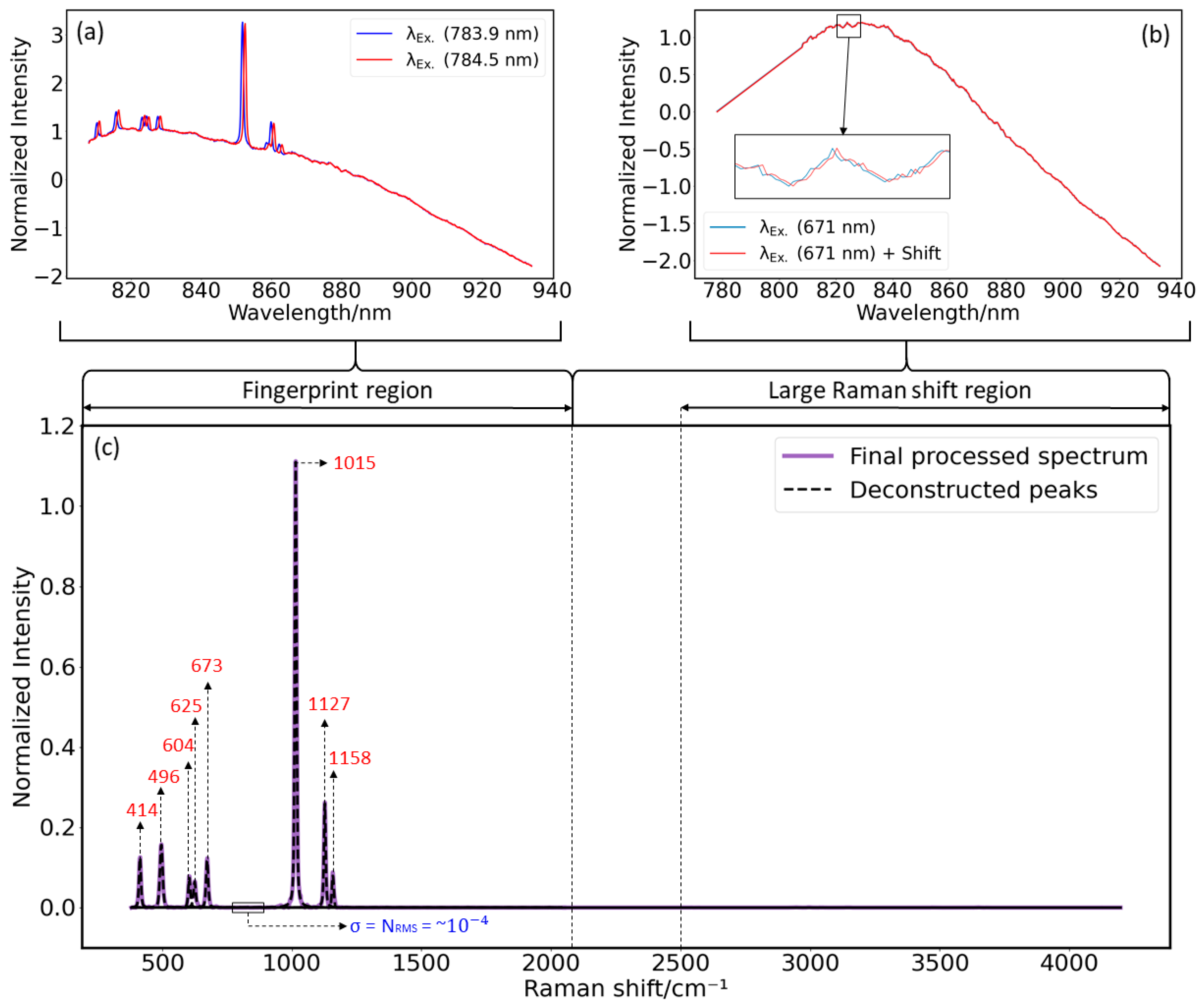
For analyzing the performance of the pre-processing procedure on a Raman spectrum with a broad fluorescence interference in the fingerprint and large Raman shift regions, the proposed method is also applied to the Raman spectrum of anhydrite sample 2 shown in
Figure 6. No narrow fluorescence interference due to rare-earth ions was observed in the Raman spectrum of analyzed anhydrite sample 2. Hence, unlike anhydrite sample 1, the additional correction procedure in the large Raman shift region was not needed. The deconstructed pseudo-Voigt peak positions shown in
Figure 6c are also listed in
Table 2 for comparison with the literature values.
It could be observed from the results shown in
Figure 5c and
Figure 6c that, for both anhydrite samples 1 and 2, the proposed method was able to provide fluorescence and quasi-noise-free final processed spectra, with a root mean square (RMS) noise value of around 10
−4 at the silent region of Raman spectrum.
From the comparison listed in
Table 2, the final processed Raman spectra of anhydrite samples 1 and 2 have the central peak positions of the pseudo-Voigt peaks in similar ranges to each other and to the literature values. In
Figure 5c and
Figure 6c, no peaks are seen in the large Raman shift region Raman spectrum due to the absence of water molecules in anhydrite.
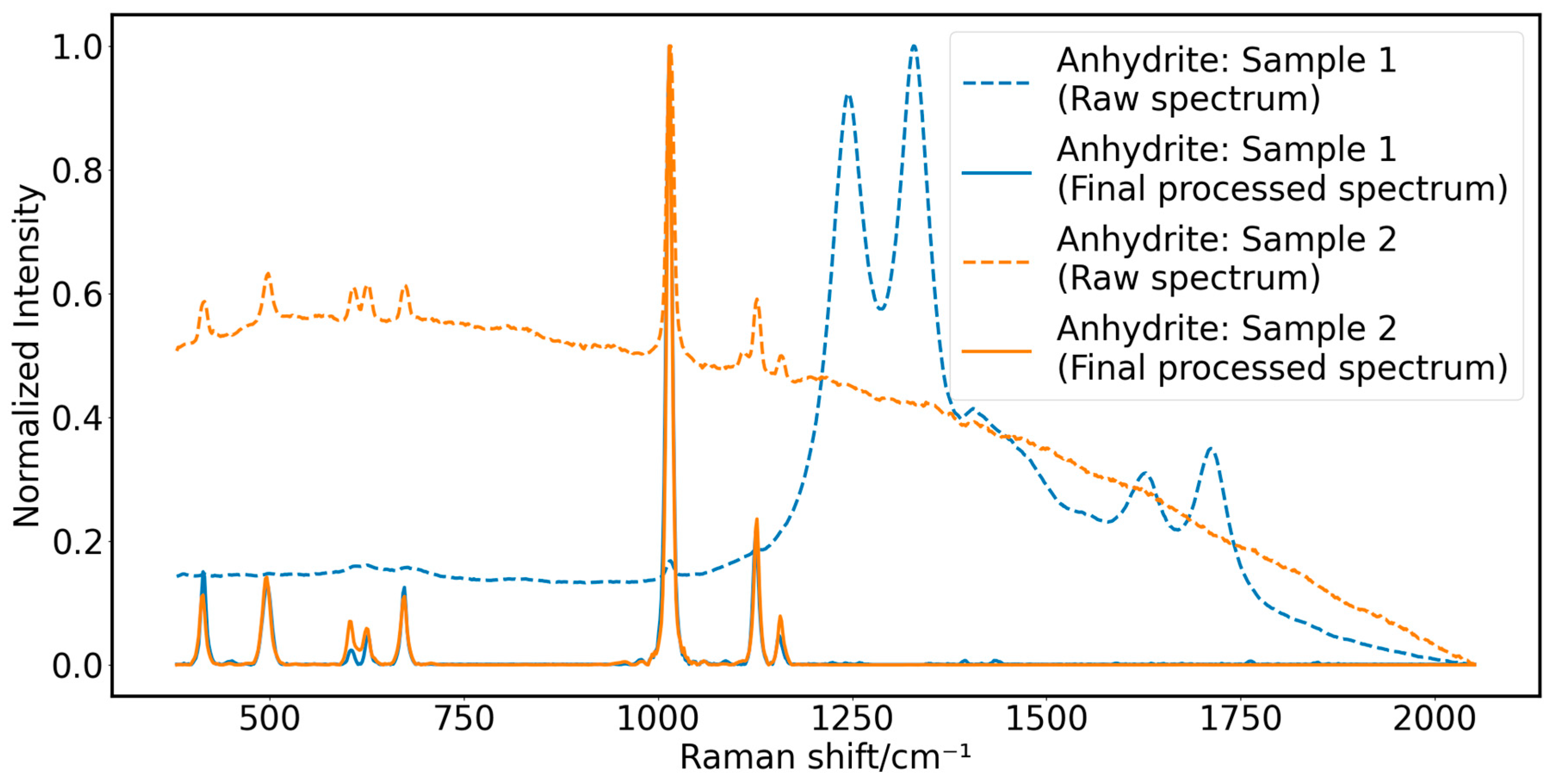
To further demonstrate the effectiveness of the proposed method, a comparison as shown in
Figure 7 is performed between raw and final processed Raman spectra of anhydrite samples 1 and 2. The raw Raman spectra used in this comparison are the same as the spectra used in
Figure 5a and
Figure 6a obtained with 783.9 nm excitation wavelength. Both the raw spectra and the final processed spectra are normalized between 0 and 1 for comparison. As one can observe, the raw fingerprint region Raman spectra (dashed curves) of both anhydrite samples differ largely from each other. Without the pre-processing method, the raw Raman spectrum of anhydrite sample 1 can easily be mistaken for other minerals due to the narrow fluorescence interference at Raman shift values of 1249 cm
−1 (869 nm), 1328 cm
−1 (875 nm), 1621 cm
−1 (898 nm), and 1707 cm
−1 (905 nm). But through the proposed method, the Raman peaks of anhydrite sample 1, which were otherwise not clearly distinguishable, were recovered after pre-processing. The remaining fluorescence interference at 1312 cm
−1 is removed from the final processed spectrum of anhydrite sample 1. As a result, the final processed Raman spectrum (solid curves) of both samples looks similar.
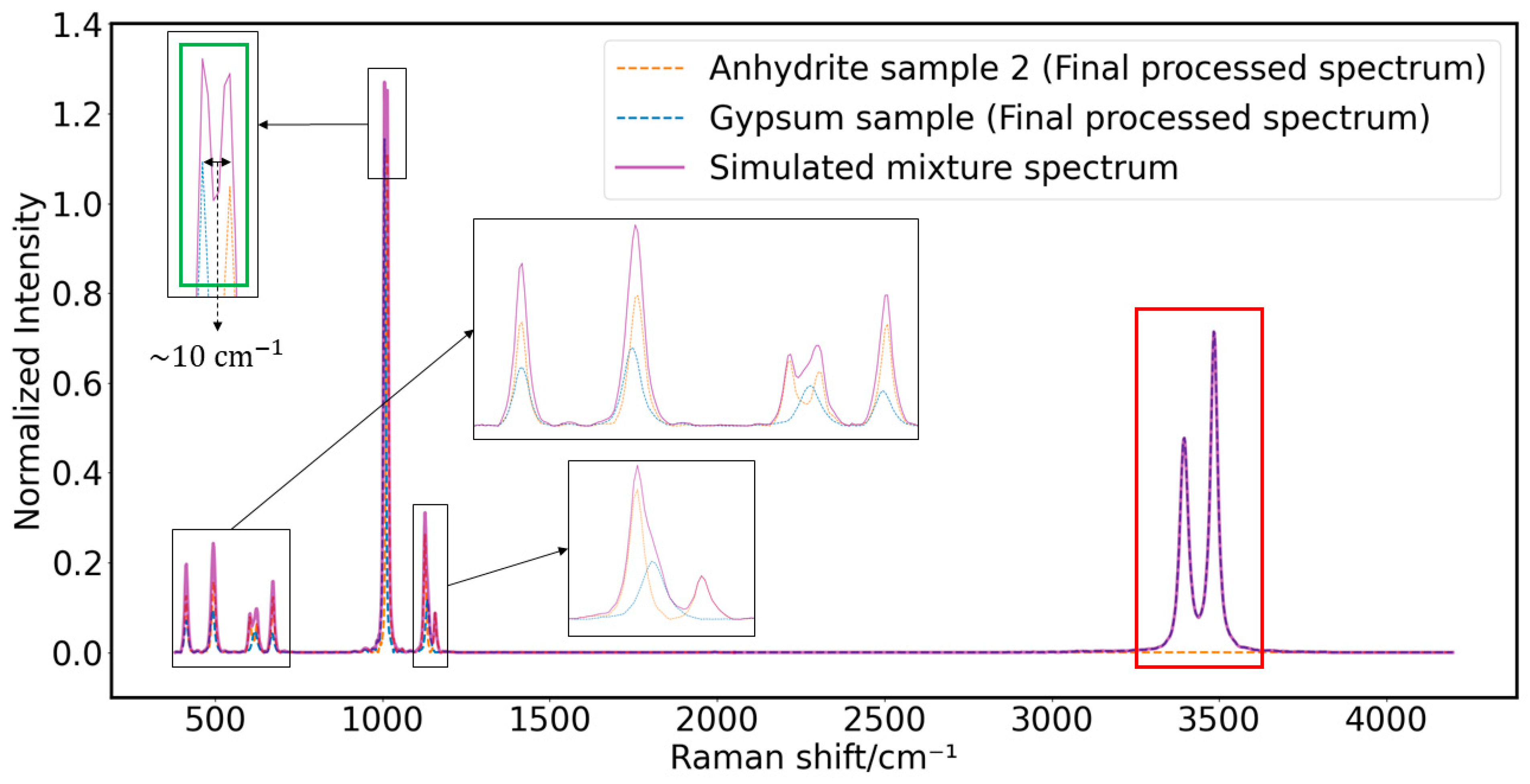
Normally, a background and noise-free fingerprint Raman spectrum of a mineral sample is sufficient for the identification of minerals. Hence, the final processed large Raman shift Raman spectrum is needed only when the sample is a mixture of similar minerals like gypsum and anhydrite. In order to simulate such a mixture, the final processed spectra of the gypsum sample and anhydrite sample 2 are added together to create a simulated mixture spectrum, as shown in
Figure 8. From the simulated mixture spectrum, it can be observed that most of the gypsum Raman peaks overlap with Raman peaks of anhydrite. As a result, the fingerprint region Raman spectra of the mixture spectrum can easily be mistaken for an anhydrite spectrum. The presence of gypsum is indicated only by small features, which are highlighted in
Figure 8 by the green boundary. Hence, the presence of the OH stretching vibration peaks (regions marked with red boundary in the large Raman shift region) in gypsum and the absence of these peaks in anhydrite help in identifying clearly the presence of gypsum in the mixture.
3.4. Effect of Spectral Averaging in Peak Finding
The single spectrum integration time of the anhydrite sample 1 was limited by the fluorescence interference to 50 ms. Longer integration times saturated the detector. Unfortunately, the Raman peaks are much weaker than the fluorescence interference; thus, at such short signal integration times, the signal might be hidden within the noise of the spectrum. Then, averaging is the method of choice in order to improve the signal-to-noise ratio and to make hardly recognizable Raman signals more clearly recognizable. But averaging is time demanding, and we motivated our work in the introduction by the need for a fast measurement method for the identification of minerals. Therefore, we analyzed the impact of the number of single spectra we utilized for averaging on the outcome of the pre-processing method we proposed.
In total, 16 batches, with each batch containing 16 SERDS spectra, are obtained. In the first batch, each SERDS spectrum was computed from one non-averaged Raman spectrum excited with 783.9 nm and one non-averaged Raman spectrum excited with 784.5 nm. In the second batch, each SERDS spectrum was computed from one averaged Raman spectrum excited with 783.9 nm and one averaged Raman spectrum excited with 784.5 nm, where the number of spectra in averaging was two. In batch 4, each of the 16 SERDS spectra was computed from one averaged Raman spectrum excited with 783.9 nm and one averaged Raman spectrum excited with 784.5 nm, where the number of spectra in averaging was four. This acquisition process is repeated for 16 batches. When neglecting the time required for reading out the spectra, in batch 7, for example, each averaged spectrum corresponds to a measurement time of 350 ms (seven times 50 ms/single spectrum). As the SERDS spectrum is computed from two averaged spectra, the measurement time of one SERDS spectrum in batch 7 would correspond to 700 ms. One SERDS spectrum in batch 2 would correspond, for example, to 200 ms. For each batch, 16 final processed spectra are determined using the proposed method explained in the context of 3.1 for the fingerprint region Raman spectrum. After that, each of the 16 final processed spectra in each batch is deconstructed into pseudo-Voigt peaks. As we neither dictate the number of pseudo-Voigt profile peaks nor their peak position, the number and position of identified peaks depend on whether weak Raman signals are recognizable as peaks in the final processed spectrum before pseudo-Voigt profile deconstruction.
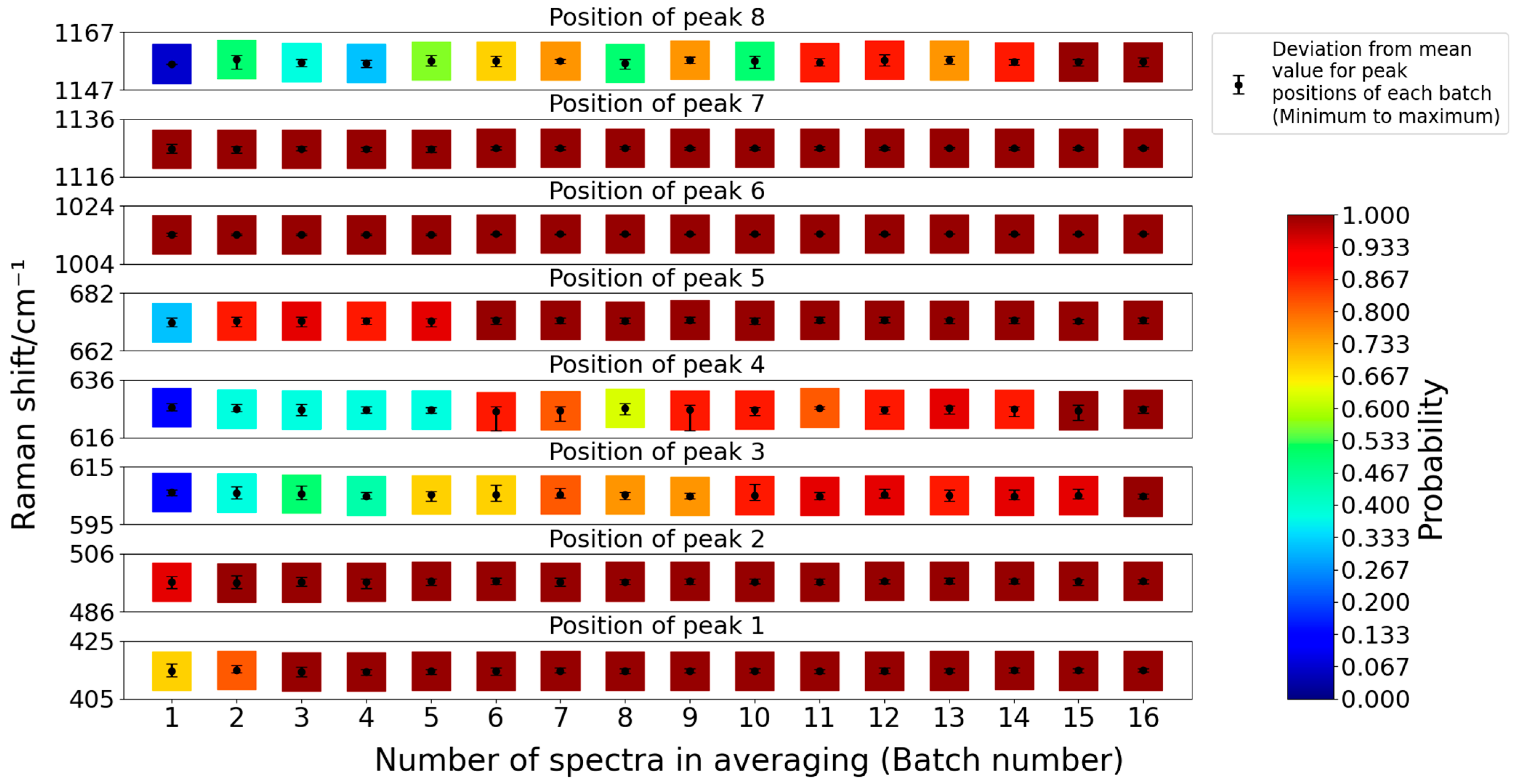
Figure 9, therefore, shows which of the eight anhydrite peaks were found, with what probability, and at which central peak position, depending on the number of spectra in averaging. The number of spectra in averaging, which corresponds to the batch number, is given from left to right. The eight peaks of anhydrite are shown from the bottom to the top. The data point highlighted by a greenish square in
Figure 9 corresponds, for example, to batch number 5 and peak number 8. The greenish background colour implies that this peak was represented by a pseudo-Voigt profile in approximately 50% of the 16 final processed spectra of this batch. Thus, in 8 of these 16 final processed spectra, this peak was not recognized. The data point and the error bars represent the mean central position of this peak, which was averaged from the eight identified peaks, and their deviation between maximum and minimum peak positions among these eight identified peaks, respectively.
It can be observed from
Figure 9 that the probability of existence of the strong peaks 1, 2, 6, and 7 in the final processed spectra is high (>0.5), irrespective of the number of spectra used in averaging. But the probability of existence of the weaker peaks 3, 4, 5 and 8 is low (<0.5), when the number of spectra in averaging is less. This is because, when the number of spectra used in averaging is less, the existence of noise in a Raman spectrum causes the Raman peaks with small intensity to be less prominent in the difference spectrum. This, in turn, causes the corresponding peaks to be absent in the final processed spectrum. With an increasing number of spectra in spectra averaging, the noise reduces and the peaks become more prominent in difference spectrum; as a result, corresponding Raman peaks appear in the final processed spectrum.
It should also be noted that in batch one, four of the eight peaks having a probability greater than 0.5 were determined without averaging during spectra acquisition and with a measurement time of 100 ms, which is faster in comparison with the existing methods of SSE and FT Raman spectroscopy. In batch two, already six out of eight peaks are identified with a probability exceeding 0.5. This corresponds to a measurement time per measurement spot of only 200 ms. For such short measurement times, not the signal acquisition time itself, but the time required to move the Raman measurement device from measurement spot to measurement spot would define the rate at which measurements can be made.
3.5. The Challenges and Considerations of In Situ Implementation
The experimental setup and pre-processing method were designed considering practical challenges in transferring the proposed method to an underground mine. As the proposed method can remove both narrow as well as broad fluorescence interference in Raman spectra of mineral samples, the method can be transferred to real in situ measurements in underground environments containing fluorescing substances. The underground environment is subjected to vibrations and light from either moving vehicles or operating machinery in the measurement surroundings. These can cause the Raman probe to move or the surrounding light to enter the Raman probe. These factors could affect the SERDS measurement by either a variation in the measurement spot position or a difference in the background interference during the two subsequent spectra acquisitions for SERDS measurement. To overcome the effect of vibration, the Raman probe will be securely mounted. To prevent interference from surrounding light, an opaque and flexible light protection cover will be attached to the end of the Raman probe to cover the region between the measurement spot and the Raman probe end. In addition, the quick spectra acquisition of the proposed method also helps in reducing interferences from vibration and surrounding light.
4. Conclusions
In this work, a method is proposed for obtaining the Raman spectrum of minerals using a combination of SERDS, deep learning-based U-Net model for noise and background removal, and dual excitation wavelengths. Since the proposed method uses the combination of both experimental and mathematical methods, it successfully removes narrow as well as broad fluorescence interference from the fingerprint and large Raman shift regions of Raman spectra and provides a background-free spectrum with significantly reduced noise. The method was also able to recover all the Raman peaks from the raw Raman spectra of minerals that were acquired using a comparatively shorter spectra acquisition time, even in the presence of a strong and narrow fluorescence background. The dual excitation wavelength technique with SERDS laser and 671 nm laser ensures that the fingerprint and large Raman shift regions of the Raman spectrum are obtained with good as well as similar quantum efficiency. The large Raman shift region Raman spectrum obtained with a 671 nm laser helps in clearly distinguishing the existence of minerals in a mixture of minerals like gypsum and anhydrite, having similar fingerprint region Raman spectra.
The background and quasi-noise-free spectrum can then be subjected to peak finding algorithms, from which the number and positions of pseudo-Voigt peaks within the spectrum can be extracted. This information is valuable input for the computation of the modelled spectrum, which is the summation of pseudo-Voigt peaks. The mineral identification can in the future then be based on the number and positions of the pseudo-Voigt peaks.
The future application of the proposed method is in underground salt rock, where various constituent minerals are identified in situ using the fluorescence and quasi-noise-free Raman spectrum obtained with this method. Since the measurement spot has a diameter of 0.12 mm, and the area for analysis in a salt mine is large, quick spectral acquisition and short pre-processing time of the proposed method is beneficial over other standard methods. In addition, unlike other existing mathematical methods of background and noise removal, the proposed pre-processing method eliminates the need for human intervention. While using the proposed method in an underground environment, measures will also be implemented to prevent the interferences from vibration and surrounding light on the measurement.
With the proposed experimental setup, the fluorescence interference in minerals that appear either in both fingerprint and large Raman shift regions or only in the fingerprint region could be removed. But in future work with samples having fluorescence interference only in the large Raman shift region, the shifting of the Raman spectrum adopted in the current work for calculating the difference spectrum in the large Raman shift region could be replaced with another SERDS laser having excitation wavelengths tuneable in the vicinity of 671 nm.