Article

Dissolution Mechanisms and Surface Charge of Clay Mineral Nanoparticles: Insights from Kinetic Monte Carlo Simulations


Department of Geosciences (FB5), University of Bremen, Klagenfurter Str. 4, 28359 Bremen, Germany
Minerals 2024, 14(9), 900; https://doi.org/10.3390/min14090900
Submission received: 10 July 2024 / Revised: 22 August 2024 / Accepted: 28 August 2024 / Published: 2 September 2024
(This article belongs to the Special Issue Feature Papers in Clays and Engineered Mineral Materials)

Abstract

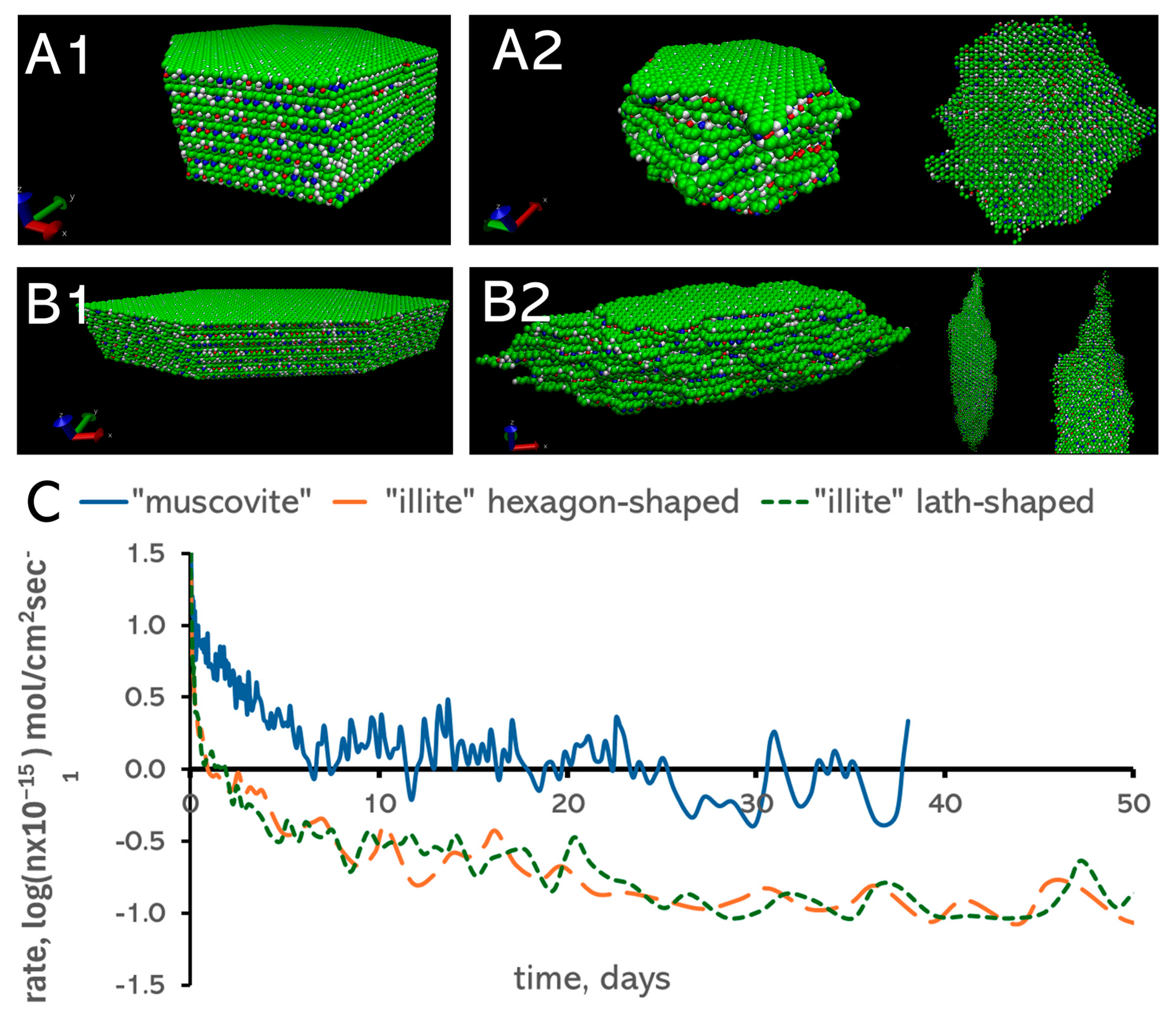
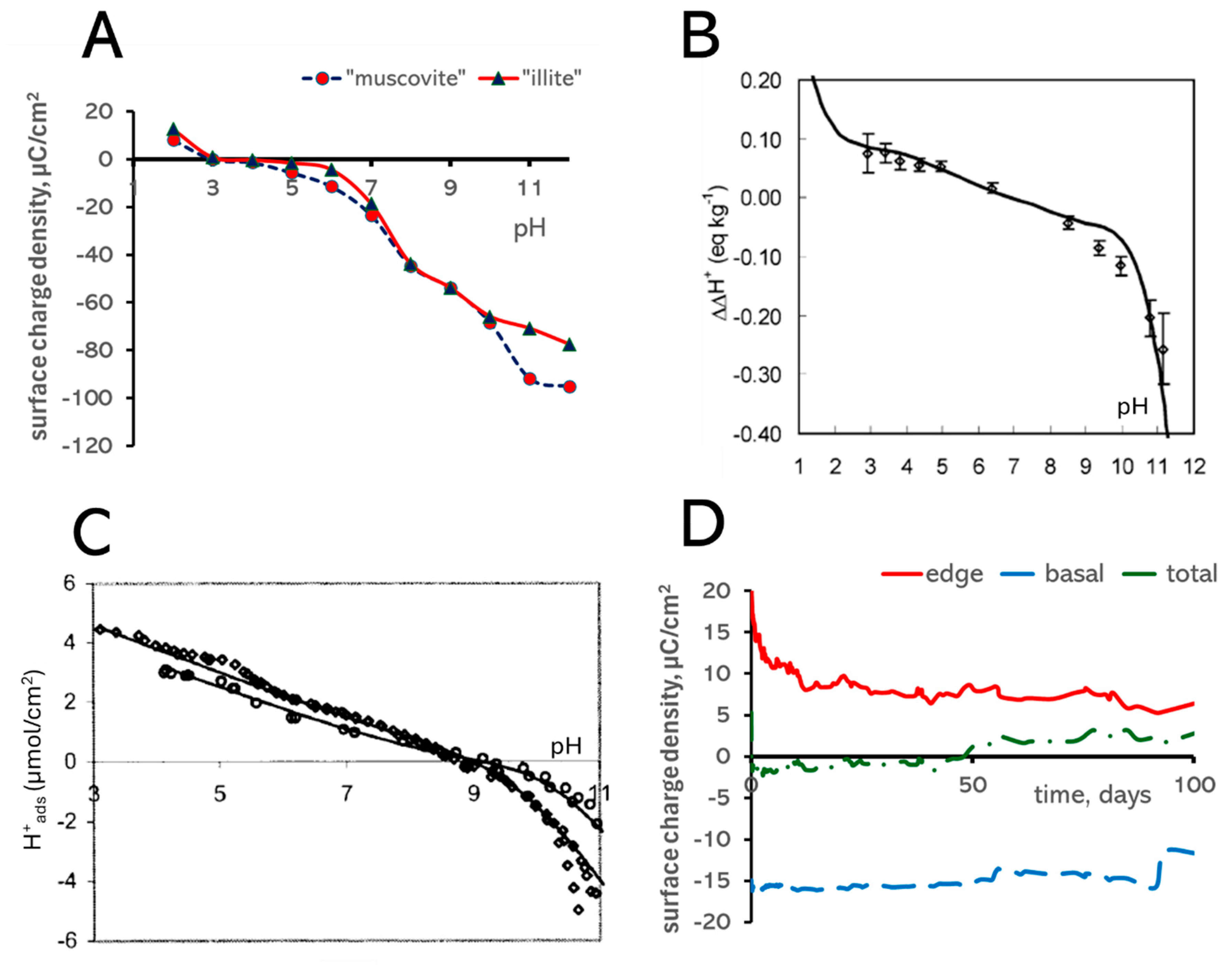
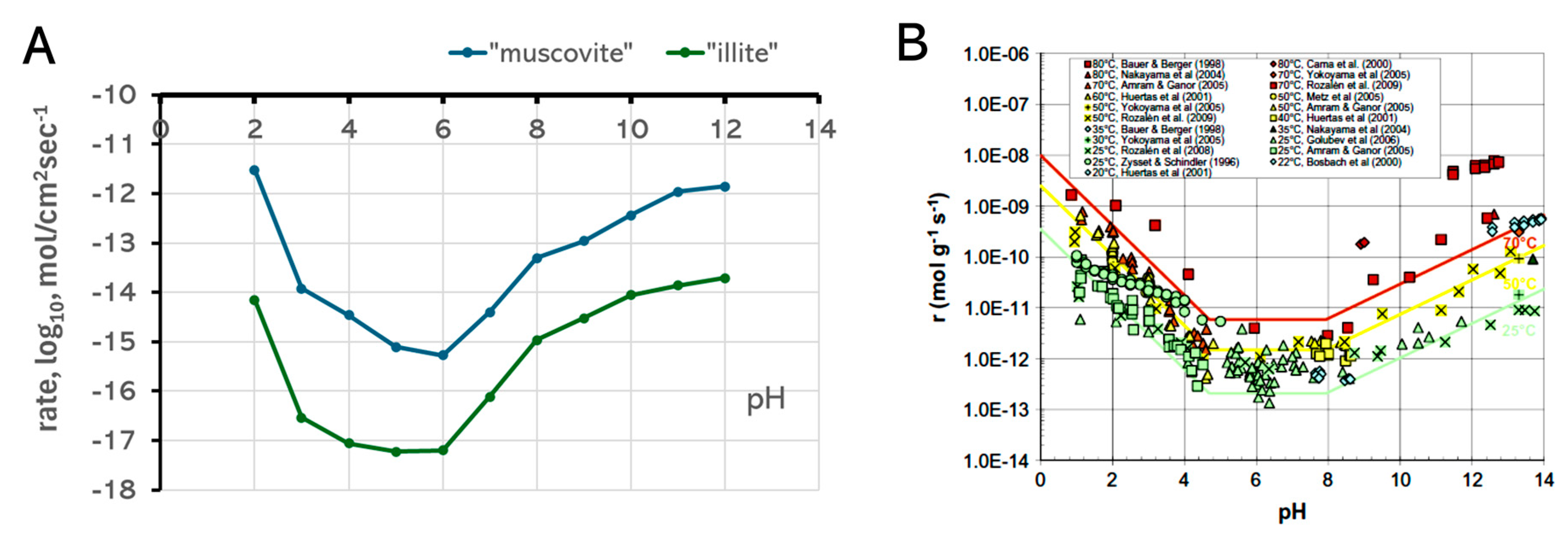
The widespread use of clay minerals and clays in environmental engineering, industry, medicine, and cosmetics largely stems from their adsorption properties and surface charge, as well as their ability to react with water. The dissolution and growth of minerals as a function of pH are closely related to acid–base reactions at their surface sites and their surface charge. The vivid tapestry of different types of surface sites across different types of clay minerals generates difficulties in experimental studies of structure–property relationships. The aim of this paper is to demonstrate how a mesoscale stochastic kinetic Monte Carlo (kMC) approach altogether with atomistic acid-base models and empirical data can be used for understanding the mechanisms of dissolution and surface charge behavior of clay minerals. The surface charge is modeled based on equilibrium equations for de/protonated site populations, which are defined by the pH and site-specific acidity constants (pKas). Lowered activation energy barriers for these sites in de/protonated states introduce pH-dependent effects into the dissolution kinetics. The V-shaped curve observed in laboratory experiments is reproduced with the new kMC model. A generic rate law for clay mineral dissolution as a function of pH is derived from this study. Thus, the kMC approach can be used as a hypothesis-testing tool for the verification of acid–base models for clay and other minerals and their influence on the kinetics of mineral dissolution and growth.
Keywords: Monte Carlo; stochastic; titration; surface charge; nanoparticles; illite; montmorillonite; mica; kaolinitie; pyrophyllite; smectites; acid–base; acidity constant; morphology; solid solution; dissolution Monte Carlo; stochastic; titration; surface charge; nanoparticles; illite; montmorillonite; mica; kaolinitie; pyrophyllite; smectites; acid–base; acidity constant; morphology; solid solution; dissolution