
Review

The Catalytic Potential of Modified Clays: A Review
by
Altantuya Ochirkhuyag
1 and
Jadambaa Temuujin
2,*
1
Laboratory of Material Science and Technology, Institute of Chemistry and Chemical Technology, Mongolian Academy of Sciences, Ulaanbaatar 13330, Mongolia
2
Graduate School, CITI University, Denver Street-34, Ulaanbaatar 14190, Mongolia
*
Author to whom correspondence should be addressed.
Minerals 2024, 14(6), 629; https://doi.org/10.3390/min14060629
Submission received: 10 May 2024 / Revised: 12 June 2024 / Accepted: 15 June 2024 / Published: 20 June 2024
(This article belongs to the Section Clays and Engineered Mineral Materials)

Abstract

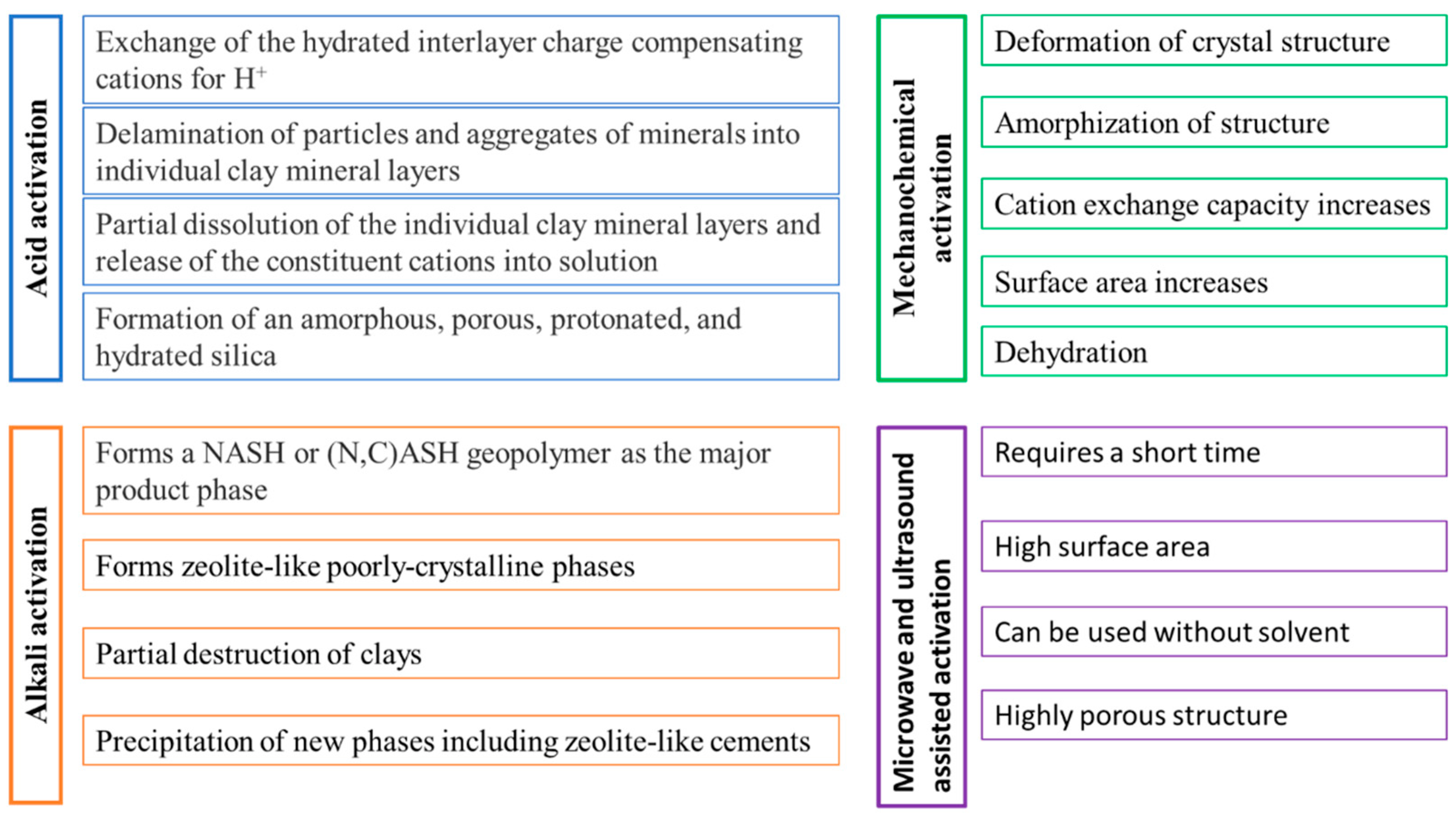
The need for innovative catalysts and catalytic support materials is continually growing due to demanding requirements, stricter environmental demands, and the ongoing development of new chemical processes. Since about 80% of all industrial processes involve catalysts, there is a continuing need to develop new catalyst materials and supports with suitable qualities to meet ongoing industrial demands. Not only must new catalysts have tailored properties, but they must also be suitable for large-scale production through environmentally friendly and cost-effective processes. Clay minerals, with their rich history in medicine and ceramics, are now emerging as potential catalysts. Their transformative potential is exemplified in applications such as hydrogenating the greenhouse gas CO2 into carbohydrate fuel, a crucial step in meeting the rising electrical demand. Moreover, advanced materials derived from clay minerals are proving their mettle in diverse photocatalytic reactions, from organic dye removal to pharmaceutical pollutant elimination and photocatalytic energy conversion through water splitting. Clay minerals in their natural state show a low catalytic activity, so to increase their reactivity, they must be activated. Depending on the requirements of a particular application, selecting an appropriate activation method for modifying a natural clay mineral is a critical consideration. Traditional clay mineral processing methods such as acid or alkaline treatment are used. Still, these have drawbacks such as high costs, long processing times, and the formation of hazardous by-products. Other activation processes, such as ultrasonication and mechanical activation routes, have been proposed to reduce the production of hazardous by-products. The main advantage of ultrasonication and microwave-assisted procedures is that they save time, whereas mechanochemical processing is simple and efficient. This short review focuses on modifying clay minerals using various new methods to create sophisticated and innovative new materials. Recent advances in catalytic reactions are specifically covered, including organic biogeochemical processes, photocatalytic processes, carbon nanotube synthesis, and energy conversion processes such as CO2 hydrogenation and dry reforming of methane.
Keywords: clay minerals; activation; catalyst; photocatalyst; nanomaterial; CNT synthesis clay minerals; activation; catalyst; photocatalyst; nanomaterial; CNT synthesis