Multi-Criteria Decision Support for Fairness-Aware Coordination in Distributed Resource-Constrained Multi-Project Scheduling


Abstract
1. Introduction
2. Literature Review
2.1. Objective Functions and Priority Analysis in RCMPSP and DRCMPSP
2.2. Coordination and Decision Mechanisms in DRCMPSP
2.3. Summary
3. Model Formulation
3.1. Problem Settings and Assumptions
- 1.
- Projects interact only through shared global resources. Precedence relations are defined within each project.
- 2.
- All projects and their arrival times are known when the coordination process begins.
- 3.
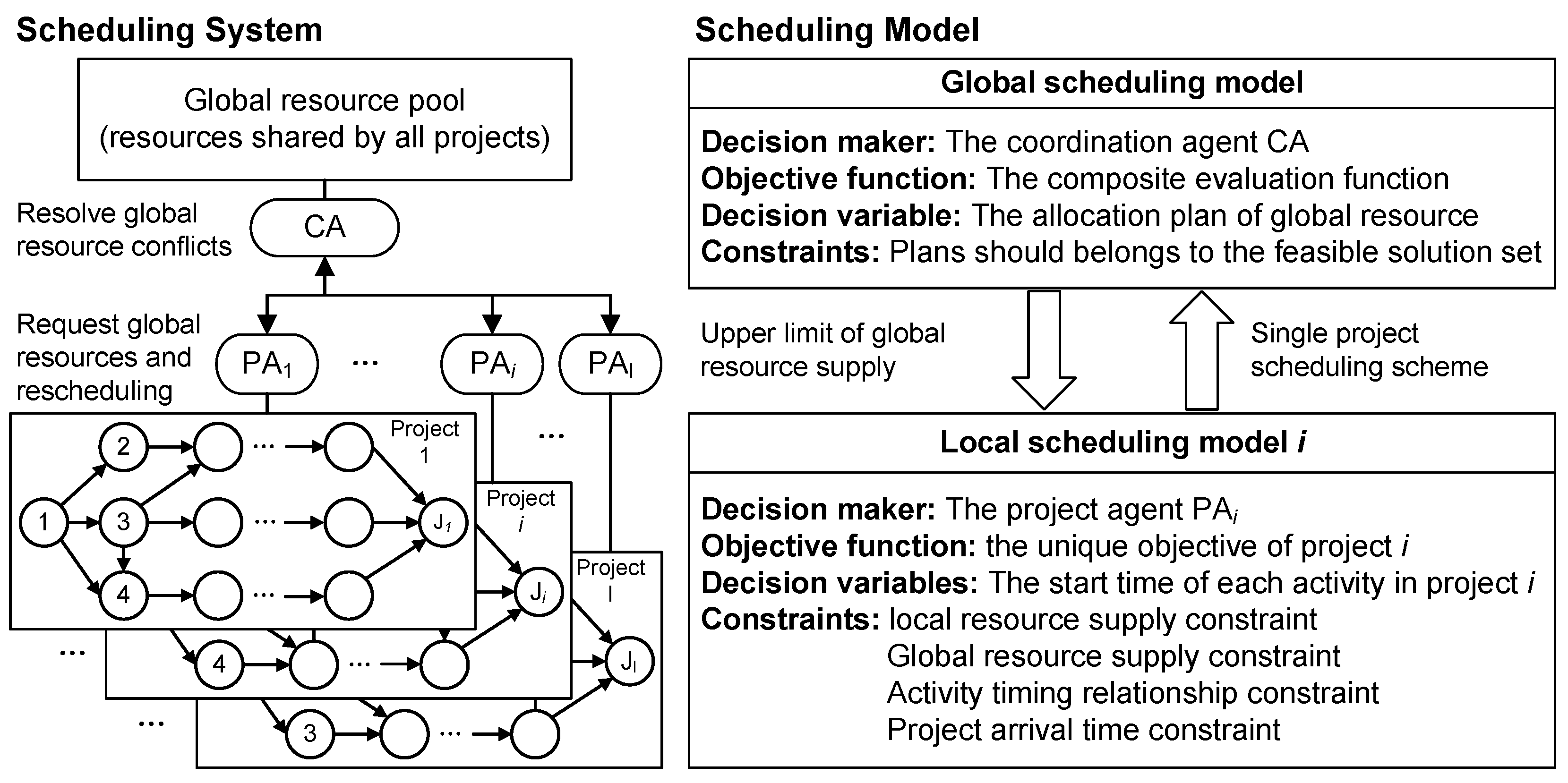
- Local schedules are formulated independently by each PA, whereas the CA enforces aggregate global-resource feasibility.
- 4.
- Resource transfer times and costs between projects are negligible.
- 5.
- Both global and local resources are renewable; their full capacities become available at the start of each period.
- 6.
- Activities are non-preemptive, which means they cannot be interrupted once initiated.
- 7.
- Each activity has a fixed duration and execution mode, and its period-specific resource requirements are known.
3.2. Local Scheduling Model
- 1.
- Minimization of the completion time:.
- 2.
- Minimization of the project duration: .
- 3.
- Minimization of the completion time deviation: .
- 4.
- Minimization of the delay time (Tardiness): .
- 5.
- Minimization of the delay cost: .
3.3. Global Scheduling Model
- 1.
- Selection of the priority project. Based on the current priority rule, the project with the highest priority is selected. The project schedule remains fixed.
- 2.
- Update of global resource availability. The CA updates the daily availability of global resources by deducting the consumption of the selected project. This updated availability information is then transmitted to the PAs of the remaining projects.
- 3.
- Rescheduling of remaining projects. The PAs of the remaining projects perform local rescheduling based on the updated resource constraints. They then report their revised global resource demands and individual project schedules to the CA.
- 4.
- Aggregation of the multi-project schedule. The CA integrates all individual project schedules to form a complete multi-project schedule alternative and calculates the attribute values at the multi-project level.
4. The Two-Stage Algorithm with MCDM Methods
4.1. Framework of the Two-Stage Scheduling Algorithm
| Algorithm 1: Two-Stage Multi-Project Scheduling Algorithm |
 |
- 1.
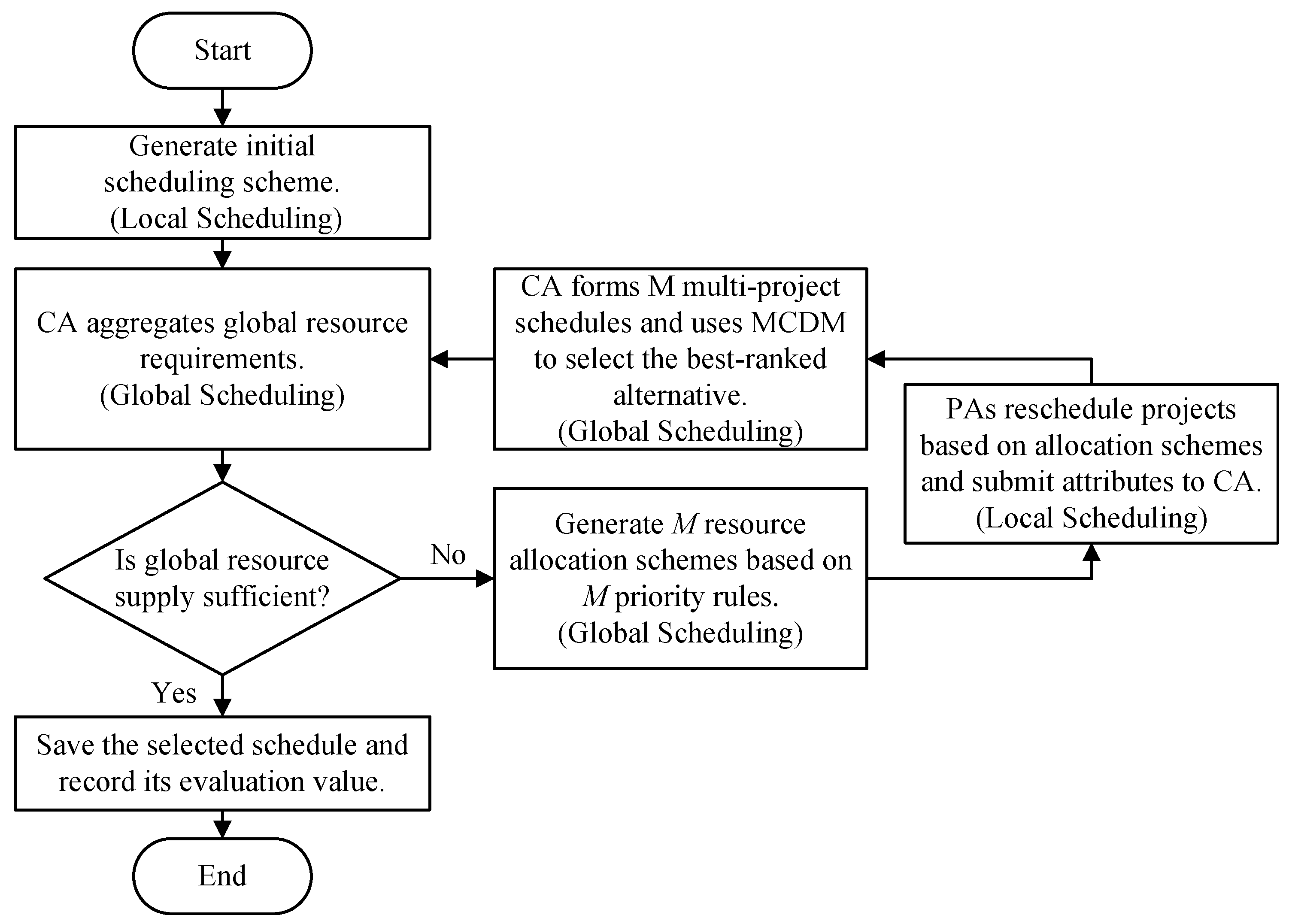
- Step 1: Initial Scheduling (Local Scheduling). Each Project Agent (PA) formulates an initial schedule based on its local resource and activity information and the complete global-resource availability. The resulting schedules are individually feasible but may conflict when combined. Subsequently, the PA reports the project’s global resource demands and attributes values to the Coordination Agent (CA).
- 2.
- Step 2: Multi-Alternative Generation (Global Scheduling). The CA aggregates and inspects the total usage of global resources to identify all dates where total demand exceeds supply. These dates are referred to as resource-conflict days. The CA then generates multiple alternatives for global resource scheduling. For each alternative, the CA calculates the remaining available global resources and transmits this information to the respective PAs. It is important to note that within any given alternative, the schedule of the highest-priority project remains unchanged.
- 3.
- Step 3: Rescheduling (Local Scheduling). Upon receiving the global resource availability information for each alternative, each PA other than the highest-priority PA participating in the current negotiation round reformulates its schedule. This process integrates the local resource constraints with the global limits associated with the alternative. The PAs then report their updated global resource demands for each alternative to the CA.
- 4.
- Step 4: Multi-Criteria Decision-Making (Global Scheduling). The CA calculates for each alternative, retains the alternatives satisfying for all projects, and applies an MCDM method to select the best-ranked schedule from the retained alternatives. Based on the global resource consumption of the highest-priority project in the chosen alternative, the global resource pool is updated. The PA associated with this project then withdraws from subsequent negotiation rounds. Next, the CA determines whether global resource conflicts persist in the new schedule. If conflicts exist, the daily availability of the remaining global resources serves as the constraint for the next round of global scheduling, and the process returns to Step 2 for the remaining PAs to reschedule. If no resource conflicts remain, the schedule derived from the selected alternative is adopted as the final multi-project schedule.
4.2. Local Scheduling Algorithm
- 1.
- Initialization: A population of chromosomes is randomly generated.
- 2.
- Decoding: The SSGS transforms each chromosome into a feasible scheduling scheme.
- 3.
- Evaluation: The objective function value is adopted as the fitness value.
- 4.
- Evolutionary Operations:
- Selection:Tournament selection is applied. Individuals compete in pairs, and the higher-fitness individuals are retained.
- Crossover: Partially matched crossover (PMX) is performed with crossover probability . Two crossover positions delimit the exchanged segments, and the resulting element mappings are used to remove duplicate activity ranks outside the exchanged segments. The offspring therefore remain valid activity-priority permutations.
- Mutation: Adaptive chaotic mutation is applied with a generation-specific probability . A Logistic-map state selects swap, insertion, or inversion after mutation is triggered.
- 5.
- Population Update: An elitist strategy is used to merge parent and offspring populations, preserving the top-ranking individuals for the next generation.
- 6.
- Termination: Steps 2 to 5 are repeated until either the maximum number of iterations or the maximum stagnation generation count is reached.
| Algorithm 2: Chaotic Genetic Algorithm for Local Scheduling |
 |
4.3. Global Scheduling Algorithm
4.3.1. TOPSIS Method-Based Global Scheduling Algorithm
- 1.
- Normalization: The decision matrix is normalized using Equation (11).
- 2.
- Weighted Matrix Construction: The weighted decision matrix is computed, where .
- 3.
- Ideal Solution Determination: The positive ideal solution () and the negative ideal solution () are identified. comprises the lowest cost value for each attribute across all alternatives, while consists of the highest cost values. All attributes are cost criteria, so these are defined in Equation (12) and Equation (13), respectively.
- 4.
- 5.
- Relative Closeness Computation: The relative closeness coefficient is calculated via Equation (16). This metric synthesizes the proximity of an alternative to the positive ideal and its remoteness from the negative ideal. Consequently, multi-project alternatives are ranked in descending order of this value, with the maximum value identifying the best-ranked alternative.
| Algorithm 3: TOPSIS-Based Multi-Project Decision |
 |
4.3.2. CoCoSo Method-Based Global Scheduling Algorithm
| Algorithm 4: CoCoSo-Based Multi-Project Decision |
 |
5. Case Study: Multi-Project Scheduling for UAV Series R&D
- Project 1: Surveying and mapping model. This project demands high flight control stability and data processing capabilities. The client prioritizes the earliest possible completion. The critical path duration is 91 days, the earliest start time is day 0, and the tardiness cost is 42.
- Project 2: Logistics and transport model. The R&D focus lies on the airframe structure and the battery management system. The project manager aims to minimize the project duration. The critical path duration is 121 days, the earliest start time is day 7, and the tardiness cost is 38.
- Project 3: Industrial inspection model. This project emphasizes long endurance and wind resistance performance. The project manager seeks to minimize tardiness. The critical path duration is 110 days, the earliest start time is day 7, and the tardiness cost is 38.
- Project 4: Agricultural plant protection model. This requires specialized software for flight path planning. The investors and managers aim to minimize delay costs. The critical path duration is 97 days, the earliest start time is day 14, and the tardiness cost is 33.
6. Numerical Experiment
6.1. Experimental Design
6.2. Comparison of Algorithm Performance
6.2.1. Comparison of Global Scheduling Algorithms
6.2.2. Comparison of Local Scheduling Algorithms
7. Conclusions
Supplementary Materials
Author Contributions
Funding
Data Availability Statement
Acknowledgments
Conflicts of Interest
Abbreviations
| CA | Coordination Agent |
| CGA | Chaotic Genetic Algorithm |
| CoCoSo | Combined Compromise Solution |
| DMAS/ABN | Distributed Multi-Agent Scheduling/Auction-Based Negotiation |
| DRCMPSP | Distributed Resource-Constrained Multi-Project Scheduling Problem |
| GA | Genetic Algorithm |
| MAS | Multi-Agent Systems |
| MCDM | Multi-Criteria Decision-Making |
| MPSPLIB | Multi-Project Scheduling Problem Library |
| OLF | Overload Factor |
| PA | Project Agent |
| PSO | Particle Swarm Optimization |
| R&D | Research and Development |
| RCMPSP | Resource-Constrained Multi-Project Scheduling Problem |
| SSGS | Serial Schedule Generation Scheme |
| TA-CoCoSo | Two-stage algorithm using CoCoSo for global coordination |
| TA-TOPSIS | Two-stage algorithm using TOPSIS for global coordination |
| TOPSIS | Technique for Order Preference by Similarity to an Ideal Solution |
| UAV | Unmanned Aerial Vehicle |
| WPM | Weighted Product Model |
| WSM | Weighted Sum Model |
Appendix A. Feasibility Preservation of the Two-Stage Coordination Procedure
Appendix B. Dispersion of Relative Deterioration Values

| Subset | TA-TOPSIS | DMAS/ABN | TA-CoCoSo |
|---|---|---|---|
| MP30_5 | 0.1601 | 0.2175 | 0.1656 |
| MP30_10 | 0.9414 | 0.9043 | 0.8795 |
| MP30_20 | 1.5423 | 1.6056 | 1.6086 |
| MP90_5 | 0.6991 | 0.6341 | 0.6621 |
| MP90_10 | 1.0193 | 1.3204 | 1.0289 |
| MP90_20 | 0.7061 | 0.8517 | 0.7136 |
| MP120_5 | 0.6435 | 0.8621 | 0.6161 |
| MP120_10 | 0.8155 | 0.9454 | 0.8039 |
| MP120_20 | 1.0438 | 1.1775 | 1.0713 |
References
- Lu, F.; Yan, T.; Bi, H.; Feng, M.; Wang, S.; Huang, M. A Bilevel Whale Optimization Algorithm for Risk Management Scheduling of Information Technology Projects Considering Outsourcing. Knowl.-Based Syst. 2022, 235, 107600. [Google Scholar] [CrossRef] [Scilit]
- Saygili, M.; Mert, I.E.; Tokdemir, O.B. A Decentralized Structure to Reduce and Resolve Construction Disputes in a Hybrid Blockchain Network. Autom. Constr. 2022, 134, 104056. [Google Scholar] [CrossRef] [Scilit]
- Karsu, Ö.; Morton, A. Inequity Averse Optimization in Operational Research. Eur. J. Oper. Res. 2015, 245, 343–359. [Google Scholar] [CrossRef] [Scilit]
- Zografos, K.G.; Jiang, Y. A Bi-objective Efficiency-Fairness Model for Scheduling Slots at Congested Airports. Transp. Res. Part Emerg. Technol. 2019, 102, 336–350. [Google Scholar] [CrossRef] [Scilit]
- Hao, Q.; Shen, W.; Xue, Y.; Wang, S. Task network-based project dynamic scheduling and schedule coordination. Adv. Eng. Inform. 2010, 24, 417–427. [Google Scholar] [CrossRef] [Scilit]
- Güth, W.; Schmittberger, R.; Schwarze, B. An Experimental Analysis of Ultimatum Bargaining. J. Econ. Behav. Organ. 1982, 3, 367–388. [Google Scholar] [CrossRef] [Scilit]
- Fehr, E.; Schmidt, K.M. A Theory of Fairness, Competition, and Cooperation. Q. J. Econ. 1999, 114, 817–868. [Google Scholar] [CrossRef] [Scilit]
- De Bock, K.W.; Coussement, K.; De Caigny, A.; Słowiński, R.; Baesens, B.; Boute, R.N.; Choi, T.M.; Delen, D.; Kraus, M.; Lessmann, S.; et al. Explainable AI for Operational Research: A Defining Framework, Methods, Applications, and a Research Agenda. Eur. J. Oper. Res. 2024, 317, 249–272. [Google Scholar] [CrossRef] [Scilit]
- Ning, X.; Lu, Y.; Li, W.; Gupta, S. How Transparency Affects Algorithmic Advice Utilization: The Mediating Roles of Trusting Beliefs. Decis. Support Syst. 2024, 183, 114273. [Google Scholar] [CrossRef] [Scilit]
- He, N.; Zhang, D.Z.; Yuce, B. Integrated Multi-Project Planning and Scheduling—A Multiagent Approach. Eur. J. Oper. Res. 2022, 302, 688–699. [Google Scholar] [CrossRef] [Scilit]
- Zhang, L.; Yan, Y.; Yang, C.; Hu, Y. Dynamic flexible job-shop scheduling by multi-agent reinforcement learning with reward-shaping. Adv. Eng. Inform. 2024, 62, 102872. [Google Scholar] [CrossRef] [Scilit]
- Liu, D.; Xu, Z.; Li, F. A Three-Stage Decomposition Algorithm for Decentralized Multi-Project Scheduling under Uncertainty. Comput. Ind. Eng. 2021, 160, 107553. [Google Scholar] [CrossRef] [Scilit]
- Adhau, S.; Mittal, M.L.; Mittal, A. A Multi-Agent System for Decentralized Multi-Project Scheduling with Resource Transfers. Int. J. Prod. Econ. 2013, 146, 646–661. [Google Scholar] [CrossRef] [Scilit]
- Li, F.; Xu, Z.; Li, H. A Multi-Agent Based Cooperative Approach to Decentralized Multi-Project Scheduling and Resource Allocation. Comput. Ind. Eng. 2021, 151, 106961. [Google Scholar] [CrossRef] [Scilit]
- Zheng, Z.; Guo, Z.; Zhu, Y.; Zhang, X. A Critical Chains Based Distributed Multi-Project Scheduling Approach. Neurocomputing 2014, 143, 282–293. [Google Scholar] [CrossRef] [Scilit]
- Yu, Y.; Xu, Z.; Liu, D.; Zhao, S. A Two-Stage Approach with Softmax Scoring Mechanism for a Multi-Project Scheduling Problem Sharing Multi-Skilled Staff. Expert Syst. Appl. 2022, 203, 117385. [Google Scholar] [CrossRef] [Scilit]
- Li, F.; Xu, Z. A Multi-Agent System for Distributed Multi-Project Scheduling with Two-Stage Decomposition. PLoS ONE 2018, 13, e0205445. [Google Scholar] [CrossRef] [Scilit]
- Zhang, X.; Ma, S.; Chen, S. Healthcare service configuration based on project scheduling. Adv. Eng. Inform. 2020, 43, 101039. [Google Scholar] [CrossRef] [Scilit]
- Rooholelm, V.; Sheikh Aboumasoudi, A. Share Determination of Stakeholder Delays, Based on Targeted Delay Analysis of Projects, with Incursive and Defensive (In-De) Approach. Int. J. Manag. Proj. Bus. 2020, 13, 1219–1261. [Google Scholar] [CrossRef] [Scilit]
- Gómez Sánchez, M.; Lalla-Ruiz, E.; Fernández Gil, A.; Castro, C.; Voß, S. Resource-Constrained Multi-Project Scheduling Problem: A Survey. Eur. J. Oper. Res. 2023, 309, 958–976. [Google Scholar] [CrossRef] [Scilit]
- Fink, A.; Homberger, J. An Ant-Based Coordination Mechanism for Resource-Constrained Project Scheduling with Multiple Agents and Cash Flow Objectives. Flex. Serv. Manuf. J. 2013, 25, 94–121. [Google Scholar] [CrossRef] [Scilit]
- Hartmann, S.; Briskorn, D. An Updated Survey of Variants and Extensions of the Resource-Constrained Project Scheduling Problem. Eur. J. Oper. Res. 2022, 297, 1–14. [Google Scholar] [CrossRef] [Scilit]
- Jiang, X.; Lee, K.; Pinedo, M.L. Ideal Schedules in Parallel Machine Settings. Eur. J. Oper. Res. 2021, 290, 422–434. [Google Scholar] [CrossRef] [Scilit]
- Zhu, L.; Lin, J.; Li, Y.Y.; Wang, Z.J. A Decomposition-Based Multi-Objective Genetic Programming Hyper-Heuristic Approach for the Multi-Skill Resource Constrained Project Scheduling Problem. Knowl.-Based Syst. 2021, 225, 107099. [Google Scholar] [CrossRef] [Scilit]
- Rodríguez-Ballesteros, S.; Alcaraz, J.; Anton-Sanchez, L. Metaheuristics for the Bi-Objective Resource-Constrained Project Scheduling Problem with Time-Dependent Resource Costs: An Experimental Comparison. Comput. Oper. Res. 2024, 163, 106489. [Google Scholar] [CrossRef] [Scilit]
- Liu, Y.; Ding, R.; Liu, S.; Wang, L. Multi-Skilled Project Scheduling for High-End Equipment Development Considering Newcomer Cultivation and Duration Uncertainty. Systems 2025, 13, 448. [Google Scholar] [CrossRef] [Scilit]
- Shi, J.; Lou, H.; Shen, X.; Xu, J. Multi-Team Agile Software Project Scheduling Using Dual-Indicator Group Learning Particle Swarm Optimization. Symmetry 2025, 17, 1267. [Google Scholar] [CrossRef] [Scilit]
- Kolisch, R. Efficient Priority Rules for the Resource-Constrained Project Scheduling Problem. J. Oper. Manag. 1996, 14, 179–192. [Google Scholar] [CrossRef] [Scilit]
- Chand, S.; Quang, H.; Singh, H.; Ray, T.; Wagner, M. On the Use of Genetic Programming to Evolve Priority Rules for Resource Constrained Project Scheduling Problems. Inf. Sci. 2018, 432, 146–163. [Google Scholar] [CrossRef] [Scilit]
- Chen, Z.; Demeulemeester, E.; Bai, S.; Guo, Y. Efficient Priority Rules for the Stochastic Resource-Constrained Project Scheduling Problem. Eur. J. Oper. Res. 2018, 270, 957–967. [Google Scholar] [CrossRef] [Scilit]
- Bertsimas, D.; Farias, V.F.; Trichakis, N. The Price of Fairness. Oper. Res. 2011, 59, 17–31. [Google Scholar] [CrossRef] [Scilit]
- Yu, J.; Liu, P.; Lu, X.; Gu, M. Analyzing the Price of Fairness in Scheduling Problems with Two Agents. Eur. J. Oper. Res. 2025, 321, 750–759. [Google Scholar] [CrossRef] [Scilit]
- Chen, V.X.; Hooker, J.N. A Guide to Formulating Fairness in an Optimization Model. Ann. Oper. Res. 2023, 326, 581–619. [Google Scholar] [CrossRef] [Scilit]
- Dauzère-Pérès, S.; Ding, J.; Shen, L.; Tamssaouet, K. The Flexible Job Shop Scheduling Problem: A Review. Eur. J. Oper. Res. 2024, 314, 409–432. [Google Scholar] [CrossRef] [Scilit]
- Song, W.; Kang, D.; Zhang, J.; Xi, H. A Multi-Unit Combinatorial Auction Based Approach for Decentralized Multi-Project Scheduling. Auton. Agents Multi-Agent Syst. 2017, 31, 1548–1577. [Google Scholar] [CrossRef] [Scilit]
- Homberger, J.; Fink, A. Generic Negotiation Mechanisms with Side Payments—Design, Analysis and Application for Decentralized Resource-Constrained Multi-Project Scheduling Problems. Eur. J. Oper. Res. 2017, 261, 1001–1012. [Google Scholar] [CrossRef] [Scilit]
- Tosselli, L.; Bogado, V.; Martínez, E. A Repeated-Negotiation Game Approach to Distributed (Re)Scheduling of Multiple Projects Using Decoupled Learning. Simul. Model. Pract. Theory 2020, 98, 101980. [Google Scholar] [CrossRef] [Scilit]
- Monghasemi, S.; Nikoo, M.R.; Khaksar Fasaee, M.A.; Adamowski, J. A Novel Multi Criteria Decision Making Model for Optimizing Time–Cost–Quality Trade-off Problems in Construction Projects. Expert Syst. Appl. 2015, 42, 3089–3104. [Google Scholar] [CrossRef] [Scilit]
- Kebriyaii, O.; Heidari, A.; Khalilzadeh, M.; Antucheviciene, J.; Pavlovskis, M. Application of Three Metaheuristic Algorithms to Time-Cost-Quality Trade-Off Project Scheduling Problem for Construction Projects Considering Time Value of Money. Symmetry 2021, 13, 2402. [Google Scholar] [CrossRef] [Scilit]
- Wauters, T.; Verbeeck, K.; De Causmaecker, P.; Vanden Berghe, G. A Learning-Based Optimization Approach to Multi-Project Scheduling. J. Sched. 2015, 18, 61–74. [Google Scholar] [CrossRef] [Scilit]
- Wang, X.; Lu, S.; Qian, X.; Hu, C.; Liu, X. Dynamic Scheduling of Decentralized High-End Equipment R&D Projects via Deep Reinforcement Learning. Comput. Ind. Eng. 2024, 190, 110018. [Google Scholar] [CrossRef] [Scilit]
- Brucker, P.; Drexl, A.; Möhring, R.H.; Neumann, K.; Pesch, E. Resource-constrained project scheduling: Notation, classification, models, and methods. Eur. J. Oper. Res. 1999, 112, 3–41. [Google Scholar] [CrossRef] [Scilit]
- Geibinger, T.; Mischek, F.; Musliu, N. Investigating constraint programming and hybrid methods for real world industrial test laboratory scheduling. J. Sched. 2024, 27, 607–622. [Google Scholar] [CrossRef] [Scilit]
- Lenstra, J.K.; Kan, A.H.G.R. Complexity of Scheduling under Precedence Constraints. Oper. Res. 1978, 26, 22–35. [Google Scholar] [CrossRef] [Scilit]
- Sprecher, A.; Kolisch, R.; Drexl, A. Semi-Active, Active, and Non-Delay Schedules for the Resource-Constrained Project Scheduling Problem. Eur. J. Oper. Res. 1995, 80, 94–102. [Google Scholar] [CrossRef] [Scilit]
- Kabak, Ö.; Ervural, B. Multiple Attribute Group Decision Making: A Generic Conceptual Framework and a Classification Scheme. Knowl.-Based Syst. 2017, 123, 13–30. [Google Scholar] [CrossRef] [Scilit]
- Bernasconi, M.; Choirat, C.; Seri, R. Empirical Properties of Group Preference Aggregation Methods Employed in AHP: Theory and Evidence. Eur. J. Oper. Res. 2014, 232, 584–592. [Google Scholar] [CrossRef] [Scilit]
- Zuheros, C.; Martínez-Cámara, E.; Herrera-Viedma, E.; Katib, I.A.; Herrera, F. Explainable Crowd Decision Making Methodology Guided by Expert Natural Language Opinions Based on Sentiment Analysis with Attention-Based Deep Learning and Subgroup Discovery. Inf. Fusion 2023, 97, 101821. [Google Scholar] [CrossRef] [Scilit]
- Behzadian, M.; Khanmohammadi Otaghsara, S.; Yazdani, M.; Ignatius, J. A State-of the-Art Survey of TOPSIS Applications. Expert Syst. Appl. 2012, 39, 13051–13069. [Google Scholar] [CrossRef] [Scilit]
- Yazdani, M.; Zarate, P.; Kazimieras Zavadskas, E.; Turskis, Z. A Combined Compromise Solution (CoCoSo) Method for Multi-Criteria Decision-Making Problems. Manag. Decis. 2019, 57, 2501–2519. [Google Scholar] [CrossRef] [Scilit]
- Homberger, J. A Multi-Agent System for the Decentralized Resource-Constrained Multi-Project Scheduling Problem. Int. Trans. Oper. Res. 2007, 14, 565–589. [Google Scholar] [CrossRef] [Scilit]
- Homberger, J. A (μ, λ)-Coordination Mechanism for Agent-Based Multi-Project Scheduling. OR Spectr. 2012, 34, 107–132. [Google Scholar] [CrossRef] [Scilit]
- Adhau, S.; Mittal, M.L.; Mittal, A. A Multi-Agent System for Distributed Multi-Project Scheduling: An Auction-Based Negotiation Approach. Eng. Appl. Artif. Intell. 2012, 25, 1738–1751. [Google Scholar] [CrossRef] [Scilit]


| Global Scheduling Mechanism | Objectives | Local Scheduling Method | Problem Instances | Literature |
|---|---|---|---|---|
| An iterative negotiation mechanism based on tentative contract | Minimizing the discounted cash flow | A genetic algorithm | PSPLib | Homberger and Fink [36] |
| A simple sequence learning game | Minimizing the average project delay and the total makespan | A reinforcement learning algorithm | MPSPLIB | Wauters et al. [40] |
| A sequential game-based negotiation mechanism | Minimizing total tardiness cost | A forward-backward hybrid genetic algorithm | MPSPLIB | Li and Xu [17] |
| A repeated-negotiation non-cooperative game | Minimizing makespan and schedule total cost | Agent-based simulation | A case study | Tosselli et al. [37] |
| A priority-based task-scoring mechanism | Minimizing the average project delay | A genetic algorithm with forward and backward scheduling | MPSPLIB | Liu et al. [12] |
| A Markov decision process modeling | Minimizing the total makespan | An up-to-date deep reinforcement learning algorithm | Eighteen instances | Wang et al. [41] |
| A multi-criteria decision-making method | Minimizing distinct progress and cost objectives | A chaotic genetic algorithm | MPSPLIB | This study. |
| Notation | Description |
|---|---|
| Sets and Indices | |
| Set of projects. | |
| i | Index of project, . |
| Set of activities in project i, . | |
| Number of non-dummy activities in project i. | |
| Zero-duration dummy start and dummy end activities of project i, respectively. | |
| j | Index of activity in project i, . |
| t | Index of time period (day), . |
| Set of local resources of project i. | |
| l | Index of local resource, . |
| Set of global resources shared by the projects. | |
| g | Index of global resource, . |
| Parameters | |
| Activity j of project i. | |
| Duration of activity . | |
| Set of immediate predecessors of activity . | |
| Arrival time of project i. | |
| Due-date allowance measured from project arrival; its absolute due date is . | |
| Absolute due date of project i, . | |
| Unit delay cost of project i. | |
| Positive project-specific reference total delay cost. | |
| Objective value and duration of project i in its initial independent schedule. | |
| Maximum allowable relative deterioration in a project objective. | |
| Availability of local resource l for project i at time t. | |
| Complete availability of global resource g at time t. | |
| Remaining availability after deducting the demand of fixed projects. | |
| Demand for local resource l by activity . | |
| Demand for global resource g by activity . | |
| Indicator function, equal to 1 when its condition holds and 0 otherwise. | |
| Decision Variables & Outcomes | |
| Integer start time of activity . | |
| Finish time derived as . | |
| Finish time of project i. | |
| Duration of project i. | |
| Completion-time deviation of project i. | |
| Tardiness (delay time) of project i. | |
| Total delay cost of project i. | |
| Priority Rules & Evaluation | |
| Set of priority scheduling rules. | |
| m | Index of priority rule, . |
| Multi-project schedule generated by rule m. | |
| Relative objective deterioration of project i under schedule . | |
| Set of attributes for schedule evaluation. | |
| n | Index of attribute. |
| Number of PAs adopting the objective corresponding to attribute n. | |
| Weight of attribute n. | |
| W | Set of attribute weights. |
| Multi-criteria evaluation function. |
| Priority Rule | Direction | Priority Index |
|---|---|---|
| Earliest Project Completion Time | min | |
| Shortest Project Duration | min | |
| Maximum Deviation | max | |
| Maximum Delay Time | max | |
| Maximum Delay Cost | max |
| Attribute | Notation | Formulation | Description |
|---|---|---|---|
| Multi-project makespan | MFT | Maximum finish time among all projects | |
| Total project duration | MPD | Sum of individual project durations | |
| Total due-date deviation | MPTD | Cumulative deviation from due dates | |
| Total delay time | MDT | Total accumulated delay time | |
| Total delay cost | MDC | Total accumulated delay cost |
| Method | TOPSIS | CoCoSo |
|---|---|---|
| Ranking Basis | Determines ranking based on the Euclidean distance of each alternative from the positive ideal and negative ideal solutions. | Integrates the Weighted Sum and Weighted Product models, employing a compromise coefficient to formulate a unified solution. |
| Compensation | Weak compensation: Offsetting extreme disadvantages solely through Euclidean distance measures is challenging. | Structured compromise: Balances complete and weak compensation mechanisms to provide a middle-ground solution. |
| Compromise emphasis | Adheres to the weakest link principle, where the performance of an alternative is constrained by its poorest criterion. | Balances the maximization of utility with the avoidance of weakest links. |
| Tendency | Prefers alternatives with no significant weaknesses. | Prefers robust solutions, thereby mitigating the impact of extreme values. |
| MFT | MPD | MDT | MDC | |
|---|---|---|---|---|
| Alternative 1 | 157 | 492 | 122 | 4840 |
| Alternative 2 | 157 | 492 | 122 | 3471 |
| Alternative 3 | 146 | 456 | 86 | 3427 |
| Alternative 4 | 146 | 455 | 85 | 3471 |
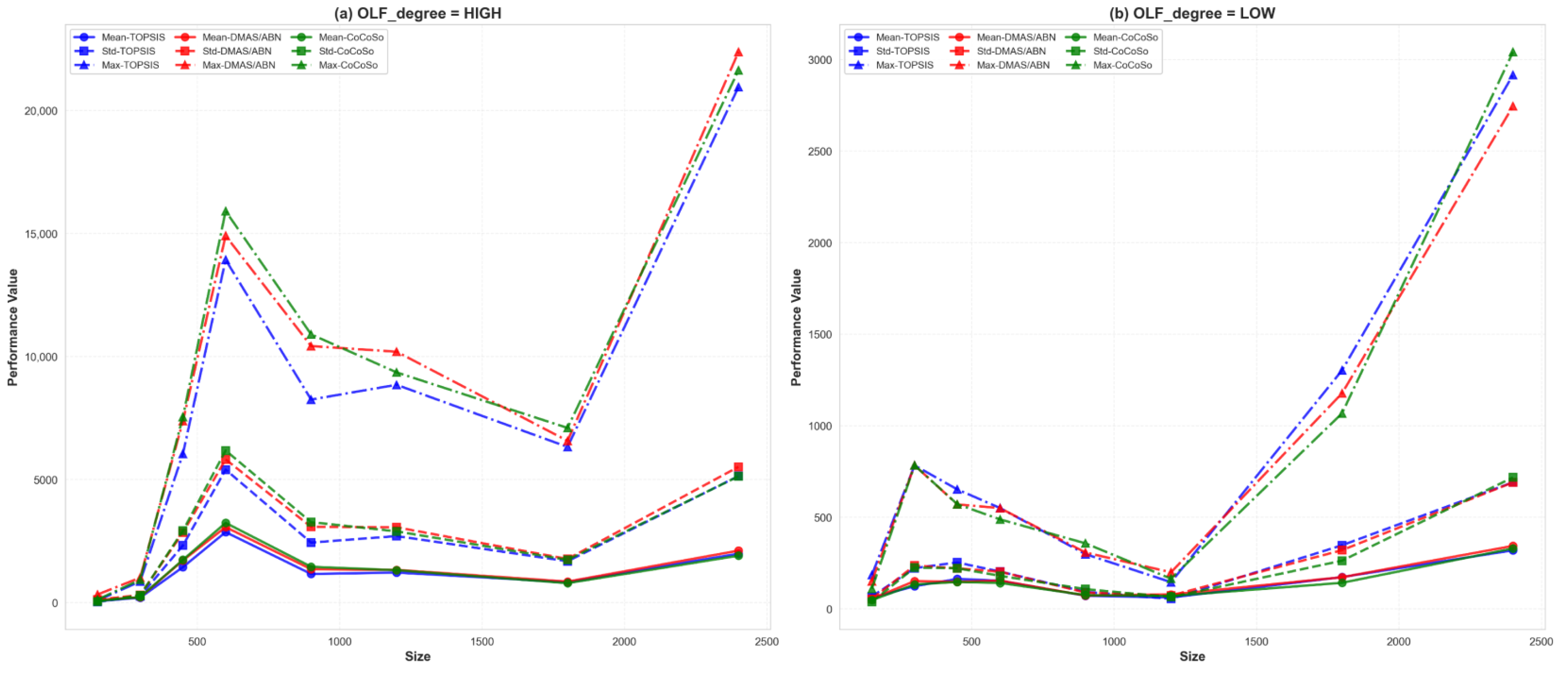
| Problem Subset | Number of Instances | Number of Projects | Number of Activities | Problem Size | Average OLF |
|---|---|---|---|---|---|
| MP30_5 | 5 | 5 | 30 | 150 | 0.826 |
| MP30_10 | 5 | 10 | 30 | 300 | 2.380 |
| MP30_20 | 5 | 20 | 30 | 600 | 3.370 |
| MP90_5 | 15 | 5 | 90 | 450 | 3.532 |
| MP90_10 | 15 | 10 | 90 | 900 | 2.949 |
| MP90_20 | 15 | 20 | 90 | 1800 | 2.009 |
| MP120_5 | 15 | 5 | 120 | 600 | 2.974 |
| MP120_10 | 15 | 10 | 120 | 1200 | 2.383 |
| MP120_20 | 15 | 20 | 120 | 2400 | 2.723 |
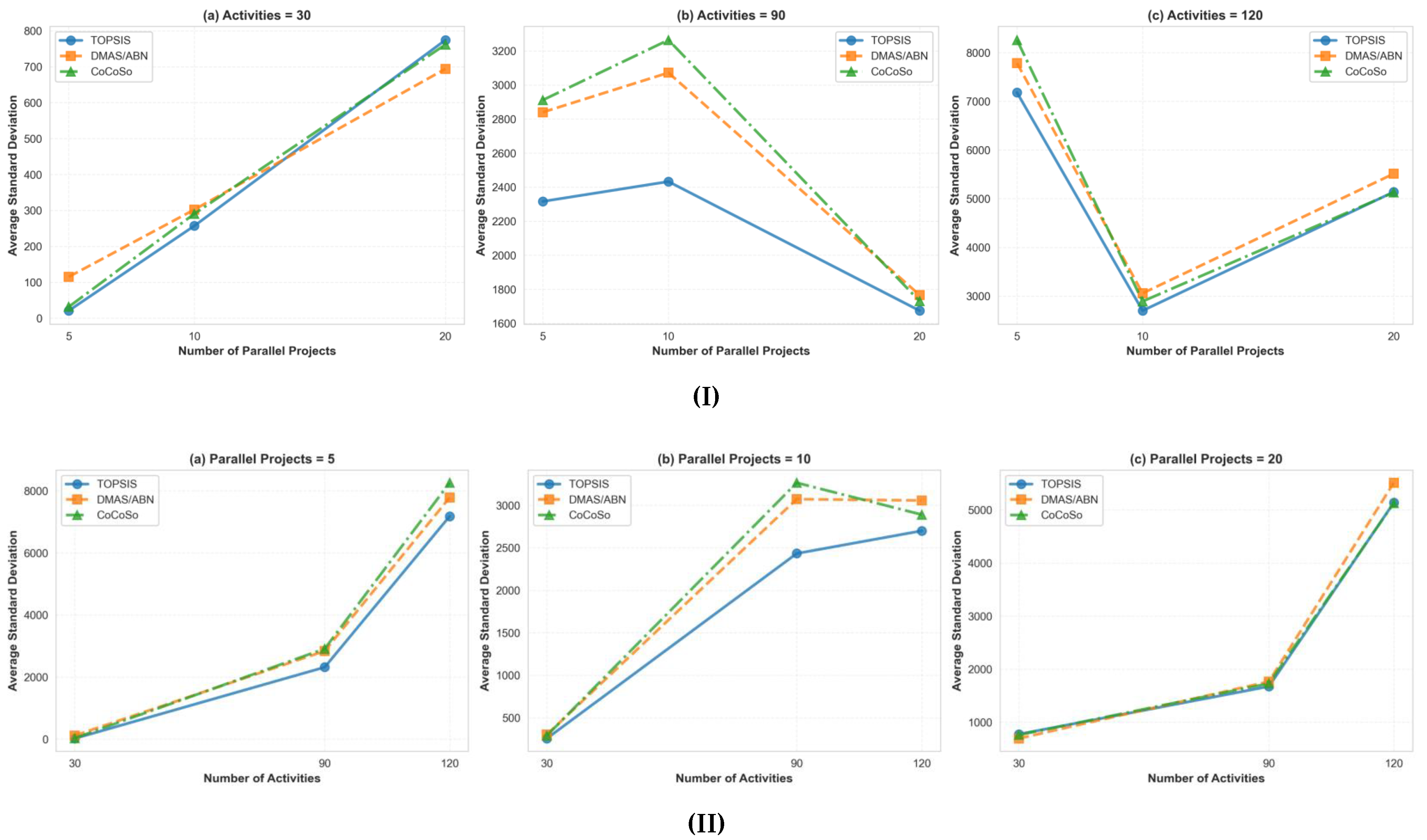
| Mean | Std | Max | ||||||||||
|---|---|---|---|---|---|---|---|---|---|---|---|---|
| Subset | TOPSIS | DMAS/ABN | CoCoSo | Gap | TOPSIS | DMAS/ABN | CoCoSo | Gap | TOPSIS | DMAS/ABN | CoCoSo | Gap |
| MP30_5 | 57.0 | 73.5 | 53.9 | 5.8% | 48.2 | 78.2 | 35.0 | 37.7% | 141.5 | 218.2 | 111.0 | 27.5% |
| MP30_10 | 180.6 | 200.9 | 202.3 | 0 | 250.1 | 289.0 | 277.4 | 0 | 840.8 | 962.2 | 895.0 | 0% |
| MP30_20 | 470.4 | 439.7 | 447.2 | 7.0% | 774.4 | 694.1 | 761.7 | 11.6% | 2993.8 | 2603.6 | 3132.4 | 15.0% |
| MP90_5 | 1011.3 | 1186.7 | 1202.9 | 0 | 1628.3 | 1966.9 | 2014.8 | 0 | 4244.3 | 5105.1 | 5219.7 | 0% |
| MP90_10 | 1013.5 | 1181.1 | 1268.3 | 0 | 2120.5 | 2674.2 | 2843.4 | 0 | 7188.2 | 9073.4 | 9492.7 | 0% |
| MP90_20 | 564.3 | 577.0 | 527.2 | 6.0% | 1143.1 | 1187.7 | 1143.2 | 0 | 4313.9 | 4412.5 | 4683.5 | 0% |
| MP120_5 | 3295.7 | 3549.8 | 3753.2 | 0 | 6249.1 | 6772.4 | 7181.8 | 0 | 15,789.4 | 17,091.1 | 18,112.4 | 0% |
| MP120_10 | 1138.7 | 1240.7 | 1228.9 | 0 | 2522.7 | 2857.0 | 2701.3 | 0 | 8267.5 | 9526.7 | 8739.6 | 0% |
| MP120_20 | 1426.8 | 1519.4 | 1377.1 | 3.6% | 3656.4 | 3905.1 | 3657.6 | 0 | 14,939.0 | 15,829.9 | 15,432.9 | 0% |
| OLF Degree | Metric | No. of Inst. | vs. DMAS/ABN | vs. CoCoSo | ||
|---|---|---|---|---|---|---|
| p-Value | Sig. | p-Value | Sig. | |||
| ALL | Mean | 105 | 0.0124 | * | 0.0431 | * |
| Std | 105 | 0.0217 | * | 0.0325 | * | |
| Max | 105 | 0.0566 | ns | 0.0300 | * | |
| HIGH | Mean | 80 | 0.0141 | * | 0.0123 | * |
| Std | 80 | 0.0073 | ** | 0.0067 | ** | |
| Max | 80 | 0.0151 | * | 0.0088 | ** | |
| LOW | Mean | 25 | 0.7103 | ns | 0.0768 | ns |
| Std | 25 | 0.3458 | ns | 0.0424 | * | |
| Max | 25 | 0.1454 | ns | 0.1592 | ns | |
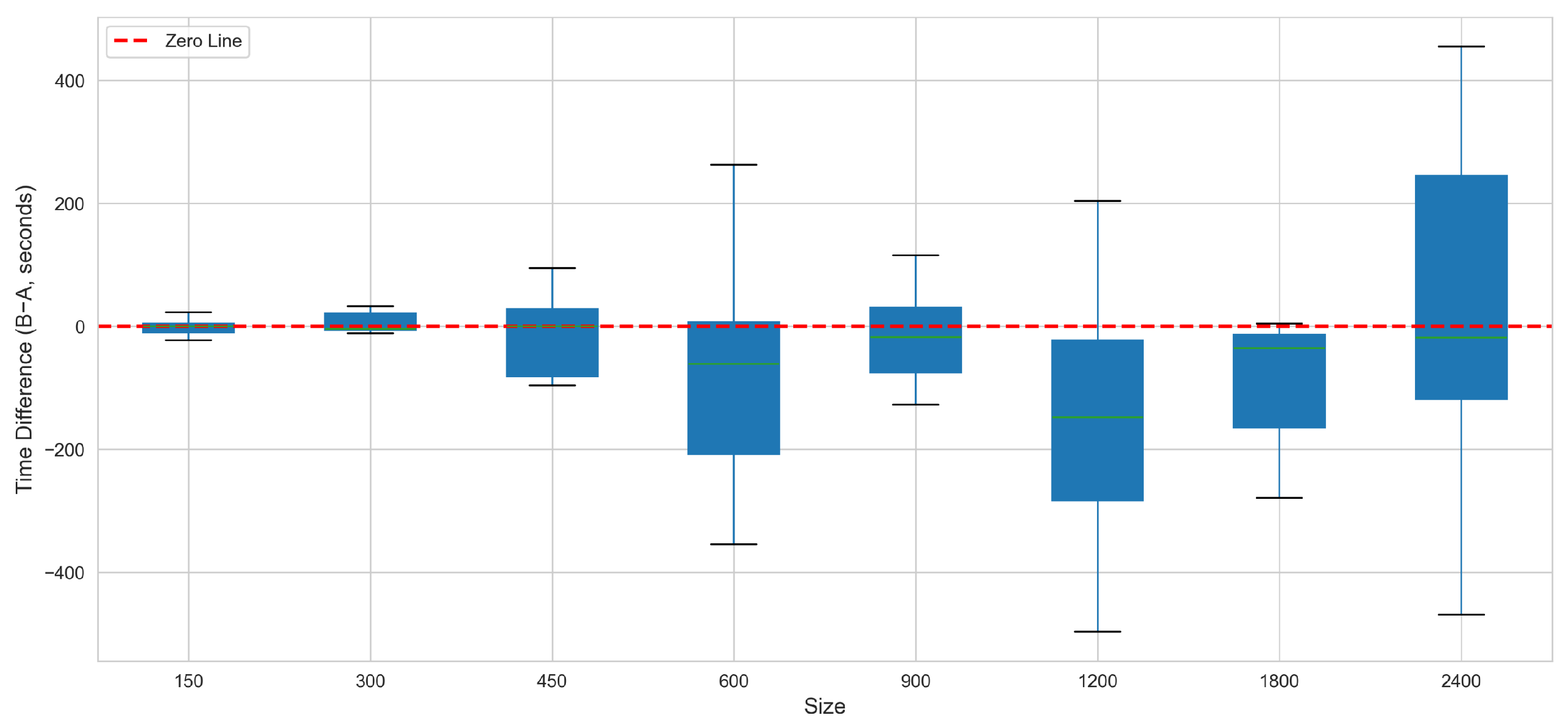
| OLF | Number of Activities | Run Time of GA | Run Time of PSO | Run Time of CGA | Gap | Significance |
|---|---|---|---|---|---|---|
| HIGH | 30 | 575.6 | 602.3 | 581.1 | 0.95% | ns |
| HIGH | 90 | 1944.6 | 1937.4 | 1893.3 | 0 | ** |
| HIGH | 120 | 3856.0 | 4232.6 | 3740.7 | 0 | ** |
| LOW | 30 | 96.9 | 101.2 | 97.7 | 0.8% | ns |
| LOW | 90 | 1092.6 | 1165.2 | 1091.9 | 0 | ns |
| LOW | 120 | 5556.2 | 5442.9 | 5387.7 | 0 | ns |
Disclaimer/Publisher’s Note: The statements, opinions and data contained in all publications are solely those of the individual author(s) and contributor(s) and not of MDPI and/or the editor(s). MDPI and/or the editor(s) disclaim responsibility for any injury to people or property resulting from any ideas, methods, instructions or products referred to in the content. |
© 2026 by the authors. Licensee MDPI, Basel, Switzerland. This article is an open access article distributed under the terms and conditions of the Creative Commons Attribution (CC BY) license.
Share and Cite
Yang, Z.; Wang, X.; Wang, J.; Wang, Y.; Li, L. Multi-Criteria Decision Support for Fairness-Aware Coordination in Distributed Resource-Constrained Multi-Project Scheduling. Symmetry 2026, 18, 1426. https://doi.org/10.3390/sym18091426
Yang Z, Wang X, Wang J, Wang Y, Li L. Multi-Criteria Decision Support for Fairness-Aware Coordination in Distributed Resource-Constrained Multi-Project Scheduling. Symmetry. 2026; 18(9):1426. https://doi.org/10.3390/sym18091426
Chicago/Turabian StyleYang, Zheng, Xiaokang Wang, Jianqiang Wang, Yujue Wang, and Lin Li. 2026. "Multi-Criteria Decision Support for Fairness-Aware Coordination in Distributed Resource-Constrained Multi-Project Scheduling" Symmetry 18, no. 9: 1426. https://doi.org/10.3390/sym18091426
APA StyleYang, Z., Wang, X., Wang, J., Wang, Y., & Li, L. (2026). Multi-Criteria Decision Support for Fairness-Aware Coordination in Distributed Resource-Constrained Multi-Project Scheduling. Symmetry, 18(9), 1426. https://doi.org/10.3390/sym18091426