Article

Effects of a Futsal-Specific Preventive Program on Interlimb Asymmetry and Injury Risk in Youth Male Futsal Players

by
Oscar Villanueva-Guerrero
1,
Bruno Travassos
2,
Rafael Albalad-Aiguabella
1 and
Elena Mainer-Pardos
1,*
1
Health Sciences Faculty, Universidad San Jorge, Autovía A23 km 299, Villanueva de Gállego, 50830 Zaragoza, Spain
2
Portugal Football School, Portuguese Football Federation, 1495-433 Oeiras, Portugal
*
Author to whom correspondence should be addressed.
Symmetry 2026, 18(9), 1425; https://doi.org/10.3390/sym18091425
Submission received: 7 July 2026 / Revised: 21 August 2026 / Accepted: 25 August 2026 / Published: 26 August 2026

Abstract

Interlimb asymmetry is relevant for monitoring neuromuscular function in athletes, but evidence on futsal-specific preventive strategies in youth players remains limited. This study examined the effects of a 20-week Futsal Preventive Program (FPP) on functional interlimb asymmetry and explored injury risk during a 9-month surveillance period. Sixty-seven youth male outfield players completed pre- and post-intervention assessments (control group, n = 36; experimental group, n = 31), while 79 players were included in the injury-risk analysis (control group, n = 41; experimental group, n = 38). The experimental group performed a 15 min neuromuscular warm-up weekly, while the control group continued its usual warm-up. Asymmetry was assessed using countermovement jump (CMJ), horizontal jump (HJ), and 505 change-of-direction (COD 505) tests. The program produced a task-specific reduction in COD 505 asymmetry compared with the control group (cluster-adjusted difference = −1.27 percentage points; 95% CI: −2.00 to −0.53; Bonferroni-adjusted p = 0.03), whereas no significant intervention effects were observed for CMJ or HJ asymmetry. Across the full 9-month surveillance period, the crude cumulative injury-risk estimate was RR = 0.92 (95% CI: 0.59–1.45), with the confidence interval including the null value. These findings support a task-specific effect of the FPP on COD 505 asymmetry, without evidence of corresponding effects on CMJ or HJ asymmetry. Injury findings were descriptive and hypothesis-generating and do not establish preventive efficacy. Further studies with a larger number of randomized teams, greater weekly intervention exposure, and individual training and match exposure monitoring are warranted to clarify potential effects on injury incidence.

1. Introduction

Futsal is a high-intensity intermittent team sport played in a 5-a-side format, in which players repeatedly perform sprints, accelerations, decelerations, and changes of direction (COD), generally interspersed with brief recovery periods [1,2]. Previous studies in elite futsal have shown that players are exposed to substantial external loads during official matches, with frequent high-intensity accelerations, decelerations, explosive movements, and position-dependent peak demands [3,4]. In professional players competing in the Spanish First Division and monitored across 20 official matches, 73.3 ± 13.8 high-intensity accelerations, 68.6 ± 18.8 high-intensity decelerations, and 173.0 ± 29.1 high-intensity COD were recorded per match [4]. These considerable mechanical and multidirectional demands require high levels of speed, strength, and lower-limb power, together with the ability to repeatedly perform high-intensity efforts [1,4,5]. Furthermore, during official professional futsal matches, players use the dominant limb more frequently and accurately in technical actions such as passing, shooting, and receiving the ball [6]. This repeated exposure to high-intensity and multidirectional actions, together with the preferential use of one lower limb during technical actions, may expose the two limbs to different mechanical and neuromuscular stimuli and contribute to the development of interlimb asymmetries [7,8]. Interlimb asymmetry refers to differences in functional or neuromuscular performance between the lower limbs [9]. Because the magnitude and direction of these differences may vary according to the task assessed, their evaluation using different functional tests is particularly relevant in multidirectional sports such as futsal [10]. The relevance of interlimb asymmetry in sport has been primarily investigated because of its potential relationship with physical performance and injury occurrence [11,12,13].
Regarding performance, a meta-analysis showed that greater asymmetries assessed through unilateral jump tests were weakly but significantly associated with poorer sprint and COD performance [14]. In addition, longitudinal evidence in elite male academy soccer players has shown that these associations may vary across the competitive season, with end-season drop-jump asymmetry being significantly associated with 10 m sprint and COD 505 performance [15]. Although no universal cut-off has been established for defining a clinically or practically relevant asymmetry, threshold-based approaches may help practitioners identify players with potentially meaningful individual asymmetry profiles. The >10% absolute asymmetry threshold used in the present study was therefore considered a pragmatic reference value rather than a validated clinical or injury-risk cut-off, as no specific threshold has been established for youth futsal players. Accordingly, threshold-based outcomes were treated as complementary and exploratory [10,14].
From an injury perspective, the available evidence remains less conclusive. A systematic review of prospective studies reported highly inconsistent findings and indicated that interlimb asymmetry should not be interpreted in isolation as a direct predictor of injury because of the heterogeneity in the tests employed, the populations examined, and the definitions of injury used [12]. Nevertheless, among youth team-sport athletes, greater unilateral countermovement jump (CMJ) asymmetries at the beginning of the season have been prospectively associated with a higher subsequent injury incidence [9]. Futsal-specific evidence remains limited. López-Fernández et al. observed morphological and neuromuscular asymmetries between limbs in sub-elite male futsal players, whereas elite players showed no significant between-limb differences in lower-limb morphology, balance performance, or neuromuscular contractile properties [8]. Villanueva-Guerrero et al. found no positional differences in functional interlimb asymmetries among elite youth futsal players, reinforcing importance of evaluating interlimb asymmetries on an individual basis [16]. However, these studies used observational designs and therefore cannot determine whether a specific intervention can modify interlimb asymmetries or their potential relationship with injury occurrence in youth futsal players.
In this context, integrated neuromuscular training programs may represent an effective strategy to simultaneously enhance physical performance and reduce injury risk in futsal. A meta-analysis in futsal showed that training programs incorporating strength, plyometric, and high-intensity exercise significantly improve vertical jump performance, linear speed, and repeated-sprint ability [17]. From a preventive perspective, futsal-specific literature indicates that structured warm-ups and integrated programs combining strength, core stability, mobility, and proprioceptive exercises may contribute to reducing injury risk [18,19]. This approach is particularly relevant in youth players because the injury epidemiology of U19 futsal is characterized by a clear predominance of lower-limb injuries, especially those affecting the ankle and knee, as well as muscle/tendon and ligament injuries [20]. Accordingly, the program implemented in the present study was designed on the basis of evidence regarding the physical demands, training strategies, and injury epidemiology of youth futsal. It incorporated mobility exercises, lower-limb and core-strengthening exercises, plyometric activities, and agility and COD tasks. Exercise selection was also intended to address functional deficits that may be relevant in futsal, particularly neuromuscular control, unilateral force production and absorption, and the ability to perform high-intensity multidirectional actions. Unilateral exercises were included to provide specific stimuli to each limb, as a systematic review with meta-analysis showed that training interventions can produce small-to-moderate reductions in functional interlimb asymmetries [21]. In this regard, interventions conducted in youth team-sport athletes have shown that unilateral training can reduce between-limb asymmetries [22], while unilateral eccentric-overload training has reduced functional jumping asymmetries in youth soccer players [23]. However, most intervention studies have focused on jump-based asymmetry outcomes in soccer or other team sports, whereas less is known about whether a futsal-specific neuromuscular warm-up can reduce the proportion of players exceeding practically relevant asymmetry thresholds across jump and COD tasks.
Despite the growing interest in interlimb asymmetries and preventive programs in team sports, to the best of our knowledge, no study has examined whether a neuromuscular preventive program specifically designed for futsal can modify functional interlimb asymmetries while simultaneously exploring its potential influence on injury risk in youth male players. Therefore, the primary aim of the present study was to examine the effects of a futsal-specific preventive program on interlimb asymmetries in youth male futsal players. A secondary aim was to explore injury risk in the intervention and control groups during a 9-month prospective injury-surveillance period. A complementary aim was to describe the proportion of players exceeding a pragmatic >10% absolute asymmetry threshold before and after the intervention and to explore whether baseline threshold asymmetry was associated with subsequent injury occurrence. It was hypothesized that the program would reduce interlimb asymmetries. Given the exploratory nature of the injury-risk and threshold-based analyses, no specific directional hypothesis was established for these outcomes.

2. Materials and Methods

2.1. Participants

A total of 79 highly trained male youth outfield futsal players were recruited for this study and prospectively monitored for injury occurrence throughout the competitive season. Of these, 67 players successfully completed both pre- and post-intervention assessments and were included in the interlimb asymmetry analysis (age: 17.2 ± 0.8 years; height: 176.1 ± 5.8 cm; body mass: 69.8 ± 7.6 kg). According to the participant classification framework, players were classified Tier 3 athletes [24]. All players were competing in the highest national U-19 futsal league in Spain and were involved in a regular training and competition schedule, which included three futsal-specific training sessions per week, each lasting approximately 90 min, in addition to one official match per week. Before data collection, an a priori sample size calculation was conducted with G*Power software (version 3.1.9.7; Heinrich Heine University, Düsseldorf, Germany). The calculation was based on a repeated-measures ANOVA design with two groups and two measurement time points, using an alpha level of 0.05, statistical power of 0.95, and an expected medium effect size of f = 0.25. This analysis indicated that at least 54 participants were required. This original sample-size calculation was based on an individual-level repeated-measures design and did not account for cluster randomization. Therefore, it is reported as the original planning calculation, while the potential reduction in effective sample size associated with clustering was subsequently quantified using outcome-specific intracluster correlation coefficients and design effects. The study protocol received approval from the local ethics committee (C.P.—C.I PI24/137, CEICA, Zaragoza, Spain) and was conducted in accordance with the ethical principles of the Declaration of Helsinki. Written informed consent was obtained from all participants before their inclusion in the study. For players under the age of 18, written consent was also provided by their parents or legal guardians.
Participants were eligible for inclusion if they met the following criteria: (i) being between 16 and 19 years of age; (ii) competing in the highest Spanish national U-19 futsal division; (iii) being free from injury during the month preceding each testing session; (iv) regularly participating in all scheduled training sessions and official matches throughout the intervention period; and (v) not taking part in any additional injury-prevention or neuromuscular training program outside the study protocol. Players were excluded if they: (i) missed or did not complete any of the testing sessions; (ii) presented an injury or illness at the time of assessment that could affect physical performance; or (iii) for experimental group (EG) players, completed less than 80% of the intervention sessions.

2.2. Study Design

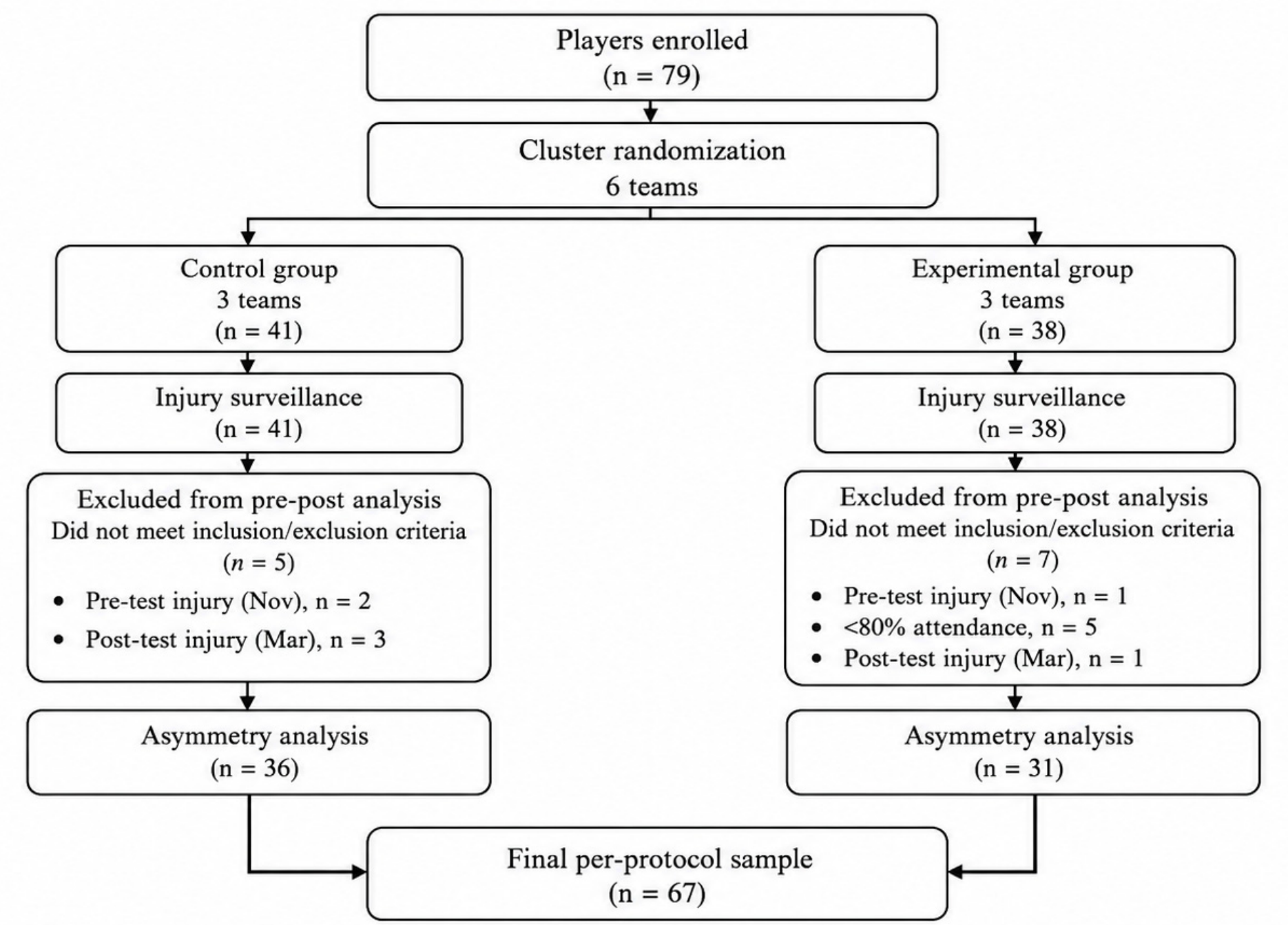
A longitudinal cluster-randomized controlled pre–post trial was conducted to examine the effects of a 20-week futsal-specific preventive neuromuscular warm-up program, named the Futsal Preventive Program (FPP), on interlimb asymmetry in youth male futsal players. In addition, injury occurrence was prospectively monitored over a 9-month surveillance period to compare injury risk between the intervention and control groups. Teams were allocated to either an experimental group (EG) or a control group (CG) using a cluster-based approach. For the injury-risk analysis, the complete injury-surveillance cohort was retained (EG, n = 38; CG, n = 41). For the interlimb asymmetry analysis, 67 players completed both pre- and post-intervention assessments and were included in the final pre–post analysis (EG, n = 31; CG, n = 36). Accordingly, the interlimb asymmetry analysis should be considered a per-protocol complete-case analysis rather than an intention-to-treat analysis, because players without complete post-intervention data or with <80% intervention adherence were excluded from the pre–post analysis. In contrast, all 79 randomized players remained included in the injury-surveillance analysis according to their original group allocation. The participant flow is presented in Figure 1. The experimental group performed the FPP once per week at the beginning of a regular training session as part of the warm-up, whereas the control group continued with its usual warm-up routine. The control warm-up consisted of traditional running-based activities combined with general joint mobility and dynamic stretching exercises. To minimize contamination between conditions, allocation was performed at the team level using a cluster-based approach. In total, six teams participated and were randomly assigned to the intervention condition (n = 3 teams) or the control condition (n = 3 teams). The six teams were randomly allocated using a computer-generated randomization sequence.
The intervention was integrated into the players’ regular training routine and was structured into two progressive 10-week phases. The first phase emphasized bilateral neuromuscular exercises, whereas the second phase progressively incorporated unilateral tasks to provide limb-specific stimuli more closely aligned with the unilateral and multidirectional demands of futsal. The FPP was implemented for 20 consecutive weeks during the competitive period, from November to mid-March, and was consistently delivered during the evening training schedule. Interlimb asymmetry was assessed before and after the intervention period. The testing battery included unilateral CMJ, unilateral horizontal jump (HJ), and the COD 505 test performed with both limbs. Interlimb asymmetry was calculated for each test. In parallel, injuries were prospectively monitored throughout the 9-month competitive season to compare injury occurrence between the intervention and control groups.

2.3. Procedures

Pre- and post-intervention assessments were conducted indoors in the same sports facilities, between 19:00 and 21:00 h, under similar environmental conditions (19–22 °C). Players were familiarized with all testing procedures and were instructed to avoid high-intensity physical activity, caffeine, energy drinks, and other stimulants during the 48 h preceding each assessment. They were also asked to maintain their usual nutritional habits and adequate hydration. All tests were completed wearing the players’ regular futsal footwear.
Before testing, participants performed a standardized 15 min warm-up based on the Raise, Activate, Mobilize, and Potentiate (RAMP) framework, including progressive running, lower-limb muscle activation, dynamic mobility, and sport-specific high-intensity actions [25]. The assessments were subsequently performed in the following order: unilateral CMJ, unilateral HJ, and the COD 505 test. The left limb was assessed first in all tests, standardized verbal encouragement was provided, and all assessments were administered and supervised by the same researcher (O.V.-G.).

2.3.1. Unilateral Countermovement Jump

Unilateral CMJ height was assessed using an iPhone 12 and the My Jump Lab application (Version 4.5.5; My Jump Technologies S.L., Madrid, Spain), which estimates jump height from flight time. Players started from an upright position with their hands placed on their hips to eliminate arm swing. They performed a rapid countermovement followed by a maximal vertical jump, taking off and landing on the same limb. The contralateral limb was maintained flexed and was not allowed to contribute to propulsion or balance. A trial was considered invalid if the player removed the hands from the hips, used the contralateral limb, or failed to maintain balance upon landing. Two valid attempts were performed with each limb, separated by 45 s of passive recovery. The highest valid jump obtained with each limb was retained for analysis. The unilateral CMJ showed intraclass correlation coefficient (ICC) values ranging from 0.89 to 0.95 and coefficient of variation (CV) values ranging from 2.9% to 4.6%.

2.3.2. Unilateral Horizontal Jump

The unilateral HJ was performed from a stationary position behind a marked take-off line. Players were instructed to jump forward as far as possible using one limb, with free arm movement permitted. Jump distance was measured in cm from the take-off line to the nearest heel at landing using a standard measuring tape. Participants were required to land on the tested limb and maintain a stable position without additional steps or contact of the contralateral limb with the floor. Invalid attempts were repeated. Two valid trials were performed with each limb, with 45 s of passive recovery between attempts. The longest valid distance achieved with each limb was retained for analysis. The unilateral HJ showed ICC values ranging from 0.86 to 0.94 and CV values ranging from 1.7% to 3.5%.

2.3.3. Change-of-Direction 505 Test

Unilateral COD performance was assessed using the COD 505 test. Running time was recorded using a dual-beam photocell system (Witty, Microgate, Bolzano, Italy). Players started from a two-point staggered stance with the front foot positioned 0.5 m behind the timing gate. They sprinted 5 m, planted the designated limb at the turning line, performed a 180° turn, and sprinted 5 m back through the timing gate. Each player completed two valid trials turning from the left limb and two turning from the right limb, alternating sides between trials. A 2 min passive recovery period was provided between attempts. Trials were repeated when the player turned using the incorrect limb or failed to reach the turning line. The fastest valid time for each turning limb was retained for analysis. The COD 505 test showed ICC values ranging from 0.85 to 0.93 and CV values ranging from 0.9% to 1.9%.

2.3.4. Interlimb Asymmetry

Interlimb asymmetry was calculated separately for the unilateral CMJ, unilateral HJ, and COD 505 tests using the percentage-difference formula [10]:
Asymmetry (%) = (|Higher-performing limb − Lower-performing limb|/Higher-performing limb) × 100
For the CMJ and HJ, a greater value represented better performance, whereas a lower completion time represented better COD 505 performance. Absolute asymmetry values were used in all statistical analyses.

2.3.5. Injury Surveillance

Injuries were prospectively monitored throughout the 9-month competitive season. An injury was defined as a futsal-related physical complaint occurring during training or competition that resulted in the player being unable to participate fully in at least the subsequent planned training session or match. For each injury, the date, training or match setting, anatomical location, injury type, injured side, contact mechanism, and number of days lost were recorded. For the injury-risk analysis, each player was classified as injured or non-injured according to whether he sustained at least one injury during the follow-up period. Players who did not complete post-intervention testing because of injury remained included in the injury-surveillance cohort. The cumulative 9-month injury-risk analysis included all injuries recorded throughout the surveillance period, including injuries occurring before implementation of the FPP. Therefore, this cumulative comparison was considered descriptive and was not interpreted as an exposure-specific estimate of the intervention effect.

2.4. Training Program

The Futsal Preventive Program was a 15 min neuromuscular warm-up specifically designed for youth futsal players. It was performed once per week at the beginning of a regular training session for 20 consecutive weeks, from November to mid-March. The program required no specialized equipment and included mobility, trunk and lower-limb strengthening, plyometric, and COD exercises. The intervention was divided into two progressive 10-week phases. Phase 1 emphasized bilateral exercises and the development of fundamental movement control. Phase 2 increased the task demands through unilateral strength and plyometric exercises and more futsal-specific multidirectional actions. Each exercise was completed for two sets, using the volume and duration presented in Table 1. Where applicable, the prescribed volume was completed on each side. Exercise attendance was recorded throughout the intervention, and players were required to complete at least 16 of the 20 scheduled FPP sessions (≥80%) to be included in the per-protocol pre–post asymmetry analysis. The control group continued its habitual warm-up routine, which consisted of running-based activities, general joint mobility, and dynamic stretching. The complete FPP protocol and supporting exercise materials are publicly available through the Open Science Framework (OSF; https://doi.org/10.17605/OSF.IO/QGP4D; accessed on 20 August 2026).

2.5. Statistical Analysis

Statistical analyses were performed using IBM SPSS Statistics version 25 (IBM Corp., Armonk, NY, USA). Data are presented as mean ± standard deviation (SD). Interlimb asymmetry analyses included 67 outfield players who completed both assessments (CG, n = 36; EG, n = 31), whereas injury-risk analyses included 79 outfield players monitored during the 9-month follow-up (CG, n = 41; EG, n = 38). Asymmetry scores from the CMJ, HJ, and COD 505 tests were converted to absolute values because their sign represents the direction rather than the magnitude of the imbalance. Normality and homogeneity of variances were assessed using the Shapiro–Wilk and Levene tests. Because randomization was performed at the team level, the primary inferential analysis accounted for the clustered study design. Team-level pre- and post-intervention mean asymmetry values were calculated for each of the six randomized teams. For each asymmetry outcome, a cluster-level analysis of covariance (ANCOVA) was performed using the post-intervention cluster mean as the dependent variable, treatment group (CG vs. EG) as the fixed factor, and the corresponding baseline cluster mean as a covariate. This cluster-level approach was selected because treatment allocation occurred at the team level and only six clusters were available, thereby aligning the unit of analysis with the unit of randomization and avoiding the assumption that individual players within the same team were statistically independent. Baseline intracluster correlation coefficients (cluster ICCs) were estimated for each asymmetry outcome using a one-way random-effects approach to quantify within-team clustering. Because cluster sizes were slightly unequal, design effects were calculated as DE = 1 + [{(1 + CV2) × m¯} − 1] × ICC, where m¯ represents the mean cluster size and CV the coefficient of variation of cluster size [26]. Approximate effective sample sizes were calculated as the total individual sample divided by the corresponding design effect. Negative ICC estimates were interpreted as no detectable clustering and set to zero for design-effect calculations. Adjusted between-group differences with 95% confidence intervals were reported. Bonferroni-adjusted p values were applied across the three asymmetry outcomes. As a sensitivity analysis, the original individual-level 2 × 2 mixed ANOVA was retained, with time (pre vs. post) as the within-subject factor and group (CG vs. EG) as the between-subject factor. Because this analysis did not explicitly account for clustering by team, it was considered supportive rather than primary. Bonferroni-adjusted p values were also applied across the three outcomes, and partial eta squared (ηp2) was calculated for the group × time interaction. Hedges’ g effect sizes with 95% confidence intervals were calculated as descriptive standardized estimates to quantify between-group differences in pre-to-post changes [27]. Interpretation of intervention effects considered adjusted effect estimates and their 95% confidence intervals alongside multiplicity-adjusted p values rather than relying solely on statistical significance.
An exploratory threshold-based analysis was performed using >10% absolute asymmetry as a pragmatic, non-validated reference cut-off. For each test and time point, the number and percentage of players exceeding this threshold were reported by group. The proportion of players exceeding the threshold in at least one asymmetry outcome was also calculated. Among players above this threshold at baseline, threshold normalization was defined as no longer exceeding >10% in any outcome at post-intervention. Between-group differences in threshold normalization were assessed using Fisher’s exact test. An unadjusted risk ratio (RR) with 95% confidence interval was also calculated as an exploratory effect estimate for threshold normalization. Given the small number of players exceeding this threshold at baseline, threshold-normalization analyses were considered exploratory. The proportion of players sustaining at least one injury in each group and the corresponding crude risk ratio (RR) with 95% confidence intervals were calculated descriptively. The study was not powered to detect between-group differences in injury outcomes, and individual training and match exposure data were unavailable; therefore, injury outcomes were considered descriptive and hypothesis-generating and no exposure-adjusted incidence rates were calculated. Total injury events, repeated injuries, days lost, and monthly raw injury-event counts were reported descriptively. Statistical significance was set at p < 0.05.

3. Results

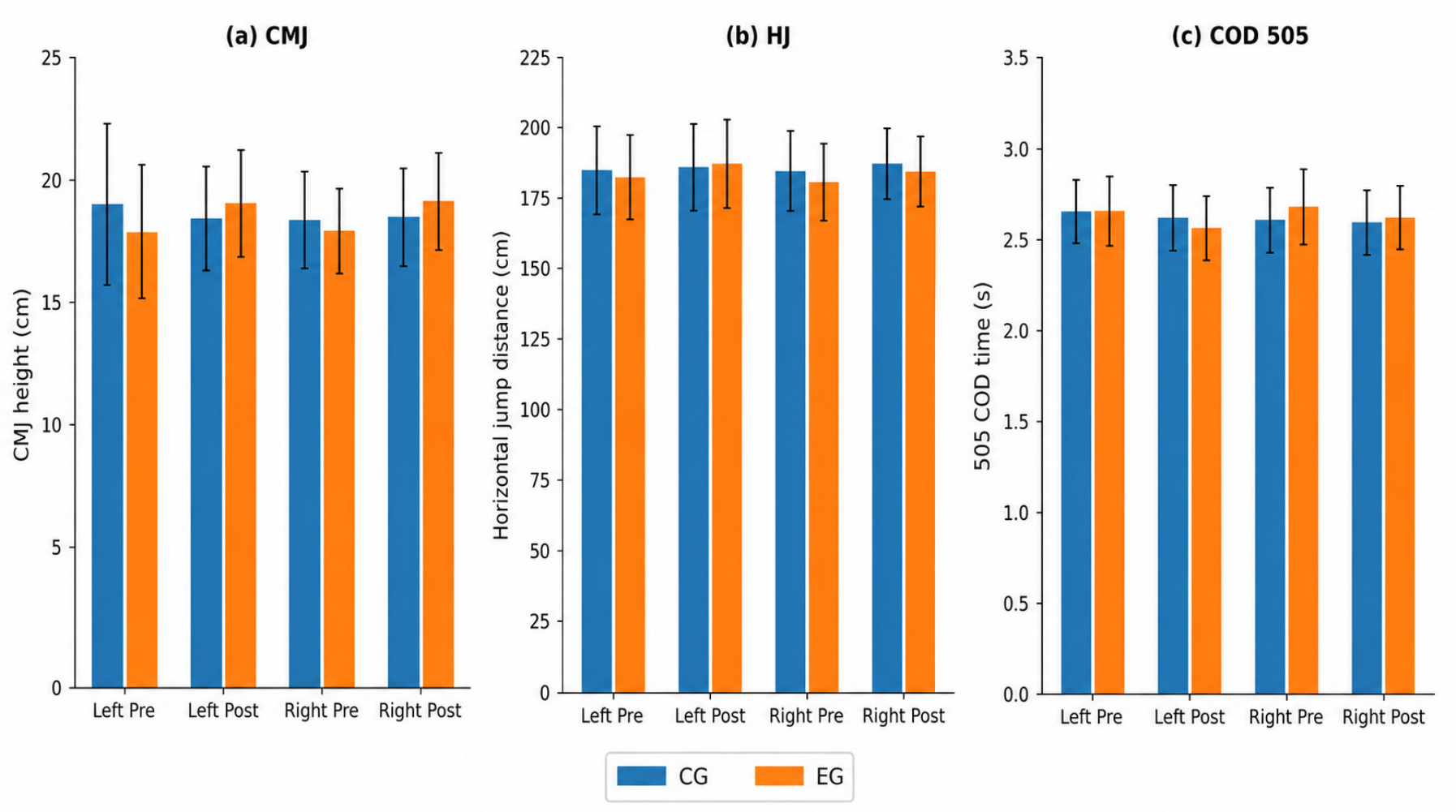
A total of 67 outfield players completed both the pre- and post-intervention assessments and were included in the primary interlimb asymmetry analysis, comprising 36 players in the control group and 31 players in the experimental group. Descriptive unilateral performance values obtained from the left and right limbs in the countermovement jump, horizontal jump, and 505 change-of-direction tests are presented in Figure 2.
Absolute interlimb asymmetry values are presented in Table 2. For CMJ asymmetry, the EG decreased from 7.34 ± 4.85% at pre-intervention to 5.53 ± 3.84% at post-intervention, whereas the CG increased slightly from 6.83 ± 4.64% to 7.18 ± 4.50. After accounting for the cluster-randomized design and adjusting for baseline cluster-level asymmetry, no significant intervention effect was observed for CMJ asymmetry (adjusted between-group difference = −1.67 percentage points; 95% CI: −8.50 to 5.16; Bonferroni-adjusted p = 0.99). The individual-level standardized difference in change scores was Hedges’ g = 0.49 (95% CI: 0.05 to 0.96). However, this descriptive estimate was interpreted cautiously because the cluster-adjusted confidence interval was wide and included no intervention effect. For HJ asymmetry, both groups showed reductions over time, from 3.81 ± 2.58% to 3.34 ± 2.14% in the CG and from 3.95 ± 3.42% to 2.74 ± 2.18% in the EG. The cluster-adjusted analysis did not show a significant intervention effect (adjusted between-group difference = −0.73 percentage points; 95% CI: −1.96 to 0.49; Bonferroni-adjusted p = 0.45), indicating that the reduction could not be attributed specifically to the intervention (Hedges’ g = 0.34, 95% CI: −0.14 to 0.81). For COD 505 asymmetry, the EG decreased from 3.81 ± 2.83% to 2.53 ± 1.80%, whereas the CG increased from 2.85 ± 2.74% to 3.07 ± 2.05%. After adjustment for baseline cluster-level asymmetry, a significant intervention effect was observed for COD 505 asymmetry (adjusted between-group difference = −1.27 percentage points; 95% CI: −2.00 to −0.53; Bonferroni-adjusted p = 0.03). The individual-level standardized difference in change scores was Hedges’ g = 0.65 (95% CI: 0.16 to 1.13). The individual-level mixed ANOVA used as a sensitivity analysis showed a consistent overall pattern, with a significant Bonferroni-adjusted group × time interaction for COD 505 asymmetry (adjusted p = 0.02), but not for CMJ (adjusted p = 0.14) or HJ asymmetry (adjusted p = 0.50). Baseline cluster ICCs were approximately 0.00 for CMJ, 0.02 for HJ, and 0.03 for COD 505 asymmetry. Given a mean cluster size of 11.17 players (range: 10–13; cluster-size CV = 0.132), the corresponding design effects were 1.00, 1.27, and 1.38, respectively. This resulted in approximate effective sample sizes of 67, 53, and 49 players for CMJ, HJ, and COD 505 asymmetry, respectively.
Descriptively, 21 players in the control group (51.2%) and 18 players in the experimental group (47.4%) sustained at least one injury during the 9-month follow-up (Table 3). The corresponding crude cumulative RR was 0.92 (95% CI: 0.59–1.45) for the EG compared with the CG. The CG accumulated 35 injury events, compared with 24 injury events in the EG. In addition, 10 control-group players (24.4%) and 6 experimental-group players (15.8%) sustained two or more injuries during the follow-up period. The total number of days lost due to injury was 960 days in the control group and 678 days in the experimental group.
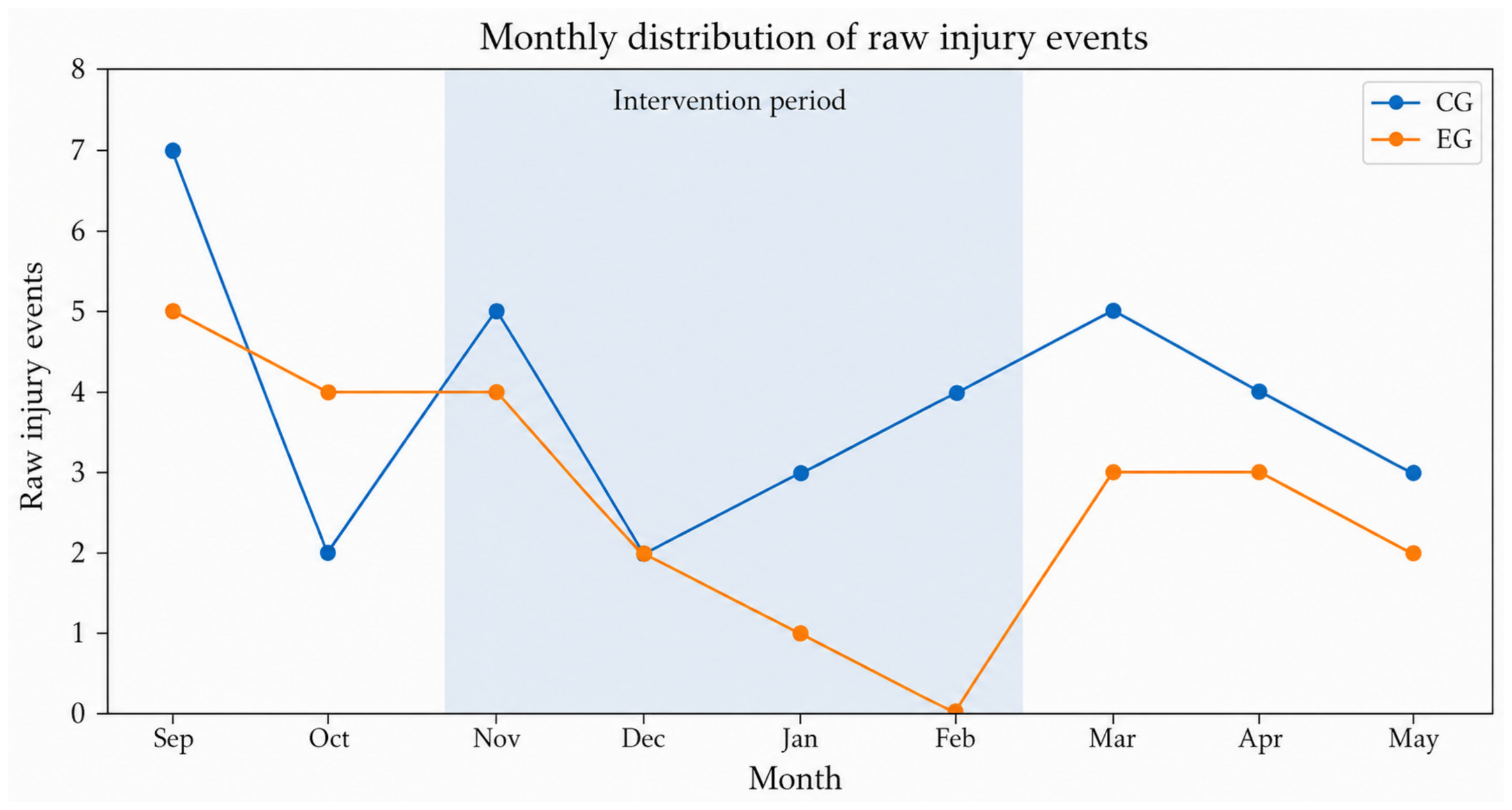
To describe the temporal relationship between injury occurrence and the intervention, injury events were also summarized according to the study period. Before implementation of the FPP (September–October), 9 injury events were recorded in both the CG and EG. During the four complete intervention months (November–February), 14 events were recorded in the CG and 7 in the EG. March included both intervention and post-intervention weeks because the FPP ended in mid-March; therefore, its 5 CG and 3 EG injury events were not classified exclusively as either during or post-intervention. During the clearly post-intervention period (April–May), 7 events were recorded in the CG and 5 in the EG. These temporal comparisons were descriptive and exploratory.
An exploratory threshold-based analysis was performed using >10% absolute asymmetry as a pragmatic reference cut-off (Table 4). After the intervention, the proportion remained relatively stable in the control group (9 players; 25.0%) but decreased in the experimental group (5 players; 16.1%). Among players who exceeded the threshold at baseline in at least one asymmetry outcome, threshold normalization was observed in 10 of 11 players in the experimental group and 4 of 10 players in the control group (90.9% vs. 40.0%; unadjusted RR = 2.27, 95% CI: 1.04–4.97; Fisher’s exact p = 0.02). Given the small subgroup sizes and the exploratory nature of this analysis, these findings should not be interpreted as confirmatory evidence of an intervention effect.
The monthly distribution of raw injury events is presented descriptively in Figure 3. These values represent event counts only and should not be interpreted as exposure-adjusted injury incidence rates.

4. Discussion

The main finding of the present study was that the 20-week futsal-specific preventive program produced a task-specific reduction in COD 505 interlimb asymmetry in youth male futsal players, whereas no clear intervention-specific effects were observed for CMJ or HJ asymmetry. The EG decreased COD 505 asymmetry from 3.81 ± 2.83% to 2.53 ± 1.80%, whereas the control group increased from 2.85 ± 2.74% to 3.07 ± 2.05%, resulting in a moderate between-group effect in favor of the intervention. For CMJ asymmetry, although a descriptive reduction was observed in the experimental group, the cluster-adjusted estimate was imprecise and compatible with no intervention-specific effect (adjusted between-group difference = −1.67 percentage points; 95% CI: −8.50 to 5.16). The individual-level standardized estimate (Hedges’ g = 0.49; 95% CI: 0.05 to 0.96) should therefore be interpreted cautiously and does not provide confirmatory evidence of an intervention effect. Similarly, no intervention-specific effect was observed for HJ asymmetry, for which the cluster-adjusted confidence interval also included no effect. The exploratory threshold-based analysis showed that the proportion of players exceeding >10% asymmetry in at least one outcome decreased from 35.5% to 16.1% in the EG, whereas it remained relatively stable in the CG (27.8% to 25.0%). However, these findings should be interpreted cautiously because the >10% threshold is not validated specifically for youth futsal and the subgroup of players exceeding the threshold at baseline was small. Moreover, threshold normalization among players exceeding >10% asymmetry at baseline was greater in the experimental group than in the control group (90.9% vs. 40.0%). However, because players were selected for this analysis based on an elevated baseline value, regression to the mean may partly explain subsequent reductions. This possibility is illustrated by the normalization observed in 4 of 10 control-group players, while measurement variability around the fixed 10% cut-off may also have contributed to changes in classification. Regarding injury outcomes, the cumulative risk of sustaining at least one injury during the 9-month follow-up was not significantly different between groups (RR = 0.92; 95% CI: 0.59–1.45).
The FPP showed a significant effect on COD 505 asymmetry, whereas no intervention-specific reductions were observed for CMJ or HJ asymmetry. This task-specific response may be explained by the greater similarity between the COD 505 test, the multidirectional demands of futsal, and the content of the intervention. While CMJ and HJ mainly reflect unilateral vertical or horizontal force production in relatively controlled conditions, the COD 505 test requires unilateral braking, force absorption, trunk control, rapid reorientation, and re-acceleration [28], which are actions frequently performed during futsal match play [1]. The FPP included several eccentric-oriented, unilateral, and multidirectional components, such as Nordic hamstring exercises, Copenhagen exercises, isometric lunges, unilateral plyometrics, and specific COD drills, including the 505 COD and V-cut COD tasks. The absence of clear intervention effects for CMJ and HJ asymmetry also suggests that the inclusion of bilateral and unilateral strength and plyometric exercises did not necessarily transfer to jump-based asymmetry. This may reflect both the relatively low training dose (one 15 min session per week) and the task-specific nature of neuromuscular adaptations. Although jump-based exercises were included in the FPP, their weekly exposure may have been insufficient to produce measurable changes in CMJ and HJ asymmetry over the intervention period. In contrast, COD-specific exercises, including 505 and V-cut actions, were directly incorporated into the intervention, providing a closer correspondence between the training stimulus and the COD 505 assessment. Therefore, the observed effect should be interpreted as task-specific rather than as a generalized improvement in interlimb symmetry. Although eccentric force capacity was not directly assessed, these exercises may have provided a more task-specific stimulus related to between-limb control during deceleration and re-acceleration [29]. However, this mechanistic interpretation remains hypothetical because eccentric force capacity, braking mechanics, and movement kinematics were not directly measured. This task-specific interpretation is also supported by previous soccer-based evidence showing that the magnitude and relevance of interlimb asymmetry may vary according to the test, the time point of the season, and the performance outcome considered [15]. Moreover, in youth team-sport athletes, higher vertical jumping asymmetries have been associated with increased injury incidence, although asymmetry should be interpreted as one component of a broader neuromuscular profile rather than as an isolated risk factor [9]. This interpretation is consistent with Bettariga et al., who concluded that training interventions can produce small-to-moderate reductions in interlimb asymmetries [21]. Gonzalo-Skok et al. showed that unilateral training strategies may reduce between-limb imbalances in team-sport athletes [23], while unilateral eccentric-overload training has been reported to decrease functional jumping asymmetries in youth soccer players [22]. Therefore, the present findings extend this evidence to youth futsal players and suggest that the principle of training specificity may explain why the greatest adaptations were observed in the COD 505 test, which most closely reflects the multidirectional braking, reorientation, and re-acceleration demands of futsal match play.
Regarding injury outcomes, the crude cumulative RR was 0.92 (95% CI: 0.59–1.45). The wide confidence interval crossed the null value and was compatible with both a potentially lower and a potentially higher injury risk in the experimental group. Given that the study was not powered for injury outcomes, these findings should be interpreted strictly as descriptive and hypothesis-generating rather than as evidence of preventive efficacy. However, futsal-specific evidence suggests that structured neuromuscular warm-ups may reduce injury burden when implemented with sufficient frequency and adherence. Lopes et al. reported that the FIFA 11+ reduced total injury incidence in amateur futsal players compared with a control group (6.5 vs. 11.6 injuries/1000 h), as well as acute injuries (5.7 vs. 11.2 injuries/1000 h), lower-limb injuries (4.4 vs. 8.7 injuries/1000 h), and days lost due to injury (10.5 ± 9.1 vs. 20.4 ± 17.3 days) [19]. Similarly, Tomsovsky et al. reported that a neuromuscular warm-up reduced contact injuries in amateur futsal players (RR = 0.68; 95% CI: 0.51–0.98), while high-adherence teams showed lower rates of all injuries (RR = 0.52; 95% CI: 0.29–0.97) and lower-extremity injuries (RR = 0.32; 95% CI: 0.14–0.81) [30]. The absence of statistically significant differences in the present study should therefore be interpreted with caution, as the intervention was implemented only once per week and the study was not specifically powered to detect between-group differences in injury risk. Descriptively, fewer total injury events (24 vs. 35), repeated injuries (15.8% vs. 24.4%), and days lost (678 vs. 960 days) were recorded in the experimental group. During the four complete intervention months (November–February), 7 injury events were recorded in the experimental group and 14 in the control group. These observations represent raw descriptive counts and should not be interpreted as evidence of reduced injury incidence or preventive efficacy. In youth futsal players, Reis et al. also showed that the FIFA 11+ improved several neuromuscular outcomes, including quadriceps strength, hamstring strength, jump performance, sprinting, agility, slalom performance, and balance [31], supporting the rationale for using structured futsal-specific warm-ups targeting strength, trunk control, unilateral force production, and change-of-direction mechanics.
From a temporal perspective, injury events were distributed across the pre-intervention, intervention, and post-intervention periods. Before implementation of the FPP (September–October), both groups recorded 9 injury events. During the four complete intervention months (November–February), 7 events were recorded in the EG and 14 in the CG, whereas March could not be classified exclusively as intervention or post-intervention because the program ended in mid-March. During April–May, 5 events were recorded in the EG and 7 in the CG. These temporal patterns should be interpreted descriptively, as individual training and match exposure data were unavailable and only six teams were randomized. However, these raw event counts were not adjusted for individual training or match exposure and therefore cannot be interpreted as differences in injury incidence. For context, previous futsal-specific prevention studies have reported lower exposure-adjusted injury incidence following structured neuromuscular warm-up programs [19]. In addition, previous seasonal epidemiological evidence in futsal has shown that injuries occur across the competitive season rather than being restricted to a single period [32]. Similarly, recent evidence in male U19 futsal players competing in the highest national league in Spain showed that injuries occurred throughout the season [20]. Although fewer injury events were descriptively observed in the experimental group, the absence of individual training and match exposure data prevents determination of whether these differences reflect a true reduction in injury incidence. Accordingly, the injury findings should be regarded as hypothesis-generating and cannot establish preventive efficacy of the FPP.
From a practical perspective, the present findings suggest that a short futsal-specific neuromuscular warm-up may be useful for reducing COD-related interlimb asymmetry in youth male futsal players. The FPP required only 15 min, was performed once per week, did not require specialized equipment, and included exercises that can be easily integrated into regular team training sessions. Coaches and strength and conditioning practitioners may therefore consider incorporating eccentric-oriented, unilateral, core-stability, plyometric, and COD-specific drills to target between-limb control during braking, reorientation, and re-acceleration actions. In addition, the exploratory threshold-based analysis suggests that monitoring individual asymmetry profiles may provide complementary information beyond group mean changes, although fixed cut-offs should be interpreted cautiously.
Several limitations should be acknowledged. First, although the study used a controlled longitudinal design with team-level allocation, the number of clusters was limited, which may have influenced the robustness of between-group comparisons. Although baseline ICCs were low, design effects reached 1.38 for COD 505 asymmetry, reducing the approximate effective sample size to 49 players. Therefore, the limited number of randomized clusters remains an important source of statistical uncertainty and the findings should be interpreted cautiously. Second, the intervention was performed only once per week; a higher weekly frequency or additional individualized sessions may have produced larger effects on both asymmetry and injury outcomes. Third, individual training and match exposure data were not available, preventing the calculation of exposure-adjusted injury incidence rates. Therefore, injury events, repeated injuries, days lost, and monthly raw injury-event counts should be interpreted descriptively. Fourth, eccentric force capacity, braking mechanics, and movement kinematics were not directly assessed, so the proposed mechanisms explaining the reduction in COD 505 asymmetry remain speculative. Fifth, the >10% threshold was used as a pragmatic applied cut-off, but no universal asymmetry threshold has been established, and its relevance may vary according to the test, population, and sport context. In addition, threshold-normalization analyses may be influenced by regression to the mean and measurement variability around the fixed cut-off, particularly given the small number of players exceeding >10% at baseline. Finally, the sample included only youth male outfield futsal players competing in the highest national U19 division, so the findings cannot be generalized to female players, younger or older age groups, goalkeepers, amateur players, or professional adult futsal.


5. Conclusions

The FPP produced a task-specific reduction in COD 505 interlimb asymmetry in youth male futsal players, whereas no clear intervention-specific effects were observed for CMJ or HJ asymmetry. Exploratory threshold-based findings suggested possible changes in individual classification, although these results require cautious interpretation. Injury outcomes were descriptive and do not establish a preventive effect of the program. Descriptively, fewer injury events and fewer days lost were observed in the experimental group; however, these findings should be considered hypothesis-generating only because the study was not powered for injury outcomes and individual exposure data were unavailable. These findings support the practical value of incorporating futsal-specific neuromuscular warm-up strategies into youth training routines, particularly for COD-related asymmetry, while highlighting the need for future studies with a larger number of randomized teams, greater weekly intervention exposure, and systematic individual training and match exposure monitoring to permit exposure-adjusted injury incidence calculations and more robust evaluation of preventive effects.

Author Contributions

Conceptualization, O.V.-G. and E.M.-P.; methodology, O.V.-G., B.T., R.A.-A. and E.M.-P.; software, O.V.-G. and B.T.; validation, B.T., R.A.-A. and E.M.-P.; formal analysis, O.V.-G., R.A.-A. and E.M.-P.; investigation, O.V.-G.; resources, O.V.-G. and E.M.-P.; data curation, O.V.-G.; writing—original draft preparation, O.V.-G. and R.A.-A.; writing—review and editing, O.V.-G., B.T., R.A.-A. and E.M.-P.; visualization, O.V.-G.; supervision, B.T. and E.M.-P.; project administration, O.V.-G. and E.M.-P. All authors have read and agreed to the published version of the manuscript.

Funding

This research received no external funding.

Data Availability Statement

Data supporting the findings of this study are available from the corresponding author upon reasonable request.

Acknowledgments

The authors would like to thank all the clubs, coaches, and players who participated in this study for their collaboration, commitment, and support throughout the data-collection and intervention period.

Conflicts of Interest

The authors declare no conflicts of interest.

Abbreviations

CGControl group
CIConfidence interval
CMJCountermovement jump
CODChange of direction
COD 505505 change-of-direction test
EGExperimental group
FIFAFédération Internationale de Football Association
FPPFutsal Preventive Program
HJHorizontal jump
OSFOpen Science Framework
RAMPRaise, Activate, Mobilize, and Potentiate
RRRisk ratio
SDStandard deviation

References

  1. Spyrou, K.; Freitas, T.T.; Marín-Cascales, E.; Alcaraz, P.E. Physical and physiological match-play demands and player characteristics in futsal: A systematic review. Front. Psychol. 2020, 11, 569897. [Google Scholar] [CrossRef] [Scilit]
  2. Naser, N.; Ali, A.; Macadam, P. Physical and physiological demands of futsal. J. Exerc. Sci. Fit. 2017, 15, 76–80. [Google Scholar] [CrossRef] [Scilit]
  3. Illa, J.; Fernandez, D.; Reche, X.; Serpiello, F.R. Positional Differences in the Most Demanding Scenarios of External Load Variables in Elite Futsal Matches. Front. Psychol. 2021, 12, 625126. [Google Scholar] [CrossRef] [Scilit]
  4. Spyrou, K.; Freitas, T.T.; Marín-Cascales, E.; Herrero-Carrasco, R.; Alcaraz, P.E. External match load and the influence of contextual factors in elite futsal. Biol. Sport 2022, 39, 349–354. [Google Scholar] [CrossRef] [Scilit]
  5. Ribeiro, J.N.; Yousefian, F.; Monteiro, D.; Illa, J.; Couceiro, M.; Sampaio, J.; Travassos, B. Relating external load variables with individual tactical actions with reference to playing position: An integrated analysis for elite futsal. Int. J. Perform. Anal. Sport 2024, 24, 298–313. [Google Scholar] [CrossRef] [Scilit]
  6. Palucci Vieira, L.H.; Kalva-Filho, C.A.; Santinelli, F.B.; Clemente, F.M.; Cunha, S.A.; Schimidt, C.V.; Barbieri, F.A. Lateral preference and inter-limb asymmetry in completing technical tasks during official professional futsal matches: The role of playing position and opponent quality. Front. Psychol. 2021, 12, 725097. [Google Scholar] [CrossRef] [Scilit]
  7. Barbieri, F.A.; Gobbi, L.T.B.; Santiago, P.R.P.; Cunha, S.A. Dominant–non-dominant asymmetry of kicking a stationary and rolling ball in a futsal context. J. Sports Sci. 2015, 33, 1411–1419. [Google Scholar] [CrossRef] [Scilit]
  8. López-Fernández, J.; García-Unanue, J.; Sánchez-Sánchez, J.; Colino, E.; Hernando, E.; Gallardo, L. Bilateral asymmetries assessment in elite and sub-elite male futsal players. Int. J. Environ. Res. Public Health 2020, 17, 3169. [Google Scholar] [CrossRef] [Scilit]
  9. Fort-Vanmeerhaeghe, A.; Milà-Villarroel, R.; Pujol-Marzo, M.; Arboix-Alió, J.; Bishop, C. Higher vertical jumping asymmetries and lower physical performance are indicators of increased injury incidence in youth team-sport athletes. J. Strength Cond. Res. 2022, 36, 2204–2211. [Google Scholar] [CrossRef] [Scilit]
  10. Bishop, C.; De Keijzer, K.L.; Turner, A.N.; Beato, M. Measuring interlimb asymmetry for strength and power: A brief review of assessment methods, data analysis, current evidence, and practical recommendations. J. Strength Cond. Res. 2023, 37, 745–750. [Google Scholar] [CrossRef] [Scilit]
  11. Bishop, C.; Turner, A.; Read, P. Effects of inter-limb asymmetries on physical and sports performance: A systematic review. J. Sports Sci. 2018, 36, 1135–1144. [Google Scholar] [CrossRef] [Scilit]
  12. Guan, Y.; Bredin, S.S.; Taunton, J.; Jiang, Q.; Wu, N.; Warburton, D.E. Association between inter-limb asymmetries in lower-limb functional performance and sport injury: A systematic review of prospective cohort studies. J. Clin. Med. 2022, 11, 360. [Google Scholar] [CrossRef] [Scilit]
  13. Roso-Moliner, A.; Albalad-Aiguabella, R.; Lozano, D.; Sancho-Monllor, B.; Villanueva-Guerrero, O.; Arjol-Serrano, J.L. Performance and Inter-Limb Asymmetry in Relation to Peak Height Velocity and Injury-Related Variables in Adolescent Male Soccer Players. Sports 2026, 14, 227. [Google Scholar] [CrossRef] [Scilit]
  14. Fox, K.T.; Pearson, L.T.; Hicks, K.M. The effect of lower inter-limb asymmetries on athletic performance: A systematic review and meta-analysis. PLoS ONE 2023, 18, e0286942. [Google Scholar] [CrossRef] [Scilit]
  15. Bishop, C.; Read, P.; Bromley, T.; Brazier, J.; Jarvis, P.; Chavda, S.; Turner, A. The association between interlimb asymmetry and athletic performance tasks: A season-long study in elite academy soccer players. J. Strength Cond. Res. 2022, 36, 787–795. [Google Scholar] [CrossRef] [Scilit]
  16. Villanueva-Guerrero, O.; Travassos, B.; Albalad-Aiguabella, R.; Mainer-Pardos, E. Positional differences in interlimb asymmetry in elite youth male futsal players. Acta Gymnica 2026, 56, e2026.006. [Google Scholar] [CrossRef] [Scilit]
  17. Villanueva-Guerrero, O.; Travassos, B.; Nobari, H.; Albalad-Aiguabella, R.; Mainer-Pardos, E. Effects of Strength and Speed Training Programs on Physical Performance Variables in Futsal Players: A Systematic Review and Meta-Analysis. J. Funct. Morphol. Kinesiol. 2026, 11, 170. [Google Scholar] [CrossRef] [Scilit]
  18. Oliveira, J.P.; Sampaio, T.; Marinho, D.A.; Barbosa, T.M.; Morais, J.E. Exploring injury prevention strategies for futsal players: A systematic review. Healthcare 2024, 12, 1387. [Google Scholar] [CrossRef] [Scilit]
  19. Lopes, M.; Simões, D.; Costa, R.; Oliveira, J.; Ribeiro, F. Effects of the FIFA 11+ on injury prevention in amateur futsal players. Scand. J. Med. Sci. Sports 2020, 30, 1434–1441. [Google Scholar] [CrossRef] [Scilit] [PubMed]
  20. Villanueva-Guerrero, Ó.; Travassos, B.; Lopes, M.; Albalad-Aiguabella, R.; Nobari, H.; Mainer-Pardos, E. Epidemiology of Injuries in Male Under-19 Futsal Players Competing in the Highest National League in Spain. Front. Sports Act. Living 2026, 8, 1830511. [Google Scholar] [CrossRef] [Scilit]
  21. Bettariga, F.; Turner, A.; Maloney, S.; Maestroni, L.; Jarvis, P.; Bishop, C. The effects of training interventions on interlimb asymmetries: A systematic review with meta-analysis. Strength Cond. J. 2022, 44, 69–86. [Google Scholar] [CrossRef] [Scilit]
  22. Gonzalo-Skok, O.; Tous-Fajardo, J.; Suarez-Arrones, L.; Arjol-Serrano, J.L.; Casajús, J.A.; Mendez-Villanueva, A. Single-leg power output and between-limbs imbalances in team-sport players: Unilateral versus bilateral combined resistance training. Int. J. Sports Physiol. Perform. 2017, 12, 106–114. [Google Scholar] [CrossRef] [Scilit]
  23. Gonzalo-Skok, O.; Moreno-Azze, A.; Arjol-Serrano, J.L.; Tous-Fajardo, J.; Bishop, C. A comparison of 3 different unilateral strength training strategies to enhance jumping performance and decrease interlimb asymmetries in soccer players. Int. J. Sports Physiol. Perform. 2019, 14, 1256–1264. [Google Scholar] [CrossRef] [Scilit]
  24. McKay, A.K.A.; Stellingwerff, T.; Smith, E.S.; Martin, D.T.; Mujika, I.; Goosey-Tolfrey, V.L.; Sheppard, J.; Burke, L.M. Defining Training and Performance Caliber: A Participant Classification Framework. Int. J. Sports Physiol. Perform. 2022, 17, 317–331. [Google Scholar] [CrossRef] [Scilit]
  25. Jeffreys, I. Warm up revisited—The ‘ramp’method of optimising performance preparation. Prof. Strength Cond. 2007, 6, 12–18. [Google Scholar]
  26. Campbell, M.K.; Piaggio, G.; Elbourne, D.R.; Altman, D.G. Consort 2010 statement: Extension to cluster randomised trials. BMJ 2012, 345, e5661. [Google Scholar] [CrossRef] [Scilit]
  27. Lakens, D. Calculating and reporting effect sizes to facilitate cumulative science: A practical primer for t-tests and ANOVAs. Front. Psychol. 2013, 4, 62627. [Google Scholar] [CrossRef] [Scilit]
  28. Dos’ Santos, T.; Thomas, C.; Comfort, P.; Jones, P.A. The effect of angle and velocity on change of direction biomechanics: An angle-velocity trade-off. Sports Med. 2018, 48, 2235–2253. [Google Scholar] [CrossRef] [Scilit]
  29. Nimphius, S.; Callaghan, S.J.; Bezodis, N.E.; Lockie, R.G. Change of direction and agility tests: Challenging our current measures of performance. Strength Cond. J. 2018, 40, 26–38. [Google Scholar] [CrossRef] [Scilit]
  30. Tomsovsky, L.; Reid, D.; Whatman, C.; Borotkanics, R.; Fulcher, M. The effect of a neuromuscular warm-up on the injury rates in New Zealand amateur futsal players. Phys. Ther. Sport 2021, 48, 128–135. [Google Scholar] [CrossRef] [Scilit]
  31. Reis, I.; Rebelo, A.; Krustrup, P.; Brito, J. Performance enhancement effects of Federation Internationale de Football Association’s “The 11+” injury prevention training program in youth futsal players. Clin. J. Sport Med. 2013, 23, 318–320. [Google Scholar] [CrossRef] [Scilit]
  32. Lopes, M.; Martins, F.; Brito, J.; Figueiredo, P.; Tomás, R.; Ribeiro, F.; Travassos, B. Epidemiology of injuries in elite male futsal players. Clin. J. Sport Med. 2023, 33, 527–532. [Google Scholar] [CrossRef] [Scilit]
Figure 1. Participant flow diagram.
Symmetry 18 01425 g001
Figure 2. Unilateral physical performance values before and after the intervention in the control and experimental groups: (a) unilateral countermovement jump height; (b) unilateral horizontal jump distance; and (c) 505 change-of-direction time. CG: control group; EG: experimental group; CMJ: countermovement jump; HJ: horizontal jump; COD: change of direction.
Symmetry 18 01425 g002
Figure 3. Monthly distribution of raw injury events in the control group (CG) and experimental group (EG) during the 9-month follow-up period. The shaded area represents the four complete intervention months (November–February); March included both intervention and post-intervention weeks because the FPP ended in mid-March. Values represent descriptive event counts and should not be interpreted as exposure-adjusted injury incidence rates. CG: control group; EG: experimental group.
Symmetry 18 01425 g003
Table 1. Structure and progression of the Futsal Preventive Program.
ExerciseWeeks 1–10: Bilateral PhaseVolumeWeeks 11–20: Unilateral PhaseVolume
MobilityAnkle dorsiflexion2 × 8 repetitionsAnkle dorsiflexion with lunge2 × 8 repetitions
MobilityHindi squat2 × 8 repetitions90/90 hip switch2 × 8 repetitions
Core strengthFront plank2 × 30 sAdvanced front plank2 × 30 s
Core strengthSide plank2 × 30 s per sideCopenhagen exercise2 × 30 s per side
Hip strengthGlute bridge2 × 30 sSingle-leg glute bridge2 × 30 s per side
Lower-limb strengthIsometric squat2 × 30 sIsometric lunge2 × 30 s per side
Hamstring strengthNordic hamstring 2 × 6 repetitionsNordic hamstring 2 × 10 repetitions
PlyometricBilateral vertical jump2 × 8 repetitionsSingle-leg vertical jump2 × 8 rep per side
PlyometricBilateral horizontal jump2 × 8 repetitionsSingle-leg horizontal jump2 × 8 rep per side
CODCOD 5052 × 4 rep per side25 m V-cut COD2 × 4 repetitions
COD: change of direction.
Table 2. Changes in absolute interlimb asymmetry following Futsal Preventive Program.
VariableCG PRECG POSTEG PREEG POSTCluster-Adjusted Difference (95% CI)pHedges’ g (95% CI)
CMJ asymmetry (%)6.83 ± 4.647.18 ± 4.507.34 ± 4.855.53 ± 3.84−1.67 (−8.50 to 5.16)0.990.49 (0.05 to 0.96)
HJ asymmetry (%)3.81 ± 2.583.34 ± 2.143.95 ± 3.422.74 ± 2.18−0.73 (−1.96 to 0.49)0.450.34 (−0.14 to 0.81)
COD 505 asymmetry (%)2.85 ± 2.743.07 ± 2.053.81 ± 2.832.53 ± 1.80−1.27 (−2.00 to −0.53)0.030.65 (0.16 to 1.13)
Cluster-adjusted differences represent EG − CG post-intervention differences adjusted for baseline cluster means; negative values indicate lower asymmetry in the EG. Hedges’ g values are descriptive individual-level standardized estimates of pre-to-post change and are not cluster-adjusted. CG: control group; EG: experimental group; CMJ: countermovement jump; HJ: horizontal jump; COD: change of direction; CI: confidence interval.
Table 3. Injury-risk outcomes during the 9-month follow-up period.
OutcomeCG (n = 41)EG (n = 38)Effect Estimates (95% CI)
Players sustaining ≥1 injury, n (%)21 (51.2%)18 (47.4%)RR = 0.92 (0.59–1.45)
Players without injury, n (%)20 (48.8%)20 (52.6%)
Total injury events, n3524
CG: control group; EG: experimental group; RR: risk ratio; CI: confidence interval.
Table 4. Players exceeding the 10% absolute interlimb asymmetry.
VariableCG PRECG POSTEG PREEG POST
CMJ ASY > 10%8/36 (22.2%)9/36 (25.0%)8/31 (25.8%)5/31 (16.1%)
HJ ASY > 10%1/36 (2.8%)0/36 (0.0%)2/31 (6.5%)0/31 (0.0%)
COD 505 ASY > 10%2/36 (5.6%)0/36 (0.0%)1/31 (3.2%)0/31 (0.0%)
≥1 ASY outcome10/36 (27.8%)9/36 (25.0%)11/31 (35.5%)5/31 (16.1%)
ASY: asymmetry; CG: control group; EG: experimental group; CMJ: countermovement jump; HJ: horizontal jump; COD: change of direction.
Disclaimer/Publisher’s Note: The statements, opinions and data contained in all publications are solely those of the individual author(s) and contributor(s) and not of MDPI and/or the editor(s). MDPI and/or the editor(s) disclaim responsibility for any injury to people or property resulting from any ideas, methods, instructions or products referred to in the content.