Review

Managing Mega-Constellations: A Starlink-Informed Review

1
School of Automation and Intelligent Science, Jiangnan University, Wuxi 214122, China
2
College of Big Data and Internet, Shenzhen Technology University, Shenzhen 518118, China
3
Research Centre for Artificial Intelligence, Jiangsu Second Normal University, Nanjing 211200, China
4
School of Intelligent Science and Technology, University of Science and Technology Beijing, Beijing 100083, China
5
Department of Aerospace Engineering, Universiti Putra Malaysia, UPM Serdang Selangor Darul Ehsan, Seri Kembangan 43400, Malaysia
6
School of Electrical Engineering, Engineering Research Center of Electrical Transport Technology, Ministry of Education, Southeast University, Nanjing 210096, China
*
Author to whom correspondence should be addressed.
Symmetry 2026, 18(7), 1141; https://doi.org/10.3390/sym18071141
Submission received: 18 May 2026 / Revised: 23 June 2026 / Accepted: 29 June 2026 / Published: 3 July 2026
(This article belongs to the Section Computer)

Abstract

Low-Earth-orbit (LEO) megaconstellations are transforming satellite communications from sparse, ground-controlled infrastructures into dense, dynamic, and increasingly autonomous space networks, while their global coverage capability is fundamentally enabled by large-scale symmetric orbital structures distributed across multiple planes and shells. As these systems expand to tens of thousands of satellites, maintaining such orbital symmetry under continuous perturbations, changing communication topologies, and varying onboard resources becomes a fundamental operational challenge. Future space systems must therefore manage, coordinate, and sustain large constellations for which their orbital configurations, communication topologies, and onboard resources vary continuously. Here, we review the management and configuration-maintenance problems of megaconstellations through a Starlink-informed perspective. We first summarize the multi-shell deployment architecture, satellite platform evolution, and dominant orbital perturbations that shape constellation behavior. We then examine hierarchical and cluster-based management strategies designed to reduce the burden on ground control and improve scalability. We further discuss in- and out-of-plane configuration maintenance. Finally, we identify open challenges in distributed autonomy, multi-shell coordination, dynamic topology management, and intelligent orbit control. This review highlights that the long-term viability of megaconstellations will depend not only on launch capacity and satellite manufacturing but also on scalable decision-making, autonomous coordination, and sustainable orbital operations.

1. Introduction

Low-Earth-orbit (LEO) megaconstellations are reshaping global communications, with SpaceX’s Starlink as the leading example [1,2,3,4,5]. Unlike traditional navigation constellations such as GPS and BeiDou, which contain only a limited number of satellites, and unlike spacecraft formations that mainly emphasize local relative-motion controls [6,7,8,9,10], Starlink-like systems aim to deploy tens of thousands of satellites across multiple LEO orbital shells and establish a global network with high throughput and low latency [11,12,13]. From an orbital-architecture perspective, such global megaconstellations can be regarded as symmetric structures. Its objective extends beyond basic Internet access: It aims to build a worldwide digital infrastructure that closes geographic gaps and serves remote regions, oceans, and aviation routes with reliable, high-rate connectivity [14,15,16,17,18]. This unprecedented scale also introduces commensurate complexity. As satellite counts rise from the tens typical of GPS or BeiDou to many thousands, operational logic changes fundamentally [19,20]. The system evolves from a small, predictable ensemble to a large, dynamic, and tightly coupled network [21,22]. Therefore, traditional constellation management and control methods are difficult to apply to these modern constellations [23,24]. Efficient operation requires new management and control approaches. In response, this paper presents a comprehensive review of existing methods and uses Starlink as a representative example.

1.1. Challenges in Megaconstellation Management

Traditional constellations have relied on a centralized and independently managed mode. In this model, ground stations handle all in-orbit data processing, compute orbital commands, and transmit control instructions to each satellite individually. For constellations comprising only a few dozen satellites, this architecture is entirely feasible—its communication load and computational demands remain manageable, allowing the ground control center to maintain precise oversight and coordination across the system [25].
However, as constellation scales expand to the level of large and megaconstellations, the fragility of this centralized paradigm becomes apparent. When thousands or even tens of thousands of satellites operate simultaneously, the communication bandwidth and computational resources required to maintain the continuous ground-to-satellite control increase exponentially [26,27]. The ground center quickly becomes overwhelmed by massive data volumes, resulting in significant decision latency and degraded system responsiveness. Furthermore, the centralized structure introduces a critical single point of failure—any malfunction at the ground control node could paralyze the entire constellation, an unacceptable risk for both commercial and strategic missions. Consequently, the legacy management framework can no longer meet the demands of modern large-scale systems, making the development of a new, scalable, and resilient management paradigm an inevitable direction for megaconstellation operations [23,28].

1.2. Challenges in Megaconstellation Configuration Maintenance

Satellites operating in LEO are constantly subjected to complex environmental perturbations, including the J 2 effect, atmospheric drag, solar radiation pressure, and gravitational influences from other celestial bodies [29,30]. These persistent disturbances will cause the constellation configuration to diverge. Without corrections, they can lead to phase drift and orbital decay, ultimately disrupting the geometric formation of the constellation that is critical for maintaining service quality. Therefore, configuration maintenance is essential to ensure the long-term stability and reliability of the constellation [26,31,32].
However, each satellite carries only a limited amount of propellant. Every maneuver directly consumes this onboard resource and reduces the satellite’s lifetime. Therefore, configuration maintenance must preserve constellation geometry through orbital maneuvers while minimizing fuel consumption. This requirement helps extend the overall service life of the constellation. As a result, configuration maintenance must balance its orbital stability against limited onboard resources.

1.3. Contribution and Outline

The main contributions are summarized as follows:
(1)
A Starlink-Informed Perspective on LEO Megaconstellation Architecture and Dynamics: This paper uses Starlink as a representative operational case to examine how megaconstellations differ from traditional satellite constellations in scale, orbital structure, and control requirements. We summarize its multi-shell deployment architecture, satellite platform evolution, propulsion and communication subsystems, and the dominant orbital perturbations that govern long-term constellation behavior. This perspective establishes the physical and architectural basis for understanding why new management and control paradigms are required.
(2)
A Structured Review of Scalable Management and Configuration Maintenance Strategies: We review the transition from a centralized ground-based operation to a hierarchical, cluster-based and increasingly distributed constellation management. In parallel, we examine configuration-maintenance methods under LEO perturbations, including in-plane phase and altitude regulation, out-of-plane inclination and right ascension of the ascending node (RAAN) correction, station-keeping, and fuel-aware maneuver planning. By linking the management architecture with orbital control requirements, this review highlights the coupling between constellation-scale coordination and individual satellite maintenance.
(3)
Identification of Open Challenges and Future Directions for Autonomous Megaconstellations: We identify unresolved challenges in scalability, multi-shell coordination, dynamic topology management, limited onboard resources, distributed intelligent control, and sustainable orbital operations. These challenges point toward future research on AI-assisted decision-making, autonomous constellation coordination, fuel-aware orbit control, and integrated space–air–ground network management.
Contribution Statement: Compared with existing reviews that mainly discuss LEO megaconstellation development, impact, surveillance, and governance; Starlink deployment, configuration, and dynamics; and routing algorithms or routing techniques for LEO satellite networks [13,33,34,35], this review places greater emphasis on the management and control problems of megaconstellations. Its core contribution is to integrate Starlink-informed orbital architecture, perturbation-driven dynamics, scalable constellation management, and configuration-maintenance control into a unified review framework. This perspective highlights that the long-term operation of megaconstellations is not only a deployment or networking problem but also a coupled management-and-control problem involving multi-shell coordination, dynamic topology evolution, orbital configuration maintenance, and limited onboard resources. Furthermore, this review identifies future directions for the autonomous and sustainable operation of hyperscale constellations, thereby providing added value.
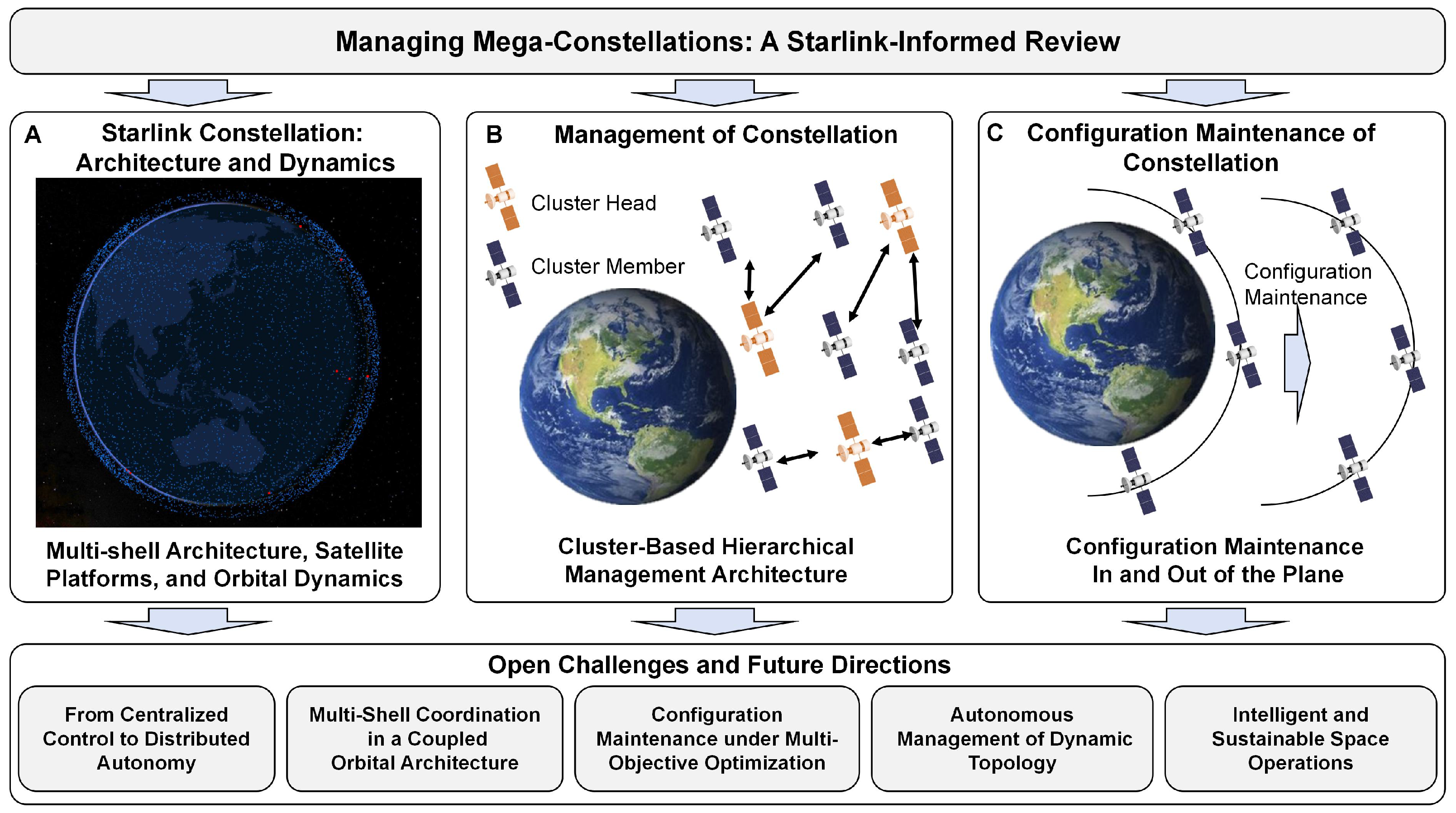
Outline: Figure 1 shows the overall framework of this paper. Section 2 briefly reviews the architecture and dynamics of Starlink. Section 3 discusses constellation management. Section 4 presents constellation configuration maintenance. Section 5 outlines open challenges and future directions. The conclusion is given in Section 6.

2. Starlink Constellation: Architecture and Dynamics

This section first outlines the structural configuration of the Starlink constellation, describing its planned full deployment and current orbital distribution. It then details the fundamental subsystems of the satellite platform, including the propulsion system and the communications and data link subsystems. Finally, the orbital dynamics model of the Starlink satellites is formulated to support our subsequent analysis.

2.1. Starlink Architecture and Deployment

2.1.1. Planned Architecture and Design Scale

SpaceX filed documents with the U.S. Federal Communications Commission to establish the Starlink network. The complete Starlink architecture requires approximately 42,000 satellites. Starlink operates three independent and complementary sub-constellations [33,36]. Table 1 shows some parameters of the constellation configuration planned for the Starlink constellation.
(1)
Starlink Gen1 (LEO): This first-generation constellation provides the foundational network. SpaceX deploys 4408 satellites in LEO. These satellites operate at altitudes ranging from 540 km to 570 km. This network delivers global high-speed and low-latency Internet access.
(2)
Starlink Gen1 (VLEO): This layer serves as a performance supplement. SpaceX plans to deploy 7518 satellites in very low Earth orbit (VLEO). These satellites operate at altitudes between 335.9 km and 345.6 km. A lower altitude reduces satellite lifetime but significantly decreases signal latency. This design supports applications with ultra-low delay requirements, such as high-frequency trading.
(3)
Starlink Gen2: This second generation expands the network scale significantly. SpaceX plans to deploy 29,988 satellites. The system utilizes multiple orbital shells with altitudes ranging from 340 km to 614 km. Starlink Gen2 increases network capacity and enables new services, such as direct-to-cellular connectivity.

Table 1. Planned orbital parameters of the Starlink constellation.
GenAltitude (km)SatellitesInclination (°)Number of PlanesSatellites per PlanePhase Satellites Total
Gen1 (LEO)550158453.07222
Gen1 (LEO)540158453.27222
Gen1 (LEO)57072070.036204408
Gen1 (LEO)56034897.6658
Gen1 (LEO)56017297.6443
Gen1 (VLEO)335.9249342.0
Gen1 (VLEO)340.8247848.07518
Gen1 (VLEO)345.6254753.0
Gen2340528053.048110
Gen2345528046.048110
Gen2350528038.048110
Gen2360360096.930120
Gen2525336053.02812029,988
Gen2530336043.028120
Gen2535336033.028120
Gen2604144148.01212
Gen2614324115.71818
Overall Total41,914
SpaceX uses a phased multi-shell deployment strategy. Each orbital shell adopts a Walker constellation configuration. This approach ensures efficient and continuous global coverage. By distributing satellites across different altitudes and inclinations, the constellation can enhance coverage redundancy, improve traffic flexibility, and support more resilient global network operation [37,38,39].
Remark 1.
Rows with the same nominal altitude and inclination may still correspond to different orbital shells when their plane numbers and satellite allocations differ. For example, the two 560 km, 97.6° Gen1 LEO entries represent two shell configurations: 6 planes with 58 satellites per plane and 4 planes with 43 satellites per plane, respectively.

2.1.2. Current Deployment and Operational Status

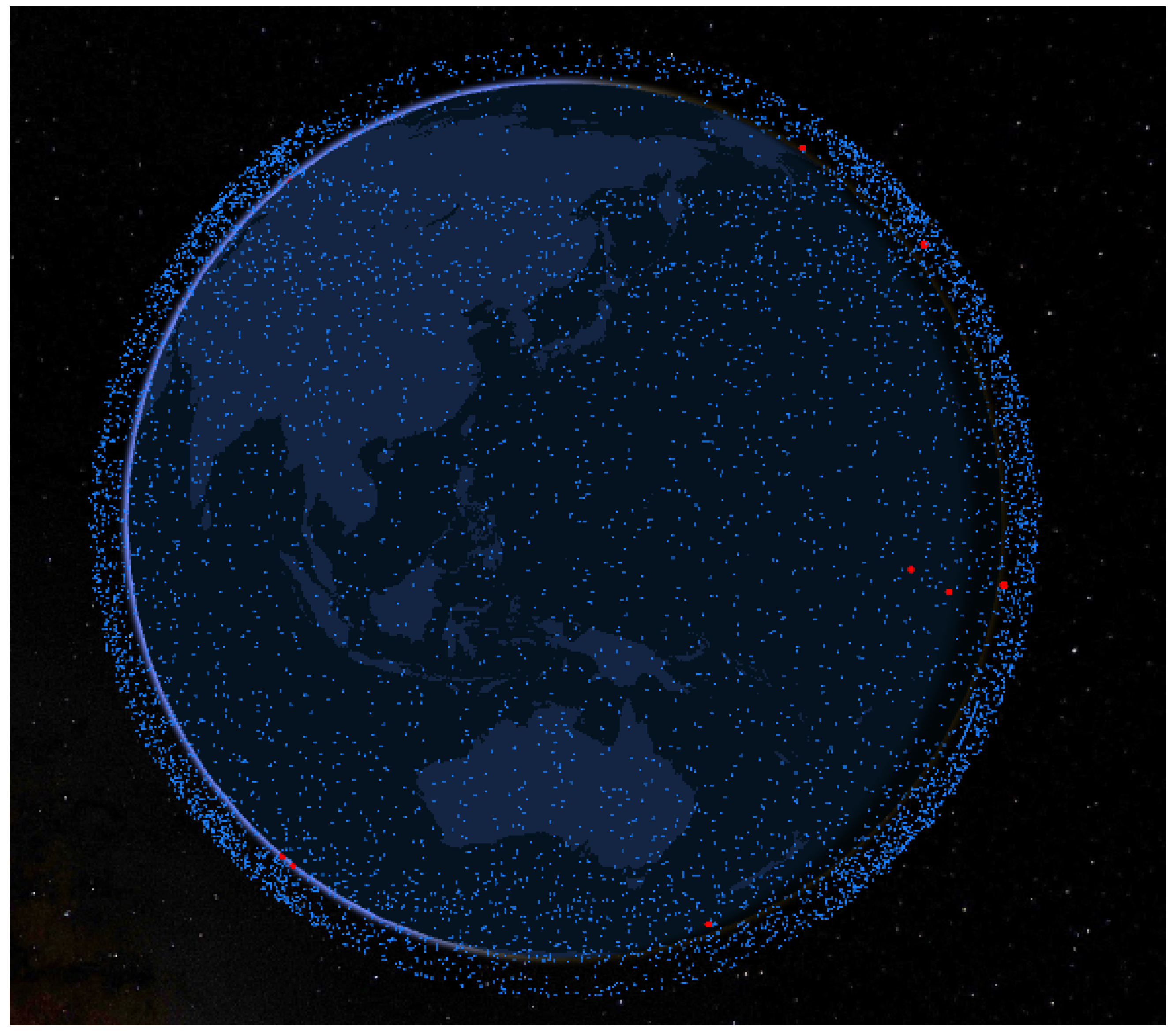
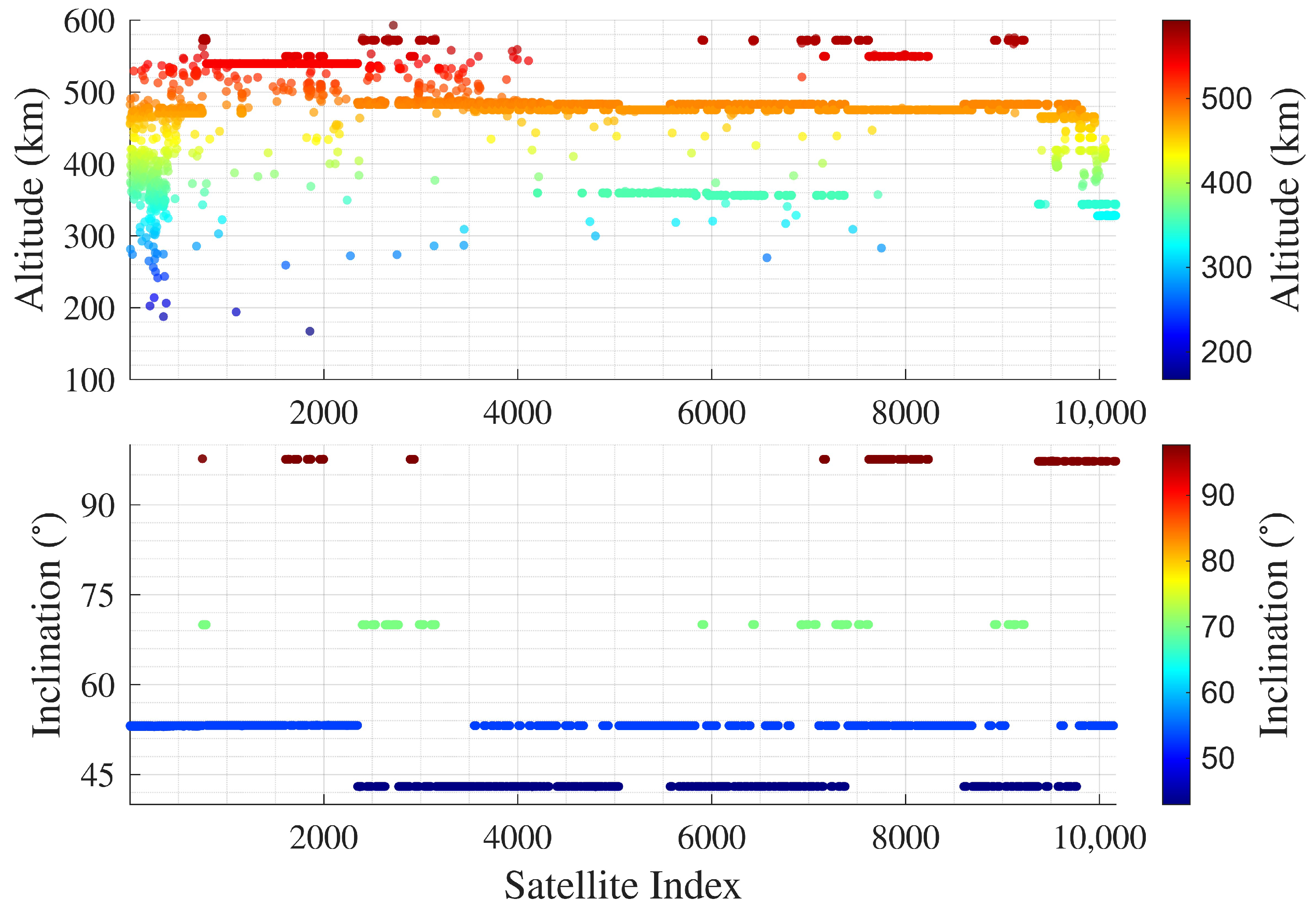
Figure 2 illustrates the current in-orbit distribution of the Starlink constellation (see: https://satellitemap.space/vis/constellation/starlink, accessed on 20 April 2026). Figure 3 details the specific altitude and inclination statistics for Starlink on April 2026. This data was obtained from the TLE files on the CelesTrak website (see CelesTrak at https://celestrak.org/, accessed on 20 April 2026).
As of April 2026, the Starlink constellation had more than 10,000 satellites in orbit. The upper panel of Figure 3 shows their altitude distribution. For near-circular LEO orbits, this distribution also reflects the distribution of orbital semi-major axes. The results reveal three distinct orbital regions. The main operational backbone lies between 450 km and 550 km. Satellites are densely distributed in this region and form several clear horizontal bands. In addition, a small number of satellites are observed at altitudes below 300 km. Such low-altitude objects are usually associated with orbit-raising, controlled deorbiting, end-of-life disposal preparation, or anomalous orbital evolution. Because atmospheric drag is particularly strong in this altitude regime, their orbits decay rapidly unless sustained or frequent thrusting maneuvers are applied. Consequently, without further orbit-maintenance or disposal operations, these satellites will naturally re-enter the atmosphere.
The bottom panel of Figure 3 presents the orbital inclination distribution. The system deploys satellites at discrete, predefined inclination angles. A large majority of the network operates near the 53° inclination. Additional satellite groups operate at higher inclinations, such as the 70° and 97.6° bands. Ultimately, these precise distributions confirm a multi-shell deployment strategy. Overall, this altitude and inclination distribution demonstrates a highly dynamic and continuously managed orbital architecture.

2.2. Satellite Platform and Key Subsystems

SpaceX designs Starlink satellites using a strategy of rapid iteration and continuous technological upgrades. Operators first deployed first-generation satellites (V1.0 and V1.5). The system has now evolved to incorporate higher-performance second-generation satellites (V2.0 Mini) [40]. SpaceX currently plans the launch of third-generation satellites (V3.0). We subsequently analyze these generations of satellite platforms and their key subsystems [36,38,41].

2.2.1. Key Spacecraft Parameters and Design Lifetime

The Starlink evolution demonstrates a clear transition from the lightweight spacecraft to large and complex platforms. The V1.0 and V1.5 satellites have launch masses of approximately 260 kg and 295 kg, respectively. SpaceX introduced the V2.0 Mini to increase its network capacity before the Starship launch vehicle enters full service. This intermediate version increases the satellite mass to 800 kg. The upcoming V3.0 satellites require Starship for deployment. They represent the largest model in the series. According to publicly available media reports, the mass of a single V3.0 satellite is estimated to be approximately 2000 kg (see: https://grokipedia.com/page/Starlink_V3_satellites, accessed on 25 April 2026; see: https://www.tomshardware.com/service-providers/network-providers/spacex-shows-off-massive-new-v3-starlink-satellites-expanded-technology-will-deliver-gigabit-internet-to-customers-for-the-first-time-and-enable-60-tera-bits-per-second-downlink-capacity, accessed on 25 April 2026; see: https://www.basenor.com/blogs/news/starlink-v3-satellites-what-the-next-gen-specs-mean?srsltid=AfmBOoq0_lx7I-9RqT25YS0Bmz74AuSOhrtU4iPeoBP9X8Oni8C9IeYt, accessed on 25 April 2026) which is roughly three times the mass of the current V2 Mini satellite. However, since the V3.0 satellites have not yet been fully deployed and their final technical specifications have not been completely disclosed, this value should be regarded as an indicative reference parameter rather than a confirmed operational specification. Regarding design lifetime, Starlink follows a rapid replacement cycle of approximately five years. This short lifespan allows SpaceX to update hardware frequently, enabling the constellation to continuously incorporate the latest computing and communication technologies.
Remark 2.
The mass of approximately 2000 kg for a Starlink V3.0 satellite should be interpreted as an estimated reference value based on publicly media sources rather than a confirmed operational specification. At present, the V3.0 satellites have not yet been fully deployed, and SpaceX has not publicly released a complete official specification for their final mass. Therefore, this value may still be subject to uncertainty due to possible changes in satellite configuration, payload design, propulsion system, and Starship-based launch strategy.

2.2.2. Satellite Propulsion Subsystem

Starlink is the first satellite constellation to use argon as the propellant for Hall-effect thrusters in mass production. Early V1.0 and V1.5 satellites used krypton propulsion systems. Krypton provides better propulsion performance than argon, but it has higher cost and tighter supply constraints. Since the V2.0 Mini generation, SpaceX has shifted to argon-based electric propulsion. This transition improves the economic scalability of constellation deployment.
Argon accounts for about 1% of the Earth’s atmosphere. Its high abundance greatly reduces extraction and supply costs. As a result, the propellant cost for each satellite can decrease to approximately 10 USD. This cost is far lower than that of traditional xenon- or krypton-based systems. The argon Hall-effect thruster can generate a thrust of 170 mN and achieve a specific impulse of 2500 s. These characteristics provide a practical balance between thrust performance, propellant economy, and large-scale manufacturability. They also support frequent orbit-raising, station-keeping, collision-avoidance, and end-of-life disposal maneuvers. Therefore, the argon propulsion system improves the maneuverability, lifetime, and operational sustainability of Starlink satellites.

2.2.3. Communications and Data Link Subsystem

The communications and data link subsystem is the core payload of the Starlink constellation [42,43]. SpaceX has upgraded this subsystem through several satellite generations. The V1.0 satellites mainly used Ku/Ka-band radio-frequency links. They provided broadband services over low- and mid-latitude regions. Their communication capability was still limited compared with later generations. The V1.5 satellites retained the Ku/Ka-band architecture and introduced optical inter-satellite link capability. This upgrade reduced the dependence on ground gateways and extended service coverage toward polar and oceanic regions.
The V2.0 Mini satellites further improved the communication payload. They support Ku-band and Ka-band links, E-band feeder links, and high-speed optical links. Public information reports a downlink capacity of about 100 Gbit/s and an uplink capacity of about 7 Gbit/s for each V2.0 Mini satellite. These improvements increase the network’s throughput and enhances its coverage over oceans and polar regions.
The V3.0 satellites are expected to provide a substantially higher communication capacity than earlier Starlink generations. According to publicly available statements and reports, a single V3.0 satellite is designed to deliver a downlink capacity of approximately 1 Tbit/s and an uplink capacity of approximately 160 Gbit/s, while the combined RF and laser backhaul capacity may reach nearly 4 Tbit/s. This generation is also expected to use Ku/Ka/E-band links and high-speed optical inter-satellite links. These technologies are intended to support global routing, reduce reliance on terrestrial gateways, and improve network resilience. However, since the V3.0 satellites have not yet been deployed in regular operation, these values should be regarded as publicly reported design targets or indicative reference parameters rather than independently verified operational specifications.
Overall, the evolution of the Starlink communication subsystem shows a clear trend toward higher throughput, stronger inter-satellite connectivity, and wider coverage. This trend also increases the complexity of constellation management. Future operations must jointly coordinate the beam allocation, optical routing, gateway access, and onboard communication resources.
Remark 3.
It should be noted that the V3.0 satellites have yet to be officially deployed. Therefore, the communication-capacity values discussed above are based on the publicly available statements and reports, rather than independently verified technical specifications. These values should thus be interpreted as indicative reference parameters rather than confirmed operational specifications.

2.3. Satellite Orbital Dynamics and Perturbations

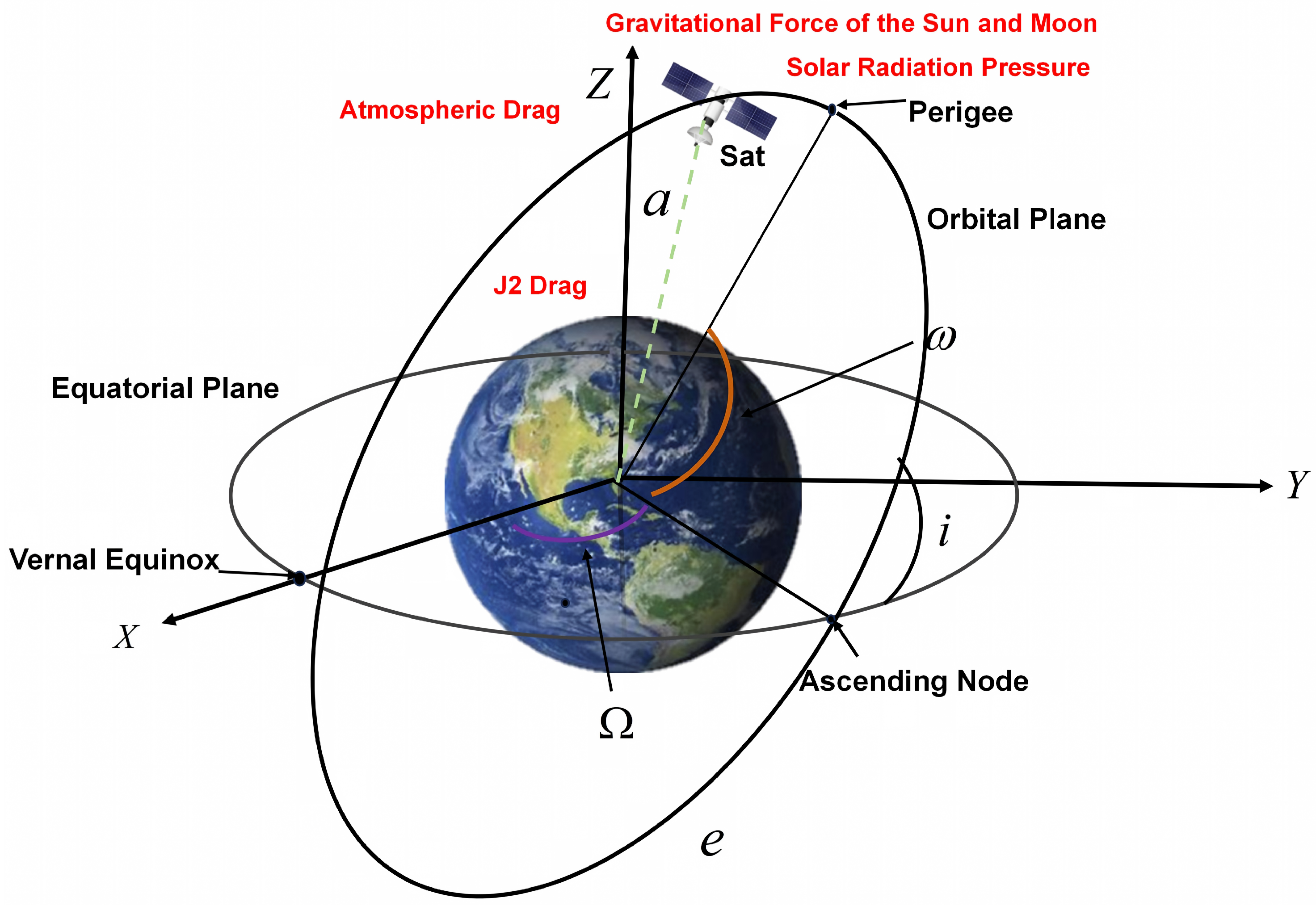
Starlink satellites operate at LEO. Their motion is therefore affected by several perturbations, including the J 2 effect, atmospheric drag, third-body gravity from the Sun and Moon, and solar radiation pressure (SRP). Among these perturbations, the J 2 effect and atmospheric drag dominate the orbital evolution [44,45]. In contrast, the effects of solar–lunar gravity and solar radiation pressure are usually less than 1%. Orbital dynamics models are commonly classified into osculating-element models and mean element models [46]. Mean element models remove the periodic terms of the perturbations. Osculating elements are more suitable for short-term simulations, such as rendezvous and docking or formation reconfiguration. Mean elements describe long-term perturbation trends with higher computational efficiency [47,48]. Hence, they are more suitable for long-term simulations, such as constellation configuration maintenance [30,48]. Therefore, this chapter adopts a mean orbital element model to describe the satellite orbital dynamics. Figure 4 illustrates the satellite’s position description and the perturbation effects in the ECI frame.
This section first introduces the mean element perturbation models for the J 2 effect and atmospheric drag. It then presents the mean element models for solar–lunar gravity and solar radiation pressure.

2.3.1. J 2 and Atmospheric Drag

We establish a dynamical model that accounts for the ( J 2 ) perturbation of the Earth and atmospheric drag:
a ˙ = A m C d ρ n a 2 ( 1 e 2 ) 3 / 2 1 + e 2 + 2 e cos f 3 / 2 e ˙ = A m C d ρ n a 1 e 2 e + cos f 1 + e 2 + 2 e cos f , i ˙ = 0 Ω ˙ = 3 J 2 R e 2 2 p 2 n cos i , ω ˙ = 3 4 J 2 R e 2 p 2 n 5 cos 2 i 1 , M ˙ = n + 3 4 J 2 R e 2 p 2 n 3 cos 2 i 1 1 e 2 .
where C d is drag parameter; A / m is the area-to-mass ratio; ρ is the atmospheric density; f denotes the true anomaly of the satellite; R e denotes the Earth’s radius; n = μ / a 3 is the satellite’s mean motion; p = a ( 1 e 2 ) denotes the semi-latus rectum; μ is Earth’s gravitational constant; θ = ω + M is the satellite phase.
Atmospheric models are crucial for accurately simulating satellite orbits and understanding the impact of atmospheric drag on their motion. Common atmospheric models include the exponential model, the Jacchia–Roberts model, and the NRLMSISE-00 model. The following is a comparison of the accuracy and typical usage scenarios of different atmospheric density models, as shown in Table 2:
(1)
Exponential Model: The exponential model assumes a simple exponential decrease in atmospheric density with altitude. It is computationally inexpensive but provides lower accuracy. It is mainly used for long-term simulations where high precision is not required. The atmospheric drag model is the exponential model:
ρ = ρ 0 · exp h h 0 H
where ρ 0 is the atmospheric density at the reference altitude h 0 , H is the atmospheric scale height, and h is the current orbital altitude.
(2)
Jacchia–Roberts Model: The Jacchia–Roberts model extends the exponential model by incorporating more detailed atmospheric data [49]. It is suitable for simulation scenarios that require high accuracy while maintaining computational efficiency.
(3)
NRLMSISE-00 Model: The NRLMSISE-00 model is the most accurate among these three options [50]. It incorporates a detailed representation of the thermospheric density, including the effects of solar activity and geomagnetic conditions. This model is widely used in high-precision orbit propagation, especially when detailed atmospheric drag modeling is required for short-term orbital predictions.
Table 2. Comparison of the accuracy and typical usage scenarios of different atmospheric density models.
ModelAccuracyEfficiency
ExponentialLowHigh
Jacchia–RobertsModerateModerate
NRLMSISE-00HighLow
This classification and accuracy comparison provided a clear overview of the appropriate atmospheric models based on the required precision and computational constraints for various simulation tasks.
Remark 4.
For Starlink-like satellites, atmospheric-density uncertainty is one of the dominant error sources in long-term configuration maintenance. In addition to the choice of the density model; solar flux, geomagnetic activity, attitude-dependent cross-sectional area, and ballistic-coefficient uncertainty should be considered when evaluating the station-keeping frequency and the propellant consumption.

2.3.2. Luni-Solar Third-Body Perturbation

Luni-solar third-body perturbations primarily induce inclination variations, which are critical for the long-term evolution of RAAN. The secular inclination rates induced by the Sun and the Moon can be expressed as [51]
( d i d t ) sun = 3 n s 2 8 n [ sin ( 2 Ω ) sin i + sin ( 2 ϵ ) sin Ω cos i sin ( 2 Ω ) cos 2 ϵ sin i ] ,
( d i d t ) moon = 3 n σ 8 n m n 2 [ sin ( Ω n 1 ) ( 2 cos ( Ω n 1 ) sin i + sin ( 2 i m ) cos i ) 2 cos 2 i m sin i cos ( Ω n 2 ) ]
where Ω n 1 = Ω Ω m ; Ω n 2 = Ω + Ω m ; n s and n m are the mean motions of the Earth around the Sun and the Moon around the Earth, respectively; ϵ denotes the obliquity of the ecliptic, i.e., the angle between the ecliptic plane and the Earth’s equatorial plane; i m is the inclination of the lunar orbit; Ω m is the lunar RAAN; σ is the mass ratio parameter.

2.3.3. Solar Radiation Pressure

SRP primarily drives the secular evolution of the eccentricity and induces an additional drift in the argument of perigee. The perturbation rates are given by [51]
( d e d t ) SRP = C s sin ( β s ω ) ,
( d ω d t ) SRP = C s e cos ( β s ω ) ,
where the SRP coefficient is defined as
C s = 3 K A s P s 2 n a m ,
where β s = n s t denotes the mean longitude of the Sun; K is the surface reflectivity coefficient; P s is the solar radiation pressure constant; A s is the effective cross-sectional area exposed to solar radiation.

3. Management of Constellation

3.1. Hierarchical Management Architecture

Traditional satellite constellations, such as GPS and BeiDou, consist of only a few dozen satellites. In contrast, modern megaconstellations expand to thousands of nodes. Traditional systems control each satellite individually through one-to-one management. This centralized approach fails to satisfy the massive control demands of these large-scale networks. Therefore, a commonly considered approach is to introduce cluster-based hierarchical management, in which the large-scale constellation is divided into smaller management domains with local coordination capability. This hierarchical architecture divides the massive network into manageable subsystems. Each subsystem maintains a clear structure and executes specific functions.
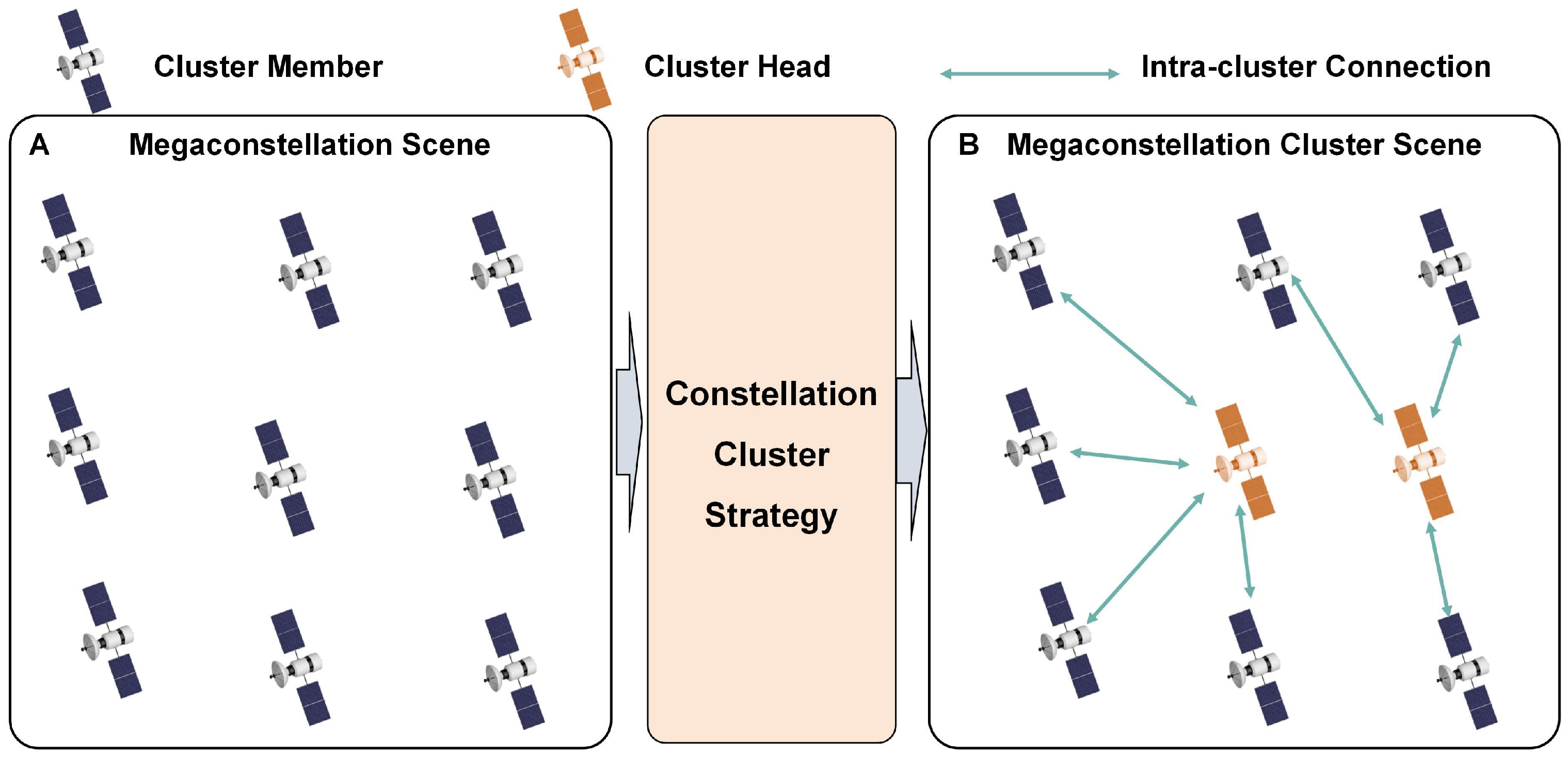
This architecture assigns specific responsibilities to the satellites within each subsystem. We classify these nodes as either cluster heads or member satellites. A standard cluster contains exactly one cluster head and multiple member satellites. The cluster head acts as a local control center. It aggregates data from all member satellites within its group and establishes a direct communication link with ground stations. Conversely, member satellites operate purely as task execution units. They only maintain communication links with their designated cluster head. Figure 5 illustrates this overall clustering strategy. The proposed architecture divides the entire constellation into several discrete clusters. Ultimately, this hierarchical, cluster-based management significantly reduces the control burden on ground stations compared to traditional centralized methods [52,53].

3.2. Constellation Clustering Strategy

Researchers widely use clustering algorithms to manage large-scale distributed networks. For example, Wireless Sensor Networks (WSNs) [54] and Unmanned Aerial Vehicle (UAV) swarms frequently adopt these strategies [55]. These networks typically contain hundreds or thousands of independent nodes. This hierarchical method effectively reduces energy consumption, minimizes routing overhead, and optimizes bandwidth utilization [56]. Specifically, Huang et al. [56] proposed an aggregation and clustering algorithm based on a graph attention network. Their model uses this network to learn similarity relationships among UAV nodes. Additionally, they designed a cluster head selection algorithm based on mixed-strategy games to enhance the overall network’s stability and efficiency. Similarly, ref. [57] employs a hierarchical multi-agent deep reinforcement learning framework to achieve dynamic clustering in UAV systems. Their distributed algorithm matches the performance of centralized algorithms while offering superior scalability. Furthermore, Mohan et al. [58] proposed a cluster head selection and routing scheme utilizing the Pelican optimization algorithm. This strategy targets the energy efficiency and network lifetime of WSNs. Their selection process evaluates multiple optimization objectives, and a potential function assigns cluster members to each head. This approach successfully enhances the overall robustness of WSNs.
While researchers extensively investigate clustering within WSNs and UAV networks, the application of these methods to satellite constellations remains in its infancy. Li et al. [59] introduced a multi-factor weighting method for the cluster head selection. Their algorithm evaluates satellite velocity, neighborhood degree, and others. The researchers also developed an event-triggered control mechanism to manage dynamic cluster changes and maintain a stable structure throughout the constellation’s lifecycle. Ma et al. [60] adopted an MEO-LEO architecture. They prioritized the cluster size metric during clustering at the LEO layer to achieve efficient constellation management. Liu et al. [61] applied game theory to cluster the satellite constellation, thereby optimizing the overall system stability and significantly reducing its communication overhead. Mao et al. [28] designed a constellation clustering strategy based on distributed management domains. Their approach explicitly models both the formation and maintenance of these satellite clusters. Jiang et al. [62] proposed a graph-based clustering algorithm for hierarchical satellite networks. Their approach integrates a token mechanism and node weights, specifically addressing the unidirectional links and node independence during the clustering process. Additionally, Jiao et al. [63] designed a multi-criteria routing algorithm using a time-varying graph method. This technique dynamically maintains the satellite clusters as the orbital topology changes. Finally, Zhang et al. [23] designed a clustering strategy that explicitly balances cluster size and energy consumption. The algorithm first selects cluster heads based on the neighborhood degree and the current residual fuel of the satellites. Next, the researchers developed a two-tier optimization structure. This structure separately optimizes the member satellite allocation and the intra-cluster multi-hop routing. Consequently, this method successfully achieves the dual objectives of managing cluster scale and minimizing energy usage.

4. Configuration Maintenance of Constellation

4.1. Configuration Maintenance Architecture

Operators typically deploy megaconstellations in LEO. In this dynamic environment, the J 2 effect, atmospheric drag, solar radiation pressure, and third-body gravitational forces from the Sun and Moon act as the primary perturbation sources. Therefore, we must develop highly effective configuration maintenance mechanisms [64,65].
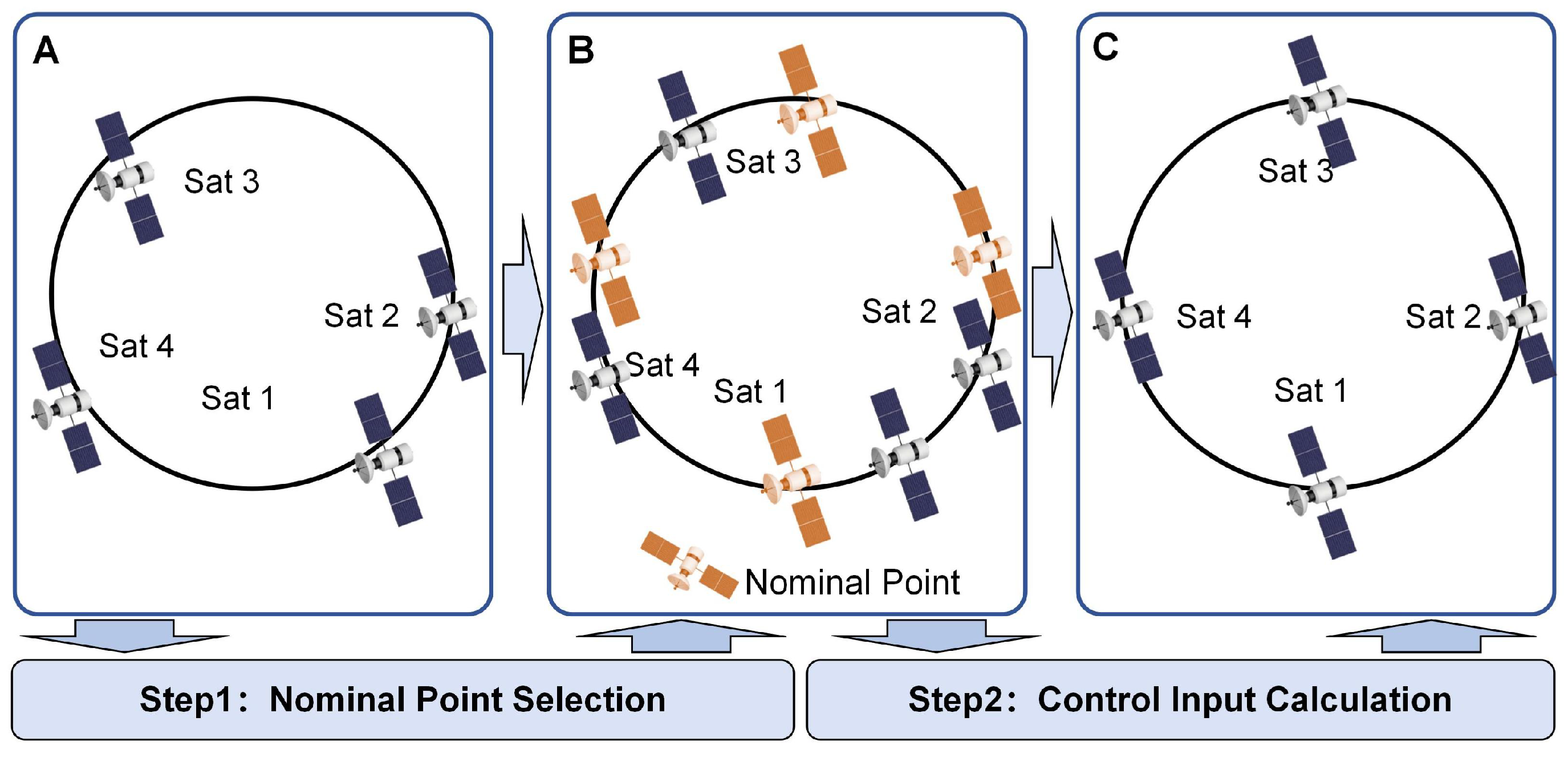
Constellation systems divide this maintenance into two primary categories: in-plane maintenance and out-of-plane maintenance. In-plane maintenance actively manages the relative phase and orbital altitude of the spacecraft [66,67]. Conversely, out-of-plane maintenance corrects the orbital inclination and RAAN [68,69]. Both maintenance strategies execute two fundamental steps, as illustrated in Figure 6. First, the system determines precise control targets. Second, the controller calculates the required control inputs. The following sections detail these in-plane and out-of-plane maintenance mechanisms. Finally, we analyze the specific configuration control modes employed by the Starlink network.

4.2. In-Plane Control

In-plane control corrects the satellite phase and orbital altitude. Equation (1) indicates that the difference in orbital altitude primarily determines the phase change rate. Therefore, we can apply a tangential velocity increment to modify the semi-major axis, which subsequently achieves phase maintenance. For a near-circular orbit, the system calculates the required tangential velocity increment, Δ V i , using the following equation:
Δ V i = n 2 Δ a
where Δ a defines the required change in the semi-major axis.
Within the in-plane maintenance framework, phase maintenance operates as a relative control process. The initial constellation design dictates a strict phase difference between adjacent satellites. In contrast, orbital altitude maintenance requires absolute control. The flight controller must maintain each satellite exactly at its designed altitude. To execute phase maintenance, we define the control targets as phase nominal points. We classify these nominal points into two distinct categories: (i) An absolute phase nominal point represents the exact preset position of a satellite within an ideal mathematical configuration [30,70]; (ii) a relative phase nominal point acts as a dynamic reference for phase control. The system dynamically selects this relative point based on the current physical state of the constellation or specific system optimization objectives.
Researchers extensively investigate strategies to optimize this in-plane configuration maintenance. For example, Xu et al. [71] transformed the configuration maintenance challenge into an inter-satellite distance control problem. Their approach continuously analyzes the distance variations between adjacent satellites. The system then triggers specific control maneuvers based on these physical changes to maintain the constellation structure. Kyuroson et al. [72] explored the synergy between deep reinforcement learning and the neuroevolution of augmenting topologies. Their combined approach allows satellites to autonomously maintain their orbits within strict tolerances despite external perturbations. Hu et al. [73] proposed a phase-keeping loop control method. Their approach combines semi-major axis overshoot control with passive control techniques. Additionally, they designed a relative phase maintenance scheme that utilizes a dynamic reference satellite to effectively manage the relative phase of the constellation. Tafanidis et al. [74] proposed a decentralized autonomous satellite control framework based on reinforcement learning and relative orbital elements. Their method trains separate policy networks to handle in-plane and out-of-plane deviations and generates low-thrust maneuver plans. This design enables long-term orbit maintenance on onboard devices with limited computing resources. Zuo et al. [75] addressed the high computational complexity and communication burden of traditional global optimization and reference-satellite methods for relative configuration maintenance. They proposed a fully distributed consensus control framework that relies only on the local inter-satellite interaction information and enables autonomous constellation configuration maintenance. Maisonobe et al. [76] studied the problem of station keeping under very low thrust. They proposed a control strategy that distributes in-plane and out-of-plane corrections over long arcs and discretizes them into small maneuvers. Their method achieves high-precision orbit maintenance at very low cost while satisfying mission constraints. Foster et al. [77] investigated phase control for a large group of co-orbital satellites without propulsion systems. They proposed an optimal control strategy based on differential drag and time-optimal allocation, and they successfully applied it to the on-orbit deployment and phase maintenance of 12 CubeSats. Yin et al. [78] investigated phase-keeping control for co-orbital satellites. They developed a cooperative control strategy with a two-layer optimization structure. The first layer optimizes the nominal points, and the second layer optimizes the control inputs. They also incorporated an orbital altitude maintenance mechanism. This approach achieves a dual optimization of energy consumption and control accuracy.

4.3. Out-of-Plane Control

Out-of-plane control aims to preserve the orbital-plane geometry of a satellite constellation, primarily through the regulation of i and Ω . These two elements determine the spatial distribution of orbital planes and, therefore, directly affect global coverage, inter-plane spacing, inter-satellite visibility, and long-term constellation stability. The long-term evolution of the orbital plane is mainly driven by the Earth’s oblateness, which is commonly described by the J 2 perturbation. For near-circular orbits, the secular drift rate of RAAN can be approximated as [48]
Ω ˙ = 3 2 J 2 n R e p 2 cos i ,
This expression shows that the RAAN drift rate is coupled with the semi-major axis, eccentricity, and inclination. As a result, satellites with slightly different orbital elements experience different nodal precession rates, which gradually alter the relative spacing among orbital planes. In addition to the J 2 effect, third-body gravity and solar radiation pressure can also contribute to long-term orbital-plane variations, although their influence in LEO is usually weaker than that of the J 2 perturbation.
A direct method for out-of-plane correction is to apply a normal velocity increment. Such a maneuver rotates the orbital plane and can compensate for inclination and RAAN deviations. For a near-circular orbit, the required normal velocity increment can be approximated as [79]
Δ V n = v Δ i 2 + ( Δ Ω sin i ) 2 ,
where v is the orbital velocity, Δ i is the required inclination correction, Δ Ω is the required RAAN correction, and i is the current orbital inclination. This equation indicates that the cost of out-of-plane correction scales with orbital velocity. Since LEO satellites have high orbital velocities, direct plane-change maneuvers are usually expensive in terms of propellant consumption. As a result, frequent out-of-plane correction is generally not suitable for megaconstellations with limited onboard fuel.
Since direct in-plane maneuvers are costly, many constellation maintenance strategies aim to reduce the need for active out-of-plane corrections by leveraging natural orbital dynamics. As shown in Equation (9), the drift of RAAN is directly related to i; therefore, we can correct RAAN by modifying only i and utilizing the natural drift of J 2 . Thus, we can modify Equation (10) to
Δ V n = v Δ i ,
In ref. [68], a fixed-period differential correction strategy is employed. By altering the inclination and utilizing J 2 perturbations, the RAAN is maintained within a predetermined tolerance range relative to its nominal design value, thereby preserving the constellation’s configuration. Similarly, Chu et al. [70] establish a threshold for RAAN; once predetermined conditions are met, they correct the RAAN by modifying the inclination. In Ref. [30], the RAAN correction was achieved through the absolute configuration control. In Ref. [80], the proposed configuration maintenance strategy involves fitting the data of the individual offsets of each satellite in the constellation and calculating the corresponding control variables based on the principle of parameter bias perturbation compensation to correct the phase and RAAN.

4.4. Starlink Control Strategy

Researchers utilize publicly available datasets to extensively study the configuration maintenance of the Starlink network [81]. For instance, ref. [82] observes that Starlink satellites perform orbit maintenance maneuvers approximately every two days. Similarly, ref. [83] confirms this high control frequency. They specifically note that satellites operating in the 550 km orbital shell execute station-keeping maneuvers every two to three days. This aggressive maintenance schedule directly supports exceptionally strict configuration tolerances. In refs. [84,85] demonstrate that operators successfully maintain the relative phase error between adjacent Starlink satellites at approximately 0.2°. Such precise phase control prevents signal interference and guarantees continuous global communication coverage. Shorten et al. [86] analyzed the public TLE data of Starlink satellites and found that Starlink station-keeping maneuvers exhibit a launch-group-based periodic burst pattern. Ref. [87] analyzes the dynamic configuration parameters of a specific Starlink orbital shell. Their analysis reveals the practical boundary conditions and control thresholds required to stabilize this massive network.
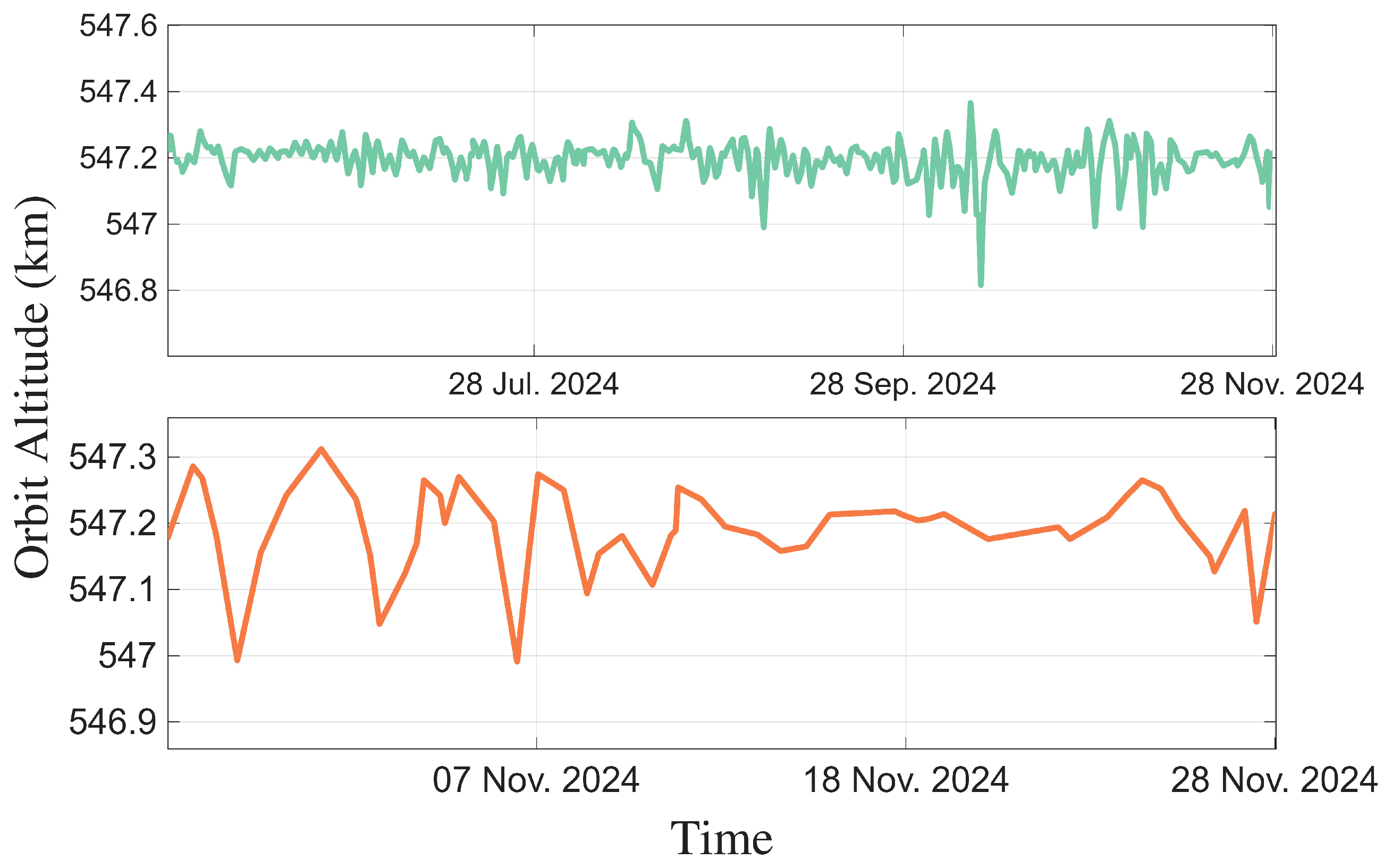
Furthermore, we retrieve the orbital altitude data for the STARLINK-1008 from 1 May to 28 November 2024 (See CelesTrak at https://celestrak.org/ accessed on 28 November 2024). Figure 7 illustrates these altitude variations. The upper panel displays the altitude fluctuations for the complete year. The lower panel provides a detailed view of the changes between 28 October and 28 November 2024. This satellite exhibits frequent altitude adjustments. These observations confirm that Starlink satellites execute regular station-keeping maneuvers to maintain their orbital configuration.
Remark 5.
It should be emphasized that the maneuver-frequency estimates derived from public TLE data are indirect. Therefore, the inferred station-keeping frequency should be interpreted as an approximate operational signature rather than a confirmed maneuver schedule.
Remark 6.
The Starlink phase error of approximately 0.2° should be interpreted as operational-level configuration maintenance performance inferred from publicly available orbital data, rather than a fixed accuracy requirement maintained at any cost. In practice, higher phase-keeping accuracy generally requires more frequent control actions and therefore leads to higher propellant consumption, as discussed in the study on configuration maintenance in multi-satellite orbits [78]. Moreover, collision avoidance has a higher priority than phase keeping in real-world operations. Thus, avoidance maneuvers may temporarily disturb a satellite’s nominal phase or altitude, and subsequent station-keeping or rephasing maneuvers are required to restore the desired configuration.

5. Open Challenges and Future Directions

The rapid expansion of LEO megaconstellations is shifting the central problem of satellite operations from deployment to sustained management. For systems such as Starlink, the key challenge is not only to place thousands of satellites into orbit but also to coordinate them as a continuously evolving orbital infrastructure [88,89]. Environmental perturbations, limited onboard resources, dynamic inter-satellite connectivity, and increasing congestion in LEO make a constellation operation a coupled problem across orbital dynamics, network management, and autonomous decision-making. This section discusses the major open challenges and future research directions for scalable, intelligent, and sustainable megaconstellation operation.

5.1. From Centralized Control to Distributed Autonomy

Traditional satellite constellations have largely relied on centralized ground control, where orbit determination, command generation, and mission planning are performed by ground stations. This paradigm is effective for small constellations, but it becomes increasingly fragile as the number of satellites grows to thousands. Massive telemetry streams, frequent station-keeping demands, and rapidly changing network states can overload ground-to-satellite communication links and introduce unacceptable decision latency. More importantly, centralized architectures create single points of failure that are incompatible with the resilience expected from global space infrastructure.
Future megaconstellations will therefore require a progressive shift toward a distributed autonomy. In such systems, satellites will no longer act only as passive executors of ground commands but as local decision-making nodes capable of state estimation, anomaly detection, resource negotiation, and maneuver planning. A central research challenge is to design distributed algorithms that remain reliable under incomplete information, intermittent connectivity, and limited onboard computation. Promising directions include lightweight consensus control, hierarchical autonomy, event-triggered decision-making, and onboard learning methods that can adapt to local orbital and network conditions without requiring full constellation-wide knowledge.

5.2. Multi-Shell Coordination in a Coupled Orbital Architecture

Starlink-like systems are not single-layer constellations. They consist of multiple orbital shells with different altitudes, inclinations, phase structures, and service functions. Existing studies often simplify this complexity by treating each shell independently. However, multi-shell constellations are inherently coupled. Satellites in different shells may share communication traffic, relay data through inter-satellite links, influence collision-risk assessment, and require coordinated station-keeping to preserve their service continuity. Differences in orbital decay, perturbation strength, link duration, and coverage geometry further complicate the cross-shell operation.
Future research should move from single-shell optimization toward multi-layer constellation coordination. A useful direction is to model megaconstellations as time-varying multilayer graphs, where each shell forms a dynamic network layer and cross-shell links represent communication, control, or safety dependencies. Such models could support the joint optimization of routing, orbital maintenance, traffic load balancing, and collision avoidance. Hierarchical control may also become essential: Higher-altitude or more stable shells could serve as coordination backbones, whereas lower-altitude shells could provide a flexible regional capacity and direct user access. The key open problem is how to coordinate these layers without creating excessive communication overhead or a renewed dependence on centralized control.

5.3. Configuration Maintenance Under Multi-Objective Optimization

Configuration maintenance is not a single-objective control problem in LEO megaconstellations. Atmospheric drag, Earth oblateness, solar radiation pressure, and third-body perturbations continuously drive satellites away from their nominal orbital states. Conventional station-keeping strategies often focus on maintaining predefined orbital elements, phase spacing, or altitude thresholds. Although such strategies can preserve geometric regularity, they may lead to frequent maneuvers, excessive propellant consumption, and shortened satellite lifetime. For Starlink-like systems, where thousands of satellites must be maintained simultaneously, the strict geometric accuracy alone is no longer a sufficient performance criterion.
Future configuration maintenance should therefore be formulated as a multi-objective optimization problem. The control system must jointly consider phase accuracy, altitude stability, coverage quality, collision risk, communication performance, maneuver frequency, and residual fuel. These objectives are often coupled and sometimes conflicting. For example, reducing phase error may improve coverage uniformity but increase fuel consumption; delaying a maneuver may save propellant but degrade inter-satellite geometry or increase collision risk. The key challenge is to determine when an orbital deviation becomes operationally significant, rather than merely being geometrically detectable.
A promising direction is to shift from a satellite-level error correction to constellation-level performance optimization. Instead of maintaining every satellite around a rigid nominal point, future controllers could allocate maneuver resources according to each satellite’s functional role, local traffic demand, residual lifetime, and contribution to global coverage. Adaptive control thresholds, cooperative maneuver scheduling, event-triggered station-keeping, and learning-assisted optimization may help balance accuracy, efficiency, and sustainability. In this view, the optimal configuration is not necessarily the most geometrically precise one but the one that best preserves the constellation service under limited resources.

5.4. Autonomous Management of Dynamic Topology

The management of LEO megaconstellations is strongly affected by their dynamic topology. Unlike terrestrial networks or traditional satellite constellations with relatively stable management relationships, LEO satellites move rapidly along their orbits. As a result, inter-satellite distances, visibility windows, ground-access opportunities, and relative geometric relationships change continuously. In multi-shell constellations, this behavior becomes more complex because different shells have different orbital periods, inclinations, nodal precession rates, and altitude-dependent decay characteristics. Therefore, the management structure of a megaconstellation cannot be treated as a fixed hierarchy but should be regarded as a time-varying system driven by orbital dynamics.
This dynamic nature creates direct challenges for constellation management. A cluster head that is suitable at one time may become less effective later because of changing link geometry, uneven member distribution, or increasing communication distance. Frequent topology variation may also require repeated reconstruction of management domains, which increases signaling overhead and weakens coordination stability. Moreover, topology evolution occurs on multiple time scales: Orbital motion changes relative geometry within minutes, atmospheric drag affects altitude and phase over days or weeks, and long-term perturbations gradually reshape the constellation structure. Management strategies must therefore consider both short-term topology changes and long-term constellation evolution.
Future research should develop topology-aware management models that explicitly include these dynamic characteristics. Time-varying graph representations provide a natural way to describe satellites as nodes and feasible management relationships as edges over specific time windows. Based on this representation, the cluster construction can be optimized not only for instantaneous connectivity but also for temporal stability, load balance, cluster lifetime, and reconstruction cost. For Starlink-like systems, the key problem is to balance stability and adaptability: the management topology should remain stable enough for efficient coordination while being flexible enough to follow the natural evolution of the constellation.

5.5. Intelligent and Sustainable Space Operations

As LEO becomes increasingly crowded, megaconstellation management must be aligned with orbital sustainability. Collision avoidance, end-of-life disposal, debris mitigation, and safe re-entry are no longer secondary operational issues but central requirements for the long-term use of near-Earth space. In addition to improved control algorithms, on-orbit refueling and servicing may become important tools for sustainable operations. Since limited propellant directly constrains station-keeping, collision avoidance, and end-of-life disposal, refueling could extend satellite lifetime and improve operational flexibility. On-orbit servicing, such as inspection, fault diagnosis, assisted orbit transfer, and assisted deorbiting, could further reduce replacement costs and improve constellation resilience.
Artificial intelligence can support both autonomous operations and future on-orbit servicing tasks. Learning-based methods are attractive for anomaly detection, maneuver planning, traffic prediction, refueling-demand prediction, and servicing-task scheduling. However, these applications require high reliability, explainability, and verifiability, especially when service vehicles perform rendezvous, proximity operations, fuel transfer, or assisted deorbiting in a crowded LEO environment. Future research should therefore focus on safe autonomy, where AI algorithms are validated, bounded, and integrated with physical constraints. Digital twins, physics-informed learning, onboard anomaly diagnosis, and human-supervised autonomy may provide practical routes toward intelligent and serviceable megaconstellations. Ultimately, sustainable megaconstellations will depend on the ability to coordinate satellites, fuel resources, and service vehicles as part of a responsible orbital infrastructure.

5.6. Summary

In summary, megaconstellations transform satellite operations from the management of a limited number of spacecraft into the coordination of a large-scale, dynamic orbital infrastructure. This transition exposes several coupled challenges. Centralized ground-based control faces scalability limits as telemetry volume, command frequency, and decision latency increase with constellation size. Environmental perturbations continuously alter satellite orbits, making configuration maintenance essential but costly in terms of propellant consumption and satellite lifetime. Meanwhile, the rapid motion of LEO satellites produces time-varying management relationships, especially in multi-shell constellations where different orbital layers evolve with distinct dynamic characteristics.
Addressing these challenges requires a shift from isolated single-satellite control toward coordinated constellation-level operation. Future research should integrate distributed autonomy, multi-shell coordination, topology-aware management, multi-objective configuration maintenance, and intelligent decision-making. In this framework, control decisions should not be driven only by rigid geometric errors but by their effects on coverage, connectivity, collision risk, fuel consumption, and long-term sustainability. Starlink-like systems therefore highlight a broader direction for next-generation space networks: the defining challenge is not simply scale but the ability to make it manageable through autonomous, fuel-aware, and sustainable constellation operations.

6. Conclusions

LEO megaconstellations are transforming satellite systems from small, centrally managed constellations into dense, dynamic, and increasingly autonomous orbital infrastructures. Using Starlink as a representative case, this review has shown that the key challenge is not only large-scale deployment but also the continuous management and configuration maintenance of thousands of satellites under orbital perturbations, fuel constraints, and evolving network topology. Future systems will require tighter coupling between system-level and single-satellite-level orbital control, achieved through distributed autonomy, fuel-aware maneuver planning, multi-level coordination, and intelligent decision-making. The long-term value of Starlink-like systems will therefore depend not merely on constellation size or communication capacity but on their ability to operate safely, efficiently, and sustainably in an increasingly crowded orbital environment.

Author Contributions

Conceptualization, T.Y. and C.Z.; methodology, T.Y., Z.H. and C.Z.; investigation, T.Y., Z.H., Q.L. and J.W.; resources, C.Z. and D.X.; original draft preparation, T.Y.; review and editing, Z.H., Q.L., J.W., R.V., D.X. and C.Z.; supervision, C.Z., R.V. and D.X.; project administration, C.Z.; funding acquisition, C.Z. All authors have read and agreed to the published version of this manuscript.

Funding

This study was supported by the National Natural Science Foundation of China (No. 62573211).

Data Availability Statement

No new data were created or analyzed in this study. Data sharing is not applicable to this article.

Conflicts of Interest

The author declares no conflicts of interest.

References

  1. Singh, L.A.; Whittecar, W.R.; DiPrinzio, M.D.; Herman, J.D.; Ferringer, M.P.; Reed, P.M. Low cost satellite constellations for nearly continuous global coverage. Nat. Commun. 2020, 11, 200. [Google Scholar] [CrossRef] [PubMed]
  2. Xu, X.; Zhang, S.; Liu, A. Topology Dynamic of Mega-Constellation Networks. IEEE Internet Things J. 2025, 12, 22975–22988. [Google Scholar] [CrossRef]
  3. Lee, Y.; Choi, J.P. Connectivity analysis of mega-constellation satellite networks with optical intersatellite links. IEEE Trans. Aerosp. Electron. Syst. 2021, 57, 4213–4226. [Google Scholar] [CrossRef]
  4. Ouyang, Q.; Ye, N.; An, J. On the Vulnerability of Mega-Constellation Networks Under Geographical Failure. IEEE Trans. Netw. 2025, 33, 2049–2062. [Google Scholar] [CrossRef]
  5. Fang, Z.; Cai, Y.; Huang, P.; Wang, Z. Constellation Reconfiguration Strategy for Emergency Multitarget Continuous Coverage Using Low Thrust. J. Guid. Control. Dyn. 2026, 49, 726–742. [Google Scholar] [CrossRef]
  6. Zhang, C.; Wang, J.; Zhang, D.; Shao, X. Fault-tolerant adaptive finite-time attitude synchronization and tracking control for multi-spacecraft formation. Aerosp. Sci. Technol. 2018, 73, 197–209. [Google Scholar]
  7. Xu, C.; Zhang, C.; Wang, J. Passive safety maintenance for long-term spacecraft cluster flying utilizing relative motion perturbed evolution law. Aerosp. Sci. Technol. 2025, 164, 110402. [Google Scholar] [CrossRef]
  8. Zhang, C.; Wang, J.; Zhang, D.; Shao, X. Synchronization and tracking of multi-spacecraft formation attitude control using adaptive sliding mode. Asian J. Control 2019, 21, 832–846. [Google Scholar]
  9. Zhang, W.; Wang, Y.; Zhang, Y. Attention-driven reinforcement learning for multi-satellite collaborative orbital interception strategy solution. Astrodynamics 2025, 9, 657–669. [Google Scholar]
  10. Zhou, H.; Jiao, B.; Dang, Z.; Yuan, J. Parametric formation control of multiple nanosatellites for cooperative observation of China Space Station. Astrodynamics 2024, 8, 77–95. [Google Scholar] [CrossRef]
  11. McDowell, J.C. The low earth orbit satellite population and impacts of the SpaceX Starlink constellation. Astrophys. J. Lett. 2020, 892, L36. [Google Scholar] [CrossRef]
  12. Wang, J.; Liu, T.; Zhang, C.; Zhang, J. Enhance uniform observation ability of remote sensing constellation using ground track configuration allocation. Aerosp. Sci. Technol. 2025, 163, 110344. [Google Scholar] [CrossRef]
  13. Ali, M.; Upadhyay, U.; McCormick, S.; Hill, J.; Zhang, B. Starlink Constellation: Deployment, Configuration, and Dynamics. arXiv 2026, arXiv:2603.25835. [Google Scholar]
  14. Han, P.; Li, C.; Huang, C.; Huang, H.; Guo, Y.; Pan, G. LEO Internet Satellite Constellation Design for Regional Civil Aviation Airways With Multiple Repeat Ground Tracks. IEEE Trans. Aerosp. Electron. Syst. 2025, 61, 4088–4104. [Google Scholar]
  15. Yan, Y.; Wang, J.; Wang, W.; Tan, L.; Varatharajoo, R.; Zhang, C. Fully-distributed autonomous scheduling for Earth-observing constellations. Astrodynamics 2025, 9, 877–892. [Google Scholar]
  16. Laniewski, D.; Lanfer, E.; Aschenbruck, N. Measuring Mobile Starlink Performance: A Comprehensive Look. IEEE Open J. Commun. Soc. 2025, 6, 1266–1283. [Google Scholar] [CrossRef]
  17. Chen, Q.; Yang, L.; Zhao, Y.; Wang, Y.; Zhou, H.; Chen, X. 3-ISL topology: Routing properties and performance in LEO megaconstellation networks. IEEE Trans. Aerosp. Electron. Syst. 2024, 61, 4961–4972. [Google Scholar] [CrossRef]
  18. Xu, Z.; An, Z.; Gu, D.; Du, L.; Chen, X.; Tong, L. Optimization and deployment method of cislunar communication and navigation constellation based on libration point orbits. Astrodynamics 2026, 10, 279–298. [Google Scholar] [CrossRef]
  19. Verhagen, S.; Teunissen, P.J. Ambiguity resolution performance with GPS and BeiDou for LEO formation flying. Adv. Space Res. 2014, 54, 830–839. [Google Scholar] [CrossRef]
  20. Zhao, S.; Yao, Z.; Zhuang, X.; Lu, M. Analysis on coverage ability of BeiDou navigation satellite system for manned spacecraft. Acta Astronaut. 2014, 105, 487–494. [Google Scholar] [CrossRef]
  21. Xu, Z.; Yin, Z.; Pan, T. Power coordination control strategy for distributed hybrid energy storage system based on CCS-MPC. Int. J. Innov. Comput. Inf. Control 2024, 20, 89–103. [Google Scholar]
  22. Shen, Z.; Xu, D.; Pan, T.; Yang, W.; Jiang, D. Observer-Based Secure Distributed Sliding Mode Control for a Multi-Area Interconnected Power System under False Data Injection Attacks. Int. J. Innov. Comput. Inf. Control 2024, 20, 1555–1572. [Google Scholar]
  23. Zhang, C.; Yin, T.; Wang, W.; Wu, J.; Wang, J.; Qi, Y.; He, W. Clustering Strategy for Megaconstellation with Synergistic Energy and Size Considerations. IEEE Trans. Aerosp. Electron. Syst. 2025, 61, 10098–10109. [Google Scholar] [CrossRef]
  24. Wang, Z.; Mu, Z.; Zhou, H.; Wu, S.; Huang, Y.; Zhang, K. Minimum hop path model for LEO mega constellation networks with inter-layer satellite links: A theoretical analytic approach. Adv. Space Res. 2025, 75, 3994–4012. [Google Scholar]
  25. Qiao, D.; Zhou, X.; Li, X. Analytical configuration uncertainty propagation of geocentric interferometric detection constellation. Astrodynamics 2023, 7, 271–284. [Google Scholar] [CrossRef]
  26. Sorge, M.; Alary, D.; Lacomba, F.; Tung, H.; Singh, B. Space traffic management: Large constellations. Acta Astronaut. 2025, 229, 698–704. [Google Scholar] [CrossRef]
  27. Zhang, C.; Jin, J.; Kuang, L.; Yan, J. LEO constellation design methodology for observing multi-targets. Astrodynamics 2018, 2, 121–131. [Google Scholar] [CrossRef]
  28. Mao, Y.; Wu, Y.; Ju, X.; Xie, H.; Yue, C. Dynamic management topology construction, evolution, and maintenance of low earth orbit mega-constellation. Space Sci. Technol. 2025, 5, 0248. [Google Scholar] [CrossRef]
  29. Junhua, X.; Yulin, Z. A coordination control method for stationkeeping of regressive orbit regional coverage satellite constellation. In Proceedings of the 2006 Chinese Control Conference, Harbin, China, 7–11 August 2006; pp. 136–139. [Google Scholar]
  30. Arnas, D.; Casanova, D.; Tresaco, E. Relative and absolute station-keeping for two-dimensional–lattice flower constellations. J. Guid. Control. Dyn. 2016, 39, 2602–2604. [Google Scholar]
  31. Fang, Z.; Liu, F.; Han, F.; Wang, Z. On Lyapunov stability of artificial potential function-based low-thrust constellation reconfiguration control. Adv. Space Res. 2024, 74, 2316–2330. [Google Scholar]
  32. Qiao, Z.; Yin, T.; Bu, X.; He, Z.; Cheng, J.; Li, Q.; Zhang, C. Maintenance of Co-orbital Satellite Configurations with Minimal Control Inputs. IEEE J. Miniaturization Air Space Syst. 2026. [Google Scholar] [CrossRef]
  33. Zhang, J.; Cai, Y.; Xue, C.; Xue, Z.; Cai, H. LEO mega constellations: Review of development, impact, surveillance, and governance. Space Sci. Technol. 2022, 2022, 9865174. [Google Scholar] [CrossRef]
  34. Elbehiry, E.A.; TagElDien, H.A.; Fares, A.; ElHalawany, B.M. Survey on routing algorithms for LEO constellations network. Fayoum Univ. J. Eng. 2024, 7, 89–99. [Google Scholar] [CrossRef]
  35. Qi, X.; Ma, J.; Wu, D.; Liu, L.; Hu, S. A Survey of Routing Techniques for Satellite Networks. J. Commun. Inf. Netw. 2016, 1, 66–85. [Google Scholar] [CrossRef]
  36. Michel, F.; Trevisan, M.; Giordano, D.; Bonaventure, O. A first look at starlink performance. In Proceedings of the 22nd ACM Internet Measurement Conference, Nice, France, 25–27 October 2022; pp. 130–136. [Google Scholar]
  37. Chaudhry, A.U.; Yanikomeroglu, H. Laser intersatellite links in a starlink constellation: A classification and analysis. IEEE Veh. Technol. Mag. 2021, 16, 48–56. [Google Scholar] [CrossRef]
  38. Ma, S.; Chou, Y.C.; Zhao, H.; Chen, L.; Ma, X.; Liu, J. Network characteristics of leo satellite constellations: A starlink-based measurement from end users. In Proceedings of the IEEE INFOCOM 2023-IEEE Conference on Computer Communications, New York, NY, USA, 17–20 May 2023; pp. 1–10. [Google Scholar]
  39. Cakaj, S. The parameters comparison of the “Starlink” LEO satellites constellation for different orbital shells. Front. Commun. Netw. 2021, 2, 643095. [Google Scholar] [CrossRef]
  40. Mallama, A.; Cole, R.E.; Respler, J.; Harrington, S.; Lee, R.; Worley, A. The Brightness of Starlink Mini Satellites During Orbit-Raising. arXiv 2024, arXiv:2405.12007. [Google Scholar]
  41. Garcia-Cabeza, J.; Albert-Smet, J.; Frias, Z.; Mendo, L.; Azcoitia, S.A.; Yraola, E. Direct-to-Cell: A First Look into Starlink’s Direct Satellite-to-Device Radio Access Network through Crowdsourced Measurements. IEEE Commun. Mag. 2026, 64, 52–58. [Google Scholar]
  42. Humphreys, T.E.; Iannucci, P.A.; Komodromos, Z.M.; Graff, A.M. Signal structure of the Starlink Ku-band downlink. IEEE Trans. Aerosp. Electron. Syst. 2023, 59, 6016–6030. [Google Scholar]
  43. De Gaudenzi, R. Satellite Networks: Past, Present, and Future Challenges—Part 2: Broadband Systems. IEEE Aerosp. Electron. Syst. Mag. 2025, 40, 4–14. [Google Scholar] [CrossRef]
  44. Lang, A.; Jiang, Y. Orbit Determination for Continuously Maneuvering Starlink Satellites Based on an Unscented Batch Filtering Method. Sensors 2025, 25, 4079. [Google Scholar] [CrossRef] [PubMed]
  45. Zhang, W.; Wang, X.; Cui, W.; Zhao, Z.; Chen, S. Self-induced collision risk of the Starlink constellation based on long-term orbital evolution analysis. Astrodynamics 2023, 7, 445–453. [Google Scholar]
  46. Zhong, W.; Gurfil, P. Mean orbital elements estimation for autonomous satellite guidance and orbit control. J. Guid. Control. Dyn. 2013, 36, 1624–1641. [Google Scholar] [CrossRef]
  47. Su, B.; Zhou, Q. Analysis of dynamic evolution and station-keeping of starlink. In Proceedings of the 2021 China Automation Congress (CAC), Beijing, China, 22–24 October 2021; pp. 8229–8234. [Google Scholar]
  48. Vallado, D.A. Fundamentals of Astrodynamics and Applications; Springer Science & Business Media: Dordrecht, The Netherlands, 2001; Volume 12. [Google Scholar]
  49. Wen, G.; Wang, S.; Zeng, Y.; Liu, T.; Zhang, M.; Liang, Z.; Ibrahim, M.; Han, X.; Liu, C. Research on the Laser Ranging of Runaway Space Objects. Aerospace 2026, 13, 186. [Google Scholar] [CrossRef]
  50. Picone, J.; Hedin, A.; Drob, D.P.; Aikin, A. NRLMSISE-00 empirical model of the atmosphere: Statistical comparisons and scientific issues. J. Geophys. Res. Space Phys. 2002, 107, SIA 15-1–SIA 15-16. [Google Scholar]
  51. Jiang, Y.; Li, H.; Bao, Y. On Perturbation and Orbital Maintenance Control Strategy for Walker Constellation. Aerosp. Control Appl. 2013, 39, 36–41. [Google Scholar]
  52. Hao, Q.; Zhou, D.; Sheng, M.; Shi, Y.; Li, J. Tiered clustering-based management architecture in mega-satellite networks. Sci. China Inf. Sci. 2024, 67, 152301. [Google Scholar]
  53. Wei, S.; Dong, T.; Liu, Z.; Di, H.; Zhang, Q.; Jin, S. Spectral clustering-based controller placement approach in low-Earth-orbit satellite networks. Space Sci. Technol. 2025, 5, 0200. [Google Scholar]
  54. Rajput, M.; Narayan Yadav, R. Machine and Deep Learning Driven Energy Efficient Clustering in IOT-WSNs: A Review. IEEE Sens. J. 2025, 25, 39371–39385. [Google Scholar] [CrossRef]
  55. Wu, J.; Zou, L.; Zhao, L.; Al-Dubai, A.; Mackenzie, L.; Min, G. A multi-UAV clustering strategy for reducing insecure communication range. Comput. Netw. 2019, 158, 132–142. [Google Scholar] [CrossRef]
  56. Huang, S.; Yao, H.; Wang, X.; Mai, T.; Wang, Z.; Guo, S. Graph Attentional Based Agglomerative Cluster for UAV Swarm Networks. IEEE Trans. Netw. Sci. Eng. 2025, 12, 3311–3327. [Google Scholar] [CrossRef]
  57. Meer, I.A.; Besser, K.L.; Ozger, M.; Schupke, D.A.; Poor, H.V.; Cavdar, C. Hierarchical Multi-Agent DRL-Based Dynamic Cluster Reconfiguration for UAV Mobility Management. IEEE Trans. Cogn. Commun. Netw. 2026, 12, 4957–4971. [Google Scholar]
  58. Mohan, Y.; Yadav, R.K.; Manjul, M. EECRPOA: Energy efficient clustered routing using pelican optimization algorithm in WSNs. Wirel. Netw. 2025, 31, 3743–3769. [Google Scholar] [CrossRef]
  59. Li, N.; Chengfei, Y.; Qiu, G.H.S.; Xibin, C. Domain control strategy for the large-scale satellite cluster. Chin. Space Sci. Technol. 2023, 43, 18–28. [Google Scholar]
  60. Ma, T.; Qian, B.; Qin, X.; Liu, X.; Zhou, H.; Zhao, L. Satellite-terrestrial integrated 6G: An ultra-dense LEO networking management architecture. IEEE Wirel. Commun. 2022, 31, 62–69. [Google Scholar]
  61. Liu, J.; Zhang, X.; Zhang, R.; Huang, T.; Yu, F.R. Reliable and low-overhead clustering in LEO small satellite networks. IEEE Internet Things J. 2021, 9, 14844–14856. [Google Scholar] [CrossRef]
  62. Jiang, Y.; Liu, Y.; Wen, Y.; Wang, G. A clustering algorithm applied to the satellite networks management. In Proceedings of the Fourth International Conference on Parallel and Distributed Computing, Applications and Technologies, Chengdu, China, 27–29 August 2003; pp. 396–399. [Google Scholar]
  63. Jiao, J.; Yang, P.; Du, Z.; Wang, Y.; Zhang, Q. Clustered multi-criteria routing algorithm for mega low Earth orbit satellite constellations. IEEE Trans. Veh. Technol. 2024, 73, 13790–13803. [Google Scholar] [CrossRef]
  64. Xu, Y.; Zhang, Y.; Wang, Z.; He, Y.; Fan, L. Self-organizing control of mega constellations for continuous Earth observation. Remote Sens. 2022, 14, 5896. [Google Scholar] [CrossRef]
  65. Xu, Y.; Wang, Z.; Hu, X.; He, Y. Self-Organizing Maintenance Method of Mega Walker Constellations With Multiple Coverage. IEEE Trans. Aerosp. Electron. Syst. 2026, 62, 3552–3568. [Google Scholar]
  66. Lafleur, T.; Apffel, N. Low-earth-orbit constellation phasing using miniaturized low-thrust propulsion systems. J. Spacecr. Rockets 2021, 58, 628–642. [Google Scholar]
  67. Yang, Y.; Wu, X.; Li, J.; Zang, J.; Lu, J.; Zgeib, R. Configuration design method of mega constellation for low earth orbit observation. Space Sci. Technol. 2024, 4, 0175. [Google Scholar] [CrossRef]
  68. Zuo, X.; Li, K.; Chen, L.; He, X.; Xu, M. Fixed-period strategy for maintaining the absolute configuration of large-scale LEO constellations. Adv. Space Res. 2025, 76, 4663–4678. [Google Scholar]
  69. Cui, H.; Geshi, T.; Jianfeng, Y.; Hao, H.; HAN, C. Station-keeping strategies for satellite constellation. Adv. Astronaut. Sci. 2013, 148, 3923–3932. [Google Scholar]
  70. Chu, Y.; Li, W.; Gong, S.; Zhang, F. Evolution Analysis and Maintenance Control Strategy Study on LEO Mega-Constellation Configuration. Aerospace 2024, 41, 24–32. [Google Scholar]
  71. Xu, Y.; Zhang, Y.; Fan, L. Autonomous semi-major axis adjustment for mega constellation continuous coverage. Adv. Space Res. 2024, 73, 5582–5594. [Google Scholar]
  72. Kyuroson, A.; Banerjee, A.; Tafanidis, N.A.; Satpute, S.; Nikolakopoulos, G. Towards fully autonomous orbit management for low-earth orbit satellites based on neuro-evolutionary algorithms and deep reinforcement learning. Eur. J. Control 2024, 80, 101052. [Google Scholar]
  73. Hu, M.; Li, F.; Xue, W.; Liu, C.; Guo, W.; Ruan, Y. Station Maintenance for Low-Orbit Large-Scale Constellations Based on Absolute and Relative Control Strategies. Appl. Sci. 2025, 15, 4640. [Google Scholar]
  74. Tafanidis, N.A.; Banerjee, A.; Satpute, S.; Nikolakopoulos, G. Reinforcement learning-based station keeping using relative orbital elements. Adv. Space Res. 2025, 76, 750–763. [Google Scholar] [CrossRef]
  75. Zuo, X.; Li, K.; Yang, Z.; Chen, L. Consensus control for relative configuration maintenance of large-scale LEO constellations. Adv. Space Res. 2026, 77, 11234–11251. [Google Scholar]
  76. Maisonobe, L.; Parraud, P. Very low thrust station-keeping for low Earth orbiting satellites. Adv. Space Res. 2023, 71, 1558–1593. [Google Scholar]
  77. Foster, C.; Mason, J.; Vittaldev, V.; Leung, L.; Beukelaers, V.; Stepan, L.; Zimmerman, R. Constellation phasing with differential drag on planet labs satellites. J. Spacecr. Rockets 2018, 55, 473–483. [Google Scholar] [CrossRef]
  78. Yin, T.; Zhang, C.; Wang, J.; Wu, J.; Varatharajoo, R.; Xu, D.; Jiang, B. Configuration Maintenance in Multisatellite Orbits Via Co-Phase and Control Optimization. IEEE Trans. Aerosp. Electron. Syst. 2025, 61, 16738–16750. [Google Scholar] [CrossRef]
  79. Zhu, X.; Zhang, C.; Sun, R.; Chen, J.; Wan, X. Orbit determination for fuel station in multiple SSO spacecraft refueling considering the J2 perturbation. Aerosp. Sci. Technol. 2020, 105, 105994. [Google Scholar] [CrossRef]
  80. Chen, C.; Lin, Y.; Shen, M.; Dai, G.; Wang, M. A novel design method for the constellation configuration stability considering the perturbation influence. Aerosp. Shanghai 2020, 37, 33–37. [Google Scholar]
  81. Qu, Y.; Tang, J. Analysis of deployment and operational strategies for Starlink Stage I LEO constellation based on TLE. Astrodynamics 2026, 1–13. [Google Scholar] [CrossRef]
  82. Liu, A.; Xu, X.; Xiong, Y.; Yu, S. Maneuver strategies of Starlink satellite based on SpaceX-released ephemeris. Adv. Space Res. 2024, 74, 3157–3169. [Google Scholar]
  83. Zhang, D.; Shen, H. Study on the orbital characteristics of starlink satellites based on precise ephemeris. Mech. Eng. 2022, 44, 1268–1278. [Google Scholar]
  84. Sun, Y.; Cao, J.; Wu, S.; He, Y. Adaptive absolute station-keeping method for LEO mega-constellation. Mech. Eng. 2021, 43, 680–686. [Google Scholar]
  85. Sun, Y.; Shen, H. The control of mega-constellation at low Earth orbit based on TLE. Mech. Eng. 2020, 42, 156–162. [Google Scholar]
  86. Shorten, D.P.; Karunarathne, W.; Roughan, M. How Is Starlink Manoeuvring? An Analysis of Patterns in the Manoeuvres of Starlink Satellites. In Proceedings of the IoTBDS, Angers, France, 28–30 April 2024; pp. 174–184. [Google Scholar]
  87. Ai-rong, L.; Yong-qing, X.; Jian-jiang, H.; Xiao-li, X.; Jun, G. Research on starlink ephemeris published by spacex. Chin. Astron. Astrophys. 2025, 49, 193–218. [Google Scholar] [CrossRef]
  88. Chen, Y.; Li, Y.; Li, H.; Liu, L.; Ouyang, L.; Yang, J.; Li, J.; Wu, J.; Wu, Q.; Liu, J.; et al. Instability of Self-Driving Satellite Mega-Constellation: From Theory to Practical Impacts on Network Lifetime and Capacity. arXiv 2024, arXiv:2406.06068. [Google Scholar]
  89. Li, Y.; Li, H.; Liu, W.; Liu, L.; Zhao, W.; Chen, Y.; Wu, J.; Wu, Q.; Liu, J.; Lai, Z.; et al. A networking perspective on starlink’s self-driving leo mega-constellation. In Proceedings of the 29th Annual International Conference on Mobile Computing and Networking, Madrid, Spain, 2–6 October 2023; pp. 1–16. [Google Scholar]
Figure 1. Overall framework of this review, covering Starlink constellation architecture and dynamics, constellation management, configuration maintenance, and future challenges for megaconstellation operations.
Symmetry 18 01141 g001
Figure 2. The current three-dimensional structural deployment scenario of Starlink (source: https://satellitemap.space).
Symmetry 18 01141 g002
Figure 3. Orbital altitude and inclination distributions of the Starlink constellation. The (upper) panel shows the altitude distribution, and the (lower) panel shows the inclination distribution.
Symmetry 18 01141 g003
Figure 4. A schematic illustration of the on-orbit state and perturbation models of the satellite in the Earth-centered inertial (ECI) frame.
Symmetry 18 01141 g004
Figure 5. Framework of cluster-based hierarchical management for megaconstellations, illustrating the transition from an unclustered constellation scene to a clustered management structure.
Symmetry 18 01141 g005
Figure 6. Framework for constellation configuration maintenance. (A) Initial satellite distribution in the orbital plane; (B) Nominal point design for determining the constellation configuration; (C) Configuration maintained following the calculation of control inputs.
Symmetry 18 01141 g006
Figure 7. Orbital altitude variations of the STARLINK-1008. The (upper) panel displays the altitude fluctuations from 28 May to 28 November 2024. The (lower) panel details the altitude fluctuations between 28 October and 28 November 2024.
Symmetry 18 01141 g007
Disclaimer/Publisher’s Note: The statements, opinions and data contained in all publications are solely those of the individual author(s) and contributor(s) and not of MDPI and/or the editor(s). MDPI and/or the editor(s) disclaim responsibility for any injury to people or property resulting from any ideas, methods, instructions or products referred to in the content.