Article

On Weak Enriched F and F-Contractions in Convex Metric and Convex G-Metric Spaces

by
Jatinderdeep Kaur
*,
Satvinder Singh Bhatia
and
Bhumika Rani
Department of Mathematics, Thapar Institute of Engineering and Technology, Patiala 147004, Punjab, India
*
Author to whom correspondence should be addressed.
Symmetry 2026, 18(7), 1140; https://doi.org/10.3390/sym18071140
Submission received: 8 June 2026 / Revised: 29 June 2026 / Accepted: 1 July 2026 / Published: 3 July 2026
(This article belongs to the Special Issue Functional Analysis and Fixed Points)

Abstract

This paper introduces and investigates two new classes of contraction mappings—weak enriched F -contractions and weak enriched F -contractions, in the context of convex metric space (CMS) and convex G-metric space (CGMS). From a given self-mapping, the study constructs a new mapping via different convex combinations, termed the k-fold averaged mapping. The paper establishes that if the underlying space is complete and certain conditions are satisfied, then the k-fold averaged mapping possesses a unique fixed point, and the corresponding iterative scheme converges to this fixed point. It is further shown that the fixed point set of the original mapping is always contained in the fixed point set of k-fold averaged mapping, and under further conditions, both sets of fixed points are equal. These results broaden the scope of fixed point theory in convex metric settings by introducing and exploring these new contraction mappings. Several examples are provided to illustrate the applicability and effectiveness of the theoretical findings.

1. Introduction and Preliminaries

Fixed point theory has been a major area of research in nonlinear analysis and metric geometry due to its wide range of applications in various mathematical and applied disciplines. Classical fixed point theorems, such as Banach contraction principle [1], have been extensively studied and generalized in numerous directions, leading to major advancements in understanding the behavior of nonlinear mappings in different types of spaces.
Since Banach’s innovative work, numerous generalizations of this theorem have been developed using various types of contraction mappings [2,3,4,5,6]. In addition, the study of expansive [7] and non-expansive mappings [8] has become an active area within fixed point theory. Notably, in 1970, Takahashi [9] introduced the concept of a convex metric to investigate the fixed point problems for nonexpansive mappings.
Definition 1
([9]). Consider a metric space ( H , d ) . A mapping W : H × H × [ 0 , 1 ] H , which is continuous, is called a convex structure whenever there are elements u 1 , u 2 H and μ [ 0 , 1 ] satisfying
d ( u 3 , W ( u 1 , u 2 , μ ) ) μ d ( u 3 , u 1 ) + ( 1 μ ) d ( u 3 , u 2 )
for any u 3 H .
A metric space ( H , d ) equipped with a convex structure W is termed as CMS and is denoted by ( H , d , W ) .
After Takahashi’s fundamental finding, various authors have investigated fixed point results (see [10,11,12,13,14,15]) in the framework of CMS. To support the analysis of fixed points, various iterative methods have been introduced.
For a convex subset D of a normed space ( H , | | . | | ) and a mapping R : D D with u 0 D , the Picard iteration { u n } D is defined by
u n = R u n 1
for all n N .
According to the Banach contraction principle, if the metric space is complete and self mapping R satisfies the Banach contractive condition, then the Picard iteration converges to the fixed point of R. On the other hand, if the Banach contractive condition is weaker, the Picard iteration may fail to converge to a fixed point of the mapping R. In such a situation, we take into account alternative iteration techniques, such as Krasnoselskij iteration [16] and Kirk’s iteration [17] of order k N .
The Krasnoselskij iteration technique is described as
u n = ( 1 μ ) u n 1 + μ R u n 1
for all n N and μ [ 0 , 1 ] .
It is clear that the Krasnoselskij iteration is a generalization of the Picard iteration. The other significant iteration technique is the Kirk’s iteration [17] of order k N , defined as
u n + 1 = μ 0 u n + μ 1 R u n + μ 2 R 2 u n + + μ k R k u n ,
where μ 1 > 0 and μ i 0 for i = 0 , 2 , 3 , , k such that i = 0 k μ i = 1 .
Recently in 2021, Berinde and Păcurar [18] used the averaged mapping, which is the Krasnoselskij iteration, to prove a fixed point result of enriched contraction mapping, thereby extending Banach contraction principle (in the case of convex metric). The main result of Berinde and Păcurar [18] is stated as follows:
Theorem 1
([18]). Consider a CMS ( H , d , W ) . A mapping R:H→H is called an enriched contraction if there exist k [ 0 , 1 ) and μ [ 0 , 1 ) satisfying
d ( W ( u 1 , R u 1 , μ ) , W ( u 2 , R u 2 , μ ) ) k d ( u 1 , u 2 ) ,
holds for all u 1 , u 2 H . Then | F i x ( R ) | = 1 and for each u 0 H , the Krasnoselskij iteration { u n } defined by u n = W ( u n 1 , R u n 1 , μ ) for all n N converges to a unique fixed point of R .
The concept of enriched contraction mapping has subsequently been used by various authors to generalize different contraction mappings in the context of a CMS ([19,20,21,22,23,24]).
In 2023, the concept of double averaged mappings was presented by Nithiarayaphaks and Sintunavarat [25] as an extension of averaged mappings. The double averaged mapping is a particular case of Kirk’s iteration [17] of order k = 2 . In this paper, they proved the existence and uniqueness of a fixed point of double averaged mapping associated with a weak enriched contraction mapping.
Recently, in 2024, Zhou, Saleem, and Abbas [26] established the concept of k-fold averaged mapping in the context of Banach space by using Kirk’s iterative method of order k. They also demonstrated that the k-fold averaged mapping has a unique fixed point associated with weak enriched contractions.
Zhou, Saleem, and Abbas [26] introduced the k-fold averaged mapping as follows:
Definition 2
([26]). Consider a Banach space H , a nonempty subset K of H , and a mapping R : H H . Define the self-mapping R ^ on K associated with R by
R ^ = ( 1 μ 1 μ 2 μ k ) I + μ 1 R + μ 2 R 2 + + μ k R k ,
where μ i > 0 and i = 1 k μ i ( 0 , 1 ] . This mapping R ^ is known as k-fold averaged mapping ( k 3 , k N ).
Zhou, Saleem, and Abbas [26] introduced two families of functions F and F to define the concept of weak enriched contraction mapping. Let F and F be the collection of mappings Y : R + 3 R + . Since the two families share several common properties, we first list the conditions common to both classes:
  • (C1) Y is continuous in every argument;
  • (C2) for ν > 0 and ∀ u 1 , u 2 , u 3 R + , ν Y ( u 1 , u 2 , u 3 ) Y ( ν u 1 , ν u 2 , ν u 3 ) .
The family F consists of functions satisfying ( C 1 ) , ( C 2 ) and
  • ( F 2 ) there exists μ [ 0 , 1 ) such that if u 1 < Y ( u 2 , u 1 , u 2 ) or u 1 < Y ( u 1 , u 2 , u 2 ) , then u 1 μ u 2 , ∀ u 1 , u 2 R + .
The family F consist of functions satisfying ( C 1 ) , ( C 2 ) and
  • ( F 2 ) there exists μ [ 0 , 1 ) such that if u 1 < Y ( u 2 , u 2 , u 1 ) or u 1 < Y ( u 1 , u 2 , u 2 ) or u 1 < Y ( u 2 , 0 , u 1 + u 2 ) , then u 1 μ u 2 , ∀ u 1 , u 2 R + ;
  • ( F 3 ) if u 3 u , then, Y ( u 1 , u 2 , u 3 ) Y ( u 1 , u 2 , u ) u 1 , u 2 , u 3 , u R + ;
  • ( F 4 ) if u 1 Y ( u 1 , u 1 , u 1 ) , then u 1 = 0 .
Example 1
([26]). The mappings Y listed below are included in class F :
(i) 
Y ( u 1 , u 2 , u 3 ) = δ u 1 , where δ [ 0 , 1 ) .
(ii) 
Y ( u 1 , u 2 , u 3 ) = δ max ( u 1 , u 2 , u 3 ) , where δ [ 0 , 1 ) .
Example 2
([26]). The mappings Y listed below are included in class F :
(i) 
Y ( u 1 , u 2 , u 3 ) = δ u 1 , where δ [ 0 , 1 ) .
(ii) 
Y ( u 1 , u 2 , u 3 ) = δ ( u 1 + u 2 + u 3 ) , where δ 0 , 1 3 .
Definition 3
([26]). Consider a normed space ( R , | | . | | ) . A mapping R : H H is said to be a weak enriched F -contraction if there exists a function Y F such that for all u 1 , u 2 H , ν i ( 0 , ) , i = 1 , 2 , , k ,   k 3 , k N , the following holds:
| | ν 1 ( u 1 u 2 ) + R u 1 R u 2 + ν 2 ( R 2 u 1 R 2 u 2 ) + + ν k ( R k u 1 R k u 2 ) | | Y ( ( i = 1 k ν i + 1 ) | | u 1 u 2 | | , | | ( u 1 R u 1 ) + ν 2 ( u 1 R 2 u 1 ) + + ν k ( u 1 R k u 1 ) | | , | | ( u 2 R u 2 ) + ν 2 ( u 2 R 2 u 2 ) + + ν k ( u 2 R k u 2 ) | | ) .
Definition 4
([26]). Consider a normed space ( R , | | . | | ) . The mapping R : H H is said to be weak enriched F -contraction if there exists a function Y F such that for all u 1 , u 2 H , ν i ( 0 , ) , i = 1 , 2 , , k ,   k 3 ,   k N , we have
| | ν 1 ( u 1 u 2 ) + R u 1 R u 2 + ν 2 ( R 2 u 1 R 2 u 2 ) + + ν k ( R k u 1 R k u 2 ) | | Y ( ( i = 1 k ν i + 1 ) | | u 1 u 2 | | , | | ( i = 1 k ν i + 1 ) ( u 2 u 1 ) + ( u 1 R u 1 ) + ν 2 ( u 1 R 2 u 1 ) + + ν k ( u 1 R k u 1 ) | | , | | ( i = 1 k ν i + 1 ) ( u 1 u 2 ) + ( u 2 R u 2 ) + ν 2 ( u 2 R 2 u 2 ) + + ν k ( u 2 R k u 2 ) | | ) .
Zhou, Saleem, and Abbas [26] proved the following results related to these two types of weak enriched contraction mappings in the context of Banach space:
Theorem 2
([26]). Let H denote a Banach space and R be a weak enriched F -contraction ( F -contraction). Suppose there exist μ i > 0 ,   i = 1 , 2 , , k , k 3 ,   k N with i = 1 k μ i ( 0 , 1 ] . Then the following assertions hold:
(i) 
the n-fold averaged mapping R ^ associated with R has a unique fixed point;
(ii) 
for any u 0 H , Kirk’s iteration { u n } given by u n = R ^ u n 1 , that is
u n = ( 1 μ 1 μ 2 μ k ) u n 1 + μ 1 R u n 1 + μ 2 R 2 u n 1 + + μ k R k u n 1 ,
for all n N , converges to the unique fixed point of R ^ .
Convex metric spaces, which generalize normed linear spaces, provide a natural and powerful framework for fixed point theory. Motivated by these observations, it is natural to investigate whether the approximation results established by Zhou et al. [26] can be extended to the broader setting of convex metric spaces. Thus, the purpose of this work is to expand the concept of weak enriched contraction mappings within the context of convex metric spaces. We establish the existence and uniqueness of a fixed point for weak enriched contraction mappings in convex metric and convex G-metric spaces using k-fold averaged mappings. Several examples have also been provided to support these results. Additionally, some existing results in the literature are not applicable to our examples.

2. On Weak Enriched F and F -Contraction Mappings in Convex Metric Space

Based on the works of [18,26], we have defined the concepts of weak enriched F -contraction and weak enriched F -contraction in the context of CMS and CGMS.
Definition 5.
Consider a CMS ( H , d , W ) . A mapping R : H H is termed a weak enriched F -contraction if there exist μ i [ 0 , 1 ] , i = 2 , 3 , k ,   μ 1 [ 0 , 1 ) ,   Y F and k 2 such that i = 1 k ( 1 μ i ) ( 0 , 1 ] and
d ( R ^ u 1 , R ^ u 2 ) Y ( d ( u 1 , u 2 ) , d ( u 1 , R ^ u 1 ) , d ( u 2 , R ^ u 2 ) )
for all u 1 , u 2 H and R ^ u = W ( u , R u , μ 1 ) + W ( u , R 2 u , μ 2 ) + + W ( u , R k u , μ k ) ( k 1 ) u .
Definition 6.
Suppose that ( H , d , W ) is a CMS. A mapping R : H H is defined as a weak enriched F -contraction if there exists μ i [ 0 , 1 ] , i = 2 , 3 , k ,   μ 1 [ 0 , 1 ) , Y F and k 2 such that i = 1 k ( 1 μ i ) ( 0 , 1 ] and
d ( R ^ u 1 , R ^ u 2 ) Y ( d ( u 1 , u 2 ) , d ( u 2 , R ^ u 1 ) , d ( u 1 , R ^ u 2 ) )
for all u 1 , u 2 H and R ^ u = W ( u , R u , μ 1 ) + W ( u , R 2 u , μ 2 ) + + W ( u , R k u , μ k ) ( k 1 ) u .
Remark 1.
If k = 1 and Y ( u 1 , u 2 , u 3 ) = μ u 1 , where μ = [ 0 , 1 ) , then (3) become
d ( W ( u 1 , R u 1 , μ 1 ) , W ( u 2 , R u 2 , μ 2 ) ) μ d ( u 1 , u 2 ) .
The mapping R satisfying (5) is called an enriched contraction mapping.
Example 3.
Let H = [ 1 , 1 ] with metric d ( u 1 , u 2 ) = | u 1 u 2 | and W ( u 1 , u 2 , μ ) = μ u 1 + ( 1 μ ) u 2 . Assume that the mapping R is defined as
R ( u ) = 9 25 u 2 if u [ 1 , 0 ) ; 1 3 5 u if u [ 0 , 1 ] .
For μ 1 = 397 400 , μ 2 = 79 80 , μ 3 = 67 100 and μ 4 = 36 80 , R is weak enriched F -contraction mapping with k = 4.
Case 1. u 1 , u 2 [ 1 , 0 )
d ( R ^ u 1 , R ^ u 2 ) = d ( ( W ( u 1 , R u 1 , μ 1 ) + W ( u 1 , R 2 u 1 , μ 2 ) + W ( u 1 , R 3 u 1 , μ 3 ) + W ( u 1 , R 4 u 1 , μ 4 ) 3 u 1 ) ,     ( W ( u 2 , R u 2 , μ 1 ) + W ( u 2 , R 2 u 2 , μ 2 ) + W ( u 2 , R 3 u 2 , μ 3 ) + W ( u 2 , R 4 u 2 , μ 4 ) 3 u 2 ) )   = | W u 1 , 9 25 u 1 2 , μ 1 + W u 1 , 1 27 125 u 1 2 , μ 2 + W u 1 , 2 5 + 81 625 u 1 2 , μ 3 +     W u 1 , 19 25 243 3125 u 1 2 , μ 4 3 u 1 W u 2 , 9 25 u 2 2 , μ 1 W u 2 , 1 27 125 u 2 2 , μ 2     W u 2 , 2 5 + 81 625 u 2 2 , μ 3 W u 2 , 19 25 243 3125 u 2 2 , μ 4 + 3 u 2 |   = 1 10 | u 1 u 2 | .
Case 2. u 1 , u 2 [ 0 , 1 ]
d ( R ^ u 1 , R ^ u 2 ) = d ( ( W ( u 1 , R u 1 , μ 1 ) + W ( u 1 , R 2 u 1 , μ 2 ) + W ( u 1 , R 3 u 1 , μ 3 ) + W ( u 1 , R 4 u 1 , μ 4 ) 3 u 1 ) ,     ( W ( u 2 , R u 2 , μ 1 ) + W ( u 2 , R 2 u 2 , μ 2 ) + W ( u 2 , R 3 u 2 , μ 3 ) + W ( u 2 , R 4 u 2 , μ 4 ) 3 u 2 ) )   = | W u 1 , 1 3 5 u 1 , μ 1 + W u 1 , 2 5 + 9 25 u 1 , μ 2 + W u 1 , 19 25 27 125 u 1 , μ 3 +     W u 1 , 68 125 + 81 625 u 1 , μ 4 3 u 1 W u 2 , 1 3 5 u 2 , μ 1 W u 2 , 2 5 + 9 25 u 2 , μ 2     W u 2 , 19 25 27 125 u 2 , μ 3 W u 2 , 68 125 + 81 625 u 2 , μ 4 + 3 u 2 |   = 1 10 | u 1 u 2 | .
Case 3. u 1 [ 1 , 0 ) and u 2 [ 0 , 1 ]
d ( R ^ u 1 , R ^ u 2 ) = d ( ( W ( u 1 , R u 1 , μ 1 ) + W ( u 1 , R 2 u 1 , μ 2 ) + W ( u 1 , R 3 u 1 , μ 3 ) + W ( u 1 , R 4 u 1 , μ 4 ) 3 u 1 ) ,     ( W ( u 2 , R u 2 , μ 1 ) + W ( u 2 , R 2 u 2 , μ 2 ) + W ( u 2 , R 3 u 2 , μ 3 ) + W ( u 2 , R 4 u 2 , μ 4 ) 3 u 2 ) )   = | W u 1 , 9 25 u 1 2 , μ 1 + W u 1 , 1 27 125 u 1 2 , μ 2 + W u 1 , 2 5 + 81 625 u 1 2 , μ 3 +     W u 1 , 19 25 243 3125 u 1 2 , μ 4 3 u 1 W u 2 , 1 3 5 u 2 , μ 1 W u 2 , 2 5 + 9 25 u 2 , μ 2     W u 2 , 19 25 27 125 u 2 , μ 3 W u 2 , 68 125 + 81 625 u 2 , μ 4 + 3 u 2 |   = 1 10 | u 1 u 2 | .
Hence, R is weak enriched F -contraction with Y ( u 1 , u 2 , u 3 ) = δ u 1 , where δ = 1 10   [ 0 , 1 ) . Since, R is not a continuous mapping, it is neither an enriched contraction nor a Banach contraction.
Example 4.
Let H = [ 0 , 1 ] with metric d ( u 1 , u 2 ) = | u 1 u 2 | and W ( u 1 , u 2 , μ ) = μ u 1 + ( 1 μ ) u 2 . Assume that the mapping R is defined as
R ( u ) = 1 a where a = k i = 1 k 1 7 i .
R is weak enriched F -contraction mapping of order k ( k 2 ) for μ 1 = μ 2 = = μ k = k k + 1 and Y ( u 1 , u 2 , u 3 ) = δ u 1 , such that δ [ 0 , 1 ) .
Consider u 1 , u 2 [ 0 , 1 ] .
d ( R ^ u 1 , R ^ u 2 ) = d ( ( W ( u 1 , R u 1 , μ 1 ) + W ( u 1 , R 2 u 1 , μ 2 ) + + W ( u 1 , R k u 1 , μ k ) ( k 1 ) u 1 ) ,     ( W ( u 2 , R u 2 , μ 1 ) + W ( u 2 , R 2 u 2 , μ 2 ) + + W ( u 2 , R k u 2 , μ k ) ( k 1 ) u 2 ) )   = | W u 1 , 1 a , μ 1 + W u 1 , 1 a , μ 2 + +     W u 1 , 1 a , μ k ( k 1 ) u 1 W u 2 , 1 a , μ 1 W u 2 , 1 a , μ 2     W u 2 , 1 a , μ k + ( k 1 ) u 2 |   = 1 k + 1 | u 1 u 2 | .
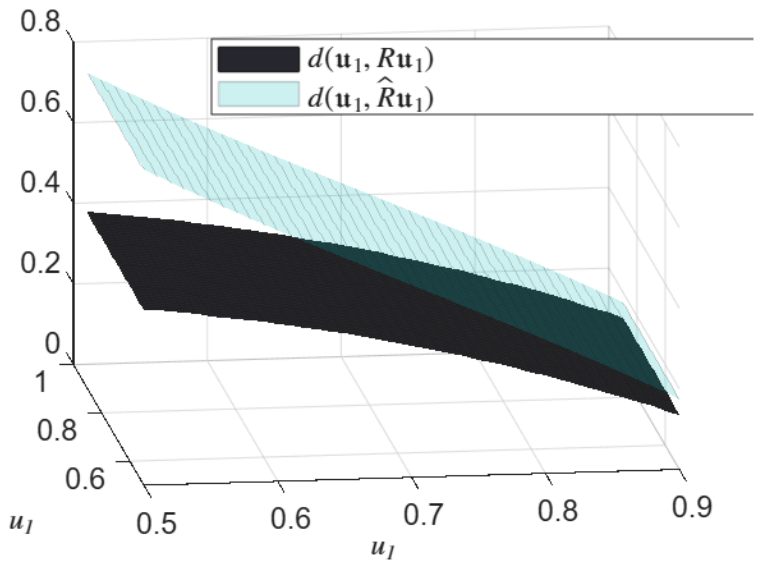
Example 5.
Let H = [ 0.5 , 0.9 ] with metric
d ( u 1 , u 2 ) = | u 1 3 u 2 3 | and W ( u 1 , u 2 , μ ) = ( μ u 1 3 + ( 1 μ ) u 2 3 ) 1 / 3 .
Assume that the mapping R is defined as
R ( u ) = 1 + u 3 2 1 / 3
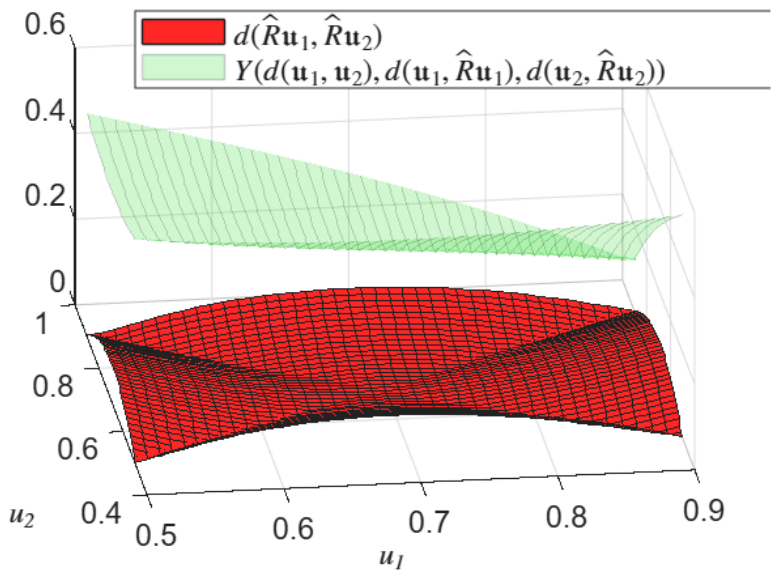
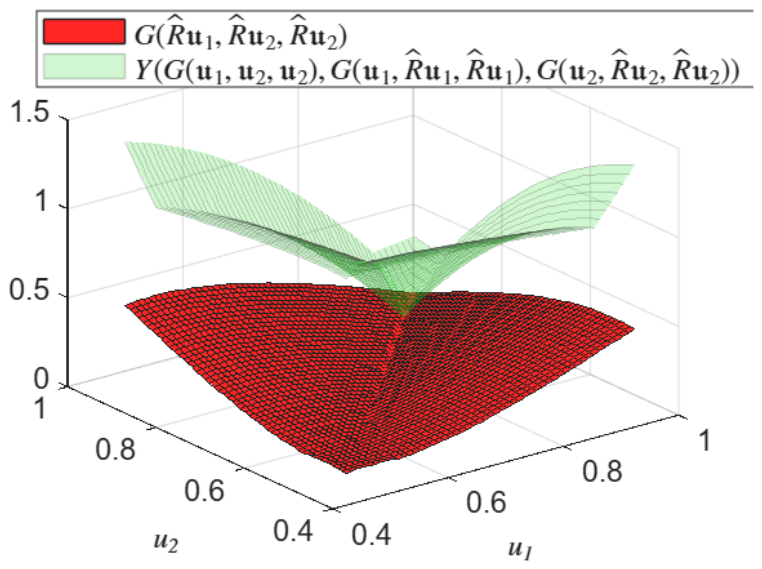
R is weak enriched F -contraction with μ 1 = μ 2 = 1 2 and Y ( u 1 , u 2 , u 3 ) = 1 3 ( u 1 + u 2 + u 3 ) .
Figure 1 represents the inequality d ( R ^ u 1 , R ^ u 2 ) Y ( d ( u 1 , u 2 ) , d ( u 1 , R ^ u 1 ) , d ( u 2 , R ^ u 2 ) ) .
Remark 2.
Example 3 and Example 4 are presented under the usual metric to demonstrate the basic applicability of the main results. However, in Example 5, we employ a non-trivial metric to show that the result remains valid beyond the standard metric framework.
The following section presents the main results on fixed point existence and uniqueness for these two kinds of weak enriched contractions in the context of convex metric spaces.
Theorem 3.
Consider a CMS ( H , d , W ) . Assume that R is a weak enriched F -contraction map. Then
(i) 
| F i x ( R ^ ) | = 1 , where R ^ u = W ( u , R u , μ 1 ) + W ( u , R 2 u , μ 2 ) + + W ( u , R k u , μ k ) ( k 1 ) u .
(ii) 
The sequence u n + 1 = W ( u n , R u n , μ 1 ) + W ( u n , R 2 u n , μ 2 ) + + W ( u n , R k u n , μ k ) ( k   1 ) u n , n 0 , converges to unique fixed point of R ^ .
Proof. 
Define R ^ u = W ( u , R u , μ 1 ) + W ( u , R 2 u , μ 2 ) + + W ( u , R k u , μ k ) ( k 1 ) u . By using (3), we have
d ( R ^ u 1 , R ^ u 2 ) Y ( d ( u 1 , u 2 ) , d ( u 1 , R ^ u 1 ) , d ( u 2 , R ^ u 2 ) ) .
Let u 1 = u n and u 2 = u n 1 in (9) to get
d ( R ^ u n , R ^ u n 1 ) Y ( d ( u n , u n 1 ) , d ( u n , R ^ u n ) , d ( u n 1 , R ^ u n 1 ) ) d ( u n + 1 , u n ) Y ( d ( u n , u n 1 ) , d ( u n , u n + 1 ) , d ( u n 1 , u n ) ) d ( u n + 1 , u n ) Y ( d ( u n , u n 1 ) , d ( u n + 1 , u n ) , d ( u n , u n 1 ) ) U 1 Y ( U 2 , U 1 , U 2 )
where U 1 = d ( u n + 1 , u n ) , U 2 = d ( u n , u n 1 ) .
Using ( F 2 ) ,
U 1 μ U 2 d ( u n + 1 , u n ) μ d ( u n , u n 1 ) μ 2 d ( u n 1 , u n 2 ) d ( u n + 1 , u n ) μ n d ( u 1 , u 0 )
which implies that lim n d ( u n , u n + 1 ) = 0 .
It is easy to observe that { u n } is a Cauchy sequence. Since metric space is complete, there exists u H such that lim n u n = u .
d ( R ^ u , u n + 1 ) = d ( R ^ u , R ^ u n ) Y ( d ( u , u n ) , d ( u , R ^ u ) , d ( u n , R ^ u n ) ) .
Assuming n in (10), we have
d ( R ^ u , u ) Y ( d ( u , u ) , d ( u , R ^ u ) , d ( u , u ) ) μ d ( u , R ^ u ) .
The above equation is true only if d ( R ^ u , u ) = 0 , that is, R ^ u = u . Thus, u F i x ( R ^ ) .
Let u u such that R ^ u = u . Using (3),
d ( u , u ) = d ( R ^ u , R ^ u ) Y ( d ( u , u ) , d ( u , R ^ u ) , d ( u , R ^ u ) ) Y ( d ( u , u ) , 0 , 0 ) μ d ( u , u )
which implies d ( u , u ) = 0 . Hence | F i x ( R ^ ) | = 1 .
Theorem 4.
Assume ( H , d , W ) is a CMS and that R is a weak enriched F -contraction map. Then
(i) 
| F i x ( R ^ ) | = 1 , where R ^ u = W ( u , R u , μ 1 ) + W ( u , R 2 u , μ 2 ) + + W ( u , R k u , μ k ) ( k 1 ) u .
(ii) 
The sequence u n + 1 = W ( u n , R u n , μ 1 ) + W ( u n , R 2 u n , μ 2 ) + + W ( u n , R k u n , μ k ) ( k 1 )   u n ,   n 0 , converges to unique fixed point of R ^ .
Proof. 
Define R ^ u = W ( u , R u , μ 1 ) + W ( u , R 2 u , μ 2 ) + + W ( u , R k u , μ k ) ( k 1 ) u . By using (4), we have
d ( R ^ u 1 , R ^ u 2 ) Y ( d ( u 1 , u 2 ) , d ( u 2 , R ^ u 1 ) , d ( u 1 , R ^ u 2 ) ) .
Let u 1 = u n 1 and u 2 = u n in (12),
d ( R ^ u n 1 , R ^ u n ) Y ( d ( u n 1 , u n ) , d ( u n , R ^ u n 1 ) , d ( u n 1 , R ^ u n ) ) d ( u n , u n + 1 ) Y ( d ( u n 1 , u n ) , d ( u n , u n ) , d ( u n 1 , u n + 1 ) ) Y ( d ( u n 1 , u n ) , 0 , d ( u n 1 , u n ) ) + d ( u n , u n + 1 ) ) .
Using F 2 ,
d ( u n + 1 , u n ) μ d ( u n , u n 1 ) d ( u n + 1 , u n ) μ n d ( u 1 , u 0 )
which implies that lim n d ( u n , u n + 1 ) = 0 .
It is easy to observe that { u n } is a Cauchy sequence. Since metric space is complete, therefore there exists u H such that lim n u n = u .
d ( u n + 1 , R ^ u ) = d ( R ^ u n , R ^ u ) Y ( d ( u n , u ) , d ( u , R ^ u n ) , d ( u n , R ^ u ) ) .
Assuming n in (13), we have
d ( R ^ u , u ) Y ( d ( u , u ) , d ( u , u ) , d ( u , R ^ u ) ) μ d ( u , R ^ u ) .
The above equation is true only when d ( u , R ^ u ) = 0 , that is, R ^ u = u . Thus, u F i x ( R ^ ) .
Let u u such that R ^ u = u . Using (4),
d ( u , u ) = d ( R ^ u , R ^ u ) Y ( d ( u , u ) , d ( u , R ^ u ) , d ( u , R ^ u ) ) Y ( d ( u , u ) , d ( u , u ) , d ( u , u ) )
which implies d ( u , u ) = 0 . Hence | F i x ( R ^ ) | = 1 .
Remark 3.
If W ( u , v , μ ) = μ u + ( 1 μ ) v , then
R ^ u = μ 1 u + ( 1 μ 1 ) R u + μ 2 u + ( 1 μ 2 ) R 2 u + + μ k u + ( 1 μ k ) R k u ( k 1 ) u = [ 1 ( 1 μ 1 ) ( 1 μ 2 ) ( 1 μ k ) ] u + ( 1 μ 1 ) R u + ( 1 μ 2 ) R 2 u + + ( 1 μ k ) R k u .
In this context, the mapping R ^ becomes a k- fold averaged mapping, as defined in [26]. Thus, our result generalizes the concept of k-fold mapping in the framework of a CMS.
Next, we derive conditions ensuring that fixed points of R ^ are also fixed points of R .
Theorem 5.
Consider a CMS ( H , d , W ) . Assume that μ i [ 0 , 1 ] for i = 2 , 3 , k , μ 1 = [ 0 , 1 ) with i = 1 k ( 1 μ i ) ( 0 , 1 ] . Then, the mapping R ^ , which is defined as
R ^ u = W ( u , R u , μ 1 ) + W ( u , R 2 u , μ 2 ) + + W ( u , R k u , μ k ) ( k 1 ) u
exhibits a feature that F i x ( R ) F i x ( R ^ ) .
Proof. 
Let u F i x ( R ) . Then by using (14) and Lemma 3 (i) in [18],
R ^ u = W ( u , u , μ 1 ) + W ( u , u , μ 2 ) + + W ( u , u , μ k ) ( k 1 ) u = u .
Theorem 6.
Assume that ( H , d , W ) is a CMS. If
d ( u , R u ) d ( u , R ^ u ) ,
  u H . Then F i x ( R ^ ) = F i x ( R ) .
Proof. 
Let u F i x ( R ^ ) . Then by using (15),
d ( u , R u ) d ( u , R ^ u ) = 0 .
Thus, d ( u , R u ) = 0 that is, R u = u .     □
Theorem 7.
Consider a CMS ( H , d , W ) . If there exists r [ 0 , 1 ) such that
d ( R ^ u , R u ) r d ( u , R u ) ,
  u H . Then F i x ( R ^ ) = F i x ( R ) .
Proof. 
Let u F i x ( R ^ ) . Then by using (16),
d ( u , R u ) r d ( u , R u ) ,
which implies d ( u , R u ) = 0 that is, R u = u . □
Theorem 8.
Let ( H , d , W ) be a CMS. Assume that for each u F i x ( R ^ ) there exists H 1 H such that
(i) 
( H 1 , d , W ) is also a CMS and u H 1 ,
( i i ) R ( H 1 ) H 1 and R satisfies ( 16 ) only for H 1 .
Then F i x ( R ^ | H 1 ) = F i x ( R | H 1 ) .
Proof. 
It follows naturally from Theorem 7 with the restriction of R on H 1 . □
Fixed point theorems for weak enriched contraction maps can be proved with the previously given results.
Theorem 9.
Assume that ( H , d , W ) is a complete CMS. Let R be a weak enriched F -contraction (weak enriched F -contraction) map. Also, if R satisfies (15) or (16) or (17), then
(i) 
| F i x ( R ^ ) | = 1 .
(ii) 
The sequence u n + 1 = W ( u n , R u n , μ 1 ) + W ( u n , R 2 u n , μ 2 ) + + W ( u n , R k u n , μ k ) ( k 1 ) u n ,   n 0 , converges to unique fixed point of R.
Proof. 
The iteration defined in (ii) converges to fixed point of R ^ and | F i x ( R ^ ) | = 1 for μ i [ 0 , 1 ) and μ 2 [ 0 , 1 ] , according to Theorem 3 (Theorem 4). As R ^ fulfil either of (15) or (16) or (17), the conclusions follow directly. □
Example 6.
Let R : H H be a mapping defined by (6). Example 3 satisfies Theorem 8 with H 1 = [ 0 , 1 ] .
d ( R ^ u , R u ) = | 7 10 u 7 16 | = | 1 3 5 u 7 16 7 16 u | = 7 16 d ( R u , u ) .
Thus, according to the assumptions of Theorem 8, Fix ( R ) = Fix ( R ^ ) . Since R ^ has a unique fixed point, it follows that |Fix(R)| = 1. Using the assumptions of Theorem 3, the sequence
u n + 1 = W ( u n , R u n , μ 1 ) + W ( u n , R 2 u n , μ 2 ) + + W ( u n , R k u n , μ k ) ( k 1 ) u n
converges to the unique fixed-point of R ^ (and hence R).
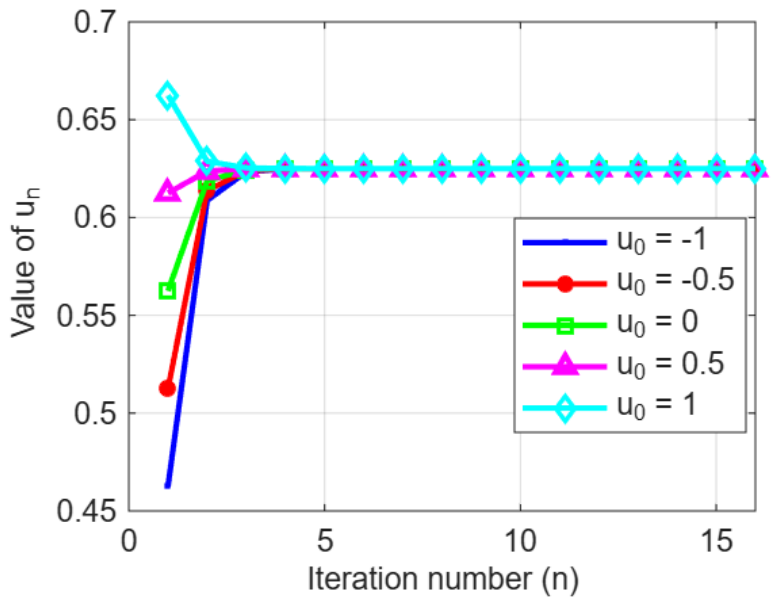
The following figure shows that the sequence
u n + 1 = W ( u n , R u n , μ 1 ) + W ( u n , R 2 u n , μ 2 ) + W ( u n , R 3 u n , μ 3 ) + W ( u n , R 4 u n , μ 4 ) 3 u n = 1 10 u n + 9 16
converges to the unique fixed point of R from different starting points.
Figure 2 represents the convergence behavior of the sequence { u n } for Example 3 corresponding to different initial points. Despite different starting values, all iterates approach same fixed point, demonstrating that the proposed iterative method is independent of the initial choice and exhibits stable convergence.
Example 7.
Assume that R : H H is a mapping defined by (7). Example 4 satisfy Theorem 7 with H = [ 0 , 1 ] .
d ( R ^ u , R u ) = | 1 k + 1 u 1 k + 1 . 1 a | = | 1 k + 1 u 1 a | = 1 k + 1 d ( R u , u ) .
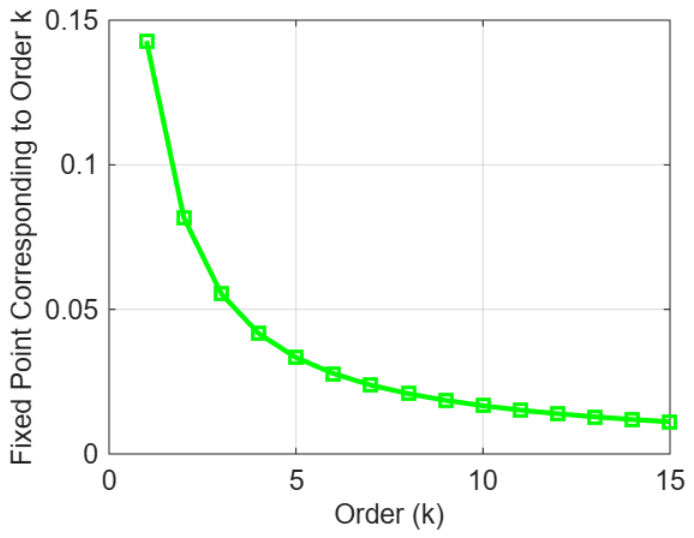
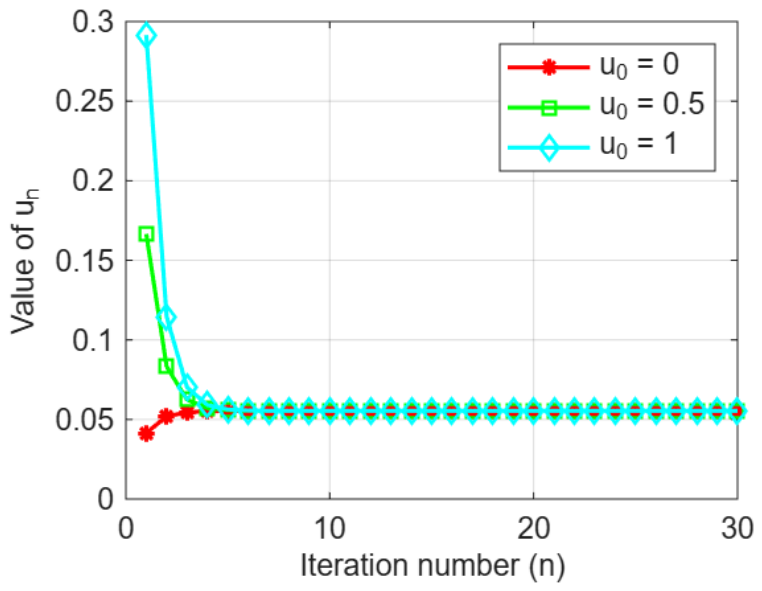
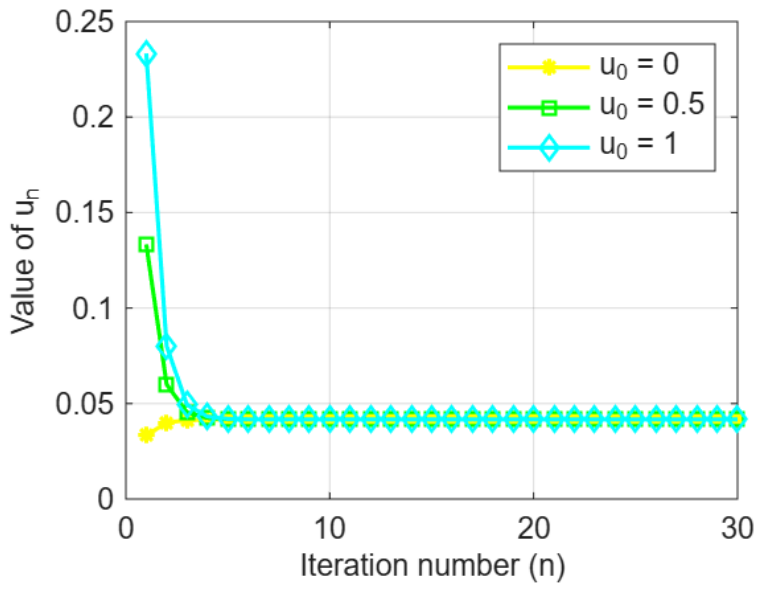
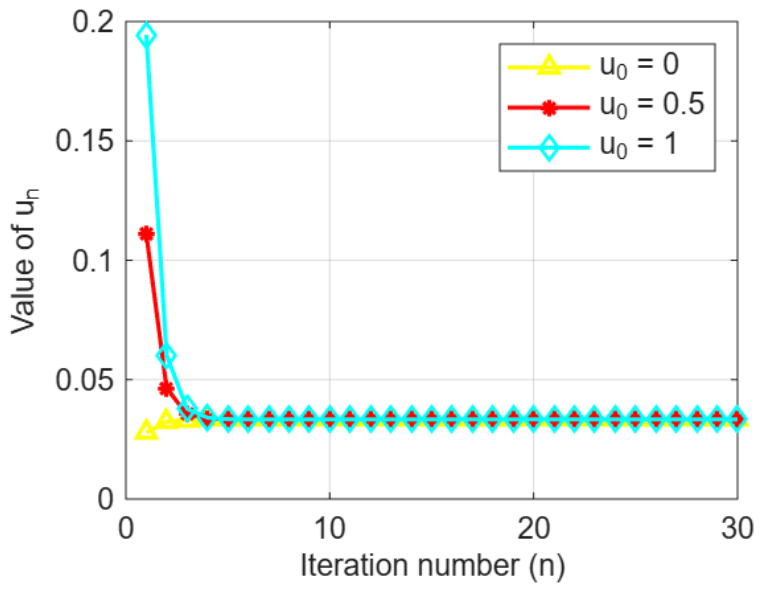
Hence, by Theorem 4 and Theorem 7, the mapping R (defined by (7)) has a unique fixed point. For a particular value of k, R is a constant map. The following figure shows the variation of the fixed point of R with different values of k.
The variation in fixed point corresponding to different values of the order k is presented in Figure 3. The figure illustrates how the location of the fixed point changes with increasing k .
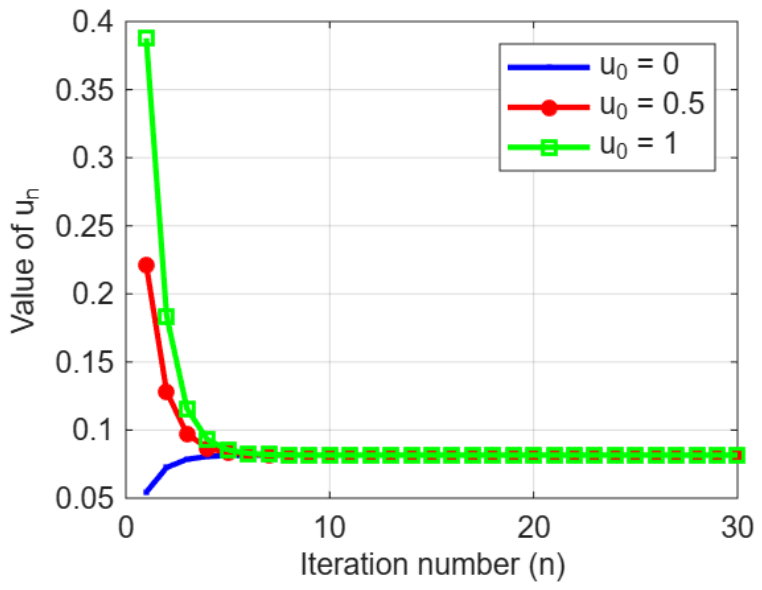
It is clear from the following figures that the sequence approaches the fixed point more quickly as the value of k increases:
Figure 4, Figure 5, Figure 6 and Figure 7 show the convergence of iterative sequence { u n } for the selected values of the parameter k. The plots show that the sequence converges to the corresponding fixed point for each chosen value of k .
Example 8.
Let R:H H be a mapping defined by (8). Example 5 satisfy Theorem 6 with H = [ 0.5 , 0.9 ] .
Figure 8 presents the inequality d ( u , R u ) d ( u , R ^ u ) . Thus, Fix(R) = Fix( R ^ ).

3. On Weak Enriched F and F -Contraction Mappings in Convex G -Metric Space

The notion of a convex G-metric space was introduced by Ji et al. [27] as follows.
Definition 7
([27]). Consider a G-metric space ( H , G ) . A mapping W : H × H × [ 0 , 1 ] H is said to define a convex structure on H if for every u 1 , u 2 , u 3 , u 4 H and μ [ 0 , 1 ] ,
G ( u 1 , u 2 , W ( u 3 , u 4 , μ ) ) μ G ( u 1 , u 2 , u 3 ) + ( 1 μ ) G ( u 1 , u 2 , u 4 )
is satisfied. Then ( H , G , W ) is called a convex G-metric space (CGMS).
Lemma 1
([27]). Consider a CGMS ( H , G , W ) . It follows that the space is symmetric whenever μ [ 0 , 1 ] .
The concept of weak enriched F -contraction and weak enriched F -contraction in the context of convex G-metric space is defined as:
Definition 8.
Consider a CGMS ( H , G , W ) . A mapping R : H H is defined as a weak enriched F -contraction if there exist μ i [ 0 , 1 ] , i = 2 , 3 , , k ,   μ 1 = [ 0 , 1 ) , Y F and k 2 such that i = 1 k ( 1 μ i ) ( 0 , 1 ] and
G ( R ^ u 1 , R ^ u 2 , R ^ u 2 ) Y ( G ( u 1 , u 2 , u 2 ) , G ( u 1 , R ^ u 1 , R ^ u 1 ) , G ( u 2 , R ^ u 2 , R ^ u 2 ) )
for all u 1 , u 2 H and R ^ u = W ( u , R u , μ 1 ) + W ( u , R 2 u , μ 2 ) + + W ( u , R k u , μ k ) ( k 1 ) u .
Definition 9.
Consider a CGMS ( H , G , W ) . A mapping R : H H is termed as weak enriched F -contraction if there exist μ i [ 0 , 1 ] , i = 2 , 3 , , k ,   μ 1 = [ 0 , 1 ) , Y F and k 2 such that i = 1 k ( 1 μ i ) ( 0 , 1 ] and
G ( R ^ u 1 , R ^ u 2 , R ^ u 2 ) Y ( G ( u 1 , u 2 , u 2 ) , G ( u 2 , R ^ u 1 , R ^ u 1 ) , G ( u 1 , R ^ u 2 , R ^ u 2 ) )
for all u 1 , u 2 H and R ^ u = W ( u , R u , μ 1 ) + W ( u , R 2 u , μ 2 ) + + W ( u , R k u , μ k ) ( k 1 ) u .
Example 9.
Let H = [ 0.5 , 1 ] with metric
G ( u 1 , u 2 , u 2 ) = | u 1 3 u 2 3 | + | u 2 3 u 3 3 | + | u 3 3 u 1 3 | and W ( u 1 , u 2 , μ ) = ( μ u 1 3 + ( 1 μ ) u 2 3 ) 1 / 3 .
Assume that the mapping R is defined as
R ( u ) = ( 2 u ) 1 / 3 0.3
R is weak enriched F -contraction with μ 1 = 1 10 , μ 2 = 9 10 and Y ( u 1 , u 2 , u 3 ) = 1 3 ( u 1 + u 2 + u 3 ) .
Figure 9 presents the inequality
G ( R ^ u 1 , R ^ u 2 , R ^ u 2 ) Y ( G ( u 1 , u 2 , u 2 ) , G ( u 1 , R ^ u 1 , R ^ u 1 ) , G ( u 2 , R ^ u 2 , R ^ u 2 ) ) .
R is not a Banach contraction. For u 1 = 0.5 and u 2 = 0.51 .
G ( R u 1 , R u 2 , R u 2 ) > G ( u 1 , u 2 , u 2 ) .
The following results focus on establishing the existence and uniqueness of a fixed point for these two types of weak enriched contractions in the context of a CGMS.
Theorem 10.
Consider ( H , G , W ) is a complete CGMS and let R be a weak enriched F -contraction. Then,
(i) 
| F i x ( R ^ ) | = 1 , where R ^ u = W ( u , R u , μ 1 ) + W ( u , R 2 u , μ 2 ) + + W ( u , R k u , μ k ) ( k 1 ) u .
(ii) 
The sequence u n + 1 = W ( u n , R u n , μ 1 ) + W ( u n , R 2 u n , μ 2 ) + + W ( u n , R k u n , μ k ) ( k 1 ) u n ,   n 0 , converges to unique fixed point of R ^ .
Proof. 
Set R ^ u = W ( u , R u , μ 1 ) + W ( u , R 2 u , μ 2 ) + + W ( u , R k u , μ k ) ( k 1 ) u . By applying (19), we get
G ( R ^ u 1 , R ^ u 2 , R ^ u 2 ) Y ( G ( u 1 , u 2 , u 2 ) , G ( u 1 , R ^ u 1 , R ^ u 1 ) , G ( u 2 , R ^ u 2 , R ^ u 2 ) ) .
Substituting u 1 = u n and u 2 = u n 1 in (22), we obtain
G ( R ^ u n , R ^ u n 1 , R ^ u n 1 ) Y ( G ( u n , u n 1 , u n 1 ) , G ( u n , R ^ u n , R ^ u n ) , G ( u n 1 , R ^ u n 1 , R ^ u n 1 ) ) G ( u n + 1 , u n , u n ) Y ( G ( u n , u n 1 , u n 1 ) , G ( u n , u n + 1 , u n + 1 ) , G ( u n 1 , u n , u n ) ) .
Using symmetric property of CGMS and by ( F 2 ) ,
G ( u n + 1 , u n , u n ) μ G ( u n , u n 1 , u n 1 ) G ( u n + 1 , u n , u n ) μ n G ( u 1 , u 0 , u 0 ) .
It follows that the sequence satisfies G ( u n , u n + 1 , u n + 1 ) 0 as n .
It is straightforward to verify that { u n } is Cauchy sequence. Because the metric space is complete, there exists u H such that lim n u n = u .
G ( R ^ u , u n + 1 , u n + 1 ) = G ( R ^ u , R ^ u n , R ^ u n ) Y ( G ( u , u n , u n ) , G ( u , R ^ u , R ^ u ) , G ( u n , R ^ u n , R ^ u n ) ) .
Letting n in (23), we obtain
G ( R ^ u , u , u ) Y ( G ( u , u , u ) , G ( u , R ^ u , R ^ u ) , G ( u , u , u ) ) μ G ( u , R ^ u , R ^ u ) .
This equation holds if and only if G ( R ^ u , u , u ) = 0 , implying, R ^ u = u . Therefore, u F i x ( R ^ ) .
Assume that u u such that R ^ u = u . Using (19),
G ( u , u , u ) = G ( R ^ u , R ^ u , R ^ u ) Y ( G ( u , u , u ) , G ( u , R ^ u , R ^ u ) , G ( u , R ^ u , R ^ u ) ) Y ( G ( u , u , u ) , 0 , 0 ) μ G ( u , u , u )
which implies G ( u , u , u ) = 0 . Thus, | F i x ( R ^ ) | = 1 .
Theorem 11.
Assume that ( H , G , W ) is a complete CGMS and R represents a weak enriched F -contraction map. Then,
(i) 
| F i x ( R ^ ) | = 1 , where R ^ u = W ( u , R u , μ 1 ) + W ( u , R 2 u , μ 2 ) + + W ( u , R k u , μ k ) ( k 1 ) u .
(ii) 
The sequence u n + 1 = W ( u n , R u n , μ 1 ) + W ( u n , R 2 u n , μ 2 ) + + W ( u n , R k u n , μ k ) ( k 1 ) u n ,   n 0 , converges to unique fixed point of R ^ .
Proof. 
The proof utilizes the same main ideas and reasoning pattern as in Theorems 10. □
Theorem 12.
Suppose ( H , G , W ) forms a CGMS. Then, W ( u , u , μ ) = u , where u H .
Proof. 
Consider,
G ( u , u , W ( u , u , μ ) ) μ G ( u , u , u ) + ( 1 μ ) G ( u , u , u ) = 0 .
Thus, W ( u , u , μ ) = u .
Theorem 13.
Consider ( H , G , W ) as a CGMS. Also assume that μ i [ 0 , 1 ] , μ 1 = [ 0 , 1 ) with i = 1 k ( 1 μ i ) ( 0 , 1 ] . Then, the mapping R ^ , which is defined as
R ^ u = W ( u , R u , μ 1 ) + W ( u , R 2 u , μ 2 ) + + W ( u , R k u , μ k ) ( k 1 ) u
exhibits a feature that F i x ( R ) F i x ( R ^ ) .
Proof. 
Let u F i x ( R ) . Then by using Theorem 12,
R ^ u = W ( u , u , μ 1 ) + W ( u , u , μ 2 ) + + W ( u , u , μ k ) ( k 1 ) u = u .
Theorem 14.
Take ( H , G , W ) to be a CGMS. If
G ( u , R u , R u ) G ( u , R ^ u , R ^ u )
  u H . Then F i x ( R ^ ) = F i x ( R ) .
Proof. 
Let u F i x ( R ^ ) . Then by using (26),
G ( u , R u , R u ) G ( u , R ^ u , R ^ u ) = 0
Thus, G ( u , R u , R u ) = 0 that is, R u = u . □
Theorem 15.
Suppose ( H , G , W ) forms a CGMS. If there exists r [ 0 , 1 ) such that
G ( R ^ u , R u , R u ) r G ( u , R u , R u ) ,
  u H . Then F i x ( R ^ ) = F i x ( R ) .
Proof. 
Let u F i x ( R ^ ) . Then by using (27),
G ( u , R u , R u ) r G ( u , R u , R u ) ,
which implies G ( u , R u , R u ) = 0 that is, R u = u . □
Theorem 16.
Take ( H , G , W ) to be a CGMS. Assume that for each u F i x ( R ^ ) there exists H 1 H such that
(i) 
( H 1 , G , W ) is also a CGMS and u H 1 ,
( i i ) R ( H 1 ) H 1 and R satisfies ( 27 ) only for H 1 .
Then F i x ( R ^ | H 1 ) = F i x ( R | H 1 ) .
Proof. 
It follows naturally from Theorem 15 with the restriction of R on H 1 . □
Fixed point theorems for weak enriched contraction maps in convex G-metric space can be proved with the above given results.
Theorem 17.
Suppose ( H , G , W ) forms a complete CGMS and let R be a weak enriched F -contraction (weak enriched F -contraction) map. Also, if R satisfies (26) or (27) or (28), then
(i) 
| F i x ( R ^ ) | = 1 .
(ii) 
The sequence u n + 1 = W ( u n , R u n , μ 1 ) + W ( u n , R 2 u n , μ 2 ) + + W ( u n , R k u n , μ k ) ( k 1 ) u n ,   n 0 , converges to unique fixed point of R.
Proof. 
For μ 1 [ 0 , 1 ) and μ i [ 0 , 1 ] , i = 2 , 3 , k , Theorem 10 (Theorem 11) ensures that the iteration defined in (ii) converges to the unique fixed point of R ^ . Since R ^ fulfils one of the conditions (26) or (27) or (28), the result is immediate. □
Example 10.
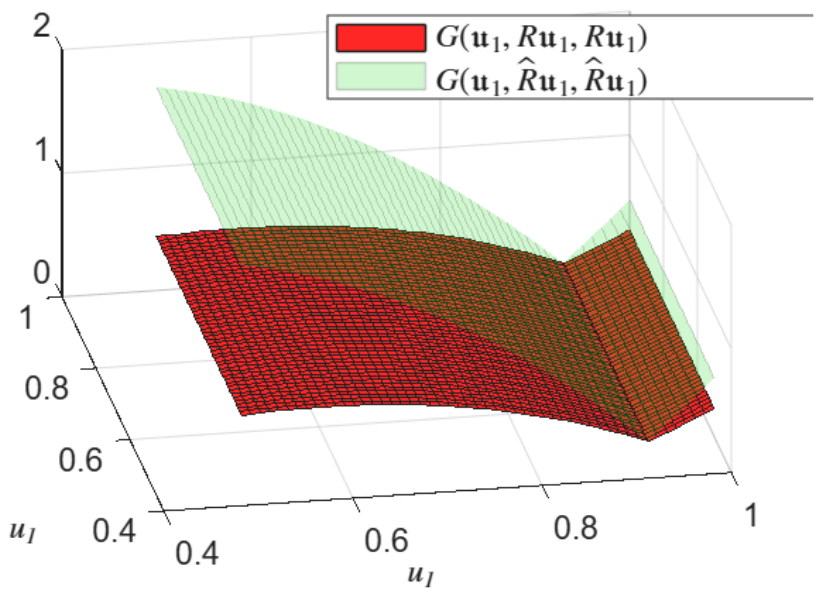
Let R be a self-mapping on H defined by (21). Example 9 satisfies Theorem 14 with H = [ 0.5 , 1 ] .
Figure 10 presents the inequality G ( u , R u , R u ) G ( u , R ^ u , R ^ u ) . Thus, Fix(R) = Fix( R ^ ).

4. Conclusions

The study successfully establishes new fixed point theorems for weak enriched contractions via k-fold averaged mappings in both CMS and CGMS. It is shown that such contractions admit a unique fixed point, and this fixed point can be approximated by a suitable iterative process. These results broaden and unify current fixed-point frameworks, improving our understanding of iterative methods and adding useful ideas to fixed-point theory.
The result presented in this work extends the existing theory of enriched contractions in convex metric spaces and provides a unified framework for studying fixed point problems through k-fold averaged mapping.
As a direction for future research, the proposed framework may be extended to more general spaces, such as b-metric space, partial metric space or fuzzy metric space. It would also be of interest to investigate analogous results for multivalued mappings, cyclic contractions and applications to nonlinear integral and differential equations.


Author Contributions

Conceptualization, J.K., S.S.B. and B.R.; Methodology, J.K., S.S.B. and B.R.; Formal analysis, J.K., S.S.B. and B.R.; Investigation, J.K., S.S.B. and B.R.; Writing—original draft, J.K., S.S.B. and B.R.; Writing—review & editing, J.K., S.S.B. and B.R.; Supervision, J.K. and S.S.B.; Funding acquisition, J.K., S.S.B. and B.R. All authors have read and agreed to the published version of the manuscript.

Funding

This research received no external funding.

Data Availability Statement

Data are contained within this article.

Acknowledgments

No AI or AI-assisted tools have been used in the development, writing, or editing of this manuscript.

Conflicts of Interest

The authors declare no conflicts of interest.

References

  1. Banach, S. Sur les opérations dans les ensembles abstraits et leur application aux équations intégrales. Fundam. Math. 1922, 3, 133–181. [Google Scholar]
  2. Dass, B.K.; Gupta, S. An extension of Banach contraction principle through rational expression. Indian J. Pure Appl. Math. 1975, 6, 1455–1458. [Google Scholar]
  3. Jaggi, D.S. Some unique fixed point theorems. Indian J. Pure Appl. Math. 1977, 8, 223–230. [Google Scholar]
  4. Reich, S. Some remarks concerning contraction mappings. Canad. Math. Bull. 1971, 14, 121–124. [Google Scholar] [CrossRef] [Scilit]
  5. Suzuki, T. A generalized Banach contraction principle that characterizes metric completeness. Proc. Am. Math. Soc. 2008, 136, 1861–1869. [Google Scholar]
  6. Zheng, D.; Cai, Z.; Wang, P. New fixed point theorems for θ-ϕ-contraction in complete metric spaces. J. Nonlinear Sci. Appl. 2017, 10, 2662–2670. [Google Scholar]
  7. Wang, S.Z. Some fixed point theorems on expansion mappings. Math. Jpn. 1984, 29, 631–636. [Google Scholar]
  8. Browder, F.E. Nonexpansive nonlinear operators in a Banach space. Proc. Natl. Acad. Sci. USA 1965, 54, 1041–1044. [Google Scholar] [CrossRef] [Scilit] [PubMed]
  9. Takahashi, W. A convexity in metric spaces and nonexpansive mappings. Kodai Math. Sem. Rep. 1970, 22, 142–149. [Google Scholar] [CrossRef] [Scilit]
  10. Abdelhakim, A.A. A convexity of functions on convex metric spaces of Takahashi and applications. J. Egypt. Math. Soc. 2016, 24, 348–354. [Google Scholar] [CrossRef] [Scilit]
  11. Fukhar-ud-din, H.; Berinde, V. Iterative methods for the class of quasicontractive type operators and comparsion of their rate of convergence in convex metric spaces. Filomat 2016, 30, 223–230. [Google Scholar] [CrossRef] [Scilit]
  12. Alecsa, C. On new faster fixed point iterative schemes for contraction operators and comparison of their rate of convergence in convex metric spaces. Int. J. Nonlinear Anal. Appl. 2017, 8, 353–388. [Google Scholar] [CrossRef] [Scilit]
  13. Haokip, N. Convergence of an iteration scheme in convex metric spaces. Proyecciones 2022, 41, 777–790. [Google Scholar] [CrossRef] [Scilit]
  14. Yildirim, I. Fixed Point Results for F-Hardy-Rogers Contractions via Mann’s Iteration Process in Complete Convex b-Metric Spaces. Sahand Commun. Math. Anal. 2022, 19, 15–32. [Google Scholar]
  15. Rani, B.; Kaur, J.; Bhatia, S.S. Convergence and stability of a new three-step iterative technique in convex metric space. Southeast Asian J. Math. Math. Sci. 2024, 20, 323–332. [Google Scholar] [CrossRef] [Scilit]
  16. Krasnoselskii, M.A. Two remarks about the method of successive approximations. Uspekhi Mat. Nauk 1955, 10, 123–127. [Google Scholar]
  17. Kirk, W.A. On successive approximations for nonexpansive mappings in Banach spaces. Glasg. Math. J. 1971, 12, 6–9. [Google Scholar] [CrossRef] [Scilit]
  18. Berinde, V.; Păcurar, M. Existence and approximation of fixed points of enriched contractions and enriched ϕ-contractions. Symmetry 2021, 13, 498. [Google Scholar]
  19. Berinde, V.; Păcurar, M. Fixed point theorems for enriched Ćirić-Reich-Rus contractions in Banach spaces and convex metric spaces. Carpathian J. Math. 2021, 37, 173–184. [Google Scholar] [CrossRef] [Scilit]
  20. Babu, G.V.R.; Rao, C.S.; Mounika, P. A fixed point theorem on enriched (ψ, ϕλ)-weakly contractive maps in convex metric spaces. J. Ramanujan Soc. Math. Math. Sci. 2022, 10, 103–112. [Google Scholar]
  21. Rawat, S.; Bartwal, A.; Dimri, R.C. Approximation and existence of fixed points via interpolative enriched contractions. Filomat 2023, 37, 5455–5467. [Google Scholar] [CrossRef] [Scilit]
  22. Rani, B.; Kaur, J.; Bhatia, S.S. On the Fixed Points of Large Enriched Contractions in Convex Metric Space with an Application. Symmetry 2025, 17, 748. [Google Scholar] [CrossRef] [Scilit]
  23. Sarkar, J.; Som, T. Fixed point theorems for enriched Ćirić quasi contraction map in Banach and convex metric spaces. Indian J. Pure Appl. Math. 2024. [Google Scholar] [CrossRef] [Scilit]
  24. Rani, B.; Kaur, J.; Bhatia, S.S. Approximating Fixed Points via Hybrid Enriched Contractions in Convex Metric Space with an Application. Axioms 2024, 13, 815. [Google Scholar] [CrossRef] [Scilit]
  25. Nithiarayaphaks, W.; Sintunavarat, W. On approximating fixed points of weak enriched contraction mappings via Kirk’s iterative algorithm in Banach spaces. Carpathian J. Math. 2023, 39, 423–432. [Google Scholar]
  26. Zhou, M.; Saleem, N.; Abbas, M. Approximating fixed points of weak enriched contractions using Kirk’s iteration scheme of higher order. J. Inequal. Appl. 2024, 2024, 23. [Google Scholar] [CrossRef] [Scilit]
  27. Ji, D.; Li, C.; Cui, Y. Fixed Point Theorems for Mann’s iteration Scheme in Convex Gb-Metric Spaces with an Application. Axioms 2023, 12, 108. [Google Scholar]
Figure 1. Representation of contraction inequality (3).
Symmetry 18 01140 g001
Figure 2. Convergence of { u n } with distinct starting points for Example 3.
Symmetry 18 01140 g002
Figure 3. Variation in fixed point with order k = 1:15.
Symmetry 18 01140 g003
Figure 4. For k = 2 .
Symmetry 18 01140 g004
Figure 5. For k = 3 .
Symmetry 18 01140 g005
Figure 6. For k = 4 .
Symmetry 18 01140 g006
Figure 7. For k = 5 .
Symmetry 18 01140 g007
Figure 8. Representation of inequality (15).
Symmetry 18 01140 g008
Figure 9. Representation of contraction inequality (19).
Symmetry 18 01140 g009
Figure 10. Representation of inequality (26).
Symmetry 18 01140 g010
Disclaimer/Publisher’s Note: The statements, opinions and data contained in all publications are solely those of the individual author(s) and contributor(s) and not of MDPI and/or the editor(s). MDPI and/or the editor(s) disclaim responsibility for any injury to people or property resulting from any ideas, methods, instructions or products referred to in the content.