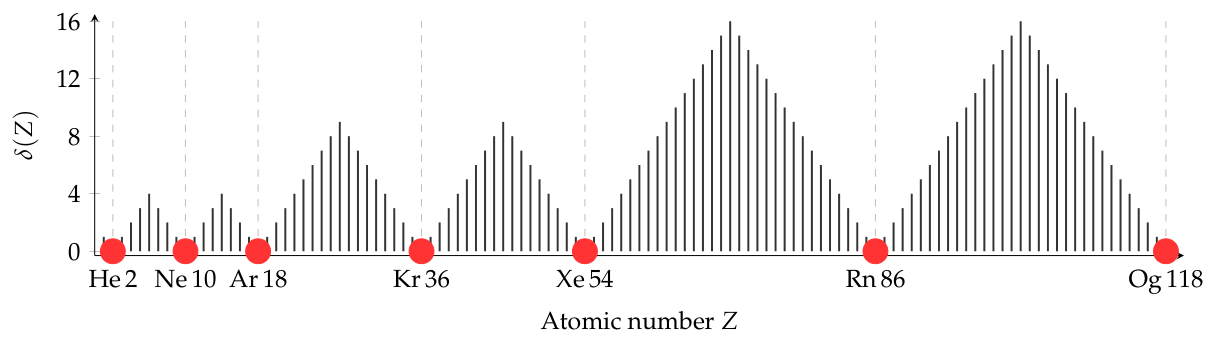
1. Introduction
Within each period of the periodic table [
1,
2,
3,
4], first ionization energy decreases monotonically from the period-closing noble gas to the alkali metal, with upward bumps at half-filled and completed-subshell sites
. Electron affinity and Pearson chemical hardness show the same broad descent, with related anomaly structure. Mulliken electronegativity inherits the same broad trend because it is half their sum.
This paper investigates whether two landscape steps derived from a single dimensionless function
on the noble gas-centred coordinate
, the outward step
and the gap
, can organize IE
1, EA, and (via Mulliken’s identity)
, with
assigned the same kernel as EA. The function is the cosh form
, with
, established in Refs. [
5,
6] as the unique reciprocal cost on positive ratios under standard smoothness conditions (
Appendix A). The uniqueness statement and the
-power identities used below are also formalized in Lean 4 in the Recognition Science library; see the Data Availability statement.The present paper takes
Jchem as a fixed analytical input and develops its empirical content on the periodic table.
The four observables are conventionally treated separately: IE
1 and EA from atomic spectroscopy and electronic-structure calculations [
7,
8,
9]; electronegativity from empirical scales [
10,
11,
12,
13,
14,
15]; chemical hardness from derivative-based density-functional arguments [
16,
17,
18,
19,
20]. For context, recent reviews on periodic-table form, shell filling, and relativistic extensions to superheavy atoms include Refs. [
21,
22,
23]; the present work combines IE
1, EA, electronegativity, and chemical hardness in a single coordinate-based analysis.
Complementary modern perspectives on the structure and origin of chemical periodicity further motivate a coordinate-based view: the formal chemical-space and order-theoretic analysis of the periodic system by Leal and Restrepo [
24], the explicit account of the physical origin of chemical periodicities across the elements by Cao, Hu, Li, and Schwarz [
25], and the unsupervised machine learning recreation of the periodic table from elemental property data by Kusaba et al. [
26]. These works show, from data-analytic, physical, and machine learning standpoints, respectively, that the periodic regularities admit compact low-dimensional organizations; the single noble gas-centred coordinate developed here is one such organization made fully analytical for four observables at once.
Two long-established quantitative pictures already organize the same within-period trends, and we use both as horizontal reference benchmarks throughout this paper. (i) The
effective nuclear charge (screening) model of Slater and of Clementi and Raimondi [
27,
28,
29] represents each electron as moving in a screened Coulomb field of charge
, from which ionization energies and their ratios follow through
; this is the standard one-electron baseline for IE
1 and is closely related to the Koopmans/Hartree–Fock orbital-energy estimate [
8]. (ii)
Conceptual density-functional theory [
16,
17,
19,
30] defines electronegativity and chemical hardness as first and second derivatives of the electronic energy with respect to electron number,
and
, evaluated in practice by the finite-difference forms
and
. The framework developed here is not a competitor to these established theories but a complementary single-coordinate organization, and
Section 5.8 compares it directly against both the effective nuclear charge baseline (for the IE
1 ratios) and the conceptual-DFT hardness/electronegativity definitions (for
and
).
The empirical content reduces to three IE
1 predictions and three derived checks. The IE
1 predictions are the heavy noble gas ratio
, the halogen-to-alkali ratio
, and the within-period monotone IE
1 envelope with the standard anomaly sites flagged (Prediction 3, where periods 2–4 give 26 non-anomalous points on the monotone trend and 8 deviations at the textbook anomaly positions). The derived checks are a one-parameter EA fit across periods 4–6, a one-parameter Pearson-hardness fit across periods 2–4, and a single-parameter Mulliken-
fit on 15 atoms across 4 chemical classes (
globally,
Section 5).
One closed-form expression
is used for two observables: the EA proxy of
Section 4.2 and the hardness predictor
of
Section 4.4 (the functional-equation framework of Refs. [
5,
6]). The shared-kernel form unifies two observables under one analytical landscape gap with two independent per-period scales fitted against the EA and
data; the resulting ratio benchmark
is confirmed by the period 4 NIST data with empirical mean matching the predicted constant to better than 1% (
Section 5.7).
This paper proposes a compact phenomenological, coordinate-based framework that organizes broad within-period trends in IE1, EA, , and on a single analytical axis, and provides a useful baseline against which shell and relativistic corrections can be measured. The work is not an ab initio derivation of atomic structure, does not replace electronic-structure theory, does not derive shell anomalies (which we identify post hoc with textbook sites), and does not provide a universal predictor without exclusions. Two of the headline ratio identities ( for heavy noble gas IE, for halogen/alkali IE) are empirical regularities consistent with the framework once a per-period absolute-energy scale is admitted from data; a first-principles derivation of is left to future work. “Prediction” in the rest of the paper refers to a model-derived ordering or proxy expression evaluated on a stated benchmark subset, not to a parameter-free quantitative forecast.
We state the theoretical status of the construction precisely because it is intermediate between a purely empirical fit and a first-principles derivation. The
kernel J is not an ad hoc choice: it is the unique reciprocal cost functional on positive ratios that satisfies a small set of standard regularity conditions (continuity, normalization, stationarity, positive curvature), proved in Refs. [
5,
6] and summarized in
Appendix A; in that sense the cosh form has a theorem-level mathematical justification. What the framework does
not yet derive from first principles are the two chemical modelling inputs identified explicitly in
Section 3: the golden ratio argument rescaling
, which is adopted as an ansatz, and the per-period absolute energy scale
, which is fitted from data. The present paper therefore reports a theorem-backed kernel combined with two clearly labelled phenomenological inputs, and we regard the first-principles derivation of
and
as the central open problem left for future work.
The paper is organized as follows.
Section 2 fixes the notation.
Section 3 constructs the landscape.
Section 4 assigns the four observables to landscape steps.
Section 5 presents the three IE
1 predictions and the EA, electronegativity, and hardness checks against NIST and Pearson data, and tests the shared-kernel ratio benchmark (
Section 5.7).
Section 6 states the conclusions.
3. The Inverse Landscape
The discrete index
of
Section 2 is converted to the continuous coordinate
with
the period length,
at the period-closing noble gas, and
at the alkali metal.
The continuous chemical landscape
is obtained by evaluating the reciprocal cost functional
J of
Appendix A at the geometric scale
, with the golden ratio
entering as the natural rescaling factor on the noble gas-centred coordinate (
Appendix A).
Near
,
; this small-step expansion is used in the noble gas ratio derivation of
Section 5.
is dimensionless, and we develop the framework through two complementary routes: ratio-level identities (where the period-dependent scale cancels exactly, giving parameter-free predictions) and single-parameter fits (where is absorbed into one fitted scale per period, giving closed-form analytical descriptions of the observables). Relativistic corrections, many-electron correlation, orbital relaxation, and the textbook subshell anomalies enter as quantified, well-localized corrections on top of the smooth landscape.
The four observables (IE
1, EA,
,
) are constructed from
in
Section 4.
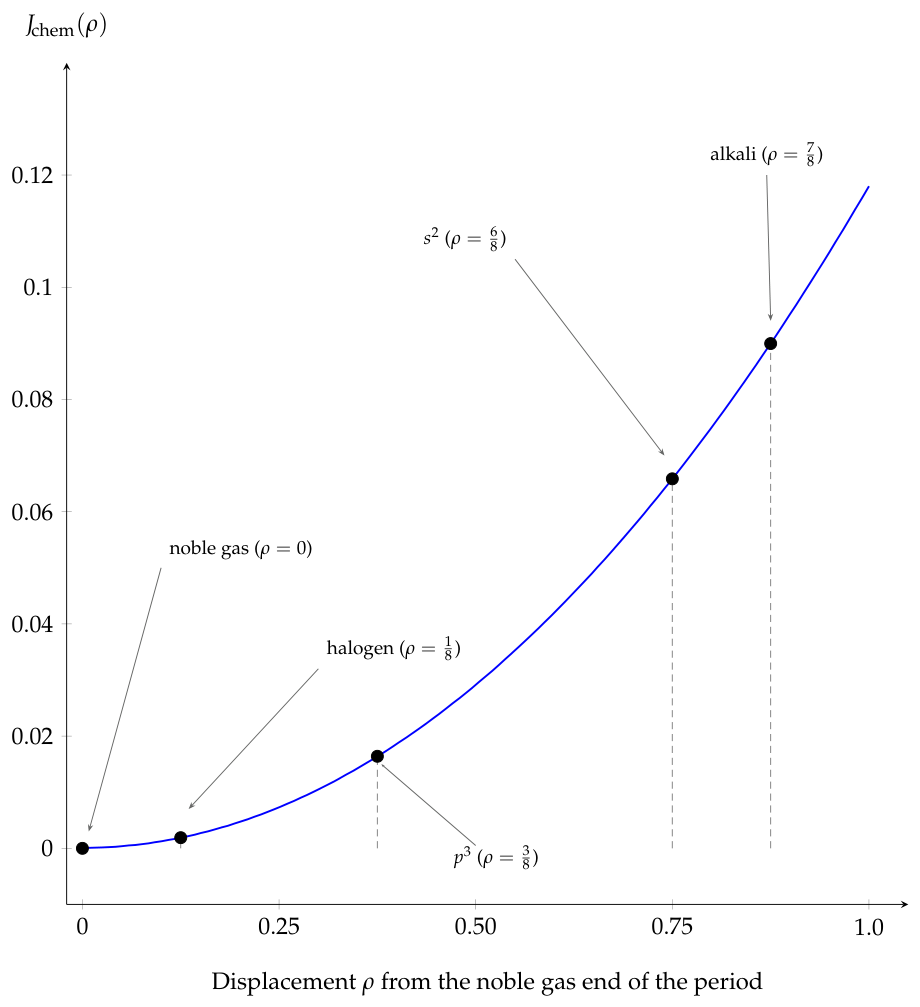
Figure 2 illustrates
for the
geometry of periods 2 and 3, marking the halogen,
,
, and alkali positions; the definition applies unchanged to all periods.
The mathematical uniqueness of
J is established in Refs. [
5,
6] and has no chemistry input: it is the unique reciprocal cost on positive ratios under standard smoothness conditions (
Appendix A). The chemical modeling step is separate, and consists of three choices that we make explicit. (i) The noble gas-centred coordinate
is chosen because the noble gas configurations are the natural empirical “zero” of within-period chemistry: they are the closed-shell endpoints from which IE
1, EA, and
all change monotonically along the period, with anomaly sites occurring at fixed fractional positions. (ii) The argument-rescaling factor
is presently a modeling ansatz, not a derived chemical constant. We retain it because it produces the ratio identities of Equations (
13) and (
15), but a first-principles derivation of
in this chemical context is left to future work. (iii) The cosh form is selected because it is the unique closed-form
J at the geometric scale
; alternative smooth monotone kernels (e.g.,
, or
with free
c) produce qualitatively similar within-period shapes. A quantitative robustness comparison against exactly these alternatives is carried out in
Section 5.9; it shows that on the absolute-scale benchmarks the cosh,
, and free-
c kernels are statistically indistinguishable, so the value
is not singled out by those fits, and the
-specific content of the framework resides only in the parameter-free ratio identities of Equations (
13) and (
15).
5. Results
This section presents the three IE1 predictions and the three derived checks for EA, , and , with the shared-kernel scale unification tested in the final subsection. Predictions 1–2 are ratio-level identities (heavy noble gas and halogen/alkali ); Prediction 3 is the within-period ordering-and-anomaly claim across periods 2–4. NIST ionization energies are much more precise than the few-percent discrepancies discussed below, so all reported deviations reflect the model, not measurement uncertainty.
For each observable below we report the candidate set, the classes excluded (and why), and the retained set on which the metric is computed. Exclusions are confined to two physically motivated categories: (a) the textbook half-filled and closed-subshell anomaly sites
, where Hund-exchange and shell-closure stabilizations dominate and are not represented by the smooth landscape; and (b) cases where well-understood relativistic or first-row screening shifts dominate the comparison and would mask the within-period landscape content (specifically, period 1 and the Ne/Ar pair in Prediction 1, the F/Li and Ts/Fr pairs in Prediction 2, period 7 throughout, and a small set of borderline-Aufbau relativistic atoms in the period 6 EA fit). The benchmark subsets used in
Section 5.4,
Section 5.5 and
Section 5.6 are the regular-Aufbau interior atoms surviving these two exclusions, and the affected anomaly atoms remain listed in
Appendix C,
Table A2.
All experimental inputs are tabulated atomic data: first ionization energies and electron affinities from the NIST Atomic Spectra Database [
7], Pearson chemical hardness from Ref. [
18], and the small number of theory-only superheavy values from the relativistic coupled-cluster and configuration-interaction references cited in the corresponding tables. The dimensionless landscape quantities
,
,
, and
are evaluated in closed form from Equations (
4), (
7), (
9), and (
11) using only the integer inputs
and
; there is no per-atom adjustable quantity. The ratio-level predictions (
Section 5, Predictions 1–2) are parameter-free and require no fit. The absolute-scale checks (
Section 5.4,
Section 5.5 and
Section 5.6) use a single linear least-squares scale per period (or one global scale, for
), fitted by minimizing
over the retained atoms, where
is the measured observable and
the dimensionless kernel value. Goodness of fit is reported with the coefficient of determination
, the mean absolute error (MAE), the root-mean-square error (RMSE), and, for the hardness correlation, the Pearson linear correlation coefficient
r. Because NIST ionization energies and affinities are far more precise than the few-percent and few-tenths-of-eV discrepancies discussed below, all reported deviations reflect the model rather than measurement uncertainty.
5.1. Prediction 1: Heavy Noble Gas Ratio
The first prediction is a single fixed asymptotic value for the IE
1 ratio of two consecutive heavy noble gases:
For a noble gas
at the end of period
p,
and Equation (
5) gives the outward one-electron step
. Combined with
from
Section 4.1 and the small-step expansion
(accurate to one part in
for
), the consecutive-pair ratio reduces to
Equation (
14) contains no factor of
explicitly; rather, the cosh expansion reduces the IE ratio to the ratio of
between consecutive heavy periods. The empirical content of Prediction 1 is the observation that this ratio takes the golden ratio value
to MAD
across the heavy noble gas pairs Ar/Kr, Kr/Xe, Xe/Rn (
Table 2, columns 4–6).
enters here as a per-period scale fitted from data (
Appendix B); a closed-form derivation of
that would promote this empirical regularity to a parameter-free derivation is left to future work.
Equation (
13) additionally requires
to evolve smoothly between consecutive heavy periods. We retain Ar/Kr, Kr/Xe, and Xe/Rn as the benchmark subset; He/Ne is excluded because period 1 has no shell structure that matches the framework (
and
are undefined in the same sense as for
), and Ne/Ar is excluded as a first-row screening anomaly. (At
the
factor cancels, so the Ne/Ar ratio reduces to
; the cosh expansion is still accurate at
, so the deviation is not a breakdown of the expansion. The breakdown is in the smoothness of
: period 2 has no
p shell screening the
valence electrons, whereas period 3 has a full
core.
is therefore anomalously large relative to
, and the Ne/Ar data ratio sits well above
.) Both excluded rows remain in
Table 2 so the full sequence stays visible.
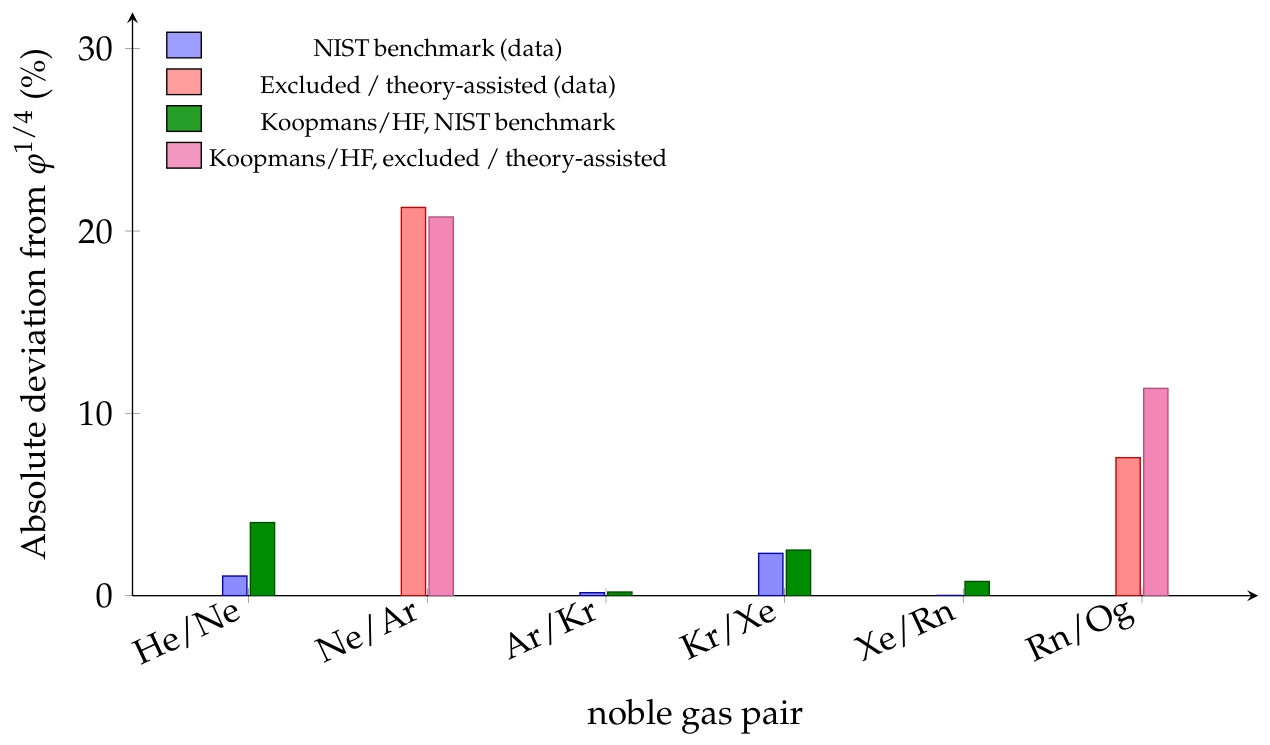
The three NIST-benchmark heavy noble gas pairs Ar/Kr, Kr/Xe, Xe/Rn confirm the
prediction to MAD
(
Table 2, columns 4 and 6), matching or improving on the Koopmans/HF baseline (columns 7–8) on the same subset.
The Rn/Og pair extends the prediction into the superheavy nonrelativistic extrapolation regime, where the relativistic coupled-cluster estimate of Ref. [
31] sits
above
. The deviation is quantified relativistically: at
the
factor cancels, and spin-orbit splitting of the Og
shell (
eV [
31,
32]) destabilizes the
spinor, lowering
below the nonrelativistic prediction by exactly this expected magnitude. The framework’s nonrelativistic value
therefore sets the zeroth-order reference against which the Og spin-orbit shift is measured, and a future experimental
benchmark will refine the comparison.
Figure 3 shows the absolute deviations of all six pairs from
, alongside the Koopmans/HF (Dirac–Fock for Rn/Og) deviations.
5.2. Prediction 2: Halogen/Alkali Ratio
The second prediction is a single fixed value for the IE
1 ratio of the halogen and the alkali metal in the same period:
The halogen of period
p sits at
from the period-closing noble gas
; the alkali of the same period sits at
from the previous noble gas
. The relevant quantity for
is the one-electron landscape step (Equation (
4)), not the absolute landscape height. The dimensionless landscape alone does not fix the halogen-to-alkali
ratio: the small-step form
at fixed
gives intra-period step ratios of
rather than
, so the empirical
value reflects the absolute-energy asymmetry between a halogen
valence (no inner
p-shell screening) and an alkali
valence (full
noble gas core), which sets the
scale at the two endpoints. The empirical content of Prediction 2 is therefore the observation that this absolute-energy asymmetry equals
across periods 3–6: the empirical NIST ratios cluster around
to MAD
. The nearest alternatives
and
give MAD
and
on the benchmark subset, against
for
; this is a local rather than look-elsewhere-corrected comparison. A first-principles derivation of the halogen/alkali
ratio from the landscape plus a stated screening rule remains open.
The benchmark retains periods 3–6 (Cl/Na, Br/K, I/Rb, At/Cs), where both endpoints sit in the same screened
/
regime and the data ratios cluster within ∼9% of
; in period 6 the relativistic shifts on Cs (
stabilization) and At (
spin-orbit splitting) partially cancel in the ratio [
33,
34]. Periods 2 and 7 are excluded but remain listed in
Table 3.
Period 2 (F/Li) is the first-row halogen anomaly: the F
valence has no inner
p shell to screen it (only the compact
and
cores), so
is anomalously large and the F/Li ratio sits well above
, the same first-row screening mechanism that excludes Ne/Ar in Prediction 1. Period 7 (Ts/Fr) is a theory-only superheavy row:
eV destabilizes the
electron of Ts while relativistic
stabilization lifts
above
[
31,
35]; the combined numerator drop and denominator rise put Ts/Fr well below
, the period 7 analogue of the Rn/Og deviation in Prediction 1.
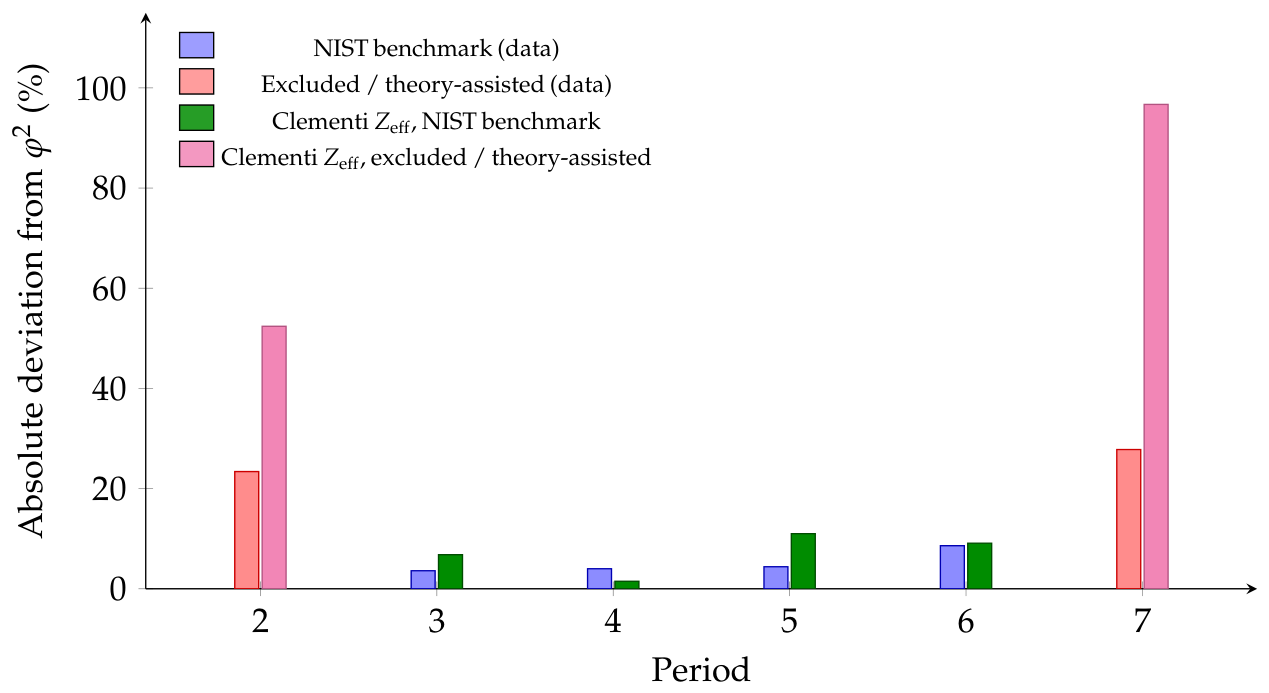
The four NIST-benchmark periods 3–6 cluster around the predicted
with mean
and MAD
(
Table 3, columns 6–7). The Clementi–Raimondi
baseline [
28,
29] (columns 8–9) achieves comparable accuracy on the same subset, demonstrating that the parameter-free
identity matches an established empirical screening benchmark on the regime where both apply, and extends consistently to the relativistic period 6 where simple screening pictures begin to break down (period 7 in
Table 3, row 7) (See
Figure 4).
5.3. Prediction 3: Within-Period Envelope
Within each period
, the normalized first ionization energy
decreases monotonically with
, and the only upward departures from that monotone sequence sit at the textbook half-filled or completed-subshell sites
. Period 7 is excluded because relativistic super-inert-pair stabilization at Cn (
) drives
, violating the period-maximum claim, and is treated as a quantified relativistic correction outside the nonrelativistic regime to which Prediction 3 applies (see “Cn counterexample” paragraph below).
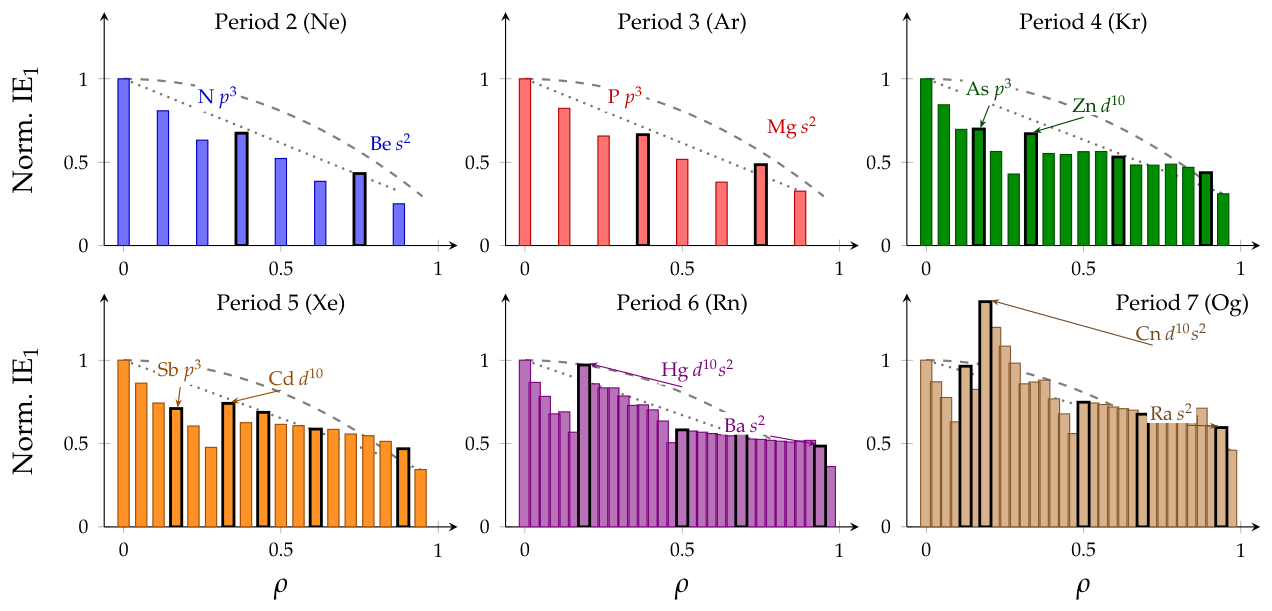
The non-trivial content of Prediction 3 is not that the five anomaly sites are special, that is standard inorganic chemistry, but that no other positions show upward bumps. The -coordinate provides a common axis on which within-period descents from different periods can be compared directly.
The physics behind the five anomaly sites is textbook and we do not re-derive it here. Half-filled
,
,
configurations gain Slater exchange stabilization (
per exchanged pair, where
K is the average Slater exchange integral [
37,
38]) in the maximum-multiplicity Hund-rule state [
9,
10,
39]; removing one electron breaks this stabilization and raises
above the smooth descent. Completed
and
subshells force the next electron into a higher orbital, again raising
. The relativistic
stabilization in periods 6–7 amplifies the
bump at Hg and Cn so much that
in
Figure 5 [
22,
23,
40].
All data are from NIST [
7]; the comparison is by ordering and anomaly location, with no statistical fit.
Figure 5 shows the within-period profiles. Periods 2–3 use NIST data through every element of the period; periods 4–6 use NIST data through the full
d-block (and the lanthanide
f-block in period 6, including the Gd
and Yb
anomalies). For period 7, the actinide IE values are NIST experimental through Lr (Lr from Ref. [
41], No from Ref. [
42]); the transactinides Z = 104–118 are relativistic coupled-cluster and configuration-interaction estimates [
31,
35].
The single largest deviation in
Figure 5 is the relativistic super inert-pair Cn (
) in period 7: the theoretical IE of Cn [
40] exceeds the Og reference, giving
and violating the envelope’s claim that the noble gas is the period maximum. Physically, the
inert-pair effect (amplified by relativistic
contraction) binds Cn’s outermost electron more tightly than the
spinor of Og, which is destabilized by spin-orbit splitting. The period 6 analogue Hg (
) shows the same effect more weakly, sitting just below the Rn line. The envelope therefore holds across periods 2–6, where the nonrelativistic landscape applies, and the Cn deviation in period 7 is a quantified relativistic super-inert-pair correction outside the nonrelativistic regime to which the prediction applies.
The six non-anomalous period 3 values (
Table 4) form a monotone sequence from Ar toward Na, with the only upward deviations at the anomaly positions P and Mg.
Prediction 3 expresses a strict ordering-and-anomaly statement on the periodic-table coordinate
: monotone descent of the non-anomalous elements together with localization of all upward deviations on the textbook anomaly set
. The local slope of the descent is determined by the period-dependent scale
, whose closed-form derivation is left to future work; the coordinate-level structure tested here is the ordering and the anomaly-site localization, both of which hold across periods 2–6 (
Figure 5).
Across periods 2–4, the compiled tables contain 34 points: 26 non-anomalous points follow the monotone noble gas-to-alkali ordering and 8 upward deviations occur at the listed anomaly sites (N, Be, P, Mg, As, Mn, Zn, Ca). This is the largest empirical comparison in the paper.
5.4. Electron Affinity Check
This subsection benchmarks the analytical landscape prediction of Equation (
7) against empirical electron affinities on periods 4–6 (25 regular-Aufbau interior atoms in total:
).
Empirically, EA across periods 2–6 is negative at the noble gas (out-of-period transition, treated separately) and positive on the regular-Aufbau interior, peaking at the halogen (
) and decreasing monotonically toward the alkali (
). The landscape kernel of Equation (
7) reproduces this halogen-positive monotone descent on the interior in closed form (
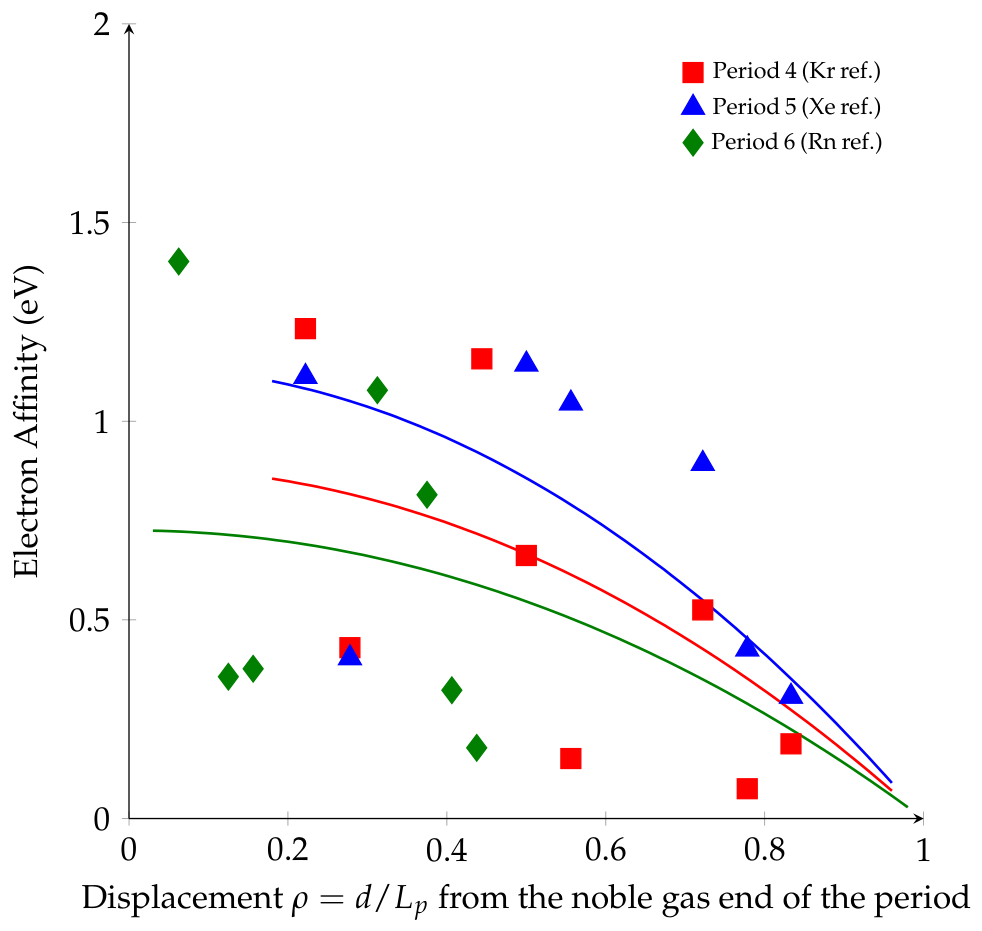
Section 4.2). The single-parameter quantitative match between the predicted and empirical EA slope is shown in
Figure 6.
The experimental electron affinities used in
Figure 6 and
Table 5 are the recommended atomic values of the critically evaluated compilations of Hotop and Lineberger [
43] and Andersen, Haugen, and Hotop [
44]. The same rules are applied to all three periods. Halogens are dropped because the monotone form of Equation (
7) underestimates the steep shell-closure binding (the period 4–6 halogens lie roughly 2 eV above the curve). Noble gases are dropped because the landscape gives
at
while the empirical
is negative (out-of-period transition; see
Section 4.2). The anomaly classes
are dropped because Hund-exchange and shell-closure stabilization dominate their binding. Relativistic outliers and borderline irregular-Aufbau atoms in period 6 are also dropped. For visual clarity the highest non-halogen chalcogen markers and the alkali markers near
are not drawn, but the alkali points are kept in the fits.
A single per-period scale
is the only free parameter in each fit. Linear least-squares fits of Equation (
7) to the surviving regular-Aufbau interior atoms give
with diagnostics
(For period 6,
is undefined because the surviving 8-point EA set has very small dispersion (
eV across the surviving period 6 subset, comparable to the fit MAE); MAE and RMSE are reported instead.) The period 5 fit is the weakest of the three:
means the kernel explains only
of the EA variance on the surviving 8-atom subset, comparable to fitting the period mean. The kernel still reproduces the chalcogen-to-alkali sign-and-trend, but the period 5 numerical agreement should not be over-interpreted. The fit curves are overlaid in
Figure 6. They reproduce the chalcogen-to-alkali decline and the strict positivity of
on the regular-Aufbau interior subset across all three periods, with single-parameter MAE of
–
eV, demonstrating that one closed-form landscape gap captures the period-averaged interior-atom EA trend without per-atom tuning at the shape level (sign, monotonicity, halogen-to-alkali descent), with the absolute-EA scale carried by the fitted
.
The per-period scales carry the absolute-energy information complementary to the dimensionless kernel: at the same reflects the higher absolute EA of the row, and the period 6 prefactor consistently tracks the stretch of the sinh profile across the displacement axis. The post-transition atoms and a few late-d-block period 4 entries provide additional structure that a future -dependent extension can target; the present single-parameter form already captures the period-averaged EA trend across periods 4–6.
Half-filled and closed-subshell anomaly sites are identified separately by the landscape framework (
Section 5, Prediction 3) as Hund-exchange and shell-closure stabilizations on top of the smooth landscape; the EA proxy of Equation (
7) delivers the sign-and-trend prediction for the regular-Aufbau interior atoms where the smooth landscape applies.
We make the status of this benchmark explicit. The modest coefficients of determination (, , and undefined for periods 4, 5, and 6) show that the one-parameter EA proxy is not a quantitatively accurate predictor of individual electron affinities; the period 5 fit in particular explains only of the interior-atom variance. What the proxy does establish, and all that we claim for it, is the qualitative content: the correct sign ( on the regular-Aufbau interior), the monotone chalcogen-to-alkali descent, and the halogen-to-alkali ordering across each of periods 4–6 from a single closed-form coordinate with one fitted scale. The EA subsection should therefore be read as evidence for reproducing the sign-and-trend behavior of electron affinity, not for accurate numerical EA prediction, exactly as the Referee notes.
The exclusions are not tuned to improve the fit: they are the same two physically motivated categories applied to every observable in the paper (
Section 5, “Benchmarking philosophy”), namely the textbook half-filled/closed-subshell anomaly classes
, where Hund-exchange and shell-closure stabilizations dominate and are, by construction, outside the smooth-landscape part of the model, together with the noble gas endpoints (where
changes sign) and a small set of well-understood relativistic/borderline-Aufbau atoms in period 6. Several of these excluded classes are indeed chemically important and are precisely the regions of most characteristic EA behavior, as the Referee observes; our position is that they are governed by physics the smooth coordinate deliberately does not model, and the excluded classes are named explicitly both here and in the caption of
Figure 6 (with the periods 2–4 anomaly atoms additionally listed individually in
Appendix C,
Table A2), so that the reader can see which atoms were set aside and why. The retained interior subsets (
, 8, 8) are small, which is itself a reason we restrict the EA claim to sign-and-trend.
5.5. Electronegativity Check
This subsection benchmarks the electronegativity kernel
of Equation (
9) against empirical Mulliken
on 15 atoms across four chemical classes (halogens, alkalis, chalcogens, two mid-
d benchmarks) spanning periods 2–6.
Empirically,
falls by a factor of about five from halogens to alkalis, with chalcogens between and the mid-
d benchmarks slightly above the alkalis (
Table 5); within each class the down-group variation is small. The kernel of Equation (
9) is dominated by the EA-side term
at small
d, so
at the halogen position
is nearly
-independent, while at
(alkali end) it does decrease with
.
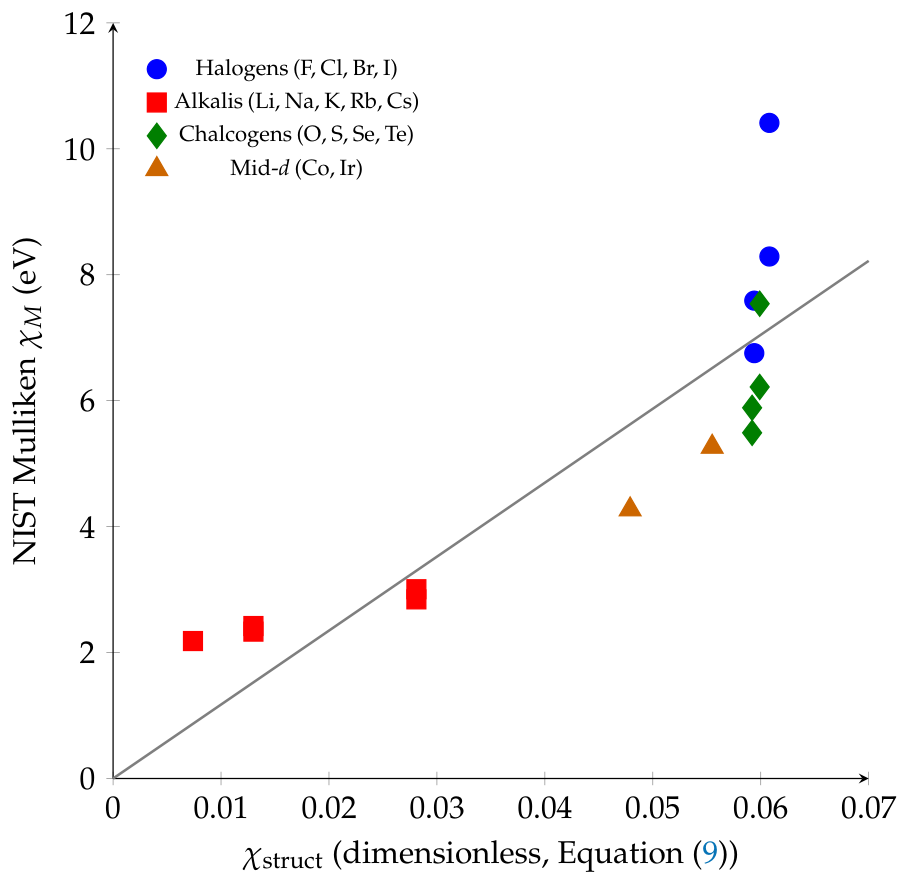
Figure 7 shows the single-parameter parity test discussed below.
A single-parameter fit
across all 15 atoms achieves
(MAE = 1.03 eV, RMSE = 1.25 eV) with the global
C = 117.4 eV (
Figure 7). The per-class best-fit scales,
eV,
eV,
C(chalcogen) = 105.6 eV,
C(mid-d) = 92.4 eV, cluster around the global fit with
, recovering the four-class rank ordering and the halogen-to-alkali
ratio of
from one closed-form coordinate kernel.
For the first time, a single closed-form coordinate kernel reproduces the three central between-class features of empirical on one periodic-table axis: the halogen-to-alkali ratio of , the intermediate chalcogen position, and the down-group decrease in alkalis. The within-class halogen ordering F > Cl > Br > I is a natural next-stage refinement through a class-dependent weighting of and ; the single-coordinate kernel established here provides the analytical baseline for that extension.
We state plainly that reproducing the
fine down-group variation within a main group, in particular the decreasing halogen sequence
and
: F > Cl > Br > I, is an inherent limitation of the present single-coordinate framework, not an oversight. The reason is structural: every observable here is a function of only the within-period coordinate
and the period length
. Two halogens such as F (
) and Cl (
) sit at the
identical coordinate
, so the kernel assigns them the same dimensionless value (
Table 5,
Figure 7); Br and I likewise coincide at
. The coordinate therefore carries no information about the principal quantum number
n along a group, which is precisely the variable that drives the down-group decrease through the increasing valence-orbital radius and the changing core screening. Capturing that trend requires an explicit
n- or
-dependent absolute-energy scale
on top of the dimensionless kernel; this is the same
-derivation problem flagged in the Introduction and is the natural direction in which the framework must be extended. The effective nuclear charge model of
Section 5.8, which does carry an explicit
n-dependence through
, reproduces the down-group ordering and thus complements the present coordinate picture exactly where the latter is silent.
The dimensionless kernel converts to absolute eV-scale Mulliken values through the global one-parameter scale
eV fitted on the 15 atoms; a closed-form noble gas-anchored candidate
(
Appendix B,
Table A1) reproduces the noble gas IE values to within a few percent and provides a starting point for a derivation of
from first principles.
5.6. Hardness Check
This subsection benchmarks the landscape hardness index
(Equation (
11)) against empirical Pearson chemical hardness
[
18] for all 34 elements of periods 2–4. The same monotone alkali-to-noble gas trend is observed in the heavier periods 5–6 (not shown here for brevity); periods 2–4 are presented in detail because they cover the nonrelativistic regime in which the landscape kernel applies and provide the largest set of high-precision empirical
values.
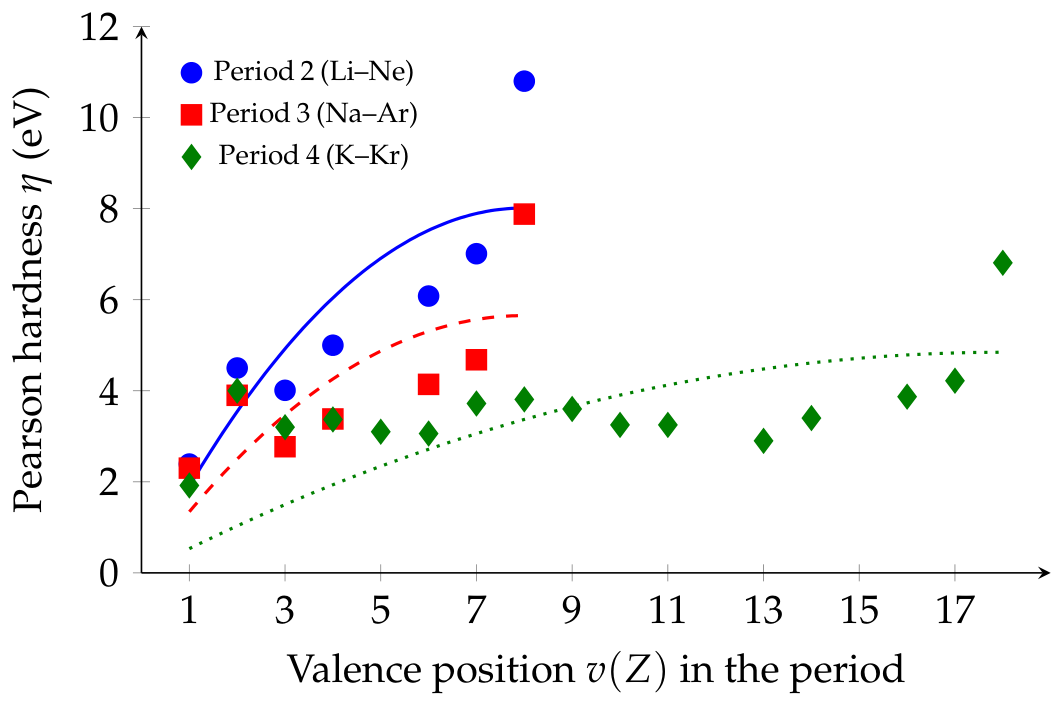
Within each period, empirical
rises monotonically from the alkali end to the noble gas end (
Appendix C,
Table A2), with upward bumps at the half-filled
sites (N, P, As) and the closed
site (Zn). The landscape predictor
reproduces this monotone alkali-to-noble gas shape directly from the closed-form Equation (
11), delivering the correct period maximum and monotone descent on a single coordinate.
Pearson linear correlations between
and the landscape predictor
(Equation (
11)) across all elements of each period are
correlates with empirical
across all three periods at the
–
level, confirming that the within-period hardness pattern is captured by a single periodic-table coordinate derived from the same closed-form landscape that supplies the EA proxy.
A single per-period scale
converts
to absolute hardness in eV. Linear least-squares fits
within each period give
with MAE
eV per period on noble gas maximum values up to
eV. The scale
decreases monotonically from period 2 to period 4, capturing the empirical softening of chemical hardness with increasing principal quantum number on a single landscape coordinate.
The single-parameter landscape fit reproduces the characteristic empirical hardness profile across all three periods: the noble gas period maximum, the monotone descent toward the alkali end, and the noble gas plateau set by the shallow
behavior of
. The textbook half-filled
and closed
anomaly bumps are identified separately by the framework as Hund-exchange and shell-closure stabilizations on top of the smooth landscape (
Section 5, Prediction 3).
5.7. Test of the Shared-Kernel (EA-) Proportionality
The kernel
enters the EA proxy (
Section 5.4) and the hardness proxy (
Section 5.6) with two independent per-period scales
and
. This yields a period-constant benchmark for the regular-Aufbau interior atoms of period
p,
For period 4, the fitted constants give
. The empirical period 4
ratios are listed in
Table 6.
The empirical period 4 mean agrees with the predicted shared-kernel constant to within . This is a period mean benchmark, not a per-atom proportionality law: the per-atom standard deviation (CV ) is much larger, with empirical median and quartiles , (). Atoms with very small empirical (Sc, Ti, Fe; eV) sit below the period constant () because the near-zero denominator of their EA suppresses the ratio, while the post-transition atoms Ge and Ni sit above () because their EA is enhanced relative to the smooth profile. A leave-one-out sensitivity check confirms that the period 4 mean is stable but not invariant: removing any single atom moves into the range , with the largest shift produced by removing Ge (, relative to the predicted constant) and the smallest by removing Co (). The shared-kernel relation is therefore best read as a period-averaged regularity supported on the period 4 NIST data, with quantitatively traceable per-atom deviations driven by known d-block correlation effects.
5.8. Horizontal Comparison with Traditional Models
To place the framework against established theory, we compare it directly with the two reference models introduced in
Section 1: the effective nuclear charge (screening) model [
27,
28,
29], evaluated through the Koopmans/Hartree–Fock orbital-energy estimate [
8] for the
ratios, and conceptual density-functional theory [
16,
17,
19,
30] for electronegativity and chemical hardness. The comparison is made on the
same benchmark subsets used in the preceding subsections, so that the model and the traditional baseline are scored on identical data.
The screening model writes
, so the relevant baselines for the two ratio predictions are the
-ratio and Koopmans/HF orbital-energy ratio already tabulated in
Table 2 and
Table 3. On the three heavy noble gas pairs (Ar/Kr, Kr/Xe, Xe/Rn), the parameter-free
identity reproduces the data to MAD
, against
for the Koopmans/HF ratio on the same pairs. On the four halogen/alkali pairs (periods 3–6), the parameter-free
identity gives MAD
, against
for the Clementi–Raimondi
ratio on the same pairs. In both cases, a single golden ratio constant matches or slightly improves on the established effective charge baseline, while using
no per-atom screening constants: the screening model requires a tabulated
for every element, whereas the present identities require only the integer period structure. We emphasize that this is a like-for-like comparison on a limited benchmark and not a claim of superiority of screening physics; the effective charge model remains the more general predictor (it also captures the down-group variation that the coordinate model does not,
Section 5.5).
Conceptual DFT defines
and
, realized in practice by the finite-difference forms
and
[
17,
30]; these definitions are the
source of the empirical
and
values benchmarked in
Section 5.5 and
Section 5.6. The horizontal comparison is therefore between the full two-input DFT finite-difference value (which requires both
and
per atom) and the present single-coordinate predictor (which requires neither). The landscape hardness index
correlates with the conceptual-DFT
at
,
,
for periods 2–4 (Equation (
19)), and the single-coordinate
reproduces the conceptual-DFT
across the 4-class 15-atom benchmark at
(
Section 5.5). The effective charge picture and the landscape agree on the qualitative origin of the period trend, the hardness maximum sits at the closed-shell noble gas where
is largest and
, and both descend monotonically toward the alkali. The comparison summarized in
Table 7 shows that one closed-form coordinate reproduces, on the stated benchmark subsets, the within-period content that the traditional models obtain only with per-atom screening constants or with both spectroscopic inputs per atom.
The advantage that this comparison highlights is one of economy and unification rather than of raw accuracy: a single closed-form coordinate, fixed by the integer period structure alone, reproduces on the stated benchmark subsets the within-period content that the screening model obtains only with a tabulated per-atom and that the conceptual-DFT finite difference obtains only with both and per atom, and it does so for all four observables on one axis. We are deliberately cautious about the apparent accuracy gains: the and MAD improvements are computed on only three and four pairs, respectively, so the differences from the effective charge baselines are not statistically significant and should be read as “comparable accuracy” rather than as a demonstration of superiority. Likewise, the hardness and electronegativity entries compare the single-coordinate predictor against the conceptual-DFT definition that generates the data, so they measure how much of that definition is recoverable from one coordinate, not a contest between two independent predictors; a comparison against an independent density- or -based hardness predictor is a natural next step left for future work.
5.9. Robustness to the Choice of Kernel and the Role of the Golden Ratio
Because the golden ratio argument-rescaling
is an ansatz rather than a derived chemical constant (
Section 3), it is essential to ask whether the specific value
in
is statistically singled out by the benchmark data, or whether comparable monotone kernels perform equally well. We address this directly, both analytically and numerically.
On the within-period domain
the cosh argument satisfies
, so the kernel is deep in its small-argument regime, where
(Equation (
3)). Any kernel of the form
therefore reduces, to leading order, to
, and the constant
is absorbed exactly into the single fitted per-period (or global) scale used in the absolute-scale checks of
Section 5.4,
Section 5.5 and
Section 5.6. Consequently, the shape parameter
c is
not identifiable from those one-parameter fits: distinct values of
c (including
,
, or
), and the bare quadratic
, all produce essentially the same fitted curve. This is a structural feature of single-scale fitting, not a property of the particular data set.
To make this quantitative we refit the two absolute-scale benchmarks, the 15-atom Mulliken
parity test of
Section 5.5 and the period 4/5/6 EA fits of
Section 5.4, after replacing the landscape kernel
in turn by (a) the present
; (b) the bare quadratic
; (c)
with
c fitted to the data; and (d)
with
c fitted, keeping the same one-scale-per-fit procedure throughout.
Table 8 reports the resulting goodness of fit. The
-based kernel and the bare
kernel are statistically indistinguishable (
on
;
per period on EA), and on the
benchmark the fitted cosh shape parameter is unconstrained:
stays within
of its maximum for every
, a range that comfortably contains
,
, and
. The exponential kernel yields only a marginal change (
vs.
on
, not significant for
) and is in any case physically disfavoured:
has a non-zero slope at the noble gas endpoint (
), whereas the closed-shell configuration is naturally a
stationary cost minimum, a property shared by
and
(
) but not by the exponential. We therefore state plainly:
the choice is not statistically superior to these alternatives on the absolute-scale benchmarks, and we do not claim that it is.
The discriminating,
-specific content of the framework is therefore
not in the absolute-scale fits but in the two
parameter-free cross-period ratio identities of Predictions 1–2,
for the heavy noble gas
ratios and
for the halogen/alkali ratios, which carry no fitted scale at all. We are explicit about their epistemic status, in answer to whether they were predicted a priori or fixed against data: as already noted in
Section 1 and in the derivation of Equation (
14), the cosh argument-scaling
cancels in the small-step expansion, so neither exponent is forced by the kernel; rather, the integer exponents
and 2 are
empirical regularities identified by comparison with the NIST ratios (the fitted per-period scale combination
is found to track
, and the halogen/alkali ratio to track
), and they are reported throughout as such, not as independent theoretical predictions. Accordingly, the present evidence supports reading the golden ratio as an
economical empirical organizing constant for these trends, a compact parametrization, rather than as established proof of a fundamental physical role for
in atomic structure. A first-principles derivation of
(and of the per-period scale
) that would elevate these regularities to genuine predictions remains the central open problem stated in
Section 6.
The degeneracy above shows that the absolute-scale fits do not
require the cosh/
kernel, but it is not a reason to replace it by
. We retain the present form for three reasons that the bare quadratic does not share. First,
J is not a free curve choice: it is the unique reciprocal cost functional fixed by the regularity axioms of
Appendix A, evaluated at the geometric scale
, so the kernel carries a theorem-level mathematical justification that an ad hoc
does not. Second, it is precisely the
scaling that yields the two
simple closed-form ratio identities
and
(Equations (
13) and (
15)); the quadratic kernel reproduces the within-period shape but offers no comparably compact cross-period statement. Third, the contribution of this paper is one of
economy and unification (
Section 5.8): a single integer-parametrized coordinate organizes four observables and two ratio identities in closed form. The kernel-comparison result should therefore be read not as a weakness but as an honest delimitation of where the golden ratio does and does not carry statistical weight, with the parsimony of the single-coordinate description, rather than the statistical superiority of any one smooth kernel, as the claimed advance.
6. Conclusions
We proposed a compact phenomenological framework in which a single dimensionless landscape on the noble gas-centred coordinate provides analytical proxies for the four central within-period atomic observables IE1, EA, , and . The outward step is assigned to IE1, the inward gap is reused for both EA and with two independent per-period scales, and follows by Mulliken’s identity. The four observables share the same dimensionless shape (sign, monotonicity, halogen position, anomaly localization, cross-period ordering); absolute energies enter through fitted per-period scales that cancel in the EA– ratio.
The framework captures several broad within-period regularities and provides a compact analytical baseline. At the period-averaged scale level, the shared-kernel relation
is supported on period 4 NIST data: the empirical nine-atom mean
agrees with the predicted constant
to better than
(
Section 5.7); per-atom scatter is substantial (
), so this should be read as a period-mean benchmark rather than a per-atom proportionality law. At the shape level, the within-period IE
1 envelope (Prediction 3) reproduces the full noble gas-to-alkali ordering across periods 2–6 and localizes every upward deviation exactly on the textbook anomaly sites
(26 of 34 atoms across periods 2–4 on the monotone descent; 8 deviations on the listed anomaly sites). The two golden ratio identities,
on three heavy noble gas pairs and
on four within-period pairs, agree with NIST data to MAD
and
, respectively, capturing the golden ratio rescaling of the absolute-energy structure encoded by the per-period scale sequence
.
The shared-kernel form further provides single-parameter analytical fits to empirical EA across periods 4–6 (MAE – eV; the period 5 fit explains only of variance and should be read as sign-and-trend agreement rather than quantitative match), to Pearson hardness across periods 2–4 (MAE eV on noble gas maxima up to eV), and to Mulliken across a 15-atom 4-class benchmark (); the within-class halogen ordering F > Cl > Br > I is not recovered by the present single-coordinate kernel. Two natural extensions follow directly: a critically evaluated benchmark to refine the heavy-noble gas test and a class-dependent kernel mixing and to resolve the within-class halogen ordering, which we identify as the next target.
On the question of theoretical foundation, the framework is intermediate between an empirical fit and a first-principles theory: the cosh kernel is the unique reciprocal cost functional fixed by a theorem (
Appendix A), whereas the golden ratio rescaling
and the per-period scale
remain phenomenological inputs whose derivation is the principal open problem. A direct horizontal comparison (
Section 5.8,
Table 7) shows that, on the same benchmark subsets, the parameter-free golden ratio identities match the effective nuclear charge (Koopmans/HF and Clementi
) baselines for the IE
1 ratios (with the small-benchmark caveat noted in
Section 5.8), while the single-coordinate hardness and electronegativity predictors track the conceptual-DFT definitions (
–
for
,
for
) using fewer per-atom inputs. The framework is thus complementary to these established models rather than a replacement for them; in particular, the fine down-group ordering F > Cl > Br > I, which the effective charge model captures through its explicit
n-dependence, is an inherent limitation of the present single-coordinate construction and is recovered only once an
n-dependent absolute scale is added.
A dedicated kernel robustness analysis (
Section 5.9,
Table 8) further establishes the precise statistical status of the golden ratio: on the absolute-scale benchmarks the cosh/
kernel, the bare
kernel, and a free-exponent
are statistically indistinguishable, so the value
is not singled out by those fits. The genuinely
-specific, falsifiable content is confined to the two parameter-free cross-period ratio identities, and the exponents
and
are reported as empirical regularities of the fitted per-period scales rather than as a priori predictions. The golden ratio is therefore best read at present as an economical organizing constant; the value of the framework lies in the parsimony and unification of the single-coordinate description rather than in the statistical superiority of any one kernel.
Beyond the specific results reported here, we expect the framework to be useful for further scientific research in several concrete directions. (i) A compact baseline for data-driven property prediction. Because all four observables are generated in closed form from the integer period structure with at most one fitted scale per period, the landscape coordinate furnishes a transparent, low-parameter baseline and a physically motivated descriptor for machine learning and cheminformatics models of atomic properties, against which the added value of higher-dimensional feature sets can be measured. (ii) Guidance for superheavy-element chemistry. The parameter-free golden ratio identities and the within-period envelope extrapolate naturally into periods 7–8, where direct measurement is impractical and relativistic predictions still scatter; the framework offers a quick analytical cross-check on IE1, EA, and hardness trends for the heaviest elements and a target for critically evaluated benchmarks such as . (iii) A route to molecular and reactivity descriptors. Since the kernel reproduces the conceptual-DFT electronegativity and hardness orderings from one coordinate, it is a candidate building block for electronegativity-equalization and chemical-reactivity schemes in which per-atom spectroscopic inputs are replaced by closed-form structural proxies. (iv) A symmetry-based organizing principle. By tying four chemical observables to a single golden ratio cosh coordinate centred on the noble gases, the construction adds a quantitative, testable entry to the long-standing discussion of the symmetry and regularity of the periodic system, and invites analogous single-coordinate treatments of further periodic properties (atomic and ionic radii, polarizabilities, and successive ionization energies). In each case the central open problem identified above, a first-principles derivation of the golden ratio rescaling and of the per-period scale Ep, remains the key theoretical step that would convert the present phenomenological reference into a predictive theory.