1. Introduction
The hydrogen atom has been instrumental in the advancement of quantum mechanics, largely due to its conceptual simplicity and analytical accessibility. It remains a key reference system in atomic physics, chemistry, and neighboring fields [
1,
2,
3,
4]. In addition to its historical value, hydrogen offers a natural and precisely controllable setting for investigating core quantum information concepts at the most basic scale. In particular, the interacting spins of the electron and proton form an effective two-qubit system. This provides a clear avenue for examining bipartite quantum correlations—such as entanglement and state fidelity—directly in terms of the underlying physical interactions. One prominent feature of the hydrogen atom is its hyperfine structure, which stems from the magnetic interaction between the electron and proton spins. This coupling lifts the ground-state degeneracy, producing singlet and triplet manifolds that can harbor intrinsic quantum correlations. Applying an external magnetic field introduces Zeeman splitting, which breaks rotational symmetry and reshapes both the energy spectrum and the eigenstate structure. Consequently, the interplay of hyperfine and Zeeman effects establishes a versatile platform for systematically exploring coherent spin dynamics, energy-level crossings, and magnetically tunable quantum correlations. At low temperatures, the hyperfine states of hydrogen reveal nonclassical correlations that result from the competition between hyperfine splittings and thermal fluctuations. Earlier work has demonstrated that these correlations decrease with increasing temperature and ultimately disappear above a specific energy scale [
5,
6,
7]. Experiments with spin-polarized hydrogen in solid H
2 matrices have also shown clear deviations from standard Boltzmann statistics at low temperatures [
5,
8], emphasizing the role of quantum coherence and correlations in these regimes. Such results call for a comprehensive theoretical study of how hyperfine and Zeeman interactions govern quantum correlations in realistic physical conditions. Viewed through the lens of quantum information, spin systems resembling the electron–proton pair in hydrogen have been extensively explored as potential media for quantum information tasks. Electron spins in semiconductor quantum dots [
9,
10] and nuclear spins in solid-state environments have been identified as candidate qubits for quantum computation and communication [
11,
12,
13]. Differing from studies centered on spatial or coordinate entanglement [
14] or purely formal treatments of hyperfine effects [
15], the current analysis focuses on spin entanglement arising from the intrinsic hyperfine interaction, while explicitly including the Zeeman term due to an external magnetic field. This approach allows both field-dependent control and decoherence phenomena to be addressed within a single consistent framework.
Quantum coherence (QC), arising directly from the superposition principle, forms a fundamental pillar of quantum mechanics and acts as a vital resource in numerous quantum information processing tasks. These include the establishment of quantum reference frames [
16,
17,
18], coherent transport phenomena in biological systems [
19,
20,
21], and key processes in quantum thermodynamics [
22,
23,
24]. Accurately quantifying QC remains a central theoretical and practical challenge within quantum mechanics and quantum information science alike, attracting intense research attention in recent years [
25]. This resource-theoretic perspective has clarified how coherence underpins distinctive quantum advantages, ranging from quantum state merging [
26] and deterministic quantum computation with one qubit [
27] to the Deutsch–Jozsa algorithm [
28] and Grover’s search algorithm [
29]. Moreover, the resource theory of coherence offers a solid basis for understanding the wave-like behavior of quantum systems [
30] as well as the fundamental character of quantum correlations, including entanglement [
31] and various discord-type quantifiers [
32]. Baumgratz et al. [
25] introduced a comprehensive resource-theoretic framework for quantifying QC in arbitrary quantum states, which has since stimulated the construction of multiple coherence measures grounded in different physical and mathematical principles. The earliest such measures were the norm of coherence and the relative entropy of coherence, both derived from distance-based approaches [
25]. These were later complemented by proposals based on entanglement [
33], operational interpretations [
34,
35], and convex-roof constructions [
36,
37]. The resulting toolbox has facilitated in-depth studies of QC’s rich features, such as its interplay with other quantum resources [
33,
38,
39], its behavior in infinite-dimensional Hilbert spaces [
40,
41], complementarity relations involving coherence [
42], and the quantification of macroscopic coherence [
43]. Overall, this resource-theoretic viewpoint has sparked extensive further investigations into the essential properties and broader consequences of quantum coherence [
44,
45,
46,
47]. In recent years, considerable progress has been made in understanding the dynamics and protection of quantum coherence in open systems. Several studies have investigated coherence revivals, freezing phenomena, and protection mechanisms under various decoherence models [
48,
49]. The use of external control fields to mitigate dephasing and extend coherence lifetimes has also been actively explored [
50].
Purity, quantified as the trace of the squared density operator, provides a direct and computationally transparent measure of the mixedness of a quantum state and serves as an essential diagnostic of its overall quantum character under environmental noise. In open quantum systems, the progressive decay of purity signals the irreversible loss of superposition and coherence due to system–environment coupling, thereby limiting the fidelity of quantum operations and the robustness of resource-theoretic quantities. Recent theoretical and experimental investigations have underscored the intimate interplay between purity, quantum coherence, and other nonclassical resources across various platforms, establishing purity as a complementary figure of merit for characterizing decoherence and control strategies [
51,
52]. The relationship between quantum coherence and state purity in dissipative environments has received increasing attention, with purity serving as a useful complementary indicator of the overall quantum character of mixed states [
51]. These developments provide important context for the present study of coherence and purity protection in the hydrogen hyperfine manifold through Zeeman tuning.
The theory of open quantum systems is concerned with the evolution of quantum systems interacting with their surrounding environments—a subject of enduring importance since the early foundations of quantum mechanics [
53]. Despite notable theoretical advances, key challenges persist, particularly the phenomenon of decoherence, which refers to the loss of quantum coherence due to system–environment coupling. This process has received considerable attention in quantum information and computation, where decoherence constitutes a major obstacle to the practical development of quantum information processors [
54,
55,
56]. The preservation of quantum coherence (QC) is therefore essential for the successful operation of quantum computers, quantum cryptography, and quantum teleportation. Moreover, decoherence provides a fundamental mechanism for understanding the quantum-to-classical transition, in which the emergence of classical behavior from quantum systems is attributed to environmentally induced loss of coherence. Within the hyperfine manifold of the hydrogen atom, the time evolution of purity under the combined influence of intrinsic spin–spin coupling, external Zeeman splitting, and local Markovian dephasing reveals how a suitably chosen magnetic field can effectively slow the rate of purity degradation, offering a practical route by which to preserve quantum features in realistic, controllable atomic systems. In this work, we investigate the dynamics of quantum coherence and purity in the hydrogen atom under dissipative conditions in the presence of an external magnetic field, employing the Lindblad master equation. We demonstrate that these quantities display characteristic damped oscillatory evolution, with the decay envelope slowing as the magnetic field strength is increased. These effects intensify at higher dissipation rates. Our results emphasize the crucial role of the environment in the degradation of QC and purity, thereby offering important insights into the preservation of quantum properties in atomic systems. The novelty of the present work lies in several aspects. First, we treat the ground-state hyperfine manifold of the hydrogen atom as a realistic and controllable two-qubit platform subjected simultaneously to intrinsic hyperfine coupling, an external static magnetic field, and local Markovian dephasing. Second, we derive exact analytical expressions for the time evolution of populations and coherences for general X-shaped initial states and quantify quantum coherence using two complementary resource-theoretic measures: the
-norm coherence and the relative entropy of coherence, together with the state purity. Third, and most importantly, we demonstrate that the external magnetic field can be used as a practical control knob: by increasing the proton magnetic parameter, interference revivals in coherence and purity are generated and sustained over longer timescales, thereby partially counteracting the detrimental effects of dephasing. This field-induced protection of quantum resources, together with the transparent physical explanation of the decoherence-free subspace formed by the fully aligned states, constitutes the central new contribution of this study.
The manuscript is organized as follows. In
Section 2, we introduce the hyperfine Hamiltonian of the hydrogen atom in the presence of an external magnetic field.
Section 3 describes the open-system dynamics based on the Lindblad master equation. The quantifiers of quantum coherence and purity are presented in
Section 4. In
Section 5, we analyze their time-dependent behavior under dissipative evolution. Finally,
Section 6 summarizes the main results and discusses their physical implications.
2. Spin Dynamics of Atomic Hydrogen in an External Static Field
The electronic ground state of the hydrogen atom features a nontrivial coupling between the spins of the electron and the proton, described by the hyperfine interaction. In its standard form, the corresponding Hamiltonian accounts for the magnetic dipole–dipole coupling and is given by
where
and
are vectors of Pauli operators acting on the electron and proton spin-
subspaces, respectively. The coupling constant
is expressed as [
57]:
with
being the vacuum permeability,
the Bohr radius,
the
g-factors, and
the masses of the electron (proton). This coefficient determines the strength of the effective spin–spin interaction mediated by the electronic wave function at the nuclear site.
The hyperfine interaction explicitly couples the electron and proton spin subsystems, rendering the system an interacting two-qubit platform. All results presented in this work, including the open-system dynamics under local Markovian dephasing and the external magnetic field, are derived in the presence of this interaction. If the hyperfine coupling were absent (), the electron and proton spins would evolve independently, and several key physical features (such as coherent population exchange and interference revivals) would no longer appear.
When a uniform external magnetic field
is present, an additional Zeeman contribution appears, describing the coupling of the magnetic moments to the field:
The magnetic moment operators are related to the spins via
where
is the Bohr magneton,
the nuclear magneton, and the approximate values
,
are used.
Inserting these relations, the Zeeman term becomes
Consequently, the total Hamiltonian for the hydrogen ground state in an external magnetic field reads
with
and
.
Each spin degree of freedom is associated with a two-dimensional Hilbert space spanned by the eigenstates of the
operator:
The total Hilbert space is then the tensor product
with the natural uncoupled basis
The sign structure of the Zeeman terms is crucial for capturing the correct hyperfine–Zeeman level arrangement, the opposite precession directions of the two spins, and the effective combinations
that govern the coherent dynamics (see
Appendix A for details). For a field aligned along the
z axis, the Hamiltonian can be diagonalized exactly; the eigenvalues and eigenvectors in the uncoupled basis are derived in
Appendix A without interrupting the main exposition.
3. Decoherence in the Hyperfine–Zeeman Spin System
In realistic environments, quantum coherence is inevitably degraded by environmental noise and dissipative processes. For the hyperfine manifold of hydrogen in an external magnetic field, an important source of decoherence is dephasing, whereby stochastic fluctuations of the surrounding environment progressively destroy the phase correlations between quantum states. Such dephasing can naturally originate from time-dependent magnetic-field fluctuations that interact with the electron and proton spins through the Zeeman coupling, leading to a suppression of quantum coherence during the system evolution.
The reduced dynamics of the spin system are described within the Markovian open-quantum-system framework by a Lindblad master equation. Throughout we set
[
58,
59,
60]:
where
is the hyperfine–Zeeman Hamiltonian and
represents the dissipative coupling to the environment.
3.1. Local Versus Collective Dephasing
We focus on
local dephasing acting independently on each spin. This scenario is relevant when magnetic-field fluctuations are spatially inhomogeneous across the electron–proton distance or when the two spins experience distinct noise sources. The Lindblad operators are taken as
with respective dephasing rates
,
. The dissipator then reads
using
.
In contrast, collective dephasing would involve identical coupling of both spins to a common fluctuating field, with a Lindblad operator proportional to , leading to decoherence-free subspaces. While relevant in certain correlated environments, the local model adopted here is more general for realistic magnetic noise in hydrogen-based systems. This choice of local dephasing is physically motivated by the fact that magnetic-field fluctuations in realistic environments are typically inhomogeneous on the scale of the electron–proton separation, leading to independent noise channels for the two spins. In contrast, collective dephasing would require a perfectly correlated fluctuating field, which is less common in dilute atomic systems but could be engineered in controlled settings. The local model adopted here therefore provides a more general and experimentally relevant framework for studying the competition between coherent hyperfine–Zeeman evolution and environmental decoherence.
In the present model, the environment is assumed to induce local Markovian dephasing, corresponding to white noise with a very short correlation time. Physically, this describes rapid, uncorrelated fluctuations of the local magnetic field acting independently on the electron and proton spins. Such fluctuations naturally arise, for example, from inhomogeneous magnetic noise in realistic atomic environments. While this Markovian white-noise description allows for an exact analytical treatment and captures the essential competition between coherent hyperfine–Zeeman evolution and decoherence, it does not account for memory effects present in colored noise environments. Extensions to non-Markovian dephasing induced by colored noise, as studied for example in structured baths [
61], would be a natural and interesting generalization of the present framework.
3.2. Equations of Motion for Density Matrix Elements
Introducing the shorthand notation
the dynamics of the density matrix elements in the computational basis
under local dephasing obey the following equations.
Populations
Thus
and
are constants of motion, while
and
are coherently coupled via
.
Single-spin coherences
with
,
.
Single-excitation coherences
Remaining coherences
with
,
.
The fact that and remain constants of motion has a transparent physical origin. These populations correspond to the fully aligned states and . Under local dephasing, these two states constitute a decoherence-free subspace. Specifically, they are simultaneous eigenstates of both local Lindblad operators and . Consequently, the dissipator does not generate any population flow out of these states. While the coherence between them decays at rate , their populations are strictly protected throughout the evolution. This protection arises directly from the local character of the noise and would not hold under collective dephasing.
This also explains the origin and dynamics of the double-spin coherence . This element represents the coherence between the two fully aligned states and that form the decoherence-free subspace. Since both states are eigenstates of the local dephasing operators, there is no population transfer out of this subspace; however, the relative phase between them is still affected by local dephasing acting on each spin independently. As a result, decays at rate while evolving with a phase factor , where arises from the differential Zeeman shift between the two states. This behavior is a direct signature of the local nature of the noise and the structure of the decoherence-free subspace.
These equations show that population dynamics originate solely from the coherent hyperfine coupling , which mediates reversible exchange between and . The fully polarized states and are invariant under both the Zeeman Hamiltonian and local dephasing, forming a decoherence-free subspace (DFS) with respect to local phase noise.
Coherences involving only one spin decay at rates or , while coherences involving both spins decay faster, at . The coherence evolves independently with phase and decay , whereas is coupled to the population imbalance , reflecting hyperfine-mediated exchange.
3.3. Initial State of Interest
To investigate the time evolution, we focus on a general class of initial mixed states described by an
X-shaped density matrix. This form is sufficiently broad to capture a wide range of physically relevant configurations, including pure entangled states and mixed states with maximally mixed marginals. The analytical solution for this initial condition is presented in
Appendix B.
The initial density matrix is given by
where the real parameters satisfy
. This parametrization encompasses, as special cases, Bell states (obtained when
) and Werner states (for
). Thus, it provides a unified framework for studying the dynamics of quantum correlations under independent dephasing without restricting to specific pure-state configurations.
In summary, this section provides an analytical framework for the reduced dynamics of the hydrogen electron–proton spin system under hyperfine coupling, Zeeman splitting, and local dephasing. The resulting closed-form expressions for the density matrix elements (see
Appendix B) reveal how hyperfine and Zeeman energies modulate phase evolution while dephasing governs the decay of coherences. Based on these dynamics, the next section introduces quantifiers of quantum correlations—concurrence, quantum steering witnesses, and Uhlmann fidelity—to systematically analyze the robustness and decay of nonclassical correlations in hydrogen under the combined influence of hyperfine interaction, external magnetic fields, and phase decoherence.
4. Quantum Coherence and Purity in Hyperfine-Coupled Electron–Proton Spins
In this section, we investigate the dynamics of quantum coherence and purity within an open-quantum-system description of coupled electron–proton spins interacting via hyperfine coupling and subjected to external Zeeman fields. The reduced dynamics, governed by a Lindblad master equation, induce decoherence and dissipation that reshape both the quantum features of the state and its overall mixedness. To characterize these effects in a rigorous resource-theoretic setting, we employ two fundamental quantifiers: quantum coherence and purity. Specifically, we use the -norm coherence and the relative entropy of coherence to quantify the amount of quantum superposition present in the proton–electron hyperfine X-state, while the state purity serves as a direct indicator of the degree of mixedness under the competing effects of coherent hyperfine–Zeeman evolution and local dephasing. All quantifiers are defined through standard formal expressions and assessed against well-established physical criteria.
4.1. Quantum Coherence for Hyperfine-Coupled Electron–Proton Spins
Quantum coherence constitutes one of the most fundamental resources in quantum information processing, capturing the extent of quantum superposition in a given state relative to a preferred basis. In the context of the proton–electron hyperfine system, we quantify coherence in the computational (uncoupled product) basis , , , .
We employ two standard and complementary coherence measures. The first is the
-norm coherence [
25]
which corresponds to the sum of the absolute values of all off-diagonal matrix elements. The second is the relative entropy of coherence [
25]
where
denotes the von Neumann entropy and
is the diagonal part of
obtained by setting all coherences to zero.
For the X-shaped density matrices that naturally arise in this system under local dephasing, both quantifiers reduce to simple closed-form expressions involving only the relevant populations and the coherences and . These measures enable a clear tracking of how the interplay between the hyperfine coupling J, the Zeeman splitting (controlled by and ), and the dephasing rate affects the preservation or decay of quantum coherence.
4.2. Purity Under Zeeman-Induced Decoherence
The purity of a quantum state, defined as [
51,
52]
provides a direct and computationally simple measure of the degree of mixedness. It equals 1 for pure states and reaches its minimum value of
for a maximally mixed two-qubit state. As decoherence progresses, the decay of off-diagonal elements leads to a monotonic decrease in purity, reflecting the gradual loss of quantum features.
In the present open-system dynamics, the time-dependent purity is strongly influenced by both the coherent hyperfine–Zeeman evolution and the local dephasing processes. We emphasize that, although purity is related to the degree of mixedness and can be connected to entanglement measures in certain cases, it does not serve as a direct quantifier of entanglement in this work. Since the electron–proton state evolves into a mixed state under local dephasing, we employ purity as an independent and complementary figure of merit that characterizes the overall robustness of the quantum state against environmental noise, alongside the coherence measures and . By varying the proton magnetic parameter , we can explore how an external magnetic field modifies the rate of purity degradation. This analysis complements the coherence measures and offers additional insight into the overall robustness of the quantum state against environmental noise.
5. Numerical Results and Analysis of Quantum Correlation Quantifiers
In this section, we present a detailed numerical investigation of the quantum correlation quantifiers—specifically the -norm coherence , the relative entropy coherence , and the purity —for the proton–electron hyperfine X-state evolving under the combined influence of hyperfine coupling, Zeeman splitting induced by an external magnetic field, and Markovian local dephasing.
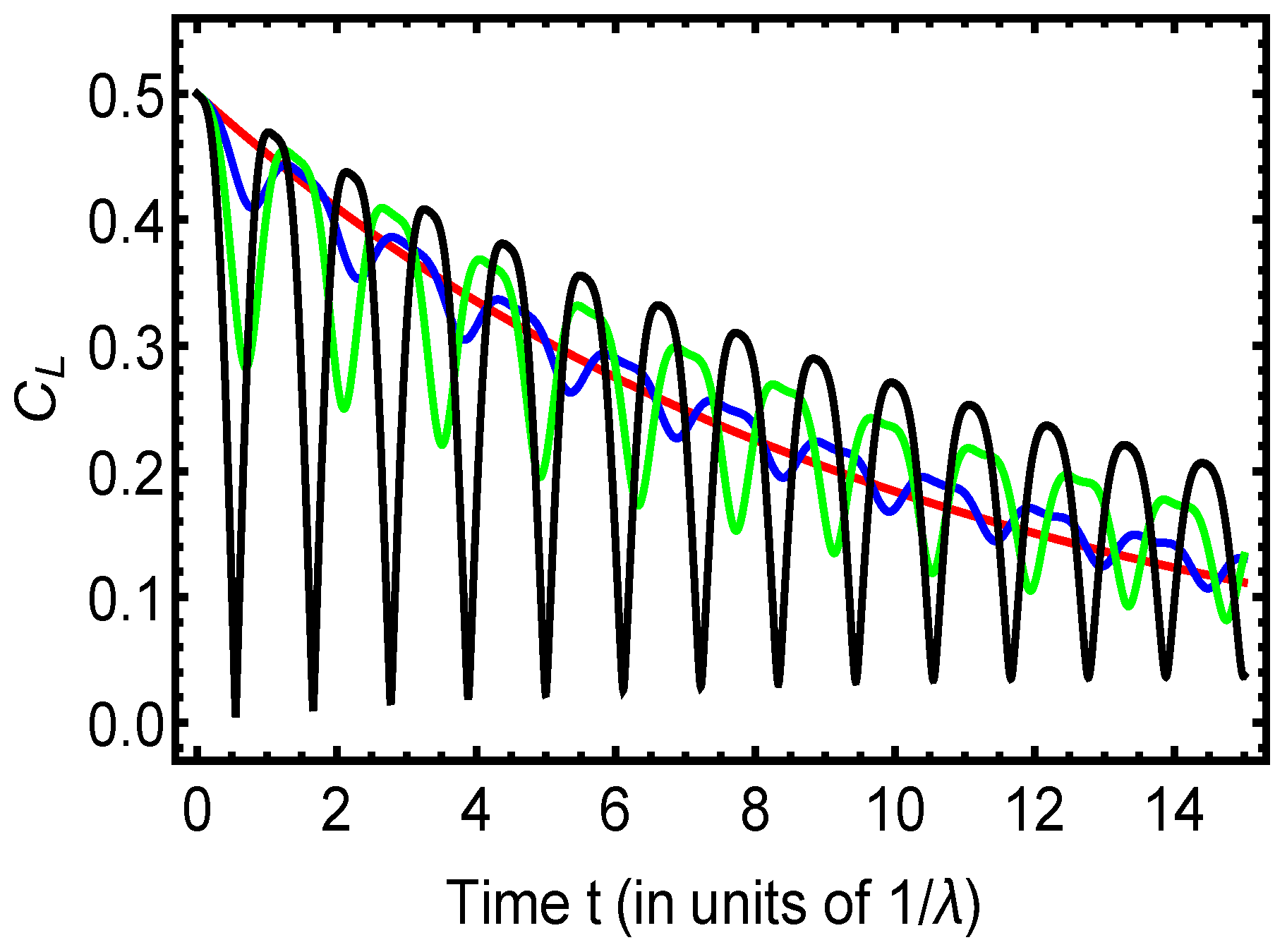
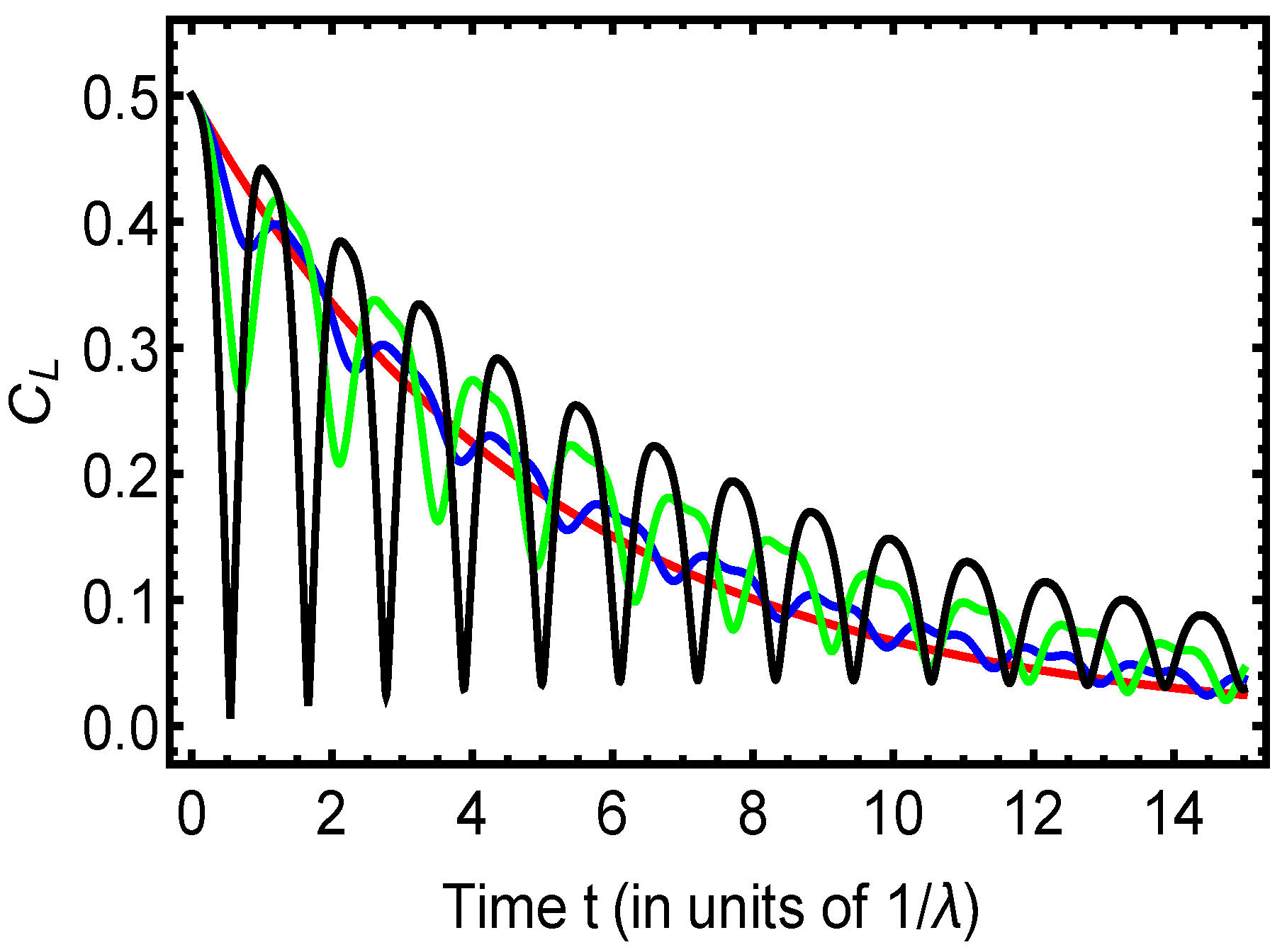
Figure 1 and
Figure 2 present the time evolution of the
-norm coherence
for the proton–electron hyperfine X-state under local dephasing. The plots show
versus scaled time
t (in units of
) for an initial X-state with parameters
, while the neutron magnetic parameter is fixed at
. Different curves correspond to proton magnetic parameters
(red),
(blue),
(green), and
(black).
Figure 1 uses a moderate decay rate
, while
Figure 2 corresponds to a stronger dephasing strength
. Both figures reveal a characteristic pattern of damped oscillations in
. The coherence starts near its maximum value and then undergoes a series of revivals and decays, reflecting the coherent unitary dynamics driven by the hyperfine coupling
and the Zeeman splitting in the single-excitation subspace. For
(red curves), the oscillations are slower and decay more gradually, as the dynamics are dominated purely by the hyperfine interaction. As
is increased, the frequency of these oscillations rises markedly—most noticeably for the black curves (
)—because the stronger Zeeman term accelerates the relative precession between the electron and proton spins. This leads to faster phase accumulation and more frequent interference revivals in the early-time regime, effectively postponing the complete loss of coherence. A direct comparison between the two figures highlights the dominant role of environmental noise. Doubling the dephasing rate from
to
accelerates the overall decay envelope in every case, causing the oscillatory features to dampen more rapidly and the long-time coherence to approach zero sooner. Nevertheless, even under the stronger dephasing of
Figure 2, the higher-
curves retain visible revivals for longer than the
case. This behavior illustrates how an external magnetic field can be used as a control knob: while it cannot eliminate dephasing, it can tune the coherent energy splittings to counteract dissipative effects to some degree. Taken together, these results underscore the delicate competition at play in the open hyperfine system. The intrinsic atomic interactions generate robust oscillatory coherence, but environmental phase noise steadily erodes it. By adjusting the proton magnetic parameter
(i.e., the strength of the applied field), one can modulate both the oscillation frequency and the effective lifetime of quantum coherence, offering a practical route by which to protect nonclassical resources in realistic noisy environments. Such field-engineered protection is especially relevant for spin-based quantum technologies where hydrogen-like systems serve as natural testbeds.
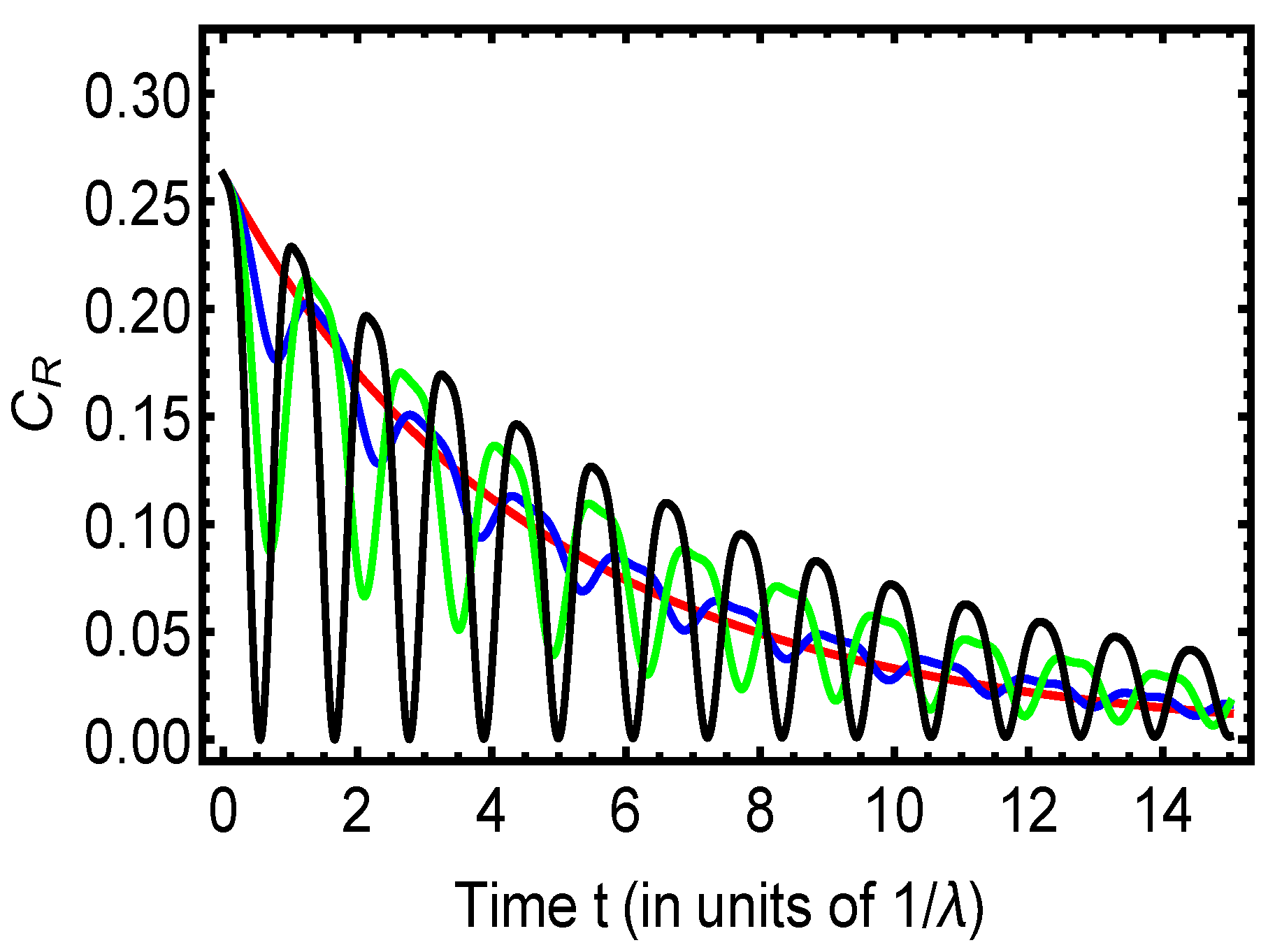
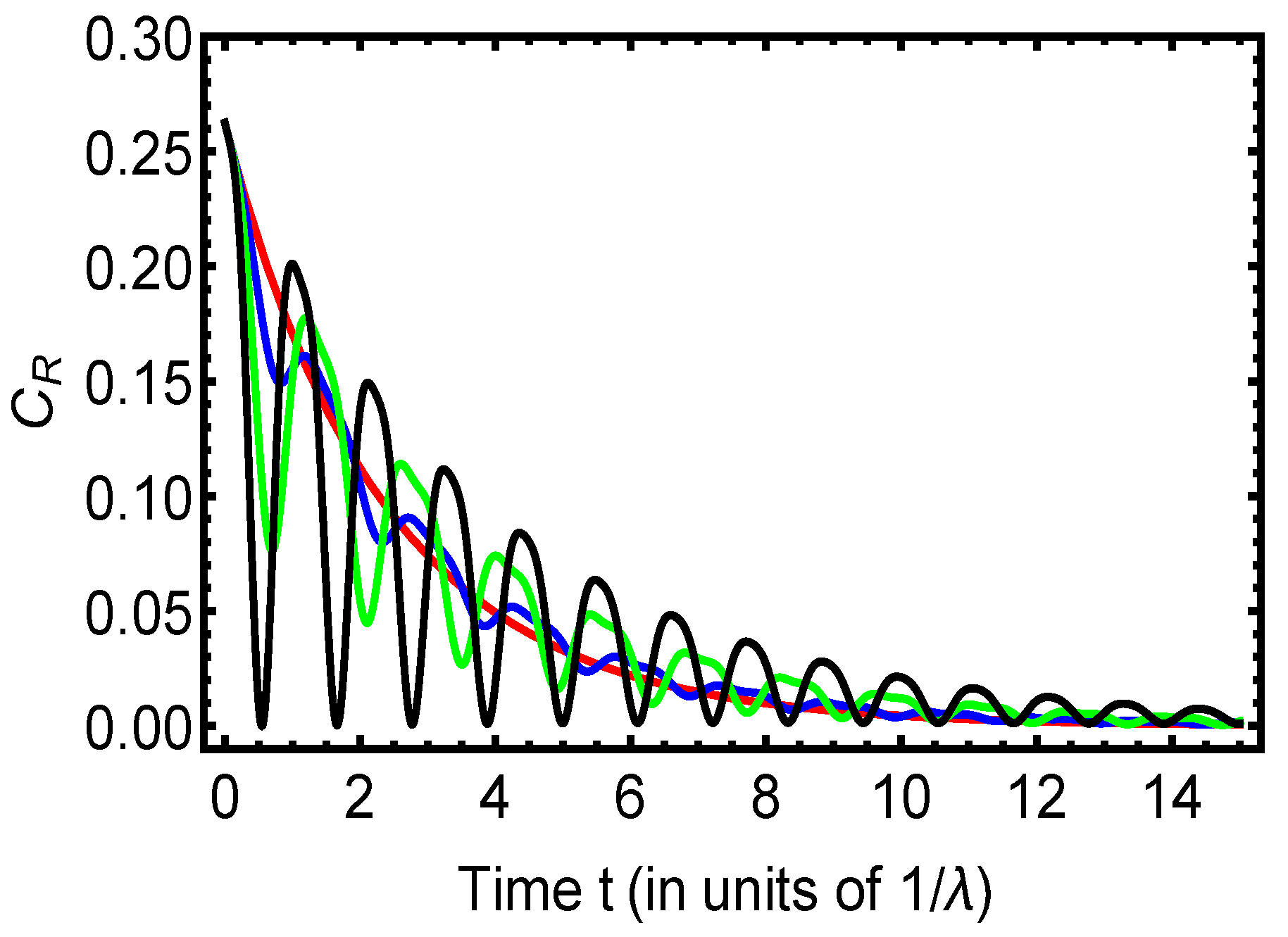
Figure 3 and
Figure 4 illustrate the dynamical behavior of the relative entropy coherence
for the proton–electron hyperfine X-state in the presence of local dephasing noise. The plots show
versus scaled time
t (in units of
) for an initial X-state with parameters satisfying
, while the neutron magnetic parameter remains fixed at
. Different curves correspond to proton magnetic moments
(red),
(blue),
(green), and
(black).
Figure 3 is calculated at a moderate dephasing rate
, whereas
Figure 4 uses a stronger rate
. Both figures display a clear pattern of damped oscillations that reflect the underlying coherent dynamics. The coherence starts from a finite initial value and then exhibits a series of revivals interspersed with decay, arising from the competition between the hyperfine coupling
(which drives population exchange in the single-excitation subspace) and the Zeeman splitting induced by the external magnetic field. For
(red curves), the oscillations are slower and the envelope decays relatively smoothly, as the evolution is governed primarily by the intrinsic hyperfine interaction. As
is increased, however, the oscillation frequency rises sharply—most visibly in the black curves (
)—because the larger Zeeman term accelerates the relative precession of the electron and proton spins. This results in faster phase accumulation and more frequent interference revivals, particularly prominent in the early-time regime. What stands out is how the external field appears to help preserve visible oscillatory structure for longer before dephasing fully takes over. Even though the long-time limit of
approaches zero in all cases (as expected for an open system), higher
values effectively postpone complete coherence loss by tuning the energy splittings in the relevant subspace. Comparing the two figures directly reveals the decisive impact of noise strength: doubling
from
to
accelerates the overall decay envelope and damps the revivals more rapidly across every curve. Yet the beneficial influence of larger
remains noticeable even under the stronger dephasing of
Figure 4. These findings for relative entropy coherence mirror the trends seen in the
-norm measure (
Figure 1 and
Figure 2), confirming that the behavior is robust across different quantifiers of quantumness. In physical terms, the applied magnetic field acts as a practical control knob: while it cannot eliminate environmental dephasing, it can reshape the coherent unitary evolution to counteract dissipative effects to a significant degree. Such field-engineered modulation of coherence lifetime offers valuable insight for protecting nonclassical resources in realistic spin systems and points toward promising strategies for spin-based quantum technologies where hydrogen-like atoms serve as natural, precisely controllable platforms.
We note that the oscillatory pattern of (and similarly of ) is qualitatively similar across different values of and , as all curves originate from the same coherent hyperfine–Zeeman dynamics in the single-excitation subspace. However, the key physical result lies in the pronounced dependence of the decay envelope on the external magnetic field: increasing the proton magnetic parameter markedly slows the damping of these oscillations, allowing coherent revivals to persist over longer timescales even under stronger dephasing. This field-controlled prolongation of coherence lifetime constitutes the central nontrivial feature of the present system.
These decoherent oscillations carry important physical information about the nature of quantum coherence in the present system. The oscillatory component directly reflects the coherent unitary dynamics arising from the hyperfine coupling and the Zeeman splitting, which drive reversible population exchange and quantum interference within the single-excitation subspace of the interacting electron–proton two-qubit system. The damping of these oscillations, on the other hand, reveals the irreversible loss of phase information due to local Markovian dephasing. The fact that the oscillations persist over a finite timescale, with visible revivals, demonstrates that quantum coherence in this atomic platform is not instantly destroyed by the environment but exhibits a controllable lifetime. Most notably, the strong dependence of the decay envelope on the external magnetic field shows that coherence in this system is tunable: by increasing the proton magnetic parameter , one can significantly prolong the survival of coherent oscillations against dephasing. This field-induced protection underscores the potential of Zeeman control as a practical tool for preserving quantum resources in realistic noisy environments.
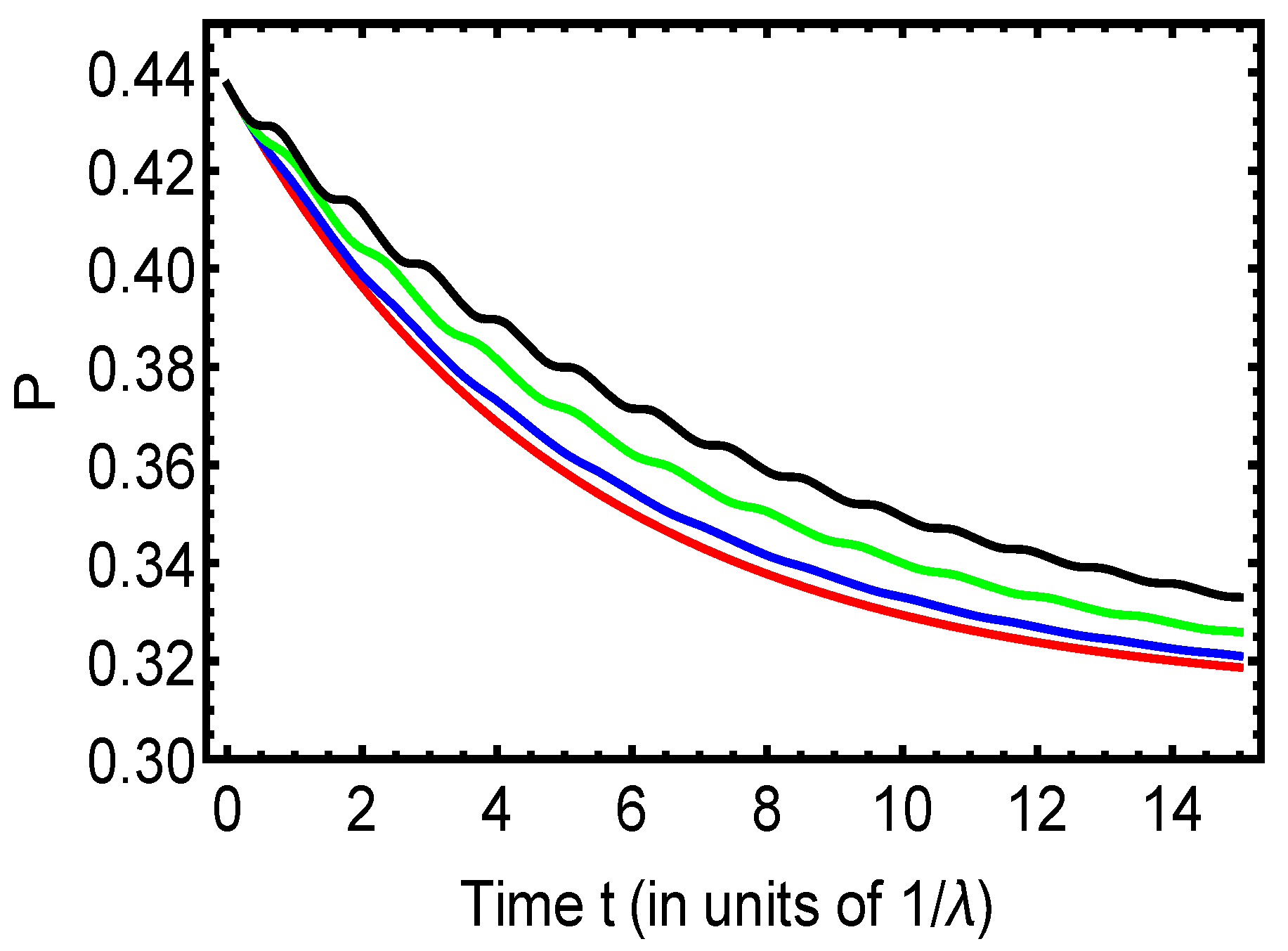
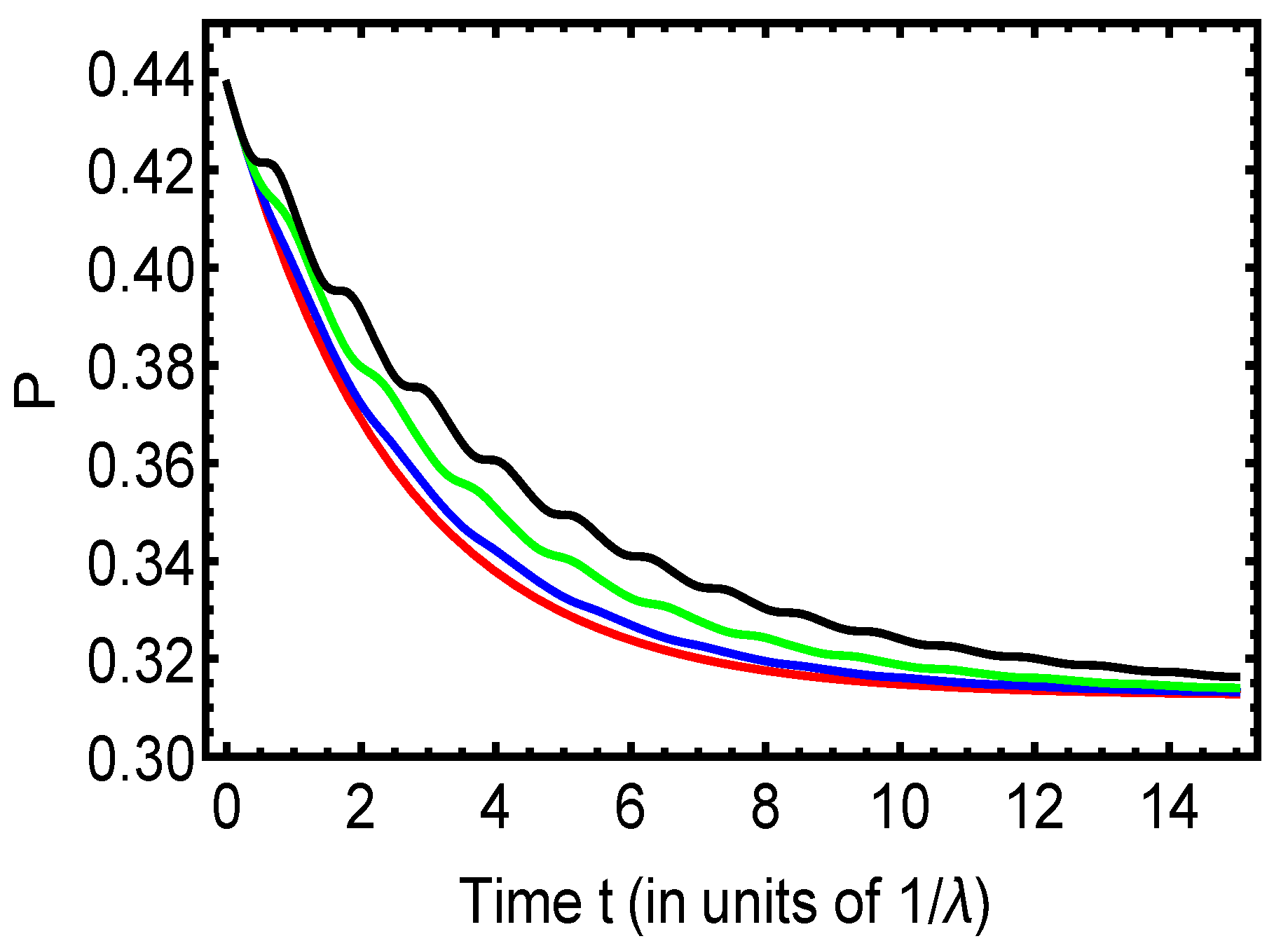
Figure 5 and
Figure 6 show how the purity
of the proton–electron hyperfine X-state evolves under local dephasing. The plots display
as a function of scaled time
t (in units of
) for an initial X-state with parameters
, while the neutron magnetic parameter is held fixed at
. The four curves correspond to different proton magnetic moments:
(red),
(blue),
(green), and
(black).
Figure 5 uses a moderate dephasing rate
, and
Figure 6 corresponds to the stronger rate
. Purity starts at approximately 0.44 for the chosen initial state (which is already partially mixed) and then decays over time as the system gradually loses its quantum coherence and becomes more mixed. What immediately stands out is that the decay is not the same for every curve. When
(red), purity drops noticeably faster, especially at early times. As
increases, however, the decay slows down—the black curve (
) stays visibly higher for longer, meaning the state remains somewhat purer despite the noise. This trend appears in both figures and tells us that a stronger external magnetic field, through the Zeeman term, modifies the coherent dynamics in the single-excitation subspace in a way that partially counters the dephasing effect. Comparing the two panels makes the role of noise strength very clear. Doubling
from 0.05
to 0.1
pushes the purity downward more quickly in every case, and the long-time limit is reached sooner. Yet even under this harsher dephasing, the protective influence of larger
is still noticeable: the black and green curves manage to hold onto higher purity values longer than the red one. In physical terms, these results highlight a nice practical point. While environmental dephasing inevitably drives the system toward greater mixedness, the applied magnetic field acts like a tunable knob. It reshapes the unitary evolution (via the hyperfine–Zeeman interplay) so that the dissipative process becomes relatively less efficient at destroying the state’s “quantumness”. This behavior lines up nicely with what we saw for coherence measures in the earlier figures and reinforces the broader picture that external fields can be used to engineer greater resilience of quantum resources in realistic, noisy hydrogen-like systems. Such field-controlled protection of purity could prove useful when designing spin-based platforms for quantum technologies where maintaining a reasonably pure effective qubit state matters.
6. Conclusions
We have carried out a comprehensive analysis of the time evolution of quantum coherence and purity in the ground-state hyperfine manifold of the hydrogen atom, treated as an effective two-qubit system subjected to both an external static magnetic field and local Markovian dephasing. Using the Lindblad master equation, we derived exact analytical expressions for the density-matrix elements of general X-shaped initial states and examined the dynamical behavior of the -norm coherence , the relative entropy of coherence , and the state purity . The numerical results reveal a consistent picture across all three quantifiers. In the absence of an external field, the coherence and purity decay relatively rapidly, with the oscillatory component driven solely by the hyperfine coupling. When the proton magnetic parameter is increased, however, the Zeeman splitting accelerates the relative precession between electron and proton spins. This leads to higher-frequency oscillations and a noticeably slower overall decay envelope, effectively postponing the complete loss of quantum features even under moderate to strong dephasing rates. The external magnetic field therefore functions as a practical control parameter: it cannot eliminate environmental noise, yet it can be tuned to reshape the unitary evolution in a way that partially counters dissipative effects and preserves nonclassical resources for longer times. These findings illustrate the delicate interplay between intrinsic atomic interactions and realistic environmental noise in a paradigmatic spin system. They also demonstrate that quantum coherence and purity exhibit greater robustness than might be expected from simpler models that neglect the Zeeman term. By bridging the microscopic physics of the hydrogen atom with modern resource-theoretic concepts, the present work offers clear physical insight into how fundamental couplings and controllable external fields can be harnessed to mitigate decoherence. Such field-engineered protection strategies are directly relevant to ongoing efforts in spin-based quantum technologies, including high-precision sensing, quantum memory, and scalable quantum information processing. These findings confirm that the external magnetic field acts as a practical control parameter, enabling the suppression of dephasing effects through the reshaping of coherent unitary dynamics. The interference revivals observed in the dynamics of coherence and purity persist over longer timescales when the magnetic field strength is increased, underscoring the utility of Zeeman tuning in protecting quantum resources. Future extensions of this framework could incorporate non-Markovian environments, collective dephasing mechanisms, or multi-atom ensembles, thereby bringing theoretical predictions even closer to emerging experimental platforms involving ultracold hydrogen or trapped spin systems. Ultimately, the hydrogen atom continues to serve as an exceptionally valuable benchmark, illuminating both the fundamental limits and the practical opportunities for maintaining quantum resources in noisy environments.